My editorial last year began with accounts of anniversary celebrations of two Trinity alumni who have long had prominent public profiles: one of the College’s most (in)famous students, the poet Lord Byron (1788–1824), and its illustrious former Director of Music Charles Villiers Stanford (1852–1924). Next year we will commemorate the 300th anniversary of the death of the enormously influential English philosopher and statesman, Francis Bacon (1561–1626), often nicknamed the ‘Father of empiricism’. But in the year 2025 the focus has been on alumni whose achievements have perhaps not hitherto received the attention they deserve.
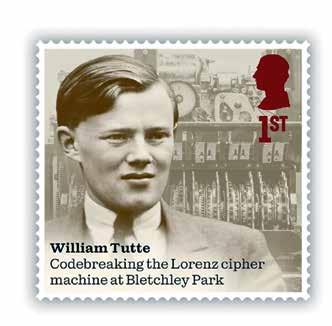
In May 2025, Trinity announced that it will honour William (Bill) Tutte (1917–2002) with a new work of art, in recognition of his achievements. Tutte was born in Newmarket, schooled in Cheveley village and Cambridge, and won a scholarship to come up to study Natural Sciences at Trinity in 1935. Naturally self-effacing, Tutte came to prominence whilst still a student when he and three others published a solution to the difficult ‘squaring the squares’ problem in a leading mathematics journal. At the outbreak of the Second World War he was recruited by Bletchley Park and was set to work on top secret German High Command messages encrypted by a Lorenz cipher machine. Although expectations were low, Tutte succeeded in deducing and inferring the structure of Lorenz, and his solution was implemented by Colossus, the world’s first programmable electronic computer built by GPO engineer Tommy Flowers. In the words of Professor Imre Leader: ‘The most remarkable thing was not just that Lorenz was more complex than Enigma, but that Tutte deduced how it worked without ever having seen the machine.’ Professor Béla Bollobás adds: ‘I am sure it’s true that his work shortened or even decided the war. The fact is
The Royal Mail stamp of William Tutte, with a Lorenz machine, part of the Valour and Victory set for VE Day’s 80th anniversary.
he broke the code of the German High Command – many of the messages were signed ‘Führer’– which had enormous significance.’ Tutte’s career after the War took him to Canada, and he spent most of his working life at the University of Waterloo. Despite the crucial importance of his Wartime activities, Tutte was never honoured by the British Government, belated recognition coming this year when he featured on a commemorative VE Day 80th anniversary first-class stamp. The new work of art for Tutte will at long last pay tribute to an illustrious alumnus whose work has hitherto been somewhat overlooked.
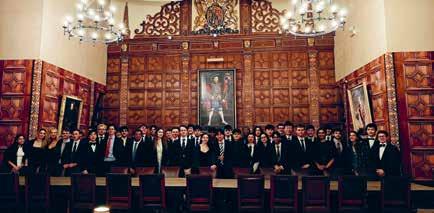
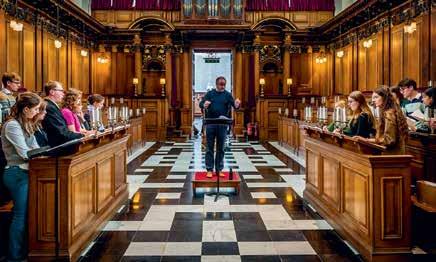
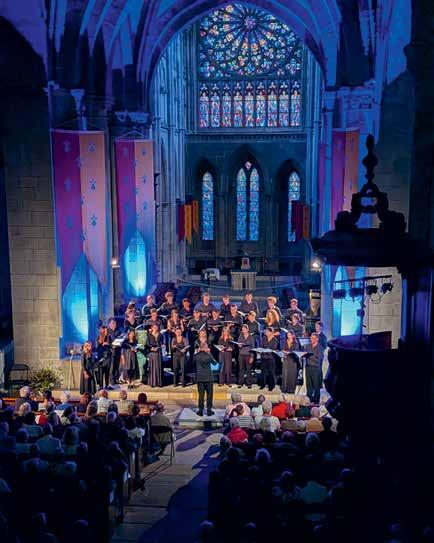
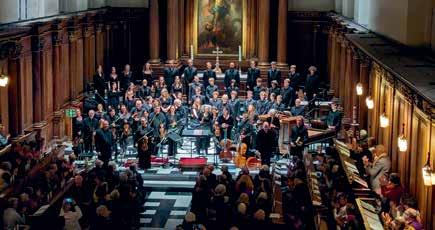
The year 2025 was also the centenary of the matriculation of another Trinity alumnus, Keiichi Kurosawa (1903–82), the eldest son of a wealthy Japanese industrialist who read Moral Sciences in 1925–28. A talented cellist, whilst at Trinity Kurosawa immersed himself in College music and the emerging British Early Music scene spear-headed by Arnold Dolmetsch. After his return to Japan in 1928 Kurosawa founded the Tokyo Madrigal Club (1929) and became a key figure in introducing Western Early Music to Japan in the mid-20th century. In November of this year, Trinity marked the achievements of this to date neglected alumnus with an excellent talk by Jason James OBE, Director General of the Daiwa Anglo-Japanese Foundation, and a concert recreating one Kurosawa put on when an undergraduate in the exact same venue, the Old Combination Room.
Royal Mail
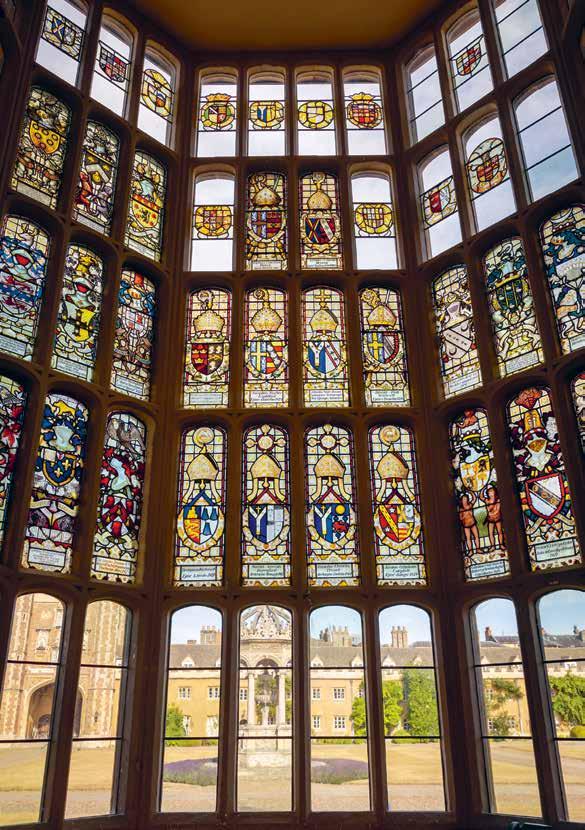
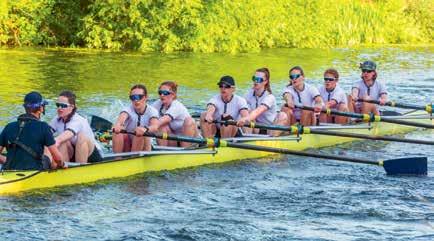
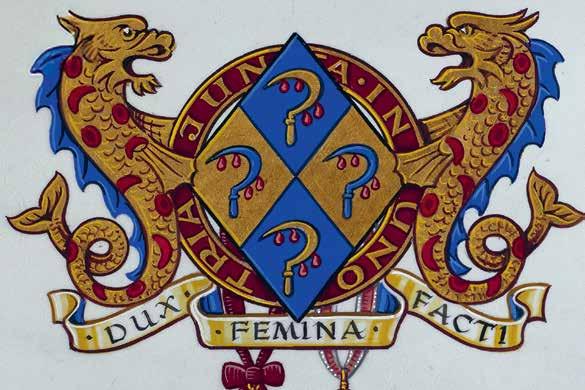
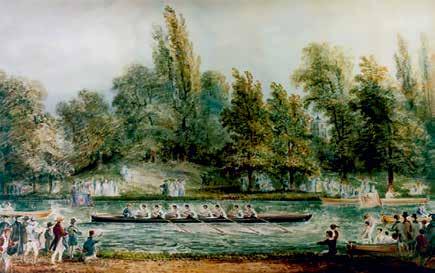
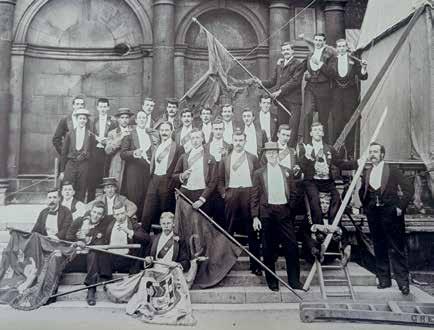
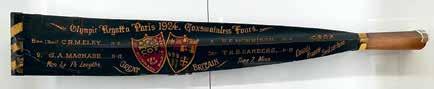
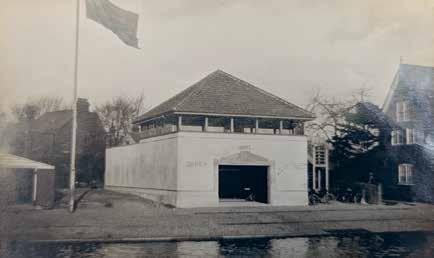
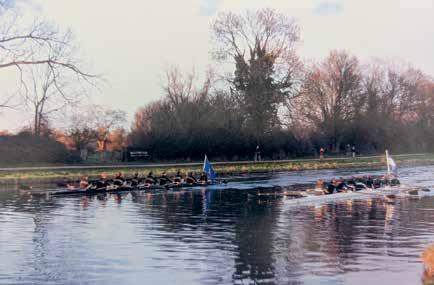
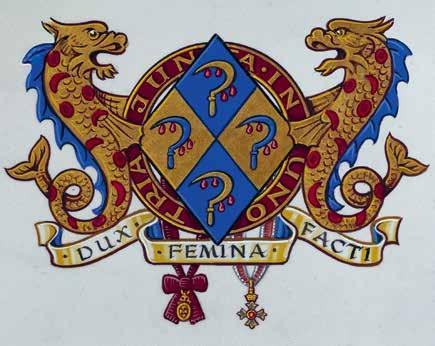
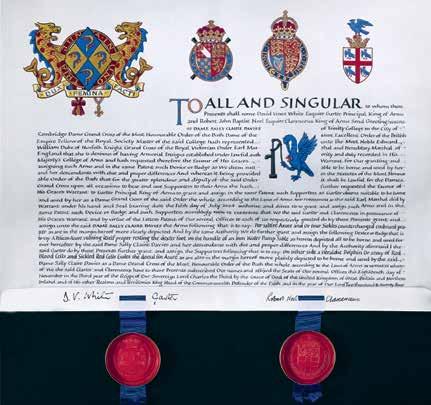
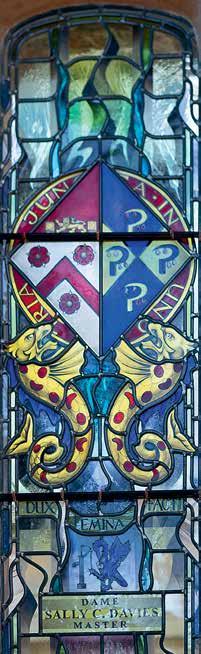
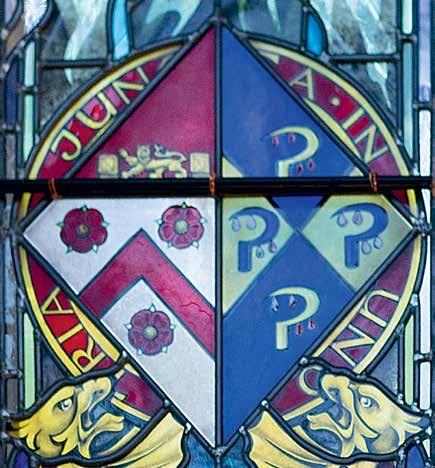
This year’s three feature articles focus on aspects of the College’s past, present and future respectively. In 2025, the Trinity First & Third Boat Club celebrated its bicentenary. In a eminently readable article, Luke Barratt gives a fascinating and erudite account of the history of the Trinity boat clubs, from the first hiring of a four-oar named ‘Shannon’ in the spring of 1825 and the formation of Cambridge’s oldest boat club, up to the triumph of Imogen Grant – who first took up an oar at First & Third in 2014 – in the lightweight double sculls in the 2024 Paris Olympics, a century after Third Trinity coxless four seized Olympic gold in the same waters. Trinity Librarian, Dr Nicolas Bell, explains in exquisite detail the history behind and the symbolism of the Master’s recently granted coat of arms, which are now displayed in a magnificent new stainedglass window in one of the hitherto blank panes of Hall’s West Oriel window. As Dr Bell observes, ‘this continues a tradition that has been ongoing since the construction of the Hall in 1604, and provides a fitting tribute to the first Dame Grand Cross to be a member of the College’. The third of this year’s features is a most topical jointly-authored article outlining how sustainability is reshaping the College’s future – in all aspects from investment, building and renovation to catering and gardening – and further arguing that this focus on sustainability is a ‘fundamental extension of the College’s centuries-old charitable objective of “advancing education, learning, religion, and research” ’.
The year 2025 has been a bumper one for alumni Honours. In the New Year Honours, Alex Kendall (2014) was awarded an OBE for services to Artificial Intelligence, our Olympic gold medallist, Imogen Grant (2014), received an MBE for services to Rowing, John Westwell (1982) an MBE for services to Education, and Bee Wilson (1992) an MBE for services to Food Writing and Food Education. In the King’s Birthday Honours, sculptor Antony Gormley (1968) was made Companion of Honour for services to Art and Emily Shuckburgh (1994) was awarded a CBE for services to Climate Science; James Korner (1974) received an OBE for services to Philanthropy and to Charity, and Andrew Makower (1980) for services to Parliament; Jennifer Gold (2005) was awarded an MBE for services to Evidence-based Policy Making, and Laura Silverman (2000) for services to Social Innovation and Education.
Amongst the College’s current Fellows, Professor Judith Driscoll (Materials Science), Professor Jason Miller (Mathematics) and Professor Marta Zlatić (Molecular Biology) were elected Fellows of the Royal Society. Professor Shankar Balasubramanian added to his already glittering array of prizes by winning the
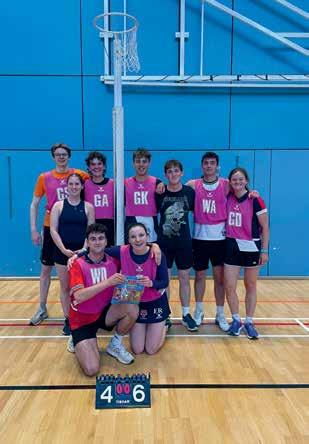
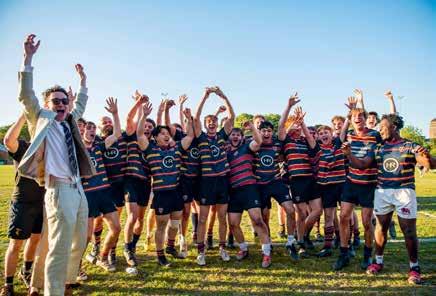
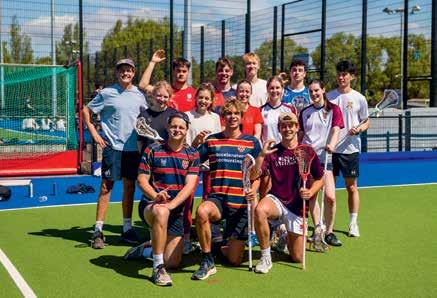
Khorana Prize of the Royal Society of Chemistry; and Professor Gary Gibbons was awarded the Dirac Medal, for redefining our understanding of gravity. In addition, our students once again excelled themselves in Tripos examinations, topping the 2025 Tompkins Table by a comfortable margin, with ten of them achieving the highest marks in their Triposes. On the sporting front, there were some noticeable successes: the Mixed Netball team won Cuppers; the Rugby team won the Boot Final, taking its first silverware since the pandemic; and the Pool team won its division and was promoted. There has been a strong drive to increase participation in sporting activities, and altogether there were teams competing in 21 sports, including a newly-formed Padel team.
Each year it is my sad duty to report the loss to the Trinity community of Fellows and distinguished alumni. This year’s Annual Record contains just one obituary. Brian Mitchell was elected a Fellow in 1967 and lectured in the Economics Faculty until his retirement in 1991. He was also a long-time member of the Cambridge University Rugby Union Football Club (CURUFC), and he put in many years of dedicated service as Treasurer of the College’s Field Club. I am immensely grateful to Professor Mark Bailey (a former England Rugby international and Research Fellow of Gonville & Caius at the same time as me) for giving us permission to adapt the tribute he wrote in September for CURUFC. Brian will be much missed.
As I write, Fellows are enjoying the ambience of the newly-refurbished Hall complete with new stained-glass window, and are also weighing up shortlisted proposals for the development of the Brewhouse site, which forms a core part of the Trinity 2046 estate plan to celebrate our 500th anniversary. In this atmosphere of forward momentum, as we look to the College’s next 500 years, I wish you all a peaceful and joyful festive period, and a most rewarding 2026.
Paul Wingfield (1990)
commemoration
chapel address the health of the college the master’s response on behalf of the college
Commemoration
Chapel Address at Commemoration of Benefactors 21 March 2025
Lord
Justice Singh (1982)
As we gather this evening to commemorate the benefactors to the College, I am very conscious of the benefits that I myself received as an undergraduate here in the early 1980s from their generosity. I was fortunate enough to receive a number of awards and scholarships, which were very helpful and enabled me, for example, to have an account at Heffers so that, in my second and third years here, I did not need to worry about the cost of books.
But the benefits of being at Trinity are of course more than material. Perhaps most important, we were encouraged to think for ourselves. In my case, I feel that the intellectual journey on which I embarked here is still continuing. The particular question I would like to address this evening is: what distinguishes a bank robber from a judge? This is a question which we first began to think about when we were studying jurisprudence, or legal philosophy, when I was here in my third year.
You may think that a bank robber is nothing like a judge and the difference is so obvious that it need not detain us for more than a second, so let me explain why I think it important, especially as I am now a judge myself. I first came across the problem when I was asked to read The Concept of Law, by Professor H. L. A. Hart, first published in 1961 and widely regarded as the most important work of legal philosophy of the twentieth century, at least in the English-speaking world. Professor Hart was undoubtedly a great legal thinker, who played an important part in making this country, and no doubt other countries, more humane in
the middle of the last century. Hart was seeking to confront the unsatisfactory suggestion made by Austin in the nineteenth century that the essence of law consists of orders backed by threats. If that were right, what would distinguish the bank robber, who issues an order that the bank should hand over money and that order is backed up by the threat of force, and (say) the tax authorities, who order the citizen to hand over money and also have threats to back up their orders? It is often said that the state has a monopoly on the use of force but does that simply mean that there is no essential difference between the state and the bank robber, only that one claims to have a monopoly on the use of force?
Hart’s answer to this dilemma was to say that, when a bank is robbed, it is “obliged” to pay the money, whereas, when it pays its taxes to the state, it is under an “obligation” to do so. But, leaving aside the point that in practice some taxpayers may not see the difference, the fundamental difficulty with this approach is that it tends to assume that all problems are ultimately problems of language or definition. In this I suspect that Hart, like many other thinkers in the middle of the twentieth century, was influenced by logical positivism and this no doubt is why Hart’s concept of law is usually regarded as belonging to the school of thought known as legal positivism.
I think that Hart’s own answer to the dilemma in fact demonstrates why positivism fails to explain the true nature of law. Once you move away from being obliged to do something in response to an order backed by threats, and say instead that the citizen is under an obligation to obey the law, what in fact you are saying is that in some way the state has the right to require you to pay the money demanded as a tax, whereas the bank robber has no such right. In other words, that the state has legitimate authority – but this then begs the question where does that legitimacy come from if not from the mere fact that the state has force on its side? This is why I think that legal problems are not merely problems of language but are problems about values, in other words they raise normative questions: what ought to be, not simply what is?
The story is told that, when the great American judge, Oliver Wendell Holmes Jr, was going to the US Supreme Court one day, he offered a lift to a young lawyer called Learned Hand, who was himself destined to become one of the greatest judges in the common law world. On leaving the carriage, Learned Hand said: “Do justice, Justice!” A few minutes later, Holmes had asked his driver to turn the carriage around and catch up with Hand again. He wound down the window and said: “That is not my job!” Many judges today would agree with Holmes that
they are not in the job of doing justice but simply apply the law, whatever the law may be.
Perhaps, but the difficulty can be that quite often the law itself refers to the “interests of justice” without necessarily defining what justice is. For example, section 37 of the Senior Courts Act 1981 confers the basic power which the High Court has to grant an injunction, and states that:
(1) The High Court may by order (whether interlocutory or final) grant an injunction … in all cases in which it appears to the court to be just and convenient to do so.
That is in what lawyers call civil law, in other words the areas of law which are not concerned with criminal offences. But we find a similar provision in criminal law, in section 59 of the Sentencing Act 2020, which states that:
(1) Every court—
(a) must, in sentencing an offender, follow any sentencing guidelines which are relevant to the offender’s case … unless the court is satisfied that it would be contrary to the interests of justice to do so.
I will return to what courts do later but, for now, I want to digress to consider a related – and big – question: where does morality come from? Although I am not a Christian myself, I have found that a very interesting answer was given by C. S. Lewis when he observed in Mere Christianity that people have an innate sense of right and wrong, of fairness and justice. This is not merely a question of taste or preference, as when someone says that they prefer chocolate ice cream to strawberry. People appeal to some standard of morally right behaviour. C. S. Lewis called it “the law of nature”. Immanuel Kant referred to the “inner voice” that each of us has as a human being. It might also be called our “conscience.”
When C. S. Lewis talked about “the law of nature”, he had in mind that people often call upon “some kind of law or rule of fair play or decent behaviour or morality.” He suggested that this lay at the basis of why fighting the Nazis during the Second World War was the right thing to do:
What was the sense in saying the enemy were in the wrong unless Right is a real thing which the Nazis at bottom knew as we did and
ought to have practised? If they had had no notion of what we mean by Right … we could no more have blamed them for that than for the colour of their hair.
C. S. Lewis also discounted the suggestion that this moral sense simply arises from human instinct. He observed that sometimes our instincts will actually tell us to do something contrary to what the moral law would require, for example to run away rather than to help someone. He said that there may be two impulses, one to help another person and the other to run away but there is a third thing which tells you that we ought to follow the impulse to help.
C. S. Lewis also answered the objection that morality is simply subjective and relative. He accepted that moralities can change over time and over place but nevertheless suggested that we are able to judge a particular society’s morality by reference to some higher standard. Again he gave the example of the Nazis: “If your moral ideas can be truer, and those of the Nazis less true, there must be something … for them to be true about.”
Interestingly, people recognise this moral standard even when doing the right thing would be against their own interests, and even when they are doing the wrong thing. This is certainly the basis of much of sentencing practice in this country. As I have said, when judges sentence in criminal cases, they follow any relevant guidelines which have been issued by the Sentencing Council. There are two main factors that have to be taken into account in assessing the seriousness of an offence: the harm caused and the culpability of the offender. This accords with what C. S. Lewis observed about most people’s innate sense of justice. We all recognise that there is a moral difference between the person who causes injury to another person accidentally and the one who does so deliberately. If we think about it, we probably also understand the difference between the person who acts negligently, in other words carelessly, and the person who causes harm deliberately. This distinction often means that a person will or will not be guilty of a criminal offence. The law may attach civil liability to the negligent person but it does not usually regard their act as criminal. Contrast the person who causes another’s death. There will be circumstances in which the criminal law will regard the person as being guilty of an offence, that is manslaughter, but even in the case of something as serious as causing the death of another person, the law will not treat that as murder unless the person intends to kill or at least intends to cause really serious injury. And, even where a person is guilty of murder, when a court comes to pass sentence, it will often distinguish between
the person who intends to cause death and the person who intends to cause really serious injury but not death. And, even if they intend to cause death, the sentencing court will often distinguish between the person who planned the death, in other words acted with premeditation, and the person who formed the intention to kill in the heat of the moment.
So we can see that at the root of much of what the law does in practice are in truth notions of morality. But this is true of the civil law and not only the criminal law. The basis of contract law is that you should keep your promises. The basis of the law of negligence was famously said by Lord Atkin (in the case about the snail in the ginger beer bottle) to be about the principle that you should love your neighbour, or at least take reasonable care not to injure your neighbour. In what lawyers call public law, there was a famous definition of “irrationality” given by Lord Diplock in 1984 in the GCHQ case:
It applies to a decision which is so outrageous in its defiance of logic or of accepted moral standards that no sensible person who had applied his mind to the question could have arrived at it. Whether a decision falls within this category is a question that judges by their training and experience should be well equipped to answer, or else there would be something badly wrong with our judicial system.
Law is certainly not a value-free zone. The relationship between law and values is, however, not a straightforward one. Often the state of the law will tell you something about the values of the society which produced it but the law does not (and should not) always try to enforce morality.
The common law itself is built upon the values which generations of senior judges in this country have thought were the right ones to inspire the law. At one time, within living memory, the senior judiciary regarded it as one of their functions to protect public morals and therefore to create new offences at common law in order to maintain the moral security of the country. They decided a case to this effect as recently as 1962. More recently, however, they have held that the courts no longer have this power to create new criminal offences, and that only Parliament can now create new offences. This should not be regarded as an abdication of the moral responsibility of judges but is in truth an application of it. This fundamental change in the attitude of the common law can be seen to be based on the value of democracy itself. Democracy is a relatively recent phenomenon in this country, as full adult universal suffrage
is less than 100 years old, when women were given the vote on the same basis as men in 1928. It did not really feature as a value of the common law until more recently still. References by the courts to the democratic legitimacy of the elected government and of Parliament are now commonplace in the case law, for example when applying the Human Rights Act 1998.
It is sometimes suggested that the law-making power of the courts is defensible in a democratic society because, if Parliament thinks the courts have got it wrong or that the law needs to be updated, it can do so: the common law has to give way to the will of Parliament, which is of course accountable to the electorate. In this sense, one can see that there is an indirect democratic legitimacy enjoyed by the common law. But this would be historically inaccurate, since the common law long pre-dates the coming of democracy to this country, as it can be traced back at least to the reign of Henry II in the twelfth century.
But, if the common law is a system of values, where are those values to be found? They can be notoriously subjective. As the great American judge, Benjamin Cardozo, pointed out a century ago, in The Nature of the Judicial Process, a judge is not entitled to impose his or her own subjective values on society. I would suggest that the values of the common law are to be found in the common law itself. For example, it is axiomatic that like cases should be treated alike. This is an aspect of the principle of equality. We would consider it to be wrong if two cases which are materially identical were decided differently, for example because one was brought by a person who is white and another by a person who is black or one is brought by a man and another is brought by a woman.
Another value that can be found in the bedrock of the common law is fairness, for example that a judge should be unbiased – and there should be no appearance of bias. One other principle that can be found in the common law, at least the proper approach to sentencing, is that the punishment should fit the crime, in other words the principle of proportionality. All of this is not to say that the common law is perfect. Far from it. I would suggest that one of the virtues of the common law is that it is able and willing to develop over time, to meet the needs of a changing society. This may lead to the recognition that what was decided in an earlier case, perhaps many centuries ago, is no longer correct, if it ever was.
To conclude, it can be seen that the law is not removed from the values of our wider society. It is part of that society and takes its shape from it. I don’t agree
with Oliver Wendell Holmes: I do think that the job of a judge is to do justice but, of course, it is justice according to law. And to answer the question I posed for myself at the start of this talk, Yes, there is a difference between a bank robber and a judge.
And so I end where I began by remembering the benefactors to the College. I have suggested that the judge works with and for the moral fabric of society, as did and do those we are remembering at Commemoration whose gifts sustained the mission of the College.
David JohnsonPhotography
Dr Imogen Grant (2014) proposed the health of the College at the Commemoration Feast, 21 March 2025
Welcome, everybody, to the Commemoration of Benefactors Dinner at Trinity College this year in 2025. What a fantastic evening to celebrate the College’s alumni, Fellows, students, and benefactors all in the same room. It’s a pleasure to be here, and I feel very honoured to have been asked to make a short speech and a Toast to the College. I was very flattered to be asked, and I was sent a few examples of previous speeches, most of which started with “20 years ago when I stepped through these halls...” I graduated in 2023. It’s only been two years, but I hope I can bring some perspective and wisdom to you. Things have already changed so much – the new hall renovations, the students, the people here, Cambridge. It’s always changing. Everyone here knows that.
What I’ll talk to you about today is my time at Cambridge, as is the tradition for these Toasts. Like most people, it was life-defining in so many ways. I came wanting a First. I came wanting to be a doctor. What met me was completely unexpected. I was drawn to Trinity initially, having grown up here, wanting to be a doctor, wanting to come to the best university in the world to study medicine. Trinity swung my hand in choosing which college to apply to, because I found on my look round that they had a cheese tasting society, and that sounded fantastic. I knew, coming to Cambridge, the extra‒curriculars were going to be very important to my time here, but my time here was defined by just one – rowing. If you don’t know who I am, my name is Imogen. I studied here. I matriculated in 2014 to study medicine. While I studied here, I also learned to row, and last summer I became Olympic Champion. It’s been quite the decade.
There were plenty of extra‒curriculars, but rowing was the one that truly took over my time here at Trinity College. First and Third Trinity Boat Club, the boathouse just a mile away on the Cam, became my second home very quickly. It just so happens that it’s also its 200th year of existence this year, and I can see why it has stood for so long. I was rapidly swept up in the enthusiasm and care that every single rower had for this Boat Club. The volunteer coaches, who came down from their full-time jobs to coach, running up and down the bank,
David Johnson
Photography
desperately trying to teach new first-years how to put the blade in the water and pull. And I was one of them. The friendship, the support, the enthusiasm of everybody I met kept me coming back for more, and I fell in love so quickly. Rowing is one of those interesting sports that has a very elitist history, but here at Cambridge, rowing is one of the most accessible sports. I didn’t have to pay subs. I had access to boats, training equipment. Race entry is completely free of charge, thanks to the alumni who have made it possible for all of the rowers here to do the same. For the first time, I was swept up in something that wasn’t my dream of being a doctor, and for the first time, my self-worth wasn’t just tied to getting good marks in exams.
So, medicine and finding the balance. Rowing took over my life, but I was still doing a medical degree. I have wanted to be a doctor since I was nine years old. It’s one of my oldest interests and my oldest love. Like many of you here, I was a high achiever at school, easily coming top of my class, getting A stars, being praised. I was the big fish in a small pond. Like some of us here, I arrived and suddenly felt quite small. I was suddenly not top of my class. I was not getting perfect grades in my essays, and it felt very daunting. Thankfully, rowing was there for me. I had people in years ahead of me sharing notes and supporting me, telling me that I was going to be okay during my exams. I had people who were happy to sit in Hall at breakfast, commiserating over essays and making plans to do more revision the next time around. I had a support system, and I had balance, most importantly. Medicine was challenging. Rowing was challenging, and equally, I was challenged by my supervisors. It really crystallised to me how much I wanted to do medicine and prove that I could do it, but also how much I wanted to prove that I could do my new love, rowing, and balance the two.
There was a study done while I was here at Cambridge. Those athletes and students who do Blue sports are more likely than the general student population to get Firsts and 2:1s. For me, rowing gave me balance. It gave me support, and it made me a better student, and it made me a better medic. When my dreams in rowing started potentially overshadowing my current studies in medicine, it was the support from this College – the Fellows, my Director of Studies –who gave me the confidence to intermit from my medical degree and chase my Olympic dream to go to the Tokyo Games in 2021. I only got there by asking for help, but in asking for help, that help was answered here.
Moving on, I wanted to talk about some firsts. Maybe not the one that you’re thinking about. I left here with a 2:1 that I was very proud of, though maybe
nine-year-old me would have been slightly horrified about. However, in leaving here, I gained so much more than just my degree. I gained an entire new life.
2015. My first year at university. The year that I learnt to row. The year that I started studying medicine. It was the year that the Women’s Boat Race was first held on the Tideway ‒ the same place and the same time as the men’s race. I was there on the banks, watching and thinking that maybe one day I could be as good as they were.
2016. Blondie, the reserve crew for the Cambridge women won on the Tideway. The first Cambridge win for the women on that iconic course. I was in that crew.
2019. Sally Davies was named Master of Trinity College. The first woman ever to hold that position in more than 500 years at Trinity.
2021. The Tokyo Olympic Games. Louise Shanahan and I were the first Trinity women to represent Trinity College at the Olympic Games.
2024. I became the first-ever female Trinity Olympic champion. I highlight these firsts because each of them is exceptional in its own way, each of them coming with its own unique set of challenges and obstacles to overcome, and each being the most incredible achievement. They all happened while I was a student here. Think what will happen in the next decades. Each of these was achieved with one thing, I believe, and one thing that really reflected my time here at Cambridge – passion.
My time here is defined by not having to choose between the two things that I’m most passionate about – medicine and rowing. Trinity let me do that. Trinity let me choose what defines me and pursue it with all my might. For me, it was rowing. For me, it was becoming a doctor. For you, it might be the Choir, classics, College rugby. Maybe it is rowing, maybe it’s Footlights, maybe it’s journalism. What this College does so amazingly well is recognise passion, recognise potential, and nurture it. We have the resources to let people go far.
And so this brings me to my toast at the end of this short address.
Standing on the podium at the Paris Olympics is a memory I will cherish for the rest of my life. It’s one of the most special experiences I have ever had the honour to be a part of. The spark for that journey began here.
I stood on the shoulders of those who came before me: those who supported my ambitions of rowing and studying; those who inspired me to want to become a doctor when I was nine years old; the women who fought for admission to Trinity College in the first place over 40 years ago; the volunteers who invested in grass root sports even when it was hard and even when people didn’t always turn up; the coaches that I had along the way; the Fellows who offered words of support; the students who were excited to hear about my stories when I came back here; and the alumni that I am now a part of. You make up such a massive part of what makes it so special to belong to Trinity.
So, I’d like to make this toast most specially to the College community, where all our journeys begin. To the College!
Joanna Cooney
Response on behalf of the College, by the Master, Dame Sally Davies, 21 March 2025
Guests, Benefactors and Fellows.
As many of you know, I have withdrawn to the Lodge most of this term, not by choice. I had a bowel cancer removed, following routine screening – the good news is that it was fully removed and had not spread, so I need no further treatment.
So, this year my speech is one of celebration of life and Trinity.
Let me start by thanking Dr Imogen Grant for her toast to the College. As you will all know, Imogen made history as Trinity’s first female Olympic gold medallist, winning the Women’s Lightweight Double Sculls at the Paris 2024 Olympics alongside Emily Craig. She is also Trinity’s first Olympic medallist since the 1960s – and will forever hold the title in her event, as it has now been removed from the Olympic schedule. She has also earned the BBC Green Sports Awards ‘Athlete of the Year’ 2024, and somehow managed to fit in getting married at the end of the year too. Congratulations Imogen, an inspiration for all.
I also want to thank The Rt. Hon. Lord Justice Rabinder Singh (1982), for his address in Chapel.
Welcome back to our reduced Great Hall, and I give our thanks to the Junior Bursar, our staff and the contractors for their ongoing work. We are nearly there. Our founder, Henry VIII, began the long tradition of philanthropy at Trinity. Over the past year, more than 2,000 alumni and friends have generously supported the College, with new lifetime gifts and pledges amounting to nearly £10 million. We are grateful for this continued generosity, which allows Trinity to remain at the forefront of undergraduate and graduate student support.
Last year, I spoke of our commitment to undergraduate financial assistance, including the Trinity Maintenance Grant. This year, we have taken a significant step forward in supporting our postgraduate community. The Trinity Cambridge Research Studentships (TCRS) will provide up to 300 fully funded PhD studentships over the next ten years, helping to bridge the funding gap that impacts our ability to attract the most talented researchers to Cambridge
– researchers who, in turn, will contribute to advancements benefiting society at large. I am particularly grateful to our Nobel Laureate Fellows for their public endorsement of this programme.
Trinity’s convening power remains as strong as ever. Just last month, we launched a series of annual policy dialogues, bringing together senior leaders in business, technology, government, and academia to address some of the most pressing global challenges. I thank my friend, an alumnus, with us tonight, who has made this possible and for his support to develop our Trinity Plus Policy Programme, along with a new alumni group for those in Government & Policy. These mark an important moment for the College as we foster leadership and impact in these critical areas.
As we look toward to Trinity 2046, our long-term redevelopment initiative to modernise key College sites, we continue to create new opportunities for our students to engage with the wider world and prepare for life beyond Trinity. Our Mentoring Month programme has grown this year, with over 100 students applying for guidance, coaching, and support. Additionally, the three strands of Trinity Plus – Policy, Entrepreneurship, and Musical Theatre – offer intensive learning experiences that broaden our students’ horizons.
The College remains grateful to the thousands of donors and volunteers whose generosity enables us to support our students in achieving their full potential. Tonight, I would particularly like to recognise our Fellow Benefactors, both present and absent, for their steadfast support of Trinity over the years.
We are especially pleased to induct three new Fellow Benefactors: Mr. Robert (Rob) Crawford (1992), Ms Selena Sun (1995) and Dr Victor Dahdaleh. Rob’s philanthropy has supported PhD studentships in the humanities, particularly in Japanese language and studies. Selena’s contributions have enabled students to travel , study in, and gain work experience in Asia, as well as supporting bursaries. Victor’s contribution is supporting studentships in medicine. Rob and Nobuko, Selena and Patrick, Victor and Mona, it is a true joy to have you with us tonight as we celebrate your extraordinary generosity – thank you. You now join the ranks of our most generous alumni benefactors, whose contributions have played a vital role in shaping the future of this College.
I would also like to recognise distinguished Benefactors in the room, including: Tzo Tze Ang, Eashwar Krishnan, Christoph Bergemann (joined by Dr Mary Chiao), Tom Howat (joined by Mr Tom Amraoui), David Manns (and Ms Nancy
Upper), Ian Menzies-Gow (and Mrs Pauline Menzies-Gow), and Yang Xia (joined by Ms Angelina Niu). Thank you all for your unwavering support.
With sadness, I must report the deaths of two of our Fellow Benefactors, Sir Henry Keswick (1958) and Mr Richard Garrett (1961). Their remarkable generosity will leave a lasting impact on generations of Trinity students to come. We will remain forever grateful.
Our members continue to excel and be recognised for their contributions in a wide range of fields. A full list of their achievements over the past year can be found in the College’s Annual Record.
• Nine alumni honours;
• two elected Fellows of the Royal Society – Rebecca Fitzgerald and Eric Lauga;
• former Masters winning prizes, the RS Copley medal for Sir Gregory Winter and Wolf Prize in Physics to Lord Martin Rees;
• along with Sir Shankar Balasubramanian winning the Canada Gairdner International award;
• Professor Joya Chatterji winning the Wolfson History prize for her latest book;
• and finally, Professor Catherine Barnard being appointed to the Cambridge Professorship in European Law.
Our students also performed exceptionally well, with 15 achieving the highest marks in their Tripos and 275 earning First-Class honours. Their accomplishments reflect both their talent and the outstanding support they receive here.
Our students continue to inspire us, their achievements echoing Trinity’s values of excellence and inclusivity. First-year Music student Hebe Kan won first prize in the UK Harp Competition – a testament to her dedication, discipline, and artistry. The Trinity College Choir has been awarded the prestigious ‘Diapason d’Or’ for its recording of the Duruflé Requiem on Hyperion Records.
At Trinity, our commitment to fairness, inclusion, and the pursuit of well-being is not just an ideal – it is a living, breathing reality reflected in the people and initiatives that shape our community. Within the College itself, inclusion is not just spoken of but actively fostered. The Revd John Summers has embraced a new role as Deputy Senior Tutor, supporting students with insight and compassion.
And for the first time in our history, our Chaplaincy is led by two women –Reverends Sophie Young and Anne Strauss. Revd Young brings with her a deep commitment to social outreach, having worked extensively with the homeless. She is leading student initiatives that engage with our local community, ensuring that Trinity’s ethos of service extends beyond our gates and into the wider world.
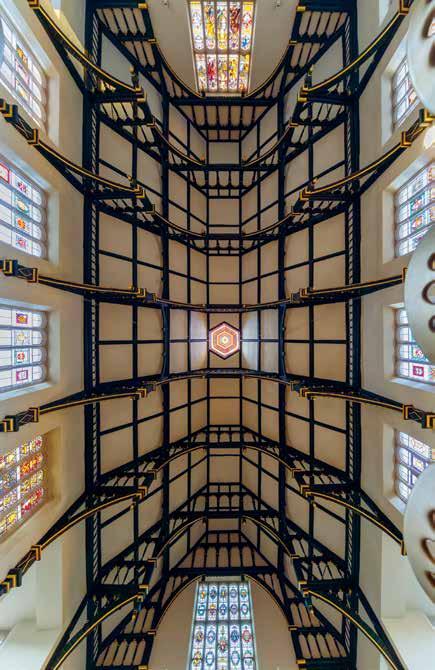
Our very buildings tell a story of resilience and renewal. The refurbishment of the Great Hall has restored its historic splendour, with the re-gilded pinnacle and weathervane now standing as symbols of the College’s enduring legacy. The hexagonal lantern, with its striking red, gold, and pale blue hues, is not just a testament to craftsmanship but a reflection of our commitment to preserving our heritage while making space for new generations.
In a moment of profound cultural and historical significance, Trinity has also taken an important step in justice and reconciliation. Four spears, crafted by the Gweagal people over 250 years ago, have been returned to representatives of the La Perouse Aboriginal Community. The repatriation ceremony in the Wren Library was more than just an event; it was a powerful acknowledgment of history, a bridge between past and present, and a commitment to truth and respect. Witnessing scholars, dignitaries, and indigenous community members come together in this act of restitution was a poignant reminder of our duty to fairness and historical awareness.
Recognising those who shape College life, we have introduced the Katherine Parr Award, which honours a final-year undergraduate who has made an outstanding contribution to Trinity in both academic and extracurricular spheres. With a prize of £5,000, this award is not just a recognition of achievement but a celebration of those who give back to their community, who lift others as they rise, and who make our College a better place for all. At this moment, I would like to welcome and thank Mr Denis (1955) and Mrs Minouche Severis, who have been supportive friends of the College for the past two decades through projects like this that provide a wide range of opportunities for College members to enrich their time at Trinity.
If my theme is about contribution and impact, consider Professor Jason Chin, who has recently been appointed to lead the new Generative Biology Institute at EIT. He is forging an environment where collaboration transcends boundaries, with 7300 researchers, where ideas thrive irrespective of background or status. We are sad to lose Jason to Oxford, but he takes the values of Trinity with him.
These stories – of leadership, of service, of artistic brilliance, and of historical justice – are the stories of Trinity. They remind us that fairness, inclusion, and the drive for good health are not abstract principles but daily practices. They are woven into the fabric of our College, reflected in every student, every tutor, every initiative, and every act of restoration. And it is through these commitments that we continue to build a future where excellence is not only achieved but shared.
Let me extend our heartfelt thanks to our catering team for the splendid meal we have enjoyed this evening. Their skill, dedication, and hard work make occasions like this so special, and we are truly grateful for their efforts, day in and day out.
To all our benefactors, alumni, Fellows, and friends – thank you. Your generosity, dedication, and commitment ensure that Trinity continues to flourish as a place of learning, discovery, and impact. It is an honour to welcome you back to the College tonight to celebrate our shared vision and achievements.
But sadly, I cannot finish without recognising that our impact, virtue and our values of excellence, inclusivity and respect, are all under threat. Threats from those who consider universities and scientists to be elites that need bringing down. Threats from the economy and the University Sector finances.
I believe Trinity, our stability, our values, our freedom to debate and discuss, developing our excellent enquiring minds, holds an ever more important role now and in the next decades than ever before during my adult life. We must develop our students to face and thrive in this everchanging world. We must help them to find their own ways to contribute to a better, more stable and inclusive world. I believe we can.
Finally, I want to say that as we move through this, my sixth year, I reflect on how my love for Trinity, the people, the buildings, and our history has crept up on me. I am proud to serve as the Master.
I will continue to strive to make Trinity ever stronger as we go forward.
In Piam memoriam benefactorum.
alumni relations & development
alumni relations and associations
dining privileges
annual gatherings
your trinity legacy
alumni achievements
donations to trinity donations to the library
David Johnson Photography
Alumni Relations & Development
Dr Michael Banner, Chair of Alumni Relations & Development
2022 alumni gave to the College in 2024/5, setting a new record for participation, with our Giving Days in June attracting strong support. Taking the year as whole, new gifts and pledges amounted to a total of £11,100,975. This tremendous generosity provides the College with invaluable funding to support all our activities.
To help mitigate declining funding opportunities for PhD research, the College has introduced the Trinity Cambridge Research Studentships (TCRS) which will provide up to 300 fully funded PhD studentships, across the University, over the next ten years. This will ensure that Cambridge continues to attract and retain the most talented researchers from around the world, regardless of their financial circumstances.
With alumni support, the College also established the TrinityPlus programme. This initiative is designed to provide undergraduate and graduate students with opportunities to broaden their horizons while gaining new skills and experience to carry into their futures. Each of the three TrinityPlus strands offered this year – Entrepreneurship, Policy, and Musical Theatre – provided the chance to learn in collaboration
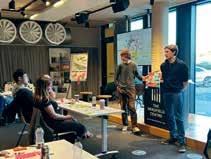
Students in a TrinityPlus Policy Programme workshop presenting to fellow participants.
Graham CopeKoga
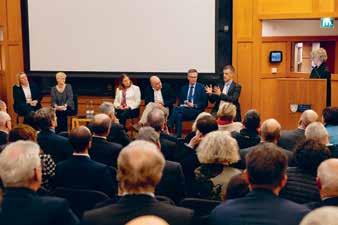
Trinity Policy Dialogue panel members and the Master take questions from the audience.
with fellow students. Following the success of the pilot programme, plans are afoot to enhance and expand our TrinityPlus offering; do get in touch with the Alumni Office if you’d like to learn more about opportunities for support.
In February, the College launched the first Trinity Policy Dialogue in the series, another development made possible by a generous donation. Chaired by the Master, Dame Sally Davies (e2019), the event opened with the inaugural lecture entitled ‘The NHS is broken – how can life sciences fix it?’ from The Rt Hon. Lord James O’Shaughnessy, Senior Partner at Newmarket Strategy and an authority on health innovation, policy and life science. Thank you to our panel of experts who chaired the Q & A session before everyone enjoyed networking drinks and dinner in Hall. To strengthen Trinity’s impact and leadership in the sector, the Alumni Office is also developing a new alumni group, the Trinity Government and Policy Association. Please email alumni@trin.cam.ac.uk to join the group.
Trinity admitted three new Fellow Benefactors at the Commemoration of Benefactors Feast on 21 March: Robert Crawford (1992), Selena Sun (1995) and Dr Victor Dahdaleh. Robert has supported PhD studentships in the Humanities, particularly in Japanese language and studies. Selena’s generosity has enabled students to travel and study in Asia and supported bursaries, and Victor’s philanthropy is supporting a studentship in Medicine. We were pleased to be joined by other Fellow Benefactors, by Lord Justice Rabinder Singh (1982) who gave an address in Chapel, and by first-year doctor and Olympic rowing champion Imogen Grant (2014), who proposed the health of the College after Dinner.
Our mentoring programmes continue to go from strength to strength, with 150 alumni helping current students and recent graduates this academic year. In March, our students were able to take advantage of the third mentoring scheme, and in October, our recent graduate scheme returned for the second time, with alumni who graduated in the past six years benefiting from the valuable insight and experience of older alumni. We are grateful to everybody who has given their time and expertise to help make a success of the scheme.
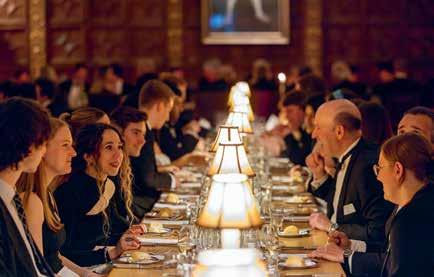
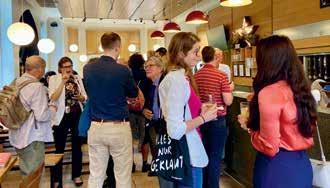
We held four Annual Gatherings this year, welcoming back three cohorts in July – those who matriculated in 1993–1995, in 1975 for their 50th anniversary, and in 1978–1980. In September, it was the turn of those who matriculated in 1981–1983 to reunite. These are always happy and spirited occasions, and we are always impressed by the distances which many travel to take part.
Trinity Alumni Associations and Groups have had a very active year too, as you’ll see in the reports from our group Chairs that follow. The Trinity Law Association held its Biennial Dinner in March, followed by the Trinity College Choir Association Dinner in April and the Trinity Business and City Association in May. September was also notable for the splendid First and
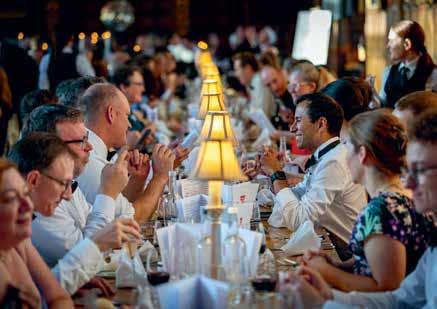
Catching up over Dinner in Hall at the Annual Gathering 1993–1995 in July 2025.
David Johnson Photography
Trinity Fellow Benefactors
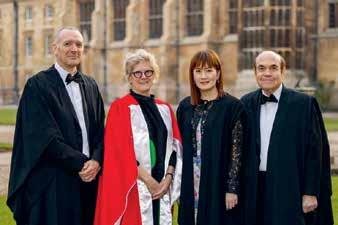
Robert Crawford (1992), Selena Sun (1995) and Dr Victor Dahdaleh with the Master, Dame Sally Davies, before the Commemoration of Benefactors Service on 21 March 2025.
Third Trinity Boat Club Bicentenary Celebration Dinner, including a special exhibition marking 200 years of rowing at Trinity.
Good progress is being made on our Trinity 2046 estate plan, the vision for how our buildings and green spaces can be developed to ensure the best possible environment and facilities for future generations. We hope to make substantial progress on the priority projects (the redevelopment of the Brewhouse site, and the renewal of the undergraduate Library and the sports facilities at Old Field) in the next few years. We hope to share more news over the year ahead, but if you would like to discover more about opportunities to support the project, please do get in touch with me or the team.
The ARDO team is busy planning events and activities for 2026 to enable you to stay in touch with the College and one another wherever you’re based, so we hope you’ll get involved. Don’t forget to share your news and developments with us too by emailing alumni@trin.cam.ac.uk. We wish you the very best for the year ahead.
Year in Numbers
A record-breaking 2022 alumni donors gave to the College this year. Thank you.
A total of 2351 alumni, students, parents, Fellows, staff, and friends donated to Trinity
£11.1M in philanthropic income
32 members of the Tudor Rose Society, the new giving circle recognising those who have made a gift or pledge of £10,000 or more in the past year
189 members of the new Postdoctoral Society alumni community alumni support
9333 alumni members in Trinity professional, regional and special interest associations
346 Great Court Circle members
£1.5M gift to provide international bursaries for Maths and Science Olympiad medallists
£3M given for two new endowed PhD studentships, in Asian and Middle Eastern Studies and in Medicine
1735 alumni attended 52 Trinity events across the globe
41 alumni and friends donated items to the Library, including books they have written, edited or translated
Current student and recent graduate mentoring programmes supported a total of 152 mentorship matches, with training provided for alumni mentors and our mentees. An additional 11 Law students were mentored via the Trinity Law Association’s Mentoring Programme
The Difference You Are Making
In the Club’s bicentennial year, an 82% increase in gifts from members of the First and Third Trinity Boat Club to support rowing at Trinity. Together, donors raised 170% more than last year
5,555 individual manuscripts (including 1159 medieval manuscripts), letters, documents, and printed books, now available worldwide and free of charge via the Wren Digital Library, supported by donors
4 secondary schools and 2 colleges in Great Yarmouth have now received academic support through Trinity’s partnership with IntoUniversity
£14.5m+ invested in Trinity and Cambridge research
£1.75m given to support the College’s new TrinityPlus Policy Progamme, providing students with new academic and personal development opportunities
147 projects, grants and Fellowships made possible by Trinity support for the Isaac Newton Trust
1500 students across Cambridge supported thanks, in part, to Trinity’s partnership with the Cambridge Trust
350+ Year 12 students made in-person visits to the College as part of Trinity’s Access and Outreach programme of day visits and residentials
£4,556,217 given to support graduate students
340 Trinity Students receive studentships, bursaries and grants via the College and donor support
£48m in studentships made possible via the new Trinity Cambridge Research Studentships programme set up by the College and University
60 Trinity student ambassadors recruited and trained to support the College’s Access and Outreach initiatives, including delivering online mentoring and contributing to the residential and events programme
Alumni Associations
Trinity First and Third Association
Tony Pooley (1964), President
This year, the Boat Club has been celebrating its founding in January 1825, 200 years ago.
The first celebratory event was a row to and from Ely on Sunday 20 October, repeating the event 200 years ago and written about by C.F.R.Baylay in the Field edition of January 28, 1882: “Before the end of the October Term, 1824, I joined a scratch crew and rowed to Ely and back, which, at that early date, was not considered an extraordinary feat.”
The next event was a celebratory get-together on the day of the Oxford and Cambridge Boat Race at the Hammersmith Ram. During the College’s June Giving Days, special arrangements were made for the first £20,000 of donations to the Club to be matched pound for pound, unlocking money to help support the refurbishment and redevelopment of the Boathouse.
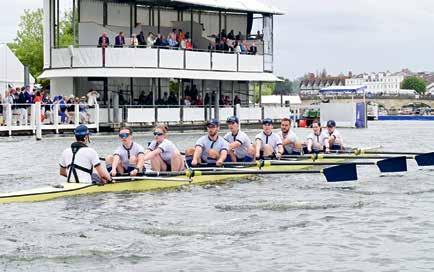
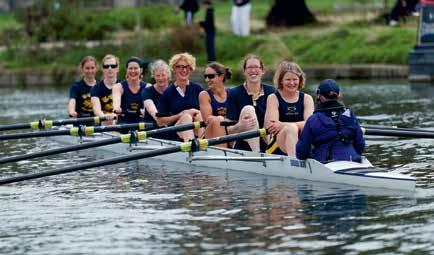
First and Third Henley Row past.
On the Saturday of the May Bumps, the Association held a garden party in College with drinks, accompanied by strawberries and cream and an exhortation to watch the top divisions of the Bumps.
At Henley, on the Saturday of the Royal Regatta, a composite crew from the Men’s and Women’s first and second boats undertook a Bicentenary row past (see photo, left) followed by celebratory drinks attended by over fifty alumni.
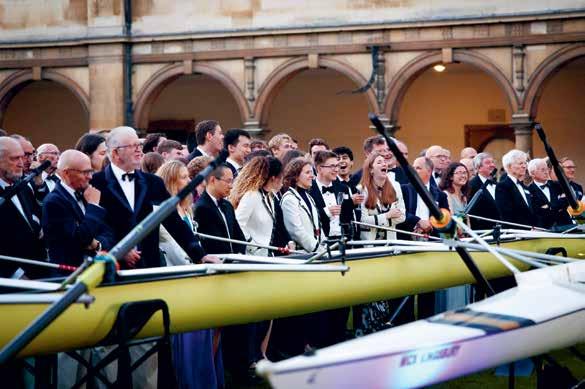
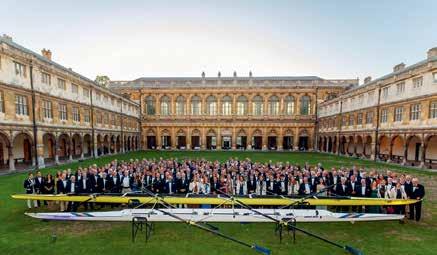
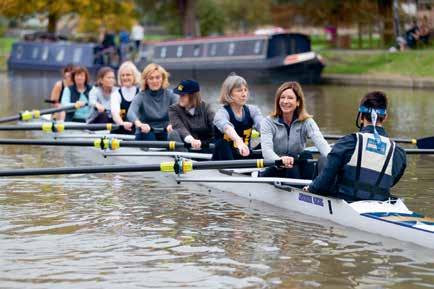
On Saturday, 20 September 2025, a 200th Anniversary Boat Club Dinner was held in Hall, attended by the Master and over 250 alumni, some of whom had enjoyed a row from the Boat House that morning (see photo, above). Talks on (relatively) recent changes in Cambridge rowing preceded the drinks before dinner, and Mike Proctor (1968), ex-Senior Treasurer of the Boat Club, ex-ViceMaster of Trinity and ex-Provost of King’s College, gave an excellent keynote speech at the end of the dinner.
Finally, on the Sunday morning afterwards, many people (including family and guests) enjoyed a College Brunch, viewed an exhibition in the Wren Library celebrating the history of the Boat Club, and took the opportunity of enjoying the Cam in a College punt.
I must thank the organising committee, the Alumni and Relations Development Office, and the Boat Club’s Alumni Relations Officer, Luke Barratt (2018, rowing
First and Third members mark 200 years of rowing at Trinity, 20 September 2025.
David Johnson Photography
at 3 in the photo on page 34), for the immense amount of work put in over the whole year to make the various events the celebratory successes that they were.
The First and Third Trinity Boat Club Association is open to all alumni who enjoyed rowing whilst up at Trinity and who wish to maintain/re-establish contact with past and present members of First and Third Trinity Boat Club. The Association exists to support the Boat Club financially, practically and socially.
The Association holds a black tie Biennial Dinner in College every two years attended by about 150 alumni and partners. The next such dinner will be held two years after the 200th Anniversary Dinner – September 2027.
Other social events include a gathering in London every first Tuesday each month for drinks and supper at ‘Ye Olde Cheshire Cheese’ in Fleet Street.
A now well-established Steering Committee, comprising alumni and current Boat Club Captains, seeks to further the progress of both the Boat Club and the Association by agreeing development strategies, the degree to which the Association can assist in funding the Boat Club and generally strengthening the bonds between current Club members and alumni. Please do get in touch if you want to offer support.
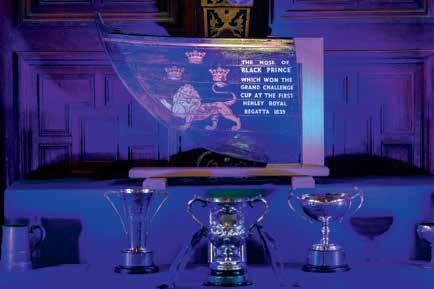
The nose of the Black Prince and trophies on display in Hall for the 200th Anniversary Dinner.
David Johnson Photography
Current performance of the Club has seemingly turned a corner. In the May Bumping Races the Women’s 1st VIII went up one, the Women’s 2nd VIII got their oars (again), the Men’s 2nd crew went up three places and the 1st Men’s VIII went up one to become head of the Men’s second Division, missing out on bumping Robinson in the Men’s first Division four times as sandwich boat.
At the international level, alumna Dr Imogen Grant, who started as a First and Third Trinity Boat Club novice in 2014, and her lightweight doubles partner Emily Craig served as a reserve for Team GB at the 2025 World Rowing Championships in Shanghai, 21–28 September.
The Club and the College are supportive of First and Third crews that choose to celebrate anniversaries of their time together at Trinity. We hope that past crews might wish to arrange reunions in College – either separately, or perhaps as part of the Biennial Dinner or on other suitable occasions. Given sufficient notice, the Club’s boatman, Stephen ‘Bomber’ Harris, would also be happy to help you enjoy an outing on the Cam.
First and Third members mark 200 years of rowing at Trinity, 20 September 2025.
David Johnson Photography
Trinity Business and City Association
Harry Hampson (1984), Chair
What a joy it is to be able to write this year’s report on the back of an exciting year of Trinity Business and City Association events and activities, crowned by the return of the TBCA Dinner for the first time since 2018.
80 alumni joined us in early June at The Bleeding Heart at the Crypt of St Ethelreda for a most convivial evening, bringing together alumni from a variety of sectors including business, investment, accountancy, entrepreneurship, legal services and finance. Alumnus and Financial Times Senior Business Writer, Andrew Hill (1984) joined us to provide an interesting and humorous take on the current state of business and finance, and we also heard from Cambridge alumnus, Lord Browne. We are most grateful to all the TBCA Members who supported this event and made it a successful evening.
A couple of weeks before the dinner, we were treated to an evening in the company of alumnus and CEO of Next plc, Lord Simon Wolfson (1986). Lord Wolfson was in conversation with Tom Hall (1986) for a wide-ranging Distinguished Speaker Series discussion that explored his journey at Next, and the opportunities taken and challenges overcome that have contributed to Next’s place as a shining beacon in a difficult environment for the UK High Street. Attendees were grateful for Lord Wolfson’s openness in sharing his opinions on improvements he would like to see within the business environment which would make a difference to UK retailers. We thank Avalon Lee-Bacon (2009) for hosting this event at Dawn Capital.
Our autumn Networking Drinks evening at our regular location of The Happenstance, Paternoster Square in late September was attended by nearly 100 alumni, which demonstrates how much our members enjoy having the opportunity to meet with one another in this relaxed setting.
In addition to our events, I am delighted to see that the College’s Mentoring Month project for students goes from strength to strength, and that TBCA members contribute their time and energy so generously to this. With it becoming embedded in College life, we have now been able to launch the TBCA Recent Graduate Mentoring programme, predominantly taking place in October. In its first year, around 30 alumni were able to gain support and advice from their
fellow alumni on things such as job applications, interviews, changing sectors, career breaks and when to seek promotions. Now in the second year of this project, we are indebted to the TBCA membership for making this possible, and to Emmanuel Soquar on the TBCA Committee and Maddie Read in the Trinity Alumni Office for their hard work.
Looking ahead to 2026, I hope that we will be enjoying further fascinating and inspiring Distinguished Speaker events, catching up at more Networking Drinks, inspiring more alumni and students through our mentoring, and spending another evening in one another’s company at a TBCA Dinner. Event ideas, speaker suggestions and volunteers to join the committee are always welcome – please contact ARDO in the first instance: alumni@trin.cam.ac.uk.
The Trinity College Choir Association Douglas Paine (2000), Chair
The Trinity College Choir Association is open to all former members of the College Choir and organ scholars, although it holds and supports events that may be of interest to alumni outside these groups who appreciate the College Choir or choral music more generally.
The highlight of this year’s activities was the TCCA Gathering which took place in College on 26 April 2025. It was excellent to welcome back so many former Choir members and their guests. It was, in part, an opportunity for TCCA members to welcome Steven Grahl, who took up his position as Director of Music in January 2024.
The event began with tea and coffee in the Ante-Chapel, before a rehearsal for Evensong. After a warm welcome from Steven, TCCA members had the privilege of joining the current Choir in a rousing rendition of Howells’ St Paul’s Service and Tallis’ Spem in alium, sung in the round.
TCCA members and the current choir were then treated to the best of College hospitality over dinner in Hall. A speech of thanks was given by Douglas Paine (2000), the Chair of the TCCA Committee.
The TCCA Committee is grateful to everyone who made the event possible, in particular: the Catering Department; Paul Nicholson and Alison Sutton in the Chapel and Music Office; and Phil Pass, Maddie Read and Olivia Butterworth in the Alumni Relations and Development Office.
Aside from the Gathering, TCCA members again provided the choir (the largest to date) for the College Alumni Carol Service on 9 December 2024, at Marylebone Parish Church. The choir was organised by Tom Dupernex (2000) and directed by Mike Waldron (2006).
TCCA members also provided a choir to sing at two Annual Gatherings in July and September 2025 at which the current College Choir were unable to attend.
The TCCA Committee is grateful to Alison Sutton for her work on improving the College database of TCCA members. Any former members of the Choir who do not receive communications from the TCCA, but who wish to do so, should contact the Alumni Office: alumni@trin.cam.ac.uk.
This year, the TEA was delighted to host a talk and networking session featuring Dr Alex Kendall (2014), co-founder and CEO of Wayve. On 21 November 2024, Alex spoke to a packed audience in the Constance Tipper Lecture Theatre about his journey from PhD research at Cambridge to leading one of the world’s most exciting Embodied AI companies, now over 350 people strong and supported by global partners such as SoftBank, Microsoft, Nvidia and Uber. His insights into the future of AIpowered autonomous mobility sparked engaging discussions and were warmly received by students and alumni alike.
After the lecture, members gathered in College for networking drinks in the OCR, where we trialled a ‘speed networking’ format. This provided a lively and informal way for alumni to share career advice and expertise with students, and for students to build their professional networks. The enthusiasm in the room made it clear that there is great appetite for this kind of event, and we hope to continue developing the format in the future.
Looking ahead, we are planning a varied programme of events for 2026, continuing to strengthen links between Trinity engineers across generations. Our aim is to provide more opportunities for alumni to engage with students, while also spotlighting the remarkable achievements of Trinity engineers in academia, industry, and beyond. We look forward to welcoming many more of you at our upcoming events and invite suggestions from the community on themes and speakers of interest.
Trinity Golf Society
Nigel Taylor (1975), Chair
This year’s Trinity Golf Day took place in early June. Despite the wind and rain, 20 Trinity alumni completed the course very respectably. In a close finish, Peter Armstrong (1970) won with 36 points. He was followed by John Harkness (1973), with 35 points, and David Cooke (1975), with 34 points. Following an excellent and convivial dinner back at Trinity in the Allhusen Room, the Bradbrook Trophy was presented to Peter by the eponymous Sandy Bradbrook (1964).
I would like to extend the thanks of all those who have taken part in Trinity Golf Society events over the last decade to Peter Larkin (1964), for his efforts in leading the group and ensuring a successful event each year. I am honoured to take over from him and hope we continue to see Peter at Golf Days for many years to come.
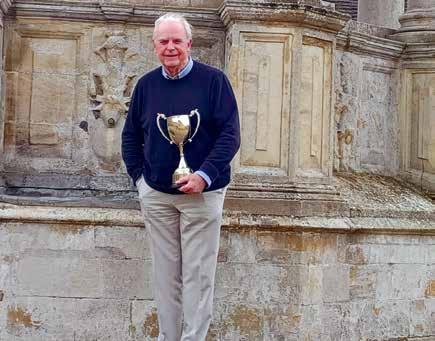
Winner Peter Armstrong (1970) with the Bradbrook Trophy.
The annual Inter-College Alumni Golf Competition was also held as usual at the Gogs in April, where George Pearson (1975) led the Trinity team on his home course to a respectable finish. Anyone interested in being considered for the 2026 team of six players should contact Captain George Pearson (via alumni@trin.cam.ac.uk) with details of their handicap (maximum 24), club membership and experience.
The Trinity Golf Society welcomes alumni golfers of all abilities. Our annual Golf Day utilises the Stableford scoring system, so everyone is in with a chance, and you do not need a club membership or to be in possession of a current handicap to join the Society or Golf Day. As well as the opportunity to play on a range of courses in the Cambridge area, we bring together alumni from different generations.
The 2026 Golf Day will take place on Thursday 3 September 2026 at Royal Worlington & Newmarket Golf Club, followed by dinner in the Allhusen Room in Trinity. It promises to be a very enjoyable day/evening. Please book your place via alumni-events@trin.cam.ac.uk, who can provide more details should you have any questions.
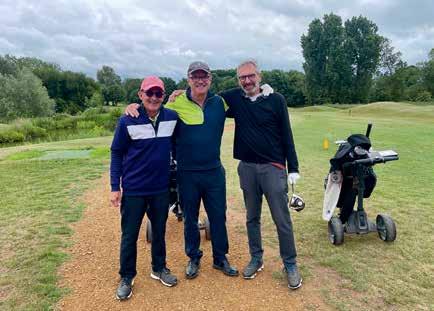
Golf Society members Tim Barson (1971), Paul Banner (1971) and Stephen Clarke (1973).
Trinity Government and Policy Association
In last year’s Annual Record, we announced the College’s intention to create a new Trinity Alumni Association covering the sphere of governance, government, and policy. We are very grateful to the group of alumni who came together earlier in the year to share their feedback on the idea and to advise on some of the key areas in which this association could be useful for alumni in, and students wishing to get into, the sector.
We are most grateful to alumnus Greg Fried (1998) for the time he has spent over recent months helping to develop a draft constitution and in setting out the early aims for the association ahead of a further meeting with a wider steering group. Various developments around the Trinity Policy Programme, the Trinity Policy Dialogue, and the new student-run Trinity Policy Forum have also all been moving ahead within College, providing plenty of integration opportunities for the future Trinity Government and Policy Association.
It is envisaged that the association will provide professional networking opportunities for Trinity alumni from diverse policy areas and from across the political spectrum; hold events (lectures, discussions, and panels) on key political and current affairs topics; and to provide advice and support to students and recent graduates.
To join the mailing list and stay up to date with news and events, and/or to express your interest in joining forthcoming steering group discussions, please contact Phil Pass, Alumni Relations Manager, via alumni@trin.cam.ac.uk.
Trinity Law Association
Andrew Walker KC (1987), Chair
To our great relief, the association was finally able to hold its no-longer-quite-Biennial Dinner in March 2025. Once again, there was a fantastic turnout, with a spread of members from those still in College to those who matriculated several decades before, and from those still in training to the dizzy heights of the UK Supreme Court. The dinner seems to have been a bookend for the repairs to the Hall: cancelled at the very start and then celebrated as the last formal College event before the Hall was due to be revealed in all its glory once again. We have already asked the College for a date in 2027, to get us back on a biennial track.
Our sincere thanks go to Joe Sampson (2008) for his fascinating pre-dinner reminder that we are not the first generation – and will no doubt not be the last – to have to manage a pandemic. Much may have changed in the 400 years since the young Stuart monarchy and local officials in the City of London dusted off their plague laws and battled an uncontrolled infectious disease – without today’s levels of scientific insight – but the practical challenges, human struggles
David Johnson Photography
Members across the generations catch up at the pre-dinner Drinks Reception in the OCR, 5 March 2025.
and heartbreak have not. And apart from a version of ‘party-gate’, Joe managed to deliver all of that without drawing too many parallels between the regimes of the day, however apt that might have been.
As I write, we are in the process of putting together our events for the academic year ahead and reorganising our mentorship programme (which is separate from the main College programme), and we will shortly be looking to refresh both our committee and our constitution. Please do look out for event notifications and our newsletter.
David Johnson Photography
A packed Hall during our Biennial Dinner, 5 March 2025.
Trinity Medics’ Association
Dr Max Emmerich (2010), Chair
The TMA was delighted to continue its series of mentorship events for medical students and earlycareer resident doctors with a speed networking event at the Francis Crick Institute in London on Friday 7 March. Thank you to everyone who helped to make the evening possible.
The Trinity Medics’ Association is looking forward to hosting another of our popular biennial dinners back at College on Saturday 21 March 2026. Do keep an eye on the alumni enewsletter for further details.
Should any alumni have suggestions for events or wish to join the TMA committee, please do not hesitate to get in touch via the Alumni Office: alumni@trin.cam.ac.uk.
Making connections at our speed networking evening, March 2025.
Trinity Women’s Network
Dr Kimberly Schumacher (1989), Chair
The Trinity Women’s Network continues to maintain contact with our members via our Facebook page (facebook.com/groups/TrinityWomensNetwork),which now has over 500 members. Please do also join our TWN LinkedIn page at linkedin.com/groups/13573031.
Our goal is to offer in-person events that inspire alumnae, enable reconnecting with other alumnae and networking. Please get in touch via alumni@trin.cam.ac.uk with ideas for events and talks, as well as working with Alumni Relations and the TWN Committee to run an event – we’d love to hear from you!
Trinity in Cambridge
Our group for alumni based in the Cambridgeshire region now has more than 100 members, across all ages. In 2026, we’ll be bringing the group together again to provide opportunities to socialise, share experiences, and make the most of the Trinity community.
If you’re based in the area and you’d like to join the group, please email us at alumni@trin.cam.ac.uk and we will add you to the mailing list. Do keep an eye on the newsletter for further details and we look forward to seeing you soon!
Members evening in the College Bar.
Trinity in China
Alan Babington-Smith (1965) and Yang Xia (2003), Co-Founders
The past year has been another vibrant one for Trinity alumni in China. Despite busy schedules, our members have continued to hit new milestones across diverse fields.
As always, Trinity in China has served as a home away from home for students and scholars in Beijing, whether visiting for short-term engagements (such as Min Huang’s (2022) conference attendance) or extended study (like Dounia Al Jijkali’s (2023) exchange programme at Peking University). We were also honoured to host Trinity Fellow Professor Jean Khalfa (e1994) during his visit, further strengthening ties between alumni and the College.
On the fundraising front, we were delighted to facilitate discussions with prominent Chinese entrepreneurs about potential donations, while rallying our community to support Trinity’s enduring legacy.
With China’s entrepreneurial and tech investment landscape regaining momentum, we warmly encourage fellow alumni to explore opportunities here – be it for collaboration, research, or simply reconnecting.
Trinity in Hong Kong
Tzo Tze Ang (1997), Dominic Chan (1988) and Will Hutchinson (1999)
Cambridge Comes to Hong Kong: Formal Hall Without the Formal Weather
On 28 March 2025, we traded Hong Kong’s spring humidity for an evening of Trinity nostalgia at our ‘Cambridge Formal Hall’. Without the draughty dining halls and unpredictable Fenland weather, we recreated the magic of formal dinners complete with (marginally better) wine and only slightly less intimidating Latin graces.
The sight of alumni proudly donning their gowns – some impressively preserved since graduation, others suspiciously crisp and new – transformed
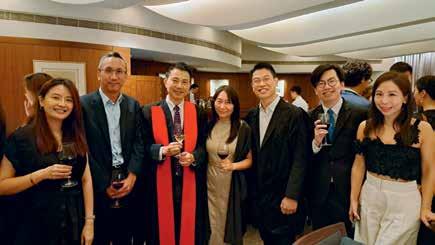
Cambridge Formal Hall comes to Hong Kong, 28 March 2025.
our Hong Kong venue into a slice of Cambridge. For those who had long since retired their academic garb to the depths of storage (or, in some honest confessions, ‘accidentally’ left them behind in College rooms), our thoughtfully provided mock-up gowns were a hit. These borrowed robes sparked a lively debate about whether the synthetic fabric was actually an improvement on the traditional wool that had once kept generations of students warm through Cambridge winters.
There was much laughter as we remembered the art of keeping sleeves out of soup bowls and navigating narrow doorways without snagging the flowing fabric.
While our Trinity pride runs deep, we’ve magnanimously opened our doors to alumni from ‘those other colleges’ – after all, someone has to appreciate our superior wit and College traditions. The evening’s cross-College banter proved that while we may have studied at different institutions, we’re united in our fondness for Cambridge and our ability to exaggerate our rowing prowess with each passing year.
The evening was filled with reminiscences of supervisions survived, May Balls attended, and punt-related mishaps that somehow seem more charming with each retelling. Several alumni confessed they’d practised wearing their gowns beforehand, while others admitted they still remembered precisely how many steps it took to reach the dining hall from their College rooms. As one alumnus put it: “The food’s better here, but I do miss the slightly anxious feeling of wondering if you’ve accidentally sat in the Master’s chair.”
Museums of the Past, Conversations for the Future
1 April 2025 brought a more cerebral – but no less engaging – gathering as we welcomed Cambridge Vice-Chancellor Professor Deborah Prentice alongside Luke Syson (e2019), Director of the Fitzwilliam Museum, and Dr. Louis Ng, Director of the Hong Kong Palace Museum, for a fascinating Global Cambridge event.
The distinguished panel explored how museums serve as bridges between past and present, examining the contrasting approaches of the venerable Fitzwilliam and the newly established Palace Museum. What might have been a dry academic exercise turned into a lively discussion about cultural preservation, technological innovation, and international collaboration.
As we continue to build our Hong Kong alumni community, these events remind us that Trinity’s traditions and intellectual curiosity travel well across
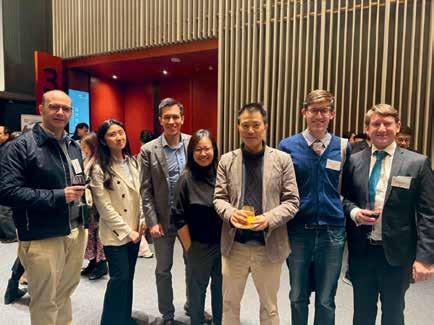
Members enjoying the Global Cambridge event on museums of the past and future, 1 April 2025.
continents. Whether raising glasses in formal attire or raising questions about cultural heritage, the Trinity spirit remains vibrant among alumni half a world away from Great Court.
Trinity in Japan
Dr Gerhard Fasol (1978), Co-Founder and Chair
I founded Trinity in Japan in 2014, with the following mission:
• to serve our Trinity community;
• to make Trinity known in Japan, which serves us all;
• for our Trinity community to help lead cooperation with Japan, including business, culture, academic, and other fields.
The group meets about once a month in Tokyo. Here are some recent events:
We celebrated our ten-year anniversary in 2024 with two special events. Trinity Fellow for Development Dr Michael Banner joined us on 6 September, updating us on the College’s latest developments, and Ivan Sorrentino (1988) discussed ‘Japan and the English language’ sharing his insight from more than thirty years in the English language industry in Japan and East-Asia, most of which have been spent in leadership roles with Cambridge University Press and Assessment.
Professor Stephen Toope (1983), former Cambridge Vice-Chancellor and a Trinity Honorary Fellow, joined us on 8 October 2024 to discuss his most recent book, A Rule of Law for Our New Age of Anxiety. We were also joined that evening by Kazumi Nishikawa, Principal Director, Trade and Economic Security Bureau, Ministry of Economics, Trade and Industry (METI), who gave us a talk entitled ‘Latest developments of METI/GOJ’s economic security policy and Japan’s innovation policy’. We were pleased to extend an invitation to this great event to Japanese Cambridge alumni in leadership positions in Japan, company founders, government leaders, and venture investors, to increase our engagement in Japan.
Yasuhide Fukumoto, Trinity Former Visiting Fellow Commoner, invited Masaharu Shiratani, Senior Vice President of Kyushu University, to our dinner on 25 November 2024 to discuss Japan’s University reforms with us. We continued these discussions the following day over lunch – Professor Shiratani had come all the way from Kyushu (about 2 hours by air) to hear our Trinity and Cambridge perspectives. I have been visiting Professor at Kyushu University, one of Japan’s former ‘Imperial Universities’ for several years, so I also shared some of my impressions. Japan’s universities receive considerable
encouragement from government, industry association Keidanren and others to reform and change mindsets.
On 27 June 2025, we focused on neurosurgery, stem-cell research and other medical topics with a group of Trinity medical students learning new surgery procedures during electives in some of Tokyo’s University hospitals. A number of our members in the pharma industry were also able to join us as well.
For our year-end dinner event (bonenkai) on 16 December 2025, Ambassador Ra Jong-yil (1967) spoke on ‘The Dragon and the Beauty – Why a political scientist writes fairy tale stories’. Ambassador Ra had a long career in SouthKorea’s government, holding positions including National Security Advisor to South-Korean President Roh Moohyun, Ambassador to Japan, and Ambassador to the United Kingdom.
I also enjoyed a number of one-on-one meetings with Trinity Fellows and alumni visiting Japan. You can find short reports about these on our website. With Trinity in Japan now in our 11th year, we have held a total of approximately 160 meetings, including about 50 video events. You can watch our online events here: https://www.youtube.com/trinityjapan/videos.
Thank you to Professor Stephen Toope and Kazumi Nishikawa for joining us on 8 October 2024 for great discussions, which continued over dinner.
We enjoy sharing ideas, good food and good conversation at our group dinners.
Looking ahead, Trinity members competing in the Kyoto Marathon asked us for a Trinity event, so we are organising a Trinity event in Tokyo on the evening 20 February 2026. Whether or not you are competing in the Kyoto Marathon, you are very welcome to join us!
College members are always welcome to join our meetings. If you contact me two or three months ahead, I may be able to organise a Trinity in Japan group meeting matching your travel plans.
Announcements of future meetings are posted on our website: https://trinityjapan.org/ and you are always welcome to contact me at fasol@eurotechnology.com.
Trinity in New York Christos Koutsoyannis (1998)
A Year of Growth and Engagement
Trinity in New York (TCNY) continues to flourish as we bring together the large number of Trinity alumni based in, or travelling through, the broader New York City tri-state area, from Princeton in New Jersey to Yale in Connecticut, as well as alumni across the United States. Our organisation holds regular social events, both in person and virtual, alongside visits from Trinity Fellows, building on last year’s very successful series of events featuring the Master and multiple Fellows.
This year has been particularly rewarding, with a number of exceptional events that exemplify our commitment to intellectual engagement and community building. In September 2024, we were privileged to host Dr Michael Banner (e2006), Trinity Dean of Chapel, Fellow, and Chair of Alumni Relations, for a fascinating breakfast discussion on Trinity, Slavery and Reparations. Dr Banner’s thoughtful and thought-provoking research on this important topic, developed over several years through his publications including his recent book – Britain’s Slavery Debt: Reparations Now! – provided alumni with deep insights into how our College is grappling with its historical legacy and contemporary responsibilities.
February 2025 brought our alumni community together at the Union League Club for a drinks and networking reception that proved to be an outstanding success. The evening provided an excellent opportunity for alumni to reconnect and forge new professional relationships over drinks and light refreshments in the elegant surroundings of this prestigious venue.
March saw TCNY members participate in a remarkable event organised by Cambridge in America (CAm) at the Harvard Club of New York City. Professor Simon Baron-Cohen (1995), Trinity Fellow and Director of the Autism Research Centre at the University of Cambridge, presented a compelling talk based on his recent book entitled The Pattern Seekers: How Autism Drives Human Invention. Professor Baron-Cohen’s presentation revealed fascinating new evidence linking the autistic mind to humanity’s capacity for invention, challenging audiences to recognise society’s debt to people with autism while addressing their continued exclusion from mainstream society.
We’re delighted to report that interest in TCNY continues to grow substantially. Reflecting this enthusiasm, our Committee has expanded from three to seven members, ensuring we can organise even more engaging events and initiatives in the near future. This growth demonstrates the strong appetite among Trinity alumni in the region for meaningful connection and intellectual discourse.
Looking ahead, we’re excited to build on this momentum with additional events and opportunities for our expanding community. Whether you’re interested in networking with fellow alumni, attending stimulating lectures, or simply maintaining your connection to Trinity College, TCNY offers valuable opportunities throughout the year.
If you wish to join Trinity in New York, to network with fellow alumni, or find out more about future events, please get in touch at alumni@trin.cam.ac.uk or visit: www.trin.cam.ac.uk/alumni/community/benefits/associations/.
We particularly welcome ideas for events and initiatives, including suggestions incorporating Trinity Fellows and notable alumni visiting New York.
Dining Privileges
The College is pleased to welcome back Members of the College on up to four occasions per year to dine at High Table, at no charge. Wine may be taken in the Combination Room following dinner, also at no charge.
To be eligible to take advantage of these Dining Privileges you must either:
• have Matriculated and completed a BA degree at Trinity and hold the status of (or be eligible to be awarded) the Cambridge MA; or:
• have Matriculated and completed the minimum of a one-year course (e.g. MLitt, MPhil, PhD) and be at least six years and one term since your Matriculation.
Please note:
• There are likely to be a number of occasions each year on which MAs cannot be accommodated in this way – e.g. special dinners or other College events.
• Out of term time, High Table may, unfortunately, be cancelled at relatively short notice due to a small number of Fellows dining that day. Any cancellations will be communicated with as much notice as possible.
• For reasons of space, MAs may not bring guests when exercising their Dining Privilege. Once per year, an MA may apply for the Vice-Master’s permission to bring (and pay for) a guest.
• Again, due to limited space, we regret that groups numbering greater than six in size will not be able to dine using their MA Dining Privileges. if larger groups would like to dine in College, please contact catering.bookings@trin.cam.ac.uk to find out more about available packages).
Dinner is at 8pm during Full Term and at 7.30pm in vacation; sherry is available in the Fellows’ Parlour half-an-hour beforehand.
If you wish to dine, please enquire with the Catering Office for availability, either in writing to The Catering Manager, Trinity College, Cambridge, CB2 1TQ, or by email catering@trin.cam.ac.uk, or by telephone 01223 338547 between 9am and 4pm, Monday to Friday.
Please also let us know if there are any Fellows whom you would particularly like to meet when you come to dine (although we cannot guarantee that they will be able to dine on the night).
Please note that a gown should be worn only by those MAs who are resident in Cambridge.
David Johnson
Photography
Annual Gatherings
The College was delighted to welcome back alumni for four Annual Gatherings in 2025, for matriculation years 1993–1995, 1975 for their 50th Anniversary reunion, 1978–1980, and 1981–1983. Thank you to the speakers for each of the occasions, who were:
• 1993–1995
Gregory Leadbetter (1993), Maddy McTernan (1994) and Euan Murray (1995)
• 1975 Roger Pilgrim, Max King, Colin Matthews
• 1978–1980 Amanda North (1978), Louise Ireland (1979), Guy Newcombe (1980)
• 1981–1983
Dana English (1981), Stephen Johns (1982) and Francis Burkitt (1983)
Gatherings planned for 2026 are as follows:
• 2005–2007 11 July
• 1976 50th Reunion 15 July
• 2014–2016 25 July
• 1984–1986 12 September
The dates and further details, including information regarding accommodation, will be shared in the near future. Please keep an eye on the monthly alumni newsletter and the website for the latest details: trin.cam.ac.uk/alumni/event
David Johnson Photography
Your Trinity Legacy
This Michaelmas, Trinity focused on legacies, celebrating the enduring contribution of alumni across the generations. Throughout the term, the College invited members to reflect on the role Trinity has played in their lives, and to share letters of advice, memories, and traditions for the students who matriculated in 2025. These reflections highlighted the rich continuity of College life and the meaningful bonds that link past, present, and future students.
This initiative also provided an opportunity to highlight the impact of legacy gifts. Bequests have always played a vital role in advancing the aims of the College; supporting students through teaching and research and helping to preserve Trinity’s historic buildings for generations to come. To encourage others to consider this meaningful form of support, we shared stories from alumni who have chosen to remember Trinity in their Wills, together with a new legacy brochure.
We were also delighted to introduce Farewill, a new alumni benefit enabling members to write a simple Will free of charge. If you would like further information about Farewill or about remembering Trinity in your Will, please visit the website www.trin.cam.ac.uk/alumni/supporting-trinity/legacy/ or contact us at legacies@trin.cam.ac.uk.
Stephen Bond
Alumni Achievements 2024–2025
The date given as the date of matriculation is the date of first entering the College, either as an undergraduate or advanced student.
1998 C L Ackroyd The Surfacing, Lake Union Publishing, 2025.
1998 A T I Adamou An Introduction to Ergodicity Economics, with co-author Ole Peters, 2025.
1973 D P Adelman Art Collecting and Middle Class Culture From London to Brighton, 1840–1914, Routledge, 2024.
1997 A A Ammora Candidate for the election of Chancellor of the University of Cambridge, 2025.
1990 P M Barrett A History of Dinosaurs in 50 Fossils, Natural History Museum, 26 September 2024.
2023 B L Barrientos Ariza Paul & Daisy Soros Fellowship, for her work on oral histories in Central America.
1974 G W Beattie Executive Producer of Giant the movie, based on his books On the Ropes (1999) and The Shadows of Boxing (2002), released in October 2025. Understanding Climate Anxiety, Routledge, 2025.
1987 G R Butterton Promoted to Special Assistant United States Attorney, Washington, DC; Adjunct Professor of Law, Georgetown University; Senior Consultant, MacArthur Foundation Law & Neuroscience Research Network.
1970 A Cahn Appointed Chair of the Royal Society for the Protection of Birds (RSPB), 2024–2027.
1986 C J Clarke The Science of Ice Cream, Royal Society of Chemistry, 2024.
1968 T Clement-Jones Honorary Professor, Queen Mary University of London, School of Society and Environment, 2025. Appointed Chair of the Board of the Authors’ Licensing Collecting Society, May 2025.
1980 J R Coe Heffers Book of the Year 2024 for The Proof of My Innocence.
1972 P D Cormack Charles J. Connick: America’s Visionary Stained Glass Artist, Yale University Press, 14 May 2024.
1963 J P P Curran Power Without Responsibility: Press, Broadcasting and the Internet in Britain, Routledge, 2024.
1984 W B H Dalrymple Book of the Year – Non-Fiction (English), Federation of Indian Chambers of Commerce and Industry Publishing Awards 2025 for The Golden Road. One of GQ India’s Men of the Year 2024.
1999 N Das OBE for services to Interdisciplinary Research in the Humanities and to Public Engagement, New Year Honours 2025.
1959 B Dembitzer The Global Famine Game: Toxic Aid, A Weapon of War, Perverse Economics, independently published, 2025.
1988 G R Dissanaike Appointed Dean of Cambridge Judge Business School, beginning 2024.
1990 V H Dowd Death in the Aviary, Datura Books, 2025.
2012 C Easton The 1797 Naval Mutinies and Popular Protest in Britain, Negotiation through Collective Action, Palgrave Macmillan, 2025.
1982 C H Edwards The Politics of Immorality in Ancient Rome, (second edition), Cambridge University Press, 2025.
1989 T C Eley Fellow, British Academy, 2025.
1980 V J Feltz Vanessa Bares All, Bantam, 2024.
1995 L J Fletcher Institutional Investment Journalist of the Year at the 2025 WTW Media Awards.
1996 W J Fletcher Chair in Physical Geography, University of Manchester, August 2024.
2015 J D Ganendra Fellow of the Linnean Society of London, 2025.
2005 J M Gold MBE for services to Evidence-based Policy Making, King’s Birthday Honours 2025.
1982 R A W Goodman OBE for services to the promotion of Trade and Investment and to UK interests overseas, particularly in Kazakhstan, New Year Honours 2025.
1991 R W Goold Appointed Artistic Director of the Old Vic, from 2026.
1968 A Gormley Companion of Honour for services to art, King’s Birthday Honours, June 2025.
2014 I Grant MBE for services to Rowing, New Year Honours 2025.
1965 D C Heggie 2025 Eddington Medal, The Royal Astronomical Society.
1987 S A Hemings All that Remains, Renard Press Ltd, 2024.
1979 P E Hoggan Promoted by the National Council to Distinguished Professor of Theoretical Chemistry, Université Clermont Auvergne, 2024.
2004 T E C Jarvis Promoted to Lieutenant Colonel, 2024.
2014 A Kendall OBE for services to Artificial Intelligence, New Year Honours 2025.
1974 J R D Korner OBE for services to Philanthropy and to Charity, King’s Birthday Honours 2025.
1977 S H Lamb The Oldest Rocks on Earth: A Search for the Origins of Our World, Columbia University Press, 2025.
1980 D J Lawrenson The Secretary, The Book Guild Ltd, 2025.
1993 G M Leadbetter The Infernal Garden, Nine Arches Press, 2025.
1973 E E Lemcio Two faux reviews in the Canadian-American Theological Review, volume 13 issue 2: Hellenization and Hubris in Early Jewish Christianity: an Exploration via Faux Reviews of Two Fictitious Modern Novels, 2024.
1979 J H Leslie-Melville Fortuna, The Book Guild Ltd, 28 August 2025.
1992 E A Lumley Producer of Paddington the Musical, 2025.
1970 A B Mackay Homer Iliad XIII– XXIV: A text and translation for students, Machaira Press, 2025.
1980 A Makower Awarded OBE for services to Parliament, King’s Birthday Honours 2025.
1956 O Malik The Art of Staying Safe (And Happy), independently published, 2024.
1999 L H McConaghy Secondary English in Action, co-edited by Sam Chater, Hachette Learning, 2024.
1999 R J McConaghy Appointed circuit judge, 2024.
2008 A S E Medland Attention Seeker, Dialogue Books, 2025.
1989 R Mokaya Elected President of the Royal Society of Chemistry, beginning 2026.
2020 P W Molloy Runner up in the Cambridge Half Marathon, 2025.
2005 W R G Mullarkey Translated Chekhov’s Three Sisters for production at Shakespeare’s Globe, 2025. Play Even These Things commissioned by the Royal Exchange Theatre, Manchester, 2026.
2005 E B Murphy Wildlands, Puffin, 2025.
1993 P Natarajan Dannie Heineman Prize for Astrophysics 2025, American Astronomical Society and American Institute of Physics. 2025 Suffrage Science Awardee in Engineering and Physical Sciences.
1980 S C Ogilvie Controlling Contagion: Epidemics and Institutions from the Black Death to Covid, Princeton University Press, 2025.
1989 R T Osman The Impossible Fortune, Viking, 2025, screenwriter on the film of his 2020 novel, The Thursday Murder Club, released on Netflix 2025.
1982 S J Patterson Ordained to the Permanent Diaconate of the Catholic Church as a deacon of the Diocese of Portsmouth, July 2024.
1974 A M Pitts Fellow of the Royal Society, 2025.
1993 S A Polonius-Teichmann Elected to the American Academy of Arts and Sciences as an international honorary member, 2025.
1990 A Qasim Candidate for election as President of the Royal College of Physicians, 2025.
1990 N Russell ‘Running Out of Water in the UK: Hidden Crisis or Absurd Prospect?’ TEDx Talk, 2025.
1981 M Sakellariadou Elected President of the European Physical Society, 2024.
1994 S S Saxena Board Member of the Scientific Council of the COP 29 Presidency, 2024.
1999 W Shan Promoted to Senior Professor in Humanities and Social Sciences, Xi’an Jiaotong University 2024.
1979 J Shaw Elected General Secretary of the Royal Society of Edinburgh, 2024.
1967 S D Shorvon Lifetime Achievement Award for services in epilepsy, the International League Against Epilepsy and the International Bureau for Epilepsy.
1994 E F Shuckburgh CBE for services to climate science, King’s Birthday Honours, 2025.
2000 L Silverman MBE for services to Social Innovation and Education, King’s Birthday Honours 2025.
1988 S Singha Honorary Doctorate, University College of Estate Management, January 2025.
2008 S Sumaria Directed and produced her documentary, Under the Open Sky, following one of the last nomadic camel-herding families of Kutch, Western India, released 2025.
1986 S D Taylor Directed a well-reviewed new production of Georg Friedrich Handel’s ‘Arianna in Creta’ at the Innsbrucker Festwochen für alten Musik, 2024.
1979 H D B Thomson Viva Byron! Castle & Maine, 2025.
1983 S J Toope Appointed to the Mastercard Foundation Board of Directors, 2025.
1968 R W Turvey Why are Limericks called Limericks? Waldegrave Publishing, 2025.
1959 B Vickers Thomas Kyd. A Dramatist Restored, Princeton University Press, 2024; The Collected Works of Thomas Kyd, Volume 1 (editor) D. S. Brewer, 2024.
1990 J H von der Thüsen Elected President of the British Division of the International Academy of Pathology (BDIAP), 2025.
1988 S R Wabuda Elected Fellow of the Society of Antiquaries.
2000 H O C Watt The Last Truths We Told, Raven Books, 2025.
2001 R E Watts The Face in the Well, Carcanet Press, 30 January 2025.
1982 J S Westwell MBE for services to Education, New Year Honours 2025.
1992 B D Wilson MBE for services to Food Writing and Food Education, New Year Honours 2025. The Heart-Shaped Tin, Fourth Estate, 8 May 2025.
2000 D A Woodman The First King of England: Æthelstan and the Birth of a Kingdom, Princeton University Press, 2025.
1989 R W Zemmel Appointed Global Head of Portfolio Operations, Blackstone, February 2025.
List of Donors
1 July 2024 – 30 June 2025
All care has been taken to ensure the accuracy of this list. If any error has occurred, please accept our apologies, and contact the Alumni Relations and Development Office so that we can amend our records.
Please note: (d) against a name indicates that the donor is deceased; (e) indicates year of election rather than matriculation; (a) indicates year of appointment.
Fellow Benefactors
Trinity’s Fellow Benefactors are recognised for their outstanding support of the College.
Ms T T Ang (1997)
Dr C Bergemann (1995) e2004
Mr R S J C Crawford (1992)
Dr V P M Dahdaleh
Mr B W Dunlevie (1977)
Mrs E Dunlevie
Mr R J Garrett (1961) (d)
Dr T J Howat (1999)
The Hon. M Huffington
Mr G J Keniston-Cooper (1977)
Newton Benefactors
Sir Henry Keswick (1958) (d)
Mr S L Keswick (1961)
Mr V Krishnan (1996)
Mr D G Manns (1964)
Mr R I Menzies-Gow (1962)
Mr P R W Pemberton (1963) (d)
Ms S W Y Sun (1995)
The Lord Wolfson of Sunningdale (1954) (d)
Professor Y Xia (2003)
Newton Benefactors have given, or pledged, £500,000 or more during their lifetime (exclusive of legacy intentions).
2 anonymous
Mr R E Cawthorn (1956)
The Ennismore Charitable Trust
The Louis and Valerie Freedman
Charitable Settlement
Global Talent Fund
Golden Bottle Trust
Mr T N Hall (1986)
Mr H C Hoare (1950)
The Prince Mahidol Award Foundation
Ms M Morgan
The Sir Francis Pemberton Charitable Trust
Mrs A J Penney (Maxwell) (1984)
Mr C J A Penney (1984)
Dr W K Phoa (1988)
Anton E.B Schefer Foundation
Mr P Tsang
Sir Gregory Winter CBE FRS (1970)
XTX Markets Technologies Limited
Dr R L Zimmern (1965)
King’s Hall Circle
Membership of the King’s Hall Circle is conferred on donors who have made a gift or pledge of £100,000 in the previous five years.
Dr G Arjavalingam (1975)
Mrs V Arjavalingam
Mr J H Ashby (1965)
Dr R Ashby
Mr J E Beerbower (1973)
Mr P T Boyle (1993)
Dr P J Boyle (Hartley) (1992)
Dame Diana Brittan DBE
Mrs J Buckle
Mr J K Buckle (1959)
Ms K J Buckle (1986)
H R Creswick Charitable Trust
Mr S D Dias (1971)
Mr M G Falcon (1960)
Mr H Hampson (1984)
Mrs R M Hampson (Gibson) (1986)
Ms A Y Hung
Dr C P Kaplanis (1979)
Ms W H W Kwan (1991)
Mr W C W Lau (1979)
Mr P F Y Lee (1990)
Mr D G Leith (1981)
Mrs V E Leng (Hoare) (1984)
Mr L M Lombardi (2001)
Mr E A Macpherson (1949) (d)
Mrs C A M Mash (de Sousa) (1983)
Mrs A E B Morgan (Leriche) (2003)
Mr S A Morgan (2001)
Mr W H Morris (1981)
Mr W Nicoll (1987)
Paeonia Foundation Limited
Dr L C Parlett (1987)
The Max Perutz Fund
Tom ap Rhys Pryce Memorial Trust
The Eranda Rothschild Foundation
Sir Christopher Scott (1973)
Dr D Scott
Sir Peter Shaffer Charitable Foundation
Mr R N Shapiro (1972)
Dr D J Shaw (1999)
Dr A M Singhvi (1979)
Mr R C Smallwood (1968)
Mr J T Snook (1972)
Dr J A Spayne (1981)
Mrs A Stent Yergin
Mr N J Tyce (1991)
Professor J H Williams Jr. (1968)
Dr D H Yergin (1968)
David Johnson Photography
Tudor Rose Society
Tudor Rose status is conferred on donors who have made a gift of £10,000 or more in the past year.
Professor L Bonfield (1975)
Ms N Cheah (1996)
Ms L K L Cheng (1997)
Mr D W Cheyne (1968)
Mr R C W Church (1964)
Mr W E Church (1962)
Mr P A Conyers (1972)
Mr R Elphick (d)
Mr M W Fitzgerald (1995)
Mr H R J Gye (2007)
Mr T P R Hennock (2009)
Mr G N Hickmet (2007)
Mr P E Jefferys (2004)
Mr I McGillivray (1984)
Mr F M Mitchell (1972)
Mr C H Moon (1973)
Thank
you
Dr D S H Rosenthal (1968)
Mr R E & Mrs J O Rubin
Mr C J Shampine (2000)
Captain M Shaw
Baron Ajit Shetty (1965)
Mr J H Silverman (1970)
Ms A M Sykes (1979)
Mr P S Thuraisingham (1992)
Mr I Y S Vun (1996)
Mr A Wang (1989)
Dr T S Wilde (1985)
Mr E C Wilson (1988)
Dr F C Wolff (1991)
Mr J M Yeomans (1975)
Mr Y Zhou
The following alumni also contributed to the College in 2024–25. indicates a Fellow Benefactor; indicates a Newton Benefactor; indicates a King’s Hall Circle member; indicates a Tudor Rose Society member; indicates a Clock Tower Circle member.
214 anonymous
Thank you to alumni and friends who have given in memory of Raj Chandavarkar and Richard Elphick.
1940s
Mr P Brackfield (1942) (d)
Mr D K Robinson (1947)
Sir Robert Smith CBE FRSE (1947)
The Revd M Campling (1948)
Mr N C B Creek (1948) (d)
Dr K W Hickson MBE (1948)
Mr J R Lindgren (1949)
Dr R Smith (1949)
1950s
Mr M B Ellwood (1950)
Mr H C Hoare (1950)
Mr G M Nissen CBE (1950)
Mr S J Steele FRCS FRCOG FFSRH (1950)
Dr D R Bainbridge (1951)
Professor B J Birch FRS (1951)
Mr W B Cook (1951)
Lord Cunliffe (1951)
Dr D C Handscomb (1951) (d)
Mr P H Stickland (1951)
Dr D B Candlin (1952)
Mr T A R Guldman (1952)
Dr R M Lodge (1952)
The Revd Canon Roland Meredith (1952)
“Receiving this prize has been very meaningful. It reassures me that the effort and dedication I have put into my studies are recognised, and it gives me fresh motivation to keep working hard. More importantly, it is heartwarming to know that alumni like my donor continue to think of and support current students. This sense of connection across generations is one of the most special aspects of Trinity. The Prize is not just a recognition of academic work but also a reminder of the kindness and generosity that make our community so strong. For that, I am deeply grateful.”
2022, Natural Sciences
The Viscount Weir (1952)
Mr D J Woodhams (1952)
Dr J Antebi (1953)
Mr R D Baggaley (1953)
Mr H Baker (1953)
Mr I Bentley (1953)
Mr M J Brett (1953)
Mr J C Demmar (1953)
Mr P Fells FRCS FRCOphth (1953)
Mr P J Houghton (1953)
Mr M Knowles (1953)
Mr R Prescott (1953)
Mr S L C Tester (1953)
Mr P G Walker (1953)
Mr J H Webb (1953)
Mr B S Wessely (1953)
Dr A O Davies FRCA (1954) (d)
Dr A C Klottrup MBE (1954)
Mr A D Linfoot OBE DCL (1954)
Dr A A Mikolajczak (1954)
Dr J M Oxbury FRCP (1954)
Mr C D Power (1954)
Sir William Reid KCB FRSE (1954)
Dr J D Roberts (1954) (d)
Mr T K Shutt (1954) (d)
Dr J R B Taylor (1954)
Mr C W Taylor-Young (1954) (d)
Mr E M A Thompson (1954)
Professor C T C Wall FRS (1954)
Mr K G P Woolley (1954) (d)
Mr M J Ben-Nathan (1955)
Mr B R Bryan (1955)
Dr N K Coni OBE (1955)
Mr R F Eddison (1955)
Mr J H Fryer-Spedding CBE DL (1955)
Dr G J J Fuzzey (1955)
Mr M A B Harrison (1955)
Mr J V Jenkins (1955)
Mr B Medhurst BEM (1955)
Mr J P A Ouvry (1955)
Mr C E Parker (1955)
Dr M G Priestley (1955)
The Lord Scott of Foscote (1955)
Mr D V Adam (1956)
Mr T H R Crawley (1956)
Mr S D Eccles (1956)
Mr G T F Fletcher (1956)
Dr I H Gibson (1956) (d)
Mr H C E Harris CBE (1956)
Dr G A W Hornett (1956)
Mr J Kelly (1956)
Mr I J Lord (1956)
Mr I P Nixon (1956)
Dr J C Symons (1956)
Dr M J G Thomas (1956)
Mr T M Whitaker (1956)
Mr A P Barclay-Watt (1957)
Mr D L Carver (1957)
Mr R R Cockroft (1957)
Dr A J M F Eisinger FRCP (1957) (d)
Mr P J Ellis (1957) (d)
Sir Patrick Fairweather KCMG (1957)
Mr G Francis (1957)
Dr T J G Francis (1957)
Professor C A E Goodhart CBE FBA (1957)
Mr R A Griffiths (1957)
Mr R W Horner (1957) (d)
Mr D S B Jamieson (1957)
Dr P H Langton (1957)
Mr C J Lowe CVO (1957)
Mr R H Macdonald (1957)
Mr R W Mackworth-Praed (1957)
Mr R J Mitchell (1957)
Professor H K Moffatt FRS (1957) e1980
Dr J T Mulvein (1957)
Mr D T Muxworthy (1957)
Mr M A Parry-Wingfield (1957)
Mr R J L Paul (1957) (d)
Dr J D H Pilkington (1957)
Mr G J S Ross (1957)
Mr E W Saville (1957)
Mr B M P Thompson-McCausland (1957)
Dr J Verity (1957)
Professor J C Wells FBA (1957)
Mr M N Wells (1957) (d)
Dr J G P Barnes (1958)
Mr J R Boyle (1958)
Mr J M Cockcroft (1958)
Mr E J Farge (1958)
Mr M S A Goodchild (1958)
Mr D A Jones (1958)
Dr T H Kanaan (1958)
Mr J R W Keates (1958)
Mr B R Langton (1958)
Professor J M Lonsdale (1958) e1964
Mr J E Marsh (1958)
Mr W J McClean (1958)
Mr M J McCormick Smith (1958)
Dr M P McOnie (1958)
Mr R D Morgan-Smith MICE (1958)
Mr G B Patterson (1958)
The Rt Hon. Sir Malcolm Pill (1958)
Dr G H R Rowell (1958)
Mr C W R Storey (1958)
Mr R T Townley (1958)
Mr O L Van Someren (1958)
Dr W B Willott CB (1958)
Professor P T Wilson (1958)
Mr D Berrington Davies (1959)
Dr R A Binns (1959)
Mr S F Brown (1959)
Mr J K Buckle (1959)
Mr D S Burnand (1959)
Sir Dominic Cadbury (1959)
Dr M R Church (1959)
Mr T C Coltman FRAeS (1959)
Mr B T Denvir (1959)
Mr C W Field ARAM (1959)
Mr T H W Fielding (1959)
Mr G A Green MA FRCS (1959)
Dr M J Gregory (1959)
Dr J J Hall (1959)
Mr J W Harris FSA FRSA (1959)
Professor B Harte (1959)
Mr A W R Hawthorne (1959)
Dr R S W Hawtrey (1959)
Mr M J Innes (1959)
Mr D A Langfield (1959)
Mr E R Macdonald (1959)
Dr H Meadows (1959)
Mr J C Morton (1959)
Sir Peter Ohlson Bt (1959)
Mr D R Price (1959)
Professor J D Pryce (1959)
Mr D Putnam (1959)
Mr J R Tyler (1959)
The Earl Waldegrave (1959)
Mr G Wilsher (1959) (d)
Dr P R Wilson (1959)
1960s
Mr G O C Allhusen (1960)
Mr R E Beveridge (1960)
Mr M J Boxford (1960)
Mr P Bradfield (1960)
Dr A H Bridle (1960)
Mr M J Brooke (1960)
Mr N C Brown (1960)
Mr P A Clarke (1960)
Dr T M G Cloughley (1960)
Dr W F Crawley (1960)
Mr J O Duce (1960)
Mr M G Falcon (1960)
Dr C Field (1960)
Dr P Furniss (1960)
Mr J M Graham-Campbell (1960)
Mr W A H Hamilton (1960)
Dr J P E Hodgson (1960)
The Revd Canon Anthony Hulbert (1960)
Lord Hunt of Chesterton CB FRS (1960) e1966
Professor J A Johnson (1960)
Mr R H Myddelton (1960)
Professor J B Onians (1960)
Professor T J Pedley FRS (1960)
Mr A F Pemberton DL (1960)
Mr P N Poole-Wilson (1960)
Mr J Richdale (1960)
Professor D J S Robinson (1960)
Professor J G Rushton (1960)
Mr D R Scott (1960)
Mr M D Shankland (1960)
Mrs S M Siddle (1960)
Mr A J Soundy (1960)
Mr S C V Ward (1960)
Mr R Ascott (1961)
Dr P L Bransby FREng (1961)
The Revd D I A Brazell (1961)
Dr D J Charters (1961)
Mr E Davie (1961)
Mr G S Grange (1961)
Lt Colonel M A Illingworth (1961)
Dr G Johnson (1961)
Dr D J R Lloyd-Evans (1961)
Dr A A MacMillan (1961)
Mr R G Miller (1961)
Professor N J Morgan (1961)
Brigadier J M A Nurton OBE MC (1961)
Dr E M Palandri (1961)
Mr I C Smart (1961)
Mr J S Stephens (1961)
Mr R B Waite (1961)
Mr D W Yates (1961)
Mr R M Andrewes (1962)
Dr D L Aston (1962)
Mr D W Barclay (1962)
Mr A J Campbell (1962)
Mr R C Carrington (1962)
Mr M G Chandler (1962)
Mr W E Church (1962)
Mr J Colquhoun (1962)
Mr D R A Humble (1962)
Mr P L Huxtable CEng (1962)
Mr L C F Ingerslev (1962)
Sir Raymond Jack (1962)
Dr A J Matthew (1962)
Mr A P McMullen (1962)
Mr A S Morrison (1962)
Mr P J Owen (1962)
Mr E D S Page (1962)
Mr J J R Pope OBE DL (1962)
Mr H R Samuel (1962)
Mr A F Shewan (1962)
Mr M R Sinker (1962)
Dr P J Smith (1962)
Dr J P Sproston (1962)
Mr G A Tarrant (1962)
Mr A D Weir (1962)
Mr A F Whittow (1962)
Mr T E Allen (1963)
Mr C B B Beauman (1963)
Sir Peter Bottomley (1963)
Lord Carnwath of Notting Hill (1963)
Colonel W J Chesshyre (1963)
Mr C R R Corbett (1963)
Mr G L Davies (1963)
Mr J M de Bunsen (1963)
Mr B H T Elliot (1963)
Mr P F Everall CBE (1963)
Professor P S Friedmann (1963)
Mr M C Hancock (1963)
Mr B Hopewell (1963)
Dr R O Hynes (1963)
Mr R G Jones OBE (1963)
Mr J B H Lucia (1963)
Mr N MacInnes (1963)
Dr C J Martin (1963)
David JohnsonPhotography
Mr G T C Musgrave (1963)
Commodore R M Parker RN (1963)
Professor J N Postgate FBA (1963) e1982
Dr A L H Rhinelander (1963)
Dr R H Robson (1963)
Mr F Seddon (1963)
The Revd R J Tetlow (1963)
Mr P J G Wigley (1963)
Mr A R Wilkinson (1963)
Mr P M Wilson (1963)
Mr J S Wood (1963)
Mr P C Akerhielm (1964)
Mr A Aldred (1964)
Mr M C Bailey (1964)
Mr H N Blackford (1964)
Sir Geoffrey Bowman KCB KC (1964)
Dr J S Bradbrook (1964)
Dr J B Bridge (1964)
Mr A M Burnett (1964)
Mr R A Chamberlain (1964)
Mr R C W Church (1964)
The Revd Dr P Clements-Jewery (1964)
Mr J R Coates (1964)
Mr N A F Comfort (1964)
Mr R G Courtney (1964)
Mr M N Dalton (1964)
Dr L N J De Jong (1964)
Mr C H B Dorin (1964)
Mr M D T Faber (1964)
Mr J E Geary (1964)
Mr J V Godfray (1964)
Mr M J C Harbour CBE MEP (1964)
Mr K J Hawkins FCA (1964)
Mr R M Lloyd-Price (1964)
Mr D G Manns (1964)
Mr D K Martin PGCE (1964)
Dr J L A Nazareth (1964)
The Lord Phillimore (1964) (d)
Mr A H Pooley (1964)
Mr R M Prichard (1964)
Mr S C Rogers (1964)
Mr H M C Rowe (1964)
Mr I D Sale (1964)
Professor R A Sharp (1964)
Professor T E Stacey (1964)
Dr M J Taussig (1964) e1970
Dr J A Tobert (1964)
In memory of Rolf Noskwith (1938)
Mr D R B Whitehouse KC (1964)
Mr R D Wilkinson CVO (1964)
Dr the Hon. P S Zuckerman (1964)
Mr J H Ashby (1965)
Dr R E Ashton (1965)
Mr D R Atkins (1965)
Mr R P Blackmore (1965)
Mr D W Boxford (1965)
Mr J M Bradley (1965)
Mr M P Clements (1965)
Professor Emeritus J H Cobbe (1965)
Mr J A Connor (1965)
His Hon. Judge Alasdair Darroch (1965)
Mr E C Davies (1965)
Mr N P Duffin (1965)
Mr P R Friedman (1965)
Professor D C Heggie (1965)
Mr M W D Howell (1965)
Mr D J Hunt (1965)
“None of my research would have been possible without the generosity of the donors and Trinity College. Your investment not only fuels my scientific curiosity but also enables me to grow as an independent researcher. I remain committed to upholding the highest standards of scholarship and integrity, and I look forward to sharing further successes with you in the coming year.”
2022, PhD in Materials Science
Mr G B Jaksch (1965)
Mr A H S Johnson (1965)
Professor W Karl (1965)
Mr H K Khalil (1965)
Dr N Kingsley (1965)
Mr A J Leitner (1965)
Mr C A Liddle (1965)
Mr M G Lord (1965)
Dr R M Malbon (1965)
Mr I P Mann (1965)
Mr A N McKenzie (1965)
Mr R J Moran (1965)
Dr E Munro (1965) (d)
Sir John Parsons KCVO (1965)
Mr I R Peacock (1965)
Mr J B Rawlings (1965)
Mr A J G Redshaw (1965)
Dr C Reisner (1965)
Mr J Robertson (1965)
Dr J A Scott TD (1965)
Mr A M Seddon (1965)
Mr G G Silver (1965)
Dr T Simpson (1965)
Professor P C Stenning (1965)
Professor M R J Svasti (1965)
Dr R A Swallow (1965)
Mr S V Twilley (1965)
Mr D F Wharton (1965)
Mr J S White (1965)
Dr E A Williams (1965)
Mr R C S Wilson (1965)
The Revd Canon Professor R A Yates (1965)
Dr R L Zimmern (1965)
Mr W P C Barry (1966)
Mr P T Bedford-Smith (1966)
His Hon. Judge John Behrens (1966)
Dr D A Benjamin (1966)
Mr P N Bishop (1966)
Mr P L S Bradstreet (1966)
Mr P J Casey (1966)
Mr J M Chapman (1966)
Mr N T Davey FCA (1966)
Mr C W Daws (1966)
Mr R H Evans (1966)
Mr A D Firman (1966)
Mr C P B Freeman (1966)
Mr J R Gallop (1966)
Dr A T Hambly (1966)
Mr G A Higgins (1966)
Dr H L Montgomery (1966)
Mr D J H Moore-Gwyn (1966)
Mr C F Morsley (1966)
Dr P Nash (1966)
Mr C W Noel (1966)
Dr R F Pannett (1966)
Dr R S Pereira (1966)
Mr C M S G Potter (1966)
Sir Stephen Silber (1966)
Dr J S Sprigge (1966)
Gp Capt Mike Trace (1966)
Dr G Wall (1966)
Dr J Wills (1966)
Mr M R Allison TD (1967)
Mr J Bosanquet (1967)
Mr J A F Buxton (1967)
Dr J M Couriel FRCP FRCPCH (1967)
Dr R S Craxton (1967)
Mr P C Drummond-Hay (1967)
Mr L K Edkins (1967)
Mr P J Freeman CBE KC (1967)
Dr A J Grant (1967)
Professor A H Harker (1967)
Mr C R Harrison (1967)
Mr P R W Hensman OBE DL (1967)
Mr D A G Hill (1967)
Mr R Hill (1967)
Dr N J Holloway (1967)
Dr J A Hulse (1967)
Mr I G Jarry (1967)
Mr C J King (1967)
Mr A V Kirwan (1967) (d)
Mr R J Leonard (1967)
Mr I C Macdougall (1967)
Dr R A Metcalfe (1967)
Professor K L Morgan (1967)
Dr P Nagenthiram (1967)
Mr M C E Ormiston (1967)
Dr I S Smith (1967)
Dr R A Smith (1967)
Dr C A Stubbings (1967)
Dr B R Sutton FBCS CEng CITP (1967)
Mr M W Thomson-Glover (1967)
Mr R W Tutt (1967)
Mr M W M Warren (1967)
Mr P Williams (1967)
Mr A J Wise (1967)
Dr I H Akroyd (1968)
Professor J A Barnden (1968)
Mr G W Caldbeck (1968)
Mr D W Cheyne (1968)
Mr R Fallas (1968)
Mr N Faragher (1968)
Mr P M Featherman (1968)
Dr P W Forder (1968)
Professor C H B Garraway CBE (1968)
Mr G C Greanias (1968)
The Revd J N Hamilton (1968)
Mr D Hart (1968)
Mr J F S Hervey-Bathurst CBE DL (1968)
The Revd Dr R D Holder (1968)
Dr C Housby-Smith (1968)
Mr N H Humphrys (1968)
Professor C A Jones (1968)
Mr R J D Linnecar (1968)
Mr C I Llewelyn (1968)
Sir Nicholas Mander Bt FSA (1968)
Dr J M McLeod (1968)
Dr G Owen (1968)
Dr J L D Pearse (1968)
Mr B L H Powell MBE (1968)
Mr N G Rogers (1968)
Dr D S H Rosenthal (1968)
Mr G Sandeman-Allen (1968)
Mr G J Sanders (1968)
Mr P H Scott (1968)
Dr S H D Shaw (1968)
Professor J A Silvester (1968)
Mr R C Smallwood (1968)
Dr P C Stott (1968)
Mr N P M Taverner (1968)
Mr M A Threadgold (1968)
Mr A S Allen (1969)
Mr S N Anscombe (1969)
Dr A R Bishop (1969)
Mr C M Booth (1969)
Mr R C Brackenbury (1969)
Mr J W Butler (1969)
Dr I Childs (1969)
Mr W B Close (1969)
Mr S P Collins (1969)
Dr D A Colman (1969)
Mr N Cullen (1969)
Mr S L Davis (1969)
Mr J D Dixon OBE (1969)
Mr E C Duff (1969)
Sir William Ehrman KCMG (1969)
Mr A J W Greg (1969)
Professor S Haberman (1969)
Mr J M Hadley (1969) (d)
His Hon. Judge Roger Hetherington (1969)
Mr C A Ignatowicz (1969)
Dr A C Ingram (1969)
Dr D M G Jenkins (1969) (d)
Mr A R Johns (1969)
Dr M H Kay (1969)
Dr T F Kelen (1969)
Mr C R H Keppel (1969)
Professor D W F Kerr (1969)
Sir John Mactaggart Bt (1969)
Dr K J Moriarty CBE (1969)
Mr I C Pankhurst (1969)
Mr D W Payne (1969)
Mr R S D Riggall (1969)
Mr A C T W Russell (1969)
Mr P H Smith (1969)
Professor C J Smyth (1969)
Mr A P Strickland (1969)
Mr A J Taylor (1969)
Dr A G Trangmar (1969)
Sir David Verey CBE (1969)
Mr J M Wallace CEng (1969)
Professor J R F Walters FRCP (1969)
Mr J P Withinshaw (1969)
Dr N J B Young (1969)
1970s
The Revd Canon Peter Adams e1970
His Hon. Peter Armstrong (1970)
Dr B J Banks (1970)
Dr A Benghiat (1970)
Mr W J Bird MBE (1970)
Mr J F Burd (1970)
Dr R D Buxton MBE (1970)
Sir Andrew Cahn KCMG (1970)
Dr N P Chotiros (1970)
Mr J G Clarke (1970)
Dr J F Coakley (1970)
Mr M J Fetherston (1970)
The Rt Hon. Sir Christopher Floyd (1970)
Mr J A D Gilmore (1970)
Mr M Greenhalgh (1970)
Mr A A Hogarth KC (1970)
Mr C J P Iliff (1970)
Mr I T Jackson (1970)
Mr M J A Karlin (1970)
Mr G H Lester (1970)
Mr J H W Lloyd CBE (1970)
Mr R R Menzies (1970)
Dr P A C Moore (1970)
Mr J G Polsue (1970)
Professor Sir Michael Richards CBE (1970)
The Rt Hon. Lord Richards of Camberwell (1970)
Dr K E Rose (1970)
Mr K N Salvesen FLS (1970)
Mr R B Saunders (1970)
Mr P S Serfaty (1970)
Mr G A Shenkman (1970)
Mr J H Silverman (1970)
Mr R G Smith OBE (1970)
Mr D M Stoughton (1970)
Dr N D Trounce (1970)
Mr S R Waters (1970)
Mr N C Akass (1971)
Mr P L Banner (1971)
Mr A J Bates (1971)
Mr J W Burton (1971)
Mr R M Buxton (1971)
Mr B J Callaghan (1971)
Mr W J Chrispin OBE (1971)
Mr J R Clegg (1971)
Professor J K G Dart (1971)
Professor J H Davenport (1971)
Mr S D Dias (1971)
Professor N D N Donaldson (1971)
Mr P M Elliott (1971)
Mr C S Flanagan (1971)
Mr C Freedman (1971)
Dr M J Glynn (1971)
Mr G F Grimes (1971)
Mr M C Hicks (1971)
Mr T J R Hill (1971)
Mr P Kearney (1971)
Mr D R Kershaw (1971)
Professor L D Lewis MA MBBCh MD FRCP (1971)
Dr P R Maidment MB BChir (1971)
Dr A T McNeile MA MMAth (1971)
Mr J Ormerod (1971)
Dr P J T Pearson (1971)
Mr J Prentice (1971)
Mr D J L Protheroe (1971)
Mr P W Reid (1971)
Mr G L Rosenthal (1971)
Mr M J A Rowe (1971)
Sir James Scott Bt (1971)
Dr P W Seviour (1971)
Mr N J P Sherratt (1971)
Dr P N Stanford (1971)
Mr N Wiseman (1971)
Mr M P Beard BEM (1972)
The Revd G L Bray (1972)
Mr M B Cashman (1972)
Mr P A Conyers (1972)
Mr B C Cunningham OBE (1972)
Mr J R Drummond CBE (1972)
Dr S Fleminger (1972)
Mr T J Flynn (1972)
Mr D S Frankel (1972)
Mr M H Griffiths (1972)
Mr R L Hallam (1972)
Professor P F Hammond (1972)
Sir Mark Havelock-Allan KC (1972)
LIST OF DONORS
David Johnson
Photography
Mr A Kenny (1972)
Mr C Langridge (1972)
Dr G P Lawrence (1972)
Mr M J Lee (1972)
Mr R M Levy (1972)
Professor T J Lyons FIMS FRSE FLSW FRS (1972)
Colonel M P Manson (1972)
Mr F M Mitchell (1972)
Mr R H Nineham (1972)
Mr D Parkes (1972)
Dr M T J Seymour (1972)
Mr J C Shakeshaft (1972)
Mr R N Shapiro (1972)
Mr J T Snook (1972)
Mr G G Stimson (1972)
Mr G M Von Mehren (1972)
Mr R T Whitehouse (1972)
Mr R Wilkinson (1972)
Dr I C Winter (1972)
Mr M S Abrahams (1973)
Professor E J Baker (1973)
Mr R H Barbour PGCE (1973)
Mr M R Barrie (1973)
Mr N C L Beale (1973)
Mr J E Beerbower (1973)
The Rt Hon. the Lord Bourne of Aberystwyth (1973)
Mr D A Bowen (1973)
Mr R Broughton (1973)
Dr D B Clinton (1973)
Mr C A A Covell (1973)
Mr R P P Cunliffe (1973)
Dr G Dear FRCA (1973)
Professor M F Doherty (1973)
Mr J M M B Eddison RIBA (1973)
Dr C G Floyd (1973)
Mr A J George (1973)
Mr R B Gross (1973)
Mr J Harkness (1973)
Mr F L Heard (1973)
Dr S Mollett ACA (1973)
Mr T J O’Sullivan (1973)
Dr H J Pearson OBE (1973)
Mr D J R Pellereau (1973)
Mr L E Pickett (1973)
Mr W R Prankard (1973)
Mr R A Reindorp (1973)
Mr C C Scott (1973)
Sir Christopher Scott (1973)
Mr J H Siegelman (1973)
Mr M Thompson (1973)
Mr P J Walker (1973)
Mr S H Wong (1973)
Mr D E Woodman (1973)
Mr G C Woods (1973)
Mr R G Wye (1973)
Mr J M Anderson (1974)
Professor A Blake FRS FREng (1974)
Mr C D Bragg (1974)
Mr M J Bridgman (1974)
Mr A J M Chamberlain (1974) (d)
Mr D Dasgupta (1974)
In honour of Professor John Lonsdale (1958) e1964
Mr A T Fisher (1974)
Mr J B Goodbody (1974)
Dr R E Hawkins (1974)
Professor B Hilton e1974
Dr D P Kennedy e1974
Professor R S MacKay FRS FInstP FIMA (1974)
Mr S Mazzola (1974)
Mr R P Menell (1974)
Mr A D Parsons (1974)
Mr R G Richmond (1974)
Lt Gen Sir William Rollo KCB CBE (1974)
Dr P F Searle (1974)
Mr H F Shanks (1974)
Mr B H Taylor (1974)
Mr R L Winterbourne (1974)
Mr R W P Apps (1975)
Mr N R Arnot (1975)
Mr C E Baker (1975)
Mr A J Banton (1975)
Mr P J Barnard (1975)
Mr P E Bearn (1975)
Professor L Bonfield (1975)
“The most important thing that this Fund did was to awaken a commitment in me to help to get other people like me to Trinity. I want prospective students to know that no matter where they come from, they can not only go to Cambridge but also fully make the most of all it has to offer. It is funds like this that allow that to happen.”
2023, Classics
Mr M R Booty (1975)
Mr D A Craig (1975)
Dr L O Drury PRIA (1975)
Sir Andrew Graham Bt CB CBE (1975)
Dr P S Hammond (1975)
Mr R A Y Herries (1975)
Mr M R Kipling (1975)
Mr P W Knapton (1975)
Mr G R D Lay (1975)
Mr G D Leak (1975)
Professor Sir Oliver Letwin (1975)
Dr J A Lorsong (1975)
Dr G A Luzzi FRCP (1975)
Mr C W Matthews (1975)
Professor A H Parks (1975)
Mr R G Paterson (1975)
Mr A G Phillips FRHistS (1975)
Mr S Roberts QPM (1975)
Mr P C Russell (1975)
Mr N A Sherwood (1975)
Mr B C Swartz (1975)
Mr M J B Watson (1975)
Mr T O G Wethered (1975)
Professor M R Wilkinson (1975)
Mr R B E Windeler (1975)
Dr P N Withers (1975)
Mr D T Woodhouse (1975)
Mr M R Atkin (1976)
Dr J Banford (1976)
Mr D J Barnard (1976)
Mr A N Berent (1976)
Mrs T Brett (McLean) (1976)
Mr C E M Clark (1976)
Mr A G Cripps (1976)
Professor J A Crowcroft FRS (1976)
Mr M D M Davies (1976)
Mr M J T Edwards (1976)
Mr H C E Eyres (1976)
Dr S Fields (1976)
Mr C S Gibbs (1976)
Mr P N A Girvan (1976)
Dr S L Grassie (1976)
Ms L J Hamblen (1976)
Mr S H Hind (1976)
Dr T P H Jones (1976)
Mr G A Kay (1976)
Mr J A A Kilby FCA (1976)
Dr M P Little (1976)
Professor S B Lyon DSc (UMIST) FREng FIMMM CEng FICorr CSci (1976)
Mr A J C Macaulay (1976)
Mr F F Mead (1976)
Mr M S Middleditch (1976)
Mr A W J Morgan CMG (1976)
Mr S J Oberst (1976)
Mr I M Partridge (1976)
Professor S L Peyton Jones OBE FRS (1976)
Professor L R Poos (1976)
Mr M J Prentis (1976)
Dr J N Sackett (1976)
Mr A J Scott (1976)
Mr J M Slater (1976)
Professor P D Smith (1976)
Mr P A C Stannard (1976)
Dr R W P Stonor (1976)
Mr P C Tennant (1976)
Professor Sir H J W Thomas KCVO FRCP (1976)
Mr S D Trotter (1976)
Professor M G Worster (1976) e1993
Mr V R Boyette (1977)
Mr T J Clarke (1977)
Mr S G Cooper (1977)
Professor A Cordero-Lecca (1977)
Mr R S Eley (1977)
Mr R K Gabbertas (1977)
Mr G R C Graham (1977)
Mr P E Hagger (1977)
Mr J M Harris (1977)
Mr P D Hill (1977)
Mr B M McCorkell (1977)
Mr N C L Q Mourant (1977)
Mr S S F Noble (1977)
Dr T J Reed (1977)
Judge Greg Sinfield (1977)
Ms B A Singer (1977)
Mr D J C Sington (1977)
Mr A C J Solway (1977)
Mr P H Stacey (1977)
Mr R L Streat (1977)
Dr P V D Swift (1977)
Mr D J R Taylor CBE (1977)
Mr I G Walker (1977)
Mr I C Watmore (1977)
Mrs C J Allen (Bollworthy) (1978)
Mr R S Bailey (1978)
Mr M J Beale (1978)
Mr M A Biggs (1978)
Professor A Bradley FRS (1978)
Mr J P Davies (1978)
Mrs L W M Davison (Barker) (1978)
Mr B J Devaney (1978)
Mrs G Devaney (Harold) (1978)
Mr P L F French (1978)
Dr R W Hall (1978)
Mrs V Jacka (Mackworth-Praed) (1978)
Mr N Janmohamed (1978)
Mr S T Jolley (1978)
Mrs F E J Karlin (Lewis) (1978)
Dr T Y Kong (1978)
Mrs P A J Latham-French (1978)
Professor J E Lefroy (Mackay) (1978)
Mr M J Lewis (1978)
Ms J R Lindgren (1978)
Mr M R Long (1978)
Mr I C Lovell (1978)
Mr J G Mathieson (1978)
Mr G C Matthews (1978)
Dr F E Nickl (Geupel) (1978)
Ms D Nissen (1978)
Ms A A North (1978)
Mr P J Pickavance (1978)
Dr A C Roxburgh (1978)
Sir C F Roxburgh KCB (1978)
Dr B E H Saxberg (1978)
Mr W P Schwitzer (1978)
Mr J R Slosar (1978)
Mr P D G Tompkins (1978)
Professor T J Williams (1978)
Mr S N Amer (1979)
Professor J K M Brown (1979)
Miss F M Cadwallader (1979)
Mr S T Cheng (1979)
Dr M F Cherry (1979)
Ms E Cranmer (1979)
Mr P E Cunningham (1979)
Dr H Curtis (1979)
Dr E J Edwards (1979)
Professor A J Elliott-Kelly FInstP (1979)
Mr G Ernest (1979)
Mr C H C Fordham (1979)
Mr G W J Goodfellow KC (1979)
Mr C P Hancock KC (1979)
Mrs D Hancock (Galloway) (1979)
Professor W S Harwin (1979)
Dr C P Kaplanis (1979)
Dr A C Kemball (1979)
Mr G A Matthews (1979)
Mr G B McInroy (1979)
Dr R E Morse (1979)
Dr S T R Murdoch (1979)
Dr J L Needham (1979)
Mr E A C Neubauer (1979)
Mr V A Neuman (1979)
Mr J E C Percy (1979)
Mrs M K Priaulx (Hall) (1979)
The Hon. Patrick Seely (1979)
Mrs S S Seely (Johnson) (1979)
Mr M A Shillam (1979)
Mr R N P Simpson (1979)
Ms A M Sykes (1979)
Mr N J S Taylor-Young (1979)
Mrs M C Timmerman (Watts) (1979)
Dr D R E Timson (1979)
Dr P J Wright (1979)
1980s
Mr J A Abbott (1980)
Mr M C Barry (1980)
Mr A J R Bonser (1980) (d)
Mrs B J Bonser (Fuller) (1980)
Dr A J Branford (1980)
Ms H E Briggs (1980)
Mr W de Wied (1980)
Dr B Dorman (1980)
Dr J M Edwards (1980)
Mr P L Evans (1980)
Mrs K A Fisher (Jones) (1980)
Mr C G N Galliver (1980)
Miss K Goldschmidt (1980)
Dr D R P Guy (1980)
Dr S C Guy (Parfitt) (1980)
Mr J E Heath (1980)
Dr F P M Heukensfeldt Jansen (1980)
Mr T M Kemball (1980)
Dr T P Killingback (1980)
Mrs Y Kyriacou-Sycallidou (1980)
Mr B Leak (1980)
Mr G R W MacGinnis (1980)
Dr R J Miller (1980)
Dr J F Money-Kyrle (1980)
Professor J A Murphy (1980)
Mr M E Novelli (1980)
Mr D A Penning (1980)
Mrs A L Piper (Bell) (1980)
Mr R H C Rees (1980)
Mr R A Scott (1980)
Dr N A Sharp (1980)
Mr R M Slynn (1980)
Mr G G E Stibbe OBE (1980)
Mr S M Tuke (1980)
Mr P M Williams (1980)
Mr D M Addison (1981)
Mr E S Ang (1981)
Dr T J Arneson (1981)
Mr C J E Bird (1981)
Mr M J Bromfield (1981)
Dr C L Brown (1981)
Mr D C Brunt (1981)
Mr P T Cummins (1981)
Mr C Denyer (1981)
Mr A M Elder (1981)
Dr C A H Fisher (1981)
Mr J R Ginsberg (1981)
Mr S Hanna (1981)
Mr I W Hull (1981)
Dr R C Hutchings (1981)
Mr A M Lane (1981)
Mr P Lillington (1981)
Mrs K F P Matthews (Lasok) (1981)
Dr M I Morris (1981)
Mr W H Morris (1981)
Mrs F J Nelmes (Nalder) (1981)
Mr S H Niman (1981)
Mr J R D Peattie (1981)
Mr J A Priestley (1981)
Mr P M Renney (1981)
Mr H J Robson (1981)
Mr S D J T Rowe (1981)
Miss C A Ryba (1981)
Mr O K Sedlacek (1981)
Professor C A Seymour-Richards e1981
Dr C E Smith (1981)
Mr M R Streat (1981)
Mr S C Taylor-Young (1981)
Mr R D Temple (1981)
Mr E D C Thornton (1981)
Mr B G Wheeler (1981)
Mr P J Whitaker (1981)
Dr J L Beaven (1982)
Mr A M Blamey (1982)
Mr C J Blewden (1982)
Mrs C M Bradley (Owens) (1982)
Mr T M Brewis (1982)
David JohnsonPhotography
Mr J A Bridgwater (1982)
Dr P T Bryant (1982)
Mr D S Burns (1982)
Mrs A G Chapple (Nunneley) (1982)
Miss E F Clark (1982)
Mr M J Cleary (1982)
Dr R E Davidson (Tait) (1982)
The Hon. Rupert Edwards (1982)
Professor A G Galione FMedSci FRS (1982)
Mrs K M Gentles (Parsons) (1982)
Mr N J Hall (1982)
Dr C L Hanna (Garbutt) (1982)
Mr J P Hickman (1982)
Mr C L D Hide (1982)
Mr M E Jenner (1982)
Mr M Kerridge (1982)
Ms C A King (1982)
Mr P J Lee (1982)
Professor S Ling (1982)
Mr I C S Lyon (1982)
Dr J D A MacGinnis (1982)
Dr D E McGinnis (1982)
Mrs J E Miller (Halsall) (1982)
Mr F J Murphy (1982)
Mr P P L Nanson (1982)
Mr J J Oates (1982)
Dr F B Ordiway (1982)
Mr N A Pease (1982)
Mr C B Pettit (1982)
Mr M R Piette (1982)
Mr C J Riches (1982)
Mrs H R Ripman (Hall) (1982)
Mr T H G Saunders (1982)
Ms C J Shelley (1982)
Mr M Solomon (1982)
Mrs S J Spicer (1982)
Mr P J Stevens (1982)
Professor T W Tan MSc PhD CBiol MIBiol (1982)
Mr C M Ten Brink (1982)
Mr J H Toyn (1982)
Dr K M Webb-Peploe (1982)
Mr T A Wilkinson (1982)
Dr P M Yelland (1982)
Mr G J A Baddoo CEng (1983)
Mr C V Ben-Nathan (1983)
Mr F W M Burkitt (1983)
Ms L A Cotterill (1983)
Dr M C de Jode (Murphy) (1983)
Mr J E R Dent (1983)
Mr N C Denyer e1983
Mr J R Evans-Tovey (1983)
Mr D J Goodwin (1983)
Dr B S Gray (1983)
Mr D I Greenberg CB (1983)
Dr A E Griffiths (1983)
Dr I S Hall (1983)
Professor L Lessig (1983)
Mrs C M S Ling (Wight) (1983)
Mr E C D Makepeace (1983)
Mrs C A M Mash (de Sousa Turner) (1983)
Mr A J Newman (1983)
Mr C W Potter (1983)
Dr C J C Remfry (1983)
Mr T E Robinson (1983)
Mr S M Robson (1983)
Mr P M Seth (1983)
Mr O M Stratton (1983)
Mr S C Vyvyan (1983)
Mrs L K Walder (Hiley) (1983)
Professor M C Walker (1983)
Mr R M Waters (1983)
Dr M P R Watters (1983)
Mr J D Weight (1983)
Mr K J F West (1983)
Mrs C E Wildfire (Pease) (1983)
Mr G A Wright (1983) In memory of Professor Nick Kingsbury e1983
Mr B N Yardley (1983)
Mr G L Adams (1984)
His Hon. Judge Robert Adams (1984)
Professor A Alavi (1984) e2000
Miss C L R Atkins (1984)
Mrs A M L Barron (Banks) (1984)
Mr A M Barron (1984)
“This year has been rich in intellectual exploration and collaboration. The support I have received through funding has been instrumental: it enabled me to undertake international travel for language learning, attend and present at major conferences, and dedicate time to supervision and public engagement. Without this support, many of these opportunities would have been inaccessible.”
2023, PhD in Philosophy
Mr J N Bell (1984)
Mr C H R Bracken (1984)
Mr P R M D Buxton (1984)
Mr P A Cadell (1984)
Mr P A L Camilletti (1984)
Mr N J Cobb (1984)
Dr P D Flynn (1984)
Dr C P Fong (1984)
Dr S J Gunn (Pilkington) (1984)
Mrs J A Hammett (Owen) (1984)
Mr H Hampson (1984)
Mr A T G Hill (1984)
Miss F E Hobday (1984)
Ms J E Hunter (Gillyon) (1984)
Dr J C Johnson-Ferguson (Getley) (1984)
Lt Colonel Sir Mark Johnson-Ferguson Bt (1984)
Dr R T Kamakaka (1984)
Mrs C F L Knight (Weller) (1984)
Mr J R L Knight (1984)
Mrs V E Leng (Hoare) (1984)
Mr R Pavesi (1984)
Mr M A Pedroz (1984)
Mrs A J Penney (Maxwell) (1984)
Mr C J A Penney (1984)
Mr R J Perrins (1984)
Mrs D L Piner (Perry) (1984)
Dr T H Reiss (1984)
Mr J Robson (1984)
Ms A C Smith (1984)
Mr J C Taylor (1984)
Mrs S Thompson (Chew) (1984)
Dr A D Wilmshurst (Smith) (1984)
Mr R S N Ames (1985)
Dr W C Au (1985)
Mr R E T Barker (1985)
Dr R C Bower (1985)
Mr E Caffyn (1985)
Professor J Chatterji (1985) e2007
Dame J G da Silva DBE FREng (1985)
Mr O E Diaz-Espino (1985)
Mr T A Dingemans (1985)
Mr B T S Gladstone (1985)
Mr J P L Gross (1985)
Mr S G M Hirtzel (1985)
Mr C Howe (1985)
Mr M Johns (1985)
Mrs S A A Langton-Gilks (1985)
Dr C I B Laske (1985)
Mrs C H Linfoot McLean (1985)
Mr J M Moleman (1985)
Mr J S Pew (1985)
Mr M T Philbin (1985)
Miss E M Power (1985)
Mr S L Rees (1985)
Dr A P Selby (1985)
Ms N L Shaw CEng (1985)
Mr M J Storey (1985)
Mr C A S Swan (1985)
Mr M J Vanhegan KC (1985)
Mr T J M Wilson (1985)
Dr M Zhao (1985)
Mr M S Albright (1986)
Miss S J Angus (1986)
Mr A S R Barrett (1986)
Professor A Barton FBA e1986 (d)
Dr R E Bleehen MA MB BChir MRCP FRCR (1986)
Mr H J P G Bottomley (1986)
Mr A P Burnford (1986)
Mr B L W Chan (1986)
Dr C J Clarke (1986)
Mr S J Dann (1986)
Mr J B Fawcus (1986)
Mrs V G Ford (Pollock) (1986)
Dr B K Fred-Mensah (1986)
Professor H R French (1986)
Mrs V E Gough (Feely) (1986)
Mr S P Gray (1986)
Mrs R M Hampson (Gibson) (1986)
Dr W W L Keerthipala (1986)
Dr L J Maurice (Lebetkin) (1986)
Mr J L McCurrach (1986)
Mr R O’Sullivan (1986)
Mr J F Pelham-Burn (1986)
Dr M D Peterson (1986) (d)
Mr P J Richmond (1986)
Mr C B Rodgers (1986)
Mr E J Saunders (1986)
Mr M A J Sutton (1986)
Mr D T Thornton (1986)
Mr A Tomazos (1986)
Mr S J Axford (1987)
Mr M D Beaney (1987)
Professor Dr G R Butterton (1987)
Mr C M Cara (1987)
Dr E C Clark (1987)
Ms K I Cook (1987)
Mr T R Hall (1987)
Lady Annabel Hervey-Bathurst (Warburg) (1987)
Professor I M Hook (1987)
Mr W W Hoon FCIM FHKIoD, MSID (1987)
Mr T C Macey-Dare KC (1987)
Mr A Mackover (1987)
Dr R B I Maclennan (1987)
Dr S M Manning (1987)
Mrs S A McNally FRCS (Hutchinson) (1987)
Professor S P Millard (1987)
Mr W Nicoll (1987)
Mr T E J Nolan (1987)
Mr A P Osborne (1987)
Dr L C Parlett (1987)
Dr M Patel (1987)
Mr D C Perry (1987)
Mr E N C Rellie (1987)
Ms S E Roques (1987)
Mrs S Sanderson (Gaffney) (1987)
Dr A Schaafsma (1987)
Mrs C Sears (Elliott) (1987)
Dr A W Sheppard (1987)
Mr G F Thompson (1987)
Mr J W Turnbull (1987)
Mr A P D Walker KC (1987)
Mr N White (1987)
Dr C A Wolfe (1987)
Dr X Zhang (1987)
Mr S K Brown (1988)
Professor J P Burnside (1988)
Mr J D Comer (1988)
Mrs E L Edmondson (Watson) (1988)
Mr P H Edmondson (1988)
Mr G P Friend (1988)
Ms F C Holland (1988)
Professor J A Horton (1988)
Mr A J Judge (1988)
The Hon. Mr Justice Godfrey Lam (1988)
Mr M T Littlewood (1988)
Ms J C Lyon (1988)
Mr R B Macklin (1988)
Mr N W Maddock (1988)
Dr W K Phoa (1988)
Mr M Radford (1988)
Mr E N Reed (1988)
Dr F S Samaria (1988)
Dr F Soliotis (1988)
Mr D L C Solomon (1988)
Mr D A S Stephens (1988)
Dr S R Wabuda FRHistS (1988)
Dr S R Wall (1988)
Mr M F Warriner (1988)
Mr E C Wilson (1988)
Mr D J Wise (1988)
Mr C J Allen (1989)
Mr A H F Armstrong (1989)
David Johnson
Photography
Mr C M Batchelor (1989)
Mr C J M Brown (1989)
Ms C L Bubna-Kasteliz (1989)
Dr D S Chatterjee (1989)
Mrs A V Dent (Stanton) (1989)
Mr N A H Dent (1989)
Professor T C Eley FBA (1989)
Mr T N Flemming (1989)
Dr J R Hall (Watkins) (1989)
Dr R S Kushwaha (1989)
Mr S W Lascelles (1989)
Professor L C Lidsky (1989)
Dr C J Litzenberger (Wiles) (1989)
Professor E L G Lyon (Groth) (1989)
Dr G W Lyon (1989)
Mr C J Newman (1989)
Mr L C Richdale (1989)
Mr M Satchi (1989)
Dr K L Schumacher (1989)
Professor S Sen (1989) e2018
Mrs E R Taylor Jolidon (1989)
Mr N R Trotman (1989)
Dr C R Turner (1989)
Mr N S Venkateswaran (1989)
Mr R B Waller KC (1989)
Mrs P A Whiteside Tomkins (1989)
Mrs R A Yates (Daldorph) (1989)
Dr R W Zemmel (1989)
1990s
Mr R E Anderson (1990)
Mr J Athanassiadis (1990)
Mrs V J T Back (Harper) (1990)
Professor P M Barrett (1990)
Dr D J D Beaven (1990)
Dr D Chart (1990)
Professor A Choudhury (1990)
Mr H J P Cuddigan KC (1990)
Dr G Deutscher (1990)
Mrs V H Dowd (Wootton) (1990)
Dr I C Dowker (1990)
Mr T R Eddy (1990)
Mr D N Eleftheriou (1990)
Mr B Elkington KC (1990)
Mr M J Foster (1990)
Dr T D Hadfield (1990)
Mr D J Herbert (1990)
Mr H C Hsia (1990)
Mr I R Jackson (1990)
Mr J M E Lee (1990)
Mr P F Y Lee (1990)
Mrs C A Leek (Segal) (1990)
Dr G D Lythe (1990)
Mrs K Mann (Dunstan) (1990)
Mr N R V W Pointon (1990)
Dr A Qasim BA MB BChir MAPhD FRCP (1990)
Mr M T Reynolds (1990)
Mr J V Romeo (1990)
Mr K S Shaw (1990)
Mrs A K M Standley (Humphreys) (1990)
Mr A Stevens (1990)
Dr J P D Taras (1990)
Mr P N S Woodrow (1990)
Mr G C Woodruff (1990)
Dr Y Y Yeo (1990)
Mr R A Alton (1991)
Ms E C Andrew ACA (1991)
Mrs H J Beedham (Bennett) (1991)
Mr C W K Chan (1991)
Mr N M Clayton (1991)
Mr S P Conkling (1991)
Ms S L Cunliffe (1991)
Mr J M Desler (1991)
Dr C J Firth (1991)
Mr J R Fox (1991)
Mr D M Furber (1991)
Mr R F Gill (1991)
Dr C R Goddard (1991)
Mrs H M Kaye (Melia) (1991)
Dr T C Killian (1991)
Ms W H W Kwan (1991)
Mrs H K Leach (Wiseman) (1991)
Mrs R Matthews (Taylor) (1991)
Mr T G M Mitcheson KC (1991)
Mr K E F Mullaley (1991)
Mr C D Murphy (1991)
Mrs J R A Phillipson (Skrine) (1991)
Dr H Ramanathan (1991)
Dr R Rummery (Edwards) (1991)
Mr J W Sleigh (1991)
Mr C Tse (1991)
Mr R H Tulloch (1991)
Mr N J Tyce (1991)
Mr M Tzartzouras (1991)
Mr S Windeler (1991)
Mr C Yalirakis (1991)
Mr N G Yates KC (1991)
Mr T R Allen (1992)
Dr P J Boyle (Hartley) (1992)
Mrs H Brennan (Rahman) (1992)
Ms J J R Burnett Reed (1992)
Mr R S J C Crawford (1992)
Mr J A Dennett (1992)
Mr J D Hastie (1992)
Mr T W R Hayward (1992)
Dr D J M Kerr (1992)
Mr J D Leake (1992)
Mr B Leech (1992)
Mr B M B Li (1992)
Mr P S Mennie (1992)
Dr M R Morris e1992
Mr J E O’Brien (1992)
Dr L Paradell Trius (1992)
Miss N S Pilbeam (1992)
Mr R F A Pine (1992)
Mr E S Rundell (1992)
Mr S C Shah (1992)
Mr S W Skinner (1992)
Mr A P Smith (1992)
Mr P D Taylor (1992)
Mrs L C Terry (Morfill) (1992)
Mr P S Thuraisingham (1992)
Dr C M Wierzynski (1992)
Mr P T Boyle (1993)
The Revd Dr A N M Clarke (Luff) (1993)
Mr J de Swaan (1993)
Mr A J Farrimond (1993)
Dr D Forsythe (1993) e2000
Dr C R Gillham (1993)
Mr A D Hodgkinson (1993)
Dr S G Hong (1993)
Mr D S Isles (1993)
Mr G L Johnson (1993)
Dr V E King (1993)
In memory of Victor R, Elizabeth J, and Victor E D King (1993)
Dr A J Kizilbash (1993)
Mr M R Knowles (1993)
Mr D P S Maltarp (1993)
Mr A A McNeil (1993)
Dr P Mody Spencer (1993)
Mr J P Moorhead (1993)
Mrs H M L Morgan MP (Halcrow) (1993)
Mr W Rantner (1993)
Mr D Rendall (1993)
Mr P G H Riches KC (1993)
Mrs G R Rollings (Pierce) (1993)
Mr E Thambiaya (1993)
Dr J R C Whyte (1993)
Dr C B Abela (1994)
Mr J F Anderson (1994)
Mr K S Backhouse (1994)
Ms P J Black (1994)
Mr P J Blundell (1994)
Dr P E Carvounis (1994)
Mrs E A Chapman (Bramall) (1994)
Mr A J Colville (1994)
Mr D T Darley (1994)
Dr F L C de Vivo (1994) e2001
Miss H L Eckhardt (1994)
Dr L Einaudi (1994)
Mr T A Fawcett (1994)
Mr S A Healy (1994)
Mr D A Hill (1994)
Mrs C H Holmes (Salmond) (1994)
Mr S J Liddiard (1994)
Dr P Loo (1994)
Dr R E Lowe (1994)
Dr S Lutchmaya (1994)
Dr G T Martland (1994)
Mr C W E Ponsonby (1994)
Miss D M Richardson (1994)
Mr S A Roe (1994)
Professor P M Schnyder (1994)
Dr J R Seaward FRCS (1994)
“The support has truly made a profound difference in my life. The funding has allowed me to focus entirely on my studies and research, free from the burden of financial stress. It has given me the space to grow intellectually, reflect more deeply, and pursue opportunities I never imagined possible.”
2024, PhD in Theology
Mr J L Skeet (1994)
Mr S G Tatham (1994)
Dr F M Welsh (1994)
Mr M R J Wiseman (1994)
Mr P R Woods Ballard (1994)
Mr N F A Worsley KC (1994)
Mr M T Arnold (1995)
Mrs R A Beale (Spicer) (1995)
Dr C Bergemann (1995) e2004
Mr J P Bevan (1995)
Ms O Buto (1995)
Mr N E Chase (1995)
Mr A J Cowie (1995)
Mr M W Fitzgerald (1995)
Mr C J Gasson (1995)
Professor C H George (1995) e2001
Mr C C S Ingram (1995)
Mr F Islam (1995)
Mrs S M Kapila (Kennard) (1995)
Mr P M Kidd (1995)
Dr M K Kopp (1995)
Mr J L Livingstone (1995)
Mrs J O M Loveridge (Elliott) (1995)
Mr A W A Marshall (1995)
Mr I S Parkinson (1995)
Mr A D Pavlovich (1995)
Mr T B Sebire (1995)
Dr M P Simmonds (1995)
Ms C T Sirikanda (Mattison) (1995)
Mr R G B Spencer (1995)
Ms S W Y Sun (1995)
Dr J C van Eyken (1995)
Mr T M Wolff (1995)
Mr M C Boardman (1996)
Mr M R Boyd (1996)
Mr R G Brown (1996)
Mr T A L Burns (1996)
Ms N Cheah (1996)
Dr C E Chideock (1996)
Dr A A Costa (1996)
Dr M A Dmitriev (1996)
Ms R H Downing (1996)
Dr L M Drage (1996)
Dr B G Fisher (Evans) (1996)
Mr G Fisher (1996)
Professor W J Fletcher (1996)
Dr P M Galluzzo (1996) e2003
Ms J Gill (1996)
Mr J W Glazebrook CEng (1996)
Dr J J Green (1996)
Dr C I Harding (1996)
Mr A J Hogley (1996)
Dr T Ignjatovic (1996)
Mr V Krishnan (1996)
Dr K Kühnel (1996)
Miss S M Kummutat (1996)
Mrs L C B Langton (Hensman) (1996)
Mr C K Lee (1996)
Mr G B Lefroy (1996)
Miss R M Liu (1996)
Mr Y Liu (1996)
Dr T Logvinenko (1996)
Miss S A March (1996)
Mr R G Moore (1996)
Mrs L H Mytton (Green) (1996)
Ms C L G Y Ng (1996)
Mr C V Patel (1996)
Mr A H S Sheikh (1996)
Mr B R Thomas (1996)
Mr I Y S Vun (1996)
Dr J C Westerhoff (1996)
Ms T T Ang (1997)
Dr J R Aston (1997)
Professor B Bagchi (1997)
Mr H Ballmann (1997)
Mr S J Blackburn (1997)
Mr G E Chambers (1997)
Mr M N Cunningham (1997)
Mr K Dauda (1997)
Mr N R Dholakia (1997)
Mrs C A Ferguson-Rhodes (1997)
Mrs E Forsythe (Rautureau) (1997)
Dr S Garner (1997)
Professor T S Gee (1997) e2004
Mr P N Goeke (1997)
Mr M D Hoe (1997)
Mr H C Lam (1997)
Ms V Manickavasagar (1997)
Ms H L Pacquement (1997)
Mr C R Phipps (1997)
Ms P Pradhan (1997)
Dr D Remoundos (1997)
Mr T A Richards (1997)
Mr A C Robinson (1997)
Mrs S Segerstrale (Michalcova) (1997)
Mr R E Thomas (1997)
Dr W A Thorne (1997)
Mr T G Bartos (1998)
Dr S B Blakey (1998)
Dr P Carlotti (1998)
Ms E Y C Cheng (1998)
Dr S F Daruvala e1998
Mr S R Elliston Ball (1998)
Mr J D Fialko (1998)
Mr M R Fry (1998)
Mr U G Igboaka (1998)
Dr C P King (1998)
Dr C Koutsoyannis (1998)
Mr T W Rose (1998)
Mr B J D Shaw (1998)
Mr W S Soong (1998)
Mr D Sveinbjörnsson (1998)
Mr M R Temple (1998)
Dr T N S Tibbetts (1998)
Mr C V Walford (1998)
Dr S L Webster (1998)
Dr L J C Blackmore (1999)
In memory of Edd Watson (1999)
Mr D J S Bonsor (1999)
Mr S S T Chan (1999)
Ms H L Cheuk (1999)
Mr A Chung (1999)
Ms O Dmitracova (1999)
Dr R Hager (1999)
Mr M J Hodgson (1999)
Dr T J Howat (1999)
Mr W F D Hutchinson (1999)
Mrs S L Remoundos (Painter) (1999)
Mr G Ringer (1999)
Dr C S M Roddie (1999)
Mr A Shah (1999)
Dr D J Shaw (1999)
Dr M W Shea (1999)
Mr W J E Swan (1999)
Mr G B M van den Driessche (1999)
Dr G M von Hippel (1999)
Dr A Wilson (1999)
Mr H Zheng (1999)
2000s
Dr S E Adams (2000)
Dr S M Baller (2000)
Dr T J Barnet-Lamb (2000)
Mr A H Bridges (2000)
Mr C R B Brown (2000)
Mr S Chen (2000)
Mr H W Clouting (2000)
Dr K A Farrell (2000)
Mrs J Gibson (Prior) (2000)
Dr A D Hemery (2000)
Mrs S E Hodges (Daulby) (2000)
Dr J D T Jane (2000)
Ms C S Jelves (2000)
Dr H B Lau (2000)
Mr T A Marriage (2000)
Ms L Mu (2000)
Mr J T O’Connor OStJ CEnv (2000)
Dr D G Paine (2000)
Mrs A E B E Pinkster (Bottomley) (2000)
Mr J N Pitcher (2000)
Dr M H Sankey (2000)
Mr C J Shampine (2000)
Professor H K Taylor (2000)
Mr W Z Z Wee (2000)
Mr A C C Wong (2000)
Professor F R Ali (2001)
Dr E V Anikina (2001)
Ms H E Barry MBE (2001)
Dr D S Z M Boctor (2001)
Ms B L Chantry (2001)
Dr I A Coomaraswamy (2001)
Mr J Y Cormier (2001)
Dr C R Cummins (2001)
Mr V S T de Gaultier de Laguionie (2001)
Mr D Dean (2001)
Mr F H F Fok (2001)
Mr J C Forbes (2001)
Mrs J M Gold (Griffiths) (2001)
Mr T W Jackman (2001)
Ms Q F Lau SC (2001)
Mr M D Morrey-Clark (2001)
Mr A J Sproat-Clements (2001)
Ms L Taylor (2001)
Mr H A Thomas (2001)
Ms Y T M Tsui (2001)
Dr M A Tunney (2001)
Ms S L Warhurst (2001)
Dr A M Weisl-Shaw (2001)
Mr P F Agar (2002)
Ms C Baseden (2002)
Miss C E Bell (2002)
Mr R Bullock (2002)
Mr D M Clarke (2002)
Dr T D Coker (2002)
Mr T Cox (2002)
Dr T J Evans (2002)
Ms S Y Fok (2002)
Mr G Fraser (2002)
Professor S K Kummerfeld (2002)
Mr S C S Lew (2002)
Mrs S J Lomax (Harper) (2002)
Mr D G Minch-Dixon (2002)
Ms R J Munro (2002)
Mr A J Partington (2002)
Mr Z Patel (2002)
Mr W H Seymour (2002)
Mr J Shah (2002)
Dr J P Skittrall (2002) a2022
Mr R Tawintermsup (2002)
Dr Q Wang (2002)
Mr M Watton (2002)
Mr C H Bell (2003)
Mr O C Butler (2003)
Mrs E Dean (Burnett Rae) (2003)
Mr T Dornon (2003)
Mrs E Dumbill (Kwiatkowska) (2003)
Ms A Fazlic (2003)
Mr P J Horler (2003)
Mr J Kinman (2003)
Professor A Lei (2003)
Professor L Merrett e2003
Dr Y P Mikheenko (2003)
Ms F J E Morgan (2003)
Mr J L O’Connell (2003)
Mr R F Pollock-Wilkins (2003)
Mr T Saeed (2003)
Ms P K Schäfer (2003)
Mr P K Y Tang (2003)
Miss H E Usmar (2003)
Mrs C P Wong (Massen) (2003)
Ms P Zhao (2003)
Mr A J Campbell (2004)
Mr P Z Cui (2004)
Mr N J I Garrett (2004)
Miss M Lazarevska (2004)
Miss E R Lodato (2004)
Dr T Macura (2004)
Dr C G E Magee (2004)
Dr R P C Manns (2004)
Mr D K McNicholl (2004)
Dr F Oyesanya (2004)
Dr T C Pruitt Price (2004)
Mr L R Reynolds (2004)
Mr B M Richardson (2004)
Mr J J S Rivett (2004)
Dr P M Salgård Cunha (2004)
Ms L A Shanbhag (2004)
Mr N P Shipley (2004)
Mr A J Sugden (2004)
Dr S A M Tang (Donnelly) (2004)
Dr A R C Thompson (2004)
Dr J Wang (2004)
Dr J R Wilkinson (2004)
Dr D Zou (2004)
Dr R Arandjelovic (2005)
Dr A Bapat (2005)
Mr A J I Blacklay (2005)
Dr H J Braviner (2005)
Mr A J Brown (2005)
Miss C L Butcher (2005)
Mr M R Cheetham (2005)
Mr M S J Collins (2005)
Mrs C H Crookes (George) (2005)
Mr J J Crookes (2005)
Mr A P Davies (2005)
Mr S S Everington (2005)
Miss Q Fan (2005)
Mr R A Gray (2005)
Dr M T Hermanowicz (2005)
Mr D Hockley (2005)
Dr Z Huang (2005)
Mr A Klimentov (2005)
Mr A Lester (2005)
Mr S A Matache (2005)
Dr S C Mertes (2005)
Mrs S L Pinks (Pitt) (2005)
Dr E C Salgård Cunha (Leadbetter) (2005)
Mr W F Xiang (2005)
Mr B H Yates (2005)
Dr L Yu (2005)
Dr P M Zaczkowski (2005)
The Revd Dr M C Banner e2006
Mr J Y K Chan (2006)
Dr P C F Chan (2006)
Mr T Dinh (2006)
Ms H L E Diss (2006)
Mrs V A Everington (Nunis) (2006)
Mr J L Gibbons (2006)
Dr M Gu (2006)
Dr J R Kiely (2006)
Dr K Kisil (2006)
Dr N Laohakunakorn (2006)
Professor A Leighton e2006
Dr F Marini-Balestra (2006)
Mr T A O’Neill (2006)
Ms O Polunina (2006)
Dr F F Rosales-Ortega (2006)
Mr D J R Rowland (2006)
Ms E V Smith (2006)
Miss E Starkie (2006)
Mr J R Strawson (2006)
Mx Z Street (2006)
Mrs E A Sworder (Hill) (2006)
Mr H Tang (2006)
Mr M J Waldron (2006)
Dr R C H Webb (2006)
Mr J H Wignall (2006)
Dr I I Zakharevich (2006)
Dr D C J Zamani (2006)
Mr C Zhao (2006)
Dr J P Attwood (2007)
Miss S L Birch (2007)
Dr P R Calvert (2007)
Mr H W Chan (2007)
Miss H M Chan (2007)
Mr S Chang (2007)
Dr O N Chen (2007)
Dr H W J Dale (2007)
Mr R W R Falconer (2007)
Mr H R J Gye (2007)
Mr G N Hickmet (2007)
Mr R Hird (2007)
Mr G B A Jin (2007)
Dr A J Kruppa (2007)
Mr T J Lambarth-Taylor (2007)
Miss E Lee (2007)
Mr K K K Lee (2007)
Mr B A Li (2007)
Mr J L Li (2007)
Mr J Liu (2007)
Miss S I Milanova (2007)
Mr E I Morland (2007)
Dr T A Napp (Brown) (2007)
Dr K C N A Oganya (2007)
“None of this would have been possible without the generous support of this scholarship. The scholarship did more than cover my fees and living expenses – it gave me the peace of mind to fully devote myself to my studies and contribute meaningfully to the academic community. It allowed me to have the full Cambridge experience by helping me maximise the value I could derive from the Cambridge ecosystem.” 2024, LLM
Mr T Oshima (2007)
Dr D Pihler-Puzovic (2007)
Ms K A Poseidon (2007)
Mr R P A Sworder (2007)
Dr R E Thomas (2007)
Dr R Xu (2007)
Dr B C Yoon (2007)
Dr M A Alvi (2008)
Miss N Bandara (2008)
Dr J O Day (2008)
Ms S Devakumar (2008)
Mr H S Harding (2008)
Mr S A Hardingson (2008)
Dr J Harmsworth King (2008)
Mr S Houghton (2008)
Mr J A Hutchinson (2008)
Ms O R Jones (2008)
Mr P J Krupa (2008)
Ms B Y B Leung (2008)
Dr J A Lintonbon (Chen) (2008)
Mr H H Y Loh (2008)
Mr A L MacFarlane (2008)
Dr M J A McMahon (2008)
Dr A T T McRae (2008)
Miss N B Q Nguyen (2008)
Dr N K Trinh (2008)
Mr A D Wood (2008)
Ms A Zavyalova (2008)
Dr Y Zhao (2008)
Mr A E C Barrell (2009)
Mr R Cholakov (2009)
Mr R S Cleary Jr (2009)
Miss E C Colliver (2009)
Dr P Coulier (2009)
Dr D A Firth (2009)
Ms L M Fox (2009)
Mr T M Gooderidge (2009)
Dr M G H Griffiths (2009)
Ms K Lam MP (2009)
Ms L Peacock (2009)
Mr E D Swartz (2009)
Mr S Tang (2009)
Mr L Tonna (2009)
Mr K T Tran (2009)
Dr Y T H Vu (2009)
Ms M Wang (2009)
Ms X Wang (2009)
2010s
Mr J Bilimoria (2010)
Mr T Dholakia (2010)
Dr B Gyenes (2010)
Ms R L Hadgett (2010)
Mr M R Hamway (2010)
Miss P M Y Jenkins (2010)
Dr R Jha (2010)
Mr C Johnson (2010)
Mr P Katta (2010)
Miss L A Kirk (2010)
Mrs A W Y Lambert (Lim) (2010)
Mr M Lambert (2010)
Dr W K Li (2010)
Mr J Miles (2010)
Mr J Mills (2010)
Dr M Murtaza (2010)
In memory of Professor Abdus Salam
Dr A Petrides (2010)
Ms H Redgewell (2010)
Mr M Selvi (2010)
Mr K Stasinskas (2010)
Mr B A Stewart (2010)
Mr H Tian (2010)
Mr Y Xu (2010)
Mr H Amako (2011)
Dr J Chen (2011)
Mr M P Colebrook (2011)
Dr M Crowe (2011)
Mr J C Grenfell-Shaw (2011) (d)
Dr T J H Hele (2011)
Mr J S L Koid (2011)
Miss D T Le (2011)
Mr I A Leith (2011)
Professor E M Meyerowitz e2011
Ms S Michael (2011)
Dr Y Nie (2011)
Mr C O Richardson-Eames (2011)
Mr M P Romanowicz (2011)
Miss T Wang (2011)
Miss H S A Wirta (2011)
Dr N Z Zamir (2011)
Dr T C Begley (2012)
Miss A Bhat (2012)
Miss L J Bratchie (2012)
Mr R Cumming (2012)
Miss H Ding (2012)
Dr C Easton (2012)
Mr A Fisch (2012)
Ms S J Gibson (2012)
Dr A P Goucher (2012)
Mr Q He (2012)
Ms S A Hitchcock (Peter) (2012)
Mr Y Jin (2012)
Miss Y Li (2012)
Professor D W Oxtoby e2012
Mr B Plummer (2012)
Dr Y Quan (2012)
Mr L Yuan (2012)
Dr C E Agbuduwe (2013)
Ms J Barnett-Cox (2013)
Ms L Bass (2013)
Mr U Bulchandani (2013)
Mr I Coward (2013)
Dr E Dierickx (2013)
Dr H Foster Davies (2013)
Mr H Gao (2013)
Mr T Herbert (2013)
Mr M Jeffreys (2013)
Mr C Jenkins (2013)
Mr W Kerr (2013)
Mr M Khan (2013)
Miss H Kinsey (2013)
Mr A O’Neill (2013)
Dr W Rafey (2013)
Miss S Sen (2013)
Mr S Walicki (2013)
Mr T Wickramanayake (2013)
Mr J Winstanley (2013)
Mr C Blake (2014)
Mr M Blazonis (2014)
Mr N Day (2014)
Mr T de la Hunty (2014)
Dr O Eales (2014)
Dr N Feher (2014)
Mr Y Gupta (2014)
Mr X Hou (2014)
Dr P Juhász (2014)
Dr K Katwa (2014)
Mr M Lavelle (2014)
Mr V Perovic (2014)
Mr K Saeed (2014)
Mr R J Shearme (2014)
Miss E Shepherd (2014)
Miss M Tran Ringrose (2014)
Mr N Tripuraneni (2014)
Dr Radu Bizga Nicolescu (2015)
Ms F Freddi (2015)
Mr T Henley Smith (2015)
Mr W Lau (2015)
Mr A S McFarthing (2015)
Mr D McLeod (2015)
Mr S Millar (2015)
Mr V Rastogi (2015)
Dr A Sellek (2015)
Mr S Shterev (2015)
Mr D Subel (2015)
Mr V Tomescu (2015)
Mr A Badelita (2016)
Mr K Ergene (2016)
Dr J A P Glidden (2016)
Mr H J Hampson (2016)
Dr A Karailiev (2016)
Mr D Lee (2016)
Mr Y Q Ang (2017)
Mr D Buica (2017)
Miss K Cimesa (2017)
The Revd O Dempsey (2017)
Dr E M Hanna (2017)
Dr K Ioannou (2017)
Mr S H S Lam (2017)
Mr G Mahapatra (2017)
Mr R A P Mitchell (2017)
Mr T T Ouzounellis Kavlakonis (2017)
Mr T R J Pycroft (2017)
Dr A Sharma (2017)
Mr D A Veres (2017)
Mr L A Barratt (2018)
Miss W I Hui (2018)
Mr S A Imam (2018)
Mr J G K Newcombe (2018)
Dr L S Dell’Anno (2019)
Miss Y Hou (2019)
2020s
Mr J B Higgins (2020)
Miss L M Kearney (2020)
Mr O Allen (2021)
Miss Y Choi (2021)
Mr A Farquharson (2021)
Miss S I Harper (2021)
Mr A Mudgal (2021)
Professor N Katsos e2022
Miss C Wray (2022)
Miss Q Zhang (2022)
Mr B Chen (2023)
Ms D Coley (2023)
Mr D S Edwards (2023)
Mr T Lazar (2023)
Professor E L Thomas e2023
Mr A J Bentham (2024)
M A E J M Fouquet (2024)
Mr Y Garg (2024)
Mr J O Ireland (2024)
Dr C Jeppesen e2024
Mr N P Nelson (2024)
Professor C A Stray e2024
Friends
Mr R R Anderson
Dr R Ashby
Mr M Bansal
Mrs S Bates
Miss K Bek
Mr J Birch
Emeritus Professor J Bishop
Ms E Bohme
Dr S Braschi
Mr I Bratchie
Mrs M Bridle
Dr R Bright-Thomas
Ms J Bristow
Mrs J Buckle
Mrs A Campbell
Ms I Chandavarkar
Mr A Clark
Sarah Coakley
Professor S Collini
Mrs B Cosans
Mr M Cosans
Ms M Costigan
Mrs M Cullum
Dr V P M Dahdaleh
Mr M Darling
Ms J Davletov
Dr T L Dunn
Ms G Eiksto
Mr R Elphick (d)
Mrs C Ewaldz Beardwell
Mrs M Fang
Mr M Feast
Dr C Firth
Mr A Forey
Professor C Frost
P Gardiner
Professor V Gatrell
“This studentship has enabled me to devote myself fully to research and to pursue meaningful personal growth along the way. I say this with deep sincerity, as someone who had to work part-time throughout her undergraduate years to afford tuition and living expenses. Unlike then, I now have the rare and precious opportunity to dedicate myself entirely to my academic work, and that is thanks to you. I carry that privilege with humility and a determination to make the most of every moment at Cambridge.”
2024, PhD in Asian & Middle Eastern Studies
K Gibbons
Mrs D Gierden
Ms H Glerum
Mr J J Glickman
Mrs E Glover
Dr D Goodings
Dr J Grenfell-Shaw
In memory of John Grenfell-Shaw (2011)
Ms A Hasheem
Mr U Herzog
Mr U Herzog
Mr P Hewitt
Professor M Holt
Mr S Hong
Ms A Y Hung
Ms L Hyde
Mr S Image CBE JP
Mr M Inpan
Dr A C Jaschke
Professor M Jaspars
Mr T Jones
Dr M Kaimaki
Dr M Kama
Dr M Kelly
Ms A P Kemball
Mr R King
Mr W Krarup
Ms A Kravchuk
Dr M Lee
Mrs J Leitner
Ms Q Liang
Ms F McKenzie
Mrs D Melling
Mr T Mitchell
Mrs G Moger-Taylor
Ms M Morgan
Peter Morris
Mr J Nabar
Dr M Nabar
Ms N Nabar
Dr M Naik
Professor P E Nelson
Mr V Nguyen
Mr P Nicholson
Professor E Nye
Mr W J O’Hearn
Ms J Palazzo
Mr P Pass
Mrs A Peacock
Mrs S Peterson
Dr T Psarogiannakopoulos
Mrs J Quarrie-Roberts
Ms J Raines
Mr M Raven
Mrs P Raven
Miss E Reed
Dr A J Reid
Mrs P Renney
Mrs M Rogers
In memory of Professor K Rogers (1948)
Mr A Rowe
Dr S Rozhko
Mr G Ruijl
Ms R Safina
Professor O Shani
Captain M Shaw
In memory of John Grenfell-Shaw (2011)
Mr D Smith
Miss D Smith
Mr I Smith
Mrs M Smith
Ms X Song
Ms N Stevenson
Mr V Stolyarenko
Ms L Storar
J Y Tan
Professor S Tolliday
Mr S Tong
Mrs A Trotter
Mr P Tsang
Ms J Vaughan-Lane
Mr P Visetsuth
Mr K Walker
P Wang
Ms M Watson
Mr M Watson
Mrs H Watterson
Mrs J Wilsher
Professor P T K Wong
Mr B Woolley
Mr R Wright
Mr M Yang
Mrs A Yelland
Professor H Zhou
Trusts and Foundations
H S Barlow Charitable Trust
The O J Colman Trust
H R Creswick Charitable Trust
Ebenezer Trust
Global Talent Fund
Golden Bottle Trust
The Haberdashers’ Company
The Hatton Trust
Keasbey Memorial Foundation
The De Lancey & De La Hanty Foundation
Limited
The de Laszlo Foundation
Paeonia Foundation Limited
Rosa Riganti Foundation
The Cyril Shack Trust
Sir Peter Shaffer Charitable Foundation
Organisations
Thank you to our Corporate Supporters who have matched employee gifts or provided other funding.
Academy Travel
AFNIL
Black Rock
BlueBridge Education Group
Cambridge Study Abroad Program
Cambridge University
Cantab Tours
Capital Research Global Investors
CNA
Deutsche Bank
Goldenwood
Goldman Sachs
Google Matching Gifts Program
G-Research
Legal & General Assurance Society Ltd
LinkedIn Corporation
Literature Cambridge
Microsoft Corporation
Netflix Employee Giving
Scholarship and Christianity in Oxford
Starquays Limited
Ultra Education
Warner Brothers Discovery
XTX Markets Technologies Limited
LIST OF DONORS
David Johnson
Photography
Great Court Circle
The Great Court Circle was founded to celebrate those who choose to remember Trinity in their Will and inform the College of their intention to do so.
47 anonymous
Professor A Acrivos
Professor J Acrivos (1983)
The Revd Canon Peter Adams e1970
His Hon. Roderick Adams (1956)
Dr N W Alcock OBE FSA (1957)
Mr J K A Alderson (1962)
Dr R J Aldous (1976)
Miss T Alisjahbana (1981)
Mr A S Allen (1969)
Mrs C J Allen (1978)
Mr T E Allen (1963)
Dr A A Ammora (1997)
Mr P G Arbuthnot (1970)
Mr J J Asbury-Bailey (1949)
Dr D L Aston (1962)
Dr P J Bakewell (1962)
Dr J G P Barnes (1958)
Mr R Bayley (1978)
Dr A R Beal (1967)
Mr J E Beerbower (1973)
Mr M J Ben-Nathan (1955)
Mr J A Benson (1991)
Mr A J Beveridge (1966)
Mr B T Bibby (1966)
Mr B M Bienkowski (1955)
Mr C J E Bird (1981)
Dr G L A Bird MB BS (1976)
Mr D A Bowen (1973)
Mr J V Boys (1955)
Mr P Brackfield (1942) (d)
Mr M J Brett (1953)
Mr M Brewster (1981)
Dr A H Bridle (1960)
Mr C P Bromley (1977)
Mr R Brooman (1974)
Mrs H Brown
Mr B C Browne (1972)
Mr G L Buchanan (1959)
Mr J K Buckle (1959)
Mr D A Bulfield (1958) (d)
Mr A M Burnett (1964)
Mr J W Burton (1971)
Professor S F Bush (1957)
Mr S R Cannon MBE (1968)
Professor R W Carrell FRS e1987
Wing Commander A C Cassidy MBE (1967)
Dr A Catterall (1954)
Mr R E Cawthorn (1956)
Dr N S Chand (2005)
Colonel W J Chesshyre (1963)
Mr W E Church (1962)
Mr C E M Clark (1976)
Mr M C Clarke FCA (1960)
Mr P A Clarke (1960)
Mr R R Cockroft (1957)
Mr S M Cohen (1966)
Mr D Cole (1954)
Mr M S J Collins (2005)
Mr N A F Comfort (1964)
Mr C R R Corbett (1963)
Ms J E M Corbett (1978)
Professor A Cordero-Lecca (1977)
Mr R Cumming (2012)
Mr M N Dalton (1964)
Professor J H Davenport (1971)
Mr P J Davidson FREng (1973)
Mr J P Davies (1978)
Mr S J Davis (1984)
Mr J Dawson (1968)
Mr T P Day (1990)
Professor N R M de Lange FBA (1971)
Mr J P de Lavis (1976)
Mrs S M de Salis (1978)
Mr P G Deakin (2006)
Mrs A V Dent (1989)
Mr S D Dias (1971)
Professor J C Dibble FGCM FRSCM (1977)
Dr G J Doherty (1999)
Mr R T Donkin (1967)
Mr C H B Dorin (1964)
Mr R C Down (1959)
Mr N P Duffin (1965)
Mr R F Eddison (1955)
Mr C P Egerton-Warburton (1980)
Mr P D C Eley (1960) (d)
Professor A J Elliott-Kelly FInstP (1979)
Mr J J Ellison (1976)
Dr H D Empsall (1965)
Mr M E Evans OAM (1964)
Mr P L Evans (1980)
Mr H F Everett (1982)
Mr C A Evers (1964)
The Revd M Ewbank
Professor J C T Fairbank MD FRCS (1966)
Mr M G Falcon (1960)
Mr N C H Falls (1964)
Mr N Faragher (1968)
Mr J P Farwell (1971)
Dr T L Faulkner (1960)
Lt Colonel T H Fell MB ChB (2001)
Dr I W Fellows FRCP (1971)
Professor I Fells CBE FRSE FREng (1952)
Mr C W Field ARAM (1959)
Mr T H W Fielding (1959)
Dr C J Firth (1991)
Mr G T F Fletcher (1956)
Mr M W Fletcher (1962)
Dr C P Fong (1984)
Dr R A Forder (1965)
Professor A R Forrest (1965)
Mr I C Fowler (1954)
Mr J E Francis (1974)
Mr M S Franklin
Professor R Fraser FRSL e1991
Ms C M Furze (1987)
Mr R K Gabbertas (1977)
Mr C R Galloway (1966)
Mr R J Gardner (1970)
Professor C H B Garraway CBE (1968)
Mr C J Gasson (1995)
Mr J V Godfray (1964)
Mr J B Goodbody (1974)
Professor C A E Goodhart CBE FBA (1957)
Mr J I Gordon (1961)
Mrs J Gove OBE (d)
Dr S L Grassie (1976)
Mr J Gray
Mr S P Gray (1986)
Mr C J Green (1954)
Mr L B Green (1969)
Lt Colonel R C Gregory (1958)
Mr P C F Gregory-Hood (1962)
Mr M H Griffiths (1972)
Mr T A R Guldman (1952)
Dr T D Hadfield (1990)
Dr J J Hall (1959)
Mr M Hamer (1958)
Mr R C Hamer (1961)
Mr J G R Harding (1954)
Mr C P M Harris (1971)
Mr C A Hastings (1987)
Mr P R W Hensman OBE DL (1967)
Mr T J R Hill (1971)
Dr J P E Hodgson (1960)
The Revd Dr R D Holder (1968)
Dr N J Holloway (1967)
Professor A Holmes-Henderson MBE (2005)
Mr R W Horner (1957) (d)
Dr T J Howat (1999)
Mr M S Howe (1959)
Mrs S Howlett
Miss E Huang (2016)
Mrs V Huang
Mrs R L Hudson (Atwell) (2005)
Mr R G T Hulbert (1959)
Mr D R N Hunt KC (1965)
Mr C F Hunt (2004)
Mr P L Huxtable CEng (1962)
Mr C J P Iliff (1970)
Dr C J H Ingoldby (1966)
Mr J A S Innes
Mr M J Innes (1959)
Mrs V Jacka (Mackworth-Praed) (1978)
Dr W R Jacob (1961)
Miss P M Y Jenkins (2010)
Mr D J R Jenkins (1964)
Professor G J Johnson (1954)
Mr S P H Johnson (1975)
Dr G L Jones (1965)
Mr J R W Keates (1958)
Mr J D Kellock (1975)
Mr R Kelly (2004)
Mr D R Kershaw (1971)
Mr J A A Kilby FCA (1976)
Mr M R King (1975)
Mr N D King (1968)
Dr N Kingsley (1965)
Mr M R Kipling (1975)
Mr A V Kirwan (1967) (d)
Mr J T L Koh (1976)
Ms K Lam MP (2009)
Mr M J Langrish (1986)
Mr M Lavingia (2002)
Professor C J Lawn (1963)
Mrs H K Leach (Wiseman) (1991)
Mr M J Lee (1972)
Dr T J Lemmon (1982)
Dr R I Letellier (1977)
Mr S Levene (1972)
Lady Lever
Mr D G Lewthwaite (1955)
Mr R M Lloyd-Price (1964)
Dr R M Lodge (1952)
Miss A Logvinenko (2005)
Professor J M Lonsdale (1958) e1964
Mr P A Lord (1959)
Dr G A Luzzi FRCP (1975)
Mr E A Macpherson (1949) (d)
Mr D G Manns (1964)
Mr S Mapara (2004)
Dr N A Martin (Chandulal Mulji) (1992)
Mr R M Martineau (1956)
Dr R F McGhee (2008)
Professor D J McKitterick FBA e1986
Dr H Meadows (1959)
Mr R I Menzies-Gow (1962)
The Revd Canon Roland Meredith (1952)
Ms A Micklethwaite (1987)
Mr M S Middleditch (1976)
Mr N H G Mitchell (1970)
Dr S Mollett ACA (1973)
Mr J P Moorhead (1993)
Mr W H Morris (1981)
Mr C F Morsley (1966)
Dr J T Mulvein (1957)
Mr V A Neuman (1979)
Mr G C F Newcombe (1980)
Mr M Nisbet (1971)
Mr J R L Nuttall (1944)
Mr J E Oates (1966)
Mr S J Oberst (1976)
Mr A C Owen (1961)
Mr C E Parker (1955)
Mr N Parrish (1986)
Mr C W W Peachey (1966)
Mr I R Peacock (1965)
Mr R J M Pearse (1966)
Mr M A Pedroz (1984)
Dr M A Perring (1957)
Professor R Petchey (1965)
Mr A D Pickering (1964)
Mr L E Pickett (1973)
Miss N S Pilbeam (1992)
Mr R G Pilgrim (1975)
The Rt Hon. Sir Malcolm Pill (1958)
Ms K Plough
Mrs S M Pollock-Wilkins (2003)
Mr J N Poole (1972)
Mr C W Potter (1983)
Mr C D Power (1954)
Mr R Prescott (1953)
Mr R M Purchas KC (1964)
Professor R Pynn (1963)
Mrs J Quarrie-Roberts
Mr J B Rawlings (1965)
Lord Rees of Ludlow OM FRS (1960) e1995
Mr M J Reilly (1992)
Mr P M Renney (1981)
Mr C J Riches (1982)
Dr M I Rietbergen (1998)
Mr J Riseley (2014)
Mr S Roberts QPM (1975)
Dr R H Robson (1963)
Ms K U Rook (1984)
Mr A W Rose (1963)
Dr D S H Rosenthal (1968)
Sir C F Roxburgh KCB (1978)
Professor M J S Rudwick FBA (1950)
Mr R A Sage (1984)
Mr H A Salmon (1989)
Mr E W Saville (1957)
Dr K L Schumacher (1989)
Mr W P Schwitzer (1978)
Ms K Scott (1978)
Mrs A J Seager (Palmer) (1999)
Mr N P Secrett (1980)
Mr A M Seddon (1965)
Mr T Shaikh (1988)
Mr J C Shakeshaft (1972)
Mr R N Shapiro (1972)
Mr R J Shearme (2014)
Mr P J P Sheil (1977)
Miss A Shepherd (2004)
Mr C R Simpkin (1961)
Ms A R Simpson FCA (Waters) (1992)
Dr T Simpson (1965)
Dr T Slivnik (1988)
Ms A C Smith (1984)
Mr J T Snook (1972)
Dr C B Snowdon (1959)
Dr G Speake FSA (1964)
Professor D R Spring e2007
Mr P A Stacey (1976)
Mr W D Stanley (1958)
Mr S J Steele FRCS FRCOG FFSRH (1950)
Mr P W Strachan (1957)
Mr D Sveinbjörnsson (1998)
Dr K W Tayler (1976)
Miss L H Teverson (1986)
Mr R E Tolley (1966)
Mr M H Trotman (1955)
Sir John Tusa (1956)
Mr J E C Twentyman (1949)
Legacies
Dr A Vats (1987)
Dr G E R Vaughan (1955)
Sir David Verey CBE (1969)
Miss I L G Von Hentschel (1980)
Dr W von Reinersdorff (1980)
Mr G A Vowles (1953)
Dr J M A Wade (1962)
Mr A Walker
Mr A P D Walker KC (1987)
Mr S C V Ward (1960)
Mr M F Warriner (1988)
Mr I C Watmore (1977)
Mr B H Weight (1969)
Mr S P Weil (1973)
The Viscount Weir (1952)
Mr B S Wessely (1953)
Mr R G Whelan (1970)
Mr D R B Whitehouse KC (1964)
Dr T S Wilde (1985)
Air Commodore M Williamson-Noble (1962)
Professor P T Wilson (1958)
Sir Gregory Winter CBE FRS (1970) e1991
Mr A J Wise (1967)
Mr N Wiseman (1971)
Mr N G Yates KC (1991)
Mrs R A Yates (Daldorph) (1989)
The Revd Canon Professor R A Yates (1965)
Dr the Hon. P S Zuckerman (1964)
We are deeply grateful for the legacies we received within the year 2024–25.
Mr J B A Barton
Mr G W Bradbrook (1961)
Mrs J M Bradbrook
Professor J W S Cassels FRS (1946) e1949
Dr D M Chapman (1960)
Mrs B Creek
Mr J B Deby QC (1950)
Mr A V Kirwan (1967)
Mr E A Macpherson (1949)
Dr H G Martin (1954)
Mr J Miller (1971)
Mr A H N Molesworth (1951)
Mr C A F Newman (1957)
Mr C J Spivey (1956)
Mr C W Taylor-Young (1954)
Mr H Ward OBE (1952)
Mr K G P Woolley (1954)
Other support and assistance
Trinity is grateful to alumni and friends for many other forms of support and assistance in 2024–25.
Alumni and friends around the world who hosted events for alumni and students
1 anonymous
Mr O Ahmed (2001)
Ms T T Ang (1997)
Lord Clement-Jones CBE (1968)
Mr B J Davidson CMG (1982)
Mr V Krishnan (1996)
Mr J P de Lavis (1976)
Committees
Trinity Business & City Association
Trinity College Choir Association
Trinity Engineers’ Association
Trinity First & Third Association
Trinity Golf Society
Trinity Government & Policy Association
Trinity Law Association
Dr P Juhász (2014)
Mrs A Lee-Bacon (2009)
Ms M Morgan
Dr W K Phoa (1988)
Mr L Syson e2019
Mr H J Willans (2001)
Trinity Medics’ Association
Trinity Women’s Network
Trinity in China
Trinity in Hong Kong
Trinity in Japan
Trinity in New York
Trin65 (1965 Year Group)
Alumni who supported the First and Third Trinity Boat Club, including coaching
Mark Crawford (1990)
Michael Streat (1981)
Neil Talbott (1999)
We use your data to keep in touch with you to provide information on services we provide to you and to keep you informed of College news and activities. Your data are held on the College’s Alumni Relations and Development database. Full details on how your data are held and used are set out in our Data Protection Statement at trin.cam.ac.uk/alumni/information/ dataprotectionstatement or you are welcome to request a hard copy from us. Some sensitive personal information may be held in the database. You have the right to contact us at any time to change how your data are used or to tell us that you do not want to receive a specific communication. Please contact us by emailing alumni@trin.cam.ac.uk or by calling +44 (0)1223 761527. If you would prefer to write to us, please address your letter to: Alumni Relations & Development Office, Trinity College, Cambridge, CB2 1TQ.
Donations to the College Library
In the period from 29 September 2024 to 26 September 2025, the following members of the College gave the Library the books named, which they have written or edited or translated. Alumni donors have their matriculation years included in their entries.
C Ackroyd (1998). The surfacing
A Adamou (1998). An introduction to ergodicity economics / Ole Peters and Alexander Adamou.
C Alexander. The diary papers of Emily and Anne Brontë / edited by Christine Alexander, with Mandy Swann.
P M Barrett (1990). Dinosaurs: how they lived and evolved / Darren Naish & Paul M. Barrett.
P M Barrett. A history of dinosaurs in 50 fossils.
C Clarke (1986). The science of ice cream. Third edition / Chris Clarke and Andrew Cox.
P Cormack (1972). Arts & crafts stained glass
P Cormack. Charles J. Connick: America’s visionary stained glass artist.
P Cormack. The stained glass work of Christopher Whall, 1849–1924: ‘Aglow with brave resplendent colour’.
JC de Swaan (1993). Seeking virtue in finance. Contributing to society in a conflicted industry.
T Dunkelgr ü n. The multiplicity of scripture: the making of the Antwerp Polyglot Bible .
C Easton (2012). The 1797 naval mutinies and popular protest in Britain: negotiation through collective action.
R Eddison (1955). Lust at first swipe: 150 titillating maxims by the world’s leading aphorist.
R Eddison. Peeing is relieving: 200 original maxims by the world’s leading aphorist
R Eddison. Robert Eddison’s wisdom & wordplay: 300 original one-liners to enrich your day
R Eddison. Within: take tea with your subconscious
C Edwards (1982). The politics of immorality in ancient Rome. Second edition.
P Hammond. Shakespeare’s tragic language
P Harden (1984). Harden’s best UK restaurants 2025 / Harden’s Limited.
P Harden. Harden’s London restaurants 2025 / Harden’s Limited.
I Hare. De Smith’s judicial review. First supplement to the 9th edition / editors, Ivan Hare KC, Catherine Donnelly SC, Joanna Bell.
J Harpur (1976). The gospel of gargoyle.
J Haslam (1973). Hubris: the origins of Russia’s war against Ukraine.
S Hemings (1987). All that remains / Sarah Hemings & Vanessa Clegg.
C Hemsley (1982). A room in the Korean museum.
S S Hothi (1999). Echocardiography: a practical guide for reporting and interpretation. Fourth edition / Camelia Demetrescu, Sandeep S. Hothi and John Chambers.
J Khalfa. Wifredo Lam: Livres d’artiste = Artist’s books: dialogues avec/with Antonin Artaud, André Artaud, Aimé Césaire, René Char, Jacques Dupin, Édouard Glissant, Alain Jouffroy, Ghérasim Luca, André Pieyre de Mandiargues,
Jean-Dominique Rey / Jean Khalfa (éd.).
M Kilgour. Milton’s poetical thought.
J Koh (1976). Dogs in early photography
R I Letellier (1977). The Bible and the religions of ancient Egypt, Mesopotamia and Greece
R I Letellier. The Davidic succession and the Man of God in the Books of Samuel and Kings
R I Letellier. An introduction to fundamental moral theology.
R I Letellier. An introduction to the Pentateuch
R I Letellier. Johannine and Pauline themes in the New Testament.
Y Loskoutoff (1986). Les médailles de Louis XIV et leur livre. Volume 3 / sous la direction d’Yvan Loskoutoff.
A Mackay (1970). The Iliad. Books XIII–XXIV: a text and translation for students.
K Mansfield (1984). 50 AI ideas you really need to know.
H C Matthews (1956). Ancient cities of Lycia on Turkey’s turquoise coast: history, archaeology, architecture.
K Moffatt. Flow: the twists and turns of a life in turbulence
M H Pesaran. Essays in honor of M. Hashem Pesaran: prediction and macro modelling / edited by Alexander Chudik, Cheng Hsiao and Allan Timmermann.
M H Pesaran. Essays in honor of M. Hashem Pesaran: panel modelling, micro applications, and econometric methodology / edited by Alexander Chudik, Cheng Hsiao and Allan Timmermann.
M H Pesaran. Essays in honor of Cheng Hsiao / edited by Tong Li, M. Hashem Pesaran and Dek Terrell.
A Phillips (1975). Winston’s bandits: Churchill and his maverick friends
R Reeve. The best-laid schemes.
R.L. Ricca (1989). Knotted fields / edited by Renzo L. Ricca, Xin Liu.
J Rigg (1974). The line of sixteen: searching for my children’s great, great grandparents.
S Sandhya (1994). Displaced: refugees, trauma, and integration within nations.
T Saunders. A royal flush: unexpected ancestors.
T F Saunders. Poems & satires / Edna St Vincent Millay; edited by Tristram Fane Saunders.
D Sperrin. State of ridicule: a history of satire in English literature
C Stray. Oxford Classics: teaching and learning 1800–2000 / edited by Christopher Stray.
D Tong. Classical mechanics: lectures on theoretical physics. Volume 1.
D Tong. Electromagnetism: lectures on theoretical physics. Volume 2.
D Tong. Quantum mechanics: lectures on theoretical physics. Volume 3.
D Tong. Fluid mechanics: lectures on theoretical physics. Volume 4.
A Vine (1996). Early modern merchants and their books.
J Whalley (1989). Beyond the pandemic? Exploring the impact of COVID-19 on telecommunications and the Internet / edited by Jason Whalley, Volker Stocker and William Lehr.
J Whalley. Disruptive activity in a regulated industry: the case of telecommunications / Peter Curwen, Jason Whalley and Pierre Vialle.
J Whalley. Fourth generation mobile communication: the path to superfast connectivity / Peter Curwen and Jason Whalley.
J Whalley. The internationalisation of mobile telecommunications: strategic challenges in a global market / Peter Curwen and Jason Whalley.
J Whalley. The Internet of Things entrepreneurial ecosystems: challenges and opportunities / James A. Cunningham and Jason Whalley.
J Whalley. Mobile telecommunications networks: restructuring as a response to a challenging environment / Peter Curwen and Jason Whalley.
J Whalley. Understanding 5G mobile networks: a multidisciplinary primer / Peter Curwen and Jason Whalley.
D Woodman (2000). The first king of England: Æthelstan and the birth of a kingdom
college activities
first & third trinity boat club
field club president’s report students’ union and societies
college choir
College Activities
Trinity College First & Third Boat Club
Zara
Bek (2022)
What a year for First and Third: it is difficult to do justice to how much has been achieved in the last year by different members of the Club. We begin in Michaelmas, a term of uncertainty as the senior side is at its smallest. Before term even started, we had a win in Small Boats Head in the W.Nov.1x. This was followed by M1 winning Autumn Head, with M2 coming second to M1. W1 won the University IVs for the first time in a decade, then won their category at Winter Head. Once again, our novice programme was the real jewel of Michaelmas, the continued dedication of Neil Talbott, joined by assistant coach Eleanor Bakewell, paid off with our best set of novice results ever. Emma Sprints were cancelled due to high winds, but we won 3 out of 4 categories of Clare Novices Regatta
The W1 Mays crew who bumped Newnham.
and our novice Fairbairns results were unparalleled. NM1 won the event, with NM2 winning their category and coming fourth overall. NM3 came eighth overall. NW1 not only won their category, but came 12th overall- only being beaten by 11 men’s crews (including our own three)! We finished off the term with a lively Boat Club Dinner, with some alumni who had raced the Fairbairns attending. We returned in chilly January for a training camp on the Cam, with over 50 people attending and a continuous stream of boats going up and down the river. The week was made possible by alumni Neil Talbott, Mark Crawford and Michael Streat ‒ all coaching under the watchful eyes of Eleanor and Bomber. We rowed plenty, but importantly built excellent Club spirit with socials in the evening, including a pizza night and a pub quiz in the bar (which was won by Mark and Neil). Momentum continued to build throughout the Lent term, Harry Turner joined the coaching team for W2, winning Second Winter League along their way to bumps. W1 went to Norwich Head and placed second over a 5K course, being the first off-cam experience for most of the crew. We entered four crews into the getting-on race, with the result that W2, M3 and M4 all got on. For M3 this marked a return to Lents after failing to get on in 2023, and for M4 it was a return after a seven-year hiatus. W3 sadly failed to get on, but posted a competitive time. The results were +8 as a Club, with W2 blading their way up the third division. M2 continue to climb the second division, with a very impressive +3. M3 went +1. M4 went +3 in the first three days, but were revenge bumped by Hughes Hall M2 on the final day to be denied blades. M1 went -2, to very strong St Catharine’s and
Mays 2025 Boat Club Dinner.
Peterhouse crews. W1 stayed level, bumping Clare, but a very illness-affected crew was bumped by Pembroke whilst being mere feet from bumping Emmanuel. M1 and M2 continued training for Head of the River Race, with M1 placing sixth in category and ahead of boats who had beaten them earlier in the term.
Into the Mays spirit was high and we retained all seven crews for the Mays. Another training camp on the Cam was a success, with a number of people arriving in T-shirts proclaiming ‘In Bomber & Eleanor we trust’. The week finished with Head of the Cam, where M1, M3 and W2 won their categories despite the crew line-ups being provisional. From there we drove on, Zara and Lizzie raced at BUCS with CUBC in the same week when they won the Lowe Double Sculls. Other Club members had success at the Small Boats Regatta, with Luke winning the Peter Brandt Sculls, Luke and Jeremy winning the Lowe Double Sculls and Polly and Sophie defended their Magdalene Silver Pairs title. A successful week that contributed heavily to our Michell Cup score. From there momentum continued: W2 won Champs Eights Head, Zara & Lizzie won Radegund Mile in the 2x, M3 won Radegund Mile. M1, M2 and W1 travelled to Bedford Regatta after some eleventh-hour trailering drama, with all three boats winning races and W1 making it to the final. W1 and M2 raced 99s regatta, with W1 losing in the final to Pembroke once again. The final race was Xpress head, with M1 winning their category. Then it was time for the GOR again, where M4 got on and W3 had to race time-only due to lack of eligible crew. Despite this they improved on their Lents time by a minute and showcased their dedication.
Onto the bumps. M4 went down one, bumping on the first day but being bumped on the final two. M3 stayed level, being bumped and then bumping. W2 BLADED AGAIN! Making it three blades in the last three sets of bumps, and once again never rowing past first post corner. M2 went up three after the rest of the division bumped out on the first day- giving them nothing to chase. W1 went up one despite some issues with the bank on the second day, bumping Newnham on day 3. M1 had an excruciating week. They started strong, bumping Caius M2 to become the sandwich boat to division 1 ‒ where they crossed the line within feet of Robinson M1. This kicked off a series of seven row-overs, fending off a strong Churchill crew on days 3 and 4 to retain their sandwich position. They gave it their all and will be back next year to regain their division one place proper. We finished out the year with nine of us making the trek to Henley for the bicentenary row past, showcasing Black Prince 805 to the Saturday lunchtime audience. Hopefully, next year the boat will return to Henley ‒ to race.
Trinity College Field Club President’s Report
Senan Bottomley (2022)
Students tend to apply to Trinity for a wide variety of reasons, including the excellent academic reputation, stunning architecture, rich history, talented choir, financial support and large cohort size, but I have never heard a student say they applied to Trinity because of the Field Club. However, while over my three years in College, I have had the privilege of working with incredible and inspiring academics, living in Great Court and enjoying the benefits of the Dunlevie Fund, my favourite memories of my time here are almost all related to the Field Club.
TCMNC after winning the Mixed Netball Cuppers Final against Selwyn.
This year, the Field Club has maintained a glorious balance between sporting success and fun. We have had 21 teams representing the College, including the new Padel team, who have made the most of the new Cambridge Padel courts, while the Climbers continue to fund the Rainbow Rocket Climbing Centre. This year was also particularly special for the Rugby team, who travelled to Bordeaux on their first tour since Germany 2014, to stay with former Field Club President Theodore Seely (2020), for some pre-Cuppers training.
While a huge emphasis is placed on participation and enjoyment, this has also been the most successful year in recent memory. Our Pool team won the second division and have been promoted. Trinity-Christ’s Rugby team, newly combined with Trinity Hall and refreshed after the Bordeaux tour, won the Boot Final, their first silverware since the pandemic. An even greater peak was reached by the Mixed Netball team (TCMNC), who have finally reached the potential that they have been showing for the past four years. Losses in cuppers semifinals have plagued the team, but a rejuvenated side led by Eloise Ramsden and Charlie Bailey dominated the league in Michaelmas to win silverware. After experiencing the pain of losing the league on the last day of play in Lent, the TCMNC also stormed to victory in Cuppers, defeating rivals Selwyn in the final.
TCRUFC after winning the Rugby Cuppers Boot Final.
@dikng99
The annual sister-college swap with Christ Church was the epitome of the combination of fun, competition and success that the Field Club has seen this year. It was their turn to host, so 110 of us boarded the coaches at 8:30 for the journey to Oxford. After our team photos, the first of 14 matches across 11 sports were Mixed Netball and two Men’s Football games. Despite our side being significantly improved compared to the team we took to Oxford two years before, we lost the 1st XI match to a crushing late goal. Following the Men’s Football, we played our first Women’s Football game in the exchange since the pandemic, which reached full time as a thrilling draw, before being won by Trinity on penalties. Meanwhile, the 1st XV played one of our best games of the year to force a heroic victory out of a narrow and niggly affair. After Trinity won Tennis, the heavens opened for Women’s Netball, making it a low scoring and tight game, which Trinity also managed to win. The sporting day finished with a well-attended game of darts in the Christ Church bar, but unfortunately our slightly impromptu darts team was no match for their trio and we lost 2‒1. Overall, the day ended with a 9‒5 victory to Trinity, which we celebrated with drinks in their iconic staircase, a delicious dinner in their hall and a brilliant evening at OxoBar, after which students returned home on either the 10pm or 1am coach.
TCMLC at Mixed Lacrosse Cuppers, where they lost in extra time in the semi-final.
In the Easter term, 100 members of the Field Club attended the Field Club Formal in the newly repaired hall, where colours were awarded to captains, for their dedication to their sports, and to players of the season, for their skill and commitment. Additionally, we acknowledged the effort of Joan Lasenby, our Senior Treasurer, and Darren Wood, our Head Groundsman, who enable us to play College sport.
A special acknowledgement has to be made this year to the contribution of Trinity students, and in particular first years, to success in some of the University’s oldest Varsity matches. Jesse Tapnack (Football), Nathan Bottomley (Rugby) and James Cake (Hockey, Cricket) were all awarded full blues in their first year after winning against Oxford. Additionally, Trinity has a strong hold over the University Cricket sides, with James Cake, Arabella Greenwood, Will Happe, Sophie Harper, Freddie Kottler and Will Roxburgh all playing against Oxford for the blues.
Finally, I would like to thank Avaanis Narendran for his contribution as Secretary this year, and wish the best of luck to the driven and talented Gigi Beale (President) and Myles Howorth (Secretary), who will be steering the Field Club next year. I am sure that they will continue to grow the Field Club and maintain all the wonderful things about sport at Trinity.
Trinity College Students’ Union and Societies
Trinity College Students’ Union
Alexander Bonoldi (2023)
This year has been an interesting and productive year for the TCSU. Much of the TCSU’s time has, importantly, been spent voicing student opinion on Trinity College’s investments, following discussions from the previous year ‒ this dialogue will most likely continue.
We have successfully received funding to entirely revamp the JCR, a project currently underway, involving new carpets, repainting, and an entire new set of furniture and decoration. We were unsuccessful in our aim to find a new space to hold Ents events. Nevertheless, this year was extremely successful in terms of events. Our Ents team invited bands from around the University to perform in our bar, and held weekly pub quizzes. In fact, some of our bops were busier than ever: LGBT bops, charity events such as Pink Week bop, garden parties, international bop, and many themed parties.
As always, the TCSU held weekly welfare teas, but we put in more effort than ever into ensuring variety ‒ such as a collaboration event with Homerton Matcha Society, the busiest welfare tea we have ever had – a lot of our events saw students from other Colleges enjoy Trinity. In a college that is so academically rigorous and prestigious, we have made sure to prioritise welfare and leisure this year: not only has the TCSU held successful events, but we have also represented students in College in various disputes, doing our best to ensure that our students feel represented and safe in College.
The welfare representatives in the TCSU worked closely as a team this year, alongside the BA Society, to make or fight for various changes. The Access Representative’s name was changed to ‘Class Act Representative’, in keeping with various other colleges, to revitalise and ensure the clarity of the role’s purpose. Furthermore, the TCSU discussed the possibility of an accommodation allocation system that ensured women in the College were not living alone on a staircase, something quite common due to Trinity’s gender gap; however, the proposal was unsuccessful.
Certainly, the TCSU this year was rigorous in its commitment to student issues. – Whilst this approach resulted in tense meetings and discussions, the TCSU Committee firmly believes student matters are its primary purpose, and it hopes that future committees will follow suit and continue to represent students in what is an incredible, yet rapidly changing College.
Trinity College Engineering Society (TCES)
Coy Zhu (2024)
This year has once again been a successful and fruitful year for the Trinity College Engineering Society (TCES). We have organised a range of activities, from industrial speakers to go-karting; there has been something for everyone. We began the year with a Freshers’ pub quiz and pizza night, which was a good opportunity for new students to meet the Committee as well as each other. A Q&A session was also held at this event, tackling any burning questions about College life, engineering and how to ace exams. In quick succession, we held the Annual General Meeting – here, we elected the Standing Society Committee and recapped the last academic year’s activities for students in attendance. This was wrapped up with yet another pizza party as a networking session to foster inter-year discourse.
With the new Committee having settled in and handover details sorted, Lent Term was opened with a go-karting trip to Letchworth Garden City, where some fairly competitive racing spirit was to be found. Students were particularly grateful that train tickets had been generously subsidised by the
An action shot of some intense go-karting.
Society. Ultimately, the event was an overwhelming success. The very next day, the Trinity Fellows hosted the Annual Trinity Engineer’s Conference, where soon-to-be graduates presented their Part IIB projects to an audience of eager undergraduates. In their unbounded generosity, the Trinity Fellows treated the College’s Engineering community to the yearly Engineer’s formal, which was a fabulous dinner, with a healthy mix of academic and non-academic discussion. Following the formal, the TCES organised karaoke in the College bar, ending with an unnamed professor belting out ‘Bohemian Rhapsody’ at the top of their lungs. Later in term, the Trinity College Science Society collaborated with TCES to host a networking event between members of both societies, helping to improve College camaraderie. This event was hugely popular with a turnout of over 50 people. In mid-February, St John’s College engineers joined us for a return formal swap (residual from last year) in Trinity. A night of good food and good company was
The Trinity Engineers’ formal.
ReactWise comes to Trinity.
St John’s and Trinity Engineers’ formal swap.
closed with an exclusive trip up the Trinity clock tower, guided by Alex Watson, and some Guinness in the St John’s bar.
To begin Easter term, TCES hosted ReactWise (S24) for a speaker event in the Winstanley Lecture Theatre. ReactWise is a Y-Combinator start-up developing data-driven software to streamline Chemical process discovery, via applications of Machine Learning algorithms such as Gaussian Processes and Bayesian Optimisation. As a start-up ReactWise has already secured £3.4 million in funding, including investments from Y-Combinator and Innovate UK. The event was hugely insightful and inspiring for all those in attendance. During the eye of the storm between Part I and II exams, TCES hosted a donut social, for Part IB, IIA and IIB students. The primary aim of this event was to encourage the discussion of module selection for specialisation in Part II, and proved exceptionally helpful for all attending Part IB students.
In conclusion, this year has been a year with plenty of events, of both social and academic nature. The Society is proud to uphold its responsibility of maintaining student welfare and providing avenues of intellectual endeavour, and we intend to do so for the foreseeable future. The Standing Committee will continue to organise events for Michaelmas of next year, with the new Committee taking a hold of the reigns in the following Lent term.
Trinity College Music Society
Becky-Ellice Creighton (2023)
It is safe to say that 2024–25 has been a truly exciting year for the Trinity College Music Society. Our first event of the Michaelmas Term – the Chaplain’s Squash in Nevile’s Cloisters – revealed a musical and enthusiastic cohort of Freshers and saw what must have been a record number of new TCMS sign-ups. This buzz of musical zeal only intensified with the release of the vibrant Michaelmas term card, crafted by our Artistic Directors, Samuel Travis and Calvin Leung.
Alongside a wide array of solo and ensemble recitals, the first large-scale highlight of the term was Gershwin’s Rhapsody in Blue and Dvořák’s ‘New World’ Symphony, conducted by Ed Gertler. A triumph in every sense, the concert drew an impressive audience – a promising sign of deepening engagement within the TCMS community.
Michaelmas also featured two charity events: Mendelssohn’s ‘Scottish’ Symphony in support of the Bone Cancer Research Trust and a Trinity Singers concert raising funds for the Cambridge Food Bank. We thank conductors Daphne Delfas and Damien Macedo for directing such brilliant, and important, events.
A particular highlight of the Michaelmas term was ‘TCMS Fauré Week’, marking the centenary of Fauré’s death. The week culminated in a moving and wellattended performance of his beloved Requiem, featuring singers from Trinity, King’s, St John’s, and beyond.Later in the term, TCMS also welcomed alumnus Owain Park for a masterclass with three of Cambridge’s leading vocal ensembles, including Trinity’s own King Henry’s VIII. November also brought a special collaboration with the Cambridge University Opera Society to stage Purcell’s King Arthur – a musico-dramatic spectacle that found a fittingly majestic home in Trinity Chapel. The term concluded with a performance of Schoenberg’s Pierrot Lunaire, offering a more grotesque but no less compelling end to a term rich in musical storytelling.
Lent term began with the arrival of another dazzling term card. After the Christmas break, TCMS musicians returned eager and energised – a spirit captured in February’s performance of Mahler’s Fourth Symphony, conducted by Isaac Chan and featuring a remarkably large orchestra. This was followed in March by Shostakovich’s Fifth Symphony, equally thrilling in scale and intensity. This concert, and the following concert, saw cellist Sarah Henderson and harpist Hebe Kan respectively perform concertos with a full orchestra – TCMS remains
Damien Macedo, Augustine Cox.
Benedict RandallShaw, Thomas Simpson.
proud to support and showcase the talents of Trinity’s outstanding soloists. March also brought one of the year’s most enigmatic events: Don’t Blow Your Cool, directed by Josh Herberg and Sohan Kalirai. This immersive, two-hour feast of sound and vision blended Xenakis, Poulenc, Balkan brass, and theatrical spectacle. The predominantly student audience sparked valuable reflection on how different styles and formats might speak to a wider range of musical tastes.
I had the privilege of stepping into the role of President during the Easter term 2025, building on the thoughtful leadership of Alex Thow and Benedict RandallShaw. Despite the pressures of exam-term, TCMS received a wealth of exciting concert proposals. The slight lull in larger-scale concerts mid-term gave space for individual performers to shine. The annual Trinity Choir members’ concerts remain a highlight of the Easter term card. Other standout events included the premiere of a piano concerto by Robinson first-year William Naunton, and a lively string orchestra concert featuring playful choreography in Anderson’s Plink, Plank, Plunk! – much to the delight of an unsuspecting audience.
The principal cast of the May Week Operetta gather for a post-performance photograph.
Front row, left to right: Max Entwistle, Anna Williams, Rosemary Zhang, Jamie Shephard, Benedict Harvey, Abigail Horton, Liam Lichy-Lightman, Rosamund Turner, Lily Kemp, Annabel King, Sarah Henderson, Sam Gray,
Back row:
Easter Term also brought three annual staples of the TCMS calendar: the Wren Library concert, the May Week concert, and the TCMS Garden Party. This year, the beautiful Wren Library walls reverberated with the sounds of Mozart’s oboe quartet, followed by the King Henry’s VIII vocal ensemble. The May Week concert – a formal black-tie evening in Trinity’s dining hall – opened with Mozart’s Symphony No.41, conducted by Liam Lichy-Lightman. The second half featured the ever-anticipated May Week Operetta, this year written by Benedict Randall-Shaw and Thomas Simpson. With reimagined pop and musical theatre favourites – from the Beatles and ABBA to Sondheim and Schwartz – the operetta spun a tale of a Cambridge in crisis: as gravity unravelled, only Super Sally could time-travel to enlist Isaac Newton’s help.The year concluded with the TCMS Garden Party – a joyful celebration of a remarkable year of music-making. We’re especially grateful to Hugh Osborn for generously serving as our Fellow host at the event, and for his ongoing support of the Society. The event also marked the final performance of the Trinity Singers under Damien Macedo, who has conducted the group for over two years. Alongside their November charity concert, the Singers gave an excellent account of themselves this year, with the ’Rheinbergerfest‘ in March, Chapel evensong in May, and a final performance at the Garden Party. We thank Damien for his energy, warmth, and tireless dedication to TCMS as he departs Trinity.
College Choir
Paul Nicholson
In September 2024 we welcomed 14 new singers to the Choir and a new Organ Scholar, Thomas Simpson. The Michaelmas Term featured a wide range of music new to the Choir, from Hildegard of Bingen and William Blitheman to James MacMillan and Judith Weir. We also continued the recent tradition of inviting current Choir members to compose introits to be sung at services. Other highlights of the term included Fauré’s Requiem sung liturgically with the Britten Sinfonia for Remembrance Sunday, and the annual Advent Carol Service. We were also pleased to welcome students from the Bobby Moore Academy for a joint service in November.
The Lent Term saw a particular focus on the music of the Renaissance composer Giovanni Pierluigi da Palestrina, marking the 500th anniversary of his birth. We also commemorated the 400th anniversary of the death of the great early seventeenth-century English musician Orlando Gibbons. At the end of term, the Choir performed Bach’s St John Passion with the Orchestra of the Age of Enlightenment in Chapel. The Evangelist was former Trinity Choral Scholar Gwilym Bowen and Christ was sung by Neal Davies. All the other solos were sung by current members of the Choir.
The Choir rehearses in Chapel with Director of Music, Steven Grahl.
Paul Ashley
In 2025, Trinity College Choir was the New Music partner for Choir & Organ magazine. Their New Music series is an annual programme of speciallycommissioned pieces for choir or organ written by some of the UK’s most talented young composers. The commissioned composers and works are profiled in Choir & Organ magazine, including scores for download and print,
The Choir performing Bach’s St John Passion with the Orchestra of the Age of Enlightenment.
Alex Jameson
Saint-Vincent, Saint-Malo.
and featured in a video recording made by the Choir in Chapel, which helps to promote these composers widely at a critical moment in their career.
In the Easter Term, the BBC came to College to broadcast one of our services live on Radio 3. The term culminated in the annual Singing from the Towers and Singing on the River Concerts, followed by the Choir’s first tour to the Channel Islands, performing on Guernsey, Jersey and a special open-air concert on Sark. There were also collaborations with Guernsey Youth Choir and student members of the Jersey Chamber Choir. The tour concluded in Normandy with visits to the three ancient foundations of Saint-Malo, Coutances and L’Abbaye de la Lucerne.
Following the tour, the Choir returned to the UK to record three pieces by Gerald Finzi for Hyperion Records, at the request of The Finzi Trust. These were premiere recordings of arrangements for organ accompaniment of three choral works originally scored for full orchestra. The Temple Church was chosen as a venue to record these, as the fine organ there was considered particularly suited to this repertoire. The final commitment was singing for an Annual Gathering service and dinner for the those who matriculated between 1978 and 1980, which brought to an end another successful year.
All are welcome at our regular services in Chapel, which are also streamed live on YouTube and available to watch again. Full details of the Choir’s recordings, forthcoming concerts, webcasts of services and YouTube videos can be found at www.trinitycollegechoir.com.
Cathédrale
Louise Jameson
sustainability at trinity: how our historic college is reshaping its future and leading from the ground up a brief history of the trinity boat clubs, 1825–2025
a new window for the hall
Features
Sustainability at Trinity: How our Historic College is Reshaping its Future and Leading from the Ground Up
Sustainability at Trinity College is not a gesture of the moment, nor a response to external pressures. It is a fundamental extension of the College’s centuriesold charitable objective of “advancing education, learning, religion, and research” ‒ a mission explicitly conceived to endure in perpetuity. That intention, long established as a marker of institutional stability, now takes on profound new meaning in a world facing complex environmental, social, and economic challenges. “ There’s no longer a separate conversation about sustainability,” says Emma Davies, Junior Bursar at Trinity. “It’s in the room with every decision now – from where we allocate capital, to how we build new spaces and how we engage with students.”
Leading positively on the sustainability of the College, estate, endowment and of our activities is now fully reflected in the College’s priorities and embedded
1 With drafting support from Sanctuary Counsel.
House martins use the ceiling bosses of Great Gate as foundations for their nests.
in its governance through forums such as the Climate Change Working Group, with a focus on:
• taking a lead role in funding sustainable research;
• providing funding for studentships and prizes to support engagement in sustainability;
• leveraging the College’s convening power to bring policy and research together, sharing lessons learnt;
• understanding and reducing the College’s environmental impact, focusing on food, waste, and energy use;
• using the College’s expertise to reduce reliance on fossil fuels in ways that others can follow;
• investing positively in the College’s operational estate, including by enhancing biodiversity and decarbonising our buildings;
• evolving the endowment to achieve the dual long-run goals of CPI+5% returns while having a positive environmental impact.
A Dobson
The past year has only accelerated the need for attention. Global temperatures in 2024 were the highest ever recorded, and for Cambridge in particular, a city shaped by its historic buildings, green spaces and river, which frequently breaks temperature records, resilience is no longer theoretical. In this feature, we explore how Trinity is translating its enduring mission into contemporary action: rethinking its estate and energy use, reshaping its investment approach, enabling leading-edge sustainability research, and listening to the concerns and creativity of its wider community.
A Sustainable Estate
For Trinity, sustainability across its estates and operations begins at home –in the bricks and boilers that enable daily College life. Thoughtfully preserved and updated, many of our buildings have operated for centuries, sustaining generations of students and Fellows. Nonetheless, making a sixteenth-century institution compatible with twenty-first-century climate goals is no small feat. A target is in place to have 90% of all Trinity’s buildings degasified by 2033 with the College adopting a pragmatic but ambitious approach: retrofit where possible, replace where necessary, and reimagine the systems that bind it all together. The programme covers the entire 36acre site, which currently relies on 21 boiler rooms serving all estate buildings in varying combinations.
In 2023–24, detailed proposals were completed for the first phase of the College’s heat decarbonisation strategy. This includes two of the College’s newer residential sites –Burrell’s Field and Pearce Hostel – which will pilot a shift away from fossil-fuel-based systems toward efficient, electrified heating solutions. To help accelerate this, a Heating Systems Working Group has undertaken an intensive programme of design and cost workshops, and hosted its first
The installation of air-source heat pumps is a key component of our pilot decarbonisation initiatives.
Fellows’ Town Hall, which provided an opportunity to share the principles guiding the programme, present key findings from RIBA Stage 2, and outline the issues being carried forward into RIBA Stage 3. Danielle Smith-Turner, the College’s Climate Change Delivery Manager observes: “The decarbonisation of our estate is a significant investment and marks an intentional shift away from fossil-fuel based systems. Pilot decarbonisation initiatives at Burrell’s Field and Pearce Hostel show how institutions can take bold, pragmatic steps toward a sustainable future without significantly impacting the fabric of the existing structure.”
The progress here represents more than just a technical task. It is a rethinking of how comfort, efficiency, and heritage can coexist. The designs incorporate airsource heat pumps, low-temperature heating distribution, and smarter controls, all embedded with a respect for the visual and structural integrity of the buildings. They also provide a foundation for scaling similar interventions to other parts of the estate, including more architecturally sensitive areas.
Over the next five years, the programme aims to continue to deliver phased projects across the estate, carefully balancing the ambitious decarbonisation target with other critical College priorities, including the refurbishment programme and the Trinity 2046 masterplan.
In addition, the College continues to engage with the Cambridge City District Heat Network, which is developing a business proposal for a city-wide district heating system. This ambitious initiative has the potential to deliver significant long-term benefits for the College, the University, and the wider city. Trinity is actively involved in understanding how this project might align with its own sustainability ambitions and in supporting wider initiatives that facilitate decarbonisation across the city.
Cultivating Climate Resilience in the Gardens of Trinity
Under the leadership of Head Gardener Karen Wells, Trinity’s Garden Department has taken ambitious steps to adapt planting strategies, reduce water use, shift away from fossil fuels, and foster biodiversity. The team’s mission is clear ‒ to cultivate a tranquil and inclusive environment that supports wellbeing, reflects sustainable values, and models ecological responsibility – and is underpinned by a Climate Resilient Garden Strategy.
One of the most celebrated recent initiatives is the creation of a woodland walk in a previously wild part of the grounds. Built entirely from reused materials sourced from the gardens themselves, the new path offers “an amazing space for everyone to enjoy and decompress,” says Karen.
Rainwater harvesting has already been piloted through a 23,000-litre tank, while an orchard at Burrell’s Field is irrigated with rainwater captured from nearby roofs. Future plans include expanding collection to additional buildings across the estate.
The team has also launched or supported a suite of citizen science and biodiversity initiatives: from the Big Bird and Butterfly Counts, to use of the iRecord and eBird platforms, to regular surveys with leading academic partners including Dr Chris Preston, Andrew Dobson and Dr Jonathan Shanklin who help record birds and wildflowers. These efforts are creating a rich picture of species diversity across the College grounds and informing targeted interventions. New planting approaches reflect this data. The College has trialled drought-tolerant borders, low-maintenance perennial gardens, and a “no-dig” cutting garden to reduce soil disturbance. Weeds, once a target for chemical control, are increasingly reclassified as ecological assets. Sustainable pest management is now preferred over routine pesticide use, and alternatives like hot water weed machines and
Sarah Squires
A Common Blue butterfly on North Paddock.
electric brushes have been trialled, with other colleges invited to observe and share learnings. Over 1,000 specimen of trees are managed through Trinity’s MyTrees database. As climate pressures intensify, the Garden Department is introducing more resilient species and increasing tree ring mulching to reduce water stress. Replacement planting is informed by guidance from Kew Gardens and the Tree Design Action Group (TDAG).
Work in the gardens is not only technical, but also deeply human. Staff well-being has become a design consideration in its own right. For example, shade, UV protection, and heated gear are now standard tools in a gardener’s kit. New welfare facilities and charging infrastructure are planned to support the battery-powered future of the department.
Students, staff and Fellows can pick-up posies or fruit picked from the Trinity Gardens from a Great Court pop-up stall.
Engagement is central. Guided tours, open days, and Freshers’ Week presentations have helped embed awareness across the College. Wildlife cameras and pop-up events, like “Foliage Friday” and a pop-up flower stall, bring a fresh touch to serious ecological education. Meanwhile, connections with other college gardening teams have been revitalised, with Trinity hosting demonstrations and knowledgesharing sessions with other colleges.
Investing for the Long Term
If Trinity’s buildings and land reflect the visible dimension of its sustainability agenda, then its endowment represents the invisible engine – an investment portfolio powering academic life, physical upkeep, and institutional resilience.
Graham CopeKoga
For centuries, the College has maintained and grown this endowment with a singular purpose: to provide stable, long-term funding for its charitable mission. Today, that purpose is being renewed through the lens of sustainability.
The endowment, now valued at circa £2.5 billion, supports more than just Trinity’s internal needs. Its income underwrites contributions to other Cambridge colleges, to departments across the University, and to external philanthropic efforts within the city and beyond. As such, the way it is invested and the values it represents matter not only to the College, but to a wider set of stakeholders. “The changing climate poses a great risk to our College and its wider communities, as well as our planet,” says Romane Thomas, Investment Manager at Trinity. “This is why we invest with the long-term sustainability of our College as a guiding principle, so that Trinity can continue to operate as a world leading academic institution for the next 500 years.”
The endowment’s aim is to achieve sustainable long-term returns, with a target of CPI +5% and a focus on sustainability including, since 2021, a commitment to lasting, positive environmental impact and achieving net zero by 2050. This approach aligns with fiduciary duty while recognising the systemic risks posed by climate change and the opportunities emerging from the transition to a low-carbon economy. The College is also taking a progressive stance on its landholdings, with more than 8,000 tonnes of CO2 equivalent having been saved due to actions on the property portfolio since 2019.
One of the most visible examples of this alignment is the transformation of the Cambridge Science Park – a 150 acre commercial asset founded by Trinity in the 1970s and now home to over 7,000 employees across more than 100 firms. Since 2019, the College has committed to a major decarbonisation of the site, with 50% of Trinity’s buildings there now no longer using gas.
Other assets owned by the endowment and historically leased to tenant farmers are now being repositioned to support a regenerative model – one that considers biodiversity, carbon sequestration, and soil health as core forms of value. A pilot biodiversity assessment on the Brightlingsea Estate has mapped habitats, species richness, and ecological risks, creating a baseline for ongoing monitoring and improvement. Meanwhile plans are in place to expand the Trimley Nature Reserve from 85 hectares of habitat to 117 hectares.
Innovative approaches to land use are not confined to farming. Land acquired nearly a century ago near Newark for sand and gravel quarrying has, in
partnership with the Royal Society for the Protection of Birds (RSPB), been transformed into a thriving nature reserve that now attracts uncommon species such as the bittern, bearded tit, hobby, eel and otter.
There are, of course, trade-offs. Retrofitting in heritage or scientific environments means navigating planning restrictions and technical compromises. On agricultural estates, balancing productivity with biodiversity involves cultural as well as economic change. But Trinity’s leadership believes these tensions can be managed, and that by being transparent and collaborative, the College can act as a bridge between old systems and new imperatives.
In terms of financial assets, Trinity has diversified exposure to sectors and funds that contribute to sustainability. It holds positions in climate-oriented venture capital, including funds that support renewable energy infrastructure, circular economy technologies, and biodiversity measurement tools. In the public equities space, the endowment does not hold fossil fuels and managers are assessed not only for performance but for how effectively they integrate ESG (environmental, social, governance) metrics – and how transparent they are in reporting them. This leadership has been recognised at a national level, with Trinity receiving a Green Gown Award for its work with the banking sector on climate finance.
The wildlife rich Trimley Marshes Nature Reserve began as a blank canvas in 1990 and was designed to mitigate the loss of the Flagbury Mudflats with the expansion of Felixstowe port.
Research in Service of Change
Beyond the physical estate and the endowment, Trinity College’s influence on sustainability extends into a powerful global domain: research. As one of the most intellectually vibrant communities in Cambridge, Trinity is home to past and present scholars, researchers and alumni such as Jerome Neufeld, Sir David J. C. MacKay, Emily Shuckburgh, Lord (Martin) Rees, Hugh Hunt, Adam Boies and David Baulcombe, whose work is shaping how societies understand and respond to environmental and social challenges, from implementing policy at a national level, to educating the next generation of Trinity’s students on how they can find solutions to climate change.
In 2024–25, the College supported and celebrated a wide array of sustainabilityrelated research across disciplines. This included studies in biodiversity economics, AI applications for climate modelling, food systems behaviour, low-carbon design, and environmental law. The diversity of this work reflects Trinity’s distinctive character – a place where blue-sky thinking and applied science intersect, and where Fellows, students, and collaborators push boundaries together.
The College also provides a supportive environment for emerging voices in climate and environmental research. PhD students affiliated with Trinity are exploring topics including peatland restoration financing, climate risk disclosure frameworks, and ecological data ethics. In addition, Trinity’s Fellows are deeply engaged with public policy. Some serve on government advisory panels, contribute to global research collaborations, or consult with intergovernmental organisations. This includes involvement in the UN’s High-Level Expert Group on Net-Zero Commitments and advisory roles for DEFRA and the UK Infrastructure Bank. In each case, the work is rooted in rigorous analysis and animated by a commitment to public good.
Food for Thought
Trinity’s commitment to sustainability is also embedded in something more universal and everyday: the food served to its Fellows, students, staff, and guests. The College has eliminated single-use plastic containers, phased out plastic straws and bottles, and begun bottling 50% of its water in-house using reusable containers. Behind the scenes, kitchens have been retrofitted with high-efficiency electric systems, while used cooking oil is converted into biofuel, saving over 100 tonnes of CO₂ in one year alone.
Sourcing policies have also evolved. Today, meat served at Trinity comes from surrounding counties, our fish from British waters, while all eggs are freerange. Only seafood rated 1–3 by the Marine Conservation Society is used, and menus are seasonally aligned wherever possible. These are not just procurement decisions, they reflect a wider ethos of stewardship and accountability in the food chain.
Looking forward, the Catering Department is exploring the introduction of self-service dining as a way to reduce plate waste and give diners more control over portioning. Better data collection will support improvements in menu planning and resource allocation, while efforts to upgrade student food facilities will continue. It is a complex challenge, particularly in a community as diverse and tradition-rich as Trinity’s. Yet by combining leadership, collaboration, and curiosity, the College is turning its kitchens into active sites of climate action.
Importantly, this work is not led by a single sustainability officer, but by a collective leadership team under the guidance of Ian Reinhardt, Head of Catering. Under his leadership the team has not only reimagined how Trinity feeds its community, but also how it can influence the wider sector. Reinhardt was chair for five years and is now a Committee member of the Cambridge Colleges Procurement Management Group, which coordinates food purchasing across multiple colleges, increasing purchasing power, raising sustainability standards, and securing better value through collective intelligence. As Ian Reinhardt says: “Every meal is an opportunity to make a difference. By simply rethinking how we source ingredients, design menus, and reduce waste, we’re showing that sustainability can be practical and collaborative without compromising on quality.”
Trinity has also explored opportunities to foster academic research linked with catering. One prominent example is the research of Dr Emma Garnett, whose work on sustainable food consumption has gained international recognition. In partnership with catering staff and students at Trinity and other colleges, she ran real-world trials on meal presentation, menu labelling, and vegetarian defaults. The results, published in Nature Food, revealed how modest interventions, such as repositioning plant-based meals or changing defaults, could significantly increase uptake, helping to lower the carbon footprint of College dining without diminishing standards or student choice. Thanks to this research, Trinity’s kitchens have become early adopters of these so-called “sustainability nudges.” A growing culture of data-informed menu design is taking shape, with the College
Trinity has supported the National Garden Scheme (NGS) for 97 years, first opening its Fellows’ Gardens to the public in 1928, a year after the scheme was founded. The Gardens team work hard to create a memorable and educational visit each year.
Graham CopeKoga
now exploring how to embed sustainable food procurement and behavioural science into its long-term strategy, not just in dining halls, but across all food service areas.
Such initiatives illustrate a core strength of Trinity’s academic culture: its ability to act as a testbed for wider systems innovation. When a research idea is trialled in the College kitchen or in a lecture hall’s lighting system, it isn’t just a local experiment – it’s a prototype with global implications.
Looking Forward One Year and Five Years On
In the coming year, the College will move forward with the implementation phase of its heat decarbonisation strategy. Following extensive technical and feasibility work, building services teams will begin delivering on planned retrofits for Burrell’s Field and Pearce Hostel. These pilot sites will serve as a learning platform for future interventions, with a view to expanding heat decarbonisation to additional buildings across the central College footprint. Alongside this, energy use across all estate areas will be reviewed with a focus on demand reduction and behavioural change.
In Trinity’s gardens, the team plans to catalogue the health and climate resilience of the entire plant collection, drawing on advice from experts including Kew Gardens and Cambridge University Botanic Garden. Experimental droughttolerant beds, such as gravel and sand borders, will complement a feasibility study into expanded rainwater harvesting.
Habitat creation will continue, including new features like hibernacula and wild areas, supported by lower mowing regimes and understorey planting. A phased transition away from box topiary and the replacement of dying trees with climate-resilient species will reshape planting across the estate.
Operational sustainability is also front of mind. The team will keep phasing out fossil-fuel equipment, improve welfare facilities and electric charging points, and trial further chemical alternatives.
On the investment side, work on rural landholdings will also continue. The biodiversity pilot on the Brightlingsea Estate will enter its second year of assessment, with insights feeding directly into tenant engagement and regenerative land management planning.
Trinity’s asset managers and external advisors are refining models for climate risk exposure and scenario analysis. The College will continue to build its capacity in active ownership, including exercising shareholder voting rights, engaging portfolio companies on climate strategies, and encouraging transparency in ESG reporting.
Research, too, will remain central. Trinity intends to deepen its support for doctoral and postdoctoral researchers focused on sustainability-related questions. The College is also exploring thematic funding opportunities, including convening seminars and cross-disciplinary projects that connect environmental research with technology, governance, and ethics.
At the five-year horizon, the ambitions are bolder still. Trinity aims to be a recognised institutional leader in the transition to a low-carbon college. This means not only meeting net-zero goals operationally, but demonstrating best practice in investment stewardship, land management, research enablement, and public communication.
A Renewed Trinity
Trinity College’s sustainability journey will continue to be woven through every aspect of College life. This is not a siloed initiative, confined to a green team or a policy document. It is becoming part of the College’s operational DNA – embedded in how decisions are made, how investments are evaluated, how buildings are maintained, and how research is pursued. The task ahead is large. But Trinity’s legacy of stewardship, inquiry, and courage suggests it is equal to the challenge. In placing sustainability at the heart of our mission and priorities, the College is staying true to its past, while protecting and shaping its future, all in service of advancing “education, learning, religion, and research… in perpetuity. ”
A Brief History of the Trinity Boat Clubs,
1825–2025
By Luke Barratt (2018)
Sum pius Aeneas, raptos qui ex hoste Peates classe veho mecum, fama super aethera notus.
(Virgil, Aeneid, 1.378–9)
A Prologue
As our motto reads: fama super aethera notus – so claims Aeneas of himself, invoking his loyalty to gods and family in a bid to win the favour of a goddess he does not yet recognise as his mother, Venus. He is stranded on the coast of Africa, his men scattered, and yet it is he who will father the Romans, a people to whom Jupiter did promise: imperium sine fine dedi
How apt, then, that this same wanderer, between trials, organises a boat race in Sicilian waters on the anniversary of his father’s death. Not grief, but the pursuit of glory, as four galleys of men strain, watching the sign to start:
Then, at the trumpet’s piercing sound, All from their barriers onward bound: Upsoars to heaven the oarsman’s shout: The upturned billows froth and spout.
Virgil’s account swells with violence and ambition. A ship wrecks. Oars shatter. One helmsman is thrown overboard. Victory goes to Cloanthus of the Scylla, not by strength and wit alone, but by prayer – as the hidden hand of Portunus carries his crew to triumph, and Aeneas proclaims the result.
The centuries roll on; the oar remains. In the wake of another great European war of land and sea, a nameless boy enters Westminster School. It is 1815. Napoleon is defeated. The navy is diminished. Now the Thames is newly cluttered with gigs and cutters, in the height of post-war naval enthusiasm. Boating thrives, and the eight-oar begins to dominate the tidal waters. Glory in battle now turns to sport. Bell’s Life in August 1824 reads:
Never was there a time when so many pleasure-boats were to be seen upon the river. This circumstance has led to frequent wagers, and those wagers have increased the number of vessels calculated to contend for the various prizes.
This boy, watching from Westminster, matures. In time – now man – he comes up to Trinity College, bringing the Thames with him. J. J. Smith’s Cambridge Portfolio records him with reverence, noting his rare gift to ‘so far abstract his mind as to invest the waters of the Cam with the qualities and capabilities of the mighty Thames’. And so, from a tradition of slow voyages to Ditton in canoes and funnies, there rises a new form of rowing on the Cam.
It is this history I attempt to tell – from the makeshift fours of 1825 to the bicentenary of their successors in 2025. To recount it in brief is to fail its richness; but the thread of contest, glory, loss, and camaraderie is unbroken, and runs still in our time.
The Early Clubs
The first strokes of Trinity rowing are half-veiled in mist, glimpsed only through memory and fragmentary record. Yet one truth is certain: by the spring of 1825, a recognisable Trinity boat club was afloat – the oldest at Cambridge.
Much of what we know rests on the recollection of C.F.R. Baylay, who, writing in The Field in January 1882, casts his mind back more than half a century:
In the spring of 1825, four Trinity men, of whom I was one, used very frequently to hire a four-oar when we felt inclined for a row. Sometimes, finding the boat we liked best engaged, we formed ourselves into a club, and hired a four-oar called the Shannon by the term. This was the first Cambridge Boat Club.
So it began: not with statutes or committees, but with four young men and a hired boat. Yet their example was quickly answered. From the following October, Johnians launched their own eight-oar, christened the Lady Margaret – the first of its kind upon the Cam. Trinity could not stand idle. The Shannon men purchased an eight-oar named the King Edward to rival her. Soon after, further craft appeared upon the water: the ten-oared Monarch and the six-oared Westminster, both of Trinity. In 1827, these three Trinity clubs, alongside boats of other colleges, contested the first organised bumps races.
The contest was fierce, the survival uneven. The Westminster vanished almost at once; the Monarch laid aside its ten-oar and embraced the eight. By the year’s end, two Trinity eights – the King Edward and the Monarch – remained, and by early 1828 they had merged as a single Trinity Boat Club. Yet unity
was short-lived. A second crew broke away, starting afresh at the bottom of the charts in 1829 under the name Second Trinity, the only Trinity crew to begin the 1829 bumps with First Trinity rejoining two races later. In the Mays returning as the Privateer, Second Trinity rowed until 1830. In 1831, a further Trinity crew arose – the Nautilus, later called Queen Bess. Its separate minutes and accounts mark it as more than a subsidiary crew: the true beginning of what endured as the Second Trinity Boat Club, broken up in 1838 but returning in 1840 and still active until 1876 (with a short revival in 1894–95 owing to political disputes).
Meanwhile, in October 1832, another fraternity took shape. Old Westminsters and Etonians, long accustomed to rivalry at school, combined their strength as the Third Trinity Boat Club. Their first years were inauspicious – a six-oar, middling results – until, in 1834, they turned to the eight. Then came glory. In nine races they rose eight places to seize the Headship. That year’s charts closed with Third first, First second, and Second third – the river crowned by Trinity alone. By now the three clubs of Trinity were firmly established, each with its own colours and its own pride. Yet they were not always divided. In 1839, when the first Henley Regatta was called, Trinity sent not one club but all three together. Rowing as a single crew in the Black Prince, they won the Grand
An early depiction of racing, centred on a First Trinity crew in a shell painted black.
Challenge Cup, the prow of their victorious boat preserved to this day – a relic of unity, and of triumph. The First Trinity minutes record the Final Grand Heat between Trinity and the Etonian Club (Oxford), around 7 o’clock on Friday 14 June:
At starting the Etonian boat drew a little ahead, which advantage they continued to keep for about a quarter of a mile, when the T.B.C. recovered their lost ground. The 2 boats continued oar and oar till within a quarter of a mile of the end, when the T.B.C. drew a little ahead, & finally were declared the victors by exactly a boat length.
Rivalry and Revelry
With the spread of rowing in the 1830s and 1840s, the Cam became crowded not only with eight-oars in the Lent and May races, but with contests of every kind. Smaller boats – fours, pairs and singles – all had their place. At first these races were run as bumping contests, the losers struck out, the order redrawn afresh each day until only two or three remained, their quarrel settled by a timed trial. Soon formal competitions arose: the Colquhoun Sculls of 1837, the Magdalene Pairs of 1844, the University Fours of 1849. By the late nineteenth century, the old bumping format had given way to the familiar chasing races, and the calendar swelled with yet more contests: Light and Coxed Clinker Fours, the Forster–Fairbairn Trial Pairs, the Lowe Double Sculls, the Bushe–Foxe Freshmen’s Sculls. The water was alive with rivalry. Yet nothing rivalled in prestige or spectacle the Lent and May Bumps, which from 1887 stood as entirely separate competitions – and remain so still.
Competition was not only between clubs, but within. Each of the Trinity clubs fostered its own private rivalries. Among others, First Trinity offered the Macnaghten Sculls and Wyatt Pairs; Second Trinity the Baines Cup and Dodington Pairs; Third Trinity the Chambers Sculls and Pair Oars. These flourished until the Second World War, when such club races fell out of fashion. Only the Baines Cup endured, reborn at the request of CUBC as the Second Trinity Challenge Sculls – an inter-club competition that, much expanded, survives to the present as the only club-run small boats event.
But rivalry was only half the story. From the very beginning, racing gave way to revelry. In May 1838, the first Mays Supper was held at the Hoop Inn. The record speaks for itself:
Members of the Club and their Friends sat down, 38 in number, Mr Massey in the chair. 47 Bottles Champagne, 12 Sherry, 6 Moselle, 2 Claret, 6 Quarts of Ale and £6/14/– worth of Punch &c. were demolished on the occasion.
The revels, however, were cut short: ‘The proceedings of the evening were interrupted at an early hour, by the unexpected attendance of Mr Evans of St John’s, the Junior Proctor, who succeeded in breaking up the party.’
Almost thirty years later, in March 1866, celebration reached new heights. First Trinity hosted the first May Ball at the Red Lion Hotel. Some three hundred guests attended, and the Secretary noted with satisfaction:
It was a grand success – the only single drawback being the room which was too small for such a large and brilliant assembly. Ladies numerous, Julien’s band. A handsome supper. What more could be wanted?
What began at the Hoop Inn with bottles and punch became, in time, one of the most famous traditions of Cambridge life. The May Ball, though under the 5.30 a.m., 15 June 1893—the
First Trinity May Ball.
Trinity College Cambridge
banner of First and Third Trinity Boat Clubs from 1897, and dropping the plural inflection from 1946, endures as a central element of student life still.
Through all these years of rivalry and revelry, camaraderie was never absent. Songs, poems and verses echoed across the boathouses. R.C. Lehmann, in his A Trinity Boating Song, caught the spirit best:
Then shout for old First Trinity, and let your song be heard Not less for those who proudly wear the blue and white of Third. One kindly mother claims us all, she bids us play our parts
As men whose Clubs are separate, while friendship joins their hearts. We ply the oar in rivalry, and in the mimic fray
With eager zest and dogged pluck we battle through the day. But when the gallant fight is o’er, united we can stand, And hold our own in name and fame, but clasp a foeman’s hand.
The words still ring true. Rivalry on the river; revelry on the bank – some descriptions of which are perhaps best kept in the Boat Clubs’ archives. But at the heart of all this persists a single comradely tradition, shared.
Floreat Prima, Floreat Tertia
The year 1849 found Trinity men at the forefront of Cambridge rowing. That spring, the Light Blue eight was composed entirely of Trinity oarsmen – men of First, Second and Third alike. It was Trinity against Oxford, and victory was emphatic: the Light Blues came home a full minute clear. Indeed, the history of the Boat Race is awash with Trinity men. Not a single contest from the inaugural race of 1829 until the wartime merger was without a Trinity man aboard, and more often than not there were several. By the eve of the Second World War, two in every five Light Blues had been from Trinity.
This dominance – in particular of First and Third – was not confined to the Thames. On the Cam, the Bumps charts stand as testimony to Trinity’s long mastery. Before the Lents and Mays were divided in 1887, Trinity crews were Head of the River in more than half the years. Thereafter, until the outbreak of the Second World War, they claimed the Lents Headship almost a third of the time, and the Mays Headship nearly as often – some thirty-eight per cent of all Headships in that long century of racing.
The presentation oar of the 1924 Olympic crew.
Nor was Henley spared. From the triumph of the Black Prince in 1839, Trinity colours became a familiar sight upon the regatta course. One century later, the tally of victories stood at eighty-one, a roll-call unmatched by any other club. The old song of C. Q. Knowles rang true:
At Henley e’er since the days of Black Prince, her vict’ries have been not a few. And full often I ween have her colours been seen triumphant on home waters too. Of the river she’s often been head, And the pathways of honour to tread: Her members full oft the dark blue have doff’d and adopted the light blue instead!
Nor was Trinity’s reach confined to English waters. In July 1876, a Trinity crew crossed the Atlantic to Philadelphia, only for their prospects to be undone by an untimely bout of malaria in their Captain. Yet most resplendent of all were the Olympic Regattas of the interwar years. In Paris, 1924, the gold medal in the coxless four went to a crew of Third Trinity; four years later in Amsterdam, First Trinity repeated the feat. Thus, within the space of two Olympiads, both of Trinity’s clubs had carried Britain to glory – triumphs that crowned a century of supremacy.
War and Recovery
The outbreak of war in 1914 brought Cambridge rowing abruptly to a standstill. Trinity’s boathouses emptied as oarsmen volunteered in great numbers. In October that year, W.W. Rouse Ball chaired a meeting of First Trinity, at which it was reported that the Captain, Secretary and Sub-Treasurer of the previous year, together with those newly elected, were all absent on military service. Racing was abandoned, and the boathouses themselves were requisitioned by the army. More than a hundred Trinity oarsmen lost their lives.
When peace was restored, revival came haltingly. The First Trinity boathouse had suffered damage, and in Michaelmas 1918 the minutes record that only fixed-seat rowing was attempted, ‘owing to lack of a coach’. The influenza pandemic of 1919 claimed more young lives still, and it was some years before rowing on the Cam resumed its former vigour.
The work of restoration was not only that of undergraduates. Alumni of both clubs returned to coach or contributed funds to shore up fragile resources. In 1930, Third Trinity issued an appeal to its bufties, declaring their accommodation ‘in imminent danger of collapse’. The response was generous: money was raised to build a new boathouse on First Trinity land, which later passed to St Catharine’s. First likewise undertook substantial renovation in the 1930s, their appeal again met by the loyalty of old members.
On the water, both clubs found renewed, if uneven, success. With the infusion of promising schoolboy oarsmen, Third performed well in the University Fours and in the Mays, while First were frequently found at the Head of the Lents. Yet, by the 1930s, the signs of change were unmistakable. As schoolboy rowing waned in importance on the Cam, so too did the small-boat racing that had once sustained the internal life of the clubs. New events, such as the Fairbairn Cup and Head of the River Race, drew the focus to the eight, and the old Trinity duopoly began to loosen its grip.
The newly constructed Third Trinity Boathouse, 1930. Trinity College Cambridge
In 1939, as war once more closed over Europe, the river altered again. The proud, if patchy, resurgence of the interwar years had brought moments of distinction, but darker contests now commanded the energies of a generation. A few crews still rowed, cutting the last golden wakes through the Cam’s summer waters, yet many again would not return. Trinity men enlisted in their hundreds; Third, in particular, found it ever harder to put out competitive boats. Wartime necessity eroded the fierce independence of the two clubs.
At the close of his Captaincy in June 1940, R.W. Hogg of Third set down a final entry into the minutes:
I am glad to say that Third has survived one year of war, but it is with deep regret that we learn the news that P.F. Hamburg, last year’s captain, is reported missing in Flanders. I am afraid there will be more news of this nature before the war is over. Meanwhile, all the best for Third in the future, and may my successor enjoy writing up this leaflet, especially when he gets near the bottom of a page and finds no support for his hand.
A familiar and, I hope, intelligible sentence to end this inscription is: ‘Floreat Tertia’.
The following page, penned by I.R. Clout in Michaelmas 1940 recorded the steep decline in membership and acknowledged the inevitable:
I hope the amalgamation of 1st & 3rd will be a permanent & a successful one, as, in the face of tradition, I must consider that the independence of Third has outlived its usefulness. Floreat Prima et Tertia.
A Whole New World
This amalgamation of 1941 bore fruit at once. In the June Eights of 1945 –the wartime substitute for the May Bumps – First and Third together claimed Headship, the first Trinity crew to do so since 1929. What had begun as a union of necessity was, by 1946, confirmed in perpetuity. Rivals for more than a century, First and Third were now one.
Three decades later, fresh change reshaped the club. In 1978 the first women undergraduates were admitted to Trinity, and before long a band of pioneers, as their male forebears had done in the 1820s, formed themselves into a boat club under the captaincy of Amanda North, who later recounted:
But then I spotted a particularly lively (and fit) group of men. I sidled up to them to investigate – it was the Men’s First & Third Boat Club. Intrigued, I innocently inquired about a ladies’ team. They laughed and told me there was no such thing. Undaunted, I blurted out ‘could I start one?’ Laughing again, they said – sure, why not....
Their early years were marked by difficulty: rowing in hand-me-down men’s shells, with oars poorly suited to their strength, they faced disadvantages against women’s clubs better equipped. The President, Denys Lawrence, wrote in a letter to the College Council at the time:
Last Mays we witnessed the sad spectacle of four very small Trinity Ladies struggling along in a boat so large that it was floating right out of the water, and using the same size oars as are used by the East German Olympic Eight. This is NOT a good advertisement for Trinty either as a charitable foundation or as a centre of intellectual excellence.
Yet with the support of donors and alumni, their first purpose-built boat – a shell christened Margot – was launched in 1990, a visible sign that women’s rowing at Trinity had come of age.
A. North (stroke) and members of the first women’s crew rowing the new women’s eight, Amanda, 2021.
David Johnson Photography
The world beyond the Cam was altering too. In 1991 the World Wide Web was unveiled by Tim Berners-Lee, and Trinity oarsmen were quick to see its possibilities. From modest beginnings, the Boat Club website grew in a vast and admired enterprise. In Cambridge it soon outpaced official channels as the most reliable source of results and news. Its BumpIT prediction game became a favourite diversion for rowers across the University, while its archives of race crews, reports, and photographs have built an unparalleled record of the last quarter-century – a digital chronicle no less rich than the old minute books. Constantly renewed and expanded, it now aims to embrace the whole history of Cambridge rowing since the 1820s.
Not every new world has been benign. In 2020 the Covid-19 pandemic once more stilled the Cam. The Bumps were cancelled, boathouses fell silent, and Zoom circuits replaced outings. Even when rowing resumed, it was restricted to fours, and a generation’s worth of experience was lost. Recovery has been gradual: some traditions were revived, while some have lapsed, and new ones have found their place. Yet through it all the spirit of Trinity rowing endures, as resilient in the twenty-first century as it was in the nineteenth.
Floreat Prima et Tertia
Since the union of the 1940s, First & Third Trinity has written fresh chapters of success. The first post-war Henley Royal saw the newly amalgamated club claiming its first Henley victory, taking the Visitors’ Challenge Cup. The following summer, they added the Ladies’ Plate, a trophy won again in 1954 and 1967. Though the balance of Henley has shifted since, with college crews no longer the dominant force they once were, First & Third has continued to hold its own with distinction amongst its peers.
The admission of women to Trinity brought with it a new possibility: the Double Headship. For years it remained only an aspiration. But in 2007, after long labour, the dream was realised: in the Lent Bumps both men and women rose to Head of the River. For a shining moment, the Cam belonged entirely to First & Third. The feat was maintained in 2008 and repeated in 2010, while in those years the men also claimed the Mays Headship. The complete set of four – both Lents and both Mays together – remains still to be achieved, a prize to which the Club continues to aspire.
The Men’s and Women’s Lents Headship crews, 2007, on their joint victory lap.
Nor has Trinity’s tradition of international triumph faded. A century after the Third Trinity coxless four seized Olympic gold in Paris, Imogen Grant – who first took up an oar at First & Third in 2014 – returned to the same waters to win gold in the lightweight double sculls. From Black Prince to the Double Headship, from Henley to the Olympic stage, the flame endures: Floreat Prima et Tertia.
An Epilogue
Two centuries have passed since four Trinity men first bent their backs in a hired four-oar, giving birth to what would become the oldest boat club at Cambridge. From the Shannon to the Black Prince, from Lady Margaret’s first rivalry to the unity of First and Third, the line has run unbroken: boats rising and falling, clubs dividing and rejoining, names painted and repainted in fading lists. Wars came, and wars passed. Some never returned; others rowed on. Yet always the Cam held its course, and Trinity its place upon it.
The bicentenary of 2025 is not only a moment of looking back, but of recognising endurance. The races won are many, the champions remembered, yet the greater triumph lies elsewhere – in the persistence of crews unknown, in mornings of
frost and fog, in outings unmarked by victory but heavy with effort. A boat is both captained and crewed: glory may touch the few, but it is built stroke by stroke from the labour of the many.
So it was with Aeneas, weary yet unyielding, who in the midst of storm and loss commanded his men to race – not for idle sport, but to bind the living, to honour the dead, and to hold fast to the hope of renewal. His words persist across the millennia: durate, et uosmet rebus seruate secundis – endure, and preserve yourselves for happier days.
So too with Trinity rowing. Not empire, but endurance. Not conquest, but continuity. Two hundred years on, the blades still rise and fall on the Cam. The motto still holds: fama super aethera notus – fame carried above the sky. Not only in the blaze of victory, but in the steady, unbroken drive that has bound generation to generation, and will yet carry us forward.
‘Comrades and friends! for ours is strength
Has brooked the test of woes; O worse-scarred hearts! these wounds at length
The Gods will heal, like those.
You that have seen grim Scylla rave, and heard her monsters yell, Yon that have looked upon the cave
Where savage Cyclops dwell, Come, cheer your souls, your fears forget; This suffering will yield us yet
A pleasant tale to tell.
Through chance, through peril lies our way To Latium, where the fates display A mansion of abiding stay: There Troy her fallen realm shall raise: Bear up, and live for happier days.’
A New Window for the Hall
By Dr Nicolas Bell
In the New Year’s Honours 2020, the Master was appointed Dame Grand Cross of the Order of the Bath, in recognition of her services to public health and to research. The only previous holder of this honour was the Princess Alice, Duchess of Gloucester. Dame Sally Davies was handed the insignia of her new office at an investiture ceremony in the week before the Covid Pandemic took hold, but has not yet been formally installed in the Lady Chapel at Westminster Abbey. The service of installation requires Knights or Dames to have their coat of arms displayed on their stall in the chapel, with an heraldic banner hanging above. In preparation for this occasion, it was first necessary for Dame Sally to be granted a coat of arms. This in turn led to the College Council agreeing to install a stained glass window in the Hall to continue the longstanding tradition of displaying the heraldic insignia of notable members of the College.
The coat of arms of Dame Sally Davies.
The badge: ‘A Pelican Azure vulning itself proper resting the dexter foot on the handle of an Iron Water Pump Sable’.
The process of granting arms began with a trip to the College of Arms to discuss the design with Timothy Duke, lately Clarenceux King of Arms. The rank of GCB allows many opportunities to introduce references to different aspects of the public life of the grantee, as Knights and Dames of this rank are required to have not only a shield but also supporters flanking it, and a motto. To represent Dame Sally’s pioneering medical research on sickle cell disease, an arresting design of sickles dripping with blood was proposed. In place of a knightly shield, Dames bear their arms on a lozenge, a format which can rather elegantly be divided into four smaller lozenges. The rich heraldic vocabulary which mainly derives from Norman French uses the word ‘embrued’ to convey ‘dripping with blood’, and this results in a blazon of Per saltire Azure and Or four Sickles counterchanged embrued proper.
The lozenge is supported by two dolphins, creatures that have always been close to Dame Sally’s heart. These are no ordinary dolphins, since heralds of past centuries assumed that dolphins were ferocious beasts of the sea, so they are depicted with fierce jaws and bright blue manes, strewn with a mixture of standard red blood cells and sickle red blood cells.
The arms are surrounded by a circlet bearing the motto of the Order of the Bath, the appropriately Trinitarian phrase Tria iuncta in uno. But the grant of arms also
includes a motto particular to the awardee. At this point the Classics Fellows were consulted on a suitable Latin motto to refer to Dame Sally’s position as the first woman to be appointed Chief Medical Officer, first female Master of Trinity, and first non-royal Dame GCB. It came as something of a surprise to find that the memorable phrase which introduces Dido of Carthage in Book I of Virgil’s Aeneid, ‘Dux femina facti’, has never previously been used as an heraldic motto. Its succinct form is difficult to render in English, but perhaps the most elegant translation is John Dryden’s: ‘A woman was the leader of the deed’.
In the Bath Chapel, Knights normally have their helms and crests displayed above their stalls. It is not the custom for Dames to wear helmets, and so an alternative was proposed for Dame Sally in the form of an heraldic badge, which will in due course be sculpted to surmount her stall. The badge consists
The grant of arms, with the seals of the Garter and Clarenceux Kings of Arms.
of a bleeding pelican touching a water-pump with its right foot. Since medieval times the pelican has been associated with blood transfusion, as legend spoke of the mother pelican wounding herself in order to feed her young with her own blood. This pelican has the bright blue colour of the global Antimicrobial Resistance campaign, a reference to Dame Sally’s appointment as the UK Special Envoy on Antimicrobial Resistance. The water-pump is the pump identified by Dr John Snow as the source of the 1854 cholera outbreak in London, and stands for the containment of epidemics, a reference to Dame Sally’s epidemiological work while Chief Medical Officer.
At the time when the Garter King of Arms granted the Master’s coat of arms at the end of 2024, the Dining Hall was covered in scaffolding and the heraldic windows were undergoing the most extensive renovation in their history. The College Council therefore saw the opportunity to fill one of the blank panes in the West Oriel window with a new stained glass window depicting the Master’s newly granted arms. Stained glass artists who specialise in heraldry are unsurprisingly few and far between, but the College was delighted to establish connection with Petri Anderson of Mongoose Stained Glass, whose previous clients had included the late Queen and Prince Philip.
The new window in the Hall.
While serving as Master, Dame Sally is entitled to impale her arms with those of the College. This makes for a rather more crowded design, as the bold pattern of four sickles has to compete with the familiar lion and Tudor roses. But the design of this window manages very successfully to bring a contemporary style through its use of organic fluid background patterns, while not looking out of place adjacent to its more historic neighbours. It continues a tradition that has been ongoing since the construction of the Hall in 1604, and provides a fitting tribute to the first Dame Grand Cross to be a member of the College.
A close-up view of the rich jewel tones of the new window.
fellows, staff, & students
the master and fellows appointments and distinctions
eightieth birthday speeches in memoriam college notes
The Fellowship
The Master and Fellows
October 2025
Master
2019 Professor Dame Sally Davies GCB, DBE, FRS, FMedSci
Fellows
Elected
2003 Professor Louise Merrett
1961 Dr Anil Seal
Title
C Commercial Law. Vice-Master
E Indian History. Senior Fellow (1957) 2004 Professor Amartya Sen
E Welfare Economics. Former Master (1998–2004)
2012 Lord Martin Rees of Ludlow E Cosmology. Former Master (2004–2012) (1976) 1991 Sir Gregory Winter
1964 Dr Neil Hamer
1964 Professor John Lonsdale
E Molecular Biology. Former Master (2012 – 2019)
E Chemistry
E African History
1966 Lord Julian Hunt E Applied Mathematics of Chesterton
1968 Dr Chris Morley
E Engineering (1962)
1969 Professor Brian Josephson E Mind–Matter Unification
1970 Professor Béla Bollobás
1971 Professor Hugh Osborn
E Pure Mathematics
E Theoretical Physics
1971 Professor John Hinch E Applied Mathematics
1973 Professor Philip Allott E International Public Law
1974 Dr Douglas Kennedy E Statistics
1974 Professor Boyd Hilton E Modern British History
1974 Professor Andrew C. E Physiology Crawford
1975 Professor Adrian Poole E English Literature. Assistant Tutor
1975 Dr Alan Weeds E Biochemistry
1976 Professor Simon Keynes E Anglo-Saxon History
1976 Professor John Rallison E Fluid Dynamics
1977 Professor Gil Lonzarich E Quantum Physics
1977 Professor Stephen Elliott E Chemical Physics
1978 Professor Alan Windle E Nanomaterials
1978 Professor John Marenbon E History of Philosophy. Special (Public) Lectures Coordinator
1979 Professor Hashem Pesaran E Econometrics and Finance (1961) 1980 Professor Keith Moffatt E Applied Mathematics (1972) 1980 Dr Arthur Norman E Computer Science
1981 Professor Pelham Wilson E Mathematics (1970) 1982 Professor Nicholas Postgate E Assyriology
1982 Professor Sir Michael Pepper E Semiconductors
1983 Mr Nicholas Denyer E Ancient Greek Philosophy
1984 Professor Christopher Lowe E Biotechnology
1985 Professor Mark Chinca C German
1986 Professor David McKitterick E Former Librarian
1986 Professor Malcolm Perry E Theoretical Physics
1986 Dr Stephen Satchell E Financial Economics
1987 Professor Robin Carrell E Haematology
1987 Dr Nigel Unwin E Molecular Biology (1974) 1989 Professor Roger Paulin E German
1989 Professor Piero Migliorato E Electrical Engineering
1990 Professor Hugh Hunt
1990 Dr Paul Wingfield
C Dynamics. Praelector (Presenter for Degrees)
C Music. Editor of Annual Record; Secretary of Council
1990 Professor Nicholas E Pure Mathematics Shepherd-Barron
1991 Professor David Khmelnitskii E Condensed Matter Physics
1992 Dr Jeremy Fairbrother E Former Senior Bursar
1992 Dr Mark Morris E Japanese Studies
1993 Professor Steven Ley E Organic Chemistry
1993 Mr Paul Simm E Former Junior Bursar (1981) 1993 Professor Kevin Gray E Comparative Law (1983) 1993 Professor Grae Worster E Applied Mathematics
1993 Professor Roger Keynes E Physiology
1994 Professor Sir Shankar D Chemistry Balasubramanian
1994 Professor Jean Khalfa E French. Fellow for International Programmes
1994 Professor Valerie Gibson E Particle Physics (1989) 1995 Professor Sir Timothy E Pure Mathematics Gowers
1995 Professor Sir Simon D Experimental Psychology Baron-Cohen
1996 Professor Catherine Barnard D European Law; Employment Law
1996 Dr Richard Serjeantson C Early Modern History
1997 Professor Colin Hughes E Pathology (1987) 1997 Professor John Lister D Applied Mathematics. Secretary: Expenditure Committee, Wine Committee
1997 Professor Sachiko Kusukawa C Early Modern Science. Secretary to the Fellowship Electors
1997 Professor Tessa Webber C Palaeography
1998 Dr Rupert Gatti E Game Theory
1998 Professor Emma Widdis C Russian
1998 Dr Susan Daruvala E Chinese Studies
1999 Professor Dame Lynn D Microstructure Gladden
2000 Professor Peter Sarris D Medieval History (1990)
2000 Professor Ali Alavi D Theoretical Chemistry
2000 Professor Imre Leader D Pure Mathematics. Admissions Tutor for Mathematics and Science
2000 Professor Marian Holness D Petrology
2000 Professor Alyce Mahon C Modern Art
2001 Professor Simon Blackburn E Ethics; Epistemology
2001 Professor Joan Lasenby C Signal Processing. Treasurer Field Club
2001 Professor Douglas Fearon E Immunology
2001 Professor Richard Hunter E Greek
2001 Dr Anne Toner C English Literature
2001 Professor Gabriel Paternain E Pure Mathematics
2002 Professor Gary Gibbons E Theoretical Physics
2002 Professor Tom Fisher C Pure Mathematics
2002 Professor Rebecca Fitzgerald C Physiology. Adviser for Women Students; Adviser for Clinical Students
2002 Dr Sean Holden C Artificial Intelligence
2004 Dr Glen Rangwala C Politics. Director of Admissions. Fellow for Ethnic Diversity
2005 Professor Judith Driscoll D Device Materials. Fellow for Trinity Women
2005 Dr Michael Tehranchi C Statistics
2006 The Reverend Dr C Religious Ethics. Dean of Michael Banner Chapel; Chair of Alumni Relations and Development
2006 Mr Rory Landman E Former Senior Bursar. Donations Secretary
2006 Dr Jeremy Butterfield E Philosophy of Physics
2006 Professor Philip Hardie E Latin and Neo-Latin Literature
2006 Professor Matthew Juniper D Dynamics
2006 Dr Rod Pullen E Former Junior Bursar
2006 Professor Angela Leighton E Poetry
2006 Professor Nicholas Thomas D Historical Anthropology (1989) 2007 Professor Joya Chatterji C South Asian History (1994) 2007 Professor Malte Grosche C Condensed Matter Physics. Fellow for Postdoctoral Affairs
2007 Professor Harvey Reall D Theoretical Physics
2007 Professor Zoran Hadzibabic D Atomic Physics
2007 Professor David Spring D Organic Chemistry. Tutor for Advanced Students
2007 Professor Jason Chin D Biochemistry
2008 Professor Stuart Haigh C Geotechnical Engineering. Senior Tutor
2009 Professor David Tong D Theoretical Physics (2006) 2011 Professor John Rudge C Applied Mathematics. Dean of College
2011 Professor Heonik Kwon B Social Anthropology
2011 Professor Cameron Petrie C South Asian and Iranian Archaeology
2011 Professor Oliver Linton D Econometric Theory
2012 Professor Patrick Maxwell D Clinical Medicine
2012 Professor Adam Boies C Energy Engineering
2013 Professor Didier Queloz D Exoplanets
2013 Professor Joel Robbins D Social Anthropology
2013 Professor Eric Lauga C Fluid Dynamics. Tutor
2013 Professor David Skinner C Theoretical Physics
2013 Professor Tiago Cavalcanti C Macroeconomics
2014 Professor Henry Wilton C Pure Mathematics
2014 Professor Claudio Castelnovo C Condensed Matter Physics
2014 Dr Sean Curran C Music and English
2015 Dr Nicolas Bell C Librarian. Tutor
2015 Professor Frank Stajano C Computer Security
2015 Professor Cate Ducati C Nanomaterials. Tutor
2015 Professor Debo Bhattacharya C Microeconomics
2015 Professor Jason Miller C Statistics
2016 Professor Mickey Adolphson D Japanese Studies (1985)
2016 Professor Michael Cates B Soft Matter Physics
2016 Professor Gregory Hannon B Oncology
2016 Professor Andrew Sederman C Magnetic Resonance
2016 Dr Catherine Aiken C Obstetrics and Gynaecology
2016 Professor Milka Sarris C Cell Biology
2016 Professor Per Ola C Interactive Systems. Tutor Kristensson
2016 Dr Benjamin Spagnolo C Law. Emoluments Secretary Senior Treasurer for Student Union
2017 Dr Richard Hayward C Cellular Microbiology. Tutor
2018 Professor Ewa Paluch C Medical Sciences (1990)
2018 Professor Samita Sen C History
2019 Dr Neel Krishnaswami C Computer Science
2019 Professor Marta Zlatic C Neuroscience
2019 Dr John Sutherland B Chemistry
2019 Dr Aleks Reinhardt C Chemistry
2019 Dr Luke Syson D Director of the Fitzwilliam Museum
2020 Mr Richard Turnill C Senior Bursar
2020 Dr Julia Borcherding C Philosophy
2021 Professor Jack Thorne C Pure Mathematics
2021 Professor Virginia Cox B Italian. Praelector
2021 Professor Michael Hurley C English. Steward
2021 Professor Catriona Kelly B Russian Culture. Praelector
2021 Professor Ulrike Tillmann
2021 Professor Jerome Neufeld
2021 Dr Carlos Fonseca
2021 Dr Dan Sperrin
2022 Professor Peter Wilson
D Mathematics
C Applied Mathematics
C Spanish
A Literature
F Classics
2022 Professor Napoleon Katsos C Linguistics. Tutor
2022 Dr Lea Niccolai
2022 Professor Michael Squire
2022 Dr Joe Sampson
2022 Ms Emma Davies
2022 Dr Roseanna Webster
2022 Dr Kamil Majcherek
2022 Dr Linda Qian
2022 Dr Kara Fong
2022 Dr Andrea Pizzi
2022 Dr Giulia Bellato
2022 Dr Joshua Heath
2022 Dr Kasia Warburton
2023 Professor Ramanujan Hegde
2023 Professor Tim Whitmarsh
C Classics
B Classics. Praelector. Tutor for Advanced Students Fellow for LGBTQ+
C Law. Admissions Tutor for Arts and Humanities
C Junior Bursar
A History
A History of Philosophy
A Chinese Studies
A Chemistry
A Physics
A History
A Russian Studies
A Applied Mathematics –Fluid Dynamics
B Molecular Biology
D Regius Professor of Greek. Secretary to the Honorary Fellows Committee
2023 Dr Richard Bethlehem
2023 Dr Christopher Jeppesen
2023 Dr Tao Sule-DuFour
2023 Dr Jessica Patterson
2023 Dr Craig Walton
2023 Dr Geoffrey Kirsch
2023 Dr Ryan Alweiss
C Neuroscience
C History
C Architecture
C History
A Earth Sciences
A Literature
A Pure Mathematics
2023 Dr Marcelo Campos A Pure Mathematics
2023 Dr Meeraal Shafaat- A History Bhokaree
2023 Dr Jeremy Schneider A History
2023 Dr Rebecca Field A Literature
2023 Dr Arjun Ashoka A Physics
2024 Mr Steven Grahl C Director of Music
2024 Mr John Summers C Law. Deputy Senior Tutor
2024 Dr Amit Agrawal C Engineering
2024 Dr Kristoffer Berg C Economics
2024 Dr Lachlan Hughes A Italian Literature and Music
2024 Dr Daniel Hanigan A Classics
2024 Dr Brian Sun A Engineering
2024 Dr Wallace Teska A History
2024 Dr Emily Bamber A Planetary Sciences
2024 Dr Mehtaab Sawhney A Pure Mathematics
2024 Dr Rajan Lal A Music
2025 Professor Julia Wolf C Pure Mathematics
2025 Dr Nikolaos Kateris C Mechanical Engineering
2025 Dr Emma Claussen C French
2025 Professor Nicola Marzari B Physics
2025 Dr Thomas Baarda A Classics
2025 Dr Kelly McCay A History
2025 Dr Warren Li A Mathematical Physics
2025 Mr Philip Easo A Pure Mathematics
2025 Dr Tim Rudner A Machine Learning
2025 Ms Lea Bourguignon A Philosophy
2025 Dr Zihong Chen A Pure Mathematics
2025 Dr Tsung Wong A Asia Studies
Titles under which Fellowships are held:
A Junior Research Fellows are elected in an open competition normally decided at the start of each calendar year. Their Fellowships are normally tenable for four years.
B Senior Research Fellows are established scholars capable of ‘contributions of high value’ to their subject. Tenable for five years, a Senior Research Fellowship may be extended for further periods of five years, as long as the holder is actively engaged in research.
C Appointment to a Qualifying College Office confers eligibility to hold a Fellowship under Title C. College officers include College Lecturers, the Dean of Chapel, the Bursars, and the Librarian.
D Eligibility for these Professorial Fellowships is restricted to those who hold a University Professorship or a University office of similar standing (e.g. Registrary, University Librarian). Some Professors, previously Fellows under Title C, choose to retain their College Lectureships on being promoted to Professor, and remain members of the College teaching staff as College Senior Lecturers, as is indicated in the list above.
E These are Fellows who, to qualify, must first have served as a Fellow under Title B, C, or D for a specified number of years. Anyone who qualifies for a Fellowship under Title E is entitled to hold it for life.
F These are Visiting Fellowships awarded only to those who are not normally resident in Cambridge; are primarily concerned with the furtherance of education, learning, or research; and are here for a period of not more than two years.
Honorary Fellows
1988 HM The King
1989 Baron Mackay of Clashfern
1991 Professor Walter Gilbert
1999 Professor Lord Alec Broers
1999 Dame Marilyn Strathern
2000 Professor Jeffrey Goldstone
2003 Sir Antony Gormley
2004 Professor Sir Richard Friend
2005 Professor Jared Diamond
2005 Judge Stephen Schwebel
2009 Dr Peter Goddard
2009 Judge Hisashi Owada
2010 Professor Sir Partha Dasgupta
2011 Sir Noel Malcolm
2011 Sir Andrew Wiles
2013 The Rt Hon. Lord Carnwath of Notting Hill
2013 Professor Michael Klein
2014 Dr Stuart Parkin
2014 Professor Sir Mark Pepys
2015 Professor Christopher Garrett
2015 Professor Anthony Grafton
2015 The Most Revd and the Rt Hon. Justin Welby
2016 Professor Bryan Birch
2016 Professor Roy Kerr
2017 Professor Stephen Toope
2017 The Rt Rev and the Rt Hon Lord Chartres
2017 Professor Sir Tony Cheetham
2017 Mr Anand Panyarachun
2017 Professor Martin Rudwick
2018 Professor Simon Schaffer
2018 Dame Judith Weir
2019 Dr Venki Ramakrishnan
2019 Professor Dominic Lieven
2023 The Rt Hon Lord Richards of Camberwell
2023 Ms Ali Smith
2023 The Rt Hon. the Baroness Carr of Walton-on-the-Hill
2024 Dr Thant Myint-U
2025 Professor Malcolm Longair
Regius Professors on the Foundation
2025 Professor Aaron Koller Hebrew
2021 Professor David Fergusson Divinity
Whewell Professor of International Law
2016 Professor Eyal Benvenisti
Chaplains
The Reverend Anne Strauss
The Reverend Sophie Young
Fellow Commoners in the Creative Arts (FCCA)
2024 Mr Tristram Fane-Saunders
2024 Dr Laurence Osborn
Past Fellows With Undertaking Under Ordinance XIII.4
2019 Dr Allison Neal English Literature
2020 Dr Richard Calis History
2020 Dr Malcolm Hodgskiss Pure Mathematics
2020 Dr Hunter Spink Earth Sciences
2020 Dr Max McGinley Physics
2021 Dr Naomi Richman Anthropology
2021 Dr Henry Lee-Six Medical Sciences
2021 Dr Oliver Janzer Pure Mathematics
2021 Dr Wladislaw Michailow Physics
Visiting Fellow Commoners (VFC)
Professor Margot Fassler
Professor Encarnacion Hidalgo Tenorio
Professor Joseph Thywissen
Professor Ali Yazdani
Emeritus Fellows
2019 Professor Sir David Baulcombe
2019 Professor Paul Brakefield
2019 Professor Daan Frenkel
2019 Dr Venki Ramakrishnan
2019 Professor Dominic Lieven
2020 Professor Huw Price
2020 Professor Michael Proctor
2021 Lord John Eatwell of Stratton St Margaret
2022 Professor Jo Miles
2022 Professor Dame Sarah Worthington
2023 Dr Stephen Layton
Temporary Lecturers
2022 Dr Robert Less Chemistry
2024 Mr Sarur Chaudhary Economics
2025 Dr Deirdre Serjeantson English
Senior Postdoctoral Researchers
2021 Dr Nur Unal Condensed Matter Physics
2022 Dr Lloyd Houston Literature
2022 Dr Beryl Pong Literature
2022 Dr Elena Scarpa Biological Sciences
2023 Dr Sharon Neufeld Psychiatry
2023 Dr Alim Tusun Asian and Middle Eastern Studies
2024 Dr Petre Breazu Linguistics
2024 Dr Marietta van der Tol Politics
2024 Dr Adam Wilkinson Medicine
FELLOWS, STAFF AND STUDENTS
David Johnson
Photography
Appointments, Distinctions and Publications
1994 S. Balasubramanian, 2025 Khorana Prize, Royal Society of Chemistry.
1996 C. S. Barnard, Elected Cambridge Professor of European Law, 2025; University Association for Contemporary European Studies Best Book Prize 2025 for Low-Paid EU Migrant Workers: The House, The Street, The Town, co-written with Dr Fiona Costello and Sarah Fraser Butlin.
2023 E.Claussen, Member of the Institute for Advanced Study Princeton, for the 2025–2026 academic year.
2015 N.J. Bell, President of the Bibliographical Society, 2024–2026.
2007 J. Chatterji, 2024 Wolfson History Prize for Shadows at Noon, her genre-defying history of South Asia during the 20th century.
2005 J. L. Driscoll, Fellow, Royal Society, May 2025.
2002 R.C. Fitzgerald, Head of the Department of Oncology, University of Cambridge, 2025.
2002 G.W. Gibbons, 2025 Abdus Salam International Centre for Theoretical Physics (ICTP) Dirac Medal, for redefining our understanding of gravity.
1994 V. Gibson, Elected Honorary Fellow of the Institute of Physics for ‘her outstanding contributions to particle physics, women in science and public engagement.
LHCb Collaboration 2025 Breakthrough Prize in Fundamental Physics.
1999 L. F. Gladden, Appointed to the Council for Science and Technology, 2025.
1994 J. Khalfa, Wifredo Lam: Artist’s Books, Jean- Michel Place, 2025.
2015 J. Miller, Fellow, Royal Society, 2025.
1980 H. K. Moffatt, Flow; The Twists and Turns of a life in Turbulence, UK Book Publishing, 2025.
2022 L. Niccolai, 2024 Philip Leverhulme Prize in Classics.
1960 M. J. Rees of Ludlow, The Shape of Wonder, Pantheon, 2 September 2025.
2023 J. Schneider, Caspar Friedrich Wolff Medal 2024, the German Society for the History and Theory of Biology, for his essay, Reawakening the Ammonites – A History of the Lost World 1500 – 1900
2021 D. Sperrin The Infernal Garden, Nine Arches Press, 2025.
2009 D.M. Tong, Classical Mechanics; Electromagnetism; Quantum Mechanics, and Fluid Mechanics, Cambridge University Press 2025.
2018 J.Weir, Fellow, British Academy, 2025.
2019 M Zlatic, Fellow, Royal Society, 2025.
Eightieth Birthday Speech
18 May 2025
Béla Bollobás (1970)
Sir Gregory Winter, Fellows and Guests, Ladies and Gentlemen!
Thank you all for coming here tonight. Let me start by apologising for giving my 80th birthday speech only now, when I am 81. I could say that there are weighty mathematical reasons for this: both 2025 and 81 are rather special numbers.
As you all know, 2025 is likely to be the only perfect square in our lifetimes. And not only is 2025 a perfect square, but it is also the product of two perfect squares. It is also the sum of the cubes of all the numbers from 1 to 9, and the square of the sum of all the numbers from 1 to 9. Also, 81 is the last perfect square I shall live to be, and the greatest fourth power anyone of us in this hall will live to be.
Leaving higher mathematics aside, I am sure that most of you remember many things from the time when you were very young. Not I; I was slow off the blocks. There is only one event that I remember from the time before I went to school, and for many years I did not know whether that had really happened or I had dreamt it. Our house, in a village a few miles from Budapest, was in turmoil, my mother was crying, there were some men about, and not even the maids paid any attention to me. Eventually, they all went through our garden to a car in the street; my father and the men sat in it, but the car couldn’t get going in the deep snow. One of the men and my mother tried to give the car a push, which eventually started and left. Only many years later did I learn that that must have been the day my father was arrested by the Hungarian KGB. This trauma must have caused my mother to give premature birth to my second sister.
My father, who was a doctor, was obsessed with learning: eventually he became not only a surgeon, but an otorhinolaryngologist, an internal specialist and a pathologist as well. In addition to working in a hospital, he had an army of patients from all over the country and beyond, and also did much medical research. In my teens, he told me that I was very lucky that I could spend most of my time learning and doing sports. He liked to say that “Learning is the greatest pleasure in life”. I agreed then and I agree now.
Concerning studying and doing sports, I was terribly spoilt. As expected, my father was very keen that I should follow in his footsteps and become a doctor. He had miniature medical furniture and medical instruments made for me, which I loved, and taught me the basics of the human body. For a while all went swimmingly, but at about the time I turned nine, something broke in me: I developed an aversion to blood and everything medical. At the same time, I fell in love with mathematics: I found it great fun. As I couldn’t imagine that one could be paid to do mathematics, I planned to be an astronomer, but in my spare time I wanted to think about mathematics.
My education started in earnest when I was six, not only with academic subjects, but also with sports. For many years in darkest communism, our house was full of my tutors, every one of them persona non grata in communism: a baron, a baroness, a general, who was a great all-rounder, a former judge, and a very cultured simple clerk, who was into music, languages, history and art history. They were not tutors in the traditional sense: we never said a single word about my school work; rather, they talked to me about history, great poets and writers, wonderful painters, sculptors and architects; music, foreign countries and customs; mathematics and physics, and I learned languages (French, Latin and German, alas, all but completely forgotten). English and Russian were left to be studied in school later.
From the time I was six, I had to have piano lessons, but I was completely useless. When my younger sister started to get lessons and in three months was much better than I was after almost four years, I managed to persuade my parents to let me off the piano to give me more time for mathematics. In sports I was spoilt just as much. I started with diving, fencing and football. In diving I was taught by an Olympian, László Hídvégi, who was almost European champion; and was taught fencing by the general I have already mentioned, who was not only one of the leaders of the Olympic delegation in 1932 and 1936, but also the founder of the first academy to train fencing coaches. The best recruits in the army were allowed to join this academy instead of marching up and down. As I was a keen football player, my father brought along Kocsis, Czibor and Budai, three brilliant forwards of the Hungarian golden team, which in the Match of the Century beat England at Wembley 6:3 in November 1953. That was the first time England was beaten at Wembley after ninety years. The return match in Budapest was even more embarrassing: Hungary won 7:1. From Kocsis, the best header of the ball in the world, I learned to head the football very well, which kept me in good stead against
all opponents. When I got interested in table tennis, my father brought along the Kóczián siblings, both world champions. To demonstrate his amazing skill, the brother played against me with the ‘slight’ handicap of hitting the ball only with the edge of his bat. (And those bats were very thin, unlike today.) Astonishing.
One of the reasons why my father was so keen for me to do sports was that, strange as it may seem to those who know me now, I was meek and shy, pathologically so. Before I arrived in Cambridge, I had never come across anyone who showed Asperger’s as clearly as I did. It is a great credit to my parents that after a dozen years I more or less got over that.
In Hungary there was, and still is, a mathematical journal for students, in which points competitions were run; decades later this model was imitated by some countries, sadly, not by the UK. From the age of ten or so I loved reading this journal, and trying to do the problems it published. For students aged 14 and above, there were also closed book competitions. Many years later this was imitated by other countries. In particular, these competitions inspired the Romanians to start the IMO, the International Mathematical Olympiad. By now, we have an elaborate system of competitions in the UK.
When I won the first competitions I could take part in, the peripatetic mathematician Professor Paul Erdős, who happened to be in Budapest, invited me to lunch with him and his mother in an elegant restaurant. I was bowled over that he treated me as an adult, not a child; he told me about interesting results and unsolved problems. From then on, we exchanged many letters, and I met him every time he was in Budapest. Erdős was a true giant of mathematics: he was called the prince of problem solvers and the undisputed monarch of problem posers. I was close to Erdős for the last forty years of his life, and I still miss him. I certainly owe him very much. For over sixty years, he was a frequent visitor to Trinity. He was eager to help young mathematicians; in particular, Alan Baker also owed him much.
Hungary was under communist dictatorship for almost 45 years. From time to time, rumours circulated that communism was at an end, but after the tragic 1956 revolution the general feeling was that it would not end in our lifetime. My fervent desire was to spend some time in the West. Miraculously, against all odds, in 1963 I was allowed to spend a year in Trinity College. Why Trinity? Because one of Paul Erdős’s best friends, Harold Davenport, was the Rouse Ball Professor in Cambridge, and a Fellow of our College. Trinity impressed me beyond belief: I was in heaven. Although I was a visitor, I was supervised by Ian Cassels, Peter
Swinnerton-Dyer, Terry Wall and John Polkinghorn ‒ all world-class Fellows of the Royal Society. Maybe they were protecting the research students from a ferocious Hungarian. In Cambridge it was very efficient to do various sports: fencing, riding, swimming, shooting, football, tennis, badminton and squash were easily available, without any time lost.
An important feature of my year here over 60 years ago was that I made friends who have been my best friends ever since. Another major feature was that I got to know Paul Dirac, Davenport, Besicovitch and Mordell. It’s not that I did anything to get to know them, but because Mrs Dirac was Hungarian, the sister of another Nobel Prize winner, Eugene Wigner, the Diracs invited me to tea. From then on, I was a regular visitor to their home. Not surprisingly, I was full of admiration for Dirac: he was a truly free man ‒ his thinking was not influenced by convention. As a pure mathematician, I loved his Ars Poetica that ‘It is more important to have beauty in one’s equations than to have them fit an experiment’. He never gave a kneejerk reaction: he thought things over before replying. It was a great delight to be in his company There are many stories about his taciturn behaviour, not all apocryphal. Dirac loved to swim in lakes. In the spring of 1964, he often took me with him to various lakes not too far from Cambridge. When we arrived to a lake, he took the temperature of the water: if it was at least 15 degrees, in he went. Needless to say, I had to follow ‒ after all, he was forty years older. What torture! Later that summer, the Diracs visited us in Hungary, the first of several visits. Much of the time, while Mrs Dirac went to Budapest and Vienna, Dirac and I stayed in our summer house by Lake Balaton, the largest lake in Western and Central Europe. (A little larger than Lac Léman.) There we swam a lot in the warm water, and sailed in my small sailing boat.
About ten years later, when we stayed with them for some weeks in Tallahassee in Florida, we had a similarly good time: Silver Lake was even warmer than the Balaton and, in spite of its snakes and alligators, Wakulla river was amazing. It was a great delight to be in the company of the Diracs, to be considered to be a part of their family. After my degree, I got the ideal job in Budapest: I joined the Research Institute of Mathematics. However, because of the year I had spent in Cambridge, I became greedy: I wanted to return there to do a PhD. My application for permission to go to Cambridge was refused, and neither was I allowed to go to Paris or Oxford. After a host of refusals, I promised myself that the next time I was in the West, I would stay there. Actually, that promise was totally forgotten the moment I drank a strong love potion, which is still working.
When the Head of the Oxford Institute of Mathematics, Charles Coulson, a former Fellow of Trinity, visited the Hungarian Academy of Sciences, he managed to extract a promise from the President, that I would be allowed to spend a year in Oxford on a Fellowship from the Oxford Institute of Mathematics on condition that I first spent a year in the Soviet Union. I was lucky that as I met Israil Moiseevitch Gelfand in Budapest, the Hungarian Academy of Sciences sent me to Moscow to learn from him (officially, to work with him). The red carpet was rolled out for me, way above my expectations and status: I had a driver and an interpreter, and I was to live in Hotel Ukraina, the luxury hotel built by Stalin for visitors from the West. After a few days, I managed to persuade my interpreter and KGB minder that I should be allowed to move into the University, and I no longer needed her help, except to get me an ample supply of tickets to operas, ballets, concerts and plays, week in week out.
Without any doubt, Gelfand was one of the greatest mathematicians of the twentieth century, together with Kolmogorov, the leader of outstanding mathematicians in Moscow. Gelfand’s Monday Night Seminar, probably the best seminar in the entire history of mathematics, was the centre of mathematical life there. It was supposed to start at 6 pm, and it did start by 7. But then it went on till at least ten, more often till eleven. The main purpose of the seminar was that Gelfand himself should understand the results and proofs, so that he could tell us about them in his own way.
Gelfand’s circle of friends and acquaintances went beyond mathematicians, biologists and other scientists: he supported painters, musicians and writers, like Maria Yudina, the amazing pianist, and Nadezhda Mandelstam, the widow of the poet Osip Mandelstam. When my future wife, Gabriella, stopped in Moscow for a few days in the midst of her concert tour of the Soviet Union, Israil Moiseevitch invited us to dinner in his apartment to meet Nadezhda Mandelstam: we shall never forget that heart-breaking experience. Gelfand claimed that excellent mathematics, science and arts need the same things: beauty, simplicity, exactness and crazy ideas.
I loved Israil Moiseevitch dearly, and learned much from him, but he could be rather inconsiderate. When a member of the seminar asked the speaker a question about a simple part of his talk, Gelfand would say: “Don’t answer him! This seminar is not for ignorant people.” For some curious reason, he often picked on the excellent mathematician Shilov. He would say: “Georgiy Evgenyevich! You listened and understood nothing!” Or: “Now that Georgiy Evgenyevich has
understood this, we can go on, because everybody understands it.” And Shilov, who was one of Gelfand’s co-authors, just smiled.
After my academic year in Moscow, and much delay, I was allowed to take up my Research Fellowship in the Oxford Institute and Christ Church. One afternoon, two people from the Hungarian Embassy came to look for me in the institute. The receptionist lady was on the ball to tell them that I was away although I was next door. Not surprisingly, the two KGB people were tailed by two MI5 men, who then asked me for a chat on the banks of the Cherwell. They wanted to know my plans; when I told them that they couldn’t be trusted because their organisation leaks, so whatever I tell them will be in Moscow the next day, they gave their word not to pass on anything that could endanger my plans. At that, I told them that everything was up to Gabriella. If, miraculously, she is willing to marry me, I’ll want to stay, otherwise I return to Hungary. How Gabriella came to England is a long story I shall not go into: MI5 did help. Although the Oxford Institute and Christ Church were wonderful, due to the lure of Cambridge and Trinity, combined with the need for secrecy and flexibility, I returned to Trinity as a research student. Unfortunately, it was exactly that summer that my former tutor, The Reverend Harry Williams, left Cambridge, Harold Davenport died of lung cancer, and Paul Dirac left Cambridge for Florida.
A year later, when I got a Title A Fellowship, and asked the Hungarians for permission to stay in Cambridge for a year, I was told not to be ridiculous. A different man contacted me from the Hungarian Embassy. Michael Vyvyan, who was rumoured to have close connections with MI5, advised me to meet him in the wide open space of the Fellows Garden. Fearing that we would be drugged and kidnapped, I asked Vyvyan and Alan Baker to keep an eye on us from a distance, which they did. Even years later, Alan liked to mention the day when he was the strong man protecting us. As it happened, their help was not needed because some real professionals from MI5 turned up as well. The KGB man blew hot and cold, offering us whatever we wanted to make us return: Gabriella could become a permanent member of any theatre she wanted, could play whatever role she wanted, but if we didn’t return, we would never be able to visit Hungary again, no member of our families would be allowed to travel abroad, my sister couldn’t go to university, and so on. Eventually, in my exasperation, I pointed out to him a couple of MI5 men who were watching us. At that, he turned around and, without saying a word, he literally ran away. That was a happy sight! Unfortunately, a little later there was a trial in Budapest: our parents were dragged into a kangaroo court
in which they were found guilty of nurturing enemies of the people like us, so they had to be punished. Also, in absentia, I was sentenced to three years in prison and my wife got two years. I am happy to say that we managed to keep away from the communist countries: no plane we were on was hijacked to Moscow.
In Cambridge I was saddened to find that many people were far too sympathetic towards the oppressive communist regimes. In the 1970s I was even worse than I am now: I ruined several dinner parties by claiming that the Khmer Rouge was a horrible organisation, not a force for democracy and freedom. I was told that my personal experiences made me biassed. Needless to say, later nobody ever said that he was for the Khmer Rouge.
A year after my Title A Fellowship, I got a University Assistant Lectureship, as it was called then, and another year later a Teaching Fellowship in Trinity. I loved lecturing and looking after students: I considered and consider it a great privilege that I could teach so many brilliant students. The teaching staff in pure mathematics was much smaller than now; first there were three of us, Alan Baker, Andrew Casson and I, but when, several years after his Fields Medal, Alan got a professorship, two of us remained. As I felt that I had to look after the casualties among our undergraduates, although I always started with the required six hours of supervisions a week, I just about always ended up with ten or more. And when Andrew Casson went on a sabbatical, and I was left alone for a year, the situation became critical. From then on, we expanded.
For decades, I loved to lecture and look after research students. I had a premonition that as soon as I stop lecturing and having research students, I’ll drop dead. And when, after 80, I did stop lecturing, this almost happened. Soon, the last two of my 75 or so research students will get their PhDs and, hopefully, their Fellowships. It’s heart-breaking to stop, but the grim reaper is on the on-deck circle, and there are several more books that I would love to finish.
On a more cheerful note, I am happy to say that when I started in Trinity, there was only a trickle of combinatorics in the UK, but now, thanks to my brilliant students, Andrew Thomason, Tim Gowers, Imre Leader, Oliver Riordan, Alex Scott, Julian Sahasrabudhe and many others, with much help from their own students, combinatorics is probably the largest and most active pure maths subject in England.
One of the great pleasures of being in Trinity was that I could get to know a fantastic group of older Fellows: Tressilian Nicholas, Jack Hamson, F.A. Simpson, Sir Andrew
Huxley, Michael Vyvyan, Sir James Butler, William Rushton, George Kitson Clark, E. H. Carr, Charlie Broad, Harry Hollond and, of course, J. E. Littlewood, whom I got to know before my first Fellowship Dinner. A little man came into the Old Kitchen, where we had drinks, and immediately sat down. To my great surprise, my elector, Sir Peter Swinnerton Dyer, told me that he was none other than Littlewood, about whom I assumed to have died years before. Swinnerton Dyer was very kind to ask him to join us, so at dinner I sat between the two of them. Soon, my wife and I got to know Littlewood very well: he was our frequent dinner guest, and my wife made several portrait busts of him. Sadly, people remembered him as a rude man (as he himself said, he was reputed to be the rudest man in Cambridge), which, added to his great distinction, made them reluctant to visit him. Even the great Louis Mordell, less than three years younger than Littlewood, preferred to ask me: “How is good old Littlewood?” In the seventies, I gave my parties for my undergraduate directees in the Old Guest Room, next to Littlewood’s room, so I tended to ask him to come over for a glass. Although first I expected the undergraduates to congregate around his chair, eager to listen to him and ask him questions, no undergraduate talked to him unless I twisted his arm.
In case this seems all rosy, I have had some spectacular failures. Three times I put up people for Honorary Fellowships, and I failed every time. I am especially sorry that I did not put up a greater fight for Bill Tutte, whom we are celebrating now. Tutte was a great mathematician, who adored the College; the 1977 conference I organised here for his 60th birthday gave him much joy. In the early 1990s, when his achievement of breaking the code of the German High Command was still an official secret, I was told that I shouldn’t even try to put him up for an Honorary Fellowship. And I didn’t. On another occasion, a College Meeting put an end to my attempt to give an outstanding mathematician an Honorary Fellowship. I still hope that the third, which so far has been a miserable failure, will be successful eventually.
My contacts with the old, very distinguished Fellows instilled in me a tremendous respect for the College; and this respect has stayed with me ever since. I am very lucky to have been in Trinity. I have also benefited much from my research students, most of whom I first got to know at Trinity as undergraduates. Overall, they have been a huge and wonderful part of my life: I am delighted that many of them have become my good friends. I am grateful beyond measure to Trinity. It is my home.
Eightieth Birthday Speech
3 November 2024
Hugh Osborn (1971)
When I couldn/t sleep at nights then, apart from choosing my records for Desert Island Discs, I used to compose 80th birthday speeches. I never thought that either would be necessary, but inevitably time creeps up and here I am. When others spoke on a similar occasions in the past, they often described their lives up to the point when they arrived at Trinity. In my case I intend to do pretty much the opposite.
My parents were both born during the battle of the Somme. Perforce, despite both being intelligent, they had to leave school at 14, and of course were both were caught up in the cataclysm of the Second World War. My father was in the RAF and rose to the exalted rank of corporal. I was born in Oxford during the battle of Stalingrad. For someone of my generation I followed the uneventful path of living in a small country town in the 40s and 50s. From primary school with 40 pupils in a class I passed the 11+ and went to the local grammar school. I did pretty well but was never top of the year. There was every expectation that you would have to do national service, but fortunately this was abolished, doubtless because the Government decided it was cheaper to move to a defence policy based on nuclear weapons. In those days if you wanted to apply to Oxford or Cambridge you had to stay on for an extra term beyond A level in order to take the entrance exam and following interview in December. In consequence I went to UCL, where I stayed for six years. I was in London during the swinging sixties, though they mostly passed me by. I did go and see the Beatles perform live, but you could hear almost nothing because of the screaming.
My first connection with Trinity was, after I had been appointed to an assistant lectureship in DAMTP, when I received a letter from Jeffrey Goldstone suggesting I might join the mathematical teaching staff. Jeffrey could, and in my view should, have received a Nobel Prize, though he does have the distinction, shared just with Peter Higgs, of having a particle named after him: there can be many Goldstone bosons but only one Higgs boson. Apart from the
various virtues that Jeffrey said Trinity possessed, he also suggested I would be guaranteed to live to 80. In that respect he proved to be right. Before arriving I had an interview with Dennis Marian the then senior tutor, and tutor to Prince Charles when he was at Trinity. I was never sure what the point of this was, but much later I was able to read the letter of reference sent to the College before I was appointed. This said I was rather uncouth and socially inept. However, by the time I saw this I knew this was to be expected of mathematicians, at least in Trinity.
I became part of a teaching staff of six. Besides Jeffrey there was Keith Moffat, Alan Baker, who was awarded a Fields Medal in 1970 but didn/t become a professor until 1974 when he could give up supervising, Andrew Casson, who failing to get a permanent job here, went to Texas in 1981 and became an FRS in 1998, and Béla Bollobás. Jeffrey went to MIT in 1977, a sad loss. He often came to talk to me about some problem. I was never able to help, but he usually found the solution while talking. Jeffrey is an Honorary Fellow and is now 91; it would be nice if he were to be invited back sometime soon. Every one of the six became an FRS although in my case much, much later. Coming from a physics background, I was woefully ignorant of much of the mathematical tripos. In my first term I was was asked to supervise Lee Hsien Loong the son of Lee Kwan Yew, the founder of Singapore as an independent country. He was a very able mathematician and could well have done research but had to return home. He became prime minister of Singapore for 20 years from 2004.
When I arrived at Trinity Rab Butler was the master. Rab was the epitome of magisterial and I am sure that Trinity was very small beer for him. He was the prime author of the 1944 education act, which governed post war education, and nearly became prime minister twice. The one time I met him he thought I was an undergraduate and I didn/t feel able to disabuse him. The Master’s Lodge then had a large collection of impressionist paintings, which I think belonged to his wife Molly, who came from the Courtauld family. What I soon realised was that the College was essentially run by John Bradfield, who was senior bursar from 1956 to 1992, the last to come from an entirely academic background. He developed the Trinity land at Felixstowe and also was the instigator of the Science Park. John devoted his life to Trinity and died in Great Court in 2014, as was in some way fitting. He was remarkably persuasive. I was on the Garden Committee at one time and there was a discussion about what to plant in some border. Most of the Committee favoured one thing, John
something else. In the end we followed John’s recommendation. His influence was not always benign: in 1987 he was instrumental in stopping Benjamin Zephaniah becoming a Fellow Commoner. This made it to the national news and upset many Fellows; not our finest hour. Still, we did appoint Ben Okri in 1991.
When I joined Trinity it was a rather different place from now, all male of course. Burrell’s Field and Blue Boar hadn/t been built. The College is now quite a bit larger, in size and numbers of Fellows, though the hall has got smaller. The Great Court Run took place in an unorganised fashion at midnight, people were free to wander through the College most of the time. Students were not burdened by debt as now and occasionally revolted, perhaps the two were connected. The more senior Fellows were to my mind very grand and had totally different life experiences because of the world wars. Their memories stretched back to many of the grand figures of intellectual life from the first half of the twentieth century. The senior fellow Tressilian Nicholas was involved in the First World War, at the Dardanelles and the Western Front. He knew T. E. Lawrence. He became Senior Bursar in the 1930s and bought the farm land at Felixstowe, which we later developed. He gave a wonderful speech on the occasion of his 100th birthday in 1987.
I would like to mention a few of the Fellows who were part of Trinity when I came in 1971 and have faded perhaps from living memory. Although I cannot claim to know each of them very well, they had an impact on me because of their experiences in the first half of the twentieth century. Jack Gallagher was Vice-Master when I arrived. An eminent historian, he was very kind and encouraging to me when I initially felt very out of place. John Littlewood was with GH Hardy the pre-eminent mathematicians in Britain for very many years. They together brought Ramanujan to Cambridge in 1914. In the films about Ramanujan, the actors playing Littlewood looked nothing like I remember him. He wrote a memoire A Mathematical Miscellany, which contains a mixture of mathematics and Trinity anecdotes. Béla, who knew him much better than I, got it republished and Gaby made a bust which is in the combination room. I hope Béla will talk a little about him in the future. When I was on the Council, Béla brought it to our attention that his widow, whom he married when she was 12 (very unlike the film), was still alive. I am happy to say we granted her a pension. Also, someone one could meet at lunch at that time was Otto Frisch, who was I think the first to interpret experiments as showing nuclear fission
and with Rudolf Peierls later showed that nuclear weapons were feasible. Not a legacy any of us are likely to repeat.
Others I would like to recall are a few Fellows who were outside the standard academic mould but were passionate about Trinity, and to each of which I felt I gained from knowing. Ralph Leigh, a distinguished expert on Rousseau. He could be rather irascible. Tony Weir was a remarkable legal scholar who made brilliant speeches at College meetings. I was the honest man when he interviewed people for Holland Fund bursaries in his room. Mostly the interviews involved me just sitting there with his cat on my lap. Robert Neild, economist and advisor to Harold Wilson in the 60s, was an expert on oysters. He never followed the mainstream, he gave an impressive speech for his 90/th birthday, and I was sometimes invited for oyster tastings. I would also like to mention Eric Griffiths. He was very much a controversialist, a charismatic teacher of English, though not all students loved him. He never interacted much with the Fellowship, but I crossed swords with him a few times. He got into trouble for what he said to a girl from Essex at an admissions interview. This made the national news, but lots of his former pupils wrote to support the son of a Liverpool docker. I very much admired Peter Laslett, who moved from the Fleet Air Arm to the BBC and then academia. He helped instigate the founding of both the Open University and the University of the Third Age. He was a social historian and helped discover the nature of ordinary people/s lives from an examination of parish records.
Of course Trinity is about teaching and research. I guess whilst I have been here there have been some 2000 mathmos; quite a few I can remember. We taught two future Fields medallists, though since they were pure I didn/t have much contact with them. A high proportion of those in other university maths departments were taught at Trinity. Not all became high-powered mathematicians. I remember one mathmo, Zoe, who was very much a party girl but later offered to come back and give motivational talks about the need to work hard. I became a tutor in 1988, but only for four years as I was promoted to reader, although I did stand in a few times later on. I do feel it was very rewarding to meet students over all subjects. There were quite a few eccentrics. One got very upset in that he filled his room with daffodils which he wanted live with until they completely collapsed. Sadly, for him, the bedder took them away when they first began to wilt.
There are not many times when one does anything which is in some way unique. In my case I feel that being senior treasurer of First & Third Trinity Boat Club May Ball for more than 30 years is unlikely to be repeated even if the Ball lasts that long. I feel the Ball is like a butterfly which lies dormant for much of the year, while the chrysalis is making preparations for its sudden emergence into a thing of beauty. The Ball last for just one night though I know that people do remember the occasion many years later. Many things have changed over time. At one ball we had girls on roller skates giving out Marlboro cigarettes. Unimaginable now, though we did offer cigarettes, though not cigars, which were reserved for Fellows, at the graduation dinner. Inevitably I remember the things that went wrong. At the beginning people applied for tickets on application forms with cheques which then had to be entered into a database. One year the relevant committee member, who is now a significant donor to the college, disappeared to the US at the end of the Lent term leaving them all randomly piled up in his room. We had to rescue them and my wife, Joan, processed them. A time-consuming exercise which she repeated for many subsequent years.
In 2002 the main band was aptly named the Fun Luvin’ Criminals. They stayed at the Hilton and managed to get so high they were unable to perform. After a lengthy delay, the entertainments officer on the Committee bravely got on the main stage to say they were not coming. Obviously, despite this being beyond our control, guests were not happy and later some Committee members were pushed in the river. The following year the Committee wanted to ban people who they felt were involved. One of these was Eddie Redmayne, and he came to see me. Of course, he was very charming, but I felt I had to support the Committee.
Most years the Ball manages to succeed, not without any hitches, but without anything significantly untoward. This is a tribute to the hard work of the Committee and it is a genuine team effort. For myself, I have always felt a moment of perhaps relief when the dawn starts to break around 3 am. At that point, after six hours the Ball is mostly running on autopilot. Of course, for me the next few days and weeks are taken up with paying people or sometimes trying to reclaim money from those who did not fulfil their contracts. The turnover is now well over half a million pounds. When I started, it was no more than £100k. Apart from the many committees, which change from year to year, I would like to thank the College staff, who nearly all (though there have been exceptions) have helped us each year.
The Ball is just a tiny interlude in the academic year. Teaching and research is our raison d’être. My research interests changed over time, but they tended to involve a lot of collaboration with research students. Although there were quite a few altogether I would like to mention three with whom I had a particularly close interaction, both before and after their PhDs. All three were attached to Trinity. Ian Jack became my student in the late 1970s. Through him, I was able to learn how to do calculations in quantum field theory. Ian became a professor at the University of Liverpool, and I am pleased to say he is here this evening. We have written a paper together in the last year. Johanna Erdmenger came to Trinity in 1994, funded by her parents, and together we managed to understand many aspects of conformal field theories. This was pretty unfashionable at that time but has become very dominant in the last several years. Johanna is now a full professor at the university of Würzburg, which given the way the German academic system works is a very non-trivial accomplishment. I remember Chris Morley saying that at a meeting of Trinity graduate students she was the only one to say positive things about Trinity. She would have come this evening but is giving a talk in Princeton.
I would like to pay particular tribute to one of my last PhD students, Francis Dolan. Francis came from Donegal, in the top left hand corner of Ireland. His family had a small holding and neither his parents or his brothers and sisters had any academic pretensions whatsoever. He went to the University of Galway, he came to Trinity in 1998 and became my PhD student a year later. For reasons I don/t comprehend, we hit it off so our mutual research became very productive. Francis was elected to a Title A Fellowship in 2003 and stayed in Trinity for the next four years. He would not have been elected nowadays, but in terms of his contributions I have no doubt that he achieved as much as most of the others elected then or since. It is not a good idea for research supervisors to stay working with their research students after their PhD. However, despite saying we wouldn/t do it we continued to write papers together, 11 in total, which judging by their citations all of which had a significant impact. After Trinity Francis went to Dublin, Southampton, Amsterdam and Crete. Francis was very troubled. He was gay, though it took me a while to realise this. Apart from depression he became paranoid and committed suicide by walking into the sea in Bournemouth, a week or so after we finished our last paper together (which now has some 400 citations). Of course, this was devastating, for his family who were strong Catholics, as well as his partner Christopher and others left behind.
I arranged a memorial meeting in Cambridge and it was surprising how many people came. I was elected to be a Fellow of the Royal Society when I was 77. In large part this must have been a consequence of my work with Francis.
Life goes on. Trinity has now gone beyond Dunbar/s number of 150, which is meant to be the number one can maintain a stable social relationship with. Still, this is only an average and other estimates are higher. I have heard quite a few 80/th birthday speeches over the years, and it has always been incredibly illuminating to hear their different perspectives on how they arrived at Trinity, especially for those who were caught up in the Second World War. If I live to 90 or so, I hope I will hear the first such speech by a female Fellow. I trust that the tradition will survive until then. I am very grateful for the support Trinity has shown me for more than 50 years. I would especially also to thank all the College staff who have helped me over the years, and the catering staff for the meal tonight, especially Cornelius and Junko.
Eightieth Birthday Speech
23 November 2024
Piero Migliorato (1989)
Master, dear Colleagues, thank you for being here to share this rite of passage, from old age to real old age. Sadly, with the good food and wine on offer, I had to restrain myself tonight. So, if my speech becomes garbled, confused, blame my accent, not the wine.
On 5 June 1944, General Mark Clark, head of the Allied Fifth Army, stood in front of cameras, on the steps of Capitol Hill in Rome and announced to the world that Rome had been liberated. This publicity stunt came at great cost. By disobeying orders, in his dash to be the conqueror of the ‘Eternal City’, the general enabled the opposing army to withdraw almost unscathed to the North, prolonging the war in Italy and the suffering for another year. But, as far as I am concerned, I can only be grateful because, some ten weeks later, I was born in a free and peaceful city.
My family had a long tradition on the side of liberty and opposing tyranny. One relative died in the defence of the Roman Republic in 1849, an epic celebrated in the Garibaldi trilogy by Macaulay Trevelyan, former Master of this College. Fifty years before, my direct ancestor was an officer in the National Guard of the shortlived Neapolitan Republic, based on the revolutionary ideals spread across Europe by Napoleon’s victorious armies. It is not known how my ancestor escaped the brutal retribution unleashed by the returning King. Not so lucky was one of his sons, Antonio. Antonio, a young industrialist, was the secretary of a secret society, the Filadelfi society. The objective was to force the King to grant a constitution. But the King was not too keen on the idea. So, Antonio was arrested, refused to name names and was sentenced to death. Age 27, he was executed on 4 April 1829. His name is engraved on the walls of Naples municipal palace, together with other Neapolitans who gave their lives for the Italian cause.
These memories were kept alive by my paternal grandfather, who was living with us. A botanist, he was also a man of wide knowledge and certainly had a considerable influence while I was growing up. My father, an artist, a painter by
training and a high school teacher by necessity, was working all hours to support a large family and did not have much time to spend with us children. Actually, he tried to teach me painting and the guitar, but I failed miserably at both.
I started pre-school and primary education at a school run by nuns: an experience hard to forget. Mercifully, my education continued in the state sector, where I found excellent teachers and rigorous academic standards. I was educated in classics, Latin and Greek, literature, history and the like. The science curriculum was somewhat thinner but nevertheless adequate to access science courses at university.
So, I read physics at La Sapienza, the oldest University in Rome. University in Italy is very much sink or swim: sympathetic tutors or dedicated directors of studies are not part of the landscape. And the late 1960s were troubled times, when the student protest erupted all over Europe and the US. One day, I was by then a research student in the Solid State Physics Laboratory and was in the lab setting up an experiment. At some point the riot police surrounded the building and ordered everyone out. At the door, I was arrested.
Let me reassure my colleagues that they are not harbouring in their ranks a convicted felon, although nowadays this is no bar to high office: I was cleared of any wrongdoing. But a big shock came years later, when I came accidentally across the list of people arrested on that day. There I found my name, next in alphabetic order to the man who had later become the head of the Red Brigades, the infamous Italian terrorist organisation.
I graduated in 1969, defending a dissertation on electro-optic effects in thin dielectric films and, soon after, was appointed to the staff of the Institute of Solid State Electronics of the Italian Research Council. Feeling the need to broaden my horizons, a couple of years later I crossed the ocean to join Bell Laboratories in New Jersey. Optical fibre communications were then at the very beginning, and I was investigating new semiconductors as light sources for this application. Meanwhile, the Yon Kippur War exploded. The price of petrol shot up, from 35 to 60 cents per gallon, as I recall. Panic ensued among the American public and the emphasis shifted to renewable energy. It so happened that one material I was studying converted sunlight into electricity with high efficiency. So, I filed my first patent on a photovoltaic device still being used today.
After briefly returning to Italy, I was on the move again, this time to England, at the Royal Radar Establishment, a research laboratory of the Ministry of Defence located in Malvern below the hills of musical fame. There I began to work on
infrared devices. Being the only non-British staff member occasionally created some problems. While the scientific staff was quite relaxed about it, the security officer required that I did not work alone after hours. Understandably, given the trauma of Philby, Burgess and the rest! So, I remember the frantic calls, around 4.30 in the afternoon, when I could not stop an experiment, trying to find a colleague prepared to chaperone me. Or when I was not allowed to read a report that I had written, because it had been classified above my security clearance. But workwise it was a vibrant stimulating environment. Among many inventions, the night vision system developed there has been widely used, starting with the Falkland War.
The Malvern connection was eventually to change my life. The Chief Scientist of the Establishment was Cyril Hilsum, later president of the Institute of Physics. If you are unlucky enough to fall foul of a radar speed gun, you can blame him, because one of his many contributions was the Gunn-Hilsum Effect, on which some of those machines are based. Hilsum eventually left his position with the Ministry of Defence to become Director of Research of the General Electric Company in London and offered me a job as group leader at the Hirst Research Centre, to work on new types of computer screens. I was 39 at the time. I had a permanent position in Italy, actually so permanent that I could not see much in the way of improvement, due to the abysmal state of funding in Italy at the time. So, I mulled over Cyril’s proposal for a week or so and then decided to take the chance, leaving Italy for good in 1983. I never regretted it.
People of my generation will remember the old bulky computer screens and TV sets. Few people know that the screens we see now in mobile phones, computers and TVs are a British invention. Original work was done under Ministry of Defence contracts in two Universities: Dundee and Hull. But a lot needed to be done to progress from a proof of concept to a viable technology. It seemed a crazy idea, at the time, to fabricate millions of tiny transistors on a large sheet of glass. That was my job at the General Electric Company: a multidisciplinary type of research, involving areas of material science, device physics and system design. The task was daunting. The competition from overseas, particularly Japan, fearsome. But they were exciting times and when in 1986 I presented our results at the International Display Conference in Tokyo, the reaction was energising. So, we presented to the company a plan for a pilot production and waited anxiously for the response of the Chief Executive, the terrifying Lord Arnold Weinstock. I recalled this instance when, years later, had moved to Cambridge and was visiting the Samsung plant in South Korea. I was impressed how quickly they had become world leaders in a key
technology, semiconductor memories. Full of admiration, I asked my host: “How did you do it?” And he replied: “Our president Mr Rhee said: ‘You‘ll do I’ and we did it!” “You know, I said, that’s almost what happened to us for screen technology. Our president said: ‘Don’t do it’ and … we didn’t!”
Meantime, some good science had been produced. I had a concomitant visiting professorship at Liverpool University, so I began to think that a full-time academic career would not be a bad option after all. So, when in 1989 a lectureship came up at Cambridge Engineering Department, I applied and was appointed, with the support of Alec Brewers, who also introduced me to this very special community, Trinity. I was then invited to meet the Trinity Engineering team and the then Senior Tutor, John Rallison. They were all simply wonderful: very welcoming and later providing the help and advice that I undoubtedly needed, because the system was so new to me. Sadly, a few of them are no longer with us, and I think in particular of my friend Nick Kingsbury, a talented, most generous and selfless person, who left us so prematurely a year ago.
In Cambridge, my work concentrated on the physics of thin film transistors and the development of analytic and simulation tools. Luckily, the General Electric Company retained me as a consultant for a number of years, also providing fabrication facilities and seconding staff to work in my group.
Having been promoted to a readership in 1993, a big boost for my activities came in 1995, when I received the unexpected visit of the research director of the Epson Company, then a leader in the field, who wanted to discuss collaboration. They were to provide over £2 million in funding for my group and set up a laboratory in the Trinity Science Park. In 1999 I was promoted to the Professorship of Physical Electronics.
In 2002 I met Helen, who has shared ever since angsts and joys of my professional and personal life.
As we all know, outstanding collaborators are essential for our work. Two of my former students of that time have been kind enough to rearrange their schedules to be here tonight: Winci Tam, who is a senior scientist at the Toshiba Lab in Cambridge, and Michael Quinn, who was elected to a Title A Fellowship here and, smartly, pursued his career in the City of London.
In the years before my retirement my group’s activities came to include semiconductor- based microscopic sensors for biomolecules. For this we had
to undergo so to speak some kind of mutation, since the language of biology was quite alien to us. None of this would have happened but for a chance discussion with my colleague Chris Lowe at the high table. This activity was funded by the BBSRC, the Ministry of Defence and also the Newton Trust and the Commonwealth Trust. The work is being continued by two of my postdocs, now full professors, Pedro Estrela in Bath and Feng Yan in Hong Kong.
And it is about time to come to my retirement. There has been a long debate in Cambridge about abolishing the retiring age. I confess I was apprehensive when the time came in 2011, but I was wrong. Having been appointed to a visiting professorship in Kyung Hee University in South Korea, I spent a good five years after my retirement, able finally to concentrate full time on research, in an exciting environment, with laboratory facilities like no other and, what is most important, highly motivated clever students. One of them, Delwar Chowdhury, is now a senior scientist with Pragmatic in Durham, the only microchip manufacturer in Britain. He should have been here tonight, but the weather had other ideas and he is snow bound. Delwar and I worked together in Seoul on one aspect of atechnology, OLED television, which is presently in view on the shelves of department stores, as well as in our Card Room.
In 2014 the International Thin Film Transistor Conference celebrated its tenth anniversary in Delft, by awarding a prize to four researchers, who had most contributed to the field in the previous decade: they were Hideo Hosono from Tokyo Institute of Technology, Jin Jang from Kyung Hee University, Sigurd Wagner from Princeton and myself.
People may ask, what am I doing now. I find that I am not short of intellectual challenges, since pushing the boundaries of my ignorance is a never-ending endeavour. In this respect I feel very fortunate to be in an environment such as this College, with so many wonderful colleagues and their stimulating conversations.
Many people, colleagues and staff, have provided their help in innumerable circumstances during my many years in Trinity. It would be impossible to list them all. I wish to mention the Catering Department and the high table staff. In many instances they have been simply marvellous, particularly when I was incapacitated following a full knee replacement. Tonight they have laid out a fantastic dinner that I hope we have all enjoyed.
To all of them and to you all in here, thank you. I hope to enjoy your company in good health for many years to come.
In Memoriam
Dr Brian Redman Mitchell (1929–2025)
Born 20 September 1929, Oxenhope, Yorkshire; died 21 June 2025, Toft, Cambridgeshire.
Trinity economic historian, Brian Redman Mitchell, was elected a Fellow in 1967 and lectured in the Cambridge Economics Faculty from 1967 until his retirement in 1991. He was also a longtime member of the Cambridge University Rugby Union Football Club (CURUFC).
Brian was born in his mother’s family home, Marsh House, Oxenhope, Yorkshire, which had been in the Redman family since the 1620s. He acquired a love of sport – notably rugby and cricket – during his schooldays at Malsis Prep School near Keighley, which developed further through an academic scholarship to Sedbergh. He played little rugby after school and university (he was an undergraduate at Aberdeen), although he refereed for some years when he finally made his way to Cambridge.
Cricket was a different matter. He joined Camden Cricket Club in the mid-1950s, played for the 1st team as an opening bat before settling into the role of stalwart captain of the 2nd XI until the 1980s, eventually becoming President of the Club. He played in Cuppers for Trinity College, latterly umpiring for them and becoming their President. Brian was also the President of the Trinity College Field Club for over thirty years, which covered all sports except rowing. He had the ear of two generations of College sports’ captains, providing support and wise counsel.
When Brian was elected as a Trinity Fellow in 1967, Dr Denis Marrian, Trinity Senior Tutor at the time, was already a very active member of the CURUFC committee and aware that Brian had a passionate interest in rugby. That association led to Brian joining the CURUFC committee in early 1974, on which he served for 41 years, first as Secretary, then Treasurer, and finally as an investment adviser until the original General Committee was disbanded upon incorporation in 2015. He had a just claim to have watched more Varsity Matches than almost anyone
else, and he is one of a handful of Vice Presidents of the club, an honorary position awarded in recognition of his exceptional service. Throughout the years, he was a calm, proportionate and commonsensical influence.
Brian’s first Varsity Match as a spectator was in 1952, the year he arrived in Cambridge as a postgraduate student, having spent three years as an undergraduate at Aberdeen. He began research as a doctoral student to work on the British coal industry, 1870–1914. He completed the PhD within three years (of course), but his findings were not published until 1984, albeit in a much-revised form. After two years of National Service, he returned to Cambridge in 1958 as a research officer in the Department of Applied Economics until 1967, when he was appointed to a lectureship and stayed in Cambridge for the rest of his life.
His role as research officer in the Department of Applied Economics was to collaborate with colleagues in the department on the compilation of a volume generating detailed statistics to quantify economic change in Britain. This was published in 1962 with Phyllis Deane, entitled the Abstract of British Historical Statistics. The material ran from the eighteenth century to the 1950s, covering major topics such as population, agricultural output, prices, wages, industrial output by sector, banking, insurance, transport, national income and expenditure, and so on.
In short, Brian was generating masses of relevant data from a wide range of sources for other historians and economists to utilise in the rapidly expanding discipline of quantitative, modern, history. As one eminent historian observed in the late 1970s, ‘It is difficult now for an economic or social historian to imagine what research or teaching would be like without Mitchell and Deane to turn to.’ It is not a facile generalisation to state that 1962’s Abstract of Historical Statistics shaped the work of an entire generation of economic historians, one of whom was Charles Feinstein. In the 1980s he wrote that Mitchell and Deane ‘transformed our knowledge and understanding’ of industrialising Britain and their book ‘is still the essential starting point for any quantitative study of the economic growth of the British economy’.
Brian’s work on this volume stimulated his own interest in, and expertise on, the growth of the railways and their contribution to the process of industrialisation, published as two influential articles in leading economic history journals (1964 and 2011). Brian argued, against the dominant theory of the time, that the railways were an enabler not a driver of Britain’s prodigious economic growth.
But Brian’s brilliance and fame lay not in historical analysis or debate, but in the mass production of hard statistics for others to use. British statistics were too parochial for the lad from Keighley, so in the 1970s and 1980s he produced three enormous volumes of international historical statistics from 1750 onwards for Europe (1975), Africa and Asia (1982) and The Americas and Australasia (1983). In 2007 these were updated as the sixth and final edition, refining the previous statistics and extending them up to 2005.
For all these monumental monographs and towering achievements, Brian’s most famous work was his 1988 update of the 1962 volume, entitled British Historical Statistics. This contained 323 tables, as against 194 in Mitchell and Deane, and was twice as long. In reviewing British Historical Statistics, one leading historian suggested that ‘Mitchell’s name must surely be at the top of citation lists in economic history as a result of the widespread use of his many volumes of statistical collections’.
Brian was meticulous in his compilation of these statistics, and the prodigious research time, patience, meticulousness and close attention to detail which underpinned them was widely acknowledged. One review of the last edition of European statistics admired the ‘sheer labour and energy involved’, while warning that even Mitchell’s statistics were only was reliable as the original sources which had yielded them: meaning that the official statistics produced by European states in the nineteenth century, on which Brian drew, might themselves be suspect. The reviewer opined that this ‘unfortunate fact’ about some statistics means ‘that what might at first sight look like a gold-mine can, for the unwary, turn out to be a landmine’.
Brian was unfailingly polite, balanced and open when acknowledging such possibilities. His was always a work in progress, not the definitive output. His work is in essence the epoch-making bridge linking the traditional and the modern approaches to historical statistics: his cadre of publications built upon the work of early pioneers, such as Thorold Rogers and Lord Beveridge, and created the foundations for modern compilations of online data. In 2010, the British Historical Statistics Project was launched with the express purpose of updating and digitising his statistics and making them available to all as an accessible international resource.
Brian’s achievements as an economic historian are aptly captured by two reviews of his output in the 1980s. One acknowledged with profound admiration the
‘selflessness of a scholar who has spent so much time and energy collecting and processing data so that it can be used in the work of others’. Another wrote, eloquently, that ‘just as the New English Bible is compared, usually unfavourably, with the authorised version, so any volume of historical statistics must compete, in the eyes of anyone trained in Britain, with the standards set by B.R. Mitchell’. Yet hardly anyone at Grange Road knew of his eminence, which itself confirms his unassuming and modest manner.
Only Brian would have the energy and the curiosity to develop a serious sideinterest in parliamentary elections. Throughout the 1960s and 1970s, he was an important cog in the backroom machine of the BBC Election Night programmes, which were renowned for the rudimentary ‘Swingometer’ as the night progressed and notable for the ‘hand’ which could be seen on screen, passing the sheet of paper detailing the latest constituency results to the presenter.
As an academic historian, Brian is unrivalled for his prodigious patience, energy and motivation; his unfailing eye for detail and numerical accuracy; and his selflessness as a one-man service industry to global economic history. Those qualities, together with utter reliability and high capability, a love of sport, and a ready engagement with the young, explain his success as a sports administrator. Brian undertook important work for decades for both CURUFC and for other historians yet maintained a low profile. Low ego, exceptionally high quality.
Professor Mark Bailey
Thank you to Professor Bailey for kind permission to adapt and reproduce his tribute to Dr Mitchell, published by the Cambridge University Rugby Union Football Club in September 2025: https://curufc.com/dr-brian-redman-mitchell/
College Notes
Undergraduate Admissions 2025
by Glen Rangwala (1993)
Trinity welcomes 200 undergraduates to start their degrees this October, plus a further five students who are participating in inter-university exchanges or have affiliated entry. They are a somewhat unusually diverse group in terms of their degree programmes, with a good number of students in what we tend to call – without any hint of disparagement, I assure you – the ‘smaller subjects’, such as Archaeology and Theology. This is alongside a customarily sizeable intake in Mathematics, Natural Sciences, Engineering and Law, among many others. It is also a highly diverse group in terms of students’ regions and backgrounds.
But as usual, what unites them is their superb academic prospects – we set our prospective students tough grade requirements to come here, and still they manage to outperform our expectations: 83% of our incoming students who took A levels not only reached but exceeded the academic entry requirements. Incoming students on the sciences side have an average of 3.3 A levels at the top (A*) level, which is quite striking given that we only expect them to be taking 3 subjects in any case. Across the arts & humanities, it is an average of 2.3 A levels at the A* grade. The incoming students all thoroughly deserve their places here, and I trust they will be beginning their degrees with a healthy dose of selfconfidence in their own abilities.
Although students achieve their places here through the demonstration of their academic potential, we also want to ensure that they can enjoy all that Cambridge and Trinity has to offer them. This means ensuring that students who need it are given financial support by the College – we do not permit students to take on paid work outside the College during term time, and the national student loans system no longer provides sufficient money for living expenses except for those from the very poorest backgrounds.
Trinity has for the past three years been trialling a new system for student support – the Trinity Maintenance Grant (TMG) – and I am pleased to report that we decided this year not only to renew the TMG for the next three intakes, but also to expand its reach. From the 2026 intake, we estimate that about 75%
of our Home students will receive a grant to support living expenses from the College. The amount provided in maintenance grants to new students will vary (depending on family circumstances) from £1,500 to £7,500 per year, in addition to any loans a student may decide to take out. It has not been a straightforward decision to do this, as we recognise that Trinity is being (considerably) more generous to its students than any other Cambridge College – or indeed, almost any other UK higher educational institution. Ultimately, the College decided that the TMG had demonstrated its effectiveness in both supporting Trinity students and encouraging those who might otherwise have felt that this University would be unaffordable to them, without causing detriment to the work done by other Cambridge Colleges to attract their own future students. We will review again in 2028.
For many of our incoming students, the support provided by Trinity goes back well before arriving for the start of the degree. In previous years, I have reported on, among other things, the educational centre in Great Yarmouth that Trinity co-sponsors and the residential summer schools run by the College for highachieving sixth form students from lower income households. One innovative project we have been supporting for over five years is a programme called ‘Parent Power’, working with parents who mostly do not have experience of higher education but who want to have the knowledge to help their children to consider that option. Trinity works on a regular basis with the chapter in Oldham, but has also convened and hosted the two national conferences held by Parent Power so that the different chapters can share their ideas and experiences.
One of the main themes brought out consistently by Parent Power members is the need for children to have positive role models with whom they can identify. In the forthcoming year, one of our main objectives is to develop our network of current Trinity students to act as ‘ambassadors’ for the College, including through taking on mentoring roles for school-aged children. We have recently put the first set of students through our new programme training them to serve as mentors, and will be planting the idea among the new intake that this is something to consider taking on during their time here. We see it is as part of our efforts to support not just the current or incoming students, but the next generation after that too.
Graduate Studentships
Internal Graduate Studentships
Mr Edward ADAMS (UK), MPhil in Political Thought and Intellectual History.
Mr Dipyaman BANNERJEE (Canada), PhD in Chemistry.
Miss Marianne M FRANSSEN KEENAN (Canada), MPhil in Classics.
Mr Davit GYULAMIRYAN (Bulgaria/Moldova), PhD in Engineering.
Mr Congrui JIA (China), PhD in Medicine.
Miss Zayna K MIAN (Pakistan), MPhil in Biological Science (Psychology).
Mr Daniel NAYLOR (UK), PhD in Pure Mathematics and Mathematical Statistics.
Mr Jay F PALOMBELLA (UK), MPhil in English Studies.
Mr Leonard W PINGEN (Germany), PhD in Physics.
Miss Ella ROWOLD CAVUSOGLU (UK), MPhil in History of Art and Architecture.
Dr Nicholas K SIM (Malaysia), PhD in Clinical Neurosciences.
Mr Nikita STRUKOV (UK), PhD in Law.
Mr Z Z Ryan TAM (Australia/Hong Kong), PhD in Chemical Engineering.
Mr Oliver M THOMAS (UK), MPhil in Medieval History.
External Research Studentships were awarded to the following postgraduate students matriculating in 2025–26, in order to pursue research at Trinity in the fields indicated.
Mr Marcos FERREIRA VELHO RODRIGUES (France/Brazil), École Polytechnique, PhD in Applied Mathematics and Theoretical Physics.
Mr Jacob C FRENCH (UK), University of Kent, MPhil in Political Thought and Intellectual History.
Miss Rachel A GIBIAN (USA/Canada), Harvard University, PhD in English.
Mr Gan JACKY (Malaysia), Universiti Tenaga Nasional, PhD in Engineering.
Miss May LEVIN (Israel/Netherlands), Stanford University, PhD in Computer Science.
Ms Qingxin ZHANG (China), Peking University, PhD in Chemistry.
Other Postgraduate Studentships were awarded to the following postgraduate students in order to pursue research at Trinity in the fields indicated.
Miss Emma L ARNOLD (USA), University of Cambridge (K), Spicer-Bury Bursary, PhD in Classics.
Mr Nathan G BECKER (USA), Columbia University, Gould Studentship in English Literature, MPhil in English Studies.
Ms Britt BESCH (Germany), Ludwig Maximilian University Munich, Overseas Bursary, MPhil in Machine Learning and Machine Intelligence.
Mr Erik J BROWN (USA), Brown University, Overseas Bursary, MPhil in Politics and International Studies.
Mr Boris BULATOVIC (Serbia), Columbia University, Trinity Studentship in Mathematics, MASt in Theoretical Physics.
Miss Katherine M BURSTEIN (USA), Harvard University, Tarner Studentship in Philosophy of Science or the History of Scientific Ideas, MPhil in History and Philosophy of Science and Medicine.
Mr Denham CARLISLE (USA), University of Arizona, Overseas Bursary, MPhil in English Studies.
Mr Isaac A FIGLIUOLI (Italy), The Warburg Institute, OOC AHRC DTP Trinity College Studentship, PhD in Italian.
Mr Leon G FOCKS (Germany), University of Munster, Krishnan-Ang Studentship for Overseas Students in the Natural Sciences, PhD in Chemistry.
Ms Megan L HICKES (UK), University of Cambridge (T), OOC AHRC DTP
Trinity College Studentship, PhD in English.
Mx Jody HOLLAND, (UK), University of Sheffield, Peter Scott Studentship, PhD in Zoology.
Mr Moboluwaduro ILELABOYE (USA), Harvard University, Overseas Bursary, MPhil in History and Philosophy of Science and Medicine.
Ms Mila IVANOVSKA (Republic of Macedonia), Harvard University, Eben Fiske Scholarship, MASt in Physics.
Ms Yoyo JIANG (Canada), Johns Hopkins University, Trinity Studentship in Mathematics, MASt in Pure Mathematics.
Mr Naïl B KHELIFA (France), École Normale Supérieure Paris-Saclay, G-Research Trinity PhD Studentship, PhD in Engineering.
Mr Márk P KÖKÉNYESI (Hungary), Eötvös Loránd University, Trinity Studentship in Mathematics, MASt in Pure Mathematics.
Mr Hanno P KÖMPEL (Germany), University of Hamburg, Studienstiftung des Deutschen Volkes Exchange Scholarship, MASt in Pure Mathematics.
Miss Rosa M KORPERSHOEK (Netherlands), Vrije University Amsterdam, Coutts Trotter Studentship, PhD in Physiology, Development and Neuroscience.
Mr Waleed N LATOO (India), National Law University of Delhi, Singhvi Trinity Scholarship and Overseas Bursary, Master of Law.
Mr Alexander S MACARTHUR (USA), Princeton University, Schilt Studentship for US Students, MPhil in Economic and Social History.
Mr Joshua A MAGGIANO (USA), University of Virginia, Lenox Conyngham Scholarship, MPhil in Politics and International Studies.
Mr Milosz P MATRASZEK (Poland), University of Cambridge (T), James Walters PhD Studentship in Physics, PhD in Physics.
Mx Ilinca MAZUREAC (Moldova), Harvard University, Krishnan-Ang PhD Studentship in Cancer Research, PhD in Surgery.
Miss Nitya NIGAM (India), Columbia University, Sheepshanks Studentship in Astronomy, MASt in Astrophysics.
Mr Brian O’CALLAGHAN (Ireland), Trinity College Dublin, Trinity Studentship in Mathematics, MASt in Pure Mathematics.
Ms Charlotte É P ORGONASI (France), Université Paris-Saclay, Knox Studentship for French Students, MPhil in Nuclear Energy.
Mr Tirth A PATEL (India), University of Michigan, Overseas Bursary, MPhil in Medical Science.
Miss Alix M C PEYROT (France), Ecole Centrale Paris, Knox Studentship for French Students, MPhil in Energy Technologies.
Mr Pawel K PIELASA (Poland), University of Warsaw Trinity Studentship in Mathematics, MASt in Pure Mathematics.
Mr Naman PRATAP (India), Indian Institute of Science Education and Research, Ramanujan Research Studentship in Mathematics, MASt in Pure Mathematics.
Mr William J PRICE CUNLIFFE (New Zealand), University of Sydney, Krishnan-Ang Studentship for Overseas Students in the Natural Sciences, PhD in Chemistry.
Mr Frank PRINGLE (UK), University of Glasgow, Leon Brittan Studentship in European Studies, MPhil in Modern European History.
Mr Tymofii REIZIN (Ukraine), Charles University, Trinity Eastern European Bursary, MASt in Pure Mathematics.
Ms Elizabeth F RICE (USA), University of Chicago, Trinity Studentship in Theology, PhD in Theology and Religious Studies.
Ms Kyra C ROEPKE (USA), University of Cambridge (CHU), Herchel Smith Studentship, PhD in Biochemistry.
Mr William H ROXBURGH (UK), University of Cambridge (T), Carl Pantin Bursary, MPhil in Biological Sciences (Zoology).
Mr Ray SAKAMOTO (USA), Harvard University, Lucy Cavendish Trinity Global Health Studentship and Overseas Bursary, MPhil in Biological Sciences (Developmental Biology).
Mr Jialu SHI (China), Peking University, Overseas Bursary, PhD in Pure Mathematics and Mathematical Statistics.
Ms Laura SILVEIRA (France/Portugal), University of British Columbia/ Sciences Po, Knox Studentship for French Students, MPhil in World History.
Mr Edward L SMITH (UK), Stanford University, CDT PhD Studentship in Superconductivity, PhD in Superconductivity: Enabling Transformative Technologies.
Mr Pedro M M SOUSA (Portugal), University of Cambridge (LC), G-Research Trinity PhD Studentship, PhD in Computer Science.
Mr Austin W SPENDLOWE (UK), University of Oxford, Alice and James Penney Studentship in English, MPhil in English Studies.
Mr Sridatta V TEERDHALA (USA), University of Pennsylvania, Trinity College Cambridge Marshall Scholarship, MPhil in Medical Science.
Mr W R Marcus TEO (Singapore), University of Cambridge (CTH), Hollond Whittaker PhD Studentship in Law, PhD in Law.
Mr Van N T TRAN (USA), Harvard University, Lt Charles H Fiske III Scholarship, MPhil in Quantitative Climate and Environmental Science.
Ms Nerys A T UDY (New Zealand), University of Otago, Henry Arthur Hollond Studentship in Law, Master of Law.
Mr Hugo VASSORT (France/Australia), University of Oxford, Krishnan-Ang PhD Studentship in Cancer Research, PhD in Haematology.
Mr Jean WATELET (France), École Normale Supérieure, ENS Exchange Scholarship (Paris), MPhil in Biological Science (Plant Sciences).
Mr Alexander W WOZNY (Canada), University of Ottawa, Overseas Bursary, MPhil in Public Policy.
Miss Océane ZOREA (Israel/France), École Normale Supérieure, ENS Exchange Scholarship (Paris), MPhil in Classics.
From the Senior Tutor
Professor Catherine Barnard (1996)
I write this report as one of my last acts as Senior Tutor before stepping down after ten years’ service. I will be replaced by Professor Stuart Haigh, an Engineer, and a long-serving and highly experienced Tutor in the College. I use this report as an opportunity to reflect on the changes during my time as Senior Tutor and the plans we have put in place for the future.
First, educational provision in the College is in good shape. This is thanks largely to the devotion and care shown by the Admissions team who work so hard to recruit excellent students we think will thrive in Trinity and the broader Cambridge community, and the Directors of Studies, Tutors and Supervisors who support them while they are in Trinity. While league tables tell only one story, Trinity is yet again at the top of the Tompkins Table this year. This bears out the success of our strategy of recruiting excellent students and helping them to deliver on their academic potential while in the College.
Second, we firmly believe that the students should benefit from quality wellbeing, mental health, and other support while at Trinity, but always with a view to ensuring that they are in a good place to thrive not only while in Cambridge but also after they leave. Our strategy is therefore to prepare them to fly the Trinity nest and become successful in the world beyond Cambridge. While we’re still seeing the legacy of the Covid years, we think that the students now coming to Trinity are generally in a better place. Trinity offers not just mental health support but also a successful programme of academic and personal development.
We have also put in place an exciting programme of activities which goes under the banner of ‘TrinityPlus’, activities intended to complement students’ studies and prepare them for future careers. There are three elements to this programme:
• TEP (Trinity Entrepreneurship Programme) which, in conjunction with King’s College, enables the students to develop their entrepreneurial skills while at the same time taking advantage of the opportunities and facilities offered by the Science Park and the Bradfield Centre;
• TPP (Trinity Policy Programme) which, with the support of a generous donor, enables the students to gain insight into the policy world and also how to convert the skills they are acquiring at Trinity to be able to deliver policy change. In particular, they look at solving wicked problems. This work is being done in conjunction with Dr. Rob Doubleday from the Centre for Science and Policy;
• TMTP (Trinity Musical Theatre Programme), which is being led expertly and enthusiastically by Trinity alumnus Cameron Richardson Eames. This programme is open to the most talented students from across the University. Cameron works with them on a one-to-one basis to develop their vocal skills. This culminated in a wonderful concert in the Chapel in May, with guest stars Kelly Ellis and Mica Paris. The students then had their music professionally recorded in London, ready to launch them on to the professional stage should they choose.
Third, money. This is always a challenge for students. At undergraduate level we recognised that the original Cambridge Bursary scheme had become out of date and was not sufficient to assist students who were in need. Trinity therefore used its mathematical brains and entrepreneurial skills to propose and deliver an innovative revised programme, the Pilot Top-Up Bursary Scheme (PTUBS). This was tested with 16 Colleges, with Trinity supporting not only its own students but also the students in the most financially disadvantaged Colleges. This scheme proved so successful that it was picked up by the University and rolled into what is now the Cambridge Bursary Scheme II, which is delivering financial support to more than 3,000 students each year across the University. The Trinity Maintenance Grant also gives a further supplement to students from financially disadvantaged backgrounds. These schemes are hugely appreciated by the students and we are very grateful to the donors who have supported them.
At postgraduate level, we have become increasingly aware of how Government funding has been significantly cut back, particularly in the Arts. For example, the AHRC has cut its financial support for PhD students in Cambridge from about 36 to two awards. Working with the University, Trinity has therefore initiated and financially supported TCRS (Trinity Cambridge Research Studentships).
Trinity is putting £12 million into support for PhD students over the next five years, funding that is being matched by the University. Therefore an extra £24 million is available to support research students for the next five years.
For years six to ten of the scheme, the University has pledged to ensure that £24 million will continue to be available for research studentships. This amounts to an almost £50 million scheme which has been facilitated by Trinity.
Looking back over the ten years, I’m very proud of the many things that the tutorial team and the wider College have achieved. There have, of course, been difficult periods, particularly during the Covid years, but I’ve always been impressed by the resilience of the students and the commitment of the staff and Fellows to deliver what is in the very best interests of our students.
The Chapel 2023–2024
Michael Banner (2006), Dean of Chapel
In the way of things, changes in personnel are the most regular changes in the life of the Chapel. And in October 2024 we welcomed as a new chaplain, Sophie Young. Sophie trained at Ridley College in Cambridge, was a curate in the diocese of Ely at St. Bene’t’s, subsequently the Bishop’s Officer for Homelessness, and immediately prior to coming to Trinity, was acting Dean at Pembroke. She brings a fresh perspective to our work, and especially with her links with the homeless, challenges our understanding of our responsibility to the wider community.
The appointment of chaplains, given the important role they play especially in the College’s care of undergraduate and graduate students, is a careful and considered process, but naturally conforms to a fairly tight timetable. Other changes which take place may do so over a less constrained period of time, and in the course of the year some conversations have started about replacing the picture which sits above the altar at the east end of the Chapel. So far, they have reached no definite conclusion.
The picture is by Benjamin West and shows the archangel Michael binding Satan, the subject probably referencing the College’s origins in Michaelhouse. It was a gift to the College from the Master, Dr John Hinchliffe, sometime Cambridge Vice Chancellor, Bishop of Peterborough and then, while still Bishop, Dean of Durham. He had resigned from Trinity to secure Durham, a plum appointment. Hinchliffe must have been a wealthy man to commission the picture, for though I haven’t been able to find out what he paid, Benjamin West was an established and fashionable artist, most celebrated for his painting of contemporary events in the style of grand history painting ‒ his ’Death of General Wolfe‘ was a huge hit in 1771. The painting in the Chapel, however much it may have cost, is not amongst West’s best works ‒ a recent report on its condition concluded that its rather muddy appearance is not a function of its age and an indication of a need for restoration, but of its original and rather unexciting quality and finish.
Three options immediately come to mind, in which doing nothing is the first, most obvious and easiest. It seems a pity, however, not to do something to improve the appearance of the building, which is so heavily used throughout the year, if
Graham CopeKoga
FELLOWS, STAFF AND STUDENTS
David Johnson Photography
Benjamin West’s painting of St Michael binding Satan, painted in 1768, above the altar.
there is a way to do so. A second option, which may raise all sorts of issues with permissions, would be to open up the large and fine clear glass window which lies behind the picture and the baldacchino (that is, the rather baroque carved canopy), on which it is mounted. Interestingly many Trinity residents express surprise at the existence of this window, but simply turn left out of Great Gate and walk towards St John’s and it is in plain sight. The window was blocked at the very beginning of the eighteenth century, which to my sensibilities and taste seems a curious choice ‒ the large east window would admit morning light rather more glorious than the baldacchino and picture which exclude it. Removing both would be a return to the past and perhaps the easiest alteration to sell in a cautiously conservative institution.
A third possibility would be to commission a contemporary work to fill the space, perhaps after a competition, and this would certainly be the most exciting and interesting way to go. The immediate issue here would be cost, however, since the space is a large one and competition and commission would each require significant funds.
The West picture seems to have hung in the Chapel from the 1770s until the 1870s, when it was removed to the Wren. It came back in 1983. In its second residence in the Chapel it has had nearly 50 years in the limelight which is perhaps as much or more than it deserves. But these things are, of course, a matter of taste and judgment, in which disagreement is notorious. So I mention all this in the Annual Record in the hope not so much of provoking, but more positively, of encouraging responses, suggestions and comments from those who are attached to the College and this particular building, and have views about how it might be enhanced (or is best left as is).
List of Preachers 2024–2025
Michaelmas 2024: Books and The Book
13 October
The Condition of the Working Class in England (Engels)
The Dean of Chapel
20 October Read Until You Understand (Griffin)
The Revd Dr Alisha Jones, Associate Professor of Music, Faculty of Music
27 October The Lion, the Witch and the Wardrobe (Lewis)
The Revd Anne Strauss, Chaplain
3 November Life Together (Bonhoeffer)
The Revd Christopher Stoltz, Parish of Little Venice with St Mary & St Saviour, London
10 November In Memoriam (Tennyson)
Professor Michael Hurley, Professor of Literature & Theology, Trinity College
17 November Accidental Saints (Bolz-Weber)
The Revd Sophie Young, Chaplain
24 November Sisters of Sinai: Cambridge’s Lady Bible Hunters (Soskice)
Professor Janet Soskice, Professor of Philosophical Theology, Jesus College
Lent 2025: Faith, Hope, Love
26 January Love is His Meaning
The Revd Anne Strauss, Chaplain & Acting Dean of Chapel
2 February Sung Eucharist for Candlemas (No address)
9 February Hope: Living Differently
Dr Gemma Simmonds CJ, Senior Research Fellow, Margaret Beaufort Institute of Theology & Director, Religious Life Institute
16 February Faith, Hope and Poetry
The Revd Dr Malcolm Guite, Poet, Author & Fellow of Girton College, Cambridge
23 February The Most Treasured Virtues: Carved in Stone
Colonel Richard Charrington, Colonel of The Royal Lancers
2 March Faith and Neurology
The Revd Prof Alasdair Coles, Professor of Clinical Neuroimmunology, University of Cambridge
9 March Waves of Love
Prof David Ford OBE, Regius Professor of Divinity Emeritus, University of Cambridge
16 March The Body of Faith, Hope and Love
The Revd Prof Deborah Mackay, Professor of Epigenetics, University of Southampton
Easter 2025: Words from Paul
4 May ROMANS 8:15 For you did not receive the spirit of slavery to fall back into fear, but you have received the Spirit of adoption as sons, by whom we cry, ‘Abba! Father!’
The Dean of Chapel
11 May ROMANS 12:21 Do not be overcome by evil, but overcome evil with good.
The Revd Sophie Young, Chaplain
18 May ROMANS 7:24 Wretched man that I am! Who will rescue me from this body of death?
The Revd Dana English, Assistant Priest, United Benefice of Holland Park
25 May GALATIANS 3:28 There is no longer Jew or Greek, there is no longer slave or free, there is no longer male and female: for all of you are one in Christ.
The Revd Anne Strauss, Chaplain
1 June ROMANS 2:24 As it is written: God’s name is blasphemed among the Gentiles because of you.
Alan Smith, First Estates Commissioner
8 June PHILIPPIANS 2:6 Who, though he was in the form of God, did not regard equality with God as something to be exploited.
The Revd Dr Hannah Swithinbank, Curate, Benefice of Kew
15 June II CORINTHIANS 5:20 We beseech you on behalf of Christ, be reconciled to God.
The Dean of Chapel
Report on Trinity in Camberwell
The Revd Anne Strauss, Chaplain (2022)
Many of you will have had contact with the Trinity Centre in Camberwell over the years. Perhaps you were one of the students who participated in the regular summer play schemes. Maybe you served as a trustee, or on the committee of the Friends. Or perhaps you’ve contributed to the collection taken at the Alumni Carol Service each year or enjoyed a guided tour of the Master’s Lodge during the regular Friends of Trinity in Camberwell sale.
More recent graduates may not be aware that Trinity has been involved in Camberwell since 1885 when the College set up a mission in the Parish. It was part of the Settlement Movement inspired by the Christian socialism of FD Maurice and Charles Kingsley, who both held chairs in Cambridge in the 1860s.
From the start one of the aims of the Settlement was to bring the graduates and undergraduates of the College ‘face to face, heart to heart’1 with people living in very different circumstances. This is still a central aim for Trinity in Camberwell today.
In 1983, a century on from that beginning, the new Trinity College Centre opened. Situated in Coleman Road next to St George’s Primary School, the Centre has thrived over the years and been a secure home for numerous community groups and organisations serving the local community. Although the much-loved Trinity College Centre Holiday Scheme is no more, since Covid, students are once again regularly visiting Camberwell. Over the last few years members of the College Choir have run Easter Term singing workshops for year 5 and 6 children at St George’s and invited them back to Trinity to try out what it’s like to sing in our Chapel, enjoy a meal in Hall and ask important questions of the Vice-Master. Now there are plans for an online chess club to bring our undergraduates together with the school children, and the College’s new Student Engagement Officer will be leading a group to help rebuild the Friends’ Garden.
1 Montague Butler, Master of Trinity, 1893, in Lawrence Goodman, Trinity in Camberwell: A History of the Trinity College Mission in Camberwell 1885–1985
The charity has employed a Community Engagement Manager, Biko Mason, to explore the needs of the local community, put the Centre back on the map, and build back the community users which had fallen away with Covid. Sport England has provided funding for a range of fitness classes, from yoga and chair exercise to table tennis. Groups including the Camberwell Incredibles, working with adults with learning disabilities, the London Senior Socials, Southwark Sea Cadets and the Southwark Day Centre for Asylum Seekers now find a home in the building. There is a full calendar of events, and the Centre is busy and vibrant.
However, it has also become clear that the Centre itself is no longer fit for purpose, and in April this year the trustees met and deliberated over the future. Should we repair and renovate, reconfigure and extend, or raze to the ground and start again? Taking advice from an architect who has recently joined the trustees, we felt that the second option was the most appropriate. A working group was formed which is developing the brief to go out to architecture firms for tender. We estimate that the work will cost £2–3 million, and we’ll be sharing details with alumni and others soon.
If you’d like to make a contribution to the project or simply want to know more about what’s going on in Camberwell, do get in touch. I’d also love to hear your stories of visiting the Centre over the years, so we can share some of the impact it’s had on you with the present generation of students.
From the Senior Bursar
Richard Turnill (2020)
The endowment continues to be well managed and to deliver sustainable long-term growth. This solid performance has allowed us to increase the financial support we give to a range of important causes across the College and beyond.
Economic Context
The financial backdrop continues to be challenging, with pressures across the wider higher education sector and many traditional income sources either stable at best or falling in real terms. Trinity is not immune to these headwinds; however, thanks to our strong internal team and our engaged Investment Committee with their invaluable expertise and external advice, the strength of the endowment means we are well positioned to sustain our mission and support our communities for the long term. This year, the College adopted a total return approach to distributing income from the endowment, this approach allows for more efficient deployment of resources while safeguarding the long-term resilience of the fund.
Endowment Performance
Despite a more challenging financial backdrop, the endowment has continued to drive returns through active management of the portfolio. In property, this included achieving planning approvals on key sites (including a new laboratory building at Cambridge Science Park and three sustainable housing developments in the south, east, and south west of England); securing positive leasing activity even in a weak economy; and actively managing key property investments such as the Cambridge Science Park and Felixstowe. Alongside this, the College increased its investment in leading global public companies and continued to build a portfolio of top-tier venture capital funds. At the same time, we exited some successful property investments that had achieved their objectives, such as The O2 Arena in Greenwich.
Priorities
The strength of the endowment and our governance has enabled the College to increase investment in its priorities. Highlights this year include establishing the Trinity Cambridge Research Studentships (TCRS), a programme to promote
research through grants for PhD studentships. Trinity is donating £12m over a period of five years which, along with the University matching this and pledging to keep the scheme going for an additional period of five years, will support up to 300 fully funded PhD studentships. Other successes include, the extension of the Trinity Maintenance Grant, supporting the successful pilot of the Trinity Entrepreneurship Programme, the completion of major renovations including the Hall, major IT infrastructure upgrades, decarbonisation projects, and increased contributions to other Colleges within the University. We have also committed matched funding to Trinity 2046, the College’s master plan.
For the endowment to continue delivering income in support of the College in perpetuity, it must mitigate systemic risks in the portfolio and the real economy to ensure its long-term health and resilience. This means sustainability continues to be a core focus underpinning the endowment’s investment principles and actions. At Cambridge Science Park, for example, we are setting new environmental standards for refurbishment, complemented by broader initiatives to decarbonise College assets and enhance biodiversity.
David Johnson Photography
Students on the entrepreneurship strand of the pilot TrinityPlus programme benefited from a range of learning and networking opportunities at the Cambridge Science Park.
Where Does It Come From?
Total: £62.6m
76% Endowment Income
9.8% Student Rents and Services Charges
9.3% Student Fees
3.8% Catering and other
1.1% Expendable donations to College Source: Trinity College 2025 Annual Report and Accounts.
7.7% Donations to University and affiliated trusts for research & student support
6.7% Statutory University contribution
14% Renewals and Renovations Fund
2.6% Alumni Relations & Development
0.6 % Governance Costs
Trinity Endowment (Net Assets) 2015–2025
From the Junior Bursar
Emma Davies (2022)
I am delighted to report that the past year has seen the completion of the Hall works and the reinstatement of the mallard. Great Court, once again free of scaffolding, can now be enjoyed in its full splendour. Much of the maintenance of our estate is carried out discreetly by our teams behind closed doors, but when this is not possible, we are grateful for the patience shown by all.
The operations that take place out of sight are both fascinating and inspiring. The upkeep of a single room draws on electrical and plumbing expertise, fire safety, decoration, carpentry and more. Bedders clean each room at least weekly, the Accommodation Office allocates rooms, and IT provides Wi-Fi and related services. Outside, the site is maintained by Housekeeping Porters, kept safe and supported by the Porters, while Old Field is kept to an excellent standard by the Groundsmen. All of this is undertaken by teams with passion and a real commitment to Trinity and its community.
In terms of larger projects, we are beginning to implement the results of the Master-planning exercise, starting with the redevelopment of the Brewhouse site. This underused area is being transformed into a much-needed social and study space, and the year ahead promises to be exciting as that project takes shape. Plans are also under way for the long-awaited refurbishment of Whewell’s Court. This will overhaul the electrical and plumbing services, remove gas heating, and provide significantly improved facilities for our next generation of students.
The gardens have also been much enjoyed this year. The May Ball and the Shakespeare Festival have proved as popular as ever, though local foxes often stole the show at the latter. The number and variety of events has grown considerably, and it is to the credit of the Gardeners that these can take place, and their tireless work to restore the grass means that we can all look forward to similar events the following year. Many of the events are supported by the Catering team. Each day, during term, the kitchens and front-of-house staff provide around 1,500 meals, from daily student dining to the large-scale events. Their ability to deliver variety, quality and consistency at such scale is remarkable, and the College is fortunate to benefit from their expertise, dedication and care.
Although much of our attention is focused on the College itself, we are also committed to engaging with the wider City of Cambridge. Trinity is open to Cambridge residents (and alumni) free of charge, hosts Singing on the River, and participates in the Cambridge Open Days. In recent years we have also been part of the route for two charity half-marathons, opened our gardens through the National Gardens Scheme, and welcomed the public to events in the Chapel throughout the year. Many of our staff also contribute their time and expertise beyond the College, from serving on governing bodies and committees to coaching community football teams. Council is pleased to support this commitment through the provision of one paid volunteering day each year for all staff.
There are many reasons to be proud to be part of Trinity.
David Johnson Photography
The Library
The Library has continued to flourish over the past year. The major project which has made the greatest difference for our students has been the rebuilding of the library toilets over the summer. The former facilities were very cramped and prone to frequent and unpleasant flooding. Some clever planning has replaced three small cubicles with four larger ones, all in the same space as previously occupied, and we hope that a rearrangement of the plumbing should prevent future eruptions. Meanwhile new LED lighting in the Wren Library has made the space much more useable for evening events.
The Wren Library continues to see growing numbers of tourist visitors during our core opening hours (12–2 weekdays and 10.30–12.30 on Saturdays in term-time): during the calendar year 2024 the numbers during this two-hour period reached 35,509, where pre-Covid the maximum had been 28,410 in 2017. This is a pattern also seen in other Cambridge tourist attractions. We have additionally been more willing in recent years to welcome specialist groups outside our standard opening hours. This year we hosted around 130 such groups, especially in the summer but also at other times except for the Easter Term when 16 extra tables are laid out in the Wren for students to revise. Non-academic group visits are encouraged to make a donation towards our conservation funds.
A major project during the past year has been the continuation of the targeted refreshing and renewal of the College Library shelves, with Sociology and Economics coming under particular attention this year. Out-of-date books are discarded, or removed to our basement storage for permanent retention if they are of particular importance or written by a Fellow or notable member of the College. This method of stock control is very labour-intensive but makes the materials remaining on the open shelves much more useful to students. It will also prepare us well for the longer-term plans to rebuild the College Library as part of the Trinity 2046 Masterplan. Progress on that front has been slow, but some preliminary structural investigations will be made over the winter.
Our digitisation programme continues to expand, with images of some 5,472 complete manuscripts now freely available online, as well as many of our older printed books. We have also lent various items to major exhibitions: two of our medieval manuscripts were in the Getty Museum’s Lumen exhibition, while two printed books were in a display at Compton Verney in Warwickshire celebrating their acquisition of a mid-17th century painting An Allegorical Painting of Two Ladies, discussing ideas around gender, race, morality and beauty in Early Modern England. The University Library borrowed ten medieval manuscripts from Trinity for display in its highly successful Curious Cures exhibition on medieval medicine.
In addition to the donations of books written by members of the College listed elsewhere in the Annual Record, Professor Roger Paulin gave a further selection of 19th-century German literature and we received a good collection of early editions of Byron not already in our existing holdings from Professor Paul Joannides (1964). Several members of the College have also kindly presented old Boat Club photos as well as other records from their time here which were not systematically collected by the College at the time. We are always glad to fill any gaps in our archival holdings.
FELLOWS, STAFF AND STUDENTS
David JohnsonPhotography
the register in memoriam addresses wanted
The Register
In Memoriam
1942 Mr P Brackfield, 22 November 2024
1944 Professor A L Mackay FRS, 24 February 2025
1945 Mr A L Blackman OBE, 17 September 2024*
1946 Mr J P Chancellor, 31 December 2014
1947 Professor P M Green, 16 September 2024*
The Revd Canon William Norman, 10 May 2025
1948 The Viscount Knutsford DL, 3 January 2025
Mr R Rutherford, 18 June 2025
1949 The Lord Lloyd of Berwick PC DL, 8 December 2024*
Mr E A Macpherson, 25 October 2024
Mr J E C Twentyman, 27 March 2025
Professor F J West, 2 February 2025
1950 Mr J R Glazebrook, 26 January 2025
Mr P G M Hutchinson, 20 August 2024
1951 Mr K H Ashworth, 2019
Dr P N Brooks, 20 February 2025
Mr P Reeves, 24 February 2025
1952 Professor I Fells CBE FRSE FREng, 20 August 2025*
Mr C J Lewis, 11 June 2025*
The Revd Canon Roland Meredith, 12 March 2025
Mr M Pattinson, 8 March 2025
His Hon. Judge John Prophet, 13 December 2024
Mr R J Wilson, 19 December 2024
1953 Mr I Bentley, 31 July 2025*
Mr W A Cadell, 5 March 2025*
Sir Torquil Norman CBE, 19 March 2025*
Mr P Wood, June 2025
1954 Mr D Cole
Mr E R W Dent, 14 June 2025
Dr P B C Fenwick, 22 November 2024
Mr D Machin, April 2024
Dr H G Martin, 16 July 2024
Mr D J D Miller, 2 April 2025
Mr R A G Monks, 29 April 2025*
Mr T K Shutt, 20 July 2025
Mr R Wergan, 31 October 2024
Mr K G P Woolley, 18 December 2019
1955 Mr A W Butler, 13 April 2025
Mr G A Campbell, 6 November 2024
Mr G B Russell
Dr C J R Thorne, 9 August 2025*
Dr G E R Vaughan, 6 June 2025
1956 Mr I Catt, 21 June 2025
Dr J W Collier, 19 April 2024
Dr R Courtenay-Evans, 27 November 2024*
Mr D G Fowler-Watt, 30 November 2024
Mr H Fox, 28 December 2022
Mr H MacGibbon, 2 September 2024*
The Rt Hon. Sir John Nott KCB, 6 November 2024*
Mr C A Watson, 26 January 2025
Mr C J C Whimster, 5 August 2024
1957 Mr P E Bright, 1 November 2021
Mr E C N Edwards, 21 March 2025
Mr A C R Elliott, July 2024
Mr R F Emmerson
Mr P J Nkambo Mugerwa, 10 November 2020
Mr R J L Paul
Professor A D Roberts, 16 October 2024
Dr I R M Wardell, 4 June 2024*
Mr M N Wells, 8 July 2025*
1958 Dr P W Bailey, 20 January 2025
Mr P J Brock, 14 February 2025
Mr D A Bulfield, 21 January 2025
Mr K H Gedney, 5 May 2025
Sir Henry Keswick, 5 November 2024*
Mr M D Murrell, 31 January 2025
Mr K Oldfield, 18 February 2025
Dr J B Peniket, 8 October 2024
Dr W F C Purser, 19 January 2025
Mr J L Seddon, 11 September 2025
Dr C A Wallace, 19 October 2024
1959 Professor A K Bagchi, 28 November 2024*
Mr M Hoffman, 24 July 2025*
Mr M J Hughes, 15 May 2024
Mr P R Hutt, 23 August 2021
Dr R J W Kershaw, 5 January 2025
Mr T G Lyttelton, 19 February 2025*
Professor P E Newstead, 27 July 2024*
1960 Mr J P Bates, June 2025
Mr F G G De Rancourt, 29 January 2024
Mr P D C Eley, 18 October 2024
Mr W A Goyder, 19 December 2024
Dr D A Ratkowsky, 13 April 2025
Dr C P Rourke, 18 December 2024
1961
Mr J F Moore
Mr D Russell, 2022
Mr D H Windebank, 15 May 2025
1962 Mr R A Bacon, 11 November 2024
Dr J H Carpenter, March 2022
Mr D G Chrisp, 8 January 2025
Mr J H Fisher, 18 May 2025
Mr M M Mollet, 12 June 2025
Professor C J Rowe OBE, 24 July 2025
Dr P S B Stewart, 16 February 2025
Mr D S Wijewardane, August 2025*
1963 Dr P A Elcombe, 5 November 2023
Mr P H R Gwyn, 14 January 2025
Mr J H Scotney, 22 March 2025*
1964
Mr R W Bird, 14 March 2025
Mr J F W Byrne, 21 April 2025
Professor R R Hall, 25 October 2024
The Lord Phillimore, 14 May 2025
Mr M R Sonnenborn, 9 November 2023
1965 Dr E Munro, 4 February 2025
Mr T A S Pearson, 2015
1967 Mr A V Kirwan, 9 January 2025
Dr M A Swinbanks, 19 May 2025
1969 Mr J M Hadley, 28 January 2025
Dr K J MacDermott, March 2025
1970 Mr J P Elias, 27 April 2025
Dr E G Lever, April 2025
Mr J K Ripley, 23 September 2024
1973 Mr A J Elleray KC, 26 October 2023
Mr N Mehra, 6 September 2024
1974 Mr A J M Chamberlain, 10 May 2025
Mr B M J Egan, 15 October 2023
Mr M D Watson, December 2024
1975 Dr Y P Lin, 26 December 2024
1976 Mr D R Beeden, 25 March 2025
Mr B Deb-Roy, 1 November 2024
Mr G I McCauley, 8 December 2022
1979 Professor N Boston, 31 March 2024*
Mr P F Sutcliffe, June 2020
1981 Mrs S M E Barry (née Pye), 26 December 2021
Miss Y J Storkey, 2018
1983 Mr A J M Cooke, 2024
Mr J D Lane, 25 November 2013
1987 Mr N C McCrery, 6 February 2025*
1990 Mr T C Harris, 28 May 2025
2002 Mr J P T Herlihy, 18 November 2024*
* The Alumni Relations and Development Office’s Obituaries and Remembrances web pages include published obituaries or unpublished personal contributions from Trinity friends for these members: trin.cam.ac.uk/alumni/community/obituaries
Links to published obituaries as well as personal remembrances are welcomed at alumni@trin.cam.ac.uk.
David Johnson Photography
Addresses Wanted: Help Us Reconnect With Our ‘Lost’ Alumni
Thank you to everyone who has made it possible for us to update our records during the past year.
We are eager to keep in touch with as many of our alumni as possible. If you are in contact with Trinity members who are not currently hearing from the College, please encourage them to contact us as soon as possible, either by emailing alumni@trin.cam.ac.uk, writing to the Alumni Relations & Development Office, Trinity College, Cambridge CB2 1TQ, or by completing the ‘Update Your Details’ form on the website: trin.cam.ac.uk/alumni/update-your-details/.