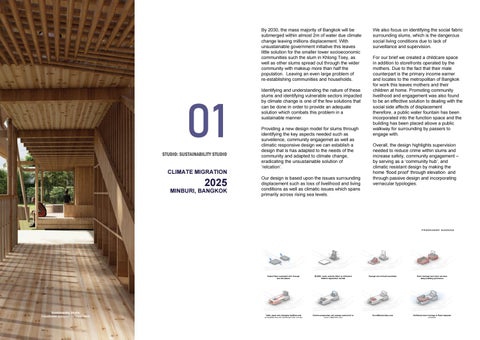
By 2030, the mass majority of Bangkok will be submerged within almost 2m of water due climate change leaving millions displacement. With unsustainable government initiative this leaves little solution for the smaller lower socioeconomic communities such the slum in Khlong Toey, as well as other slums spread out through the wider community with makeup more than half the population. Leaving an even large problem of re-establishing communities and households.
01 STUDIO: SUSTAINABILITY STUDIO
Identifying and understanding the nature of these slums and identifying vulnerable sectors impacted by climate change is one of the few solutions that can be done in order to provide an adequate solution which combats this problem in a sustainable manner. Providing a new design model for slums through identifying the key aspects needed such as surveilence, community engagemet as well as climatic responsive design we can establish a design that is has adapted to the needs of the community and adapted to climate change, eradicating the unsustainable solution of ‘relcation’.
CLIMATE MIGRATION
2025 MINBURI, BANGKOK
Our design is based upon the issues surrounding displacement such as loss of livelihood and living conditions as well as climatic issues which spans primarily across rising sea levels.
We also focus on identifying the social fabric surrounding slums, which is the dangerous social living conditions due to lack of surveillance and supervision. For our brief we created a childcare space in addition to storefronts operated by the mothers. Due to the fact that their male counterpart is the primary income earner and locates to the metropolitan of Bangkok for work this leaves mothers and their children at home. Promoting community livelihood and engagement was also found to be an effective solution to dealing with the social side affects of displacement therefore, a public water fountain has been incorporated into the function space and the building has been placed above a public walkway for surrounding by passers to engage with. Overall, the design highlights supervision needed to reduce crime within slums and increase safety, community engagement – by serving as a ‘community hub’, and climatic resistant design by making the home ‘flood proof’ through elevation and through passive design and incorporating vernacular typologies.
PROGRAMME MASSING
Sustainability Studio Visualization produced by Tricia Gillett
Raised floor expressed with through site circulation
30,000L water amenity block to withstand 350mm September rainfall
Storage and vertical circulation
Store frontage and water services along building perimeters
Toilet, basin and changing facilities only accessible through monitored stair access
Kitchen preparation and storage connected to water collection tank
Surveillanced play area
Additional store frontage in flood response scenario
RESPONSE TO BREIF
GROUND AND FIRST FLOOR PLAN
MIN BURI COMMUNITY GROUND AND FIRST FLOOR PLAN
N 0
2.5m
SHADOW STUDY SUMMER SOLSTICE 9AM
WINTER SOLSTICE 9AM
MATERIALS
0
SUMMER SOLSTICE 12PM
WINTER SOLSTICE 12PM
SUMMER SOLSTICE 3PM
WINTER SOLSTICE 3PM
S E C T I O N FA C I N G E A S T
S E C T I O N FA C I N G W E S T
C L I M AT E R E S P O N S E
1m
CLIMATE RESPONSE WIND CATCHMENT
PASSIVE VENTILATION
RAIN CATCHMENT SYSTEM
SHADING DEVICES
Sustainability Studio Visualization produced by Tricia Gillett
SITE CONTEXT
RESPONSE TO BREIF
MIN BURI COMMUNITY Adopting comfortability through familiarity in addition to allow informality to act as a filter, the structure allows by passers to fully integrate and interact with the architecture providing and fullfilling the needs of Min Buri’s most vunerable, mothers, children and surrounding village by-passers.
EAST ELEVATION
LONG SECTION BB
The program space consists of public water amenities, storefronts for the mothers, a childcare consisting of kitchen and storage, toilet and changing facilities, interative and play areas with additional spill out space.
Constructed with natural materials such as recylced timber and strips of bamboo for joinery as well as naturally woven shading cloth, the structure encompases a number of vernacular elements whilst also maintaining versitile and neccesary program space.
SOUTH ELEVATION
With the combination of all social considerations in combination with built techniques to guide the design, the design is able to develop into a functional and operative interactive form providing support to the commuities needs.
Following these simple but fundamental design principals to other community structures you are able to achieve and fullfill the same outcome of success in promoting community and support as well as combating climate change.
Sustainability Studio Visualization produced by Tricia Gillett
C L I M AT E M I G R AT I O N ,
2025 MIN
BURI,
BANGKOK
N ATA L I E , T R I C I A , A L I C E MARC4002
FA C T O R S I N F L U E N C I N G C L I M AT E M I G R AT I O N I N S O U T H E A S T A S I A
VE
R
S
10 million EN
15 million
Indonesia
Indonesia
20 million Timor Leste 0 100 200
400km
Lee, J. (2011). Climate Fiscal Framework in Thailand: Local government analysis, Bangkok: UNDP
opp ortu nities , consumption
RI
Singapore
FACTORS INFLUENCING CLIMATE MIGRATION
CD
Singapore
D E M O G R A P HI
5 million
h alt he s, stic teri arac Population ch
Brunei
Malaysia
DR
IC D R IV E R S
Thailand
POL ITIC AL
S ER IV
Cambodia
RS IVE DR L IA
OM
Thailand
in ly/k mi Fa , n tio ca
k, cost of moving, social n ewor etwo ram rks al f , t ech leg nd no la log ca y liti s po om ed s, Fre cle e, nc na er
Capacity building and technology
Em plo ym en t
Joint adaptation and mitigation
ON
Coastal Flooding
Vietnam
Int erv en ing Conflict, Inse ob curi st ty, a Po lic ies ,G ov
s ce ren efe r ,p ge
EC
Laos
Mitigation
SO C
Cyclones/Typhoons
Adaptation
Ed u
Riparian Flooding Myanmar
CLIMATE RESPONSE EXPENDITURES
ation, wealth, marital statu educ s, e ex, thn icit e, s g y, r A eli gio n, lan gu a
SOUTH EAST ASIAN MEGA CITY POPULATION DENSITIES AND MAJOR THREATS BY 2025
VIR
ONME
NTAL DR
IVE
RS
Exp ce osu elian re to hazard, ecosystem r
E N V I R O N M E N TA L C A U S E S F O R N AT I O N W I D E M I G R AT I O N W I T H I N T H A I L A N D
REGIONAL TEMPERATURE INCREASE FROM 1990
URBAN ANDURBAN RURALAND POVERTY COMPARISON RURAL Population (%
POVERTY COMPARISON
BUR M A
Urban
20
Rural
LAOS V IETNA M
15 10 15 10
2011
2012
2014
2013
2015
NATUREOF OFTHREATENED THREATENED NATURE RURALAGRICULTURE AGRICULTURE RURAL Tons
Rice
15
Rubber
Sugar CA M BODI A
10 15 10
2015
2016
2017
2018
2019
2020 VIETNAM
MIGRATION OF YOUNGER GENERATIONS Population (% Young of Families Rural Young adultsAdults of Rural Families
40
103K+ 250K+
29.4
25.6
10 10
POPULATION DENSITY
Families
37.6
20
29.0
30
Young Adults of Urban Young Adults of Urban Families
5M+
0
1995
2007
1995
2007
INDONESIA
MALAYSIA
50 100
200km
T H E C L I M AT I C S TAT U S OF BANGKOK
URBAN GROWTH PREDICTION
NONG CHOK POPULATION: 170,000+ AREA: 236.3KM²
1988
MIN BURI POPULATION: 140,000+ AREA: 62.64KM²
1993 1998 2003 2008
KHLONG TOEY
0
2011
POPULATION: 100,000+ AREA: 13KM² TO BE DISPLACED: 12,500
0
BANGKOK
5
10km
2035
2km
N 0
2km
THE EVOLUTION OF BUILDING TYPOLOGIES
Traditional Thai Housing
quality carpentry work with finite and durable materials
Elevated light weight construction is cooled from below
gentle roof slopes made in thatch in areas of less rain
dependent on local materials oriented towards bodies of water
prefabricated woven walls ideal for temporary living
Suburban housing and shopfronts
enclosed ground levels due to road proximity
Spill out shop activities that are shaded by fabric covers
open pontoons to sell and trade goods
two story shop or workplaces below
active neighbourhoods and communities
Informal settlements
quite dark with small openings to protect from harsh environments
unstable footings and constantly undergoing change
built over several generations from available and recycled materials
rusted corrugated iron roofing sheets
prone to floods with trash and waste management issues
I M PA C T S O N T H E C O M M U N I T Y O F K H LO N G T O E Y
Polluted floods
High rates of crime
Destruction due to fire
Mother and children productivity
Covid-19 impacts on high-density living
Poor waste management Extended Droughts
Government eviction notices Pressure on primary income earners
Unprecedented events and relationships that bring together displaced communities
P R O V I D E D S PA C E W I T H C O M P E N S AT I O N
KHLONG TOEY “SM ART COMMUNITY” PROJECT
Residents electing to receive compensation to move and build at designated location
30% C O M P E N S AT I O N Residents electing to receive compensation to move elsewhere
20% GOVERNMENT PROVIDED HOUSING Residents electing to move into new apartment precinct
50%
Neighbouring suburb, Soi Trimit where public facilities will be provided (1.2km away)
Compensation and land to rebuild in Min Buri (17.7km away) Compensation and land to rebuild in Nong Chok (34.2km away)
Compensation to relocate elsewhere; in many cases the amount received will not be efficient to remain in the city centre
K H LO N G T O E Y A N D M I N B U R I C O M PA R I S O N
R E LO C AT I O N
ZONE AND SITE CONDITIONS
78SQM PLOT
MIN BURI Self constructed household in a 78 sqm plot of land within a 0.07km² precinct in Min Buri
Orientation
Mobility
CONSTRUCTION AT OWN EXPENSE
1800-2000 RELOCATED RESIDENTS
500 HOUSING PLOTS, EACH 78SQM
Housing plots
External contributors Building Use
Shelter site
Informal and formal gathering
SUPPORTING VULNERABLE C O M M U N I T I E S I N R E LO C AT I O N
Supporting
Greater Accessibility and
Networks RELOCATIONMicro-economies CHALLENGES AND LIMITATIONS IN MIN BURI
Transport
The extensive business and factory district in Min Buri will not is not infrastructure provide equal job opportunities without required qualifications efficient enough in connecting Min buri to the city centre or Port Redevelopment Project.
The extensive business and factory district in Min Buri will not be able to provide equally attainable job opportunities without the required qualifications
Insecure rights to land and risk of eviction from public places are critical to the economical activity of vendors
Encouraging Neighbourhood Watch
Creating a sense of shared ownership Earnings for home-based stall
Transport infrastructure is not efficient enough to connect workers are relatively low Min Buri to the City Centre for job opportunities when paid by the piece
Limited technology and capital result in low productivity, limiting the growth of self-employed individuals
Insecure rights to land and risk of eviction from public places are critical to economic activity
Min Buri has a strong education network with 3 possible primary schools within walking distance
Min Buri has a strong education network with 3 possible primary schools within walking distance
Lack of sanitation practices still cause illness’ currently such as diarrhea, coughs, fevers and measles in young children
Percentage doing the behaviour
Washing hands before feeding
23%
Boiling feeding bottles
14%
Keeping food properly
71%
Proper garbage disposal
58%
Proper disposal of human waste
22%
Lack of sanitation practices still cause illness’ currently such as diarrhea, coughs, fevers and measles in young children
ARCHITECTURAL BRIEF
RESPONSE
AIMS
• Adapting to the impacts of climate change
• Maintaining previous micro-economies
• Merging a shopfront and childcare typology
• Prioritising 24hr surveillance and safety
• To support a self sustaining mother and child network
• Strengthening a sense of belonging
• Supporting well-being, liveability and productivity
• Providing access to childcare related needs
An adaptable public shelter design model accommodating for the social well-being and needs of vulnerable communities
BRIEF
• Rain water collection and reuse system for shelter occupants and the public • Storage units for kitchen tools, plastic stools, sewing kit, blankets, clothing, feeding bottles and others • 2 Basins for bathing and washing • Children’s change table • Kitchen area powered by biofuel • Indoor and outdoor market seating • 1 Toilet/Washing stall with bio-waste system • Interactive teaching and educational features • Separated stalls and serving spaces • Areas for easy pick up and takeaway scenarios • Opportunities for spill out activities • Local materiality and construction adapted
PROGRAMME MASSING
Raised floor expressed with through site circulation
30,000L water amenity block to withstand 350mm September rainfall
Storage and vertical circulation
Store frontage and water services along building perimeters
Toilet, basin and changing facilities only accessible through monitored stair access
Kitchen preparation and storage connected to water collection tank
Surveillanced play area
Additional store frontage in flood response scenario
GROUND AND FIRST FLOOR PLAN
N 0
2.5m
S O U T H E L E VAT I O N
0
1m
S E C T I O N FA C I N G E A S T
0
1m
S E C T I O N FA C I N G W E S T
C L I M AT E R E S P O N S E
WIND CATCHMENT
SUMMER SOLSTICE 9AM
PASSIVE VENTILATION
SUMMER SOLSTICE 12PM
SUMMER SOLSTICE 3PM
RAIN CATCHMENT SYSTEM
WINTER SOLSTICE 9AM
SHADING DEVICES
WINTER SOLSTICE 12PM
WINTER SOLSTICE 3PM
Cloth Shading Device
Wire securing
Bamboo structural membrane
Children’s play area Expressed upper floor
Storefront and public water amenities
W E S T E R N FA C A D E
W OV E N P L AY AR E A
V I E WS O FR UO TM H ETRHNE FN AO CR AT DH E