Hire Ground Issue 6 | Tribepad

Page 1


ISSUE SIX

tribepad.com

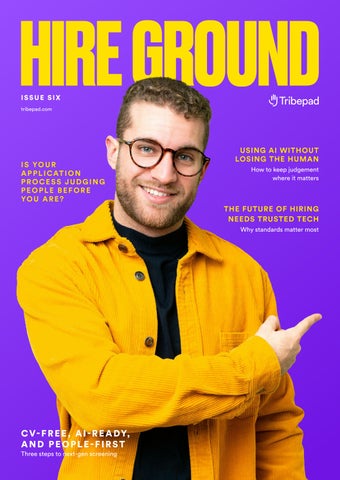
THE FUTURE OF HIRING NEEDS TRUSTED TECH Why standards matter most USING AI WITHOUT LOSING THE HUMAN How to keep judgement where it matters IS YOUR APPLICATION PROCESS JUDGING PEOPLE BEFORE YOU ARE?

CV-FREE, AI-READY, AND PEOPLE-FIRST Three steps to next-gen screening

Recruitment is changing, but not always in the ways people expect. A lot of the real progress isn’t loud or headline-grabbing. It’s happening quietly, in the detail: in how we design applications, how we use data responsibly, how we decide when technology should step in and when people should. That’s what this issue is really about.

Across these pages, you’ll see a consistent theme emerge. Whether it’s becoming a founding member of the Association of RecTech Providers, achieving B Corp certification, or challenging bias in AI-driven hiring, the question we keep coming back to is simple: are we building systems that genuinely work for people?

As a sector, we’ve never had more tools at our disposal. AI, automation, digital identity, video screening – they all promise speed and scale. But as several contributors explore here, progress only happens when those tools are used with care, transparency and accountability. Fair hiring isn’t something you bolt on afterwards. It has to be designed in from the start.

This issue brings together perspectives from across the hiring ecosystem: customers, partners, accessibility experts and our own team. You’ll find practical ideas you can apply immediately, from making application journeys more inclusive to using data in ways that build trust, not suspicion. You’ll also see how collaboration, not competition alone, is shaping the future of recruitment technology in the UK.

Tribepad was built on the belief that hiring can be better: fairer for candidates, simpler for recruiters, and more effective for employers. That belief still guides everything we do.

I hope this issue challenges your thinking, sparks a few new ideas, and reassures you that meaningful change doesn’t always need noise; just intent.

Tribepad

4

6

10

12

16

21

Shaping the future of recruitment technology

Tribepad becomes a founding member of the Association of RecTech Providers

Is your application process judging people before you are?

Me

Why becoming a B Corp matters to us at Tribepad

Transforming recruitment through collaboration

Malvern Hills & Wychavon Councils’ story

AI in recruitment: closing the perception gap for better hiring

The View: CV-free, AI-ready, and people-first: Three steps to next-gen screening

The View episode preview 22

Making your hiring strategy work smarter, not harder

Where tech helps, and where bias still sneaks in

Tribepad roars with pride for Sheffield Children’s Hospital

Help us turn up the roar!

Upcoming events calendar

the future of recruitment technology

Tribepad becomes a founding member of the Association of RecTech Providers

Tribepad is pleased to announce that it is a founding member of the Association of RecTech Providers (ARTP), a new industry body launched in September 2025 in the UK Parliament to help set standards for the future of recruitment technology.

ARTP has been established as the vehicle for collective action across the RecTech sector, with a clear mission: to create a roadmap for recruitment, influence hiring policy, and work in close partnership with the Better Hiring Institute (BHI) to showcase member organisations and best practice.

The launch of ARTP comes at a critical moment for employers. Talent acquisition leaders are increasingly bombarded with new technology solutions, from AI screening and digital identity to video interviewing and automated assessments, yet often lack clarity on which providers are credible, tested and aligned with responsible hiring principles. ARTP aims to address this challenge directly by helping to create trusted markets for recruitment technology.

Central to this ambition is the development of RecTech standards, designed both for technology providers and employers. These standards will enable organisations to assess providers more confidently, while encouraging the market to compete on quality, fairness and transparency rather than speed alone. The standards are being shaped by ARTP’s Standards Committee, which is open to all members, and will be formally launched in Parliament later this year.

“Britain should be leaders in hiring and that is the ambition for the first National Hiring Strategy… Recruitment technology is key to fixing this problem. I was delighted to launch the first trade association for “RecTech” in Parliament which has been launched to develop standards, influence policy, and set out a roadmap for a new way to hire. What we need is a trusted jobs market where people will trust the recruiting market place enough so that we can all move around much more in that context, in a world of short jumps.”

ARTP is also looking beyond today’s challenges to what hiring could look like in the future. This includes exploring how market mechanisms can influence behaviour, how recruitment processes can be digitised end to end, and how innovations such as digital wallets could one day allow candidates to apply for roles more quickly, securely and consistently.

Working with its growing membership, ARTP is building a practical blueprint for recruitment transformation. In November 2025, the association presented its early thinking to more than one hundred employers, marking an important milestone in shaping a shared vision for the sector. That momentum is continuing as ARTP expands its policy engagement, employer outreach and standards development.

For Tribepad, becoming a founding member reflects our long-standing commitment to fairer, more transparent and more effective hiring. As recruitment technology continues to evolve, collaboration across the sector is essential to ensure innovation genuinely benefits employers, candidates and hiring teams alike.

Read more about the initiative at www.betterhiringinstitute.co.uk/artp

Is your application process judging people before you are?

Ross Linnett is a digital accessibility advocate, Founder, and CEO of

Inspired by his personal experience of dyslexia, he founded the business to help organisations create more accessible websites and digital content through a range of accessibility solutions that support people with diverse needs.

Recite Me.

Most employers like to believe their hiring decisions are fair, objective, and based on merit. CVs are reviewed, interviews are structured, and unconscious bias training is rolled out with good intent.

And that’s all well and good, yet some of the best candidates may never even get the chance to apply. Why? Because they are judged by the application process itself, long before a recruiter ever lays eyes on their application.

Inaccessible application processes unintentionally filter out diverse talent. Today, I want to highlight how this happens, why it matters, and what you can do to create application experiences that assess ability, not accessibility.

The hidden gatekeeper: Your website

Your careers site and application portal often represent the first real interaction a candidate has with your organisation. In other words, candidates encounter your digital storefront long before they read your values statement or meet your hiring team.

Poorly designed platforms quietly exclude people with disabilities, neurodivergent traits, and varied access needs. When your website isn’t optimised for accessibility, their experience is telling them, often quite clearly, that they’re not welcome.

The most common barriers include:

• Job listings that can’t be read properly by screen readers.

• Application forms with unlabeled fields or confusing instructions.

• Mandatory time-limited tasks that disadvantage some candidates.

• Poor colour contrast, small text, and cluttered layouts.

• Overly complex application journeys with no save-and-return option.

Of course, none of these barriers reflect a lack of skill, motivation, or capability. They exist simply because the application process was never designed to support diverse ways of accessing and engaging with information.

The consequences of inaccessibility

Creating an inclusive candidate journey isn’t just about legal compliance. Although under legislation like the Equality Act, that’s absolutely a responsibility you should take seriously. Accessibility regulations are evolving globally, and organisations that ignore accessibility expose themselves to significant legal and reputational damage, often at a far higher cost than proactive improvement.

But there are real, measurable business consequences, too.

1. A narrowed talent pool

When qualified candidates abandon applications due to frustration or barriers, you lose access to skills, perspectives, and lived experiences that strengthen teams and improve decision-making.

2. Undermined DEI commitments

Candidates are increasingly savvy. If your public messaging champions inclusion but your application process tells a different story, trust can erode quickly.

3. A damaged employer brand

Poor experiences travel fast through reviews, social media, and word-ofmouth. Complex and exclusionary processes don’t just deter individual applicants. They shape perceptions across entire communities.

What makes an application process inclusive?

First and foremost, it isn’t about lowering standards or offering special treatment. It’s about removing unnecessary barriers so candidates are assessed on what actually matters: their ability to do the job.

Truly inclusive candidate journeys share the following key characteristics:

• Clear and simple messaging that minimises cognitive load.

• Flexible ways to engage that recognise different communication preferences and working styles.

• Accessible designs that are compatible with assistive technologies.

• Transparent information that lets candidates know what to expect and how they’ll be assessed.

It’s essential to note that enhanced inclusivity benefits everyone. A process that works well for diverse candidates is typically faster, clearer, and more user-friendly for all applicants.

Steps to improve your application process

It’s a common misconception that improving accessibility requires a complete rebuild, but that’s generally not the case. Small, structured changes can have a significant impact.

Here are a few practical, simple steps you can take to get started:

1. Check the accessibility of your website

Run a free accessibility check of your homepage to uncover accessibility barriers.

2. Review forms and assessments

Remove unnecessary fields, clearly label inputs, and evaluate whether timed tasks are essential or simply habitual.

3. Simplify language and instructions

Use plain, direct language and break steps into manageable sections.

4. Offer flexibility

Make it clear that adjustments are available and explain how candidates can request them without needing to disclose more than they’re comfortable with.

5. Test with diverse users

Involve people with different access needs. Their feedback will surface issues that internal teams often miss.

6. Treat accessibility as an ongoing commitment

As roles, platforms, and technologies change, accessibility requires regular reviews, not a one-off fix.

The bottom line: If they can’t apply, they can’t be hired

The key takeaway here is that you can’t claim to hire inclusively if your application process excludes people. And inclusion doesn’t start in an interview room. It begins the moment a potential candidate lands on your website or clicks “Apply now.”

The real question isn’t whether your hiring team is fair. It’s whether your systems are giving everyone a fair chance to be seen. Remember: the best candidates aren’t always the ones who find your process easiest. They’re often the ones who never got the chance to apply at all.

When application processes are accessible and inclusive by design, you don’t just reduce risk. You’ll build stronger talent pipelines, protect your reputation as an employer of choice, and make better hiring decisions all around.

Why becoming a B Corp

to us at Tribepad

This summer, we celebrated something that means a great deal to us at Tribepad: achieving full B Corp certification. For me, as someone responsible for people and culture here, this represents so much more than a certificate. It’s a public recognition of the values we’ve lived by since 2008 – that technology should serve people, not the other way around, and that business can, and should, be a force for good.

What B Corp recognition means

B Corp certification isn’t handed out lightly. It’s awarded by B Lab, the global non-profit that measures businesses against rigorous standards of social and environmental performance, transparency and accountability.

To qualify, companies must score at least 80 points on the B Impact assessment. The average business scores 50.9.

90.6

We were thrilled to achieve reflecting the passion our people bring to making everything we do more purposeful.

Becoming a B Corp puts us among a small but growing group of UK software companies that have proven they operate responsibly, prioritise people and the planet, and measure success by more than just revenue.

Living our values, not just talking about them

The accreditation process provided an opportunity to reflect on how deeply fairness is baked into Tribepad’s DNA. We’ve always said we exist to make hiring better for everyone – faster for employers, fairer for candidates, and more efficient for recruiters.

Our team has built our platform to actively remove barriers in hiring and reduce bias. From anonymous applications and fairer assessments to inclusive job design and campaigns like Stop the Bias, we’ve consistently championed a more level playing field in recruitment. And this goes beyond the software – it’s how we treat our people, how we listen to customers, and how we contribute to our local community here in Sheffield and beyond.

Responsible innovation in HR tech

As the HR technology landscape evolves, particularly with AI, there’s both excitement and responsibility in equal measure. We’re investing heavily in developing AI-driven tools, but with a simple guiding principle: transparency and fairness first. Decisions we make affect real people’s lives – and we believe technology needs human-centred design and ethical safeguards built in, not bolted on afterwards.

Why this matters

For the organisations we work with – from Tesco and Greggs to the NHS and Compass Group – our B Corp status is reassurance that your partners care just as much about the how as the what.

Yes, we help you fill vacancies faster and improve candidate experience. But we’re equally focused on building a recruitment ecosystem that supports overlooked talent, encourages diversity, and operates sustainably.

When you choose Tribepad, you’re choosing a technology partner that’s committed to doing things the right way.

Looking ahead

B Corp certification is a journey of continuous improvement. The new framework will challenge us to keep asking tough questions about our governance, our employee experience, our environmental footprint, and the social outcomes of our work.

Being a B Corp provides an external stamp of approval, one of trust and transparency – and personally, I’m so grateful to work with the brilliant Tribepad team whose every action earned it.

Malvern Hills & Wychavon Councils

Transforming recruitment through collaboration

Malvern Hills and Wychavon District Councils, serving a combined population of 200,000, share a Chief Executive and several services, including HR and recruitment managing around 140 hires annually. Despite the team’s dedication, outdated processes created significant challenges:

arrow-right Manual, time-consuming workflows

arrow-right Overwhelming paperwork and email chains

arrow-right Inconsistent candidate experiences

arrow-right Difficulty filtering high volumes of CVs

For years, the councils, like many others, used a well-established ATS through their membership in the WMTalent Acquisition shared service, which unites 16 public sector organisations. While the system had served its purpose in the past, changing recruitment needs and rising candidate expectations provided an opportunity to review the technology landscape.

Recognising the need to modernise, West Midlands Employers (WME) led a collaborative review of the recruitment technology market in 2023/24. After an extensive procurement process, Tribepad was selected as the new strategic ATS partner. Its public sector expertise, user-friendly technology, and proactive support made it the ideal solution to meet the evolving needs of WMTalent Acquisition subscribers.

In

just six months, WMTalent Acquisition onboarded 14 organisations onto Tribepad’s platform.

Malvern Hills and Wychavon were among the first to implement the system, completing their transition in just 10 weeks. This marked a significant shift for the councils, as they delivered a successful implementation of Tribepad’s platform which is helping to streamline recruitment, reduce inefficiencies, and enhance the candidate journey.

WMTalent Acquisition: Elevating recruitment for better outcomes

Previously, recruitment at Malvern Hills and Wychavon Councils was fragmented. Applications came from multiple sources, creating inconsistency for candidates and inefficiencies for hiring managers. Onboarding and decision-making often took place outside of a centralised system.

Recognising the opportunity for more than just a new system, Malvern Hills and Wychavon Councils via the WMTalent Acquisition service focused on creating a streamlined approach that connected people, processes, and technology. By embedding Tribepad at the core of recruitment and managing it as a shared service, the team transformed hiring into a structured, efficient, and collaborative process.

Key improvements delivered:

1. Empowering hiring managers:

WMTalent Acquisition worked closely with managers, providing training and tools to simplify tasks and ensure confident, fair hiring decisions.

2. Streamlined candidate experience:

Centralising applications created a consistent, professional journey, enhancing the councils’ reputation as employers of choice.

3. Greater visibility and control:

With all recruitment activities housed in one system, HR gained oversight, enabling strategic management of recruitment while reducing manual workload.

The impact on time to hire has been significant. Managers now spend less time sifting through unsuitable CVs, candidates enjoy a better experience, and the quality of hires has soared. WMTalent Acquisition’s collaborative approach has proven that great recruitment isn’t just about filling roles - it’s about building a future workforce with purpose and precision.

The Tribepad advantage

Tribepad’s user-friendly system revolutionised the councils’ recruitment process, offering:

arrow-right A responsive, mobile-friendly interface

arrow-right Automated updates to keep candidates informed

arrow-right A seamless, branded journey from application to onboarding

From April to September 2024, 77% of over 900 applications were completed, significantly improving engagement and ensuring candidates felt valued throughout the process.

Through the shared service model powered by WMTalent Acquisition, Malvern Hills and Wychavon DC’s digitised and automated much of the process, giving managers self service tools that drastically reduced administrative time.

Our previous system simply wasn’t effective - candidates were slipping through the cracks. Now, the experience has transformed. From application submission to the hiring decision, candidates stay engaged every step of the way. If successful, the process flows seamlessly from interview to onboarding. The difference in the candidate experience is remarkable.”

Jill Moore, HR Systems and Recruitment Manager, Malvern Hills & Wychavon District Councils

Key achievements

arrow-right Reduced time to offer by 75%: From 16 weeks to just 22 days, streamlining the hiring process dramatically.

arrow-right Consistent pipeline of top talent: Ensuring high - quality candidates, even for the most challenging roles.

arrow-right Accelerated hiring capability: Enabled hiring decisions to be made within a single day.

This collaboration demonstrates how shared services, empowered by Tribepad’s platform, can deliver efficiency, enhance the candidate experience, and ensure better outcomes for both hiring teams and candidates.

We’re not doing all that manual work now. Tribepad has saved us a huge amount of time. Everything is so much easier than before.”

Peter Davies, Recruitment Advisor, Malvern Hills & Wychavon District Councils

Real results for the Councils

The transformation has been significant. From April to September 2024, Malvern Hills and Wychavon saw:

arrow-right 75% reduction in time to offer

arrow-right A standout achievement: filling five Civil Enforcement Officer roles quickly, a feat previously thought to be challenging.

There’s been a huge increase in application quality. We’re getting the people now who actually want the job and are willing to invest some effort.

It’s hard to shortlist sometimes because the applications are so good! It’s very unusual now that interviews aren’t successful. We often have managers saying they interviewed three people and would hire all three if they could. Whereas, we wouldn’t even have been getting the applications from those people.”

Jill Moore, HR Systems and Recruitment Manager, Malvern Hills & Wychavon District Councils

Delivering success through collaboration

WMTalent Acquisition’s support played a crucial role in this success. By choosing Tribepad as their strategic ATS partner, the councils received a solution that met their needs while ensuring seamless service delivery. This transformation shows how collaboration and modern technology can streamline recruitment, improving outcomes for both organisations and candidates.

Be part of something bigger - join the WMTribe today!?

Are you a public sector organisation in the West Midlands? The WM Talent Acquisition Service offers a collaborative, shared approach to attracting and hiring top-quality talent.

If you’d like to learn more about how our service can support your recruitment needs, contact us at wmtribe@wmemployers.org.uk

AI in Recruitment: Closing the Perception Gap for Better Hiring

Artificial Intelligence is dramatically reshaping recruitment; a transformation that is both promising and, for many, deeply unsettling. Recent research conducted on behalf of Tribepad by Obsurvant, involving over 1,000 UK adults, uncovers the nuanced hopes, fears, and experiences driving candidate attitudes toward AI in hiring. For HR leaders, these insights are essential for navigating change, fostering trust, and ensuring the technology delivers on its potential.

Cautious scepticism around hiring decisions

The journey starts with the data: When asked what influences recruiters’ decisions, candidates point most frequently to previous work experience (43%) and skillset (23%), but 14% believe personal preference, not merit, has been a deciding factor. This sentiment climbs to 20% among 25–44-yearolds, signalling that perceptions of bias persist at a formative career stage.

Mistrust also runs through ideas of “cultural fit”: 61% overall, and 70% of 25–44s, suspect employers wield this phrase as an excuse to make unfair choices. Men are somewhat more likely to feel this way (65% vs 59% for women), but the suspicion runs deep across all demographics.

Confidence and trust: Interviewers vs AI

Only 6% of candidates are “very confident” in interviewers’ ability to fairly assess applicants, while 41% are “somewhat confident.” In contrast, 44% are explicitly “not confident.” Age and region matter: 63% of under-35s profess confidence, but this plummets to 36% for ages 55–64 and just 30% for those over 65. Londoners are most likely to trust their interviewers (59%), while just 24% in Northern Ireland, and 39% in Wales, agree—an important reminder that perception varies as much by postcode as by birthdate.

But what happens when machines enter the picture? A significant 80% trust human recruiters to make fair hiring decisions, yet 65% don’t trust AI with the same responsibility. Interestingly, 36% simultaneously say they don’t trust humans either; a contradiction that should give HR pause. There are bright spots for AI: 44% of 25–34 year olds trust AI in recruitment, far higher than the 28% average across all ages. Men are slightly more positive than women (41% vs 36%). And the regional gap is huge: trust in AI surges to 53% in London but slumps to 23% in the South West. Overall, just 14% of people would feel more confident with AI involvement—but among the under-35s, this rises to 24%. Still, these are modest figures that reinforce how many candidates find the prospect of robotic hiring partners unnerving.

The roots of skepticism (and optimism)

Dig deeper and the reasons for both anxiety and hope come into focus.

Candidates who support AI in talent acquisition highlight its objectivity: the perceived ability to judge candidates based on “skills and experience”, immune to charm, appearance, or unconscious bias. AI is also credited with being faster, more consistent, and less prone to gut-feeling errors or distractions; a sometimes-overlooked efficiency benefit when hundreds of CVs need review.

But sceptics see the loss of human connection as a core drawback. For many, rapport-building, team fit, and subtle “grey areas” simply can’t emerge from data points alone. AI, they worry, is too blunt for a nuanced process. There’s also fear of savvy applicants gaming the system, tweaking their answers for perceived algorithmic preferences. For a vocal minority, replacing humans with machines in such a personal process signals a culture more focused on efficiency than humanity, even raising fears of broader job displacement.

Where AI fits best

Despite reticence, most candidates see a logical role for AI early in recruitment: screening CVs, filtering for required credentials, and shortlisting. Here, speed and consistency are advantages, and objectivity may increase perceived fairness. But when it comes to final interviews, team dynamics, and hiring decisions, most believe human judgement remains indispensable.

Advice for HR: Strategies to build trust and balance

Given these complex attitudes, what should HR leaders do?

01.

Transparency—from start to finish

State clearly where, how, and why AI is used in the process. For example, “AI helps us filter applications for essential criteria; every final interview and hiring decision is made by humans.”

Demystification builds comfort.

03.

Commit to fairness and oversight

Explain your approach to monitoring both human and AI bias. Let candidates know your technology is regularly audited and that their feedback is welcome and acted upon.

02.

Highlight the human element

Emphasise that technology aids, but does not replace, skilled recruiters’ judgement, especially in interviews and offer stages. Touchpoints with real people are vital to alleviate candidate anxieties.

04.

Enable empathic interactions

Reinforce opportunities for reciprocal communication—a prescreening call, personalised feedback, or informal meet-theteam sessions—across the process.

05.

Tackle mistrust head-on

Recognise candidates’ fears of being “replaced” or misjudged.

Communicate the value of AI as a tool to improve efficiency and fairness, not to sideline humanity or personal connections.

06.

Tailor your approach across demographics

Younger talent and urban candidates are more open to AI; older workers and regional populations tend to be more sceptical. Segment communication and candidate experience strategies accordingly.

Conclusion: Human + AI = The future of fairer hiring

This research underscores a truth for 2025: candidates want both fairness and human understanding. They crave objectivity but do not want processes to lose their warmth. By openly addressing prejudices, against both people and technologies, talent teams can build a recruitment journey that is rigorous, empathetic, and trusted.

Organisations that succeed in the AI era won’t be those who automate away the personal, but those who use digital tools to further empower their people, applying technological precision and the human touch, in harmony, for truly better hiring.

CV-free, AI-ready, and people-first: Three steps to next-gen screening

Episode Preview

The View, Ep. 12 with Andrew “Woody” Wood, previously Chief Customer Officer at Willo

The way we hire is shifting fast. Old methods, like relying on CVs, no longer cut it in a world reshaped by AI, shifting candidate expectations, and the pressure for more inclusive recruitment. As Andrew “Woody” Wood, shared on The View, in his previous role as Chief Customer Officer at Willo, the future of screening has three clear directions: CV-free, AI-ready, and people-first.

CV-free: moving beyond resumes

CVs have long been flawed. As Woody highlights, most candidates exaggerate or downplay aspects of their experience, and self-assessment is often unreliable. Beyond accuracy, CVs also drive bias. Recruiters often make decisions based on irrelevant details – like education background or career gaps – rather than true potential.

What’s more, CVs now fuel a race to the bottom in an AI world. Candidates can effortlessly generate job-tailored CVs using AI tools, which in turn forces recruiters to lean on AI to sift through them. “AI ends up assessing AI,” says Woody. Instead, businesses need richer, fairer ways to evaluate talent.

AI-ready: tech that adds value

AI has incredible potential to transform recruitment. Willo’s Hiring Trends report finds 40% of employers

already use AI in hiring – but over half expect to change their tool. This points to a central truth: you can’t just layer AI over broken processes. To get value, recruiters must first refine their hiring approach, then adopt AI tools that truly support their goals – not just the latest hype.

People-first: tech as an enabler

Recruitment is still, at its core, about people. Automation and smart tools should be used to give recruiters more time to build human connections, which is where they make the biggest impact – on candidates, hiring managers, and employer brand.

One way forward is video screening, giving managers deeper candidate insights without the admin burden. Tools like Tribepad Video Screening slash time-to-hire, build inclusivity, and make moving beyond CVs more realistic.

As Woody notes, hiring managers may cling to CVs as a “comfort blanket”, but recruiters are the experts. Now is the time to lead that shift. In a changing world of work, CV-free, AI-ready, people-first hiring isn’t an optional upgrade – it’s the future.

Making your hiring strategy work smarter, not harder

WHERE TECH HELPS, AND WHERE BIAS STILL SNEAKS IN

Metra is founder of Starling Business Solutions, a specialist inclusive culture change and development consultancy, whose purpose is to enable working communities to be places where people can thrive and achieve success.

If there is one message I want talent acquisition leaders to take from our second DEI webinar, it is this: technology can absolutely help us build fairer hiring processes, but only when it is designed and used with intent. Automation can reduce friction, improve consistency and widen access. It can also create new barriers, introduce fresh risks, and quietly reinforce old patterns if we stop thinking critically.

This session brought together three brilliant practitioners who sit at different points of the hiring ecosystem: Joy Drury, Global DEI Manager at Lloyd’s Register; Sarah Ellis Jones, Senior Recruiter at JKR Global; and Chris Holay, Head of Accessibility at Recite Me. What emerged was a nuanced, practical conversation about anonymous hiring, accessibility, trust, and the role of data in making inclusion real.

Anonymous recruitment: what candidates want, and what it can cost you

We opened with a data point from Tribepad’s Stop the Bias report: most candidates believe anonymous recruitment would make hiring fairer, and that preference is strongest among 18 to 24-year-olds. In other words, many candidates are actively looking for signals that the process is safe and unbiased.

But anonymous processes also come with trade-offs, especially if they remove the very thing that helps candidates commit: human connection.

Sarah shared an experience from agency recruitment where anonymised hiring led to significant candidate drop-off between stages. The reason was simple: candidates could not engage with the brand, understand the culture, or see how the role might move their career forward. If the process feels faceless, the best candidates often opt out.

The takeaway is not “do not anonymise.” It is “do not anonymise and disengage.” Fairness and connection must coexist.

Where tech genuinely reduces bias: bolt-ons, not autopilot

Joy shared a practical example of technology being used well: inclusive language tooling. At Lloyd’s Register, an AI-based inclusive language tool is being implemented as a bolt-on to existing processes. Hiring managers and teams still write the job description, but the tool flags biased or exclusionary language, suggests alternatives, and provides a score so teams can see improvement over time.

Two things mattered here. First, it is a learning tool, not a replacement for human accountability. Hiring managers see their own assumptions reflected back, often in ways they did not expect. Second, it scales. When teams ask “what is the right language to use?”, the tool provides support without making inclusion dependent on a single DEI person’s availability. That matters in a world where language evolves, and everyone needs to keep up.

This “bolt-on approach” came up repeatedly: tech works best when it strengthens the process, rather than pretending to be the process.

Where bias creeps in: nuance, emotion, and over-reliance on automation

Chris offered a powerful reminder that automation can erase potential. He shared that he applied for a different role than the one he ultimately got, and it was conversation and human judgement that surfaced the right match. A purely automated screening process might have filtered him out before anyone understood what he could bring.

That is not a rare story. It is exactly how bias sneaks in: not always through intentional discrimination, but through rigid rules and pattern-matching that cannot recognise non-linear careers, transferable skills, or “high potential” candidates.

Sarah also raised a sector-specific risk: in the creative industries, AI is often not sophisticated enough to understand nuance in skill sets between different agencies and business models. Over-relying on automation can push recruiters back into familiar, pre-defined talent pools, feeding from “the same pool as everybody else” rather than widening access.

There is also the human element that AI still cannot capture well: emotional investment, motivation, and the energy someone brings when they talk about their work. Those are signals that matter in hiring, and they require conversation, not just data.

Fair-by-design interviews: accessibility is not an add-on

If there was one section of the discussion that every TA leader should turn into a checklist, it was Chris’s guidance on making video interviewing accessible.

He started with a simple point: accessibility begins before the interview starts. If you send a link, make it descriptive. People using screen readers, or those who feel anxious navigating platforms, need to know what they are clicking.

From there, he outlined practical changes that can transform the experience:

Reduce on-screen distractions (including reaction and “emoji” features)

Ensure closed captions are available and usable

Enable easy participation of interpreters or support workers (such as BSL interpreters)

Encourage clear audio (a headset can improve caption accuracy significantly)

Use Q&A functions where possible, rather than fastmoving chat stream

Do not default to camera-on as a requirement, because it does not work for everyone

Joy added an important operational point: hiring managers need support to ask about reasonable adjustments properly and early, with clear structure and language. “It’s voluntary” is not enough if the process does not feel safe.

The trust issue: data, disclosure, and transparency across borders

Across all perspectives, trust was the thread running through everything. Trust in how data is collected, stored, and used. Trust in whether disclosure will harm opportunity. Trust in whether candidates can control their information.

Chris shared a particularly concerning example: a candidate profile appearing across different organisations using the same recruitment tool, including sensitive disclosure information. Even if rare, it highlights why transparency and data governance are not compliance exercises, but inclusion essentials.

Joy also spoke about global complexity: Lloyd’s Register recruits across 71 countries, and even when data questions are legally permissible, they may not be culturally normal. Questions intended to support inclusion can be perceived as intrusive, creating new barriers if trust is not established.

What leaders need to see: dashboards that drive action, not vanity metrics

Finally, we discussed reporting. Data is how we prove inclusion is real, and how we spot bias early. Leaders want dashboards that show business impact, not just activity.

Sarah described the need to understand where the organisation is now, where it is trying to get to, and what external factors might be influencing progress. Joy emphasised that we should only collect data we will act on. Chris highlighted reputation, retention, and internal progression as meaningful measures of whether inclusion is working.

Perhaps the most important line of the session was this: lack of data is data. If people will not disclose, if they drop out, if certain groups stall at the same stage, the process is telling you something. The job is to listen, then redesign.

The bottom line

AI and technology can make hiring fairer, faster, and more inclusive. But they are not neutral, and they are not enough.

The strongest model we heard was balance: automate the heavy lifting, use bolt-ons to improve consistency and language, widen access through flexible formats, and keep human judgement where it matters most.

Work smarter, not harder, by using tech to strengthen your strategy, not to outsource your thinking.

Tribepad Roars with Pride for Sheffield Children’s Hospital

Tribepad is thrilled to be sponsoring a lioness in the Pride of Yorkshire, a spectacular public art trail taking place across Sheffield, Barnsley, Rotherham, and Doncaster during the summer of 2026.

Organised by Sheffield Children’s Hospital Charity to mark its 150th anniversary, the trail will feature 150 life-sized lion and lioness sculptures and 150 lion cubs, all uniquely decorated by artists, schools, and community groups.

The initiative not only celebrates a remarkable milestone in local healthcare but also aims to raise £2.8 million to fund lifesaving research, cutting-edge equipment, and therapeutic activities for children and young people.

For Tribepad, this is about more than brand visibility. It’s an opportunity to back a local charity that has been

changing lives for 150 years. The lion is a fitting symbol; brave, collaborative, and proud; values that reflect both Sheffield Children’s and Tribepad’s own culture.

The sculpture sponsored by Tribepad will take its place among 149 others on display across the region.

Families will follow the trail, explore the designs, and at the end gather for a farewell event where the lions will be auctioned to raise even more toward the fundraising target.

By joining the Pride of Yorkshire, we are helping bring an unforgettable community celebration to life while supporting a cause that matters to so many. Let’s support a cause that matters to so many and ensure Sheffield Children’s continues to roar with pride well into the future.

Dates for your diary

PPMA ANNUAL CONFERENCE 2026

Thursday 23rd - Friday 24th April

Birmingham Metropole Hilton

This conference is designed for HR, OD, and People Managers in the public sector, providing practical insights, innovative ideas, and opportunities to connect with peers across the sector.

HR TECHNOLOGIES 2026

Wednesday 29th April - Thursday 30th April

Excel London

Bringing senior HR and talent professionals together for two days of insight and innovation. This is your chance to meet leading tech providers, hear from top experts and explore cutting-edge solutions.

CARE SHOW LONDON EXHIBITION

Wednesday 29th April - Thursday 30th April

Navigate the future of care with confidence. Hear the latest insights and guidance from leading experts. Discover practical solutions you can implement right away. Connect and collaborate with thousands of care professionals.

RECFEST 2026

Thursday 2nd July 2026

Knebworth Park

The UK’s largest Talent Acquisition event - perfect for TA professionals and Resourcing Leaders.

IHR MANCHESTER LIVE 2026

Thursday 14th May

Victoria Warehouse, Manchester Manchester’s leading event for in-house recruiters to connect, learn and grow.

IHR LONDON LIVE 2026

Tuesday 22nd September 2026

Business Design Centre, London

The ultimate one day exhibition for in-house recruiters and TA professionals, #LiveLDN26 is where the brightest minds and boldest ideas in talent come together to experience the future of hiring.

Turn static files into dynamic content formats.

Create a flipbook
Hire Ground Issue 6 | Tribepad by Tribepad - Issuu