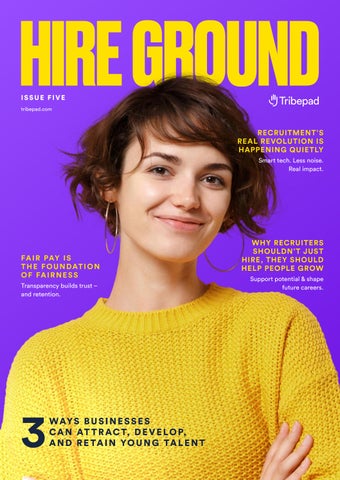
Hire Ground - Issue 5

Page 1


FAIR PAY IS THE FOUNDATION OF FAIRNESS

Transparency builds trust –and retention.

WAYS BUSINESSES CAN ATTRACT, DEVELOP, AND RETAIN YOUNG TALENT

RECRUITMENT’S REAL REVOLUTION IS HAPPENING QUIETLY

Smart tech. Less noise. Real impact.

WHY RECRUITERS SHOULDN’T JUST HIRE, THEY SHOULD HELP PEOPLE GROW Support potential & shape future careers.

There’s something about Sheffield. It’s a place that doesn’t let you get ahead of yourself. Straighttalking. Solid. Full of good people doing proper work. It’s where Tribepad was born, and it’s still home – even as we grow into new places.

I’ve been with Tribepad eight years now, and stepping into the CEO role feels big. Not just for me, but because this is a business that matters. We’re not building flashy tech for the sake of it. We’re building tools that help people find jobs. Real jobs, in care homes, councils, hospitals, kitchens. Work that keeps the country running.

This magazine is a little window into what we’re about. You’ll find ideas on how to write more inclusive job ads. How to spot bias before it creeps in. Why tech can help – but only when it’s used properly. You’ll read about councils cutting time to hire in half, and care providers finding the people they need after years of struggling.

There’s also a bit about what’s next. We’re planning to grow – carefully, thoughtfully – with more customer focus, more product innovation, and more brilliant people joining us in Sheffield and beyond. But the heart of it stays the same. We want to help people hire better. Fairer. Faster. That’s it.

So have a read. See what speaks to you. Take an idea or two. And if it gets you thinking about how things could be done differently – better – then I reckon it’s done its job.

Recruitment’s real revolution is happening quietly

AI that works for people, not headlines.

Fair pay is the foundation of fairness

Why pay transparency is non-negotiable now.

Ways businesses can attract, develop, and retain young talent by Ed Heaver, CEO, Serve Legal

Hiring ahead of the curve: time for a mindset shift in professional services by Christine Robinson, Strategic Adviser to Dayshape

5 reasons to use video in recruitment By Andrew Wood, Chief Customer Officer of Willo

Why recruitment’s real opportunity is right now by Matt Burney, Senior Strategic Advisor, Indeed

Deter, detect, or redesign?

How should recruiters respond to the AI-enabled candidate?

How Tribepad helped Milton Keynes City Council put the joy back into recruitment

Transforming recruitment with tech that actually helps.

The DEI barometer

Who’s backing inclusion – and who’s backing off.

Brits back bigger DEI push despite US government policy to pull back

Our research shows people still want fairness.

A few things we’re proud of recently.

watch out for.

Recruitment’s real revolution is happening quietly

While noisy AI launches dominate headlines, the real transformation in recruitment is happening in quieter, more considered corners of the market.

Not with gimmicks. Not with flashy rebrands. But with smart, deeply integrated innovation that supports the actual journeys recruiters and candidates go through.

That’s what Tribepad is doing.

Rather than rushing to plug in a third-party chatbot and call it innovation, Tribepad has taken a different route. We’ve spent time mapping the entire recruitment journey, and only then started adding AI –not as a shiny extra, but as a purposeful part of the process. The result? A seamless, scalable and ethical platform upgrade that gives hiring teams what they really need: better tools to make confident decisions.

This isn’t a single feature. It’s a full reimagining of the hiring process, using AI in thoughtful, targeted ways.

Sidekick features include:

Salary suggestions based on real-time data for role type and location

Job description generations that are generated and editable, with one-click regeneration if you want a new version

Skills suggestions drawn from the role spec, with the ability to prioritise each one, giving clear weighting for later stages like interviews

Candidate scoring across experience, education, skills and application quality

Interview questions tailored to fill in the gaps, either for recruiters or candidates to answer

Clear AI feedback on each applicant, showing strengths and potential weaknesses

The system will get sharper over time, refining suggestions and matching based on behaviour across your organisation. So while the first few outputs might need a sense-check, it’s built to grow with you.

And while you’ll see AI scores in the system, they’re never used to make final decisions. The recruiter stays in charge. Tribepad’s AI is a co-pilot, not a gatekeeper. You get transparency, not mystery. Support, not shortcuts.

This is a major investment – the biggest in Tribepad’s history. But it’s been done with care. And it shows. Unlike other platforms that bolt AI onto the edges, our new AI tools are woven into the application and screening process right through to interview.

We’re currently running a real-world test with a group of large customers – comparing Tribepad’s AI recommendations against actual past hires to check for fairness, relevance and accuracy.

So yes, there’s a lot of noise about AI. But the real work? It’s happening behind the scenes. With purpose. With ethics. With impact.

And it’s coming this autumn.

Let’s talk about one of the thorniest issues in recruitment: pay.

Pay disparities have been a persistent problem for decades, and they’re a major obstacle to achieving diversity, equity and inclusion (DEI) in the workplace. Whether it’s the gender pay gap, wage inequities for ethnic minorities, or the motherhood penalty, these issues undermine trust and perpetuate inequality.

The numbers paint a stark picture. In the UK, the gender pay gap still stands at 14.9%, effectively meaning that women work for free for two months of the year. The gender pay gap widens with age, progressing throughout a woman’s career and as family responsibilities increase. When women first enter the labour market, the gap is relatively small, but it grows over time. With less income to save and invest, these disparities compound, leaving women at greater risk of poverty and social exclusion in later life.

In 2020, the gender pension gap in the EU exceeded arrow-up-right-from-square

28%

Ethnic minorities often earn less than their white counterparts for the same roles, and candidates with disabilities face a significant wage gap, even when they meet or exceed the qualifications of their peers.

The ONS reports that in the UK in 2022, Black, African, Caribbean, or Black British employees earned a lower median hourly pay (£13.53) than White employees (£14.35), a trend seen since 2012. Country of birth mattered: UK-born Black employees earned more (£15.18), while non-UK-born earned less (£12.95) compared to UK-born White employees (£14.26).

While the UK lacks dedicated pay transparency laws, there are various measures and guidelines in place:

Equal pay: Under the Equality Act 2010, employers must ensure men and women receive equal pay for the same or equivalent work, prohibiting pay discrimination.

Gender pay gap reporting: Employers with over 250 staff are required to publish their gender pay gap figures annually, including mean and median pay gaps and bonus distribution. This data is publicly accessible via the Gender Pay Gap Service website.

Executive pay: UK-listed companies must report on executive pay as part of their transparency obligations.

Transparency pilot: In 2022, the government trialled a scheme where participating employers included salary details in job adverts to promote openness. They axed it - something we think is a backwards step.

Pay secrecy: The Equality Act 2010 prevents employers from enforcing pay secrecy clauses in contracts, supporting open discussions about wages.

Pay information requests: Employees can request pay data for a comparator if they suspect pay inequality, though employers are not legally obliged to share it.

But pay disparities aren’t just bad for employees - they’re bad for business. Companies that fail to address pay equity are less likely to attract top talent, particularly as candidates increasingly look for organisations that align with their values. Transparency and fairness in pay practices build trust, attract top talent, and retain employees.

“Pay transparency and fairness aren’t just buzzwords - they’re essentials for building trust with candidates and creating workplaces where everyone can thrive.

The decision to halt the pilot is profoundly disappointing. It signals a retreat from a proactive stance on gender pay equity at a time when such measures are critically needed.

The pilot represented a tangible step towards addressing systemic pay disparities that disadvantage women. By requiring salary details to be transparent in job adverts and eliminating the practice of basing salary offers on previous pay, the pilot could have set a new standard for fair pay practices across the UK.”

The evidence: why pay equity matters

Addressing pay inequities isn’t just the right thing to do - it’s smart business. Here’s what the research tells us:

Pay transparency attracts talent: Companies that publish salary ranges in job advertisements see a higher volume of applications from diverse candidates. It’s a simple step that immediately signals fairness.

Candidates are increasingly seeking employers who are transparent about pay.

According to Glassdoor arrow-up-right-from-square

75%

of job seekers are more likely to apply for roles that include a salary range in the job advert

Audits uncover hidden gaps: Regular pay audits help organisations identify and address inequities before they escalate. Yet, only a small percentage of companies conduct these audits consistently.

Fair pay boosts retention: Employees who feel they’re paid fairly are more likely to stay, leading to lower turnover and higher engagement. Ensuring fair compensation is crucial for retaining talent and maintaining employee engagement.

Channel 4, a champion of DEI, has set a strong example by introducing transparent salary policies and benchmarking pay against industry standards. This commitment has not only improved trust among employees but also enhanced the organisation’s reputation as an inclusive employer.

Zaid Al-Qassab, former CMO for Channel 4, and passionate diversity sponsor says:

“Everyone knows that companies have targets for revenue and profit and costs and all sorts of other things the company considers critical to overall health. If diversity targets are included in that basket – even if you don’t always hit them, like any other target – it tells employees you’re taking diversity seriously. And on the contrary too. I think not having diversity targets is a huge red flag.”

how to fix pay inequities The action plan:

Transparency starts with job ads. Including salary ranges shows candidates that your organisation values fairness and isn’t afraid to be held accountable. But don’t stop there - total compensation, including benefits, bonuses, and equity options, should also be clearly outlined.

Quick win: Review your existing job ads. Are salary ranges included? If not, work with your HR team to standardise this across all postings.

Pay audits aren’t just a compliance exercise - they’re a strategic tool for identifying inequities. Audits should be conducted annually and include a deep dive into starting salaries, raises, bonuses, and promotions. Where disparities are found, corrective action must be taken immediately. In one European study 66% of companies found pay audits to be useful for establishing pay equity.

Quick win: Establish a dedicated pay equity task force to oversee audits and drive accountability.

Subjectivity is the enemy of fairness. Organisations should adopt clear, standardised frameworks for determining salaries, raises, and promotions. These frameworks should prioritise skills, experience, and role requirements over factors like negotiation outcomes, which often disadvantage women and minorities. A study by Syndio found that 69% of women feel anxious about negotiating pay, with 25% fearing rejection, 23% lacking confidence, and 21% worried about seeming pushy, while men, who are generally more confident, cited knowing their worth, no career impact, and improved perception (each 16%) as top feelings during pay discussions.

Structured performance reviews can also play a key role in ensuring that pay decisions are based on objective criteria rather than personal biases. No more golf round deals or after work drinks influencing the decision making.

Quick win: Train managers on how to use standardised frameworks and performance review tools to ensure consistency across teams.

ways businesses can attract, develop, and retain young talent 3

arrow-up-right-from-square

Imagine rejecting the next Steve Jobs, Oprah Winfrey, or Richard Branson - simply because they lacked experience. It happens every day. Businesses overlook young talent, assuming inexperience means inefficiency, when in reality, they could be missing out on their most adaptable and innovative employees.

Investing in young talent isn’t just the right thing to do, it’s a winning strategy. Here’s how to make it happen:

01. Hire for potential, not experience

Too many hiring processes prioritise experience over ability. But for young candidates, problem-solving skills, creativity, and adaptability matter more. Offering entry-level roles, apprenticeships, or structured training allows them to gain confidence while bringing fresh ideas to the company.

02. Provide clear pathways for growth

Hiring young talent is only the start, retaining them requires a vision for their future. Career progression plans, mentorship, and hands-on training help early-career employees see long-term prospects, keeping them engaged and motivated.

03. Support education and career development

Many young employees are balancing work with education or seeking ways to upskill. Offering flexible working hours, professional training, or sponsorship for further education creates a loyal and highly skilled workforce. It’s an investment in both the employee and the future of your business.

And if there’s ever a doubt about whether to hire the youngest person in the room, remember this: every experienced professional was once an untested beginner.

Hiring ahead of the curve: time for a mindset shift in professional services

Christine Robinson, Strategic

to Dayshape, who help professional services firms build smarter, more profitable teams by using intelligent resource planning to match the right people to the right work at the right time.

Every January, the same pattern repeats. Teams under pressure. Work piling up. A frantic rush to plug gaps with new hires. And while everyone talks about planning, too often it’s reactive. It’s firefighting. And the impact shows. People burn out. Quality slips. Opportunities are missed.

The short-term hiring mindset is deeply ingrained in professional services. Some of that’s understandable. Workloads can be unpredictable. Clients move quickly. Projects don’t always follow neat timelines. But there’s also a reluctance to shift perspective. To think longer term. To plan for growth and succession rather than just survival.

Hiring ahead of the curve isn’t just about having more people in seats. It’s about building the right capability at the right time. It’s about forecasting with confidence. About matching resource to demand in a way that feels deliberate, not desperate.

And that’s where strategic resource planning comes in.

Most professional services firms already know their crunch points. They know when client demand peaks. They understand where the gaps are likely to appear. But too often that insight sits in spreadsheets, or in the heads of a few key people. It’s not connected across the business. It’s not being used in real time to make better hiring decisions.

If busy season comes around every year, why does it still feel like a surprise?

The firms that get this right aren’t necessarily bigger or better resourced. They’re just thinking differently. They’re using tools like Dayshape to bring clarity to the chaos. To see ahead, rather than constantly catching up.

Because when you can model demand accurately, you can hire with purpose. Not just to fill a gap, but to build strategically. You can create roles that support long-term capability, not just short-term capacity. You can onboard properly, rather than throwing people in at the deep end. And you can grow sustainably, without burning out your existing team.

That’s not just good for delivery, it’s good for culture too. People want to work somewhere that feels planned, not panicked. Where there’s time to do good work. Where resourcing decisions feel fair, not arbitrary. Where growth doesn’t come at the expense of wellbeing.

But this kind of shift takes courage and innovation. It means moving away from the comfort of old habits. It means challenging assumptions about how work gets done. It means trusting data, not just gut feel. And it means seeing resource planning not as an admin function, but as a strategic capability.

At Dayshape, we believe professional services firms have everything they need to get ahead — if they’re willing to take a longer view. Hiring should be proactive, not reactive. Forecast-led, not finance-lagged. Integrated across planning, delivery, and people functions. And powered by real-time insight that helps firms see not just where they are, but where they’re going.

This isn’t about hiring on instinct—it’s about hiring with intent and building resilient, capable teams that can deliver great work and adapt to whatever comes next. Whether that’s a sudden spike in demand, a new regulation, or a shift in client expectations.

Professional services is changing. The old model of just-in-time hiring doesn’t hold up anymore. Firms that want to thrive need to think beyond busy season. Beyond headcount. Towards something more sustainable and ultimately more effective.

Hiring ahead of the curve might sound like trying to predict the future - but it’s exactly what firms need to do now. Without forward planning, they’re not solving capacity pinch pointsthey’re just maintaining them.

5 reasons to use video in recruitment

Recruitment’s changing fast. Everyone’s talking about AI, automation, and faster hiring. But sometimes the quietest shifts are the most powerful. One of the biggest changes we’re seeing – for candidates and recruiters alike – is the rise of video screening.

Used well, it’s not just a time-saver. It’s a trust builder. It creates consistency, widens access, and helps people connect on something deeper than a CV. For candidates, it’s a chance to be seen. For hiring teams, it’s a way to make better decisions – faster, fairer, and with more confidence.

Here are five ways video is helping transform the recruitment process –and why it matters.

1. It brings people to life beyond the CV

There are plenty of people who look great on paper but don’t bring the energy, communication or people skills needed for the job. Equally, there are brilliant humans being overlooked because their potential isn’t obvious on a CV. Video gives a glimpse into who someone really is – not just what they’ve done. It captures confidence, curiosity, spark. You can’t always explain that in bullet points.

For recruiters sifting through hundreds of near-identical applications, video helps cut through the noise. It makes it easier to spot candidates with the soft skills, values and real-world potential that might otherwise go unnoticed.

2. It builds in fairness from the start

Bias creeps in early. Traditional screening often relies heavily on CVs, which are loaded with cues around age, education, postcode and background. It’s easy to slip into unconscious filtering based on assumptions – even with the best intentions.

Video helps break that cycle. Everyone gets the same questions in the same format. Responses can be scored by a diverse panel, without the pressure of a live setting. There’s no need to rely on a gut feeling from a rushed phone call. No pressure to perform in a single high-stakes moment. Just a calm, consistent, repeatable way to assess potential –based on what matters.

3. It gives candidates more control – and confidence

Applying for a job can be anxiety-inducing. Especially when you don’t know what to expect, or whether your answers will land well. Video screening helps level the playing field. Candidates can record answers at a time that works for them, in an environment where they feel comfortable. They can retake responses if they need to. It’s still rigorous, but it gives them the space to put their best foot forward, without the performance anxiety of a live interview.

4. It fits into the flow of modern recruitment tech

Video screening is just one part of a wider process and it only works if it fits. That’s why at Willo we’ve worked closely with platforms like Tribepad to make sure video integrates smoothly into existing applicant tracking systems. Recruiters don’t need to manage multiple logins or stitch together separate systems. Candidates get a joined-up experience that feels designed – not cobbled together.

And because it’s fully embedded into the wider ATS environment, hiring teams can keep everything in one place: from initial screening through to feedback, scoring and shortlisting. It’s faster. It’s cleaner. And it’s built to scale.

5. It saves serious time – without losing the human touch

We all know recruitment teams are stretched. One of Willo’s customers, EDF, cut recruitment admin by 50% after implementing Willo. That’s a huge saving – especially at scale, across different departments or locations. Recruiters can screen more candidates in less time, without sacrificing quality. Hiring panels don’t need to coordinate diaries just to review early-stage applicants. And no-one gets burnt out from back-to-back phone interviews that could’ve been a video.

Importantly, it still feels human. Candidates are seen and heard. Recruiters get a richer sense of who’s behind the application. Everyone saves time, without compromising on connection.

A better way to begin

At Willo, we don’t see it as video interviewing. We see it as a chance for people to show who they are, in their own words, on their own terms.

Used well – and with platforms like Tribepad that take ethics and equity seriously – video screening isn’t just a smarter tool. It’s a step towards a fairer, more human way of hiring. One that works better for everyone.

Because when the foundations are fair, the whole process gets better.

Why recruitment’s real opportunity is right now

There’s a lot being said about AI and the future of work right now.

Some of it’s useful, plenty of it’s noise. But if you work in recruitment, here’s the bit I think matters most: this isn’t a moment to fear. It’s a moment to act.

In my role at Indeed, I spend a lot of time scanning what’s happening across economics, tech and the labour market – and helping people make sense of it. I’m not here to sell you a product. I’m here to talk about where we are, what’s changing, and what it means for recruitment. Right now, the pace of change is fast – but that also means the opportunities are bigger than they’ve ever been.

We need to get better at showing our value

There’s long been a feeling that talent acquisition is undervalued. Sometimes that’s fair. But I also think we need to hold up a mirror. Because if we’re not explaining what we do in a way that lands with leadership, how can we expect to be taken seriously?

Indeed research found that

35%

of TA teams spend around 14 hours a week on tasks that could be automated

We did some research at Indeed that found TA teams spend around 14 hours a week – 35% of their time – on manual tasks that could be automated. That number is important. If your FD sees that and thinks, “I can cut 35% of this team,” you’ve got a problem unless you’re already showing where the real value is.

Hiring isn’t just admin. It’s human, strategic and business critical. But we have to be the ones to explain that. You can’t expect a CFO or a CEO to just ‘get it’. You have to connect the dots for them. That means becoming better communicators. Better storytellers. More confident advocates for the work we do.

AI isn’t the threat – doing nothing is

AI isn’t coming – it’s here. It’s in the platforms we already use. At Indeed, it’s part of our backbone. And if you’re using our tools, you’re using AI, even if you haven’t thought about it that way.

There’s been this idea that AI will wipe out jobs. But the reality is more nuanced. A lot of admin roles will change. That includes HR and TA. But change doesn’t mean replacement. The people who adapt and use tech to do their jobs better will be the ones who stay and thrive.

The risk isn’t AI. It’s being passive. Sitting still. Waiting for someone else to tell you how your role is going to change. This is the time to experiment, test ideas, build new ways of working. Don’t wait for a restructure. Be the person who says, “Here’s what I’ve tried, here’s what I’ve found, here’s what we could do.”

Use the tools. They’re out there.

Right now, there are brilliant, often free, tools out there that can help recruiters be more efficient and more strategic. Whether it’s AI built into your systems, co-pilot tools in your browser, or even just better ways of structuring your team based on data – the resources are there.

This is a golden age of recruitment innovation. But only if we use it. Only if we go looking for better ways of working and have the confidence to pitch new ideas to our teams and our leadership.

And for those of you earlier in your careers who maybe don’t feel like you’ve got that permission – try anyway. Show what you can do. Even if the idea isn’t perfect, the fact you’ve taken initiative says a lot.

Talk less about brand, more about pay?

At a recent event, I took part in a session where the room had to vote on what mattered most to candidates – employer brand or pay. The overwhelming vote was for pay.

Now, that’s just one room. But it’s telling. For all the investment in careers pages, social content and EVP frameworks, most people just want to know if they can afford to live. That doesn’t mean brand doesn’t matter. It does. But it might be more of a retention tool than an attraction one right now. Worth thinking about.

The missing piece: communication

Something else I’ve seen shift over the years is how we build our skills. There used to be loads of meetups, small events, spaces where people could learn to talk about their work, build confidence and start developing leadership presence. That’s been replaced, largely, by social media. I think we’ve lost something in that. Because being able to stand up and tell your story – whether it’s to a room of five people or fifty – is such a useful skill. Not just for speaking gigs. But for internal buy-in. For getting budget. For influencing decisions. For making the case when you need to.

We can’t just do great work. We have to talk about it. Clearly. Confidently. Relevantly.

If I could give one piece of advice…

If I could go back and tell my 20-year-old self anything, it’d be this: pay attention, and back yourself more. Imposter syndrome is real. But most people feel it, even when they’re doing incredible work.

If you think you can add value – say so. If you’ve got an idea – try it. Don’t wait for someone to come and ask. The world of work is changing fast. And in that kind of environment, the people who take initiative are the ones who’ll shape the future of recruitment – not just react to it.

tribepad.com/theview

Deter, detect, or redesign?

HOW SHOULD RECRUITERS RESPOND TO THE AI-ENABLED CANDIDATE?

Episode Preview

The View, Ep. 11 with Estelle McCartney, CEO at Arctic Shores

Recruiters are drowning in sameness. That’s the view of Estelle McCartney, CEO at Arctic Shores, who joins Tribepad’s The View in Episode 11 to explore how recruiters can stay afloat — and even thrive — in an AI-powered hiring world.

In a landscape where 88% of Early Careers candidates now use AI tools weekly, recruiters are no longer facing a trickle of ChatGPT use, it’s a full-blown tide. With only 9% of candidates seeing AI use in recruitment as cheating, it’s clear AI is here to stay.

So what’s the right response? Estelle lays out three approaches: deter, detect or redesign.

Deterring AI use may seem tempting, but she argues it’s out of touch, ineffective, and could harm your employer brand. Detection has its place, but it’s far from foolproof, and more importantly, the intent behind it matters. Used thoughtfully, it can spotlight where candidates need

support or where to dig deeper in interviews. Used punitively, it risks bias and backlash — especially when research shows AI is helping underrepresented groups access opportunity.

The real opportunity, says Estelle, lies in redesigning hiring processes for today’s realities. That means letting go of traditional CV-based methods, which have become homogenised and unhelpful in an AI world. Instead, Arctic Shores advocates a practical, forward-looking approach to skills-based hiring — one that focuses not on what candidates have done, but what they’re capable of. Skills enablers like adaptability, self-management and capacity to learn matter more than ever in a world where hard skills become outdated in less than three years.

AI isn’t the problem. It’s a reality. And this conversation is a must-watch for any hiring leader ready to reimagine recruitment for the future.

How Tribepad helped Milton Keynes City Council put the joy back into recruitment

It’s fair to say Milton Keynes City Council’s recruitment team are kept busy. Serving the almost 300,000-strong borough with all public services, their passionate, high-energy team are more than up to the challenge – but until Tribepad, they’d been fighting against the current. Although it kept them safe, their internally built recruitment software made life much harder than it needed to be. Now, with Tribepad, they’ve got talent tech that still keeps them safe but with heaps of flexibility and a far lighter touch.

Before

MKCC had almost all the ingredients for an awesome recruitment function. A modern, exciting employer brand. A high-energy, passionate team. And a safe, legal recruitment system. But recruitment was still a major pain point. There was enormous frustration with a system that, although accommodating, was clunky, inconsistent, and inflexible.

ݏ The candidate experience left a lot to be desired.

ݏ The recruitment team was struggling to maintain visibility and control.

ݏ Holding the system together became one person’s full-time job.

Because it had been built in a now-defunct programming language, nobody could make changes. So, when something

needed changing, the team had to add caveat upon caveat, creating a labyrinth of outdated info.

Before Tribepad, the resourcing team weren’t in control. It was department managers who were shouldering responsibility. The legacy system was a valiant attempt to solve the problem –but it was far too complicated, outdated and time-consuming.

ݏ Managers struggled with it.

ݏ Candidates struggled with it.

ݏ The recruitment team struggled with it.

Now

Tribepad created a centralised hub for recruitment that matched the collaborative way MKCC wanted to work. Now the team spend their time working alongside managers. There are no more sleepless nights panicking about compliance, and the feedback from all quarters has been glowing.

The joy of freedom and flexibility

MKCC can now handle all their different recruitment fast, easily and safely from one simple platform. The team can configure different journeys, workflows, contracts, onboarding packs, and conditions. They can make changes themselves in real time. They’ve refined referencing, launched an employee referrals programme, integrated DBS checks, run LADO checks for children’s services hires, and overhauled onboarding with videos to engage new starters.

A candidate experience that does MKCC justice

The legacy tech meant MKCC couldn’t showcase their offer effectively. Applicants had to trawl through endless questions. The system applied unnecessarily stringent policies to every role. Job adverts looked outdated and often didn’t match the job. Managers wrote their own descriptions, making the brand look inconsistent.

Now, with Tribepad, they can walk the walk and talk the talk.

ݏ Candidates get a smart, streamlined, mobile-friendly interface.

ݏ Comms are on-brand.

ݏ Roles are promoted with multi-media adverts co-created with hiring managers.

Since implementing Tribepad, the team has had buckets of positive feedback – including from a new hire who’d abandoned an earlier application due to the previous process.

Game-changing business insights

With the old system, MKCC could barely stay on top of day-to-day work. Tribepad changed that. The team now has great reporting and a bird’s eye view. They can optimise processes, feed data into planning, and evidence impact.

Passionate and transparent partners. Always.

One thing we say a lot at Tribepad: we’re not software people, we’re people people. We’re here because we love what we do, and we believe we’re making a difference. That passion is something we’re proud to hear shone through for MKCC, from our super transparent documentation and pricing, through to every single time our teams collaborate.

“I’m

so passionate about resourcing. I genuinely believe if you get recruitment right, you make such a difference to somebody’s career. You’re setting that bar high immediately, from the first engagement. That’s the experience we want to deliver; that’s what Tribepad has helped us deliver.”

We helped MKCC to:

ډ Build a slick, collaborative process that works better for everyone

ډ Consistently showcase their fab brand and voice

ډ Evidence 47% ethnic minority hires with brill reporting

ډ Stop sleepless nights in their tracks by making compliance easy

ډ Receive glowing feedback from all quarters

ډ Cut unnecessary faff for candidates with tailored journeys

ډ Refine and streamline referencing

ډ Launch an employee referrals programme

ډ Create a fully integrated DBS service

ډ Run LADO checks for all children’s services hires

ډ In the words of Ofsted, the team have safer recruitment ‘Sewn Up’!

ډ Create an exciting onboarding experience (not just a compliant one)

ډ Boost everyone’s confidence handling change

ډ Get the reins back over their recruitment

THE DEI

In the midst of US businesses being mandated to roll back on DEI initiatives, which companies are making a stance - and which are rolling back? Interesting insights from the Institute of Directors shows that 71% of UK businesses are not planning to change their approach to DEI, despite reductions in such policies by US firms. Only 10% plan to reduce DEI activities, while 4% intend to enhance them. Here’s who staying hot on DEI - and who’s not.

WHO’S STANDING FIRM:

Simmons & Simmons has reaffirmed its DEI targets including 50% female partner promotions and 15% of partners from ethnic minority backgrounds. Reported in Financial News London.

Cisco UK continues to invest in DEI through pay equity audits, inclusive hiring and neurodiversity hiring programmes. Reported in Financial Times.

The Scottish Government – the SNP led government in Scotland continues to support Stonewall’s Diversity Champions Scheme, despite political pressure to exit. Reported in The Times.

WHO’S ROLLING BACK:

Rolls-Royce has ended its formal DEI programmes globally, including support for employee inclusion networks. Reported in The Times (paywall).

Barclays has announced that it will prohibit trans women from using female bathrooms in its buildings (following the recent UK Supreme Court ruling defining ‘woman’ in the Equality Act as referring exclusively to biological women. It has also eliminated gender and ethnicity targets for its US staff. Reported in The Guardian.

Meta (UK) has scrapped DEI programmes. Reported in The Guardian (with reference to how the Prospect Union has warned that this move could affect Meta’s ability to retain talent and thrive as an inclusive business.

Microsoft has allegedly decided that diversity is no longer business critical (after making several employees working on DEI initiatives redundant). Reported in The Telegraph.

BRITS BACK BIGGER DEI PUSH DESPITE US GOVERNMENT POLICY TO PULL BACK

Tribepad’s latest research as part of its Stop The Bias series reveals a clear generational divide in how candidates view diversity, equity and inclusion (DEI) in hiring. Based on a representative sample of over 1,000 UK adults, the survey highlights that younger people are significantly more likely to value inclusive policies and leadership, while also exposing a nuanced tension between supporting inclusion and prioritising fairness.

A COUNTRY DIVIDED ON HOW TO MOVE FORWARD

Against the backdrop of the US government insisting that DEI policies for federal contractors are stopped, the British public view remains clear: Just 14% of Brits of working age say that UK employers should cancel efforts in promoting equality, diversity and inclusion following the US government’s mandate that companies it works with must cancel workplace equality, diversity and inclusion (ED&I) policies. A third (33%) say the UK employers should make no changes to policies at all, while 36% say DEI efforts should be further increased. That figure rises to almost half (47%) of 18 to 34 year olds.

At the same time, 43% of respondents worry that DEI policies could unfairly disadvantage certain groups, with men more likely to hold this view (48%) than women (39%).

There’s heavy concern about the social impact of online misogyny and extremism:

65%

say misogynistic influencers, such as Andrew Tate, are problematic for society

4 in 10 women (38%) see these influencers and their views as an “extremely serious problem”, compared with 1 in 4 men (24%). 77% of Brits agree that companies should be allowed to refuse employment to people who publicly promote misogynistic, racist, or extremist views.

WHAT YOUNGER WORKERS WANT

People aged 18 to 34 believe that visible DEI efforts increase their confidence when applying for a job. More than 4 in 10 of this age group (42%) say a clear DEI policy would make them feel more confident about applying for a role, compared with just one in four (24%) of those aged 55 to 64.

42% of 18-34 year olds believe that visible DEI efforts increase their confidence when applying for a job

The same pattern holds true across other measures. Diverse leadership representation is important to 27% of 25 to 34 year olds, compared with just 18% of older workers. Inclusive job language makes a difference for 18% of younger respondents, again dropping to 13% among over 55s.

GENDER AND REGIONAL DIVIDES

The data also reveals gendered and regional differences. More men than women favour anonymous applications (27% vs 21%), and Londoners are far more likely to value diverse leadership (37%) than people in Wales (12%) or Scotland (18%).

“Candidates don’t just look at salary or job title anymore,” said Neil Armstrong, CEO of Tribepad. “They’re paying attention to whether companies reflect their values, and for younger jobseekers, that includes diversity, equity and inclusion. But what’s really interesting is that even those who recognise the importance of DEI still want recruitment to feel fair. That tension is where the work lies.”

68%

of respondents agree that companies promoting DEI create better workplaces

DEI STILL MATTERS – ESPECIALLY TO YOUNGER GROUPS

While just 68% of all respondents agree that companies promoting DEI create better workplaces, that figure rises to 76% for 18–24 year olds and 80% for 25 to 34 year olds. This suggests younger candidates are not just more aware of DEI; they expect it.

When asked which area of DEI should be prioritised, age came out on top (42%), followed closely by disability (40%). Racial and ethnic background was cited by 31% of respondents, though that rose to 44% among 25–34s compared to just 21% of over-55s. Older respondents were more likely to prioritise age, with 58% of that cohort naming it as the top issue.

THE MERIT DEBATE

Despite strong support for inclusion, meritocracy still matters. When asked whether candidates should be hired solely on merit, without considering diversity, the majority agreed, but there’s a clear generational split.

82% of over 65s say hiring should be merit-based only, with no DEI considerations

75% of those aged 55-64 say hiring should be merit-based only, with no DEI considerations

82% of over 65s and 75% of those aged 55 to 64 say hiring should be merit-based only, with no DEI considerations. Among 18 to 24s, that drops to just 58%. Overall, 74% of respondents agreed with the merit-only stance, a surprising finding given that Tribepad’s 2023 Stop The Bias report found 9 in 10 jobseekers have experienced some form of bias during recruitment.

Even when presented with a scenario where a minority and non-minority candidate are equally qualified, opinions vary. Support for giving both candidates an equal chance increases steadily with age, from 60% among 18 to 24 year olds to 93% among those aged 65 and over. Conversely, younger respondents are more likely to favor one candidate over the other, with 16% of 18 to 24 year olds favouring the minority candidate and 17% favouring the non-minority candidate. These figures decline sharply with age, dropping to 1% and 2% respectively among the oldest group.

WHAT IT MEANS FOR EMPLOYERS

“This data tells us something vital: while younger generations are grappling with how to redress systemic imbalances, the majority of people, across all ages, want fairness at the heart of hiring. For employers, the message is clear: build systems that genuinely level the playing field. That means removing bias, not reversing it. True equity doesn’t ask us to tip the scales, but to finally balance them, “ said Armstrong.

It’s always nice to get some recognition that we’re doing the right thing by candidates and clients. We’ve been out winning awards. Here’s a round up.

TALENT LABS AWARDS 2025

Won Best Supplier Partnership with West Midlands Employers

IHR SUPPLIER AWARDS 2025

Bronze winner for Best ATS for Enterprises

Shortlisted for Best ATS for SME’s

TIARA TALENT TECH STAR AWARDS 2025

Shortlisted for The Talent Tech Innovation Award

RECRUITER AWARDS 2025

Highly commended as Industry Supplier of the Year

Read more

Dates for your diary

IHR LONDON LIVE

23rd September

Business Design Centre

The ultimate exhibition for the talent acquisition industryenjoy a day of inspiration, learning, and connection.

CLOSERSTILL CARE SHOW

8th & 9th October

Birmingham NEC

Join 4,500 care professionals at Care Show Birmingham for expert insight and policy updates.

IHR LEADERS CONFERENCE

23rd October

The Lowry Hotel, Manchester

A collaborative event for senior TA leaders to workshop challenges, share insights, and shape the future of recruitment.

WEBINAR: CLOSING THE GAP

5th November, 2pm Online

We’ll explore the real-world challenges organisations face when trying to ensure fair pay.

TALENT TECH RISING 2025 CONFERENCE

27th November

London

Join us at this high-impact, AI-only recruitment tech showcase where Tribepad will share a fresh, pragmatic take on AI in hiring.

Book now
Book now Book now
Book now
Book now

Growing pains? You deserve better.

Tribepad Gro is the ready-to-go recruitment platform designed for SMEs and growing teams.

Find out more

Turn static files into dynamic content formats.

Create a flipbook
Issuu converts static files into: digital portfolios, online yearbooks, online catalogs, digital photo albums and more. Sign up and create your flipbook.