HISTORY
> WORDS BY COURTNEY O’GRADY
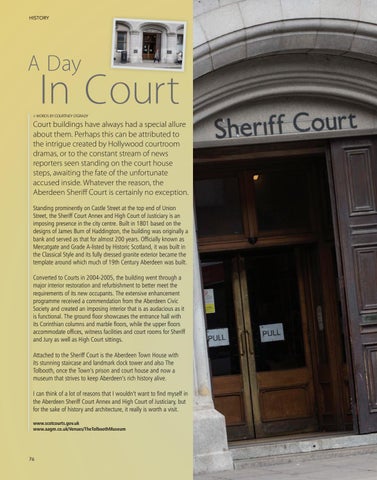
Court buildings have always had a special allure about them. Perhaps this can be attributed to the intrigue created by Hollywood courtroom dramas, or to the constant stream of news reporters seen standing on the court house steps, awaiting the fate of the unfortunate accused inside. Whatever the reason, the Aberdeen Sheriff Court is certainly no exception. Standing prominently on Castle Street at the top end of Union Street, the Sheriff Court Annex and High Court of Justiciary is an imposing presence in the city centre. Built in 1801 based on the designs of James Burn of Haddington, the building was originally a bank and served as that for almost 200 years. Officially known as Mercatgate and Grade A-listed by Historic Scotland, it was built in the Classical Style and its fully dressed granite exterior became the template around which much of 19th Century Aberdeen was built. Converted to Courts in 2004-2005, the building went through a major interior restoration and refurbishment to better meet the requirements of its new occupants. The extensive enhancement programme received a commendation from the Aberdeen Civic Society and created an imposing interior that is as audacious as it is functional. The ground floor showcases the entrance hall with its Corinthian columns and marble floors, while the upper floors accommodate offices, witness facilities and court rooms for Sheriff and Jury as well as High Court sittings. Attached to the Sheriff Court is the Aberdeen Town House with its stunning staircase and landmark clock tower and also The Tolbooth, once the Town’s prison and court house and now a museum that strives to keep Aberdeen’s rich history alive. I can think of a lot of reasons that I wouldn’t want to find myself in the Aberdeen Sheriff Court Annex and High Court of Justiciary, but for the sake of history and architecture, it really is worth a visit. www.scotcourts.gov.uk www.aagm.co.uk/Venues/TheTolboothMuseum
76