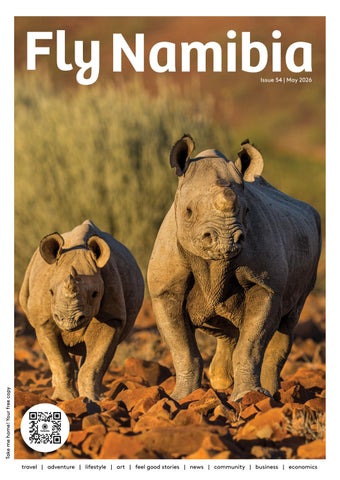
FlyNamibia May 2026

Page 1


Gray Namibia Proprietary Limited is

Cover image

Marcus Westberg Courtesy of Save the Rhino Trust

Editor Elzanne McCulloch elzanne@venture.com.na

Production Manager Liza Lottering liza@venture.com.na

Sales

Daleen Small daleen@venture.com.na

Layout & Design

Richmond Ackah Jnr. design@venture.com.na

Admin and Enquiries

Bonn Nortje bonn@venture.com.na

Printing

John Meinert (Pty) Ltd

Venture Publications (Pty) Ltd.

PO Box 21593

Windhoek Namibia

Disclaimer:

Please note that while every effort has been made to ensure the accuracy and reliability of the content within this magazine, Venture Publications Pty Ltd and FlyNamibia accept no responsibility for any errors or omissions. The views expressed by individual authors are solely their own and do not necessarily reflect those of the publisher or FlyNamibia. All material, including

Welcome

At Venture Media, we’re more than just a publisher - we’re a multi-media content creation powerhouse. Our expertise includes awe-inspiring photography, striking videography, impeccable design, and crisp podcasts. With a reputation for excellence spanning three decades, we bring unparalleled storytelling to life.

In our boutique publishing and content marketing house, stories that matter take center stage. Every page you turn reflects our commitment to quality and innovation. Dive in and experience the difference that top-tier content creation can make.

Agnes Shivute An environmental consultant with interest in indigenous flora, nature enthusiast, Namibia Botanical Society awardee and aspiring author.

Host of Nova Sunrise on Nova 103.5, climbing wall owner, voracious reader, sometime writer, active lifestyle proponent, family man, and coffee lover.

Elzanne McCulloch Writer, editor and publisher of Stories that Matter. Managing Director of Venture Media.

A creator, guide, and curious soul inspired to help people reconnect with their bodies, find their flow, and reclaim their health – naturally.

Rukee Kaakunga A Windhoek-based communications specialist, blogger and freelance fashion writer.

Dr Daleen de Lange I am passionate about mental health and about every visiting individual with his/her own needs within a unique personal context.

Glen-Nora Zeupereje Tjipura is a writer and filmmaker, passionate about stories, whether reading or consuming

Passion and dedication to keep the nation abreast with what’s happening on national and international level.

David

A digital content creator capturing Namibia's stories through bold visuals and real moments. My work celebrates the people, places, and pulse of the nation.

Madeleen Duvenhage Windhoek-based writer perpetually scouting for hidden gems and offbeat narratives found in the ordinary.

Kandanga-Erastus

creative & movement enthusiast. Usually building, creating, and storytelling, blending wellness, purpose, and a passion for bringing meaningful ideas to life.

David Bishop
Dr Theuns Laubscher Windhoek-based veterinarian passionate about wildlife, livestock, equine, and fur babies across Namibia.
Cerina Bezuidenhout Haasbroek
Laschandre Coetzee A strategic dreamer, working in sustainability and communication strategy. Partner of local gallery The Project Room.
Penda
Maggie Forcelledo Paz News & Content Editor.
Emily
Windhoek-based

Need To Knows. with FlyNamibia

Select which tickets you would like to purchase: destinations, travel dates, morning/afternoon departure. We offer multiple fare options such as: Saver, Classic or Premium

Passenger details

Please enter names as they appear on passport or travel documentation

LOGIN to upload passenger details from previous booking.

Baggage policy, sporting equipment, over weight luggage or to add an additional bag(s) More options for the perfect trip

Read up on all our additional information regarding terms and conditions, and tick the selection box once completed to continue.

Payment

Fill in your payment details in our DPO paygate to make final payment.

Confirmation Mail

Transaction confirmation will be sent to passenger email entered.

Windhoek Eros Airport Office

Cash payment at: Eros Airport, Ondangwa Airport

Electronic Funds Transfer (EFT) Online card transaction

Ondangwa airport office

Katima Mulilo airport office

Hosea Kutako airport office

All major travel agents

PayToday app Buddy SuperApp

Online check-in opens 24 hours before departure of the flight on Fly Namibia

Check-in opens 1h 30min before domestic flight and 2 hours before international flight.

Check-in CLOSES 30 min prior to domestic flight and 50 min prior to international flight.

Luggage restrictions

Lotions and aerosols above 100ml, flammable aerosol, sharp objects, i.e. nail files, nail scissors, Leatherman, matches.

Katima Mulilo (via Maun)
Victoria
ZIMBABWE

DOMESTIC FLIGHTS

WV*4Z8505 06:30 Eros - Windhoek Ondangwa - Toivo Ya Toivo 07:30 Mon, Tue, Fri

WV*4Z8506 08:00 Ondangwa - Toivo Ya Toivo Eros - Windhoek 09:00 Mon, Tue, Fri

WV*4Z8595 16:20 Eros - Windhoek Ondangwa - Toivo Ya Toivo 17:20 Tue, Wed, Thu, Fri, Sun

WV*4Z8596 17:50 Ondangwa - Toivo Ya Toivo Eros - Windhoek 18:50 Tue, Wed, Thu, Fri, Sun

Lüderitz flights from 23 April - 9 May 2026

WV*601 09:00 Eros - Windhoek Lüderitz 09:50 Mon-Sun

WV*602 13:15 Lüderitz Eros - Windhoek 14:00 Mon-Sun

Katima Mulilo flights for May 2026, excluding 4 May

WV*4Z8137 13:15 HKIA - Windhoek

WV*4Z8138 16:15

Katima Mulilo (via Maun) 15:15 Mon, Wed, Fri, Sun

Katima Mulilo HKIA - Windhoek (via Maun) 18:15 Mon, Wed, Fri, Sun

Katima Mulilo flights for 4 May 2026

WV*4Z8137 10:15 HKIA - Windhoek

WV*4Z8138 13:05

Katima Mulilo (via Maun) 12:25 Mon

Katima Mulilo HKIA - Windhoek (via Maun) 15:15 Mon

REGIONAL FLIGHTS

FLIGHT NO. DEPARTURE FROM TO ARRIVAL DAYS

Maun flights for May 2026, excluding 4 May

WV*4Z8137 13:20 HKIA - Windhoek Maun 14:20 Mon, Wed, Fri, Sun

WV*4Z8138 17:15 Maun HKIA - Windhoek 18:15 Mon, Wed, Fri, Sun

Maun flights for 4 May 2026

WV*4Z8137 10:15 HKIA - Windhoek Maun 11:15 Mon

WV*4Z8138 14:15 Maun HKIA - Windhoek 15:15 Mon

Victoria Falls flights for May 2026, excluding 2, 5, 7 May

WV*4Z8135 09:15 HKIA - Windhoek Victoria Falls 10:40 Tue, Wed, Thu, Fri, Sat, Sun

WV*4Z8136 11:15 Victoria Falls HKIA - Windhoek 12:40 Tue, Wed, Thu, Fri, Sat, Sun Victoria Falls flights for 2, 5, 7 May 2026

WV*4Z8135 10:15 HKIA - Windhoek Victoria Falls 11:40 Sat, Tue, Thu

WV*4Z8136 12:55 Victoria Falls HKIA - Windhoek 14:15 Sat, Tue, Thu

in Partnership with

4Z341 11:40 Cape Town Walvis Bay 13:55 Mon-Sun

4Z342 14:40 Walvis Bay Cape Town 16:45 Mon-Sun

4Z320 07:00 Cape Town HKIA - Windhoek 09:10 Mon, Tue, Wed, Thu, Fri, Sat

4Z326 10:40 Cape Town HKIA - Windhoek 12:50 Mon-Sun

4Z328 18:15

Cape Town HKIA - Windhoek 20:25 Mon, Tue, Wed, Thu, Fri, Sun

4Z329 07:05 HKIA - Windhoek Cape Town 09:10 Mon, Tue, Wed, Thu, Fri, Sat

4Z321 09:50 HKIA - Windhoek Cape Town 11:55 Mon, Tue, Wed, Thu, Fri, Sat

4Z327 13:40 HKIA - Windhoek Cape Town 15:45 Mon-Sun

*Code Share

HKIA - Hosea Kutako International Airport

Our main routes

FROM TO Windhoek Sossusvlei

Sossusvlei Swakopmund Swakopmund Twyfelfontein

Twyfelfontein Ongava

The seasonal FlyNamibia Safari schedule will resume on 1 May 2026 and run until 30 November 2026. Our daily shuttle flight operates in a clockwise circuit seven days a week. The exact departure and arrival times are determined the day before the flight and will be communicated directly to lodges, tour operators, and transfer companies. A minimum of two passengers is required per sector. All destinations remain available on a private charter basis.

The departure time from Sossusvlei is between 08:30 and 11:00, meaning arrival in Swakopmund and Twyfelfontein will be in time for lunch, and arrival at Etosha will be between 12:30 and 15:30. The arrival time in Windhoek will be between 16:00 and 17:00, or earlier if necessary to ensure connections with various airlines. It’s important to note that no activities should be booked on the day of departure to the next destination until the departure time is confirmed the day before. All destinations remain available on a private charter basis.

For more information, contact: Email: safari@flynamibia.com.na

Mokuti Ongava Mokuti Windhoek

Additional route options

FROM TO Swakopmund Ongava Swakopmund Mokuti Twyfelfontein Mokuti Ongava Windhoek

Sossusvlei Twyfelfontein

Sossusvlei Ongava

Sossusvlei Mokuti

Twyfelfontein Windhoek Swakopmund Windhoek

WELCOME ON BOARD

Dear Passenger,

As we move into May, Namibia’s tourism season begins to gather momentum, and there is a palpable sense of movement across the country. The landscapes settle into their winter rhythm, wildlife becomes easier to spot, and travellers from across the world turn their attention to our remarkable corner of Africa. For us at FlyNamibia, this marks one of the most exciting times of the year –when the skies become busier, connections strengthen, and Namibia’s stories travel further than ever before.

Tourism season is now in full swing, and with it comes renewed opportunity for connection – between destinations, between people, and between nations. Aviation plays a vital role in making these connections possible, and this season we are proud to continue expanding access to some of Southern Africa’s most iconic destinations.

Our Windhoek to Victoria Falls route now operates six days a week, creating consistent and reliable access to one of the region’s most celebrated natural wonders. Victoria Falls remains a destination that captures the imagination of travellers from around the world, and the increased frequency strengthens Namibia’s role as a gateway to regional exploration. Whether travellers are beginning their journey in Namibia or combining destinations across borders, this route continues to unlock new opportunities for tourism growth and regional collaboration.

Equally significant is our Maun to Katima Mulilo connection, operating four days a week. This route plays an important role in linking the Okavango Delta region with Namibia’s Zambezi Region, strengthening the circuit that allows travellers to experience some of Africa’s most diverse and wildlife-rich environments. It is a connection that supports both tourism and regional accessibility, ensuring that these extraordinary landscapes remain within reach.

While our aircraft carry travellers across borders and landscapes, our commitment extends beyond transport alone. We remain deeply invested in supporting Namibian people, creativity, and enterprise – and that spirit continues through initiatives such as the FlyNamibia Makers Project.

We are incredibly encouraged by the response to this year’s Makers Project. Submissions have now officially closed, and we are proud to share that an internal panel made up of team members from across various FlyNamibia departments is currently reviewing the applications. This diverse evaluation team reflects the collaborative spirit that defines our organisation and ensures that each submission is considered thoughtfully and fairly.

The Makers Project represents more than support – it represents belief in Namibian ingenuity and the power of local talent to shape the future of our nation. By June, we look forward to announcing the individuals and businesses who will receive support through the FlyNamibia Makers initiative. It is always inspiring to witness the creativity, resilience, and determination that emerge through this process, and we are honoured to play a small role in helping these ideas take flight.

As we move deeper into the tourism season, I am reminded of how aviation connects not just destinations, but possibilities. Every flight represents movement – of people, of ideas, of opportunity. And every passenger on board contributes to the growing story of Namibia as a destination of excellence.

Thank you for choosing to fly with us. Whether you are travelling for business, adventure, or discovery, we are proud to be part of your journey.

We’re for Namibians. And we rise by lifting others.

Read our previous issues

PRESIDENT NANDI-NDAITWAH NAMED AMONG THE WORLD’S 100 MOST INFLUENTIAL PEOPLE

President Netumbo Nandi-Ndaitwah has been named to TIME magazine’s 2026 TIME100 list, recognising the world’s most influential people for global impact. In a tribute, UNAIDS Executive Director Winnie Byanyima highlighted Nandi-Ndaitwah’s leadership and the often-overlooked role of African women in liberation struggles. She recalled the President’s involvement in Namibia’s independence movement in exile and her contribution to a democratic vision grounded in dignity, equality and shared prosperity. The tribute traces her journey from liberation activist to Foreign Minister and Namibia’s first female President. Internationally, she is recognised as a Global South voice advancing equity, justice and inclusive governance globally.

In her 2026 State of the Nation Address, President Netumbo Nandi-Ndaitwah reaffirmed value addition as central to Namibia’s economic future. Few sectors reflect this priority more than livestock.

The red meat industry supports nearly 70% of livelihoods, sustains over 57,000 jobs, and contributes up to 6.2% of GDP when processing is included. Yet Namibia continues to export large volumes of live cattle, effectively exporting jobs, processing opportunities, and foreign exchange.

Namibia already has a proven model. Through the Namibia Agronomic Board, the country protects domestic producers by restricting imports when local supply is

RED MEAT DIPLOMACY: WHY NAMIBIA MUST TREAT CATTLE LIKE CROPS

sufficient, encouraging value addition and agro-processing. This pragmatic approach strengthened horticulture and farmer incomes.

The contradiction is obvious. Namibia shields vegetable farmers when supply is adequate, but allows cattle to leave the country unprocessed even when abattoirs have spare capacity. This is not a market failure, but a policy gap.

A Livestock Value Retention Scheme, modelled on the NAB approach, could address this. Threshold-based export controls, minimum value-retention requirements, seasonal flexibility, and incentives for local slaughter would ensure more cattle are finished and processed locally. A modest export levy could fund feedlots, cold-chain infrastructure, and communal area integration.

No country builds a strong export brand by exporting its value chain. If vegetables deserve protection, cattle—Namibia’s most strategic agricultural asset—deserve the same policy intelligence.

NAMPOWER LISTS N$5 BILLION NOTE PROGRAMME ON NSX

green and sustainable notes, to support infrastructure and energy projects. Managing Director Kahenge Haulofu said the initiative strengthens funding efficiency and market development. The DMTN framework, developed over two years, supports varied tenors, currencies and investor participation while aligning with international sustainable finance standards.

STANDARD BANK NAMIBIA NAMED BEST INVESTMENT BANK IN NAMIBIA FOR 2026

Namibia Power Corporation (NamPower) has listed a N$5 billion Domestic Medium-Term Note (DMTN) programme on the Namibia Securities Exchange, providing the utility with flexible access to domestic capital markets. The listing was arranged with Cirrus Securities and Nedbank Namibia as co-lead arrangers. The programme allows NamPower to issue multiple debt instruments, including

Standard Bank Namibia has been named Best Investment Bank in Namibia at the 2026 Global Banking and Finance Awards, recognising its role in structuring transactions, mobilising capital and providing advisory services across key sectors of the economy. The bank has been actively involved in financing and advisory mandates in areas such as energy, infrastructure, mining and logistics. Head of Corporate and Investment Banking Nelson Lucas said the award reflects the commitment and resilience of the bank’s staff. Head of Investment Banking Marco Triebner said the recognition highlights the division’s focus on excellence, collaboration and innovation. The bank continues to support investment and economic growth in Namibia.

Discover unparalleled conference facilities amidst breathtaking natural landscapes with Namibia Wildlife Resorts. Host your next event at Popa Falls Resort, where the serene Okavango River meets nature’s tranquility. Gross Barmen Resort offers a rejuvenating retreat, blending wellness with state-of-the-art conference amenities. At Khorixas Camp, immerse yourself in the rich history of ancient civilizations while enjoying modern conference conveniences. Lastly, Hardap Resort presents a lakeside haven, perfect for inspiring creativity and fostering collaboration. Elevate your conference experience with us!

Lüderitz

One of Namibia’s truly unique destinations is the coastal town of Lüderitz in the socalled Deep South. Originally named Angra Pequena (small bay) by the famous Portuguese explorer Bartholomeu Dias in 1487, the settlement was renamed Lüderitz in honour of its founder Adolf Lüderitz in 1886. Located directly on the shores of Lüderitz Bay facing the Atlantic Ocean, Lüderitz forms a barrier between the towering coastal dunes of Namib-Naukluft National Park directly to the north, and the unforgiving rocky coastline to the south. The town has a fishing harbour surrounded by early 20th century German colonial buildings. Ten kilometres to the east the world-renowned ghost town, Kolmanskop, affords you the opportunity to gain a spellbinding insight into what life was once like in this former diamond settlement. Other activities include bird-watching such as at Halifax Island to view Namibia’s largest colony of African Penguins from a boat. Set aside a morning or afternoon to explore the sheltered coves of the Lüderitz Peninsula, Shark Island, Grosse Bucht, Sturmvogel Bucht and Dias Point where the Portuguese navigator Bartholomeu Dias erected a stone cross in July 1488. Lüderitz is especially famous for its delicious fresh seafood: west coast rock lobster (called crayfish locally), oysters and the much sought-after delicacy – abalone (perlemoen variety). The town celebrates its rich seafood culture with an annual Lüderitz Crayfish Festival. The Ombepo Wind Farm east of Lüderitz is Namibia’s first wind farm.

LÜDERITZ WATERFRONT

A number of exciting modern developments have taken place in the centre of Lüderitz. One of them is the Lüderitz Waterfront Development which currently includes the harbour square that hosts the annual Crayfish Festival. The harbour square consists of shops, restaurants and coffee shops, offices and apartments. The Yacht Club is also at the Waterfront. A major project which was launched in the

last quarter of 2024 is the largest maritime museum complex in Africa. This multi-million-Namibia-dollar attraction displays Namibia’s rich maritime history, geology and marine fauna and flora. It is housed in the Lüderitz Waterfront complex at the historical power station located directly on Lüderitz Bay. The impressive modernised building is currently home to a restaurant, offices, gym, conference facilities, auditorium, a large promenade and a satellite campus of the Namibia University of Science and Technology. Lüderitz is easily accessible by good roads from Windhoek (685 km tar), Keetmanshoop (340 km tar) and the Fish River Canyon (480 km from Ai-Ais Resort – 184 gravel and 295 tar), and with FlyNamibia on a direct flight between Windhoek and Lüderitz airport.

DISTINCTIVE ARCHITECTURE

Among the most striking architectural attractions are the Goerkehaus and Felsenkirche (rock church). Both adorn the slopes of Diamond Mountain. The church with its beautiful stained-glass windows is truly unique, as all building materials – even the sand – were shipped from Germany. In the ‘old town’ are the houses of former mining magnates and prominent businessmen, including Kreplin House and Troost House. The Krabbenhöft & Lampe Building was erected for a trading business during the period of economic prosperity that followed the discovery of diamonds. The Deutsche Afrika Bank is part of the historic street view of Bismarck Street, one of the oldest roads in town. In Berg Street, in the historic core of the town, is a complex of residences built during the diamond boom. Other noteworthy structures are the old post office, the former German school, the Lesehalle and the Turnhalle.

Find more Namibia travel inspiration at www.thisisnamibia.com

Follow @thisis_namibia on Facebook and instagram for extraordinary Namibia travel stories.

Maritime Museum

In theatrical terms, it had been aeons before the biggest red-carpet event on the Namibian calendar finally happened. Six long and hard years, to be exact.

The biggest fashion moments at the Namibia Theatre and Film Awards

So when the date for the return of the biggest night of the sector was announced, everyone’s mind was hard at work, contemplating what they would wear to fittingly celebrate this special occasion. It also marked the moment that fashion creatives would finally get rewarded for their tireless and easily forgotten efforts behind the scenes of theatre and screen productions.

The stage, the red carpet and everyone who received an invite to the event were more than ready to usher in the new season of the NTFAs. “A New Season: Celebrating Transition and Growth” was the perfect theme for an

industry that last paused to honour its biggest stars way back in 2019.

The biggest fashion and beauty winners

In a glorious posthumous gesture, the late Cynthia Schimming won the Best Stage Craft: Costume and Wardrobe Design award alongside Lizette Kavari. Both were honoured for their work on the multidisciplinary historic project, Hereroland

Eathan Madison won their first NTFA award for Best Stage Craft: Make-up for their work on Naked Spaces.

Delila Katanga

What the stars wore

With this being the biggest theatre and film event in Namibia in over six years, everyone went all out to look their best on the night. Taking on the theme in their own creative ways, the stars were decked out in their finest – from bold African-fabric patterns to sharp, modern interpretations – and the cameras were given a feast to behold. In this way, attendees gave their individual yet collective nod to growth, resilience and new seasons in the Namibian theatre and film industry.

Lizette Kavari
Industry darling Kulan Ganes walked away with the Best Costume Design and Make-up for Film award for her work on #LANDoftheBRAVEfilm.
Rukee Kaakunga
Eathan Madison
Kulan Ganes
Patrick Sam
Esther Veii Beukes

Native Leaves:

WILD BASIL

Scientific name: Ocimum americanum

Common name: Wild basil

World Wildlife Day was celebrated globally on 3 March under the theme “Medicinal and Aromatic Plants: Conserving Health, Heritage and Livelihoods” – a welcome reminder that plants are wildlife too. Often, charismatic animals like lions and elephants seem to be at the centre of conservation conversations, but this year was different. The theme reminded us that plants are equally important and that they are inclusive of the term “wildlife”. Often packaged as wellness products and labelled as “organic” or “natural”, plants form an integral part of our cultural daily lives.

With many organisations taking the time to celebrate wildlife on this day, a few numbers stuck with me. I read several social media posts on Facebook, LinkedIn and even WhatsApp statuses saying that Namibia is home to more than 195 plant families and more than 4,300 plant species – another reminder about the rich plant diversity across our country.

While all plants play a vital role in our daily lives, this year’s World Wildlife Day celebration focused on plants with medicinal and aromatic potential, recognising their contribution to health, heritage and livelihoods. Wild basil is one of those: a herb that has both medicinal and aromatic uses and one I almost never overlook whenever I am cooking. Admittedly, I am neither a chef nor a foodie, but I surely enjoy food much more when there is an aroma to it and wild basil offers just that. Before I learnt how to cook, I never understood why grandma always made sure we have a few shrubs of the herb around our homestead. Today, I know better than to underestimate its use in the kitchen. Wild basil has an aroma that discards any unpleasant smells from your relish. It is no secret that fish does not have a pleasant smell, but adding herbs such as wild basil does the trick. Whether it is catfish, tilapia or any

other fish, adding a few thoroughly washed leaves always gives it a better aroma.

Wild basil can grow up to the size of a shrub. It has broad leaves and it produces small flowers with white or purplish petals. The herb produces small pods with tiny green seeds that turn black once dry. The seeds may be small, but they happen to be quite resilient, with the ability to survive extreme seasons once they fall on the ground, only to effortlessly sprout during the rainy season. Wild basil can be sowed almost anywhere and it will thrive with minimal care.

My phone is a personal library of plant pictures of leaves, flowers, fruits and even seeds which I have snapped over the years, yet basil pictures have never been part of my gallery. I found myself away from the village, so getting a picture of this herb was going to be a struggle (I prefer to take the pictures myself than to look them up on the internet). A blessing in disguise was a visit to my cousin’s place while I was in the capital city. She had the herb in her backyard. In fact, she had several shrubs, so I was able to take a multitude of pictures of my preference.

Encountering the aroma felt like home away from home. Wild basil does not require a lot of water and flourishes throughout the year with minimal care. In the village, it is quite odd if there is no sight of this herb in a homestead. Living near the Cuvelai stream with an annual retreat to free fish requires one to be constantly on the lookout for either fish, mosquitoes or both. Fortunately, the basil aroma also serves as a great insect repellent. As a consumer, I have learned that both the fresh and sundried leaves are perfect for this purpose; it offers the same aromatic intensity.

The beauty of this herb is that you can grow yourself a shrub in no time or several shrubs by just taking cuttings and placing them in a container with water. Roots will start to develop, and you can easily monitor their growth. More root development is recommended if you want to ground your cuttings directly into the soil in your prepared space, or you can place it in a plant pot. Collecting seeds and simply placing them in your preferred area prior to rainfall is actually the easiest way to own your own wild basil shrub.

We’re for Namibians

Namibia.

The Rhino Protector

Simson Uri-Khob

Dedicated. Natural. Cultural. Resilient.

Simson Uri-Khob’s early life was shaped by the practical world of craftsmanship. A welder and mechanic by trade, he preferred working with his hands – a skill that unexpectedly paved his path into the heart of Namibian conservation.

It began with a broken-down field vehicle on a Sunday. After fixing a car for the late Blythe Loutit, founder of Save the Rhino Trust (SRT), Simson was invited to join the team as a supervisor and mechanic. While his initial role involved building elephant dams and maintaining machinery, a few

days spent in the field with the rhino tracking teams changed his trajectory forever.

"This is the real work I want to do," he realised. "I want to be in the field with these animals."

Simson chose to start from the ground up, learning the art of land tracking from veteran rangers. Over a 32-year journey, he climbed the ranks from tracker to Director of Field Operations, eventually earning his Master’s degree and becoming the CEO of Save the Rhino Trust.

I don't want to tell my kids one day we had rhinos in Namibia and show them pictures," he says. "I want to say, 'I have been looking after that rhino... and there it is, still alive".

His passion is fueled by the unique nature of Namibia's desert-adapted black rhinos (Diceros bicornis bicornis). These are the only free-roaming black rhinos in the world, living without fences in the harsh, open landscapes of the Kunene and Erongo regions. For Simson, their survival in such demanding conditions makes them a symbol of resilience.

Beyond the protection of animals, Simson is a bridge-builder. He has dedicated his career to bringing communities and wildlife together. Under his leadership, SRT has pioneered a model where local communities are not just neighbours to wildlife, but their primary protectors. By employing community members as Rhino Rangers, he has transformed the way rhinos are perceived – a valuable asset that brings tourism, jobs, and education to the region.

The weight of this responsibility is felt most deeply in the difficult moments. Simson still carries the memory of a 2014 poaching incident, where the loss of an animal he knew personally served as a stark reminder of why his work must never stop. "I don’t want to tell my kids one day we had rhinos in Namibia and show them pictures," he says. "I want to say, 'I have been looking after that rhino... and there it is, still alive".

Simson Uri-Khob is more than a conservationist; he is a guardian of Namibia's natural heritage, reminding us that through community ownership and relentless dedication, our wildest dreams for the future can remain roaming free.

Marcus Westberg
Marcus Westberg
Marcus Westberg

When Should You Start Anti-Ageing Treatments?

Aging is a privilege but how we approach it has evolved. One of the most common questions I receive in practice is: “When should I start anti-ageing treatments?”

The answer may surprise you. Anti-aging isn’t something to consider once signs of ageing appear, it’s something to think about before they do. Prevention, rather than correction, is where the real value lies.

While factors like genetics and environment play a significant role in how and when our skin begins to age, a good rule of thumb is to start considering preventative treatments between the ages of 25 and 30. At this stage, subtle interventions can help maintain skin quality, support collagen production, and slow down the visible signs of ageing over time.

Of course, the approach should never be one-size-fitsall. Seeking guidance from a qualified and experienced aesthetic practitioner is key. A reputable practice will assess your skin, lifestyle, and goals before recommending treatments tailored specifically to you.

It’s also worth shifting the mindset around “aging gracefully.” Graceful aging doesn’t mean doing nothing, it means making informed, intentional choices about how you care for your skin. Previous generations relied heavily on topical creams and home remedies, but today, advancements in aesthetic medicine offer a range of natural, non-invasive treatments that enhance and preserve your skin without compromising authenticity.

The goal isn’t to change how you look, it’s to maintain healthy, radiant skin for as long as possible.

If you’re unsure where to begin, consider this your sign to start the conversation. A proactive approach today can make all the difference tomorrow.

Dr. La-toya is an aesthetic medical doctor passionate about helping you better understand your skin and make confident, informed skincare decisions. She’ll be back next month with more expert insights and practical skincare advice.

Threads of Namibia

How designer McBride Kavari is reimagining the Herero dress for the world

The Herero dress has a distinctive quality. It is large, graceful and profoundly symbolic. History is present in every fold. In the hands of Namibian designer McBride Kavari, this iconic garment is not just preserved; it is evolving, travelling and telling new stories on runways from Windhoek to Berlin.

“I will never go to a runway, whether it’s Milan, Berlin, wherever, and not carry at least one or two traditional garments,” Kavari says. “That’s what tells people who I am.”

Kavari’s journey into fashion did not begin in a studio. It began in his mother’s bedroom. Armed with curiosity and a dusty sewing machine, he started designing as a child, creating his first dress for his niece. By primary school, he was already entering competitions, winning prizes and eventually funding his own education through design.

“I never went to fashion school. It’s a God-given talent,” he says. Balancing school, clients and a growing demand eventually led him to make a defining choice. “At some point, I had to choose my passion.”

The Herero dress itself is a powerful example of cultural adaptation. Its origins trace back to the Victorian era, influenced by the German colonial presence in Namibia. Before colonisation, Herero women wore garments made from animal skins. Over time, these evolved into the now iconic long, layered dresses, modest in structure yet bold in presence.

What makes the dress uniquely Herero is the headgear, known as the otjikaiva. Designed to resemble cattle horns, it reflects the Herero people’s deep connection with cattle, a symbol of wealth, identity and heritage. “Without it, we are not us,” Kavari explains.

While rooted in tradition, the Herero dress has continuously evolved. Earlier designs were defined by strict modesty, with high necklines, long sleeves and a conservative silhouette that reflected cultural values of dignity and womanhood. The otjikaiva was also much smaller and less pronounced than it is today.

Over time, this began to change. The headgear grew in size and structure, becoming more sculptural and expressive. Women experimented with ways to shape it, at one point even using materials like folded newspaper to create the now distinct horned form. The dress itself became fuller and more dramatic, with layered skirts and exaggerated proportions forming the striking silhouette that makes it instantly recognisable today.

Modern designers like Kavari continue this evolution. From introducing shorter sleeves to refining structure and fit,

his work brings a contemporary edge while maintaining cultural integrity. “Fashion is not static,” he says. “But we also don’t want to take the dress away from culture; we want to bring the youth closer to it.”

This balance is key. Traditional designs remain for cultural ceremonies, while runway interpretations allow for creative freedom. “There’s confusion,” he admits. “People think you are destroying the dress. But the runway is different – that’s where a designer gets to be creative.”

That approach is resonating with a new generation. Today, many young Herero women proudly own and style multiple dresses, embracing both heritage and individuality. “They’ve fallen in love with it again,” he says.

Traditionally, wearing the Herero dress is tied to cultural rites of passage. Young girls are introduced into womanhood through ceremony, often at a wedding, where they are presented to their ancestors at the holy fire, marking their readiness to wear the dress. “It’s not something you just decide,” Kavari says. “You go through a process.”

Historically, married women were expected to wear the dress daily, symbolising status and identity. While that expectation has shifted, the sense of pride remains. Today, the dress is no longer limited to traditional events. “You can wear it anywhere,” he says. “As long as you wear it with dignity.”

Kavari has become known for modernising the Herero dress while respecting its roots. “There’s a difference between designing for a traditional event and designing for the runway,” he explains. On the runway, designers are free to experiment, reimagining structure, proportion and detail while still honouring the essence of the garment. For Kavari, this evolution is necessary. “If we don’t evolve it, we risk losing it.”

His designs have travelled far beyond Namibia, reaching clients across continents and even finding their way into international collections. What is notable is that his work resonates beyond the Herero community. “I make dresses for everyone,” he says. This global appeal speaks to the universal power of cultural storytelling through fashion.

At the heart of Kavari’s work is preservation. “My biggest dream is for the dress to remain alive,” he says. In a rapidly changing world, the Herero dress stands as both a cultural archive and a living form of expression, evolving yet rooted. Through designers like Kavari, it continues to tell its story. “Nothing about us without us,” he says. “We have to tell our own story.”

Glen-Nora Tjipura

National Conference on Community-Based Natural Resource Management

Enhancing Governance for Optimised Community Benefits

Namibia’s conservation community gathered for what Minister of Environment, Forestry and Tourism Indileni Daniel called an “important week in our calendar”. At the National Community-Based Natural Resource Management (CBNRM) Conference held on 25 March in Windhoek, the minister emphasised the link between conservation and Namibia’s fragile resources. She called for sustainable, science-based policies rooted in national interest. “CBNRM is a global example of how local livelihoods are supported through conservation. It is national and government supported. Its success is worth celebrating!”

CBNRM: A pioneering model And indeed, its success is worth celebrating.

What began in the 1980s as a grassroots response by traditional leaders to rampant poaching, has grown into one of the world’s most recognised conservation models. Formalised through the 1996 legislative amendments that devolved rights over wildlife and tourism to communities, CBNRM has enabled a remarkable recovery of species that were once pushed to the brink. Today, Namibia stands apart as the only country where populations of freeroaming elephants, lions, cheetahs and even black rhinos thrive beyond the boundaries of formally protected areas.

Across the country, 87 registered conservancies and 48 community forests now span more than 186,000 square kilometres – over 60% of the communal land – supporting an estimated 244,587 residents. These landscapes are not only ecological strongholds but economic engines, generating over 2,000 jobs while funding community projects, from youth outreach initiatives to soup kitchens for the elderly. Women play a significant role in leadership and management, while measurable benefits, ranging from cash dividends to shared equipment, filter into rural households.

Yet, as the minister cautioned, “Success should not give way to complacency.”

Challenges such as land use conflicts, illegal harvesting of resources and the growing threat of wildfires remain persistent and complex. Gaps in governance and unequal distribution of benefits continue to test the system. One sentiment echoed through the sessions: this is a moment for “business unusual, not business as usual”, a call to reevaluate approaches and set clear objectives for the next 30 years.

The people’s voice

If there was a unifying thread throughout the conference, it was this: conservation must stay grounded at grassroots level, closest to the people it is meant to serve.

Despite the visible gains, the conference faced prickly questions. Delegates and partners alike repeatedly asked: “Where are the missing voices?” Too often, community members themselves remain absent from national conversations that directly affect their livelihoods. Discussions highlighted the need to move beyond broad generalisations and better understand impact at household and individual level.

Held over two days, the National CBNRM Conference created an important platform for updates, critique and collaboration. Yet many left with the shared hope that such dialogue will not remain confined to conference halls. Future platforms must continue to open space for deeper engagement, especially with representatives from conservancies themselves.

Namibia’s CBNRM programme remains a pioneering model. It has delivered tactile conservation and development successes over decades, but its future will depend on a willingness to listen more attentively, adapt more boldly and strengthen the systems that support it.

Partnerships Power Namibia’s Environmental Future

On a clear Windhoek morning, leaders from government, finance, conservation and community organisations gathered at the Community Conservation and Inspiration Hub for Environmental Knowledge Day –an event hosted by FNB Namibia through the FirstRand Namibia Foundation.

Under the theme “Driving Sustainable Impact Through Strategic Partnerships,” the gathering served as a reminder that Namibia’s environmental success story has always been built on collaboration.

From the outset, speakers reinforced Namibia’s position as a global example of conservation done right – particularly through community-based models that empower people living closest to natural resources.

Maxi Louis, CEO of the Namibia Association of Community-Based Natural Resource Management Support Organisations (NACSO), highlighted the importance of shared knowledge and community ownership in protecting Namibia’s natural heritage. “Knowledge is only powerful when shared, applied and used to uplift communities,” she emphasised, reminding attendees that conservation in Namibia extends beyond wildlife to critical areas such as water security, food production, energy and waste management.

Environment, Forestry and Tourism, who stressed that Namibia’s environmental challenges – from drought to floods – are no longer distant threats, but present realities requiring coordinated national action.

“Environmental sustainability is not the responsibility of one sector alone,” she said. “It is a collective national endeavour.”

One of the day’s most significant moments came with the announcement of support for the Wildlife Credits initiative, led by the Community Conservation Fund of Namibia (CCFN), to which the FirstRand Foundation has committed a sum of N$ 4 million to be implemented over a four year period. CEO Pandeni Kapia described the programme as a transformative model that rewards rural communities for protecting wildlife habitats – recognising conservation as both an ecological and economic investment. Namibia’s community conservancies now cover more than 16 million hectares, representing nearly 20 percent of the country’s land, and continue to generate meaningful national income through conservation-linked activities.

Environmental sustainability is not the responsibility of one sector alone,” she said. “It is a collective national endeavour.”

For the FirstRand Namibia Foundation, environmental stewardship forms part of a broader national investment strategy. Trustee Clara Bohitile shared that the Foundation has invested over N$120 million across education, health, culture and environmental programmes over the past decade – including N$18.2 million specifically directed towards environmental guardianship initiatives.

But the message of the day was clear: funding alone is not enough. Impact happens through partnerships.

Daniel Motinga, CEO of RMB Namibia, reflected on the growing role of finance in sustainability, noting that environmental responsibility is no longer a peripheral concern for investors – it is central to long-term economic resilience. “Sustainability is not just an environmental issue,” he explained. “It is a developmental and societal issue – an economic necessity.” That sentiment was echoed by Honourable Indileni Daniel, Minister of

The event also celebrated innovation beyond traditional conservation spaces, highlighting initiatives such as Cricket Namibia’s recycling programme, which demonstrates how sustainability can be embedded into everyday life – even in sport.

As conversations concluded and networking began, one message lingered in the room: Namibia’s future will be shaped not by isolated action, but by partnerships that bridge communities, finance, conservation and government.

FNB’s Environmental Knowledge Day served as both a celebration of progress and a call to action – reminding all involved that Namibia’s natural heritage remains one of its greatest national assets, and one that must be protected through shared responsibility.

Elzanne McCulloch

ElevateyourjourneywiththeunrivaledcomfortandperformanceofourKingAiraircraft. Whetheryou’retravelingforbusinessorleisure,theKingAircombinesluxury,efficiency,and safety,deliveringaseamlessflyingexperiencetailoredtoyourneeds.

CONSERVATION BEYOND BOUNDARIES

Namibia is redefining what conservation can look like. In March 2026, the country formally recognised its first three Other Effective Areabased Conservation Measures (OECMs), signalling a shift toward more inclusive, outcome-driven biodiversity protection.

OECMs differ from traditional protected areas. They are not officially proclaimed parks or reserves, but rather landscapes, often communal, private or mixed-use, managed in ways that achieve sustained conservation outcomes. In essence, they acknowledge that biodiversity protection does not stop at park fences.

EXPANDING THE CONSERVATION MAP

At the heart of this milestone are three newly recognised sites: the NamibRand Nature Reserve (188,980 hectares), ProNamib Nature Reserve (84,500 hectares) and Canyon Nature Park (45,000 hectares).

Together, they cover approximately 318,480 hectares, adding significant ecological value through improved landscape connectivity and ecosystem protection. These sites complement Namibia’s existing conservation network, strengthening links between protected areas, communal conservancies and community forests.

FROM FRAMEWORK TO RECOGNITION

The recognition followed a validation workshop and certification ceremony held in Windhoek from 30 to 31 March 2026. The gathering brought together key stakeholders, including representatives from the Ministry of Environment, Forestry and Tourism (MEFT), the Ministry of Fisheries and Marine Resources, WWF Namibia, the Namibia Nature Foundation (NNF), conservation practitioners and land managers.

Far from being a symbolic event, the workshop played a critical role in shaping Namibia’s conservation future. It provided a platform to review and validate the national framework and guidelines for identifying OECMs, assess expressions of interest and build a shared understanding of how this approach can complement existing conservation efforts.

LEGACY OF INNOVATION

Namibia’s conservation journey has long been rooted in innovation and community involvement. Dr Juliane Zeidler, WWF Namibia’s country director, highlighted how this latest step builds on decades of progress.

“Over the past couple of decades, Namibia has made tremendous strides by unlocking tourism development, creating employment and stimulating local and regional

economies, all for the benefit of conservation and sustainable development,” she said. “The recognition of the first three OECM sites takes Namibia a step further in people-centred, landscape-level conservation.”

ENABLING CONSERVATION WHERE PEOPLE LIVE

A key strength of Namibia’s approach lies in its enabling policy environment. By recognising conservation beyond state-owned land, the country has created space for a wider range of contributors.

“It is commendable that Namibia’s legislation allows conservation to be recognised beyond state-owned protected areas, communal conservancies and community forests,” said Sikongo Haihambo, the executive director of MEFT. “OECMs demonstrate that effective conservation cuts across communal, private and mixed-use landscapes where people live and work as stewards of our natural heritage.”

ALIGNING WITH GLOBAL AMBITIONS

The designation of these sites also reflects Namibia’s commitment to global conservation goals. According to Kenneth Uiseb, the deputy director of wildlife monitoring and research at MEFT, the sites directly contribute to the Kunming-Montreal Global Biodiversity Framework’s Target 3 – the “30x30” ambition to conserve at least 30% of the world’s land and sea areas by 2030.

“They demonstrate that well-managed landscapes can deliver long-term conservation outcomes even when not formally proclaimed as protected areas,” he noted.

RECOGNISING COLLECTIVE EFFORT

For those on the ground, the recognition is a meaningful endorsement of years of work. Nils Odendaal, the chief executive officer of NamibRand Nature Reserve, emphasised the role of collaboration in achieving these outcomes.

“This recognition affirms the dedication of land managers, conservation partners and communities who have worked consistently to achieve real conservation outcomes,” he said. “Recognition as OECMs highlights the strength of partnerships and shared stewardship for Namibia’s biodiversity.”

THE ROAD AHEAD

The certification of Namibia’s first OECMs is more than a milestone; it is a signal of where conservation is heading. By embracing diverse governance and management models, the country is broadening both the scale and inclusivity of its conservation efforts.

AFTER THE RAIN

How internal parasites emerge with the season – and what it means for herd health and performance

The rains arrive quietly.

Not with drama, but with a subtle shift in the air. The dust settles. The grass softens. The cattle lift their heads a little more often. Somewhere between the smell of wet earth and the hum of returning insects, something else awakens too – something smaller, older and far less welcome.

Internal parasites have always been part of the landscape. They do not arrive from elsewhere. They wait.

These parasites – mainly worms that live inside the animal’s stomach, intestines or liver – rely on moisture to survive outside the host. Their eggs are passed in dung, hatch on the pasture and develop into infective larvae (the stage where animals pick it up while grazing). Without rain, this cycle slows down or stops. With rain, it accelerates.

In Namibia, their presence follows moisture. The higher rainfall areas – the north, the north-east and the central highlands after a good season – carry the heavier burden. Communal grazing areas, where animals move together and pasture rests are limited, allow parasites to accumulate quietly over time.

In contrast, the deep south and west, with their long dry spells and intense sunlight, offer fewer opportunities for parasites to survive between hosts. But even here, after the rain, the balance shifts.

Often, the first signs are easy to miss.

A calf that lags behind the herd. An ewe whose ribs begin to show despite good grazing. The coat becomes dull. Growth slows. These are not always dramatic signs, but they reflect animals losing condition due to parasites feeding off nutrients or, in some cases, blood.

In small stock, one of the most important signs is found on the lower eyelid. When pulled down, a healthy animal should have a deep pink to red colour. When it appears pale or washed-out, it often indicates anaemia – a shortage of red blood cells – usually caused by blood-sucking worms such as Haemonchus (commonly known as wireworm). Sometimes there is diarrhoea. Often there is not. Parasites do their best work unnoticed.

On a farm, patterns tell the story better than individuals.

Young animals struggle, while older ones remain strong. Certain camps produce poorer performers. Animals improve briefly after treatment, only to decline again when returned to the same grazing. These patterns point to pasture contamination, where infective larvae are building up on the grass over time.

Management begins long before treatment.

Rotational grazing allows camps to rest. With time, sunlight and dryness reduce the number of infective larvae on the pasture. Overstocking increases contamination, as more animals deposit parasite eggs in the same area. Underdosing – giving too little medication – allows some parasites to survive treatment, which contributes to resistance, meaning

the medicines become less effective over time. Both are common, and both are preventable.

When treatment is needed, it should be deliberate.

Products such as AgraVet Orange offer broad-spectrum control, meaning they target a wide range of internal parasites, including roundworms (worms in the stomach and intestines) and liver fluke (a parasite that lives in the liver and can cause chronic weight loss and reduced production). Valbazen is effective against adult liver fluke and gastrointestinal worms. For injectable control, Ivomec and similar ivermectin-based products remain reliable tools when used correctly.

The key is accuracy – correct weight estimation, correct dose and treating the right animals at the right time.

Not every animal needs treatment.

The strongest animals often carry some level of parasites without showing signs of illness. These animals help maintain a natural balance and contribute to herd immunity – the ability of the group to tolerate parasite exposure over time. Treating every animal unnecessarily increases costs and accelerates resistance. Selective treatment, where only the animals that need it are treated, is often the more effective and sustainable approach.

Internal parasites are part of farming in Namibia, just as rain and drought are. They cannot be eliminated – only managed. Patiently. Observantly. With respect for the balance between animal, pasture and season.

The signs are always there, if you know where to look.

Beneath the warm lights of The Village in Windhoek, the story of Namibia’s conservation success unfolded – not through dramatic vistas or iconic wildlife, but through the voices and journeys of those who protect them. On 16 April 2026, the fifth annual Grassroots Owen-Smith Conservation Awards, known as the GOSCARs, brought together conservationists, community leaders and supporters to honour the quiet, persistent work happening away from the spotlight.

Six rangers were selected by the GOSCARs panel this year, each one embodying the values that defined the life and work of community-based conservation pioneer Garth Owen-Smith. Their work is grounded in the development and application of local knowledge, where conservation is not an abstract ideal but a daily responsibility evolving around community life.

Drawn from conservancies across the country, from Okongoro to King Nehale in the Oshikoto Region, the 2026 recipients are Uezekava Jokaa Tjuma, Uezekandavi Nguezeeta, Taiwin Garoeb, Jauire Allu Uararavi, Gustav Haraeb and Gabriel Mwatilefu Absalom. Each is widely respected within their community, known not only for their dedication to conservation, but for their role in supporting and uplifting those around them.

Amongst them, one story stood out. Tjuma, the only woman among this year’s recipients, is an elephant ranger and a team leader whose presence in the field has quietly reshaped expectations. In a role often dominated by men, she has inspired younger colleagues through her example. By doing this work at her age and standing her ground in the face of an animal many fear, she has shown young men and women in her community that courage is not defined by gender, and that they too can step forward and do the same.

The awards are presented annually to Namibia’s top performing conservancy game guards, lion or rhino rangers, fish guards and community resource monitors. This year, the panel also recognised outstanding field workers employed by NGOs, reflecting the nature of conservation work in a changing environment. As pressures on ecosystems grow, the role of these frontline individuals becomes ever more vital.

Each recipient received N$30,000, with a portion of the prize allocated to their community-based organisation, reinforcing the idea that conservation is a shared effort with shared benefits. The awards are made possible through contributions to the Owen-Smith Memorial Fund,

THE BACKBONE OF CONSERVATION

Namibia’s ‘Foot Soldiers on the Ground’ Honoured at the 5th Annual GOSCAR Awards

supported by Namibian and international partners and managed by the Namibian Chamber of Environment (NCE).

The selection process is guided by a panel with deep roots in Namibia’s conservation history, chaired by Dr Margaret Jacobsohn, co-founder of IRDNC, alongside Hon. Beaven Munali, co-chair, and Ronny Dempers, executive director of the NDT. Their combined experience reflects decades of commitment to community-based natural resource management.

In his keynote address, IRDNC Executive Director John Kasaona reflected on a journey that began long before independence. Having worked alongside Dr Jacobsohn in the 1980s as her translator in the Kunene Region, he spoke about the strides that have been made since those early days. “We’ve come a long way since then!” he said, before recalling the legacy at the heart of the awards: “Garth’s goal in life was to liberate conservancies and give ownership to local chiefs, local leaders and the people living side by side with wildlife.”

That vision, honed through countless conversations held under trees with communities, laid the groundwork for Namibia’s internationally recognised conservation model. It is a system built on trust, participation and local stewardship.

Dempers echoed this sentiment in his remarks on the importance of recognising those working on the ground. “Without the community in the driver’s seat there can be no CBNRM (community-based natural resource management),” he noted, highlighting the essential role of what he called the “foot soldiers on the ground”. “Community game guards are the backbone of conservation in Namibia.”

As the awards were presented, Dr Jacobsohn offered a final reflection that captured the spirit of the evening: “Without these boots on the ground there would be no conservation!”

In celebrating these individuals, the GOSCARs shift the narrative away from policies, committees and government towards the people who live alongside and sustain wildlife. It is a reminder that Namibia’s conservation success is measured not only in wildlife numbers but in the courage, commitment and resilience of those who protect it every day.

Colours filled the streets across the country, as song and dance brought communities together in celebration of Namibia’s 36th Independence Day anniversary celebrations. Communities from all 14 regions united in a powerful display of pride and national identity, marking the milestone with a shared spirit of joy and reflection.

“As we celebrate, we also remember the nations that gave shelter to our people, the friends and comrades who stood with us, as well as the brave men and women

Namibia, beyond 36 for a prosperous future

who paid the ultimate sacrifice so that Namibia could be free,” said President Netumbo NandiNdaitwah as she addressed the nation.

Over the past three and a half decades, the country has made notable progress in maintaining peace, strengthening democratic institutions and advancing socio-economic development. Peaceful transitions of power and a continued commitment to constitutional governance have positioned Namibia as one of Africa’s stable democracies. As the nation celebrates this achievement, focus remains on addressing key challenges such as youth unemployment, inequality and economic diversification, while building on opportunities across different sectors. “Namibia has built a strong foundation of peace, stability and democratic governance. Yet, we are mindful that the work is not complete. The expectations of our people, especially our youth, call on us to accelerate inclusive development, create opportunities and ensure that the benefits of independence are shared by all,” she noted.

Regional progress

Also celebrating her birthday, which coincides with Namibia’s Independence Day, Vice President Lucia Witbooi reaffirmed the government’s commitment to inclusive development while addressing communities in the //Kharas Region.

Speaking during the engagements, Witbooi highlighted Namibia’s progress since independence, noting that the //Kharas Region has undergone a significant transformation since independence, evolving from a historically marginalised area into a strategic economic hub. She pointed to growth in key sectors, including export-driven agriculture along the Orange River, particularly table grape production in Aussenkehr, as well as agri-processing linked to the Naute Dam and Neckartal Dam projects.

Additional gains have been recorded in mining, fisheries and tourism, supported by major infrastructure investments that have improved connectivity, service delivery and institutional capacity. She also highlighted ongoing efforts to extend development to smaller settlements through improved access to water, sanitation, electricity and road networks.

In the health sector, she said access to healthcare has expanded through a growing network of clinics and health facilities, with the government continuing to invest in both the construction of new clinics and the upgrading of existing ones to better serve communities. “The government continues to renovate and build new clinics to make health accessible to the residents of the //Kharas Region. Positioned within the Lüderitz–Aus Development Corridor, the region is now entering a new phase of industrialisation, driven by large-scale

renewable energy and green hydrogen initiatives, which are expected to accelerate economic growth, create employment and reinforce the //Kharas Region’s role as a key contributor to Namibia’s sustainable development trajectory,” Witbooi added.

Despite the progress, the vice president acknowledged that challenges remain, including limited value addition, constrained industrial activity and gaps in water, sanitation and housing, compounded by fiscal pressures. However, she noted that the government is actively addressing these issues through targeted interventions, including infrastructure upgrades in Grünau, water expansion projects in Ariamsvlei, rehabilitation of water systems in Noordoewer and Aussenkehr, as well as the servicing of residential plots in Aus, among other developments in the region.

Speeches delivered across the regions carried a common message, the need to create opportunities and ensure that the benefits of independence reach every Namibian. The call for shared prosperity was evident throughout the day’s events, reflecting a collective desire for a future where no one is left behind.

As the celebrations came to an end, the spirit of unity and reflection lingered across the country. Beyond the speeches and ceremonies, the day served as a reminder of how far Namibia has come and the journey that still lies ahead. With a renewed sense of purpose and a shared commitment to progress, the nation looks forward with hope, determined to build a future where the promise of independence is not only remembered, but fully realised in the lives of all its people.

FROM WALVIS BAY TO THE NATIONAL STAGE Johanna Nambinga’s rise through Miss Namibia

Debmarine Namibia’s involvement as the official partner of Miss Namibia has not only elevated the pageant but also opened doors for emerging creatives across the country. Among those who have stepped into the spotlight is Johanna Nambinga, a 26-yearold fashion designer whose talent and determination have made her one of Namibia’s most promising names in fashion.

Johanna’s journey began with a childhood passion for sketching dresses, long before she realised that her hobby had a professional name: fashion illustration. “Seeing my sketches come to life was always the peak of my imagination,” she recalls. That imagination eventually led her to study fashion design in 2019, graduating in 2021. Yet, financial challenges meant she could not obtain her diploma, a setback that might have discouraged many. For Johanna, however, it became fuel for perseverance.

In 2025, she applied to design for Miss Namibia and Miss Teen Namibia. Out of many applicants, she was chosen, not only as the youngest designer but also the only one from Walvis Bay. While most designers were assigned two garments, Johanna was entrusted with five, including two evening gowns and three two-piece outfits for contestant b-roll footage. This responsibility was more than a task; it was a vote of confidence in her creativity.

“Working with Miss Namibia as an emerging designer was truly a dream come true,” she says. The opportunity gave her brand, JOMONA, immediate visibility. Sales rose by nearly 45%, and new clients began to trust her work, knowing that Miss Namibia collaborates only with the best. With her earnings, Johanna invested in a larger workshop, laying the foundation for future growth.

Her creativity was further tested when she was tasked with representing the Dioptase crystal in a gown for finalist Alica Mokhatu. Johanna embraced the challenge, weaving the gem’s essence into a design that sparkled on the finale stage. The collaboration was seamless, built on trust and artistic freedom.

The impact of Miss Namibia on Johanna’s career has been undeniable. Beyond new clients, she has been featured in TV and radio interviews, as well as newspaper articles, amplifying her visibility. Yet, she sees this as just the beginning. Her long-term vision is to continue working with Miss Namibia and, one day, design for Miss World and Miss Universe, bringing Namibian creativity to the global stage.

Johanna is quick to emphasise the importance of corporate support in nurturing the creative industry. “Debmarine Namibia’s involvement is very important and beneficial, not only to the creative industries but to the Namibian youth in general,” she explains. Their partnership with Miss Namibia has introduced young people to the company’s values and opportunities, bridging the gap between corporate and creative sectors.

Her message to aspiring designers is clear: “When you see an opportunity to work with Miss Namibia, grab it. There’s so much room for all of us to benefit from it. When positions open up, apply for them.”

Miss Namibia, she believes, is more than a crown. It is a gateway to advocacy, growth, and change. It is a dazzling showcase where over 100 artists, designers, choreographers, makeup artists, hairstylists, and performers come together to celebrate artistry, culture, and empowerment. With Debmarine Namibia fuelling this legacy, every finalist gains tools for life, and every contestant walks tall with purpose.

Johanna’s story is proof that when platforms like Miss Namibia uplift women, they transform communities. From the depths of the Atlantic to the heights of national pride, Namibia’s diamonds shine not only in jewellery but in the courage, creativity, and resilience of its youth.

Changing the narrative of disability

Side by Side and Special Olympics

“You are a champion!”

The words ring out across the open yard. Jubilant and affirming. Ndangi, one of the teachers at Side by Side Early Intervention Centre, leads the cheer as a group of children jump into action. It is a lively Tuesday morning session, one of two held each week for younger and older groups, where energy and encouragement set the tone from the very start.

A young curly-haired girl with Down’s Syndrome lights up at the call to begin. Without hesitation, she beelines towards a row of cones neatly placed on the sand. With determined strides, she races her opponent from one end to the other, reaching to swoop up the cones from the ground. Around her, teammates and volunteers rally behind her efforts. The interactions are loud and unrestrained, as children tend to be, a little chaotic and distracted at times, with some drifting off before being gently coaxed back to the activity.

Here it is about far more than reaching the finish line.

Building strong foundations

This is the heart of Side by Side Early Intervention Centre, a space for children with intellectual and physical disabilities. Through structured activities and consistent engagement, the centre focuses on early development, helping children build physical, cognitive and social skills in an environment that is nurturing and stimulating.

Established in 2013, the centre has steadily grown from humble beginnings. What started as house visits conducted by a German volunteer on a bicycle, following her work with the Autism Association, gradually evolved into a fully fledged centre rooted in the heart of the community. For Huipie van Wyk, the director of Side by Side, her involvement expanded over time, fuelled by her own search for resources and support after her daughter Elandri was diagnosed with severe brain deformities shortly after birth.

Today, Side by Side runs six programmes each week, reaching approximately 120 children and their families. At its core is a strong focus on education, with 34 children currently enrolled in various learning initiatives. The ECDC programme forms a cornerstone of this work, offering a foundational and often life-changing approach that extends beyond literacy to include tactile, practical life skills. Children learn through doing, whether through everyday activities or hands-on experiences such as preparing kapana over an open fire. Guided by qualified occupational therapists, the programmes are designed to strengthen mobility, build independence and nurture confidence. Physical wellbeing is also prioritised, with initiatives that include dental health check-ups.

Huipie explains that every programme has been intentionally structured to engage multiple aspects of a child’s growth, ensuring a holistic rather than fragmented approach. Behind this work is a dedicated team of 24

staff members, alongside families who are often actively involved in the process of care, feedback and problem solving.

A model that goes beyond charity For Huipie, the way in which this work is framed matters deeply.

“We are not a charity, but a non-profit. In fact, we are actually a fully operational business which provides an essential service that benefits the community, but we don’t make a profit.” It is a distinction that speaks to sustainability as much as purpose. In a sector often reliant on donor funding, longterm thinking becomes critical. Non-profits, she admits, often “shoot first, aim later” when it comes to budgeting and funding. “Yet we really need reserves in place.” Which is why the need to become self-sustainable is more pressing than ever, particularly as community needs continue to grow.

As Side by Side approaches its thirteenth year, the focus is not only on impact, but on longevity. “Non-profits are supposed to take the issue and see what’s the solution. We are only successful if we manage to work ourselves out of a job. How are we benefitting the children long-term?” It is a question that underpins every programme and decision.

Beyond the practical work lies a deeper mission – one that challenges how disability is perceived and addressed. Traditionally, disability care has been shaped by two dominant approaches. The charity model focuses on meeting immediate needs, while the medical model centres on fixing physical conditions and rehabilitation. While both have value, they can also be limiting. Huipie and her team advocate for a more integrated alternative: the social model.

Rather than asking how to fix the individual, it asks how society can change. It recognises that attitudes, environments and perceptions can either restrict or empower. “You have a place in society. You are worthy. Your disability is not a medical disaster.” Her perspective is rooted in lived experience.

“Raising my daughter was the best qualification. She taught me, at every juncture of her life, what would need to be next. Whether it was education, adequate healthcare or physiotherapy, she really gave us a blueprint on how to care and respond. God doesn’t make mistakes. What if

we could change society’s outlook, that this child is not a mistake but someone created with an infinite purpose?”

Since its founding, Side by Side has witnessed a slow shifting in stubbornly ingrained mindsets. There is greater openness, earlier detection in hospitals after birth and a steady erosion of misconceptions often linked to societal stigma or deeply held superstitious beliefs which depicts disability as a curse or a vengeful “payback” for wrongful deeds done in the past.

Yet, the work is far from over.

Connecting dreams to a decade of knowledge and experience

The leading aviation training organisation in Africa.

The power of partnership

A key element of the centre’s work is its partnership with Special Olympics Namibia, a collaboration that has significantly expanded opportunities for the children involved. From Monday to Thursday, children are transported to the Katutura Youth Complex, where the energy shifts to the dynamic world of sport.

This partnership, established three years ago between Side by Side Centre and Special Olympics National Director Levien Smit, is rooted in a shared understanding. Both women have experienced the beauty, bewilderment, pain and wonder of raising children with special needs: a bond that has not only propelled their leadership, but also the depth of their commitment.

Globally, Special Olympics operates in more than 200 countries, engaging millions of athletes with intellectual disabilities. In Namibia, that momentum is steadily building, with approximately 3,000 registered participants across nine regions. Each afternoon, between 14:00 and 16:30, the Katutura Youth Complex comes alive.

At times, up to 80 athletes fill the space, training, competing and, most importantly, growing. While sport is the entry point, the impact stretches far beyond physical activity.

Special Olympics offers year-round training and competitions in a range of Olympic-style disciplines, creating consistent opportunities for athletes to build fitness, resilience and confidence.

“Sport is a great tool to encourage social inclusion and value.” For Levien, the transformation is tangible. “Some of these kids experience a complete personality change!”

Namibia’s athletes are already making their mark internationally, having competed in Germany, France, Portugal and Italy. At the 2025 World Winter Games in Italy, the Namibian team placed fourth out of thirteen in the floorball tournament.

Despite these achievements, funding remains a constant need. All programmes are offered free of charge, ensuring accessibility for all participants.

In the pipeline, the organisation is preparing to expand its reach even further. A new initiative, Count Me In, is set to launch later this year in partnership with the Ministry of Education, Innovation, youth, Sports, Arts and Culture, and occupational therapists. The programme will focus on equipping young people with practical, employable skills once they leave school, creating a bridge between participation and independence.

Looking towards 2026, the focus is on strengthening existing programmes while continuing to invest in people. Special Olympics Namibia aims to train up to 200 coaches each year, expanding capacity and reach across the country.

More than a game

There is, however, a persistent misconception that programmes like these exist simply to keep disabled children occupied.

Huipie is quick to challenge this. “This is not a ‘cute social duty’. It is a platform for dignity and real opportunity. There are many examples of young people who, through the Special Olympics, have gained the confidence and skills needed to secure employment.”

Similar to Side by Side, Special Olympics’ approach is inclusive, extending into education, health and leadership. Participants are given meaningful roles within the organisation, reinforcing a sense of ownership. The long-term vision, both women admit, is ambitious. Plans are underway to build towards a more integrated, multidisciplinary model, combining efforts under an umbrella structure that can be expanded across every region.

The impact of this collaboration is evident in moments like the cone race. What may appear to be a simple exercise carries deeper meaning. It is about showing children that they are capable, that they are strong and that they are, indeed, champions.

It is about creating a future where children of all abilities are not separated from society but fully integrated within it. Seen. Recognised. Valued. Two organisations, distinct yet aligned, working towards a combined goal.

A future where every child knows, without question: You have a place in society. You are worthy.

For more information:

Special Olympics Namibia
Side by Side Early Intervention Centre

lights up Windhoek with an immersive experience Visions Beauty Exhibition

The first-ever Visions Beauty Exhibition, hosted by Vibration Studios, lit up Windhoek with an extravagant showcase of Namibia and Africa’s best beauty brands.

Hosted on 4 April, the event featured an exhibition of international beauty brands, including Cosmetica, Satiskin and Sofn’free, showcasing their latest product offerings, while beloved Namibian brands such as Fluffy’s Hair, Wellem Cosmetics and Shonique Beauty also took up space. Apart from offering attendees a variety of brands and experiences to choose from, the event catered to both established and emerging brands, offering a platform for brand exposure that has never been seen before in Namibia.

Visions Beauty Exhibition was inspired by the idea of creating a beauty experience that, according to lead organiser and Vibration Studios founder Maria Nepembe, felt “fresh, exciting and interactive”. “We wanted to move away from the traditional, static exhibition format and instead build something that people could truly engage with. The vision was to create a space where beauty meets lifestyle, where attendees don’t just walk through booths, but actually experience the brands through activities, conversations and moments,” said Nepembe.

Attendees included an esteemed crowd consisting of influencers, industry experts and beauty-conscious buyers.

Aina Raiza Kweyo, a TV personality and social media influencer, shared her experience of the event, saying: “Overall, the exhibition was a great success. It was so great to see people opening up to the entertainment industry as a whole. People are showing interest in our make-up artists and other creatives.”

“Fluffy had so many people visiting her mobile salon, the whole event was a one-stop show for all things beauty and hair, which is a great sign that Namibians are opening up to creatives in the hair and beauty space,” she added.

She was equally impressed at the number of people who showed up. "A packed attendance for an event that happened for the first time is a sign that the industry is

growing in stature and that creatives in the beauty sector are finally getting the recognition they deserve."

For the organisers, the event was everything they envisaged and more. “The outcome exceeded our expectations,” noted Nepembe. “We saw great attendance numbers throughout the day, and more importantly, the energy in the space was exactly what we had hoped for. Vibrant, engaging and dynamic. The feedback from both attendees and exhibitors was overwhelmingly positive, with many highlighting how different and enjoyable the experience was compared to typical expos."

In a world of endless health advice, new trends, and conflicting information, it is easy to feel overwhelmed. Every week there is a new protocol, a new supplement or a new “best way” to take care of your body.

Over time, I have always come back to three core foundations – the three things I believe sit at the root of almost all health, energy and resilience: mitochondrial health, nervous system regulation and gut health.

If you support these three, everything else becomes easier.

1. Mitochondria: your energy at a cellular level

Mitochondria are often called the “powerhouses” (think nuclear powerplants) of the cell, but that description barely does them justice. They are responsible for producing the energy your body uses for everything – organ functioning, thinking, moving, healing, regulating hormones and even ageing.

When your mitochondria are functioning well, you feel it: stable energy, mental clarity and physical resilience. When they are not, it often shows up as fatigue, brain fog, slow recovery and a general sense of depletion.

Mitochondrial health is influenced by how you live daily –the quality of your food, your exposure to sunlight, your movement, your sleep and even your stress levels. It is not something you fix overnight; it is something you build consistently.

2. Nervous system: the state that shapes everything

You can eat the “perfect” diet and still feel unwell if your nervous system is constantly in a state of stress.

The nervous system determines whether your body is in “fight or flight” (survival) mode or “rest and digest” (healing) mode. When stress becomes chronic – whether from work, emotional load or constant stimulation – the body stays in survival mode.

In this state, digestion slows, hormones shift, sleep becomes disrupted and recovery is compromised. Over time, this affects every system in the body.

Learning to regulate your nervous system – through breathing, movement, rest, time in nature and simply creating moments of stillness – is one of the most powerful things you can do for your health. It is not a luxury, and

The three things I believe in:

mitochondria, the nervous system and the gut

lately there is so much talk of it, but the practice of it is not yet happening.

3. Gut health: the centre of communication

Your gut is more than a digestive organ. It is a central communication hub between your brain, immune system and hormones.

Within your gut lives your microbiome – trillions of bacteria that influence how you digest food, absorb nutrients, regulate inflammation and even how you feel emotionally. A balanced gut supports immunity, mental clarity and metabolic health. An imbalanced gut can contribute to fatigue, mood changes, skin issues and chronic inflammation.

What you eat matters, but so does how you eat, how stressed you are and how well your body can actually process what you consume.

Bringing it together

These three systems are deeply connected. Your nervous system influences your gut. Your gut influences your mitochondria. Your mitochondria determine the quality of energy your body runs on.

This is why I do not believe in quick fixes. I believe in foundations.

When you support your energy at a cellular level, create safety in your body and nourish your internal ecosystem, you do not just “manage symptoms”. You create a body that can adapt, recover and thrive.

Health does not need to be complicated.

Sometimes, it comes back to just a few things done consistently and done well.

Haasbroek

Living Well is a monthly wellness column exploring functional health, natural rituals and conscious living in Namibia. Follow @cerinabzd on Instagram for tips, workshops and holistic health guidance, or read more on Substack at cerinalife.substack.com

Launching the Namibia Trade Network, rethinking customer value

On 26 March 2026, Venture Media hosted the first Business Breakfast Club for the year, marking not only the start of a new series of conversations but also the official launch of the 36th edition of the Namibia Trade Network. Set against the serene backdrop of Droombos, with its lush trees and quiet atmosphere, the morning brought together entrepreneurs, sales executives and trade partners who arrived despite an unexpected early downpour.

The theme for the session, “Customer-Centric Innovation. Delivering Value Beyond”, set the tone for a discussion that explored what it truly means to place the customer at the centre of business thinking. At its core, customer centric service is about more than meeting expectations. It is about designing solutions that create value extending beyond the product itself. In an increasingly fast-changing world, technology plays a critical role in ensuring that services remain relevant, responsive and competitive. However, innovation is not simply about progress for its own sake. It must be contextual, thoughtful and firmly grounded in local realities.

The panel brought together a range of perspectives. Stacey Susa-Pinto, a trade and governance advisor and lawyer, is known for equipping purpose-driven professionals to lead with clarity and presence through her work as founder of the Purpose Academy. She was joined by Mufaro Nesongano, the executive for communication and consumer relations at the Communications Regulatory Authority of Namibia (CRAN), and Josephat Kustaa, the head of business development and innovation at Pupkewitz MegaBuild.

Each speaker contributed to a conversation that moved beyond defining innovation in abstract terms, focusing instead on how it is experienced from the customer’s point of view. For a company such as Pupkewitz, which has reached the milestone of 100 years, adapting to changing consumer behaviour is essential. Kustaa pointed to practical examples such as the introduction of clickand-collect services, where customers can browse and pay online before collecting in store, with further plans to expand into delivery services within Windhoek. At the same time, he emphasised the importance of balance, recognising that while some customers prefer digital convenience, others still value in-person interaction.

Susa-Pinto highlighted a broader challenge within the African context, noting that customers are not always placed at the forefront of business strategy. “I think one of the biggest issues Africa grapples with is creating businesses where we neglect to ask: ‘Am I building something where the customer feels seen, important and empowered?’ If we are not creating with those insights in mind, we are already failing even before we’ve started.” Her remarks underscored the importance of intentionality in innovation, particularly in a country like Namibia where diversity of access, experience and need must be carefully considered.

The discussion also addressed structural challenges such as rural connectivity and affordability, both of which shape how innovation can be implemented and accessed. Susa-Pinto highlighted that this is not the only obstacle. She likened

the role of businesses to that of informants, noting that a breakdown in customer-centric service often stems from an inability to access what is possible. “Have we, as service providers, painted a clear picture of what is possible? The customer requires information in order to make informed decisions. In doing so, opportunities are created not only locally but also within the broader global village, allowing ‘little Namibia’ to push boundaries and make its mark.”

Across the discussion, a clear thread emerged from all panellists. The emphasis was not only on innovation itself, but on the need to add value beyond the tangible product. Fundamental questions remain central to this process. Who is our customer, and what has been put in place to ensure that they feel empowered? While technology continues to shape the future of business, the importance of face-to-face engagement should not be discounted. Even in a digital age, human connection remains a critical component of meaningful service. Ultimately, innovation must begin from the client’s perspective, shaping solutions that are both relevant and impactful.

Launch of the Namibia Trade Network

The morning also celebrated the launch of the 2026 Namibia Trade Network – a milestone marked by its 36th edition. Daleen Small, manager of the Namibia Trade Network, reflected on her seventh year overseeing the completion and release of the publication, extending thanks to the clients and collaborators who continue to support its growth.

In her opening remarks, Venture Media Managing Director Elzanne McCulloch noted that the Namibia Trade Network remains the longest-running publication and directory in the country, having first been published in 1990. Its rebrand in 2018 from a directory to a network signalled a shift in purpose, placing greater emphasis on connecting Namibian businesses and individuals while engaging with the issues shaping the nation. This year’s overarching theme of technology builds on that vision, asking not only what technology is, but why it matters. As McCulloch put it, “Not just tech for tech’s sake, but tech built for purpose.”

Further extending its platform for dialogue, Venture Media introduced a new podcast series aimed at connecting experts and amplifying both timely and pressing topics. The session concluded with an open invitation for attendees to contribute their own stories and expertise to future conversations.

As the formal programme came to a close, guests continued their discussions over a hearty breakfast, reinforcing the spirit of connection that underpins the Business Breakfast Club and the Namibia Trade Network.

The next BBC will take place on 10 June, where the theme of Water Scarcity and Business Continuity will be discussed.

www.bbcnam.com

SECCO DRINK INFUSIONS

Turn every sip into an experience

Imagine turning an ordinary drink into something extraordinary. Whether it’s a refreshing mocktail, a sparkling soft drink or your favourite cocktail, Secco Drink Infusions offer a simple yet sophisticated way to elevate your beverages. Secco is a curated blend of freeze-dried fruits, botanicals and aromatic spices designed to naturally infuse your drink.

Easy mixology in the convenience of your home

Gone are the days of complicated recipes and endless ingredients! With Secco, it’s as easy as opening the sachet, adding it to your drink and letting the infusion work its magic. The dry ingredients rehydrate and release flavours, transforming your drink into a sensory experience.

Naturally better

Secco is made from 100% natural fruits, flowers and spices. It contains no artificial colours, flavours or preservatives and the ingredients are sustainably sourced where possible. Therefore, Secco is not just a drink enhancer: it is a clean, conscious lifestyle choice.

Seven signature flavours

Secco offers a variety of flavours for every moment and every drink, such as:

• Raspberry Rose Hibiscus

• Pepper Berry

• Ginger Lime

• Spiced Pomegranate

• Cherry Blossom

• Pineapple and Cassia Bark

• Spiced Fig

With Secco, each sachet is a burst of flavour waiting to unfold in your glass.

More than just a drink

Secco is not just about taste; it is about creating moments. From beach picnics to dinner parties, it transforms everyday occasions into memorable experiences. It is also perfect as a thoughtful gift, offering a luxurious yet accessible way to impress.

The final sip

In a world where convenience often sacrifices quality, Secco proves you can have both. It is stylish, natural and incredibly easy to use, bringing the magic of a professional mixologist into your everyday life.

Secco Drink Infusions. Every drink deserves to be extraordinary.

... anyone can shop at

Amid conflict, a green awakening emerges

As I write this, the war in Iran is still ongoing but we have at least been given a two-week reprieve before US President Donald Trump follows up (or doesn’t, as has often been the case lately) on his much criticised threat to wipe out “a whole civilisation”. Confusion abounds. We have seen increased fuel prices due to the increase in the price of oil, food prices are sure to increase, and any hope we may have had of more interest rate decreases has almost certainly been eliminated – in fact, some economists are even warning of potential rate increases.

It seems repugnant to talk about any “good” that could come from a conflict that has seen a death toll estimated in the thousands and the destruction of key infrastructure like roads, bridges, refineries and even desalination plants. However, the war, and resultant energy shock it has caused, may turn out to be the catalyst for increased investment in, and adoption of, green technology.

While accurate, quantifiable figures are very hard to come by (and usually require a longer time frame to be worth using as a measure), there are signs from numerous European countries that show this move being driven by consumers.

In the United Kingdom, for example, Euro News reports that sales of heat pumps (which run on electricity rather than gas, and are reportedly much more efficient than traditional “boilers”) increased by 51% in the first three weeks of March, while solar sales increased by 54%. In Germany, enquiries about solar systems and heat pumps have increased by about 30% since the start of the US-Israel war on Iran, according to Bloomberg.

of clean energy technologies (but sadly at the same time the world’s largest emitter of greenhouse gases), has said that it plans to accelerate its renewable energy transition and source more energy from alternative suppliers. This despite the fact that its grid is already more than 50% powered by renewable energy and electric vehicles make up more than half of all new car sales.

Of course, there are also those who argue that the problem is not being reliant on oil and gas but rather being reliant on oil and gas from the “wrong places”. The increased price of oil has once again incentivised exploration and the expansion of existing infrastructure, with calls in the United Kingdom for renewed drilling in the North Sea, a Canadian company saying that they plan to massively expand their liquefied natural gas export facility and the Trump administration suggesting that it was willing to pay a French company US$1 billion to abandon plans to build offshore windfarms and pursue fossil fuel projects instead.

Of course, there are also those who argue that the problem is not being reliant on oil and gas but rather being reliant on oil and gas from the “wrong places”.

It is not just at home that people are looking to break their dependence on fossil fuels either, with Reuters reporting that enquiries for electric vehicles have increased across France, Romania, Portugal and Poland, with one French online used-car retailer seeing sales almost double between the middle of February and 9 March.

This customer-led push for renewables is encouragingly being echoed in the “halls of power”, with German Environment Minister Carsten Schneider telling an EU summit that “becoming independent of oil and gas is one of the key issues”, while his Latvian counterpart, Kaspars Melnis, said that the bloc needs to look at producing “more and more of their own renewable energy”.

But it is not only Europe that is looking for alternatives, because China, which is already the world’s leading source

It also makes sense that, locally, we have seen calls for the expansion of the Dangote Petroleum Refinery in Nigeria and the Cabinda Refinery in Angola so that African countries can source their petrol and diesel from the continent.

In Namibia we are of course all still waiting for when our own oil pipelines will come on-stream, but perhaps we, as well as the rest of the world, should be looking a little more closely at how Spain has managed to navigate the current crisis long before it started. Research by global energy think tank Ember shows that the cost of energy in Spain has increased far less than in fellow EU states such as Italy, which relies heavily on oil and gas for energy production. According to Ember’s report, Spain “cut its power sector import bill more than any other EU country” between 2020 and 2024. It did this by doubling its wind and solar capacity, so much so that it did not use coal-fired power at all in August 2025.

Renewables still have their issues, mainly related to storage, but as I said earlier, if it is acceptable to say that something good has come from this bad situation, it can only be that more and more people are now starting to “think green”.

Until next time, enjoy your journey.

David Bishop

A Dialogue Across Generations The Project Room at RMB Latitudes Art Fair 2026

From 22–24 May 2026, RMB Latitudes Art Fair returns to Shepstone Gardens in Johannesburg, bringing together artists, galleries and cultural practitioners from across the continent in what has become one of Africa’s most compelling contemporary art platforms. Now in its fourth edition, the fair continues to distinguish itself through a curatorial approach that prioritises meaningful engagement, longterm visibility for artists and a more intimate, immersive experience of art.

For The Project Room, participation in this year’s fair presents an opportunity not only to showcase Namibian talent, but to contribute to a broader continental dialogue that reflects both the diversity and depth of artistic practices emerging from Namibia today.

This year’s presentation centres on a considered pairing of two artists: Anne Lacheiner-Kuhn and Trudi Dicks. While separated by generation, biography and lived experience, their works come together in a quiet yet powerful conversation that unfolds through form, material and restraint.

Anne Lacheiner-Kuhn, a young Namibian artist whose multidisciplinary practice engages with identity, memory and belonging, brings a contemporary lens to the booth. Her work navigates layered histories through processes of collage,

sampling and reconfiguration, often reflecting on the fluidity of identity and the complexities of inhabiting multiple cultural narratives. As a queer artist working between Namibia and London, her practice is both deeply personal and politically resonant, contributing to a growing discourse around representation and selfhood within African contemporary art.

Much like an oasis, the Namibian art scene has grown in conditions that are often geographically and structurally challenging yet continues to produce work of remarkable depth and international relevance.

In dialogue with this is the work of Trudi Dicks, presented through a selection of monochromatic pieces. Dicks’ work, characterised by its subtle tonal shifts and meditative compositions, offers a counterpoint rooted in stillness and introspection. There is a voyeuristic quality to these works, as if we are watching a private moment unfold from across the room. This echoes the experience of people-watching in public spaces – moments of curiosity and of imagining untold stories. What has just been said? What remains unsaid? Are these figures connected by kinship, tension or silence? Dicks never tells us outright. Instead, she masterfully positions us as observers who are invited to lean in, to listen and to interpret. Though she is no longer with us, her legacy continues to shape the contours of Namibian art history.

Together, these two bodies of work create a compellingly aesthetic and thematic tension. Where Lacheiner-Kuhn’s work speaks to fragmentation and reconstruction, Dicks’ offers a sense of resolution and calm. Where one navigates the maze of contemporary identity, the other holds space for contemplation and continuity. This intergenerational exchange underscores a central proposition: that Namibian art is not singular but richly layered – capable of holding multiple narratives, voices and temporalities at once.

This year’s fair theme, Oasis, considers the idea of creative flourishing in unlikely contexts – a notion that resonates strongly with Namibia’s own artistic landscape. Much like an oasis, the Namibian art scene has grown in conditions that are often geographically and structurally challenging yet continues to produce work of remarkable depth and international relevance.

Participation in RMB Latitudes Art Fair 2026 allows The Project Room to position Namibian art in the continental

framework, connecting local artists to new audiences, collectors and institutions, while contributing to ongoing conversations shaping African contemporary art.

The gallery’s participation in this fourth edition is once again supported by RMB Namibia, whose investment in platforms such as this plays a vital role in strengthening the visibility and sustainability of the Namibian arts industry, as well as fostering meaningful cultural exchange across the continent.

The Project Room - Namibia www.theprojectroom.com.na

We’ve saved you a seat

Welcome to the FNB Lounges

The FNB Lounges at Eros and Walvis Bay Airports can be accessed free of charge between 2 and 6 times per month, depending on the card type, by the following FNB Namibia credit card holders:

• FNB Platinum credit card (2 times a month)

• FNB Private Clients credit card (4 times a month)

• FNB Private Wealth credit card (6 times a month)

• FNB Business credit card (4 times a month)

Access for FNB Africa credit card holders

If you are an FNB South Africa or Botswana Private Wealth or Private Clients credit card holder, you are also welcome to access the FNB Lounges for a fee.

To enter the FNB Lounges, simply present your qualifying card, boarding pass and passport. Terms & Conditions apply.

Namibia, Russia boost economic partnership with new investment focus

Namibia and the Russian Federation have reaffirmed their longstanding bilateral ties, with a renewed focus on expanding trade, investment and economic cooperation, during the 11th session of the Intergovernmental Commission on Trade and Economic Cooperation between Namibia and Russia as well as the Namibia–Russia Business Forum held in Windhoek recently. These sessions, chaired by Minister of International Relations and Trade and Chairperson of the Namibian Party of the Commission Selma Ashipala-Musavyi, and co-chaired by His Excellency Yuri Trutnev, Deputy Prime Minister and Special Representative of the Russian President, Plenipotentiary Envoy to the Far Eastern Federal District and Co-Chairperson of the Russia–Namibia Intergovernmental Commission on Trade and Economic Cooperation, brought together government officials, business leaders, investors and representatives of key economic sectors from both countries.

Minister Ashipala-Musavyi described the gathering as a clear affirmation of the strong historical friendship and cooperation between the two countries.

Ashipala-Musavyi highlighted the importance of the sessions amid a rapidly changing global landscape, noting that increasing geopolitical uncertainty and threats to international peace call for strengthened diplomatic cooperation. She emphasised that Namibia remains committed to working with global partners, including Russia, to promote peace, stability and shared development.

The minister further emphasised the government’s development priorities under the leadership of President Netumbo Nandi-Ndaitwah, pointing to key sectors such as agriculture, youth empowerment, education, health, housing and the creative industries. “These priority areas are very important for the upliftment of the living standards of our people. I therefore continue to invite the Russian business community to explore business opportunities in these priority areas,” she said.

Among the proposals discussed was the potential establishment of a fertiliser manufacturing plant in Namibia to support agricultural production. The project is expected to reduce costs, boost output and enhance food security, while positioning Namibia to export agricultural products and fertilisers within the framework of the

Ministry of International Relations and Trade

African Continental Free Trade Area (AfCFTA). “The worldclass Walvis Bay port and our transport corridors make Namibia an attractive partner for any investor seeking to expand their business in the burgeoning African market,” she added.

Progress was also reported on several bilateral agreements, including a draft agreement on customs cooperation and advancements in geology and mining collaboration. In a joint communiqué issued after the meeting, both countries reaffirmed their commitment to deepening economic ties, encouraging private-sector participation and promoting joint ventures, technology transfer and value addition, further noting the importance of strengthening peopleto-people exchanges, academic cooperation and cultural ties as a foundation for long-term partnership. The meeting concluded with an agreement to hold the 12th session of the Intergovernmental Commission in Russia in 2027, at a date to be determined through diplomatic channels.

Photography:

BEYOND NAMIBIA’S ENERGY FUTURE

Why early choices will define long-cycle value

Namibia’s emerging oil and gas sector presents a generational opportunity. But success will not be determined by resource potential alone. It will depend on how effectively stakeholders align around a shared long-term vision, manage frontier risk, and deliberately build an ecosystem capable of sustaining value well beyond first oil.

This reality came through clearly at the Namibia International Energy Conference 2026, where leaders from international oil companies, financial institutions and industry bodies reflected on what it will take to translate discovery into development. The message was consistent and unambiguous. No single participant can deliver Namibia’s energy ambition in isolation. Progress depends on trust-based partnerships, clear role definition and a willingness to invest collectively in the foundations of a long-term industry.

One theme in particular set this conversation apart from more traditional energy discussions. Frontier development is not constrained only by capital availability, but by how well risk, timing and value creation are understood and sequenced. Traditional, linear funding models are ill-suited to environments where uncertainty is high, infrastructure is still emerging and local capability must be built alongside production.

Speaking at the opening of the conference, FirstRand Namibia CEO Conrad Dempsey noted that “Namibia’s data-driven, coordinated planning approach is a global differentiator. The industry is united around long-term, generational value creation, not short-term gains.” This framing is critical. It recognises that energy development is not a single investment decision, but a series of interdependent commitments that unfold over time and require patience, discipline and coordination across the value chain.

Equally important is realism across time horizons. As Dempsey observed, there are moments when slowing down allows progress to accelerate later. Phased delivery, staged workforce development and deliberate capacity building are not signs of hesitation. They are the mechanisms through which complexity is managed and generational value is created in frontier energy environments.

Within this context, banks can play a distinctive and catalytic role. As Angelique Peake (FirstRand Namibia Group Head, Oil and Gas Strategy) articulated during the discussions, “We are very deliberate in how we position our role in the oil and gas sector. We are certainly able to participate in funding where it makes sense, including partial funding alongside broader funding structures. At the same time, we recognise that operators typically have access to deep international balance sheets and global treasury platforms.”

Where FirstRand Namibia is especially focused, she noted, is on enabling the broader ecosystem that underpins long-term industry success. “We are focused on playing a meaningful role in building a sustainable Namibia by actively enabling the local and regional ecosystem, from logistics and infrastructure to downstream and ancillary services. This is a journey, and we continue to deepen our understanding of the sector while investing in the skills and capabilities required to support what is an exciting long-term opportunity for Namibia.”

This distinction matters. Energy development does not succeed on anchor projects alone. It depends on whether local suppliers, contractors and service providers are positioned to participate credibly, manage operational realities and scale with the industry over time. For Namibia, the ultimate measure of success will not be barrels produced, but capabilities retained. Infrastructure that serves multiple sectors. Businesses that grow from local suppliers into regional players. Skills that remain long after individual projects mature. An energy sector that strengthens economic sovereignty rather than narrowing it.

As Dempsey reflected, unlocking Namibia’s energy future will require “shared sacrifice, realistic expectations and a collective commitment to long-term value creation rather than short-term wins.” That commitment is not about lowering ambition. It is about anchoring ambition in institutional strength, commercial discipline and partnership.

Namibia’s energy story is therefore not only about oil and gas. It is about stewardship. About whether today’s decisions create an industry that outlasts individual projects and cycles. Alignment across government, operators, financial institutions and local enterprise can turn energy development into a catalyst for skills, infrastructure and economic resilience. But that outcome requires patience, coordination and a willingness to privilege long-term capability over short-term momentum. The real test will be whether the system is built to endure.

In this life, don’t forget to live…

During a recent short holiday in South Africa, I spent time with family and close friends. It could not have been more idyllic: sandy beaches, the fynbos of the Western Cape, the warm sun on my face, evening chatters and laughter around a fire with snoek, moskonfyt and perfectly baked sweet potatoes…This is living! As I soaked in the days and consciously savoured the moments, I wondered: “why do I not do this more often?” We can get so caught up in the race to perfection, to more of just about everything - to achieving goals and pleasing everyone - that we sometimes forget to pause and nurture the things that make life worth living. We can never get time back. Once it has run out, it is gone forever. It is our responsibility to choose wisely when we spend our time.

Finding the balance between when to work hard and when to take a much-needed break is extremely important; and, evidently, extremely difficult. Being a solution-driven person, I asked myself how one can pause more often and how one can intercept the goal-driven frenzy in which we so easily get

In the end, balance is not something we find once and keep forever. It is something we practice, gently and imperfectly, over and over again.

caught up in. How do we restore balance? Must I schedule it in my diary (not a bad idea, actually!), must I work less or must I socialise more? Perhaps it begins with intentionality. Not grand, sweeping changes but small, deliberate choices made daily: choosing to sit a little longer at the table, to take a walk without a destination, to listen fully, without distraction, or to just notice the warmth of the sun, the smell of the earth, the sound of laughter. It may require courage to step out of the constant busyness of life and to deliberately create opportunities for restoring balance.

To accept that rest is not laziness, that joy is not indulgence and that connection is not a luxury but a necessity. We may also need to redefine success, not only as achievement and productivity but as presence, contentment and meaningful connection. Success might be building a puzzle with friends from school days long gone or sharing a simple meal and talking about what life offered us along the way. In the end, balance is not something we find once and keep forever. It is something we practice, gently and imperfectly, over and over again. Because a full life is not measured only by what we accomplish but by what we truly experience along the way.

Dr

President Nandi-Ndaitwah makes new Executive appointments

President Netumbo Nandi-Ndaitwah has appointed new members of the Executive, including a minister in the presidency, several deputy ministers and an advisor to the minister of defence and veterans affairs, as part of efforts to strengthen government coordination and service delivery.

The announcement was made at State House in Windhoek during an official ceremony where the president outlined the constitutional basis and strategic intent behind the latest appointments.

Addressing the nation, the president reflected on her assumption of office on 21 March 2025, during which she appointed the Cabinet of the 8th administration and restructured various offices, ministries and agencies, noting that the changes were aimed at improving governance, coordination and service delivery, including the decision to initially leave some ministries without deputy ministers.

She explained that the latest appointments are intended to further strengthen the Executive and enhance the implementation of government programmes, ensuring that policies translate into tangible improvements in citizens’ daily lives.

Following the 2025 Regional Councils and Local Authorities elections, the president noted that the ruling SWAPO Party received a renewed mandate. “Therefore, these appointments are mostly drawn from the National Council, which is composed of representatives from the subnational government who are directly elected by the people in their respective constituencies, to tap into

regional expertise and expand representation within the Executive, ensuring that governance remains inclusive and responsive,” she said.

Emphasising Namibia’s diversity, the president called for leadership that transcends differences and harnesses unity as a source of strength, underscoring the importance of inclusive governance.

Photography: Namibian Presidency

The appointments are:

• Honourable Charles Mubita, Minister in the Presidency

• Honourable Moses //Khumub, Deputy Minister in the Office of the Vice President

• Honourable Hambeleleni Ndjaleka, Deputy Minister of Health and Social Services

• Honourable Hans Haikali, Deputy Minister of Works and Transport

• Honourable Anselm Marungu, Deputy Minister of Environment, Forestry and Tourism

• Honourable Wenzel Kavaka, Deputy Minister of Information and Communication Technology

• Honourable Edward Wambo, Deputy Minister of Home Affairs, Immigration, Safety and Security

• Honourable Theresia Brandt, Deputy Minister of Justice and Labour Relations

• Honourable Hilma Nicanor, Advisor to the Minister of Defence and Veterans Affairs

The president urged the newly appointed officials to align their work with the implementation of the Sixth National Development Plan (NDP6), stressing priorities such as infrastructure development, healthcare, safety and security, job creation and improved access to public services. She further reminded the appointees that public office carries significant responsibility, calling for

discipline, accountability and a results-driven approach. She said performance will be measured against tangible outcomes that improve the lives of citizens.

“The 8th administration has been given a clear mandate by the people of Namibia to deliver measurable progress. These are not abstract commitments. They are your key performance indicators, and they will define your tenure as such,” she noted.

President Nandi-Ndaitwah also highlighted her leadership philosophy, centred on pragmatism, integrity, accountability, meritocracy and inclusivity, urging the new leaders to place national interests above personal considerations and to serve with ethical commitment and efficiency.

“History will judge you not on the basis of the titles you hold, but on the impact that you make in the lives of the people you are called to serve,” she said.

The occasion highlighted a broader commitment to strengthening governance and accelerating development under the 8th administration, with a strong focus on accountability, unity and effective service delivery.

OUR COMMUNITIES

We work with our stakeholders to ensure that communities thrive, sustainably, through enabling quality healthcare and education.

At Namdeb, we are about more than mining. We are about mining for good.

Namdeb, NAMITVEST and MUN

sign Landmark Agreement that allows mineworkers to invest

On 7 April 2026, Namdeb Diamond Corporation, NAMITVEST and the Mineworkers Union of Namibia (MUN) signed an agreement enabling Namdeb employees to invest directly in NAMITVEST investment opportunities through a payroll deduction system.

This initiative highlights the collective commitment of all parties to advance financial inclusion within Namibia’s mining sector. It provides employees with the chance to build personal and family wealth without requiring large upfront capital.

Under the agreement, employees may select from various NAMITVEST investment options, with contributions deducted from their monthly salaries. To safeguard workers from overcommitting, only a limited portion of their income can be allocated to these investments. Participation is entirely voluntary, ensuring that those uninterested are not obligated to join.

Speaking at the signing, Namdeb CEO Riaan Burger emphasised the company’s responsibility to empower its workforce beyond the workplace: “This partnership gives our employees practical tools to participate in wealth

creation and plan for the future. We are marking a very important milestone and a significant opportunity for our employees. We believe that they are at the heart of all we do.”

He further noted that financial empowerment is a critical pillar for sustainable growth, removing barriers and enabling responsible decision-making. By facilitating payroll deductions, Namdeb is making it easier for employees to invest, plan and secure their financial futures.

MUN Acting President Poco-Key Mberiuana stressed the importance of financial literacy and consumer education: “For the last decade we have fought for fair wages and financial support. While daily needs remain pressing, we have an obligation to teach our members to save and invest, building generational wealth.”

The agreement also underscores retirement preparedness as a key outcome. Payroll deductions allow employees to steadily grow supplementary savings that complement existing pension benefits, reducing vulnerability after retirement and promoting independence and dignity.

NAMITVEST Chairperson Mayamelo Kalumbu highlighted the broader impact of the initiative: “This is about progress and inclusion. For too long, many have had fewer privileges. The agreement introduces simple discipline that allows employees, who form the backbone of our economy, to invest directly.”

Together, Namdeb, NAMITVEST and MUN have set a precedent for financial empowerment in Namibia’s mining industry, ensuring that employees can build sustainable wealth.

Macro Pulse

Namibia Trade Statistics

Geopolitical risk, energy market dislocation, and the cascading effects on Namibia’s trade position

The global trading environment remains under significant stress in early 2026. The convergence of distinct geopolitical tensions, the protracted Russia-Ukraine conflict, deepening US-China rivalry, and intensifying protectionist trade measures has created a compounding set of risks. The US-led military strikes on Iran in late February and Tehran’s subsequent declaration of war have added a volatile new dimension to an already fragile global order. For a small, open, commodity-exporting economy like Namibia, these developments are transmitted directly through oil prices, shipping costs, fertiliser markets, and food inflation channels.

The most immediate shock has come through energy markets. Brent crude surged roughly 15% in early March before climbing to $120 per barrel as the market priced in sustained disruption risk through the Strait of Hormuz. Tanker traffic through the strait collapsed by more than 90% within days, with major container carriers Maersk, CMA CGM, and Hapag-Lloyd suspending transits. The International Energy Agency has described the resulting supply dislocation as the “largest in the history of the global oil market.” With roughly 20% of global oil consumption, a quarter of seaborne oil trade, and a fifth of global LNG flows ordinarily transiting this corridor, scenarios of $100–$140 per barrel oil remain plausible if the conflict proves prolonged, with a severity not seen since the 1970s embargo.

For Namibia, the petroleum import channel is the most direct point of vulnerability. Oil constitutes the country’s single largest import item at 17.6% of the total import bill, recording the largest product-level trade deficit at N$1.7 billion in February 2026. A sustained move to tripledigit oil prices would not only inflate the import bill directly but cascade through domestic transport, logistics, and manufacturing costs, raising the price of virtually everything the country imports.

Compounding the energy shock is the disruption to global food commodity flows. The Strait of Hormuz does not merely carry oil; it handles 44% of global sulphur exports, 31% of urea, 18% of ammonia, and 15% of processed phosphate exports. In aggregate, roughly one-third of all internationally traded fertiliser passes through this single chokepoint. The Gulf region produces nearly half the world’s urea and 30% of global ammonia, and natural gas, which determines 70–90% of the cost of producing nitrogen fertiliser, has seen production fall 20% since the conflict began, with prices surging up to 70%. Urea prices alone have spiked

approximately 50% since late February 2026, while the FAO projects global fertiliser prices could average 15–20% higher through the first half of 2026 if the crisis persists. Crucially, unlike oil, there are no internationally coordinated strategic reserves for fertiliser, making supply disruptions far harder to manage.

The transmission from fertiliser markets to food prices is already underway. Higher energy costs raise fuel, transport, and logistics expenses across agricultural supply chains, a first-order effect felt at the retail level almost immediately. The second-order effect runs deeper: as fertiliser prices spike, farmers globally face a dual cost shock of more expensive inputs and rising fuel costs. The FAO has warned that if disruptions persist beyond 40 days, farmers may reduce fertiliser application, cut planted acreage, or shift toward less input-intensive crop decisions that would reduce yields for wheat, rice, and maize and reshape food supply well into 2027. In the US, fertiliser supply in mid-March stood at just 75% of normal levels at the onset of the critical Corn Belt planting season. The UN World Food Programme estimates the conflict could push an additional 45 million people into acute hunger by mid-2026. The FAO Food Price Index rose 2.4% in March alone, and global cereal prices, wheat up 13%, maize up 4%, rice up 5%, are climbing as markets price in sustained supply constraints. For Namibia, whose food import bill already reached N$1.4 billion in February 2026, the cascading pressure on global food prices represents a direct and mounting threat to household purchasing power.

Running parallel to the Iran crisis, the Russia-Ukraine conflict, now grinding through its fourth year, has reshaped the structural contours of global commodity trade in ways that are increasingly permanent. Russia has suspended ammonium nitrate exports to preserve domestic supply, while China, the world’s largest phosphate producer, has blocked phosphate exports, removing 25% of global supply. Sanctions on Russia accelerated the formation of parallel trading blocs and rerouted commodity flows through intermediary jurisdictions. For African mineral exporters, this has been a double-edged sword: the Western push to diversify away from Russian supply has supported prices for uranium, base metals, and critical minerals, while the broader shift toward trade fragmentation imposes real costs on smaller economies.

Layered on top is the intensification of US tariff policy, creating a rolling regulatory shock for global trade. More than 3,000 new trade and industrial policy measures were introduced worldwide in 2025 alone. For Namibia, whose

exports are split between China (5.5%) and OECD markets (19.2%), this polarisation introduces strategic exposure that demands careful navigation.

DISRUPTION AS OPPORTUNITY: WALVIS BAY, LÜDERITZ, AND NAMIBIA’S STRATEGIC PORT ADVANTAGE

Yet within this landscape of compounding risks, a countervailing dynamic is emerging, one that positions Namibia’s Atlantic-facing port infrastructure as a direct beneficiary of Middle Eastern instability. The compounding effect on global logistics is now unmistakable: container carriers are rerouting to avoid both the Persian Gulf and the Red Sea, the latter following Houthi-controlled Yemen’s resumption of attacks on commercial shipping, forcing Suez Canal traffic around Africa’s Cape of Good Hope. This has added weeks to transit times and dramatically increased shipping costs, but it has also redirected vessel traffic directly past Namibia’s coastline.

Walvis Bay and Lüderitz are already capturing tangible gains from this rerouting. Ship-refuelling companies along Africa’s coast are experiencing a surge in business, and Namibia’s ports are at the centre of this shift. Dubaibased Flex Commodities has launched physical bunkering operations at both Walvis Bay and Lüderitz, targeting the growing volume of Cape-rerouted traffic. South Africa, historically the continent’s largest bunkering hub, has seen volumes fall from approximately 130,000 tonnes per month in 2023 to around 80,000 tonnes in 2024 due to regulatory constraints, with business migrating to Walvis Bay and Port Louis. Meanwhile, the Namibian Ports Authority (Namport) completed deepening of the Walvis Bay entrance channel from 14 to 16.5 metres in mid-2025, enabling the port to accommodate larger vessels that were previously routed to South Africa’s eastern ports. In a further vote of confidence, Mediterranean Shipping Company (MSC), the world’s largest container shipping line, designated Walvis Bay as its transhipment hub for the Southern Africa West Coast in January 2025, adding direct services connecting North Europe, Namibia, South Africa, and East African ports.

Lüderitz, meanwhile, is being positioned as the dedicated logistics base for offshore oil and gas operations in the Orange Basin, with a new supply base planned to be fully operational by 2028. Namport has reserved land at Walvis Bay’s North Port for energy and industrial clusters designed to serve the wider SADC region, positioning it as a logistics gateway for landlocked neighbours, including Zambia and Botswana. With multiple final investment decisions expected by the end of 2026 and first oil from the Orange Basin targeted for 2029, the convergence of geopolitical rerouting and domestic energy development is creating a structural rather than cyclical uplift for Namibia’s port sector.

The food-fertiliser nexus further reinforces the port opportunity. When food prices rise sharply, governments and consumers respond by ramping up domestic agricultural production and expanding planted acreage, generating demand-side momentum that sustains fertiliser consumption even as prices are elevated. This self-reinforcing cycle, observed during the 2008 and 2022 food price spikes, is already repeating. For Namibia, where 31.9% of export value moves by sea through Walvis Bay, this creates a dual commercial opening: sulphur and unroasted iron pyrites already rank among the top re-export commodities (7.5% of total re-exports), and the logistics infrastructure through Walvis Bay positions the country to capture increased transit volumes of fertiliser raw materials destined for Southern and Central African markets.

Europe, meanwhile, presents a more straightforward headwind. The eurozone continues to limp through weak growth, Germany stagnated in 2024 and is expected to manage only 1.2% in 2026 and is now absorbing a simultaneous energy shock and tariff shock. For Namibia, which directed 15.7% of its exports to the EU in February 2026, softer European demand for fish, processed minerals, and agricultural products represents a near-term drag on export earnings.

The commodity price picture is not uniformly negative, however. Geopolitical uncertainty has reliably supported gold prices, and the structural shift toward nuclear energy continues to underpin uranium demand. Non-monetary gold alone accounted for 25.5% of Namibia’s total exports in February 2026. To the extent that safe-haven flows into gold and strategic investment in nuclear capacity persist, they provide a meaningful, if partial, hedge against cost pressures on the import side.

The policy agenda that emerges is less about identifying new priorities than about accelerating existing ones with greater urgency. Reducing structural petroleum import dependence through renewable energy investment is now an immediate economic security imperative. Deepening intra-African trade through the AfCFTA framework, where Namibia already channels 65.5% of its exports to the African continent, provides the most credible buffer against extra-continental volatility. Expanding Walvis Bay’s role as a fertiliser and mineral transit hub and fast-tracking Lüderitz’s development as an offshore supply base would convert global disruption into a durable source of services revenue. The risks are real, but so are the openings. The difference between the two will come down to the speed of execution.

Simonis Storm is known for financial products and services that match individual client needs with specific financial goals. For more information, visit: www.sss.com.na

INVEST WHERE NAMIBIA BUILDS ITS FUTURE

Who We Are: Namibia’s Trusted Partner in Impactful Investing

Old Mutual Alternative Investments is one of Namibia’s leading private investment managers, specialising in infrastructure, private equity, debt, and mezzanine financing. With deep local roots and the backing of over 175 years of African investment experience through the Old Mutual Group, we combine insight, integrity, and impact. We invest in projects that power progress from energy and education to housing and healthcare creating jobs, building communities, and delivering sustainable returns. For investors seeking both growth and purpose, we are the partner of choice.

Building a Legacy: Investing in Namibia’s Future

At Old Mutual Alternative Investments, we view every investment as a building block in the foundation of Namibia’s long-term prosperity. We don’t just deploy capital, we direct it with intent, towards projects that unlock potential, empower communities, and strengthen the pillars of our nation. Whether it’s funding sustainable energy, enabling local enterprise, or supporting essential infrastructure, our approach is rooted in creating meaningful, measurable impact.

We see opportunity where others see risk, and we act boldly, knowing that real progress requires commitment.

To invest in Namibia is to believe in its people, its promise, and its power to shape a brighter tomorrow.

We believe that when we invest with purpose, we invest in people, and when we invest in Namibia, we invest in a future we can all be proud of.

High-level visit strengthens Namibia, Brazil bilateral ties

BMinistry of International Relations and Trade

razil’s Minister of Foreign Affairs, Mauro Vieira, undertook an official visit to Namibia, his second visit to the country and the first in his current capacity. Vieira highlighted that relations between Namibia and Brazil date back to before Namibia’s independence, recalling Brazil’s early support for the country’s liberation struggle.

“As early as 1987, President José Sarney had the honour of receiving the historical leader Sam Nujoma who, at the time, served as head of the South West Africa People’s Organisation (SWAPO). That moment symbolised Brazil’s solidarity and reinforced our commitment to the selfdetermination and freedom of Namibia,” he noted.

Vieira held talks with Namibia’s Minister of International Relations and Trade Selma Ashipala-Musavyi, describing the engagement as an important step in strengthening long-standing ties between the two countries. A key pillar of cooperation between the two countries remains their naval collaboration, which was established in 1994 and continues to play a critical role in strengthening Namibia’s maritime capabilities.

“This partnership has not only contributed to strengthening Namibia’s maritime capabilities but has also enhanced our capacity to safeguard our territorial waters and marine resources,” said Ashipala-Musavyi.

The minister noted that Namibia and Brazil have significant untapped potential in trade and investment, despite existing cooperation between the two countries. She highlighted the presence of a direct maritime shipping route between the port of Santos in Brazil and the port of Walvis Bay in Namibia, describing it as a strategic link that could boost trade flows, reduce logistical barriers and strengthen commercial ties.

Ashipala-Musavyi added that Namibia intends to leverage this opportunity by working closely with Brazilian counterparts to increase trade volumes, supported by greater investment and business exchanges between the two nations, as well as within the broader Southern African Development Community (SADC) and Mercosur regions.

Energy cooperation

Namibia’s recent oil discoveries were cited as presenting significant opportunities for both countries, including potential investments that could support industrialisation and value addition.

Vieira confirmed that Brazilian energy company Petrobras has resumed interest in Namibia, with ongoing negotiations expected to contribute to economic growth, job creation and social development. “The wealth generated by the oil industry creates opportunities for our countries,” he said.

Ashipala-Musavyi further noted that Namibia offers a stable business environment, strategic access to regional and international markets as well as an abundance of natural resources that remain underutilised in terms of value addition.

According to the African Energy Chamber, Brazil’s decades-long mastery of ultra-deepwater oil and gas is now a strategic asset for African producers and investors. It notes that as the energy landscape evolves, strategic cooperation between Brazil and African nations could unlock a new era of Atlantic basin development, moving beyond traditional North-South investment patterns.

Sector growth

In the agricultural sector, Brazil expressed interest in advancing technical discussions to enable exports of pork and poultry products to Namibia, which could contribute to strengthening food security.

Minister Ashipala-Musavyi highlighted the growing collaboration in this sector, noting that Namibia values Brazil’s experience and technological advancement in agriculture, particularly in areas such as the development of smallholder farming, livestock management and agroprocessing.

Brazil has also been contributing to Namibia’s social development through programmes implemented in partnership with the World Food Programme, supporting vulnerable groups such as children, pregnant women and patients affected by HIV/AIDS and tuberculosis. On the multilateral front, both countries reaffirmed their commitment to the Zone of Peace and Cooperation of the South Atlantic (ZOPACAS), which marks its 40th anniversary this year.

PRIME LOCATION

Whether you're on business or exploring Namibia, CYMOT Hilltop has everything you need under one roof!

Conveniently located next to Grove Mall in Windhoek, we make shopping easy, hassle-free, and enjoyable.

Start your journey with the perfect cup! Fuel up with the rich aroma and bold avours of Slow Town Coffee, available in-store. From a quick espresso to a smooth latte, every cup is crafted to perfection.

MAY

MAY IN NUMBERS

25 50+

AFRICA DAY celebrates the inception of the Organisation of African Unit; marking unity, heritage, and progress across the continent.

Celebration, Nature and Stories

LODGES, 1 EXPERIENCE

Across Namibia, dozens of lodges host fireside storytelling, cultural evenings, and guided

DESERTS, COUNTLESS FOOTPRINTS

In the Namib and Kalahari, every day brings new tracks from wildlife and travellers alike.

1

BEES IN A HIVE

For World Bee Day, celebrated on 20 May, a single hive can hold up to 50,000 bees, reminding us how small creatures support entire ecosystems.

SHARED NATIONAL CELEBRATION

Cassinga Day on 4 May is observed across the country, with gatherings, ceremonies, and moments of reflection.

COUNTRIES, 1 RIVER

The Zambezi Region connects ecosystems across multiple countries, displaying

300+

STARS VISIBLE

With clear, dry skies, May nights reveal hundreds of stars, making it perfect for stargazing.

1 2 50+ 5

DUNE, 300 M HIGH

Some dunes in the Sossusvlei area reach over 300 metres,

1 YEARS OF MEMORY

Desert-adapted elephants in northwestern Namibia can 20+

DRY SEASON BEGINNING

May signals the start of the dry season in many parts of Namibia.

SHADES OF SAND

Desert sands shift in colour from pale gold to deep red depending on light and mineral content.

10–15

SEALS PER SQUARE METRE

At places like Cape Cross Seal Reserve, thousands of seals gather so closely that they almost cover the shoreline.

Celebrate, observe and take part!

CROSSWORD

ACROSS

1. Expanding an economy into different sectors to reduce reliance on one area (from Namibia, beyond 36 for a prosperous future)

3. A protein that supports skin structure and helps maintain firmness and elasticity (from When Should You Start Anti-Ageing Treatments?)

9. Relating to the period of foreign rule that influenced early changes in Herero dress design and culture (from Threads of Namibia: How designer McBride Kavari is reimagining the Herero dress for the world)

10. A condition where blood lacks sufficient red cells, often indicated by pale eyelids in livestock (from After the Rain)

DOWN

2. A belief often linked to disability stigma, where events are seen as curses or punishment without evidence (from Side by Side and Special Olympics: Changing the narrative of disability)

3. The quality or state of being linked or able to access systems, especially in rural areas and digital infrastructure (from Launching the Namibia Trade Network, rethinking customer value)

4. Responsible care and management of natural resources to ensure long-term sustainability (from Partnerships Power Namibia’s Environmental Future)

5. Occurring or awarded after a person’s death (from The biggest fashion moments at the Namibian Theatre and Film Awards)

6. Something that triggers or accelerates significant change (from Reflections: Amid conflict, a green awakening emerges)

7. Illegal hunting of wildlife, referenced in a 2014 incident that shaped conservation urgency (from We’re for Namibians: The Rhino Protector)

SUDUKO

Find the words in the articles throughout this

The goal of Sudoku is to fill a 9×9 grid with numbers so that each row, column and 3×3 section contain all of the digits between 1 and 9.

Cassinga Day

Turn static files into dynamic content formats.

Create a flipbook