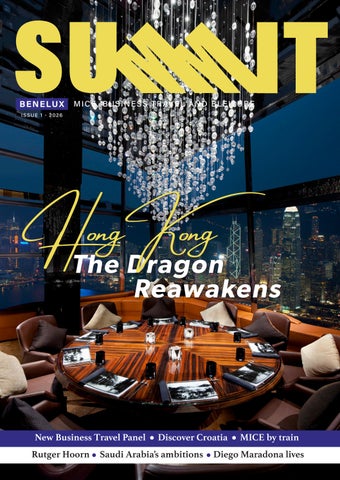
SUMMIT 1 - 2026

Page 1


Hong Kong

The Dragon Reawakens

New Business Travel Panel Discover Croatia MICE by train Rutger Hoorn Saudi Arabia’s ambitions Diego Maradona lives

A NOTE BY THE EDITOR

What a start to the year we’ve had. Fresh out of the fireworks and bubbles, the world started shaking on its geopolitical feet. But no industry is as resilient as the one we call business travel. We have been here before, facing serious challenges of all sorts, yet one thing remains true: people always need to travel.

It is wonderful, therefore, to be able to share some good news. The airline industry is on the up and up, many destinations are seeing an increase in corporate bookings, and the MICE sector continues to grow steadily. No one ever said it was easy, but because we love what we do, we always find a way. All IT, AI, and other abbreviations aside, this is and always will be a people business.

I am very pleased to offer you some food for thought from the esteemed members of our MICE and Business Travel panels. We explore great new destinations, both near and far, accessible by plane or train, for business, pleasure… or both. We also feature an insightful interview with expert Rutger Hoorn, and I had the pleasure of revisiting one of my favorite cities in the world: the bustling, cinematic, enigmatic, and tasty Hong Kong.

There is much more for your quarterly enjoyment inside. Wishing you all the best for the year ahead!

Editor-in-chief

Editors: Arjen Lutgendorff, Sharon Evers, Dylan Cinjee, Bart Matthijs, Pieter Weymans, Theo de Reus.

Press releases and info: info@summitbenelux.com

Summit Benelux. Arendstraat 33A, 1223 RE, Hilversum. www.summitbenelux.com

Design:

Publishers:

van Apeldoorn

van Apeldoorn Sales & Marketing:

and information about advertising, etc.

Bakker, Dennis Ebbers, Dennis de Groot Sales@travmedia.nl SUMMIT Benellux is a

Encounter the whole world

Austrian Airlines, Brussels Airlines, Eurowings, Lufthansa, SWISS, Air Dolomiti, Discover Airlines and Edelweiss – these are the Lufthansa Group airlines.

For instance: flying from Amsterdam via our hubs Frankfurt, Munich, Vienna and Zurich to more than 270 destinations around the world.

And, not forgetting those living or working close to the border of Belgium and Germany, plenty of connections from either Brussels or Dusseldorf are offered.

With the airlines of the Lufthansa Group, passengers can make the most of a wide selection and lots of combination opportunities. Coordinated timetables and combinable fares ensure the greatest degree of flexibility when planning flights.

With the best connections

Whether for business or pleasure – the Lufthansa Group airlines fly passengers flexibly around the world.

IATA ON 2026: SKY HIGH AND BUDGET WISE

The global air transport industry is entering a historic chapter. According to the latest Global Outlook from the International Air Transport Association (IATA), the sector is projected to achieve a record net profit of $41 billion (€38.5 billion) in 2026. While this headline figure suggests a robust recovery, the underlying financial reality remains one of disciplined resilience rather than excessive gain, with net margins stabilizing at a lean 3.9%. For the first time in history, industry revenues surpassed the $1 trillion mark in 2025, a momentum expected to carry through 2026 with total revenues hitting $1.053 trillion. This growth is underpinned by unwavering passenger demand, even as global traffic growth (measured in RPK) moderates slightly to 4.9% year-on-year. The primary governor on this growth is not a lack of interest from travelers, but a persistent shortage of “hardware.” Supply-chain bottlenecks and delivery delays from major manufacturers mean airlines are struggling to induct new, fuel-efficient aircraft. This scarcity has pushed passenger load factors to a record projected high of 83.8%. For the business traveler, this translates to

consistently full cabins and stable yields, as airlines maximize every available seat.

Regional Shifts: Europe Takes the Lead

The 2026 outlook highlights a significant shift in regional dominance. For the first time in several years, Europe is expected to cede its position as a follower to become the most profitable region, with a projected net profit of $14 billion. This performance is bolstered by strong intra-European leisure demand and a particularly stellar performance from the Turkish market.

The Decarbonization Dilemma

Despite record financial figures, the industry’s “flight path” to Net Zero by 2050 is hitting significant turbulence. Sustainable Aviation Fuel (SAF) remains the industry’s primary hope for decarbonization, yet it is projected to account for less than 1% of total fuel consumption in 2026.

A new and unexpected competitor for renewable energy has emerged: Artificial Intelligence. The staggering electricity demands of AI data centers are increasingly competing for the same

renewable inputs needed to produce SAF. This competition risks driving up costs and further delaying the scaling of sustainable fuels. IATA has issued a clear “unambiguous verdict” on current policies, calling for global harmonization to prevent a fragmented regulatory environment from stalling aviation’s energy transition. IATA Director General Willie Walsh recently put the industry’s record profit into a startling perspective for the corporate world. Despite the $41 billion total, airlines earn an average of just $7.90 per passenger. To illustrate the thinness of this margin, Walsh noted that “Apple will earn more selling an iPhone cover than an airline makes transporting a passenger across the globe.” As the industry navigates the remainder of the decade, the focus remains on “shock-absorbing resilience.” Success in 2026 will be defined by those who can manage aging fleets effectively while balancing the rising costs of labor, maintenance, and the looming price tag of the green transition.

TUI Groups & Incentives

Unforgettable incentive trips

Fully

Creative à la carte incentive trips

Heading

Benefit from our years of experience and network

ANNIVERSARY YEAR FOR ‘BIJ JEF’

This year, Bij Jef celebrates its 30th anniversary. What began as a daring culinary dream has evolved into a restaurant and boutique hotel that firmly placed Texel on the global gastronomic map. Three decades of continuity on an island is exceptional in itself; that Bij Jef achieved consistent national and international acclaim during this period makes this milestone truly special. At a time when Texel was hardly considered a culinary destination, Jef Schuur started his restaurant with a distinct vision for flavor, origin, and hospitality. Initially located in Den Burg and later moving to Den Hoorn, Bij Jef is a member of Les Patrons Cuisiniers and Relais & Châteaux, where Jef

SECRID INTRODUCES

serves as a Delegation Chef. The anniversary year will be celebrated with a series of national and international guest chefs and special events. The festivities kick off on Sunday, March 22, with Hans Sneijders. As the former Chef de Cuisine of Château Neercanne, he was a key mentor and source of inspiration for Jef. His presence marks the beginning of a year dedicated to celebrating 30 years of Bij Jef.

SPRING/SUMMER

2026 COLLECTION

Secrid presents its Spring/Summer 2026 collection: a sophisticated expansion of its iconic pocketwear range where innovation, functionality, and expressive design converge. The new collection introduces the Flexwallet alongside fresh interpretations of existing lines such as Matte Satin, Vintage, Jungle, and Original. With this release, Secrid continues its thirty-year legacy of design-driven innovation, ensuring every product is crafted to simplify and enrich daily life. A standout addition to the collection is the Flexwallet: an ultra-thin wallet that combines

the original Cardprotector with the Flexpocket, an innovative, flexible textile sleeve. The Flexpocket provides space for extra cards, cash, tickets, or small essentials while remaining exceptionally compact and lightweight. Thanks to its soft structure, the wallet effortlessly adapts to its contents and the movements of daily use. Designed for those who prefer to travel light, the Flexwallet is available in a variety of colors, including Black, Kelp, Mauve, Orange, and Teal

BREITLING RETURNS TO F1 AS OFFICIAL WATCH PARTNER OF ASTON MARTIN

Two legendary names defined by a fascination with speed have officially joined forces. Breitling has announced a global, multi-year partnership as the official watch partner of both Aston Martin and the Aston Martin Aramco Formula One Team. The partnership marks Breitling’s official return to the F1® paddock, kicking off with the release of the Navitimer B01 Chronograph 43 Aston Martin

Aramco Formula One Team. The connection between the two brands dates back over a hundred years. In 1907, Leon Breitling introduced the Vitesse (French for “speed”), a chronograph so accurate that Swiss police used it to issue the very first speeding tickets. The debut watch of this partnership brings the Navitimer—originally designed in 1952 as a flight tool—back to the racetrack. In a nod to Aston Martin’s Formula 1® debut, production is strictly limited to 1,959 pieces

NOORDWIJK: WHERE VITALITY ENHANCES BUSINESS MEETINGS

As organisations increasingly prioritise wellbeing, productivity and meaningful connection, the choice of meeting destination matters more than ever. Noordwijk offers a distinctive proposition. As an officially recognised spa town, this coastal destination has been associated with health, relaxation and quality for more than a century — values that align seamlessly with today’s MICE market.

Meet by the sea: calm, clarity and energy

The environment plays a crucial role in performance. Meeting by the sea creates space to think clearly, recharge and connect on a deeper level. In Noordwijk, fresh sea air, expansive views and surrounding dunes provide a calm yet energising setting that supports focus and creativity. Business programmes can be enriched with vital elements: a short beach walk between sessions, an active break in the dunes, or a mindful start with yoga by the sea — small interventions that positively impact engagement and effectiveness.

Vitality as an integral part of your programme

In Noordwijk, vitality is not an add-on but part of the meeting experience. This makes the destination particularly suitable for board meetings, strategic sessions and multi-day conferences where mental clarity, decision-making and sustainable performance are key. The natural surroundings encourage

balance and help participants remain sharp, connected and inspired throughout their stay.

Culinary quality that connects

Noordwijk also stands out gastronomically, with a high-quality and diverse culinary scene — from refined restaurants to stylish beach clubs with strong culinary identities. Local and seasonal products take centre stage, with careful attention to quality, presentation and flavour. From healthy lunches to extended dinners, food becomes a natural moment of connection within any business programme.

Compact, convenient and well connected

Beyond inspiration, Noordwijk offers clarity and convenience. The destination is compact and well organised, with hotels, meeting venues, restaurants and the beach all within walking or cycling distance — enabling smooth programmes without unnecessary transfers. Located close to Amsterdam Schiphol Airport and well connected to major cities, Noordwijk is accessible for national and international groups, while still offering the tranquillity of a coastal retreat.

© Dirk van Egmond Noordwijk Duinen

THE SUMMIT MICE EXPERT PANEL

We welcome back our SUMMIT Expert Panel: experienced MICE professionals who share their answers to questions from the editor. Do you have a question yourself? Mail us!

Our two questions:

1. The world is currently in a state of unrest; everyone will agree on that. Why is organizing an incentive specifically now a good and commercially useful idea?

2. What is the most important business lesson you have ever learned, and from whom?

Evelien Schepers, Conscious Travel Designer & Partner at Contour Travel

1. Organizing an incentive is about more than just bringing people together in a carefully chosen location. It is precisely the breaking of routines and comfort zones that leads to inspiration, cross-pollination, and valuable knowledge sharing. When participants are taken out of their daily context, space is created for new insights and genuine connection.

In an era characterized by polarization and global uncertainty, it is more important than ever for businesses to remain resilient and enterprising. Incentives play a crucial role in this. They create moments of encounter where not only strategic and technical themes are addressed, but where there is also room for informal conversations and human contact.

By continuing to connect, inspire, and amaze, organizations strengthen their mutual bonds of trust. And it is that very trust that is the essential building block for sustainable cooperation and successful business.

2. Our sector demands flexibility. Last-minute changes, uncertain circumstances, weather influences, or technical challenges are not exceptions but reality. It is precisely our resilience that ensures these factors do not affect the final result.

We always operate from one principle: there is always a Plan B, and if not, there are still 25 other letters in the alphabet. This mentality allows us to remain decisive and creative even in the face of setbacks. Often, it is these alternative scenarios that manage to surprise and position us even more strongly as a partner.

Tijn Kramer Chief editor SUMMIT Benelux

Annemieke Stuurman, Director GI Travel

1. Specifically in these turbulent times, attention to people is more important than ever. The world is out of balance on many fronts, and we all feel it. Uncertainty, constant change, and increasing pressure have a major impact on people’s energy and the way they work and collaborate. That is why organizing an incentive right now is a conscious and valuable investment for a company. It offers employees the opportunity to detach from daily hectics and rediscover the vital mutual connection. Traveling together and sharing a special experience strengthens mutual trust, provides relaxation, and gives teams and colleagues new, fresh energy.

I experienced this myself last weekend when we traveled to Glasgow with our entire team of 30 employees. That collective experience provided an enormous team boost and showed once again how much power lies in experiencing and connecting together. By organizing an incentive, you show that people are seen and appreciated. That increases engagement, motivation, and loyalty—factors that contribute directly to achieving business objectives and better performance at all levels. In uncertain times, people need appreciation, trust, and perspective. An incentive provides that internally, but also externally. It radiates confidence to customers and partners and shows that we continue to look forward together, despite the circumstances we find ourselves in. Organizing an incentive in today’s restless times is therefore not a luxury, but a meaningful investment in people and the future.

2. The most important business lesson I learned from our previous director, Marijke Vink, is that success is ultimately always about people. Especially in our MICE (Meetings, Incentives, Conferences, and Exhibitions) business, people are the key to success on all fronts—both our own colleagues and the valuable partners we work with in The Netherlands and worldwide.

Listening, giving trust, and sincere attention form the most important pillars, especially when things get tense and we have to face unexpected circumstances together. Good leadership lies in connection. Results follow when people feel safe to be themselves, share ideas, and grow together. Figures are obviously important, but the way you treat people ultimately determines whether success is lasting and sustainable.

Owner of Motivation Travel

1. People always need direction, trust, and connection— but perhaps now more than ever. In a (hybrid) work environment full of stimuli, distance, and fragmented attention, this does not happen automatically. That is exactly why incentives with valuable live experiences are not a luxury, but a strategic instrument. Welldesigned incentives bring people together physically and accelerate precisely what organizations need: mutual human connection and true engagement. They create trust and emotional bonding and generate shared memories—essentially the foundations of loyalty and commitment.

Additionally, incentives are a powerful means to shift group behavior. In a short amount of time, teams can reconnect with their purpose, their values, and each other. This inspires and motivates, but also keeps the “human” element relevant in the age of AI. Live experiences are also an effective way to facilitate dialogue, maintain focus, and move in the same direction together. The World Economic Forum emphasized this year with the theme

“Spirit of Dialogue” the power of gathering live in difficult times: meeting each other, listening, and searching for direction together.

2. The most important lesson I have learned as an entrepreneur is that there is always room for entrepreneurship in both good and bad times, as long as you dare to choose, have a creative plan, and take responsibility for your own value. In my work in the incentive industry, I have learned along the way that entrepreneurship isn’t about working harder or delivering more, but precisely about making sharp choices: which clients fit you, where do you truly add value, and where do you consciously draw a line.

If I were to name a mentor and inspiration, it would be Martijn Dirks (Provast). He taught me that saying “yes” is just as important as saying “no.” He taught me that expertise has value, and that you must dare to name and price that value and stand by it completely. I also twice had the opportunity to work with former South African President F.W. de Klerk, speak with him, and hear his lectures. His lesson was that true progress requires letting go of your own interests for the sake of the collective greater goal; that always touched me and became a mantra.

Nathalie Jacobs, Managing Partner FAME Travel Designers

1. Nowadays, there is so much polarization in the world, and almost everything happens digitally. We scroll endlessly, organize our meetings digitally, do our grocery shopping via an app…

Never before have we had so little personal contact with each other, yet that is one of the most important basic human needs. Physically coming together at an inspiring location abroad restores a sense of connection—a feeling that we are part of a larger whole. Deconnecting from everything digital for a while also brings peace to people’s minds and bodies. That is why we are increasingly focusing on incentive trips that center on wellbeing. Why not dive into a cold bath together or delve into breathwork?

2. Our business coach always says: “Start working on your business instead of in your business.” Until a good year ago, I was constantly involved in the company’s operations, but as a result, FAME lacked direction and vision. By literally stepping out of operations and beginning to focus on strategy and vision, much more room has been created for creativity and growth potential.

Rob van Helvoort, Owner Travel Legends

1.With all the negative news, motivation may decline. However, research shows that incentives have a direct impact on productivity and workplace culture. Studies indicate that companies using incentives can achieve up to 40% higher productivity. This can translate into increased sales, more efficient processes, or simply higher output per employee. In addition, it is important to continue fostering connection among colleagues, as this also has a direct effect on workplace culture and overall employee satisfaction.

2. Do not give discounts. You can be transparent about your pricing, but do not compete on price, compete on value. If you let price lead, you ultimately undermine your brand and your entire positioning. I heard this during a lecture by Jos Burgers, and I still apply it today ;)

CROATIA: A NEW KEY PLAYER UNDER THE SUN

In recent years, Croatia has emerged as one of the most dynamic destinations for MICE in Europe. The country seamlessly blends breathtaking historical backdrops with a modern infrastructure and an exceptionally competitive price-to-quality ratio. This unique proposition offers a sophisticated mix of Central European business efficiency and the relaxed elegance of a Mediterranean lifestyle.

The country’s strategic hubs offer diverse environments suited for any corporate requirement. Zagreb, the capital, serves as the year-round anchor for major congresses and trade fairs, boasting the nation’s largest capacities and seamless connections to the rest of the continent. Meanwhile, Dubrovnik, often called the “Pearl of the Adriatic,” remains the premier choice for high-end incentives, where medieval architecture meets world-class luxury hotels. Further along the coast, Split and Hvar provide a perfect synergy of ancient history, such as Diocletian’s Palace, and active water-based incentives. For the Central European market, the region of Istria and the town of Rovinj are particularly favored for their road accessibility and world-renowned gastronomy featuring truffles and premium wines.

The strength of Croatia’s incentive appeal lies in its unconventional venues and natural wonders. Imagine hosting a gala dinner in a Roman amphitheater, conducting board meetings within the stone walls of a fortress, or organizing team-building retreats on private archipelagos like Brijuni or the Pakleni Islands. The accessibility of these experiences has been greatly enhanced since Croatia’s 2023 entry into the Schengen Area and the adoption of the Euro, which effectively removed many of the logistical and financial hurdles for international planners.

From a statistical perspective, Croatia’s performance on the ICCA (International Congress and Convention Association) rankings reflects its growing influence. The country consistently maintains

a strong global presence, typically securing a spot within the world’s Top 40. Within Europe, it frequently lands between the 20th and 25th positions. Zagreb leads the national ranking, often appearing in the top 50 European congress cities, followed closely by Dubrovnik, which excels in small to medium-sized international association meetings of up to one thousand participants. It is important to note that while ICCA focuses on rotating association congresses, Croatia’s standing is arguably even stronger in the corporate incentive sector, which the ranking does not track. To illustrate the diversity of the Croatian offer, one can look at several curated three-day programs. A “Royal Treatment” itinerary in Dubrovnik might involve a private cocktail on the ancient city walls at sunset, a speedboat flotilla to the Elaphiti Islands for a beach club takeover, and a black-tie gala at the Lovrijenac Fort, famously known as the “Red Keep.” In contrast, a program focused on Split and Hvar emphasizes adventure and lifestyle, featuring sailing regattas, jeep safaris through lavender fields, and canyoning on the Cetina River. Zadar offers a more boutique experience focused on innovation and nature. A typical program there includes checking into sleek design hotels, visiting the Sea Organ and Greeting to the Sun installations, and embarking on a “Robinson Crusoe” lunch on an uninhabited island within the Kornati National Park. For those seeking urban culture, Zagreb provides a sophisticated year-round itinerary

Tijn Kramer Editor-in-Chief

including workshops for local delicacies like Štrukli, visits to unique museums, and grand gala evenings at the iconic Esplanade Hotel, a historic stop on the Orient Express.

Transformation

The country’s transformation into a serious contender for large-scale international congresses is supported by impressive infrastructure. The Amadria Park Convention Centre in Šibenik stands as the largest and most modern facility on the Adriatic coast, capable of hosting over fifteen hundred delegates with extensive breakout spaces. In the north, the Zagreb Fair continues to provide massive exhibition pavilions, while the upcoming Pical Event Center in Poreč, set to open in 2026, will become Istria’s largest venue with a capacity for twelve hundred people.

As we look toward 2026, several key trends are shaping the Croatian MICE landscape. Following a significant investment cycle, nearly all major venues now feature high-end streaming

studios for hybrid events. There is also a notable rise in the “Bleisure” factor, with delegates extending their stays by an average of two and a half days. To support this, many organizers now offer pre- and post-conference tours directly through their registration platforms. Furthermore, the expansion of airports in Split and Zadar ensures that logistical barriers have been virtually eliminated. For those looking to elevate a keynote session, Croatia offers venues with unparalleled atmosphere. The acoustic brilliance of St. Donatus Church in Zadar is ideal for academic symposia, while the Vatroslav Lisinski Concert Hall in Zagreb can accommodate plenary sessions for up to eighteen hundred attendees. For a truly unforgettable conclusion to a scientific congress, the historic Fort Revelin in Dubrovnik provides a dramatic setting that few other destinations in the world can match.

Business Travel Tips

• Relationship First: Personal trust is the foundation of business. Prioritize face-toface meetings over emails; Croatians want to know the person behind the proposal before signing any contracts.

• The Coffee Ritual: “Going for coffee” is the primary venue for negotiation. These sessions are long and informal—rushing to the point is considered rude.

• Formal Beginnings: Maintain a professional distance initially. Use surnames and formal titles (Gospodin for Mr., Gospođa for Mrs.) until a closer rapport is established.

• Polished Presentation: Appearance is a sign of status and respect. Ensure your attire is smart and professional, as Croatians place high value on a well-groomed first impression.

• Top-Down Hierarchy: Decision-making is often centralized at the top. Be patient if you have to meet with several layers of management before reaching the final decision-maker.

• Strict Punctuality: While social life is relaxed, business meetings are not. Always arrive on time, though you should be prepared for your counterpart to take their time during the discussion.

• Master Small Talk: Start meetings with neutral topics like sports, food, or travel. Avoid diving straight into business, and steer clear of regional political history.

• Respect the “Weekend”: Avoid scheduling meetings for Friday afternoons. Work-life balance is strictly guarded, and business usually halts as people head to the coast or countryside.

• Timing Your Visit: Avoid August entirely. Much like the Mediterranean “siesta” on a month-long scale, the country effectively shuts down for summer holidays.

ZADAR, THE NEW RISING STAR OF THE MEDITERRANEAN FOR MICE EVENTS

For meeting planners and incentive organisers from Belgium, The Netherlands and Luxembourg, Zadar presents a compelling Mediterranean alternative that combines authenticity, modern infrastructure and a relaxed, unspoiled atmosphere. Compact and easy to navigate, the city allows organisers to focus on meaningful programmes and delegate experience within an intimate and welcoming coastal setting.

Accessibility is a key strength. Zadar International Airport offers seasonal direct flights from Brussels with Brussels Airlines and Ryanair, from Eindhoven with Ryanair, as well as convenient connections from Amsterdam. With flight times of under 2.5 hours and an airport located just 15 minutes from the city centre, long transfers are eliminated, maximising productive time on the ground. Excellent road links further connect Zadar with Zagreb and neighbouring markets, making it a practical choice for regional conferences, corporate gatherings and mid-sized international events from the Benelux region.

Zadar’s appeal is further defined by its human scale. Historic venues, hotels, conference facilities, restaurants and social event locations are all within minutes of one another, simplifying logistics and creating a relaxed environment that naturally encourages connection and engagement beyond the meeting room.

A Growing Portfolio of MICE Venues

Zadar’s growing MICE profile is supported by a new generation of high-quality accommodation Zadar’s infrastructure supports high-quality events while preserving intimacy. The Falkensteiner Resort Punta Skala in nearby Petrčane remains a proven regional MICE hub, capable of accommodating larger groups across multiple hotels. It features versatile spaces, including the state-of-the-art Fortis Club with a multifunctional hall of 527 m² that seats up to 470 people in theatre style — perfect for plenary sessions, product launches, exhibitions, gala dinners and incentive programmes in a contemporary seaside setting. In the urban core, the Hyatt Regency Zadar (opened in 2025) brings an internationally recognised luxury brand to the city. With 133 premium rooms and suites, it offers over 740 m² of flexible event space, highlighted by a 400 m² pillarless Regency Ballroom with natural daylight and

poolside terrace access, accommodating up to 355 guests in theatre or banquet setups. Additional breakout rooms, pre-function areas and high service standards make it an excellent venue for executive meetings, board-level gatherings and upscale corporate events — all within walking distance of the historic centre.

Just a short drive away, the Congress & Event Center Zadar at Hotel Pinija provides a complementary nature-inspired option. Surrounded by pine forests and the Adriat-

ic, it features the Donat hall (348 m², up to 355 participants in theatre) and Forum hall (283 m², up to 295), contributing to a total congress capacity of around 870 guests. The venue excels for sustainable “green” meetings, team-building activities and events that benefit from outdoor areas and a relaxed resort feel.

Experiences Beyond the Meeting Room

Zadar’s strength as a MICE destination becomes especially evident once the formal programme concludes. Delegates can step straight into the inspiring historic old town on a peninsula, steeped in centuries of layered history. This walkable setting is ideal for hosted receptions, guided cultural tours, or informal networking moments woven naturally into the day, all with stunning sea views.A short stroll along the waterfront leads to the city’s signature landmarks: the Sea Organ, where sea waves create soothing, ever-changing melodies and the Greeting to the Sun, a solar-powered installation that lights up in vibrant colours at dusk. These unique, organic experiences spark wonder and easy conversation, turning simple sunset gatherings into memorable highlights.

The wider Zadar region offers excellent incentive options. Sail through the surrounding archipelago, hike or explore Paklenica National Park’s dramatic landscapes, or enjoy sea kayaking along the coast. These nature-based activities provide refreshing balance, perfect for team-building or rewarding performance. Gastronomy completes the picture with authentic Dalmatian cuisine: fresh seafood, seasonal ingredients,local specialities like Pag cheese and dishes under the peka, paired with award-winning Croatian wines and premium olive oils. From private tastings to chef-led dinners, these elements allow organisers to create genuine, locally rooted programmes that resonate deeply.

In a MICE landscape where balance, authenticity and meaningful downtime matter more than ever, Zadar stands out. It combines reliable infrastructure with an intimate scale, genuine Mediterranean warmth and a calmer pace that feels personal and rejuvenating. Organisers enjoy efficiency without stress, while delegates return more connected, inspired and energised.

www.zadar.travel | info@zadar.travel

BALTIC ELEGANCE: LATVIA’S PREMIER VENUES FOR HIGH-END CORPORATE EVENTS

From the medieval grandeur of Riga’s Old Town to cutting-edge industrial transformations and tranquil countryside estates, Latvia is rapidly positioning itself as a sophisticated hub for the MICE sector.

Latvia offers a remarkably diverse selection of venues, ranging from contemporary architectural landmarks to luxurious historical estates. Whether you are planning a high level conference, an elegant gala dinner, or a memorable incentive event, Riga and its surrounding regions provide an exceptional variety of locations to meet every requirement. The capital city presents numerous urban venues within convenient walking distance of major hotels, creating a

seamless experience for international guests. Riga’s Old Town, with its charming cobblestone streets and rich heritage, is home to several luxury venues housed in restored historical buildings enhanced with modern design elements.

The House of the Blackheads, prominently situated on Riga’s Town Hall Square, stands out as one of the most prestigious event settings in the city. Its magnificent façade draws attention even from afar, while the interior—characterized by ornate halls and refined décor—is ideal for high profile receptions, gala dinners, and ceremonial gatherings. For a more intimate yet equally distinguished atmosphere, the Small Guild offers versatile room layouts and a warm historical ambiance, making it a preferred choice for smaller luxury events.

Riga’s contemporary venue scene is just as compelling. The Latvian National Library, one of the city’s most iconic modern structures, serves as a multifunctional venue for conferences, exhibitions, and receptions of various

scales. Purpose-built to accommodate both cultural activities and corporate events, it has become a favored location among international organizers. Hanzas Perons, a striking transformation of a former railway cargo warehouse, offers a unique blend of industrial heritage and modern aesthetics. Its openplan layout, high ceilings, and flexible technical infrastructure make it particularly suitable for creative corporate functions, product launches, and largescale receptions.

Beyond the capital, Latvia’s luxury offering extends into its countryside, where numerous manors and castles provide exceptional event possibilities. Many of these estates—some meticulously restored, others enriched with contemporary extensions—offer facilities for conferences, gala dinners, and team building activities in tranquil natural surroundings. Within a short drive from Riga, guests can experience the charm of Latvia’s historical heritage while enjoying high-quality hospitality and exclusive settings that lend themselves perfectly to multi-day events, retreats, and incentive programs.

GREEN AND NEARBY MICE ON YOUR DOORSTEP

Düsseldorf

Wherever you are coming from in the Benelux, you have a very sustainable option in the neighborhood. Leave the car, skip the plane, hop on the train and enjoy these wonderful smaller cities.

Düsseldorf, Germany

Düsseldorf is known for its fashion, art, and the famous “longest bar in the world.”

• Accessibility: Like Cologne, Düsseldorf is easily accessible with the ICE International from Amsterdam, Utrecht, and Arnhem (travel time approx. 2 hours and 15 minutes).

• Venues: Messe Düsseldorf is worldfamous. For a more modern vibe, venues in the MedienHafen (with architecture by Frank Gehry) are especially popular.

• Incentive: An architecture walk through the harbor or a team-building activity along the Rhine promenade.

Ghent (Gent), Belgium

If you’re looking for a more intimate and less corporate atmosphere, Ghent is a hidden gem.

• Accessibility: Around 2 to 2.5 hours travel time via Antwerp or Brussels.

• Venues: ICC Ghent is located in Citadel Park, but the city truly shines in its reuse of historic buildings, such as the Old Fish Market (Oude Vismijn).

• Incentive: A boat tour through the medieval canals with a tasting of local beers and the famous “Ghent noses” (cuberdons).

Leeuwarden, The Netherlands

The Frisian capital stands for calm, space, and a distinctive local culture. We love this town.

• Accessibility: Direct train connections from Utrecht and the Randstad. It’s the perfect destination to escape the bustle of the western Netherlands.

• Venues: WTC Expo Leeuwarden for large-scale events, or Post-Plaza (housed in a former post office) for an atmospheric, upscale setting.

• Incentive: Wadden Sea mudflat hiking (just 30 minutes away), a traditional barge tour through the canals, or a visit to the innovative WaterCampus.

GRAND HOTEL HUIS TER DUIN

ENJOY HOLLAND’S FINEST BEACH

The majestic Grand Hotel Huis ter Duin has been the highest point on the Dune in Noordwijk for over 135 years, directly located on the beach with a stunning view of the North Sea. The 254 rooms, including various suites and penthouses, combined with the 19 multifunctional meeting rooms, provide the perfect combination for a successful event!

A unique family owned and operated hotel; 254 rooms, including 20 suites and 4 penthouses; 19 multifunctional rooms, all with direct daylight and air conditioning. The largest room has a ceiling height of 5.7 meters and can accommodate up to 500 people in cabaret style with ‘back projection’;

Directly located on the beach, making it perfect for incentives and social activities;

Three-time winner of the M&IT Award for ‘Best Overseas Hotel’; Only 20 minutes from Schiphol Airport and 30 minutes from Amsterdam and The Hague; Free WIFI in the rooms, meeting rooms, and public areas.

Aachen (Aken), Germany

Aachen is an ideal destination just across the border, offering a unique mix of imperial history and high-end technology.

• Accessibility: From cities such as Heerlen or Maastricht, you can reach Aachen in 15 to 30 minutes. From the Randstad, you can easily travel via various routes.

• Venues: Eurogress Aachen is a leading conference center. For a historical setting, you can use venues around the world-famous Aachen Cathedral.

• Incentive: A guided tour through the historic city center combined with a tasting of Aachener Printen, or a visit to the RWTH University high-tech campus for an innovative angle.

Cologne (Keulen/Köln), Germany

Cologne is one of Europe’s most important trade fair cities and has a welcoming, vibrant atmosphere. Plus Kolsch.

• Accessibility: With the direct ICE International, you can travel from Amsterdam Central to the heart of Cologne in around 2 hours and 40 minutes.

• Venues: Koelnmesse is enormous and ideal for large-scale exhibitions, but the city also offers unique venues such as Flora Köln (a beautiful glass palace in the botanical gardens).

• Incentive: Climb the cathedral, enjoy a Kölsch beer tasting in one of the many traditional breweries, or take a boat cruise on the Rhine.

Antwerp, Belgium

Antwerp is a “pocket-sized” global city combining fashion, diamonds, and an impressive port. It is hipper than ever.

• Accessibility: The Eurostar (formerly Thalys) or the Intercity Brussels takes you directly to Antwerp Central Station in 1 to 2 hours. The station itself is considered one of the most beautiful event locations in the world.

• Venues: The Flanders Meeting & Convention Center Antwerp (FMCCA) is literally located inside the zoo (ZOO Antwerp), right next to the station. Hosting meetings among the animals adds a unique dimension.

• Incentive: A chocolate-making workshop at Chocolate Nation or a culinary walk through the trendy Eilandje district near the MAS museum.

Luxembourg City, Luxembourg

Luxembourg is a surprisingly modern and green destination, ideal for international business meetings.

• Accessibility: By train, you travel via Brussels and then take the direct connection to Luxembourg. A major advantage: all public transport throughout the entire country is free.

• Venues: The Kirchberg district is home to the Luxembourg Congress Center, surrounded by modern architecture and European institutions.

• Incentive: Explore the UNESCO-listed casemates (underground fortifications),

followed by a wine tasting in the nearby Moselle Valley.

Lille (Rijsel), France

Lille is the perfect “far-away” destination that still feels very close. It is a key hub for both the Eurostar and TGV networks.

• Accessibility: From Rotterdam or Amsterdam, take the Eurostar to Brussels South (Bruxelles-Midi), where you transfer to the TGV or Eurostar to Lille (travel time from Rotterdam approx. 2 hours).

• Venues: Lille Grand Palais is a vast complex for conferences and exhibitions. For something more distinctive, consider L’Aéronef or venues in the beautiful Vieux-Lille district.

• Incentive: A culinary tour through the old town or a visit to the nearby La Piscine Museum in Roubaix, an Art Deco swimming pool transformed into a museum.

Maastricht, The Netherlands

Often described as the most “un-Dutch” city in the country, Maastricht is ideal for an international feel without crossing the border.

• Accessibility: Direct intercity connections from the Randstad. The station is within walking distance of the city center.

• Venues: MECC Maastricht has recently been completely renovated and ranks among the top venues in Europe. For

Maastricht

WHERE IDEAS MEET – AACHEN AT THE HEART OF EUROPE

Aachen, Charlemagne’s capital and Germany’s westernmost major city, offers an outstanding setting for meetings, congresses, and corporate events. Situated in the tri-border region of Germany, Belgium, and The Netherlands, the city benefits from excellent international accessibility. The Eurostar links Aachen directly to Brussels, Paris, and London within a few hours, while convenient rail connections to Antwerp, Luxembourg, and Amsterdam, as well as nearby airports such as Cologne-Bonn (CGN) and Düsseldorf (DUS), ensure smooth national and international travel.

With more than 2,000 years of history, Aachen successfully combines cultural heritage with forward-looking innovation. The historic old town and the UNESCO World Heritage Site Aachen Cathedral represent its rich past, while RWTH Aachen University and numerous research institutions and technology-driven companies make the city a leading hub for science, business, and knowledge exchange. Aachen’s participation in the EU mission “100 Climate-Neutral and Smart Cities” underlines its clear commitment to sustainability and responsible urban development.

The local event sector has grown considerably in recent years. According to the Meeting & Event Barometer Aachen 2023/2024 (EITW), the number of event venues has increased by more than 80 percent. Today, over 40 locations are available, ranging from historic buildings to modern conference facilities. Aachen attracts a notably high proportion of international participants, exceeding the average of comparable destinations.

In addition, Aachen offers more than 80 hotels across all categories, many located within walking distance of key venues. Competitive pricing, short distances, and a vibrant urban and cultural scene further strengthen its profile as an attractive MICE destination. Event planners receive comprehensive, free support from aachen convention, a neutral partner providing local expertise, strong networks, and services such as venue coordination, site inspections, social programmes, and participant management.

Aachen combines tradition, innovation, and sustainability, providing an ideal setting to turn ideas into successful events. Tributing to that, Aachen adds a compelling chapter with the reopening of the Kurhaus Aachen in 2026. As a historic landmark and symbol of the city, the venue offers a distinctive setting for meetings, conferences, and events. Carefully renovated, the building provides flexible spaces supporting modern congress concepts — from plenary sessions and parallel meetings to networking formats, lectures, and evening social events.

With strong cross-border accessibility and proximity to established congress infrastructure, the Kurhaus Aachen delivers a balanced mix of functionality and character, designed for meaningful exchange, planning, and memorable experiences.

Interested in more information?

Visit: www.aachen-convention.de or www.eurogress-aachen.de

© Eurogress Aachen

a historic atmosphere, choose amazing Château Neercanne or the underground cellars of Rebelle.

• Incentive: An underground exploration of the marlstone caves or an exclusive dinner at one of the many vineyards in the Jeker Valley.

Mechelen, Belgium

Often overshadowed by Antwerp or Brussels, Mechelen is Flanders’ MICE surprise: compact, historic, and highly innovative.

Accessibility: The Eurocity Direct (formerly the Benelux train) stops directly in Mechelen. From Amsterdam, the journey takes around 2 hours.

Venues: Het Predikheren is a former monastery now serving as one of Europe’s most inspiring library and meeting spaces (a Flanders Heritage Venue).

Incentive: Climb the St. Rumbold’s Tower for a skywalk with views stretching to Antwerp and Brussels, or join a beer workshop at the legendary Het Anker brewery.

The

Hague (Den Haag), The Netherlands

The city of peace and justice, offering a unique blend of political prestige and the beach at Scheveningen.

• Accessibility: Excellent rail access via The Hague Central Station and Hollands Spoor.

• Venues: The World Forum specializes in large, often high-security international conferences. The Fokker Terminal, a former aircraft hangar, provides a bold industrial setting.

• Incentive: A networking reception at one of the beach pavilions or a visit to Impact Campus Titaan for groups focused on innovation and sustainability.

Leiden and Noordwijk, The Netherlands

Known as the “City of Discoveries,” Leiden is ideal for academic or medical congresses thanks to its strong links with the university and the Bio Science Park. Noordwijk aan Zee is the true upscale diamond of the Dutch coast.

• Accessibility: A major Randstad rail hub, with trains departing every 10–15 minutes from all major cities.

• Venues: ECC Leiden offers a large, flexible floor space for big groups, while national museums such as Naturalis or the National Museum of Antiquities provide unique dinner venues. The classic Grand Dame Grand hotel ter Duin is where presidents sleep.

• Incentive: A canal cruise along Leiden’s 28 kilometers of waterways or a “scientific walk” through the historic

Hortus Botanicus. And of course all sorts of fun beach activities.

Groningen, The Netherlands

A young, vibrant city that never sleeps, ideal for energetic groups. And ‘Eierballen’ (do not miss this home town snack)

• Accessibility: Despite the distance, the direct train connection from Utrecht and the Randstad is very comfortable, allowing you to work productively along the way.

• Venues: Forum Groningen is an architectural landmark with multiple event spaces and a rooftop terrace offering the best views in the north of The Netherlands.

• Incentive: An “Energy Tour” to the Eemshaven or a nighttime climb of the Martinitoren.

Leiden
Luxemburg

THE NEW MATURITY: RUTGER HOORN ON THE FUTURE OF GLOBAL INCENTIVES

In this interview, Rutger Hoorn, VP of Global Sales at Ovation Global DMC and IRF Board Member, discusses the shifting landscape of the incentive industry in 2026. He explores the rise of intentional luxury, the unique pragmatic approach of the Benelux market, and why rewarding the “solid middle” is now a strategic necessity for global businesses.

You hold a key leadership position at Ovation Global DMC and serve on the Board of Trustees for the IRF. How do these two roles complement each other when identifying shifts in the global incentive landscape? They complement each other in the best possible way: one role gives me signal, the other gives me reality. At the IRF, I’m in the middle of the industry’s research, benchmarks, and emerging indicators— what’s changing and why. At Ovation, I see how those shifts land in the real world: what buyers are actually asking for, what participants respond to, and what destinations and suppliers can truly deliver. The combination keeps me honest. Research can show a trend; operations confirm whether it’s a trend or just a talking point. And when a new pattern shows up in client behavior, say around sustainability reporting, duty of care, or “reward the many,” I can bring that back into the IRF conversations as practical insight from the field. It becomes a feedback loop: data informs design, and design informs the next questions we need to ask.

As we move through 2026, how would you describe the current state of the union for the incentive industry? Are we in a phase of stabilization, or is the rapid transformation we saw post-pandemic still accelerating? Personally, I’d call 2026 a new maturity phase rather than a stabilization or back to “normal.” Some elements have stabilized—lead times are improving, supply is rebalancing, and we see, slowly but surely, budgets being set with more confidence. But the underlying transformation is still very much alive. What’s changed is the direction of transformation. Post-pandemic acceleration was about speed and unpredictability; today it’s about intentionality. Buyers are more deliberate about value, impact, and relevance. They’re asking: “What does this reward mean? What story does it tell about our culture? How does it support retention, performance, and purpose?” And because talent pressure hasn’t disappeared, incentive travel is increasingly framed as a strategic tool. It is less “nice-to-have” and more “business-critical.”

From your perspective, how does the Benelux market differ from the North American or Asian markets in its approach to reward and recognition?

Broadly speaking, the Benelux market is highly intentional and pragmatic in how it thinks about rewards. There’s often a stronger preference for experiences that feel authentic, well-curated, and socially responsible without being showy for the sake of it. It’s less about spectacle and more about substance: quality, access, and meaning. North American programs can lean more toward big emotional moments and bold “once-in-alifetime” style reveals, often with a stronger focus on the recognition theater element. In many of the Asian markets, I see a nuanced interplay of status, hierarchy, group harmony, and prestige, with a deep emphasis on impeccable service and protocol. Benelux clients tend to ask: “Is it real? Is it thoughtful? Does it align with who we are?” That’s a powerful filter, and it often leads to beautifully designed programs with depth.

IRF research indicates that Europeans prioritize cultural immersion and unique local history more than North Americans. How does this thirst for authenticity change the way Ovation designs an itinerary in the Benelux?

It changes everything, in a good way. In the Benelux, cultural immersion isn’t a “half-day add-on,” it’s the backbone of the program. We design with layers of authenticity: not just visiting a museum, but gaining behind-the-scenes access, meeting the people who keep traditions alive, and placing guests into environments where they can feel the destination, not just consume it. That might mean a private opening in a historic venue, a curated encounter with contemporary Dutch design, a canal experience that’s more intimate and story-led than touristy,

or a culinary journey where the chef explains the provenance and philosophy, not just the menu. The goal is to make guests feel: “I couldn’t have done this on my own.” That’s what luxury looks like in 2026: access, context, and connection.

Data shows 48% of Europeans now prefer Western Europe over long-haul destinations. As a VP of Global Sales, how do you steer a client who wants a luxury feel but insists on staying close to home?

I start by reframing luxury. Luxury isn’t distance; it’s precision. It’s time saved. It’s access granted. It’s being known. So if a client wants a high-end feel but prefers to stay closer to home, we focus on private access to venues and museums, micro-moments of personalization, culinary excellence with local storytelling, well-being and pacing, and designled hospitality. In Western Europe, and especially the Benelux, we can deliver extraordinary luxury by curating the “unbuyable” and making it feel effortless. A short-haul destination can feel more premium than long-haul if the experience is truly bespoke.

European planners are twice as likely to prioritize a low carbon footprint compared to Americans. Are we reaching a point where programs in Europe are judged more on their legacy and impact than on their opulence?

In Europe, we’re definitely reaching a point where impact is a dimension of prestige. Opulence without intention can feel outdated. Programs are increasingly judged on what they contribute, what they respect, and what they leave better than they found it. That doesn’t mean luxury disappears; it means luxury evolves. A program can still be spectacular, but it should also be responsible, locally beneficial, and measurable. Clients are

asking for smarter transportation choices, reduced waste, community engagement that’s not performative, and venues with credible practices. The best incentives now deliver a dual win: emotional ROI for participants and reputational ROI for the company.

The IRF research even touched on tipping fatigue and cultural confusion. How do you prepare international groups for these subtle soft differences in hospitality between the US and Europe?

We treat cultural alignment as part of duty of care and part of the experience. The key is to reduce anxiety and prevent awkward moments. We do that through pre-trip briefs in plain language regarding etiquette, onsite cues via the event app, and host coaching. The biggest difference I see is that US service culture can be more overt and tip-driven, while much of Europe is more understated and “included.” If you explain that upfront, guests relax, and when guests relax, they connect more deeply with the destination.

There is a growing trend regarding Broadening the Definition of Top Performer. Why is it strategically vital for companies to reward the

solid middle rather than just the elite sales stars?

Because the “solid middle” is often the engine room of a company. They’re the consistent performers, the culture carriers, and the managers-in-waiting who are most at risk of feeling invisible if recognition only goes to the top 1%. Strategically, rewarding only the elite can create a winner-takes-all culture that’s hard to sustain. Recognizing the middle drives retention and influences day-to-day cultural behavior. When you reward the middle intelligently, you don’t lower standards; you widen the runway for excellence.

How do you design an inclusive strategy that motivates the majority of the workforce without diluting the exclusivity that makes an incentive trip special?

You separate eligibility logic from experience design. Inclusion doesn’t mean “same for everyone.” It means more people have a clear path to earn something meaningful while still protecting the magic of a toptier reward. A strong model is tiered recognition: a flagship incentive for top performers and a second-tier regional experience that creates visibility and pride. Exclusivity should come from

access and storytelling, not from artificial scarcity. You preserve “special” by designing it with intention, while expanding motivation through fairness and transparency.

The industry faces staffing shortages. Based on IRF insights, what must the MICE industry change to become an employer of choice for Gen Z, who value purpose over traditional corporate perks?

Gen Z doesn’t just want perks; they want purpose, growth, flexibility, and psychological safety. To become an employer of choice, our industry has to modernize the employee experience with the same creativity we apply to events. This includes clear career pathways, coaching cultures, realistic workload planning, and authentic sustainability. We also need to celebrate the craft. This industry offers the chance to build human moments that people remember for life. If we pair that meaning with modern employment practices, we’ll win talent. It won’t be an easy task, as our industry is engrained with going beyond what is expected, but it is necessary.

Incentive travel is inherently human-centric. How do you ensure

AI enhances logistical efficiency without automating away the empathy and personal touch that are the hallmarks of a DMC?

For me, the rule is simple: AI should remove friction, not replace relationships. We use it to improve speed and consistency behind the scenes with routing, data synthesis, and early-stage planning. But the emotional moments—the welcome, the recovery when something goes wrong, the ability to read a room—those stay human. The best DMCs will use AI to give people more time to be human: more time for client counsel, onsite care, and personalization. AI is the assistant; hospitality is the art.

How is Ovation using technology to provide boutique experiences for thousands of attendees simultaneously?

Boutique at scale is about modular personalization. You can’t handcraft every moment uniquely, but you can design the program so it feels personally relevant. Ovation does it through choice architecture with curated tracks and micro-zoning, which creates smaller group “neighborhoods” within a big program. Tech-enabled service with real-time communication ensures

support feels instant. Ovation has 60 offices worldwide, and every office has local talents who continue to craft local ideas. Being a large global DMC doesn’t make us less boutique; it makes us boutique in 60 destinations.

You hold CIS, CITP, and DES certifications. Why is this formal alphabet soup of credentials crucial for the future of our industry? Because our industry is becoming more complex and clients expect professionalism that matches the stakes. Certifications signal that you understand design, risk, finance, and logistics, not just how to “put on a nice trip.” As incentives become more strategic, buyers will increasingly choose partners who can demonstrate competence and ethics. Credentials also help attract talent by showing there’s a real profession here with room for progression.

What is the one thing you always look for in a hotel that tells you: They truly understand high-end hospitality? It’s not the thread count; it’s the anticipation. The best hotels notice what matters before you ask. One small indicator I always watch is how they handle the “in-between” moments:

arrival flow, luggage timing, and small errors. High-end hospitality isn’t perfection; it’s recovery with grace and service that feels personal rather than scripted.

If you had to design a 3-day trip for your own team tomorrow with no budget constraints, where would you go and what would be the wow moment?

I’d keep it close to home and go for something that reflects what I love about this region: design, water, heritage, and culinary craft. I’d do a three-day trip in The Netherlands with an emphasis on access and meaning. The wow moment would be a private evening in a remarkable historic space with a modern Dutch creative twist, featuring immersive storytelling and a chef’s table. It wouldn’t be flashy for the sake of it, but elevated and emotional. The best reward isn’t constant activity; it’s the feeling of being valued.

With a global role and a family in The Netherlands, how do you stay grounded while constantly being in the air?

I anchor on routines and priorities. Travel can pull you into a constant “next” mindset, so I try to stay disciplined about what keeps me grounded: protecting family time, keeping small rituals that travel with me, and being present where my feet are.

Also living in The Netherlands helps. There’s a cultural clarity here: be direct, be practical, don’t overcomplicate. That mentality keeps me balanced in a global role. And I’ve learned that being grounded isn’t about traveling less; it’s about traveling with intention, knowing why you’re there, what matters, and when it’s time to come home and fully switch on to family. My wife is my biggest supporter and understands the importance of the travel and me being with the teams and my clients. It’s sometimes hard for my kids, that’s for every traveling parent, no doubt. Family is the backbone of it all.

RIYADH AND THE ROAD FORWARD

The International MICE Summit (IMS25), held at The Canopy in Riyadh on November 26–27, 2025, has redefined the trajectory of the Middle Eastern events industry. Under the banner of “Public-Private Collaboration: Fueling MICE Growth,” the summit served as an a statement of intent for Saudi Arabia’s Vision 2030, gathering over 3,000 global leaders—a massive jump from the inaugural edition’s 1,700 attendees—to witness a seismic shift in global investment and infrastructure. Hosted by the Saudi Conventions & Exhibitions General Authority (SCEGA), the summit moved beyond theoretical discussion to deliver tangible economic outcomes, most notably the unveiling of 20 commercial agreements and Memoranda of Understanding (MoUs) involving global entities with a combined revenue exceeding USD 9 billion.

Tijn Kramer Editor-in-Chief
SUMMIT Benelux

A Global Pivot to Riyadh

The most striking development of IMS25 was the collective commitment of the world’s exhibition giants to establish a permanent presence in the Kingdom. Six leading global exhibition and event companies confirmed they are opening new international offices in Riyadh, a move that signals a transition from seasonal interest to deep-rooted long-term partnership.

Among these, the 800-year-old Messe Frankfurt announced a permanent subsidiary to bring its extensive

portfolio of global brands to Saudi Arabia. Wolfgang Marzin, President and CEO of Messe Frankfurt, framed this as a pivotal historical moment, stating that the launch of “Messe Frankfurt Saudi Arabia” represents “a commitment to serving the Kingdom’s dynamic industries from within the Kingdom itself”. Marzin further remarked that “Saudi Arabia is shaping the future of mobility, aviation, and innovation, and we are proud to support this remarkable journey”.

Following suit, Koelnmesse confirmed it would open its own regional office in 2026 after a series of successful event launches. Gerald Böse, President and CEO of Koelnmesse GmbH, highlighted the strategic importance of this expansion, noting that “Saudi Arabia is a pillar of Koelnmesse’s international strategy—a dynamic growth market and a hub for innovation”. He described IMS25 as a “new chapter” in their global success story.

Exponential Infrastructure Growth

The summit also served as the launchpad for the 2025 Saudi Venue Infrastructure Report, which painted a picture of rapid physical transformation. According to the report, the Kingdom’s exhibition capacity grew by 32% yearon-year across 923 accredited venues. This is part of a staggering 320%

increase in exhibition space since 2018, bringing the national total to 300,520 square meters. Riyadh remains the focal point of this development, with the Riyadh Exhibition & Conference Center in Malham leading the country with 78,000 square meters of space. Together with Makkah and the Eastern Province, these regions account for

90% of the Kingdom’s total capacity. H.E. Fahd bin Abdulmohsan Al-Rasheed, Chairman of SCEGA, emphasized that this infrastructure is not just for domestic use but positions Saudi Arabia as the “fastest-growing business events destination in the G20”.

Engineering a World-Class Destination

Strategic discussions during the plenary sessions focused on the methodology behind the Kingdom’s rise. Fahd Hamidaddin, CEO and Board Member of the Saudi Tourism Authority, led a fireside chat titled “Beyond the Bid: How Saudi Arabia is Engineering a WorldClass MICE Destination,” exploring how the Kingdom is using “marquee events” as catalysts for national economic development.

The summit also addressed the global context of these developments. A panel featuring Chris Skeith OBE, CEO of UFI, and Dr. Senthil Gopinath, CEO of ICCA, delved into “Delivering Global Events Amid Uncertainty and Cost Fluctuations”. They emphasized the resilience required in a rapidly changing world and the role of publicprivate collaboration in maintaining economic value.

Further commercial announcements underscored the diversity of this growth. Terrapinn revealed a major portfolio expansion for 2026, including five new intellectual property (IP) launches: ARABLAB LIVE, MOVE, Shop Arabia, Climate Tech, and Hyperscale Live. David Beguely, Managing Director at Terrapinn, noted that these exhibitions were “designed specifically for the Saudi market, reflecting the Kingdom’s rapid development as a connectivity and innovation hub”.

The Road Ahead

As the Kingdom prepares for megaevents like Expo 2030 and the 2034 World Cup, the IMS25 has proven to be more than just a summit; it is a declaration of the Kingdom’s status as

About Vision 2030

Vision 2030 serves as the structural backbone of Saudi Arabia’s MICE market, moving the sector from a niche service to a primary driver of non-oil GDP. At its core, the vision utilizes the business events industry as a “convening force” to accelerate the development of other strategic sectors such as healthcare, technology, and renewable energy. By hosting global summits, the Kingdom creates a physical marketplace for the knowledge exchange and foreign direct investment required to meet its 2030 targets.

The impact of this national blueprint is most visible in the aggressive expansion of venue infrastructure and the legislative reforms that have simplified the process of doing business. Under the guidance of the Saudi Conventions & Exhibitions General Authority (SCEGA), the licensing of event companies has surged, growing from 3,800 in 2018 to over 17,000 by late 2025. This 330% increase in the private sector ecosystem is directly tied to Vision 2030’s goal of increasing private sector contribution to the economy and creating 1.6 million tourismrelated jobs.

Furthermore, Vision 2030’s giga-projects—including NEOM, Qiddiya, and the Red Sea Project—are being designed with integrated MICE districts that offer capabilities far beyond traditional convention centers. For example, the Riyadh Expo 2030 site alone is planned to deliver 6 square kilometers of exhibition space integrated with high-tech hospitality towers. These developments are supported by a massive overhaul of national connectivity, including the King Salman International Airport project, which is designed to handle 100 million passengers and features onsite meeting floors to embed business events directly within the traveler’s journey.

Strategic leadership at the International MICE Summit 2025 reinforced that these initiatives are part of a deliberate “golden decade” for events.

H.E. Fahd bin Abdulmohsan Al-Rasheed, Chairman of SCEGA, noted that “Vision 2030 is delivering an unprecedented era of opportunity for the events industry, creating new experiences, opportunities, and destinations as Saudi Arabia welcomes the world.” This sentiment was echoed by Fahd Hamidaddin, CEO of the Saudi Tourism Authority, who described the engineering of the MICE sector as a catalyst that puts “countries on the map as destinations of global events” while simultaneously expanding the national economy. Through this alignment, the MICE market is projected to reach a valuation of USD 4.6 billion by 2030, serving as the gateway through which the world experiences the Kingdom’s transformation.

a global convening force. The participation of major players like RX Global, who announced ventures like MIPIM Arabia and InterAviation Arabia, and Clarion Events, which highlighted new MENA strategies under CEO Chris Gallon, demonstrates that the global industry is now fully integrated into Saudi Arabia’s vision.

By bridging the gap between high-level research and operational reality, IMS25 has established a new standard for industry summits. As H.E. Fahd bin Abdulmohsan Al-Rasheed noted in his welcome address, the MICE industry is no longer just a “nice-tohave” for the Kingdom—it is a business-critical engine driving cross-sector innovation and human capability development in line with Vision 2030.

EXCELLENCE IN VIENNA

The Imperial Riding School, Autograph Collection, which opened in May 2024 after a substantial €45 million investment, has quickly become a standout fixture on the Viennese hotel scene. Occupying a historic building from 1727—a former military riding school under Emperor Franz Joseph I—the property successfully merges its rich, multi-layered past with contemporary design. As the first Autograph Collection property in Austria, the hotel operates on a scale befitting its heritage, offering 342 guest rooms and significant public facilities. The design, executed by Goddard Littlefair, implements a clear aesthetic that references equestrian tradition and an idyllic natural setting, achieving an elegant yet modern atmosphere. Guest accommodations are noted for their comfort and luxury, including well-appointed bathrooms featuring products from the local Saint Charles pharmacy.

MICE Excellence and Culinary Offerings

The hotel’s facilities are strongly oriented towards both leisure and high-end business. The MICE (Meetings, Incentives, Conferences, and Events) offering is particularly robust, demonstrated by the property being named the Number 1 Top Meeting Hotel in Europe by Cvent just a year after its opening. The hotel features 13 distinct function rooms totaling over 1,200 m². These spaces—which include the impressive “Kaisergarten” hall and smaller rooms like “Harrach”—are highly functional and designed to host events from major conferences to bespoke receptions. The availability of Vienna’s largest private inner-city garden further enhances the venue’s appeal for large-scale and outdoor events.

The food and beverage program centers around Elstar - The Garden, the signature restaurant situated in the property’s extensive garden space. The restaurant is a key

attraction for both guests and local residents, serving as a hub for both formal and relaxed dining. The bar, The Farrier, offers creative cocktails in the sophisticated setting of the former riding hall, while the Cameo take-away caters to guests requiring convenience. For recreation, the hotel provides a 450 m² wellness area complete with a pool.

Location and Strategic Importance

The Imperial Riding School is strategically situated in the Landstraße (Third District), a central area known for its balanced mix of residential character, cultural sites, and commercial activity. This location facilitates effortless access to the city’s major points of interest. Public transport provides short connection times to the historic First District and Vienna International Airport (VIE), while also being well-positioned near major road networks. The neighbourhood itself offers a quieter, more authentic Viennese experience compared to the immediate city centre, with some rooms affording views of the nearby Russian Orthodox Cathedral of St Nicholas.

This successful launch highlights Vienna’s continued dominance in business tourism. The city’s MICE market thrives on its advantageous geographic position in Europe, its world-class infrastructure, and a consistent reputation for security and high quality of life. The Imperial Riding School, with its blend of unique historical character, luxury amenities, and top-ranked event capabilities, is now a definitive asset supporting Vienna’s standing as a leading destination for international conferences and corporate travel. The hotel’s commitment to sustainability, evidenced by a significant investment in features like a 1,650 m² photovoltaic system, also aligns with modern corporate environmental priorities.

RIU OPENS THE NEW HOTEL RIU PLAZA LONDON THE WESTMINSTER IN THE HEART OF THE BRITISH CAPITAL

RIU Hotels & Resorts continues to expand its presence in the United Kingdom with the opening of the new Hotel Riu Plaza London The Westminster, a contemporary four-star property located in the historic and prestigious district of Westminster. Together with the nearby Riu Plaza London Victoria, the brand now offers travellers two excellent accommodation options in central London.

The new hotel features 464 rooms and enjoys an exceptional location just one minute from the River Thames and the Tate Britain museum. Guests are within walking distance of some of the city’s most iconic landmarks, including Westminster Abbey, the Houses of Parliament and the world-famous Big Ben. Buckingham Palace, St. James’s Park and the London Eye are also close by, allowing visitors to explore the best of London on foot. The hotel is conveniently located just a 15-minute walk from the Riu Plaza London Victoria.

The property stands out for its modern and sophisticated design, which includes subtle references to the world of British espionage, creating a distinctive and memorable atmosphere. Its spacious and elegant rooms are fully equipped to provide maximum comfort and relaxation after a day discovering the city.

One of the highlights of the experience is the full buffet breakfast, a signature feature of RIU’s city hotels that allows guests to start the day with energy. For the rest of the day, the lobby Bar serves a wide selection of snacks and drinks at any time. Guests can also take advantage of a fully equipped gym open 24 hours a day.

With its prime location, comprehensive services and the renowned quality of RIU, the Hotel Riu Plaza London The Westminster strengthens the brand’s presence in London and becomes an ideal choice for travellers looking to experience the city from the very heart of Westminster.

BUSINESS TRAVEL AND MICE IN 2026 AND BEYOND:

FROM TRAVEL TO STRATEGIC LEVER

If you still think business travel and MICE are simply “back,” you’re missing the real story. The news isn’t in the volume, but in the reshaping of the profession. Corporate travel and MICE are shifting towards a strategic discipline in which costs, compliance, risk, sustainability, technology and talent policy constantly influence one another. For decision-makers in the Benelux, in the coming years it will be less and less a question of whether you travel, and more and more a question of how you travel, why you travel, and what you demonstrably achieve through it.

The Global Business Travel Association predicted that global business travel spend in 2025 would reach a historic peak of 1.57 trillion dollars, but it also explicitly noted a number of uncertainties such as trade and policy risks and economic pressure. At the same time, GBTA is already looking ahead to 2026 with an expected acceleration, but with ongoing volatility as an undertone. That is precisely the paradox travel managers, procurement and meeting planners are stepping into in 2026: there is momentum, but there

is also fragility. And so management becomes more important.

Travel becomes governance

A striking shift is that corporate travel is less an operational service and more a governance domain. The trip touches policy, reputation and employer branding. In many organizations, HR, finance, legal, risk and sustainability are therefore much closer to decisions than before. In practice, this means the travel manager has more often become a change manager: someone who

builds consensus, steers behavior and helps embed decisions.

Research by Deloitte summarizes that reality as a mixed outlook in which companies do keep traveling, but with more nuance and caution, especially among larger organizations with higher spend. For its 2025 study, Deloitte surveyed more than 150 travel managers and more than 1,000 corporate travelers, and saw that some of the major players scale back budget expectations sooner than you might think based on the general recovery

sentiment. The implication toward 2026 is clear: the conversation about travel becomes less emotional (“we need to get back on the road”) and more rational (“which trips are truly essential, and how do we prove the value?”).

Costs become less a number and more a scenario

Everyone in business travel feels it: price remains important, but predictability becomes the new holy grail. After years of fluctuations, tight capacity and restart pressure, “stabilization” sounds like music to the ears. In their Global Business Travel Forecast, CWT and GBTA state that prices would continue to stabilize throughout 2025 and 2026, after a period in which a higher price level has been “normalized” as the new baseline. At the same time, the warning is that this normalization remains fragile due to macroeconomic and geopolitical factors.

For procurement and travel buyers, the negotiating table therefore shifts. Not only the price per night or ticket counts, but also flexibility, service levels in case of disruptions, transparency around surcharges, and suppliers’ ability to provide the data you need for reporting and compliance. That is a quiet but fundamental change: a travel program is increasingly assessed on “total program performance,” not on a standalone deal. Anyone who wants a mature program toward 2026 therefore needs not only to negotiate harder, but to contract smarter.

Disruptions and duty of care as a brand promise

If there is one theme that will not disappear in the coming years, it is disruption. Flights get cancelled, weather conditions become more extreme, geopolitical uncertainties continue to seep into travel advice and corporate policies. That makes

duty of care more than a checklist. It becomes a brand promise to your own employees: if you travel for the company, we ensure you are safe, that you are informed, and that you are not alone when things go wrong.

SAP Concur’s research shows how widely that perception is shared among travelers. In the 6th Annual Global Business Travelers Research Report, 3,750 business travelers in 24 markets were surveyed, with explicit attention to increased disruptions, geopolitical concerns and restrictions on freedom of travel. The same research environment also points to tensions between stakeholders: CFOs, travel managers and travelers look differently at comfort, rules and costs, which

increases the importance of clear, datadriven decision-making.

For MICE, the impact is even greater, because you work with groups. A meeting planner who wants to remain relevant toward 2026 increasingly becomes a risk director: able to think through scenarios, brief partners sharply, keep communication channels watertight, and above all protect the participant experience. Because in a world where disruptions can “just happen,” the quality of your response is at least as important as your original planning.

Sustainability: fewer declarations, more execution

Sustainability is not a new topic, but it is a topic that is maturing. Where the post-pandemic debate often

revolved around intentions and statements, it is now about execution: measuring, reducing, choosing and being accountable. In 2025, Business Travel News published a sustainability report based on a survey of 198 travel managers (Europe and North America), conducted between April and July 2025, focusing on how companies try to reduce their impact and where the biggest barriers lie. One signal that fits this is that travel managers are actively trying to change booking behavior, for example by stimulating a modal shift from plane to train.

BCD Travel also describes the trend as a shift from “talk” to “action,” driven in part by new regulations and rising stakeholder expectations. Toward 2026, this means sustainability in corporate travel becomes less a communication

angle and more a policy component. You see this on three levels.

First of all, in data. CO2 information shifts from a report after the fact to choice information during booking. That makes sustainability something you have to weigh in the moment, not something you “offset” afterwards. Second, in policy choices. Many programs are moving toward fewer-butbetter: fewer trips that are better filled, more combined visits, and more rail alternatives on short distances where that is realistic.

Third, in supplier selection. Companies ask for more evidence rather than claims: what do you measure, how do you reduce, and how do you demonstrate it? This is also an opportunity for destinations, venues and hotels: those who make sustainability concrete, transparent and easy for corporate clients increase their attractiveness in tenders.

Bleisure: from spontaneous bonus to policy with boundaries

Bleisure has long not been exceptional in the Benelux: employees add extra days to a trip, bring a partner, or use a business trip as a springboard to truly experience a destination. But toward 2026, bleisure becomes less a lifestyle phenomenon and more a policy issue. Analysts continue to publish strong growth projections, such as Mordor Intelligence valuing the bleisure travel market at 611.72 billion dollars in 2025 with a forecast toward 963.88 billion dollars by 2030. Such figures differ by research firm, but above all they make clear that this behavior is structural, not temporary.

What organizations need now is clarity. Without a framework, grey zones arise around cost delineation, liability and duty of care. Policy guides from travel management platforms emphasize precisely this: a clear bleisure policy is essential to work fairly, transparently and risk-consciously. Toward 2026, it therefore becomes important to organize bleisure explicitly. Not to forbid it, but to make it manageable,

with clear agreements about what the company pays, what is private, how insurance works, and what support the traveler can expect when the “private part” begins. There is also a strategic advantage here. Wellorganized bleisure can contribute to wellbeing and retention, and can even lead to better cost efficiency when travelers combine smartly. But that advantage only exists if you make it visible and manageable.

MICE and Impact 2.0: why coming together must be earned again

For meetings and events, “impact” becomes the key word. Not only ROI in euros, but also return on relationships, culture, knowledge sharing and reputation. IMEX positioned “Impact 2.0 – Activating the Future” as its Talking Point, emphasizing translating values into action and using events to create real, lasting change. That thinking carries through toward 2026 because organizations become more critical: if you bring people together physically, it must deliver something that cannot be achieved online. That changes event design. Fewer standard formats, more curation. Less plenary broadcasting time, more interaction. And above all more attention to the human factor: psychological safety, inclusion, and creating genuine connection. The meeting planner thus becomes less an “organizer” and more an “architect” of an experience. That is challenging, but it is also precisely where the sector can differentiate itself.

Tech and AI: the quiet backbone of the new program

Finally, there is technology. Not as a gimmick, but as a foundation to keep complexity manageable. In the coming years, expectations around realtime information, compliance, reporting and personalization will grow. That is only achievable with better data flows and smarter tooling. Deloitte’s corporate travel study shows how organizations keep traveling while still steering more sharply on budget and efficiency, which increases pressure on programs to function smarter. AI fits into that story as an accelerator: approvals can become contextual, disruption flows can become faster, reporting can become more useful. But AI is only as strong as your policy and data. If those are shaky, technology mainly accelerates confusion.

A closing thought

Toward 2026 and beyond, corporate travel becomes less a “return to the past” and more a discipline of mature management. Growth may be there, but with uncertainties as a constant backdrop. That calls for programs that do not only try to be cheaper, but above all clearer, safer, more measurable and more human. The winners in the coming years are not the organizations that are simply “traveling again,” but those that redesign travel and meetings as a conscious investment: in relationships, in culture, and in controlled, demonstrable impact.

CATHAY PACIFIC BUSINESS CLASS

AMSTERDAM-HONG KONG

Following the post-pandemic reshuffling of longhaul networks, Cathay Pacific’s direct link between Amsterdam Schiphol and Hong Kong remains a cornerstone for the Benelux-based business traveler. Flying the CX270 , we evaluated the end-to-end premium experience, from the newly minted ground product at Schiphol to the refined “soft product” high above the clouds. The journey began at the Oneworld Lounge in Schiphol’s Non-Schengen area. Opened in early 2024, this dedicated space is a significant departure from previous third-party arrangements. The design is contemporary and understated, offering a tranquil environment for productivity. For the business traveler, the availability of high-speed connectivity and ergonomic workstations makes it a functional and sophisticated prelude to the long-haul flight ahead. The food, drinks and service were among the best of all lounges on Schiphol

The Hardware of the A350-1000

Cathay Pacific utilizes the Airbus A350-1000 on this route, the stretched flagship of their Airbus fleet. The Business Class cabin is arranged in a 1-2-1 reverse herringbone configuration, ensuring direct aisle access for every passenger. Occupying seat 16A, the sense of privacy is immediate. The seat offers a width of approximately 20 inches, which feels generous given the clever sculpting of the side consoles. A standout feature is the side cabinet which houses the Bamford noise-canceling headphones; it includes a vanity mirror and ample space for small electronics, complemented by international power sockets and USB ports. The A350’s “Airspace” cabin is notably quieter than older wide-body jets, with higher humidity levels and lower cabin altitude pressure, which measurably reduces fatigue upon arrival in Hong Kong.

Inflight Entertainment and Local Curation

The StudioCX entertainment system is accessed via a crisp 18.5-inch HD screen that can be angled for optimal viewing while dining or reclining. A major point of praise for the user experience is the ability to skip pre-roll advertisements, allowing immediate access to the library. While the selection is vast, the “Hong Kong Cinema” category was a very nice local touch!. I watched the Hong Kong movie police classic Infernal Affairs which provided a fun culturally relevant transition to the destination. Also there is some great local music to get in the mood for a trip to Hong Kong. The interface is intuitive, and the responsive touch-screen ensures that navigating the hundreds of titles remains a seamless part of the journey rather than a technical chore.

Gastronomy and Botanical Amenities

Cathay has leaned heavily into “homegrown” collaborations to elevate its catering, featuring dishes from Hong Kong’s Michelin-starred institutions, Louise and Duddell’s. For the main service, I opted for the braised beef brisket and tendon noodle soup by Duddell’s. Braised dishes are technically superior for inflight catering as they retain moisture and depth of

flavor at altitude. To accompany the beef, the wine list offered a Domaine des Sénéchaux, Châteauneuf-duPape 2022. This full-bodied Rhône red, with its notes of black fruit and lavender, provided enough structure to stand up to the rich, savory broth, with amazing soft noodles. Throughout the flight, the Bamford amenity kit provided high-quality botanical skincare, which is essential for maintaining hydration on an eleven-hour journey.

Sleep and Personal Service

When it came time to rest, the seat transitioned into a fully flat bed extending to 75 inches. The sleep experience was significantly enhanced by the Bamford bedding package, which includes a plush mattress topper, a high-thread-count duvet, and a full-size pillow. These soft touches transform the utilitarian lie-flat seat into a genuine sleeping quarters. The service on CX270 was remarkably attentive and culturally adaptive; a notable highlight was an Indonesian flight attendant who spoke some Dutch, adding a layer of localized hospitality that resonates well with the Dutch market. The pacing of the service was efficient, clearly designed to maximize rest on this overnight leg.

The Verdict

The Cathay Pacific Business Class remains a benchmark for the industry. While newer “suite” products with doors are entering the fleet elsewhere (see coming soon),

the A350-1000 product offers a reliable, spacious, and exceptionally quiet environment. Combined with the vastly improved lounge experience at Schiphol and a sophisticated culinary program, it remains a preferred choice for the discerning professional heading into the Greater Bay Area or beyond. On the way back, the experience was equally good, with the bonus of the world class Cathay Pacific Lounges on Hong Kong Airport.

Coming Soon: The Aria Suite

While the A350-1000 remains a fleet staple, Cathay Pacific is currently elevating its long-haul offering with the introduction of the Aria Suite. Debuting on the retrofitted Boeing 777-300ERs, this new generation focuses on three key pillars: privacy, technology, and refined comfort.The most significant upgrade is the addition of sliding privacy doors, shifting the cabin toward the “private cocoon” trend favored by modern business travelers. The hardware has also received a major digital boost, featuring a 24-inch 4K Ultra-HD screen—a substantial increase from the current 18.5inch display—alongside Bluetooth audio connectivity and integrated wireless charging.= By blending these high-tech features with warm, tactile materials and clever storage, Cathay Pacific is ensuring its product remains a top-tier contender for the next decade of corporate travel.

TAILOR MADE MICE EXPERIENCES: SEASIDE COLLECTION & RIVERSIDE LUXURY CRUISES

At Seaside Collection, we create inspiring MICE experiences by combining premium hospitality, carefully selected destinations and seamless organization. Our portfolio of 12 exclusive resorts and city hotels across Germany, Spain, the Canary Islands and the Maldives offers versatile settings for meetings and incentives — always with a strong focus on quality, service and authenticity.

Our properties in the Canary Islands are particularly well suited for MICE groups seeking a balance between productivity and leisure. From flexible meeting spaces and bespoke catering to wellness facilities and beachfront locations, every detail is designed to enhance engagement and creativity.

Spotlight: Seaside Los Jameos–Lanzarote

Following an extensive renovation, Seaside Los Jameos has reopened in September 2025 featuring upgraded conference facilities, elegant new interiors and enhanced public spaces. Located just steps from the beach, the hotel combines modern functionality with Canarian charm, making it an excellent choice for meetings, incentives and exclusive group events.

Our MICE-friendly properties in the Canary Islands include:

• Grand Hotel Residencia*****GL –Member of The Leading Hotels of the World

• Palm Beach***** – Member of Design Hotels™

• Seaside Sandy Beach****

• Los Jameos**** (reopened September 2025)

Riverside Luxury Cruises – A Unique MICE Experience on Europe’s Rivers

For clients looking for something truly distinctive, Riverside Luxury Cruises offers an exceptional MICE alternative on Europe’s most iconic rivers, including the Rhine, Danube, Main, Rhône and Saône.

Riverside’s fleet of ultra-luxury river ships provides an intimate, high-end setting

ideal for executive meetings, incentives, product launches or board-level retreats. Events can be tailored for small groups from around 10 guests or expanded to full ship charters, offering maximum exclusivity and branding opportunities.

Spacious suites, refined dining concepts, elegant lounges and flexible event areas create a sophisticated yet relaxed atmosphere. Onboard meetings can be seamlessly combined with curated shore experiences, private excursions and cultural highlights — all while changing destination without changing hotel.

With personalized service, exceptional cuisine and the comfort of a floating five-star venue, Riverside Luxury Cruises transforms business events into unforgettable journeys.

HONG KONG & THE ART OF BUSINESS

What does Hong Kong have that other cities don’t? Of course, it’s an Asian economic powerhouse with everything that entails: a mega port, a flawless airport, and a world-class airline. It’s a gateway to mainland China, and there’s something happening 24/7, 365 days a year. And it has been for decades. But still…

Without doubt, Hong Kong is one of the most fascinating cities on earth. The city is enigmatic, ambitious, culinary, artistic, hungry, and endlessly diverse. It breathes history while leaning confidently into the future. It’s the mysterious backdrop of Wong Kar Wai films, Temco clocks, and Bruce Lee. But above all, Hong Kong is simply Hong Kong — a legendary city with a soul entirely its own. Let’s take a closer look at what it offers the business traveler, in whatever form that may take.

Gems

Hong Kong is a city where the business world seamlessly blends into a vibrant social scene. Anyone crossing the “Nine Dragons” from Kowloon to the financial heart of Hong Kong Island discovers a world of unparalleled luxury and hidden gems. For business travelers, the Hong Kong Convention and Exhibition Centre (HKCEC) is often the focal point of the trip — an architectural icon on the Wan Chai waterfront where global deals are closed overlooking the harbor.

As evening falls, the city transforms, offering a wide range of venues for both formal networking events and informal relaxation. Bar Leone, recently named the best bar in the world, carries an Italian signature. Go for a taste, but we tend to prefer something local. For those seeking a classic nightlife experience, a visit to the famous bar street of Lan Kwai Fong is essential; here you’ll find a constant buzz that forms the heart of the local entertainment scene.

Yet the city offers more than just business and nightlife. For a dose of cultural inspiration, the PMQ Building is well worth a visit, showcasing creative entrepreneurship inside a historic setting. A stroll along Hollywood Road is also a must. Steeped in history, it’s known for its antique shops and art galleries. For those wanting to capture the city’s raw, visual edge, the street art in Art Lane or the striking architecture of the Monster Building offers a unique perspective on Hong Kong’s aesthetic.

No visit to this metropolis is complete without sampling its gastronomic highlights, many of them Michelin-recommended. For a quick yet authentic business lunch, Joy Roasted Meat is renowned for its perfectly prepared local specialties, while the Tea House wontons offer a subtler, more traditional taste experience. As the day winds down, the Avenue of the Stars is the ideal place to unwind. From here, you’ll enjoy the best view of the Symphony of Lights, a spectacle that brings the skyline to life and once again underscores Hong Kong’s boundless ambition. And where to stay? Hong Kong offers the full spectrum of accommodation, from a simple hostel bed to absolute world-class luxury. If you don’t mind, we opted for the latter.

Sleep

There is no need to introduce RitzCarlton. But the hotel Hong Kong of the famed hotel branch operates in class of it’s own it seems.

The hotel quite literally rises above the rest, with rooms and facilities located between the 102nd and 118th floors of the imposing ICC Building. For the business traveler, the experience begins in the rooms, where modern elegance meets floor-to-ceiling windows

offering panoramic views over the city or Victoria Harbour. Each room feels like a lofty retreat, complete with marble bathrooms, a state-ofthe-art entertainment system, and high-speed internet — essential for working efficiently between meetings.

The transition from relaxation to work is nowhere as seamless as in the exclusive Club Lounge on the 116th floor. This must be one of the finest club lounges in the world. It’s far more than a private space with snacks and drinks. Need a limousine to a nearby meeting? They’ll arrange it, complimentary. The ladies and gentlemen in the lounge go above and beyond to make your visit effortless, and they succeed. Open 24 hours a day, it serves as a haven for discerning professionals, with a dedicated concierge ready to handle every logistical detail. Throughout the day, five culinary presentations are served, ranging from a lavish breakfast to refined evening cocktails. The lounge also offers a discreet setting for short meetings, making it ideal for important conversations with the Hong Kong skyline as your backdrop.

Meet

For larger business gatherings, the hotel boasts impressive meeting facilities spread across more than 2,500 square meters. From the Diamond Ballroom — a crystal-clear, pillar-free space perfect for prestigious gala dinners — to more intimate meeting rooms equipped with the latest audiovisual technology, every space is designed to impress. Combined with bespoke catering from Michelin-starred kitchens, the Ritz-Carlton becomes more than just a hotel; it functions as a fully fledged strategic hub in the heart of the Asian business world.

MICE: Tips for great incentives

Hong Kong is far more than a backdrop for business; it’s the perfect stage for incentive programs that leave a lasting impression on both high-performing teams and senior management. The most iconic introduction to the city begins on the water — and the standard ferry crossing is only the start.

For a more elevated experience, a private charter on a luxury yacht or a traditional red-sailed junk such as the Aqua Luna lets your group claim Victoria Harbour as its own. At sunset, a Symphony of Lights cruise delivers front-row views of the world’s largest permanent light and sound show, cocktails in hand as the skyline glows around you.

Groups looking for action can head to Sai Kung, where kayaking or stand-up paddleboarding in remote bays is followed by a fresh seafood feast on a secluded island. Back on land, Hong Kong’s nature parks — covering nearly forty percent of the territory — provide space for the Dragon’s Back Challenge, a guided hike along one of Asia’s most scenic ridges, ending with a relaxed beachside barbecue at Big Wave Bay.

The city’s soul, however, is found in its heritage and cuisine. Team-building takes shape in private culinary studios with a Dim Sum Challenge, where colleagues learn to fold har gow dumplings under a chef’s guidance — a hands-on, often humorous way to blend tradition with collaboration. For deeper cultural immersion, teams can join a Mahjong workshop or train with a Wing Chun master to practice focus and balance — mindfulness in motion.

Meanwhile, the historic streets of Kowloon and Old Town Central set the scene for a “Grand Race” scavenger hunt. Using tablets and live clues, teams navigate herbal markets, temples, and street-art alleys, solving riddles and interacting with locals. The result turns the city itself into an interactive playground — with cultural insight as the real prize.

And literally at the top sits Ozone bar. Located on the 118th floor, it is one of the highest bars in the world, offering dazzling views across Victoria Harbour and the Hong Kong Island skyline — the ultimate setting to impress business associates while the city glows far below.

Back to the city

The crossing from Kowloon to Hong Kong Island ideally begins with a ride on the Star Ferry, an experience inextricably linked to the city’s soul since 1888. This iconic green-and-white ferry has been named by National Geographic as one of the must-see experiences of a lifetime, thanks to its unparalleled views of the glittering skyline and the constant activity of Victoria Harbour. For business travelers, the crossing to Central or Wan Chai serves not only as efficient transport, but also as a rare moment of reflection amid the pace of the metropolis.

Once ashore on Hong Kong Island, you find yourself in the beating heart of international finance, where cutting-edge business and historical heritage continuously intertwine. A ride on the “Ding Ding,” the historic double-decker tram operating since 1904, offers a relaxed way to absorb the

energy of neighborhoods like Causeway Bay and Central. For those seeking cultural depth between appointments, Tai Kwun is an absolute must; this former police compound has been transformed into an impressive arts and heritage center.

For much-needed relaxation after a day of meetings, the island offers a surprising amount of nature. The famous Dragon’s Back hiking trail delivers spectacular coastal views. Yet nowhere is the day concluded more spectacularly than at Victoria Peak, reached by the historic Peak Tram, where the sheer scale of the skyscrapers truly comes into focus.

For decades, Hong Kong has been Asia’s undisputed financial center, serving as the crucial bridge between Western capital markets and mainland China. For the international business traveler, the city radiates efficiency; nowhere else in the world is infrastructure so perfectly aligned with speed and productivity. From the Airport Express, which brings you from the ultramodern airport to the heart of the business district in just 24 minutes, to the skyline dominated by names like HSBC, Goldman Sachs, and J.P. Morgan, everything here signals ambition. The beating heart of this business machine lies in Central and Admiralty. Elevated pedestrian walkways connect the gleaming office towers, allowing you to move from meeting to meeting without ever getting wet — even during the monsoon rains.

Naturally, the city continues to evolve. While the focus once lay solely on traditional finance, fintech and creative industries are now growing rapidly, fueled by hubs like Cyberport and Science Park. As a result, Hong Kong is no longer just a city of bankers, but also a breeding ground for innovation within the Greater Bay Area. It is this resilience and constant ability to reinvent itself that ensures Hong Kong, despite political and economic shifts, remains one of the most important gateways to the Asian economy.

DIEGO MARADONA IS ALIVE AND WELL…AND LIVES IN NAPOLI

Naples is not a city you simply visit; it is an overwhelming experience that stimulates every one of your senses. The moment you step into the historic center, the Centro Storico, you’re immersed in a chaotic yet charming scene of laundry fluttering from balconies and the constant buzz of Vespas racing past.Make no mistake: this is not fashionable Milan or artistic Florence. This is Naples — unpolished, a little rough around the edges, but sincere, heartfelt and completely authentic. Before arriving, we already knew two things. We wanted to deepen our culinary education in the birthplace of pizza. And above all, we wanted to visit SSC Napoli, the reigning Serie A champions, forever linked to the greatest footballer of all time.

As you wander through these atmospheric streets, it’s impossible to ignore the seductive aromas of street food. The city feels like one vast open-air kitchen where, for just a few euros, you can taste some of its most iconic snacks. Think pizza fritta — a golden, deep-fried cloud of dough stuffed with creamy ricotta — or pizza a portafoglio, a classic Margherita folded like a wallet so you can eat it on the go while navigating the crowds.

The spiritual heartbeat of the city lies in the Duomo, the cathedral dedicated to patron saint San Gennaro. For Neapolitans, he is more than a saint; he is a confidant, a protector against the looming threat of Vesuvius. Devotion here is tangible. Yet in Naples, religious fervor doesn’t stop at the church.

There is another sacred name: Diego Armando Maradona. The Argentine legend who delivered Napoli its first league title. Historically, that achievement cannot be overstated. Poor, often ridiculed Naples — looked down upon by the wealthy and arrogant North — suddenly became the best at the nation’s greatest passion: football. The year was 1987. They have never forgotten.

Maradona’s presence is everywhere. But nowhere is the cult surrounding him more intense than in the Quartieri Spagnoli. This maze of steep alleys has turned into an open-air museum dedicated to the football icon. At Largo Maradona you’ll find the famous towering mural of Diego, surrounded by photos, scarves and candles. It’s a place where football and religion merge seamlessly. Walking through these streets, you immediately feel that Maradona was far more than a player. He gave the poor South pride and hope. For that reason, he will forever remain the undisputed king of Naples.

Learning the Laws of Pizza

Before heading to the legendary stadium that now bears his name — formerly the Stadio San Paolo — it was time to go back to school. If you’re in the city of pizza, there’s really only one way to understand Naples: get your hands in the dough yourself. We signed up for “Pizza Maker for a Day” at the official institute. No trendy gimmicks here — just white aprons and marble countertops. You don’t simply learn a recipe; you learn the strict rules of the Associazione Verace Pizza Napoletana.

The ratio between water, salt and flour (always Type 00) is sacred. Kneading is practically a workout. The chef demonstrated it casually and skillfully — but watching him,

SUMMIT Benelux

you realized it was art. You must massage the dough, not force it. I tried shaping the perfect cornicione without tearing the center. Then came the moment of truth: the schiaffo, the famous “slap.” You stretch the dough by slapping it against the marble surface. At first it felt awkward, but after a few attempts the rhythmic smack echoed across the counter and something resembling a pizza began to appear.Toppings followed: crushed San Marzano tomatoes (no substitutes), fresh basil leaves and mozzarella di bufala. The smell alone was mouthwatering. The oven would decide the rest. Maybe it wasn’t the most perfect circle they had ever seen — but the taste? Incredible. With a certificate and membership card in hand, no pizza would ever taste the same again.

Football as Religion

Now it was time for the main course: the Stadio Diego Armando Maradona — the perfect climax to our visit. Normally, attending a Napoli match is raw and intense. This time, however, I experienced it from a special place: the Positano Lounge. That’s the advantage of buying tickets through P1 Travel (p1travel.com), which has grown into a global hub for sports trips and football packages at many legendary clubs. No hassle, no questionable tickets — everything arranged perfectly, with hospitality options ranging from budget-friendly to pure luxury. The lounge itself was comfortable and filled mainly with local fans enjoying the buffet, a beer, a glass of wine, or of course an Aperol before kickoff and during halftime. It felt surreal: sipping wine while hearing the die-hard supporters in the Curva already chanting.

Because that’s Naples: pure football passion. This stadium is no modern VIP palace. The stadium is old-school, worn, with a running track around the pitch, scheduled to be replaced by something more contemporary in the near future. But for now, it breathes pure football nostalgia — and that’s exactly why you want to see it before it disappears. When the match against Sassuolo kicked off, we took our seats just outside the lounge. The view was phenomenal. You could feel the history of the stadium, which only last year witnessed Napoli’s legendary championship season. From the first minute, the atmosphere was electric. Neapolitans don’t just sing; they scream their love for the club. Every time the ball approached the opponent’s goal, a collective roar rose that sent shivers down your spine. At the final whistle, one beautiful goal was enough. For Naples, that is all it takes. Outside the stadium, in the fading twilight, Maradona’s image lit up again under the streetlights. It was clear: we hadn’t just watched a football match. We had participated in a ritual, repeated every two weeks, by a city that lives for its club. Diego looked down — and saw that it was good.

THE SUMMIT BUSINESS TRAVEL EXPERT PANEL

In follow-up to the MICE Panel, SUMMIT Benelux now also debuts a dedicated Business Travel panel. We ask serious experts from the field about current affairs. One question is for every panel member, the other one is personalised. We welcome our team of professionals from BATM, Barin, BCD Travel and NATM for their appreciated insights.

Marnix H Fruitema, Chairman BARIN (Board of Airline Representatives in The Netherlands)

”Howcanthebusinesstravelindustrymovefromreacting to crises to proactively managing permanent geopolitical instability?”

Geopolitical instability is no longer an exception — it has become a structural reality that will shape our industry for years to come. Instead of treating disruptions as temporary crises, the business travel sector must adapt to a world where volatility is the norm. Include it in your business model. Plan for permanent uncertainty! Two priorities stand out. First, build a diversified and balanced portfolio of clients, markets and destinations. Over-dependence on a limited number of regions or customer segments has repeatedly proven risky and leaves businesses exposed. Second, align the cost base with volatility. If fluctuating demand is here to stay, fixed cost structures create unnecessary financial pressure. A more flexible, variable cost model (scalable capacity, agile staffing and adaptable supplier contracts) is essential to maintain healthy margins and financial stability.

Are the new plans by the Dutch government regarding aviation a step forward? Or are they not?

The three coalition parties, D66, CDA and VVD — have presented their coalition agreement. Clear choices are being made, yet for our industry the outcome remains mixed. A strong aviation sector and a competitive Schiphol with its hub function are essential to a healthy Dutch economy. As Peter Wennink’s report confirms, restricting Schiphol’s growth risks weakening The Netherlands’ position as an international business hub. It is therefore encouraging that the Cabinet recognizes the importance of aviation, entrepreneurship and a European level playing field. The connection between our investment climate and aviation is undeniable, particularly at a time when that climate is under pressure. The proposal to consider a night closure of Schiphol is therefore surprising. Such a measure would create disruption far beyond our borders (“Mr Harbers remember..?”) and would disproportionately affect leisure carriers and cargo operators. A genuine European level playing field also means reconsidering the long-distance tax and abandoning a national CO2 ceiling. At the same time, we miss a concrete action plan and investment strategy for Sustainable Aviation Fuel, while other countries are moving ahead. BARIN is less concerned with political labels than with results. We look forward to constructive dialogue and decisive action, while continuing to invest in quieter, more sustainable aviation.

Odete Pimenta da Silva, Managing Director NATM (Netherlands Association for Travel Management)

”How can the business travel industry move from reactingtocrisestoproactivelymanagingpermanent geopolitical instability?

If we’re honest, the core of the problem lies in a persistent misconception: the business travel industry still treats geopolitical disruptions as temporary exceptions. They’re not. Instability is the new reality. As long as organizations continue to think in terms of crisis response, travel programs will remain vulnerable and unprepared for structural uncertainty. The shift toward proactive action requires a fundamental change in mindset. Risk management must move from incident-driven response to the deliberate design of resilience. Travel policies need to function during disruption, not just in stable times. Flexibility, scenario planning, and clear decision-making authority are essential. Organizational courage is also required. Control and cost management too often take priority over agility, slowing down decision-making when speed is critical. Strategic alignment between travel, security, HR, legal, and finance is therefore not bureaucracy, but a necessary condition for continuity. Stability will not return. Structural preparedness can.

“In an era of high-tech solutions, the human expertise of the Travel Manager is more vital than ever.”

“In an era of high-tech solutions, the human expertise of the Travel Manager is more vital than ever” because technology does not simplify the landscape, it makes it more complex. The greater the availability of data, dashboards, and automation, the stronger the need for interpretation, context and prioritisation. Systems can flag risks, but they cannot assess proportionality. They can track costs, but they do not balance them against wellbeing. This becomes particularly critical in the context of duty of care. Employers carry responsibility for their travelling employees, especially during disruptions or emergencies. In those moments, an alert or tracking tool is not enough. Someone must understand the situation, weigh competing interests, and assume accountability. The Travel Manager bridges technology and human judgment. They translate data into decisions, policy into practice and risk into workable solutions. In a digital environment where everything appears measurable, professional judgment remains the decisive factor, and that cannot be.

Pascal Stuyve, president BATM (Belgian Association for Travel Management)

”How can the business travel industry move from reactingtocrisestoproactivelymanagingpermanent geopolitical instability?

From a Travel Management perspective this is only possible when Travel Management is positioned as a strategic function within an organization. Having the necessary cross-functional processes set up that can deal with these kinds of circumstances is critical. Being well prepared avoids extreme decisions during crisis situations. This will never exclude the need to react differently depending on the type of crisis but it will help to not (over)react each time something happens in the world. Ultimately ‘Travel’ to meet customers and prospects face-to-face is important for each company to achieve its goals and being prepared to handle the geopolitical instability in such a way that it limits disruption within the organization is part of the value Corporate Travel Management should deliver.

“In an era ofhigh-tech solutions, the human expertise oftheTravel Manageris morevital than ever.” I fully agree. The role of a travel manager can be extremely valuable in today’s world under the condition that the value a corporate travel program generates aligned to the overall company goals and well-defined, articulated and demonstrated across all stakeholders. This is the only way how you can have a seat at the table. Technology is there to support the program and to help create the best possible user experience for its travellers and should always create transparency, efficiency and productivity. In a fast-changing world, the travel manager brings expertise that is needed to build such an ecosystem which is more and more driven by technology.

How can the business travel industry move from reacting to crises to proactively managing permanent geopolitical instability?

Having a strong travel risk management (TRM) program in place is a necessity in the business travel industry. This allows organizations to take a proactive approach rather than only reacting when disruptions occur. This requires a balance of technology and human expertise to safeguard travelers’ health and well-being. Things like pretrip authorization, destination intelligence, TRM policies, risk assessments and mitigation play a key role in decision-making before a traveler begins their journey. Finding alternative routes, locations or rescheduling in-person meetings to virtual are simple, proactive steps to mitigate risks for high-risk travel. According to ISO 31030 (international standard providing comprehensive guidance on managing risks associated with business travel) the responsibilities of travelers to cooperate and act in compliance with the organization’s TRM policy and procedures should also be set out. Traveler engagement, education and policy awareness is crucial is influencing traveler behavior and compliance. Risk management is a core service that we provide as a TMC and one we’ve invested in heavily over the years. BCD’s TRM solution is aligned with the ISO 31030:2021 – Travel risk management – Guidance for organizations. We combine unmatched expertise, cutting-edge technology, and a human-centered approach to help organizations confidently prepare for, support, and evaluate every journey. BCD is the only travel management company with a dedicated Global Crisis Management team. Our team has years of combined experience in travel risk management and actively shapes industry standards through our roles and participation on the GBTA Risk Committee. We’re announcing a strategic partnership with Riskline, a global travel risk intelligence company, on Feb. 17. This collaboration brings together BCD’s established travel management and risk technology capabilities with Riskline’s advanced intelligence expertise, creating a unified solution that supports travel and security managers, as well as travelers, with timely, trusted insights when they need it most.”

What are the most important requirementsforthe business travelerin 2026 regarding theirbusiness travel agency?

There are three key aspects for business travelers in 2026: First: Business travelers expect a seamless, personalized experience that meets them where they are. As a TMC our goal is to pull them into the program with the content and features that reduce the anxiety of travel and keep them a step ahead of the unexpected. Second: We know that the majority of travelers prefer self service trip management compared to phone calls and emails. So we provide consistent, efficient service options across channels with features like chat, call-back and same-agent service. And finally: They want a seamless payment and expense experience. Less personal investment and less paperwork. Our TripSource platform solves for these areas and much more, while providing detailed insights to the travel program. Also, with weather and geopolitical disruptions becoming more common, traveler safety and wellbeing is top of mind for travelers. BCD offers travelers advanced travel risk technologies paired with expertled support and a 24/7 Global Crisis Management team. In a recent TRM travel buyer survey by BCD*, half the respondents had travelers who experienced a risk incident in the past year requiring TRM activation. In BCD’s corresponding TRM traveler survey*, one-third of travelers said they don’t know where to find company safety information, and three-quarters turn to alternative sources during an incident. About 30% are unsure whom to contact in an emergency. Even though many organizations offer easy access to booking and risk management apps, travelers remain unsure where to find safety resources which is why clear communication and pre-trip preparation is so important.” (* Results based on an online survey conducted in Dec. 2025 of 88 travel buyers worldwide. *Results based on an online survey conducted in Nov. 2025 of 1,284 business travelers worldwide. )

Fast and flexible to Brussels? Travel with Eurocity Direct! Eurocity Direct!

Travel smart and fast to Brussels South with Eurocity Direct. Running 16 times a day, just like EuroCity, it makes train travel more convenient than ever. From Amsterdam South, cut your journey time from over 3 hours to just around 2 hours.

If you want a frequent, quick, comfortable, sustainable, and direct journey – Eurocity Direct is the clear choice.

Turn static files into dynamic content formats.

Create a flipbook