AMOKABEL COVERED CONDUCTOR
ā FOR 11KV, 22KV & UP TO 52KV* (*ON REQUEST)

![]()
ā FOR 11KV, 22KV & UP TO 52KV* (*ON REQUEST)

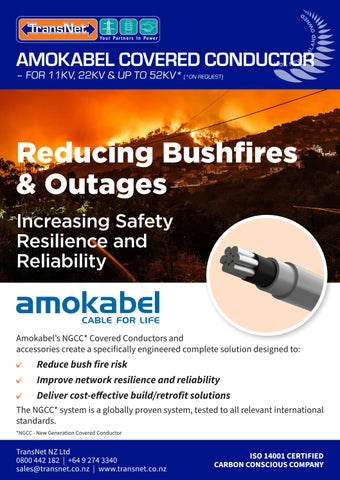
Amokabelās NGCC* Covered Conductors and accessories create a specifically engineered complete solution designed to:
Reduce bush fire risk

Improve network resilience and reliability
Deliver cost-effective build/retrofit solutions
The NGCC* system is a globally proven system, tested to all relevant international standards.
*NGCC - New Generation Covered Conductor


⢠Swedish company Amo kraftkabel AB is a world leading manufacturer of covered conductors for secure energy distribution. Our covered conductor systems span from 1 to 52kV. Our covered conductors are used in Europe, Africa, Australia, South America and Asia. Amo kraftkabel has also developed the ALUS-D, which is a double insulated 1kV ABC cable.
⢠Amokabel also provide a large range of AAC, AAAC and ACSR bare conductors from 40kV to 400kV.
⢠In addition, Amokabel has a full range of copper conductors for earthing, also including tinned copper and covered connecting cables. We specialize in providing customers with custom solutions for safe and cost-effective systems.
⢠Amokabel now has a subsidiary in Australia and is planning to commence production in Australia within the next twelve months to be able to meet the expected demand for covered conductor systems urgently needed by Australian networks.
⢠Storm & resilience focus: NZ outages are increasingly driven by extreme wind, rain, flooding and slips, making vegetation impacts and windborne debris the dominant risks. Covered conductor directly mitigates contact/ outage ignition while improving restoration safety and speed.
⢠Reliability & quality regulation: Commerce Commission quality standards (SAIDI/SAIFI) are front and centre; NGCC* reduces vegetation related faults and contributes to meeting DPP (Default Price-Quality Path) thresholds and disclosure expectations.
⢠Tree risk management trend: Government and industry are moving toward stronger vegetation controls (e.g., āclear to the skyā zones and expanded notice areas) covered conductor complements these changes by lowering residual risk where trees remain near lines.
⢠Safety for public, crews & wildlife: Typical leakage currents <1 mA reduces shock hazard for farm machinery, contractors, and the public; fully covered conductors significantly reduce wildlife electrocution risk important for native bird conservation and public perception.
⢠Bush/grass fire ignition reduction: While NZās ābushfireā risk is lower than the likes of Australia, NGCC* still addresses electrically initiated ignition from vegetation and animal contact (up to ~99% reduction vs. bare, based on CSIRO).

⢠Design & construction: NGCC* system approach aligns with AS/NZS 7000 Overhead line design and the guidance in SA/SNZ HB 331:2020 Overhead line design handbook, which NZ utilities already reference for distribution (11āÆkV, & 22āÆkV).
⢠Electrical safety legislation: Installation and operation comply with Electricity (Safety) Regulations 2010, including safe distances and signage; NZECPāÆ34 safe distance obligations remain for builders and mobile plant.
⢠SWER compatibility: NGCC* Hybrid is well suited to rural SWER contexts common in NZ.
⢠Fast retrofit with familiar practices: Stringing NGCC* is near identical to bare conductor methods; crews use the same trailers, recovery units, rollers, and strain gear minimising retraining time.
⢠Cost & programme advantages: Restringing NGCC* is typically only 10ā15% more than bare; undergrounding alternatives are up to ten times more expensive and NGCC* delivers a large risk reduction step without capex shock.
*NGCC - New Generation Covered Conductor
⢠Span & structure: Use of ACSR/ACS options supports long spans and often eliminates interpoling, ideal where NZ terrain, access and forestry corridors make pole additions costly.
⢠Lifecycle: Minimum expected service life of at least 45 years, comparable to bare conductor.
⢠Accessories & training: Full suite of tested accessories plus local project support and crew training.
⢠Voltage platforms: NGCC* Hybrid as a 22āÆkV MV option; NZ distribution commonly at 11āÆkV & 22āÆkV.
⢠Conductor choices in AU (indicative for NZ feeders):
o 25āÆmm² ACSC (SWER, long rural spans)
o 62āÆmm² ACSR
o 159āÆmm² AAAC
These map well to rural NZ feeder typologies where span length and sag control are key. A full range of cable sizes is available in addition to these three standard sizes.
⢠Materials & layers: Longitudinal water blocking, inner semicon layer, XLPE insulation, and UV resistant HDPE outer jacket, durable under NZās UV, salt spray and high rainfall exposures.
⢠Amokabel NGCC* can be used as a direct alternative to AAC without interpoling.

RELIABILITY CASE FRAMING FOR NZ EXECUTIVES & REGULATORS
⢠Vegetation is a leading outage driver in NZ; utilities and Transpower are investing in vegetation intelligence and LiDAR to mitigate risk ā NGCC* reduces consequence when contact occurs and complements data driven vegetation programmes.
⢠Major event context: Gabrielle caused ~234k customer outages; regulators emphasised resilience planning as the ānew normalā, NGCC* is a practical, network wide mitigation that supports resilience objectives without waiting on undergrounding budgets.
⢠Disclosure readiness: With evolving Commerce Commission definitions and assurance, demonstrating fault reduction from NGCC* helps show progress against reliability metrics (SAIDI/SAIFI) and supports price quality compliance narratives.
KEY SUMMARY
āNGCC* covered conductor delivers underground like reliability at a fraction of the cost, materially reduces vegetation/animal fault risk, improves public and crew safety, and aligns with NZ standards and evolving vegetation regulations making it a pragmatic resilience investment for 11 & 22kV feeders across rural and urban New Zealand.ā
*NGCC - New Generation Covered Conductor
CCSX25 7/2.12 ACS (Aluminium Clad Steel) CBL 31.5kN (Breaking Load)
Direct replacement for 3/2.75 (3/12) steel conductor
⢠Conductor and all layers simultaneously manufactured in one operation
⢠Extruded, longitudinal water blocking layer
⢠Extruded, inner semi-conductive layer
⢠XLPE Insulation layer
⢠UV-/Track resistant HDPE outer layer
⢠Tested to AS/NZ and EN50397-1 standards
Max Load(IEC 61597), Cond.Temp 80 °C, Air Temp. 30°C, Wind Speed
0.5 m/s, Solar Radiation 1045W/m², α=0.9, ε=0.15 Approx Value

CCSX62
6/1/3.37 ACSR (Aluminium Conductor Steel Reinforced) CBL 18.6kN (Breaking Load)
Direct replacement for AAC and ACSR conductors from 7/2.50 to 7/3.75
⢠Conductor and all layers simultaneously manufactured in one operation
⢠Various conductor types
⢠Extruded, longitudinal water blocking layer
⢠Extruded, inner semi-conductive layer
⢠XLPE Insulation layer
⢠UV-/Track resistant HDPE outer layer
⢠Tested to AS/NZ and EN50397-1 standards
Max Load(IEC 61597), Cond.Temp 80 °C, Ambient Temp. 15°C, Wind Speed 0,5 m/s, Solar Radiation 1000W/m², α=0,9, ε=0,15 Approx
Max Load(IEC 61597), Cond.Temp 80 °C, Ambient Temp. 40°C, Wind Speed 0,5 m/s, Solar Radiation 1000W/m², α=0,9, ε=0,15 Approx

Module of Elasticity After Load (Estimated Value)
Minimum Bending Radius During Installation
CCSX159 19/3.26 AAAC (All Aluminium Alloy) CBL 42kN (Breaking Load)
Direct replacement for 19/3.25 AAC
⢠Conductor and all layers simultaneously manufactured in one operation
⢠Various conductor types
⢠Extruded, longitudinal water blocking layer
⢠Extruded, inner semi-conductive layer
⢠XLPE Insulation layer
⢠UV-/Track resistant HDPE outer layer
⢠Tested to AS/NZ and EN50397-1 standards
Max Load(IEC 61597), Cond.Temp 80 °C, Ambient Temp. 15°C, Wind Speed 0,5 m/s, Solar Radiation 1000W/m², α=0,9, ε=0,15 Approx
Max Load(IEC 61597), Cond.Temp 80 °C, Ambient Temp. 40°C, Wind Speed 0,5 m/s, Solar Radiation 1000W/m², α=0,9, ε=0,15 Approx
Short Circuit Current, 1 sec 80-250°C
Colour
Bending Radius Set In Position


CCSX62 FITTINGS
CCSX159 FITTINGS Termination Clamp


Overview
Installation requirements and works practices for NGCC* are almost identical to that of stringing bare conductor. Typical equipment such as a recovery unit, cable trailer with an effective braking system, suitable rollers and appropriately rated hauling and straining equipment are also required to haul, string and strain Amokabel NGCC*.
When stringing NGCC*, it is preferred to keep the NGCC* off the ground where possible and practical. Steps should be taken to prevent potential damage to the NGCC* hard covering from sharp objects such as barbed wire fences, street signs or farm implements. Steps to mitigate damage include placing barriers to prevent contact. Specific stockings and comealongs are required for each of the 3 sizes of covered conductor with each size having its own specific termination fitting type.
Overvoltage protection is recommended in lightning prone areas and near frequently used areas. Each DB is responsible to determine the frequency and location of surge protection. Contact us directly for further information.
Each DB is responsible to determine where vibration protection is required to be fitted considering the topography, span lengths and tension.


Lakalakaimonu Multi Utility Complex
Ph 0800 442 182 PO Box 39 383
Howick, Auckland
sales@transnet.co.nz NEW ZEALAND
Ph 0800 442 182 PO Box 39 383 Howick,
Ph +67 627 939 PO Box 2932 Nukuāalofa
transnet@kalianet.to TONGA