pendence on long, fragile supply chains, minimizes overproduction, and enables responsiveness that the current system can’t provide. PERSONALIZATION AND REACTING TO TRENDS IN REAL-TIME Anyone who attended Toy Fair New York this February and visited FAO Schwarz may have already seen early signals of this shift. A large part of the instore experience today revolves around customization and personalization. The toys, from companies like Brio, BuildA-Bear Workshop, Funko, Schleich, and Steiff, are being customized on the spot. The trend is clear: consumers are drawn to products that feel immediate, unique, and connected to the moment. Yet, these experiences are layered on top of the existing system. In many cases, the product is still produced elsewhere, shipped across the world, and only finalized at the point of sale. But that personalization makes the toy special, keeping it in play longer — perhaps as a cherished heirloom enjoyed by kids for generations. The real opportunity is far more fundamental. Not only customizing products in-store, but also producing them there completely. With 3D printing, we are already seeing the first applications of this concept. Local, on-demand manufacturing changes the job for everyone in the chain. For retailers, it means less guesswork. Stores can carry less inventory, respond faster to demand, and become places where products are made rather than just sold. Imagine a child walking into a toy store and seeing their toy being made from locally recycled material.
For manufacturers, control is the upside. Localized production shortens lead times, reduces dependence on overseas supply chains, and gives companies room to respond when demand shifts or disruption hits. It also creates the opportunity to capitalize on trends while they’re hot.
WHAT IS CIRCULARITY?
Circularity is the next evolution of sustainability. Circularity means designing toys that never become waste. They are either turned into new products or become nutrients for the earth. Instead of “make, use, dispose,” circular systems keep materials in use through reuse, repair, and regeneration, creating long-term value without relying on constant new resource extraction.
THE TOOLS ARE ALREADY HERE Robotics, automation, and digital manufacturing have advanced far enough that small-scale production is no longer some far-off concept. The problem is that much of this technology is being used to support the same strained system: bigger runs, longer supply chains, and production models built around distance. THIS CANNOT BE THE ENDGAME The industry does not need better tools for an outdated model. It needs a model built for how the business actually works today. Before that shift can happen at scale, companies have to make the idea tangible. Retailers, manufacturers, and consumers need to see it work in real time — not tucked away, hidden inside a factory, but in the public eye as part of the shopping experience itself. Most families don’t think about supply chains when they walk into a toy store. They look at the price, the play value, and whether the toy feels worth bringing home. That changes when they can see part of the process for themselves. A figure being finished in-store, a component be-
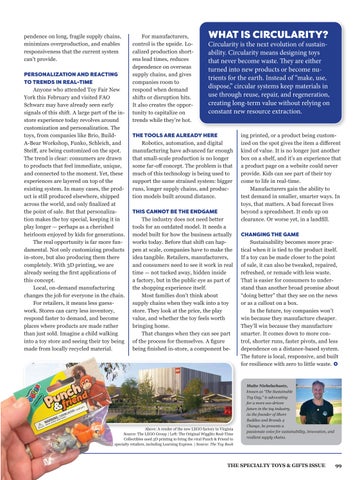
Above: A render of the new LEGO factory in Virginia Source: The LEGO Group | Left: The Original Wigglitz Real-Time Collectibles used 3D printing to bring the viral Punch & Friend to specialty retailers, including Learning Express. | Source: The Toy Book
ing printed, or a product being customized on the spot gives the item a different kind of value. It is no longer just another box on a shelf, and it’s an experience that a product page on a website could never provide. Kids can see part of their toy come to life in real-time. Manufacturers gain the ability to test demand in smaller, smarter ways. In toys, that matters. A bad forecast lives beyond a spreadsheet. It ends up on clearance. Or worse yet, in a landfill. CHANGING THE GAME Sustainability becomes more practical when it is tied to the product itself. If a toy can be made closer to the point of sale, it can also be tweaked, repaired, refreshed, or remade with less waste. That is easier for consumers to understand than another broad promise about “doing better” that they see on the news or as a callout on a box. In the future, toy companies won’t win because they manufacture cheaper. They’ll win because they manufacture smarter. It comes down to more control, shorter runs, faster pivots, and less dependence on a distance-based system. The future is local, responsive, and built for resilience with zero to little waste.
Malte Niebelschuetz, known as “The Sustainable Toy Guy,” is advocating for a more eco-driven future in the toy industry. As the founder of Shore Buddies and Brands 4 Change, he presents a passionate voice for sustainability, innovation, and resilient supply chains.
THE SPECIALTY TOYS & GIFTS ISSUE 99
Circularity_June2026.indd 99
5/12/2026 10:25:40 AM