International Toy Industry
German Quality from China: A Profile of Hape
by Scarlett Wisotzki, editor in chief, Das Spielzeug
E
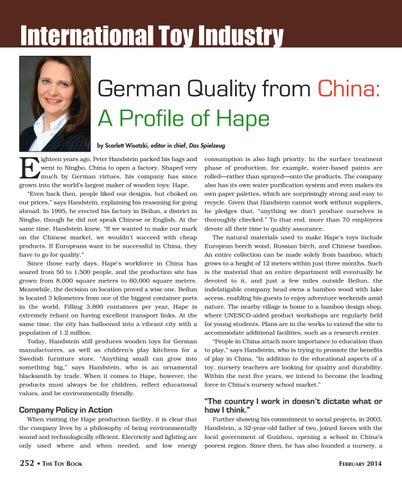
ighteen years ago, Peter Handstein packed his bags and went to Ningbo, China to open a factory. Shaped very much by German virtues, his company has since grown into the world’s largest maker of wooden toys: Hape. “Even back then, people liked our designs, but choked on our prices,” says Handstein, explaining his reasoning for going abroad. In 1995, he erected his factory in Beilun, a district in Ningbo, though he did not speak Chinese or English. At the same time, Handstein knew, “If we wanted to make our mark on the Chinese market, we wouldn’t succeed with cheap products. If Europeans want to be successful in China, they have to go for quality.” Since those early days, Hape’s workforce in China has soared from 50 to 1,500 people, and the production site has grown from 8,000 square meters to 60,000 square meters. Meanwhile, the decision on location proved a wise one. Beilun is located 3 kilometers from one of the biggest container ports in the world. Filling 3,800 containers per year, Hape is extremely reliant on having excellent transport links. At the same time, the city has ballooned into a vibrant city with a population of 1.2 million. Today, Handstein still produces wooden toys for German manufacturers, as well as children’s play kitchens for a Swedish furniture store. “Anything small can grow into something big,” says Handstein, who is an ornamental blacksmith by trade. When it comes to Hape, however, the products must always be for children, reflect educational values, and be environmentally friendly.
consumption is also high priority. In the surface treatment phase of production, for example, water-based paints are rolled—rather than sprayed—onto the products. The company also has its own water purification system and even makes its own paper palettes, which are surprisingly strong and easy to recycle. Given that Handstein cannot work without suppliers, he pledges that, “anything we don’t produce ourselves is thoroughly checked.” To that end, more than 70 employees devote all their time to quality assurance. The natural materials used to make Hape’s toys include European beech wood, Russian birch, and Chinese bamboo. An entire collection can be made solely from bamboo, which grows to a height of 12 meters within just three months. Such is the material that an entire department will eventually be devoted to it, and just a few miles outside Beilun, the indefatigable company head owns a bamboo wood with lake access, enabling his guests to enjoy adventure weekends amid nature. The nearby village is home to a bamboo design shop, where UNESCO-aided product workshops are regularly held for young students. Plans are in the works to extend the site to accommodate additional facilities, such as a research center. “People in China attach more importance to education than to play,” says Handstein, who is trying to promote the benefits of play in China. “In addition to the educational aspects of a toy, nursery teachers are looking for quality and durability. Within the next five years, we intend to become the leading force in China’s nursery school market.”
Company Policy in Action
“The country I work in doesn’t dictate what or how I think.”
When visiting the Hape production facility, it is clear that the company lives by a philosophy of being environmentally sound and technologically efficient. Electricity and lighting are only used where and when needed, and low energy
Further showing his commitment to social projects, in 2003, Handstein, a 52-year-old father of two, joined forces with the local government of Guizhou, opening a school in China’s poorest region. Since then, he has also founded a nursery, a
252 • THE TOY BOOK
FEBRUARY 2014