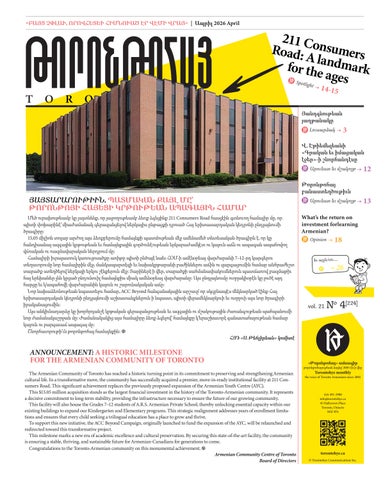
ANNOUNCEMENT: A HISTORIC MILESTONE FOR THE ARMENIAN COMMUNITY OF TORONTO
The Armenian Community of Toronto has reached a historic turning point in its commitment to preserving and strengthening Armenian cultural life. In a transformative move, the community has successfully acquired a premier, move-in-ready institutional facility at 211 Consumers Road. This significant achievement replaces the previously proposed expansion of the Armenian Youth Centre (AYC).
This $15.05 million acquisition stands as the largest financial investment in the history of the Toronto-Armenian community. It represents a decisive commitment to long-term stability, providing the infrastructure necessary to ensure the future of our growing community.
This facility will also house the Grades 7–12 students of A.R.S. Armenian Private School, thereby unlocking essential capacity within our existing buildings to expand our Kindergarten and Elementary programs. This strategic realignment addresses years of enrollment limitations and ensures that every child seeking a trilingual education has a place to grow and thrive.
To support this new initiative, the ACC Beyond Campaign, originally launched to fund the expansion of the AYC, will be relaunched and redirected toward this transformative project.
This milestone marks a new era of academic excellence and cultural preservation. By securing this state-of-the-art facility, the community is ensuring a stable, thriving, and sustainable future for Armenian-Canadians for generations to come.
Congratulations to the Toronto-Armenian community on this monumental achievement.
What’s the return on investment forlearning Armenian? Opinion → 18
METRAS
դուն երկու ընտրանք ունիս. կա՛մ
մեր թիրախն է գոյացնել 100 000 տոլար։ 2026
տարեշրջանին, ՀՕՄ-ի Գանատայի շրջանային վարչութիւնը, պիտի յատկացնէ՝ 25 000 տոլար ՝ համալսարան եւ քոլէճ յաճախող
ուսանողներուն, 5 000 տոլար՝ ամառնային ճամբարներուն եւ $72,400՝ կրթական հաստատութիւններուն։
□ '-l6w(lwqft(l -+ ARS Foundation / 3401 Olivar Asselin, Montreal, QC, H4J 1 L5
D E-transfer -+ ars-canada@bellnet.ca 0-+ Cash
D Online -+ www.ars-canada.ca/donations
է։ Նշենք մի քանին, ինչպէս՝ արձակագիր Ա.Արփինէի «Պոկուած ծառեր»ը, Մ.
Գալշոյեանի «Քաղաքացին»։ Իսկ բանաստեղծներէն Ճ. Սիրունիի, Կ. Արմէնեանի, Վ. Օշականի եւ ուրիշ մեծամեծ մտաւորականներու
գործերը։ Այս մասն
A landmark
$15.05 million acquisition of premier facility at 211 Consumers Road fuels
TORONTOHYE—The Armenian Community of Toronto (ACC Toronto) has officially reached a historic turning point that fundamentally redefines its commitment to strengthening and reinforcing Armenian cultural, educational, and social life in the GTA. In a bold move marked by strategic foresight and fiscal responsibility, the community has successfully acquired a premier, move-in-ready institutional facility at 211 Consumers Road.
The $15.05 million acquisition stands as the largest financial investment in the history of the Toronto-Armenian community, representing a decisive commitment to long-term stability and the future of the over 50,000 Armenian-Canadians residing in the Greater Toronto Area. The board’s official announcement, ‘A Historic Milestone for the Armenian Community of Toronto’ (See Armenian version on the cover page; English version on page 3), emphasizes that this achievement marks a new era of academic excellence and cultural preservation.
Karnig Hasserjian, chair of the Armenian Community Centre of Toronto, emphasizes that this acquisition was a necessary response to the community’s upward path. “This acquisition represents a pivotal moment in the trajectory of our community. By securing this state-of-the-art building, we are gaining the vital space needed to enhance our cultural, athletic, and scouting programs, ensuring our arts and community offerings have a permanent home for sustained growth and long-term impact,” he explains.
The decision to pivot toward 211 Consumers Road marks a significant evolution from the community’s previous strategy, which centred on a planned 16,000-square-foot expansion of the Armenian Youth Centre (AYC) at 50 Hallcrown Place. While that plan served a purpose for many years, a rare market opportunity emerged, allowing leadership to secure a solution of significantly greater scope. The new facility, a professionally fit-out building formerly operated by Hanson College, offers 40,000 square feet of modern institutional space—nearly three times the size of the originally proposed expansion—and was renovated as recently as 2022.
The strategic rationale for this financial shift was detailed by Ara Hasserjian, the lead for the acquisition, in an interview with our sister media outlet, Nor Hai Horizon. Ara Hasserjian explained that the community was navigating a ‘perfect storm’ of market conditions where the cost of new construction had skyrocketed due to extreme inflation, while the commercial real estate market experienced a notable downturn.
Reflecting on the financial prudence of the deal, Ara Hasserjian told Nor Hai Horizon that the cost per square foot for this building is less than half the cost of new construction. “By paying less than half the price, we receive not only the same amount of space but the real estate itself.” He highlighted the building’s high ceilings, three floors serviced by an elevator, and bright, expansive rooms as attributes perfectly aligned with the community’s needs, noting that this purchase solves immediate space requirements while providing room for projected future growth. Critically, while the facility is a game-changer for the school, it was acquired with the vision of being a versatile community asset; its modern layout is designed to host a wide array of communal activities, meetings, and gatherings outside of school hours, effectively doubling the community's footprint for evening and weekend programming.
The new facility at 211 Consumers Road is situated approximately one kilometre from the existing Hallcrown Place campus. This proximity allows the new building to serve as an extension of the community’s established hub in Toronto, maintaining a consolidated presence for students, parents, and organizations within close proximity to the original Centre.
The cornerstone of this expansion is its impact on the ARS Armenian Private
School, the only Armenian-Canadian day school in Ontario. Principal Raffi Sarkissian addressed the chronic capacity challenges that had begun to restrict the school’s mission during his sit-down with Nor Hai Horizon. For years, the school was forced to turn away prospective students due to a lack of physical space. One stark example of this bottleneck is seen in the kindergarten enrollment, where the school faces roughly 20 ‘known’ rejections annually—families who inquire only to be told there is no room. This figure, representative of waiting lists across various grades, likely hides a much larger number of parents who do not even attempt to enroll, know-
ing the school has reached its limit.
The acquisition of 211 Consumers Road allows for a strategic ‘domino effect’ across the community’s three-building campus. The new facility will serve as the dedicated home for the ARS Lapoyan High School, housing students in Grades 7-12. In terms of enrollment capacity, this shift allows the school to move from two sections per grade to potentially three, raising the total student population from under 700 today to 1,000 or more.
This shift unlocks essential capacity at the 45 Hallcrown Place facility, which will focus on the youngest learners in the Roubina Nursery and Babayan Kindergarten, while 50 Hallcrown Place will transition to house the Kololian Elementary school (Grades 1-6). While the nursery remains a priority requiring ongoing development to meet the community's needs, the new campus provides the high school with an upscale ‘university-style’ atmosphere, complete with built-in technology that significantly enhances the overall quality of the ARS educational product.
Sarkissian emphasized the project’s deeper communal responsibility, framing it as a ‘sacred task.’ “We aren’t just doing this for the generation that is alive today; we are doing it for the generation that hasn’t been born yet,” he told Nor Hai Horizon.
for the ages
fuels a strategic transformation for Toronto’s
“When they arrive, that generation will judge us by what we did to meet the needs of our time. We want them to look back and say they were lucky to have a generation that created such a strong foundation for them.” He added that seeing graduates now returning as professionals—lawyers, engineers, and builders—to volunteer their expertise for this acquisition is a testament to the community’s ‘healthy’ foundation and the vibrant, self-sustaining continuity of generations.
Armenian community
School Board of Directors, expressed his excitement for the educational possibilities this new campus brings: “This expansion marks a new era for our students and educators,” Saraphanian stated. “With enhanced facilities and room to grow, we can further inspire academic excellence and strengthen the Armenian identity among our youth. I am thrilled for this opportunity to usher in a new era of growth for the school community.”
The excitement surrounding the new campus is already rippling through the younger generation. One fifth-grade student, speaking anonymously with her parents’ blessing as she left school for the day, shared her enthusiasm for the project. “It’s so cool that we’re getting such a big new building,” she told
The impact of this expansion is also expected to benefit the various community organizations that have long called the Hallcrown campus home, such as the Homenetmen Armenian General Athletic and Scouting Union, the Hamazkayin Armenian Cultural and Educational Society, and the Armenian Youth Federation (AYF) of Canada. Historically, these groups have navigated the challenges of a growing school population within shared multipurpose facilities. To support this, the original Armenian Youth Centre (AYC) at 50 Hallcrown Place is expected to undergo modest construction to better serve Grades 1–6 elementary students and to provide more robust facilities for community use.
While specific operational details are still being finalized by the respective committees, the addition of 40,000 square feet of institutional space at Consumers Road significantly increases the community’s overall infrastructure. This broader distribution of space is intended to alleviate pressure on shared areas such as the gymnasium and theatre, providing these cultural, athletic, and youth programs with greater flexibility to develop and flourish. By design, the facility will serve as another hub for the Toronto-Armenian public, providing much-needed modern halls and breakout spaces for initiatives that define the community's vibrant life.
This achievement is rooted in a nearly 60-year history of resilience, evolving from the original 1967 center on Dupont Street to the establishment of the Hallcrown hub in 1979. Each phase was built on the dedication of volunteers and donors. To support this $15.05 million leap, the ACC Beyond campaign has been officially relaunched and redirected toward the Consumers Road campus purchase and the outfitting required for a September opening.
The community must now raise approximately $8 million with great urgency. With necessary building enhancements, the planned AYC expansion, and nursery upgrades still in the works, the total fundraising goal is closer to $12–$15 million.
Torontohye. “I saw some photos of the rooms, and they look so modern. Even though I’m still in elementary school, I’m excited because it means we’ll have more space to play and learn, and one day I’ll get to go to high school there. It feels like we are all getting an upgrade!”
This sense of ‘upgrading’ the future is shared by the parents and alumni who have watched the school evolve over decades. For Nairi Kerjikian—an ARS alumna, current parent, and chair of the school’s Telethon committee—the acquisition is the fulfillment of a multi-generational promise. Kerjikian, whose parents were among the school’s founders, noted that the dream of a thriving Armenian day school has now educated two generations of her own family. “As my journey as a parent of an ARS student is nearing its end, I am excited that my daughter will spend her final year of high school at 211 Consumers Road,” she shared. She believes the facility will enable the school to become an even more vibrant hub of creativity, providing future students with the modern resources they need to grow into proud Canadian-Armenians. “With the expansion into a third building, I am filled with hope that this dream will continue to inspire and educate a third generation and beyond.”
Speaking with Torontohye, Vazrig Saraphanian, chair of the ARS Armenian Private
Leadership is eagerly awaiting the major benefactors who now have a unique opportunity to be part of this special milestone, while calling on the entire community to mirror the sacrifices of the founders who built the Armenian Community Centre (1979), the original ARS Armenian Private School wing (1982), the St. Mary Armenian Apostolic Church sanctuary (1990), and the Armenian Youth Centre (2004).
Drawing on her eight years of experience on the school’s telethon committee, Kerjikian expressed her confidence in the community’s spirit of giving. “Our school is the shining jewel of our community. It is essential to preserving our identity and ensuring our community’s survival,” she stated, urging every member of the community to play a part in this multi-million investment in their collective future. “Year after year, as our goals have grown, the community has risen to the occasion—meeting and often exceeding expectations. I am confident that our community will once again answer the call.”
As the Toronto-Armenian community prepares for the grand opening this fall, the sentiment remains one of profound responsibility and dedication to excellence. “Our ability to expand while seamlessly maintaining the continuity of student education and community programs underscores our commitment to operational strength and service,” ACC chair Karnig Hasserjian says. “This investment is a decisive affirmation of our dedication to our heritage, one that will fuel our community’s success, foster a culture of achievement, and reinforce our contribution to excellence for generations to come.”
The triumph of audacity: Defiant choices, historic milestones
By Rupen Janbazian
Often, when I look out the window of my office in Yerevan at the capital’s ever-changing skyline, all new construction and towering cranes, my mind drifts back to the streets in Toronto where my identity first took shape. What strikes me, and says a great deal, is that the first images that come to mind are not the sidewalks around our family home, where I lived for nearly a quarter century, but Hallcrown Place and the surrounding streets, where my school, church, and community centre stood. It is as though our collective home felt even more intimate, more truly ours, than the homes we lived in.
Not long ago, I was back in Toronto, sleeping in the bedroom of my former life. Trying to step away for a moment from the strain of an already difficult time, I found myself going through old belongings. In the process, I came across an old issue of Zank, our school’s student paper. There, with all the innocent ambition of an 8th-grader, my classmates and I had written reflections on the opening of the secondary school. In that piece, I had referred to Toronto as ‘foreign lands.’
Today, I read those words very differently. Toronto is, after all, my birthplace. It is where I spent the first 26 years of my life. To call it “foreign” now feels almost absurd. And yet I understand why I wrote it that way. It came from the kind of upbringing we were given, one whose purpose I can now see more clearly. We were taught to hold tightly to our roots, our language and our culture. We were raised in such a warm and distinctly Armenian environment that everything beyond it naturally felt, in some sense, foreign.
But now, all these years later, I see that those lands were never truly foreign at all. Earlier generations made them ours through their labour, their sacrifice and their determination to build a home there. We grew up at the meeting point of two worlds, as Armenian as we were Canadian, learning that being Armenian is not simply an accident of birth but a continuing act of will. Those institutions gave us a strong foundation, one that has allowed so many of us to move through the world without ever feeling entirely like strangers.
A few days later, I found myself returning to these thoughts on my way back home to Yerevan. Sitting in a café at Frankfurt airport, we published online the announcement from the Armenian Community Centre Board of Directors regarding the historic acquisition of 211 Consumers Road. It is a defining leap, one that will surely be remembered as one of the boldest undertakings in our community's history. As I looked at the people and leadership behind this project, I felt a deep rush of emotion take over. I saw childhood friends, my schoolmates, my fellow community members, with
whom I’ve spent countless hours in those buildings on Hallcrown Place. To see my contemporaries now walking in the footsteps of our elders with that same ambition and courage confirms something essential: The Armenian community of Toronto remains vibrant and unshaken. It does not fear big dreams, because it was built in an environment where every stone, from the tighter confines of Dupont to the wider promise of Hallcrown Place, was laid with boldness.
History has shown that the Toronto-Armenian community’s greatest achievements have often grown out of decisions that must have seemed unrealistic, even reckless, at the time. I still remember 2004, when the Armenian Youth Centre was founded. There were surely doubters then too, cautious voices asking whether it was madness to take on such a massive structure, how the millions of dollars in debt would ever be paid off, or whether those walls would ever truly be filled. At the time, it may well have seemed unreasonable to shoulder that kind of responsibility. But today, that same so-called madness has become one of the central lifelines of our community. More than that, time has shown that even that building has become too small for us. Had our leadership back then lacked the courage and foresight to take that risk, we would not be standing on the strong foundation we have today.
In the end, history is not made by caution alone. It is shaped by decisions that look beyond the next year and toward the next quarter-century.
The purchase of this new complex follows that same logic. When you are faced with a growing community, when more and more children want to attend Armenian school each year, you have two choices: You can accept the limits, create waiting lists, and slowly stagnate, or you can make a new, bolder, more decisive move. Once again, Toronto’s Armenians chose the latter. In doing so, they showed that our collective will is stronger than our economic anxieties. Moving grades 7 through 12 to a new building opens the door not only to increased enrolment, but to a new standard of educational quality. That is a real victory.
This historic turning point reminds us that remaining Armenian in the diaspora is not accidental. It is the result of steady, deliberate investment. Toronto’s Armenians have always succeeded when they have chosen courage, when they have refused to settle for what is old, cramped, or no longer enough, and instead reached for something better. We have shown that our ‘foreign lands’ stopped being foreign a long time ago, because we anchored our identity there with conviction. This new complex will help light the way for future generations, shaping Toronto-Armenians who will carry their heritage with pride and continue building something new.
Congratulations to our community on this new beginning. May this bold step become the starting point for even greater achievements. ֎
What’s the return on investment for learning Armenian?
By Sophia Alexanian
I can summarize contemporary discourse on learning and preserving Armenian in the diaspora into two camps. The first is a traditional, conservative view that treats Armenian language acquisition as a moral obligation for all diasporans (an approach that, in its pursuit of linguistic purity, often results in exclusion). The second is a more contemporary perspective that acknowledges uneven access to Armenian education, accepts this reality as fixed, and, in an effort to resist full assimilation, adopts the reassuring mantra that “all Armenians are valid,” regardless of language proficiency (an approach that prioritizes inclusion at the risk of cultural dilution).
This piece is not about the collective relationship the Armenian diaspora has with language preservation. I want to focus on individual choice—specifically, the decision to preserve or acquire Armenian fluency in adulthood.
Many people did not choose to acquire Armenian fluency as children. Their parents spoke Armenian at home; they attended Armenian schools; they had access to community events and extracurriculars; and some even spent summers in Armenia in full-immersion environments. Many in Toronto, though born in North America—where heritage languages traditionally go to die—benefited from a combination of factors that left them at least conversational. But adulthood introduces a choice. Language is use-it-or-lose-it: Do they preserve or improve their fluency, or not?
There are also those who did not grow up with the language at all, again due to familial or geographic circumstances. They may consider learning Armenian later in life, often sparked by a specific motivation. Is it worth it, all things considered?
It is intellectually dishonest to pretend people are not making this choice, whether consciously or passively. Yet the two dominant frameworks leave little room for individual agency. The conservative view assumes there is no choice: Armenian is an obligation. The inclusive view assumes ability is fixed, that non-speakers must simply be accepted as they are, with no expectation that they might be encouraged to learn.
Right now, many young adults are deciding what role Armenian will play in their daily lives. It’s only fair to examine what goes into that decision. How much Armenian do I need to know for it to be 'worth it'?
If you’re looking to learn Armenian for sentimental reasons—I want to speak the language my ancestors did! —this section is not for you. But I think that, for many people, sentimentality is not enough. There needs to be a practical reason to justify investing time and resources into learning Armenian.
So, in practical terms, what is the minimal effort
required to get a meaningful return? How much Armenian do you need to know for it to be ‘worth it’?
Basic conversational phrases and scenarios, such as how to introduce yourself, order a coffee, and so on, are easier to learn than you think. Google Translate and Large Language Models (LLMs) handle basic phrases well, travel blogs offer listicles of keywords, and short stays in the homeland provide daily practice. You do not need to be particularly resourceful to learn these basics. But are they worth it?
You need to walk before you run. For many people, their use cases for Armenian never progress beyond basic conversation, and it is enough for them to know these scripts to feel included or integrated, or whatever it is they are seeking among Armenians.
Here is what I have come to realize, though. Most of these interactions can happen in English. Even in Yerevan, it is hard to find a restau rant without an English menu or someone my age who cannot hold a basic conversation in English. So in practical terms, basic Armenian does not expand your communi cative range very much—low effort, low return.
where Armenian would be useful until you’re in the moment, woefully unprepared. I had that experience at a tech event in Armenia. I was comfortably socializing in Armenian until someone asked what university courses I take in Canada. I froze. I’d never translated my coursework. I had no idea how to say FPGA (Field-Programmable Gate Array), digital logic, renewable energy, three-phase circuits, differential equations, or printed circuit boards in Armenian. My academic life exists entirely in the anglophone world, and I couldn’t describe what I studied without sounding clueless.
The foundational textbook I (and an estimated
This is not an argument against learning Armenian, nor is it a claim that anything short of full fluency, with PhD-level vocabulary, is pointless. It is an invitation to think concretely about where Armenian knowledge will actually be meaningful, and to align learning goals with those contexts. The question is not how much Armenian to learn, but for what purposes.
Do I understand what I can access in Armenian (and what I can’t)?
The sad reality is that you usually don’t realize
75 percent of engineering students worldwide who study microelectronic circuits) have used was originally written in English by professors at the University of Toronto. It has since been translated into 10 languages, but Armenian is not one of them. It’s hard to motivate speakers of a global language to learn a minority language when the global language seems to contain more information. The need to translate into the minority language comes up only in edge cases, moments when you have to extract knowledge from its dominant context.
So what is most convenient to access and express
in Armenian? Things about Armenians and Armenia.
Basic daily life in Armenia is easy to navigate in English, but more complex financial, legal, business, and political matters require advanced fluency. I felt this recently when I tried (and failed) to read a bond prospectus for a real estate development in Yerevan. My everyday Armenian and reliance on translation tools were inadequate for evaluating investment risk.
Over time, more of this material may become accessible in English as Armenia attracts foreign investors and expats. I could also hire translators (my 2024 lease agreement was written in both Armenian and English). But to engage fully with the modern Armenian state as it currently functions, advanced proficiency in the official language is
A global language gives you access to a vast world of information. Armenian gives you independent access to Armenia and the broader Armenian world.
Am I in a position to access Armenian education 'on autopilot'?
Once you realize you need an expanded, specialized vocabulary, you have to learn it. But no one is reading a translation dictionary cover to cover. Formal classes, books, and apps are useful in the early stages. Long term, though, most vocabulary comes from consuming Armenian media and attending community events.
I think many people overestimate how much Armenian they comprehend while underprioritizing media consumption. If you are never in situations where you do not fully understand what is being said, you will stop acquiring new vocabulary.
invaluable.
You also do not need to live in Armenia to benefit from accessing Armenian-language information. Armenian-language media, written for an internal audience, offer more nuanced and culturally literate perspectives than English-language cultural products, which often flatten complexity for outsiders.
In short, it is useful to discuss your field in Armenian. It is useful to navigate business and intellectual life in the homeland. It is useful to consume cultural production in its native context. All require specialized vocabulary.
Can you watch a short video in Armenian and follow it with English subtitles? What about with an auto-translated description? Armenian subtitles, clear enunciation, visual cues, or a more fluent 'discussion buddy' to confirm your understanding—these are all crutches that make in-context learning through media consumption possible. On the subject of learning contexts, I want to acknowledge the Armenian community here in Toronto for providing in-person spaces where language acquisition happens naturally. The Armenian Relief Society (ARS) Roubina chapter, in particular, has been a meaningful environment for me in recent years. It’s an environment where you absorb vocabulary incidentally through routine activities like event budgeting, logistics planning, and mental health seminars, with Armenian used functionally throughout.
The reality of how people acquire and maintain Armenian fluency also makes the choice of dialect far less critical than it often seems. The two standard dialects are mutually intelligible. In practice, the media you consume, the events you attend, and the people you interact with will shape the flavour of Armenian you speak. Most figurative language and vocabulary quirks are acquired on autopilot anyway.
Do I have the confidence and humility to speak Armenian?
Speaking a second language requires both confi -
dence and humility. You need confidence to try, but also humility to accept that you will make mistakes and may sound ‘dumber’. It takes a mindset shift to become comfortable with vulnerability.
Community support is crucial. When I interned in Armenia, my coworkers at the Matenadaran, the coordinator at the Armenian Assembly of America, and the general public were patient and encouraging, which helped me improve. One memorable encounter was with an Artsakh rights advocate. I explained that I had written an article in English about ‘Learn for Artsakh’ and wasn’t sure I could discuss it properly in Armenian. She encouraged me to try and offered to teach me any words I didn’t know. Having a safe person to interact with made all the difference.
In contrast, some diasporan-led spaces can be less welcoming. I’ve seen people stress the importance of preserving Western Armenian while simultaneously harassing beginners for speaking it 'wrong.' You cannot expect new learners to engage if minor mistakes are met with judgment. The presence of linguistic purists may even subtly shape dialect preferences for new learners.
Finding safe, supportive people to practice with is essential for any learner.
Is there a conclusion to this overanalysis?
There is some truth to the idea that “Armenian speaking” and “non-Armenian speaking” Armenians are distinct categories with unique experiences, and most people cannot be converted. Most do not choose whether to acquire Armenian as children, the stage when language learning is easiest.
One takeaway is to support accessible Armenian education for children, especially those who cannot speak it fully at home. Even learning to form basic sentences and hold everyday conversations gives a strong foundation for future fluency.
Because learning a language you rarely use as an adult is difficult, it is unfair to expect Armenian knowledge as a prerequisite for participating in community life. People should feel welcome as they are.
At the same time, being well-versed in Armenian and committing to continuous learning provides unique access to Armenia and the Armenian-speaking world without relying on translators. It allows a more direct, personal engagement with Armenian culture. This is why I encourage Armenian language acquisition overall.
To end on a hopeful example: Monte Melkonian, the Armenian-American revolutionary buried in Yerablur, only became fluent in Armenian as an adult. He had grown up in California and spoke English, Spanish, French, and Japanese before learning Armenian. It is never too late. ֎
Photo: The Armenian alphabet monument at the now-shuttered Melkonian Educational Institute in Nicosia, Cyprus (Photo by Alexander-Michael Hadjilyra)
to the editor
Building a legacy
Dear editor,
I read on Torontohye's website the announcement about the Armenian Community Centre of Toronto's historic purchase of a new campus at 211 Consumers Road for the A.R.S. Armenian Private School, an important step for the future growth of our community.
Congratulations to the Board of Directors of the Armenian Community Centre of Toronto on this remarkable milestone. This achievement represents a major investment in the future of Armenian education and in the strength and continuity of our community.
This expansion will create new opportunities for more students to benefit from an Armenian education and will help support the development of future generations of community leaders. It is inspiring to see such a strong commitment to academic progress, cultural preservation, and the long-term vitality of the Armenian community in Toronto.
This milestone is a significant financial accomplishment and also a meaningful step toward building a stronger, more vibrant, and more sustainable future for Armenian-Canadians for generations to come.
I extend my heartfelt congratulations and best wishes for continued success in all your future endeavours. ֎
Hrad Poladian Toronto
Dear editor,
The recent announcement regarding the purchase of 211 Consumers Road has evoked an overwhelming sense of pride in our community, reflecting our commitment to tackling any challenge head-on and our unwavering dedication to ensuring that every Armenian child in Toronto has the opportunity to grow up learning the Armenian language and culture while receiving a top-notch education.
I am equally proud of the continuity that we are witnessing today. A new generation is carrying the torch of those who have come before us, building upon a legacy that started 47 years ago when courageous visionaries established this school with nothing more than faith, commitment and determination. From a small school of just 75 students, we have grown to an enrollment of over 680.
Today, our leaders have once again answered the call by stepping forward to meet the evolving needs of our community and to create the conditions for our school and its student body to continue growing. In doing so, they are not only strengthening our school, but also shaping the next generation of torchbearers who will carry our heritage forward and inspire those who follow. ֎
Nairi Kerjikian Toronto
Years pass, but the legacy remains
Dear editor,
I would like to thank Torontohye for publishing Levon Ishkhanian’s outstanding article ('Quiet fortune, loud echoes: A personal account of Koko Bahlawanian and Pe-Ko Records,' published in vol. 21, issue 3. #223) about Pe-Ko Records. Reading it inspired me to share a few of my own cherished memories.
Krikor Bahlawanian (Koko Amo) is my uncle, married to my paternal aunt. In many ways, his presence in Montreal was the reason my family immigrated to Canada from Lebanon in 1972. A handsome gentleman then and now, Koko is a tall, blue-eyed man with a humble spirit. Whether he is laughing or simply deep in thought, he always seems to carry a gentle grin.
I remember my frequent visits to Pe-Ko Records most vividly. Koko was remarkably dedicated, working late into the night every day of the week. Stepping into the store meant being greeted by a vibrant soundscape of Armenian, Arabic, and Greek music playing over the loudspeakers. Whenever I grew excited over a new release, Koko would notice my joy. He’d often hand me a vinyl record, 8-track, cassette, or CD and say, "Maral, take this home to your parents; it was just released!"
Pe-Ko Records was more than just a store; it was a mini community centre where everyone was welcomed with respect. On holidays and long weekends, people would travel from Ontario, Ottawa, and even Detroit to visit him and catch up on the latest hits.
Though I have lived in Toronto for over 40 years since getting married, my pride in my family hasn’t faded. Whenever Pe-Ko Records or Koko comes up in conversation, I always jump in to say—with great politeness and even greater pride—"That is my Koko Amo."֎
Maral Kouzoudjian Jamjekian Toronto
CASSANDRA HEALTH CENTRE
ARMENIAN
MEDICAL CENTRE & PHARMACY
Dr. Rupert Abdalian Gastroenteology
Dr. Mari Marinosyan
Family Physician
Dr. Omayma Fouda
Family Physician
Dr. I. Manhas
Family Physician
Dr. Virgil Huang
Pediatrician
Dr. M. Seifollahi
Family Physician
Dr. M. Teitelbaum
Family Physician
Physioworx Physiotherapy
Love These Recipes?
Each month, we are proud to translate and feature plant-based recipes for our readers in Western Armenian. Did you know that the original English versions of these recipes—and many more— are available in The Vegan Armenian Kitchen Cookbook?
Written by Toronto’s very own Lena Tashjian and photographed by Siroon Parseghian, this award-nominated cookbook features over 115 plant-based staples and veganized classics. It is a comprehensive resource for Armenian cuisine, culture, and heritage!
12. (ածական, գոյ.) բարձրագոյն դպրոց (Թ.-ԺԲ. կարգեր)
14. (գոյ.) միջոց, ընթացք, գնացք
17. (գոյ.) ծաղկոց, մանուկներու դպրոց
Junior problem
Lily has 24 coins, all of which are either nickels or dimes. If the total value of the coins is $1.65, how many nickels does she have?
Armen’s Math Corner
(answers on pg. 26)
Senior problem
Henry has 12 chocolate eggs that all look the same, but only three have a prize inside. He gives three eggs to each of his four friends: Vaheh, Aramik, Heros, and Massis. There is a one in X chance that one person is lucky enough to receive all three prizes. Can you determine the value of X?