մը, որ հաւաքաբար կը նշէ իր յաջողութիւնները,
եւ մեր առաքելութիւնը՝ ըլլալ հարթակ մը բոլորին համար,
կ’արտացոլացնեն այն արժէքները,
![]()
մը, որ հաւաքաբար կը նշէ իր յաջողութիւնները,
եւ մեր առաքելութիւնը՝ ըլլալ հարթակ մը բոլորին համար,
կ’արտացոլացնեն այն արժէքները,
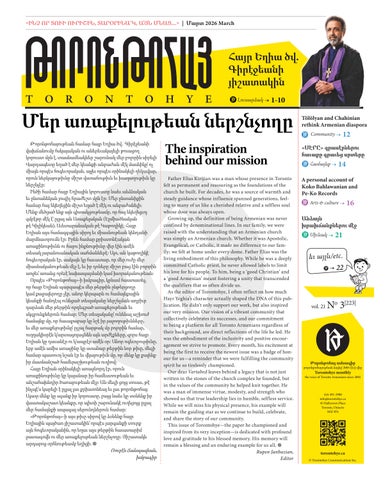
Father Elias Kirijian was a man whose presence in Toronto felt as permanent and reassuring as the foundations of the church he built. For decades, he was a source of warmth and steady guidance whose influence spanned generations, feeling to many of us like a cherished relative and a selfless soul whose door was always open.
Growing up, the definition of being Armenian was never confined by denominational lines. In our family, we were raised with the understanding that an Armenian church was simply an Armenian church. Whether it was Apostolic, Evangelical, or Catholic, it made no difference to our family; we felt at home under every dome. Father Elias was the living embodiment of this philosophy. While he was a deeply committed Catholic priest, he never allowed labels to limit his love for his people. To him, being a ‘good Christian’ and a ‘good Armenian’ meant fostering a unity that transcended the qualifiers that so often divide us.
As the editor of Torontohye, I often reflect on how much Hayr Yeghia’s character actually shaped the DNA of this publication. He didn't only support our work, but also inspired our very mission. Our vision of a vibrant community that collectively celebrates its successes, and our commitment to being a platform for all Toronto Armenians regardless of their background, are direct reflections of the life he led. He was the embodiment of the inclusivity and positive encouragement we strive to promote. Every month, his excitement at being the first to receive the newest issue was a badge of honour for us—a reminder that we were fulfilling the community spirit he so tirelessly championed.
Our dear Vartabed leaves behind a legacy that is not just written in the stones of the church complex he founded, but in the values of the community he helped knit together. He was a man of immense virtue, modesty, and strength who showed us that true leadership lies in humble, selfless service. While we will miss his physical presence, his example will remain the guiding star as we continue to build, celebrate, and share the story of our community.
This issue of Torontohye—the paper he championed and inspired from its very inception—is dedicated with profound love and gratitude to his blessed memory. His memory will remain a blessing and an enduring example for us all. ֎ Rupen Janbazian, Editor


Համեստ, սակաւախօս, բայց անխոնջ մշակը
գնաց միանալու երկնային Հօրը։
կատարուածին ծանրութեանը,


Our mission is to empower you with the Knowledge and Confidence required to make informed decisions that support your individual goals

Our Model Paydown. As the amortisation period progresses, more of your payment goes toward the principal and less toward interest. Who Qualifies for Our Services?

• Existing Locked Term Mortgage Holders: No bank enrolment is necessary. We guarantee a reduction in your mortgage.
• New Home Buyers: We guarantee mortgage reduction for all new home buyers.
• Existing Refinancing Clients: If you are refinancing your mortgage, we offer a guaranteed mortgage reduction.
• Existing Renewing Clients: For those renewing their mortgages, a reduction is also guaranteed.
All of our services come with a 100% guarantee, ensuring your satisfaction and peace of mind throughout the process.
Vahan Kassabian, CEO
Contact Us
Get in touch for a complimentary consultation. If you have any questions or would like to get started, feel free to reach out by phone at +1 289-378-0029 or by email at ceo@vkglobalenterprises.com


The 15th of every month is the deadline for submitting your newspaper articles, advertisements, classified ads, announcements, or obituaries. Make sure to send in your submissions to info@torontohye.ca before the deadline to ensure they are included in the upcoming edition. Don’t miss out on the opportunity to share your message with the community!


TORONTOHYE—The University of Toronto (UofT) Armenian Students’ Association (ASA) hosted an online academic panel on Jan. 15 to examine Armenian diasporic history, identity, and future directions, bringing together two influential scholars for a wide-ranging discussion.
Moderated by ASA co-president Arina Asloian and vice-president Ani Astour, the event, titled “Armenian Diaspora Across Time: History, Identity, and Future Directions,” opened with a brief introduction to the Association’s work on the St. George campus. Asloian described ASA as a student-run club that aims to bring Armenian students and community members together to celebrate heritage and culture.
course, she suggested that earlier and later configurations can be approached through different lenses: diaspora as lived experience on the ground, and diaspora as a scholarly concept used to study dispersed communities across time.

The moderated discussion began with a question on the historical conditions that shaped early diasporic identity in the Armenian case. Khachig Tölölyan, Emeritus Professor of English and Letters at Wesleyan University, offered a sweeping overview that challenged the tendency to locate the Armenian diaspora primarily in 1915. While acknowledging the centrality of the Armenian Genocide in modern Armenian diasporic consciousness, he emphasized that both coercion and economic pressure have shaped Armenian dispersal across many centuries.
Tölölyan traced early large-scale movements to the period around the collapse of the Bagratuni kingdom in the 11th century, when artisans and merchants began moving northward, including to the Crimea, and from there into Slavic and Balkan lands. He also pointed to the forced deportations of Armenians from Nakhichevan in 1603-1604 under Shah Abbas, which resulted in the establishment of a major Armenian community in Iran. He further highlighted the development of significant pre-Genocide Armenian communities in Tbilisi and Istanbul, noting that these, too, emerged through a mix of displacement, insecurity, and the search for relative stability.
Talar Chahinian, lecturer in the Program for Armenian Studies at the University of California, Irvine (UCI), and visiting faculty in Comparative Literature, built on that historical framing by interrogating the idea of 'origins' itself. In the Armenian case, she argued, the impulse to pinpoint a single starting point often collapses diverse formations into one dominant narrative. While 1915 remains a foundational reference for much of public dis -
Tölölyan added a linguistic dimension to this point, noting that terms for diaspora and self-description evolve over time. The widespread Armenian-language use of spyurk (սփիւռք), he argued, becomes dominant relatively late, particularly after the mid-20th century, reflect
not only in vocabulary but also in collective self-understanding.
One of the discussion’s most focused exchanges centred on Western Armenian literary history and the ways distinct diasporic centres produced different cultural responses to exile. Chahinian, drawing on her research, compared post-WWI Paris with post-WWII Beirut, emphasizing that the two environments shaped language politics and literary production in fundamentally different ways.

In the Paris of the late 1920s, she explained, Armenian-language periodical life was vibrant, but the community was scattered and readership limited. Language, in that context, often became a medium for literary experimentation and for articulating exile as a condition. In the Beirut of the postwar decades, by contrast, Armenians lived in closer proximity and benefited from dense community networks. Language there was more intentionally mobilized as a tool for institutional consolidation, with schools, cultural organizations, and literary projects contributing to a broader vision of sustaining a Western Armenian language community and a 'nation in exile.'
Tölölyan reinforced this contrast by arguing that Paris saw a literary 'flowering' alongside an awareness that the linguistic base was shrinking, while the Middle East—especially Beirut and Aleppo— played a decisive role in consolidating Western Armenian through education and communal life,
even if its literary output was perceived as lagging behind Paris. Chahinian added a striking anecdote from the Parisian literary scene, illustrating the frustration of producing literature with a limited readership and capturing the paradox of creative vitality amid demographic and linguistic anxiety. A later question turned to diaspora not only as a dispersed population, but as a political and institutional actor. Tölölyan urged the audience to think beyond a narrow definition of power as coercion. Diasporas, he suggested, rarely possess the ability to compel states in the way states compel others, but they can exercise influence through mobilization, institution-building, and the shaping of discourse. He pointed to the rapid post-genocide construction of community life in the Middle East—churches, schools, and organizations—as an example of diasporic capacity to build durable structures under difficult conditions. This was, in his framing, 'stateless power': the ability to marshal resources and create institutions that would not otherwise exist. He also stressed that cultural production should be understood as part of this ecosystem, arguing that even when literature is not the sole vehicle of intellectual life, non-fiction writing, essays, and journalism help sustain communal debate and identity formation.
Chahinian briefly followed up on the question of how diasporic writing is defined, and the exchange touched on the breadth of diaspora-related cultural production over the decades, including writing that reflects on diaspora as a lived community reality as well as diaspora as a concept.
Asked about Western Armenian’s precarity and the role of culture in sustaining diasporic identity, Chahinian approached the question carefully, warning against framing literature as valuable only insofar as it 'preserves' identity. That approach, she suggested, can become limiting. Still, she acknowledged that the modern recognition of Western Armenian as endangered has catalyzed new activity, including institutional initiatives and grassroots projects. She described what she sees as an energizing moment of experimentation, particularly among artists and writers who are playing with
Levon Ichkhanian
A proverb often attributed to Seneca says, "Luck is what happens when preparation meets opportunity." In the Armenian diaspora, luck rarely arrives loudly. It comes quietly, through people who open doors, through places that become gathering points, and through moments that shape us long before we understand their significance. For me, one of those moments came when I was 13 years old and met producer, promoter, and founder of PeKo Records, Koko Bahlawanian.
Pe-Ko Records is a corner store on a quiet residential street in Montreal, Canada. Armenians across North America and beyond know it as a cultural landmark, a place where the music of our people and neighbouring cultures was preserved, produced, and shared. Since 1970, Pe-Ko has housed one of the most important collections of Armenian, Arabic, and Greek music on vinyl, 8-track, cassette, and CD. It is the kind of place where you walk in for a recording and walk out with a story, a memory, or a connection you didn’t expect.
The name Pe-Ko itself carries a story. It is a tribute to the bond between father and son, Peter and Koko, a reminder that Armenian enterprises often begin with family, with legacy, and with the desire to build something that lasts. And lasting is exactly what Pe-Ko has done. While record stores around the world closed their doors with the rise of digital streaming, Pe-Ko remained open, serving a community that still walks through its doors. Fifty-five years later, it is still in business, which is a rare achievement in any industry and a rarity in the world of physical music.
immersed in music from the start. During the Lebanese Civil War, I studied classical guitar with him before emigrating to Toronto, where my musical world expanded to include the electric guitar, jazz, and improvisation under my father, Edouard, a jazz pianist and music director for pioneer Adiss Harmandian. My education was further enriched through private lessons, school music programs, and the influence of Giro ammo (Giro Dolmayan), the saxophonist in my father’s band, who often took me to hear international jazz artists—experiences that left a lasting impression on my musical journey.
By the early 1980s, Toronto and Montreal’s Armenian communities were flourishing. Churches, schools, and community centres were being built, and every fundraiser or celebration needed
essential stops on Rue Dudemaine: knafeh b’jibneh from Mahrouse, man’oushé and lahmajoun from Zahle Bakery, and a visit to Pe-Ko Records to see Koko.
Walking into Pe-Ko was like stepping into a cultural crossroads. In this sense, Pe-Ko Records transcended the boundaries of a record shop. His store operated as a hybrid social and retail space, part Damascus café and part European salon. It became a liminal cultural node where social stratification temporarily dissolved, where musicians and audiences converged, and where diasporic identity was continuously rehearsed and negotiated. The store’s endurance and influence reflect the power of such third spaces to sustain artistic ecosystems, particularly within displaced and diasporic communities by way of music. You could hear Armenian, Arabic, French, and English in the same conversation. You could see elders flipping through vinyl while teenagers discovered the music their parents grew up with. You could feel the pulse of a community that had carried its culture across oceans and refused to let it fade.

Koko’s story, like so many Armenian stories, begins with survival. His father, Khatchig Pehlivanian, was a child of the Armenian Genocide. Orphaned at a young age, he escaped through the desert in 1916, eventually reaching Lebanon, where he built a life with his wife, Arshaluys, who was also an orphan. Their story mirrors that of countless Armenian families, including my own. My grandparents were from Aintab and Adana; our histories run parallel, shaped by loss, resilience, and the determination to rebuild. Perhaps that is why Pe-Ko records always felt familiar to me.
Music entered my life early when, at age five, I received a toy guitar for Christmas—a gift that set everything in motion. Growing up in a family of three generations of musicians, including my uncle, Professor Joseph Ichkhanian, who founded Lebanon’s classical guitar program and authored the enduring Méthode Moderne de Guitare, I was
live music. My father’s band, with me as the young guitarist, became a fixture at these events. Armenian music was the heartbeat of these gatherings, and I quickly realized that if I wanted to contribute meaningfully, I needed to learn the repertoire. My first opportunity came when I performed with Adiss Harmandian at 13, a moment that felt like destiny, having spent my childhood watching my father, Edouard, music-direct his rehearsals and concerts.
Montreal soon became a regular destination as its Armenian community was the largest in Canada, and we travelled there often for performances. A typical weekend meant leaving Toronto early Saturday morning, driving six to seven hours, performing until the early hours of the morning, sleeping a few hours, and driving back on Sunday. But before returning home, there were always three
Koko was at the center of it all. He knew every artist, every album, every recording session. He knew which songs would resonate with which communities, which singers were rising, and which musicians were shaping the sound of the diaspora. He often shared pre-release recordings with me so I could learn the music before anyone else. He would tell artists, “This kid knows your music, inside out!” and those words opened doors I could never have opened alone. In many ways, he became a quiet mentor, not through formal lessons, but through access, encouragement, and belief.
From 1979 to 1991, I had the privilege of performing during the golden age of Armenian diasporic music. The period which preceded several major cultural shifts: the aftermath of the Lebanese Civil War, which dismantled Beirut’s once-vibrant Armenian cultural infrastructure; the collapse of the Soviet Union in 1991, which redirected musical and cultural gravity toward Armenia itself; the rise of digital media, which fragmented the shared cassette-era listening experience; and the transformation of rabiz into new post-Soviet and
globalized forms. I performed locally alongside Toronto’s own Dikran Shemavonian, in addition to internationally acclaimed artists such as Adiss Harmandian, Paul Baghdadlian, Harout Pamboukjian, and their contemporaries, touring the world.
Today, through the lens of a doctoral candidate researching Armenian diasporic music, I see with even greater clarity how central Koko was to that era. He did far more than operate a record store: Pe-Ko Records in Montreal, and later, from 1983 onward, adding Pe-Ko Records in Los Angeles. He built an ecosystem that connected artists, retailers, and audiences across continents. He produced and distributed recordings directly to Armenian communities—at events, in libraries, and in Middle Eastern variety stores—allowing people to purchase the music and reexperience their favourite artists at home and in their cars. Armenian radio and television amplified the music further. As songs circulated, singers became familiar. Familiarity created demand. Demand created opportunities. In many ways, all artists shared a form of collective luck.
Many tried to replicate Koko’s model. Few succeeded. None endured. Yet Pe-Ko Records is still here, still open, still relevant, still serving the community. The catalogue is being digitized, and select albums are being re-released on vinyl. The store remains a place people visit not just to buy music, but to reconnect with a piece of who we are. It is a living archive, a cultural anchor, and a testament to what one person can build when passion meets purpose.
Every time I’m in Montreal, I return to Pe-Ko Records to see Koko. Some forms of luck, it seems, are timeless.
Thank you, Koko. ֎
Western Armenian across dialects, vernaculars, hybrid forms, and digital spaces. Rather than treating language as fixed, she emphasized its living, adaptive qualities—especially in contact zones where different Armenian varieties and community histories intersect.
Tölölyan added that the contemporary digital landscape has also encouraged shorter forms of writing and new ambitions for public-facing cultural work, though he noted he felt less equipped to judge the long-term consequences of these shifts.
The final moderated question addressed the current relationship between diaspora and homeland, and where that relationship may be headed. Tölölyan described the moment as particularly fraught, emphasizing that there is no single diaspora position because the diaspora itself is made up of institutions, political organizations, churches, and individuals with distinct relationships to Armenia.
He argued that one central tension lies in questions of political legitimacy and participation: To what extent should diasporans weigh in on homeland politics, and to what extent should the homeland shape diaspora life? He suggested that these questions become even more complicated in a context where Armenian communities now include citizens of Armenia living abroad, diasporans who have acquired Armenian citizenship, and long-established diasporans with different historical relationships to the state.
Chahinian placed this tension within broader shifts in diaspora studies, noting that older models often centred on dispersion and a myth of return, whereas newer frameworks increasingly imagine diaspora as tied to a nation-state and its institutions, with states attempting to define and 'claim' their diasporas. In the Armenian case, she suggested, this evolving framework has become more visible in how diaspora engagement is discussed, structured, and contested.
The open Q&A broadened the discussion; participants asked about language development after Armenia’s independence, the growing presence of Western Armenian in Yerevan due to repatriation and migration, and whether this 'contact zone' is changing how Armenian is spoken and heard in Armenia today. One audience member noted that Western Armenian is now more audible in public life and media, while also questioning how quickly language shifts can occur across generations.
A separate set of questions focused on the Armenian Church, translation, and accessibility. One participant asked whether translating liturgy and teachings into English might strengthen religious engagement and outreach in diaspora contexts. The discussion acknowledged both the practical appeal of accessibility and the likely resistance from those who view liturgical language as central to continuity and tradition. Another audience member, speaking from personal experience, described the Church as a space where Armenian can still be heard consistently and where language learning can become intertwined with faith and community participation.
The final questions returned to the relationship between Eastern and Western Armenian. Asked whether merging the two would aid communication between the diaspora and Armenia, Chahinian argued for the value of plurality and rejected the notion that a single 'national standard' should determine the fate of distinct Armenian-language communities. Languages, she stressed, predate nation-states, and their integrity carries histories that deserve to continue. Tölölyan echoed the point pragmatically, emphasizing that mutual understanding is possible without enforced unification, and that educated speakers often communicate across standards more easily than assumed. The principle, as he framed it, is not uniformity, but coexistence and connection.
The two moderators concluded the evening by thanking both speakers, participants from the wider community, and supporters who have encouraged the ASA's academic panel series. ֎
A proposal for Church–State reconciliation in response to the bishops’ statement
In response to the recent statement issued by the Assembly of Bishops, I write not in opposition, nor in alignment with any political authority, but out of sincere concern for reconciliation. The bishops have reaffirmed the spiritual unity and canonical integrity of the Armenian Apostolic Church. That affirmation deserves respect.
The tensions surrounding Prime Minister Nikol Pashinyan and His Holiness Karekin II have evolved beyond personal disagreement. They reflect a broader institutional challenge between the sovereign Republic of Armenia and the Armenian Apostolic Church—two foundational pillars of Armenian national life. What began as a dispute has matured into structural strain, touching on questions of authority, accountability and public trust. Preserving both institutions requires procedural clarity rather than continued public contestation.
By K.M. Greg Sarkissian
its unifying national mission and diminishing the vitality of its living connection with the diaspora. A sustained decline in engagement would not only reduce national capacity, but could also erode the Church’s credibility and its historic role as a unifying spiritual centre. Reconciliation must therefore be structured and safeguarded.

If reconciliation does not take place, the risk extends beyond disagreement. It may gradually fragment the working relationship between Church and State within the Republic. More concerning, it may deepen emotional distance between Armenia and its diaspora. For many diaspora Armenians, faith, identity and national belonging are inseparable. The Church has historically served as the primary bridge to the homeland. If polarization persists, indifference may replace engagement—not out of hostility, but out of fatigue.
For a small nation with significant global potential, such disengagement could carry long-term consequences. At the same time, it could affect the Church itself—weakening
First, both sides should commit to an immediate de-escalation of public rhetoric. Second, each should appoint two official representatives: one senior institutional figure and one legal expert (constitutional and canon law, respectively).
Third, a time-bound (90-day) Joint Consultative Commission should be established to clarify institutional boundaries, review contested actions under principles of due process and recommend safeguards against future conflict. Equal representation from State and Church should be complemented by mutually trusted independent figures, including respected members of the diaspora.
Fourth, confidence-building measures should accompany the process. Fifth, the commission’s findings should be published transparently, followed by the creation of a permanent Church–State liaison mechanism. This proposal asks neither side to surrender principle. It asks both to preserve unity—before distance hardens into division. ֎
The views expressed in this article are solely those of the author and do not represent the official position of the Zoryan Institute.
It's Family day—a relatively new addition to the calendar, one that, if I’m being completely honest, I never quite understood. A statutory reminder to spend time with the people who are supposed to matter most to you always felt a bit redundant, almost forced.
I wasn’t supposed to be here this Family Day, but here I am, typing away from the waiting room of the cardiology department of one of the best hospitals in Toronto. My laptop is propped up on a narrow counter and, for a moment, if I ignore the hum of the fluorescent lights above my head and imagine my dog at my feet, it almost feels like my standing desk back home.
Home, now, is Yerevan, of course and, less than a couple of weeks ago, I was there, sick in bed with a stubborn cold that had incapacitated me in the most annoying way. I had called my mother, who was several time zones away, to complain, half looking for sympathy, half performing the small rituals of distance that keep you virtually tethered to family when you live far away.
And then, in the span of a sentence, the conversation changed…
There are moments when life narrows itself into a single, unmistakable instruction. No ambiguity, no space for interpretation. A family emergency, the kind that turns an ordinary phone call into something else entirely and, suddenly, your body is already moving ahead of your thoughts.
Step one: Hang up.
Step two: Open the browser.
Step three: Search flights.
Step four: Book the next flight to Toronto.
What surprised me wasn’t the decision; that part was obvious. What struck me was the way I moved through it. I think of myself as an emotional person, someone who feels things fully, sometimes to a fault. But in that moment, there was no spiral, no overthinking: just action, almost mechanical.
I booked the ticket, packed without really registering what I was putting into my bag, and got into a cab headed to the airport at an ungodly hour, when the city was still asleep.
Between Yerevan and Doha, I stayed in that same state: emotionless, functional, almost robotic.
I had promised my mother I would call when I landed at the layover point, and I did. We exchanged the usual things first: the reassurances, the doctor’s updates. And then, she began to talk about the messages, the calls, the visits. About how quickly people had shown up. Not publicly nor performatively. Just there.
Family, yes. But also friends. And then, the broader circle: members of the Armenian community of Toronto, which has always had this stubborn way of pulling together when it matters.
News travels differently in our communities. It doesn’t need amplification; there was no social media post to announce the emergency. It moves through something older.
She told me how supported and held she felt during such a vulnerable time.
And then, she said something simple: That we’re lucky; lucky to belong to something that extends beyond our immediate family. A kind of second layer of belonging. A family not defined strictly by blood, but by proximity, by history, by a shared understanding that doesn’t always need to be explained.
That’s when whatever I had been holding back gave way, and I broke down. Somewhere in that airport, between gates and announcements, I felt it all arrive at once. Not just fear, or worry, or exhaustion, but recognition. That distance, for all its weight, is not the same as absence.
I’ve spent the last few years building a life in Armenia with my partner, a life that feels intentional and rooted. It’s where our days unfold, where our habits have settled. It’s the place I now refer to, without hesitation, as home.
But standing here, in the city where I was born, surrounded by the people who formed me, it becomes impossible to pretend that the word ‘home’ can be contained so neatly.
Toronto is not a past life; it’s still here, intact, waiting for me in ways that are both comforting and disorienting. And maybe that’s the point. We spend so much time

trying to define these things cleanly. Homeland. Diaspora. Community. Belonging. We draw lines and assign labels, trying to organize something that resists being organized.
But moments like this ignore all of that. They don’t ask where you live or where you’ve chosen to anchor your future. They reduce everything to something simpler. They ask the simpler questions, like ‘Where do you go when it matters?’ ‘Who is there when you arrive?’ ‘What is family?’
Family Day, as a concept, still feels a bit strange to me. The idea that we need to set aside a day for it can feel, at first glance, like an admission that the rest of the year isn’t doing the job.
But maybe that’s too cynical. Maybe the point isn’t that we forget, but that we need reminders anyway. Not because the connection isn’t there, but because life has a way of dulling our awareness of it. Routine, distance, work, ambition, all the small but necessary things that fill our days, can quietly push those connections into the background.
And it’s not only blood that gets pushed there—community does, too. Until you need it, and it is suddenly there again: the calls, the visits, the way people show up and stay, the realization that family is sometimes larger than the people you are related to.
Being here today, I don’t need a calendar or holiday to tell me what matters, but I understand, maybe a little more than I did before, why the day exists. Because even when you think you have learned how to live across continents, life reminds you that family is not an idea. It is a responsibility and, sometimes, it is not only yours.
And maybe that’s the part I understand now: the heart doesn’t only keep you alive—it draws you back to your people, to the kind of family that extends beyond blood. ֎

MEDICAL CENTRE & PHARMACY
Dr. Rupert Abdalian Gastroenteology
Dr. Mari Marinosyan
Family Physician
Dr. Omayma Fouda
Family Physician
Dr. I. Manhas
Family Physician
Dr. Virgil Huang
Pediatrician
Dr. M. Seifollahi
Family Physician
Dr. M. Teitelbaum
Family Physician
Physioworx Physiotherapy


times12b.problem:answers:Junior cm1,360problem:Senior


3. (գոյ.) գիրք, որ բառեր կը
4. (գոյ.) խօսքի բաղկացուցիչ մաս:
8. (գոյ.) հայոց լեզու՝ Արեւելահայաստանի
9. (գոյ.) լեզուի մը բոլոր գիրերուն ամբողջութիւնը
11. (գոյ.) շարք, գիծ, նախադասութիւն
13. (գոյ.) աշխարհաբարէն առաջ
գործածուած հայերէն
17. (գոյ.) հայոց լեզու՝ Արեւմտահայաստանի
18. (գոյ.) մարդկային լեզու, խօսք, որեւէ
19. (բայ) յօդուած պատրաստել,
1. (գոյ.) նախադասութեան
2. (գոյ.)
5. (ածական)
6. (բայ)
7.
12. (գոյ.)
14. (գոյ.) գիր, նշանագիր
15. (գոյ.)
16.
3.
13. (գոյ.) աշխարհաբարէն
(հայերէն sudoku)

A recipe requires ⅓ cup of butter, ¼ cup of milk, and ½ cup of flour. Caroline has 4 cups of butter, 6 cups of milk, and 7 cups of flour. What is the greatest number of times she can make this recipe using only the ingredients she has?
a. 4 times b. 12 times c. 14 times d. 16 times e. 18 times f. 20 times


(answers on pg. 22)
Albert observes a hydro pole whose top is connected by a heavy-duty cable to a point on the ground four metres from its base. The hydro pole measures 13 metres in height. He wonders how many centimetres long the cable is from the top of the pole to the ground. Could you help Albert find the length of the cable?


