Top 500 | 15th Edition - ISS Global Forwarding South Africa
South Africa’s best managed companies
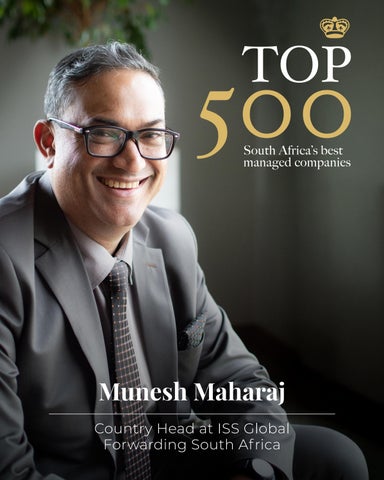
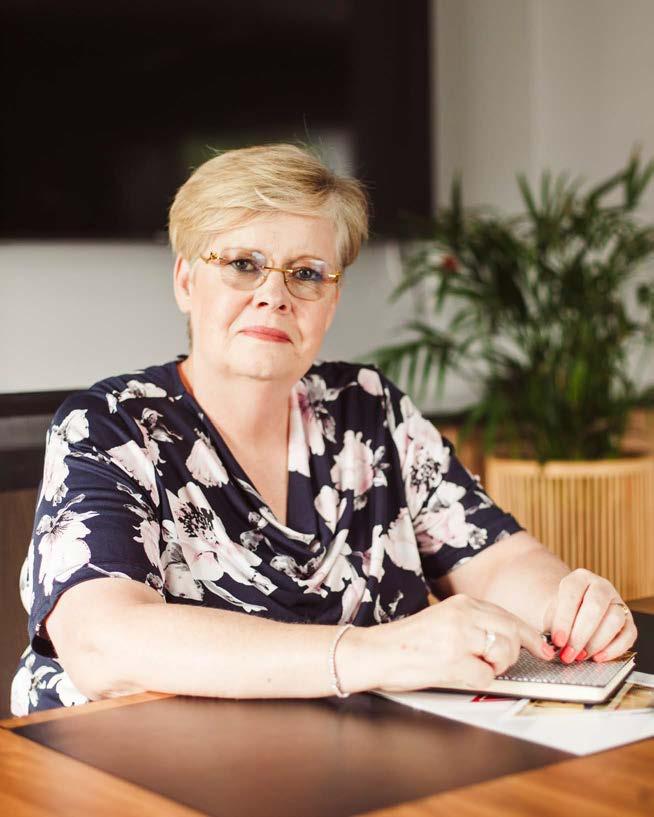
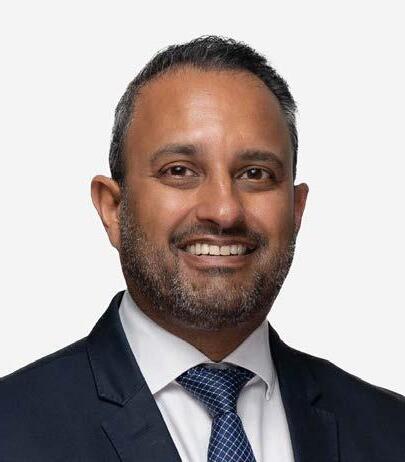
Munesh Maharaj Country Head at ISS Global Forwarding South Africa
EDITORIAL
LEADING FROM THE FRONT
12 | Spotlighting a selection of South African CEOs who are leading from the front
20 | Kabelo Makwane, Country Director, Google South Africa: The case for agility in tech-driven times
Thulani Dube, Head of Innovation and Advancement - Cornerstone Institute: Preparing South African leaders for the new world of work
Cheree Dyers, CEO of Prescient Investment Management: What I wish more CEOs said about gender equity in leadership
Nanda Scott, Group Chief Transformation and People Officer at Cassava Technologies: Putting people at the heart of progress
Janet Askew, Co-Founder and Director, Allardyce Academy: Making values stick
Dumisani Moyo, Marketing Director at SAP Africa: Leadership critical to reap AI benefits
PODCASTS
46 | From DEI to AI: Nedbank’s Deb Fuller on why humanity is still key for success
47 | Hannes Wessels on leading Africa’s crypto rise under Richard Teng’s vision
48 | Leadership is broke: Blanchard SA’s Jayson Naidoo knows how to fix it
49 | Dr Sarah Babb on why was EY able to create $1-billion in value by tapping into neurodiverse talent
50 | Silicon Valley vs Policymakers: Beverly Schäfer on AI sovereignty and reclaiming humanity
TECHNOLOGY
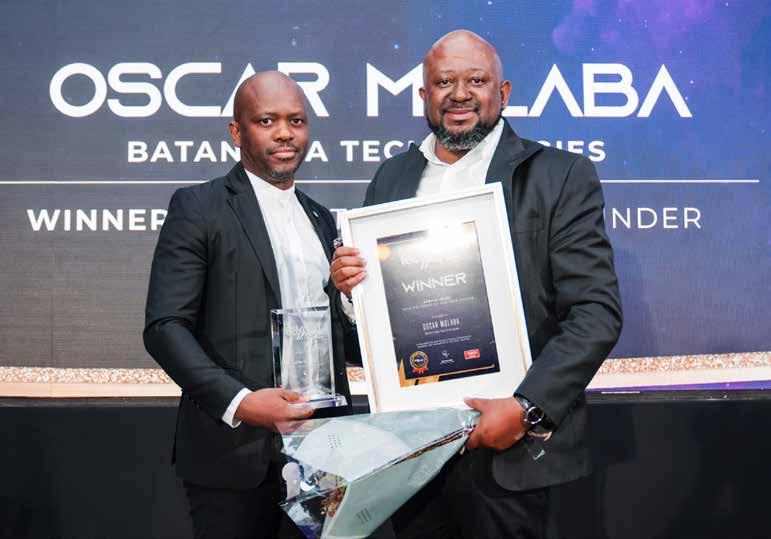
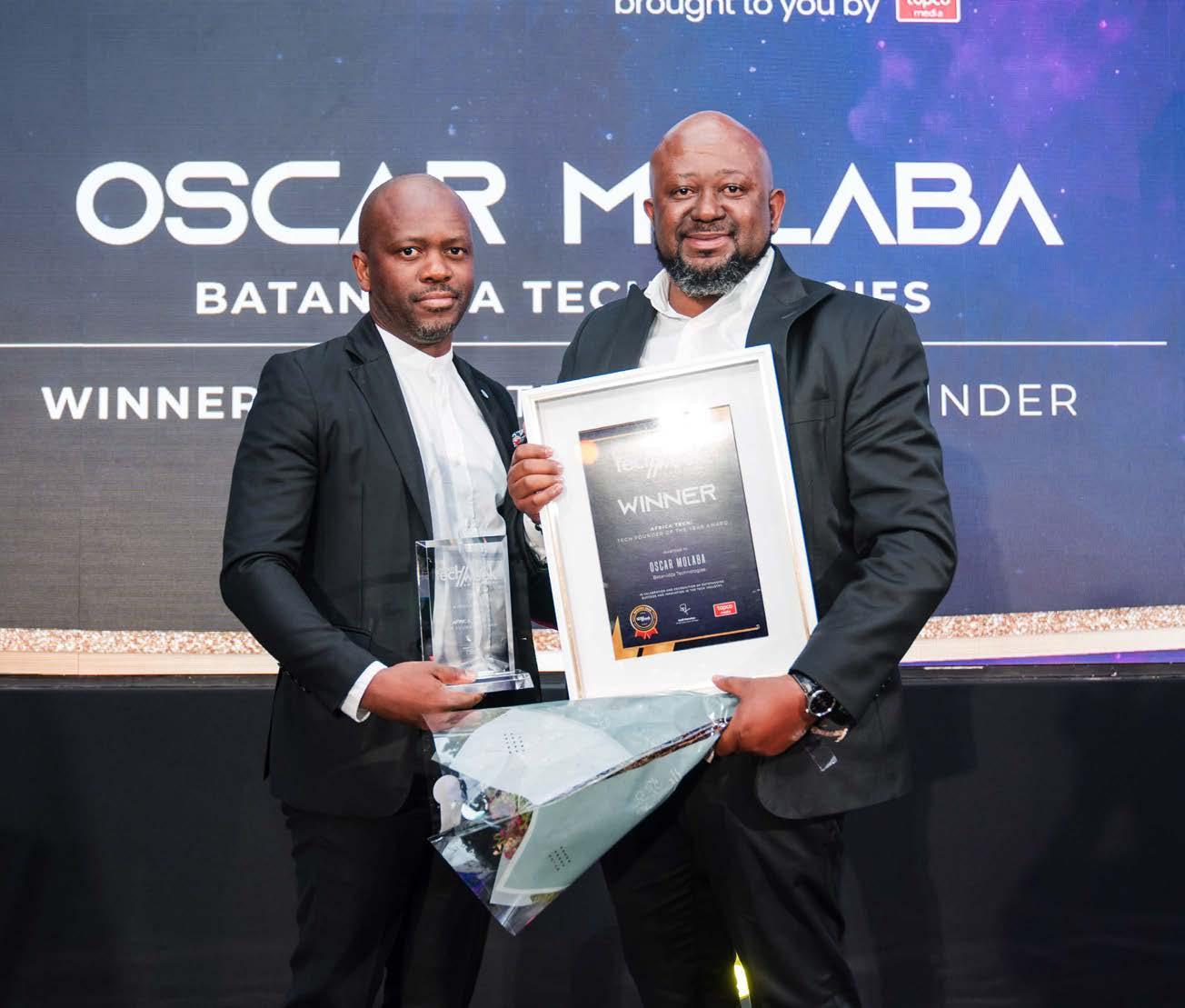
52 | Africa Tech Founder of The Year: Oscar Molaba
54 | Africa Tech Digital Transformation award winner, Etapath
56 | The Fourth Industrial development decade for Africa
62 | Smart hospitality: How technology is redefining guest experiences in South Africa
TIPS & ADVICE
70 | Learnings from other markets can power South Africa’s energy transition
74 | 8 lessons : An entrepreneur’s journey
78 | Building business robustness in the midst of disruption and beyond
80 | 5 start-up tips from a successful entrepreneur
82 | Being a thought leader with impact goes beyond just having an opinion
84 | Cultivating a solutions focused mind-set
88 | Rise above the competition with a compelling storytelling strategy
90 | Developing grit In entrepreneurship and business leadership
SECTOR OVERVIEWS
CEO
Ralf Fletcher
HEAD OF BRAND
Twaambo Judy Chileshe
TOPCO STUDIO
PRODUCTION DIRECTOR
Van Fletcher
GROUP EDITOR
Fiona Wakelin
DEPUTY EDITOR
Koketso Mamabolo
ASSISTANT EDITOR SHUMIRAI CHIMOMBE
TRAFFIC MANAGER
Daniël Bouwer
GRAPHIC DESIGNERS
Tashwell Brown, Artizan
RESEARCH MANAGER
Veronique Anderson
RESEARCHERS
Pelisa Sokomani, Jamie Daniels
PROJECT MANAGER
Emlyn Dunn
BUSINESS DEVELOPMENT
Odelia Fester, Josh Vaughn
MARKETING
Thabiso Mohlabeng, Samila Nkohla
ACCOUNTS
Amirah Esau, Celeste Isaacs, Sebastian Fletcher
IMAGES iStock Pexels
Unsplash Flickr
PRINTERS
LAWPrint
HEAD OFFICE
Top Media and Communications (Pty) Ltd
T/A Topco Media
2nd Floor, Elkay House 186 Loop Street, Cape Town. 8001
Tel: 0860 009 590
Email: info@topco.co.za
Website: www.topco.co.za
DISCLAIMER
All rights reserved. No part of this publication may be reproduced, stored in a retrieval system or transmitted, in any form or by any means, electronic mechanical, photocopying, recording or otherwise, without the prior written consent of Top Media & Communications (Pty) Ltd T/A Topco Media. Reg. No. 2011/105655/07. While every care has been taken when compiling this publication, the publishers, editor and contributors accept no responsibility for any consequences arising from any errors or emissions. ISBN: 9780620500746
CONTRIBUTORS
BOYD CHISLETT
Chief Business Officer at Liquid Intelligent Technologies, South Africa
CHEREE DYERS
CEO of Prescient Investment Management
CRAIG WHITE
COO & Co-Founder of Geddes Capital
DUMISANI MOYO
Marketing Director at SAP Africa
JANET ASKEW
Co-Founder and Director, Allardyce Academy
JESSIE TAYLOR
Writer
JUANITA VORSTER
Strategist for Organisations, Leaders, and Future-Focused Initiatives
KABELO MAKWANE
Country Director, Google South Africa
KHABONINA MNGUNI
Co-Founder and CEO of ZS Uniforms
KIMBERLEY TAYLOR
Founder & CEO of Loop
LYNN VERMAAK
Chief Imaginations Officer At Aha Training & Development
MIMI KALINDA
CEO of Africa Communications Media Group
NANDA SCOTT
Group Chief Transformation And People Officer At Cassava Technologies
SHAILIN MOODLEY
Chief Technology Officer, Energy Exchange Of Southern Africa (EXSA)
THULANI DUBE
Head Of Innovation And Advancement - Cornerstone Institute
FEATURED CLIENTS
HONEYCOMB BEE RATING
ISS GLOBAL FORWARDING
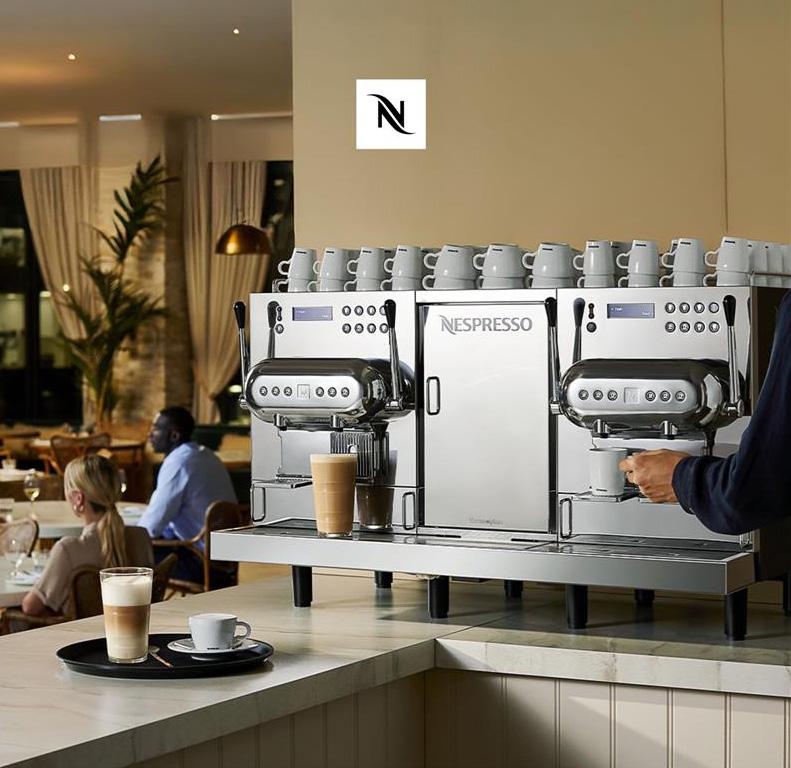
NESPRESSO
SANLAM SUPERGROUP WSP
EDITOR’S LETTER
Ican’t believe it has been a year since I last wrote this letter, prefacing our flagship publication Top500 Best Managed Companies. This is our 15th edition – a milestone worthy of some reflection for 15 years we have been ran ing the top best managed companies in South Africa, witnessing powerful growth and sustainability – as well as some downward shifts. Most recently our Head of Research noted interesting improved performance in the Real Estate, Investment Services and Water sectors, with contraction in the Mining industry.
This celebratory edition starts with a selection of the CEOs of best managed companies shooting the lights out, as identified by our research department, and includes a synopsis of their companies’ performance.
The Leadership section opens with a powerful piece, “Leading through constant change: the case for agility in tech-driven times”, by abelo Ma wane, Country irector, oogle South Africa:
“If change is the only constant in modern business, then today’s leaders are feeling it from all sides. This is particularly true now that artificial intelligence has moved from theoretical discussions to everyday operations. New tools emerge faster than teams can master them, mar et expectations shift overnight, and processes that were once reliable bedroc now feel li e outdated legacy systems.
“What separates the companies that surge ahead from those that fall behind is rarely just capital or headcount. It is the leader’s approach: agility, curiosity, and a willingness to pivot in the face of the un nown, abelo Ma wane.
As thought leader, abelo is oined by Nanda Scott, roup Chief Transformation and eople fficer at Cassava Technologies, Cheree yers, C of rescient Investment Management, Thulani ube, Head of Innovation and Advancement at Cornerstone Institute, anet As ew, Co-Founder and irector, Allardyce Academy and umisani Moyo, Mar eting irector at SA Africa.
ur Tech section brings you the Africa Tech ee Founder of the ear, scar Molaba and in Tips and Advice you will find useful articles such as how to develop a solutions focused mind-set , 8 lessons from the first 5 years of business and how to build business robustness in the midst of disruption.
The odcast line up is a particularly inspiring one and includes: eb Fuller from Nedban annes essels, inance Sara abb, culture shifter and ayson Naidoo, Chief ncouragement fficer at lanchard.
The publication would not be complete without the important range of Sector Overviews which sum up how particular industries are performing and the crux of the matter the Index and Ran ing of the top 500 best managed companies in South Africa.
From myself and the ama ing team, we hope you enjoy the read.
The 2026 Chinese Zodiac year is the year of the Fire orse, beginning on February 1 , 2026 unar New ear) and lasting until February 5, 202 , bringing with it themes of passion, boldness, transformation, and opportunities for brea throughs. I loo forward to it with optimism – and we wish you a peaceful, abundant New Year.
FIONA WAKELIN roup ditor
Igniting Minds, Shaping Futures
Igniting Minds, Shaping Futures
Who Is Siyafunda?
Who Is Siyafunda?
The Siyafunda Education Foundation (SEF) is committed to addressing South Africa's educational challenges by bridging the gap in STEM education. As a registered nonprofit organisation, SEF empowers young minds and transforms communities through innovative STEM programmes. We act as catalysts for change, igniting curiosity and providing a platform for young learners across the nation to access essential knowledge.
The Siyafunda Education Foundation (SEF) is committed to addressing South Africa's educational challenges by bridging the gap in STEM education. As a registered nonprofit organisation, SEF empowers young minds and transforms communities through innovative STEM programmes. We act as catalysts for change, igniting curiosity and providing a platform for young learners across the nation to access essential knowledge.
Why Partner With SEF?
Why Partner With SEF?
Partnering with SEF means joining a collective effort to build a brighter future alongside South Africa's youth. Together, we co-create asset-based, community-driven opportunities and platforms for success. As a registered Public Beneficiary Organisation, we provide 18A tax certificates for donations, ensuring every contribution counts. Our commitment to transparency ensures that every resource nurtures innovation and growth. As a Level 1 BEE enterprise, collaborating with SEF is an investment in our shared future. Join us in crafting a story of triumph, resilience, and limitless opportunity.
Partnering with SEF means joining a collective effort to build a brighter future alongside South Africa's youth. Together, we co-create asset-based, community-driven opportunities and platforms for success. As a registered Public Beneficiary Organisation, we provide 18A tax certificates for donations, ensuring every contribution counts. Our commitment to transparency ensures that every resource nurtures innovation and growth. As a Level 1 BEE enterprise, collaborating with SEF is an investment in our shared future. Join us in crafting a story of triumph, resilience, and limitless opportunity.
What Do We Do?
What Do We Do?
SEF drives transformation in under-resourced regions through holistic school and community development. Partnering with companies, mines, IPPs, and individuals, we create sustainable impact through bursary funds, multi-year projects, and community building initiatives. Our context specific approach ensures that each project meets the unique needs of the community. By investing in education and infrastructure, we empower communities.
SEF drives transformation in under-resourced regions through holistic school and community development. Partnering with companies, mines, IPPs, and individuals, we create sustainable impact through bursary funds, multi-year projects, and community building initiatives. Our context specific approach ensures that each project meets the unique needs of the community. By investing in education and infrastructure, we empower communities.
So, What’s Next?
So, What’s Next?
Join the journey of impact by contacting Felix Spies at felix@siyafundaef.org.za. Whether you're an individual or a company, be part of the change. Every email sparks change and every inquiry ignites possibility. Connect with SEF today to help realize every child's potential.
Join the journey of impact by contacting Felix Spies at felix@siyafundaef.org.za. Whether you're an individual or a company, be part of the change. Every email sparks change and every inquiry ignites possibility. Connect with SEF today to help realize every child's potential.
www.siyafundaef.org.za
@siyafunda_education_foundation
www.siyafundaef.org.za
Siyafunda Education Foundation
@siyafunda_education_foundation Siyafunda Education Foundation
In South Africa, many young people face violence, poverty, and inequality. The resulting toxic stress, compounded by limited support, harms brain development, health, learning, and future opportunities, with its impact passing to future generations.
Founded in South Africa in 2009, Waves for Change (W4C) is a non-profit company that supports adolescents growing up in high-stress environments. From five beach sites across the Eastern and Western Cape, W4C has created safe, joyful “third spacesˮ where young people can practise coping skills, build resilience, and connect with caring peers and coaches.
Through research and collaboration with global partners, W4C created the Take5 Model to extend the reach of Surf Therapy and strengthen youth mental well-being support worldwide.
Take 5 Model to extend the reach of Surf
Together, Surf Therapy and Take 5 advance one mission: empowering adolescents to thrive.
Healing through the ocean
Surf Therapy fuses the rush and therapeutic benefits of surfing with the Take 5 routine to create a structured, evidence-based programme.
How it works:
Adolescents are referred through schools, hospitals, and child and youth care centres.
They attend weekly sessions for 10 months at one of five beach hubs.
Each session combines surfing with the Take 5 five step routine: Energiser, Check in, Breathing, Play, Reflection. After 10 months, participants graduate into weekend Surf Clubs, maintaining lifelong connections with coaches, peers, and the ocean.
Since 2011, Surf Therapy has supported more than 10,000 adolescents, trained 215 local coaches, and provided over 100,000 nourishing meals annually.
OUR IMPACT
Scaling resilience through physical activity and play
Developed and rigorously refined within Surf Therapy, Take 5 is a teaching framework that helps organisations scale physical activity and play-based mental health programmes with confidence and ease.
skills for working with vulnerable youth.
in 5 countries across the African continent.
Peer-reviewed studies show that Surf Therapy improves stress management and social behaviour outcomes for youth. Where W4C has a presence, Surf Therapy programmes are now integrated with city-wide health referral systems.
A Case Study with the Western Cape Government shows that Take 5 makes coaches more effective at building resilience with vulnerable youth. There is increased demand from government ministries and civil society partners to use the Take 5 model in 2026.
children to the power of the ocean:
LEADING FROM THE FRONT
SPOTLIGHTING A SELECTION OF SOUTH AFRICAN CEOS WHO ARE LEADING WITH VISION AND IMPACT
THESE CEO S ARE LEADING WITH IMPACT AND DRIVING IMPRESSIVE PROGRESS ACROSS DIVERSE SECTORS OF SOUTH AFRICA’S ECONOMY. FROM FINANCIAL SERVICES AND INFRASTRUCTURE TO RETAIL, AND TELECOMMUNICATIONS, THEIR LEADERSHIP REF ECTS RESI IENCE INNO TION ND CO IT ENT TO ONG-TER UE COLLECTIVELY, THESE LEADERS ARE NOT JUST DELIVERING STRONG RESULTS, THEY ARE SETTING THE PACE FOR TRANSFORMATION, INCLUSIVE GROWTH, AND LASTING IMPACT IN THEIR INDUSTRIES.
BY PELISA SOKOMANI AND VERONIQUE ANDERSON
MPUMI MADISA
CEO BIDVEST GROUP
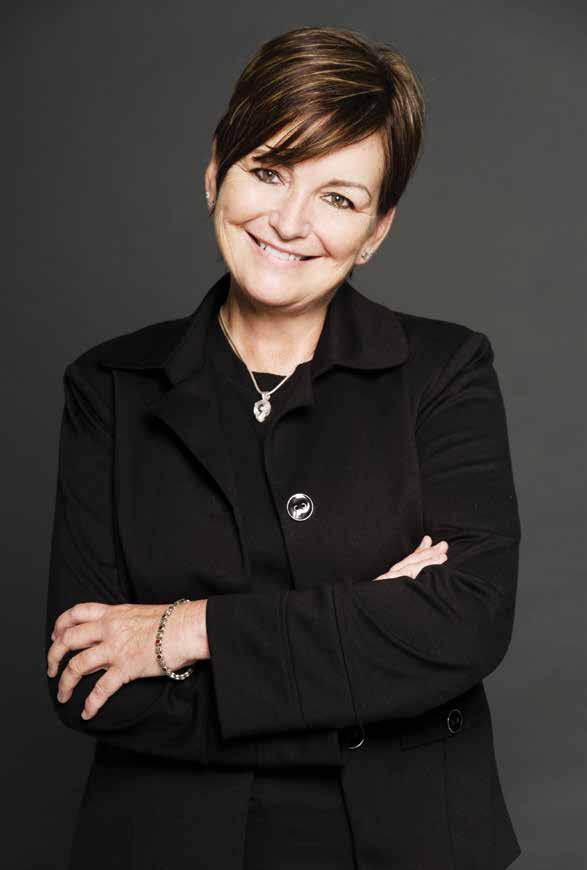
Mpumi Madisa became CEO of Bidvest on 1 October 2020, following her appointment as CEO designate in March 2019. She is the first blac woman to lead a Top 0 S company, a landmar achievement for corporate transformation in South Africa.
Under her leadership Bidvest Group delivered a solid performance for the fiscal year ending 30 une 2025, reporting revenue of R126.6-billion (up 5%), operating profit of R12-billion trading margin 9.5 ), and cash generated from operations of R14.7-billion. Headline earnings per share (HEPS) were 1886.4 cents, with a final dividend of 53 cents per share. With Mpumi at the helm, Bidvest has succeeded in maintaining a diversified, resilient conglomerate model, operating over 250 individual businesses across services, freight, commercial products, automotive, and branded goods. It has achieved operational expansion and strategic acquisitions, including hygiene/facilities management and automotive dealer networ s.
management appointments within Africa. The conglomerate extends community support and upliftment through socio-economic initiatives, including the Bidvest Supplier Development Programme and sponsorship of Team SA’s Olympic and Paralympic efforts.
Its scale, diversification, and consistent profitability underline idvest s position as one of South Africa’s largest and most resilient industrial conglomerates.
SHAMEEL JOOSUB
GROUP CEO VODACOM LIMITED
Shameel Joosub has served as CEO of Vodacom Group since September 2012, following a distinguished career within the Vodacom–Vodafone organisation that began in 1994.
It has also added North America as a new growth mar et.
idvest is a significant employment contributor and employs approximately 13 0 3 people, with 3 of management appointments being female and 52% of South African
Under his leadership, Vodacom has transformed from a predominantly South African operator into a leading pan-African telecommunications and digital services group. His leadership has earned multiple accolades, including Telecoms C of the ear 2023) and an honorary doctorate from the Central University of Technology (CUT) for leadership and industry impact.
Through ision 2030
Shameel is focused on rapid customer-base expansion, scaling financial-services adoption, and increasing revenue from digital and technology innovation, securing Vodacom’s relevance in the future digital economy.
Mpumi Madisa
Shameel Joosub
Vodacom delivered an exceptional performance in 2024, reporting a 26.4% increase in Group revenue to R151-billion, driven largely by the successful acquisition and integration of its Egypt operations. Service revenue grew by 29.1%, while EBITDA increased by 2 .3 , reflecting both strong commercial execution and disciplined cost management.
Vodacom was also ranked Number 1 in its sector in the 15th edition of the Top 500 Best Managed Companies, confirming its leadership position in the telecommunications industry.
2024 marked a major milestone as Vodacom celebrated its 30th anniversary, commemorating three decades of driving technology, innovation, and digital inclusion across Africa. The company was also recognised as Africa’s Top Employer for the second consecutive year, highlighting its excellence in employee engagement, operational reliability, and workplace culture.
DR LEILA FOURIE GROUP CEO JSE LIMITED N : N N
Since 2019 Dr Leila Fourie has served as Group CEO of the Johannesburg Stock Exchange (JSE) - Africa’s largest stock exchange by market capitalisation which stood at approximately R21.73-trillion as of July 2025, with around 435 listed companies.
Under her leadership, the exchange has undergone significant strategic transformation, mar ed by revenue diversification beyond traditional equity trading; technology and regulatory modernisation; and expansion into private markets, voluntary carbon markets, and new ETF segments.
Her tenure is widely recognised for delivering operational resilience, strategic clarity, and inclusive leadership, positioning the JSE as “more collegiate, future-fit and globally aligned. She was also recognised among the inaugural global cohort of female exchange leaders by the World Federation of Exchanges (WFE).
Dr Leila Fourie
For the trailing 12 months to mid-2025, the S delivered a strong financial performance, reporting revenue of approximately R3.1 -billion up 9.9 year-on-year) and net income of about R9 2.9-million. The roup achieved a return on equity of approximately 20.2 , maintained a dividend yield of around 6 , and remained highly cash-generative with cash and bond holdings of roughly R2. -billion.
erformance highlights for 202 included revenue growth driven by diversification across asset classes improved cost discipline healthy cash generation and stable dividend profile eight new equity mar et listings, with strong growth in TFs and the sustainability segment and the highest-ever Net romoter Score N S), reflecting deep client trust and strong relationships
The S continues to perform strongly in regulation, governance, and global credibility, while advancing innovation through the introduction of S products and carbon trading platforms.
ADRIAN GORE GROUP CEO DISCOVERY
Adrian ore founded iscovery in 1992 and serves as its roup Chief xecutive. e has received numerous accolades for entrepreneurship and leadership, including usiness eader of the ear.
e has guided iscovery s expansion from a single medical aid provider into a diversified multinational group spanning health and life insurance, ban ing iscovery an ), investments, and wellness, with a global presence and substantial wor force. The private healthcare group is listed on the S under S .
nder his leadership, iscovery introduced the globally recognised shared-value insurance and wellness/behaviour-change model through itality, which encourages healthy lifestyles to reduce insurance ris , pioneering innovation in the insurance industry.
For the year ended 30 une 2025 the group achieved strong growth - revenue rose 10.6 to R . billion, with normalised headline earnings up 30 to R9, million and overall normalised profit from operations reaching R15,2 million 29 o ).
• iscovery ealth: profit growth, with higher premium income
• iscovery Invest: 29 profit growth
• iscovery Insure: 229 operating profit increase
• iscovery an : achieved first profitable period in 2 F 2025, with deposits of R23.3billion and advances of R9.2billion
• A final dividend of 201 cents per share reflected strong shareholder returns.
nder Adrian s visionary leadership, iscovery has successfully combined innovation, diversification, and social impact, delivering robust performance across multiple business lines while maintaining a focus on shareholder value, operational excellence, and global expansion.
BERTINA ENGELBRECHT CEO CLICKS GROUP LIMITED
ertina ngelbrecht has served as C of Clic s roup since anuary 2022. She oined Clic s in 2006 as roup uman Resources irector, bringing deep expertise in corporate strategy, sta eholder engagement, transformation, and people leadership. Since becoming C , she has accelerated store expansion, loyalty programme growth, privatelabel penetration, and pharmacy networ expansion, while maintaining strong earnings and mar et confidence.
nder her leadership, Clic s roup delivered another year of resilient growth in 2025, with revenue reaching R . -billion, up 5.3 yearon-year, and net income of approximately R3.2 -billion. Retail turnover grew 6 , while private-label sales surged 10. , reinforcing Clic s value-led strategy and margin resilience. The roup achieved a strong trading margin of 9. , confirming its position as one of the most profitable and defensive retailers in South Africa.
As the largest pharmacy networ in the country, Clic s surpassed 1,000 stores nationwide, after adding 55 new outlets, significantly strengthening its national pharmacy and healthcare footprint.
The roup s rating improved to evel 3 with 1 blac ownership. Clic s was Included in the FTS ood Index for the th consecutive year and is a top performer in MSCI s ealth Care roviders Services Industry governance ran ings.
Clic s roup is one of the most reliable, wellgoverned, and recession-proof retail and healthcare businesses in South Africa, with dominant pharmacy mar et share, trusted healthcare access, and industry-leading customer loyalty, particularly through its ClubCard.
Bertina Engelbrecht
PIETER ENGELBRECHT
CEO SHOPRITE HOLDINGS LIMITED
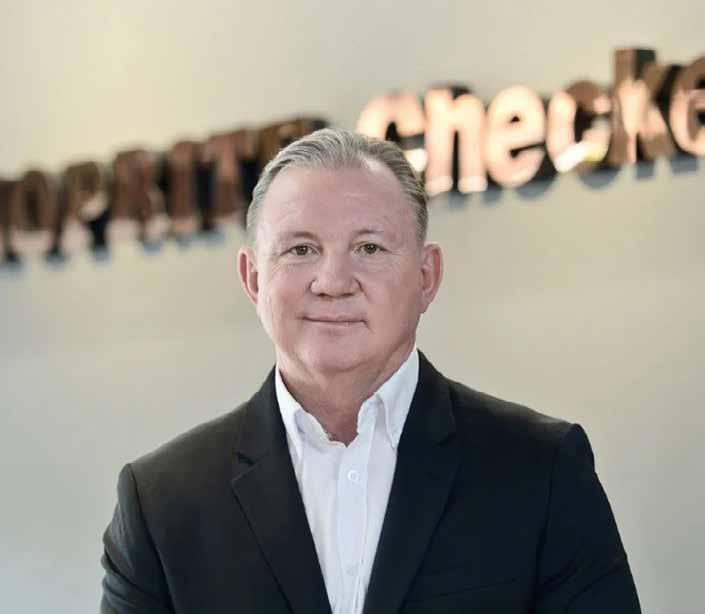
Pieter Engelbrecht has served as CEO of Shoprite Holdings since January 2017. He previously served as COO of Shoprite Checkers for over a decade before being appointed CEO. Over nearly three decades at Shoprite, he has played a central role in launching ey growth platforms, including financial services, discount retail formats, and in-store pharmacies. Under his leadership Shoprite Holdings delivered another year of exceptional performance in 2025, with group revenue reaching R256.7-billion, up 8.6% year-on-year, and net income of R7.58-billion.
The Group now operates 3,478 stores, including 615 franchise outlets, after opening 281 new stores during the year. This expansion created 8,723 new jobs, bringing total employment to approximately 168,000 people, making Shoprite the largest privatesector employer in South Africa.
South African supermarket sales grew 9.5% to R213.5-billion, while the Group’s Sixty60 online platform surged 47.7% to R18.9-billion, supported by a 9 on-time delivery rate, confirming Shoprite s dominance in both physical and digital retail.
Other major achievements include achieving revenue growth above R250-billion with market share growth for five consecutive years, the successful launch of its budget retail discount chain Usave; national supply-chain resilience; operational efficiency and unmatched scale.
Shoprite was recognised as a 2024 Top Employer with its initiatives including entry-level general assistants earning on average 11% above the National Minimum Wage. As a result, workforce increases have exceeded management increases for 5 consecutive years.
RUWAYDA REDFEARN
CEO DELOITTE AFRICA
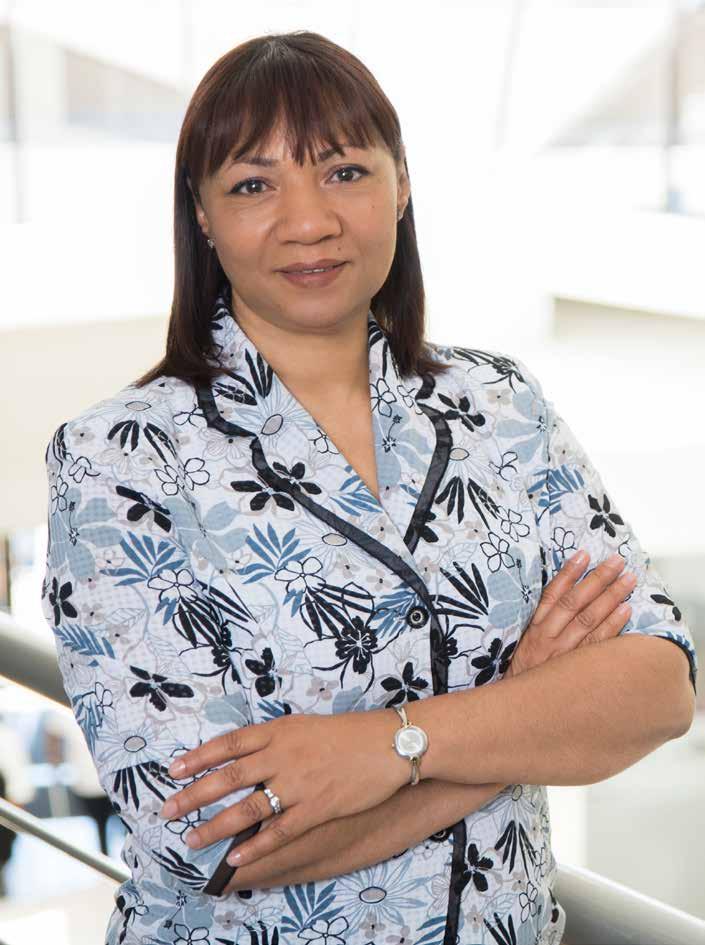
Ruwayda Redfearn was appointed CEO of Deloitte Africa on 1 une 2022. She is the first female C of the firm, mar ing a significant milestone in eloitte Africa’s leadership transformation. Her appointment also reflects eloitte Africa s commitment to
Pieter Engelbrecht
Ruwayda Redfearn
diversity and gender inclusivity, with 42% female representation on the Executive Committee at the time of her leadership.
Deloitte Africa comprises a network of roughly 7000 professionals across the continent, with offices in 12 countries and 1 locations, and the capacity to serve clients in up to 52 African nations.
Under Ruwayda’s leadership, Deloitte Africa has strengthened audit quality, governance, and risk management, investing in technology and controls while enhancing transparency.
The firm places S , sustainability, and social impact at the core of its strategy, building capacity in climate, sustainability, and governance advisory services across the continent. Through its cluster networ , eloitte Africa combines global standards with local African expertise, helping clients navigate complexity and risk via its “OneDeloitte” approach. Its regional reach spans southern, east, west, central, and Francophone Africa, including strategic expansions into emerging markets such as Ethiopia.
Ruwayda’s vision for Deloitte Africa focuses on positioning the firm as a trusted global partner, an employer of choice, and an organisation that creates meaningful impact for clients, employees, and society.
The firm also emphasises talent development, cross-border mobility, diversity, and inclusion, maintaining its position as a leading professionalservices employer in Africa.
PAUL HANRATTY
GROUP
CEO
SANLAM LIMITED
aul anratty has served as roup C of Sanlam imited since 1 uly 2020, after oining the board in 201 . is career spans senior leadership roles across South Africa, the nited ingdom, and multiple emerging mar ets, giving him deep global and technical expertise in insurance and financial services. In une 202 , his tenure as C was extended to 31 ecember 202 , reflecting strong board and shareholder confidence in his leadership and strategic direction.
Paul’s leadership is widely recognised for sharpening Sanlam s strategic focus, expanding its global footprint, and delivering consistent shareholder value while maintaining strong governance and social responsibility.
Sanlam s 202 annual results reflect strong, sustainable performance, with a 16 increase in earnings per share and an 11 rise in dividends, underpinned by excellent outcomes from its South Africa, Africa, and India operations. rowth was driven by strong new business volumes, disciplined capital management, and a healthy return on group equity value, reinforcing Sanlam s position as one of South Africa s most stable and trusted financial services institutions.
eyond financial performance, Sanlam continues to lead in people and workplace excellence. The group was ran ed among the Top 10 Top mployers in South Africa for 202 /2025, reflecting its commitment to employee wellbeing, development, and progressive workplace practices. Sanlam also features in a Top 500 leading companies publication, reaffirming its status as a corporate leader.
Paul Hanratty
LEADING THROUGH CONSTANT CHANGE
BY KABELO MAKWANE, COUNTRY DIRECTOR, GOOGLE SOUTH AFRICA
If change is the only constant in modern business, then today’s leaders are feeling it from all sides. This is particularly true now that artificial intelligence has moved from theoretical discussions to everyday operations. New tools emerge faster than teams can master them, market expectations shift overnight, and processes that were once reliable bedrock now feel like outdated legacy systems.
What separates the companies that surge ahead from those that fall behind is rarely just capital or headcount. It is the leader’s approach: agility, curiosity, and a willingness to pivot in the face of the unknown.
A HERITAGE OF ITERATION
Google’s own history is a case study in this “perpetual beta” mindset. The company began at Stanford University in the mid-1990s, not with a finished business plan, but with a question: how do we organise the rapidly growing web?
From the early days of “Backrub” to the incorporation of oogle in 199 , the company s NA has been defined by rapid iteration. We didn’t just build a search engine and stop we expanded, refined, and pivoted to build the foundations that billions rely on today.
That same desire to evolve guides our strategy across Africa. In 2021, we committed to investing 1-billion over five years to support the continent’s digital transformation. But investment without infrastructure is just potential waiting to happen.
INFRASTRUCTURE AS THE BEDROCK OF AGILITY
Recent strategic investments by oogle are significantly boosting Africa’s digital infrastructure.
T E C SE FOR GI ITY IN TEC -DRI EN TI ES
Recognising that business agility requires fast, reliable digital connectivity, oogle is heavily committed to ey infrastructure pro ects. These include the operational quiano subsea cable, which has connected Africa s west coast to urope since 2023, and the mo a fibre route, announced in May 202 , which provides the first direct fibre lin between enya and Australia via a terrestrial networ through multiple African countries.
These pro ects, along with the operational ohannesburg oogle Cloud region, form the Africa Connect initiative.
This comprehensive infrastructure acts as a series of high-capacity digital highways designed to transform connectivity and support the continent s future digital economy.
The economic case for this is clear. A ublic First report commissioned by oogle found that our tools and services contributed approximately 16-billion to the Sub-Saharan economy in 2023 alone. Furthermore, for every 1 invested in digital technology here, the region is pro ected to generate over 2 in economic value by 2030.
THE AI PIVOT: FROM COMPLEXITY TO CAPABILITY ith connectivity improving, the conversation naturally shifts to capability. This is where AI enters the boardroom.
Across the continent, we are seeing teams move past the hype and test AI in meaningful ways summarising complex data, enhancing customer service, and optimising logistics. For leaders, the challenge is not to become a technologist, but to become a technological strategist. It is about as ing: ow do these tools fit into our operations here do they add speed
hile people argue about what AI will or won t do, the reality is that C s are already using it in their day-to-day wor . At a recent Tsurance golf event, I found myself in conversation with executives from Tsurance, e uyCars and Chec ers, about whether AI has illed consulting. None of us thought so: we agreed that AI isn t replacing human creativity or udgement any time soon, but it has become embedded in how C s thin , plan and run their companies. ach of them could point to concrete ways it has changed their own habits, their decision-ma ing and the day-to-day mechanics of their business.
For Google, this is familiar territory; we have been an AIfirst company for nearly a decade. That deep experience is realised in emini, our family of AI models. e designed emini not ust to be smart, but to be useful within the wor flows people already use. evelopers are using it to debug code faster small businesses are generating mar eting copy in seconds and educators are designing lesson plans more efficiently.
BUILDING THE WORKFORCE OF TOMORROW owever, the most sophisticated AI in the world is useless without the talent to wield it. e cannot build a digital future if the tools remain a luxury. To ensure Africa s young minds are not ust consumers of this technology but its architects, we must democratise access to it.
This is the driving force behind our latest education initiative. e recently rolled out an offer granting eligible university students across South Africa, hana, enya, Nigeria, Rwanda, and imbabwe free access to our premium oogle AI ro plan for 12 months.
This is not a light version of our technology. It puts our most advanced tools directly into the hands of the next generation. owered by emini 3.0 ro, it gives students access to features that fundamentally transform academic output:
Deep Research: Synthesising hundreds of web sources into comprehensive, cited reports in minutes.
Veo 3: enerating high-quality video content to bring creative ideas to life.
NotebookLM: Acting as an advanced research assistant to organise complex thought.
y removing the financial barrier, we are ensuring that the future wor force the talent that will soon be wal ing through your doors is already fluent in the language of AI. This is a direct investment in the region s agility. A student who can use guided learning to master a new concept today is an employee who can pivot to a new mar et requirement tomorrow. The companies recognised in the Top 500 est Managed list understand this instinctively. Sustained performance rarely comes from a single big bang moment. It comes from steady improvement, clear udgement, and the structural agility to move when the mar et moves. AI fits perfectly into this pattern. It is powerful when guided by strong leadership, and most effective when people remain at the centre of its use. As leaders, our ob is to equip our teams and the generation following them with these tools, fostering the capabilities that turn constant change into a competitive advantage.
Leadership in uncertain times demands far more than technical skill or strategic foresight. It requires clarity of purpose, emotional intelligence, and the ability to unify people around a shared mission.
LEADERSHIP
LEADING BEYOND UNCERTAINTY
BY THULANI DUBE, HEAD OF INNOVATION AND ADVANCEMENT
CORNERSTONE INSTITUTE
In the twenty-first century, leadership has never faced greater pressure or complexity. Executives today must navigate an intricate convergence of disruptions such as geopolitical instability, technological upheaval, climate crises, shifting workforce expectations, and volatile markets. South Africa, with its own dynamics such as inequality, youth unemployment, and infrastructure fragility, stands at the crossroads of these global transformations. Yet, within this turbulence lies extraordinary opportunity.
We are entering an era shaped not only by human ingenuity but also by intelligent systems capable of planning, acting, and evolving autonomously. These agentic technologies are reshaping industries, workforces, and societies. In this context, South African leaders must move beyond survival strategies and begin to see uncertainty as a platform for reinvention. The challenge is not simply to manage volatility, but to lead through it, learn from it, and transform it into sustainable growth.
Leadership in uncertain times demands far more than technical skill or strategic foresight. It requires clarity of purpose, emotional intelligence, and the ability to unify people around a shared mission. The most effective leaders succeed not by dictating every move, but by creating conditions that allow others to think, act, and lead with confidence. In this sense, the role of a leader is to provide direction without control and to clarify what matters most while giving teams the autonomy to determine how best to achieve it.
In South Africa’s multifaceted and rapidly evolving corporate landscape, this leadership philosophy carries profound relevance. The nation’s complexity, socially, economically, and culturally, demands leaders who are not only adaptive but deeply inclusive. The recent leadership
transition at YOCO is indicative of leadership that understands the need to adapt to the current and future journey and in this particular instance a shift from start up mode to sustainable scaling within a highly competitive ecosystem.
True leadership in this context is purpose driven and participatory. It seeks to harness the full spectrum of perspectives, experiences, and talents that define modern South African organisations. When leaders create space for diverse voices and genuine collaboration across generations, disciplines, and communities, they unlock the collective intelligence needed to navigate uncertainty. Inclusion, therefore, is far more than a moral obligation, it is a strategic catalyst that builds trust, inspires innovation, and fuels the organisational agility required to thrive in a world where volatility has become the new normal.
Reshaping leadership traits
The evolving world of work has also reshaped the essential traits of effective leaders. Today, leadership requires the ability to maintain balance and energy under pressure, recognising that resilience begins with personal well being where mental health is no longer just a buzz phrase. It demands humility and a servant mindset, grounded in the understanding that progress is collective. In the African spirit of Ubuntu, true leadership is measured not by control, but by the ability to enable others to rise. The future of leadership must take keen interest in the mental state of the organisation to drive not only an innovative workforce but one that can unlearn the old and learn the new.
In the coming age of accelerated change, continuous learning has become the defining trait of successful leadership. The speed at which industries transform means that experience alone is no longer sufficient. Curiosity and adaptability must therefore be cultivated into strategic capabilities. The most effective leaders will be those that cultivate a culture of ongoing learning, where development is not a periodic event but a daily practice. They see every challenge as a lesson and every setback as an opportunity to grow stronger and fail forward so to speak.
Equally important is the capacity for grit and emotional resilience. The new world of work will require the ability to remain steady when circumstances are unpredictable and to transform adversity into momentum. In South Africa, where volatility often defines the operating landscape, this quality is indispensable. Yet resilience in the modern context will not simply be about endurance but renewal as well as about using challenges as catalysts for evolution rather than obstacles to progress.
Leaders who sustain their humanity amidst complexity stand apart. Empathy and emotional connection should not just be regarded as soft skills but the foundation of trust and cohesion in high pressure environments. The best leaders know that when stress rises, empathy must rise with it. They must create psychological safety, encourage open dialogue, and maintain a sense of perspective that keeps teams grounded and inspired.
Cultivating sustainable stewardship
Above all, in the twenty-first century and beyond, leadership will be defined by stewardship. For leaders this is the awareness that leadership is temporary, but its impact is enduring. A leader’s responsibility is not only to achieve results, but to leave behind organisations that are stronger, more ethical, and more sustainable. In South Africa, this carries particular weight, as the corporate sector plays a crucial role in addressing inequality, building capability, and driving social transformation.
The focus on ESG in the new world of work must be prioritised. ESG is crucial for leaders in the changing world of work, as it anchors purpose and performance, ensuring that growth is not only profitable, but principled, sustainable, and aligned with the values of a rapidly evolving ecosystem and society.
Now and in the future, traits alone are not enough to ensure enduring leadership. The most forward thinking organisations are those that institutionalise leadership development by embedding it into the fabric of work itself. These organisations must create Leadership Factories. These are environments that deliberately cultivate leadership capacity at every level. In these systems, mentorship, growth opportunities, and learning are not confined to workshops or retreats but are woven into the daily rhythm of work.
Additionally, in the era of intelligent technology, such leadership factories must evolve into adaptive learning ecosystems. Through data driven insights, collaborative platforms, and even AI-enabled feedback systems, learning can now occur in real time and in the flow of work. This marks a profound shift where development is no longer something leaders schedule but rather something they live. For South African companies, this model is transformative. By developing leadership capacity broadly rather than relying on a handful of executives, organisations build resilience and scalability that can withstand current and future disruption.
Reimagining resilience as a strategic capability
As the world rapidly shifts, resilience is evolving from being a personal attribute into a core strategic capability that defines organisational longevity. It now extends beyond individual toughness to encompass financial agility, operational adaptability, and cultural cohesion. More importantly, it includes what can be termed as developmental resilience. Leaders like Sim Tshabalala and Lincoln Mali have shown the level of developmental resilience needed for the new work era. These leaders have shown the ability for a leader to transform disruption into a catalyst for learning, reinvention, and growth. Organisations that weave learning into their crisis response don’t merely survive upheaval, they evolve through it. They convert turbulence into momentum and uncertainty into advantage. Ultimately, the true power of resilience lies where knowledge meets curiosity and courage and with such the act of adapting becomes the spark of innovation. South African leaders undoubtedly face the unique challenge of navigating the globallocal nexus. The country’s economy is deeply connected to international trends, from energy transitions, trade realignments to shifts in digital governance and artificial intelligence adoption. To succeed in the era to come, leaders must be globally informed yet locally grounded. They must interpret global trends through the lens of national realities, ensuring that growth strategies contribute to inclusive development and meaningful employment. The leaders who strike this balance of being global in vision but local in impact will be in a position to define the next generation of South African enterprise growth. Through this, such leaders will also be in a position to solve some of the country’s most challenging problems while driving organisational success.
The road ahead is not without challenges. Integrating intelligent technology responsibly, addressing persistent skills shortages, preserving culture in hybrid work models, and upholding ethical governance in the face of rapid digitisation are all pressing issues. Yet these challenges also represent opportunities for renewal. Leaders who approach them through a learning lens while embedding reflection, feedback, and ethical awareness into daily operations will create organisations capable of thriving in the current and future complexity.
Converting disruption into direction and uncertainty into growth
Ultimately, the new world of work calls for leaders who are not merely resilient, but evolutionary. For South African leaders, success will depend on their ability to build organisations that learn faster than the world changes. Leadership will go beyond being defined by the ability to command certainty but by the capacity to enable discovery. The most effective leaders will be able to convert disruption into direction and uncertainty into growth.
The enduring test of leadership, therefore, is not how well one weathers the storm, but how courageously one uses it to chart a better course as ecosystems go through radical transformations. The future belongs to those who see uncertainty not as a threat, but as the raw material of sustainable progress.
It’s no longer enough for CEOs to say they support gender equity. What matters is how often those words translate into real change - and, for most companies, the evidence is underwhelming. It is essential to move beyond symbolic gestures and surface-level messaging to address the real gaps that persist - pay, promotion, participationand to commit to meaningful change, even when it is uncomfortable.
For those of us who lead teams and steer strategy, this requires deliberate reflection. What are the actual results of our equity strategies? Where have we moved the needle? Where are we still falling short? More importantly, what are we doing to create structural, sustained change? We often say we’re making progress, and in some areas, that is true. Change takes time. However, time is not a strategy. If we are not measuring our actions, revisiting our targets and taking ownership of outcomes, then progress remains a story we tell ourselves, not a reality we build.
According to Citywire’s 2024 Alpha Female Report , just 12.5 per cent of portfolio managers globally are women. While this has improved slightly, the retention gap remains
LEADERSHIP
WHAT I WISH MORE CEOs SAID ABOUT GENDER EQUITY IN LEADERSHIP
BY CHEREE DYERS, CEO PRESCIENT INVESTMENT MANAGEMENT
significant. The average turnover rate for female portfolio managers is 43 per cent, compared to 29 per cent for men. Women are not being developed and retained at the same pace, which suggests a deeper, structural issue.
Closer to home, Just Share’s 2024 research shows that only 23 per cent of executive management roles in the JSE Top 40 are held by women. Female representation on boards is slightly better, at 36 per cent, but remains far from parity. Although women make up 46 per cent of South Africa’s economically active population, less than a quarter of senior leadership positions are filled by them. In fact, only four of the JSE Top 40 companies have female CEOs. Companies that once set gender diversity targets often fail to revise them, treating the targets as ceilings rather than minimum expectations.
Gender equity cannot be outsourced from C-suite leaders to the human resources department or onto a compliance checklist. This responsibility lies with the executives and CEOs who make the decisions about hiring, promotion and recognition. Did you know that, according to the World Economic Forum’s Global Gender Gap Report 2025, South Africa ranked 6th in 2006 and has since fallen to 33rd
on the Global Gender Gap Index? August is a time to reflect on whether we are doing enough and the data suggests we are not. At the current pace of progress, global gender parity will only be achieved in 123 years, missing the Sustainable Development Goals set for 2030 by more than a century.
Diversity needs to be recognised for what it is: a competitive advantage. Companies committed to diversity and inclusion significantly outperform those that aren’t. According to McKinsey’s 2023 Diversity Matters Even More report , companies with more than 30 per cent women in leadership positions are significantly more likely to outperform those with lower levels of female representation. The same report indicates that leadership diversity is also convincingly associated with holistic growth ambitions, greater social impact, and more satisfied workforces.
It is well documented that diverse teams make better decisions, challenge groupthink and bring more creative solutions to complex problems. However, this only happens when diversity is actively managed and different perspectives are not only heard, but used intentionally to strengthen thinking, decisions and outcomes.
Too often, the burden of change is placed on women as if the issue lies with them, not the system. Very few organisations examine and measure the leadership behaviours they reward. Many still value visibility over output, hours over outcomes, and outdated leadership styles that fail to reflect how the world of work has evolved.
Even when women reach senior roles, they are often stretched thinner than their male colleagues. They are expected to fix problems they didn’t create and take on the additional burden of mentoring, emotional labour and cultural leadership; all on top of their core responsibilities. This is the invisible tax many women in leadership pay. It is rarely acknowledged or openly discussed, and these contributions are rarely recognised or rewarded. At the same time, women are judged more harshly for showing ambition and often held to higher standards just to be seen as equal.
What about work-life balance? I wish more CEOs, especially female leaders, would acknowledge that it is largely a myth. In leadership, balance is rarely symmetrical. Life moves in cycles. Some seasons are intense, while others offer more space to breathe. The real goal is not perfect balance but personal agency. That means having the ability to prioritise, choose how and when to show up, and take ownership of the space you need. Of course, that is only possible in a workplace
culture that supports it. Leaders have a responsibility to shape that culture by letting go of unrealistic messages about balance and creating space for agency and support instead.
If we want to see more women move through the ranks, we have to change the system. That means refusing to accept a shortlist with no women. It means tracking who receives high-impact projects and visibility. It also means re-evaluating how we measure performance and what we reward.
Financial services are well positioned to lead this shift. Remote work, tech-enabled delivery and output-based performance models have enabled flexibility. These changes allow people to work in ways that are both effective and sustainable. The result is a greater opportunity to embrace different leadership styles and to open doors for more women.
Technology, when applied with intent, can help us redefine success. Leadership no longer has to look like the person who is first in the room and last to leave.
In our own leadership journey, we’ve seen how progress follows intent. Today, women make up 67 per cent of the executive committee, 50 per cent of the board and executive leadership combined, and 40 per cent of the investment team. Half of both the board and executive committee are Black women. These outcomes were not the result of a single policy, but of deliberate action taken over time. Equity was treated as a leadership priority, not a branding exercise. We tracked progress, confronted the blind spots and made decisions even when they were uncomfortable. These figures are not just milestones. They are markers of intent and proof that what gets measured moves the needle.
There is a clear business case for getting this right. Citywire’s research shows that gender-diverse portfolio management teams deliver lower volatility and stronger risk-adjusted returns. Despite this, more than 80 percent of new fund mandates in 2024 went to males. This doesn’t reflect capability; it reflects bias in who gets the opportunity.
We need to be honest about where we are falling short. Progress has been made, but not nearly fast enough. Leadership means making decisions that move us forward, even when they are uncomfortable. It is time to lead with intent and take responsibility for the outcomes.
Women are ready. The market is ready. The world has changed. The only question is whether we are ready to stop wishing and start leading.
LEADERSHIP
PUTTING PEOPLE AT THE HEART OF PROGRESS
BY NANDA SCOTT, GROUP CHIEF TRANSFORMATION AND PEOPLE OFFICER AT CASSAVA TECHNOLOGIES
The success of any significant organisational change has less to do with the technology or strategy and everything to do with the people. In practice, it often raises questions and uncertainties. This is where leaders, with their ability to provide clarity and confidence, play a crucial role, creating a safe environment for change and securing the path forward.
Many of the challenges businesses face today, especially as a result of advancing technologies, are new. No leader can be expected to have all the answers, but they can ma e decisions with courage and openness, even when the way forward isn t obvious. hat matters most is the ability to inspire confidence in teams so that together, they can adapt and succeed, instilling a sense of inspiration and confidence in their teams.
ith more than half of Africa s C s anticipating that technology will impact how they create, deliver, and capture value in a digital future, companies will inevitably need to reinvent themselves to eep pace. And this calls for effective strategies that lead companies forward without losing sight of their people. It also calls for leaders who are willing to galvanise teams around new visions, challenge comfort ones, and ma e the un nown feel possible, always with purpose and empathy.
The good news is that with the right approach, change can be a positive experience. This comes from being authentic enough to earn trust, clear enough to articulate a vision, courageous enough to follow through, and brave enough to ma e difficult decisions when necessary.
AUTHENTICITY, CLARITY, AND COURAGE
Authenticity often determines whether change efforts succeed or falter. eaders who are genuine in their intentions and consistent in their actions create environments where people feel safe to voice concerns, test new ideas, and step beyond their comfort ones. hen teams believe leaders have their best interests at heart, trust follows. And with trust, even the most difficult conversations become easier to navigate, empowering and enabling everyone involved.
eing authentic isn t about perfection, but ac nowledging what you don t now,
while also showing conviction as you pursue solutions. Aligning words and actions consistently means that people don t doubt your motives. This builds not only respect but also resilience, because instead of being participants in a process, people now they re partners in progress, ma ing them feel respected and valued.
qually important is clarity of vision. e need to guard against change for change s sa e, and leadership should agree on the direction, goals, and process to be followed before engaging with sta eholders. ffective leaders understand that articulating a compelling vision, then wor ing bac wards to build the strategies and approaches needed to achieve it, is ey to gaining buy-in. It s about explaining what s changing, why it matters, and how people fit into the bigger picture.
True leadership is most evident not in moments of comfort, but when confronting hard choices while eeping people at the heart of the decision, considering how their role contributes to the collective mission. This is where leadership matters most sometimes it could mean changing course when the original plan no longer fits the current reality. eadership is nowing when to persevere, when to ad ust, and when to let go, without losing sight of the bigger goal.
It is critical to remember that it is people who carry organisations forward. rganisations where leaders listen closely to their people, focus on strengths, and are the ones that create teams that are engaged and resilient. It s a process of connecting hearts and minds, not ust processes and systems.
This is an approach that we ve followed at Cassava Technologies as we deliver on our vision of being the leading digital solutions provider in our chosen mar ets. ur experience has taught us a simple truth: brave leadership isn t ust about strategy or technology. It s about seeing, valuing, and empowering people. ecause when people feel seen, they don t ust participate in change they become its most powerful drivers. Ac nowledging and wor ing with this, instead of against it, helps organisations move forward with purpose, adapt to disruption, and create real, lasting change.
EMPLOYEE BUY-IN THAT LASTS LEADERSHIP
MAKING VALUES STICK
BY JANET ASKEW, CO-FOUNDER AND DIRECTOR, ALLARDYCE ACADEMY
In the early days of my career as a humble HR Officer, I watched a textbook rollout of a new performance management system. Executives were briefed, documents drafted, and metrics defined. We even did “show and tell” sessions, complete with role plays
And yet, despite all the preparation (and my dramatic abilities), it landed with a carpeted thud. Eyes rolled.
Confusion reigned. Engagement was minimal. The process became another tick-box exercise. Why? Because we focused on the “what” and the “how”, and completely missed the “why”.
That lesson has stayed with me. In every organisation, no matter how sophisticated the systems or strategy, staff buy-in hinges on one thing: meaning.
Why buy-in matters
Harvard Business School reports that organisations with high employee engagement outperform peers by up to 23% in profitability. When employees commit to business goals and objectives, they’re more motivated and engaged. But engagement isn’t built on formfilling or glossy posters. It’s built on connection, both the human kind and the cognitive kind, that helps people join the dots between purpose and practice.
When employees understand why a process exists, how it reflects organisational values, and what’s in it for them, they shift from reluctant compliance to active commitment. Without that connection, the reaction is predictable: why bother?
And nothing derails change faster than a why bother? attitude.
The SPARK of buy-in
Over the years, I’ve found buy-in grows when we apply a simple framework I call SPARK:
See the system: Understand the bigger picture and where values show up or get lost.
• Pause for perspective: Create time to reflect and hear diverse voices.
Ask with curiosity: Invite dialogue rather than dictate.
Reflect on impact: Evaluate outcomes and adjust.
• Kindle trust: Build credibility through transparency, consistency, and recognition.
This isn’t soft HR fluff. It’s strategic scaffolding that makes culture change stick.
S – see the system
Zoom out before starting. Be clear about where we are and why change is needed. It’s important to challenge assumptions before making costly or unnecessary changes.
What are our values, and do our processes reflect them?
If we claim to value empathy, is feedback restorative or punitive? If we value innovation, do workflows allow experimentation? Mapping exercises with employees help expose misalignments like frequent overtime in a “work-life balance” company, or managers following different rules than employees.
P – pause for perspective
Rushing kills buy-in, while reflection helps surface hidden concerns and the voices that are often unheard.
The pressure of deadlines often leads to a hurried or superficial change management approach, but the costs are high. Encourage people to share stories of when they saw values in action. Use peer-led discussions to test how well decisions align with values. Simple pauses often spark profound insights.
A – ask with curiosity
Values shouldn’t be handed down like commandments, or worse, copied from a consultant’s slide deck! To be meaningful, they must be co-created with the people who live them daily.
Ask five employees to define “trust” and you’ll get five different answers. I often ask, “What does trust look like, sound like, feel like? How will I know when you’ve acted in a trustworthy manner?”
Curiosity is the bridge to alignment. When people feel heard, they engage.
R – reflect on impact
Once values and processes are in play, track their effect. Are behaviours shifting? Are employees more connected?
Use simple tools: pulse checks, quick surveys, or feedback circles. Look at both emotional indicators (trust, belonging) and business metrics (productivity, retention). Adjust early, don’t wait for failure!
K – kindle trust
Trust is at the heart of all relationships; without it, even the best-designed processes collapse.
Kindling trust requires transparency, consistency, recognition, and humility. Celebrate when employees live the values. Acknowledge when leaders slip and commit to better.
Values must be lived, not laminated
If you’ve ever had to light a fire in the bush, you will know how quickly the spark can flutter and die. It requires nurturing and constant fuelling, but when the fire takes and you can sit back to enjoy the warmth and a hot meal, there’s enormous satisfaction.
The performance management system I saw years ago wasn’t flawed in design, but in delivery. We failed to link it to purpose, to values, and to people’s daily work.
Today, I see organisations across industries making the same mistake. They have the systems and metrics, but without meaning and leadership commitment, momentum fizzles.
LEADERSHIP CRITICAL TO REAP AI BENEFITS
BY DUMISANI MOYO, MARKETING DIRECTOR AT SAP AFRICA
Artificial Intelligence (AI) is reshaping industries and societies around the world. In Africa, it holds immense potential to tackle deeprooted challenges in healthcare, education, financial inclusion, and unemployment.
Yet while the AI technology gap dominates the conversation, the more urgent issue is the need for bold leadership.
AI is often positioned as the next frontier of human progress. In Africa, that promise is constrained by significant barriers including inadequate infrastructure, limited investment, poor internet access, and fragile data ecosystems. According to the United Nations, while 85% of Africa’s population has access to 3G, only 38% use the internet, well below the global average of 68%. This highlights a disconnect between infrastructure availability and meaningful digital inclusion.
Despite pervasive challenges, AI innovation is gaining momentum across the continent. In Zimbabwe, Dr. CADx uses AI to enhance radiology diagnostics. In Kenya, M-Shule delivers personalised learning via SMS, expanding access to education in areas with limited internet. In South Africa, Aerobotics uses AI to help farmers boost crop yields. Founded in Cape Town, the company now operates in 18 countries, with its largest market in the United States. In Nigeria, LifeBank uses AI and data analytics to connect hospitals with critical supplies such as blood and vaccines.
Yet we play a limited role in the global AI value chain. According to the World Economic Forum, between 2022 and 2023, the continent attracted only $641-million in AI-related venture capital, a mere 0.3% of the projected $184-billion in global AI investments.
Initiatives like IndabaX are working to change that narrative. Since 2018, this community-led network has brought together AI stakeholders across Africa to strengthen skills in machine learning and AI. By 2024, it had expanded to 47 countries, and plays a vital role in building local expertise and advancing continent-wide engagement.
Partnerships pave the way
Harnessing AI’s full potential requires more than technical expertise. It demands foresight, coordination, and a clear strategy shaped around Africa’s
unique opportunities and challenges. While some governments have launched national AI strategies, AI is still often seen as a futuristic concept in many boardrooms. Universities face the challenge of updating curricula fast enough, and policymakers often struggle to keep pace with rapid technological change.
Encouragingly, initiatives are gaining momentum across the continent. Rwanda’s Centre for the Fourth Industrial Revolution (C4IR), in partnership with the World Economic Forum, places AI at its core. Ghana’s National AI Strategy targets growth across healthcare, education, ethics, and capacity-building. South Africa’s Presidential Commission on the Fourth Industrial Revolution (PC4IR) has prioritised AI alongside other transformative technologies. Kenya’s Blockchain and AI Task Force is already looking at how emerging tech can drive development, financial inclusion, and job creation.
But closing the gap will take bold action and a broad-based effort that engages Africa’s youth across every stage of the AI value chain, from classrooms to boardrooms. With 60% of the population under 25, Africa is the world’s youngest and fastest-growing continent. That youth represents a powerful force for innovation provided they are equipped with the technical skills, leadership, governance, and strategic insight to solve local problems at scale.
Without leaders who can envision the possibilities, commit resources, and invest intentionally, even the most advanced technology will fail to deliver impact.
AI is more than a tool. It has the potential to influence policy, shape education reform, transform business models, and redefine systems across healthcare, finance, and governance. If Africa does not play an active role in designing, applying, and regulating AI, others will define the future on its behalf. This poses significant risks, including systems built on foreign datasets that misrepresent African realities or fail to address local needs.
Closing the leadership gap requires building a new generation of decision-makers who not only understand technology, but also grasp its wider social, ethical, and economic dimensions. Africa needs leaders who can think strategically about AI and create environments where inclusive innovation can thrive.
Unlocking Africa’s AI potential
To thrive in the AI era, Africa must co-create, coinnovate, and lead. Bridging both the technology and leadership gaps demands a coordinated and sustained effort across four key areas:
1
Invest in Leadership Development
investment is needed to develop leadership capacity. Policymakers, educators, entrepreneurs, and business leaders must be equipped with the skills, mindset, and confidence to shape AI strategies that drive inclusive and sustainable progress.
2 3
Localise AI in National Agendas
AI should be deeply integrated into national and regional development plans. Governments must embed AI in education, public services, and innovation ecosystems. Importantly, this must go beyond adoption to localisation, ensuring AI reflects African contexts. The African Development Bank estimates that AI could contribute as much as $1.2-trillion to Africa’s GDP by 2030, highlighting its immense transformative potential.
Foster Public-Private Collaboration
Collaboration between government, industry, academia, and civil society is essential to build robust AI ecosystems. To achieve this, Africa must develop, and champion AI solutions grounded in local languages, data, and social realities.
4
Tell Africa’s Own AI Story
According to UNESCO, Africa is home to one-third of the world’s languages, yet 15% of them are at risk of extinction. Here, generative AI holds transformative potential to document, preserve, and even teach endangered languages to younger generations, safeguarding a vital part of Africa’s cultural heritage. However, this requires homegrown AI solutions grounded in local languages, data, and social realities, such as Masakhane, a grassroots initiative that brings together researchers, linguists, and native speakers to build tools for African languages.
Africa stands at a defining moment. Shaping a truly African AI future will require a shared vision, bold leadership, and deep collaboration across government, business, academia, and civil society.
As the African proverb says, “Wisdom is like a baobab tree; no one individual can embrace it.”
Sources: United Nations - Africa Renewal | Fox News | World Economic Forum | Deep Learning Indaba | State of AI Adoption in Africa Report | UNESCO |
SANA-ULLAH BRAY, SANLAM GROUP
EXECUTIVE: HUMAN CAPITAL
In addition to being one of South Africa’s Best Managed Companies, Sanlam has achieved a number of Awards over the years, including the Top Empowered: Sustainable Business of The Year Award, Top Empowered: Youth Development of the Year Award.
What does being ranked number one in the Life Insurance sector mean to you as a leader of the organisation? Being recognised as the Best Managed Company in South Africa’s life insurance sector is a powerful affirmation of Sanlam’s strategic excellence, operational discipline, and long-term vision. It confirms our leadership in the financial services industry, driven by progress across skills development, female empowerment, inclusive policies, good corporate citizenship, and consistent year-on-year growth. This recognition signals that Sanlam is not only financially sound, but also ethically and strategically well-run. For shareholders and investors, it reinforces that Sanlam is well-positioned for sustainable growth and resilient performance. Above all, it highlights our ability to adapt to evolving client needs while upholding strong governance – the hallmark of truly world-class management.
Sanlam has a rich history spanning over 100 years. How has the company managed to evolve alongside South Africa’s socio-economic landscape to continuously meet the needs of its diverse clients and markets?
Sanlam’s ability to evolve for more than a century is a testament to our deep understanding of South Africa’s shifting socio-economic landscape and our unwavering commitment to inclusive financial empowerment.
Over the decades, we have broadened our offerings beyond traditional insurance to include disability cover, income protection, asset management, and financial planning. We have embraced transformation by aligning our business model with socio-political realities – expanding into previously underserved markets and promoting financial inclusion at scale. At the heart of this journey is a commitment to shared value creation through accessible financial services, education, empowerment and quality financial advice. Sanlam envisions a future where all individuals can fully participate in society, thrive economically, and contribute to building resilient, sustainable ecosystems. By integrating social impact, environmental stewardship and economic prosperity into our core operations and business strategy, we strive to reaffirm our commitment to being a catalyst for positive change and a trusted partner
in creating a more equitable and sustainable world. Today, with a presence in more than 30 countries, we have leveraged our South African heritage to become a global financial powerhouse – while remaining deeply committed to the communities we serve at home.
Regarding your stakeholders and the communities you serve, how has Sanlam maintained engagement, and how does this inform your empowerment initiatives and sustainability strategies?
Sanlam’s approach to stakeholder engagement is at the heart of our purpose-led strategy, enabling us to build trust, drive empowerment and shape long-term sustainability that responds to the real needs of the communities we serve.
We follow a structured stakeholder management framework to identify, prioritise and engage with key groups –from clients, employees, and investors to regulators and community leaders. Regular surveys and dialogue forums help us track stakeholder sentiment, refine our risk management processes, and adapt our business strategy in line with evolving expectations.
Through the Sanlam Foundation, we have invested millions of rands in education, nutrition, and infrastructure upgrades in disadvantagedcommunities. Insights from stakeholders have also helped shape our investment strategy, ensuring integration with ESG principles and reinforcing our commitment to responsible business practices. For us, engagement goes beyond listening – it is about co-creating solutions. By embedding stakeholder voices into our core strategy, we ensure our empowerment and sustainability practices are not only impactful, but also deeply relevant to the people and communities we serve.
Sana-Ullah Bray, Sanlam Group Executive: Human Capital (Centre) with members of the Top500 team
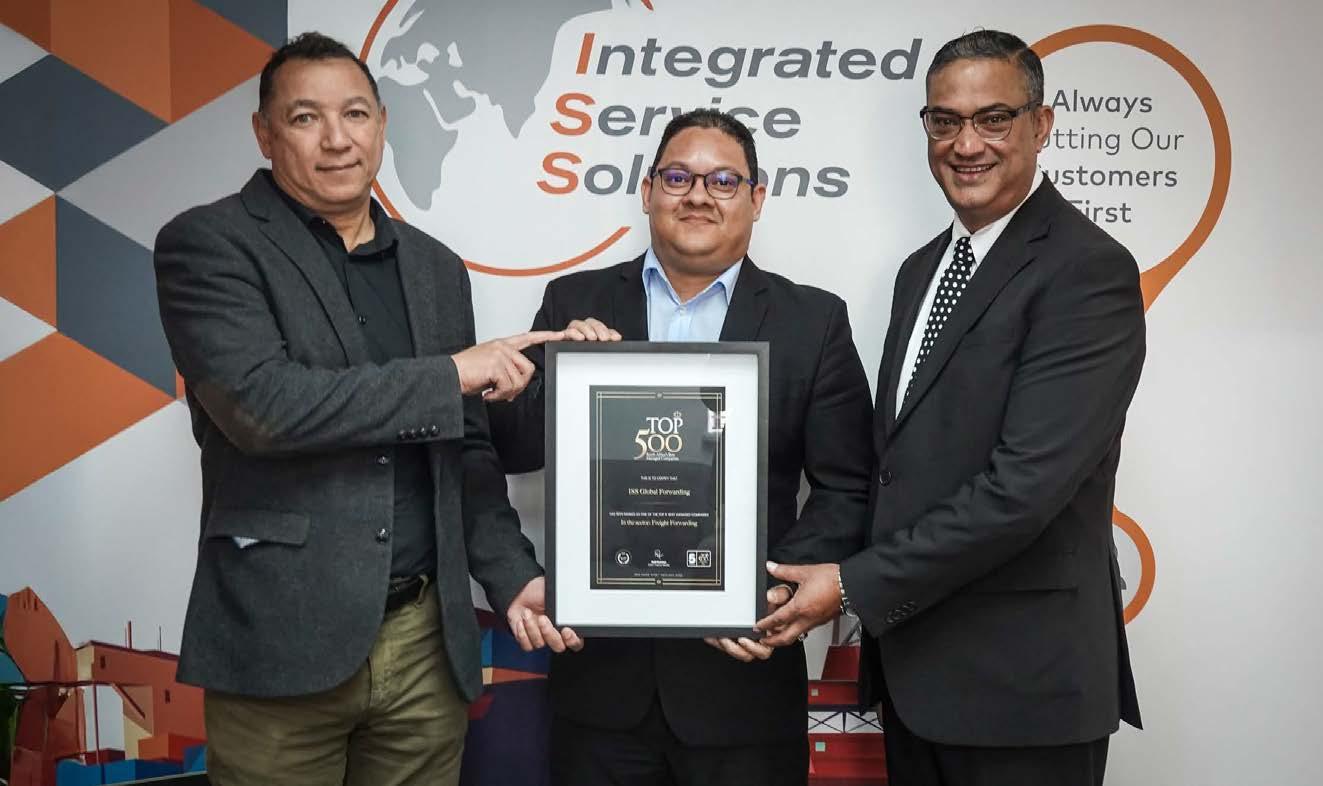
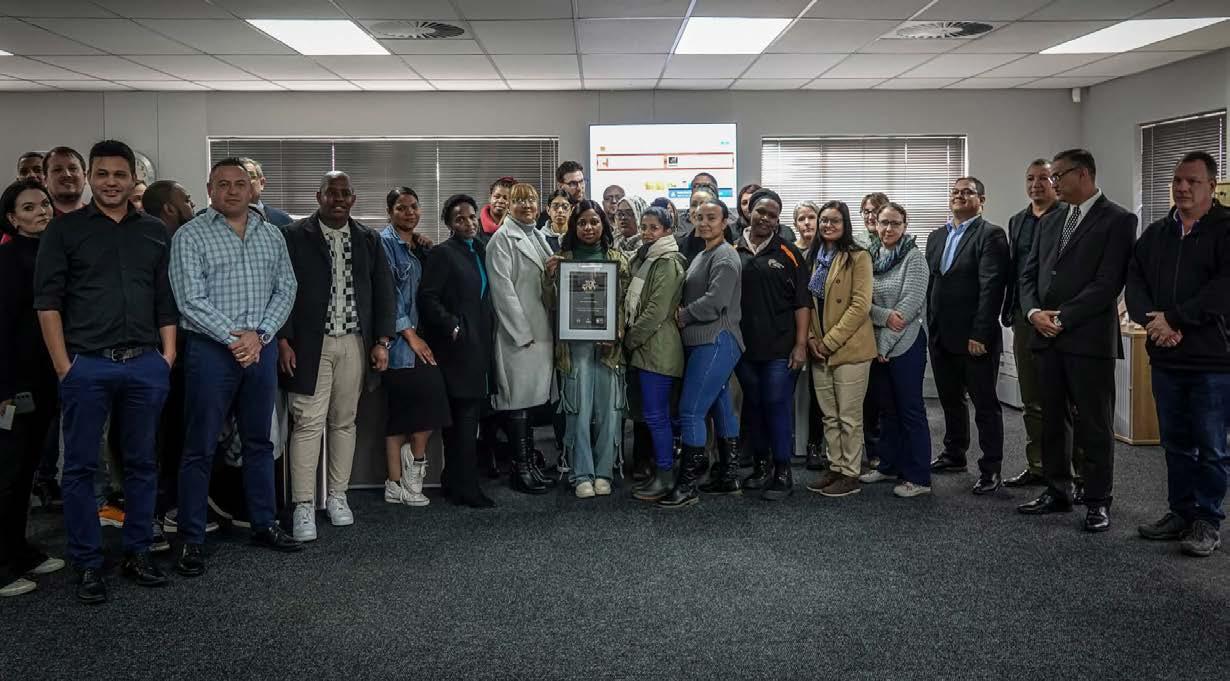
ISS GLOBAL FORWARDING
FORGING SPLENDIDLY AHEAD IN SOUTH AFRICA
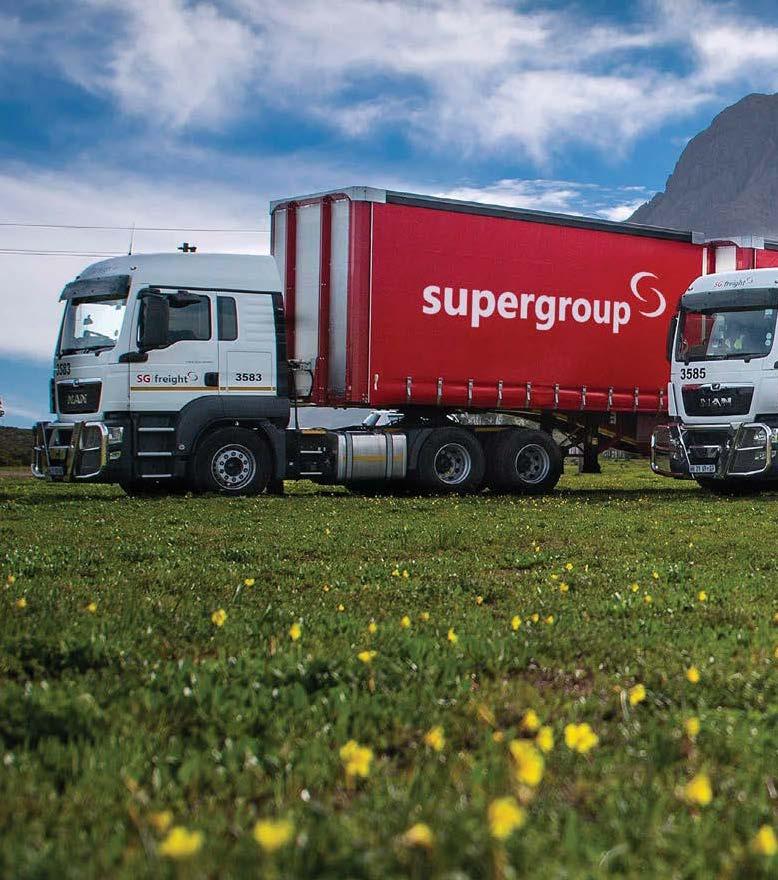
ISS Global Forwarding is at the helm of bountiful bespoke and state-of-the-art solutions for clients across the globe. Country Head of ISS Global Forwarding in South Africa, Munesh Maharaj, tells of the inspiration behind the growth of the local centre and the logistics behind its innovative strength.
Integrated Service Solutions (ISS) commenced operation on September 1st, 2018. The company is a wholly owned subsidiary of the Investment Corporation of Dubai, an investment arm of the Government of Dubai.
Integrated Service Solutions is the result of a strategic directive by the Government of Dubai to separate Inchcape Shipping Services Holding Ltd into two standalone companies with the aim of optimising the growth potential, customer focus and core competencies of each, being marine services and supply chain logistics.
With its global headquarters in Dubai and operating out of the Dubai Airport Free Zone, Integrated Service Solutions Global Forwarding focuses on core activities of global freight forwarding, contract logistics, oil & gas projects, and renewable energy and industrial projects.
Integrated Service Solutions has its presence in over 35 countries across the Middle East, Asia, Africa, Europe, North America and Australasia. As part of its ambitious growth strategy, the group is focused on acquiring small-medium companies and incorporating entities in strategic locations to expand its presence and create a global network.
ISS Global Forwarding ticks all the boxes
Projections in the logistics and freight forwarding landscape have for some time had some hesitancy in the outlook because of global turbulence. This year, in particular, will see the need for freight forwarders to develop strategies to cope with geopolitical instability,
natural disasters and potential trade wars. This year the forecast is more positive, especially for companies that prioritise customer service, operational efficiency and technological adaption. They are predicted to thrive in the current evolving landscape.
Thus, ISS, a leading global forwarding and logistics company, is most certainly set to flourish. It meets, above and beyond, all these requirements.
Headquartered in Dubai, the company is at the centre of world logistics and freight forwarding.
Entities in the Group consist of the likes of Emirates Airlines, Dubai Bank, The One & Only Hotels, and Kerzner Holdings, to name a few, for whom the company offers customised solutions for the movement of goods across the world.
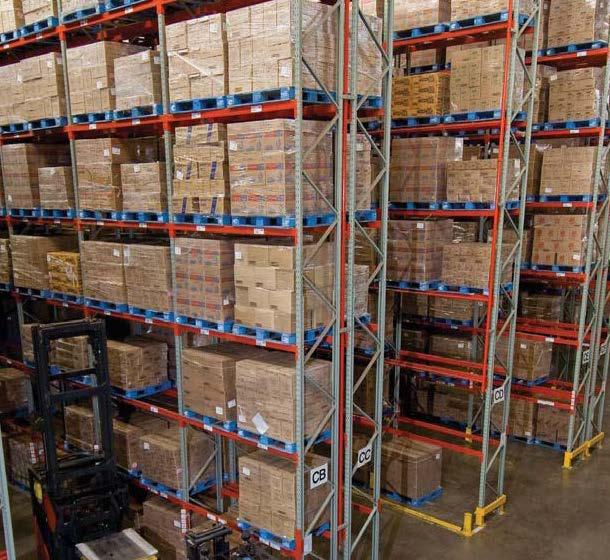
With years of expertise in supply chain management, it has developed a robust reputation for efficiency and innovation. ISS Global Forwarding leverages a vast network, cutting-edge technology, and strong partnerships to provide end-to-end services in shipping, warehousing, and transportation.
Adaptability, top-rated efficiency
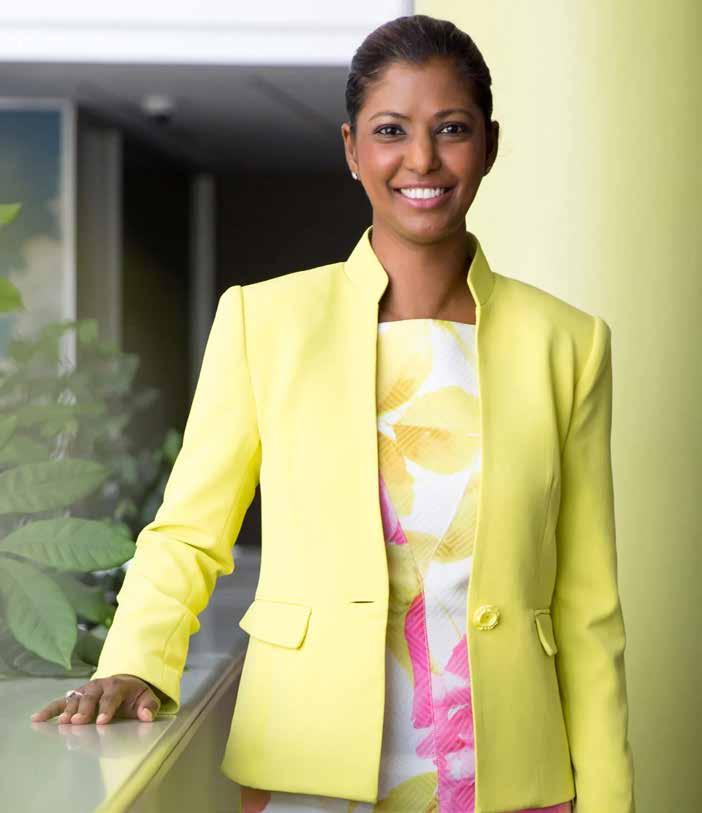
Munesh Maharaj, Country Head of ISS in South Africa, says that the company is certain to prosper, given its adaptability and top-rated efficiency in all aspects of the business.
“The ISS Global Forwarding brand stands for reliability, innovation and customer-focused service,” he says. “It symbolises a commitment to streamlining global logistics and simplifying supply chain complexities for businesses of all sizes. “The brand represents trust in its ability to deliver on time, with transparency and sustainability at its core.” He says that what is unique about ISS Global Forwarding is its global reach combined with a strong local presence, allowing
the company to tailor solutions based on specific regional needs while maintaining top-class international standards. They are known to cope with formidable standards with aplomb such as handling both traditional and digital supply chain challenges with skilled care. This, together with exceptional customer support, makes them excel in the logistics industry.
Munesh said that ISS Global Forwarding set out to enrich its goal of technical progress with data-driven decision-making, automating processes and optimising logistics to improve speed and reduce costs. The results are staggering.
Measuring achievement
“We measure achievement through key performance indicators (KPIs) such as client satisfaction, operational efficiency, delivery time accuracy, cost reductions, and environmental sustainability efforts,” he says.
“Successful project execution, employee development and profitability also form essential metrics of success.”
The company’s message to shareholders is thus: maintaining the capability of handling complex logistics challenges, delivering on promises, and adapting to unexpected circumstances while keeping sustainability and customer services at the forefront. It’s no wonder that the sentiment among these stakeholders is one of satisfaction. They bask in the wonderful glow of
gratification, having trust repaid in such a timely and meticulous fashion. “We foster trust with clients and stakeholders, and we deliver on promises,” says Munesh.
Core values ingrained
The formal core values have been ingrained in all who work with him. “The core values that guide us are customer centricity, integrity, innovation, sustainability and operational excellence,” he says. “The company remains committed to delivering exceptional service while upholding ethical standards.”
Speaking of ethics, he says that ISS Global Forwarding adheres to the highest ethical standards, ensuring fair business practices and compliance with global regulations. In the workplace, the company promotes an inclusive culture, with fairness, integrity and respect for human rights, encouraging employees to act responsibly and with integrity.
“The company ensures professional service by providing regular training and development opportunities, setting clear and definitive performance expectations and encouraging a culture of excellence.”
Going above and beyond for clients
“Professionalism is ingrained in the company’s values, with staff encouraged to go above and beyond to meet customer needs.”
Kevin Hefele - Branch Manager, Duane Lakey - Country Head of Finance and Munesh Maharaj - (FCILT) (AFIMASP), Country Head at ISS Global Forwarding South Africa
He says that the company motivates its staff through recognition programmes, career development initiatives, and offering competitive compensation and benefits. “We believe in fostering an environment where employees feel valued and are given growth opportunities.” People are important to ISS Global Forwarding. To this particular company, it is not a cliché. As such it is also involved in community outreach programmes, supporting local initiatives focused on poverty alleviation, healthcare, and education.
“By partnering with NGOs and other organisations, the company contributes to improving the lives of disadvantaged communities,” says Munesh.
Continuous learning for hands-on experience
The company ensures that its staff is well-trained and prepared by investing in continuous learning through training programmes, mentorship and hands-on experience.“By staying ahead of industry trends, employees are equipped with the skills and knowledge needed to perform at their best.” The key strategic drivers that are the ethos and motivation of ISS Global Forwarding are customer-centric innovation, sustainability, digital transformation and global network optimisation.
The company’s X-factor
What is it that sets ISS Global Forwarding apart from similar companies?
“The X-factor with the company is its comprehensive global network, advanced technology integration and customer-first approach. When you combine those three factors, everything comes together as it should. The focus on sustainability and innovation also positions the company as a leader in the logistics industry.”
Munesh says that the focus on sustainable development practices has also given them big-league status.
Committed to sustainability
“The company is strongly committed to sustainability, focusing on reducing its carbon footprint, improving energy efficiency and supporting circular economy initiatives. Sustainable practices are embedded in every aspect of its operations, from transportation to packaging.”
Munesh says this is all part of taking stock of the bigger picture, being cognisant of how everything has come
TheISS Global Forwarding South Africa team
together to ensure excellence.And that also means ensuring that systems have been put in place to ensure ISS Global Forwarding remains a world-class company continually.
“The company manages its operations through an integrated suite of logistics management systems, data analytics, and performance monitoring tools. These systems provide visibility, optimise operations and ensure high standards across the global network.”
Corporate competitiveness
This in turn triggers the company’s contribution to the enhancement and development of South Africa’s corporate competitiveness globally.
“By bringing global logistics expertise to South Africa, ISS Global Forwarding helps local businesses improve their supply chains, reduce costs, and access new markets. Through collaboration with local businesses, the company fosters a more competitive corporate environment in South Africa,” says Munesh.
We’ve spoken before of dealing with the unexpected, but it’s worthwhile emphasising the competence in dealing with it, as the logistics industry is particularly in need of coping well with this phenomenon. It’s part of the expertise that is inherent within the company.
Agile and adaptable
“ISS Global Forwarding is agile and adaptable, with contingency plans in place to deal with disruptions,” says Munesh. “The company’s global network allows it to quickly reroute shipments or adjust plans to minimise the impact of unexpected events.”
This forms part of the good corporate governance philosophy, which is ensured through adherence to transparent policies, regular audits, and the implementation of ethical guidelines for decision-making.
“The company’s leadership emphasises accountability, transparency and fairness in all its operations,” he says. As expected, the vision for ISS Global Forwarding is to be the most trusted and innovative partner worldwide. “This means at all times providing tailored solutions
that provide value for customers while promoting sustainability and growth. I can’t stress strongly enough the importance of having bespoke solutions in place. There is no such thing as one-size-fits-all in this business.”
Integrating advanced technologies
Looking somewhat further ahead, Munesh explains where he sees the business in five years:
“In five years, ISS Global Forwarding aims to expand its global presence even further, integrate advanced technologies such as AI and IoT (the Internet of Things) in its services and lead the logistics industry in sustainability and innovation. It will continue to evolve as a trusted partner to businesses seeking efficient and effective supply chain solutions.
“The company remains committed to continuous improvement, sustainability and providing solutions that are both innovative and reliable. We look forward to fostering more long-term relationships with our clients and stakeholders while adapting to the ever-changing logistics landscape.”
Waterford House, Suite 5 & 7, First Floor No. 2
Waterford Place, Century Blvd, Century City 7441 Cape Town
The Employment Equity Act (EEA) has been a cornerstone of South Africa’s transformation agenda for decades, but the 2025 amendments mark one of the most significant shifts in recent years. With new thresholds, sectoral targets, extended planning periods, and stricter compliance rules, many businesses are asking what this means for their dayto-day operations - and their B-BBEE scorecards.
We sat down with Deirdre Mitchell, Managing Director at Honeycomb BEE Ratings, which has consistently ranked first in the Top500 Best Managed Companies in its sector, to unpack the updates, clear up common misconceptions, and offer guidance on how businesses can navigate the changes coming into effect from 1 September 2025.
Why has there been such a strong reaction from the business community to the 2025 amendments of the Employment Equity Act?
The reaction stems from a lack of clarity. The amendments came into effect on 1 September 2025, and many companies are still uncertain about what is required of them. Miscommunication
EMPLOYMENT EQUITY ACT CHANGES
WHAT BUSINESSES NEED TO KNOW IN 2025
DEIRDRE MITCHELL, MANAGING DIRECTOR AT HONEYCOMB BEE RATINGS
from service providers has caused panic - some employers are being told they must immediately report, which is not true. The reality is that they need to have their five-year plans in place and work towards sectoral targets, but not all businesses understand this yet.
What has changed compared to the pre-2025 requirements?
Previously, a Designated Employer was classified as one with more than 50 staff or one that met the Schedule 4 turnover thresholds. This meant that even a company with fewer than 50 employees could be designated if their revenue was high enough for their sector. Employment Equity (EE) plans were set for three years, based on Economically Active Population (EAP) targets published by Stats SA.
From 2025 onwards, Schedule 4 has been removed. A Designated Employer is now simply any company with 50 or more employees, regardless of turnover. EE plans must run for five years and must incorporate both sectoral targets (set by the Minister of Labour and updated periodically) as well as the EAP.
What additional requirements have been introduced for designated employers?
Designated employers must now include proof of no adverse CCMA rulings related to discrimination or racism. Importantly, only final rulings count - appeals or ongoing cases do not disqualify compliance. Compliance is confirmed through a Certificate of Compliance issued by the Department of Labour.
What about smaller businesses - those with fewer than 50 staff?
While they are not formally designated employers, if they wish to do business with StateOwned Entities (SOEs), they too must prove they have no adverse CCMA rulings and obtain a Certificate of Compliance. This is a significant shift because it ties compliance directly to access to government-linked business opportunities.
How does the reporting process work under the new rules?
Companies will still need to submit their EEA2 and EEA4 reports based on the updated five-year plans. The reporting window for 2025 runs from 1 September 2025 until 15 January 2026. These reports need to reflect not only EAP alignment but also progress against sectoral targets, with explanations provided where targets cannot reasonably be met.
Are companies allowed to retrench or fire employees to meet targets?
No. The Act is clear that no one may be dismissed to achieve compliance. Instead, companies must plan around new hires, role replacements, and future workforce development. Where targets cannot be met, employers must show reasonable justification.
What are the penalties for non-compliance?
At present, penalties focus on failing to report, not having the correct plans in place, or lacking the necessary committees during inspections. This can result in a fine from the DOL and will prevent a business from doing business with SOE’s and securing a B-BBEE certificate.
How do these changes connect to B-BBEE compliance?
Employment Equity compliance is directly linked to the Management Control element of the
B-BBEE scorecard. Companies with valid EE plans and Certificates of Compliance stand to earn maximum points in this area, boosting their overall rating. This has knock-on benefits for tendering, partnerships, and being recognised as a preferred supplier.
What practical steps should businesses take right now?
The first step is to ensure you have a compliant five-year EE plan in place that reflects both EAP and sectoral targets. Second, check that your internal committees are functioning and records are kept. Finally, prepare to report during the official reporting window. Businesses should also secure proof of no adverse CCMA rulings to avoid any obstacles in certification.
Beyond compliance, how can companies turn these changes into an advantage?
Businesses that embrace Employment Equity and align it with their transformation strategy will find themselves better positioned for growth. A strong B-BBEE rating supported by EE compliance opens the door to SOE contracts, government work, and large corporate tenders. Transformation is increasingly the price of doing business in South Africa - those who take it seriously will be more competitive.
What is your one piece of advice for business owners who feel overwhelmed by the changes?
Work with the changes rather than against them. Embrace transformation as part of your long-term business strategy. By aligning with the new Employment Equity requirements, you won’t just remain compliant - you’ll also build a stronger, more competitive business for the future.
For professional and impartial B-BBEE verifications for enterprises across all 12 sectors, contact Honeycomb BEE Ratings - South Africa’s largest independent SANAS-accredited verifications agency on info@honeycomb-bee. co.za or (011) 880 1630. For more information go to www.honeycomb-bee.co.za.
A CITY BUILT FOR CONNECTED COMMERCE
HOW ATTACQ’S LOGISTICS PRECINCTS ARE ENGINEERING THE FUTURE OF CONNECTED BUSINESS IN SOUTH AFRICA
Attacq Limited’s flagship development, Waterfall City, has rapidly emerged as one of South Africa’s most connected, strategically positioned business nodes. Built on a precinct-led development philosophy, Waterfall City integrates logistics, office, retail, residential and digital infrastructure into a single, cohesive ecosystem.
For businesses operating in a market defined by volatility, speed and increasing cost pressures, this environment offers a rare advantage: a location where infrastructure, mobility, sustainability and operational continuity work together by design.
Why logistics needs more than roads
As South Africa strengthens its role as a gateway to regional and continental trade, the performance of its logistics networks becomes central to economic growth. Competitiveness today rests not only on roads and warehousing capacity, but on the quality of the environment in which supply chains operate.
Attacq’s precinct-led approach responds to this shift — designing logistics ecosystems that reduce friction, support high mobility and provide strategic resilience.
The precinct as a platform
Unlike traditional real estate development focused on standalone assets, Attacq’s model shapes the broader precinct environment through:
Integrated transport and mobility planning
Future-proofed infrastructure
• Built-in sustainability systems
Curated commercial and tenant networks
These elements position Waterfall City as a highperformance operational platform where businesses can scale and adapt with confidence.
Inside Waterfall City Junction
A core expression of this strategy is Waterfall City Junction, a 627,582 m² joint venture with Sanlam Properties. Developed in phases to stay ahead of demand, the precinct offers:
Optimised freight circulation and road access
• Solar-ready infrastructure and rainwater harvesting
Smart metering for real-time utility management
Centralised, always-on precinct management
In a market shaped by load shedding, rising utility costs and heightened ESG requirements, these features go beyond convenience — they protect continuity and stabilise operating costs. The precinct supports high-volume warehousing, multi-sector distribution, e-commerce fulfilment and light manufacturing, enabling tenants to operate at pace and precision.
Designed for the way business moves
Operational performance is engineered into every Attacq logistics asset:
High eave heights for increased storage density
• Forty-metre yard depths for quicker truck movement
Pre-installed solar capacity
Five-day backup water supply
• Shared work and collaboration spaces
This design philosophy gives businesses the ability to scale quickly, adjust distribution models and maintain uninterrupted operations — core advantages in fast-moving markets.
Where leading brands choose to operate
Waterfall City is home to high-profile operators including BMW, Massbuild, Cotton On and Amrod — reinforcing the precinct’s reliability and strategic relevance.
The addition of an 80MW Vantage Data Centres campus extends Waterfall City’s role into a hybrid logistics-and-digital hub, embedding it as a key node in Gauteng’s economic network.
Built for urgency, ready for scale
To meet sustained demand for high-performance logistics space, Attacq is advancing a 22,142 m² speculative warehouse at Waterfall City Junction. Ready for occupation in October 2026, this assists to shorten the time from lease commitment to operational go-live — essential in sectors where speed defines market advantage.
Ecosystems that keep business moving
Attacq’s logistics strategy goes beyond property development. It focuses on designing systems that support business continuity, attract investment and enable long-term economic growth.
Waterfall City remains the flagship expression of this vision — a logistics environment engineered not just for today’s challenges, but for the future of commerce.
ABOUT ATTACQ
Attacq Limited is a leading South African real estate investment trust (REIT) listed on the JSE and A2X, renowned for its strategic focus on mixed-use precincts, sustainable development, and long-term value creation. Anchored by its flagship Waterfall City development, Attacq has positioned itself as a catalyst for integrated urban growth, combining retail, commercial, residential, and increasingly, logistics assets.
Guided by the Horizon 2030 strategic framework, at the heart of Attacq’s strategy is its commitment to long-term value creation through smart, safe, and
sustainable spaces. Its portfolio spans three core areas: Waterfall City (completed developments, projects under construction, and leasehold land); the Rest of South Africa (broader completed portfolio); and Other Investments, including a 4.0% stake in Lango Real Estate and complementary business diversification initiatives. Key assets include Mall of Africa, Garden Route Mall, Mooi Rivier Mall, Eikestad Mall, and Lynnwood Bridge Precinct
Logistics is a key growth pillar. Attacq is actively expanding its logistics footprint through developments like Waterfall Junction, a landmark logistics park spanning 620,000m² of bulk, and Waterfall City Midi Units, which offer state-of-the-art warehousing designed for modern business needs. These hubs are equipped with energy-efficient infrastructure, solar-ready rooftops, and water resilience features, aligning with Attacq’s sustainability goals.
Attacq’s precincts integrate mobility, technology, and green spaces to support future work and living, while a tenant-centric approach ensures businesses thrive through flexible leasing and collaborative partnerships. Strengthened by a R2.7 billion transaction with the GEPF, reduced gearing, and a market cap of approximately R11 billion, Attacq combines a robust capital structure with a peoplefirst culture and strong sustainability credentials (A+[ZA] long-term / A1[ZA] short-term from GCR). With a robust capital structure, a people-first culture, and a clear roadmap for growth, Attacq is not just building spaces, it’s shaping the future of South African cities. For business leaders seeking strategic alignment with innovation, resilience, and impact, Attacq offers a compelling platform for partnership and investment.
WHAT DOES SECURING THE NAMING RIGHTS FOR THE FUTURE OF HR CONFERENCE AND AWARDS MEAN TO YOU AND YOUR COMPANY?
AFFORDABLE PLANS
From R1 275pm
To suit the needs of all South Africans
DEPENDANTS UP TO AGE 24 YEARS PAY CHILD RATES
Securing the naming rights for The Future of HR Conference and Awards is a significant milestone for BDCS. It reflects our dedication to driving innovation in HR and our commitment to being at the forefront of industry trends. This partnership allows us to showcase our leadership in HR recruitment, while also contributing to the ongoing conversation about the future of work. It’s an opportunity to highlight our values –empowerment, technology integration, and talent development – on a larger scale, while also creating meaningful connections with other industry leaders who share our vision for the future of HR.
ONLY PAY FOR A MAXIMUM OF 3 CHILDREN**
ADVICE FOR ASPIRING ENTREPRENEURS
My biggest piece of advice is to stay resilient. Entrepreneurship is a journey filled with highs and lows, and success often comes from how well you handle challenges. Always be willing to learn and adapt because the business world is constantly evolving. Surround yourself with people who inspire and support you, but don’t be afraid to make tough decisions when necessary. Most importantly, believe in your vision, even when others don’t. Your passion and perseverance are what will set you apart. Don’t wait for the perfect moment to start –take the first step and build from there.
EXCITING THINGS ON THE HORIZON
JOIN NOW
There’s a lot to look forward to!
BDCS is expanding its offerings, incorporating more AI-driven recruitment tools to improve efficiency and accuracy. We’re also launching new initiatives focused on upskilling and reskilling, aimed at empowering professionals to stay
trustworthiness, strong customer connections and service delivery.
The results of the 2025 Ask Africa Orange Index™ were based on 59,000 interviews across 26 categories and 200 brands, using audited data and independent sampling methods, with no member data shared. This makes it one of the most robust and credible benchmarks of customer experience in South Africa.
The Index is the country’s largest and longest-standing measure of customer experience, offering comparative insights across industries. It highlights brands that remain true to their purpose while consistently delivering quality
meaningful connections with our members and reshaping the healthcare ecosystem to deliver affordable, quality healthcare. Trust, reputation and relevance have always been at the heart of our strategy and this recognition affirms that we are on the right track.”
With more than four decades of experience in healthcare, Bonitas continues to lead the way in a dynamic industry. The Scheme remains committed to delivering on its promise of being the “Medical Aid for South Africa.”
www.bonitas.co.za
#MedicalAidForSouthAfrica
DEB FULLER
FROM DEI TO AI
NEDBANK’S DEB FULLER ON WHY HUMANITY IS STILL KEY FOR SUCCESS
BY KOKETSO MAMABOLO
From General Electric, building a bank, and now leading the HR portfolio at one of Africa’s leading banks, Deb Fuller’s story is one of how human-centred leadership trumps everything.
In this episode of the Business Unusual Podcast, Deb joins Ralf Fletcher to discuss why DEI isn’t just evolving, the reason why culture is even more important than strategy or even execution.
“If you’re not solving for execution, your strategy is merely a pipe dream. But from my perspective, I truly believe that culture is actually what eats execution and strategy for breakfast.”
T IS IS UST- E R FOR ANYONE READY TO:
1 Lead with purpose
2 Think differently about adopting technology
3 Understand why a human-centred approach always wins
Watch if you’re ready to challenge assumptions and accelerate leadership that matters. stand
Listen here
HANNES WESSELS
FROM HSBC TO BINANCE
HANNES WESSELS ON LEADING AFRICA’S CRYPTO RISE UNDER RICHARD TENG’S VISION
BY KOKETSO MAMABOLO
They’ve declared bitcoin dead 53 times but it keeps getting stronger each time, says Hannes Wessels, General Manager of South Africa for Binance, which boasts the world’s most prominent blockchain ecosystem.
In this fascinating conversation with Topco Media CEO Ralf Fletcher, on the Business Unusual Podcast, the former S C ban er simplifies some technical aspects of the crypto world, addresses misconceptions and offers a sophisticated perspective on bitcoin investment cycles and the market dynamics in South Africa.
Whether you’re a casual speculator, a crypto die-hard, financial professional, or ust someone who wants to know more about how the future is happening.
YOU’LL FIND OUT:
1 Actionable insights from an industry expert based on both theory and practice
2 A concise overview of the crypto adoption ourney
3 A perspective on crypto’s security compared to fiat systems
JAYSON NAIDOO
LEADERSHIP IS BROKEN
BLANCHARD SA’S JAYSON NAIDOO KNOWS HOW TO FIX IT
BY KOKETSO MAMABOLO
What if the real problem in your company isn’t the strategy, the economy, or the competition… but you?
In this episode of the Business Unusual Podcast, leadership coach and Blanchard South Africa
C ayson Naidoo flips the script on traditional leadership. Raised on a small farm, Jayson’s journey from cricket captain to an expert on leadership is anything but conventional—and so is his leadership philosophy.
He unpacks the real reasons teams underperform, the shocking truth behind toxic work cultures, and why most leaders—yes, even the “good” ones—are guilty of what he calls “leadership malpractice”.
This episode dives deep into the human side of leadership.
YOU’LL FIND OUT:
1 hy influence, not authority, defines a true leader
2 The three non-negotiables every leader must master
3 How to lead with both accountability and love (yes, love)
4 And what to do if you’re stuck under a poor, even toxic, manager
Whether you’re leading a team, scaling a startup, or just trying to survive in a high-stakes workplace, this conversation will challenge how you think about leadership—and give you the tools to transform it. Because at the end of the day, leadership isn’t something you have—it’s something you do. Watch now. Your team, your company, and your legacy depend on it.
Listen here
DR SARAH BABB
WHY WAS EY ABLE TO CREATE $1-BILLION IN VALUE BY TAPPING INTO NEURODIVERSE TALENT?
BY KOKETSO MAMABOLO
Around 20% of the global population is neurodivergent and even higher concentrations can be found among entrepreneurs. Businesses have a unique opportunity to unlock extraordinary value by recognising and leveraging neurodivergent strengths.
In this Business Unusual Podcast Dr Sarah Babb, founder and managing director at Stimm, joins Ralf Fletcher to explore the business case, market reality and strategic advantages in embracing neurodiversity in the workplace
If you’re a leader, HR professional or entrepreneur looking to future-proof your organisation this episode will show you how neuro inclusion is a business imperative which can drive innovation and give you a competitive edge.
YOU’LL FIND OUT:
1 Why being neurodivergent can be a superpower in the workplace
2 Why disengaged employees present a massive market opportunity
3 How you simple concessions can go a long way for neurodivergent employees
BEVERLY SCHÄFER
SILICON VALLEY VS POLICYMAKERS
BEVERLY SCHÄFER ON AI SOVEREIGNTY AND RECLAIMING HUMANITY
BY KOKETSO MAMABOLO
Why are we operating in a policy vacuum while global AI systems consume Africa’s data? What can be done to deal with AI being used for dangerous ends?
In this episode of the Business Unusual Podcast, Ralf Fletcher chats with Beverly Schäfer, the former deputy speaker of the Western Cape provincial parliament, who served as the MEC for Economic Opportunities, Tourism and Agriculture in the Western Cape and is now a leading voice in data sovereignty and ethical AI. Together they explore the tension between the exponential developments in technology and human values in Africa’s next frontier.
If you’re a leader, policymaker, technologist or just a concerned citizen then this is the call to reclaim human agency in a data-driven world.
YOU’LL FIND OUT:
1 Why we need to use AI for good and not just for growth
2 Why we need to be thinking about regulation Contagiou
3 here Africa fits in the future of AI
Listen here
Brainfood for business.
Take a journey away from short termism and start looking at a better future. Meet the interesting people changing Africa – and the way we work, think and live.
AFRICA TECH FOUNDER OF THE YEAR
OSCAR MOLABA
BY KOKETSO MAMABOLO FOUNDER, BATANIDZA TECHNOLOGIES
Vision, perseverance and entrepreneurial spirit is what defines the Africa Tech Founder of the Year. For the judges of this year’s awards, Oscar Molaba, the founder of Batanidza Technologies, has demonstrated “exceptional leadership, innovation and impact” which landed him one of the headline awards at the ceremony held on after the first day of this year’s Sentech Africa Tech Week summit, held in Cape Town.
Batanidza Technologies describes itself as a link between people, organisations and technology, offering innovative solutions such as AI softwaretesting and IT resource augmentation. The company has achieved rapid growth over the last six years driven by Oscar’s extensive experience in ICT consulting, business development, and strategic growth.
“I founded Batanidza to create a consulting business where people felt seen, valued, and impactful. The journey has been anything but linear, but it’s been rich with purpose.”
We found from Oscar what inspires him, what the biggest lesson in his career is, and more.
Congratulations on winning the Tech Founder of the Year award. What does winning the award mean to you and your organisation? Winning this award is deeply meaningful, not just for me, but for everyone at Batanidza Technologies. It’s a powerful affirmation that purpose-driven leadership matters, and that building with heart, with people in mind, and with Ubuntu at the core, can lead to real success. This recognition is also a tribute to my team, most of whom are women, who have carried our vision forward with excellence, grace, and grit. For us, this award is not the finish line; it’s fuel for the road ahead.
Please tell us about your journey, how did you get to this point in your career?
I started as a junior software tester nearly two decades ago. Back then, I was just eager to learn and earn my place in a fast-paced industry. Over the years, I climbed the ranks through roles in QA, project delivery, business development, and eventually strategic planning. But I always felt a disconnect in many environments, consultants
were often treated like numbers. That discomfort became my drive. I founded Batanidza to create a consulting business where people felt seen, valued, and impactful. The journey has been anything but linear, but it’s been rich with purpose.
What are the biggest lessons you’ve learnt in your journey and how have you been able to apply them?
The biggest lesson? Success without people is empty. I’ve learned that culture eats strategy every day, if your people aren’t aligned with your purpose, no strategy will hold. I’ve also learned to trust timing; growth doesn’t always come as fast as we’d like, but consistency compounds. At Batanidza, we applied these lessons by building a culture that prioritizes inclusion, collaboration, and integrity. We don’t just hire skills, we hire values. That’s helped us scale sustainably and build a brand that people trust.
What inspires you to do what you do?
I’m inspired by the possibility of creating real, lasting change, especially in communities that have historically been left behind by the tech economy. Every project we deliver, every consultant we mentor, every job we create, it all contributes to something bigger than ourselves. Seeing someone grow into their potential because they were given an opportunity, that drives me. I believe that technology should be a tool for empowerment, and I wake up every day with a deep sense of purpose knowing that Batanidza is helping to build a more inclusive, more connected future for Africa.
What do you believe are the major trends we should be looking out for in the next few years?
The next few years will be shaped by AI integration, cloud-first strategies, and automated testing at scale, but beyond the tech, the bigger trend will be human-centered innovation.
The companies that will lead are those that can blend emerging tech with empathy, ethics, and relevance to local needs. I also believe inclusive hiring and digital access in underserved communities will become not just moral imperatives, but competitive differentiators. The future is digital, yes, but it must also be deeply human.
AFRICA TECH DIGITAL TRANSFORMATION
ETAPATH
AFRICA TECH DIGITAL TRANSFORMATION AWARD WINNER
BY KOKETSO MAMABOLO
In just five years Etapath went from manual internal process to building an in-house tool which evolved into client-facing, digitalfirst, centralised tech solution. Their digital transformation journey has seen them help businesses provide their employees with safe, reliable and affordable transport.
“Our journey has been rooted in a vision to make transport in South Africa more accessible, efficient, and opportunity-driven,” says Benjamin Gordon, Co-Founder of Etapath, the winner of the 2025 Africa Tech Digital Transformation award. Across the country, Etapath has completed over a million scheduled commutes, with over 15 000 users and the results are impressive: Their corporate clients report 30% in savings on transport and a 40% drop in absenteeism.
After having made such an impact in only half a decade, there’s sure to be even more success in store for the rapidly growing tech company. “Opportunities only materialise when you’re prepared to seize them, and we’ve made it a priority to always be ready for what’s next.”
Congratulations on winning the Digital Transformation award. What does winning the award mean to you and your organisation?
Winning the Digital Transformation Award is a significant milestone for us. It affirms the hard work we’ve invested in evolving from manual operations to digital systems, from reactive problem-solving to proactive innovation, and from serving local needs to having a national footprint. More than just a recognition of our technology, this award honors the real-world impact we’re making; supporting workers on their daily commutes, enabling businesses to function reliably, and opening doors for communities to access better opportunities.
Please tell us about your journey, how did you get to this point in your career?
Our journey has been rooted in a vision to make transport in South Africa more accessible, efficient, and opportunity-driven. Since Etapath’s
start in 2020, we’ve focused on delivering hightech transport solutions that address real-world challenges. Early traction with major corporate clients helped us expand nationally by 2022. Along the way, we developed impactful tools like the Team Manager platform, an integrated payment system, and detailed passenger data analytics. Strategic partnerships with organisations such as BPESA and Google Mobility have played a critical role in our growth and influence.
What are the biggest lessons you’ve learnt in your journey and how have you been able to apply them?
One of the most important lessons is to never take things personally. The best ideas should win, no matter where they come from. True progress happens when ego steps aside. Another key lesson is that luck is really the intersection of preparation and timing. Opportunities only materialise when you’re prepared to seize them, and we’ve made it a priority to always be ready for what’s next.
What inspires you to do what you do?
We’re driven by a bigger mission: to eliminate technology as a barrier to employment, investment, and growth. We believe tech should be an enabler, not an obstacle. By making commuting simpler, safer, and more affordable, and by equipping small fleet operators with advanced tools, we’re helping build an inclusive and competitive transport ecosystem that benefits everyone, from individual commuters to enterprise-level clients.
What do you believe are the major trends you believe we should be looking out for in the next few years?
We expect Cape Town to emerge as a key hub for tech innovation in South Africa. We’re also watching the rise of homegrown e-hailing platforms expanding across Africa. And of course, AI is set to transform the transport industry even further; especially in areas like route optimisation, driver allocation, and operational efficiency.
One of the most important lessons is to never take things personally. The best ideas should win, no matter where they come from.
INDUSTRIALISATION IN AFRICA
THE FOURTH INDUSTRIAL DEVELOPMENT DECADE FOR AFRICA
SET TO DRIVE AFRICA’S TRANSFORMATION, EQUITY AND GLOBAL SOLIDARITY
BY SHUMIRAI CHIMOMBE
The UN General Assembly held a joint debate on 6 October 2025 on United Nations reform and Africa’s development, during which delegates supported a fourth Industrial Development Decade for Africa to drive the continent’s “transformation, equity and global solidarity”.
The third Industrial Development Decade for Africa (2016–2025) (IDDA III) was the outcome of a UN General Assembly Resolution passed on 25 July 2016. This was in recognition of the need to take suitable steps to achieve the goals of the African Union Agenda 2063 - Africa’s blueprint and master plan for transforming Africa into the global powerhouse of the future, and the UN’s Agenda 2030 to achieve the continent’s Sustainable Development Goals (SDGs).
The United Nations Industrial Development Organisation (UNIDO) was tasked with coordinating and implementing the Decade in collaboration with the African Union, regional bodies, development banks and the private sector, with the vision “to firmly anchor Africa on a path towards inclusive and sustainable industrial development”. This would be achieved through strengthening key elements of industrial productive capacity such as infrastructure, innovation and technology transfer,
industrial financing, industrial knowledge and skills, and the support from public and private sector institutions that regulate and advocate industrial development.
Other enabling development actions included implementing productive diversification, agribusiness value chain development, trade capacity building, renewable energy and energy efficiency, industrial policy, special economic zones and industrial parks, climate change and human capital development. All this while strengthening public-private partnerships (PPP) with a range of stakeholders.
Highlighting key developments in advancing industrialisation At the 193-member Assembly in October, UNIDO Director General, Gerd Müller, presented his report on the progress made in implementing the IDDA III. The Assembly noted that tangible progress had been achieved in agribusiness, renewable energy, pharmaceuticals, digitalisation and special economic zones.
However there are ongoing challenges faced by the continent such as low manufacturing output and limited value addition in extractive industries, limited financing and technology, particularly for small and medium sized enterprises, and high trade costs.
The report provides an update on the progress made in implementing the IDDA III during the period from July 2024 to June 2025. This includes an overview of completed, ongoing and planned projects and highlights collaborative efforts between local and international partners, especially in areas where UNIDO and other United Nations agencies are involved.
Some of these projects include:
Trade capacity-buildingUNIDO continued to collaborate with the African Union and the International Trade Centre under the €200-million Africa Trade Competitiveness and Market Access (ATCMA) programme, managing a
portfolio of €129.7-million to strengthen intra-African and Africa-European Union trade. Implementation takes place across the regional blocs - the Economic Community of West African States (ECOWAS), the Economic Community of Central African States (ECCAS), and the Common Market for Eastern and Southern Africa (COMESA).
The Southern African Development Community (SADC) officially launched the ATCMA on the margins of the 8th SADC Industrialisation Week held in Antananarivo, Madagascar on 28 July. The €25-million regional initiative is designed to enhance trade competitiveness, strengthen regional quality infrastructure, and boost intra-African and Africa–EU trade.
Green tech - In South Africa, 1 600 refrigeration and air conditioning technicians were trained, leading to savings of $2.3-million and 7 279 tons of carbon dioxide equivalent per year.
According to the report, the industrial sector of the continent became more diversified in 2024, driven by green technologies, digital innovation and value chain restructuring. Renewable energy development remained a priority with approximately 2.4 GW of new solar capacity being added, bringing the share of renewables in Africa to nearly 15% of total energy capacity. Industry technologies gained traction, with 12% of manufacturing firms adopting digital tools to boost productivity. The continent’s deposits of lithium, cobalt, copper and rare earth minerals attracted strategic investments, reinforcing its role in global green supply chains. The Internet penetration rate reached 44%, fuelling growth in e-commerce and technologyenabled manufacturing. As a result, digital tools have significantly enhanced efficiency in agroprocessing and light manufacturing, which together contribute to over 60% of the output of Africa.
More countries developed industrial strategies and policies focused on processing critical minerals and agricultural commodities.
For example, in South Africa, the Department of Mineral and Petroleum Resources published the Critical Minerals and Metals Strategy in May 2025. The Department stated in the strategy that the increasing demand for critical minerals presents opportunities for innovation, industrial expansion, employment creation and economic growth. Advanced processing capabilities will
position the country as a global player in critical mineral value chains, particularly in emerging sectors such as renewable energy technologies, electric vehicles, green hydrogen and advanced manufacturing.
Driving Africa’s transformation through sustainable and resilient infrastructure projects There were improvements in industrial infrastructure and regional integration. Under the Programme for Infrastructure Development in Africa (PIDA), more than 76 regional priority infrastructure projects, including on energy corridors, transport networks, and information and communications technology backbone systems, were being implemented in 2025. PIDA was established in 2012 as a joint initiative of the African Union Commission, the African Union Development Agency (AUDA-NEPAD), and the African Development Bank. It coordinates the development of cross-border infrastructure in four key sectors – transport, energy, information and communications technology (ICT), as well as transboundary water resources.
Some of these projects include:
330 kV Ghana - Togo - Benin
Transmission Interconnection Project - to reinforce the existing interconnection line between Ghana, Togo and Benin in order to augment power exchanges among these countries and beyond.
Bulawayo - Gwanda Road
- Rehabilitation of 320km road between Bulawayo and Beitbridge Road. This is one of
six international trunk routes connecting Zimbabwe with its neighbouring countries of Zambia, Botswana, South Africa and Mozambique, and thus forms an important component of the Southern African Development Community (SADC) ‘North-South Corridor”’. The route attracts international trade and the transportation of international cargo and bulk commodities between those countries.
The Lesotho Highlands Water Project (LHWP) - a multiphased multi-million Maloti bi-national project which entails construction of dams and tunnels in Lesotho for storing, diverting and controlling the flow of water of the Senqu/ Orange River and its tributaries, and when all the phases are complete, to deliver 70 cubic metres per second of quality water to South Africa and generation of hydro-electric power in Lesotho.
The way forward - towards the fourth Decade The report highlighted that since its launch in 2016, the Third Industrial Development Decade for Africa has mobilised high-level political commitment, supported over 730 projects, strengthened regional coordination and delivered tangible impact in priority areas, such as agribusiness, clean energy, pharmaceuticals and digital innovation. It emphasised that sustainable industrialisation requires support for both large enterprises and micro-, small and medium-sized enterprises. Large firms drive innovation and exports in capital-intensive sectors, while micro-, small and medium-sized enterprises
– accounting for over 80 per cent of enterprises in Africa – are key to jobs and regional value chains. It recommended that governments must foster investment, enterprise growth and industrial clustering to unlock the continent’s full industrial potential.
At the UN General Assembly joint debate session, the African Union called for a fourth Decade, aimed at prioritising
development in sectors such as integrated infrastructure, green manufacturing, renewable energy, digital transformation, youth and women’s empowerment, and regional integration under the African Continental Free Trade Area (AfCFTA). “With vision, political will and international solidarity, the forthcoming fourth Industrial Development Decade for Africa can unlock the continent’s full industrial
potential and contribute decisively to a more equitable, balanced and inclusive multilateral system.”
The General Assembly pledged to support the establishment of a fourth Industrial Development Decade for Africa to drive the continent’s “transformation, equity and global solidarity”.
The full report can be accessed on the UN website
Sources: United Nations | Programme for Infrastructure Development in Africa (PIDA) | Department of Mineral and Petroleum Resources
NESPRESSO SOUTH AFRICA REDEFINING COFFEE EXCELLENCE, ONE CAPSULE AT A TIME
In an ever-evolving coffee landscape, one brand continues to define innovation, craftsmanship, and sustainability - Nespresso. As the pioneers of the coffee capsule system, Nespresso has transformed the simple act of drinking coffee into a moment of indulgence and artistry, one that resonates deeply with South Africans who appreciate both quality and convenience.
From the first capsule brewed decades ago to today’s sophisticated range of machines and coffee experiences, Nespresso remains a leader in redefining how coffee is sourced, crafted, and enjoyed. In South Africa, the brand continues to expand its footprint across both domestic and professional channels, ensuring that coffee lovers, whether at home, at work, or on the go, experience the perfect cup, every time.
INNOVATION AT THE HEART OF EVERY CUP
At Nespresso, innovation is more than technology, it’s a philosophy. The brand continues to push boundaries through a diverse and evolving portfolio that caters to every taste, mood, and moment. From bold espressos to smooth iced coffees, and from indulgent flavoured blends to functional coffees infused with vitamins or adaptogens, Nespresso is constantly exploring new frontiers in taste and well-being.
This spirit of innovation also extends to the brand’s latest release - the Samra Origins Tanzania. Inspired by heritage and craft, this blend honours Africa’s rich coffee traditions, paying tribute to the people and places that cultivate these extraordinary beans. With every sip, it tells a story of connection from farm to cup.
THE PROFESSIONAL COFFEE PARTNER OF CHOICE
Beyond the home, Nespresso Professional has become the preferred partner for businesses across South Africa’s HORECA (Hotel, Restaurant and Café) and SOHO (Small Office/Home Office) sectors. Combining state-of-the-art machines with consistent, barista-quality coffee, Nespresso ensures that every touchpoint - from a hotel breakfast service to a corporate boardroomreflects excellence.
Machines such as the Aguila and Momento series are engineered to meet the demands of highvolume environments, delivering precision, quality, and efficiency with every pour. Whether it’s a
perfectly layered cappuccino, a refreshing iced latte, or a robust espresso, Nespresso Professional helps businesses elevate customer experiences and inspire workplace moments of connection.
SUSTAINABILITY GROUNDED IN PURPOSE
At the core of Nespresso’s success lies its unwavering commitment to sustainability. Through the AAA Sustainable Quality™ Program, developed in partnership with the Rainforest Alliance, Nespresso supports more than 150,000 farmers globally to improve coffee quality, protect ecosystems, and enhance livelihoods. Locally, the brand continues to champion recycling and circularity from its nationwide capsule collection points to innovative recycling partnerships that transform used aluminium into new possibilities.
This holistic approach reflects Nespresso’s belief that great coffee can be both exceptional and responsible, a belief that increasingly resonates with South Africa’s conscious consumers and forward-thinking businesses alike.
A LEGACY OF TASTE, CRAFT AND CONNECTION
As Nespresso looks to the future, its mission remains the same: to craft moments that inspire. With an ever-growing portfolio that celebrates innovation, heritage, and sustainability, the brand continues to lead the way, not just as the creator of the coffee capsule category, but as a curator of meaningful coffee experiences for every occasion.
In the words of Gabriel Nobre, CEO of Nespresso South Africa,
“At Nespresso, every cup tells a story of craftsmanship, sustainability, and innovation. We’re proud to offer South Africans coffee experiences that not only taste exceptional but make a positive impact at every stage of the journey.”
SMART HOSPITALITY
HOW TECHNOLOGY IS REDEFINING GUEST EXPERIENCES IN SOUTH AFRICA
BY BOYD CHISLETT, CHIEF BUSINESS OFFICER AT LIQUID INTELLIGENT TECHNOLOGIES, SOUTH AFRICA
Following South Africa’s successful hosting of the G20 Leaders Summit, its hospitality sector stands ready to welcome the world and to showcase how technology is transforming guest experiences. With SA’s travel and tourism sector projected to reach a milestone of 1.9 million jobs in 2025, hotels, resorts, and conference venues are no longer relying solely on service and setting. They’re increasingly powered by intelligent digital
It’s all about the data
infrastructure that connects people, systems, and experiences.
Simply put, technology is redefining the hospitality industry, from booking engines to in-room automation, mobile check-ins, and real-time analytics. And it all depends on three essential drivers: data, connectivity, and human experience.
The ability to collect, interpret, and act on information is the key differentiator between good hospitality and exceptional hospitality. It’s about building a 360-degree view of each guest by drawing insights from systems like reservations, loyalty programmes, mobile apps, and on-site sensors.
This allows for hyper-personalisation, where services are tailored to individual preferences and expectations. A returning guest might find their room pre-set to their ideal temperature, their preferred drink ready on arrival, or their itinerary adjusted based on previous visits. These seemingly small details, made possible by advanced analytics and AI, show our commitment to making each guest feel uniquely valued and catered to.
A crucial component of this equation is trust. The most successful operators are those that treat data security and consent management as integral to the guest experience. Robust networks and secure authentication processes ensure that personal information remains protected, even as digital interactions become more seamless.
A strong connectivity foundation
Reliable, high-speed connectivity is the backbone of this new digital environment. It underpins every aspect of major international gatherings, such as the G20, where thousands of guests, delegates, and media representatives converged. From streaming and conferencing to digital transactions and on-site operations, connectivity powers them all.
And this isn’t limited to urban settings with easily accessible infrastructure. For instance, Liquid Intelligent Technologies’ investment in fibre networks, wireless infrastructure, and satellite technologies has enabled hotels and lodges to provide world-class connectivity, whether in the heart of Sandton or on the edge of the Kruger National Park. In a country as geographically diverse as South Africa, this blend of technologies ensures that even the most remote destinations can deliver the same standard of digital experience as their urban counterparts.
Looking beyond
functionality,
to people and the environment
Yet, despite the growing reliance on technology, hospitality remains fundamentally about people. The balance lies in embracing digital tools without losing sight of the human element. The best guest experiences blend efficiency with empathy, ensuring that while technology streamlines the journey, staff can focus on creating meaningful, memorable interactions. This reassures our audience that authentic hospitality is not lost in the digital transformation.
Innovative technology is also about sustainability. Guests and shareholders expect transparency around environmental impact. In this regard, intelligent automation is transforming the way hotels operate, from optimising heating, cooling, and lighting to reducing energy use. Predictive maintenance tools help prevent downtime, while data analytics improve everything from housekeeping schedules to inventory management. Smart meters, water sensors, and digital dashboards allow travellers to see, and even contribute to, sustainability goals. By connecting environmental performance with guest engagement, we are fostering a sense of environmental consciousness and responsibility in our audience.
A future powered by intelligent and immersive experiences
With close to 6.8 million tourists visiting South Africa in the first eight months of the year, and the government setting a target of 15 million visitors by 2030, what’s next for the country’s hospitality sector?
While AI and augmented reality will definitely play key roles, hospitality thrives on warmth and authenticity. The most future-ready establishments will be those that use technology to empower people rather than replace them.
Large-scale events like the G20 Summit provide more than an opportunity to welcome the world. They offer an opportunity to showcase South Africa’s growing strength as a digitally connected nation – with customer experience at its heart.
A global logistics and mobility group
WSP GROUP AFRICA
CREATIVE, COMPREHENSIVE AND SUSTAINABLE ENGINEERING SOLUTIONS
we are
WSP is one of the world’s leading professional services consulting firms. We are dedicated to our local communities and propelled by international brainpower. We are technical experts and strategic advisors including engineers, technicians, scientists, architects, planners, surveyors and environmental specialists, as well as other design, programme and construction management professionals. We design lasting solutions in the Transportation & Infrastructure, Property & Buildings, Earth & Environment, Power & Energy, Resources and Industry sectors, as well as offering strategic advisory services. Our talented people around the globe engineer projects that will help societies grow for lifetimes to come.
WSP’s 75 000 global experts include advisors, engineers, environmental specialists, scientists and technicians, in addition to other design and programme management professionals. Our talented people are well positioned to deliver successful and sustainable projects, wherever our clients need us.
Today, we are boldly redefining the role of a professional consulting firm. We are applying our state-of-the-art expertise and the collective ingenuity of our people in order to imagine and create Future Ready® places for clients and communities, locally and across the globe. In Africa, we have more than 6OO engineers, technicians, scientists, as well as earth and environmental experts that provide services to transform the built environment and restore the natural environment.
Operating from South Africa and into Africa, our specialist skills backed by a global reach make us the service provider of choice – whatever the challenge might be. We are a level 1 B-BBEE company with 51% black woman ownership.
Who
“Beyond compliance, we help clients anticipate challenges, unlock opportunities, and embed resilience,” says Anoop Ninan, the CEO of Forvis Mazars in South Africa where they serve a range of sectors from financial services, manufacturing, healthcare and education to fast-growing sectors such as tech, media, and telecommunications.
Forvis Mazars provides audit and assurance, tax, accounting, financial advisory, and consulting services, and this year ranks among the Top 5 in the Accounting and Consulting sector.
“Being recognised among the Top 5 firms reflects the trust our clients place in us and the strength of our people. It underscores our ability to deliver consistent, high-quality services while remaining agile and personal.”
Here Anoop explains what sets them apart and how they built a presence in over 100 countries.
Please share the backstory of Forvis Mazars.
Our history combines global reach with strong South African roots. Mazars was founded in France in 1945 and grew into an international partnership. In South Africa, our story dates to the 1950s, evolving into one of the country’s top six audit firms. In 2024, Mazars and US-based FORVIS formed Forvis Mazars, a global partnership under a single brand in over 100 countries. With 1 000+ professionals across seven South African offices, we
Forvis Mazars
LEADING PROVIDER OF AUDIT AND ASSURANCE, TAX, ADVISORY AND CONSULTING SERVICES WORLDWIDE
INTERVIEW WITH THE CEO
OF
FORVIS MAZARS IN SOUTH AFRICA, ANOOP NINAN
are proud to be JSE-accredited auditors and advisers to leading banks, insurers, corporates and public entities. This blend of local expertise and global integration enables us to support clients navigating regulatory, economic and technological change.
What sets Forvis Mazars apart from the competition?
We are defined by four qualities: nimble, everywhere, experienced, and trusted. Unlike firms that operate as loose networks, we are a single, integrated partnership — enabling seamless collaboration across borders and disciplines. Clients value our agility and responsiveness, paired with the scale and consistency of a global leader. In 2023, we launched an innovation hub in Johannesburg to drive digital transformation, embedding AI, analytics and platforms like Atlas, SIgnals and InControl into our work. We also stand out for our purpose-driven culture, through initiatives like our Data School for unemployed graduates in South Africa. This mix of innovation, integrity, and integration makes us a credible alternative to the largest firms, with a personal touch clients trust.
What have been some of your most memorable AHA moments as CEO?
A major milestone was the launch of Forvis Mazars in 2024, uniting two likeminded organisations with a shared vision. Another was seeing our teams embrace digital innovation, from AI-enabled tools to guiding clients through transformation. Personally, moments of impact inspire me most: seeing our youth initiatives equip graduates with data skills, or our community programmes provide healthcare and education support. Another defining
experience has been collaboration across our African offices, showing the strength of our integrated regional model. It reinforces that while we are rooted in South Africa, we are part of a wider African success story.
Please share a message of inspiration with our readers. The future belongs to leaders who combine resilience with foresight. Stay curious, adaptable, and purpose driven. Challenges are opportunities to learn, transform, and innovate. For professionals, invest in your skills and build strong networks. For business leaders, embrace collaboration and purpose alongside performance. At Forvis Mazars, our brand promise is to help clients prepare for what’s next, and the same applies to individuals: keep preparing, keep evolving, and seize tomorrow’s opportunities.
Scan the QR code for more information.
Anoop Ninan, CEO of Forvis Mazars in South Africa
TIPS & ADVICE
LEARNINGS FROM OTHER MARKETS CAN POWER SOUTH AFRICA’S ENERGY TRANSITION
BY SHAILIN MOODLEY, CHIEF TECHNOLOGY OFFICER, ENERGY EXCHANGE OF SOUTHERN AFRICA E SA
n a unique period of modernisation and liberalisation, lessons from other markets hold the opportunity for South Africa’s energy transition.
The last four years have seen an unprecedented shift in global energy dynamics as power demand surged in the wake of COVID-19, the war in Ukraine upended traditional energy supply chains, and climate change risks continued to heighten. In response, many power markets
have, or are in the process of transitioning from centralised monopolies to decentralised, competitive ecosystems, ushering in a new era for energy security, economic growth, and sustainability.
To promote competition, increased capacity and additional investment, South Africa must make the transition to a liberalised market quickly. However, this needs to be balanced with a cautious approach to promote energy security and a stable electricity system.
And policy alone is not enough to chart the course to this future. The willingness to learn from the successes and challenges faced by other countries that have taken the journey toward liberalised energy markets can provide much-needed direction.
RED FLAGS: CAUTIONARY TALES FOR SOUTH AFRICA
South Africa is set to launch the wholesale power market in 2026. The South African Wholesale Electricity Market will be a critical step in our energy reform and seeks to open the sector for increased competition, transparency, and economic efficiency in the sector.
While the momentum is encouraging, a lot can go wrong when introducing a new market. The experiences from markets ahead of us on the curve offer crucial lessons in what can go wrong when a market is opened.
TEXAS: PRICE VOLATILITY IS A MAJOR PITFALL
Texas’s “energy-only” market has highlighted the drawbacks of price volatility in the sector. The model works by paying power producers only
for the energy they produce, instead of making capacity payments as well. While this approach attracts significant investment, it can result in extreme price hikes when supply is low. For example, the 2021 Winter Storm Uri resulted in millions of Texans losing power when wholesale prices spiked to their maximum cap, causing devastating losses for market participants and extreme financial pressure for consumers.
This case holds a major warning for South Africa: a market designed without robust mechanisms for grid stability and capacity payments could lead to extreme price volatility and a potential loss of public trust.
INDIA: UTILITY DEBT DAMPENS INVESTMENT INTEREST
For India, the financial woes of its state-owned distribution companies have hindered liberalisation efforts in the electricity market. Decades of regulated, subsidised tariffs have rendered these utilities debtladen – dampening prospects for long-term Power Purchase Agreements (PPAs) with private generators. This has created a high-risk environment and tends to slow down investment.
Similarly, some of our utilities also hold significant debt and therefore face a similar ris . A transparent plan to address this debt or empower distributors to participate in the mar et is crucial.
AUSTRALIA: REGULATORY FOOTBALL HAMPERS PROJECT TIMELINES
The energy transition in Australia has been negatively impacted by inconsistent long-term government policy. ngoing shifts in political direction and the lac of a stable, established emissions framewor have subdued investment appetite. New generation pro ects have therefore been slow to come online, resulting in price volatility and supply consistency issues. For South Africa, this underscores the importance of robust consensus on energy policy. The Integrated Resource lan and other ey framewor s must be treated as long-term blueprints, not as political footballs, to inspire trust in the system and energy security.
GREEN FLAGS: OPTIMISTIC DRIVERS FOR SOUTH AFRICA
espite the challenges faced in other mar ets, the global experience also provides a blueprint for success. ositive outcomes from other countries offer ey insights into the levers that can be pulled to navigate successfully towards an open energy mar et.
NORDICS: THE POWER OF INTEGRATION
The Nordic countries success in terms of energy transition is built on a strong foundation of crossborder grid integration. Nord ool mar et allows power to flow freely between countries, providing a vast balancing area and reducing reliance on local supply and, inherently, diversifying supply.
As a member of the Southern African ower ool, South Africa can leverage this model. y strengthening its regional interconnections and embracing transparent trading, it can improve energy security and provide a larger, more attractive mar et for investors. It also holds the opportunity to spearhead and support the energy transition for the Southern African region.
BRAZIL AND AUSTRALIA: THE RISE OF BILATERAL MARKETS
ra il s dual-mar et model and Australia s open mar et have shown the power of private-to-private transactions. These approaches enable large industrial and commercial customers to bypass the traditional utility and sign direct As with private generators. This provides a clear, ban able business case for new generation, independent of government procurement.
South Africa s move to remove the licensing cap for private generation is already unloc ing a wave of private investment, with over 100 pro ects in the pipeline. This is a strong indicator that the mar et is moving towards a more efficient, customerfocused model. Notwithstanding this, grid capacity must urgently be addressed to realise the value of these pro ects. ithout an effective transmission system, increased production is nullified.
JAPAN: THE CATALYST OF THE CRISIS
The opening of apan s energy mar ets, which were muted for decades, was fast-trac ed by the Fu ushima disaster - a evel nuclear crisis on the International Nuclear and Radiological vent Scale. The crisis created an undeniable and urgent mandate for change.
Similarly, South Africa s ongoing energy crisis has forced political and social will for reform. The urgency enabled the unbundling of s om and the rapid introduction of new legislation, li e the lectricity Regulation Amendment Act. This crisis as a catalyst is a powerful driver for change that can overcome long-standing barriers.
A PERFECT STORM OF POLICY PROMULGATION AND MODERNISATION
hat is unique about South Africa s energy transition is that we are not ust modernising our grid we are also liberalising the mar et at the same time. ith new policies driving competition and cutting-edge technologies coming online, we have the opportunity to learn from global mar ets and build a more efficient and equitable energy future for South Africa.
BY KIMBERLEY TAYLOR FOUNDER & CEO OF LOOP
ENTREPRENEURIAL ADVICE
There was a pivotal moment in my entrepreneurial journey when the tables turned, and I found myself transitioning from the person seeking guidance to the one being sought out for advice, insights, and expertise. Suddenly, people were reaching out to me for guidance on building their own businesses, eager to hear my pitch, or seeking introductions to valuable connections.
It’s a surreal experience, to say the least. And while I’m humbled by the recognition, I’m also acutely aware that I’m far from having all the answers. In fact, I don’t think anyone can truly know it all, nor do I want to. The beauty of entrepreneurship lies in its complexity, its ever-changing landscape, and the constant need for innovation and adaptation. With that in mind, I’d like to share eight key lessons I’ve
learned throughout my journey building Loop – lessons that have shaped me, challenged me, and helped me grow both personally and professionally.
1
ASSUMPTION ERROR
Too often we assume rather than ask. We assume somebody else is going to solve the problem, or that the solution already exists. But everybody else is assuming the same, leaving plenty of room for solutions and opportunities. This phenomenon is often referred to as “pluralistic ignorance,” where everyone assumes others know something they don’t, resulting in collective inaction.
Curiosity is key to breaking this cycle. Be curious about the problem, the process, the people, and the possibilities. Ask questions, seek feedback, and challenge your own assumptions. Test your assumptions constantly, both about how the world could look and what you believe it should look like. By doing so, you’ll uncover new insights, identify potential blind spots, and create opportunities for innovation and growth.
In my experience, assumptions can be particularly damaging when they’re based on limited information or biases. For instance, assuming a particular market trend will continue without verifying the data can lead to misguided decisions. By staying curious and testing assumptions, you can avoid these pitfalls and make more informed decisions.
2
TRY ON NEW THINGS
As an entrepreneur, I’ve learned to give myself permission to try on new things –almost like stepping into a character. hen I m inspired by someone s confidence, leadership style, or approach to problemsolving, I allow myself to “try it on” for myself. It’s about experimenting with different personas, styles, and approaches to see what works best for me and my business. By doing so, I’m able to tap into new strengths, build confidence, and develop a more adaptable mindset.
This process of trying on new things is essential for entrepreneurs, who must be willing to evolve and adapt constantly. It’s not about being a chameleon or pretending to be someone you’re not; it’s about being open to new experiences, learning from others, and finding what wor s best for you and your business. Whether it’s trying a new communication style, taking on a new role, or exploring a new market, the ability to try on new things can help you stay agile, innovative, and ahead of the curve.
By embracing this mindset, I’ve been able to:
• Develop new skills and expertise
• Build stronger relationships with colleagues, partners, and customers
• Stay adaptable in a rapidly changing business environment
• Discover new opportunities and approaches that I may not have considered otherwise
BUILD IN BOILER ROOMS, NOT BOARDROOMS
4 5 6 3
In business you need to get your hands dirty. We can’t only theoretically conceptualise solutions to business problems in boardrooms. We need to get into the boiler room to understand what the actual problem is we’re trying to solve.
hen I first started the business, I too every opportunity to learn from the person whose problem I was trying to solve. This loo ed li e getting into the delivery vehicle with the driver, going on their route, as ing questions about how they approach their day, why they do it a certain way, what they find challenging, and it was immensely useful in understanding the actual problem we re loo ing to solve, rather than a theoretical assumption.
I also believe we need to feel the problem. When we have empathy with the person whose business challenge we’re trying to solve, we re better able to understand the nuances and complexity and thus more li ely to solve in an effective and relevant way.
SO, WHAT?
In my experience, entrepreneurs are innately curious. e ve only got to loo at children to now that s true for all of us they re naturally inquisitive, always as ing questions, and see ing to learn. As entrepreneurs, we need to tap into that same curiosity and as questions that challenge our assumptions and push us beyond our comfort zones. One of the most powerful questions we can as is so what
So what is a question that prompts us to thin further, to thin beyond the obvious, and to explore the implications of our ideas and actions. It s a question that encourages us to dig deeper, to see connections, and to consider the potential consequences of our decisions. y as ing so what repeatedly, we can uncover new insights, identify potential opportunities, and develop a more nuanced understanding of our business and the world around us.
For example, when analysing customer feedbac , as ing so what can help us identify patterns and areas for improvement that might not be immediately apparent. hen evaluating mar et trends, as ing so what can help us understand the potential implications for our business and identify opportunities for growth.
BE THE HGB
is for hot girl or guy at the bar . ear me out on this one. It s about attracting, not hard selling. In business, that means ensuring your product can sell itself (attracting) because the features and functionality are appealing to the potential customer as it solves a specific business problem. When your product is the hot girl or guy at the bar, it doesn t shout loo at me, buy me a drin but rather it carries itself in a way that others find interesting and appealing.
Thin of it li e this: when you re at a bar and you see someone who catches your eye, you don’t need to be sold on them. You’re drawn to them because of their confidence, charisma, and authenticity. That’s what we want our products to be the ind of thing that people are naturally drawn to because of its value, quality, and relevance.
To achieve this, we need to focus on building products that are not just visually appealing but also substantively valuable. Everything that loo s good must be supported by the substance on the inside. This means investing in user experience, customer support, and continuous improvement to ensure that our products meet the needs and expectations of our customers.
MAKE YOURSELF THE VILLAIN
hen things don t wor out the way we d li e, it’s easy to play the blame game. We point fingers at others, circumstances, or fate, hoping to shift the responsibility away from ourselves. But this approach rarely leads to growth or resolution. Instead, I ve found it helpful to imagine the situation as a story where I’m the
villain. By taking ownership of my part in the situation, I can regain control and find the lesson in it.
This mindset shift allows me to focus on what I can control – my own actions and reactions. Rather than getting bogged down in anger or resentment towards others, I can channel my energy into learning and improvement. By acknowledging my role in the situation, I can identify areas for growth and develop strategies to avoid similar challenges in the future.
The sooner we recognise and accept our role in an undesirable situation, the faster we can learn from it and move on. Blame limits our potential, while bravery creates an opportunity to learn and grow.
ONE SMALL STEP
The difference between having an idea and a business is action. Action is what sets us apartyou are either the person that talks about being fit, or you re the person who gets up consistently to go for a run. ou re either the person who talks about the big idea, or the one that builds the deck or makes the call.
At the beginning of my business journey, when everything was about selling the product, I had a big piece of paper, and I drew 100 blocks on it. Each block represented somebody I would approach with my product - through connections or cold calling - and I would colour every block either red or green. Red if I was unsuccessful and green if the person at least listened to my story (or pretended to). There came a point where the green blocks outnumbered the red blocks, but only because I persisted, and then some.
Big things are overwhelming so start small. I believe that courage builds confidence and the way to be courageous is simply to find the next small thing to do - make a list of potential clients, write a script of what to say to these clients, whatever small thing you can manage but eep moving forward because that s what momentum is.
Everything that looks good must be supported by the substance on the inside
THE STRUGGLE IS REAL
Not only is the struggle real, it is also very important. People will make assumptions about you or try to put you in a box. One I hear often is “your dad must be rich” (that is not the case). I am the product of my past - this is true for all of us - and because of a chaotic home life in my early years, I learned that life is not fair, but we must find purpose in it anyway.
As a child I loved the story of Matilda by Roald ahl. The young character s ability to thin herself out of an undesirable situation is something that I recognised as a superpower at age eight. Today, my version of Matilda s abilities is to write down what I want the end story to be. I ask myself what, when I eventually look back on a particular period or project or challenge, what is it that I want it to look like, ideally. Call it reverse-engineering but I have found it to be a powerful way of taking ownership of a situation. And recognise the struggle in that and do it anyway.
There is purpose on the other side of the hard things we go through. This belief has really helped me build resilience through the many challenges I ve faced in life and business
As countless entrepreneurs have said before me, and will no doubt continue to say, business is a combination of luck and timing. But you still need to work hard, and smart, and do all the things.
Together with the working and the doing, lean into what inspires you and the eventual outcome is certain to be beyond what you could imagine.
TIPS & ADVICE
BUILDING BUSINESS ROBUSTNESS IN THE MIDST OF DISRUPTION AND BEYOND
BY JUANITA VORSTER, STRATEGIST FOR ORGANISATIONS, LEADERS, AND FUTURE-FOCUSED INITIATIVES
Until someone creates a way to accurately predict the future, there is no way to prepare your business for every change that will come its way. Whether it is societal trends that change consumption patterns, or machinery or infrastructure that breaks down, or the rise of automation and AI, change is truly inevitable.
The key to thriving within and beyond disruption is not resistance, it is robustness.
To move beyond a fixation on how disrupting disruption is, everyone running – or involved in running – a business of any size in any sector must be skilled in building robustness into the business so that it can adapt quickly and smoothly to the prevailing conditions of the day. A truly robust business doesn’t just survive the punches dealt by exponential change; it is set up to keep on winning in a new game of business.
Win by being exceptional
It is simply not good enough to be good enough anymore. What was successful fifty years ago might not be enough to even stay afloat now. These days, a business has to be better than market average in everything it does and everywhere its clients connect with it.
Products and services that exceed client expectations, and a buying process that is frictionless, combined with a unique and memorable customer experience is not aspirational anymore; it is now a necessity. And so is using technology to consistently achieve that standard.
The need to constantly assimilate, adapt, and adopt innovative technology and processes across all departments in a business is greater than ever before. Irrespective of the size or available resources of a business, as many people as possible should constantly be on the hunt for different ways to do things towards achieving better results.
Yes, as many as possible people across the entire operation. If this thought scares you, maybe you should consider whether you have nines and tens – the best of the best –in your teams. Employees who score nine and ten out of ten aren’t always the most experienced or the most expensive; they are simply those best suited to the unique requirements of your business. Employing the best of the best is crucial if you want everything your business does to be exceptional.
Win by being a great place to work and play
For business owners or leaders who do not employ only nines and tens, the thought of giving employees what they want can be frightening. But even average employees could be more willing to give their best all the time if they:
• Know what the impact of their work on the business is
Know exactly what it is that they’re supposed to be doing, and how it fits into the bigger picture of the business Don’t have to comply with rules that are left over from a previous era
Can trust that discipline will be applied fairly
Receive praise on a regular basis
Are provided with bad news about the business not as a scare tactic but because they are trusted to help turn things around
Are given an appropriate amount of autonomy
Receive both financial and non-financial reward
• Are impressed by you
Feel the business is set up to win
Get the right people into your business, and then do everything you can to make them want to stay there.
Win by always prospecting for new clients
Irrespective of how long your business has been around or how much market share it currently enjoys, it’s dangerous to rely solely on existing customers! The rule for whoever is responsible for selling – yes, even if it is the business owner – is that they should spend at least 20% of their time prospecting for NEW clients. And that should never ever stop.
A robust business has a robust pipeline of opportunities and orders to fill. Never let your salespeople – or yourself – tell you that there aren’t any more clients available to sell to. If you’ve knocked on the door of every single potential client in one market, then start selling to the next market! The golden rule of sales is to sell to people who have money, and to remember that money has a tendency to move.
Be bold and explore new locations to target or new clients needs to fulfil.
Win by having everyone focused on the bottom line
Too many business owners or leaders see the growth of the business as their sole responsibility. However, while they will be held accountable for it, they have every right to share the responsibility throughout the business.
Everyone in the business – yes, everyone – can set a growth target to achieve. From reduction in expenses to increase in number of prospects to better customer service; it’s all possible! Set targets, enable your people to achieve those targets, and you might be pleasantly surprised by what they – and the business – achieve!
These are the most exciting times in which to run a business. There are endless opportunities to overcome challenges, but only if you decide to lead your business with belief, passion and courage.
TIPS & ADVICE
VISION, PURPOSE, LEGACY
ST RT-UP TIPS FRO SUCCESSFU ENTREPRENEUR
BY HABONINA NGUNI - CO-FOUNDER AND CEO OF S UNIFOR S
BY SHUMIRAI CHIMOMBE
One of the most common challenges aspiring entrepreneurs face is the fear of stepping away from the security of their jobs to start their own business venture. Will it succeed? How can the business stand up against the competition? How do I even begin? Many questions can run through one’s mind - leading to many potential small business owners giving up before they have even started.
Standard Bank EmpowHER Gauteng winner, Khabonina Mnguni’s story behind starting and growing her business Zibangwenya Supplies trading as ZS Uniforms in Tembisa serves as an inspiration.
We have extracted some gems from her pitch that address some valuable questions every aspiring entrepreneur needs to answer for themselves.
DO YOU HAVE A SPECIFIC VISION FOR YOUR BUSINESS?
“We are building what will be the biggest school uniform manufacturer and retailer on the African continent.”
ZS Uniforms specialises in providing comprehensive uniform solutions tailored to the needs of various industries and institutions. They are currently supplying 11 schools and their revenue has grown by 2 700% between February 2021 and February 2025.
WHAT PROBLEM ARE YOU SOLVING WITH YOUR SOLUTION?
“In a township like Tembisa, access to school uniforms still remains a problem as most parents still have to go to town to buy uniforms. And given the sheer size of the school uniform market there are no black female-owned large scale retailers of uniforms operating in the townships.
At ZS we are bringing uniforms retail directly to our community by affording them high-quality, and affordable uniforms that are tailor-made for local schools and now proudly manufactured in-house. We have invested in our own machines which allows us to cut down costs and maximise turnaround time, take control of our supply chain, while also improving skills and creating jobs in Tembisa.”
By transitioning to in-house manufacturing the business has acquired four industrial sewing machines and one embroidery machine. This has enabled them to now also provide on-site embroidery for school logos and branding.
WHAT SETS YOU APART?
e have our own flexible lay-by plans and a special rewards programme for parents, which supports affordability as well as loyalty. We are also based in the township so parents don’t have to travel far to buy uniforms”
DO YOU HAVE A PERSONAL STORY THAT DEFINES YOU AS A BUSINESSWOMAN AND AS A BRAND?
Khabo is a third generation entrepreneur who is inspired and motivated by what her maternal and paternal grandparents achieved as entrepreneurs in their time.
“This business is my legacy as we are operating from the same building built by my grandparents in the 1980s at a time when ownership of a retail complex was nearly impossible. But their pioneering spirit and their heart for our community, is the driving force behind our business today.”
WHAT IS THE HEART OF YOUR WHY? DO YOU HAVE A PURPOSE THAT DRIVES YOU?
Although she is a qualified finance and marketing professional with some 13 years experience, habo said that she felt unfulfilled. “I yearned for purpose, impact. Legacy. And entrepreneurship has given me just that.”
“This business is a legacy to my grandparents. It’s my purpose as a professional but it also serves as a promise to the learners that we serve.”
Giving back to the community is also at the heart of what ZS Uniforms do. Through their CSI arm Threads for Ikasi Foundation, they have impacted a total of 118 learners by donating uniform packs since January.
“I am sewing the future of South Africa, one uniform at a time”
LEADERSHIP
BEING A THOUGHT LEADER WITH IMPACT GOES BEYOND JUST HAVING AN OPINION
BY MIMI KALINDA
Thought leadership is more than just having an opinion or being vocal in a particular field. It is about actively contributing to the evolution of ideas, whether by refining existing concepts or introducing groundbrea ing ones. The essence of thought leadership lies in adding value, shifting perspectives, solving problems, and driving meaningful conversations that leave a lasting impact.
Establishing oneself as a thought leader requires intentional reputation building. It is not something that happens by chance but rather a result of clarity, consistency, and strategic effort. Thought leadership emerges when individuals recognise their unique expertise and use it to influence and inspire others. It is not about simply being seen but about being recognised for offering something distinct and valuable to a field.
One of the fundamental questions to consider when developing thought leadership is if you disappeared from your industry today, what gap would be left behind?” This question compels professionals to shift their focus from routine job responsibilities to their broader contribution to the field. Identifying gaps and addressing them with insights and innovative thinking is a core component of effective thought leadership. The goal is to create value in such a way that others would feel the absence of one s contributions if they were no longer present.
stablishing credibility requires consistent effort and strategic positioning. Thought leaders differentiate themselves by offering fresh perspectives and solutions to industry challenges. It is not enough to repeat existing ideas true thought leaders push conversations forward and encourage innovation. Developing a unique voice and perspective helps create a lasting impression and fosters trust within the professional community.
Thought leaders differentiate themselves by offering fresh perspectives and solutions to industry challenges
Platforms like LinkedIn play a critical role in amplifying thought leadership. However, many people hesitate to use them effectively. Sharing insights, engaging with relevant discussions, and providing thought-provoking content can significantly enhance one s reputation. The ey to impactful content is authenticity, relevance, and a clear alignment with one s area of expertise.
Thought leadership does not require constant output but rather meaningful contributions that resonate with the audience and offer genuine value.
A major concern for many aspiring thought leaders is how to achieve visibility without becoming overwhelmed. Thought leadership should not consume every aspect of one s life rather, it should be integrated in a way that feels sustainable. Being selective about speaking engagements, choosing platforms that align with professional goals, and focusing on high-quality contributions rather than sheer volume are essential strategies. The emphasis should always be on creating impact rather than chasing exposure.
An essential aspect of thought leadership is continuous learning and adaptation. Industries evolve, and staying informed about trends, research, and emerging challenges is critical for maintaining credibility. A thought leader who remains static in their thinking risks becoming irrelevant. The ability to pivot and introduce new insights as industries shift is what differentiates sustained thought leadership from fleeting influence.
Engagement is another pillar of thought leadership. True leaders do not only broadcast their views but also engage in meaningful dialogue. Responding to others insights, ac nowledging different perspectives, and fostering discussions create an ecosystem of shared learning. This engagement solidifies one s role as a trusted voice in their industry, rather than just another commentator.
Ultimately, becoming a thought leader is an ongoing process of growth, learning, and strategic positioning. It requires self-awareness, commitment, and a willingness to engage with industry challenges in a meaningful way. Those who invest in their expertise, share their insights with authenticity, and consistently add value to conversations will find themselves naturally emerging as thought leaders. Thought leadership is not about self-promotion but about making a difference and leaving a legacy that others can learn from and build upon.
The key to sustainable thought leadership is consistency. A single viral post or one speaking engagement does not establish long-term credibility. Rather, it is the accumulation of insightful contributions over time that cements a leader s reputation.
TIPS & ADVICE
CULTIVATING A SOLUTIONS FOCUSED MIN SET
12 TIPS
BY LYNN VERMAAK, CHIEF IMAGINATIONS OFFICER AT AHA TRAINING & DEVELOPMENT
When did you last think about ‘the way you think’? How has your thinking led you to greater success, performance or not? Are your thoughts mainly positive or negative? Do you get caught up and absorbed in the problem, and then struggle to focus on the solutions?
Our world is made up of many problems. It’s inevitable. Every day as human beings we are faced with various problems. It’s human nature to focus on problems and fall into the trap of negativity. Therefore, one of the most powerful things you can do for yourself is to train your mind to be a solution-focused mind. Your mind-set impacts everything you do – your relationships, your work, how you approach projects, your success in different areas of your life.
Do you have any limiting beliefs that keep you from achieving your goals? Limiting beliefs such as, “I will fail. I don’t have what it takes. I don’t have the resources. I don’t know where to start solving the problem.” So many people fall short of their true potential because their fear holds them back in some way.
We are living in exponential times. The nature of work is changing. Change is a constant. Quick adaptive responses are needed. We need to anticipate the future and develop strategies that minimise the effects of being blindsided by change, especially with the onset of the Fourth and Fifth Industrial Revolution.
To manage this disruption and change, we need to shape the future; and embrace a solutions
Replace the word “problem” with the word “opportunity”
focused mind-set. It is possibly one of the most effective tools we can pack into our career development toolkit. For an organisation it drives it forward in creating competitive advantage and innovative capability.
Next time you have a problem in your everyday personal and wor life, find solutions by trying the following:
PR E S S T H E PAU S E B UT TO N
When you are so engulfed in a problem, you don t thin clearly and finding a solution is nearly impossible in that state of mind. Clear your mind from the negative noise with silence for at least 5 minutes. If possible, find a quiet place to pause and reflect for even 10 minutes more.
C H O O S E YO U R R E ACT I O N
The way you choose to engage with and thin about problems, directly influences your ability to solve them effectively. Don’t let emotion get in the way of finding a solution. Regulate your emotions, from irritability of the problem to rather excitement; seeing the problem as a challenge to grow and improve.
YO U R AT T I TU D E D E T E R M I N E S YO U R
A LT I TU D E
Choose and develop an attitude which is more positive and not stuck. This helps you to tac le problems better and find more creative solutions that will move your forward.
C H A N G E YO U R PE R S PE CT IVE
Change your perspective. Think solutions, not problems. Changing your perspective requires looking at the world with different eyes. Not to look at problems as blocks, barriers or inconveniences, but rather as an opportunity for growth or an opportunity to deliver a creative solution. See challenges as opportunities.
C H A N G E YO U R L A N G UAG E TO A N N N
Replace the word “problem” with the word “opportunity”. Thus, no ‘problemtalk’, rather ‘solution-talk’. Focus on the strengths, and not the weaknesses. Focus on what is working well.
L EVE R AG E YO U R C R E AT IVI TY
time to practice deliberate creative thinking as part of your work and life.
S I L E N C E YO U R I N N E R C R I T I C
When brainstorming ideas, to come up with solutions, often our inner critic judges and evaluates them before we have even said them out aloud. We look for all the reasons why the idea will not work or why it will fail, or why it is impossible. Silence your inner critic and realise that anything is possible. Instead of saying, “It’s not possible, it’s stupid, or it will not work, etc.”, rather say. “Anything is possible”. N N
Q U E ST I O N S T H AT I NVI T E S O LUT I O N
Look at what you take for granted about your problem. Challenge your basic assumptions about the problem. Ask questions such as, “How might I …?” “In what ways might we …?” “How to …?” “What if ….?” D
Know what you want, and what your desired outcome or vision is. Become actionorientated towards creating a preferred future.
Look at the resources available to you right now, what can you use? What can you do with what you have? Most times the answer is right in front of you.
Involve others. Generate ideas together to find the way forward. Solution-see ing is a deliberate way of thinking. We need to think ‘solutions’ – not problems. The choice remains yours. It takes practice, but believe me, it is worth it. 4 5 6 8 7 3 2 9 10 11 12
We must employ creative thinking to break away from the boundaries of traditional thinking and problem-focussed thinking. Albert Einstein once said, “We are boxed in by the boundary conditions of our thinking.” Can creative thinking be learnt? Yes – a resounding ‘yes’. Learning to think creatively should be a key part of your career and personal development. It is a must-have skill for the 4th Industrial Revolution. It will give you the edge in your career. It is time to reinvent yourself. It is
Ta e action until you find the best solution fit for you. This will require you to be flexible when things don’t work out as planned, so that you can go back to the drawing board to panel beat ideas to make workable solutions.
TIPS & ADVICE
RISE ABOVE THE COMPETITION
WITH A COMPELLING STORYTELLING STRATEGY
BY SHUMIRAI CHIMOMBE
Imagine watching a YouTube video of a business owner selling her range of handmade ceramic dishes talking about how beautiful they are, how they can be used, and giving the price range. Then watching a video on Instagram of another entrepreneur also selling ceramics, but this time tells her story of how she employs and trains unemployed women from a nearby township, and gives them the skills to produce this beautiful range with designs inspired by the Shwe Shwe fabric that the women love to wear.
Which product would grab the most attention? Most likely, it would be the product with a story. The reason being that stories have the power to grab attention, connect with emotion, and persuade us to take action.
Storytelling has become an essential necessity for entrepreneurs, business owners and leaders who wish to distinguish themselves in today’s fast-paced and competitive market. Especially where social
media has so many people jostling for attention, likes, and ultimately clicks on the ‘Add to Cart” icon on your website, or clients’ feet through the doors of your business. The same applies to other areas of business communication - be it pitching your idea to potential funders and clients, advertising and marketing your services on radio, television or online platforms, or networking at business events.
StoryTagger defines business storytelling as the art of using narratives to convey messages, ideas and values in a compelling manner. If used effectively this can be a very powerful tool to captivate audiences and have a lasting impact. It is a strategic approach that drives engagement, shapes brand identity, creates a deep emotional connection, and establishes trust.
WHAT ARE THE BENEFITS OF STORYTELLING?
Boosting engagement: Overwhelming your audience with too much complex information or technical jargon is a sure way to lose people’s
attention. Weaving a compelling story that speaks to your customers can help you connect and engage with them on a deeper level.
Establishing emotional connections: Related to boosting engagement, customers often feel more drawn to stories than sales pitches, marketing emails or other overtly promotional methods. If used skillfully, stories can grab their attention, appeal to their emotions and encourage them to listen to your message instead of tuning out.
Giving Inspiration: A good story will resonate with your audience and inspire them to take action, especially when your message appeals to their emotions. This will boost your business goals - whether it’s to gain more clients, sell your product, encourage people to sign up for your service, or subscribe to your publication.
Building trust: If your story is authentic and sincere, it will earn the trust of the people you are reaching out to, and as we know, earning trust is a major asset to have in business.
Giving you the edge: You can gain competitive advantage if your competitors do not have a business storytelling strategy. And even if others also use similar strategies, the great thing about storytelling is that you can craft your stories to be unique to your business and your identity which will help you stand out.
TYPES OF STORYTELLING
According to Indeed.com there are several types of storytelling. You can decide on which strategy is the most suitable for your company and aligns with your identity the best. Here are four options:
The challenge: You can tell the story that demonstrates how someone faced a challenge and overcame it. Also referred to as the hero’s journey, this type of story follows the mission of the hero, who powers through a challenge.
The underdog: The underdog story follows the journey of how someone starts out appearing to have little chance for success. However, by the end, they’re victorious.
The customer: Focusing on a customer’s story shows a real-life case of how your product or service helped someone.
The pivot: This demonstrates to your audience that you re flexible and adaptable with a pivot
story, which shows how your company changed directions to overcome a challenge or to improve its services to its clients.
CRAFTING YOUR STORY
The art of storytelling may be a difficult concept for some people to navigate. Especially as it requires creativity, authenticity aWhat are you doingstarted your business? Or tell the story behind the company. Or you create a narrative that demonstrates your values and what you want to achieve. The iconic John Lewis & Partners Christmas adverts are the perfect example of how a brand tells a captivating story that goes straight to the viewers’ emotions especially during the season of giving.
FOCUS ON THE STORY, NOT THE PRODUCT:
Subtlety is the key ingredient here. Emphasising your product too much can make the story feel insincere and drive away potential clients. It is possible to inspire your audience to try your product without pushing it on them.
HAVE A CLEAR GOAL
our storytelling campaign needs a clear, specific objective and should align closely with the business goal you’re aiming to meet. Having a clear structure with a beginning, middle, and end to your story will help maintain a logical flow so your audience can follow the narrative. Supporting your goal with real wor experiences from employees and leaders or from your clients is an impactful form of storytelling for business.
DECIDE ON THE BEST WAY TO SHARE YOUR STORY
How will you keep your audience engaged? Think about the best medium to share your stories. This could be through blogs, videos, podcasts, radio, television or other means that best reaches your target audience.
Ultimately, developing a strategy that translates your ourney, expertise and achievements into compelling storytelling could be the magic that will drive the growth and success of your business.
DEVELOPING GRIT IN ENTREPRENEURSHIP AND BUSINESS LEADERSHIP
BY CRAIG WHITE, COO & CO-FOUNDER OF GEDDES CAPITAL
Entrepreneurship and leadership often appear glamorous, filled with innovation and success stories. Yet, for entrepreneurs the reality is frequently marked by challenges, setbacks, and moments of doubt. hat distinguishes those who persevere from those who falter In my experience, the answer lies in one powerful word: grit.
UNDERSTANDING GRIT
Grit is the combination of passion and perseverance toward long-term goals. Popularised by psychologist Angela uc worth, it highlights that talent alone is not enough. Success requires commitment, the ability to push through obstacles, and the resilience to continue - even when progress feels slow. hether leading a startup or navigating corporate leadership, grit drives lasting achievement.
KEY LESSONS IN GRIT
Four ey lessons stand out - each deeply rooted in grit. 1
PERFORMANCE MATTERS
The bottom line is everything. Staying laser-focused on results ensures the business remains sustainable. Passion may ignite the journey, but perseverance ensures you meet targets - even amid unexpected hurdles.
3
4 QUALITY IS KEY
Whether in relationships or delivery, always aim to improve and add value. Trust is built on quality and sustained through consistent excellence. ven when extra effort is required, upholding high standards lays the foundation for longterm success.
EMBRACE GROWTH
rowth means constantly challenging yourself and your business, unlearning, and innovating. For women in business, it often involves overcoming biases while see ing new opportunities. rit will eep you grounded - reminding you that you re doing your best, and that s enough.
WHY GRIT MATTERS
Entrepreneurship and business leadership demand adaptability, resilience, and unwavering dedication. rit has guided me through tight deadlines, constructive feedback, and setbacks that could have become roadbloc s. Remaining consistenteven when immediate results aren t visible - has been crucial to sustained success. It s about advancing despite obstacles, advocating for yourself, and proving that resilience is a powerful asset.
FINAL THOUGHTS
2
LEAD BY EXAMPLE
Strong leadership sets the tone. While you can t meet everyone s expectations, standing firm in your convictions is essential for long-term success. ifficult decisions require resilience, and by leading with integrity, you inspire those around you to stay committed despite challenges.
Success is rarely linear - it s shaped by perseverance and the willingness to push forward through uncertainty. As Angela uc worth reminds us, The highly accomplished are paragons of perseverance.” Talent may open doors, but grit keeps them open.
To every entrepreneur: let grit guide you. Embrace setbacks, celebrate progress, and remember that your ourney is defined not just by achievements but by the resilience you show along the way.
South Africa’s consulting-engineering, mining and infrastructure sectors form a powerful trio at the heart of the country’s economic recovery. Together, they provide the technical expertise, natural-resource strength and long-term investment pipeline needed to reignite sustainable growth.
Consulting engineers convert policy into delivery, translating infrastructure blueprints into practical, technically sound and sustainable projects. Mining continues to deliver foreign-exchange earnings, attract investment and sustain hundreds of thousands of jobs. And the expanding public- and private-sector infrastructure pipeline is generating ongoing demand for professional services and construction capacity.
Beyond their individual roles, these industries are catalysts for innovation, localisation, and skills development — enabling inclusive participation and resilience across
ENGINEERING SKILL, MINING DEPTH AND AN INFRASTRUCTURE PIPELINE POWERING ECONOMIC RECOVERY
communities and value chains. Their combined performance will define South Africa s competitiveness and growth trajectory in the decade ahead.
A ROBUST PIPELINE AND EXPANDING CAPACITY
By mid-2025, data pointed to a steady rebound across all three sectors. Government and state-owned enterprises together announced infrastructure-spending plans exceeding R940 billion over the next three years, while National Treasury’s medium-term estimates indicate over R1 trillion in total planned infrastructure investment.
For consulting engineers, this translates into an expanding order book and rising fee income.
Consulting Engineers South Africa (CESA) reports that its member firms employ between 1 000 and 21 000 people, generating cumulative fee income in the hundreds of millions — a testament to a specialised professional-services market anchored in project delivery.
The mining sector continues to underpin national output and export performance. According to the Minerals Council South Africa, mining employed around 475 000 people at the end of 2024 and contributed 5–6% of GDP.
The industry generated R776.1 billion in mineral exports that year, reinforcing its role as a cornerstone of foreign-exchange earnings and a critical supplier of inputs for manufacturing and the green-energy transition.
Transformation remains central to both the consulting-engineering and mining value chains. CESA’s transformation efforts have gathered momentum, notably through its School of Consulting Engineering, which recently achieved a - evel 2 certification signalling commitment to equitable access and technical-skills development.
In mining, transformation is guided by an evolving policy framework and revised charter that promote ownership, beneficiation, and enterprise-development goals. Across both sectors, industry partnerships are investing in mentorship, supplier-development and professional-training initiatives to expand participation for young engineers and blac -owned firms.
The R940 billion infrastructure pipeline and the R776.1 billion in annual mineral exports are tangible illustrations of how engineering and mining capacity translate into delivered economic value building the physical and financial foundations for inclusive growth.
BUILDING TOWARDS A RESILIENT FUTURE
The outlook for 2025 and beyond is broadly positive. South Africa s infrastructure pipeline encompassing water, transport, energy and social infrastructure provides sustained demand for engineers, project managers and mining-infrastructure specialists.
olicy reforms and blended-finance framewor s are encouraging collaboration between the public and private sectors, unlocking additional capital for shovel-ready projects. These mechanisms also
open the door for blac -owned firms and SMM s to participate more meaningfully in large-scale developments.
While delivery bottlenecks, energy supply constraints and municipal-capacity challenges remain, the increased focus on unblocking projects, strengthening procurement systems and improving technical-governance standards signals a constructive policy environment for progress.
Engineering expertise, mining depth and infrastructure investment together form the bedrock of South Africa’s economic renewal. With a strong project pipeline, a growing emphasis on transformation, and collaborative financing models taking shape, these sectors are poised to deliver long-term social and economic returns.
From powering the grid to connecting communities, this ecosystem is more than an economic driver it is the foundation on which South Africa’s sustainable and inclusive future will be built.
R940 billion in infrastructure investment planned over the next three years
18 000–21 000 people employed in consulting engineering
SECTOR OVERVIEW: LIFE INSURANCE
SECURING TOMORROW
RESILIENCE AND GROWTH IN SOUTH AFRICA’S LIFE INSURANCE SECTOR
BY JESSIE TAYLOR
South Africa’s long-term insurance industry entered 2025 demonstrating impressive resilience and scale - anchored by strong balance sheets, record benefit payouts, and a deepening commitment to transformation and inclusion.
Recent data from the Association for Savings and Investment South Africa (ASISA) show that life insurers continue to expand their asset base while delivering significant value to policyholders. The sector is a cornerstone of national savings and investment and a powerful enabler of financial protection and social stability for millions of households.
A SECTOR SHOWING STEADY GROWTH
By end-June 2025, life insurers’ assets under management reached R4.8 trillion, up from R .5 trillion at the close of 202 - reflecting healthy net inflows, solid investment returns and disciplined capital management.
The sector’s solvency remains robust, comfortably exceeding the Prudential Authority’s minimum requirements, reinforcing its ability to meet claims obligations and sustain long-term policyholder confidence.
The industry’s social contribution is clear in its claims-paying record. ASISA data show that insurers paid out R639 billion in claims and benefits during 202 , followed by R29 billion
in the first half of 2025. These payouts directly support households through life, disability and retirement benefits, reinforcing financial resilience across income levels.
ith around 0 000 employees across life offices and asset managers, the life-insurance industry is a ma or employer and s ills investor. Its wor force spans actuarial, distribution, digital and compliance expertise, forming part of a broader financial-services s ills base that fuels professional development and innovation.
Transformation remains a ey pillar of industry strategy. ASISA s transformation monitoring shows significant gains in lac ownership and management representation, moving steadily towards the Amended Financial Sector Code targets. xecutive-level lac representation increased meaningfully between 201 and 2023, while ownership and voting rights of lac shareholders have expanded across ma or life offices.
The industry s training, enterprise-development and graduate programmes continue to widen participation, helping to build a more inclusive and future-ready wor force.
INVESTING IN THE ECONOMY
The life-insurance sector plays a central role in South Africa s financial ecosystem. Together with ban ing, investment and pension-fund activity, finance and insurance contribute around 5 to .
ife insurers mobilise long-term savings into productive investments - supporting capital mar ets, infrastructure and corporate financing. At household level, premium inflows and benefit payouts stimulate consumption and retirement income stability.
Insurers are also expanding access through bancassurance, digital-first platforms and insurtech collaborations, extending protection and savings products to younger and previously underserved customers. In parallel, S -lin ed investment strategies and sustainable-finance products are gaining traction as insurers align growth with national climate and inclusion goals.
hile macroeconomic and operational challenges persist - including inflation, interestrate volatility and energy constraints - the sector s strong solvency buffers, regulatory engagement, and ongoing digital transformation are supporting resilience.
ife insurers are refining asset-liability management, optimising costs, and leveraging technology for straight-through processing in underwriting and claims. These efficiencies not only enhance customer experience but also expand financial inclusion through affordable and accessible insurance offerings.
ith its combination of financial scale, trusted claims record and renewed transformation momentum, South Africa s life-insurance sector stands as a cornerstone of national resilience. Continued regulatory stability, targeted innovation in retirement and ris -cover products, and partnerships with fintechs and ban s are broadening mar et access. These efforts are not only enhancing financial security for households but also strengthening the sector s contribution to long-term savings, investment and inclusive economic growth.
QUICK FACTS
~80 000 mployees across the lifeinsurance ecosystem 1 2 3 4 5
R4.8 trillion ife-insurer assets under management end- une 2025)
R639 billion Claims and benefits paid in 202
R297 billion Claims and benefits paid in 1 2025
45.6 million Active ris and savings policies
Source:AssociationforSavingsandInvestmentSouthAfrica, MoonstoneInformationRefinery,SouthAfricanReserve an , StatsSA,Moneyweb, usinessReport
SECTOR OVERVIEW: INVESTMENT SERVICES
CAPITAL, CONFIDENCE AND CHANGE
SOUT FRIC S IN EST ENT-SER ICES SECTOR
BY JESSIE TAYLOR
South Africa’s investment-services landscape - spanning asset managers, collective investment schemes (CIS), investment advisers, retirement-fund service providers and institutional investors - is on firmer ground than many appreciate. ith large domestic savings pools, a mature fund-management community and ma or institutional investors, this sector is a central pillar of capital mobilisation, corporate finance and national savings.
Recent figures reinforce this: CIS assets surpassed R4 trillion in June 2025, reaching approximately R .16 trillion, driven by mar et recovery and net inflows. At the same
time, life insurers held around R . trillion in assets at end- une 2025. hen combined with sizeable institutional assets (for example, those managed by the ublicInvestmentCorporation IC) which oversees more than R3 trillion), South Africa s professionally managed capital pools comfortably sit in the multi-trillion-rand range.
Improved equity returns, selective flows into multi-asset and income strategies, and demand for offshore diversification all underpinned sector performance in early 2025. Net inflows into multiasset income and short-term interest funds helped fuel the CIS industry s growth even as investors sought yield and mitigation of volatility. On the institutional side, portfolio rebalancing
into credit, private markets and selective equities indicates a pragmatic mindset as interest-rate swings moderate.
Behind the numbers lies a substantial workforce. Members of the Association forSavings & InvestmentSouth Africa (ASISA) comprising asset managers, life offices and related service firms account for roughly 0 000 employees across asset management, life offices and ancillary provider businesses. This talent base spans fund managers, actuaries, compliance experts, and distribution professionals. It also supports a full ecosystem of research, advice, and distribution, servicing both retail households and large institutional clients.
Transformation remains a strategic imperative in the sector. ASISA member-reporting reveals meaningful shifts in ownership: for example, Black South African ownership of assetmanagement entities rose sharply by the end of 202 similar gains emerged at life offices for Black unencumbered shareholding. On the management and control front, progress at the executive level is visible, yet broader achievement of employment-equity targets and management-control transformation remains a wor in progress. The industry prioritises pipeline development, via the ASISA Academy and enterprise & supplier-development initiatives, to broaden participation and deepen the talent pool.
ECONOMIC ROLE: MOBILISING CAPITAL FOR GROWTH
The investment-services sector is embedded within the finance, real-estate business-services cluster - a major engine of the South African economy. In 202 , these combined sectors accounted for about 24% of nominal GDP. Within that cluster, investment management, pensionfund intermediation and related services play core roles in value-added generation, employment creation and capital allocation. y pooling and directing savings into corporates, infrastructure and sovereign debt, the sector acts as a vital conduit for growth.
Large domestic savings pools (multi-trillion-rand AUM) present opportunities to boost local
private-market investing and fund infrastructure/ green projects. Product innovation and digital advice platforms are widening retail access to diversified investment strategies offshoreallocation channels are increasing resilience for domestic portfolios.
Ongoing transformation programmes, skills investment and supplier-development initiatives are building a deeper, more inclusive talent pipeline across investment functions.
South Africa’s investment-services sector is well-positioned to deepen its contribution to the growth narrative: robust AUM bases, recovering market returns and product innovation provide strong foundations. With continued emphasis on transformation, skills development and digital distribution, the industry is set to broaden participation, deepen capability and remain a critical engine of savings mobilisation, job creation and long-term value for both households and institutions.
QUICK FACTS
R4.16 trillion: CIS assets under management (end-June 2025)
Net inflows: Multi-asset income and short-term interest funds posted notable inflows in early 2025 1 2 3 4 5 6
R4.8 trillion: Life insurers’ assets under management (end-June 2025)
R3 trillion: Assets managed by the IC
~80 000: mployment across ASISA member firms
24%: Finance, real estate business services share of nominal GDP 202 )
SCALE, TRANSFORMATION AND CONSUMER DYNAMICS POWERING SOUTH AFRICA’S DIVERSIFIED RETAILERS
BY JESSIE TAYLOR
South Africa s diversified retail sector - spanning supermarket groups, general-merchandise chains, clothing and homeware retailers, and multi-format retail groups has shown resilience, scale, and adaptive strategies in its improving sales figures, strong employment impact, and deepening transformation initiatives.
After the spending pressures of 2023 202 , retail trade sales rebounded through 202 and into 2025, supported by easing inflation and recovering consumer confidence.
Retailers have responded with sharper cost control, expanding value and small-format
stores, and investing in digital channels and loyalty ecosystems. This agility - coupled with a growing focus on supplier development and local sourcing - has strengthened retail s role as both a bellwether for household well-being and a driver of inclusive growth.
SUPPORTING JOB CREATION
Retail trade sales recorded sustained growth in early 2025. Stats SA data show that in the three months to anuary 2025, sales reached approximately R3 0.5 billion, with continued gains reported into mid-year. Ma or foodanchored and general-merchandise groupsincluding Shoprite, ic n ay, oolworths and Mr rice - continue to dominate volumes, while
nominal retail sales growth for 2025 is projected at about 7%, driven largely by food, clothing, and homeware categories.
These flows sustain extensive supply and logistics networks that support domestic manufacturing and wholesale trade. As such, diversified retail remains one of South Africa s most significant and visible indicators of consumer activity.
iversified retailers are among South Africa s largest private-sector employers. Labour-market data and company filings show that the leading groups - Shoprite, Pick n Pay, Woolworths and Mr Price - collectively employ hundreds of thousands of workers across stores, warehouses, and support offices. eyond direct obs, the retail ecosystem sustains extensive indirect employment in logistics, manufacturing, agriculture, and smallbusiness supply chains.
Transformation remains a central pillar of retail group strategy. - verification results for 2025 indicate a mix of levels across groups, with most maintaining mid-to-high recognition status. Retailers are increasingly embedding transformation through supplier development, youth employment programmes, and enterprise-finance initiatives that foster black-owned participation in their value chains.
A KEY REVENUE GENERATOR
The wholesale and retail trade sector continues to represent a major share of South Africa’s GDP, contributing roughly 15% of total value-added when combined with motor trade and accommodation.
Retail s economic footprint extends far beyond point-of-sale activity - it fuels supplier contracts, logistics, financial services, and employment income that feed back into household consumption and national savings. Retailers’ ongoing investments in digitalisation, logistics hubs, and supply-chain optimisation further enhance productivity and competitiveness. Research from MR, RM / R, and Stats SA confirms broad-based sales growth across
categories through mid-2025, despite cost pressures in transport, energy and wages.
Retailers that managed inventory efficiently and grew private-label offerings captured share and sustained margins amid intense competition. iversified retailers are positioned for steady, inclusive growth in 2025 and beyond. Their combination of large-scale store networks, digital agility and transformation-driven sourcing is enabling the sector to protect jobs, deepen local value creation, and meet evolving consumer needs.
As inflation moderates and household demand stabilises, retailers that continue balancing affordability, productivity, and localisation will anchor economic recovery - contributing meaningfully to employment, manufacturing linkages, and national consumption growth.
QUICK FACTS
1
2
3
4 5
6
R340.5 billion: Retail trade sales (three months to Jan 2025)
3–5% y/y: Retail sales growth (Stats SA, early–mid 2025)
~7% nominal growth projected: MR 2025 outlook
Employment: High hundreds of thousands across ma or diversified groups
B-BBEE progress: Active S and procurement transformation
Sector outlook: Consumer demand stabilising; structural growth from digital & local sourcing
South Africa’s real-estate holdings and development sector sits at the intersection of capital markets, urbanisation and economic recoverydelivering homes, workplaces, logistics capacity and retail property that together shape investment returns, jobs and municipal revenue. The sector is more resilient and more active than many observers expected at the start of the year: residential price growth has reasserted a gentle upward path, commercial yields and total returns have recovered strongly across industrial and retail sub-segments, and listed property (SA REITs) and private development pipelines are being re-priced by renewed investor appetite and clearer macro signals. This combination of healthier operational metrics, improving occupier demand in key nodes, and continued capital recycling has made the sector an important engine of infrastructure renewal and private investment.
AN ESSENTIAL ECONOMIC CONTRIBUTOR
The value of South African property markets is multi-trillion rand in aggregate when
listed REIT market capitalisation, institutional portfolios and private-market stock are combined. Listed real-estate companies remain substantial capital pools (the JSE real-estate cohort has hundreds of billions of rand of market capitalisation). Commercial transaction volumes rebounded in 2024 and into 2025, with institutional deal flow in 202 reported above R27 billion and active capital markets participation by domestic and offshore investors. Residential indices point to modest national house-price growth of circa 2% to 3% year-on-year in early-to-mid 2025, supporting a positive but measured valuation environment. Real-estate holdings and development are an essential component of the finance/ real-estate/business-services cluster that materially contributes to South Africa’s GDP and to provincial value-added. fficial national accounts show ongoing positive growth in the finance, real-estate and business-services grouping through 2024-25, with real-estate activities helping to support household consumption, construction demand and services-sector activity. Beyond direct value added, the sector generates downstream
SOUTH AFRICA’S REAL ESTATE HOLDINGS AND DEVELOPMENT SECTOR
economic impact through development spend, construction employment, municipal rates and levies, and the leasing ecosystem that sustains retail, logistics and office occupiers.
Performance in 2024 and into 2025 has been differentiated by asset class:
•Industrial/logistics led the recovery with strong rental growth, low vacancy and the best total returns - driven by e-commerce and supply-chain demand.
• Retail showed resilient trading and improving footfall, benefiting from recovery in consumer demand and renewed investor interest.
• ffices moved from a clear tenant-mar et towards a more balanced dynamic in core nodes, with vacancy improving in many precincts.
• Listed property posted solid total returns in 2024 and continued to attract equity and debt capital in 2025 as yields normalised and asset managers rotated into income-generating property. evelopment activity is increasingly targeted at logistics, affordable residential and mixed-use urban projects that deliver both returns and municipal uplift.
BOOSTING EMPLOYMENT AND CHAMPIONING TRANSFORMATION
Employment related to real-estate holdings, property management, development and associated services is substantial, spanning developers, asset managers, property managers, bro ers, facilities teams, professional services finance, legal, technical) and construction trades. The broader finance, real estate and business services” industry employed roughly three million people.
The property sector has increased its focus on transformation, with major listed landlords and development groups publishing B-BBEE and supplier-development programmes, and corporates increasingly integrating local procurement and enterprise-development targets into development contracts. hile management-control and blac -representation targets remain wor -in-progress across ownership and senior management - particularly among high-value listed property firms -
governance and disclosure have improved. Industry commentary and diversity reviews highlight both positive steps (active enterprise development, targeted procurement, internship/ apprenticeship programmes) and the need to accelerate management-level transformation in 2025.
The real-estate holdings and development sector begins 2025 with momentum: operational metrics are stabilising, capital mar ets are open to quality assets, and development pipelines targeted at logistics, affordable housing and mixed-use precincts present an attractive ris -return set. y combining disciplined capital allocation, stronger transformation programmes and targeted urbanrenewal projects, the sector can continue to deliver jobs, municipal revenue and long-term returns that support economic recovery and inclusive growth.
QUICK FACTS
1
2
R27 billion+: institutional commercial deal flow reported in 202 indicative of mar et liquidity and transactions) c.2-3 y/y: national house-price growth FN / ightstone early-to-mid 2025)
R300 billion (approx.): listed-realestate mar et capitalisation scale S real-estate cohort, mar et-cap order of magnitude)
3
4
Low hundreds of thousands: estimated direct and closely lin ed employment across development, holdings, management and property services 2025, conservative)
Industrial out-performance: industrial/logistics delivered the strongest total returns in recent MSCI/industry indices (2024 performance benchmar )
Source:StatisticsSouthAfrica,JonesLang LaSalle, Absa, FirstNational an , i community, rowthpoint roperties, roll
SECTOR OVERVIEW: CONSTRUCTION GROUPS
CONSTRUCTION’S CATALYTIC ROLE
JOBS, INFRASTRUCTURE DELIVERY AND RESILIENCE IN SOUTH AFRICA’S CONSTRUCTION-GROUPS SECTOR
BY JESSIE TAYLOR
South Africa’s construction-groups sector - comprising large general contractors, multi-discipline construction houses, civil-works specialists and their supply chains - remains a strategic engine for employment, infrastructure delivery and economic recovery in 2025. Following a turbulent period in 2023-24 marked by cost escalation, constrained private investment and municipal delivery issues, the sector has a mixed but manageable performance profile.
Public infrastructure pipelines and targeted stimulus support civil works and social infrastructure programmes. At the same time, large contractor groups are adapting by
tightening project-selection criteria, focusing more sharply on project-management discipline and increasing use of blendedfinance models to unloc constrained pipelines.
A CATALYST FOR JOBS
The construction ecosystem is a major employer - spanning skilled trades, site management, engineering, specialist services, and construction supply chains. Labourmarket data and industry surveys place total construction employment at around 1.2 million people. The Q1 2025 period saw a modest quarterly decline in payrolls and rising informality in some segments, underscoring the labour-intensive nature of the sector,
where even small changes in activity translate into meaningful job gains or losses. This is why targeted public-works programmes and contractor-development initiatives remain policy priorities.
Transformation remains a core commercial and policy imperative for construction groups. The Construction Industry Development Board (CIDB) Construction Sector Code and associated frameworks require contractor development, black-owned participation and preferential sourcing. Monitoring reports and workstreams during 2024-25 show steady progress on enterprise-development and supplier-diversity initiatives, but management-control and executive-level transformation remain active areas of focus for the largest contractors. The industry is increasingly embedding procurement- and skills-development targets into project delivery to widen participation and deepen inclusion.
SUPPORTING ECONOMIC GROWTH
Construction remains a material contributor to national output. fficial series show that from construction stood at approximately R99.6 billion in Q2 2025. While real output is under pressure - with forecasts indicating modest contraction or flat growth in 2025 as rising input costs and weaker private investment weigh on volumes - the sector s role within gross fixed capital formation and in delivering transport, water, energy and social infrastructure keeps it central to medium-term growth plans.
Industry forecasts published mid-2025 suggest a small contraction in real output for the year, while nominal market size may grow modestly, driven by higher input prices and contract values. Tender-activity and contract-award data show geographic and segmental variation, with evidence of consolidation among mid-tier contractors and improved project-governance practices among major groups.
Market research puts the construction-market value in 2025 in the tens of billions of rand, with projections around R160 to R165 billion (nominal) for the year. Long-term pipeline indicators -
including national infrastructure and sectoral master-plans - point to sustained multi-year demand across transport, energy, water and social infrastructure segments. Contractor margins, however, remain under pressure due to materials inflation and logistics cost escalation, prompting increased use of risk-sharing arrangements and more rigorous pro ect pre-qualification by larger groups.
The construction-groups sector enters 2025 with a cautiously positive outlook. Public investment and a prioritised infrastructure pipeline provide a platform to restore capacity and create jobs, while improved procurement practices, blended-finance models and contractordevelopment programmes offer a pathway to broaden participation and enhance delivery. For construction groups that align strategy with discipline, transformation and technology adoption, 2025-26 offers an opportunity: to rebuild margins, scale regional footholds and help deliver the infrastructure South Africa needs for inclusive growth.
QUICK FACTS
1 2 3 4 5
R99.6 billion: from construction
~1.2 million: Estimated people employed in construction
R160-R165 billion: Market-size estimate for construction market
Output outlook: Research-houses forecast a small real contraction in 2025 (~-0.5% to -1%)
Tender activity: CIDB reported year-on-year declines in civil & building tenders across many provinces in 2025
DRIVING INCLUSIVE GROWTH THROUGH WATER SECURITY AND INFRASTRUCTURE
BY JESSIE TAYLOR
South Africa’s water sector is evolving into one of the most pivotal components of national development, ensuring basic service delivery and enabling industrial growth, food security, public health, and job creation. Following the renewed focus on infrastructure investment, the sector has seen increased government and privatesector collaboration, strengthened regulatory oversight, and a growing emphasis on sustainability and transformation.
The Department of Water and Sanitation (DWS) continues to lead the charge through its National Water and Sanitation Master lan, which identifies critical challenges and immense growth opportunities. With South Africa classified as a water-scarce country - receiving an average annual rainfall of only 465mm, well below the global average of 60mm - efficient water management, infrastructure maintenance, and equitable access are strategic imperatives.
A GROWING ECONOMIC CONTRIBUTOR
Statistics South Africa groups electricity,
gas and water under the broader “utilities” category, which collectively added more than R136 billion in real value to South Africa’s GDP in the fourth quarter of 2024. Within this grouping, water infrastructure and service delivery represent a growing share of both public investment and employment.
According to the DWS and National Treasury, South Africa’s combined public-sector investment in water and sanitation infrastructure is projected to exceed R65 billion in 2025, up from R56 billion in 2023/24. The National Infrastructure Plan 2050 further highlights a multi-year pipeline exceeding R940 billion across bulk water supply, treatment, and sanitation projects. These figures reflect the sector s critical role in unlocking economic growth and ensuring long-term water security.
The water sector, which falls within the utilities category in official labour statistics, employs approximately 145 000 people, spanning engineers, plant operators, project managers, hydrologists and support staff. This workforce
supports both public water boards and private engineering consultancies engaged in design, construction and maintenance of water systems. Rand Water, Africa’s largest bulk water utility, alone employs more than 3 500 staff, with Umgeni-Uthukela Water, Lepelle Northern Water and Magalies Water adding thousands more to the national total. Furthermore, capacity-building initiatives by the Energy and Water Sector Education and Training Authority (EWSETA) continue to strengthen technical and managerial skills across municipalities, particularly in previously underserved regions.
Transformation remains a cornerstone of South Africa’s water strategy. The DWS and National Treasury have embedded B-BBEE compliance and preferential procurement into all water infrastructure tenders, driving participation by black-owned and women-led companies. Local procurement and supplier development are key levers for inclusive growth, with new opportunities emerging in leak detection, smart metering and decentralised treatment technologies.
Finding opportunity in infrastructure challenges Investment in South Africa’s water infrastructure continues to accelerate. The National Water Resource Strategy identifies that over R332 billion is required to rehabilitate and upgrade wastewater treatment wor s, and R25 billion is needed to repair municipal water networks. These projects are expected to generate thousands of direct and indirect jobs and drive new business for consulting engineers, contractors and local manufacturers.
In addition, municipalities collectively plan to invest more than R5 .6 billion between 202 and 202 in water and sanitation systems. This momentum reflects a broader national priority: strengthening water security while fostering localisation and sustainable industrialisation. The sector continues to face challenges such as ageing infrastructure, high non-revenue water losses and constrained municipal finances. owever, these challenges are being
transformed into opportunities for innovation and partnership. lended finance mechanisms, such as the Infrastructure Fund managed by the Development Bank of Southern Africa are mobilising private investment, while digital technologies - including smart sensors, GISbased leak detection and automated treatment monitoring - are improving efficiency.
ublic private partnerships and donor-funded programmes are gaining traction, helping municipalities to upgrade capacity and reduce losses. The ater artnerships ffice, launched in collaboration with the DBSA and DWS, plays a crucial role in connecting private capital with bankable projects, fostering sustainability and growth.
QUICK FACTS
1 2 3 4 5 6
R136.7 billion: Value added by the electricity, gas and water industry to GDP
R65 billion: Public-sector investment in water and sanitation
145 000: People employed in the utilities sector 1 2025)
R332 billion: Funding required for wastewater rehabilitation (National Water Resource Strategy)
R54.6 billion: Planned metro investment in water & sanitation 202 202 )
R940 billion: Long-term national infrastructure pipeline (National Infrastructure lan 2050)
SC E CREDI I ITY ND I P CT IN SOUT FRIC S - EE ERIFIC TION INDUSTRY
BY JESSIE TAYLOR
At the heart of South Africa’s transformation architecture lies a small but powerful industry: - verification agencies. These SANAS-accredited entities play a crucial role in ensuring that transformation claims made by businesses are credible, consistent and transparent.
y issuing verified - certificates, these agencies enable companies to access public procurement, participate in supplier-development chains, and demonstrate their commitment to inclusive growth. Their wor practically affects transformation policy - turning compliance framewor s into measurable, trusted outcomes that drive economic participation across sectors.
The industry remains compact in size but substantial in impact, and is a gate eeper of fair opportunity and a catalyst for genuine empowerment.
GUARDIANS OF TRANSFORMATION INTEGRITY
The South African National Accreditation System (SANAS) accredits the conformity-assessment bodies that perform - verifications, guided by the R47 series and the Department of Trade, Industry and Competition TIC) s erification Manual.
As of mid-2025, there are between 85 and 87 SANAS-accredited - Rating or erification Agencies operating nationally. These range from niche specialist consultancies to multidisciplinary firms offering verification alongside training, advisory, and enterprise-development services.
hile not large by headcount, the sector s professionalism and compliance requirements place it among the most technically exacting corners of the professional-services economy. mployment within the verification sector is estimated at 1 000 to 3 000 people, a highly s illed
wor force that includes auditors, verification analysts, Economic Empowerment Professionals (EEPs), legal advisors and administrative support. The Association of B-BBEE Professionals (ABP) continues to professionalise the field through ongoing accreditation, ethics codes and continuous professional development. Each accredited individual must demonstrate technical competence, impartiality, and adherence to evolving verification standards, which will raise the overall quality and credibility of the profession. This emphasis on capability, independence and integrity is vital to the credibility of the transformation journey itself.
Transformation within and beyond the sector erification agencies are not ust assessors of transformation; they are active participants. Many have made significant progress in lac ownership and management representation, ensuring that their internal governance reflects the empowerment values they uphold.
ENABLING ECONOMIC ACTIVITY
Though its direct GDP contribution is small, the - verification industry enables billions of rands in downstream economic activity. Every verified certificate opens access to government tenders, corporate supply chains and funding opportunities - unlocking growth for small and emerging businesses.
Industry data suggest that annual verification fees range widely, from R4 500 for smaller entities to well over R100 000 for complex or multinational audits. This places the sector’s direct annual market value in the low hundreds of millions of rand, while the indirect value enabled through verified procurement and enterprise development reaches into the multi-billion-rand range.
In this way, the sector amplifies transformation rather than a simple service providerensuring that empowerment translates into measurable participation.
etween 202 and 2025, the verification industry entered a period of consolidation and maturation. Tighter SANAS accreditation, stricter oversight by
the B-BBEE Commission, and evolving digitalreporting tools have improved governance and reduced inconsistencies.
At the same time, the scope of services is expanding beyond compliance verification into training, monitoring, digital evidence capture, and transformation-advisory solutions. These adjacent offerings are creating new revenue opportunities and encouraging innovation.
The - verification-agency sector continues evolving from a compliance function to a transformation assurance cornerstone. As accreditation frameworks tighten and digital systems mature, the industry’s credibility and strategic relevance grow stronger.
Agencies that invest in technical excellence, transparency, and scalable digital tools will be best positioned to meet rising demand for credible verification. Their continued professionalism and integrity will ensure that South Africa’s transformation journey remains measurable, meaningful, and inclusive.
SCALE, TRANSFORMATION AND CAPITAL FOR GROWTH IN SOUTH AFRICA
SSI TA R
South Africa’s banking sector is a core pillar of financial stability, credit intermediation and economic inclusion. The system is wellcapitalised, profitable at the ma or-group level, and plays an active role in funding businesses, households, and ma or infrastructure pro ects - even as the macro-environment presents measured headwinds for credit demand. Regulators and industry bodies highlight strong prudential metrics, ongoing progress on transformation targets and sustained investment in digital channels that broaden access and efficiency across the mar et.
RESILIENT REVENUE GENERATION
The South African ban ing system is a multitrillion-rand industry: total ban ing-sector assets are reported in the South African Reserve an SAR ) A900 series in the multi-trillion-rand range at mid-2025, with the largest local groups accounting for the vast ma ority of these balances.
The sector s si eable deposit base funds lending to households and corporates and underpins intermediation into bonds, infrastructure finance
and wor ing-capital facilities. Interim results for the first half of 2025 from ma or ban s such as Standard an roup, Nedban roup, Absa roup and FirstRand imited show resilient revenue generation and improving return-on-equity trends, driven by net-interest income, fees and reduced impairment charges at some ban s. In the first half of 2025 the largest ban s reported broadly resilient earnings: netinterest margins were stable, non-interest income strengthened via transactional and investmentban ing activity, and impairments moderated versus the pandemic pea .
At the same time, loan growth remained selective: higher interest rates in prior years tempered household credit demand, even while corporate lending - especially to commodity and infrastructure sectors - showed poc ets of strength.
an s sit at the heart of the finance cluster that materially contributes to national output. The broader finance, real-estate and businessservices grouping accounted for a significant
share of nominal GDP in recent quarters, and banks are the principal intermediaries within that cluster - mobilising deposits, underwriting corporate paper, providing trade finance and enabling large investment flows. The sector s role in payments, wealth management and pension-fund intermediation further multiplies its contribution to investment, employment and fiscal revenues.
A KEY JOB CREATOR
an s are significant employers of s illed professionals and front-line staff. hile precise headcounts vary by disclosure, industry and sector-skills reporting indicate that the formal banking sub-sector directly employs a large, skilled workforce largely concentrated in auteng and other metro areas. Training and sector-skills initiatives remain key channels for up-skilling in areas such as digital banking, compliance, retail distribution and actuarial disciplines. The ban ing ecosystem also supports a much larger indirect employment footprint via outsourced services, call centres, technology providers and branch retail networ s.
Transformation is a strong and visible focus for the sector. The an ing Association of South Africa documents measurable progress against the Amended Financial Sector Code: broad indicators such as Black ownership, economic interest and management representation are ahead of many sectoral targets, with industry-weighted ownership and voting-right measures exceeding baseline thresholds.
Banks also report large-scale delivery of retail financial products that advance inclusion, and many institutions have elevated enterprise-development, supplier-finance and SM programmes to widen economic participation. overnance, disclosure and targets for senior-management transformation remain active priorities.
The banking sector combines balance-sheet strength, progressive transformation outcomes and active investment in digital channels - all of which underpin a constructive outloo . As macro conditions stabilise and credit demand begins to normalise, banks that balance prudent credit origination, competitive digital offerings and focused support for SM s and sustainable pro ects will broaden financial inclusion and help power South Africa s longer-term recovery.
QUICK FACTS
1 2 3 4 5
Total ban ing-sector assets: R 8.33 trillion
ross loans advances: R 5.87 trillion
Return on equity ban s): ~15.9%
Cost-to-income ratio: ~56.6%
Number of registered ban s in South Africa: 27
Source:SouthAfricanReserve an , an ingAssociationofSouth Africa, wC,Standard an ,Nedban ,StatisticsSouthAfrica
SECTOR OVERVIEW: FOOD PROCESSING
FEEDING THE NATION
BY JESSIE TAYLOR SCALE, TRANSFORMATION AND RESILIENCE IN SOUTH AFRICA’S FOOD-PROCESSING INDUSTRY
South Africa’s food-processing sector remains a vital industrial anchor - converting agricultural outputs into retail goods, underpinning national food security and supporting extensive downstream value chains. The industry has demonstrated resilience amid input-cost pressure and episodic supply shocks, with renewed demand in quick-service, grocery and export channels helping to stabilise volumes and margins.
Government and industry initiatives to strengthen local supply chains, investment in energy-resilient plant upgrades and targeted skills interventions
have bolstered production capacity, positioning the sector to play a central role in inclusive growth and import-substitution strategies.
A significant contributor to manufacturing
The food-and-beverage manufacturing division is one of South Africa’s largest manufacturing sub-sectors in terms of employment and turnover. Data show that the agro-processing complex, which includes food processing, beverage production and allied activities, accounts for a significant share of manufacturing value-added, and recorded around 4.5% year-on-year real income growth in May 2025.
These dynamics underscore the sector’s multi-billion-rand economic footprint and its importance to manufacturing GDP.
The sector’s 2024 performance was mixed: some sub-segments (value-added bakery, snacks and certain packaged groceries) held volume and margin, while commodity-linked lines faced cost and supply pressure. By mid-2025, many processors reported recovery in volumes and improved earnings, helped by lower electricity disruption in some quarters and commodity-price stabilisation. Major listed processors reported double-digit improvements in interim results in the first half of 2025, reflecting operational efficiencies and favourable product-mix shifts. Export orientation and product innovation (health, convenience and fortified foods) have emerged as strong performance levers.
The sector’s resilience depends on robust supply chains and infrastructure. Government and industry reviews highlight rising capital investment in processing upgrades, effluent treatment, and energy-resilient manufacturing plants, but there are also persistent bottlenecks in municipal services and logistics in some regions. Investment priorities for 2025 include automation, packaging and cold-chain capacity - crucial for boosting productivity and export readiness.
A MAJOR EMPLOYER
Food and beverages manufacturing is a major employer within the South African manufacturing base. Historical Stats SA series show employment in the food and beverage industry, estimated at 190 000 to 236 000 employees in recent years. This makes the sector one of the largest providers of semi-skilled and skilled jobs across both urban and rural production hubs. Skills bodies and the FoodBev SETA continue prioritising up-skilling for plant operators, quality assurance and automation-readiness.
Transformation and enterprise development are central to the industry’s agenda. The Department of Trade, Industry and Competition and sectorspecific charters require progress across ownership, management control and supplier development. Many large food processors run
supplier-development programmes, local-sourcing initiatives and skills-transfer partnerships with small-holder suppliers. These efforts aim to channel procurement spend toward black-owned SMEs and broaden participation across regional agri-value chains. While ownership and senior-management transformation remain work-inprogress, measurable gains in supplier development and procurement localisation have been recorded.
With its combination of industrial scale, downstream linkages and growing transformation momentum, South Africa’s food-processing sector is well positioned for inclusive growth. Success will depend on converting investment pipelines into delivered capacity, upgrading plant infrastructure, and deepening localisation and supplier participation. As processors navigate cost pressures and input constraints, those that combine operational excellence with supply-chain resilience and inclusive business models will help anchor jobs, food security and value-added manufacturing in the country.
The business sector has an important role to play in promoting equity and social transformation
The Top 500 aims to identify the top five companies in each of 100 business sectors monitored by the Topco Research Department. In order to do so, some measure of the qualities that we consider to be characteristic of top companies must be designed in order to rank companies.
To be classed as one of South Africa’s best companies, we expect companies to excel in three key spheres, namely financial performance, empowerment, and policy and accreditation. The criteria within financial performance speak to the ideas of top companies being large, growing and productive institutions that are leaders by virtue of their size and dynamism. Financial performance is measured by four indicators: turnover, rate of turnover growth, Rand turnover growth and turnover per employee.
Size is both an indicator and an outcome of whether or not a company is a top company. From the perspective of financial performance, turnover is used to proxy company size and this indicator has large weight within the measure. The dynamism of top companies is reflected in their ability to expand and grow, and so we include two medium-weight indicators –one relative, one absolute – of growth in the scoresheet. The former indicator is the rate of turnover growth over the year – since top companies are faster-growing – while the latter is the Rand value of the turnover growth.
Absolute turnover growth is included to account for the fact that top companies’ growth should make a large contribution to increased total output. These two indicators have a medium weight within the scoring system. Top companies are more productive than other companies and the final performance indicator, turnover per
employee, which has a medium weight, speaks to this characteristic.
The business sector has an important role to play in promoting equity and social transformation. Top companies are committed to fulfilling this role, and this commitment is measured using six criteria. Two of these criteria focus on companies’ commitment to the goal of transformation as demonstrated in their employment profiles, namely the shares of employment accounted for by female employees and by black employees respectively.
Top companies, however, go further than just employment, and are committed to ensuring greater diversity at the level of management and control. The proportion of black and female executive and non-executive directors is evaluated to complete the scoring for this sphere. Top companies are involved within communities and are committed to quality. This sphere of policy and accreditation accounts for the remainder of the total score. In gauging companies’ engagement and involvement within communities, we measure their total spend on corporate social investment activities relative to net profit.
Companies are also judged on the existence of written policies regarding employment equity, skills development, health and safety, HIV/Aids, and the environment. The final criterion within this sphere, commitment to quality, is proxied by the number of SABS-approved accreditations held by companies.
MORNÉ OOSTHUIZEN DEPUTY DIRECTOR
Development Policy Research Unit, University of
Cape Town
Resources
Coal
Thungela Resources Limited
Exxaro Resources Limited
Glencore Coal South Africa (Pty) Ltd
Gold
AngloGold Ashanti Limited
Gold Fields Limited
Harmony Gold Mining Company Limited
Sibanye Stillwater Limited
DRDGold Limited
Platinum
Valterra Platinum
Impala Platinum Holdings Limited
Northam Platinum Limited
Metals and Minerals
Insimbi Industrial Holdings Limited
Pan African Resources Limited
Merafe Resources Limited
Kumba Iron Ore Limited
Bauba Resources Limited
Diversified Mining
Exxaro Resources Limited
South32 SA Coal Holdings (Pty) Ltd
African Rainbow Minerals Limited
Merafe Resources Limited
Anglo American plc
Gas
Petroleum, Oil and Gas Corporation of South Africa (PetroSA)
Air Liquide (Pty) Ltd
African Oxygen Limited (Afrox)
Sasol Limited – Gas Division
Air Products South Africa (Pty) Ltd
Metier Mixed Concrete (Pty) Ltd
Brikor Limited
Trellidor Holdings Limited
Cement
PPC Limited
Afrimat Limited
Sephaku Cement (Pty) Ltd
AfriSam South Africa (Pty) Ltd
Basic Industries Speciality Chemicals
Sasol LImited
AECI Limited
Omnia Holdings Limited
Spanjaard Limited
African Oxygen Limited
Retail & Commercial Fuels
Engen Petroleum Limited
Total South Africa (Pty) Ltd
BP Southern Africa (Pty) Ltd
Shell Downstream South Arica (Pty) Ltd
Builders Merchants
Cashbuild South Africa (Pty) Ltd
The Building Company (Pty) Ltd
Brikor Limited
Italtile Limited
Massbuild (Pty) Ltd T/A Builders
Warehouse
Building & Construction
Materials
Cashbuild South Africa (Pty) Ltd
Afrimat Limited
Construction Groups
WBHO Construction (Pty) Ltd
Murray & Roberts Holdings Limited
Stefanutti Stocks (Pty) Ltd
Aveng Africa Limited
VEA Road Maintenance and Civils (Pty) Ltd
Forestry
Sappi Southern Africa Limited
Mondi Limited
South African Forestry Company Limited
Hans Merensky Holdings (Pty) Ltd
York Timber Holdings Limited
Steel
ArcelorMittal South Africa Limited
BSI Steel Limited
Hulamin Operations (Pty) Ltd
Macsteel Service Centers South Africa (Pty) Ltd
Trident Steel (Pty) Ltd
General Industries
Diversified Industrials
The Bidvest Group Limited
Barloworld Limited
KAP Industrial Holdings Limited
Bell Equipment Limited
Argent Industrial Limited
Electronic Products
Altron Limited
Reunert Limited
Alaris Holdings Limited
Siemens (Pty) Ltd
South Ocean Holdings Limited
Industrial Products & Equipment
Invicta Holdings Limited
Barloworld Limited
KAP Industrial Holdings Limited
enX Group Limited
Hudaco Industries Limited
Consulting Engineering Mining & Infrastructure
WSP
Zutari (Pty) Ltd
Bigen Africa Services (Pty) Ltd
SMEC South Africa (Pty) Ltd
SRK Consulting (South Africa) (Pty) Ltd
Cyclical Consumer Goods
Automotive Manufacturing & Services
Motus Holdings Ltd
Metair Investments Ltd
Feltex Automotive Trim (Pty) Ltd
Combined Motor Holdings Ltd
MAHLE Behr South Africa (Pty) Ltd
Automotive Manufacturing & Services
Motus Holdings Ltd
Metair Investments Limited
Feltex Automotive Trim
Combined Motor Holdings (CMH)
MAHLE Behr South Africa (Pty) Ltd
Household Appliances
Defy
Whirlpool South Africa (Pty) Ltd
Home of Living Brands (Pty) Ltd
Nu-World Holdings Ltd
Non-Cyclical Consumer Goods Agriculture
VKB Landbou (Pty) Ltd
Senwes Limited
NWK Limited
Omnia Holdings Limited
TWK Agri
Farming
RCL Foods Limited
Astral Foods Limited
Oceana Group Limited
Crookes BrothersLimited
Quantum Foods Holdings Limited
Food Processors
Tiger Brands Limited
AVI Limited
Premier Group Limited
Libstar Holdings Limited
RFG Holdings Limited
Packaging
Mpact Limited
Nampak Limited
Bowler Metcalf Limited
RPC Astrapak t/a Berry Astrapak
Transpaco Limited
Personal Products
Amka Products (Pty) Ltd
Unilever South Africa (Pty) Ltd
Kimberly-Clark South Africa (Pty) Ltd
HPCB a division of Tiger Brands
Beauty Products
L’Oréal South Africa
Holdings (Pty) Ltd
Estée Lauder Companies
Avroy Shlain (Pty) Ltd
Avon Justine (Pty) Ltd
Annique Rooibos
Pharmaceuticals
Aspen Pharmacare
Holdings Limited
Adcock Ingram Holdings Limited
Ascendis Health Limited
Cipla Limited
AstraZeneca Pharmaceuticals (Pty) Limited
Cyclical Services
Direct Response Marketing
Homechoice Holdings Limited
Verimark Holdings Limited
Homemark (Pty) Ltd
B-BBEE Verification Agencies
Honeycomb BEE Ratings (Pty) Ltd
MSCT BEE Services (Pty) Ltd
EmpowerLogic
Transformex CC
AAA BEE Verification Agency CC
Diversified Retailers
Shoprite Holdings Limited
Clicks Group Limited
Woolworths Holdings
Pick n Pay Retailers (Pty) Ltd
Pepkor Holdings Limited
Diversified Industrial Manufacturing
Sasol Limited
Sappi Southern Africa Limited
KAP Industrial Holdings Limited
Nampak Limited
ArcelorMittal South Africa Limited
Retail - Soft Goods
Woolworths South Africa
(comprising Fashion, Beauty and Home)
Pepkor Limited – Soft goods
The Foschini Group Ltd
Mr Price Group Ltd
Truworths International Ltd
Hotels
Tsogo Sun Hotels Limited
Southern Sun Limited
City Lodge Hotels Limited
Sun International Limited
Travel & Tourism
Flight Centre Travel Group (Pty) Ltd
Travel with Flair (Pty) Ltd
Rennies Travel (Pty) Ltd t/a Rennies
BCD Travel
Club Travel SA (Pty) Ltd
Restaurant & Pubs Holdings Companies
Famous Brands Limited
Spur Corporation Limited
Wembley Group of Companies
Broadcasting Contractors
MultiChoice Group Limited
South African Broadcasting
Corporation Limited (SABC)
African Media Entertainment Limited
Sentech SOC Limited
eMedia Holdings Limited
Media Printing Companies
Novus Holdings Limited
Caxton & CTP Publishers &
Printers Limited
Media24 Limited
Food Services
Nestlé
Bidfood (Pty) Ltd
In2food Group
Feedem Group
Empact Group
Legal Services
Bowmans
Webber Wentzel
Spoor & Fisher
Adams & Adams Attorneys
Fasken
Exhibition & Conference Facilities
Cape Town International
Convention Centre Company SOC Ltd (RF)
Durban International Convention
Centre SOC Ltd
Reed Exhibitions (Pty) Ltd
Johannesburg Expo Centre (Pty) Ltd
Recruitment Groups
ADvTECH Limited
Adcorp Holdings Limited
Workforce Holdings Limited
Primeserv Group Limited
CSG Holdings Limited
Car Hire
Europcar, a Division of Motus
Holdings Limited
CMH Car Hire (Pty) Ltd t/a First Car
Rental & CMH Fleet Solutions
Zenith Car Rental (Pty) Ltd t/a Avis
Rent A Car
Thrifty Car Rental South Africa
Hertz Rent A Car South Africa
Fleet Management & Vehicle Tracking
Netstar (Pty) Ltd
Fleet Africa (Pty) Ltd
Zeda Limited – Fleet Management
Division (Avis Fleet)
EQSTRA Fleet Services (Pty) Ltd
Freight Forwarding
Savino Del Bene (South Africa) (Pty) Ltd
Hellmann Worldwide Logistics (Pty) Ltd
ISS Global Forwarding South Africa (Pty) Ltd
Megafreight Services (Pty) Ltd
Santova Limited
Courier Services
The Courier Guy South Africa (Pty) Ltd
Aramex South Africa (Pty) Ltd
SkyNet Worldwide Express (Pty) Ltd
FedEx Express
Ram Transport South Africa (Pty) Ltd t/a Ram Hand-to-hand Couriers
Road Freight
Super Group Limited
Trencor Limited
OneLogix Group Limited
Santova Limited
Value Logistics Limited
Non-Cyclical Services
Medical aid schemes
Bonitas Medical Fund
Discovery Health Medical Scheme (DHMS)
Bestmed Medical Scheme
Medshield Medical Aid
Fedhealth Medical Scheme
Hospital Management
Life Healthcare Group Holdings Ltd.
Mediclinic International
Netcare Ltd.
AfroCentric Investment
Corporation Limited
Advanced Health Ltd.
Food Retailers
Shoprite Holdings Limited
Pick n Pay Retailers (Pty) Ltd
Woolworths Holdings Limited
Spar Group Limited
Telecommunications Wireless
Vodacom Group Limited
MTN Group Limited
Telkom SA SOC Limited
Utilities Water
Rand Water SOC Ltd
uMngeni-uThukela Water
Johannesburg Water SOC Ltd
Vaal Central Water
Magalies Water
Financial Banks
Standard Bank of South Africa Limited
FirstRand Limited
Capitec Bank Limited
Absa Bank Limited
African Bank Holdings Limited
Short-term Insurance
Santam Limited
Old Mutual Insure Limited
The Hollard Insurance
Company Limited
Momentum Short-term Insurance
Company Limited
AIG South Africa Limited
Life Insurance
Sanlam Limited
Momentum Metropolitan
Holdings Limited
Clientèle Limited
Liberty Holdings Limited
OUTsurance Insurance
Company Limited
Investment Holding Companies
Hosken Consolidated
Investments Limited
Royal Bafokeng Holdings
Proprietary Limited
African Equity Empowerment
Investments Limited
Remgro Limited
Deneb Investments Limited
Investment Services
JSE Limited
PSG Financial Services Limited
Purple Group Limited
Vunani Limited
Sasfin Holdings Limited
Real Estate Holdings and Development
Redefine Properties Limited
Growthpoint Properties Limited
SA Corporate Real Estate Limited
Attacq Limited
Vukile Property Fund Limited
Real Estate Investment and Services
Fortress Real Estate Investments Limited
Acsion Limited
Putprop Limited
Balwin Properties Limited
Trematon Capital Investments Limited
Asset Management
Coronation Fund Managers Limited
Alexander Forbes Holdings Limited
Sygnia Limited
Futuregrowth Asset Managers (Pty) Limited
Ninety One Limited
Accounting & Consulting
PricewaterhouseCoopers Inc. (PwC South Africa)
Deloitte & Touche (South Africa)
KPMG South Africa
Ernst & Young Inc. (t/a EY South Africa)
Forvis Mazars
Specialized Finance
Alexander Forbes Group Holdings Limited
Deneb Investments Limited
Transaction Capital Limited
PSG Financial Services Limited
Information
Technology
Computer Hardware
Alviva Holdings Limited
Mustek limited
Hewlett Packard South Africa (Pty) Ltd
Acer Africa (Pty) Ltd
IBM South Africa (Pty) Ltd
IT Components
Rectron (Pty) Ltd
Axiz (Pty) Ltd
Business Connexion (Pty) Ltd
Pinnacle Micro (Pty) Ltd
Tarsus Distribution (Pty) Ltd
IT Groups
Alviva Holdings Limited
Business Connexion (Pty) Ltd (BCX)
Altron TMT (Pty) Ltd
Adapt IT Holdings Limited iOCO
Telecommunications Solutions
Jasco Electronic Holdings Limited
Blue Label Telecoms Limited
Link Africa (Pty) Limited
Telviva (Pty) Limited
TeleMasters Holdings Limited
Business Software Solutions
Microsoft South Africa (Pty) Limited
ISA Holdings Limited
Sage South Africa (Pty) Ltd
PBT Group Limited
Boxfusion Holdings (Pty) Ltd
Diversified Business Support
Adcorp Holdings Limited
Invicta Holdings Limited
Metrofile Holdings Limited
Novus Holdings Limited
Monocle Solutions
SOC Services
Airports Company South Africa SOC
Limited (ACSA)
Air Traffic and Navigation Services
Company SOC Limited (ATNS)
Eskom Holdings SOC Limited
Transnet SOC Limited
Armaments Corporation of South Africa SOC Limited (Armscor)
Education
Universities
The University of South Africa (Unisa)
University of Witwatersrand
University of Stellenbosch
University of Limpopo
North West University
SOUTH AFRICA'S TOP500 COMPANIES
AAAA BEE Verification Agency CC
Absa Group Limited
Accelerate Property Fund Limited
Acer Africa (Pty) Ltd
Acsion Limited
ACTOM (Pty) Ltd
Adams & Adams
Adapt-It Limited
Adcock Ingram Holdings Limited
Adcorp Holdings Limited
Advanced Health Limited
ADvTECH Limited
AECI Limited
AECI Mining
African Bank Holdings Limited
African Dawn Capital Limited
African Equity Empowerment Investments Limited
African Media Entertainment Limited
African Oxygen Limited
African Rainbow Capital Investments Limited
African Rainbow Minerals Limited
Afrimat Limited
AfriSam (South Africa) (Pty) Ltd
AfroCentric Investment Corporation Limited
AIG South Africa Limited
Air Liquide (Pty) Ltd
Air Products South Africa (Pty) Ltd
Air Traffic and Navigation Services Company Limited
Airports Company of South Africa Limited
Alexander Forbes Group Holdings Limited
Altech Netstar (Pty) Ltd
Altron Limited
Alviva Holdings Limited
Amka Products (Pty) Ltd
Anglo American Platinum Limited
Anglo American South Africa Limited
AngloGold Ashanti Limited
Appletiser SA (Pty) Ltd
Aramex South Africa (Pty) Ltd
ARB Holdings Limited
ArcelorMittal South Africa Limited
Argent Industrial Limited
Armaments Corporation of South Africa SOC Ltd (ARMSCOR)
Cape Town International Convention Centre Company SOC Ltd
Capitec Bank Limited
Cashbuild South Africa (Pty) Ltd
Caxton and CTP Publishers and Printers Limited
Cell C Limited
Cipla Limited
Circuit Breaker Industries t/a CBI-electric:Low Voltage
City Lodge Hotels Limited
Clicks Group Limited
Clientele Life Assurance Company Limited
Clover SA (Pty) Ltd
Club Travel SA (Pty) Ltd
CMH Car Hire (Pty) Ltd t/a First Car Rental & CMH Fleet Solutions
Construction Industry Development Board (CIDB)
Cognition Holdings Limited
Colgate-Palmolive (Pty) Ltd
Collins Property Group Limited
Conduit Capital Limited
Coronation Fund Managers Limited
Crookes Brothers Limited
CSG Holdings Limited
CSIR International Convention Centre:
CSIR ICC
D
Darling Brew
Datatec Limited
De Beers Consolidated Mines Ltd.
Daimler fleetboard
Defy Appliances (Pty) Ltd
Deloitte South Africa
Deneb Investments Corporation Limited
DGB (Pty) Ltd
DHL International (Pty) Ltd t/a
DHL Express
Discovery Health Medical Scheme (BHMS)
Discovery Limited
Distell Limited
DRD Gold Limited
DURBAN ICC
E
ELB Equipment Holdings (Pty) Ltd
Ellies Holdings Limited
eMedia Holdings Limited
Empact Group (Pty) Ltd
Empowerdex (Pty) Ltd
Empowerlogic (PTY) Ltd
Engen Petroleum Limited
Enviroserv Waste management Limited
enX Group Limited
EOH Holdings Limited
Ernst & Young t/a EY South Africa
Europcar, a Division of Motus Holdings Limited
EQSTRA Fleet Services (Pty) Ltd
Exxaro Resources Limited
F
Faircape Dairies (Pty) Ltd
Famous Brands Limited Fasken
Faurecia Emissions Control Technologies (Pty) Ltd
FAW Vehicle Manufacturers South Africa (Pty) Ltd
FedEx Express South Africa (Pty) Ltd.
Fedhealth Medical Scheme
Feedem Group (Pty) Ltd
Feltex Automotive a Division of KAP Manufacturing (Pty) Ltd
Fidelity ADT (Pty) Ltd
Finbond Group Limited
FirstRand Limited
Fleet Africa (Pty) Ltd
Flight Centre Travel Group (Pty) Ltd
Fortress Real Estate Investments Limited
Forvis Mazars
Foskor Limited
G
GIBB Proprietary Limited
Gold Circle (Pty) Ltd
Gold Fields Limited
Grand Parade Investments Limited
Grindrod Limited
Growthpoint Properties Limited
GWK
HHans Merensky Holdings (Pty) Ltd
Harmony Gold Mining Company Limited
Hellmann Worldwide Logistics (Pty) Ltd
Hertz Rent A Car South Africa
Hewlett Packard South Africa (Pty) Ltd
High Power Equipment Africa (Pty) LtD
Hino Trucks
Hisense S.A. (Pty) Ltd
Hollard Life Assurance Company Limited
Home of Living Brands (Pty) Ltd
Homechoice Holdings Limited
Homemark (Pty) Ltd
Honeycomb BEE Ratings (Pty) Ltd
Hosken Consolidated
Investments Limited
HPCB a division of Tiger Brands Limited
Hudaco Industries Limited
Huge Group Limited
Hulamin Operations (Pty) Ltd
I
IBM South Africa (Pty) Ltd
Impala Platinum Holdings Limited
Imperial Logistics, a DP World Company
In2food Group(Pty) Ltd
Independent Development Trust (IDT)
Insimbi Industrial Holdings Limited
Interwaste Holdings Limited
Invicta Holdings Limited
Irvin & Johnson Limited
ISS Global Forwarding
Italtile Limited
Itec Group (Pty) Ltd
Iveco South Africa (Pty) Ltd
J
Jaguar Land Rover South Africa (Pty) Ltd
Jasco Electronic Holdings Limited
JCDecaux South Africa (Pty) Ltd
Joe Public United
Johannesburg Expo Centre (JEC)
Johannesburg Water SOC Ltd
Johnson & Johnson (Pty) Ltd
JSE Limited
K
Kaap Agri Bedryf Beperk
KAP Limited
Kia South Africa (Pty) Ltd
Kimberley-Clark South Africa (Pty) Ltd
King James Cape Town Pty Ltd
Kintetsu Worldwide Express South Africa (Pty) Ltd
Komatiland Forests (Pty) Ltd
KPMG South Africa (Pty) Ltd
Kuehne-Nagel (Pty) Ltd
Kumba Iron Ore Limited
Kyocera Document Solutions South Africa (Pty) Ltd
LLactalis South Africa (Pty) Ltd
Lesedi Nuclear Services (Pty) Ltd
LexisNexis (Pty) Ltd
LG Electronics SA (Pty) Ltd
Liberty Group Limited
Libstar Holdings Limited
Life Healthcare Group Holdings Limited
Link Africa (Pty) Ltd
Luxe Holdings Limited
MM & C Saatchi Abel (Pty) Ltd
Macsteel Service Centres SA (Pty) Ltd
Maersk (Pty) Ltd
Mahindra & Mahindra South Africa (Pty.) Ltd
MAHLE Behr South Africa (Pty) Ltd.
Massbuild (Pty) Ltd T/A
Builders Warehouse
MATSAPA-A-BOTSHELO TRADING & PROJECTS (MAB)
Mazars (Pty) Ltd
MCMining Limited
Media Development and Diversity Agency (MDDA)
Media24 (Pty) Ltd
Mediclinic International Limited
Mediterranean Shipping Company (Pty) Ltd
Medshield Medical Aid
Merafe Resources Limited
Merchants SA (Pty) Ltd
Metair Investments Limited
Metrofile Holdings Limited
Mhlathuze Water
Microsoft SA
MiX Telematics Limited
Momentum Metropolitan Holdings Limited
Mondi Limited
Motheo Construction Group (Pty) Ltd
Mpact Limited
Mr Price Group Limited
MSCT BEE Services (Pty) Ltd
MTN Limited
MultiChoice Group Limited
Municipal Infrastructure Support Agent (MISA)
Murray & Roberts Cementation (Pty) Ltd
Murray & Roberts Holdings Limited
Mustek Limited
Mustek Security Technologies
NNampak Limited
Naspers Limited
Nedbank Group Limited.
Nelson Mandela Metropolitan University
Nestlé South Africa (Pty) ltd
Netcare Limited
Ninety One Limited
Nissan South Africa (Pty) Ltd
North West University
Northam Platinum Holdings Limited
Novus Holdings Limited
Nu-World Holdings Limited
Nutun Business Services
South Africa (Pty) Ltd
OOcean Network Express (ONE)
Oceana Group Limited
Old Mutual Insure Limited
Old Mutual Limited
Omnia Holdings Limited
Onelogix (Pty) Ltd
Orange River Wine Cellar Co-Op Limited
Outdoor Network Limited
OUTsurance Holdings Limited
PParamount Advanced Technologies (Pty) Ltd
PBT Group Limited
Pepkor Holdings Limited
Petra Diamonds Southern Africa (Pty) Ltd
Petroleum, Oil and Gas Corporation of South Africa (PetroSA)
PG Bison (Pty) Ltd
Pick n Pay Stores Limited
Pinnacle Micro (Pty) Ltd
PPC Limited
Premier Group Limited
Pricewaterhousecoopers Services
South Africa (Pty) Ltd
Primedia Outdoor a division of Primedia
Primeserv Group Limited
Procter & Gamble SA (Pty) Ltd
PSG Konsult Limited
Purple Group Limited
Putprop Limited
QQuality Beverages 2000 (Pty) Ltd
Quantanite (SA branch)
Quantum Foods Holdings Limited
RRam Transport South Africa (Pty) Ltd t/a Ram Hand-to-hand Couriers
Rand Merchant Investment Holdings
Rand Water
Raubex Group Limited
RCL Foods Limited
Rebosis Property Fund Limited
Rectron (Pty) Ltd
Redefine Properties Limited
Reed Exhibitions (Pty) Ltd
Remgro Limited
Rennies Travel (Pty) Ltd t/a Rennies
BCD Travel
Rentokil Initial (Pty) Ltd
Reunert Limited
Reutech Radar Systems a division of Reutech Limited
RFG Holdings Limited
Ricoh South Africa (Pty) Ltd
Royal Bafokeng Platinum Limited
S
Sage South Africa (Pty) Ltd
Salungano Group Limited
Samsung Electronics South
Africa (Pty) Ltd
Sanitech: a division of Waco
Africa (Pty) Ltd
Sanlam Limited
Santam Limited
Santova Limited
Sappi Southern Africa Limited
SAS Institute (Pty) Ltd
Sasfin Holdings Limited
Sasol LImited
Sasol Limited (Gas division)
Sasol Mining (Pty) Ltd
Sea Harvest Group Limited
Sentech SOC Limited
Senwes Limited
Sephaku Holdings Limited
Shell Downstream South Arica (Pty) Ltd
Shoprite Holdings Limited
Sibanye Stillwater Limited
Siemens (Pty) Ltd
Sigma Connected South Africa (Pty) Ltd
SilverBridge Holdings Limited
SkyNet Worldwide Express
SMEC South Africa (Pty) Ltd
South African Broadcasting Corporation Limited (SABC)
South African Local Government Association (SALGA)
South African Reserve Bank (SARB)
South Ocean Holdings Limited
South32 Limited
Southern Sun Limited
Spanjaard Limited
Spar Group Limited
Spoor & Fisher
Spur Corporation Limited
SRK Consulting (South Africa) (Pty) Ltd
Standard Bank Limited
Stefanutti Stocks (Pty) Ltd
Stellenbosch Vineyard (Pty) Ltd
Strata Mining Services (Pty) Ltd
Sun International Limited
Super Group Limited
Sygnia Limited
Syntell (Pty) Ltd
TTarsus Distribution (Pty) Ltd
TATA Automobile Corporation
South Africa (Pty) Ltd
TeleMasters Holdings Limited
Telkom SA SOC Limited
Telviva (Pty) Ltd
Thales South Africa Systems (Pty) Ltd
Tharisa Minerals (Pty) Ltd.
The Bidvest Group Limited
The Foschini Group Limited
The South African Breweries (Pty) Ltd
The Waste Group (Pty) Ltd
Thrifty Car Rental South Africa
Thungela Resources Limited
Ti Fluid Systems
Tiger Brands Limited
Total South Africa (Pty) Ltd
Turner & Townsend Pty Ltd
Toyota South Africa Motors (Pty) Ltd
Trans Hex Group Limited
Transaction Capital Limited
Transnet SOC Limited
Transpaco Limited
Travel with Flair (Pty) Ltd
Trellidor Holdings Limited.
Trencor Limited
Trident Steel (Pty) Ltd
Trollope Mining Services 2000 (Pty) Ltd
Truworths International Limited
Tsogo Sun Hotels Limited
Tsogo Sun Limited
Turner & Townsend (Pty) Ltd
TWK Agri (Pty) Ltd
UUmgeni-Water
Unilever South Africa (Pty) Ltd
University of KwaZulu-Natal
University of Limpopo
University of South Africa
University of South Africa (UNISA)
University of Stellenbosch
University of Witwatersrand
VValue Logistics Limited
VEA Road Maintenance and Civils (Pty) Ltd
Verimark (Pty) Ltd
Visual International Holdings Limited
VKB Landbou (Pty) Ltd
Vodacom Limited
Volkswagen of South Africa Ltd.
Voltex (Pty)Ltd
Volvo Group Southern Africa (Pty) Ltd
Vunani Limited
WWebber Wentzel
Wembley Group of Companies
WestconGroup SA
Whirlpool South Africa (Pty.) Ltd
Wideopen Platform (Pty) Ltd
Wison Bayly Holmes-Ovcon Limited
Woolworths Holdings Limited
Woolworths South Africa (comprising Fashion, Beauty and Home)
Workforce Holdings Limited
WSP
X
Xerox - Bytes Document Solutions
Y
York Timber Holdings Limited
Z
Zeda Limited
Zenith Car Rental (Pty) Ltd t/a
Avis Rent A Car
Zest Weg Group
Stay informed about environmental, social, & governance trends, strategies & best practices. Feature in our publication to join us in shaping a better tomorrow.
Subscribe to Topco Media’s official Weekly newsletter as we keep you up-to-date with the latest business blogs and articles.
Hon. Inkosi Mzamo
Buthelezi, Minister of Public Service & Administration
CORPORATE SHOWCASE COUNTERS
SUMMIT 2026
Celebrating excellence across government.
The Public Sector Leaders Summit is a premier platform that celebrates the contributions of organisations and individuals, across both the public and private sectors, who continue to invest in South Africa’s growth with resilience and optimism.
The 2nd Annual PSL Summit will provide the ideal environment for engaged networking, collaboration and knowledge sharing between stakeholders who are committed to building a thriving and inclusive economy.
between
For more information Contact: emlyn.dunn@topco.co.za marketing@topco.co.za