R E S E A RC H
changed his mind on divestment and “would now approve a law requiring divestment of the state’s ten-billion-dollar public employee pension fund”. “There are instances in human history when the gravity of an evil is so clear, and the cost of its continuance so great, that governments – at every level – must use every tool at their disposal to combat it,” said governor Kean. Massie writes that - despite the “verbal fireworks” after the Rubicon speech - it was the economic effect and not the political effect that was the most profound on South Africa. The apartheid regime was buffeted from many fronts internally through actions such as making the country ungovernable through mass protests, strikes and stay-aways organised by the United Democratic Front (UDF) in the 80s. The South African economy was in shambles, with high inflation, huge military spending made to quell internal unrest, fighting in frontline states by the defence force and slow consumer spending with the overall annual growth rate slipping to less than 1 percent writes Massie. But the Rubicon speech also came in the midst of a debt crisis for the South African government. A leading American bank, Chase Manhattan, unexpectedly announced it did not intend to extend a credit line to the South African government, and the bank demanded payment of a $500-million loan. Other international banks followed suit, giving the once proud and supposedly independent and untouchable apartheid government a massive blow, and leaving it with an outstanding debt of $14.3-billion to be paid within a few years. These large international banks usually rolled over loans. Massie believes that the debt crisis was already underway two weeks before Botha gave the Rubicon speech, but with it, his stubborn stance caused a major sense of disgust in the US. “…within twenty-four hours the value of South Africa’s currency plummeted. Capital was withdrawn at an alarming rate and at the end of August the Rand had fallen to thirty-four cents to the dollar.”
Louise Gubb
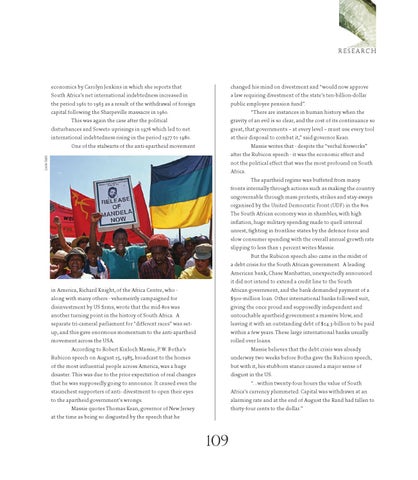
economics by Carolyn Jenkins in which she reports that South Africa’s net international indebtedness increased in the period 1961 to 1963 as a result of the withdrawal of foreign capital following the Sharpeville massacre in 1960. This was again the case after the political disturbances and Soweto uprisings in 1976 which led to net international indebtedness rising in the period 1977 to 1980. One of the stalwarts of the anti-apartheid movement
in America, Richard Knight, of the Africa Centre, who along with many others - vehemently campaigned for disinvestment by US firms, wrote that the mid-80s was another turning point in the history of South Africa. A separate tri-cameral parliament for “different races” was setup, and this gave enormous momentum to the anti-apartheid movement across the USA. According to Robert Kinloch Massie, P.W. Botha’s Rubicon speech on August 15, 1985, broadcast to the homes of the most influential people across America, was a huge disaster. This was due to the prior expectation of real changes that he was supposedly going to announce. It caused even the staunchest supporters of anti- divestment to open their eyes to the apartheid government’s wrongs. Massie quotes Thomas Kean, governor of New Jersey at the time as being so disgusted by the speech that he
109 man_swart01.indd 5
12/2/08 8:24:10 AM