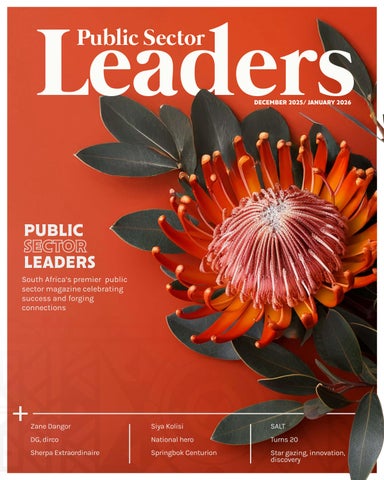
DECEMBER 2025/ JANUARY 2026
PUBLIC SECTOR LEADERS South Africa’s premier public sector magazine celebrating success and forging connections
Zane Dangor
Siya Kolisi
SALT
DG, dirco
National hero
Turns 20
Sherpa Extraordinaire
Springbok Centurion
Star gazing, innovation, discovery
December 2025/ January 2026 | Public Sector Leaders
1
C-SUITE DELEGATES | GOVERNMENT OFFICIALS
Hon. Inkosi Mzamo Buthelezi, Minister of Public Service & Administration
2
Public Sector Leaders | December 2025/ January 2026
CORPORATE SHOWCASE COUNTERS
S U M M I T
2 0 2 6
Celebrating excellence across government. The Public Sector Leaders Summit is a premier platform that celebrates the contributions of organisations and individuals, across both the public and private sectors, who continue to invest in South Africa’s growth with resilience and optimism. The 2nd Annual PSL Summit will provide the ideal environment for engaged networking, collaboration and knowledge sharing between stakeholders who are committed to building a thriving and inclusive economy.
For more information Contact: emlyn.dunn@topco.co.za marketing@topco.co.za
December 2025/ January 2026 | Public Sector Leaders
3
Contents
DECEMBER 2025/ JANUARY 2026 | ISSUE 58
Editorial
44 | 16 Days of Activism
A turning point in South Africa’s fight against gender-based violence
18 | What can we learn from G20 South Africa?
46 | Seacom 2.0
Leadership lessons for South African leaders from the 2025 G20 Summit
From under the sea to our homes
26 | The Medium-Term Budget Policy Statement
A stronger fiscal outlook offers hope for households and public services
30 | Trade Finance
Unlocking South Africa’s growth, trade and opportunity
32 | Southern African Large Telescope (SALT) turns 20
Celebrating two decades of stargazing, innovation and discovery
Features 10 | Addressing the Nation
Our children hold the power to change our future
22 | Women in Leadership
Advocate Kholeka Gcaleka strengthens the Public Protector’s commitment to justice
24 | Trailblazer
Zane Dangor: Steering South Africa’s G20 legacy with purpose and dignity
28 | Tech
National Treasury proposes new online gambling tax
4
32 36 | Summertime on the coast
A feast of festivals and celebrations lined-up in Cape Town this Summer
26
40 | Holiday Feature A taste of Dezemba!
48 | In Other News
Fire season readiness: A province prepared for the summer ahead
50 | Agriculture
Towards an inclusive agricultural sector
52 | Sporting Action
On Siya’s milestone, Atlas stones, victory at Lord’s and other highlights
56 | Regional Focus
Promoting tourism in the Free State
Public Sector Leaders | December 2025/ January 2026
58 | Financial Fitness
The hidden cost of absenteeism in South Africa
60 | Legal Matters
What buyers and sellers need to know about the sale of immovable property
62 | Health & Wellness
Managing expectations while staying grounded during the holiday season
64 | Upcoming Events December calendar
December 2025/ January 2026 | Public Sector Leaders
5
36
52
24
22
CREDITS
Deputy Editor Koketso Mamabolo koketso.mamabolo@topco.co.za
PUBLIC SECTOR LEADERS The Digimag For Leaders In The South African Public Sector Fully Accredited Member of ABC
Assistant Editor Shumirai Chimombe shumirai.chimombe@topco.co.za
Digital Publishing Platforms Issuu Magzter Media Carrier
Contributors Jessie Taylor Wandile Sihlobo Thulani Dube Sanine Baird
Head Office Top Media & Communications (Pty) Ltd T/A Topco Media Elkay House, 186 Loop St Cape Town
Design Tashwell Brown
Tel: +27 86 000 9590 Fax: +27 21 423 7576 Email: info@topco.co.za Website: www.topco.co.za
Advertising Sales, Distribution and Subscriptions Top Media & Communications (Pty) Ltd Tel: 086 000 9590 info@topco.co.za | www.topco.co.za
Cover Design Nasreen Emeran
CEO Ralf Fletcher
SALES National Project Manager Emlyn Dunn Tel: 072 1263962 emlyn.dunn@topco.co.za
TOPCO STUDIO Production Director Van Fletcher van.fletcher@topco.co.za Group Editor Fiona Wakelin fiona.wakelin@topco.co.za
6
Images iStock / Unsplash / GCIS | Flickr
(Scan QR code below to view website)
Traffic Manager Daniël Bouwer artwork@topco.co.za
Brand Coordinators Sidney Phiri sidney.phiri@topco.co.za Printers LAW Print
Public Sector Leaders | December 2025/ January 2026
DISCLAIMER
All rights reserved. No part of this publication may be reproduced, stored in a retrieval system or transmitted, in any form or by any means, electronic, mechanical, photocopying, recording or otherwise, without the prior written consent of Top Media & Communications (Pty) Ltd T/A Topco Media. Reg. No. 2011/105655/07. While every care has been taken when compiling this publication, the publishers, editor and contributors accept no responsibility for any consequences arising from any errors or emissions.
December 2025/ January 2026 | Public Sector Leaders
7
2 Government Employees Medical Scheme
OPTION SELECTION
6
Crafted for You and Your Family’s Unique Needs 2026 OPTION SELECTION Now open until 16 December 2025
In accordance with the Scheme's Rules, GEMS members are encouraged to review their healthcare needs each year and use their right to continue with their current benefit option or change to a different benefit option in the new year.
Choose your 2026 option quickly and effortlessly by dialling *134*20018# or via: • • •
GEMS Member Portal by clicking on “Login” at www.gems.gov.za Use the QR code to download the GEMS Member App The self-help facility by calling 0800 00 4367 and following the voice prompts
Contact details 0800 00 4367 (toll-free) enquiries@gems.gov.za
8
• • • •
A GEMS Walk-in Centre Enquiries@gems.gov.za Fax to 0861 00 4367 Post to GEMS, Private Bag X782, Cape Town 8000
@GEMSMEDICALAID1 @GEMSMEDICALAID Government Employees Medical Scheme
www.gems.gov.za Public Sector Leaders | December 2025/ January 2026
Use the QR Code to download the GEMS Member App
Letter from the
EDITOR’S LETTER
Editor
BY FIONA WAKELIN
Welcome to the December 2025/ January 2026 edition of Public Sector Leaders (PSL) malnourished mothers to breastfeed, babies are being weaned onto lowprotein diets, which lower their immunity and make them susceptible to infections. As they grow up, their health suffers and they fall further behind. As children’s advocates keep reminding us, this domino effect must be broken,” – H.E. Ramaphosa. Focus on the vulnerable continues in our feature on 16 Days of Activism - each year, from 25 November to 10 December, the world observes 16 Days of Activism for No Violence Against Women and Children - a campaign aimed at ending gender-based violence against women, children, and vulnerable groups. Importantly, on 21 November 2025, South Africa declared GBVF a national disaster under the terms of the Disaster Management Act, 2002.
S
eason’s Greetings! This will be my last letter before the close of 2025 and the advent of 2026. In some ways tempus has fugitted and in others a lot has happened this year. I think I can speak for colleagues and friends that we are all looking forward to some R’nR and an opportunity to recharge batteries, put some fuel in the tank. But I digress. In this December/January edition of Public Sector Leaders, His Excellency President Cyril Ramaphosa’s letter, penned to the nation on 15 December, spoke to the importance of our children – and highlighted some chilling statistics: “Many children are disadvantaged before they are even born, with maternal undernutrition contributing to low-birth weights. Because it is difficult for
Adv. Kholeka Gcaleka, South Africa’s Public Protector features in the Women in Leadership slot, and in homage to the outstanding role he played during the G20, we selected Zane Dangor, G20 Sherpa, Dirco DG, as Trailblazer. To complement this we have a comprehensive article written by our contributor Thulani Dube, Head of Innovation and Advancement at Cornerstone Institute entitled “Leadership lessons for South African leaders from the 2025 G20 Summit”: “It is fitting that South Africa anchored the summit in the philosophy of Ubuntu, focusing on solidarity, equality and sustainability to drive the agenda of global cooperation. This focal point is a strong reminder that humanity is interdependent and that progress requires deep mutual responsibility,” – Thulani Dube. For those of you who have been following the rampaging wild fires ravaging our farmlands, winelands and natural environment, In Other News takes a look at fire season and the heroic work done by firefighters –
some of whom are concerned community members, willing to put their lives at risk. In Financial Fitness we look at the hidden cost of absenteeism and in Legal Matters we zoom in on all you need to know about the sale of immovable property. The fascinating article “Seacom 2.0: From under the sea to our homes” goes on a deep sea dive looking at connectivity and the road to the digital future – Seacom 2.0 is an ambitious subsea cable system which will run across the Indian Ocean Basin, the Middle East, the Mediterranean, and southern Europe, connecting 2.9 billion people (predominantly youth) in 33 countries. Continuing on this celebration of amazing achievements we turn from under the ocean skywards and feature “Southern African Large Telescope (SALT) turning 20: Celebrating two decades of stargazing, innovation and discovery.” Our fabulous Sporting Action article honours national hero Siya Kolisi, the twelfth Springbok centurion. Siyamthanda – was ever a person more aptly named? And, last but not least, there are some scrumptious recipes to try out this festive season. From myself and the amazing team, we wish you an abundant, safe end of year and look forward to seeing you in February 2026.
FIONA WAKELIN | GROUP EDITOR
December 2025/ January 2026 | Public Sector Leaders
9
ADDRESSING THE NATION BY FIONA WAKELIN
10 Public Sector Leaders | December 2025/ January 2026
Our children hold the power to change our future
I
n his letter written to the nation on 15 December, His Excellency Cyril Ramaphosa focused on the health and wellbeing of South African children, many of whom continue to bear the ill-effects of poverty, which negatively affects their health and education. “Since the advent of democracy, we have made considerable progress in reducing child poverty and mortality. We have expanded access to education and are now focused on making sure every child has access to early childhood development. “Earlier this month, Cabinet approved the National Strategy to Accelerate Action for Children (NSAAC). It focuses on a range of interventions to improve the conditions and the development of our nation’s children and adolescents. The strategy follows extensive consultation with the children’s sector, relevant government departments and with children themselves. It identifies ten priorities for children and teenagers that seeks to galvanise all of society. The strategy follows key milestones
in the life of children, paying added attention to adolescents and children with disabilities,” – President Ramaphosa. This comprehensive roadmap to promote and protect the rights of children will be implemented through the 5th National Plan of Action for Children 2025-2030 and relies on close collaboration between government, civil society organisations and all other social partners. Statistics South Africa’s report on poverty trends showed that while child poverty declined from 69% in 2006 to 49% in 2023, the child poverty rate in South Africa is still the highest for any age group. Nearly half of our country’s children live in poverty. “Many children are disadvantaged before they are even born, with maternal undernutrition contributing to low-birth weights. Because it is difficult for malnourished mothers to breastfeed, babies are being weaned onto low-protein diets, which lower their immunity and make them susceptible to infections. As they grow up, their health suffers and they fall further behind. As children’s advocates keep reminding us, this domino effect must be broken.
“Crimes against children, including abuse, neglect and abandonment, are worryingly high. Figures released during Child Protection Month in May revealed that there were more than 26,000 cases of child abuse and neglect reported in the 2024/2025 financial year. The majority of cases involved sexual abuse,” – H.E. Ramaphosa. His Excellency went to emphasise that the experience of children today will determine our nation’s social and economic wellbeing over the next twenty years. “We pay tribute to the thousands of civil society activists who have championed child rights and provided care over many decades. Thank you to our health workers, teachers, child and youth care workers and social workers for protecting, developing and inspiring our children. We also pay tribute to the parents, grandparents and relatives who care for the young in our society. For the sake of our shared future, we must work together to ensure that our nation’s children and young people grow, thrive and are happy,” – His Excellency Cyril Ramaphosa.
December 2025/ January 2026 | Public Sector Leaders
11
ADVERTORIAL SIBANYE-STILLWATER
Zero tolerance for Gender-Based Violence and harassment at Sibanye-Stillwater
Combatting GBV in the workplace and beyond
S
exual harassment, gender-based violence (GBV), and discrimination remain persistent concerns at the company and in the mining sector more broadly, despite the many progressive policies implemented in recent years. Underreporting, the withdrawal of GBV cases, social pressures and the lack of perceived psychological safety indicate the need for a deeper cultural transformation. Clarifying the distinctions Gender-based violence (GBV) broadly refers to any harmful act of violence or discrimination based on gender. While sexual harassment is a form of GBV, significantly not all GBV is sexual harassment. Further, both can manifest as physical, verbal, or nonverbal behaviours toward any gender, and undermine dignity, safety, and equality in the workplace.The mining industry faces unique risks, with research indicating that violence and harassment are recurrent threats, especially for women. These can occur
both inside and outside the workplace. Underreporting and withdrawal of cases remain common, often driven by fear of retaliation, financial dependence on the abuser, lack of trust in reporting processes and social pressures favouring peaceful settlement approaches. A zero tolerance approach At Sibanye-Stillwater, we firmly uphold the notion that every individual deserves dignity and respect at home, in the workplace and within community and social settings. We have adopted a clear stance publicly. The company does not tolerate any form of harassment, sexual misconduct, discrimination, or GBV. We have thus also decisively sought to address gender-based violence and harassment in our workplace. This includes a zero tolerance approach to all forms of harassment, sexual misconduct, discrimination, and GBV. We have integrated GBV and respectful workplace training into onboarding and
12 Public Sector Leaders | December 2025/ January 2026
annual learning programs and provided multiple clear reporting channels for employees and their families. We have also strengthened access to victim support services and ensured impartial consequence management through external oversight. At a leadership level, we have fostered a culture of visible leadership, accountability, and open communication. Awareness, continuous training, and victim centred reporting • Training: Sibanye-Stillwater has integrated GBV and respectful workplace training into our onboarding and annual learning programs. New employees are required to complete a newly designed and unique scenariobased module on sexual harassment. • Awareness: company policies and Codes of Ethics dealing with GBV and sexual harassment are prominently displayed on notice boards and included in induction programmes.
support, but also contributes to improving our company’s reputation internally and externally. We are able to attract and retain talent by ensuring that a good working environment is maintained.
•
•
Implementing clear and multiple reporting channels: employees are able to report incidents of GBV, harassment, or discrimination through traditional channels such as HR, supervisors, union representatives or Protection Services. Further, we have setup dedicated reporting and referral centres across our operations. Moreover, we have also ensured that If individuals are uncomfortable reporting themselves, a colleague can be requested to report on their behalf. As has always been the case at Sibanye-Stillwater, all reported incidents are treated confidentially, and retaliation is strictly prohibited. Victim support: The company provides access to safe houses, psychological care, and external support including the widely available LYRA 24/7 confidential support, to help overcome the challenges of GBV and sexual harassment, especially fears about reporting. Further, When GBV or harassment is suspected and reported, immediate safety measures are implemented, and affected individuals are referred to wellness programs and external confidential support as needed.
•
Impartiality: harassment cases reported are handled by an external chairperson to ensure impartiality. Further, both informal (mediation, apology, training) and formal (written complaint, investigation, disciplinary action) procedures are available to victims. Significantly, the process is survivor-focused, confidential, and conducted in a timely manner.
Leadership & culture Meaningful change however requires visible leadership, consequence management, and open communication. Leaders at every level are encouraged to consistently lead by example as “champions”. They are required to clearly communicate the company’s stances and ensure that consequence management is both visible and fair. These actions have had a significant impact across our organisation. They have created a safer, more respectful, and inclusive workplace, empowering everyone to speak up and access support when needed. This has fostered a culture of respect and zero tolerance for misconduct. This does not only assist the victim by ensuring access to strong reporting mechanisms and adequate sociological and psychological
Leading on these issues has also set a benchmark for our industry and the sector more broadly. It empowers and improves the lives of our host communities, many of whom are employed in our operations. However, much still needs to be achieved. The goal of a society where gender-based violence and sexual harassment is stopped cannot be achieved alone and in isolation. We all have a responsibility to emphasize zero tolerance for harassment and discrimination in every setting, whether formal or informal. By collaborating and working together as individuals, businesses and society more broadly, we can drive the cultural transformation needed to make our workplaces and our industry safe for everyone. At Sibanye-Stillwater, we thus remain dedicated to this zero-tolerance approach to GBV and harassment. We are committed to protecting every employee, ensuring a culture of respect and accountability, providing victim centred approaches to combat this scourge and continuedly improving our processes and procedures to combat GBV and sexual harassment in all its forms. No one should feel unsafe psychologically and physically while being employed by us.
Libanon Business Park, 1 Hospital Street, Libanon, Westonaria, 1780. +27 (0)11 278 9600 www.sibanyestillwater.com
December 2025/ January 2026 | Public Sector Leaders 13
ADVERTORIAL CLIFFE DEKKER HOFMEYR
I
n recognition of the role it can and must play as a responsible corporate citizen, Cliffe Dekker Hofmeyr (CDH) established a dedicated Pro Bono and Human Rights Practice in 2011. The Practice commits itself year-round to confronting, head on, a wide range of public interest issues, striving to effectively utilise its resources to offer legal support to the many vulnerable groups across our society. Two of the Practice's members – Director, Brigitta Mangale and Senior Associate, Elgene Roos – have dedicated themselves to, among other areas of public interest, confronting the complex and devastating body of issues faced by our women, children and members of the LGBTQIA+ community. Brigitta and Elgene recognise that if we are to confront these issues as a society, it is the task of responsible feminist lawyers to rise to the occasion without fear or favour, and to recognise that there are many ways in which we as lawyers can and must stand as pillars of solidarity and advocacy for affected communities, whether in addressing domestic violence, supporting survivors of abuse, or challenging the systemic conditions that enable gender-based violence and femicide.
Cliffe Dekker Hofmeyr (CDH)
Beyond the 16 Days – the dedicated impact of Brigitta Mangale and Elgene Roos in confronting GBV and femicide 14 Public Sector Leaders | December 2025/ January 2026
Given their collective experience and expertise, Brigitta and Elgene together stand as a formidable force in the arena of strategic public interest litigation. One of several matters in which they are involved was recently before the Western Cape High Court: that is, the matter of S.H. and Others vs the Minister of Justice and Correctional Services and Others, a landmark application that seeks the decriminalisation of sex work. Brigitta and Elgene represent one of the sixteen amici curiae who sought admission to the proceedings: a non-profit organisation championing inclusion, with a particular focus on migration and sexual orientation, gender identity, gender expression and sex characteristics. Through
Brigitta Mangale, Director, Pro Bono and Human Rights Practice
One such legal education workshop was hosted by Elgene on 28 November 2025 in favour of the Frida Hartley Shelter in Johannesburg. During the session, she explained the key components of the Domestic Violence Act, including definitions of the forms of domestic violence, legal protections available to survivors, and the various support mechanisms in place. She guided participants through practical steps for accessing protection orders and navigating interactions with law enforcement officials. By creating a space for open dialogue, the workshop aimed not only to inform but strengthen women's agency in asserting their rights and seeking help when needed, while also equipping them with practical tools to support others in their communities.
its intervention as amicus, the organisation will assist the Court by highlighting how the criminalisation of sex work disproportionately affects LGBTQIA+ individuals, particularly transgender women and genderdiverse individuals, and how migrant sex workers face additional barriers, including policing practices, restricted access to healthcare, and obstacles to legal protection. The application raises important human rights issues that will have a ripple effect throughout our society, and Brigitta and Elgene are honoured to be contributing to this positive change in our constitutional dispensation. But it is not only strategic litigation that can effectively bring about the much-needed positive change in our legal, social and economic attitudes toward women, children and the LGBTQIA+ community. A sound knowledge of one's basic human rights can be a powerful and effective source of empowerment and protection. In recognition of this fact, Brigitta and Elgene allocate significant resources toward hosting legal education workshops in response to needs identified within the community.
harassment, with a specific focus on protection orders. In recognising that many of the attendees – and indeed many sexual abuse and harassment survivors across the country – live with or in close proximity to their abusers, the session was focused on providing practical and useful solutions in those circumstances, with a particular emphasis on utilising protection orders and the laws intended to protect survivors safely and effectively. Both Brigitta and Elgene recognised the importance of framing these training sessions in a way that is realistic, sensitive, and responsive. It is their honour to do this work and to serve in ways that meaningfully support women, children and LGBTQIA+ individuals. It is only when we all answer the call to find unique ways in which we can contribute to the fight, that we have hope to stand strong against the scourge of gender-based violence and femicide. Brigitta and Elgene remain committed to further the fight in these ways and many more far beyond the 16 Days of Activism.
CONTACT DETAILS Elgene Roos, Senior Associate, Pro Bono & Human Rights Practice
(CPT OFFICE) 11 Buitengracht Street, Cape Town, 8001, South Africa PO Box 695, Cape Town, 8000
On 8 December 2025, Brigitta hosted a similar workshop in Cape Town at the Saartjie Baartman Centre for Women and Children in favour of a group of women who have survived domestic violence. The workshop explained legal procedures available to the women in the context of sexual
Tel: +27 (0)21 481 6300 cliffedekkerhofmeyr.com Cliffe Dekker Hofmeyr Inc @CDHLegal @cdhlegal Cliffe Dekker Hofmeyr
December 2025/ January 2026 | Public Sector Leaders
15
ADVERTORIAL TIA
Grassroots Innovation Awards 2025 celebrate homegrown technologies transforming the innovation landscape
T
he Technology Innovation Agency (TIA) in partnership with the Department of Science, Technology and Innovation (DSTI) hosted the Grassroots Innovation Awards ceremony alongside the Science Forum South Africa in Pretoria in November. The awards brought together policy makers, innovators, entrepreneurs, industry partners and international delegates for an evening dedicated to celebrating creativity, impact and technological advancement. The Grassroots Innovation awards are part of the DSTI Innovation for Inclusive Development (IID) Programme, implemented by TIA. These awards recognise, celebrate, and award excellence and impact
in the design and delivery of key strategic programmes (Grassroots Innovation Programme, Living Labs Programme and mLabs Programme) and TIA’s Centres for Innovation and Entrepreneurship. The event recognised excellence across seven award categories, recognising outstanding grassroots innovators whose solutions address community challenges and contribute to inclusive development. • Outstanding Women Grassroots Innovator – Paula Maseko of Buhle Bomqhele – North West • Outstanding Youth Grassroots Innovator – Namhla Dotwana of Namhla Collection – Eastern Cape
16 Public Sector Leaders | December 2025/ January 2026
• • • •
•
Disability Innovation Award – Landile Mabele of Navwok – KwaZulu Natal Social Innovation Award – Mzomhle Mapatwana of Mifano Ya Mvua Investments Outstanding Lab Supporting Grassroots Innovators – Innovate Durban and MLab Limpopo Outstanding Centres for Innovation and Entrepreneurship supporting Grassroots Innovators – Sakhile Youth Empowerment Centre (SAYEC) The Professor Keolebogile Shirley Motaung “Grassroots Innovator of the Year” – Namhla Dotwana – Eastern Cape
The overall winner of the night, Namhla Dotwana from Tsolo in Eastern Cape scooped the Professor Keolebogile Shirley Motaung “Grassroots Innovator of the Year” 2025 with a cash prize of R100 000.00. Namhla Collection is a rural-based sustainable beauty enterprise that transforms indigenous South African plants, particularly imphepho, into premium skincare, haircare and home spa products. The project promotes the revival of South African Indigenous Knowledge, innovation and circular rural economies by cultivating, processing and packaging products within the village of eGotyibeni, Tsolo in the Eastern Cape. Grassroots innovation is a cornerstone of the TIA mandate reflecting the agency’s commitment to empowering communities to address their own local needs through practical, community-based solutions. These programmes are intentionally designed to target innovators outside formal innovation systems, focusing particularly on individuals and communities who have historically been marginalised or excluded from mainstream innovation opportunities. By providing grants, technical support, and access to infrastructure, the initiative ensures that ideas born from local experience can grow into meaningful, scalable innovations. Within the Grassroots Innovation Programme, TIA currently manages approximately 292 active projects, among these, 50 projects have been commercialised, 52 companies created, and 148 jobs generated. An additional 400 projects are supported through a structured innovation support programme in the various Labs and CIEs. These numbers represent far more than outputs—they represent livelihoods changed, households uplifted, and pathways opened. They demonstrate that grassroots innovation is not theoretical; it is transformative. Collectively, these programmes support more than 700 grassroots innovators through various support packages and initiatives. If innovation is to drive economic growth, all sections of society need to participate in the economy. The participation needs to be meaningful and inclusive; this is part of the commitment made in the 2019 White Paper on Science Technology and Innovation and the DSTI Decadal plan. As an entity of the DSTI, TIA is an implementing agent for government
policy. As such, the Agency has established three transformation programmes to advance several intents of the White Paper on Science, Technology and Innovation. These programmes are targeted towards women, youth and people with disabilities. These inclusive programmes are designed to address systemic challenges in the funding, enabling environment, support and development of previously marginalised entrepreneurs in the technology and innovation ecosystem. The Deputy Minister of Science, Innovation and Technology, Dr Nomalungelo Gina delivered a keynote address where she commended the finalists and winners for their contribution to national development and the strengthening of the innovation ecosystem. “The grassroots innovation awards are very close to my heart because they debunk the notion that innovation is for the wellheeled elite, and not for rural people in our townships. When the government emphasises the point that no one must be left behind in our empowerment, this is one demonstration to that commitment. We also celebrate innovators who live in rural areas, as well as the innovators with disabilities because they are rewriting the narrative from one of limitation to one of possibility,” said Dr Gina. This year's awards are particularly significant, coinciding with TIA 15 years of supporting innovation in South Africa. For 15 years, TIA has stood at the forefront of South Africa’s innovation ecosystem by supporting bold ideas, empowering visionary talent, and helping to build a future defined by possibility. From supporting emerging technologies to uplifting innovators, TIA’s impact has been as inclusive and diverse as it is transformative. TIA Board chairperson, Loyiso Tyira said, “We honour and recognise outstanding grassroots innovators whose solutions address community challenges and contribute to inclusive development. Innovation is not a luxury; it is a national imperative. The work showcased at these awards demonstrates the powerful role of creativity, science, and entrepreneurship in driving economic progress. We are celebrating a significant milestone this year – it is 15 years since the establishment of TIA. TIA has been
central to advancing South Africa's innovation agenda over the past 15 years. Our work is aligned with government's priorities of inclusive economic growth, skills development, and the creation of industries through science, technology, and innovation. TIA’s role in the National System of Innovation is vital to building a knowledge-based economy and securing a better future for all South Africans. Congratulations to all the winners!” Mr. Tyira highlighted that under TIA 2.0, award-winning innovators should not face funding gaps as they advance their projects. TIA is committed to helping them move smoothly through available support mechanisms by using the Quadruple Helix Model, which unites government, industry, academia, and communities. This coordinated approach aims to create a single, integrated ecosystem so innovators don’t need to apply separately to multiple stakeholders, enabling a streamlined path from prototype to market. A special moment at the event was the renaming of the overall category: Keolebogile Shirley Motaung Grassroots Innovator of the year in honour of one of the Agency’s late Board members. Professor Keolebogile Shirley Motaung, a respected and accomplished biomedical scientist, visionary entrepreneur and passionate advocate for inclusive innovation. The award acknowledges and honours her legacy and contribution in South African innovation. This award celebrates the grassroots innovator who has demonstrated significant personal growth as well as progression of his/her solution to the market that impacts several beneficiaries. As TIA reflects on the past 15 years of impact, the Agency looks boldly ahead to expanding its programmes, growing partnerships and empowering the next generation of innovators, entrepreneurs and start-ups. As the agency shapes the next 15 years, TIA invites all stakeholders in the innovation ecosystem to be part of the journey towards an inclusive economy driven by innovation. For more information: www.tia.org.za
December 2025/ January 2026 | Public Sector Leaders
17
G20 BY THULANI DUBE
G20 Leaders Summit Group
Leadership lessons for South African leaders from the 2025 G20 Summit
W
hen South Africa hosted the 2025 G20 Leaders Summit, the world experienced more than an important diplomatic gathering. This historic 20th G20 summit may be viewed as a moment of global self reflection that took place on African soil and was guided by the principles that have long defined the continent’s moral compass. The principles of Ubuntu. At the centre of this historic convening was an urgent call to rethink how leadership is exercised in a world marked by fracture, inequality, and a rapid rate of change.
For senior leaders in organisations, emerging leaders navigating their career paths, and South African citizens in general contending with the weight of inequality in daily life, the summit offered profound lessons about what leadership must look like going forward. It is fitting that South Africa anchored the summit in the philosophy of Ubuntu, focusing on solidarity, equality and sustainability to drive the agenda of global cooperation. This focal
18 Public Sector Leaders | December 2025/ January 2026
point is a strong reminder that humanity is interdependent and that progress requires deep mutual responsibility. Anchoring leadership in the principle of Ubuntu The G20 Leaders Declaration emphasised that no country can thrive in isolation and that global stability depends on a shared sense of humanity and collective care.This, for leaders in any setting, signals the importance in how leadership should be
understood in organisations and societies. We live in a world where systems are increasingly interconnected, from supply chains to digital networks to financial markets. Leadership that fails to recognise interdependence quickly becomes obsolete. Ubuntu prompts leaders to recognise that resilience and success is not achieved through isolation or individual brilliance, but through relational strength, collaborative practice and the understanding that one person’s progress is intertwined with another’s, as echoed in the Zulu phrase “Umuntu ngumuntu ngabantu” I am because we are. Confronting inequality as a structural, global and leadership driven challenge The emphasis on Ubuntu naturally connects to one of the most defining themes of
the summit which is the urgent need to confront inequality as a structural, global and leadership driven challenge. The Global Inequality Report prepared for the G20 by a committee of independent experts on inequality put forward that extreme inequality is not an inevitable outcome of global economics, but rather the consequence of policy choices and leadership decisions that can be reversed with genuine political will.. According to the analysis, 83% of countries today exhibit high income inequality, with Gini coefficients exceeding 0.4.The report also found that more than 2.3 billion people face food insecurity, and climate instability disproportionately harms those already most vulnerable. For South African leaders, these global statistics hit extremely
close to home. South Africa remains one of the most unequal countries on earth. Inequality seems embedded into everything, from the labour market to organisational culture to youth employment prospects to community wellbeing and even national cohesion. The G20’s insistence that inequality is a leadership problem and not simply a statistical reality offers direction for business executives, educators, policymakers and civic leaders. Leaders cannot hope to steward institutions into the future without confronting the inequalities embedded within those institutions. Pay disparities, representation gaps, unequal access to skills, and exclusionary cultures are not matters on the margins. Leaders must
December 2025/ January 2026 | Public Sector Leaders
19
G20 BY THULANI DUBE
understand that these issues are foundational risks that weaken trust, erode performance and destabilise long term viability in organisations and beyond. The G20’s call for the establishment of an International Panel on Inequality, a body envisioned to track global inequality trends, evaluate policy impact and consolidate evidence, reinforces the idea that confronting inequality requires sustained institutional mechanisms rather than episodic good intentions. An indication to leaders on the importance of data driven decision making. Reaffirming the importance of multilateralism and collaboration The summit affirmed that, in moments of crisis, leadership must move beyond unilateralism and the belief in national exceptionalism. The gathering of Global Leaders unfolded amidst geopolitical tensions, economic fragmentation, war and climate shocks. However in the midst of all these issues the Leaders’ Declaration reaffirmed an unwavering commitment to multilateral cooperation, peaceful conflict resolution and collaborative problem solving even among countries whose interests are divergent. In a world where crises increasingly transcend borders, the lesson for organisational leaders is clear in that collaboration is not optional. It is essential. As much as countries must navigate competing priorities to solve global challenges, organisational leaders must find ways to align diverse stakeholders such as boards, employees, clients, regulators and communities toward a shared purpose. Leadership in times of crisis, as the summit demonstrated,
is a collective act. It requires early warning systems, integrated planning, shared intelligence and a willingness to build coalitions that extend beyond one’s immediate sphere of influence. Highlighting economic transformation, sustainable industrialisation, equitable knowledge sharing Throughout the summit, there was a consistent message that economic transformation must take precedence over narrow conceptions of growth. The G20 made it clear that growth for its own sake is no longer adequate. Instead, nations must invest in industrialisation that promotes value addition, sustainability, and fair inclusion in global supply chains. The Leaders’ Declaration emphasised the need for local value creation, expanded participation of developing countries in global trade and the integration of social protection with economic strategy. For South African leaders, both in business and government, this carries deep relevance. The nation has historically exported raw materials while importing finished products. To embrace the spirit of the G20 commitments means reimagining the country as a site of innovation, manufacturing, creativity and technological advancement rather than simply a source of unprocessed resources and cheap labour. Economic transformation that ignores labour rights, fair wages, and safe working conditions is no longer defensible. Sustainable industrialisation is inseparable from social upliftment. Leadership must take on the stance of serving. Another major theme emerging from both the summit and the inequality report is the need for radical collaboration and equitable knowledge sharing. The Global Inequality Report argued strongly for the reform
20 Public Sector Leaders | December 2025/ January 2026
of global access to knowledge, and a more level playing field in global competition policy. The call is to build a world where information and innovation are not concentrated in a handful of wealthy countries or corporations but shared in ways that uplift broader humanity. This principle applies just as powerfully to organisations. Leadership in the 21st century requires moving away from siloed information cultures and towards systems that reward openness, cross disciplinary collaboration, evidence based decision making and collective innovation. As Africa continues to grapple with technological dependency and digital exclusion, the G20’s focus on technology transfers, skills development and the strengthening of local innovation ecosystems signals a path forward. Leaders who invest in knowledge equity , who ensure that learning, development, data and research capabilities are distributed rather than centralised are building institutions that are more resilient, agile and future ready. Recognising human dignity as a core of development Across every thematic area of the summit, the human experience remained deeply central. The inequality report noted the enormous human cost of inequality which are hunger, unemployment, inadequate healthcare, climate vulnerability, unsafe living conditions and limited mobility, all of which reinforce a cycle of exclusion that is difficult to break. The G20’s commitment to poverty reduction, food security, disaster preparedness, adaptive social protection and expanded access to health services shows that people cannot be treated as beneficiaries of development but rather they must be regarded as full stakeholders in the decisions that impact their lives.
This carries a powerful leadership lesson in that human dignity must sit at the core of development. Compassion and data must work together. Evidence without empathy becomes technocratic and alienating. Empathy without evidence becomes well intentioned but carries a high risk of ineffectiveness. In South Africa’s organisational spaces, this calls for leaders to drive wellness initiatives, mental health support, fair labour practices, and workplace cultures that treat employees as human beings rather than mere human capital. The summit also forced leaders to confront the realities of debt, fiscal sustainability and responsible stewardship of resources. Many African countries are facing unsustainable debt burdens that may limit their ability to invest in public services, infrastructure and social protection. The G20 discussions highlighted the need for transparent debt restructuring, innovative financing mechanisms and joint responsibility between creditors and debtors. Within organisational contexts, this translates into a leadership ethic grounded in honesty about financial constraints, thoughtful investment strategies and the kind of transparency that strengthens rather than fragments stakeholder trust. Fiscal responsibility is not simply about cutting costs or increasing revenue, it is about managing resources in a way that secures long term resilience rather than short term gratification. Highlighting the leadership challenge in climate change, energy and technology. The summit highlighted the leadership challenge in climate change, energy and technology. Africa’s energy poverty remains staggering with over six hundred million Africans lacking electricity, and a large number have no access to clean cooking
technologies. Climate change amplifies inequality by hitting the poorest hardest, undermining development and eroding human security. Leadership that sidelines sustainability is no longer leadership at all. The future belongs to leaders who integrate environmental stewardship into the centre of organisational and national strategy. This means thinking beyond immediate cost considerations and toward long term systems change. For South Africans, the notion of a just transition must draw leadership that considers and does not leave workers or vulnerable communities behind. Climate leadership requires horizon thinking, a willingness to plan beyond election cycles or quarterly reporting periods, and the humility to acknowledge that humanity’s survival depends on choices made today. One of the most striking lessons from the summit is the importance of adopting both a global and a local lens simultaneously. South Africa’s leadership at the G20 demonstrated that African priorities can and must be placed at the centre of global debates. This dual orientation is essential for modern leadership. Leaders must understand global forces such as technological shifts, supply chain realignments, demographic transitions and climate risks, while grounding their strategic decisions in local realities, cultural knowledge and contextual intelligence. Leadership imported uncritically from Western contexts will not solve South Africa’s local challenges nor will isolationist approaches equip the country to thrive in an interconnected world. Paving the way for future leaders and generations An enduring leadership lesson from the G20 Summit is the
emphasis on building institutions that outlast individual leaders. The proposed International Panel on Inequality embodies this idea. Leadership that matters does not simply respond to the moment. It builds the structures future generations need to continue solving problems long after individual leaders have moved on. This principle challenges leaders to reflect on the systems they are building within their organisations and communities. They must focus on creating cultures that endure as well as documenting knowledge for future leaders. They must strive to establish processes that safeguard integrity, performance and inclusion. Legacy is not defined by personal achievement but by institutional longevity and societal impact. In the end, the 2025 G20 Summit did more than issue declarations or refine policy commitments. It offered a mirror, reflecting a world struggling with inequality, mistrust, climate risk and uneven growth. It offered a map, charting a way forward rooted in humanity, cooperation, equity and sustainability. It offered a mandate to global leaders, organisational executives, emerging professionals and citizens alike to lead differently. To lead boldly. To lead with empathy, courage and integrity. And above all, to lead with the understanding that leadership divorced from equity is leadership destined to fail, but leadership rooted in Ubuntu has the power to transform organisations, societies and ultimately the world. Download the G20 Global Inequality Report at https://www.gov.za/ Download the G20 South Africa Summit Leaders' Declaration at https://dirco.gov.za/
December 2025/ January 2026 | Public Sector Leaders
21
WOMEN IN LEADERSHIP BY JESSIE TAYLOR
S
outh Africa’s Public Protector plays a vital role in strengthening constitutional democracy, promoting accountability, and ensuring that citizens receive fair and ethical treatment from the state. Since her appointment as Public Protector on 1 November 2023, Advocate Nompilo Kholeka Gcaleka has led the office with a renewed focus on stability, professionalism and public trust. Her tenure marks a new chapter for the institution - one that prioritises efficiency, responsiveness, and depoliticisation as the Public Protector of South Africa (PPSA) works to rebuild credibility and deliver justice for ordinary citizens.
DEFENDING THE PUBLIC Adv. Gcaleka was born in Johannesburg in 1982 and has built a distinguished career across South Africa’s legal and publicservice sectors. She earned her LLB from the University of KwaZulu-Natal and an LLM from the University of Johannesburg, later qualifying as an advocate and entering the National Prosecuting Authority (NPA) in 2004. Her roles included Senior State Advocate and Senior Deputy Director of Public Prosecutions, where she gained extensive experience in litigation, governance and criminal justice.
Advocate Kholeka Gcaleka strengthens the Public Protector’s commitment to justice
22 Public Sector Leaders | December 2025/ January 2026
Her public-service career further expanded through advisory roles in key government departments, including the Ministries of Home Affairs, Finance, and Public Service and Administration, where she provided expertise on legislation, compliance and policy implementation. In 2020, she was appointed Deputy Public Protector by President Cyril Ramaphosa, following a meritbased selection process and
vetting by Parliament. She became Acting Public Protector in June 2022 and was formally appointed Public Protector after a vote of the National Assembly on 19 October 2023. The Public Protector is an independent constitutional institution established under Chapter 9 of the Constitution and the Public Protector Act of 1994. Its mandate is to: •
• • •
Investigate allegations of maladministration, abuse of power, and improper conduct in any sphere of government Resolve complaints lodged by members of the public Recommend and enforce remedial action Ensure fairness, accountability, and justice in state administration
The PPSA is accessible to all South Africans and handles thousands of cases annually, ranging from service-delivery failures to major investigations into state entities. RESTORING ACCOUNTABILITY Adv. Gcaleka has taken a renewed interest in restoring stability and professionalising the office. Shortly after taking office, Adv. Gcaleka emphasised the need to distance the institution from political controversies and restore public trust. In a March 2024 media briefing, she stated that the institution was “recovering” after a period of instability, with renewed focus on impartiality, ethical leadership and internal efficiency. Her leadership has already shown measurable improvements. Between October and December 2024, the office finalised 1 494 cases, surpassing its performance for the same period in the previous year. According to the PPSA, this reflects a stronger internal review
system, better turnaround times, and a commitment to clearing backlogs. Adv. Gcaleka has also overseen several significant investigations. One widely reported case saw the Public Protector finding that the South African Police Service (SAPS) mishandled a 2021 sexualassault complaint involving two high-profile media personalities. The office found evidence of improper conduct, including leaks of confidential statements to the media and inadequate support for victims.
Her office has increased community outreach programmes, focusing on vulnerable groups such as rural communities, the elderly, women and marginalised individuals who may not know how to lodge complaints or access state remedies.
Her office has increased community outreach programmes, focusing on vulnerable groups such as rural communities, the elderly, women and marginalised individuals who may not know how to lodge complaints or access state remedies.
administrative failures can significantly impact daily life, the PPSA serves as a vital lifeline for resolving complaints that might otherwise remain unaddressed.
Adv. Gcaleka inherited an institution facing funding constraints, morale concerns, and public scepticism. Despite these challenges, her approach has been described by analysts as measured, legally sound and focused on institutional strengthening rather than public theatrics. She has repeatedly emphasised that her work should be judged on performance and impact. The Public Protector plays a crucial role in protecting citizens from administrative injustice, ensuring accountability in government operations, investigating corruption and misuse of state resources, and helping to improve service delivery through remedial directives. It plays a vital role in strengthening democracy by acting as a watchdog over state power. In a nation where many rely on public services and where
Adv. Gcaleka’s commitment to depoliticising the office, improving turnaround times and strengthening investigative capacity is a positive sign for the future of the institution. Her tenure comes at a pivotal moment - one where South Africans increasingly demand clean, efficient and ethical governance. As the PPSA continues to expand its reach and modernise its operations, her leadership may help restore confidence in one of the country’s most important democratic institutions.
Sources: Parliament of South Africa Presidency of South Africa Public Protector South Africa News24 Daily Sun
December 2025/ January 2026 | Public Sector Leaders 23
TRAILBLAZER BY JESSIE TAYLOR
Zane Dangor steering South Africa’s G20 legacy with purpose and dignity
I
n 2025, Zane Dangor stood at the centre of one of the most significant diplomatic moments in recent South African history - serving as G20 Sherpa and Director-General of the Department of International Relations and Cooperation (DIRCO) during the country’s presidency of the G20. As he guided the complex negotiations, logistics, and global spotlight that came with hosting the first G20 summit on African soil, Mr Dangor’s leadership earned attention not just for formality and protocol, but for an emphasis on inclusive representation, solidarity, and global responsibility.
Mr Dangor’s career spans decades of public service and advocacy. Before rising to his current prominent position, he worked in social development and human rights advocacy, serving as an advisor to successive Ministers of International
Relations and Cooperation. This experience helped him build his understanding of governance, diplomacy, and developmental justice. In April 2022, he was appointed as the Director-General of DIRCO. When South Africa assumed the G20 presidency on 1 December 2024, the government entrusted him with the additional role of G20 Sherpa - a demanding responsibility to coordinate South Africa’s contributions to G20 working-group negotiations, represent the presidency internationally, and steer preparations for the 2025 summit.
priorities: advancing inclusive economic development, supporting sustainable energy transitions, strengthening global governance for emerging economies, and promoting equity in trade and development.
DELIVERING ON A GLOBAL PLATFORM Under Mr Dangor’s stewardship, South Africa shaped the 2025 G20 agenda around the theme “Solidarity, Equality, Sustainability.” In a formal address to the United Nations General Assembly in March, he outlined the presidency’s
Perhaps most importantly, he consistently underlined that multilateral cooperation cannot be taken for granted, declaring in Sun City that “we cannot succeed unilaterally,” and urging global unity to address shared challenges such as climate change, inequality, and the debt crisis in the Global South.
24 Public Sector Leaders | December 2025/ January 2026
Later, at the third Sherpa Meeting, held at Sun City in June, which Mr Dangor chaired, he noted that South Africa had already convened 70 of the 132 planned preparatory meetings, emphasising progress across working groups on trade, climate, debt sustainability, and social policy.
diplomacy, arguing that major conflicts risk undermining international law unless justice is upheld. He described the forum as a timely platform for justice amid geopolitical tensions.
The Johannesburg summit in November confronted unexpected diplomatic turbulence when some member nations signalled partial or full withdrawal. Despite this, Mr Dangor worked to ensure that consensus-building remained central. In the aftermath, as G20 Sherpa, he emphasised that the G20’s strength lay not in unanimity at all times, but in the resolve to find common ground where possible. Following the summit, with the G20 presidency due to pass to the United States, Mr Dangor announced that the handover would be a “low-key affair,” reflecting pragmatism and avoiding unnecessary theatricality - a signal of diplomatic maturity. When South Africa was subsequently excluded from the first post-presidency Sherpa meeting, Mr Dangor publicly described the exclusion as a “breach of protocol,” raising concerns about the implications for continuity and equity in multilateral dialogue. SHAPING DEBATES BEYOND THE SUMMIT ROOM Mr Dangor hasn’t reserved his voice for only G20 corridors. At the 2025 Doha Forum in Qatar, he emphasised the importance of global accountability and equitable
His interventions reflect a broader diplomatic philosophy: one where South Africa - and by extension, the Global South speaks not just for itself, but for those countries often overlooked in global decisions. Under his watch, DIRCO has sought to amplify voices outside traditional centres of power, maintaining that representation, fairness, and solidarity must stay central in international relations. Mr Dangor’s leadership during South Africa’s G20 presidency demonstrates the growing importance of skilful, valuedriven diplomacy in an era of global volatility. His stewardship ensured that South Africa’s ability to host and manage a complex summit was not compromised by major incidents, demonstrating administrative competence at home and diplomatic credibility abroad. The successful convening of numerous working-group meetings, progress toward consensus on the Leaders’ Declaration, and engagement with UN institutions all underscore that reputation. In addition, his insistence on inclusivity - embedding the themes of solidarity, equality and sustainability - brought renewed relevance to global debates on debt relief, climate equity, development finance and inclusion of emerging economies. For African states and other countries in the Global South, this presidency under Dangor offered a rare moment of alignment between the global agenda and regional priorities.
As global challenges intensify - from climate change and inequality to geopolitical instability - leaders like Mr Dangor remind us that diplomacy remains a human art: rooted in cooperation, anchored in integrity, and driven by hope for a fairer world. THE G20 - FACTS AND FIGURES The Group of Twenty (G20) is the world’s premier forum for international economic cooperation. Established in 1999, it brings together the major advanced and emerging economies to strengthen global financial stability, coordinate economic policy and address shared development challenges. The G20 represents: • Around 85% of global GDP • 75% of international trade • Two-thirds of the world’s population • 80% of global greenhouse -gas emissions Its members include the African Union (as a permanent member since 2023), the European Union and 19 of the world’s largest economies across every continent. Each year, the G20 Presidency rotates. The host nation sets the agenda and leads ministerial meetings, working groups, negotiations and the annual Leaders’ Summit. South Africa assumed the Presidency on 1 December 2024, becoming the first African country to host the G20 Summit. In addition to economic cooperation, the G20 now addresses a broad range of global issues, including climate action, pandemic preparedness, technology governance, energy transitions, development finance, anti-corruption and multilateral reform.
Sources: DIRCO | G20 SA | Government of South Africa | News24 | IOL | EWN | The Peninsula Newspaper | Eurasia Review
December 2025/ January 2026 | Public Sector Leaders 25
MTBPS BY JESSIE TAYLOR
The MediumTerm Budget Policy Statement A stronger fiscal outlook offers hope for households and public services
T
he 2025 Medium-Term Budget Policy Statement (MTBPS), tabled on 12 November by Finance Minister Enoch Godongwana, offers a cautiously optimistic blueprint for South Africa’s economic recovery - one built on fiscal consolidation, infrastructure investment and renewed confidence in the nation’s financial stability. For consumers, households and businesses, the implications are significant. The headline numbers show a welcome shift. Government debt is projected to stabilise at 77.9% of GDP in 2025/26 - the first time since the 2008 global financial crisis that public debt is not expected to rise as a proportion of national output. Treasury anticipates a primary budget surplus of R68.5-billion (0.9% of GDP) this year, with surpluses growing to a projected R224-billion by 2028/29. The overall budget deficit is slated to narrow from 4.5% to 2.7% of GDP over the medium term. STABILITY, INFLATION AND COST-OF -LIVING PRESSURE Perhaps the most tangible outcome for households is the decision to lower the official inflation target from a broad 3–6% range to a fixed 3% with a 1% tolerance band. The shift is designed to anchor inflation expectations, reduce volatility, and gradually bring down interest and borrowing costs - a move likely to preserve purchasing power, ease pressure
HON. ENOCH GODONGWANA - MINISTER OF FINANCE
26 Public Sector Leaders | December 2025/ January 2026
on household budgets and improve long-term financial planning. While the MTBPS revised the 2025 GDP growth forecast downward to 1.2%, from 1.4% earlier in the year, analysts describe this as a modest adjustment given global economic headwinds. More importantly, the balance between stabilising public finances and maintaining investment indicates that the government aims to support growth without resorting to austerity. One of the key themes of this MTBPS is a shift in spending from consumption to investment, particularly in infrastructure. Government resources are being mobilised to fund power, logistics, transport and other critical sectors, via a revamped Budget Facility for Infrastructure (BFI), which will now operate four bid windows per year. This focus is expected to deliver tangible long-term benefits: improved service delivery, better utilities, reduced business costs, and potential job creation as building projects take shape. For publicsector entities and service delivery agencies, the emphasis on state capability building and infrastructure
renewal signals a more stable foundation for future planning and expansion. Social sectors are not left behind. The MTBPS maintains priority spending on education, health, and social support programmes, while signalling a more efficient use of resources. WHAT THE MTBPS MEANS FOR CONSUMERS, HOUSEHOLDS AND BUSINESSES For households, the combination of stable public finances, a lower inflation target and infrastructure investment offers hope for a gradual easing of cost-of-living pressures. As inflation settles and interest rates potentially soften, consumers may see improved real incomes and purchasing power. For businesses, especially small and medium-sized enterprises, the renewed focus on logistics, infrastructure, and macroeconomic stability could ease operating costs, enable investment, and encourage growth. The improved fiscal outlook also raises the prospect of renewed investor confidence, which could spur new ventures and job creation. However, financial experts warned
ahead of the MTBPS that “bracket creep”, where tax thresholds fail to keep pace with inflation, still risks eroding disposable income. But the overall tone of the MTBPS suggests a careful balancing act: protecting vulnerable households while steering the economy towards stability and growth. The 2025 MTBPS represents more than just numbers and forecasts. It is a statement of intent: to stabilise debt, invest in infrastructure and deliver better public services all while preserving affordability for citizens. If carried out effectively, the MTBPS could mark the beginning of a renewed growth cycle - one that benefits households, businesses and the broader South African economy. For now, the message is cautiously optimistic: with prudent fiscal management, inflation under control, and investment picking up, South Africa may be turning a corner, offering hope for improved living standards, renewed investor confidence, and stronger, more inclusive growth in the years ahead.
MTBPS in a nutshell South Africa’s 2025 MTBPS presents a stronger fiscal outlook, signalling renewed stability and a more sustainable growth path. Key numbers include: • • • • •
Government debt is projected to stabilise at 77.9% of GDP in 2025/26 — the first stabilisation in more than a decade. Treasury forecasts a primary surplus of R68.5-billion (0.9% of GDP) this year, growing to R224-billion by 2028/29. The consolidated deficit is expected to narrow from 4.5% to 2.7% of GDP over the medium term. Economic growth for 2025 has been revised slightly downward to 1.2%, reflecting global headwinds but steady domestic recovery. South Africa has shifted to a new 3% inflation target, with a 1% tolerance band — the first change in 25 years.
Source: National Treasury | STANLIB | Banking Association of SA | Engineering News | SA News | Cape Business News | IOL | Reuters | Moneyweb
December 2025/ January 2026 | Public Sector Leaders 27
TECH BY SHUMIRAI CHIMOME
National Treasury proposes new online gambling tax Gross Gambling Revenue (GGR 2024 - 2025) GGR represents turnover or money staked minus winnings paid to players R74.5-billion - Gross gambling revenue (GGR) 25.6% - increase from the previous financial year (FY) A breakdown of the GGR 69.8% (R51.97bn) - Betting 44.7% - growth from the previous FY 22.3% (R16.65bn) - Casinos 4.1% - decline from the previous FY 5.6% (R4.15bn) - Limited payout machines (LPM) 0% - year-on-year growth 2.3% (R1.73bn) - Bingo 8.6% - decline from previous FY
internet access, smartphone usage, and aggressive marketing and sponsorship or other association with popular sports leagues. Now, betting is accessible anytime, anywhere. Alongside this expansion, serious social costs have emerged, including financial hardship, family breakdowns, violence, mental illness, and even suicides.” According to the National Treasury the World Health Organisation has highlighted gambling as a global public health concern, reinforcing the urgency of intervention. The discussion paper provides an overview of the gambling industry in South Africa and explores the current legislative framework and international practices on the taxation of online gambling, and proposes the new national online gambling tax for South Africa. National Treasury has invited the public
Source: National Gambling Board (NGB) 2024/2025 FY Statistics
The National Treasury announced that it has proposed a 20% national tax on online gambling, specifically targeting online betting. The details of the proposal can be found in the discussion paper published on 25 November 2025. “In a nutshell, the proposed tax would be levied on the gross gambling revenue (GGR), defined as the difference between the total wagers placed and winnings paid out, of online gambling operators in addition to the current applicable provincial levies which range from 6% to 9%”, the National Treasury explained. “This proposal comes in response to the rapid growth of online gambling in South Africa, fueled by increased
28 Public Sector Leaders | December 2025/ January 2026
to submit comments on the proposal at gamblingtax@treasury.gov.za, with submissions due by 30 January 2026. EXPONENTIAL GROWTH LEADS TO RISE IN PROBLEM GAMBLING The discussion paper indicates that the growth of online gambling also brings challenges, such as problem gambling and social issues, which require continued monitoring and responsive regulation. Problem gambling is characterised by a behavioural addiction where a person loses control over their gambling behaviour. “From a public policy perspective, there should be no problem with recreational gamblers as they do not place any external costs on society. However, to the extent that problem gambling imposes a cost on society (negative externalities), it is in the public interest that such
Statistics South Africa, in its Personal Services Industry 2023 report shows that enterprises that provide bookmaker and online gambling services experienced a rapid surge in income to R152.6-billion which is about a 72% per annum increase over the period between 2018 and 2023, outpacing all other activities under the sporting and other recreational activities.
behaviour be regulated or reduced.” The document references studies (such as the WHO report Gambling 2024) that show that though many people participate in gambling as a form of recreation, or even as a means to gain an income, gambling can also become a psychologically addictive and harmful behaviour in some people. This psychologically addictive behaviour may negatively affect an individual gambler and the gambler’s behaviour may also impose costs on society, such as reduced productivity, family welfare considerations and criminal activity. “Gambling can lead to serious harms to health ….. These harms may create a case for possible government intervention to mitigate these costs.” LATEST STATISTICS REFLECT SIGNIFICANT GROWTH IN THE GAMBLING INDUSTRY The discussion paper referenced the National Gambling Board (NGB) data for the 2024/2025 financial year, which indicates that about R1.50-trillion was wagered in the South African gambling industry. This was 31.3% higher than the turnover generated during the previous financial year. Most of the turnover from gambling came from betting activities and casinos, with the betting sector generating more than three quarters
of industry turnover at 75%. Casinos accounted for 19.5% while Limited Payout Machines (LPMs) and bingo made up 3.6% and 1.8% of the market, respectively. From the turnover from betting, about 98.8% (R1.112-trillion) was on sports betting and the remainder was on horseracing. Furthermore, about 99.9% of sports betting was conducted through bookmakers. Over the five previous financial years, all the gambling modes experienced growth, however, betting experienced significant growth of 390% from around R10.6-billion in 2020/21 to R51.97-billion in 2024/2025 compared to casinos which grew by 83%. Online betting is reported to represent over 85.5% (R44.46-billion) of the 2024/25 GGR, while the remainder is made up of betting at retail outlets. The NGB reported that the national incidence of gambling has increased from 30.6% in 2017 to 65.7% in 2023, with the National Lottery and online betting on sports and other contingencies being the preferred modes of gambling. Furthermore, the betting prevalence increased from 13% in 2017 to 46% in 2023, with gamblers largely reflected as young and falling within the 25 to 34 age category.
The discussion paper concluded by indicating that the regulatory environment of gambling is shaped by the fact that gambling, other than lotteries and sports pools, is an area of concurrent legislative competence between national and provincial governments. However, it has not kept pace with the gambling developments over the years creating regulatory gaps. This does not prohibit the taxation on online or interactive gambling to internalise the social costs related to gambling activities. To this end, a national tax of 20 per cent on the gross gambling revenue of the online and interactive gambling industry is proposed. “By internalising the social costs of gambling, the government aims to discourage its prevalence and generate revenue to address related harms through public expenditure. The tax is expected to generate over R10-billion annually, which could strengthen national finances while serving as a deterrent to excessive gambling”, said National Treasury. COMMENT PERIOD The draft national online gambling tax discussion paper is available on the National Treasury website: www. treasury.gov.za. Written comments should be sent to the email address: gamblingtax@ treasury.gov.za by close of business on 30 January 2026.
Source: National Treasury | South African Government News Agency | National Gambling Board
December 2025/ January 2026 | Public Sector Leaders 29
TRADE FINANCE BY JESSIE TAYLOR
Trade Finance
unlocking South Africa’s growth, trade and opportunity
T
rade is the lifeblood of economies, enabling goods to flow from producer to consumer, creating jobs, and connecting businesses to global and regional value chains. However, trade does not occur spontaneously; it relies on a complex web of financing, guarantees, and working capital support that enables companies to import inputs, produce goods, and export - often before payment is received. That’s where trade finance comes in. In South Africa and across Africa, trade and supplychain finance are increasingly recognised as a critical foundation for sustainable growth, inclusive economic participation, and resilience in an uncertain global environment.
uncertainty, strengthening trade relationships, and facilitating market expansion. Global estimates of the trade finance gap (the difference between demand and available support) reach a staggering US$2.5 trillion, with emerging markets and fragile economies hardest hit. In that context, trade finance is not simply a financial convenience; it is a vital mechanism for inclusion, global integration, and economic development.
TRADE FINANCE IN AN EVOLVING LANDSCAPE At its core, Trade finance consists of financial instruments and processes that bridge the timing and risk gaps between buyers and sellers, especially when trade crosses borders. These can include letters of credit, import or pre-export loans, invoice factoring, export credits, and other mechanisms that secure transactions, guarantee payment, and provide working capital. Without trade finance, many exporters and importers particularly small and mediumsized enterprises (SMEs) - would struggle to take on the risk of shipping goods without guaranteed payment, or to manage the cash flow delays between receiving supplies and earning revenue. In effect, trade finance serves as a trust-enhancing tool, reducing
30 Public Sector Leaders | December 2025/ January 2026
In South Africa, where trade remains central to sectors ranging from manufacturing to mining, and from agriculture to retail, robust trade finance can make the difference between stagnation and growth. By enabling companies to import raw materials, export finished products, and manage cash-flow cycles, trade finance underpins the country’s capacity to compete internationally. The landscape of trade finance is undergoing rapid change, offering
being excluded from global supply chains and successfully exporting to new markets. With working capital, firms can source inputs, fulfil orders, and manage payment cycles without crippling cash-flow constraints. That in turn supports job creation, local sourcing, and broader entrepreneurial growth. At the macroeconomic level, trade finance reduces barriers to commerce and supports exportled growth - a crucial source of foreign exchange, economic diversification and resilience. In times of economic stress or global uncertainty, trade finance helps mitigate volatility by facilitating working-capital flows and maintaining supply chains, especially when private lenders withdraw from riskier markets.
promise for South Africa and the continent as a whole. As regional trade initiatives, such as the African Continental Free Trade Area (AfCFTA), open new corridors, the demand for efficient, inclusive, and affordable trade-finance solutions is rising. At the same time, technological advances - particularly in digital banking, automation and artificial intelligence are transforming how trade finance is delivered. What once involved reams of paperwork, manual verification, and lengthy processing times can now often be handled more efficiently, with greater transparency and lower costs. In many cases, document review times that used to take days can now be completed in under an hour. These developments are especially valuable for SMEs, which often lack extensive collateral or a long credit history. By making trade finance more accessible, efficient and affordable, South Africa stands to
unlock greater participation in export markets and intraAfrican trade. GROWTH, JOBS AND STABILITY Trade finance is not just about export-import of goods. It can also serve as a tool for financing essential infrastructure development, such as in renewable energy, housing, and other sectors critical to long-term growth. This broader scope makes it a strategic lever for national development, beyond short-term commercial transactions. When trade finance flows efficiently, the benefits ripple across the economy. First and foremost, businesses gain greater certainty in dealing with foreign partners, suppliers and customers. That confidence enables expansion, scaling and longer-term planning. For SMEs in particular, access to affordable trade finance can make the difference between
Given South Africa’s structural challenges of unemployment, inequality, energy constraints, and infrastructure bottlenecks, proactive trade finance can act as a stabiliser. By supporting export industries, imports of necessary goods, and local manufacturing, trade finance contributes to economic activity, revenue generation and sustained employment. As global market dynamics shift and intra-African trade accelerates under the AfCFTA, South Africa is well-positioned to benefit, provided it prioritises trade finance. For businesses, especially SMEs, now is the time to engage: to explore trade finance instruments, reassess export and sourcing strategies, and tap into new markets. Ultimately, trade finance is more than a financial service: it is a strategic enabler of growth, jobs, global integration and resilience. For South Africa, getting it right means unlocking the country’s full potential, transforming trade from a challenge into an engine of opportunity.
Source: AgriBiz | World Bank | Investopedia | Moneyweb | RMB | Standard Bank | Euromoney | SA News
December 2025/ January 2026 | Public Sector Leaders 31
SOUTHERN AFRICAN LARGE TELESCOPE (SALT) BY SHUMIRAI CHIMOMBE
Southern African Large Telescope (SALT) turns 20
Celebrating two decades of stargazing, innovation and discovery 32 Public Sector Leaders | December 2025/ January 2026
“F
rom cosmic explosions to exoplanets, from galaxies in voids to Galactic nebulae, SALT’s science has been rich and impactful — laying a strong foundation for even greater discoveries in the next 20 years.” - SALT
The Southern African Large Telescope, called SALT, marked a significant milestone when it celebrated 20 years of cutting-edge astronomy, innovation and international collaboration. Since its inauguration on 10 November 2005, it has grown into a flagship facility for South African science, with its research making a valuable contribution to global astronomy. “As Africa’s ‘Giant Eye on the Sky’, SALT has transformed our view of the Universe and inspired generations of scientists, students, and visitors alike. Over the past two decades, SALT has delivered groundbreaking discoveries — from witnessing colliding neutron stars to uncovering distant galaxies — while building local expertise and fostering international collaboration,” said a statement on its website.
AN IDEAL STARGAZING LOCATION UNDER THE SOUTHERN SKY The telescope is located and operated at the South African Astronomical Observatory (SAAO) field station near the small town of Sutherland, in the Karoo region of the Northern Cape province, about 400 km from Cape Town. It is the largest single optical (lightcollecting) telescope in the southern hemisphere and among the largest in the world. In its design it has an 11m wide hexagonal primary mirror array, comprising 91 individual 1m hexagonal mirrors. The light gathered by SALT’s huge primary mirror is fed into an array of instruments (an imager and three spectrographs) from which astronomers study the properties of planets, stars and galaxies, as well as the structure of the Universe itself. The SAAO site was chosen for its year-round clear skies, semi-arid setting, absence of city lights and pollution, making it one of the darkest astronomical sites in the world. It is also strategically situated (in longitude) between the other large optical observatories of the southern hemisphere in Chile and Australia, to allow continuous coverage for time-critical observations.
December 2025/ January 2026 | Public Sector Leaders 33
SOUTHERN AFRICAN LARGE TELESCOPE (SALT) BY SHUMIRAI CHIMOMBE
According to the South African Astronomical Observatory, SALT can detect the light from faint or distant objects in the Universe, “a billion times too faint to be seen with the unaided eye – as faint as a candle flame would appear at the distance of the moon.” “As a spectroscopic telescope, SALT excels at surveying a wide range of cosmic targets. Its large collecting area and Sutherland’s dark skies allow astronomers to capture stunning data, from faint, low-brightness objects to bright targets that shine far above the night sky. SALT’s unique design makes it one of the most efficient survey telescopes in the world.” SALT is funded by a consortium of international partners from South Africa, the United States, Germany, Poland, India, the United Kingdom and New Zealand. It is owned by the SALT Foundation, a private company registered in South Africa. The South African National Research Foundation (NRF) is a major shareholder, owning approximately one third of the shares. As a national facility for optical/infrared astronomy, SAAO makes telescope time available to qualified astronomers and post-graduate students in South Africa and at SALT partner institutions. A certain percentage of time is also granted to astronomers from around the world, to promote scientific and technological collaboration and the exchange of ideas and information.
•
•
•
•
Over the years it has been the site of multiple visits by scholars and researchers from around the globe, as well as stargazing tours for the public, and tours aimed at schools and presenting “an unforgettable educational experience, immersing students in the wonders of the universe against the breathtaking backdrop of Sutherland’s pristine night skies.” A WEALTH OF SCIENTIFIC DISCOVERIES ACROSS ASTRONOMY. Researchers at SALT have made some groundbreaking scientific discoveries that have placed South Africa firmly on the global map as a centre of knowledge and innovation. Here a few standout achievements:
Eight Super-Hot Stars Unveiled (2020): Using SALT, astronomers identified eight new extremely hot subdwarf stars - rare helium-burning stars with surface temperatures over 100 000 Kelvin (K). These discoveries provided insight into late stages of stellar evolution, with SALT’s UVsensitive spectroscopy proving crucial in analysing their atmospheres. “Peekaboo” Galaxy Discovery (2022): SALT, in collaboration with NASA’s Hubble Space Telescope, helped characterise a tiny nearby galaxy nicknamed the “Peekaboo Galaxy”, which had only recently emerged from behind a fastmoving star. SALT spectra showed the galaxy has extremely low metallicity similar to galaxies in the early Universe. Discovery of a four star system (2022): SALT and the University of Canterbury’s Mount John Observatory in New Zealand discovered a system of four stars orbiting each other. Careful observations with high-resolution spectrographs enabled researchers to calculate the orbits of the four stars which consist of a short-period binary orbiting another short-period binary on a longer orbital period. Unlike the Sun, most of the stars in the Galaxy have one or more stellar companions. Binary stars are now recognised to play a major role in a large range of astrophysical events. A major supercluster of galaxies uncovered (2016): An international team of astronomers from South Africa, the Netherlands, Germany, and Australia discovered a previously unknown major concentration of galaxies in the constellation Vela, which they dubbed the Vela supercluster. Superclusters of galaxies are the largest and most massive known structures in the Universe. They consist of clusters, embedded in wall-like structures of galaxies that span up to 200 million light-years across the sky. The Vela supercluster had gone unnoticed due to its location behind the Milky Way, where dust and stars obscure background galaxies.
“These examples barely scratch the surface. SALT has also contributed to studies of black holes, supernovae (massive explosions when giant stars collapse) and gamma-ray bursts (the most powerful and violent explosions in the known universe), large surveys of distant galaxies, and much more. The telescope’s
34 Public Sector Leaders | December 2025/ January 2026
work has led to well over 600 scientific papers in diverse areas of astrophysics.” - SALT A BEACON OF AFRICAN SCIENTIFIC ACHIEVEMENT THAT UNITES RESEARCH, EDUCATION, DIPLOMACY In her address at the milestone celebration event that took place in Sutherland on 10 November, Deputy Minister of Science, Technology and Innovation Nomalungelo Gina said that SALT was designed from inception to serve as both a scientific and developmental project, linking frontier research with education, technology, and socio-economic advancement. “Over 20 years, SALT has matured into one of the most scientifically productive facilities relative to its cost. Its role as a scientific partner in global collaborations illustrates the return on investment in world-class infrastructure — science that inspires pride, attracts talent, and strengthens South Africa’s scientific credibility worldwide. From its inception, SALT was not intended to be just a telescope but a
training platform for a new generation of South African scientists, engineers, and technicians, particularly from historically underrepresented groups. “Through the NRF and SAAO, SALT has created pathways for postgraduate training, internships, technical skills development, and bursary programmes. Thousands of hours of SALT observation time have supported PhD and MSc research, leading to the development of high-level skills essential for South Africa’s knowledge economy”, said Minister Gina. “As it enters its third decade, SALT is poised to continue exploring the southern skies and inspiring the next generation of scientists.” - Southern African Large Telescope (SALT) Read more about SALT’s 20-year journey from inception to the present and its vision for the future in their anniversary booklet https://www.salt.ac.za/ wp-content/uploads/2025/11/20Years_LowRes.pdf
Sources: Southern African Large Telescope (SALT) | South African Astronomical Observatory (SAAO) | South African Government News Agency
December 2025/ January 2026 | Public Sector Leaders 35
CELEBRATIONS AND FESTIVALS SEASON BY SHUMIRAI CHIMOMBE
A feast of festivals and celebrations lined-up in Cape Town this Summer
A
s temperatures rise with the arrival of Summer and the outdoors beckon, Cape Town comes alive with a burst of exciting cultural and social events for the festive
season. Over the years, some of these have become iconic annual highlights showcasing the Mother City’s diversity, heritage and creativity.
Here is a selection: Unity on the Square festival - Greenmarket Square - 16 December Time: 4pm to 10pm In celebration of Reconciliation Day in South Africa on 16 December, Cape Town’s historic Greenmarket Square in the heart of the CBD will be set for a full day of music, dance, food, and community. Founded in 2021, the Unity on the Square Festival has become one of Cape Town’s premier urban cultural celebrations, a space where families gather, artists perform, and the city comes together to celebrate its creativity. The event has grown into a must-attend fixture on the festive calendar, drawing audiences eager to experience the city’s rich music and heritage in a safe, inclusive, and vibrant environment. This year the event celebrates its fifth anniversary with a special tribute to Loukmaan Adams, one of the Mother City’s most iconic performers, who turned 50 in September. There will be an exciting line-up of performers who have inspired, collaborated with, and journeyed alongside Loukmaan throughout his career. They will include soulful singers, electrifying dancers, live bands, and cultural showcases - each performance chosen to reflect the rhythm, passion, and flair that define Loukmaan’s creative world. Adding to the experience, local food trucks will offer a variety of tastes, textures and flavours, ensuring that every guest can enjoy the perfect combination of music, culture, and cuisine. With offerings ranging from Cape Town classics to international treats, the food is as much a part of the celebration as the stage performances. Tickets: R50 (for adults and children) available at Quicket.
36 Public Sector Leaders | December 2025/ January 2026
Rotary Cape Town Carols at Kirstenbosch: 18 - 21 December 2025 Time: From 6pm The enormously popular Cape Town Carols at Kirstenbosch is the flagship project of The Rotary of Kirstenbosch. The event takes place at the picturesque Kirstenbosch Botanical Gardens and is sponsored by Pick ‘n Pay and supported by Radio Tygerberg 104FM and Fine Music Radio. The Carols pageant is narrated by the well-loved voice of seasoned stage performer and radio host Nick Plummer leading a cast of talented soloists and volunteers; accompanied and supported for over 20 years by the Cape Town Concert Brass Band, and more recently the Friends Swing Choir. It’s a fun way to bring your own picnic and relax on the lawns, or pre-order a picnic from Pick ‘n Pay and get into the mood for Christmas, all while helping to raise funds for deserving charities in and around Cape Town. For more information go to https://kirstenboschrotary.co.za/carols-at-kirstenbosch/
Kirstensbosch Summer Sunset Concerts: 23/11/2025 - 29/03/2026 Time: 5:00 pm to 7:00 pm For over 30 years the Kirstenbosch Summer Sunset Concerts series has been a major feature on the Mother City’s summer events calendar. With the stage set against the breathtaking backdrop of the eastern slopes of Table Mountain, the series has attracted visitors from near and far. It has provided a platform for local and international emerging and established artists to perform for a diverse audience. The lineup includes: Mango Groove/ The Billy Joel Experience – New Year’s Eve : 31 December Time: 20:30 to 00:15 Two legends, one stage. Mango Groove’s 40-year legacy of pop-kwela joy meets the timeless magic of The Billy Joel Experience with Alexander Broussard & band. Goldfish – 4 January 2026 Time: 17:15 to 19:00 Global electronic icons Goldfish will bring their unique blend of sax riffs, double bass grooves and house beats to create an ocean of sound and energy that transforms the stage into a thrilling open-air dancefloor. Belinda Davids – 11 January 2026 Time: 17:15 to 19:00 Experience the magic of Whitney Houston’s music brought to life by international sensation Belinda Davids. Her breathtaking voice and emotional performances have wowed audiences worldwide. This promises to be a spine-tingling showcase that honours one of the greatest voices in history.
Freshlyground/ Manana – 18 January 2026 Time: 17:15 to 19:00 Freshlyground, South Africa’s beloved Afro-fusion band, reunites with their joyful rhythms and timeless anthems. Sharing the stage with Manana, whose soulful, jazz-infused sound is captivating audiences everywhere, this is a cross-generational celebration. For the full line-up of concerts go to the SANBI website https://www.sanbi.org/event/kirstenboschsummer-sunset-concerts-2025-26/
December 2025/ January 2026 | Public Sector Leaders 37
CELEBRATIONS AND FESTIVALS SEASON BY SHUMIRAI CHIMOMBE
V&A Waterfront New Year’s Eve Celebration - 31 December Another long-running iconic feature on Cape Town’s festive calendar. Count down to the New Year at the vibrant V&A Waterfront New Year’s Eve celebration. There is an exciting lineup of musical artists, and you can book a table at one of the surrounding restaurants to fully immerse yourself in the NYE energy. Featured artists include: GoodLuck - an award-winning, chart-topping live electronic band from Cape Town which has grown to become one of South Africa’s biggest electronic outfits on the international scene. The GoodLuck sound is a mix of electronic-pop and dance music, while taking subtle influences from genres such as afro-house, jazz and beyond. Starlight Band - led by front man and founder Nathan Ambach aka N8N, the band features a lineup of celebrated musicians who have shared world stages with many great artists and entertainers. Zoe Modiga - a multi-award winning songstress representing the past, present and future of modern African music. She is a lively, transcendent performer known to enchant audiences across borders into another world with her uplifting discography, while having an evocative individualism in fashion and imagery. Emo Adams and Loukmaan Adams - these brothers have become a popular fixture on the local scene with their energetic musical act. Possibly one of the most popular Cape Town-born entertainers, Emo’s upbringing is steeped in local Cape culture. Loukmaan has performed with A-list American artists, and locally he has shared stages and/or collaborated with many other high profile artists. DJ Shezzy K - Sherwin Khojane aka DJ Shezzy K has been exposed to and influenced by the music industry all his life. A versatile artist, he plays for all crowds of different ages and ethnicities and is able to cater for both old-school and new-school markets. Find out more here https://whatsonincapetown.com/waterfront-new-years-eve/
38 Public Sector Leaders | December 2025/ January 2026
Kaapse klopse' or Cape Town Minstrel Carnival - 2 January 2026 The Cape Town Minstrel Carnival, as it's officially known, takes place annually at New Year when thousands of musicians, singers, and dancers gear themselves for the traditional ‘Kaapse klopse'. The origin of the carnival stretches back to the 19th century and has its origins in the time of slavery in Cape Town, when the original citizens of District Six were allowed their one day off on January 1st. The event, which has developed a distinct Cape flavour, is also supposed to have ties to the minstrel entertainers who stopped off in Cape Town on huge American ocean liners, over 100 years ago. Over ten thousand costumed musicians and dancers, some with their faces painted white, as opposed to the original black-painted faces of the visiting minstrels, parade and march through the streets of the Cape Town CBD. Accompanied by the energetic rhythms of drums, banjos, and trumpets, the event is a dazzling display of music, dance, and cultural heritage deeply rooted in the city's rich history.
Cape Town Jazzathon - V&A Waterfront Amphitheatre - 9 to 11 January 2026 Time: Friday – 1:00pm – 7:45pm Saturday – 1:00pm – 7:40pm Sunday – 1:00pm – 6:45pm Celebrating its 29th anniversary as South Africa’s longest-running music festival, the Cape Town Jazzathon 2026 will take place from 9 to 11 January at the V&A Waterfront. Affectionately known as The People’s Festival, Jazzathon is a multifaceted Cape Town project that promotes jazz in every form, including live performances, educational workshops, award programmes and multimedia content. Produced and managed by JCQ Productions, Jazzathon features three days of free live performances by emerging and established artists. This year’s Jazzathon Summer Showcase promises to be exceptionally diverse, with a rich variety of styles including Afro Jazz, Cape Jazz, Hip Hop, R&B, Reggae, Neo Soul, and Straight Ahead. The festival is funded by the Department of Sports, Arts & Culture’s MGE (Mzanzi Golden Economy), the Department of Cultural Affairs & Sport and the City of Cape Town.
Sources: The Rotary of Cape Town | South African National Biodiversity Institute | SA-venues.com | Whats On In Cape Town | Cape Town Etc | V&A Waterfront | Established Africa | Western Cape Government Department of Cultural Affairs & Sport
December 2025/ January 2026 | Public Sector Leaders 39
HOLIDAY FEATURE FREEDOM DAY FOCUS
KOKETSO MAMABOLO BY JESSIE TAYLOR
! Dezemba A TASTE OF
Ke Dezemba! It's too hot for snow but that doesn't mean the festive feeling isn't in the air. From a classic Bobotie, to a hearty farmhouse pasta, ending with the simplicity of a yoghurt fridge tart, these recipes are perfect for the holidays. 40 Public Sector Leaders | December 2025/ January 2026
Classic Bobotie 15min
1hr 15min
Serves 6
WHAT YOU'D NEED • 450g mince or 2 tins of lentils (vegetarian option) • 1 tablespoon oil • 1 medium onion, chopped • 1 tablespoon apricot jam • 1 teaspoon of turmeric • 1 desertspoon of curry powder (medium) • 1 teaspoon of salt • Quarter teaspoon of black pepper • 1 teaspoon of chutney • 1 thick slice of bread • 2 - 3 tablespoons of water • 1 tablespoon vinegar • 1 dessertspoon raisins • Topping ingredients • 1 egg • Quarter pint of milk • Salt, pepper • Lemon leaf or bay leaf
How to make it 1.
Soak the thick slice of bread in 2-3 tablespoons of water 2. Heat oil and fry onion gently until transparent 3. Stir in apricot jam, spices, seasoning and chutney. Add mince (or lentils) and beat with back of metal spoon over heat until loose 4. Add bread in after squeezing water out. Add vinegar and raisins. Turn into a greased pie dish and level out on top 5. For the topping beat egg, milk and seasoning and strain over meat. Place bay leaf or lemon leaf in centre 6. Bake at 180 degrees celsius for one hour until golden
December 2025/ January 2026 | Public Sector Leaders
41
HOLIDAY FEATURE KOKETSO MAMABOLO
Farmhouse Pasta 15min
30–35min
Serves 4
WHAT YOU'D NEED • 450g boerewors of your choice • 2 large red onions, peeled and sliced • 2 tablespoons red wine vinegar • 15g butter • 1 tablespoon olive oil • 1 tablespoon clear honey • 350g pasta shapes • 6 tablespoons double cream • 2 tablespoons wholegrain mustard • 2 tablespoons chives, chopped
How to make it 1.
Bring a large saucepan of lightly salted water to a boil. Grill the boerewors according to package instructions 2. While the boerewors is cooking, toss the onions in the vinegar and leave to stand for 5 minutes. Melt the butter with the oil and fry the onions with the vinegar for 5 minutes until softened. Add the honey and stir for 5 minutes until golden 3. Cook the pasta al dente. Drain the pasta and return to the pot. Cut the cooked sausage into chunks and mix into the pasta along with the onions 4. Over a low heat, stir in the cream and mustard. Heat through, stirring, for 2 - 3 minutes until hot. To serve, pile into warm serving bowls and sprinkle with chopped chives
42 Public Sector Leaders | December 2025/ January 2026
Yogurt Fridge Tart 15min
4 minutes | ±5 hr chill time
Serves 6–8
WHAT YOU'D NEED • 2 packs of Tennis Biscuits • 100g melted butter or margarine • 1kg full cream yogurt (flavour optional) • 2 teaspoons of lemon juice • 1 tin condensed milk • Strawberries for topping (optional)
How to make it 1.
Crush biscuits and mix with melted margarine or butter in a dish 2. Refrigerate for an hour 3. Mix yoghurt in a microwavable bowl with condensed milk and lemon juice 4. Place yoghurt mixture in microwave for four minutes 5. Remove mixture from microwave and stir 6. Pour yoghurt mix over biscuit mix 7. Refrigerate for four hours
December 2025/ January 2026 | Public Sector Leaders 43
16 DAYS OF ACTIVISM BY JESSIE TAYLOR
E
ach year, from 25 November to 10 December, the world observes 16 Days of Activism for No Violence Against Women and Children - a campaign aimed at ending gender-based violence against women, children, and vulnerable groups. In South Africa, this campaign has become more urgent than ever - especially this year, with the government formally declared GenderBased Violence and Femicide (GBVF) a national disaster. The 16 Days campaign is rooted in global human-rights advocacy and has been observed annually since the early 1990s. In South Africa, the 2025 edition was launched under the theme “Letsema: Men, Women, Boys and Girls working together to end GBVF”, calling on all sectors of society - public, private, civil and community - to unite against violence.
16 Days of Activism:
A turning point inSouth Africa’s fight against gender-based violence 44 Public Sector Leaders | December 2025/ January 2026
Over the years, the campaign helped raise awareness of the devastating impact of abuse, femicide, and other forms of gender violence. It has provided a platform for survivors, activists and communities to speak out - but 2025 marks a historic shift. The formal classification of GBVF as a national disaster signals that this is no longer just an “awareness issue,” but a crisis demanding priority attention, coordinated resources, and systemic change. GBVF AS A NATIONAL DISASTER On 21 November 2025, South Africa declared GBVF a national disaster under the terms of the Disaster Management Act, 2002. The decision, following widespread protests including the national “shutdown for women” campaign led by Women for Change, reflects
the severity and persistence of violence against women and children across the country. This legal classification unlocks a range of coordinated interventions. The head of the National Disaster Management Centre (NDMC) now calls for cross-government collaboration, mobilised funding, and concerted efforts across justice, health, social development, policing, and community-based support services. The declaration also strengthens survivor support by bolstering shelters, trauma counselling services, and the national helpline system, which the GBV Command Centre coordinates. The decision followed months of sustained activism, including nationwide protests, petitions, and public “lie-down” demonstrations timed to coincide with the G20 Summit in Johannesburg. The national shutdown was a powerful show of collective social and economic influence, signalling that gender-based violence is not only a personal or private tragedy but a national crisis. A HOPEFUL PATH FORWARD With GBVF legally recognised as a disaster, the emphasis now turns to concrete action. Authorities, civil society, and community organisations are being called on to implement interventions, including expanding safe-shelter capacity, improving forensic services, reducing delays in justice, and ensuring accessible psychosocial support for survivors. During the 16 Days period, planned community dialogues, survivorcentred events, and awareness
The formal classification of GBVF as a national disaster signals that this is no longer just an “awareness issue,” but a crisis demanding priority attention, coordinated resources, and systemic change.
campaigns across provinces aim to keep GBVF in the public eye - but the message is clear: activism must translate into systemic change. Critical to success will be crosssector collaboration among national government, local municipalities, police, health systems, NGOs, and community groups, as well as sustained budget allocation, timely implementation, and robust accountability mechanisms. The synergy between the annual 16 Days campaign and the new national disaster classification for GBVF presents a historic opportunity. Awareness efforts that have aimed to highlight the scale of the problem for decades now have a legal and institutional framework backing them. That increases the likelihood of long-term, meaningful change. For survivors of violence and their families, the shift signals more than symbolic solidarity - it represents a commitment to justice, protection, prevention and healing. For service providers, it unlocks resources and coordination. For society at large, it reflects a collective refusal to accept gender-based violence as inevitable.
GENDER-BASED VIOLENCE IN SOUTH AFRICA: KEY FACTS AND STATISTICS Gender-based violence (GBV) remains one of South Africa’s most urgent human-rights crises. The country continues to record some of the highest levels of violence against women and children globally, prompting the government to declare GBV and femicide a national disaster in 2025. According to the SAPS Crime Statistics (2023/24), more than: • •
• • • •
55 000 cases of sexual offences were reported, including over 41 000 rapes. On average, one woman is killed every four hours, making South Africa’s female homicide rate five times the global average. Over 10 000 domestic-violence protection orders are issued monthly. Research by Statistics South Africa shows that: 1 in 3 women will experience physical or sexual violence in their lifetime. Emotional and economic abuse remain significantly under-reported.
GBV also carries a heavy economic cost. A study commissioned by the government estimates that GBV costs South Africa between R28 billion and R42 billion annually, through healthcare, lost productivity, policing, social services and justice-system expenditure.
Source: World Health Organization | Government of South Africa | Legalwise overview | EW | DWYPD | GCIS
December 2025/ January 2026 | Public Sector Leaders 45
SEACOM 2.0 BY KOKETSO MAMABOLO
From under the sea to our homes Seacom 2.0 and the road to the digital future
A
I and data services have ramped up the need for digital infrastructure capable of supporting transforming economies and Africa is not being left behind. Back in 2009, Seacom stepped onto the scene by building the first privately owned subsea cable system in the Indian Ocean Basin. Spanning 17 000 km, from Mtunzini in KwaZuluNatal, through the Red Sea and Mediterranean, all the way to Marseille in France, the system is said to have reduced connectivity costs by 300% and contributed 6% in GDP growth.
Over a decade later the multinational ICT enabler is bracing for the future through Seacom 2.0, an ambitious subsea cable system which will run across the Indian Ocean Basin, the Middle East, the Mediterranean, and southern Europe, connecting 2.9 billion people (predominantly youth) in 33 countries. It is estimated that the number of AI agents active in the region will number in the tens of billions and Seacom 2.0 is set to be the backbone of a new digital economy. By 2030 half of the
46 Public Sector Leaders | December 2025/ January 2026
world’s population is projected to reside in the Indian Ocean Basin region and Seacom 2.0 is designed to support a world population of 10 billion. CONNECTING AFRICA TO THE WORLD In a release following the announcement of the project at Submarine Networks World 2025 in Singapore, the Seacom highlighted the technical advancements that will prep Africa for the future: “The new system is no ordinary cable. Seacom 2.0 introduces a 48-fibre-pair architecture, a leap in
It is estimated that the number of AI agents active in the region will number in the tens of billions and Seacom 2.0 is set to be the backbone of a new digital economy.
also a strategic decision that transforms coastal nations from passive endpoints into active custodians of global digital flow.” According to Seacom the project will boost GDP, form the foundation of much-needed smart infrastructure, empower SMEs by connecting them to the digital economy, and create a gateway to landlocked countries.
design tailored for high-capacity, low-latency AI workloads. Cable landing stations will transform into AI communication nodes, seamlessly linking African nations sovereign AI infrastructure to global data hubs.” A major feature of Seacom 2.0 is how it's designed with resilience in mind. Routes are closer to African shores with neutral landing points. “This design ensures uninterrupted connectivity while reinforcing Africa’s digital sovereignty and
“This project isn’t just about connecting people; it is about ensuring Africa and its neighbours control their digital destinies,” stated Alpheus Mangale, Group CEO. “By enabling open access and regional integration, we are creating a system that is resilient, sustainable, and inclusive.” Costs for the project are estimated to be between $1.5-billion to $2-billion and Seacom is aiming to reach financial close by the end of 2026 with new traffic projected to come onto the system as early as late 2029. Before Seacom launched in 2009, Sat-3/SAFE was the only undersea cable connecting sub-Saharan Africa. Today, South Africa is a landing point
for several major cable systems including the 45 000 km 2Africa cable, one of the world’s largest subsea projects which began partial activation in September backed by Meta, MTN Global Connect, Vodafone, and Orange, among others. Along with Google’s Equiano cable, which connects South Africa to Portugal along the west coast, the continent also has the East African Submarine System (EASSy). The system went live in 2010 and features twelve landing stations along the east coast, connecting twelve landlocked countries along the way. In 2024 Google announced Project Umoja which will connect Australia to South Africa before spreading north into Zimbabwe, Zambia, the DRC, Rwanda, Uganda, and Kenya through terrestrial fibre. Not to be left behind, Meta announced what will become the world’s largest undersea cable when completed, Project Waterworth, which will connect five continents and span over 50 000 km. In an article detailing why integration is important, Alpheus wrote that, “Africa already has strong fundamentals with a young, tech-savvy population and high mobile penetration. But to unlock this potential, convergence is essential. The digital divide extends beyond access. It includes high costs, fragmented ICT systems, and unequal access to opportunities. By bundling services into an integrated solution, convergence lowers duplication, reduces costs, and broadens access to digital services.”
Source: Seacom | TechCentral | Carnegie Endowment | Submarines Telecoms Forum | Tech Point Africa
December 2025/ January 2026 | Public Sector Leaders 47
IN OTHER NEWS – FIRE SEASON BY JESSIE TAYLOR
Fire season readiness: A province prepared for the summer ahead
T
he Western Cape is heading into what could be one of its most challenging fire seasons in recent years, with the South African Weather Service (SAWS) forecasting a hot, dry summer marked by above-average temperatures. These conditions, combined with the province’s characteristic
strong winds, are expected to heighten the risk of wildfires. Authorities have warned that the province could see an increase in fire outbreaks compared to recent seasons - a concern underscored by the more than 11 000 wildland fires recorded during the 2024/25 season, which burned over 32 000 hectares of land.
48 Public Sector Leaders | December 2025/ January 2026
DRY, HOT CONDITIONS FORECAST The Garden Route is of particular concern this year. While parts of the southwestern Western Cape received above-normal rainfall during June, July, and August, the Garden Route, Little Karoo, and Central Karoo experienced persistently dry conditions throughout winter. Lower-than-
expected rainfall, combined with high temperatures and strong summer winds, has left vegetation dry and ready to ignite.
property and infrastructure. This makes early detection and rapid response essential pillars of the province’s wildfire strategy.
Recent projections from SAWS suggest warm, dry spells with intermittent high wind events the exact combination that allows fires to spread rapidly. Warmer temperatures and strong winds increase drying and can push fires rapidly across the landscape. Faster, wind-driven fires require more aerial and ground resources and faster response times. With the Garden Route’s population swelling during the holiday season, the elevated fire risk is becoming a critical concern for both local authorities and the tourism sector.
A PROVINCE MOBILISED FOR RAPID RESPONSE Despite the challenging conditions, the Western Cape is entering this fire season with strengthened preparedness and confidence. One of the most significant developments is the mobilisation of 700 firefighters by Working on Fire (WoF), who will support provincial and municipal fire services throughout the season. These teams are undergoing refresher training a nd will be deployed strategically to high-risk areas, particularly where ground winds and dry vegetation increase the potential for fire spread.
Some parts of the Western Cape experienced near-normal rainfall in winter; however, there have been drier-than-usual conditions from September onwards. The drop in spring rainfall has reduced soil moisture, and vegetation has dried out considerably creating abundant fuel for fires. The prolonged dryness has led to reduced soil moisture and drier vegetation, increasing the availability of fuel and heightening the potential intensity of fires. In addition to weather-driven risk factors, the province has already seen several large fires even before the official start of the fire season. In Gansbaai, approximately 500 hectares burned recently and are still being monitored. Flare-ups have also been reported on Table Mountain, and in the Cape Winelands and the Garden Route districts. While fires are a natural component of the fynbos ecosystem, uncontrolled and unwanted fires pose significant risks, from loss of biodiversity and agricultural damage to threats to
The City of Cape Town Fire and Rescue Service is similarly prepared. More than 90 wildland firefighters have been added to the city’s operations and will be stationed in areas prone to runaway vegetation fires. This additional support will free up on-duty staff to respond to other emergency calls, ensuring a more efficient and agile team. From November to April - the warmest and driest months - vegetation fires are most prevalent. To support firefighters on the ground, aerial resources will again play a crucial role. Helicopters, fixed-wing aircraft and spotter planes will be deployed throughout the summer to detect early ignition points and assist with water bombing, especially in rugged terrain such as mountain slopes and deep valleys.
units continue to work alongside one another in joint operations rooms during major incidents. This collaborative approach has already proven effective, with several fires in the Winelands, Overberg and Karoo regions being contained swiftly through combined aerial and ground efforts. Authorities emphasise that even with strong firefighting capacity, community awareness and cooperation are indispensable. Many fires originate from human activity, such as openflame cooking, debris burning, unattended braais, and the careless disposal of cigarettes. While the risk outlook for the season is undeniably high, the Western Cape’s preparedness is equally strong. Firefighting teams have been expanded, training has been intensified, and inter-agency coordination has been strengthened. Weather monitoring has improved, enabling quicker risk assessments and the proactive deployment of resources. And with communities increasingly aware of the importance of prevention, the province is better equipped than ever to protect both people and ecosystems. n
Provincial coordination also remains strong. CapeNature, municipal fire services, private wildfire teams and volunteer
Source: EWN | NovaNews | Western Cape Government | News24
December 2025/ January 2026 | Public Sector Leaders 49
AGRICULTURE BY WANDILE SIHLOBO
Towards an inclusive agricultural sector
I
n selecting land reform beneficiaries for agriculture in South Africa, we must focus on a few farmers who can succeed, and progressively build from there. This was my call on November 26, 2025. I presented a keynote address at the African Farmers Association of South Africa's Leadership and Strategic Partnership Congress in Pretoria.
My input was titled: "Principles for Inclusive and Sustainable Growth of Black Commercial Farmers in South Africa". My presentation framed the dualism that currently exists in South Africa, aiming to set out a path to help us move beyond the "Two Agricultures" toward a thriving, inclusive agricultural sector.
The idea is not to take from a white farmer and pass it to a black farmer, but to use the existing land on the government's books as a catalyst for inclusiveness while maintaining land reform under market principles. There should be no attempt to undermine property rights and investment in this sector. I have said many times that the South African government has around 2.5 million hectares of land to distribute with title deeds to black farmers. The inclusivity journey will start from here. It will be growing the "agricultural pie". The Department of Land Reform and Rural Development has so far failed to move quickly to release this land to deserving black farmers, in partnership with organised agriculture and agribusinesses.
50 Public Sector Leaders | December 2025/ January 2026
The inertia of the Department of Land Reform and Rural Development adds to the frustrations of many black farmers in this country and of agribusinesses keen to collaborate.
•
The speedy release of the land and partnerships with the Land Bank and the Department of Agriculture on their Blended Finance Instrument would drastically increase the contribution of black farmers to commercial output and ensure the sector's output and job creation improve.
I also talked about the challenge of multiple farmer associations rather than a few inclusive associations that address the needs of all. Currently, many associations add to the confusion and inertia in government policy implementation and are also prone to being vehicles for rent-seeking.
My talk also drew on the long history of the South African farming economy and on the government's 1930s support for the farming sector. The principles of that time are relevant even today. At the time, the principles included: 1. State investment in land and infrastructure made available for settlement on clear conditions 2. Support through extension services, finance, markets, family support (food and subsidy for 24 months), BUT the farmer has skin in the game and will be evaluated after 5 years 3. Principles: • Avoid project-based and piecemeal approaches to support • Provide subsidies or on-farm infrastructure (bore holes, animal handling facilities, fences, dairy parlours, pig pens, poultry houses) • Fixed subsidy amount for items – farmer finance and build self, and then claim subsidy after verification that it is in place (only 80% of costs) • Investment in climate-smart practices or regenerative agriculture can also be supported on this basis.
No free handouts of fertiliser, inputs or tractors – farmer needs to finance this through access to agricultural finance – land and agricultural bank or cooperatives
Overall, the path for assisting black farmers remains the Agriculture and Agro-processing Master Plan. And this Plan isn't just focused on inclusion, but on growing the sector inclusively. In essence, we don't need another plan to grow agriculture inclusively, but we must (1) release the 2.5 million hectares of government land with title deeds, (2) continue with blended finance and ensure its inclusive of many agribusinesses, and (3) utilise the Master Plan as a path for achieving this. In selecting beneficiaries for land reform, the approach must not aim to make all farmers commercial, but instead lean on the concept of "Better Few, But Better" for black farmers. The attempt to help everyone at once will slow progress. Significantly, the insight was based on a book written by Professor Johann Kirsten titled "The Uncomfortable Truth About South Africa's Agriculture".
Wandile Sihlobo is the chief economist of the Agricultural Business Chamber of South Africa. He writes the AgriView newsletter. This article is based on his speech at the African Farmers Association of South Africa's Leadership and Strategic Partnership Congress in Pretoria.
December 2025/ January 2026 | Public Sector Leaders
51
SPORTING ACTION BY KOKETSO MAMABOLO
A hundred up over a century later On Siya’s milestone, Atlas stones, victory at Lord’s and other highlights
52 Public Sector Leaders | December 2025/ January 2026
T
he cement truck with no reverse gear is still rolling. What would the great poet-commentator Kaunda Ntunja think about Siyamthanda Kolisi becoming the twelfth Springbok centurion? It was he whose voice introduced the world to an icon as he ran out as Springbok captain for the first time. It was he who immortalised Tendai ‘The Beast’ Mtwarira when he won his 100th cap in 2018. This moment, another inspiring chapter in the life of one of the country’s most recognisable people, was made for Kaunda’s words, his sense of history and ability to bring meaning to the fore. He understood what Siya’s captaincy meant. It was about hope, transformation, and progress. About the beginning of a new era: •
•
A hundred and fifty six years after the game was first introduced to the Xhosa people by Reverend Canon Robert John Mullins, growing through the teams at schools such as Lovedale and Healdtown. A hundred and thirty one years after the first black club was established in Port Elizabeth.
•
Sixty eight years after the great dual athlete Grant Khomo led out the Bantu Springboks, in their black jerseys with a jumping Springbok patched onto their chests, for the first “test match” for non-white players.
•
Twelve years after Chiliboy Rallepelle was meant to fulfill the dream after he captained the Springboks in a non-test match against the World XV invitational side.
The waiting was over. There was Siya Kolisi, a man from the “Home of Legends”, the Eastern Cape’s darling, born in the heartland of the black rugby tradition. Siya has since become somewhat of a statesman. Passionate, resilient, playful, lighthearted, gentle, sincere and wonderfully empathetic, his charm and warmth have made him a true man of the people. He has become a symbol of hope in a country which has made a name for itself by finding it in the darkest corners. If there was a Mount Rushmore of South African icons, anchored by Madiba, Siya would have a case to be on it. Rassie asked the players
to ‘keep the main thing the main thing’ and Siya did, but recognising that not everyone can make rugby their main thing, or overcome the challenges that make any main thing impossible. Siya and players in this cohort reminded the coach that part of the main thing is remembering what it means for everyone else. Siya, having gone through so much, was given a lot, and he accepted it knowing the responsibility that comes with it. He is above everything a very brave man. Many captains before him, like Rassie and John Smit have spoken about how being the Springbok captain means your leadership is required beyond the field, into the streets of the cities, towns and rural districts across the country. On his 100th Siya was singing alone as the team waited to emerge from the tunnel but in reality he was not. In 1995 Francois Pienaar said he had 40 million behind him. Siya seems to have hundreds of millions. Cheers, captain.
December 2025/ January 2026 | Public Sector Leaders 53
SPORTING ACTION BY KOKETSO MAMABOLO
Top five sporting moments in 2025 Proteas Men clinch ICC World Test Championship title Led by the resilient and graceful Temba Bavuma, the Proteas rid themselves of the “chokers” title and ascended to the top of the cricketing world. On the whole, the year was a mixed bag for both the men’s and women’s sides, but the former won a title and the latter reached their third consecutive title. Bavuma and Proteas Women captain Laura Wolvaardt will hope 2026 will bring continued success and more consistent performances.
Rayno Nel becomes the world’s strongest man The former Cheetahs flanker stunned the world when he beat defending champion Tom Stoltman to become the first African to win the World Strongest Man competition. At just the age of 31, Nel is gaining momentum at the prime age for a strongman and the 148kg colossus has certainly announced his arrival on the scene in a big way.
Baby Boks prove they can win trophies like their big brothers Captained by the baby-faced Riley Norton, fresh out of high school, the U20 Springbok Men’s side won the World Championship for only the second time in the country’s history, following in the footsteps of the 2012 side which featured future Springbok stars such as Pieter-Steph du Toit and Handré Pollard. Particularly impressive were Hashim Pead, Batho Hlekani, Cheswill Jooste, and Esethu Mnebelele, who all received invitations from Rassie Erasmus to train with the senior squad.
54 Public Sector Leaders | December 2025/ January 2026
South Africa dominates World Relay Championship Headlined by teenage sensation Bayanda Walaza and veteran Akani Simbine, in a late career purple patch, Team South Africa topped the medal table at the relay showpiece in Guangzhou, China, winning two gold and one bronze medal. Notably, the women’s 4x400m relay team broke the national record twice on their way to third place in the final.
Springbok Women make history Coach Swys de Bruin described them as a sleeping giant which has just been awakened. Despite losing to New Zealand’s mighty Black Ferns in the quarter-final, the Springbok Women sent a warning shot out to the rugby community. They stole hearts and courted many new fans as they carried the country’s flag with a smile and a dance between bouts of play that were equal parts brawn and brains.
December 2025/ January 2026 | Public Sector Leaders 55
REGIONAL FOCUS: FREE STATE BY JESSIE TAYLOR
Promoting tourism in the Free State Rediscovering South Africa’s heartland
T
ourism in the Free State is undergoing a quiet renaissance. Long overshadowed by coastal destinations and the highprofile national parks of other provinces, this central region of South Africa is now stepping into the spotlight thanks to bold new investments, a resurgence of local pride, and a growing appetite among South Africans and international travellers for experiences off the beaten track.
In 2024, the province recorded approximately 1.4 million overnight domestic trips in a single quarter (Q3 2024), resulting in an estimated R1.9 billion in domestic tourism expenditure. Tourism now contributes approximately 4.3% of the Free State’s GDP, underscoring its importance to local development and job creation. A HIDDEN TOURISM GEM Visitors are drawn to the province’s diverse natural and cultural attractions. Golden Gate Highlands National Park remains the Free
State’s flagship tourism destination, known for its striking sandstone cliffs, hiking trails, wildlife and mountain scenery. The charming artistic town of Clarens, located nearby, is another major draw. The Vredefort Dome, the world’s oldest and largest confirmed meteorite-impact structure and a UNESCO World Heritage Site, is one of the province’s most distinctive attractions, attracting geologists, adventurers and heritage tourists alike. One of the most significant developments redefining tourism in the Free State is the unveiling of the Kgodumodumo Dinosaur Interpretation Centre, located at the picturesque Golden Gate Highlands National Park near Clarens. Officially opened in June, the centre has been hailed as a world-class cultural and scientific attraction, showcasing prehistoric discoveries, interactive exhibits, and an immersive celebration of geological, palaeontological, and cultural heritage. The centre draws on globally important fossil
56 Public Sector Leaders | December 2025/ January 2026
finds - including some of the oldest dinosaur embryos known - which enrich the global narrative about life on Earth, while rooting these stories firmly in Free State soil. The display features life-sized dinosaur models, fossil exhibits, archaeological reconstructions, and interactive elements designed to engage both families and serious heritage enthusiasts. But the centre is more than a fossil museum. Its establishment reflects a broader push to redefine how people, both locals and visitors, perceive the Free State. It represents restitution, empowerment and pride: built in partnership with local communities, and backed by funding from the European Union via the national Treasury. Tour guides from surrounding areas have been trained, and local small businesses stand to benefit through crafts, hospitality, and services. The project is intended to stimulate broader tourism, extending beyond the park itself and into rural economies across the province. The public response has been
encouraging. During its first two weeks open, the centre recorded nearly 9 000 visitors, a mix of learners, families, and tourists drawn by curiosity, education, and the promise of new adventure. A LEVER FOR ECONOMIC AND COMMUNITY UPLIFTMENT For tourism in the Free State to flourish, momentum must be maintained - and ambitions must be matched with strategy. First, marketing and awareness campaigns will be critical. Many South Africans, as well as residents, remain unaware of just how much the Free State has to offer: from dramatic landscapes and fossilrich terrain to Basotho heritage, welcoming small towns, and the tranquil beauty of its wide-open spaces. Tourism stakeholders can now capitalise on the uniqueness of the Kgodumodumo centre to position
the province as a destination for families, school groups, heritage travellers and science tourists. The success of the site offers a call to invest further in training and capacity building. Newly trained local tour guides are a positive start. Sustained development should build a workforce skilled not only in guiding but also in customer service, hospitality, conservation, cultural heritage, and entrepreneurship, ensuring that the community is prepared for growth and that tourism remains authentic, respectful, and sustainable. The launch of the Kgodumodumo Dinosaur Interpretation Centre marks a turning point for tourism in the Free State - one that blends science and heritage, rural upliftment and visitor experience, economic opportunity and cultural pride. For travellers - both local and international - it offers a chance to
explore something different: a land where ancient giants once roamed, where cultures converged, and where discovery meets the quiet dignity of South Africa’s heartland. With vision, investment, and care, the Free State can transform from a hidden gem into a vibrant hub of heritage tourism, proving that sometimes the greatest treasures lie not on distant shores, but in our own backyard. With renewed investment in tourism infrastructure, including the new Kgodumodumo Dinosaur Interpretation Centre, as well as increased marketing of rural towns, the Free State is steadily strengthening its position as a must-visit provincial destination. Its blend of natural landscapes, history and cultural offerings continues to offer compelling value for domestic and international travellers.
Source: South African Tourism Domestic Performance Report | Free State Provincial Economic Review and Outlook (2024) | SANParks | Free State Government Tourism Information | OFM | Engineering News | SouthAfrica.net | SA News
December 2025/ January 2026 | Public Sector Leaders 57
FINANCIAL FITNESS BY JESSIE TAYLOR
A
bsenteeism - the habitual or frequent absence of employees from work - represents more than just a payroll issue. In South Africa, it has become a silent drain on organisational performance, economic output and service delivery. Hidden within the everyday rhythm of sick leave, medical appointments, and burnout is a financial burden running into billions of rand each year. Recognising the real cost - and acting to mitigate it - is not simply a matter of corporate housekeeping. It is central to maintaining productivity, delivering on public-sector mandates, and preserving long-term institutional resilience. Understanding the full scope of absenteeism’s consequences - and investing in preventative strategies - can yield meaningful returns. Addressing absenteeism not only saves money but also enhances institutional performance and resilience. Healthier, more engaged staff are more productive, more reliable, and more likely to stay with an organisation long-term.
The hidden cost of absenteeism in South Africa:
a wake-up call for employers 58 Public Sector Leaders | December 2025/ January 2026
THE SCALE AND CONSEQUENCES OF ABSENTEEISM According to recent research, sickness-related absenteeism in South Africa costs the economy more than R20-billion annually. Other studies have placed the cost more conservatively between R12-billion and R16-billion per year. Independent estimates also suggest that as many as 15% of employees may be absent on any given working day - a rate significantly higher than the global norm. These statistics tell only part of the story. Absenteeism ripples through organisations in a multitude of ways. Payroll costs remain: salaries must often be paid regardless. Meanwhile, organisations may rely on temporary staff or pay existing employees overtime to bridge capacity gaps.
More subtly, absenteeism undermines productivity and erodes institutional memory. Teams become overburdened, deadlines slip, and quality can suffer. In sectors such as public health or public services, where continuity and reliability are critical, the effect is magnified: missed appointments, delayed processes, and reduced responsiveness become the norm.
basic primary care and support through employer-sponsored health interventions, they are more likely to manage chronic conditions, seek early treatment, and maintain regular attendance.
Beyond direct financial implications, high absenteeism rates impact morale, staff engagement and institutional culture. When presenteeism - employees showing up but under-performing due to poor health - combines with absenteeism, the real cost may be far higher.
Addressing absenteeism not only saves money but also enhances institutional performance and resilience. Healthier, more engaged staff are more productive, more reliable, and more likely to stay with an organisation long-term.
REDUCING ABSENTEEISM THROUGH INTERVENTIONS One of the primary drivers of avoidance in both the public and private sectors is the absence of robust wellness and prevention measures. Many employers view sick leave and absenteeism as a reactive challenge rather than a proactive opportunity for improvement. However, research suggests that a different approach can deliver both improved health outcomes for employees and significant savings for employers. For example, wellness programmes that include regular health screenings, lifestyle counselling, mental health support, and preventative care help organisations catch early signs of disease, stress, or burnout before they lead to extended absenteeism. When employees have access to
Moreover, adopting transparent attendance monitoring systems - such as time-and-attendance tracking - can help identify patterns and potential problem areas. Studies show that unmanaged absenteeism can add up to about 17% or more in payroll-related expenses when secondary costs (overtime, replacements, lost productivity) are included.
Beyond systems and data, organisational culture plays a pivotal role. Workplaces with heavy workloads, poor safety standards or low morale tend to see higher rates of absenteeism. Fostering a workplace culture that emphasises health, safety and wellbeing is critical. Employers in sectors such as construction, manufacturing or public services should prioritise occupational health and safety policies, ensure reasonable workloads, and take a proactive stance on stress, burnout and mental health. While the numbers associated with absenteeism are stark, they also offer a powerful impetus for transformation. When organisations treat absenteeism not as an inevitable burden but as a signal - a sign that workplace health, culture or support may need strengthening - pathways open to not only contain costs, but to build stronger, healthier workforce systems. Many employers are already doing so successfully. Where wellness programmes, preventive health measures, and supportive workplace environments have been implemented, reductions in sick leave are evident, and productivity, engagement, and staff retention improve. Ultimately, tackling absenteeism head-on sends a message: that employee wellness matters, and that a healthy workforce is not just a cost - it is an investment in the future.
Source: FA News | NovaNews | The Citizen | IOL | CTSTime | UNISA | Cape Business News | Moonstone Information Refinery
December 2025/ January 2026 | Public Sector Leaders 59
LEGAL MATTERS BY JESSIE TAYLOR
Sale of immovable property:
Here’s what buyers and sellers need to know
B
uying or selling property in South Africa is a major financial and legal undertaking - one that requires careful preparation, clear documentation and compliance with a host of statutory requirements. Whether you are a buyer or a seller, understanding what the law requires and what best practices look like is key to a smooth transfer and long-term peace of mind.
In a stable, well-regulated property market, transactions tend to proceed more smoothly, with fewer surprises and greater trust between parties. By understanding the legal framework, working with qualified professionals, and preparing early, both buyers and sellers can turn what might seem like a daunting process into a straightforward, successful transaction.
Ultimately, when immovable property sales are handled properly, they contribute positively to individual wealth, community stability, and broader economic activity reinforcing confidence in South Africa’s property market for years to come. A STEP-BY-STEP PROCESS One of the first steps for buyers is to ensure that the seller has the legal right to sell the property. This means conducting a search at the Deeds Office (typically through your conveyancer) to confirm that the title deed is clear, marketable, and free of encumbrances such as bonds, servitudes, or unresolved claims. In South Africa, the sale of immovable property must comply with specific legislation, including the Alienation of Land Act and, where relevant, the Consumer Protection Act. The sale
60 Public Sector Leaders | December 2025/ January 2026
agreement, usually known as the Offer to Purchase (OTP), must be in writing and signed by both the buyer and the seller. Digital signatures are not permitted; the documents must bear “wet ink” signatures. Once the OTP is signed, the transfer is not automatic. Ownership only changes hands once a licensed conveyancer lodges the necessary paperwork at the Deeds Office and the transfer is registered. The conveyancer draws up the transfer deed, handles the cancellation or registration of mortgage bonds (if relevant), obtains municipal rates clearance, and secures any required compliance certificates. For sellers, full disclosure is vital. They must provide a completed defectsdisclosure form, declaring any known structural or latent defects such
last minute to obtain them can stall the entire process. Finally, financial and transactional costs must be budgeted for properly. The buyer typically pays for conveyancer fees, Deeds Office registration costs, transfer duty (or VAT if applicable), and bond registration costs. The seller often pays estate agent commission, compliance certificates and any bond cancellation fees. These tips will help ensure a smooth and successful sale: 1. 2.
3. 4.
Buying or selling property in South Africa is a major financial and legal undertaking - one that requires careful preparation, clear documentation and compliance with a host of statutory requirements. as wiring problems, leaks or damp issues. Failure to declare relevant defects, even if a “voetstoots” clause is used, can leave sellers exposed to legal claims if these issues are discovered after transfer. Outstanding municipal rates, levies or utility accounts must be settled before transfer can proceed. Municipal clearance certificates are often required, and waiting until the
5. 6.
7.
8. 9.
Appoint a reputable, registered conveyancer as early as possible. Professional conveyancers navigate the legal requirements, ensure FICA (Financial Intelligence Centre Act) compliance, and manage the transfer process end-to-end without them, the transfer cannot proceed. Treat the Offer to Purchase as the binding foundation of the deal. Ensure all conditions - such as financing, inclusions (fixtures, fittings), occupation date, and suspensive clauses - are clearly spelt out before signing. Once signed, it becomes a binding contract, and any ambiguities or omissions can lead to disputes later. Gather required compliance certificates and complete defect disclosure early in the process. Electrical, gas, plumbing, and (if applicable) electric-fence or beetle-clearance certificates, along with a full declaration of visible and latent defects, make the process more efficient and reduce the risk of post-sale litigation. Confirm that all municipal rates, levies and utility accounts are up-to-date.Request a rates clearance certificate well in advance - municipalities can take weeks to issue them, so early application helps avoid unnecessary delays. Budget realistically. Beyond the purchase price there are transfer duty, conveyancer and Deeds Office fees, potential bond cancellation or registration costs, compliance certificates, estate agent commission, and, for buyers, possible VAT if purchasing a commercial property. Knowing these costs up-front helps avoid unpleasant surprises.
While the sale or purchase of immovable property in South Africa can seem complex, it’s instructive to view the legal and administrative requirements not as bureaucratic burdens, but as safeguards. They protect buyers’ investments, ensure transparency and accountability, and reduce the risk of disputes after transfer. For sellers, compliance and full disclosure build confidence in potential buyers, increase the credibility of the listing, and reduce the likelihood of costly claims post-sale. For buyers, due diligence - title search, compliance checks, clear contracts - ensures that what you see is what you get.
IMMOVABLE PROPERTY SALES Official registries list roughly 6.9 million properties nationwide as of 2024, with a total estimated residential-property market value of around R6.9 trillion. Residential assets account for nearly 90% of all registered properties, making them the dominant segment in South Africa’s property market by far. In terms of property types, the market includes a wide variety of immovable assets: •
•
•
Residential houses, ranging from entry-level homes to high-end dwellings and apartments, remain the bulk of transactions. Sectional-title units and apartments, particularly in urban and peri-urban areas, continue to form a significant portion of the residential stock. Commercial and industrial properties, encompassing offices, retail and logistics facilities, form a large but smaller share of overall real estate activity. As of mid-2023, the commercial real estate (CRE) sector was valued at approximately R1.92 trillion, underscoring the scale and significance of non-residential property.
Source: Harcourts | LBF Law | Hamilton’s Property Portfolio | PropCore SA | Property24 | Hoom real estate | Standard Bank
December 2025/ January 2026 | Public Sector Leaders
61
HEALTH AND WELLNESS BY SANINE BAIRD
Managing expectations while staying grounded during the holiday season
T
he holiday season has a strange way of magnifying everything. Deadlines feel heavier. Expectations feel higher. And the illusion that we’re all meant to “wrap up the year beautifully” becomes its own source of pressure.
Here’s what I have learned as a leader. Staying grounded isn’t about doing less. It’s about doing it with intention.
1. Don’t manage expectations - design them
Most people walk into December with a silent wishlist: the perfect holiday, a smooth workplace shutdown, magical family moments and fifteen uninterrupted hours of sleep somewhere in between. Expectations become burdens when they’re unspoken and assumed. A simple shift is to ask your team (and your household): “What does enough look like for us this month?” Defining “enough” together turns pressure into partnership. It also leaves room for real life, which is famously unpredictable this time of year.
2. Stop trying to be the ‘holiday hero’
Leaders often default to being the fixer - the one who holds the calendar, the business relationships, the emotional temperature of the room.But heroic leadership is outdated. Grounded leadership recognises that peak season doesn’t need a superhero; it needs a team, a rhythm, and boundaries. Say out loud: “This season doesn’t need me to be extraordinary. It needs me to be honest. ”Honest about capacity. Honest about timelines. Honest about the fact that humans don’t come with an “end-of-year upgrade” just because the calendar turns red and green.
62 Public Sector Leaders | December 2025/ January 2026
3. Protect your pace, not your productivity
The holiday season tricks us into believing that slowing down is a luxury. The truth? It’s a tactic. Some of the clearest decisions I’ve made as a leader came not from pushing harder but from stepping back briefly to see what was actually moving the needle. Your pace sets your presence. And presence, whether in boardrooms or at the dinner table, is the currency of trust.
4. Replace ‘year-end reflection’ with ‘pattern recognition’
Rather than asking, “How did I do this year?” try something more actionable: “What patterns showed up?” Patterns reveal hidden insights: repeated work issues, repeated delays, repeated frustrations… or repeated joys, repeated wins, repeated sparks of creativity. Spotting these patterns now can shape your 2026 goals far more powerfully. upgrade” just because the calendar turns red and green.
5. Treat rest as part of your business strategy
Rest is not a luxury item, nor is it a reward you earn after crossing the finish line. It’s strategic infrastructure. Your best ideas, clearest decisions, and strongest boundaries often come from moments where you allow yourself to step out of the noise, even briefly. Lean into that. The holiday season will always come with chaos, colour, and a long to-do list. But grounding yourself doesn’t require perfection - it requires intention. A few small shifts now can help you enter the new year steady, centered, and ready, rather than simply relieved that December is over.
December 2025/ January 2026 | Public Sector Leaders 63
UPCOMING EVENTS BY SHUMIRAI CHIMOMBE
December/January
01 DEC
03 DEC
10 DEC
World AIDS Day
International Day of Persons with Disabilities
Human Rights Day
The theme of this year's World AIDS Day is “Overcoming disruption, transforming the AIDS response." It is an important opportunity to highlight the impact that the funding cuts from international donors have had on the response to AIDS. The funding crisis is threatening to unravel decades of progress, with HIV prevention services being severely disrupted and community-led services, vital to reaching marginalised populations, are being deprioritised. The day also serves to showcase the resilience of countries and communities stepping up to protect the gains made and drive the HIV response forward. This year’s theme calls for sustained political leadership, international cooperation, and human-rightscentred approaches to end AIDS by 2030.
The day is about promoting the rights and well-being of persons with disabilities at every level of society and development. It aims to raise awareness of the situation of persons with disabilities in all aspects of political, social, economic, and cultural life. This can enable them to participate fully, equally and effectively in society with others, and face no barriers in all aspects of their lives. This year’s theme is “Fostering disability inclusive societies for advancing social progress”, and it builds on the reaffirmed commitment of world leaders who gathered at the Second World Summit for Social Development in Doha, Qatar to build a more just, inclusive, equitable and sustainable world that includes all segments of society.
The theme for Human Rights Day this year is “Human Rights, Our Everyday Essentials”. At this time of heightened geopolitical tensions, turbulence and unpredictability, when many feel a growing sense of insecurity and alienation, the theme aims to reaffirm the values of human rights, and show that they remain a winning proposition for humanity. It also aims to re-engage people with human rights by showing how these rights shape their daily lives. By bridging the gap between human rights principles and everyday experiences, this campaign raises awareness, inspires confidence and encourages collective action; highlighting that human rights are positive, essential and attainable.
64 Public Sector Leaders | December 2025/ January 2026
Calendar 16 DEC
24 JAN
26 JAN
Day of Reconciliation
International Day of Education
International Day of Clean Energy
South Africa marks National Reconciliation Day on 16 December to promote social cohesion, healing, unity and nation-building. With the theme "Reaffirming Reconciliation for Future Generations”, this year’s focus is on the critical role played by all South Africans in advancing democracy, and ensuring that their voices are heard and incorporated into daily decisions aimed at improving peoples’ lives. National Reconciliation Day was adopted at the start of the country’s democracy when it was envisioned that reconciliation, peace and stability would be a defining characteristic of the new democratic dispensation. Each year we have an opportunity to reach out to one another to deal with our past, reconcile and build a new nation, and continue to work towards a society free from racial, social, economic and class barriers.
The United Nations General Assembly proclaimed 24 January as International Day of Education in celebration of the role of education for peace and development. The theme for 2026 is “Learning for Lasting Peace” and celebrates the essential role of education in promoting peace, sustainable development, and global unity. Established by the UN in 2018, this day highlights the transformative power of education to shape resilient societies, create opportunities, and support the Sustainable Development Goals (SDGs). Without inclusive and equitable quality education and lifelong opportunities for all, countries will not succeed in achieving gender equality and breaking the cycle of poverty that is leaving millions of children, youth and adults behind.
The International Day of Clean Energy on 26 January was declared by the UN General Assembly as a call to raise awareness and mobilise action for a just and inclusive transition to clean energy for the benefit of people and the planet, and achieve Sustainable Development Goal 7 (SDG7), which aims to ensure access to affordable, reliable, sustainable and modern energy for all by 2030. It is also the founding date of the International Renewable Energy Agency (IRENA), a global intergovernmental agency established in 2009 to support countries in their energy transitions, serve as a platform for international cooperation, and provide data and analyses on clean energy technology, innovation, policy, finance and investment.
December 2025/ January 2026 | Public Sector Leaders 65
Igniting Igniting Minds, Minds, Shaping Shaping Futures Futures Igniting Minds, Shaping Futures Who Who Is Is Siyafunda? Siyafunda? Who Is Siyafunda?
What What Do Do We We Do? Do? What Do We Do?
The Siyafunda Education Foundation (SEF) is committed The Siyafunda Education Foundation (SEF) is committed to addressing South Africa's educational challenges by Theaddressing Siyafunda South Education Foundation (SEF) challenges is committed to Africa's educational by bridging the gap in STEM education. As a registered nonto addressing South Africa's educational challengesnonby bridging the gap in STEM education. As a registered profit organisation, SEF empowers young minds and bridgingorganisation, the gap in STEM a registered profit SEF education. empowers Asyoung minds nonand transforms communities through innovative STEM profit organisation, SEF empowers mindsSTEM and transforms communities through young innovative programmes. We act as catalysts for change, igniting transforms communities through forinnovative STEM programmes. We act as catalysts change, igniting curiosity and providing a platform for young learners programmes. act as acatalysts igniting curiosity and We providing platform for for change, young learners across the nation to access essential knowledge. curiosity providing a essential platformknowledge. for young learners across theand nation to access across the nation to access essential knowledge.
SEF drives transformation in under-resourced regions SEF drives transformation in under-resourced regions through holistic school and community development. SEF drives transformation under-resourced regions through holistic school andin community development. Partnering with companies, mines, IPPs, and individuals, through holistic school and community development. Partnering with companies, mines, IPPs, and individuals, we create sustainable impact through bursary funds, Partnering companies, mines, IPPs, and individuals, we create with sustainable impact through bursary funds, multi-year projects, and community building initiatives. we create projects, sustainable through bursary funds, multi-year andimpact community building initiatives. Our context specific approach ensures that each project multi-year community initiatives. Our contextprojects, specific and approach ensuresbuilding that each project meets the unique needs of the community. By investing in Our context specific approach ensures that project meets the unique needs of the community. Byeach investing in education and infrastructure, we empower communities. meets the and unique needs of thewe community. By investing in education infrastructure, empower communities. education and infrastructure, we empower communities.
Partnering with SEF means joining a collective effort to Partnering with SEF means joining a collective effort to build a brighter future alongside South Africa's youth. Partnering with SEF means joining South a collective effort to build a brighter future alongside Africa's youth. Together, we co-create asset-based, community-driven build a brighter future alongside South Africa's youth. Together, we co-create asset-based, community-driven opportunities and platforms for success. As a registered Together, we and co-create asset-based, community-driven opportunities platforms for success. As a registered Public Beneficiary Organisation, we provide 18A tax opportunities and platforms for success. As a registered Public Beneficiary Organisation, we provide 18A tax certificates for donations, ensuring every contribution Public Beneficiary Organisation, weevery provide 18A tax certificates for donations, ensuring contribution counts. Our commitment to transparency ensures that certificates donations,toensuring every ensures contribution counts. Our for commitment transparency that every resource nurtures innovation and growth. As a Level counts. Our commitment to transparency ensures that every resource nurtures innovation and growth. As a Level 1 BEE enterprise, collaborating with SEF is an investment every nurtures innovation As a Level 1 BEE resource enterprise, collaborating withand SEFgrowth. is an investment in our shared future. Join us in crafting a story of triumph, 1 BEE enterprise, collaborating with SEF is an investment in our shared future. Join us in crafting a story of triumph, resilience, and limitless opportunity. in our shared Join us in crafting a story of triumph, resilience, andfuture. limitless opportunity. resilience, and limitless opportunity.
Join the journey of impact by contacting Felix Spies at Join the journey of impact by contacting Felix Spies at felix@siyafundaef.org.za. Whether you're an individual or Join the journey of impact by contacting Spies or at felix@siyafundaef.org.za. Whether you're anFelix individual a company, be part of the change. Every email sparks felix@siyafundaef.org.za. Whether you're an email individual or a company, be part of the change. Every sparks change and every inquiry ignites possibility. Connect with a company, be part of the change. Every Connect email sparks change and every inquiry ignites possibility. with SEF today to help realize every child's potential. change and inquiryevery ignites possibility. Connect with SEF today toevery help realize child's potential. SEF today to help realize every child's potential.
Why Why Partner Partner With With SEF? SEF? Why Partner With SEF?
66 Public Sector Leaders | December 2025/ January 2026
So, So, What’s What’s Next? Next? So, What’s Next?
www.siyafundaef.org.za www.siyafundaef.org.za @siyafunda_education_foundation www.siyafundaef.org.za @siyafunda_education_foundation Siyafunda Education Foundation @siyafunda_education_foundation Siyafunda Education Foundation Siyafunda Education Foundation
Scan To Connect Scan To Connect
THE TRIPLE DIVIDEND: WHY ADOLESCENT MENTAL HEALTH IS SOUTH AFRICA’S SMARTEST INVESTMENT In South Africa, many young people face violence, poverty, and inequality. The resulting toxic stress, compounded by limited support, harms brain development, health, learning, and future opportunities, with its impact passing to future generations. Founded in South Africa in 2009, Waves for Change (W4C) is a non-profit company that supports adolescents growing up in high-stress environments. From five beach sites across the Eastern and Western Cape, W4C has created safe, joyful “third spacesˮ where young people can practise coping skills, build resilience, and connect with caring peers and coaches. Through research and collaboration with global partners, W4C created the Take 5 Model to extend the reach of Surf Therapy and strengthen youth mental well-being support worldwide.
Together, Surf Therapy and Take 5 advance one mission: empowering adolescents to thrive.
Healing through the ocean
Surf Therapy fuses the rush and therapeutic benefits of surfing with the Take 5 routine to create a structured, evidence-based programme.
Scaling resilience through physical activity and play
Developed and rigorously refined within Surf Therapy, Take 5 is a teaching framework that helps organisations scale physical activity and play-based mental health programmes with confidence and ease.
How it works:
Adolescents are referred through schools, hospitals, and child and youth care centres. They attend weekly sessions for 10 months at one of five beach hubs. Each session combines surfing with the Take 5 five‑step routine: Energiser, Check‑in, Breathing, Play, Reflection. After 10 months, participants graduate into weekend Surf Clubs, maintaining lifelong connections with coaches, peers, and the ocean.
Since 2011, Surf Therapy has supported more than 10,000 adolescents, trained 215 local coaches, and provided over 100,000 nourishing meals annually.
How it works:
Coaches and facilitators learn nine essential protective coaching skills for working with vulnerable youth. Coaches learn to integrate the Take 5 routine into their existing work.
Waves for Change is working with the Department of Arts and Culture to integrate Take 5 into after-school programmes across the Western Cape. The partnership will reach over 800 coaches and 100,000 children in the coming year. Outside of South Africa, Waves for Change is working in partnership with UNICEF to integrate Take 5 into government-led after-school and in-school mental health programmes in 5 countries across the African continent.
OUR IMPACT Peer-reviewed studies show that Surf Therapy improves stress management and social behaviour outcomes for youth. Where W4C has a presence, Surf Therapy programmes are now integrated with city-wide health referral systems. A Case Study with the Western Cape Government shows that Take 5 makes coaches more effective at building resilience with vulnerable youth. There is increased demand from government ministries and civil society partners to use the Take 5 model in 2026.
How can you help? Sponsor a Surf Therapy site and connect hundreds of vulnerable children to the power of the ocean: R2,000,000 per year. Sponsor the training of a partner to use the Take 5 model: R250,000.
2025/ January 2026 | Public Sector Leaders Learn more: www.waves-for-change.org | December www.take-5.org
67
68 Public Sector Leaders | December 2025/ January 2026