

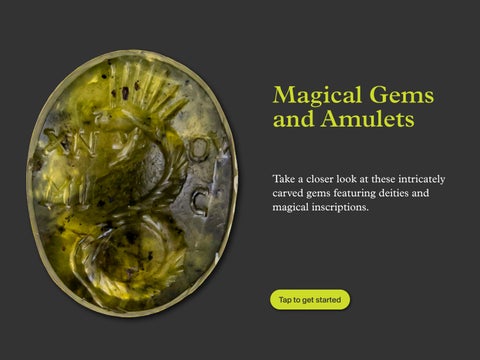
Magical Gems and Amulets
Take a closer look at these intricately carved gems featuring deities and magical inscriptions.
Tap to get started
Object Overview
Tap the object you’d like to learn more about here or use the white arrows to flip through.


Magical Gem with the God Mios
Roman, 2nd–3rd centuries CE.
Red jasper
Said to be from Saqqara, Egypt
The Brooklyn Museum, Charles Edwin Wilbour Fund, 37.1755E
The lion-headed deity Mios was worshipped at Leontopolis, a city in Egypt’s Nile Delta. On this amulet he is shown carrying an ankh (symbol of life), holding a lion-headed staff, and wearing a solar disc, which equates him with the sun god Horus. The inscribed prayer to Mios addresses him by his many names and appeals for divine favor on behalf of a man named Ammonios.
Object Overview


Magical Gem with Osiris
Roman, 2nd-3rd centuries
CE
Lapis lazuli
Kelsey Museum of Archaeology, University of Michigan, 1963.04.0002
The Egyptian god Osiris, shown as a mummy, stands on a winged scarab beetle. Surrounding him is the ouroboros, a snake with its tail in its mouth, symbolizing protection. The back and sides of the gem are covered in magic names and permutations of vowels, which were thought to have special powers.
Object Overview


Magical Gem with Serapis
Roman, 2nd–3rd centuries CE
Jasper
Kelsey Museum of Archaeology, University of Michigan, 0000.02.6072
The Ptolemaic Greek rulers of Egypt introduced the deity Serapis into the local pantheon in the 3rd century BCE. Here Serapis sits enthroned within an ouroboros (snake with its tail in its mouth). The inscription includes a magical palindrome and an enigmatic formula of uncertain purpose.
Object Overview


Magical Gem with Harpocrates on a Solar Boat
Roman, 2nd–3rd centuries CE Hematite
Kelsey Museum of Archaeology, University of Michigan, 0000.02.6109
The Egyptian god Harpocrates sits on a lotus flower in the center of the papyrus boat that sails daily across the sky. He is accompanied by other deities, along with groups of scarabs, snakes, goats, hawks, and crocodiles. On the reverse of the gem is a scarab beetle flanked by hawks and a magical inscription of uncertain purpose.
Object Overview


Magical Gem with Osiris, Isis, and Nephthys
Roman, 2nd–3rd centuries CE
Bloodstone in gold mount
University of Michigan Library (Special Collections Research Center), SCL-Bonner 56

Still in its original gold pendant frame, this amulet depicts the Egyptian deity Osiris mummified and standing between the sister goddesses Isis and Nephthys aboard a papyrus boat. The reverse side shows the god Serapis mummified, along with the Egyptian magical name Bainchoooch, “spirit of darkness.”
Object Overview


Magical Gem with Chnoubis
Roman, 2nd–3rd centuries CE
Green chalcedony
Kelsey Museum of Archaeology, University of Michigan, 0000.02.6009
Magical gems engraved with the lion-headed serpent Chnoubis (or Chnoumis) were especially popular during the Roman period. He was an Egyptian astrological deity known as a decan and was believed to have influence over the human body—specifically, the stomach and womb. Most Chnoubis amulets are carved from green stone, which was thought to have special healing properties.
Object Overview


Magical Gem with Double-Headed Deity
Roman, 2nd–3rd centuries CE
Hematite
Kelsey Museum of Archaeology, University of Michigan, 0000.02.6059
Like Chnoubis, on a nearby gem, this unnamed deity with two heads—one a snake and the other an ibis—was likely an astrological god. The inscription on the reverse side of the gem includes the command “Digest!,” indicating the amulet was intended to heal stomach ailments.
Object Overview


Magical Gem with Harpocrates and the Womb Roman, 2nd–3rd centuries CE Carnelian
University of Michigan Library (Special Collections Research Center), SCL-Bonner 19
Within an ouroboros (snake with its tail in its mouth), the god Harpocrates sits on a potlike symbol representing the human womb. His hand rests on a key that is meant to seal it, probably to promote pregnancy. The lengthy magic formula carved into the gem includes the word Ororiouth, a secret name for the deity believed to control the uterus.
Object Overview


Magical Gem with Lizard
Roman, 2nd–3rd centuries CE Green chalcedony
The J. Paul Getty Museum, Villa Collection, 81.AN.11.1
Gems of this type were used to treat eye diseases. It displays a lizard and a crescent moon, along with a Greek inscription that probably means “blind” and “heal the eye.” Lizards were believed to have the ability to regenerate their eyes, and the waning moon indicates the proper time of month for performing the healing ritual.
Object Overview

Magical
Gem with Cow-Headed Hekate
Roman, 2nd–3rd centuries CE
Black jasper
Kelsey Museum of Archaeology, University of Michigan, 0000.02.6055
This gem shows Hekate, the Greek goddess of magic, holding two torches. Unusually, she has been given the head of a cow, the sacred animal of the Egyptian deity Hathor, with whom she was sometimes equated. It is undecorated on the reverse side.
Object Overview


Magical Gem with Snake-Legged Deity
Roman, 2nd–3rd centuries CE
Green and red jasper
Kelsey Museum of Archaeology, University of Michigan, 0000.02.6054
This strange creature with the body and arms of a soldier, the head of a rooster, and snakes for legs appears frequently on magical gems, but his identity remains uncertain. He carries a whip and a shield, suggesting a protective role, and inscriptions often equate him with the sun god or the Jewish god Yahweh.
On this gem, the long inscription includes the names of the archangels Michael, Raphael, Gabriel, and Ouriel. The reverse side shows an eagle-headed Egyptian god whose identity is also unknown.
Object Overview

Magical Gem with Lion
Roman, 2nd–3rd centuries
CE
Rock crystal
Kelsey Museum of Archaeology, University of Michigan, 0000.02.6050
This rock crystal amulet displays a lion and a sun, representing the astrological sign of Leo. It was carved in the form of a pendant and pierced at the top so it could be suspended. The inscription names the Jewish god Yahweh and the magical name Abrasax, which refers to the sun god.
Object Overview


Magical Gem with Herakles and the Nemean Lion
Roman, 2nd–3rd centuries CE
Red jasper
Bibliothèque nationale de France, Inv.58.2220bis
Carved in red jasper, a stone believed to have healing powers, this amulet shows the hero Herakles subduing the Nemean Lion. The gem was meant to cure abdominal pain or colic, as indicated by the inscribed Greek spell, which reads, “Withdraw, bile, the god drives you away!”
The reverse side displays the triple-bodied goddess of magic, Hekate, along with the names of the Jewish god Yahweh and the magical figure Abrasax.
Object Overview
Magical Gems and Amulets
Return to Start
Object Overview

