

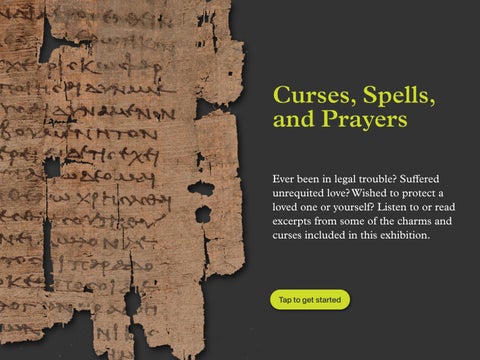
Curses, Spells, and Prayers
Ever been in legal trouble? Suffered unrequited love? Wished to protect a loved one or yourself? Listen to or read excerpts from some of the charms and curses included in this exhibition.
Tap to get started
Object Overview
Tap the object you’d like to learn more about here or use the white arrows to flip through.


Jewish Amulet Invoking Angels
Roman, 3rd century CE. Silver.
The J. Paul Getty Museum, Villa Collection, 80.AM.55.2
In ancient Jewish tradition, hosts of angels were thought to protect from illness and demonic forces. In the inscription on this silver amulet, a woman invokes 31 different angels by name.
Jewish Amulet Invoking Angels
Translated Inscription:
I call upon you, Holy Angels, that you heal Arsinoë from every illness: Prince of the hosts of YHWH, Michael; and the man, Gabriel; and Raphael, master of healing; and ‘Anael, who answers [the prayers of] the daughters of Eve; Sadqiel, ‘Uriel, Nahariel, Seraphiel, Barqiel, Yakonel, Suriel, Suriel, Rahabiel, Ramiel, Harbiel, Shatqiel, Doliel, and Yahobel, Sitriel, ‘Azriel, Sammael, ‘Azazel, Yehezqel, Yaqtiel, ‘Amsiel, and ‘Uzziel, Nuriel, and ‘Amatiel, and ‘Amoriel, and ‘Emuniel, and ‘Anaquiel. I pray of you, heal Arsinoë from every evil spirit. For Thy loving-kindness and truth.
Translation end. Translated by Roy Kotansky
Play Translation


Womb Amulet and Case
Roman, 1st century CE. Gold.
Said to be from Beirut, Lebanon.
Bibliothèque nationale de France, Inv.56.286–87
This gold tablet is inscribed in Greek with a spell to ensure a woman’s health. Rolled up and placed in the tubular amulet case to be worn around the neck, the tablet commands the womb to remain in its proper place. The spell reflects an ancient belief that the uterus could wander inside the body and cause illness.
Object Overview
Womb Amulet and Case
Translated Inscription:
I adjure you, O womb of Ipsa, whom Ipsa bore—in order that you never abandon your spot—in the name of the unconquerable living Lord God, to remain at your spot, that of Ipsa whom Ipsa bore.
Translation end.
Play Translation

Object Overview

Amulet to Influence a Legal Case
Roman, 4th century CE. Gold. From Bostra (Bosra, Syria).
The Walters Art Museum, Gift of the children of Robert Garrett, 1964, 57.1960
This highly specific charm was composed for a man named Proclus to help him win a lawsuit brought before the Roman military governor of Arabia in the city of Bostra, in present-day Syria.
Object Overview
Amulet to Influence a Legal Case
Translated Inscription:
Holy and strong, mighty and great-powerful Name, give favor, glory, victory to Proclus whom Salvina bore, before Diogenianus the Dux of Bostra in Arabia, before Pelagius the assessor, and before all men small and great; before gods; before demons, in order that he might be justifiably or unjustifiably victorious in any judgment before any judge; before a magister; before all who observe him and who hear him and his words.
Establish him strong. Make [him] a victor over everyone, particularly over Salvina, whom Eve bore […] in order that Proclus, whom Salvina bore, might receive victory and glory. Silence, subjugate, and enslave
Play Translation
Salvina, whom Eve bore […] and all enemies, opponents, and associates […] and all opposing parties, small and great, men, women, and children—all who are watching Proclus, whom Salvina bore, the one bearing your holy and unconquerable power. And give [him] power, victory, favor, courage, boldness, [raising] awe in everyone, in all fortune and life, in every place, according to every hour, both day and night. And may no one act in opposition in anything at all except for the victory, favor, glory, power for the one bearing your glory; now, now; quickly, quickly, quickly. Amen!
Translation end. Translation by Roy Kotansky.
Object Overview

Encrypted Magical Papyrus
Egyptian, 2nd century CE. Papyrus and ink.
University of Michigan Library (Papyrology Collection), P.Mich.inv. 534
To protect the secrecy of this magical handbook, the text substitutes special symbols for the Greek letters. Once decoded, the papyrus provides instructions for various rituals and the recitation of magical names. One spell, addressed to the Egyptian goddess Isis, asks that the practitioner be graced with beauty.
Object Overview
Encrypted Magical Papyrus
Translated Inscription:
[The] compulsive spell in order to show you whether the matter has been carried out: Burn cypress with the strip of papyrus and say: [Isis,] holy maiden, give me a sign of the things that are going to happen, reveal your holy veil, shake your black [Tyche] and move the constellation of the bear, holy [IOTHE] PNOUN GMOERMENDOUMPA great-named [IAKO] PHTHOERI THERMOER PHTHAO, great-named IOTHE [PHNOU]THOUER BOB HELIX, greatnamed IAKO...
Play Translation

Object Overview
Encrypted Magical Papyrus
Translated Inscription Continued:
When you have said this and at the same time have opened your hands, the goddess will remove the [edge] of your hand from your breast. For you will see [a star being led] of necessity [to you], at which you are to look [intently], as it flashes [a picture] while rushing [toward you], so that you become stricken of God. [Wear the] above picture [for protection]. [For], in the name of [the goddess], it is a [picture] of Kronos who encourages you. After you have received this sign, rejoice at your [fortune] and say once: CHAITHRAI. For when you have said this, she will cooperate with you
Play Translation
[in whatever] you pray for. And immediately say these words, [lest] there occur a removal of the stars and your lucky day: THA [...]
OUSIR PHNOUCH MELLANCHIO
KERDO MELIBEU [...] KASP [...]
NEBENTHTRIX
GARN
[...]
O THRAO
SAU TRAIS TRAIS BASYM; immediately, immediately, accomplish this, within this moment. Very glorious Pronoia, make the one who yesterday was [unlovable] beautiful [in the sight of all], make ... [former] ...
Translation end. Translation by R.
F. Hock.
Object Overview

Papyrus with a Magician’s Monologue
Egyptian, 2nd–3rd centuries CE
Papyrus and ink
Ann Arbor, University of Michigan Library (Papyrology Collection), P.Mich.inv. 5
Description: Probably part of a work of fiction rather than a magical handbook, this Greek papyrus preserves the words of a magician boasting of their own magical skills. And yet, the magician laments the futility of finding a drug to counteract the power of love.
Object Overview
Papyrus with a Magician’s Monologue
Translated Inscription Continued:
If I order the moon, it will descend; if I wish to prevent the day, night will linger on for me; and again, if we demand the day, the light will not depart; if I wish to sail the sea, I have no need of a ship; if I wish to move through the air, I shall become weightless. For love alone I find no drug, none with power to create it, none with power to abate it. For the earth in fear of that god bears no such plant. But if anyone has it to give, I beseech, I implore, “Give it to me—I wish to drink it down, I wish to rub it on.” A fair image is appearing to your daughter you say, and this seems strange to you? But how many others have fallen in love with outlandish creatures. . .
Translation end.
Play Translation

Object Overview

Love Charm for Four Women
Roman, 3rd century CE
Lead
Said to be from Tunisia
Malibu, California, The J. Paul Getty Museum, Villa Collection, Gift of Stefan Hornak, 83.AI.244
In a lengthy and meticulously inscribed Greek erotic charm, a man named Gaius seeks the affection of four different women: Postuma, Tertullina, Perpetua, and Candida. Calling upon the gods of the Underworld, he commands the spirit of a dead man to compel the women to fall helplessly and passionately in love with him.
Object Overview
Love Charm for Four Women
Translated Inscription:
Let Earth open up to me! Let Hades open up to me! Let the holy tomb of Osiris open up to me! Let the gates of Hades open up for me! And, having raised him up, send up to me—among the spirits of the dead under your control—that single deceased soul, bound by fear and trembling. . .
I adjure you, deceased soul of the dead, whoever you might be, by Osiris beneath the earth. I adjure you by the prince of deceased souls, bind, compel to come Postuma and Tertullina and Perpetua and Candida, for my lust, and passion for Gaius, now, now; quickly, quickly! Translation end. Translation by Roy Kotansky. Play Translation

Object Overview

Magical Papyrus with Rituals
Addressed to Hekate
Egyptian, late 3rd–early 4th centuries CE
Papyrus and ink
Ann Arbor, University of Michigan Library (Papyrology Collection), P.Mich.inv. 7
This fragment of a Greek magical handbook includes a series of rituals addressed to the goddess of magic Hekate, who is also called by her Babylonian name, Ereschigal. The spells include one to protect from demonic harm, another to counteract other magical spells, and a love charm.
Object Overview
Encrypted Magical Papyrus
Translated Inscription:
[— This] name [is] a favor charm, a charm to dissolve a spell, a phylactery, and a victory charm: “AA EMPTOKOM BASYM, protect me.” Charm of Hekate Ereschigal against fear of punishment [in the underworld]: If he [a punishment daimon] comes forth, say to him: “I am Ereschigal, the one holding her thumbs, and not even one evil can befall her.” If, however, he comes close to you, take hold of your right heel and recite the following: “Ereschigal, virgin, bitch, serpent, wreath, key, herald’s wand, golden sandal of the Lady of Tartaros.” And you will avert him.
Translation

Encrypted Magical Papyrus
Translated Inscription Continued:
“ASKEI KATASKEI ERON OREON IOR
MEGA SAMNYER BAUI (three times)
PHOBANTIA SEMNE, I have been initiated, and I went down into the [underground] chamber of the Dactyls, and I saw the other things down below, virgin, bitch, and all the rest.” Say it at the crossroad, and turn around and flee, because it is at those places that she appears. Saying it late at night, about what you wish, it will reveal it in your sleep; and if you are led away to death, say it while scattering seeds of sesame, and it will save you.
Play Translation

Encrypted Magical Papyrus
Translated Inscription Continued:
“PHORBA
PHORBA BRIMO AZZIEBYA.”
Take bran of first quality and sandalwood and vinegar of the sharpest sort and mold a cake. And write the name of so-and-so upon it, and inscribe it in such a way that you speak over it into the light the name of Hekate, and this: “Take away his sleep from such-and-such a person,” and he will be sleepless and worried. Against fear and to dissolve spells: Speak through [two] knives [sounding loudly] this formula, but [against] evil animals it does not work [compellingly], for [—]
Translation end. Translation by H.
D. Betz.
Play Translation
Object Overview
Curses, Spells, and Prayers
Return to Start
Object Overview

