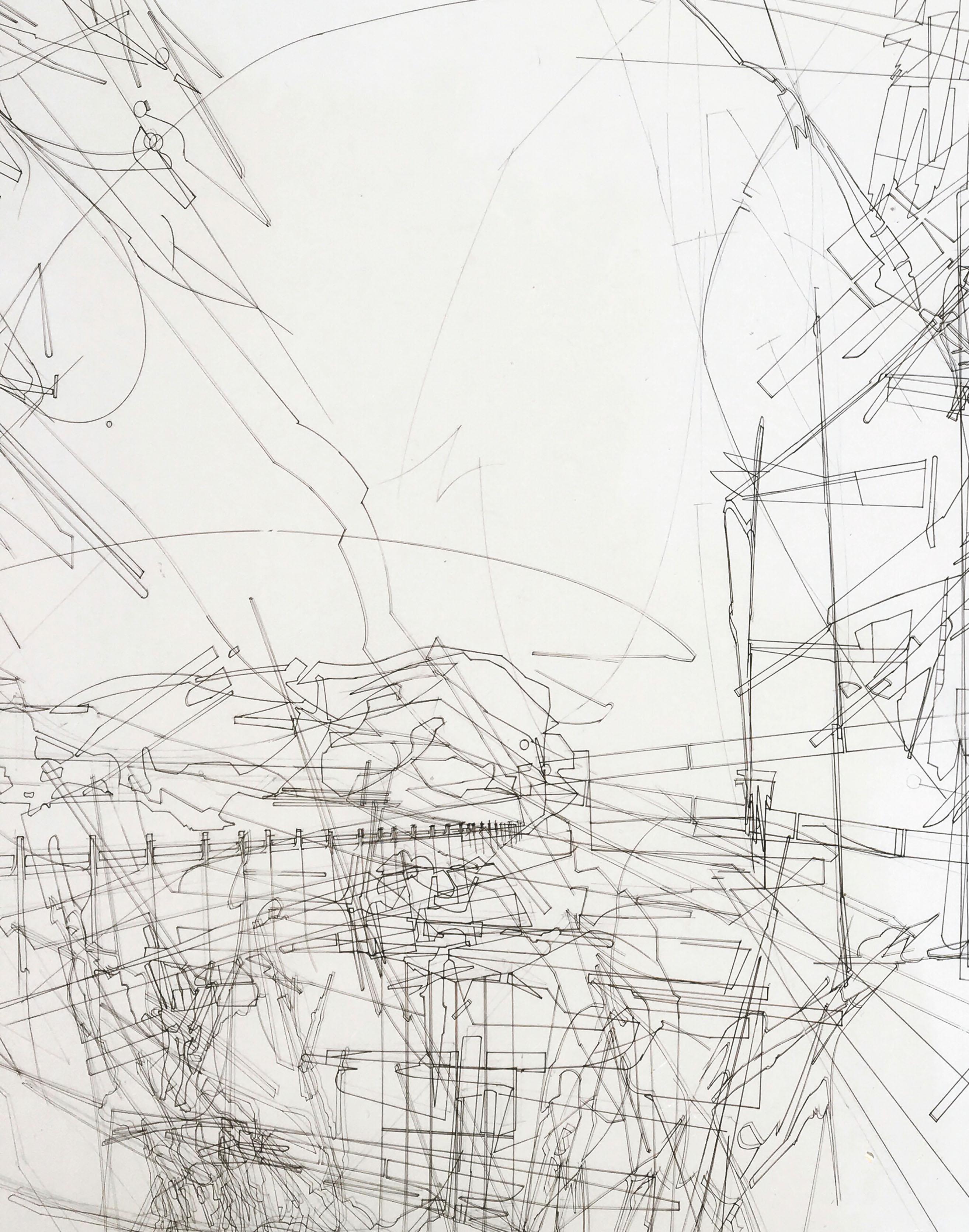
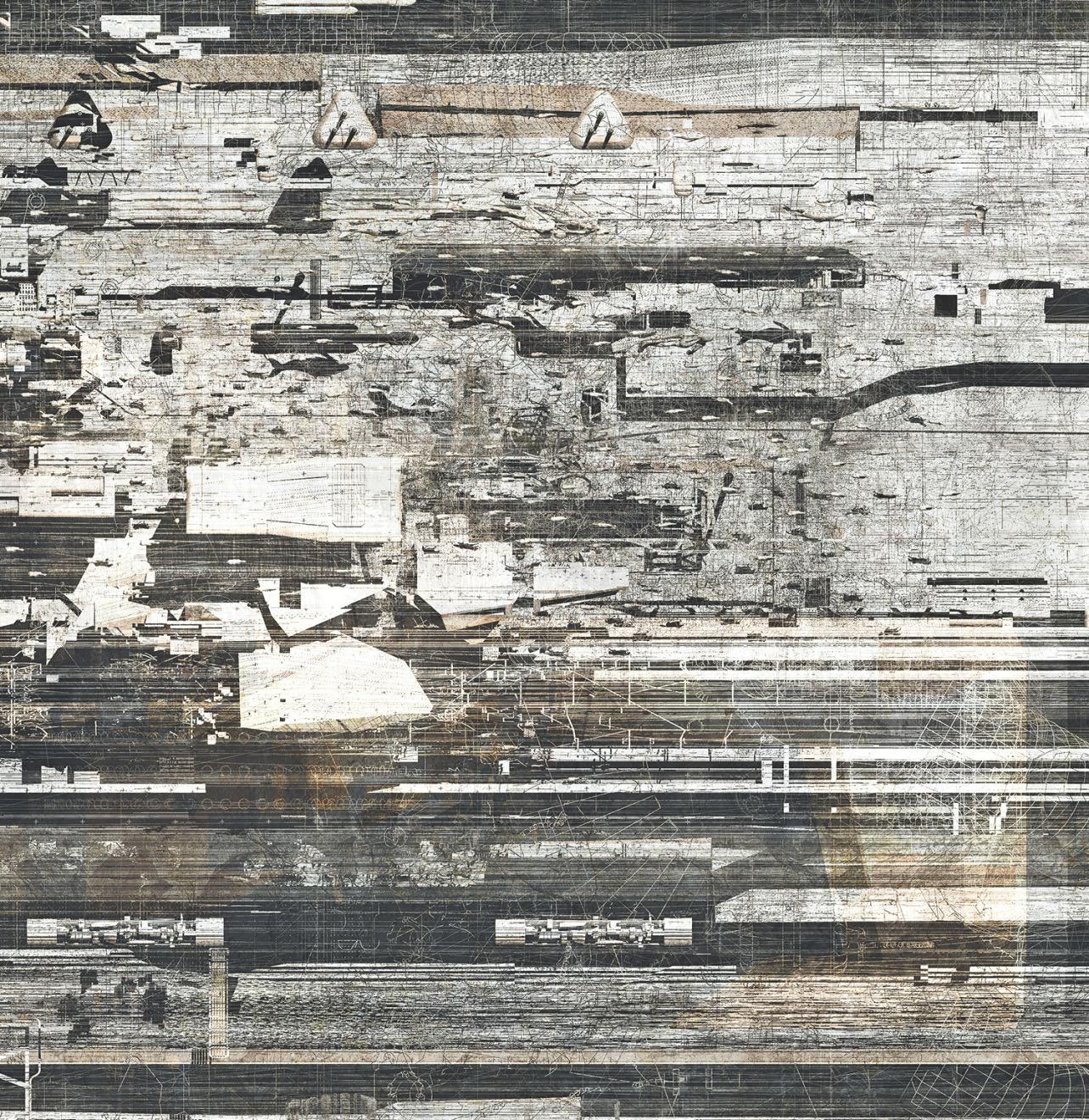
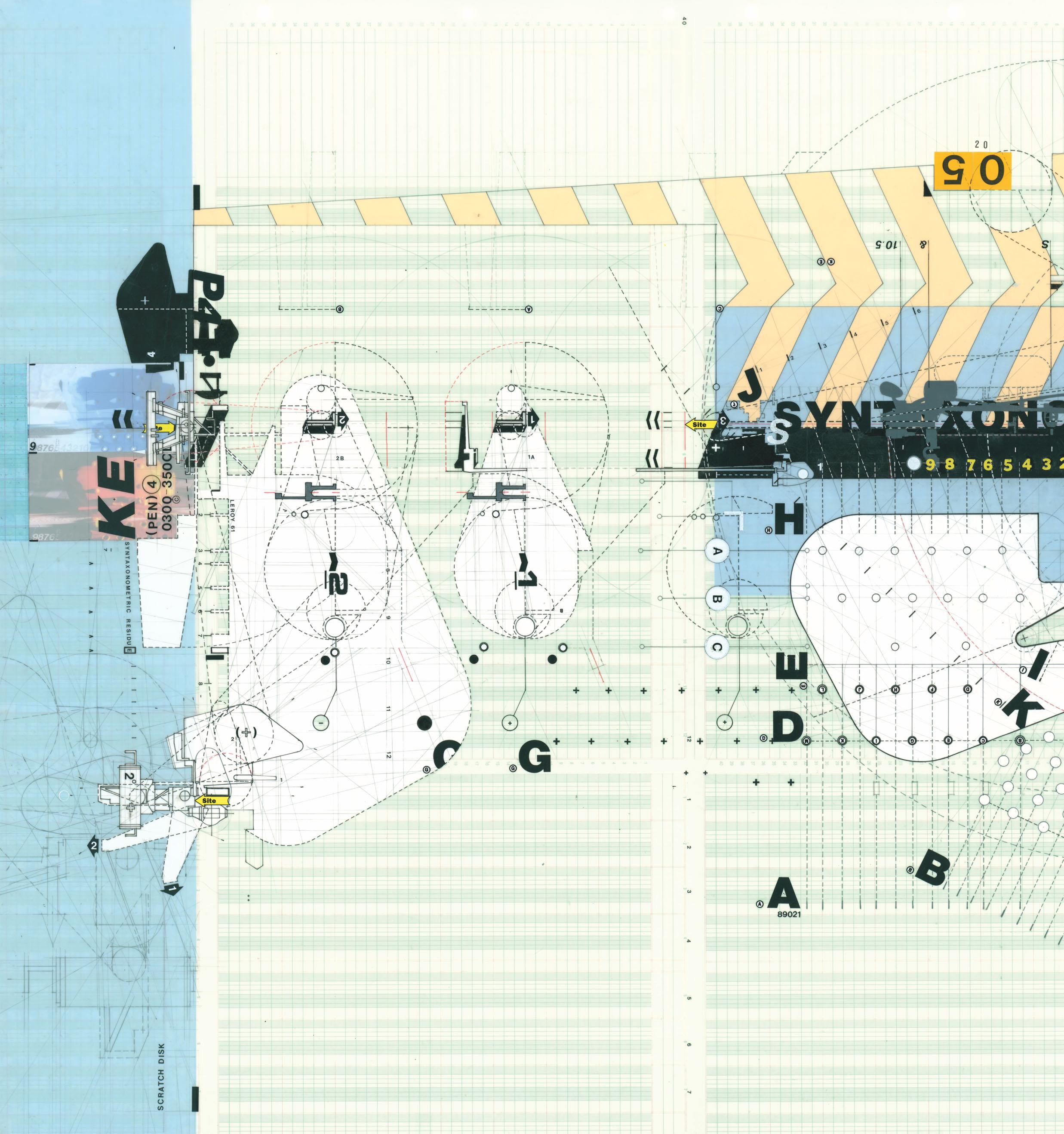
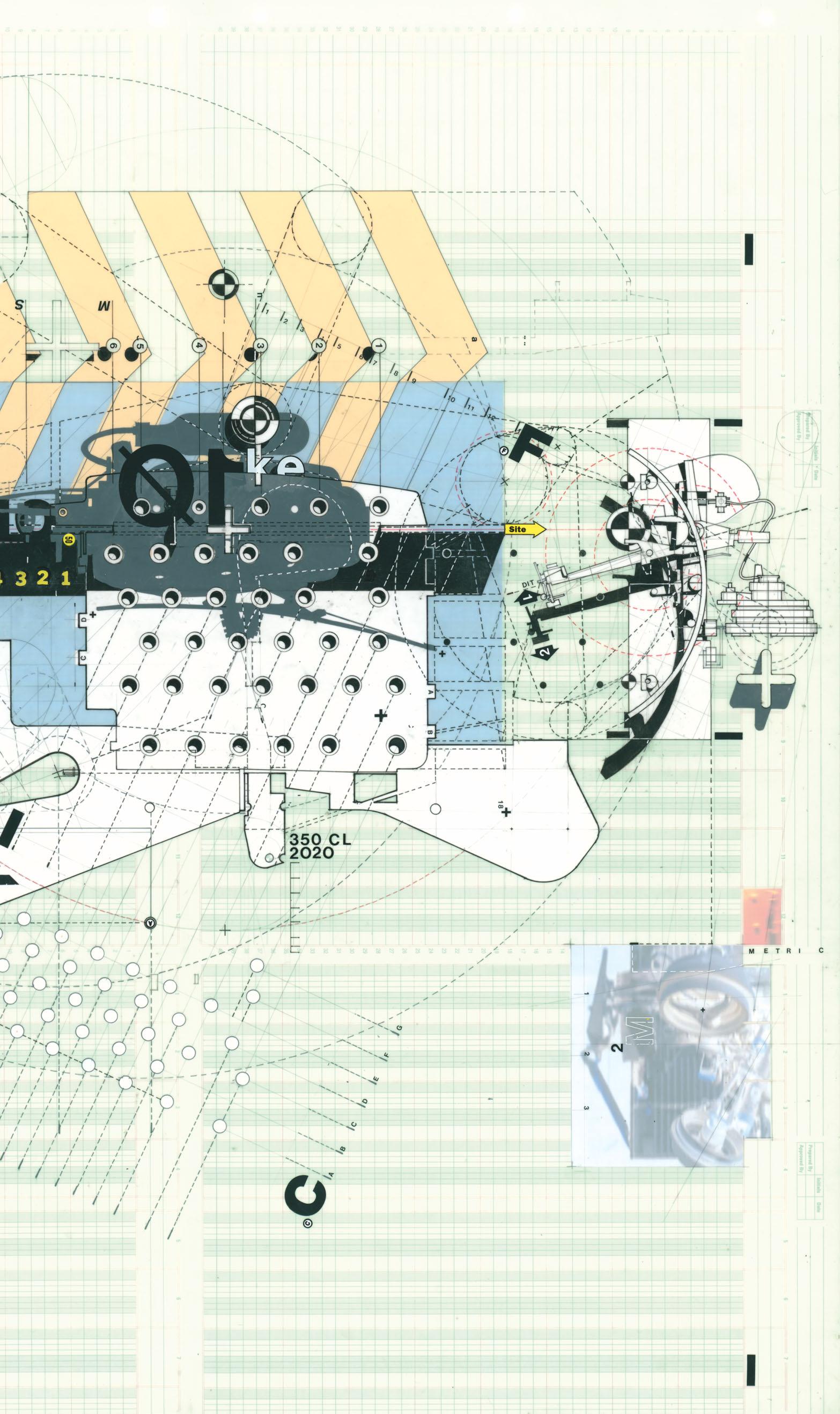
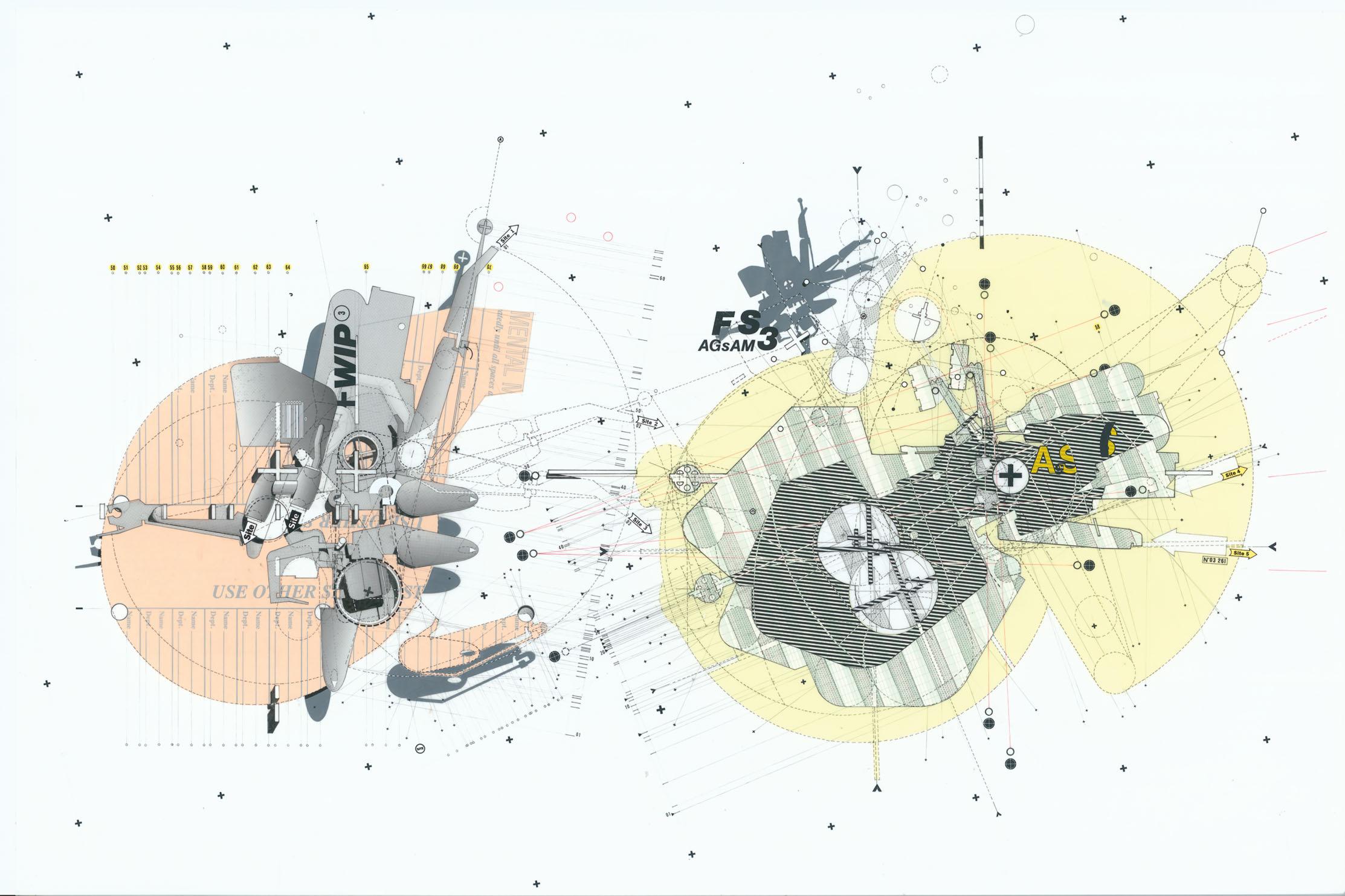
‘The architects featured in this 2 have developed numerous ways to posit architectural work that pushes the boundaries of their own cataractic eyes, and in so doing have created new ways of seeing for themselves and methodologies to help them see with different eyes.’
— Neil Spiller
Editorial Offices
John Wiley & Sons
9600 Garsington Road
Oxford OX4 2DQ
T +44 (0)18 6577 6868
Editor Neil Spiller
Managing Editor
Caroline Ellerby
Caroline Ellerby Publishing
Freelance Contributing Editor
Abigail Grater
Publisher Todd Green
Art Direction + Design
Christian Küsters
CHK Design
Production Editor
Elizabeth Gongde
Prepress
Artmedia, London
Printed in the United Kingdom by Hobbs the Printers Ltd
EDITORIAL BOARD
Denise Bratton
Paul Brislin
Mark Burry
Helen Castle
Nigel Coates
Peter Cook
Kate Goodwin
Edwin Heathcote
Brian McGrath
Jayne Merkel
Peter Murray
Mark Robbins
Deborah Saunt
Patrik Schumacher
Ken Yeang
Journal Customer Services For ordering information, claims and any enquiry concerning your journal subscription please go to www.wileycustomerhelp .com/ask or contact your nearest office.
Americas
E: cs-journals@wiley.com
T: +1 877 762 2974
Europe, Middle East and Africa
E: cs-journals@wiley.com
T: +44 (0)1865 778 315
Asia Pacific
E: cs-journals@wiley.com
T: +65 6511 8000
Japan (for Japanesespeaking support)
E: cs-japan@wiley.com
T: +65 6511 8010
Visit our Online Customer Help available in 7 languages at www.wileycustomerhelp .com/ask
Print ISSN: 0003-8504
Online ISSN: 1554-2769
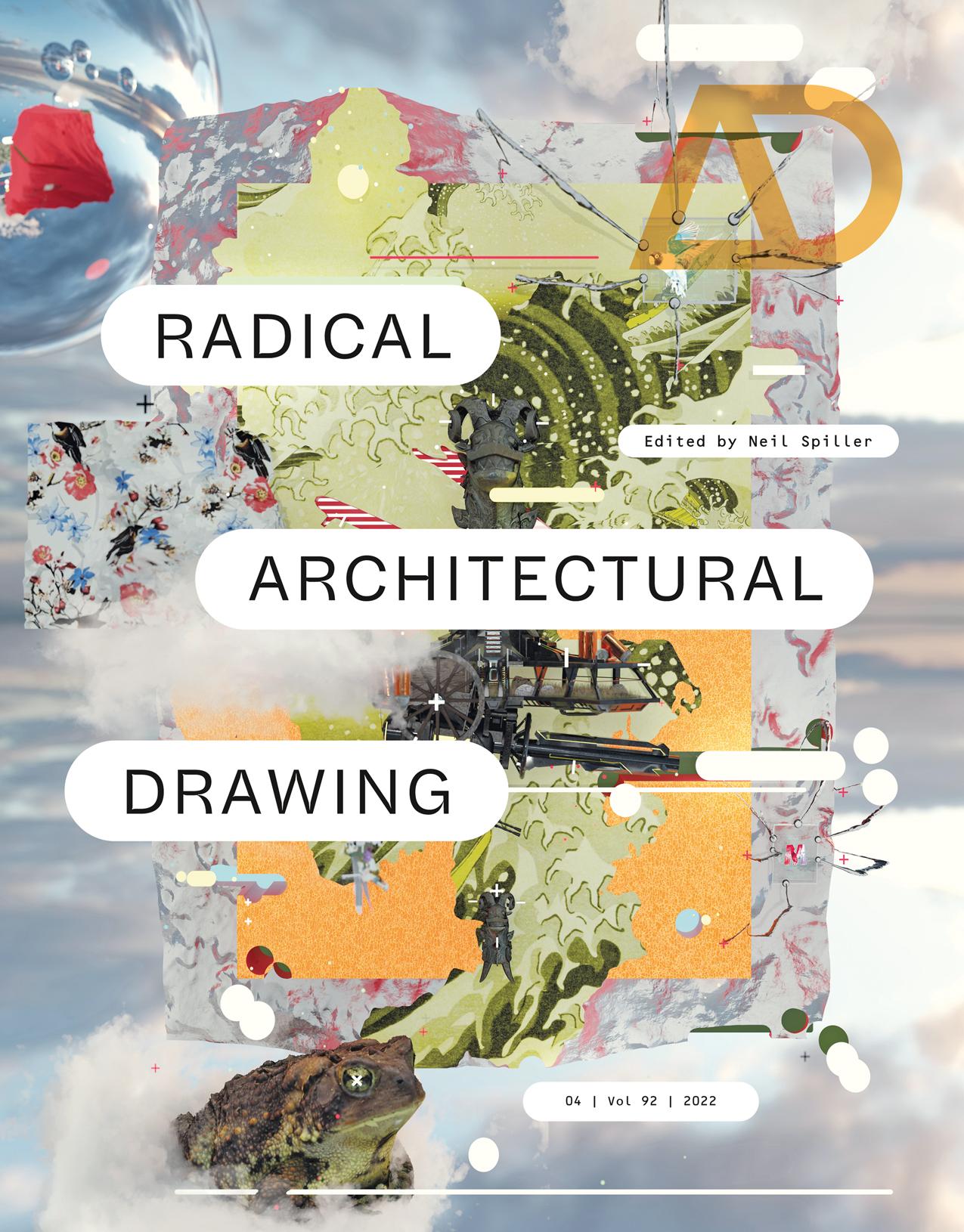
Front cover
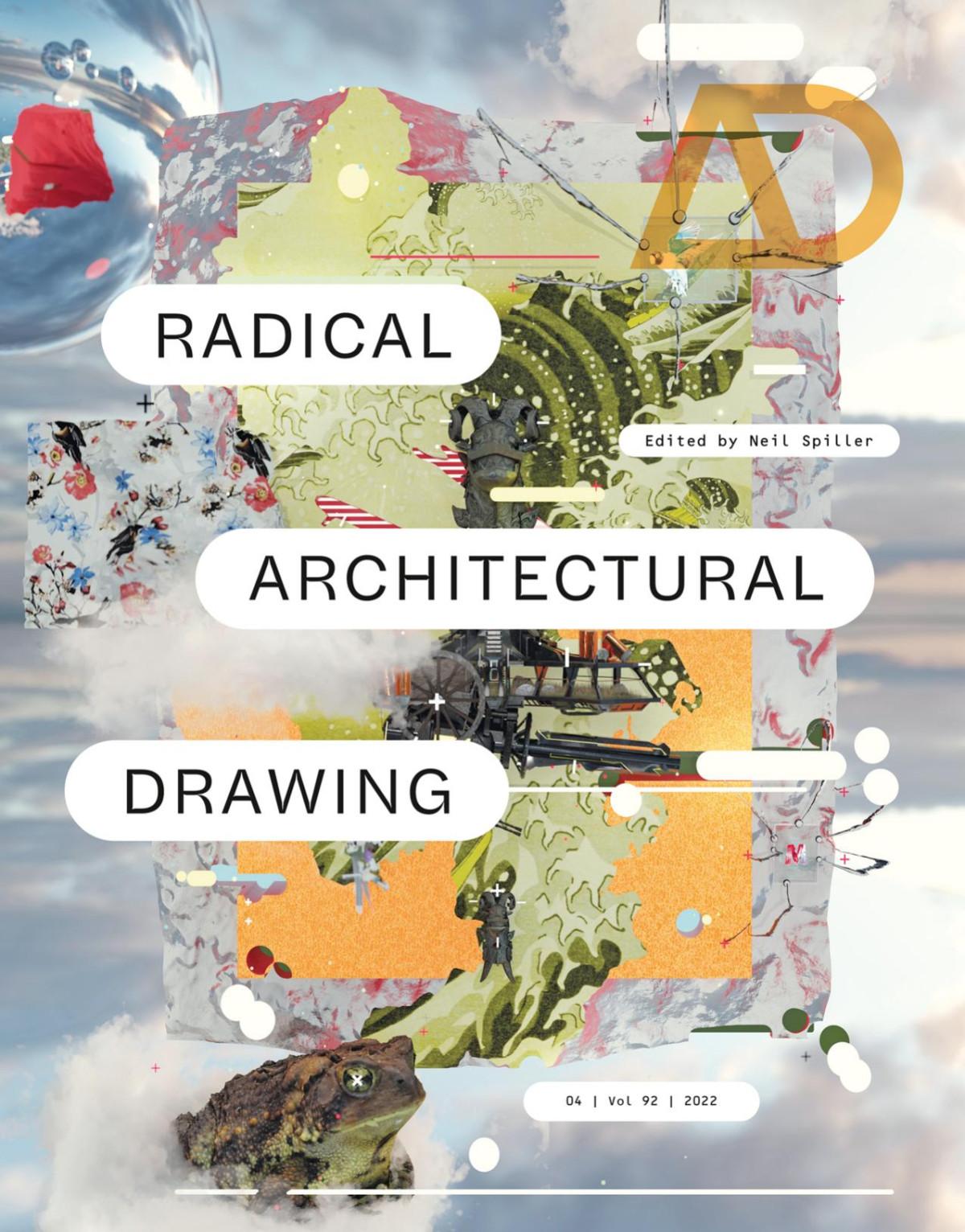
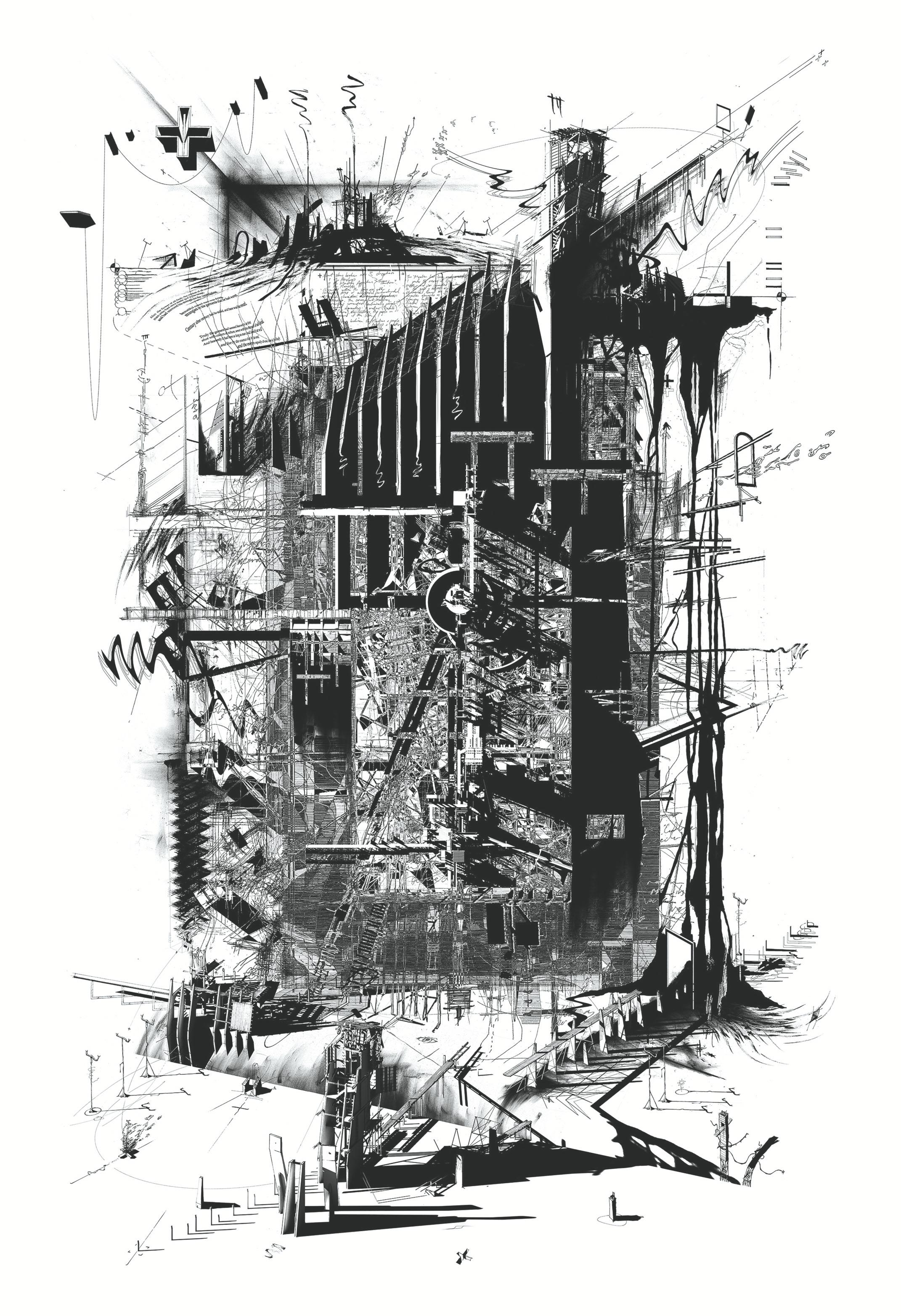
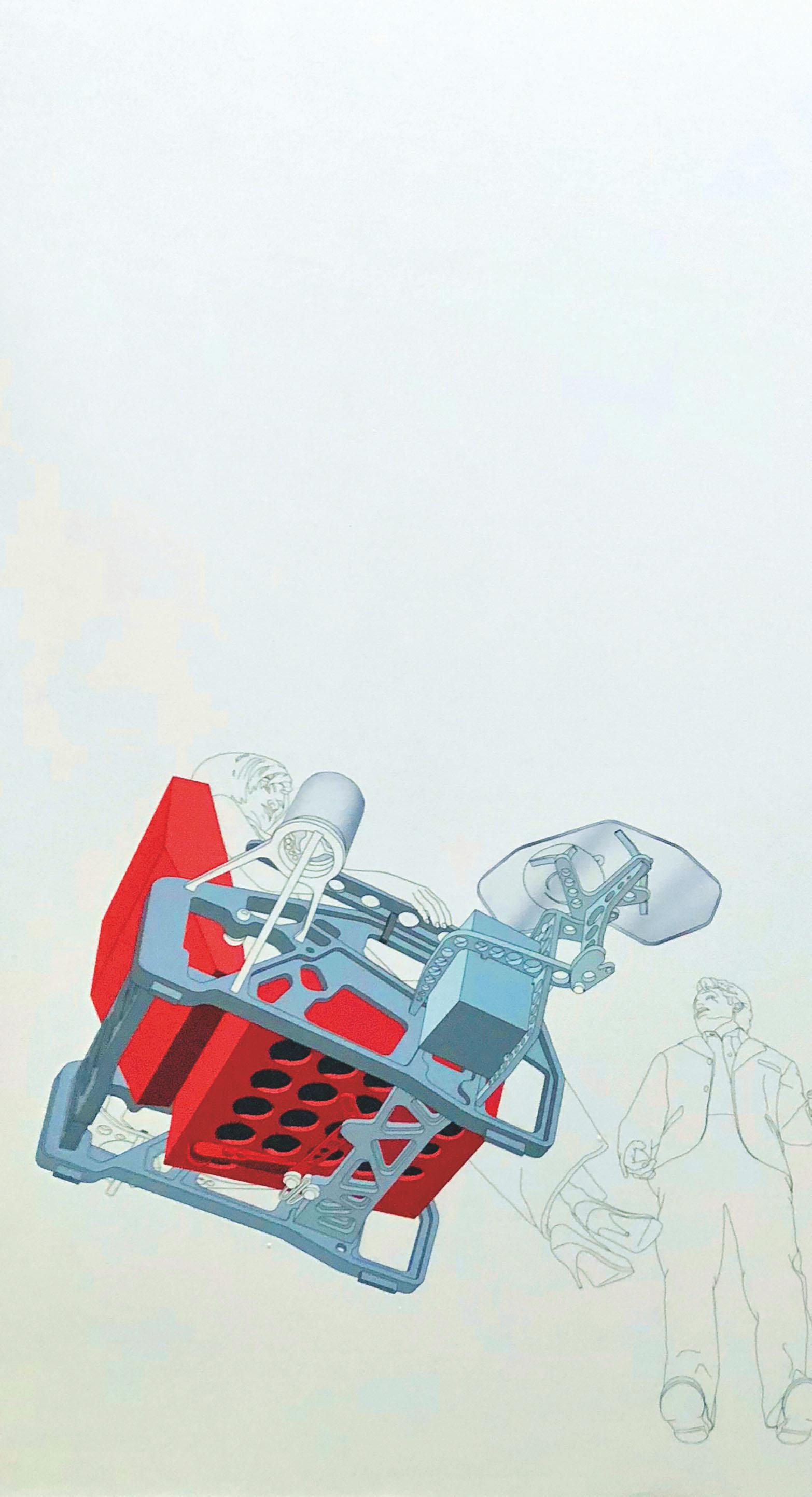
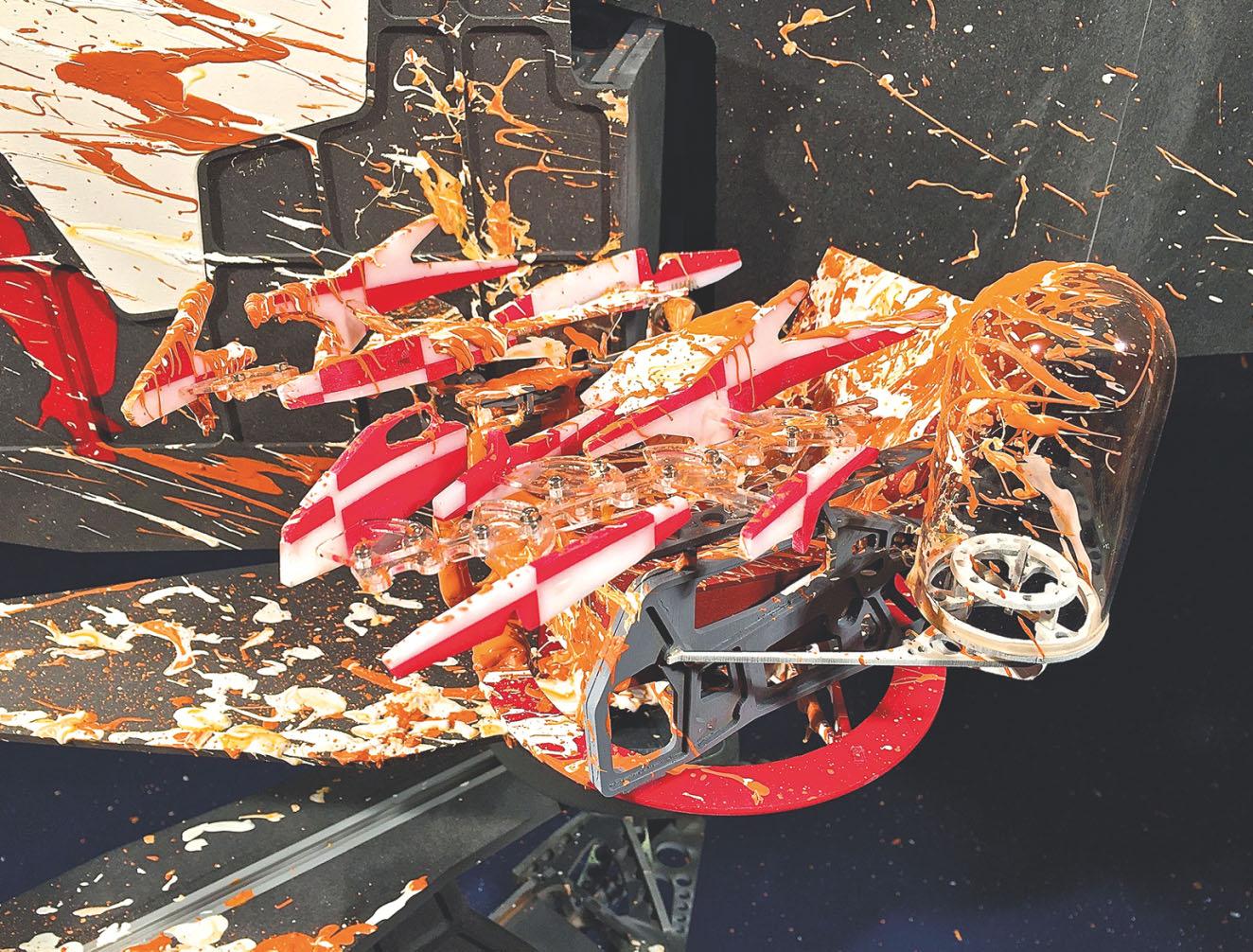
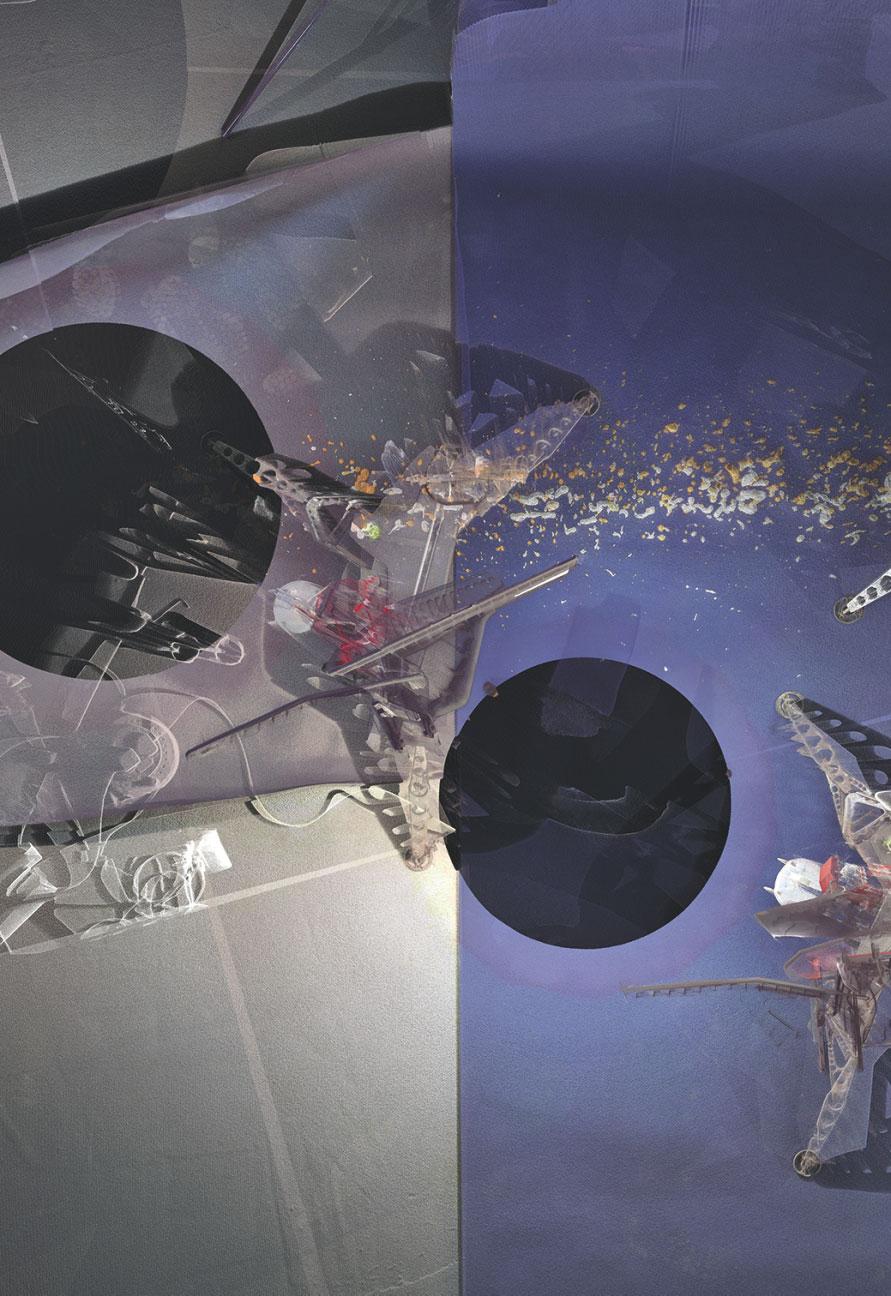
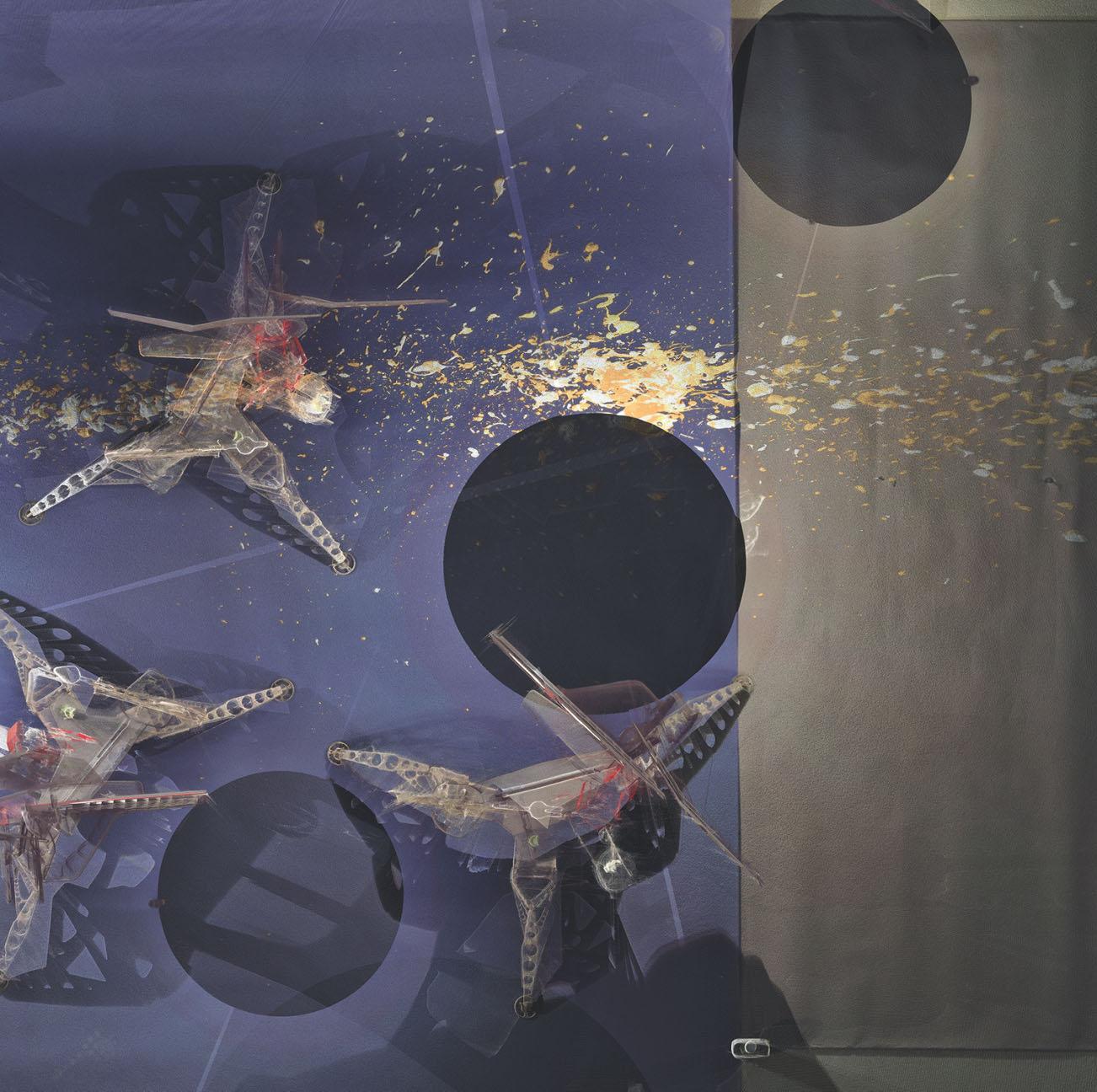
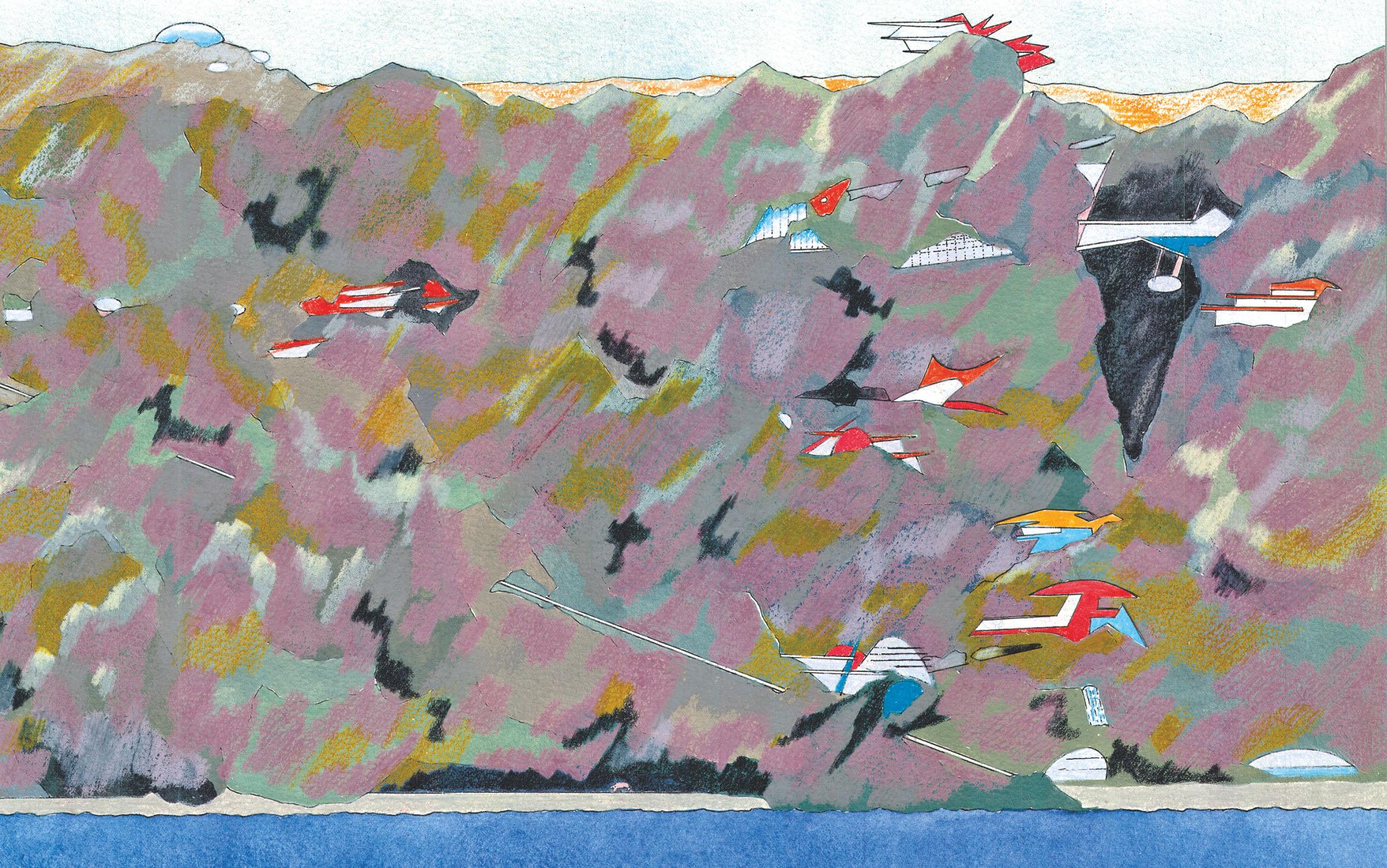
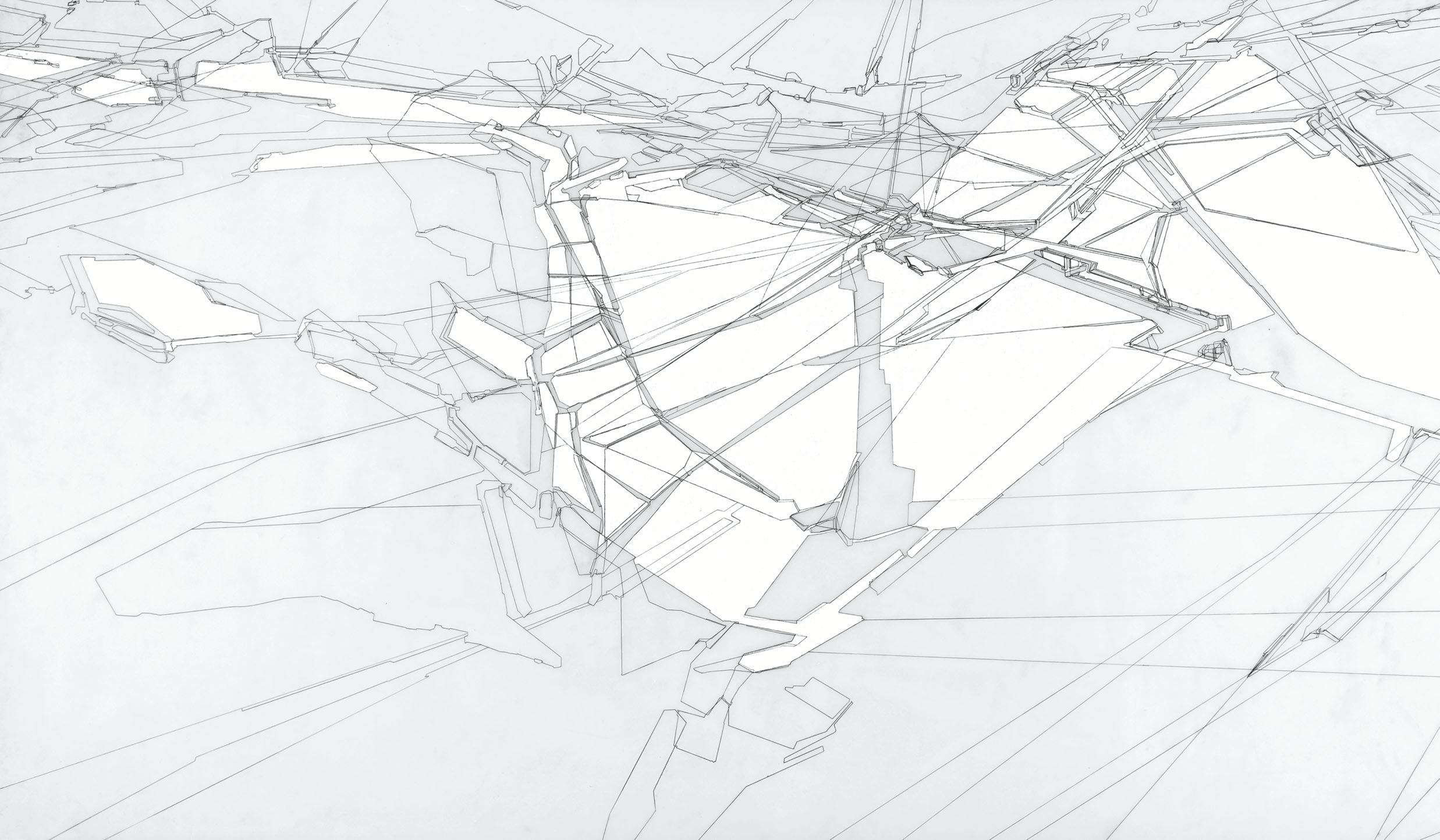
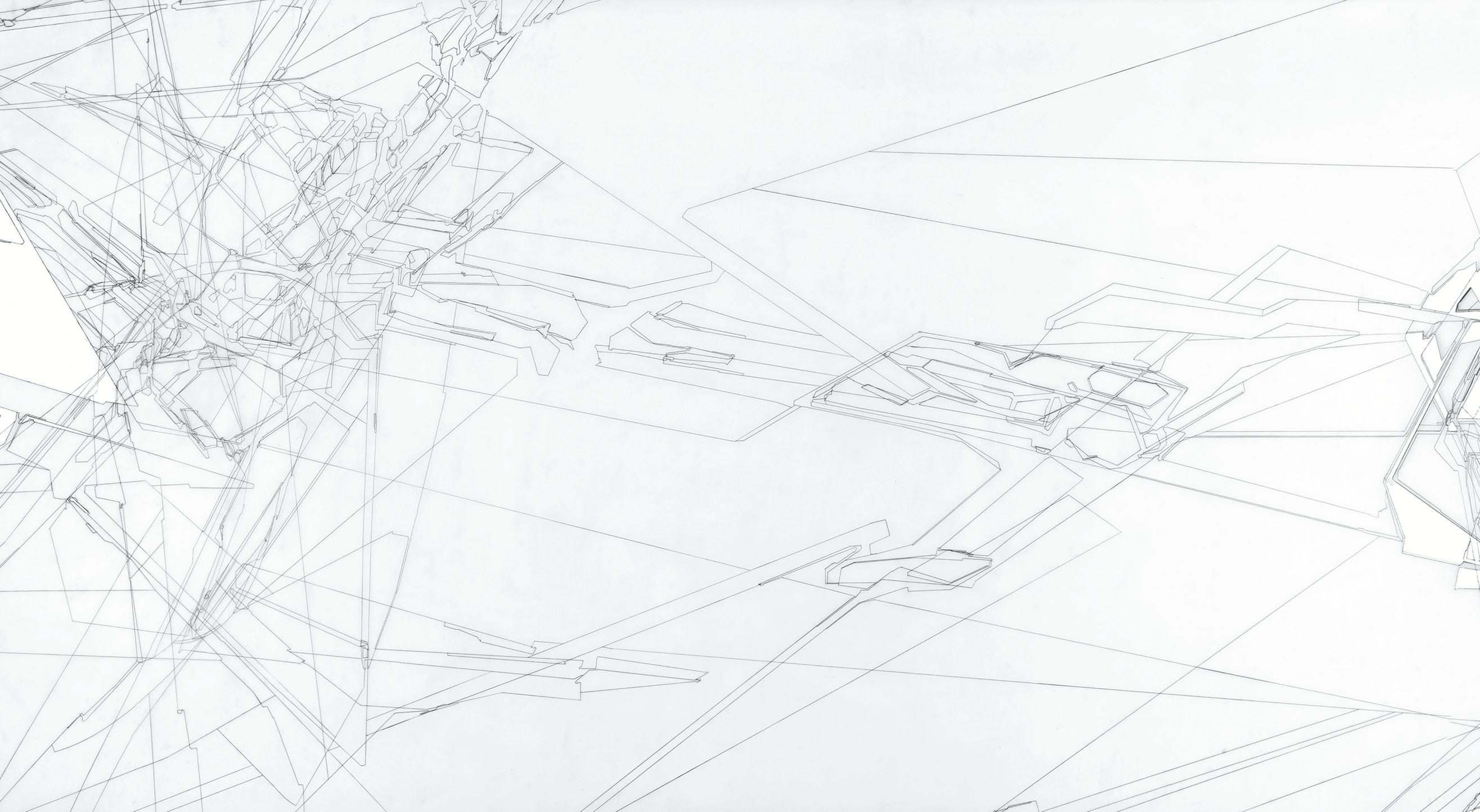
Perry Kulper in collaboration with Oliver Popadich, Aerial Diptych Folly, v.03, Frontal, 2018.
Rights and Permissions Requests to the Publisher should be addressed to: Permissions Department
John Wiley & Sons Ltd
The Atrium
Southern Gate
Chichester West Sussex PO19 8SQ UK
F: +44 (0)1243 770 620 E: Permissions@wiley.com
All Rights Reserved. No part of this publication may be reproduced, stored in a retrieval system or transmitted in any form or by any means, electronic, mechanical, photocopying, recording, scanning or otherwise, except under the terms of the Copyright, Designs and Patents Act 1988 or under the terms of a licence issued by the Copyright Licensing Agency Ltd, 5th Floor, Shackleton House, Battle Bridge Lane, London SE1 2HX, without the permission in writing of the Publisher.
Disclaimer
The Publisher and Editors cannot be held responsible for errors or any consequences arising from the use of information contained in this journal; the views and opinions expressed do not necessarily reflect those of the Publisher and Editors, neither does the publication of advertisements constitute any endorsement by the Publisher and Editors of the products advertised.
Prices are for six issues and include postage and handling charges. Individual-rate subscriptions must be paid by personal cheque or credit card. Individual-rate subscriptions may not be resold or used as library copies.
All prices are subject to change without notice.
Identification Statement Periodicals Postage paid at Rahway, NJ 07065. Air freight and mailing in the USA by Mercury Media Processing, 1850 Elizabeth Avenue, Suite C, Rahway, NJ 07065, USA.
USA Postmaster
Please send address changes to Architectural Design, John Wiley & Sons Inc., c/o The Sheridan Press, PO Box 465, Hanover, PA 17331, USA
Subscribe to 1 2 is published bimonthly and is available to purchase on both a subscription basis and as individual volumes at the following prices.
Prices
Individual copies:
£29.99 / US$45.00
Individual issues on 2 App for iPad: £9.99 / US$13.99
Mailing fees for print may apply
Annual Subscription Rates
Student: £97 / US$151 print only
Personal: £151 / US$236 print and iPad access
Institutional: £357 / US$666 online only
Institutional: £373 / US$695 print only
Institutional: £401 / US$748 print and online
6-issue subscription on 2 App for iPad: £44.99 / US$64.99
Neil Spiller is Editor of 2, Visiting Professor at the Azrieli School of Architecture at Carleton University in Ottawa, Canada (2020–22) and was Visiting Professor at the IAUV University of Venice in 2021. He was previously Hawksmoor Chair of Architecture and Landscape and Deputy Pro Vice-Chancellor of the University of Greenwich, London. Prior to this he was Dean of the School of Architecture, Design and Construction and Professor of Architecture and Digital Theory. He was also previously Vice-Dean and Graduate Director of Design at the Bartlett School of Architecture, University College London (UCL).
His architectural design work has been published and exhibited worldwide. He is an internationally renowned visionary architect and has been speculating with architectural drawing for four decades. He is also the founding director of the Advanced Virtual and Technological Architectural Research (AVATAR) group, which conducts research into advanced technologies and architectural representation, and the impact of virtuality and biotechnology on 21st-century design. He is recognised internationally for his paradigm-shifting contribution to architectural discourse, research/experiment and teaching. Before becoming Editor in 2018, he guest-edited eight 2 issues including the highly successful Architects in Cyberspace I and II (1995 and 1998), Protocell Architecture (2011) and Drawing Architecture (2013). His books include Digital Dreams (Watson-Guptill, 1998), Cyber Reader: Critical Writings of the Digital Era (Phaidon, 2002), Lost Architectures (Academy, 2002) and How to Thrive in Architecture School: A Student Guide (RIBA Publishing, 2020). He has also published books with Thames & Hudson: Visionary Architecture: Blueprints of the Modern Imagination (2006), Digital Architecture Now (2008), Educating Architects (2014)and Architecture and Surrealism (2016). 1
INTRODUCTION
NEIL SPILLER
ARCHITECTURAL IMAGINATION REMOVING THE CATARACTS
Each pair of eyes inevitably has to carry its own horizon. But this extended sense of largeness and of the lateral encourages you to imagine (as in childhood) a multiple of alternative horizons.
— John Berger, Cataract, 20111
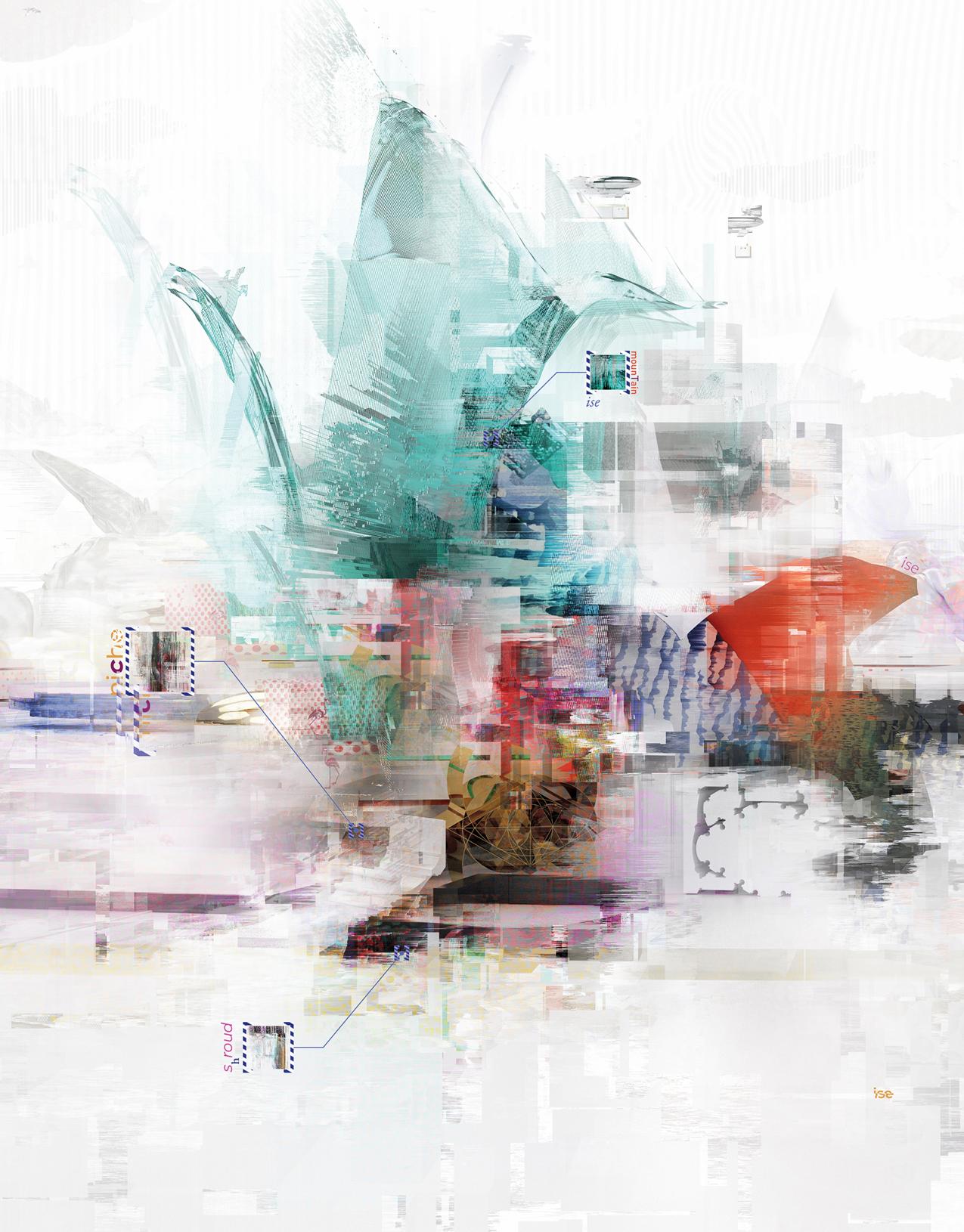
William du Toit, The Machine Stops: The Stamper Battery, Narrative Architecture final-year MArch(Prof) thesis studio, Victoria University of Wellington, New Zealand, 2021
Drawings can be narrative based This image uses EM Forster’s short story The Machine Stops (1909). In Forster’s book society relies on technology to provide for all its needs – and when the machine breaks down, civilisation collapses. Du Toit uses the narrative as a generator for an allegorical architectural project conceived to help reawaken and safeguard tales of environmental devastation, so that we may learn from them in the future. (Tutor: Daniel K Brown)
Towards the end of his life, the great philosopher of seeing, John Berger, suffered from cataracts. His book Cataract charts his elation with being able to gradually see clearly and in full colour after his operations. His straightforward but beautifully crafted words revel in the simple joy of being able to accept the light and sight of nature into the eye and the happiness it brings to the human condition.
The architects featured in this 2 have developed numerous ways to posit architectural work that pushes the boundaries of their own cataractic eyes, and in so doing have created new ways of seeing for themselves and methodologies to help them see with different eyes.
The issue is built around an international group of architects involved in an ongoing KU Leuven Faculty of Architecture international drawing research project coordinated by Riet Eeckhout and Arnaud Hendrickx. But, it is also important to see one’s work through the eyes of others. The concept of this 2 is therefore to bring the voices of others to each featured architect. Like the ‘drawers’, the commentators are global in their reach and bring new perspectives.
In 2018 Eeckhout and Hendrickx set out to organise a dialogue platform, Drawing Architecture, to accommodate regular meetings and discussions between architects whose work and research within the discipline is predominantly pursued through drawings. The aim of the subsequent meetings (two a year) was to discuss the agency of particular drawings and allow the conversations to revolve around what the drawings are in search of, their material practice, and what techniques
had been involved in making them. They could thus be a catalyst for the unpicking of methodical thinking, ultimately generating a more profound understanding of a particular field of practice and an inevitable momentum in each individual’s production and thought processes. The imperative was to catch these collaborating mechanics in action when conversing about recent work, resulting in a more refined understanding of one’s own creative practices and also of the minds of others when questioning them or responding to their questions.
The Artefact of the Drawing
The drawing and its artefactual agency have a language of their own, beyond the intention or concerns of the drafter. To have the physical drawings of recent and ongoing work present on the table, around which dialogues can take place as opposed to on-screen viewing, allows for the agency of the material work to participate and augment the conversation with a tactile susceptibility.
When meeting at regular intervals, there is a particular trust, intimacy and vulnerability that surfaces when speaking about nascent or in-process work – participants are drawn in closer, trading the traces of process revealed by its authors. Although dialogue tends to start with understood and established assumptions, in a generous exchange such as this one, there is room for uncertainty and hesitation, also tacit hunches and slingshot manoeuvres to articulate decisive consistencies that restructure the knowledge one holds of one’s work, and of the work of others.
This research and this 2 embrace a wide range of drawing practices from differing cultural and academic backgrounds, each leaning on distinct historical and theoretical contexts, covering three generations from different parts of the world and bringing together a wealth of field knowledge.
Such plurality of practices sharpens the understanding of different operational needs and material concerns that lead to the specificity of the drawing practice and its contribution to thinking mechanics.
On the other hand, what binds us/them is the inclination to explore the diagrammatic capacity of drawing, the drawing used beyond the usual representational imperatives of architectural drawings.
Visceral Pleasures
Over 20 years ago Jeremy Millar and Michiel Schwarz, in the catalogue of the exhibition ‘Speed: Visions of an Accelerated Age’ held at the Photographers’ Gallery (London) in 1998, wrote presciently about the acceleration of our contemporary lives: ‘Any person from two hundred years ago, one hundred years ago, fifty, twenty years ago would almost certainly be astonished by the rapidity of our actions, of what we can achieve, (when it goes wrong) instead we sit, fingers tapping, like some supercharged biological metronome.’2
The world of contemporary architectural representation is much faster than it used to be; computers render and spin virtual models around at pace, yet students working in this way often have problems with scale and the materiality of their representations. ‘It is as a result of the increased speed of our lives that we now get impatient more quickly than ever before.
Ozayr Saloojee, Basilica e Monastero Agostiniano Santi Quattro Coronati, Rome, ‘An Argument for Unknowing / An Accountability of Love’ series, 2020
above: Part of a drawing/research project that explores questions of buildings, drawings and architectural canon both ‘as built’ and ‘as remembered’. A working counter of the analytique as an order problem, the series looks to ideas of the trans-ocular, uncertain and associated ecologies of architectural drawing. Saloojee is Chair of the MArch programme at the Azrieli School of Architecture and Urbanism, Carleton University, Ottawa.
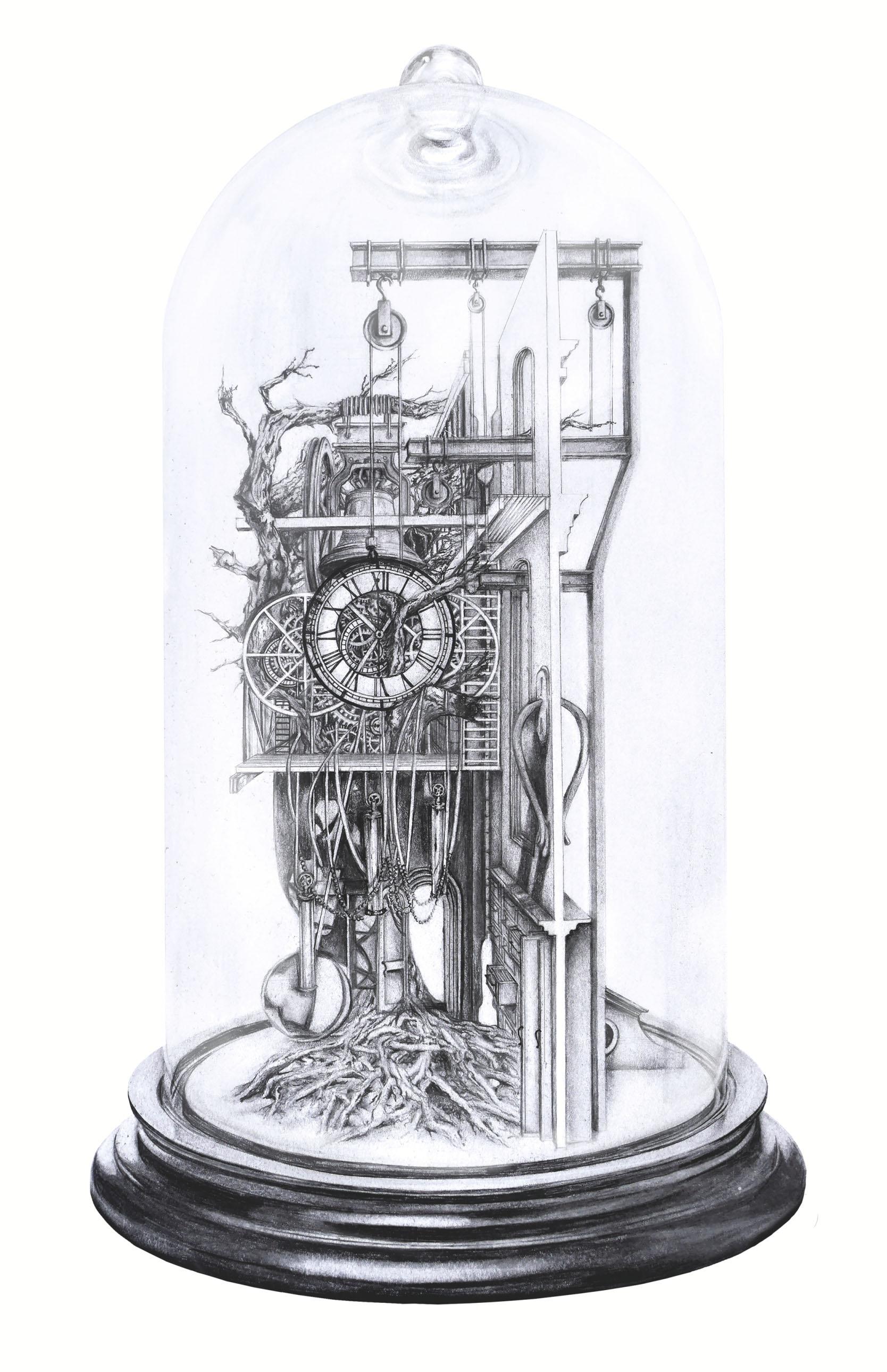
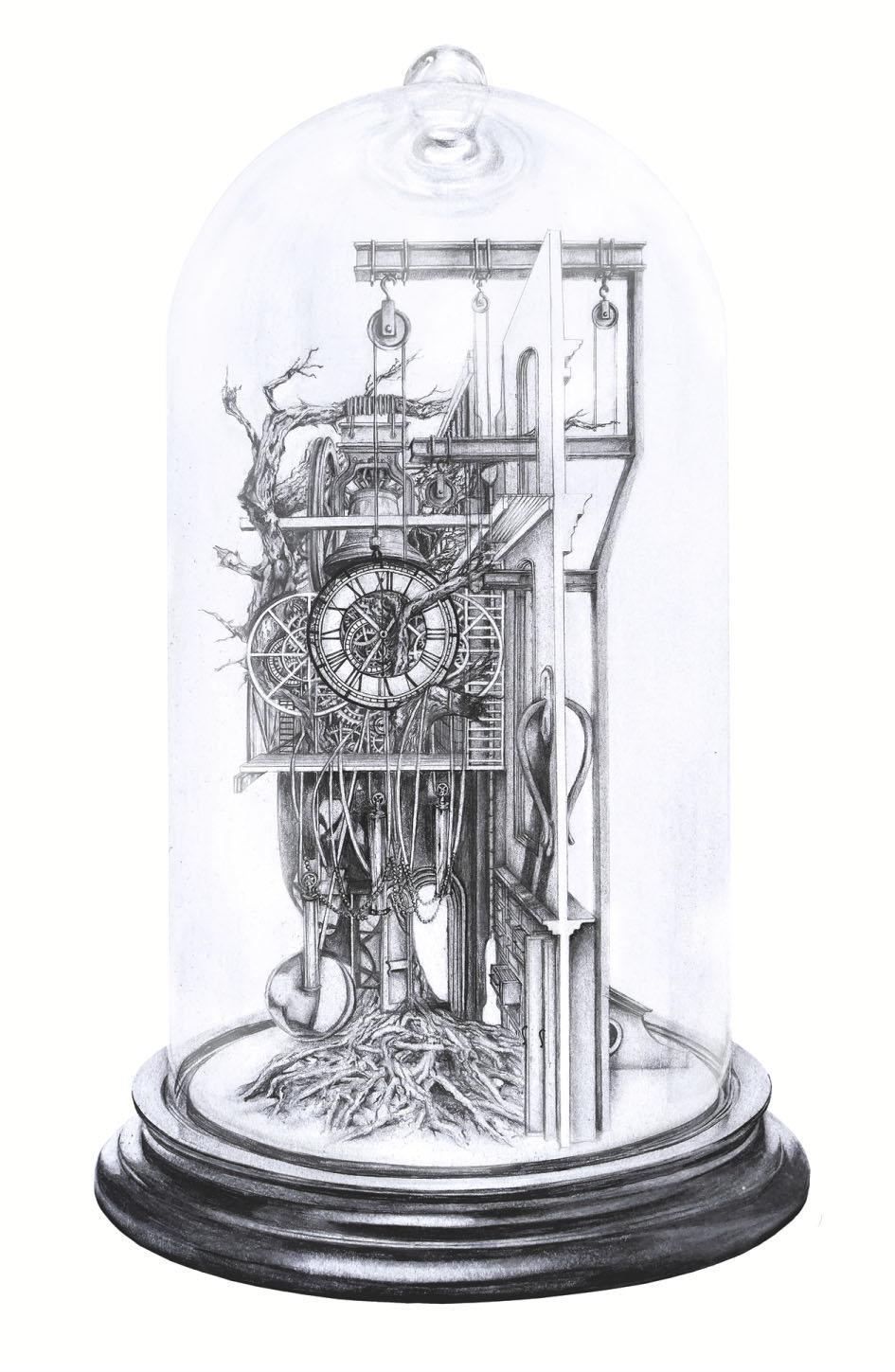
Alice Charles, An Artefact of Time, Narrative Architecture final-year MArch(Prof) thesis studio, Victoria University of Wellington, New Zealand, 2021
opposite: Italo Calvino’s novel Invisible Cities (1972) and Alan Lightman’s novel Einstein’s Dreams (1992) are used as generators for an allegorical project that helps reawaken and unveil lost voices of place and time that are visible only as scattered fragments within an urban landscape. In this image, fragments of time and place have been strategically ‘curated’ within a glass bell jar. (Tutor: Daniel K Brown)
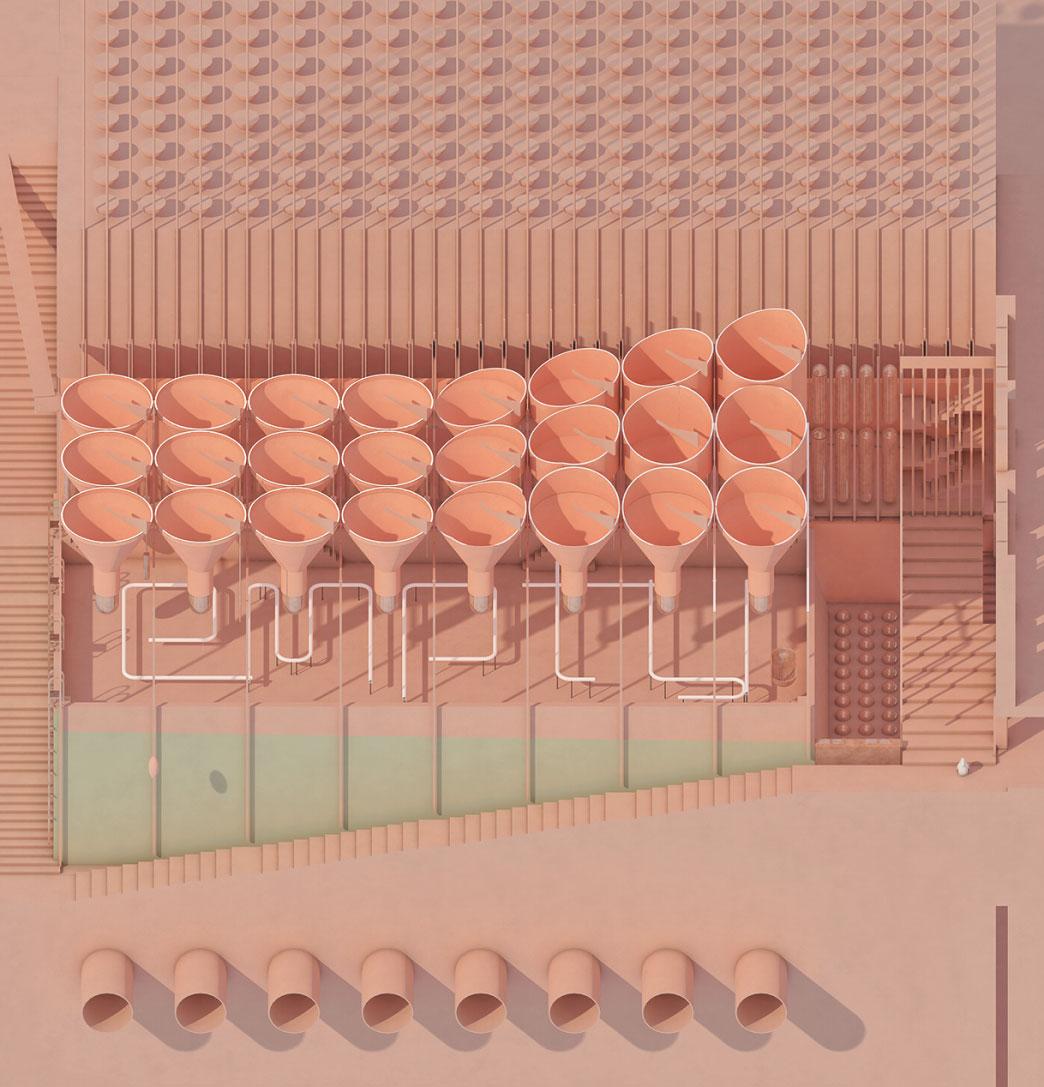
Michael Chapman, Axonometric, ‘Silhouettes’ series, 2020
right: Exploring the excavation of a buried swimming pool, this project used analogue axonometric projection processes to create shadows in the empty pool, projecting a three-dimensional architecture above that recreated the head movements of the Adélie penguin courtship ritual in a 15-minute window in time. Chapman is Professor of Architecture at the School of Architecture and the Built Environment, University of Newcastle, New South Wales.
The drawing and its artefactual agency have a language of their own, beyond the intention or concerns of the drafter
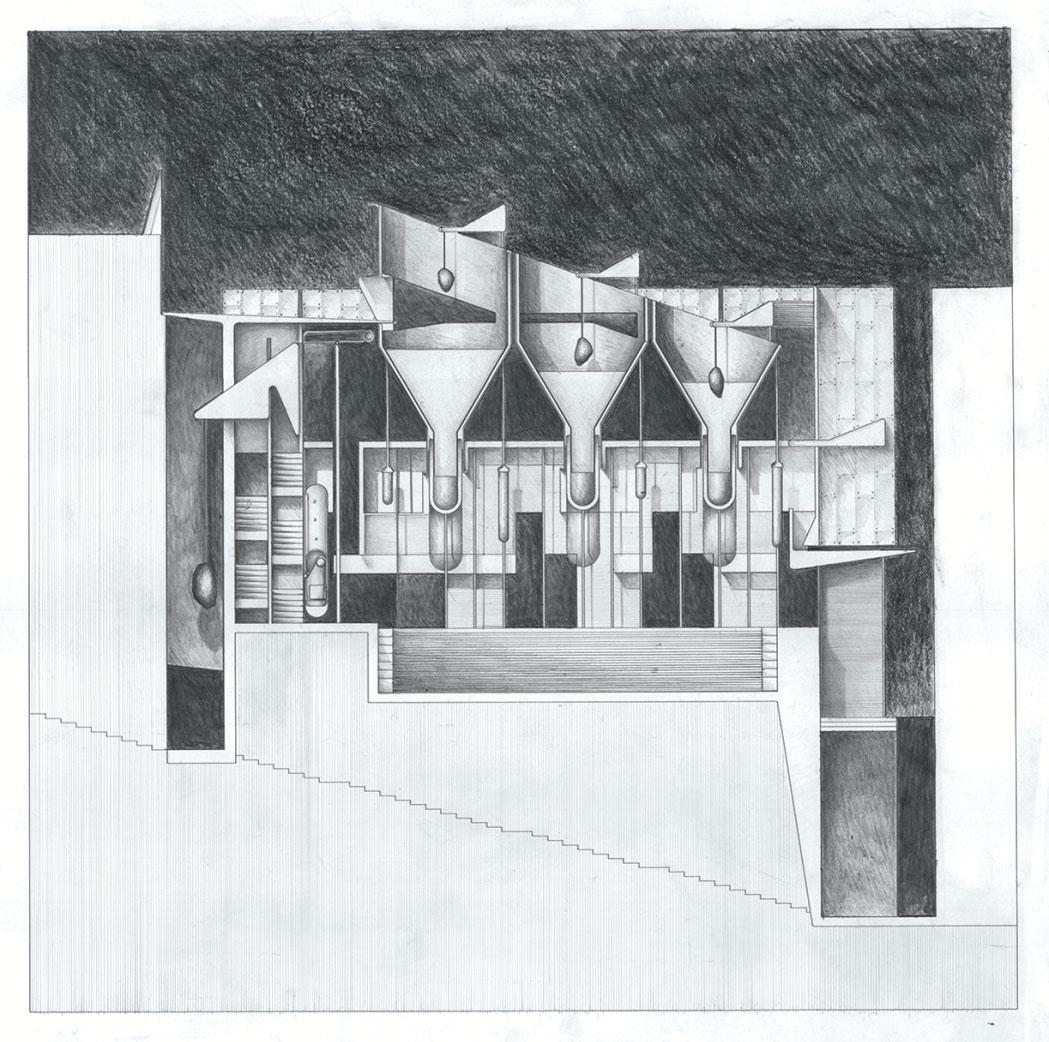
Michael Chapman, Love-time axis, ‘Silhouettes’ series, 2020
above: This sectional drawing is used to position the elements in relationship to the existing façade, mapping the shadows in three-dimensional space and time. The drawing process went from analogue axonometric, to digital model, to analogue drawn sections, cut along the axes of longitudinal (emptiness), transverse (love) and vertical (time).
Constant acceleration is the one constant in our experience of modernity. Speed has become a self-fulfilling prophecy.’3
The architects featured here are akin to the growing fashion for ‘slow food’ which is about the joy of preparation, the wait for cooking, anticipation, the lengthy performative celebration of eating as a socially good thing, and savouring the moment. The drawing, for all the proponents gathered here, is about the same sensations and is for us/them cathartic. Equally it preferences skills learnt comfortingly maybe decades earlier. To these architects there is nothing more pleasurable than drawing an arc with a compass, an angle with a set square, adjusting an Anglepoise lamp over a drawing, or the friction-free swish of a Mayline drafting table. This is not to say that digital technologies cannot augment the manual to create hybrid possibilities for drawing, and many of our featured protagonists have created numerous ways of working as a synthesis between the actually drawn and the virtually represented.
Order and Legibility
The drawers are a small group, known to each other over years and in some cases decades. There is a complex genealogy: some taught others, some collaborate with others and some over the years have congregated in certain locations – University College London’s Bartlett or the University of Manitoba, for example – at certain points in time. This 2 could have traced the family tree and the interconnections between the various drawers, which are numerous; or been organised in a thematic manner such as ‘transparency’, ‘machines’ etc, or by the ages of the architects concerned. However, it was decided to do none of these, but simply to set out the order of the publication alphabetically, from Cantley to Young. Likewise the writers for this issue are international and multi-generational practitioners and academics and their insights have been very instructive. The simple application of the alphabetic strategy (for the drawers) provides a rich mix of styles and grain for the issue, showcasing each essay and drawings as a complete piece of original work, each with its own intellectual integrity.
To kick off, Los Angeles architect Bryan Cantley’s machinic drawings are dissected by the eminent curator and Professor at the School of Architecture and Design at Virginia Tech, Aaron Betsky. Bartlett Professor and office room-mate of Nat Chard, Penelope Haralambidou examines Chard’s paint-flinging drawing machines, particularly his Instrument Ten construction. Genealogically much of the work featured within this 2 stems from the audacious 1960s output of the avant-garde Archigram group. Architectural Association and Bartlett tutor Ricardo de Ostos describes and comments on recent work by one of that group’s founders, Peter Cook, and later in this edition I try to unravel some of the thought experiments and protocols of another, Michael Webb, in his much-admired long-running project ‘Temple Island’.
Some drawings have ascalar properties; that is to say, they exist at many scales simultaneously. Michael McGarry, Professor at Queen’s University Belfast, evokes the psychogeography of Riet Eeckhout’s house in Flanders and the landscape it is situated in to gain insight into her way of working on her ‘Drawing Out Gehry’ series. Another maker of ascalar work is American academic Perry Kulper,
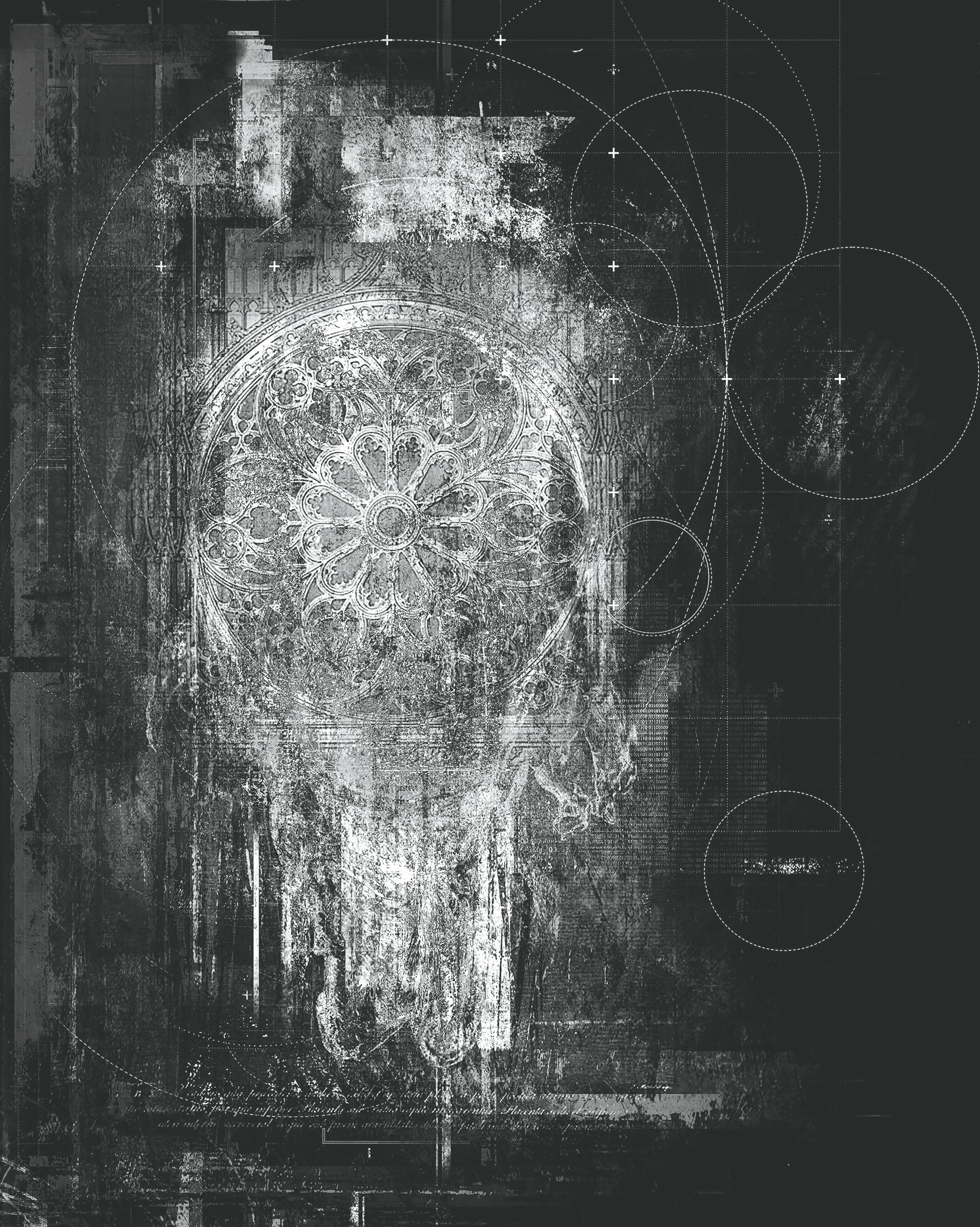
Peter Baldwin, [HE]R0se Window CONcerning the MEDIAtix and the (super) Induction of Transformed States of Being, 2021
Inspired by St Thomas Aquinas’s description of the Immaculate Conception, the drawing attempts to explore its own existence as a mediating link between tacit knowledge and explicit form. Considered as an environment of gestures it contains tangible traces of the thoughts, intuitions, observations and exchanges that occurred during its construction. Baldwin is Senior Lecturer and Programme Leader at the Lincoln School of Architecture and the Built Environment in the UK.
whose spatial tactics Jason Young, Dean of the College of Architecture and Design at the University of Tennessee, Knoxville, interprets for us.
Landscapes of the Mind
Drawings do not just appear with pen or lead on paper or tracing paper with predetermined actions. They can also consist of the residue of creative journeys of discovery. Equally drawings can be made in three- and four-dimensional space. Two very different examples of this are the work of currently Edinburghbased practice Metis, here described and situated theoretically by Peter Salter – a fine draughtsman himself – and Natalija Subotincic, who is in the process of building her own private memory theatre in her home in Montreal, here described and elucidated by her old friend, collaborator and teacher, eminent professor of History and Theory Alberto Pérez-Gómez.
The notion of a different and personal memory theatre in part informs my work too, and the particular section of the ‘Communicating Vessels’ project (1998–) featured in this 2 charts my efforts of memorialising graphic design legend and late friend Vaughan Oliver. Chris L Smith, Professor of Architectural Theory at the University of Sydney’s School of Architecture, Design and Planning, ploughs into and excavates some of its landscape of associations.
Other contributions are also concerned with landscape. Bartlett Professor CJ Lim has a long and illustrious history of producing extraordinary drawn pieces. South African architect and designer Sarah de Villiers explains his recent ‘Rainbow Community’ project as landscapes of inclusive negotiation.
Bartlett Professors Mark Smout and Laura Allen have developed a preoccupation with augmented landscapes; head of Architecture at the Massachusetts Institute of Technology (MIT) Nicholas de Monchaux examines their unique world where a model can become a drawing (and vice versa), and their 2021 Venice Architecture Biennale installation Rescue Lines Bartlett academic Robin Wilson sheds light on the inclinations, preoccupations and aspirational thoughts that architect Shaun Murray has for his distinct cartographies of semi-visible landscapes of ethereal coalescences of actions, ecologies and data.
Each drawing is an alchemist’s alembic carrying within it the nascent architectural personality of its creator – here read, decoded and interpreted by other, learned eyes
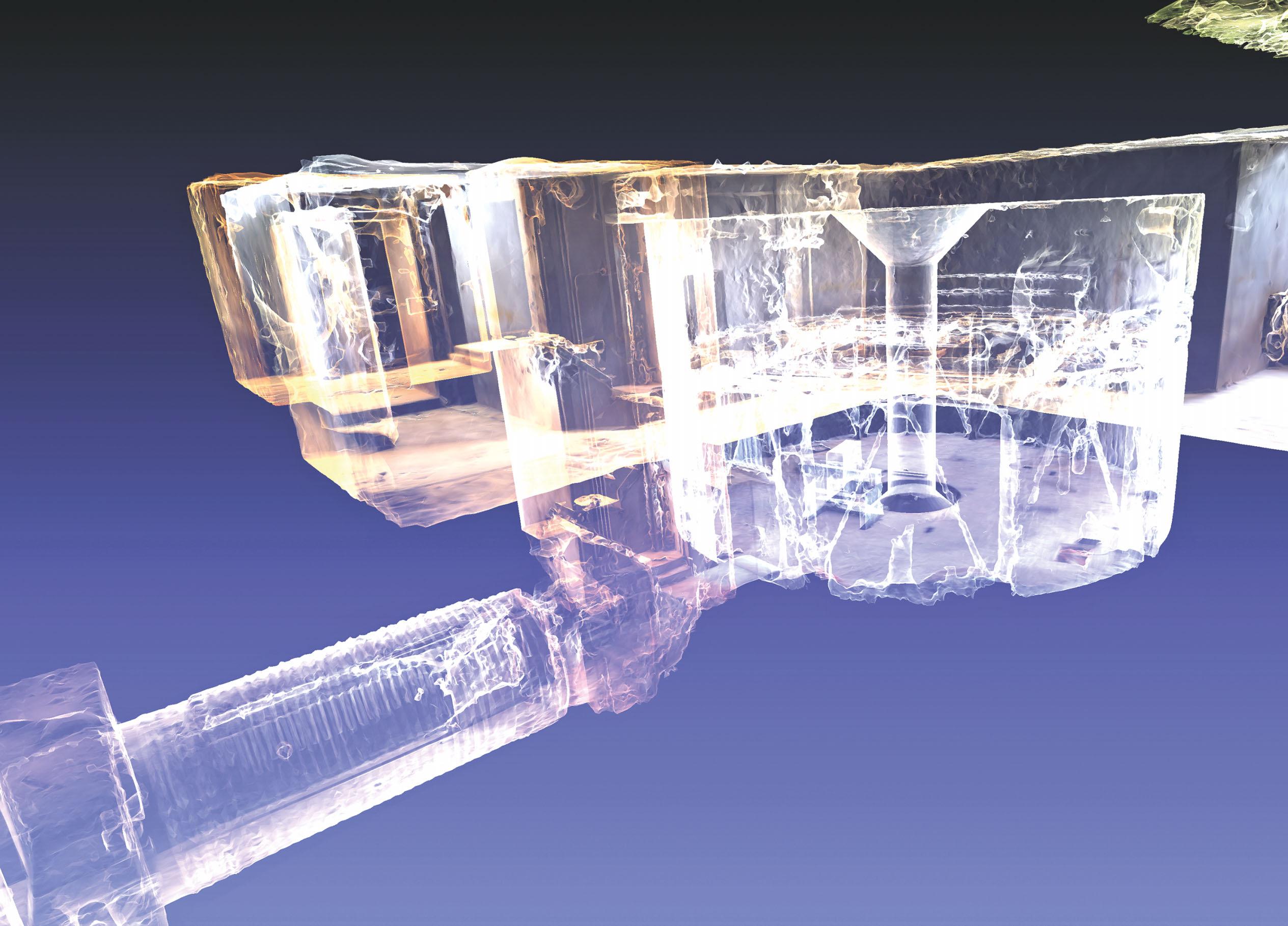
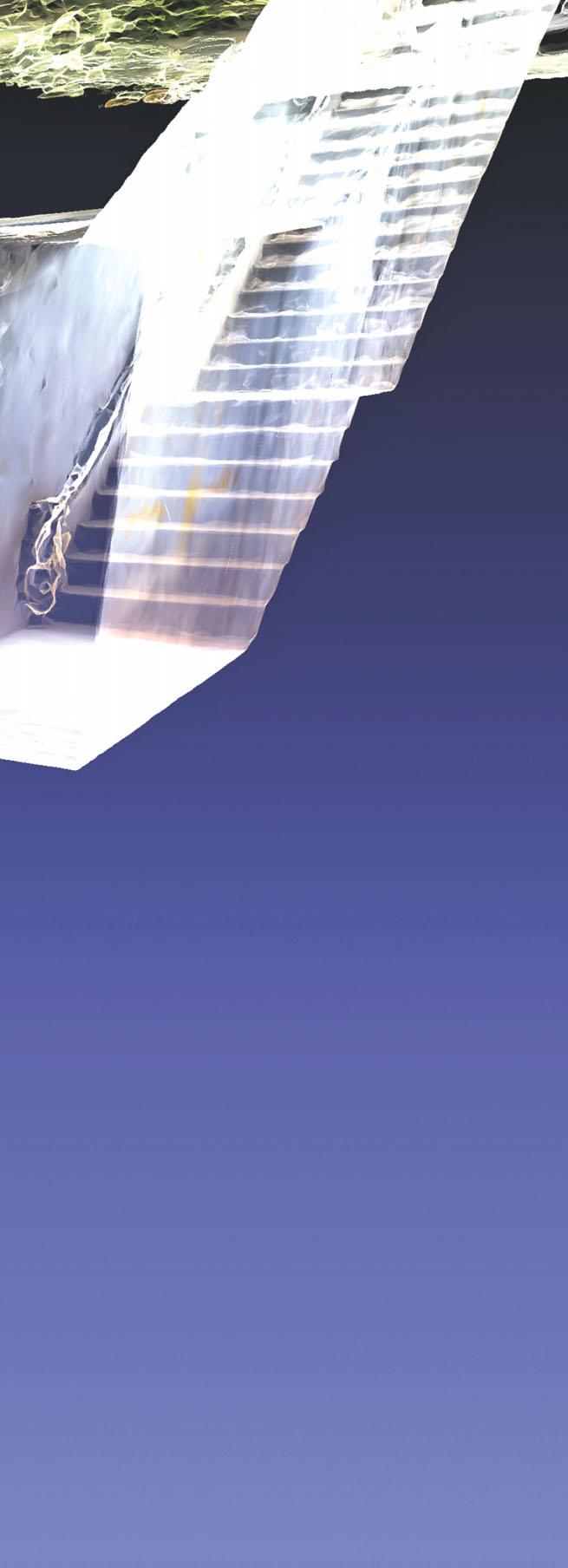
Brian Kelly, Subterranean Atlas-F missile launch complex, Wilson, Kansas, 2021
3D scanners can generate and reveal previously unseen arrangements of space and are particularly useful for underground structures. More than 1,100 high-resolution digital images of this Cold War ruin were captured in situ. The mesh photogrammetry model and render accurately portrays both its proportional and material status in a hi-tech radical drawing. Kelly is Associate Professor at the University of Lincoln, Nebraska.
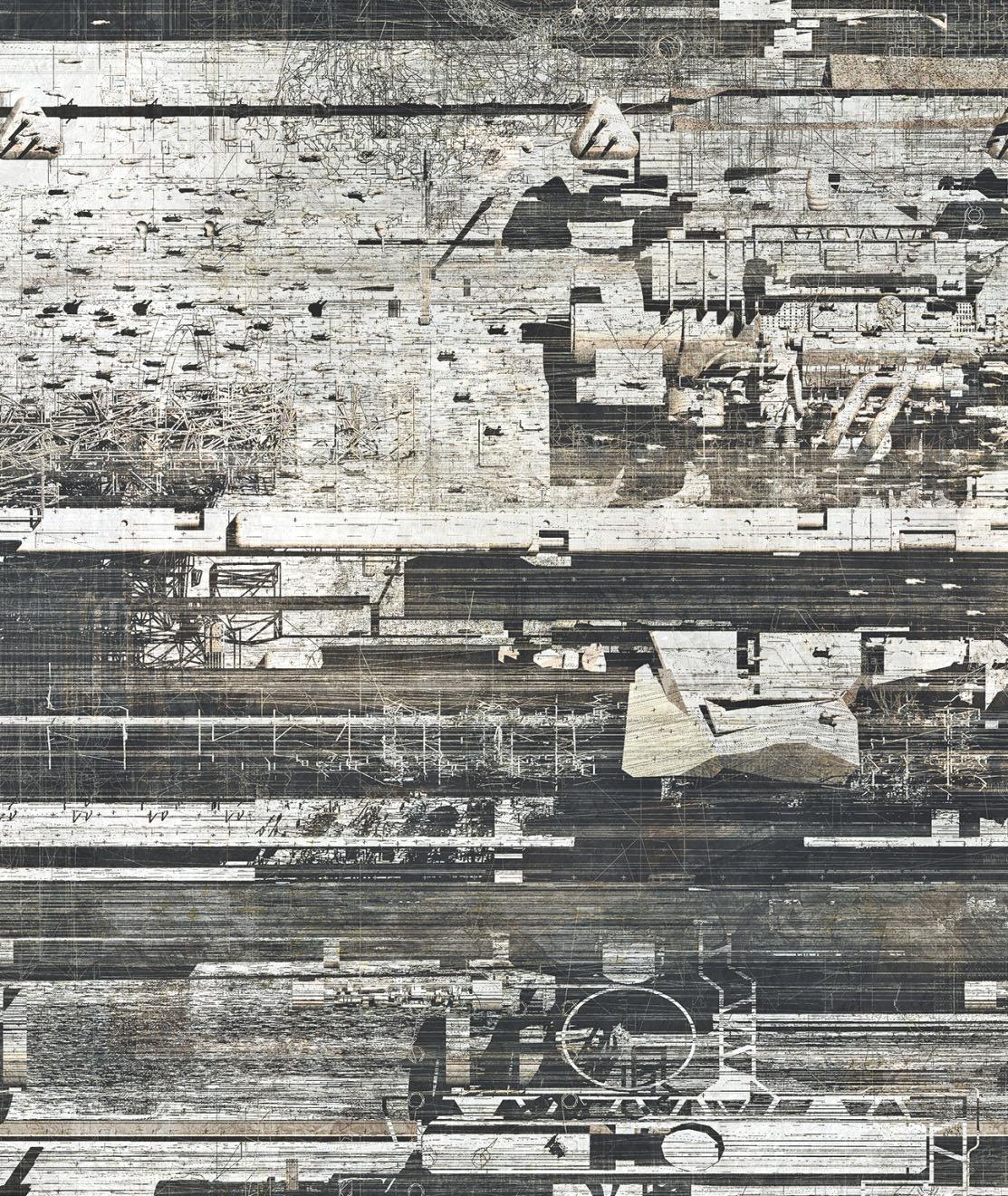
Anton Markus Pasing, White Horses I, 2020–21
Creating a drawing can provoke thoughts not previously conceived, such as this one. Pasing, a professor at the Peter Behrens School of Arts, Hochscule Dusseldorf, wrote a prose poem about his love and gratitude of living in a city. The literary side of the brain can be creatively activated by drawing too.
New digital tools can make other types of drawings and suggest other drawing methodologies. Nowadays Mark West utilises layered digital photography and processes of Photoshop erasure and opacity as well as hand rendering to produce hugely evocative, surreal panoramas constructed from the everyday of city life and revealing a Westian divine in the mundane, creating a cast of architectural characters more akin to Hieronymus Bosch than Le Corbusier. Viennese Professor and practitioner Wolfgang Tschapeller investigates West’s strange and beautiful world.
Accurate drawings of our surroundings made by threedimensional scanners that chart millions of points in space with laser beams can also be manipulated creatively and architectonically. American academic and practising architect Michael Young, a Fellow of the American Academy in Rome, uses these techniques as the prima materia for his own architectural endeavours and experiments. Ulrika Karlsson, Principal of servo Stockholm and Professor at the KTH School of Architecture, Stockholm, investigates these spectral works.
The Spectrum
There is a considerable diversity in the work presented in this 2. This is very healthy indeed: it shows creative architects questioning the tried and tested dogmas and protocols of the established architectural profession, and finding new, individual and original ways of producing and representing architectural space.
Each drawing is an alchemist’s alembic carrying within it the nascent architectural personality of its creator – here read, decoded and interpreted by other, learned eyes. Enjoy this journey through the wilder sides of architectural representation and discourse.
To paraphrase John Berger, do not let the portcullis of architectural cataracts distort and limit your vision or newfound freedom.
I hope this edition of 2 is inspirational to others and provokes some readers into beginning a radical creative, personal architectural journey of their own through new eyes.4 1
Notes
1. John Berger, Cataract, Notting Hill Editions (London), 2011, p 24.
2. Jeremy Millar and Michiel Schwarz, Speed: Visions of an Accelerated Age, exh cat, The Photographers’ Gallery (London), 1998, p 4.
3. Ibid
4. Thanks to Riet Eeckhout and Arnaud Hendrickx for their help in the preparation of this article.
Virginia Tech School of Architecture and Design Professor and renowned curator, critic and writer
Aaron Betsky investigates the machinic architectural worlds of architect Bryan Cantley. Professor of Design Theory at California State University, Fullerton, Cantley has been developing a considerable and starkly individual body of work since his MArch at the University of California, Los Angeles in the early 1990s.
Aaron Betsky
Bryan Cantley, Syntaxonome SourceCode, 2020
Cantley’s work explores the enigmatic blurred boundary between abstraction, notation, presence and absence. The choreography of these nuances all conducted in a machinic idiom.
THE PERSISTENT MEMORY OF MACHINES FANTA S TI C AL MO NSTER S
We used to operate machines. Now we write memos about how to write code to allow somebody to instruct a machine to run itself. That truism is open to challenge, but certainly the third industrial revolution has eliminated a great deal of clanging and banging from our lives. By the same token it has also removed inspiration from a certain class of artists and architects for whom the mechanisms of production and their heroic homes, the factories of first and second revolutions, were fitting objects not only of study and service, but also interpretation and even exaltation. Bryan Cantley, who for decades has been taking apart the remnants of machines and buildings to turn them into fantastical monsters of mechanical might, similarly now writes memos about those artefacts. Except that, through the paper and the spreadsheets on which he scribbles his instructions for non-operation and his descriptions of dead tech, the monsters still stretch and turn. If you listen closely, you might even hear an occasional cling or clang.
Cantley inhabits an environment that further defines his production: in Orange County or, as he has pointed
out, ‘behind the Orange Curtain’. Traditionally, that has meant being in a space of non-events gliding by on an invisible sea of finance, translated into former bean fields filled with single-family homes whose spread is interrupted by rivers of freeways and islands of shopping malls and office complexes disappearing behind mirrored glass. Like the image of industry, that myth of Southern California’s wealthy miasma is – if it was ever correct, which is highly doubtful –certainly a retrospective one. One of the most diverse cultures in the US, this collection of cities, suburbs, institutions and attractions contains as much detritus of selective waves of development and abandonment, production and consumption, and modes of economic coherence as many other places. Meanwhile, the remnants of Southern California's foundational myth, which mixes dreams of suburban peace with Spanish Colonial aesthetics and a sun-drenched, mountainous landscape rolling down to the sea covered in Mediterranean-like vegetation, give a particular flavour to Cantley’s work.
Highly skilled, heavily articulated and artful, Cantley’s drawings suggest spaces and architectures evolving in a fecund melting pot of line, plane and texture.
Genealogies
Nor is that all. Cantley is, after all, also a member of a particular discipline – architecture – that has, at least since its codification in France in the 17th century, teetered between a mechanical and an artistic, a practical and a theoretical, and a popular and an elitist character. He has chosen the latter avenue of engaging in experimental work. The results of this choice are largely drawings and models that are resolutely impractical, but instead constitute a commentary on, or at least an articulation of, current conditions that propose future forms. This also makes him part of a particular culture of experimentation. Practised or pursued by architects and allied artists throughout the world, the branch of such experimental architecture of which Cantley is part has recently found a small mode of coalescence around a group of ‘paper architects’ from several generations, from Michael Webb to Perry Kulper, whose work resonates clearly with what this maker is producing.
Behind these architects, however, one can see arraigned more generations of experimenters who have obviously inspired Cantley. The most obvious lineage traces back through Neil Denari and Wes Jones, perhaps to Thom Mayne, but certainly to Lebbeus Woods, the New York-based instigator of the Research Institute of Experimental Architecture. In a broader sense, however, the fascination with industrial production and its artefacts also puts this work in the lineage of Charles Sheeler, Laszlo Moholy-Nagy and Constant.
Bryan Cantley, Field Shifts, 2020
Playing at a much quieter end of the graphic spectrum, Cantley sometimes reduces a drawing almost to its construction lines, yet still maintaining and rejoicing in its precision and suggestion.
What, then, has he produced within this context? An astonishing set of drawings and models that together form a drawn speculation on what remains of mechanical reality within the landscapes of Southern California. When he first developed his experimental architectural practice, which he called Form:uLA, after moving to Los Angeles from North Carolina in the summer of 1988, Cantley’s work was clearly mechano-morphic. It combined the language of mechanical drawings with their overt systems of measurement and attempts to unfold complex mechanisms, with a hobbyist’s approach of laying out different parts for inspection. Then the experimenter went to work, slashing, slicing and otherwise deforming the basic elements and building machines out of the detritus. He sometimes assigned functions (a roving community centre, a ‘seeder’ or a modern version of a Batmobile) to these parts, but they were, more than anything else, fractured architecture foregrounding the body parts that are usually hidden behind walls and in mechanical risers, all of them deformed and set free to sail through what was shown as a combination of a tourist-brochure vision of Southern California and a nightmare of human-built sameness.
Over time, the work has flattened out, while also becoming more abstract. The language about the images has changed in a similar manner
Words and Twins
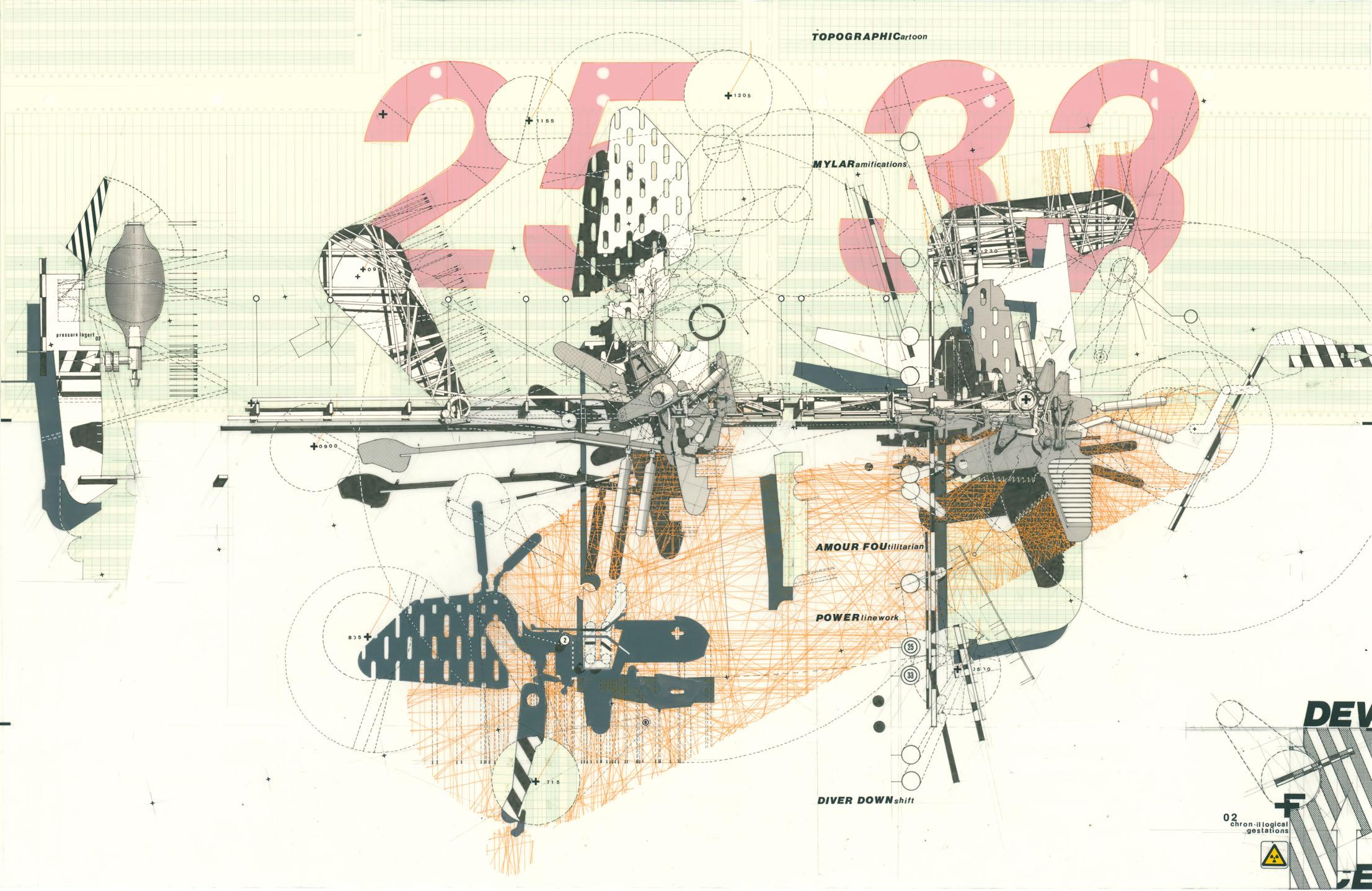
Over time, the work has flattened out, while also becoming more abstract. The language about the images has changed in a similar manner. If the titles were once clear, if somewhat odd when you matched them with the results, Cantley now uses terms such as ‘syntaxonometric’, by which he seems to mean a threedimensional drawn construction that has the quality of a sentence, to describe them – although about what he speaks is not completely clear. Perhaps it is the ‘fiducial shifting’ or the ‘sampling’ he also mentions. Certainly there is an attempt to bring a sense of financial and economic structures into the drawings. But there are no tables or even flow diagrams here. The only reference to the flows of money are the spreadsheets on which he draws, and the total abstraction some of the drawings reduce themselves to.
Bryan
Cantley, Mylaramifications 25:33, 2019
Some of the more complex work implies the manoeuvring of families of forms drawn from the same graphic genetic code.
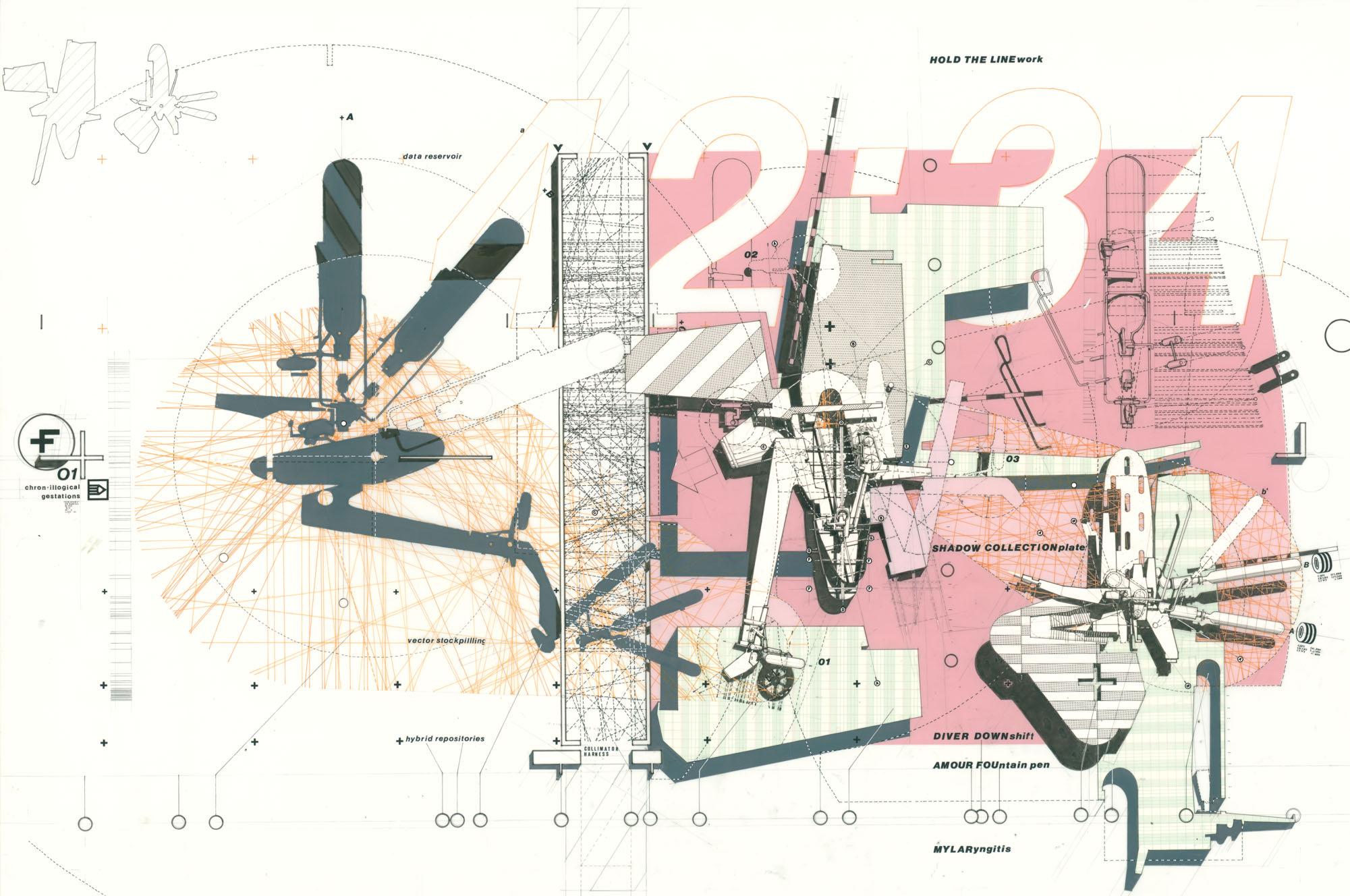
In other images, Cantley speaks of ‘dizogotic twins’, which is to say paired structures that are simultaneously born out of the same genetic origin but are still different. This appears to mean the development of mechanical and building elements that arise from his interest in folded plates and camshafts that dominated some of his earlier drawings, here combined, drawn apart and extruded or added onto with lines rather than with more equipment.
There are a lot of references to shifts and flows, and to such popular writers as Baudrillard in these drawings. How such readings or language refer to the work itself remains, however, enigmatic. This approach to a loose application of abstract, evocative words combined with references to larger issues as a web of implication over an equally vague and yet seemingly precise and somehow referential set of fragments also has a history, particularly in the work of Michael Webb and Lebbeus Woods, but also in the drawings of the contemporary German architect Anton Markus Passig.
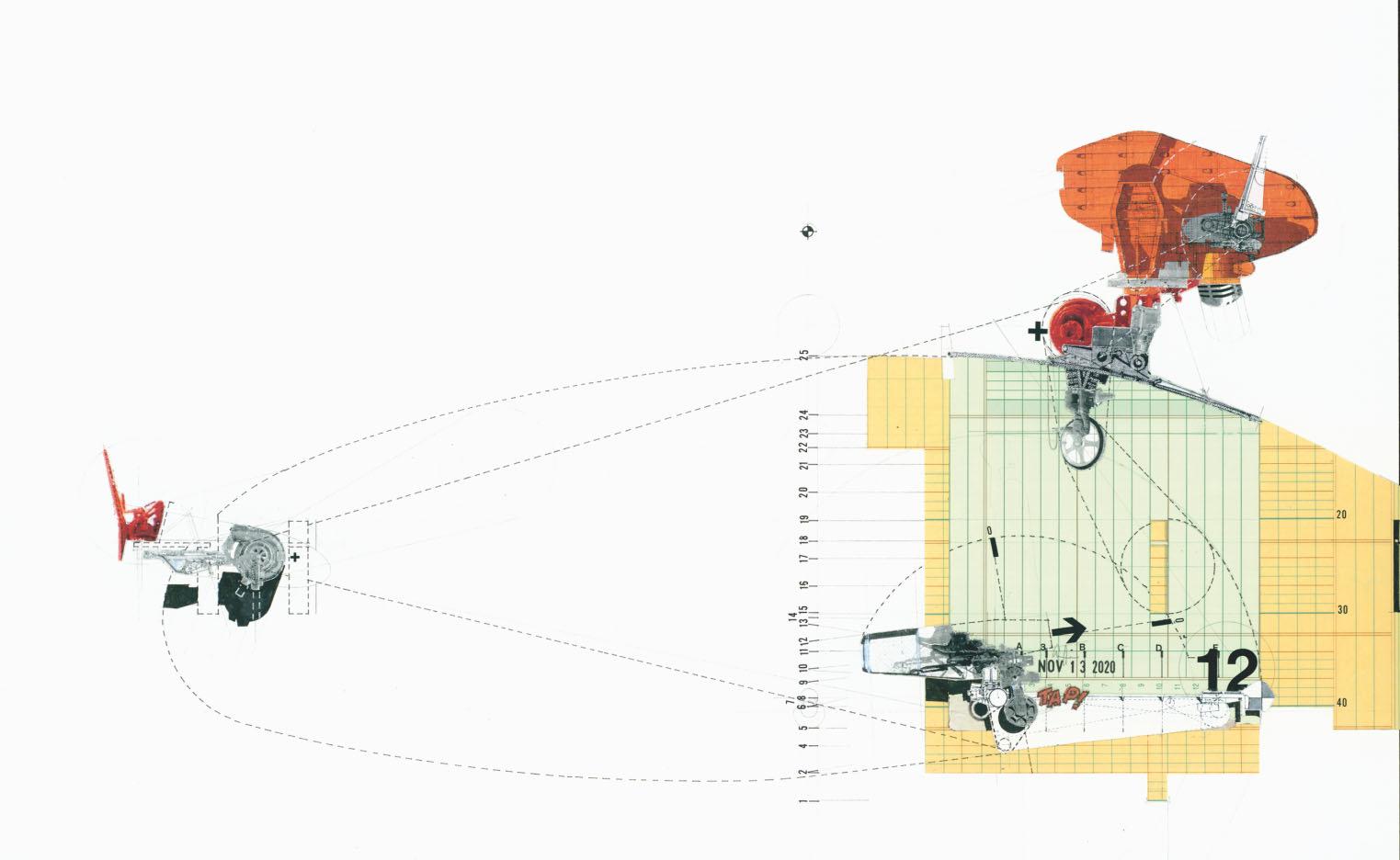
What is particularly interesting about the drawings is the manner in which Cantley has moved away from the more traditional focus on describing an object, even if it is flayed out for our inspection, to an exploration of certain relations and compositions that interest him separately from what the object of inquiry might be. In Myth-Appropriations 12 (2020),for instance, most of the (virtual) surface of the drawing is blank, while the rest consists of elements familiar from his previous work, such as enlarged letters, elliptical lines that describe the orbit or radius of a rotating object, the green graph-paper of which he is so fond, and a cylinder that might either be something he abstracted from a motorcycle engine or could be a proposal for a spacecraft. The intensity of the collage, combined with the white space on which it drifts, gives the drawing the sense of setting out on a quest towards some goal – whose nature is, as usual, completely obfuscated by the short accompanying text.
What is particularly interesting about the drawings is the manner in which Cantley has moved away from the more traditional focus on describing an object
Bryan Cantley, Mylaryngitis 42:34, 2019
Forms waltz across the drawing on carpets of colour and texture, combined with linear registrations, numerical figures and short sentences, all adding to their enigma.
In recent years, Cantley has adopted a less-drawn and more paper-collage technique due to a lack of access to his studio during Covid-19 lockdown. The drawings still show the delicacy of line and precise placement and juxtaposition of textures that are key to his recognisable creativity.
The Drawing Stripped Bare
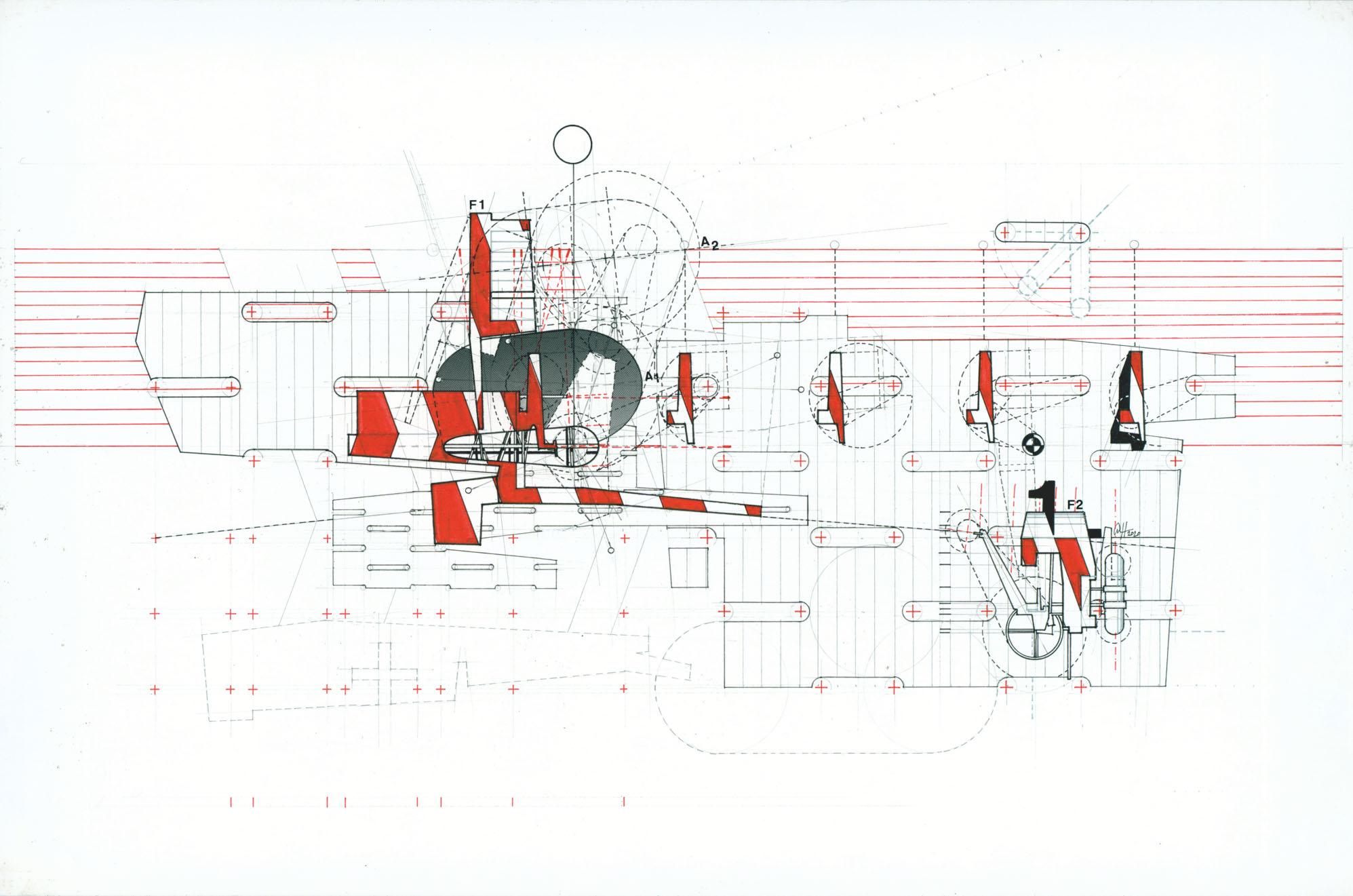
In other drawings, Cantley shows only construction lines, stripping his description of mechanisms and objects down to the absolute minimum. He asks us to eschew any object of description and to instead enjoy the beauty of the working drawing itself. Because not only the focus of such drawings, but also their scale and even orientation are so obscure, all we can do is examine the patterns and grids and imagine what they might someday produce. Even the chequerboard, which once evoked the finish flag in the Formula One races his office title referred to, are now heraldic patterns lost in a contourless map of unknowable territories.
Cantley actually calls some of these drawings ‘Emergent Device-ives’, almost confirming that he is birthing not just twins, but whole broods of orders that now also include ramps that emerge from the cams, photoshopped layers shifting through what were once meticulously drawn grids, and Spirograph-like doodles, but not quite. After all, what does that ‘ives’ mean and why does the text speak of ‘residual spaces’? Is Cantley instead uncovering more hidden aspects of the landscapes he inhabits and holding them up for our inspection instead?
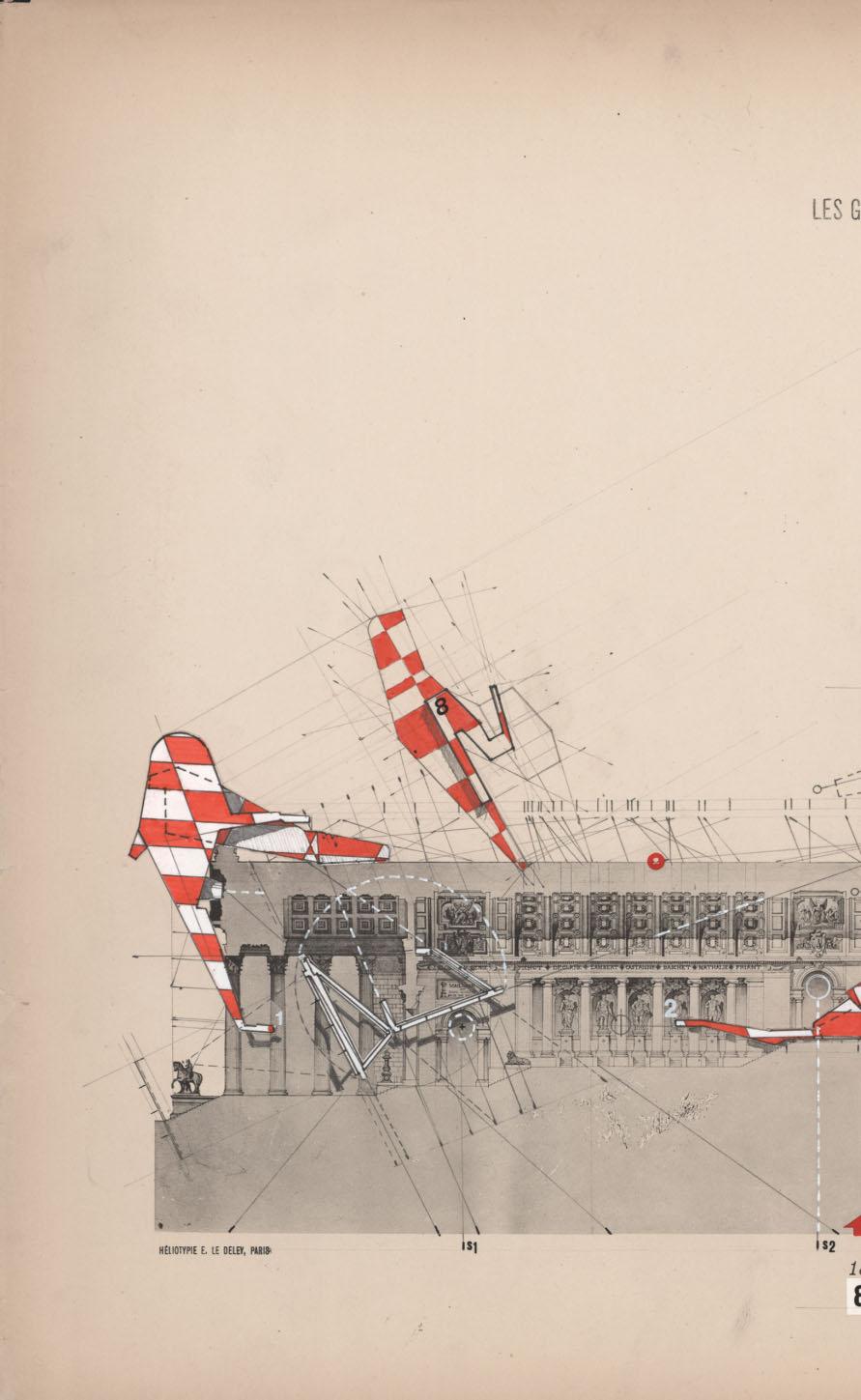
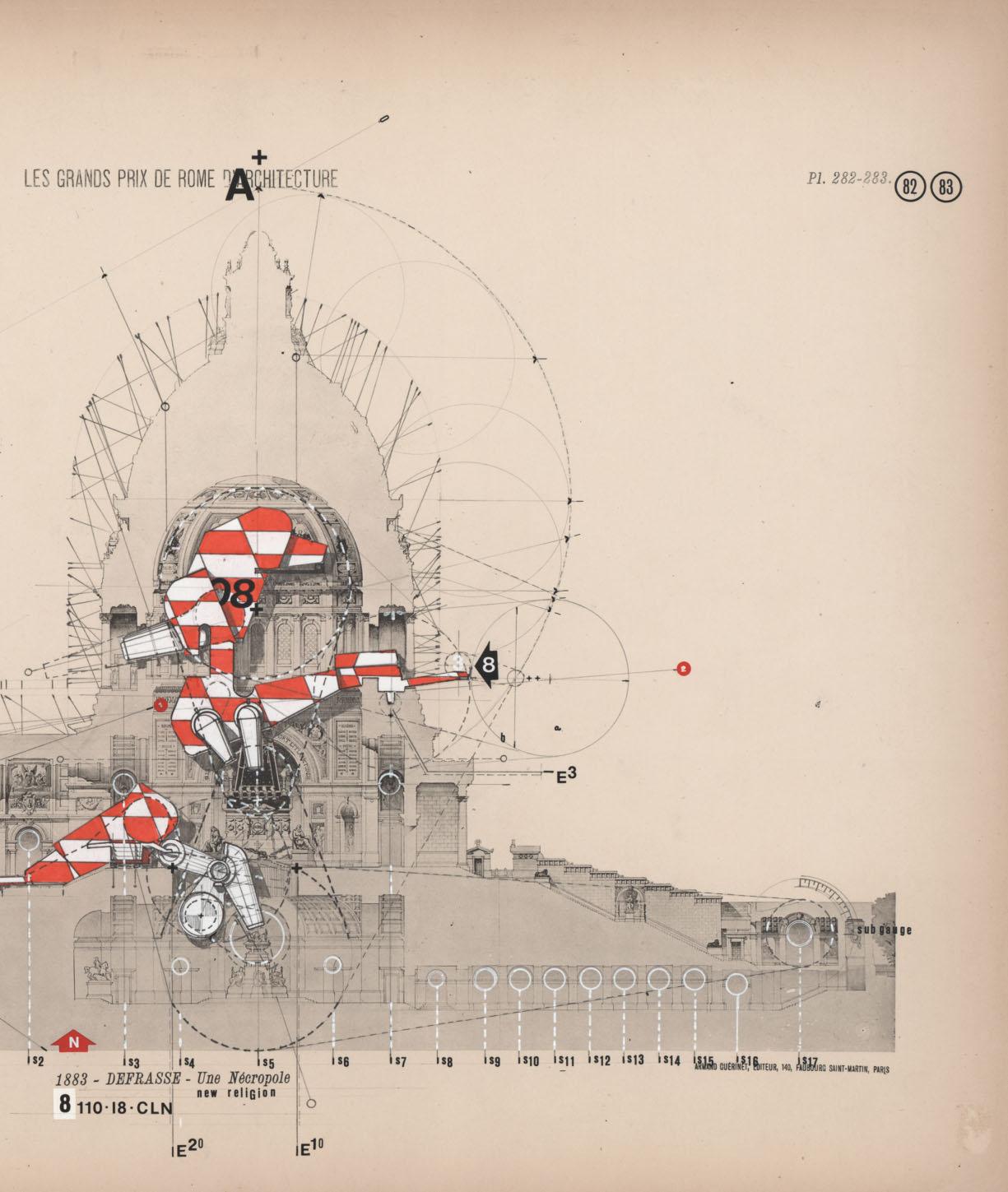
above: The use of found architectural drawings figure in Cantley’s work. He uses such drawings as a base layer, which he then détournes by inserting and overdrawing, contrasting his own architectural tropes with those of previous eras.
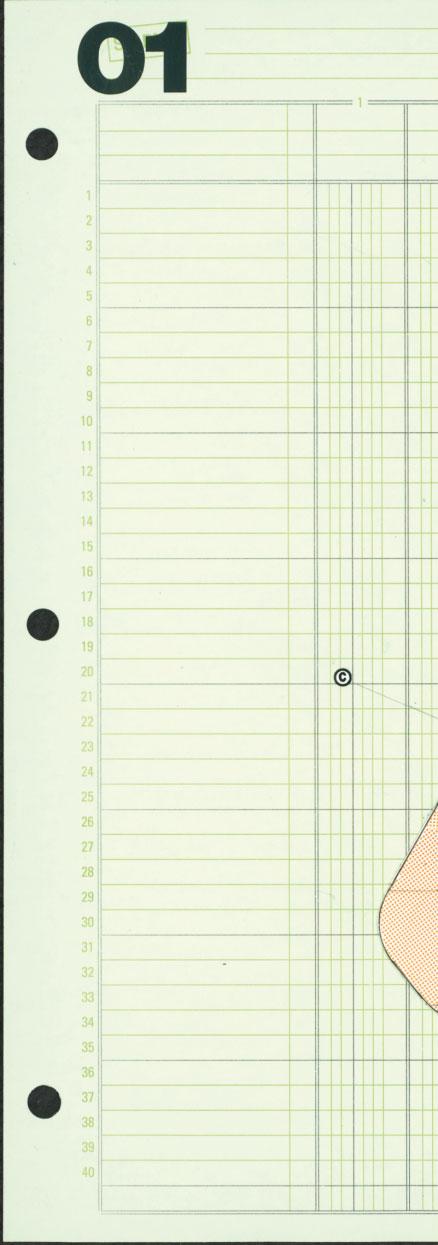
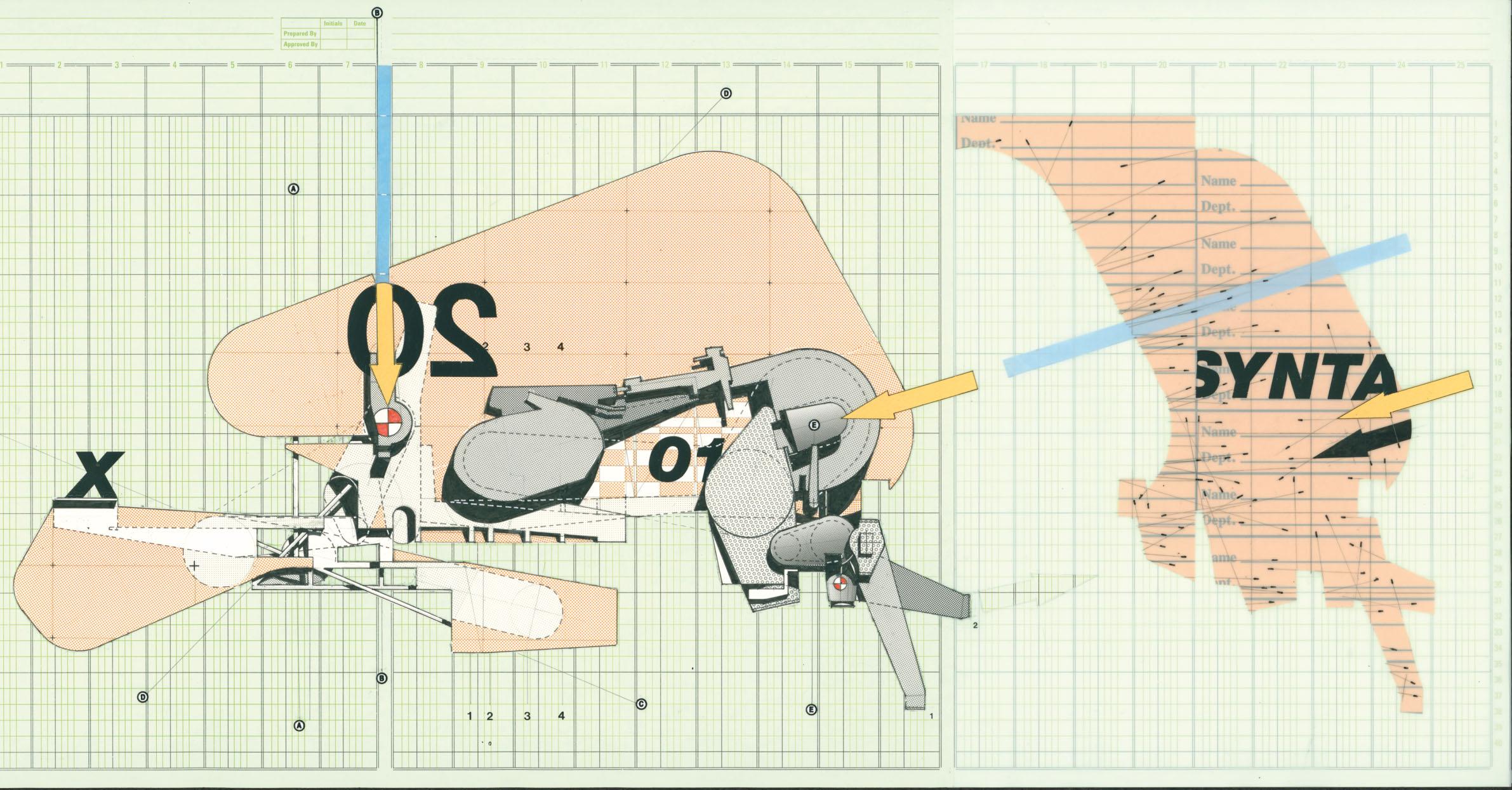
Bryan Cantley, Syntaxonome 01-02, 2020
right: The lexicon of Cantley’s formal articulations is one of air inlets, bladders, conduits and armatures perched on artificial ground planes –metallic forms communing with each other across the drawing.
Only rarely, as in his ‘Palimpsestuous Relationship’ series, does Cantley make an overt reference to the field of architecture and to his work as a redrawing of that particular context. Even more rarely, these days, does he give us an object or a perspective that we can hold onto. Instead, what he leaves us with are continual riffs, developing from one drawing to the other, described in equally drifting, evocative ways, that never go anywhere. This self-sampling form of collage is without a doubt purposeful for all its seeming improvisation. It produces a body of work that as a whole has a clear subject matter, style and mode of appearance. It is the architecture of Bryan Cantley, freed from any purpose to which it is oriented, any of the sources from which it arose (although it is impossible, of course, to be completely liberated from such generative fields) and a categorical sense of organisation. What it does constitute, in however an obtuse and obscure manner, is the drawing out of the forms and shapes that float around our human-made world, both real and virtual, as processed by Cantley’s head and birthed by his hands. That these elements seem like relics from a recent past that has, at least in these drawings, not faded away, makes them all the more haunting. 1
Penelope Haralambidou
CONSTRUCTING INDETERMINACY
Nat Chard, Instrument Ten, 2016
Figurative worm’s-eye view of the occupation of two chairs. The drawing is one of a set of three, showing the same scene from three different points of view.
A DÉTOURNEMENT OF DIDACTIC MODELS
Drawing happens across space and time, and is action orientated by pen/ pencil, inkjet or paint. The substrate that is drawn/marked on is also important, whether mylar, paper or sculptural instruments. Penelope Haralambidou explores her fellow Bartlett School of Architecture professor and office room-mate Nat Chard’s Instrument 10, part of a longstanding iterative drawing and representation project.
In front of the door of room 515, on the fifth floor of 22 Gordon Street, I search for my key. This everyday occurrence was previously completely unremarkable, but on this occasion it is coloured with great anticipation. After a hiatus of 18 months due to the Covid-19 pandemic, I am back in the office I share with Nat Chard at the Bartlett School of Architecture, University College London (UCL). My return is an opportunity to search for the material clues and entry points into Chard’s work.
More than an office, the small room is our designresearch storage space, covered with fragments of work in progress. Reminiscent of the engraved frontispiece of Danish natural philosopher Ole Worm’s catalogue to his Museum Wormianum in Copenhagen,1 where his collection of artefacts was displayed across every inch of the space, our work also takes over all surfaces of our cabinet of curiosities. As in Worm’s reptilian display, on the right above Chard’s desk and perched on the top part of the wall hang the three-legged bases of the four instruments synecdochally comprising his Instrument Ten. Between their splayed limbs rests a vertically positioned Charles and Ray Eames leg splint, and below amongst cardboard boxes, jars of beeswax, yellow tape and metal-clip containers lies a 1:6 articulated human skeleton model in foetal position.
On the left-hand side of the room, which is covered in shelves, uncannily like Worm’s Wunderkammer engraving, we find the rest of the dismantled members of Instrument Ten. These are the upper body parts of the quadripartite instrument, the four winglike picture planes, clamped securely on the top shelf. A trio of glass bell jars next to them house scenes of scaled human figures at work – the male below, female balanced on a ladder, each featuring two pairs of arms in action. On the shelf below is the 1:6 model of a chair designed by Chard, the subject matter that each of the four partinstruments strives to portray.
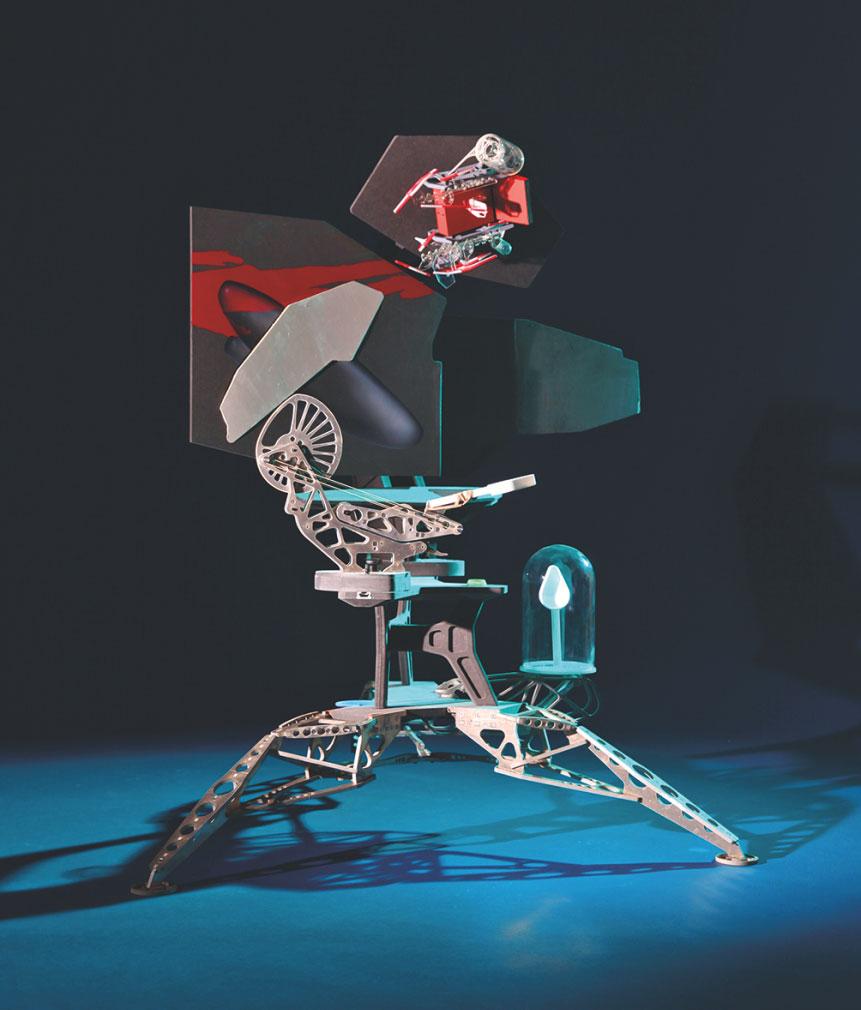
opposite: Before the projection. One of the four part-instruments comprising Instrument Ten. Visible are the three-legged base, catapult mechanism with plastic spoon, articulated wing-like picture plane with attached model of the chair, and an alternative plastic spoon in a bell jar.
Architectural drawing conventions encourage ideas of certainty, but Chard’s work examines how they might also nurture the uncertain
above: Arrangement of the four participant sub-instruments in preparation for an act of projection. All four catapult mechanisms are aimed at a model chair on another instrument.
Indeterminate Occupation
According to Chard, Instrument Ten is in search of a means of ‘developing tacit knowledge by manipulating the essential terms of architectural drawing: projection, reception and skiagraphy’.2 It belongs to an ongoing body of practice-led research carried out through the construction of a series of numbered drawing instruments. Inspired by didactic models, they aim to examine indeterminate occupations beyond the reductive predictions of programme in architecture.
Architectural drawing conventions encourage ideas of certainty, but Chard’s work examines how they might also nurture the uncertain. Construction of the early instruments started as an exploration into pictorial projection, still largely Chard’s main preoccupation. However, he felt that the behaviour and drawing results of these initial versions were rather predictable; Instrument Ten is an attempt to be less in control while keeping the need for precision high.
When pieced together – with its bottom and top body parts reunited – Instrument Ten comprises four segments, or perhaps more appropriately four participants: four standalone performative drawing instruments resembling a pack of mechanical three-legged creatures. Each of the creatures has an internal projecting and receiving function: a point of view and a picture plane. The point of view is a Latex paint-projecting apparatus, a catapult featuring a specially formed ‘spoon’, and the picture plane is a composite, articulated shell. The object that interrupts the projectiles of paint, the equivalent of the visual rays, is a chair model attached to the picture plane. A geometric abstraction of a notional figure sits on each chair, dressed in red-and-white chequered Perspex. The resulting drawing of the chair, the spectre conjured by the pattern of the splatter on the receiving screen, is also a shadow of this occupation. All four instruments are interconnected with string and feature a series of calibrating and coordinating components and bell-jar displays.
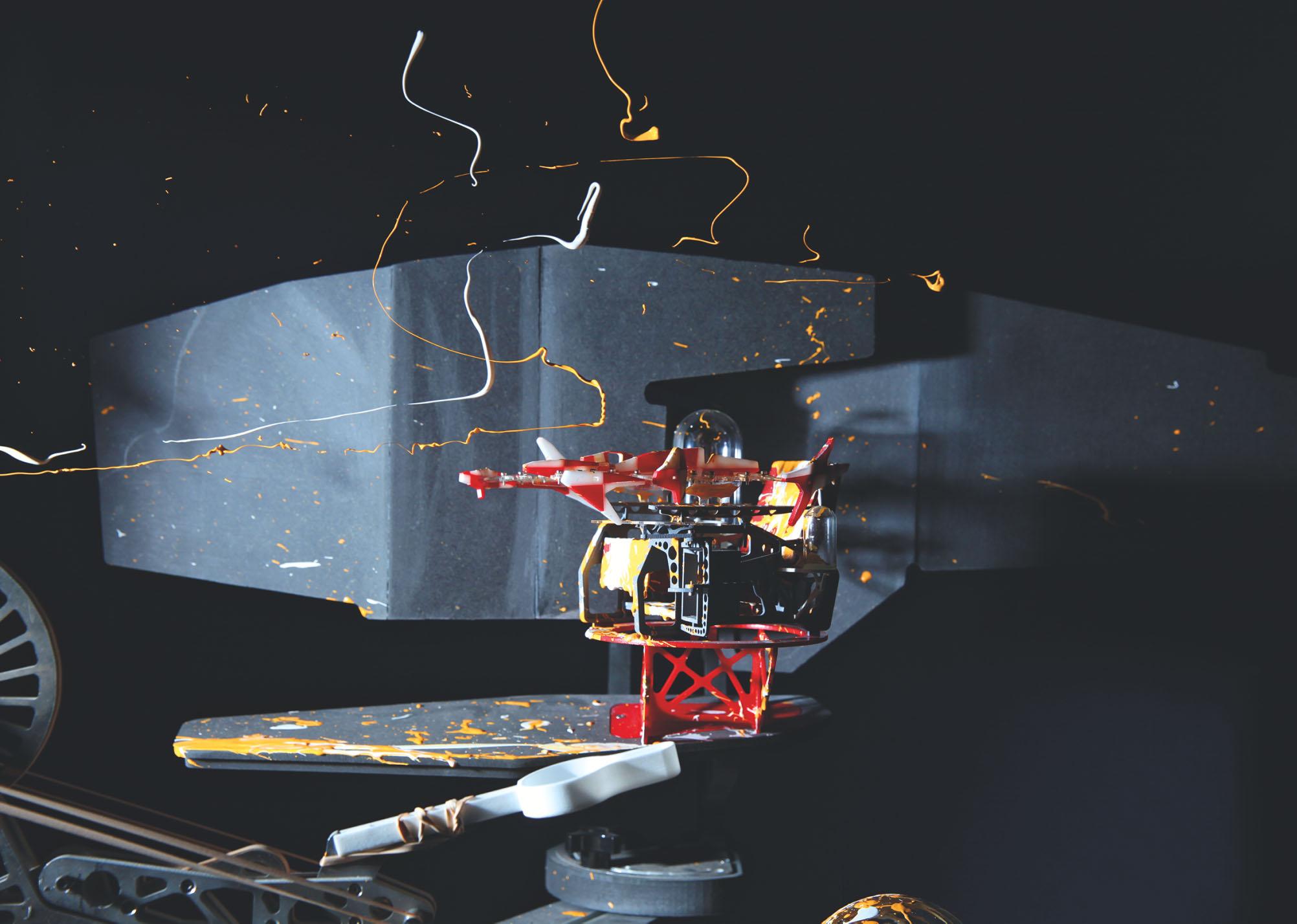
A series of mesmerising slow-motion films capture the unfurling of the paint globules in space. Before reaching their target, they elongate in elegant sinuous ribbons, stretching, twisting and flexing. At the point of contact, they expand like the wings of an insect preparing for flight, and after the clash they plummet backwards, collapsing into a constellation of speckles, some rescued by the picture plane. But the films capture another unexpected transient field of occupation: the slow-motion shadows of the splatter, temporarily casting its trace on the picture plane like the passing of clouds.
The certainty of the single point of view from which all visual rays emanate in linear perspective projection is here split into a multitude of paint beads, each with its own agency and impulsive unpredictability. The seemingly amorphous patterns of the resulting trace of the splatter on the picture planes are images. Mathematical and statistical analysis, equivalent to the methods used in forensic examination of stains of blood
(another non-Newtonian fluid), should reveal a precise analogical relationship with the portrayed chair. Staging vision, the four mechanisms are thus also representations of acts of looking, complex models of eyes that spill their white and orange irises on their retinas, making Instrument Ten a four-eyed composite entity.
Ambiguous Objects
Chard’s projection of paint as an indeterminate substitute of the projection of light in Instrument Ten is reminiscent of French artist Marcel Duchamp’s methods and intentions. Duchamp also employs indeterminacy and challenges accepted notions of perception in his The Bride Stripped Bare by Her Bachelors, Even (The Large Glass) (1915–23).3 More specifically, like Chard’s hurling of paint, Duchamp fired matches dipped in paint from a toy cannon to define the nine ‘Shots’ – the Bachelors’ attempt to reach the Bride. The similarities between Duchamp’s and Chard’s work, ideas and processes, do not stop there, however. Both explore projection as a physical act and value chance: the dropping of strings in Duchamp’s 3 Standard Stoppages (1913–14)4 and Chard’s staging of acts of drawing as an equivalent of, or a rehearsal for the indeterminacy of inhabiting architecture. Like Duchamp, Chard is a ‘defrocked Cartesian’; his work reconstructs the imagination through drawing to test the boundaries between reality and its aesthetic and philosophical possibilities with playfulness, but also a heightened need for precision.5 The intentionally elaborate design and didactic appearance of his drawing instruments invites us to bring our own specificity. He sees the creation of ambiguous objects that play a game of seduction with their viewers, inviting them to complete the work, as his main debt to Duchamp. The projection of paint and the resulting pattern of the splatter invokes our physical encounter of and visceral entry into the space of representation that Instrument Ten draws forth.
Didactic Models
Didactic instruments and models are good communicators of explicit knowledge, objective and codified, that is easy to articulate and share. Chard creates instruments that resemble didactic ones to communicate implicit or tacit knowledge: knowledge that is subjective, difficult to express or extract, including personal wisdom, experience, insight and intuition. His creation of instruments that construct and communicate tacit knowledge is informed by practiceled research into a range of didactic instruments from the realm of explicit knowledge. The two main fields of his research are astronomy, including the mechanisms of planetarium projectors and planetary models such as the orrery, and the natural history diorama, observing the original habitat and the projective techniques involved in its reconstruction.
Both fields share precise observation and re-creation of an external field condition: the celestial dome and the pristine landscape of the animal habitat. Through precise geometrical projection on a curvilinear plane –the planetarium dome and the painted curved-diorama backdrop – the aim is to recreate a physically compressed simulacrum that captures a convincing illusion of the natural world experience. The planetarium and the diorama are scientific replicas, models staging our current understanding of the known world in an analogous but distorted environment, their didactic function embedded in the affirmation of this analogical relationship.
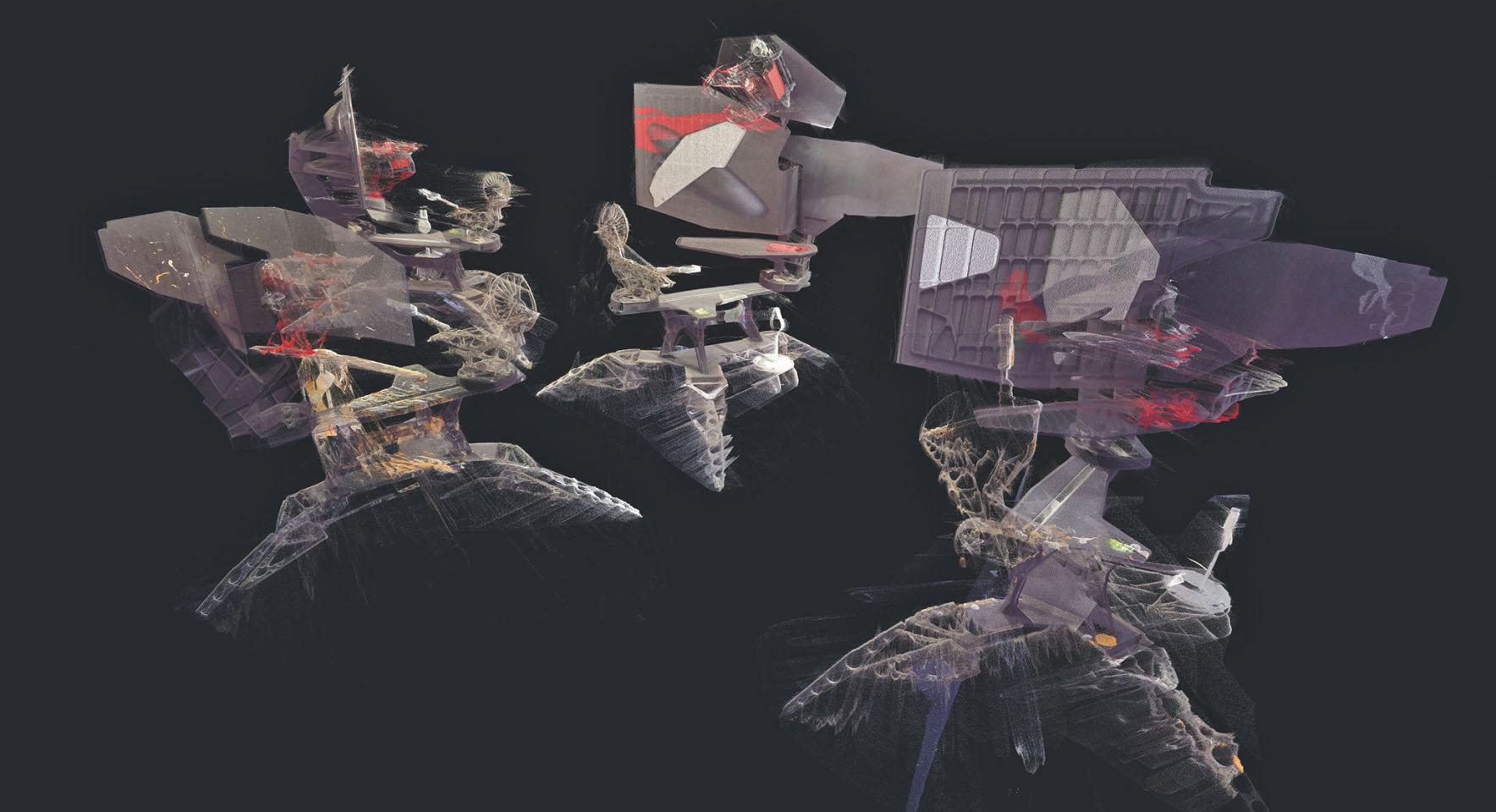
3D scan of the quadripartite instrument. Emerging through the point cloud, the instrument appears translucent, allowing views of both the front and back of each picture plane. LiDAR scan and photogrammetry by Thomas Parker.
Chard’s Instrument Ten turns this didactic relationship on its head. Although clearly referencing the examples above by featuring projection mechanisms, curved picture planes and the creature-like quality of the early Zeiss planetarium projector, it is devoid of direct didactic function. Its creation precedes the existence of the external world condition it is supposed to invoke. It is a didactic model, but the novel architecture spatial paradigm it claims to expose has not been conceived yet.
Détournement
Seemingly ambivalent towards didactic models, Chard’s attitude can be best explained through the Situationist technique of détournement, literally ‘diversion’ in French, first developed by the Letterist International collective of radical artists and cultural theorists and later by the Situationist International in the 1950s.6 Also translating as ‘rerouting’ or ‘hijacking’, it involves creating a variation of a previous known work to communicate a meaning that is antagonistic or antithetical to the original. Guy Debord employed the technique in the problematic film version of his Society of the Spectacle (1974), where he used the provocative montage of found footage to critique mass marketing and its role in the alienation of modern society. Duchamp détourned the Mona Lisa in his ‘rectified readymade’ L.H.O.O.Q. (1919)7 by adding a moustache, and in another example Mel Bochner and Robert Smithson hijacked the art magazine article in their
Seemingly ambivalent towards didactic models, Chard’s attitude can be best explained through the Situationist technique of détournement
A part-instrument in action. White and orange elongated sinuous globules of Latex paint caught mid-flight. The 1:6 chair model and its abstracted occupant are already marked with the remnants of a previous throw of paint.
‘The Domain of the Great Bear’ (1966), which tellingly takes as its subject matter an analysis of the Hayden Planetarium.8
So détournement is an attempt to turn a work of art, or a technique, against itself, to question it and reveal its hidden assumptions. In their ‘Mode d’emploi du détournement’ (‘A User’s Guide to Détournement’) (1956), Debord and Gil J Wolman describe the role of the technique in challenging architecture. They suggest that the ‘light of détournement spreads in a straight line’ and that any new architecture tends to ‘start with an experimental Baroque phase’ or ‘architectural complex’: ‘[a] dynamic ambient environment in conjunction with behavioural patterns, will most likely make use of the détournement of known architectural forms, and … will harness plastically and emotionally, all kinds of détourned objects – cranes or skilfully placed metal scaffolding – successfully taking over from a defunct sculptural tradition.’9
This creation of a ‘dynamic environment’ of ‘détourned objects’ towards a new way of conceiving architecture that takes over from a defunct tradition resonates with Chard’s expectations for the role and performance of his ‘Baroque’ complex of models – his ambiguously didactic Instrument Ten.
Detail of the aftermath of the projection.
Scale-Shifting
Chard enters the emerging world that his détourned didactic models promise with precious ignorance. He uses the word ‘hope’.10 Hope in the instrument’s intervention and potential of creating greater things.
In their book The Model as Performance (2018), Thea Brejzek and Lawrence Wallen develop the notion of the model as a ‘provocative construction between past and present, idea and reality, that challenges and redefines the relationship between object, viewer and environment’. They see the model as inherently ‘performative and epistemic’ and argue for its ‘potential for cosmopoiesis, or world-making’.11
Shifting in scale, from the enlarged anatomical model of an eye to the one-to-one object of the drawing instrument in action, which can also be conceived as an ambiguous 1:6 model of a potential architectural building housing four participants, Instrument Ten creates an ever-fluctuating locus of exchange with the viewer. The pleasure lies in its ability to surprise not only its author, but also, through him, us, his audience. Instrument Ten acquires agency, shaping Chard’s and our sensibility, and through its connection to the planetarium and the diorama it is performative and epistemic; it suggests a bigger new world beyond, which awaits to be defined. 1
Notes
1. ‘Musei Wormiani Historia’, engraved frontispiece in Ole Worm, Museum Wormianum, Leiden, 1655: www.britishmuseum.org/collection/ object/P_1872-0511-1004.
2. Nat Chard, ‘Instruments Nine and Ten’, unpublished research folio, edited by Yeoryia Manolopoulou, Barbara Penner and Phoebe Adler, Bartlett School of Architecture, University College London, 2021.
3. Marcel Duchamp, The Bride Stripped Bare by Her Bachelors, Even (The Large Glass), 1915–1923: www.philamuseum.org/collection/object/54149.
4. Marcel Duchamp, 3 Standard Stoppages, 1913–14: www.moma.org/collection/ works/78990.
5. Penelope Haralambidou, Marcel Duchamp and the Architecture of Desire, Routledge (London), 2013, p 243.
6. Guy-Ernest Debord and Gil J Wolman, ‘Mode d’emploi du détournement’, Les Lèvres Nues 8, May 1956, pp 2–9.
7. See later reproduction, Marcel Duchamp, L.H.O.O.Q. (1930): www. centrepompidou.fr/fr/ressources/oeuvre/c5pXdk6.
8. Mel Bochner and Robert Smithson, ‘The Domain of the Great Bear’, Art Voices, Fall 1966, pp 44–51. See also www.artforum.com/print/200607/secrets-of-thedomes-on-the-domain-of-the-great-bear-11493.
9. Debord and Wolman, op cit, p 7. Author’s translation from the French.
11. Thea Brejzek and Lawrence Wallen, The Model as Performance: Staging Space in Theatre and Architecture, Bloomsbury (London), 2018, p 1.
Top, planar view of the instrument after a paint projection session. LiDAR scan by Thomas Parker.
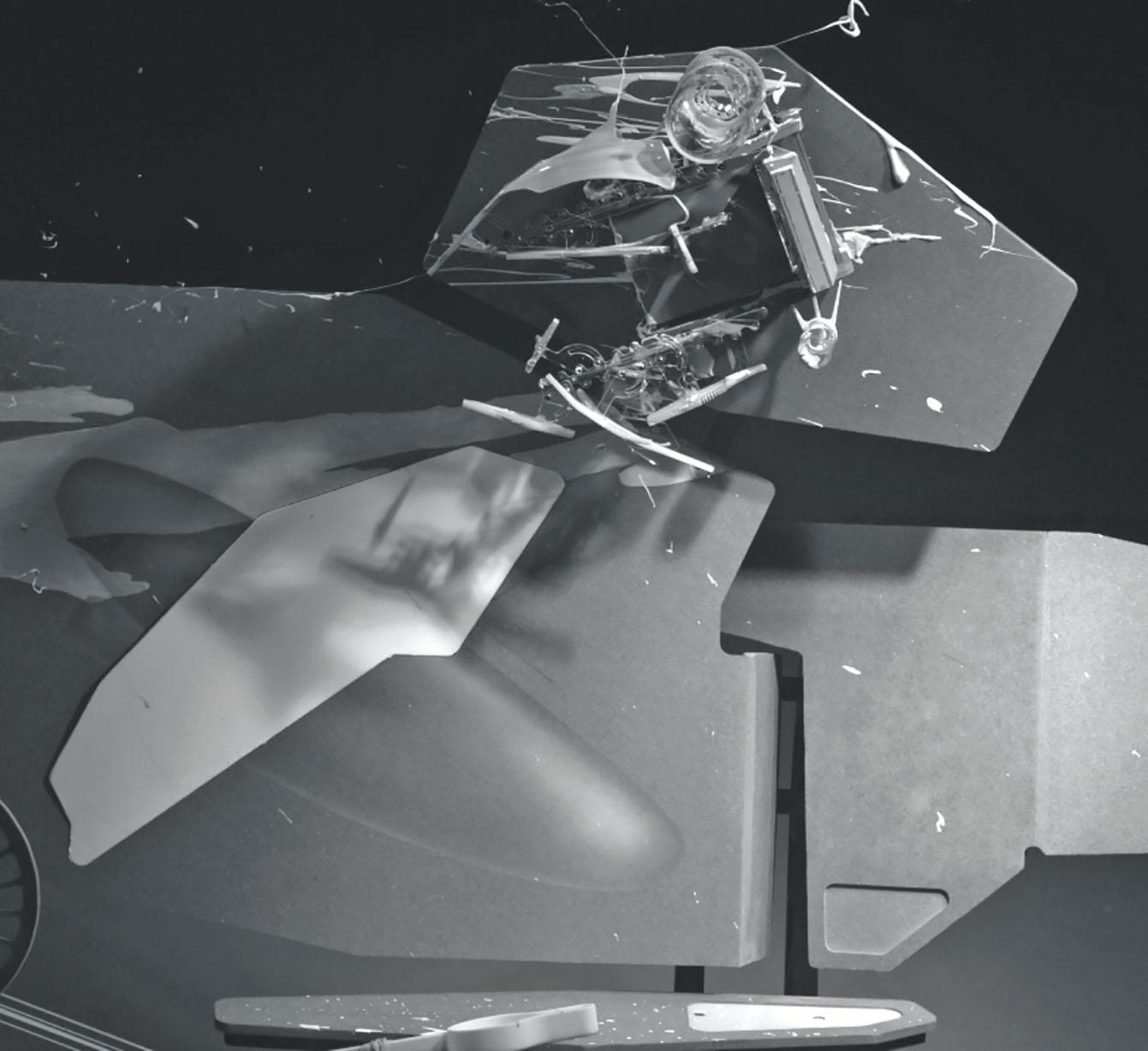
Black-and-white slow-motion film still capturing the moment when the paint hits its target. High-speed filming by Zhuyang Chen, with thanks to Professor Yiannis Ventikos.
Consistency in Change
As both a design experiment and a recollection of Tuscan towns, the drawing organises journeys around colourful buildings and narrow streets, establishing a contrasting gradient with the surrounding landscape.
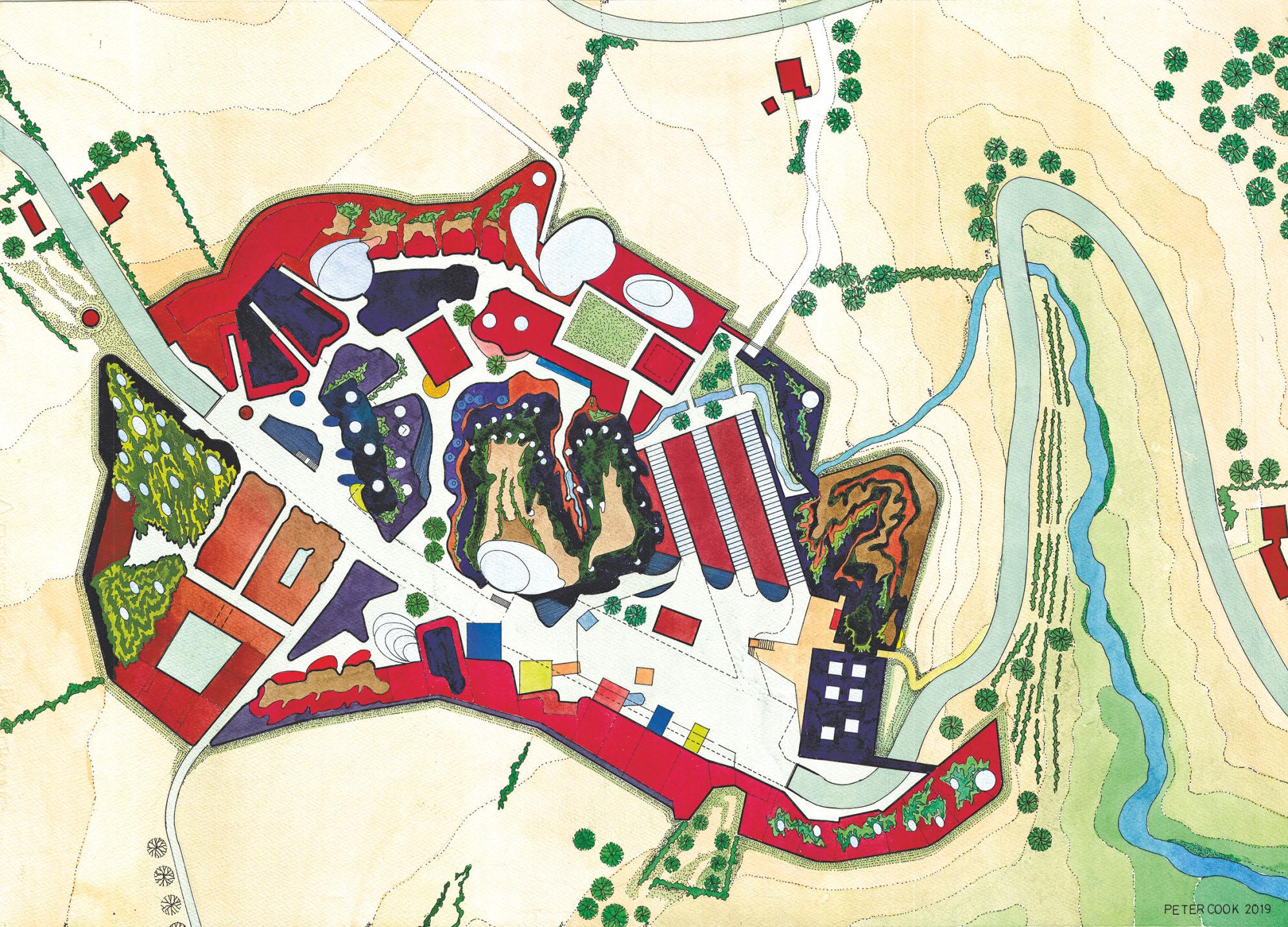
Peter Cook, Tuscan Hilltop Town: Plan, 2019
Architecture for Optimistic Living
Beacons of inspiration for generations of architects, Peter Cook’s drawings often have similar but differently expressed architectural preoccupations. Concerned with transparency, time and change, they choreograph ‘growies’ or ‘veggies’ and a wealth of typologies and topologies. Bartlett School of Architecture and Architectural Association design tutor Ricardo de Ostos takes us through some of his recent work.
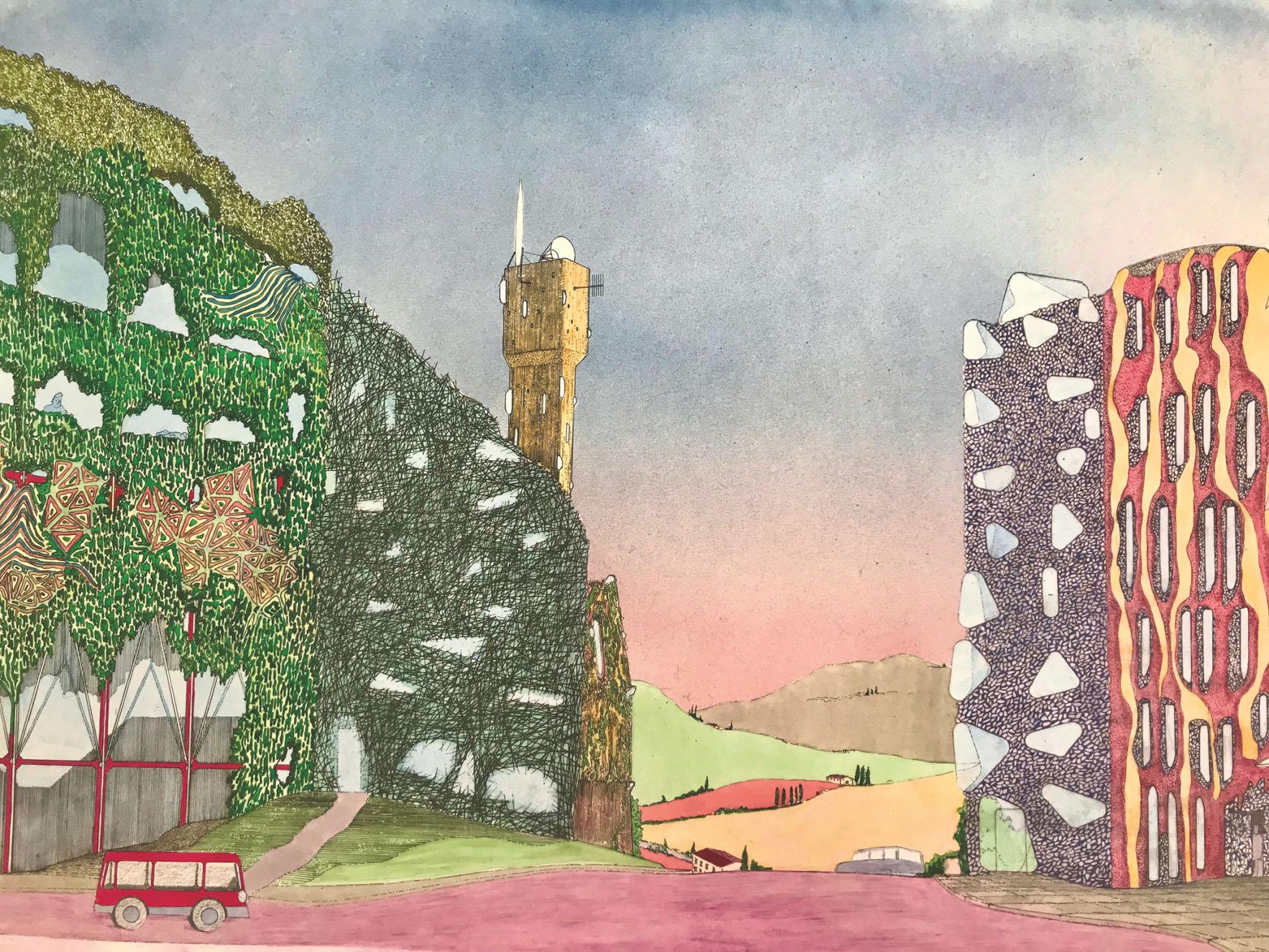
Peter Cook, View from a Tuscan Hilltop Town, 2020
‘I hate abstraction, I was never interested in it.’ Sitting at home in his garden, Sir Peter Cook explained to me the reasoning and motivation behind some of his latest drawings. It is a late-summer afternoon and despite the gloomy forecasts in the press, today the English weather is clear with gentle sunlight shining down on North London. For Sir Peter Cook – yes he has been knighted by the Queen – explaining architecture in his own words was routine pre-pandemic, with hundreds of lectures in packed auditoriums. One could find his weekly travel updates on Facebook posting pictures of kiosks in Tel Aviv or funky buildings in Los Angeles. The drawings featured here were produced mostly during the London lockdowns.
Cook’s dislike for abstraction, as he empathically states, is balanced by his unmatched talent for narrating encounters. In studying his drawings, one may find a thematic, motifs and composition hierarchies. All foundations of both structural and artistic vision are inked in the architectures drawn. But above all, the macro-organisation of both drawings and architecture hide a subtle game. A wall thick with vegetation may conceal a cut-out window, a high-tech steel-frame structure and glass panels revealing the silhouette of a woman standing by. In the world of Cook’s architecture, daily life and high ideas interplay without prejudice. Design and projects, form and material are interwoven with post-occupation. Many of his drawings portray not only space, but time in the shape of people’s habits, customs and cultures. He is not afraid to explore culture as what people do and not what they say they do. The latter way seems to be a common phenomenon among young talents too concerned to be radical and anxious to change reality. On the other hand, the former is common for conversationalists, some London cab drivers and philosophers like Michel de Montaigne. If today’s public discourse is overpowered by weaponising differences, Cook’s work instead celebrates what we have in common.
War Memories
In his set of drawings of a village in Tuscany, the interplay between design and occupation, technology and context open the conversation between existing site and building. An inhabitable wall surrounded by a yellow hilly landscape presents the Tuscan Hilltop Town: Plan drawing (2019), where objects rather than grid organise the inner spaces. The distribution of forms and surface coverage in plan announces a place where the inside is not only different from outside, but otherworldly. From the top view the town accepts the gentle river entering from the northeast. Like in a tale from Ovid’s Metamorphoses, dark-green vegetation sprouts and transforms hard-edged buildings into soft giants with glassy eyes. Along the north side of the walled town, a higher density of forms, geometric coloured red blocks give birth to streets, semi-private gardens and small public squares. From larger buildings to small street corners, the Tuscan town plan celebrates meandering, the surprise of exploring a place. Rather than being a place of statements and rigid consistency, the formal logic seems to exist in order for the detour to emerge. As described by Cook, ‘in these streets people meet, find a way to move and discover’.
As we sit in his garden, he mentions what I would later come to read in his recently published autobiography Lives in Architecture: Peter Cook (2021).1 His passion for maps and the relationship between terrain and architecture has existed since his childhood. His father Frederic William Cook MC DCM was an army Major with three Military Crosses. In his autobiography, Cook recounts how as the Commandant of Leicester and Nottinghamshire, his father set up camps during the Second World War for British and Allied troops, but also prisoners, and took young Peter to see a ‘muddy field’ near Leicester. A month later the place was filled with people, watchtowers, huts and Italian prisoners-of-war. Marching on the tunes of war drums, the landscape was now a settlement –people occupied it. The complexities of the human condition were made visible. In Cook’s passion for drawing, the maps became less of a graphic obsession than a tool to order chaos, to play and to ask questions.
This was impactful for several reasons. Not only was this a landscape that suddenly transformed into a small town with its hierarchy and stern demarcations, it became a symbol of the conflicting period and a powerful memory in the eyes of a child. In education, one of the crucial signs of learning is not to repeat in a parroting-back of information, but instead to transfer experiences and knowhow between areas of knowledge. And transferred Peter Cook has done. Gone is the bleakness of war and the muddy fields. Enter instead maps with colourful objects where power and hierarchy are secondary to discovery, freedom and meandering. A mapping that would have ordinarily settled for asking ‘why?’ is instead substituted by one prodding us with the relentless optimism of ‘why not?’. Could a hostile landscape be changed by colourful and cheerful architecture? Or a traditional Italian town be reimagined through the overlap of lush and furious vertical landscapes? As a master conversationalist, Cook establishes environmental relationships enabling elegant drifts showing the architecture as an emerging map of possibilities. To draw is less to set instructions to be followed than a meditation on what is possible. In the Tuscany Hilltop Town plan, the urban configuration is tied together not by norms or forced rules, but by trust that humans are curious to discover and inspect instead of being told what to do by a guide book. ‘Why not?’ dares to embrace change against repetition.
Portfolio consistency in architecture is normally heavy handed. While the young and ambitious tend to force commonality in forms and statements with the hope of distilling their brand, more experienced architects often rest on their laurels and signature approaches, all of which are just other behaviours standing in for repetition. However, consistency, or in this case coherence within a life project can be achieved through change. In the perspective View from a Tuscan Hilltop Town (2020), the town emerges in full glory, or perhaps better said, fully dressed buildings in tight vegetation and stripy yellow and red textures. Framing a classical Italian landscape, the building windows offer an eclectic display of forms amid the solid volumes. On the left side, a building with a metal structure, cables and glazed façade is slowly but steadily being covered by vegetation. Fluffy greens hang down like a dark beard. Midway through the elevation, a
triangulated pattern inhabits the wall as if a living tattoo. The drawing celebrates the existing landscape while inserting something new.
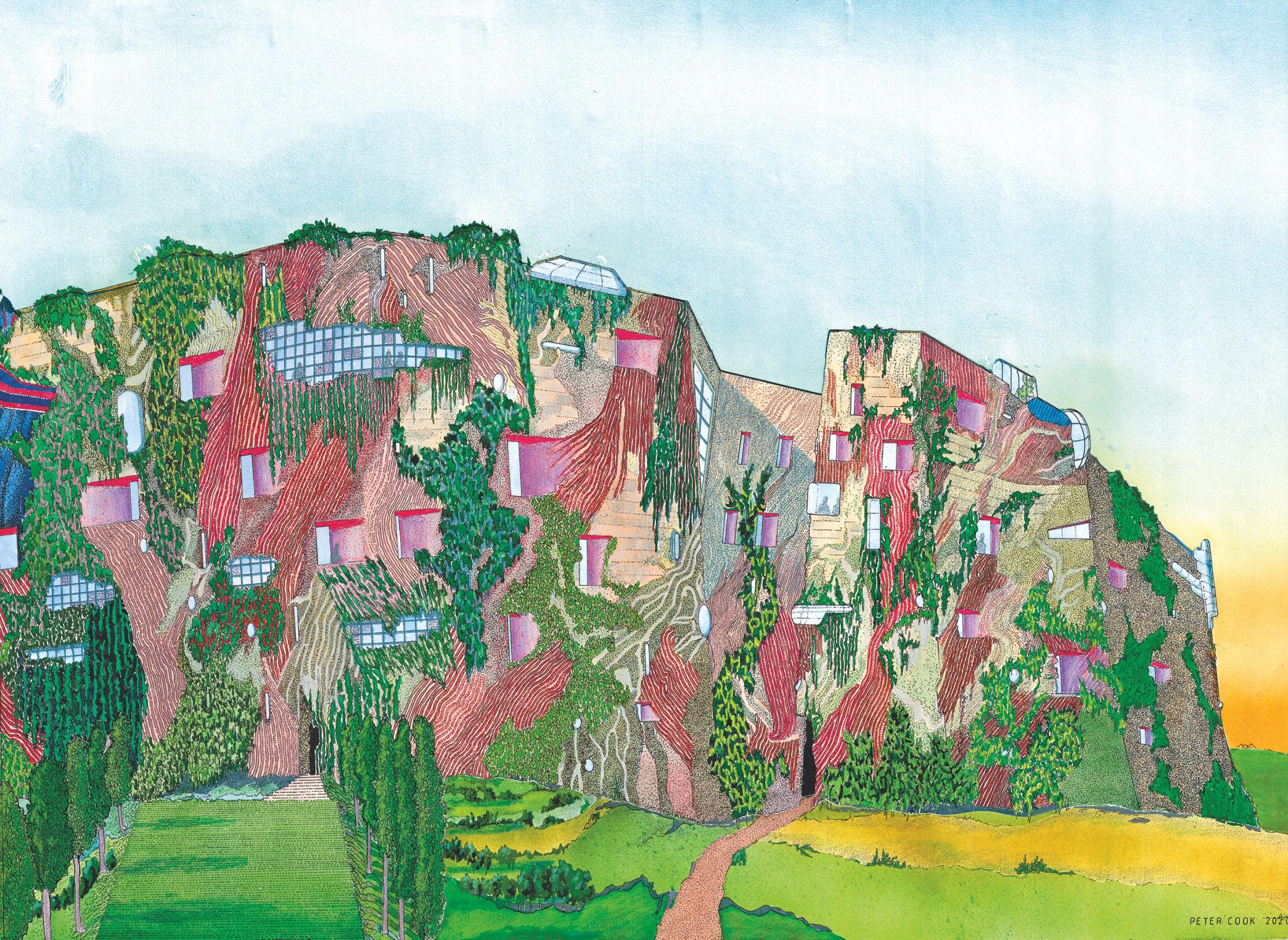
The buildings for the Tuscany walled town do not segregate through their framing, but instead ooze out growth and greenery through their porous materials. As seen in Tuscan Hilltop Town: The Wall (2020), the wall is inhabitable. As if perforated by shrapnel, it proposes windows in many shapes and forms, patterns and furious greenery. But most intriguing of all are the entrances at the base. Two openings, both cavernous and dark as if the façade has been cracked open; a fissure into a rock. The architecture of a system and a kit of parts here coexist in harmony with the mysterious rocky landscape, as if the map refuses the architecture to be only frames.
The Violence of Romance
As one of the most successful and influential architectural educators of the last 50 years, Cook was always interested in buildings. Though a co-founder of arguably the most famous experimental architecture group of the 20th century, with much of his work linked to Archigram and its futuristic imagination of the 1960s and 1970s, he never snubbed the idea of buildings. Quite the opposite. The building is an encounter with the real. In fact, his work with Archigram stretched the question of what else a building can do.
The buildings for the Tuscany walled town do not segregate through their framing, but instead ooze out growth and greenery through their porous materials
Peter Cook, Tuscan Hilltop Town: The Wall, 2020
The inhabited wall is inspired by the necessity to protect, but also by opportunities for infiltration from local plant species.
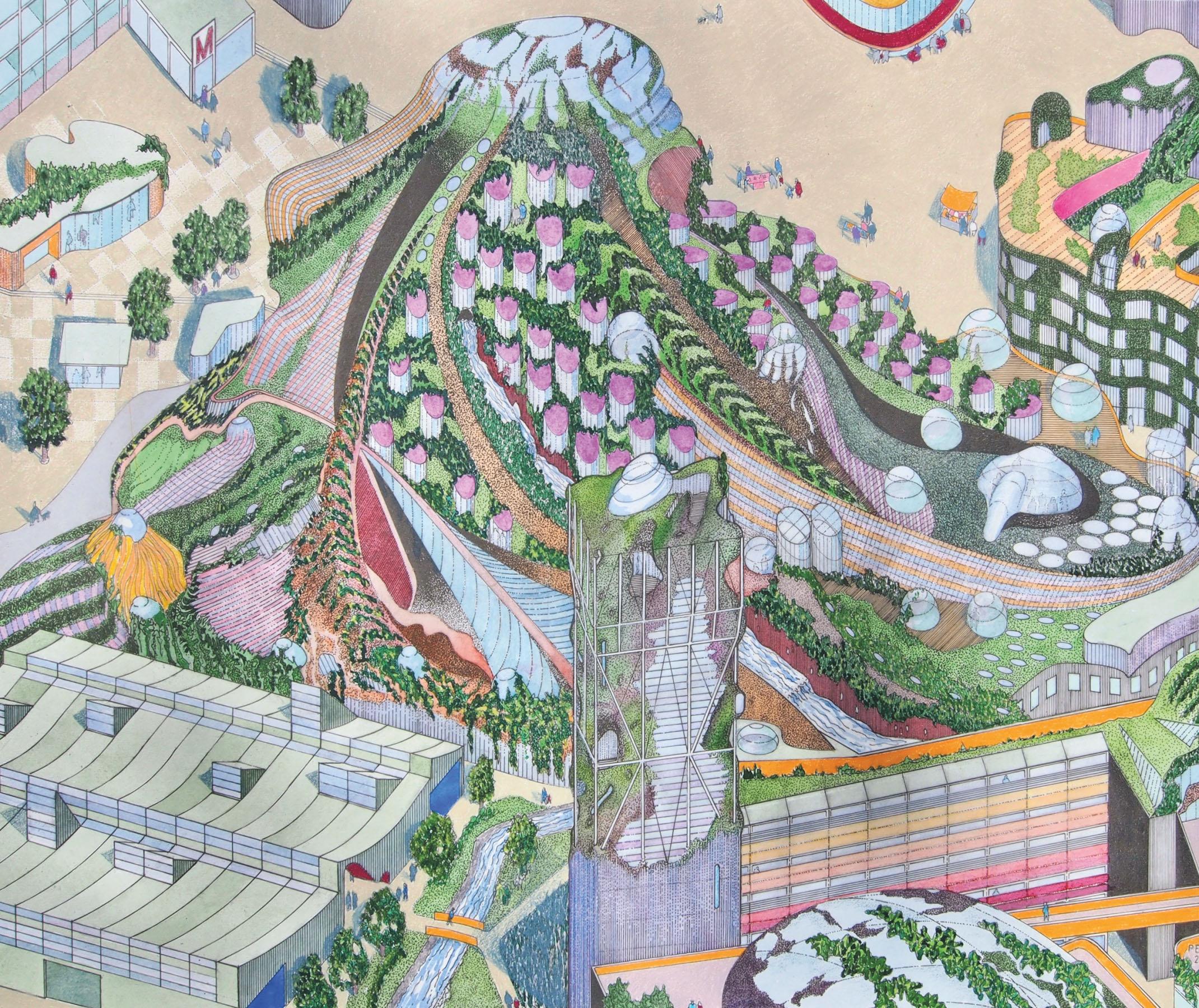
In Tuscan Hilltop Town: Central Area (2020), the top view reveals the crest of a mountainous form made up of towers, farms, gardens, glass roofs and even a water stream sliding down towards the ground. Suddenly the town is a cornucopia of surprises and encounters of opposition. Kiosks with their smells and colours dot the streets, a calm green market building appears bottom left with a language very different from the other constructions. Even though the drawing is the result of the imagination, the architecture is never a one-liner. It is never the repetition of one idea. Instead, diversity is everywhere. Diversity as the coexistence of difference, the celebration of diverse forms, economies and livelihoods.
In Cook’s recent drawings there is no overthinking, but an amalgamation of both academic and in-practice experiences. Instead of science or art, systems or expression, his work celebrates the union of technology and culture. Even when remotely participating in competitions, designing and building during the Covid-19 pandemic, his dedication to drawing never dwindled. A crucial part connecting both practice and academia is his passion for the incidental, the detour.
Peter Cook, Tuscan Hilltop Town: Central Area, 2020
Celebrating great formal diversity, the town’s central area hosts a mountainous building from where water and landscape absorb nature and gradually spill it back into the public realm.
Pyrotechnical Green Assembly
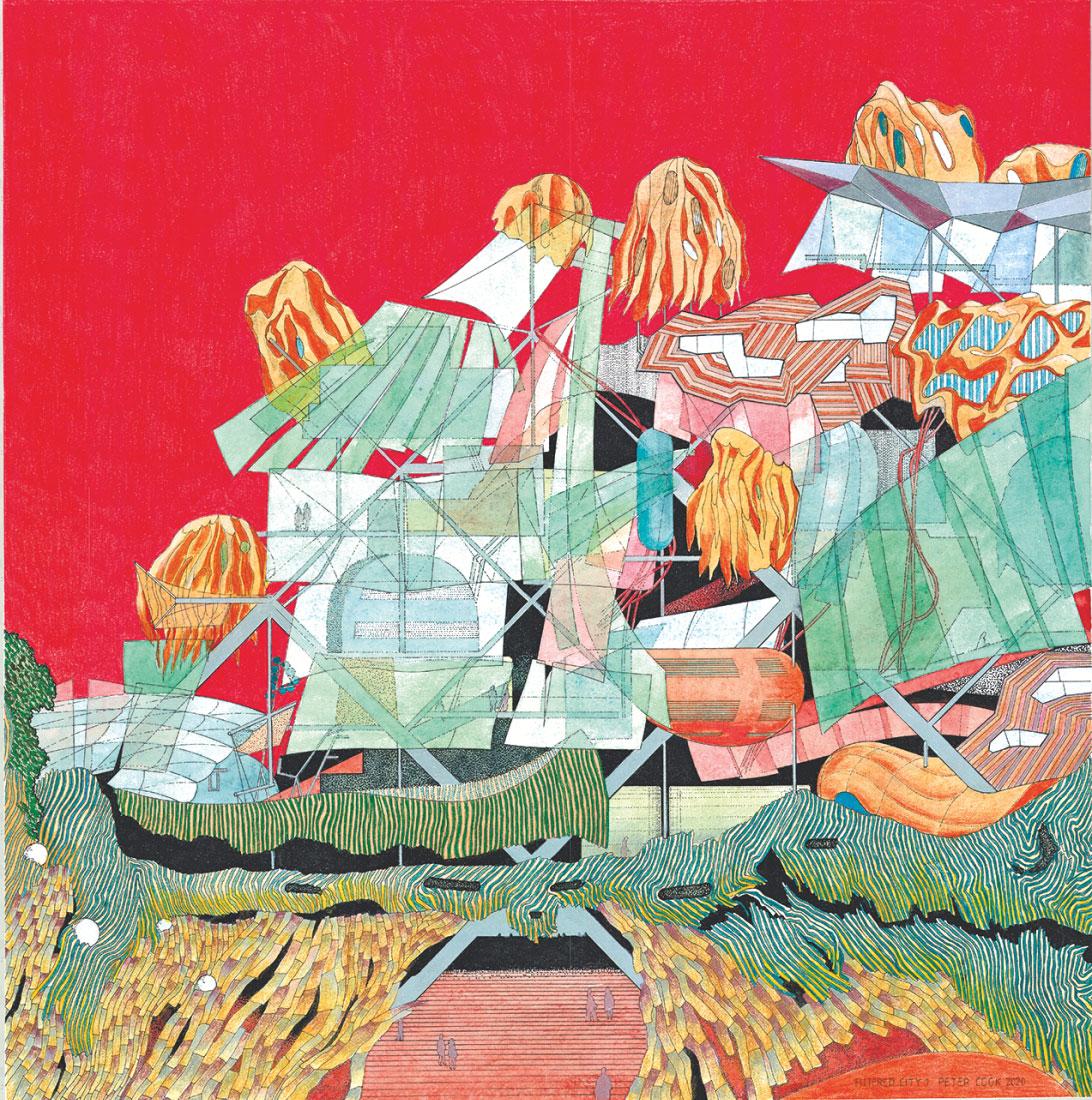
Against a red sky, Filtered City – Nests (2021) shows a building in elevation through a blue diagonal grid from where malleable forms emerge. Here, volumes are not overexplained, but suggestive. Is the fluffy skirt in the lower part of the drawing decoration or some performative membrane? Midway through, the blue filtering fabrics hang down. To add to the composition, capsules dressed in orange fabrics punctuate the scheme, adding a softer and surreal quality to it. If Archigram lives on the collective unconscious of architects of steel and high-tech materials, Cook’s work has been about the soft volume, the time-based natural growth in dialogue with daily life. Metal capsules intersect with spongy and draping architectural skins. The combination of different resolutions and soft and hard forms is reminiscent of Surrealist Max Ernest’s paintings of forest cities, where forests and cities are both paradoxically – and plausibly – hard and soft at the same time. In Cook’s architecture, the combination of the born and the made are in constant evolution.
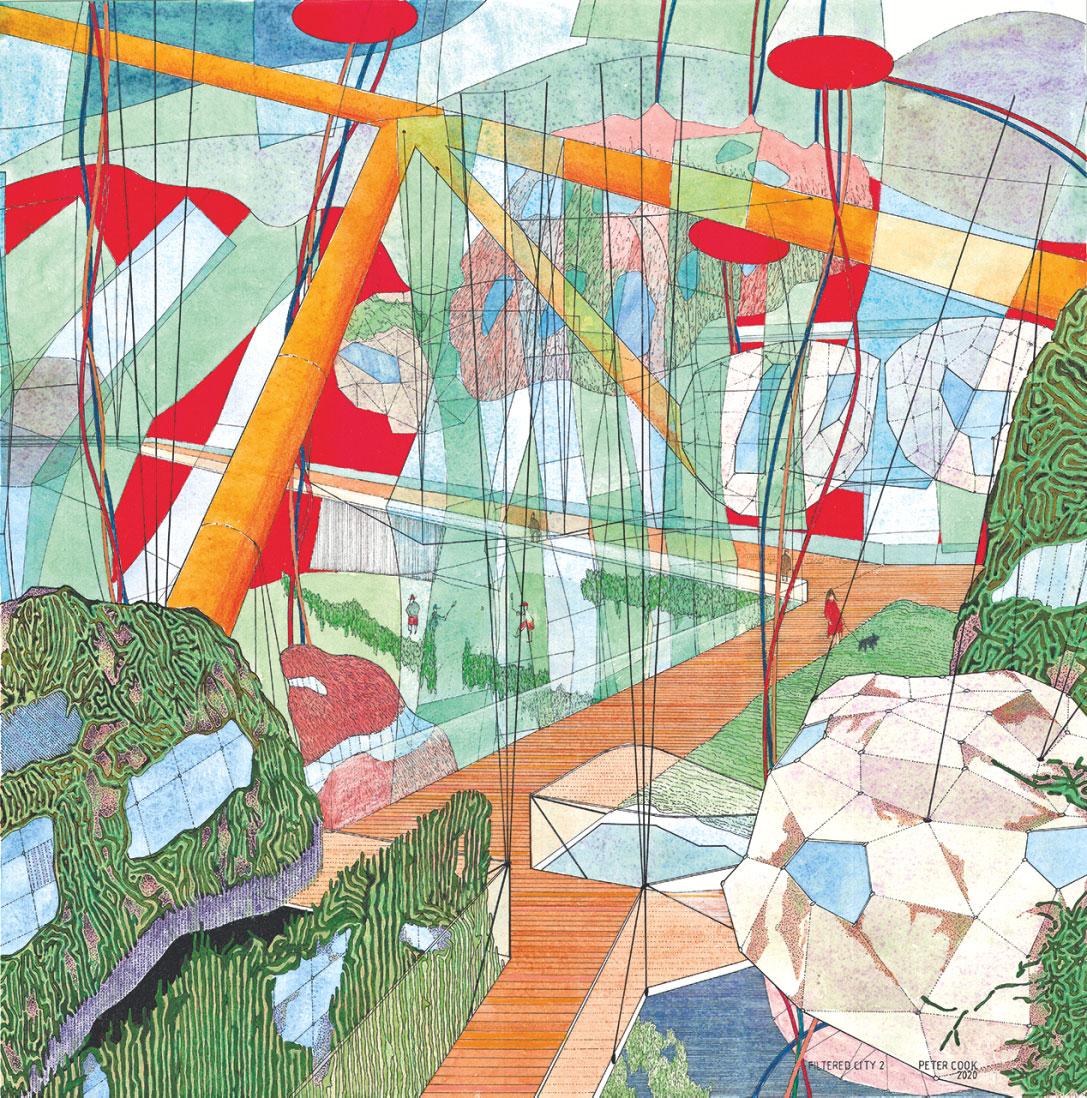
In the Interior view, green pods flank the composition, and fabric filters drape from the yellow grid as a young girl walks her dog along a path. Movement and growth are the dominant layer. Wind, rain and sunlight shift the ambience. The colossal interior space pulsates with the weather being less a solid mass than sensorial instrument. Nature adds to the incidental experience of the space, creating atmospheres and erecting a surreal and upbeat microcosm.
In Cook’s recent drawings there is no overthinking, but an amalgamation of both academic and in-practice experiences
Peter Cook, Filtered City – Nests, 2021
The drawing investigates how an architecture of layers generates surprise atmospheres and ambiences when interplayed with both weather and human occupation.
Peter Cook, Filtered City – Interior, 2021
A microcosm inhabited by capsules and walkways where filters mediate a shifting environment of light, air and greenery.
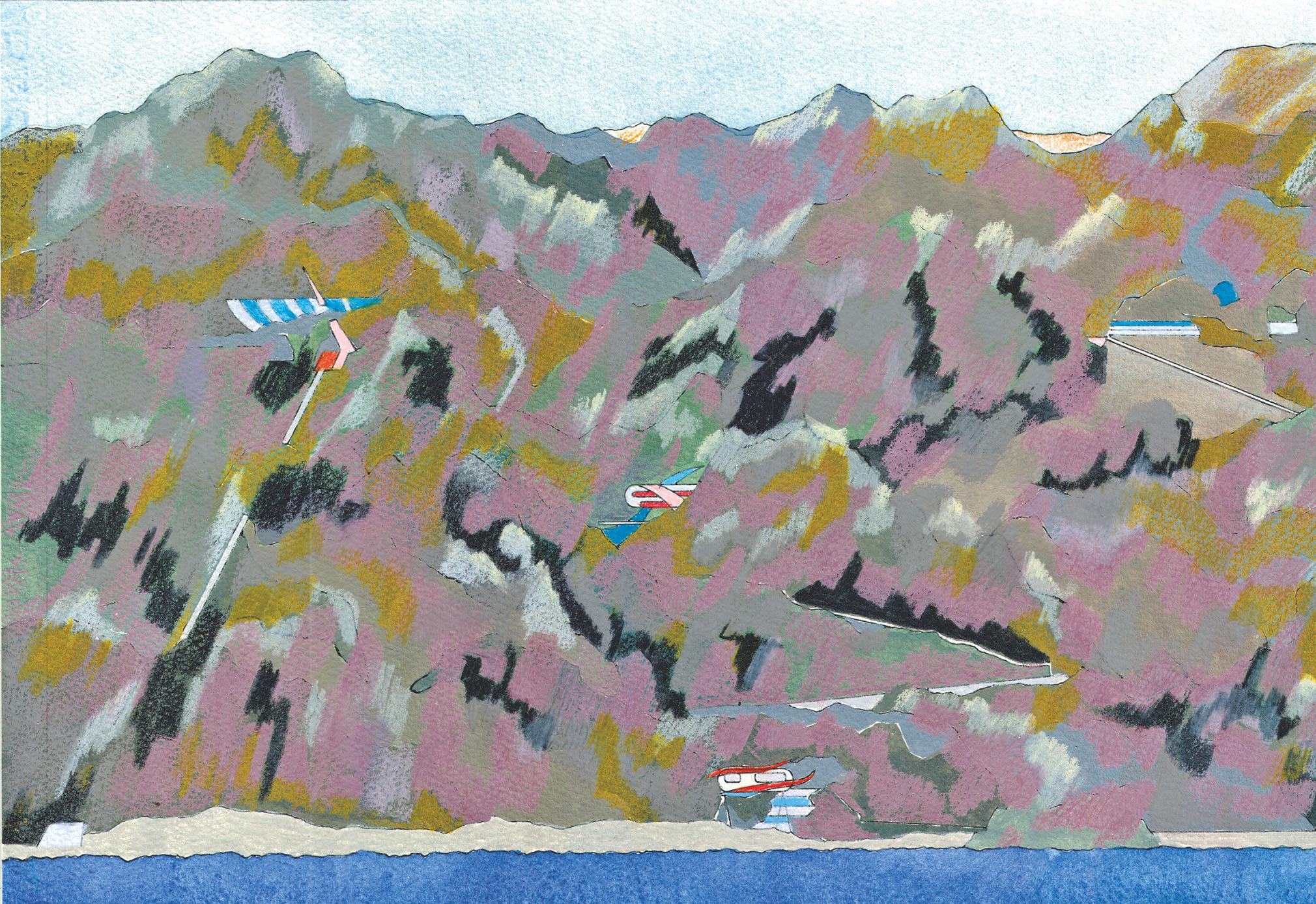
Peter Cook, Tough Landscape –Insertions, 2021
In a challenging and limiting landscape, architecture encrusts elastic formal elements to create a network of spaces and journeys.
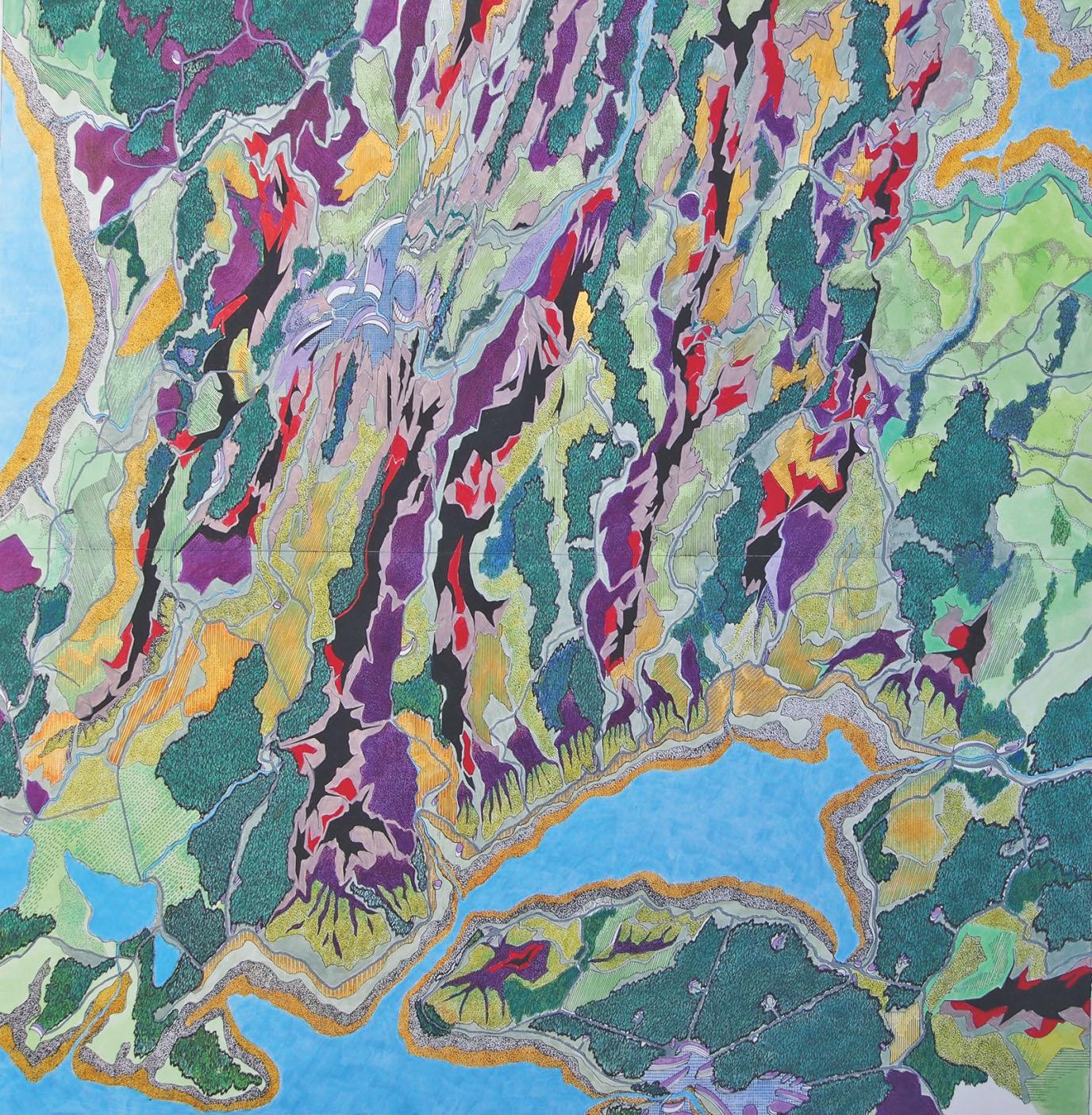
Peter
–Friendly Forests, 2021
Natural growth and punctual architectural interventions evolve an idea where forest co-evolves with terrain and human settlements.
Cook, Tough Landscape
In the powerful Tough Landscape – Friendly Forests (2021), striated filaments descend in furious colours and densities. In a pyrotechnical flow of things and green, the drawing takes the concept of a map into a three-dimensional composition. Forests, lands and farms erupt and swipe across the landscape in a frenzy, culminating in a hypnotic and utterly intense green world. In one moment we can see a group (high-tech village or a sci-fi town?) of sharp glass-edge buildings laying on top of a glazed floor. In another, individual dwellings flank forest edges as if safeguarding the place in a woodland assembly. This fast and aggressive drawing dares to experiment with natural forms as if visualising a ‘forest 2.0’.
As worlds within worlds, Cook’s drawings show how experimental architecture at its best embraces conversations between the real and imaginary, technology and art. Not real as abstract political ideal, but as a multilayer of beautiful paradoxes where we all live and which we desire to improve. Establishing conversations between antagonist characters, cherishing the incidental over the formal and valuing observation above dogma, his work champions what makes cities worth fighting for. Against the pied pipers of architectural austerity, Peter Cook has led optimists, design enthusiasts and mavericks to visualise tomorrows from a street corner near you. 1
Note
As worlds within worlds, Cook’s drawings show how experimental architecture at its best embraces conversations between the real and imaginary, technology and art
1. Peter Cook, Lives in Architecture: Peter Cook, RIBA Publishing (London), 2021, p 2.
Michael McGarry
SHALLOW TO DEEP: DRAWING AS CLOSE ENCOUNTER
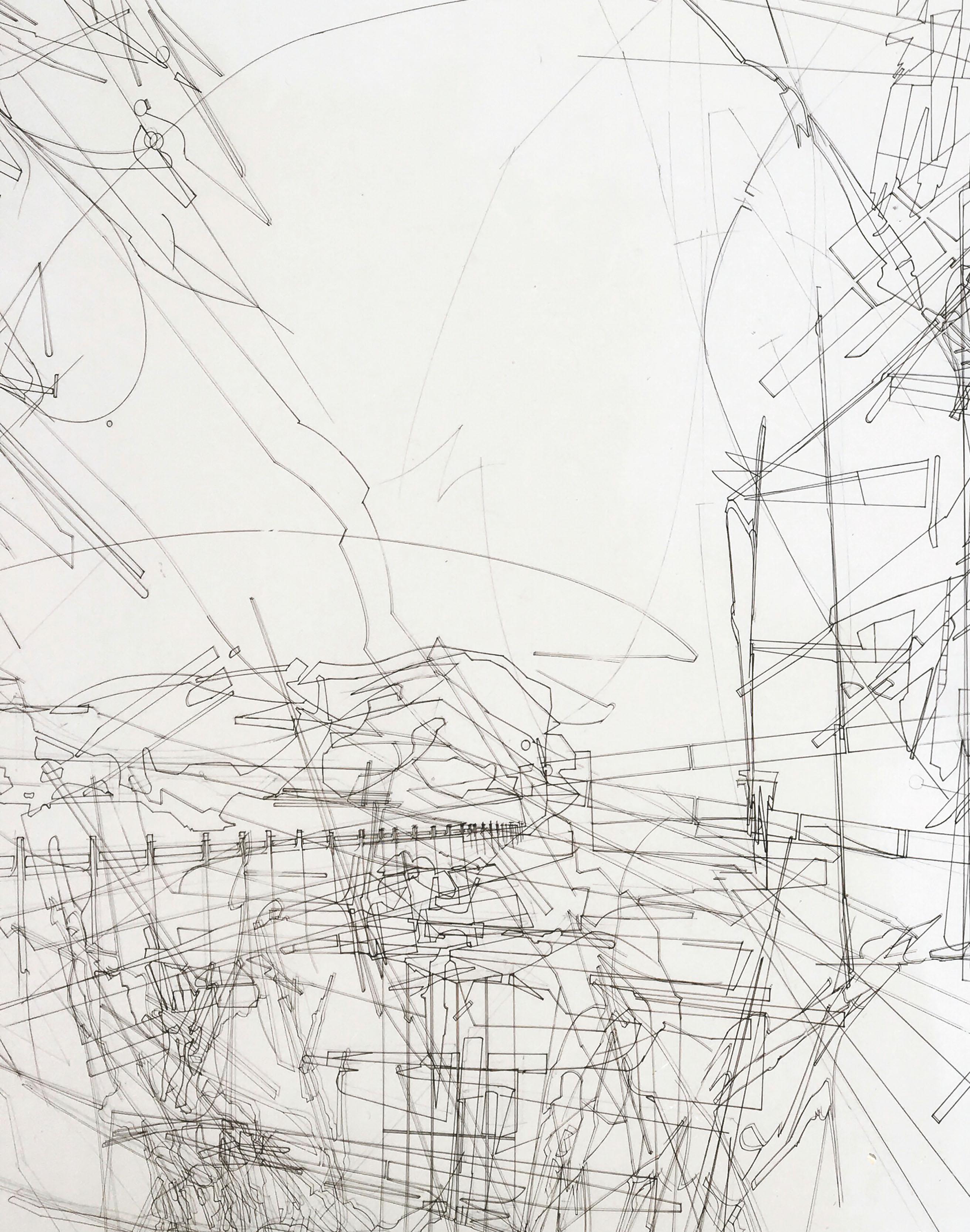
Riet Eeckhout, Drawing Out Gehry II, 2018
Successive iterations are traced from several projections of earlier drawings, the drawing itself stretching to contain content, the figural read in both opaque white and in concentrations of line, the central grounded void as a reassuring backdrop.
Taking inspiration from a Frank Gehry sketch, Belgian architect Riet Eeckhout, through her process of ‘drawing out’, has produced a series of abstract works of considerable scale.
Michael McGarry, Professor of Architecture at Queen’s University Belfast, links her practice to the psycho-geography of the Belgian landscape and the internal geometries of her house and street in Flanders.