US Cyber Market: Modest Growth
Following triple digit growth in the 2020 to 2022 period and achieving the highest growth of any commercial insurance product, the US cyber insurance market is facing a new reality. In 2023, domestic stand-alone cyber premiums experienced a slight contraction of 2%, while domestic package cyber premiums saw a moderate 5% increase. With stand-alone cyber premiums comprising 69% of written premiums and package cyber policies accounting for 31%, the overall domestic written premium growth was just 0.2% to $7.25 billion. Premiums written by alien surplus lines insurers, primarily Lloyd’s, fared slightly better as they increased by 7% to $2.59 billion. In total the US cyber market grew a modest 1.6% to $9.84 billion (NAIC Cyber Report 2024)1
Declining Rates and Limited New Policyholders
The stagnation in market growth observed in 2023 can be attributed to a combination of declining premium rates and limited growth in policy count. While the hard market saw significant growth by premium rate increases, policy count growth remained comparatively modest. From 2020 to 2023, the number of US domestic policies increased just 10%, whereas premiums grew by 142% during the same period (NAIC Cyber Report 2024).
Without significant influx of new buyers entering the US cyber market, growth will continue to predominantly depend on price change and the market will likely fail to reach long term growth projections and necessary market diversification. Although 2023 data suggests a positive trend in policy count growth, some of this increase may be attributable to previously unreported package policies. For instance, one insurer reported an increase in policies from 96,300 to 349,500 while another saw growth from 198,300 to 284,600 (AM Best Cyber Report 2024).2
Figure 1:
Figure 2: U.S.
In 2024, premium rate change in the US cyber insurance market has fallen to below zero, marking the onset of a soft market. In addition to price reductions, insurers have also rolled back eligibility criteria, expanded coverage and reduced deductible levels over the past 12 months. Insurance market cycles typically shift following a few years of price hikes, and given the significant tightening between 2020 and 2022, it is not surprising that the market has transitioned into a soft phase. Hard markets, on the other hand, typically happen after several years of elevated loss activity, falling premium rates and/or one or several catastrophic events. The question is how long the soft market phase will last and what can be inferred from the 2023 year loss performance and the loss activity we’ve observed in 2024 so far. It’s possible that cyber insurance will see more rapid shifts in market cycles than traditional lines of insurance given the dynamic nature of the risk.
Continued Profitability Improvement?
While premium growth stagnated in 2023, so did loss ratios based on the NAIC’s reported loss figures. The reported loss ratio for stand-alone cyber increased by just over one point to 44.3% with package cyber loss performance improving 12 points to 35.5%. The combined result was a 3-point reduction in cyber market loss ratio to 41.6%.
Top 20 Cyber Insurers ($ millions)
Figure 3: 2022-2023 US Domestic Cyber Insurance Market Premium and Loss
At first glance, the numbers appear encouraging, but a deeper analysis of the NAIC data uncovers some significant discrepancies in loss reporting:
• Package cyber policy losses require reporting on a loss payment and case reserve basis. However, loss development in the cyber line after the close of an accident year can add 50% or more in additional losses on top of the initial payments and case reserves in that year. As a result, the reported 35.5% “loss ratio” for the 2023 is likely understated and could be over 50% on an ultimate loss basis. Stand-alone cyber requires loss reporting on an “incurred loss” basis but it’s unclear whether insurers interpret that as estimated ultimate loss, incurred but not reported (IBNR) losses, or just paid loss and case reserves, as seen with package cyber policies.
• One insurer reported zero losses on both its stand-alone and package cyber policies in 2023 and another reported just 4.3% loss ratio. These two insurers alone account for $430 million of written premiums, representing 6% of total premiums reported to the NAIC in 2023.
In addition to the challenges in statutory loss reporting for the cyber line, there are several reasons why some insurers may have a reserving lag following the 2023 year. Prior to the surge in ransomware attacks that began in 2019, cyber insurance was considered a medium tail line in terms of loss development. The primary loss drivers were data breaches and privacy litigation which typically take 2-3 years, or longer, to fully develop. The shift to ransomware as the main driver of loss in 2019 significantly altered the landscape of cyber insurance, transforming it to a shorter tail line of business. This was largely due to the fact that 85% of organizations paid the extortion demands which meant that losses matured very quickly, and the bulk of claims centered around the extortion payment itself. Over the past couple of years fewer organizations have opted to pay extortion demands and as a result incidents now much more frequently involve business income loss. Additionally, cybercriminals have turned to double extortion tactics
(encryption and data theft) to increase their leverage. With most cyber extortion attacks involving data exfiltration, the complexity and scope of these events have driven cyber loss maturation back to a medium tail timeline, reflecting the extended periods required to fully resolve claims. The recent wave of privacy litigation involving website tracking tools has only added to that shift in loss development trends.
While the current NAIC data may not fully capture this reality, the 2023 cyber market’s loss performance is expected to develop significantly worse than that of 2022. The spike in extortion incident activity observed particularly in the second half of 2023 is another strong indication of the potential reserving lag.
The Impact of Extortion on Reported Data Breaches
With the increase in extortion activity the number of reported data breaches has skyrocketed. 2023 saw the highest number of data breaches since reporting began: 3,205 - a 78% increase over 2022.
Figure 6: Reported Ransomware Attacks 2020-2024
Reported Data Breaches
www.idtheftcenter.org/wp-content/uploads/2024/01/ITRC_2023-Annual-Data-Breach-Report.pdf. Accessed Sept. 2024.
About three quarters of the data breaches reported in 2023 were associated with cyberattacks with the rest resulting from system failures or human error. Although nearly every extortion attack now involves some level of data exfiltration, not all are reported as data breaches and there are several reasons why. Stolen data may not contain personally identifiable information, but sensitive corporate information instead. In other cases, the victim of an extortion incident is potentially unaware of the notification requirement or may assume that an extortion payment ensures that stolen data is forever suppressed, which is never guaranteed. Similar to extortion activity levels, data breach incidents have continued at the same high pace in the first half of 2024 with 1,571 reported incidents compared to 1,393 for the same period in 20235
Shift in Initial Access Techniques
Ransomware groups continue to evolve their tactics. Initial access techniques used for cyber extortion attacks can still largely be grouped into phishing, remote code execution vulnerabilities and remote access exposure but 2023 saw a major shift to VPN compromise, a trend that’s become even more apparent in 2024.
Our CTI (Cyber Threat-Intelligence) team tracks current attack patterns and exposures by scanning customers’ external networks, observing honeypot activity and malware logs, and by monitoring sales and chatter in underground markets. That intelligence e ort is further augmented with forensic data collected from our Incident Response team.
As vulnerability exploitation has decreased considerably, VPN exploitation via brute-forcing and valid credentials has become a leading attack vector for multiple ransomware a liates6 and perhaps the reason why extortion attacks remain at a high level. Prominent ransomware groups like Akira, have relied heavily on brute-forcing Cisco ASAs to gain initial access to their victims’ networks. Although VPN is a necessary security solution for enterprise networks, when not properly managed, it can represent an exposure as severe as an internet-facing RDP (Remote Desktop Protocol) connection. This increased interest by threat-actors has also recently expanded to brute-forcing tools that include multiple SSL VPN providers, as well as other remote access solutions, including RD Web.7
This development highlights the importance of continuous auditing and management of VPN and other forms of remote access to corporate networks, as the lack of basic security controls, most notably MFA (Multi-Factor Authentication) has once again become a widespread factor in ransomware exploitation. The issue is not isolated to small organizations with several of the most high-profile and costly attacks of 2023 and 2024 involving VPN compromise and lack of MFA. VPN servers require thorough monitoring, patching and auditing. Customers with limited sta ng and technical resources should consider a managed cloud solution, and ensure MFA is enabled on all accounts. This would decrease the risk of VPN compromise due to inconsistent patching or lack of brute-forcing prevention. If a managed solution is not possible, regularly audit VPN security groups to ensure access is provisioned only to accounts requiring VPN access, including local users on the VPN appliance. They should ensure default accounts are disabled, and default passwords are reset. Additional steps that would diminish the
6“Ransomware Tracker: The Latest Figures [March 2023].” Therecord.media, therecord.media/ransomware-tracker-the-latest-figures.
7“Large-Scale Brute-Force Activity Targeting VPNs, SSH Services with Commonly Used Login Credentials.” Cisco Talos Blog, 16 Apr. 2024, blog.talosintelligence.com/large-scale-brute-force-activity-targeting-vpns-ssh-services-with-commonly-used-login-credentials/.
risk of a successful VPN brute-forcing attack include denying IP connection and authentication from anonymizing software like TOR (The Onion Router), and unauthorized VPN services and proxies. It is also critical to enforce password complexity and lockout policies, to prevent repeated brute-forcing attempts from succeeding. Implement “Impossible Travel” rules to deny consecutive login attempts to the same account from di erent IP ranges. Geolocation blocking alone is not e ective. Ransomware operators easily circumvent this mitigation by using US-based proxies and VPN services.
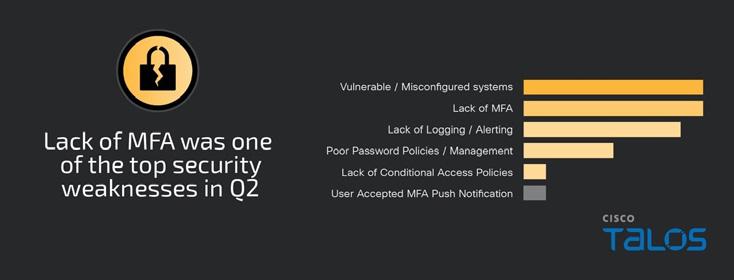
of MFA was one of the top security weaknesses in Q2
Although wide scale weaponization of vulnerabilities as a method of initial access has declined, easily accessible Proof of Concept (PoCs) exploits have contributed to a sustained frequency of critical vulnerability exploitation for specific enterprise products. Widely available across GitHub and other repositories, PoCs of critical vulnerabilities a ecting ConnectWise ScreenConnect, Cisco ASA and Citrix NetScaler saw persistent weaponization by multiple ransomware groups.
February was specifically marked by wide-scale exploitation of CVE-2024-1708, a path traversal vulnerability, and CVE-2024-1709, a critical authentication bypass vulnerability, both a ecting ConnectWise ScreenConnect, a well-known remote access software solution. As a Remote Management and Monitoring solution (RMM), ScreenConnect is of strong interest to remote attackers. This became evident as working PoCs were shared after the vulnerabilities were announced, which was immediately followed by exploitation by multiple high-profile groups, including Black Basta and LockBit8
8“Threat
Source: https://blog.talosintelligence.com/ir-trends-ransomware-on-the-rise-q2-2024/
Dubbed “CitrixBleed”, CVE-2023-4966, a sensitive information disclosure vulnerability a ecting NetScaler ADC and Gateway, continued to be exploited this year. It can allow a remote, unauthenticated attacker to obtain session tokens from memory, and hijack existing authenticated sessions, bypassing multi-factor authentication, validating continued threat actors’ interest. With thousands of vulnerable instances still detected worldwide, exploitation is expected to continue.
Cisco VPN vulnerabilities also remain widely exploited, in particular, CVE-2020-3259, a critical information disclosure vulnerability a ecting Cisco ASA and FTD appliances that could allow an attacker to retrieve memory content from the Cisco device, including cleartext usernames and passwords. Another prevalent Cisco vulnerability, CVE-2023-20269, a ects the separation of authentication, authorization, and accounting (AAA). Prior to its release as CVE-2023-20269, Akira was targeting corporate networks by simply exploiting this flaw via a publicly available Metasploit module published in 20229
Figure 7: Leading Security Weaknesses
New Normal in Widespread Events
In 2023, the cyber landscape experienced a resurgence of widespread incidents, with several attacks exploiting vulnerabilities in widely used software products across various industry sectors. These high-profile breaches underscored the pervasive risks facing organizations reliant on critical digital infrastructure. For example, Cl0p’s exploitation of a remote code execution vulnerability (CVE-2023-34362) in the MOVEit file sharing service impacted more than 2,700 organizations in multiple industries (Source: https://www.emsisoft.com/en/blog/44123/unpacking-the-moveit-breach-statistics-and-analysis/). So far, this year’s most prevalent widespread events have been the result of successful targeting of third-party software providers specific to the auto and healthcare industry. Moreover, three major events in the first seven months of this yearincluding one that seems to have caught catastrophe models o guard - marks a significant increase in widespread event activity compared to the past several years.
Change Healthcare
On Feb 21, 2024, Change Healthcare was the victim of a ransomware attack. Owned by UnitedHealth Group, the company provides billing services, prescription and insurance claims processing. As Change Healthcare provides services to 94% of US Hospitals, the attack resulted in interruptions in claims and prescription processing across the entire United States10. It was later revealed that 4 Terabytes of data were exfiltrated from the company’s networks, possibly exposing the confidential data of 1 in 3 Americans.
It was revealed by the attacker that they had gained access to Change Healthcare’s networks through the use of Citrix Remote Access portal credentials they discovered in an InfoStealer log. Since MFA was not enforced on that account, the attackers were simply able to bypass security controls through valid credentials, and gain access to internal resources within the network11. The attackers then moved laterally throughout the Change Healthcare networks, exfiltrating data and deploying encryption. As a preventative measure, services were shut down, to prevent encryption from spreading to the broader UnitedHealth Group networks12. And while Change Healthcare opted to pay $22 million to the ransomware group
¹0“Latest Alerts and Advisories | NJCCIC.” Nj.gov, 2024, www.cyber.nj.gov/Home/Components/News/News/1299/214. Accessed 11 Oct. 2024.
¹¹“Change Healthcare Hacked Using Stolen Citrix Account with No MFA.” BleepingComputer, www.bleepingcomputer.com/news/security/change-healthcare-hacked-using-stolen-citrix-account-with-no-mfa/.
¹²Testimony of Andrew Witty Chief Executive Officer, UnitedHealth Group Before the House Energy and Commerce Committee Subcommittee on Oversight and Investigations “Examining the Change Healthcare Cyberattack” May 1, 2024, Transcript of Proceedings, pp. 1-10, 2024 https://d1dth6e84htgma.cloudfront.net/Witty_Testimony_OI_Hearing_05_01_24_5ff52a2d11.pdf
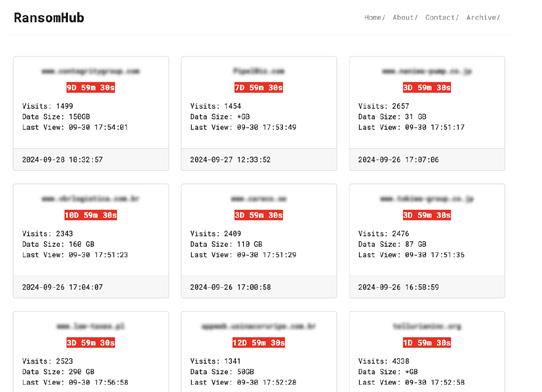
behind the attack to ensure exfiltrated data was deleted, the group (BlackCat) refused to pay the ransomware operator in possession of the data, who in turn decided to capitalize on the attack through another group, RansomHub13. RansomHub, demanded an additional ransom payment for data deletion. UnitedHealth Group estimated the event could reach a total monetary cost of over $2.3 billion.14
CDK Global, Inc.
On June 19, 2024, CDK Global experienced a ransomware attack at the hands of BlackSuit. As one of the largest Software-as-a-Service (SaaS) providers for the automobile dealership industry, CDK’s software products streamline purchasing, leasing, and marketing for thousands of dealerships in the US and Canada.15 As a result of the attack, and the vendor’s critical role in daily operations, thousands of dealerships were forced to severely diminish their productivity.
Immediately after detecting the attack, the company shut down systems to limit the scope of the compromise, and attempted to restore services, but shortly after, they were forced to take systems o ine again. Additional cause of concern was the use of an always-on-VPN connection associated with CDK’s DMS (Dealer Management System) services, as these connections into customers’ networks could have further exposed them during the compromise16. The company was forced to pay a $25 million ransom to BlackSuit for data deletion and decryption17
CrowdStrike
On Friday, July 19th 2024, CrowdStrike released an automatic update for its Falcon Sensor software as normally scheduled. However, this update contained code that conflicted with the normal operating procedure of the Microsoft Windows operating system. The result was 8.5 million Windows devices, both physical and in the cloud, unable to reboot, rendering them unusable. The nature of the issue left system administrators to manually remediate the issue on each individual machine, after CrowdStrike had created a fix for the release18. Due to the widespread nature of the issue and business urgency to return to a working state, this event was capitalized on by malicious actors. Social engineering attacks were launched to distribute malware via fake updates and remediation support services19
The outage caused by the CrowdStrike Falcon update resulted in roughly $5.4 billion in damages to Fortune 500 companies, and widespread outages in multiple industries, including over 46,000 flight delays and 5,171 flight cancellations.20 Although the CrowdStrike outage was not the result of an attack, this event is a reminder of the catastrophic consequences that can result from a widespread non-malicious attack across multiple industry verticals.
¹³“Latest Alerts and Advisories | NJCCIC.” Nj.gov, 2024, www.cyber.nj.gov/Home/Components/News/News/1299/214.
¹4Alder, Steve. “UHG: Substantial Proportion of US Population May Be Affected by Change Healthcare Cyberattack.” HIPAA Journal, 23 Apr. 2024, www.hipaajournal.com/change-healthcare-responding-to-cyberattack/.
¹5“CDK Global.” Cdkglobal.com, 2024, www.cdkglobal.com/fixed-ops/service/cdk-service. Accessed Sept. 2024.
¹6“CDK Global Outage: Everything You Need to Know.” Sangfor Technologies, 2024, www.sangfor.com/blog/cybersecurity/cdk-global-outage-everything-you-need-know. Accessed Sept. 2024.
¹7“Ransomware Summer: Attacks Heated Up, but so Has the Global Response | TRM Insights.” Trmlabs.com, 2024, www.trmlabs.com/post/ransomware-summer-attacks-heated-up-but-so-has-the-global-response. Accessed Sept. 2024.
¹8Djajapranata, Cliff. “CrowdStrike, Microsoft Outage: Is Tech Too Vulnerable?” Georgetown University, 25 July 2024, www.georgetown.edu/news/ask-a-professor-crowdstrike-outage/.
¹9Counter Adversary Operations. “Threat Actor Uses Fake Recovery Manual to Deliver Unidentified Stealer.” Crowdstrike.com, ²0Whitmore, Geoff. “The CrowdStrike Outage Is Still Impacting Airlines.” Forbes, 22 July 2024, www.forbes.com/sites/geoffwhitmore/2024/07/22/the-crowdstrike-outage-is-still-impacting-airlines/. 12
The Outlook
As we look to 2025 it’s worth revisiting some of the predictions in our 2023 report to see what we didn’t get right. We estimated that growth in the US cyber insurance market would slow to 20-25% and that turned out to be too optimistic when in reality the market ended the year at just 1.6%. Another prediction that didn’t come true was systemic risk concerns potentially leading to coverage restrictions in the wake of the MOVEit attack. In the end, the attack didn’t have su cient impact on cyber market loss performance to lead to any changes. We’ve since had three major widespread events and yet it doesn’t seem like these events will lead to changes in market behaviors or coverage structures in the short term, if at all.
It’s now clear that 2022 was an anomalous ransomware year and what we’ve seen in all other years since 2019 should be considered the norm in cyber extortion. On top of that, the market may have to contend with an average of three to four mini-CAT events per year in addition to the potential 50-year, 100-year and 200-year catastrophic events that some insurers are already pricing into their portfolios.
As the U.S. cyber insurance market enters a pivotal phase, it is clear that this is not just a period of stabilization but a moment requiring strategic adaptation and innovation. While hard market growth was fueled by rapid premium increases, the softening market of 2023-2024 signals that pricing alone can no longer drive expansion. The future will depend on attracting new policyholders, portfolio diversification and working even more closely with policyholders to address increasingly sophisticated cyber threats.
The long-term success of the cyber insurance market hinges on its ability to balance profitability with robust risk management, adapt to regulatory changes, and create a greater cybersecurity investment. In an increasingly volatile landscape, only insurers who innovate and embrace a dynamic approach to risk will thrive. The question is whether the industry can seize the opportunity or be blindsided by the very threats it seeks to mitigate.