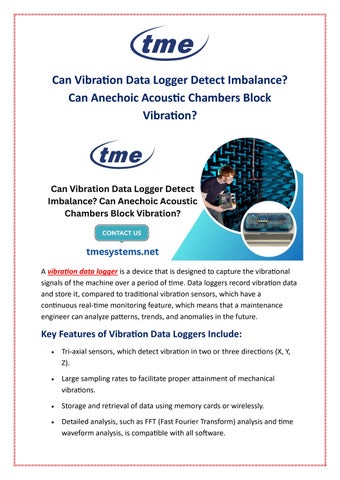

Can Vibration Data Logger Detect Imbalance?
Can Anechoic Acoustic Chambers Block Vibration?

A vibration data logger is a device that is designed to capture the vibrational signals of the machine over a period of time. Data loggers record vibration data and store it, compared to traditional vibration sensors, which have a continuous real-time monitoring feature, which means that a maintenance engineer can analyze patterns, trends, and anomalies in the future.
Key Features of Vibration Data Loggers Include:
Tri-axial sensors, which detect vibration in two or three directions (X, Y, Z).
Large sampling rates to facilitate proper attainment of mechanical vibrations.
Storage and retrieval of data using memory cards or wirelessly.
Detailed analysis, such as FFT (Fast Fourier Transform) analysis and time waveform analysis, is compatible with all software.
This is because vibration data loggers are the best tools to diagnose mechanical problems such as imbalance, misalignment, bearing defects, and looseness.
What Is Imbalance in Rotating Machinery?
Imbalance is generated when the mass is not evenly distributed about the axis of the rotor, and centrifugal forces are generated during the rotation. This imbalance may cause too much vibration that can destroy bearings, shafts, couplings, and other machine parts. Typical causes of instability are:
Uneven mass distribution is being brought about by manufacturing tolerances.
Accretion of materials on fans, impellers, or turbines.
Rotating components Wear, corrosion, or erosion.
It is important to detect imbalance at early stages in order to minimize downtime, maintenance, and catastrophic failures.
Can Vibration Data Logger Detect Imbalance?
A vibration data logger is capable of identifying an imbalance in rotating machinery, yes. It detects abnormal 1xRPM signals, which point to unequal mass distribution by measuring the amplitude and frequency of vibration.
Early detection is provided by trend monitoring and FFT analysis, which contributes to preventing the damage of equipment, decreasing downtime, and facilitating successful predictive maintenance strategies.
How Can Vibration Data Logger Detect Imbalance?
Vibration Frequency Analysis
Imbalance generally generates vibration at the rotational frequency of the equipment. A vibration data logger can distinguish between imbalance and other mechanical problems by doing a frequency spectrum analysis, which allows one to locate the peak of the vibration.
Amplitude Measurement
Another significant pointer is the strength of vibration. An increase in amplitudes at particular frequencies will frequently indicate imbalance. The constant logging will enable the maintenance teams to monitor the rising trends that depict the deterioration of the imbalance with time.
Phase Analysis in Imbalance Detection
On phase analysis, it is used to identify the direction and point of imbalance. Technicians are able to establish exactly where to make a correction on the balancing when they compare the vibration phase of various sensors attached to the machine.
Benefits of Using Vibration Data Loggers for Imbalance
Detection
Preventive Maintenance Advantages
Early identification of imbalance enables maintenance staff to plan corrective measures in time before it fails, eliminate emergency repairs, and save downtime.
Cost Reduction and Downtime Minimization
Avoiding unexpected outages and subsequent breakage of bearings, shafts, and couplings results in high cost savings.
Improved Equipment Lifespan
The constant monitoring of vibration assists in ensuring the machinery is at the best balance, hence extending the overall equipment life and enhancing efficiency in the operation.
Industries That Rely on Vibration Data Loggers
Manufacturing and Production
The machines are used like conveyors, fans, and motors, and always undergo monitoring so that there can be minimal downtimes and product quality can remain the same.
Power Generation
Pumps, turbines, and generators need to be efficiently and safely balanced. The detection of imbalances is essential to avoid disastrous failures.
Oil and Gas Industry
Refinery and offshore platform rotating equipment work in an extreme environment. The imbalance and other mechanical faults are detected early through the use of vibration data loggers.
Step-by-Step Process to Detect Imbalance Using a Vibration
Data Logger
1. Mount the accelerometer or velocity sensors where they are suggested.
2. Calibrate the data logger of the particular machine.
3. Record vibration information during operations.
4. Carry out frequency and amplitude analysis.
5. Compare vibration data against baseline data.
6. Determine imbalance rotational frequency peaks.
7. Find the direction of imbalance by phase analysis.
8. Take corrective balancing measures.
9. Check progress to ensure progress.
Limitations of Vibration Data Loggers
Not always able to spot the root cause without further examination.
Needs to be well placed on the sensor to be detected.
Interpretation of the data needs experienced staff.
May not work as well with very low-speed imbalances when highsensitivity sensors are not used.
Anechoic Acoustic Chambers
An anechoic artificially constructed chamber is a room that absorbs almost all sound reflections and so forms extremely quiet surroundings. It is used in studies and experimentation to measure sound, noise, and acoustic performance without the interference of the echo or outside noise.
Can Anechoic Acoustic Chambers Block Vibration?
The anechoic acoustic chambers are established to absorb sound, not mechanical vibrations. Although they provide an almost quiet environment, they can still conduct vibrations caused by floors, machinery, or outside objects that may be transmitted through the structure. Special isolation systems such as floating floors or spring mounts are needed to successfully suppress vibrations in these chambers.
Types of Anechoic Chambers
Full Anechoic Chambers
Full anechoic chambers absorb all the sound from all directions, including the floor. They are suitable for full acoustical testing and the simulation of the freefield conditions. Although it can be used to control airborne sound, vibration control must be taken independently of the structure.
Semi-Anechoic Chambers
Semi-anechoic chambers are designed to be used with reflective floors, and hence they are suited to test objects that require support, such as vehicles or machinery.
These chambers are concerned with airborne sound and might need further vibration isolation in order to measure accurately.
Reverberation Chambers
Reverberation chambers are the converse of anechoic chambers - they maximize the reflections to form a diffuse sound field. Although applicable in testing sound absorption materials, they are not meant to control vibrations.
Engineering Features That Address Vibration
Floating Floors
The building structure is not mechanically attached to a floating floor. Vibrations caused by the building will not get into the chamber and affect delicate equipment by using resilient mounts or damping material layers.
Spring Isolation Systems
The chamber floor or walls can be independently vibrated out by means of springs and dampers. These are designed to resonate with the major vibration frequencies in the building to achieve maximum isolation.
Concrete Foundations
Most of the high-performance chambers are located on concrete foundations that are independent of the main building. This extra weight decreases the vibration transfer and supplements floating floors and springs.
Real-World Applications
Aerospace Testing
Components of aircraft, satellites, and space instruments demand accurate acoustic measurements. Anechoic chambers of vibration are necessary to give an assurance that the airborne sound and structural vibrations do not disrupt important tests.
Automotive Noise Testing
The studies of vehicle noise, vibration, and harshness (NVH) are based on chambers, which absorb the sound and reduce the vibrational interference.
The chambers assist the engineers in streamlining the engine mounts and suspension, as well as the cabin acoustics.
Electronics and Speaker Testing
Testing of high-fidelity speakers or calibration of microphones needs to be in an anechoic environment with minimal vibrations. Vibration can misread or give artifacts on sensitive electronic equipment, and hence, isolation systems are required.
How Engineers Reduce External Vibrations
Isolation Mounts
Special mounts and pads are used to decouple equipment or chambers from the vibrations of the building. Material, including rubber, neoprene, or air bladders absorb energy prior to it reaching the delicate apparatus.
Decoupling Techniques
In response, the engineering solutions usually isolate the chamber and the building, forming air gaps or elastic connections to decrease vibrational energy transfer.
Building Within a Building Design
Other facilities have adopted the room-in-room concept in which the chamber is built as an independent structure within the main building. This design reduces the vibration of the exterior and gives maximum acoustic isolation.
Conclusion
Vibration data loggers are effective at detecting rotating machine imbalance, thereby preventing equipment downtime, reducing downtime, and minimizing equipment life. Anechoic acoustic chambers are good sound-absorbing devices, but not naturally vibration isolating; special-purpose isolation devices are required to reduce structural or external vibration interference.
For More Information Visit Our Website: https://tmesystems.net/news/can-vibration-data-logger-detectimbalance-can-anechoic-acoustic-chambers-block-vibration