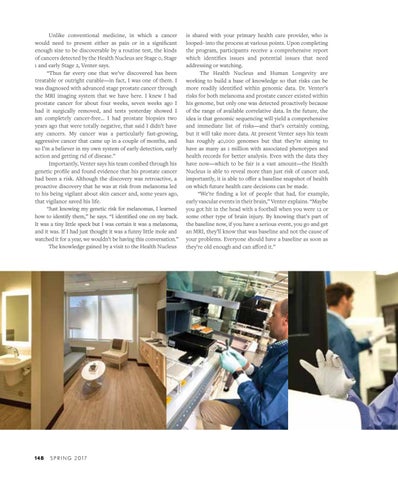
Unlike conventional medicine, in which a cancer would need to present either as pain or in a significant enough size to be discoverable by a routine test, the kinds of cancers detected by the Health Nucleus are Stage 0, Stage 1 and early Stage 2, Venter says. “Thus far every one that we’ve discovered has been treatable or outright curable—in fact, I was one of them. I was diagnosed with advanced stage prostate cancer through the MRI imaging system that we have here. I knew I had prostate cancer for about four weeks, seven weeks ago I had it surgically removed, and tests yesterday showed I am completely cancer-free… I had prostate biopsies two years ago that were totally negative, that said I didn’t have any cancers. My cancer was a particularly fast-growing, aggressive cancer that came up in a couple of months, and so I’m a believer in my own system of early detection, early action and getting rid of disease.” Importantly, Venter says his team combed through his genetic profile and found evidence that his prostate cancer had been a risk. Although the discovery was retroactive, a proactive discovery that he was at risk from melanoma led to his being vigilant about skin cancer and, some years ago, that vigilance saved his life. “Just knowing my genetic risk for melanomas, I learned how to identify them,” he says. “I identified one on my back. It was a tiny little speck but I was certain it was a melanoma, and it was. If I had just thought it was a funny little mole and watched it for a year, we wouldn’t be having this conversation.” The knowledge gained by a visit to the Health Nucleus
148
SPRING 2017
is shared with your primary health care provider, who is looped- into the process at various points. Upon completing the program, participants receive a comprehensive report which identifies issues and potential issues that need addressing or watching. The Health Nucleus and Human Longevity are working to build a base of knowledge so that risks can be more readily identified within genomic data. Dr. Venter’s risks for both melanoma and prostate cancer existed within his genome, but only one was detected proactively because of the range of available correlative data. In the future, the idea is that genomic sequencing will yield a comprehensive and immediate list of risks—and that’s certainly coming, but it will take more data. At present Venter says his team has roughly 40,000 genomes but that they’re aiming to have as many as 1 million with associated phenotypes and health records for better analysis. Even with the data they have now—which to be fair is a vast amount—the Health Nucleus is able to reveal more than just risk of cancer and, importantly, it is able to offer a baseline snapshot of health on which future health care decisions can be made. “We’re finding a lot of people that had, for example, early vascular events in their brain,” Venter explains. “Maybe you got hit in the head with a football when you were 12 or some other type of brain injury. By knowing that’s part of the baseline now, if you have a serious event, you go and get an MRI, they’ll know that was baseline and not the cause of your problems. Everyone should have a baseline as soon as they’re old enough and can afford it.”