Munazzeel Riasat FINANCE DIRECTOR 437.371.5342 finance@tma149.ca
Jay Boehmer
MUSIC PERFORMANCE TRUST FUND (MPTF) ADMINISTRATOR 437.371.2282 trustfund@tma149.ca
Here at TMA149 we acknowledge the land we are meeting on is the traditional territory of many nations including the Mississaugas of the Credit, the Anishnabeg, the Chippewa, the Haudenosaunee and the Wendat peoples and is now home to many diverse First Nations, Inuit and Métis peoples. We also acknowledge that Toronto is covered by Treaty 13 with the Mississaugas of the Credit.
Executive
Joint
Member
Defending
Scoring
Member
President’s Message
President’s Message
I recently signed a binder-full of letters to new members thanking them for participating in the orientation session. In the letter it states we’re writing “to show our appreciation for your commitment to solidarity with your fellow musicians which allows us to grow as a musician’s community and achieve fair working conditions and dignity as working musicians.”
It made me think how nice it would be if younger members had more voice in our association’s governance. Their involvement is essential for our sustainability, relevance and evolution. As technology reshapes job markets, the perspectives and participation of emerging musicians are crucial to addressing evolving issues. Young musicians today face serious challengesprecarious employment, gig economy exploitation, student debt - but they are underrepresented in union leadership and decision-making processes. That’s why we’re working to create inclusive governance guidelines and leadership development programs to empower them to shape the future of our local. Fresh perspectives can inspire innovative strategies for collective bargaining, organizing, and advocacy. Union governance that reflects generational diversity is more responsive and resilient. Young people bring energy, adaptability, and a strong sense of social justice.
By integrating digital tools and communication platforms in the form of our new website, e-bulletins and social media, we are trying to modernize our outreach and build stronger connections with a wider base of workers.
Many unions, including our own, are struggling to attract and retain young members, perhaps due to perceptions of outdated structures or insufficient engagement with issues that matter to younger generations. I look at our current Board, and I see mostly middle-aged to older white men. And as fond as we are of talking about our vast experience, we could certainly use some fresh perspectives. We’d like the board to better reflect our membership’s diversity of age, race and gender.
It’s essential for the future of the TMA in particular and the AFM as a whole to get a younger outlook in the leadership department. By investing in youth leadership, we can remain powerful agents of change in an evolving landscape.
If you’d like to know more about how you can participate, please get in touch with any of us on the Board. Our contact info is on our website.
In solidarity, Les Allt
Les Allt President, TMA
Dusty Kelly Executive Director, TMA
Dear Members,
Director’s Report
This is issue #2 of our rebranded Crescendo focusing on recording and digital media. Aside of our member spotlights, you will find guest contributions from SOCAN, AFM Electronic Media Services Department, Screen Composers Guild of Canada, and Guild of Music Supervisors. We hope you find these articles informative and look forward to your feedback.
As each one of our national electronic media contracts have come up for renewal, we have made it a priority to incorporate Generative Artificial Intelligence (GAI) language in the form of Side Letters to protect Musician’ work. We take the position musical content produced for film/tv/digital media is ‘covered work’, whether or not that work uses GAI and consequently that work attracts corresponding payments and protections.
The AFM in its negotiations with the Association of Motion Picture Television Producers (AMPTP) successfully bargained language that was modelled on that of SAG-AFTRA’s (after the lengthy strikes). We have taken AFM’s model language, added a Canadian lens, and used this as the starting point for our negotiations. The language addresses the three ‘C’s” Consent, Compensation and Copyright. With respect to Copyright legislation, the US has taken a wait and see approach as the many court cases wind their way through the judiciary. Thus far the courts are recognizing only humans can own copyright. In Canada, the new Mark Carney led Liberal government has incorporated a first by appointing Evan Soloman, Toronto Centre MP, as Minister of Artificial Intelligence and Digital Innovation, a clear indication of the importance of AI to this government.
The National Electronic Media Team (TMA is a member) concluded negotiations for the Canadian Broadcasting Corporation/Radio Canada (CBC) General Production Agreement which included a GAI side letter. Although we started with our model GAI Side Letter language, it was quickly rejected by CBC.
Creative control to ethical use of GAI were among some of CBC’s concerns. Another was their desire for flexibility on the use of GAI in producing future musical content. The negotiations came down to arguments over key words like “original”. Over several days, we achieved measurable language that protects musicians’ work with a reaffirmation by the CBC to engage musicians when they create musical content, (the expenditure guarantee is still in place). To be clear CBC presently does not permit the use of GAI.
We are also in early negotiations with the Canadian Media Producers Association (CMPA) for a GAI side letter to the Independent Production Agreement (IPA). Our TV Ontario agreement was a difficult negotiation, and we were successful including language that at the request of either party we would meet during the term of the agreement to discuss GAI.
Executive Director’s Report
Recently you may recall we sent an e-bulletin reminding members of their AFM obligations to work under AFM agreements for recording:
No AFM member shall take engagement or employment or become engaged or employed in the rendering of musical services of any kind (e.g., the making of soundtracks, ‘sidelining”, etc.) for any type of recorded product (audio and/or visual) unless the person, firm or corporation providing the engagement or employment shall have previously entered into an appropriate written agreement with, or approved in writing by, the AFM,
the consequences of non-union recording, and the use of waivers and that include GAI: “What is the cost of giving away your rights including moral rights worldwide and in perpetuity?”
Many engagers demand musicians sign blanket waivers (see Waiver article on page 17) that take away all rights to downstream revenues your work may generate, no matter how your work is reused, or how much money that reuse generates. To be clear, we are not talking about self-produced recordings, or where there is no engager (see Joint Venture Agreement article on page 7).
Without an AFM agreement, your work could find its way into a commercial or TV show or even be used to train AI. You see no additional revenues beyond the one-time payment and now in this GAI world, nothing to prevent you from being displaced in future live work without compensation.
Collective agreements and AFM recording contracts exist to protect our members’ rights to compensation, consent and control of your work. Need more information or assistance please reach out to our office – we are here to help!
Quick update on negotiations – We have successfully concluded negotiations with the National Ballet of Canada for the 2025-2028 agreement – details will be available once the Memorandum of Agreement has been drafted. A big thank you goes out to Richard Sandals, Negotiation Committee chair, and team members Emily Eng, Dominique Laplante, Maria Pelletier and Clara Wang. Canadian Opera Company negotiations are ongoing at time of writing. On the horizon, Canadian National Exhibition, Casa Loma Orchestra, and Concerts in Care agreements are all up for renewal. If you have played under any of these agreements, please feel free to reach with any concerns you want to share working under the agreements.
In solidarity, Dusty Kelly
John K. Painting is the AFM Director of the Electronic Media Services Division (EMSD) and Assistant to the President. A graduate of Columbia University, John Painting has worked in Electronic Media since beginning his career at AFM Local 802 (New York City) in 2011.
Throughout his tenure, Painting has been regularly involved on the bargaining team for EMSD contract negotiations, both at the Local and Federation level. He also liaises with the Organizing & Education Departments, assisting in EMSD-related organizing efforts, and developing new educational content to better explain EMSD agreements.
A few years ago, I got a call from a musician who had received a request from the music department of a television series seeking to license one of her band’s songs for use in the show. She was familiar with how “New Use” worked, when AFM-covered content generates additional payments when it is utilized in a new project. But this wasn’t a traditional recording done on a major AFMsignatory record label; this was her own self-contained band’s tracks. Nobody had hired them, so how does this go on a contract?
Self-contained groups can put their work on an AFM contract without having to go through the unorthodox logistics of paying themselves by using the Joint Venture Agreement. This contract is designed to memorialize the personnel on a recording, as well as each person’s percentage ownership share of the tracks, in situations that are not a traditional union contract Employer/ Employee relationship. Any artist, group, or individual may use the Joint Venture Agreement as long as all the musicians on the contract own a share of the product and share jointly in any profits, revenue, and royalties generated by the use of the recording.
Now, while this means the band members in the above scenario should all have earned a share of the synchronization license fee paid by the television producer for the use of the song, something which is beyond the scope of AFM contracts, there are other residual payments that would be missed out on in the absence of AFM paperwork. This would include Secondary Market residuals for film projects, or other New Uses generated by subsequent use of the television program down the line, like soundtrack albums or clip fees.
Joint Venture Agreements
Since the recording had been filed on a Joint Venture Agreement, even without wages and benefits being paid on the session work (since there was no Employer), the television producer paid the musicians a New Use fee as part of the license and filed a B-7 Report Form for the use of the track in the show.
This paperwork can be particularly useful if the personnel of the band changes in the future. If a television show 10 years from now asks to license the track, but two of the band members have left the group since the original recording, the memorialization of the personnel at the time could help prevent later disputes over ownership share.
If you’re curious about how the Joint Venture Agreement can help protect your self-produced work, reach out to the TMA today.
John K Painting
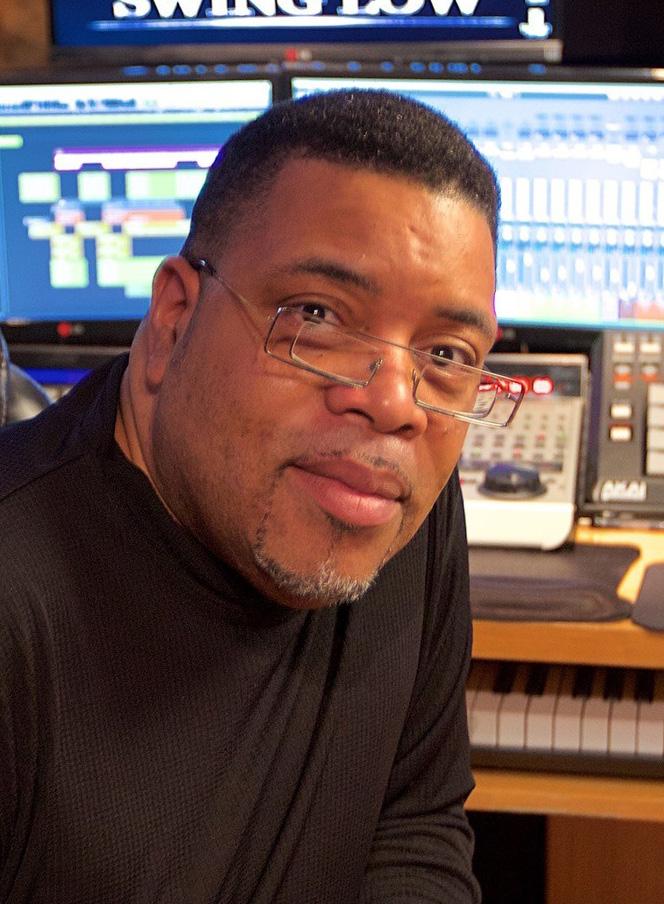
Member Spotlight: Orin Isaacs
Few figures in Canadian music and television have had the impact and versatility of Orin Isaacs. From his early days as a working musician to his long-standing success as a TV and screen composer, Isaacs has remained both adaptive and rooted in creativity. We sat down with him to reflect on his career, the evolution of the industry, and the future of music creation in the age of artificial intelligence.
TMA: Briefly describe the arc of your career as a musician, and TV, Film and Screen com-poser.
OI: I was a gigging musician from my late teens and into my 20’s. Since most gigs happened at night I needed something to fill my days, so I got some recording gear, set it up in my bed-room and started to produce music. I hustled!! My first major project was on EMI records. While shooting our 1st music video, there was a TV show filming next door. They heard my track, came over and asked who did the music?? And the rest is history, I’ve been in TV ever since. I don’t do many features and docs come around every two or three years so I consider myself a TV guy since that’s what takes up most of my time.
TMA: Briefly describe your creative process as a TV, Film and Screen composer?
OI: It’s pretty simple. Producers and Directors know what they are looking for…when they hear it… so it’s my job to figure out how to translate what they are thinking into music. I just try and get as much info as possible to help me start in a good place. It’s just problem solving. I’m in the delivery business and the product is music. In terms of process…I just start with piano on my DAW and hit notes until they sound right to me LOL. Once I get something that feels good and I can do it all myself, I do a full out idea, no demos!! Producers have access to too much music that’s fully produced, so I gotta compete right out of the gate.
TMA: As creatives, we find ourselves having to adapt and shift to accommodate an ever-changing industry. Now that the industry is normalizing GAI in the creation of music for TV, Film and Screen, what have you identified as pros and cons to the use of GAI in music composition?
OI: The Pros are that almost anybody can create an amazing track with little to no barrier to entry at almost no cost. The Cons are that almost anybody can create an amazing track with little to no barrier to entry at almost no cost. So that actually devalues music overall. I’m lucky to still have clients that want bespoke music for their productions, but it’s getting few and far between as my generation is aging out. New composers starting out in this climate will have a very hard time competing against AI.
Orin Isaacs
Member Spotlight: Orin Isaacs
TMA: Have You Collaborated With Other Artists Or Technicians In Developing AI-Composed Music? If so, how has this affected your work?
OI: No, at this stage of my career, I’m not really into working against my own best interest. I just focus on what AI can’t do yet.
TMA: How does the creative process differ with the use of GAI? In other words, do you still need to sit at a piano and work out themes and ideas?
OI: Yes I still sit down at a piano to work out melodies and ideas, because that is at the heart of what I do as a composer. There’s no better feeling then a 5 note melody that is instantly recognizable that brands a show, that came out of your head. As a Musical Director I use AI as a tool. So stem separation and the ability to make a guy sound like a girl and vise versa, that sort of thing, those tools are amazing!!
TMA: How important has the union, and in particular, the TMA been for your career?
OI: I work on so many TV shows that are signatory to Union so it goes without saying. Also you don’t really think about a pension until you get older. So that is an important factor to me.
TMA: In your opinion, what should the union be doing to protect music creation now and in the future?
OI: I’m not sure what they can do?? If a client wants AI generated music, they will use it. That level of client probably won’t care where it comes from in terms of a unionized composer/member. So I think as long as there is an issue/question of copyright ownership with AI generated music, the union should hammer the fact that productions can avoid that with original music.
TMA: What advice do you have for the next generation of screen composers?
OI: What never changes is that you have to be really really good at what you do. Then be really really good at convincing producers you’re the one. Composers are competing against every other composer for the same dollar!! What makes you so special?? Once you find out what makes you special and what sets you apart, double down on it. I would say I have general advice not just for screen composers, but for anybody trying to develop relationships in the Biz that can help them. Be what you want to attract. So if you want to work with Rockstars you got to be a Rockstar!!
In an industry shaped by rapid change, Orin Isaacs stands as proof that artistry, adaptability, and authenticity still matter. Whether it’s playing bass guitar or behind a mixing console, he continues to shape Canadian television. And even in the age of AI, there’s still no substitute for the human touch.
Defending Human Created Music
JOHN ROWLEY is a leading Canadian composer and music supervisor for film and television. He is known for his work on numerous projects including the award winning series “Pretty Hard Cases” (for which John received a Canadian Screen Award nomination for Best Original Music, Comedy), “Mary Kills People”; “Little Dog”; “Letterkenny”; “Corner Gas: The Movie”; “Rookie Blue”; “The Phantoms” (for which John also received a Canadian Screen Award nomination) and the Woody Harrelson starring feature film “Defendor”. “Final Assault”, a piece John composed for “Defendor”, was used to introduce the Toronto Blue Jays’ starting lineup at home games at the Rogers Centre throughout the 2013 season.
John studied law at Osgoode Hall Law School, going on to article with the Toronto law firm Fraser Milner Casgrain and being called to the Ontario Bar in 2001. John received a BA (Hons) (English) from University of King’s College/ Dalhousie University and received a diploma in Recording Arts Management from The Harris Institute For The Arts. Currently John serves as President of the Screen Composers Guild of Canada, is a founding member of the Guild of Music Supervisors Canada and is also a member of the Toronto Musicians’ Association.
As the digital revolution has spun our world with dizzying disruptions for the last 30 years or so, I’ve often found myself wondering if the changes which have come are positive or negative. This is especially true now, as Generative AI (Gen AI) impacts something we all hold dear: music creation.
A recent study from CISAC ((the international association representing author’s rights collective societies) predicts a 24% revenue decline for music creators by 2028. If true, that would be a staggering decline over the next 3 years. The study also predicts that the revenues of Gen AI services in music and audiovisual projected will rise from €0.3 billion to €9 billion over the same three years.
While I’m optimistic that music lovers will ultimately prefer human created and performed music over Gen AI music, I also believe Gen AI will create significant disruption to the livelihoods of music creators.
As rampant text and data mining (TDM) has gobbled up the entirety of human creative output, Canada’s government has adopted a ‘wait and see’ approach. When Canadian legislators finally act, SCGC believes several vital
John Rowley
principles must be respected to mitigate against worst case scenarios for music creators.
Firstly, the use of copyright protected material by Gen AI businesses requires the 3 C’s: consent, credit and compensation. Therefore, the use of musical works to populate so-called large language models (LLMs) must be licensed either via collective management organizations or directly from rights holders.
In a joint submission on AI issues to the Canadian government in December 2023, SCGC and the Songwriters Association of Canada stated:
At a minimum, AI companies operating in Canada should be required whether by legislation or regulation, to (i) maintain accurate and transparent records of the copyrighted works ingested into their AI programs, (ii) to obtain consent in the form of a licence before ingesting it, and (iii) to pay compensation in exchange of such use.
It follows that Canada should not exempt TDM activity from copyright protection as some other jurisdictions have explored. To do so would deprive rights holders from important legal protections and revenue, and to enrich AI companies at the expense of creators. Human creators should not be forced to subsidize their competition.
Secondly, copyright should not be afforded to Gen AI works. The US Copyright Office has adopted the position that copyright does not extend to purely AI-generated material, nor to material lacking sufficient human control over expressive elements. In Canada, the situation is unclear after the Canadian Intellectual Property Office granted copyright to a Gen AI artwork titled “Suryast” via an automated registration process. That registration was subsequently contested by the Canadian Internet Policy and Public Interest Clinic and the case is before Canada’s Federal Court.
SCGC believes that the Copyright Act is based on a philosophy of providing incentives for human creativity At present, the Act does not explicitly specify an “author” means a human author. When the Act is next revised, I believe adding such a clarification could bring critical guidance to regulators, courts, creators and Gen AI offerings.
Defending Human Created Music
By the same token, Gen AI musical performances should not receive copyright protection. Copyright protection and related benefits such as neighbouring rights should be reserved for human musical performances.
Likewise, performers’ musical identities should not be allowed to be recreated via Gen AI without the 3 C’s being respected. In the US, the ‘NO FAKES’ Act is a bipartisan bill that would protect the voice and visual likeness of individuals from unauthorized recreations by Gen AI. Similar legislation may be needed in Canada to protect our artists from having their voices stolen.
Finally, Canadian legislators and regulators need to consider whether human music creators have a right to equitable participation in the revenue generated by the creation and exploitation of Gen AI musical outputs, an idea advanced by Professor Daniel Gervais’ in his recent white paper entitled “The Remuneration of Music Creators for the Use of Their Works by Generative AI.”
In summary, there are interesting times ahead. Let’s buckle up and continue to defend the value of human created music.
John Rowley – President, Screen Composers Guild of Canada
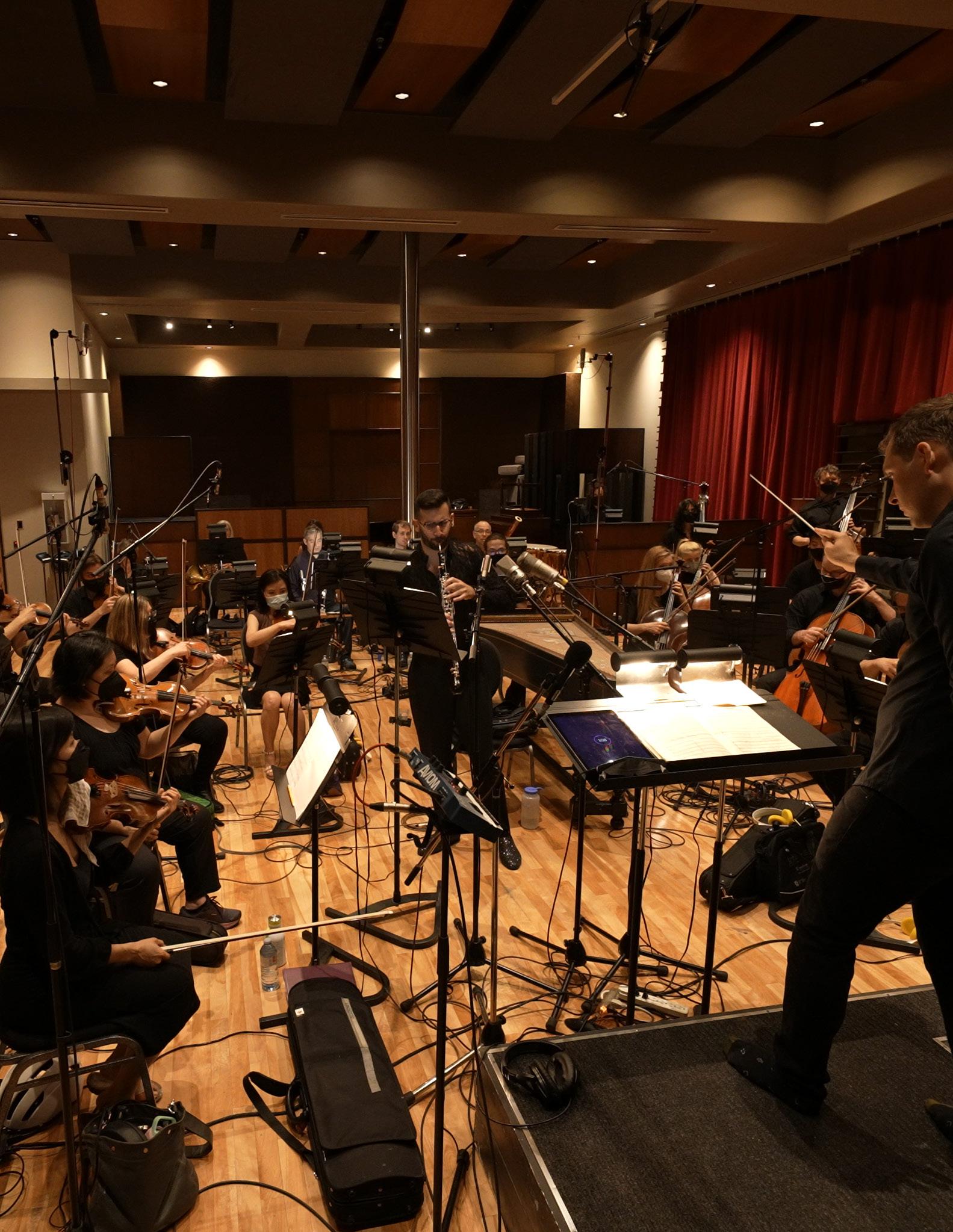
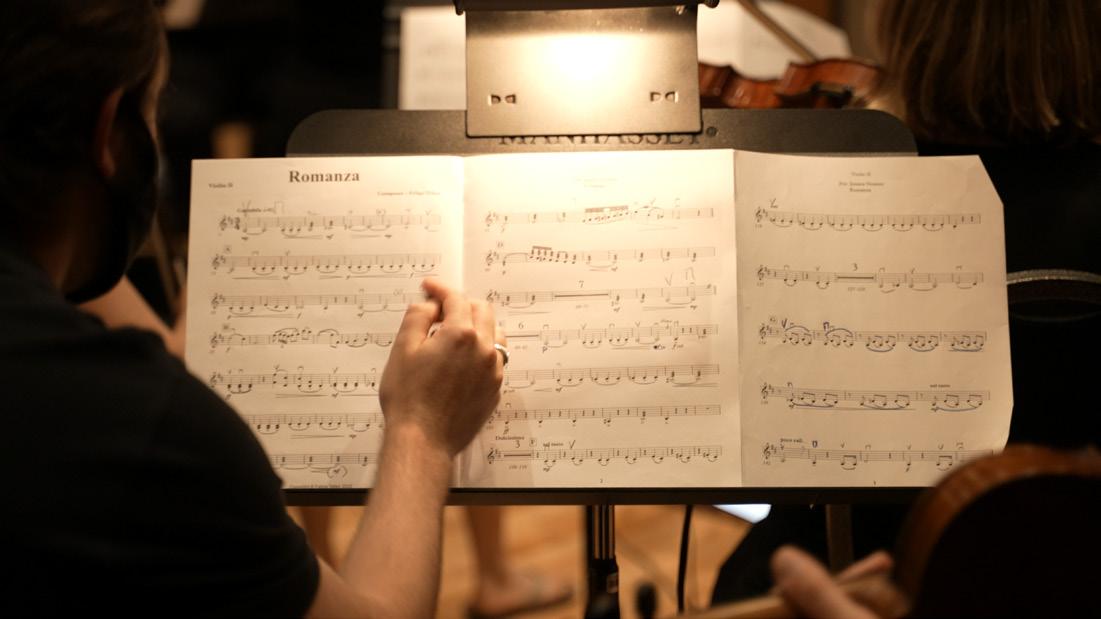
Romanza from Evocations by Felipe Téllez Fina Canadian Studio Symphony
With Generous support from Canada Council for the Arts and Ontario Arts Council
Photo by Igor Petrof
Scoring The Story
Scoring the Story: A Conversation with Music Supervisor Heather Gardner on AI, Authenticity, and the Future of Composition
For over fifteen years, Heather Gardner has built a career intersecting story and sound. With roots as a pianist and a deep understanding of the emotional weight music carries, Gardner has helped shape the soundtracks of major TV shows, films, and ad campaigns. Her credits include BET (Netflix), Robyn Hood (Global), My Dead Mom (Crave), Hell of a Summer (dir. Finn Wolfhard/Billy Bryk), Young Werther (dir. José Lourenço), and Paying For It (dir. Sook-Yin Lee), among many others. Heather is Head of Music Supervision + Licensing at Vapor Music / Long Division, and President of the Guild of Music Supervisors, Canada.
In this conversation, Gardner walks us through her path as a music supervisor, the evolving role of AI in music creation, and what she believes the industry and unions must do to support and protect creators in an ever-changing landscape.
TMA: Briefly describe your process as a music supervisor.
HG: My process is divided into two halves — creative and clearance/ administrative. The creative side is what most people think of when they imagine music supervision: sourcing songs that match the tone of a story, hunting through playlists, working with labels and publishers, and pitching songs for scenes. We operate both at the macro level — shaping a project’s overall sound — and at the micro level, working scene by scene.
The clearance side is where it gets complicated. Every song has to be fully cleared, with permissions from all rights holders. It’s a constant dialogue with labels, publishers, sync agencies, managers, and artists. And it’s also an ongoing game of budget Tetris — shifting elements around to make sure creative goals align with financial and legal realities.
TMA: As creatives, we find ourselves having to adapt and shift to accommodate an ever-changing industry. Now that the industry is introducing GAI in the creation of music for TV, film and screen, what have you identified as pros and cons to the use of GAI in music composition?
HG: Because so much of my job involves licensing and ensuring we have the legal right to use a particular song, I’ve personally steered clear of AI-generated music. There’s still too much legal uncertainty around ownership and copyright. Until there’s clarity on what’s legal — especially around AI training on copyrighted material — it’s not something I feel comfortable using.
That said, I do see real value in AI-assisted discovery tools. For example, I can drop a YouTube link into my DISCO music library and it will suggest similarsounding tracks — or I can use search prompts to uncover new options. These tools can be incredibly helpful during the early stages of curation. But when it comes to actual song creation, I believe that’s still a job for humans.
TMA: Have you worked with other artists or technicians in developing AI-composed music? If so, how has this affected your work?
HG: This isn’t something I’ve experienced yet! All of my collaborations to date have been with human composers and rights-holding artists.
TMA: In your opinion, what should the union be doing to protect music creation now and in the future?
HG: The biggest challenge is the sheer amount of information — and misinformation — out there. AI is still the wild west. It’s nearly impossible for creators to know what’s legal, what isn’t, and what legal precedents exist to protect them.
Unions have a key role to play in offering clear, accessible resources that help creators understand their rights in this new landscape. As the industry develops regulations to balance ethics and innovation, creators need to be equipped with the knowledge to protect themselves.
TMA: What conversation should we be having to ensure legal and ethical use of AI in music composition?
HG: We need to focus on clarity, transparency, and access to reliable information. As with many emerging technologies, the ethical and legal boundaries are still being drawn. Until they are, education is our strongest defense.
TMA: What advice do you have for the next generation of composers?
HG: The advice I always give — especially to those hoping to get their music into film and TV — is that authenticity will always rise to the top. You can always tell when a song has been written “for sync” or to check boxes. The magic is lost. It’s the same with AI — it might do a lot of impressive things, but it can’t replicate the soul of a song that needed to be written.
So keep creating what you’re called to create. That spark is irreplaceable — and it’s what makes all the difference.
TMA: Heather Gardner’s perspective helps illustrate to us that while technologies evolve, the heart of music supervision and music creation remains grounded in human authenticity. As the conversation around AI continues to unfold, voices like hers are vital in shaping a future that values both innovation and the art of human content creation.
Scoring The Story
Heather Gardner
Member Spotlight: Robert Carli
Robert Carli is an award-winning composer and multi-instrumentalist. He has worked on many successful TV and film projects, including 18 seasons of Murdoch Mysteries, the SyFy series Wynonna Earp, Skymed for Paramount, and many more. He is also in demand as an instrumentalist and arranger, and regularly performs as saxophonist with ensembles such as the Toronto Symphony Orchestra, the National Arts Centre Orchestra, the National Ballet of Canada, and the Art of Time Ensemble
TMA: Can you briefly describe the arc of your career asa musician, and TV, Film and Screen composer?
RC: I studied composition at U of T and worked as an assistant for a couple of years in Film and TV. I have also toured with bands across Canada, and the world as a side musician, but it was always my dream to work as a composer, and a creative. It can take a long time to get a foothold in the industry, and I feel fortunate that I was able to get my first scoring gig at 28.
TMA : Describe your creative process as a TV, Film and Screen composer.
RC: Every project is different, of course, but I like to write melodies at the piano and then work those to picture as piano sketches. Then orchestrate accordingly. But some projects are less melody driven, so I might find myself doing some more experimental work with unusual instruments or sounds and synths.
Robert Carli
Member Spotlight: Robert Carli
TMA: As creatives, we find ourselves having to adapt and shift to accommodate an ever-changing industry. Now that the industry is using Generative Artificial Intelligence (GAI) in the creation of music for TV, Film and Screen, what have you identified as pros and cons to the use of GAI in music composition?
RC: AI is a force in all industries, and the music biz is no different. There are the obvious concerns, where AI will be used to actually create content, which to me, is the whole point of pursuing a creative goal. If we abuse AI, we deny ourselves the gratification of working through a problem and coming up with a solution. There are lots of shortcuts in life, but only when we do the work do we get stronger.
The promise of AI is that it will be a great tool to help us be more creative, and more efficient. AI could become a highly capable and adaptable assistant we could all use, so that the mundane tasks are completed. It is already proven a powerful ally when troubleshooting and fixing problems in the studio. It already fixes our spelling and prose and grammar; if it could extract parts and help me balance my mixes, that would be handy to have around.
TMA: How does the creative process differ with the use of GAI? In other words, do you still need to sit at a piano and work out themes and ideas?
RC: This is really a question of personal preference. Sitting with an instrument and improvising is a journey; it’s one we want to take. It’s like going for a walk; sure you could drive to your destination, but sometimes that misses the point. Sometimes there is no destination, just the walk. Technology can often divorce us from reality. Social media tends to get us to look but not listen. We have conditioned ourselves to have a visual bias instead of an aural one. I think it’s really important to listen more, be patient, and become more aware of the process.
TMA: How important has the union, and in particular, the TMA been for your career?
RC: Very important. I grew up in a time where the union held a lot of relevance to me as a performer and in recording. I joined when I was in high school, and it has helped me get paid fairly, allowing me to travel. The union was really relevant to me but I can see how it may not be as relevant now to a younger generation. It’s so important that the union look at the current recording agreements and ask, are these relevant now to how we create, record and produce music.
TMA: In your opinion, what should the union be doing to protect music creation now and in the future?
RC: Tough question, and I should probably review the mission and vision of the AFM. Is it to protect players, or creatives, or both?
TMA: That’s a great question, especially in light of the recent rebranding we have undergone. We took a hard look at what kind of organization we have been, and where we need to grow, and adapt to meet the needs of our diverse membership. The mission of the TMA is to offer musicians the opportunities they need to adapt and flourish within the ever-evolving music industry - this includes creatives like yourself.
In addition to our mandate to make the industry a place where musicians can work in a respectful and safe environment, receive fair compensation for that work, and have the freedom to express their creativity etc, the TMA is dedicated to fostering a community that embraces all aspects of what it means to live, work and be a musician in Toronto.
Member Spotlight: Robert Carli
RC: If the union is serious about helping the creatives, and not just performers, it needs to collaborate with those groups like the Screen Composers Guild of Canada, Canadian League of Composers, SOCAN and Society of Composers and Lyricists that are fighting the battles now.
Technology has changed the way we perform, record and create. The agreements we have now are antiquated. For example, where it used to take four musicians, now it takes one or even none. I believe the union needs to be proactive, recognizing how things have changed, and adapt accordingly. Provide barrier free ways to record and hire musicians, that can be competitive on the world stage but still allow for accessibility and affordability. Especially for the younger generation who have yet to see themselves in a union.
TMA: What conversation should we be having to ensure legal and ethical use of AI in music composition?
RC: So much of it is about IP. AI can steal anything and rebrand it rather simply. We need to figure out a way to protect our intellectual property and not make our works available to be harvested at will. There needs to be respected license agreements that can protect copyright holders from AI developers simply taking whatever they want.
TMA: What advice do you have for the next generation of screen composers?
RC: We all need to understand how quickly technology changes. For that reason, we need to view technology as an opportunity to ask ourselves, how can we use it rather than see it as a deterrent. So many creators are doing what is popular because it works, but it’s important to try and branch out and find your own voice. Ask yourself, what is the essence of your creativity and musicianship? Recognize that efficiency is not always rewarded in the arts. It’s a slow burn. Learning an instrument, developing a theme, coming up with material, developing your career requires patience. Listen to music, listen to your body, your sound and heart.
To Waive or Not to Waive: Musicians’ Rights and Waivers
Julia Werneburg is legal counsel to the Society of Composers, Authors and Music Publishers of Canada (SOCAN). She has over a decade of experience as an intellectual property lawyer protecting creator rights. In that time, she has acted as in-house counsel to two national copyright collectives and in private practice at a leading international law firm. She has a Bachelor of Law from University of Ottawa and a BA from Francis Xavier University.
Musicians have certain legal rights relating to their performances, including neighbouring rights and moral rights. Neighbouring rights are rights of equitable remuneration that exist to provide performers (as well as makers of sound recordings) with the ability to receive compensation when sound recordings are publicly broadcast or played. In Canada, performer royalties relating to plays of recorded music are collected and
distributed by collective management organizations (Re:Sound, ACTRA RACS, and ARTISTI). Moral rights may protect a performer’s right to the integrity of the performance and, in some circumstances, to be associated with the performance as its performer by name or under a pseudonym and the right to remain anonymous.
What’s a waiver?
At times, musicians may be asked to waive their rights – that is, to give up their right or to agree not to enforce it. This can sometimes happen if, for example, the negotiating party does not want the musician to be allotted a share of ongoing royalties for the use of the sound recording featuring the musician’s performance, or doesn’t want to credit the musician when the sound recording is exploited. Waiving a right can have long term consequences.
Considerations before signing
Before agreeing to waive a legal right, in any context, a musician should ensure that they fully understand the following:
(a) what rights they have – i.e. what they would be entitled to if they didn’t sign the waiver, and the potential value of those rights;
(b) the scope of the asked-for waiver - i.e. what they are being asked to sign away and any exclusions from the waiver; and
(c) the implications of signing the waiver, including any financial or principled considerations. Essentially, a person being asked to waive any rights should ensure that they fully comprehend the terms and implications of the proposed bargain,
to ensure that there are no surprises or disappointments down the road – including, for example, if their performance becomes part of a hit!
When being asked to agree to waive their rights, musicians should consider whether doing so (or not) could ultimately lead to a decrease in future opportunities, revenues, or exposure. Being paid an upfront sum to waive one’s rights may not in all cases be an economically unfair or disadvantageous proposition. However, any decision impacting the long-term economic exploitation of a performance needs to be made carefully by the musician, particularly at a time when radio listenership is declining and many AI systems are routinely (and often illegally) training on copyright-protected sound recordings without paying any compensation to rightsholders.
Seek legal advice
If time and/or resources allow, it is generally best practice for a musician to obtain independent legal advice prior to signing a waiver. This may not always be practicable, but an experienced copyright or entertainment lawyer can be useful in guiding the decision as to whether to sign a waiver. If a private retainer is not possible for financial reasons, it may be helpful to consult a legal clinic that provides pro bono services to members of the arts community, such as Artists’ Legal Advice Services in Ontario.
Julia Werneburg
MPTF Report
The current Music Performance Trust Fund (MPTF) fiscal year began on May 1st and the TMA is off to a very lively start with more than 50 applications for performances in May and June. The reason for this increase is due to multiple performance requests for MusicFest Canada (York University), Festival of the Sound (Parry Sound), and the Toronto Jazz Festival.
The MPTF fiscal year, ending April 30, 2025, is now complete with 227 performances in the books. Our past allocation was $179,400 plus an additional $4,000 that I requested in February. The new allocation for L149 is set at $204,400 with an increase of 14% over last year. (We hope that this amount will last until April 30, 2026, or thereabouts.) MPTF tells us that all AFM locals have likely reached a ceiling with their respective annual budgets.
The MPTF continues to put an emphasis on several programs and will fund these concerts at 100%: Educational Performances in Schools, Black History Month (February), International Women’s Day (March 8), and Jazz Appreciation Month (April). We are also offering a “discounted” payment for Seniors Residences for solo and duo performances. Other Community Performances will be funded at 50% as usual.
The TMA has recently updated their Live Performance Contract (LPC) along with a new Contract Worksheet in EXCEL. (Be sure to use the dedicated MPTF version of the worksheet.) This should make for an easier time when filling out your TMA contract and should clear up the calculation errors.
As always, please provide a minimum 6 weeks notice for your MPTF request. More information about the MPTF program at: https://public.tma149.ca/musicperformance-trust-fund/
Jay Boehmer, MPTF Administrator
Jay Boehmer MPTF Administer, TMA
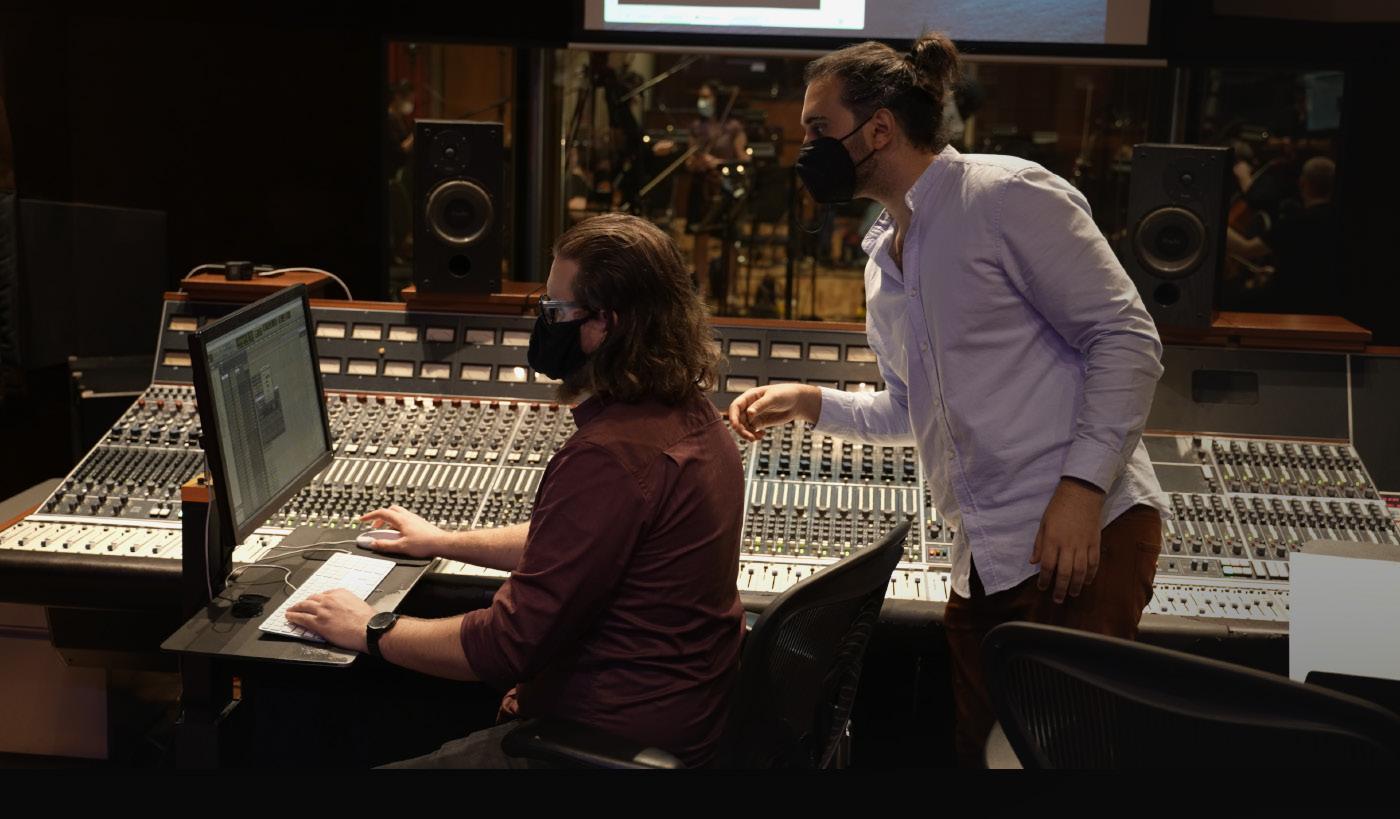
Felipe Téllez Fina, Composer & Producer
Sydney Galbraith, Sound Engineer, Revolution Recording
With Generous support from Canada Council for the Arts and Ontario Arts Council