School Curriculum Guide
School Curriculum Guide
Dear Upper School Students,
Your Upper School experience at Indian Creek is designed to help you explore deeply, discover your interests, and grow as a learner and member of our community. Early in your high school years, you will experience a wide range of subjects and ideas while building a strong academic foundation As you progress through increasingly challenging coursework, you will deepen your knowledge across core disciplines and develop the skills needed for advanced study
Alongside your courses, each grade participates in a seminar series that introduces important issues in the world around you. These seminars connect classroom learning with the broader community through engagement with contemporary topics, interdisciplinary questions, and local organizations and professionals
As your interests become clearer, your academic experience becomes more focused. Through a broad selection of electives, you will have opportunities to pursue deeper study in subjects that matter most to you while continuing your work in increasingly rigorous core classes. Students may also enroll in specialized electives offered through our partnership with Global Online Academy, expanding the range of courses available
In your senior year, you will bring together the knowledge and skills you have developed throughout Upper School. Seniors share reflections through Senior Speeches, offering insights into their growth, values, and aspirations. Students also complete Senior Passion Projects, with dedicated time in May for completion and public presentation These experiences allow you to apply what you have learned and share your work with the community as you prepare for the next stage of your journey
This curriculum guide provides an overview of the Upper School academic program. Inside, you will find graduation requirements, course planning documents, signature program offerings, course descriptions, and course policies As you review these materials and plan your course of study, take advantage of the opportunity to explore new interests while designing a program that is both challenging and balanced
Your advisors, teachers, and the Upper School administrative team are here to help guide you through your academic journey. Please do not hesitate to use all of the resources that ICS has to offer to create your premier school experience
Sincerely,
Kaycie Bowen
Upper School Principal
Indian Creek is the premier independent school in the Annapolis area where KINDNESS is currency, WELL-BEING is priority, and EXCELLENCE IN EDUCATION is relentlessly pursued

True to one’s own personality, spirit, or character
Connection
Meaningful and reciprocal relationships
uriosity erest that leads to inquiry
Belonging
Individual identities and talents are discovered, valued, and affirmed
Holding high expectations for student performance, always trying to improve, and regularly showcasing learning
Showing up and standing up
active process of finding alignment and truth in ourselves, our relationships, and our ose
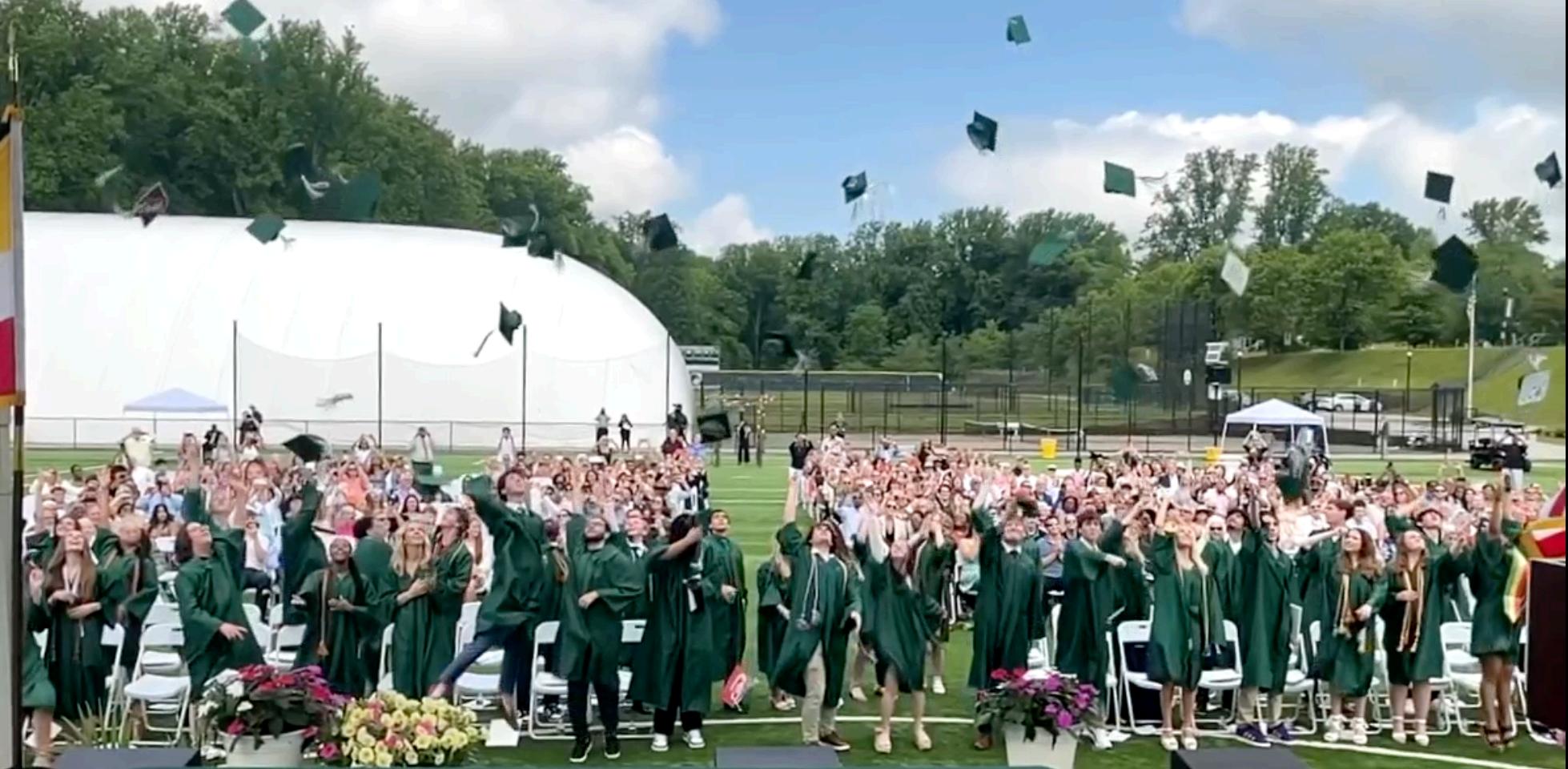
The ICS Upper School program prioritizes a college-preparatory experience rooted in an intentionally designed curriculum that develops deep knowledge while also emphasizing durable, human-centered skills that prepare students for future study and career development
Human-centered skills at ICS include resiliency, critical thinking, communication, and empathy. In the age of AI, these skills are essential for future readiness because they support innovation, collaboration, and leadership.
The recommended ICS course load provides a strong, broad academic foundation and helps ensure a well-rounded transcript for the college application process The required course of study includes the minimum credits by discipline that students must complete to graduate from ICS, providing a broad college-prep experience Most students complete the recommended course of study. Some students elect to meet minimum requirements in one area to have scheduled space for specialization in another area (e g , STEM, arts, interdisciplinary)
English
4 credits required
Students must complete a full credit of English each year. Electives can be taken in addition to any approved English class
3 credits required, 4 recommended
Students are required to take PreModern History, Modern World History or AP World History, and US History or AP US History
For students who took Big 9, this course fulfills the Pre-Modern History requirement
4 credits required
Students must complete their math sequence either through Precalculus or College Algebra.
For the Classes of 2027 and 2028, students must earn at least three math credits (four strongly encouraged) and complete Algebra 2
Science
3 credits required, 4 recommended
Students are required to take Biology, Chemistry, and Physics
The Class of 2027 is required to take Biology and Chemistry or Physics in addition to Big 9 The Class of 2028 is required to take Chemistry and Biology in addition to Big 9 + Physics
Total Credits:
2 credits required, 3 recommended
Students are required to take two consecutive years of the same language
Class of 2028 and beyond: completion of Level 3 or higher in a chosen world language is required
1.5 required, 2 recommended
Students are encouraged to complete both Visual and Performing Arts courses to fulfill this requirement but may choose any combination of Fine Arts or Performing Arts credits, including courses focused on digital media
Class of 2027 and 2028: 21 required, 24 recommended Class of 2029 and 2030: 22 required, 24 recommended
Athletics
1 athletic credit required
This can be earned in any combination of playing on an ICS team sport (0 5 credit/season), participating in the ICS team manager program (0 5 credit/season), or completion of a semester-long fitness class (0 5 credit)
4 seminars required
Students participate in grade-specific seminars: Digital Foundation Seminar in Grade 9, Outdoor Seminar in Grade 10, Life Skills and College Counseling Seminar in Grade 11, and College Counseling Seminar in Grade 12.
5 academic credit required
Starting with the Class of 2028, all students are required to complete the Health and Human Development for graduation
* The minimum required credits for graduation exceed the Maryland State requirements for nonpublic schools for secondary school graduation, which include: “four credits in English-language arts; two credits in social studies to include at least one credit in U.S. history; six credits in science and mathematics (at least two credits in each); and nine additional
The Indian Creek School English department believes that the critical analysis of texts, the act of writing, and the process of revision are fundamental components both of academic excellence and of life beyond scholastic boundaries Independently and collaboratively, students read as writers, write as readers, and think critically about texts, themselves, and the world around them. ICS students learn to analyze and evaluate language and to use it to formulate nuanced positions on topics that matter to them. Furthermore, they practice communicating these complex ideas effectively and purposefully to a wide range of audiences, both in writing and in dialogue with other students Ultimately, the skills that English students cultivate during their time at Indian Creek School shape them into analytical, sensitive thinkers who are conscientious and engaged citizens of the world.
Throughout their Upper School English Department studies, students…
Read a diverse curriculum of fiction, nonfiction, poetry, and hybrid genres that contribute to their recognition, appreciation, and understanding of genre, as well as skills in comprehension and critical analysis.
Write formally and informally in various modes (e.g. persuasive, research, informative, narrative, reflective, and document-based) such that they learn to communicate complex ideas effectively and purposefully to a wide range of audiences and to make writing choices on the level of the word, sentence, paragraph, and essay
Gain agency and clarity in oral communication, learning how to make choices that are appropriate for a given audience and purpose, including in formal public speaking; likewise, as audience members, students develop their active listening skills, including asking meaningful questions and relating external concepts to the presented material. Learn to find relevant and reliable sources, select appropriate evidence, and utilize a wide range of research materials to help them formulate meaningful questions, explore them academically, and develop nuanced positions in response
Grade 9 Yearlong 1 Credit NCAA Approved
The ninth-grade English course focuses on both literature and composition To broaden their understanding of both the similarities and differences of lives around the world, students primarily read literature with settings outside of the United States, exploring literature as both a mirror and a window and considering identity in the context of community Through close readings and discussions of fiction, poetry, and nonfiction by diverse authors, students further develop their ability to analyze and think critically about language. Students develop their communication skills in the areas of reading, writing, listening, and speaking; they learn to express their ideas more effectively as they engage in discussion; and they create, revise, and share different types of formal and informal writing throughout the year
Grade 10
The tenth-grade English course is a broad survey of American literature Students read both historical and contemporary works, including novels, plays, and short stories by writers who represent the diversity of the American experience Readings are placed in historical and cultural contexts through accompanying lessons on various periods in American history. Students develop and apply critical thinking skills through selected texts and learn how to present a written analysis of readings in thesis-driven analytical essays Analytical skills are further deepened and applied through class discussions on selected readings and related articles Students emerge from English 10 with an appreciation of and experience with different forms of literature, knowledge of literature’s cultural impact throughout America’s history, and the ability to produce clear and forceful analytical writing
Grades 10, 11, 12
Prerequisite: Completion of English 9 and Departmental Approval
Note: This course counts as a departmental requirement when completed in Grade 10.
AP Seminar is a foundational course in the AP Capstone program that develops students’ research, collaboration, and communication skills Students examine real-world issues from multiple perspectives, evaluate sources for credibility and bias, and construct evidence-based arguments Through team and individual projects, students conduct inquiry, synthesize information, and present their findings in written and oral formats
The course emphasizes critical thinking, academic writing, and formal presentation skills. Students complete two major performance tasks and an end-of-course exam Continuation in the AP Capstone sequence with AP Research is optional
Grade 11 Yearlong 1 Credit
Approved
The eleventh-grade English course, Language and Composition, is a writing-intensive course that prepares students for both college reading and writing experiences Students read and write in a variety of modes and genres The readings introduce students to several literary genres as they learn strategies for understanding and analyzing more complex texts. Students frequently write in informal and formal formats, composing with increased clarity and sophistication. Core writing skills, different organizational structures, the writing process, and research and citation skills are emphasized
Grade 11 Yearlong 1 Credit
Prerequisite: Completion of English 10 or AP Seminar and Departmental Approval
NCAA Approved
The AP English Language and Composition course focuses on the rhetorical analysis of nonfiction texts and the development and revision of well-reasoned analytical and argumentative writing The course requires students to become skilled readers of prose written in a variety of contexts and skilled writers who compose for a variety of purposes Students analyze nonfiction writing by major literary figures and synthesize and cite evidence to support their arguments As both readers and writers, students consider the decisions writers make as they compose and revise Major units include rhetorical analysis and close reading, argument, and synthesis essays that require students to evaluate and incorporate relevant outside sources
Grades 12 Yearlong 1 Credit NCAA Approved
Prerequisite: Completion of AP English Language and Composition and Departmental Approval
Note: It is strongly recommended that students complete AP Language and Composition before taking AP Literature and Composition
The AP English Literature and Composition course focuses on imaginative literature: fiction, poetry, and drama Students read, analyze, discuss, and write about both classic and contemporary literature from a variety of periods and in a variety of genres. Students grow in their abilities to read closely, analyze literature thoughtfully, and write persuasively about imaginative literature Topics include the functions of character, setting, structure, narration, figurative language, and literary argumentation Writing assignments include analytical and argumentative essays that require analysis and interpretation of literature The AP English Literature and Composition course aligns with a college-level introductory literature curriculum
Students must earn four English credits for graduation, completing one credit in each year of Upper School Timing within the sequence is essential for departmental credit Students who elect to take AP Seminar in Grades 11 or 12 will receive academic credit; however, the course will count as a general elective and will not fulfill the required English credit for that year
Similarly, Grade 11 students who complete a semester-long English course (See Page 5) will earn elective credit only, as semester courses do not satisfy the full English credit requirement in Grade 11 In Grade 12, however, approved semester-long English courses may be combined to fulfill the annual English credit requirement
Grades 11, 12 Semester 5
Credit
NCAA Approved
African American Literature is a survey course that will take us from the early days of American enslavement to the 21st century Students will read, analyze, and discuss literary texts written by African Americans, paying particular attention to the political, historical, and social context that informs these texts Through aesthetic and contextual approaches, the class will consider how writers used literary self-representations to challenge, interact with, reappropriate, and revise the “majority” culture’s definitions African American literature and culture thereby define and constitute the nation significantly and profoundly Therefore, the themes explored in this course include identity, citizenship, and belonging, evolving representations of gender and sexuality, and activist and aesthetic responses to institutional and extra-legal violence. Students in the course will develop skills across multiple fields, emphasizing historical, literary, visual, and data analysis skills
Grade 12 Semester .5
Creative Writing Creative Writing focuses on developing each writer’s individual writing process, voice, and style across several genres of composition In this survey course, students learn the fundamentals of writing fictional narratives, various forms of poetry, and creative nonfiction Students read mentor texts that focus on different genres and skills, write and revise their own poetry and prose in those genres, and workshop their pieces with fellow classmates. Through this process, students become more critical readers, learn how to discuss and provide feedback on others’ writing, and learn how to strengthen their own writing By the end of the course, students will develop a deeper understanding of each step of the writing process and will be better prepared for college-level writing through a creative approach to teaching writing skills
Approved
Grade 12
Semester .5
NCAA Approved
This class is meant to be an overview of literature that deals, in some form or another, with dystopia what the O E D describes as “an imaginary place or condition in which everything is as bad as possible ” Students will discuss what this word means and how it (and related concepts like utopia) has been conceptualized in almost a century of literature, film, and television, and will consider how each of these genres should be defined and how the conventions of each genre have changed over time The class will analyze and evaluate a number of representations that claim to depict a dystopian society and compare them with our own world, and will read them as warnings, political statements, and as inquiries into the philosophy of language and of science
The course below is a sample of the offerings available through Global Online Academy. Visit https://globalonlineacademy.org/student-program/student-courses to see all approved English course offerings through GOA.
Global Online Academy: Creative Nonfiction Writing
Grades 10, 11, 12
Prerequisite: None
Note: This class is offered through our online partner, Global Online Academy
In this course, you’ll learn how to transform real experiences into captivating narratives, all while strengthening core writing skills.You’ll explore diverse forms of creative nonfiction personal narratives, opinion pieces, profiles, and more. Along the way, you’ll create a library of inspiring texts, consider publishing opportunities, and establish sustainable writing habits Connect with a global community through video chats and online discussions, where you’ll participate in a supportive workshop model, receive valuable feedback, and grow as a writer in today’s exciting nonfiction genre
The Upper School History Department believes that the study of history builds empathy for and curiosity about the human experience Upper School students will seek to find connections between their world and the history that shaped it using their studies of world and U.S.history.They will be expected to read critically, think about, and discuss a variety of historical sources in order to analyze how the world, with both its triumphs and flaws, and their place in it came to be.At the completion of their study of history at the Upper School, students will be able to clearly express and justify their own ideas and beliefs and thoughtfully engage with diverse perspectives of others through the lens of history.These skills prepare students to become active and informed citizens of their community, nation, and world.
Throughout their studies in the Upper School History Department, students…
Collect and evaluate evidence, analyze diverse perspectives, and formulate and construct arguments using historical sources both verbally and in writing.
Utilize historical reasoning processes – causation, comparison, and continuity and change – to decipher patterns and connections across time periods and locations. Determine the trustworthiness of a source by analyzing its historical context, intended audience, purpose, point of view, and significance.
Analyze how historical events reflect and affect their world and remain willing to continuously evaluate their own assumptions, beliefs, and understanding as they encounter new evidence and perspectives.
Grade 9
This Grade 9 History course provides a comprehensive exploration of premodern world history, tracing the development of human societies from the origins of early humans to the year 1200 CE Students will examine key themes and transformations, including the emergence of early humans, the Neolithic Revolution and the rise of agrarian societies, the growth of empires, and the spread of major belief systems such as Hinduism, Buddhism, Judaism, Christianity, Islam, Confucianism, and Daoism. The course also highlights the formation of regional and global networks, such as the Silk Roads, Indian Ocean trade, and Trans-Saharan routes, emphasizing the interconnectedness of cultures and the exchange of ideas, goods, and technologies Through a combination of primary and secondary sources, students will analyze the political, social, economic, and cultural forces that shaped the premodern world By engaging with historical methods and diverse perspectives, students will develop critical thinking and analytical skills, gaining a deeper understanding of the long-term processes that have influenced human history The course encourages reflection on the diversity of human experiences and the ways in which early societies laid the foundations for the modern world
Modern World History
Grade 10 Yearlong 1
This course focuses on the modern world, taking the pre-modern rise of the global tapestry of the 13th and 14th centuries as its starting point It continues the focus on studying history with a global mindset, allowing students to better understand the vital connections among peoples and regions of the world The key frames students use to examine the human story include networks, communities, and production and distribution. Through these frames, they will study belief systems, geography and environment, economic systems, arts and ideas, government and citizenship, migration and diffusion, science and technology, and society Students will also further develop the skills they learned in Grade 9, including critical reading, contextualizing, sourcing, corroboration, thesis generation, evidence application, and analytical writing
Grade 10 Yearlong 1
Prerequisite: A- in Pre-Modern History and Departmental Approval
The AP World History: Modern course prepares students for the Advanced Placement national exam in Modern World History and focuses on developing students’ understanding of world history from approximately 1250 CE to the present In this course, students investigate the content of world history for significant events, individuals, developments, and processes in nine units and develop and use the same thinking skills and methods (analyzing primary and secondary sources, making historical comparisons, chronological reasoning, and argumentation) employed by professional historians when they study the past The course employs five themes (interaction between humans and the environment; development and interaction of cultures; state-building, expansion, and conflict; creation, expansion, and interaction of economic systems; development and transformation of social structures) that students explore to make connections among historical developments in different times and places encompassing the major geographical regions of the globe: Africa, the Americas, Asia, Europe, and Oceania Extensive writing is required, including document-based essays Strong reading comprehension skills are also needed to handle the college-level textbook and multiple additional primary source readings
Surveying the history of the United States from the pre-revolutionary era to today, U S History includes units that feature the nation’s significant events and turning points Students will use both primary and secondary source documents to explore the political, economic, and social developments that mark major periods in United States history Students in this course will also complete a major research paper unit that is focused both on the research process and on an area of historical interest Grade 11
Grade 11
Prerequisite: A or above in Modern World or a B or above in AP Modern: World and Departmental Approval
In this course, students prepare for the Advanced Placement national examination in U S history by studying such topics as indigenous America, the age of discovery, colonialism, the Revolution and establishment of the early republic, economic growth in the 19th century, slavery and its legacy, the Civil War and Reconstruction, the development of the West, populism and progressivism, participation in two World Wars, the Depression, the Cold War, Vietnam, and contemporary America. The course integrates such themes as demographic change, economic transformations, and diplomacy so that students may understand more general concepts of continuity and change over time. Extensive writing is required, including document-based essays Strong reading comprehension skills are also needed to handle the college-level textbook and multiple additional primary source readings
Grades 10, 11, 12
This course examines the historical and contemporary consequences of inequality in the United States. Using an intersectional perspective to deepen their understanding of how inequalities impact individuals, communities, and systems, students in this course will utilize an interdisciplinary lens to explore the complexities of inequality and how it is reproduced in society These explorations are meant to encourage students to build empathy, wrestle with the concepts of race, sex, gender, class, and ability as social constructs, and understand the various impacts of systemic inequality in the United States Students are challenged to create feasible pathways for reducing inequality and improving the quality of life in the U S while tackling the tenets of systemic inequality, including bias and stereotyping This course will include an opportunity for students to explore contemporary issues such as intersectionality, gentrification, affirmative action, Title IX, and generational poverty to evaluate the impacts of inequality in the world around them A final project will prepare students to effect change by taking action on social challenges
Archaeology
Grades 10, 11, 12 Spring Semester .5 Credit NCAA Approved
This class will introduce students to the basics of archaeology, the study of human history and prehistory through physical remains Through this, students will develop skills in evidence-based reasoning, critical analysis, and responsible interpretation of the past. Students will gain an understanding of how archaeologists locate, excavate, and document the sites and artifacts of past cultures. They will learn how researchers interpret this evidence to examine the lives of our predecessors Student-led discussions will answer questions like “who owns the past?” and “what is pseudoarchaeology?” Course material will be enriched through visits to local sites and museums Students will have the opportunity to delve into research for a site of their choice for their culminating project
Grades 11, 12
Prerequisite: Successful completion of AP Seminar (See English section for more information on AP Seminar )
Note: This course is the second in the two-year AP Capstone sequence described in the Student-Directed Pathways of this guide The AP Research course, while interdisciplinary in nature, will receive a history elective credit
AP Research, the second course in the AP Capstone experience, allows students to deeply explore an academic topic, problem, issue, or idea of individual interest Students design, plan, and implement a yearlong investigation to address a research question Through this inquiry, they further the skills they acquired in the AP Seminar course by learning research methodology, employing ethical research practices, and accessing, analyzing, and synthesizing information Students reflect on their skill development, document their processes, and curate the artifacts of their scholarly work through a process and reflection portfolio The course culminates in an academic paper of 4,000–5,000 words (accompanied by a performance, exhibit, or product where applicable) and a presentation with an oral defense
ICS Voros Distinction: After submitting their AP Research paper to the College Board, ICS students may review and revise their paper with an ICS Voros Thesis advisor and then present it again in a public defense at school Doing so successfully will earn the ICS Voros Distinction, recognized on the ICS transcript and at graduation Students who complete AP Research in Grade 11 may also write a Voros Senior Thesis in the Humanities in their Grade 12 year
United States Government
This course is designed to acquaint students with the origins, concepts, organizations, and policies of the United States government and political system The class will specifically cover the foundations of the U S government system and the interaction between the branches of government Students will read and analyze relevant primary and secondary source documents to increase comprehension and incorporate this knowledge into assignments The course culminates in a mock trial experience Grade 12
Prerequisite: A- or above in US History or a B or above in APUSH and Departmental Approval
In this course, students prepare for the Advanced Placement national examination in U S Government and Politics through a course of study that provides an analytical perspective on government and politics in the United States This course involves both the study of general concepts used to interpret U S politics and the analysis of specific case studies It also requires familiarity with the various institutions, groups, beliefs, and ideas that constitute U S political reality. The course provides a more in-depth look at the U.S. government than the U.S. Government class by expanding to cover political ideologies, civil rights, and political participation. Extensive writing is required. Strong reading comprehension skills are also needed to handle the college-level textbook and multiple additional primary source readings
The courses below are a sampling of the offerings available through Global Online Academy. Visit https://globalonlineacademy.org/student-program/student-courses to see all approved History course offerings through GOA.
Grades
Prerequisite: None
Note: This class is offered through our online partner, Global Online Academy
What stories emerge when we study Black communities in the U S within the broader history of Africa and the African diaspora? In this interdisciplinary course, you’ll examine culture, history, literature, the arts, and social sciences through diverse African American voices and perspectives Fully aligned with College Board requirements, the course will strengthen your skills in analyzing sources, applying concepts, and making evidence-based arguments while preparing you for the AP® Exam You’ll investigate topics ranging from early African kingdoms to present-day successes and challenges, analyzing literary works, political texts, visual culture, and data sets to understand essential concepts and pivotal movements in the Black experience Along the way, you’ll consider how identities such as race, class, and gender intersect to shape perspectives and experiences within African American communities
Prerequisite: None
Approved
Note: This class is offered through Indian Creek’s online partner, Global Online Academy
Understand Global Conflict and Cooperation: Are China and the U S on a collision course for war? Can Israel and Palestine reach a peaceful solution to a long-term conflict? Will North Korea launch a nuclear weapon? Can India and Pakistan find a way to share the subcontinent in peace? In this course, you’ll go beyond soundbites and daily news headlines to examine the context, causes, and consequences of today’s most pressing global issues Working alongside classmates from around the world, you’ll learn strategies to prevent, mediate, and resolve conflicts, equipping you with the knowledge and skills to engage with global challenges thoughtfully and effectively
The Indian Creek Math Department believes that developing strong mathematical habits of mind, including curiosity, perseverance, and thoughtful risk-taking, are essential discrete mathematical skills Building on conceptual foundations, students engage in independent and collaborative learning experiences that emphasize problem-solving in authentic contexts and meaningful connections between mathematical ideas and the world around them. Through reflective practice, students learn to use resources effectively and communicate mathematically. Teachers maintain high expectations while supporting the diverse identities, strengths, and learning needs of each student, fostering a community of belonging where all students feel valued and affirmed Grounded in kindness, well-being, and a relentless pursuit of excellence in education, the Upper School Math program inspires students to think deeply and persevere through challenges with confidence.
Develop critical thinking skills through solving complex problems
Apply mathematical concepts to a variety of real-world and interpersonal connections.
Demonstrate perseverance by identifying mistakes and utilizing resources to remediate understanding.
Collaborate using math vocabulary, arguments, reasoning, and communication. Model problems algebraically, numerically, graphically, and in context
Grade 9
Algebra 1 covers the basic skills of algebra, including expressions, equations, inequalities, exponents, polynomials, and proportions The focus is on three function families: linear, exponential, and quadratic Students learn to graph linear equations, solve systems of linear equations, and use graphs, equations, and inequalities to solve problems Multiplying and factoring polynomials lay the foundation for solving quadratic equations
Grades 9, 10
Geometry is the study of relationships within shapes and figures In this course, students will apply constructions, coordinate geometry, and proofs to develop geometric relationships. Students will analyze lines, angles, triangles, quadrilaterals, circles, and 3D figures. Congruence and Similarity will be used to prove properties and solve problems. The geometric experience is enhanced by hands-on activities and technology
Grades 9, 10
Prerequisite: A- or higher in Algebra 1 and Departmental Approval
This rigorous, fast-paced course is designed for high school students who are ready to delve deeper into the study of geometry. Students will explore fundamental geometric concepts with a focus on critical thinking, problem-solving, and proof techniques Topics include properties of geometric figures (points, lines, angles, polygons, and circles), transformations, congruence and similarity, right triangles and trigonometry, and 2D to 3D calculations Students will discover geometric relationships using coordinate geometry, constructions, and mathematical proofs. The ability to apply these geometric relationships is crucial for offering reasoning to solve various situations This course is ideal for students who are motivated, ready for academic challenges, and interested in expanding their mathematical abilities in preparation for college-level coursework.
Grades 9, 10, 11
Approved
This course covers polynomial, rational, radical, and exponential functions It is for students who intend to continue with math electives, including Financial Algebra, Statistics, and College Algebra. Algebra 2 spends more time reinforcing a strong mathematical foundation than Accelerated Algebra 2 Students who plan on taking AP Precalculus should take Accelerated Algebra 2
Grades 9, 10, 11
Yearlong 1 Credit
Prerequisite: A- or higher in Geometry or a B+ in Accelerated Geometry and Departmental Approval
NCAA Approved
This accelerated course is designed for students looking for a challenging and fast-paced environment It covers all standard Algebra 2 topics, including quadratic functions, polynomials, rational and radical equations, exponential and logarithmic functions, and complex numbers, while extending into higher-level mathematical concepts such as trigonometric identities, matrices, and conic sections A strong foundation in algebra and a deep understanding of the material are essential for success The course emphasizes critical thinking, problem-solving, and real-world applications, preparing students for advanced math courses, including Precalculus and Calculus
Grades 10, 11, 12
Prerequisite: Successful completion of Algebra 2
College Algebra is a comprehensive high school mathematics course designed to prepare students for the academic rigors of post-secondary education This course serves as a bridge between intermediate algebra concepts and the advanced mathematical principles encountered in college-level courses Through a blend of theoretical understanding and practical application, students will develop the foundational skills necessary for success in various STEM disciplines.
Grades 10, 11, 12
Yearlong 1 Credit
NCAA Approved
Prerequisite: A- or higher in Algebra 2 (with completion of a mandatory summer reinforcement course) or a B+ in Accelerated Algebra 2 and Departmental Approval
AP Precalculus centers on functions modeling dynamic phenomena. This research-based exploration of functions is designed to better prepare students for college-level calculus and provide grounding for other mathematics and science courses In this course, students study a broad spectrum of function types that are foundational for careers in mathematics, physics, biology, health science, social science, and data science During this course, students acquire and apply mathematical tools in real-world modeling situations in preparation for using these tools in college-level calculus Modeling, a central instructional theme for the course, helps students come to a deeper understanding of each function type By examining scenarios, conditions, and data sets, as well as determining and validating an appropriate function model, students develop a greater comprehension of the nature and behavior of the function itself. The formal study of a function type through multiple representations (e g , graphical, numerical, verbal, analytical), coupled with the application of the function type to a variety of contexts, provides students with a rich study of precalculus
Grades 10, 11, 12
Approved
Prerequisite: A- or higher in Algebra 1, or a B or higher in Algebra 2, and Departmental Approval. Geometry or Algebra 2 are not required prerequisites for students who meet the Algebra 1 grade and Departmental Approval requirements
AP Statistics introduces students to concepts and tools for asking and answering questions with data It is a course about evidence, inference, and the process of science. Students will practice a formal investigative and reasoning process, by formulating questions, collecting data, analyzing data, and interpreting results in context. Projects and problems are based on realistic scenarios wherever possible, and students will learn how to find and analyze real-world data AP Statistics at ICS emphasizes the use of computational tools over rote calculations: graphing calculators, spreadsheets, and the statistical programming language R Students will also study the mathematical ideas that underlie major statistical concepts, such as probability and distributions Finally, students will be expected to communicate data-backed ideas effectively in writing, graphs, and presentations
Grades 11, 12
Prerequisite: B+ or higher in AP Precalculus and Departmental Approval
This course offers students a solid introduction to calculus, focusing on the essential concepts of limits and derivatives that serve as the foundation for advanced mathematics and problem-solving Through the study of limits, students will develop critical thinking skills, learning how to analyze the behavior of functions and apply these insights in a variety of contexts The course emphasizes the practical applications of derivatives, teaching students how to approach real-world challenges like optimization and related rates, skills that are highly valued in fields such as science, engineering, and economics By the end of the course, students will gain not only a deeper understanding of calculus but also the ability to think analytically and solve complex problems.
AP Calculus AB
Grades 11, 12 Yearlong 1
Prerequisite: B+ in AP Precalculus and Departmental Approval
NCAA Approved
Note: For placement or credit purposes, colleges and universities typically treat AB as one semester of calculus and BC as two semesters
Calculus AB is an AP-certified, college-level equivalent of a first-semester calculus course Students learn the basics of differentiation, integration, and first-order differential equations They also practice applying these concepts to situations involving quantities that change over time and situations that involve maximizing or minimizing a given quantity The course is a full preparation for the AP Calculus AB exam The course teaches students to approach calculus concepts and problems when they are represented graphically, numerically, analytically, and verbally to make connections among these representations. Students learn how to use technology to help solve problems, experiment, interpret results, and support conclusions.
Grades 11, 12
Prerequisite: A in AP Precalculus and Departmental Approval, Current or Past Enrollment in AP Calculus AB
Note: AP Calculus BC is a BLinc and meets less often than a standard class
Calculus BC is an AP-certified, college-level equivalent of a first and second-semester calculus course. The course is intended for highly motivated students with an interest in mathematics AP Calculus BC extends the content learned in AP Calculus AB to different types of equations (polar, parametric, vector-valued) and new topics (such as Euler's method, integration by parts, partial fraction decomposition, and improper integrals), and introduces infinite sequences and series, which represent the bulk of the course material The course is offered asynchronously Students meet once a week and occasionally meet at other times for recitation
To enroll in AP Calculus BC, students must be concurrently enrolled in AP Calculus AB and have the recommendation from their Precalculus teacher. Prior completion of AP Calculus AB with a score of 3 or higher on the AP exam can also satisfy this requirement. Please note that the schedule for AP Calculus BC conflicts with X-block ensembles
Grades 11, 12 Fall Semester
Prerequisite: Successful completion of Algebra 2 Note: This course counts as a general elective credit rather than a department graduation credit
This course approaches financial literacy using algebraic models Topics covered include behavioral economics, banking (interest rates, savings, and checking accounts), investing (stocks, bonds, and retirement), credit (loans, mortgages, and credit cards), and budgeting Students are given real-world scenarios to show their learning throughout the semester such as balancing living expenses, simulations of buying a car, and creating an investment portfolio
Prerequisite: Successful completion of Algebra 2 Note: This course counts as a general elective credit rather than a department graduation credit
This course introduces students to the fundamentals of entrepreneurship, guiding them through the process of ideation, business planning, and launching a venture The course emphasizes hands-on learning and real-world applications, preparing students for entrepreneurial endeavors and innovative problem-solving As the culmination of the class students will create and pitch a business proposal to a panel of entrepreneurs and business leaders for feedback
The Financial Algebra Series explores real-world economics and practical applications of mathematics These courses are designated as general electives and may not be recognized by colleges as meeting traditional mathematics entrance requirements
The courses below are a sampling of the offerings available through Global Online Academy. Visit https://globalonlineacademy.org/student-program/student-courses to see all approved Math course offerings through GOA.
Grades 10, 11, 12
Prerequisite: A solid foundation in single-variable calculus, including integration techniques such as trigonometric substitution, integration by parts, and partial fractions. Completion of the AP® Calculus BC curriculum with a score of 4 or 5 on the AP® Exam would be considered adequate preparation
NCAA Approved
Note: This class is offered through our online partner, Global Online Academy
Embark on an exciting journey into multivariable calculus through vector and differential calculus, setting the groundwork for advanced study in three-dimensional space You’ll begin with parametric equations, polar coordinates, and space curves to explore movement and paths in higher dimensions Then you’ll progress into three-dimensional coordinate systems, mastering vectors, dot and cross products, and equations of lines and planes in space Dive deeper into vector functions, derivatives, integrals, arc length, and curvature to quantify the behavior of curves in space Then you will be ready to analyze functions of several variables, using tools like limits, continuity, partial derivatives, and the gradient vector, and you’ll apply these skills to optimization problems, including constrained optimization with Lagrange multipliers
Prerequisite: A strong background in Precalculus and above as well as a desire to do rigorous mathematics and proofs
NCAA Approved
Note: This class is offered through our online partner, Global Online Academy
Once considered the most abstract and least practical area of mathematics, number theory is now essential to our everyday digital world: every second, millions of secure internet transmissions rely on number theory for encryption. In this course, you’ll explore the world of mathematical reasoning and proof, learning the tools needed to understand the RSA algorithm the backbone of global internet security You’ll also invent your own encryption schemes and encounter games that use number theory Alongside practical applications, you’ll get a taste of the rich history of this subject, from legendary mathematicians to the proof of Fermat’s Last Theorem (a famous problem solved just 20 years ago after 350 years of effort)
The Indian Creek School Science Department promotes an understanding of the methods and significance of science in the everyday world, teaching skills in observation, inquiry, critical thinking, working collaboratively, and scientific literacy By offering robust science courses, the science faculty encourages and supports students to develop their passions and pursue projects and research outside of the classroom. By the time they graduate from ICS, students will have the tools to communicate scientifically and apply the scientific process to real world experiences.
Throughout their Science Department studies, students…
Develop precise observational and questioning skills that enable them to distinguish between observation and inference and to frame meaningful scientific investigations. Read, interpret, and synthesize scientific texts, data, and models, applying disciplinespecific vocabulary to deepen comprehension and connect concepts across contexts. Design and conduct controlled investigations by formulating testable hypotheses, identifying variables, and implementing appropriate and ethical experimental procedures.
Apply scientific reasoning to analyze problems, select appropriate tools and technologies, and evaluate solutions based on empirical evidence. Communicate scientific understanding clearly and accurately through written analysis, data visualization, graphing, modeling, and the purposeful use of technology
*Class of 2027 could have taken Big 9 Science of our World and Physics or Chemistry
Grade 9 Yearlong 1 Credit
Note: Students can concurrently enroll in Chemistry with Departmental Approval
NCAA Approved
Biology 9 is an introduction to general biology and high school-level laboratory courses. The course topics include cellular biology, genetics, ecology, and evolution Students will be introduced to laboratory experiences that enhance their learning of biology through project-based, hands-on learning This course provides the foundational knowledge needed for continued study of science at an advanced level
Grades 10, 11, 12 Yearlong 1 Credit
Prerequisite: Successful completion of Algebra 1
NCAA Approved
Note: Students can concurrently enroll in Biology with Departmental Approval
Chemistry explores atomic structure, nuclear processes, bonding, acids and bases, and the nature of various substances Students have ample opportunity for problem-solving (i e , "doing" chemistry, not merely memorizing), investigating chemistry in their own lives, and examining chemistry's implications for contemporary social and technological issues. Students learn the scientific method of questioning, observation, organizing data, hypothesizing explanations, making predictions, and testing theories to determine their validity.
Grades 10, 11, 12 Yearlong 1 Credit NCAA Approved
Prerequisite: Successful completion of Algebra 1.
Note: The Class of 2028 completed their study of Physics through the Big 9 course
Physics is the study of motion and change Through frequent laboratory investigations, students build conceptual models to explain and predict the behavior of a wide range of physical systems, from atoms to soccer balls to planets and stars Iterative analysis of motion and the use of conservation principles are key threads that run throughout the course. These ways of thinking give students insight into how changes in the energy and momentum of physical systems occur and are constrained Students also code and use simple computational models to explore the behavior of more complex phenomena Topics include gravitation, electricity, magnetism, sound, light, and heat
Grades 11, 12 Yearlong 1 Credit NCAA Approved
Note: Students can concurrently enroll in Chemistry with Departmental Approval
Students in this laboratory course study the basic principles of biology, from chemical structures of biomacromolecules to global connections in biogeochemical cycles Units on modern tools and research, ranging from genetics and biotechnology to evolution, introduce students to future directions in the field
Grades 10, 11, 12
Yearlong
Prerequisite: Accelerated Geometry or higher, with a grade of B+ or higher in the most recent math course
NCAA Approved
Note: AP Physics does not require previous completion of Physics This class is cross-listed in Math
AP Physics 1 is an algebra-based, introductory college-level physics course. Students cultivate their understanding of Physics through inquiry-based investigations as they explore the following major topics: Kinematics; Dynamics: Newton's laws; Circular motion and Newton’s universal law of gravitation; Simple harmonic motion: simple pendulum and massspring systems; Impulse, linear momentum, and conservation of linear momentum: collisions; Work, energy, and conservation of energy; Rotational motion: torque, rotational kinematics, and energy; rotational dynamics, and conservation of angular momentum This course requires that 25 percent of the instructional time be spent in laboratory work, with an emphasis on inquiry-based investigations that provide students with opportunities to demonstrate foundational physics principles.
Grades 10, 11, 12
Yearlong 1
Prerequisite: This class can be taken as an elective after the successful completion of Biology and Chemistry
Approved
Note: This class alternates with AP Biology. It is not offered in the 2026-27 school year
AP Environmental Science engages students with the scientific principles, concepts, and methodologies required to understand the interrelationships within the natural world The course requires students to identify and analyze natural and human-made environmental problems, evaluate the relative risks associated with them, and examine alternative solutions for resolving or preventing them. Environmental science is interdisciplinary, embracing topics from geology, biology, environmental studies, environmental science, chemistry, and geography
Grades 10, 11, 12
Yearlong
Prerequisite: B+ or higher in Biology, Chemistry and Algebra 1 (all three prerequisite courses are required).
NCAA Approved
Note: This class alternates with AP Environmental Science.
This laboratory-based course builds on foundational concepts introduced in Biology and challenges students to explore the complexity of living systems through experimentation, collaboration, and intellectual risk-taking Aligned with the College Board framework, AP Biology centers on four foundational ideas: evolution, cellular energetics, genetic information systems, and biological interactions. Students engage in an in-depth study of content typically presented in a first-year college biology course for majors while participating in sustained laboratory investigations that require them to design experiments, analyze quantitative data, evaluate models, and communicate evidence-based conclusions Throughout the year, students deepen their understanding of energy transfer, continuity and change, the relationship between structure and function, biological regulation, interdependence in nature, and the dynamic connections among science, technology, and society
Grades 11, 12 Fall Semester 5 Credit
Prerequisites: A grade of B+ or higher in Biology and Chemistry
NCAA Approved
This course provides a comprehensive study of the anatomy and physiology of the human body Topics include body organization, homeostasis, and body systems This course features ample laboratory work, including blood typing, dissection of preserved specimens, and other unit-associated activities.
Grades 11, 12 Fall Semester .5
Credit
NCAA Approved
Prerequisites: This class can be taken as a series with Abnormal Psychology or can be taken independently, in any order
This course serves as an introductory course to the fundamentals of psychology Students learn the history of psychology and the changing understanding of mental health. Students explore basic concepts of neuroscience and its place in psychology Students investigate contemporary approaches to psychology and schools of thought The course concludes with an overview of personality psychology and social psychology
Grades 11, 12 Spring Semester 5
Credit
NCAA Approved
Prerequisites: This class can be taken as a series with Foundations of Psychology or can be taken independently, in any order
This course focuses on abnormal psychology and understanding mental health as a continuum Students explore the diagnosis and classification of psychological disorders, the causes and contributors of psychological disorders, and a basic explanation of a variety of psychological disorders. This course concludes with anoverview of past and present treatments and current contemporary treatments for different psychological disorders.
The courses below are a sampling of the offerings available through Global Online Academy. Visit https://globalonlineacademy.org/student-program/student-courses to see all approved Science course offerings through GOA.
Grades 10, 11, 12
Prerequisite: None
NCAA Approved
Note: This class is offered through our online partner, Global Online Academy
This course puts you in the role of a medical detective as you investigate mysterious cases, identifying symptoms, making diagnoses, and exploring treatments just like in medical school You’ll work both individually and collaboratively, sharpening your critical-thinking skills as you analyze data, diagnose illnesses, and develop treatment plans for patients Dive into anatomy, physiology, disease process, demographics of disease, and treatment protocols, while also debating current health issues and evaluating the factors that influence patient care
Grades 10, 11, 12
Prerequisite: None
NCAA Approved
Note: This class is offered through our online partner, Global Online Academy
Explore the critical issues of climate change and its wide-reaching impacts on communities and ecosystems In this course, you’ll examine essential topics like climate justice, agriculture, wildfires, renewable energy, sea level rise, and invasive species all through the lenses of equity and sustainability Engage in hands-on projects to understand the causes and effects of climate change, dive into public policy and equity debates, and analyze how these issues shape the experiences of diverse populations around the world Your journey will finish with a student-led project, creating an action plan for change in your community
In the Indian Creek Classical and World Languages department, we believe that students should be exposed to other cultures and languages in the wider world in which they live During class time, students are immersed in the study of a classical or world language and culture. By the time they graduate from ICS, students can demonstrate communicative skills in their language of study and their understanding of different cultures. Our goal is for them to become emerging global citizens.
Throughout their World and Classical Languages Department studies, students…
Develop a strong grasp of grammar, sentence structure, and word forms in order to understand and create meaning with precision. Recognize how changes in structure affect meaning and use that knowledge to read, interpret, and communicate more effectively.
Grow a broad and transferable vocabulary while exploring roots, prefixes, and suffixes. Use patterns in language to unlock the meaning of unfamiliar words and strengthen overall academic literacy
Read and interpret increasingly complex texts with attention to tone, purpose, and context. Communicate ideas clearly and accurately in writing and speaking, demonstrating both precision and nuance.
Examine how language reflects culture, history, and identity. Compare cultural perspectives thoughtfully and engage with diverse viewpoints with curiosity and respect
Latin 1
Grades 9, 10, 11
Approved
Students are introduced to the classical world and acquire the fundamentals of Latin grammar and a basic vocabulary. They learn the cases of nouns and theconjugations and tenses of verbs. Reading and translation are emphasized over the spoken language A study of Roman culture and history is also included There is also an emphasis on the influence of Latin on the development of the English language, where students acquire a solid foundation in the derivation of English words from Latin roots, prefixes, and suffixes
Latin 2
Grades 9, 10, 11
Prerequisites: Successful completion of Latin 1
Approved
Students continue to acquire the fundamentals of Latin grammar and vocabulary Reading and translation continue to be emphasized over the spoken language There is a continued emphasis on English derivation and the study of Roman culture and history
Latin 3
Grades 9, 10, 11, 12
Prerequisites: Successful completion of Latin 2
Approved
Students continue to acquire the fundamentals of Latin grammar and vocabulary Reading and translation continue to be emphasized over the spoken language There is a continued emphasis on English derivation and the study of Roman culture and history
Latin 4
Grades 10, 11, 12
Prerequisites: Successful completion of Latin 3
Approved
Latin 4 continues to build on what was taught in Latin 1 -3 The first part of the course is set in and around the court of the Emperor Domitian (81-96 CE(AD)). The stories explore the tensions and effects of living under tyranny. The second part is an anthology of Latin prose and poetry, including selections from Pliny, Cicero, Vergil, Ovid, Catullus, and Livy The emphasis on vocabulary and word derivation will continue
Spanish 1
Grades 9, 10, 11
Approved
Spanish language study at Indian Creek begins with communication. Students actively exchange information in Spanish about themselves and other familiar topics by engaging with authentic materials and tasks while developing cultural competence Students interpret written and audio materials and learn vocabulary and grammar to express themselves using several forms of the present tense, including regular, irregular, and stem-changing verbs, as well as verbs like gustar This class is appropriate for those with little to no experience in Spanish
Spanish 2
Grades 9, 10, 11 Yearlong
Prerequisites: Successful completion of Spanish 1
Approved
This course builds on the elements mastered in Spanish 1 to increase students’ ability to communicate in oral and written Spanish and develop listening and reading comprehension skills. Students continue to work on mastering present tense forms and start to communicate using past tenses, including the preterite and imperfect Students will explore and compare topics related to different communities when engaging with authentic materials and tasks This class is appropriate for students who can effectively exchange information using different forms of the present tense
Spanish 3
Grades 9, 10, 11, 12
Prerequisites: Successful completion of Spanish 2
This class builds on the elements mastered in previous courses to increase students’ ability to communicate in oral and written Spanish The subjunctive, future, conditional, and several perfect tenses are added to the tenses studied before Students use a variety of texts, explore authentic material in the language, and create and engage in non-scripted conversation. Students continue to develop cultural awareness by comparing Spanish-speaking communities and practices to their own This class is appropriate for students who effectively use present and past tenses in speaking and writing and who understand main and supporting ideas in different texts and audio
Spanish 4
Grades 10, 11, 12
Prerequisites: Successful completion of Spanish 3.
The course reviews the main elements of grammar presented in previous years and gives students extensive written and oral communication practice Students use different tenses and complex sentence structures to express ideas and opinions Students will also explore using formal language for email responses and academic language for guided essays. Students develop skills for cultural comparisons in speaking and writing and are exposed to various authentic resources, including podcasts, videos, and informative and literary texts. The course is conducted entirely in Spanish, and students are expected to produce language independently in speaking and writing about known topics without electronic translation
Grades 10, 11, 12 Yearlong 1 Credit
Prerequisite: Successful completion of Spanish 4 or AP Spanish and Departmental Approval
NCAA Approved
Note: This class will be discontinued after 2026-2027.
This class focuses on advancing conversation and writing skills through the analysis of literature, film, videos, music, media, and the arts Students apply their language skills to real-life tasks and explore contemporary issues in the Spanish-speaking world as well as their own interests and passions. The skills refined and extended include independent oral and written communication in informal and formal settings, as well as aural and reading comprehension of advanced authentic materials This course is conducted in Spanish
AP Spanish Language and Culture - Not Offered in 2026-28
Grades 10, 11, 12 Yearlong 1 Credit
Prerequisite: B+ or higher in Spanish 4 and Departmental Approval
NCAA Approved
Note: This class will become the primary advanced Spanish course starting in 2027-2028
The Spanish Advanced Placement Language course covers the equivalent of a third-year university course in advanced Spanish composition and conversation. In addition to the curriculum, students practice and refine the skills needed for the special test format of the AP Spanish Language Exam The skills refined and extended include independent oral and written communication in informal and formal settings, as well as aural and reading comprehension of advanced authentic texts and recordings This course is conducted in Spanish
Grades 9, 10, 11, 12 Semester
Note: This course counts as a general elective credit rather than a department graduation credit.
This discussion and project-based semester long elective will be conducted in English In this course, students investigate how culture influences perspectives, behaviors, and interactions at local, national, and global levels This interdisciplinary exploration will include the study of cultural products such as film, music, art, dance, and food, among others. We will compare products, practices, and perspectives through the lens of multiculturalism. Through critical inquiry and reflective practice, learners will develop the skills needed to navigate an increasingly interconnected world with empathy, curiosity, and respect
Portuguese
Grades 10, 11, 12
Note: This course counts as a general elective credit rather than a department graduation credit
NCAA Approved
In this class, students will acquire and apply practical communication skills to have basic conversation in Portuguese There will be an emphasis on Brazilian Portuguese While we will learn basic vocabulary and grammatical structures in Portuguese, we will learn about the richness and diversity of Portuguese speaking countries and communities We will focus particularly on exploring contemporary Brazilian culture through music, films, TV, and literature
The Computer Science & Engineering department empowers students to navigate and shape a rapidly evolving technological landscape by fostering an understanding of hardware, software, and systems design The curriculum achieves academic excellence by prioritizing immersive learning, in which students move beyond rote memorization to apply technical concepts to complex real-world challenges. Throughout their studies, students explore the intersection of technical logic and creative expression, cultivating the curiosity and authenticity needed to build personally relevant artifacts. This approach ensures that students develop the confidence to use technology as a tool for meaningful connection and innovative problem-solving
Throughout their Computer Science & Engineering department studies, students…
Learn versatile programming languages and computational logic to design, build, and debug software across multiple platforms.
Apply the engineering design process to ideate, prototype, and iterate on physical and digital products that address specific user needs
Analyze the ethical and social implications of emerging technologies, preparing them to lead with integrity and foresight in a digital society.
Engage in structured collaboration and professional communication to manage longterm projects and present technical findings to diverse audiences.
The Computer Science & Engineering Department includes coursework in coding, engineering design, and computational problem-solving. These courses are cross-listed or count as general electives toward overall graduation credit requirements.
Grades 9, 10, 11, 12
Note: This class is cross-listed in Fine Arts
NCAA Approved
In this course, students learn to differentiate and integrate functions. Introduction to Computer Science and Digital Design is an introductory, project-based course for which no previous experience is required. In this course, students will explore hardware and software basics and use web-based toolsand applications The first focus will be on digital media using the Adobe Creative Cloud (license provided by the school), where students will learn to create images and logos using Adobe Photoshop and Illustrator The second unit is a website-building section using free web-based tools where students will learn the basics of what makes a solid webpage and how to create an effective website Last, the class will explore blockbased coding with web-based tools, creating originalgames online If time permits, the class will finish with basic textbased coding using Swift Playgrounds.
Grades 9, 10, 11, 12
Yearlong 1
Credit
NCAA Approved
Prerequisite: Successful completion of Algebra 1.
AP Computer Science Principles is a full-year, rigorous, entry-level course that introduces high school students to the foundations of modern computing The course covers a broad range of foundational topics such as programming, algorithms, the Internet, big data, digital privacy andsecurity, and the societal impacts of computing This course highlights the relevance of computer science by emphasizing the vital impact advances in computing have on people and society. By focusing the course beyond the study of machines and systems, students also have the opportunity to investigate the innovations in other fields that computing has made possible and examine the ethical implications of new computing technologies
Grades 9, 10, 11, 12
Prerequisite: Successful completion of Algebra 1
NCAA Approved
Note: This class can be taken as a series with Introduction to Engineering: Mechanical and can be taken in any order.
This course introduces students to electrical engineering, focusing on electrical circuits, systems, and their practical applications Students will learn about circuit theory, digital logic, and signal processing, with an emphasis on hands-on learning using Arduino boards for microcontroller programming and interfacing With project-based learning at its core, the course encourages students to develop problem-solving skills and apply theoretical concepts by completing two major engineering design projects. The aim of the course is to equip students with a broad understanding of electrical engineering principles, preparing them for further education in engineering and technology fields while also introducing them to potential careers in these areas
Grades 9, 10, 11, 12
Prerequisite: Successful completion of Algebra 1.
Note: This class can be taken as a series with Introduction to Engineering: Electrical and can be taken in any order
This course introduces students to the fundamentals of mechanical engineering and design, blending vital mathematical and scientific principles with practical applications Students will engage with a wide breadth of topics, including statics and dynamics, material science, thermal properties and heat transfer, fluid mechanics, and Computer-Aided Design (CAD). The course uses a hands-on approach, which provides students with an intuition for how materials behave and how engineering concepts are applied in real-world designs Students will complete two major engineering design projects, applying their knowledge to solvepractical problems The aim of the course is to equip students with a broad understanding of mechanical engineering principles, preparing them for further education in engineering and technology fields while also introducing them to potential careers in these areas
Grades 10, 11, 12
Yearlong 1 Credit
Prerequisite: Successful completion of Algebra 2
NCAA Approved
Note: This course rotates every other year with Data Structures and Algorithms in Python.
AP Computer Science A is equivalent to a first-semester, college-level course in computer science The course introduces students to computer science with fundamental topics that include problem-solving, design strategies and methodologies, organization of data (data structures), approaches to processing data (algorithms), analysis of potential solutions, and the ethical and social implications of computing. The course emphasizes both object-oriented and imperative problem-solving and design using Java programming language. These techniques represent proven approaches for developing solutions that can scale up from small, simple problems to large, complex problems The AP Computer Science A course curriculum is compatible with many CS1 courses in colleges and universities
Data Structures and Algorithms in Python - Not Offered in 2026-27
Grades 10, 11, 12
Prerequisite: B- or above in AP Computer Science
Principles or AP Computer Science A Students who lack a prerequisite may submit sample work and obtain permission from the instructor.
Note: This course rotates every other year with AP Computer Science A It will not be offered in 2026-27
In this course, students learn about collaborative problem solving, design strategies and methodologies, organization of data (data structures), approaches to processing data (algorithms), and analysis of potential solutions using the Python programming language Students will also learn basic Python data science tools, including NumPy, Pandas, and Matplotlib. They will use these tools to create personally relevant projects throughout the course, which is taught with a project-based learning approach and challenges students to consider the ethical and social implications of computing Data structure topics covered are arrays, strings, linked lists, stacks, queues, dictionaries, trees, graphs, and Pandas DataFrames Topics in algorithms include iterative and recursive sorting, searching, pathfinding, and graph algorithms The course begins with an overview of the Python programming language but assumes students have prior programming experience in some other language
The courses below are a sampling of the offerings available through Global Online Academy. Visit https://globalonlineacademy.org/student-program/student-courses to see all approved Computer Science and Engineering course offerings through GOA.
Grades 10, 11, 12
Prerequisite: None
Semester-Online
Note: This class is offered through Indian Creek’s online partner, Global Online Academy
Cybercrime is on the rise, and this is your chance to be part of the solution. Go beyond the basics of cybersecurity, as you explore the inner workings of computer components, network design, DNS, TCP/IP, and how cybercriminals exploit both technology and human behavior to breach systems Examine ciphers, encryption, data security, and malware anatomy, while also considering the complex balance between privacy and tracking You’ll emerge with the expertise to defend both personal and organizational data, equipped with knowledge in data recovery, enterprise security, and the latest trends in cybersecurity
Grades 10, 11, 12
Prerequisite: None
Semester-Online
NCAA Approved
Note: This class is offered through Indian Creek’s online partner, Global Online Academy.
Artificial intelligence is everywhere, powering your favorite apps and influencing daily life in ways you may not see How much do you really know about how generative AI works and how it’s impacting our world? In this course, you’ll dive into the history of AI research, from the early dreams of artificial general intelligence to the development of AI technologies like neural networks, machine learning, deep learning, generative AI, natural language processing, and facial recognition. You’ll explore how AI systems are trained, understand the biases that arise from datasets, and learn about responsible AI principles like fairness, transparency, human-centeredness, and data privacy
The goal of the ICS Fine Arts Department is to introduce the Elements of Art and the Principles of Design, to encourage expression and creativity, to guide in the development of technical skill, and to spread joy through the art produced Students learn to think critically about visual form, analyze artistic choices, and refine their work through reflection and revision. Through a range of media and processes, students develop confidence in their artistic voice while gaining an appreciation for historical and contemporary art. The department fosters both disciplined practice and imaginative exploration, empowering students to communicate ideas visually with clarity and intention.
Throughout their Fine Arts Department studies, students…
Connect and relate artistic ideas across historical, cultural, and contemporary contexts, drawing on personal experience and visual analysis to deepen understanding and meaning.
Create original works of art by generating, developing, and refining ideas through intentional use of media, techniques, and design principles. Present and exhibit artwork throughout the school hallways and during Upper School Art Nights, showcasing student work and fostering a vibrant and engaged creative community
The Fine Arts program offers instruction in ceramics, studio art, and digital art, providing students with diverse opportunities for creative expression.
Grades 10, 11, 12
This course, previously Journalism and Publications, will focus on the principles of design, teaching students how to use Adobe software in Photoshop and Illustrator to create the school’s yearbook Modules within the course will focus on image editing and manipulation, font creation and manipulation, and creation of publication layouts and themes, all while creating the all-school yearbook Interviewing will still be an important component of this class, so students should expect to work with students in PreK-12th grade to ensure coverage of all three divisions.
Grades 9, 10, 11, 12
Note: This course is cross-listed with Computer Science and Engineering
This is an introductory project-based course for which no previous experience is required In this course, students will explore the basics of hardware and software and use web-based tools and applications The first focus will be digital media using the Adobe Creative Cloud (license provided by the school), where students will learn to create images and logos using Photoshop and Illustrator The second unit is a website-building section using free web-based tools wherestudents will learn the basics of what makes a solid webpage and how to create an effective website. Last, the class will explore block-based coding with web-based tools, creating original games online. If time permits, the class will finish with basic text-based coding using Swift Playgrounds
Grades 9, 10, 11, 12
Students focus on digital storytelling with the goal of learning a multitude of skills related to digital video and audio content creation Smaller project-oriented lessons will stack and build on previous lessons, ending with a cumulative final video project utilizing all the skills learned in the course.
Grades 9, 10, 11, 12 Semester
This class introduces students to the world of sports marketing and management through hands-on experiences and realworld applications. Students in this class will learn the foundations of game-day broadcasting, play-by-play announcing, and management of sports media technology and processes.
Grades 9, 10
Art Foundations is an introduction to art course that analyzes and interprets the elements and principles of design through drawing, painting, collage, sculpture, and ceramics Students are encouraged to develop their ability to see and interpret what they see through various exercises and projects, to improve their skills, and to exercise creativity with thoughtful responses to projects presented
Grades 9, 10, 11, 12
Prerequisite: Successful completion of Art Foundations
Ceramics 1 is composed of two-semester courses, 1A and 1B; students who take 1A are not required to take 1B, and students do not need to take 1B immediately following or in the same school year as 1A. 1A and 1B each receive a .5 art credit.
Students gain knowledge of clay hand-building and decorating methods as they use the three major forming methods, pinching, coil, and slab, to build a variety of functional, vessel, and sculptural ceramic objects. Students explore surface decoration methods as well as glaze applications. During 1B, students work with wire, forming 2- and 3- dimensional sculptures
Grades 10, 11, 12
Prerequisite: Successful completion of the prior level
Ceramics 2 is composed of two-semester courses, 2A and 2B; students who take 2A are not required to take 2B, and students do not need to take 2B immediately following or in the same school year as 2A 2A and 2B each receive a 5 art credit
Ceramics 2 is a second-level course with a focus on hand-built clay vessels and sculpture on a larger scale Students enhance their ability to create interesting and original ceramic objects Students also continue to explore surface decoration with a variety of glaze applications
Grades 11, 12
Prerequisite: Successful completion of the prior level
Ceramics 3 is composed of two-semester courses, 3A and 3B; students who take 3A are not required to take 3B, and students do not need to take 3B immediately following or in the same school year as 3A 3A and 3B each receive a 5 art credit
Ceramics 3 is an advanced, individualized course in which students broaden their proficiency and further develop a personal artistic style in clay Students continue working with hand-building techniques throughout the semester Ceramics 3A begins with an introductory pottery project and develops skills on the potter’s wheel. Ceramics 3B offers the option to explore varied forms and vessels or to study a culture not previously examined.
Introduction to Potter’s Wheel
Grades 11, 12 Semester 5
Prerequisite: Successful completion of Ceramics 1A/B and 2A and Departmental Approval.
Note: This course is restricted to a limited number of students and will run concurrently with other Ceramics courses.
This is a beginner wheel course that introduces students to the foundational techniques of throwing clay on the potter’s wheel The class focuses on developing core skills such as centering, opening, pulling walls, shaping forms, trimming, and glazing Students will learn how to create functional ceramic pieces including bowls, mugs, and cylinders while gaining an understanding of studio safety, proper tool use, and clay preparation.
Studio Art 1
Grades 9, 10, 11, 12 Semester .5 Credit
Prerequisite: Successful completion of Art Foundations
Studio Art 1 is composed of two-semester courses, 1A and 1B; students who take 1A are not required to take 1B, and students do not need to take 1B immediately following or in the same school year as 1A 1A and 1B each receive a 5 art credit
Students explore drawing, painting, and collage in this two-dimensional fine arts course Drawing skills are developed through the use of pencil, colored pencil,charcoal, and ink Color theory and painting techniques are applied with oil pastels, watercolors, and acrylics Concepts in design and abstraction are presented with abstract studies in collage From representational to abstract and from basic drawing to the use of mixed media, students are encouraged to interpret, explore, and create.
Studio Art 2
Grades 10, 11, 12
Prerequisite: Successful completion of the prior level
Semester 5 Credit
Studio Art 2 is composed of two-semester courses, 2A and 2B; students who take 2A are not required to take 2B, and students do not need to take 2B immediately following or in the same school year as 2A 2A and 2B each receive a 5 art credit
Expanding on the knowledge and skills learned in 2D Studio I, 2D Studio 2 students explore design concepts, drawing and painting techniques, and color theory with an emphasis on individual, in-depth concentration, exploration, and development Through group demonstrations and discussions, visual examples, andindividual guidance, students develop their ability to interpret subject matter and produce thoughtful and creative works of art
Art 3
Grades 11, 12 Semester .5 Credit
Prerequisite: Successful completion of the prior level.
Studio Art 3 is composed of two-semester courses, 3A and 3B; students who take 3A are not required to take 3B, and students do not need to take 3B immediately following or in the same school year as 3A. 3A and 3B each receive a .5 art credit.
Expanding on the knowledge and skills developed in 2D Studio 2, 2D Studio Art 3 students continue exploring design concepts, drawing and painting techniques, and color theory with an emphasis on individual growth A selected group of artists is introduced, discussed, and interpreted. Through demonstrations, visual examples, and individual guidance, students strengthen their ability to interpret subject matter and produce thoughtful, creative work. Serious art students also have the opportunity to build a portfolio
Grades 12 Yearlong 1 Credit
Prerequisite: Successful completion of the prior level and Departmental Approval
This AP course includes two sections: Sustained Investigation and Selected Works Sustained Investigation (60% of exam score): Students will submit images and writing to document their inquiry-guided investigation through practice, experimentation, and revision with 15 digital images that include works of art and design and process documentation with typed responses to prompts, providing information about the questions that guided their investigation and how they practiced, experimented, and revised, guided by their questions Students will focus on in-depth, inquiry-based art and design making, on the skillful synthesis of materials, processes, and ideas, and on articulating information about their work Selected Works (40% of exam score): For the portfolio, students will submit works of art and design and writing to demonstrate skillful synthesis of materials, processes, and ideas: for AP 2-D Art and Design, there will be five physical works or high-quality reproductions of physical works with written responses on paper describing the materials, processes, and ideas used.
The courses below are a sampling of the offerings available through Global Online Academy. Visit https://globalonlineacademy.org/student-program/student-courses to see all approved Fine Arts course offerings through GOA.
Global Online Academy: Architecture
Grades 10, 11, 12
Prerequisite: None
Note: This class is offered through our online partner, Global Online Academy.
This is your chance to think like an architect, transforming abstract concepts into tangible spaces with other students from around the world In this hands-on course, you’ll master the fundamentals of architectural design from exploring building materials and analyzing structures to creating 3D models and developing spatial awareness. Discover how architecture drives the evolution of contemporary styles and shapes our culture as you design innovative architectural solutions for real-world challenges Your journey will end with a final project that showcases your unique vision and design process
Global Online Academy: Arts Entrepreneurship
Grades 10, 11, 12
Prerequisite: None
Note: This class is offered through our online partner, Global Online Academy.
Ready to turn your creativity and passion for the arts into a thriving career? This course will help you develop real-world strategies for building a personal brand, networking, and launching a career in fields like design, music, and filmmaking You’ll learn directly from industry insiders, analyze successful (and not-so-successful) artistic ventures, and gain practical skills to kickstart your own arts business.
The performing arts allow humankind to celebrate and preserve our cultural heritage, explore the domain of expression and imagination, and discover new knowledge. Indian Creek School strives to encourage artistic performance by helping students understand the truths and principles that underlie the role of the performing arts in human life through experiences that lead to creating, performing, and responding to the artistic process.
Throughout their Performing Arts Department studies, students…
Generate, develop, and refine creative ideas, concepts, and expressive choices to produce original and interpretive works that demonstrate technical skill and artistic intention.
Select and prepare varied musical works appropriate to their technical level and performance context, analyze structure and style, and perform with expressive interpretation and technical accuracy that reflects both personal insight and the creator’s intent.
Analyze and evaluate musical works within their structural, historical, and cultural contexts, supporting interpretations with evidence that reflects an understanding of expressive intent and performance practice
Connect musical knowledge and personal experience to performance and creation, relating musical ideas and works across genres, cultures, and contexts to deepen artistic understanding and meaning.
The Performing Arts include instrumental and choral ensembles, theatrical performance, and courses in music theory and composition.
Grades 9, 10, 11, 12
Note: Chorus meets during the Ensembles block.
In Chorus, students discover and experience the joy of singing in an ensemble This course helps to develop young student voices and knowledge of choral music by teaching the basics of vocal pedagogy: breathing, placement, and diction Rhythmic and ear training are fundamental Students also study the basic elements of music theory, including tempo, chord progression, and other musical concepts. Students perform a diverse choral repertoire with ample opportunity for group performance and individual vocal growth for beginners and singers who have had previous experience in a choir
Solo Choir
Grades 9, 10, 11, 12
Audition Required
Note: This class meets during the scheduled blocks and, therefore, must be one of the six-block selections. Students must also concurrently enroll in Chorus
This ensemble moves beyond the basic techniques of vocal pedagogy (breathing, placement, and diction) and challenges selected students beyond the scope of the chorus class More emphasis is put on part singing with fewer singers on a part A cappella (unaccompanied) singing is a major part of this ensemble To enhance abilities in this area, upper-level ear training and rhythmic technique are assessed in an audition before enrollment in the course A varied repertoire is explored, and numerous performance opportunities are included
Grades 9, 10, 11, 12 Fall or Spring
Audition Required
Note: Rehearsals take place during the morning enrichment block Additional required rehearsals are scheduled outside of the school day
Students performing in the Fall Play or Spring Musical receive .5 performing arts credit per production. Students can select to participate in one or both performances The Fall play often includes a selective auditioning process, while the Spring musical allows all interested students a part in either an audition-related role or the general ensemble
Grades 9, 10, 11, 12 Fall or Spring 25
Note: Rehearsals take place during the morning enrichment block Additional required rehearsals are scheduled outside of the school day
Tech Crew members earn .25 performing arts credit per production. Students in the Tech Crew have a reduced time commitment compared to performers, but must participate in all tech rehearsals, dress performances, live performances, and set break-down The Fall Play has limited spots for tech personnel and openings may be determined by seniority/experience
Grades 9, 10, 11, 12
Semester 5 Credit
Students are invited to unleash their inner music producer in this hands-on class where they will dive into the world of digital music creation using powerful tools like Logic Pro and GarageBand Whether a seasoned musician or just starting out, this class is all about exploring one’s creative side and crafting original beats, tracks, and compositions Students will learn to build music from the ground up, starting with catchy loops and building them into full-fledged songs Create beats, mix sounds, experiment with recording techniques, and learn how to transform ideas into polished tracks that sound like they came straight from a studio
Grades 9, 10, 11, 12
Audition Required
Note: String Ensemble meets during the morning enrichment block. Students must provide their chosen instrument. Students interested in learning a new instrument should contact the Performing Arts department for guidance
This class covers a general historical timeline for various genres of music, including contemporary and classical string repertoire Students perform representative pieces of music from these and other genres Students extend their technical and musical abilities through individual and group instruction. The study of the basic elements of music theory and general musicianship through instrumental performance is the focus of this class.
Grades 9, 10, 11, 12
Audition Required
Note: Fusion Band meets during the Ensembles block Students must provide their chosen instrument Students interested in learning a new instrument should contact the Performing Arts department for guidance
Fusion Band is an audition-only band class that allows students to explore and perform a diverse repertoire ranging from jazz to contemporary styles. Limited spaces are available in the band, contingent upon instruments and auditions. Students enrolled in Fusion Band will be able to develop their musical skills and ensemble performance abilities through the collaborative exploration of various contemporary music genres The ensemble will comprise a mix of woodwinds, brass, percussion, keyboard, bass, and guitar Throughout the course, students will delve into the intricacies of ensemble playing, improvisation, music theory, and stylistic interpretation Emphasis will be placed on developing individual musicianship while fostering a strong sense of cohesion and unity within the ensemble Students will work toward achieving a high level of musical proficiency in an ensemble setting.
Students are paired with an academic advisor whose responsibility is to know and support each of their advisees and families on their ICS academic journey Advisors are the first point of contact for students and families and the first layer in the School’s student support network Academic advisors partner with teachers, deans, college counselors, and administrators at school and with parents/guardians at home in supporting their advisees.
Note: This course is required for all students, starting with the Class of 2028. It can be completed at any time but is strongly encouraged as a 9 or 10 grade elective th th
Health and Human Development is focused on the health and well-being of students The goal of this course is to provide tools for students to understand, maintain, or improve their own health and the health of others This course focuses on supporting learners in developing the self-advocacy and self-awareness skills needed to navigate essential health concepts: Core health concepts include mental and emotional health, substance abuse prevention, safety and violence prevention, family life, and healthy eating
9, 10, 11,
Lifetime Fitness and Wellness Pursuits is the first course of a two-semester series The course is designed to build a foundation for personal fitness, physical literacy, lifetime wellness, and healthy living Students will apply the knowledge and skills to demonstrate mastery of concepts needed to achieve lifetime wellness They will also participate in a variety of physical activities to understand how to attain personal fitness and lifetime wellness
Students work with free weights, weight machines and plyometrics exercises to develop intrinsic lifelong fitness habits that center around muscular strength andcardiovascular improvement This course is available to students who wish to develop muscular tone and strength Grades 9, 10, 11, 12
Students will engage in three essential areas of technology use designed to prepare them for academic success and responsible participation in a digital world: foundational digital skills, digital literacy, and digital citizenship The course begins with focused instruction in ICS’s Learning Management System, CREEKnet, and builds competency in the Microsoft 365 suite, including Word, Excel, and PowerPoint Beyond technical skills, students examine how technology influences attention, dopamine release, sleep, and overall well-being, and explore ethical topics such as cyberbullying, digital bias, online identity, and the responsible use of artificial intelligence. By the end of the seminar, students will not only know how to use technology effectively, but also how to engage with it thoughtfully and responsibly in ways that support both their academic growth and personal well-being
In the Outdoor Education Seminar, students will cultivate leadership skills, build confidence in an outdoor setting, and develop a closer, more intentional relationship with our local community Over the course of the year, students will practice outdoor skills such as building a fire, constructing a shelter, and administering wilderness first-aid. Through these lessons, they will develop a greater sense of resilience and confidence outside, while also connecting with their peers through challenging, meaningful shared experiences Alongside these tangible skills, students will study the history, literature, science, and art of the Chesapeake Bay region By the end of the year, students will have examined and considered our local environment through a variety of academic lenses
Life Skills Seminar is a practical, hands-on course designed to prepare juniors for increasing independence during and after high school. Students build confidence in managing everyday responsibilities while developing the knowledge and habits that support long-term well-being Topics include sleep science, nutrition, financial well-being, relationship skills, and digital health, alongside practical skills such as preparing healthy meals, understanding basic car maintenance, and navigating real-world situations with maturity and self-advocacy
College Counseling Seminar guides juniors through the early stages of the college application process with clarity and intention. Students explore post-secondary options, reflect on their interests and strengths, and begin building a thoughtful college list By the end of the seminar, students leave with a clear plan, an organized timeline, and a stronger sense of direction as they approach the application process
College Counseling Seminar supports seniors as they complete and submit their college applications with confidence and care Students receive structured guidance on finalizing college lists and managing deadlines The course includes review of the school’s college planning portal, Naviance, and communication with colleges to ensure accuracy and completeness Seniors also explore the transition to college, addressing social and emotional pressures, independence, roommate dynamics, and personal well-being
During the Spring Semester, our seniors are provided dedicated time to develop, execute, and present their Senior Passion Projects Under the guidance of their selected mentors, they refine a meaningful topic, conduct research or create original work, and bring their ideas to fruition The experience culminates in a showcase that highlights both the process and the final product, celebrating student initiative, creativity, and purpose
Signature programs at Indian Creek School extend learning beyond the standard curriculum, allowing students to pursue areas of genuine interest through a selective, credit-bearing experience. Operating outside the traditional academic schedule, these programs require an application, interview, and director approval. Designed for sustained study within a focus area, completion of a signature program culminates in special recognition at graduation.
Evergreen Institute
Entry points in 9 & 10 th th .5 Credit
Four-year, leadership program
The Evergreen Institute is a leadership and community engagement program that fosters well-being and personal growth It focuses on cultivating key leadership skills such as resilience, effective communication, curiosity, and selfawareness. Students develop the capacity to make a meaningful difference and design solutions to real-world problems through a human-centered approach - empowering them to contribute positively to our school and community through service, mentorship, and action
Admission Requirements: Rising 9 and 10 graders begin the application process the Fall of their 8 or 9 grade year th th th th
Enrollment Process: An online application and recommendation forms are available through the ICS website, and in-person interviews are held in January
Entry points in 9 & 10 th th
Program Requirements: Complete a three-day summer program with Anne Arundel Community College for an Engagement Coaching Program
Four-year, research program
Indian Creek’s Science, Technology, Engineering, and Math (STEM) Program is an academic research experience centered on inquiry, innovation, and sustained problem-solving Students design and conduct original research projects driven by their own questions and interests while developing advanced skills in methodology, data analysis, and critical thinking Throughout the program, students receive mentorship and structured support as they refine their work and deepen their understanding of STEM disciplines and their specific research question Participation in the annual ICS STEM Symposium marks the culmination of each year, with students in Grades 9–11 presenting research posters and seniors delivering a formal presentation and defense of their thesis The program not only provides practical preparation for college-level STEM fields but also fosters the development of scientific reasoning, problem-solving, and professionalism in students.
Admission Requirements: Applicants must maintain a B(80%) average, or higher, in all science and math courses Additionally, they must have completed Algebra I prior to joining the STEM program
Enrollment Process: Rising 9 and 10 graders begin the application process the Fall of their 8 or 9 grade year An online application and recommendation forms are available through the ICS website, and in-person interviews are held in January
Program Requirements: Participants must complete two AP-level math and/or science courses, maintain a minimum grade of B- in all math and science classes in addition to maintaining a C- or better in all other coursework, enroll in four years of both math and science
Acceptance to a signature program is a path to discovery and growth. We understand that students’ interests can change over time and if a student decides the program is no longer the right fit, they may choose to step away. Students who leave at the end of a semester will receive the Pass/Fail grade earned for that term If a student withdraws at any other point during the semester, a withdrawal (W) will appear on the transcript Seniors are held to a higher standard of commitment. While they may choose to leave the program through the end of the fall semester and receive either their earned Pass/Fail grade or a withdrawal (W), any decision to withdraw during the spring semester of senior year will result in a failing grade (F) on the transcript.
The Voros Senior Thesis offers select students the opportunity to pursue an original research question within the humanities, developed from their academic interests and prior studies Designed to mirror the expectations of collegiate thesis work, the program challenges students to craft a sustained, argument-driven paper of 40–60 pages that demonstrates intellectual depth, analytical rigor, and independent scholarship Through this experience, students strengthen the research, writing, and critical thinking skills essential for success beyond high school
Admission Requirements: Students apply in the spring of their 11 grade and are selected based on demonstrated academic excellence and intellectual maturity. th
Enrollment Process: Applicants must propose a research question that is both focused and substantial enough to sustain a formal thesis grounded in argument, not simply topical research.
Program Requirements: Spring of their 12 grade year, candidates present and defend their work before a panel of faculty and local experts Earning them a completed with Distinction, Complete, or Incomplete designation. th
The AP Capstone Program develops students’ skills in research, collaboration, critical analysis, and academic writing. Anchored by AP Seminar and AP Research, the program challenges students to investigate complex, real-world issues, evaluate diverse perspectives, and construct evidence-based arguments. Students who successfully complete both courses and earn qualifying scores may receive the AP Capstone Diploma or AP Seminar and Research Certificate from the College Board. The program prepares students for the expectations of collegiate inquiry by fostering independence, resilience, and advanced scholarly skills.
10, 11, 12
Two-year course sequence
External to ICS, the College Board manages and grants recognition through the AP Capstone program, which includes the two yearlong courses AP Seminar and AP Research These courses are designed to complement other AP offerings and encourage interdisciplinary inquiry. Based on qualifying exam scores in AP Seminar, AP Research, and four additional AP exams across any disciplines, students may earn either the AP Capstone Diploma or the AP Seminar and Research Certificate from the College Board
ICS does not administer or regulate these awards, and depending on the timing of AP score releases, official recognition may be received after graduation
AP Capstone Diploma Requirements:
Awarded to students who earn scores of 3 or higher in AP Seminar and AP Research and on four additional AP Exams of their choosing
AP Seminar and Research Certificate Requirements: Awarded to students who earn scores of 3 or higher in AP Seminar and AP Research but do not earn a 3 or higher on four additional AP Exams
Combination with Voros Senior Thesis or STEM Thesis: ICS students may revise and extend the research conducted for AP Research to align with a thematically related, yet distinct, thesis question within either the Voros and/or STEM programs While background research may inform work across programs, the central research question and final product must be substantively unique in order to receive credit within more than one program
Student-directed learning opportunities allow students to extend their ICS experience beyond the traditional classroom. Through independent study, internships, and online coursework, students explore areas of interest in greater depth while building independence and self-direction. These opportunities strengthen college readiness and cultivate a deeper sense of purpose and intellectual exploration
Global Online Academy
Indian Creek School partners with Global Online Academy to expand learning opportunities for Upper School students Students in Grades 10, 11, and 12 may enroll in one online course per academic year in place of a scheduled academic block Each student’s schedule will include a dedicated GTD-style block to support successful completion of coursework, with attendance required for students in Grades 10 and 11. This partnership broadens the ICS course catalog by providing access to distinctive offerings not currently available on campus; therefore, courses already taught in person at ICS are not eligible for online selection All selections are reviewed by both the relevant department and school administration to determine whether they will fulfill a departmental graduation requirement or count as a general elective ICS pays for one semester of Global Online Academy The cost of any additional enrollments or semesters will be billed to families
Enrollment Process: During the course selection process, you will have the opportunity to assign a GOA course to your selection form Please mark the option clearly and write-in the name of the course you wish to take To help our families familiarize themselves with the varied options, we have placed select examples throughout this guide under their associated departments Additionally, please access the GOA 2026-27 Course catalog at: https://globalonlineacademy org/student-program/student-courses or via the following QR code:

Students may propose an Independent Study to pursue a subject in greater depth or explore an area not currently offered within the Upper School curriculum To enroll, students must secure an ICS faculty or staff mentor who will provide ongoing guidance, oversight, and feedback throughout the experience. Independent Studies may be scheduled within one of a student’s academic blocks and can range in structure from largely asynchronous, self-directed work to a format that more closely follows a traditional class model In all cases, students are expected to demonstrate initiative, sustained engagement, and meaningful progress toward clearly defined goals
Enrollment Process: During course selection in the year prior to the proposed Independent Study, students must submit a completed application At minimum, the application must include confirmation of an ICS faculty or staff mentor, the intended duration of the study, and a working title or general description of the proposed topic
All components of the Independent Study must be finalized at least one month prior to the projected start date in order for the course to move forward A student may only participate in one Independent Study at a time
12 5 or 1 Credit
Seniors may pursue an Internship to gain meaningful, applied experience in a field of interest while extending their learning beyond the traditional classroom Internships may take place on or off campus and must be supervised by a mentor within the ICS community or the broader professional community Each internship must include a clearly defined academic learning component that is distinct from volunteer service or community service work Internships are scheduled in conjunction with a GTD block to provide dedicated time for engagement and reflection In all cases, students are expected to demonstrate initiative, professionalism, and sustained commitment to their learning objectives
Enrollment Process: Students interested in pursuing an Internship should schedule a meeting with the Assistant Principal early in the planning process (roughly 6-12 months before desired start) to discuss potential placements, expectations, and logistics Following this meeting, students will receive an application to complete and submit for review At minimum, the application must include confirmation of a mentor, a defined scope of work with an academic learning component, and a proposed timeline for completion.
All components of the Internship must be finalized at least three months prior to the projected start date in order for the experience to receive official approval