Classified advertising Anna Brandt classifieds@westvalleyview.com
Circulation/Distribution Manager: Chris Yee cyee@westvalleyview.com
Circulation Assistant: Linda Ryan lryan@westvalleyview.com
Press: Terry Webb twebb@westvalleyview.com
Chris Garrison, Jorge Veloz
West Valley View is published each Tuesday and Friday by West Valley View Inc.
Vista is published semi-annually by West Valley View Inc.
Subscriptions: Home delivery of West Valley View is free upon request within western Maricopa County west of State Route 101 and south of Northern Ave. as well as all of the city of Tolleson. Requested mail subscriptions within Maricopa County: $150 per year, $80 for 6 months. Out of county & state: $175 per year, $90 for 6 months.
Copyright: The entire contents Copyright 2011 by West Valley View, Inc.
Vista is printed on 100% recycled paper with soy-based inks. 9-9-2011 • 78,700 - 4,000
Fall/Winter Vista 2011 was conceived and designed by Michael Clawson and Jonathan Barnes. All photos by Michael Clawson unless otherwise noted.
by Art Schneider with photography by Michael Clawson.
Welcome to Vista
It started small.
Some solar here. Some solar there. Most people only knew of solar on their calculators, and even then only when they plowed through the basic addition and subtraction on their monthly bills or helped the kids with their math homework. Solar just didn’t seem that important. Then something changed.
For some, it might have been the panels that started sprouting on roofs — and then thinking, “Hey, what are those?” Or perhaps some noticed the articles in the West Valley View about how local businesses were embracing solar technology.
For me it changed when Henry Speak, an Avondale man and Vietnam veteran, fought his homeowners association more than 15 years ago. The fight was over the solar panels on his roof. The HOA didn’t approve of the panels, but Speak didn’t really care and put them up anyway. After they were installed, the HOA began fining him $50 a day. And those terracotta colored panels were up for a whole lotta days while Speak and his attorney litigated the case, which they later won based on a state law that prevents any en-
tity from prohibiting solar. In the Valley of the Sun, there’s a law that makes sense. It was around that time that “going green” entered the world lexicon; it replaced “save the whales” from the vocabulary. With its entry into pop culture and everyday lives, green ideas began trickling down into the very fabric of our daily routines. While brushing our teeth we turn the water off. When leaving a room we flick the light switch. While buying a car we ask about the fuel efficiency. It’s common sense.
Yes, some of this green thinking is rooted in the slumping of the economy. Money is tight, so why not use less water and electricity? Why not try to reduce the power bill with appliances that don’t hog so much power? And, for heaven’s sake, why not consider trading in that Hummer for a compact car with a smaller gas tank? These things make sense for the bottom line in any home in these tough economic times. Noble environmentalism or just saving a buck, Mother Earth doesn’t care about your intentions as long as she’s protected.
Of course, caring for the environment has become a partisan debate. Al Gore’s
film An Inconvenient Truth, which lays out a gloomy future if we continue to ignore global warming, contributed to the polarized politics of caring for the environment. Global warming has already become a sticky topic in the upcoming presidential election. But until we have a Martian candidate, we all share this planet, so we all must protect it in ways big and small.
With this Vista magazine, we look at people who are doing their part in reducing their footprint — carbon and others — on this planet. These are West Valley residents who have heard nature’s call, and answered it by biking to work, using solar power, or just educating the public in ways they can help. This Vista honors them, the protectors of our planet.
— Michael Clawson
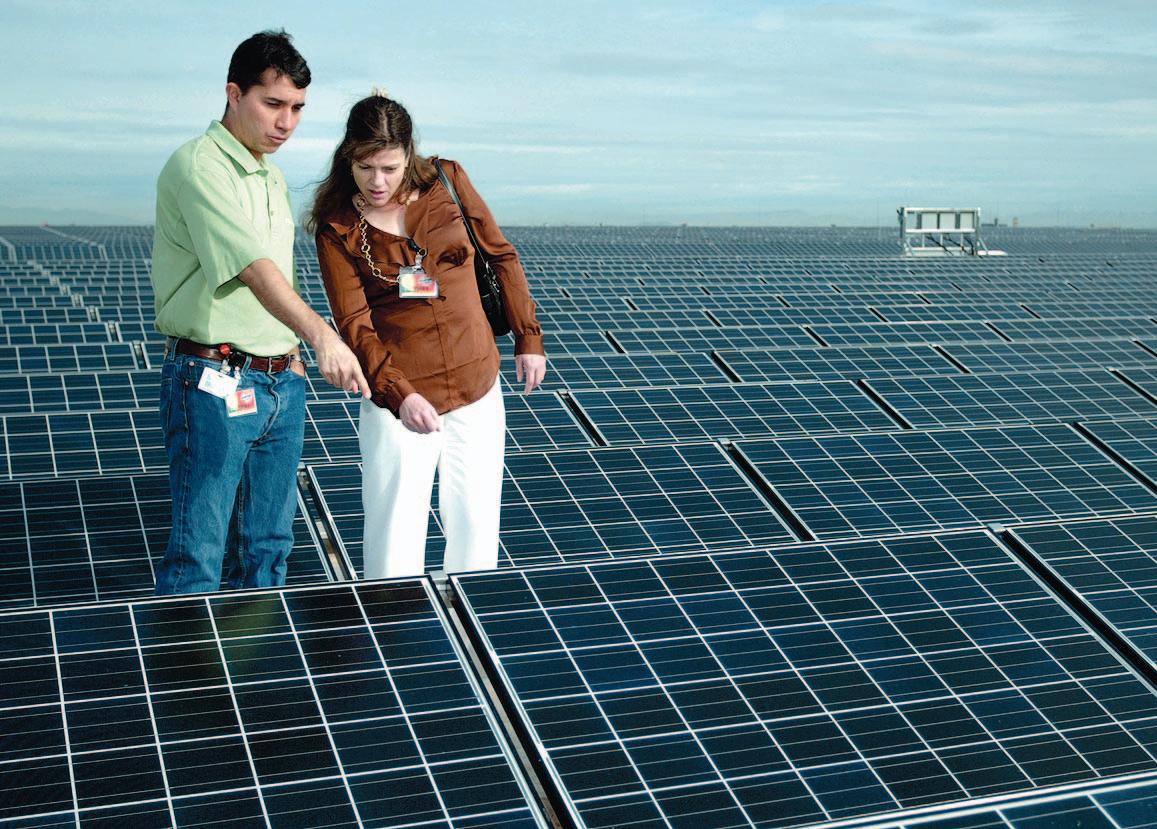
SRP engineer Jerald “Chico” Hunter, left, discusses solar paneling on top of a Tolleson Gatorade facility with Solid Solar founder and former CEO Lori Glover during a press event in Tolleson in 2009. Gatorade was one of the first West Valley companies to embrace solar on such a large scale.
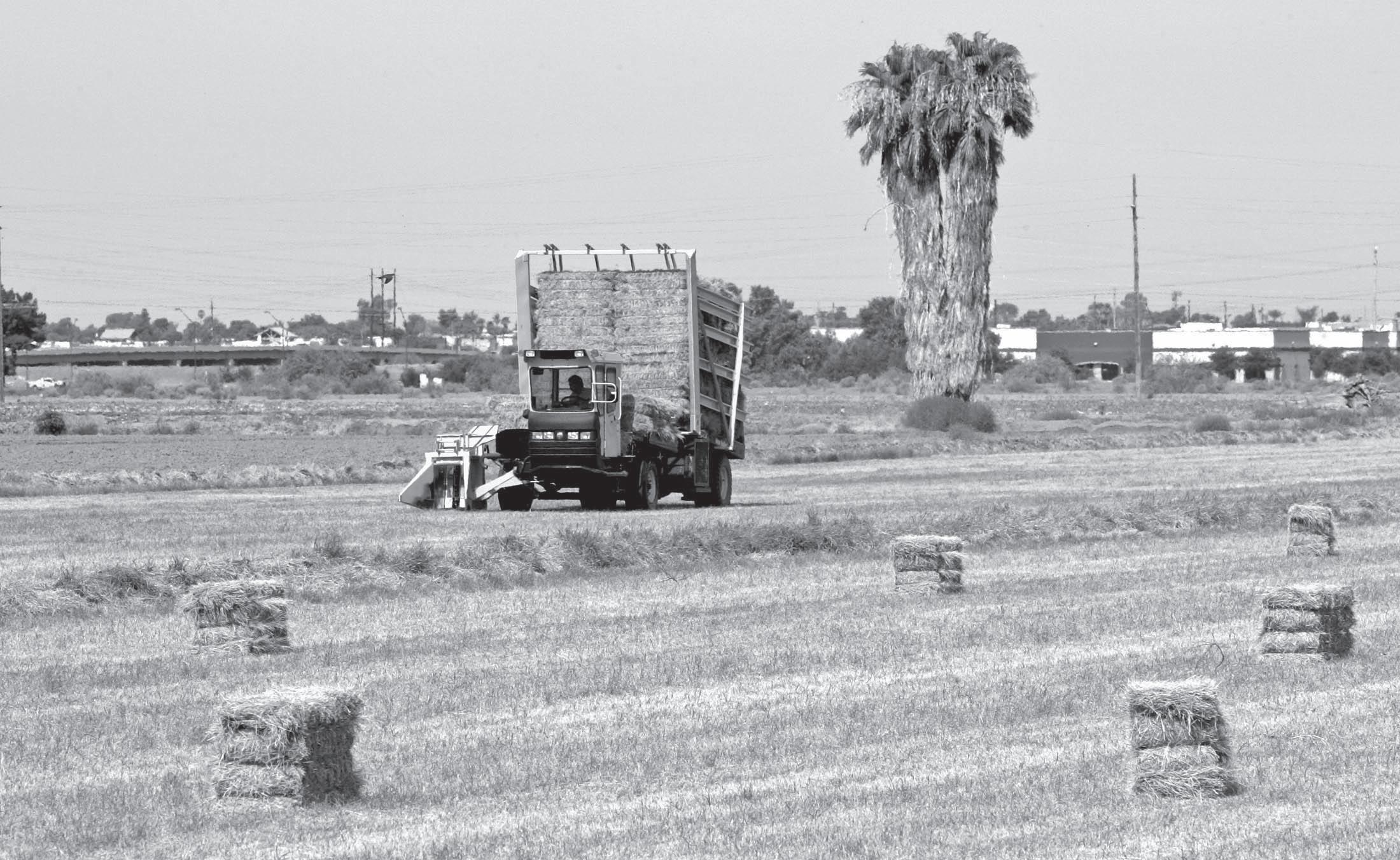
A farm machine picks up bales of hay that will be used as feed near Interstate 10 and Avondale Boulevard in Avondale. Even in the hot summer months fields still go to harvest in Arizona.
Oh my gourd!
Community gardens prove fruitful in the West Valley
Something seriously fruity is happening in the West Valley. Hordes of gourds are growing at the Garden Patch Community Garden in Avondale.
Community gardening, a type of urban agriculture, is touted by advocates as being beneficial to the health of individuals, the economy, the environment and society as a whole.
It’s a new trend taking place in the Southwest Valley, a growing suburban landscape with an agrarian past where old meets new and a modern form of oldfashioned farming is taking root.
“I think there’s been a big movement. I really think that [community gardening] is the wave of the future – not only because of increasing food costs, but we’re talking about reducing our carbon footprint,” Avondale Councilwoman Stephanie Karlin said. “Community gardens are important not only for a healthier lifestyle but also for the local economy.”
Karlin is the founder and coordinator of the Garden Patch, Avondale’s first community garden that’s sprouted up on a 2-acre site next to the Civic Center Library, 11350 W. Civic Center Drive.
Green at Home
Consisting of communal and individual plots, this organic bed of greens is seen by organizers as a way to bring neighbors and strangers together, not only for the purpose of producing nutrition-filled food, but to encourage and promote social interaction and environmental stewardship.
It’s here where community gardeners come together on a regular basis to make a difference one green thumb at a time.
Gourd for the goal
“We want to bridge the gap and truly build community through the garden. Socioeconomic differences, geographic barriers, we really want to break those down,” said Peter
COMPOSING COMPOST
Composting is nature’s way of recycling.
Horticulturalist and garden author Kirti Mathura says that by taking decomposed organic matter, you can create an ideal soil amendment and top mulch perfect for gardening.
To create a finished compost product, you need to provide food, water and air.
The Arizona Department of Environmental Quality offers a recipe that’s sure to conjure up a nice composition of compost.
First you’ll need some browns. Browns include dry leaves, twigs, straw, saw dust, newspaper and junk mail.
Then you’ll need some greens. Greens comprise grass clippings, landscape trimmings, vegetables and fruit peels.
You’ll blend the green material, and separately, you’ll blend the brown material. Then layer the greens and browns in a composting bin in the yard.
Now don’t let the pile get too dry, you hear? It should be as moist as a wrung-out sponge.
Be sure to add water regularly in dry weather. The pile may need to be covered in wet weather.
Turn the pile weekly, but keep layering the greens and browns. Always keep the greens covered with browns.
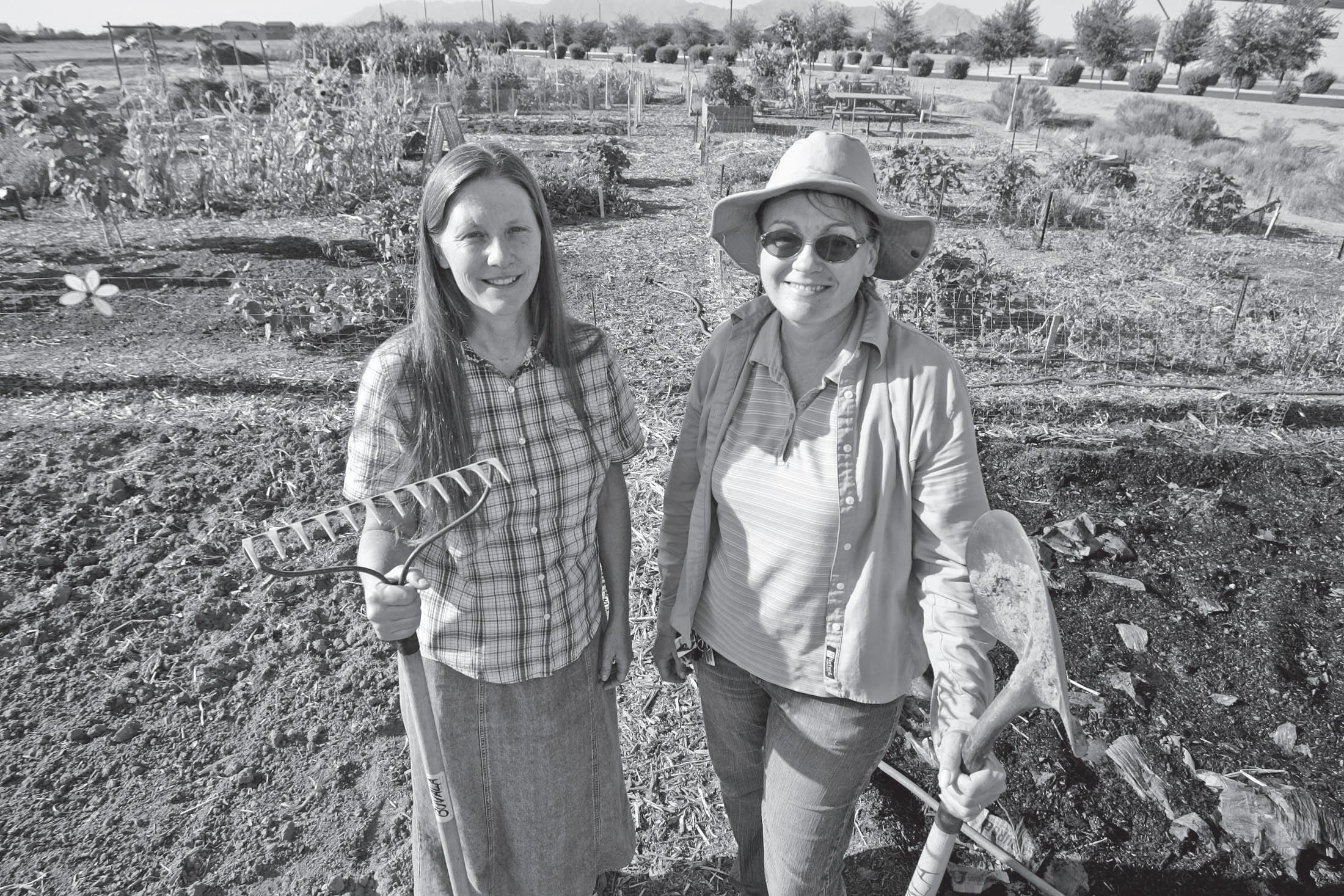
Community gardeners Michelle Buvala, right, and Linda Ford take a break from tending to their vegetables in the Avondale community garden in Avondale.
Conden, president of the Garden Patch.
“The goal is to create a place where people can garden together, make friends, and share and spread knowledge about fruits and vegetables, gardening, better nutrition and exercise, but really, the main reason for starting these gardens is to get people to eat better,” he said.
While community gardens have grown like wildflowers throughout much of the nation, the trend is just starting to blossom here in the Valley.
“Community gardens in Arizona have historically been rather sparse, but all of a sudden, there’s been a spike in interest and a lot of people are starting community gardens,” Conden said.
Last fall, the town of Buckeye in partnership with Arizona State University and Buckeye Elementary School started its first community garden on a half-acre plot
near Mahoney Avenue and Fifth Street at the site of Buckeye Outreach and Social Services.
“It’s a slow process to build a garden when you’re doing it in a well planned way, but it’s good,” said Debbie Driscol, manager of Buckeye’s neighborhood services. “But the excitement has really begun to rally because plants are starting to pop out of the ground. People like to see things growing.”
Driscol said the purpose of the community garden, which is situated in what she called a “fairly low-income neighborhood,” is to provide access to fresh fruits and vegetables to the local community.
“The rule of thumb at the community garden is very simple,” she said. “If you help plant, build, weed and maintain, you can harvest and take home what you can use.”
Any remaining crops are donated to the local food banks, Driscol said.
As if reducing your carbon footprint and limiting negative impacts on the Earth weren’t reasons enough, experts claim that by going green at home, you can not only save the world, but your wallet as well.
Not only do residential eco-friendly efforts help the environment, they also help with cost-savings. And now residents can save even more by taking advantage of several rebate programs offered through West Valley cities.
“The lofty goal of saving the world for our children is not enough in these economic times,” said Mark Mangano, energy efficiency coordinator with the city of Avondale. “Many of the programs are there to help people out financially through energy efficiency and conservation.”
Reducing energy consumption “is the first step in reducing greenhouse gases,” Mangano said. “The ultimate goals are
Going green can save you green
Green at Home
reducing dependence on unsustainable fossil fuels and replacing outdated energy generation methods with sustainable alternative energy sources.”
Several residential energy efficiency rebate programs are available through Avondale.
Mangano recommends taking advantage of the Home Performance with Energy Star home energy audit for $99.
Residents who undertake any of Energy Star’s recommendations can receive $50 from the city for the audit, and up to $100 for duct sealing, $200 for air sealing, $150 for insulation improvements and $150 for shade screens. Utility companies also offer rebates, he said.
A $350 High-Efficiency Central Air Conditioner rebate is also available for
Avondale residents if they meet the federal government’s standard for awarding tax credits for AC retrofits.
Avondale also offers a couple of HVAC Duct Testing and Repair rebates. Residents can get $50 back from the city for duct testing and $100 for duct repairs.
When it comes to conserving water, Mangano touts home water audit kits and on-site audits designed to assist residents in determining water use and locating water waste.
Several rebates and incentives are available for this as well, he said.
Residents can receive up to $600 for indoor plumbing fixtures and outdoor landscape conversions.
A low-flow plumbing rebate up to $75 is also offered, as is a $5 rebate for changing the showerhead.
Residents can also make use of a $50
automatic irrigation controller rebate, as well as a $100 residential rebate for highefficiency clothes washers.
Residents can also get a rebate of up to $400 for converting to a Xeriscape turf.
Mangano said he likes the idea of Xeriscape landscapes because they lower the consumption of imported and ground water, allow more water to be available for domestic uses and the environment, and require less time and work needed for maintenance.
Little or no lawn-mowing equals less air pollution, he said. Plus, Xeriscape plants in an appropriate planting design, soil grading and mulching take full advantage of rainfall retention.
In addition, “Xeriscape plants will tend to survive and thrive, while more ornamental plants may be unable to adapt. Makes sense,” Mangano said.
While Avondale has yet to offer any rebate programs
for installing solar at home, switching to solar “in some instances will save money on the utilities,” Mangano said.
And when it comes to the environment, solar “cuts down on the amount of electric and gas that is being used,” he said.
With “reasonable permit fees” and the cost and ecological considerations related to solar, “we have not discovered any cons if all is installed properly,” he said.
Mangano said anyone living in the West Valley has a part to play when it comes to saving the planet.
“Everybody [can] become a leader in their homes and neighborhoods,” he said. “All of the regional cities have tremendous suggestions and opportunities to learn how to spend wisely with a better understanding of sustainability. Start somewhere. There are so many things that anyone can do.”
— Frank Morris
A sunflower grows in the Avondale community garden. Gardeners from around the West Valley have staked out small patches of land to grow a wide variety of plants.
GOURD From V7
Fruitful endeavors
Community garden advocates claim that along with providing local, healthy affordable food that’s good for the environment and the economy, community gardens also enable neighborly interaction and a sense of community pride.
“I think the people who are interested in the community garden also have a sense of community. You’re out there, you’re working, it’s hard work, but you’re socializing and talking to other people,” Karlin said.
“And the bonding that’s taken place, I’m just really amazed at how generous the community spirit is,” she said. “These people have not known each other beforehand, but there’s a lot of giving and sharing for the common goal – and they all seem to be enjoying themselves.”
WHAT DOES YOUR GARDEN GROW?
In the West Valley, almost any kind of fruit and vegetable can be grown successfully when you choose the right variety and plant them at the appropriate time. There are two growing seasons to consider: spring and fall. Horticulturalist and garden author Kirti Mathura has a few suggestions that could make your crop-growing experience a bountiful one.
In the warm season, try growing Hopi blue corn or breeder’s choice sweet corn. Green grape and yellow pear tomatoes are also a treat. Blackbell and purple blush eggplants are winners, as are sweet banana peppers and jalapenos.
The warm season also calls for royalty purple podded beans and Bisbee red black-eyed peas. Armenian cucumbers, ambrosia hybrid melons and sugar baby watermelon are also ideal for
And that, Karlin said, is part of what community gardening is all about.
“It’s the people who are out there gardening their little hearts out that make this happen,” she said.
To learn more or to get involved in a community garden near you, contact the
the warmer months. Black beauty zucchini, red velvet okra and Spanish peanuts are also choice.
Then in the cool season, try growing buttercrunch or romaine lettuce. How about some curled cress salad greens or some mizuna mustard greens? You bet. Go for some rhubarb and some nutri-bud broccoli. You won’t regret it.
The cool season is also favorable for some Copenhagen cabbage, early snowball caulifl ower and early white Vienna kohlrabi. Danvers carrots are great, as are white icicle radishes, Detroit dark red beets and some purple top white globe turnips. Don’t forget the granex onions, dwarf gray sugar peas and seascape strawberries.
With these suggestions in mind, you’re sure to have a good ol’ time gardening away!
Buckeye Community Garden at 623293-3176 or ddriscol@buckeyeaz.gov; the Garden Patch at 623-333-1914 or garden.patch@yahoo.com; or the American Community Gardening Association at www.communitygarden.org. — Frank Morris
Rio Salado College has many locations in the West Valley to meet your educational needs.
Communiversity @ Surprise
Rio Salado College @ Avondale
Rio Salado College @ Luke Air Force Base
Rio Salado College Online
Rio Salado College Lifelong Learning Center
Bike commuters saving the environment
While gas-guzzling vehicles are the standard form of transportation for Arizona residents getting to and from work, they’re not the only mode. Some ambitious West Valley residents use a more environmentally friendly mode to commute — their bicycles.
Ryan McDowell and Tech Sgt. Nicole Eisenbarth, a pair of Goodyear residents, prefer bike pedals over gas pedals as their way to get to and from their jobs. They do it for the environment, and exercise.
“I do it for every aspect, for sure,” Eisenbarth said. “Obviously I care about the environment, and for my daughter and how people younger are going to grow up and what they’re going to smell in the air, and obviously I do it to cut costs because gas prices are so high.”
For McDowell, it’s more the exercise and love of cycling than for the environment, but whether it’s a conscious effort or not, he’s helping.
“I look at it more as fitness, I like the fitness aspect of it,” he said. “It’s hard to look at being green and helping the environment when you get passed by a semi truck and he’s blowing exhaust in your face and debris. You’ve got to keep that in mind. I cycle as a
Green Mobility
“I cycle as a means of transportation because I enjoy it.”
Ryan McDowell Goodyear resident
means of transportation because I enjoy it.”
McDowell’s commute to work at DNA Cycles in Avondale, where he is a bike mechanic, is 17 miles one way. He doesn’t ride to work every day, but quite a bit.
Last year he logged nearly 2,500 commute miles on his fixed-gear single-speed bicycle.
“I have been an avid cyclist for about as long as I can remember,” McDowell said. “I’m 28, I’ve raced and ridden, worked at bike shops. It’s just kind of been a hobby turned into passion turned into career.
Cycling to work just seemed like a natural thing. A few years back I was hard up on money and gas prices for my truck were through the roof. It was a natural progression to look at my bike as a natural mode of transportation.”
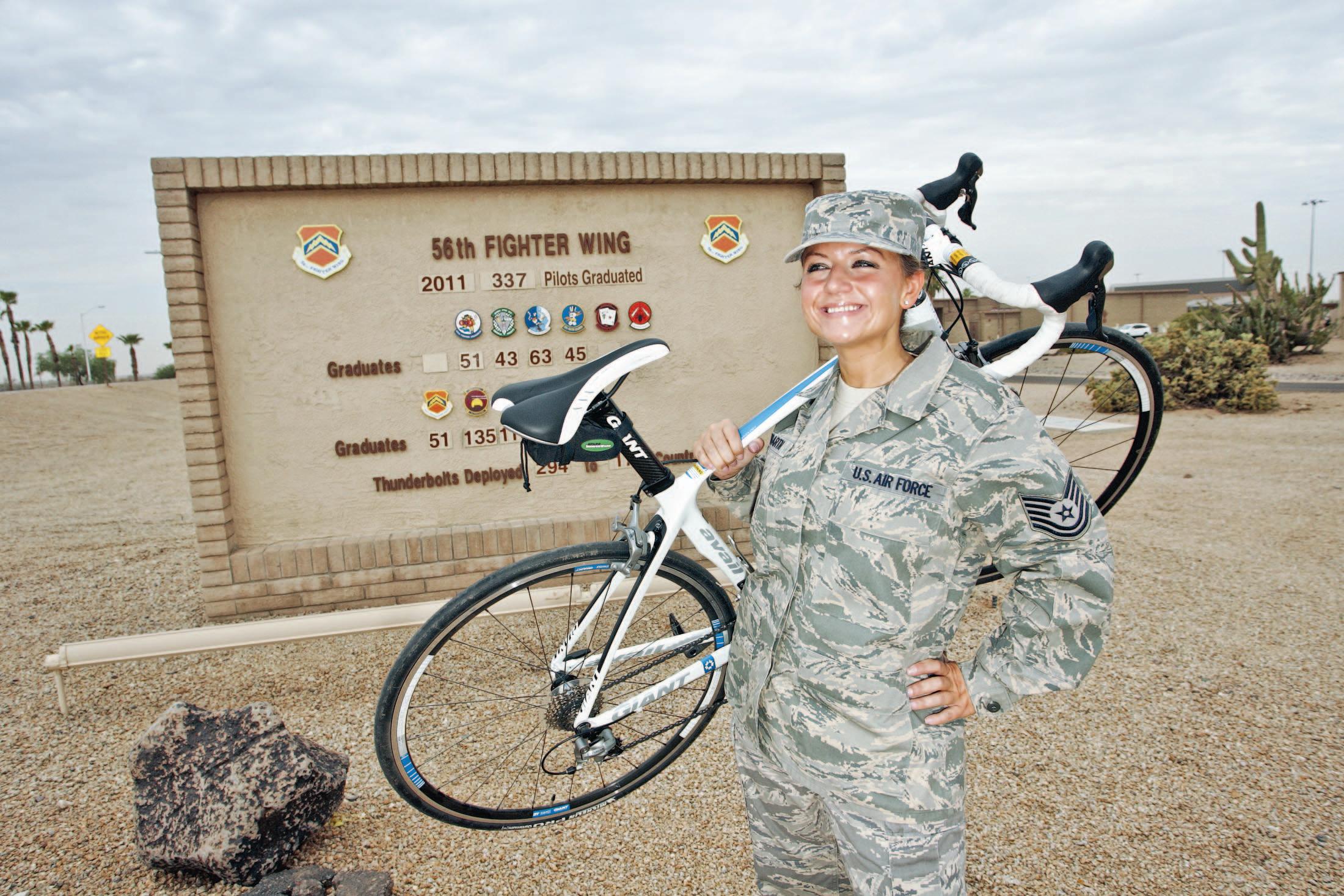
Eisenbarth rides a 2011 Giant Avail Advanced and uses it to commute every day to Luke Air Force Base. Her travel distance varies day to day depending on when she gets up and what route she takes, but it’s generally around a 25-mile trip.
“If I get up early enough I’ll make it a longer commute, go out of my way to make it a 30- or 35-mile trip,” Eisenbarth said. “At least twice a week I do that.”
Biking despite the elements
Despite the heat, where temperatures reached 115 degrees in late August this year, that doesn’t deter Eisenbarth from commuting with her bike every day.
“I wouldn’t say it’s too difficult,” Eisenbarth said of riding in the heat. “I’m one
See BICYCLE on V38
Tech Sgt. Nicole Eisenbarth holds up her bicycle at Luke Air Force Base. Eisenbarth rides from her Goodyear home to the base even in the summer.
Smart for the environment
Smart cars help planet go green
Smart cars are a brilliant idea.
The tiny vehicles look like micro machines on the road, and their footprint on the environment is just as small.
“The car itself is actually 95 percent recyclable,” said Sean Schwartz, a sales representative for Smart cars in Chandler, the only dealership in the Valley that sells Smart cars. “Even after the cars are gone, what they say isn’t [recyclable] is the gas and headlights and tires, but even tires they now recycle. So the gas and headlights are the only thing that is not recyclable on the vehicle.”
Smart cars are advertised to get 41 miles to the gallon on the highway, which is the most of any gasoline engine on the market, Schwartz said. And, not only are they good for the environment in more ways than one, they’re also fun to drive.
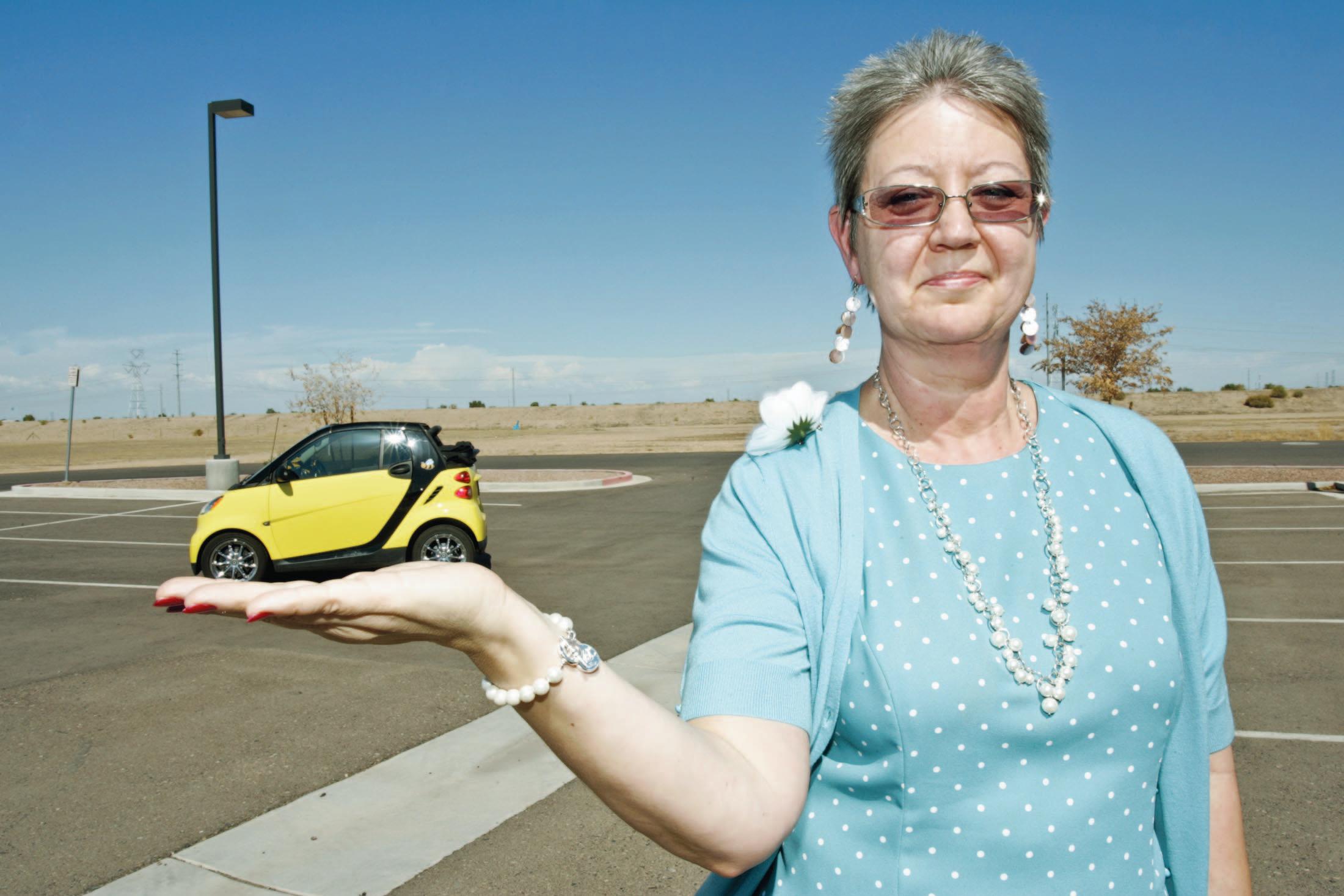
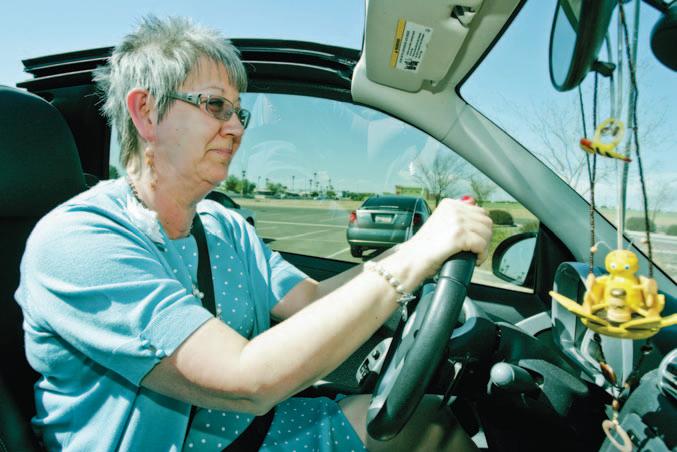
“I love it,” said Connie Stepnitz, a Smart car owner who is the customer service manager for the city of Goodyear. “I have a yellow one with a black top so it looks like a bumble bee. My husband got me a personalized license plate and there’s a bee in my windshield. It’s such a novelty, everywhere I go people want to look at it and want to sit in it and they all
Green Mobility
ask the same questions because you just don’t see it.”
Smart cars have been sold in the states only since 2008, although the European model has been around much longer. Like the old Volkswagen bugs, its engine is in the rear of the car. At just under 9 feet long, Smart cars pack a lot into such a tiny two-seater vehicle. The leg and head room is surprisingly plentiful for its size.
“It’s taller than most sedans,” Stepnitz said. “My husband is 6-4, can get in and still has head room and leg room because the engine is not up front so there’s space underneath the dash.”
Despite their size, Smart cars include a number of safety features. They are designed like a race car with a roll bar and have eight air bags.
“That’s what a lot of people will think that just because of its size it’s not safe, especially in the U.S. with huge pickups and SUVs, everyone just assumes the bigger the safer that they are, but the car is actually engineered very well,” Schwartz
said. “It’s a division of Mercedes and is all designed by them and got really great crash test scores.”
Stepnitz always feels safe in her car, she said. Even at 80 miles per hour she doesn’t have any issues. The only thing she has to be careful about is other drivers because her car is so small.
“Like all small cars and motorcycles, you have to realize people have blind spots and don’t always see you, so you have to be a proactive driver, be defensive and aware of everything that’s going on,” she said.
Why purchase one?
Stepnitz bought her car for a few different reasons, including its looks, sportiness, and how good it is for the environment, she said.
“My husband has a Hummer and we get 11 miles to the gallon,” Stepnitz said.
Goodyear city employee Connie Stepnitz shows off her Smart car — in this forced perspective shot — in Avondale. The tiny cars are part of a growing trend in cars: smaller, more economical and better gas mileage.
Zoom bus a nice alternative
Ihaven’t ridden a bus since I was a teenager.
I haven’t had a need.
But now that Avondale debuted its Zoom circulator system — a first for West Valley residents — I decided to hop on and give it a ride.
I didn’t really have a destination; I just wanted to see how it worked and what it was like, so I went to the Avondale Civic Center stop (a popular on and off location for riders, I’m told) and parked my car.
The bus stop was conveniently located next to the library and I can see how it would be a well-liked destination for users of the system.
I sat in the 113 degree heat for less than 5 minutes before the Zoom appeared.
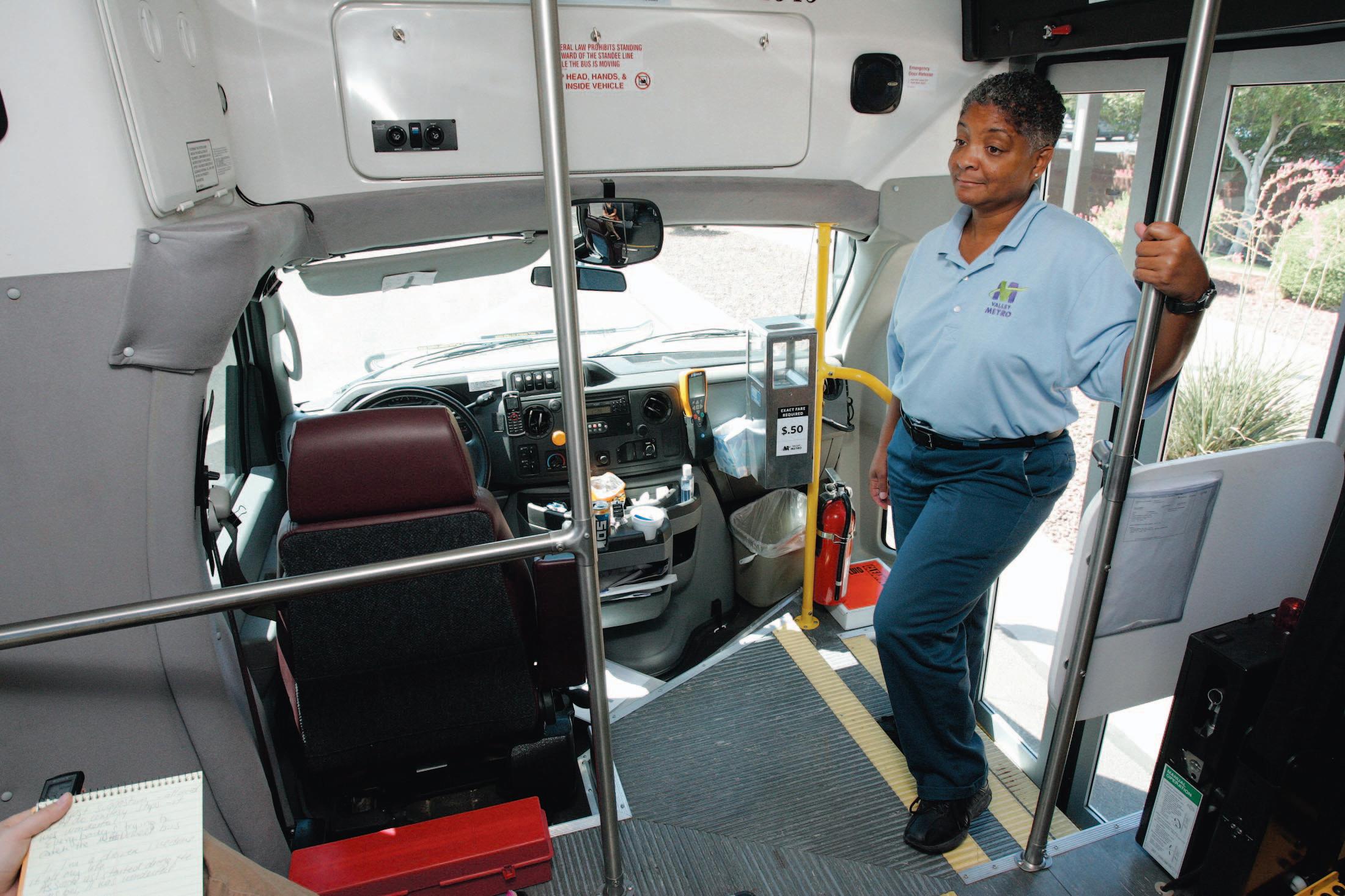
It stopped right in front of me, and welcomed me with open doors. A single rider left the bus before I entered, dropped my 50 cents in a bucket and took a seat right behind the driver, Vicky McRae.
Only one other passenger was on the bus, when I took my ride just after 10:30 a.m. on a Friday.
Christopher Romero, 20, sat a seat or
Green Mobility
two behind me.
He said it was his 10th ride in a single week because classes had just started back up at Estrella Mountain Community College, where he was a student.
He used a different bus system before the Zoom, but it was more costly and took twice as long to get him to his destination, he said.
The bus isn’t very crowded and offers a relaxed environment, he said.
“I notice some familiar faces. It’s nice,” Romero, 20, said. “It feels more friendly.”
He also hasn’t noticed any time issues, he said. Buses have been prompt and “no fuss.”
“If anyone asks me, I would recommend the Zoom. It’s so simple and cheap,” he said.
My ride on the Zoom was uneventful but relaxing.
I sat in air conditioned comfort without worries of traffic. We zoomed around a good part of
ZOOM on V17
WHERE DOES THE BUS GO?
Just about all major destinations in Avondale are included on the Zoom’s bus route. The 14-mile route runs from 5:30 a.m. to 8:30 p.m. and is 50 cents per ride; exact change is necessary. For exact times, visit the website www.avondale.org/zoom
DESTINATIONS:
• Estrella Mountain Community College
• Estrella High School
• Old Town Avondale
• Avondale Community Center
• La Joya Community High School
• Avondale Civic Center
• Avondale Civic Center Library
• Randall McDaniel Sports Complex
• Universal Technical Institute
• Avondale Auto Mall
• Gateway Pavillions
Shuttle driver Vicky McRae looks over her van after arriving to a bus stop several minutes early in Avondale. McRae has been a driver of buses, taxis and shuttles for most of her life.
Avondale, taking the bus to commercial areas such as the Harkins Movie Theatre and over to Universal Technical Institute, before stopping again at the Avondale Civic Center.
I could have stayed on the bus for the second half of the loop, which went to EMCC but my opinion was already swayed.
Riding the Zoom was easy. I wasn’t stressed about where I was going or when I was
going to get there. My driver was confident, friendly and knowledgeable and I could see myself using the Zoom more often, especially if I wanted to save on money or had Avondale-only destinations.
The Zoom is relatively new and I hope the city takes input from its riders, who may want different pick-up and drop-off points than what are available. But from what I saw and experienced, it’s a ride worth catching.
— Sara Bisker
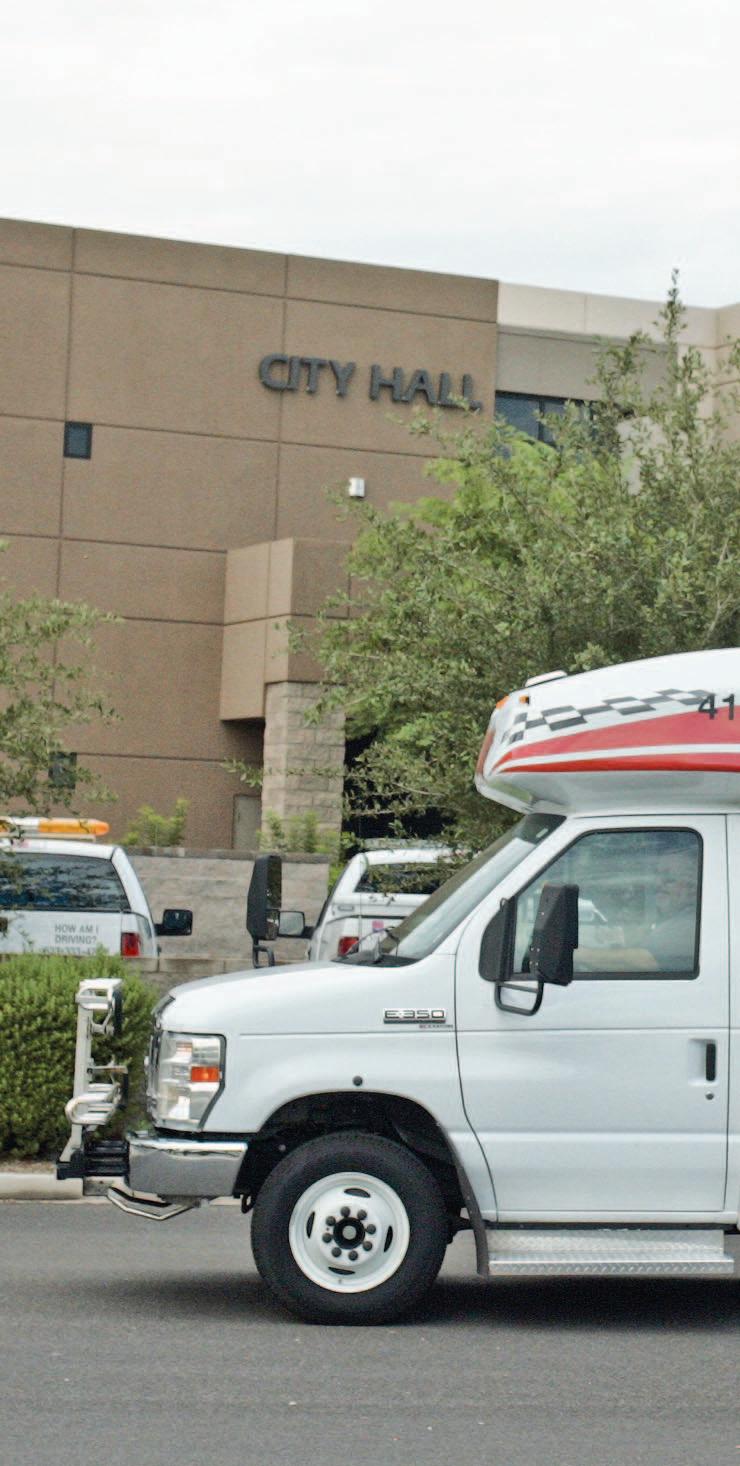
A Zoom shuttle arrives at Avondale City Hall after completing its westbound route through the West Valley.
ZOOM From V16
Waste water equals nuclear energy
Palo Verde station uses 21 billion gallons of effluent water a year
Long before “Going Green” became the hot environmental catch phrase, Palo Verde Nuclear Generation Station was living it.
“When the decision was made to build the largest U.S. nuclear plant in the desert, ground water would never be an option,” said Bob Lotts, water resources manager for Arizona Public Service Co. and former plant manager for Palo Verde’s Water Reclamation Facility from 1982 to 2009.
So the solution was to use effluent, or waste water.
All conventional electric generating facilities — nuclear, coal or natural gas — require large amounts of water. Most of it comes from rivers, lakes, oceans or groundwater.
The original planners of Palo Verde chose to use effluent water instead of ground water for plant cooling purposes mainly because there wouldn’t be enough water in the ground to keep the 4,250acre nuclear facility west of Buckeye going.
“When we started this concept in the 1970s era, there was nothing to do with the [waste] water but discharge it into the river,” Lotts said. “This was the perfect
Working Green
solution and way ahead of its time.”
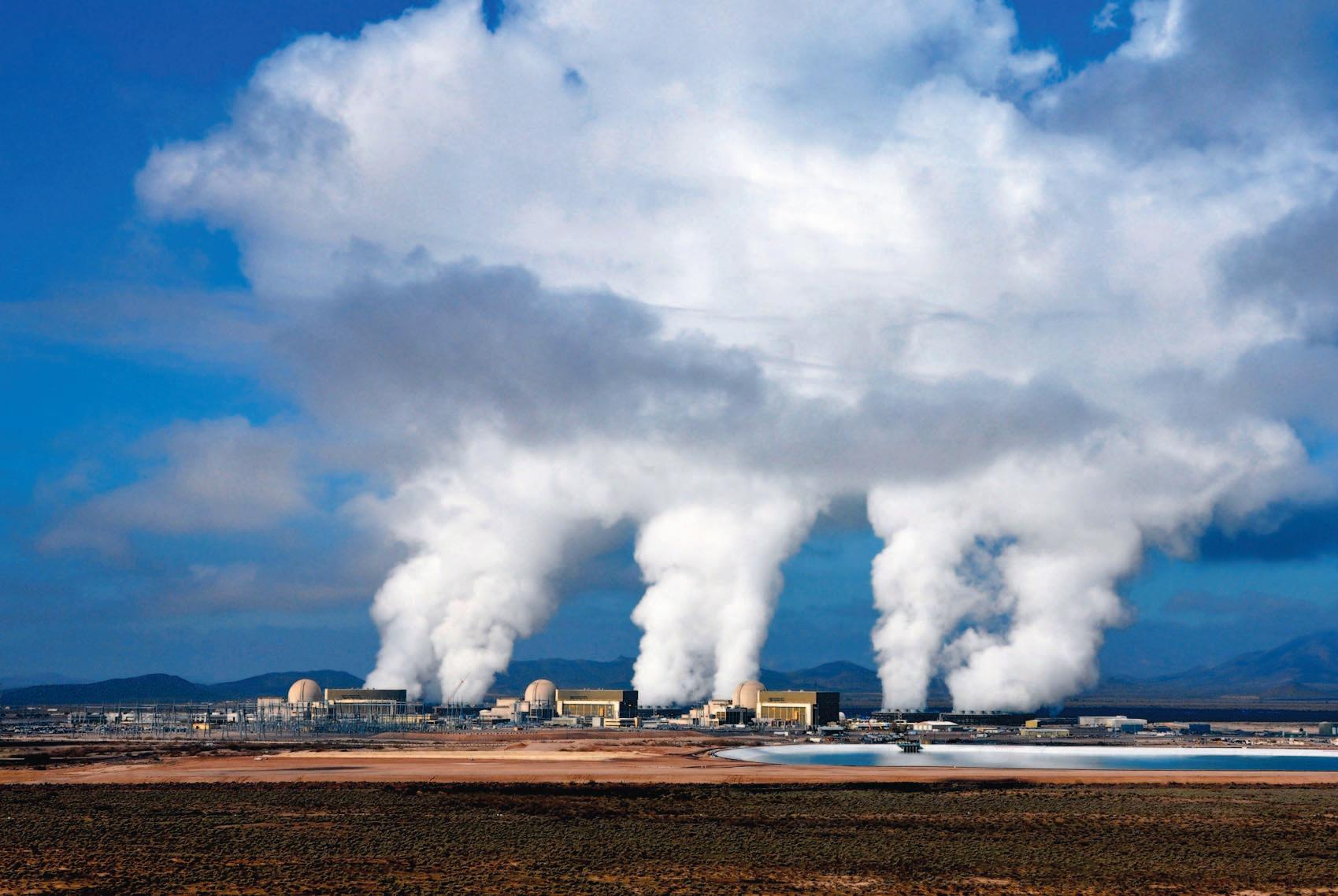
So far ahead in fact, that Palo Verde is still the only nuclear plant in the world that uses effluent water; of course the plant — which has three almost identical pressurized water reactors that can generate 4,170 megawatts at full capacity, providing electricity to about 4 million customers in Arizona, California and New Mexico — is the only one in the world not on a body of water, such as a lake, river or ocean.
Still, “it’s just a matter of time before we see it replicated in other countries,” Lotts said.
Over the years, the water expert has been in contact with representatives from many countries — even visiting some to provide details face to face — in regards to using effluent water at a nuclear plant, and he thinks Jordan might be the first to duplicate what was done at Palo Verde.
How they get the water
Palo Verde uses approximately 21 billion gallons of effluent water a year.
The water comes from three different sources:
• The Phoenix Wastewater Treatment Plant off 91st Avenue south of Buckeye Road, receives effluent from Phoenix, Glendale, Tempe, Mesa and Scottsdale and has a daily capacity of 150 million gallons.
• The Tolleson Wastewater Treatment Plant, just across from the Phoenix one, receives effluent from Tolleson and has a daily capacity of 17 million gallons.
• Goodyear Wastewater Treatment plant, just southeast of 163rd Avenue and MC85, receives effluent from Goodyear and has a daily capacity of 5.5 million gallons.
All three plants are tied into 36 miles of underground pipeline that stretches from the 91st Avenue facilities to the Palo Verde station, Lotts said.
The pipeline has a continuous flow of water, with the speed determined by how much the nuclear plant needs.
“If demand is 50,000 gallons a minute,
Steam rises from the Palo Verde Nuclear Geneating Station in the far West Valley.
Van pooling before it became trendy
Half of Palo Verde’s employees van pool to work each day
Palo Verde Nuclear Generating Station’s employees have been cutting down on vehicle emissions for decades.
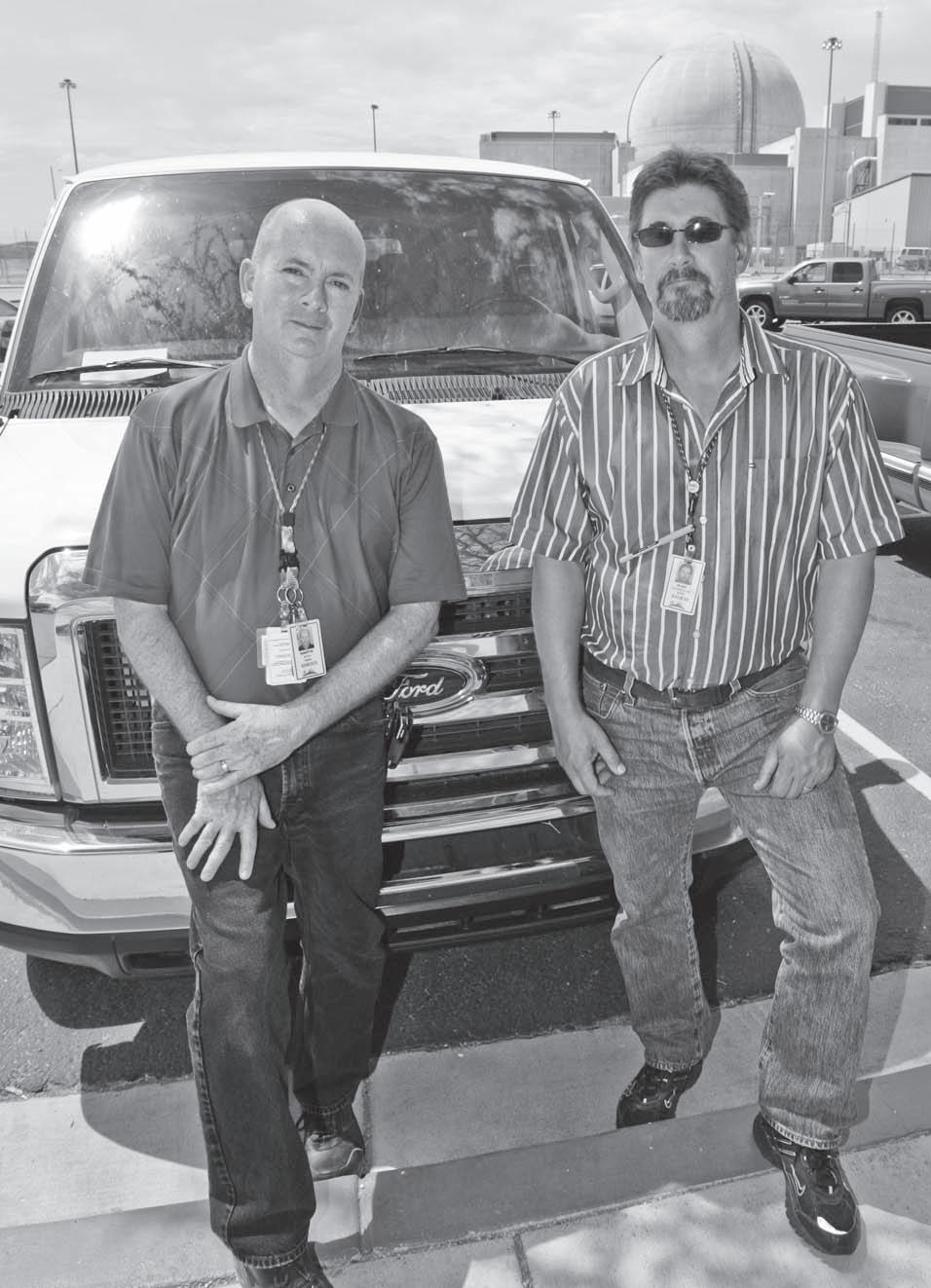
Alan Chamberlain has been “van pooling” to the nuclear plant since 1988.
“It’s a nice benefit,” he said. “While the rest are snoring, I’m driving.”
And the southeast Phoenix resident means that literally. Chamberlain, an environmental scientist, is the van captain for his group, so more often than not he is behind the wheel of the 10-seat passenger van as it cruises to the Palo Verde station.
“We leave at 5:10 a.m.,” he said. “In the old days, it was a ghost town,” he said of the roadways to the plant. “Now Phoenix has grown so much, even at that hour there is quite a bit of traffic.”
Palo Verde has a fleet of 178 white vans with black numbers on the back that are used by 1,180 of its approximately 2,400 employees. One hundred and fifty-two vans are used daily by the employees in the van pool system, which costs them $120 a month.
“It’s meant to be an attractive option for people,” said Marty Eroh, Palo Verde’s environmental department leader.
“We have vans running from Fountain Hills, Wickenburg, Queen Creek, Maricopa,” as well as cities closer to the nuclear power plant such as Goodyear and Buckeye, he said.
The vans rack up 4.5 to 5 million miles a year, and remove more than 1,000 vehicles from the Phoenix metro roadways four days a week (Palo Verde employees work 10-hour shifts.)
The plant has two full-time mechanics responsible for keeping the vans running in safe condition.
The money the employees pay into the van pool system covers all expenses except for van replacement. Arizona Public Service Co. replaces vans after 10 years of service.
APS owns the majority of Palo Verde — 29.1 percent — and thus runs the facility. APS took over the van pool program in 1994 from the contract company that previously managed it.
— Rich Ott
Palo Verde workers and van captains Marty Eroh, left, and Alan Chamberlain stand near a carpool van near Reactor 3 at Palo Verde Nuclear Generating Station.
Going ‘green’ is an agricultural thing
West Valley farmers, like others throughout Arizona, are constantly going “green,” or searching for new ways to save energy and conserve resources.
In Buckeye, for example, farmers have stepped forward by using flowing canal water to produce a modest amount of hydroelectric power to operate the gates on a large irrigation system.
The innovation is part of relentless pressure that is put on farmers to produce more with fewer resources, according to farmers and agricultural-industry groups.
“Water is one of our biggest expenses, so we always have to find ways to cut back and do better with less,” said Steven Bales Jr., a fifth-generation farmer.
Bales, an advocate of “green” ideas, is one of the operators of Bales Hay Sales, a 2,500-acre ranch and farm at 20600 W. Beloat Road, near Buckeye.
The rural roadway, a mile south of Maricopa County 85, takes its name from some of Bales’ early ancestors who settled in the area during the 1880s.
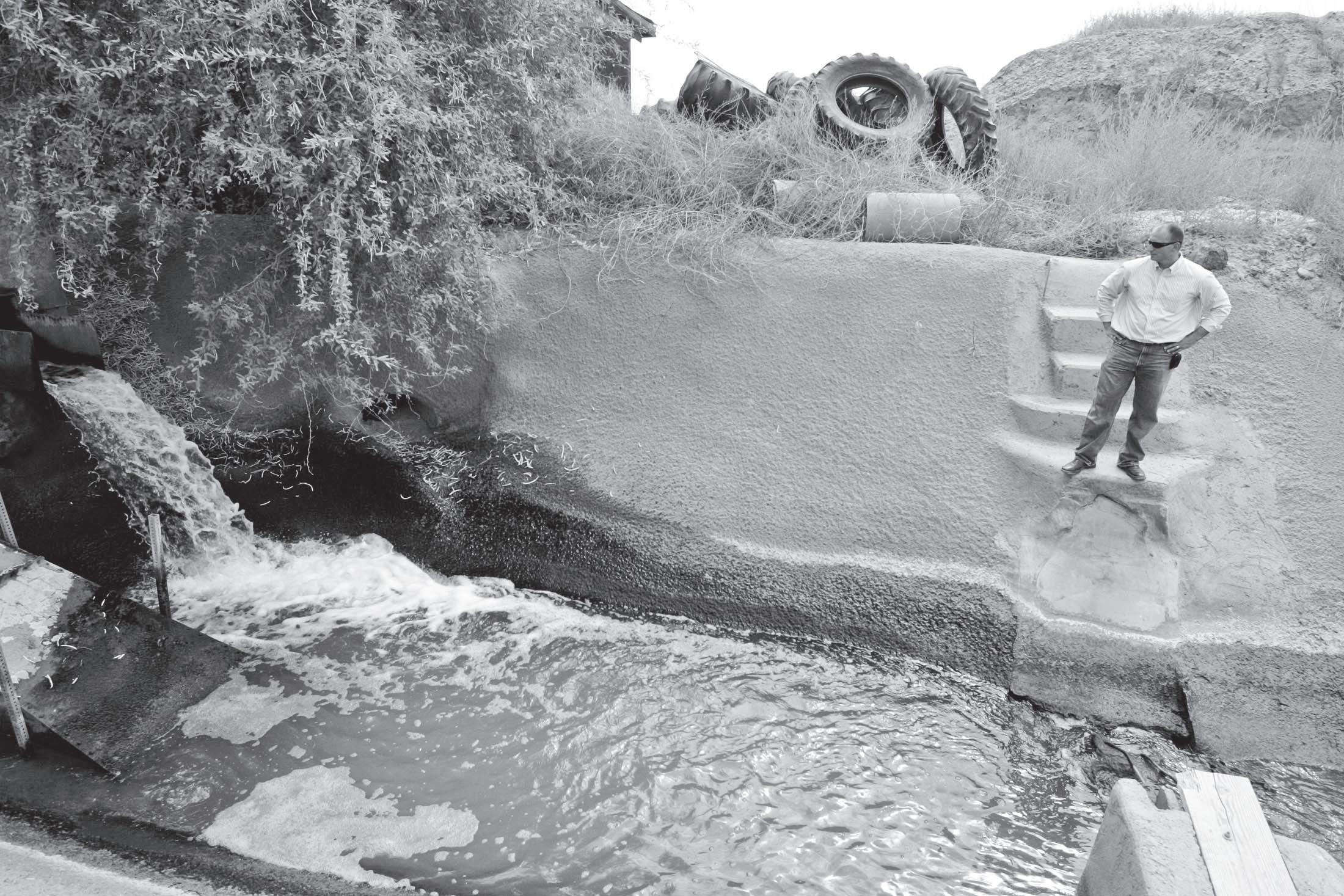
Not far from his ranch, the Buckeye Water Conservation and Drainage District has installed a generator along a canal near Beloat and Rainbow roads.
The generator, when fully operating,
Working Green
will crank out a maximum of 12 kilowatts to help power canal gates, said Ed Gerak, the district’s general manager.
The low-energy generator went online in April 2010 at a cost of $120,000 as part of a test project by the district to help reduce power costs, Gerak said.
“The project will probably never pay for itself, but the money contributed toward the installation will count as a tradeoff on other projects,” he said.
Because of low flows during the summer, the district cannot afford to run water through the generator just to produce power, Gerak said.
However, the generator can be used quite effectively during high-flow winter months, producing enough electricity to power two homes, Gerak added.
GREENER ARIZONA
Arizona long has been known for its five C’s: cattle, citrus, climate, copper and cotton — and all but copper relate directly to agriculture.
What are some of the “green” innovations that may sustain Arizona agriculture for the next 20 years?
Pat Rorabaugh, a hydroponics and plant-sciences expert at the University of Arizona, has offered several long-range predictions. They include:
• Water conservation: More subsurface drip irrigation in the fields.
• Water recycling: Water condensers in the farm field or greenhouse that can pull water directly from the air for use back in the greenhouse or field.
• Aquaponics: Using the same water for two crops, a process achieved by recirculation of water between fish and plants to create a sustainable system.
• Rain harvesting: Collecting and channeling rain from homes, buildings and barns in order to provide fresh water for animals and crops.
• Solar technology: More use of solar panels to power homes, sheds and barns, as well as crop-processing facilities.
SOURCE: Arizona Farm Bureau.
Ed Gerak, district general manager for the Buckeye Water Conservation and Drainage District, monitors water as it spills into a channel in Buckeye.
Now, the district has plans to install another generator in Goodyear south of Maricopa County 85 and Estrella Parkway, Gerak said. It is one that will generate about 120 kilowatts, or 10 times the amount of the current generator.
“As we looked for ways to reduce our power costs, this was one idea we adopted in our green efforts,” he said.
In fact, West Valley farmers have proven throughout the years they can conserve resources through many means, including water conservation, drip irrigation and alternative pest-management control, Gerak said.
It is a do-or-die proposition for farmers because of the steep up-front costs of operating a ranch or farm, he said.
“Today, farmers cannot make it on just 150 or 200 acres,” Gerak said. “The reality is that they need 600 to 700 acres to scratch out a living in Arizona.”
Adapting to the challenges of the times is part of a concept known as “sustainability,” said Julie Murphree, a spokeswoman for the Arizona Farm Bureau, a group based in Gilbert.
“To me, sustainability describes an Arizona farmer or ranch family that has been using the same land for three, four, five and even six generations,” she said.
“And we have dozens of farm families like that in Arizona, including many in the West Valley – the Bales, the Hickmans,
“As we looked for ways to reduce our power costs, this was one idea we adopted in our green efforts.”
Buckeye Water Conservation and Drainage District
the Millers and the Roveys, to name just a few,” Murphree said.
Because of the ups and downs of the market, farmers and ranchers have to be astute business people to keep a farm or ranch for multiple generations, she said.
“That is why they are always on the cutting edge of going green,” Murphree said. “That makes farmers and ranchers some of the smartest people I know.”
However, it is not an easy proposition, according to Glenn Hickman, president and chief executive of Hickman’s Family Farms, 6515 S. Jackrabbit Trail, in Buckeye, the huge egg producer for Arizona and parts of other states. It has Hickman family roots dating from 1944.
In 2008, after being named the Arizona Farm Bureau’s farmer of the year, Hickman described agriculture as under assault in the United States because of green issues and the “rising tide” of animal activism.
“The cost of compliance has gotten out of hand,” Hickman said. “We spend more time filling out forms, performing audits
Ed Gerak
general manager
and generally documenting our every moving part of our business.”
As a result, farmers work hard to provide consumers with the safest and most nutritious food in history, he said.
“We must redouble our efforts to communicate directly with the consumer that thinks milk comes from the stores,” Hickman told Farm Bureau members.
In fact, producing milk is very hard work, according to William “T” Gladden and his nephew, Dan Gladden, operators of Saddle Mountain Dairy, a multi-generational family farm in Palo Verde.
Both say it is a challenge to respond to the ebbs and flows of the dairy market.
Dan Gladden said that despite the economic worries, the dairy hopefully has provided enough opportunities to pass along to another generation.
“It’s a good life,” Gladden told the View two years ago. “It’s not for everybody, but it’s a good life. It’s a family life, but there are no guarantees.”
—
Brent Whiting
Forget the environment, save money
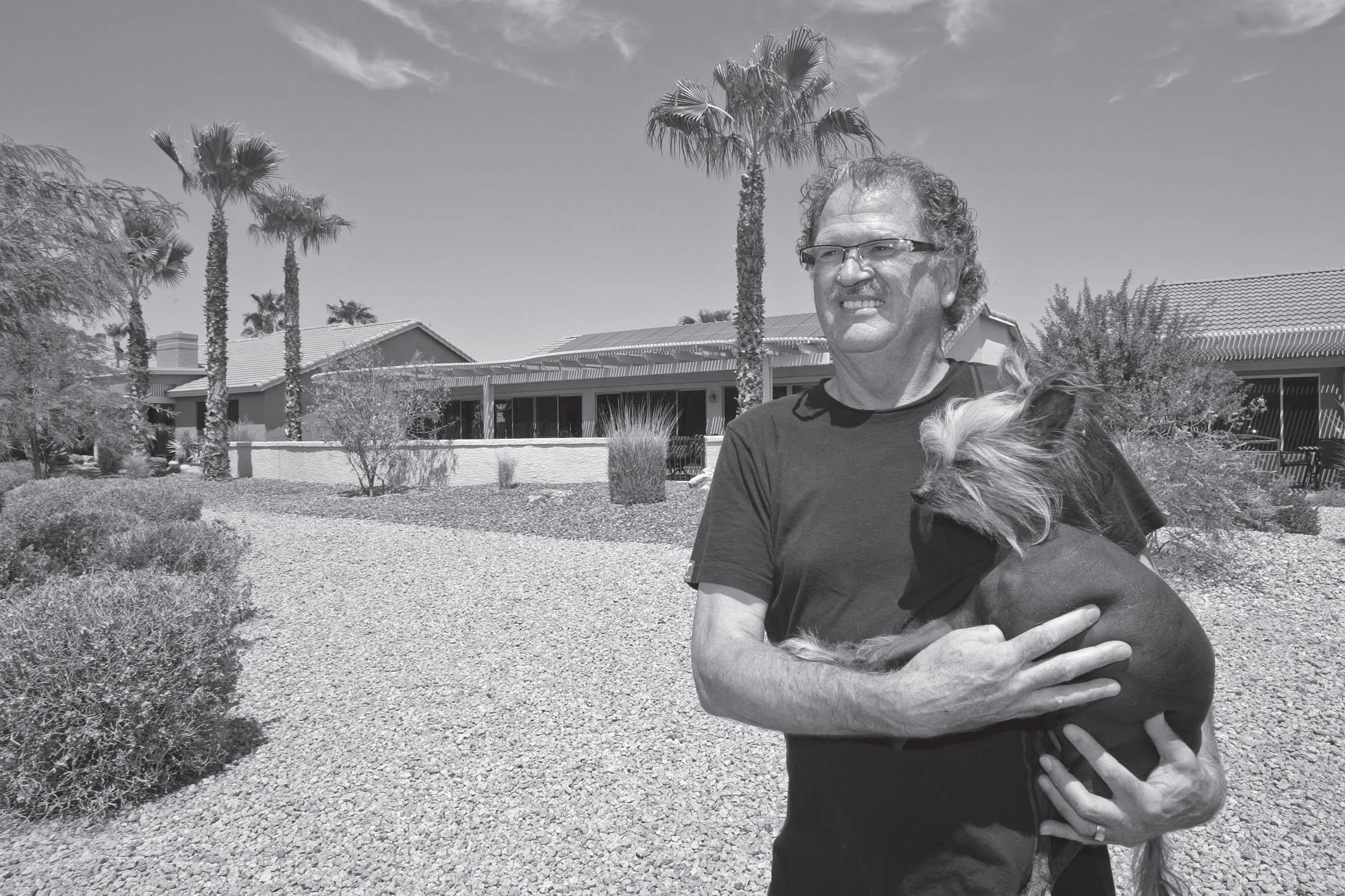
Goodyear resident Dru Bacon likes to say he’s atoning for his past sins.
“I’m a former chemical engineer that made hazardous chemicals and polluted the environment,” he said from his PebbleCreek home.
As an employee of Eastman Kodak in Tennessee, he was responsible for environmental compliance and environmental reporting in an age when the Environmental Protection Agency wasn’t in existence.
“I always had mixed emotions about it. I knew we were doing things that were bad for the environment. The industry standard was very, very low,” he said.
When the EPA was formed in 1970, companies received mandates to change their ways but a cultural or paradigm shift was still needed, Bacon said. It was harder to come by.
“It was a grudging compliance with the law, but eventually the old school guys moved out and the influence of newer people started taking effect,” he said.
Real efforts were made to educate and protect the public from harmful practices, he said.
“Protecting people from hazardous
Green Cities
carcinogenic chemicals became not something to be downplayed and people stopped saying, ‘We’ve done this since the company came into existence and you don’t see people falling down with cancer.’ It went from that attitude to, ‘Yes, we have a responsibility to protect our employees and we need to do whatever we can do,’” he said.
That shift in paradigm is still happening, but it’s much more apparent in people’s behaviors and attitudes, Bacon said.
Cities such as Avondale and Buckeye have reduced their work week from five days to four days to curb energy costs.
“Maricopa County mandates that all cities develop a Trip Reduction Program to reduce traffic impacts on air pollution and emissions in our communities,” said Mark Mangano, Avondale’s energy efficiency coordinator.
Green Fridays in Avondale is one way the city is fulfilling that mandate, he said.
“Avondale is meeting its commitment to reduce the number of employee vehicle
trips to City Hall, which means cleaner air for us all. In addition to the environmental benefits, the city anticipates saving on utility costs like electricity, heating/cooling, water usage and janitorial services by closing City Hall one day per week,” Mangano said.
For one business in Buckeye, being green is about setting an example.
The Millstone Café, 801 E. Monroe Ave., is owned by Joe and Hortencia Blanton. They have made conscious efforts to change their practices.
Recently, the owners changed every single light bulb from compact fluorescents to LED, or light emitting diode.
“LED bulbs last up to 10 times as long as CFLs, do not cause heat build-up and use only 2 to 10 watts of electricity,” Joe said.
It was a simple change that made a difference, he said.
Some changes may not seem so simple but are of equal or greater importance,
Environmentalist Dru Bacon, and his dog Sasha, stands in his backyard, where he can see the solar panels on his roof in Goodyear.
such as installing solar on a home.
Environmentally, solar is the way to go, Bacon said.
But many people are too timid to put panels on their roof tops, buy solar water heaters and generally invest in a technology they’re unfamiliar with, he said.
When Bacon moved to PebbleCreek in 2001, only two homes had solar panels. Now, through diligence in communicating the issue and taking away some of the “unknowns” there are 391 solar homes –and growing.
If the environmental impact doesn’t sell you, then maybe the cost will.
When Bacon purchased his system three years ago, it cost $37,000, he said. The same system, which saves about 27 tons of carbon dioxide emissions annually, uses 28, 200-watt panels and would cost about $20,000 today (before tax rebates and credits), he said.
There are no moving parts, it can be cleaned with the rain water and for the most part is nothing but a moneymaker, he said.
In the winter, his average electric bill is $17. In July, his bill was $113 but he said if it weren’t for the solar panels, he would have paid close to $400 to cool his 2,500-square-foothome.
If you can’t afford to install a system, there are alternatives. Many banks will offer to finance a system, Bacon said.
“You can, if you have the
credit to do so, you can finance through a bank and the cost that you pay for your loan payment and the amount you pay for the residential electric bill will be less than your electric bill to begin with, so when your loan is paid off, you’re in really great shape,” he said.
Secondly, there are companies out there such as SolarCity that lease residential systems to customers at zero-cost.
“You put nothing down, you put it up there and the cost of the lease payment plus the cost of the residential bill is less than your electric bill would have been without the panels. Why not do that?” Bacon said.
To learn more about leasing, visit www.solarcity.com or search the Web for other solar leasing companies.
Bacon said he believes that money saving is the main reason the world will change and become a better place environmentally.
“The environment is very much secondary,” he said. “There are people in this community … who are the most anti-environment, the most rabid right-wing guys, anti-EPA, but they’ve got solar on their house because it saves money. It doesn’t matter. You’re not going to ever sell it on the environment. Nobody would ever do it for the environment.”
Unless, you’re like Dru Bacon.
“I know the world is in trouble,” he said. “That the planet is in deep, deep trouble.”
— Sara Bisker
Dru Bacon
Local recycling programs working
As Americans become more environmentally conscious, curbside recycling has gained a solid foothold across the country.
More than 80 million tons of material is recycled each year in the United States, according to the U.S. Environmental Protection Agency, with each person producing 4.6 pounds of trash per day, 1.5 pounds of which is recycled.
Recycling can provide a revenue source for a municipality as well as aiding the environment by reducing the amount of material that has to be landfilled.
Landfilling contributes to global warming through the release of methane into the atmosphere and may potentially pollute groundwater and waterways.
In the early 1980s, only one curbside recycling program existed in the country, according to the EPA. There are now more than 8,500 curbside recycling programs nationwide, including Avondale, Buckeye, Goodyear, Litchfield Park and Tolleson.
The oldest of those local programs is Avondale’s, which greenlighted its curbside recycling program in January 2003.
“It has worked very successfully,” said Les Miller, Avondale’s recycling coordinator. “We are seeing the right materials be-
Green Cities
ing loosely placed in the right container. Since I have come on board, I have seen a significant improvement due to our continued education and inspections.”
More than 5,000 tons of co-mingled recyclable materials are collected annually in Avondale, and the city is able to divert 20 percent of trash collected away from the landfill, Miller said.
Avondale’s program differs from the other local municipalities’ in that the city derives revenue from selling the recyclables, whereas the revenue from selling the recycables go the firms with which Buckeye and Goodyear have contracted.
“We make pennies on the pound vs. having to pay $25 per ton to haul trash to the Glendale landfill,” Miller said.
“The program generated $162,000 in revenue for the city last year,” said Cindy Blackmore, assistant public works director.
Buckeye
Buckeye’s program, which started on Dec. 1, 2008, has also proved successful, said Elizabeth Biggins-Ramer, Buckeye’s
Solid Waste manager.
Buckeye recycled 3,557 tons of material last fiscal year, while maintaining a 20 percent diversion rate.
“The greatest tonnage comes from mixed paper, followed by glass, with plastic being the lightest,” Biggins-Ramer said.
The diversion of recyclable materials saves room in the Southwest Regional Landfill, which is operated by the Buckeye Pollution Control Corp.
“We probably have about another 18 years left in the facility, based on current rate of recycling and the downturn in the economy,” Biggins-Ramer said. “The life of a landfill is a very fluid formula.”
Unlike Avondale, Buckeye does not derive direct revenue from the recycling program.
“The processor [Republic Services, formerly Allied Waste] takes on the risk of the market,” Biggins-Ramer said.
“Sometimes the recyclable materials bring in less than it costs to collect them.
Workers sort through recyclable materials on a fast-moving conveyor belt at the Arizona Community Ecocenter Material Recovery Facility operated by Waste Management in Surprise.
“We have asked for the lowest and best price from Republic. It allows us to keep a low, steady per-home cost.”
Although the town derives no direct financial benefit from the program, it is not a drain on the municipality’s finances.
Buckeye charges residents $14 per month for a 96-gallon receptacle.
“We have a $1 administrative fee that pays for all the extraneous things,” Biggins-Ramer said. “We do the billing and customer service.”
Goodyear
Goodyear began curbside recycling in 2006.
“The program is working super well,” said Nora Fascenelli, Goodyear’s public information officer. “We had an award-winning program that allowed us to educate our residents. From the very start we have had good compliance from our residents. We keep the process going by reinforcing it in our In Focus magazine.”
The city’s recycling program maintains a diversion rate of more than 30 percent, which translated into 6,200 tons of co-mingled re-
cyclable materials diverted from the landfill last year.
“The city oversees the collection of recycled material through a contract with Waste Management [all inclusive solid waste/ recyclable materials collection service contract],” Fascenelli said. “The recycling material is taken to Waste Management’s White Tanks Transfer Station and then is transported to their Material Recovery Facility in Surprise. The materials are separated and sold by Waste Management to markets that accept these commodities.”
Waste management then derives any revenue.
“The city pays only for the cost of collecting and disposing of the material,” Fascenelli said. “The city does not absorb the cost for what is sold to outside markets.”
Goodyear charges its residents $22.80 per month for sanitation services.
“The fee includes curbside collection of refuse [regular trash], recycling and bulk trash pickup twice each month,” Fascenelli said. “This $22.80 fee has not been increased since 2008, but a fee hike may occur in the near future — perhaps this fall.”
— Mike Russo
• William L. Joslin, DVM
• Valery K. Stevens, DVM
• Diane M. Paster, DVM, DABVP, CCRT
Paper, plastic and aluminum all get crushed before they are melted down at recycling plants.
West Valley Health Care Directory
Assisted Living
La Loma Care Center
14260 Denny Blvd. Litchfield Park (623) 537-7400
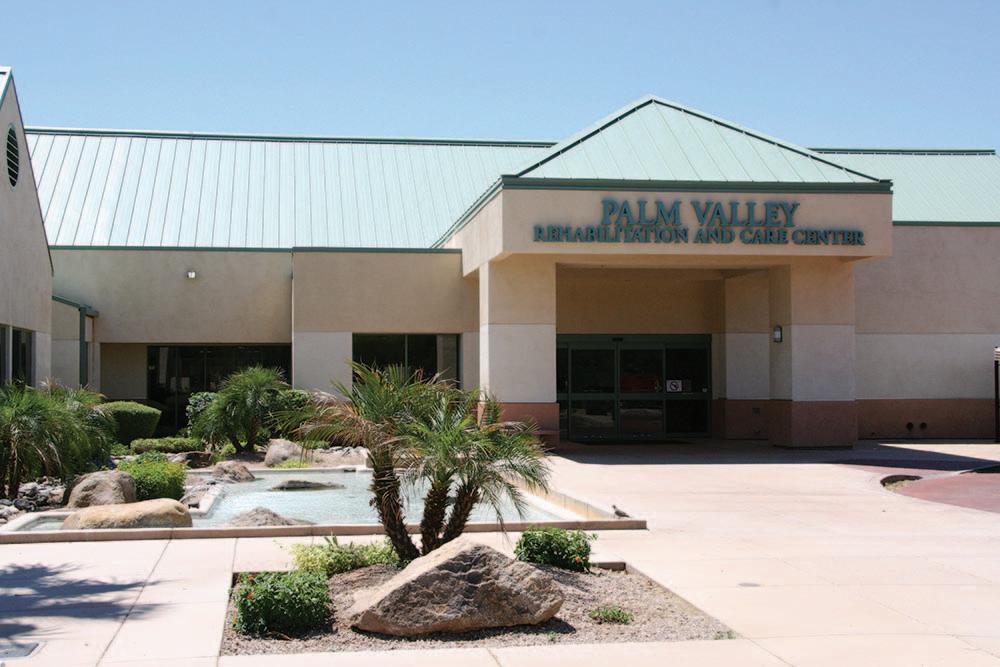
Palm Valley Rehabilitation 13575 W. McDowell Rd. Goodyear (623) 536-9911
Cardiologists
Heart & Vascular Center of Arizona
9305 W. Thomas Rd., #270 20940 N. Tatum Blvd., #325 1331 N. 7th St., #375 (602) 307-0070
Chiropractic
Goodyear Chiropractic 11 W. Van Buren St. Avondale (623) 932-4060
Dentists
All Smiles Dentistry 551 E. Plaza Circle, Ste. A Litchfield Park (623) 535-9164
Patrick Martin, D.D.S.
Gary R. Gibbs, D.D.S. 14044 W. Camelback #200 Litchfield Park (623) 535-5488
hardness of the water,” Lotts said. “So our part is acting like a giant water softener.”
that’s our flow down the pipeline,” Lotts said.
The gigantic pipes — ranging in size from 66 inches in diameter to 114 inches — have run almost error free since the plant went live; two Palo Verde units began operating in January and September 1986, respectively, while the third unit went on line in January 1988.
“In 1994 and 1997, we had failure of some spool pieces on the pipeline in three different places,” Lotts recalled. “We repaired them and put in an extensive monitoring program. Since that time, no failures.”
Just in case there ever were a problem with the pipeline, Palo Verde has two on-site storage reservoirs that contain 1 billion gallons of water.
Once Palo Verde receives the effluent, which has undergone primary and secondary treatment at the various wastewater treatment facilities, it is further treated at the station’s Water Reclamation Facility (WRF), which has a capacity of 90 million gallons a day.
“Mainly what we do is reduce the
How water is used at the plant
Most power plants cannot produce power without water. The process includes converting water into highpressure steam that drives turbines. The turbines are connected to a generator that produces electricity.
The used steam after it turns the turbine must be condensed back into water then reheated back into steam. At Palo Verde, the used steam is condensed back into water using the effluent water treated at the WRF. The water is then reheated in the steam generator back into steam to drive the turbines again.
The process of condensation absorbs the heat from the steam. The condenser systems consist of thousands of tubes. The used steam passes on the outside of the tubes; the water (from WRF) inside the tubes picks up the heat and passes it to the atmosphere. That is the water vapor seen rising from the cooling towers — an average of about 14,000 gallons of water a minute evaporate from each unit’s cooling tower.
Nine cooling towers (three for each unit) are used to cool the water from
the condenser before it is sent back to the unit. About 40,000 to 55,000 gallons of water (enough to fi ll more than 300 swimming pools) is needed every minute when all three units are operating.
After the treated effluent is used about 20 to 25 cycles, the water’s chemistry is no longer acceptable to use again. The water is then pumped to the evaporation ponds where it naturally evaporates into the atmosphere.
Palo Verde has three, 30-foot evaporation ponds on a total of 650 acres; because of that, no water is discharged from Palo Verde.
So everyone benefits from the facility, especially the wastewater treatment plants, which recently renegotiated contracts with Palo Verde in 2010, “so they now have a greater revenue stream than before,” Lotts said. “We put [the effluent] to beneficial use and they receive a revenue income stream from it.”
— Rich Ott
NUCLEAR From V18
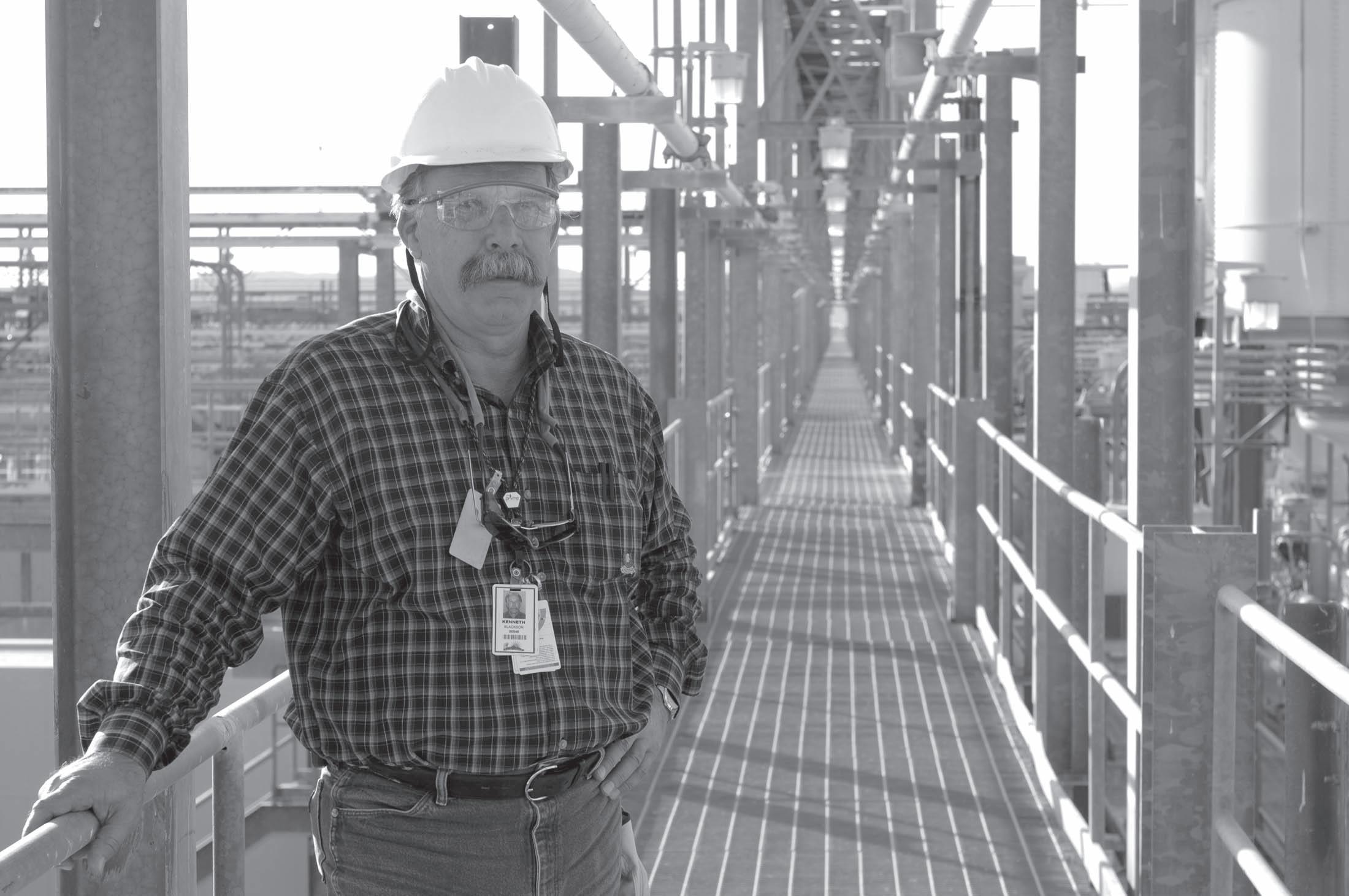
Palo Verde worker Kenneth Blackson stands on a catwalk above a pool of effluent water near the Palo Verde Nuclear Generating Station. The station uses recycled water from around the Valley.
Every drop counts
Bender family in Buckeye conserves water every day
Could you live on 5 gallons of water a day? How about 30 gallons? The Bender family in Buckeye has done both in the last few years to bring awareness to the global pure water crisis.
The average American uses 100 gallons of water every day, according to the Environmental Protection Agency.
A 5-minute shower takes 30 gallons, flushing the toilet uses 7 gallons and brushing your teeth with the water running is 2 gallons. It all adds up.
In 2009, the Benders shut off the water to their house in Verrado for an entire week. They had no showers, no flushing toilets and no dishwasher.
They fulfilled daily water needs by carrying buckets from a “well” at the Verrado Village Sport and Health Club a mile away.
“You start thinking about water when you’re at work and how you have to get home and go get water,” mother, Kristine Bender, said. “It kind of encompasses you, because it’s the No. 1 element to sustain us.”
While the family knows this was an extreme measure and not something that could be continued permanently, it did it to
Teaching Green
help the organization Water is Life, which provides short-term and long-term sustainable water solutions in developing countries.
“I don’t think we have to live that way here to be drastic; we just have to be smarter,” Kristine said.
She met the founder of Water is Life through some friends and offered to go on a trip to Kenya to deliver water filters. Since then, she’s become a full-time volunteer.
“Most people truly believe we’re never going to run out of water,” Kristine said. “I don’t think I’m adamant the world is going to run out and I need to do something now, but
See WATER on V35
WATER USAGE
Brushing teeth with tap running: 2 gallons
Dishwasher: 15 gallons
Hand washing with tap running: 2 gallons
Shaving with tap running:
WATER SAVING TIPS
• When washing dishes by hand, don’t let the water run while rinsing. Fill one sink with wash water and the other with rinse water.
• Run your washing machine and dishwasher only when they are full and you could save 1,000 gallons a month.
• Use the garbage disposal sparingly. Compost instead and save gallons every time.
• Collect the water you use for rinsing produce and reuse it to water houseplants.
• Designate one glass for your drinking water each day. This will cut down on the number of times you run your dishwasher.
Source: wateruseitwisely.com
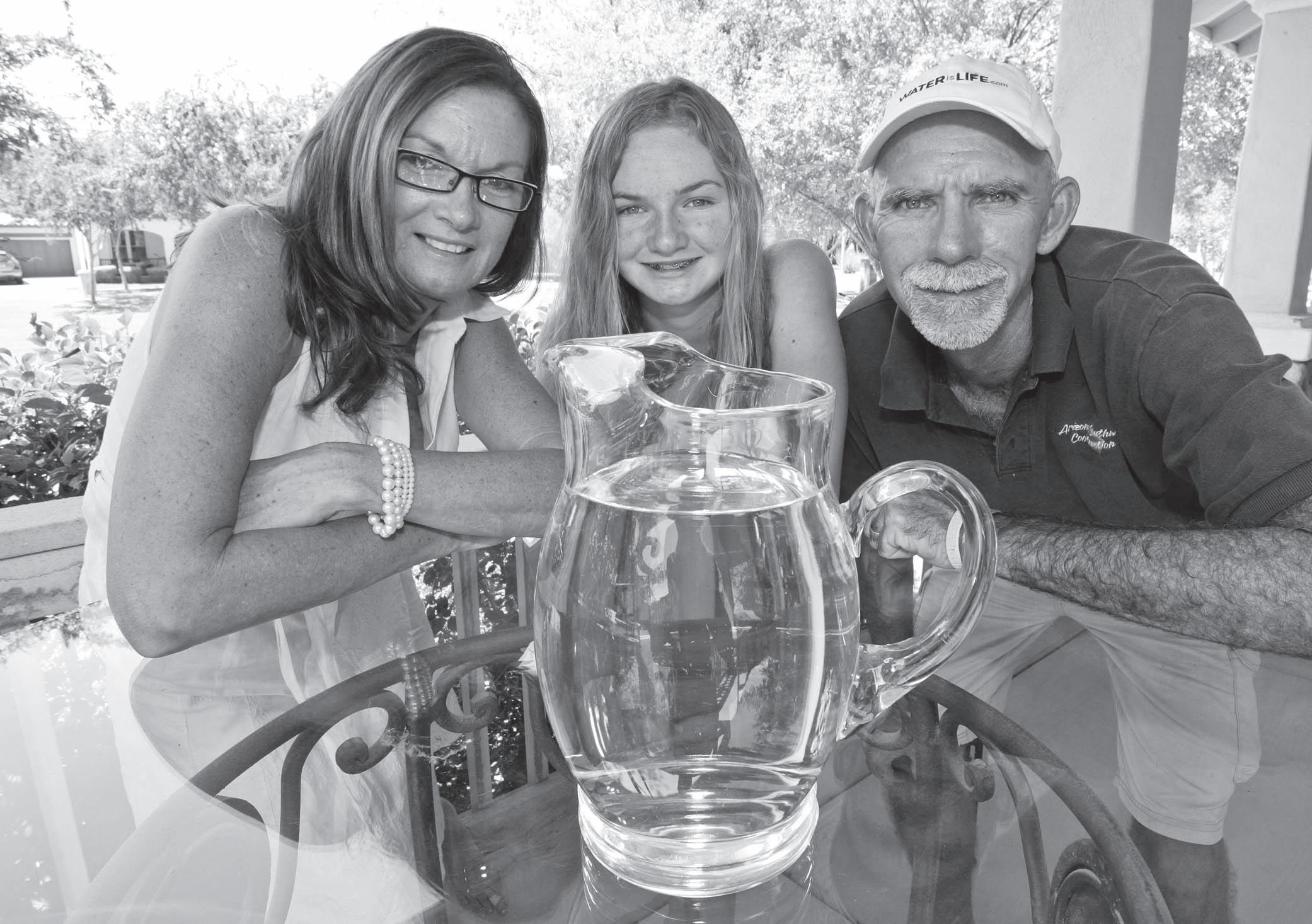
Buckeye parents Mark and Kristine Bender stand next to their daughter, 13-year-old Olivia, center, in Buckeye. The Bender Family frequently spreads the word about water conservation.
it’s like everything else and we’re burning through our resources.”
After the week without water, Kristine was almost afraid to turn the pipes back on, she said.
“It made me nervous that I’ve done this for a week and now I’m going to go back to abusing it,” she said.
But the family learned how to better conserve water from the experience, she said. Now they don’t run the dishwasher or washing machine as often; adjusted the flow on the toilets so they use less water; and put a bucket in their shower to catch extra water that can be reused.
“I think it’s just been a really cool three years of awareness of water in general,” Kristine said.
A few months after their week without water, the Bender family moved to Haiti for three months.
“We packed up the whole family, moved out of our house and moved to Haiti to work on the water crisis there,” Kristine said. “What that kicked in for us is living it.”
While there, the entire family only had 5 gallons of water a day.
“One of the things we found in certain other countries is because of the rarity and scarcity of water, they treat it not as a commodity, but as a true resource,” said Mark Bender, father.
“I think we go through our daily lives and there’s so many things to be worried about that we just forget,” Kristine said. “I think topically we all know how not to waste water, but I think it’s time to take it to the second tier for us and really teach our kids.”
Their daughters, Picabo, 16, and Olivia, 13, weren’t thrilled with the idea of not having running water at first, but quickly came around.
“I was just a kid who didn’t want to go without water because I didn’t understand why we were doing it until they told me it would help,” Olivia said. “I feel better now that I’m using less water than I did before, because I know it’s making a difference.”
OUTDOOR CONSERVATION
Arizona households use as much as 70 percent of their water outdoors. Learn how to minimize use and still have a beautiful landscape during Goodyear’s free seasonal water conservation classes.
Most classes will be at 4980 S. 157th Ave. in Goodyear. For information, call 623-8827510. Register online at goodyearaz.gov/ h2o365.
BECOMING ONE WITH NATURE
The popular Tres Rios Nature and Earth Festival will return to the vast Estrella Mountain Regional Park in March 2012. The event offers a unique opportunity for nature lovers to visit a riparian corridor in the West Valley near where the Salt and Agua Fria rivers join the Gila River.
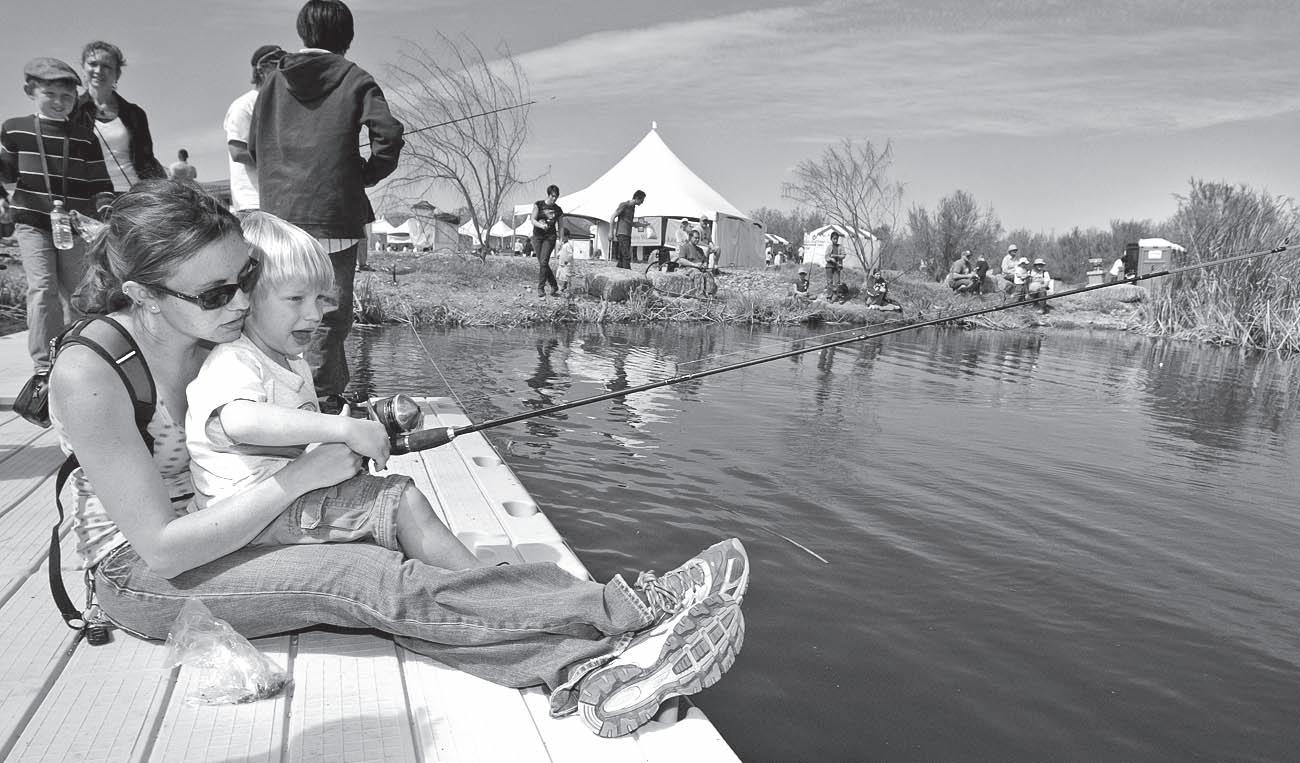
(Right) Phoenix mother Dawn Arnold holds her son, Braden, 4, as they fish at the Tres Rios Nature Festival. (Above) Fallen Feathers volunteer Jody Kiernan holds a common Raven. (Far right) A baby mouse is held up a by a child’s hands at the Tres Rios Nature Festival, a showcase of animals and ways to save and protect them.
The “Three Rivers” Festival will emphasize local plants, animals, ecological relationships and available recreational opportunities. Festival attendees will be able to see live wildlife up close, go canoeing, try archery, fish, view local birdlife, hike and learn about recycling and green-living zones.
WATER From V35
She’s even helped start a Water is Life club at her school, Odyssey Preparatory Academy, in Buckeye.
“We create awareness for the water and
help raise money for Water is Life,” she said. “I know most little kids don’t know about that, and we should tell them so they start being aware.”
The family is also going back to Haiti for three weeks this month.
— Emily McCann
Schools bring innovation to students
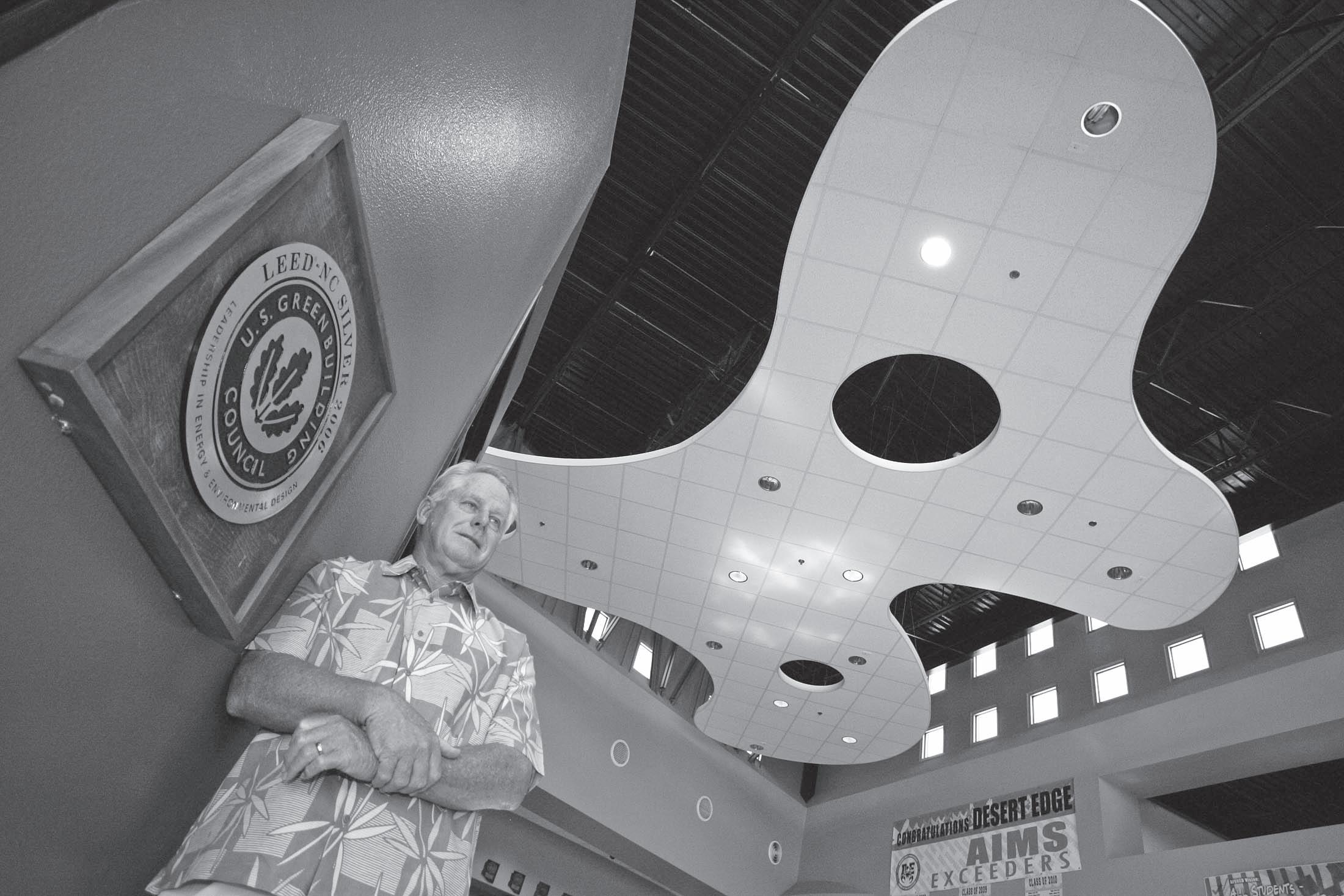
Desert Edge High School in Goodyear is a “LEEDer” in going green. When the campus opened in 2002, it was the first in the state to be LEED-certified silver, and only the fourth in the nation.
LEED stands for Leadership in Energy and Environmental Design, and is a rating system that was developed by the U.S. Green Building Council.
Included in Desert Edge’s designs are motion and daylight sensors to reduce artificial-lighting use; carbon dioxide sensors that shut off fan coils when rooms are empty; an Energy Star-rated roofing system; low-emitting adhesives, sealants and paints; and using agri-fiber board for cabinetry with no or low formaldehydes.
Sustainable water features that were already in place on campus include drip irrigation and xeriscaping.
Desert Edge produces about 30 percent of the energy needed to run the campus on site, Principal Bob Grey said.
Now, the school is taking its efforts one step further with the Academy of Sports Medicine, Entertainment Marketing and Green Technologies.
The program is for freshmen this year, and the students will stay in their chosen pathway during their high school career.
Teaching Green
“The whole idea for the pathway for the academy is to have kids at an early age start thinking about something rather than just doing school — having a reason for their existence.”
Bob Grey
Desert Edge High School principal
The three pathways were chosen after brainstorming sessions, a parent meeting, talking to feeder-school administrators and input from last year’s freshmen, Grey said.
“The whole idea for the pathway for the academy is to have kids at an early age start thinking about something rather than just doing school — having a reason for their existence,” he said.
Those who choose the path of green technologies will learn about lessening man’s environmental footprint through the use of renewable resources.
If voters approve a $31.6 million capital bond for the district this fall, Desert Edge could use some of the funds to turn a parking lot on campus into a land lab for plants, Grey said.
Careers associated with green technologies include marine biologists, entrepreneurs of green products, energy scientists, environmental engineers and environmental lawyers. Internships in the pathway also include working with Fortune 500 companies, organic farmers or local sports venues. — Emily McCann
Desert Edge High School principal Bob Grey stands next to the LEED certification plaque for his school in Goodyear.
of those people who just keeps going. If I know I have to get to point B, no matter how hard it is, I just keep going. But it is hard, and I try to make sure I hydrate myself throughout the day, especially when I know I’m going home. I take care of myself to make sure I can do it.”
Eisenbarth used to be a runner but turned to biking after she was diagnosed with hip dysplasia and arthritis in both hips. She’s goal-oriented and needed something with the same amount of distance, and biking has been a passion ever since. She’s going to participate in the California Coastal Classic in mid-September, a bike race from San Francisco to Los Angeles that covers 580 miles in eight days. She’s raised $3,000 for the Arthritis Foundation to participate.
“It’s more than commuting, it’s a lifestyle, something I enjoy, and it’s a whole-person concept for me for sure,” Eisenbarth said.
What helps Eisenbarth and McDowell with their commutes are the bike lanes in the West Valley. The transitions leave a little to be desired in some spots, but for the most part the bike lanes work out
“It’s more than commuting, it’s a lifestyle, something I enjoy, and it’s a whole person concept for me for sure.”
Tech Sgt. Nicole Eisenbarth Goodyear resident
well for these commuters.
“The bike lanes are probably the best I’ve ever seen,” McDowell said. “I commuted in Atlanta and that was pretty nightmarish. The bike lanes in Goodyear, when you’re lucky enough to be on them, are fantastic, but they kind of end and are sporadic. I just wish there were more of them.”
“The transitions aren’t the greatest,” Eisenbarth added. “There definitely isn’t enough bike lanes for sure, that’s why my route is longer because I rearrange it for bike lanes. Otherwise I could get to base quick, but my No. 1 concern is my safety.”
McDowell recommends more people try biking to work, especially if the com-
mute is a convenient distance. Under seven miles each way is a good starting point for the non-serious cycler, he said. Every person who bikes to work instead of driving helps the planet stay green.
“The difficult part is getting up and planning ahead for it, waking up early, bringing clothing and getting out on the street and battling traffic,” McDowell said. “Once you do it a few times you realize it’s really not that hard, it’s definitely doable and then it becomes kind of an addictive feeling and you kind of get hooked on it. Then if something comes up and you need to actually drive, you get done and are like, I need to get home and ride my bike.”
— Casey Pritchard
BICYCLE from Page V12
Tech Sgt. Nicole Eisenbarth holds up her bicycle at Luke Air Force Base. Eisenbarth braves the summer heat to get to her post at the West Valley Air Force base.
Going green at home can be as easy as one, two, 10. Earth911 offers these simple tips for converting to the green side.
1. Buy only what you need. Don’t over purchase. And for items you need to buy regularly, consider buying in bulk. You’ll save money and wasteful packaging.
2. Recycle, recycle, recycle! There are many ways to reuse, renew and recycle ordinary household items. Visit Earth911.com to find some nifty new uses for those plastic bags or construction materials.
3. Change a light, change the world. When those incandescent light bulbs burn out, replace them with the energy efficient compact fluorescent light bulbs (CFLs). They use 2/3 less energy and last 10 times longer than regular bulbs.
4. Bag it up the green way. Rather than relying on those plastic bags at the
grocery store, take your own reusable cloth bag. Also try using biodegradable bags when picking up poo after your pooch.
5. Green your gadgets. With the latest and greatest gizmos coming out every time you look the other way, try to restrict your electro-cravings. If your hip toy took a dive and is no longer useable, recycle it — it can be done.
6. Make every drop count. Though 70 percent of the world is covered in water, it’s still a natural and precious resource that should be conserved. Turn off the faucet when brushing your teeth, only use the dishwasher and washing machine when full. Use your noggin. You know how.
7. Turn up the savings. Though summers in the West Valley can be excruciatingly hot, making the sacrifice and raising your thermostat just 2 degrees will save you money and help the planet.
Save the planet ... or some money YouAre Here
8. Clean the air. Carpool, ride the bus, use public transportation, service your car on a regular basis, drive the speed limit, keep your tires inflated, buy a hybrid. Believe it or don’t, but all these tips will help have a positive environmental impact.
9. Save a tree. When printing documents at home, print on both sides of the paper. Or email documents and information instead of printing and mailing them. Save the information to your computer or a disk instead of printing one out for your file cabinet.
10. Home sweet home. Have you heard? Clotheslines are making a comeback. Dry your clothes on the line instead of in the dryer. Use cloth napkins instead of paper ones. Make your own cleaning solutions using soda, soap and vinegar. Open the doors and windows to let the fresh air in!
Source: Earth911.com
Photo
“It’s kind of an oxymoron statement in my driveway, one of each. He works from home, but it helps make me feel better about my carbon footprint because I drive every day.”
Stepnitz commutes to Goodyear from Surprise. On the city streets she gets 40 miles per gallon, she said. While there are electric vehicles that get better gas mileage, none has the recyclability of a Smart car. Plus, the price tag is much much smaller — they start at just $12,000.
“I think that the main thing that attracted me was it was a little different and people would notice it, and there weren’t any in the states,” Stepnitz said. “When you drive in Goodyear you see a lot of Priuses. Effectively, I get the same thing, it’s good for the environment, but I get
something that looked a little sportier, is a little more noticeable and I thought was more fun to drive.”
There is an all-electric version of the Smart car, but currently it’s only available for lease because of how new it is, Schwartz said.
“When the next generation comes out,
maybe a year or two down the road, it’s going to be better in terms of top speed and range and then they’ll start selling them,” he added.
The popularity of the car can’t be denied, though. When the Chandler dealership first started selling them, consumers couldn’t walk in and get one. The reservation list took up all of their sales for an entire year. That’s exactly how Stepnitz got her car, and she had to wait 16 months.
“In 2008 we were extremely busy,” Schwartz said. “In 2009 when the market and everything kind of crashed, it slowed down a little bit, but every year since it’s been getting busier and busier.”
It’s likely to continue that way, especially with so many people living the green lifestyle nowadays.
— Casey Pritchard
Connie Stepnitz drives her Smart car in Avondale.
Only
Avondale, Goodyear
Abundant Harvest Church 919 N. Dysart Road, Suite N and O Avondale
623-810-2355
www.abundantharvestchurch.org
Avondale Christian Assembly
541 E. Main St., Avondale 623-932-1670
www.avondalechurch.com
Calvary Chapel
3673 S. Bullard Ave., Goodyear 623-925-2440
www.calvarygoodyear.org
Christ Community
United Methodist Church
104 W. Western Ave., Avondale 623-932-3480
www.myccumc.com
Christ Evangelical Lutheran Church
918 S. Litchfield Road, Goodyear 623-932-2394
www.christevangelical.org
Christ Presbyterian Church
925 N. Sarival Ave., Goodyear 623-882-0721
www.cpcgoodyear.org
The Church of Jesus Christ of Latter-day Saints
425 S. Estrella Parkway Goodyear 623-925-0106
Citrus Road Community Church of the Nazarene 418 S. Citrus Road, Goodyear 623-932-2733
www.crccnazarene.com
Coldwater Church 15 N. Fifth St., Avondale 623-249-9694
www.coldwaterchurch.com
Compass Church
16060 W. Van Buren St., Goodyear 623-935-3060
www.compasschurch.info
Cornerstone Christian Center
11301 W. Indian School Road, Avondale 623-877-3220
www.cornerstoneaz.org
Crossings Church
Desert Edge High School 15778 W. Yuma Rd Goodyear 623-239-1096
www.goodyearcrossings.org
Desert Springs
Community Church
14440 W. Indian School Road, Goodyear 623-435-2105
www.dscchurch.com
Estrella Falls Baptist Church
Centerra Mirage Elementary 15151 W. Centerra Drive South Goodyear 623-932-2723
www.estrellafallsbc.org
Estrella Mountain Church
10485 S. Estrella Parkway, Goodyear 623-386-0300
www.emcaz.org
Faith Harvest
Corte Sierra Elementary
3300 N. Santa Fe Trail Avondale 623-444-9762
www.faithharvest.com
Faith on Fire Church
13770 W. Van Buren St., Goodyear 602-690-1442
www.faithonfirechurch.com
First Baptist Church
Garden Lakes
2517 N. 107th Ave., Avondale 623-936-7148 www.gardenlakesbaptist.com
First Southern Baptist Church
1001 N. Central Ave., Avondale 623-932-2723 www.fsbca.org
Gateway Baptist Church
12409 W Indian School Rd, Ste C312 Avondale 623-628-8885
Goodyear Church of Christ
807 N. La Jolla Blvd., Goodyear 623-932-1042
www.goodyearchurchofchrist.org
Harvest Outreach
Christian Center
715 E. Western Ave., Avondale 623-932-6453
www.harvestoutreachaz.com
Heritage Baptist Church
Rio Vista Elementary 10237 W. Encanto Blvd., Avondale 623-882-2351 www.HeritageBaptistAZ.org
Holy Family Independent
Catholic Church
918 S. Litchfield Road, Goodyear 602-750-3411
www.holyfam.webs.com
In His Presence Christian Center
Comfort Suites
15575 W. Roosevelt St., Goodyear 623-688-3447
www.ihpcconline.com
Jehovah’s Witnesses
14038 W. Yuma Road, Goodyear 623-932-1708
King of Kings P.C.A.
Western Sky Middle School
4095 N. 144th Ave., Goodyear 623-385-6607 www.kingofkingspca.org
Litchfield Park First
Baptist Church
901 Plaza Circle, Avondale 623-935-3163
Morning Star Baptist Church
500 S. Seventh St., Avondale 623-932-4320
Palm Valley Church
431 N. Litchfield Road, Goodyear 623-536-2106 www.palmvalley.org
The Rock Luke Elementary School
7300 N. Dysart Road, Glendale 623-932-1009 www.therockaz.com
The Sanctuary
Community Church
Avondale Community Center 1007 S. Third St., Avondale 623-936-6793 www.thesanctuarycc.com
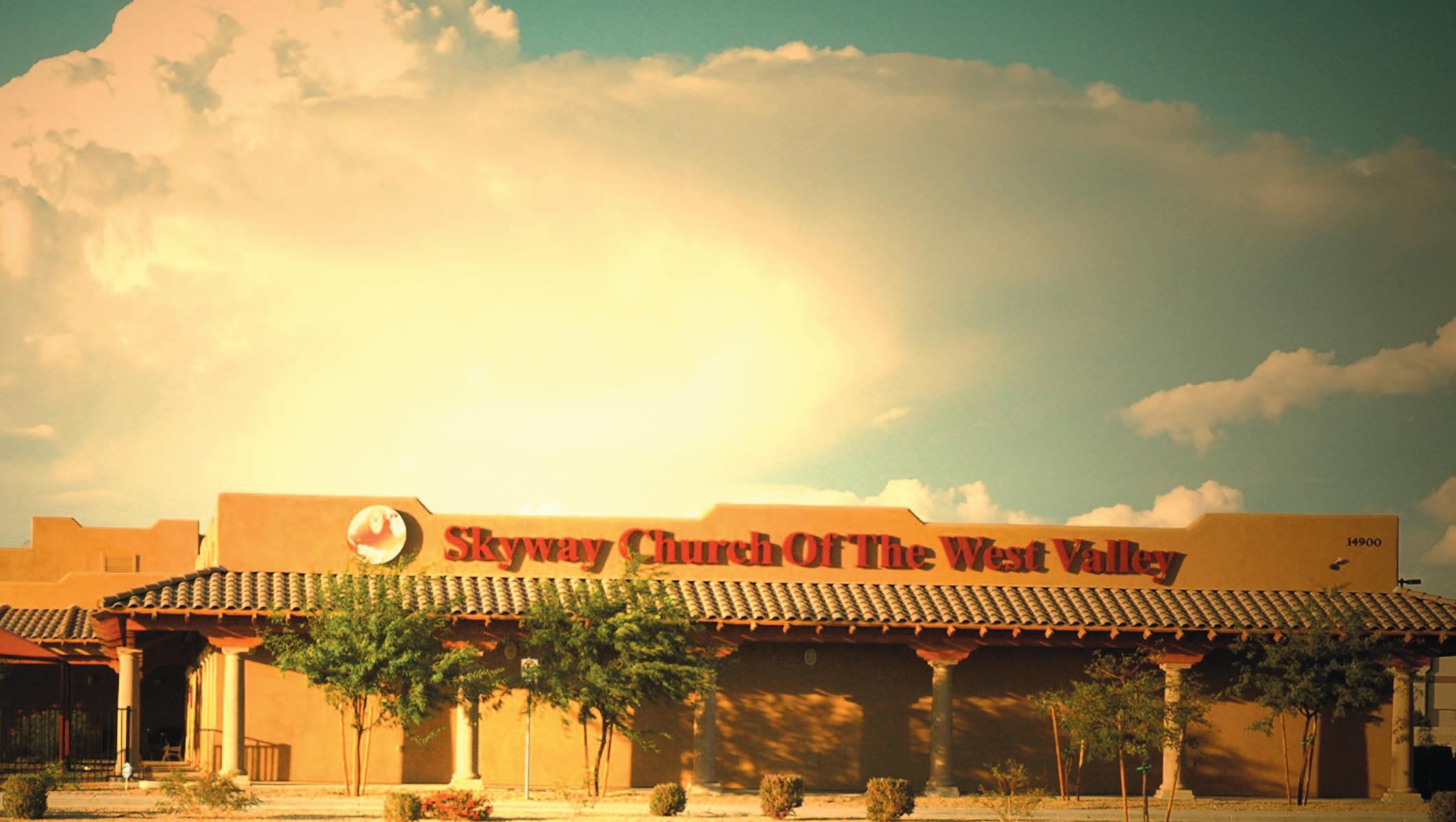
Skyway Church of the West Valley
14900 W. Van Buren St., Goodyear 623-935-4858 www.skywaychurch.com
St. John Vianney Catholic Church and School
539 E. La Pasada Blvd., Goodyear 623-932-3313 parish.sjvaz.net school.sjvaz.net
St. Thomas Aquinas Catholic Church
13720 W. Thomas Road, Avondale 623-935-2151 www.stacc.net
St. Thomas Lutheran Church
16220 W. Van Buren St., Goodyear 623-925-1095
Temple of Faith
201 E. Main St., Avondale 623-680-6683
Trinity Lutheran Church
830 E. Plaza Circle Avondale 623-935-4665
Truth Tabernacle Church — Pentecostal United 825 N. Central Ave., Avondale 623-932-0893
Vineyard Church
255 N. Litchfield Road, Goodyear 623-932-2500 www.azvineyard.org
Saturday Evening 6:30 pm ........................................................Youth Service
715 E. Western Ave. • Avondale • 623-932-6453
New Jerusalem Ministries
508 Clanton
Buckeye 623-386-2714
Our Savior’s Lutheran Church 10 N. Apache Road, Buckeye 623-386-6708
Palo Verde Baptist Church
29600 W. Old Highway 80 623-393-9628
The River Church
Verrado High School gymnasium
20050 W. Indian School Road, Buckeye 623-262-4969 www.theriverchurchaz.com
St. Henry Catholic Church
Sundance Elementary School — Sunday Mass
23800 W. Hadley St., Buckeye 128 S. Third St. — All other Masses
Buckeye 623-386-6407
Summit Community Church 4291 Verrado Way, No. 232, Buckeye 623-535-0251 www.summitcc.org
Summit of Hope Assembly of God 24500 W. Maricopa, Buckeye 623-695-0224
Valley Christian Ministries
Bales Elementary School 25400 W. Maricopa Road, Buckeye 623-505-6220 www.vcm1.ws
Victory Baptist Church
12808 S. Tuthill Road, Buckeye 623-386-3240 www.victorysbc.org
Way of Grace Church
Youngker High School
3000 S. Apache Road, Buckeye 623-478-2130
www.wayofgracechurch.com
West Valley Church of Christ
18604 W. Lower Buckeye Rd., Buckeye 623-695-5623
West Valley Free Will
Baptist Church
19956 W. McDowell Road, Buckeye 623-853-0570
White Tanks
Southern Baptist Church 1420 N. 192nd Ave., Buckeye 623-853-0089
Litchfield Park
The Church at Litchfield Park
300 N. Old Litchfield Road, Litchfield Park 623-935-3411
www.churchatlitchfieldpark.org
The Church of Jesus Christ of Latter-day Saints 14111 W. Wigwam Blvd., Litchfield Park 623-536-7231
Desert Joy Christian Fellowship
Dreaming Summit Elementary School 13335 W. Missouri Ave., Litchfield Park 623-872-0721 www.desertjoy.org
Kingdom of the Valley Christian Church
447 S. Old Litchfield Road Litchfield Park 623-584-3113
Lighthouse Fellowship
3015 N. Jackrabbit Trail 623-853-1050 www.lighthousefellowshipaz.webs.com
Pathway Bible Church
Litchfield Elementary School
13825 W. Wigwam Blvd. Litchfield Park www.pathwaybibleaz.com
St. Peter’s Episcopal Church
400 S. Old Litchfield Road, Litchfield Park
623-935-3279
www.stpetersaz.com
Westpointe Baptist Church
Wigwam Creek Middle School
4510 N. 127th Ave., Litchfield Park 623-521-3549
www.westpointebaptist.org
Lighthouse Church
14185 N. 83rd Ave., Peoria 623-979-4392
www.lighthouseaz.com
Pentecostal Deliverance COGIC
8668 W. Mountain View Road, Peoria 623-486-7782
Real Life Ministries
Arizona Charter Academy 16011 N. Dysart Rd. Surprise 623-933-4999
www.rlmdestiny.com
South Peoria Baptist Church
9000 W. Olive Ave., Peoria 623-486-1556
Tolleson, Cashion
Blessed Sacrament
Catholic Church
512 N. 93rd Ave., Tolleson 623-936-7107
The Bridge
Christian Worship Center
The Arts Academy 2504 S. 91st Ave., Tolleson 623-399-8540 www.bridgeworshipcenter.com
Cashion Apostolic Church 11132 W. Joblanca
Cashion 623-936-4480
Church of Zion
10909 W. Hopi
Cashion 602-936-4637
The Church of Grace 8 S. 92nd Drive Tolleson 623-936-7303
Hamblen Chapel
Evangelical Methodist Church 1614 S. 111th Ave., Cashion 623-936-9524
La Misión Assembly of God 11147 W. Buckeye Road, Cashion 623-936-3703
St. William Catholic Church
11025 W. Third St., Cashion 623-936-6115
Wings As Eagles
International Church
Country Place Elementary School 10207 W. Country Place 1-800-450-0966 www.waeic.com
Tonopah
Valley Baptist Church of Tonopah/Wintersburg
37702 W. Indian School Road, Tonopah 623-393-0211
www.tonopahvalleybaptistchurch.org
Waddell
Cotton Lane Community Church
6240 N. Cotton Lane Waddell 623-935-1776
Peoria
COME GROW WITH US
Uplifting Music/Inspiring Sermons
9:15am - Worship Service/Nursery
10:45am - Contemporary Worship Service/Nursery and Elementary Church School
W. Phoenix, Glendale, Sun City, Surprise Alleluia Lutheran Church 8444 W. Encanto Blvd., Phoenix 623-849-4327 www.AlleluiaChurch.com
Beth El Congregation Jewish — Conservative 1118 W. Glendale Ave., Phoenix 602-944-3359
Beth Emeth Congregation 13702 W. Meeker Blvd., Sun City West 623-584-7210 www.bethemethaz.org
Calvary United Methodist Church 7949 W. Indian School Road, Phoenix 623-849-1676
Wings As Eagles International Church
Worship Services:
8:00 AM - “A Little More
9:30 AM • 11:00 AM - “Blended Services”
For complete information: 14440 W. Indian School Road Goodyear, AZ 85395 623-435-2105
www.dscchurch.com
Come be a part of a church that is committed to people who are hurting We are a multicultural ministry dedicated to spiritual growth. Empowering God’s people to soar to the highest potential in God and life.
Visit us this Sunday @ 11am Intercessory Prayer 10:45am Country Place Elementary School 10207 W. Country Place Blvd. Tolleson, AZ 85353 800-450-0966 www.waeic.com
Pastor Artis & First Lady Terri Smith
Camelback Community Church
7634 W. Camelback Road, Glendale 623-846-3497
www.camelbackcommunity.com
The Carpenter’s House of Worship
Independence High School 6602 N. 75th Ave., Glendale 623-266-2469 www.carpentershouseofworship.com
Crosspoint Christian Church
8600 W. Glendale Ave., Glendale 623-937-2741 www.crosspointchristian.org
Davids 400
7905 N 71st Ave., Glendale 623-889-0313
The Door Christian Fellowship Church
7342 W. Indian School Road, Phoenix 623-848-0849
First Church of Christ, Scientist 8228 W. Orangewood Ave., Glendale 623-937-9258
First Country Baptist Church 12844 W. Santa Fe Drive Surprise 623-583-9838
www.firstcountrybaptist.org
Grace Walk Community Church
7840 W. Lower Buckeye Road, Phoenix 623-907-8991
Kingdom of the Valley Christian Church
10801 N. 24th Ave., Suite 105, Phoenix 623-584-3113
Love Life Church
8016 W. Camelback Road, No. 108 Glendale 623-872-4998
Our Lady of the Sun Catholic Church
12546 W. Peoria Ave., El Mirage 623-974-4133
Rivers of Living
Water Ministries
3045 W. Buckeye Road Phoenix 623-205-6809
St. Andrew’s Episcopal Church
6300 W. Camelback Road, Glendale 623-846-8046
St. Paul Lutheran Church
6301 W. Indian School Road, Phoenix 623-846-2228
Streams Christian Church
6532 N. El Mirage Road, Glendale 623-363-7450
www.streamschurch.org
Temple Beth Shalom
Jewish — Reform
12202 N. 101st Ave., Sun City 623-977-3240
Thomas Road Baptist Church
5735 W. Thomas Road, Phoenix 623-247-5735
www.trbcphx.org
West End Baptist Church 9101 W. Indian School Road, Phoenix 623-877-2815
West Valley Family Church
6115 N. 91st Ave., Glendale 623-872-1734
Not listed?
If we forgot your church in the religion directory, please let us know by emailing news1@westvalleyview.com to be included in the next Vista magazine.
LIGHTHOUSE FELLOWSHIP
Lighthouse Fellowship is a non-denominational church that teaches God’s word, verse by verse, from Genesis to Revelation, and how the Bible’s teachings apply to our lives.
Sunday Morning Service 10:15AM Sunday Evening “Lighthouse Cafe” 6PM Wednesday Bible Study 7:00PM Wednesday Youth Night 7:00PM
3015 N. Jackrabbit Trail (1 blk. N. of Thomas Rd.) Litchfield Park For more information - 623-853-1050, or visit www.lighthousefellowshipaz.webs.com Listen to “STREETLIGHT”, Saturdays, 6:15PM on KXEG 1280AM, or 7:15PM on KXXT 1010AM
Heritage Baptist Church
10237
West Valley Business Directory
Automobile Dealers
Tom Jones Ford 23454 W. Hwy 85 Buckeye (623) 386-4429 www.nocitysalestax.com
Banks
Wells Fargo Bank
1050 N. Estrella Pkwy. Goodyear (623) 882-3400
Wells Fargo Bank 11425 W. Buckeye Rd. (Inside Fry’s) Avondale (623) 478-1584
Wells Fargo Bank
540 S. Watson Rd. Buckeye (623) 925-3000
Wells Fargo Bank
Goodyear / Avondale 13470 W. Van Buren (623) 932-1410
Batteries
AZ Battery Store
560 N. Bullard Ave., Ste E-50 Goodyear (623) 853-3321
Beer Distributors
Golden Eagle Distributors Inc.
Budweiser 26815 W. Baseline Rd. Buckeye (623) 386-6312 www.gedaz.com
Chamber of Commerce
Buckeye Valley Chamber of Commerce (623) 386-2727 www.buckeyevalleychamber.org Chamber of Commerce of Tonopah P. O. Box 1104, Tonopah www.coctonopah.org (623)393-8184
Southwest Valley Chamber of Commerce 289 N. LItchfield Rd. Goodyear (623) 932-2260 www.southwestvalleychamber.org
Clothing
Hi-Fashion
Corner of Dysart & Van Buren Avondale (623) 925-1885
Construction
CORE Construction 3036 East Greenway Road Phoenix (602) 494-0800 www.COREConstruct.com
Credit Union
First Credit Union 1310 N. Litchfield Rd. Goodyear (480) 831-2645
Equipment
Rentals
Palo Verde Rentals
Equipment Rentals for Home Owners & Contractors
3617 S Jackrabbit Trail
Buckeye (623) 386-5000
Funeral Homes
Avenidas Funeral Chapel
522 E. Western Ave.
Avondale (623) 925-1525
Buckeye Funeral Home
104 E. Baseline Rd. Buckeye (623) 386-4812
Thompson’s Valley West Funeral Chapel
926 S. Litchfield Rd. Goodyear (623) 932-1780
Golf
PebbleCreek Golf Resort
Eagle’s Nest Country Club
3645 Clubhouse Drive (1 mile W. of Litchfied Rd. on Indian School)
Goodyear (623) 935-6750
Tuscany Falls at PebbleCreek
I-10 W. Exit 126, 1-1/2 mile N. on Pebble Creek Parkway to Clubhouse Drive. Goodyear (623) 536-2491
District 5, which includes Goodyear, Tolleson, Avondale, south Buckeye
301 W. Jefferson Ave., 10th floor Phoenix, AZ 85003
602-506-7092
mrwilcox@mail.maricopa.gov maricopa.gov/dist5
Max Wilson (R), Supervisor
District 4, which includes Avondale, Litchfield Parvk, Goodyear, north Buckeye
301 W. Jefferson Ave., 10th floor Phoenix, AZ 85003
602-506-7642
mwwilson@mail.maricopa.gov maricopa.gov/dist4
State Legislature
District 4
Sen. Scott Bundgaard (R)
1700 W. Washington, Room 212 Phoenix, AZ 85007
602-926-3297; sbundgaard@azleg.gov
Rep. Jack W. Harper (R)
1700 W. Washington, Room 113 Phoenix, AZ 85007
602-926-4178; jharper@azleg.gov
Rep. Judy Burges (R)
1700 W. Washington, Room 220 Phoenix, AZ 85007
602-926-5861; jburges@azleg.gov
District 12
Sen. John Nelson (R)
1700 W. Washington, Room 301 Phoenix, AZ 85007
602-926-5872; jnelson@azleg.gov
Rep. Steven Montenegro (R)
1700 W. Washington, Room 218 Phoenix, AZ 85007 602-926-5955; smontenegro@azleg.gov
Rep. Jerry Weiers (R)
1700 W. Washington, Room 131 Phoenix, AZ 85007 602-926-5894; jpweiers@azleg.gov
District 13
Sen. Steve Gallardo (D)
1700 W. Washington, Room 315 Phoenix, AZ 85007
602-926-5830; sgallardo@azleg.gov
Rep. Richard Miranda
1700 W. Washington, Room 332 Phoenix, AZ 85007
602-926-5911; rmiranda@azleg.gov
Rep. Anna Tovar (D)
1700 W. Washington, Room 323 Phoenix, AZ 85007
602-926-3392; atovar@azleg.gov
District 23
Sen. Steve Smith (R)
1700 W. Washington, Room 311 Phoenix, AZ 85007 602-926-5685; stevesmith@azleg.gov
Rep. John Fillmore (R)
1700 W. Washington, Room 331 Phoenix, AZ 85007 602-926-3012; jfillmore@azleg.gov
Rep. Frank Pratt (R)
1700 W. Washington, Room 223 Phoenix, AZ 85007 602-926-5761; fpratt@azleg.gov
District 25
Sen. Gail Griffen
1700 W. Washington, Room 302 Phoenix, AZ 85007
602-926-5895; ggriffen@azleg.gov
Rep. Peggy Judd
1700 W. Washington, Room 126 Phoenix, AZ 85007
602-926-5836; pjudd@azleg.gov
Rep. David W. Stevens
1700 W. Washington, Room 312 Phoenix, AZ 85007
602-926-4321; dstevens@azleg.gov
White House photo by Pete Souza President Barack Obama meets with Sen. John McCain, R-Ariz., in the Oval Office, Feb. 2, 2011.
Cities at a Glance
Population: 74,000
Median age: 29.43
Median household annual income: $75,000
Land area: 54 square miles 2011-12 fiscal-year budget: approximately $163.2 million
Mayor: Marie Lopez Rogers
Vice Mayor: Jim McDonald
Council Members: Jim Buster, Stephanie Karlin, Frank Scott, Charles Vierhout and Ken Weise
City manager: Charlie McClendon
Fire chief: Paul Adams Library: Avondale Civic Center Library, 11350 W. Civic Center Drive (623-333-2602); Sam Garcia Western Avenue Library, 495 E. Western Ave. (623-333-2601)
City Hall: 11465 W. Civic Center Drive (623-333-1000) www.ci.avondale.az.us
Police Dept.: 11485 W. Civic Center Drive (623-333-7000)
Police chief: Kevin Kotsur
Fire Dept.: 11485 N. 107th Ave. (623-333-6000)
Post Offices: Avondale Post Office, 401 W. Western Ave. (623925-2924); Cashion Post Office, 1216 N. 111th Drive (623-9361362)
Population: 52,764
Median age: 30
Median household annual income: $38,000
Land area: 375 square miles
Mayor: Jackie Meck
Vice Mayor: Brian McAchran
Council Members: Robert Garza, Elaine May, Ray Strauss, Craig Heustis and Eric Orsborn
Fire Dept.: 404 S. Miller Road (623-349-6000)
Fire chief: Bob Costello Library: 310 N. Sixth St. (623-3496300)
2011-12 fiscal-year budget:
$174.8 million
City Hall: 530 E. Monroe Ave. (623-349-6000) www.buckeyeaz.gov
Town manager: Stephen Cleveland
Police Dept.: 100 N. Apache Road, Suite D (623-386-4421)
Police chief: Mark Mann
Post Office: 51 E. Monroe Ave. (623-386-3117)
Population: 64,600
Median age: 35.2
Median household annual
income: $77,606
Land area: 190 square miles
2011-12 fiscal-year budget:
$213 million
City Hall: 190 N. Litchfield Road (623-932-3910) www.ci.goodyear.az.us
Population: 5,097
Median age: 45
Median household annual
income: $86,726
Land area: 3.5 square miles
2011-12 fiscal-year budget:
$7.1 million
City Hall: 214 W. Wigwam Blvd. (623-935-5033)
www.litchfield-park.org
Population: 7,083
Median age: 29.4
Mayor: Georgia Lord
Vice Mayor: Joanne Osborne
Council Members: Gary Gelzer, Sheri Lauritano, Bill Stipp, Wally Campbell and Joe Pizzillo
City manager: John Fischbach
Police Dept.: Venida Business Center, Bldg. E, 175 N. 145th Ave. (623-932-1220)
Police chief: Interim Bill Cusson
Mayor: Tom Schoaf
Vice Mayor: Paul Faith
Council Members: Diane Landis, Peter Mahoney, John Romack, Tom Schoaf and Paul Stucky
City manager: Darryl Crossman
Police Dept.: Maricopa County Sheriff’s Office (602-876-1011)
Fire Dept.: 175 N. 145th Ave., Bldg. E (623-932-2300)
Fire chief: Interim Paul Luizzi Library: 250 N. Litchfield Road (602-652-3000)
Post Office: 875 S. Estrella Parkway (623-882-9148)
Fire Dept.: Goodyear Fire Department (623-932-2300)
Library: 101 W. Wigwam Blvd. (602-652-3000)
Post Office: 591 Plaza Circle (623-935-2089)
V??
Median household annual income: $38,773
Land area: 6.6 square miles
2011-12 fiscal-year budget: $44.8 million
Mayor: Adolfo Gamez
Vice Mayor: Kathie Farr
Fire Dept. : 9169 W. Monroe St. (623-936-8500)
Fire chief: George Good Library: 9555 W. Van Buren St. (623-936-2746)
Council Members: Clorinda Erives, Jose “Diego” Espinoza, Linda Laborin, Albert Mendoza and Juan Rodriguez
City manager: Reyes Medrano Jr.
Post Office: 8805 W. Van Buren St. (623-907-0206)
City Hall: 9555 W. Van Buren St. (623-936-7111) www.tollesonaz.org
Police Dept. : 8350 W. Van Buren St. (623-936-7186)