





ASU ENGINEERING CAREER FAIR
Tuesday, Feb 21 1 P.M. - 6 P.M.
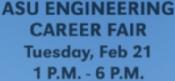
Memorial Union, Second Floor Tempe Campus
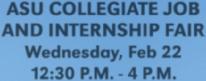
ASU COLLEGIATE JOB AND INTERNSHIP FAIR
Wednesday, Feb 22
12:30 P.M. - 4 P.M.
Memorial Union, Second Floor Tempe Campus





ASU Spring Engineering Career Fair
Tuesday, February 21, 1 p m to 6 p m. Memorial Union, Second Floor
ASU s Engineering Career Center hosts this event for organizations seeking engineering candidates for full-time and internship positions ASU s Fall 2011 engineering career fair connected over 90 companies with nearly 1,700 engineering students Preview time for student volunteers will kick off the Spring engineering event.
Spring 2012 Workshops
Looking to get ready for the Spring Engineering Career Fair? Take advantage of these seminars available this week
Writing a technical resume with help from Optimal Resume
Resuming writing for beginners Friday, Feb 17, ECG 238, 1:30 2:30 p m. Friday, Feb 17, ECG 238, 3:00 4:00 p m.
Introducing Optimal Resume
Learn the features of Optimal Resume, a new resource from Engineering Career Center. Friday, Feb 17, ECG 347, 1:30 2:30 p m.
Preparing for a Career Fair
Participating employers in the Spring 2012 Collegiate Job and Internship Fair
AAA Insurance Exchange Abercrombie & Fitch
Aetna, Inc Aid to Adoption of Special Kids (AASK) Ajilon Finance American Conservation Experience American Family Insurance Group Ameriprise Auto & Home Insurance Apple, Inc Applied Materials Archstone Arcosanti (AZ)



Learn how to get the most out of Tuesday s event. Friday, Feb 17, ECG 324, 3:00 4:00 p m.
Mastering the Behavioral Interview with help from Optimal Resume
Learn how to interview effectively. Friday, Feb 17, ECG 324, 1:30 2:30 p m.
Job Search Strategies for International Students
Friday, Feb 17, ECG 347, 3 4 p m.




Resume Critiques
Current day sign up for 15 minute sessions will be in the ECG student center beginning at 1pm. Friday, Feb 17, ECG Student Center, 1-4:30 p m.
Wednesday, Feb 22, 2012 12:30-4p m.
Memorial Union (MU) second floor, Tempe campus
All majors and degree levels are encouraged to attend.
List of 140+ participating employers and what they re recruiting for is available at www asu edu/ career
No pre-registration is required.
Rapid Resume Review
Have your resume critiqued by a professional career advisor or recruiter in time to make a great impression at Collegiate! No pre-registration is required.
Tuesday, Feb 14, 12:30-2:30p m , MU Mohave Rm 236
Wednesday, Feb 15, 2:30-4:30p m., MU La Paz Rm 242
Friday, Feb 17, 2:30-4:30p m., MU La Paz Rm 242
Workshop: How do I succeed at a job or internship fair?
Tuesday, Feb 14, 3-4p m., Student Services Bldg Rm 329
Friday, Feb 17, 11a m -12p m., Student Services Bldg Rm 329
Monday, Feb 20, 1:30-2:30p m., Student Services Bldg Rm 329















ø ¨ øƪªÆ ±Æ ø¥¥ ø ±Æ















A cover letter is a marketing piece that introduces you to an employer It also highlights your special accomplishments that most benefit the organization In that sense, a top notch cover letter sells you and your resume
Cover Letters That Get Results
Both mail and e-mail can be used in a job search Be certain to follow the application procedures set by the organization Most employers accept resumes online but you still have to send a cover letter as well. When sending an e-mail, it s common practice to have the cover letter be the body of the e-mail and the resume as an attachment Put Job Application in the subject line
Before you start writing, ask yourself: Who is my audience? What skills are the employer looking for in a candidate? What do I have to offer and how can I show that my skills benefit the employer?
The Body of the Letter
Paragraph 1
State your purpose for writing, where you heard about the job opening and why you should be considered for the position
Here is a list of 10 commonly made mistakes in resumes Make sure to avoid these mistakes when creating your resume
1. Too long or too short
One page is recommended for a new college graduate If you have worked for a number of years, it might be appropriate to have a second page On the other hand, a resume that only fills half a page isnt going to have enough information to sell your candidacy to the fullest
2. Disorganized and poor formatting
The look of your resume creates a visual impact Be certain that you adhere to parallel construction standards for format as well as for content. Refer to Formatting Your Resume on page seven
3. Too flashy
Steer clear of flashy formatting or overly creative resumes with non-standard fonts or graphics Unless you re applying with an organization known to be highly unconventional, a very professional approach is your best bet
4. Faulty writing style and typos Overuse of the same adjectives or action verbs, a
sloppy layout and errors in grammar and spelling are just some of the factors that result in immediate disqualification from consideration
5. Including unrelated and irrelevant personal information
An accepted standard in resume writing is the omission of words I, me or my Bullet points which describe your work experience are always sentence fragments because they do not have I as the subject Personal information not legal to ask in interviews should not be included in your resume, such as marital status, race, religion, etc
6 Poor descriptions of experience and education
This is where most resumes fail to sell the candidate Capitalize on this golden opportunity to not only describe what you did but to give the reader an indication of the scope of the work AND the quality of your performance
7. Unclear career objective or sending an unfocused or generic resume
Before you begin composing your resume, establish your career goal(s). Then use that focus to develop a specific career objective Customizing your resume
for a specific job will sell your qualifications more effectively so dont rely on one version for every application Update and modify your resume to more closely align with the specific job
8 Repetitiveness
Reading the same action verbs repeatedly in a resume is a turn-off for employers Come up with new ways to say similar things.
9 Sending a resume without a cover letter
Even the strongest resume by itself won t compensate for failing to create a personalized cover letter to accompany it Unless you re instructed otherwise, submit all resumes with a cover letter.
10 Misdirected cover letter
Too many resumes arrive on employers desks completely unsolicited or directed to the wrong person in the organization Find out in advance to whom to send your resume and cover letter for the job you want
Example: Please consider me for the position of that I saw posted on Sun Devil CareerLink Based on my education and experience, I believe that I would be a strong candidate.
Paragraph 2
Highlight your experience and qualifications, keeping in mind the employer s specific needs Think of it as relating facts about yourself and how those facts will benefit the employer This is also the opportunity to indicate why that particular employer is an attractive option Everyone likes to hear why their firm is desirable
Example: Through my communications course work, I developed strong presentation skills These skills would allow me to be an immediate contributing member of the speaking team.
Paragraph 3
Ask for an interview and state that you will follow up within a certain time frame Example: I would welcome the opportunity to interview for this position and look forward to hearing from you I will be in contact within a week to arrange a convenient time.
Paragraph 4
Thank the individual for his or her time and consideration of your application
Example: Thank you for your consideration, and I hope to hear from you soon In the meantime, I may be reached at






¨ªÆª ¨ªº ø
¨ªÆ ±Æ øƪªÆ ©¨
…ÿ— …¤êŒ¤ ‘——’ “Ÿ ⁄—Œ





…ªæ⁄¥ ªªµ ¨ø¥ª ¨ªºÙø 樱´ ¨´ºª ¨ ¨± æª ± ºªÆªº ±Æ øº
¨ªÆ ø ºª ¨Æß ¥ª™ª¥ ± ¨± Ú ‹± ê¨ ´ ø¨¨ ªflÕÀ ›øƪªÆ⁄øÆ ß±´øƪ ªªµ ø øƪªÆ Ê Õ — ⁄ à … flŒ ¤ ‹ ¤ ¤ ‘ — – ” ¤ “à À ´¨¨ ªº ª¨ª ±¥±
› — À “ à “ Ÿ Ò ⁄ “ fl “ ›¤ Œª™±¥´¨± ¶ ª®¨ªÆ ø¥ ø ø¥Æª






How long does it take to find an internship?
Finding an internship could take one day or several months The average search lasts about a month The earlier you start, the more options you re likely to have Some organizations have deadlines four to five months or more prior to the start date of the internship Others review applicants and make offers one to two weeks before the start date
What steps are involved in finding an internship?
Step 1: Contact your academic department s internship coordinator to learn about earning credit if applicable
Step 2: Identify career(s) of interest
Step 3: Develop an effective resume and cover letter
Step 4: Search for leads
Use Sun Devil CareerLink for postings and on-campus interviewing.
Utilize additional recommended online internship resources.
Connect with internship employers at ASU career events.
Meet with a Career Services advisor to get advice and help
Speak with faculty, academic advisors and internship coordinators in your department
Postings of internships are often found in your departmental offices.
Network with friends, family and acquaintances.
Step 5: Apply for internship openings
Create Your Own Internship
It s also possible to create your own internship by contacting employers in your field of interest and describing your qualifications, interests and how you can contribute to their success Descriptions of existing internships are helpful to frame your discussion with








Over half the internships posted through ASU s Sun Devil CareerLink provide a wage or stipend Most e range of $8 - $20 per hour, depending on r field and level of skill required It is typical disciplines for internships to be paid while the opposite is true Check with your p coordinator to determine what to expect eld of interest

skill development that you re seeking One of the advantages of receiving credit is having an ASU internship coordinator review the internship description and objectives to make sure that it will be a good learning experience
2. Most, but not all, departments that provide credit do so under a 484 course number If credit is granted, you must pay for that course irrespective of whether your internship is paid or unpaid
3. In order for credit to be granted, the departments require that the internship be directly related to your field of study


lly nonprofit organizations (including an or social services, and healthcare agen), government entities, small companies, employers in highly sought-after fields r few paid internships There s no direct elation between internship pay and qualf an experience There are many unpaid nships that are of significant value, e there are many paid internships that ide little value You should ask questions mployers during the interview process to d t mine whether or not a specific internship ovide the opportunities for learning and

One of the first things to remember is that ASU grants academic credit, not employers It s up to your academic department to determine whether you can earn credit for a specific internship Their decision will be made based on the professional nature of the actual responsibilities and their relatedness to the academic discipline
There are some things to keep in mind when pursuing academic credit:
1 ASU academic credit options for internships vary from discipline to discipline
Some ASU majors require the completion of an internship for credit.
Many majors offer credit as an option.
Some majors do not grant credit for internships.
4. Since specific requirements vary, check with you internship coordinator about these possible issues:
Class level and GPA requirements
Prerequisite courses
Number of work hours required per credit
Registration deadlines
Application process
Resources for obtaining an internship
Assignments, usually written, related to the internship
Employer evaluations
Affiliation Agreement requirements for the employer
There are two primary formats used in resumes: chronological and functional. Both include similar information, but the information, particularly relating to experience, is grouped differently A third type, the Combination, is a hybrid that includes aspects of both
Chronological Resume
This is the most widely used and universally accepted format. It outlines your work experience in reverse chronological order
Strengths
Most employers favor this format
It is generally easier for the candidate to prepare
Drawbacks
It reveals employment gaps
It may visually emphasize your most recent experience rather than a job that is most pertinent to your career goal.
Functional Resume
Functional resumes are designed to focus the reader s attention on the skills your have developed, irrespective of how you obtained them Select the general skills necessary for success in the type of position you want Then provide specific examples from any of your work or volunteer experiences that show how you developed or used that skill.
Some possible headings include:
Management and Supervision
Sales Broadcasting Production Event Planning
Teaching and Training
Budget Management
Counseling
To select the best skill categories for your resume, go back to the starting point: the job descriptions you found in which you re most interested That should help you pinpoint the most important skills for the job
Strengths
This provides the flexibility to highlight the skills relevant for the job
It can de-emphasize job titles
It may minimize employment gaps
It highlights project-based accomplishments
Drawbacks
Some employers prefer to have a very specific list of your prior work experience
This takes longer to prepare It can be difficult to follow
A clear objective is a must
Combination Resume
It is possible to combine these two formats into a combination resume Simply use the skills categories as you would for a functional resume and add a brief summary of your employment, usually without descriptions of the actual tasks and responsibilities



Think of your resume as your principle marketing document It should be carefully designed to highlight your most pertinent qualifications for the specific job(s) you want
Start by locating two or three job vacancy listings that interest you Note the specific qualifications and experiences that are sought Your goal is to address that employer s specifications to the fullest extent If your employment interests are very different from one another, you will need to customize several versions of your resume to pinpoint the particular requirements of each type of job
Think about the jargon or vocabulary used in the profession you want to enter Inject that language into the descriptions of your experience to demonstrate your understanding of the field
By starting with a specific job goal in mind, you have a frame of reference for decisions that you will make about what to include in the final version of your resume.
There are generally a minimum of five sections or categories of information on resumes They are:
Heading (personal information including name, address, etc.)
Objective
Educational Background
Work Experience
Extracurricular or Volunteer Activities
Depending upon your personal circumstances, there could be a number of others:
Summary of Qualifications
Skills and Accomplishments
Relevant Courses
Honors and Awards
Professional Affiliations
Publications
Special Certifications
Below are descriptions to help you better understand the type of content that should be included in the five most common categories of a resume
Heading
information including a day time phone number, if possible Include an e-mail address, but avoid an e-mail address that isnt professional in nature If necessary, establish another account that you use solely for business purposes Be sure to check it frequently and respond quickly to any request for additional information
Tell your reader why you have written to them in a succinct statement about what you want The more concrete your statement, the better Examples: Summer internship in marketing Professional counseling position in family social services
A secondary school teaching position in English or drama Avoid statements that focus on what you hope to get from the job A challenging professional position with the opportunity for advancement doesnt tell the reader what kind of work you want to do. Employers will assume that you dont have a clear career focus and are just applying randomly If you have to use the same resume and have multiple career interests, you may omit this section but recognize that it weakens your case
As a current student or recent graduate, this section of your resume is usually your primary qualification for employment Thus, you would typically include this section before your descriptions of prior work experience Here are some standard practices to use when composing this section
Examples:
Exclude mention of high school. Degrees and certificates should be listed in reverse chronological order. Include your degree (example: Bachelor of Arts), your academic major, the full name of the institution, the city and state of the institution, and the expected or actual date of your graduation. Provide your grade point average if it is a 3.0 or above on a 4.0 scale.
Students with a major in something unrelated to their career goals may include a brief list of relevant courses to strengthen their qualifications in the eyes of a prospective employer
Write this section in as compelling a manner as possible It isnt enough to simply recount a list of your job responsibilities Show the reader how successfully you have accomplished your tasks in your prior jobs Use action verbs to begin each bullet point under your jobs, quantify wherever possible and show your accomplishments
Examples:
To quantify your responsibilities and your accomplishments, you would say supervised a team of 12 customer service workers instead of led the customer service team. Managed a budget of $34,000 for the student group is much more concrete than simply managed the budget. To show your accomplishments, use statements, such as exceeded sales quota by 20% for the last two years or met the zero defect goals for production for six months.
Another standard practice is to list your work experience using parallel construction
For example, when writing about your work experience, decide on a format for the job title, organization name, location and dates of employment Use that same format for all of the jobs. The same applies to the way you present your educational background if you have completed several degrees as well as your extracurricular activities and other categories of information on your resume Dont forget to carefully review the job description for the position in which you are applying and include those requirements or experiences in your resume where applicable
Like the work experience section, the way that you describe your activities outside the classroom can be an excellent opportunity to convey to the reader the relevant skills you have developed These experiences can be with student clubs and organizations through the university and with community-based volunteer groups Again, it s best to use parallel construction when composing this section
Source: ASU Career Services Online Career Guide
ª ¨ ¨ ª…±Æ¥º
† › ª ø¥¤ ªªÆÒ› ª ¨ † ¤ ™Æ± ª ¨ø¥¤ ªªÆ ø º ÿªø¥¨ ˙Õøª¨ß–Ʊ ª ± ø¥ † ›™¥Ù¤¥ª ¨Æ ø¥Ù”ª ø ø¥ø º º´ ¨Æø¥¤ ªªÆ † fl ±´ ¨ Ù⁄ ø ª † ›± ´¨ªÆÒÖƱ ª ± ø¥ Ò Ÿ¥±æø¥Õ´ ¥ß› ø † ÿ´ ø Œª ±´Æ ª –Ʊª ± ø¥