www.ahwatukee.com
Sports




BY PAUL MARYNIAK AFN Executive Editor
As Arizona prepares to launch sports betting Sept. 9, the Gila River Indian Community is poised to become one of the big players after teaming up with the gambling world’s biggest operators.
Ahwatukee will be right on the doorstep of the tribe’s brick-and-mortar venues.
While the Arizona Department of Gaming still must decide by the end of the month which of the 16 tribes competing for 10 licenses will be allowed to accept online and in-person bets on professional and college sports, a knowledgeable source said the GRIC is a sure bet to be one of the winning applicants.
BetMGM announced last week partnerships with Gila River Hotels & Casinos and the Arizona Cardinals, stating that besides digital bet-
ting, it will set up sportsbooks at the Arizona Cardinals’ State Farm Stadium and at Wild Horse Pass, Lone Butte and Vee Quiva casinos.
While online sports betting does a far greater business nationwide, retail sportsbooks’ revenue is nothing to sneeze at.
And that’s why the brick-and-mortar sites will be offering more than, well, bricks,


TU, Kyrene impose mask mandates after court ruling ................ See Page 6
BY ZACH ALVIRA AND DREW SCHOTT AFN Sports Staff


With the high school football season only weeks away, the Arizona Interscholastic Association’s new COVID-19 guidelines are causing a stir among athletes and coaches at high schools in Ahwatukee and throughout the East Valley.
Some of the key changes from last year’s guidelines open the opportunity for players with no symptoms to present negative tests to come out of quarantine after 10 days rather than 14.


Teams as a whole can have a shorter quarantine period – 10 days from last known exposure – if an outbreak were to occur.
But vaccinated coaches and players are excused from quarantine as long as they do not present virus symptoms.
“We worked with our Sports Medicine Advisory Committee,” AIA Executive Director David Hines said. “They are our doctors, and they are in tune with what is going on across the board.



As high school football teams like Desert Vista’s Thunder practice for the upcoming season, which begins in a few weeks, coaches and players are keeping a wary eye on the surge in COVID-19 and hoping it will not disrupt their schedule like it did last year. (Zac Bondurant/AFN Contributor)
Vaccinations are available, that wasn’t the case last year. Just about all of our athletes are old enough to receive the shot.
“The intention is, really, we would like to have teams not cancel games.”
The AIA, like other entities, cannot to man-
date vaccines. The state law banning mask mandates by schools left it with the option to only “strongly encourage” mitigation strategies like masks and vaccines.









TheAhwatukeeFoothillsNewsis published every Wednesday and distributed free of charge to homes and in single-copy locations throughout Ahwatukee Foothills.
Times Media Group:
1620 W. Fountainhead Parkway, Suite 219
Tempe, Arizona, 85282
Main number: 480-898-6500
Advertising: 480-898-5624
Circulation service: 480-898-5641
PUBLISHER
Steve T. Strickbine VICE PRESIDENT
Michael Hiatt
ADVERTISING STAFF
National Advertising Director
Zac Reynolds 480-898-5603 zac@ahwatukee.com
Advertising Sales Representatives: Karen Mays, 480-898-7909, kmays@ahwatukee.com
Laura Meehan, 480-898-7904, lmeehan@ahwatukee.com
Classified: Elaine Cota, 480-898-7926, ecota@ahwatukee.com
Circulation Director: Aaron Kolodny 480-898-5641, customercare@ahwatukee.com
NEWS STAFF
Executive Editor: Paul Maryniak, 480-898-5647, pmaryniak@ahwatukee..com
GetOut Editor: Christina Fuoco-Karasinski, 480-641-4518, christina@timespublications.com
Sports Editor: Zach Alvira 480-898-5630, zalvira@timespublications.com
Designer: Ruth Carlton - rcarlton@timespublications.com
Production Coordinator: Courtney Oldham 480-898-5617 production@timespublications.com
Reporters: Tom Scanlon, 480-278-6903 tscanlon@timespublications.com Wayne Schutsky, 480-898-6533 wschutsky@timespublications.com Cecilia Chan. 480-898-5613, cchan@timespublications.com
Ahwatukee Foothills News is distributed by AZ Integrated Media a circulation service company owned by Times Media Group The public is permitted one copy per reader. For further information regarding the circulation of this publication or others in the Times Media Group family of publications, please contact AZ Integrated Media at circ@ azintegratedmedia.com or 480-898-5641. For circulation services please contact Aaron Kolodny at aaron@ azintegatedmedia.com.

WRITE A LETTER
To submit a letter, please include your full name. Our policy is not to run anonymous letters. Please keep the length to 300 words. Letters will be run on a space-available basis. Please send your contributions to pmaryniak@ahwatukee.com.
EDITORIAL CONTENT
The Ahwatukee Foothills News expresses its opinion. Opinions expressed in guest commentaries, perspectives, cartoons or letters to the editor are those of the author.
ADVERTISING CONTENT
The content and claims of any advertisement are the sole responsibility of the advertiser. The Ahwatukee Foothills News assumes no responsibility for the claims or content of any advertisement.
© Strickbine Publishing, Inc.

48th Street widening project likely this fall
AFN NEWS STAFF
Come fall, the intensified work on the I-10 Broadway Curve project won’t be the only challenge Ahwatukee motorists will be facing.
Phoenix will be widening 48th Street from Baseline Road to South Pointe Parkway to allow for the installation of sidewalks and new bicycle lanes.
The city Street Transportation Department sums up the work on the nearly year-long project this way:
“The west side of 48th Street will have new curb and gutter and sidewalks along the length of the project. A new traffic signal will be installed at the intersection of Baseline Road. This project will also install a new storm drain system and reconstruct the existing pavement.”
Ironically, that section of 48th Street is a private road – something that department spokeswoman Heather Murphy said “is somewhat unusual, but it was constructed by the developer to facilitate access into and out of the office park development that’s in there and it was just never passed over to the city.”
The city has made an agreement with Charles Schwab & Co. and the Pointe South Mountain Business Park Association to upgrade it and make that
see STREET page 9
Clarification
A story on the Club West Golf Course litigation inadvertently failed to note that the Club West Association HOA’s insurance policy is covering the board’s legal expenses in a suit filed against it by the Club West Conservancy. ■

The segment of S. 48th Street outlined in yellow will be undergoing construction starting this fall. (City of Phoenix)
mortar and cashiers as they court both seasoned and amateur bettors on everything from professional and fantasy sports to less popular competitions like cricket, rugby and Swedish soccer.
“You are correct in that betting alone does not do it,” said Dominic Orozco, the chief strategic marketing officer for Gila River Hotels & Casinos.
“It’s an amenity thing that we wanted to make sure we capture wholeheartedly,” Orozco continued, adding sportsbook is “an additional amenity that we brought on to support …all the gaming things that we have.”
And he said Wild Horse Pass Hotels & Casinos believes “we had to take this to a different level and not just offer betting.”
The three GRIC casinos combined are devoting 15,000 square feet of space to sportsbooks – two thirds of that at Wild Horse Pass Casino – though each will be offering a unique physical environment to attract bettors who want more than the thrill of a wager.
And while the tribe and BetMGM will be ready to offer online wagering on Sept. 9, Orozco said it likely won’t be until November the betting parlors themselves will be fully operational, although something will be in place for on-site sports wagers.
All this is occurring as commercial gaming revenue nationwide reached a record $13.6 billion in the second quarter of this year, according to the American Gaming Association.
With nearly $24.8 billion generated to date for 2021, the association said this year is on track to overtake 2019 as “the highest-grossing year ever for commercial gaming revenue with revenue totaling $43.6 billion.
The association also reported that while sports betting in the second quarter of this year declined by 8 percent to a mere $888 million because of “a quieter sports calendar,” it also reported:
“The first half of 2021 has already generated more sports betting revenue ($1.8 billion) than all of 2020 ($1.5 billion).”
Within the next five years, that total annual revenue from sports betting is projected to quintuple.
Gila River Hotels & Casinos has latched on to one of the big gorillas in the world of sports betting.
During a quarterly earnings call Aug. 4, MGM President/CEO Bill Hornbuckle

boasted, BetMGM remains a clear leader in iGaming, having reached a 30 percent market share in the second quarter.”
Kenneth Manuel, Gila River Hotels & Casino CEO, called BetMGM “the king of sportsbooks” while Gila River Indian Community Governor Stephen Lewis said, “Building on the successful launch of our new table games at Wild Horse Pass, this new sports betting operation will now continue our successful implementation of our historic new Compact arrangement.”
He was referring to the new agreement the state and Arizona tribes signed earlier this year that helped pave the way for sports betting.
Orozco said Gila River Hotels & Casinos is spending more than $12 million to retrofit portions of its three venues so betters can have a worthwhile experience beyond placing bets and watching games.
“We have taken areas of our casinos that haven’t been necessarily used or utilized for revenue-generating activities and are re-fitting them to be sports betting.
“You will find in these sports-betting parlors, these books, not only that the bar and food and beverage complement is there. You will find a different, more modernized, state-of-the-art type of sportsbook. So what you’re typically seeing in Vegas is the old traditional type of sportsbooks… This is a little bit different.”
He said the books at all three casinos will be “a very open-air sportsbook” that will be “very welcoming to the floor.”
“We want to make sure our players can get their bets in as quick as possible, as things are happening,” Orozco said.
At Wild Horse Pass Casino, two separate areas of the second floor will have sports betting operations. To pave way for one of them, Shula’s Steak House is being relocated while the other space will be housed by what used to be the old disco called Chrome.
In one, a 250-inch LED screen that can be subdivided into as many as nine quadrants for nine separate games will be the center of attention.

“The viewing and the sound experience will be elevated,” Orozco said. “It’s more than just a couple speakers on the ceiling.”
He said the screen will emit different colors at dramatic points in a game “so that if the Cardinals score a touchdown, you’ll see team colors.”
One venue will have an “all-the-timeavailable sportsbook” while a side with the giant screen “will be more spiritual,” Orozco said.
“You have not only the viewing; you will now have increased bars, you will have a dynamic food offering and we will incorporate two blackjack table games inside the venue.”
He said that the casino also may have a “player interactive game” where staff from, say, the Cardinals, will narrate from a DJ booth the action on the screen; a real DJ will provide music when games break to commercials.
Vee Quiva’s sportsbook will have an outdoor patio “so folks can enjoy fire pits or their meals or whatever in an outdoor setting,” Orozco said.
And at Lone Butte – the casino that typically draws some of the heaviest gamblers because of its location – the sportsbook will have a special VIP section with “special TVs and special views,” dedicated server and even special menu items.
At all three sportsbooks, patrons will be able to place bets at cashier cages as well as from their comfortable seating areas.
Orozco said the books at Lone Butte and Vee Quiva will be able to accommodate about 250 people comfortably while its flagship Wild Horse Pass Casino book will be able to handle 400 to 500 patrons.
And none of the TVs at any of the sportsbooks will be smaller than 175 inches.
And patrons will not only have their own menu but Wild Horse Pass also is working on kiosks from which sportsbook patrons also will be able to order from any other restaurant within each casino for pickup or delivery.
While it may take until early November to complete construction of the three casinos’ books, Orozco said that by the time the whole NFL hits the field on Sept. 9, “we’re going live” with online betting and some temporary physical area where people can bet on games.
Newbies to sports betting also will be able to find some instructions on the finer points of wagering not only online on Wild Horse Pass’ websites but also from live attendants. ■
Vee Quiva Casino, the newest of the Gila River Indian Community’s gaming palaces, will have a sportsbook that will include a patio. (Special to AFN)
Wild Horse Pass Hotel & Casino will have two areas up and running by November where people can place bets on sports games but also enjoy what promises to be an “immersive” and “encompassing” experience, developers say. (Special to AFN)














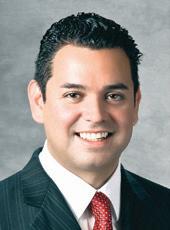
Kyrene, TU impose mask mandates after court ruling
BY PAUL MARYNIAK AFN Executive Editor and HOWARD FISCHER Capitol Media Services
As their members expressed anger, frustration and concern, Kyrene and Tempe Union governing boards last week voted not to defy the state’s ban on mask mandates and instead approved resolutions asking the governor and Legislature to rescind it. But that all changed two days ago after a judge ruled that the ban does not take effect until Sept. 29.
Arizona schools are free to require students and staff to wear masks on campus, at least for the time being, Maricopa County Superior Court Judge Randall Warner ruled on Monday, noting "Under Arizona law, new laws are effective 90 days after the legislative session ends, which is Sept. 29 this year."
Warner acknowledged that there is an exception for emergency measures. But he said this does not qualify.
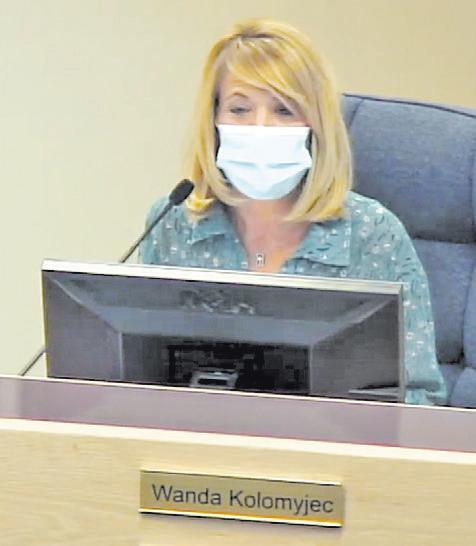
Dr. Wanda Kolomyjec, one of the Ahwatukee members of the Kyrene Governing Board, cast one of two votes, along with Michelle Fahy, against the resolution, calling it too weak. (YouTube)
"They require a two-thirds vote and this statute was not approved by a two-thirds majority,'' Warner wrote.
The judge also said a clause in the measure making it retroactive to July 1 is legally meaningless.
Hours after the judge's ruling, both Tem-
pe Union and Kyrene reimposed the mask mandate that had been in effect all of last school year.
While Warner's ruling sets no precedents, it gives added strength to similar restrictions imposed by at least six districts around the state that have decided, at least for the time being, to require those coming on campus to wear face coverings.
Warner emphasized that he is not making any decisions on the merits or even the legality of the law itself, but only its effective date. And the judge could raise those issues at a future hearing.
Chances are slim to none that the boards' resolutions last week will get any attention from the Legislature or Gov. Doug Ducey after 26 of 47 Republican lawmakers last week urged Ducey to punish districts that are defying the mandate ban.
On the same day of Warner's ruling, Ducey issued an executive order barring cities and counties from requiring their employees get COVID-19 shots. Through his press secretary, Ducey also rapped the judge's ruling. "Kids need a stable learning environment,'' said press aide C.J. Karamargin
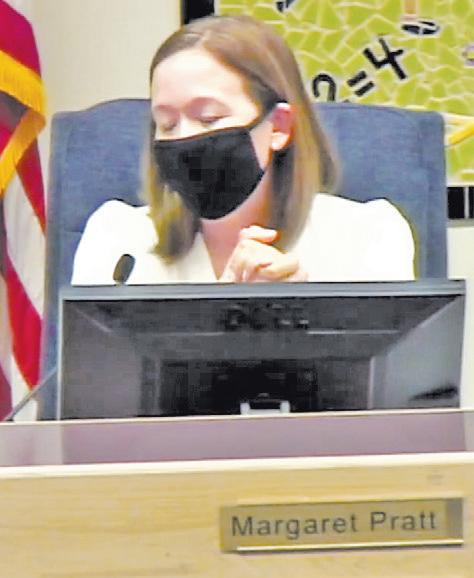
Ahwatukee resident and Kyrene Governing Board member Margaret Pratt voted for the resolution urging the Legislature and Gov. Doug Ducey to rescind the ban on mask mandates.(YouTube)
in a prepared statement. "Temporary mandates and efforts to flout the law aren't
see MASKS page 14









































At Ahwatukee Dental Health, Dr. Amy Nordquist and her team are dedicated to providing each and every patient with the care and attention they need in the most comfortable way possible. Her time spent with you will always be thorough and focused on your dental concerns. Our team values personalized attention and long-term relationships with all of our patients. We can’t wait to meet you!













segment a public street.
The project also will include new bicycle lanes extending from those north of Baseline Road.
When the project actually begins is uncertain because utility lines must be relocated and there are rights of way that still need to be acquired.
The city also has to bid out a contract for the work, though the estimated project cost was not available.
Murphy conceded that motorists trying to avoid any work on I-10 by using 48th could be in for a hassle, though she said, “We will do our level best to minimize the inconvenience to drivers especially knowing that the Broadway Curve project is going to be underway in some of the same timeline.”
She said that while the city has estimated it will take 200 work days to complete the work, that timeline could be impacted by weather and other unforeseen developments, so that pegging its length at a year would not be inaccurate.
But she added that because it’s a widening project rather than a total street reconstruction, efforts will be made to maintain
traffic flow, however restricted that might end up becoming.
“Unlike a reconstruction project where you’re actively doing work in all the intersections and stuff like that, this is a widening project,” Murphy said.
“So there are not at this moment any anticipated plans for full closures. There will be a traffic control plan established by the contractor that gets the job.”
“We will carefully view that traffic control plan, as we do all of them because we have competing priorities and the Broadway Curve project is, of course, a major project that is going to be disruptive to probably all our lives.”
Speaking of the Broadway Curve project, another round of weekend hassles await I-10 motorists as crews continue to scrape asphalt from segments of the highway that will be impacted by the nearly four-year work.
Westbound I-10 between SR 143 and 24th Street will be closed, as well the southbound SR 143 ramp to westbound I-10 and I-10 westbound ramps at Broadway Road and 40th and 32nd streets. Westbound I-10 drivers will have to exit onto northbound SR 143 and access westbound Red Mountain Freeway to pick up


with the open westbound I-10 lanes again. During the weekend of Aug. 27-30, eastbound I-10 will be closed between US 60 and SR 51. A slew of on ramps will be closed at Seventh, Jefferson, 24th, 32nd and 40th streets and Broadway and Buckeye roads.
Eastbound I-10 drivers will have to head
east on the Red Mountain Freeway, take southbound Loop 101 and get on westbound 60 to get back to I-10.
ADOT has mobile apps that people can download on the App Store at rb.gy/gnpzao or on Google Play at rb.gy/smi4u9 for updates on closures. They also can find information at i10broadwaycurve.com. ■
Contact Paul Maryniak at 480-898-5647 or pmaryniak @timespublications.com



LA CASA DE JUANA























Markwood North



Tartesso
Listed




















































Researchers push for updating U.S. poverty measure
BY CHASE HUNTER News21
Timothy Smeeding began his research career in public affairs and economics by sitting across from the woman who created the official poverty measure of the United States – a standard he’s worked most of his career to change.
The stakes are high. The poverty line directs tens of billions of dollars annually in aid to the nation’s poorest people – for public housing, subsidized rent, food stamps, free school lunches, college grants, Medicaid and federal grants to nonprofits that serve low income communities.
But the equation used to set the poverty line hasn’t been updated since the 1960s.
Consider 1967: The annual median income was $7,143; the median rent was less than $100 per month; and a gallon of gas cost 31 cents. A year at the University of Pennsylvania was less than $2,000.

“The official poverty measure was something that we created 70, 65 years ago, and it was appropriate for that time and period. But it isn’t anymore,” said Smeeding, a professor at Robert M. La Follette School of Public Affairs at the University of Wisconsin-Madison.
Most expenses, such as housing, fuel and college tuition, have skyrocketed. But the cost of food – which the poverty measure
was mainly based on – has become cheaper because of better farming practices and more efficient supply chains.
The federal government determines who is in poverty based on the cost of food to sustain a household, adjusted by the number of people in a family. Today, a family of four falls into poverty based on an annual household income of $26,500.
Economists who study poverty and inequality said the measure is outdated and may leave behind millions of people who might be eligible for assistance.
“If we were going to kind of have a more realistic measure, I think it would probably show that instead of 10 percent of kids roughly being under or near the poverty line, it would be more like 20 percent,” said Shawn Fremstad, a senior fellow who studies poverty and income inequality at the Center for Economic Policy and Research in Washington, D.C.
Shailly Gupta Barnes, policy director for the Kairos Center, a social equity and antipoverty group in New York, said the formula doesn’t effectively serve low-income communities.
“It was evident that of the measures that we had, the programs that were pegged to
it were not sufficiently meeting the need that we saw,” said Barnes, who also works with the nonprofit Poor People’s Campaign.
She said 4 out of 10 people in the U.S. “are one emergency away from economic ruin.”
But an adjustment to more accurately capture poverty in the U.S. also would balloon the costs of pro-grams for food and rent assistance, health care and other government aid programs.
The budget for Medicaid, which provides free or low-cost health care to some people with low incomes, was more than $450 billion in 2020, according to the Office of Management and Budget. And the budget for the Supplemental Nutrition Assistance Program, or SNAP, which distributes benefits once known as food stamps, is more than $100 billion, according to the Congressional Budget Office.
Smeeding said the poverty line issue is further complicated because such government assistance doesn’t consider the financial benefits already provided to the poorest families in the form of SNAP benefits and tax refunds that aren’t considered income.
U.S. Treasury high-fives Phoenix rental help
The U.S. Treasury Department gave Phoenix a high five recently for effectively using experienced community representatives in its rental assistance program.
Although Phoenix has yet to spend close to $25 million in $52 million of federally funded rental relief money, the Treasury Department cited Phoenix in a brief look at how implementation of the Emergency Rental Assistance Program can be made more effective by “continuous improvement and nimble outreach strategies.”
“Sensitivity to the challenges faced by the locality’s ERA applicants can allow grantees to pivot to more effective strategies,” the Treasury Department said, citing areas such as “landlord engagement,” eviction diversion, utility assistance and “making the application process simple and user friendly.”
The Treasury Department said Phoe-
nix’s use of “experienced local community action representatives into the oversight of the application process has been critical to raising application completion rates.”
“Program administrators commented that these representatives are sensitive to the challenges of the local populations and have allowed the program to better problem solve application challenges and improve training of line staff.
“Recognizing that residents may not realize that various rental assistance programs offered through other funding streams have different eligibility requirements,” it added that Phoenix launched a “’re-education’” campaign on social media…to reach potential applicants who may have been discouraged from seeking help due to past experiences of ineligibility for other similar-sounding programs.”
Phoenix provides rental assistance to any city resident “regardless of citizenship or immigration status and Social Security Number, according to the city website.
Qualifying households must have an annual income below 80 percent of $63,200 for a family of four and have “qualified for unemployment benefits or experienced a reduction in income or experiencing other financial hardship due to COVID-19.”
Applicants also must demonstrate a risk of homelessness or housing instability as a result of unpaid rent and utility bills since March 2020.
In a memo to City Council last week, Housing Services Director Marchelle Franklin reported that the city has spent $26.7 million on rental and utility assistance since March. That equates to 58 percent of total funds available and represents an average $7,600 per household.
As of Aug. 4, her report showed, a total 8,699 residents in 3,503 households were helped. Another 668 applicants were ruled ineligible for assistance.
Franklin said that the city has doled out at least $1.9 million a week for four consec-
utive weeks and credited the use of experienced community representatives with getting money faster to needy households.
“Staff continues to work weekends to assist residents facing eviction,” she wrote. “This includes targeted outreach to persons scheduled for a lockout from their home or eviction proceeding as referred by the landlord-tenant law firm.”
She said on one recent Saturday, city staffers “contacted 279 residents and 14 households were served, totaling $102,106 in financial services.”
The city is also working with Phoenix Library and IT personnel to set up a document center at Burton Barr Library that she said “will greatly expedite the ability of staff to assist residents.”
“This team’s focus will be to verify that each application is finalized for caseworkers and ready for the last steps of disbursement,” she said, noting that see POVERTY page 14
RENT page 21
Mollie Orshansky, a social science research analyst in the Office of Research and Statistics at the Social Security Administration during the Kennedy Administration, developed the official measurement of poverty used by the U.S. government. (Special to AFN)






steal your HEALTH Exercise is Medicine
TAKE CONTROL OF YOUR HEALTH & WELLNESS
Have you slipped into obesity? There are 3 medical categories of defined obesity. Are you there?
Worsens Outcomes
Adults with excess weight are at even greater risk:
• Having obesity may triple the risk of hospitalization due to a COVID-19 infection.
• Obesity is linked to impaired immune function.
• Obesity decreases lung capacity.
• Models estimate that roughly 1/3 of COVID-19 hospitalizations in the U.S. have been attributed to obesity. (Dec. 2019 - Nov. 2020)
Other obesity related health issues:
Heart Disease • Stroke • Type 2 Diabetes & Certain Types of Cancer MAKE YOUR HEALTH A PRIORITY! DON’T WAIT!

Join us for a Dementia Expo featuring Jan Dougherty!
Wednesday, August 25th
3:00pm - 6:30pm at Tuk Urban Kafe 15815 S 50th Street, Phoenix, AZ 85048

Please RSVP to Sheri Simpson at 480-800-7304
Jan Dougherty is a leader in dementia care crafting award winning innovative programs to support people living with dementia and their family caregivers across the care continuum. Jan is a noted speaker and author in the field of dementia and has received numerous state and national recognition awards for her work.
3:00pm- 4:30pm: What is Dementia, how it affects family, the person with dementia, and what to do?
4:30pm - 4:45pm: Break - Appetizers and Drinks
4:45pm - 5:30pm: Questions and Answers
5:30pm - 6:30pm: Book Signing - Travel Well With Dementia






“You need some measure that takes account of the programs that you’re using,” he said.
By continuing to use an archaic poverty measure, Smeeding said, it’s not possible to see the impact of SNAP, Medicaid and other government assistance programs. And the impact of the poverty line goes beyond money, Smeeding said.
“In effect, it has a role to play in public debate and public understanding,” he said, by shaping the under-standing of what poverty is and how prevalent it is.
Fremstad recommends the U.S. follow the model used by many European countries: a relative poverty measure. There, the poverty line is anywhere from 40-70 percent of the median household income.
For example, if the median household income in France is $50,000 and the poverty line is set at 50 percent of the median, households making less than $25,000 would be considered in poverty.
Smeeding said the cost of living in different parts of the U.S. should factor into any measure on poverty; what $1,000 buys in Billings, Montana, does not go nearly as
from page 6
going to help them,'' he continued. "Kids should be in school, learning, and their parents should be the ones making decisions.'
Emotions ran high at the Kyrene Governing Board meeting Aug. 10 as members Michelle Fahy and Wanda Kolomyjec passionately denounced state leaders and refused to vote for the resolution, suggesting it was insufficient as COVID cases continue to climb.
Meanwhile, all three state universities and the Maricopa County Community College District said they would require masks in some campus areas, including classrooms.
The continuing rancor over masks came as new data from Maricopa County’s Department of Health showed COVID-19 cases rising within both Kyrene and Tempe Union district boundaries and in two of Ahwatukee’s three ZIP codes.
The lone exception to the surge in COVID-19 cases that has produced numbers not seen since February was 85045, which also happens to have the largest percentage of fully vaccinated residents.
Data show that 85045, where 69.2 percent of all eligible residents are fully vaccinated, showed cases per 100,000 fall from
far in San Francisco.
A more accurate poverty measure also should factor in the cost of housing, education and child care, he said.
“Most people think that those needs should some-how change with living standards,” Smeeding said.
Many state and local jurisdictions have “largely stopped using the poverty line to determine eligibility for social programs,” according to Stanford Social Innovation Review. Instead, local governments often set program eligibility at a percentage of the federal poverty line.
In Arizona, the state has its own measurements for some of its programs, including cash assistance.
Researcher meets the poverty-line originator
These measures rose in the early 1960s, Smeeding said, when the Kennedy administration acted to help families making less than $3,000 per year. However, the $3,000 was an arbitrary figure.
An economist on Kennedy’s Council of Economic Advisers suggested creating a more systematic approach to identifying and measuring poverty. The job was handed to Mollie Orshansky, a social sci-
183 to 171 and the percentage of new positive test results plummet from 10.8 percent to 4.4 percent.
Neither of Ahwatukee’s other three ZIP codes were as lucky even though 62 percent of all eligible residents are fully vaccinated in 85048 and 59 percent fully vaccinated in 85044, according to county data.
In 85044, cases per 100,000 swelled in one week from 187 to 406, though positive new test results fell from 17.6 percent to 13.7 percent, the data show.
In 85048, cases per 100,000 climbed from 186 to 264 while positivity fell slightly from 14.9 percent to 13.9 percent.
In Kyrene School District, cases per 100,000 went up from 199 to 305 while Tempe Union saw cases rise from 202 to 282. Positive new test results in both districts were around 14 percent, the data show.
The county does not break down vaccination rates by school districts.
Kyrene’s dashboard showed that as of Aug. 14, there were 102 COVID-19 cases in district schools, 70 in elementary schools and three in the K-8 Kyrene Traditional Academy.
Tempe Union’s dashboard showed that of 56 active COVID-19 cases, 53 were students and most were in the two Ahwatukee cam-
ence research analyst in the Office of Research and Statistics at the Social Security Administration.
Her goal: devise a system that would create a fair and accurate measurement of poverty in the U.S. that could be applied to a country of 180 million people.
The data available to Orshansky in the mid-1960s was a fraction of what is available today. But using data from the Department of Agriculture and studies on nutritionally adequate diets, Orshansky developed conclusions to calculate a poverty threshold.
Discovering that most non-farm families at the time spent one-third of their income on food, she used the family food budget to calculate the poverty threshold, giving the federal government a widely applicable and systematic approach for the first time. Orshansky’s measure was adopted in 1969.
In the 1970s, Smeeding said, a few small voices wanted the poverty measure to reflect a more holistic view of a changing economy. He was one of them.
In 1972 – while sharing an office with Orshansky at the Social Security Administration – Smeeding wrote his Ph.D. dissertation for the University of Wisconsin-
puses with Mountain Pointe and Desert Vista reporting 23 and 19 cases, respectively.
And it wasn’t just public schools wrestling with the virus surge.
Horizon Honors sent 56 students and three adult staffers from a third-fourth grade classroom into quarantine until Aug. 23 after 11 people among them tested positive for COVID-19.
And after Summit School Ahwatukee reported on Aug. 15 that two students were diagnosed, parents began asking the administration to make masks mandatory.
Currently, neither Summit nor Horizon Honors require masks and the ban on mandates does not apply to them.
Members of both the Kyrene and Tempe Union boards voiced concern that the rising number of COVID-19 cases within the districts’ boundaries will force them to suspend in-class learning and send all students back to learning at home.
They contended that a mask mandate would slow the prospects of that happening.
Several members said they had received hundreds of emails and the vast majority were from parents who wanted a return of a mask mandate.
Kyrene Board President Kevin Walsh read a letter from a parent who pulled her
Madison, saying there were flaws in the Orshansky Poverty Thresholds.
“I accepted her poverty line. I just said that the income measure, the resource measure needed to be changed to reflect taxes and benefits,” Smeeding re-called."
When Orshansky’s model began guiding U.S. policy more than five decades ago, the American economy was heavily based on manufacturing and agriculture, Smeeding said, but now it’s driven by technology and information.
Fremstad and Smeeding said policy creators need to keep Orshanky’s original intention in mind – to accurately pinpoint poverty.
That means throwing out a six-decadeold standard.
“The inability to measure poverty accurately reflects an inability of our society to address problems of need and want sufficiently,” Barnes said. “And that’s not the kind of society that any of us need.”
This story was produced in collaboration with the Walter Cronkite School-based Carnegie-Knight News21 “Unmasking America,” a national reporting project on the lingering toll of COVID-19. ■
daughter out of a Kyrene school and enrolled her in a private school that required all students and staff to wear masks.
But while the two boards were unwilling to follow about a half dozen other districts in the state in openly defying the law, officials in both districts said they will be utilizing quarantines and taking additional mitigation measures.
Kyrene laid out a lengthy list of mitigation strategies that include a return to some of the measures that were in effect in 2020-21 but lifted at the start of the current school year.
Among them is a return to requiring children to immediately go to their classrooms when they arrive at campuses and more stringent social distancing that reduces free-wheeling mingling.
Kyrene also said its layered approach will include increasingly tougher mitigation measures on a school by school basis, depending on a combination of virus cases in a school and the level of virus spread in the community surrounding it.
Both governing boards also pleaded with parents and eligible students to get vaccinated, wear masks on campus and follow
MASKS
















Court: Schools not liable for off-campus violence
BY HOWARD FISCHER Capitol Media Services
Schools can’t be held accountable for violent incidents between students that occur off campus, the Arizona Supreme Court ruled last week.
The justices rejected claims by Diannah Dinsmoor that the Deer Valley Unified School District was liable for the 2014 shooting death of her daughter, Ana, who was killed by a fellow student identified only as Matthew.
Dinsmoor does not dispute that the shooting – Matthew also killed himself – occurred off campus. But she said that school officials were aware that the pair had been dating, that Ana had planned to meet Matthew that day and that Matthew had been violent with another exgirlfriend.
Justice Ann Scott Timmer, writing for the unanimous court, acknowledged that there is a “special relationship’’ between a school and its students that can make them responsible.
“But once students leave the school’s control, the special relationship ends, and students are simultaneously released to their parents’ or guardians’ full custodial care,’’ she wrote. “At that point, the school is relieved of any duty to affirmatively protect students from any hazards they encounter.’’
Timmer acknowledged there can be exceptions.
For example, she said, a school can be sued if a child is injured because of the decision to place a bus stop on a heavily traveled street, subjecting the student to an unreasonable risk of harm.
Similarly, Timmer said if there is an active shooter in the neighborhood, a school can be liable for allowing students to leave the building.
But none of that, she said, applies here.
According to court records, the somewhat complicated situation involves, Matthew, Ana and Raven, with the boy apparently playing the girls off against each other.
At one point, Ana said that Matthew had threatened Raven, something she brought to the attention of Kimberly Heinz, the vice principal at the school and, eventually, to the off-duty police officer who worked at the school. The school saw no threat to Ana but did put a safety plan in place for Raven.
Heinz and the police officer were aware that Ana was going to meet with Matthew after school. And while the officer counseled against it, they took no action.
Ana went to her friend’s house to meet Matthew where he shot and killed her and then himself.
While a trial judge threw out the resultant lawsuit, the Court of Appeals said that “special relationship’’ between the school and the student opened the door for liability.
That led to Friday’s Supreme Court ruling.
“People do not generally have a duty to protect others from harm,’’ Timmer wrote. “Nevertheless, the school-stu-


dent relationship imposes an affirmative duty on schools to protect students from unreasonable harm.’’
But that, she said, has limits. And Timmer said those are pretty much defined by geography.
The justice said that there are things which make that special relationship exist on school grounds. That creates a situation where the school “supervises and controls students and their environment, enabling it to identify and eliminate risks.’’
Timmer said all that pretty much disappears once the student goes off campus.
“The key consideration is whether a known and tangible risk of harm arose that endangered the student while under the school’s custody and control,’’ she wrote. “In such scenarios, students are deprived of the protection of their parent, and the school has an affirmative duty to protect them from such risks until they are safely released from the school’s custody and control.’’ ■














Coach kills self after child-sex sting arrest
BY ZACH ALVIRA Tribune Sports Editor
AChandler High School swim coach died by suicide Aug. 8 – 48 hours after he was arrested by Scottsdale Police in a multi-agency East Valley human-trafficking sting that led to the arrest of 17 other men.
Bob Chen shot himself with a gun he rented at a Tempe shooting range.
Chen recently had taken a position as head coach for a program in California and was an assistant coach at Chandler High for three years before taking over as head coach in 2020 after the COVID-19 death of former coach Kerry Croswhite.
Chen was also a longtime coach for the Rio Salado Swim Club, coaching two athletes to this year’s Olympic Trials.
Three police agencies confirmed Chen’s arrest, including Mesa Police, the lead agency in the sting. Chen was arrested on suspicion of four charges, including an attempt to have sex with a 14-year-old girl.
Also involved in the “human sex trafficking reduction operation” were the state Attorney general’s Office, Homeland Security and Tempe Police.
David Tait, the director and owner of Rio Salado Swim Club, said Chen was arrested Friday afternoon after downloading an “underground” application to his phone used to solicit child prostitutes.
Police said Chen initially requested to meet with an underage girl. Upon arriving at the agreed-upon destination, Chen had second thoughts and left before meeting her, according to Tait.
Upon leaving the site, he was pulled

BOB CHEN
over by Scottsdale Police and arrested.
Tait said Chen spent the night in jail and was released Saturday. He was assigned a parole officer, curfew, ankle monitoring device and had his phone confiscated by police.
“To my knowledge, there was no bail or bond; he was released on his own,” Tait said. “We would not have bailed him out.”
A distraught Chen contacted Patrick Tolson, the development team director for Rio Salado, after his release from a prepaid phone.
According to Tait, Tolson interrogated Chen, who denied any acts of this nature taking place with swimmers he has coached in the past.
Chen did admit to soliciting prostitutes in the past, but had said this was the first instance where the female was underage, according to Tait.
“They were looking at each other square in the face but we don’t put any
stock in that,” Tait said. “We are going to further investigate in case there are other victims.”
Kristin Adair, who took over for Chen as head coach of the club, went to Chen’s home before he and Tolson arrived.
Aware Chen had become suicidal, she and Chen’s parents removed anything he could use to harm himself, including his gun.
On Sunday, Chen slipped out of the home without his family’s knowledge and used a spare set of keys to access his car. He then drove to C2 Tactical Gun Range in Tempe, where he rented a weapon and used it on himself.
“It was our plan Monday to contact an attorney and get in touch with USA Swimming Safe Sport, but he ended up killing himself Sunday afternoon,” Tait said. “Our first reaction was to protect the kids and get them help.
“I sent an email Sunday night explaining Bob had committed suicide. We didn’t release these other details because we wanted the parents to be able to talk to their kids before they went to school.
“On Monday we lined up trained therapists and then Tuesday we had a meeting with parents where shared the details openly, honestly and transparently so everybody could take the information and share it with their children in the best way they know how.”
Tait added he and the other Rio Salado coaches wanted to get the information out to parents to identify other children who may have been harmed.
“We don’t believe there have been other children, we don’t have any reason to believe there have been, but if there were, we wanted to find out who they are and get



them the proper support,” he said.
Chandler Unified School District spokesperson Terry Locke said the district was made aware of the charges against Chen on Tuesday. He was not employed by the district at the time of his arrest.
Jim Culver, the athletic director at Chandler, informed the school’s swimmers of his death on Monday morning. He was unaware of the charges brought against the former coach at the time.
“We had a meeting this morning with our swimmers and staff on campus to share the sad news,” Culver said. “Our counselors and school administration were present as well as coaching staff.”
Chen’s death rattled the Chandler High community, which was still reeling after the loss of Croswhite last year. The school’s aquatics complex was named after him in December to celebrate his legacy at the school.
That same month, Chandler swimmer Brisa Vasquez lost both of her parents just hours apart from the virus. Tony and Lisa Vasquez were part of the team’s booster club.
Tait said while Chen had success as a coach at various levels, there may never be a time in which his legacy can be discussed.
“I told the parents choices have consequences,” Tait said. “One of Bob’s consequences here is this information coming to light. We are going to do the right thing with this information. That comes before any talk about Bob’s reputation or legacy.
“The kids are first, and we are going to protect the kids first. That’s our singular goal right now.” ■



Stroke


Milgard® offers beautiful, comfortable, energy efficient vinyl windows and doors for your home.
Whether you’re building a new home or renovating your existing one, your choices are wide open when it comes to selecting beautifully designed Milgard windows and patio doors. Strong, beautiful, long lasting and durable. Milgard windows and patio doors are designed with stunning architectural style and superior performance.
Available from Lasting Impressions: Stop by our design showroom to see the latest trends! 4454. E. Thomas Road, Phoenix, AZ 85018 | 602.508.0800 | liwindow.com
Showroom Hours: Mon - Thu 8:30-5:00 | Fri 8:30-4:00 | Sat 9:00-2:00 | ROC#179513




































Redistricting looms over 2022 congressional contests
BY BROOKE NEWMAN Cronkite News
Arizona’s congressional incumbents have the advantage of name recognition and massive fundraising leads – but analysts say they might need both as congressional redistricting has “put us all in a state of limbo” for the 2022 House races.
There are other variables for next year as well, including an open seat in District 2 where Rep. Ann Kirkpatrick, D-Tucson, is not seeking re-election.
But for now, fundraising “is something members of Congress can control” and they have, with the latest campaign finance reports showing incumbents had raised $3 million and had $4.7 million in the bank as of June 30.
“Showing the ability to raise money is important early on to show you have a viable race and that you’re a viable candidate,” said Paul Bentz, senior vice president of research and strategy at HighGround Inc.
Arizona’s House races could be overshadowed by the race for the Senate seat held by freshman Sen. Mark Kelly, D-Ariz. His election gave the state two Democratic senators for the first time in a half-century and helped Democrats gain the slimmest majority in the Senate.
With control of the Senate at stake,
RENT from page 14
document preparation consumes 78 percent “of the time required to serve each applicant.”
Meanwhile, delinquent water accounts in Phoenix total more than $10.2 million in unpaid bills and involve 17,789 accounts. Of these, only 340 are commercial custom-
both parties are expected to funnel money to the race, where Kelly has already raised $10 million and three of his Republican challengers have raised more than $3 million combined.
But House hopefuls have been raising money at a good clip, too, starting with Rep. Tom O’Halleran, D-Sedona, who reported raising $745,004 so far this year and having $616,995 in the bank, according to his June 30 filing with the Federal Election Commission.
Jason Rose, a Republican political consultant, said O’Halleran’s is the “most intriguing congressional race.” Rose said O’Halleran did not win his 2020 re-election by the margins many expected, garnering just over 51 percent of the vote, and he faces a credible challenger in state Rep. Walter Blackman, R-Snowflake, who had raised $137,727 as of June 30.
Miles Coleman, associate editor of Sabato’s Crystal Ball at the University of Virginia’s Center for Politics, said that O’Halleran’s district currently leans Democratic, with 36.2 percent of voters registered as Democrats to 32.4 percent registered Republicans.
But he said “if Yavapai County gets put back in, O’Halleran could have a much more red district” in District 1, which covers most of northern and eastern Arizona.
The heaviest fundraising has been in District 2, the Tucson-area seat that comes
ers and another 748 involve residential water theft cases.
The city report shows that 9,943 individual water account holders have deferred payment arrangements to pay down their debt. Balances owed average $530, it said, but the total arrearage is $5.3 million.
Another 6.758 delinquent water customers owing an average $386 have not made
open with Kirkpatrick’s retirement. Four Democratic hopefuls had raised a combined $1.2 million for that race, led by Randall Friese, a state representative and surgeon who had raised $566,363 by June 30 and had $425,392 cash on hand.
Other Democrats running include state Sen. Kirsten Engel, who reported raising $335,019 and state Rep. Daniel Hernandez, who raised $268,340.
“District 2 will be the odd one out because there’s no incumbent,” said Bentz, adding that it is the district with the most flexibility when it comes to redistricting and is “likely to see some significant change.”
Democrats in the district had a voter registration edge of 36.5% to 32% for Republicans, according to the latest data from the Arizona Secretary of State’s office.
Incumbents are currently running for re-election in all the other districts in the state, and they have substantial fundraising leads over their challengers, with most raising 80 to 90% of the total for the district.
Chad Campbell, senior vice president of Strategies 360 in Arizona, said that “being an incumbent gives you an inherent advantage,” as far as higher name recognition and fundraising capacity.
The analysts agreed it is hard to take out an incumbent, even for challengers who can compete in fundraising. They point to
deferred payment plan arrangements, the report shows. Their debt totals more than $2.6 million, according to the report.
The current total delinquency is more than three times what it was just two years ago, according to the report. It showed that in August 2019, delinquencies totaled $3.2 million and nearly $1 million of that involved theft.
District 4 Rep. Paul Gosar, R-Prescott, who reported raising $185,744 to the combined $132,499 raised by two Democratic challengers in his district.
But that district, they note, is 48.5 percent Republican to 18.9 percent Democratic. Just under one-third of voters in the western Arizona district are independents.
“That’s why he (Gosar) can act the way he does” and still be re-elected, Bentz said. District 6 is another example where registration can offset a challenger’s fundraising.
Despite being heavily outspent last year, and coming off a House ethics probe for handling of his office and campaign funds, Rep. David Schweikert, R-Fountain Hills, was able to win election to a sixth term from the district where GOP voters have a 38-27-percent advantage over Democrats.
“He got outspent last cycle, it was not a wonderful year for Republicans and had vulnerabilities,” Rose said of Schweikert. “And it’s a district that has flipped in the past… despite all of that they were still unable to unseat him.”
But all that could change in redistricting, which is why analysts say challengers and incumbents have to raise funds heavily now.
“Raising money… is something members of Congress can control,” Coleman said. “It’s important in the off years for them to have as strong of a starting quarter as they can.” ■
The report also showed that 9,140 city water customers have received some kind of assistance to pay down their debt. The report said just under $4 million has been used to help delinquent customers. Of that, the single largest program involved the use of $2 million in federal pandemic relief to credit the accounts of 3,657 customers. ■


But the rise in cases has coaches erring on the side of caution and having honest talks with players about vaccines.
“We know this is a family decision, we know people across the country are choosing not to get the immunization,” Mountain Pointe head football coach Eric Lauer said.
“But we want to make sure they know, and their parents know where it stands if they were to be in contact with someone who has COVID,” Lauer added.
“Especially with football back on, if you get caught up in the contact tracing and have to sit two or more games, man, that could be horrific for your senior year.”
Lauer said he did not know how many of his players have already received the vaccine. He admits the percentage of vaccinated players is probably not as large as the coaching staff, most of which are vaccinated.
But he recognizes that it isn’t his place to try to convince athletes and their parents to do what is best for them.
Plus, for the most part, Lauer said his players know the steps they need to personally take to hopefully avoid becoming infected.
Many of them, such as senior athlete Amier Boyd, take those precautions seriously.
“I just want to put myself in a position where I wouldn’t get it,” Boyd said. “Last year was hard. If we got it then we missed dang near half the season. So, I think we are better prepared and will do what we can to stay healthy this season.”
Sometimes, however, doing everything the right way can still lead to slip ups. Especially when it comes to an unpredictable virus that COVID-19 has proven to be.
Desert Vista’s varsity and junior varsity programs paused all team activities for 10 days due to an outbreak in the program. Tempe Union High School District said six cases were confirmed positive and 16 more players were quarantined as close contacts.
The Thunder returned to the field Aug. 8, the start of official practices for all 4A through 6A programs. There was a renewed sense of energy with the team, much like there was this spring and summer after

have been inoculated. He could not provide an accurate estimate for players and said at the end of the day, that’s information he believes should remain private.
“I would be lying if I gave a percentage,” Wisdom said. “Everyone has their personal preference for what they should do as a family. Obviously, there are some pros and cons but I’m a football coach, and people have to make their own decision for what is best for them.”
Desert Vista senior quarterback Xavier Castillo has been outspoken on social media about his vaccination status.
But his main reason for getting a shot had nothing to do with football: It provided a safe way to regularly visit his grandparents.
Castillo said his grandmother became infected with COVID early in the pandemic and was admitted into the ICU. Luckily, she survived.
But from that point on, he and his family decided if they wanted to see her, they all would have to take necessary steps to keep her safe. That included the vaccine when it became widely available.
miss any games. I have to be at every practice, every game, just make sure I am present for everything. I can’t let COVID get in the way of that.”
The new highly contagious Delta Variant, estimated by state health officials to make up over 80 percent of the new cases, has begun to take its toll on other East Valley school districts and teams.
Higley became the second program to quarantine after “multiple” cases were discovered. Hamilton High School just two weeks into the fall semester reported 62 active cases at one point.
That number has since dropped to 22 active cases and 97 resolved. District leaders said the outbreak at Hamilton did not directly affect any sports programs.
Scottsdale Unified School District late last week announced more than 600 students were in quarantine It was not immediately clear whether any high school sports programs were affected.
not having those opportunities last year.
First-year Desert Vista Coach Ty Wisdom has so far not gone too in depth with his players about the vaccine and the different scenarios that could take place this season. He believes most of his coaching staff
While he decided to do it for family reasons, he was also relieved when he saw the new AIA guidelines. As long as he didn’t have symptoms, he could remain on the field even if he was a close contact.
“I did it for the safety of my family,” Castillo said. “But it’s also very important because it’s my senior year. I can’t afford to

As the Pride takes to the practice field, Mountain Pointe head football coach Eric Lauer said, he wants players and parents to “know where it stands if they were to be in contact with someone who has COVID.” (Zac Bondurant/AFN Contributor)
Even before the dramatic rise in quarantined students in Scottsdale, Saguaro head basketball coach Lucas Ramirez made it a point to keep an open line of communication with his players about the vaccine and strategies they can take to remain healthy. Though he has told them the vaccine is a way to “keep the season pretty normal.”
“We are one community,” Ramirez said. “But at the end of the day, there are choices that every student-athlete and their families have to make and whatever that decision is, hopefully they think it’s the best decision for themselves, their family, their team and the school community as a whole.”
Hines and the AIA are hopeful for a “normal” season. Last year, an estimated over 90 percent of all sports contests were played – a number Hines was happy with given the circumstances.
This year, with the vaccine widely available and perhaps the best way to avoid athletes quarantining, he hopes for little to no cancellations.
“Whatever normal is nowadays, we want that,” Hines said. “We want more students to be involved, participation numbers up and more support for those athletes from their classmates. It was great to see in the spring people supporting these kids. We want to build on that.” ■
Desert Vista senior quarterback Xavier Castillo has been outspoken on social media about his vaccination status. But his main reason for getting a shot had nothing to do with football: It provided a safe way to regularly visit his grandparents. (Zac Bondurant/ AFN Contributor)
Coalition seeks to undo GOP budget bill blitz
BY HOWARD FISCHER Capitol Media Services
Acoalition of school board members, educators, child welfare advocates and others is asking a judge to void a host of changes in state law approved in the waning days of the legislative session.
Attorney Roopali Desai is not alleging that any of these new laws, individually, is illegal. They range from whether schools and even universities can impose mask mandates and changes to election laws to banning the teaching of what legislators and Gov. Doug Ducey have incorrectly labeled “critical race theory.”
The legal problem, she said, is that these were combined with other unrelated provisions into what lawmakers call “budget reconciliation bills,” essentially a grab-bag of issues.
That, said Desai, violates constitutional provisions which clearly state that each piece of legislation “shall embrace but one subject and matters properly connected therewith.”
MASKS from page 14
other recommended health protocols to stem the advancing virus.
Some board members also criticized Ducey for signing the Republican-driven measure banning masks.
Fahy bitterly noted that the law does not apply to private schools. She said Brophy College Prep, where Ducey’s children attend, recently imposed a mask requirement.
Fahy echoed the concern expressed by several members of both boards over the risks they would be taking if they defied the mandate ban – ranging from loss of school funding to personal liability.
Many board members also ripped Ducey and the Legislature for taking away local control over their districts.
“What the governor has done is taken it out of our hands. We can’t do anything that we need to do to protect our children right now and it’s hard,” said Tempe Union board member Berdetta Hodge.
“It’s really hard to sit here and know we’re going to pass a resolution,” she continued. “But are we going to really save the lives of the kids and the families? We can’t do what we were elected to do.”
Fahy told the community Ducey bears
The same provision requires each element to be laid out in the title.
She told Maricopa County Superior Court Judge Katherine Cooper that each of the challenged provisions was illegally enacted and cannot be enforced.
If Desai wins the case, the implications go beyond nullifying the challenged provisions and, most immediately, ending the legal risk that now exists for schools, colleges and universities who are requiring staff and students to wear masks while on campus.
It also would force a major change in the long-standing practice of lawmakers doing what she called “horse-trading,” piling unrelated issued – many which had previously failed on their own – into a single package designed to corral the necessary votes.
Senate President Karen Fann, RPrescott, said she could not comment until she reviews the lawsuit with attorneys. But C.J. Karamargin, press aide to Gov.
the responsibility for what might happen without a mask mandate and urged parents and others to write him.
“He should be ashamed,” she said. “You should be ashamed of him. He is holding the puppet strings and distracting our community members from what is most important – our children. They are our future and they deserve protection by us until they are old enough to advocate for themselves. We need to be their voice. So, let your voices be heard and directed to us, but also to your state leadership.”
Arizona State University was the first of the three state universities to announce mandatory face masks in a variety of situations.
All three universities now mandate face coverings in classrooms, teaching or research labs as well as “close-quarter environments where physical distancing may not be possible.’’
That specifically includes meeting rooms, workshop, design or production studios “and other indoor settings where social distancing is not possible.’’
Masks must be worn in any other “indoor and outdoor settings where physical distancing may not be possible.’’
But ASU Vice President Jay Thorne said he does not believe the new policy violates
Doug Ducey, said he is “confident the legislation we signed is constitutional.”
All this comes as the Department of Health Services, whose director Dr. Cara Christ has said she backs the decision by the governor and lawmakers to bar mandated mask use in schools, reported more than 3,000 new cases, a level that hasn’t been seen in six months.
Meanwhile, the attorney for a Phoenix Union High School teacher asked Maricopa County Superior Court Judge Randall Warner on Friday to void a mask mandate enacted by the district’s governing board.
Alexander Kolodin said that act specifically runs afoul of a provision in one of those budget reconciliation bills now being challenged by Desai barring schools from imposing mask mandates. And he argued the district is powerless to ignore the statute.
But Mary O’Grady asked Warner to toss the lawsuit, saying that statutes, including the one Kolodin is using, are not effective until the 91st day after the end of the ses-
either. The key, he told Capitol Media Services, is that it does not discriminate.
“Our requirements apply to everyone on campus (students, faculty, staff, and visitors) and regardless of their vaccination status,’’ he said. “They do not conflict with the order or the legislation.’’
Ducey has yet to actually seek a court order to enforce the anti-mask legislation. Instead, his press aide simply denies there is a problem.
In a letter crafted by Queen Creek Rep. Jake Hoffman, whose district represents most of Gilbert, the 26 Republican lawmakers calling for punishment also want Ducey to give vouchers to students “trapped” in the districts defying the mask mandate ban, giving them tax dollars to send their kids to private or parochial schools.
“It borders on anarchy and destabilizes the very foundation of our society to have local governments effectively refusing to comply with the law,” the letter said. “It must not be allowed to stand. Any local government that willfully and intentionally flaunts state law must be held accountable.”
Stating “the window to hold the rogue local governments refusing to follow state law accountable is closing and the people of Arizona’s patience is running short,” the
sion. And this year, that is Sept. 29. Kolodin contends that these are budget bills which take effect immediately.
But that whole argument of effective dates becomes moot if Desai wins her own lawsuit and the court voids not just the anti-mask language but everything else she argues was enacted unconstitutionally. All that goes to the requirement limiting each measure to a single subject and having the title properly reflect what is in the bill.
It starts with HB 2898 which has the language banning not just school districts but also counties, cities and towns from requiring the use of face coverings or proof of vaccination against COVID-19 to participate in in-person instruction. What’s also in the 231-page bill is a provision prohibiting teaching curriculum “that presents any form of blame or judgment on the basis of race, ethnicity or sex.’’ That includes concepts like saying a
see SUIT page 24
letter also declared:
"Stated plainly, the Legislature did its job by passing common sense laws to protect the children and students of Arizona from anti-science mask and vaccine mandates, now we are eager to see the executive branch do its job to ensure that those laws are faithfully executed by the various levels of government within this state.”
Meanwhile, a top doctor at the state’s largest hospital network said last week that the facilities could begin to impose capacity restrictions at the rate COVID-19 is multiplying in Arizona.
In a wide-ranging news conference, Dr. Marjorie Bessel, chief clinical officer at Banner Health, said the 71 children admitted with the virus last month is double the figure from a month before.
The good news, she said, is most pediatric cases the hospitals have seen so far do not require treatment in an intensive-care unit. But Bessel said that may be only a temporary situation.
“This does not mean that the virus cannot have a serious impact on children,’’ she said, pointing out the experience in states like Louisiana, Florida and Texas where the number of children in ICUs has spiked. ■

student “should feel discomfort, guilt, anguish, or any other form of psychological distress because of the individual’s race, ethnicity or sex’’ and even authorizes the state Board of Education to suspend or revoke an offending teacher’s certificate.
Desai said HB 2898 is titled “appropriating monies, relating to kindergarten through grade twelve budget reconciliation.’’ The reality, she said, is the bill includes “substantive policies that have nothing to do with the budget.”
“It’s bad enough that the titles don’t describe what’s actually happening in these bills,’’ Desai told Capitol Media Services. “But the legislature went out of its way to mislead people about what’s in the bills.”
For example, SB 1824, dubbed as “appropriating monies; relating to health budget reconciliation,” says students cannot be required to be immunized to attend school suing any vaccination that has only been given “emergency use authorization” by the Food and Drug Administration. That is the status of all COVID vaccines. And another section bars local governments from establishing a “vaccine passport’’ or requiring proof of vaccination to
enter a business.
Then there’s SB 1819 which, according to its title, deals with “budget procedures.”
But that bill includes “fraud countermeasures” for paper ballots and strips power from Secretary of State Katie Hobbs to defend election law challenges.
What’s also in that bill is setting up a special committee to review the findings of the audit of the 2020 election, changes to the governor’s emergency powers, investigating the practices of social media platforms and even language about condominiums.
“None of these subjects have any logical connection to each other,’’ Desai said. She argued this is more than just an academic discussion.
Desai said one purpose of the singlesubject rule is to prevent “logrolling,” trying to pull together the support for a series of measures that would fail on their own by adding items designed to convince foes of any particular provision to agree to support the whole package because it also contains something they want.
For example, she cited statements by Rep. Joseph Chaplik, R-Scottsdale, that he would not support the HB 2898 unless it also included a ban on mask mandates for
students.
“Never before has the Legislature so ignored the normal process and procedure for enacting laws as they did for this session,” Desai wrote. She said if the courts do not enforce the single-subject rule it would be “rendered wholly meaningless.”
In her filing, Desai said these are not simply academic and legal concepts.
She said if the provisions in the K-12 measure are not voided “public schools could be left powerless to protect their students and staff.
No date has been set for a hearing on the new lawsuit. And Warner, handling the Phoenix Union case, has not said when he will decide whether to block the district’s mask policy. ■

GOT NEWS?
Contact Paul Maryniak at 480-898-5647 or pmaryniak@timespublications.com

















Independent Living Assisted Living • Memory Care






























North Chandler Place is the only continuum of care 55+ living community in North Chandler. We offer a conveniently located campus with several different care options to ensure that you or your loved one will remain as comfortable and as independent as possible – even with changing needs. Our staff provides many different care options throughout our charming and spacious campus including: skilled nursing and rehabilitation, assisted living and memory care, and a variety of attractive and comfortable independent living apartment homes.








Real Estate Guide
BY ALLEN HENDERSON AFN Columnist
So, what is going on in the Ahwatukee real estate market? Is the bubble going to burst?
Despite reports of a dip or a slowdown in the Ahwatukee market, the market is still performing at record levels.
There were only 31 properties listed on Aug. 1. On average in 2021, 160 properties are selling per month in Ahwatu-
kee. The listing inventory of 31 properties on Aug. 1 would be depleted in about 6 days. As we have seen for many months, demand is outstripping supply in Ahwatukee, the entire metro area, and many real estate hot spot cities around the country.
Our Aug. 1 analysis of Ahwatukee real estate sales indicates that the 154 Ahwatukee properties sold in July 2021 at an average sale price of $539,490 with an average of 25 days on market.
























The average sale price declined slightly from the average sale price of $541,140 in June, when 176 closed escrow.
From Jan. 1 to the end of July, 1,117 properties sold at an average price of $509,483. with an average of 27 days on the market.
The number of units sold and the average sale price is up dramatically compared to the same period in 2020, when 941 properties closed escrow at an average sale price of $401,717.
The average price of an Ahwatukee property is 26.8 percent higher in 2021 than in the same period last year.
There are rumblings of the market slowing and prices softening in parts of the country, but we have not seen any slowing in the Ahwatukee market.
The number of units sold in the three Ahwatukee zip codes is up 18.7 percent, compared to last year. The increase in the number of units sold and the dramatic increase in the average sale price in Ahwatukee is fueled by incredible demand coupled with the record low-interest rates.
The record low rates are allowing buyers to purchase homes that would be out of their reach if interest rates were even a few points higher. When we expand our search to include the Metro Phoenix area, we see very similar results to what our Ahwatukee analysis demonstrates.
Our quick analysis of the Metro Phoenix market shows approximately 51,700 closed residential transactions in Jan. 1-July 31. The average sale price for the period is hovering around $525,000. The average price a year earlier in the Metro Phoenix market was approaching $400,000.
This represents a 31 percent increase in the average price of a property in Metro

Phoenix versus the same period in 2020. Despite the strong market we are seeing, locally and regionally, many remember the real estate debacle of 2007 and 2008. We are frequently asked if the bubble is about to burst.
As we said last month, the current situation, while looking similar to the events of 2008, is remarkably different. Demand remains incredibly high and the record low inventory levels are pushing prices steadily higher.
In many markets, including our own, we are seeing homebuyers making offers over the asking price to get a property.
Bidding wars are common. Mortgage reforms have become laxer and the mortgage interest rates have remained at record lows.
This has allowed the bullish real estate market to continue to expand. Most experts believe that this market will contin-
ue until buyers are forced to the sidelines because they can no longer afford the escalating prices.
So, is any end in sight? Many are asking if we are about to see prices crash as we saw when the real estate bubble burst in 2008. In the days leading up to the 2008 crash, there was a lot of speculation going on in the real estate markets.
Speculators were building properties at a pace that outstripped the demand. The mortgage market in retrospect was unregulated in many ways and lenders were doing creative lending. There were nothing-down an little-down loans, interest-only loans and loans with no verification of assets or ability to pay the loan off.
It was the wild west of real estate and when it stopped it crashed. It brought down individuals and banks. It required a huge bailout by the government (really the taxpayers). Incredibly, nobody went


to jail.
The current market is fueled by demand and low interest rates. In my opinion, as long as real estate interest rates remain relatively low, and demand remains high, the number of units sold and the average price of a property will continue to increase in the Ahwatukee and Metro Phoenix market.
When this market does slow down, it will be a result of prices surpassing the ability of buyers to afford to make the payments. A rise in interest rates, out-ofcontrol inflation, and continuing increases in prices will be the most likely culprits in slowing or stopping the local, regional, and national real estate markets.
Most importantly and of the most concern to me is the increasing inflation rate. If the rate of inflation is allowed to continue unabated, it will have the effect of pushing the cost of all consumer items, including properties, higher. Unchecked inflation can bring this market down in a hurry as dollars become less valuable and prices rise.
Treasury debt levels have never been higher as economic stimulus and massive infrastructure debt increases. These factors will increase taxes, create dramatic increases in consumer costs, reduce consumer spending and put downward pressure on home prices and the volume of homes sold if they continue.
It is still my opinion, that despite the boomimg real estate, inflation should be on the watchlist for all home-buyers and home sellers and those contemplating getting into or out of the real estate market.
Allen Henderson is an Ahwatukee resident and Realtor. If you have any comments or questions contact him at 480-392-2090. ■






How courts resolve HOA-homeowner disputes
BY BEN GOTTLIEB AFN Guest Writer
Millions of Arizonans live in a homeowners association.
The benefits and virtues of living in an HOA are extolled by many:
(1) a responsible and elected board of directors manages the affairs of the HOA; (2) upkept common areas and landscape throughout the community; (3) aesthetics that are pleasing to the eye; and (4) amenities and perks such as recreational facilities, playgrounds, pools. Some people, however, would prefer to not live in an HOA. These folks might complain about being subjected to the covenants, conditions & restrictions and governing documents of the HOA. Or the dues and fees they must pay. Or the politics that inevitably surfaces in an HOA community,
giving rise to disputes.
And despite all the benefits of living in an HOA, disputes surface frequently. They arise in a variety of situations.
Examples include when the HOA attempts to foreclose on one of its members for failure to pay dues, when a homeowner feels ggrieved by nuisance-type behavior a neighbor engages in, when a homeowner fails to comply with the governing documents, when election related protocols are not follows, when the HOA fails to enforce the CC&Rs, or when the HOA is not properly managing the affairs of the community.
In the past year or so, many homeowners have also complained about the HOA shutting down the amenities due to COVID.
Under Arizona law, CC&Rs are deemed a restrictive covenant that runs with the land.
Courts interpret CC&Rs to give effect to
the intention of the parties. In some cases, if frequent violations have been permitted by the HOA over time, the courts may consider the restrictions abandoned and unenforceable.
CC&Rs are a creature of contract law, and as such, the CC&Rs are a contract between the homeowners in an HOA as a whole, as well as the individual homeowners.
Therefore, when a dispute arises in an HOA under the CC&Rs, it may be asserted by the HOA or an individual homeowner within the HOA.
Many HOA disputes lead to litigation whereby the HOA or a homeowner files a lawsuit in Superior Court. In these types of lawsuits, the relief sought are usually injunctive relief as well as legal damages.
As in many other litigation cases in Arizona, the plaintiff will also seek reimbursement of attorneys’ fees and costs. When a homeowner or HOA seeks a preliminary
injunction, the court will hold a hearing relatively soon after the lawsuit is filed.
Let’s assume you live in an HOA and you learn that your neighbor plans to construct a second story addition on his or her property. You do not want the second story addition to be built for a myriad of reasons, one of which is it will block your view of the picturesque mountain backdrop you gaze at on every day while drinking your morning coffee.
You consult with a real estate attorney and determine that the CC&Rs do not allow second story additions to be built in your community.
You formally request that the HOA board take action and issue a cease-and-desist letter to your neighbor.
To your chagrin, you learn that your neighbor is a doctor and the president of
BY BONNY HOLLAND AFN Guest Writer
The past year has been a crazy one for real estate. Home prices have increased dramatically.
For Maricopa County in August 2020, the average list price per square foot was $209 and in August 2021, the list price per square foot is $263 – a whopping 25.83 percent increase in just one year.
While homeowners are very happy with this and the rise in their equity, the big question everyone is asking now is how this increase affects the affordability of homes.
The chart shows the affordability of homes in past decades.
You can see, that because of extremely low interest rates, even with the increase in the price of homes, home affordability remains one of the lowest it has been in






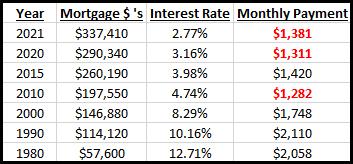
the past 40 years.
There are two exceptions to this:
2010 – This is the year the housing market crashed, and home values along with it. A third of all sales were either a short sale or foreclosure
2020 – While home prices had a healthy increase, mortgage rates were at record highs.

This year, prices again increased significantly, but mortgage rates were at historic lows.
So, except for 2010 and 2020, it was more expensive to buy a home every single year in the past 40+ years than it is today.
Let’s look at affordability based on median family income in the Phoenix Metro area.
Last quarter, affordability in Phoenix was 56. This means that a household with an income of $79,000 could afford 56 per-
cent of what was sold.
The normal range in Phoenix has been 60-75.
What we will begin to see is pushback from buyers willing to pay the prices sellers are asking for their homes. We are starting to see a lot of price reductions –an increase of 130 percent since May. This trend should continue, but with the ability to work remotely now, Phoenix has become more appealing to people who have been living in expensive cities up and down the West coast, causing a large increase in demand.
Please reach out to me to help you navigate this extremely complex and unique market.
Contact Bonny Holland for a conversation about what is right for you and your family in this market. bonny@leadingluxuryexperts.com 602-369-1085. ■

























LOT•PARADISE VIEWS OF SOUTH MOUNTAIN•3 BED,2.5 BATH, PLUS EXECUTIVE OFFICE AND LOADED WITH UPGRADES•FORMAL LIVING ROOM•FORMAL DINING ROOM•FAMILY ROOM W/WETBAR, BUILT-IN MEDIA CENTER, & FIREPLACE•KITCHEN INCLUDES: S/S APPLIANCES ,CORIAN COUNTERS, LARGE ISLAND, GAS COOKTOP, 42’ CABINETS, RECESSED & PENDANT LIGHTING, & S/S HARDWARE•BREAKFAST NOOK•NEUTRAL PAINT & CARPET•STONE-LOOK TILE FLOORING•PLANTATION SHUTTERS•LARGE MASTER SUITE WITH VIEWS•MASTER BATH W/DUAL VANITIES, GLASS BLOCK WALK-IN SHOWER W/TRAVERTINE & MOSAICS•PARADISE OASIS BACKYARD WITH PEBBLETEC POOL, WATERFALL, PALM TREES, COVERED PATIO, EXTENSIVE DECKING, BUILT-IN BBQ, GRASSY PLAY AREA, & ENDLESS VIEWS•PATIO FURNITURE INCLUDED•THIS IS THE HOME YOU HAVE BEEN WAITING FOR!
Listed for $799,000

















Sellers should observe some caution in hot market
Home sellers have a right to feel optimistic, even bullish, about selling a house today.
Here are a few key things buyers are doing today that could cause problems for sellers—and how you can sidestep these potential pitfalls.
Homebuyers are waiving the home inspection. While waiving a home inspection is certainly a substantial risk for buyers, it can be risky for sellers, too.
Because if homebuyers discover an issue after they move in that requires expensive repairs, “I think it’s logical that, in many cases, one of the phone calls a buyer
from page RE4
the board is your neighbor’s patient. You also learn they are long-time friends.
After waiting several weeks, the board takes no action. Construction is about to start. Do you have any recourse?
Under Arizona law, because the CC&Rs are a contract between the homeowners in an HOA as a whole, as well as the indi-


would make is to an attorney to find out if they can pursue the seller to recoup some of the losses,” said one Realtor said.
The fix: “Regardless of whether an inspection is happening or not, sellers must always be honest about known defects to the property that may impact value and disclose where appropriate,” said broker Matt Dolan.
Homebuyers are waiving the appraisal contingency. If the appraised price ends up lower than what the buyer offered to pay, the buyer must make up the difference or ask the seller to lower the price.
If a buyer waives the appraisal contingency but then can’t pay for the house, sellers do have one strong consolation
vidual homeowners, you have legal standing to file a lawsuit against the HOA as well as your neighbor.
You, as a homeowner, can file a lawsuit to enforce the CC&Rs, which prohibits constructing second story additions in the community.
You can also seek a temporary restraining order and preliminary injunction preventing your neighbor from constructing
prize: In most cases, they get to keep the buyer’s earnest money, the deposit offered upfront to show they’re serious about following through. “If the seller were to retain the buyer’s earnest money, they’re probably going to take a much bigger hit because the listing is going to have a bit of a stink on it,” a Realtor said.
As a result, before accepting an offer, make sure the buyer has financing in order and is pre-approved for a loan.
Homebuyers are racing to close the deal. Waiving contingencies such as home inspection or appraisal generally turbocharges the closing process.
What if you had hoped to buy a new home before moving out? Then you may
the second story addition while the Court decides the lawsuit.
The Court will hold an evidentiary hearing and you will need to prove your case has strong merits and you will experience irreparable harm if the Court denies the preliminary injunction.
Once this showing is made, if the Court is persuaded it will enter an order preventing your neighbor from constructing
suddenly find yourself in the same crazy seller’s market as your poor buyers – and it may take you much longer than you’d ever imagined to buy a new house.
The fix: This is one area where home sellers would be smart to add a contingency of their own to their real estate deal. Due to market conditions, home sellers should request more time than usual to buy a new place. Gelios suggests adding a contingency giving you 45 days minimum to find another property.
Even better, if your buyers are open to it, propose a rent-back agreement where the buyers allow you to remain in your old house and rent it from them until you’ve found a new home. ■
the addition on his or her property.
Chandler resident Ben Gottlieb and Ahwatukee resident Patrick MacQueen are co-founders of the real estate law firm MacQueen & Gottlieb. If you have questions about an HOA and injunctive relief, you can contact Ben Gottlieb ben@mandglawgroup.com; or call 602533-2840. ■




















































Griffin 602-692-7653 martygriffin@q.com

























jillo@homesbyjillo.com






www.ahwatukee.com
Ahwatukee group helps family’s ‘war’ on cancer
BY COTY DOLORES MIRANDA AFN Contributor
War.
That is what Heather, Joshua and Luke Ozga agree they are going through as Heather’s 9-year-old son, Luke, is stricken with a rare and virulent cancer.
“A war to save Luke’s life,” said Heather Ozga of Chandler.
But the family has a powerful ally in Ahwatukee-based Ahwatukee-based nonprofit Armer Foundation for Children, which is helping Ozga through a financial morass.
While donations can be made elsewhere online, Armer Foundation gives all donated money to the family. There are no
Marking 2 decades
St. John Bosco Catholic School in Ahwatukee marked its 20th anniversary last Saturday with a party for supporters and alumni. They were welcomed by Principal Jamie Bescak, top left, while Luis Acosta cooked burgers and Sadie Seidel, 7, played around the dunk tank. (Pablo Robles/AFN Staff Photographer)

processing fees, and donations are taxdeductible.
In addition to the hospital stays, medications and procedures there are so many other costs the family faces including the loss of income for Heather Ozga who left her job at MD Anderson Cancer Center when her son was initially diagnosed and the upcoming stay in Houston.
Armer Foundation co-founder and president Jennifer Armer said a blood drive and fundraiser is slated for 11 a.m.3 p.m. Sunday Aug. 22 at UFC Gym, 3830 E. Ray Road, Chandler and called for raffle donations.
“I am in need of raffle baskets to help raise funds for Luke to get to the Car-T therapy trial in Houston. And Heather
is going to need funds to live off as she’ll most likely have to rent an apartment or some type of housing,” explained Armer.
Armer also is looking for raffle baskets to raise money to support a trib Heather and Luke will be making later this month to Houston, Texas, where he will be undergoing an experimental treatment.
To sign up for the drive or donations, call Armer at 480-290-2977 or email armerfoundation@gmail.com. Sign up for the blood drive at vitalant.org with the code: LukeOzga.
The Ozga family didn’t ask to be in this devastating battle against a virulent and rare form of lymphoma attacking Luke
�ee CANCER page 29







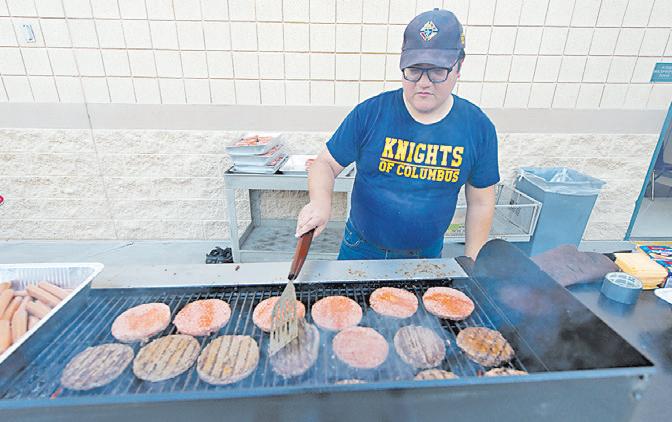



Luke Ozga thought he had his cancer beat. But the 9-year-old Chandler boy got bad news. (Courtesy of the Ozga Family)
since December 2019, but they have faced it bravely.
He appeared to have overcome that initial attack, but relapsed a year later. A bone marrow donation from his elder brother Josh appeared to be successful and the family was ecstatic.
In early July, Luke Ozga marked the 100th day following his bone marrow transplant. The family’s small celebration featured two cakes, one with creamy white icing in which the happy youngster chose to plant his face to indicate his happiness.
Less than two weeks later, on the 110th post-transplant day, what the family hoped was a routine examination to assure them all was going well brought devastating news: they were informed the bone marrow transplant that had been such agony for both brothers had failed.
“They said we didn’t have very many options left,” a tearful Heather Ozga said.
Sitting beside her in a social media post, as he did again in follow-up videos, was 12-year old Joshua Ozga, the elder brother who had just entered 7th grade at San Tan Junior High School and who has proven himself to be preternaturally knowledgeable on the disease and various treatments, including chemotherapy.
At that 110th day examination, the family learned Luke had trace amounts of cancer in his bone marrow.
“I almost hit the floor,” she said.
“Hearing your child has cancer is a parent’s worst nightmare; hearing he needs a bone marrow transplant was heartwrenching but we got through it, and we thought it was a complete success,” explained Ozga.
“If you looked at him and saw him, he’s so positive, so smiley, he looked great, he felt great. So when we went in and I heard this and said, ‘Okay, what next?’ and they said ‘We’re running out of options,’ that was beyond devastating.”
One option mentioned was a clinical trial in Texas at the Texas Children’s Hospital.
The family and their ever-enlarging support group of friends and even strangers prayed he would be accepted.
Last month, they learned that the lifeline of hope remained as Luke was approved into the program, this despite the 13-yearold age minimum.
“Luke will be only the third patient with

“For 60 pills, it was $7,748,” she revealed. “We obviously need a lot of help, financially.”
It is still undecided if it will be necessary for 12-year-old Josh to accompany the family to Texas Children’s Hospital in late August.
“We found out that more than likely Josh won’t need to go to Texas as they will be able to take blood here at PCH and send it there,” said Heather Ozga. “Only if it’s not good enough, or contaminated, would Josh need to go.”
Ozga anticipates the Houston trial and hospitalization would require a stay of up to six weeks.
She said it appears a different donor will be used for the next blood marrow transplant that will occur after the CAR T clinical trial. The family is urging residents to research and then enter the Be The Match database to help locate a bone marrow donor for this procedure.
look at the amount of money donated on the Armer Foundation or GoFundMe pages because I promise you, it’s gone in the blink of an eye.”
Recent figures on fighting cancer indicate one round of chemo can range from $10,000 to $100,000 or more. Luke has had numerous rounds.
Bone marrow transplants are one of the most expensive procedures, with studies showing it can be as high as $200,000 per transplant. Luke has had one and faces two more.
The upcoming clinical trial will add considerably to the costs so far.
As with the chemo medicine, some insurance plans don’t cover those expenses as they are considered ‘experimental’. Such trials can cost $41,000.
As thrilled as she was to discover last week that her youngest son has been approved for the clinical trial in Houston, she is searching for ways to get there, stay there and be strong for her son as he goes through it all in a strange place.
T-cell leukemia to receive this treatment in the U.S.,” she said. “He has lymphoblastic lymphoma, not leukemia, but we do, however, follow the leukemia protocol because due to the rareness of his cancer, they don’t have a protocol for lymphoblastic lymphoma.”
TCH was the first to offer cell therapy in pediatrics in 2012. The clinical trial to which Luke will enter sometime in August is for an immunotherapy known as chimeric antigen receptor (CAR) T-cell therapy for children with advanced acute lymphoblastic leukemia.
This clinical trial is all about life or death,” said Heather. “We had the conversation with both the boys, and Luke just cried and cried and cried.”
“It’s his last chance,” added Joshua.
Heather Ozga paused a moment to wipe away tears.
“And it’s all about money, too,” injected Joshua.
“Yeah it is, but everything is,” his mother replied stoically.
The cost of battling cancer is astronomical, and can easily add to the daily stress. When Luke started chemo, the family learned one of the two medications that were to be taken concurrently during this period was not covered by insurance.
Ozga acknowledges many medical terms are hard for the average citizen to grasp – among them the difference between leukemia and lymphomas.
But when dealing with them month after month, year after year, it becomes a second language, one even Josh has mastered.
“I’ve had to learn more about cancer in the past year and a half than I’d ever want. The meds alone are mind-blowing, along with their side effects,” she said. “The easiest way to describe the difference between leukemia and lymphomas is that lymphomas are usually masses.”
“When Luke was first diagnosed in December of 2019 he had a huge tumor on the front of his heart that had filled his lungs with tumor fluid and had collapsed his lungs so he literally couldn’t breathe. He was breathing 41 to 48 breaths per minute,” Ozga continued.
“It was awful and it had spread to his lymph nodes in his belly and his kidneys. That’s why his cancer is more rare and harder to get rid of because it’s aggressive and grows fast.”
While attention is focused on doing everything possible to save her son’s life, Ozga is understandably concerned about the ever-escalating cost of cancer.
“I’m having insomnia and anxiety attacks,” she admitted. “Cancer is so devastating and so expensive. People shouldn’t
“I’m trying to figure out what sort of costs I’ll have with our trip, but haven’t been able to find out as of yet. I don’t know if food or gas is covered, if our flights or a rental car will be. I’m trying to get answers now so I’m prepared,” she said.
“I’m feeling like we need to drive to be able to bring all the necessary items we will need for our extended stay but concerns about my vehicle’s age and mileage worries me so I’m still trying to work all the details out.”
Even as a single mother, she said she knows she’s not alone. Besides her parents and sister and friends - some of whom she’s never even met, she said her faith makes it possible to keep going every day.
“Josh and I go to our church every night and pray at the beautiful cross asking our Father to save Luke’s life,” she said. “I was born and raised Catholic and I attend The Grove. I sleep with my rosary, I pray a million times a day. God is so much a part of our lives.”
Fundraising is serious business for the family as they face the ensuing months of travel, treatments, and more.
“We need all the help we can get to help save my son’s life,” she admitted candidly. “Anything helps at this point.”
To help the Ozga family, make a taxdeductible donation at ArmerFoundation.org. ■
Healther Ozga and sons Luke and Joshua have gone through a heart-wrenching ordeal as Luke fights a rare and virulent cancer. (Courtesy of the Ozga Family)
Ahwatukee Kiwanis baby shower needs donations of all kinds
The Kiwanis Club of Ahwatukee is hoping the community will open its hearts to support the group’s annual baby shower benefitting Teen Moms in foster care and parenting teens from Tempe Union’s Compadre Teen Parenting Program.
Each of these young moms will receive a basket of new items based on information received ahead of time with each baby’s gender, age and clothing size. They will be able to “shop” for free for gently used clothing and necessities for their babies.
For moms who are not able to attend the event, clothing and necessities will be chosen for them by volunteers. All the gifts of new and used items will be delivered to them at the group homes or school.
“These young women are alone in their pregnancy and parenting experience without family and friends to support them,” Kiwanis member Andi Pettyjohn said. “They can use our help to make it easier for them to ‘beat the odds’ in this hard life.”
Donations will also be given to moms in crisis at The Phoenix Dream Center, UMOM, Tumbleweed and other shelters. Foster parents who are fostering babies will also benefit from donations.
Monetary donations can be made by mailing a check to PO Box 50596, Phoenix, AZ 85076 or on the Kiwanis website ahwatukeekiwanis.org
People can shop from a gift list as well at amazon.com/ baby-reg/3K5BWAZABFIII. By default, they will be delivered to a volunteer’s house so donors don’t need to worry about delivering them or dropping them off anywhere.
The following new or gently used items are needed: baby clothing sizes newborn to 5T, strollers, socks, diapers, car seats, shoes, toys, sippy cups, baby blankets.
Items can be dropped off at :
• Ahwatukee Swim & Tennis Center, 4700 E. Warner Road;
• Bartoli’s Cleaners, next to Target on Ray Road;
• Learn N Play, 15626 S. 42nd St.;
• Triple R Childcare, 4510 Ray Road;
• Vision Community Management, 16625 S. Desert Foothills Pkwy;
• US West Realty, 4505 E. Chandler Blvd.;
• God’s Garden at Horizon Presbyterian, 1401 Liberty Lane;
• Primrose Preschool, 3922 ER. Chandler Blvd.;
• Ahwatukee Foothills Montessori, 3221 E. Chandler Blvd.;
• Tutor Time, 15365 S. 48th St. Information: Andi Pettyjohn, 602-402-6267 or andi@wttaz. com.
Goodwill fundraiser to benefit St. Benedict Church building fund
You can help St. Benedict Church’s construction drive by dropping gently-used items at the Goodwill on 32nd Street and
Chandler Blvd. 10 a.m.-2 p.m. Saturday, Aug. 21.
Your donations will help St. Benedict raise money for the construction of their new church. The donations can only be made at that time and location and donors must mention St. Benedict’s at the time of drop-off.
Petition signing for protection of rights slated in Ahwatukee
A petition signing effort to protect voting rights and public education funding is being held in Ahwatukee.
Locations include: 7-10 a.m. Saturdays and Sundays at the Nosh Cafe, 4855 E. Warner Road; 9-11 a.m. Saturdays at Ironwood Library, 4333 E. Chandler Blvd; 8-11 a.m. Sundays at the Ahwatukee Farmers Market, 4700 Warner Road; and 11 :30 a.m.-1:30 p.m. Saturdays and Sundays at Pomegranate Cafe, 4025 E. Chandler Blvd.
MacQueen and Gottlieb hire two new attorneys at their firm
Ahwatukee resident Patrick MacQueen and Chandler resident Ben Gottlieb, founders of MacQueen & Gottlieb, a major real estate firm, have announced the hiring of attorneys Dan Thiel and Josh Perlman.
Thiel brings over a decade of experience and has practiced in state and federal courts throughout the nation. He began
his career practicing in general commercial litigation. After that, he spent four years representing large pharmacy retail chains in complex antitrust actions pursuing claims against brand and generic drug manufacturers for attempting to monopolize the prescription drug market.
He has also devoted a portion of his practice to representing life insurers in stranger originated life insurance (STOLI) litigation, a niche area of the law in which insurers challenge an investor’s attempt to cash in on individual life insurance policies for lack of insurable interest.
Perlman was a clerk for Superior Court Judge Timothy J. Thomason, specializing in commercial and complex civil litigation matters.
“He brings a depth of local knowledge in business law, in-house counsel experience and real estate litigation,” MacQueen said.
Voted the number one real estate law firm in Arizona, M&G handles a variety of real estate matters, specifically business law, litigation, transactional law, and estate planning, in both the commercial and residential environments.
Information: MandGLawGroup.com. ■



Receive
Schedule






Business
www.ahwatukee.com
Barrett-Jackson acquires famed local car brand
Apremier Ahwatukee company that has been a leader in the sale of classic cars has been acquired by another leading in the collector car industry.
Barrett-Jackson Holdings, the parent company of Barrett-Jackson Auction Company, has acquired Collector Car Network Inc., including its well-known properties ClassicCars.com, AutoHunter, The ClassicCars.com Journal and the Future Collector Car Show.
“The acquisition furthers BarrettJackson’s mission to grow the collector car market through strategic alignment of best-in-class brands and world-class customer service,” Barrett-Jackson said in a release.

Collector Car Network founder Roger Falcione, a longtime Ahwatukee resident, will remain with the company and keep its Ahwatukee headquarters on Chandler Boulevard. “Barrett-Jackson Auction Company and
ClassicCars.com are two of the most respected companies in the collector car
hobby,” said Craig Jackson, chairman and CEO of Barrett-Jackson, adding:.
“Our internationally broadcast live events and their online platforms are unrivaled. Working together, we will better serve our booming customer base, as well as attract the next generation of collectors to the hobby. This strategic step has the potential to fuel unparalleled expansion of the collector car market.”
Falcione added, “We see this acquisition as an enormous growth engine for the collector car marketplace. Our two companies are perfectly aligned to be the leading resource for car collectors worldwide, including the rising generation of collectors who are evolving the market.”
Falcione presides over the world’s most comprehensive collection of resources for buyers, sellers and owners of classic and collector vehicles.
Racing icon’s mega go kart center coming to S. Chandler
BY PAUL MARYNIAK AFN Executive Editor
Amajor entertainment venue with ties to an auto racing legend is coming to south Chandler.
Andretti Karting & Games last month shelled out $4.9 million to buy 10.2 acres on the southwest corner of Cooper Road and the Santan Loop 202 Freeway from hotel developer Drury Development Company and DDC Hotels LLL.
Named after racing legend Mario Andretti, the company already operates three venues in Texas, two in Georgia and one in Orlando, Florida.
And when it opens either late next year or early 2023, company spokesman Stan Manousos told the SanTan Sun News, it will offer the same stunning array of hitech entertainment options, mostly focused around auto racing.
“We like Chandler and we like the area





by the 202,” Manousos said, adding that his company is impressed with the access it gives to the broader Phoenix Metro market.
And, of course, “We like that there are many families living in the area,” he said.
The cornerstone of each venue is hightech electric go-kart racing on intricately designed tracks that even offer “mini Mario go karts” for kids as young as 4.
Manousos said that while each track is unique to each venue, they all are built
with the features that Andretti Karting boasts for its Marietta, Georgia, venue:
“Experience the adrenaline rush of our electric go kart races with instant acceleration as you put the pedal to the metal around hairpin turns, up and down elevation changes and long straightaways on our indoor climate-controlled tracks.”
Manousos said the sites usually offer two tracks that can be linked together for a different driving experience.
The Orlando, Florida, site, for example,
can be rented out and the tracks can be coupled for one big circuit that accommodates 30 to 40 people at a time for a race.
Touting “the best model of electric karts in the industry, the Biz Kart Ecovolt GP,” the website calls the vehicles “powerful, ergonomic, safe and environmentally friendly.”
Beyond the centerpiece attraction, Andretti Indoor Karting sites offer an array
Ahwatukee resident Roger Falcione will remain President and CEO of the car collector site he founded and that Barrett-Jackson Auction Company recently acquired. (AFN file photo)
Though track configurations di er at each site, all the Andretti Indoor Karting sites boast “hairpin turns, up and down elevation changes and long straightaways on our indoor climate-controlled tracks.” (Andretti Indoor Karting)
529 plans have many education-related uses
BY JOSEPH ORTIZ AFN Guest Writer
If you’ve heard of 529 plans, you might think they can only be used to help pay for college.
And you wouldn’t be alone: Less than one-third of adults properly identified that a 529 plan can be used for more than just higher education, according to a survey by Morning Consult and Edward Jones.
But what are these other expenses?
Before we get to them, let’s review the main benefits of 529 plans. Contribution limits are high and earnings can grow taxfree if withdrawals are used for qualified education expenses such as tuition and room and board.
Withdrawals for nonqualified distributions are subject to taxes and a 10 percent penalty on the earnings portion.) Plus, as the account owner, you maintain control of the plan, so you can switch beneficiaries to another qualified family member, if necessary.
CARS from page 32
His enterprise has twice been inducted into the Inc. 5000 list of the fastest-growing privately held companies in America that, as his website explains, serves “the passions and lifestyles of classic automotive enthusiasts” who can easily and safely buy and sell classic and collector vehicles of all ages and makes.
His flagship brand, ClassicCars.com, is the largest online collector car marketplace in the world and has ranked 2,954 out of a billion domains for web visits and engagement, according to Alexa Rank, the Amazon tool that measures such internet activity. Among millions of U.S. websites, it ranks 612. Classiccars.com is a five-time Stevie Award winner for Front-Line Customer Service Team of the Year, attracts over four million visitors a month and supports the largest online network of buyers, sellers, dealers and auction houses.
Falcione’s ClassicCars.com Journal is a regularly updated site with hundreds of articles on everything automotive – or, as the site puts it, “steel, rubber and soul” – from how to pick a good restoration service to backroads where you can see vintage car shows in motion to the latest concept designs and even 50s movies like
Now, let’s consider the other uses of 529 plans, which have been made possible by various pieces of legislation over the past few years:
Student loan repayments. The average amount of student loan debt per borrower is well over $32,000, according to the Federal Reserve. So, many people welcomed the news that 529 plans could be used to repay student loans. There’s an aggregate lifetime limit of $10,000 in qualified student loan repayments per 529 plan beneficiary, plus $10,000 for each of the beneficiary’s siblings.
Being able to use 529 plans to repay student loans gives you some flexibility if your family members have excess balances in their accounts.
K-12 expenses. A 529 plan can now be used to pay up to $10,000 per year in tuition expenses at private, public and religious elementary and secondary schools. This amount is per student, not per account.
the 1958 “Hot Rod Gang.”
It reaches over 500,000 monthly readers and is recognized as one of America’s most influential online automotive websites.
It also has been voted the second most influential automotive blog in the country.
Another brand, called futurecollectorcarshow.com, features pictures of soupedup cars and hot rods from Falcione’s Future Collector Car Show that kicks off Arizona Auction Week.
Falcione added another brand to the Collector Car Network in last year with AutoHunter.com, an online auction for collectible vehicles.
His Future Collector Car Show draws more than 12,000 people annually and features vehicles that target the next generation of car lovers as well as the up-andcoming cars of today.
Founded in 1971, Barrett-Jackson has long been on the forefront of the industry, and particularly in the online space since 1994 with respect to online auction catalogues, online bidding and live streaming.
“Roger and his team have built an exceptional organization with an awardwinning customer service culture,” said Jackson. “Combined with Barrett-Jackson’s customer service record, expertise and world-class marketing efforts, we will
However, not all states allow 529 plans to be used for K-12 expenses – or to be technical, some states consider K-12 tuition to be a nonqualified 529 plan expense, which means the earnings portion of a 529 plan is subject to state income taxes and possibly a “recapture” of other state income tax breaks connected with 529 plan withdrawals.
So, make sure you understand your state’s rules on K-12 expenses before taking money out of your 529 plan.
Apprenticeships. Not every child wants or needs to attend a college or university. And now, 529 funds can be used to pay for apprenticeship programs registered with the U.S. Department of Labor.
These types of programs, which combine on-the-job training with classroom instruction, are offered at community colleges and trade schools. Once students complete their apprenticeships, they often go on to well-paying careers in a variety of fields.
And since these types of programs are
make it even easier for everyone to engage in the hobby.”
Falcione’s company and brands created fulltime jobs for people who vet the vehicles, the owners and potential buyers, but also provide business for local vendors and services like mechanics and transporters who can connect buyers halfway around the world with a vehicle they bought from someone in the Valley.
Falcione moved out here from his native Boston to sell his company, an online site that carried stories about motor sports, to a buyer that made products for the same industry.
“It was supposed to be three years and turned out to be 20,” he told AFN last year.
Before he ever got into online businesses, he had worked for an energy company in Massachusetts, where he was in charge of several computer-related departments.
Then, “I started to break out on my own and start my own business.”
He had started the motor sports site in 1994 – when the internet was barely a baby to the world at large – and at the same time bought the domain name classiccars.com.
He had gone to a couple conferences and learned about the internet, then “I decided to take the lead.”
typically far less expensive than a fouryear college degree, a 529 plan can have a particularly long reach.
The tax treatment of 529 plans for all these expenses can vary from state to state, so, if you move to another state after you’ve established your plan, you’ll want to know the rules. Even if you don’t move, it’s still a good idea to consult with your tax advisor about how 529 plan withdrawals will be treated.
Nonetheless, a 529 plan could be valuable to you in many ways. Consider how you might want to put it to work for you and your family.
Joseph Ortiz is a financial planner for Edward Jones. Reach him at 480-7537664 or joseph.ortiz@edwardjones.com. Joe will resume his coffee clubs on the last Thursday of every month. His next is 1011 a.m. Aug. 26 at the Four Points Sheraton Inn 10831 S. 51st St., Ahwatukee. At this month’s he will discuss current market conditions. ■
“I first had to explain to my wife and family what the internet was – that shows you how long ago it was,” said Falcione, who with his wife Diane has two grown children.
“I’ve always had an interest in cars,” he explained. “I’m not a mechanic or mechanically inclined in any way, but I’ve always had an interest in cars and I was introduced to this gentleman at the time and told him I was I was interested in starting the company and it just so happened that he owned a racetrack.”
In 2007, Falcione decided to do something with the classiccars.com domain.
“I’ve always loved the history and the beauty and the stories and the passion behind classic cars, so I thought I’d give that a shot,” he said.
The only problem: The next year saw the advent of the Great Recession.
“Yeah, so my timing wasn’t always great,” he chuckled. “But we managed to grow throughout that whole ordeal. We were really, really fortunate. We were able to still grow the company.”
“Now we’re the largest car marketplace and we’re right here in Ahwatukee,”
“We’re proud to be in Ahwatukee and we’re certainly proud of having so many of our Ahwatukee folks working here. It’s a very special place.” ■
from page 32
of other entertainment options as well as an extensive dining menu with vegan and gluten options.
Besides a pinball and video arcade and “boutique bowling” with blacklit racing-themed lanes, the venue offers a variety of virtual amusements, including racing simulations and games with “advanced graphic technology and full sensory immersion.”
“Andretti’s racing simulators are the most advanced on the market and deliver big-time on thrills and heart-pounding excitement,” the company brags. “It’s so realistic that you actually feel the motion and vibrations of the car, experience the tension in the seatbelt, and hear the sounds of the race track.”
With panoramic screens, the simulators “are the same kind that professional race car drivers use,” the company said, and its “full motion actuators” “give the feel of driving at high speeds.”
Another attraction, called the 7D Xperience, offers “a 3D interactive movie experience with amazing special effects. Up to eight riders at a time compete for the highest score using laser blasters and battling on-screen enemies. You actually feel the earth-rumbling movement and wind,” the website states.
Some venues also offer laser tag, rope climbing and zip lines.
Pricing is similar in all six Andretti venues, which do not charge an admission to enter. Go

$11 for a 10-minute weekday laser tag experience to $30 to $35 for bowling for an hour with up to six people on one lane to a $90 VIP package that combines one race, six other attractions and a $10 game card.
Patrons who posted reviews on travel sites gave various Andretti Indoor Karting Venues generally high marks. While some posts warned of sticker shock, the pricing apparently is no major obstacle: the Orlando, Florida, venue reportedly draws close to a half million guests a year.
Florida developer Eddie Hamann opened the original Andretti Indoor Karting and Games in Roswell in 1999, naming it after his friend Mario Andretti, one of only two drivers to have won races in Formula One, IndyCar, the World Sportscar Championship and NASCAR.
Hamann, who is Manouso’s partner, said he eventually met John Andretti, a nephew of Mario and another champion
Helping kids
TruWest Credit Union followed its philosophy – “people helping people” – when it recently donated 75 backpacks to Kyrene de la Esperanza Elementary School were filled with school supplies including folders, binders, notebooks, markers and pencils.
“We prioritize helping out in our community whenever we can,” said Jennifer Kimmell, senior vice president and chief marketing o cer from TruWest Credit Union, noting Esperanza “is one of the local schools in our backyard and we were happy to be able to provide new backpacks and school supplies for students who need them.” (Special to AFN)
race car driver.
“We decided to build the first facility in Melbourne, Florida in 1999: an outdoor facility with go karts, video games, miniature golf, bumper boats, a couple of rides and laser tag,” Hamann told a Florida newspaper.
By the time they opened their first corporate facility in 2001 in Georgia, “the rest of the Andretti family were involved.”
“The Andretti team is aware that customers today are very sophisticated. At a very early age, they start handling social media and cutting-edge technology. It’s just part of their day-today life at home,” Hamann added.
Mario Andretti told Georgia newspa-
pers he “did whatever they needed me to do to make it work” and largely provided financial backing for his nephew John and partners.
John died in 2020 after a three-year battle with colon cancer at age 56 and the Andretti Indoor Karting websites all tie into a foundation that supports colon cancer research.
Mario recalled, “John asked me [ and Michael if we were interested in joining the venture and as soon as I saw what they were doing, I said, ‘Absolutely.’ You know, we jumped in and helped and, as time went on, it caught on. I mean the community just obviously started coming to it and taking advantage of it and it kept growing.” ■
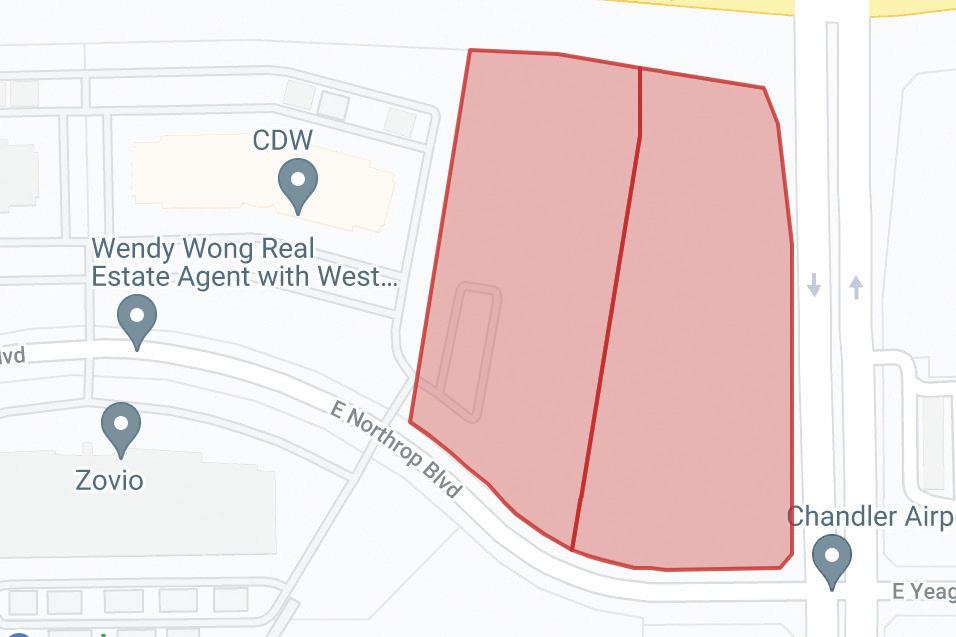



Andretti Indoor Karting paid just under $5 million for a 10.2-acre site at Cooper Road and the Santan Loop 202 Freeway. (Special to Santan Sun News)
Gilbe r t location opening Fall 2021
2000 S. San Tan Village Parkway Gilbert AZ 85295

In the very near future, Copenhagen will be announcing the opening of our brand new showroom, to be located in the heart of Gilbert’s thriving shopping district, and directly across from San Tan Village Mall. This newly constructed, 32,000 square foot showroom will offer inspiring furniture vignettes, with a specific focus on the contemporary and modern designs you’ve come to know at Copenhagen. Of course, our classic Scandinavian, our fine collection of teak furniture, as well as our fabulous collection of contemporary accessories, including art, rugs and lighting, will also be represented. This will undoubtedly be the area’s most unique furniture shopping experience. We can’t wait to show it off. On behalf of the entire Copenhagen team, we looking forward to seeing you very soon!









Architectural rendering of the future Copenhagen, Gilbert. Construction is well under way!
www.ahwatukee.com
We want Shea Homes to keep its promises
BY DERIK HERPFER AFN Guest Writer
Has Shea Homes decided that it’s OK to break a 28-year-old promise made to the Club West community to build hundreds of new houses on the Club West Golf Course?
As the community knows, the golf course has been closed for over 3 years. Unfortunately, sometimes golf courses that were used to sell entire planned communities like Foothills Club West do indeed close for an assortment of reasons.
Shea’s return to Foothills Club West to carve up the “heart” of the community would be a flashing red-light warning to other golf communities across the USA – a builder could come back to take your open space views if your golf course closes.
This all sounds preposterous, but here’s what we know...
Shea Homes and the current owner of the golf course, The Edge, have announced that Shea Homes is under contract to purchase the golf course property.
This could result in 400+ new houses being built on the golf course if it is rezoned as standard R1-6 Single Family Residences across the 160+ acres.
In addition, The Edge has an option to purchase the golf course “declarant rights” from Shea Homes. It appears that The Edge believes it could use those rights to change the golf course use restrictions to allow homes to be built on the property. These rights are part of the Club West Golf Course “Declaration of Covenants, Conditions and Restrictions” created by UDC Homes (predecessor to Shea Homes) back in 1993.
These CC&Rs, as they’re commonly referred to, constituted a formal written promise to the Foothills Club West community that the land would be a high-quality golf course. On the very first page of the Declaration, it says that these protections were put in place “for the purpose of enhancing and protecting the value, desirability and attractiveness of Foothills Club West.”
On page 2 of the CC&Rs, it says, “At all times after December 31, 2008, the Golf

Course Property and all portions thereof shall be used as a golf course” and related facilities, and that the use of the property for any other purposes “shall be prohibited.”
Article 4 of the Declaration says that the Club West Golf Course would be “maintained in a first-class manner and at a level equal to or exceeding the maintenance level of other upscale, high-end, daily fee, public golf courses in Maricopa County, Arizona.”
Further, marketing materials from UDC
advertised that “People who purchase UDC homes and live on this golf course will have some of the most desirable sites in the entire Valley.”
As “promises,” these all seem pretty darn clear.
For many of the 350+ families that bought property adjacent to the golf course, the picture is even worse. UDC Homes wrote sales contracts that had addendums attached describing the promise of a golf course.
These families (and anyone who now

owns a house on the course) have paid premiums of $20,000-$80,000 to have homes with open space views.
Shea Homes, as the purchaser and legal successor to original developer UDC, appears to stand in the shoes of UDC for each and every one of these promises.
In 2010, Shea Homes indicated that it was “done” with development at Foothills Club West, when it voluntarily transferred the Declarant Rights to the Foothills Club West HOA at no cost.
Unfortunately, because the former Foothills Club West HOA Board did not follow the legal requirements of the HOA Master Declaration in accepting this assignment, the Golf Course Declarant Rights will likely revert back to Shea Homes.
That shouldn’t be a problem if Shea Homes keeps its promise to the community.
In April 2021, the Club West Conservancy contacted Shea’s top attorney to discern their intentions. At first, we were told that Shea did not want to get in the middle of any controversy at Foothills Club West and that Shea might happily assign the Declarant Rights to the CWC for safe keeping. Now, Shea has confirmed it is in escrow to purchase the golf course property and is conducting “due diligence.”
Why would Shea Homes believe that it is permissible for it to break a “promise” to the community regarding this land? Do they believe that Club West homeowners will not be quick enough to become aware of what is happening or strong enough to fight it? Do they not understand or care how the community feels about more new housing?
To make sure Shea truly understood the depth and breadth of the community’s stance against new houses, the CWC met with Shea Homes recently to review the June 2020 community survey results in detail.
This survey showed that 81 percent of the community would rather leave the land “As Is” with minimal maintenance instead of adding new houses. Even among people that live OFF the golf course, 76 percent of them said leave the land “As Is”
The Club West Golf Course has been barren since early 2018. (AFN file photo)
For a brief few months, a former owner of the course had brought the site back to life. (AFN file photo)
Twin 33s a viable solution to green shipping
BY DENNY BARNEY AFN Guest Writer
The well-being of our environment is more important than ever. As such, it’s time for us to consider modernizing our trucking industry, which moves about 72 percent of all freight in the United States.
When we order packages online, a domino effect occurs of boxes being loaded onto trucks to those trucks hitting the highways to hardworking delivery people dropping packages off at America’s doorsteps.
Thankfully, there is a simple solution to get this process done more efficiently and sustainably by modernizing federal regulations to allow trailers that are five feet longer than the 28-foot trailers currently permitted.
Arizona is one of 20 states in the U.S. that allow twin 33-foot trailers to operate. Lawmakers know the environmental and
Voting rights laws should be both legal and ethical
The Supreme Court ruled recently that certain Arizona voting rules do not violate the Voting Rights Act. But just because something is legal doesn’t mean it is ethical.
We all are familiar with the moral concept of balancing the letter and the spirit of the law. When we talk about observing the spirit of the law, we are acknowledging that the highest morality involves asking what is the best we can do, not what is the most we can get away with.
This framework can help us consider laws within their historical context, where we ask about the intent of the law and the people it seeks to protect or potentially exclude.
Historians agree that Congress intended the Voting Rights Act of 1965 to provide expansive protections for the right to vote. Just a year prior, some senators thought a voting rights law unnecessary.
WEST from page 36
because they didn’t want the construction noise, traffic, etc.
Further, Shea was also briefed on the landslide election of four new candidates to the HOA Board in March 2021 who ran
economic gains these trailers bring to our state and the technological advancements that make them safe.
Unfortunately, the remaining 30 states still adhere to the federal regulation set in the 1980s mandating that trailers cannot exceed more than 28 feet.
This regulation, set before the emergence of modern technology and our heavy reliance on e-commerce, does not take current obstacles of the shipping industry or our country’s increasing need for environmental sustainability into consideration.
“Twin 33s” are merely five feet longer than the trailers currently allowed by federal law, but their long-term benefits are clear. In addition to far-reaching safety and economic gains, these trailers play a crucial role in our fight to preserve our environment by using less gas and reducing carbon emissions.
In fact, the Americans for Modern Trans-
portation, noted that the adoption of Twin 33’ trailers equates to 274 million fewer gallons of fuel, 3.12 million fewer tons of CO2 emissions and 3.36 billion fewer vehicle miles traveled with transportation efficiencies.
Aside from using less gas and requiring fewer miles driven, Twin 33 trailers increase freight capacity by 18 percent while following the 80,000-lb. weight limit on truck freight. Given the various sizes and shapes of boxes our packages come in, these trailers get more people what they need by fitting a higher volume of boxes containing America’s multitude of online orders.
Trucks drive our nation’s economy, transporting a majority of freight each year and supplying our businesses with the goods they need to prosper.
As e-commerce continues to grow exponentially and more people rely on the ability to run their errands with the press of a button, our shipping industry must adapt
LETTERS TO THE EDITOR
Illinois Republican Everett Dirksen had already worked tirelessly to pass the Civil Rights Act, because he understood the moral imperative of equality, suggesting that “stronger than all the armies” is a law whose “time has come.”
However, after witnessing the horrifying violence of Bloody Sunday, Dirksen realized the Civil Rights Act was insufficient in protecting the right to vote, so he helped draft the revolutionary bill.
Exemplifying this noble spirit, the VRA has been accepted as one of the crown jewels of American democracy.
Looking for the underlying spirit can also reveal examples of laws with discriminatory purposes, even if the letter of the law appears neutral.
For instance, literacy tests for voting registration were designed to seem fair on their face, but they were often written and employed with racist intent to disenfranchise Black Americans.
What was the spirit of the Arizona voting
on a clear platform of “no houses.” This is a “read my lips” moment, but is Shea listening?
law addressed in the Brnovich decision, where the Court upheld policies that ban ballot collecting and throw out all out-ofprecinct ballots?
Although the law does not mention race, the effect of prohibiting volunteer collection of ballots is borne disproportionately by some Arizonans: Only 18 percent of Native Americans living on tribal lands have mail service to their homes.
As such, prohibiting ballot collecting can have a severe impact on casting a ballot. What could be the spirit behind trying to make it harder for them to vote?
The out-of-precinct policy also has discriminatory effects. As Justice Kagan pointed out in her dissent, Hispanics, Native Americans, and Black Americans in Arizona were twice as likely to have their ballots discarded than white voters.
Even if this result is accidental, a state committed to voting rights would seek to fix this imbalance.
We must be united in our commitment
It’s time for us to speak louder than ever before. If no action is taken, the sights and sounds of nature in our community will soon be overtaken by the sights and sounds of construction.
Every homeowner in Foothills Club West needs to make their voices heard – write to the AFN, our City Councilman Sal DiCiccio and the Zoning and Planning Commission. The people in the Club West Conservancy are not going to sit on their hands and
to keep pace with our modern needs.
The use of Twin 33s in Arizona has already proved successful, but because of the decades-old federal regulation they are not allowed to cross state borders. If the rest of the country allowed Twin 33s, we would see faster shipping times, thriving interstate commerce, and far less strain on our environment.
As we watch our nation’s infrastructure strive to become greener each day, our lawmakers should ensure the shipping industry does not fall behind by implementing greener policies like the adoption of Twin 33s.
I hope our senators will help the rest of the country experience the benefits of Twin 33s by advocating for their federal adoption in Congress.
Denny Barney is president and CEO of East Valley Partnership, a business owner and a former Maricopa County Supervisor. ■
to protect every American’s right to vote. We believe there were inspired elements to the Founding Fathers’ conception of “a more perfect union.”
As women of faith in the 21st century, we too ask: How can we form a more perfect union? Our faith compels us to seek the higher path — to speak out and do better. Let’s call on our senators to pass new laws that uphold the spirit of the Voting Rights Act, to ensure that every American’s right to vote is sacred. We face a formative moment in our democracy where we can determine what spirit to imbue into new legislation. We deserve voting laws that are both legal and ethical.
Christie Black is a director of advocacy for Mormon Women for Ethical Government. She resides in Mesa. Gilbert resident, Rachel Albertsen is the director of special projects for MWEG. ■ Rachel Albertsen Christie Black
we welcome you to join us. Please contact the CWC at ClubWestConservancy.org/ take-action to see how you can help. We still believe that promises are meant to be kept.
Derik Herpfer is president of the Club West Conservancy. ■

Cultured Pearl Three-Layer Necklace










Sports & Recreation



Pride player Timothy Allen dedicates season to late father
BY ZACH ALVIRA AFN Sports Editor
Troy Allen Sr., dressed in his blue Desert Vista polo shirt and white cap, settled into his seat on an early-morning �light to San Diego on Aug. 31, 2019.
As he buckled his seat belt in preparation for takeoff, he couldn’t help but crack a smile when asked if he had a son on the Thunder football team.
“Troy Allen,” he said in an upbeat way. Troy Sr. was traveling to watch his son and the rest of the Desert Vista varsity football team play in the Honor Bowl, an annual high school showcase that takes place in San Diego, and features teams from all over the country, including Arizona on some occasions. Desert Vista was scheduled to play Notre Dame from Sherman Oaks. Troy didn’t know much about the Knights other than they had similar uniforms to the Thunder.
He spoke highly of his son, a junior at the time. He also made sure to mention Timothy, a freshman at Desert Vista. Both play wide receiver and defensive back, just like he did. He was proud of that.
“It’s an understatement to say he was their biggest fan,” Tonya Allen, Troy Sr.’s wife and the boys’ mother, said. “He pushed for them to be their best, be their greatest. Even during times where they kind of slacked or got lazy, when he passed, they both wanted to go hard for their dad.”
Troy Sr. was diagnosed with calciphylaxis, a very rare but serious disease in which calcium accumulates in small blood vessels of the skin and fat tissues. He was also on dialysis and in need of a new kidney.
Tonya was a perfect match. But when COVID began the procedure was postponed. In May, when he began to have health problems, it was postponed again. On June 29, Troy Sr. died. He was 54. His death weighed heavily on his family. It shocked the South Mountain Baptist Church community, where he was a pastor for 13 years. But it was especially hard for Timothy.
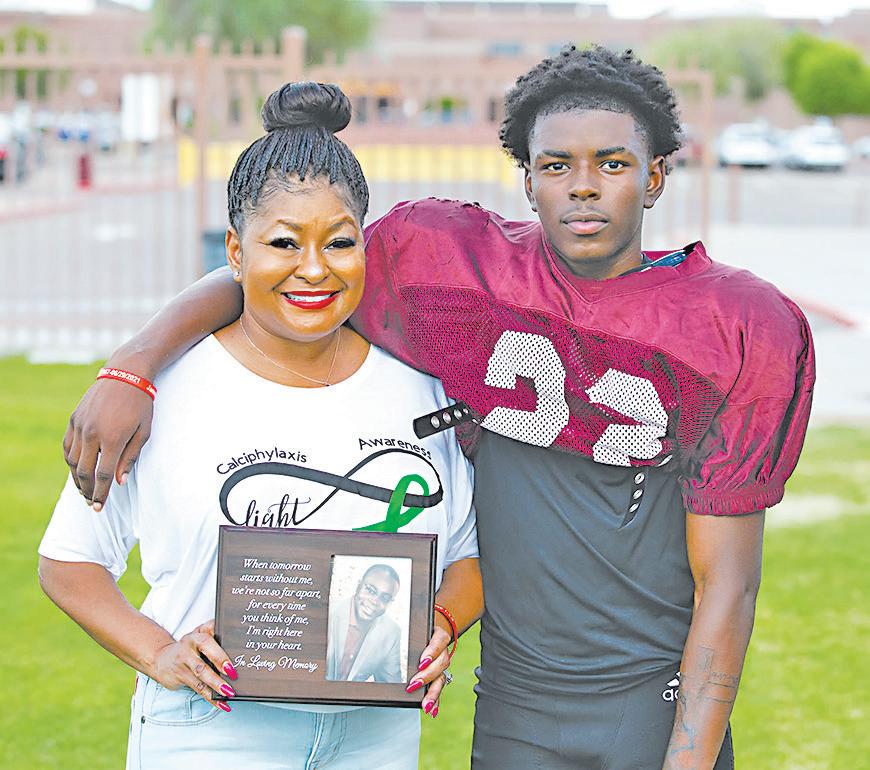
Mountain Pointe junior Timothy Allen lost his father, Troy Sr., just 10 days before he departed for football camp with the Pride this summer. He, his mother Tonya, and older brother Troy Jr. have found strength in each other and aim to honor Troy Sr.’s legacy on a daily basis. (Zac BonDurant/AFN Contributor)
“I was angry,” Timothy said. “I was angry at myself because I felt like I didn’t always treat him like how I was supposed to. It was hard, really hard. He was my mentor, and he was there for everything, sports and all.”
Troy Sr.’s death occurred just 10 days before Timothy was due to go to football camp with Mountain Pointe –where he transferred after his freshman year when Troy Jr. moved from Desert Vista to Saguaro for his se-
nior season.
Tonya was reluctant to let him go alone, asking head Pride coach Eric Lauer if she could accompany the team up north.
Lauer insisted Timothy would be in good hands, surrounded by his teammates and coaches.
Since returning, every day without his father has become a bit easier. One of the last conversations they had had was just before Timothy played in a 7-on-7 tournament. His father told him to “play hard.”
Timothy, who will turn 16 this month, got a tattoo on his left forearm in honor of his father. Tonya made an exception for his young age.
Along with a large cross, it has a lion symbolizing his father and the strength

Timothy plays wide receiver and corner back for the Pride, just like his father did when he played football. Not only does that mean a lot to Timothy, but his father took pride in coaching him and Troy Jr. (Zac BonDurant/AFN Contributor)
he had. It also has his birthday. Once it’s �inished, it will have both Troy Sr. and Tonya’s name – the two people who mean the most to him.
It included the phrase, “I love you forever.” On his right wrist he wears a band with his dad’s name.
Timothy has already dedicated his junior season to his father. That will likely carry over to the rest of his football career. Troy Jr., who is preparing to play his freshman season with the Salt River Scorpions, has done the same.
Both know their dad is with them at all times on the �ield, giving them strength to get through every practice and drill.
“Especially when I line up at corner back,” Timothy said, “that’s what he played. I can tell he’s there with me.”
To raise awareness for Calciphylaxis, Tonya started a foundation in his honor. Her and both boys have become heavily involved. The foundation and the bond they have as a family has allowed them to stay strong in a time of tragedy.
The foundation has also allowed them to carry on the strong legacy Troy Sr. left behind with his death.
“He was amazing,” Tonya said. “My boys are trying to follow in the path of integrity their dad had. That’s something I try to instill in them. Their father had a good name. Those are big footsteps to follow.”
Troy Sr.’s memory will forever remain with his family. Whether it’s the car he purchased for Timothy ahead of his 16th birthday while he was sick or the constant reminders that he is still with them in spirit on a daily basis, everything the family does going forward is in his honor.
That includes football. The game he had a passion for growing up and the love he shared with Troy Jr. and Timothy.
“He was the world to me,” Timothy said. “This will be a special year. I’m excited for the �irst game.”
If he’s able to �ind the end zone, he already planned his celebration.
“I’ll take a knee and look up to the sky. He’ll like that.” ■



Cigna Medicare Advantage plans offer all the coverage of Original Medicare plus added benefits that may include:
› $0 monthly premium
› $0 medical and $0 pharmacy deductible
› $0 primary care physician visits
› $0 lab copay
› $0 transportation to and from health services*
› $0 copay for many prescription drugs
› Over-the-counter allowance
› Fitness program, dental, vision and hearing services
› Telehealth Services – Virtual primary care physician visits, online or by phone
•
•
•
•
•

Lynn Marble
Phoenix Health Insurance (623) 516-8300
Monday to Friday: 8.00am to 5.00pm Or visit www.phxhealthinsurance.com
*Plan-approved locations and restrictions may apply by plan. Under 60-mile one-way trips.
All Cigna products and services are provided exclusively by or through operating subsidiaries of Cigna Corporation, including Cigna Health and Life Insurance Company, Cigna HealthCare of South Carolina, Inc., Cigna HealthCare of North Carolina, Inc., Cigna HealthCare of Georgia, Inc., Cigna HealthCare of Arizona, Inc., Cigna HealthCare of St. Louis, Inc., HealthSpring Life & Health Insurance Company, Inc., HealthSpring of Florida, Inc., Bravo Health Mid-Atlantic, Inc., and Bravo Health Pennsylvania, Inc. The Cigna name, logos, and other Cigna marks are owned by Cigna Intellectual Property, Inc. Cigna complies with applicable Federal civil rights laws and does not discriminate on the basis of race, color, national origin, age disability or sex. Cigna cumple con las leyes federales de derechos civiles aplicables y no dicrimina por motivos de raza, color, nacionalidad, edad, discapacidad o sexo. English: ATTENTION: If you speak English, language assistance services, free of charge are available to you. Call 1-888-284-0268 (TTY 711). Spanish: ATENCIÓN: Si habla español, tiene a su disposición servicios gratuitos de asistencia lingüística. Llame al 1-888-284-0268 (TTY 711). Chinese: 注意: 如 果您 使 用繁體中文, 您可以 免 費獲得語言援助服務. 請致電 1-888-284-0268 (TTY 711). Cigna is contracted with Medicare for PDP plans, HMO and PPO plans in select states, and with select State Medicaid programs. Enrollment in Cigna depends on contract renewal. © 2021 Cigna
Y0036_21_92127_M 936621 b



Young talent aplenty in Valley theatre fundraiser
When Valley Youth Theatre streams its VYTal Affair-athon fundraiser this Saturday, Ahwatuikee residents may recognize a couple of familiar faces on VYT’s stage.
Nearly 100 performers will take part in this year’s eight-hour, Jerry Lewis-style telethon featuring live and recorded interviews and performances from current “VYTkids” and alumni cast members – including stars of stage and screen like Broadway’s Nick Cartell, who recently completed a two-and-a-half-year run as Jean Valjean in the National Tour of “Les Misérables.”
The fundraiser will stream live from 10 a.m. to 6 p.m. Aug. 21 at vyt.com and on Facebook at facebook.com/valleyyouththeatre. Viewers can tune in and out anytime throughout the day.
Jessica Wastchak has been singing and dancing across the Valley since she was 5. She will give one last performance before she begins her freshman year at New York University’s Tisch Drama department.
And it’s only �itting that her �inal act bene�it VYT.
“VYT has been a constant in this crazy COVID time,” said Jessica, who has performed in six VYT productions and is part of VYTeens, the theater company’s teen show choir. “I’m grateful for everything they have given me in the last few years and want to help in any way I can.”
She’s not the only one who feels that way. Indeed, performers and alumni from productions over the past three decades jumped at the opportunity to participate in the fundraiser – including 16-year-old Makenna Jacobs.
“At the age of 7, I was introduced to – and found my love for – theater while performing in my �irst musical at VYT,” she said. Nine years later and she’s made a name for herself on the Valley theater scene. She has performed in nine VYT productions in the last eight years – including the roles of Cindy Lou Who in “Seussical JR,” Piglet in

performers as young as 9 years old, seasoned professionals who were in our shows 30 years ago and everyone in between. It’s going to be a day of amazing performances.”
The opportunity to perform in VYTal Affair-athon is especially sweet for Jessica considering the challenges of the last year.
“I went from being extremely busy to not having anything on my calendar in less than a week once the pandemic hit,” she said. “It was a major life shift, but there was a silver lining as I headed into the college audition process.
in life.”
Most of the performances were pre-recorded in July. In addition to vocal performances, the event will include live Zoom interviews with alumni, multi-track numbers and a few surprise guests.
A highlight of the fundraiser is the 21year reunion of the cast of West Side Story, which played at VYT in 2000.
Five alumni performers from the original production – Nick Cartell, Katie “Rex” Casey, Chris Ciccarelli, Sharie “Combs” Nievar and Ian Sidden – will come together for a virtual performance of the powerful “Tonight Quintet.”
Each hour of the telethon will be hosted by a local celebrity, including Yetta Gibson, Gina Salazar Hook, John Hook, Brad Perry and Carey Peña. The fundraiser will also include a silent auction featuring travel, entertainment, skin care, spa, hotel, food and beverage and dozens of other packages.
“A Winnie-the-Pooh Christmas Tail. It also includes the title role in “Pinkalicious.”
Makenna has collected a slew of awards from the National Association of Teachers of Singing (NATS) Arizona District, Southwest Regional and National competitions.
She will show off her vocal chops with a performance of “All American Girl” during VYTal Affair-athon.
Jessica also is one to watch. She will perform “What Baking Can Do” from the beloved musical “Waitress.” At only 18, she already has won multiple National Youth Arts awards along with district, regional and national NATS recognition.
“VYTal Affair-athon is an opportunity to showcase the incredible talent in Phoenix to people around the world,” said Bobb Cooper, VYT’s longtime artistic director.
“The cast for this fundraiser includes
“There was nothing to stop me from focusing only on training and I ended up getting accepted into my dream school, NYU. I am so excited to perform in VYTal one last time before I leave.”
The sentiment is echoed by Makenna.
“VYT and theater have taught me the importance of hard work and perseverance, not only in my life onstage, but offstage, too,” she said.
The virtual event replaces the 27th annual VYTal Affair, the theater’s biggest annual fundraiser. It’s the second year the COVID-19 crisis prompted VYT to take the event online.
Said Cooper, “We are truly grateful for the swell of support we’ve received over the last 18 months. It has touched our hearts and reaf�irmed our commitment to inspire young people to be the best they can be – on stage and, more importantly,
“This fundraiser will jump-start the next phase of Valley Youth Theatre,” said Cooper. Indeed, the theater just announced its return to live performances. VYT will stage “Spookley the Square Pumpkin, The Musical” from Oct. 1-31. Rounding out the season are the 25th annual production of “A Winnie-the-Pooh Christmas Tail,” “Sleeping Beauty,” “Junie B. Jones, The Musical” and “High School Musical.”
For information about VYTal Affair-athon sponsorships, donations or providing an in-kind gift to the telethon, visit vyt.com.
High-pro�ile performers who got their start at VYT include Emma Stone, Jordin Sparks, Kimiko Glenn, Chelsea Kane, Max Crumm, Matt Dallas, Columbus Short, Nick Cartell and Sam Primack. ■



Makenna Jacobs performed in “Pinkalicious” and will be one of the young stars in Valley Youth Theatre’s virtual fundraiser Saturday. (Courtesy Valley Youth Theatre)
Mesa vet’s cidery announces statewide expansion
BY JORDAN HOUSTON Tribune Staff Writer
Mesa veteran Jason Duren knew at an early age he was destined to help people. When two traumatic brain injuries prematurely ended his active Marine career, the father of two felt lost – but he refused to give up.
Duren has now recommitted to his purpose by cultivating one of Arizona’s largest cideries with his brother, Josh. Cider Corps embodies Duren’s love for cidermaking and his desire to uplift veterans.
Over the years, it has built a reputation as a space for community members to gather, connect and support local veterans through awareness – and it is only continuing to grow.
Cider Corps, which sits at 31 S. Robson Drive, recently announced the statewide expansion of its award-winning hard cider Mango Foxtrot. The beverage, a blend of mango and rose hip with an apple cider base, is now available at most of Arizona’s Sprouts Fresh Markets, according to Duren.
“This entire team just believes in this story and community,” Duren said. “The cider is just a catalyst for healing that can happen in the community over a drink.”
As the company’s �irst statewide distribution, Mango Foxtrot is sold in fourpacks throughout Phoenix, Flagstaff, Tucson, Oro Valley and Prescott Valley.
The style, which has a 7 percent ABV, won a gold medal at the 2019 U.S. Open Cider Championships. It is also one of the most favored �lavors at the cidery.
In addition to Sprouts, Cider Corps’ canned ciders are available at Phoenixarea Whole Foods, AJ’s Fine Foods, Total Wine and a handful of independent package and bottle shops.
Founded in 2017, the Cider Corps taproom is in a 1900s-era building that was once the Mesa police station. Cider Corps features 12 to 15 alternating cider styles and three cider slushie �lavors available in the taproom by the glass. It is open for dine in and take away, and features online ordering.
It has partnered with Myke’s Pizza for an independent fast-casual restaurant concept, Duren shares. It also offers Pair Coffee & Tea, adding a full coffee bar, espresso drinks, coffee pour overs and artisan teas. Duren, a judge advocate for the Military Order of the Purple Heart, seeks to utilize

his operation to give back to the veteran community.
With a mission statement of “Drink Great Ciders. Honor Great Sacri�ice,” Cider Corps serves as a platform for veterans to be honored through awareness, Duren continues.
Cider Corps frequently features an “Honor Series” of ciders, highlighting different Marine units by featuring their logos on the can.
“Josh does the graphics around it, and we base the cider off it [the unit],” Duren said. “So, when you’re drinking it, the hope is that you look up some of the information about the cause on the key in.”
The for-pro�it organization consistently partners with veteran-oriented nonpro�its in Arizona and California, according Duren. The company has raised funds to help veterans pair up and put service animals through training, as well aid a Californiabased nonpro�it build adaptive athlete sur�boards.
The goal is to partner with veterangeared nonpro�its that are “a making a change in their community,” Duren said.
“I knew I wanted to do something forpro�it and then support some of these guys that are doing real things in veterans’ lives and just be a small part of that.”
Raised in Kansas, Duren joined the marine corps in 2009 after moving to Arizona. A natural-born athlete and college-recruited pole vaulter, Duren said he wanted to join the force to give back to his community.
While deployed in Afghanistan in 2013,


Duren suffered two traumatic brain injuries from multiple IED blasts, leading to a long road to recovery.
“During that time, I wanted to spend a lot of time by myself,” he said. “I was in the garage a lot and Josh started coming over quite a bit. We decided to �ind a hobby we could do together that requires (mental) processing.
“They (doctors) would say that we have to process information, recognize something that you want to change, and then change it. That is part of the brain mapping.”
During the retirement process, Jason and Josh experimented with cider making as a hobby and as therapeutic outlet for Jason.
Out of this hobby has come a unique technique for cider making.
“What is probably the most unique aspect of how we make our ciders at Cider Corps comes at the �inal stages of fermentation called malolactic fermentation,” Duren said. “This technique converts the malic acid in apples to lactic acid – essentially creating a ‘softer’ mouthfeel and reducing the sour or ‘sharper’ �lavor pro�iles most
people associate with hard apple ciders. The end product is a perfectly balanced cider unlike anything you have tasted.”
The �lavor comes directly from apples and other fruits, so it doesn’t need additional extracts or sugars.
Cider Corps released its �irst two ciders in September 2017 and continued to make more styles while building out their taproom. They opened the taproom doors to the public on Veterans Day, November 11, 2017, and sold 2,600 pints on that �irst day.
Since then, they have seen the taproom become the gathering spot they hoped for: a space where community members can honor the sacri�ice of its veterans while raising awareness for the obstacles they face upon returning home.
Due to an increase in demand, Cider Corps recently expanded its production to Gilbert, according to Duren.
Duren said he hopes to move all cider production to a 14,000-square-foot facility in Gilbert next year, he added. The Mesa location will remain open as a taproom. ■
Retired veteran Jason Duren has made it his mission to give back to veterans after two traumatic brain injuries ended his active-duty career. He is now the co-owner of one of Arizona’s largest cideries. (Courtesy of Jason Duren)




Right about this time of the year in Arizona, we look at big, heavy meals and well, they just don’t look appetizing because of the heat.
That’s when charcuterie boards and light bites are a welcome meal or appetizer.
Caponata is the perfect choice for days like that; when noshing is the most satisfying. This dish called Caponata, a sweet and savory fresh vegetable sauté comes from the Sicilian side of my family, my father’s side.
I’ve share with you before that I grew up in a civil war zone of sorts, between the North and the South. Momma is from Venice, (northern Italy) and dad came from Trapani, the southernmost tip of Sicily’s “boot.”

Friendly battles have raged at the kitchen table all of my life, with the northern contingency (Mom) insisting that food from the north, like risotto, polenta and osso buco are much preferred over southern Italy’s arancini, calzones and of course, caponata.
Guess who was the big winner in the plate wars? Me! I loved it all, and didn’t mind the friendly fire of food one bit.
Caponata is delicious either as an appetizer on toasted baguette slices or as or a light afternoon meal served over pasta or steamed rice. If you’ve heard the term “agrodolce,” caponata’s sauce is the perfect example. Its name comes from “agro” meaning sour and “dolce” meaning sweet. The sweetness comes from sautéed
Ingredients:
½ cup olive oil, divided
1 cup chopped sweet yellow onion
1 cup chopped celery
1 large eggplant, peeled and cut into one inch cubes
1 (28 oz) can of crushed tomatoes or tomato sauce
1 (4 oz) jar of small capers
Directions:
Heat in a large (12-inch) skillet, 3-4 tablespoons of olive oil.
Add onions and celery, cooking for 6 minutes.
Add cubed eggplant. Cook for 12 minutes stirring occasionally. Add remainder of olive oil a little at a time during the 12 minutes.
Stir in crushed tomatoes, capers, basil, red wine vinegar, sugar, salt, and pepper.
yellow onion and a little bit of sugar, while the sour is derived from the capers and vinegar. There are a whole lot of delicious flavors in between, and the best part is, you can make up a big batch and enjoy it all week long in various recipes.
This week, Dad’s side wins the battle, but the Italian food war is far from over! ■

½ cup fresh or dried basil
¼ cup red wine vinegar
3 tablespoons sugar
1 teaspoon salt
1 teaspoon pepper
1 (6oz) large can of black pitted ripe olives, sliced
8 large green olives stu ed with pimiento, sliced
Simmer until all vegetables are fork tender, about 20 minutes, stirring occasionally.
Spoon mixture into large bowl and add black and green olives.
Serve mixture warm or at room temperature. Refrigerate remaining caponata.
Serve with pasta, rice or crustini (toasted baguette.)
Note: Make at least one day in advance of serving. Mixture can be frozen in large batches. ■








FREEDOM.




TO BE YOU.


If you think oxygen therapy means slowing down, it’s time for a welcome breath of fresh air.
Introducing the Inogen One family of portable oxygen systems. With no need for bulky tanks, each concentrator is designed to keep you active via Inogen’s Intelligent Delivery Technology.® Hours of quiet and consistent oxygen flow on a long-lasting battery charge enabling freedom of movement, whether at home or on the road. Every Inogen One meets FAA requirements for travel ensuring the freedom to be you.




• No heavy oxygen tanks
• Ultra quiet operation
• Safe for car and air travel
• Full range of options and accessories
• FDA approved and clinically validated

• Lightweight and easy to use