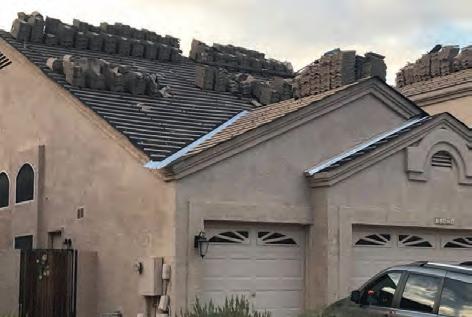
State Superintendent of Public Instruction Kathy Hoffman on Monday released a 35-page document of guidelines for reopening schools in August that could become
a handy tool for parents in deciding whether they want to send their children to campuses – and what questions they should be asking their kids’ schools.
Stressing the guidelines are designed to provide districts “with parameters and options as they develop their own contingency
plans,” the state Department of Education’s “Roadmap for Reopening Schools” raises a myriad of issues that could impact everyone from students to taxpayers.
The options raise the possibility of potentially significant costs for districts, like buying
Foothills HOA meeting turns heated over election timing
BY PAUL MARYNIAK AFN Executive Editor
An effort to partially stymie the impact of a special election on changes to the Foothills Community Association charter bylaws backfired when four of its seven board members refused to support longtime HOA President Bill Fautsch.
The dramatic outcome of a debate during the board’s virtual meeting last Wednesday set the stage for a special election this summer before its annual board election.
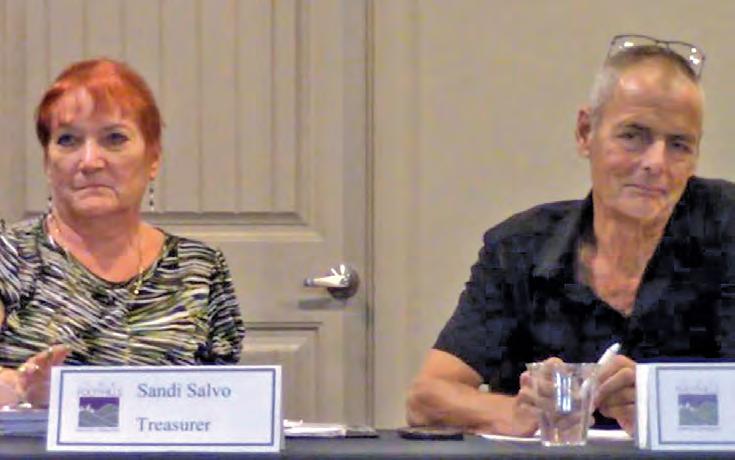
That special election will be on a set of five proposals – including one setting term limits that, if approved, would sideline board Treasurer Sandy Salvo, a longtime Fautsch ally, from running for reelection to her sev-
enth term.
About 1,200 Foothills Association members had signed the petition for the special election that had been circulated over several months by a group of residents.
The petition lists five measures impacting the associations bylaws.
details, see page 29. (Pablo Robles/AFN Staff Photographer)
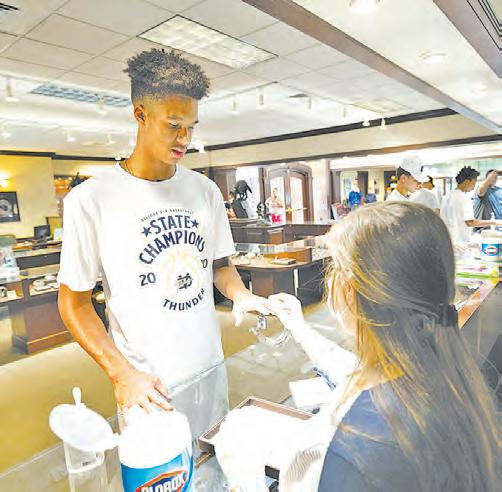
Desert Vista High School’s varsity basketball team got together Saturday for a joyous reason - getting measured for their championship rings. With Coach Gino Clump at the far left, players include, from left, Justin Phillips, Terrance Dixon, Caleb Harberston, Tayan Thompson, Andrew King, Dasean Lecque, Osasere Ighodaro, Brandon Trilli and Daylyn Martin. (For
TheAhwatukeeFoothillsNewsis published every Wednesday and distributed free of charge to homes and in single-copy locations throughout Ahwatukee Foothills.
Times Media Group: 1620 W. Fountainhead Parkway, Suite 219
Production Coordinator: Courtney Oldham 480-898-5617 production@timespublications.com
Reporters: Jim Walsh, 480-898-5639 jwalshe@ahwatukee.com
Wayne Schutsky, 480-898-6533 wschutsky@timespublications.com Cecilla Chan. 480-898-5613, cchan@timespublications.com
Ahwatukee Foothills News is
or
at aaron@ azintegatedmedia.com.
WRITE A LETTER
To submit a letter,
EDITORIAL
Foothills News expresses its opinion. Opinions expressed in guest commentaries, perspectives, cartoons or letters to the editor are those of the author.
ADVERTISING CONTENT
The content and claims of any advertisement are the sole responsibility of the advertiser. The Ahwatukee Foothills News assumes no responsibility for the claims or content of any advertisement.
BY PAUL MARYNIAK AFN Executive Editor
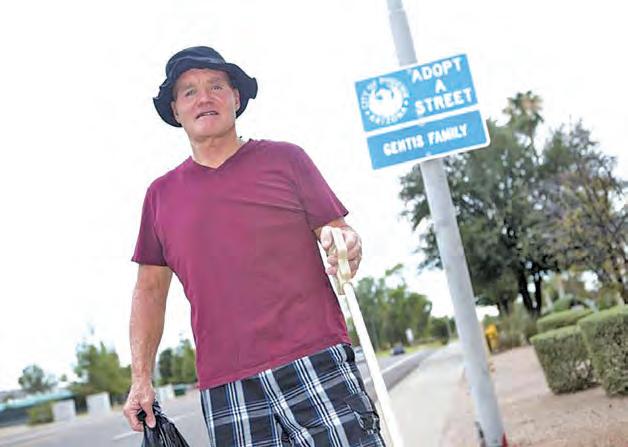
Now that he’s seen the paperwork, a former longtime director on the Ahwatukee Board of Management still believes that HOA obtained a loan of $178,750 from a federal program designed to help pandemic-crippled businesses without getting homeowner approval as required by the association’s bylaws.
But retired Phoenix Police lieutenant Christopher Gentis said he doubts he can do anything to even protest the action since the board won’t be meeting again until September.
“To me the whole application had to be manipulated because we’re not a business,” said Gentis, who was a board member for 22 years, half that time as an officer, including president for seven.
The federal Payroll Protection Program is part of the $2 trillion Coronavirus Aid, Relief and Economic Security Act passed by Congress to address the economic fallout of the pandemic.
Its specific purpose was to help businesses meet their payroll and cover mortgage payments and utilities for eight weeks.
But Gentis said ABM’s full-time employees kept working from home throughout the duration of the governor’s executive orders that shut down nonessential businesses for more than two months.
Moreover, he said ABM can count annual on more than $1.2 million in revenue from annual homeowner fees.
“We’re not a business,” he said. “We are there for the lot owners and when you look at the corporation commission’s designation – what kind of corporation
Christoper Gentis had been a member of ABM’s board for 22 years, including seven as president, and said the HOA should not have received pandemic relief money aimed at struggling businesses. (AFN file photo)
we are – it is a non-profit corporation for the benefit of a group of people, which is the homeowners. We’re not designed to make money.”
Gentis said HOA bylaws require a homeowner vote on any loan over $100,000, although board President Carolyn Johnson has disputed his characterization of the money, calling it a grant.
She also has said the relief funds were needed to cover ABM’s significant losses from cancellations of weddings, parties and other events at the HOA’s activities center as well as the loss of fees from the closure of its tennis courts.
But Gentis said, “The community center was always a side thing and now it’s apparently grown into a business.”
As for ABM’s employees, he said, “all the employees would have been budgeted for the fiscal year, which in the world is Jan. 8 to Dec. 31.
“There’s no way that the income from
the community center covers the payroll because the money is already there, it’s already planned.”
“The whole purpose of my HOA is to maintain property values and quality of life,” he said. “That’s the whole purpose and the quality of life is for the lot owners”
The application that was signed by two HOA employees who were listed as “secretary” and “assistant treasurer” repeatedly states the money is a loan.
But it also states, “Loan forgiveness will be provided for the sum of documented payroll costs, covered mortgage interest payments, covered rent payments and covered utilities.”
Gentis said the board held an emergency meeting last month, apparently to vote to accept the money after receiving word its request had been approved. But he said the board never contacted him or any other homeowner he was aware of.
“They already knew how I feel but it would have been nice if at least they
would have asked for my written argument and then at least had it read before they made a decision,” he said, adding he had found out about the emergency meeting accidentally after it had already been held.
Gentis said he’s frustrated, citing publicity about businesses that couldn’t get the federal aid for a variety of reasons and were facing financial ruin because of the pandemic.
In response to reports of large national companies getting millions in PPP funds, Treasury Secretary Steven Mnunchin vowed audits and suggested there would be penalties if those recipients had other sources of capital.
Forbes magazine reported that his warning “was not directed at small, independently owned companies.”
“If your business obtained under $500,000 or perhaps even under $1,000,000 in PPP loans, it is highly unlikely this audit will occur and you will face any liability,” Forbes advised readers.
“It is important to remember, it is your lender who will review documentation after eight weeks to determine forgiveness based on use of funds,” it added. “Lenders are working towards an easy mechanism to approve forgiveness of most loans ‘at the push of button’ and forsake lengthy reviews.”
Gentis said he likely won’t fight with ABM any more.
“We move on,” he said. “I’ve said my peace.
“I think I represent a vast majority of people within the HOA, especially the age-restricted neighborhoods that don’t understand why this would be important to do this.”
Besides, he added, the federal program itself “is just about to the point where they can’t find enough investigators to investigate all the issues in this or it would take 100 years. In the long run, it’s free money.”
8747 S. Priest Dr., Ste. 101, Tempe, AZ 85284 mike@azms.net
#175156 Mike Langs, NMLS #175381
Investors close Club West Golf Course deal, still want homes
BY PAUL MARYNIAK AFN Executive Editor
Wilson Gee on Monday closed his deal with four investors who are buying the beleaguered Club West Golf Course and still want to still build some homes on part of it.
Although Gee could not be reached before AFN’s deadline, the Foothills Club West HOA board released a statement to residents saying the four men, who called themselves The Edge, closed escrow and are renaming the course “The Park at Club West.”
The board also asked for a limited number of residents to join a committee that it is forming to “help define and establish the needs of the community and to assure that they are addressed.”
“The new owner has contacted the Foothills Club West HOA board to establish a meeting to discuss what their hopes and plans for the property will be,” the statement said, although it did not indicate when that meeting would be held or if any resident will be allowed to attend, whether in-person or virtually.
“The new owners stated that they have changed their original plans for development and a golf course to a limited amount of development and a maximum amount of open park space,” the board said. “Community input is being requested as this will drive their proposed final plans for the property.”
The Edge had been in escrow on the property for months after a previous group of investors who had been in escrow to buy it walked away from the deal, saying Gee’s asking price of $850,000 was too high for the amount of work that would be needed to restore the 18-hole course.
The Edge presented a plan to Club West in January that proposed restructuring the course but keeping it at 18 holes and building a new clubhouse.
But the lynchpin of that plan was selling three sections of the course to Taylor Morrison for construction of 162 houses, mostly two-story homes.
That riled a number of homeowners,
particularly the 357 who paid premiumlot prices of as much as $60,000 to have property next to the golf course.
A nonprofit called the Club West Conservancy was formed by some of those residents as well as other homeowners who opposed the obstruction to views that houses would create for some homeowners.
Opposition was strong enough to prompt Taylor Morrison to pull out of its tentative deal with The Edge.
The sale climaxes three years of frustration for Gee but also comes at a time when the Conservancy is suing the board over the way it changed the land use regulations governing the site.
A hearing on that suit has not yet been scheduled and could affect the way homeowners would be asked to vote on any new plan presented by The Edge, which has dropped any golf course from its plans, presumably because it wouldn’t be selling enough land for enough homes to pay for it.
The Conservancy, which proposes a preserve or a park for the site, is accusing the board of violating the HOA’s bylaws by not submitting its changes to the course’s land-use regulations for a community-
golf course would be used. The board has asked Superior Court to dismiss the Conservancy’s suit.
The course was closed in the summer of 2016 after Gee said he could no longer afford to pay more than $700,000 a year for city water to irrigate it.
Homeowner Jim Lindstrom then put together a detailed plan that called for homeowners to buy the course, with each paying a portion of the rehabilitation and maintenance costs that would be based on the number of homeowners who participated in his plan.
wide vote. It argues any changes must be approved by 75 percent of the landowners. The Club West board’s changes make it possible for as few as about 400 homeowners to approve a change in the way the
But Lindstrom couldn’t secure enough interest and the course remained in disrepair until fall of 2017, when an Ahwatukee man, Richard Brueninger, reached a deal with Gee to buy it for $1 million. He restored the site to a luxurious green and reopened it for play until he fell in arrears by more than $160,000 on his city water bill. The city shut off the water, the course deteriorated quickly, and after a prolonged legal battle with Gee, Brueninger was out.
In September 2018, Gee put the course up for sale, pricing it at $850,000.
The Club West Golf Course is now called “The Park at Club West” after four investors calling themselves The Edge closed their deal to buy the beleagured site from Wilson Gee.
(Special to AFN)
Rashmi Bhatnagar,
It would establish an annual update and review of the bylaws; limit board members’ consecutive years of service to no more than two two-year terms; establish a policy for board elections that would include a more complete presentation of candidates’ backgrounds and platforms for member; establish a formal procurement policy to govern the expenditure of hundreds of thousands of dollars for landscaping and other HOA services; and implement electronic voting.
Fautsch, who has said he won’t run again for an office he has held for more than 10 years, did not oppose the special election. But he argued for it to occur on one day and be held after the annual board elections.
He cited the $10,000 cost of elections – an expense largely driven by state law that requires paper ballots – as well as concerns for social distancing if two election meetings attracted large crowds.
“I would be in favor of having the annual meeting and the special meeting at the same time and date,” Fautsch said. “It makes it easier. There’s a savings cost.
“I’m not running again, so there should be no concerns with any of the other members that have been rooting to get me out of this position. So, I think it makes sense that we do the annual meeting and then we have our special meeting after the annual meeting.”
The meeting had been relatively uneventful for the first two hours but quickly heated when the matter of scheduling the two elections came up.
David Randolph, one of the petition drive organizers, noted that the petition had been signed by roughly a quarter of the association’s approximate 4,200 homeowners and commercial members and said Fautsch’s proposal was “defying the will of a huge number of the association’s members.”
Fautsch told him: “I believe, David that you did have roughly 25 percent of
the membership voting in favor of it, although a lot of it was through misinformation, lies and deceptions. So, I don’t know that, if the truth were told, that you would have gotten the 25 percent.”
When Randolph countered, “Your comments are not very respectful,” Fautsch replied, “I’m just stating the truth.”
“That, I think, is a matter of perception, Bill,” Randolph shot back.
Some residents also suggested a special election could be avoided if Salvo opted not to run again, noting that the board has made some efforts to address the other four issues in the petition.
Committees of board members and residents have been meeting on those four other proposals, but the board had already rejected term limits – fueling the petition drive.
Board attorney Austin Baillio infuriated some residents when he told Randolph:
“There’s three fourths of the community that either is apathetic to your position or is against your position and the board. Although they do hear and are weighing your position, they also have to take into consideration all the rest of the homeowners in the community.
“But trust me when I say they don’t take this decision lightly that they have discussed the political impacts and the disharmony that decision might cause and yet for the reasons that they’ve articulated tonight, they do feel that having both meetings on the same night is the right thing to do.”
Resident Jim St. Leger told Baillio:
“Let’s look at the historical role for how many people have voted in annual elections. Right prior to the last year or two, the numbers were very, very low. So, I think 25 percent is a large number of people who have stepped forward to sign something, based on what we’ve had in the past.
“The truth is that amendment group – whether you agree with them or not –they got their number of votes required before the annual election and the process should dictate they get to go first.”
“They did what they were chartered to do based on the rules of this organization,” St. Leger continued. “We had a disruption called the coronavirus but now to sort of use that as an excuse to say, ‘Well now we’re going to push you aside and do a simultaneous vote, but you’re going to be second’ – that just feels directly unfair.”
Randolph also disputed the lawyer’s characterization.
“Most often if we go into a neighborhood and we knock on five doors and three of them answer and though they all signed, that doesn’t mean the other two people that weren’t home were any way opposed to this,” he said, adding:
“That just means they weren’t home… I think that any assumption that there is widespread opposition to these reforms is totally misplaced. I think that when the petition election comes, we will see massive support.”
Some board members also expressed uneasiness with Fautsch’s proposal.
Board member Drew Porter, for example, said, “This is taking some courage for me to say, I came into this meeting prepared to vote a certain way. … I’ve heard some well-reasoned arguments from some people I respect tonight and I’m rethinking.”
Salvo, who later abstained from voting on Fautsch’s failed measure, largely kept silent except to say at one point that she felt she was under personal attack by opponents of his move.
But, referring to both Salvo and Fautsch, St. Leger said, “My personal view this is absolutely not about the people. I’ve worked closely with both of them and I’ve enjoyed our time together collaborating on projects, but I’m all about the process…by which we implement the bylaws of the community.”
Fautsch insisted on pressing for a vote – and found only one member supporting him.
“So now we will have to set our special meeting date first and then when we set our annual meeting,” he said afterward. As they were trying to determine dates, it was suggested there was a legal way to tighten the time between the two elections.
But Fautsch said, “No, I think after hearing everybody speaking, I would like to stay on as long as I possibly can. So, I would like to do it per the guidelines. I wouldn’t support shortening it. I’ll stay on the job until September - October if necessary.”
Longtime Foothills HOA treasurer Sandy Salvo and President Bill Fautsch listen to members during an in-person meeting last year. (Special to AFN)
from page 1
more buses and increasing class space; an array of daily inconveniences for parents, like staggered schedules; headaches for teachers and staff, like daily testing and repetitive hygiene instruction; and huge disappointments for students at every grade level, such as making field trips and assemblies virtual and curbing participation in large activities such as sports.
And it calls on the State Legislature –which would have to be convened for a special session – to give districts a break on regulations affecting their per-pupil reimbursement and increasing their flexibility for teaching kids.
“There have been growing concerns regarding public school budget stability due to potential shifts in student enrollment and attendance and the ability to expand and offer learning opportunities in either or both a traditional brick and mortar setting or through a virtual platform,” the roadmap states.
“School leaders are exploring various instructional models in which students could learn from home on a partial or full-time basis,” it continues. “However, state statute currently does not fully ac-
commodate the need to implement new and multiple types of instructional models, including for distance learning.”
Kyrene Superintendent Dr. Jan Vesely said she would present the district’s reopening plan to the Governing Board next Tuesday, June 9.
Kyrene has assembled multiple committees to address the myriad of issues, with a 40-member Emergency Management Team overseeing 11 “design teams” to drill down on issues like daily logistics and technology.
“It will reflect a commitment to safety, choices, well-being and personalization for every student,” Vesely said in a prepared statement.
And she reiterated what Hoffman and Gov. Doug Ducey told a group of superintendents from across the state last week: “The roadmap does not issue directives but gives school districts flexibility to determine the best way to execute guidelines within our own school environments.”
Tempe Union Superintendent Dr. Kevin Mendivil said, “We are closely reviewing these newest recommendations as we plan options for reopening in the fakk and consider what will best work for TUHSD students and families.
“Our goal is to provide learning opportunities for our students while ensuring the safety of all involved in the educational process,” he added.
The roadmap lays out four scenarios districts should consider, depending on their level of preparation.
Key to all four scenarios is districts’ ability to follow the “decision tree” laid out by the U.S. Center for Disease Control and Protection.
The very first guideline in that threestep self-evaluation process advises districts not to reopen campuses if it cannot screen students and employees for symptoms and exposure history and cannot protect the higher risk people.
The first scenario OKs reopening if there is “non-to-minimal local/community cases of COVID-19,” a school board approved contingency plan, “clearly communicated screening expectations” and a plan to address the “medically fragile.”
A second scenario poses a hybrid approach with both distance learning and brick-and-mortar classes.
The roadmap does not address how distance learning might work for high school lab classes or for students in vocational training such as Tempe Union’s
Career and Technical Education program and those attending the East Valley Institute of Technology a half day each day.
A third involves starting the 2020-21 school year the same way the 2019-20 school year ended – with all students learning from home until the district feels it can meet reopen campuses and the fourth scenario involves emergency closures.
The roadmap advises districts to identify essential functions and then address non-essential ones such as after-school activities, field trips and sporting events.
The roadmap and related information also provide a thorough list of issues that parents can consider in deciding whether to send their kids back to school as soon as campuses reopen. The material is at azed. gov/communications/2020/03/10/ guidance-to-schools-on-covid-19.
The questions the roadmap asks the district officials to ask themselves could easily be asked of them by parents.
They include questions like how prepared is everyone for a sudden shift to an all-distance learning set-up, what hardware and software is needed for disabled students and how will staff be
Survey shows strong school reopening reservations
BY HOWARD FISCHER Capitol Media Services
Gov. Doug Ducey may be ready to send kids back into the classroom as soon as this coming week.
But many Arizonans do not share his views.
A new survey shows just 52 percent of those questioned said they would allow children to go back to school even though the governor allowed his stay-at-home order to expire earlier this month.
HighGround, a political consulting firm, found that just 29.5 percent of respondents to its survey said they would definitely permit kids to go to school and 22.5 percent were in the “probably yes’’ category.
More significant, nearly one out of every five people surveyed who actually have children in school said they would definitely not be putting their kids into seats.
The effects on the children aside, that could have devastating effects on districts’ finances since the state aid they get depends on attendance.
It was only a special provision in state law this year that kept the funds coming at the same regular rate for students who were being taught at home.
The only way those who don’t attend brick-and-mortar classes could be counted for purposes of state aid would be if the students are engaged in a state-certified online instruction program.
The Arizona Board of Education has
SCHOOL from page 14
trained in safety protocols and how will those protocols be enforced.
Students also could expect a much different environment when they return if some suggestions are implemented. They include the possibility of having to wear masks on school buses, sitting at desks that all face in the same direction rather than toward each other or sitting only on one side of work tables safely distant from each other and even being advised how to walk in corridors and maintain social distancing.
Besides smaller classes, the road map also suggests that teachers and the same students remain together for most if not
established a quicker process to get that certification, assigning Rio Salado College to evaluate the quality of districts’ online learning platforms.
Districts that have certified online programs for only some grades must get certified for expanding it for others.
State schools chief Kathy Hoffman, in a statement to Capitol Media Services, acknowledged that there is some hesitation among parents – putting the burden on schools.
“Arizona Department of Education urges over-communication with parents and families, as well as including them in the process as schools develop their plans,’’ Hoffman said. “When parents know what the plans are and can provide input, they’re more likely to be assured regarding health and safety issues.’’
Hoffman said schools need to take the lead “with the utmost empathy and flexibility.’’ But she said that things “will look different than those of previous years.’’
Pollster Paul Bentz said the guidance that Hoffman provides and what school officials tell parents could have a huge effect.
He pointed out that fully 14 percent of the 400 people surveyed said they did not know whether kids should be back in school.
By contrast, Bentz said, people had more definite views, whether pro or con, about other activities. For example, fewer than 2 percent of people have no views about whether they’re willing to go to a movie.
And the “don’t know’’ figure for dine-in
all the school day – a difficult, if not impossible, scenario especially for high school students, given that they all don’t take the same subjects in a semester.
The roadmap also suggests that districts close common areas like cafeterias and playgrounds, letting kids eat in the classroom or otherwise “stagger use and clean and disinfect between use.”
And when social distancing is not possible, it suggests districts may want to consider limiting nonessential volunteers, visitors and “activities involving external groups or organizations as possible, especially with individuals who are not from the local geographic area.”
Hoffman also acknowledged that one of the first things teachers will have to de-
restaurants was just half a percent.
“The clarity that they (schools) can provide on what the protocols are going to be is critically important because that’s a movable audience,’’ he said.
Chuck Essigs, lobbyist for the Arizona Association of School Business Officials, said he expects that attendance on the first day of school will be low.
Essigs said a lot of parents are likely to take a wait-and-see attitude to decide if they feel safe about conditions.
And even if parents do decide that school is safe, there are more practical concerns.
He said if schools are supposed to be complying with social distance requirements, that means districts can’t put buses full of children on the road. So that, Essigs said, could mean having three times the number of bus runs just to transport the same number of children.
Bentz said the feelings about sending children to school relate directly to their level of concern about the virus -- and the economy.
He said there is a definite correlation between those who believe the governor is moving too fast in reopening the state and those who do not think school is a safe option.
He also said that those most worried about the push to get back to normal despite the ongoing outbreak tend to be younger.
“Voters in the 50-to-64 range were much more likely and much more desirous to get the state open and get the economy
termine if kids are back in school is what they learned during distance learning so schools can determine “which kids are needing the most support.”
“There may be kids that, during this time, have jumped ahead a grade level and maybe students who are working and need a lot more review from this past academic year that have really missed a lot,” she said.
She also suggested a survey showing 18 percent of parents are unwilling to send the kids back to school could be addressed with more information.
“I would encourage them to be as involved as possible and for our schools to be over-communicating with families on what types of policies and proce-
moving,’’ Bentz said.
He said the likely reason for that is pure economics.
“Those folks are often 10 years or less away from retirement and are looking at their 401(k) and looking at their longterm economic growth and want to make sure they’ve got something to retire to,’’ And then there’s the politics of it all.
Bentz said that half of Republicans questioned believe that Ducey’s efforts are proceeding at just the right pace, with nearly a third saying he is going too slow.
Among Democrats, however, just a quarter find Ducey’s plans to be appropriate, with nearly 70 percent saying he’s moving too fast.
“Some of these folks are not going to be satisfied with anything that’s being done to reopen, and that’s from the Left, in the same manner that, on the Right, that there’s about 30 percent of Republicans that think everything is happening way too slow,’’ Bentz said.
In fact, he said, a majority of Republicans are willing to do pretty much anything now like dining out, bars and movie theaters.
“But the rest of the electorate is much more cautious of those large public gatherings,’’ Bentz said.
The live telephone survey using a combination of landlines and cell phone was conducted April 18-22 among likely Arizona voters – those who have a history of participating in prior elections. It has a margin of error of 4.9 percent.
dures they are putting into place to make schools as safe as possible,” Hoffman said. As for money to pay for more computers, more teachers and other expenses, she pointed to Arizona’s “rainy day fund” of more than $1 billion and said that unlike in other states, there has been no realistic talk about cutting state aid.
She also said schools might get some help from federal pandemic relief, although U.S. Education Secretary Betsy Devos last Friday reasserted her determination to force public schools to share that money with private schools - those charging tuition - by crafting an order.
(Howard Fischer of Capitol Media Services contributed to this report.)
ANSWERS TO PUZZLES AND SUDOKU from Page 31
www.ahwatukee.com
BY COTY DOLORES MIRANDA AFN Contributor
Lindsay “Linden” Eller grew up in Ahwatukee and has come home to be with her family during the pandemic with a goal to spread joy worldwide.
She’s launched FREE JOY, which she started as a community kindness experiment in Flagstaff – where she settled after six years traveling abroad – and has expanded into a “global kindness project.”
“I started the FREE JOY project in Flagstaff as sort of a community kindness experiment,” she explained. “I’d make these little packets filled with delights of all sorts and leave them around the city, including an art gallery, a coffee shop and my yoga studio.”
Eller, who attended Kyrene de la Colina and Centennial Middle School before graduating from Mountain Pointe High School, said the packets “were intended
Goat Yoga now has real and virtual �ield trips Ahwatukee artist aims to spread joy by mail
Motivating kids to do homework has been a challenge during the pandemic, so Gilbert’s Arizona Goat Yoga helped by offering virtual tours for classes to meet yoga goats, alpacas and chickens.
“I have three kids of my own and I see how hard it is now that school is online to get motivated to really do it,” said Arizona Goat Yoga owner April Gould. “I was trying to think of a way that we might be able to help and so we decided to do virtual field trips and that has been so much fun.”
Gould takes teachers and students around the Gilbert farm to show them the animals’ daily lives. The farm has 58 goats, 19 of whom are babies, two alpacas and six chickens.
Goat Yoga expects to reopen June 6 for
for people to take when they were having a low day.”
“When the pandemic started, I thought, the world could really use some FREE JOY! So, I expanded it to what it is currently, a matching system to connect people who want to offer something kind to people who need something kind.”
FREE JOY, located on her contemporary collage art website LindenEller.com/free-joy, allows the visitor to opt to “Give JOY” or “Receive JOY.”
To give JOY, people indicate whether they are willing to send more than one FREE JOY and willing to send it to someone outside their country.
Those opting to receive JOY can indicate their situation – such as “I am currently a health care worker aiding the COVID-19 pandemic” or “I am iso-
lated/living alone due to the COVID-19 pandemic” or “I have lost my job due to the
in-person field trips, though Gould said the online versions will continue because they have become a hit in and of themselves. Her first two online sessions next month are already full – as are the first
two in-person field trips.
“We are so excited,” said Gould.
“It’s already full, so we will be adding more and taking all precautions and recommendations from the CDC and Governor Doug Ducey.
“We will also be continuing virtual goat yoga classes, Zoom field trips/ birthday parties, alpaca meetings and ‘Goat Grams’... so there is still plenty to do for those who are not ready to go out or anyone out of state who can’t attend a class.”
The pandemic kept the farm from host-
COVID-19 pandemic.”
Once registered, Eller sends along further information and additional guidelines.
Eller than matches a giver and receiver, who communicate via snail mail.
“A first-class letter is only 55 cents or the giver may wish to send a parcel,” said Eller.
“It’s a different kind of gift, it’s handwritten, it’s physical. I hope to continue to encourage people to keep the written communication alive. I’ve traveled so much, I’ve always had the habit of writing letters, and receiving them has so much joy. I actually started writing letters as a child with my grandmother.”
The giver can send encouraging letters as well as things to brighten the recipient’s day.
“FREE JOY contents depend on the giver, but should centralize around things that would lift someone’s spirit,” she explained.
ing goat yoga, during which baby goat parade in rainbow tutus, prance around at guests’ feet and run across their backs.
“It’s really sad right now that we’re not able to do goat yoga because we have so many babies who need lots of love and attention and human interaction,” Gould said. “It’s unfortunate for them that they’re not getting a lot of human interaction from hundreds of in-person people.”
“During a field trip I just walk around and show the animals and talk about them and then there’s a lot of Q&A,” Gould said. “I get questions as simple as, ‘What is their name?’ to “How long do they live?’ A lot of questions are super cute.”
According to Gould, some teachers asked their students to research the animals first and then they discuss what they’ve learned with the class. This makes
Lindsay “Linden” Eller’s FREE JOY campaign aims to bring cheer to isolated and depressed people worldwide. (Special to AFN)
ANNIKA TOMLIN AFN Staff Writer
Now that Goat Yoga will be reopening June 6, kids and families can enjoy the many animals and their antics in person instead of just on a computer screen. (Special to AFN)
New trails at South Mountain offer new adventures
BY ANDY LENARTZ AFN Guest Writer
Outdoor adventurers have two newly opened trail options in South Mountain Park at the 19th Ave/Ma Ha Tuak Trailhead.
The Hau’pal Trail is a relatively short, quick trail with a significant elevation gain; complemented nicely by the Ma Ha Tuak Perimeter Trail which connects the 19th Ave Trailhead with the San Juan Lookout, National Trail, and Maricopa Trail. Located in an area of the park which is for the moment relatively isolated, these carefully crafted trails provide an opportunity to experience solitude in the middle of Phoenix.
Hau’pal Trail
Taking its name from the O’odham word for red-tailed hawk, the Hau’pal Trail is an intentionally designed, carefully crafted, challenging trail with incredible views the entire length of the trail. As a selfcontained loop, this trail is a particularly welcome addition to the South Mountain Trail system.
A challenging hike, the Hau’pal Trail
JOY ���� ���� 19
“Some ideas include a simple letter, something you made yourself or with your children, poems, drawings, comics, stories, photographs, written-out web links to songs, and videos,” she said. “They’re sent directly from the giver to the receiver.”
One of the first givers was Luke Weisman, a friend of Eller’s who initially was wary of what he might be able to contribute.
He found a creative way.
“Pre-pandemic, she had mentioned to me her FREE JOY project that she’d posted around Flagstaff, which I thought was a lovely way to connect people in a small town,” Weisman said. “It wasn’t until later on Instagram that I saw the scope of the project had widened and that I thought I could join in as a giver.”
climbs over 1,000 feet quickly. It starts with a steady ascent for the first half mile, then starts to rise more aggressively toward the summit of the Ma Ha Tuak Range. The one-mile mark provides a view into the valley separating the three mountain ranges at South Mountain Park with the central section of the park visible. Telegraph Pass, which separates the Gila and Guadalupe Ranges, is also visible directly to the south.
After completing the climb, the trail traverses the ridgeline. This kicks off a fun, beautiful stretch of trail, walking along the ridgeline with the 19th Avenue Trailhead and return trail which completes the Hau’pal loop visible below.
About 1.7 miles in, the one-mile descent back to the trailhead begins. The first portion is a steep drop, before the trail levels out and continues down through a series of switchbacks. There are several points where the trail crosses a previously existing non-maintained trail, however, the Hau’pal Trail is well-marked and easy to follow.
One of these connections is an unmaintained connector trail between the Hau’pal and Alta Trails, which can make an epic loop utilizing the Ma Ha Tuak Pe-
“When I first took on the project of sharing JOY, I was a little apprehensive,” he added. “I didn’t know what I was going to do for the project. But I love games, and thought a combination of photography and line art to create a puzzle, with the object of matching cropped photos of Arizona plant life to the artistic lines emerging from them was an interesting idea.”
Weisman, a freelance graphic designer and avid climber, then took a long hike in the desert with his camera.
“It all came together quickly, triggering something during that process – immense joy for me. I fell in love with the act of making this for someone I didn’t know and I only hope it brings them as much happiness as it did for me making it.”
Eller’s decision to make FREE JOY an international program stems from her
rimeter Trail.
Ma Ha Tuak Perimeter Trail
A smooth, manicured dirt trail, the Ma Ha Tuak Perimeter trail follows a ridgeline on the midpoint of the Ma Ha Tuak Range for a majority of the trail, passing directly below the Alta Trail. Following a route between the mountain range to the south and residential area of Laveen Village to the north, the trail provides decent views and an interesting landscape, particularly in the spring when wildflowers are blooming.
Starting from the west side of the 19th Avenue Trailhead, this gradually undulating trail passes through a number of washes with several climbs, but nothing overly substantial.
One fun aspect of the Ma Ha Tuak Perimeter Trail is that the upcoming stretch of trail is continuously visible, providing a preview of the trail ahead. At 3.5 miles, the San Juan Lookout is visible in the distance, framed by the Estrella Mountains with two unmaintained connector trails to the lookout at 4 and 4.5 miles in.
Continuing past the connection with the San Juan Lookout, the trail loops around the western edge of the Ma Ha Tuak
worldwide travels.
After college in California, she went abroad for six years, traveling to various places in Europe and Asia.
“I’ve taught English in Japan, worked in the sheep-shearing industry in New Zealand, and in Australia I worked on an apricot farm and did some waitressing,” Eller said.
She said the years of travel enriched her artwork. Her creative collages, published and exhibited internationally, are done in mixed media.
She uses a wide variety of materials including paper, transparencies, found fragments, paint, pastels and sewing thread.
“I’m interested in visually representing the memory process - its alterations, renewals and inaccuracies. I like to think of my work as layered field recordings that
Range. At 6.5 miles, the trail connects with the county-encircling Maricopa Trail, and shares this trail until the Ma Ha Tuak Perimeter Trail ends at an intersection with the San Juan Road and National Trail.
This portion was once the most serene area of the park, a location for quiet contemplation with a magnificent view of the nearby Sierra Estrella. With the newly completed 202 freeway, the final section of the Ma Ha Tuak Perimeter Trail is now one of the loudest and least isolated areas of South Mountain Park.
“Are there other topics related to South Mountain Park you’d like to learn about? Other trails you’d like to explore?
Contact the author at andy_lenartz@ yahoo.com.
Details
Hau’pal Trail: 2.8 miles total, 1,050-foot elevation gain
Ma Ha Tuak Perimeter Trail: 7.25 miles each way, 860-foot elevation gain
Trailhead: 19th Avenue/Ma Ha Tuak: 10500 S 19th Ave, Phoenix, AZ 85042
hopefully represent a collective narrative,” said Eller, the daughter of Randy Eller and Karen Krusmark.
Like other artists, Eller had to put planned exhibits and art festivals on hold due to the pandemic, including a onewoman show at a Flagstaff art gallery, an installation at the Coconino Center for the Arts and at the spring Tempe Festival of the Arts, which was canceled.
But she’s staying active artistically as well as philanthropically.
She used her quarantine time to work on a mixed media book and posting her current work on the membership platform, Patreon.
She also sells her work through her website, LindenEller.com, donating 15 percent of all sales to Feeding America, a nonprofit.
Real Estate Guide
BY PAUL MARYNIAK
AFN Executive Editor
AFN recently held a virtual roundtable with four local real estate experts to talk about the pandemic and issues and trends they’ve seen in and around the Ahwatukee market.
They included Patrick MacQueen and Benjamin Gottlieb – whose law firm, MacQueen & Gottlieb, PLC is considered one of the state’s top-rated real estate law firms; Christie Ellis, a longtime Realtor and Ahwatukee resident who has been active in a number of community activi-
ties; and Liz O’Neall, vice president and director of business operations for AZ Property Inspections.
What is the Ahwatukee housing market looking like?
Ellis: We definitely have a lot of buyers out there. Our demand only changed slightly and that’s mostly because the Ibuyer – Zillow, Offerpad , Opendoor – they all fell off. So, we have the normal demand of the regular home buyer and some investors who are looking to buy property
ROUNDTABLE from page RE1
for themselves or as a long-term investment property.
What we are also seeing is that demand really hasn’t changed but demand for what the buyer wants is a little bit different – meaning they’re willing to pay the price but they do want the paint fixed before moving and they do want the roof changed … We haven’t seen a dip in pricing … We saw a lesser number of buyers and they’re all back again now.
Given the unemployment numbers, does it surprise you that demand is so strong?
Ellis: No, not really, for several reasons. This is the first time some people can apply for unemployment, so Realtors, hairstylists, nail salon people – they all applied. So the person who’s had the typical salary job, I haven’t seen a lot of them lose their positions. What we’ve seen are for people like first responders, firefighters, teachers, nothing’s really changed for
them as far as their positions go. They’re still out there shopping and they’re buying and they’re taking advantage of these super low interest rates. I mean, there like record lows... When you’re looking at rates still in the threes, you can’t argue why a buyer shouldn’t buy right now.”
Is it still a good time to be selling your house?
Ellis: The challenges are where six months ago I ‘d say “just leave everything the way it is, we’ll just sell this like it is, don’t paint this, don’t update that.” Now, I’m telling them, “maybe that color paint probably wouldn’t fly with most people, change the paint color. Let’s do a few little repairs that would make it more appealing. Let’s get the inspections done ahead of time because it’s much better if we know what we’re going into than anything else.”
Liz, when you’re inspecting homes, does this attitude change anything for your business?
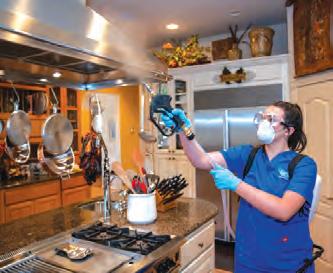
O’Neall: “What we’re seeing now is it’s just business as usual. The only thing different right now is that our inspectors are prepared with full PPE. They’re going in with gloves, with masks, with booties and we offer to meet with the clients rather than right on the property at the end when we explain our findings – we offer to do it kind of like this through remote. I would say, though, that 95 percent of our clients say, “No, we’re going to meet you at the property.” They want to be there and we make sure we practice social distancing with them, of course. We’re not on top of each other but if buyers want to be there to hear these findings, that’s fine with us.
Pat and Ben, do you typically get involved in a normal home transaction or do you tend to be called when there’s some kind of a major unusual real estate issue?
MacQueen: We don’t see all the roses and prettiness that these two usually can see. We always see it if there’s a money dispute or if there’s a problem.
in Ahwatukee. Mainly we’re seeing those people who were locked out of their businesses for two or three months. Maybe they got a PPP loan. Maybe they didn’t. But it’s pretty ugly for a couple of gyms, a couple of restaurants in our little village here.
Businesses can still be evicted if they fall back on their rent?
Ron & Coleen Tompkins
TRUST
I can tell you what we’re seeing isn’t so much on the residential side. In Ahwatukee, we’re actually representing a number of either landlords or tenants on the commercial end and it’s not a good picture. A lot of restaurants can’t get their numbers to pencil anymore based on the ability to keep people in and flow. We represent a couple of gyms that are just hanging on by a thread.
I don’t know if that’s going to trickle over into the residential. I just think that the residential is a different animal particularly here in Arizona, here in Phoenix, here
Gottlieb: There was an executive order signed on April 6 and there was a lot of language in that executive order targeting commercial small businesses with softened language – such as landlords are encouraged to work with commercial tenants on rent deferrals and maybe forgiving late fees and things of that sort. But the executive order did postpone or prevent any type of eviction activity until May 31. However, the tenant would of course need to qualify under the executive order. The standard under that executive order was whether or not the small business could not afford rent due to the COVID-19 pandemic and so the tenant would have to actually prove that and supply documentation. But the landlord was prevented from taking any activity or any action that would inhibit the business activity or the functioning of the business up until the expiration of the executive order.
What do you think’s going to happen? Are we going to see a wave of eviction notices go out?
MacQueen: I’ve already got my letters in my lockout instructions prepared on behalf of the commercial landlord tenants that we represent. That’s not just here in
see ROUNDTABLE page RE4
CHRISTIE ELLIS
BENJAMIN L. GOTTLIEB
LIZ O’NEALL
PATRICK R. MacQUEEN
Ahwatukee, but that’s throughout the Valley. I’ve got literally a flow chart of all the ones that are going to be shuffled in and out. So, we’re sending out demands saying “Hey, you’re in default. Here’s your opportunity to cure” and some people are trying to get those cured, some people aren’t. And then on the tenants’ side, they’re saying “I’ve been locked out, what do you want me to do? I couldn’t do anything for two months. And even if I was an essential service, nobody was coming by.” I think it’s going to be kind of ugly come June 1. Gottlieb: We’re seeing some commercial evictions now. I’m representing a business owner, a tenant that owns various coffee shops and he’s not suffering financially right now because people are still going out and getting coffee. So, he doesn’t qualify under the executive order so that eviction action is taking place right now. But the majority of landlords are waiting until June 1.
So back in 2008, 2009 we had all these commercial vacancies for so long and it looked terrible. Is it really better for landlords to not have someone in there
versus working with them? Or are they thinking if we can get this one out, we can get that one?
MacQueen: They do have to do that analysis. But at the same time, some of the commercial lenders are actually pushing the boat here. They’re saying, “Well you as the landlord need to get paid. I don’t care what you can do. I want to see that you’re actually taking action against this tenant. And if you don’t then I’m going to evict them and then I’m going to foreclose on you.”
So, it’s a lot of pressure from a lot of different angles. I do think some of the landlords are like, “yeah, we want to do something.” But at the same time, under those commercial loan documents, they might not be able to do much.
Is this situation different from the Great Recession?
Gottlieb: I think the Fed has been extremely active and was quick during this pandemic and that has calmed a lot of the markets, which bleeds into the commercial market as well. So, I think at least in the short-term, that’s had an impact and then of course Congress quickly acted with its fiscal stimulus programs, which I think has an impact.
It sounded a few minutes ago like the landlords may not be interested in turning things around.
MacQueen: I’m a little more pessimistic than Ben. I think the office market is going to take a big hit, if you think about it. I think from our own internal sort of analysis, we’ve found that people are way more productive at home.
I suspect that’s going to be consistent for a lot of other businesses. I think the office market is going to soften a little bit. It was pretty robust prior to all this. I think restaurants – those were pretty crowded to begin with and depended on those crowds, I think those are going to be the ones that struggle because they’re going to implement social distancing.
I worry about coffee shops too. The whole point of a coffee shop is to bring people together and have them sit together and talk. And now if you have to monitor them being six feet apart or putting up chairs -- It’s those types of situations that I do worry about.
So, there’s been a moratorium on evictions. Come June 1, are people going to be expected to come current right away?
Gottlieb: If they’re not current by May 31, the landlord has the right to initiate the process.
MacQueen: I agree, based on the governor’s order, there’s no requirement or obligation.
Christie, this brings up an issue for you – mortgage forbearance. What are the pitfalls?
Ellis: It’s not a forgiveness. It depends. Not every loan does this. So, depending on the type of loan you have, some of them will do it like literally the minute this is lifted. They’re like, “okay, now you owe $10,427.” Some are willing to break that up over the next few months, amortize it so that they increase your monthly payment. It really depends on the servicer, the loan type, that sort of thing.
A lot of people were thinking, “Free money, I don’t have to pay my bill.” …I don’t think they are truly understanding of what a forbearance meant. I’m hoping at this point most of them have figured it out because a lot of lenders reached out to their people.”
BY ALLEN HENDERSON AFN Guest Writer
Once again, the Ahwatukee-Foothills market has remained strong in May, despite the downward national trend and the coronavirus.
The number of units closed dropped in May but the average price has surged again over the same period last year. Ahwatukee property sales in May stayed strong with 131 closed listings at an average sale price of $387,270. While this is down from the $417,095 average price of a property recorded in April, the average price of an Ahwatukee property in May is 11 percent ahead of the $315,612 recorded in May of last year.
The average sale prices recorded in May is 3 percent higher than the average property value of $375,234 recorded in 2019 for the Ahwatukee real estate market.
For the period of Jan. 1 - May 31, the average price of a closed sale in Ahwatu-
kee was $392,141. There were 590 closed properties in the period.
For the same period last year, 699 properties closed at an average price of $365,387. The number of units sold fell from 699 to 590 units for a 16 percent decline but the average value of a property that closed escrow in 2019 was $365,383 versus the average value of $392,1141 for the same period this year.
While the number of units sold in 2020 is down, the average price per unit sold is up 7.3 percent over Jan. 1 - May 31, 2019.
The average days on market – which measures the pace at which homes are selling and is a good indicator of the strength of the real estate market – was 36 days last month versus 61 days in May 2019.
Marketing time measured by days on market was down 41 percent in May 2020.
If we look at the average days on the market for the period Jan. 1 - May 31, properties were going under contract in 49 days versus 66 days in the same period last year.
We have noted before that about 40
percent of listed Ahwatukee-Foothills properties are overpriced and require a price reduction to sell. Interestingly, only 36 of the 131 closed properties – 28 percent – required a price reduction to go under contract.
Between Jan. 1 and May 31, 181 of the 590 closed properties required a price reduction to go under contract. So, in the first five months of 2020, 31 percent of properties were listed too high and required a price reduction to go under contract.
The dramatic drop in the number of properties requiring a price reduction is significant. We assume that the drop in the number of properties requiring a price reduction is a function of buyers offering purchase offers over comparable sales.
We tell clients that any offer has to appraise to close. In the current market, it is obvious that appraisers are sliding appraised values, higher than comparable sales indicate, to meet what buyers are willing to pay in a rising market.
There are 23 million-dollar-plus listings in Ahwatukee. There were two
closed sales for million-dollar-plus properties in May. We have a 12-plus month inventory of seven-figure properties, but they are selling at a steady pace of about two per month.
Even though we are in one of the strongest seller’s market in years, two properties failed to sell in Ahwatukee in May and the listings expired. It is almost incomprehensible that property would expire in this market.
The old real estate axiom of location. location, location and price, price, price applies. Every property will sell at its value. If there are condition issues, they can and should be addressed or the price reduced. If there are location issues, they cannot be cured but the price can be reduced to bring the property to its value to get a property under contract and closed. Pricing will cure all impediments to a property and get any and every property under contract and closed. There are 154 active listings at the
Estate living with refined tranquility in this exquisite setting. Meticulous stonework adorns entire exterior of this luxury home. Inviting entry opens to diagonally laid tile with granite inlays and dramatic wooden staircase. Formal dining room with stacked stone fireplace. Gourmet kitchen features granite countertops, large island, Subzero refrigerator, and Wolf gas cooktop with double ovens. Fireplace and wet bar in great room. Floor plan boasts seven bedrooms, playroom and large game room. Expansive master suite includes large sitting area with two-way fireplace, crown molding, separate walk-in closets and spacious bathroom. Three custom iron doors lead to massive covered patio with pavers, built-in barbeque, heated pool with waterfall and slide, gorgeous landscaping with fruit trees and koi pond.
Large secondary bedrooms. Oversized laundry room with sink, granite countertops, cabinetry and room for a refrigerator. Additional upgrades throughout include 8’ solid core doors, speakers, surround sound in numerous locations, designer paint and exterior security cameras. Three masonry fireplaces. Anderson windows installed six years ago on entire first level. Four Trane a/c units with variable speed. Over-sized side entry four car garage. Availability to park an RV in the back as long as a garage is built for it. Over 7,000 square feet of stone on exterior. Almost acre-sized lot affords complete privacy.
Listed for $1,950,000
Mendoza 480.706.7234 www.MendozaTeam.com
5,271 sqft, 6 bedrooms, 5 bathrooms. Absolutely Gorgeous One-of-a-Kind Craftsman with a Basement Located in the Prestigious Community of Ahwatukee Custom Estates. This Home is packed with Today’s Features: the Main floor offers a Spacious Gourmet Kitchen Decorated in Re-Purposed Iowa Barnwood with a Large Farm Sink, Subway Tile Back Splash, Quartz Counter Tops and a Large Kitchen Island with Under the Counter Mounted Seating. A Charming Family Room located just off the Kitchen, an Over-Sized Formal Dining Room, 6th Bedroom/Den/Office with its own private Entrance/Exit and full Bathroom and a Massive Laundry Room which doubles as a Craft Room. Upstairs you will find a Loft Area and The Master Bedroom en Suite with Private Balcony, Upgraded Master Bathroom with His & Hers Sinks, Separate Soaking Tub and Shower plus 3 more roomy Secondary Bedrooms and Bathrooms. The Fully Finished Basement Boasts another Bedroom with Full Bathroom, Built-In Playhouse, Walk-In Pantry, Extra Large Open Flex Space for Game Room, Theater Room or Exercise Space the possibilities are endless! Huge Backyard with Tons of Outdoor Entertainment! Pool, Batting Cage, Half Court, Trampoline, Multiple patios and sitting areas! Listed for $1,349,900
SONORAN LIV ING
PRISTINE & CLASSY GATED
CALABREA ESTATE!
PRISTINE & CLASSY GATED ESTATE ON A PREMIUM 2/3 ACRE HILLSIDE LOT • PRIVATE CUL-DE-SAC • 6 BEDROOMS, 4.5 BATHS, 5200 SQFT OF PURE LUXURY FINISHES • STUNNING VIEWS IN EVERY DIRECTION • IRON DOOR • BUTTED GLASS WINDOWS IN ENTRY & KITCHEN • CUSTOM WINDOW TREATMENTS • DECORATOR PAINT • DOME CEILING FOYER & GROIN VAULTED CEILINGS IN LIVING ROOM • TRAVERTINE & HARDWOOD FLOORS THROUGHOUT • 7-INCH BASEBOARDS • MEDIA ROOM • DREAM KITCHEN INCLUDES S/S APPLIANCES,SLAB GRANITE COUNTERS, ALDER CABINETS,HUGE ISLAND,WALK IN PANTRY • LARGE MASTER SUITE W/STONE FIREPLACE • MASTER BATH W/JACUZZI TUB,3 VANITIES & SNAIL SHOWER • PARADISE BACKYARD W/TRAVERTINE IN VERSAILLES PATTERN,TURF GRASS,PEBBLETEC POOL/ JACUZZI,4 WATER FEATURES,LARGE COVERED PATIO,STACKED STONE BBQ • 4 CAR GARAGE W/EPOXY & STORAGE! YOUR DREAM ESTATE AWAITS!!
Listed for $1,449,000
KELLER WILLIAMS® REALTY Geno Ross
Do you think we’ll see a lot of foreclosures?
Ellis: I don’t see that right now. A lot of loans now require you to have six months’ worth of reserves before you can get a mortgage. So, I believe a lot of people anticipated that if something were to happen, “I want to be able to pay my house payment for six months without having to worry about it.”
I don’t think in early March they stopped making their payment. It will probably come up more now. So, if we’re going to
from page RE4 HENDERSON from page RE5
time of writing. Considering the 131 Ahwatukee-Foothills closed listings in May, the current 154 active listings would last about 1.17 months. Anything less than a six-month inventory is considered to be a seller’s market.
The Ahwatukee real estate market re-
see anything, it will probably be later.
Has the South Mountain Freeway had any impact on the Ahwatukee market?
Ellis: A lot of people are happy about it. It’s had a more positive effect than a negative effect. The only time we have a challenge is when it’s super close. It’s a little more challenging... I’d be curious to see if anybody has an inspection on a house that’s pretty close to the freeway construction and if they have more damage and more issues than a property farther away.
Liz, do you �ind buyers ask you about
mains a strong sellers’ market. There are 83 properties under contract and pending close at the time of writing. With reasonable market activity, we should see at least 120 to 130 closed sales in the AhwatukeeFoothills market in June.
Despite the economic shutdown, the Ahwatukee real estate market appears to be strong and performing well. Properties are
the freeway noise and things like that?
O’Neall: It’s interesting. We get questions about that. We get questions about cow smells when you’re in certain areas and the wind is blowing a certain way, you can smell cows but maybe if they were there looking at the home a couple of days before, they didn’t smell that. We really can’t comment on that. We could only really just on defects in the home. But they do ask the inspector “if this was your mother buying, what would you say. But we really try not to be opinionated that way. It’s interesting, but there is a house for everyone.
selling faster than anticipated. Prices are up. However, it is extremely important that agents, sellers and buyers use vigilance and caution as they conduct themselves in pursuit of their real estate endeavors.
If you want to sell your AhwatukeeFoothills property, don’t get stuck on the sidelines. It is still a great time to buy or sell a property in Ahwatukee. More impor-
Tim, my husband and one of the lead inspectors in our group, went into a home and it was backed up right to the 101, like Ray and 101. And the backyard was very tiny and you could see the signs and you could hear the lights and you could hear the cars and he had a student with him. We have these prospective inspector candidates that need to follow along with licensed inspectors to get licensed.
So, Jim walks in the backyard and he thinks to himself – he doesn’t say this out loud – “Oh Lord, I would never live like this.” And the student says to him, “Wow, this is the house for me.”
tantly, it is possible to conduct a real estate transaction safely if everyone involved conducts themselves prudently and follows the established guidelines to protect themselves and others.
Ahwatukee resident and Realtor Allen Henderson of Henderson Real Estate can be reached at 480-392-2090 or allen@homesahwatukee.com.
the experience both fun and educational.
“The kids were coming back with all these facts about alpacas that I didn’t even know, which is pretty neat,” Gould said.
Gould said the virtual field trips, which were free for teachers, were well received.
“The best thing for me is seeing the kids having fun and it being so different for them,” Gould said. “As soon as we get on, all I hear is, ‘Aww.’ I just love the excitement of the kids.”
Teachers thanked Gould for breaking up the monotony of their new everyday life having school online.
“Since it’s virtual it’s fantastic because you can do it anywhere,” Gould said. “Kids can get to see not only the goats and alpacas and things like that, but they also get to see another place in the United States of what life is like right now in Gilbert.”
Besides the teachers’ free field trips, guests can visit virtually for 10 minutes for $35; have a customizable goat gram for $35 or a 30-minute “alpacalypse” conference call for $75. The conference call brings alpacas Kip or Napoleon to virtual business meetings for 30 meetings.
“I’ve been getting a lot of requests for birthday parties, which is a whole new level,” Gould said. “I’m excited for that because, apparently, virtual birthday parties are going to be kind of the thing for right now.”
Gould is anxiously awaiting her first goat breakup gram customer. The goat comes online with a sign that reads, “We can still be frieeeends.”
“I’m super excited for it when that day comes,” Gould said. “Let a goat break up and do all the dirty work. It makes the let down a lot easier that way.”
Aside from the fun, Gould and her team had a tough time through the pandemic.
“For us, like many small businesses, it really hurts,” Gould said. “Our whole business is based on a lot of people in close gatherings, everything that we’re not allowed to do right now.
“It’s been really tough on us, but also really hard on the animals. I know that
Class of 2020 valedictorian
Last week’s special section on local high school graduates inadvertently left out one of Desert Vista High School’s Class of 2020 valedictorians.
sounds funny, but the goats are getting really depressed. They’re not used to just grazing and being bored.”
The animals are still playing, sleeping, eating and nursing throughout the day as if they were still doing goat yoga without an audience.
As for continuing the online trips, she said, “I think it’s just become a new creative thing and maybe keeping it ongoing for the people out of state or out of the country.
“I think it would be so neat to have a virtual tour or field trip to see somewhere different and this kind of opened up a door for new ideas in that aspect.”
✓ Affordable programs — Call for tuition information — Scholarships available
✓ 2, 3, 4, & 5-day class schedules
✓ Stay and Play and Enrichment Classes include dance, cooking, kindergarten readiness and more
✓ Classes begin August 3rd and 4th — Classes fill quickly, enroll now!
For more information, a tour, and to begin the registration process
CALL 480.460.0081 or VISIT www.godsgarden.com
Ahwatukee ASU professor rolling out podcast series
AFN NEWS STAFF
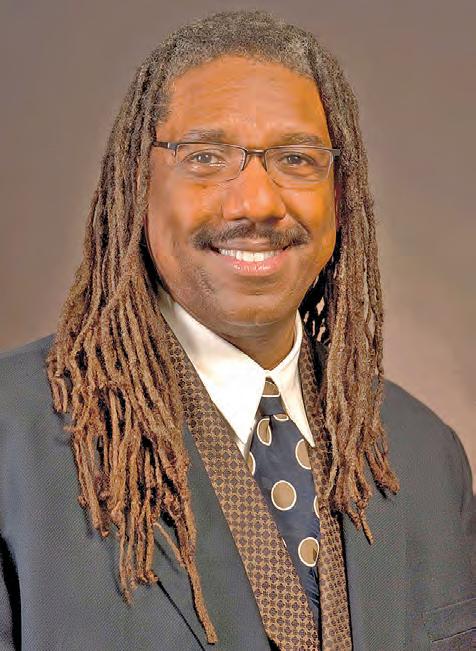
Arizona State University’s Project Humanities – a program founded and run by Dr. Neal Lester of Ahwatukee – is rolling out a podcast series next week focusing on various social issues.
Starting June 4, the discussions will be held 6-7 p.m. every other Thursday and will be broadcast live on Zoom and Facebook Live and cover topics such as “whupping and African American parenting,” death and dying, youth mental health and academic pressures, menstrual equity and neglected rape kits.
“To be clear,” said Lester, Foundation Professor of English, “Project Humanities is not starting its own podcast but rather building on the popularity of audio books and podcasts.
“Unlike physically reading a book and having the reading be the single focus of our attention at that moment, audio books and podcasts potentially allow us to do other things as we listen and learn. Just as what happens with book clubs and film clubs, our podcast club invites individuals to experience a podcast, then come together to talk about it and potentially learn from it.”
He said the podcasts “are accessible, provocative and linked to topics related to past and future Project Humanities events” and will be co-facilitated by a Project Humanities team member and others.
The schedule includes:
June 4, “Spare the Kids,” based on
“Spare the Kids: Why Whupping Children Won’t Save Black America” by Stacey Patton; June 18, “After Life;” July 2, “Why Did Police Departments Throw Out Rape Kits?” July 16, “School Stress Led Him to Despair. Support from Family, Friends Brought Him Back;” July 30, “Menstrual Equality.”
Project Humanities promotes local, national and international conversations “about the breadth, depth, and value of humanities study and humanist practice and understanding across disciplines and communities.”
Information: 480-727-7030 or projecthumanities@asu.edu.
DR. NEAL LESTER
SERVING AHWATUKEE, MOUNTAIN PARK RANCH, LAKEWOOD, THE FOOTHILLS AND SURROUNDING AREAS
Opinion
www.ahwatukee.com
“No,
BY NEAL LESTER, PHD. AFN Guest Writer
For my white friends who ask if I am okay, the answer is “No, I am not okay.”
To ask that question of me right now amid this COVID-19 pandemic that is disproportionately killing black and brown people in the US, and while experiencing the trauma resulting from the deaths of Ahmaud Arbery, Breonna Taylor, and George Floyd is not good.
Dealing with American racism in all of its insidious forms, police brutality, human loss and suffering cannot be captured in sound bites. This unrest across this state, country and the globe is bigger than George Floyd. I have already written about the parallel plagues of American racism and COVID-19 just a few weeks ago.
I am not okay when what I wrote in August 2017 about Confederate monuments and Charlottesville applies to Minneapolis now, albeit potentially Anytown, USA: “For White Allies in Search of a Solution to American Racism / When Folks of Color Are Exhausted.”
No, I am not okay and not alone in not being okay: your black colleagues may look like they’re okay — chances are they’re not.
I am not okay when I know that jogging in the “wrong neighborhood” can lead to a young black man’s death in Georgia, my home state; or that allegedly forging a check can lead to being suffocated at the hands of Minnesota police as other police stand by doing nothing to intervene.
I am not okay when I recall being told by white police to stop jogging in a “white
neighborhood” in Birmingham, Alabama, because my presence made the home dwellers nervous.
I am not okay when I realize that I could have been a newspaper headline or crime statistic while facilitating our Saturday morning community outreach and a police sergeant became more and more agitated as I tried to explain our purpose.
I am not okay when I am stopped in Sierra Vista for speeding but asked three times by the ticketing officer: “Where are you from?” Being from Phoenix—as my driver’s license shows--and then Georgia, were not “exotic” enough to match my loc hairstyle and skin color in southern Arizona.
I am also not okay when I see so many Facebook posts and threads now of alleged white allies asking black folks to give them a blueprint of how and where to direct their anger and outrage. One person even asked an already vulnerable and angry black woman to organize a panel of other women of color to “brainstorm on solutions to American racism.”
Others complain about the destruction of property during protests, contending that peaceful protest and “civility” is all needed to address this plague of American racism. What was Colin Kaepernick’s peaceful protest against police brutality?
How did the Reverend Dr. Martin Luther King’s, Medgar Evers’ and Malcolm X’s steadfast fight for justice end?
While I do not legitimize violence as a principle, I ask that concerned individuals – black and white – measure the impact of destroying property as compared to killing people.
Spike Lee gets it right in Do the Right Thing (1989) when Mookie calculatedly
throws a chair into the pizzeria window to deflect the crowd protesting the death of Radio Raheem because his boombox music was too loud.
To be clear, I am in no way minimizing or advocating for the destruction of property, potentially the source of another’s livelihood.
What I am keenly aware of is, however, the legitimacy of expressing anger, hurt, and pain and responding viscerally to serial injustices. I understand the rage that Lauryn Hill laments in “Black Rage,” which she dedicates to Michael Brown’s death in 2014: “Black rage is founded on two-thirds a person. Rapings and beatings and suffering that worsens/ Black human packages tied up in strings/ Black rage can come from all these kinds of things.”
Property can be insured and rebuilt. Dead bodies cannot be resurrected with a life insurance policy.
I am not okay with stories of innocent black men who spend years in prison for crimes later determined they did not commit. This unrest is about 400 years of moments like this since the first Africans were forcibly brought to this country.
This moment is about the reality of black American identity in this country clamoring to declare our own humanity.
I am not okay when Michael Donald is hunted like an animal, beaten, shot and hung from a tree by white men in Mobile, Alabama as a symbol of the illusion of white supremacy in the deep south.
I am not okay when Sandra Bland is pulled from her car and perceived as a threat because she has a lit cigarette and dares to speak back to an officer.
I am not okay with Carolyn Bryant recanting, saying that Emmett Till did noth-
ing to her years after he was killed by her husband and brother-in-law and the world grieved with his mother Mamie. How can anyone be okay when people are pushed to the edge from decades of having one’s humanity denied? How can anyone in the US with their humanity-empathy, respect, integrity, and compassion--intact be okay with racial violence in the US since 1660?
Lest we also forget the Tuskegee Syphilis Experiment, the bombing of the 16th Street Baptist Church, the Atlanta Child Murders, the Scottsboro Boys, Amy Cooper’s faux fear of a black male bird watcher, and Susan Smith’s bigger-than-a-“little white lie” that a black man kidnapped her two small children in a carjacking when she herself drowned them, or the recent tsunami of “White People Calling the Police on Black People” for living.
Indeed, how is anyone okay with the individual and collective stories of American racial injustice: “A Decade of Watching Black People Die”?
So, no, I am not okay. If you are paying attention to what’s happening in this country and in this state and in cities across this state, and when you know our American and world history regarding our inhumanity to each other based on race—and all other systemic -isms that oppress and dehumanize--how is that you are okay? If you are okay, perhaps your commitment to fundamental humanity and to social justice is not as deep as you believe. We are not all in this together, and all lives do not matter … and never have.
Ahwatukee resident Neal A. Lester, PhD, is Foundation Professor of English and founding director of Project Humanities at Arizona State University.
Horizon Honors families wish to recognize Horizon Honors staff for an amazing year! You met the challenges of 4th quarter with collaboration, innovation, and dedication. We are grateful, thankful, and proud to be Eagles!
Greg Adam
Nate Agostini
Clint Alfrey
Pat Andrew
Jan Appel
Mary Arrison
Davina Baird
Shannon Barden
Lisa Barlow
Jennifer Bellin
Donna Bennett
Beth Bennett
Ann Bialk
Tara Bobesku
Amanda Bors
Sandra Boston
Kevin Boston
Tyler Bowman
Jessica Bradley
Chris Britt
Donna Bullock
Christi Burdette
Kevin Burdette
Michaela Burns
Matt Butler
Adam Butler
Mindy Buttrey
Sarah Cahill
Abby Cardenas
Ryan Carlin
Bev Carlson
Kristen Carr
Madeline Carrasco
Janeth Carrasco
Tracey Carswell
Leslie Carter Natalie Cavaleri
Eric Christofferson
Cole
Collins Andrew Cooper
Mike Corey Jane Cowley Laura Coy Jessica Davis
Susie Davis
Stephen Delgado-McCollum
Janet Dewan
Lisa Di Chiara
Linda Dickson
Thi Diep
Stacy Dietz
David Dinardo
Robert Dixon
Randall Dominiack
Mariah Driggs
Mindy Duet
Kimberly Elkins
Taylor England
Ben Erickson
Ryan Erickson
Audrey Fairley
Jeremy Fairley
Betsy Fera
Alison Fisher
Jeremy Fisher
Chris Fletcher
Jordan Foraker
Lisa Fuller
David Gallegos Cheryl Garland Joshua Garrett Joy Garrett
Payton Garrett
Gloria Gilbert Randy Goff
Scott Gotham
Chris Granger
Elissa Gruendler
Kasey Guajardo
Sarah Hansen Andrew Harank Devin Harris
Melissa Hartley
Ellen Hauck
Dorene Healy
Tamara Heinrich
Chris Henderson Brad Hendrix
Camille Hensel
Kristi Hewitt
Carolyn Higgins Emily Holtrop
Susan Holweger
Karen Hookom
Jacki Hostetter
From Horizon Honors Families
Josiah Hostetter
Isom
Kehmeier
Kingman
Knutson
Kowalski
Kramme
Larson
Kara Lashar
Isaiah Ledford
Debbie Ledford
Donna Levi
Jill Lindsey
Rick Lorenzo
Jamie Lydick
Kris Maglunog
Kelly Maguire
Alexa Marshall
Camryn Marshall
Allegra Marshall
Kim Martin
Vonda McDaniel
Annette McGuire Sean McGuire
Patricia McIntyre
Janet McKinney
Stephanie McNally
Frank McShane
Emily Merkel
Ashley Mistak Matt Mixer
Julie Moses Alex Munsell
Munsell
Mattie Myers-Gutt
Kristin Neis
Summerlynn Olrich
Laura Owes
Arlo Pew
Mark Pieratt
Melissa Ramsey
Erin Reid
Holly Riley
George Rivas
Elizabeth Robertson
Monica Ruiz-Jiminez
Jenny Sacco
Paul Salomon
Lauren Salomon
Jeff Schenk
Paul Schneider
Cynthia Shaheen
Jennifer McCarthy Hayley McCrory
Tamra Shaw
Sherri Shereshovech
David Sheveland
Jeff Simminger
Brad Skaggs
Staci Smith
Bobby Smith
Sue Sorel
Bill Thompson
Sonja Tinsley
Lani Travis
Veronica Trejo
David Vitagliano
Kerry Wais
Heather Wallace
Barb Waltman
Laura Wanstreet
Mike Wanstreet
Beth Weiss
Mark Wilson
Matt Winebrenner
Danielle Winhold
Roger Wood
Jennifer Wood
Tami Wright
School Board
Steve Holm, President
Fred Neal, Vice President
Pilar Holtrop, Member
Brittany Stotler, Member
www.ahwatukee.com
Sister-owners mark Dream Dinners’ 13th year
BY COTY DOLORES MIRANDA AFN Contributor
This month marks the 13th anniversary for Ahwatukee’s Dream Dinners – and, during the economic uncertainties created by the pandemic, one that is more special to the sisters who own it.
The Dream Dinners franchise in Ahwatukee opened doors at 3820 E. Ray Road in 2004, but sisters Laura Pre�ling and Sara GilBride purchased the business in 2007.
Zoned as a specialty food store, Dream Dinners – a meal-preparation service that helps customers make home-cooked meals easier – kept its doors open when many businesses were shuttered in mid-March. Yet it took adapting.
Normally, the business invites customers to come in and prepare their dinners. But that was not possible under state restrictions that were lifted May 12.
Their extensive kitchen, with stainless steel counters and spacious food prep areas, were absent of the hustle, bustle and cheerful camaraderie of guests working on their make-and-take meals.
And though COVID brought a hard reality for the two sisters, they’re grateful.
“We’re particularly grateful during this strange and dif�icult time amidst COVID-19 to still be open and to be able to help people get food for their families,” said Pre�ling.
“Our mission has always been to bring families around the dinner table, so this, even though brought about by something dif�icult and maybe a little scary, is bringing families together around the table again. I view it as a blessing in disguise.”
“Laura and I count our blessings every
���
DREAMS
���� 26
Ahwatukee coach offers help to stressed workers
Monica Brown is a different kind of coach.
While she coaches businesses, groups and individuals, her goal is not to help them succeed in the typical way that success is measured.
Instead, she leads meditation sessions for them.
“There are studies that show that regular meditation can boost the immune system, improve one’s ability to regulate stress, enhances cognitive abilities and creativity and regulate emotions,” said Brown.
“For businesses, this means greater innovation, happier employees, more positive employee to employee relationships and greater productivity.”
During the pandemic, Brown said she recognizes the particularly stressful con-
ditions that �irst responders, healthcare workers and other “frontline” employees are encountering.
So, she has developed a video meditation to help them calm their frayed nerves.
“While in the midst of COVID-19 I am also creating custom one-of-a-kind meditations for clients and offering online classes to assist people in boosting their immune system and shutting down the worry that they are experiencing,” said the longtime Ahwatukee resident and former Phoenix police of�icer.
“When COVID-19 cases began rising and Arizona moved into lockdown, I felt compelled to create a meditation to assist frontline workers and �irst responders in stopping the �ight-or-�light response that they may be experiencing so that they could stay physically, mentally and emotionally healthy short and long term,” she explained.
That stress reminds her of some days as a police of�icer, though she added, “looking back, the occasional intense day I ex-
perienced was nothing compared to what frontline and �irst responders are facing right now.”
“Staying in the �ight-or-�light response over a period of time becomes a chemical assault on the body,” she said. “Our frontline and �irst responders are facing bigger challenges than ever before and I wanted to do my part in supporting them.”
She developed the meditative video in collaboration with a musician named Anaamaly.
It can be downloaded at bit.ly/FirstLineResponders-download and viewed on YouTube at bit.ly/FirstLineRespondersvideo.
“I’ve had a lot of positive response from those that have experienced the meditation,” Brown said. “The intention with creating this meditation was to be of service and
Sisters Laura Prefling and Sara GilBride are marking their 13th year as owners of Dream Dinners in Ahwatukee. (Special to AFN)
AFN NEWS STAFF
Life coach Monica Brown of Ahwatukee has made a special video meditation to help soothe frayed nerves of frontline workers in the pandemic. (Pablo Robles/AFN Sta Photographer)
day that we weren’t forced to shut our doors during the Arizona stay-at-home orders but we had to adjust how we operate,” added GilBride.
The sisters surmounted the new-normal limitations, praising their employees for helping them do so.
“Our team has been tremendously selfless, coming in each week to make sure we can continue serving our guests and our community,” said Pre�ling, an Ahwatukee resident and mother of three.
“Now, we’re making all the meals for our customers and doing curbside pickup,” explained GilBride. “We hope in the next few months we can have customer sessions again and can have our guests in the store assembling their own dinners. We miss that time with our customers and look forward to catching up.”
Both Pre�ling and GilBride say they consider their service a constant in a time of uncertainty.
Gilbride feels their service “provides normalcy, consistency and comfort to a community/city/country that has changed overnight in so many ways.”
Dream Dinners was founded in 2002 by two Washington state mothers who wanted prepare-and-freeze meals to help them provide healthy eating for their families with less time involved.
The �irst in the category of “meal assembly” franchises, Dream Dinners now has more than 100 locations in 30 US states. Pre�ling and GilBride also own Dream Dinners in North Phoenix.
Before the pandemic, it provided the space and all ingredients for meals that could be taken home and frozen, then thawed and cooked when desired.
After reviewing the monthly menu posted online at DreamDinners.com, the
For
(Special to AFN)
clients selected a session time and then dropped in to assemble and customize a month’s worth of meals.
“All the prep work like chopping was already done, and the clean-up was our responsibility,” explained GilBride. “Our guests loved it.”
Now, things “do run a little differently” added Pre�ling.
“Through the end of June, we’re assembling all guests’ meals for them. We’ve also waived the usual service fee for that through the end of June,” she said.
“Less people in the store means a safer environment for both our team and our guests. We want everyone to feel safe and comfortable. And as with many other businesses right now, we provide a curbside pickup where they don’t even need to get out of their car.”
Pre�ling said while people may have more time at home, that doesn’t translate to having more free time to cook.
Stefanie Gardner, a work-at-home mother, knows about that as she navigates schooling from home with her children, ages 6 and 10.
area of my life.
have the meditation freely available to any front line/ �irst responder that wanted it. It is currently in a few places waiting for approval so that it can be shared within those government and hospital institutions.”
Brown said she got into her current job after choosing “to make some major changes in my life.”
“Big change came with challenges,” she said, adding that over time “I noticed that I had organically created a system for making tangible and desirable changes in any
“I enjoyed going every month to put together my meals at Dream Dinners. I enjoyed being able to adjust each recipe to my family’s taste. When quarantine hit it was a comfort to know we had a freezer full of a variety of meals and more meals coming next month,” said Gardner, who moved last year from Tennessee to Ahwatukee for her husband’s career.
“I was invited to a Dream Dinners tasting by a new acquaintance at my kids’ school and thought I’d go and meet people. I fell in love with the convenience, great quality of food, and that I could have yummy dinners for my overly-picky family,” she said.
“I work in the home and felt Dream Dinners was an indulgence but my husband disagreed after tasting the �irst dinner. I have two children, and that ‘witching hour’ right before dinner can be hard and there were times where dinners have burned or been complicated by me having to deal with my children while I’m cooking dinner,” said Gardner.
“With Dream Dinners, I know I only need to �ind a 30-minute slot of time and I’ll have a complete and tasty dinner for my family. I also don’t have the many random spices and ingredients that I’d use only for one recipe, and they provide those so that’s really nice,” she said.
Gardner found that the 12 prepared meals she bought each month – three dinners a week – augment “our mundane, kid-approved meals like spaghetti and meatballs, poppyseed chicken, taco night, chicken tenders with mac-and-cheese.”
“Now I intersperse the yummy Dream Dinner meals to give my husband and I a break and elevate my children’s palates.”
Despite the quarantine, business at Ahwatukee’s Dream Dinners has been good, said Pre�ling.
“Dream Dinners is about getting families around the dinner table and we know
families have been doing that more than usual these days. Busy families who were on the move all the time are forced to slow down,” she said.
“Yet, right now, so many parents are still busy – working full time from home while homeschooling their kids, which is not an easy task.”
She feels her service “gives them one less thing to worry about” with meals “they know are good for their family and taste good too.”
GilBride said dinnertime duties have also undergone changes.
“We do know that kids have been helping more in the kitchen and both parents are taking the initiative to get dinner on the table and Dream Dinners makes that so much easier for everyone,” she said.
“We’ve even heard that kids and parents take turns picking out the Dream Dinner for the evening. And as we have heard from lots of parents over the years, the kids will try it, even if it’s different, if they know it’s from Dream Dinners.”
While curbside pick-up has preempted indoor meal prep for customers, Pre�ling and GilBride say things can change quickly.
“The good thing is even though we’re assembling all meals right now, we’re still running very much like normal. Many of our guests opt for this service anyway, so we aren’t holding our breath for the end of June date to allow guests back in,” said Pre�ling.
“Who knows? Maybe a lot of people will want to keep utilizing this pick-up service.”
Besides grill-ready meals like Gaucho Grilled Pork Tenderloin and grilled summer pizzas, dream dinners’ June menu, available online, includes turkey gyro kebabs with tzatziki yogurt sauce, peach bourbon chicken, and chipotle shrimp with mango salsa and jasmine rice.
Information: DreamDinners.com.
“This system is repeatable, step by step. I have talked to many people that settle in their lives for mediocrity instead of creating a life they love living. Thing is, they usually know what they want; whether it is a knock-your-socks-off long-term romantic partnership, a profession that excites them enough to get up and go to work in the morning or to just wake up every day feeling amazing,” she explained.
“People are afraid to take the steps towards what they want,” she added. “I am passionate about happiness and living a vibrant
life. A person gets one life, this isn’t a dress rehearsal. I stepped into coaching to help people be happy and live a ful�illing life.”
She describes her clients as “visionaries that want to have a positive impact in the world while making a good living with time left over at the end of the day to enjoy their personal life.”
“I help them get crystal clear about their goals and what area of their life to focus on �irst,” she said. “We work together to create a “roadmap” to their goals. I take them step by step through my system and support them as they create tangible changes
in their lives.”
She has spent years guiding meditations and this year donated some of her time to training student nurses at a Veterans Administration hospital in Miami “to boost the immune system and lower stress.”
Patrons of the Pomegranate Café in Ahwatukee also may remember her weekly meditation sessions that she held for two years at the Pomegranate Café. Brown also donated time to leading a meditation session for Kyrene elementary school teachers. For information on her services: monicabrowncoaching.com or 480-510-6885.
now, Dream Dinners is preparing the take-home meals rather than have patrons come in and fix them.
Pet massage featured at local pet food store
An Ahwatukee pet food and supply store is offering lessons in pet massages.
Gordy’s Goodies Pet Food & Supplies, 15425 S. 48th St., will host a trained therapist 10-11 a.m. Saturday, June 5, to teach owners how to massage their pets. Cost is $25.
It’s one of several special programs that owner Lisa Thayer has lined up this month.
On June 13, Gordy’s will offer lessons in Pet CPR by Furbaby CPR, 10-11 a.m. and a Puppy Play Day with Foothills Canine Academy, noon-1 p.m. The latter is free but spots are limited and for puppies 10 weeks to six months old.
From 10 a.m.-1 p.m. June 18, anesthesia-free teeth cleaning will be provided
by Dr. Jodie Gruenstern. Call the store at 480-687-7191 for an appointment and prices.
Two adoption sessions also are planned this month.
On June 20, Adoption Day with Love Connection Dog Rescue will be held 10 a.m.-2 p.m. and on June 27 from 2-4 p.m., Adoption Day with Chi Town Rescue will be offered.
Sports & Recreation
AIA releases return-to-play recommendations
BY ZACH ALVIRA AFN Sports Editor
The Arizona Interscholastic Association last week released its recommendations for student-athletes to return on campus for summer workouts in phases.
The recommendations were by the AIA’s Sports Medicine Advisory Committee fall in line with other guidelines by state and national health committees, including the Centers for Disease Control and Prevention.
School districts are welcome to base their own plans off of what the AIA suggested. However, some had already es-
tablished guidelines their students and coaches will follow beginning as early as Monday.
Several school districts had already begun drafting their own guidelines for student-athletes to return to campuses for summer workouts. Bruce Kipper, the Tempe Union High School district athletic director, said a plan was being presented to district leaders sometime in the coming days. As of now, he hopes students can return to campuses in mid-June.
“We are currently working on a plan to phase in training for our athletes,” Kipper said. “We worked collaboratively with our assistant superintendent, team doctor and head of our athletic trainers. Nothing
Desert Vista senior forward Osasere Ighodaro was happy to be with his teammates again after COVID-19 forced a delay in the team’s sizing for their championship rings. (Pablo Robles/AFN Sta )
had been approved yet.”
The 12-page AIA document includes general health practices, including staying home if sick or at risk for severe illness, frequently washing hands and using a face mask when possible. The AIA also recommends daily health and temperature checks and for schools to issue questionnaires that require athletes to list any and all symptoms they may have on a daily basis.
Additionally, it recommends athletes to avoid �ist bumps, high �ives and hugging, as well as to disinfect frequently touched surfaces. The recommendations also call for outdoor practices when possible and for drinking fountains and locker rooms
to be closed.
The �irst phase of the AIA recommendations calls for groups no larger than 10 that remain together each day.
All athletes and coaches must be symptom free for at least 14 days before taking part in training exercises. If athletes live with someone that is either sick or at an elevated risk, they should not attend workouts. All personal equipment should be disinfected after practice and athletes should head home immediately.
“Our priority through this is for the safety and well-being of all our state’s studentathletes and those that support them,”
Sophomore guard Marcus Wady played a pivotal role in Desert Vista’s championship run this season. He and fellow sophomore guard Das- ean Lecque figure to be one of the best backcourts in the state as they look to defend their title next year. (Pablo Robles/AFN Sta )
Thunder basketball sized for championship rings
BY ZACH ALVIRA AFN Sports Editor
Lifting of shutdown orders gave the Desert Vista basketball team an opportunity to
of�icially cap off their championship season nearly three months later.
Saturday at Ganem Jewelers in Ahwatukee — one of the team sponsors — the Thunder players were all sized for their championship rings.
For many, it was the �irst time they had seen one another since schools were shut down in mid-March. But for Osasere Ighodaro, the only senior on the Desert Vista roster this past season, it was his chance to say his �inal goodbye.
“It was good to see my team all together
Check us out and like the Ahwatukee Foothills News on Facebook
said Executive Director David Hines. “We are not guaranteed to have a fall season. We are preparing to be ready on time, but it will all depend on how this situation develops as the summer goes on. We just ask that schools, coaches, players and parents consider and utilize the guidelines until we get back to normal.”
The second phase allows for 50 or more athletes. All other precautions from phase one remain intact. Once in phase three, teams may return to a traditional practice setting with no limitations on the number of participants. Contact is allowed to proceed in the third phase along with the use of shared equipment. The AIA also emphasized the importance of heat acclimatization in its return-to-play recommendations.
Chandler Uni�ied School District released its return-to-play guidelines. Athletes will be able to resume workouts in groups of 10 or less starting June 8.
Scottsdale Uni�ied School District spokeswoman Amy Bolton said the district was initially aiming for a June 29 start date, but schools have started telling students to prepare to begin workouts on June 15.
Mesa Public Schools Athletic Director Steve Hogan said he had hoped to have a plan approved by district leadership for athletes to begin summer workouts within the week.
again, it’s been awhile,” said Ighodaro, who will play basketball at Marquette University next year. “It’s a great feeling. I’m enjoying being around my guys again more than the ring. But I’m glad we got it. It was a great season.”
Ighodaro, a 6-foot-10 wing that quickly became one of the top recruits in the state this past season, played a pivotal role in Desert Vista’s run to the title.
He averaged 15.9 points, 10.6 rebounds and 4.4 blocks per game last season. In the playoffs, he averaged 21.8 points, 11.8 rebounds and 3.5 blocks, which includes a 32-point, 11-rebound and 6-block performance in the championship game against rival Mountain Pointe.
Desert Vista Coach Gino Crump said in December he wanted to do everything in his power to send Ighodaro off with a
While the AIA recommends social distancing during practices, neither the association nor school districts have yet turned their attention to actual games and how social distancing can work in contact sports like Thunder football. (AFN file photo)
Tempe Union’s targeted return-to-play date comes on the heels of other districts and schools nearby.
Gilbert Public Schools announced its
“This is a new thing we have to get acclimated to,” said Mountain Pointe football coach Eric Lauer, who was hired in December. “I think it’s a doable thing but there is an added variable because we just got here and athletically, I don’t know these guys. It maybe puts us in more of a sped-up mode because we don’t know each other. The best are going to play and we don’t have time to play around to �ind out who that will be.”
championship ring. And despite turmoil and uncertainty in the early stages of the season, he was able to help the team accomplish just that.
“It still hasn’t sunk in yet. I don’t know when it will,” Crump said of the championship. “It was a special year and with all the adversity, it has made it extra special. We had a great group of kids.”
The Thunder �inished the season 15-1 with the 6A trophy in hand.
“At �irst, it didn’t even feel like we won,” sophomore guard Marcus Wady said. “I mean, I knew we won, but it didn’t really feel like the season came to an end because nothing was normal. So, once all of this starts coming in you really feel like we did something.”
Wady will be one of three returning starters for Desert Vista next season alongside junior forward John Soloman and sophomore guard Dasean Lecque, who led the
four-phase guidelines May 26. Coaches were briefed Thursday and workouts were to begin June 1. Valley Christian High School also released its guidelines May 26 and opened its campus to students the same day.
Thunder in scoring this past season. Together, Wady and Lecque make up one of the most talented backcourts in the state despite having only played together for one season.
Lecque transferred to Desert Vista from New York before the start of the 2019-20 school year. His older brother, Jalen Lecque, signed with the Phoenix Suns and spent time this season in Phoenix and with the club’s G-League af�iliate, Northern Arizona Suns, in Flagstaff before the season was suspended.
He leaned upon players such as Wady and Ighodaro to show him the ins and outs of the Desert Vista program. Now with Ighodaro gone and Soloman, who transferred from Florida last year, the go-to big man for the Thunder, they all aim to defend the 6A crown next year in what again will be one of the most talented teams in the state.
“I thought we had the best backcourt in
The AIA’s recommendations came shortly before Arizona Gov. Doug Ducey announced schools would be open in the fall and organized youth sports could resume. While some uncertainty remains surrounding what exactly a fall sports season would look like in Arizona, Lauer believes the steps taken so far are in the right direction.
“I think we are moving in the right direction and are kind of in line with the governor as he starts to open the state,” Lauer said. “I think a lot of the district will follow some of his restrictions as well.”
the state in me and Marcus,” Lecque said. “I feel like there’s no doubt that we can go back-to-back. We are losing a few guys, but we have great chemistry now and everyone is closer.”
While unable to have an of�icial ring ceremony, Crump said it was great to have the team back together.
The �inal design of the rings will be silver with the school logo in the center and the word “State” above it and “Champions” below. One side of the ring will have the player’s last name and number. The other will have a picture of the trophy and the Thunder’s season record, 28-3.
Crump anticipates the rings to be completed in six weeks.
“We can’t have a ring ceremony and Oso (Ighodaro) is going to be gone so it kind of changed everything for us,” Crump said. “We just wanted to do something special for the guys.”
Ahwatukee Animal Care Hospital is excited to introduce our new bilingual Associate Veterinarian, Dr. Alexandra Velazquez. In addition to general practice, Dr. Velazquez specializes in a variety of services that involve reproduction. Please join us in welcoming her to the beautiful Ahwatukee community and our veterinary team.
Welcome Dr. Velazquez
Dr. Miranda Anderson
Class of 2020
Mr. and Mrs. Darrel and Dorothy Anderson announce with great pride the graduation of their daughter, Dr. Miranda Rose Anderson, from Midwestern University, College of Osteopathic Medicine.
After graduating from Desert Vista High School, Miranda completed her Bachelor of Science degree at The University of Arizona in Tucson and she then went on to recei ve her Masters degree in Medical Sciences at Boston University. Miranda then attended Midwestern University in Glendale, Arizona receiving her Doctors Degree in Osteopathic Medicine. Dr. Anderson will finish her residency at the Verde Medical Center in Cottonwood, Arizona.
are now underway for the Mountain Park Ranch Homeowners Association (MPRHOA) Annual Meeting scheduled for Tuesday, October 20, 2020. Two (2) of the five Board of Director positions will be voted on this year. Nominations are now being accepted in the MPR Office for the open positions up until July 3, 2020. Any Member interested in serving on the Board should contact Jim Welch, Executive Director, at the Mountain Park Ranch office at 480-704-5000 or e-mail: jim@mtparkranch.org for further information. MPRHOA By-laws allow Board Members to serve two consecutive two year terms.