For the first time in its 40-year history, a woman is the top officer in Ahwatukee’s only veterans organization.
Commander Brenda Smull of Ahwatukee was unanimously voted by her comrades last week to lead American Legion Post 64, becoming the 14th veteran to head the post.
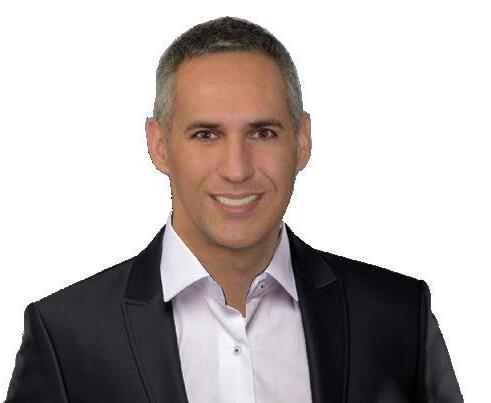
Smull succeeds Realtor Peter Meier, one of Ahwatukee’s pioneers who held the position in 2014-16 and has been its leader since 2018.
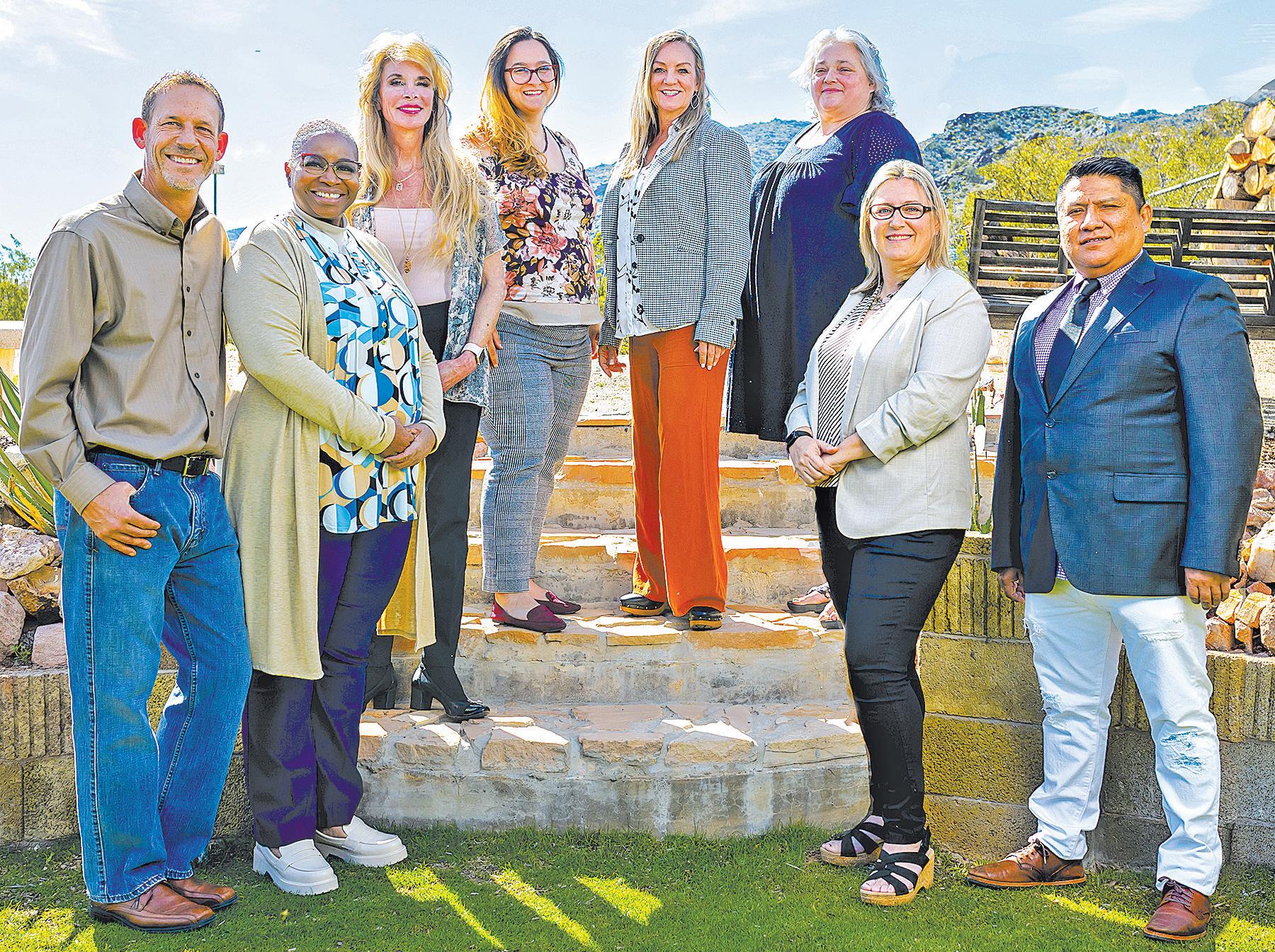
Meier is now second vice commander. Other officers elected last week include Al Hunter, first vice commander; Roddy Charlton, adjutant; Craig Amis, service officer; Rebecca Schmidt, chaplain; Jay Hendrix, treasurer; and Mark Shillinger, sergeant at arms.
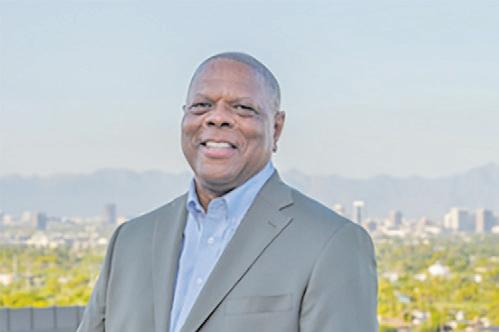
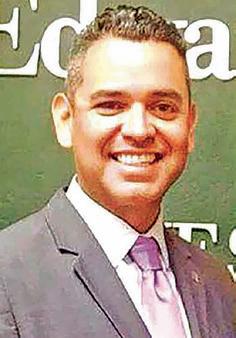
Managing director of IT projects for Edward Jones and an Ahwatukee resident for over five
BY PAUL MARYNIAK AFN Executive Editor
Prenuptial jitters plague many couples as their wedding day approaches, but what Timothy Cowdell and Dr. Shawna Begay went through last week was downright nervewracking.
With their June 10 wedding getting closer, Begay took her daughter on May 7 to the Tempe venue for the reception because she’s Be
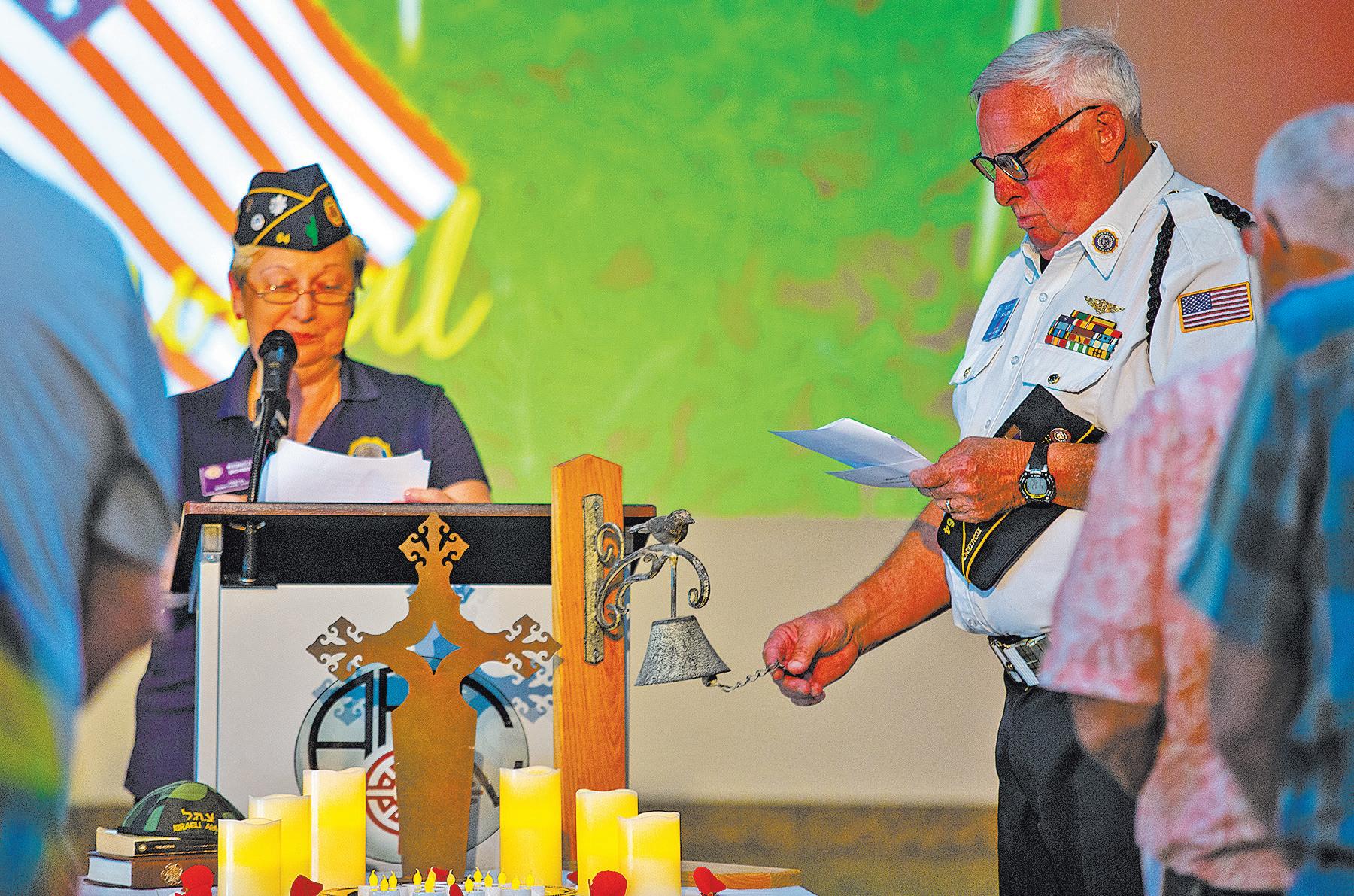
Ahwatukee American Legion Post 64 Commander Brenda Smull assumed the leadership post last Wednesday of the community’s only veterans organizations just before a memorial service was held for Post 64 Legionnaires who passed away last year. (David Minton/AFN Staff Photographer)
gay’s maid of honor.
After touring Lido Restaurant on Lakeshore Boulevard near Baseline Road, Begay ap-
Tim Cowdell and Shawna Begay of Ahwatukee are breathing much easier now that they found a new venue for their wedding reception June 10 a week after they were told May 7 that the venue they had reserved was closing at the end of this month. (Special to AFN)
The Ahwatukee Foothills News is published every Wednesday and distributed free of charge to homes and in single-copy locations throughout Ahwatukee Foothills.
Times Media Group:
1900 W. Broadway Road, Tempe, Arizona, 85282
Main number: 480-898-6500
Advertising: 480-898-5624
Circulation service: 480-898-5641
PUBLISHER
Steve T. Strickbine VICE PRESIDENT Michael Hiatt
ADVERTISING STAFF
National Advertising Director Zac Reynolds 480-898-5603 zac@ahwatukee.com
Ahwatukee Foothills News is distributed by AZ Integrated Media, a circulation service company owned by Times Media Group. The public is limited to one copy per reader. For circulation services please contact Aaron Kolodny at aaron@TimesLocalMedia.com.
To start or stop delivery of the paper, please visit: https://timespublications.com/phoenix/ or call 480-898-7901
To get your free online editiona subscription, please visit: https://www.ahwatukee.com/e-subscribe/
WRITE A LETTER
To submit a letter, please include your full name. Our policy is not to run anonymous letters. Please keep the length to 300 words. Letters will be run on a space-available basis. Please send your contributions to pmaryniak@ahwatukee.com.
EDITORIAL CONTENT
The Ahwatukee Foothills News expresses its opinion. Opinions expressed in guest commentaries, perspectives, cartoons or letters to the editor are those of the author.
ADVERTISING CONTENT
The content and claims of any advertisement are the sole responsibility of the advertiser. The Ahwatukee Foothills News assumes no responsibility for the claims or content of any advertisement.
Sheraton hotel closes for apartment plan development
BY PAUL MARYNIAK AFN Executive Editor
The Sheraton hotel on S. 51st Street near Elliot Road has permanently closed as a Scottsdale developer prepares to turn it into a luxury high-rise apartment building with additional units surrounding it.
Located on an 8-acre county island, the Four Points by Sheraton Phoenix South Mountain had once been a venue for local groups’ big events, like Ahwatukee Republican Women breakfasts and Ahwatukee Foothills Chamber of Commerce’s Women in Business awards banquets. But the convention center where those events had been held has been little more than an empty cavern in recent years. And if the six-story hotel’s 160 rooms were ever
Councilman slates coffee klatch here
Ahwatukee residents will have a chance to meet their new representative to Phoenix City Council this Friday.
Councilman Kevin Robinson will hold an informal meet-and-greet at 7 a.m. May 26 at Hillside Spot, 4740 E. Warner Road in the strip mall on the northwest corner of 48th Street.
Robinson, who took office in April, said before his election run-off victory that he had hoped to hold these gatherings in various villages in District 6.
Last week from the council dais, he said he was making good on that promise, saying there’d be “coffee and donuts or snacks” for visitors.
“We will be out and about at least three or four times a month in different parts of the council district just meeting with the community, talking to them first face to face and first-hand so we can address their concerns more directly,” he said.
fully booked, it’s been a long time.
Now, Caliber Development of Scottsdale will be razing the convention center and turning those 160 rooms into 100 studio and one-bedroom apartments and building another 84 one- and two-bedroom apartments in a series of 18 three-story and two-story buildings surrounding it.
Caliber’s proposed community will be developed with "sophisticated and upscale design, walkways, balconies and patios and high-end community amenities,” the developer told the county.
Those amenities will include a “resortstyle pool,” clubhouse with entertainment and work spaces, a ramada, cabana, grilling station and outdoor kitchen, fitness center, package lockers for deliveries and a dog walk.
As with another developer’s plan to replace two under-used office buildings with a 417-apartment complex less than a mile away on 50th Street north of Ray Road, Caliber’s target demographic comprises high-earning tenants who are expected to stimulate local businesses.
Fencing has been erected around the Four Points by Sheraton Phoenix South Mountain on 51st Street and Elliot Road in Ahwatukee as Scottsdale-based Caliber Development Co. prepares to turn the building and surrounding property into a complex with 184 to 188 apartments. (David Minton/AFN Staff Photographer)
“This proposal will not only bring a new residential development to this underutilized site, but with its attractive design, we anticipate it will attract residents with the type of disposable income that is needed to support dining, retail, and entertainment options in the nearby area,” Caliber told Maricopa County planners in a zon-
ing application that was approved earlier this year by the Board of Supervisors.
“We believe this is a good land use decision that complements the area,” the developer said. “We see the walkability to the nearby commercial center to be a big selling
point for our community. We also expect these professionals to be attracted because of the close proximity to I-10 Freeway.”
It also said its plan will breathe new life not only into the moribund hotel site but also stabilize and even energize the nearby commercial area.
“The proposed multi-family community will help to not only avoid vacancies in adjacent retail and restaurants but will support new commercial tenants because of the expendable income from individuals likely to live in this community,” Caliber told the county.
“It also provides a much-needed housing opportunity within this high employment growth area.”
The Sheraton site had once been the home of another hotel.
The Sheraton in 2014 replaced the Grace Inn, which for 26 years had welcomed weary I-10 travelers and in its heyday hosted regional celebrations and annual gatherings for major organizations like Kiwanis and Rotary clubs.
As Sheraton prepared to remodel the Grace Inn, the chain heralded its arrival, promising a “great hotel at great rates" that
SHERATON from page 4
would “prove to be a hit with travelers.”
It said its 6,307-square-foot convention center would offer a state-of-the-art gathering spot for a variety of social events.
Caliber’s zoning application indicated that the pandemic dealt a mortal blow to an already struggling venue.
It noted the initial hope was that it would become a mecca for hospitality, office or commercial uses.
“But over the many years, that vision has not been realized and this prime piece of real estate has sat vacant for decades and has become an eyesore to some,” it said, blaming inadequate access on the winding main driveway leading from 51st Street to the hotel and undeveloped portions nearby.
Adding to Sheraton’s failed vision, Caliber said, is the fact that “there is no market for hotel use at this intersection.”
“COVID-19, and its negative effect on the demand for office developments, has only made this situation worse,” Caliber said.
While the development calls for 315 total parking spaces, Caliber obtained county approval for a reduction of a requirement of two spaces per unit to 1.68 spaces with 20% of all spaces for guest
from page 1
years, Smull becomes one of only 613 female commanders among the 12,248 Legion posts in the United States.
She also is one of a comparatively small number of female Legionnaires: The 59,744 women who belong to the American Legion in the nation represent only 4.16% of the 1,435,938 Legionnaires, although national American Legion spokesman John Raughter said the gender of another 96,724 members is unknown.
Mirroring the national statistics, the 1,669 women who belong to Legion posts in Arizona represent only 4.84% of the 34,484 Arizona members of the 104-yearold veterans organization.
“We have had a woman national commander and are seeing many fill the positions of post and department (state) commanders,” Raughter said. “It certainly doesn’t mean that we are satisfied with the status quo and we certainly encourage more women veterans to join the Legion and seek leadership positions.”
A native of New Brunswick, New Jersey, Smull comes from a family with a long his-
parking. It called that 2-1 ratio “outdated and extremely high for today’s multifamily projects.”
While the hotel’s 61-foot height will be untouched, Caliber’s new buildings stand within the county’s 40-foot requirement.
The developer also said a traffic analysis by Lokahi of Scottsdale estimates the complex will generate 14% fewer vehicle trips than the hotel produces and add only one trip to the morning rush hour and six trips to the evening rush hour.
“The...development is anticipated to result in minimal traffic-related impacts to the existing roadway network and surrounding area,” Caliber said.
County planners agreed with that projection, stating, “It is anticipated that the hotel conversion won’t adversely impact peak hour trips during the weekday and the conversion to a less intense use will offer an overall trip reduction over the course of the average weekday.”
The Sheraton’s fate was sealed in 2018, according to Valley real-estate tracker vizzda.com, when Caliber through a couple subsidiaries bought the site for $16.11 million. That broke down to $100,687 per unit or $168 per square foot.
Caliber has not yet indicated when construction will begin.
tory of military service and participation in veterans organizations.
While majoring in biochemistry at Rutgers University not far from her hometown, Smull enlisted in the Army ROTC and was called into combat not long after earning her degree.
She was among the troops who participated in Operation Desert Storm in 1991 and served as a signal platoon leader in the 1st Cavalry Division.
She joined the American Legion after that, signing up with the post in New Brunswick where her father, a World War II veteran, belonged.
She joined Post 64 after moving here from Colorado, where she was an officer in a Veterans of Foreign Wars chapter.
Smull regards her new position as an opportunity to broaden Post 64’s ranks with more younger veterans and heightening its visibility in the community.
”We want to do more activities in the community that people are interested in – that help veterans, but not just flag ceremonies,” she said. “I think that will attract
LEGION
Horne seeks school sports transgender lawsuit dismissal
BY HOWARD FISCHER Capitol Media Services
Arizona’s school chief is urging a federal judge to dismiss a bid by two transgender girls – one a Kyrene student – to void a new state law that prohibits them from playing on teams designated for girls.
In a new court filing last week, Tom Horne said the 2022 statute both protects biological girls from unfair competition and ensures they are not injured by those who are stronger and more powerful.
Horne dismissed as unfounded the contention that these two students have no advantage because they are either prepubescent or are taking puberty blockers.
Horne also said even if that is true – a point he is not conceding – the students have a legal remedy far short of being allowed to compete in sports designated for girls only.
“They can also seek an order requiring
a co-ed team if this court ultimately finds that pre-puberty males have no advantage,’’ wrote Dennis Wilenchik, one of the private attorneys hired by Horne after Attorney General Kris Mayes has disqualified herself from defending the statute.
And that, Wilenchik told U.S. District Court Judge Jennifer Zipps, “would be a much more reasonable proposed remedy’’ than an order allowing the two girls to participate in girls-only sports.
Hanging in the balance is a measure that requires public schools and any private schools that compete against them to designate their interscholastic or intramural sports strictly as male, female or coed.
And, more to the point, it specifically says that teams designated for women or girls “may not be open to students of the male sex.’’
Supporters said it was based on the inherent physical advantages of biologi-
cal males.
The lawsuit does not challenge the entire law. But it contends that, given the two transgender girls have not entered puberty, the statute is unconstitutional at least as to them.
One student is an 11-year-old boy who is set to attend Aprende Middle School in July and would like to try out for girls’ soccer and other teams. Lawyers say the student has “lived her life as a girl’’ since age 5.
The student “has not experienced any of the physiological changes, including muscle development, that increased testosterone levels would cause in a pubescent boy,’’ the lawyer said.
The other student is a 15-year-old who attends The Gregory School, a private school in Tucson.
Lawyers said that student has been on puberty-blocking medication since age 11.
Horne, through his lawyers, said the claim of the lack of a physical advantage is wrong. And he cites several studies he said backs that determination.
But, even absent such scientific conclusions, Horne wants Zipps to rule that allowing transgender girls to participate in girls’ sports makes no sense.
What it also does, he contends, is undermines Title IX, the federal law passed in 1972 designed to prohibit discrimination based on sex in education programs and activities that receive federal assistance.
“The purpose of enacting Title IX 50 years ago was to provide women with the same opportunities in sports as men,’’ Wilenchik said.
“Allowing transgender females to participate in women’s teams eliminates that level playing field and erodes all the progress celebrated in women’s sports,’’ he said. “The alternative is not only illogical
but unfair.’’
Attorneys for the transgender girls, by contrast, read Title IX’s ban on discrimination on the basis of sex to also encompass individuals who are transgender.
“Neither Title IX, its regulations, nor its guidance purport to define ‘sex’ as something that is determined at fertilization and revealed at birth or in utero,’’ they told Zipps.
Horne’s position is that even if Zipps does not agree with his claims that transgender girls have a biological advantage, she should not void the law or even the part of it that affects pre-pubescent transgender girls.
“The logical solution is not to put biological males on girls’ teams, but to make those sports like the rest of life, coed,’’ Wilenchik wrote.
“This is the solution that best addresses the needs of transgender females wishing to participate in sports who claim no physical advantage over biological females while still maintaining a level playing field.’’
Before the law took effect, the Arizona Interscholastic Association which governs high school sports already had protocols to handle requests by transgender athletes to participate in sports on a case-by-case basis.
Factors included a student’s “gender story,’’ including the age at which they became aware of the “incongruence’’ between the sex assigned at birth and gender identity, and whether the student is undergoing gender transition.
Dr. Kristina Wilson, who was on the AIA’s medical advisory board, testified that out of 170,000 high school athletes there had been just 16 requests by transgender individuals to compete.
Zipps has not set a date to consider the request to block enforcement of the law, at least as to these two transgender girls.
Ahwatukee Dental Health, Dr. Amy Nordquist and her team are dedicated to providing each and every patient with the care and attention they need in the most comfortable way possible. Her time spent with you will always be thorough and focused on your dental concerns. Our team values personalized attention and long-term relationships with all of our patients. We can’t wait to meet you!
City’s $134M surplus covers raises and even cricket
BY PAUL MARYNIAK AFN Executive Editor
Phoenix City Council has approved a $1.9 billion spending plan for the fiscal year beginning July 1 that includes additional money for public safety, services to the homeless, parks and community arts programs and even cricket.
Councilman Jim Waring cast the lone “no” in the 8-1 vote on May 16, saying that while the spending plan was more of a “back to basics budget,” it was still allocating too much money for social services “while our roads are crumbling.”
While Waring conceded that the spending plan had a “focus on things that I think our residents are noticing,” he also said he had considered supporting the new budget but that “there are just too many holdovers from previous years that made that impossible for me.”
But neither Waring nor his colleagues voiced any criticism of the fact that 85% of the $134 million surplus in the 202324 budget will be spent on raises for city workers “to address retention and hiring challenges occurring in all City departments,” according to a council report from City Manager Jeff Barton.
City Budget and Research Director Amber Williamson said that $114 million for raises is necessary to meet the challenges posed by a 17% vacancy rate in the city workforce.
“We want to invest in our employees to continue to develop the best workforce we can to deliver programs and services to the community,” she told the council.
A significant portion of the $114 million would meet the recommendations of a city employee compensation study that is being finalized by the administration to identify ways for Phoenix to compete with the private and public sectors for talent.
“This amount includes $20 million to be set-aside for potential employee compensation increases in FY 2024-25 and beyond,” Barton noted.
Of the roughly $20 million in surplus cash that remains, $5 million has been set aside to build up the city’s reserves.
And of the remaining $15, the biggest piece – $7.6 million – will be “for the con-
tinuity of services for vulnerable populations.”
Barton noted, that $2.4 million of that $7.6 million will “support the Low-Income Home Energy Assistance Program (LIHEAP), the Victims of Crime Act, and to expand the Behavioral Health Engagement Teams contract.
“These programs are essential in the continuation of outreach to areas of the City experiencing high instances of substance abuse, behavioral health issues and homelessness, as well as managing domestic violence and sexual assault referrals while maintaining acceptable response times,” he told council.
The other $5.2 million of that will be “for operations at homeless shelters in the city for public safety responsiveness and criminal justice support,” Williamson said.
The new budget also adds $3.6 million and 26 new positions for “healthy neighborhoods and community enrichment
“The services, programs and positions reflected in this area will enhance the City’s ability to develop and maintain healthy, vibrant and safe neighborhoods throughout the city,” Barton said.
That would include another $577,000 for the Gated Alley Program that would give Phoenix a total of 77 gated alley segments and restore two grant-funded inspectors.
The budget also doubles the initial $125,000 allocation “to support renters at Herberger Theater Center and other local venues such as the Black Theatre Troupe, Phoenix Center for the Arts’ Third Street Theater, Phoenix Theatre, and Valley Youth Theatre,” Barton said.
“A project manager position is also included to help manage and coordinate the Office of Arts and Culture’s model for involving artists in designing and building a better city,” he wrote.
To increase park security and resident safety, $2 million will be used to hire 14 park rangers in a dozen city parks – none of them in Ahwatukee.
Councilwoman Ann O’Brien cited the reference to a 17% vacancy rate and wanted to know if those salary savings would sustain security in city parks.
Call For Pricing
Sun River
Listed for
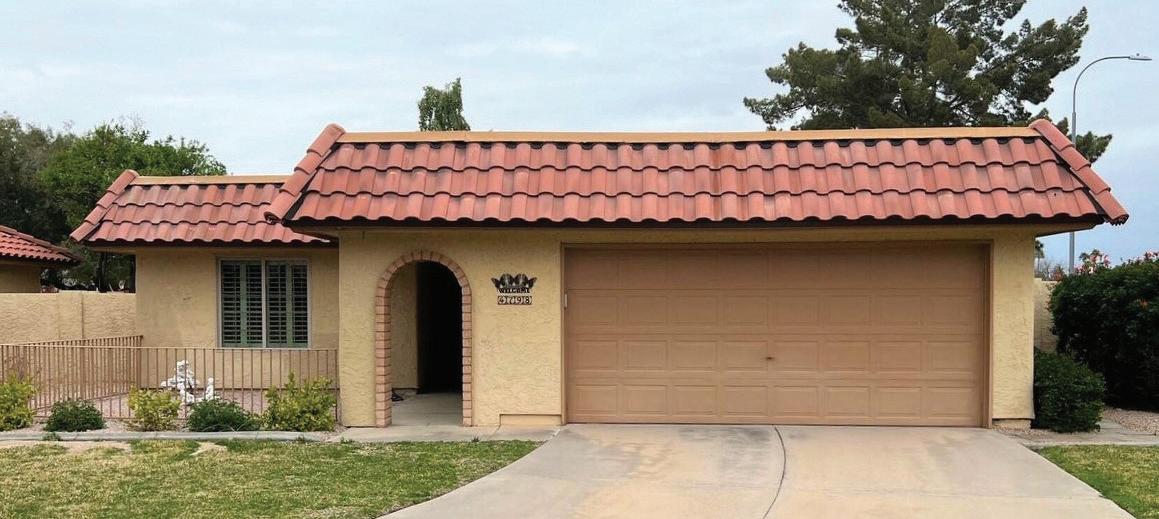
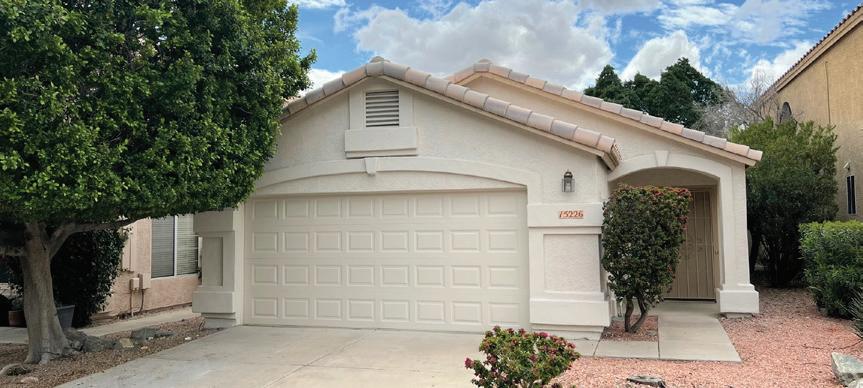
Recessed LED lighting throughout home! 2021 interior paint and 7 ¼” baseboards. 2022 trendy ceiling fans and 2022 silhouette window blinds. The 2021 remodel of the bathrooms includes new faucets, vanities, sinks, Toto toilets, mirrors, lights, and tile surrounds in showers. Enormous, expanded walk-in shower in the master suite! 2020 Nuvo whole-house water purification system. 2021 Milgard windows and doors throughout. 2021 sprinkler systems front and back. Sparkling pebble tec pool!
Mountain Park Ranch
Williamson said, “We can start recruiting for those new positions that become effective July 1 so that we can kind of shorten the gap in the recruiting process and get those folks closer to onboarding by the time we get the budget to potentially eliminate some of that gap.”
Williamson also said, “There will be vacancy savings within the parks department that will avail themselves of the opportunity to cover those vacancies with security as well as to look at other opportunities if that’s necessary.
Barton noted that over the course of 12 town halls on the proposed spending plan last month, as well as on the city’s website, a mere 362 residents provided suggestions for how the city should spend close to $2 billion in the next fiscal year.
Of the 760 comments – some people made multiple suggestions – the biggest share – 160 – called for “additional funding to create cricket fields and amenities.”
The additional spending items approved
LEGION
from page 5
more young people.”
Of the 131 members of Post 64 “there’s a lot of people between the ages of 55 and 65, so I want to tap into the people 40 to 60,” said Smull.
The Ahwatukee post’s first Gen X commander, Smull noted that baby boomers comprise over three-quarters of Post 64’s ranks.
“We’ve got to get people engaged,” she said, pointing to a social she organized last month as one way she intends to do it.
“It was just people doing things, having fun,” she said, adding fun activities peppered among more staid ritual ceremonies is one way she believes she can expand Post 64’s membership.
“The other thing I want to do is partner with other veterans groups, like U.S. Vets,” she said.
U.S. Vets focuses on “the successful transition of military veterans and their families through the provision of housing, counseling, career development and comprehensive support.” It recently opened a shelter for homeless female veterans in Phoenix.
Smull sees Ahwatukee as an untapped source of veterans, who may total between 5,000 and 10,000 here.
To help attract them, the post has re-
by Council included $250,000 for three cricket fields.
Roughly 30 comments each called for more money for park improvements, public bathrooms, arts and culture, free public transit, more homeless services and free public WIFI.
Of the remaining surplus money, the next biggest allocation is $3.8 million to fully staff the new Ahwatukee fire station, the fourth for the community. Those 31 firefighters and paramedics already are in training to be ready for service at the new station at 19th Avenue and Chandler Boulevard when it opens in about two years.
The remaining $1 million in add-ons to the original budget include $250,000 for a street sweeper to clean bike lanes throughout the city, $250,000 for A New Leaf’s Phoenix Day Early Childhood Education Center, $125,000 for additional maintenance at Sueño Park, and $150,000 “to clean and remove debris in up to three additional washes annually and to cleanup medians.”
vived the position of service officer.
“That’s the key person who helps vets deal with the VA and navigates them through the VA,” she said.
Smull is also forming bridges between the post and other organizations. Recently Post 64 became a charter organization of Boy Scout Troop 172 in Tempe.
“There’s a whole pool of veterans that are fathers and grandfathers or mothers of Boy Scouts,” she said. “So that’s another way to build bridges. But I’m trying to reach out to other organizations in the community to do more. I’ve got a whole plan.”
Smull is counting on her history of leading soldiers and coworkers to help achieve that plan.
The author of a book titled “Simple Words and Simple Truths" – which incorporates speeches and blogs she has written over the last nine years – Smull also counts on her abilities as a communicator, which she sharpened as the public relations coordinator for both the Ahwatukee and district Toastmasters organization.
“Our overall message to any age is ‘what can we do to help you as a veteran?’” she explained. “It’s going to be all about service. Generation X and millennials want to do things that are meaningful. They don’t want to just do a flag ceremony.
Willis Ranch – Chandler
Ahwatukee Legionnaires remember their comrades
BY PAUL MARYNIAK AFN Executive Editor
As each name was read, a small bell tolled.
The meeting room at the Ahwatukee Recreation Center fell silent as American Legion Post 64 held May 17 paid a Memorial Day tribute to eight members and two Post Auxiliary members who passed away last year and another, World War II veteran Anthony Sebastiano, who passed away just after the new year began.
Post 64 Auxiliary President Darlene Hunter and Chaplain Rebecca Schmidt solemnly read each name, followed by the tinkle of a small bell rung by Post 64 Adjutant Roddy Charlton.
• Debbie Demblec, Post 64 bugler and auxiliary member.
It was a final farewell by Ahwatukee’s only military veterans organization to valued members but also people who had served their country.
Indeed, Edmund Mangan had been Post 64 commander from 2016-18 before illness prompted him to turn over those duties to Ahwatukee Realtor Pete Meier, a Vietnam vet who just concluded his tenure. David Von Tersch for years had served as Post 64’s sergeant at arms.
His successor, Commander Brenda Smull, stood solemnly as Schmidt reminded the audience, “We shall keep in hallowed memory the lives of these members whom we have loved and ‘lost for only a little while.’”
The ceremony was Ahwatukee’s only formal Memorial Day observance as the Post
64 Color Guard will continue on Monday a tradition it has kept for years – heading up to the National Memorial Cemetery of Arizona in Cave Creek, where they will join
contingents from scores of other veterans organizations.
That ceremony, at 8 a.m. Monday at 23029 N. Cave Creek Road, was an annual event that both Mangan and Van Tersch observed as proud Color Guard members.
Smull wrote obituaries for the two leaders after they passed away last year – Mangan on Oct. 17, five days after his 79th birthday; Von Tersch on Oct. 5, his 72nd birthday.
She recalled both fellow Legionnaires’ life-long patriotism and dedication to Post 64.
An Air Force captain and a member of the Arizona Veterans Hall of Fame, Mangan “impressed me even more when I learned that he was active in Military Officers Association of America and volunteered for ESGR and JROTC programs, Smull wrote.
“Having served as a captain in the Army, I know what these organizations are and hold great respect for people who participate and support them.”
Of Von Tersch, Smull wrote, “What impressed me most about Dave Von Tersch was his dedication and loyalty to fellow veterans, friends, and the members of the community.”
She cited “the long list of volunteer roles and leadership positions he held” and his work in organizing ceremonies for Flag Day, 4th of July, Memorial and Veterans Day, the spring Easter Parade, Evolution of the Flag, ‘the annual Winterfest and Color Guard and Honor Guard for countless school, community and funeral events.”
While not as much information was immediately available about the other Post 64 members who were remembered at last week’s ceremonies, Schmidt had them all in mind when she said:
“We shall strive to pattern our lives after the zeal for patriotism and their devotion to duty as we rededicated ourselves to the unfinished work that their hands began. We thank them and we honor them.”
American Legion Post 64 Chaplain Rebecca Schmidt read some of the names of the eight post members and two auxiliary members who passed away last year as post Adjutant Roddy Charlton rang a small bell reserved for tolling the names of fallen veterans. Not pictured is Post 64 Auxiliary President Darlene Hunter, who alternated with Schmidt in reading the names of their beloved comrades. (David Minton/AFN Staff Photographer)
Photos of eight American Legion Post 64 members and two Auxiliary members who passed away last year and a few other mementoes were set up at the reception table for the memorial service at the Ahwatukee Recreation Center last week. (David Minton/AFN Staff Photographer)
“They want to participate in a cause that has meaning and purpose, so that’s why I am going to say to younger people, ‘We’re now going to get more involved with students. We’ll get more involved with homeless vets, more female vets and all that.’
“Then, with the older folks, we’re going to keep the traditions. We’re still going to do Memorial Day. We’re still going to do the Ahwatukee Easter Parade,” she continued. “So, the traditions will be maintained but with a younger, more energetic spin on other important activities.”
She said she’s bringing with her many ideas she gleaned from activities as an officer in a Denver Legion post, which had about 200 members, many veterans of Middle East conflicts rather than Vietnam.
Post 64 also is reviving an American Legion Auxiliary chapter, which comprises the spouses and children of post members.
“It used to be called the Ladies Auxiliary but now it’s for both men and women,” she said, noting she has already drafted her husband Steve.
Post 64’s visibility to some degree is hampered by the fact that, unlike many VFW and America Legion outfits, it has no building of its own and has adopted the Ahwatukee Recreation Center as the headquarters for its monthly meetings
and many of its activities.
Many veterans organizations have a bar and restaurant in their buildings that become the equivalent of a neighborhood hangout, enhancing their visibility.
But Smull noted that the Denver post she helped lead had no bar in their building and “they’re doing just fine.”
To grow, she said, Post 64 has to give younger veterans reasons to consider joining – a challenge, she added, that many veterans organizations confront.
“We have a bigger challenge in Ahwatukee because if we don’t increase our membership in 10 years, this post won’t be very active at all,” Smull said. “I’m the new generation and I’m hopeful to bring in people that are like me, are younger.”
She noted that Post 64 lost nine members last year alone and already several more have passed away this year.
“We lost a lot of people,” she said, “and then there are others who just can’t do things anymore” because of their age.
She said she is focused on growing the post partly out of respect for her parents and partly because she likes embracing challenges.
“My parents are passed but they were very active,” she said. “They always did a lot for veterans. They went to the VA hospital and visited people. They just did a lot. So, I want to honor my father.”
To learn more about Post 64: americanlegionpost64.com
We offer the followingservices:
INJECTABLES:
- Botox, Jeuveau and Dysport
- Dermal Fillers
- Sculptra
LASER TREATMENTS:
- Plasma Resurfacing
- Ultherapy
- Fractional 1540 non ablative resurfacing
- Photofacial (IPL)
- Laser Hair Removal
SKIN TREATMENTS:
ACTUAL CLIENT! BEFORE AND AFTER PHYSIQ TREATMENTS!
- Skinwave Hydra-infused Facial
- Microneedling
- Custom Facials
- Chemical Peels
- Dermaplaning
BODY TREATMENTS:
WE’RE EXTENDING EXCLUSIVE DISCOUNTS TO OUR NEIGHBORS!
15 units of Botox or Jeuveau FREE with purchase of 30 units! (a value of up to $180)
1/2 OFF Physiq Body Sculpting! (a savings of $1800)
- Physiq Body Sculpting reducesfat,tightensskinand stimulates muscle all in one treatment!
1/2 OFF Skinwave Hydra-infused facial treatment! (a savings of $75) All
through 5/31/2023
WEDDING from page 1
proached the only employee on the premises where she and Cowdell had already paid most of their $7,000 fee and told her how excited she was.
And that’s when her excitement turned to horror.
“She said, “I’m so sorry but we had to cancel your event,” Begay recalled. “She said ‘There’s an issue with the kitchen and the event coordinator should have called you.’
“I said, ‘We haven’t been able to set a time to talk to her and she hasn’t called us or anything.' And I’m thinking we have four weeks to deal with any kitchen issue and can we still use the menu and bring in our own caterer.
“‘No,’ she said. ‘That’s not going to work.’ And I’m standing there watching people eat in the restaurant.’”
“I was just in shock,” Begay said, recalling she had asked her fiancé ‘What do we do?’
For most of last week, any excitement and anticipation that Cowdell and Begay might have felt dissolved into a nightmare of frantic calls to scores of venues that ended with the same response: they were booked for June 10.
And with 100 mostly out-of-town guests coming from as far as Alaska who had booked plane and hotel reservations months ago, those were the last words the couple wanted to hear.
Early last week, Cowdell said, “We took off work and we were driving around from one place to another.”
Cowdell, a Washington State native retired Air Force officer who works for Honeywell, and Begay, a Window Rock native who is a development counselor for Grand Canyon University serving students with Indigenous backgrounds, had made their reservation with Lido’s on their very first
visit Feb. 1.
The couple, who first met online in October 2020, loved its location along a lake and said that while losing the spot was bad enough, their treatment by management in the wake of the cancellation added aggravation to their panic.
“Tim wouldn’t accept their answer about kitchen issues,” Begay said. “‘There’s something else going on,’ he said. And then finally they disclosed they sold the property and had to be out by the end of May.”
A request for comment left on Lido’s voice mail by the Ahwatukee Foothills News was not returned.
But owner Edward Georgescu issued a statement to Channel 3 News last week that said, “Unfortunately, our financial situation is not sustainable. I am sorry they had to change their plans and find out the way they did.”
By the end of last week, the couple found a new venue and the wedding will go on as scheduled.
But their nightmare is just one example of why couples should approach potential
wedding venues carefully, said Kim Horn of Ahwatukee, an official wedding planner for over 20 years and the former Arizona coordinator for the Association of Wedding Consultants.
“When you’re signing a contract for a venue, you have to understand what you’re reading,” Horn said. “A lot of people, when they’re reviewing a contract, just sign it.”
“I tell people never give a deposit until you have reviewed the contract because once you give that money up, your negotiating power goes down.”
Horn said that the need for an expert review of a venue contract is perhaps more important now than ever because the number of venues has exploded in the Valley in recent years.
“After COVID, people saw a spike in weddings and many saw it as an opportunity,” Horn said. “They had no idea what they were getting into.”
Horn said some operators figured “I can make this much money” by thinking that the post-pandemic rush to the altar would generate weddings every day because
bookings would be so intense that any day for a wedding would do.
“So what happens is that when you get back to what is real, most people don’t want to have a wedding Monday through Thursday.”
That’s led to other abuses that show why couples should consider a professional planner who can advocate for them through both the negotiations leading to the big day as well as during the reception itself.
Some of those problems don’t even materialize until a reception is underway, Horn said.
One major headache for newlyweds can occur when a venue doesn’t hire enough staff for a reception.
She said she has seen venues trying to provide only one bartender for receptions with over 200 guests or only a a couple, leaving only one bartender to service over 200 guests or a too small of a wait staff efficiently serve plated meals or replenish buffet items.
“What some venues are trying to do, in my opinion, is control the flow of food because the fewer people they have serving, the less they serve,” Horn said. “It’s like a numbers game.
“I had one venue where they had one bartender for 150 people and the bartender at one point announced the bar was closed because he was passing out champagne.”
Horn said “mom and pop venues” have sprung up because “there are a lot of people that were in real estate and think, ‘We have this house, or a barn, and we can just get a caterer in there.’ They have no idea what’s involved.”
Horn also suggests that couples avoid signing up a venue’s wedding planner and look for an independent professional because the on-site advisor “works for the venue, not for the couple.”
If you owe more than $10,000 in credit card bills or other unsecured debt, see how National Debt Relief can help resolve your debt for a fraction of what you owe.
ONE AFFORDABLE MONTHLY PAYMENT PROGRAM
We work with you to set up a monthly payment that fits within your budget.
NO UPFRONT FEES
You won’t pay a penny until your debt is resolved.
RESOLVE YOUR DEBT IN 24–48 MONTHS
We’ll resolve your debt as quickly as possible so you can finally start living the life you want. GUARANTEE
Tim Cowdell and Shawna Begay had picked the Lido Restaurant on Lakeshore Drive in Tempe because of its lakefront location but were told it was closing at the end of May, ten days before their wedding reception was to be there. (YouTube)
Desert Vista and Mountain Pointe high schools will be joining the other Tempe Union campuses in graduating the Class of 2023 tomorrow, May 25, the East Valley Institute of Technology bid adieu to its seniors last week. The class of 2,500 seniors from scores of high schools who attended EVIT in half-day sessions the last two years was so large the ceremonies were split across two days so that Sloan Park stadium in Mesa could accompany the newly minted grads and their guests comfortably. (David Minton/AFN Staff Photographer)
Class of 2023 shows EVIT’s efforts to change lives
BY DR. CHAD WILSON AFN Guest Writer
This week, nearly 2,500 high school students and adults from across the Valley completed career training programs through the East Valley Institute of Technology.
During two ceremonies at Chicago Cubs Sloan Park Stadium, we celebrated these students who will go on to be our next generation workforce.
For our high school students, this was no small feat. Most of them have attended EVIT for a half-day for two years, many of them giving up sports and other activities so they could commit themselves to their career training.
For many of our adult students, this marks the end of a period in which they juggled full-time jobs and families with career training so they could upgrade their skills, earn advanced certifications or start a new career.
For all of them, this is the beginning of a journey to see where their EVIT training will take them.
At EVIT, we strive every day to change lives. That’s what quality career training can do. The skills and knowledge our stu-
PERIPHERAL NEUROPATHY AND CHRONIC PAIN TREATMENTS NOT WORKING!!
Mesa, AZ - When it comes to chronic pain and/ or neuropathy, the most common doctor-prescribed treatment is drugs like Gabapentin, Lyrica, Cymbalta, and Neurontin. The problem with anti-depressants or anti-seizure medications like these is that they offer purely symptomatic relief, as opposed to targeting and treating the root of the problem. Worse, these drugs often trigger an onset of uncomfortable, painful, and sometimes harmful side effects.
The only way to effectively treat chronic pain and/or peripheral neuropathy is by targeting the source, which is the result of nerve damage owing to inadequate blood flow to the nerves in the hands and feet. This often causes weakness and numbness.
dents learn now lay the groundwork for them to have a better quality of life.
It also improves the quality of Arizona’s workforce – which improves the quality of life for all of us.
We are undergoing a lot of changes at EVIT as we work toward ensuring that the training we provide continues to change lives and meets the evolving needs of our state and workforce.
That’s why we pursued and succeeded in getting legislation passed to allow Career Technical Education Districts like EVIT to offer associate degrees.
When EVIT first opened its doors 30 years ago, there were many good jobs and careers that did not require any post-secondary education.
But today, the Center for the Future of Arizona estimates that 65% of all jobs require some education and training beyond high school. To help meet that demand, we hope to be offering at EVIT associate degrees in nursing, paramedics, and surgical technology by January.
In a fast-changing world, our most vulnerable populations often get left behind. At EVIT, we are putting programs and ini-
As displayed in figure 1 above, the nerves are surrounded by diseased, withered blood vessels. A lack of sufficient nutrients means the nerves cannot survive, and thus, slowly die. This leads to those painful and frustrating consequences we were talking about earlier, like weakness, numbness, tingling, balance issues, and perhaps even a burning sensation.
The drugs your doctor might prescribe will temporarily conceal the problems, putting a “BandAid” over a situation that will only continue to deteriorate without further action.
Thankfully, Mesa is the birthplace of a brand new facility that sheds light on this pressing problem of peripheral neuropathy and chronic pain. The company is trailblazing the medical industry by replacing outdated drugs and symptomatic reprieves with an advanced machine that targets the root of the problem at hand.
Effective neuropathy treatment relies on the following three factors:
1. Finding the underlying cause 2. Determining the extent of the nerve damage
(above 95% nerve loss is rarely treatable)
3. The amount of treatment required for the patient’s unique condition
Aspen Medical in Mesa, AZ uses a state-ofthe-art electric cell signaling systems worth $100,000.00. This ground-breaking treatment is engineered to achieve the following, accompanied by advanced diagnostics and a basic skin biopsy to accurately analyze results:
1. Increases blood flow
2. Stimulates and strengthens small fiber nerves
3. Improves brain-based pain
The treatment works by delivering energy to the affected area(s) at varying wavelengths, from low- to middle-frequency signals, while also using Amplitude Modulated (AM) and Frequency Modulated (FM) signaling.
It’s completely painless!
THE GREAT NEWS IS THAT THIS TREATMENT IS COVERED BY MEDICARE, MEDICAID, AND MOST INSURANCES!!
Depending on your coverage, your peripheral neuropathy treatment could cost almost nothing – or be absolutely free.
The number of treatments required varies from patient to patient, and can only be determined following an in-depth neurological and vascular examination. As long as you have less them 95% nerve damage, there is hope!
Aspen Medical begins by analyzing the extent of the nerve damage – a complimentary service for your friends and family. Each exam comprises a detailed sensory evaluation, extensive peripheral vascular testing, and comprehensive analysis of neuropathy findings.
Aspen Medical will be offering this free chronic pain and neuropathy severity evaluation will be available until May 31st, 2023. Call (480) 2743157 to make an appointment.
Due to our very busy office schedule, we are limiting this offer to the first 10 callers. YOU DO NOT HAVE TO SUFFER ANOTHER MINUTE, CALL (480) 274-3157...NOW!!
We are extremely busy, so we are unavailable, please leave a voice message and we will get back to you as soon as possible.
While
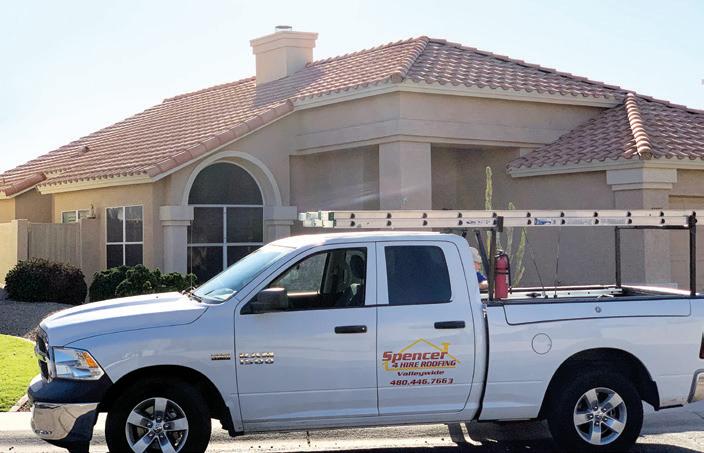
At Spencer 4 Hire Roofing we believe it is essential to give back to our community and support those who support us. So, this 4th of July we have decided the best way to celebrate our country’s freedom is by supporting those who have afforded us those freedoms. We are giving away ONE FREE ROOF ($13k Value) to a deserving veteran!
Have someone in mind? We are looking for someone who inspires and is deserving. The giveaway is limited to homes in the following zip codes; 85044, 85045, and 85048. The nominee must be the owner of the home. Scan the QR code or visit the link below to make your nomination!
Gov. Katie Hobbs and Attorney General Kris Mayes said last week the state has been the victim of massive fraud in its health care program and blamed their Republican predecessors for ignoring it.
They also released the names of 100 providers whose payments have been suspended for “credible allegations of fraud” – including one in Ahwatukee at 3546 E. Windmere Drive operated by Simon George, according to state records.
The scheme for at least some of the “sober living homes’’ involves signing up Native Americans, often on the street, with the promise of treatment.
But when they got there, there was no treatment and, according to Hobbs, some had to “escape out of windows and jump over fences in the middle of the night just to access a phone to reach the outside world.’’
Yet, the governor said, the Arizona Health Care Cost Containment System, the state’s Medicaid program, was billed for the “services.’’
Mayes said it even involved scammers just using the names of Native Americans – some who were dead – to bill for services that were never provided.
All this, both contend, occurred because AHCCCS, under the direction of someone appointed by Doug Ducey, and the Attorney General’s Office run by Mark Brnovich failed to adequately address the problems.
“This is what you get when you have a governor who didn’t care about governing,’’ Mayes said.
That drew a sharp reply.
“The investigations revealed today had been underway for several years, well before the current occupants took office,’’ said Daniel Scarpinato, who had been Ducey’s chief of staff.
He pointed out that even Mayes acknowledged that there have been more than 40 prosecutions and $75 million recovered during the past three years – long before Hobbs and Mayes took office in January.
Scarpinato called the press conference “grandstanding.’’
Former Attorney General Mark Brnovich had a similar reaction.
“Our office prosecuted a record amount of health care fraud cases,’’ he said.
But Mayes said that the prosecutions of the past amounted to a “whack-amole’’ approach of going after individual fraudsters but never recognizing or addressing how to prevent the problem in the first place.
In each of these cases the fraudulent claims involve care for Native Americans.
And the reasons is the nature of AHCCCS.
Most of the more than 2.4 million residents enrolled are in health care plans which are paid a flat fee of federal and state dollars for all care.
But under federal law, services to Native Americans are provided on a fee-forservice basis. And Mayes said that makes it attractive for sober living homes to seek out and sign them up for care.
Mayes said that, however, is only part of the scam.
“They simply purchased lists of names
and dates of birth of people and used those to bill AHCCCS,’’ Mayes said. And there even were cases where the state was billed for services she said that were “impossible to render,’’ like 13 hours a day of alcohol rehab services for a 4-year-old for whom they had that child’s AHCCCS identification card.
“This poor child was not in one of the facilities and did not need alcohol rehabilitation,’’ Mayes said. She said there were similar billings, like $1 million for treating a woman and her children over the course of a year.
There also were services for “patients’’ who were dead, in jail, or clearly not in Arizona at the time.
Most of this went undetected and unprosecuted, Mayes said, despite what she said were complaints registered by investigators for AHCCCS and within the office she inherited from Brnovich.
“This never should have been allowed to happen,’’ she said.
Mayes estimated that in the past three years there has “hundreds of millions of dollars’’ lost due to fraud. But she declined
to put a figure on it.
“I wish I could be more specific about that,’’ Mayes said. “I don’t think it is too much to say this is one of the biggest scandals in the history of the state of Arizona when it comes to our government.’’
“The previous administrations were asleep at the switch, asleep at the wheel,’’ Mayes said. “The Ducey administration was, at best, negligent while they allowed scam artists and fraudsters to take advantage of the antiquated, outdated systems and incompetent management of AHCCCS.’’
Carmen Heredia, now head of AHCCCS designated by Hobbs, said, “We have suspended payments to approximately 100 Medicaid providers based on credible allegations of fraud.”
Mayes said that in 2019, there was $53.5 million billed to AHCCCS under the code of outpatient behavioral health services. That more than doubled to $132.6 million the following year, to $291 in 2021, and hit $668 million in the 2022 fiscal year.
Mayes made it clear there were some efforts to pursue the problem before she took office in January. In fact, she was the one who acknowledged that more than 40 people were indicted in the past three years and the state has recovered $75 million.
But the problem, she said, is that no one in either AHCCCS or her office undertook a systematic review.
And that goes to her claim and that of Hobbs that the failure starts at the top.
Mayes said that prosecutors and investigators in what is now her office have been “screaming from the rooftops’’ for some time now, “trying to get the leadership of the Attorney General’s Office and the leadership of AHCCCS to shut down the money’’ as a way to address the problem. And she said similar alarms were being raised by investigators in AHCCCS.
Instead, she said, Brnovich and AHCCCS went after individual offenders as they were found. And all that did, Mayes said, is result in those people simply forming a new corporate entity to go back in business.
“You can’t prosecute your way out of this problem,’’ she said.
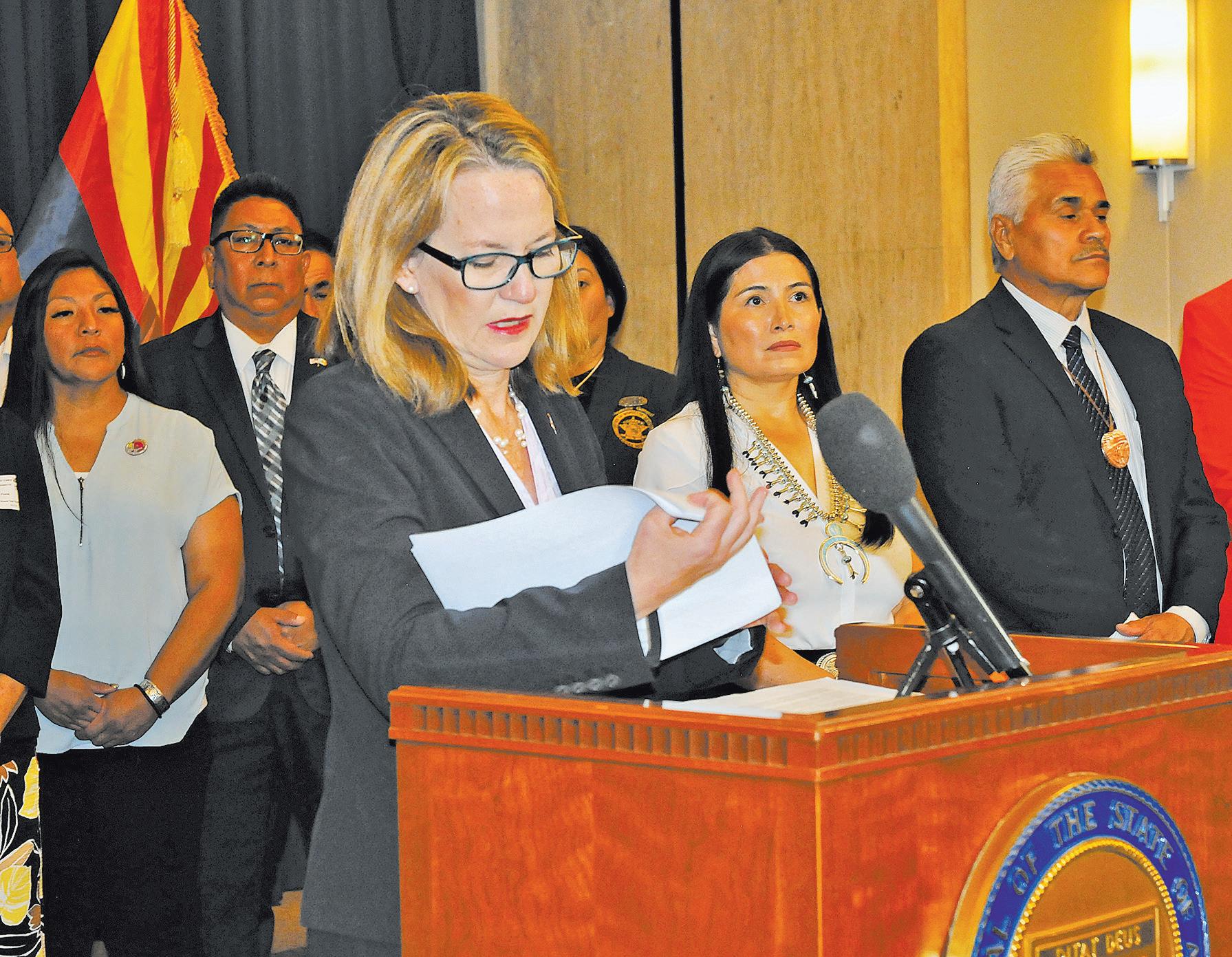
State Attorney General Kris Mayes, with tribal leaders standing nearby, discussed massive fraud by sober living homes. (Howard Fischer/Capitol Media Services)
GOP leader praises Hobbs for budget compromise
BY BOB CHRISTIE Capitol Media Services
Democratic Gov. Katie Hobbs took major heat from many Democrats for negotiating a state budget package with Republican legislative leaders that did not include any changes to the state’s universal school voucher program.
But Republican Senate President Warren Petersen is heaping praise on Hobbs for the deal, saying she negotiated in good faith, kept her promises and made a rare bipartisan budget happen.
He pointed out that despite Democrats’ anger over school vouchers, “that wasn’t going to get on her desk’’ because majority Republicans would never vote to curtail the program.
“Kudos to her,’’ Petersen said about the governor’s direct negotiations with him and House Speaker Ben Toma.
“She was reasonable,’’ he said.
“And she would keep her word,’’ Petersen said. “”Whenever she would say ‘I agree to that,’ she did it.’’
The deal on the $17.8 billion state budget package for the fiscal year that begins on July 1 came much earlier than many
Cabinet post in the Obama Administration in 2009, a shock for Republican lawmakers who have had 14 years of working with a GOP governor.
Petersen sat down with Capitol Media Services this past week for a wide-ranging interview as the yearly legislative session takes a virtually unprecedented onemonth break called by Petersen and Toma.
With the budget done and the only bills remaining needing major work before votes, they called a break in floor sessions to work on those issues.
“We literally have put everything up there was ready,’’ for a vote, he said. “And now I’m not going to make people come down here if I don’t have any floor work to do.’’
He said he was the one who came up with the plan that doled out chunks of a big budget surplus to each of the 47 Republican lawmakers in the House and
Arizona Senate President Warren Petersen, R-Gilbert, praised Gov. Katie Hobbs for being “reasonable” during 2023-24 budget negotiations with the Republican-controlled Legislature. (Capitol Media Services)
HOBBS from page 20
What that earned was individual buyin from GOP lawmakers who for the first time had ownership of a slice of the budget, Petersen said.
That’s a huge difference from the way the budget has normally been done, with Republican leaders hammering out a deal with the governor and then presenting it to rank and file GOP lawmakers as a done deal.
“It came from the difference between communism and capitalism and the way things normally go and why we always have problems,’’ Petersen said of his strategy.
“You normally have six people down here deciding how all the money gets spent,’’ he said. “And then those six people try to convince everybody else to vote for the budget.’’
Giving each lawmaker a portion of the budget – $20 million each for GOP House members, $30 million for each GOP senator – gave them control they did not have previously.
“It was like literally the first time I’ve been down here where people were happy,” Petersen said.
“Everyone went in ready to vote for this budget. Why? Because I gave them all a piece of the budget. Everybody got their own piece, and they owned it” he added.
Many Democrats voted for the plan, although many grumbled about how it was presented to them. Petersen blamed Democratic leaders for not adopting his formula with their members and delaying giving him their budget “asks.’’
After the budget passed and was signed on May 12, what’s left is a series of top-tier proposals that currently don't have consensus among Republican lawmakers, with the governor having the final word.
The biggest issue is the extension of a half-cent sales tax in Maricopa County which pays for transportation projects.
The 20-year, multi-billion-dollar tax expires in 2025 unless voters extend it. But the Legislature has to give its permission for the issue to be put on the ballot; it’s the only county that requires that step to ask voters to approve a transportation tax.
Last year, lawmakers passed the tax extension proposal but it was vetoed by then-Gov. Doug Ducey. With an even more conservative Republican caucus this session, it faces tough scrutiny.
Petersen said he and others have major problems with the proposal presented by the Maricopa Association of Governments, the entity that doles out the money for freeways, major roadways, buses and light rail and clean air programs.
Petersen has little faith in MAG.
“MAG is completely unaccountable,’’ he said. “They’re very, very insulated.’’
He said that, on paper, the agency is led by mayors who are supposed to have some oversight.
“But not really,’’ he said. “These mayors are overwhelmed, busy.’’
Petersen said the plan’s use of 44% of the funds for mass transit is a non-starter. And he said it creates what he called a $2 billion “slush fund’’ that he worries would be used to extend light rail despite promises that’s not contemplated.
And then there’s the part that says air quality is a consideration in what to fund.
“If they’re just saying, we can use any measures we want, they need to define what air quality programs they want to do,’’ he said.
Without definitions, Petersen said MAG could potentially impose limits on gasoline-powered cars or adopt cap and trade programs or who knows what. If they want flexibility for future technologies, he said
a mechanism for legislative oversight should be added.
“Believe it or not conservatives want clean air,’’ Petersen said, including for themselves and their children.
“But they need to define what it is,’’ he said. “And yeah, if it’s reasonable, we put that in.’’
Petersen had just left a meeting with Hobbs when he sat for the interview in his office, and said it sounds like she may want to be directly involved in the negotiations over Proposition 400, the tax extension.
Other remaining issues include a revamped proposal to ban city-imposed taxes on home rentals. Hobbs vetoed that bill earlier this session, saying there was no mechanism ensuring renters facing rising housing costs will actually see the money.
She also opposed the $270 million appropriation to compensate cities for the lost revenue for the first 18 months of the ban, saying it came outside the budget plan.
Toma said recently that tying a signing of a rental tax ban and Proposition 400 in negotiations with the governor was a possibility. Petersen, however, said he’s not doing that.
“I don’t horse trade,’’ he said.
The other key battle remaining is a Republican proposal to override many city zoning laws in an effort to boost construction of lower-priced housing options.
That measure has failed once this year. And new versions pushed by Sen. Steve Kaiser, R-Phoenix, don't yet have the votes to pass and the powerful League of Arizona Cities and Towns is strongly opposed, calling zoning a quintessentially local issue.
Petersen said he does not know if that will get enough support to pass, and if it does not, that’s OK.
“If he doesn’t have the votes, he doesn’t have the votes,’’ Petersen said. “It’s really
that simple.’’
“We probably have at least 10 bills that have loose ends on them that are really important for Arizona,’’ he said. “And we’re looking at if we can negotiate what to do with those by June 12, and the rental tax is one of them.’’
Petersen, who became Senate President in January after a decade representing Gilbert in the House and Senate, said the unusual long break in legislative action is by design.
“We’re not taking a month off, OK. We just don’t have floor work.’’
Mayor Kate Gallego raised concerns about the possibility of the rental tax elimination on May 16 when City Council approved a $1.9 billion spending plan for the fiscal year beginning July 1.
Also raising concerns about the impact of the Legislature’s refusal to fund mass transit, Gallego said the city would lose $80 million if the rental tax is eliminated.
“In the past when the Legislature has made changes to our city tax code, they have back-filled with funding from elsewhere and I certainly hope that they will value the work that our first responders and infrastructure, social services that we do at the City of Phoenix and find a way to make up for any cuts should they decide to move forward with those,” the mayor said.
“I still remain concerned about some of that happening related to the debt ceiling and what that will mean for our economy and we’ll continue to watch that. It is possible we may need to adjust mid-year depending on what is in front of us but we will try to be nimble and to still deliver for our residents,” Gallego said.
AFN Executive Editor Paul Maryniak contributed to this report.
tiatives in place to help ensure that one of those populations – Arizona’s foster care youth – don’t get left behind.
In June, we will break ground on a new residential facility at the EVIT Main Campus, where students who are getting ready to age out of the foster system can live and receive support services while taking one of our career training programs.
We hope our foster care efforts will become a model that other CTEDs can use to meet the needs of these students who have no family to support them.
These are challenging life-changing goals that require commitment and hard work. But if the 2,500 EVIT students who crossed the ceremony stage this week are any indication, they are reachable goals that are worth the effort.
Dr. Chad Wilson is superintendent of the East Valley Institute of Technology, a Career Technical Education District providing career training for high school students and adults at two central Mesa campuses and in high schools in 11 East Valley school districts. Information: evit.com
Coolidge beat Queen Creek in percentage growth last year
BY HOWARD FISCHER Capitol Media Services
Queen Creek and Maricopa grew faster in the past year measured than any other community in Arizona, U.S. Census Bureau data released last Thursday showed – but that doesn’t tell the whole story.
The bureau’s new figures also put Queen Creek and Maricopa among the top 15 nationwide for population increases between July 1, 2021, and July 1, 2022.
But the agency, in crafting its rankings, only ranks what it considers “large cities” – meaning those with 50,000 or more residents.
And a deeper dive finds that Coolidge, fueled by new factories and economic development, outpaces both Queen Creek and Maricopa with a one-year population change equaling 11.9%.
The new report also finds that about one out of four Arizona communities actually lost population. The biggest loser was Douglas, which shed 4.6% of its residents, dropping the city below 16,000 – essentially back to where it was at the turn of the century.
Much of what is in the new national report is no surprise. The fastest growing communities tend to be on the edge of existing cities.
And most of them are in the south or west and, like Queen Creek and Maricopa, on the edges of major urban areas.
Georgetown, Texas, is considered by the Census Bureau as having grown the fastest by percentage in the past year at 14.4%. It is about an hour outside of Austin.
No. 2 Santa Cruz, California, at 12.5%, benefits from its location south of San Jose and the Silicon Valley.
Much of the same proves true in Arizona.
Decades ago it was communities like Glendale and Mesa that grew by leaps and bounds. These communities rapidly filled up.
Not only did the state – much of it with county tax dollars – complete the Loop 202 freeway into the Southeast Valley, it now is building and extending what had been a one-mile stretch of State Route 24 from the 202 into Pinal County.
And that’s just the beginning: The new budget signed earlier this month by Gov. Katie Hobbs gives Queen Creek $87.5 million to further extend SR 24, including a traffic interchange at Ironwood Road.
Even with the freeway still not complete, Queen Creek managed to add another 4,416 residents in the year ending July 1, 2022. And that computes out to a nearly 6.7% increase.
Other communities in and beyond the fringes of the Phoenix Metro area also racked up strong year-over-year population increases including 4.6% for Casa Grande, 3.8% for Goodyear and nearly as much for adjacent Buckeye.
Wickenburg and Surprise also managed growth in excess of 3 percent.
Coolidge also qualifies as being on the fringes of Phoenix. But its growth has been aided by lots of new economic development.
And there’s more to come.
Last November, for example, Procter & Gamble announced a $500 million investment in a manufacturing facility. And the community has available land to accommodate both industry and residential.
The pattern of growth on the edges of urban areas repeats itself around Tucson, though to a much lesser extent.
Marana added another 1,290 residents in the one-year period, bringing population up to 55,962 according to the Census Bureau. But that was enough to post a growth rate of something less than 2.4%.
After Douglas, the other community posting the largest population loss was Florence. But that is highly affected by the number of inmates at state-run facilities there which has been declining over the past few years.
At the same time, additional freeways were built, widened and extended. And that promoted living farther out as it cut down commute times for those who need to travel into the main city for work to acceptable levels.
Queen Creek is a key example.
Community
www.ahwatukee.com
Wherefore art thou, ROMEOS? Probably at lunch
BY COTY DOLORES MIRANDA AFN Contributor
When a local restaurant gets a reservation for a large group of men under the name ROMEOs, there can be some initial confusion.
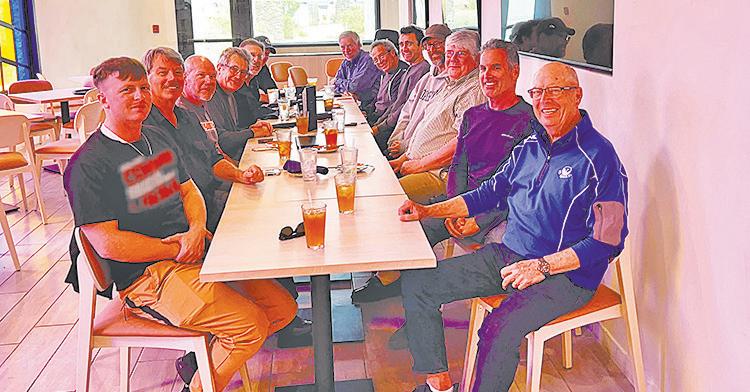
The eyebrow-raising name is cleared up when founder, Dave Hackett, explains the acronym stands for Religious Old Men Eating Out, a local Life Group started through Ahwatukee’s Lamb of God Lutheran Church.
The men’s Life Group, founded in September 2021, gathers for lunch once a month at various area restaurants. They generally attract 10 to 20 members ages 40 to 70. Some are retired, others are fulltime or part-time working professionals.
The Ahwatukee Lamb of God Lutheran
Church offers parishioners a wide range of Life Groups to join, both social and service, that enable church members and other parishioners to “share their lives, knitting together as a family for mutual encouragement and strengthening.”
Making friends and nurturing friendships are paramount to the ROMEOs, said organizer Dave Hackett who explained these are area men of a certain age who may find it difficult to pursue.
“The Ahwatukee ROMEOs started in September 2021; COVID was winding down and people were looking for ways to reconnect,” he recounted. “As men, it can be a little awkward asking another man out to lunch, but inviting a whole congregation of men out to lunch, no problem.
see ROMEOS page 28
Art is just as important as mobility for Y OPAS
BY KAIA CANFIELD AFN Guest Writer
Have you ever thought about how much your life would change if you were unable to drive but you still wanted to remain in your home?
The Y Outreach Program for Ahwatukee Seniors, or Y OPAS, helps local seniors with a variety of support services that enable them to maintain independent living at home.
For the past year, Y OPAS also has offered a free two-hour monthly arts and crafts class to enrolled senior women and men.
This activity helps seniors get out of the house once a month for a couple of hours to socialize and participate in a free art class held at the Foothills YMCA.
Art instructor Kiki Meldrum understands how important it is for seniors to stimulate their brains by creating a simple arts and craft project once a month. (Kaia Canfield/Contributor)
Y OPAS is appreciative of the many volunteers who help with transportation for seniors as well as those teaching a fun two-hour creative activity for Y OPAS clients from 10 to noon on the third Monday each month. Art instructor Kiki Meldrum under-
stands how important it is that seniors stimulate their brains by creating a simple arts and craft project once a month.
While encouraging socializing, Kiki comes up with fun creations that help seniors enjoy the process of producing an item they can take home with them.
The process of planning and creating stimulates motor skills and engages the brain in learning something new.
Kiki, a creative goldsmith and owner of Island Aura Jewelry, also finds time to foster dogs.
Her educational background is working with young children with limitations which has proved helpful when teaching seniors with limited dexterity and health issues, though the art projects are easy. Kiki has the patience to help seniors with eye and hand coordination or cognitive ability issues.
The group activity helps with socialization skills and works the brain in different areas. Her motto is that regardless of the end result, it is important to have fun.
Volunteering to teach brings her joy because the seniors remind her of her amazing grandma who helped raise her and this is her way of honoring her grandmother.
Some examples of past projects are wreaths for the holidays, pressed flower book marks, painting a tree adorned with buttons, beading, sand art, pottery, and in May, a wine cork flag to display for national holidays.
Sara Jackson has been a client of Y OPAS for a few years and enjoys attending the art classes.
She wants to encourage other Y OPAS clients to participate in the art classes for the fun, stimulation and to get them out of house, away from the TV.
Sara also taught a class on the care of orchids. An avid reader who believes it is still important to her to do things outside the home, she says it is easy to make one phone call to Y OPAS to register for the free class and a volunteer will take care of the
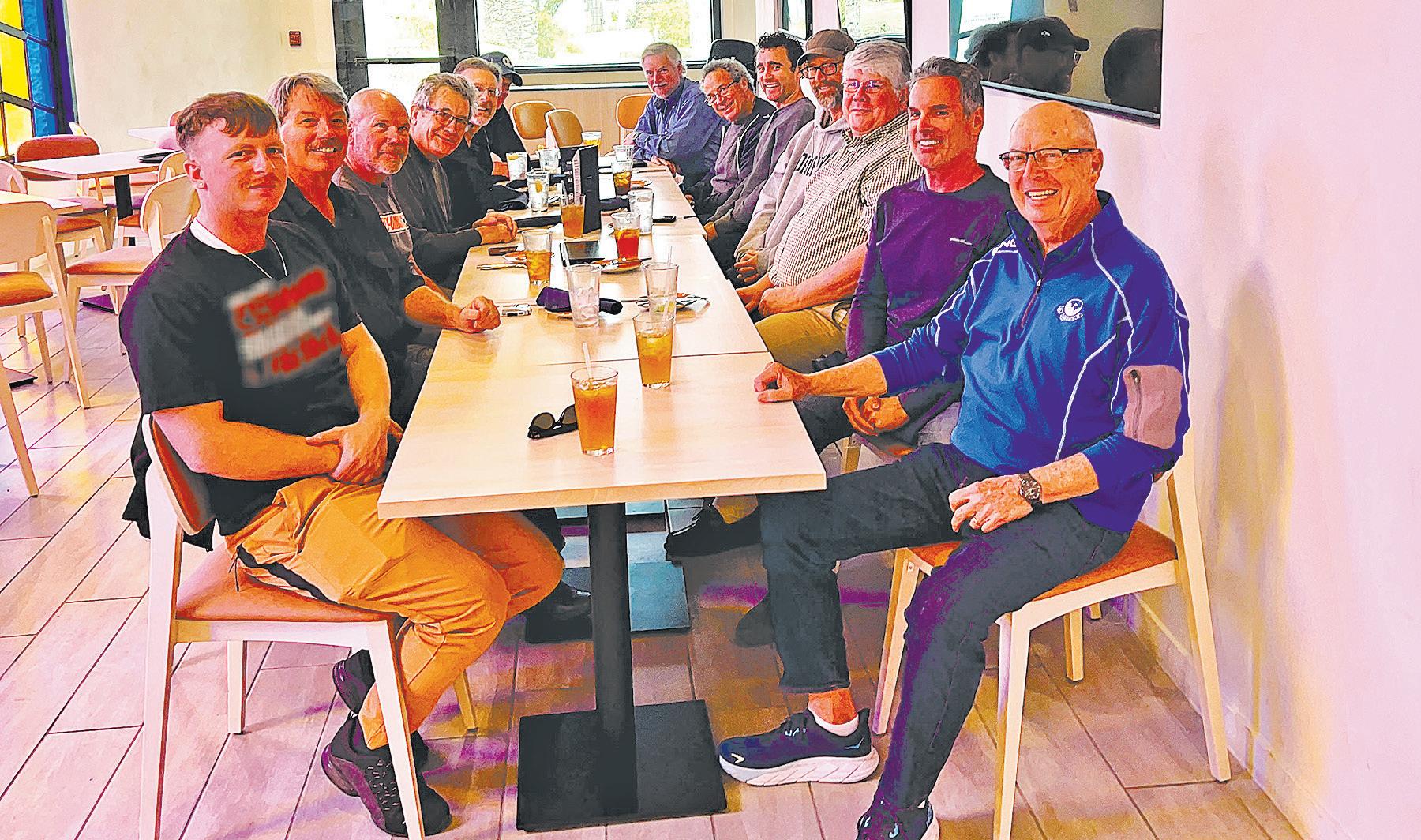
The Retired Old Men Eating Out, or ROMEOs include: left row: Micah Joel, Dennis Niska, Tim Meyer, Paul Manning, Paul Gulden and Dan Jaehnig. Right row: Don Groth, Dave Hackett, Chris Muller, Brian Welch, Pastor Mike Koepke, Chad Chadderton and Dan Weed. (Courtesy of Dave Hackett)
Ahwatukee woman seeks 10 exchange student hosts
AFN NEWS STAFF
Ten East Valley families are being sought to host foreign exchange students for 10 months.
Pascale Dunton of Ahwatukee, the west region manager for International Student Exchange, said families can benefit as much as the visitors from hosting a student and the qualifications for hosting include non-traditional households.
Dunton, a U.S. State Department-certified public diplomacy ambassador who coordinates exchange students visiting in the southwest from abroad, has lived in Ahwatukee since 1991.
“Host families can be a traditional family, same-sex couple, single person – although we prefer for single people to host two students),” she said, adding that the minimum age for a host is 25.
“Our oldest host family is 78,” Dunton said. Naturally, there are some requirements.
“We run a criminal background check on all family members age 18 and up,” Dunton said. “Host families must earn the median income of the town they live in but generally speaking should be at least $30,000 a year.”
“Host families welcome students and treat them like their own kids, provide a bedroom or shared bedroom and meals,” she added.
But hosts don’t have to worry about going broke or conducting their daily routine in a different manner.
“Students adjust to how the family lives and eats – this should be three balanced meals per day,” Dunton said, adding students who must bring at least $350 to America and must pay for their own specialty food items a family might not normally eat.
Students must also use their own cash to cover the cost of personal care items, cell phone plan, going out with friends, extracurricular activities, and any travel with the host family, organization, school or church.
“Students are required to volunteer and give back to the community in any way they wish,” Dunton said. “Students have chores and follow the same rules as the family children. Host families can freely travel with their student as long as they notify the organization ahead of time.”
Additionally, she said, each student and
host family is assigned a coordinator for the year for support and “help all with the adjustment to a new culture/family member/foreign teen.”
Dunton so far has placed 40 of the 50 students coming to the Valley. Among them are seven girls – three from Italy, two from Spain and one each from Germany and South Korea. All are high-school age and six have been familiar with the English language for over 10 years while the South Korean girl has been using English for six.
Across the country Dunton’s organization has as many as 800 to place and she said it’s been a little more challenging this year to find them hosts.
“This year has been more difficult to secure host families and I suspect it has to do with families not having been able to travel and do things due to COVID limitations,” she said.
“We are seeing increased travel abroad, time away from home, spending time out of the area visiting relatives and children making it more difficult to have a student in the home bound to school holidays.”
But Dunton is grateful to have weathered the pandemic, noting that exchange students at the height of COVID-19 did not attend a day of in-person schooling.
“It was tough on all of us but especially them (the students) as that is not what they had imagined of their American experience,” she said.
“They were resilient and surprised us by learning skills they never thought they would – old-fashioned skills such as knitting, sewing; learned to bake, cook, played board games, creatively socialized and interacted.
“When asked them during the exit interview if they would do the program over again despite the limitations they said yes because while they were limited here, at home they would have been forced to stay indoors for months.”
Host families qualify for a tax deduction equivalent to a $600 donation to a nonprofit and their students can get a discount if they want to be a guest of a host family in a broad area of European countries, as well as Australia, New Zealand and Japan.
As for what a host family can derive from the experience other than a small tax benefit, Dunton said, “Many host families have traveled and continue to travel abroad visiting their former sons and
daughters.
“Just this June, a current family in Gilbert is traveling to Portugal, Italy and Greece and their former daughters – six of them will be joining them on the land portion of their six-week vacation,” he said.
“In two weeks, a Scottsdale family is traveling to Italy to visit former sons and daughters and will travel to Valencia, Spain, to meet their new student arriving in early August and at-
see EXCHANGE page 28
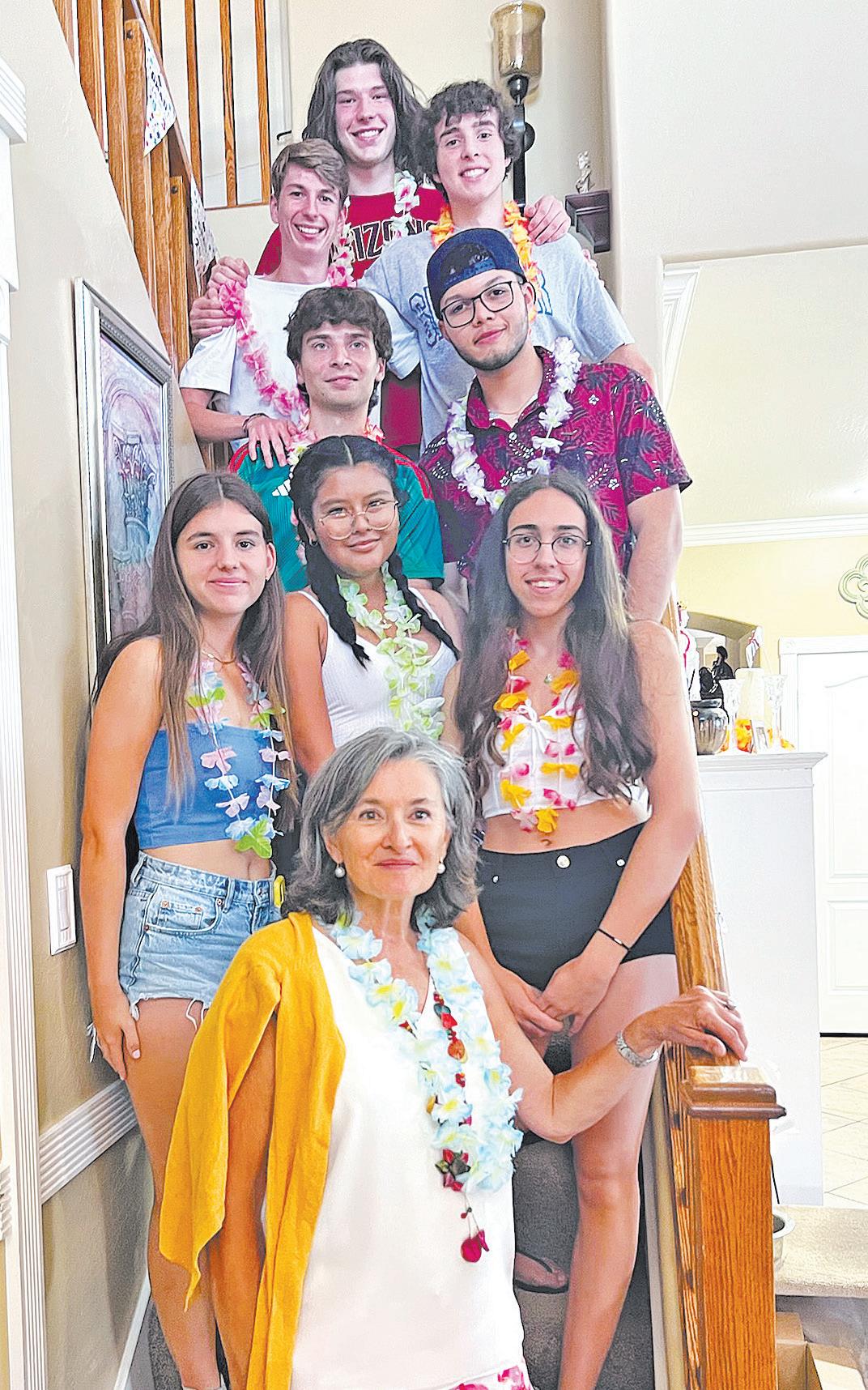
Ahwatukee resident Pascale Dunton, a State Department-certified public diplomacy ambassador and western region director for International Student Exchange, gathered last weekend for a farewell party for the exchange students she placed in area homes. “I was honored about their feedback about their amazing schools, the support they received from their host families,” she said. (Courtesy of Pasquale Dunton)
LA CASA DE JUANA
DELIVERS A KNOCKOUT WITH ITS FRESH, AUTHENTIC AND MOUTHWATERING FOOD
If you thought you have been to a Mexican restaurant lately you probably need to reconsider and visit La Casa De Juana in Ahwatukee. The fare is authentic Mexican, and when we say authentic we mean it, unlike many of the restaurant chains that call themselves Mexican. Upon entering you’ll be dazzled by the colorful décor, the tables and chairs are beautiful, Mexican painted murals, colorful banners hanging from the ceiling and the gracious service with warm orange and yellow tones echoing throughout the restaurant will make this your favorite Mexican restaurant. With great lunch and dinner specials, we have Happy Hour Monday - Sunday from 2 - 6 PM with $5 House Margaritas, $4 Beers, $5.95 Cheese Quesadilla, $8.95 Chunky Guacamole and $9.95 Juana’s Nachos. Live music every Thursday night in our Ahwatukee location and every Friday at our Tempe location. In conclusion The flavorful salsa, the delicious margaritas, the extraordinary and well-priced food will definitely keep you coming back.
Don’t hesitate to stop by the Ahwatukee location 3941 E. Chandler Blvd. (S/W corner Chandler & 40th St) to make your next reservation call 480-626-9295 www.juanashouse.com
Thus the start of the ROMEOs.”
Monthly attendees comprise a varied group of men that Hackett said continues to grow.
“A lot of our church members work from home, are retired or just don’t have a chance to interact with other men on a regular basis. I work from home and usually eat lunch by myself or with my two dogs,” Hackett said, smiling.
The vibe of the group, with its members ranging from 40s to 70s, is ebullient with an emphasis on positive interaction.
“We’re just a bunch of guys talking about everything from sports to food to travel,” laughed Hackett, an appraiser and Realtor who owns Desert Homes Appraisals. “We’re having a good time.”
He explained this is actually the second iteration of ROMEOs.
“I’m actually a second-generation ROMEO. My dad, Joseph Hackett, and his neighbor would go out once a month when their wives would get together. They called themselves the ROMEOs, only theirs meant Retired Old Men Eating Out,” recalled Hackett. “My dad has since passed. When Pastor Mike Koepke
Y OPAS
transportation.
She said she has met some fascinating people with incredible stories and the class contributes to her own mental health.
No longer able to drive, Sara appreciates all the volunteers from Y OPAS that help with providing transportation.
Now she looks forward to the monthly Y OPAS shopping bus trip, luncheon, dominoes, and the art class. All these activities have helped her self-esteem, socialization, and sense of accomplishment.
EXCHANGE from page 27
tending Saguaro High School. In early June a Phoenix host sibling will travel to Italy to spend a couple of weeks with their student.
“The exchange program is not so much an exchange of going to another country or
introduced Life Groups at the church, I thought reviving the ROMEOs would be a good way to honor my dad and to meet and connect with other church members.”
Hackett said the Lamb of God Lutheran Church ROMEOs have members who have belonged to the church since it opened as well as winter visitors and newer members and congregants.
Among the winter visitors are Tim and Elaine Meyer from Minneota, Minnesota, 150 miles southwest of Minneapolis.
A retired banker, Tim Meyer is a Lamb of God Lutheran Church member and an avid ROMEO during the winter months.
“I enjoy gathering with the people I call friends at the ROMEO gatherings. We come from all walks of life but share a strong common bond amongst each other, which is our faith. It’s hard to find people that are like-minded these days but this group has the same, not similar, Christian beliefs. We don’t have to debate that, we are all of the same mind,” said Meyer, 64.
“The church has a number of Life Groups, like the ROMEO’s, for people to form connections. That is one of the main reasons I enjoy the ROMEO’s so much. It creates a sense of community,” he said, observing:
She loves the interaction with other seniors and tries to be a positive influence. It is fun to see clients proudly leaving the class with a smile and a finished art project that they created and can show their relatives and friends.
Tami Schrank is a Y OPAS volunteer driver and also volunteers to help the Y OPAS scheduling office.
Originally from the Midwest, about five years ago she became involved with Y OPAS when looking for an opportunity to help others in the area. When she drives someone to the art class she often participates in the class.
coming to the U.S. but an exchange of ideas and sharing of cultures,” Dunton said.
“Having a new son or daughter allows families to show off traditions, customs, places and see things from a different perspective. Having walked the walk our foreign exchange students walk 43 years
“We live in a disconnected world of social media and distant interactions but this group has a bond of community that is personal and real. Each of these men come from different walks of life but when we gather we laugh, share, discuss, muse, and pontificate about things like a simple gathering of friends. No drama.
“All of this interaction happens through the lens of our faith. I really value my time with the ROMEO’s.”
Dan Jaehnig is another ROMEO who appreciates the monthly luncheon gatherings. He has been with the group since its inception and attends most monthly gettogethers.
“The ROMEOs group is a great opportunity each month to check out an Ahwatukee restaurant, and have lunch with the guys from church,” said Jaehnig.
Lamb of God Lutheran Church Pastor Michael Koepke also attends monthly and offers grace. He said the ROMEOs meet a need among the men in the congregation.
“Life Groups are an important part of our ministry at Lamb of God. We want to do more than be a friendly church. We want to be a church of friends; and Life Groups are one place where those friendships are made,” explained Koepke.
Similar to Kiki, Tami had a wonderful relationship with her grandmother who was the catalyst in her choosing to work with seniors needing help.
Tami was an elementary school teacher for many years and enjoys using her various skills to assist seniors with their art projects. There are always plenty of laughs and amazing stories and she has developed a relationship with many of the seniors she has driven to appointments over the years.
Their backgrounds and experiences are so interesting. The easy-to-use online Y OPAS scheduling tool allows her to pick a
ago, I have a very good understanding of how much courage it takes to leave all that is dear and familiar behind - having to make new friends, learn new customs, rules and adapting.
“Life Groups, like the ROMEOs, are meant to encourage that fellowship among us. Also, they’re meant to provide a way for newcomers to be able to more easily assimilate into the Lamb of God family and get to know us outside of Sunday mornings,” said Koepke.
Though younger men are now joining, the core group consists of older men, said Hackett.
“It seems like the older you get, the harder it is to meet new friends. The ROMEOs is a great way to get to know church members outside of the church, and to help build fellowship within the church,” he said. “I’ve made many great friends through the ROMEOs that I may not have otherwise.”
And there is a side benefit.
“The wives like it, too, as it gets their husbands out of the house for a couple of hours,” Hacket chuckled. “And they can say they married a ROMEO.”
Dave and Denise Hackett have been married 31 years this August.
The ROMEOs is open to all members and visitors to the Lamb of God Lutheran Church, 599 E. Chandler Blvd., Ahwatukee. For more information stop by their Sunday church service at 9:30 a.m., or email ROMEOs@DaveHackett.com.
suitable time that fits into her busy schedule spent with her grandchildren.
She also drives clients to the monthly Y OPAS luncheons. Not one to waste time, Tami either waits for the clients at their appointments, sometimes runs errands, or goes home until the senior is ready to go home.
She loves volunteering and giving back to the community and hopes to inspire others to become Y OPAS volunteers.
For more information on becoming a client or a Y OPAS volunteer: valleyymca.org/opas or call 602-212-6088.
“Every year I welcome a new batch of students and help them maximize their success.”
Dunton said there is some urgency in the need to find the remaining 10 host households.
Learn more by calling her at 602-9804388; email pascale-dunton@cox.net.
from page 26
Laughs galore in Ahwatukee as 2 comedy shows to roll
Ahwatukee residents who need a laugh don’t have far to travel as two comedy shows are in the offing.
HaHaTukee Comedy, a weekly comedy club that presents shows at Cactus Jack’s at 4747 E. Elliot Road, Ahwatukee, has has completed the first round of a 17-week Funniest Person in the Valley Comedy Competition sponsored by local comedian Anthony Solimini and Comedy School founder Tony Vicich at 7 p.m. every Tuesday.
The winners of 10 weekly rounds will not be facing off for the first stage of semifinals.
The grand prize winner will get $1,000 while second place will garner $300 and third place $250.
Along with cash prizes, bookings at the Tempe Center for the Arts, along with bookings at other comedy clubs, and out of state comedy clubs will be awarded.
Judging during the preliminaries will be done by three judges of the producers choosing.
Meanwhile, the Ahwatukee Comedy Club is returning at 7 p.m. June 3 at the Lights, Camera Discover auditorium at 4825 E. Warner Road, featuring comedians Arthur Bellkind, Keith Ellis, Bob Kubota and Danielle Williams. Tickets are $10 at the door or at lcdcomedy.eventbrite.com.
Tryouts slated for 12U AAA Ahwatukee Devils baseball
The Ahwatukee Devils 12U AAA team will hold tryouts 8-11
a.m. June 3 at Sun Ray Park’s northeast field. Registration and paperwork can be found at ahwatukeedevils.com.
“We will be evaluating kids based on drills we have selected,” a club spokesman said. “We will ensure every kid is evaluated fairly.
The competitive team practices twice a week starting in September and plays two tournaments a month through spring. Monthly dues depends on the number of players. For questions about this nonprofit: jpac4lyf@yahoo.com.
Ahwatukee Kiwanis Club lists speakers for coming weekly meetings
The Kiwanis Club of Ahwatukee has a series of speakers lined up at its weekly meetings at the Original Biscuits Restaurant on the southwest corner of Elliot Road and 48th Street in Ahwatukee.
The public is invited to attend. The meetings start around 7 a.m. and usually don’t last more than an hour.
Speakers include: Audrey Partridge, Goldfish Swim School, May 25; and Emily Gesell, Boy Scouts of America, June 8.
Ironwood Library offers free activities for all ages in May
Ironwood Library, 4333 E. Chandler Blvd., Ahwatukee, presents a variety of programs for children, teens and adults. Unless otherwise noted, free tickets are required and available 30 minutes before programs’ start times at the library’s information desk.
For more information: phoenixpubliclibrary.org.
Babytimes
Babies ages birth to 23 months, accompanied by a favorite adult, will enjoy songs, rhymes, books, and interactive fun Tuesdays, 10:30-11:10 a.m. Space is limited to 12 families.
Toddlertimes
Toddlers ages 24-36 months, accompanied by a favorite adult, will enjoy songs, rhymes, books, and interactive fun Thursdays, 10:30-11:10 a.m. Space is limited to 12 families.
Full STEAM Ahead
Children ages 6-12 explore hands-on creative ways to design, experiment, and invent 2-4 p.m. Saturday, May 27, in this drop-in Science, Technology, Engineering, Art and Math (STEAM) program. No tickets required.
Book Club
Adult readers over 18 can meet up with fellow bibliophiles to share their thoughts about each month’s selection the first Wednesday of each month, 5-5:45 p.m. The June 7 book is The Last Thing He Told Me by Laura Dave. No tickets required.
www.ahwatukee.com
Rebranded mental health center slates open house
BY COTY DOLORES MIRANDA AFN Contributor
With a new name, expanded services and more access to affordable mental health care, the Center for Progressive Therapies in Ahwatukee is reintroducing itself to the community.
Formerly called Ahwatukee Psychology, the center will hold a free open house 10 a.m.-2 p.m. Saturday, May 27, at 11011 S. 48th St.
Founder and lead psychotherapist Mysti Rainwater has been in practice since 2007, when she and her husband Sean Rainwater moved to Ahwatukee.
“I’ve been practicing in the Ahwatukee area since starting my private practice, providing counseling services. I have never practiced anywhere other than Ahwatukee,” said Rainwater, who met her husband, an Arizona native, when she was
an Arizona State university student earning a bachelor’s degree in human communication. Her master’s degree in counseling psychology is from Northern Arizona University.
In addition to self-pay, the Center for Progressive Therapies now accepts most commercial health insurance plans and further broadens the accessibility for mental health services through Arizona Medicaid, known as AHCCCS or Arizona Health Care Cost Containment System.
Rainwater said she is thankful to now offer mental health services to those who are unable to pay through self-pay or personal insurance.
Her determination to do so was a result of input from many area residents seeking therapy but hampered by financial constraints and lack of providers accepting insurance.
“It’s always been important to me to accept commercial health insurance plans
to allow for affordable mental health care,” she said.
“While recently researching the needs of our community, we discovered that a significant number of therapists have moved toward the self-pay or concierge model in order to avoid the hassles and expenses associated with accepting insurance for counseling services,” said Rainwater.
“We were actually amazed to discover that many clients were not even aware that psychotherapy was a medical service covered under their insurance plan.”
Rainwater said accepting insurance was important to her as she and husband Sean typically seek out medical professionals available to their family of four.
“During my many years in private practice in the Ahwatukee area, I have always accepted insurance because personally, I pay a lot of money for medical insurance
at the newly renamed business, formerly Ahwatukee Psychology. (Special to AFN)
Golf impacts Arizona economy in many ways
BY LUCAS GORDON Cronkite News
With an influx of visitors throughout the year, it’s no surprise that the golf industry has an overwhelmingly positive impact on Arizona’s economy.
Arizona is home to over 370 golf courses, where players completed over 16 million rounds and generated over $6 billion in 2021, according to a Rounds Consulting Group report on the golf industry.
Rounds’ data comprises not only golf courses but repair shops, brand stores and other golf-related businesses.
Citing the three main categories of the report, Luis Cordova, the vice president and COO of Rounds Consulting Group, said the industry’s impact is not just reflected on the greens.
“There’s the golf courses themselves, so all the activity that goes on in golf courses,” he said. “Then there’s the tourism component, so Arizona gets a lot of golfers from
across the country, so that has another economic impact. And then outside of
that, there are all these golf-related businesses in Arizona.”
The Rounds Consulting Group was assigned by the Arizona Alliance of Golf to create the economic model using the three areas of research.
The alliance’s mission is to educate Arizonans about the benefits of the golfing industry for not only local golfers but for the entire community.
“We are a unified organization that could work to protect and promote the industry here in Arizona, while also educating non-golfers about the important contributions that the industry has on the state,” said alliance Executive Director Katie Prendergast. “The goal being that the alliance could start to serve as sort of the unified voice for golf in Arizona.”
The Rounds Consulting Group is an update to a study Arizona State University
Mysti Rainwater, an Ahwatukee resident, is owner/founder of the Center for Progressive Therapies, which will host an open house Saturday
Foothills Golf Course in Ahwatukee, now owned by a California family-run business and managed by Troon through General Manager Jeremy Strauss, is among those Arizona courses seeing a resurgence of interest in the game. (AFN file photo)
conducted over a decade ago on the economic contributions of the golf industry.
Prendergast was sure to include data that stemmed from the pandemic. Research shows golfers around the country played 13% more rounds in 2020 during the pandemic than they did the year prior.
The report estimates that 27% of beginning golfers who started during the pandemic will turn into committed players.
Youth participation is going up as well.
The growth in Arizona followed the national trend and continued to grow in 2021. There was a 3.8% growth of rounds played from 2020 to 2021.
“A lot of people are moving to Arizona, so the whole population base is growing,” Cordova said. “And then the rise in remote work gave people a lot more flexibility so they can golf during the day.”
As the number of golfers grows, so too are the employees that help run the golf courses throughout the state.
In 2021, 19,300 people were employed by golf-related businesses – an 8% increase from the number of employees working before the pandemic started. The growth
of golf employment was determined to be directly correlated to the number of golfers playing.
Not only is the amount of people playing golf important in the sport’s economic impact in Arizona, but the amount of spectators for big events also plays a big part.
The WM Phoenix Open, one of the largest golf tournaments in the country, creates a large socioeconomic impact on the communities surrounding TPC Scottsdale.
The tournament is put on by the Thunderbirds, a nonprofit that donates the proceeds to charity.
“Over the life of the tournament, more than $175 million has been distributed to local organizations and individuals in need through Thunderbirds Charities,” said Thunderbirds Executive Director Chance Cozby. “Golf is not only part of the fabric of this community, golf works to strengthen the community.”
Large events in Scottsdale, such as the WM Phoenix Open and the NCAA Men’s Golf Championships, create a boom in business in the surrounding areas.
The biggest benefactors are restaurants and hotels. The WM Phoenix Open attracted an estimated 700,000 spectators and
many needed somewhere to stay and eat.
“When people come from out of town they are using our hotels and resorts, but are also going out to eat and drink,” said Stephanie Pressler of Experience Scottsdale, a marketing organization that supports businesses in Scottsdale.
The most impressive statistic from the Rounds Consulting Group’s study is the environmental impact of golf courses while still generating more money than ever.
While concerns are often raised about the amount of water that courses use, only 2% of Arizona’s daily water usage goes toward golf course irrigation.
Arizona has tried to curb that thinking by using reclaimed water to irrigate the grass and fill the lakes within the course.
“The reason the daily usage is going down is that a lot of golf courses are using reclaimed water,” Cordova said. “They’re not using the clean drinking water that we use.”
Throughout Arizona, over 46 million gallons of reclaimed water were used in 2021. Maricopa County leads the state in reclaimed water wages with 25 million gallons used a year.
Including environmental statistics was
important for the AAG in its efforts to protect the game of golf by showing off all the benefits of golf both economically and environmentally.
“We are ensuring that elected leaders, regulators, influencers and media voices understand the water leadership that’s occurred within the industry, and also the contributions that the industry has,” Prendergast said.
Business owner feels they’ve ‘piefected’ winning strategy
BY KEN SAIN Managing Editor
Cheryl Standage said one of the biggest challenges to starting a pie business in the East Valley was the parent company’s commitment to variety.
PIEfection is known for have the largest selection of pies but most of their customers are not ordering in advance: They want them fresh, and great tasting, when they walk in to pick it up.
“It was very difficult when we first opened,” Standage said.
She staged a grand opening for her newest location in Chandler on May 13. It is her third location, joining stores in Mesa and Scottsdale and a fourth in Queen Creek is expected to open in late summer.
Standage said the key to success is having a huge variety and having the pies ready to go when customers walk in knowing what they want.
“We know exactly how many pies we’re
THERAPIST from page 31
and I’d always look to my insurance providers first when seeking services for myself or my family,” she said.
COVID-19 swelled the ranks of those in need of mental health care, and yet many people found themselves unable to afford counseling due to the pandemic’s financial toll.
This led Rainwater to offer yet another option for payment.
“Through COVID we realized that many Ahwatukee residents lost jobs, and therefore, insurance benefits, and were transferring to AHCCCS, so we decided to expand the practice and to accept AHCCCS insurance,” she explained.
Rainwater said this was another “really big push for me” to make other changes.
“May is Mental Health Month, and the idea that we are in a mental health crisis in the U.S. prompted us to decide to rebrand and expand, changing the name to Center for Progressive Therapies, and to open our second location in Chandler.”
going to sell, for example, in Mesa or Scottsdale on any given day,” she said. “We know what the percentage of banana cream, that percentage of coconut cream, and then we also overproduce.
“I would rather throw some pies away and make sure I can meet my customers’ needs. Taking an order is a hassle for the customer, it’s a hassle for us. You have to have a lot of space to track orders and to take orders and it takes a lot of manpower. So I can overproduce pies and make it happen more than if I were to take orders.”
Standage started the company in 2012 after a career in corporate America that began in human resources and ended managing 250 people in banking.
“I left that job and I didn’t know what I wanted to do,” Standage said, adding that since finding an opportunity to open PIEfection in Mesa, “it’s been an amazing ride.”
As part of the grand opening event in Chandler, Standage asked Mayor Kevin
Hartke to take multiple pies in the face for charity. The money raised went to benefit the Ukrainian Children’s Relief Fund.
“My nephew spent two years in Ukraine,” Standage said. “He was talking to me about it and I said we will definitely hold a fundraiser for this organization; 100% of the proceeds go to the Ukrainian children. There’s no overhead, there’s no administration, and those are the kinds of fundraisers that I like to do.”
The pie business is working out well for Standage. She said the key their great pies, with everything homemade using the freshest ingredients. She said her Mesa and Scottsdale stores sold 20,000 pies last year for Thanksgiving.
She took a quick look at the numbers at mid-day on the day before Mother’s Day, and pronounced, “We’re killing it.”
Standage said with four locations open by the time Thanksgiving comes this year, they will need to bring in extra staff and start baking pies sooner.
“We’re getting really nervous,” she said.
“We had a swing shift crew last year, they came in and worked four until midnight. We’re going to have to add a third crew.”
If a customer wants a pie that isn’t on the menu, they will make it. Customers need to call 24 hours in advance. But with more than 70 pies on the menu, coming up with one might be a challenge.
In addition to pies, PIEfection offers quiche and savory pies, which are made at the Mesa store because it has a bigger kitchen. Some of the savory pies include: Italian beef pot pie, pizza pot pie, chicken enchilada pot pie and Philly cheesesteak. But other than that, they stick to mostly traditional, sweeter pies.
“We focus on one thing, and we want to do it better than anybody else,” Standage said.
PIEfection
2100 W. Chander Blvd. 480-218-7437 piefectionaz.com
cal Behavior Therapy skills, which have proven to be effective in treating a number of mental health issues, including bipolar disorder, anxiety and depression, posttraumatic stress disorder, eating disorders, and substance abuse.
While making these changes, Rainwater and Center for Progressive Therapies opted to further expand by opening a new office at Chandler Place in Chandler. This facility is located at 1600 W. Chandler Blvd.
“The expansion beyond Ahwatukee was yet another reason for introducing the name change,” she explained. ““The rebranding also allows us to serve surrounding communities as well.”
Mysti and Sean Rainwater have two sons, both born and raised in Ahwatukee, and both Eagle Scouts from local Boy Scout Troop 278.
“I like to say I live, work and play in Ahwatukee,” she said, smiling.
Sean is chief financial officer of Center for Progressive Therapies, and oversees facilities and licensing.
As they did with Ahwatukee Psychology, Center for Progressive Therapies offers services for individuals, couples, groups and families. “Children and teens are an expanding demographic for mental health services,” said Rainwater. “A growing population we serve are families with teens exploring identity.
who just don’t know how to navigate the topic or the conversation so they’re seeking help from a counselor,” she said.
“With such an emphasis on pronouns, we are getting a lot of calls from parents
Rainwater’s facility also offers groups for adolescents as well as adult Dialecti-
Mysti said she’s hoping for a big turnout at the open house. “I want our neighbors to know we are here for them.”
Information: centerforprogressivetherapies.com. or 480-781-2631.
Therapists who will join Center for Progressive Therapies’ May 27 open house include, from left: Sean Rainwater, Tracy Parson, Cheri Palazza, Samara Ethier-Whitmore, Owner-Founder Mysti Rainwater, Alyson French, Crystal Sheard and Ben Pedraza. (Special to AFN)
Build your estate plan like you build a house
BY JOSEPH ORTIZ AFN Guest Writer
If you’ve ever been involved in building a house — or even if you’ve just heard about it — you know that there’s a well-defined process to be followed. But here’s something to think about:
Some of the same steps connected to constructing a home are the same as those needed to build an estate plan.
Here are some to consider:
Get the right “builder.” Unless you’re an experienced do-it-yourselfer, you’ll probably have to hire someone to build a house for you. Of course, you’ll make your wishes known about what you want your house to look like, but you’ll be relying on the builder’s expertise.
And the same is true with estate planning — you’ll want to share your goals and vision with a legal professional who’s experienced in creating comprehensive estate plans.
Build a strong foundation. “Every house needs a strong foundation” isn’t just a metaphor — it’s true for every house that’s built.
And when you create an estate plan, you also need a foundation that includes whatever basic elements are appropriate for your situation — a will, a living trust, power of attorney and so on.
Make necessary additions. Even if you’re pleased with your new house, you may eventually decide to make some changes, such as adding on a new bedroom or bathroom.
And the structure of your estate plan may need to undergo some modifications, too. For example, if you drew up a will two decades ago, but haven’t looked at it since, it may be out of date — especially if you’ve experienced changes in your life, such as new children or a divorce and remarriage.
That’s why it’s a good idea to review your estate plans at least every few years.
Protect your investment. Of course, when you build a new house, you’ll have to insure it properly. And while there’s no actual “insurance policy” for an estate plan, you do have ways to protect it.
For one thing, you need to make sure beneficiary designations on retirement plans, investment accounts, insurance policies and other assets are correct. These designations are powerful and can even supersede the instructions in your estate-planning documents.
So, as mentioned, if you’ve had significant life changes involving your family, you need to ensure your beneficiary designations are updated if you want to protect how insurance proceeds, investments and other assets are distributed.
Watch for mistakes. It’s unfortunate, but mistakes do happen in home construction. Water stains can indicate that water is seeping through cracks in the foundation. Or cracks in retaining walls and garage floors could be a sign that the concrete structures were installed improperly.
Estate plans can also contain errors or bad choices. Some are inadvertent, such as failing to put intended assets into a trust, but others are done with the best of intentions, such as naming adult children as joint owners of your assets.
Even if your children are quite responsible, this move could give their creditors access to your money. If you want your children to be able to step in as needed, you could find other methods, such as giving them power of attorney.
Following these “construction” techniques can help you create an estate plan that can last a lifetime — and beyond.
Ahwatukee resident Joseph Ortiz is a financial advisor for Edward Jones. Reach him at 480-753-7664 or joseph. ortiz@edwardjones.com.
www.ahwatukee.com
Blue Cross is addressing Arizona mental health
BY DR. CARA CHRIST AFN Guest Writer
Ihave held titles throughout my life and career that reinforce my commitment to healthcare and caring.
I’m the Chief Medical Officer at Blue Cross Blue Shield of Arizona, former Director of the Arizona Department of Health Services, and above all – I am a mom.
So when I read statistics like this, from the Centers for Disease Control and Prevention’s latest Youth Behavioral Risk Survey, my heart sinks: In 2021, 42% of high school students felt so sad or hopeless almost every day for at least two weeks in a row that they stopped doing their usual activities.
Research shows nearly half of all teenagers in the U.S. are experiencing a sense of hopelessness.
This is not a problem we can simply hope will get better or resolve itself. We need a strategic plan and measured efforts.
Our team at Blue Cross Blue Shield of Arizona is stepping up to the plate in our state with an action plan. We set an ambitious goal of engaging 525,000 Arizonans in improving behavioral health by 2025.
We often discuss mental health by itself, but behavioral health fully encompasses the issues we need to tackle. Behavioral health affects how we think, feel, act, handle stress, relate to others, and make healthy choices.
Behavioral health includes mental health and substance use issues, which can both impact your physical health. It is not always the case, but there can be a cause-and-effect connection between mental health and substance use disorders. For example, sometimes people who are experiencing depression, anxiety, or suicidal thoughts “self-medicate” with unprescribed substances in an attempt to
find relief.
Recent statistics demonstrate the need to address mental health and substance use disorders at the same time:
• 1,030,000 adults in Arizona have a mental health condition.
• 87,000 Arizonans ages 12–17 have depression.
• Suicide is the 10th leading cause of death in Arizona.
• 5 Arizonans die a day from opioid overdoses.
• 17.5% of Arizona adults report drinking excessively.
The Blue Cross Blue Shield of Arizona Behavioral Health Action Plan is all about raising awareness and getting others involved – the first steps to creating actionable change.
We formed a plan to reach 525,000 Arizonans through different channels: online, training, partnerships, and more.
For example, Blue Cross Blue Shield of Arizona has social media series of content
that gives tips on taking care of your mental health and sparking joy.
We are launching a website dedicated to behavioral health full of insights and resources. We are working on enhancing availability of behavioral health services and treatment in Arizona.
We will continue to fund and partner with Arizona-based nonprofit organizations that educate and treat mental health and substance use, and fight stigmas through the BCBSAZ Foundation for Community & Health Advancement.
On the business front, our team is creating a guide for leaders to support their employees’ mental health. We’re also continuing to provide Mental Health First Aid training throughout the state.
This specialized training teaches you what to do or say to someone who may be experiencing a mental health or substance use crisis until professionals step in.
Congress must act on early cancer detection
BY ROBIN REED AFN Guest Writer
When it comes to cancer, the disease may appear to be colorblind with an estimated 14,000 Arizonans dying each year because of it. But what this overall statistic does not indicate is the disproportionate burden that low-income, minority and underserved communities share in these figures.
According to the American Cancer Society, for most cancers, African Americans have the highest mortality and shortest survival of any racial group. African American men specifically have the highest cancer incidence rate in America; their prostate death rate is double those of every other cohort.
Most alarming is that nearly a third of African Americans report experiencing
racial discrimination during healthcare visits. Similar challenges beset members of our rural communities, where preventative healthcare services are difficult or even impossible to access.
Addressing racial disparities, removing geographic barriers to healthcare and encouraging early screening participation are key to reversing these trends across the Grand Canyon State.
We know that detecting cancer in its infancy is the most efficacious way to improve – by an astounding 89% – the five-year survival rate. Once widespread metastasis occurs, however, there are precious few options left.
That is why it’s critical to get a jump on the disease.
Historically, this has been accomplished by early screenings like pap smears, colonoscopies, and mammograms. These technologies have saved millions of lives.
But not everyone can easily make it to a physician’s office if they live in an underserved area. There are only five earlscreen options for more than 100 cancer types, which limits oncologists’ ability to catch the vast majority of the malignancies early.
Sadly, most cancer deaths are on account of types for which no early screens exist.
We need to be able to cast a wider preventative net. Luckily, new “multi-cancer early detection” technologies can screen for dozens of cancer types at once by analyzing a sample of a patient’s blood. The benefits of these tests can be extraordinary.
Mobile units can bring tests to urban centers and rural areas that face access barriers to healthcare. In addition, tests like these can be performed in practically any community care setting, lifting the
economic burden for thousands of our Arizonans.
In order for the tests themselves to be accessible, aspects of Medicare need to be updated for the benefit of seniors, who are at the greatest risk of cancer.
Washington has done this before when it acted on providing similar coverage for earlier generations of early cancer screening – mammograms, colonoscopies and the like.
Luckily, the Nancy Gardner Sewell Medicare Multi-Cancer Early Detection Screening Coverage Act (H.R 2407) would enable Medicare to immediately start the process of covering MCED tests as soon as they get FDA approval for widespread use.
The bill last year quickly grew support to more than 300 members of Congress – including both of Arizona’s Senators and six
see CHRIST page 36 see REED page 36
Many veterans struggling with addiction
BY VERONICA RAUSSIN AFN Guest Writer
Memorial Day honors those who made the ultimate sacrifice in service of their country. It’s a chance for every American to remember those who died in the nation’s wars.
We can also recognize and help those veterans who returned home and now battle addiction or mental health issues.
In Arizona, there are over 500,000 veterans, according to the Department of Veterans Affairs. Nationally, over 3.9 million veterans had a mental illness or substance disorder.
This number continues to increase.
Various factors influence substance use disorders in a person’s life. For many veterans, their life in the military came with risks and potential causes.
Causes and related factors of substance
use can include trauma or stress due to service, difficulties reintegrating into civilian life, mental health disorders, and injuries or chronic pain.
Many veterans deal with financial hardship, struggle to find employment, and experience difficulties accessing benefits and resources.
There are also mental, emotional, and physical health concerns. Untreated trauma is a significant problem, directly impacting all areas of life.
In addition, there are barriers to accessing treatment and support. This can include cost, stigma, inadequate funding, and limited access to rural locations.
Fortunately, there are ways that families, friends, and communities can help. Consider some of the following resources:
The Arizona Department of Veterans Services provides direct services to veterans.
The Arizona Coalition for Military Families helps service members, veterans, and family members connect to resources,
support, and career opportunities.
The U.S. Department of Veterans Affairs provides a VA Facility locator, VA Supportive Housing, Homeless Veterans Community Employment Services, and Community Resources and Referral Centers.
SAMHSA provides a facility locator for substance use and mental health treatment resources for veterans and their families.
Helpful hotlines for veterans include the Veteran Crisis Line, 1-800-273-8255, and Lifeline for Vets, 1-888-777-4443.
This Memorial Day, we remember those who have died.
Yet, we must also continue supporting veterans in our communities struggling with substance use and mental health. These individuals sacrificed everything to protect our freedoms. The least we can do is offer a helping hand in their time of need.
Veronica Raussin is a community outreach coordinator for Addicted.org.
CHRIST from page 35
More than anything, we want to see a decrease in deaths by despair, overdoses, anxiety, depression, and other behavioral health conditions.
Through our work, we are also aiming for an increase in certain numbers – like the number of people who know the 988 Suicide & Crisis Lifeline by heart and the number of Arizonans trained in Mental Health First Aid.
Behavioral health is something that affects every one of us. We all feel, react, manage stress, and make choices daily. We all have good days and bad days, and that is perfectly normal.
However, it is something we need to work on, just like our physical health. The Behavioral Health Action Plan is meant to be a launching pad for conversation, connection and change.
REED from page 35
Arizona members of the House from both major parties – setting up momentum for passage this year.
For anyone who has experienced the fight against cancer for themselves or someone they love, you know how important it is to have as many treatment opportunities as possible.
There is no better time than now to encourage our representatives to give all Arizonans – and especially those shouldering a disproportionate burden of cancer – the help we deserve.
Robin Reed is president of the Black Chamber of Arizona. Info: 602-3075200
DV alum Matthew Liringis aiming for U.S. Open
BY ZACH ALVIRA AFN Sports Editor
Matthew Liringis knew early on he wanted golf to be a part of his life for the long term.
He was a standout golfer for Desert Vista High School, winning the individual state title in the 2012-2013 season as a senior. He had more than 20 college scholarship offers to continue his career.
But as much as colleges wanted him, he came to realize he didn’t want them. So, instead of taking a “traditional” path and playing at the college level, he went pro. It hasn’t been easy, but Liringis has already proven himself on the course making numerous U.S. Open qualifiers over the course of his career. Now, the 27-yearold is back in the same position again, preparing for another qualifier in hopes of playing with golf’s biggest names in Los Angeles June 15-18.
“Having the opportunity to play with the biggest names, it would definitely be a great experience,” Liringis said. “It would be very cool to learn from them and just go out there and have fun.”
Liringis is waiting on where exactly he will play the U.S. Open qualifier. He submitted a list of his top three choices out of nine total courses across the country.
As it stands, he is on a waiting list for Hillcrest Country Club in Los Angeles. He is also in good standing with Tacoma, Washington.
Though, where he plays his qualifier doesn’t matter too much. He’s confident in his ability and overall thankful for the opportunity. It’s what he has strived for since he became pro after graduating from Desert Vista.
Liringis has qualified for two golf tournaments in his career, both part of the PGA minor tour. In 2018 he played in an event as part of the Web.com Tour. In 2019 he qualified for the Korn Ferry Tour.
He has yet to make his break on big-time tournaments, where he would play alongside some of the world’s best golfers.
It isn’t an easy process to become a professional. Unlike other sports, there are no drafts. Being labeled as a “professional” is very close to just being that, a label. There is no base salary. There are no coaches or trainers, or practice facilities open to him at any time.
Liringis has had to fund this dream himself, with the help of his parents and
San Tan Ford, who has become a sponsor helping him with entry fees to tournaments.
He recalls one instance in Nashville where he was attempting to fly out his caddy and best friend, Beau Tribolet, but he only had $700 to his name and still needed a hotel. His parents helped with the cost. Now, he works at Encanterra Golf
Course near Queen Creek, where he trains from time to time along with Whirlwind Golf Club in Chandler. He also does ride share services at night to keep up with travel costs for tournaments.
“You’ve gotta have the discipline to practice in between working two jobs and figuring out how to fund this crazy obsession for chasing a little golf ball on a golf course,” Liringis said. “It takes money and time to practice and play.
All those long days and nights practicing and working were worth it when he qualified for the two tournaments.
He said he felt like a star. He had a badge that read, “Player,” which alone felt like a dream. But he quickly learned the PGA goes above and beyond for its players.
Representatives met with him before the start of the first round. He was asked a simple question: “What do you need to be successful this week?”
From new golf balls to club shafts, he was offered it all. Those two instances made all of the stress from traveling and paying his own way worth it.
“It was a really surreal experience,” Liringis said of his first event. “We’re very grateful. Wedges and golf clubs aren’t cheap.”
Liringis will learn where he is assigned to play the qualifier on May 26. He then has just over a week to arrange travel and a hotel stay. Also beginning in June is PGA Tour Canada, which he qualified to be a part of this summer.
But should he make the U.S. Open, he would have to take a break to compete in Los Angeles.
Having the opportunity to play on the tour in Canada is yet another goal Liringis has accomplished in his pro career. He hopes to accomplish another in mid-June.
“All the sacrifices I’ve done, my team has done, it’s been a lot of hardships,” Liringis said. “We got emotional earning the spot in Canada because that’s something we’ve been working toward for eight to 10 years. “It’s something I’ve dreamed about since I was a little kid.”
Desert Vista alum Matthew Liringis, “right,” and his caddy Beau Tribolet are preparing for the U.S. Open qualifier that will take place June 5. Should he qualify, he will play in his first major PGA Tour event since going pro after high school. (Courtesy Matthew Liringis)
Matthew Liringis qualified for the PGA Tour Canada taking place this summer. He hopes to add on to his good fortune by playing at the U.S. Open June 15-18. (Courtesy Matthew Liringis)
New casino breaks the ‘dungeony’ look
BY KEN SAIN Tribune Staff Writer
Most casinos are designed in a similar fashion: There are no windows, it’s dark, you won’t see a clock anywhere.
It’s a design that Arizona casinos copied from Las Vegas and Atlantic City, all designed to keep folks in their seats gambling.
The new Santan Mountain Casino opening next month near South Chandler is breaking the mold. The fourth Gila River Indian Community casino is scheduled to hold its grand opening on June 30.
“We’re really trying to forward-think on what we feel like the environment that the guest will enjoy,” said Blake Katsnelson, the general manager of the new casino at the corner of Gilbert Road and Hunt Highway.
“There’s a dark style that the older casinos have, almost dungeony. We try to pull that out and give it a bright, vibrant, airy feeling.”
Katsnelson gave a tour of the new casino to media and other guests on May 17. It was the first look for the public.
Visitors will be able to see windows from many areas of the casino. Katsnelson said it’s a first for Arizona and a new concept nationally.
He said the owner decided to go this route out of a belief that casino clientele will change over the years.
“We all know that the traditional gambler is probably now a 50-plus female,” he said. “We’re trying to plan ahead and think about the new generations that are coming.
“What we found is that the newer generations that are coming, the Millennials, Gen Z’s and even the ones after that – they don’t like that feeling. They like to be open, they like to be new and exciting.”
Santan Mountain Casino has many of the additional features found in other gambling venues around the state, including its own restaurant (Honey & Vine), a sports book and a high-limit betting area.
It also has two outdoor gardens for anyone looking to get away from the casino for a moment or two.
There is also a large banquet and/or conference room, which Katsnelson said is the only space like it available for rent for miles around.
The functional indoor space is about 6,000 square feet. It’s also attached to one of the garden areas. Total space is 14,000 square feet.
Katsnelson said the property was de-
new casino. However, city officials say they don’t expect the casino to have too big an impact on area traffic.
Katsnelson is the general manager of Gila River Resorts and Casinos’ newest location, Santan Mountain Casino, just south of Chandler. (David Minton/ Tribune Staff Photographer)
signed with weddings in mind, saying there is really no place else to go in the South Chandler area where a couple could hold a large wedding.
In that vision, the couple could get married on the patio, then have the reception in the banquet room. The banquet room can be divided by two walls into three distinctive spaces for smaller events.
The City of Chandler is installing a traffic light at the corner of Gilbert and Hunt Highway to help ease flow caused by the
Gila River Resorts and Casinos’ newest location, Santan Mountain Casino, just south of Chandler, is awash in bright welcoming color. (David Minton/ Tribune Staff Photographer)
“The expectation though, as far as the traffic studies that I’ve seen, is it’s not going to overwhelm the system down there,” said Jason Crampton, the city’s senior transportation planner. “It’s going to add a few thousand trips, probably, but it’s not going to crush the load of arterial streets down there.”
Katsnelson suggested visitors avoid Gilbert Road and get there by traveling on Hunt Highway instead. Crampton said the city will be monitoring the uptick in traffic. There may be a soft opening of the casino before the official grand opening at the end of June.
Katsnelson said that depends on when the city completes putting up the light. He said the owners don’t want to open if visitors will have to navigate a four-way stop sign at that intersection.
The sports book is the largest in the state at 7,000 square feet, Katsnelson said. The casino has 810 slot machines, 15 blackjack tables, two craps tables and three roulette tables.
In keeping with its bright theme, Katsnelson said they have the only white roulette wheel in the United States.
In addition to the restaurant, there is also a small food court with three options, pizza and Italian, American and Asian foods.
The casino will employ about 700 people and has a total of 150,000 square feet on the 160-acre property.
Katsnelson said one of the main objectives of Santan Mountain is to give residents who live near by a much-needed entertainment option.
“Our main focus is the houses and the rooftops that are here, giving them something to do,” he said. “Within a 15-mile radius, there’s not anything really out there except for downtown Gilbert. There’s really nothing from an entertainment standpoint. So that was our goal when we chose this location.”
Blake
Clarivate Analytics (US) LLC seeks a Senior Salesforce Developer in Chandler, AZ to utilize all stages of SDLC incl req gathering, analysis, & arch design using Agile, Waterfall & hybrid methods. 100% telecom. perm. w/in U.S. Applicants may apply at jobpostingtoday.com Ref #84500.
GENERAL EMPLOYMENT
Gen Digital Inc. has an opening for Software Engineer in Tempe, AZ. Job duties Include: analyze, design, debug and/or modify software; or evaluate, develop, modify and code software programs to support programming needs. May telecommute from home. To apply, submit resume to jobads@gendigital.com. Must reference job 1648.6931.
GENERAL EMPLOYMENT
Gen Digital Inc. has an opening for Software Engineer in Tempe, Az. Job duties include: analyze, design, debug and/or modify software; or evaluate, develop, modify and code software programs to support programming needs. May telecommute from home. To apply, submit resume to jobads@gendigital.com. Must reference job 1648.6979
GENERAL EMPLOYMENT
Gen Digital Inc. has an opening for Software Engineer in Tempe, AZ. Job duties Include: analyze, design, debug and/or modify software; or evaluate, develop, modify and code software programs to support programming needs. May telecommute from home. To apply, submit resume to jobads@gendigital.com. Must reference job 1648.2313.
Thank you,
GENERAL EMPLOYMENT
Sr. Consultant, Valuation at Equity Methods in Scottsdale, AZ. Individually set goals and lead projects from inception to completion; competencies in financial modeling, critical data analysis, & quantitative fin. Reqd: Bach in Acct, Finance, or related & 5 yrs exp (or, Masters & 3 yrs exp) as Valuation Analyst, Fin Analyst, or similar; cog ability & bkgrd chk. Apply at equitymethods.com