









WHO people going places




® WHAT moving forward


campuses everywhere
























Regis University College for Professional Studies has a transfer program designed to help you move seamlessly from an Associate’s degree to an accredited Bachelor’s degree that fits your career path. Our Associate’s to Bachelor’s® Program works in partnership with your community college to give you the guidance and support you need to earn the degree that’s right for you.
We’ll accept up to 90 transfer credit hours toward your degree. And, with our online classes you can continue your education without leaving your community. It’s just another way we’re making a life of influence accessible, affordable, and within your reach.
Start your own influential path today.


WesternInternationalUniversity(WIU)canhelpyou completeyourbachelordegreewith:
•Fulltransfercreditofyourassociatedegreetoward yourWIUbachelordegree,reducingthenumberof creditsyouwillneed
•Nextgenerationclasseslive,onlineorrecordedwith mixedmediatosuitalllearningstyles.
•Coursesthatbegineverymonthandlast8weeks
•Dedicatedcounselorstohelpyoueverystepoftheway
Contactusat800-447-0919orvisitwest.eduto learnmoreabouttheWIUDifferenceandhowyou canstartmaximizingyoursuccesswithWIU.















AGEC is the Arizona General Education Curriculum. It is a 35- to 37-credit block of courses that will transfer to any public university in Arizona to meet lower-division general education requirements. It is part of a statewide agreement among community colleges and universities. You can read more about it at www.aztransfer.com
should I complete AGEC?
AGEC is a transfer pathway that will allow you to maximize your experience at a community college. It allows you to incorporate your credits efficiently into university graduation requirements and to complete baccalaureate majors in the minimum number of required credits. Successful completion guarantees your general admission to one of Arizona’s three public universities, and will meet all of your lower-division general education requirements.
Does AGEC work for any major?
AGEC works for many university majors. There are three versions.
AGEC-A For liberal arts majors (e.g., social science, fine arts, humanities, etc.)
AGEC-B For business and business-related majors
AGEC-S For majors with more stringent mathematics and mathematics-based science requirements
How do I know which AGEC to follow?
If you know the major you plan to follow and the university you plan to attend, you can follow a transfer guide. These transfer guides are available at: www. aztransfer.com
It is highly recommended that students meet regularly with an academic advisor to develop an educational plan. Your advisor can help you locate information and answer your questions about AGEC and transfer requirements.
The requirements for AGEC are embedded in the requirements for the Associate of Arts (AA), Associate of Business (ABus) and Associate of Science (AS) degrees. They include:
Students who are undecided about which of the Arizona public universities they plan to attend, or what program of study they intend to pursue, are advised to explore educational options while they complete the AGEC.
Still have questions?
Your advisor can help you identify the transfer pathway for your major, locate resources, select courses, interpret policies, and stay on track for graduation and transfer.


WE

At CCAD, we’ve created a space where the arts, new ideas, and diverse perspectives are encouraged and explored. It’s a discussion, a classroom, a building… and our entire downtown campus. Use it to take your associates degree to a full BFA: we’re here to help. Call toll-free, 877.997.CCAD (2223).



























“I chose to participate in the MAPP program because I felt it was the best way to transition into ASU from the community college. I’m looking forward to attending the Mary Lou Fulton Teachers College and receiving my bachelor’s degree in early childhood education in 2013 and being the first in my immediate family to graduate from a university!” Celia Peru


“The MAPP was a great way to not only guarantee my admission to ASU, but ensure that I was taking all the classes that I needed to meet the requirements. I am looking forward to being molded into a professional in my chosen career. I am also looking forward to the opportunity to network with other people who enjoy what I do, and making lifelong friends and colleagues”
Chiquita Higgins

Maricopa-ASU Pathways Program (MAPP)
If you are decided on a major and plan to transfer to ASU to earn a bachelor’s degree, then the Maricopa-ASU Pathways Program (MAPP) might be an excellent option for you. This program includes the specific coursework that allows students attending one of the Maricopa Community Colleges to transfer to ASU without loss of credit. Along the pathway, you will earn an MCCCD Arizona General Education Curriculum (AGEC) certificate and a transfer associate’s degree. MAPPs are available for many of the most popular majors at ASU. Many majors are available now and more will be developed over the next year.
To be eligible for the Maricopa-ASU Pathways Program, you must:
• Be currently enrolled at a Maricopa Community College.
• Be interested in transferring to Arizona State University in the next three years.
• Know your intended major.


“The reason I decided to follow the RN-BSN pathway program is because I want to obtain my BSN in nursing and the pathway program gives me the opportunity to accomplish my goal. I chose nursing as a career because it’s a continuation of learning and it’s a career that requires your heart to connect with individuals when needed.”
Joseph Jenneford
Student benefits:
• Guaranteed admission to ASU degree programs when all MAPP requirements are met.
• Eligibility for the ASU Tuition Commitment, which provides predictable limits on tuition increases during enrollment at ASU.
• Specific scholarships available for meritorious students who complete an associate’s degree.
• Access to Transfer Advising and other pre-enrollment services on-site at the Maricopa Community Colleges.
Make an appointment with an advisor at your community college. Your community college advisor will explain the MAPP terms and requirements and sign you up for a MAPP.
For more information please visit www.maricopa. edu/alliance.

Glendale Community College
RN-BSN Student

“I heard about this program during registration at Scottsdale Community College and knew it would be perfect for me. I always knew I wanted to go to ASU, but thought starting at a community college would be a better fit for me personally.”
Rachel Stellwagen
Scottsdale Community College Business MAPP Student


“The MAPP ensured that I was on the right track to accomplishing my goals of acquiring a BS in psychology. It took the guess work out and ensured that I took only the classes which are required of me at Arizona State University. I have already made the necessary connections to do volunteer research with a couple ASU professors and potential mentors.”

Kaveish Sewalia Scottsdale Community College Psychology MAPP Student
“I heard about this program after talking to an advisor and it sounded like a deal that was hard to pass up. What interested me about the MAPP program is because once you have completed your associate degree in your specific major, you are guaranteed acceptance into ASU to complete your bachelor’s degree with a seamless transfer.”
James Xie
Scottsdale Community College Business MAPP Student





















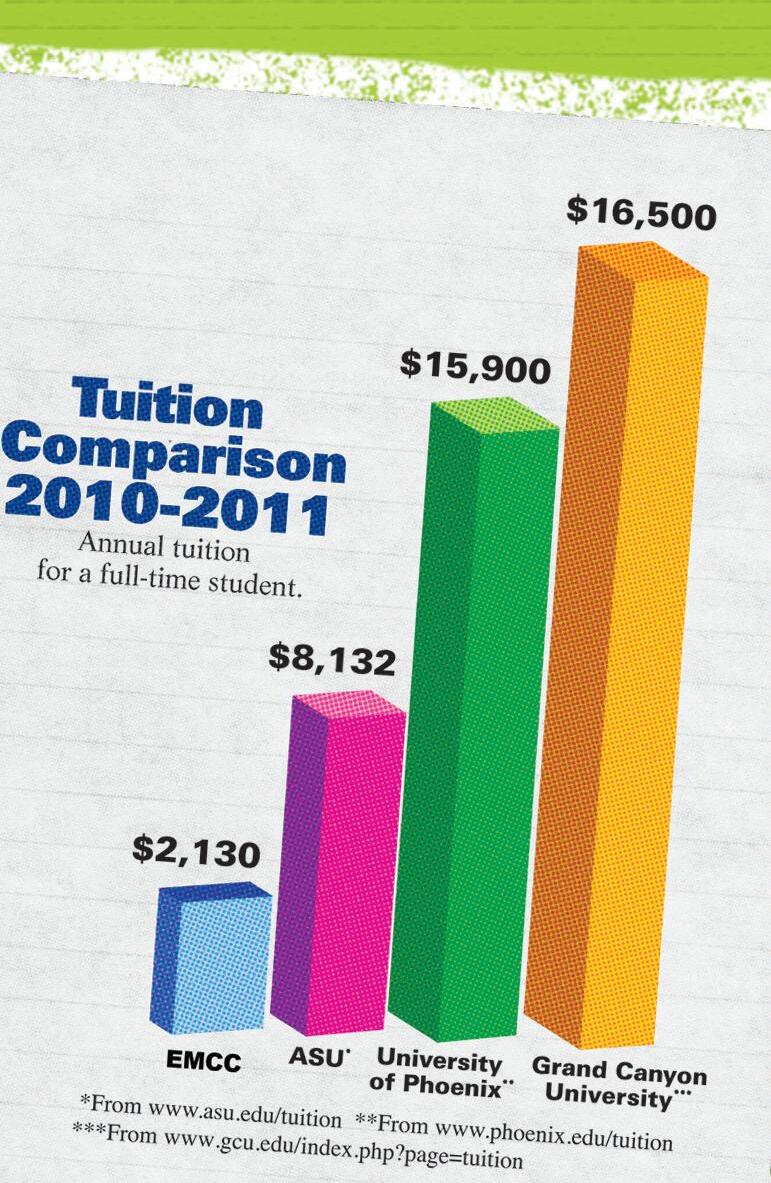











Preparing for a successful career in today’s demanding job market requires a higher level of education. Graduates who hold a bachelor’s degree earn nearly twice the lifelong earnings of workers who have only a high school diploma.
Excelsior College is an accredited, nonprofit leader in distance learning that has helped more than 136,000 graduates attain their goals. Our flexible programs can help you achieve your goals.
As a student or graduate of one of the ten Maricopa Community Colleges, you can earn college credit and your bachelor’s degree, at a distance, while continuing to live and work in your hometown. And, through the Community College Partner Program, you may also be eligible for discounted tuition and fees.
While you’re attending community college, you can fulfill select degree requirements through the UExcel® credit-byexamination program. An alliance between Excelsior and Pearson, two global leaders in education, UExcel offers a rigorous, supported way to let students demonstrate their competency in popular lower-level subjects.
Once you have earned your associate degree, we provide even more ways to keep you moving toward your goals. Excelsior offers dozens of bachelor’s degrees which can be completed at a distance. We’re known for granting maximum transfer of credits earned at community colleges and are top-ranked nationwide for number of transfer students by U.S.News & World Report. And, you will receive responsive support every step of the way.
To find out more about transfer options:
• Call 800-896-1627
• Email articulation@excelsior.edu
• Visit ccpartnerships.excelsior.edu














Ready to transfer to NAU now?
to









NAU’s “Connection” partnership with the Maricopa Community Colleges provides a smooth transfer path from associate’s to bachelor’s degree. The Maricopa/NAU Connection eliminates transfer anxiety with the help of student service coordinators on each community college campus. A variety of degree programs are offered in classrooms on Maricopa College campuses and/or online.
Ready to start your associate’s degree with Connect2NAU?
Incoming freshman can take advantage of Connect2NAU, a joint admission program with the Maricopa Community Colleges. Connect2NAU saves students time and money, enabling completion of an NAU bachelor’s degree for less than half the cost of a four-year public university education. Students are admitted to NAU while earning an associate’s degree at a Maricopa Community College and receive intensive support to ensure a smooth path to completing their bachelor’s degree.
Undergraduate programs can include online and hybrid deliveries, 90/30 credit transfer and continuation for several associate’s degrees in applied sciences. Degrees are offered for many different majors including:
• Business Administration
• Elementary Education
• Administration of Justice
• Health Sciences
• Interior Design
• Emergency Services Administration
























• Speech Communication
• Public Management (Interdisciplinary Studies)
To learn more, visit the Connection website at www.maricopa.edu/connection or contact an NAU representative:

Average Cost of a Bachelor’s Degree












on the 2010/2011 average cost to attend an AZ community college for two or three years and transfer to NAU Extended Campuses.



My name is Patricia Moore, and I am entering my senior year at Northern Arizona University. My journey to where I am now was filled with a lot of hard work, but it was worth it the whole way. When I started taking classes at Glendale Community College in 2007, I had no idea what degree I wanted to strive for. It was not until my second year that I heard about the NAU-GCC communication program. It was perfect for me because I could stay at home and take university classes on a
campus I was already familiar with.
Attending Northern Arizona University has been an experience like no other. This program has taught me more in a year than I could imagine. Marie Baker is a wonderful teacher who cares deeply about her students’ success – and it shows. The material she teaches is fascinating and life changing. Since the course is only eight weeks long, the work demand is challenging, but it’s helped prepare me for the rapid demands
of the job world.
Northern Arizona University has helped me achieve my PR dreams by helping me improve my communication skills. Since I will be attaining a Bachelor of Science in Communication and am already familiar with a fast-paced work environment, I am one step ahead of my competitors. With my experience and knowledge, I am fully prepared to step out and fulfill my dreams – thanks to Northern Arizona University’s partnership with GCC.

































Beginning or returning to college is one of the most life-changing decisions you can make. Before deciding “Where” to study after completing your community college program (as in, which college or university), you obviously need to have a firm understanding of “What” you are most interested in pursuing. Unfortunately, there is no one, simple way to figure this out. You must rely on introspection as well as accurate information you receive from others. Information is available at your high school campus, community college, local library and on the internet. Other recommendations include:
• Examine and self-assess your abilities, career and life goals, interests and values. What are your strengths? What are your weaknesses? What kind of skills do you have? What subject areas do you like?
• Utilize the resources and assessment tools available in Career Services, counseling departments and advisement/ transfer centers to help you make decisions – starting in your first year. Most of these centers have resources for choosing a major and a career, as well as internship and job placement information.
• Access The Occupational Outlook Handbook, a nationally recognized source of career information, designed to provide valuable assistance to individuals making decisions about their future work lives. The handbook is located on the U.S. Bureau of Labor Statistics web site (www.bls.gov/






General business is a broad area that can lead to many career opportunities. Students should clearly define their goals and seek experiences and skills necessary to reach those goals. Gaining relevant experience through part-time and summer jobs or internships is critical. Business students often specialize with a major in management, marketing, finance, logistics, accounting or human resources.
Learn about various fields of business through research on internet sites and books, informational interviews of professionals and exposure to work environments through shadowing, volunteering or interning. Develop interpersonal and organizational skills through participation in and leadership of student organizations. Strong communication skills, including public speaking, are also important to achieving success in this field.
Consider earning an MBA or other related graduate degree after gaining work experience to reach the highest levels of business management. Re-produced with permission from U.Tenn-Knoxville through Mesa Community College. Additional info at: http://career. utk.edu
Areas of Employment:
Management; sales; insurance; banking; real estate; human resource management.
Employers:
Banks; insurance firms; credit unions; hotels; real estate developers; service industries; manufacturers; universities; local, state and federal government agencies; healthcare organizations; retail companies; industrial organizations.




Information/Strategies:
To deliver effective customer service, develop problem solving skills, self-confidence, assertiveness and empathy; start in entry-level management trainee positions; demonstrate initiative and leadership to get promoted; develop strong interpersonal/communication skills in order to work well with a diverse clientele; obtain sales experience through part-time, summer or internship positions; learn to work well on a team and develop strong communication skills; develop strong persuasion skills and learn how to build relationships; develop a strong commitment to customer satisfaction; become highly motivated and well-organized.
MCCCD
Several transfer universities offer majors in business and the business-related academic areas mentioned above. As well, these universities offer bachelor’s programs in a variety of specializations, from small business to global business, and from project management to organizational leadership. Visit www. maricopa.edu/transfer to access program information for this major.











• Investigate careers and then find out which majors lead to them. Talk to faculty and college/department representatives, as well as people in the work world, about degree programs, career outlooks/prospects and their experiences.
• Participate in career fairs and internships. Choose internships, student activities, volunteer work and/or parttime employment that can help you develop skills in areas that interest you.
• Research information regarding future trends in the workforce. What jobs sound interesting to you? Which ones pay the salary you would like to earn? What level of education is required in the job postings you find interesting?







Nursing is the largest healthcare field, combining science and technology with the desire to help people. One must enjoy helping people of all types and backgrounds. Nurses work with welldefined populations, such as within neonatology, pediatrics, adults and geriatrics. Three out of five nurses work in hospitals. Many nurses work part-time. Nursing requires both physical stamina and emotional stability. Nurses must be able to follow orders and direct others. Other qualities important to the field include orientation to detail, sympathy and concern, responsibility and the ability to handle stress and emergency situations. Many opportunities outside of traditional nursing exist for RNs who want to work in non-clinical roles. Research the skills, experiences and degrees necessary to attain these positions.
Re-produced with permission from U.Tenn-Knoxville through Mesa Community College. Additional info at: http://career. utk.edu
Treatment Types/Settings:
Emergency/trauma; ambulatory care; radiology; hospice and palliative care; critical care; home health care.
Employers:
ferent cultures, races and socioeconomic backgrounds; take electives in areas such as wellness, holistic health, medical ethics and death and dying; join relevant professional associations and plan to attend continuing education programs; many specialties exist and some nurses combine specialties, e.g. pediatric oncology; shadow nurses in different settings to learn which ones hold the most appeal; cultivate managerial skills for head nurse or other supervisory positions; obtain a master’s or doctoral degree for advanced practice nursing.
MCCCD Transfer Universities Offering Related Degree Programs:
Below are some of our partners offering local, in-state, out-of-state or online bachelor’s degrees for this major. Visit maricopa.edu/transfer for more information!
• Arizona State University
• Empire State College (A SUNY Institution)
• Excelsior College
• Grand Canyon University
• Kaplan University
• New Mexico State University
• Northern Arizona University
• Penn State – World Campus
• Regis University
• University of Arizona
• University of New Mexico
• University of Phoenix

Hospitals; ambulatory care centers; physicians’ offices and medical groups; hospices; large corporations; birth centers; dialysis centers; nursing care facilities; clinics and medical centers; health maintenance organizations.
Information/Strategies:
Develop patience, the ability to work with both patients and families for long periods and good listening skills; learn to work effectively with people from dif-


• University of the Incarnate Word
• University of Texas at El Paso – UTEP
• Weber State University
• Western Governors University






Speech communication is a broad degree that can lead to job opportunities in many different fields. Skills and experiences gained through co-curricular activities, internships, part-time jobs and volunteering are critical in shaping a career path.
Students pursuing this major often seek employment in a variety of sectors: business, public relations, advertising, media, non-profit, government, law and education. Students should explore specializations within major and professional fields and select electives to enhance knowledge in area(s) of interest.
Speech communication is also good preparation for graduate school in many disciplines. Get experience with public speaking by joining Toastmasters International (www.toastmasters.org). A Ph.D. is required for teaching and research in colleges and universities.
Re-produced with permission from U.Tenn-Knoxville through Mesa Community College. Additional info at: career.utk.edu
Jobs within Communication Media: Writing; editing; copywriting; publishing; producing; managing/directing; research; sales.
Employers:
Healthcare organizations; nonprofit organizations; radio/television companies; publishing firms; law firms; consulting firms; internet companies; chambers of commerce; professional associations; political committees; colleges and universities.
Information/Strategies:
Explore specializations within major and professional field. Select electives to enhance knowledge in area(s) of interest; for work in the media sector, take elective courses in journalism, broadcasting, public relations and advertising; get involved in campus leadership roles in residence halls, student unions/activities, programming boards, etc.; develop strong written and verbal communication skills and excellent interpersonal skills; participate in a debate or forensic team to hone communication skills; take courses in conflict management and develop negotiation skills; learn to work well on a team and develop leadership skills.



MCCCD Transfer Universities Offering Related Degree Programs:
Below are some of our partners offering local, in-state, out-of-state, or online bachelor’s degrees for this major. Visit maricop.edu/ transfer for more!
• Arizona State University
• Ashford University
• Charter Oak State College
• DeVry University – Phoenix
• Empire State College (A SUNY Institution)
• Excelsior College
• Grand Canyon University
• Kaplan University
• New Mexico State University
• Northern Arizona University
• Ottawa University
• Prescott College
• Regis University
• University of Arizona
• University of Phoenix
• University of Texas at El Paso – UTEP
• Weber State University
• Western International University
And other transfer universities!

Engineers need to think in scientific and mathematical terms, have ability to study data, sort out important facts, solve problems and be logical thinkers. Creativity is useful. Other helpful traits include intellectual curiosity, technical aptitude, perseverance, ability to communicate and work well with others, a commitment to teamwork and a basic understanding of the economic and environmental context in which engineering is practiced.
A bachelor’s degree provides a wide range of career opportunities in industry, business and government. Graduate degrees offer more opportunities for career advancement. Professional or technical societies confer certification in some areas. Because of rapid changes in most engineering fields, both continued education and keeping abreast of new developments are very important.
Re-produced with permission from U.Tenn-Knoxville through Mesa Community College. Additional info at: career.utk.edu
Engineering disciplines:
Mechanical; chemical; industrial; biomedical; electrical/computer; environmental; aerospace; materials sciences; civil; nuclear; engineering science and mechanics; biosystems engineering.
Employers:
Business and industry; colleges and universities; local, state and federal government; engineering firms; manufacturing firms; consulting firms; specialty indus-
tries (e.g., transportation, telecommunications, healthcare, utilities, etc.); research institutes.
Information/Strategies:
Work experience through co-op, internships, parttime or summer jobs or regular employment is extremely beneficial; develop excellent verbal and written communications skills including presentation and technical report writing; develop exceptional interpersonal and communication (verbal and written) skills; gain laboratory and research experience as an undergraduate; foreign language ability is beneficial for international work; develop strong math and problem solving skills; consider a master’s degree for advancement; join related professional organizations.
MCCCD Transfer Universities Offering Related Degree Programs:
Below are some of our partners offering local, in-state, out-of-state or online bachelor’s degrees for this major. Visit maricopa.edu/transfer for more!
• Arizona State University
• Charter Oak State College
• DeVry University – Phoenix
• Excelsior College
• New Mexico State University
• Northern Arizona University
• University of Arizona
• University of Texas at El Paso – UTEP
• Weber State University





Some students may choose to study psychology because they enjoy the subject but wish to pursue careers requiring “any major.” In this scenario, it is critical to develop desirable skills through internships, part-time or summer jobs, or volunteer experiences. Some skills valued most by employers include: communication, interpersonal, leadership, teamwork and computer skills. Other students might major in psychology because they want to work in a related field. Many entry-level helping positions are available, however, the amount of direct client contact is limited for those who have a bachelor’s degree.
For those students wishing to pursue graduate education: maintain a high grade point average, secure strong faculty recommendations and gain experience through volunteer or work opportunities. Assist a faculty member with his or her research.
Re-produced with permission from U.Tenn-Knoxville through Mesa Community College. Additional info at: career.utk.edu
Employment areas:
Human services – direct care/administration; business and industry; research; human resources; education and higher education.
Human Services Work:
Administration: advocacy; programming; community relations; management; development/fundraising; grant writing.
Information/Strategies:
Acquire related experience on campus as a resident hall advisor, orientation leader, admissions tour guide or peer mentor; earn a graduate degree in psychology, statistics or marketing for the greatest number of opportunities; develop strong quantitative and statistical skills by taking additional math and statistics courses; earn an MBA or a graduate degree in human resources to attain higher level positions; acquire knowledge of government and community resources available for those in need; earn a minor in business or supplement curriculum with business courses; secure strong personal recommendations; develop strong communication skills; cultivate the desire to help others; volunteer or work as a tutor.
MCCCD Transfer Universities Offering Related Degree Programs:










Direct care: counseling; case management; mental health services; physical health/wellness; crisis work; art therapy; music therapy; psychotherapy.
More than two dozen transfer universities offer majors and degrees in psychology. At the bachelor’s degree level, some universities offer specializations or concentrations in specific sub-fields, such as social psychology or applied psychology. Visit www.maricopa.edu/transfer to view additional transfer information for this major.




















Maricopa’s transfer agreements are on behalf of the district as a whole, and courses taken at any of the Maricopa Community Colleges are equally transferable to private, public and international baccalaureate degree-granting institutions. The Maricopa Community Colleges use established criteria to enter into these agreements so that students are provided with transfer options to quality, reputable institutions. Visit the following site to learn more about these partners: www.maricopa.edu/transfer








Maricopa has transfer articulation agreements with the following institutions:
Argosy University
Arizona State University
Art Institute of Phoenix
Ashford University
California University of Pennsylvania
Capella University
Chamberlain College
Charter Oak State College
Cleveland Chiropractic College
Columbia University
Columbus College of Art & Design
DeVry University – Phoenix
Empire State College

Excelsior College
Franklin University
Grand Canyon University
Jones International University
Kaplan University
Mayville State University
Midwestern University
New Mexico State University
Northcentral University
Northern Arizona University
Ottawa University
Palmer College of Chiropractic
Park University
Pennsylvania State University –
World Campus
Prescott College
Regis University
University of Arizona
University of the Incarnate Word
University of New Mexico
University of Phoenix (ground)
University of Texas, El Paso
Utah State University
Wayland Baptist University
Weber State University
Western Governors University
Western International University
Western New Mexico University










































































































Arizona General Education Curriculum (AGEC) and Associate Degree:
• Have you selected a major with an Arizona General Education Curriculum (AGEC)? If so, have you completed the requirements and requested AGEC certification on your transcripts?
• Have you met with an advisor to determine your eligibility to graduate at your community college?
• Have you submitted an application for graduation?
Major and University Requirements:
• Does your major have a second language proficiency requirement?
• Have you completed all the pre-requisites for your university program?
• Have you met the minimum cumulative GPA for admission into the university and academic program you want?
• Have you investigated tuition and fees at the university? (Note: Some programs may require a professional fee, which is in addition to tuition.)
















The earlier you identify your academic goals and interests, the better. When gathering information, consult a variety of sources – including printed resources, websites, college representatives and other students. Before you transfer to a university, check into the following:
University Application Process and Transcripts:
• Have you researched university admission priority dates and deadlines?
• Have you submitted your application(s) for admission and all of your official transcripts (and any AP and CLEP test scores) prior to transferring?
• Have you checked to see if high school transcripts and test scores are required?
• Have you sent final official transcripts after your final semester is completed?
Financial Aid/Scholarships:
• Have you submitted your Free Application for Federal Student Aid (FAFSA) by the priority date of your transfer institution(s)?
• Have you researched scholarship and work-study opportunities? Be wary of potential scams, as services should be free of charge.
• Have you decided whether you will live on- or off-campus?
(Note: On-campus housing can be limited and is usually awarded on a first-come, first-serve basis.)





As you are likely aware, this site contains everything you need to get started at your Maricopa Community College, including:
• Class search features
• Course descriptions and outlines
• General education designations
• Internet, hybrid and Honors class search options
• Access to your grades, schedule, charges and payments, contact information, transcripts and more!

These sites contain information, links and resources you will need for making the most of your transfer opportunity with the Maricopa Community Colleges. The more you familiarize yourself with these tools, the smoother your transfer experience will be. Advisors, faculty and counselors will guide you through many of the steps, but get started today and save yourself time in learning what’s new with these tools!






This site links information for all Arizona public and tribal community colleges and state universities. With it, you can:
• Access transfer/major guides
• See how courses transfer (CEG)
• Understand key transfer concepts
• Learn about degrees/pathways
• Search for college/university advisors
• Figure out if an AGEC is for you!
Check out this link for a new way to learn more about the dozens of college and university transfer options you have, whether in Maricopa County, on-line, with a pre-professional program, to a private institution or at a public Arizona state university.
• Compare colleges by size and location
• Get an understanding of tuition/costs
• Learn about credit transfer
• Access specific sites for MCCCD graduates
• Get connected with faculty/advisors



















If you have a tight budget and want to stay close to home, begin at one of the Maricopa Community Colleges. Your community college will help you prepare academically to enter the university you choose. To learn more about your transfer opportunities, visit: www.maricopa.edu/transfer


1. Explore
Now is the time for you to explore a major or program of study. Ask faculty and staff from career services, counseling and advisement centers about resources to help you.
2. Decide
Now that you are on the path to completing your AGEC and associate degree, you have a few more decisions to make. You need to decide which academic program to pursue (according to your university major) and which college or university you would like to attend.
3. Prepare
If transferring to a university is your academic goal, you should begin by looking into an AGEC (Arizona General Education Curriculum) – a 35-credit certificate that fulfills university general education requirements and will have you more than half way through your associate.
4. Transfer
When you are ready to transfer, make sure that you have requested an evaluation of your transcripts for AGEC and associate degree.




• Associate in Arts (AA)
• Associate in Arts – Elementary Education (AAEE)
• Associate in Business (ABus)
• Associate in Science (AS)
• Associate in Transfer Partnership (ATP)
• Associate in Arts (AA) Degree, Fine Arts – Art
• Associate in Arts (AA) Degree, Fine Arts – Dance
• Associate in Arts (AA) Degree, Fine Arts – Theatre
• Associate in Applied Science (AAS)
If you complete any of the above degrees, you will be admitted to a public Arizona university with junior status; however, this does not guarantee admission into specific programs.


Besides acknowledging your efforts and providing you with a sense of completion and achievement, your degree may offer you several of these advantages:
• Guarantees admission into many Maricopa partner institutions.
• Prepares you academically to enter into university programs.
• Helps assure a seamless transition by maximizing the applicability and transferability of your academic credits.
• Provides a transfer plan to a four-year college or university.
• Helps you qualify for a job or promotion.
• Helps you qualify for tuition discounts and scholarships at Maricopa partner institutions.





































Are You Going to College to Fit In or Stand Out?

Choose focus not conformity. Imagination over social acceptance. Learning, not just going to class. UAT offers degrees in Advancing Computer Science, Artificial Life Programming, Digital Media, Digital Video, Enterprise Software Development, Game Art & Animation, Game Design, Game Programming, Network Engineering, Network Security, Open Source Technologies, Robotics & Embedded Systems, Serious Game & Simulation and more.
Go Geek. www.uat.edu