www.ahwatukee.com




www.ahwatukee.com
BY PAUL MARYNIAK AFN Executive Editor
Tempe Union officials are selling a 63-acre plot of land in Ahwatukee that could lead to the construction of as many as 178 new homes not far from the South Mountain Freeway and make the school district co-developers of the project.
The school board two weeks ago authorized Nathan and Associates to begin marketing the property on the southwest corner of Desert Foothills Parkway near Frye Road for a sale that could yield between $15 million and $19 million for the district.
Despite several members’ strong reservations, the board also decided to leave open for now the possibility of entering a potentially risky joint venture with the builder who buys the site instead of only looking to sell it outright.
Voters last November approved a ballot question allowing the board to sell the site.
“It’s a highly coveted site by the development community,” Ryan Duncan of Nathan and Associates told the board during a study session April 5. “There’s not a builder in town who doesn’t know about it.
“A property like this, given its size and
BY PAUL MARYNIAK AFN Executive Editor
Controlled blasting in areas east and west of Desert Foothills Parkway will begin this summer and continue several times a week into next year, when even “more substantial” explosive work will start on South Mountain, the Arizona Department of Transportation has disclosed. The blasting is necessary to remove rock as work on the South Mountain Freeway continues gaining momentum along Pecos Road in Ahwatukee.

Meanwhile, there were other developments involving the construction’s impact on area residents and motorists:
Residents who have been complaining about construction-related beeping noise
>> See FREEWAY on page 16













TheAhwatukeeFoothillsNewsis published every Wednesday and distributed free of charge to homes and in single-copy locations throughout Ahwatukee Foothills.
Times Media Group: 1620 W. Fountainhead Parkway, Suite 219 Tempe, Arizona, 85282
Main number: 480-898-6500
Advertising: 480-898-5624
Circulation service: 480-898-5641
Steve T. Strickbine
ADVERTISING STAFF
National Advertising Director
Zac Reynolds 480-898-5603 zac@ahwatukee.com
National Account Coordinator: Patty Dixie 480-898-5940, pdixie@ahwatukee.com
Major Account Representative: Terry Davenport 480-898-6323, tdavenport@timespublications.com
Advertising Sales Representatives: Karen Mays, 480-898-7909, kmays@ahwatukee.com
Laura Meehan, 480-898-7904, lmeehan@ahwatukee.com
Classified: Elaine Cota, 480-898-7926, ecota@ahwatukee.com
Circulation Director: Aaron Kolodny 480-898-5641, aaron@azintegratedmedia.com
Executive Editor: Paul Maryniak, 480-898-5647, pmaryniak@timespublications.com
Managing Editor: Ralph Zubiate, 480-898-6825, rzubiate@timespublications.com
GetOut Editor: Justin Ferris, 480-898-5621, jferris@timespublications.com
Designers: Ruth Carlton, 480-898-5644, rcarlton@timespublications.com
Tonya Mildenberg, 480-898-5618 tmildenberg@timespublications.com Paul Braun,480-898-5601 pbraun@timespublications.com
Production Coordinator: Courtney Oldham 480-898-5617 production@timespublications.com
Reporters: Jim Walsh, 480-898-5639 jwalshe@timespublications.com Mike Butler, 480-898-5630 mbutler@ahwatukee.com
Prep Sports Director: Jason P. Skoda, 480-898-7915, jskoda@ahwatukee.com
Photographer: Kimberly Carrillo, kcarrillo@timespublications.com
WRITE A LETTER
To submit a letter, please include your full name. Our policy is not to run anonymous letters. Please keep the length to 300 words. Letters will be run on a spaceavailable basis. Please send your contributions to pmaryniak@ahwatukee.com.
EDITORIAL CONTENT
TheAhwatukeeFoothillsNewsexpresses its opinion. Opinions expressed in guest commentaries, perspectives, cartoons or letters to the editor are those of the author.
ADVERTISING CONTENT
The content and claims of any advertisement are the sole responsibility of the advertiser. TheAhwatukee FoothillsNewsassumes no responsibility for the claims or content of any advertisement.
© Strickbine Publishing, Inc.
(Kimberly Carrillo/AFN Staff Photographer)
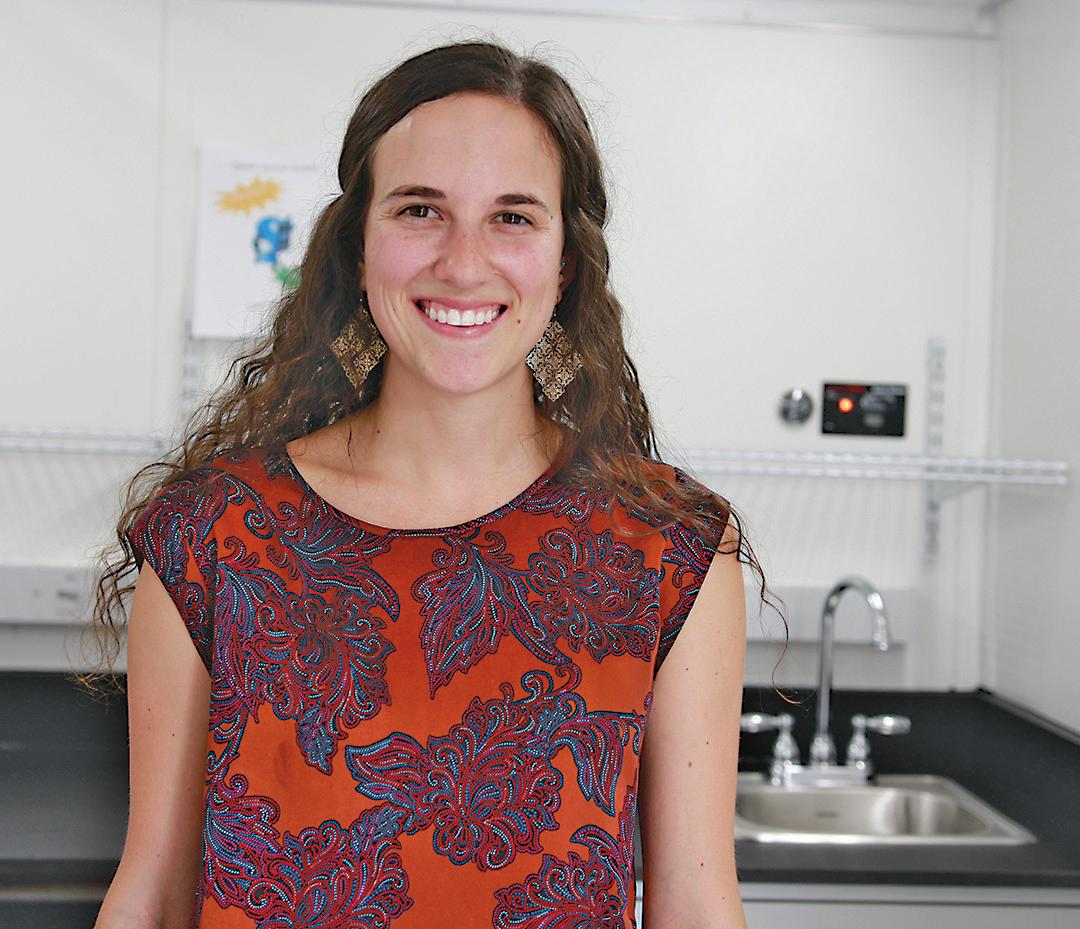
Sara Mantlik of Ahwatukee has devoted four years to raising enough money to build and equip a mobile dental unit that will serve poor people in this country and abroad. The Arizona State University graduate student so far has raised more than $65,000.
BY PAUL MARYNIAK AFN Executive Editor
Sara Mantlik of Ahwatukee has spent four years raising money to build a mobile dental van for poor people, and last week she began seeing a light at the end of the tunnel.
The nearly completed 24-foot unit was hauled up from Tucson to a Tempe bar for a fundraiser that the Arizona State University mechanical engineering grad student hoped would garner some of the remaining $15,000 needed to add the remaining pieces of equipment and get the exterior appropriately signed.
The project started innocuously.
The 2012 graduate of Mountain Pointe High School had only been in search of getting one more credit for her sophomore year at ASU when she signed up for a class called Engineering Projects in Community Service.
“I just needed one credit to meet my scholarship,” Mantlik explained. “So I said to myself, ‘I’ll do EPICS because it sounds cool. I really had no idea what it meant.”
What it ended up meaning was a kind of second career for Mantlik, who had never before engaged in a fundraising campaign – let alone organize a project that would require her to learn the art of the ask – approaching people in all kinds of positions and persuading them to contribute to her dream.
“I’ve had to learn everything – how to make flyers, set up a nonprofit and talk to very high-level donors. I’d think, “How am I going to pitch this so they’ll


















(Kimberly Carrillo/AFN Staff Photographer)
ASU student Fionnuala McPeake, one of Mantlik’s partners in the campaign to build a mobile dental unit, stands outside the vehicle, which still needs some equipment and exterior signage before it can be put to use.



take it seriously?’” she recalled.
She had stumbled on an organization called IMAHelps and its efforts to reach impoverished areas in the United States and around the world where people have no access to dentists and often suffer horrible facial deformations and excruciating pain as a result.
With the help of some classmates, including Desert Vista High School grad Jackie Janssen of Ahwatukee, she set up a nonprofit called Engineering Smiles, rolled up her sleeves and started working.
“When I met the nonprofit IMAHelps and heard the need for dentistry, it really inspired me,” Mantlick said. “And somehow I just kept pushing and pushing. And once I started fundraising, I couldn’t stop.”
“It has become my full-time job the last four years,” she added. “Somehow just wanting to get it done and present it to the nonprofit inspires me. I always think about their faith and how they’re going to react when they see it. That just keeps me going.”
Despite her own efforts, Mantlik said the entire project could not be done without the rest of the student team –including Janssen, Andrea Kemmerrer, Christine Bui, Nick Kemme and Fionnuala McPeake
Along the way, she picked up other allies, including entrepreneur William Elliott, who read about her project in a
professional magazine that his dentistwife Anita receives. The Elliotts and construction management expert John Cribbs comprise her advisory board.
“It’s really exciting,” William Elliott said. “Just through their own hard work and ingenuity they’ve raised a lot of money.”
Mantlik then found Catalina Laboratory Products in Tucson, which provides laboratory equipment. Coowners Chris Andrews and Kim Bergman offered to help out.
“If it was not for them and their amazing generosity, the clinic would be nowhere close to where it is today,” Mantlik said.
Mantlik also had to adjust her goal. Initially she had planned on a 50-foot trailer with four dental chairs but wound up reducing that in half.
Besides the amount of money she would need to raise, the larger unit would have been difficult to fly overseas, Mantlik noted.
The unit would be used by IMAHelps wherever a need is identified and there are dentists to staff it.
Mantlik gets her master’s degree next month and then is scheduled to start a job in Milwaukee, so she is working with her team to develop a way to raise the rest of the money.
People who want to help her can go to engineeringsmiles.org.
“The team is graduating in two weeks and we are really working hard to have it completed,” Mantlik said. “I wanted it to be my graduation present.”















Four schools in Ahwatukee last week received an A+ School of Excellence award, which the Arizona Educational Foundation gives annually to schools that have passed a rigorous application process touching on all facets of their operation
Three Kyrene schools and their principals were honored and Desert Vista High Scholl received its second A+ award, joining Mountain Pointe and McClintock as Tempe Union district schools that have been twice honored by the foundation. Christine Barela is principal of Desert Vista.
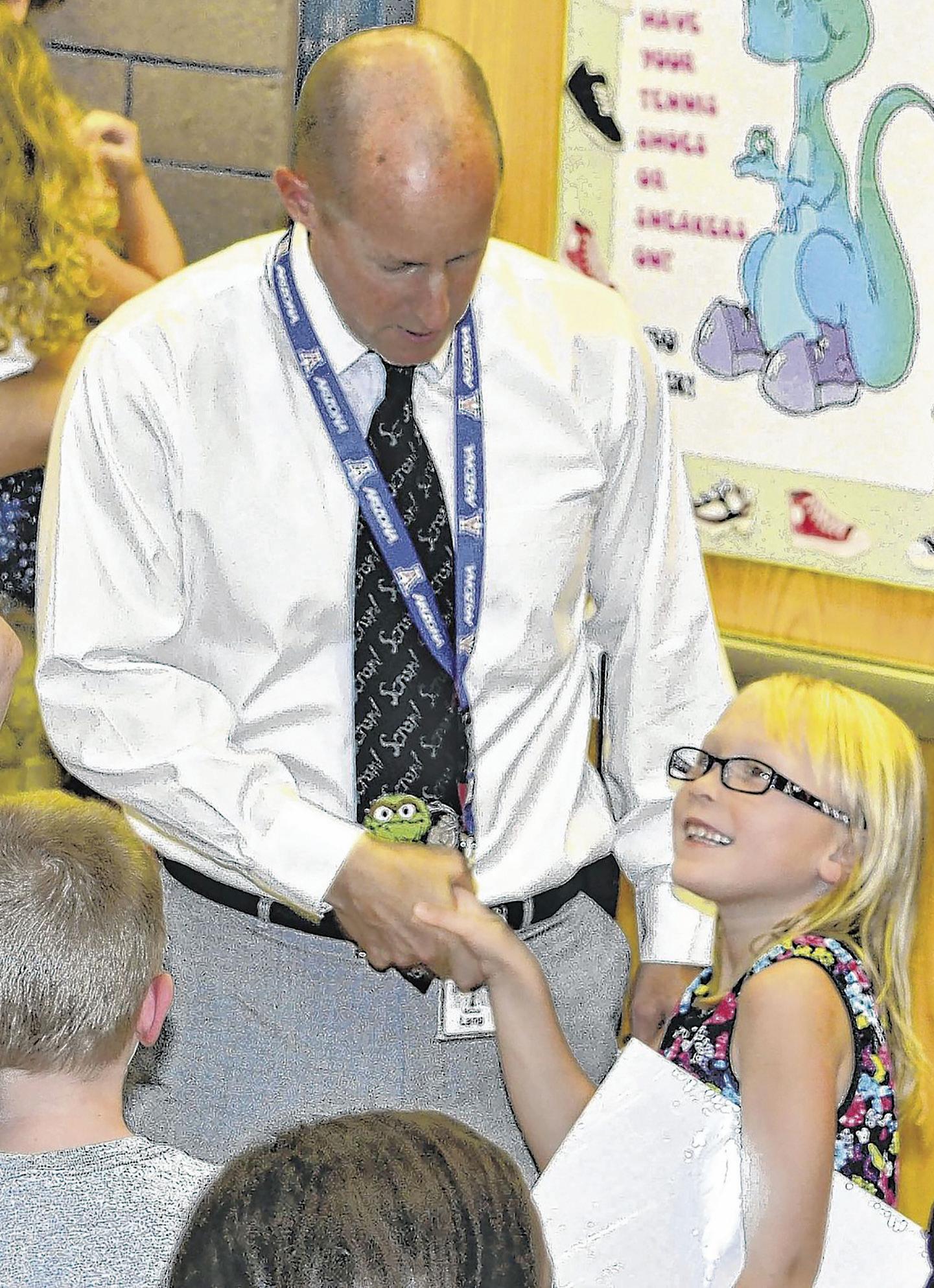
The winning Kyrene schools and principals are: Kyrene de la Estrella, Michael Lamp; Kyrene de los Cerritos, Darcy DiCosmo; and Kyrene de los Lagos Dual Language Academy, Dr. Ana Gomez del Castillo.
Schools that apply for the award are evaluated on student focus and support, school culture, active teaching and learning, curriculum, leadership, community and parent involvement and assessment data.
Schools receive $500 and a banner
designating them as an A+ School of Excellence™ winner. All staff and faculty at the schools also are eligible for partial scholarships from Argosy University Phoenix. The award is valid for three and a half years.
Recognition through the A+ School of Excellence™ program can help increase confidence in Arizona’s public schools and create greater parent and community support, the foundation said.
A total of 14 of Kyrene’s 25 schools are now A+ Schools of Excellence. In Ahwatukee, the others include Akimel A-al and Altadeña middle schools as well as Esperanza, Cerritos, and Monte Vista Elementary schools.
The judges were effusive in their praise for the three Kyrene schools that won.
“The teachers were focused and set on ensuring that all students were being challenged to think and perform at high levels,” they said of Cerritos, calling it “a shining example of what happens when everyone works together to achieve their goal of making it a place where every student is a leader.”
Of Lagos, another panel said:
“Principal Dr. Ana Gomez de Castillo’s passion and commitment to empower teachers, shared leadership style and willingness to do “what’s best for kids” is evident throughout campus. She has clearly built a welcoming environment with a positive culture where students, staff, parents and community members feel like family and there is a sense of pride and togetherness.”
The judges said, “The staff at Estrella is committed to providing rigorous instruction, culturally responsive teaching and authentic teacher/student relationships that support the learning potential of every student. ... Support systems were in place for all learners and were evident through classroom observations.”

Traci Tartaglio Owner




















































BY DUSTIN QUIROZ Cronkite News
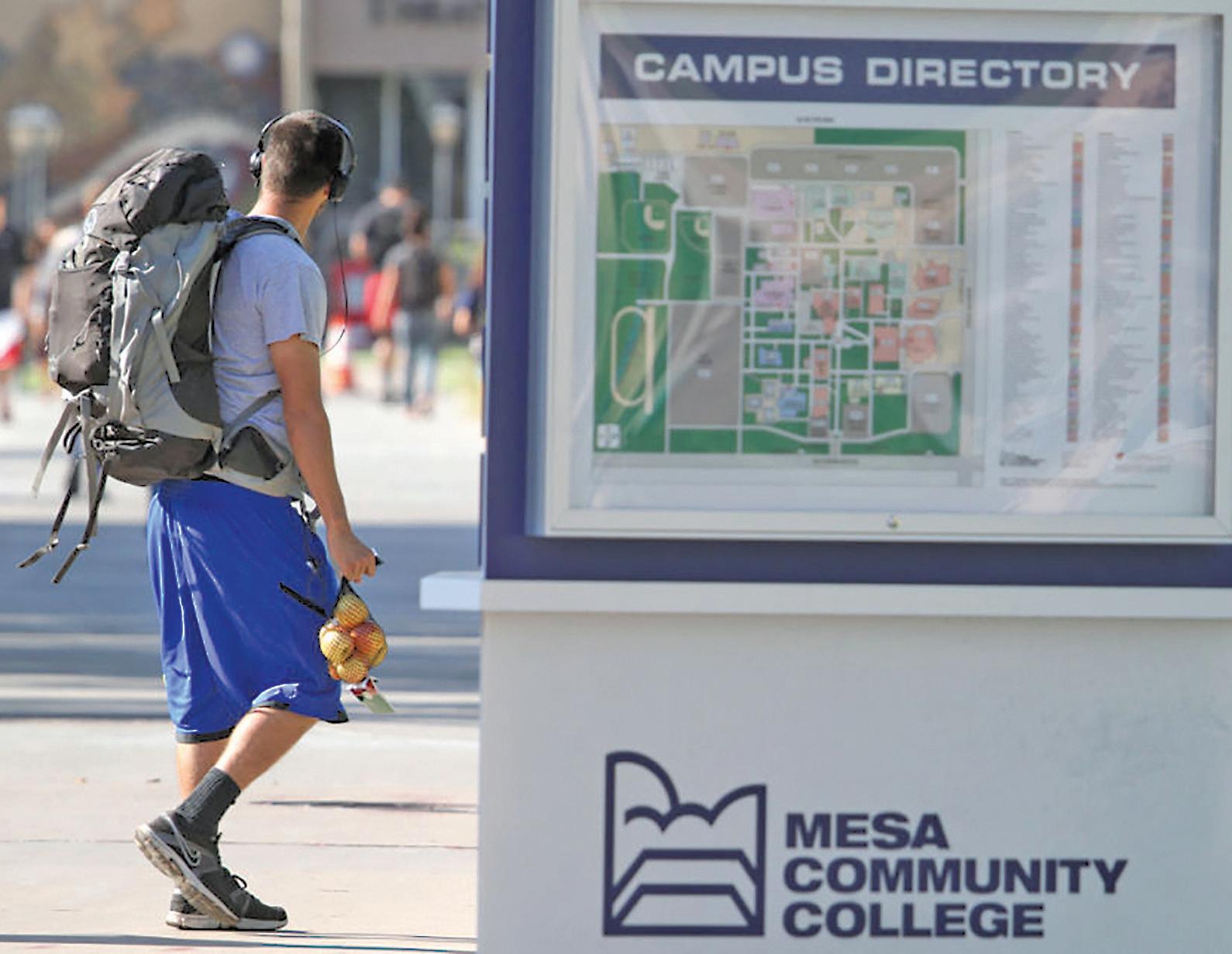
Sunny Price knows what it’s like to try to keep up with college studies when you don’t have enough to eat.
“It’s not focusing on the studies, or what I learned today, or how can I apply this to my life, or let me do my homework, oh, I got a report tonight,” said Price, a student at Mesa Community College.
“It’s just, where is my next meal going to come from and where am I going to sleep tonight?” said Price, who now serves as the community college director for the Arizona Students’ Association.
She’s not alone. Authors of a recent national report on hunger and homelessness at community colleges said their survey showed that in Arizona, a little over one in 10 community college students may be in danger of being homeless and more than 30 percent may experience extreme food insecurity.


The Wisconsin HOPE lab surveyed about 33,000 students at 70 community colleges across the country, including 11 in Arizona, which mirrored the national results.
In Arizona, the study included
Chandler-Gilbert Community College and Mesa Community College.
The research did not come as a surprise to Maricopa Community Colleges or students who struggle with those issues.
Robert Schwing, a spokesman for Maricopa Community Colleges, was aware of students such as Price long before the study was released. He said the Arizona colleges that participated in the study have been trying to be more than just a simple “supplier of education” but an organization that helps the “whole student.”
“Being a student is a job,” Schwing said. “Just like it’s detrimental to your job or my job performance if we showed up to work in the morning without eating for two days.”
He said every campus has one form of food bank or another or provides other meal assistance, as well as referral services for housing.
“You can’t go to one of our facilities, one of our colleges, and not encounter these kinds of services,” Schwing said. Mesa Community College says it’s been addressing the issue for a while.
“There have been things going
on for the last couple of years,” said Dawn Zimmer, coordinator of media relations for Mesa Community College.
“We have a task force looking at food insecurity. Our student body president, Aaron Mixson, himself has experienced that difficulty.”
Cindy Barnes Pharr, dean of community affairs for Chandler-Gilbert Community College, said she doesn’t think the ratio of homelessness or food insecurity is as high there.
“At Chandler-Gilbert, we’re in a lot different demographic than South Mountain or Phoenix College,” she said.
Food insecurity ranges all the way from uncertainty about where your next meal might come from to knowing you are not going to eat today without help, the category that the 30 percent of students like Price fell into.
Housing insecurity is generally not permanent homelessness, but may mean couch-surfing or sleeping in a car or a shelter. Price recalls working with students who would have to choose “do I go to Phoenix on a park bench or do I go to MCC outside.”
Cynthia Zwick, executive director of the Arizona Community Action Association, said she was not surprised by the numbers in the report.
“It’s consistent with other numbers in our experience here in Arizona in that we have significantly high number of people who are struggling generally with food insecurities,” Zwick said.
One of the report’s authors, Sara Goldrick-Rab, said the study confirmed her belief that community college students weren’t simply struggling to afford books or laptops but that there was a large population “struggling to
even be able to afford food.”
And the report may not even have captured the full extent of the problem, Goldrick-Rab said, because of the stigma associated with hunger and homelessness, particularly among college students.
“The system has convinced the people within the system, if they can’t afford to go to college they failed, if they’re hungry in college then they failed,” she said. “So, they’re really afraid to come forward.”
Even though the Maricopa colleges are aggressively pushing help toward students, Schwing and Price said many students still struggle due to a lack of awareness and due to the stigma that can come with reaching out for help.
“It’s not something that the average person really thinks about because it’s not something that I can necessarily look at you and tell,” he said. “No one carries around a sign that says, ‘I haven’t eaten.’”
Schwing urged others to do what they can, when they can, to help struggling students.
“When you have the opportunity to make a contribution to the food pantry, either in product or in cash or volunteer time, do so because this can happen to any of us,” he said. “And it’s only based on the concern or generosity of all of us that we can help this not happen.”
Price said the situation on campus is better from the times when she struggled to find food, and she had a simple message for those who are still struggling.
“It’s OK to be hungry, it’s OK to be homeless,” she said. “But let us know so we can help you out with it.”


















BY HOWARD FISCHER Capitol Media Services
Rebuffing prosecutors and sheriffs, Gov. Doug Ducey has signed legislation to make it more difficult for them to seize property.
“Reforms have been needed in this area for some time,’’ the governor said in a prepared statement.
But Ducey was not alone in his assessment: Only Rep. Becky Nutt, R-Clifton, voted against the measure.
The new law will require prosecutors to provide “clear and convincing evidence’’ to a judge that property they want to seize is connected to criminal activity before they can seize it. That means either it was used as part of a crime or that it was acquired with proceeds from criminal activity.
That is more rigorous than the current standards which allows seizure based on “preponderance of the evidence.’’ That is the lowest of all standards and means only that it is more likely than not the property is linked to a crime.
Rep. Eddie Farnsworth, R-Gilbert, who crafted the changes, said the new standard is appropriate as there is no requirement that someone be convicted of a crime – or even charged – before prosecutors can try to take property.
The change, which takes effect later this year, also will remove some disincentives that now exist for people who contend their property was wrongly seized from challenging the government.
Under the current law property owners are responsible for their own legal fees, even if they win. Farnsworth said that means it makes no sense to have to hire an attorney for $20,000 to recover a vehicle that might be worth just half that much.
The other change eliminates the possibility that a property owner who fights forfeiture and loses could be on the hook for the government’s costs and legal fees.
Prosecutors and sheriffs from throughout the state had sought a veto.
“If HB 2477 is enacted, the Mohave County area will suffer because of an overreaction to the misdeeds of a very
small percentage of others,’’ James Schoppman, chief deputy county attorney, wrote in a letter to the governor. “The result will be a net loss to our community and a net gain for drug traffickers.’’
Ducey, however, said he sees the issue different.
“As public servants, we are entrusted with not only protecting public safety but also the rights guaranteed to every citizen of this great state and nation,’’ the governor said in his statement. “Today’s important legislation strikes an appropriate balance between enabling law enforcement to do their jobs while upholding civil liberties.’’
And Ducey brushed aside claims by prosecutors it would undermine the ability to fight crime.
“This bill will allow law enforcement to take appropriate action against drug cartels and other criminal enterprises, while ensuring citizens do not have their property seized without due process.’’
Highlighting the broad popularity of reform, HB 2477 drew support from a wide variety of groups, including the Institute for Justice, the Goldwater Institute, Arizona Free Enterprise Club, Arizona Citizens Defense League, ACLU of Arizona, Arizona Attorneys for Criminal Justice, Los Abogados, Public Integrity Alliance, the Tenth Amendment Center, National Federation of Independent Business, Right on Crime, FreedomWorks, and U.S. Justice Action Network.
One recent poll showed that 87 percent of Arizonans also supported forfeiture reform.
The governor’s signature comes less than two weeks after the inspector general at the Department of Justice and the treasury inspector general for tax administration released bombshell reports criticizing the federal government’s forfeiture practices.
“Arizona has some of the worst civil forfeiture laws in the nation, and we applaud the Arizona governor and Legislature for curbing many abusive practices,” said attorney Keith Diggs.
“But we will keep fighting until Arizona’s rigged system is completely abolished.”











location, we envision 40 to 50 potential suitors who would consider this,” he added, saying he anticipated that the district would receive “10 to 15 offers –maybe more but at least that many.”
Duncan told the board it had two options for a sale. The “least risky” would be an outright sale, although he cautioned that a builder would want to get as close to final approval of the development plan by the city before finalizing the deal.
Duncan also said the board could elect to enter a joint venture in which it would share the proceeds for the sale of each plot.
In such an arrangement, he said, “the builder would go in on their dime” to prepare the land and divide it into plots for homes and the district would realize revenue when each plot is sold.
“This has the potential to generate more income,” he said. “If the money was coming in more of an installment basis, that may be more beneficial to the district.”
But Duncan warned that such an arrangement is “less risky for the builder, more risky for the district” and that “you have to make sure you’re picking the right partner.”

The “more complicated” joint venture option also would mean that it could take the district as long as six years to realize all the revenue it can get from the deal.
“I am strongly opposed to a joint venture,” said board member Sandy Lowe. “Builders go belly-up all the time
and we could be left with a bunch of dirt and half-built houses, and that would be the worst case.”
Added board member Michelle Helm: “I agree. I think we should go for the straight-up sale. I don’t like the idea of a joint sale.”
But the board decided that for now it would not rule out a joint venture completely after Brandon Schmoll, the only Ahwatukee member, said, “I don’t like to take anything off the table, especially if there haven’t been any offers made. I don’t want to rule anything out immediately.”
However, Duncan cautioned that while there was potential for more revenue from the deal than an outright sale, “there’s always a downside in a joint venture –you could get less.”
The land was originally purchased well before the current board and administration were in office, with an eye toward the possible construction of a third high school in Ahwatukee. That vision was never realized – partly because of demographics, but also because of the site’s topography.
Indeed, board members agreed that the site is so hilly that it likely would never have been suitable for a large building like a school or even a commercial development.
And Duncan said that the sale’s ultimate worth to the district will depend on a more detailed analysis of the land by the winning bidder.
Other contingencies also will affect the






from page 12
site’s final price as well as the number of homes that could be built on it, Duncan said.
He said an outright sale is “the least complicated deal structure,” would attract the largest number of bidders and likely would realize the quickest closing, which he estimated could take eight months to a year.
Stating an outright purchase also carried “little market risk” to the district, Duncan said. “The housing density for the site is still an open issue.”
That’s because the builder’s proposed development plan would be subject to the review of the Ahwatukee Foothills Village Planning Committee and Phoenix officials. Those officials would also be listening to reaction from neighboring homeowners.
The vagaries in the review process also explain why Nathan and Associates would not get more specific about the land’s worth to the district besides saying it could range between $15 million and $19 million.
“The builder will want a final ruling by the City of Phoenix,” Duncan advised. He also said he and his associates would make sure “the builder is not seeking any exotic zoning.”
Nathan and Associates expect to collect the bids, analyze them and present them with a recommendation to the board during a closed-door meeting sometime over the next two months.


The district will be able to use all the sale proceeds because the funds will go into its capital fund. There, it can be used to buy everything from supplies to improvements for buildings and grounds. The money also can be used to pay down debt, Superintendent Kenneth Baca told the board.
Assistant Superintendent Anna Battle, who lives near the site, said she expected the sale will be greeted enthusiastically by neighbors.
With the impending freeway, she added, “there’s optimism right now.”
“Once the road goes in, there are exciting possibilities,” Battle said of the freeway.
Some board members, like Michelle Helm, also expressed regret that the district was selling an asset.
“I came in here not in favor of selling and yet, after listening to all our administrative people, I am convinced now is the time and it will be advantageous for our district,” Helm said.
Other board members, as well as Battle, concurred, calling it a “win-win” for the district. They also said they were being “good stewards” with an asset that can be sold for the benefit of students and taxpayers.
Duncan said the district is going to market at a good time.
“We can never time a real estate cycle, but I think your timing is good,” he told the board.
Battle called it “a responsible and thoughtful move” by the board, noting new homes will bring more students.




Bradley Rasmussen, MD Sarah Neumann, MMS, PA-C

Kelly Fields, LME, CLT Carmen Orozco, CMLT, Licensed Aesthetician




Nathan S. Uebelhoer, DO

Bethany Cheatham, MSN, FNP-C

Lisa Cockrell, RN

BY HOWARD FISCHER Capitol Media Services
Gov. Doug Ducey signed a new law Friday that even the head of his own Republican Party boasts would do pretty much what Democrat foes charged was the goal all along.
HB 2244 overturns not only statutes but Supreme Court case law, which says that efforts by voters to propose their own laws need be only in “substantial compliance’’ with election laws to go on the ballot. Instead, any measure not in “strict compliance’’ could be challenged and stopped before voters ever get a chance to weigh in.
Ducey said the Arizona Constitution limits the ability of lawmakers to alter what voters approve at the ballot.
“This commonsense legislation preserves the integrity of the (initiative) process by ensuring that those seeking to make lasting changes to our laws comply with current laws,’’ he said.
But Arizona Republican Party Chairman Jonathan Lines, in a newsletter to party faithful, praised the GOP-controlled Legislature for enacting something that “would make it possible for ballot initiatives to be thrown out for minor errors regarding language and paperwork’’ – precisely what Democrats charged during several hours of debate this week over the measure.
The change to “strict compliance’’ is not academic.
The chamber hired attorneys to convince the Arizona Supreme Court to overturn the vote.
That failed. And the 1998 Voter Protection Act bars lawmakers from repealing the law.
That left the goal of putting what Chamber President Glenn Hamer called “guardrails’’ around the initiative process.
Those reforms were originally part of a single measure sponsored by Rep. Vince Leach, R-Tucson. But the bill was divided into three separate measures.
That, in turn, means that foes of the package would have to launch three separate petition drives and not just one to give voters the final say. Even Rep. Ken Clark, D-Phoenix, who has been at the forefront of fighting what the Republican majority approved said that pretty much quashes any such plan.
Ducey already has approved legislation making it illegal to pay petition circulators based on the number of signatures they get.
And a measure awaiting final Senate approval would make initiative organizers financially responsible for incidents of fraud or forgery committed by paid circulators, regardless of whether there is evidence that the organizers knew what the circulators were doing.
Politicians remain free to use paid circulators, are not subject to fines for acts of circulators, and have no risk of having their nominating petitions thrown out for failure to strictly comply with the law.


Mark Weaver, MPAS, PA-C
Jeremy Davis, MD, MS


Had this requirement been in place in 2012, voters would not have been given a chance to decide whether to make permanent a one-cent surcharge on state sales taxes, with most of the proceeds earmarked for education.
And just this past year, voters got a chance to decide whether to legalize marijuana for recreational use when the Supreme Court concluded the initiative petitions substantially complied with what Arizona law requires.
In both cases, voters decided to reject the proposals.
But it was voter approval last November of the minimum wage increase that led to the full-court press by the Arizona Chamber of Commerce and Industry to rein in the initiative process.
Leach said that distinction is merited because politicians can be thrown out of office every two or four years.
There is some possibility that the courts could void the change to “strict compliance’’ if the justices believe that they – and not the legislature – decide how to judge the constitutional rights of voters to propose their own laws.
While what’s in the newly signed HB 2244 would not have kept the minimum wage initiative off the ballot, the measure already signed by Ducey would have killed the measure.
The Arizona Restaurant Association, trying to keep Proposition 206 from going to voters, argued that many of the petitions to put the issue to voters should be invalidated because the circulators either were not qualified or
Always
I have been very
Wolfgang’s takes very good care of us. ~ Amy M.
with the
I have received from Wolfgang’s. ~ Bob R.












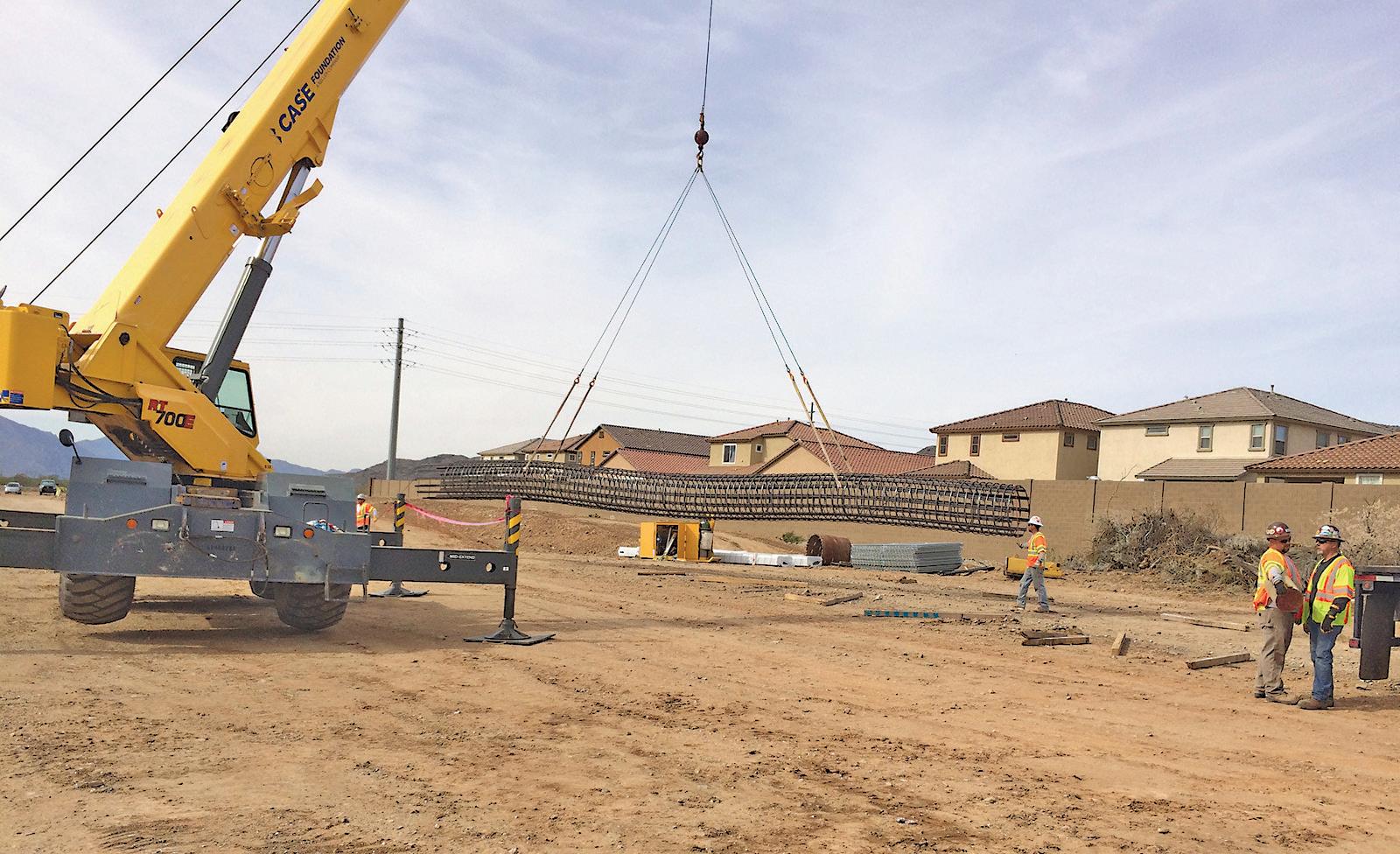
throughout the night caused by heavy equipment and trucks going in reverse can expect it to continue for at least another two months.
That is the price of the agreement between ADOT and a group of public officials that shortens a hauling period that would have lasted six months. An ADOT spokesman said the agency is taking steps to curb the beeping.
ADOT installed a speed-monitoring device along the interim Pecos Road in response to complaints about excessive speeding along the 40 mph four-lane road.
“Pecos Road is a local road, not a freeway, and construction is occurring on the other side of the concrete barricades,” said Rob Samour, ADOT’s senior deputy state engineer for major projects. “Motorists have a responsibility to slow down and obey the reduced speed limit.”
Freeway developer-designer Connect 202 Partners started contacting 1,000 homeowners within a half mile of the blasting area about 10 days ago “to schedule surveys, which will include a physical inspection of the homeowner’s property to document its current condition before blasting work begins,” ADOT spokesman Dustin Krugel said.
No date nor detailed plans and schedules for the blasting have yet been finalized, although the home surveys won’t begin until late May, he said. He also said additional information about the blasting would be provided to the public before the work begins.
“These surveys are completely precautionary and voluntary,” Krugel
said, adding:
“Connect 202 Partners has hired Aimone-Martin Associates (AMA), which specializes in blasting and vibration monitoring and has extensive experience working within residential areas in Arizona to conduct the surveys.
“AMA will also conduct vibration monitoring during the blasting to ensure ground vibration does not exceed allowable levels and provide a second level of assurance the blasting will not impact residences.”
Opponents criticize blasting plan
Krugel also warned, “More substantial rock removal will be needed for the center segment for the freeway when it passes through a portion of South Mountain. That work is not anticipated to begin until 2018.”
News of the impending blasts drew an angry reaction from Pat Lawlis, president of the Ahwatukee-based Protect Arizona’s Resources and Children, which is trying to stop the freeway work before the U.S. District Court of Appeals for the Ninth Circuit.
PARC and the Gila River Indian Community contend that a federal judge in Phoenix erred when she failed to find that ADOT and the Federal Highway Administration performed an insufficient environmental impact study of the 22-mile freeway.
The freeway is projected to provide a detour for 140,000 vehicles a day around downtown Phoenix from the 59th Avenue interchange of I-10 in west Phoenix to the I-10 interchange in Chandler. At a cost of $1.7 billion, the freeway is Arizona’s most expensive highway project in history.
“The blasting would still destroy foothills of South Mountain that cannot be replaced,” Lawlis said. “This is irreparable harm, and ADOT knows it. They are once again bullying the residents of Ahwatukee for no good reason. This work easily could be delayed until after the court case is settled.”
Because the freeway is scheduled to open by late 2019, work is underway along multiple segments of the thoroughfare.
The only exception involves the segment that will cut a 200-foot gash through three peaks of South Mountain. ADOT and the FHA have told the appeals court that work would not start on that segment until the middle of next year.
Other noise issues related to construction have involved beeping and jackhammering this month, causing some residents to wonder if ADOT had reneged on its assurances at several public meetings that contractors would follow city ordinances restricting such activity to 7 a.m.-7 p.m.
The jackhammers were heard the first weekend of April during a full closure of
Pecos Road so that crews could remove traffic signal foundations at 40th and 32nd streets, Krugel said.
“In order to have the roadway open before the Monday morning commute, some jackhammering was needed to break up the concrete foundations late Friday night/early Saturday morning. We received one complaint regarding this work,” he said.
The more persistent noise involves beeping from trucks hauling tons of dirt that will form an embankment for the freeway.
“What do you like to do during the spring in Arizona? Leave the windows open at night, but I can’t because of all that beeping,” said Lakewood resident Jeff Ludwig, a retired construction worker.
Ludwig said the noise could be eliminated if more flagmen were deployed to guide the dump trucks.
“I thought of complaining to the Health Department because that noise is keeping people awake at night and robbing them of sleep,” he said.
But Krugel said more flagmen, or spotters, “are not being considered” because of safety concerns and because

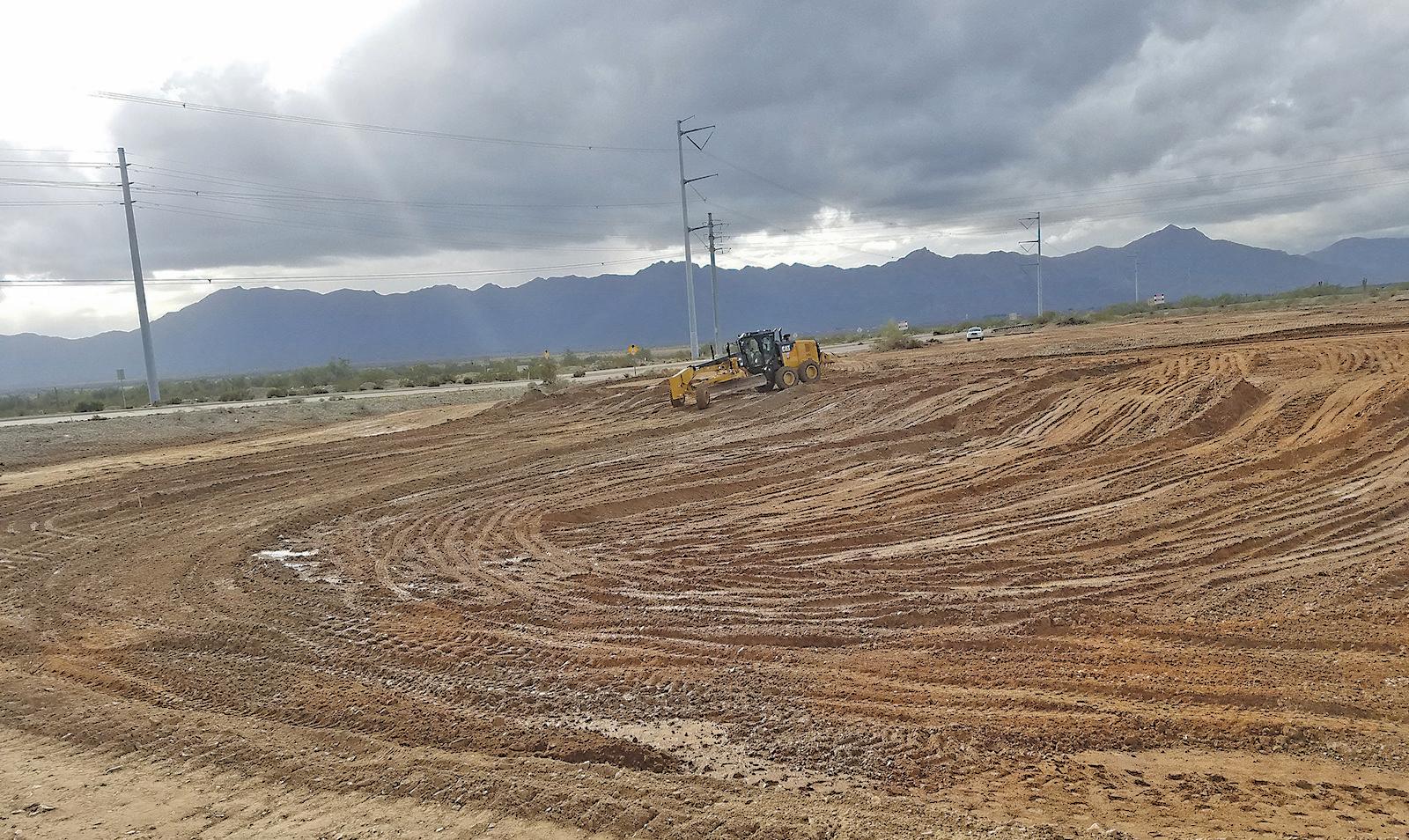
Grading of land around 17th Avenue has been going on for more than a month as preparations are made for the South Mountain Freeway.
crews would then need additional lighting “that may impact adjacent residents.”
“ADOT and Connect 202 Partners are committed to listening to the community and working in partnership to minimize noise and inconvenience from South Mountain Freeway construction,” he said, adding: “Based on community input, we are evaluating additional options to reduce
noise during the nightly dirt hauls, including installing white noise backup alarms to reduce the noise created from heavy equipment that is backing up.”
The white-noise alarms that crews have begun testing create a static sound instead of the beeping, Krugel said.
“If the safety team feels these alarms provide the same level of protection
See FREEWAY on page 19







BY PAUL MARYNIAK AFN Executive Editor
The East Valley in the early 1980s was starkly different from what it is today.
The region was the 90-pound weakling to Phoenix. Major traffic arteries beyond County Club Drive were almost nonexistent. Cities fought over scant opportunities for development. The Pentagon was letting Williams Air Force Base die a slow death.
Amid this bleak and unpromising scene, a small group of business executives began meeting in 1982 at the Mesa Holiday Inn – then an exciting addition to a region dominated by cutrate motels.
They formed the East Valley Partnership because they saw the region as a land of opportunity unrealized.
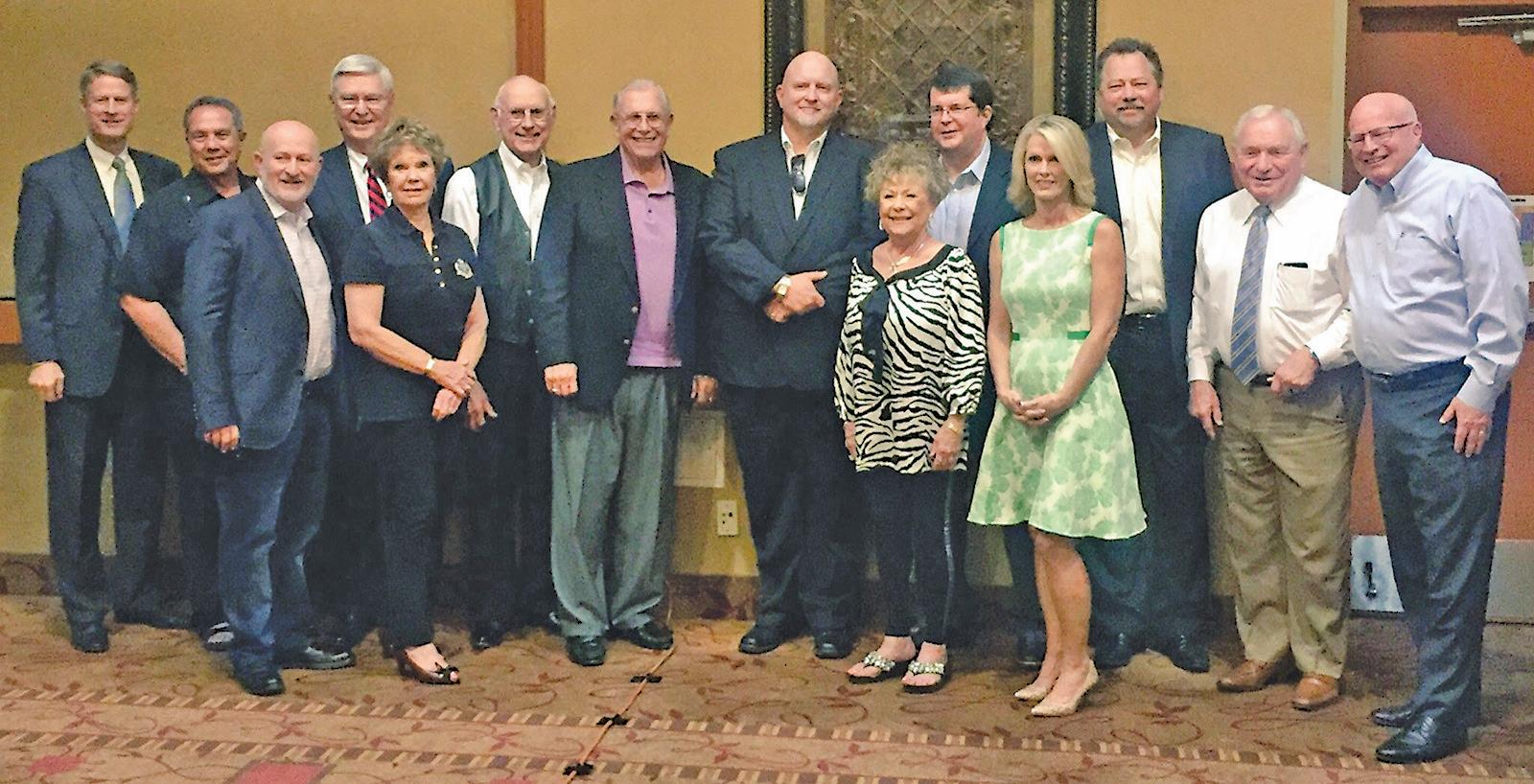
Some of those executives gathered two weeks ago at the same Holiday Inn to reminisce over the battles and the struggles that helped make the region what it is today.
Six men and two women who chaired the East Valley Partnership board at various times over the last 35 years were joined by its two former directors and a legendary former county supervisor and legislator who had worked closely with them all.
Segments of their conversation will be aired during the partnership’s 35th anniversary celebration at its annual organizational meeting in June.
The executives, many of whom are retired from their jobs but still active in the community, offered an informal timeline of the East Valley’s evolution –and a look at the challenges the region faces if that evolution is to continue over the next 35 years.
While they were asked to talk about their one-year term at the helm, many had been with the partnership since its inception and recalled that challenges over the last 3½ decades.
And they grew the partnership to include a broad spectrum of education, business and community leaders.
“One of the reasons the partnership was first born was that we in the East Valley weren’t getting any respect,” said Joannie Flatt, a public relations specialist and one of the leaders in the campaign that produced the Mesa Arts Center. She and several other partnership
leaders recalled how they lobbied to get an East Valley representative on the state Transportation Board, a five-member panel that exercises a huge influence on what highway projects get funded in Arizona.
“The big issue back in 1983 was the Phoenix clout,” recalled Mesa attorney David Udall. “We were the East Valley nobodies. We needed to develop clout.
Our principal function was to become a counterbalance to Phoenix clout.”
Looming large over the conversation were the late supermarket magnate Eddie Basha and the late Charles “Chuck” Waldheim, a former publisher of the old Mesa Tribune who died three years ago.
Both men drove the partnership to push for more political influence on state boards so that more highway money would flow into the region.
“The East Valley had no freeways, no courthouse,” said Tom Freestone, a former Maricopa County supervisor and judge who was so busy he had no time to formally join the partnership.
Nevertheless, he worked closely with Basha and the partnership on a wide range of issues, such as securing a second East Valley seat on the five-member county board of supervisors.
It paid off.
When a judge told a Mesa official that it would be “over his dead body” that
the region would get a permanent fulltime court so citizens and police weren’t forced to travel to Phoenix, Freestone’s reaction changed the jurist’s mind.
“I said, ‘Fine, then the courts won’t be getting any more money,’” recalled Freestone, whose board controlled the judges’ purse strings.
Base closing poses challenge
Freestone also recalled how East Valley cities would squabble – to the region’s detriment – over projects and potential large employers.
“We had to neutralize the situation so we could get things done. The towns were at rivalry,” he said.
A big challenge – and opportunity – to the East Valley’s growth came in 1991 when the Pentagon closed Williams Air Force Base.
Cattle rancher Chuck Bacchus recalled how the then-new Gov. Fife Symington asked him to join a committee to study its reuse.
That study eventually produced two landmark developments for the far East Valley – the birth of Williams Gateway Airport and Arizona State University’s Polytechnic Campus, both of which today are major economic centers for the region.
Kerry Dunne, the partnership’s first executive director, recalled how Waldheim in the 1990s saw how Japan’s
economy was thriving, so he had an idea to lure Japanese investments to the region.
Waldheim arranged for America West Airlines to supply a 747 that flew to Japan.
“He filled it with Japanese investors and when they landed at Sky Harbor, every company that had a helicopter loaned it for us to take them for a tour of the East Valley,” Dunne said, adding:
“Then we took them to Superstition Springs Golf Course and it looked like a scene from ‘Apocalypse Now’ with all these helicopters coming in.”
Former Mesa Schools superintendent Jim Zaharis recalled a strong campaign “to get the movie industry here.”
“We found people were living here and commuting to the West Coast,” he added.
Though Zaharis said “we got a little traction and got an animation studio to relocate here,” Hollywood stayed put.
More successful was the partnership’s push for a regional approach to the Rio Salado project, said Nancy Russell. “It was a Tempe project and became an East Valley project,” she said.
It helped accelerate development of a 40-mile strip from Mesa to Phoenix
BY PAUL MARYNIAK
AFN Executive Editor
While work on the South Mountain Freeway is proceeding at a fast clip, the court effort aimed at stopping it is moving at a snail’s pace.
Just days after a panel of judges for the U.S. District Court of Appeals for the Ninth Circuit appeared to be on track for possibly scheduling oral arguments in the case, it granted the Gila River Indian Community a delay that is a month longer than it wanted to file a brief.
The panel’s action on Monday, April 17, came only three days after it had granted a request by the Arizona Department of Transportation and the Federal Highway Administration to file a brief that was longer than what the court normally allows.
When that request was granted, it triggered a deadline for the Protect Arizona’s Resources and Children to file a final brief in the case – normally a sign that oral arguments might be set soon.
from page 17
of the construction workers as the traditional alarms, the alarms will be replaced on developer’s equipment.”
Krugel said that 16 to 20 trucks are hauling about 450,000 cubic yards of dirt for the freeway between 24th and 48th streets and that the nightwork is necessary “to avoid significant traffic backups on 40th Street and Pecos Road and impacts to the Pecos Park-andRide” lot.
from page 18
to improve the region’s environmental quality and economic vitality along the dry Salt River bed and made possible to the creation of Tempe Town Lake. Economic development took on an even greater emphasis under Roc Arnett’s service as executive director.
Arnett and the board crafted a plan for a new city called Superstition Vistas.
Located roughly beyond Gateway Airport, mostly in Pinal County, Superstition Vistas was envisioned as a place to live, work and play.
But then the court gave the Gila Community until May 30 to file a brief even though the community had only requested a May 1 deadline.
As always, the panel did not explain its actions.
PARC and the Gila Community are appealing U.S. District Judge Diane Humetewa’s rejection of their arguments that ADOT and the FHWA planned the freeway in violation of federal environmental law as well as laws protecting sites considered sacred by Native Americans.
The panel also has not ruled on a request by 21 tribes in the Southwest to intervene in the case.
Native Americans consider South Mountain a sacred site and say ADOT’s plan to cut a 200-foot-wide gash across three mountain peaks violates federal protection of such sites.
If the tribes’ request is granted, that would presumably create still more delays. The panel likely would to set a deadline for their brief, give the government agencies time to respond and then possibly give the tribes still more time to answer that brief.
He also noted, “The community and elected officials have consistently told ADOT and Connect 202 Partners that they want us to complete the work in as little time as possible while limiting traffic impacts on Pecos Road, and night work is necessary to accomplish both.”
While crews are doing as much work in the daytime as they can near homes, “some must be done at night for safety and to reduce traffic impacts,” he said, adding that includes “current work to haul in dirt and future work to place bridge girders over local streets.”
Although it was stalled by the 2008 market crash, it remains part of Pinal County’s master plan.
The crash also marked a dramatic turn for the partnership, as former chairs Brian Campbell and Mark Dreher explained.
“We were very fortunate as an organization to still be solvent because a lot of nonprofits were suffering,” Dreher said. “Everything shifted to an economic development focus. We were searching for aviation companies. We were all trying to figure out where after the recession we were going to go.”
Added Campbell: “We started to focus the partnership to compete not just on a regional basis but on a national and
Appeals courts do not work under any deadline and cases have been known to drag on for years.
When the appeal was filed late last year, PARC and the Gila Community had requested a temporary injunction halting freeway work until the case was resolved.
But the panel sided with the government agencies, which contended that the appeal had little likelihood of success and a construction delay would cost taxpayers tens of millions of dollars.
In seeking permission to file a brief longer than the panel permits, ADOT and the FHWA lawyers contended that the record in the federal case is more than 78,000 pages long and that they needed to address “voluminous administrative records, multiple parties and complex issues.”
In their brief, the government agencies say they “selected the environmentally preferable alternative that would serve the project’s purpose and need. The project will reduce congestion and save millions of hours of travel time; the present value of travel time savings for the project between 2020 and 2035
“Once the dirt embankments are built up at each site, crews will move to other areas along the freeway,” Krugel said, adding that notices had been sent to Foothills Paseo and Lakewood HOAs and homes along Pecos Road.
The “tonal backup alarms” are needed for workers’ safety, he added.
“Construction vehicles have large blind spots, making it difficult to see fellow workers on site and according to Occupational Safety and Health Administration,” Krugel said. “More than 150 people are killed each year from
international basis. We were learning that we weren’t just competing with the west side or Phoenix.”
So, it started branding the region as Phoenix/East Valley, forming a brand with the onetime bully that the partnership formed to fight.
That brand has become useful in efforts to luring out-of-state employers.
As the discussion shifted to the future, virtually all the former partnership leaders said education opportunities were paramount.
And that’s where the East Valley has an advantage, they said.
“We go and talk to these CEOs outside Arizona and they just say, ‘Why would
would be almost $3.4 billion.”
They also say the freeway will impact only two-tenths of one percent of South Mountain Preserve, or about 31.1 acres of the 16,600-acre area.
“The agencies thoroughly considered the reasonably foreseeable environmental impacts of the project and alternatives, as well as potential mitigation measures,” they also maintain.
The agencies also said that they considered alternatives to the freeway, but that “these alternatives were eliminated because they did not address the unmet transportation demand.”
That demand indicated that without the freeway, only 69 percent of the transportation network’s demands would be met in 2030, the brief states.
Government lawyers also dispute PARC’s contention that environmental studies of the freeway’s impact were flawed.
“After considering all the available information and the models of air emissions, the agencies determined that the proposed project would not produce disproportionate impacts on children,” government attorneys wrote.
being run over by construction vehicles. The crews have also established circular haul routes to reduce the amount of backing up needed.”
Nevertheless, residents’ ears are bound to be impacted for the next two years by freeway work.
“The bottom line is that construction makes noise,” Krugel said. “But ADOT and Connect 202 Partners work to minimize it as much as possible. We want to be a good neighbor by limiting those impacts and completing the project in as little time as possible.”
we go there? You’re like 49th in education in the country. They’d hammer us with statistics,’” said Campbell.
He said they point to ASU’s main campus as well as the Polytechnic, Mesa and Chandler-Gilbert community colleges and the high performancetest scores in East Valley public school districts.
“When we were out competing, it was East Valley assets we were selling,” he recalled of his time at the partnership’s helm. “It was always East Valley assets. We needed to brand and focus on the East Valley and that’s what we tried to do.
“And we’re still doing it.”
BY PAUL MARYNIAK
Adelyn Troutman can look and act like any tyke nearing 16 months of age.
The Ahwatukee toddler is effusive, bubbly and full of life.
But as the month wears on, that liveliness seeps quickly from her.
She takes more naps, rapidly loses her child-like enthusiasm and becomes paler with each passing day.
Eventually, she must be taken to the hospital, where doctors stick a needle in her little arm to give her a blood transfusion. Otherwise, she will die.
This is Addy’s cycle.
Her parents, Matt and Kami Troutman, have tended to her through this agonizing cycle 20 times – since she was 2 months old. And the only way she can break it is with a bone marrow transfusion.
“We can definitely tell the signs as the month goes on,” Matt Troutman said. “Once it starts to happen, it happens quick.”
Addy suffers from a rare genetic dis-

ASUing the need for another 200 to 240 millimeters of blood.
“Basically, all new blood is the same age,” her father said.
It didn’t take long after Addy was born for her parents to see there was something wrong with their little girl.
two months, she seemed extremely pale so we brought her in to our pediatrician and he took one look at her and sent us directly to Phoenix Children’s Hospital.”
That’s when they got her diagnosis.
“We didn’t have a lot of information beyond a name,” he recalled. “We had to figure out what that really meant. At first it didn’t fully sink in.”
When it did sink in, it changed the Troutmans’ lives in many ways – some for the good and some not so.
order called Diamond-Blackfan anemia, which prohibits her body from making red blood cells.
Those cells have a relatively short life span, so by the end of four weeks after her last transfusion, they’ve all died off, forc-
“When Addy was born, she was extremely anemic and stayed in the neonatal intensive care unit for 21/2 weeks,” Matt Troutman explained. “The doctors could not determine at that time what was the cause. They gave her transfusions and we eventually went home thinking that everything was fine. After
Beyond the agony of watching their daughter undergo her monthly transfusions and her steady loss of energy that leads to the next one, there are also the mounting expenses.
It costs $3,500 to $4,000 for each transfusion, and Troutman, a web designer whose contract job recently ended, is covered right now by an expensive COBRA policy while he looks for new work.
Then the bone marrow operation looms ahead, and he hasn’t even looked into its cost.
BY PAUL MARYNIAK
Nearly eight years after a spinal cord injury sustained in a soccer match left her temporarily paralyzed, Mackenzie Saunders of Ahwatukee has once again proved nothing will stop her.
The 2016 Desert Vista High School grad and student body president recently received the Emerging Student Leader Pitchfork Award from Arizona State University – an honor accorded annually to only one of ASU’s 70,000 students. Mackenzie, who won the award through a combination of an online student election and a judging panel’s consideration of her work, was honored for her initiative in getting involved and making an impact in the ASU community.
“This award encompasses all four campuses,” Mackenzie said, “so I was
super-excited to win. I won because of my on-campus involvement, specifically my experience working with Barrett Residential Council this year and my recent election to be president of Vista Community Council next year.”
Given her track record at Desert Vista, her activity is no surprise.
The daughter of Liz and Gary Saunders, she was the president of the speech and debate club, editor in chief during her junior year at the school’s journalism operation and the president for the Arizona Association of Student Councils.
This year, while studying business law, she’s involved in the Barrett Residential Council, the Residence Hall Association, Young Democrats, McCord Business Scholars and VoteNow.
“The Barrett Residential Council is basically student council for residential life here at Barrett, the Honors College,” she explained.
The residential complex houses around 1,700 students within nine buildings, and “I was elected vice president in September through a complex-wide application, interview, campaigning and election process. Campaigning was through flyers, word of mouth and social media.”
She ran an effective campaign, winning about 60 percent of the student vote against nine other candidates.
“That was super-cool,” said Mackenzie, who helps put on events in the complex and runs weekly community council meetings on the budget and activities in Barrett.
“It’s also a paid position through Barrett Housing, so this is actually my job, too,” she added, calling it “a super-timeconsuming position, because when I am not planning for my upcoming event, I

BY COTY DOLORES MIRANDA AFN Contributor
It is “Ahwatukee’s Funnest Night Out,” or so says the Festival of Lights’ website of the 22nd annual Festival of Lights Wine & Beer Tasting on Saturday, April 29.
Held for the third year at Rawhide Western Town, just south of Ahwatukee, the event is an evening gathering of adults to raises funds for the nonprofit FOL’s Million White Lights Display, which illuminates Chandler Boulevard from 24th Street to Desert Foothills Parkway from Thanksgiving through New Year’s Day.
The move to Rawhide from Foothills Country Club two years ago was necessitated by weather and availability, said FOL president Janyce Hazlett.
“Although the club was a lovely venue and in Ahwatukee, they could give us only summer dates due to their wedding schedule. It was really quite hot for us in June, so we began searching for a venue that could host in April,” she explained.
“Rawhide approached us and offered April. It’s really a wonderful venue and quite close as well. We were quite concerned about the move out of the neighborhood, but it did revitalize the organization, as well as the event itself. This year, we have quite a few new sponsors and other purveyors.”
Hazlett knows well what works for the

FOL and, as one of the original women founders, is deeply invested.
“I was a founder with two other ladies back in 1995, when we saw the wonderful lights on Chandler Boulevard come down as the builder Del Webb completed its marketing campaign of this area,” she recalled.
“I’ve been involved in the Festival of Lights for most of the past 22 years, and in 2015 they needed a new president. I’d never taken on that position, so I decided to give it a tryand am now in my third
year,” she said, adding:
“Our all-volunteer committee includes very dedicated folks and we’re always looking for more.”
Besides volunteers to help before, during and after the event, the FOL Wine & Beer Tasting Committee is seeking additional sponsors and contributors for its silent auction.
“This has evolved into Ahwatukee’s signature event for adults,” said Hazlett of the evening that annually attracts about 500 people.
The FOL also sponsors the annual FOL Kickoff, an enormously successful daylong, family-friendly event the Saturday after Thanksgiving that concludes with the now famous lighted-motorcycle parade ushering in Santa.
The FOL Wine & Beer Tasting Event provides event goers with a selection of more than 50 varieties of wines and beers, food samples from a dozen or more area restaurants, live music by Trapwire, and line dancing with Ahwatukee’s Carrie McNeish.
The event’s silent auction is well-known for the quality of their items including jewelry and trips, and for the quantity.
Traditionally, over 100 items are up for bid in this major fundraising portion of the fundraising event.
“We don’t usually talk money but we did take in almost $20,000 in our silent auction last year,” said the FOL’s Susan Anderton, the organization’s president in 1997-98 and now in her fourth year as secretary.
“This year, we once again have some great items: Muhammad Ali autographed gloves, Bondurant Fiat two-day package, two Soul Cycle beach bicycles, wine and more wine baskets, decorations for a Christmas tree, birthday party for 10 at Main Event, Larry Fitzgerald autographed helmet and much more,” she said, adding there are select items to fit every budget.
The prize-winning Mountain Pointe High School Robotics Club has claimed another honor. This time, its teacher-mentor, Mel Wendell, has been named the 2017 Arizona Regional Robotics Teacher of the Year by FIRST Robotics Competition. The club, dubbed the Pridetronics, won the national robotics competition sponsored by First last year.
FIRST stands for For Inspiration and Recognition of Science and Technology.
“The award recognizes that students cannot be “FIRST” without the help, guidance, and support of teachers. It honors those who give up their time, talent and enthusiasm to support robotics and who exemplify a positive role model, guidance, grace under pressure, fairness and compassion,” Tempe Union High School District said in a release about
her honor.
Wendell, an engineering teacher, was nominated by her students.
Under her guidance, the Pridetronics Club has grown over seven years to 47 students.
In nominating her, they called her “an inspiration to the Pridetronics family” and “a dedicated mentor and teacher that the Pridetronics are lucky and grateful to have. She is not only there to provide comfort to her students but to guide the team through their FIRST journey.”
“Mrs. Wendell’s undying passion and love for STEM is what drives her as lead mentor… She makes it possible for the club to turn their ideas into reality. She not only runs the robotics team but teaches multiple levels of engineering classes, stressing the importance of engineering,” the students also wrote.
Wendell was gratified by their nomi-
nation.
“Engineering and robotics have become my passion and to be recognized by my students means the world to me.
I am proud to be their teacher and to see how much passion they have for engineering and robotics keeps me going strong,” she said.
Principal Bruce Kipper praised Wendell’s leadership, stating in the release:
“She started the program just a few short years ago and it has grown so fast. The students are getting a great hands-on experience working with local engineers and they are competing with the best in the state and the nation.”
The students also praised Wendell’s advocacy of science technology, engineering and math for women
“She has pushed for the formation of a Girls Robotics Day on the high school campus. Due to this, our number of fe-
male members has doubled,” they wrote, adding:
“Melissa Wendell orchestrated visits from various women with PHDs in the engineering field to inspire females to participate in robotics or the engineering field. Wendell is, truly, a role model for all of the girls in the club with her strong, positive, attitude, firm beliefs, and impartial consideration.”
The district said not only wanted to credit Wendell for her efforts on behalf of the club, but also “wanted the judges to know the knowledge they are gaining from Ms. Wendell goes far beyond engineering,” the district said.
They wrote: “Mrs. Wendell stresses the importance of respect to teammates and others during competition. Many people in the club find that they can trust her with anything and turn to her in their times of need.”


NATIONWIDE – The phone lines are ringing off the hook. That’s because U.S. State Silver Bars sealed away in State Vault Bricks are being handed over to AZ, CA, NV, UT, CO and NM residents at just the state minimum set by the Lincoln Treasury for the next 2 days.
This is not a misprint. For the next 2 days residents who find their state on the Distribution List above in bold are getting individual State Silver Bars at just the state minimum of $59 set by the Lincoln Treasury. That’s why everyone should be taking full Vault Bricks loaded with five U.S. State Silver Bars before the deadline ends.
And here’s the best part. Every AZ, CA, NV, UT, CO and (Continued


















NM resident who gets at least two Vault Bricks is also getting free shipping and free handling. That’s a real steal because all other state residents must pay over six hundred dollars for each State Vault Brick.
Not long ago, nobody knew that the only U.S. State Silver Bars locked away in the private vaults of the Lincoln Treasury would be allocated to the Federated Mint for a limited release to residents in 6 states. Every single one of the 50 U.S. State Silver Bars are date numbered in the order they ratified the Constitution and were admitted into the Union beginning in the late 1700s.
“As Executive Advisor to the Lincoln Treasury I get paid to deliver breaking news. So, for anyone who hasn’t heard yet, highly collectable U.S. State Silver Bars are now being handed over at just the state minimum set by the Lincoln Treasury to residents in 6 states who beat the offer deadline, which is why I pushed for this announcement to be widely advertised,” said Mary Ellen Withrow, the emeritus 40th Treasurer of the United States of America.
“These bars are solid .999 pure fine silver and will always be a valuable precious metal which is why everyone is snapping up as many as they can before they’re all gone,” Withrow said.
There’s one thing Withrow wants to make very clear. State residents only have two
days to call the Toll Free Order Hotlines to get the U.S. State Silver Bars.
“These valuable U.S. State Silver Bars are impossible to get at banks, credit unions or the U.S. Mint. In fact, they’re only being handed over at state minimum set by the Lincoln Treasury to AZ, CA, NV, UT, CO and NM residents who call the Toll Free Hotline before the deadline ends two days from today’s publication date”, said Timothy J. Shissler, Executive Director of Vault Operations at the private Lincoln Treasury.
To make it fair, special Toll Free Overflow Hotlines have been set up to ensure all residents have an equal chance to get them.
Rapid shipments to state residents are scheduled to begin with the first calls being accepted at precisely 8:30am today.
“We’re bracing for all the calls and doing everything we can to make sure no one gets left out, but the U.S. State Silver Bars are only being handed over at just the state resident minimum set by the Lincoln Treasury for the next two days. For now, residents can get the U.S. State Silver Bars at just the state minimum set by the Lincoln Treasury as long as they call before the order deadline ends,” confirmed Shissler.
“With so many state residents trying to get these U.S. State Silver Bars, lines are busy so keep trying. All calls will be answered,” Shissler said. n (Continued

COVeR jUST $59 STATe MINIMUM
If all lines are busy call this special toll free 1. overflow hotline: 1-888-414-3758 Ext.FMS2216
residents who find their state on the 2. Distribution List to the left in bold and beat the deadline are authorized to get individual State Silver Bars at just state minimum of $59 set by the Lincoln Treasury. That’s why everyone should be taking full Vault Bricks loaded with five State Silver Bars before they’re all gone. And here’s the best part. every AZ, CA, NV, UT, CO and NM resident who gets at least two Vault Bricks is also getting free shipping and free handling. that’s a real steal because all other state residents must pay over six hundred dollars for each State Vault Brick.
All
No State Silver Bars will be issued to any 1. resident living outside of AZ, CA, NV, UT, CO or NM at state resident minimum set by the Lincoln Treasury.
Call the Non-Resident Toll Free 2. Hotline beginning at 11:00am at: 1-888-414-3761 Ext.FMS2216
If you are a u.s. resident living outside of the 3. states of AZ, CA, NV, UT, CO or NM you are required to pay $134 for each State Silver Bar for a total of six hundred seventy dollars plus shipping and handling for each sealed State Vault Brick loaded with five u.s. State Silver Bars. This same offer may be made at a later date or in a different geographic location.
FEDERATED MINT, LLC AND LINCOLN TREASURY, LLC ARE NOT AFFILIATED WITH THE U.S. GOVERNMENT, A BANK OR ANY GOVERNMENT AGENCY. IF FOR ANY REASON WITHIN 30 DAYS FROM SHIPMENT YOU ARE DISSATISFIED, RETURN THE PRODUCT FOR A REFUND LESS SHIPPING AND RETURN POSTAGE. DUE TO THE FLUCTUATING PRICE IN THE WORLD GOLD AND SILVER MARKETS, ORDERS MAY BE CANCELLED OR PRICES WILL CHANGE WITHOUT NOTICE AND STATE MINIMUMS ARE SUBJECT TO AN ADDITIONAL FEE OF NO MORE THAN 2% FOR EVERY $1 INCREASE IN THE NEW YORK SPOT SILVER PRICE PER OUNCE WHEN EXCEEDING $18 PER OUNCE AND SHALL BE APPLIED AT THE TIME THE ORDER IS PROCESSED FOR SHIPMENT. THIS SAME OFFER MAY BE MADE AVAILABLE AT A LATER DATE OR IN A DIFFERENT GEOGRAPHIC LOCATION. FEDERATED MINT 7600 SUPREME AVE. NW, NORTH CANTON, OH 44720 ©2017 LINCOLN TREASURY

with five
State Vault Brick.
two
Bricks
and

BY KELLY ATHENA AFN Contributor
Alex Magewick, a freshman at Des-
ert Vista High School, raised money for his upcoming service trip by holding a garage sale last weekend.
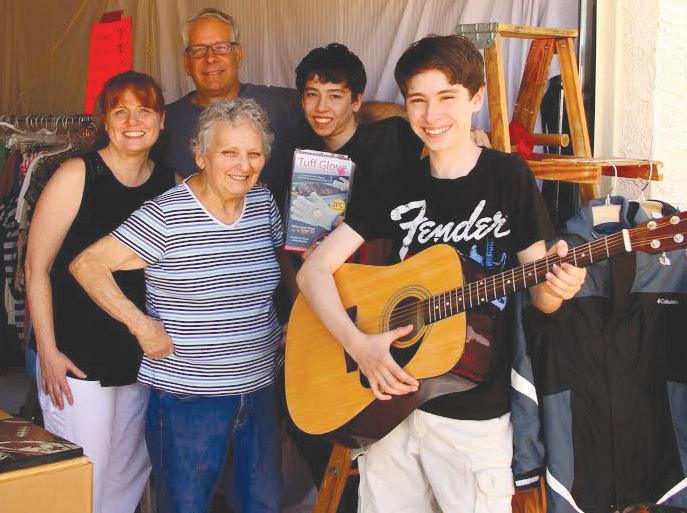
He will spend two weeks in Boston this summer with other teens from Mountain Park Community Church doing service work for less-fortunate people. Alex enlisted lots of friends to donate their extra stuff. He sorted and organized it into categories: games, clothes, books, kitchen items, jewelry and Christmas items.
This was a three-generation job.
His brother, Zachary, a seventh-grader at Altadena Middle School, helped him rig a pulley to anchor two clothing racks in their garage. He clipped sheets over shelves of stored items he was not selling. He arranged tables and priced each item with a little help from his parents, Phil and Mary Magewick, and his grandma, Virginia Hielen.
Alex immediately greeted me when I walked up to the sale. “I love your neon green shoes! That’s my favorite color!”
“Thanks, I got them at a garage sale for $2 last month,” I said.
“Oh, they look brand new,” said his mom.
“Could I help you find something?” asked Alex.
I replied, “I need a freezer chest to hold all the palo verde and ironwood beans I’m planning to harvest soon.”
“Sorry, we’re fresh out of freezer chests. Could I interest you in a candle?” chimed in his dad Phil.
Alex had a guitar next to him.
“Could you play me something on your guitar?” I asked. He whipped his guitar around and started playing ZZ Top’s “La Grange” riffs. Then he launched into a medley of Beatles tunes: “Here Comes the Sun,” “Blackbird” and “Day Tripper.”
“Good musical taste for a teen,” I thought. He played each tune just as the original artist did, with spot-on timing, notes, and chording.
“I’ve taught myself how to play over
the last year or two,” he remarked.
“Guess who came to our sale today?” asked Alex.
He ran inside to get a signed DVD by Glen Wacker, the fearless stuntman of “Will It Make It?” TV show fame. The vehicle-destroying stuntman likes to come out to local garage sales on the weekends.
Phil and Mary met at ASU in 1988 and married in 1992.They’ve lived in the same Ahwatukee house since 1992.
“All there was in Ahwatukee was a junkyard, a rock company, a Safeway store, two stoplights, coyotes, rabbits, and tons of empty lots. I loved the
mountains and the seclusion,” recalled Phil. “We used to come across paved parts of the old International Harvester proving grounds when we hiked in West Ahwatukee.”









“We already have a big pile of bills,” he said. “With the transplant, we can’t even imagine the cost.”
Right now, however, he and his wife have more pressing concerns – mainly, finding a donor with the right blood match.
And if they find a match and Addy undergoes the bone marrow transplant, she faces months of recovery – including up to six weeks in the hospital.
The Troutmans are awaiting results on tests of their son and other daughter, hoping one of them will have a compatible blood type.
But because Diamond Blackfan Anemia is genetic, the two children also need to be tested to make sure they don’t possess the mutated gene that causes the disease. If they do, then the Troutmans have to hope a donor will emerge from the bone marrow network managed through bethematch.org.
The Troutmans know their situation is hardly unique, and they have launched a campaign to drive awareness of the bone marrow donor program, hoping people will consent to having a swab taken from their mouth and then registered in the national database for other people like Addy.
“Right now, the main goal is to find her the perfect match,” Matt Troutman said. “he better match we find, the less dangerous and risky the whole procedure will be.”
“Registering as a donor is very quick,” he continued. “It takes about five minutes and all you need to do is a quick form and a swab in the mouth, and once you register, you are on the registry for life. We advocate to please register and help save a
from page 24
I walked around looking for something to buy and found a blue cotton shirt in my husband’s size. “My husband doesn’t like long sleeves. He’s always warm,” I said.
“Well, he can roll up the sleeves. How about 50 cents?”
“I can’t say ‘no’ to that,” I thought. I spied a John Steinbeck paperback I hadn’t read, a cashmere scarf made in West Germany (obviously vintage, with no moth holes), and a makeup organizing kit.
I suddenly noticed a boxed pair of oven “Tuff Gloves” in the corner of a table. “I’ve been looking for these for two years – ever since my sister snatched a
life – if not Addy’s, then someone else like her who desperately needs it.”
They have already become regular blood donors as well and are encouraging others every chance they get to do the same.
“When we started thinking about how Addy depends on those transfusions, we went out and started attending blood drives,” Matt Troutman said. “It opened our eyes, knowing we now have a baby who depends on these kinds of events to keep her alive.”
They’ve also been moved by the kindness of others to their and Addy’s plight.
At first, friends and neighbors were helping, but as word has spread beyond them, total strangers are coming to their aid.
“We are so overwhelmed by the love and support so many people are showing as we start this crazy journey,” he said. “We didn’t want to bother people with our problems, but we discovered many people want to help. Ahwatukee has been really, really great.”
To become a donor: BeTheMatch.org
To help the Troutmans: GoFundMe.com/ adelyns-cure
Local fundraisers:
• Zzeeks Pizza on Warner Road and 48th Street is holding an Adylen’s Cure benefit 11 a.m.-10:30 p.m. April 27. Mention Addy and a portion of the proceeds from your bill will go toward her fund.
• Chick-Fil-A in the Ahwatukee Foothills Towne Center, 5035 E. Ray Road will hold a similar fundraiser 6-10 p.m. May 10.
• The website is now live: adelynscure.com
• A raffle with proceeds going to Addy’s medical expenses can be entered at adelynscure.com/raffle
• T-shirts supporting Addy can be purchased at booster.com/adelynscure
• Follow Addy’s fight: adelynscure.com
pair out from under me when we were at a garage sale together a couple years ago. They keep your hands safe up to 500 degrees of heat and are easier to use then mitts.”
Alex replied, “Well, if we’d have known you’d be so excited about them, we would have priced them higher!”
I handed Alex $5.
“Could I bag your things and take them to the car?” he asked.
With heartbreaking conflicts going on around the world, sometimes the humor and kindness of new friends at a neighborhood sale is just the “love bomb” I need.
Kelly Athena of Ahwatukee is a garage sale aficianado, master gardener and desert forager. Email her at greengirl@kellyathena.com with news of upcoming garage sales or sustainable events.




Desert Vista Football Boosters seek gear, plan breakfast
The Desert Vista High School Football Boosters is holding a fundraiser and a benefit breakfast.
















It’s collecting gently used or new football gear – including cleats, pads and helmets as well as other equipment –that will be resold to anyone interested in suiting up for the spring/summer season.
The sale will be held in conjunction with a free pancake breakfast 8-10 a.m. May 6 at the high school football stadium. The breakfast will be cooked and served by boosters, and donations are sought to benefit the 3-year-old football program at Arizona State University Preparatory Academy in downtown Phoenix.
Gear can be dropped off after football practice at Desert Vista High from April 24 to the day of the sale/breakfast.
Information: Valerie Myers at 480204-4408 or valmyers04@gmail.com.
Ahwatukee Republicans plan a ‘tax relief’ party next week
The Ahwatukee Republican Women and Legislative District 18 GOP will hold a Tax Relief Beer, Wine & Soda Tasting fundraiser 6:30-9 p.m. Friday, April 28, at 4025 E. Tamaya St., Ahwatukee.
A variety of beer, wine and soda will be available to taste. Burgers, hot dogs and brats will be available for dinner in addition to tasty side dishes and desserts. Advance tickets are $20 for 20 tickets. If you pay at the door, it will be $25. Additional tickets will be available for purchase at the event.
Tickets can be used for beverage tastings and main dishes. People are asked to buy tickets early so organizers can plan for food accordingly. Also, attendees are asked to bring a bottle of wine or two bottles of specialty beer as a donation.
Information: ahwatukeerepublican women.com
Phoenix Public Library, including the Ironwood branch at 4333 E. Chandler Blvd., Ahwatukee, is making it easy for people to discharge fines for overdue books. From now until April 23, they can donate a can of food or a nonperishable food item And get a 50-cent credit per item toward any fines they’ve accumulated.
The “Food for Fines” program allows for a total $75 to be credited toward
fines or for lost library items. The program collected more than 30,000 pounds of food for Arizona’s hungry last year, Food will be donated to St. Mary’s Food Bank Alliance.
Desert Foothills Methodist slates ‘Care for the Caregiver’ Caregivers often feel stressed and tired, forgetting or feeling guilty about taking care of themselves. Desert Foothills United Methodist Church’s Stephen Ministry will present a panel of area agency professionals to help caregivers focus on their physical, emotional and spiritual needs while taking care of others.
The panel includes: Scott Hawthornwaite from the Area Agency on Aging, Cindy Findley of the Arizona Caregiver’s Coalition, Sandra Brinkley, registered nurse and the Rev. Dr. Kristin Hansen, Pastor of Desert Foothills Methodist. The panel is at 7 p.m. Monday, May 1, at Desert Foothills United Methodist Church, 2156 E. Liberty Lane, Ahwatukee. RSVP is required: 480-460-1025 or office@desertfoothills.org.
Ahwatukee Foothills Montessori, 3221 E. Chandler Blvd., Ahwatukee, is offering a “fun, interactive and handson” summer camp for children age 3-8 for eight weeks from May 30 through July 21 with a different theme each week. Campers will participate in theme-related activities, crafts and games each week and enjoy Water Day every Friday. Themes are related to Spanish and art activities and special events such as puppet shows and magic shows are scheduled throughout the summer. Campers do not need to be enrolled in the regular school program and can sign up for weekly sessions or just for a few days a week. Space is limited.
Information: 480-759-3810.
The Kyrene Foundation is asking the community for help in providing donations for its Wishes Come True drive. Not every eighth-grade student can afford a one-time dress for a special occasion, such as an eighth-grade promotion ceremony.
To help meet this need, the Kyrene Foundation is collecting gently used dresses for eighth-grade girls in need for upcoming promotion ceremonies.
WEDNESDAY, APRIL 19
Legion hosts hospice speaker
American Legion Post 64 of Ahwatukee community is hosting a free public education program featuring Hospice of the Valley’s Lin Sue Cooney. “We offer so much more than end of life care,” said Cooney. “We provide all sorts of expertise in dementia, have a thriving volunteer program, pet therapy and music. We also have a wonderful program called Saluting Our Veterans which I will definitely discuss.” DETAILS >> 3 p.m., Ahwatukee Recreation Center, 5001 E. Cheyenne Drive, Ahwatukee. Information: Ed Mangan, USAF Captain (former), Post 64 Commander, emangan3@aol.com 602-501-0128.
THURSDAY, APRIL 20
Peter Longo discusses golf
“The Evolution of the Golf Swing” is the title of a presentation by PGA life member, trick shot artist and golf historian Peter Longo. He will present a fun-filled, dynamic seminar of golf swings from then until now. He will also demonstrate a few trick shots.
DETAILS >> 6:30-7:30 p.m., Ironwood Library, 4333 E. Chandler Blvd., Ahwatukee. Free, no registration required.
SATURDAY, APRIL 22
DV collecting your junk
The Desert Vista High School senior class is collecting clutter you might want to ditch so it can sell the discards to Goodwill and raise money for Grad Night. There are also sponsorship opportunities for local businesses for the seniors' big night.
DETAILS >> Drop off your junk 8-11 a.m. at the high school parking lot. Information on sponsorships: 480-231-1533 or dvgradnight.com.
TUESDAY, APRIL 25
Annual school band concert set
The Mountain Pointe High School Band will hold its annual joint concert with the Ahwatukee Foothills Concert Band. The bands perform individually as well as jointly.
DETAILS >> 7 p.m., Mountain Pointe High School auditorium, Knox Road and 44th Street, Ahwatukee. Admission: $5.
SATURDAY, APRIL 29
Winetasting fest slated
The Winetasting Festival that helps support Ahwatukee’s annual Festival of Lights show along Chandler Boulevard will be held. Tickets are going on sale soon.
DETAILS >> 6:30-10:30 pm., Rawhide in Chandler. Ticket info: folaz.org/winetasting-festival.
TUESDAY, MAY 2
The 100+ Women Who Care Valley of the Sun, a local philanthropic group of women who meet quarterly to contribute to and connect personally with deserving local charities will gather. Guests are welcome.
DETAILS >> 5:30-7:30 p.m. Foothills Golf Club, 2201 E. Clubhouse Drive, Ahwatukee. Information: 100WWCValleyOfTheSun.org.
SUNDAYS
‘TinkerTime’ open for kids
A makerspace for children to design, experiment, and invent as they explore hands-on STEAM activities through self-guided tinkering.
DETAILS >> 1-4 p.m. every Sunday, Ironwood Library 4333 E. Chandler Blvd., Ahwatukee. Ages 6-11. Free; No registration required.
MONDAYS
Chamber offers networking
The Ahwatukee Foothills Chamber of Commerce networking
and leads group is open to chamber members.
DETAILS >> Noon, Native Grill and Wings, 5030 E. Ray Road, Ahwatukee. Devida Lewis, 480-753-7676.
TUESDAYS
Chair yoga featured
Inner Vision Yoga Studio offers chair yoga to help seniors and people recovering from injuries to stay fit.
DETAILS >> 1:30-2:30 p.m., 4025 E. Chandler Blvd., Ahwatukee. $5 per class. Information: donna@ innervisionyoga.com or 480-330-2015.
Toastmasters sharpen skills
Improve your speaking skills and meet interesting people at Ahwatukee Toastmasters meetings
DETAILS >> 6:45-8 a.m at the Dignity Health Community Room, 4545 E. Chandler Blvd., Ahwatukee.
Power Partners available
The Ahwatukee Foothills Chamber of Commerce networking and leads group is open to chamber members.
DETAILS >> 8-9 a.m., Four Points by Sheraton, 10831 S. 51st St., Ahwatukee. Dorothy Abril, 480-753-7676.
WEDNESDAYS
Watercolor classes available
Watercolor classes that teach both bold and beautiful as well as soft and subtle approaches to the art are available twice a week for beginners and intermediate students who are at least 15 years old. Step-by-step instruction and personal help are provided.
DETAILS >> 2:30-5 Wednesdays and 10 a.m.-12:30 p.m. Saturdays at Hobby Lobby, 46th Street and Ray Road, Ahwatukee. Cost: $25 per class, $80 for four classes. Registration required: jlokits@yahoo.com or 480-471-8505.
Ahwatukee Foothills Montessori holds an open house weekly. It includes a short talk about Montessori education, followed by a tour of its campus.
DETAILS >> 4 p.m. Wednesdays, 3221 E. Chandler Blvd., Ahwatukee. Information: 480-759-3810
Hospice of the Valley offers a free ongoing grief support group for adults and is open to any adult who has experienced a loss through death. No registration required. DETAILS >> 6-7 p.m. first and third Wednesdays, Pecos Community Center, 17010 S. 48th St. 602-636-5390 or HOV.org.
An informal, relaxed social organization of about 90 women living in the Ahwatukee Foothills/Club West area. A way to escape once a month to have fun and meet with other ladies in the area. Guest speaker or entertainment featured.
DETAILS >> 7 p.m. second Wednesday of the month, Foothills Golf Club, 2201 E. Clubhouse Drive. Contact jstowe2@cox.net or FoothillsWomensClub.org.
Parents are invited to join a drop-in group to ask questions, share ideas or just listen to what’s going on with today’s teenagers.
DETAILS >> 5:30-7 p.m. second Wednesday of each month. Maricopa Cooperative Extension, 4341 E. Broadway Road, Phoenix. Free. RSVP at 602-827-8200, ext. 348, or rcarter@ cals.arizona.edu.
Legislative District 18 Democrats gather for an informal chat. DETAILS >> Free and open to the public 7:30-9 a.m. the third Wednesday of the month at Denny’s, 7400 W. Chandler Blvd., Chandler. RSVP: marie9@q.com or 480-592-0052. The Legislative District 18 Democrats meet the second Monday of the month. See ld18democrats.org. Information: ld18demsinfo@gmail.com. Free and open to the public. The location changes from month to month.


























am preparing for meetings, meeting with different executive members of the council and coming up with ideas for future programs.”
Mackenzie, who now has full use of her legs, stunned the community when she was injured at age 13 during a club soccer match. She was hospitalized for more than a month and went through more months of rehabilitation therapy before recovering. She was elected three weeks ago to be president of the Vista Community Council for the next school year. Vista del Sol is the 12-building, on-campus housing complex for about 2,000 upper-division Barrett Honors students.
“I will be in charge of overseeing all events put on in the community, along with running weekly meetings and overseeing the other paid student positions within the council,” she said, adding: “My biggest responsibility is to spend our $18,000 per semester budget; I am the only member of the council allowed to handle our funds. Typically, the money is spent on different large events and materials for students. This is also the largest and most diverse residential community on campus, since it includes people of all grade levels and all majors.”
In an almost understated way, Mackenzie said, “I adjusted to campus life pretty quickly because I chose an extracurricular to join my first week on campus.
“I spent my second day on campus volunteering for a Barrett Residential Council event because I saw it was happening and asked to jump in. Adjusting to campus life is all about putting yourself out there and finding your niche in the community,” she added.
Asked how she manages her heavy course load and extracurricular schedule, she said, “The most important thing is prioritization. I have learned to always keep school as my number one priority, because even though I am heavily involved outside of the classroom, academics are why I’m here. I always have to make sure I have enough time to study and go to class before I do work for outside organizations.”
As for those who will be graduating high school next month and heading to a college or university, she has this advice:
“Find a club or organization to get involved in right when you move in. It doesn’t matter if you end up staying in that same club for all four years; all that matters is staying involved. If you stay involved, it becomes so much easier to meet people and get comfortable in a new environment.”


from page 21
Anderton encouraged participants to “dress comfortably” for the outdoor event, and because part of the venue is packed dirt, suggested “closed-toe shoes.”
For the third year, tickets remain $50 each, or attendees can save $10 with $240 Six Shooter Package. Parking is free.
Tickets for the 6:30-10:30 p.m. festival can be purchased at FOLAZ.org, or at the three Ahwatukee Safeway stores: Safeway at Desert Foothills Parkway and Chandler Boulevard, Safeway at 40th Street and Chandler Boulevard, and Safeway at 48th Street and Elliot Road.
Hazlett said besides supporting the FOL Million White Lights, the event aids local charities.
“This year we’ve chosen three charities as recipients of a portion of our proceeds: Y OPAS - Outreach Programs for Ahwatukee Seniors from our local YMCA, Kiwanis Club of Ahwatukee and Starbright Foundation,” she said.
Information: FolAz.org
from page 26
New or like-new attire that is appropriate, such as semi-formal dresses, can be donated through April 27 at the Kyrene School District Office, 8700 S. Kyrene Road, Tempe, or the Kyrene Family Resource Center, 1330 E. Dava Drive, Tempe. Volunteers are needed for the April 29 dress selection. Information: tward@kyrene.org or signup.com/ go/gFJURS.
Ahwatukee
Livestrong is a free small group fitness program at the Ahwatukee Foothills Family YMCA for adult cancer survivors aimed at easing them back into fitness and improve their quality of life. Each 12-week session meets for 75 minutes twice a week and a free YMCA membership for the duration of the program. Class size is limited to six people. Information: Debbie Mitchell at 602-212-6081.
Send your letters on local issues to











































































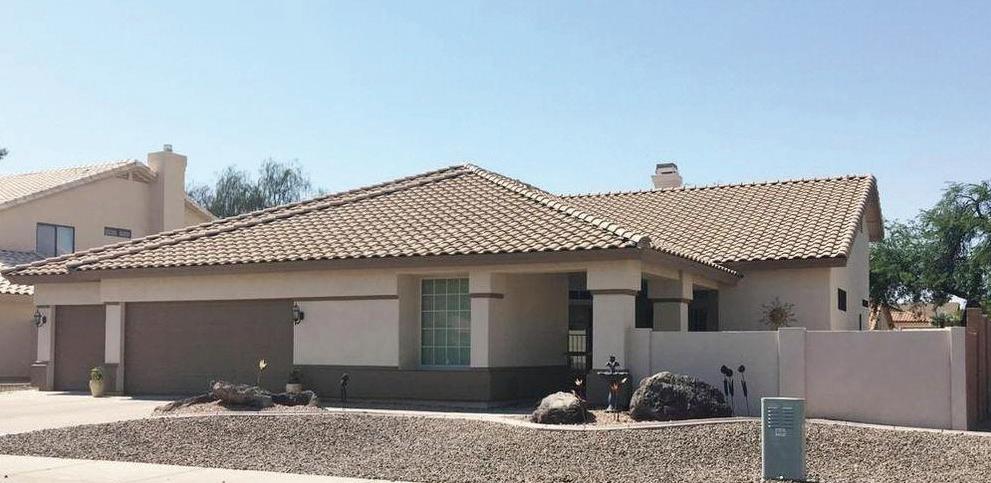


























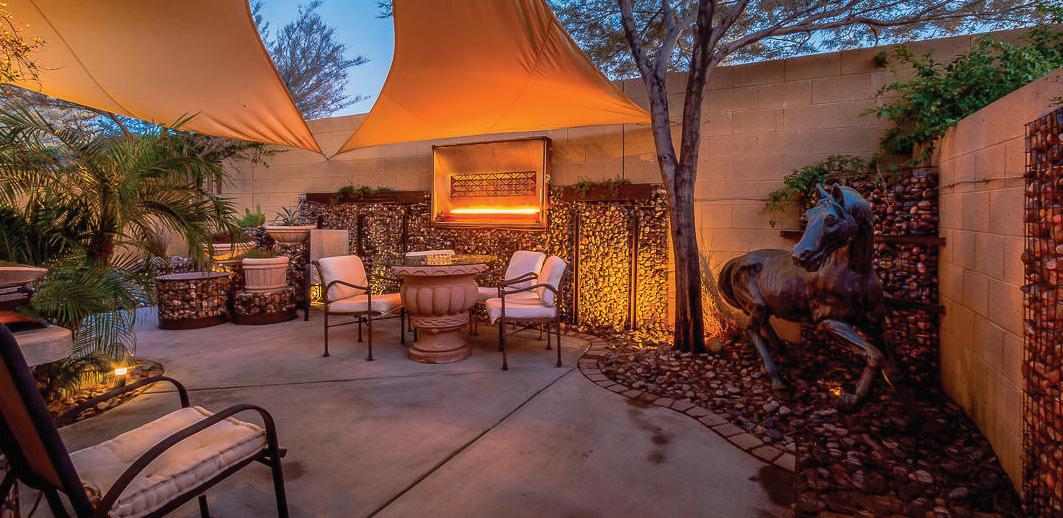



BY PAUL MARYNIAK AFN Executive Editor
On a spring morning as flawless as the rhythms of the Desert Vista and Mountain Pointe high school marching bands, the 41st annual Kiwanis of Ahwatukee Easter Parade stepped off to the delight of young and old alike along 48th Street Saturday.
Many of the 75 entries featured decked-out vehicles or brightly attired children and adults who had begun gathering at least two hours before the parade’s 10 a.m. start. City Councilman Sal DiCiccio said he unofficially estimated 15,000 people lined up along 48th Street.
The parade marked at least two record appearances as Easter Parade Boss Mike Schmitt directed the procession for the 25th consecutive year and Mountain View Lutheran Church and its preschool remained the only entrant that has been in all 41 marches.
“We couldn’t ask for better weather, and everything else is perfect,” said Ahwatukee Kiwanis President Scott Ryan, who rode in one of six 1950s-era convertible T-birds supplied by the Arizona Classic Thunderbird Club. The group is the largest of its kind in the country dedicated to the preservation of the 1955-57 models of the legendary Fords.
Among those with guest-of-honor positions in the other T-birds were state
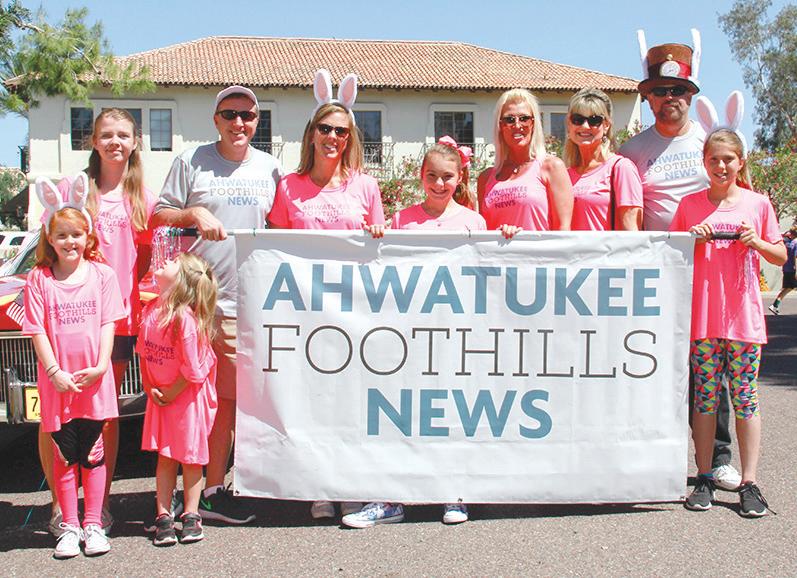
Rep Jill Norgaard and state Sen. Sean Bowie, both of Ahwatukee. “I’ve been going to this since I was a little kid,” Bowie said.
Although a Thunderbird had been reserved for him, DiCiccio elected to walk the parade route from Warner Road to just south of Elliot Road.
The colorful assortment of fourwheeled vehicles included classic Ford Mustangs, a restored 1965 station wagon, a miniature locomotive large
enough to accommodate an adult “engineer,” several miniature cars and even a horse-drawn stagecoach provided by Wells Fargo Bank. AFN Publisher Steve Strickbine drove a red convertible 1991 Cadillac as his daughters handed out candy.
About 100 Ahwatukee Girl Scouts and Daisies from several units were on hand, as was Ahwatukee Cub Scout Pack 278, led by Scoutmaster Todd Norman. Adding to the kaleidoscope of colors

and flash were about 30 girls from the Center Point Dance Club who had made headdresses of tutus in pinks, purples and greens.
The Ahwatukee Recreation Center, led by a member riding a John Deere tractor, included several of its pickleball club players.
The parade drew entrants from beyond Ahwatukee’s ZIP codes.
Several Tempe dance groups and a church were on hand, as were groups from Mesa and Chandler.
Camelback High School’s awardwinning color guard appeared made its sixth appearance in the Ahwatukee parade, carrying a huge American Flag that nearly stretched the distance between the curbs on four-lane 48th Street.
Following the parade, many marchers and spectators flocked to the second act of the Kiwanis Club’s salute to Easter and the community – the Spring Fling Carnival and Crafty Fair at Ahwatukee Community Park.
Both events help fund a variety of Kiwanis Club of Ahwatukee projects, including Reading is Fundamental, Children’s Book Drive, Back to School Shopping Spree, adoption of group homes for teens in foster care, Bikes for Tykes, Key Clubs at Mountain Pointe and Desert Vista high schools and Horizon Honors Secondary School, six Middle School Community Service Awards, Ahwatukee YMCA and the Eliminate Project.



Clockwise from upper left: Best friends Rylie Paceco, 7 and Addison Zius enjoy the parade; Harper Faltis, 5, was all smiles; Riley Mae Hunter, 3, was part of the God's Garden entry; the Ahwatukee Recreation Center pickleball squad was out in force; showing of head dresses made from their tutus are Center Pointe Dance members, from left, Sydney Mittelman, Marley Bivens, Jadyn Sprague and Anna Batchelor; 7-year-old Zatthias Apodaca played bunny while the lone adult-size Official Easter Bunny rode a flatbed and God's Garden Christian Preschool students decorated their giant wagon and the dancers of Shake It Up from the YMCA strutted their stuff to the delight of spectators.









BY MALINDA MALONE AFN Guest Writer
Pet First Aid Awareness Month emphasizes the importance of education, training and being a conscientious, responsible, loving pet parent all through the year.
With summer knocking at the door, we will be spending a lot of time in swimming pools. Extra diligence must be taken for the safety of our children but also our pets. There is a tremendous need for training in pet first aid and CPR because, unfortunately, thousands of pets die every year from preventable accidents.
Pools can be dangerous for our dogs. Not all dogs are good swimmers and some breeds, like the bulldog, may even drown if left unsupervised around a pool. A pool fence or enclosure is a great option if you are unable to supervise a dog that spends his or her time in the backyard. When possible, train your dog to swim.
Not comfortable with such a task?
Enlist the help of a dog trainer. Trainers can handle your pooch’s fear of water and teach him or her a few swimming basics.
Senior dogs are more likely to suffer from arthritis, vision loss, seizures and






a host of other health issues that may require even more attention around the pool. You may even have to prohibit them from swimming altogether.
Confirm with your veterinarian if your dog is healthy enough to swim in the pool.
Life vests and life jackets are perfect for the dog that will never be a great swimmer. They provide extra buoyancy and a dash of bright colors so that your dog can stay afloat and remain highly visible. You should never leave your dog unattended if it is swimming.
Being able to properly administer CPR and first aid, especially if your dog is in a pool accident. There is no doggy 911! It is up to us as pet parents to know what to do in the event of a mishap.
An important part of being a caring, conscientious, responsible and loving pet owner is knowing the life-saving skills of pet first aid and care. There are pet safety and CPR courses, if you want to learn more, take a class and get trained.
This is a great month to not only make yourself and your family aware of the dangers pets face poolside, but to also be prepared for the worst.




www.ahwatukee.com
BY PAUL MARYNIAK AFN Executive Editor
Hope you had a wonderful Easter. I know Ahwatukee did.
If you were at the 41st annual Kiwanis of Ahwatukee Easter Parade, I’m pretty certain your holiday weekend had an extra-special touch.
Although I have edited countless stories about the parade over the last 15 years, I had never attended one.
I realized on Saturday what I had been missing.
The imagination that some groups and businesses put into their entries was a delight.
And who couldn’t be impressed by the performance of groups like the two local Tempe Union high schools, the Shake It Up team from the Ahwatukee Foothills YMCA, the Center Pointe Dance members and the rest?
While all the participants deserve a round of applause, the members of the Kiwanis Club of Ahwatukee deserve a standing ovation.
I can only imagine the work that went into organizing the parade and the Spring Fling Carnival and Craft Fair that followed.
No matter that the parade has been organized for more than four decades. There are no doubt well-established routines members follow in preparing for the event.
Still, every year brings its challenges.
And every year, organizers of an event of this magnitude have to sweat it out as the big day gets closer. They have to worry about the weather. Worry that the participants will show up. Worry that no detail has been overlooked.
No event of the parade’s scale goes on year after year without fretting.
If you don’t believe that, think about how you are in the days and hours before a big family holiday dinner.
Of course, Easter Parade Boss Mike Schmitt, who has been commanding the procession of souped-up vehicles and contingents of performers and organizations for 25 years, acted on Saturday as if he didn’t have a care in the world. But I suspect he has had a couple anxious moments as the calendar
marched on to the day of the parade.
Then, again, he also can count on his fellow members.
The thing that’s important to remember about the Kiwanis Club of Ahwatukee is that it’s not a very big organization. It counts maybe a few dozen members at most.
But what it might not have in members, it makes up in passion –passion for the community and passion for the club’s ideals.
On Kiwanis.org, the group is clear about its mission:
“Kiwanis International brings the world together — one community at a time. Today, we stand with more than 600,000 members in more than 80 countries from Kiwanis to Key Club to Circle K and beyond. Each community has different needs, and Kiwanis empowers members to pursue creative ways to serve the needs of children through local service projects and fundraising. Kiwanis hosts nearly 150,000 service projects each year.”
True to that mission statement, the Ahwatukee Kiwanians put their heart and soul into more than a dozen
community-focused activities every year.
They take poor kids on back-toschool shopping sprees, try to make Thanksgiving and Christmas a little brighter for foster kids who live in group homes because no one wants to take them into their homes and encourage literacy among children through reading activities.
The parade was their gift to the community. The Spring Fling help funds their efforts through the year to do these things and a lot more.
But this is not a bunch of crepe-hangers who go about their club activities as if they were just jobs.
From what I’ve seen and the members I’ve met, the Ahwatukee Kiwanians also exemplify another statement on the International’s website: “We have fun along the way.”
And they surely showed it last weekend.
The club gets together weekly at 7:30 a.m. Thursdays at Biscuits Restaurant, 5623 Elliot Road, Ahwatukee. If you want information, email mike. maloney2003@gmail.com.
BY MIKE SISSEL AFN Guest Writer
Every day, millions of young athletes arrive at ballparks, gymnasiums, fields or countless other sporting venues, ready for practice. Their bags are overflowing with the newest, greatest equipment and their bodies adorn the latest trends in sports swag.
Although they may not embrace the idea of practice, they long for the opportunity to shine in the game. Meanwhile, coaches tidy up their practice plans while simultaneously leading the team through warm-ups. With only a few precious hours to work with the athletes, their minds frantically gravitate toward a single, pressing
question: “Are we going to be ready for the game?
Often unbeknownst to both athlete and coach, there’s a much more important game taking place, long before practice even begins. I call it “the game within the game.” Unlike a traditional sporting event, this unique game takes place between an athlete’s ears.
Some call it mental toughness or mindset training, while others refer to it as emotional intelligence. Regardless of the semantics we use to describe it, the fact remains that in order for an athlete to truly excel in the game, he/she must learn to manage the complex nature of the human mind.
For the past several years, I’ve had the great fortune of working with young athletes, both individually and in a team setting. Perhaps my single greatest role
as a mental toughness coach is to expose the many limiting beliefs that occupy an athlete’s mind, then work to replace them with empowering beliefs that will ultimately serve as fuel for success.
Below is an open letter to all athletes, in which I expose the two most common limiting core beliefs that often destroy an athlete’s mindset and even drive them away from sports.
Dear athlete, Did you know that the most important thing you’ll bring to practice today is not the contents of your bag or backpack (equipment and apparel)?
I’d like to introduce you to a much different kind of backpack, one that far outweighs the importance of the backpack you’re accustomed to carrying over your shoulders.
It’s called the mental backpack and it
contains all your core beliefs with regard to sports, yourself, or life in general. Unlike a sports bag, your mental backpack is with you wherever you go. When you arrive at practice, it’s easy to get caught up in the physical preparation for your upcoming game or competition. What you often fail to realize is that your mental preparation is always contributing to (or hindering) your physical performance. There are two limiting beliefs that a lot of athletes carry in their mental backpack, followed by a new, empowering belief. If either of these apply to you, I encourage you to embrace the new belief and add it to your mental backpack.
Limiting belief #1: “My success is
defined by a medal or trophy.”
Athletes who win are often glamorized with confetti parades, lucrative marketing deals and a larger-than-life reputation. This is what every athlete longs for, isn’t it? Or is it?
While the trophies and medals are certainly nice to have, they tend to lose their meaning over the years.
Ask any retired athlete what they remember most about their experience and rarely will they point to a trophy or medal. They’ll talk about the relationships they developed with their teammates and coaches, or the person they became as a result of hours of training and preparation.
If this is a limiting belief you’ve adopted over the years, I invite you to replace it with a new, empowering belief: “My success is defined by WHO I’ve become (my character), not by WHAT I’ve accomplished (trophies and medals).
Limiting core belief #2 – I can’t fail. When I meet with athletes for the first time, one of the first things I say to them is, “You’re going to fail this season, and it’s okay for you to fail.”
If you think that perfection is possible, then you’re choosing to believe an illusion. What television rarely portrays are the many failures in the lives of these supposed perfect athletes.
Think about it. If there’s no room for failure in your life, then there’s no room for risk. If there’s no room for risk, there’s no room for growth. If there’s no room for growth, then you’re bound to stay in the safe confines of your comfort zone, doing only the things you know you’re good at.
We all have that little voice in our heads called doubt. Doubt asks, “Are you sure you can do this?” or “What if you fail?” You are welcome to continue listening to doubt, or you can choose to talk to it with the voice of courage. Here’s what courage says, “I’m doing this,” or “I’d rather fail than not try at all.”
At the end of the day, it’s not about the number of failures you make in your sports career; it’s about how you choose to respond to your failures.
If this is a limiting belief you’ve adopted over the years, I invite you to replace it with the following empowering belief: “I may fail, but I AM NOT a failure.”
BY MITZI EPSTEIN AFN Guest Writer
Thursday, April 13 had some highs and lows, but not much gladness.
As citizens of Arizona, you have a constitutional right to make laws, without the legislature, via citizens’ initiative.
However, the Legislature metaphorically stomped all over that right April 13. SB1236 creates red tape wound around red tape. Onerous, picky requirements do not stop fraud; they just stop the process. Under HB2244, every step of the initiative process must be in “strict compliance” with the law. Before these bad bills passed, a judge could decide if the spirit of the law was followed.
Now, a ballot measure could be stopped because a paid circulator’s ID number is missing from a petition, or because of a misspelling of one of the 46 words that are required to be printed on all advertisements about the initiative. Those are examples of why this ridiculously high standard is not used in law – until now.
Lawsuits will undoubtedly be doubled or tripled because of these bad bills.
SB1042 allows a teacher to be certified without requiring training in pedagogy –how to teach.
I do want professional engineers and scientists to have pathways to become teachers. That could be great for students!
Well, only if those engineers and scientists somewhere along the pathway learn how to teach to the many diverse kinds of learners in a classroom: three students might be dyslexic, two might be autistic, five might speak German, Spanish or Chinese as their first language.
Some learn best kinesthetically, while others need charts and graphs. Many students had no dinner last night. Some will be dealing with a death or loss in their family. Some students will nearly hide under their desks rather than participate in class, while a few might challenge or threaten the teacher.
Over the past decades, education research has shown time after time that students learn well with a teacher who guides them to explore and learn, in contrast to a teacher who just explains. Teachers who nurture curiosity and empower students to find answers are
powerful teachers.
That skill is not the same as the skill of being an engineer or a scientist.
In the Legislature, we could have found some good solutions to bring professionals from other fields to teaching via alternate pathways, but instead the governor and the Republicans in the legislature chose to slam a bill down and vote on it in a rush.
I literally received the 23-page amendment at 9:45 in the morning, just a few hours before it came to the floor for debate. That is a terrible way to make laws! The only way I could get testimony from teachers and education professionals was to text them questions while I was on the floor of the House.
“The People’s House” is how we reverently refer to the Arizona House of Representatives. Sadly, in this past week, gravely dangerous laws were passed that left the people of Arizona out.
I have been badly disappointed by the process, and I will redouble my resolve to change it to be more inclusive.
BY STACEY PROCTOR AFN Guest Writer
Bullying in our society is at an all-time high. This behavior can start as early as 3 years old and can extend all the way through the teenage years.
Since its inception 20 years ago, North Star Youth Partnership has been providing positive, life-changing services to youth in the community. With the concern of bullying at the forefront, North Star created the Peer Assistance Leadership PAL program, aimed at combating bullying in schools.
Diane DeLong, program manager of North Star, said, “Bullying has escalated over the past 20 years and has now reached epidemic proportions due to social media. The bullying continues, long after the school day has ended.”
Christine Williams, who manages the PAL program at three local schools,
added:
“Participants in the program use the peer helping model, which includes communication, group dynamics, active listening and problem-solving. It was through the participants in the program that we identified a major source of bullying: limitations in the ability to practice good hygiene.”
To eradicate this need, the program has been accepting donations of soaps and toiletry items throughout the school year. To coincide with North Star Youth Partnership’s 20th anniversary, these donations have been distributed to local schools.
The response in way of donations that we received has been overwhelming. This program has the opportunity to make an instant impact in the lives of youth, continuing the work that North Star has been doing for the past 20 years. Each item represents the potential to stop a child from being
bullied, which is such a powerful message in the community.
North Star also combats bullying by empowering youth through mentorship programs, linking younger students with older students.
This encourages social support and builds confidence in teens. North Star Youth Partnership has touched the lives of more than 250,000 participants in the 20 years since its original debut. The program is committed ending bullying in all schools throughout Arizona.
For more information or to become involved in the North Star Youth Partnership program: contact Diane Delong at ddelong@cc-az.org.
-Stacey Proctor is a spokeswoman for Catholic Charities, which provides care for the vulnerable of all faiths through programs in foster care, early start education, housing, veteran services, refugee relocation and poverty reduction. Information: catholiccharitiesaz.org.
Sandy Kraus doesn’t want to tell parents how to raise their children. She just wants to help them do it. So, the Ahwatukee mother of three has set up shop as a parent coach under the name Legacy Parenting, a business aimed at providing couples “general parenting skills in a group setting” or a customized approach through one-onone consulting.
“My mission is to help parents to not only achieve their parenting goals but to enjoy their kids along the way,” she said. “I work with parents to help them clarify the parenting goals, teach skills and provide support to bring about change.”
“I am not a counselor nor a therapist. I work in the present to influence the future. I am not here to tell parents how to raise their children,” she added. “Parents know their children best and always have the final say in what works for their family.”
Her website, legacyparenting.today, (no .com or .org) explains her approach: “Parent coaching is a partnership between you and the parent coach. The parent coach will work from your strengths while being focused on your family’s values and goals. Working together, we will explore options which will work for your family in a non-
judgmental atmosphere.”
Kraus is starting a series of classes Thursday, April 22, and Tuesday, April 25, for parents of kids 1 to 4 years old.
The premise is outlined on a flyer that asks, “Is parenting your young child tougher than you thought it would be?”
The classes, in her office at 4425 E. Agave Road, Ahwatukee, run weekly 9-11 a.m. April 22-May 6 or 6:30-8:30 p.m. April 25-May 9 and cost $45 for the series and $15 for a workbook.
Some of her future classes include divorce, dealing with temper tantrums, technology and children and “learning why your child acts the way they do.”
“I plan to add new topics as I go along to address issues which are relevant to what parents are experiencing in their daily lives,” she said.
Individual coaching sessions are $30 an hour and are “tailored to address specific concerns the parents have within their particular family,” she added.
Along with raising three children, Krause has other experience with kids.
A college graduate with a degree in elementary education, she has taught fourth grade and kindergarten.
“Even though I enjoyed teaching, I did not want to return to the school system and began looking at other careers which might interest me,” she explained.
“I have always been passionate about children and helping them reach their
full potential. I realized through my past teaching and working with youth in our church and my children’s schools, that parents need knowledge and support when dealing with their children.”
She obtained certification in parent education from the University of Minnesota in 2010 and, two years later, became certified in parent coaching at Concordia University.
“My long-range goal is to make a positive impact within families in our community by strengthening the bonds between parents and their children,” she continued.
Kraus’s clients include both parents and grandparents, and their children can range in age from newborns to teens.
Indeed, she said, “I can work with parents before their baby is born. This helps parents think about how they want to parent and to come together as a family before they are sleep deprived.”
While a child’s first year of life “is one of the most important stages of development” that parents can influence a great deal, Kraus said, parents sometimes need help at a much later stage in their children’s lives.
“Parents whose children are just becoming teens can struggle adjusting to the rapid changes during these years,”
she explained. “I have had parents of teenagers tell me they expect to have problems when their children become teenagers. But it doesn’t have to be that way.”
Kraus said her biggest challenge right now is making people aware of her service.
“I usually hear ‘What is a parent coach?’ Parents aren’t aware that help is out there to get them over the bumps that occur during parenting.”
Information: 480-759-1898 or legacyparentingtoday@gmail.com
BY DAVE ALLAZETTA AFN Contributor
The U.S. health care system is continuing to evolve in 2017, with new technologies and programs helping make care more efficient and accessible for more Americans.
Here are five health care trends to monitor this year.
Fitness trackers
The wearable-technology market is
booming; the industry’s value is expected to reach $31.2 billion by the end of 2020, according to a recent research report. This is good news for consumers, as wearable devices enable people to track their daily steps, monitor their heart rates and analyze sleep patterns.
Some employers and health plans, such as UnitedHealthcare Motion, are including fitness trackers as part of wellness programs, enabling some employees to earn up to $1,500 per year in incentives by meeting specific daily walking goals.
Employers are expected to incorporate
more than 13 million wearable and fitness tracking devices into their wellness programs by 2018, according to technology consultancy Endeavors Partners. A related study published in Science & Medicine showed people tend to overestimate how much exercise they get each week by more than 50 minutes and underestimate sedentary time by more than two hours.
Some employers offer other wellness incentives, which can include gift cards, lower health insurance premiums,
cash bonuses and discounts on gym memberships. An estimated 70 percent of employers already offer wellness programs and 8 percent more plan to do so during the next year, according to a 2016 study from the Society for Human Resource Management.
The value of corporate wellness incentives has increased to $693 per employee, up from $430 five years ago, according to a recent study from the National Business Group on Health. However, the study found that fewer





Ahwatukee Foothills Montessori has given birth.
The 23-year-old school has started a Chandler campus – partly because school administrator Meaghan McClung was moved by some parents’ long drive.
“I noticed that many clients were driving to school each day from their homes and workplaces in Chandler, Gilbert and beyond,” McClung explained.
“Parents would gladly make the sacrifice of the long drive time because ‘it was the best school for their child,’ but I began to investigate the possibility of opening a second campus to help relieve the commute for my clients.”
She found one with the help of a parent and now oversees a campus at 5570 W. Chandler Blvd. as well as the Ahwatukee school down the road at 3221 E. Chandler Blvd. McClung said her goal is “to replicate the Montessori Program we had cultivated and mastered over 23 years at our Ahwatukee location.”
The Ahwatukee campus was started in January 1995 by Jan Vickory, who had set up three Montessori schools in Michigan before deciding to seek warmer climes.

She set up a program structure that remains today: a preschool and kindergarten serving children ages 2½ through 6 with a teacher-student ratio of 1 to 7 and classroom “directresses” certified by the American Montessori Society.
Although Vickery retired in 2011 and sold the business to McClung, an 18-year veteran of the school, she still remains a
consultant and staff trainer.
McClung said that from the start, she was committed to carrying on Vickery’s legacy of maintaining an environment “designed to allow the child to become a self-motivated and self-driven learner.”
“Teachers recognize that the child has the capacity to learn from the environment with minimal adult interference,” she said. “In AFM classrooms, children are
given appropriate freedom of choice, allowing them to develop critical thinking and problem-solving skills.”
Thanks to daily one-on-one reading instruction, many students are reading independently by age 3.
The school also provides age-appropriate Spanish, art and music curriculums.
McClung said that by the time students are ready to transition to the first grade, the teachers are “focused on showing students how to translate the concepts they have learned through the Montessori materials to the more abstract version they are likely to encounter in their future studies.”
“It is common for graduate students to be extremely fluent readers, accomplished public speakers, and, often, awardwinning essay writers,” she added.
“Parents choose AFM because of the excellent academic reputation we have earned, but our standing has also been built on our attention and focus on the whole child, McClung added. “We specialize in helping our students to become confident, compassionate, critical thinkers.”
Information: 480-759-3810, ahwatukeefoothillsmontessori.com.

AFN News Staff
April is Autism Awareness Month, and this is a special year for Ahwatukee-based HOPE Group Arizona, a business that deals directly with this social impairment.
HOPE Group Arizona has been serving families statewide since its inception in 1997 as a state-qualified vendor focusing on autism and spectrum diagnosis mainly in children and young adults.
The business was formed by owner Lori Cairns, who was trying to “restore hope and advocacy on the part of the parent and family unit when they are weighed with diagnosis such as autism,” said spokeswoman Brandwyn Boyle. Cairns’ son was diagnosed with autism at age 2.
HOPE Group runs clinical offices in Ahwatukee, Gilbert and Tucson. Boyle said it has “helped thousands of Arizona families push through and gain ground against this social disorder that now is diagnosed in over 1 in 68 children a year.
“We want to continue our path of reminding all parents and families out there that a diagnosis is not an ending point; it’s simply a place to start with new hope,” said Cairns.
The company serves over 700 families a year, and employs over 500 people.
“We are actively recruiting, as we have many families statewide to serve,” Cairns said, adding:
“HOPE is looking for people that would like to have a great career path and learn a new skill set, all while helping others in need. It really is an amazing employment
opportunity.”
HOPE Group is hosting openemployment and training workshops. Information is at hopegroupaz. com/about/joinour-team.
The company also helps families with members diagnosed with genetic, metabolic and developmental disorders such as Down syndrome and cerebral palsy.
The AFN asked Boyle some questions about the business:
Question: What were the circumstances surrounding HOPE’s creation? Did Lori find an absence of any help?
Answer: Upon receiving her son’s diagnosis, Lori was not only surprised to find a lack of services provided, but also just an overall absence of resources.
There was very little offered in the realm of community/parent support, education or awareness. It seemed as if autism was being treated as a fatal diagnosis, versus a place to start with varying options.
Q: Why was Ahwatukee picked for your headquarters?
A: Lori has resided in Ahwatukee since 1990, and that’s where her children grew up and attended school. She loved the community aspect of it, and how it had a small town vibe even being part of Phoenix. That was the feel she desired
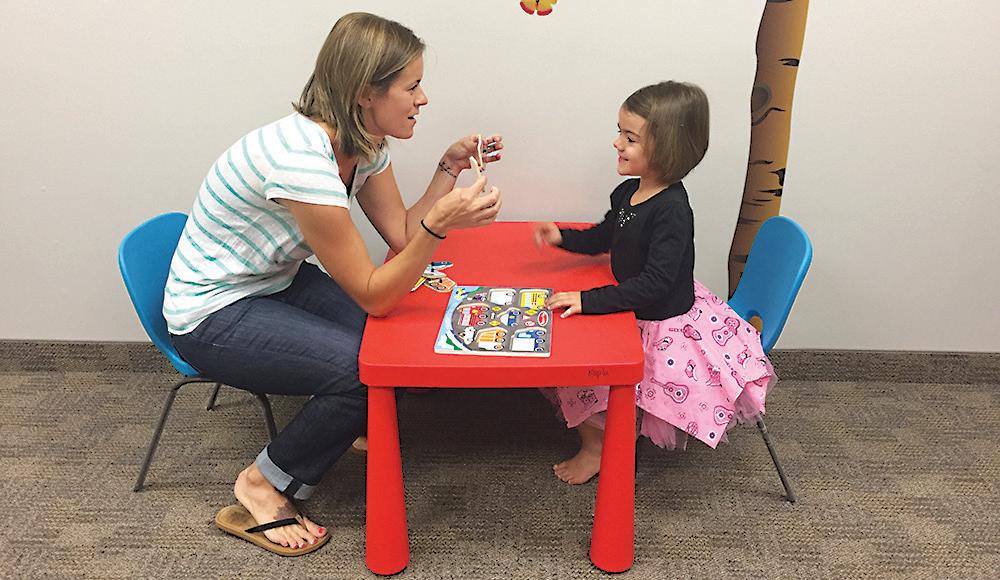


than half of eligible employees earned the full incentive, with workers leaving millions of dollars of unclaimed rewards.
Some new online and mobile services enable people to comparison shop for health care based on quality and cost. The Health4Me app, available on iPhone and Android devices, enables users to identify nearby health care providers and facilities, as well as compare quality and estimated cost information for more than 850 common medical services. With a growing number of Americans now enrolled in consumer-directed health plans, more people are using online and mobile health care transparency resources. More people (32 percent) are using websites and mobile apps to comparison shop for health care, up from 14 percent in 2012, according to the recent UnitedHealthcare Consumer Sentiment Survey.
Get care anywhere
New mobile apps now enable people to meet with a primary-care physician and specialist to obtain medical care, with the goal of providing convenience and more

affordable care. The cost of a video-based virtual visit is usually less than $50 and may provide significant savings when compared to costs for similar minor medical needs treated at a doctor’s office (approximately $80), urgent care facility (approximately $160) or emergency room (approximately $650), according to UnitedHealthcare claims data.
Recent advances in audio and video technology is enabling people to obtain a diagnosis and necessary prescriptions for minor medical needs including allergies, sinus and bladder infections, bronchitis and other conditions.
Employers and health plans are increasingly using value-based care arrangements. That is a shift away from the common fee-for-service structure, in which a care provider is paid separately for each treatment, appointment or test during a treatment plan, generating multiple claims within a single, broader episode of care.
Under value-based care, providers are paid for achieving certain quality outcomes and demonstrating that they’re improving people’s health, rather than getting paid solely for the number of services they provide to patients. In other words, they’re paid for value over volume.




A new UnitedHealthcare program with health care facilities nationwide is using a type of value-based care (bundled payments) for knee, hip and spine procedures, and participating employers have recorded an average savings of $10,000 or more per operation when compared with median costs in the same metropolitan area. Meanwhile, employees having the surgery may save $1,000 in lower outof-pocket costs when accessing an innetwork facility that accepts bundled payments.
for her business; family, community and unity.
Q: What exactly does the business do?
A: HOPE Group offers families and schools access to comprehensive evaluations and intensive behavior supports. In addition, respite and habilitation care services are available in home as well clinical service hours. HOPE Group is a qualified vendor with the Arizona Division of Developmental Disabilities, and accepts most private insurance.
All of HOPE Group’s programs are based on applied behavior analysis and grounded in evidence-based practices. HOPE Group aims to maximize the potential in all individuals with developmental disabilities and neurological disorders.
Q: What can the business offer that a nonprofit agency cannot?
A: A for-profit business allows more flexibility to serve the community.
Q: Why should parents consider HOPE?
A: Our length of serving the community is definitely part of our foundation, but the depth and quality of our services is truly what differentiates. HOPE focuses on our
- Dave Allazetta is CEO for UnitedHealthcare of Arizona.
ability to be in-home or in community settings while providing care. This truly affects how we, as providers, relate to an individual’s natural environment and our ability to support the family as a unit.
Q: Are fees set or are they determined based on each child?
A: Each situation is a case-by-case basis. HOPE is contracted with DDD, health insurance companies, school district contracts as well as private pay.
Q: How active a role does Lori play in the company?
A: Lori formed this company in her home office, and 20 years later the office has become her home. She is in house every day, taking calls and giving advice to mothers and families just like hers.
Q: What are the business’ long-range ambitions?
A: Being proactive in legislation, community care, and awareness education. HOPE is part of various special interest groups and committees, such as the ASD advisory committee. They were appointed as part of the community to help establish Autism treatment policies. HOPE Group provides awareness and education to first responders and pediatricians to help with the safety and health of local communities. Moving forward, HOPE Group plans to continue to establish change for the greater good.
BY SHELLEY GILLESPIE AFN Contributor
Rushing out the door without breakfast is a common approach for many. When the need for food arises, people often stop for a breakfast sandwich.
Brian Tate and Jeff Yauck tried that approach, but it didn’t offer the healthy boost they needed to start their days. Not finding something quick and healthu, they decided to make it themselves.
“I wasn’t used to eating breakfast, but I did the research and this fits in with my energy needs,” Yauck said.
In August, they opened Oats Overnight, their own manufacturing company, to make healthy oat breakfasts in several flavors. Bypassing the normal purchasing approaches, customers order directly from their website, oatsovernight.com. They’ve also advertised on social media.
“If you have a quality product, people will share,” Tate said.
Yauck already had been making a similar breakfast himself, but the pair settled on flavored mixes of Green Apple Cinnamon, Chocolate Peanut Butter Banana, and Strawberries & Cream.
Customers use their preferred milk or milk equivalent to shake with the ingredients in a tightly sealed Blender Bottle, then place the mix in the refrigerator overnight.
The results, more shake than oatmeal, provide customers with 24-26 grams of protein, plus the protein from milk, with oats, powders and concentrates of apples, strawberries, bananas, maca root, flax seed and chia seeds. Sweetening is kept to a minimum with ace-k, sucralose and maple syrup powder included, depending on the flavor.
The starter pack, which includes the Blender Bottle and three pre-measured
breakfast packs, is priced at $18. Subscriptions are available for 12 or 24 packs. Currently, shipping is included.
When they began, the two entrepreneurs had no idea how fast the demand would grow. They rented a 1,750-square-foot space in Tempe that they outgrew within three months.
“When we took the space, we thought the space was so enormous,” Yauck said.
“It’s not enough room,” Tate said.
Now they’re planning to move to a Chandler location with about 7,500 square feet.
Originally, they used a coffee blender to grind the ingredients, but quickly grew to a 130-serving blender. Now, they’re using a 3,000-serving ribbon blender.

“We’ve been tripling our orders every month,” said Tate. “We hit 5,000 customers yesterday.”
Tate and Yauck have been hands-on in every aspect of the venture, from researching ingredients, sourcing, manufacturing and shipping. They pack the orders themselves and ship no later than the next day.
With the crush of orders – expected to total 30,000 servings in January –they’ve needed to hire six people and were interviewing additional people in late January.
Their plans include an expansion of their product line with several new flavors that could include stevia, a natural sweetener. A nutritionist on their staff weighs in on the ingredients.
Prior to starting Oats Overnight, Yauck
had been in Hollywood building movie sets for small productions.
Tate took a six-month break from his career as a professional poker player in Los Angeles.
“Poker playing is like being a stock broker. You assess the risks and make decisions,” Tate said.
This break from poker shows his willingness to risk on their Oats Overnight venture. They began the business after being friends for nearly 10 years, five of them in Arizona.
Originally, their marketing focused on fitness-oriented people, plus those who have no time to think about health concerns. They quickly discovered that the potential market was much broader.
“We’re producing a healthy, efficient,
relatively cheap breakfast,” Tate mentioned.
“We hope to replace cereal as a quick and easy option.” Yauck added.
Tate and Yauck talk like a tag team, finishing each other’s sentences, but it is apparent that they wholeheartedly care about their product, its benefits, and making their customers happy.
The results show it’s working.
Oats Overnight has been so engrossing that Yauck admits, “We don’t have a life.” Tate said, “We both have girlfriends we don’t see much. No life, but lots of oatmeal.”
Their motto: Life is hard. Make breakfast easy.
Find out more about Oats Overnight at oatsovernight.com.






Phoenix South
7400 W. Boston St., Chandler. 480-857-4969
With all the amenities you need, and hotels everywhere you want to be, the Comfort Inn Chandler –Phoenix South hotel in Chandler near Arizona State University will get you rested and ready for anything. Conveniently located off West Boston Street, our pet-friendly leisure hotel in Chandler gives you easy access to other local sites, activities and attractions
1640 S. Stapley Drive, Mesa. 602-885-1148
LT Consulting is your righthand man in real estate. Fierce loyalty, tenacity, and ability to execute contracts for clients. LT Consulting has been able to help clients create passive income with fix n’ flips, rentals and wholesales.
Sam’s Club
700 N. 54th St., Chandler. 480-893-1555
Membership-only warehouse chain selling a variety of bulk grocery items, electronics & home goods.
2201 E. Clubhouse Drive, Ahwatukee.480-460-4653
The Foothills Golf Club stretches to almost 7,000 yards with lush rolling fairways, blue lakes, and 65 bunkers set against rough rocky desert terrain. With four sets of tees, The Foothills Golf Club has appeal for golfers of all skill levels and has earned a four-star ranking from Golf Digest, along with being listed as one of Phoenix’s top golf courses.
Dr. Nicole Gerard PLLC
3100 W. Ray Road, Chandler. 602-492-3112
Naturopathic physician and healthy living advocate Dr.Nicole Gerard strives to bring effective, quality healthcare with a natural approach with a focus on diet and lifestyle coaching, women’s health, digestive issues, and overall wellness.
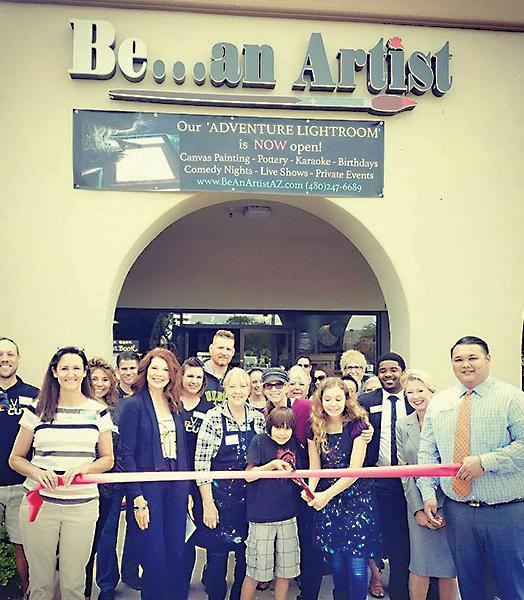

Name: Jim Hunt Company: United Brokers Group - Jim Hunt
Address: 106 S. Kyrene Road, Chandler.
Phone: 480-221-2883
Email: jim@huntazhomes.com
Website: huntazhomes.com
What type of business services or products do you provide?
I offer residential real estate services for home buyers and sellers all over the Phoenix Metro Area. From Happy Valley to Laveen, San Tan Valley and Maricopa, I’m happy to travel anywhere to help a client; though Ahwatukee is the heart of my territory.
How long have you been a chamber ambassador?
Eight years (ambassador chair four years).
What do you enjoy most about being an ambassador?
I love being an ambassador because I
get to be a connector and help bring other business owners together. I also enjoy telling the Chamber story and why it is important as a business owner to support our business community. Bringing new members into the Chamber is the benefit of telling our story and then watch them flourish by branding and marketing their business. They would be the first to tell you the Chamber gave them the platform to be successful. Why would you encourage other members to consider being an ambassador?
I would encourage any member to become an ambassador if they truly want to be an advocate of the Chamber, being a business community connector and help build a bigger, better and stronger Chamber. Our ambassadors are the “heartbeat” of the Chamber and one of the most important positions within the Chamber. What is the time commitment?
A good ambassador will spend five to six hours a month going to
BY CAMERON CALL AND MIKE KELSO AFN Guest Writers
While you were watching Sergio Garcia dominate at the 2017 Masters golf tournament, several of Ahwatukee’s finest business owners were busy organizing one of the biggest events of the year for the Ahwatukee Foothills Chamber of Commerce – the annual Chamber Masters golf tournament.
Plans have been underway, not just over the weekend, but for the past several months. This year is extra special because it marks the tournament’s 20th anniversary.
The tournament starts with registration at 7:30 a.m. Friday, April 28, at Foothills Golf Club, 2201 E. Clubhouse Drive, Ahwatukee.
There is a shotgun tee-off at 7:30 a.m. with lunch and an awards program starting at 12:30 p.m.
As the chairs of the event, we had the help of committee members Christie Ellis, Tracy Jones, Thomas Moore, James Goodman, Tom Rodriguez, Dee Gordon, Kevin Cash and Jim Hunt.
As a result of this all-star lineup, we are expecting this one to be the best tournament yet. Darla Hoffman from A-Peeling Faces and Chamber
CEO Lindy Lutz Cash have also been instrumental in assisting this year’s committee.
Each year the chamber holds a tournament to raise money for a selected nonprofit organization that impacts our great community.
Boasting a full field, the tournament offers entertaining contests on the links, vendor booths, raffle prizes, friendly competition and great food. And in true Masters flair, the winning foursome is presented with a special Chamber Masters jacket, which is sure to be coveted.
This year, the beneficiary to the tournament is the Ahwatukee Chamber Community Foundation (ACCF).
ACCF seeks to provide the community with activities and events encompassing a wide area of interest with the goal to make the lives of the residents of Ahwatukee well rounded.
The organization’s slogan of “Building Community, Building Ahwatukee” reflects its vision to develop, fund, and provide resources to the people of Ahwatukee by way of their events, activities and scholarships.
ACCF serves as a resource to inspire the next generation of local entrepreneurs to become leaders in the Ahwatukee community.
our monthly meeting, mixers and a few ribbon cuttings, but a great ambassador will spend 10-plus hours each month, as they not only go to the monthly meeting, mixers and ribbon cuttings. They are also involved in committee work, along with bringing in new members or making member visits. I always say, “The more you put into the Chamber, the more you will get out of your membership.”
In keeping with ACCF’s aim, a major focus is the Young Entrepreneurs Academy (YEA!). YEA! teaches students how to start and run their own real businesses. Students come up with an idea, pitch their idea to a panel of investors, and in true “Shark Tank” style, they seek and receive funding to launch a real area business.
The goal of YEA! is to teach young people how to create their own American Dream.
Here is where you come in.
We are seeking sponsorships and golf registrations to reach our goals. Sponsorship packages vary in price from $2000 to $230 and come with a wide array of different perks for the sponsor.
A golf foursome is $530 and for a single entry, it is $145. Sponsors and golfers must be registered no later than Friday April 21. Golf registration can be made via www.ahwatukeechamber. com/newsletters.html or by calling the Chamber office at 480-753-7676.
If you would like more information on supporting this event, contact us at cameron@thespecific.com or Mike Kelso at mike.kelso@onqfinancial.com
BY REV. WILLIAM F. HOLLAND JR. AFN Guest Writer
There is more to being rich than having money.
We often hear the term “it’s all about the money,” but nothing could be further from the truth when it comes to hope and a sense of spiritual well-being. Humans use their creativity and imaginations to dream about being satisfied, and I would say that fantasies about power, fame and money are the most common.
The recent record-breaking lottery generated quite a bit of excitement. Like everyone else, I was amazed at how the jackpot grew and what a mesmerizing effect it had on the masses. It is our lust and greed for money that increases its influential power to deceive and distract us from what’s really important.
Certain religious interpretations declare that gambling is a sin. It might be, but casting lots is not always associated with wrongdoing. I can agree that someone who cannot afford to pay their bills yet wastes money on
daily lottery tickets needs more than a financial advisor.
Nonetheless, I personally do not see anything wrong with someone spending a couple of dollars every now and then to have a chance to be financially secure. It is true: Money cannot bring happiness, and I question whether even winning the lottery would truly be a blessing for many, as I believe that would depend on how mature and levelheaded the individual is.
I have also pondered that instead of praying to have more money, maybe we should spend more time asking God how to better manage what we have. We have heard about the stories of those who have lived modest lifestyles and then suddenly find themselves with a mind-boggling amount of financial power. However, many of these testimonies have not turned out as one might think and in the end have actually been more like a curse.
I am not knocking money. In fact, I need it and it can do a lot of good. But in the hands of those who pay no heed to God’s instructions, it can become
like a blind man operating a wrecking ball. Instead of wealth being used as an instrument to help others, it can actually use us if we are not careful, by capturing our mind and possessing our soul.
The Bible mentions a lot about wealth, and there is no shortage of books and sermons to help further explain the benefits and dangers. One camp teaches that God desires to bless His people with material abundance while the other side emphasizes the need to give everything we have away and to live by faith alone.
I personally fall into the category of trying to find a reasonable balance that can enjoy God’s blessings while also learning how to be compassionate and generous toward others.
Yes, Jesus told His followers to sell all they have, give it to the poor and take up their cross and follow Him, but does this mean literally or to just be willing? Surely there is no condemnation to work, earn a paycheck, pay our bills, have a home, and support our family all the while faithfully representing Him as a true Christian.
I have also wondered if winning the
lottery is strictly by chance or if God has a hand in who wins? We realize He already knows in advance who will have the correct numbers, but how in the world with so many people praying to win, does He choose one winner?
Let’s just say it’s possible that God could give us the numbers through road signs or a dream, but we must remember that more important than having a bank filled with money is to make sure we are not in love with it.
Hopefully, we all can agree that having money and being rich are two different things, and even if we have small finances, our true joy, peace and contentment will always be found in the secret place of His presence.
“For the love of money is the root of all evil: which while some coveted after, they have turned away from the faith and pierced themselves through with many sorrows” (I Timothy 6:10).
-Rev. William Holland lives in Kentucky, where he is a Christian author and community outreach chaplain. Get a free copy of his new CD at: billyhollandministries.com
BY PAUL MARYNIAK AFN Executive Editor
For two guys who consider acting an avocation, Tyler Maxson and Trevor Orme have played one of the most challenging roles around.
They have portrayed Jesus Christ in the 65-minute, worldrenowned “Mesa Arizona Easter Pageant Jesus the Christ” at the Mormon Temple, which ended a 10-day run on Friday. Orme, a 29-year-old lawyer in Mesa, just completed his third year as Christ.
Maxson, a 37-year-old psychologist in Mesa, played Jesus for nine years until he became an assistant director of the spectacle and limited his appearance as Jesus to just the day its Spanish version ran.
What has playing Jesus done to them in their personal lives?
“It makes you want to be better and do more good,” Maxson said. “In my professional life as a psychologist, I

feel like it’s made me want to care more and do more for my patients. With my family, it’s really been a gift. I can’t emphasize that enough.”
Said Orme: “In general, throughout these three years, I’ve come to realize the love Christ has for us. When I put on that wig and that costume, I’m still me but I’m not me anymore. I want to feel, act and be exactly who he would be.”
The role has both challenges and rewards, both men said.
One of the biggest challenges is it has no speaking part – but it does have a lip-synching responsibility.
None of the 504 cast members actually speak since the narrative is taped and broadcast to the audience.
Nevertheless, the actor is expected to move his lips and align his facial expressions according to the narrator’s words.
Then there are the inevitable perceptions – both by other characters on stage and the audience.
“I think one of the hardest things about playing the role are the expectations that everyone has of you,” Maxson said. “People are very free with how they feel
about the Savior and the faith. They project all that onto you when you’re on stage. It’s a difficult to shoulder.”
Maxson and Orme played the Jesus who is most on the stage. The pageant uses several men to play Christ at different stages of his life – from infant to the young boy in the temple to the one who gets baptized to the one who gets crucified.
A separate actor is needed for the baptism because the scene change is too fast for one man to shed his wet clothes and don a new wardrobe.
Orme played Jesus on the cross several times.
That scene is one of two where the actor playing Christ is elevated. On the cross, he is about 20 feet above the stage floor. To portray the Ascension, a crane lifts the actor 60 feet.
Having done both, Orme said, “they’re both incredible, but for different reasons.
“On the cross, that was particularly unique because you’re portraying a very recognizable moment that most Christians fix their belief around. You also have a different visual perspective on the crowd,” he added, noting:
“It’s probably the same perspective Christ had when he was hanging on the

cross, looking out at everyone who had gathered, seeing his mother. It’s a very humbling, somber, tender moment.”
Naturally, the two actors also have pondered what Jesus felt in those waning hours of his life.
Orme said playing the scene in the Garden of Gethsemane was a revelation.
“Most people look at that scene and it’s one of great suffering by Jesus. Instead, I felt overwhelmingly sad. It’s not just physical pain but a sadness. I imagine Christ really felt that sorrow as he considered what was about to happen. He was dying for our sins. That makes you want to cry.”
No one seeks the role during the pageant’s September auditions, said Jenee Prince, the pageant director for the last six years.
While the choice is made by a committee, Prince looks for applicants who can play the role.
Nor does she look only for stage presence; the actors’ conduct in real life matters.
On both scores, she said, both Maxson and Orme fit the bill.
“Both of those men have great presence and a wonderful personality and spirit that is calming and peaceful and so humble,” she said. “And they
have some acting background.”
She said both reflect what she prizes in the actors’ personal lives: “Their countenance and the way they conduct themselves with their family and their community. Their knowledge and relationship with the Savior and others. These are all important considerations.”
Prince herself sees the role as particularly challenging.
“It has to be a little overwhelming to play someone who is perfect. As imperfect people, we’re trying to tell the story of a perfect person,” she said.
In some ways, that’s why Maxson retired from the role: The father of three said he was concerned that now that his kids are older, his annual portrayal of Jesus might confuse them.
“I didn’t want my children to have to wrestle with their image of their dad,” he said.
And as much as he liked playing Jesus for nearly a decade, Maxson is proud to have been helping Prince direct.
“The pageant is really a unifying thing,” said Maxson. “Being part of this pageant has connected me with people of other religions and I love what we have. I think it’s a gift for the city and for those who want to connect with Easter in a special way.”


BY ANNA COPPER Cronkite News
“Granny tells me I’m going to Hell,” said Chris Wojno, vice president of the Humanist Society of Greater Phoenix.
Wojno, now 31, was 25 when he realized he could no longer profess a belief in God.
A self-described “lazy Roman Catholic,” he had decided to start attending Mass in his mid-20s. However, his attempted return to the faith brought up a period of questioning and re-evaluation of his own beliefs.
Despite the tension it creates among his family, he now describes himself as an “atheist-agnostic.” And he is far from alone.
According to a survey by the Pew Research Center in 2014, 23 percent of U.S adults describe themselves as atheists, agnostics or say their religion is “nothing in particular.” This is up sevenpercentage points from 2007, when 16 percent of Americans counted themselves among the unaffiliated. In Arizona, the share is slightly higher: 27 percent are
unaffiliated, which is up from 22 percent in 2007.
There is a generational divide, too.
Linell Cady, director of the Center for the Study of Religion and Conflict at Arizona State University and professor of religious studies, said, “When the younger generation is showing that kind of a trend over seven or 10 years, it really appears to be something that is going to just grow larger and larger.”
Cady identified several reasons why this could be happening. First, she said there is a growing “individualistic orientation” in the United States.
“Americans are increasingly not becoming involved in civic organizations in the way that they had been,” she said. “So, if you think about it that way, religion is one more arena where people are less inclined to be joiners.”
What may better account for the trend away from religion among younger generations are their opinions of religious institutions.
Cady pointed to the role that religion plays in politics. Though it’s unclear whether specific political stances commonly adopted by religious groups
directly contribute to the rise of the “nones,” it is clear many younger Americans do not have a favorable view of religious organizations overall.
The percentage of Millennials who say churches and religious institutions have a positive effect on the direction the U.S. dipped from 73 percent to 55 percent between 2010 and 2015.
Among older generations, opinions have increased slightly, but trust in religious institutions has gradually been declining over the past four decades in the U.S. population overall. According to a Gallup poll, 41 percent of Americans said they have a great deal or quite a lot of confidence in organized religion.
Cady also said that the “democratization of morality” further contributed to the trend away from organized religion.
The majority of respondents in Pew’s Religious Landscape study said that common sense, not religion, was their source for guidance on right and wrong.
“I think what’s happened over the last few decades is more and more Americans realized that you can be an atheist; you can be a humanist and not be immoral,” she said. “You’re finding more and more

people who are being emboldened to say, ‘OK. I’m not really religious either.’”
The Humanist Society of Greater Phoenix is headquartered in Mesa in a whitewashed stucco house with a tile roof. Most of the space is devoted to a large multipurpose room where the group holds its twice-monthly gatherings, but there is also a kitchen, rec room for children and a library.
Bookshelves take up nearly every square inch of wall space in the library.
As he reached for books near the top of one bookcase, Wojno said, “The Quran, the Rigveda, Confucianism, Christianity, Judaism, various mythologies. We encourage people to pretty much research as much as possible. The more information they have, the better. The more exposure they have to concepts, the better.”
Access to that kind of information influenced Wojno’s “de-conversion.”
“Your faith is like a foundation or a dam,” Wojno said. “You’ve got this big edifice, and as you start looking into the various claims that hold it up, but when

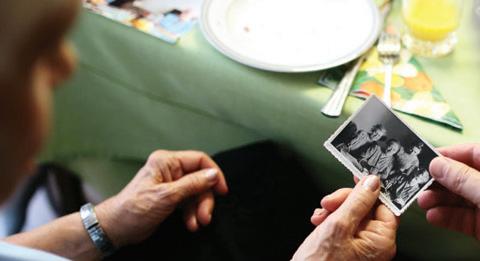









SATURDAY, APRIL 29
SHIRER TO BE
Priscilla Shirer Simulcast for women and teen girls will focus on the power of prayer and learning to study God’s Word for yourself.
DETAILS>> 9 a.m.-4 p.m., Bridgeway Community Church, 2420 E. Liberty Lane, Ahwatukee. Cost: $15 (includes refreshments), plus $8 for lunch (optional). Register: bridgewaycc.org.
BIBLE EXPLORED
This biblical scripture study embraces a spirit-filled, intellectually honest, and understandable exploration of God’s Word. Lessons will combine Christian and Jewish theology along with Bible history, archaeology and linguistics for a rich learning experience.
DETAILS>> 9:15 a.m. Mountain View Lutheran Church. 11002 S. 48th St., Ahwatukee. 480-893-2579, mvlutheran.org.
HORIZON SEEKS YOUNG PEOPLE
High school and middle school students meet to worship and do life together.
DETAILS>> 5 p.m. at Horizon Presbyterian Church, 1401 E. Liberty Lane. 480-460-1480 or email joel@horizonchurch.com.
KIDS CAN LEARN JEWISH LIFE
Children can learn and experience Jewish life. Chabad Hebrew School focuses on Jewish heritage, culture and holidays.
DETAILS>> 9:30 a.m. to noon, for children ages 5-13 at Pollack Chabad Center for Jewish Life, 875 N. McClintock Drive, Chandler. 480-855-4333, info@chabadcenter.com, or chabadcenter.com.
SUNDAY CELEBRATION SERVICE
Inspirational messages and music to lift your spirit. A
from page 45
you start looking at the claims in detail, you start to notice little cracks. And as you keep looking at the cracks, they get deeper. You will reach a certain point where it just won’t stand up anymore.”
While skeptics, doubters and freethinkers are a core part of the group, the majority of religiously unaffiliated people don’t identify as atheist or agnostic. In Arizona, they make up a quarter of
the “nones,” with the rest defining their religion as “nothing in particular.”
And even though they don’t identify closely with any one faith, 35 percent of “nones” in Arizona say that religion is very or somewhat important to them, and 88 percent of them say they believe in a god to some degree.
Debra Nolen, 62, counts herself as a believer.
She grew up Catholic but no longer attends church. Like many other Catholics she knows, as soon as she didn’t



welcoming community committed to living from the heart. Many classes and events offered. We welcome you!
DETAILS>> 10 a.m. Sundays at Unity of Tempe, 1222 E. Baseline Road, Suite 103, Tempe. Information: 480-792-1800, unityoftempe.com.
JOIN CHRIST-CENTERED YOGA
This Flow 1-2 class (intermediate) is free and open to the community.
DETAILS>> 6-7 p.m., Mountain Park Community Church, 2408 E. Pecos Road. Greg Battle at 480-759-6200 or gbattle@moutainpark.org.
CLASS TARGETS THE GRIEVING
Classes for those grieving over death or divorce. DETAILS>> 6:30 p.m., Holy Trinity Lutheran Church, 739 W. Erie St., Chandler. 480-963-4127.
have to go to Mass anymore, she stopped going.
“I hesitate to label myself as a Christian, but I do believe in God,” she said. “I believe if you’re a Christian then that means that you belong to the community of faith. And for me, being a religious studies major and knowing how church works? It turned me off to actually going.”
When she was in her 20s, she and her best friend developed a renewed interest in Catholicism. Together, they attended

TUESDAYS
GRIEFSHARE
Mountain Park Community Church is offering an ongoing GriefShare programs to help people deal with the pain of losing a loved one.
DETAILS>> 6:30-8 p.m., 2408 E. Pecos Road, Ahwatukee. To register: mountainpark.org and click on Launch. Information: Alex at 480-759-6200
FINDING HEALING FOR PAIN
HOPE, an acronym for “Help Overcome Painful Experiences,” offers support for men and women who seek God’s grace and healing.
DETAILS>> 6:30 to 8 p.m. Mountain Park Community Church, 2408 E. Pecos Road. mountainpark.org.
Submit your releases to pmaryniak@ahwatukee.com
Mass at several different churches. But the more they went, the more Nolen became exposed to church politics.
“You’re only as good as the minister telling those stories back to you. You can have five friends all go to a different church and come back with a different perspective on the same stuff. To me, that’s kind of problematic,” she said.
Still, Nolen never stopped reading the Bible. She said she continues to find comfort in the stories within its pages and finds faith “amazing.”









With 12 of its members destined for a national staff this summer, the Mountain Pointe High School Theatre Company will wrap up its season of comedy presentations with a centuries-old classic.
It will present William Shakespeare’s “Twelfth Night” at 3 and 7 p.m. Wednesday, April 26, and Thursday, April 27, at the school’s new Black Box Theater, 4201 E. Knox Road, Ahwatukee. A short show also will be presented by Mountain Pointe’s improv company, Rebel Without Applause. Tickets are $7 for students, $10 for adults.
“Twelth Night” is the story about a twin brother and sister, Viola and Sebastian, who are separated by a shipwreck. Fearing her brother has died, Viola disguises herself as a man and goes to work for a young nobleman named Orsino.
Orsino is in love with a reclusive Lady Olivia and soon makes the male-disguised Viola a page and his messenger to Olivia. While Viola falls secretly in love with Orsino, Olivia is falling in love with Viola. And all three become miserable. Written around the same time Shakespeare wrote “Hamlet,” the comedy features plenty of plot twists as the love triangles become more tangled.
Corey Quinn, Mountain Pointe’s veteran director and a biology teacher, is directing the play.
Also sharing a starring role is the school’s new Black Box Theater. It provides an intimate setting
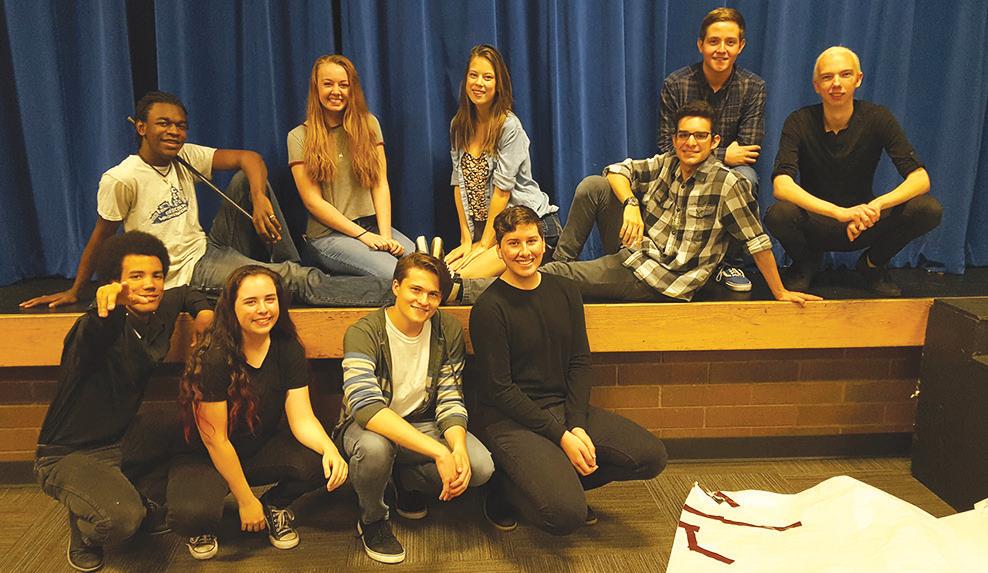
for the audience since it is seated around three quarters of the stage – a perfect setting for one of Shakespeare’s comedies.
Students in the cast and ther characters are Michael Rodriguez, Orsino; Jack Rupp, Sebastian; Michael Williams, Sir Toby Belch; Ethan Briant, Sir Andrew Aguecheek; Corey Drozdowski, Malvolio; Ali Stookey, Viola; Kaya Sciaudone, Olivia; Lexi Powers, Maria; Katie Corbin, Feste; Taylor Simmonds, Fabian; Andre Presume, priest; and Alayjia Marcellin and Lexi Artusa.
BY STEVEN SOLOMON GetOut Contributing Writer
Don festival parade-style attire and get a taste of the Big Easy at the Great Southwest Cajun Fest in Chandler on Saturday, April 22.
Showcasing the heart and soul of New Orleans, paired of course with Arizona fusion and flavor, Cajun Fest is filled with cultural festivities, food and entertainment.
“I’m so excited to bring Southwest Cajun Fest back to downtown Chandler this year,” says Landon Evans, event
coordinator with the HDE Agency, a multimedia marketing company. “Now that we are in our third year, we’ve finetuned all the details and plan to make it the biggest and best year yet.”
Brought to Chandler by Abita Brewing, Cajun Fest celebrates Cajun culture, cuisine and handcrafted beer, and will feature live music by jazz, blues and contemporary swing revival bands. The event is from noon to 9 p.m. at Dr. AJ Chandler Park, 178 E. Commonwealth Ave.
The stage crew includes Bekkah Weier, Sam Cool Ellis Carraway Cassandra Presume Myels Thomas and Jacob Lemos.
Meanwhile, 12 Mountain Pointe students have earned their way onto the national stage, performing at the International Thespian Festival this summer at the University of Nebraska in Lincoln.
It’s the first time they will attend the festival, a celebration of student achievement in the performing arts.
The Mountain Pointe actors competed against 540 students from 26 schools at the Central Arizona Acting Festival and the AIA State One-Act Festival. For advancement to the International Festival, students had to earn superior ratings from a panel of judges.
Organized by the Educational Theatre Association, the festival is a weeklong immersion experience and competition. Students compete and participate in singing, dancing, acting, designing, directing, creating, writing, and memory-making.
Workshops are presented by theater professionals, that include individual and group performances, programs for technical theater students, and opportunities to audition for college admission and scholarships.
The Pride actors chosen for the festival include: Ari Alvarado, one-act play; Ruben Ayala, solo musical; Katie Corbin, duet scene; Alexa de la Torre, one-act play; Cory Drozdowski, one act play; Katelyn Moyers, duet scene; Lexi Powers, one-act play; Michael Rodriguez, duet scene; Chance Stokes, duet scene and one-act play; Ali Stookey, monologue and one-act play; Michael Williams, monologue; and Nehemiah “Nemo” Wright, one-act play.
Ali Stookey’s monologue earned perfect scores and superior ratings from all three judges. The students are working on fundraising plans for the trip to Nebraska. A GoFundMe account has been established to help fund the trip. Those wishing to donate can contribute by visiting www.gofundme.com/mptc-thesfest

BY CHRISTINA FUOKO-KARASINSKI GetOut Contributing Writer
As a participant at vintage sales, Desiree Byrne saw plenty of fellow vendors, but sometimes very few shoppers.
To find success, she and others created Front Porch Pickins Vintage & Handmade Market, which comes to Tumbleweed Park in Chandler on Friday, April 21, and Saturday, April 22.
“We actually started out as vendors ourselves, going to smaller shows,” Byrne recalls. “One of our priorities is focusing on PR and marketing by making a big buzz.”
Front Porch Pickins is Arizona’s largest vintage market, Byrne says. About 100 vendors will sell antique, shabby, rusty, chippy, handmade, knitted, crocheted, galvanized and farmhouse items, along with custom clothing and signage.
Those seeking something new and novel for the home can check out the custom farmhouse-style woodworking pieces of Scottsdale Design Co., while La Vida Patina’s boho industrial goods and the His, Hers and Ours Custom Shave Shop’s vintage-inspired
safety razors serve as additional draws. Runof-the-mill items aren’t here.
“We’ve had pickle-scented soap,” she says with a laugh. “We had one lady who upcycled old doll heads and made them into planters. It’s one of those things where you say, ‘I think I need to own that. I don’t know why.’ We have cool and funky items.
“We had a vendor who sold cigar boxes made into guitars, and people who bring old pickup truck beds and made them into benches.”
This has been a passion project for Byrne, who moved from Illinois to Arizona as a teenager.
“I’ve always been obsessed with vintage” she says. “My dad took me to auctions and estate sales. It’s been surrounding me. My dad has a vintage room at their house. There’s always been some sort of vintage vibe going on in my world.
“The passion stayed with me as I was growing up. I was obsessed with all the different TV shows; the ones where people are flipping and upcycling things. I love it. They always say find what you love and make

it a job. That’s what I’ve done.”
This time featuring a car show, Front Porch Pickins continues its tradition of showcasing the area’s top food trucks. Woodfired pizzas from local favorite Doughlicious are among the culinary options available at the event, and crepes, salads, frozen yogurt and other snacks and sweets will also be available for purchase.

on market day, but year-round. We’re in this together. We’re hoping small businesses. We’re working together to make sure these mom-and-pops can make it.”


The food, Byrne says, provides the perfect opportunity to take a break.
“A lot of people walk through part of it, stop and eat, get back up and keep walking,” she says. “Shoppers should make a whole day of it with their friends. Bring the girlfriends.”
No matter how many people attend, Byrne is thankful for the support.
“If you’re running a business, you have to have the sales to make it work – not just


from page 48
Headlining the event is Zach Deputy, a multi-instrumentalist and songwriter based in Savannah, Georgia. On the food side, regional dishes will be featured from a variety of vendors, including Honey Bear’s BBQ, Creole Cajun Bistro, Angry Crab Shack and Ragin’ Cajun.
Organizers say that crawfish was a big deal last year, with patrons waiting in long lines to get it. Evans increased the number of crawfish boil booths to diminish the lines.
The activity schedule begins with a procession at 2 p.m., followed by a watermelon-eating contest at 3 p.m., a wingeating contest at 4 p.m., a crawfish-eating contest at 5 p.m. and another procession at 5:45 p.m.
BY CHRISTINA FUOKO-KARASINSKI
GetOut Contributing Writer
Since guitarist Richard Williams cofounded Kansas, he has learned to live in the moment; no expectations, no regrets.
As a result, Williams’ 43-year-run in Kansas has gone quickly.
“I never thought I’d be doing this when I was 30,” says Williams via telephone from Atlanta, where the band has been based since the 1970s. “I just turned 67. I’ve had almost 40 years of surprises.
“Our goals were set pretty low when the original six of us got together. We wanted to make an album, in the hopes of breaking out of the Midwest bar market,” he said. “We didn’t play the kind of music that club owners would love to have. We played a lot of weird stuff. They wanted people up there dancing, so they’d get thirsty and drink more beer.”
Kansas stuck to its guns and found success along the way.
The band is now celebrating the 40th anniversary of the album “Leftoverture” by performing the collection in its entirety. The show at the Chandler Center for the Arts will also feature hits, deep cuts and new songs from “The Prelude Implicit.”
“The show is two and a half hours long,”
he says. “It’s the longest show we’ve ever done. It’s very satisfying for the band. I always felt like, with oneand-a-half-hour shows, we were just getting warmed up. It wasn’t worth the trouble and expense to get somewhere. Now, I feel it’s really worth my time and I know the crowd agrees.”

“Leftoverture” was released in 1976 and includes the million-selling single “Carry on Wayward Son,” as well as “The Wall,” “Miracles Out of Nowhere” and “What’s on My Mind.” The album peaked at No. 5 on Billboard’s album charts and reached sextuple-platinum status.
“The Prelude Implicit” hit stores on September 23 and reached No. 14 on the top 200 album chart, No. 41 on the Billboard 200, No. 5 for rock albums, No. 6 for physical albums, No. 17 on the vinyl albums chart.
When “Leftoverture” was recorded, the goal was simple: just to break out.
“There wasn’t a lot of future thought on that,” he says. “We didn’t come from a place where big dreams come true. That was as big of a dream as we had.”
But music publisher, producer, talent manager and songwriter Don Kirshner had other thoughts.
“He was putting a lot of money into us,” he says. “With ‘Leftoverture,’ he got the hit he wanted and then suddenly we were selling millions of records, which helped sell the past catalog.
“We achieved dreams so far beyond our dreams. I do this now because it’s simply what I love to do. I love to travel. I love the performances. I love the guys. It is so much fun. Instead of waiting for a goal to be reached to expect happiness, I’ve learned to slow it down and just appreciate the day.”
The processions will be led by the mayor and council, and include alumni from Louisiana State University and a puppy parade. Anyone can bring their pup, especially dressed up in a costume, and be in the parade.
Sign-ups for the eating contests will be handled on site, starting at noon the day of the event. A maximum of 15 people will be registered for each event and participants must be at least 18 years old.
The first person to eat half a watermelon wins that contest, the first to eat 12 wings wins that contest and the first to eat 12 crawfish wins that contest. The events are not timed and winners receive gift cards to local businesses.
“I love producing events in Chandler, it’s my home and I take great pride in the strong community our events have helped to build,” Evans says. “A portion of the proceeds will go back into the downtown Chandler community through the Downtown Chandler Community Foundation, and that makes me very proud of the work we’re doing.”
Tickets are $8 in advance and $10 at the gate. Children 12 years old and under will be admitted free. Tickets for VIP admission, which are only available in advance, are $125 and include catered food, six adult beverages, access to private seating in the VIP area, private restrooms and front stage access.
So how popular is Cajun Fest? “Last year about 7,000 people attended,” Evans says. “This year we’re looking to hit about 10,000.”
BY MIKE BUTLER Tribune Staff Writer
Rhema Soul Cuisine in Queen Creek reels in new customers with
barbecue, but the newbies
delights.
“If you’re watching your waistline, you’re in the wrong place,” said Ron Childs, who runs the cafe with his wife, Via.
For most of their lives, Ron and Via were the kind of couple who loved to cook and entertain and about whom friends would always say, “You guys should open a restaurant!”
They dreamed about it, but Ron had a pretty dreamy career going as a PGA teaching pro in the Bronx. When their three kids were older, and the daily teaching grind had caught up with Ron, they tried catering, and that worked out well.
But then life in the city caught up with them. They had to get out, and so they took out a map. When there was an “X” on every state except Arizona, they packed up and headed west on a new adventure.
Although the Valley was in the depths of the real estate bust in 2010, Ron and Via
had trouble finding a house they liked. The couple’s agent drove them down to Queen Creek one day on a hunch they’d like it.
They loved it, buying the first house they visited.
Ron said he thought he would pick up another job teaching golf, but he couldn’t find a position that paid anywhere near what he was making in New York.
The restaurant dream moved to the front burner.
The first Rhema outgrew its location in six months, requiring a move to the current shop in a plaza on the northeast corner of Ellsworth and Ocotillo roads.
The signature chicken and red velvet waffle, featuring fried boneless chicken thighs, reflects Ron’s love for red velvet cakes and muffins. The “Broritto” wraps chicken thighs in a flour tortilla with Caribbean red rice, seasoned black beans and house aioli. Traditionalists go for the pork sandwich, fried shrimp and fried pollock.
Keep that soul train chugging along with a side of collard greens with smoked turkey, carrot and craisin salad, potato salad, seven-cheese baked macaroni or cornbread.
Ron said most of the recipes reflect three generations of love on both sides of the family. Ron’s family roots stretch from Grenada to the Carolinas; Via’s from Jamaica to the Virginias.
“There’s a whole lot of flavor clicking in that kitchen,” he said.
Happily, Ron is also an inspired experimenter, and his “Symphony Fries” are pure genius: fresh-cut fries and sweet potato fries loaded with chopped pork and five different cheeses, drizzled with barbecue sauce.

Ron makes all of his barbecue sauces. He’s of the dry rub/sauce-on-the-side school and smokes St. Louis-style ribs and other meats early in the morning outside the back door.
Rhema Soul Cuisine, 21803 S. Ellsworth Road, is open from noon to 7 p.m. Wednesday, Thursday, Saturday and Sunday, and Friday from noon to 8 p.m. The restaurant is closed Monday and Tuesday for cleaning, food prep – and golf. Visit rhemasoulcuisine.com for more information.
Reach Mike Butler at 480-898-5630 or at mbutler@timespublications.com.















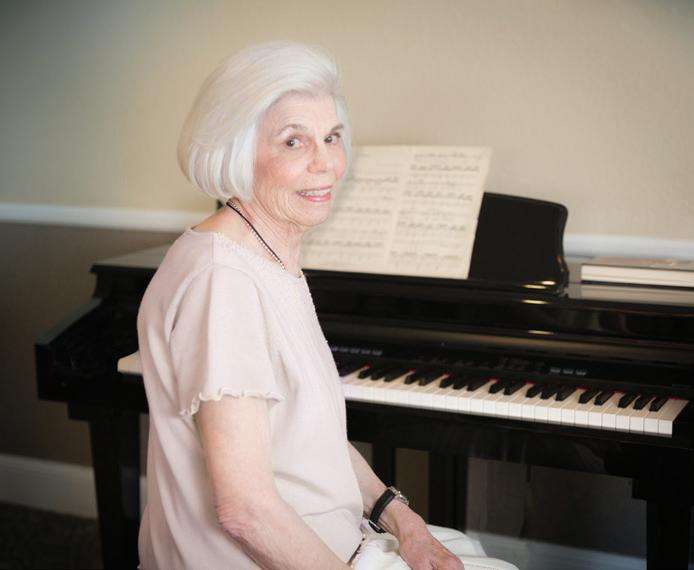















BY JUSTIN FERRIS GETOUT EDITOR
Like the 1951 movie from which it gets its name, the Broadway musical version of “An American in Paris” tells the experiences of an American soldier who decides to stay in Paris after the war. The score uses classic songs from George and Ira Gershwin.
DETAILS>> Times vary, today-Sunday, April 19-23. ASU Gammage, 1200 S. Forest Ave., Tempe. Tickets: $20-$150. 480-965-3434. asugammage.com.
Irving Berlin wrote some of the most iconic songs in Broadway, movie and music history, including “God Bless America, “White Christmas,” “Blue Skies” and plenty more. Now you can hear 40 of his hits in a brand new, world-premiere musical revue.
DETAILS>> 2 or 7:30 p.m., Thursday-Friday, April 20-21. Tempe Center for the Arts, 700 W. Rio Salado Parkway, Tempe. Tickets: $28$34 adults, $23-$29 students. 480-350-2822. tca.ticketforce.com.
For its one-year anniversary, the popular Highland Yard Vintage Market offers the theme “Designer’s Choice,” to showcase the best work from more than 30 local designers and artisans. Plus, enjoy food, interactive market demonstrations, and more.
DETAILS>> 10 a.m. to 6 p.m., Thursday-Sunday, April 20-23. Behind Merchant Square, 1509 N. Arizona Ave., Chandler. Cost: Free. facebook. com/Highlandyardvintage.
Chandler’s regular Art Walk takes a tropical turn that includes Corona del Sol’s Steel Drum Band, tropical food and drink specials, and island-related art and items for sale. Feel free to dress up in your best tropical tourist attire.
DETAILS>> 6-9:30 p.m., Friday, April 21. Dr. A.J. Chandler Park, 3 S. Arizona Ave., Chandler. Cost: Free. downtownchandler.org.
Watch authentic Native American drumming, dancing and singing from a variety of tribes, and enjoy traditional Native American food during the 31st annual Pow Wow at Arizona


State University. Be aware that this is a spiritual and cultural event, so please read the rules on behavior before attending.
DETAILS>> Times vary, Friday-Sunday, April 21-23. ASU Band Practice Field, E. 6th St., and S. Rural Road, Tempe. Tickets: $8 adults, $6 students, $20 three-day pass. powwow.asu.edu.
Join other runners to honor former Arizona Cardinal and U.S. soldier killed-in-action Pat Tillman, and to raise money for the Pat Tillman foundation, which supports the academic dreams of veterans and their spouses.
DETAILS>> 7:05 a.m., Saturday, April 22. Sun Devil Stadium, 219 Packard Drive, Tempe. Cost: $50 registration. pattillmanfoundation.org.
Pop culture fans ages 12-18 can enjoy a day of celebrating comics books, manga, anime, cosplay, gaming or whatever else interests you. Enjoy workshops, panels, a vendor hall, hangout areas and a cosplay fashion show. More than 400 attendees expected.
DETAILS>> 11 a.m.-6 p.m., Saturday, April 22. Boy & Girls Club Compadres Branch, 300 E. Chandler Blvd., Chandler. Cost: Free. chandlerlibrary.org/libcon.
For Earth Day, enjoy live animal presentations, crafts, food and drink, information booths, and vendors of environmentally friendly products. Then wrap it up with an early Arbor Day tree planting dedication.
DETAILS>> 9 a.m.-noon, Saturday, April 22. Veterans Oasis Park, 4050 E. Chandler Heights Road, Chandler. Cost: Free. chandleraz.gov.
Join the Mesa community for a day of games, carnival rides and live entertainment. For Earth Day, visit the Living Green Village for solar cooking demos, a tree-hugging booth and more environmentally friendly fun.
DETAILS>> Noon-4 p.m., Saturday, April 22. Hohokam Stadium, 1235 N. Center St. Mesa. Cost: Free. mesaaz.gov.
Bike or drive to the park for a free screening of Disney’s live-action version of “Jungle Book.” Bring a blanket or chairs; popcorn will be provided.
DETAILS>> 7:30 p.m., Saturday, April 22. Harmony Park, 1434 S. 32nd St., Mesa. Cost: Free. mesaaz.gov/biceped.








38 With

46 See 38-Across 48 Prayer ending
Russo 50 Sketched 53 Tramcar contents
45 Seethe
47 Proof that you’re who you say you are
52 Shopper, e.g.
54 Thing
55 Part of “to be”
56 Part of N.B.
57 Metallica drummer Ulrich
58 Homer’s neighbor
59 From the start
1 Spore cases
2 Word after 10-Down
29 First lady
30 Leary’s drug 32 Platitudes





BY RYAN CLARKE AFN Staff Writer
Football draws a full circle for Arizona Rattlers quarterback Cody Sokol, but the circle is imperfect — featuring sharp turns and odd curves as if a child drew it.
With a baby on the way and a rekindled career on the gridiron, Sokol is hoping his haphazard journey can serve as an inspiration for the next generation now that he is playing and starting locally for the Arizona Rattlers.
“Football is not the most important thing in the world,” Sokol said. “But it’s something that’s given me paths and great opportunities and developed me into the man I am today.”
Sokol’s football career began at Desert Vista High School, where he led a talented and tight-knit team into his final year in a Thunder uniform in 2009. Desert Vista’s fortunes faded when Sokol broke his foot in the second game of the season.
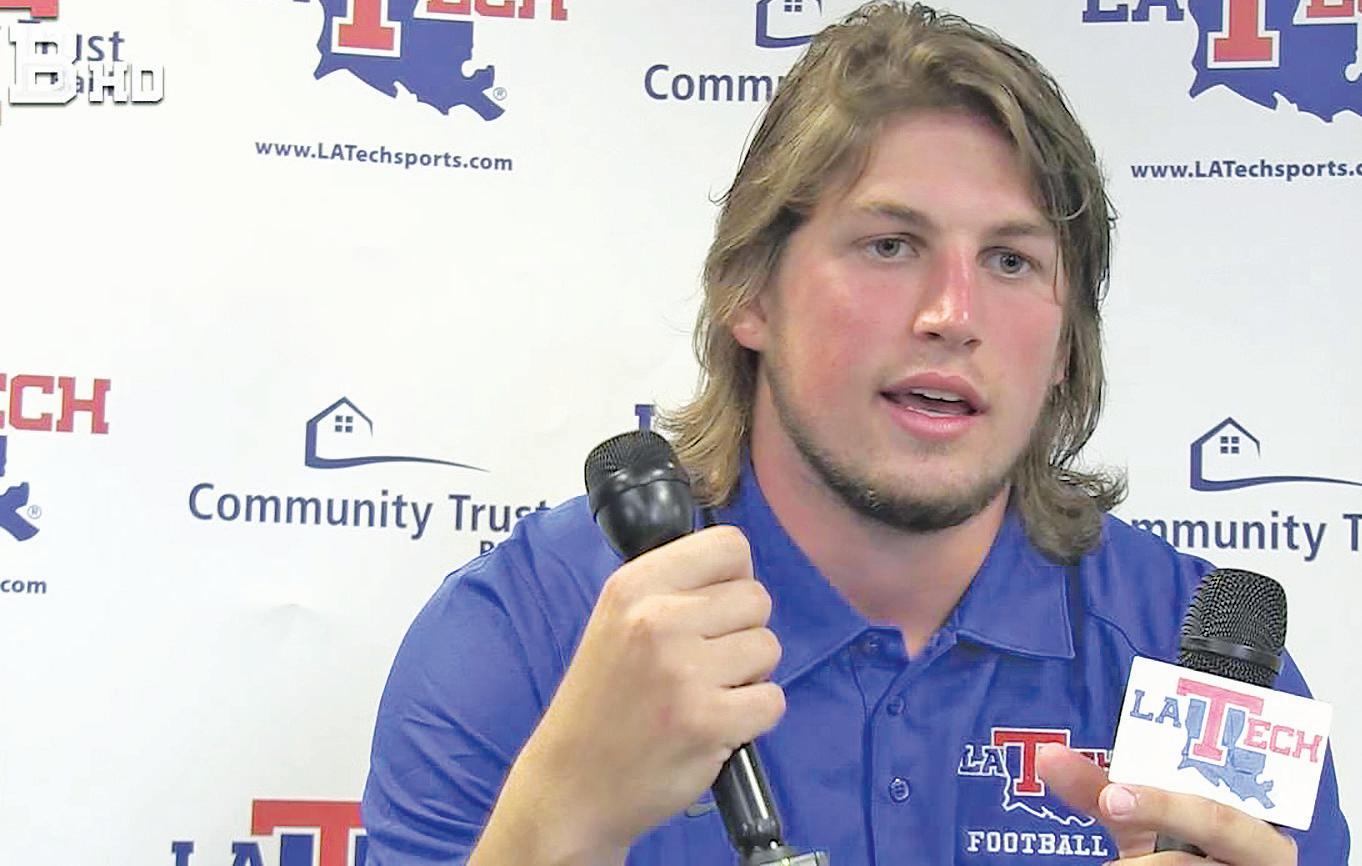
After sitting out the rest of the season and watching his team finish 2-8, Sokol’s scholarship offer was pulled by Oregon State.
He had few options in the football realm, so he turned to Scottsdale Community College, where he had an opportunity to prove once again that he was worthy of a Division I program.

“I learned real quick that it’s a business,” Sokol said. “Not everything they promise you is kept — you’ve got to make your own recruiting journey.”
Faith instilled by his high school coaches kept Sokol grounded during a dark time. His involvement in the Fellowship of Christian Athletes is something he points to as a guiding light when things weren’t going his way.
He also had faith in his abilities is a quarterback, and those prayers were answered quickly by the likes of Wyoming, Idaho and other low-level Division I schools. But Sokol wasn’t satisfied — he wanted the kind of offer that showed Oregon State it made the wrong decision.
“It wasn’t anywhere that I was really set on going to,” Sokol
said. “So I came back my sophomore year and that’s when I was an AllAmerican and had 28 offers, and my final three were Arizona, Cincinnati and Iowa.”
The winding road home would have been considerably shorter if Sokol chose to stay in state. Instead, he chose Iowa, the state where he was born and still has a number of family members.
The Hawkeyes’ pro-style offense seemed like the perfect fit, but Sokol never attempted a pass in two seasons.
Sokol graduated from Iowa without fulfilling his dream of starting for a Division I football team. That opportunity finally arrived when he transferred to Louisiana Tech.
At LaTech, He started all 14 games, throwing for 3,436 yards and 30 touchdowns. But seven rounds of the 2015 NFL Draft came and went without Sokol hearing his name called.
He signed with the Kansas City Chiefs as an undrafted free agent, was waived, bounced around a handful of practice squads, and found himself out of football. The frantic search for a permanent football home continued.
“I didn’t really get an opportunity to go to the CFL, and the Arizona Rattlers
called me up,” Sokol said. “They told me they wanted me to do a private workout.”
The Rattlers provided an opportunity to return home and continue a football career in disarray, but Sokol wasn’t sold. He had the NFL on his mind — and still does — but that desire led him to reject the Rattlers initially and join the A-11 Football League.
The league folded before it played a single game — and once again Sokol was out of a job. He went to work in Arizona as the quarterback’s coach for Scottsdale CC and continued his workout regiment.
“I was kind of in that in between mode of whether I wanted to start my career or continue playing football,” Sokol said. “I still had that fire — I still had years left and something to give to the game.”
After an entire season where he wasn’t under center, the Rattlers called again and brought Sokol on for this season. Now, he’s their starting quarterback — settled in Phoenix just in time for a baby due in May – after taking over the last two games.
It’s perfect timing and the culmination of years that included pain, regret and uncertainty. Sokol, who has completed 32 of 58 passes for 389 yards with eight touchdowns and an interception in two starts, can play football in front of family and friends again, just as he did at Desert Vista.
“Cody’s been a great example, he’s around DV a lot, works out with us in the weight room,” Thunder head coach Dan Hinds said. “Our boys are able to see how determined he is and how hard he has worked to get to this point in his life.”
Sokol has navigated challenges that would deter most athletes and emerged with a new perspective. He wants his atypical homecoming to inspire his future child and all the children in the stands at Rattlers games.
“I’d say never give up on your dreams, no matter who’s telling you that you can’t do something,” Sokol said. “You can.”
BY JASON P. SKODA AFN Prep Sports Director
Nick Wallerstedt jumped off the mound, fielded the ball and threw it to first base.
It was a free-and-easy day during a Mountain Pointe High School practice just after school let out.
The baseball team essentially had the campus to itself. The nearby football practice field was empty.
A year from now, that may not be the case – and Nick might have to choose between the two sports.
Wallerstedt’s focus was fully on baseball that day as he got back in line during the pitchers’ fielding practice. But next season, a recently passed regulation by the Arizona Interscholastic Association will allow year-round practice.
Nick is the Pride football team’s projected quarterback the next two seasons and the team might be practicing in March.
“I’m sure it would work out, and I’d talk to the coaches, but it would be hard missing practices,” Wallerstedt said of football.
“Right now, it is baseball season and I don’t have to think about that because they’re not practicing,” he added. “I still have my Sunday (quarterback) workouts and I guess I will get to football when I can.”
Wallerstedt’s place on the football team in pretty much assured so he can head to the diamond without much hesitation, but not everyone has that luxury.
A borderline starter in one or both sports, however, might be forced to make a choice in light of the AIA legislative council’s 39-5 vote allowing year-round practice.
The pool of multi-sport athlete pool has been dwindling over the last decade
or so as specialization in a sport has become more commonplace.
The year-round practice rule might make multi-sport athletes nearly extinct.
“The fear of loss time will drive this,” Mesa wrestling coach David DiDomenico said. “There has to be respect and an understanding among the coaches of the sports or kids might start hearing ‘If you are not here’ type stuff.
“What (football coaches) aren’t seeing is the athlete. They are learning how to compete. They are getting coaching. They are leaning to be more wellrounded athletes and they are being held accountable academically,” DiDomenico added.
Larger schools are not as dependent on multi-sport athletes as smaller athletic programs.
Mountain Pointe baseball coach Matt Denny is in his first year with the Pride after transferring from a smaller program at Gateway High.
He has seen how playing an additional sport can both develop a player’s athleticism and help out a program.
“Some schools work better at letting kids play more than one sports,” Matt said. “It’s important to me. It’s probably going to create some animosity at some schools. I want my kids playing football, basketball or whatever. It creates a toughness and develops them as athletes.
“What I don’t like is when I hear them say, ‘Well, I am not going to be a starter on the basketball team so I am not going to play.’ That creates a lack of depth in the program,” he continued. “That seventh player that could give quality reps practice doesn’t always realize that they are helping the program.”
Some coaches also worry that a yearround practice schedule leads to a higher risk of injury.
The University of Wisconsin School


of Medicine and Public Health followed 1,500 athletes from 29 different Wisconsin high schools throughout the 2015-16 sports season, and the results were damning.
The found a 60 percent higher rate of lower-body injury among athletes who specialize in a single sport, where the same muscles are used over and over again. Often those athletes play club seasons, further heightening the injury risk over players who compete in multiple sports.
Lower-extremity injuries were defined as any acute, gradual, recurrent
or repetitive-use injury to the lower musculoskeletal system.
“The new science is showing a specialized athlete has a higher chance of getting hurt,” DiDomenico said. “They are doing the same thing over and over with high school and club teams. It’s simple wear and tear. If they are doing something different it changes the body and what muscles are being used, and there’s more of chance for burnout.
“Hopefully, this new ruling doesn’t increase it even more. It’s in place now, but we won’t know the totality of it for a couple of years.”



BY JASON P. SKODA AFN Prep Sports Director
The ruling to allow high school coaches to have practices yearround with their teams is a big unknown.
“I’m anxious to see how this plays out,” Mesa wrestling coach David DiDomenico said. “Especially, from what I know, they didn’t ask the coaches what they thought about it. It wouldn’t have mattered if they surveyed us or not. The AIA will make their choices and decisions anyway. The pendulum already swung.”
However it is viewed by administrators, coaches, parents and athletes, it is coming to Arizona high school sports.
July 1 is going to be the beginning of a new era for the Arizona Interscholastic Association and the schools it serves as coaches have the shackles come off –even as other states like Texas, where high school football reigns, has backed away from the idea.
Several athletic directors, who have to police out-of-season participation longer, have said too much has been
made of it, and others call it a touchy subject.
The legislative council had little problem moving yearround practice along, passing it with a 39-5 vote on March 3, and yet AIA Executive Director Harold Slemmer is on the record saying he is believes the ramifications will have a “ripple effect on the culture of sports” and head sports down a path “we might regret in a few years.”
Once it became clear that the idea of year-round practice was gaining steam, Mesa district athletic director Steve Hogen requested a committee to oversee the new rules.
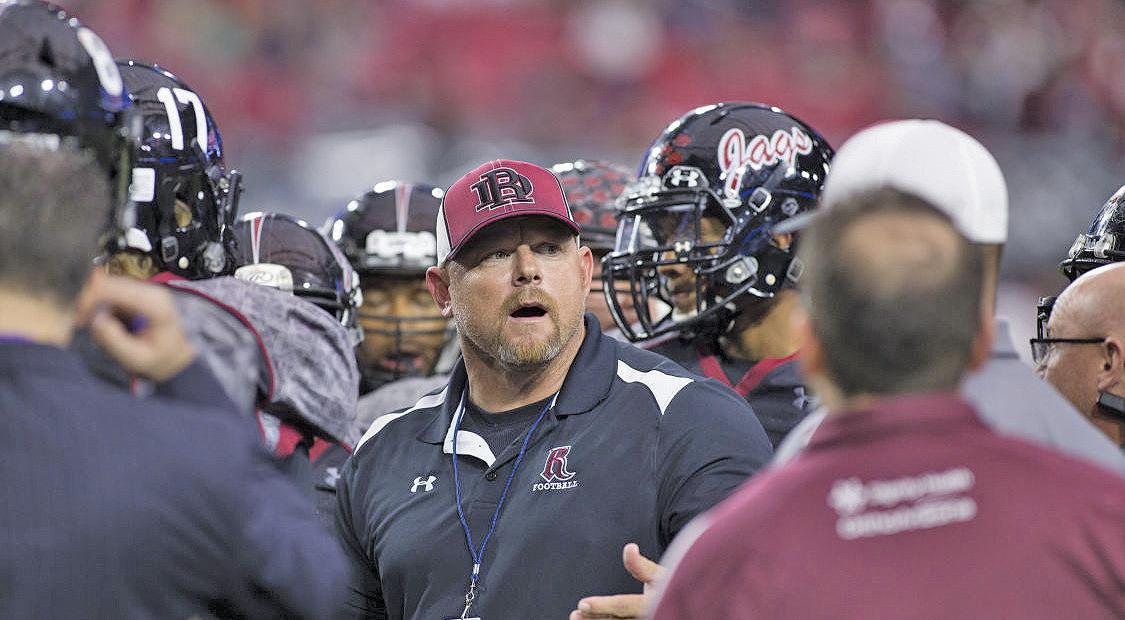
Desert Ridge coach Jeremy Hathcock won’t ask his athletes to give up one sport for another with the opportunity for extra practice, but he knows it may happen. “You can’t stop a parent from being that person who pushes their kids to give up something for another,” he said. “That’s not what we want.”
“My goal was at the very least to come out of it with some sort of checklist that I could take back to my district saying this what you need to do in order to stay legal,” Hogen said. “A majority of schools are doing it the right way. Some are circumventing the rules to their advantage.
“(AIA lawyer Mark Mignella) asked if you are doing what you can to get around the bylaw, why have the bylaw at all? It was a good question. I agreed in part. If we have a bylaw creating a culture of cheating and circumventing the rules because they are getting together out of season already, why have the bylaw?”
Now, coaches can practice at all times without having to charge a $50 camp fee for offseason workouts or create a culture where a leader on the team “suggests” the players get together for workouts.

“I had a football coach see all of the other sports wearing his school colors and practicing out of season, and he said he wants to be able to do that,” Hogen said. “The same coach asked about 7-on7 (leagues) and how the other schools are doing it.
“I explained to him all that is involved with the insurance and other aspects. He said, ‘I just want to do it and not go through that stuff.’”
The new ruling will most likely lead to 7-on-7 leagues in the winter and spring rather than just the summer, like now.
Coaches such as Desert Ridge’s Jeremy Hathcock are the forefront.
The trend is to create all-star 7-on-7s teams that travel nationally.
Hathcock, who had his projected starting quarterback go through the summer 7-on-7 season with an all-star team rather than the Jaguars’ squad last year, approves of the change.
“If we are going to do it, we better do
it right,” he said. “If they are with us, it eliminates the middle man. We have the kids’ best interest at heart.”
While football is most prominent, this could very well affect the others sports even more, especially if the football team decides to practice outside of spring football.
“We share athletes no problem at Desert Ridge,” said Hathcock, whose son played football and wrestled. “But people are who they are. You aren’t going to change them. You can’t stop a parent from being that person who pushes their kids to give up something for another. That’s not what we want.”
While some are claiming all hell is about to break loose, the majority are saying nothing much will change. Coaches aren’t going to get paid more (a stipend about $4,000 in most cases) and they need breaks from the players just as much as the players need a break from them.
Most of the East Valley schools have a class during the school day already dedicated toward a particular sport.
“I really don’t think for the most part coaches are going to do it,” Hogen said. “There will be some change in 7-on-7, but overall I don’t think they want to coach year-round.
“At some point, when you practice so much, it can create negative returns, and if someone does go after it fully it might very well backfire.”
– Contact Jason Skoda at 480-898-7915 or jskoda@ahwatukee.com. Follow him on Twitter @JasonPSkoda.
BY JASON P. SKODA
AFN Prep Sports Director
Becca Longo is burning bright in the national spotlight now, but it all really began more than a decade ago.
The Basha senior became the first female football player to sign a national letter of intent for football, and the news brought national interviews with CNN, ESPN and “Good Morning America.”
None of that was the goal when she began idolizing Heidi Garrett more than a decade ago, when Longo saw her kick for her brother’s high school team in California. Garrett holds the national record for females with a 48-yard field goal.
Nor was it the dream when Longo was in San Diego for a soccer tournament and she booted a penalty kick so high and far past the goal that people on the sidelines mockingly made the sign for a good field goal.

It’s only now that Division II Adams State University in Alamosa, Colorado, saw enough in her recruiting tape she sent out and the confidence she showed in the initial visit at Basha to give her an opportunity. Reportedly, a female has never gotten a football scholarship at the Division I or II level until Longo signed her letter of intent on Wednesday.
“It’s crazy to think about it and how much it is blowing up,” Longo said. “Everyone is saying I’m the first one to do it, and that’s hard for me to believe. It’s just a title. It doesn’t change anything for me. I just want to do what I love.”
The love started for good when she
saw Queen Creek playing spring ball her freshman year.
“Me and my friend said we were going to play football,” said Longo, who kicked for the Bulldogs’ JV team as a sophomore.
“Only, I really did.”
It’s that kind of mentality that sealed the deal for Adams State coach and former Cardinals quarterback Timm Rosenbach.
“What I want to make clear is that she is capable of doing this at this level,” Rosenbach said. “Do I see her making 54-yarders or kicking off for us? No, but I’ve seen players aged 18 to 35 miss a lot of chip shots. As long as you make the kicks you are supposed to make, then you have something.
“In just talking to her you can tell there is a mental toughness. She is the one who put herself out there. This is something she wants to do, so if she is good enough to do it, we should afford her the opportunity.”
It is one she is not taking lightly. Longo made a 30-yard field goal and 30












Ahwatukee Lightning Lacrosse won the state championship in the Arizona Youth Lacrosse League recently after defeating Scottsdale 5-4.
Club President Richard Harkey called the Cactus Cup game “really close,” noting that the Lightning defeated Glendale 11-4 earlier that day while Scottsdale had beaten Chandler to advance to the final.
The win capped an undefeated season for the Lightning, which went 18-0. The team is coached by Harkey, Sukarno Ivey and Mary Stark.
The Arizona Youth Lacrosse league is made up 65 teams broken into age categories from for boys in kindergarten through eighth grade from Ahwatukee, Scottsdale, Chandler, West Valley, Paradise Valley, Tempe and Tucson.
The Ahwatukee Lightning, a nonprofit lacrosse club, feeds into the Mountain Pointe and Desert Vista high school teams once players get too old for the club.
“Lacrosse is the fastest sport on two feet,” Harkey said. “It is a great game in which it combines soccer, hockey, football and basketball.”

The team, which dates back to the 1990s, counts 120 boys and 30 girls.
The league’s season runs mid-January to April, and a “fall ball” season extends from October to December.
The Lightning this year also started a lacrosse team for girls in kindergarten through eighth grade. It also will be sponsoring clinics for boys in August.
Though Harkey said he “never really heard about” lacrosse growing up in Chicago, he’s a die-hard fan now.
“I wish I would have played,” he said. “I learned the sport while my son did, and he has been playing for four years. He is 11 now.
Harkey said youngsters in first through eighth grade are always welcome to check out the club. Information for boys: ahwatukeelax.com, for girls: ahwatukeeladieslax.leag1.com.
Ahwatukee orthodontist Dr. Chris Woolaver is a team sponsor.
BY JASON P. SKODA AFN Prep Sports Director
Long before Nicole Powell was introduced as the new leader of Grand Canyon University women’s basketball program this week, Sara Gorton Slattery was on the same Phoenix campus training distance runners to break through mental barriers.
They were doing the similar things on Mountain Pointe High School’s campus in the late 1990s.
“It is very rare to have such highlevel athletes in the same school,” said David Klecka, who was the Pride’s track coach at the same time. “They pushed each other and had success and drive in common. They could vent to each other in regards to recruiting and pressures.
“They both were the best in their sports. Period.”
Now, they are back together again.
The two stars from the same high school graduating class are now running separate programs at the same university.
“It’s funny how people can come in and out of your life,” Slattery said.
“When the (women’s basketball) position opened up, I told some people what a great fit Nicole would be. Even my mom made the connection. We had stayed in touch through social media and when (Powell) emailed me I was so excited.”
The same could be said for the administration at GCU. Everything about Powell, her personal success in the game, her coaching pedigree and her winning ways matched the blueprint that has been in place Grand Canyon on its road to Division I athletics.
“She is a high-energy individual who has a strong passion for working with people and is highly respected in the basketball world, having played and coached at the highest levels of
the sport,” Lopes athletic director Mike Vaught said. “She will be a great influence on our student-athletes and the university as a whole.”
Powell has been making a name for herself in the coaching ranks at Gonzaga University and Oregon State since retiring from a highly successful playing career, collegiately at Stanford University and an 11-year WNBA career. She had one of the most storied high school athletic careers in Arizona history.
Powell was a badminton state singles champion, a state doubles champion in tennis and made the varsity team’s top six in the one year she ran cross country. Later in her career, she balanced her tennis responsibilities with track on the Pride’s 4x400 and 4x800 relay teams along with being a top-eight finisher at state in the shot put and discus.
“She could literally do anything and win,” Klecka said. “I have never seen an athlete like her.”
Slattery’s success was more singular but just as impressive before she moved on to Colorado, where she was a two-time national champion in the 5,000 meters (indoor) and 10,000 meters (outdoors). For the Pride, she was a cross-country state champ and two-time runnerup and won the 3,000 meters at the 1999 Pan American Junior Athletics Championships.
In track, Slattery won titles in the 3,200 and 1,600-meter events during twice to give her 10 state titles including team championships. She set state records in the 1,500 (4:31.50), the 1,600 (4:49.11) and the 3,200 (10:15.94).
She tried to revitalize her running career in 2015 as she attempted to qualify for the 2016 U.S. Olympic Marathon Trials, but came up short. Around the same time, she was pegged as GCU’s cross-country coach.
With Grand Canyon’s ascent to Division I athletics in place, Slattery knows the process will be slow but satisfying.
“I wasn’t seeking it out with two young kids, and having to juggle everything but it has worked out well,” Slattery said. “We are growing and developing as much as we can. It will be two or three years until we have a team that can contend, but we have athletes willing to work.”
Work is something that Powell and Slattery know a little about. It’s easy to look at the totality of the results and forget what it took to get there. The athletes under their guidance will get a first-hand look at what these two Mountain Pointe Hall of Famers are all about.
“I cannot wait to get on the road and share what we’ve got going on here with recruits and their families,” Powell said. “This is a special place and I know we are going to attract talented, high character student-athletes who want to win championships, but also have a strong desire to serve others.
“The culture of GCU is unique.”
Ask anyone who was around Mountain Pointe in the early days and they will say the same about their school.
Many athletes – don’t forget men’s volleyball Olympian Reid Priddy, a 1996 graduate – who excelled and administrators, like then-principal and current AIA executive director
Harold Slemmer, who helped create an atmosphere that developed stars of every kind.
“Looking back after I left Mountain Pointe I felt I was a step above students from other schools; more prepared to be successful,” Slattery said. “The school back then, before open enrollment, had so many great athletes and administrators to show us the high standard they kept and how to go about achieving our goals.
“It has a lot to do with the success Nicole and I and others have had, and now we are together again with the same ideals.”
(Special to AFN)


Keystone Montessori has provided my children with a warm and nurturing environment in which to develop their love of learning. The teachers, staff, and parent community all work together to ensure our children receive an outstanding education that focuses not only on academics, but also on grace, courtesy, and respect for their community. We love Keystone!
- Parent Testimonial
BY ALYSSA HESKETH Cronkite News
Athree-year study of the Arizona State University football team will help researchers develop tools to better diagnose and prevent sportsrelated concussions and other injuries or diseases.
The study, conducted by the Translational Genomics Research Institute, drew data from sensors placed inside players’ helmets during practices and games from 2013 to 2016. It combined the sensor data with blood, urine, and saliva samples from each player to examine the changes in an athlete’s body that can occur from multiple head impacts.
The study data has been published in an open-access journal to help other researchers develop tests to detect concussions off the playing field, including battlefield explosions and car accidents.
“We want to develop some type of a test – that could be a rapidlyadministered test – that would help understand if a player did receive a head
impact or a concussion that may not be showing typical symptoms,” said Matt Huentelman, professor of neurogenomics at TGen.
The helmet sensors detected the number, direction and intensity of hits that 55 players, ages 18 to 25, sustained over three football seasons. The data was sent to researchers through a computer as part of the Sideline Response System, a monitoring tool developed by football equipment-manufacturer Riddell.
The study will help diagnose concussions on the field by comparing the data from head impacts with the players’ genetics, which TGen said could definitively determine whether a player had a concussion and how long it might take them to recover.
Former ASU football player Jason Franklin, who played from 2011 to 2016, said he participated in the study because he understands the impact that a head injury can have on the body. Franklin has sustained four concussions, and said the last one was the worst.
“It freaks you out at first because you do not think like that,” Franklin said. “I was 22, and I thought I was pretty

indestructible, as most 22-year-olds do.”
Franklin said he does not regret playing football because he believes it helped shape him into who he is today. He does, however, want children who play sports to take better safety precautions, like resting longer after getting hit.
“If kids are not playing the sport right, it is on us to teach them the right way,” he said.
An estimated 1.6 million to 3.8 million sports- and recreationrelated concussions occur each year in the United States, according to protectthebrain.org. After sustaining a concussion, an athlete is four to six times more likely to sustain a second one. Football accounts for more than 60 percent of concussions, and is ranked among the five leading sports or

recreational activities that account for concussions in youths ages 5 to 18. An Brain injuries that result from football account for 65 to 95 percent of sports fatalities.





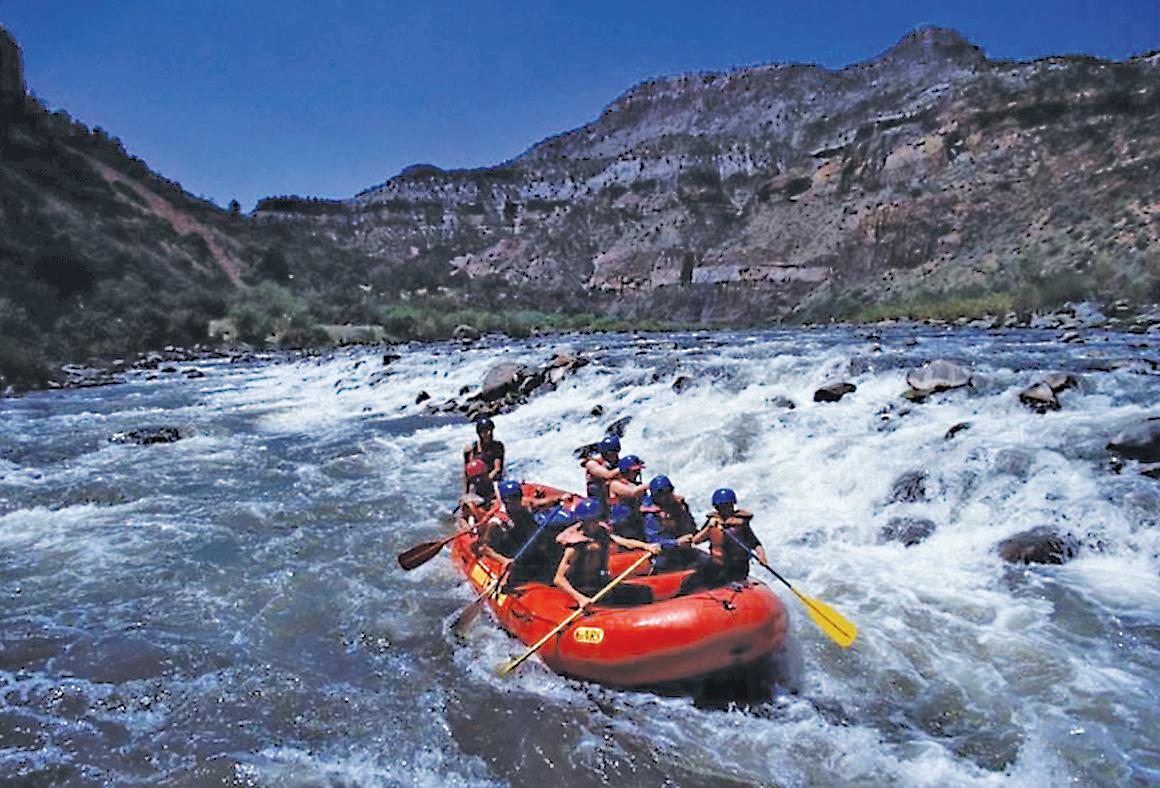
BY KANAK JHA Cronkite News
Every spring, the Upper Salt River draws whitewater rafting enthusiasts to eastern Arizona. Tour guides start setting up camp north of Globe in February.
But a successful season depends on Mother Nature. Several tour guides said they expect this year’s season to be busy since the water conditions are better than they have been in seven years.
Water levels have reached 18,000 cubic feet per second so far, said Brendan Grady, a tour guide with Salt River Rafting. When Grady started rafting these rapids in 2013, the levels peaked at 500 cubic feet per second. And the next year, the river was not even raftable, he said.
“The Salt River is an exceptional desert river that doesn’t happen every year,” Grady said. “So we’re kind of uniquely lucky.”
The water conditions are a result of snow caps melting in the White mountains. This year, the mountains have seen 16.5 inches of snow, 7 inches more that the previous year, according to Weather Source.
Dino DeSimone, a water supply specialist for the U.S. Department of Agriculture, said the region did not have a typical winter, which means it’s not a typical spring.
“The last time we had this kind of a spring was in 2010, which was seven years ago,” DeSimone said. “So it doesn’t happen very often.”
For Colorado native Joe Greiner, rafting in Arizona is always a unique experience. He said the seclusion and wildlife in the area are a “must see” for both tourists and locals in the spring.
Greiner’s company Wilderness Aware Rafting offers a multiday tour down the river called the Salt River Wilderness trip.
On a five-day trip, rafters on the Upper Salt River start and travel about 51 miles through the Salt River Canyon Wilderness – often referred to as Arizona’s other Grand Canyon, according to the U.S. Forest Service. Rafters float past canyon walls lined with saguaro cacti and if they’re lucky, they spot a mountain goat or two along the way.
Greiner remembers the day he realized the trip was feasible for most people after a rafting guide pled guilty to blowing up a boulder that had created a bottleneck on the river’s path in 1994, according to The New York Times.
“You would normally have to stop there and reload,” Greiner said. “The whole time, your heart is racing because people are coming behind you and then once you get loaded up again, you look






















Chris Henderson is the new head coach for the Horizon Honors boys basketball program. Henderson takes over the Eagles after the team came off a 25-win season. The coach for the past three years, Steve Currier, retired at the end of the year.
Henderson, who played his high school career at Barry Goldwater High in Phoenix, has coached six years as an assistant at 5A schools.
Hines selected to take over as AIA executive
The Arizona Interscholastic Association’s executive board unanimously voted for David Hines to succeed Dr. Harold Slemmer as the next AIA’s executive director.
Tempe Union Assistant Superintendent Anna Battle and Mike Sivertson of the Peoria Unified School District were also in the running for the post. Hines, the AIA’s current assistant executive director, joined the association in 2008.
Hines’ experience with Arizona’s high schools began when he attended Tempe High (Class of 1973). He eventually joined the Mesa School District, serving that district for 30 years as an administrator, teacher and track, cross country and football coach. Among his roles with the AIA, Hines has served as a tournament coordinator and AIA member school liaison.
Three Arizona State student-athletes – Fred Gammage, Matt Haack and Laiu Moeakiola –have been named to the 2017 National Football Foundation (NFF) Hampshire Honor Society, the NFF and College Football Hall of Fame.
The NFF Hampshire Society is comprised of college football players from all divisions of play who each maintained a cumulative 3.2 GPA or better throughout their college career.
Gammage, Haack and Moeakiola are among a total of 1,089 players from 297 schools qualified for membership in the society’s 11th year, both new single-year records in the history of the program.
Former Hamilton coach to receive Kush Award
Former Arizona State University Assistant Athletics Director of Football Operations and High School Relations John Wrenn has been named the 2017 recipient of the Frank Kush Lifetime Achievement Coaching Award from the Valley of the Sun Chapter of the National Football Foundation.
The award recognizes outstanding Arizona high school and/or college coaches who have contributed significantly to the game.
Wrenn becomes the seventh individual with ASU ties to win the award, joining the award’s namesake, former ASU head coach Frank Kush. Others are head coaches Bruce Snyder and Ed Doherty, former ASU assistant coach Larry Kentera, former ASU athletics director Dick Tamburo and coaching legend Karl Kiefer.

Ahwatukee!


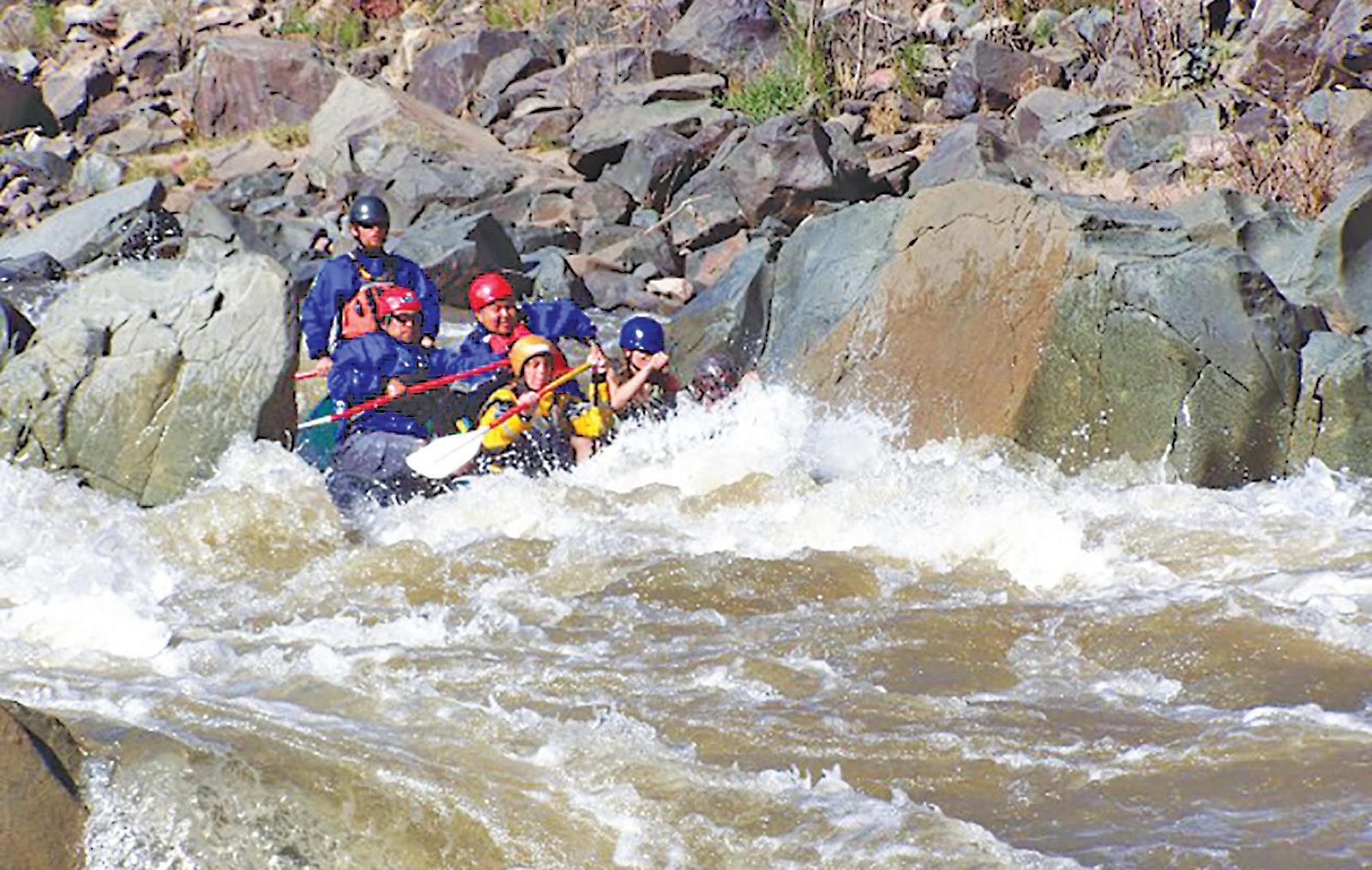
from page 61
back at this death falls. That day – when we discovered that the wilderness trip was accessible to everyone – was pretty exciting.”
Trips down the river cost between $85 to $920 per person depending on the trip length and company. While revenues go to the handful of tour companies based in Colorado, the tourism dollars for local hotels, transportation and food benefit Globe and Show Low on the outskirts of the canyon.
Salt River Rafting connects its customers to local restaurants, lodging and activities. The Best Western Copper Hills Inn has special rates for rafters during the season.
“We have rafting groups stay here often since we are the closest to the site near Show Low,” said Shauna Cameron, operations manager at the Best Western. “The groups come from all over,
from page 57




of 33 field goal attempts last season after sitting out 2015. Now, she is headed to Colorado in the fall ready to do whatever it takes to succeed.
“I just want to go and kick, and play basketball,” said Longo, who hopes to play both sports. “I plan on studying sports management and focusing on my schooling. I know I am getting a chance to do something that most people don’t, so I am going to do my best to make it happen.”
And if she happens to inspire some
including Arizona.”
Arizona might not seem like a rafting destination in comparison to neighboring Colorado. But the rapids on the Salt River are white rapids, and the falls that originally blocked the path were classified as Class 6, the most dangerous. Most of the existing rapids on the Salt River are labeled intermediate, Class 3 or higher, according to American Whitewater.
The guides take groups of up to 200 people a day down the river. “We have thousands of people coming out here to try the rapids,” Grady said.
American Whitewater uses the U.S. Geological Survey Gauge to report water conditions on the river about every hour, and the tour guides use the information to plan their trips, although the water levels can vary.
“It’s a unique, awesome resource,” Grady said. “There is variability with the river, it can change quickly. You might as well take advantage of it.”
younger girls, as Garrett did for her, then she will do her best to do just that along the way.
“It is hard to put into words what all of this means,” she said. “I never expected any of this and I am speechless when it comes to the amount of support and help I’ve received to get me through this process.
“I just want to kick and get better, but if it can inspire some young girls do something like that then I hope it works out like a dream like it has for me.”
– Contact Jason Skoda at 480-898-7915 or jskoda@evtrib.com. Follow him on Twitter @ JasonPSkoda.
ARMOUR, Don
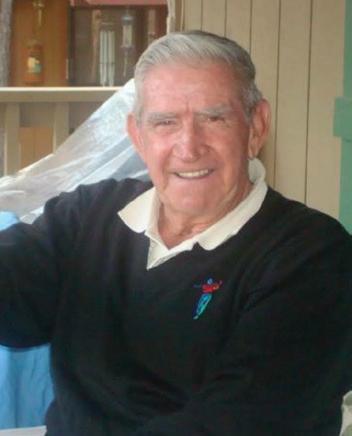
was the consummate gentleman, always had
made a positive impression on every single person he met He did random acts of kindness before the phrase was invented

was a true cowboy, ranching, wrangling, and had an early career as prof
dealership in Grand Junction Beginning from an entry-level position of w
Phoenix, and began a career with America West Airlines He was in the final class to be cross-trained on nearly all aspects of airline operations, including being a flight attendant
farm and turf equipment manufacturers He traveled the western United States, calling on dealers, establishing relationships He continued thriving in this business until the time of his death For the past six years he partnered with his son David Watching David continue to service and grow the business he started was one of his greatest satisfactions
Donʼs favorite business, however, was spending time with his wife Vy and their extended, blended family Five children, seven grandchildren, and four great-grandchildren afforded many opportunities for celebrations and milestones Whether in Colorado, Arizona, Illinois, or Michigan, Don and Vy traveled to be with family to share their lives throughout the years
Don and Vy lived in the Ahwatukee Foothills (Phoenix) community since 1991, active in golf, community, church, and volunteer activities, forging f a m i l y - l i k e f r i e n d s h i p s a t e v e r y t u
owned and operated Pages Book Co at 40th and Chandler Blvd where they developed friendships they have kept to this day
Don was a member of the Foothills Golf Club, attended Desert Foothills United Methodist Church and was an active volunteer for YOPAS, driving seniors to their various appointments
Since 1996, Don and Vy spent summers in Mundʼs Park, Arizona, escaping the heat, opening their home to visitors, and thriving in yet another loving community For Don, Mundʼs Park was a little piece of Colorado and was his favorite place to be
Don leaves behind his wife Vy; son Jeff (Trish) of Pho enix; son Dave ( K r i s t y ) o f G r a n d J u n c t i
C h a n d l e r , D a u g h t e r - i n - l a w B
(Bette Anne) of Northfield, Illinois; Vyʼs daughter Roberta (Pete) of Hillsd
There will be a Celebration of Life Saturday, April 29, 2017, at 11 a m , Mountain View Lutheran Church, 11002 S 48th St , Phoenix, Arizona, 85044 In lieu

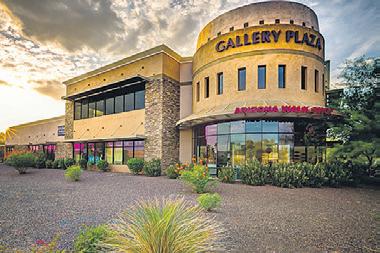

Contact David Singh at 602-380-8080 or David singh@pruthiproperties com













Ahwatukee Foothills Friends and Neighbors (AFFAN) is a women s organization, dedicated to cultivating friendships, and goodwill. AFFAN promotes social charitable and educational events all year long AFFAN holds monthly luncheon meetings with varied speakers We offer over 40 monthly activities including Book Clubs, Canasta, Bunco, Euchre, and Bridge. Other monthly activities are Dining Out, Stitch and Chat, Explore Arizona, and Garden Club Significant others/ spouses can attend some events For more info contact Teresa Akrish Phone: 480-518-5788, teresaakrish@gmail.com Check our website at affanwomensclub com






















Dining For Women (DFW) diningforwomen org inspires, educates and engages people to invest in programs that make a meaningful difference for women and girls
extreme


















DFW helps women find dignity and strength, develop skills and opportunities value and support their children s education We have a local chapter in Ahwatukee which meets the 3rd Thursday every month from 6 30 p m -8:30p m If you d like to know more on how you can transform lives and reduce poverty contact Mary Hake at marysullivanhake @gmail com
PARENTS OF ADDICTED LOVED ONES
Are you affected by someone who is dealing with an addiction? If so, know that you are not alone and that the PAL (Parents of Addicted Loved Ones) group can help. The group is available to provide education and support to anyone 18 years or older who is dealing with a friend or family member with an addiction See our local meeting list at palgroup org
PRAISE AND WORSHIP, GREAT MESSAGES FOR TODAYS LIVING! OUR MISSION IS “EVANGELISM, HEALING, DISCIPLESHIP, THROUGH THE WORD OF GOD! VISIT US AT ValorCC com




















































































































BOOK GROUP!
3rd Wed at 3pm at the Ahwatukee Retirement Center At 5001 E Cheyenne Dr, Phoenix, Az 85044
Contact ED MANGAN Cmdr 602-501-0128
In-Ahwatukee Toastmasters Club meets from 6:45-8am every Tuesday at Dignity Health Urgent Care Ahwatukee - Community Room (1st floor) 4545 E Chandler Blvd , Phoenix, AZ 85048
Guests welcome anytime! http://4873 toast mastersclubs org/
We are a group of women, of all ages, who meet the first Tuesday of the month, in local venues, for the purpose of discussing member chosen books We do not charge fees, we call ourselves the Happy Hour Book Club and we go by the initials HHBC For more information interested women can contact Donna and the email address is happyhourbook clubahwatukee@ gmail com
GAMBLERS ANONYMOUS & GAMANON for meeting information 602-266-97846