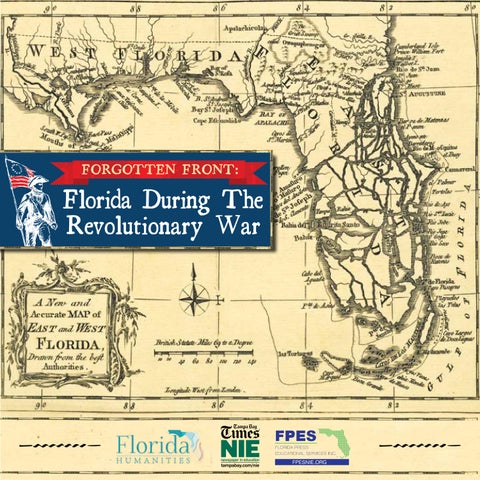
Florida During The Revolutionary War

In the beginning
On July 4, 2026, the United States of America will commemorate the 250th anniversary, or semiquincentennial, of the signing of the Declaration of Independence. The fight for freedom from British rule started many years before the actual revolution, change in government or society took place. As John Adams wrote, “The Revolution was in the minds of the people, and this was effected, from 1760 to 1775, in the course of 15 years before a drop of blood was drawn at Lexington.”
The American Revolution arose out of the intellectual and political disorder following Great Britain's victory in the French and Indian War (1754-1763), also known as the Seven Years' War.
The war provided Great Britain with large territorial gains in North America; however, disputes about frontier policy and paying the war’s expenses led to discontent among the American colonists, and ultimately to the American Revolution.
Sources: Office of the Historian, U.S. Department of State; Library of Congress; National Archives
Setting the stage
Starting in the 1760s, American colonists began to protest the taxes that Parliament imposed on them. By the 1770s, colonists in Boston were in open conflict with British troops, and in 1773 staged the Boston Tea Party in anger over a new tax on tea. At the same time, colonists objected to British
revolution of the mind
The American Revolution developed out of the intellectual and political turmoil following Great Britain’s victory in the French and Indian War, according to the Library of Congress. American colonists were inspired to resist British colonial policies that “raised issues of inequalities of power, political rights and individual freedoms. This revolution of the mind had physical consequences as Americans openly and sometimes violently opposed Great Britain’s new assertions of control.”
policies that prevented them from moving west and settling on Native American lands.
The British Parliament was determined to control the unruly American colonists. Britain began to prepare for war in early 1775. The first fight broke out in April of that year in Massachusetts. In August, King George III proclaimed the colonists “in a state of open and avowed rebellion." In other words, the colonists wanted to fight against their government. With the publication of Thomas Paine’s pamphlet "Common Sense" in early 1776, a fire was lit under this previously unthinkable idea.
On June 11, 1776, Thomas Jefferson began to write the Declaration of Independence. Jefferson, who borrowed his prose from existing documents such the Virginia Declaration of Rights, later explained that “he was not striving for originality of principal or sentiment.”
Instead, he hoped his words served as an “expression of the American mind.”
Jefferson wrote: “When in the Course of human events, it becomes necessary for one people to dissolve the political bands which have connected them with another, and to assume among the powers of the earth, the separate and equal station to which the Laws of Nature and of Nature’s God entitle them, a decent respect to the opinions of mankind requires that they should declare the causes which impel them to the separation.”
Sources: Office of the Historian, U.S. Department of State; Library of Congress; National Archives

Top: Stone engraving of the Declaration of Independence. National Archives
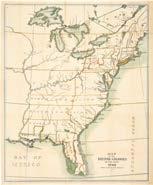
Bottom: Map of the British Colonies in the Year 1765. National Archives Thomas Jefferson,
In his writing of the Declaration of Independence, Thomas Jefferson was influenced by the works of John Locke. Locke, “a well-known English political philosopher, provided many Americans with the philosophical arguments for inalienable natural rights, principally those of property and of rebellion against abusive governments. The phrase "inalienable rights" refers to rights every person is born with and cannot lose.
What exactly are inalienable natural rights? In pairs or small groups, research Locke’s philosophy and the idea of “inalienable natural rights.” Write down the main points of this philosophy. Next, look in the newspaper for examples of the rights Locke writes about. Search for articles, photos,
Think about it George Washington, aware of the strategic importance of the Florida territories, wrote more than 80 letters about the Florida colonies to the Continental Congress and his generals. Washington authorized five separate invasions of East Florida between 1776 and 1780, none of which were successful. During a series of battles from 1779 to 1781, Spain was able to recapture West Florida. When the American Revolution ended in 1783, England returned East Florida to the Spanish in the Treaty of Paris. Florida became a United States Territory in 1821 and was officially named a state in 1845.
Sources: Florida Historical Society; University of Florida 6
headlines and phrases that represent these rights. Create an infographic explaining Locke’s main ideas. You can create your infographic using pen and paper, or it can be created on Canva. Share your infographic and what you have learned with your class.
Florida Standards: SS.8.A.1.1; SS.8.A.1.3; SS.8.A.1.5; SS.8.A.1.6; SS.8.A.1.7; SS.8.A.3.5; SS.8.A.3.6; SS.8.A.3.8; SS.8.A.4.3; SS.8.A.4.8; SS.912.A.1.1; SS.912.A.1.2; SS.912.A.1.5; SS.912.A.1.6; SS.912.A.1.7; ELA.612.EE.1.1; ELA.612.EE.2.1; ELA.612.EE.3.1; ELA.612.EE.4.1; ELA.612.EE.5.1; ELA.612.EE.6.1; ELA.612.F.2.1; ELA.612.F.2.2; ELA.612.F.2.4; ELA.612.C.1.3; ELA.612.C.1.4; ELA.612.C.2.1; ELA.612.C.3.1; ELA.612.C.4.1; ELA.612.C.5.1; ELA.612.R.2.1; ELA.612.R.2.2; ELA.612.R.2.3; ELA.612.R.2.4; ELA.612.V.1.1; ELA.612.V.1.3
A timeline of significant events in Florida and around the nation
1559
August – Spanish conquistador Tristán de Luna y Arellano brings 1,500 soldiers, colonists, slaves and Aztec people in 11 ships from Veracruz, Mexico, to Pensacola. In September, the colony is struck by a hurricane, sinking many of their ships and devastating their food supplies. In 1561, the remnants of the colony are rescued by Spanish ships and returned to Mexico, and the site is abandoned.
H 1565
September 8 –Spanish conquistador Pedro Menéndez de Avilés founds St. Augustine, the first permanent European settlement in North America.

1585
The first British colony, granted by Elizabeth I to Sir Walter Raleigh, is established on Roanoke Island off North Carolina. Most settlers return to England within a year under threat of a Spanish raid. In 1587, John White would return with a group of about 120 English colonists. Later that year, he would return to England for supplies and more colonists. Upon his return in 1590, the colony is deserted, leading to the nickname, the “Lost Colony.”
H 1586
May 28-30 –Sir Francis Drake ransacks and burns St. Augustine during a raid against Spanish settlements in the Caribbean.
H 1607
May 14 –Jamestown, Virginia, the first permanent English settlement in North America, is founded by English settlers.
H 1620
November 11 – The Mayflower arrives at what is now Provincetown Harbor, Cape Cod. Before going ashore, 41 male passengers sign the Mayflower Compact, the first governing document of the Plymouth Colony.
December 18 – The Mayflower anchors in Plymouth Harbor, the site that would become the Plymouth Colony.
1693
November 7 – Spanish King Carlos II issues a royal decree granting freedom and protection to all enslaved people forced to work with no freedom or rights, Africans escaping British colonies, as long as they convert to Catholicism and serve Spain.
Declaration of Independence by Napoleaon Sarony. National Museum of American History
National Archives
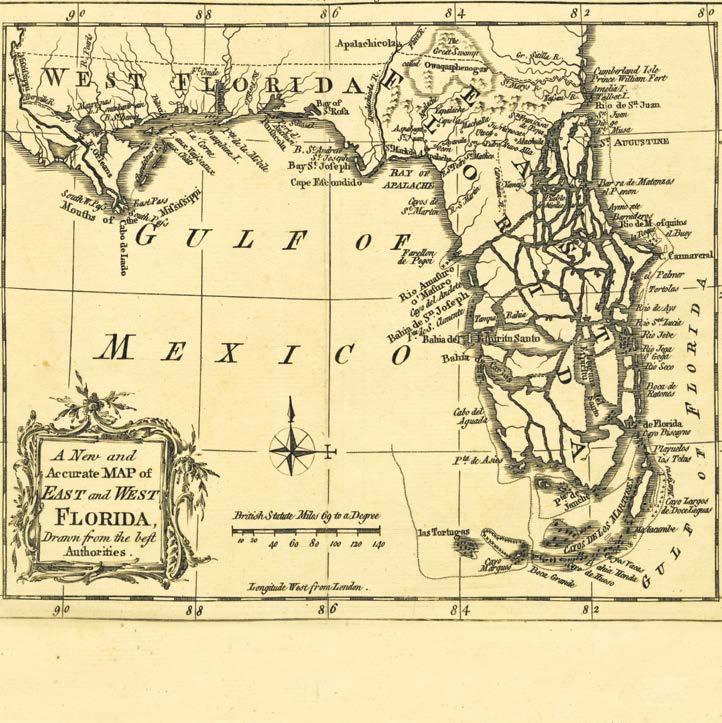
East and West Florida
In 1763, France, Britain and Spain signed the Treaty of Paris at the end of the French and Indian War. As part of the treaty, France gave up almost all its land in North America, and Spain gave up Florida.
During the French and Indian War, Britain had captured Havana, Spain’s busiest port. In exchange for Havana, the Spanish traded Florida to Britain. The British then divided Florida into two territories: East Florida and West Florida.
Pensacola became the capital of West Florida. St. Augustine became the capital of East Florida. Under British rule, East Florida consisted of what is the modern boundary of the state, east of the Apalachicola River. West Florida included the modern Panhandle of Florida, as well as parts of what are now Louisiana, Mississippi and Alabama.
The land of flowers
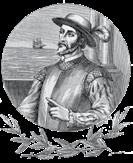
Written records about life in Florida began in 1513 with the arrival of Ponce de León. Between April 2 and April 8 of that year, de León landed on the northeast coast of Florida. He called the area la Florida in honor of Pascua florida ("feast of flowers"), a Spanish name for Easter.
The city of St. Augustine was established by the Spanish in 1565. It is the oldest continuously occupied settlement of European and African American origin in the United States.
St. Augustine was an active city for more than four decades before the English established a settlement at Jamestown, Virginia, in 1607.
Sources: Florida Historical Society; City of St. Augustine; Florida Department of State
Loyalty to the crown
At the start of the American Revolution, East Florida and West Florida were the only two southern colonies that remained loyal to King George III. This was a problem for the British, because the southern colonies in North America supplied food, clothing and other supplies to their sugar plantations in the Caribbean.
At the time, the British had 33 colonies from Nova Scotia, Canada, down to Grenada. Sixteen of those colonies were in the Caribbean.
During the American Revolution, approximately 60 percent of the British military was stationed in the Caribbean.
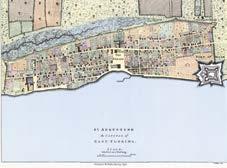
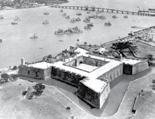
The two Florida colonies were located between the British sugar plantations in the Caribbean and the northern colonial revolt. The British launched attacks on the American rebellion from both St. Augustine and Pensacola. St. Augustine was especially important to the British because it had the only stone fortresses south of the Chesapeake Bay.
Sources: Florida Center for Instructional Technology; Florida Historical Society; City of St. Augustine; Florida Department of State
Prosperity and hope
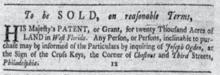
During British rule, England had a strong desire to develop Florida trade. The London Board of Trade advertised 20,000-acre land lots to those willing to enter Florida. The land, however, had to be settled within 10 years with one resident per 100 acres.
While the King’s council in London granted land titles, pioneer families could gain land grants at the two colonial capitals, St. Augustine and Pensacola. Former British soldiers were eligible for special grants. Each pioneer settler was given 100 acres of land and 50 acres per family member. To recruit southerners, slavery was permitted.
Pioneer families had much to celebrate in British Florida. The Native American hostilities had ended, and there had been peace in Florida for more than 10 years. The population of St. Augustine nearly doubled from what it was in the Spanish period. Commerce and trade were growing, including cattle ranching, shipping and plantation agriculture.
Source: National Park Service

H 1698
November 21 – The presidio of Santa María de Galve is founded by the Spanish on the site of today’s Pensacola Naval Air Station. In 1752, the Spanish move to the mainland and establish Presidio San Miguel de Panzacola, the site of present-day Pensacola.
H 1702
November 3 –James Moore, Governor of Carolina, attacks Spanish St. Augustine. Until December 26, 1,445 people are held under siege in the Castillo de San Marcos. Moore burns virtually the entire town before his departure.
H 1719
May 14 – Pensacola is captured for France by the Governor of French Louisiana, Jean-Baptiste Le Moyne de Bienville. 1722
November 25 –Pensacola returns to Spanish control. It is burned to the ground by the departing French.
H 1738
March 15 - The free Black settlement Gracia Real de Santa Teresa de Moze, now known as Fort Mose is established near St. Augustine. It is the first free Black settlement in what is now the United States.
H 1740
January 7-8 – British General and Governor of Georgia James Oglethorpe seizes two Spanish forts, Fort Picolata and Fort San Francisco de Pupo, west of St. Augustine along the St. Johns River.
May 24 – July 20 – General Oglethorpe again attempts to seize St. Augustine. Unable to seize the fort, he begins a siege. In other words, the army surrounded the fort and cut off supplies to force surrender. The siege of St. Augustine ends in defeat for Gen. Oglethorpe, who retreats to Fort Frederica on the Georgia barrier island of St. Simons.
H 1742
July 7 – La Florida Governor Manuel de Montiano attacks Fort Frederica but is defeated in the Battle of Bloody Marsh. The defeated Spanish leave the island on July 13.
H 1743
March 30-31 –General Oglethorpe again attempts to raid St. Augustine, but fails.
H 1754
May 28 – The French and Indian War (Seven Years' War) begins.
July 10 – The Albany Congress is called in Albany, New York. Benjamin Franklin proposes the
government for the colonies.
Albany Plan of Union a single
Thomas Jefferys, Map of St. Augustine, 1769. State Archives of Florida, Florida Memory
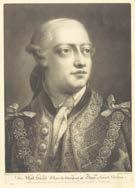
King George III. Library of Congress
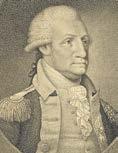
General George Washington. Library of Congress
The Virginia Gazette June 13, 1771
Ponce de Leon. State Archives of Florida, Florida Memory
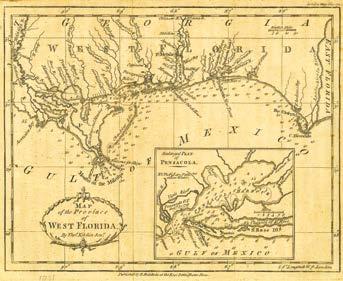
The colony of West Florida
West Florida consisted of the land between the Mississippi and the Apalachicola rivers. It included parts of modern-day Alabama, Mississippi and Louisiana. Pensacola was the capital of West Florida. West Florida had thick pine trees and sand. It was not good for farming and did not grow in population as much as East Florida. West Florida earned most of its money through the sale of animal fur and lumber.
Sources: Florida Center for Instructional Technology; Historical Society of Palm Beach County
British West Florida
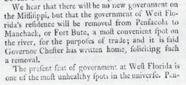
During the Seven Years’ War, British forces defeated those of the Spanish and the French. One result was a new British province: West Florida. This new territory was created in 1763 from what had been Spanish and French possessions in what are now Mississippi, Louisiana, Alabama and the Florida panhandle. Territorially, British West Florida included more than half of the present state of Alabama. Its first northern boundary was just below modern Montgomery; however, due to lobbying by West Florida’s first governor, George Johnstone, the boundary was expanded in 1764 to below present-day Birmingham.
X
The towns of Pensacola and Mobile were important at the time, since they were both ports. Apart from a scattering of traders, the population surrounding the British settlements was primarily Native American, particularly Creek, Choctaw and Chickasaw.
X
The onset of the American Revolution in1775 hindered the growth of population and the expansion of trade in that region. American privateers further hindered the flow of goods and immigrants to British territories. According to the Naval History and Heritage Command, a privateer is a person or ship that engages in maritime warfare under a commission of war.
A home for loyalists
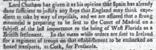
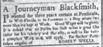
The one population group that increased during the revolution was the Tories, or loyalists: people who remained loyal to the British crown. Tories found West Florida an attractive location because “the British crown offered free land in West Florida as a reward to anyone who met any of three criteria: proven loyalism, service in the Seven Years’ War, or head of household,” according to Alabama Humanities Alliance.
At its height in 1779, the white population of West Florida did not exceed 6,000. Throughout the colony’s existence, the military was a major component of the population.
Land was either cheap or free in West Florida, so many immigrants were able to acquire large holdings and establish plantations worked by enslaved people.
Source: Alabama Humanities Alliance
Growing the province
In West Florida, Governor George Johnstone promoted immigration and plantation development. Johnstone focused his recruiting efforts on French, German and Swiss farmers.
While the land in West Florida around Pensacola was sandy and infertile, there was fertile soil near the Amite and Mississippi rivers. That rich farmland remained unused until late in the British years. Consequently, exports of animal skins and furs were the primary source of West Florida's economy. News of fertile farmland spread in the early 1770s, which prompted an influx of emigrants to West Florida. However, by the time the new people selected tracts and initiated settlements, the Revolutionary War began, and further population growth and development ceased.
Source: Florida Division of Historical Resources

888888888888888888888888888888888
1763
February 10 – The Treaty of Paris ends the French and Indian War (Seven Years' War). French territories east of the Mississippi become British. French territories west of the Mississippi become Spanish, along with the port of New Orleans.
Spain surrenders La Florida, which had been a Spanish colony since the 16th century, to Britain. Britain divides it into two colonies: East Florida, with St. Augustine as its capital, and West Florida, with Pensacola as its capital.
October 7 – King George III issues the Proclamation of 1763 forbidding European settlement west of the Appalachian Mountains, but encouraging movement to the Floridas.
1764
April 5 – Britain passes the Sugar Act, taxing sugar and other goods.
The Pennsylvania Gazette, May 30, 1765.
"Thursday last dispatches were received from his Excellency James Grant, Esq.; Governor of East Florida, giving an account that the civil government of that province was happily established."
1765
March 22 – Britain passes the Stamp Act taxing most paper goods (legal documents, newspapers, pamphlets, etc); they must have a stamp to show the tax was paid.
March 24 – Britain passes the Quartering Act making colonial legislatures, a group of people who make laws, responsible for the cost of barracks or other accommodations for British troops.

Top: Rind's Virginia Gazette, Oct. 15, 1772; Center: The Pennsylvania Gazette, Jan. 3, 1765; Bottom: The Virginia Gazette, April 19, 1770.
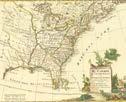
Prockter, J. Map of East and West Florida, 1765 State Archives of Florida, Florida Memory
The South Carolina and American General Gazette, Oct. 7, 1771.
The South Carolina and American General Gazette, Dec. 10, 1771.
Willing expedition
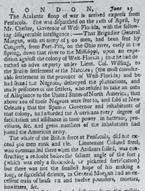
Being farther from the population centers in Georgia, West Florida faced fewer invasions than the rest of the territories. The notable exception was the Willing Expedition, which took place in the winter of 1778.
Continental Naval Captain James Willing was sent as an ambassador by Congress to invite West Florida to become the fourteenth state. Although sympathetic to the American cause, local leaders were concerned by the threat posed by New Orleans and Spanish Louisiana. The leaders refused Willing’s invitation. Congress, wanting the population of West Florida to swear an oath of neutrality, authorized Willing to lead troops into the region. Willing raided plantations in West Florida and acquired oaths from the citizens of Natchez and other areas. Eventually, a loyalist force defeated Willing’s raiders, and they sought shelter in New Orleans.
Willing’s vessel was intercepted during a return Atlantic voyage and he was held on a prison ship in New York for at least a year. In May 1779, Spain entered the war, dramatically shifting the balance of power on the Gulf Coast.
Source: American Battlefield Trust
Changing of the guard
During the first three years of the American Revolution, West Florida remained uninvolved and proudly loyal to Britain. To protect West Florida from other raids, Britain reenforced it with two regiments of troops from Pennsylvania and one regiment from Germany.
Following Spain's declaration of war on Britain, on June 21, 1779, Bernardo de Galvez, Spanish governor of Louisiana, attacked West Florida. In September 1779, Baton Rouge was the second British outpost to be seized by Gálvez's men. Gálvez and his commander José Manuel de Ezpeleta laid siege to Mobile’s Fort Charlotte in March 1780. Elias Dunford, commander of the fort, surrendered on day 13 of the attack.
For the next year, the new governor of Mobile, José de Ezpeleta, attacked the Pensacola military base and Britain’s Native American allies from Mobile. Pensacola, West Florida’s last stronghold, surrendered to Gálvez in May 1781, ending British rule in West Florida.
Source: Alabama Humanities Alliance; Naval History and Heritage Command
GOING BEYOND THE TEXT Newspapers: A window onto society
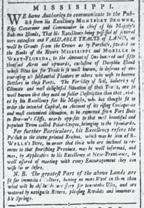
On the pages of this Newspaper in Education publication, there are many images of newspaper accounts of what took place during the Revolutionary War era.
On its website, Florida State University Libraries notes, “Newspapers record historical events, but they do so in a way that reflects the concerns, opinions and debates of their communities, which may be local, national,
The Floridas after the revolution
While the colonies of East Florida and West Florida remained loyal to the British during the war, both provinces became Spanish territories after the signing of the Treaty of Paris in 1783.
After 1783, American immigrants moved into West Florida. In 1810, the American settlers in far western West Florida rebelled. President James Madison and Congress used this rebellion to annex the land to Louisiana, then a U.S. territory.
Further negotiations about East and West Florida started in 1815. It was not until 1818, when General Andrew Jackson seized Pensacola and Fort St. Marks, that Spain realized it could no longer defend the area from attack.
President John Quincy Adams used Jackson’s military action to force Spain to control the residents of East Florida or give up control to the United States. As a result, Spain released control of East Florida and gave up all claims to West Florida.
Under the Onís-Adams Treaty of 1819, the United States and Spain defined the western limits of the Louisiana Purchase and Spain relinquished its claims to the Pacific Northwest. In return, the United States recognized Spanish rule over Texas.
Source: Office of the Historian, U.S. Department of State
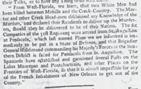
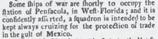
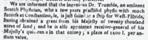
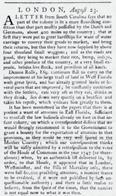
or international.” In addition, a newspaper also is a business, which affords a special platform for society. “Thus, while we can rely on newspapers to relay the latest news of its time and place, that news is a filtered version of everything that happened, framed in such a way to meet both the goals of the paper as a business and to capture the attention and interest of a target audience of readers.”
Using the newspaper snippets in this publication, write down some of the key ideas about society during the Revolutionary War period. Next, look through the newspaper for key ideas about society today. Be sure to look at
all the sections of the newspaper, including articles, photographs, cartoons and advertisements. Write a brief essay explaining what future generations will think about our society based on the modern newspaper. Florida Standards: SS.8.A.1.1; SS.8.A.1.2; SS.8.A.1.3; SS.8.A.1.5; SS.8.A.1.7; SS.8.A.3.8; SS.8.A.3.16; SS.912.A.1.1; SS.912.A.1.2; SS.912.A.1.4; SS.912.A.1.5; SS.912.A.1.6; SS.912.A.1.7; ELA.612.EE.1.1; ELA.612.EE.2.1; ELA.612.EE.3.1; ELA.612.EE.4.1; ELA.612. EE.5.1; ELA.612.EE.6.1; ELA.612.F.2.1; ELA.612.F.2.2; ELA.612.F.2.4; ELA.612.C.1.3; ELA.612.C.1.4; ELA.612.C.2.1; ELA.612.C.3.1; ELA.612.C.4.1; ELA.612.C.5.1; ELA.612.R.2.1; ELA.612.R.2.2; ELA.612.R.2.3; ELA.612.R.2.4; ELA.612.V.1.1; ELA.612.V.1.3
888888888888888888888888888888888 HH
March 29 – The Virginia House of Burgesses passes the Virginia Resolves, seven resolutions that challenge the legality of the Stamp Act.
October 7-25 – The Stamp Act Congress meets in New York City and issues a “Declaration of Rights and Grievances against Great Britain” to protest the tax and demand representation.

1766
March 18 – Britain repeals the Stamp Act and passes the Declaratory Act, which reiterates Parliament’s authority over the colonies.

"We hear that 200 different grants of land, to the amount of 70,000 square acres, were, in the course of last year, made out to settlers in West Florida." The South Carolina Gazette, July 7, 1766.
1767
June 5-29 – Britain passes the Townshend Acts, imposing new duties on imports of glass, paint, oil, lead, paper and tea to the Colonies from Britain.
Denys Rolle, a a former member of the British Parliament, begins to settle his Rollestown plantations with laborers, people who worked for several years to pay off a debt or earn passage to America, from England. He would continue to acquire land until 1784, reaching a total acreage of 78,000 acres near present-day Palatka. In 1779, he would replace his indentured workers with enslaved Africans. In 1784, he would leave for the Bahamas and file a claim for compensation with the East Florida Claims Commission.
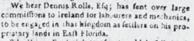
"We hear Dennis Rolle, Esq. has sent over large commissions to Ireland for labourers and mechanics, to be engaged in that kingdom as settlers on his proprietary lands in East Florida." The South Carolina Gazette, Aug. 24, 1767.
Poulson's American Daily Advertiser, Nov. 10, 1778.
The South Carolina and American General Gazette, April 28, 1775.
The Virginia Gazette, Dec. 3, 1767.
Top: The Pennsylvania Gazette, April 11, 1765. Below: The South Carolina Gazette and Country Journal, Jan. 5, 1768.
Top: The South Carolina Gazette and Country Journal, May 8, 1770; Middle: The South Carolina Gazette and Country Journal, June 23, 1775; Bottom: The South Carolina Gazette and Country Journal, Jan. 5, 1768.
Think about it
At today’s Ormond Beach, in Volusia County, a Scottish merchant named Richard Oswald sent agents, overseers and 240 enslaved Africans to two 20,000-acre tracts that became known as New Smyrna. Dr. Andrew Turnbull, the resident manager, traveled to the Mediterranean in 17671768 to recruit indentured laborers from Greece, Italy and Minorca. With the outbreak of the American Revolutionary War in 1775, shipping forest products and indigo from other colonies was not safe. This created a market for these items for Florida planters. Workers were transferred from indigo fields to fields of timber to harvest wood, turpentine, pitch and tar to supply to the British.
Source: Florida Division of Historical Resources
Colony of East Florida
East Florida was important to both the American rebels and the British. The British wanted to control East Florida because its ports served as privateering bases to use against the French. They also wanted to eliminate the Spanish threat to the colony of Georgia. The American rebels saw East Florida’s possession by the British to be a threat to the security of the new nation.
The East Florida colony was bordered by the Apalachicola River, the Gulf of Mexico and the Atlantic Ocean. St. Augustine was the capital.
While West Florida had sandy soil, East Florida had fertile soil and was better for farming.
To bring settlers to East Florida, the British crown offered land grants – free acreage – to settlers who would come to farm and defend the new British territory.
A growing settlement
James Grant, the first governor of East Florida, did more to increase the population of East Florida than anyone else. Grant maintained good relations with the Seminole tribe and traded goods with them. He encouraged entrepreneurs from England and other British colonies to take advantage of the land grant policies that enabled settlers to obtain large tracts in East Florida at little or no cost. He also encouraged settlers from North and South Carolina, Georgia and other British colonies to come and start plantations.
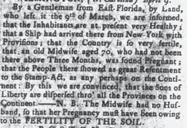
Many British citizens brought enslaved Africans to work on the plantations. The enslaved people cleared land, drained marshes, built homes, cared for farm animals, and planted and harvested crops such as citrus fruit,
February 11 – The Massachusetts Assembly issues the Massachusetts Circular Letter, denouncing the Townsend Acts and asserting that Great Britain had no right to tax the Thirteen Colonies without their representation in government.
August 1 – Boston merchants agree to not import British goods, or sell to Britain, in the Boston Non-Importation Agreement
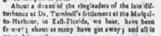
"About a dozen of the ringleaders of the late disturbance at Dr. Turnbull's settlement at the Mosquito-Harbour, in East-Florida, we hear, have been secured; about as many have got away; and all is quiet there again." The South Carolina Gazette, Sept. 19, 1768.
sugarcane, rice and cotton.
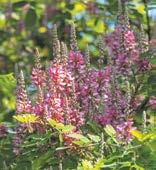
In the 1760s and 1770s, indigo, which produced dark blue dye, was the main crop raised in East Florida. It required intensive labor to grow and process. By the early 1770s, dozens of farms and plantations had been established in East Florida along the major inland rivers and along the Atlantic coast for approximately 90 miles south of St. Augustine. Although West Florida became a Spanish territory in 1781, East Florida remained loyal to Britain.
Sources: Florida Center for Instructional Technology; University of North Florida Department of History; Journal of the American Revolution; City of St. Augustine; State Archives of Florida; Florida Division of Historical Resources
The end of the war
When the Revolutionary War ended, East Florida became a sanctuary for loyalists. The Florida Division of Historical Resources notes, “Thousands of refugees were transported from Savannah and Charleston to St. Augustine and provided emergency rations, tools and seeds to plant provisions at unoccupied rural tracts. By the end of December 1782, more than 6,000 refugees had arrived in East Florida, and eventually the population increased to between 17,000 and 18,000 residents.”
At the end of the Revolution, Britain ceded East Florida back to Spain and most British colonists left. East Florida remained under Spanish rule until 1821, when it became an American territory.
Sources: Florida Division of Historical Resources; Florida Department of State

August 19 – A rebellion erupts on the New Smyrna plantation, established largely with indentured workers from the Mediterranean on 20,000 acres near Mosquito Inlet in East Florida, due to brutal working conditions and food shortages. The three-day uprising is subdued and the leaders are executed. In 1777, the New Smyrna plantation would be abandoned by most of the surviving colonists, who would flee to St. Augustine to petition the governor for change.
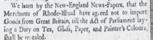
"We learn by the New-England News-Papers, that the Merchants of Rhode-Island have agreed not to import Goods from Great Britain, till the Act of Parliament, laying a Duty on Tea, Glass, Paper, and Painter's Colours, shall be repealed." The South Carolina and American General Gazette, Nov. 30, 1769.
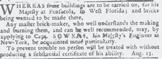
"Whereas some buildings are to be carried on, for his Majesty in Pensacola, in West Florida; and bricks being wanted to be made there, Any master brick-maker, who well understands the making and burning them, and can be well recommended, may, by applying to Capt. SOWERS, his Majesty's engineer at New-York, be acquainted more particularly. To prevent trouble no person will be treated without producing a substantial certificate of his ability." The Pennsylvania Journal or Weekly Advertiser, Aug. 22, 1771.
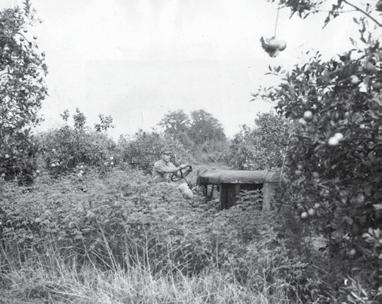
plants growing in a citrus orchard. Times, 1948.
Aerial view of Castillo San Marcos. State Archives of Florida, Florida Memory
Below: Indigofera tinctoria commonly called true indigo, was the original source of the blue dye known as indigo.
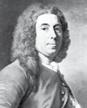
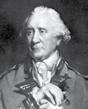
East Florida Governor James Grant. State Archives of Florida, Florida Memory
East Florida Governor Patrick Tonyn. State Archives of Florida, Florida Memory
The East Florida Rangers
Organized in 1775, the East Florida Rangers were modeled after the group of Floridians organized by Governor Lieutenant Colonel Patrick Tonyn in 1774. The rangers, a group of loyalist militiamen, consisted of 130 men, organized into four companies. A militia is a group of everyday people trained to fight in emergencies.
Refugees from Georgia and the Carolinas, the rangers were compensated for their service with clothing, supplies and one shilling a day. The Rangers supplied provisions and intelligence to the regular British troops. The militia secured the Florida settlements from attacks from Native Americans and soldiers.
Groups of rangers and Native Americans were employed to patrol the frontiers. The rangers, under control of the governor, were loosely organized and often had conflicts between military and civil authorities.
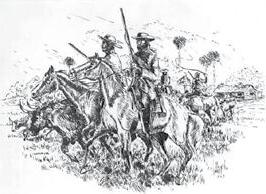
Thomas Brown
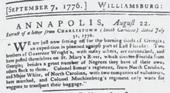
In 1779, the East Florida Rangers were reorganized into a local infantry, soldiers who fight on foot, regiment known as the King’s Rangers. The King’s Rangers, wearing new uniforms, were no longer considered to be attached to East Florida and might be taken into the King’s service.
Sources: National Park Service; Historic Florida Militia, Inc.
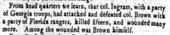
Born in Whitby in Yorkshire, England, Thomas Brown emigrated to America in 1774, at the age of 25. Brown settled in Georgia and founded the community of Brownsboro. In August 1775, Brown was challenged by a crowd of patriots who demanded to know to which army he was loyal. Brown told the patriots, colonists who wanted independence from Britain, that he would not fight against the British. A fight ensued, in which Brown suffered a fractured skull.
After he was injured, Brown was then allegedly tied to a tree where he was “roasted by fire, scalped, tarred and feathered,” according to Historic Florida Militia, Inc. Angry and injured, Brown began mobilizing Georgia’s loyalists and the local members of the Creek Nation into a militia. Brown led a group of horse-mounted loyalists, which became known as the East Florida Rangers. Brown was so successful in getting support from the Creek nation for the Crown that in 1779, he was appointed Superintendent of Creek and Cherokee nations.
Source: Historic Florida Militia, Inc.
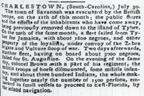
March 5 – British troops fire into a crowd of Boston colonists protesting the occupation of their city by British troops, killing five and injuring three more, an event that becomes known as the Boston Massacre
1772
November 2 – The Boston Committee of Correspondence is established and writes to every town in the province, encouraging towns to create their own committees of correspondence. Within six months, 118 outlying towns create committees and respond to Boston. These lines of communication connect Boston’s radical leaders to the towns, becoming a key communications system during the early years of the American Revolution.
DID YOU KNOW?
When the American Revolutionary War broke out in 1776, the population of East Florida was 4,000, including 3,000 enslaved people from Africa. Of the one thousand white settlers, most were immigrants from England and Scotland who received royal land grants from King George III. As tensions in the
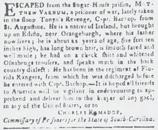
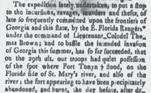
The South Carolina Gazette and Country Journal, July 8,
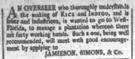
"AN OVERSEER who thoroughly understands the making of RICE and INDIGO, and is sober and industrious, is wanted to go to WestFlorida, to manage a plantation whereon there are forty working hands. Such a one, being well recommended, will meet with good encouragement by applying to JAMIESON, SIMONS & Co." The Virginia Gazette, Apr. 11, 1777
13 colonies intensified, the British governor of East Florida invited loyalists to come to Florida and “take shelter under the British flag.” When news of the signing of the Declaration of Independence reached St. Augustine, an angry mob of loyalists burned effigies of John Adams and John Hancock in the city plaza.
Source: National Park Service
GOING BEYOND THE TEXT
Researching informational text
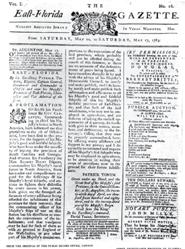
Although news from Florida was often covered in Revolutionary War-era newspapers, there was only one newspaper printed in the state during this time. The East Florida Gazette, sometimes referred to as the East Florida Gazette Extraordinary, was founded in 1783 by Dr. William Charles and John Wells. This loyalist newspaper played an important role for the inhabitants of Florida.
Learn more about the history of the East Florida Gazette on the Journal of the American Revolution website: allthingsliberty.com/2020/02/the-eastflorida-gazette-1783-1784. Then, check out the timeline of Florida newspapers on the University of South Florida website: digitalcommons.usf.edu/cgi/viewcontent. cgi?article=4561&context=fac_publications Next read “How Florida’s newspapers grew, prospered and struggled”: tampabay. com/opinion/2021/10/24/how-floridasnewspapers-grew-prospered-and-struggledcolumn
Write a journal entry or blog post about what you have learned from these sources. Include the main points expressed by George Kotlik, Gary R. Mormino and David Shedden in their articles. Be sure to capture the main ideas as well as the who, what, when, where, why and how points discussed in the articles. Create a PowerPoint or Canva presentation showing what main points you have learned. Share your presentation with your class.
Florida Standards: SS.8.A.1.1; SS.8.A.1.2; SS.8.A.1.3; SS.8.A.1.5; SS.8.A.3.16; SS.8.A.4.17; SS.912.A.1.1; SS.912.A.1.2; SS.912.A.1.3; ELA.612.EE.1.1; ELA.612. EE.2.1; ELA.612.EE.3.1; ELA.612.EE.4.1; ELA.612. EE.5.1; ELA.612.EE.6.1; ELA.612.F.2.1; ELA.612.F.2.2; ELA.612.F.2.4; ELA.612.C.1.3; ELA.612.C.1.4; ELA.612.C.2.1; ELA.612.C.3.1; ELA.612.C.4.1; ELA.612.C.5.1; ELA.612.R.2.1; ELA.612.R.2.2; ELA.612.R.2.3; ELA.612.R.2.4; ELA.612.V.1.1; ELA.612.V.1.3

1773
May 10 – Britain passes the Tea Act, granting the British East India Company a monopoly on tea sold in the colonies.
December 16 – A group of Sons of Liberty members disguise themselves as Mohawk Indians, board three ships moored in Boston Harbor, and throw 340 chests of tea – more than 92,000 pounds – owned by the East India Company into the water in a protest about the British tax on tea and against the monopoly of the East India Company. This becomes known as the Boston Tea Party
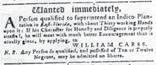
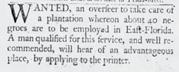
"Wanted immediately: A Person qualified to superintend an Indigo-Plantation in East-Florida, with about Thirty working Hands upon it; If his character for Honesty and Diligence is properly attested, he will meet with much better Encouragement than is usually given, by applying to, WILLIAM CARSS. N.B. Any Person so qualified, and possessed of Ten or Twelve Negroes, may be admitted on Shares." The South Carolina Gazette, July 5, 1773.
The Virginia Gazette, Sept. 7, 1776.
The Pennsylvania Evening Post, March 10, 1779
1778
Poulson's American Daily Advertiser, Sept. 3, 1782
The South Carolina Gazette and Country Journal, July 15, 1778
East Florida Gazette, May 10, 1783.
The basis of our governments being the opinion of the people, the very first object should be to keep that right; and were it left to me to decide whether we should have a government without newspapers, or newspapers without a government, I should not hesitate a moment to prefer the latter. But I should mean that every man should receive those papers and be capable of reading them.”
— Letter from Thomas Jefferson to Edward Carrington, January 16, 1787
IThe first newspapers in America
The first American newspaper, Publick Occurrences Both Forreign and Domestick, was published in Boston on September 25, 1690, by Benjamin Harris, an English writer, publisher and coffeehouse owner. It was shut down after just four days by colonial authorities, who cited the newspaper’s “sundry doubtful and uncertain reports” and prohibited any future publishers “to set forth any Thing in print without License first obtained from those that are or shall be appointed by the Government to grant the same.”
The colonies’ first continuously published newspaper, the Boston News-Letter, was first published on April 24, 1704, by postmaster John Campbell. It lasted seventy-two years. Florida’s first newspaper, the loyalist East-Florida Gazette, was founded in St. Augustine in 1783 by William Charles and John Wells, former publishers of a pro-British newspaper in South Carolina. The lack of a patriot paper was one reason the independence movement never flourished in Florida.
IMarch 31 – Britain passes the Boston Port Act closing the city’s port and ordering the citizens of Boston to pay a large fine to compensate for the tea thrown into the harbor during the Boston Tea Party. It is the first of the four Coercive Acts, known as the Intolerable Acts in America.
May 20 – Britain passes the Administration of Justice Act, which removes the ability of the colonists to hold trials of British officials in the colonies, and the Massachusetts Government Act, which essentially revokes the charter of the royal colony and placed it under the direct control of Great Britain.
NEWSPAPERS d AND THE e
AMERICAN REVOLUTION
“Without newspapers, there would have been no American Revolution.”
–Todd
Andrlik, founding editor of Journal of the American Revolution and author/editor of "Reporting the Revolutionary War: Before It Was History, It Was News"
Newspapers played a critical role in America's independence. In the eighteenth century, newspapers were the only form of mass media available. The average newspaper circulation per week in 1750 was 600. Yet the news reached many more people per copy because news articles were often read out loud to crowds in gathering places like meeting houses, coffee houses and taverns.
As Todd Andrlik notes, “Just as social media helped ignite and organize the Arab Spring revolutions of the Middle East and Northern Africa, colonial newspapers fanned the flames of rebellion, provided critical intercolonial communication during the war, sustained loyalty to the patriot cause, and aided in the outcome of the war.”
What were newspapers like?
In appearance, newspapers in the Revolutionary War period were very different from the newspapers of today. In the 1770s and 1780s, newspapers were usually only four pages. Typically, they were printed once a week. There were few illustrations, and of course, no photography. Headlines were rarely, if ever, used, and English spelling was not yet standardized.
The content largely consisted of advertising, local and world news, and legal notices, along with essays, poems and humorous material. Sources included private letters sent in by readers, European and colonial newspapers, after-action battle reports, and information from ship captains, sailors, merchants, travelers and militia. Although most of the news was weeks or even months old, it was the very latest information that colonists had access to and was considered “breaking news.”
Most newspaper publishers were printers, who had paper, ink and presses, or postmasters, who had easy access to information. There were no distinct reporters or editors. Instead, the publisher did it all. Benjamin Franklin, for example, was both a printer and a postmaster and wrote many of his paper's articles.

There is vexatious, terrible and abettors, The reason it is, as observed, to a spirited of the people’s – Samuel Boston independence create the impression to British rule pseudonyms the Roman Republic. Harbottle

June 2 – Britain passes the Quartering Act, allowing royal governors, rather than colonial legislatures, to find homes and buildings to house British soldiers. Unlike the previous Quartering Act of 1765, the Quartering Act of 1774 allows British troops to be housed in private homes and facilities.
September 5 – October 26 – Delegates from twelve of the thirteen British colonies of North America meet in Philadelphia to discuss the British blockade of Boston Harbor and the Intolerable Acts in the First Continental Congress
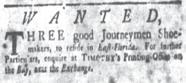
Journeyman Shoemakers, to reside in East-Florida. For further particulars, enquire at TIMOTHY'S PrintingOffice on the Bay, near the Exchange." I, The South Carolina Gazette and Country Journal, June 3, 1774.
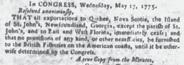
"In CONGRESS, Wednesday, May 17, 1775. Resolved unanimously, THAT all exportations to Quebec, Nova Scotia, the Island of St. John's, Newfoundland, Georgia, except the
The Boston Gazette,
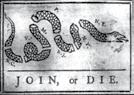
In 1754, Benjamin Franklin published America’s first newspaper cartoon to urge the American colonies to unite against a common threat during the French and Indian War. The Pennsylvania Gazette, May 9, 1754.
a
Propaganda and bias
Propaganda: The spreading of ideas, information or rumor for the purpose of helping or injuring an institution, a cause or a person.
– Merriam Webster
REVOLUTION
is nothing so fretting and vexatious, nothing so justly to tyrants, and their tools abettors, as a free press. reason is obvious; because it has been very justly observed, in a spirited answer spirited speech, ‘the bulwark people’s liberties.’”
Samuel Adams, writing as “Populous” in the Gazette, March 14, 1768. Supporters of independence wrote articles using pseudonyms to impression that there were more opponents rule than there actually were. Many of the pseudonyms were the names of famous orators of Republic. The Annotated Newspapers of Dorr, Massachusetts Historical Society.
Propaganda is a persuasive message intended to influence thoughts and actions. Propaganda can be used to promote a wide variety of causes, some of which many would consider “good,” and some of which many would consider “bad.” Many of the techniques used in propaganda are the same as those used in advertising to sell or promote goods and services. Like advertising, propaganda often appeals to emotions or gut reactions instead of logic or reason.
While most mainstream media organizations today strive to keep their news coverage unbiased and separate from their editorial, or opinion, coverage, newspapers during the American Revolution were proudly patriot or loyalist.
Similar to overtly left- or right-leaning 21st century media, American Revolution-era newspapers used common propaganda tactics such as name calling, fear mongering, selective news printing and demonizing the enemy.
March 23 – Patrick Henry gives his “Liberty or Death” speech to the Virginia House of Burgesses in Richmond.
April 18 – Paul Revere and William Dawes ride to Lexington and Concord to warn that the British are planning to march inland to seize patriot leaders, weapons and supplies, in what becomes known as Paul Revere’s Midnight Ride
The long s: Why does the word congreſs have an “f” in it?
In fact, the “f” in Congress is not actually an f, but a different character now called the “long s.” Words such as “house” and “congress” in eighteenth-century newspapers are often printed as “houſe” and “congreſs.” The long s stopped being used in printed materials by the early nineteenth century.
Want to impreſs? You can create a long s with the Unicode combination 017F.
7
Sources: American Historical Association; Todd Andrlik, "Reporting the Revolutionary War: Before It Was History, It Was News;" Colonial Williamsburg; Journal of the American Revolution; Mount Vernon; National Archives; Newseum; PBS Classroom, “Journalism in Action;” David Shedden, "Florida Newspaper History Chronology," 1783-2001; Smithsonian Magazine
GOING BEYOND THE TEXT
Exploring propaganda
Before people could easily post their opinions on social media, they traded insults and accusations through pamphlets and newspaper articles. Oftentimes these documents were intended to incite fear and outrage. During the Revolutionary War period, there was little fact verification or source attribution. As the National Endowment for the Humanities website notes, the result of this was the spread of “fake news” and propaganda. Propaganda is messages meant to persuade people, often by exaggerating or twisting the truth. Propaganda can take the form of speeches, written newspaper articles or pamphlets, or editorial cartoons. To learn more about propaganda, check out this video by CBS Kids News, youtube.com/ watch?v=GtpHX3nr7uE.
During the American Revolutionary War, one of the most well-known perpetrators of false and sensational news was Benjamin Franklin. One example of this is the cartoons shown on page 8 urging the American colonies to unite against a common threat during the French and Indian War. In addition to cartoons and pamphlets, Franklin also published newspaper articles based on propaganda to rile the colonists. You can learn more about Franklin’s propaganda newspaper on the National Archives website: founders.archives.gov/ documents/Franklin/01-37-02-0132. Today, false information can be present on social media, blogs, or in quotes of people interviewed in news stories, letters to the editor, editorials or cartoons. Look for examples of propaganda on the internet and in the newspaper. Think about the following questions: Which eyewitness accounts are trusted? How do you know if a source is credible? How do you analyze which rhetorical appeals –logos, pathos and ethos – are biased? Select three examples of propaganda that you find to share with your class. Analyze the examples and explain in a brief essay what aspects fit the definition of propaganda. Share what you have learned with your class.
Florida Standards: SS.6.W.1.3; SS.6.W.1.5; SS.7.CG.2.8; SS.7.CG.2.9; SS.8.A.1.1; SS.8.A.1.3; SS.8.A.1.4; SS.8.A.3.3; SS.8.A.4.3; SS.912.A.1.2; SS.912.A.1.4; SS.912.A.1.5; SS.912. CG.2.11; SS.912.CG.2.12; SS.912.CG.2.13; SS.912.H.1.6; SS.912.W.1.3; ELA.612.EE.2.1; ELA.612.EE.3.1; ELA.612.EE.4.1; ELA.612.EE.5.1; ELA.612.EE.6.1; ELA.612.F.2.2; ELA.612.F.2.4; ELA.612.C.1.3; ELA.612.C.1.4; ELA.612.C.1.5; ELA.612.C.2.1; ELA.612.C.3.1; ELA.612.C.4.1; ELA.612.C.5.1; ELA.612.R.2.2; ELA.612.R.2.3; ELA.612.R.2.4; ELA.612.R.3.4; ELA.612.V.1.1; ELA.612.V.1.3

April 19 – The British soldiers arriving in Lexington and Concord intending to seize weapons from the colonists are met with volunteer militia known as “Minute Men.” The Battles of Lexington and Concord take place over 16 miles along the Bay Road from Boston to Concord and mark the beginning of the Revolutionary War.
May 10 – Delegates from the Thirteen Colonies meet in Philadelphia, beginning the Second Continental Congress It will
function as the national government of the American colonies throughout the Revolutionary War.
June 15 – Congress appoints George Washington Commander-in-Chief of the Continental Army.
June 17 – In the first major action of the war, inexperienced colonial soldiers hold off hardened British veterans for more than two hours in the Battle of Bunker Hill. The battle is a tactical victory for the British, but
more than 1,000 British are killed or wounded.
July 3 – George Washington assumes command of the Continental Army outside Boston.
July 5 – Congress approves the Olive Branch Petition, a final attempt to avoid war with Britain. The petition emphasizes their loyalty to the British crown and their rights as British citizens.
October 13 – Congress establishes the Continental Navy
November 7 – John Murray, the Earl of Dunmore and Virginia’s royal governor, issues what will become known as Lord Dunmore’s Proclamation establishing martial law and offering freedom to indentured servants and enslaved people who leave patriot owners and join the British army.
Thomas Brown arrives in St. Augustine. Brown, a wealthy Georgia landowner originally from Yorkshire, England, had been tortured and forced out of Georgia by the Sons of Liberty, who beat, burned, scalped, tarred and feathered him for refusing to join the patriot cause.
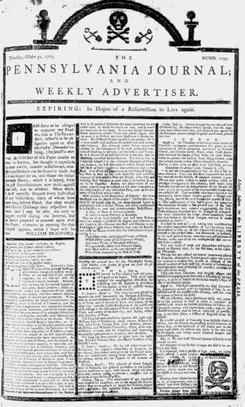
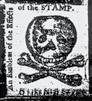
On October 31, 1765, the Pennsylvania Journal redesigned its masthead to look like a tombstone to emphasize that British actions were destroying American rights.
March 14, 1768.
Let the battles begin
While the largest battles of the Revolutionary War took place in the territories of the 13 original colonies, the war impacted a much wider region of North America. The American rebels conducted armed invasions of Canada in 1775 and of Florida beginning in 1776. In fact, George Washington authorized five incursions into Florida – though only three actually took place.
Invading East Florida
Following his successful defense of Charleston from a British force of 2,900 on June 28, 1776, American Major General Charles Lee turned his attention to invading the British colony of East Florida.
Lee and Major General Robert Howe marched south from Savannah, Georgia, in an attempt to capture St. Augustine for the patriots. However, they
were hampered by raids by the East Florida Rangers and their Native American allies, as well as by disease and desertions.
By October 1776, the expedition ground to a halt before even coming close to St. Augustine.
Sources: American Battlefield Trust; Revolutionary War Journal; Florida Museum; Mount Vernon.
Battle of Thomas Creek: May 17, 1777
rThe conditions leading up to the Battle of Thomas Creek began during the fall of 1776, as loyalist and British forces defended against patriot raids across the St. Marys River between Georgia and East Florida.
In February 1777, British troops moved north from East Florida into Georgia, capturing Fort McIntosh.
The patriot response was to invade East Florida, with the goal of capturing the capital of St. Augustine.
Colonel John Baker and 100 mounted militia would travel by land. The second force, commanded by Colonel Samuel Elbert, would travel by ship. Departing on May 1, they planned to meet at Sawpitt Bluff, north of St. Augustine, on May 12 to plan their attack on the city.
On May 4, Baker’s force fought with Creek warriors allied with the loyalists. Two militiamen were wounded and one Native American was killed and his body mutilated.
When Baker’s forces arrived at the rendezvous on May 12, Elbert’s men were not there. Baker’s men established camp and waited.
Three days later, a group of East Florida Rangers and Creek warriors stole 40 horses from the patriot camp and attempted to stage an ambush, a surprise attack. During the battle, two patriots and one member of the Creek tribe were killed. The patriots scalped and mutilated the deceased warrior.
On May 16, Baker ordered a retreat back to Georgia. That evening they camped at Thomas Creek.
In the meantime, British Lieutenant Colonel Mark Prévost had crossed the St. Johns River with 100 British soldiers to join the East Florida Rangers and Creek warriors.
On May 17, Baker’s militia was ambushed by this combined force, now numbering more than 250.
The battle was a British victory, with three Americans killed, nine wounded and approximately 40 captured. In revenge for the vicious mutilation of their fellow tribesman, the Creek warriors killed many of the patriot prisoners. The remainder were taken back to St. Augustine to be imprisoned.
Sources: American Battlefield Trust; National Park Service; Florida Department of State
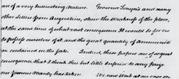
Above: George Washington's letter to John Hancock, Dec. 18, 1775. George Washington Papers, Library of Congress
"Governor Tonyn’s & Many other Letters from Augustine Shew the weakness of the place, at the Same time, of what vast Consequence it woud be for us, to possess ourselves of it, & the great quantity of Amunition Contained in the Fort; indeed these papers are of So great Consequence, that I think this, but little inferior to any prize, our famous Manly, has taken."
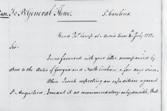
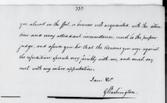
Right: Letter from George Washington to Robert Howe, July 4, 1777. George Washington Papers, Library of Congress
“To Brigadier General Robert Howe Head Quarters Camp at Morris Town, 4th July 1777.
Sir
I was favor’d with your letter accompanied by others to the States of Georgia and North Carolina, a few days since.
When I wrote respecting an expedition against St Augustine, I meant it as recommendatory only, sensible, that you almost on the spot, or however well acquainted with the situation and every attendant circumstance, must be the proper judge; and assure you Sir that the reasons you urge against the expedition operate very forcibly with me, and must say meet with my intire approbation.
I am &c.
Geo. Washington”
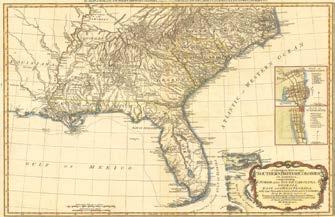
also the Floridas and part of the Bahama Islands &c. From the latest authorities. State Archives of Florida, Florida Memory
January 10 – Thomas Paine publishes “Common Sense,” a 47-page pamphlet advocating for independence from Britain.
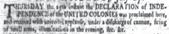
February 27 – East Florida’s inhabitants draft an address to the king affirming their loyalty, writing that they were “deeply deploring and disavowing the present unhappy and unnatural Rebellion, which prevails through most of Your Majesty’s other Colonies on this Continent.” East Florida’s inhabitants also promised to avoid any “connection and Correspondence with, or Support of [the rebels] . . we shall be always ready, and willing to the utmost of our weak abilities to manifest our Loyalty to Your Majesty’s Person, and a due Submission to Your Majesty’s Government, and the Legislature of Great Britain.” "THURSDAY,
April 12 – North Carolina’s Fourth Provincial Congress unanimously adopts the “Halifax Resolves,” the first official action by an entire colony recommending independence.
June 7 – Richard Henry Lee of Virginia proposes the Lee Resolution declaring the Thirteen Colonies to be independent of the British Empire, to the Second Continental Congress. It is the earliest form and draft of the Declaration of Independence.
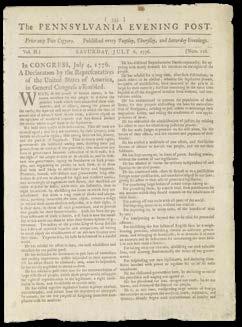
July 4 – The Second Continental Congress adopts the Declaration of Independence, officially declaring its independence from the British Empire.
August 8 – Major General Charles Lee and Major General Robert Howe march south from Savannah, Georgia, with 2,500 men in an attempt to capture St. Augustine. Mass desertions due to lack of supplies and poor planning cause the mission to be abandoned.
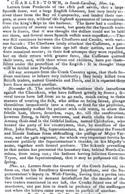
August 11 – An angry crowd of loyalists gathers in the city plaza of St. Augustine. They hang effigies of Samuel Adams and John Hancock before setting fire to a copy of the Declaration of Independence.
December 25 – George Washington leads the Continental Army to cross the Delaware River. This critical strategic decision leads to key American victories in the Battle of Trenton, the Battle of Second Trenton and the Battle of Princeton.
Cary's Southeastern United States including Florida, 1806. A new map of part of the United States of North America, containing the Carolinas and Georgia,
What happened to Colonel Elbert?
By May 18, Colonel Elbert’s ships had only reached Amelia Island, fifteen miles north of the original rendezvous point. Two British ships, the Rebecca and the Hawke, spotted the Americans and engaged them in battle. The Rebecca’s topmast was hit, leaving it unable to maneuver and forcing the British to end their attack. Colonel Elbert sailed back to Georgia, leaving a detachment of troops to march north along the coast with orders to destroy farms along the way.
Battle of Alligator Bridge: June 30, 1778
rThe colonial patriots attempted to invade Florida again in the spring of 1778.
A force of 1,300 Continental troops and militia from Georgia and South Carolina gathered at Fort Howe in Georgia under the command of Major General Robert Howe. The expedition reached the Florida border at St. Marys River on June 26.
When British Lieutenant Colonel Mark Prévost learned of the advance, he gathered 450 British troops at a bridge crossing Alligator Creek. A branch of the Nassau River, Alligator Creek was located four miles northwest of the Thomas Creek battle site. Prévost’s men built fortifications on the south bank of the creek.
On June 30, Howe sent 100 cavalry members, under the command of Colonel James Screven, to locate and attack the East Florida Rangers.
Screven’s horsemen chased the loyalists to the Nassau River. Colonel Thomas Brown ordered some of his men to circle behind Screven’s troops while Brown and his Rangers stood ready for a frontal assault. Screven’s cavalry was able to avoid Brown’s trap.
Brown and his Rangers ran straight to Alligator Bridge, where Prévost had been preparing defenses. At first, there was confusion among the waiting British. Because there were no official uniforms to distinguish between loyalist and patriot militia, they were unsure which side’s soldiers were running at them.
When it became clear that the cavalry in the rear was firing upon the men running toward the British line, a firefight ensued between Screven’s cavalry and Prévost’s troops. The East Florida Rangers circled back to attack the patriots from their flank.
Screven, who was wounded, ordered a retreat. Nine Americans and five British were killed.
This battle marked the Continental army’s final attempt to invade Florida.
Sources: National Park Service; Revolutionary War Journal
The Siege of Pensacola: March
9-May 10, 1781
rThe largest battle of the American Revolution fought in Florida involved the Spanish and French against British and Indigenous forces.
Spanish governor of Louisiana Bernardo de Gálvez launched an expedition force of 40 ships and approximately 7,800 troops in the spring of 1781 to capture Britishheld Pensacola.
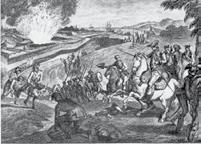
The siege lasted for two months. The turning point in the battle happened on May 8, when a Spanish artillery shell hit a British
powder magazine, destroying the fort, killing approximately 100 British soldiers and leading British General John Campbell to surrender.
The Spanish victory weakened the British hold and helped support the American cause for independence. By the end of the war, all of West Florida was under Spanish control, and Spain got East Florida back as part of the 1783 Treaty of Paris.
Source: Florida Department of State

GOING BEYOND THE TEXT Newspaper archeology
History textbooks often focus on elections, wars and “great men.” However, there is also the history of the ordinary, of the forgotten and of the community.
In this activity, you will engage with the “ordinary” past through the analysis of just one artifact: a newspaper.
Individually or in small groups, choose one historical copy of a Revolutionary-era newspaper from The Annotated Newspapers of Harbottle Dorr, Jr. at masshist.org/dorr or Chronicling America (Library of Congress) at loc.gov/collections/chronicling-america
Imagine that you are an archeologist who has just discovered this newspaper and that you know nothing about the time and place that it comes from. Read the entire newspaper, including all the ads, classifieds, notices etc. As you read, make notes. Address questions such as:
• What kind of amusements did people in this society enjoy?
• Can we determine what type of political system was in place and the effectiveness of the system?
• What were the major economic activities of this society?
• What kinds of transportation did this society utilize?
Write an account of the society that this artifact represents based only on what you have read in the newspaper. Be sure to back up your conclusions with evidence from the text. Make a short oral presentation to your class.
Adapted from: Newspaper archeology, Donald Falls, Manatee High School
Florida Standards: SS.8.A.1.1; SS.8.A.1.2; SS.8.A.1.3; SS.8.A.1.5; SS.8.A.3.16; SS.8.A.4.17; SS.912.A.1.1; SS.912.A.1.2; SS.912.A.1.3; ELA.612.EE.1.1; ELA.612. EE.2.1; ELA.612.EE.3.1; ELA.612.EE.4.1; ELA.612.EE.5.1; ELA.612.EE.6.1; ELA.612.F.2.1; ELA.612.F.2.2; ELA.612.F.2.4; ELA.612.C.1.3; ELA.612.C.1.4; ELA.612.C.2.1; ELA.612.C.3.1; ELA.612.C.4.1; ELA.612.C.5.1; ELA.612.R.2.1; ELA.612.R.2.2; ELA.612.R.2.3; ELA.612.R.2.4; ELA.612.V.1.1; ELA.612.V.1.3
88888888888888888888888
Thomas Brown establishes the East Florida Rangers, a loyalist militia. The Rangers consist of escaped enslaved men, Native Americans and refugees from Georgia and the Carolinas as well as loyalist residents of East Florida. They will conduct raids into Georgia and South Carolina throughout the war.
January 6 - May 28 – The Continental Army winters at Morristown, NJ.
February 17 – The East Florida Rangers take Fort McIntosh on the Satilla River, 70 miles south of Savannah.
May 17 – Loyalist militia, British regulars, and allied Native Americans, under the command of Thomas Brown, ambush a force of Continental troops and Georgia militia, forcing them to return to Georgia, in the Battle of Thomas Creek
June 14 – The Second Continental Congress passes the first Flag Resolution officially adopting the “Stars and
Stripes” as the national flag: “That the flag of the thirteen United States be thirteen stripes, alternate red and white; that the union be thirteen stars, white in a blue field.”
September 19 – First Battle of Saratoga, NY (Freeman's Farm) takes place.
October 7 – The Continental Army defeats a superior British army at the Second Battle of Saratoga, NY (Bemis Heights), helping to induce France to enter the war on the American side.
October 17 – The British surrender at Saratoga, NY.
December 19 – George Washington and his army winter in Valley Forge
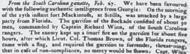
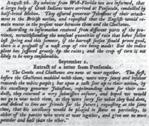
"From the South Carolina Gazette, Feb. 27. We have been favoured with the following authentic intelligence from Georgia: On the morning of the 17th instant, Fort Mcintosh, at Sitilla, was attacked by a
the
The
of about
soldiers who
a
or
for
April 11, 1777.
large party from Florida.
garrison,
guard
fort
town, of the stockade consisted
50 men, commanded by Captain Richard Winn, of
South Carolina Rangers. The enemy kept up a smart fire on the garrison
about five hours, after which Lieut. Col. Thomas Brown, of the Florida rangers, came with a flag, and required the garrison to surrender, threatening, that in case of non-compliance, no mercy would be shewn." The Virginia Gazette,
Bernardo de Gálvez, State Archives of Florida, Florida Memory
Replica of a print depicting the capture of Pensacola by the Spaniards, State Archives of Florida, Florida Memory
Wellge, H., Beck & Pauli & Norris, W. &. C. (1885) Pensacola, Fla., county seat of Escambia County Library of Congress
Declaration of Independence. The Pennsylvania Evening Post. July 6, 1776
A watershed time for Native Americans
At the time of the Revolutionary War, approximately 250,000 Native Americans lived in British North America. More than 80 tribes lived east of the Mississippi River. While most Native Americans remained neutral during the war, some sided with the British. Other tribes, including Oneidas, Tuscaroras and Stockbridge-Munsees, fought for the Americans. No matter which side they backed, the Native Americans had one goal: to preserve their lands and sovereignty. Regardless of their allegiances, Native Americans experienced many losses during the American Revolution. These losses had long-lasting effects on tribal lands, culture and identity.
Source: National Archives; National Museum of the American Indian
Westward expansion
For most Native people, an independent United States was more of a threat to their way of life than Britian was. The British placed limits on colonial encroachment on Native American lands. In addition, British officials had greater financial resources, and they controlled the sea. British officials also supplied important trade goods, such as cloth, metal tools, firearms and ammunition. Many tribal nations viewed the King of England as a protector and ally. In addition, the Native nations knew that an American victory would expose their territories to invasion by soldiers and settlers. Those Native American nations who chose to support the revolutionaries believed that the American revolutionaries would allow the tribes to maintain control over their homelands.
Source: Museum of the American Revolution
A British advantage
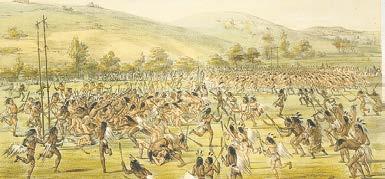
The British maintained a network of forts and trading outposts on the frontiers, which were beneficial to the Native Americans. From these bases, British officers encouraged Native American warriors to launch raids on communities that supported the American cause. Oftentimes, the warriors were accompanied by loyalists who had been forced to flee those communities.
While many Native Americans fought with the British, battles on the frontiers involved few British soldiers. Most of the fighting was between Native warriors, American loyalists, and rebel militia.
While the Revolutionary War cost Britain the 13 colonies, the cost to Native Americans was much higher. At the end of the war, the peace treaty recognized the independence of the United States and ceded all British territory east of the Mississippi and south of Canada to the new nation.
American settlers flooded into this new territory and treated the native people harshly. The colonists believed all Native people supported the British during the war. When Native Americans fought back against the Americans, they had no support from their former British allies.
Source: American Battlefield Trust
Native American - settler relations 1775-1830
Conflict marked the relationship between Native American peoples and white settlers. From 1775-1830, indigenous nations faced increasing pressures from American settlers. During this time, native populations were weakened by disease, wars and loss of alliances. The American Revolution complicated these underlying forces because British and American forces tried to enlist native allies while simultaneously committing acts of violence against them. Following the Revolutionary War, the U.S. government adopted policies that viewed Native American lands as forfeited, resulting in forced treaties that gave much of the territories to settlers. However, the Seminole Tribe of Florida never signed a peace treaty with the U.S. government.
Source: EBSCO; Seminole Tribe of Florida
DID YOU KNOW?
After the American Revolution ended in 1783, Spain regained control of Florida as part of the Treaty of Paris. When the British evacuated Florida, Spanish colonists as well as settlers from the newly formed United States came to Florida in droves. Many of these new residents were enticed to move to Florida by favorable Spanish land grants. Members of the Seminole Tribe (formerly Creek) were important Spanish allies in the defense of Florida. Escaped enslaved people also entered Florida, trying to reach a place where their U.S. masters had no authority over them. Instead of becoming more Spanish, Florida increasingly became more “American.”
Source: Florida Department of State

January 10 – Continental Navy Captain James Willing, commissioned by Congressmen Robert Morris and William Smith to attack British posts, seizes loyalist property and appeals to Louisiana Governor Galvez for support, departs Fort Pitt in Pennsylvania in the gunboat Rattletrap. Along the way, his expedition seizes cargoes of pelts, animal hide, and brandy from French traders.
February 6 – The American Colonies and France sign the Treaty of Alliance, formalizing France’s financial and military support of the revolutionary government in America.
February 19 – James Willing and his men arrive at the British post of Natchez and continue down the Mississippi River, attacking private homes, burning plantations and stores of goods, seizing slaves and property, and killing livestock. On Feb. 23, they capture the British ship Rebecca while it is moored at Fort Bute and rename it the Morris. Using the Rattletrap and the Morris Willing’s men continue to raid the countryside up and down the Mississippi River.
June 18 – The British abandon Philadelphia. The Continental Army marches out of Valley Forge.
June 30 – General Robert Howe, commander of the American southern army, sends Colonel James Screven with 100 calvary to find and attack Thomas Brown’s East Florida Rangers. They are defeated by a combined force of British troops, East Florida Rangers and Georgia militia in the Battle of Alligator Creek Bridge
July 14 – A force of 10 British soldiers and 22 Upper Creek tribesmen, under Capt. David Holms, sets out from Pensacola on a land journey to St. Augustine to aid the British of East Florida. Mapmaker Joseph Purcell used this 1778 expedition to record his observations and data for the purpose of preparing a map of the roads and geography. His map "The Road from Pensacola in
West Florida to St. Augustine in East Florida" is the only definitive map of the Old Spanish Trail as it existed in the 18th century.
August 29 – Capt. Holms reaches St. Augustine with a force of approximately 240, having gathered additional Seminole and Creek reinforcements. However, the patriots have already retreated, and Governor Tonyn sends Capt. Holms away.
October – James Willing sets sail for Philadelphia but is taken prisoner by the British and remains in British custody in New York for several years. He is finally exchanged in September 1781.
Above left: The Pennsylvania Gazette, Oct. 9, 1766.
Above right: The South Carolina and American General Gazette, Nov. 25, 1768.
The Pennsylvania Journal or Weekly Advertiser, July 27, 1774.
The Pennsylvania Gazette, Dec. 11, 1766.
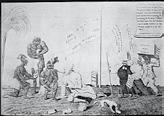
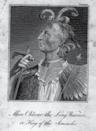
British cartoon criticizing the King's use of Native Americans in the war, 1780. National Archives
Colonization of Florida
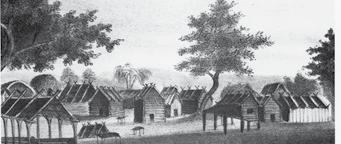
During the early colonial period, France and Spain vied to conquer and colonize Florida and the surrounding portions of the southeast. During this time, missionaries attempted to convert Native Americans to Christianity and make them loyal to the Spanish crown. In 1763, Spain surrendered its Florida colony to Britain. As a result, many Native Americans living in St. Augustine along with two remaining Franciscan missionaries left for Cuba.
The demise of Florida’s native people left a population hole that encouraged other Native Americans seeking land and the desire to live in peace, free from tribal conflicts. Most of these new residents were from the Lower Creek tribes from Georgia and Alabama who sought independence from the Upper Creek.
Florida presented new opportunities for native people. By the 1770s, the new Florida natives collectively became known as the Seminole, a name possibly derived from a Spanish word meaning “wild” or “runaway.” The Seminole tribe also included members of the Yuchi and Yamasee tribes. The population also increased with runaway enslaved people who found refuge among the Native Americans.
Seminole tribe members traded honey, cow and deer hides, garden produce and other merchandise for European items, especially after Britain took control of Florida in 1763.
Sources: University of Florida Research; Florida Department of State
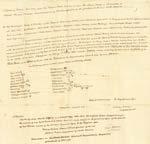
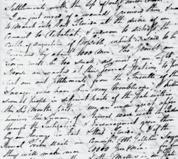
I am just cured of a wound I received there, & ready to march into East Florida at the desire of our Council to retaliate, & endevour to distress the Castle of Augustine if possible, which is said to be Garrisond by about 1000 Men, tho’ I doubt our Force will be too Small, as most of our Light Horse are wanted at their several stations, to protect our out settlements from the Insults of the Savages, who have been very troublesome, & killed Several people in different parts of the state within this Six Months past. We are under great apprehensions this Summer, of a General Warr with the Indian[s] through the Instigation & Encouragement given them by our Enemys in East & West Florida. & if the Several Tribes Unite, our Commissy Mr Galphin Says they will make near 20,000 Gun Men.
- Lachlan McIntosh letter to George Washington, April 13, 1777. George Washington Papers, Library of Congress
Native American history in Florida
The south's largest Native American tribes during the Revolutionary War were the Creek, Chickasaw and Choctaw nations.
Creek towns were divided among the upper towns and lower towns. Each group wanted to pursue its own foreign policies.
A major concern for the members of the Creek tribe was access to manufactured European goods. The Revolutionary War threatened the practicality of the trade and provided opportunities for Creek men to acquire trade goods by providing military services, especially on behalf of Britain in 1780 and 1781.
At the start of the Revolutionary War, the British hired Choctaw warriors to patrol the Mississippi River against American attacks. Despite these efforts, in February 1778, James Willing led an
expedition down the Mississippi River that attacked British settlements all the way to New Orleans. The British responded by organizing a force of Choctaw warriors to march to the town of Natchez, Mississippi, to protect the town. The Choctaw force convinced Natchez residents to remain pro-British. When Spain declared war on Britain in 1779, hundreds of Choctaw warriors helped the British defend Mobile and Pensacola in 1780 and 1781.
Britian’s most loyal southeastern ally was the Chickasaw Nation. Chickasaw warriors patrolled the Mississippi River to prevent American attacks. Members of the Chickasaw tribe also sent warriors to assist Britain in defending Mobile and Pensacola against Spain.
Sources: Encyclopedia of Alabama; University of South Florida Research
Think about it
The history of Native American tribes of Florida begins with the first people of Florida, who came to the region more than 14,000 years ago. The two largest groups were the Timucua and the Calusa. In the 1500s, when Juan Ponce de Leon landed in Florida, there were approximately 350,000 Native Americans who inhabited the state. The Spanish conquistadors brought diseases and wars, and many of the native people of the Florida did not survive.
Sources: University of South Florida Research; The Seminole Tribe of Florida; Tampa Bay History Center
GOING BEYOND THE TEXT
Analyzing natural history
Naturalists study, observe and record the natural world to better understand its complexity. Naturalist William Bartram spent 1774 in East Florida gathering information about plants and animals. Bartram’s Travels part natural history, part travelog, represents classic American nature writing because of Bartram’s descriptions of Florida.
Step one: Using the following websites, research Bartram.
• Florida Museum of Natural History: floridamuseum.ufl.edu/ naturalists/bartram
• National Endowment for the Humanities: neh.gov/article/ william-bartrams-man-eating-monster
• National Gallery of Art: heald.nga.gov/mediawiki/index.php/ William_Bartram
• Smithsonian Magazine: smithsonianmag.com/science-nature/ americas-first-great-enviromentalist-florida-williambartram-180983452
Step two: Working in small groups, create a PowerPoint presentation about Bartram and his experiences. Choose 8-10 facts about Bartram to feature in your presentation. Step three: Look for examples of current articles and images focused on nature in the newspaper. Add a couple of slides to your presentation showing examples of naturalists in today’s world.
Step four: Share what you have learned and discovered with your class.
Sources: Florida Museum of Natural History; National Endowment for the Humanities
Florida Standards: SS.8.A.1.1; SS.8.A.1.2; SS.8.A.1.3; SS.8.A.1.5; SS.8.A.3.16; SS.8.A.4.17; SS.912.A.1.1; SS.912.A.1.2; SS.912.A.1.3; ELA.612.EE.1.1; ELA.612. EE.2.1; ELA.612.EE.3.1; ELA.612.EE.4.1; ELA.612.EE.5.1; ELA.612.EE.6.1; ELA.612.F.2.1; ELA.612.F.2.2; ELA.612.F.2.4; ELA.612.C.1.3; ELA.612.C.1.4; ELA.612.C.2.1; ELA.612.C.3.1; ELA.612.C.4.1; ELA.612.C.5.1; ELA.612.R.2.1; ELA.612.R.2.2; ELA.612.R.2.3; ELA.612.R.2.4; ELA.612.V.1.1; ELA.612.V.1.3

June 18 – The Sullivan Expedition devastates Native American settlements in New York and Pennsylvania by destroying homes and crops, with the goal of forcing largely Loyalist-aligned Iroquoian people from the area.
June 21 – Spain signs the Treaty of Aranjuez with France, entering the American Revolutionary War on the side of the French, against Britain.
August 18 – A hurricane makes landfall at New Orleans, sinking all but one of a
fleet of Spanish warships and destroying boats, fields and supplies.
August 29 – The British-aligned Iroquois warriors and loyalists are defeated at the Battle of Newtown, NY. The Sullivan Expedition operates virtually unopposed for the next month.
September 21 – The Spanish capture the British outpost at Baton Rouge in the Battle of Baton Rouge. It is the second British outpost to fall to Spanish arms during Louisiana Governor Bernardo de Gálvez’s march into British West Florida.
November – Washington’s Army begins camping at Morristown, NJ.
"The English being forced to submit to these conditions, the garrison marched out of Baton Rouge with military honours, and advancing 500 steps delivered themselves prisoners of war to the Spanish troops, who received them formed; in number 375 men, with arms and colours." Poulson's American Daily Advertiser, Feb. 22, 1780.
1780
March 14 – Bernardo de Gálvez, Spanish governor of Louisiana, and his commander José Manuel de Ezpeleta lay siege to Fort Charlotte and capture Mobile. For the next year, Ezpeleta, now the governor of Mobile, attacks the Pensacola garrison and Britain’s Native American allies from Mobile.
May 25 – Several regiments from Connecticut mutiny in the Morristown, NJ camp because of delayed wages and shortages of basic supplies.
June 23 – Washington’s army leaves their winter camp at Morristown, NJ.
"The loss of the province of West Florida will prove a severe loss to this country. It may be said there are now fourteen provinces now lost, besides islands." The Pennsylvania Journal or Weekly Advertiser, April 19, 1780.
October 7 – Patriot militia surround and defeat a force of American loyalists under Major Patrick Ferguson at the Battle of Kings Mountain, S.C. Indicating the deep divisions within America, Ferguson is the only British soldier on the field.
Seminole town. State Archives of Florida, Florida Memory
Hartford Courant July 8, 1765.
Land Grant from the Upper Creeks, Lower Creeks and Seminoles to Thomas Brown, 1783.
State Archives of Florida, Florida Memory
Long Warrior from Bartram
Social class, race and gender
A social class is a group of people within a society who are of similar socioeconomic status. Social class also includes race and gender. In times of war and revolution, the clearly drawn lines of social class often break down. The Revolutionary War period had this effect for women, Native Americans and Black people. The war brought forth new rules and ideologies and, to some extent, established boundaries were questioned. As the Library of Congress notes, “Because accounts are often written by those in power, and during a time when views were less progressive, the perspective is almost always slanted to see women and minorities in a utilitarian light rather than view them as individuals - much less as equals.”
Source: Library of Congress
The arrival of the Spanish
African slavery in Florida began after the arrival of the Spanish in 1513. Due to the scarcity of Spanish settlement in the colony and the relatively liberal Spanish laws regarding freeing enslaved people (manumission laws), only a few hundred enslaved Africans lived in Florida during the First Spanish Period (1565-1763).
When Pedro Menéndez de Avilés established St. Augustine in 1565, he was accompanied by free and enslaved Africans.
Many Africans in Florida were free, including runaway enslaved people living among the Native Americans. Africans, both enslaved and free, performed crucial work for the Spanish and Native Americans, such as construction, agricultural labor, craft work and military service. The Spanish encouraged enslaved people to leave the British colonies by offering them freedom in Florida in return for their conversion to Roman Catholicism.
It was during the British rule of Florida, from 1763-1783, that there was a large-scale importation of enslaved Africans into the colony. When Great Britain gained control of Florida in 1763, British planters began large-scale agricultural enterprises in East Florida. By the time the American Revolution began in 1775, there were approximately 3,000 enslaved people in British Florida.
The enslaved were used to produce sugar, rice, indigo, citrus, naval stores and sea-island cotton.
As loyalist refugees from South Carolina and Georgia sought security in Florida during the war, the planters brought their enslaved people with them. By the end of the Revolutionary War in 1783, out of a total population in British East Florida of 17,375 persons, 11,285 were Black. This population decreased rapidly after the Spanish regained control.
Sources: Library of Congress; Britannica; Florida Memory; National Park Service
Differing views
The practice of arming free Black people at Fort Mose in St. Augustine underscored the differing views of Spanish and British colonists about African slavery. In British-controlled Florida, nearly 65 percent of the population were enslaved Africans. In contrast, at the end of the first Spanish period in 1763, the enslaved made up approximately 13 percent of the colony’s population. Of the 420 persons of African descent living in Spanish Florida in 1763, one-fifth were free Black people serving the Spanish crown.
In 1768, Scottish physician and planter Andrew Turnbull attempted to establish a colony of free workers near what is now New Smyrna. Turnbull recruited more than 1,200 laborers, mostly from the Mediterranean island of Minorca, to develop indigo plantations. Poor working conditions and disputes between the laborers and their British overseers caused the colony to collapse by 1777. The remaining colonists fled north to St. Augustine.
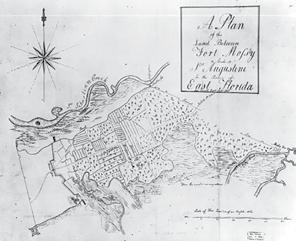
Think about it
The Revolutionary era provided a unique opportunity for enslaved people. According to the National Park Service, “Historians estimate that more than 20,000 runaway slaves joined the British during the American Revolution. The experiences of the ‘Black Loyalists’ represent the largest exodus of North America slaves before the Civil War.”
The British policy of offering freedom to enslaved people owned by rebellious colonists guaranteed that British military camps functioned as a draw for slave refugees. Most of the fortifications that were erected both in Pensacola and St Augustine were built largely by slave labor. Learn more about this topic with this video from the National Park Service, nps.gov/media/ video/view.htm%3Fid%3D4F685996-82BD-4F30-944E-8504B343780F
Sources: National Park Service; American Battlefield Trust
Unlike Turnbull’s New Smyrna experiment, most British planters relied on African slave labor. The presence of so many enslaved Africans along the Florida frontier resulted in tensions between Native Americans and slave-owning Europeans. Many enslaved people sought freedom among the Seminole Tribe during the 18th and 19th centuries, much to the apprehension of planters in Georgia, Florida and the Carolinas. As a result, planters raided Native American and free Black settlements.
Sources: Library of Congress; Britannica; Florida Memory; National Park Service
The Royal Gazette, March 27, 1782.
888888888888888888888888888888888
1781
March 1 – The Articles of Confederation, adopted by the Continental Congress on November 15, 1777, come into force after ratification by Maryland. This document serves as the United States’ first constitution. It is in force from March 1, 1781, until 1789 when the present-day Constitution goes into effect.
March 9-May 10
– Spanish General
Don Bernardo de Gálvez leads a
force of 40 ships and approximately 7,800 men against a British force of approximately 2,000 in the Siege of Pensacola On May 8, a Spanish shell hits a powder magazine in the Queen’s Redoubt, destroying the fort, killing approximately 100 British soldiers and leading British General John Campbell to surrender.
May 10 – Pensacola officially comes under Spanish control, ending British rule in West Florida.
September 28 – October 19 – A joint French and American force traps a large British army on Virginia’s Yorktown peninsula in the Battle of Yorktown. Unable to evacuate or receive reinforcements because a French fleet has driven off a British fleet, the British are forced to surrender.
October 19 – British General Charles Cornwallis surrenders to General George Washington at Yorktown.
1782
January – The evacuation of loyalists begins.
Largely unwelcome in the new United States, approximately 100,000 Americans who remained loyal to the crown find new lives in Britain, Canada and British colonies in the West Indies. Among them are about 15,000 African Americans, some of whom end up helping to found the country of Sierra Leone in Africa.
March 8 – Ninety-six neutral Native American people are murdered by Pennsylvania militiamen at Gnadenhütten Village in what is now Ohio. The militia,
seeking revenge for alleged raids by Native American tribes in the area, pretend friendship and disarm the tribe; on the following morning they slaughter the villagers in cold blood. Two scalped boys escape to relate the incident, now known as the Gnadenhütten Massacre
November 30 – Britain and the United States sign preliminary Articles of Peace that recognize American independence. It is signed by Benjamin Franklin, John Jay and John Adams, and one British representative, David Hartley.
This map shows British agricultural activities near the city of St. Augustine. State Archives of Florida, Florida Memory
The role of women
Unlike enslaved people, a woman’s situation during the 1700s depended on social and economic class, race and family situation. In American colonies, white married women with children might be asked to work while their husbands were on the battlefield. If a woman did not have children, she may have joined men on the front lines to serve as a nurse or housekeeper doing laundry.
Surviving primary source documents discussing the lives of women in East and West Florida during the British Period are rare, creating a limited historiography of women’s experiences.
Sources: Library of Congress; The Florida Historical Quarterly: " ... in a strange place ... ": The Experiences of British Women during the Colonization of East & West Florida Deborah L. Bauer
British women in Florida
Beginning in late 1763, British women arrived in East and West Florida. Upon their arrival in St. Augustine and Pensacola, women were faced with a harsh landscape and needed to navigate the social order of polite British society. Most white women who immigrated between 1763 and 1775 came from economically prosperous families of English, Scottish or Irish heritage. They were the wives, daughters, mothers and sisters of men who had solid business relationships with the colonial government or British military. These women, from wealthy families, had basic literacy skills such as reading, writing and math. They also received training in the "feminine" arts, such as music, dancing, sewing, cooking and housekeeping.
Source: The Florida Historical Quarterly: " ... in a strange place ... ": The Experiences of British Women during the Colonization of East & West Florida by Deborah L. Bauer
A strange place
Dorothy Murray Forbes was a typical British woman who arrived in British Florida. Forbes faced a very different environment than what she faced in Massachusetts. Historian Deborah Bauer writes, “The mindset that Dorothy Forbes possessed upon her arrival in St. Augustine in March 1769 mirrored the common state of mind that many women no doubt had when they immigrated to the
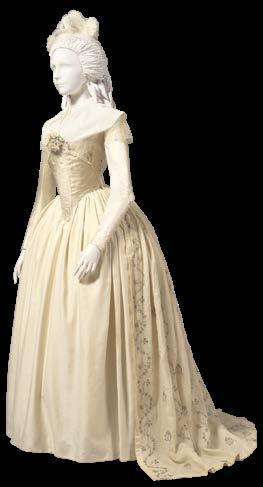
dated six months after her arrival, Forbes describes Florida as “a strange place." East Florida was “the only peninsular colony of Great Britain's North American colonies, a fact that affected the women's travel,” Bauer writes that most women traveled between St. Augustine and Pensacola by military ship due to threats of attack by animals and people.
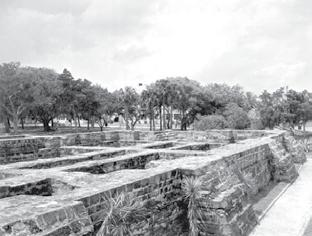
Source: The Florida Historical Quarterly: " ... in a strange place ... ": The Experiences of British Women during the Colonization of East & West Florida Deborah L. Bauer
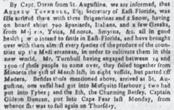
Paying homage to a woman
While white men were the ruling party of the time, it is interesting to note that one of the largest populations of Florida settlers that arrived in one company was named in honor of a woman. When Dr. Andrew Turnbull arrived in Florida, he called his territory "New Smyrna" in honor of his Greek wife. Turnbull led a group of 1,500 people from the Mediterranean countries to the Florida colonies. According to author Lucy Worthington Blackman, the stories of the women of the New Smyrna colony are interpreted through the writings of the men. However, some texts written by Maria Garcia, Turnbull’s wife, survived. According to her letters, Garcia experienced
HH
1783
February 1 – Florida’s first newspaper, the loyalist The East-Florida Gazette, is founded in St. Augustine. The paper is printed weekly from February 1, 1783, to March 22, 1784.
April 19 – The Continental Congress approves the preliminary Articles of Peace
September 3 – The U.S. and Britain sign the Treaty of Paris, ending the
American Revolution and formally recognizing the United States as an independent nation. Canada remains a British province.
Under the Treaty of Paris, Florida is returned to Spain. Under the fifth article of the treaty, the British are given 18 months to settle debts, sell homes and move out of Florida.
December 23 – Washington resigns as Commander-in-Chief of the Continental Army in Annapolis, MD.
1784
a “heavy share of the hardships and sufferings which befell the colonists” and led to the abandonment of their colony.
In "The Women of Florida, Volume 2," Carita Dogget Corse describes Garcia as a woman with a “dauntless spirit” who influenced the settlement. Corse describes Turnbull as dressing fashionably: Her image shows a “lady of much determination and spirit, a true partner for a pioneer doctor.” Garcia faced the dangers of “the savage new land resolutely,” and “raised her seven children to take a creditable part in the history of Florida and South Carolina. Hers was indeed a life of more variety than was granted to most people of her day.”
Source: "The Women of Florida, Volume 2," by Lucy Worthington Blackman
GOING BEYOND THE TEXT
Gracia Real de Santa Teresa de Mose
Enslaved Africans risked their lives to escape English plantations to find freedom among Spanish residents in St. Augustine. This new St. Augustine settlement, Gracia Real de Santa Teresa de Mose, or Fort Mose, became the first legally free Black settlement in North America.
Learn about Fort Mose on the following websites:
• floridamuseum.ufl.edu/histarch/ research/st-augustine/fortmose
• nps.gov/foma/learn/ historyculture/fort-mose.htm
• https://fortmose.org/about-fortmose
• floridastateparks.org/learn/ flight-freedom
While you are doing your research using these websites and other reputable sites, find out as much information about Fort Mose as you can. Try to imagine what it was like for the inhabitants of this area. Using newspaper articles from the Perspective or Opinion section in the newspaper as models, write a newspaper article from the perspective of a person relocating to this site. In this narrative-style article, be sure to focus on the journalistic points: who, what, where, when, why and how. Share what you have learned with your class.
Florida Standards: SS.8.A.1.1; SS.8.A.1.2; SS.8.A.1.3; SS.8.A.1.7; SS.8.A.2.7; SS.8.A.3.15; SS.8.A.3.16; SS.8.A.4.17; SS.912.A.1.1; SS.912.A.1.2; SS.912.A.1.6; ELA.612.EE.1.1; ELA.612.EE.2.1; ELA.612.EE.3.1; ELA.612. EE.4.1; ELA.612.EE.5.1;ELA.612.EE.6.1; ELA.612.F.2.1; ELA.612.F.2.2; ELA.612.F.2.4; ELA.612.C.1.3; ELA.612.C.1.4; ELA.612.C.2.1; ELA.612.C.3.1; ELA.612.C.4.1; ELA.612.C.5.1; ELA.612.R.2.1; ELA.612.R.2.2; ELA.612.R.2.3; ELA.612.R.2.4; ELA.612.V.1.1; ELA.612.V.1.3
January 14 – The Continental Congress ratifies the Treaty of Paris, officially establishing the United States as an independent and sovereign nation.
March – British colonists begin to move out of St. Augustine. Most English settlers in Florida leave for England or the Bahamas.
March 22 – The East-Florida Gazette prints its final issue.
July 12 – Spanish Governor Vicente Manuel de Zépedes takes charge of the government buildings and Fort St. Mark in St. Augustine, restoring its former name, the Castillo de San Marcos.
"The Packet is just arrived from England, and, it seems, this place is to be given up to the Spaniards. There are some transports now here, and 5000 tons more is taken up by government, and are expected here daily, to carry us poor Tories off, some to Providence, and some to the West-Indies." Hartford Courant, May 11, 1784
Tampa Bay Times/NIE 15
This dress illustrates women's fashion for wealthy female colonists arriving from Great Britain, Philadelphia Museum of Art
Ruins of Turnbull's Plantation coquina warehouse, New Smyrna Beach, Florida, Library of Congress
The South_Carolina Gazette, July 11, 1768.
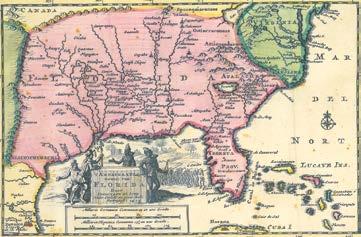
About Florida Humanities
Funding for this program was provided through a grant from Florida Humanities with funds from the National Endowment for the Humanities. Any views, findings, conclusions or recommendations expressed in this publication do not necessarily represent those of Florida Humanities or the National Endowment for the Humanities.
Since 1973, Florida Humanities has been the statewide, nonprofit partner of the National Endowment for the Humanities (NEH), firmly committed to sharing Florida’s stories by promoting a better understanding of the state’s history, heritage, cultures and literature. They have awarded more than $20 million in support of statewide cultural resources and public programs strongly rooted in the humanities. These programs preserve Florida’s deep history and heritage, promote civic engagement and community dialogue, and provide opportunities to reflect on the future of Florida. Learn more at floridahumanities.org.

Humanities advisors
James Cusick, Ph.D., Curator, P.K. Yonge Library of Florida History, University of Florida
David Head, Ph.D., Associate Lecturer, Department of History, University of Central Florida and Distinguished Faculty Fellow in History, Kentucky Wesleyan College
Robert Overton, Executive Director for UWF Historic Trust, University of West Florida
Margo S. Stringfield, Archaeologist, University of West Florida Archaeology Institute
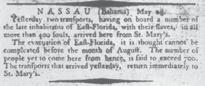
"Yesterday two transports, having on board a number of the late inhabitants of East-Florida, with their slaves, in all more than 400 souls, arrived here from St. Mary's. The evacuation of East-Florida, it is thought cannot be completed before the month of August. The number of people yet to come here from hence, is said to exceed 700. The transports that arrived yesterday, return immediately to St. Mary's." The Virginia Gazette or The American Advertiser, July 9, 1785.
Tampa Bay Times Newspaper in Education
The Pulitzer Prizewinning Tampa Bay Times is the largest daily newspaper in Florida. Locally owned and independent, the Times has long been celebrated for its outstanding and credible journalism, practiced with integrity in the public interest. The Times has been part of the Tampa Bay community for more than 140 years.
The Tampa Bay Times Newspaper in Education program (NIE) is a cooperative effort between schools and the Times to encourage the use of newspapers in print and electronic form as educational resources – a “living textbook.”
Since the 1970s, NIE has served educators, students and families in the Tampa Bay area by providing classroom access to the Times plus award-winning original educational publications, teacher guides, lesson plans, educator professional development resources and much more – all at no cost to schools, teachers or families.
Our educational resources fall into the category of informational text, a type of nonfiction text. The primary purpose of informational text is to convey information about the natural or social world.
NIE is a member of Florida Press Educational
1785
March 19 – The 18-month period allowed by the Treaty of Paris for British colonists to leave East Florida or to declare allegiance to Spain ends, although the deadline is extended by four months, to July 19.
November 10 – Former East Florida Governor Patrick Tonyn boards a troop transport bound for England, symbolizing the end of British rule in Florida. He is among the last to leave East Florida after remaining in the province to supervise the departure of British colonists.
Services (FPES), a 501(c) (3) nonprofit organization of Florida newspaper professionals whose mission is to promote literacy, civic engagement and critical thinking, particularly for young people. Learn more at fpesnie.org.
To learn more about NIE, visit tampabay.com/ nie, call 727-893-8138 or email ordernie@ tampabay.com. Find us on Facebook at facebook.com/ TBTNIE.
Times staff
Jodi Pushkin, Newspaper in Education manager, jpushkin@tampabay.com
Sue Bedry, grants officer, sbedry@tampabay.com
Credits
Written by Jodi Pushkin and Sue Bedry, Times staff
Designed by Stacy Rector, Fluid Graphic Design, fluidgraphicdesign.com
Special thanks to educators Stephanie Lee Boynton, St. Johns County Schools, and Jean Faulk, Manatee County Schools, for their oversight and expertise.
Cover image
Prockter, J. Map of East and West Florida, 1765.
State Archives of Florida, Florida Memory
© Tampa Bay Times 2026
1787
September 17 – Thirty-nine of the Constitutional Convention’s 55 delegates sign the U.S. Constitution It is then sent to the states for debate and ratification votes.
Between December 7, 1787, and June 21, 1788, the required 9 of 13 states ratify the Constitution, making it the official framework for the government of the United States of America. All 13 states ratified the U.S. Constitution by May 29, 1790.

Teachers, download the teacher guide for this publication at nieonline. com/tbtimes/curriculum_ social_studies.cfm#250!
Florida Standards
This publication and its activities incorporate the following Florida Standards for middle and high school students. Florida Standards BEST: ELA.612. EE.1.1; ELA.612.EE.2.1; ELA.612. EE.3.1; ELA.612.EE.4.1; ELA.612. EE.5.1; ELA.612.EE.6.1; ELA.612.F.2.1; ELA.612.F.2.2; ELA.612.F.2.4; ELA.612.C.1.3; ELA.612.C.1.4; ELA.612.C.1.5; ELA.612.C.2.1; ELA.612.C.3.1; ELA.612.C.4.1; ELA.612.C.5.1; ELA.612.C.5.2; ELA.612.R.2.1; ELA.612.R.2.2; ELA.612.R.2.3; ELA.612.R.2.4; ELA.612.R.3.2; ELA.612.R.3.3; ELA.612.V.1.1; ELA.612.V.1.3 Social Studies: SS.8.A.1.1; SS.8.A.1.2; SS.8.A.1.3; SS.8.A.1.4; SS.8.A.1.5; SS.8.A.1.6; SS.8.A.1.7; SS.8.A.2.4; SS.8.A.2.5; SS.8.A.2.7; SS.8.A.3.2; SS.8.A.3.3; SS.8.A.3.4; SS.8.A.3.5; SS.8.A.3.6; SS.8.A.3.8; SS.8.A.3.15; SS.8.A.3.16; SS.8.A.4.2; SS.8.A.4.3;
SS.8.A.4.8; SS.8.A.4.17; SS.912.A.1.1;
SS.912.A.1.2;
SS.912.A.1.3;
SS.912.A.1.4;
SS.912.A.1.5;
SS.912.A.1.6;
SS.912.A.1.7

Timeline sources: American Battlefield Trust; Florida Memory Project; Florida Museum; The Gilder Lehrman Institute of American History; Journal of the American Revolution; Library of Congress; Museum of Florida History; National Park Service; Revolutionary War Journal; Shedden, D., Florida Newspaper History Chronology, 1783-2001.
Map of Ferdinand DeSoto's American conquests, drawn from his memoirs, 1638: 'T Amerikaans Gewest van Florida Door Ferdinand De Soto Nader Ontdekt en groot deels Bemagtigt ; La Floride, Grand Paÿs de l'Amerique Septentrionale, State Archives of Florida, Florida Memory