TIMBERLAB MASS TIMBER DESIGN GUIDE
PRODUCT + PROCESS
© 2026 Timberlab Incorporated
Revised March 2026
Do not distribute without permission from Timberlab.
850 NW 13th Avenue
Portland, OR 97209
Timberlab.com
Information herein is shown for explanation purposes only. Examples shown are not suggestions for any particular project; they are presented as general considerations and do not apply to specific circumstances.
DISCLAIMER
This document is provided on an “as is” basis for general informational purposes only and does not constitute engineering, architectural, or other professional advice. Timberlab makes no representations or warranties, express or implied, regarding the accuracy, completeness, or applicability of the information contained herein. The information, drawings, and examples provided are illustrative only and may not be suitable for all projects or conditions. Any reliance on this document is at the user’s own risk, and all project specific applications must be independently reviewed and approved by qualified licensed professionals to ensure that your application complies with all applicable laws, codes, regulations, and authority‑having‑jurisdiction requirements, and is appropriate for the specific project, site conditions, and intended use, including but not limited to fire and life safety requirements. Certain products or systems described, including cross laminated timber (CLT), may be under development or not yet commercially available. References to such products are informational only and do not constitute an offer to sell or a commitment to manufacture. To the fullest extent permitted by law, Timberlab disclaims liability arising from the use of or reliance upon this document. The contents of this document are the intellectual property of Timberlab and may not be reproduced without prior written consent. Nothing in this document shall be construed as granting any license or rights, by implication or otherwise, to any Timberlab intellectual property.

ABOUT THIS DOCUMENT
Thank you for picking up this guide! We invite you to keep it by your side as you develop, design, engineer, and prepare to build the next mass timber library, school, apartment building, office building, warehouse, hotel, laboratory, hospital, and beyond. Inside, you will find our current product offerings, ideas for system design, considerations for high-quality construction, and insights into how we operate.
The guide is meant to be a tool for understanding both product and process. Whether this is your first experience with mass timber, or you are a seasoned expert, we offer our approach to decision-making in a sequential manner that mirrors the design and procurement phases of a project and will keep you on track toward achieving your project schedule. Read the guide cover-to-cover to comprehend the complete project development cycle, and then revisit specific sections as your work progresses.
We have included a decision checklist at the end of each design phase section to help your team make decisions in the appropriate timeframe. Decisions fall under the categories of team formation, architectural planning, structural design, and procurement. You will notice we focus first on the big picture building blocks, and then gradually build specificity with the design.
This guide offers common applications that will apply to most projects. It is not meant to be a substitute for conversation, as we know every project has unique qualities and conditions. We are passionate about serving our customers and encourage you to contact us with general questions and project-specific inquiries.
Enjoy the process and know that our team is here to assist at every step of your mass timber project.

WHAT IS TIMBERLAB?
A renewable, structural material derived from trees, for use in constructing our built environment.
A place in which scientific or technological research, experiments, and measurement may be performed toward the pursuit of knowledge and greater understanding.
To accelerate the mainstream adoption of mass timber in the U.S. construction market to benefit the planet and its people.
A world where buildings have a low carbon footprint and high community impact.
OUR ETHOS
We are experts on a bold mission: to innovate, produce, and deliver mass timber solutions like no other — transforming the built environment and changing the planet’s future.
With a deep understanding of how buildings are constructed and where there is room for improvement and innovation, Timberlab works at the forefront of a movement rooted in sustainability through renewable materials, quality through precision manufacturing, and cost certainty through prefabrication.
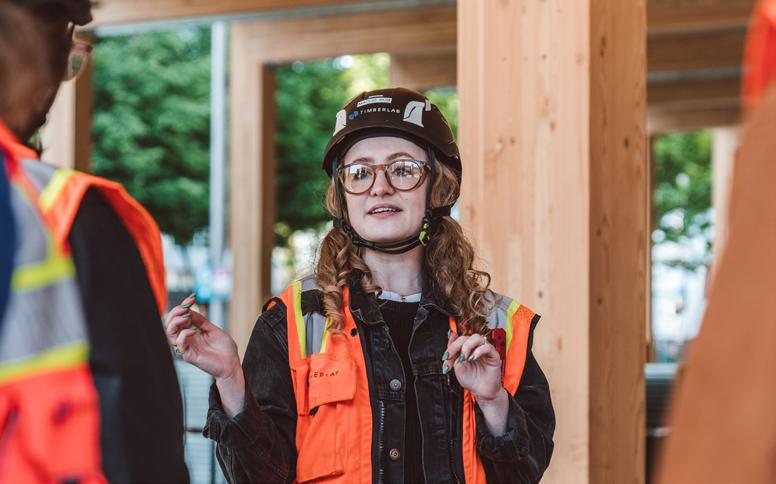
As a team of architects, engineers, and builders, we see every project from multiple vantage points. We provide solutions that result in the highest value for the owner and occupant and offer services to support your team throughout the project life cycle.
We’re driven to test new ideas and reach new heights through transparency, collaboration, and creativity – breaking boundaries and pushing forward with inspired motivation.
We view our work as a practical and scientific endeavor constantly evolving to respond to ever-changing climate imperatives, societal pressures, and the mass timber supply chain landscape. With curiosity and passion, we are alert to the needs of our partners in the architecture, engineering, and construction community and the owners, developers, and facility managers responsible for real estate investments, and we work to provide durable, high-quality solutions at the cusp of possibility.
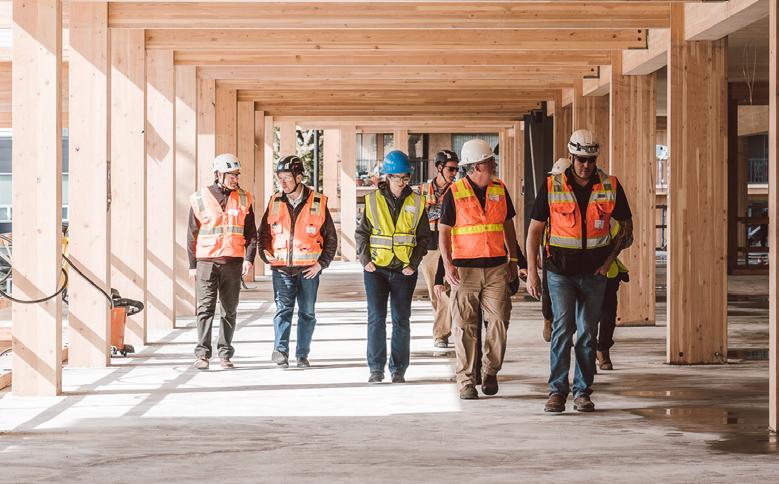
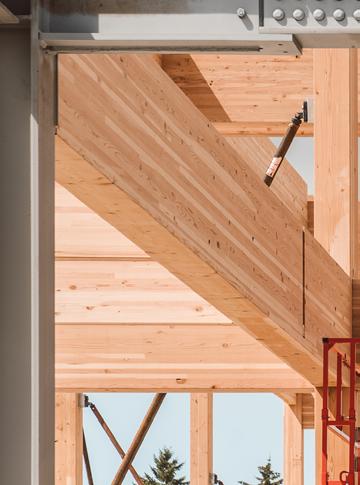
OUR ROOTS
Timberlab was born out of and is a subsidiary of Swinerton, a company known for excellence and innovation for over 135 years. With a history and culture of entrepreneurship and innovation, Swinerton is no stranger to working on the frontier – pioneering steelreinforced concrete following the 1906 San Francisco earthquake, and one hundred years later, incubating one of the top industrial solar contractors in the United States (now SOLV Energy).
As the first mass timber buildings were being built in the Pacific Northwest, Swinerton’s Portland office recognized the opportunity to reduce their impact on the natural environment, deliver projects with improved quality and safety outcomes, support rural economies, and create beautiful spaces by bringing the outside in.
Swinerton Mass Timber, an operating group within Swinerton, was formed in 2018 to provide turnkey mass timber systems to general contractors across the country. In January of 2021, Timberlab was launched as a separate business entity within the Swinerton Incorporated family of companies.
To this day, our foundation as a general contractor enables us to support projects holistically, focusing not only on the mass timber, but on the harmonious integration of the structure with all other building systems. Through proactive problem solving, we offer solutions that result in the highest value for the owner and occupant and are committed to being a partner in the success of the entire project.
From our early days of providing mass timber installation services to the commercial construction market, to our latest step into manufacturing, we have endeavored to close the gaps in the supply chain. We focused first on providing installation services, and then layered on fabrication modeling, CNC machining, and timber engineering. As the demand for mass timber continues to rapidly increase, we hope that the manufacturing branch of our business will augment the existing production capacity in the United States and give owners and developers further confidence that the supply chain can support their vision – at any scale.
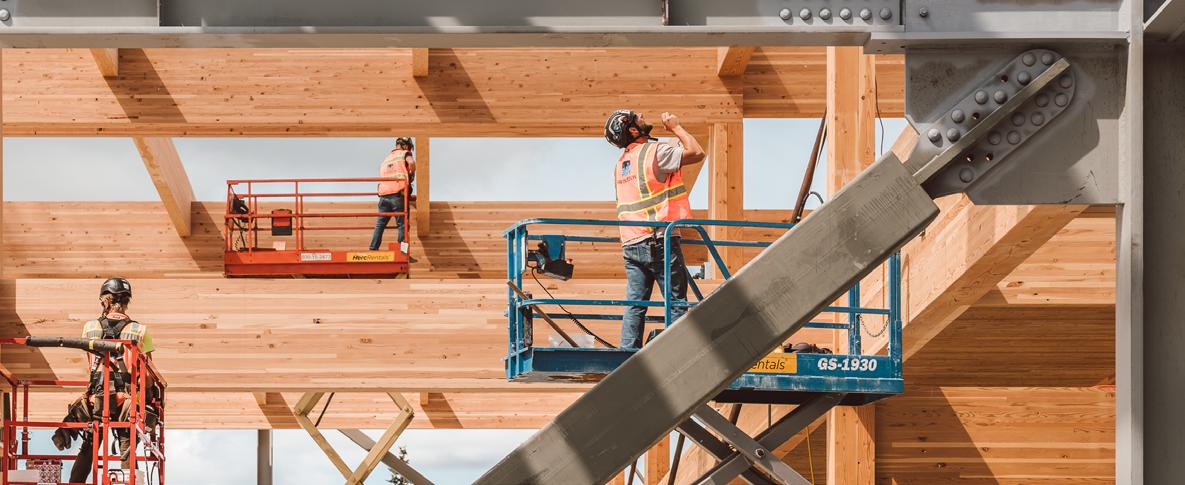
FACILITIES

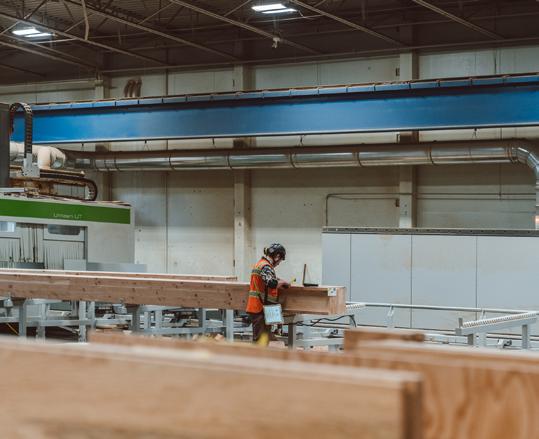
PORTLAND, OR FABRICATION FACILITY
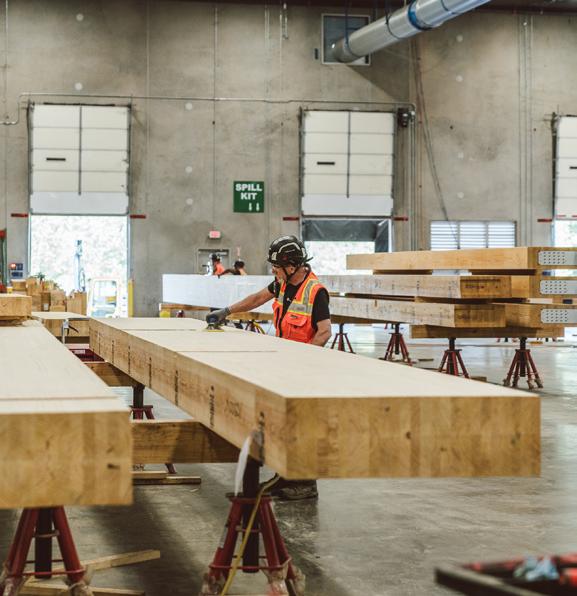
Timberlab's Portland, OR, fabrication facility is a regional hub for mass timber innovation and custom mass timber fabrication. Equipped with advanced CNC machinery, the facility enables precise fabrication of mass timber components for projects nationwide. This facility was our team's first and was formally launched in 2021 to aid in quality control, production efficiencies, and growing the supply chain for engineered wood products. This facility is also used to create custom mock-ups to assist in regional mass timber research and development.
GREENVILLE, SC FABRICATION FACILITY
Timberlab's Greenville, SC, operation extends the company’s mass timber production capabilities to the East Coast, allowing for efficient delivery of custom glulam and CLT products to projects east of the Mississippi. This facility is equipped with advanced manufacturing technologies and staffed by a skilled team dedicated to delivering high-quality, sustainable timber solutions. With this strategic location, Timberlab's Greenville facility is located within the Southern Yellow Pine timber basket, helping create more opportunities to build large-scale projects utilizing local Southern pine material.
SWISSHOME / DRAIN, OR GLULAM MANUFACTURING FACILITIES
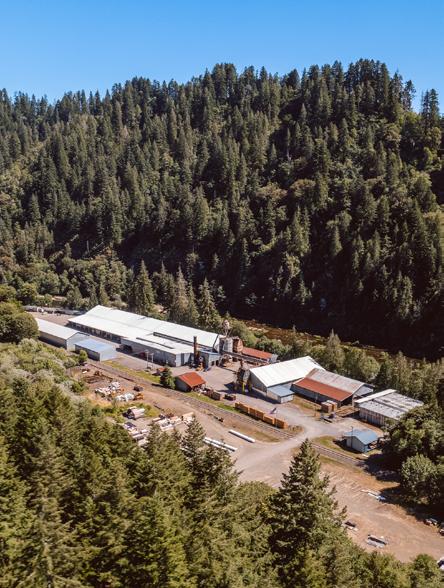
Timberlab's Swisshome, OR, glulam manufacturing operation, formerly American Laminators, carries a rich legacy of craftsmanship and expertise in engineered wood products. Acquired by Timberlab in 2024, the facility is located within Oregon’s premier timber basket, benefiting from access to some of the highestgrade lumber in the country. The proximity to quality raw materials ensures that Timberlab continues to produce exceptional glulam products. By preserving the legacy of this long-standing facility, Timberlab honors the region's deep-rooted timber traditions while advancing modern mass timber innovation.
Timberlab's Drain, Oregon glulam manufacturing operation is the second American Laminators facility that our team acquired in 2024. This legacy facility has extensive roots in Oregon's timber economy and is known for producing some of the longest-spanning glulam beams in the country. Located strategically near rail lines and the Interstate 5 corridor, this facility ensures that material can be delivered efficiently.
MILLERSBURG, OR CLT MANUFACTURING FACILITY
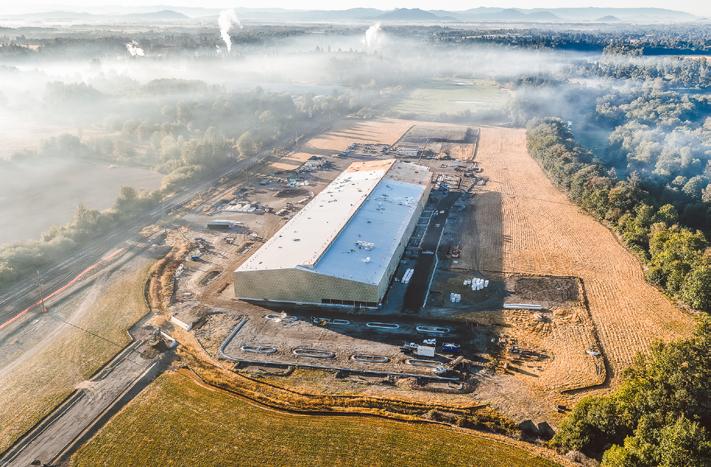
Timberlab’s Independence Hall CLT manufacturing facility in Millersburg, Oregon represents a major investment in expanding North America’s mass timber supply chain. Designed by LEVER Architecture and built in collaboration with project partners across the Swinerton ecosystem, the approximately 190,000-square-foot facility stretches nearly the length of three football fields and stands among the largest CLT production sites in the United States. Located in the Willamette Valley—the heart of the Pacific Northwest’s timber economy—the project reinforces Oregon’s role as a global hub for mass timber innovation while strengthening the region’s vertically integrated wood products industry. When operational, the plant is expected to produce 7–9 million square feet of CLT annually, supporting a rapidly growing pipeline of mass timber projects across the western United States and beyond.
The building itself serves as a full-scale demonstration of mass timber manufacturing and design. Constructed almost entirely from regionally sourced Douglas fir glulam, the facility incorporates long-span beams reaching up to 110 feet, more than 240 glulam columns rising up to 45 feet, and roughly 192,000 square feet of glulam roof panels that frame an expansive manufacturing hall designed to accommodate large-format panel production. The structure’s two-bay layout and tall clerestory daylighting system allow the factory floor to operate efficiently as CLT panels move from lamstock processing to finished product within a controlled environment. Equipped with advanced automated machinery—including a full CLT production line and radio-frequency press—the facility will enable Timberlab to manufacture high-quality panels ranging from 2 to 12 inches thick, creating a critical domestic source of engineered timber and helping accelerate the mainstream adoption of mass timber construction.


EXPERIENCE
Across over 80 finished mass timber projects and over 6 million square feet of mass timber built, Timberlab has delivered one of the most diverse and technically advanced mass timber portfolios in North America. Our projects span coast to coast—from the Pacific Northwest and California to the Mountain West, Midwest, Southeast, Texas, and the Northeast—and ranges in scale from academic buildings to large commercial offices, airports, high-rise residential towers, cultural institutions, as well as industrial operations. Timberlab has supported projects at every level of complexity, including long-span roofs, hybrid timber-steel and timber-concrete systems, tall timber structures, adaptive reuse, and highly exposed architectural timber assemblies, often delivered within active or constrained sites.
HEARTWOOD
Seattle, WA
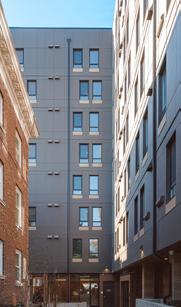
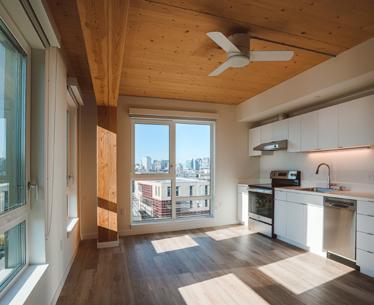
Heartwood is the first building in the country permitted as Type IV-C construction in the United States. At eight stories and 70,000 gross square feet in the Capitol Hill neighborhood, it is the first tall wood building permitted by the City of Seattle. Timberlab, in partnership with DCI Engineers, developed a 2-hour fire-rated woodto-wood connection for the structure.
LIVE OAK BANK
Wilmington, NC
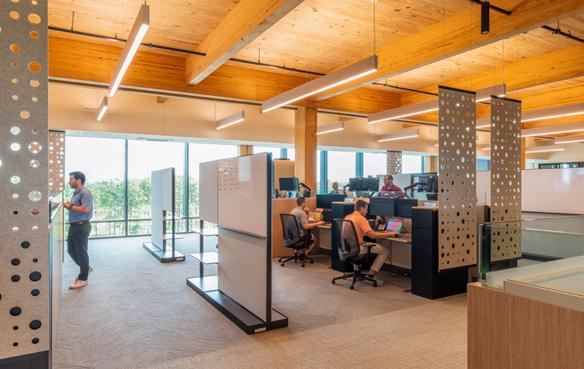
Live Oak Bank Building 4 in Wilmington, North Carolina is a 67,000-square-foot, four-story office building that brings a mass timber structural system to campus—pairing exposed wood warmth with a high-performance workplace environment. Timberlab performed the delegated design of the timber structure and prefabrication of the glulam timber and cross-laminated timber (CLT) at Timberlab’s South East fabrication facility.
PORTLAND INTERNATIONAL AIRPORT
Portland, OR
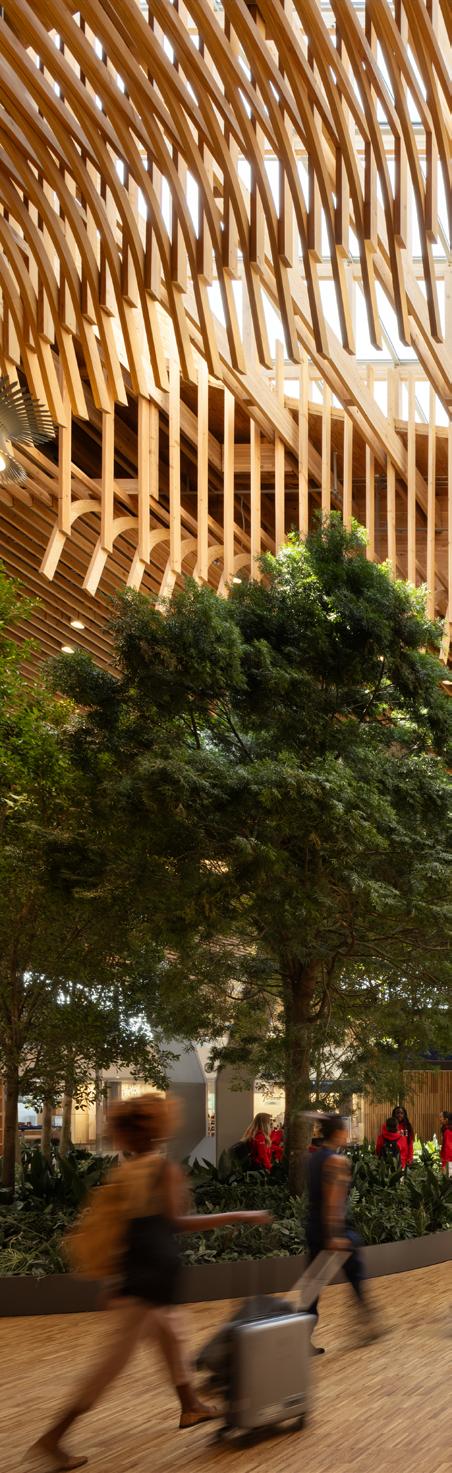
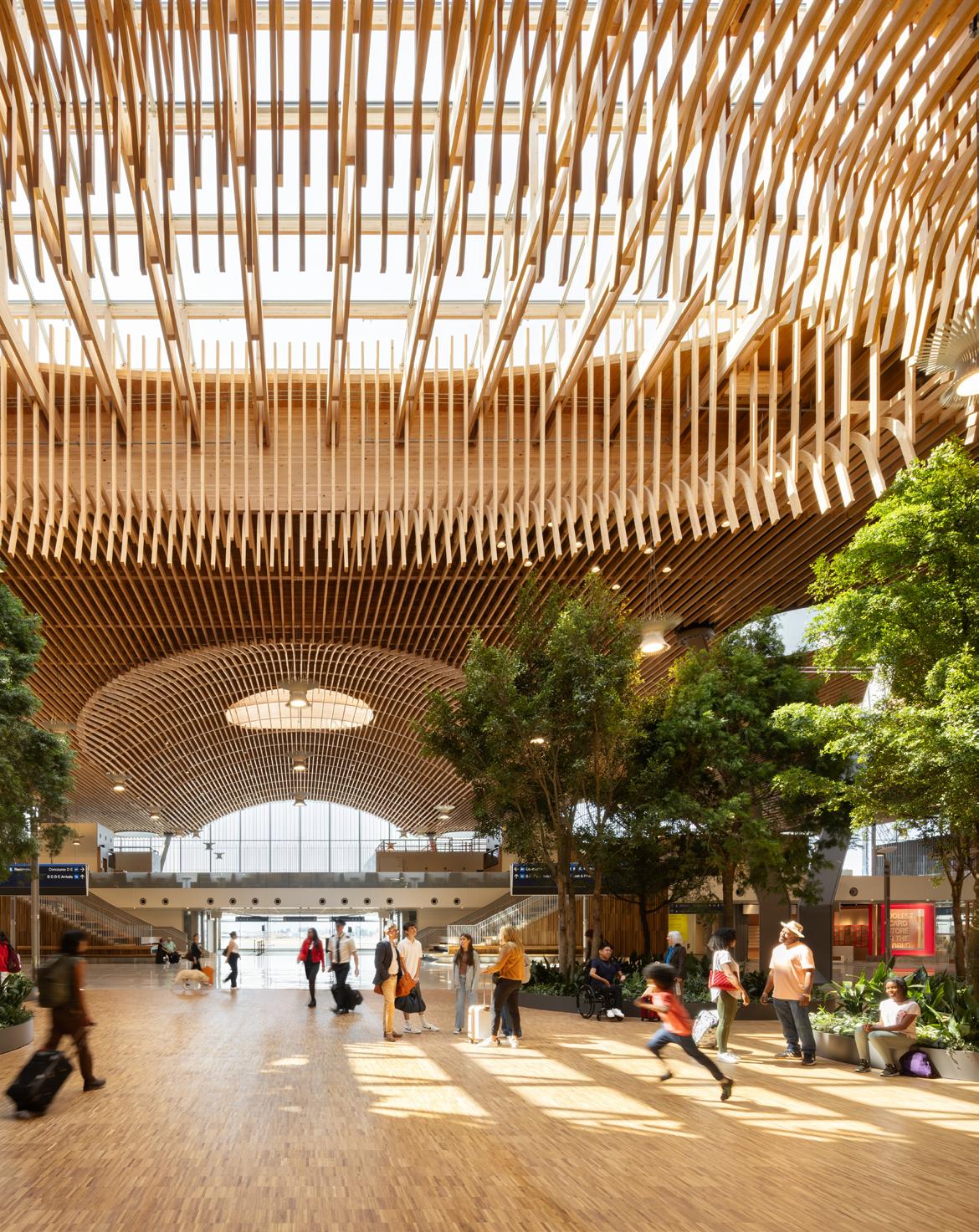
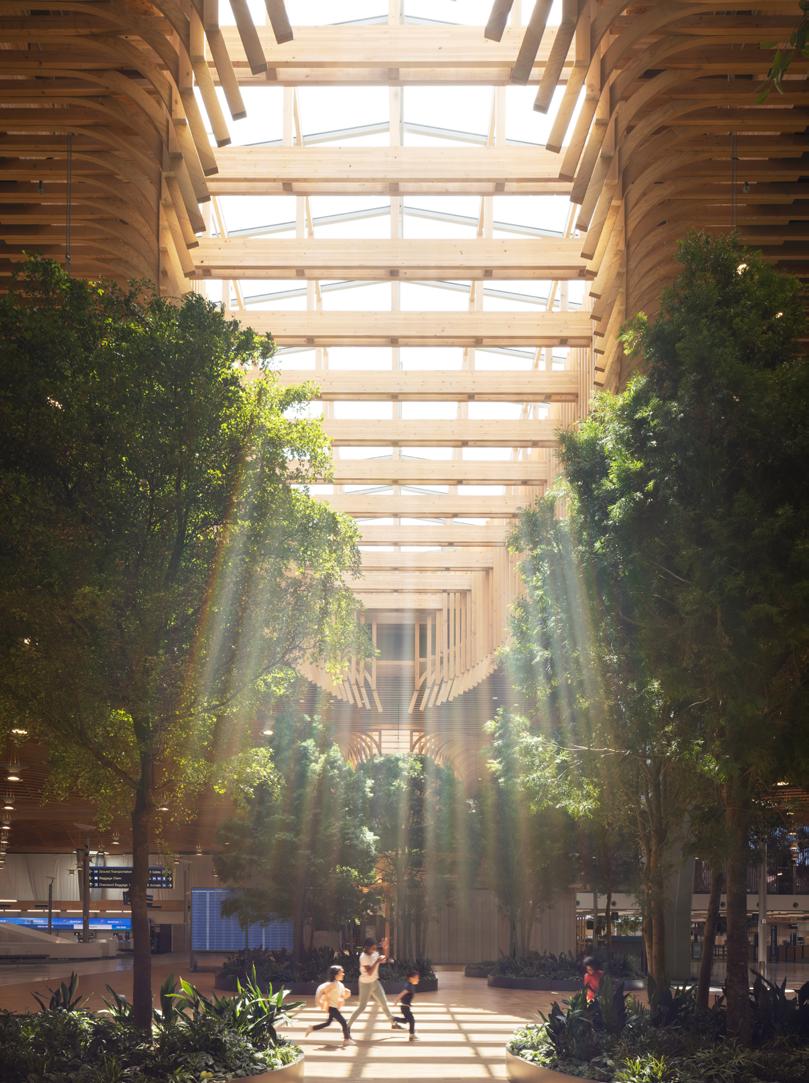
Portland International Airport’s Terminal Core Redevelopment is anchored by a nineacre, curved mass timber roof composed of 3.5 million board feet of Douglas fir, with long-span 80-foot glulam arches, a 2-inch mass plywood panel (MPP) diaphragm/ skylight curb system, and an underside 3x6 lattice layer consisting of over 30,000 pieces. Timberlab entered the project in 2019 in a design-assist role, providing constructability input, strategic procurement coordination with regional producers, and fabrication-level digital coordination to translate the roof’s compound geometry into buildable cassettes.
NORTHLAKE COMMONS
Seattle, WA
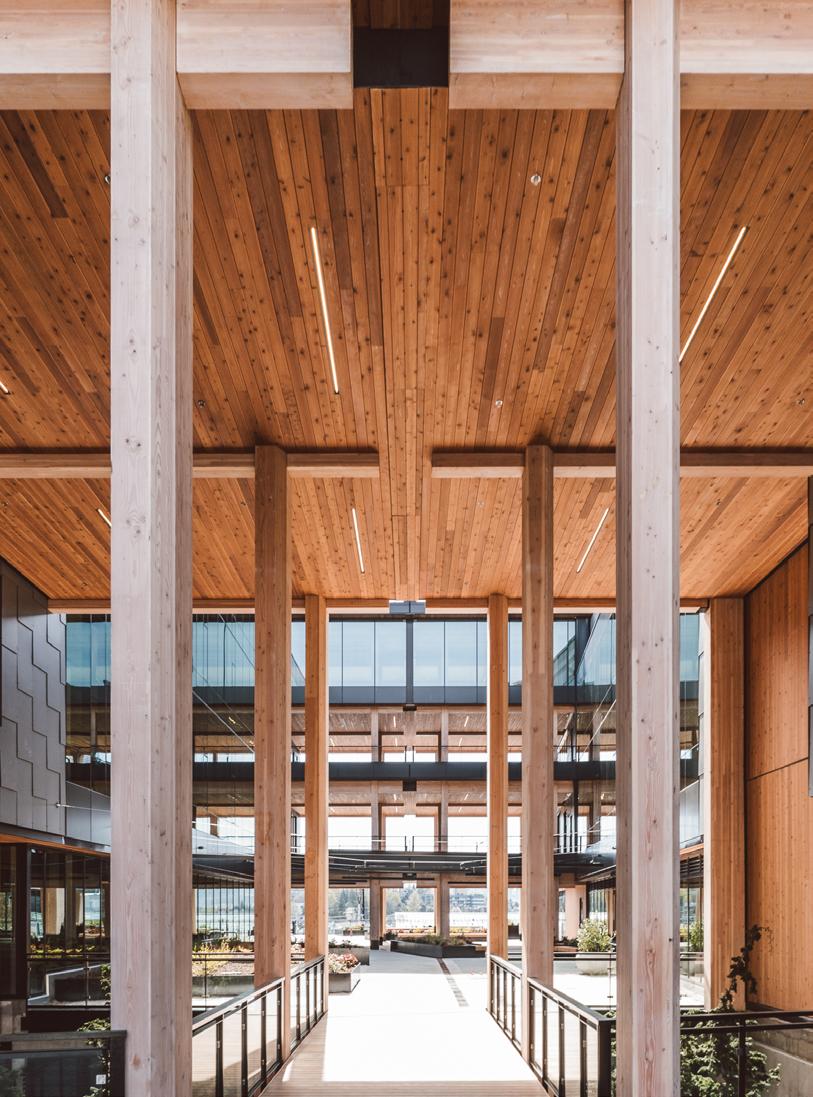
Northlake Commons in Seattle, Washington is a five-story, 175,000-square-foot mixed-use, lab-ready office and commercial building that represents one of the largest mass timber workplace structures in the United States, integrating over 150,000 square feet of exposed CLT and glulam structure over a concrete podium with warehouse, retail, and outdoor public plaza components.
TDEM
Austin, TX
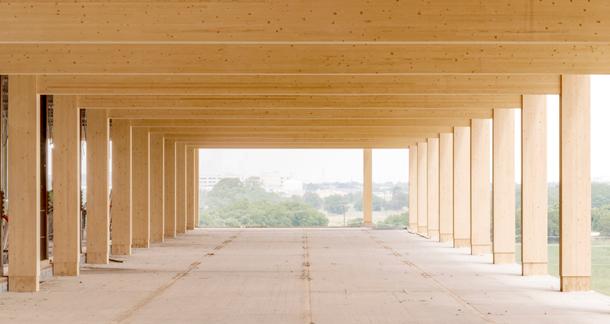
The Texas Division of Emergency Management (TDEM) Headquarters in Austin, Texas is a purpose-built public safety campus designed to consolidate statewide emergency management operations into a single, modern facility. At 90,000 square feet, the six-story headquarters office building was engineered to withstand extreme events such as 200-mph windstorms.
ASCENT
Milwaukee, WI
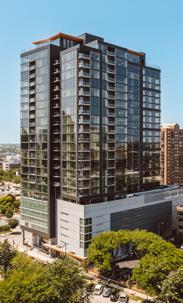
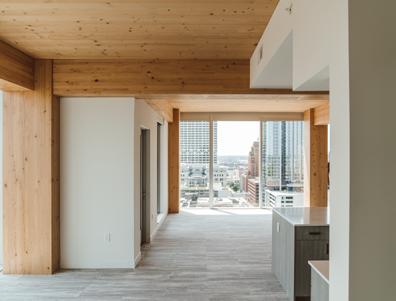
Timberlab’s contributions on Ascent in Milwaukee, Wisconsin supported one of the most technically ambitious mass timber projects built to date: a 25-story, 493,000-square-foot hybrid mass timber-concrete residential tower that, at 284 feet, became the world’s tallest mass timber hybrid structure upon its completion in 2022.
USM
Portland, ME
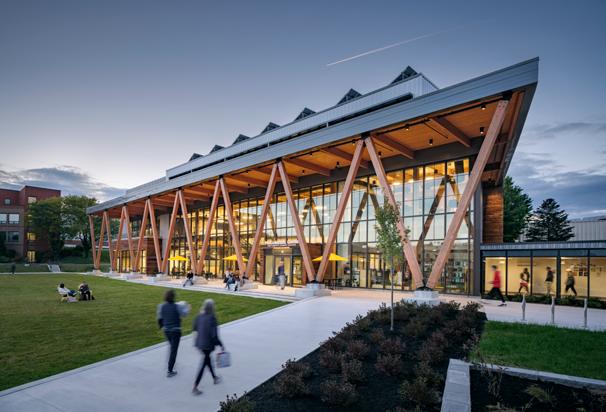
The University of Southern Maine McGoldrick Center for Career & Student Success in Portland, Maine is a 41,000-square-foot, three-story mixed-use academic and student life facility that serves as a central hub for the University. As one of Timberlab’s first East Coast projects, our team provided a holistic scope on the project, including: design-build services for the mass timber structural system, encompassing delegated design, custom connection detailing, and full fabrication and installation of the timber frame.
SUITE OF SERVICES
To support the production of fully fabricated mass timber systems, we offer a selection of complimentary services to enhance project value and advance the mass timber industry. We provide services and products to customers across the United States and Canada.
EARLY PROJECT ASSISTANCE
We are problem solvers at heart and enjoy being involved in the conceptual phase of a project when mass timber is being considered as a potential structural solution. For project teams exploring new frontiers, curious about appropriate applications of mass timber products, seeking permitting support, or needing a better sense of cost and schedule, we are available to serve as an extension of your team. This early project assistance is integral to how we operate and fundamental to each level of service that we offer. In fact, it is in this early stage of development when we can have the biggest impact on project viability and value.
TIMBER ENGINEERING
As mass timber is still new to many in the AEC industry, we have established a service-oriented timber engineering team that can provide support to structural engineers and project teams as needed. We engage as a partner, seeking first to understand the specific needs of the team and then propose services that we believe will add significant value by reducing cost, accelerating schedule, or improving the constructability of the project.
DIGITAL CONSTRUCTION
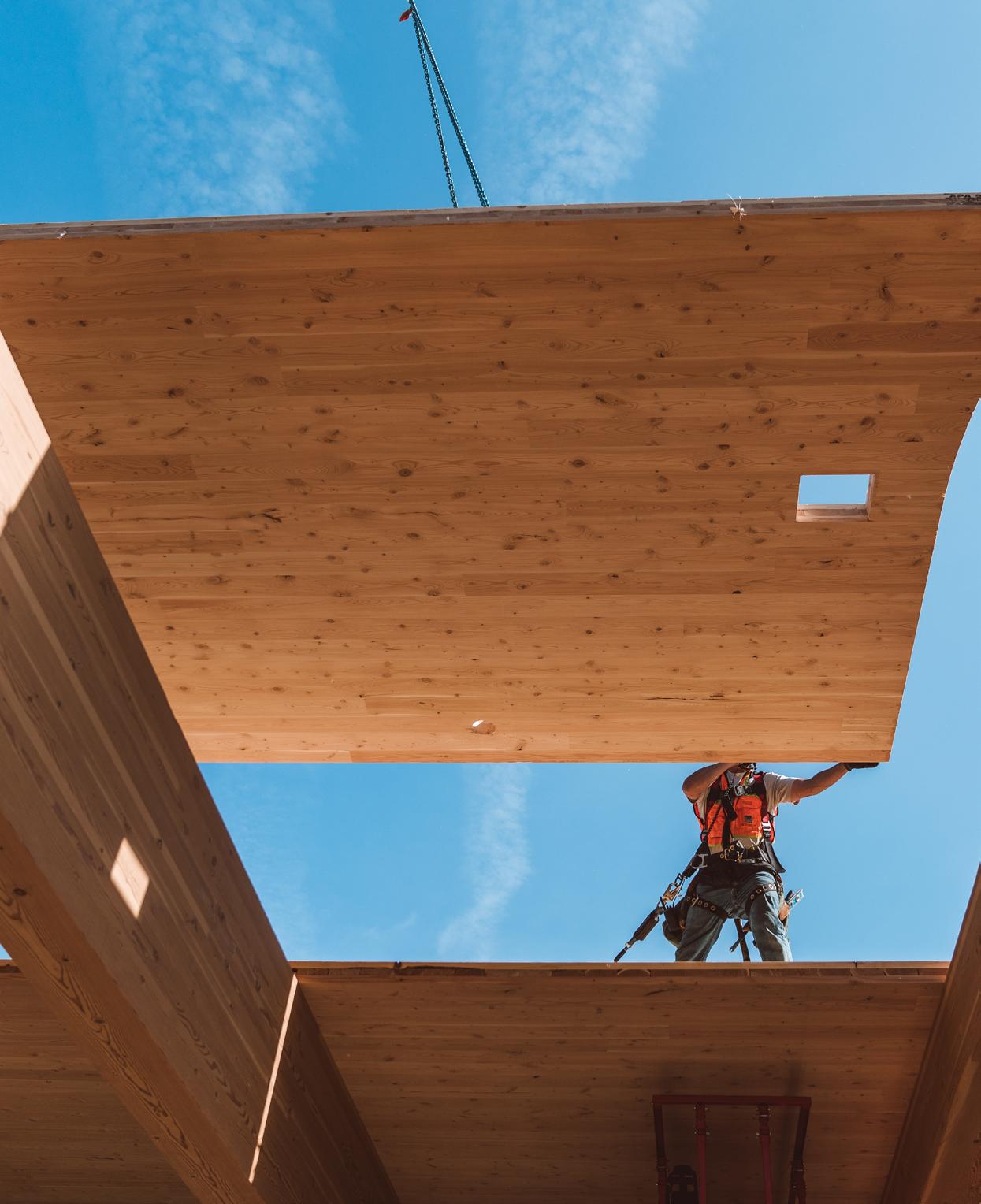
The detailing process is the link between architectural vision and the physical building. Our digital construction team translates the structural design into fabrication-level information used to prefabricate the mass timber components. Working in Revit, we validate the geometry of the building, coordinate the structure with other building systems, and refine each detail to ensure safe, elegant, and efficient assembly of the kit of parts on site.
INSTALLATION
For general contractors across the United States, we offer installation services for our mass timber systems. With our builder roots, we prioritize safety and quality, and we have the experience to support efficient assembly of the structure and smooth coordination with other trades.
PARTNER WITH US
Thank you for your interest in working with Timberlab. The care we provide and the value we offer extend beyond manufacturing products. To truly uplift mass timber as the building blocks of the future, we concern ourselves with how the timber structure integrates with other building systems and the long-term performance after we have left the site. We see ourselves as a partner in the success of the whole building, in service of broad project and societal goals. We offer six distinct levels of service, outlined below.
LEVEL 1 DESIGN-BUILD:
For teams seeking a one-stop shop for mass timber, we provide delegated timber engineering services in coordination with the structural engineer of record, a fully coordinated and fabricated mass timber structure, and installation by our in-house craft.
LEVEL 2 DESIGN-SUPPLY:
For teams seeking robust support with a mass timber solution, we provide delegated timber engineering services in coordination with the structural engineer of record, and a fully coordinated and fabricated mass timber system for installation by others.
LEVEL 3 SUPPLY-INSTALL:
For teams seeking a turnkey solution, we supply and install a fully coordinated and fabricated mass timber system.
LEVEL 4 FULL-SERVICE SUPPLY:
For teams seeking mass timber supply, we deliver a fully coordinated and fabricated mass timber system to the site for installation by others.
LEVEL 5 FABRICATION-ONLY SUPPLY:
For teams who can provide an issued-for-construction fabrication model and shop drawings, we can provide fully fabricated mass timber components.
LEVEL 6 FABRICATION-READY SUPPLY:
For teams who intend to provide all design assistance, fabrication modeling, and CNC machining, we can provide manufactured billets cut to specified length.
DESIGN-SUPPLY
SUPPLY-INSTALL
2. INTENTIONAL SOURCING
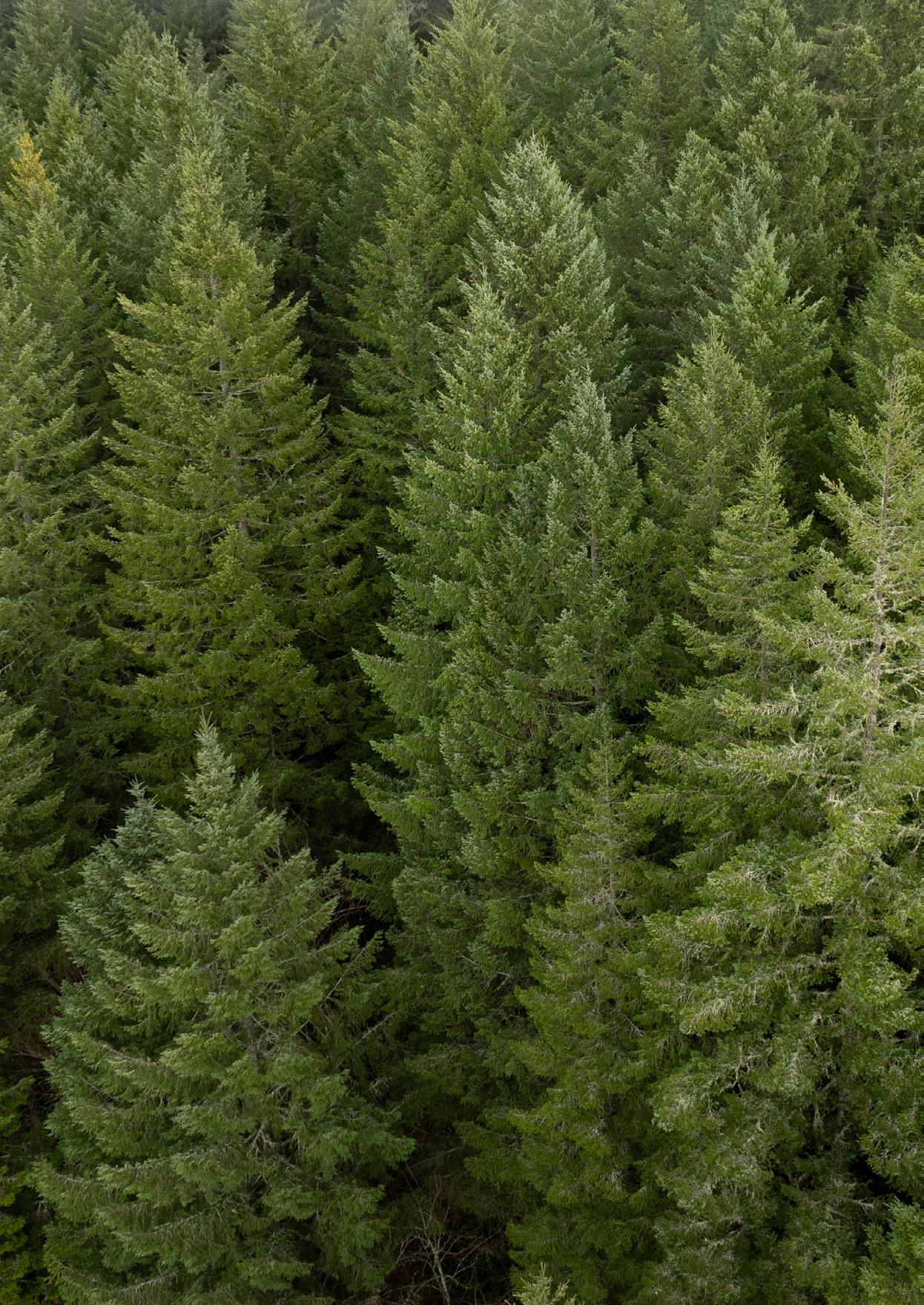
Timberlab is committed to responsible wood sourcing for our projects and offers creative solutions to meet sustainability and wood procurement goals. We prioritize working with suppliers and land owners who adhere to rigorous environmental standards and promote responsible forest management practices. By carefully selecting our timber sources, we aim to minimize our ecological footprint and contribute to the preservation of our planet’s precious resources. Through our dedication to sustainable timber procurement, we strive to create a positive impact, not only in the construction industry but also in the preservation of forests for future generations.
CERTIFIED WOOD
We maintain chain of custody certification for FSC®, SFI®, and PEFC forest management standards. Please let us know early if you are interested in sourcing wood for your project with any of these certifications, as species can impact availability of material. There may be cost premiums for certified products due to supply chain limitations.
Third-party-verified forest management and wood fiber certifications are one way that project teams can ensure their input fiber meets rigorous environmental, health, and social standards. The three most commonly known and widely accepted forest management certification organizations are Forest Stewardship Council® (FSC), Sustainable Forestry Initiative® (SFI)*, and Programme for the Endorsement of Forest Certification (PEFC).
Timberlab holds and actively maintains certifications for each of these organizations. Our wood sourcing certifications include:
• FSC® Chain of Custody - SCS-COC-007899
• SFI® Chain of Custody - SCS-SFI-COC-007899
• SFI® Certified Sourcing - SCS-SFI-CS-10010
• PEFC Chain of Custody - SCS-PEFC-COC-007899
Certified lamstock (glulam input lumber) can be difficult to procure in sufficient quantities and grades due to current supply chain limitations. Maintaining certification also requires investments in human and physical capital by the landowner, mill, and manufacturer. This in turn can lead to a premium associated with certified wood fiber.
It is best to have conversations about certified wood early in the design process to ensure project teams can achieve sustainability goals while adhering to schedules and overall project costs.
*SFI marks are registered marks owned by the Sustainable Forestry Initiative Inc.
INTENTIONAL WOOD SOURCING
Mass timber construction is unique in its ability to tell the story of the material itself. When you leave your structure exposed, it gives end users the opportunity to ask questions such as: Where does this wood come from? Why does it look this way? Why use wood instead of an alternative building material? Our relationships with forest landowners and sawmills enable us to offer transparent and targeted wood sourcing in support of a variety of regional, ecological, and social equity values. While specific priorities may change over time, we remain committed to supporting our customers in selecting where their wood comes from, if they so choose, and insofar as sourcing goals align with our product specifications. We are flexible in our procurement, capable of segregating lumber within our facilities, and are a trusted partner in helping your team achieve its triple bottom line objectives.
CASE STUDIES
PORTLAND AIRPORT (PDX)
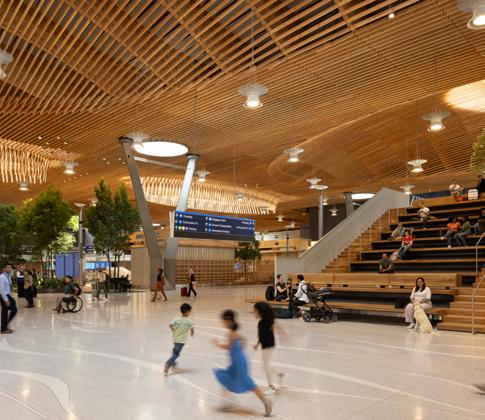
The Portland International Airport’s new mass timber roof is widely recognized as one of the first commercial construction projects to apply intentional, targeted procurement strategies for mass timber at scale. Comprised of approximately 3.5 million board feet of Douglas fir, all of which was sourced from forests in Oregon and Washington that are situated within 300 miles of the airport. PDX’s new roof is a testament to what can be accomplished when a group of motivated designers and their manufacturing partners engage early to accomplish even the most ambitious of client goals. By tracing fiber back to source forests and physically segregating material as it moved through the supply chain, PDX tells the story of the material that was used to build the space while celebrating regional landowners and stewards who are managing forests in more meaningful ways.
BOULDER CIVIC AREA WEST
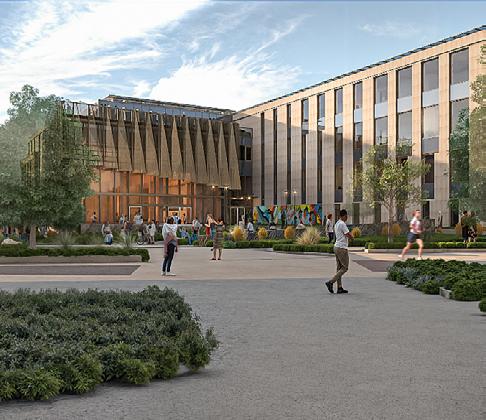
The Boulder Civic West Campus project demonstrates how regional forest resources can be directly integrated into high-performance mass timber construction. For this project, the team successfully incorporated Colorado-sourced wood fiber into the cross-laminated timber (CLT) panels, strengthening the connection between local forests, manufacturing, and the built environment. Timberlab supported this effort by coordinating material sourcing and technical alignment to ensure the locally derived fiber met the project’s structural, quality, and sustainability requirements. The result is a civic building that reflects Boulder’s environmental values while reinforcing a resilient, in-state mass timber supply chain.

SPECIES OFFERINGS
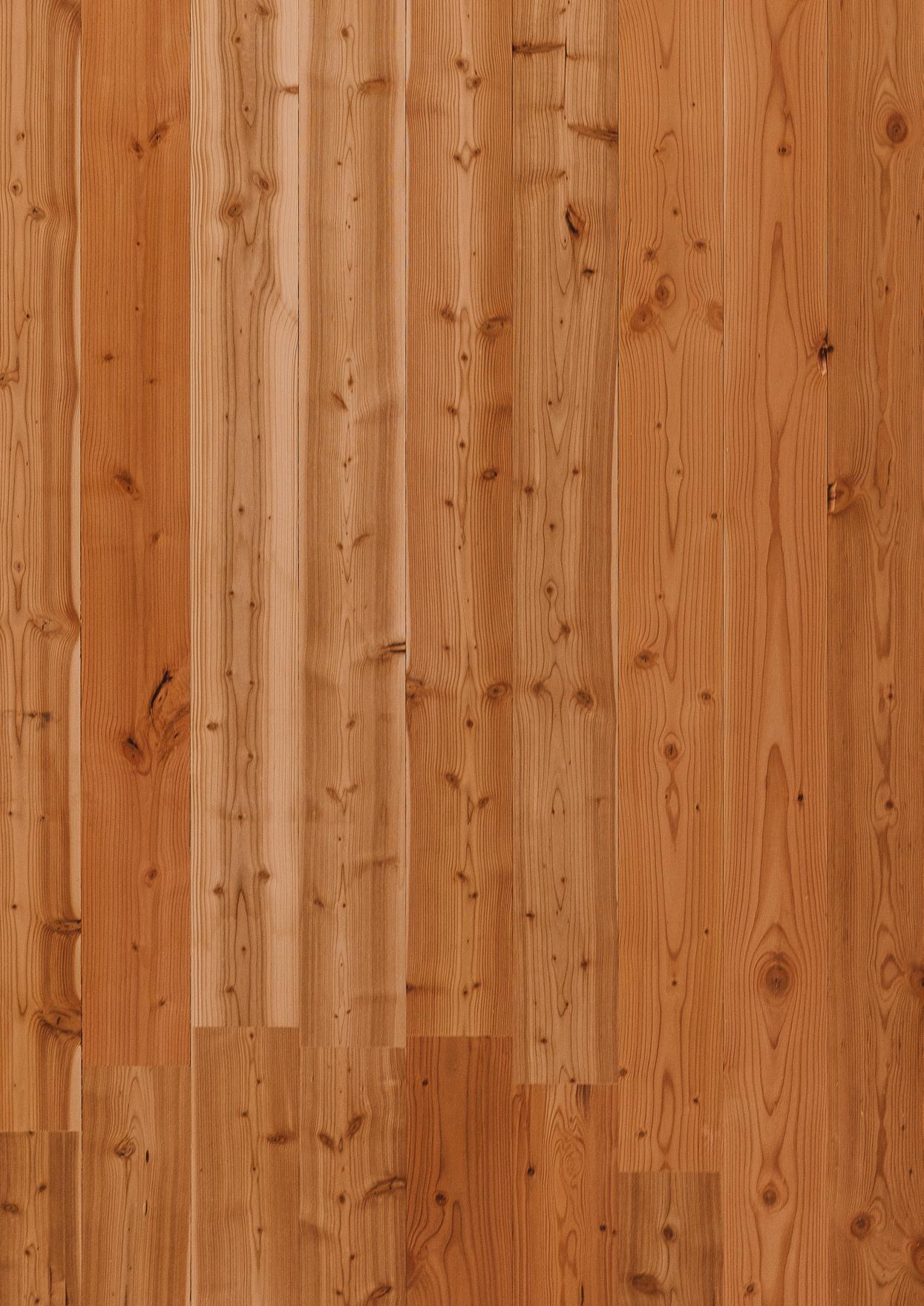
DOUGLAS FIR-LARCH
Species
Bioregion
Appearance
Density
Notable Characteristics
Durability
Douglas fir (Pseudotsuga menziesii) Western larch (Larix occidentalis)
Central British Columbia south along Pacific Coast to central California, central Mexico, also Rocky Mountains to Arizona
Sapwood is generally a light straw color. Heartwood is a deep russet brown. Grain is straight or slightly wavy.
32 - 35 lb/ft³ (at 15% moisture content)
510 - 560 kg/m³ (at 15% moisture content)
Stiff and strong for its weight, among the most dense softwoods in North America. Dimensionally stable, glues well, and machines well.
Requires preservative treatment for wet service conditions. Pressure treatment options both with and without incising of the wood to achieve durability requirements are available.

Availability
Douglas fir accounts for 37% of forest land in Oregon, with 10.9 million acres of cover. While Douglas fir populations are sensitive to increasing temperatures that produce drought events and higher pest infestations, it is the most prevalent tree species in the Pacific Northwest.
SOUTHERN PINE
Species Bioregion
Appearance Density
Notable Characteristics
Durability Availability
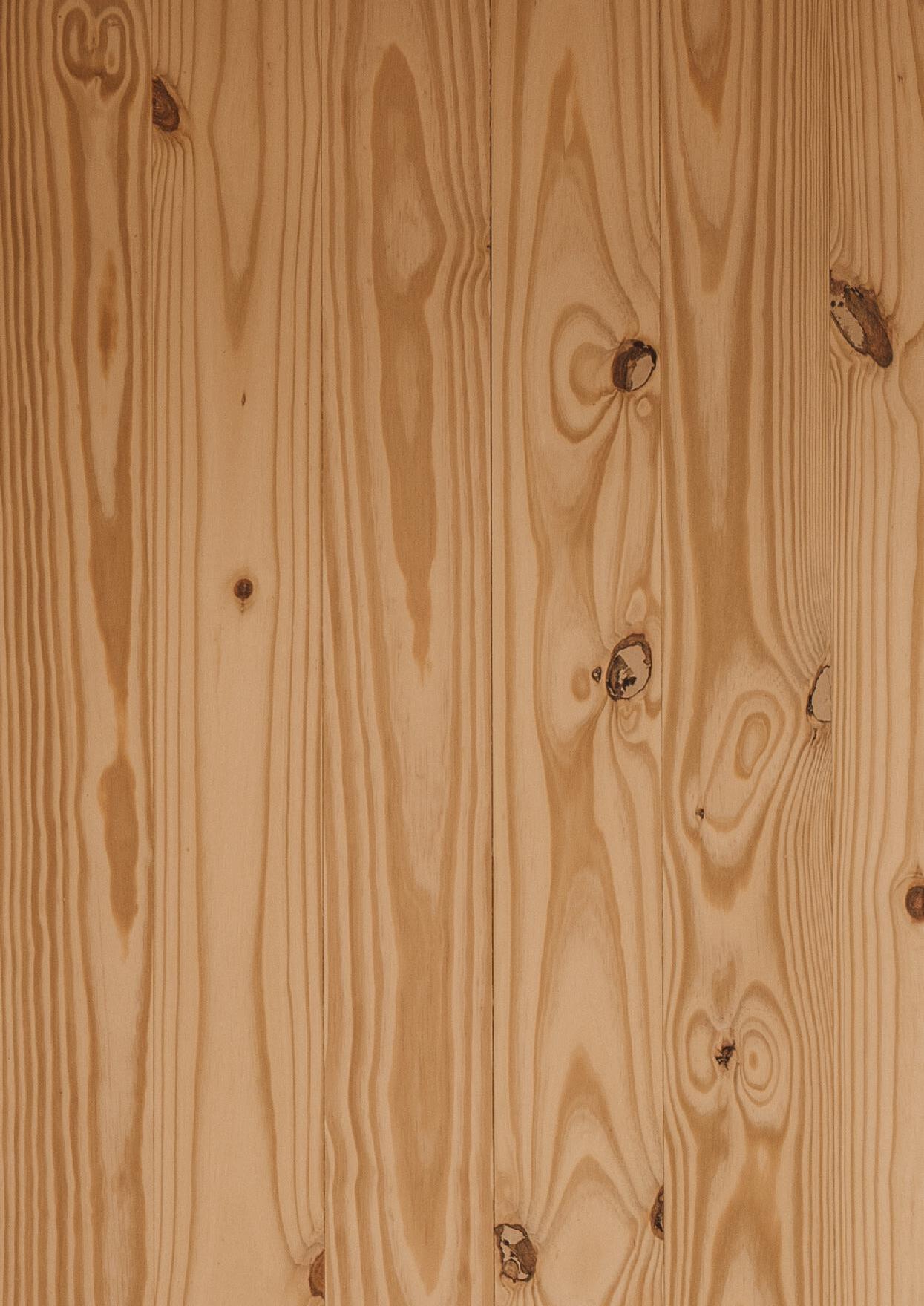
Longleaf pine (Pinus palustris)
Shortleaf pine (Pinus echinata)
Loblolly pine (Pinus taeda)
Slash pine (Pinus elliotti)
Southeastern United States
Sapwood ranges from white to yellow or golden. Heartwood ranges from yellow to reddish-brown. Distinct grain pattern.
33 - 39 lb/ft³ (at 15% moisture content)
530 - 625 kg/ m³ (at 15% moisture content)
Highest specific gravity of all common softwoods.
Requires preservative treatment for wet service conditions. Pressure treatment options to achieve durability requirements are available.
Widely available, Southern pine forests are some of the most productive in the world. It is grown in a vast band in the southeast United States, near sawmills.
ALASKA CEDAR
Species
Bioregion
Appearance
Density
Notable Characteristics
Durability
Common Applications
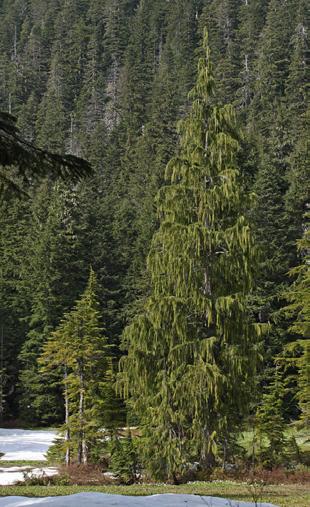
Alaska Cedar (Chamaecyparis nootkatensis)
Coastal regions of Alaska, British Columbia, and the Pacific Northwest of the United States
Light color, with straight grain. Sapwood is whitishyellow and not distinct from heartwood. When left exposed outdoors, weathers to a uniform gray.
26 - 31 lb/ft³ (at 15% moisture content)
420 - 500 kg/ m³ (at 15% moisture content)
The heartwood is naturally durable due to natural extractives that also provide a pleasant aroma.
Heartwood is naturally durable. Resistant to decay, insects, and fungi.
The heartwood can be used in exterior above-ground applications that are exposed to moisture.

3. CLT
PRODUCT
CERTIFICATIONS
Timberlab Cross-Laminated Timber (CLT) will be certified by APA - The Engineered Wood Association to the ANSI/APA PRG 320 (2025) product standard. We will manufacture the CLT grades and layups listed in APA Product Reports for US and Canadian building codes.
The information provided in this product guide applies to CLT designed to the following US design standards:
• 2024 International Building Code
• 2024 ANSI/AWC National Design Specification for Wood Construction
• 2021 ANSI/AWC Special Design Provisions for Wind and Seismic
• 2024 ANSI/AWC Fire Design Specification for Wood Construction
Note: Our CLT products are still in development. Please contact Timberlab's manufacturing team for the most up to date product information.
PRODUCT CHARACTERISTICS
Lamination Layers
Finished Panel Measurements
Laminating Lumber
Maximum Width
3, 5, 7, 9
11'-2 1/2"
Maximum Length 60'-0"
Thicknesses
Species Combinations
Moisture Content
Cross section dimensions (post-planed)
Panel Edge Profile
Face Lamination Orientations
Adhesives
Panel Tolerances
(Per APA PRG 320)
Facebond
End (Finger) Joints
Edge Joints Transverse Laminations
Edge Joints Longtitudinal Laminations
Thickness
Width
Length
Squareness
Straightness
Density
Use Conditions
Shop Sealer
Appearance Classifications
4 1/8", 6 7/8", 9 5/8", 12 3/8"
Douglas fir-larch (WWPA)
Spruce pine fir (NLGA)
Southern pine (SPIB)
12% +/- 3% (At the time of manufacturing)
Thickness = 1.375"
Widths = 5.25" or 7" (approximate)
Square, or chamfer if specified
Longitudinal (LL) or Transverse (TL)
Hexion MF Radio Frequency (clear bondline)
Hexion MF Radio Frequency (clear bondline)
Hexion MF Radio Frequency (clear bondline, non-structural)
Hexion MF Radio Frequency (clear bondline, non-structural, when specified)
+/- 1/16" or 2% of panel thickness, whichever is greater
+/- 1/8"
+/- 1/4"
Length of two panel face diagonals measured between panel corners shall not differ by more than 1/8".
Deviation of edges from a straight line between adjacent panel corners shall not exceed 1/16".
Average density at 12% moisture content: SPF - 30 pcf DF - 35 pcf SP - 38 pcf
Dry (Ref: APA PRG 320 Scope)
Yes, if specified
Industrial Appearance, Architectural Appearance
CROSS-LAMINATED TIMBER
PANEL DIAGRAM
TIMBERLAB
TIMBERLAB
CROSS-LAMINATED TIMBER
CROSS LAMINATED TIMBER
PANEL LAYUP
PANEL LAYUP
LONGITUDINAL "LL" LAYUP
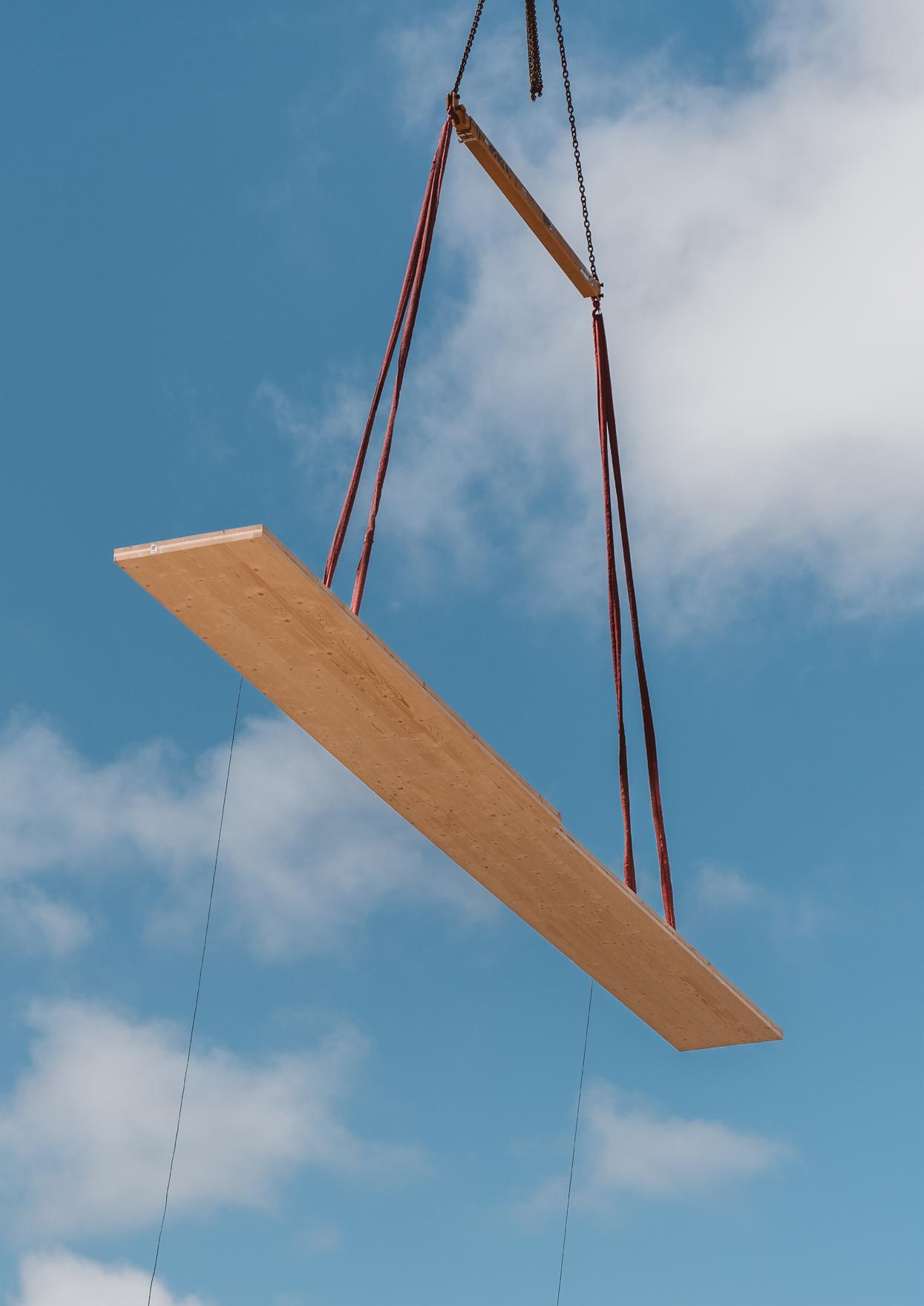
Cross-laminated timber is a large-format prefabricated engineered panel product most commonly used as floor, roof, and wall elements in buildings. It is manufactured using graded lumber laminations stacked in alternating cross-wise layers to form a solid and dimensionally stable large format panel. During manufacturing the laminations are face bonded and finger-joint bonded together using certified structural adhesives.
LONG DIRECTION LAMINATIONS. Edges fit tightly to one-another. Adhesive optional.
SHORT DIRECTION LAMINATIONS. Edge joints are adhesively bonded.
FINGER JOINTS: Profile on side of board. Joints are randomly distributed.
LAMINATION LAYERS ARE STACKED with face bond structural adhesive between each layer.
PRESSURE is applied along surface as well as along the long sides of the panel.
TIMBERLAB
CROSS-LAMINATED TIMBER
PANEL LAYUP
LONGITUDINAL "LL"
TRANSVERSE "TL"
GRADES + LAYUPS
TABLE 1: ASD REFERENCE DESIGN VALUES FOR LUMBER LAMINATIONS USED IN TIMBERLAB CLT
Note: Our initial product certifications will be obtained for Douglas fir CLT panels, followed by Southern Pine. These panels can also be provided with alternate species on the visible face layer for aesthetic purposes. Additional layups will be certified as our product line grows. Refer to our website for the most current offerings.
TABLE 2: LAYUPS AND THICKNESSES
SPECIES OFFERINGS
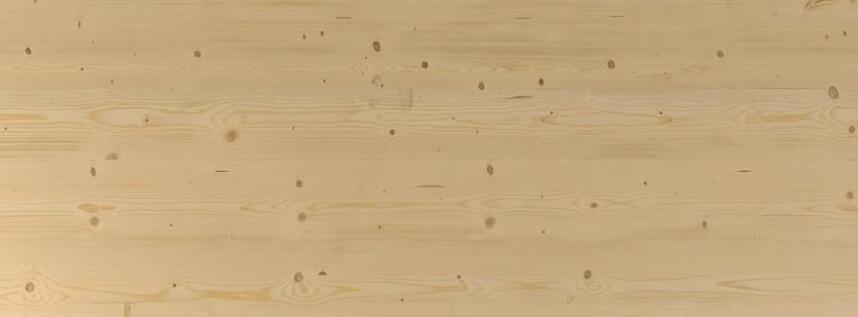
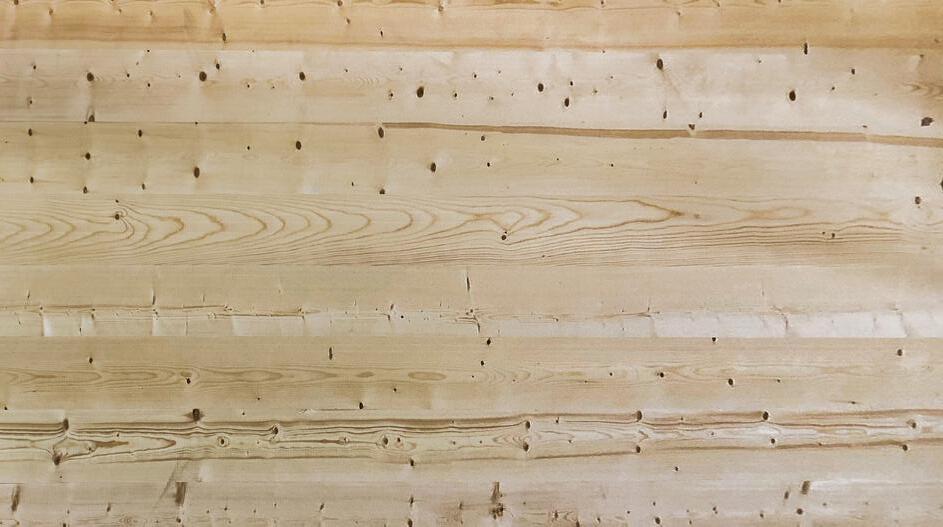
Timberlab works closely with a diverse range of lumber suppliers across the timber industry, including partners in Canada. With decades-long relationships with these providers, we ensure that we procure high-quality timber products across a diverse range of species.
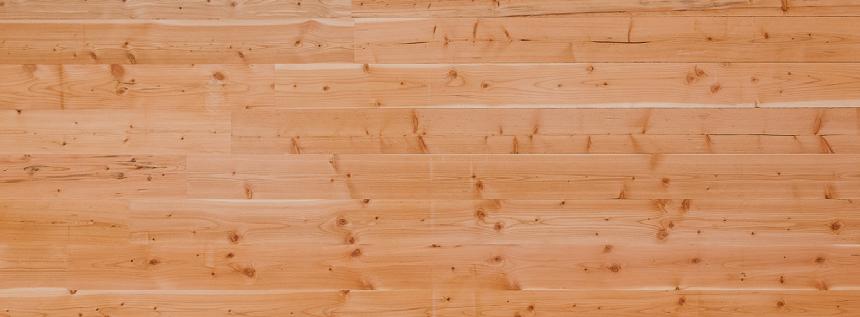
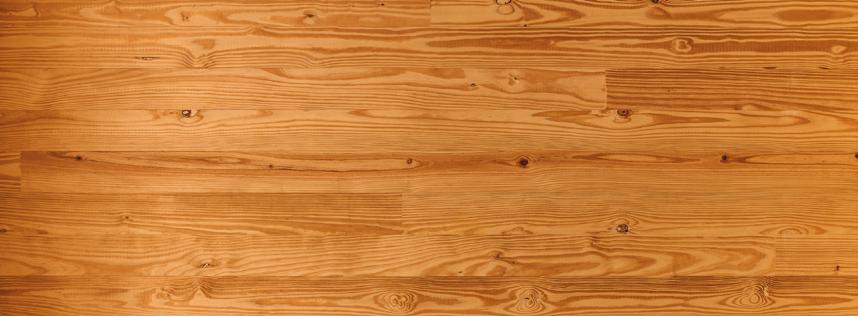
SPRUCE PINE FIR (SPF)
DOUGLAS FIR-LARCH (DF)
SOUTHERN PINE (SP)
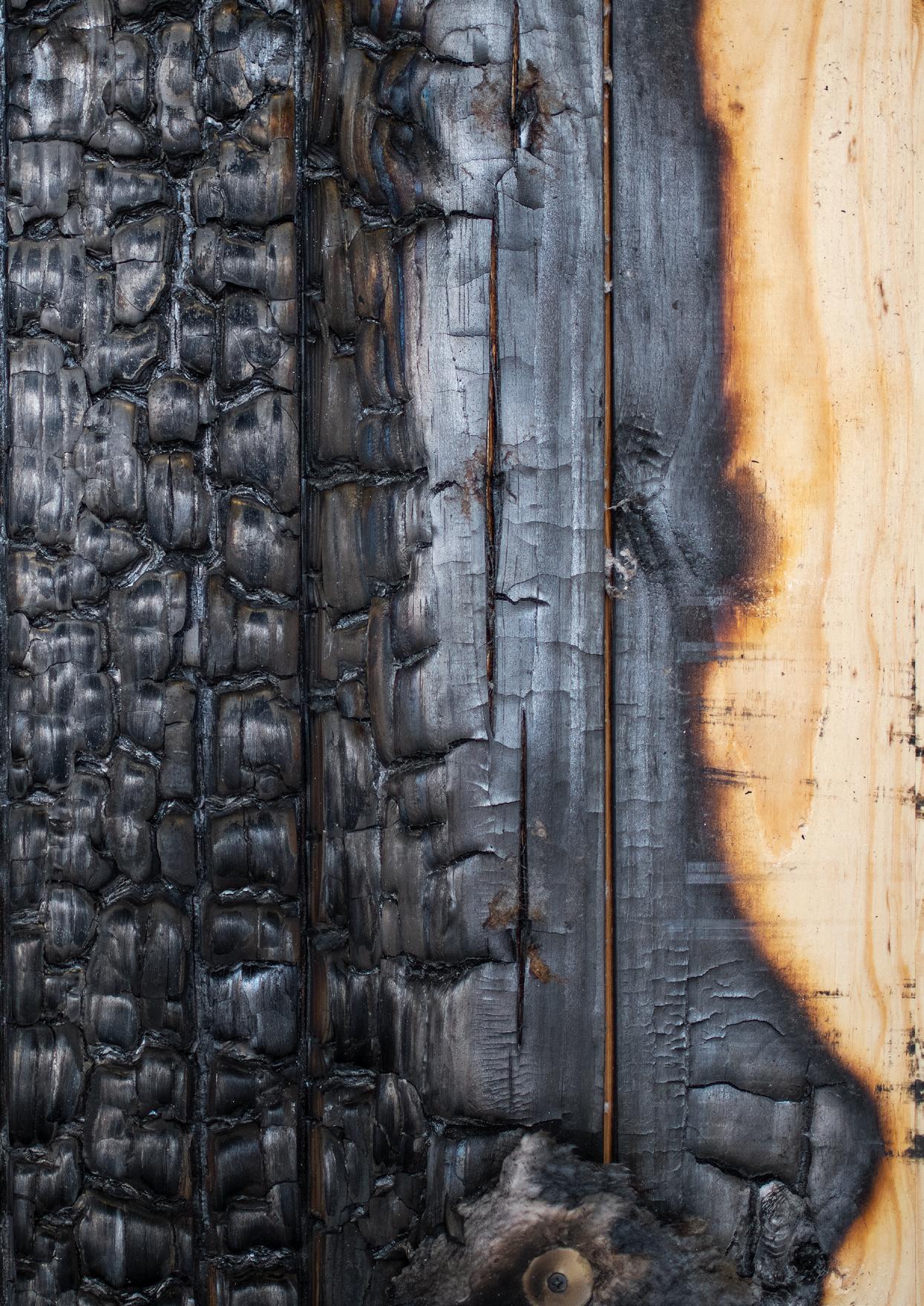
FIRE PERFORMANCE
The International Building Code (IBC) includes multiple methods for demonstrating fire performance of timber structures. In Type IV-HT construction, CLT is required to meet minimum thickness requirements: 4 inches for floors and exterior walls, and 3 inches for roofs. No further testing or analysis is required, though the IBC does contain additional detailing requirements that must be followed.
For other construction types or building elements that require up to a 2-hour fire-resistance rating, IBC and the National Design Specification (NDS) for Wood Construction permit a calculation method to demonstrate compliance. This method, outlined in Chapter 16 of the NDS, is based on calculating the capacity of a residual cross-section after charring. Due to the consistent and well-researched char behavior of large timber elements, this method is applicable to all CLT without the need for product-specific fire testing.
Many CLT manufacturers do choose to perform productspecific fire testing of floor or wall assemblies, which can often yield increased fire-resistance ratings over the char calculation method. Timberlab CLT will be tested according to the standard ASTM E119 fire test method and the results published on our website as they become available.
APPEARANCE CLASSIFICATIONS
Timberlab's cross-laminated timber will be produced to two levels of appearance classifications to achieve project visual requirements. These classifications generally align with the two appearance classifications in Appendix X1 of PRG 320. An architectural appearance (AA) surface classification may be specified for the top, bottom, or both faces of the panel. Unless otherwise specified, the top face of all Timberlab CLT panels used in floor or roof applications have an Industrial Appearance (IA) classification. The following table presents the visual characteristics of the CLT panel face at the time of manufacture.
Characteristic
Industrial Appearance (IA)
Architectural Appearance (AA)
Lumber Unless a more limiting criteria is stated below, visual characteristics of the lumber are limited by the specified CLT face layer lumber grade.1
Surface Finish
Sanded, 80-100 grit
Voids Permitted, not filled
Knots
Knot holes and loose knots permitted, not filled
Wane Permitted
Blue Stain No limitation
Edge Joint in Laminations
Face Lamination Edge
Tight fit, with occasional gaps of 1/4" maximum
Joint Adhesiver (Non-structural) None
Edge Profile Square or chamfer if specified
Factory Sealer Yes, if specified
Sanded, 80-100 grit
Filled when measuring over 3/4"
Free of loose knots, and open knot holes filled
Not permitted
5% of visible area max
Tight fit, with occasional gaps of 1/4" maximum
None, except when specified
Square or chamfer if specified
Yes, if specified
1. Reference the Lumber Grading Agency Rule Books, such as WWPA, for lumber grades rules. Face layers of visual (V) and Mechanically Stress Rated (E) grade CLT are No. 2 joist and plank and MSR, respectively.
ARCHITECTURAL APPEARANCE CLASSIFICATION
This is an appearance classification normally suitable for applications where appearance is an important, but not overriding consideration. Specific characteristics of this classification are as follows:
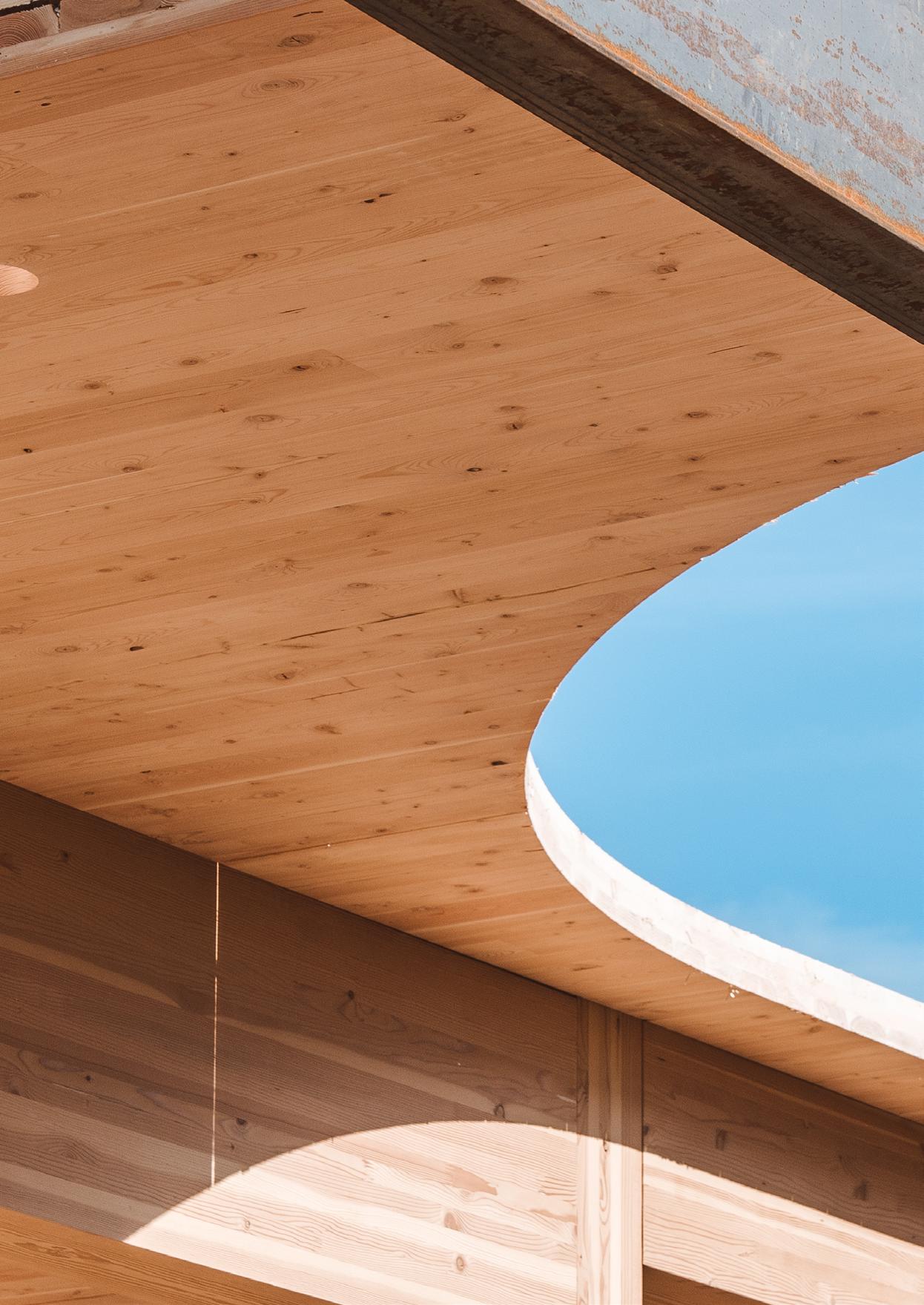
• In exposed surfaces, all knot holes are voids measuring over ¾ inch are filled with a wood-tone filler or clear wood inserts selected for similarity with the grain and color of the adjacent wood.
• The face layers exposed to view are free of loose knots, and open knot holes are filled.
• Knot holes to not exceed ¾ inch when measured in the direction of the lamination length with the exception that a void may be longer than ¾ inch if its area is not greater than ½ in².
• Voids greater than 1/16 inch wide created by edge joints appearing on the face layers exposed to view are filled.
• Exposed surfaces are surfaced smooth with no misses permitted.
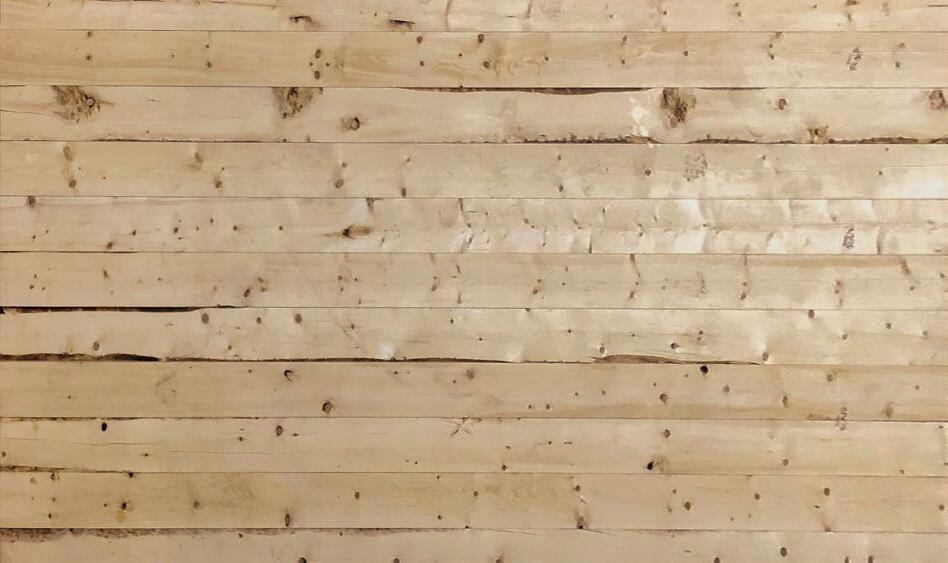
INDUSTRIAL APPEARANCE CLASSIFICATION
This is an appearance classification normally suitable for use in concealed applications where appearance is not of primary concern. Specific characteristics of this classification are as follows:
• Voids appearing on the edges of laminations need not be filled.
• Loose knots and knot holes appearing on the face layers exposed to view are not filled.
• Members are surfaced on face layers only and the appearance requirements apply only to these layers.
• Occasional misses, low laminations, or wane (limited to the lumber grade) are permitted on the surface layers and are not limited in length.
ADHESIVES
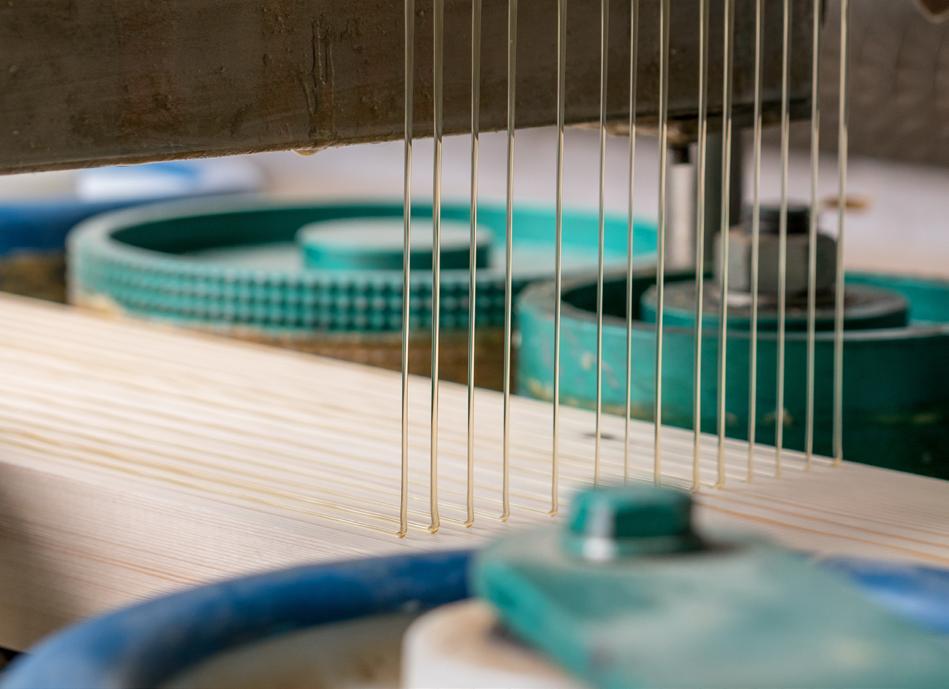
Adhesives are a small (less than 1 percent by volume) but essential component of Timberlab CLT which allow the use of lumber sawn from smaller diameter trees to be bonded together to form large, highperformance structural panels. All adhesives suitable for use in structural Timberlab CLT are required to undergo comprehensive performance testing to ASTM standards to ensure they have sufficient strength, moisture durability, and fire endurance equivalent to solid sawn timber.
Adhesives are used at two locations in Timberlab CLT: 1) at the end-to-end finger joints of each lamination, and 2) at the bond of the wide faces of laminations to each other. The glued bonds are required to be sampled and tested daily as quality assurance for strength and moisture durability.
The adhesives we use are moisture resistant conforming to the requirements of APA ANSI PRG 320, ANSI 405, and ASTM D2559. We use a clear face-bond adhesive. We are qualified to use the following adhesives manufactured by Hexion:
• Face Bond (Clear): Ecobind 6500 and Wonderbond M-650Y (Radio Frequency)
• Fingerjoints: Cascomel 4720 with Wonderbond Hardener 5025A (Radio Frequency)
LOW CHEMICAL EMISSIONS
Current standards for green building design, such as United States Green Building Council LEED v4, include eligible points for low-emitting materials. Timberlab CLT meets these requirements, ensuring the product has minimal adverse indoor environmental quality impacts. In addition, the Hexion Ecobind 6500 and Wonderbond M-650Y adhesive has a UL Green Guard Gold Certificate of Compliance (Certificate Number: 97465-420) based on testing in accordance with the UL 2818-2022 GREENGARD Certification Program for Chemical Emissions for Building Materials, Finishes And Furnishing.
CNC FABRICATION
Timberlab has been specializing in CNC fabrication since 2020, with three facilities operating multiple state-of-the-art machines across the United States. It is this step of the production process that transforms an industrial product into a customized building component, cut precisely to suit your needs.
4. GLULAM
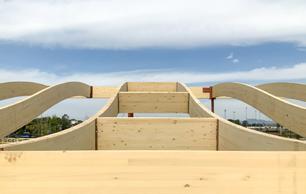
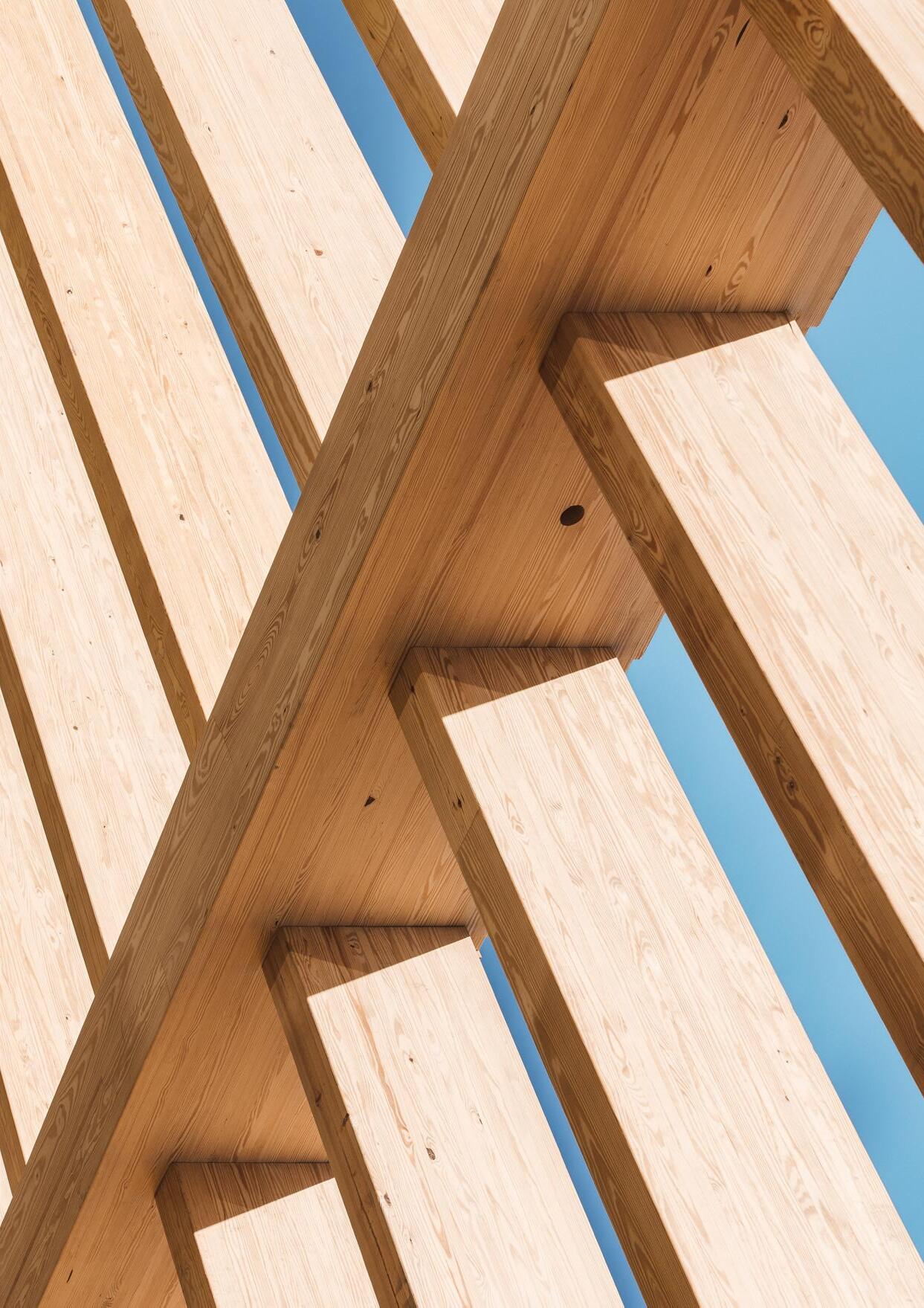
Timberlab provides a full range of custom glued laminated timber (glulam) solutions, manufactured and fabricated through an integrated, North America–based production network. Our glulam is produced at Timberlab’s manufacturing facilities in timber-rich Oregon, where we control lamination, pressing, and finishing to meet structural and architectural requirements across a wide range of building types. From there, members are digitally detailed and CNC-fabricated for precision fit-up—supporting complex geometries, exposed architectural conditions, and tight construction tolerances. Timberlab’s glulam include straight and curved beams, columns, and specialty members in multiple species and finishes, delivered with the technical coordination, logistics planning, and installation expertise required to perform at scale and integrate seamlessly with hybrid timber, steel, and concrete systems.
TIMBERLAB GLULAM PRODUCT CERTIFICATIONS
Timberlab glulam is certified by APA - The Engineered Wood Association. We manufacture to the ANSI A190.1 (2022) Product Standard for Structural Glued Laminated Timber.
Timberlab produces glulam layup combinations with design values that conform to ANSI 117 (2020) Standard Specification for Structural Glued Laminated Timber of Softwood Species.
The information provided in this product guide applies to glulam designed to the National Design Specification for Wood Construction (2024) and Supplement developed by the American Wood Council. In addition our manufacturing facilities maintain a certification to manufacture glulam to the current edition of Canadian Standards - CSA O122 & CSA O177. Please contact Timberlab for additional information.
PRODUCT OVERVIEW
Member Finished Dimensions
Straight + Cambered Members
Curved Members
Lumber for Laminating Species
Moisture Content
Length: up to 135'-0"
Width: 31/8” to 30”
Depth: 6" - 72" (Note 1)
Max height (depth + camber): 16'-0" for lengths up to 60ft 12'-0" for lengths over 60ft

Douglas fir-larch, Southern pine, Alaska cedar
Not exceeding 16% at time of manufacturing
Adhesives Face Bond Adhesive Clear MF standard. Brown PRF available when specified
Finishing Appearance Classifications
Framing, Industrial, Architectural, Premium in accordance with ANSI A190.1
Special Surfacing Rough sawn texture upon request
Standard Shop Sealer Yes
Coatings
Available upon request
Member Tolerances Width 1/16” +/- (2mm)
Depth
Length
Camber Or Straightness
Squareness
+1/8” +/- (3mm) per foot (305 mm) of depth. -3/16” (5 mm) or 1/16” (2 mm) per foot of depth, whichever is larger
Up to 20’ (6.1 m), +/- 1/16” (2 mm). Over 20’ (6.1 m), +/- 1/16” (2 mm) per 20’ (6.1 m) of length or fraction thereof
Tolerances for camber are applicable at the time of manufacture without allowance for dead load deflection. Up to 20’ (6.1 m), the tolerance is +/- 1/4” (6 mm). Over 20’ (6.1 m), the tolerance shall increase 1/8” (3 mm) per additional 20’ (6.1 m) or fraction thereof, but not to exceed ¾” (19 mm). The tolerances are intended for use with straight or slightly cambered members and are not applicable to curved members such as arches.
The tolerance for squareness shall be within +/- 1/8” (3 mm) per foot (305 mm) of specified depth unless a specially shaped section is specified. Squareness shall be measured by placing one leg of a square across a top and/or bottom face and measuring the offset from the other leg of the square to the member at the opposite face of the beam.
1. Depths noted are standard; depths up to 118" are possible. Please contact Timberlab for additional information.
STANDARD SIZES
Standard finished widths are the same for all appearance classifications (industrial, architectural, and premium) and are the total dressed laminating lumber widths in a layer minus an allowance to account for planing both side faces after pressing. Standard widths and depths are shown below.
STANDARD WIDTHS
1. Different widths may be considered on a case-by-case basis. Contact Timberlab for additional information.
2. SL = Split lamination layups
3. Sizes utilizing 2x12 AC can only be produced in limited quantities.
4. Timberlab has the ability to manufacture up to 30 inches in width. Contact Timberlab for preferred widths.
STANDARD DEPTHS
Standard depths are in multiples of the standard lamination thickness.
Douglas fir, Alaska cedar 1-1/2 inches
Southern pine 1-3/8 inches
Glulam depths can be a minimum of (2) laminations, although our standard depths start at a minimum of (4) laminations. Our maximum standard glulam depth is 72 inches. Please contact us for information about producing glulam up to a maximum depth of 118 inches.
SPLIT LAMINATION LAYUPS
We offer multiple piece lamination (split lamination) layups as a cost-effective and sustainable alternative for producing wide members. In this process, described in ANSI A190.1, Section 10.3, we stagger adjacent laminations of two or more boards in a brick-like pattern to achieve larger widths. Typically, for members wider than 10 ¾", we provide split lamination layups.
As an option, Architectural and Premium classification glulam produced with split laminations include a clear wood inlay on visual faces to disguise the joint. Inlays on exposed faces are recommended for split laminated glulam used in exterior applications where water may accumulate.
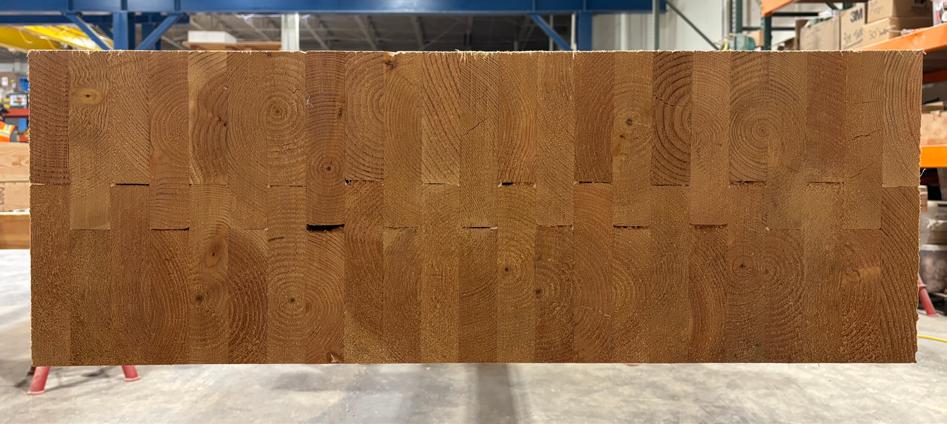
Unglued joint, typical
1/4” max gap at outer laminations. Occasional 3/8” permitted. Bottom detail shows inlays.
1/4” max gap at outer laminations. Occasional 3/8” permitted. Bottom detail shows inlays.
Nominal Board Width: Max Int. Gap:
Nominal Board Width: Max Int. Gap:
10” or less
12” 14”
16” and wider
Minimum overlap = lamination thickness (1” min)
Minimum overlap = lamination thickness (1” min)
10” or less 12” 14” 16” and wider 3/8” 1/2” 5/8” 5/8”x (Nominal Width)/14
3/8” 1/2” 5/8” 5/8”x (Nominal Width)/14
1/2” wide x 1/4-1/2” deep glued inlays of like material when specified. Top detail shows no inlays.
1/2” wide x 1/4-1/2” deep glued inlays of like material when specified. Top detail shows no inlays.
+ 2x10 16-1/4” 2x8 + 2x10
2x4 + 2x8 12-1/4” 2x6 + 2x8 14-1/4” 2x6 + 2x10 16-1/4” 2x8 + 2x10 18-1/4”
Split lamination layup examples (in inches) See our "Standard Sizes" page for a complete list of glulam member sizes
2x8 + 2x12
Unglued joint, typical 5/31/2024
- 2x12
2x10 + 2x12 Custom 2x4 min - 2x12 max
5/31/2024
LAYUP COMBINATIONS
STANDARD OPTIONS
Douglas Fir (DF)
24F-1.8E 24F-V4
L1
Southern Pine (SP)
24F-1.8E
Alaska Cedar (AC)
Note: See the NDS Supplement Tables 5A and 5B for structural design values.
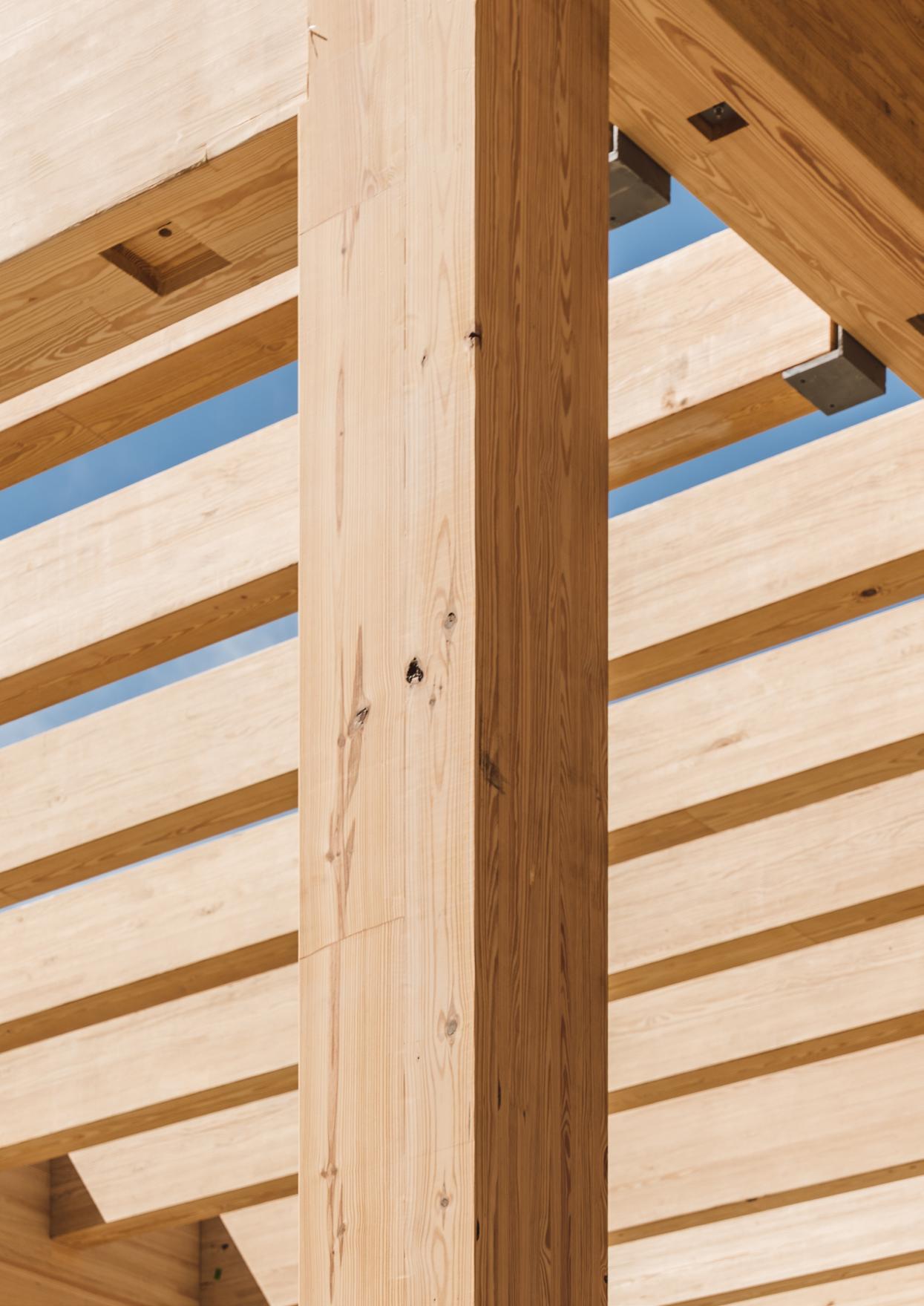
COLUMN + BEAM LAYUPS
COLUMNS
Glulam columns, either square or rectangular in cross-section, are subjected to stresses primarily in axial tension or compression and are most effectively manufactured with lumber of uniform grade. While we can produce glulam with many different grades of lumber, higher strength lumber intended to reduce the cross-sectional dimensions of the member will have a higher cost and may be subject to longer lead times to gather wood of this grade.
UNBALANCED BEAMS
Unbalanced beams are intended for use in simple-span applications loaded in positive bending, producing the greatest tension stress on the bottom of the beam. To resist such stresses, unbalanced beams are manufactured with the highest strength laminations on the bottom of the member. Importantly, the asymmetry of unbalanced beams results in a significantly reduced bending capacity if installed upside down – the top side of the beam is indicated with a stamp.
BALANCED BEAMS
Balanced beams are intended for use in multi-span or cantilevered applications. As either the top or bottom of the member is stressed in tension due to applied loads, balanced beams are manufactured with high-strength tension laminations on both the top and bottom.

An example of different laminating lumber grades in an unbalanced and balanced glulam beam.
Example of stamps used for glulam beams.
FIRE-RATED BEAMS
In applications where glulam beam fire rating is achieved via wood char, it is required to specify and manufacture beams with layups in accordance with ANSI 117 so they maintain their structural capacity in the event of a fire. For beams that will be exposed to fire on three sides, this is accomplished by adding one tension lamination to the bottom of the beam for each hour of fire resistance required, and removing a corresponding number of inner laminations, so that the beam depth remains the same.
For beams designed for fire exposure on four sides (as in the case of a beam without a CLT floor fastened to its top side), both the top and bottom of the layup shall be modified in accordance with ANSI A190.1. Beams with fire rated layups are marked with “1-hour fire rating” or “2-hour fire rating” for quality assurance. These special layup requirements do not apply to columns because they are manufactured with a uniform grade of laminations. Specifying a fire-rated layup must be done in conjunction with structural calculations by the engineer, to ensure the charred beam cross-section has sufficient strength for the required fire exposure duration. Please reference APA Technical Note Y245, Calculating Fire Resistance of Glulam Beams and Columns, for additional guidance.
THREE SIDES OF BEAM EXPOSED TO FIRE (TOP SIDE PROTECTED)
UNBALANCED
Outer Compression
Inner Compression
Inner Compression
Outer Compression
Inner Compression
Inner Compression
Tension
Inner Tension
Inner Tension
Additional Outer Tension
Outer Tension
Inner Tension
Inner Tension
Additional Outer Tension
Additional Outer Tension
Inner Tension
Inner Tension
Additional Outer Tension Outer Tension
Tension
Inner Tension Inner Tension
Outer Tension Outer Tension Inner Tension
Additional Outer Tension
Additional Outer Tension Outer Tension ONE HOUR
FOUR SIDES OF BEAM EXPOSED TO FIRE
UNBALANCED
Outer Compression
Additional Outer Compression
Inner Compression
Inner Compression
Outer Compression
Additional Outer Compression
Additional Outer Compression Inner Compression
Inner Compression
Additional Outer Tension Outer Tension Outer Tension Additional Outer Tension
Inner Tension Inner Tension
Tension Inner Tension
Additional Outer Tension
Additional Outer Tension
Outer Tension
Tension
Tension
Outer Tension
Additional Outer Tension
Additional Outer Tension
Tension Inner Tension
Tension Inner Tension
Additional Outer Tension
Additional Outer Tension Outer Tension
TAPERED BEAMS + COLUMNS
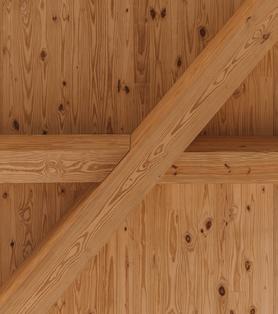
Tapered glulam members are manufactured with lamination layups that meet the requirements of ANSI 117 Section 5.6 unless project-specific lamination layups are specified. In accordance with the standard, this allows tapered members to be designed to the requirements of the NDS, including the structural design values found in the NDS Supplement.
Alternatively, when a glulam beam is cut to a tapered shape during secondary manufacturing or fabrication by removing material from the compression face, it is acceptable to specify the standard full depth prismatic beam layup as long as the reduced design values in accordance with ANSI 117 Section 4.12 are used.
Compression Lams
Standard Layup
Compression Lams
Standard Layup
Layup
Compresion lams carry through
Standard Layup
Tension lams carry through
Standard Continuous/ Cantilevered Layup
Profiles varry
BEVELED BEAMS
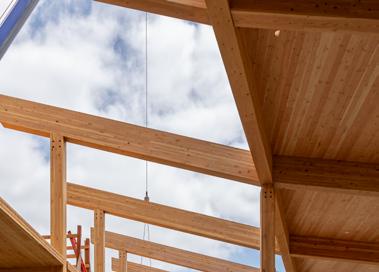
Glulam beams can be bevel cut on their compression face to accommodate building design needs such as sloped roofs. Beveled beams are manufactured with lamination layups so that the grade of laminations in the outer compression zone is maintained throughout the entire depth of the bevel cut, meeting the requirements of ANSI 117 Section 5.8.
Representative examples of glulam layups with compression side bevel cuts.
BEVEL CUT PROFILE EXAMPLES
LAYUP WITHOUT BEVEL CUT
LAYUP WITH BEVEL CUT
CAMBER
For long-span applications where design is controlled by deflection, a small amount of upward curvature can be built into a glulam to offset anticipated deflection and creep. In many construction projects where the structure is rarely subjected to specified design live loads and the deflection due to dead loads is relatively small, camber may result in unwanted crown in the floor and constructability challenges. Below, we offer our rules of thumb for incorporating camber into glulam design:
• Camber should be specified for long-span members of at least 40 feet in length.
• Cambered beams are best paired with seated bucket or knife plate connections with more forgiving tolerance to allow for beam deflection over time and hand fabrication methods.
• Camber should not be used with proprietary concealed beam hangers or other systems that require tight tolerances for fit-up, such as large groups of bolts or tight-fit pins.
• Camber is not recommended for beams with multiple connection points.
• Camber is not recommended for continuous span applications.
CAMBER (INCHES)
Reference APA Technical Note S550 Glulam Beam Camber, for additional guidance in determining beam camber requirements.
CALCULATING BEAM CAMBER
As an alternative to using the table above to specify camber, the following formula may be used to calculate the approximate radius of curvature given the beam span and camber desired.
R = 3L2 / 2∆
Where:
R = approximate radius of curvature
L = span (ft)
∆ = desired camber (in)
6/14/2024
CURVED MEMBERS
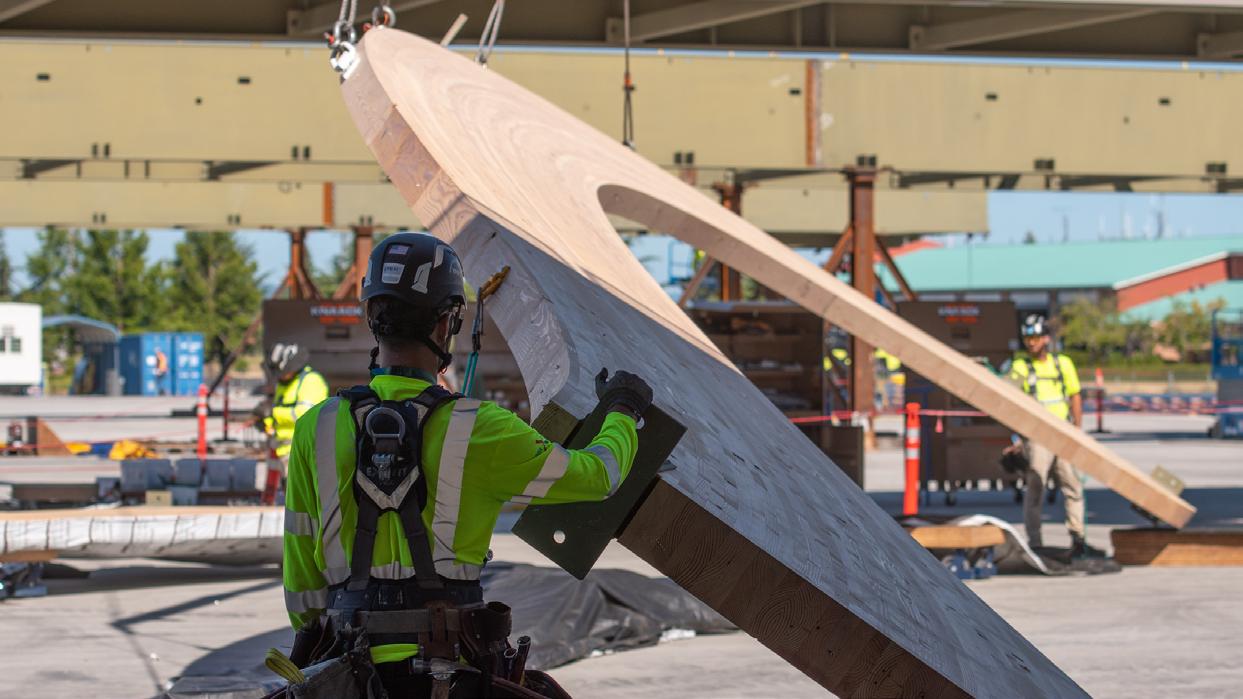
Timberlab glulam can be manufactured into curved shapes for use as arches or meet other expressive architectural requirements. Design requirements for curved glulam members are covered in the NDS. Multiple curves or straight and curved segments can be constructed into one member as required. The minimum radius that can be achieved is presented in the table below. The maximum member height is 16'-0" for lengths up to 60 feet, and 12'-0" for lengths over 60 feet.
9/23/2024
Notes:
1. For radius less than 22ft, maximum member width is 10 3/4".
2. A tighter radius of 27'-6" may be possible, please contact us.
3. Radial reinforcing (not shown in figures) may be required.
APPEARANCE CLASSIFICATIONS
Timberlab glulam can be specified and manufactured to the four appearance classifications listed in the table below. These classifications comply with ANSI A190.1.
Characteristic Framing
Surface Finish Surfaced on two sides, on which the cumulative depth of misses, low laminations, and wane shall not exceed 10% of beam width at any bond line. Maximum area of low laminations shall not exceed 25% of the surface area of a side. Surfaced to meet conventional framing sizes.
Industrial
Surfaced on two sides, on which the cumulative depth of misses, low laminations, and wane shall not exceed 10% of beam width at any bond line. Maximum area of low laminations shall not exceed 5% of the surface area of a side, and no more than two low laminations shall be adjacent to one another.
Voids Not filled Not filled
Knots
Architectural Premium
Exposed faces shall be surfaced smooth . No misses, wane, low laminations permitted.
Architectural glulam is not sanded but can be added for an additional cost.
Exposed faces shall be surfaced smooth . No misses, wane, low laminations permitted.
Laminations shall be selected to minimize loose knots, unsound knots, knotholes, pencil wane, bark inclusions, and voids that will be visible after final surfacing.
As an option, Architectural and Premium glulam produced with the split lamination technique can come with a clear wood inlay on visual faces to disguise the join t.
Voids over ¾” long shall be filled with woodtone colored filler or with wood inserts. A void can exceed ¾” in length if area does not exceed ½ in2.
Wide face shall be free of loose knots, and open knots shall be filled.
In exposed surfaces, voids over ¾” long (or longer if its area does not exceed ½ in²) shall be filled with a woodtone colored filler or with clear wood inserts selected for similarity to the grain and color of the adjacent wood.
On the wide face, knots shall be limited to 20% of the net face width of the lamination, and not over two maximum size knots or their equivalent shall occur in a 6 ft length.
Knot Holes
Wane Pencil wane permitted, not limited in length, but limited to one in ten pieces of lumber used.
Eased Edges
Loose knots and knot holes appearing on exposed face layers are not filled
Pencil wane permitted, not limited in length, but limited to one in ten pieces of lumber used.
Pencil wane shall be repaired, regardless of length. Wane ≤ 8” to be filled. Wane > 8” to receive wood inserts.
Edge voids over 1/16” in wide faces exposed to view shall be filled.
The edges of the member exposed to view in the final structure shall be eased with a minimum radius of 1/8” or equivalent chamfer.
Note: To conserve space, some of the descriptions in the table have been abreviated. Refer to ANSI A190.1 for the full text.
Pencil wane shall be repaired, regardless of length. Wane ≤ 8” to be filled. Wane > 8” to receive wood inserts.
Edge voids over 1/16” in wide faces exposed to view shall be filled.
The edges of the member exposed to view in the final structure shall be eased with a minimum radius of 1/8” or equivalent chamfer.
Edge Gaps
ADHESIVES
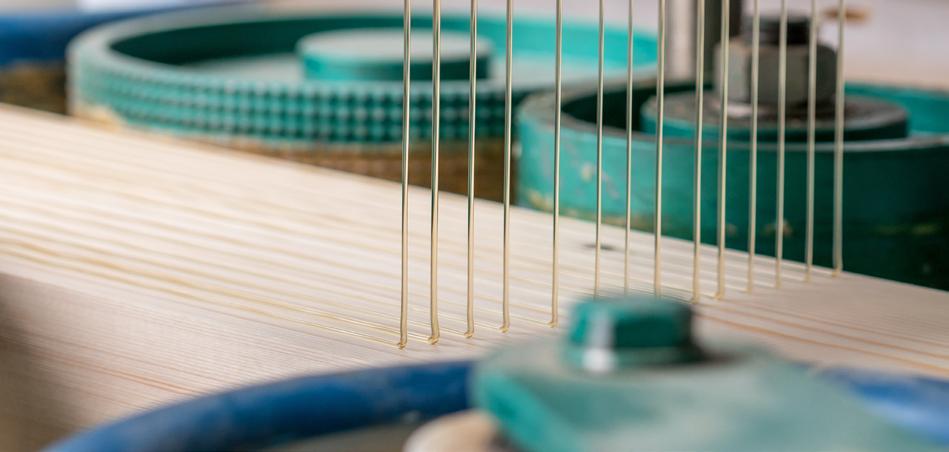
Adhesives are a small (less than 1 percent by volume) but essential component of glulam which allow the use of lumber sawn from smaller diameter trees to bonded together to form large high performance structural members. All adhesives suitable for use in structural glulam are required to undergo comprehensive performance testing to ASTM standards to ensure they have sufficient strength, moisture durability, and fire endurance equivalent to solid sawn timber.
Adhesives are used at two locations in Timberlab Glulam: 1) at the end-to-end finger joints of each lamination, and 2) at the bond of the wide faces of laminations to each other. The glued bonds glulam are required to be sampled and tested daily as quality assurance for strength and moisture durability.
The adhesives we use are moisture resistant conforming to the requirements of ANSI A190.1, ANSI 405, and ASTM D2559. Unless specified otherwise, we use a clear face bond adhesive. We are qualified to use the following adhesives manufactured by Hexion:
• Face Bond (Clear): Ecobind 6500 and Wonderbond M-650Y
• Face Bond (Brown): Cascophen LT-75 and Cascoset FM-260, or FM-282
• Fingerjoints: Cascomel 4720 with Wonderbond Hardener 5025A (Radio Frequency)
LOW CHEMICAL EMISSIONS
Current standards for green building design, such as United States Green Building Council LEED v4, include eligible points for low emitting materials. Timberlab glulam meets these requirements, ensuring the product has minimal adverse indoor environmental quality impacts. In addition, the Hexion Ecobind 6500 and Wonderbond M-650Y adhesive has a UL Green Guard Gold Certificate of Compliance (Certificate Number: 97465-420) based on testing in accordance with UL 2818-2022 GREENGARD Certification Program for Chemical Emissions for Building Materials, Finishes And Furnishings.
PRESERVATIVE TREATMENTS
PRESERVATIVE TREATMENTS
Glulam members are preservative treated when required for protection from decay and termites. Typically, glulam does not need to be preservative treated when used as follows:
• Dry service conditions where the moisture content does not exceed 16%, as in most covered structures.
• Site locations and applications where the termite hazard is not known to be very high and it is not required by local building codes.
• When a naturally durable species such as the heartwood of Alaska Cedar is used.
PROPER SPECIFICATION
When preservative treatment is required, applicable provisions in Chapter 23 of the International Building Code (IBC) may apply to your project, including identification of the following:
• The specific glulam members that require treatment.
• The AWPA U1 Use Classification.
• When incising of the wood surfaces is required.
• Corrosion resistance requirements for metal hardware and fasteners in contact with treated wood.
• Marking requirements for the preservative treatment.
TREATMENT APPLICATION
Timberlab has supply partners that apply proprietary preservative treatments with independent third-party evaluation reports that are equivalent to AWPA above-ground use classifications referenced in the IBC. These treatments have the aesthetic advantage of not requiring incising of Douglas fir glulam, limited discoloring of the wood, and being compatible with finish coatings.
Timberlab does not apply preservative treatments. Typically, finished glulam members without any shop sealer are transported from our manufacturing facilities to companies that specialize in the treatment of wood products by pressure process. Metal hardware and fasteners for the member are typically installed after treatment.
SHOP SEALERS + FINISH COATINGS
SHOP SEALERS
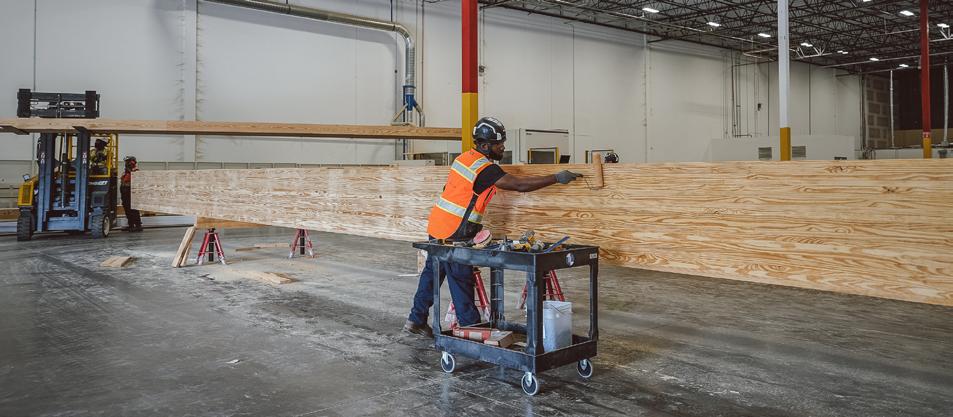
It is customary for a shop sealer to be applied to glulam prior to shipping. Unless noted otherwise, we will provide a one-coat clear sealer formulated for wood surfaces to all faces of the member. This product is intended to provide temporary protection during storage, transport, and construction that reduces checking, splitting, and moisture damage.
FINISH COATINGS
It is recommended that finish coatings for either an interior or exterior glulam application be applied in the field at the appropriate stage of construction. The designer should ensure the specified finish coatings are compatible with any shop sealer or preservative treatment previously applied to the glulam. Finish coatings, with a regular maintenance schedule, are highly recommended for glulam applications where the wood surfaces is exposed to the exterior environment and subject to weathering.

5. CONCEPT DESIGN PHASE
We are excited that you are considering mass timber for your project! The seedling conceptual design stage is the most advantageous time to explore the possibilities of a mass timber structure, and we hope you will review our project experience and connect with our team to learn how we have taken this innovative construction typology to new markets and new heights – from libraries and community centers to athletic facilities, academic buildings, and high-rise apartment buildings.
IS MASS TIMBER A GOOD FIT?
General guidelines, but not hard and fast rules, exist for determining whether a mass timber structure would be suitable for your project. In fact, our team is continually exploring new opportunities for integrating mass timber into projects, as further research and product assemblies emerge. Below are a few questions we routinely ask to help us identify if and how mass timber can create value for your project.
• Does the current version of the building code applicable to your project allow for mass timber as envisioned? Confirming allowable building heights, stories, and areas is a common first step.
• Are the mass timber elements replacing concrete and steel systems, offering condensed construction timelines, reduced embodied carbon, and health and wellness benefits to occupants?
• If mass timber elements are replacing light wood framing, is there an aesthetic, building height, or schedule advantage to offset the added cost of increased wood fiber in the structure?
• Does your project site have poor soil conditions? Mass timber buildings can offer potential savings on building foundations, particularly compared to alternative designs in concrete.
SETTING INTENTIONS
We encourage you to use this time to set project intentions that will inform overall priorities and cost. Are you designing a bespoke building, or quality affordable housing? Understanding your goals and motivation for using mass timber – be it market differentiation, reducing embodied carbon, beauty, speed of construction, or something else – will help us recommend the highest-value solution for your project.
PROJECT DELIVERY METHODS
The early concept design stage is also a helpful time to consider a range of project delivery methods and move forward with one that supports your project objectives. While there are many variations of each type, including having trade partners as delegated designers, keep in mind that your project delivery method will inform your procurement process and timeline and will require different strategies to harness the full prefabrication potential of mass timber. For public projects, consider any procurement requirements that may dictate contracting structure.
DESIGN-BUILD AND INTEGRATED PROJECT DELIVERY (IPD)
Hiring the construction team in time to participate in the design process will offer the greatest opportunity for maximizing the prefabrication potential and efficiency of mass timber, yielding cost certainty. Design-build and IPD are highly effective in bringing forward feedback from all parties early in the process, allowing the trade partners to help the team optimize the design and streamline the overall schedule. As an example, coordination of penetrations for building services is enabled through early release of design-assist or design-build contracts with structural, mechanical, electrical, plumbing, fire sprinkler (MEPF), and façade trade partners. This early coordination allows factory drilling of penetrations without delaying the project, maximizing the schedule, quality, and safety outcomes we associate with mass timber.
CONSTRUCTION MANAGER / GENERAL CONTRACTOR (CM/GC), CONSTRUCTION MANAGER AT RISK (CMAR)
Engaging a construction manager simultaneously with the design team allows for early engagement with structural, MEPF, and façade trade partners through design assist contracts or early releases. This approach can be a strategic way to promote cost-effective and constructible designs, without requiring full commitment for the construction scope of work. Mass timber design assist efforts will be most impactful beginning in the schematic design phase, to support the decision-making process.
DESIGN-BID-BUILD
Finalizing construction documents before onboarding a construction partner can be a barrier to optimal design, as projects are conceived and often permitted without input from builders, trade partners, and manufacturers. This lack of input can have significant negative impacts on cost, constructability, and even aesthetics. In implementing the design-bid-build project delivery method, lead times may also be longer than typical to allow for thorough translation of design intent into fabrication-level information, and penetrations for building services may not be incorporated into the production process. That said, this guide is specifically written to support cost-effective and constructible design so that architects and engineers can make informed decisions in any situation.
APPROPRIATE APPLICATIONS OF MASS TIMBER
Mass timber products are most appropriately used as interior structural elements under dry service conditions. Glulam columns and beams create the structural frame, and large-format CLT panels serve as floor, roof, and wall elements.
With careful specification and detailing, mass timber elements can also be incorporated into exterior environments such as building soffits and canopies. In these applications, close attention must be paid to species selection, finish coatings, preservative treatments, proper detailing of connections to protect wood from moisture, and developing a regular maintenance regimen.
We also understand that glulam and CLT may be used as architectural elements, as part of larger prefabricated assemblies and modules, and in alternative structural capacities outside the scope of this document. We look forward to collaborating with you to bring your mass timber dreams to life.
6. SCHEMATIC DESIGN PHASE
DESIGN PARAMETERS: ITERATING TOWARD THE IDEAL FLOOR ASSEMBLY + STRUCTURAL GRID
In the Schematic Design (SD) phase of a project, we gain consensus on the architectural and performance goals that will inform the structural framing approach, grid size, and floor assembly design. While each project is unique, we assess the same set of parameters to uncover the optimal design for each project. This section of the guide will walk you through those parameters and help you arrive at a system that offers the highest value to owners and occupants.
BUT FIRST, A NOTE ON COST-EFFECTIVE DESIGN
The decisions made in the schematic design phase are the major cost drivers impacting the financial viability of mass timber for your project. One primary cost driver for mass timber structures is wood volume. To assess efficiency, we calculate the ratio of total volume of wood fiber in the structure relative to total square-foot area of system. A lower number corresponds to a more efficient structure. While you may not begin to determine member sizing until the design development phase, know that CLT is almost always the predominant contributor to wood fiber, and minimizing panel thickness can be the best way to reduce cost.
Reasonable expectations for wood fiber density:
• Non-rated: 0.45-0.65 CF/SF
• 1-hour fire rated (fully exposed): 0.55-0.75 CF/SF
• 2-hour fire rated (fully exposed): 0.65-0.9 CF/SF
A second factor influencing cost is piece count, and, if the number of pieces becomes high enough, this can become the predominant cost driver. Piece count impacts not only installation, but CNC fabrication and detailing – both time-intensive processes, as well as connection hardware quantity.
STRUCTURAL LOADING
As with any structural material, establishing loading criteria is key to choosing an appropriate column grid and structural system. For residential structures, the loading requirements may be straightforward. For office buildings, a developer or owner may decide to design to code-minimum requirements, or to a higher capacity to offer greater flexibility to prospective tenants. Understanding the loading requirements of the structure, including those of an occupied or green roof, is an important first step in determining CLT panel thickness and efficient structural grids.
CONSTRUCTION TYPE
The construction type is not a prescription, but a strategy. It is an intentional decision made from knowing the building occupancy, height, area, and number of stories, and charting a path that addresses fire and life safety risks while still achieving programmatic requirements. For mass timber buildings in particular, the construction type has significant cost and design implications. It sets the fire rating requirements for the structure, which in turn drives mass timber element sizes and total volume of wood fiber – the primary cost drivers for mass timber systems. The goal, then, is to optimize the amount of fiber for the intended use of the building. Choosing a construction type that does not require a fire-resistance rating for the structure (such as Type III-B, Type IV-HT, or Type V-B) can help control costs, if the building size and height are within the code limits. For larger buildings where an unrated structure is not permitted, more stringent ratings will increase cost, i.e., a 2-hour-rated structure will carry a cost premium compared to a 1-hour-rated structure.
In some cases, a variance can be requested from an Authority Having Jurisdiction (AHJ) to make a less stringent construction type feasible. Early conversations with AHJs can be helpful in achieving desired results.
PRO TIPS FOR CONSTRUCTION TYPE SELECTION
• Not all mass timber buildings should be classified as Type IV construction. Type III and Type V are common classifications as well and are a good fit for most 1- to 2-story structures.
• In most jurisdictions, for six-story office buildings and five-story residential buildings up to 85 feet in height, a choice can be made between Type IV-HT and Type III-A construction. Each type has its own limitations and opportunities with respect to fire resistance design methodology, allowances for assembly occupancy, fire-rated partitions, and other considerations.
• For mixed-occupancy buildings with assembly occupancy, the assembly classification will typically have the most restrictive height and story limits. Keeping assembly spaces on the lower floors of a building will help avoid triggering a more onerous construction type.
• Type IV-A, IV-B, and IV-C construction are the most stringent mass timber construction types. They should be reserved for tall timber buildings or low-rise buildings with large areas.
• Mass timber can be utilized for roof structure in Type I-B and Type II construction.
• Fire separations can be implemented in larger buildings when designs push up against area limitations.
FIRE PERFORMANCE
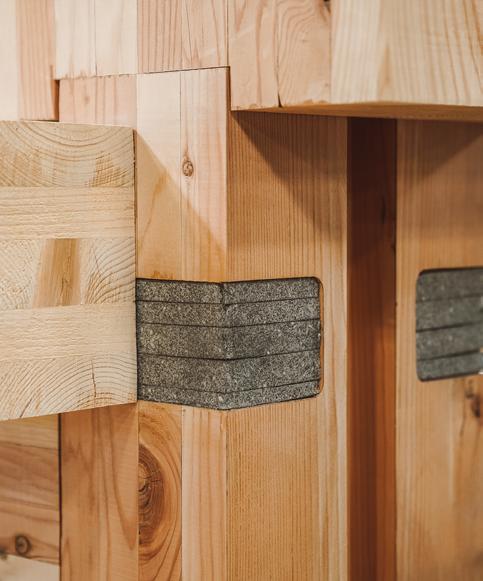
Mass timber structures can perform triple duty, serving as structure, finish material, and fire-rated construction. Unlike light-frame wood construction, mass timber elements will char at a predictable rate, forming an insulating layer that protects interior wood from damage. This characteristic allows engineers to size structural members to include sacrificial material so that the structure can withstand fire for as long as is required by code, without the need for additional protection.
FIRE DESIGN METHODOLOGY
General fire-resistance rating (FRR) requirements for the structure can be found in IBC Table 601. Additional FRR requirements may be triggered by other code provisions – for example, maintaining a FRR for a stair shaft in an otherwise unrated building. Engaging a code consultant to ensure all relevant requirements are being factored into the decision-making process can help guide the team to the most efficient solutions.
For Type IV-HT construction, minimum size requirements for structural members are provided in the IBC Chapter 23. For other construction types, if fire test data are unavailable, ratings are typically determined by a char calculation approach laid out in the ANSI/AWC National Design Specification for Wood Construction (NDS), Chapter 16. It can also be effective, particularly for elements requiring a 2-hour rating, to meet fire-rating requirements through non-combustible protection of mass timber elements, which avoids potential increases to member sizing. In Type IV-A construction, where the primary frame requires a 3-hour rating, a portion of the rating is required to come from non-combustible protection.
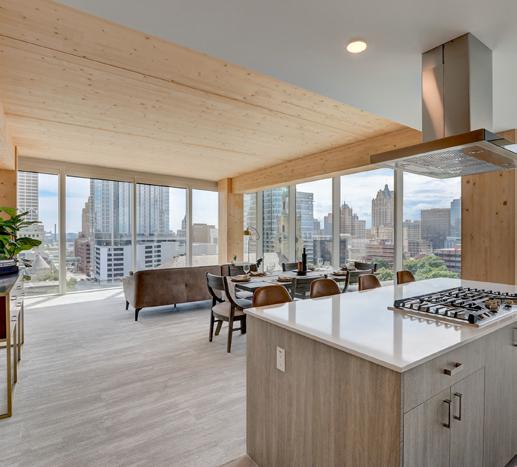

FIRE-RATED CLT
When designing a fire-rated CLT floor, roof, or wall system, a calculable cross-section is deemed sacrificial, thereby reducing the section which remains structurally effective in a fire scenario. Simply stated, the spanning capacity of a CLT panel may decrease as the fire rating requirement increases. As such, an optimal structural grid utilizing the full capacity of the CLT panel will vary depending on the firerating requirement. To ensure efficient use of wood fiber, we recommend designing a grid based on the fire-rated spanning capacity of the thinnest CLT panel that suits your program.
FIRE-RATED GLULAM
Fire-rated glulam members may need to be upsized if fire is the governing design factor. As the lamination grades in a glulam beam are non-uniform, fire rated glulam beams have a different layup than non-rated members. When a fire rating is required, the designer should specify additional tension laminations in accordance with NDS Chapter 16. For balanced beams, additional tension laminations should be added to both outer faces.
HVAC DISTRIBUTION STRATEGY
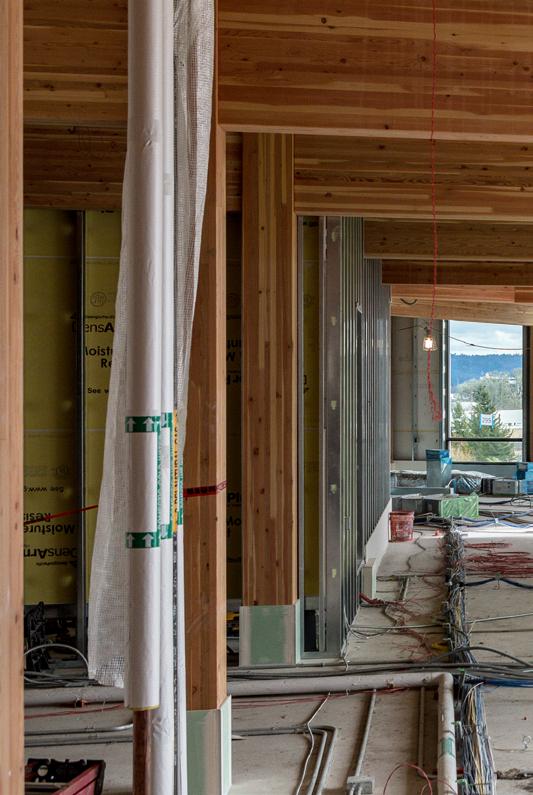
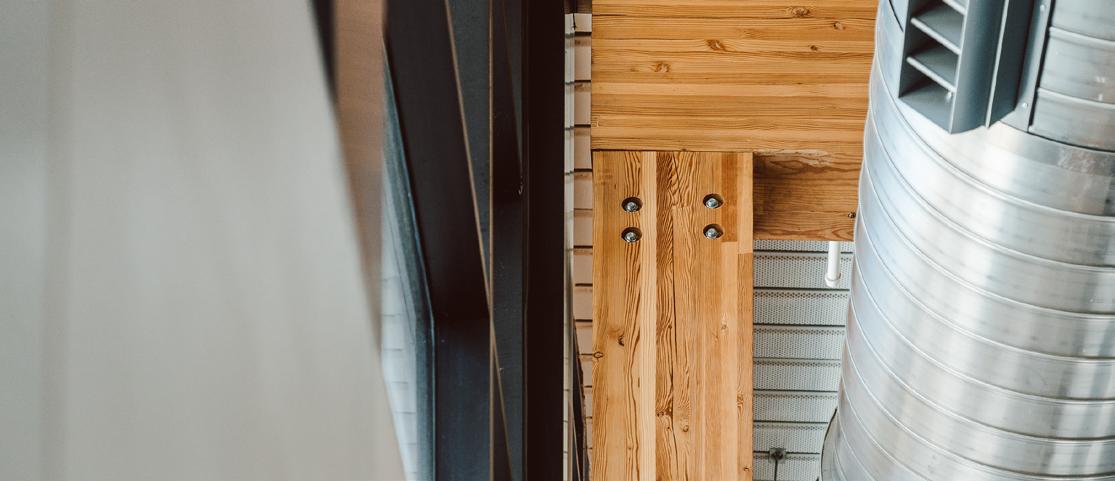
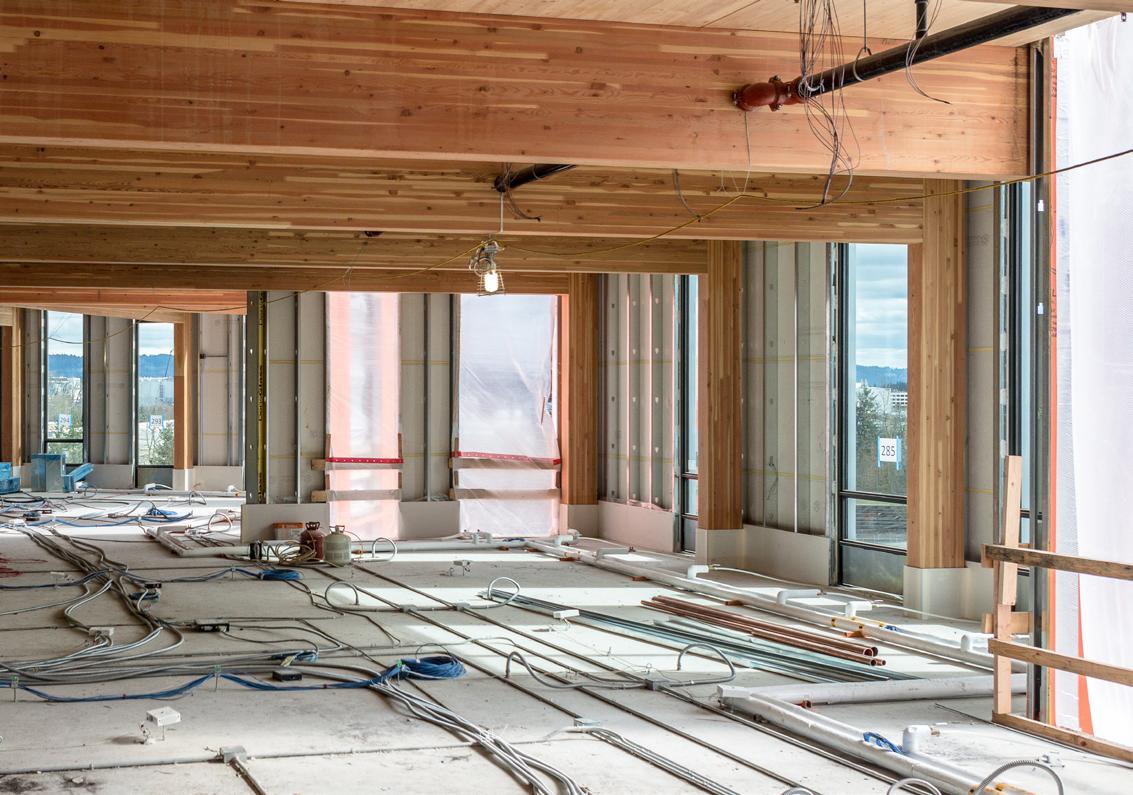
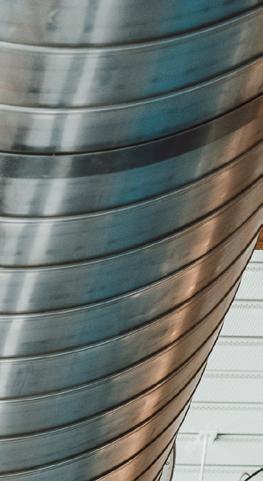
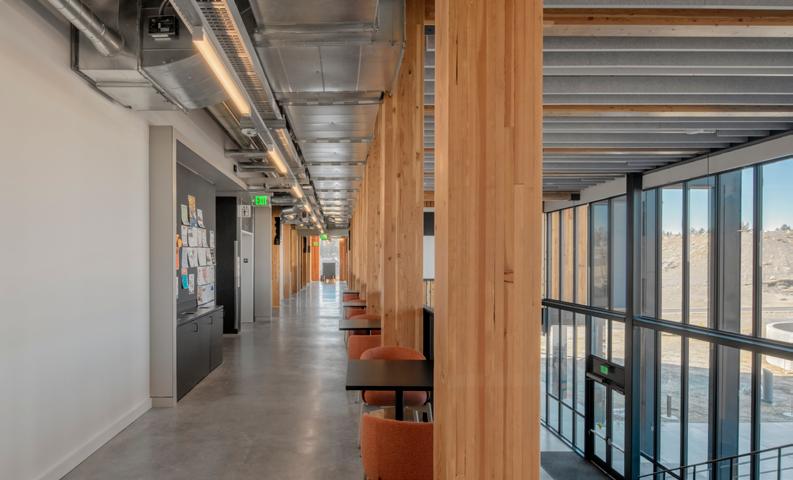
In an exposed mass timber building, many building services that might typically be concealed become expressed as part of the architecture. The mechanical system can have a big impact on the experience of the interior space. To support harmonious design, we recommend that the HVAC distribution strategy and structural framing approach be considered in parallel. Overlaying a plan or model of mechanical routing atop a structural framing plan can be a helpful tool for visualizing how ducts and beams interact. Refer to the Gravity System Options section of this guide for further discussions of how various mass timber framing schemes can integrate with the HVAC system.
ACOUSTIC PERFORMANCE
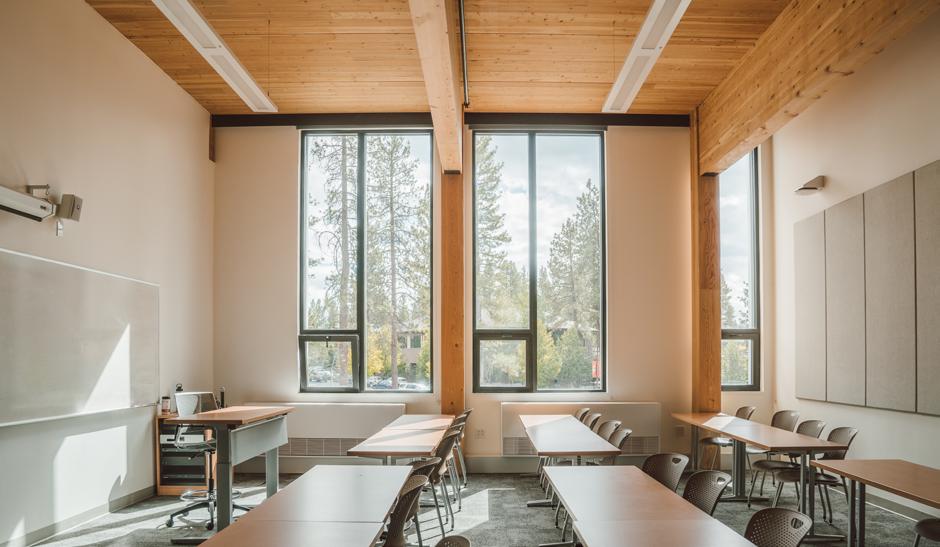
Mass timber buildings can meet and exceed code requirements for sound performance with intentionally designed assemblies. The acoustic performance requirements of your project will inform the floor assembly makeup and thickness, and in some cases, perhaps even the grid layout.
CLT floors are typically covered on at least one side for acoustic purposes. Placing the acoustic assembly on the top side improves the durability of the wearing surface and allows the CLT soffit (underside) to be exposed in the ceiling of the floor below. When designing your floor assembly, consider airborne, structure-borne, and flanking sound transmission.
When designing your floor assembly, consider airborne, structure-borne, and flanking sound transmission.
AIRBORNE SOUND
Airborne sound, coming from speech or music, is transmitted through floors, walls, and openings, and measured by a Sound Transmission Class (STC) rating. Mass from the structure itself and from toppings or other materials contribute to improved airborne sound separation and higher STC ratings.
STRUCTURE-BORNE SOUND
Structure-borne sound, typically footfall from rooms adjacent or directly above, is measured by an Impact Insulation Class (IIC) rating. Decoupling, for example from a resilient acoustic mat, is the most common way to improve structure-borne sound separation in mass timber buildings.
FLANKING SOUND
Flanking sound transmission encompasses all sound passing over, under, or around barriers. For mass timber structures, this typically occurs at the joints between components, and careful detailing of connection points is the most effective way to mitigate the presence of flanking sound.
FLOOR VIBRATION PERFORMANCE
While vibration is not a life safety issue, performance is critical for occupants’ sense of safety and overall satisfaction with the environment. Vibrations felt in a building are commonly caused by mechanical systems or human activity. When engineering a mass timber structure, vibration is often a governing factor in the design, and when performance requirements are above standard – for a healthcare or life science project, for example – member sizes become larger and/or grids get smaller to increase the stiffness of the structure. Notably, vibrations are more easily felt in large open spaces. Where the design permits, introducing full-height partitions can help mitigate vibration concerns.
Several methodologies exist for calculating vibration in timber structures. The CLT Handbook and the Canadian wood code (CSA O86) both provide simplified, user-friendly starting points for preliminary checks of vibration governed CLT panel spans. However, these methods have limited applicability because they ignore the effects of floor toppings and other finishes, and they also assume the CLT panels span between rigid supports (such as load-bearing walls). Where CLT is supported on beams, the beams create additional flexibility within the system and can significantly impact the vibration performance of a floor. For this reason, detailed analysis is often useful, and our team is equipped to support vibration design for your project using computational analysis as well as in-house data we have collected from testing our completed projects.
GRAVITY SYSTEM OPTIONS
Now that we’ve considered the parameters that influence a structural framing approach, we present the most common schemes used across all types of mass timber projects. Note that it is feasible to utilize multiple framing approaches in different areas of a structure to support different programs. This is easier done in single-story buildings but can also be accomplished in multi-story buildings so long as column grids stack vertically.
BEAMS IN ONE DIRECTION
A system with beams in one direction can be constructed of all timber materials utilizing glulam columns, beams, and CLT panels. Alternatively, it could be built with hybrid materials such as steel posts and/or steel beams supporting a CLT deck, or a metal deck atop a glulam frame. The system is characterized by a rectangular column grid and a one-directional orientation of beams. CLT is oriented in the perpendicular direction, spanning the full width of the bay from beam to beam.
COMMON APPLICATIONS
• Tall timber multifamily residential construction, Type IV-C, IV-B, IV-A
• Commercial office
• Academic buildings
• Libraries, community centers
• Long-span structures
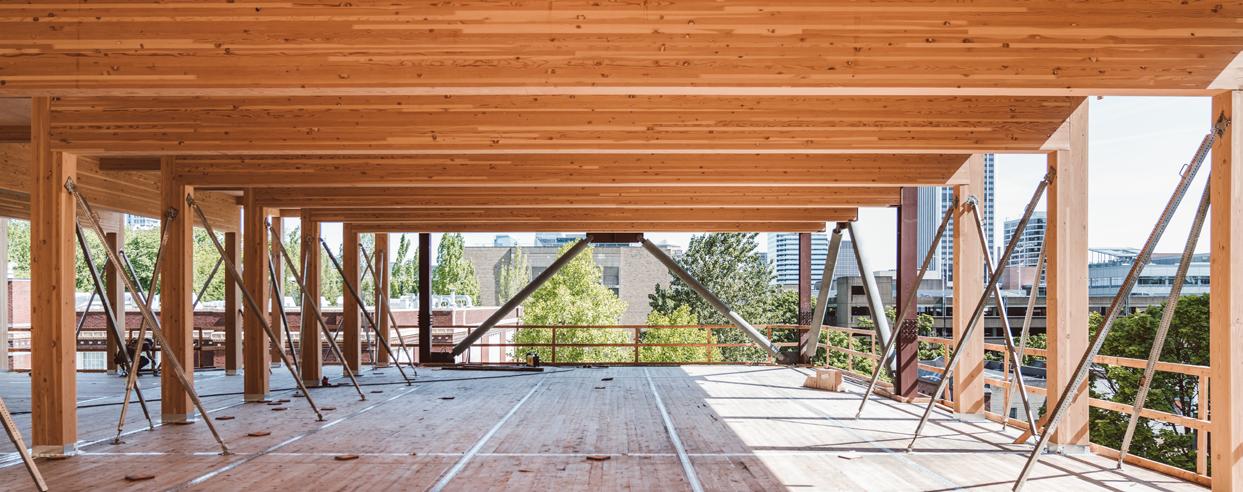
Diagram for educational purposes only
PRO TIPS FOR SYSTEM DESIGN WITH BEAMS IN ONE DIRECTION:
1. CLT panels span continuously perpendicular to the beams. Because CLT is economically produced in 40- to 60-foot lengths, multi-span continuous panels are typically easy to achieve. It is smart to validate early whether all CLT panels can span continuously across multiple bays, as single-span conditions may impact the grid layout if the panel is deflection-governed.
2. Cantilever CLT panels to allow columns to sit slightly away from perimeter walls. When positioning perimeter columns, consider the distinct strong and weak-axis cantilever capacity of CLT panel.
3. At roof framing, span beams continuously over the supporting columns to reduce beam depth and piece count, positively impacting installation schedules.
4. Design mechanical corridors with shallow beams to route main service lines along the length of a building. Branch lines run parallel to beams out to the perimeter.
5. Design mechanical corridors with no beams by utilizing the two-way spanning capacity of CLT panels. The viability of this approach will depend on spans, loading, and fire rating requirements.
6. Double beams can be used to reduce the overall depth of structure and create extra head height clearance. This approach will increase the cost of the wood structure and may add complexity to the fire design for rated structures due to the added charring surfaces, but it can also help with building height and floor-to-floor height issues. Since the beams typically “bypass” the columns in this configuration, it creates opportunities to easily incorporate cantilevers or continuous spans.
7. Rotate glulam framing to ease the transition as the building massing turns a corner, as the program shifts from one space to another.
8. Achieve cantilevers through double beams that extend beyond the column line. CLT panels are supported by cantilevering beams.
9. Infill framing will often be necessary to support shafts and other large openings in the CLT deck.
10. Perimeter beams may be required in non-rectilinear buildings, to ensure CLT panels are adequately supported along their oblique edge. Perimeter beams may also be necessary to stiffen the slab edge to accommodate heavier exterior wall assemblies or elements like balconies, canopies, etc.
11. Sloped roofs are most easily accommodated by a system in which beams run in one direction and the slope follows the direction of the beams.
12. Upturned beams may be incorporated into this system along perimeter edges of the building, to create a clean sightline and maximize window height and daylighting. The CLT slab terminates at the inside face of the upturned beam and is typically supported on an added ledger.
13. Rotate CLT panels 90 degrees to accommodate a change in framing. Ensure panels are adequately supported.
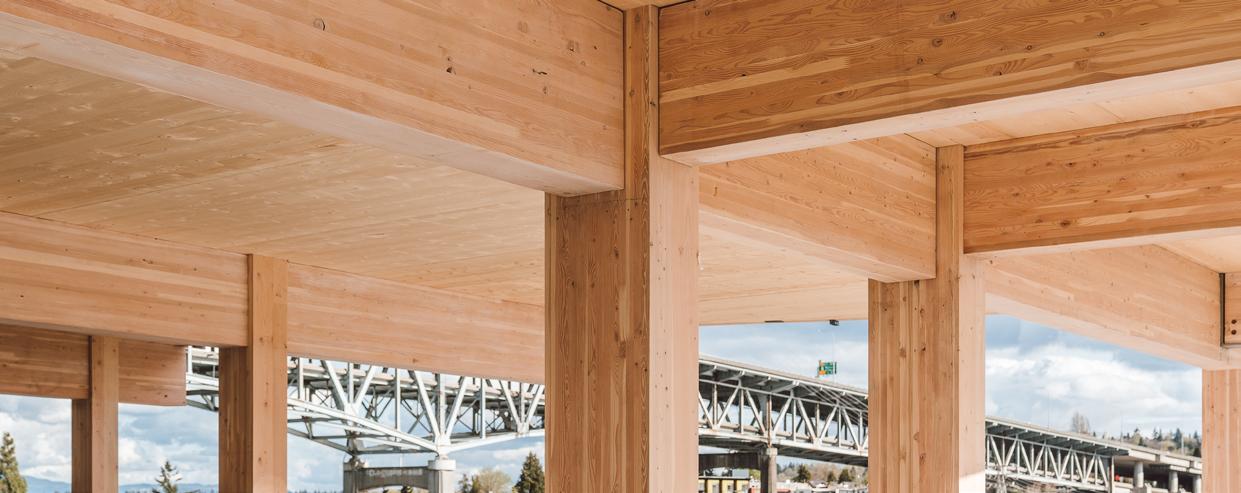
BEAMS IN TWO DIRECTIONS
Much like a system with beams in one direction, a system with beams in two directions can be constructed of all timber materials utilizing glulam columns, beams, and CLT panels. Alternatively, it could be built with hybrid materials such as steel posts and/or steel beams supporting a CLT deck, or a metal deck atop a glulam frame. The system is characterized by a two-directional orientation of beams with a column grid that is typically square or nearly square. Primary beams (girders) bear on columns, and secondary beams (purlins) support CLT panels.
COMMON APPLICATIONS
• Commercial office
• Academic buildings
• Libraries, community centers
PRO TIPS FOR SYSTEM DESIGN WITH BEAMS IN TWO DIRECTIONS
1. An efficient column grid for a system with beams in two directions is 30’ x 30’, but grids can typically range from 20’ x 20’ to 30’ x 40’.
2. CLT panels span continuously perpendicular to the purlins.
3. Purlin spacing will depend on CLT panel thickness and spanning capacity. It is generally most cost-effective to space purlins based on the maximum span of the thinnest panel that meets the loading and fire rating requirements.
4. Align purlins in the same plane as girders for the thinnest floor assembly. This maximizes head height clearance but adds cost for connection hardware.
5. Stack purlins on top of girders to create a cavity for service distribution. This increases the floor assembly depth, reducing head height clearance or requiring taller floor-to-floor heights. On the upside, this approach reduces the cost of connection hardware for purlins and may reduce both beam depth and installation costs if purlins can be provided as multiple-span members. However, fire-resistance ratings in this approach can be more challenging because of the introduction of additional charring surfaces. Purlins can be notched to help reduce the overall height of the structure, but notching can cause significant reductions in structural capacity and must be designed with care.
6. Single girders will be the most straightforward and cost-effective way to design a system with beams in two directions, though can reduce head height clearance and add complexity to connection design for large bays and heavy loading. Note that girder widths should be sufficient to accommodate back-to-back purlin connections if the purlins are aligned in each bay.
7. Double girders can be used to reduce the overall depth of structure and create extra head height clearance. This approach will increase the cost of the wood structure and may add complexity to the fire design for rated structures due to the added charring surfaces, but it can also help with building height and floor-to-floor height issues. Since the girders typically “bypass” the columns in this configuration, it creates opportunities to easily incorporate cantilevers or continuous spans.
8. Column sizing must accommodate connections on all four sides. This constraint is often what governs the column size rather than structural capacity requirements.
9. Offset purlins from the column line to avoid complexity and cost arising from four beams connecting to a single column.
10. Cantilever girders to support overhangs and terraces, or simply to allow columns to be pulled in slightly from the perimeter wall.
11. Cantilever CLT panels to allow columns to sit slightly away from perimeter walls. When positioning perimeter columns, consider the distinct strong and weak-axis cantilever capacity of the CLT panel.
The point-supported system utilizes the two-way spanning capacity of CLT to create a flat plate structure in which the CLT is supported directly by columns, eliminating the need for beams. In this structural scheme, in addition to span limits in both directions that are dictated by loading requirements, column grids are limited in the short dimension by the maximum manufactured width of CLT panels. In fire-rated applications, this solution is most easily achieved with non-combustible protection of the timber, as the stresses can become quite high near columns. This system offers the greatest head-height clearance, as there are no beams in the structure, and services can be mounted directly to the ceiling. The system allows for simplified fabrication and efficient on-site assembly.
No code provisions for the design of point-supported CLT currently exist, which means the design must rely on available test data and an engineering approach which must be reviewed and approved by the Authority Having Jurisdiction. Timberlab is participating in ongoing research that is continually adding to the available body of knowledge on point-supported CLT design and detailing, making this system likely to grow in popularity in the future.
• Student housing
• Hotels
• Multifamily housing
• Mechanical cooridors in office and residential buildings
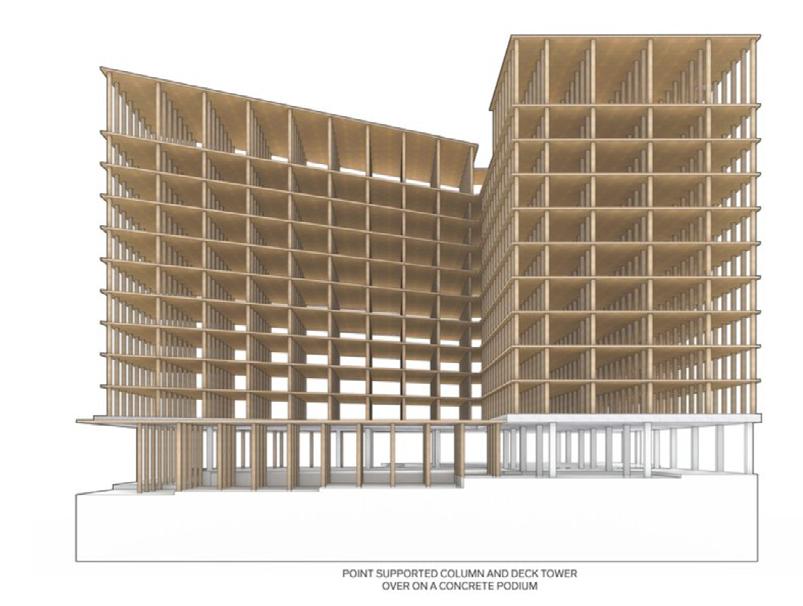
PRO TIPS FOR POINT-SUPPORTED SYSTEM DESIGN
Note: Point supported systems typically have grids of 10 12 feet in the short direction and 15 18 feet in the long direction for non rated construction.
1. Grid layout is established by balancing program requirements against an efficient CLT panel size for manufacturing and transportation.
2. CLT panels span continuously along the long dimension of the column grid, to maximize the panel capacity.
3. Punching shear can be a governing factor in the design of point-supported systems. Early design checks of shear forces at the supports are recommended to ensure an appropriate CLT panel layup is chosen. Due to punching shear forces, penetrations in CLT panels must be kept away from columns.
4. Cantilever CLT panels at the building edges to allow columns to sit slightly away from perimeter walls. Cantilever design for CLT along the minor strength axis must consider both structural and manufacturing constraints. Ensure that the specified panel has the capacity to cantilever the required distance, within the maximum manufactured panel width.
5. Rotate the panels and introduce supporting beams in select locations, where the building jogs out to create a cantilever condition.
6. CLT panels may be simple spanning if the grid produces an odd number of bays. In this case, panel specifications will need to be based on the simple-span condition.
7. Plan shafts and large penetrations very carefully, as point-supported systems are very sensitive to the location of openings. We recommend that design teams establish and understand the limitations for their specific loading and column grid early in the design process.
8. Cores can support CLT, typically by means of a steel or wood ledger. When cores are located near the building perimeter, consider how best to infill the deck between the core and the exterior wall.
9. Coordinate slab edges with various column sizes throughout the building.
CLT AND LIGHT-FRAME BEARING WALLS
The CLT on load-bearing wall system utilizes CLT panels as the floor deck in an otherwise conventionally wood-framed structure, or as the floor system supported by cold-formed steel framing. The CLT panels introduce schedule and structural depth efficiencies to the project, while offering the warmth of exposed wood ceilings. Building cores can be constructed with CLT panels, CMU, cold-formed steel, or concrete. These systems are typically limited to 5-6 stories by the building code when constructed with light-frame wood walls, or if the project is in a high seismic zone and the light-frame walls are intended to provide lateral resistance.
Notably, understanding requirements for fire rating and acoustic performance is integral to costeffective unit layout. The spacing of load-bearing walls, which typically include the demising walls but can also include additional load-bearing walls with openings within the units, is ultimately what determines CLT panel thickness and system efficiency and cost.
COMMON APPLICATIONS
• Multifamily housing
• Student housing
• Hotels
Diagram for educational purposes only
PRO TIPS FOR DESIGNING CLT ON LIGHT-FRAME BEARING WALLS
1. CLT panel thickness is determined by the maximum distance between supports. It is best to aim for 3-ply panels if fire ratings and acoustic performance targets allow. Timberlab has test data on panels thinner than 5-ply which can meet typical code requirements for acoustics.
2. Keep fire-resistance rating requirements as low as possible by choosing the most appropriate construction type classification. Typically, Type III-B construction requires only a ½-hour rating, which can help with CLT panel designs.
3. When CLT panels span parallel to corridors, design units with consistent widths to optimize panel thickness and layout efficiency.
4. In large open areas, a dropped beam may be introduced as an intermediary support for CLT panels, to reduce the spanning dimension.
5. Incorporate load-bearing partition walls to provide intermediary support for CLT panels in the design of larger units.
6. Header beams can be used to support CLT panels at large breaks in interior partition walls. Small openings can be accommodated by the two-way spanning capability of CLT without the need for header beams.
7. Avoid corridor beams by checking minor-strength axis spanning capacity against corridor width. Note that beams or other methods of support are still typically needed at transitions where the CLT changes span direction.
8. Utilize spandrel CLT panels (panels manufactured with the outer layers oriented in the short direction of the panel) at load-bearing corridors if hallways are narrower than the maximum CLT panel width.
9. Joints and intersections of wood and gypsum should be carefully considered at load-bearing walls, especially at head-of-wall joints with load-bearing cold-formed steel studs. Steel is more susceptible to heat and char penetration.
10. Cold-formed steel studs can allow for taller structures compared to light-frame wood, but special considerations are required to limit crushing and accommodate shrinkage of the CLT floors.
SPECIAL CONSIDERATIONS FOR MASS TIMBER OVER PARKING
Mass timber office and multifamily buildings often require parking levels built in concrete, and the way in which these two systems come together will impact cost and may influence project viability. We have seen both solutions discussed below utilized effectively and recommend that the project team analyze both options during the schematic design phase of the project.
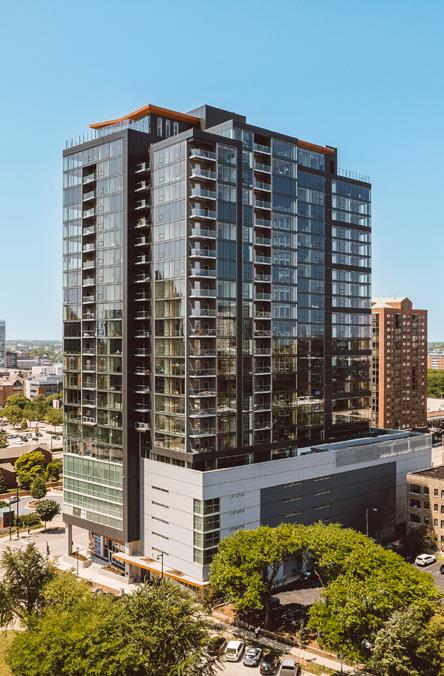
TRANSFER SLAB
One solution is to design the concrete structure and the mass timber structure separately and optimize the grids for each system on its own. This approach often results in a mass timber structure that does not stack neatly on the concrete structure, necessitating a robust concrete transfer structure at the interface: a thick flat slab, or a system with beams in one or two directions. For shorter structures transferring less load, a flat slab is usually sufficient. For taller structures that may require transfer beams, a system that requires beams in only one direction instead of both will typically be more efficient.
STACKING COLUMNS
Another solution involves iteratively designing the concrete system and the mass timber system so that the grids for each work for their respective use, yet also aligning columns in at least one direction. Stacking mass timber columns on top of concrete columns will facilitate load transfer down to the foundation and eliminate the need for a thick transfer slab.
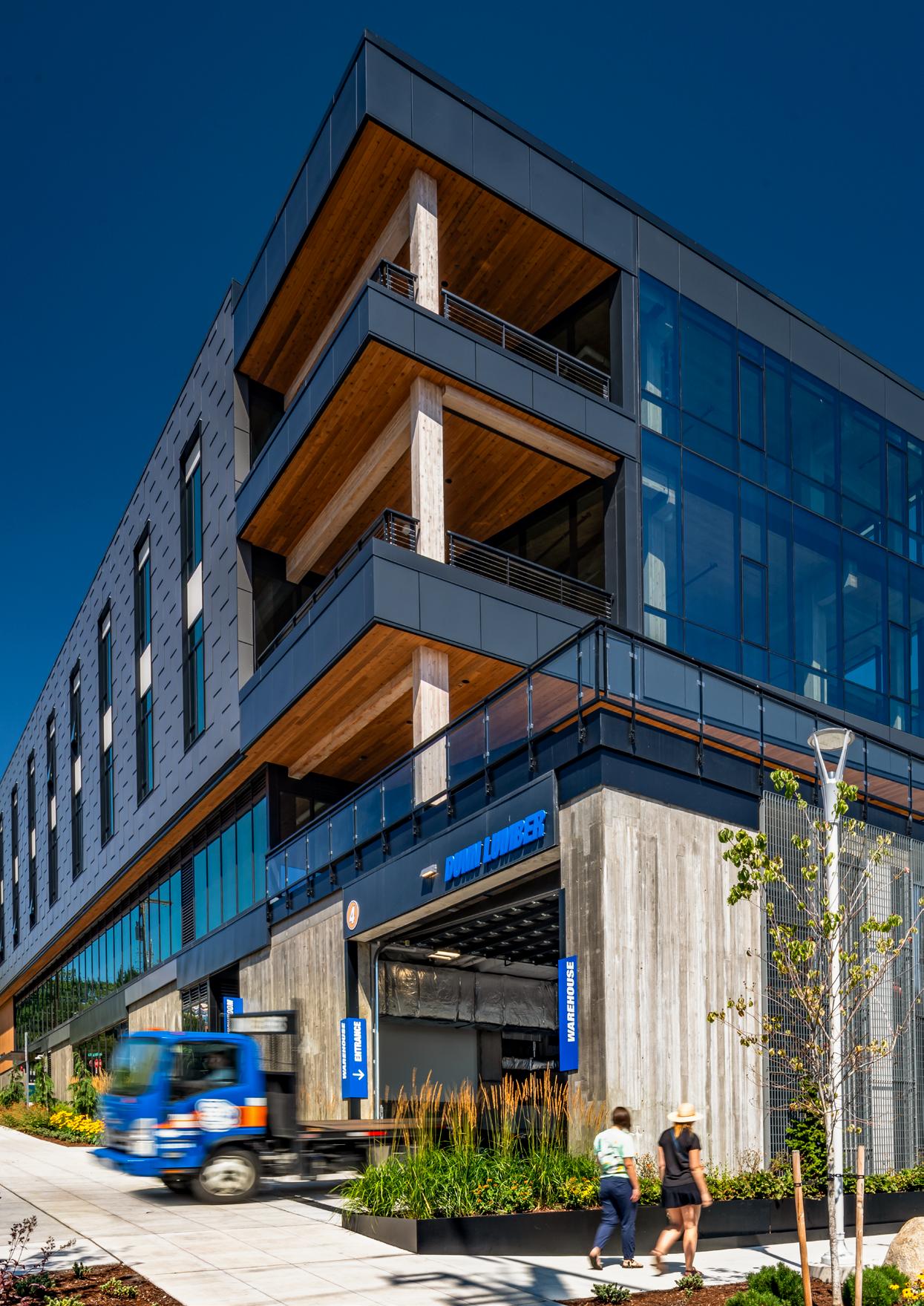
LATERAL SYSTEM STRATEGY
The lateral force-resisting system you select for your project may be governed by the seismic design category or high wind zone of your geographic location and informed by other factors including cost, schedule, and constructability. During the schematic design phase, we recommend project teams analyze at least two alternatives to ensure that an intentional and informed decision is made.
VERTICAL LATERAL SYSTEM
Vertical lateral force-resisting systems have implications for architecture and structure, procurement, constructability, embodied carbon, cost, and schedule. Each type of vertical lateral system, be it concrete, steel, CMU, light-frame walls, or mass timber, will be suited to a specific range of applications, heights, and seismic zones. The choice may also be influenced by which trades are already involved in the project: for a building with a cast-in-place concrete podium, for example, continuing up with concrete cores is often a practical solution.
For hybrid projects that rely on another material for the lateral system, steel braced frames tend to integrate well with mass timber due to similarities in how the structural frame is erected and tolerances closer to that of mass timber than concrete or CMU. CMU may offer cost savings compared to concrete on low-rise buildings but should be chosen with caution. In addition to potentially longer construction durations, significantly greater flexibility must be designed into connections of mass timber to CMU to accommodate as-built conditions. This approach can require heavy field modifications to ensure fit-up, which can have a negative impact on speed of construction as well as aesthetics if these interfaces are exposed to view.
Mass timber lateral systems, while not suitable for all project types, offer the added benefits of a lower embodied carbon than their concrete, CMU, and steel counterparts, as well as the procurement and on-site efficiencies of having a single trade deliver the entire superstructure.
GLULAM BRACED FRAMES
Glulam braced frames create a stiff lateral system and are often left architecturally exposed. Although the building codes do not currently contain seismic design provisions for this system, test data and precedent projects provide a strong base for justifying their use in lower seismic regions. The structural design typically is based on ensuring the braces remain elastic and dissipate energy through their end connections.
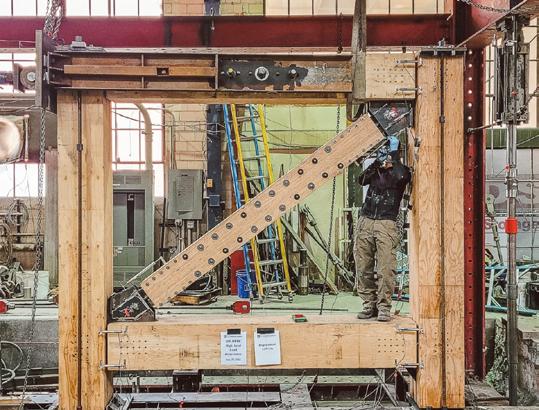
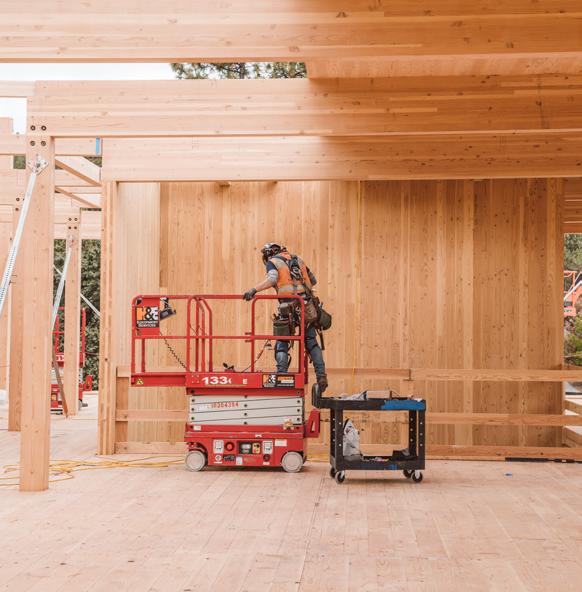
CLT SHEAR WALLS
CLT shear walls provide excellent stiffness, with ductility and energy dissipation derived from the CLT panel connections. Design and specification are supported by the inclusion of seismic design requirements in 2021’s Special Design Provisions for Wind and Seismic (SDPWS) Appendix B and in ASCE 7-22, Minimum Design Loads and Associated Criteria for Buildings and Other Structures, for buildings up to 65 feet in height. Due to the onerous and highly prescriptive nature of the SDPWS requirements, it may be advantageous to design with a lower R factor of 1.5 and disregard the Appendix B requirements, which is an approach permitted in SDPWS for Seismic Design Categories A and B.
POST-TENSIONED CLT ROCKING WALLS
Post-tensioned CLT rocking walls offer an opportunity to utilize mass timber in higher seismic zones in mid-rise and high-rise construction. Due to rocking and self-centering capabilities, this system can reduce damage to the structure and building and create opportunities for occupants to reinhabit a building following an earthquake. Code provisions are currently being developed based on testing that has verified this system and a robust and resilient alternative to traditional CLT shear walls. Timberlab was a key participant in the most extensive research done to date, the NHERI TallWood project, which subjected a full-scale 10-story structure to over 100 ground motions, including the 1994 Northridge earthquake (magnitude 6.7) and the 1999 Taiwan Chi-Chi earthquake (magnitude 7.7). Even prior to the adoption of code provisions, these systems can be used with a performance-based design approach.
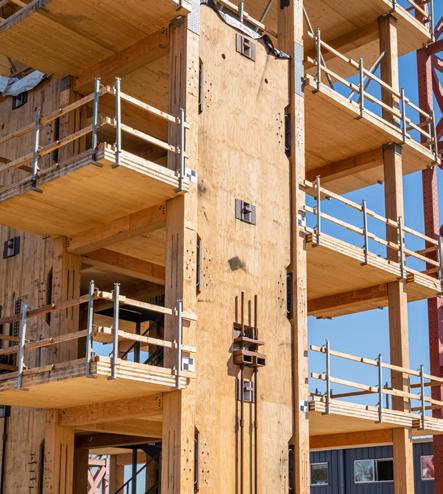
HORIZONTAL DIAPHRAGM
CLT’s inherent ability to resist forces in two directions makes it ideal to be used as the horizontal diaphragm in a cost-effective, efficient manner. Doing so captures the full structural potential of the product and allows for the elimination of other costly and high-embodied-carbon materials. Code provisions for the design of CLT diaphragms were introduced in the 2021 version of SDPWS.
When doing a preliminary calculation of diaphragm forces, check panel capacities as well as a typical panel-to-panel connection to determine the feasibility of using CLT as the horizontal diaphragm. It is common that panelto-panel connections will be the governing factor in the design.
BENEFITS
• Schedule: The diaphragm is established once CLT panels are fastened together and connected to the braced frames or walls, allowing for follow-on trade work to proceed immediately.
• Sustainability: CLT diaphragms remove the need for structural concrete in the floor assembly, opening opportunities to utilize low-carbon non-cementitious assemblies and the potential for disassembly at the end of the building’s useful life.
• Structure weight: Avoiding a concrete diaphragm removes up to 50 psf of dead load from the structure, reducing the overall demand on the structural frame and maximizing head height clearance.
• Constructability: Construction is simplified as fewer trades are needed to build the superstructure. Eliminating a wet trade also improves the cleanliness of the site.
At times, structural demands may necessitate a concrete diaphragm; this situation usually arises in high seismic zones. Although a concrete diaphragm may offer cost savings associated with reducing drag and collector plates that would have been required for the CLT diaphragm in the completed structure, the most practical approach to the temporary condition is to use the CLT as the diaphragm, rather than waiting for the topping to be cast before the structure can be considered laterally stable. Although the diaphragm demands during construction will be lower, some amount of strapping and reinforcement of the CLT will still be required. Bear in mind also that a concrete diaphragm typically needs to be tied to the CLT, often accomplished with a field of screws installed in the CLT and left projecting up into the topping, which can have negative effects on acoustic performance.

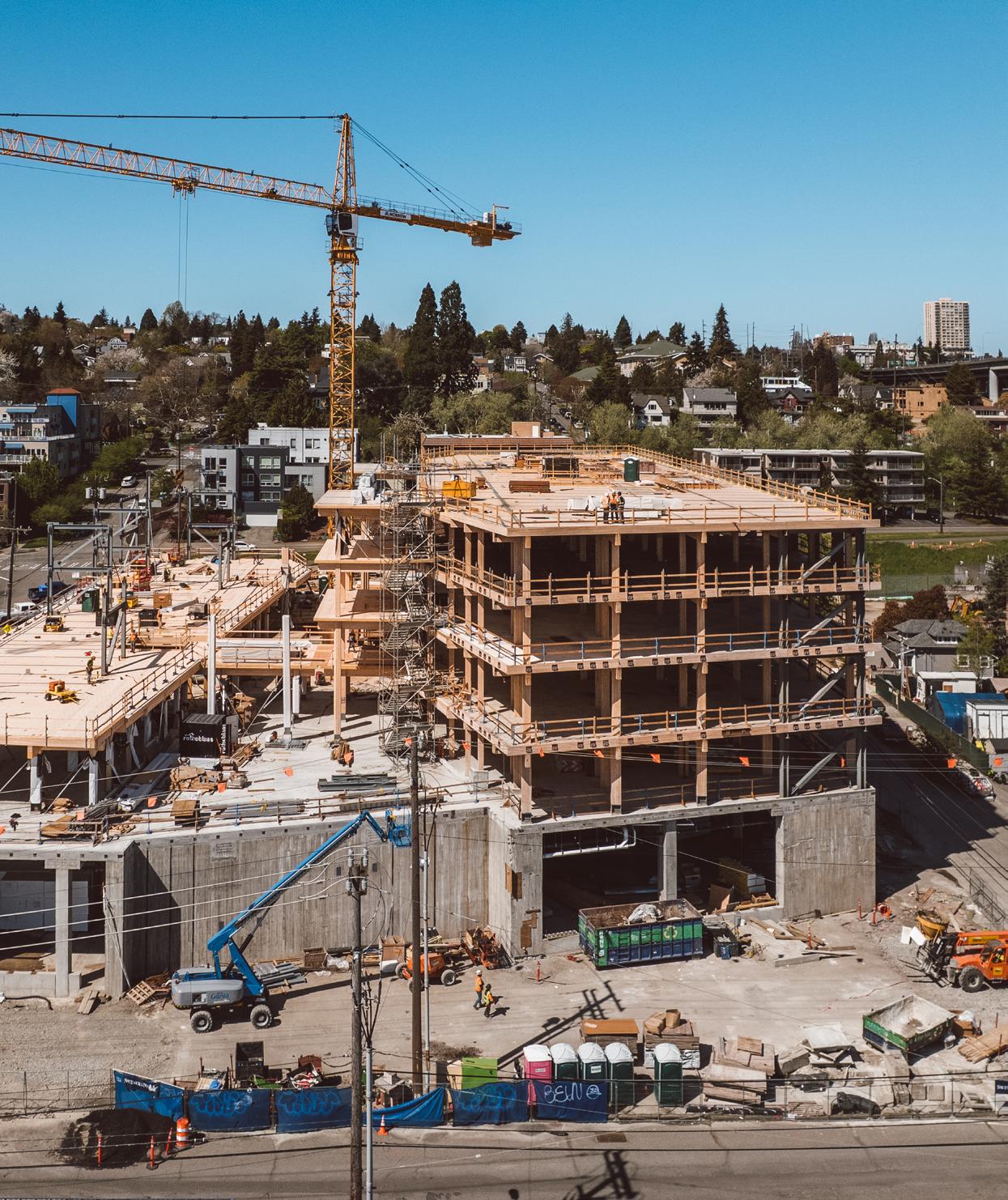
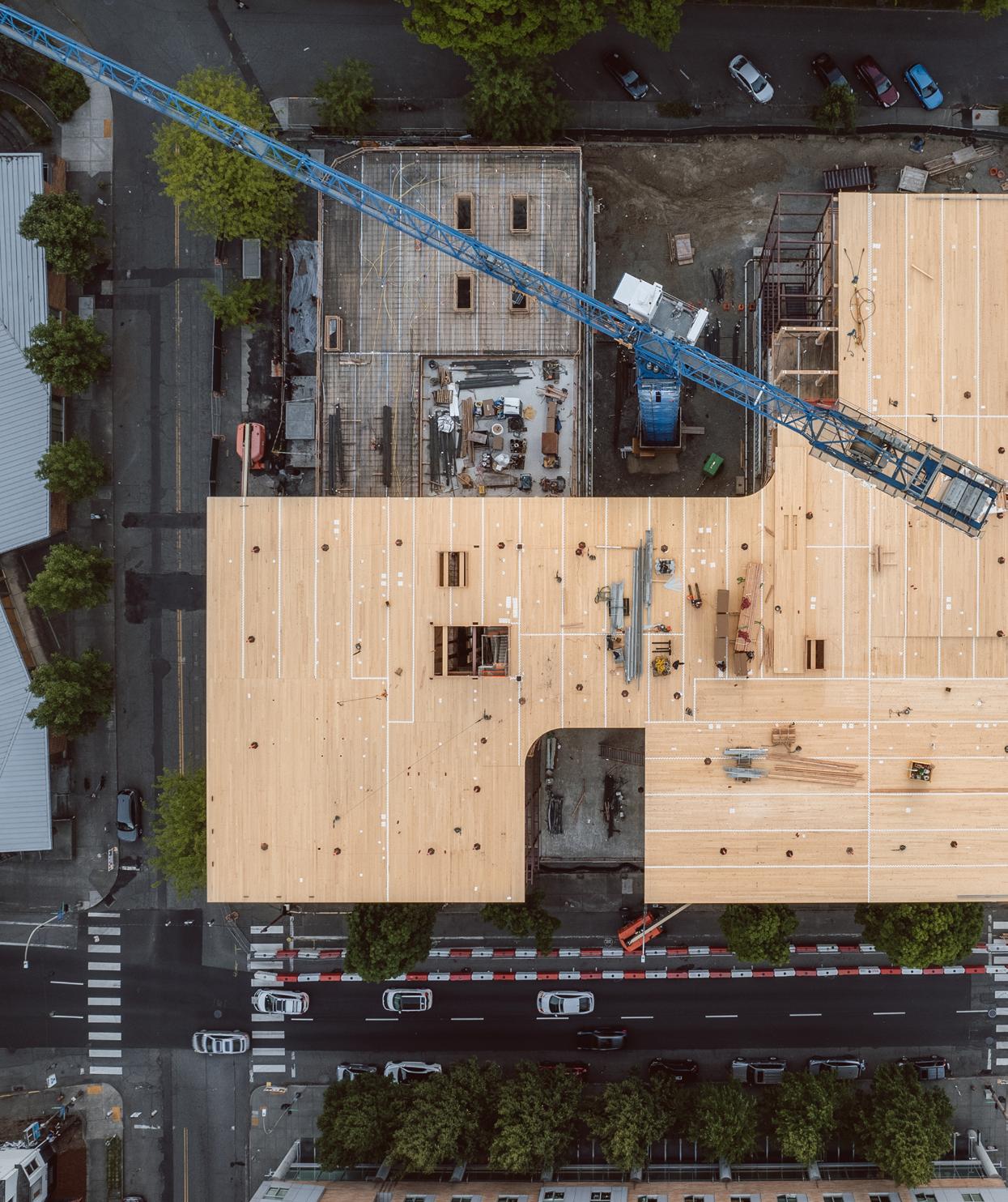

SCHEMATIC DESIGN PHASE CHECKLIST
We offer the following checklist to help keep your team on track toward timely delivery of a mass timber building. In our experience, the items on this list should be addressed by the end of the schematic design phase.
TEAM FORMATION
O Review project delivery models and associated schedule-related impacts.
O For projects with a 2-hour fire-resistance rating requirement or that will require a code variance related to fire safety, consider hiring a fire engineer.
O For projects with stringent acoustic requirements, consider an acoustic consultant.
O Identify any potential mass timber elements to be designed by Timberlab.
PROGRAMMATIC & PERFORMANCE REQUIREMENTS
O Define construction type strategy.
O Understand fire-resistance rating (FRR) requirements.
O Determine finished floor requirements.
O Set acoustic performance requirements.
O Set vibration performance requirements.
O Set head height clearance requirements and understand relationship to floor assembly thickness and grid size.
O Select HVAC system.
O Consider how the HVAC system will interact with the structure and impact head clearance.
STRUCTURAL DESIGN
O Finalize decision to build mass timber structure.
O Set loading and deflection requirements for the structure.
O Determine any variance requests, performance-based design elements, and testing requirements. Meet with AHJ to assess acceptance path.
O Determine if lighter mass timber structure will reduce foundation size.
O Determine minimum CLT panel thickness.
O Set structural grid and framing approach.
O Compare options for lateral force-resisting system. Consider cost, schedule, and constructability.
O Determine if CLT can be the horizontal diaphragm.
PROCUREMENT
O Connect with Timberlab to receive a preliminary budget and constructability feedback for your design. Our preconstruction managers have a wealth of knowledge and experience to recommend solutions that align with project goals and budget.
O Identify wood sourcing goals that may impact procurement strategy and/ or timeline.
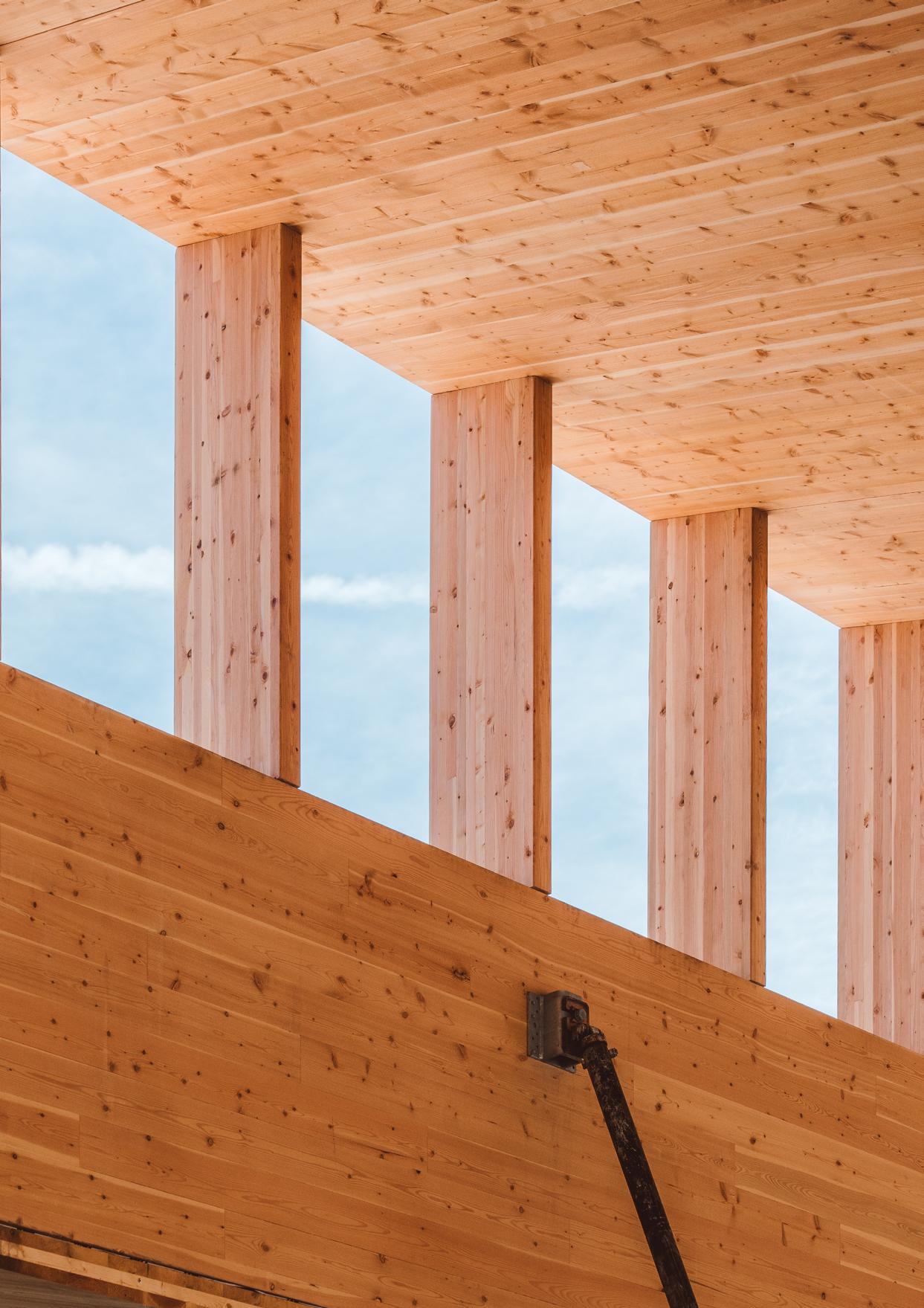
7. DESIGN DEVELOPMENT PHASE
In the Design Development (DD) phase of a project, we begin to refine the framing concept produced during the Schematic Design phase – selecting the species of wood for your structure, calculating member sizes, refining the approach to connection design, and beginning to design typical details.
SPECIES SELECTION
Selecting a species of wood for your mass timber project has architectural and geographical implications. It also has structural implications, as the strength characteristics of glulam and CLT components vary with the type of wood used in the layup. For glulam columns and beams, the strength characteristics of each species have a substantial effect on the size of members, with stronger wood yielding members with smaller cross-sections. The differences across species for CLT panels are less pronounced but still important. The choice of species also has a major impact on connection design; denser species such as Douglas fir and Southern pine can typically be designed with more compact connections than other softer woods.
MEMBER SIZING
Member sizing for CLT and glulam is a function of lumber strength grade, and depending on the condition, sizes can be governed by deflection, vibration, fire, and even connection design. While the structural calculations for determining member sizes may be straightforward, multiple levers can be pulled to meet architectural and cost objectives.
COLUMNS
When designing columns, specify a grade as well as a member size. Please keep in mind that for higher grade columns with a smaller crosssectional area, there are procurement implications and increased cost, as well as potential impacts to connection design. For example, a Combo 5 Douglas fir column uses L1 lamstock, and a Combo 2 Douglas fir column uses L2 lamstock. While a Combo 2 column may be 12-18% larger than the Combo 5 column, this grade is easier to procure and less expensive, as the L2 fiber is more readily available than L1. Additionally, where columns support multiple beams with concealed connections, fastener clashes or bearing area requirements may require a larger member regardless, or a redesign of the connection detail. For certain species, designing with a higher grade can be effective in small quantities.
BEAMS
The cross-sectional area of the beam is the primary determinant of strength, with depth having a greater effect than width. Deeper beams are more structurally efficient, and one of the best ways to drive down the cost of a mass timber building is to choose the most efficient beams from a structural perspective and set floor-to-floor heights that can accommodate the optimized structure. Though it is often possible to adjust beam sizes to be wider and shallower to increase head height clearance, wider beams are typically more expensive per unit volume due to their use of wider boards of lumber and a greater volume of wood to achieve the same strength as a narrower, deeper beam.
For buildings with a fire-resistance rating and exposed beams, a certain minimum width may be required due to charring from both sides. Multi-span beams can create structural efficiencies, particularly for roof framing and where deflections may govern the design.
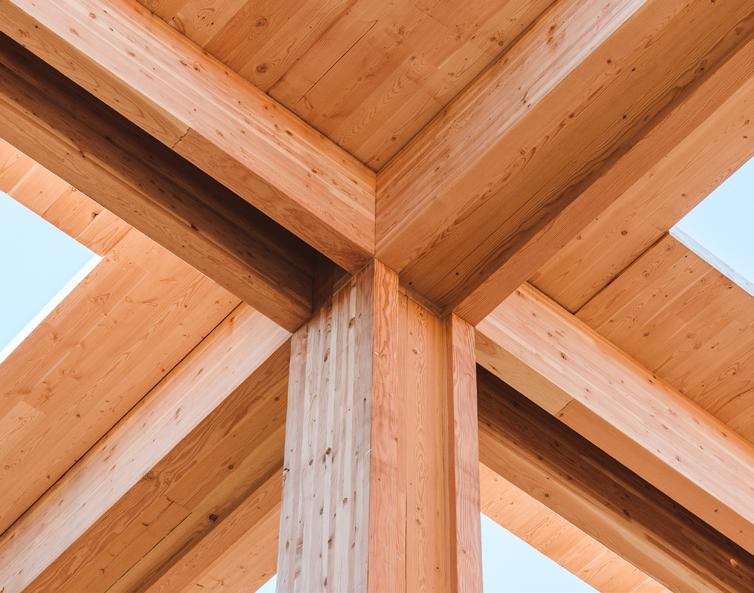
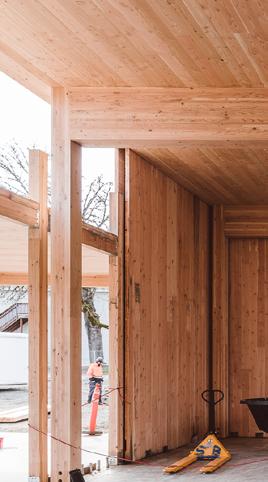
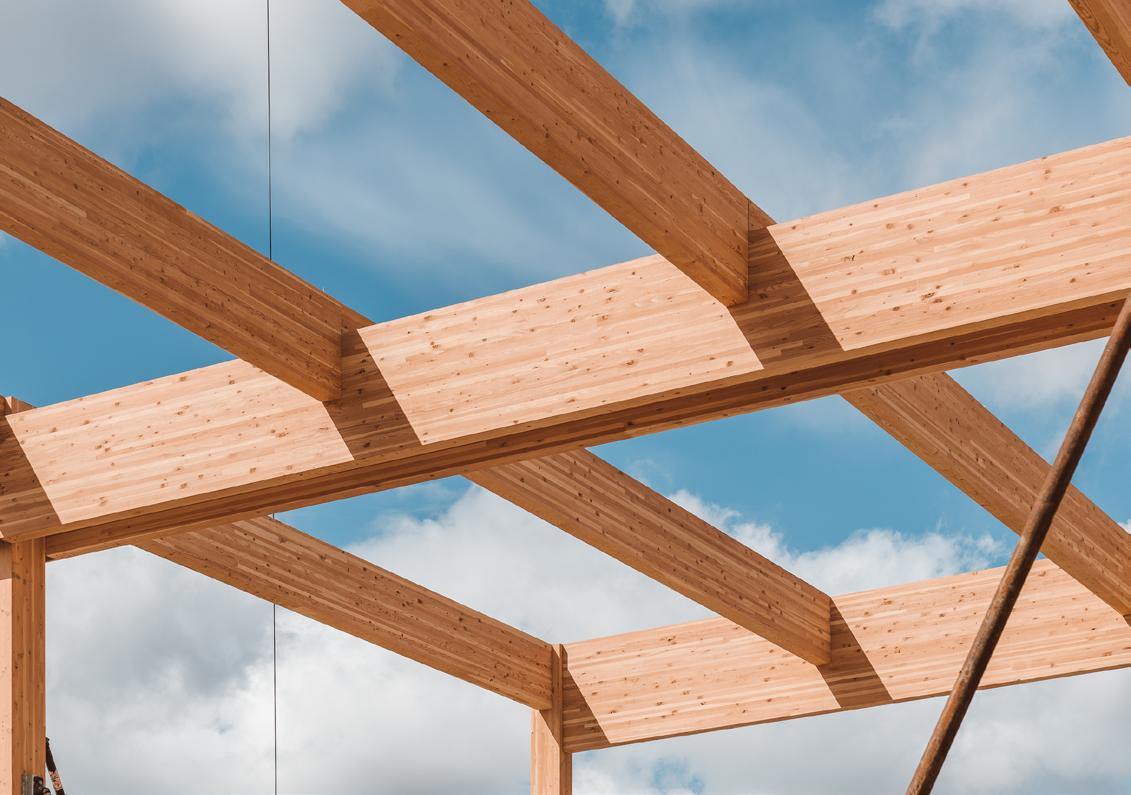
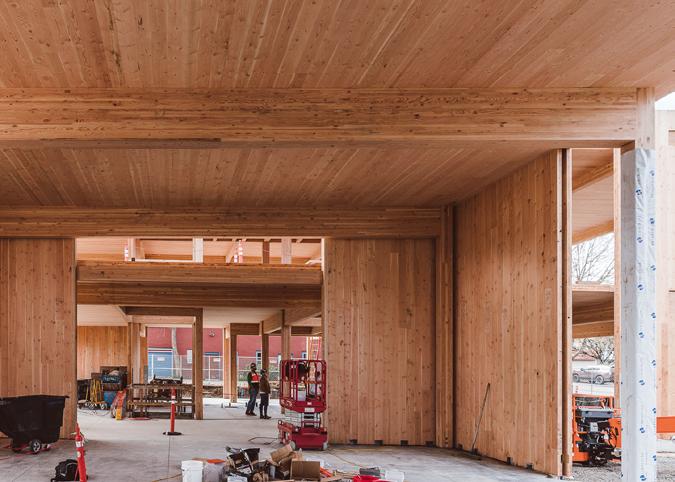
FLOORS & WALLS
When sizing CLT, you’ll notice that we offer higher-strength (E-grade) layups to help you achieve a longer span without needing to increase the panel thickness. E-rated lumber is more expensive, and it can take longer to procure large quantities than V-grade lumber, but it is often more cost effective than specifying a thicker panel if it meets your structural requirements. However, keep in mind that special sourcing requirements, such as FSC certification or lumber from a specific geographical region, can make E-rated panels difficult to procure.
ROOF DESIGN
Given that wood readily absorbs and releases moisture from its surroundings, it is important to design mass timber structures to shed water effectively and efficiently and avoid the trapping of moisture during construction and occupancy. We like to say that durable design with wood requires “good shoes and a good hat.” The roof serves as the hat, protecting your mass timber structure from weather, and its careful detailing will support a long lifespan for your building. We recommend designing the roof to slope toward temporary drains at the center of the building, to avoid water running back onto glulam beams and columns along the perimeter, but any well executed plan with temporary drains will be of great benefit.
FLAT ROOF FRAMING
Flat mass timber roof structures are not ideal, as it creates the potential for long-standing pooling water during construction. We understand, however, that a sloped roof may not be feasible for certain projects. In these instances, we recommend installing additional temporary roof drains and allowing for additional site labor to push standing water off the CLT decks.
SLOPED ROOF FRAMING
There are several ways to achieve a sloped roof structure to promote water drainage off the roof during the life of the building. The slope need only be a minimum of 1/4” over a foot, nearly imperceptible to the human eye, to achieve the desired result. Note that for any non-timber members at the roof level, such as steel beams, it may be necessary to create that slope in those elements as well. Increasing the slope of the structure may be required to compensate for deflections and avoid the risk of ponding.
PRO TIPS FOR WEATHER-RESISTANT ROOF CONSTRUCTION:
• Robust edge sealer on CLT panels.
• Temporary sealant between CLT panels and around any structural members penetrating the deck. Products can include high-adhesion water-resistant tape or caulk.
• Temporary covers over penetrations in CLT panels, with edges taped.
• A durable roof membrane compatible with the local climate and all roof assembly components. The membrane can be applied in the shop or in the field.
• Moisture content requirements for CLT panels confirmed with specified roof assembly.
• Temporary drainage during construction via flexible hosing connected to floor penetrations.
• Site labor to remove standing water and snow quickly after weather events.
BEAMS IN ONE DIRECTION FOLLOWING ROOF SLOPE
For systems with beams in one direction, sloping the roof structure in the direction parallel to the beams is a simple and costeffective approach.
BEVELED ROOF BEAM
For glulam members that are not oriented parallel to the roof slope, the cleanest approach, visually, is to bevel-cut these roof beams. Doing so adds complexity and cost to the fabrication but makes installation simple. This approach may require additional laminations on all roof beams, to offset the capacity lost with the bevel cut.
3/16/2026
SHIMMED ROOF BEAM
Utilizing tapered shims is an alternative approach to beveling. This approach can present challenges for determining the variety of shim sizes and locations across a roof plane, and for coordination with other trades. Shims can also have structural implications for the force transfer between the CLT roof panels and the supporting framing.
We often recommend recessed shims but note they will create shadow lines at the top edge of the beam.
ROTATED ROOF BEAM
The rotated roof beam approach is well-suited to secondary beams, which do not connect directly to columns. Despite potential complications to the design of connections to supporting beams, this detail is ideal for its avoidance of shims, easy fabrication, and affordability.
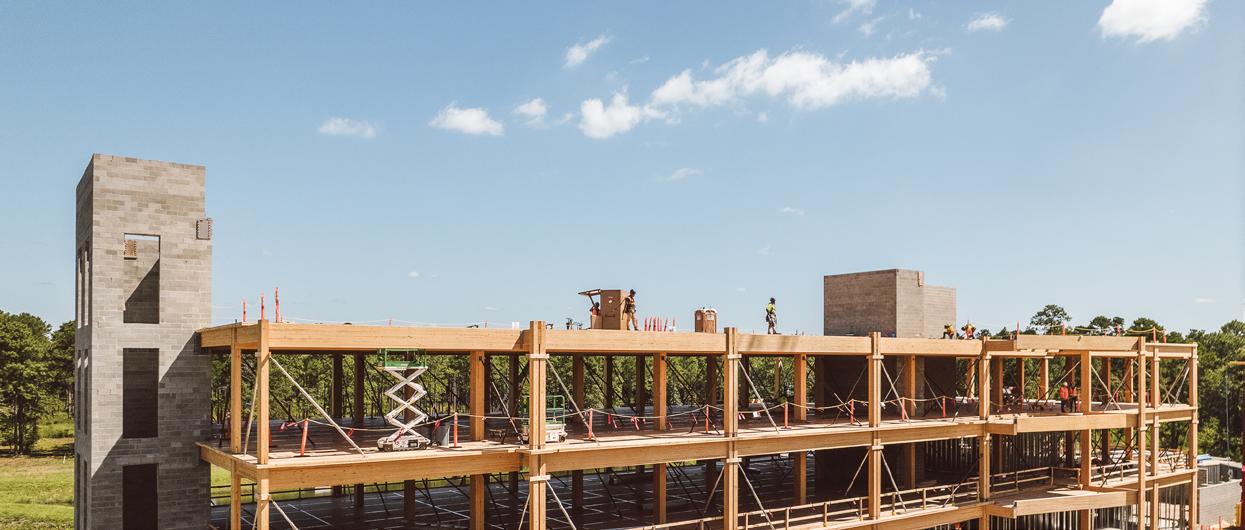
CONNECTION DESIGN
In an exposed mass timber building, connections have functionality beyond the structural design. They contribute to the architecture and the fire resistance of the overall building and can have meaningful cost implications depending on the approach. In general, the design of mass timber connections shall be in accordance with the National Design Specification (NDS) for Wood Construction, keeping in mind structural, durability, fire safety, and architectural performance requirements, as well as differences in material tolerance when interfacing wood with other materials.
This outline of connection designs is intended to highlight the most common approaches and guide you in their effective use. The list is not all-inclusive, and we encourage you to call us to brainstorm ideas for bespoke designs and highly custom or complex conditions. If greater support is desired, we would be glad to provide delegated design services for the timber connections for your project.
Please note the information contained in this section is for information purposes only and should be assessed and verified by your team’s structural engineer of record.
TYPICAL CLT CONNECTIONS
You will notice nearly all CLT connections are easily achieved with self-tapping wood screws, manufactured by several companies. We recommend streamlining the specification of fasteners across the structure so that we can purchase from one manufacturer for the project, as much as possible.
CLT SPLINE CONNECTIONS
Recommended:
GAUGE-METAL SPLINE
Our preferred detail for CLT splines uses gaugemetal straps with nails, or screws as needed. Steel splines are slim in profile and do not need to be routed into the panel, minimizing CNC machining. The metal is water resistant, and the straps are available off-the-shelf, fully engineered with high load capacities. We recommend applying high-adhesion water-resistant tape or caulk below the strap for the most weathertight installation.
Alternatives:
PLYWOOD SPLINE
The plywood spline connection is a traditional design with routing required on both sides of the joint to allow the plywood to sit flush with the top surface on the deck. Plywood splines can use nails or screws as needed. We recommend applying exterior-grade tape below the strap for the most weathertight installation. However, note that plywood is very absorbent, making it more difficult to control moisture levels; these splines will take longer than CLT to dry out after moisture contact.
BUTT JOINT SPLINE
The butt joint spline is a great solution at a ridge or valley of a CLT roof. It also has the benefit of requiring simplified CNC machining for the CLT panels. However, because the fasteners are not efficient to install, this detail is typically used only in unique situations.
HALF-LAP SPLINE
This spline detail is ideal for CLT walls visible on both sides, or when bringing together panels of different thicknesses. It often results in a higher panel count, as the lap reduces the width of each panel by a few inches on each side. Typically the detail includes 2-1/2” to 4” of horizontal lap and half of the thickness of the panels for vertical routing. The width of the lap is usually controlled by fastener edge distance requirements.
CLT BEARING CONNECTIONS
CLT ON GLULAM BEAM
Self-tapping wood screws are installed perpendicular to the glulam beams, through CLT panels, for a mechanical connection from the topside of the CLT deck.
CLT ON STEEL WF BEAM
Self-tapping wood screws are installed into pre-drilled holes in the top flange of the steel beam, from the underside of the deck. Typically, holes should be 1/16” larger than the maximum diameter of the screw shank or outer threads. Consider prime-painting all sides of steel members to minimize any staining of the wood by the steel.
CLT ON STEEL BEAM WITH LEDGER
A wood ledger is bolted to the top of the steel beam, with the CLT fastened to the ledger with self-tapping screws.
CLT ROOF ON CLT WALL
CLT panels are fastened to CLT walls below via mechanical connection with selftapping screws.
CLT ROOF ON WOOD FRAMED WALL
CLT panels are fastened to wood frame walls from below via mechanical connection with wood screws.
CLT FLOOR ON WOOD FRAMED WALL, NON-RATED
CLT panels are platform-framed, with mechanical connection to wall below via wood screws. The sill plate of the wall above is nailed to the CLT below.
CLT FLOOR ON WOOD FRAMED WALL, FIRE-RESISTANCE RATED
Rim boards are added to the wall system for continuous load transfer in fire-rated construction. Rim boards can be fire-resistant-treated (FRT) wood as needed, to match exterior wall framing.
CLT LEDGER CONNECTIONS
CLT ON LEDGER FOR BALLOON-FRAMED WALL
CLT panels are supported on balloonframed walls using a wood ledger, with a lateral clip to the wall.
CLT FLOOR TO CLT WALL, WOOD LEDGER
CLT floor panels are supported by CLT walls via wood ledger. Fire rating can be achieved through recessing the fasteners and plugging the resultant holes.
CLT FLOOR TO CLT WALL, STEEL LEDGER
CLT floor panels are supported by CLT walls via steel angle. This detail is best suited to non-fire-rated applications or where the ledger can be protected by other non-combustible assemblies.
CLT FLOOR TO CONCRETE WALL
CLT panels are supported by concrete wall panels with either a steel angle or wood ledger. Embeds are often provided by the concrete trade partner but are a critical coordination item. As concrete walls have much less stringent tolerance limits than the timber components, it is important to leave room for adjustability at the interface of these elements.
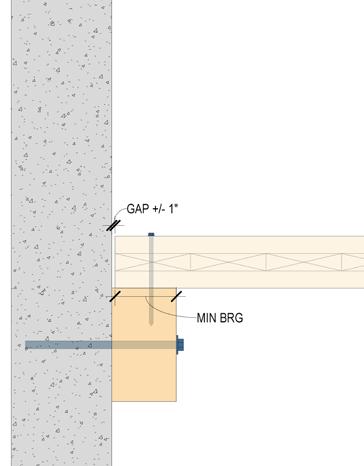
CLT FLOOR TO CONCRETE
WALL, STEEL ANGLE
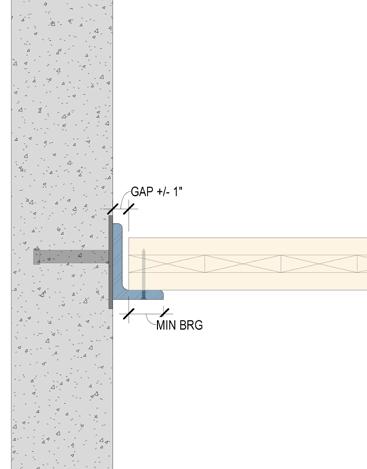
CLT FLOOR TO CONCRETE
WALL, STEEL LEDGER
CLT WALL TO CONCRETE FOUNDATION
There are many ways to connect CLT wall panels to the concrete foundation. Providing adjustability to achieve a flat bearing surface for the CLT wall panel is a key consideration for this connection type. We offer two options for an exposed-hardware connection, where at least one side of the panel is furred out or hidden from view, and two options for a concealed-hardware connection where both sides of the panel are exposed. Of course, it is also possible to fur out a molding at the base of the panel to conceal hardware. Generally, exposed hardware connections are more constructible and less expensive than concealed connections.
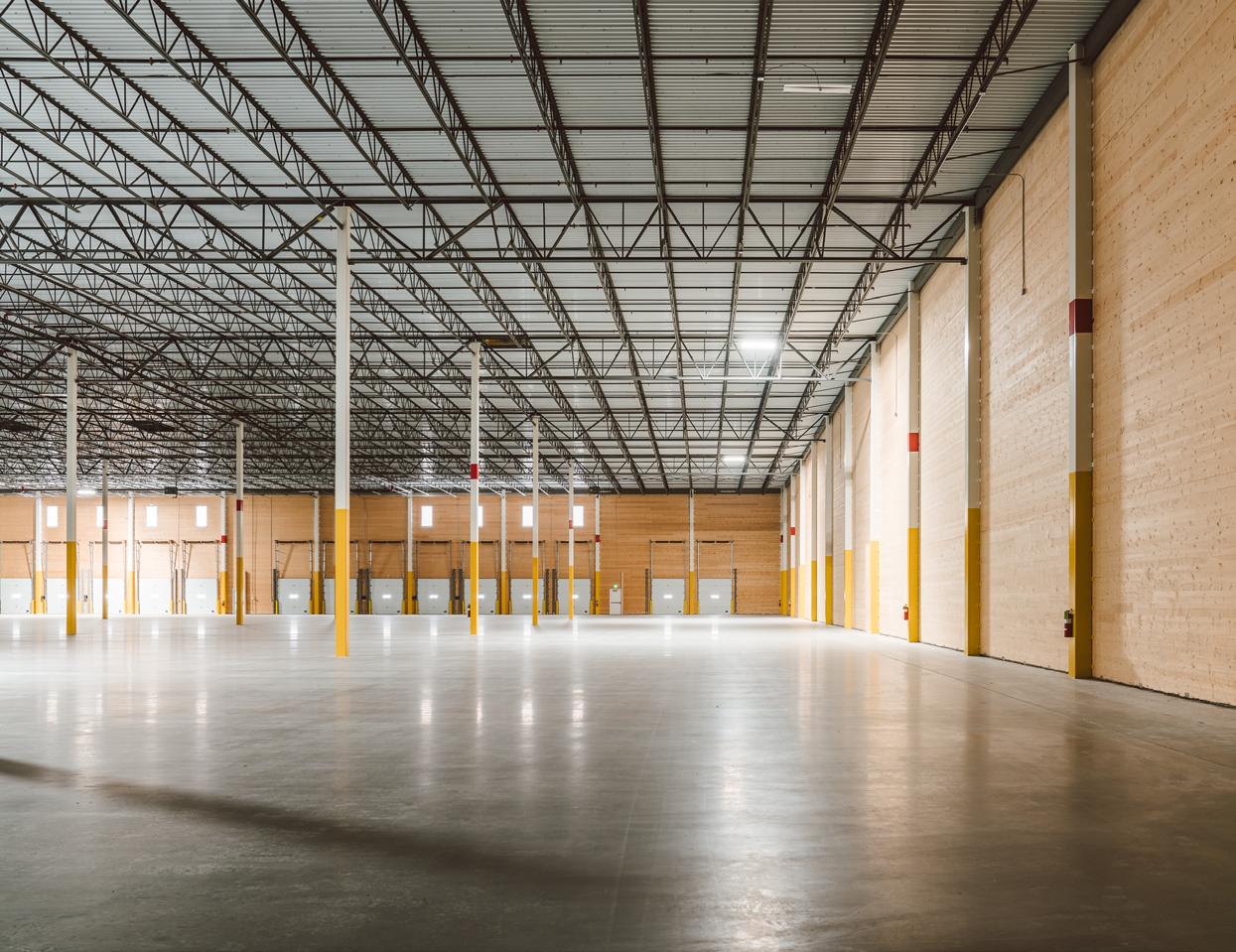
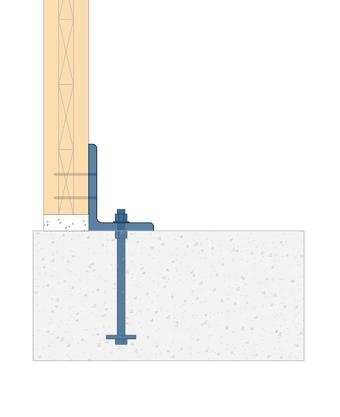
CLT TO FOUNDATION, STEEL ANGLE ORIENTED OUTWARD
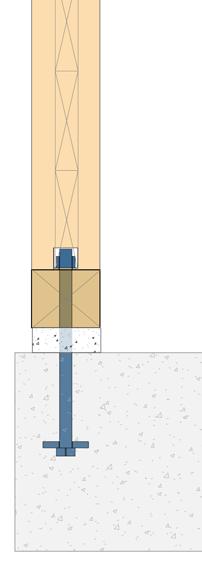
CLT TO FOUNDATION WALL, SILL PLATE
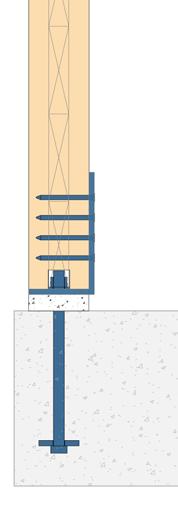
CLT TO FOUNDATION, STEEL ANGLE ORIENTED INWARD
TYPICAL GLULAM CONNECTIONS
Glulam connections generally fall into three classes: (1) wood-bearing, requiring only the timber and structural fasteners, (2) steel hangers, requiring a custom welded steel assembly and structural fasteners, and (3) proprietary, pre-engineered connectors, available off the shelf.
FIRE PROTECTION OF CONNECTIONS
Many glulam connections can be designed to meet fire-rating requirements of 1 or 2 hours. Various connection types might have different advantages depending on the exact geometries, fire-resistance ratings, and loading requirements. For fire-rated elements that remain exposed in the completed structure, a properly detailed connection incorporates an insulating (sacrificial) wood layer around any steel hardware, and depending on the connection, a barrier material will be required to seal the joint and prevent further charring from a non-exposed side of a glulam member. We recommend fire tape in these instances, applied in our facilities according to direction from the project team.
Alternatively, connections can be protected with non-combustible materials such as gypsum board. For wood-to-steel connections, we generally suggest this approach to protecting connections.
Ensure that fire-resistance rating requirements are noted in either the architectural or structural details of connections.
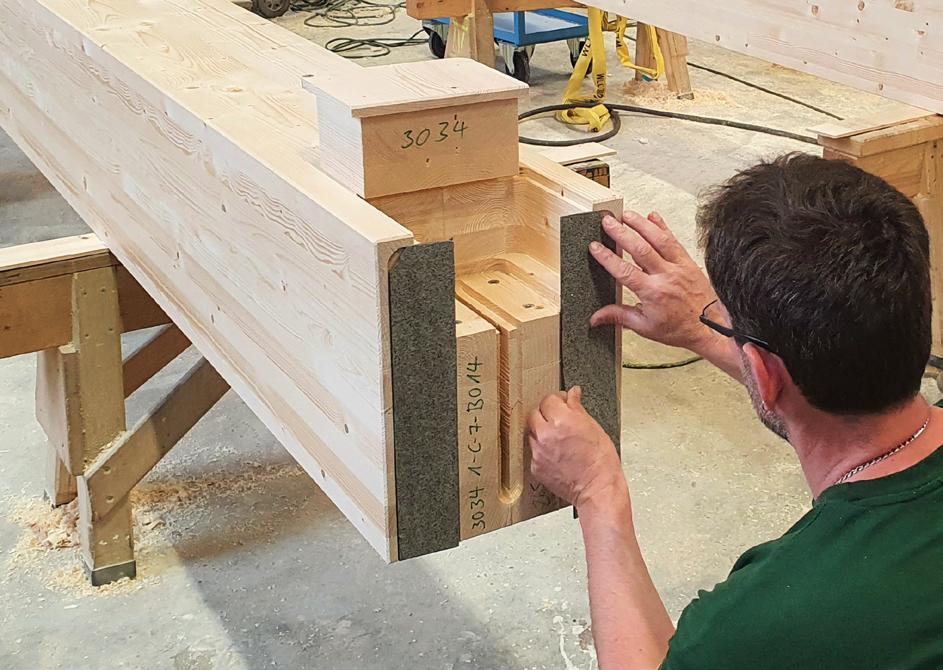
COLUMN BASE
The column base is the connection that launches the mass timber building off the ground, and it presents significant schedule risk if not detailed and procured with care. When designing these connections, consider implications for speed of installation, adjustment to accommodate higher tolerance concrete slabs, and long-term durability (moisture management). Keeping the bottom of the wood above the ground level or finish floor elevation can avoid damage during construction and the potential for trapped water throughout the building’s life.
COLUMN BASE NO UPLIFT
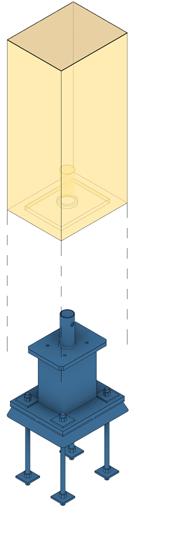
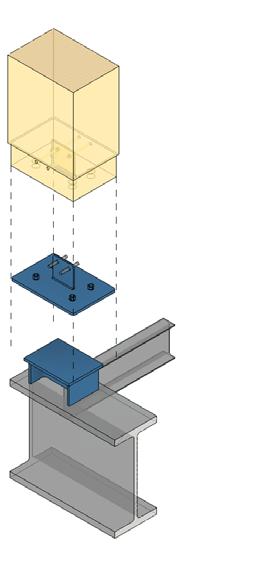
COLUMN BASE, CONCEALED BASE PLATE WITH BOLTS
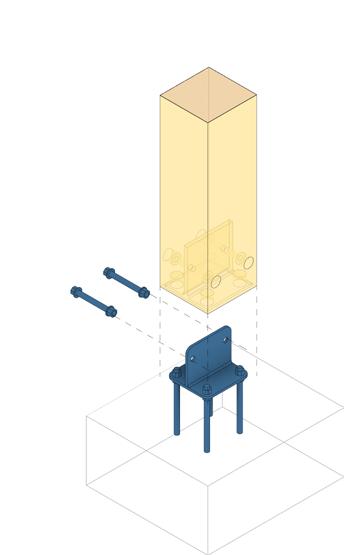
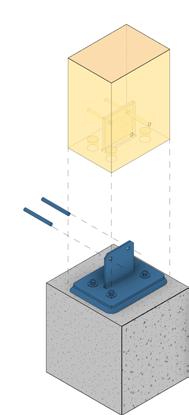
COLUMN BASE TO EMBED OR STEEL FRAMING
COLUMN BASE, EXTERIOR
COLUMN SPLICES
For multi-story buildings, the primary load is typically a compression load that is transferred from the column above directly to the column below to avoid perpendicular-to-grain crushing and shrinkage of the floor structure. This load transfer can often be achieved through bearing alone, although additional hardware (a steel plate assembly or simply wood screws) may be needed to provide a mechanical connection and lateral stability. Consider ways to detail the splice to accommodate rigging, and to guide the precise installation of the column above.
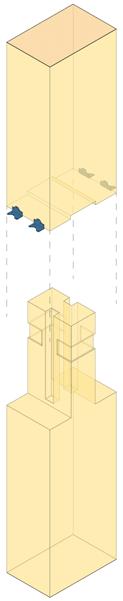
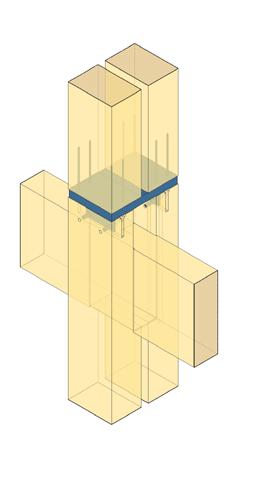
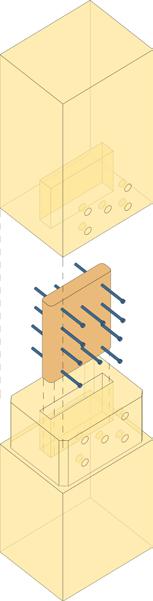
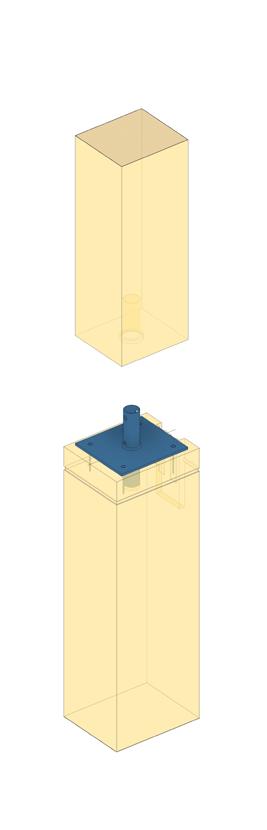
COLUMN SPLICE, WOOD BEARING
COLUMN SPLICE, STEEL KNIFE PLATE
COLUMN SPLICE, STEEL PIPE
COLUMN SPLICE WITH LVL
WOOD BEARING
Of all the ways to connect glulam to glulam, utilizing the bearing capacity of the wood itself can be highly effective – eliminating the work of detailing and fabricating steel hardware and the time associated with procuring it. Note that wood bearing connections typically require wider members than other approaches. Wood bearing connections can also be highly effective for fire-resistance-rated members. Timberlab has performed its own testing on wood bearing connections for 1-hour and 2-hour conditions and can help inform the design of these types of connections.
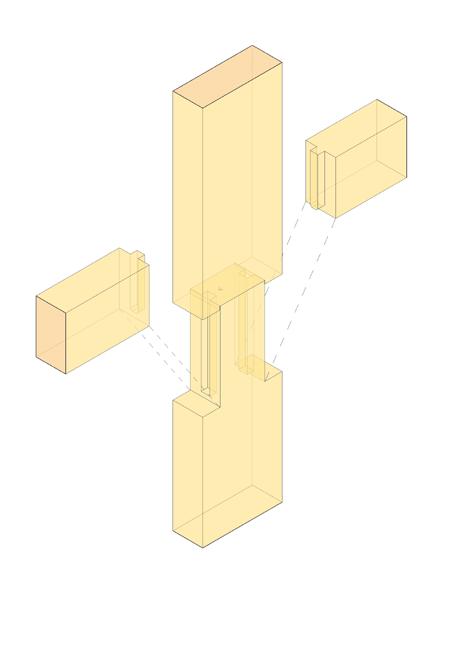
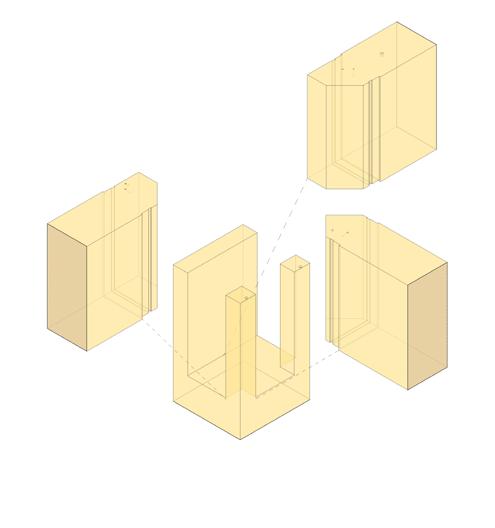
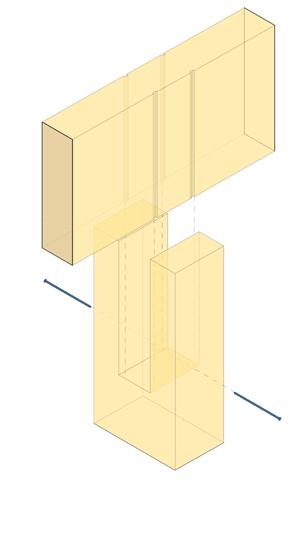
WOOD BEARING, COLUMN LEDGE
WOOD BEARING, COLUMN POCKET
WOOD BEARING, GOALPOST COLUMN
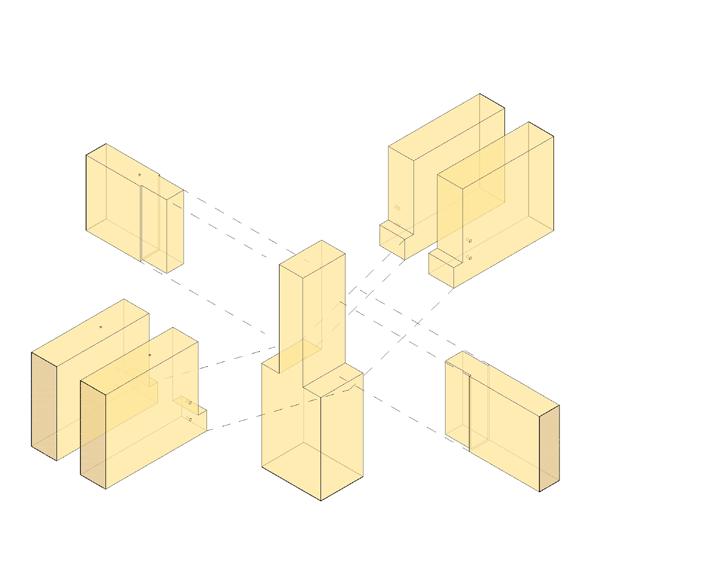
WOOD BEARING, PURLIN OVER GIRDER
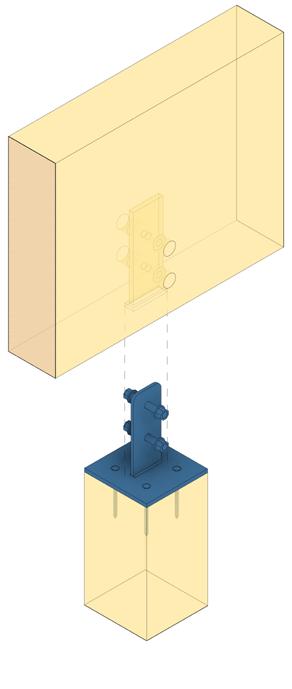
WOOD BEARING, DOUBLE BEAM
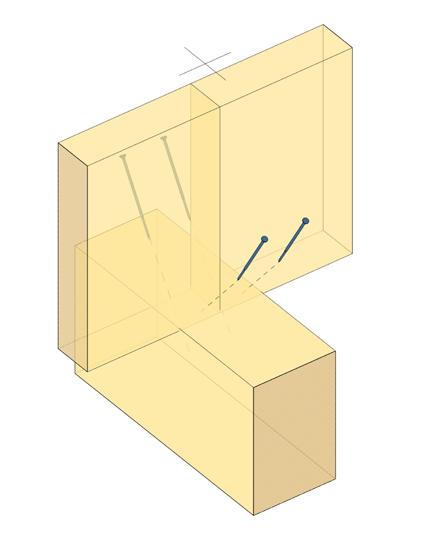
WOOD BEARING, ROOF BEAM CONTINUOUS OVER TOP OF COLUMN
CUSTOM STEEL ASSEMBLIES
Custom welded steel assemblies can be an effective way of detailing connections with larger reactions. This approach is most simply applied in non-rated applications where bottom plates and bolts can be left exposed. In fire-rated buildings, the cost of recessing steel connections and plugging holes for through-bolts can become significant. We also recommend custom steel assemblies when connecting glulam beams to steel beams or columns.
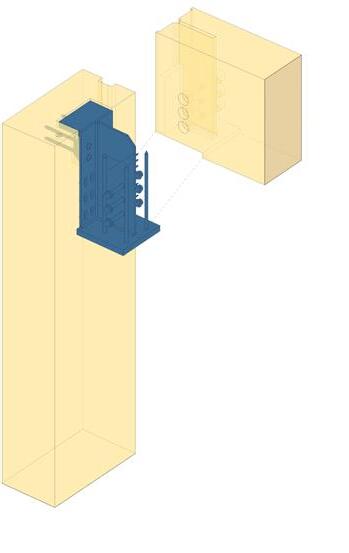
CUSTOM STEEL HANGER, FULLY CONCEALED + FIRE RATED
CUSTOM STEEL HANGER, MOUNTED ON TOP OF COLUMN
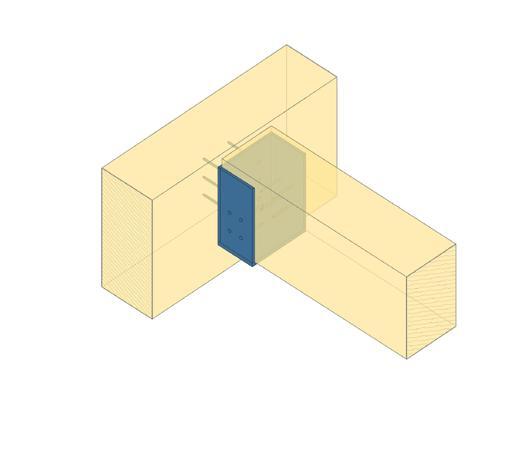
CUSTOM STEEL HANGER, BEAM TO BEAM BUCKET
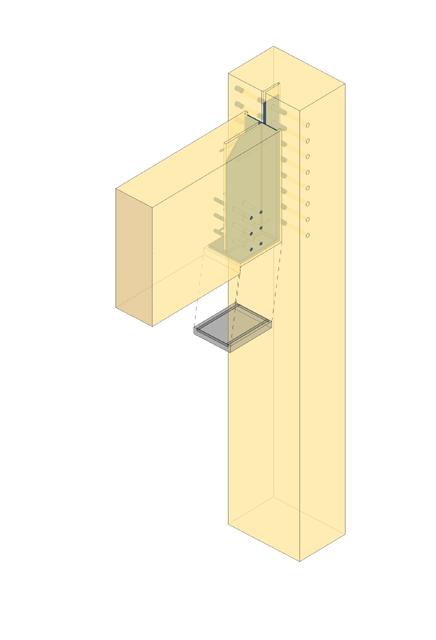
CUSTOM STEEL HANGER, BEAM TO BEAM BUCKET
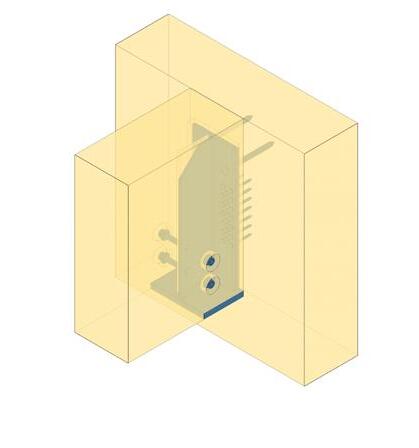
PRE-ENGINEERED HANGERS
In fire-rated applications where concealed hardware is a requirement, or for applications with low to medium reactions, pre-engineered hangers are often the most effective connection typology. They also have the benefit of working well for oblique connections.
PRE-ENGINEERED HANGER, DAPPED INTO SUPPORT
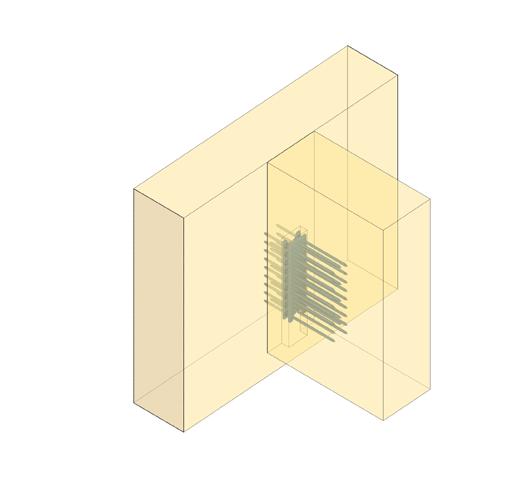
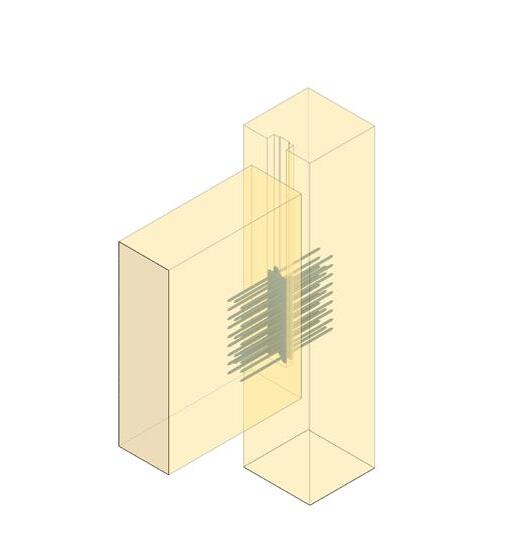
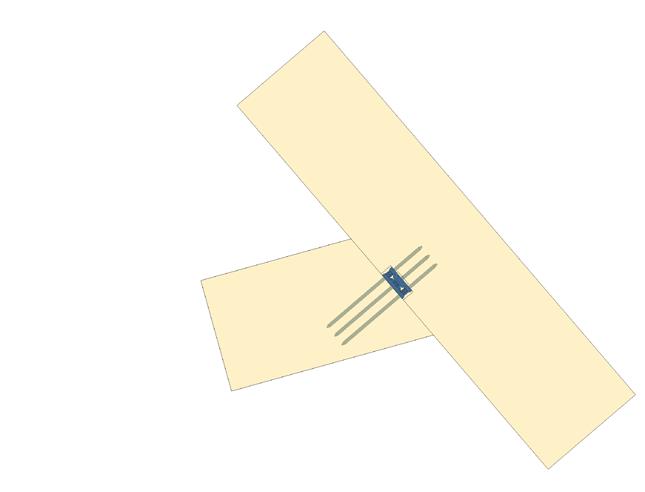
CUSTOM STEEL HANGER, BEAM TO BEAM BUCKET
CUSTOM STEEL HANGER, BEAM TO BEAM BUCKET
SLAB EDGE DOCUMENTATION
The slab edge plan, completed by the Architect, is critical to a complete mass timber design. For each level of the structure, the slab edge plan confirms the precise geometry of the CLT deck and clearly defines the edges of this floor or roof system and all openings within. While the slab edge documentation will be confirmed during the shop drawing process, preparatory coordination by the project team can significantly expedite that process.
INTERFACE WITH NON-TIMBER STRUCTURAL ELEMENTS

The CLT slab edge must be carefully coordinated at each interface with concrete shear walls, steel braced frames, and other non-timber structural elements. Slab edge coordination should consider tolerance differences between materials, ensure minimum bearing requirements are met, and enable some degree of adjustability in the field.
INTERFACE WITH FAÇADE SYSTEM
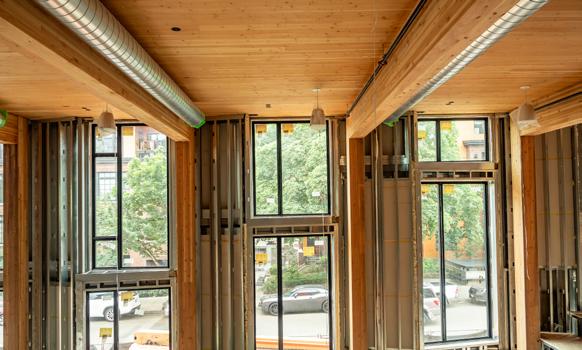
INTERIOR OPENINGS
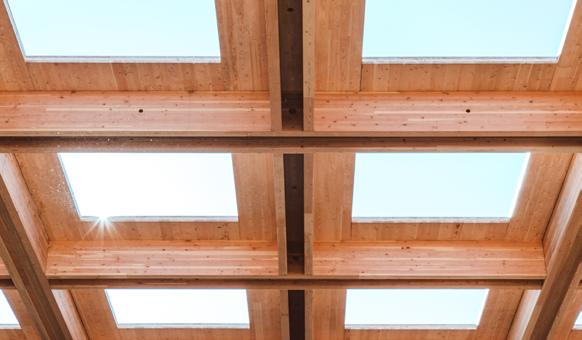
At the perimeter of the building, the CLT slab edge must be coordinated with the façade system, accounting for property lines and setbacks, thickness of exterior wall assemblies, and material tolerances. Other systems that occur at the façade line such as window shades may also affect these details.
Openings in the CLT deck, at shafts, stairs, and skylights, must be carefully and precisely coordinated with relevant trade partners.
DD PHASE CHECKLIST
We offer the following checklist to help keep your team on track toward timely delivery of a mass timber building. In our experience, the items on this list should be addressed by the end of the design development phase.
TEAM FORMATION
O To maximize the prefabrication potential of mass timber, select and on-board trade partners for all structural systems, MEPF systems, and exterior façade system.
O If engaging Timberlab for timber engineering services, clearly define the scope of delegated design and provide all loading requirements to the Timberlab team. Clarify with AHJ whether delegated design is to be submitted with permit documents or can be a deferred submittal.
ARCHITECTURAL DESIGN
O Select desired species for glulam and CLT.
O Select connection detail approach, as joints have visual impact and will become part of the architecture.
O Identify means of fire protection, particularly for non-combustible materials.
O Coordinate the CLT deck perimeter, working toward complete slab edge documentation..
STRUCTURAL DESIGN
O Size members to reflect design forces, connection geometries, and fireproofing requirements.
O Develop indicative details for typical connections. Note that it is possible to mix and match different connection approaches for different details, so long as your selections are informed by aesthetics, fire-performance, cost, and constructability.
O Examine atypical conditions such as building cores, terraces, balconies, roofs supporting mechanical equipment, and identify additional structural framing requirements at those locations.
PROCUREMENT
O Review Timberlab glulam and CLT specifications and select the customization options that suit your project needs. Specifications are available upon request.
O Begin conversations about finishing requirements for mass timber components.
O Request updated pricing from Timberlab for your Design Development set of documents. Depending on your construction schedule, your DD set may likely be the bid set.
O Refine the construction schedule for your project to include preconstruction activities on the critical path. Be sure to include the timber shop drawing and production timelines, structural coordination timeline, and MEPF trade coordination timeline. Tie activities to design decisions to illuminate when elements of the design must be finalized, and to gain a sense of mass timber lead times for your project.
O Begin looking for Builder’s Risk insurance for your project. Finding an insurance carrier can take longer for mass timber projects, as there are often extensive questionnaires to complete.
8. CONSTRUCTION DOCUMENTS PHASE
In the Construction Documents (CD) phase of a project, we are finalizing the design of all structural members, beginning to coordinate MEPF services with the intent of factory-coring penetrations, and solidifying the specifications for both glulam and CLT elements. The goal is to prepare the project for the shop drawing process to commence and achieve cost certainty through complete design.
COORDINATION PHILOSOPHY
Our intention with the coordination process is to ensure accuracy and precision in the manufacturing of mass timber components, including any factory-cored penetrations. This involves the integration of architectural, structural, mechanical, electrical, plumbing, fire sprinkler, façade, and elevator designs – a time- and energy-intensive process that yields tremendous benefits for construction.
While we view our role in this process as participatory and supportive, we are adept at guiding project teams that are new to this type of coordination. To ensure a successful mass timber project delivery, Timberlab recommends that all trade partners are contractually required to participate in BIM coordination led by the General Contractor.
STRUCTURAL COORDINATION
Coordination of structural systems ensures smooth installation on-site. The process involves the reconciliation of system geometries and dimensions, as well as refinement of details at the interfaces between systems to allow for differences in manufacturing and construction tolerances between materials. Critical attention must be given to the connection of glulam columns or CLT walls with the concrete foundation or slab and the interaction between a mass timber gravity system and a steel or concrete lateral system.
MEPF COORDINATION
Our approach to 3D modeling focuses on how the space will look in its final condition. We collaborate with your team to understand the design intent for the finished space, meticulously organizing services that are mounted to the ceiling to ensure an uncluttered aesthetic. This process involves close coordination with other trade partners so that we not only avoid clashes in the field, but ensure elegance.
To harness the full prefabrication potential of mass timber, we seek to integrate all penetrations for mechanical, electrical, plumbing, and fire sprinkler systems, and work with trade partners to ensure their information is integrated into our model. Why? Because a CNC machine can do in 1 minute what it would take a carpenter 1 hour to do on site, without the safety risk. The result is an efficient installation of structure and follow-on trade work, both interior and exterior, producing the schedule savings that we attribute to mass timber buildings.
Below, we present a list of design decisions that, if made during the construction documents phase, will expedite the shop drawing process, contributing to a shorter lead time for material delivery.
Locate and size the vertical MEP system distribution. The accurate and precise location and size of MEP shafts, mechanical units, electrical panels, and other equipment and shaft openings can impact structural framing design, often resulting in identification of additional members or a change to member sizing to compensate for large penetrations in the CLT floor or roof system. Early MEPF design and coordination ensures complete structural design leading up to the shop drawing (fabrication modeling) process.
Assemble complete submittals for lighting, devices, and elevators. Full submittals are needed so that we can better understand unit weights, circuit sizing, layout, and sleeving considerations through CLT floors and walls. Elevator specifications from the vendor will impact the exact size of openings, affecting the CLT dimensions adjacent to the core walls, and the overall slab edge documentation.
Design intended fire sprinkler penetrations through glulam beams. If the design intent is to run fire sprinkler mains through glulam beams, this information needs to be communicated early to determine any impacts to member sizing.
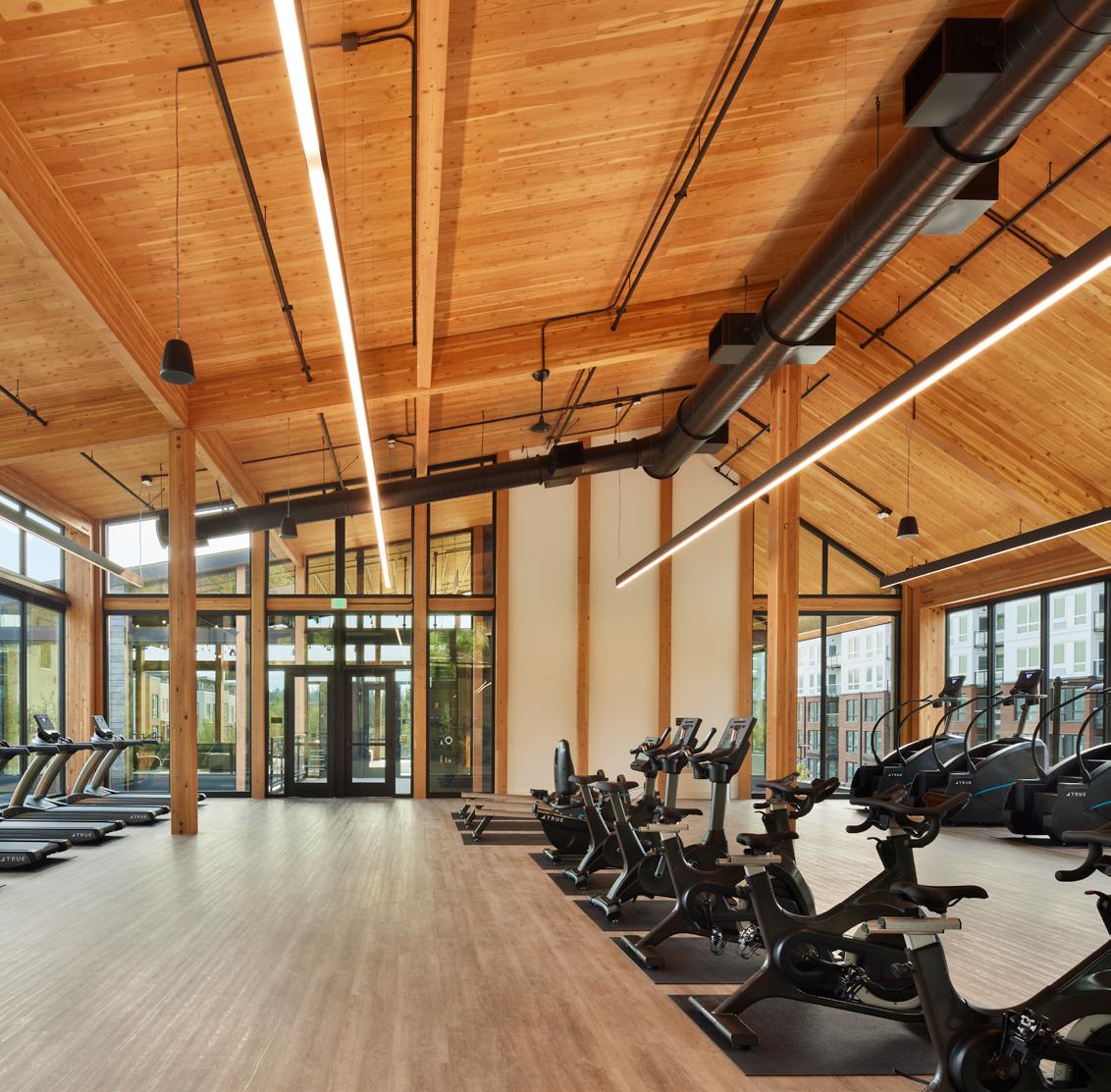
PENETRATION GUIDELINES
Mass timber construction offers tremendous opportunity to prefabricate building components for swift, safe assembly on site. The precise penetration of beams and panels through which to run building services is one aspect of this componentization, facilitating efficient installation of building services once the structure is in place and resulting in an elegant, uncluttered, exposed timber ceiling.
All openings, regardless of size, will impact both the structural and fire performance of the member or assembly. We offer the following design guidelines to help ensure the integrity of your mass timber structure.
CLT PENETRATIONS
Penetrations in CLT floors are often made for plumbing pipes and electrical junction boxes. Most penetrations of this nature can be made without additional structural support. Larger openings such as MEP shafts and skylights, however, may require additional glulam framing to ensure structural integrity. Additionally, consideration should be given to the impact of penetrations on the assembly’s fire-resistance rating.
The structural impact of a CLT penetration will depend on the strength characteristics of the panel, the loads to which the panel is subjected, and the size and location of holes. These variables make it difficult to develop simple rules for allowable penetrations in CLT. Particularly for larger openings, the structural engineer must evaluate the proposed penetrations to determine whether they can be accommodated, with or without reinforcing.
For preliminary review, a “strip analysis” can be used to evaluate the structural impact of an opening, idealizing portions of the panel as simply supported beams spanning in both the strong and weak directions to transfer forces around the opening. As this method simplifies the full plate behavior, it is not ideal for designs that are nearly overloaded.
For greater accuracy, a finite element model (FEM) plate analysis can be performed for the force distribution around openings in panels. For the best results, ensure that the engineering model accounts for the orthotropic nature and behavior of CLT, such that major and minor strength-axis properties are distinctly represented.
To preserve the integrity of fire-rated assemblies, CLT penetrations must be sealed in accordance with IBC Section 714. In practice, this requires the use of firestop systems tested in accordance with ASTM E814 or UL 1479.
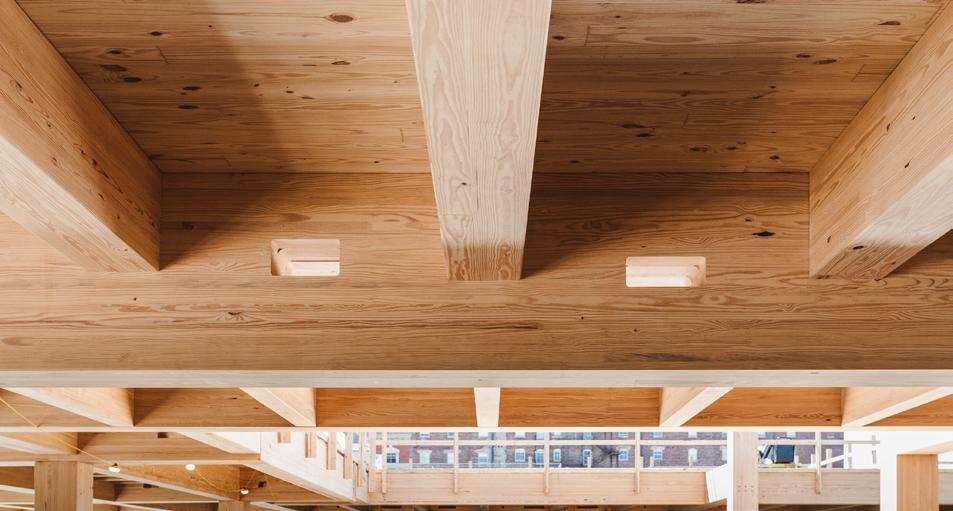
GLULAM PENETRATIONS
In locating and sizing horizontal penetrations in glulam beams, a prescriptive method published by APA allows for small hole placement (typically 1-1/2” diameter or less) without reduction in structural capacity. In this method, avoid penetration in the high-strength tension laminations on the top and bottom of the beams (the moment critical zone) and instead locate holes in non-critical zones in portions of the beam stressed to less than 50% of design bending stress and less than 50% of design shear stress. Note that these guidelines are intended for simple span beams subjected to uniform loads. If this information is applied to continuous or cantilevered beams, it should be used with caution and based on engineering analysis.
For larger penetrations, an additional method published by APA for round holes can be used to calculate the reduced shear and bending capacity of the member, which can be compared to the demands on the beam to determine if the hole can be accommodated. For rectangular holes, no guidance is provided in the US-based codes, but provisions from other codes can serve as the basis for a rational engineered approach. Larger openings are typically reinforced near their edges with fully threaded screws.
When designing penetrations through fire-rated glulam beams, we caution our clients to take additional protective measures, as the fire performance of penetrated members is less understood than that of non-modified members. Of note, preliminary research has shown that the char rate at and around penetrations is in-line with standard char rates applied to the exposed sides of a member. Therefore, when designing a structural member, charring from inside the penetration must also be included in the structural analysis calculations. We recommend working with a fireproofing consultant to develop effective details for protecting penetrations through beams.
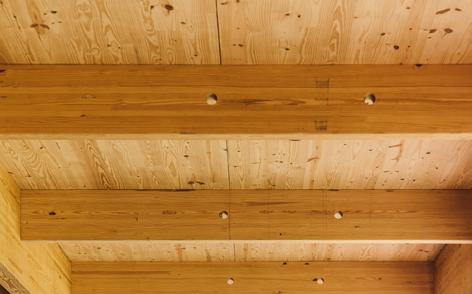
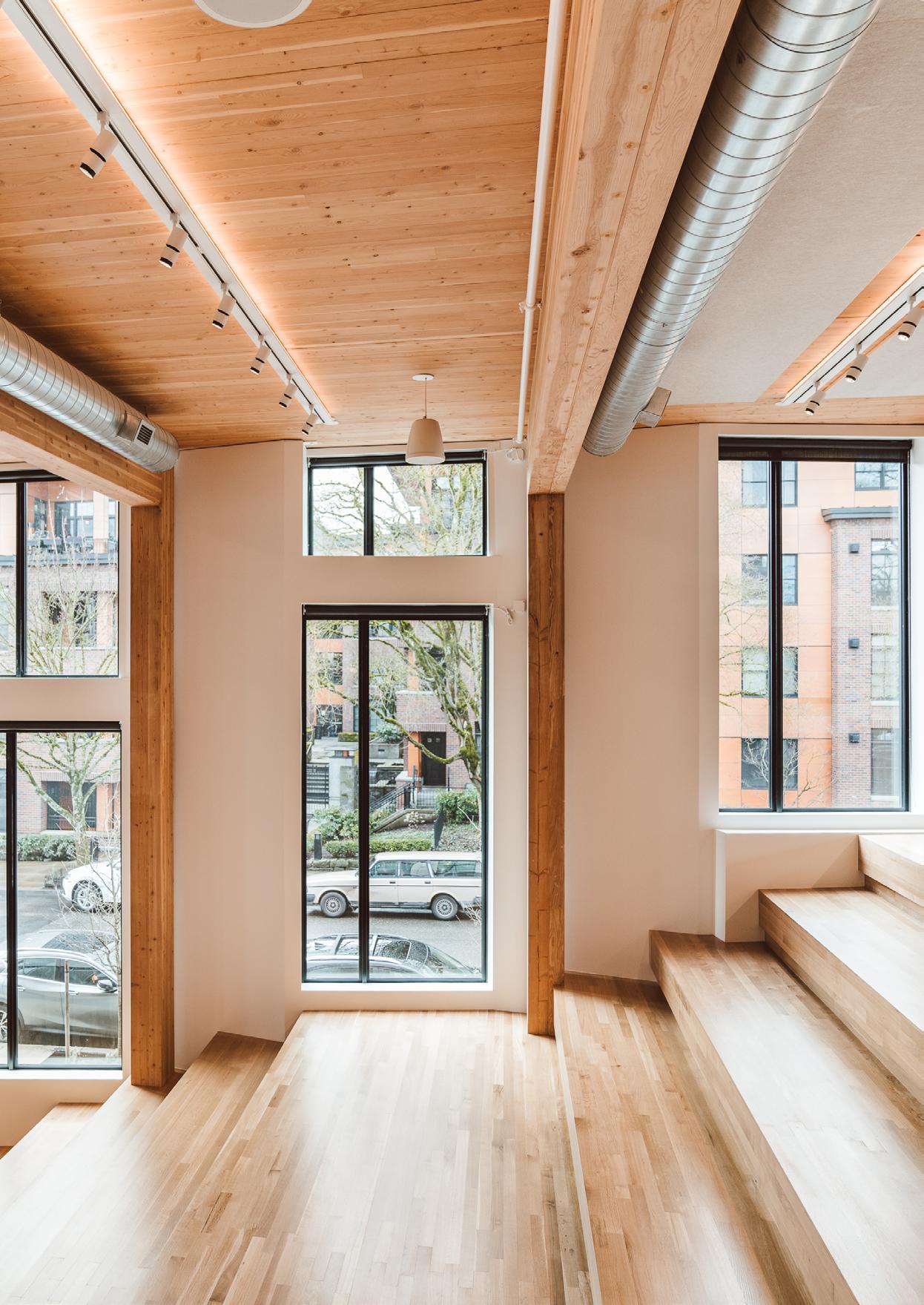
COATINGS + TREATMENTS
In specific applications, or for the entire system, strategic application of coatings and treatments becomes imperative to elevate the visual appearance, fire performance, or overall durability of mass timber components. A plethora of products exists on the market, each with its own performance attributes and composition. Our team is here to support you in identifying products that align with your specific requirements, providing consultation on important considerations and offering flexibility to apply coatings prior to shipping materials to the jobsite.
SHOP SEALER
Shop sealers play a crucial role in protecting wood during transportation and construction, with the added benefit of rapid dissipation. A single coat is applied to all glulam components at our facilities before shipment. Should your specifications call for additional coatings or treatments, we will collaborate with your team to seamlessly integrate these into the process or ensure compatibility with the initial sealer application.
END-GRAIN SEALER
End-grain sealer serves as a cost-effective measure to shield mass timber components from absorbing excess moisture during construction, because end grain is much more prone to absorbing water than other surfaces. As part of the manufacturing process, our team applies this sealer to exposed end-grain surfaces, including the top and bottom of columns, ends of beams, and edges of CLT panels to ensure comprehensive protection.
COATINGS
Surface-applied finish coatings applied to all or part of the mass timber system can be specified to provide protection of wood from water or UV exposure, to alter the color or visual appearance of the wood, or to improve flame-spread rating. Contact our team to discuss coating options for your project.
PRESERVATIVE TREATMENTS
Preservative treatments are an important step for glulam members employed in exterior applications with limited protection from the elements. Treatments act as a safeguard against decay caused by weather and insects. Given that this process requires the treatment to be applied to the member in a pressure vessel, it must be applied during the off-site fabrication process, prior to delivery and on-site assembly. Member crosssection size and length may be limited by the available size of the pressure vessel.
PERMITTING + PROCUREMENT CONSIDERATIONS
As for any prefabricated structure, deciding when to schedule production of your mass timber system relative to when you anticipate receiving a building permit is both an art and a science. We recognize that depending on the construction schedule, there may be pressure to begin manufacturing prior to receiving comments from the authority having jurisdiction (AHJ). In these cases, close communication with our team to understand the risk is critical. If material is released early, we cannot take responsibility for any changes to the design required by the AHJ, but we will try to incorporate additional components into our production queue in a timely manner.
LOGISTICS
To ensure a productive installation process, we can support your team in designing a plan to manage the risks associated with long-distance transportation. Timberlab recommends securing off-site storage to stockpile finished mass timber components for all projects located more than a six-hour drive from the Timberlab facility serving the project. The offsite facility should be insured and have the means to offload trucks in bulk.
MOISTURE MANAGEMENT
A key element to constructing any building is having a moisture management plan which considers the final building enclosure within the strategy. The plan is developed and implemented by the general contractor and shall include input from all parties, including those involved with the permanent building envelope (e.g., weather barrier, windows, roofing, façade and intermediate trade scope succeeding, mechanical curbs, mechanical screens, fall protection anchors, and all other trades that will work on top of the roof). While there is no one-sizefits-all moisture management plan for mass timber projects, provisions should be made to avoid standing water on mass timber products and minimize the time between structural top-out and building dry-in.


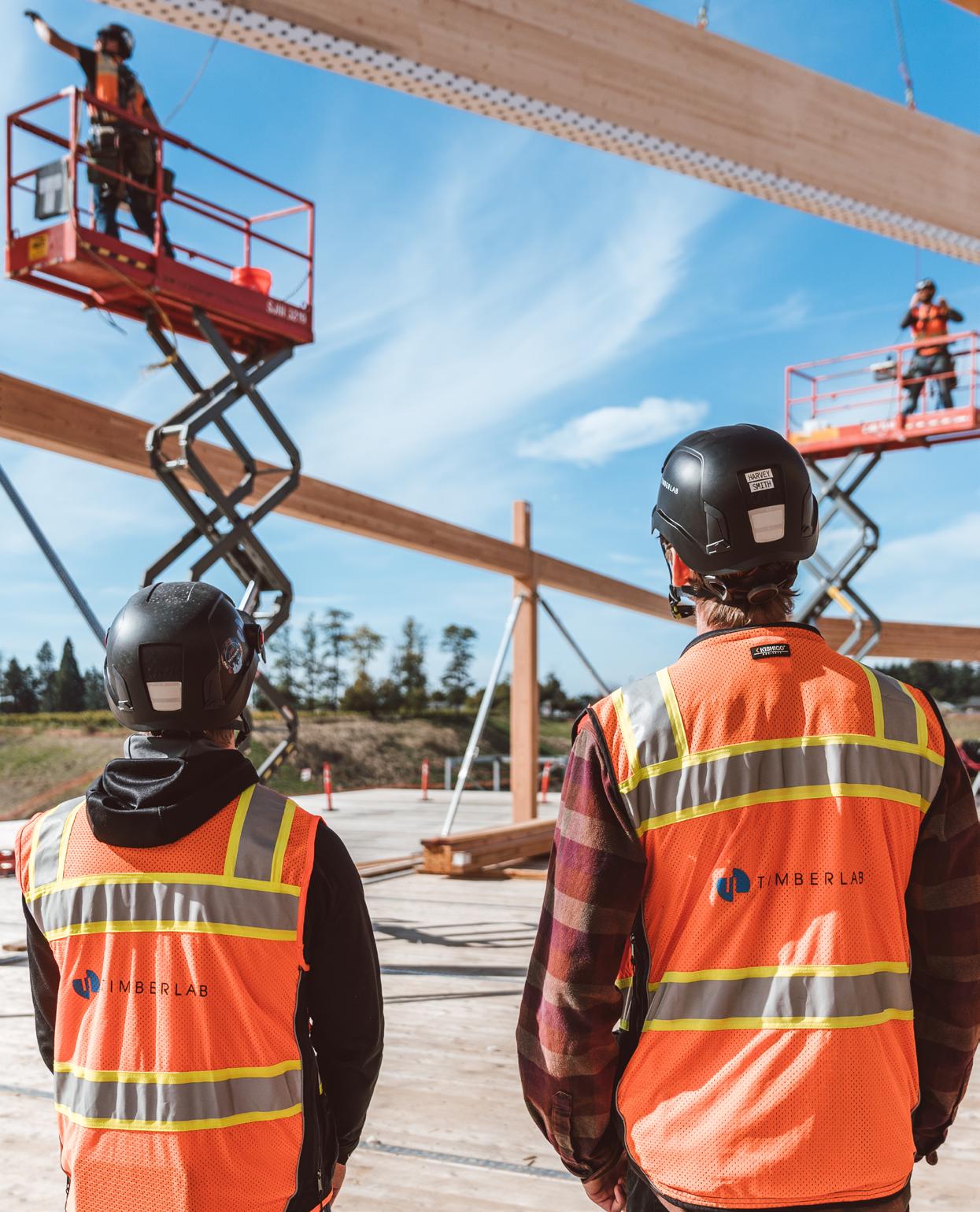
CD PHASE CHECKLIST
We offer the following checklist to help keep your team on track toward timely delivery of a mass timber building. In our experience, the items on this list should be addressed by the end of the construction documents phase.
PERMITTING
O Determine which document set is to be submitted for building permit.
O Incorporate delegated mass timber design into construction documents, if applicable. For further information on delegating design to Timberlab, reference our delegated design guides: https://issuu.com/timberlab/docs/timberlab_delegated_connection_design_guide https://issuu.com/timberlab/docs/timberlab_full_delegated_design_guide
O Obtain engineering judgments for any non-prescriptive assemblies.
BUILDING COORDINATION
O Finalize CLT slab edge documentation in preparation for the shop drawing process. This will require coordination of all systems including elevators, stairs, and façade.
O Perform coordination of all structural systems including concrete, steel, and mass timber.
O Model MEPF systems and identify desired openings in the mass timber system to be cut by Timberlab.
STRUCTURAL DESIGN
O Finalize design of all structural members, including those required to support large openings, terraces, balconies, and rooftop mechanical equipment. Document any special requirements such as custom layups or bevels.
O Continue to develop structural details. If the design of connections is delegated to Timberlab, finalize all typical connections and explore atypical conditions requiring a different solution. If connection design is not delegated, all connections must be fully designed and documented.
O Work through structural design of mass timber stairs. We are always glad to provide delegated design of these systems and are most successful when we begin this effort early.
PROCUREMENT
O Finalize any customizations to the Timberlab glulam and CLT specifications, including any requirements for wood sourcing.
O Finalize approach to coatings, treatments, and other finishes.
O Work with Timberlab toward final pricing of material supply and installation.
O Continue to refine construction schedule, aligning on durations and anticipated dates for shop drawings, material production and delivery, and installation. Careful sequencing of construction activities can save significant time resulting from early move-in of follow-on trades.
O Develop plan for delivery and storage of material if project site is located more than 6 hours from the Timberlab facility serving your project.
O Develop project-specific moisture management plan.