
Tideway, Annual Report – 2021/22

Page 1


ANNUAL REPORT 2021/22

INTRODUCTION

Bazalgette Tunnel Limited, trading under the name Tideway, began operating as an independent regulated water company in August 2015, when Ofwat awarded us our Licence to design, build, commission, maintain and finance the Thames Tideway Tunnel.

Welcome to Tideway’s (Bazalgette Tunnel Ltd BTL) annual report and accounts for 2021/22.

This year, for the first time, we have published separately our annual regulatory performance report as well as creating our first annual sustainability report. This report brings together our legacy benefit, climate change and sustainable finance reporting.

HIGHLIGHTS

No major injuries or significant incidents as a result of marine activities Health, Safety & Wellbeing

Tunnelling Team of the Year award, New Civil Engineer Tunnelling Awards Schedule, Cost & Quality

More than

Mental Health

First Aiders

Innovation in Tunnel Construction BMB and Shutterstrip connecting concrete sections involving a soluble film for the first time

Winner Business Contribution of the Year, 2021 London sports Awards. Tideway, LYR and Active Row Vision, Legacy & Reputation

Completion of all primary tunnelling (April 2022)

Tunneller of the Year, New Civil Engineer Awards Company & People

S&P Global rating Environmental benefit score 95/100 ‘advanced’

Sands End Arts and Community Centre opened funding from Tideway’s Community Investment Programme

British LGBT annual awards ‘Top 10 Inclusive Companies’ Staff survey results:

96% Tideway Values and promotes diversity 94% I am treated with respect as an individual

High level of liquidity with sufficient funds secured to cover the costs to project handover

Strategic Report

Chairman’s Introduction

Our EPIC programme – an award-winning, immersive health and safety induction – is one of our proudest innovations...

Tideway made good progress across all areas in the year, with the company responding and adapting well to the new “normal” following the upheaval and uncertainties created by the pandemic in 2020.

On behalf of the Board I pay tribute to the efforts of our staff, our extended supply chain, our contractors and all our partners. It is thanks to this incredible team effort that the goal of a cleaner and healthier River Thames is now within reach.

Underpinning progress this year was the establishment of a revised programme – the 2021 Baseline – which the Board approved in July 2021. This was an excellent example of collaboration with Thames Water and our supply chain to set an updated and robust programme, taking account of Covid-19 impacts and detailing the steps to 2025 when the super sewer will become operational.

Another key development in the year was when our regulator Ofwat, following consultation, agreed an amendment to our licence to reflect the financial impacts of the pandemic and the effect of the extraordinary macroeconomic interventions, introduced by government, on revenue calculations.

This outcome provides greater certainty for our company and confirms the integrity of the financial model being applied for Tideway as a successful one for future costefficient, long-term private capital investment in critical UK infrastructure.

The outcome also provides certainty for Thames Water bill-payers. The estimate of £20-25 a year, which we gave at the beginning, remains intact and the actual impact on bills continues to be at the lower end of this range. Delivering value for bill-payers is a critical responsibility of ours, not least at a time of acute pressures on the cost of living.

On 1 June 2022, DIF Capital Partners announced its intention to divest its 10.66% stake in Tideway, on a broadly pro rata basis, to the other existing shareholders in the company, their affiliates or related entities. The change which was driven by one of their underlying investment funds coming to the end of its fund life is subject to third party approvals. We understand the reason for the change and welcome the continued support from our shareholders.

Tideway has always been innovative, and the Board has continued to support the executive team in driving this aspect of our culture. Our EPIC programme – an award-winning, immersive health and safety induction – is one of our proudest innovations and this year we have been active in opening it up to others in the industry. We hope this will be a legacy for a safer construction sector.

Through the main Board and our Health, Safety, Security and Environment Committee, we carefully track progress in the area of health, safety and wellbeing. This report notes several new initiatives – screening for hypertension; an assessment of the health benefits of using alternatives to diesel in powered plant; and a tally of 142 trained mental health first-aiders – to highlight Tideway’s continued ambition to create better working environments and expand the definition of doing things safely or not at all.

It is more urgent than ever that we consider the impact of our activities on climate change. Last year we published our first disclosure on climate related activities, and we are updating this for publication shortly. Coinciding with the COP26 talks we had a focused Board session on carbon mitigation and have supported the establishment of a package of initiatives, including resources to fully verify our carbon footprint and to learn lessons from early decisions made on carbon impacts. We intend to share this widely to influence others. Our ‘More by River’ approach – another innovation and a significant investment – has enabled us to eliminate more than 650,000 HGV trips on London’s roads and avoid around 27,000 tonnes of CO2e.

Chief Executive, Andy Mitchell, notes in his report that the physical legacy of the Tideway project – the new riverside public realm – is taking shape. It has been a great pleasure visiting our sites this year and meeting the women and men who are making this possible. It is the finer details that make our project special, from the new ‘floodable’ tidal terraces being created at our Chelsea site, to the ventilation columns cast in nickel-aluminium bronze that are now in place at our sites in Putney and King George’s Park in Wandsworth.

My personal highlight of the year though was being with the team at Chambers Wharf in Bermondsey to mark completion of the tunnelling phase of the project. Whilst there is still a great deal of work ahead of us, this was the most symbolic of milestones and surely gives all of us involved in the UK’s infrastructure story reason to be proud.

Sir Neville Simms Chairman

Sir Neville Simms Chairman 21 June 2022
Sir Neville Simms, Tideway Chair, on site at Chelsea Embankment Foreshore

Chief Executive Officer’s Report

We also continue to meet our targets on employing local people and apprentices. Increasingly we are sharing our experiences with other projects so they can apply the same thinking and carry forward the benefits from what we have done.

Iwrite this introduction within days of us celebrating our most significant milestone to date, the completion of the new 25km tunnel structure beneath the River Thames. This has been a big moment for Tideway and for everyone who has been involved in the project over many years.

We have been immersed in the story of our construction progress since we mobilised our sites and put the first spade in the ground in 2016. But this year we turned a corner. Our focus is now as much on preparing to connect the new system up with the existing infrastructure, as it is on heavy civils delivery. For the first year we report as much work happening above ground as below. Work at our Putney site is nearing completion, with the new public riverside space fully formed and the new granite river wall in place. At Blackfriars we have started to install one of the most ambitious of the Tideway public artworks that will appear along the riverside. The project, for so long under the radar, underground, is now visible to London.

At the start of the business year the major effects of the pandemic were coming to an end but like everyone else we were going through a period of adjustment. We have continued to support and connect our people, and this has underpinned our performance. In July the Board approved our 2021 Baseline; a revised, detailed programme to take us up to when the Tunnel is fully operational in 2025. This was a collaborative effort with Thames Water, our stakeholders and contractors and we remain on track to achieve this programme date.

Financially we are in a strong position. In March we raised a further £300m through a green bond issuance, which means we are funded to when the tunnel becomes operational. The level of interest in our bond programme, which was oversubscribed by a factor of five, is a measure of confidence in the project. Our sustainability credentials were highly scored by ratings agency S&P.

The capital cost estimate of the project is £4.3bn, an increase of two per cent since we last reported our costs. We will continue to assess our cost estimate including for the effects of external factors such as inflation. The cost of the project to Thames Water customers remains well within the £20-25 a year range, an estimate that is unchanged since 2015.

As Sir Neville Simms notes in his foreword, Ofwat’s amendment to our Licence gives us even greater financial certainty and stability going forward.

Keeping people safe and well has always been our primary consideration and once again this year we report an ‘Accident Frequency Rate’ below the levels experienced by other large infrastructure projects. Nevertheless, performance relative to our own track record was challenging in the first half of the year and required several interventions to get it on track, including joint-venture board level reviews and additional strategies and improvement plans. Thanks to these efforts we have seen a steady improvement month-on-month since September, and this positive trend has continued into the new business year.

On our construction programme, we ended the year 77 per cent complete and as noted above, have since completed tunnelling on the final two Tunnel sections. Progress on the critical secondary lining of the tunnel is steady and 50 per cent complete. We are also engaging with Thames Water on the arrangements to connect to the Lee Tunnel through the removal of a concrete bulkhead.

The safe delivery of our construction programme is a means to an end, and for us the end is a cleaner, healthier River Thames. In the year of the COP26 discussions the issue of sewage pollution in the UK’s water courses has never been higher up the public agenda. We have a critical responsibility – our project is urgently needed if London is to meet its environmental ambitions as a world city.

Andy Mitchell CBE Chief Executive Officer

The way we deliver the project must also be sustainable. We have continued to move more of our materials by River, including 90 per cent of the material excavated from the tunnel. Sustainability is also about investing in the communities we work in and our ambition is to leave a social as well as a physical legacy. This year we saw the opening of a new community centre in Fulham, delivered through our community investment programme. We also launched a new partnership with environmental charity Groundwork London, to fund 27 local greening schemes across the city. Our teams continue to volunteer in their communities, and this is firmly established in our culture. We also continue to meet our targets on employing local people and apprentices. Increasingly we are sharing our experiences with other projects so they can apply the same thinking and carry forward the benefits from what we have done.

You can read detailed commentary on these areas of our progress and performance in this report. Finally, I would like to thank the Tideway team for their effort, commitment and creativity during the year – it continues to be a privilege to lead this company.

Andy Mitchell
Andy Mitchell, Tideway CEO, on site at Chambers Wharf, Bermondsey

PURPOSE

Tideway is building the Thames Tideway Tunnel under the River Thames – creating a healthier environment for London by cleaning up the city’s greatest natural asset, now and for the foreseeable future.

Delivering our Purpose and Vision

We bring our purpose and values to life through what we do and how we do it.

The way we treat each other and our stakeholders is important to us successfully delivering the project. We aim to transform the way the industry operates and in particular we want to see a step change in the health and wellbeing of everyone involved in the project, as well as our partners and stakeholders, whether that is through our focus on safety and wellbeing in the workplace, volunteering with our charity partners, collaborating with our partners, engaging local residents on what we are doing or supporting people to develop skills and find employment.

Our Commitment to Legacy & Sustainability

In line with our Purpose and Vision, Tideway has made long term and public commitments as to the value and benefits it is seeking to achieve.

At an early stage of the project, we made 54 legacy commitments across the environment, health, safety and wellbeing, economy, people and place. We aligned our commitments to the UN Sustainable Development Goals (SDG), identifying the ten SDG Goals to which Tideway makes a direct contribution. We will continue to report on our legacy commitments including those that have already been achieved. The project’s core environmental benefits will make a long-term direct contribution to SDG 6 Clean Water and SDG 11 Sustainable Cities.

We continue to evolve our approach to wider public value. This activity includes the appointment an of an independent social value expert to undertake a robust and comprehensive, quantitative evaluation of the social impact of our Legacy programme and secondly, a carbon learning legacy project together with an independent verification of our carbon data. We intend to share the learnings from both the social value and carbon projects with the industry to support other infrastructure projects and future frameworks.

We provide a comprehensive review of our performance in relation to Legacy and Sustainability in our 2021/22 Sustainability Report.

We intend to share the learnings from both the social

Who We Are & What We Do

Tideway is a privately financed company responsible for building, commissioning, financing and maintaining the Thames Tideway Tunnel.

However, our ambition for this engineering endeavour goes beyond building a 25km tunnel, ‘the super sewer’ to stop tens of millions of tonnes of sewage polluting the Thames each year. We want to transform the River Thames, leaving it cleaner and changing how Londoners use it. We want people to enjoy the Thames in their leisure time, participating in water sports and appreciating the views and walks along the foreshore. The joy and prosperity a cleaner river will provide for Londoners will be our legacy once the project is complete.

OUR SHAREHOLDERS

Our shareholder groups are represented on our Board, enabling them to support decision making and provide important project oversight and governance. They bring with them extensive experience of investing in and managing a wide range of infrastructure assets in the UK and overseas, knowledge that supports us in the delivery of the project.

Since Licence Award, our Shareholders have invested £1.3bn. Close to half the total equity has come from UK investors, including many pension funds, giving 3.8 million UK pension holders a stake in Tideway.

DELIVERING WITH OUR PARTNERS

Tideway has an alliance comprising Tideway, Thames Water, the Programme Manager (PM), three consortia known as the Main Works Contractors (MWCs) and our System Integrator. We work closely with Thames Water and their team co-located at our offices. Thames Water is responsible for important elements of the project and will ultimately operate the system.

The Alliance Agreement incentivises collaboration towards achieving the construction aims, milestones and outcomes, including the objective of meeting overall cost challenges. We have an experienced and competitive supply chain and we share lessons learned that enable us to best deliver the project.

Role Partners

Programme Manager

West Contract

BMB Joint Venture

Central Contract

FLO Joint Venture

East Contract

CVB Joint Venture

System Integrator

• Jacobs

• Bam Nuttall Ltd

• Morgan Sindall Plc

• Balfour Beatty Group Ltd

• Ferrovial Agroman UK Ltd

• Laing O’Rourke Construction Ltd

• Costain Ltd

• Vinci Construction Grands Projets

• Bachy Soletanche Ltd

• Amey OWR Ltd

THE DELIVERY MODEL

The Thames Tideway Tunnel has an innovative delivery model, which was established to attract private sector capital to finance infrastructure and deliver value for money to customers. It includes a bespoke regulatory framework, with a contingent Government Support Package, which recognises the unique nature of Tideway’s business. This framework provides a revenue stream during both the construction and operational periods. Revenues are billed and collected on our behalf by Thames Water from its wastewater customers and passed to Tideway.

For the period until 2030, our revenues are calculated according to the framework set out in our Licence, which is primarily based on a percentage return (2.497 per cent) on the regulatory value of our company (Regulatory Capital Value or RCV). From 2030, we expect to be regulated in line with the rest of the water industry.

Blackfriars Bridge Foreshore, where the full length of the tunnel was linked following the breaking out of two large grout plugs

Who We Are & What We Do

ENGAGING WITH OUR STAKEHOLDERS & PARTNERS

In delivering a major infrastructure project across London we recognise the importance of engagement, transparency and building trust.

We listen to our stakeholders’ views directly and through their representatives such as local councillors, MPs and Members of the London Assembly.

Our most recent stakeholder research shows positive sentiment towards the project to be around 80 per cent. We continue to ensure that the communities we are working in are kept up to date on the progress being made, potential impacts and how best they are being mitigated. At the three main drive sites there are dedicated community relations teams and other forums. These methods, plus a 24-hour Helpdesk, ensure that we are always accessible to our neighbours. To support the project, we have established a range of independent parties and roles to ensure we engage fairly and effectively with each of our stakeholder groups and to support trust in the project. These include independent assessors of project information, Chairs for stakeholder groups and bodies for advice, complaints and compensation. The Tideway Reporting Group is chaired by the Right Honourable Nick Raynsford.

“Our partnership with Tideway has been an extraordinary success and I want to thank all those involved for their hard work on this incredible project, and I look forward to seeing its completion.”
Environment Minister, Rebecca Pow

“As a Londoner, I really value the attempt to clear up the Thames for future generations… I also think that there’s been huge efforts and huge successes in engaging with communities along the routes as well. I think the stakeholder engagement has been very good, both in terms of the information provided to communities, and also an attempt for the project to get to know those communities and provide some benefits for them during the construction phase.”

Yonder Research

Rt Hon Nick Raynsford, Independent Chair of the Tideway Reporting Group, 2021/22 review

During the year, the independently-chaired bodies that Tideway established have continued to work effectively. The quarterly meeting of the TTT Forum, incorporating stakeholders from across the project, continues to be well attended with strong levels of engagement. The Forum continues to consider construction progress and this year the focus of meetings also started to move towards the commissioning and land handback phases, as well as the project’s long-term legacy. The Independent Compensation Panel (ICP) saw a significant reduction in claims (108 vs 171 in 2020/21) reflecting the ‘steady-state’

stage of the project and intrusive works reducing in some areas. The Independent Complaints Commissioner (ICC) received no appeal requests on ICP decisions and no complaints were escalated to the Commissioner. It should be noted that Tideway received approximately 40 per cent fewer complaints compared with the previous 12 months which is a measure of the effectiveness of site operations as well as a reflection of the stage of the project. I am pleased to see Tideway’s continued commitment to a high level of engagement, openness and support to the bodies and those impacted by the project.

Stakeholder Groups

Engagement Channels

Quarterly Liaison Committee meeting (including Thames Water)

Independent Roles and Assurance

Independent Technical Assessor (ITA): The ITA reviews Tideway and Thames Water reporting to the Liaison Committee.

Independently chaired

Thames Tideway Tunnel Forum –meets quarterly Bilateral meetings

Annual stakeholder survey

Regular Community Liaison Working Group meetings Letter drops about works

Quarterly newsletters

Community Information Centres Dedicated web pages and other communications

Independent Chair of Tideway Reporting Group ICP, ICC, IAS report annually to the Tideway Reporting Group. The Reports are available on Tideway’s website

Independent Chair for TTT Forum

Independent services available to support stakeholders, which include: Independent Advisory Service (IAS): Offers independent help and support to stakeholders living and working close to our construction sites.

Independent Compensation Panel (ICP): Oversees and determines claims made under any of the non-statutory compensation policies.

Independent Complaints Commissioner (ICC): Assists stakeholders who are not satisfied with the ICP’s response regarding a claim.

Consenting bodies and delivery partners
Key Government and regulatory stakeholders Communities directly impacted by construction
Residents SCHOOLS BUSINESSES & LOCAL SERVICES STAKEHOLDERS ALSO INCLUDE
asset owners & Local authorities

The Tunnel Route

THAMES TIDEWAY TUNNEL

The ‘super sewer’ tunnel will run from the Acton Storm Tanks in West London to the Lee Tunnel at Abbey Mills in East London, mostly under the River Thames. The flow from over 30 combined sewer overflows (CSOs) will be diverted from the sewerage network into the main tunnel. From there it will run to the Tideway Pumping Station, to be pumped to Beckton sewage treatment works.

The main tunnel construction used Tunnel Boring Machines (TBMs) in four drives from three main sites. The primary tunnelling concluded in April 2022.

Purpose

WHAT WE DO

Tideway is building the Thames Tideway Tunnel under the River Thames – creating a healthier environment for London by cleaning up the city’s greatest natural asset, now and for the foreseeable future.

Our values HOW WE DO IT

SAFETY

Transform the health, safety and wellbeing of all

LEGACY

Create a healthier future for London

COLLABORATION

Work together as an effective team

RESPECT

For people, places and resources

INNOVATION

Strive for excellence in project delivery

Cleaner Thames More by River

The Thames Tideway Tunnel will dramatically reduce CSO discharges, reducing sewage-related litter (and plastics) and improving water quality in the tidal Thames

Our river transport strategy will aim to keep over 300,000 lorries off London’s congested roads, and could produce 90% less CO 2 than the road equivalent

New public spaces

We are creating seven new areas of public land in the River Thames

Stakeholder value

LONDON

• Reconnecting London with the River Thames

• Ensuring that we leave a positive legacy for London

• Developing the river economy

ENVIRONMENT

• A positive impact on the tidal River Thames

• Ensuring, where we can, that we reduce our environmental impact

COMMUNITIES

• Providing a river that locals deserve and can use

• Enhanced local landscapes for reclaimed land and public art

OUR PEOPLE

• A unique and innovative project with a focus on learning and development

• A safe and inclusive workplace

Enablers

SAFE OPERATIONS/DELIVERY

We strive to create and maintain a culture of doing things safely or not at all

See Health, Safety & Wellbeing

EFFECTIVE GOVERNANCE, RESILIENCE AND OVERSIGHT

Our risk management systems and policy provide a clear framework for managing and reporting risks

See Risk Management section & Governance section

TALENTED AND PASSIONATE PEOPLE

We work to attract, motivate, develop and retain the best talent

See Company & People section

COLLABORATIVE PROCESSES

Tideway and Thames Water collaborate closely, while we maintain an experienced, competitive supply chain

See Who We Are & What We Do – Delivering with our partners

STAKEHOLDER FOCUS

We aim to build enduring relationships with government, local authorities, our neighbours, partners, suppliers and others we impact

See Engaging with our Stakeholders & Partners section

EFFICIENT FINANCING

We aim to finance the project as efficiently as possible to ensure that we minimise our impact on bill-payers

See Financing section

• A competitive and fair compensation package that incentivises delivery and rewards success

SUPPLY CHAIN

• Industry and supply chain with the right incentives across each of our three contract areas

• Providing opportunities for companies and for workers to develop skills and gain experience

• Industry leading innovations that are shared via i3P

BILL PAYERS

• Finance the project efficiently, minimising impact on Thames Water bill payers

INVESTORS

• An appropriate return on investment

The Timeline

THE TIMELINE

Tideway maintains a schedule with our partners for delivery of the project.

• Mobilisation of the MWCs

This started off site, with mobilisation of people, the start of detailed design work, consenting applications and procurement of subcontractors and materials. Moving on site as these activities progressed, construction sequencing was finalised, and the enabling Thames Water Works were completed.

• Construction

Excavating deep shafts at the three drive sites and each CSO interception shaft, followed by tunnelling, tunnel secondary lining, installing mechanical and electronic equipment, and architectural and landscaping works.

• Commissioning

All the worksites and tunnels will be connected to the London Tideway Tunnels (LTT) system and tested. Once this is complete, the MWCs hand over the Thames Tideway Tunnel (TTT) Works to Tideway, the MWCs’ activities will be complete, and the contractors will be demobilised.

• System Acceptance period

This will be a proving period. The LTT will be operated across a variety of storm conditions, to demonstrate that it fulfils the project requirements. Once this is complete, Thames Water will become responsible for maintaining the near-ground structures and assets. Tideway will retain responsibility for the shafts and tunnel structures and ensure the TTT is available to allow flow to pass to the Lee Tunnel. This involves inspecting the deep tunnels and shafts, which we expect to do on a ten-yearly cycle, performing any maintenance as required.

2021 BASELINE

Tunnel Secondary Lining

Commissioning

Handover

System Acceptance Period

Regulator System Acceptance Date

* Mobilisation activities shown from Licence Award to the start of Construction at the three main drive sites. Additional mobilisation activities continue throughout construction (i.e. consents, procurement).

Tideway’s Chambers Wharf site in Bermondsey is visible to the east of Tower Bridge
Outline view on the schedule
Licence Award Mobilisation*
Construction
Shafts
Main Tunnels

Our Strategy & Priorities for 2022/23

Health, Safety & Wellbeing

The Executive Team and the Board have reviewed and developed targets and aspirations for 2022/23.

They reflected on the project’s progress and the development of the new 2021 baseline with our delivery partners to find the best opportunities for the completion of construction and commissioning.

By the end of March 2023 construction will be 89% complete, this year our focus will be to:

• Retain our focus on Health, Safety and Wellbeing.

• Maintain high performing tunnelling and marine operations whilst securing good secondary lining performance ensuring that lessons are shared across the programme.

• Progress Worksite Close Out Strategies and hand back land to Thames Water.

• A commercial strategy that best aligns our delivery partners to the 2021 baseline on cost and schedule .

• Focus on System Commissioning with our partners in particular Thames Water. This will include finalising the System Commissioning Plan at T-12 (the 12 months prior to start of Commissioning) ensuring alignment with partners and stakeholders.

• Secure positive regulatory treatment for the schedule impacts of Covid-19.

• Continue to maintain the current positive stakeholder environment.

• Increase emphasis on our Vision of reconnecting London with the River Thames.

Objective

We are targeting zero fatalities or serious injuries, off or on-site. We will achieve this by setting new standards for health, safety and wellbeing. This is the right thing to do for those involved, as well as improving productivity and reducing the chance of delays or stoppages.

Key Long Term Activities

A HSW programme which is recognised as transformational in comparison to previous projects.

Delivering HSW the ‘RightWay’, in line with the delivery programme, verified by appropriate assurance.

Maintain a focus on Health & Wellbeing to achieve relative parity with Safety.

Drive for an equivalent high level of HSW performance in the marine environment.

Priorities for 2022/23

• Continue to reinforce HSW in the construction phase, to achieve positive improvements on previous performance in all areas but specifically high-risk activities including marine, tunnelling and secondary lining. Ensure Tideway transformational HSW behaviours and standards are realised in the forthcoming worksite testing and commissioning phases.

• Implement the HSW strategy for MEICA installation and site commissioning risks and review to determine effectiveness.

Relevant Principal Risks:

• Health, safety and wellbeing

• High impact, low probability events.

SCHEDULE, COST & QUALITY

Objective

We want to deliver the Thames Tideway Tunnel safely at the right quality and to best value. Finishing earlier would reduce cost, benefiting bill payers and investors, and deliver environmental benefits more quickly and reduce disruption to local residents.

Key Long Term Activities

Enabling all our delivery partners to safely deliver the project more efficiently and at lower cost, and using the Alliance to best effect.

Maintaining our focus on delivering a high-quality, fit for purpose asset and its integration into the wider sewer network.

Priorities for 2022/23

• Working with the Programme Manager, all three MWCs, the SIC and Thames Water to deliver the best value for money schedule through the 2021 baseline.

• Continue to hand back areas on completion of construction (including architecture and landscaping), and/or worksite testing and commissioning (as applicable).

• Maintaining Thames Water’s continued support for the 2021 Baseline programme (to be re-confirmed at T-12), through the joint approach, to the earliest possible achievement of key dates for Commissioning, Handover and Acceptance.

• Obtaining commitment from the EA, OFWAT, Thames Water and DEFRA to the most flexible approach for bulkhead removal that minimises the impact of sewage discharges into the River Lee whilst enabling the 2021 Baseline programme to be achieved.

• Ensuring that the asset being delivered is of the right quality, demonstrated by contemporaneous quality certification and particularly certification to achieve Systems Activation.

• Commercial status of all three MWCs, SIC and TWUL aligned to Tideway’s objectives for cost and schedule.

Relevant Principal Risks:

• Programme delivery

• Supply chain failure

• High impact, low probability events

• Interfaces with Thames Water infrastructure

• Regulatory and political.

Vision, Legacy & Reputation Company & People Financing

Objective

We want to maintain a supportive environment for delivering the tunnel and build a positive reputation with our stakeholders. We want to continue to be a responsible business in all that we do and demonstrate these credentials in order to build trust.

Key Long Term Activities

To ensure continued good relations with stakeholders including the consent granting bodies.

Promote the Tideway story to a broad range of audiences.

Address the needs and concerns of our neighbours including through our Community Investment programmes.

Continue to deliver our legacy commitments Meet ESG reporting requirements.

Work with the end in mind to have a structured ‘successful delivery’ communications and engagement plan, which includes a clear narrative.

Continue to engage with internal audiences to maintain a ‘one-team’ culture.

Maintain political consensus through engagement with local, regional and national stakeholders.

Priorities for 2022/23

• Continue to ensure our stakeholder engagement programme supports successful completion of the project, which includes engagement with Thames Water and critical stakeholders to ensure a joined-up, ‘one team’ approach.

• Evolve the narrative to reflect Tideway’s position as a leading environmental project and prepare for successful delivery.

• Ensure that we deliver on our essential ESG commitments.

Relevant Principal Risks:

• High impact, low probability events

• Reputation.

Objective

Deliver effective organisation change in line with project requirements. Continue to support a high-performing, motivated and engaged workforce which will deliver better value and help us recruit and retain people with key skills.

Key Long Term Activities

Reinforcing values and behaviours.

Maintaining our commitment to diversity.

Maintaining a clear strategy for preserving organisational capability in critical roles.

Providing training and development and succession planning.

Offering competitive terms and conditions, benefits and incentives.

Delivering systems, processes and tools to support an effective organisation.

Maintain/create policies, processes and activities which appropriately maintain the Tideway culture within a reducing organisation.

Priorities for 2022/23

• Continue to manage the capabilities of the organisation to support and encourage efficient delivery through a motivated and empowered team and deliver restructuring activities in line with project requirements.

• Refine our strategy for the future of the company.

Relevant Principal Risks:

• High impact, low probability events

• Reputation.

Objective

We aim to deliver efficient sustainable financing and financial risk management, which minimises our cost of capital and supports our investment grade credit rating.

Key Long Term Activities

Maintaining a low risk financing position by preserving our Baa1/BBB+ credit ratings and strengthening financing sustainability/ ESG performance.

Maintaining appropriate levels of liquidity.

Optimise our cost of finance to increase our return to shareholders.

Drive strong financial control and discipline across the company.

To continue to build trust and confidence with our stakeholders through high quality reporting, engagement and assurance.

Priorities for 2022/23

• Maintain the Company Credit rating & deliver IRR and shareholder distributions in line with the financing plan

• Liquidity and investment management – continue focus on capital preservation and liquidity and seek to optimise return

• Conclude consultations and Licence modifications with Ofwat and DEFRA relating to Covid-19’s impact on schedule specifically extending the System Acceptance date.

Relevant Principal Risks:

• Programme delivery

• High impact, low probability events

• Credit risk rating

• Inflation

• Regulatory and political.

Health, Safety & Wellbeing

Objective

We are targeting zero fatalities or serious injuries, off or on-site. We will achieve this by setting new standards for health, safety and wellbeing. This is the right thing to do for those involved, as well as improving productivity and reducing the chance of delays or stoppages.

Priority for 2021/22

• Continue to reinforce HSW in the construction phase, to achieve positive improvements on previous performance in all areas but specifically high-risk activities including marine, tunnelling and secondary lining.

• Implement the HSW strategy for MEICA (Mechanical, Electrical, Instrumentation, Control and Automation) installation and site commissioning risks and review to determine effectiveness.

2021/22 Measure

Maintain strong HSW performance

Performance

There were no major injuries during the year and no significant incidents as a result of our marine activities. The first half of the year saw the three-day Accident Frequency Rate (AFR-3) plateau in the region of 0.2, before steadily decreasing month on month from September. This was testament to the efforts made at every level to eliminate and reduce accident and injury occurrences. It included regular joint venture board level reviews of Health, Safety and Wellbeing (HSW) improvement plans and strategies and increased focus on site leadership. Both AFR-3 and AFR-7 showed improvements from the levels in the previous year.

Despite the continued additional challenges, particularly early in the year, the programme’s three-day Accident Frequency Rate has remained below the highs experienced during other large infrastructure projects.

During the year, there were 19 lost time incidents of which five resulted in RIDDOR reportable injuries. One was a significant hand injury sustained by a marine operative during a lifting operation which has resulted in prolonged absence from work. We investigated each of these incidents and implemented the resultant lessons learned and remain committed to improve as we progress further into the project.

RightWay

The ‘RightWay in Delivery’ initiative continues to provide an opportunity for site teams to showcase innovations and good practices. Site teams submit their best practice examples for each of the six categories; leadership, competence, health & wellbeing, safe workplace, communication & engagement and performance & improvement. Quarterly the overall winning site team is presented with an award and in this way, we celebrate and promote enthusiastic ownership of good practice and encourage adoption of best practices across sites.

Hammersmith was a stand-out site having won five monthly awards across Competency, Leadership and Safe Worksite categories. The team has continued to display its commitment to best practice and continual improvement to support the challenging and demanding works in the Inlet Channel and Interception Chamber.

Accident Frequency Rate 7 (AFR-7)

Actual

AFR-7: as above, for over seven days lost time for the individual involved. Excludes Road-Traffic accidents to ensure alignment with RIDDOR 2013. Injuries contributing to AFR-7 will automatically be included in AFR-3. Number of reportable accidents* Accident Frequency Rate 3 (AFR-3)

* Definitions: Major injury: any injury that could potentially lead to death, prolonged disability or permanently diminished quality of life.

AFR-3: 12-month rolling average, per 100,000 hours worked, of injuries which occurred as a result of work activities and resulted in more than three days lost time for the individual involved. Excludes Road-Traffic accidents to ensure alignment with RIDDOR 2013.

Health, Safety & Wellbeing

Health and Wellbeing

Our aim this year was to maintain a focus on Health and Wellbeing to achieve relative parity with Safety and to minimise and mitigate any health risks arising from our work, whilst supporting the wider health and wellbeing of our workforce.

Occupation Health Inspections (OHI)

The approach of OHI to support the management of health risks has continued to serve us well. This includes high quality inspections by experienced site staff, supported by our occupational hygienists. The inspections have focused on tasks which are potentially problematic and associated with tunnelling and the construction of secondary lining such as exposures to noise, dust and ergonomic hazards.

Targeted interventions have been developed to address the risks at source. An example includes the redesign of physically demanding tasks and the introduction and evaluation of the associated health benefits of utilising HVO (Hydrotreated Vegetable Oil) as a replacement for diesel in powered plant. Ongoing training programmes alongside this continue to provide the workforce with the skills to protect their health at work.

With our OH Services Provider we have sought to improve the wider health of our workforce. Through a targeted project to identify and address hypertension, almost 1000 worker assessments have been carried out. Hypertension was identified in approximately one quarter of those assessed, allowing referrals to be made for ongoing health management. Addressing cardiovascular risk factors in this way is critical for a workforce known to be at increased risk of early disability or death due to socioeconomic, lifestyle and workplace factors.

We have also supported a move to hybrid working for many of our office-based workforce. The flexibility of dividing time between home and office working has provided opportunities to balance personal and work commitments; reducing commuting demands whilst maintaining strong and productive working relationships with colleagues.

Mental Health

We support our workforce with the Mates in Mind programme including more than 142 Mental Health First Aiders, Mental Health First Aider Networks, Mental Health focused RightWay Live sessions and initiatives and the use of local services such as the mental health charity, MIND. Tideway’s Mental Health Working Group (MHWG) works to gain insights from the business to help inform what actions we needed to take.

Initiatives include:

• Mates in Mind course for managers/supervisors

• “Tribes” and “TimeAway” to connect staff working from home

• Hosting a Supply Chain Event in October for World Mental Health Day, bringing together the supply chain to share lessons learned from Tideway’s approach to mental health and support smaller companies as they embark on the same journey.

Employer’s Project Induction Centre (EPIC)

Our well established EPIC centre provides an immersive induction experience and has been used by many of our partners and is available for external industry days to promote the experience to the wider industry. To date, over 21,000 people have attended the programme, including those working on Tideway and other interested parties, supporting our aim to be transformational and to help improve health and safety across the construction sector.

EPIC Logistics is FORS Silver accredited programme designed to provide HGV drivers with a visceral experience of a fatal incident It highlights the impact that a chain of poor decisions can have on health and safety. To date, EPIC Logistics has been undertaken by over 1,000 drivers. This supports our More by River strategy to significantly reduce vehicle movements.

The full EPIC and EPIC Logistics days were affected by the pandemic and an interim EPIC was devised to ensure behavioural safety training continued across the project. The interim session was a 2-hour, socially distanced, reduced capacity version, that was rolled out at our EPIC training centre and on site, 1,213 people attended. The full EPIC and EPIC Logistics day resumed on 21 June 2021.

Carnwath Road in Fulham, where secondary lining is being cast using a shutter

Schedule, Cost & Quality

Objective

We want to deliver the Thames Tideway Tunnel safely at the right quality and to best value. Finishing earlier would reduce cost, benefiting bill payers and investors, and deliver environmental benefits more quickly and reduce disruption to local residents.

Priorities for 2021/22

• Working with the Programme Manager, all three MWCs, the SIC and Thames Water to deliver the best value for money schedule developed through the T-24 reviews resulting in the establishment of a 2021 Baseline.

• Start to hand back areas on completion of construction (including architecture and landscaping) and/or worksite testing & commissioning (as applicable).

• Securing TWUL’s commitment, through the joint approach, to the earliest possible System Commissioning Commencement Date (SCCD), Start of Systems Activation, Handover and Acceptance.

• Seeking and implementing all appropriate opportunities to increase efficiency, mitigate risk, and minimise the impact of COVID.

• Ensuring that the asset being delivered is of the right quality, demonstrated by contemporaneous quality certification.

• Commercial status of all three MWCs, SIC and TWUL aligned to Tideway’s objectives for cost and schedule.

2021/22 Measure

Delivery against the 2021 baseline regulatory baseline – schedule handover

Target Forecast Handover by quarter one 2025 Handover by quarter one 2025

Target Forecast Delivery against the regulatory baseline – cost* £3.5bn £4.3bn

* Tideway’s element of the programme in outturn prices (based on current inflationary expectations), up to System Acceptance. Ofwat has set a regulatory baseline of £3.1bn (in 2014/15 prices) Which is equivalent to £3.5bn in outturn prices).

Performance

Tideway continues to be in peak construction and by end of 2021/22 we had completed 77 per cent of our programme. Shortly after, in April 2022, we recognised a major milestone on the project with the completion of all primary tunnelling, when the last two TBMs finished their drives. This puts us in a good position to complete the secondary lining of the tunnels which is already 50 per cent complete and we remain on track for the system to come into full operation in 2025. The cost estimate is currently £4.3bn which is a two per cent increase from the previous year however the impact on customer bills remains well within the pre-Licence award estimate of £20-25 (in 2014/15 prices).

With the impact of delays caused by Covid-19 abating, Tideway undertook a re-baseline activity and established the “2021 Baseline” which was approved by the Board in July 2021. This involved completing a thorough review of the cost and schedule risks to provide an integrated, holistic plan for successful delivery of Tideway, including a detailed review of the system commissioning activities to construction completion and Handover. The 2021 Baseline provides a revised cost and schedule to report the future performance of the programme activities against. A major achievement has been the completion of the tunnelling (i.e. primary lining) in April 2022. This is a one month improvement when measured against the 2021 Baseline. As we move closer to starting commissioning in late 2023, Tideway and Thames Water continue to collaborate and implement the ‘Joint Approach’ to deliver the earliest possible System Commissioning Commencement Date (SCCD), Start of System Activation, Handover and Acceptance. Dedicated teams from Tideway and Thames Water are working together on the detailed planning for System Commissioning and a successful initial Rehearsal Of Concept (RoC) was carried out during the year which provided a valuable measure of planning status and focus for the teams. The progress of the ‘Joint Approach’ is reported on a monthly basis to the Interface Committee and continues to set good foundations to work together over the coming years.

Construction Quality

The level of non-conformance and re-work on the project has remained at a satisfactory level, with no critical defects being reported. Construction quality is the responsibility of the MWCs who self-certify their works. This self-certification is overseen through regular surveillance by the Programme Manager. Further technical assurance is provided by inspections from Tideway’s NEC Supervisor team with regular oversight by Tideway’s Chief Technical Officer. Tideway’s Quality Management System is subject to annual senior management review and internal audit.

These levels of assurance provide the project with a robust framework to drive construction quality compliance and enable an integrated approach for dealing with quality related issues.

Commercial

Each of the MWCs’ target prices have been adjusted to reflect Compensation Events (risks retained by Tideway). The primary areas of change to the MWCs relates to finalisation of the programme to commercial completion and the introduction of Tideway’s Phased Commissioning Plan to the MWCs’ scope of work. This includes the introduction of incentives for ongoing programme alignment between the MWCs and efficient delivery meeting Tideway’s objectives. As a result of these activities, all three MWCs are collaboratively working with Tideway to finalise the detailed construction schedules to align with key milestone dates for the overall programme. Subject to final commercial discussions, all parties are incentivised and substantially aligned in their commercial approach for delivering the remaining works on the programme.

Schedule, Cost & Quality

MORE BY RIVER

The completion of tunnelling in April 2022 sees the end to large volumes of materials transported by river with 1,011,427 tonnes transported in 2021/22, compared with 597,797 tonnes by road (41% of which was excavated material from non-foreshore sites). Our More by River approach supported the construction of Main Tunnel D and the Greenwich Connection Tunnel with the excavated material and the primary lining segments accounting for 804,867 tonnes.

At Kirtling Street and Carnwath Road riverside 138,434 tonnes (100 per cent of the total) of main tunnel secondary lining aggregates were delivered, with the remainder consisting of small excavations and permanent fill for the new realm. The primary materials to be transported by river over the coming year will be secondary lining aggregates for Main Tunnel A and Greenwich connection tunnel, we will also start to demobilise the cofferdams and remove the temporary cofferdam fill material.

This brings the total quantities to date transported by river on Tideway to 5,409,510 tonnes (54 per cent of total quantities) This consists of 4,608,440 tonnes of specified materials that are required to be transported by river under the River Transport Strategy and 801,066 tonnes of additional materials that were transported as part of the More by River strategy. The impact of this was to remove around 326,000 HGVs or 650,000 HGV journeys from London’s roads (roughly 500 a day) and saving over 17 million HGV miles and avoiding in the region of 23,400 tonnes of CO2e. All of this reduced the impact of the project on not just residents around Tideway sites, but other Londoners by removing the traffic from the road network.

1,011,427 tonnes of materials were transported by water in 2021/22... ... compared with 597,797 tonnes by road

To date, our river strategy has resulted in...

326,000 fewer HGV arrivals

650,000 fewer HGV journeys

Saving 23,400 tonnes of CO2 emissions

WEST AREA

Focus has been on installing the secondary lining of the tunnel alongside carrying out works above ground that will make up the new areas of public realm.

The secondary lining of the Frogmore Connection Tunnel, which runs from King George’s Park in Wandsworth, through Tideway’s site at Dormay Street, beneath the Thames before connecting to the main tunnel was completed in May 2021. This additional layer of concrete will protect the structure against erosion and increase the design life. Secondary lining of the Main Tunnel A section from Acton to Carnwath Road is now more than 50 per cent complete.

On the surface, works to create new areas of public realm have made good progress. At King George’s Park in Wandsworth works have continued to plant the trees that will form the final landscaping of the site and the first signature ventilation column on the project has been installed. The new river wall has started to take shape along the Putney Embankment Foreshore site, where an attractive new piece of public realm will be created on the riverside.

Further highlights included:

• In July 2021, the breakthrough of a 75m connection tunnel at Carnwath Road Riverside into the Central section linked both sections for the first time.

• At Hammersmith Pumping Station a significant part of the site was handed back to the owners in the Autumn, marking the first hand back of Tideway project land.

• The Barn Elms shaft was completed and the shaft cover slab was lifted into place in December 2021.

• Acton Storm Tanks, the secondary lining of the 35-metre deep shaft was completed and works are progressing on the tunnel portal which connects the shaft with the main tunnel.

• A special tree planting ceremony was held at King George’s Park in the Spring as part of the Queen’s Green Canopy initiative.

CENTRAL AREA

The focus has been on completing the Main Tunnel secondary lining with works completed from Carnwath Road to Blackfriars and works from Chambers Wharf to Blackfriars significantly ahead of the 2021 Baseline.

Works have also progressed on installing new river walls for our new areas of public realm at Blackfriars and Chelsea. The full length of the main tunnel was linked following the breaking out of two large grout plugs deep underground at Tideway’s Blackfriars Bridge Foreshore site.

At Victoria Embankment Foreshore work to uncover the Low Level 1 Sewer was completed, which formed part of the original Victorian sewerage system. A steel flume was also installed in the existing Victorian system at Blackfriars Bridge.

Further highlights included:

• The secondary lining of the junction where the main tunnel meets the connection tunnel beneath Heathwall Pumping Station was completed.

• Work to connect the existing sewers into the new sewer reached a key milestone at Albert Embankment Foreshore, following the breakthrough of a 30-metre tunnel under Vauxhall Bridge.

• At Victoria Embankment the concrete shaft roof slab was cast which will form part of the new public space to be created at this location.

• Shaft secondary linings were completed at Chelsea Embankment, Heathwall Pumping Station, Albert Embankment and Victoria Foreshore.

Schedule, Cost & Quality

EAST AREA

The final two tunnel boring machines (TBMs) on the project completed their underground journeys in April 2022, marking the completion of tunnelling on the project.

TBM Annie broke through the shaft at Chambers Wharf after a 4.5km journey from Greenwich, which included passing through a ‘plunge pool’ created in the shafts by the teams at Earl Pumping Station and Deptford Church Street to ensure safe levels of water pressure.

TBM Selina arrived at Abbey Mills Pumping Station in Stratford after a 5.5km journey underneath a number of landmarks including the world’s oldest river tunnel designed by Marc and Isambard Brunel.

Further highlights included:

• In Spring 2021, the team at Chambers Wharf successfully lifted TBM Ursula to the surface and onto a barge with the help of an 1,800 tonne marine crane. TBM Ursula completed 7.6km of tunnelling after starting her journey from Kirtling Street at the end of 2020.

• In July 2021, the final concrete base slab was successfully poured and set in the deepest shaft, located at King Edward Memorial Park in Wapping.

• The new piece of land at King Edward Memorial Park was approved. Once complete, riverside terraces descending towards the water will allow visitors to get closer to the River Thames.

• Across the duration of waste removal operations from Greenwich Pumping Station, the site has operated at 39.9% waste removal by barge, exceeding their commitment by 9.9%. The site also removed 7,030 HGVs from the road, removing 2,530 more than predicted. Due to this exceedance of commitment, the site has saved a total of 391.56 tCO2e.

TBM Annie breaking through after a 4.5km journey between Greenwich and Chambers Wharf

Vision, Legacy & Reputation

Objective

We want to maintain a supportive environment for delivering the tunnel and build a positive reputation with our stakeholders. We want to continue to be a responsible business in all that we do and demonstrate our ESG credentials in order to build trust.

Priority for 2021/22

• Continue to ensure our stakeholder engagement programme supports efficient delivery of the project.

• Evolve the narrative and prepare our ‘successful delivery’ plan with the end point in mind. Includes engagement with Thames Water to agree a joint approach to communications, engagement and Corporate Responsibility to the end of the project.

• Ensure we deliver on our ESG commitments and fulfill our reporting and governance requirements.

2021/22 Measure

Support from Stakeholders

Performance

Delivering a positive legacy is essential to the success of the project. We received three awards in recognition of the positive impact of our pan-London ‘river reconnection’ community programmes with London Youth Rowing and Thames21. Our community and STEM volunteering targets were achieved, despite another year where face-to-face events were disrupted by the pandemic.

Legacy

Our legacy programme is organised under five themes –environment; health, safety and wellbeing; economy; people; and place. We have 54 measurable commitments and this year, on average, 90 per cent were on track, against a target of 85 per cent.

Four more of the commitments were fully achieved bringing the total to 15. Firstly, we developed four industry leading initiatives to reduce the risks to vulnerable road users. Our MWCs are providing procurement opportunities and support to SMEs, but due to the advanced stage of the project, formal local market engagement activities are no longer appropriate, hence the associated legacy commitment has been achieved. Tideway’s educational website, Tunnelworks, has been developed although new content is not being added we are ensuring the resources remain available. Finally, our commitment relating to pan-London community investment activities was closed out as most of our ‘river reconnection’ programmes have concluded.

* Science, Technology, Engineering, Mathematics (STEM)

** Includes Tideway and MWC staff

Underground at Carnwath Road, Fulham

Vision, Legacy & Reputation

Reducing our carbon footprint continues to be a key element of the environment theme of our legacy programme, albeit with more limited opportunities to do so as we near completion. We’re currently below our carbon footprint, although we haven’t completed construction we are not expected to exceed our anticipated carbon footprint.

We commenced a project with our supply chain, MWCs and programme manager to better understand the carbon implications of how we procured, designed and constructed the tunnel. This project will complete in 2022/23 and should provide key lessons for future infrastructure projects about how to design, build and measure the carbon impacts associated with major infrastructure assets.

At the end of the financial year we have consumed 64 per cent of the predicted CAPEX (embedded) (Scope 3) carbon, which is in line with our original carbon footprint target. We have recently appointed a carbon consultant to provide third party verification of our carbon data. The assurance process will commence in 2022/23, with findings available thereafter. For the first time, we are reporting a SWOT analysis of our carbon data and methodology in our sustainable finance report . It focuses on our Scope 3 embedded emissions as the vast majority of our carbon forecast of 768,756tCO2e is from the construction of the tunnel. Our Scope 2 emissions from grid electricity used in offices are limited and we will not have Scope 1 emissions until the tunnel is operational.

Ethical Supply Chain

Tideway supports ethical sourcing practices in the supply chain, including:

• Ensuring everyone on the project is paid the London Living Wage (LLW).

• Paying SMEs within 30 days of invoice under the Fair Payment Charter.

• Ensuring staff have job security by working under contracts.

• Maintaining a strong position on tackling Modern Slavery including having a robust Modern Slavery and Human Trafficking Statement and being signatories to the Gangmasters & Labour Abuse Authority (GLAA) Construction Protocol.

• Verified to the Building Research Establishment (BRE) Ethical Labour Sourcing Standard (ELS) (BES 6002).

We are also committed to ensuring that 100 per cent of our key building materials (cement, aggregates, steel) must be certified to either BES6001 Responsible Sourcing of Construction Products, CARES Sustainable Constructional Steel (SCS) or Eco-Reinforcement as applicable. All timber being used on site must be certified as FSC and/or PEFC standard.

Our supply chain spend to date has reached:

2000 COMPANIES

12 UK REGIONS

19 LONDON BOROUGHS

Since Licence Award c93% of our supply chain spend has been within the UK.

Engagement and Communication

Tideway proactively communicates with stakeholders and the public about the benefits and progress of the tunnel to maintain a supportive environment and be publicly accountable. This year has been characterised by increased awareness of environmental issues, including the issue of the sewage pollution in UK waterways and this has raised the profile of Tideway’s purpose and activities.

We continued to highlight the project’s construction milestones, sustainability objectives – including contributing to events at the COP26 summit – legacy activities and financing model, through our communication and engagement channels. As pandemic restrictions lifted, we were again able to engage stakeholders face-to-face, taking MPs, government ministers and officials, London council leaders, industry bodies and investors on site visits and river boat tours. We continued to hold regular meetings with local residents and stakeholders to explain construction activities and potential impacts. Our 24-hour Helpdesk received 2504 enquiries and 463 complaints (reductions of 39 per cent and 43 per cent respectively, compared with last year).

STEM engagement

Tideway’s community investment and STEM programmes supported 12711 people and 148 organisations. As well as our jobs, apprenticeships and training creating a skills and employment legacy, we want to inspire the next generation of engineers and construction workers. Through our STEM engagement programme we engaged 6317 young people, ranging from primary schools close to our sites to masters students at UCL’s Bartlett School of Sustainable Construction. Project staff volunteered 1257 STEM hours in the year, or 1.8 hours per 3 FTE per year, above the target of 1 hour per 3 FTE.

Vision, Legacy & Reputation

Community Investment, Charitable Giving and Volunteering

Our community investment programme marked several important milestones, began new partnerships focused on the environment and gained significant external recognition. Our biggest single investment, the new Sands End Arts and Community Centre in Fulham, opened in March 2021.

Two pan-London partnerships, designed to support our vision to reconnect Londoners with the Thames, concluded. Active Row, with London Youth Rowing, engaged almost 7,000 young people in indoor and on-water rowing, 68 per cent of them from a minority ethnic background and 42 per cent female. The Thames Discovery Programme, with the Museum of London Archaeology, engaged 2,000 young people in river history on the foreshore and in the classroom and 30 budding archaeologists gained heritage skills certificates. A third ‘river reconnection’ partnership, Thames River Watch with Thames21, entered a new three-year phase with joint funding from Tideway and Thames Water and with a focus on recruiting volunteers from diverse backgrounds and groups who are poorly represented in the environment sector.

We launched two programmes to bring communities closer to nature and preserve their local environment – funding for the Creekside Discovery Centre in Deptford Creek to run land and low-tide walks, wildlife mapping projects, family fun days and certificated courses in creek know-how; and for Groundwork London’s 2022 Our Space Award, which gave grants to 27 projects across London to ‘clean and green’ their communities. We offered a new community fund for Wandsworth, where we have six construction sites, giving grants to charities and social enterprises supporting young people, families in food poverty and vulnerable groups.

Tideway gave £27,325 in charitable donations, including £10,000 to the British Red Cross to support refugees in Ukraine and around the world. Collections of items to send to Ukraine refugees were held at multiple sites. There were also £16,387 worth of in-kind donations and £25,183 in donations from staff fundraising.

Y Winner – Business Contribution of the Year 2021

London Sports Awards –

Tideway and LYR for Active Row

Y Silver Award – Best Alignment of Brand Values 2021

Corporate Engagement Awards –

Tideway and LYR/Thames21 for ‘river

reconnection’ partnerships

Y Highly Commended –

Social Purpose Category 2022

UK Sponsorship Awards –

Tideway and LYR for Active Row

Sands End Arts and Community Centre

The new Centre, near Tideway’s Carnwath Road site, was built with capital funding from Tideway’s Community Investment Programme and has also been supported through staff volunteering and donations. Officially opened in March 2022, the Centre has a main hall, function rooms and the Walnut Tree Café – which uses equipment and employs staff from the former café at Tideway’s London Bridge office.

“I am so grateful that Martin has the opportunity to get out and do something he enjoys and which stimulates him. It’s wonderful for me, too – I am a 24/7 carer and it gives us both some variety in our week, as well as giving us the chance to use art to express ourselves and – even now – to learn.”

Tideway worked very closely with Hammersmith and Fulham Council on the project, providing support through staff volunteering, staff donations, assistance with recruitment, a staff member appointed as a trustee and other professional advice.

Greta Chaffer, 82, from Parsons Green, attends the weekly Active Minds art sessions with her husband Martin, 87. Part of a Hammersmith & Fulham public health programme organised by H&F Dementia Action Alliance (HFDAA), the 10-week course at the Sands End Arts and Community Centre is offered free to the whole community. It is designed to be ‘dementia friendly’.

The wide smiles and sense of accomplishment of those creating drawings, paintings and prints tells a story of the power of art to support learning and wellbeing at any age.

“The SEACC is a fantastic legacy for Tideway and we are confident that it will offer opportunities for all members of the community in Sands End and beyond to get involved.”

Andy Mitchell Tideway CEO
Greta Chaffer taking part in an Active Minds art session at the Sands End Arts & Community Centre
A taekwondo session hosted by Active Successful Engagement for local young people

Company & People

Objective

Deliver effective organisation change in line with project requirements. Continue to support a high-performing, motivated and engaged workforce which will deliver better value and help us retain key skills.

2021/22 Measure

Priority for 2021/22

• Continue to manage the capabilities of the organisation to support and encourage efficient delivery through a motivated and empowered team and deliver restructuring activities in line with project requirements.

* Includes Tideway employees and our programme manager.

88 per cent of those eligible took part in the survey.

** We assess our performance based on a number of indicators, including engagement survey and demographic data and agree our assessment with our Remuneration Committee.

Performance

We wanted to understand how our people were feeling and responding to the second year of the pandemic so instead of our usual engagement survey we ran a tailored engagement and wellbeing survey, incorporating a selection of key questions. The results were encouraging and helped us understand how to adapt to hybrid working and the Company restructure in the previous year and still meet the requirements of the latter stages of the project.

“Tideway has an excellent work culture in which everybody’s views are valued and respected, and a generally positive and cooperative environment.”

Staff Engagement & Wellbeing Survey 2021

Tideway is open and honest in its communications with employees I am treated with respect as an individual

Tideway values and promotes diversity

Diversity and Inclusivity

Tideway’s active staff networks LGBTQ+, Gender, Race, Disability and Carers continue to help drive our diversity and inclusion work. Tideway was shortlisted for the third year in a row at the British LGBT annual awards as one of the ‘Top 10 Inclusive Companies’.

The awards celebrate the campaigners and allies who have made a positive impact on the LGBTQ+ community during the past 12 months, with the winner to be announced this August. Tideway was shortlisted based on the numerous ways that the company prioritises inclusivity, with particular reference to Encompass, the staff-led network that works to make Tideway and the wider construction industry more inclusive for its staff.

We were pleased to see our employee engagement score question, ‘the company values and promotes diversity’ return to the 2019 high of 96 per cent.

Whilst we missed our 40% target for women on the project through our practices and employee network we continue to focus on initiatives to attract and support women working on the project; blind recruitment, mentoring, coaching, targeted development initiatives.

“I am thrilled that Tideway is shortlisted at these fantastic awards for the third year in a row.

As part of Encompass, the network has continually developed our inclusion philosophy through numerous activities and events which has shown us to be a leading company in the construction sector.”

Steve Hails, Executive Sponsor for the LGBT+ Encompass network

Georgiana Noureanu-Bucur and Zainab Vaid, engineers on the eastern contract walking in the tunnel at Chambers Wharf

WOMEN INTO CONSTRUCTION

We have supported our legacy commitment to increase diversity through our partnership with Women into Construction to promote women into work placements and jobs on site.

WiC engaging with more than 300 women about a variety of roles including traffic marshals, crane operators, and tunnelling and site engineers. Where job opportunities were not available on completion of placements, many used their experiences to find employment elsewhere.

Tideway supported WiC’s ‘Moving on Up’ project, which aimed to develop best practice and enable companies to increase gender diversity and address the gender pay gap.

Tideway’s labour-only suppliers Danny Sullivan Group, VGC Group and Reliable Contractors were active participants, encouraging retention and progression of women, as well as assisting nine women currently in low-paid roles to access coaching and further training to develop their careers.

As Tideway is nearing completion, we also wanted to leave a legacy for the industry. With WiC we created a Diversity Matrix that helps contractors develop their diversity plans to support recruitment, retention and progression of women in the workplace.

“WiC secured me two weeks work experience on site, where I assisted the engineers in their everyday tasks. This experience gave me confidence and encouraged me to pursue a career in the construction industry. Following the work experience, I was offered the position of Environment Lead and I am very proud to be part of this fantastic project.”

Efrat Shabat Hadas Site Environmental Lead, FLO Joint Venture

Women completing placements

Women into tailored training programmes in the Tideway supply chain employment

Efrat Shabat Hadas at Albert Embankment Foreshore

Company & People

Talent

We annually review our succession plans, to ensure that we understand our strength at a senior leadership team level and identify those individuals who have potential to progress further within the organisation.

Ignacio Tognaccini Sainz working on the central section of the ‘super sewer’ was named young Tunneller of the Year. Ignacio’s win followed Dimple Parmar claiming Degree Apprentice of the Year at NCE’s Graduate and Apprentice Award.

We annually review our succession plans to understand our strength at a senior leadership team level and identify and support individuals who have potential to progress further within the organisation. This regular health check ensures we have appropriate plans for key roles. As the organisation reduces in size, in line with project requirements, we continue to support individual career aspirations internally and externally.

APPRENTICES

PEOPLE WITH CONVICTIONS

14 London boroughs

Report from designated non-executive director

Baroness McGregor-Smith

This is my third report as the designated non-executive director representing workforce matters since I accepted the role in July 2019.

Average (Project to date: 1 in 31)

(Project to date: 1 in 145)

The past year has continued to provide challenges to all our working lives. As well as responding to the impact of Covid-19 and the new hybrid ways of working, Tideway has continued the process of business reorganisation as we move toward the commissioning and handover phases. The link between the Board and the workforce is important and my regular meetings, virtually and back in person with the employee representatives allows me to feed-back their views and concerns to the Board at our Board meetings. Organisational change and changes to ways of working have been prominent in those discussions, and I’m pleased to report that overall feedback has been positive, with staff generally feeling that the reorganisations are handled well and the flexible working arrangements the company provides are supportive to individual circumstances, with no major issues raised. I’m personally pleased to support the work Tideway is doing relating to diversity and inclusion, and I’m happy that our commitment to transparency is reflected in the publication of our ethnicity and gender pay gap data in our Governance section, Remuneration Committee report. The Board is committed to hearing the views of staff as the project progresses and I’d like to say thank you to the employee representatives who have taken part in our engagement activities this year.

Designated Non-Executive Director

Baroness McGregor-Smith

Composer Rob Smith performing underground at Chambers Wharf to mark the end of tunnelling
Baroness Ruby McGregor-Smith June 2022

Financing

Objective

We aim to deliver efficient sustainable financing and financial risk management, which minimises our cost of capital and supports our investment grade credit rating.

Priorities for 2021/22

• Maintain the Company credit rating and deliver shareholder distributions in line with the financing plan.

• Maintain strong liquidity position.

• To achieve appropriate regulatory treatment of COVID19 impacts and an improvement in the FCA mechanism.

Performance

We achieved most of our financing priorities for the year with the exception of distributions. These were deferred for the first half of the year due to the continued uncertainty on cost and schedule arising from the impact of Covid-19 and the uncertainty as to the regulatory response, but distributions were re-instated in December 2021 following clarity on the treatment of Covid-19 and a regulatory financing mechanism (Financing Cost Adjustment) which have led to licence modifications.

Debt covenants remain healthy and fully compliant with Net debt/Adjusted RCV (gearing) at 62.7% (covenant is maximum 70%) and Interest Coverage Ratio at 4.45x (covenant is minimum 1.3x) as at 31 March 2022.

Cash and liquidity continued to be managed effectively and prudently, in accordance with our Investment Management Strategy.

Financing Activity

In March 2022 we issued a £300m 12-year green bond in the public sterling market and with these additional funds, Tideway has reached a point of financial resilience, where sufficient liquidity has been secured to cover the costs to the project handover.

The maturity of the Revolving Credit Facility (RCF) was extended by a further year to January 2027. As a sustainability-linked loan it includes a rebate linked to a sustainability key performance indicator (KPI) of meeting at least 85 per cent of the live legacy commitments. This year we exceeded the target by meeting 90 per cent of the live commitments. The savings were used to partly fund Tideway’s contribution to Our Space Awards for London communities to green their neighbourhoods. The RCF remained undrawn during the year.

Following the latest debt issuance, Tideway has secured total committed debt funding of £3,143m. Of these committed debt facilities, £2,618m has been settled and the funds have been received, and £525m is still undrawn.

Our multi-format debt platform supports the raising of long-term debt via structural enhancements that include a bankruptcy-remote structure and a package of covenants and restrictions protecting cash flows. The debt platform includes a multi-currency bond programme, which is listed on the regulated sustainable market of the London Stock Exchange.

Given the discontinuation of Libor from January 2022, we agreed the transition of our LIBOR-linked transactions in the second half of the year and all necessary amendments have been finalized with the relevant external counterparties.

Treasury Policy

Tideway’s treasury policy incorporates the corporate objective to finance the company while minimising risk. Our target is to maintain a robust investment grade credit rating. We manage our financing activities within the parameters set in the Government Support Package, the financing documents and the Licence.

Carnwath Road, Fulham

Financing

Sustainable Financing

Our sustainable financing strategy aligns Tideway’s financing both with the long-term target of cleaning the river and with the significant ESG efforts during construction which have been captured in Tideway’s legacy commitments. All bonds issued to date are green and are listed in the London Stock Exchange Sustainable Bond Market. Tideway’s total green debt issuance stands at £1,883m, which includes the bonds and a £75m green US private placement. The £160m RCF is structured as a sustainability-linked loan.

The sustainable financing strategy is supported by the Sustainable Finance Framework which was updated in February 2022. It is aligned with the International Capital Markets Association (ICMA) Green Bond Principles and the Loan Market Association (LMA) Green Loan Principles, as well as with the Loan Market Association Sustainability Linked Loan Principles. It is available on our website

Our Sustainability Report combines our previous Sustainable Finance and Climate-related Financial Disclosure reports. This report shows the progress against our legacy commitments and is aligned with the United Nations Sustainable Development Goals at target level. It also includes information for investors on the allocation of proceeds and impact of the project in line with ICMA’s Green Bond Principles and LMA’s Sustainability-linked Loan Principles as well as describing how our climate change disclosures align with the Taskforce on Climate-related Financial Disclosures (TCFD).

Our bond programme and the bond series issued under it are covered by a Green Transaction Evaluation from S&P Global ratings which was updated in February 2022 giving us an Environmental benefit score of 95/100 and a governance and reporting opinion rated as advanced. It is published on our website

Hedging

Tideway has entered into long-term swaps with commercial banks to hedge the interest rate for tranches one to eight of the £700m EIB loan and £70m of the £300m US Private Placement notes. These transactions were completed in previous financial years and no swaps were executed in 2021/22.

Distributions

At Licence Award our shareholders committed a total of £1,274m in the form of £509.7m in equity and £764.5m as shareholder loans. This amount has been fully injected into Tideway and investments are being debt financed now. As a result, our gearing is increasing to our target capital structure as we deliver our investment programme and risks are gradually retired.

Prior to System Acceptance, Tideway will not generate distributable profits and as such it will not be able to pay dividends to its shareholders. As a result, during construction Tideway’s shareholders receive a cash return on their investment through a combination of payments of interest on the loan and partial repayments of those loans, which now stand at £799.5m. This mechanism was put in place during the Infrastructure Provider equity procurement process run by Thames Water and overseen by Ofwat and the UK Government and was key to achieving the low cost of capital bid by our shareholders. Ultimately, Thames Water’s wastewater customers benefit from the low cost of capital achieved through the procurement through a lower charge in their bills.

Tideway deferred the distributions in Q1 and Q2 as a result of the company recognising the continued uncertainties caused by the Covid-19 disruption and the uncertainty as to the regulatory response. Following the Ofwat consultation on this matter and the clarity provided around the treatment of the Covid-19 related costs and the regulatory mechanism called the Financing Cost Adjustment, distributions were resumed in Q3. The total distributions paid in the year were £29.7m and £79.1m were capitalized and added to the shareholder loans taking the overall balance to £799.5m.

Liquidity

At 31 March 2022, we had total liquidity of £1bn, comprising £476m of cash, the £160m undrawn RCF, the £40m undrawn part of the EIB loan and £325m of undrawn bonds. This, combined with expected revenue collections, provides liquidity significantly in excess of our 12-month target, including all liquidity required to the project handover.

Credit Ratings and Environmental, Social and Governance Assessments

Fitch affirmed the credit rating at BBB+ with stable outlook. Moody’s maintained the Baa1 rating and changed Tideway’s outlook from negative to stable following the conclusion of Ofwat’s consultation on certain licence changes addressing the impact of Covid-19 and the FCA.

S&P Global Ratings completed an updated Environmental, Social and Governance Evaluation of Tideway in January 2022. Tideway achieved a score of 76/100, a two-point uplift from the previous assessment done in 2020. Our workforce and diversity, safety management and transparency and reporting were rated as strong. Our environmental and social scores are above the industry average and our governance score is in line with the industry.

Investment Management

We maintained substantial cash balances throughout the period, averaging £353m per daily close. We managed these cash balances by adhering to the set limits and criteria of our approved investment management strategy, prioritising the preservation of principal, ensuring adequate liquidity and striving to optimise the yield.

Financial Performance Review

Accounting Policies

Our financial statements have been prepared in accordance with International Financial Reporting Standards (IFRS) and our key accounting policies are outlined in note 1 to the financial statements.

During the construction phase of the project, expenditure which is directly attributable to bringing the Thames Tideway Tunnel into its intended use will be capitalised as an asset under construction within the Statement of Financial Position. Similarly, during the construction phase, any regulated revenue amounts received from Thames Water, will be deferred onto the Statement of Financial Position. This is because the performance obligation for recognising these amounts as revenue in the Income Statement will not be met until the tunnel is operational and being used by Thames Water. Post System Acceptance we consider that accounting for the Thames Tideway Tunnel as a finance lease is the most appropriate accounting basis under IFRS.

Non-GAAP Measures

In our financial reporting, we use certain measures that are not required under IFRS, the Generally Accepted Accounting Principles (GAAP). We believe these measures are valuable to the users of the accounts in helping them understand our underlying business performance. Our principal non-GAAP measure is Allowable and Excluded Project Spend.

Under our Licence, our costs are classified as either ‘Allowable Project Spend’ or ‘Excluded Project Spend’. Allowable Project Spend (on a cash basis) is added to our Regulatory Capital Value (RCV). Excluded Project Spend (on a cash basis), such as financing costs, is not added to the RCV.

Allowable costs are stated on an accruals basis, which form part of the Allowable Project Spend when the underlying assets or liabilities are cash settled. Excluded costs are costs stated on an accruals basis which will be Excluded Project Spend when the underlying assets or liabilities are cash settled.

For the purposes of calculating net debt, borrowings include all intra-group and third-party borrowings with the exclusion of shareholder loan notes.

Income Statement

During the year, Tideway reported a loss of £10.9m (2020/21: £6.0m profit), with no dividends paid or proposed (2020/21: £nil).

We did not recognise any taxable profits in the period (2020/21: £nil) and the resulting corporation tax charge for the period was £nil (2020/21: £nil).

We do not consider that the reported loss in the year reflects our business performance, as it results from the movement in the fair value in the Company’s derivative financial instruments. These are long-term swaps which we entered into with commercial banks to economically hedge the interest costs of the Company’s debt. The swaps fix finance costs for the Company’s regulatory period and ensure that we benefit from low-cost financing.

The movement in fair value of these financial instruments is recognised in the Income Statement because, under International Accounting Standards (IAS) 23, these do not represent current borrowing costs incurred for financing the project and so, unlike our other expenditure, cannot be capitalised. Note 11 to the financial statements provides more detail on the financial instruments.

We have made a ‘disregard election’ to HMRC which means that any gains or losses arising from the movement in the fair value will be disregarded for current tax purposes (the Tax section later in this Financial Performance Report provides more details).

Statement of Financial Position

The total carrying value of the tunnel asset under construction is shown in the table below.

* Capitalised Costs is the GAAP measure and aligns to note 6 of the financial statements

At 31 March 2022, costs of £4,016.3m were capitalised within the asset under construction in the Statement of Financial Position. This represents £785.7m costs during the year and £3,230.6m for the prior periods to 31 March 2021.

The table reflects the split of this years capitalised costs between the Direct costs, Indirect costs and Excluded costs.

Direct Costs

Direct costs are primarily the Main Works Contractor costs and the System Integrator contract so reflect costs directly related to the tunnelling programme such as primary tunnelling and secondary lining works and other related construction activities such as shaft construction and marine works. The direct costs are higher than 2020/21. This is due to increased construction works in 2021/22 and the lower activity in 2020/21 due to Covid-19.

Indirect Costs

The largest indirect cost is Resource Costs of £45.9m. This represents the cost to employ an average of c286 Full Time Equivalents (FTEs) (2021 c359 average FTEs) either employed or contracted by the Company. Other Indirect Costs totalled £15.6m in the year and this includes the cost of information systems, insurance, GSP, office and other running costs. Indirect costs have reduced compared with 2020/2021 due to budget controls and cost cutting measures as construction comes closer to completion.

Excluded Costs

The Excluded costs (on an accruals basis) for the year ended 31 March 2022 were £200.2m. These comprise £197.3m of interest expense (including shareholder loan interest), £3.4m of costs which mainly relate to financing, partly offset by £0.5m interest income.

Excluded costs are higher than 2020/21 mainly from the impact of higher inflation on existing index linked debt and the additional cost of new debt.

Financial Performance Review

Costs and Net Cash Outflow Comparison

The table shows both the Allowable costs and Excluded costs and the equivalent Allowable Project Spend and Excluded Project Spend.

For the year ended 31 March 2022, our Allowable Project Spend of £530.8m is £54.7m lower than the Allowable costs of £585.5m. The Excluded Project Spend outflow of £63.8m is £136.4m lower than the Excluded costs of £200.2m. This is mainly due to accretion costs on our debt for which the associated cash flow will not occur until the future.

Net Debt and Financing

Net debt at 31 March 2022 was £2,467.0, which was £723.6m higher than the £1,743.4m net debt at 31 March 2021. The table below compares the movements in net debt

The table (below) compares the movements in net debt.

At 31 March 2022, the Company’s total borrowings were £3,596.8m being £799.5m of shareholder loans and £2,797.3m of other borrowings which include third party borrowings and intra group debt.

The borrowings include the March 2022 issuance of a £300m 12-year green bond in the public sterling market and with these additional funds, Tideway has reached a point of financial resilience, where sufficient liquidity has been secured to cover the costs to the project handover.

Cash and cash equivalents at 31 March 2022 was £333.7m, which was £2.5m

Net cash flows from operating activities of £70.5m (2021: £127.3m) represent movements in working capital and are mainly driven by timing of payments to our Main Works Contractors and the receipt of regulated revenue payments from Thames Water which are deferred on the Statement of Financial Position during the construction phase of the project. Net cash flows used in investing activities of £673.7m (2021: £514.9m) show the gross cash outflows used in constructing the Thames Tideway Tunnel as well as movements to short-term deposits which represent money market funds where cash is held on deposit.

The net cash inflows from financing activities of £605.7m (2021: £338.0m) are largely the result of £607.8m proceeds from new borrowings (£432.8m of fixed and index linked bonds, £100.0m of floating rate loans and £75.0m fixed rate loans), partly offset by £2.1m repayment of lease liabilities.

Financial Performance Review

Financial Key Performance Indicators (KPIs)

Under its Common Terms Agreement (CTA), Tideway must comply with a set of financial covenants including to calculate two key ratios, Senior Regulatory Asset Ratio (Senior RAR) and Funds from Operations Interest Cover Ratio (FFO ICR) and report compliance with certain thresholds in specified circumstances. The performance of the two ratios for 2021/22 are provided below.

1. Senior RAR

This ratio compares the net debt to the RCV. It is calculated as long-term senior borrowings, less cash and short-term deposits to the RCV. The Senior RAR trigger in the CTA is 70%.

2. FFO ICR

This ratio compares the level of cash interest cover compared with the funds from operations. The FFO ICR trigger in the CTA is 1.3 times. The test period is twelve months to the reporting date.

Revenue

Within the financial statements, all regulated revenue is deferred in the Statement of Financial Position, in line with our revenue recognition accounting policy. During the year, we received cash inflows of £72.9m (202/21: £68.9m) from revenue, which includes some revenue from prior years.

Tax

1 RCV is per the CTA definition not the Regulatory Accounts definition

The table provides a reconciliation to the net debt in the financial statements:

The table provides a reconciliation of Net Cash flow and Debt Interest to the financial statements:

to the

1 Part of “Cash from operations” within the Consolidated Cash Flow Statement

2 Part of “Construction of infrastructure asset” within the Consolidated Cash Flow Statement

The Directors are responsible for ensuring that we comply with tax laws in the UK, which is the only territory we undertake our business activities in. We are committed to complying with tax laws in a responsible manner and to having open and constructive relationships with the tax authorities. The scope of our business activities in the UK mean that we are subject to the scope of corporation tax, employment taxes, Value Added Tax (VAT) and other taxes such as environmental levies related to our project activities. Consequently, the Directors are responsible for ensuring that we calculate, collect and pay the appropriate taxes to HM Revenue & Customs and as a result the taxes we pay make an economic contribution to the UK. We believe we are compliant with all applicable UK tax legislation and pay the correct taxes on time and in full.

During the construction phase of the project, we anticipate that we will not pay any Corporation tax. This is because the tunnel we are building is an asset that will not be ready for economic use until it is fully operational. The System Acceptance date is when the asset is transferred to Thames Water. The significant amounts of expenditure we incur in construction go towards the development of that asset.

We do receive regulated revenue payments from Thames Water during the construction phase, however we do not recognise these as revenue in the Income Statement. This is because the performance obligations for recognition of this revenue will not be met and fulfilled until the System Acceptance date. This effectively means the recognition of revenue is matched to the same period where economic value can be obtained from the tunnel.

Our Income Statement does recognise profits and losses from the valuation of derivative financial instruments. As a result of the potential volatility of such items and because they are forward looking in nature, HMRC allows companies to take an exemption which effectively removes them the calculation of taxable profit or loss.

As a result of the accounting implications of the above, our Income Statement is unlikely to have taxable profits during the construction phase. This is in line with expectations at the time Tideway was procured and customers benefit in full from lower bills as a result of this. In the post construction taxation periods when the Tunnel asset is fully operational, we expect this position to change.

Financial Performance Review

Tax Strategy

Tideway’s commitments on tax and adherence to them are underpinned by the tax strategy which is based on the following principles:

1. Tax planning and compliance:

We will engage in tax planning that supports our business and reflects commercial and economic activity. We will not engage in artificial tax arrangements and will adhere to relevant tax laws and seek to minimise the risk of uncertainty or dispute. Tideway is part of the Bazalgette Equity Limited Group, of which all members are domiciled in the UK. We consider the interaction with company members when we implement our tax policies.

2. Relationship with HM Revenue & Customs (HMRC):

We will seek to build and maintain a constructive relationship with HMRC. We will work collaboratively wherever possible with HMRC to resolve disputes and to achieve agreement and certainty. We will engage with the government on the development of tax laws where we can and where the tax law change is relevant to Tideway’s business activities.

3. Transparency:

We support measures that build greater transparency, increase understanding of tax systems and build public trust.

4. Tax risk management: We identify, assess and manage tax risks and account for them appropriately. Risk management measures are implemented including controls over compliance processes and monitoring of effectiveness.

5. Governance: The Chief Financial Officer (CFO) is responsible for and implements our approach to tax, which is reviewed and approved by the Audit Committee. The CFO is also responsible for ensuring that appropriate policies and procedures are in place and maintained and that the financial control team, with specialist external support as necessary, has the appropriate skills and experience to implement the approach effectively.

The publication of this strategy is considered to constitute compliance with the duty under paragraph 16(2) Schedule 19 Part 2 of the UK Finance Act 2016.

Victoria Embankment Foreshore

Risk Management

Our ability to deliver positive outcomes for our stakeholders depends on our risk management which is embedded in our culture and is central to achieving our objectives and priorities.

We have implemented a framework which gives us a defined process for identifying, analysing and controlling both corporate and project delivery risks. We actively monitor risks held on our ‘Active Risk Manager’ database. This includes quantification of project risks, and the potential cost and impact to the schedule and allows us to challenge the effectiveness of our mitigating actions.

Risk Management Framework

Our risk management approach ensures that we monitor and review the external environment and the uncertainties we face to ensure that we can respond appropriately to external changes, mitigate risks where we can and keep our project on track. We consider the emerging issues that may impact the project’s future as part of our annual business planning.

The Board Risk Committee reviews our principal risks and risk management processes and reports its findings to the Board. It considers:

• Corporate risks, those that might impact on the financial and reputational viability of the company.

• Programme risks, which impact the physical delivery of the tunnel and associated works.

• Principal risks, which bring together the corporate and programme risks that have the potential for the most material impact on the business.

The Board Risk committee is supported by a Corporate Risk Committee and an Executive Risk Committee that considers the programme risks across the West, Central and East areas as well as System Integrator and System Commissioning risks.

The Compliance and Assurance Review Group (CARG) is a CEO-led group focused on reviewing the Company’s activities, both as the client or through the PM and MWCs. It applies the three lines of defence model, to review the appropriateness and compliance with our controls and assurance activities.

Risk Management Framework

BOARD

Ultimately responsible for effectiveness of risk management and internal control system

AUDIT & FINANCE COMMITTEE

BOARD RISK COMMITTEE

CORPORATE RISK COMMITTEE Corporate Risks

EXECUTIVE RISK COMMITTEE Programme Risks

EXECUTIVE LEADERSHIP TEAM

Accountable for the design and implementation of the risk management processes and the consistent application of risk management systems and management of corporate risks

Principal Risks

We assessed our principal risks regularly, updated our mitigations throughout the year and implemented changes to manage our risk exposure. We considered whether there were material changes to increase or decrease our risk exposure.

During the year the risk level of four risks were reduced and we retired one principal risk – the Financing Cost Adjustment risk. The FCA was removed as we agreed an adjustment to the regulatory mechanism via a licence change coming into effect on 8 March that balanced the interests of customers and shareholders.

Our Risk Appetite

Tideway’s risk appetite remains unchanged. To manage the risks we face, we define our risk appetite, which is the level of residual risk that we are ready to take. Although this appetite recognises the agreements that underpin our delivery model, such as our Licence and the Government Support Package, our Board can further refine the residual risk through the strategies it sets.

Tideway’s risk policy is to target an overall Company risk profile consistent with an independent UK regulated water company. This reflects our Board’s risk appetite which is low and the importance of resilience. The Board’s appetite for risk has been at the core of the main strategic decisions that it has taken to date.

Climate Related Financial Disclosures

CORPORATE RISKS

Risks which are managed by Tideway

PROGRAMME RISKS

Risks which are managed by the MWCs and/or Tideway

INTERNAL AUDIT

Provides independent assurance that controls are effective

Tideway recognises the importance and supports the Task Force on Climate-related Financial Disclosures (TCFD). We are committed to ensuring that our climate disclosures align with TCFD recommendations. In our Sustainability Report, we have made disclosures consistent with TCFD recommendations for ten of the eleven recommendations. Given the nature (with most of carbon footprint during construction) and the advanced stage (77% complete as of March 2022) of the project, Tideway is not able to fully comply with recommendation 2. c) namely the inclusion of a 2°C or lower scenario although we include a description of the resilience of the organisation’s strategy, taking into consideration different climate-related scenarios (using UK Climate Projections) and population growth. These are discussed in our Sustainability Report.

CARG
Our

Risk Management Principal Risks

1 Health, Safety & Wellbeing

Overall

Description

The health, safety and wellbeing of our employees and the public is paramount. There is a risk that incidents could cause harm to individuals and delay progress.

Effect

A safety failure could cause injury, affect health and wellbeing or lead to loss of life.

A single serious event or multiple events could also lead to delays or stoppages that could prevent us meeting our time and cost targets.

Mitigation

Our RightWay programme, aligned to the delivery programme, includes the RightStart approach with the very best facilities and arrangements on-site.

We are also continuing and developing our EPIC programme, mandated for all people working on our sites. Several working groups have been established to identify how to manage emerging risks associated with MEICA works, increased interaction with TWUL networks and A&L e.g. Safe Asset Access Working Group a collaborative forum of MWC, TWUL, PM and Client.

Relevant Objective

Health, Safety & Wellbeing

Commentary

No change in risk level

Marine

Description

There is a risk that a single marine incident could lead to multiple persons being affected or harmed and delay progress.

Effect

A safety failure could cause damage to third party assets, injury, affect health and wellbeing or lead to loss of life.

A single serious event or multiple events could also lead to delays or stoppages that could prevent us meeting our time and cost targets.

Mitigation

Tideway continues to monitor marine risks and has implemented a Marine Assurance Plan and marine safety action plan. Inspections and surveillance both on vessels and from riverbanks and bridge ensure compliance with Tideway requirements.

Relevant Objective

Health, Safety & Wellbeing

Commentary

No change in risk level

2 PROGRAMME DELIVERY

Description

We are delivering a capital investment programme of £4.3bn. While there is experience of delivering similar projects in London, it is possible that the construction could take longer than planned and/or cost more.

Effect

A delay in delivering the tunnel would delay Londoners’ benefits from the project and could attract regulatory enforcement. Cost increases above the regulatory baseline would increase charges to those customers receiving wholesale services from Thames Water, increase financing requirements and reduce returns for our shareholders.

Mitigation

Our approach to working with our contractors will help us to deliver the programme on time and to budget.

This includes:

• World-class contractors, with experience of major infrastructure/tunnelling projects in London.

• Contracts that transfer certain risks to our contractors that they are better placed to manage.

• An integrated, proactive approach to risk management. A thorough approach to and preparation for new activities.

• Commercial settlements to ensure MWCs teams remain focused on delivery.

• Tideway continues to pursue schedule opportunities and cost savings across the programme. In dialogue with contractors. It has been revising its cost estimates to reflect the current position on the project.

3 Supply Chain Failure

Description

Our delivery strategy is based on outsourcing works. Our ability to deliver therefore depends on our contractors’ performance.

Effect

If our contractors do not deliver at the standards we expect, we may not be able to deliver our investment programme on time and on budget.

Mitigation

The procurement process ensured our contractors were technically excellent and financially strong, and limited our exposure to any one contractor. Within each consortia the contractors are joint and severally liable; the contracts also contain step-in rights, whereby one consortia could replace another, which helps mitigate against financial failure.

Relevant Objective

Schedule, Cost & Quality

Commentary

Reduced exposure

Reflects the advanced nature of the project, procurement approaching 90% complete whilst we still recognise there exist severe pricing pressures for materials and commodities in part due to inflationary issues.

4 HILP - High impact, low probability events

Description

Major investment programmes are complex and challenging, and we could suffer incidents that were highly unlikely but have a significant impact. These could affect the tunnel or assets belonging to others.

Effect

HILP events could have a significant effect on cost, schedule, health and safety or our reputation. Their financial impact could exceed our insurance cover, damaging our financial position and our ability to deliver the tunnel.

5 Credit Rating Risk

Description

Adverse operational or financial performance, or factors external to the Company, could result in a credit rating downgrade.

Effect

The loss of an investment grade credit rating would affect our ability to raise debt, prevent distributions and would be a breach of our licence.

Mitigation

Mitigation

We minimise the chance of these events occurring by using best-in-class design, programme management and appropriate construction techniques. Our contractors have extensive experience of similar projects in London and conduct detailed Readiness Reviews before the commencement of major activities. We also mandate compliance with the Joint Code of Practice for Risk Management of Tunnelling Works in the UK. In the unlikely event that we make a claim that exceeds the limits of our insurance, the GSP provides support. With Tideway reaching the end of tunnelling approximately half of the HILP risks have now been retired.

Relevant Objective

Health, Safety & Wellbeing

Company & People

Schedule, Cost & Quality

Financing

Vision, Legacy, & Reputation

We have a robust delivery model, within a regulated framework, and a GSP. We maintain a conservative financial profile and actively manage risks. We regularly engage with rating agencies. The credit ratings remain two notches above licence and financing documents covenants.

Relevant Objective

Financing

Commentary

No change in risk level

Relevant Objective Schedule, Cost & Quality Financing

Commentary

No change in risk level

Commentary

No change in risk level

Risk Management Principal Risks

6 Inflation Risk

Description

There is a risk of inflation that is lower than assumed in our business plan or that the Retail Price Index (RPI) reform impacts Tideway’s business.

Effect

Our RCV is indexed to RPI until 2030, and lower inflation would reduce nominal cash-flows and returns which are directly linked to RPI.

Mitigation

Tideway has issued 70% of its long-term debt indexed to RPI and Consumer Prices Index (CPI). Reductions in revenue due to low inflation would therefore be partially offset by reductions in interest cost. The resulting correlation between nominal RCV and nominal debt will help to protect interest cover ratios and equity returns. The current level of inflation has reduced the risk in the short term.

The RPI reform will be implemented from 2030 with RPI converging to CPIH, at which time Tideway’s licence will have transitioned to CPIH indexation, with the similar timetable to transition into CPIH being a positive development for Tideway.

Relevant Objective

Financing

Commentary

Reduced exposure

A reduced risk due to current inflation levels and forecasts.

7 Reputation Risk

Description

We are particularly focused on the risk that poor performance on our sites, on the river or with our neighbours could damage our reputation and support.

Effect

The loss of support from our neighbours or consent granting bodies could lead to delays and higher costs.

Mitigation

We actively develop relationships with key stakeholders. For example, through our CLWGs we seek to find the best ways of addressing neighbours’ concerns, in advance of works happening.

The More by River strategy uses the river wherever feasible to ease congestion and to promote the use of the river.

We have established the Tideway brand as part of our efforts to build trust and communicate the legacy and long-term benefits we aim to deliver.

Relevant Objective

Company & People

Vision, Legacy & Reputation

Commentary

No change in risk level

8 Thames Water Performance

Description

Thames Water is a key partner for Tideway. We have a number of important interactions with Thames Water, including its delivery of the Thames Water Works during the construction period, the Handover and Acceptance process and in the operational period.

Thames Water also passes revenue through to Tideway.

Effect

Thames Water’s failure to deliver its share of the works could affect our ability to deliver our investment programme on time and on budget.

If Thames Water does not comply with the Revenue Agreement, it could have a financial impact.

Mitigation

Tideway and Thames Water have worked closely together through all key milestones to date and have developed a joint approach to System Commissioning, Handover and Acceptance.

The Alliance Agreement has incentivised Thames Water to help us deliver the programme.

Thames Water is also incentivised to deliver its share of the works in a timely manner, through its regulatory settlement. Joint Rehearsal of Concept exercises for commissioning, handover and acceptance periods have been undertaken with more scheduled; these provide early identification of future issues. We have worked with Thames Water to develop and agree updated arrangements for managing the revenue process.

Relevant Objective

Schedule, Cost & Quality

Commentary

Reduced exposure Positive developments in engagement and planning.

9 Regulatory and Political Risk

Political Climate

Description

Policy changes pursued by the Government may have legal, regulatory, reputational and relationship impacts on Tideway.

Effect

Increased political and public focus on river pollution and sewage discharges could increase scrutiny of Tideway.

Any institutional reforms could affect Tideway’s relationship with key stakeholders such as Defra and/or its legal and regulatory environment.

Brexit is leading to changes in government and regulatory oversight, and potentially to legislation impacting the Tideway project. Gaps in scope or implementation of post-Brexit arrangements could generate legal/regulatory uncertainty.

Mitigation

Mitigations include information gathering and relationship building with political stakeholders, legal horizon scanning, and Defra/Ofwat engagement.

Relevant Objective

Schedule, Cost & Quality

Financing

Commentary NO CHANGE IN risk level

REGULATIONS

Description

Tideway must comply with regulatory requirements, including those in our licence granted by Ofwat. We also aim to meet other regulatory expectations, such as those set out in Ofwat’s Vision and Strategy.

Effect

If we do not meet Ofwat’s requirements, we could face enforcement including financial penalties or the loss of our licence. Failure to align with regulatory expectations could damage Tideway’s relationship with Ofwat and other key stakeholders.

A revised regulatory framework could affect financial performance and investors’ returns.

Mitigation

Tideway’s focus is on compliance, high performance, and positive regulatory relationships. We have considered carefully how Ofwat’s Vision and Strategy apply to Tideway, including in relation to public value. Ofwat made changes to Tideway’s licence in March 2022 to mitigate Covid-19 cost impacts. It has also consulted on further changes to mitigate schedule penalty impacts of Covid-19.

Relevant Objective

Schedule, Cost & Quality Financing

Commentary

Reduced exposure

The reduction in risk level reflects the progress made with Ofwat on addressing Covid-19 impacts. The FCA has also been resolved.

* The change in risk level is in comparison to last year’

Long-Term Viability Statement

The UK Corporate Governance Code requires company directors to state whether they have a reasonable expectation that the Company will be able to continue in operation and meet its liabilities as they fall due over a long-term period.

To assess the Company’s long-term viability, the Board has:

• identified the most appropriate period over which to make the assessment;

• evaluated the Company’s current position and future prospects;

• considered the potential impact of principal risks (taking into account availability and effectiveness of risk mitigation plans) over the period and where appropriate, analysed the potential financial impact under a suitable set of sensitivities; and

• overseen the governance process, ensuring robust levels of assurance over the analysis, and drawn conclusions regarding the company’s long-term viability.

Appropriate Period

The Board considers that it is appropriate to assess the Company’s viability over the period to 2030, in line with Tideway’s current regulatory period. This time horizon is supported by the progress made in the implementation of our investment programme to date and the significant de-risking of our financing plan achieved. This period extends beyond the forecast timeline for delivery of the Thames Tideway Tunnel and System Acceptance by Thames Water but is still covered by Tideway’s planning horizon which extends to the end of the current regulatory period (2030). The Board is not aware of any specific relevant factors that would affect this statement beyond this period and therefore has no reason to believe the Company will not be viable over a longer period.

Current Position and Future Prospects

The viability assessment takes into account our business and financing plan which is prepared as part of our annual planning process. Tideway has now raised £3.0bn of long-term financing since Licence Award. As of 31 March 2022, this represented 100 per cent of third party funding needs to Handover (March 2025). We expect to be able to raise new finance for any additional funding needs in the period to 2030.

Potential Impact of Principal Risks

Where appropriate during the year, we conduct sensitivity analysis on our financial model to stress-test the resilience of the Company and our business model to the potential impact of our principal risks, or a combination of those risks. For the purposes of this assessment, we have considered the likely impact of each principal risk on the Company’s viability, taking into account the availability and effectiveness of risk mitigation plans and the measures we could realistically take to avoid or reduce the impact or occurrence of the underlying risks. In considering the likely effectiveness of such actions, we take into account the Board’s regular monitoring and review of risk management and internal control systems.

The Board confirms that it has conducted a robust assessment of the principal risks (considering availability and effectiveness of risk mitigation plans) facing the Company, including those that could threaten its business model, future performance, solvency and/or liquidity, and which are set out in the Principal Risks section of this report.

Tideway has nine principal risks and the scenario analysis (outlined in the table below) has covered six of these. The three risks that have been excluded from the analysis are:

• High Impact Low Probability (HILP) events (apart from Covid-19 that has been included) as it is considered too remote for meaningful quantification and substantially covered by commercial insurance and/or the Government Support Package;

• Credit Rating Risk: Our credit ratings have remained unchanged since Licence award at Baa1 by Moody’s and BBB+ by Fitch, being two levels above the covenants in the CTA and Licence. Moody’s changed the outlook from negative to stable following the conclusion of Ofwat’s consultation on the licence changes addressing the impact of Covid-19 and the FCA; Fitch maintained a stable outlook. The factors that could lead to a downgrade remain material construction delays or other significant delivery problems and unfavourable regulatory developments. The financial impact of any downgrade is indirectly captured in the programme delivery scenarios 1 and 2 below; and

• Reputational Risk as the financial impact cannot be quantified.

We have assessed the potential impact of the remaining six relevant principal risks on Tideway’s viability by modelling several scenarios, which have been discussed and agreed by the Board. Before mitigations, we consider there are four key routes through which viability could be impacted: i) increases in the total costs of the project (including potential delays in the project as ultimately this will translate into a cost increase scenario), particularly if the Company were to bear a disproportionate share of these costs; ii) reduction in outturn inflation, iii) increase in interest rates and iv) an increase in bad debt; For each of these routes, we have modelled scenarios representing impacts ranging from plausible downside to severe downside, as well as reviewing a scenario comprising the current estimate considered by the Board.

• Cost increase: Our current estimate of £4.3bn compares to our regulatory baseline of £3.5bn (£3.1bn in 2014/15 prices). For our plausible downside scenario, we modelled a 16% increase in the remaining costs to complete, taking the total to £4.4bn. This is consistent with our most recent internal scenarios. We consider a severe downside case to be a 20% increase in the remaining costs to complete, which equates to a total cost of £4.5bn. Two cost scenarios (current and plausible downside) include the impacts to date of the current Covid-19 pandemic, the agreed cost allocation with our stakeholders and assume the current Covid-19 pandemic will not have any significant impact in the future. Although it is not possible to know the precise impact of any future pandemic crisis, our severe downside cost scenario is intended to be sufficient to cover any significant disruption from a future Covid-19 (or equivalent) event. However, if such an event occurred, then the Company would re-engage with the regulator and other stakeholders regarding potential additional cost allocation, as well as implementing its own cost mitigation measures.

The Threshold Outturn is the limit up to which the Company will be required to fund expenditure. The GSP provides that the company may request that the Secretary of State provide contingent equity in respect of the cost overrun above the Threshold Outturn. Ofwat compares our total cost against the Threshold Outturn in 2014/15 prices and there is headroom in the plausible downside and severe downside scenarios of circa £240m and £200m, respectively.

• High inflation is not a risk to Tideway as we receive higher revenue as the RCV increases with inflation. Therefore, for inflation risk we have modelled low inflation scenarios where outturn inflation is 1% and 2% lower than current expectations for 4 years, as well as a scenario of 0% average inflation in the period. The Bank of England policy response to current high inflation has led to higher interest rates. Therefore, we have also modelled scenarios where outturn interest rates are 1% and 2% higher than current expectations for 4 years, as well as a scenario of 4% higher through to 2030. These sensitivities have been run in isolation (i.e. without including the benefit from higher inflation) to show that the worst case scenarios have limited impact. This is due to Tideway having already raised significant long-term financing with only a relatively small proportion left to raise before 2030 and all the financing raised to date is in either an inflation or fixed-rate format.

• As the bad debt impact has a limited impact on the Company’s long term viability, we assumed a conservative 50% lower revenue collection in one, two and four years in the period.

• Finally, we have modelled a combined scenario with 16% cost increase, 2% lower inflation for 4 years, 50% revenue under recovery for 2 years and 2% higher interest rates for 4 years, which we consider a reasonable composite downside combination of impacts.

Long-Term Viability Statement

The outcome of the sensitivities has been assessed considering a range of different financial ratios and the output of this analysis is summarised in the following table:

SCENARIO ANALYSIS

Principal Risk Scenario Assessment

Scenario 1. An increase of 16% £0.1bn in the remaining cost to complete the project (net of any sharing of costs assumed with the Main Works Contractors).

Tideway would be able to finance the increase in cost in Scenario 1 and Scenario 2 by flexing the amount of distributions to its shareholders and drawing existing available facilities. Gearing and interest cover ratios would be consistent with an investment grade rating, and compliant with our financing covenants.

Mitigation Strategies Programme Delivery (incorporating delays, also including HSW, Supply Chain Failure, Thames Water performance, Political and Regulatory risks).

Principal Risk No.

1. 2. 3. 8. 9.

Inflation Risk

Principal Risk No. 6.

Scenario 2. An increase of 20% £0.2bn in the remaining cost to complete the project (net of any sharing of costs assumed with the Main Works Contractors).

Scenario 3. Outturn inflation 1% lower than current forecast for 4 years then reverts to the long term forecast.

Scenario 4. Outturn inflation 2% lower than current forecast for 4 years then reverts to the long term forecast.

Scenario 5. Average inflation 0% until 2030.

Scenario 6. Interest rates 1% higher than current forecast for 4 years then reverts to the long term forecast.

Scenario 7. Interest rates 2% higher than current forecast for 4 years then reverts to the long term forecast.

Scenario 8. Interest rates 4% higher than current forecast until 2030.

Scenario 9. A 50% under recovery in one year.

Scenario 10. A 50% under recovery in two years.

Scenario 11. A 50% under recovery in four years.

Combined Scenario

70% of Tideway’s debt portfolio is linked to inflation, and therefore our assets and liabilities would move in a similar way.

Gearing and interest cover ratios would be consistent with an investment grade rating and compliant with our financing covenants.

The programme risk is most significant during the remaining years of construction, but some risk will still exist post construction as the project enters the commissioning and systems acceptance period.

The programme risk is managed through Tideway’s risk management framework, which is explained in the Risk Management section

The mitigation strategies for Scenarios 1 and 2 include the raising of new debt (within our gearing ratio requirement) and flexing the level of distributions to our shareholders.

With the current high levels of inflation, the risk of low inflation in the short term is considered unlikely.

The key mitigation strategy for Scenarios 3, 4, 5, 6, 7 and 8 is that 70% of Tideway’s debt portfolio is linked to inflation, and therefore our assets and liabilities would move in a similar way.

The residual risk is considered acceptable.

Governance, Assurance and Conclusions

In reaching its conclusion, the Board has taken into account Ofwat’s statutory duty to secure that companies can finance their functions and has assumed that there will be no changes to the regulatory framework or Government policy that will adversely affect the Company’s viability. The Board also believes that financing will be available to Tideway over the period covered by the analysis.

We have undertaken a range of internal assurance activities, which the Board considers provide a robust degree of assurance over the analysis. The internal assurance activities have included a first and second line of defence review as described in the Board statement on accuracy and completeness of data and information within this report.

On the basis of the robust assessment of our principal risks and on the assumption that we manage or mitigate them in the ways disclosed, the Board’s review of the business plan and other matters considered and reviewed during the year, and the results of our sensitivity analysis and assurance described above, the Board has a reasonable expectation that the Company will be able to continue in operation and meet its liabilities as they fall due over the period to 2030.

The Board has also considered it appropriate to prepare the financial statements on the going concern basis. The Directors believe, after due careful enquiry, that the Company has sufficient resources to continue in operational existence for the foreseeable future and has assumed that there will be no changes to the regulatory framework or Government policy that will affect the Company’s viability. Therefore, the Directors consider it appropriate to adopt the going concern basis in preparing these financial statements.

The Strategic Report was approved by the Board on 21 June 2022 and was signed on its behalf by:

Our revenue includes a building block that deals with under recovery of revenue, and therefore the impact would be temporary and limited. After mitigation gearing and interest cover ratios would be consistent with an investment grade rating and compliant with our financing covenants.

Scenario 12: (1, 4, 7 and 10). After mitigation gearing and interest cover ratios would be consistent with an investment grade rating, and compliant with our financing covenants.

The value of the revenue collection increases each year as revenue is driven by the RCV which accumulates each year. However, the main mitigation strategy for Scenarios 9, 10 and 11 is that there is a building block that deals with the under recovery of revenue which mitigates the risk to an immaterial level.

See above.

Note: For scenario 5 our modelling projects a change in capital will be required during 2023/24 to be compliant with our gearing financing covenant. However, as the value required is small, we would look at other actions, such as re-profiling some of the non critical path expenditure, as a sufficient alternative.

Andy Mitchell CBE Chief Executive Officer
Richard Morse Deputy Chair and Independent Non‑Executive Director (Chair of the Audit Committee)

Section 172 Statement

Section 172 of the Companies Act 2006 requires that when making decisions, the directors must act in the way they consider, in good faith, is most likely to promote the success of the company for the benefit of its members as a whole, while also considering the broad range of stakeholders who are affected by the company’s activities. Section 172 requires directors to have regard (among other matters) to:

(a) The likely consequences of any decisions in the long term

(b) The interests of the company’s employees

(c) The need to foster the company’s business relationships with suppliers, customers and others

(d) The impact of the company’s operations on the community and environment

(e) The desirability of the company maintaining a reputation for high standards of business conduct

(f) The need to act fairly as between members of the company

This statement, with references to other parts of the Annual Report, explains how the directors have had regard to the matters set out in section 172. We also explain some of the principal activities of the Board, how the interests of stakeholders were taken into account and what the outcomes of those activities were.

Long Term Decision Making

The directors understand the evolving nature of the project and the challenges associated with ensuring the business is prepared for current and future phases of the project. The strategic objectives approved in the 2022/23 Business Plan each include specified long term activities, as set out in more detail in Our Strategy and Priorities for 2022/23. A continuing focus this year has been the effect of Covid-19 and the extreme macro-economic conditions which impact revenues through the FCA. The Board has been actively involved in reviewing these matters and engaging with Ofwat on our long term regulatory mechanisms.

The Interests of The Company’s Employees

The directors recognise that Tideway employees are core to the successful completion of the project. It is a strategic priority to manage the capabilities of the organisation to support and encourage efficient delivery through a motivated and empowered team. The Board has been regularly updated on organisation change and Lady McGregor-Smith, in her capacity as the designated non-executive director representing workforce matters, has met with employee representatives and reported their views to the Board. (For more information see the Company and People section of the Strategic Report.)

Relationships with Suppliers, Customers and Others

The Alliance Agreement brings together Tideway, Thames Water, the Programme Manager, the Main Works Contractors and the System Integrator. We share lessons learned that enable us to best deliver the project. This year the Board oversaw significant collaborative planning to develop the new 2021 baseline to find the best opportunities for the completion of construction and commissioning.

Our legacy commitments include supporting ethical sourcing in the supply chain and our Modern Slavery Statement is reviewed annually by the Board. More generally, it is a strategic objective to maintain a supportive environment for delivering the tunnel and to build a positive reputation with stakeholders. Tideway takes a proactive approach to engagement, using a range of communication channels to inform the public and engage with our neighbours. (For more information on our approach to these matters see the Vision, Legacy Reputation section of the Strategic Report.)

The Impact of The Company’s Operations on the Community and Environment

The directors are mindful of the long-term commitments contained in Tideway’s Legacy Plan and the Board has been engaged in review of how those commitments are aligned against the UN Sustainable Development Goals. (See the Sustainable Financing section of the Strategic Report.)

The Board’s HSSE Committee regularly reviewed performance on environmental and sustainability matters and related risks on the risk register. (See the report on the activities of the HSSE Committee for more information.)

This year Board members also received a briefing on carbon mitigation, giving the directors an opportunity to reflect on climate change policy drivers, the carbon mitigations implemented by Tideway and potential future actions. (More information on Tideway’s carbon position can be found in the Vision, Legacy & Reputation section of the Strategic Report.)

Maintaining a Reputation for High Standards of Business Conduct

As noted, maintaining our reputation is one of Tideway’s strategic priorities as set out in the 2022/23 Business Plan.

(See Our Strategy and Priorities for 2022/23.) The company’s proactive approach to engagement and communication is regarded as key to public accountability.

Important stakeholder bodies – The Thames Tideway Forum, the Independent Compensation Panel and the Independent Complaints Commissioner – are independently chaired and report annually to the Tideway Reporting Group. (For more information see Engaging with Our Stakeholders & Partners.) Board members are actively involved in reviewing and approving Tideway’s Annual Report and support our transparent approach to reporting against the provisions of Ofwat’s principles for board leadership, transparency and governance and the UK Corporate Governance Code. (For more information see the Governance Standards section of the Governance Report.)

Examples of Board Activities

The Need to Act Fairly as Between Members of the Company.

Four shareholder directors sit on the Tideway Board where they represent the views of investors in Board discussions and decision-making. The arrangements we have in place to ensure Tideway maintains an independent Board for the purposes of strategic and risk management decisions are set out in the Governance Standards section of the Governance Report. Other detailed information about our Shareholders and their relationship with Tideway is set out in the Relationship with Shareholders section of the Governance Report.

New Baseline Covid-19 Business Plan and Budget 2022/23

Summary

The Board reviewed and approved Tideway’s new baseline in July 2021. This involved a thorough review of project cost and schedule risks to provide an integrated, holistic plan for successful delivery of Tideway, including a detailed review of the system commissioning activities to completion and handover.

Outcomes

Stakeholder considerations

The Board reviewed activities carried out with the Programme Manager, the three Main Works Contractors, the System Integrator and Thames Water to develop the new baseline. Additionally, the Board was briefed on assurance activities undertaken in relation to schedule. External third party consultants who carried out the assurance activities attended the July 2021 Board meeting and presented their findings directly to Board members.

The impact of Covid-19 has continued to be a focus for Board activity. Monthly Board Performance Reports monitored the effect of Covid-19 on the workforce and measures taken to mitigate and minimise its impact. In addition Board members have been regularly updated on discussions with Ofwat regarding the regulatory treatment of costs associated with Covid-19 and schedule impacts.

The health, safety and wellbeing of those involved on the project has been the Board’s priority. Board members have been informed of measures implemented by Tideway in response to the pandemic, and have shared their experience from other organisations, including in relation to implementing hybrid working for office-based staff.

As regards licence modifications, Board members were regularly updated on and contributed to preparations for engagement with Ofwat, and considered the impact of proposals on Thames Water customers.

The 2021 Baseline provides a revised cost and schedule forecast that has been established as the performance measurement baseline to have the future performance of the programme activities reported against it.

Ofwat made changes to Tideway’s licence in March 2022 to mitigate Covid-19 cost impacts. Ofwat have also consulted on further licence modifications to mitigate schedule penalty impacts of Covid-19.

Approval of Tideway’s annual business plan and budget followed an in-depth review by the Board of project schedule and milestones and proposals for strategy and priorities in the year ahead. This included scrutiny of the draft business plan and budget in a Board workshop format, leading to final approval of the annual business plan and budget 2022/23 in a formal Board meeting in late March 2022.

Considerations covered review of progress in each of the Main Works Areas and Board Members were briefed on matters affecting each of the Main Works Contractors as well as interfaces with Thames Water.

The position of Tideway’s workforce and organisational structure was also considered: The plan considers the need to delivery effective organisational change in line with the project requirements. Health, safety and wellbeing priorities also reflect the forthcoming worksite testing and commissioning phases.

The impact of project costs on Thames Water bill payers was reviewed, as well as projected shareholder distributions.

Throughout the business planning and budget process Board members were updated on progress in the project and the status of matters affecting the Main Works Contractors. The overall outcome of the decision is a business plan and budget that the Board believes supports Tideway’s strategic priorities and has taken into account the impact of our activities on a wide variety of stakeholders.

CORPORATE Governance

Chairman’s Introduction

There is no doubt in my mind that the next phase of the project is critical and success with commissioning of the system, the handover over certain assets to Thames
Water and acceptance will determine the reputation of the project in the long-term.

Tideway is committed to maintaining the highest standards of corporate governance and the following report describes the main activities of the Board over the past year, as well as the governance arrangements that guide and support our decision-making.

As reflected in this report, our activities over the year have covered a wide range of matters, from annual business planning activities and ongoing progress in the main works areas, to managing the impact of Covid-19 and increasingly concentrating on preparations for completion and handover. As the project progresses it is important that Board members are equipped to understand the changes that lie ahead and to that end we have spent considerable time, in the Board and its sub-committees, discussing changing risks and looking ahead to the commissioning and handover phase of the project.

The evolving nature of the project also led to changes in our executive directors over the course of the year: Mark Sneesby stepped down as Chief Operating Officer and we welcomed Roger Bailey, the Chief Technical Officer, to the Board. Roger’s responsibilities for the completion and handover help ensure the Board remains focussed and well-prepared to meet the challenges that lie ahead and we thank Mark for the work he did delivering the project through the Main Works Contractors, the Systems Integrator and the Programme Manager.

Our shareholder directors continue to play an active role in Board discussions and a further change to the Board also occurred in the year with Gavin Tait stepping down as Shareholder Director representing Amber. Gavin has been replaced on the Board by his Amber colleague, Chris Morgan, who was already very well familiar with the project having attended as an Observer at Board meetings since 2019.

SIR

As in previous years, our governance arrangements meet the objectives set out in Ofwat’s board leadership, transparency and governance principles, and we continue to comply with all but one of the requirements of the UK Corporate Governance Code (the Code). Our reporting reflects that we do not comply with the Code’s requirement (provision 11) that at least half the Board, excluding the Chairman, should comprise Independent Non-Executive Directors. We currently have six Independent Non-Executive Directors on the Board including myself.

This makes the Independent Non-Executive Directors the largest single group, balanced against three Executive Directors and four Shareholder Directors. Further information is set out in the Governance Standards section of this report, and more detailed reporting on our compliance with the codes is available here, on Tideway’s website.

There is no doubt in my mind that the next phase of the project is critical and success with commissioning of the system, the handover of certain assets to Thames Water and acceptance will determine the reputation of the project in the long-term. Good governance plays a vital role in maintaining trust and confidence, particularly important in an organisation such as ours, which is involved in providing essential public services. We intend to maintain our focus, and our standards, to deliver the project successfully for the benefit of all Londoners.

Chelsea Embankment Foreshore

Board Leadership, Transparency and Governance

The Board Members

INDEPENDENT NON-EXECUTIVE DIRECTORS

Sir Neville Simms FREng Chair of the Board and Chair of Nomination Committee

Appointed August 2015, having met the independence criteria.

Key Skills and Experience

• Chartered civil engineer with significant board-level experience, known for driving change and enhancing value.

• Excellent understanding of policy making and regulation through advising and influencing government policy in the infrastructure sector.

Background

Sir Neville is recognised as an outstanding leader in the industry and has a long track record of leading major organisations. He was Chief Executive of Tarmac plc, Chairman of International Power plc and until May 2005, Chairman of Carillion plc. He was also joint Chairman of the Channel Tunnel contractors’ consortium, TML for the final three years of the project. Sir Neville chaired the Building Research Establishment Trust, as well as several construction industry bodies, the regional leadership teams for Business in the Community in the West Midlands and the Solent Regions. He was also a founder member of the government’s Private Finance Panel and served for seven years on the Court of the Bank of England.

External Appointments

None

Richard Morse

Deputy Chair of the Board and Chair of Audit & Finance Committee

Appointed August 2015

Key Skills and Experience

• Over 30 years’ experience of investment banking in the infrastructure and energy sectors.

• Significant understanding of regulated businesses.

Background

Richard has a background in investment banking with significant expertise in the energy and infrastructure sectors, having been the Deputy Director of Ofgem (1999-2001) and the head of corporate advisory teams at Dresdner Kleinwort Wasserstein, Goldman Sachs International and Greenhill International. He is a Partner at Opus Corporate Finance. Richard has been involved in the project since 2013 when he joined the board of subsidiary Thames Tideway Tunnel Limited, to assist in the set-up of Tideway.

External Appointments

• Chairman – JLEN Environmental Assets

• Chairman – The Woodard Corporation

• Non-Executive Director – Heathrow Southern Railway Limited

• Trustee – The Grange Festival

INDEPENDENT NON-EXECUTIVE DIRECTORS

John Holland-Kaye Chair of Health, Safety, Security and Environment Committee

Appointed July 2017

Key Skills and Experience

• Significant experience of developing and delivering major UK infrastructure.

• Strong commercial perspective, including from experience in the construction sector.

Background

John has been the CEO of Heathrow Airport Limited since July 2014. Prior to that, he was Commercial Director and Development Director at Heathrow, where he was responsible for delivering £1bn of annual investment, including the new Terminal 2. John has held various senior executive roles, such as Divisional CEO at Taylor Wimpey plc and Managing Director of Bass Brewers.

External Appointments

• Chief Executive Officer – Heathrow Airport Limited

• Member – HRH The Prince of Wales’ Sustainable Markets Council

• Member – DEFRA’s Council for Sustainable Business

Baroness Ruby McGregor-Smith CBE Independent Non-Executive Director

Appointed June 2019

Key Skills and Experience

• Chartered accountant with significant board-level experience in operations and change management.

• The first Asian woman to become chief executive of a FTSE 250 company.

Background

Baroness Ruby McGregor-Smith is the President of the British Chambers of Commerce. She was the Chief Executive of MITIE Group plc from 2007 to 2016. As one of the few female chief executives in the FTSE 250 and FTSE 100, she grew MITIE’s employee base from circa 23,000 to 65,000, making it one of the UK’s largest private sector employers. She was made a life peer of the House of Lords in 2015 where she sits on the Risk Assessment and Risk Planning Committee. Recognised by the Financial Times as one of the top 50 female business leaders in the world in 2013, she also served as the Chair of the Women’s Business Council between 2012 and 2016, and she authored the Independent Report to the UK Government on Race in the Workplace, published in 2017. In 2020 she was appointed by the UK Government to lead the In-Work Progression Commission, providing an independent review into the barriers that prevent people from progressing in work and increasing pay.

External Appointments

• President – British Chamber of Commerce

• Chair – Airport Operators Association

• Chair – MindGym plc

• Chair – Institute of Apprenticeships and Technical Education

• Non-Executive Director – SNC-Lavalin Inc.

• Pro-Chancellor – The University of Surrey

Board Leadership, Transparency and Governance

The Board Members

Michael Queen

Chair of Remuneration Committee

Appointed August 2015

Key Skills and Experience

• Proven commercial and strategic skills, gained from running and advising a wide range of organisations.

• Deep understanding of infrastructure investment.

Background

Michael is a chartered accountant with over 30 years’ experience in the alternative finance sector. He was CFO and then CEO of 3i Group plc, where he developed 3i’s activities in the infrastructure sector by founding 3i Infrastructure plc. He was previously a member of the Prime Minister’s Business Advisory Group (2010-2012) and currently brings his commercial and financial expertise to a variety of organisations.

External Appointments

• Chair – Coller Capital

• Chair of Council – University of Surrey

• Chair – Enterprise M3

Chair of Risk Committee

Appointed July 2018

Key Skills and Experience

• Recognised leader in the construction sector, with expertise in strategy and commercial management.

• Extensive experience in the successful delivery of high-profile infrastructure projects.

Background

Mike is experienced across the development, construction and services sectors. Mike was the President and CEO of Skanska UK plc (2009-2017) and prior to that, he was one of the company’s Executive Vice Presidents and main Board Directors (2001-2009). He has been closely involved with the successful delivery of several high-profile infrastructure projects, including the M25 PFI/PPP, the Channel Tunnel, the Channel Tunnel Rail Link, National Grid Power Tunnels, Crossrail, Thameslink, Northern Hub and Waterloo Rail Alliances.

External Appointments

• Non-Executive Director – Southern Water Services

• Non-Executive Director – Network Rail

• Supervisory Board Member – ARCADIS (the global design and cost consultancy business headquartered in Amsterdam)

• Expert Panel Member – Department of Transport’s Acceleration Unit

Chris Morgan

Amber Infrastructure

Appointed September 2022

Andrew Cox

Allianz

Appointed March 2018

Key Skills and Experience

• Significant experience of managing infrastructure investments.

• Detailed knowledge across a range of sectors including regulated utilities, transportation and social infrastructure.

Background

Chris is Investment Director at Amber Infrastructure where he is responsible for managing various infrastructure investments, including sitting on the boards of Tideway and Angel Trains (a UK rolling-stock leasing business). Prior to joining Amber, Chris worked at Deloitte where he provided advice to clients in connection with corporate transactions.

Chris has a first-class degree in Accounting and Finance from the University of Southampton and is an Associate Chartered Accountant with the Institute of Chartered Accountants in England and Wales.

Key Skills and Experience

• Specialist in asset management activities for infrastructure investments.

• Significant experience in infrastructure transactions.

Background

Andrew is Co-Head of Infrastructure for Allianz Capital Partners, a fully-owned subsidiary of Allianz Global Investors. He has been responsible for all asset management activities for the direct infrastructure investment portfolio since 2016 and from 2020 he has also taken responsibility for the Renewable Energy portfolio as well. He sits on several other boards, including Porterbrook (UK rolling-stock leasing) and Silex (Norwegian offshore gas transmission).

Prior to joining Allianz, Andrew was a senior Principal Investor and Asset Manager for 3i in its infrastructure team for nearly ten years. Before that, he worked at Ambac and Citi. Andrew has an MA in History from Gonville and Caius College, Cambridge.

Mike Putnam

Board Leadership, Transparency and Governance

The Board Members

NON-EXECUTIVE SHAREHOLDER DIRECTORS

Key Skills and Experience

• Significant experience of investment in assets in the UK and Ireland.

• Extensive infrastructure managing projects through the construction and long-term operations phases.

Background

Appointed November 2019

May 2015

Javier is a Director at DIF where he is responsible for the asset management of several UK and Irish investments. Prior to joining DIF in 2016, Javier worked for Barclays Infrastructure Funds Management and then as a director at 3i, where he was involved in the origination and execution of new equity investment opportunities and the asset management of existing investments across infrastructure and energy sectors. Javier has a first-class degree in Mathematics and Computation from Loughborough University and is a qualified Chartered Accountant with the Institute of Chartered Accountants in England and Wales.

Key Skills and Experience

• Over 20 years’ experience in the infrastructure sector.

• Wide range of board-level experience, spanning several sectors.

Background

Alistair co-founded Dalmore Capital in 2009 and is CIO. He is a Dalmore shareholder and board member, as well as being on the investment and operations committees. Alistair has held senior positions in the infrastructure investment business, including at Edison Capital, Noble Group, Merrill Lynch and 3i Infrastructure plc. He was a founding member of the infrastructure team at 3i and was involved in the acquisition of Anglian Water and the purchase of stakes in Oiltanking GmbH. Alistair was also a Non-Executive Director of CAF Bank and is a Director of Cory Holdco Limited.

Company Secretary

Appointed January 2018

Background

specialist knowledge of the construction and infrastructure sectors.

Valmai is Company Secretary and Legal Counsel at Tideway. Throughout her career, she has been involved in a range of UK infrastructure and development projects. Prior to Tideway, she worked in-house at a multinational construction company and before that, as a solicitor in private practice, specialising in construction and engineering.

EXECUTIVE DIRECTORS

Appointed August 2015

Key Skills and Experience

• Civil engineer who has managed high-profile UK and overseas projects.

Background

Andy was appointed CEO of Tideway in 2014 and was formally appointed to the Tideway Board on Licence Award in 2015. He joined the project from Crossrail where he was Programme Director and a Board member. He has worked around the world, including on developments such as Hong Kong Airport and Hong Kong West Rail. He also worked for Network Rail, where he was Project Director for its Southern Power Upgrade project and Senior Programme Director of the Thameslink Programme. Andy is a Fellow of the Royal Academy of Engineering and the Institution of Civil Engineers, and former Chair of the Infrastructure Industry Innovation Platform (i3P) and the Infrastructure Client Group (ICG). Since 2018 Andy has also been Co-Chair of the Construction Leadership Council and in 2020 he was named Personality of the Year at the Building Awards in recognition of his efforts working with government to prepare for Brexit and to support the industry through the coronavirus pandemic. He was honoured with a CBE for Services to Civil Engineering.

Appointed November 2018

Appointed August 2021

Key Skills and Experience

• Financial expertise in the construction and infrastructure sectors.

• Experienced on large scale infrastructure projects in various industry sectors.

Background

Before joining Tideway, Mathew was the Finance Director of Crossrail Ltd, the company responsible for delivering the new high-frequency, high-capacity railway for London and the South East, known as the Elizabeth line. Prior to that he worked for Balfour Beatty in a number of roles, the last one as interim CEO and Finance Director at Balfour Beatty Support Services, where he was responsible for business sectors such as UK rail and utilities operations, and a workforce of 8,500 people. Mathew is an External Member of the House of Lords Commission and is also Chair of the House of Lords Audit Committee.

Key Skills and Experience

• Track record delivering complex engineering projects.

• Extensive experience in infrastructure sector.

Background

Roger joined the project in 2012 and took on the role of Asset Management Director in 2014 and then Chief Technical Officer in 2018. He was appointed to the Board in 2021. He is a chartered civil engineer with more than 30 years’ experience in the planning, design and construction of complex infrastructure projects in the UK and overseas. Roger is a Fellow of the Institution of Civil Engineers and a Director of the Thames Skills Academy.

Javier Falero
DIF
Alistair Ray Dalmore Capital Appointed
Key Skills and Experience
Lawyer with
Valmai Barclay
Andy

Board Leadership, Transparency and Governance

EXECUTIVE MANAGEMENT TEAM

Andy Alder Programme

Delivery Director

Responsible for the delivery of all infrastructure across the project.

Background

Andy joined Tideway in 2015 from Crossrail, where he was Chief Tunnel Engineer and then Project Manager for tunnelling in the West area. He was previously responsible for the design of the London Underground Tottenham Court Road Station Upgrade and DLR Extensions to London City Airport and Woolwich. Andy is a Council Member and Trustee Board Member of the Institution of Civil Engineers, as well as Chair of the ICE’s Finance, Assurance and Risk Committee and the ICE’s Advisory Board on Construction Productivity. Andy is a Fellow of the Institution of Civil Engineers, the Association for Project Management and the Royal Geographical Society.

Julie Thornton

Human Resources Director

Responsible for employee engagement, development, diversity and HR strategy.

Background

Julie joined the project in 2013. Her corporate career began over 25 years ago at IBM, where she went on to be Head of HR for Global Services, UK, before moving to Citibank as Vice President for HR in EMEA in Geneva and London. Julie’s experience includes business services, oil and gas, and construction sectors.

Lucy Webster

External Affairs Director

Responsible for external and internal communications, brand, stakeholder engagement and public affairs, community engagement, sustainability and legacy and Tideway’s corporate responsibility programme.

Background

Lucy joined Tideway in 2016 from Metropolitan, a large housing provider. Prior to this, she held senior communications roles in the transport and regeneration sectors. She spent six years at Transport for London and worked on the preparation for the London 2012 Olympic Games, including planning and land assembly. Lucy sits on the Board of the London Design and Engineering UTC, a mixed university technical college at the University of East London campus.

EXECUTIVE MANAGEMENT TEAM

Steve

Responsible for business services, including information systems, quality and environment together with advising on health, safety and wellbeing issues, and promoting a positive health and safety Company culture.

Background

Steve joined Tideway in 2016 after gaining over 20 years’ experience in the construction, engineering and manufacturing sectors. He was previously Director of Health and Safety at Crossrail, which he joined from Siemens Energy. Steve is Chair of the Board of Trustees of Mates in Mind, Chair of the Infrastructure Client Group H&S forum, a founding member of the Health in Construction Leadership Group and, as of April 2018, Steve was the first Honorary Fellow of the British Occupational Hygiene Society. In 2019, Steve was recognised as one of the top 10 Corporate Allies at the National LGBT Awards.

Celia Carlisle

General Counsel

Responsible for providing strategic legal advice on all aspects of the project, negotiating key contracts and ensuring regulatory compliance.

Background

Celia joined the project in 2013 from the Olympic Delivery Authority. She has over 20 years’ experience, both in-house and in private practice, of advising major infrastructure projects on their procurement, construction, governance, regulation and financing. Celia sits on the finance committee of the London Design and Engineering UTC, a mixed university technical college at the University of East London campus and also on the panel of the ICE Independent Assurance panel.

Responsible for strategy, business planning, corporate risk, revenue, regulatory and government relations, annual and corporate reporting.

Background

Matt joined the project in 2011 to focus on the funding of the Tideway project through its development and delivery phases and to establish its approach to legacy. Prior to this, he was a Director at a management consultancy where he advised governments, regulators, companies and investors in the utility and infrastructure sectors. Before moving into consultancy, Matt held various positions at Ofwat.

Richard Lewis

Asset Ownership Director

Responsible for the commissioning plan and delivering an integrated operable CSO control system, ensuring the tunnel is ready for operation with the Thames Water network.

Background

Richard joined the project in 2015 in the Project Sponsor team taking on the role of Asset Ownership Director in 2020. He has over 25 years’ experience in the water and chemical process industries, both supporting operational assets and delivering complex projects. Richard is a Fellow of the Institute of Mechanical Engineers and Member of the Project Management Institute.

Board Leadership, Transparency and Governance

The Board’s Role and Responsibilities

THE ROLE OF THE BOARD

The Board’s role is to govern Tideway so it achieves its strategy and objectives, in particular the successful delivery of the Thames Tideway Tunnel, consistent with the values and purpose of the organisation. The Board is collectively responsible for Tideway’s long-term success and for delivering sustainable value to customers, shareholders and other stakeholders. It sets Tideway’s strategy and risk appetite and approves and monitors management’s plans for achieving Tideway’s strategic objectives and targets, including risk mitigation. Important aspects of Tideway’s business are subject to scrutiny by the Board committees, which report to the Board, and final decisions are made at Board level. Descriptions of the committees’ roles and activities are set out later in this section.

The Board has approved a schedule of delegated authority (SoDA) which authorises management to approve certain decisions up to specified limits, beyond which Board approval must be obtained. This assists with implementation of decisions relating to funding and investment, contractual commitment and change, invoicing and payments, procurement, recruitment, treasury, the discharge of consents and claim settlement. The Board reviews the SoDA each year and by exception.

Certain matters are reserved to Shareholders for approval and these are set out in full, later in this section. Nevertheless, the Board considers all such issues and advises Shareholders as appropriate. The Board is ultimately responsible for Tideway’s overall direction, supervision and management.

The following matters are reserved to be decided by a simple majority of the Board:

• Significant risks: determining the nature and extent of the significant risks the Board is willing to take in achieving Tideway’s strategic objectives.

• Chair and Chief Executive Officer: deciding the division of responsibility between the Chair and the CEO.

• Directors’ remuneration: approving the Directors’ remuneration.

• Director and executive training: approving induction training and development programmes for Directors and senior employees.

• Reporting: approving of interim and annual reports and accounts.

• Distributions: approving any distributions.

• Accounting policies and practices: approving accounting policies and practices and any changes to them.

• External auditors: approving the Audit and Finance Committee’s strategy for maintaining appropriate relationships with external auditors.

• Risk and internal control policies: setting the approach to risk management and internal control policies.

• Risk and internal control review: reviewing the effectiveness of risk management and internal control systems.

• Policies: setting the policy on business conduct, ethics, human rights, anti-bribery and corruption, corporate responsibility and health and safety.

BOARD ACTIVITY

The Board is required by its terms of reference to meet at least six times a year and in the period met formally eight times. Two Board workshops were also held during the year and a number of additional updates were organised giving Board members an opportunity to discuss emerging issues. Following the lifting of restrictions relating to Covid-19 we have utilised a mixture of online and in-person meeting formats for these sessions.

• Insurance: setting and monitoring the overall levels of insurance.

• Shareholder general meeting: approving resolutions and related documentation to be put to Shareholders at a general meeting.

• Shareholder communications: approving any circulars, prospectuses and other documents to be sent to Shareholders.

• Political and charitable donations: approving all spend relating to political or charitable donations.

• Related party transactions: approving the entry into, amendment to, or a step to resolve any dispute in relation to a related party transaction.

Leadership and Employees

Strategic Priorities and Actions Arising Progress

Reviewing the health, safety and wellbeing and engagement of employees

Engaging with the workforce

The Board has focussed on a range of issues including operational delivery, risk management, stakeholder engagement and governance. This table summarises some of the Board’s key discussions and progress made against specific activities.

Reviewing the composition of the Board and monitoring its effectiveness

Ensuring appropriate succession planning

Monitoring the remuneration strategy, to ensure it remains appropriate

Strategy and Performance

Received regular monthly performance updates on health, safety and wellbeing, including performance against the Health and Safety Performance Index (HSPI).

Discussed and approved the proposal to reappoint Lady McGregor-Smith as the non-executive director representing workforce matters and received reports further to her engagement with staff.

Discussed activities in support of equality, inclusivity and diversity through the Encompass network.

See (the Company and People section) for more information including the report from the non executive director representing workforce matters.

Undertook the annual review of effectiveness of the Board, its committees and individual directors.

See page the Board Development & Evaluation section for more information.

Considered and approved Executive Director changes reflecting the development of the project.

Reviewed arrangements for retention of key staff.

Discussed employee rewards.

Strategic Priorities and Actions Arising Progress

Monitoring progress against strategic priorities

Discussed topics including:

• health, safety and wellbeing

• schedule, cost and quality

Reviewing and approving business activities

Monitoring performance

• vision, legacy and reputation

• company and people

• financing.

Received a half-year assessment of performance against the 2021/22 business plan.

See the Strategic Report section for more on Tideway’s objectives and priorities.

Reviewed and approved the Annual Business Plan and Budget.

Reviewed and approved operational matters in accordance with the SoDA.

Reviewed and discussed management’s monthly operational performance reports.

Received updates on key business activities, including briefings on:

• the development of the new 2021 baseline on cost and schedule;

• work with our delivery partners to find the best opportunities for completion of construction and commissioning;

• carbon mitigation;

• the FCA;

• the impact of Covid-19;

• commercial strategy;

• risk exposure and risk retirement as the project progresses.

Board Leadership, Transparency and Governance

The Board’s Role and Responsibilities

Stakeholder Engagement

Strategic Priorities and Actions Arising Progress

Monitoring engagement with key stakeholders

Received regular briefings on engagement with key stakeholders including Ofwat, Defra, Thames Water and the Main Works Contractors.

Reviewed and advised on plans for engagement with key stakeholders.

Risk Management

Strategic Priorities and Actions Arising Progress

Reviewing risk appetite

Reviewed the Board’s risk appetite and Tideway’s principal risks.

See the Risk Management section of this report.

Monitoring risk management and control Reviewed the effectiveness of the risk management and internal control systems.

Monitoring key operational risks

See the Risk Management section of this report.

Received detailed briefings on key risks including relating to schedule, secondary lining, interfaces between main works areas and commercial and legal response plans.

Governance

Strategic Priorities and Actions Arising Progress

Ensuring appropriate delegation of authority

Reviewing work carried out by Board committees

Monitoring and ensuring good corporate governance

Reviewed and approved updates to the SoDA.

Received post-meeting reports from the Chairs of each committee, summarising discussions and actions.

Received regular governance updates from the Company Secretary.

Ensuring appropriate assurance Reviewed, via the Audit and Finance Committee, and approved the 2020/21 Assurance Plan.

Refreshing director’s understanding of responsibilities

Ensuring compliance with duties under the Modern Slavery Act

Regulatory Matters

Discussed evolving ESG requirements and opportunities for directors to develop their knowledge particularly regarding the impact of climate change.

Reviewed and approved changes to Tideway’s Modern Slavery Statement.

Strategic Priorities and Actions Arising Progress

Monitoring regulatory requirements

Ensuring regulatory reporting requirements are met

Ensuring compliance with the project licence

Reviewed and approved licence changes addressing the impact of Covid-19 and the FCA.

Reviewed and discussed regulatory developments, strategy and consultation responses.

Reviewed and approved the Annual Performance Report and Accounts and the Revenue Statement, prior to submission to Ofwat.

Reviewed and discussed licence compliance, including reviewing changes to the licence and approving the Risk and Compliance Statement and the Statements on sufficiency of financial and non-financial resources.

See the Annual Performance Report section for statements.

Financing

Strategic Priorities and Actions Arising Progress

Reviewing and approving financing arrangements

Reviewed and approved the Financing Plan.

Reviewed and approved the Sustainable Finance Report and Climate Related Financial Disclosures Report.

Reviewed and approved updates to the base prospectus for Tideway’s green bond programme.

Reviewed and approved the issuance of a £300m green bond in the public sterling market.

Reviewed and approved changes to financing agreements arising from the discontinuation of LIBOR.

Reviewed scheduled distributions to shareholders and approved decisions to pay or defer distributions accordingly.

See the Financing section for more information.

Financial Reporting and Taxation

Strategic Priorities and Actions Arising Progress

Reviewing past and projected financial performance

Reviewed and approved the Annual Budget.

Reviewed and approved the half year and full-year financial statements.

Board Leadership, Transparency and Governance Governance Standards

Tideway has from the outset aimed to achieve the highest standards of corporate governance, and to operate in a way that is transparent and collaborative for the benefit of all our stakeholders.

Ofwat’s principles for board leadership, transparency and governance

We are required by our licence to meet the objectives contained in Ofwat’s 2019 principles for board leadership, transparency and governance and to explain in a manner that is effective, accessible and clear how we are meeting the objectives. The Board has reviewed the objectives and is satisfied that we complied with them. To demonstrate our compliance we have carried out a mapping exercise which sets out each of the objectives and describes the measures we had in place to meet them. This is available for review on the Tideway website here.

The UK Corporate Governance Code

We also measure our governance arrangements against the principles set out in the 2018 UK Corporate Governance Code (the Code) and we are pleased to report that we complied with the principles set out in the Code other than the requirement that at least half the Board, excluding the Chair, should comprise Independent Non-Executive Directors. We have six Independent Non-Executive Directors, including the Chair, on the Tideway Board. This makes the Independent Non-Executive Directors the single largest group on the Tideway Board.

The Board believes it has the right combination of Executive Directors, Shareholder Directors and Independent Non-Executive Directors for the role of the Board supporting the organisation. Importantly, no individual or group can dominate the Board’s decision making, and the Board is satisfied that the Independent Non-Executive Directors are independent in character and judgement, with no relationships or circumstances which are likely to affect or could appear to affect their independence. Each of the Board committees is chaired by an Independent Non-Executive Director and the Shareholders’ Agreement entered into at Licence Award supports these principles, containing legally binding commitments to maintain an independent board.

The significant independent representation and limited matters reserved to Shareholders help ensure that the Board is independent and in control of the regulated business and able to operate in a sustainable way in line with the long-term nature of the sector.

More information features in the composition of the Board section. The limited matters reserved to Shareholders are set out in full in the Relationship with Shareholders section, and information on our process for identifying and managing conflicts of interests is available on the Tideway website.

Further detailed mapping, setting out the principles of the Code and the measures Tideway had in place to meet them, is also available for review on the Tideway website here

Project Manager Mousa Khalifeh at Chambers Wharf

Board Leadership, Transparency and Governance

The Board

THE BOARDROOM TABLE

The Tideway boardroom table consists of 13 Directors, ten of whom are Non-Executive, plus the Company Secretary. Six of the Non-Executive Directors are independent, including the Chair of the Board, Sir Neville Simms.

DIVISION OF RESPONSIBILITIES WITHIN THE BOARD

The Chair’s primary role is to provide independent oversight and governance, as leader of the Board. The Chair is the most senior leader of the business and the guardian of the interests of all Shareholders and stakeholders. He is responsible for leading the Board and ensuring its effectiveness and takes overall responsibility for the Board’s composition, capability and performance evaluation.

The Chair’s key functions are to:

• manage the Board and run Board meetings promoting a culture of openness and debate;

• take responsibility, with the Board, for agreeing and monitoring Tideway’s strategy and its delivery through the Annual Business Plan;

SECTOR EXPERIENCE

Board members have a wide range of expertise, including financial, operating and regulatory experience in the construction, finance and infrastructure sectors. We recognise that as the project progresses the matters requiring Board consideration will change and we intend to keep Board members’ skills and experience under review and to refresh the Board from time to time, to ensure its breadth of sector experience appropriately reflects the project’s needs.

Further details of the Tideway Directors, including their dates of appointment, is contained in their biographies. Further information on the process for Board appointments and succession arrangements is available on the Tideway website.

• ensure good corporate governance is maintained, in the interests of all stakeholders;

• discuss with the CEO any recommendations from the Remuneration Committee;

• agree with the CEO all key external communications;

• represent Tideway externally at the most senior level;

• determine with the CEO which matters require Board approval;

• determine with the Company Secretary which decisions are reserved to the Shareholders;

• facilitate constructive Board relations and effective contribution of Non-Executive directors; and

• ensure that directors receive accurate, timely and clear information.

It is important that the Chair and CEO work well together, to provide effective and complementary stewardship. The Chair therefore consults regularly with the CEO and is also available to advise and support the CEO.

Chief Executive Officer

The CEO is responsible for all of Tideway’s operations, as leader of the Executive Committee.

The CEO is responsible for Tideway’s leadership and operational management, within the Annual Business Plan approved by the Board. He is supported by the CFO, CTO, and seven other direct reports on the Executive Committee.

The CEO’s key functions are to:

• develop Tideway’s vision and values;

• manage the Executive Committee and Tideway’s day-to-day activities;

• set the operating plans and budgets required to deliver the agreed company strategy;

• ensure that Tideway has appropriate risk management and control mechanisms;

• develop the necessary performance objectives and non-financial programmes required to enhance and develop Tideway’s culture;

• determine, strengthen and develop the senior management team; and

• share with the Chair the external representation duties for Tideway.

Senior Independent Director

The Board has appointed Richard Morse as its Deputy Chair, in which role he fulfils the functions of the Senior Independent Non-Executive Director. He provides a sounding board for the Chair and serves as an intermediary for other Directors, when necessary or appropriate.

The Deputy Chair is also available to Shareholders and other stakeholders if they have concerns which it would be inappropriate to raise through the conventional channels of Chair, CEO or the other Executive Directors.

Non-Executive Directors

The Board includes ten Non-Executive Directors, four of whom represent the current Shareholders and six of whom are independent. The Shareholder Directors represent the views of investors in Board discussions and decision-making.

The Independent Non-Executive Directors (who form the largest group) ensure there is a balance of perspectives, drawing on a wide range of skills and experience, so that the Board can make high quality decisions that address diverse stakeholder needs.

All the Non-Executive Directors use their breadth of knowledge and experience to challenge, monitor and approve the strategy and policies recommended by the Executive Directors. Each of the Board committees is chaired by one of the Independent Non-Executive Directors, with those roles allocated based on their relevant skills and experience.

Board Leadership, Transparency and Governance

The Board

Executive Directors

The Executive Directors are the CEO, CFO and CTO. The role of the CEO is set out above.

The CFO is responsible for commercial and risk strategy involved in delivering the project, plus overall cost and schedule performance. He manages Tideway’s finances, including financial and business planning, management accounting and control processes and treasury. The CFO is also responsible for Tideway’s strategy and regulation team.

The CTO is responsible for ensuring completion of the project and handover to Thames Water. As such, the CTO leads the Completion & Handover Team and is responsible for technical oversight, property and commercial agreements, compliance with planning permission, system commissioning and the operational integration of the completed Thames Tideway Tunnel asset into the existing sewer network. The CTO works closely with the CEO and CFO.

BOARD DEVELOPMENT, CONFLICTS AND EVALUATION Development

To ensure Board members maintain a deep understanding of the business and stay abreast of developments affecting Tideway’s legal and regulatory environment, we provide a range of opportunities inside and outside the boardroom. During the year the Board received regular presentations and updates on topics including the main works contracts, project and programme manager activities, operational matters and the supply chain. Social distancing requirements have limited opportunities for site visits, but nonetheless the majority of Independent Non-Executive directors have been able to attend sites across the project.

New directors joining the business are given a comprehensive induction programme tailored to their skills, experience and role on the Board. This year, as part of his induction to the Board Chris Morgan visited sites in Putney and Greenwich.

Board Evaluation

Tideway conducts annual evaluations of the performance of the Board, its committees, the chair and individual directors. This year’s Board evaluation was conducted internally, following an externally facilitated evaluation in 2021. Board members were asked to consider implementation of the recommendations from the 2021 Board evaluation and to comment on the performance of the Board, its Committees, individual directors and the Company Secretary. They were also asked to evaluate the performance of the Chair in a process overseen by Richard Morse as Senior Independent Director.

The evaluation covered a wide range of matters including but not limited to:

• How effectively Board members work together to achieve objectives.

• The composition of the Board, including whether there is an appropriate balance of skills, experience, independence and knowledge.

• Whether there is sufficient diversity among Board members.

• How the Board addresses stakeholder needs.

• How well the company meets the overarching objectives set out in Ofwat’s principles on board leadership, transparency and governance.

Overall, the results and feedback were positive. Board members are satisfied that Tideway continues to maintain a high standard of corporate governance and that the balance of experience and skills on the Board is appropriate for the current stage of the project. They believe that the needs of key stakeholders are known and addressed appropriately. Board members also reflected positively on the approach taken to setting the purpose, strategy and values of the company through the annual business plan process, and they commented favourably on the effectiveness of the Chair in leading the board and facilitating constructive discussions.

It was agreed that the actions arising from last year’s board evaluation had been largely achieved, though it was noted that further progress will be required to update the succession roadmap. The Board is due to have a meeting this summer dedicated to considering the future shape of the company and it is anticipated that progress in this area will be made through those discussions.

A lack of diversity at Board-level was also recognised in this year’s board evaluation. While board members appreciate the need for continuity and in-depth knowledge as the project approaches its final stages, they also acknowledge that the company falls some way short of the positive diversity targets that apply elsewhere in the sector. This too will be considered in the context of discussions regarding the future shape of the company with the aim of achieving improved diversity on the Board for the long term.

BOARD COMMITTEES

Board Committee Structure

Each Board Committee is chaired by an Independent Non-Executive Director.

The Committee chairs regularly update the Board on the committee’s work. Minutes of the committee meetings are available to all Directors through a secure electronic portal.

The Board has five Board committees. The committees meet regularly, in accordance with an agreed schedule. All Non-Executive Directors are permitted to attend committee meetings, in addition to the committee members. The Executive Directors are not members of the Board committees, but they are invited to attend the majority of meetings other than Remuneration and Nomination committee meetings, which only the CEO attends, for all business other than relating to his own remuneration.

Each committee has terms of reference, which have been approved by the Board. Each committee’s terms of reference and performance are reviewed by the Board each year, to ensure that the committees operate effectively. The Board approves any changes to the terms of reference, which are available on Tideway’s website.

Audit & Finance Committee
Richard Morse
Nomination Committee
Sir Neville Simms
Remuneration Committee
Michael Queen Risk Committee Mike Putnam
HSSE Committee
John Holland-Kaye
BTL BOARD
Sir Neville Simms

Committee Reports Risk Committee Report

Mike Putnam

Chair of Risk Committee

I am pleased to present this report on the activities of Tideway’s Risk Committee.

Composition of the Committee

The Risk Committee is made up of four Independent Non-Executive Directors (including myself) and two Shareholder Directors. Together we share a thorough understanding of the Tideway project, significant experience in the infrastructure sector and an appropriate balance of risk management expertise.

All members of the Board are entitled to attend the Committee and the majority of Board members are frequently present, which adds to the depth of discussion in Committee meetings and assists decision making at Board level. As a matter of course we invite the Director of Strategy and Regulation, the Head of Integrated Project Management Office (IPMO), the General Counsel and the Internal Audit Manager. Other relevant experts are also invited to attend Committee meetings where required.

Role of the Committee

The role of the Committee is to review and report to the Board on risk management, mitigation and internal control. This includes determining the nature and extent of the principal risks Tideway faces. (These are described in the Risk Management section of the Strategic Report.) We also assist the Board in its oversight of risk by reviewing Tideway’s risk appetite and risk profile, and the effectiveness of its risk management framework.

We are supported by two executive-level risk committees. The Corporate Risk Committee is chaired by the Director of Strategy and Regulation and meets every six months to consider corporate risks that may affect the financial and reputational viability of the business. The Executive Risk Committee is chaired by the Chief Financial Officer and meets monthly to review programme risks that could affect the physical delivery of the project. I have regular meetings with the Director of Strategy and Regulation and the Chief Financial Officer to help ensure proper information flows from these committees, up to the Board’s Risk Committee.

Activities in the Year

The Committee met formally three times and undertook the following main activities:

Subject Activities

Risk appetite monitoring Considered reports on key risk exposures, emerging and potential risks and matters driving risk across the project.

Assessed and challenged the appropriateness of Tideway’s overall risk appetite and approved the principal risks.

Risk management and governance Received regular risk reports covering principal and corporate risks, programme and project risks and the mitigations in place.

Received updates from the Compliance Assurance Review Group (CARG) which is chaired by the CEO and challenges relevant staff on compliance and assurance matters.

Received reports from Internal Audit with observations on the CARG covering management’s approach to the process.

Internal controls Reviewed Tideway’s Risk Management Policy and Risk Management Strategy.

Deep dives on system commissioning and operational integration

Deep dive on bulkhead removal

Deep dive on risks associated with commercial disputes

Risks associated with system commissioning and operational integration are an increasing area of focus as the project moves toward its final phases. In June Committee members received a detailed briefing on risks associated with commissioning and steps underway to mitigate those risks. This was followed, in March, with another deep dive allowing the Committee to further interrogate Tideway’s preparedness for system commissioning and operational integration, including the joint approach to commissioning, developed with Thames Water and work undertaken with delivery partners to find the best opportunities for completion of construction and commissioning.

The Committee has also focussed on plans for bulkhead removal and steps proposed to minimise the risk of sewage discharges into the River Lee while the bulkhead works are undertaken. An initial briefing was received by the Committee in September, which was followed by a deep dive in March, allowing Committee members to track progress and comment on developing plans.

A further review of ongoing risks provided Committee members opportunity to consider the risks associated with commercial disputes, Tideway’s disputes management process and preparedness for disputes which might arise.

Annual effectiveness review Carried out an annual review of effectiveness which considered:

• Tideway’s risk appetite and desired culture in relation to risk;

• the operation of risk management and internal control systems, including the determination of principal risks;

• the integration of risk management and internal controls with Tideway’s strategy, business model and business planning processes;

• changes in the nature, likelihood and impact of principal risks and Tideway’s ability to respond to change in the business and the external environment;

• the extent, frequency and quality of communication from Tideway’s management to the Board regarding the results of risk monitoring;

• issues dealt with over the course of the year, including actions to address weaknesses or control failings;

• the effectiveness of Tideway’s public reporting processes; and

• Tideway’s approach to financial resilience, particularly in the context of decision-making relating to distributions.

Covid-19 risks The Committee received reports on the continuing impact of Covid-19 and assurance relating to Government and Construction Leadership Council requirements arising as a result of the pandemic.

Committee Reports Nomination Committee Report

The Nomination Committee is currently made up of four Independent Non-Executive Directors and three Shareholder Directors. A majority of members are therefore Independent Non-Executive Directors. have been the Committee Chairman since Tideway was established. I have chaired a number of companies and construction industry bodies and, together with the other members of the Committee, we have an appropriate balance of experience and a deep understanding of Tideway’s business and the infrastructure sector.

All Shareholder Directors and Independent Non-Executive Directors are entitled to attend our meetings. The Committee would expect to meet at least once during the year.

The Committee meets to assist the Board by:

• reviewing Company succession planning and talent management activity;

• understanding the current bench strength of the Executive Management Team;

• conducting a rigorous and transparent process when recommending or renewing the appointment of Directors to the Board; and

• approving the appointment of the new Non-Executive Director

• reviewing the development plans of all staff members.

Role of the Nomination Committee

The Committee is responsible for:

• regularly reviewing the Board’s structure, size and composition, including the balance of skills, knowledge, experience and diversity, and making recommendations to the Board regarding any changes;

• considering succession planning for Directors and senior executives, considering the challenges and opportunities facing Tideway, and the skills and expertise needed on the Board in the future; and

• evaluating, the balance of skills, knowledge, experience and diversity on the Board before the Board makes an appointment. In the light of this evaluation, it prepares a description of the role and capabilities required for an appointment.

Activities

The Committee focused on Board succession planning for the Executive Management team as well as reviewing the overall bench strength of the Senior Leadership team and renewing the Independent Non-Executive Directors’ appointments.

During the year the committee accepted the resignation from the Board of Mark Sneesby, Chief Operating Officer and thanked him for his contribution to overall project delivery.

The Committee approved the appointment to the Board of Roger Bailey, Chief Technical Officer recognising the future requirements of the project as it moves towards completion and handover.

The Committee is aware that whilst the Board has an appropriate range of skills and expertise, it recognises the need to improve the overall diversity during any future Board changes.

Membership of the Nomination Committee
Secondary lining at Blackfriars Bridge Foreshore

Committee Reports

Health, Safety, Security And Environment Committee Report

I am pleased to present this report on the work of the HSSE Committee.

The Committee’s members have an in-depth knowledge of Tideway’s business and an appropriate balance of expertise in matters concerned with health, safety, security and the environment. In my role as Chair of the Committee I bring a background of leadership in business, construction and infrastructure and first-hand experience of priorities attached to health, safety, security and environmental matters.

Composition of the Committee

Including myself, the Committee has three Independent Non-Executive Directors and three Shareholder Directors. All members of the Board are entitled to attend the Committee and we also invite the Director of Business Services and Health, Safety and Wellbeing and the Legacy and Sustainability Manager. Further invitations are extended to relevant staff as required.

Role of the Committee

Tideway is committed to best practice, continual improvement and a transformational approach to health, safety and wellbeing. We are committed to creating a healthier environment for London by reducing the overflow of untreated sewage into the tidal Thames, and environmental sustainability commitments form a key element of our legacy programme (as detailed in the Strategic Report). The Board acknowledges that effective leadership on HSSE matters must come from the top of the organisation. The HSSE Committee therefore has a key role in regularly reviewing, developing and overseeing consistent policy, standards and procedures for managing HSSE risk and helping to ensure that Board members are sufficiently informed to discharge their individual and collective responsibilities for HSSE.

The Committee is responsible for reviewing Tideway’s HSSE strategy and objectives and overseeing significant Tideway actions relating to HSSE. This includes incident investigation reports and the close out of actions resulting from any serious incidents the Committee sees fit to review.

The Committee is supported by executive-level Monthly Management Review meetings, which are chaired by the CEO and include an in-depth review of matters related to health, safety and wellbeing. The Legacy and Sustainability Manager sits on the Alliance Legacy and Environment Committee which meets bi-annually to provide strategic support and challenge on legacy and environmental issues. Both forums feed into the HSSE Committee.

Activities

In accordance with its terms of reference, the Committee met twice in the year.

Subject Activities

HSW performance Addressed detailed reports on the HSW performance of the MWCs, Programme Manager and Tideway.

Sustainability performance Reviewed the performance of the MWCs, Programme Manager and Tideway on sustainability and legacy commitments.

Risk registers Reviewed and considered the priority of matters included in the HSW and Environmental risk registers.

Safe asset access Received a briefing on activities relating to safe sewer network access.

MEICA Received a briefing on actions taken in relation to safety during the design, manufacture, testing, installation and commissioning of the Mechanical, Electrical, Instrumentation, Control and Automation (MEICA) elements of the project.

John Holland-Kaye

Javier Falero

Sir Neville Simms

Gavin Tait

Chris Morgan

Shareholder Director (resigned September 2021) 1

Shareholder Director (appointed September 2021) 1

Committee Reports Audit and Finance Committee Report

I am pleased to present this report on the role and main activities of the Committee.

Composition

I have over 30 years’ experience of infrastructure and energy transactions as an investment banker. The Committee members have an appropriate balance of financial and accounting experience and an in-depth understanding of Tideway’s business and the infrastructure sector.

There is a majority of independent Committee members, based on a Committee composition of three Independent Non-Executive Directors including myself and two Shareholder Directors. All of the Independent Non-Executive Directors have recent and relevant financial experience.

All members of the Board may attend our Committee meetings. We invite the Internal Audit Manager, the Director of Strategy and Regulation and the General Counsel to attend as a matter of course, and other relevant staff as required.

Role of the Committee

The Committee reviews and reports to the Board on all financial reporting matters. We review the role and independence of the external auditor, the Internal Audit function and Tideway’s overall approach to compliance and assurance and annual reporting. We also review and report to the Board on Tideway’s treasury policy, treasury strategy and financial strategy.

Our main responsibilities are to:

• review the half-year and annual financial and regulatory statements, including considering any significant areas of judgement and the ability of the Board to confirm that the annual report and accounts, taken as a whole, are fair, balanced and understandable and reporting to the Board on the significant issues considered by the Committee and how these were addressed;

• review the scope, planning and effectiveness of the Internal Audit function and Tideway’s internal control and risk management systems;

• review procedures for whistleblowing, identifying and reporting fraud and other inappropriate behaviour, and the outcomes from any significant matters identified;

• make a recommendation to the Board for the appointment or reappointment of the external auditor;

• review the scope and results of the annual audit and report to the Board on the effectiveness of the external audit process and how the auditor’s independence and objectivity have been safeguarded;

• review Tideway’s processes for ensuring compliance with its obligations and considerations for any breaches and the adequacy of any actions taken as a result of a breach; and

• review and present to the Board any funding, hedging or investment, or any material change to Tideway’s financing arrangements. Membership of the Audit and Finance Committee

Activities

The Audit and Finance Committee met nine times in the year.

Subject Activities

Financial and regulatory statements Considered the appropriateness of the accounting policies. Reviewed significant issues in respect of the 2021/22 financial statements.

Annual external audit Considered issues arising from the statutory and regulatory audits.

Internal audit Reviewed the plan, activities and effectiveness of the Internal Audit function.

External auditor Reviewed the reappointment of the external auditor, including considering the external auditor’s independence and objectivity and subsequently recommended reappointment.

Compliance and assurance Considered the company’s approach to compliance and assurance.

Long-term viability statement Considered management’s approach and recommendations relating to the Long-Term Viability Statement for adoption by the Board and inclusion in the Annual Report and Accounts.

Financial and narrative reporting Reviewed the company’s approach to annual reporting including regulatory requirements.

Sustainable finance Reviewed the company’s Sustainable Financing Report and its Climate Related Financial Disclosure Report.

Considered evolving ESG measurements and learning opportunities for directors regarding the impact of climate change.

Long-term viability statement Considered management’s approach and recommendations relating to the Long-Term Viability Statement for adoption by the Board and inclusion in the Annual Report and Accounts.

Financial resilience Considered Ofwat’s discussion paper on financial resilience in the water sector.

Treasury strategy and performance Received detailed reports on financing market conditions. Reviewed the performance of Tideway’s financing strategy.

Distributions Considered scheduled distributions shareholders.

Funding, hedging and investment Considered opportunities relating to funding, hedging and investment management. Reviewed and recommended issuance of a green bond in the public sterling market.

Reviewed assumptions contained in Tideway’s long term financial model.

Received updates on LIBOR transition and reviewed associated amendments to key finance documents.

Bond prospectus Reviewed updates to the base prospectus for Tideway’s green bond programme.

Financing Cost Adjustment Received reports on the FCA and related discussions regarding adjustment to the regulatory mechanism.

Baroness

Gavin Tait

Director (resigned September 2021) 4

Chris Morgan Shareholder Director (appointed September 2021) 4

Michael Queen Independent Non-Executive Director 7

Finance and Treasury team changes Reviewed plans for Finance and Treasury team staff changes including handover plans.

Committee Reports Audit and Finance Committee Report

Significant Matters Considered In Respect Of

The 2021/22 Financial Statements

The Audit and Finance Committee has considered a number of significant issues in relation to the financial statements. These mainly related to the judgements in relation to the accounting estimates made by management in preparing the financial statements and the regulatory accounts, and also to the appropriateness of the accounting policies adopted for the year to 31 March 2022, including changes from the prior period. The Committee reviewed the following key areas in relation to the financial statements:

• the appropriate reporting and disclosure relating to estimated outturn costs for the project;

• the valuation and disclosure of financial instrument arrangements in the period;

• the evidence supporting the assumption that the accounts can be prepared on a going concern basis, including a review of Tideway’s liquidity, cash flows and exposure to financial, strategic and operational risks;

• the evidence and assumptions supporting the Long-Term Viability Statement and the Directors’ view of Tideway, including a review of Tideway’s liquidity, cash flows and exposure to financial, strategic and operational risks;

• compliance with accounting standards and other legal requirements; and

• asset carrying value considerations in the financial accounts.

Internal Control, Risk and Compliance

The Committee is responsible for reviewing Tideway’s internal control and risk management systems, and compliance matters. We are supported by the independent Internal Audit function, which reviews the effectiveness of Tideway’s risk management and internal control systems throughout the year and regularly reports to the Committee. The Committee provides further review and challenge including:

• reports prepared by the Internal Audit function, management’s response to issues raised and their timely resolution;

• the control-related findings presented by the external auditor during its audit of the financial statements;

• approach to assurance, particularly considering requirements contained in Tideway’s Project Licence, consents, financial obligations and other legal duties;

• approach and underlying process to assure the Board in relation to the Risk and Compliance Statement which is required in the Annual Report under the Licence granted by Ofwat; and

• the policies and procedures in place to prevent, detect and investigate fraud.

Internal Audit

The Internal Audit function has a remit to carry out risk-based reviews covering the whole of the business, giving the Committee assurance on the adequacy of the internal controls.

The Internal Audit Manager is considered independent of management. The Internal Audit Manager reported functionally to the CFO in the period. To help preserve the independence of the function, she also met regularly with the Chair of the Audit and Finance Committee without executive management being present.

The Committee has a role to oversee the work of the Internal Audit function to ensure it is as robust and effective as possible including:

• reviewing and approving the Internal Audit function’s policy;

• considering and approving the function’s planned programme of work;

• monitoring the adequacy of the function’s resources and skills;

• reviewing the function’s performance in terms of reports prepared and subsequent follow-up and close out of actions;

• monitoring progress against the approved programme of work.

Based on the Committee’s oversight of the Internal Audit function, the Committee considers that the Internal Audit function is independent and effective.

Confidential Reporting Procedures and Whistleblowing

The Committee is responsible for ensuring that Tideway has systems in place which allow staff to raise, in confidence, concerns about possible improprieties in financial reporting or other matters and for ensuring that where such concerns are raised, arrangements are in place for proportionate and independent investigation and follow-up action.

Tideway has a confidential whistleblowing policy and procedure for its staff which has been advertised throughout the organisation. It covers a range of areas where malpractice could occur, such as health and safety, fraud, bribery, money laundering and other human resource related matters. Staff are encouraged to deal with any matters of concern with line management first and also have direct access to a confidential whistleblowing reporting process with Crimestoppers. The Internal Audit Manager acts as the Whistleblowing Officer and monitors, investigates and reports both to the General Counsel and the Committee on any concerns raised and the resulting outcome.

Auditor Appointment, Independence and Objectivity

This is the seventh financial year in which the Annual Report and Accounts have been audited by KPMG, which was appointed following a competitive tendering process described in our 2016/17 Annual Report. The contract permits us to continue to appoint KPMG on an annual basis, subject to the requirements of the Companies Act. The current external audit engagement partner is Anna Jones. This is her second year in the role.

The Committee keeps KPMG’s performance, independence and appointment under regular review. In addition the CFO has regular contact with the audit team, as does the Chair of the Board and Chair of the Audit and Finance Committee, who each have regular dialogue with the lead audit partner at KPMG, sometimes with and sometimes without member of the Tideway Executive team in attendance.

During the period the Committee considered KPMG’s performance in relation to:

• audit of the financial statements, including planning materiality;

• execution of the audit approach including its assessment of key accounting issued, audit judgements and audit adjustments required;

• arrangements to identify, manage and report its own conflicts of interests;

• independence and objectivity;

• the extent of, approval for and quality of the current and future non-audit services carried out by KPMG and their impact on KPMG’s independence; and

• arrangements for the delivery of the external audit.

The Committee has considered and approved the fees and activities for non-audit services carried out by KPMG.

I have met the KPMG engagement partner to discuss matters without the Executive management in attendance. The Committee has also reviewed the performance of the audit with the Executive team and has concluded it is satisfied with the independence of the auditor and the overall quality of the audit process. Accordingly, the Committee agreed to recommend KPMG’s appointment as auditor for the 2021/22 financial year. Both Executive management and the Committee will continue to monitor the auditor’s performance and independence.

This report was approved by the Board of Directors on 21 June 2022.

Richard Morse Chair of the Audit and Finance Committee

Committee Reports

Remuneration Committee

I am pleased to present this report which reviews the role and main activities of the Committee for the financial year ended 31 March 2022.

Tideway continues to strive to be a world-class employer, offering an inclusive culture, fair pay and competitive terms and conditions to its employees. Its remuneration and employment policies and practices are designed to attract and retain the best talent to work on each stage of the project.

Underpinning the remuneration strategy is the Company’s culture of respect, fairness and equity of application of the policy across the organisation, irrespective of role or seniority. Therefore, the approach to pay and benefits for both the executive Directors and all employees are applied in the same way. Our Company annual bonus targets are set with the aim of promoting individual and collective motivation to realise the company’s objectives and purpose, focusing on Health and Safety, the time, cost and quality of build and importantly the impact on our communities and support to our people. In this way, we align the interests of customers, who are ultimately paying for the project through their water bills with the investors who are funding the project. Ultimately delivering the positive environmental impact of cleaning up the river Thames.

Composition

The Committee has four Independent Non-Executive Directors (including myself) and three Shareholder Directors. The Committee has an appropriate balance of experience and in-depth knowledge of Tideway’s business.

Other Non-Executive Directors have the right to attend the Committee if they so wish. The CEO attends the meetings for all business other than that relating to his own remuneration. Independent advisors attend meetings by invitation and the HR Director or nominated deputy acts as Secretary to the Committee.

Role of the Remuneration Committee

The Committee has delegated responsibility for:

• setting the remuneration policy for all Executive Directors and the Company’s Chairman, including pension rights and any compensation payments;

• recommending and monitoring the level and structure of remuneration for senior management;

• setting and reviewing the ongoing appropriateness and relevance of the remuneration policy;

• commissioning external benchmarking to obtain reliable, up-to-date information in other companies of comparable scale and complexity;

• recommending the design of, and determining targets for, any performance-related pay schemes and recommending he total annual payments made under such schemes;

• recommending the policy for, and scope of, pension arrangements for each Executive Director and other designated senior executives;

• ensuring that contractual terms on termination, and any payments made, are fair to the individual and the Company, that failure is not rewarded and that the duty to mitigate loss is fully recognised; and

• overseeing any major changes in employee benefits structures throughout the Company.

Activities

Tideway is a dynamic, multi-year construction project, requiring a progression of skills and expertise over its life, from a competitive employment market. This requires us to constantly review and translate Tideway’s remuneration policy into individual remuneration and incentive packages for staff and senior management. We aim to retain and incentivise the whole workforce, including the senior Executive team. Each year, the Remuneration Committee reviews the overall compensation and benefits for all employees and compares them to various market benchmarks. This year the review took into account the impacts of the pandemic on the programme. The Committee took the decision that recognising our people for exceptional work during this time was important but the normal guidance to managers to recognise different levels of performance was suspended as some roles, by their nature, were differently impacted by the pandemic. The Committee therefore agreed a standard increase to all employees of 2.5 per cent. The executive directors each received a standard basic pay increase of 2.5 per cent. I would like to thank our Shareholders for their views and constructive input during this challenging time.

The Committee reviewed the overall Executive remuneration, to ensure it remains appropriate and fair. The first two long-term incentive plans (LTIPs) were put in place in 2016. These focus on the completion of the Tunnel by achieving key milestones, the first two of which are starting and completing tunnelling. The third LTIP implemented in 2019 is designed to incentivise management to transition the Company smoothly to Handover and Acceptance of the Tunnel. Whilst speed of construction is an important component of our incentivisation and reward strategy, it does not override either health and safety or the quality of the finished tunnel, which must be fit for purpose to deliver a positive environmental impact by reducing raw sewage discharge into the Thames.

In the year we reviewed the targets for LTIP2 which were revised due to the impact of the pandemic on the completion of primary lining of three of the tunnels. The target was amended to increase the incentive for completion of the remaining primary tunnelling. No changes have been made to LTIP3 in the year. All incentives are still subject to satisfactory Health and Safety performance and the Committee has the discretion of assessing the final award.

Over the coming years the project will move into different phases, the Committee therefore continue to review the overall remuneration and incentivisation for the Executive management team and key roles to ensure stability and retention of critical knowledge and experience. Specific awards were therefore agreed based on the required retention period. The committee agreed that these were proportionate to the commitments required and delivery on the project. These awards are subject to claw back and malus. The committee will review the need for similar retention awards in respect of Executive Directors in the next financial year.

Committee Reports

Remuneration Committee

REMUNERATION POLICY REPORT

The Company’s remuneration policy continues to reflect the complexity and significance of one of Europe’s largest infrastructure projects. Directors’ remuneration comprises three elements: base salary; an annual bonus; and LTIPs. We assess annual bonuses on a combination of individual and Company performance, to incentivise and reward success in line with our annual business plan objectives and Company purpose.

Willis Towers Watson, as required, provides independent salary and benefits benchmarking and consultancy to the Company, to ensure that salaries and bonuses remain in line with market norms.

PAY AND CONDITIONS FOR EMPLOYEES

We have maintained our position regarding pay and conditions, recognising that whilst Tideway is a regulated independent water company, we have several unique characteristics which influence our remuneration strategy. Not least, we are implementing one of Europe’s largest infrastructure projects and need to do so in a manner which provides value for money for customers. Our overall compensation structure is designed to attract and retain appropriate skills, experience and talent to achieve the Company’s aims. There continues to be a very competitive labour market and it is important for the project’s success that we offer an attractive overall compensation and benefits package.

We apply our compensation strategy consistently across all employees, from junior members of staff through to the senior management team, with the same principles of fairness and equity.

• Remuneration packages reflect the complexity and significance of one of Europe’s largest infrastructure projects.

• Reward is based on total compensation, meaning base pay, bonus and benefits.

• Future increases in base pay are merit based, by reference to market comparators. There is no right to annual increases, although an annual review will take place.

• Pensions are contributory into a defined contribution scheme, with contributions in line with market practice.

• All employees have a base-level benefits package, covering holidays, pension, life insurance and private medical cover. Additional benefits are provided based on job level (such as car allowances and level of medical insurance cover) or personal circumstances (such as relocation allowance).

• Bonuses are discretionary, based on a combination of individual and Company performance, and are a key part of the package to incentivise and reward project and personal success.

• All employees who are eligible for an annual bonus share the same Company-wide targets and have individual objectives set in the same way as those of the Executive Directors. Maximum bonus opportunities for our staff range from 10%-50% of salary, depending on their seniority and role.

Details of the bonus opportunity for Directors are on page 58.

Tideway has no collective agreements in place and salary increases are determined based on an individual’s performance and internal and external relativities. The overall salary increase pot was three per cent in 2021/22. Individual annual increase reviews take place in April each year. The Remuneration Committee considers the same criteria for the annual pay award for employees as those used when considering any increase to base pay for Executive Directors.

GENDER AND ETHNICITY PAY GAP REPORTING

As Tideway employs less than 250 people we are not required to report our gender pay gap, however the Committee took the decision to report in 2019, and for the second year we have included our Ethnicity Pay Gap data. This is in line with our principles of transparency.

The Tideway Median Gender Pay Gap to April 2021 was 26.62% (32.87% 2020). We recognise that whilst this is a significant improvement this is still above the national figure of 15.5%. Our median Ethnicity Pay Gap is 12.86% (24.7% 2020). As our organisation reduces in size as the project moves towards completion, we will review the veracity of continued reporting.

I am proud to note that externally Tideway was recognised within the annual S&P ESG report for our reporting which stated “we view positively that the company monitors its gender and ethnicity pay gaps and is taking steps to address these”. am pleased to report that both have seen year on year improvements.

In a traditionally male dominated industry we continue to look at ways to reverse this imbalance through measures such as inclusive recruitment, a focus on new talent in underrepresented groups in our succession planning activity, mentoring and promoting flexible working, and targeted development opportunities.

In 2021 we trained a group of employees to be diversity and inclusivity champions, their role is to observe and provide feedback on any acts of unconscious bias observed in key people activities such as succession planning, employment interviews and appraisal moderation meetings. We are proud that Tideway employs 36% women, but we recognise that continued focus to improve diversity at the senior levels within the company is required to address the structural imbalance.

We continue to take practical steps to achieve our broader diversity and employment goals, including an employee network, Encompass, with several working groups which focus on gender, disability, LGBT+ and race. Each diversity strand has an executive sponsor, to support diversity and inclusion activities and programmes across the Project. We continue to support a range of activities within schools, to encourage young women to take STEM subjects at school and university, to try to redress the known gender imbalance in the engineering sector. The Company will continue to focus on these issues to work towards increased diversity of representation across all levels of the Company.

Tideway prides itself on being an inclusive employer and this is reflected in our Employee Engagement Survey results. This confirmed that we continue to live our values, with a 94% favourable response to “I am treated with respect as an individual”.

Committee Reports

Remuneration Committee

PAY AND CONDITIONS FOR EXECUTIVE DIRECTORS

Full details of each component of the Executive Directors’ remuneration and the way remuneration was calculated, applicable for the year ended 31 March 2022, are set out here.

Executive Director Base Salary Arrangements

Purpose and strategy The overall remuneration package is set to attract and retain Directors of the appropriate calibre, to reflect the organisation’s size, complexity and external market competition and company values.

Operation The base salary of the Executive Directors is reviewed by the Remuneration Committee annually and is normally fixed for 12 months. There is no right to an annual increase. Increases are set by reference to:

• individual performance;

• internal and external comparators; and

• market conditions.

Opportunity Base salary increases are reviewed at the same time as those across the Company and will usually be in line with market increases.

The Remuneration Committee will consider differences to this where there is:

• increase in role scope or responsibility, including a promotion;

• external market data showing that the salary is not competitive; and/or

• a risk of not attracting or retaining executives.

Performance metrics The individual’s performance, external market and internal relativities will determine the salary level. Salary levels for the Executive Directors for 2021/22 are set out later in this report.

Executive Director Annual Bonus Arrangements

Purpose and strategy Incentivises and rewards performance against annual targets, which support the Company’s strategic direction and personal development.

Operation Annual targets included Health, Safety and Wellbeing, project milestones, public perception, employee engagement, as well as personal targets. Targets are set annually by the Remuneration Committee and notified to the Board.

The Remuneration Committee approves the assessment of achievement.

All bonuses are discretionary and can be removed or adjusted at the Committee’s discretion.

Opportunity Maximum bonus opportunities

CEO – 100%

CFO – 80%

COO – 80%

CTO – 80%

Health Safety and Wellbeing

Schedule Cost and Quality

Awards for 2021/22 were:

CEO – 95% CFO –

and Reputation

Maintain Strong HSW performance Safety record better than other recent major projects. Improved performance on 2020/21.

Good/Outstanding HSPI>2.0 AFR<2020/21 EOY.

Monthly Schedule Performance Deliver schedule milestones. Overall tunnelling in line with plan. Not applicable.

Year-end position in line with outturn budget (Estimate at Completion) In line with EAC forecast. Not applicable.

Asset Quality, Fitness for Purpose & Durability No Significant delays due to quality issues. No Outstanding concerns.

from stakeholders

Company and People Organisation changes delivered against plan, whilst preserving as values driven, skilled, diverse and engaged workforce

material schedule impact as a result of stakeholder intervention.

Subjective (evidence of effective organisation transition including surveys/polls and feedback from the Workforce Engagement Director with Employee Reps).

support from stakeholders in progressing the project.

Not applicable.

Personal objectives Achievement of personal objectives As per individual plan. As per individual plan.

These targets are shared with all staff.

• The Committee has discretion to weight each of the above requirements as it sees fit.

• The Committee has assessed that the Company achieved 95 per cent of its goals overall. This was based on a range of inputs, including the project’s health and safety record, performance schedules, employee surveys and independent research detailing our reputation in the external market.

• The Committee has discretion to reduce the bonus to zero if there is a significant health and safety or regulatory breach.

• Personal objectives comprise a combination of strategic, project and development measures to support the delivery of project milestones, Company priorities and personal development of the individual.

Committee Reports

Remuneration

Committee

EXPLANATION OF PERFORMANCE

METRICS CHOSEN

The metrics chosen were designed to ensure that all staff members remained engaged with the project’s priorities, of time and budget, whilst underpinning the Company’s core values of transformational health and safety, stakeholder and employee engagement. Delivering the operational tunnel will ensure improved environmental goals of a cleaner river Thames.

Executive Director In Service Benefits

Company targets for Directors and executive management are 50 per cent of the bonus opportunity, with individual targets making up the other 50 per cent. For other employees, the split is 25 per cent Company targets and 75 per cent personal targets. Individual targets focus on all areas of the Company, project delivery and personal development.

Purpose and strategy Ensures the overall package is competitive and supports the recruitment and retention of suitable Directors.

Operation Executive Directors receive benefits in line with market practice, which include car allowance, medical insurance and life insurance. Other benefits, dependent on individual circumstances, could include travel, accommodation or relocation allowances.

Opportunity Benefits are determined at an appropriate level based on external market data and, in the case of other benefits, personal circumstances.

Performance metrics Not applicable.

Executive Director Retirement Benefits

Purpose and strategy Ensures the overall package is competitive, within current pensions and taxation parameters, to provide post-employment benefits.

Operation Executive Directors receive a Company contribution towards their pension of £4,000 per annum, in line with current government tax relief taper limits.

Opportunity The Executive Directors have fully portable self-invested personal pensions.

Performance metrics Not applicable.

The Company may terminate the contract of any Executive Director in line with their contract of employment, which includes provision for payment in lieu of notice. Employment contracts may be terminated without payment in circumstances of gross misconduct.

Executive Director Termination Policy

Base salary + benefits Payment made up to termination date.

Annual bonus There is no contractual entitlement to a bonus payment. If the Director is under notice or left employment at the time of payment, the Committee may use its discretion to make a bonus award. Typically, in the market this would be pro-rated for time and based on the performance assessed at the end of the bonus year.

Long-term incentive plan Treatment would be in line with plan rules and at the Remuneration Committee’s discretion.

Executive Director LTIP Arrangements Applicable to the CEO, CFO and the COO

Purpose and strategy To reward performance and delivery and retain Directors over the life of the project, right through to final commissioning and handover of the tunnel at completion, in line with Company values and legacy commitments.

Operation The LTIP is split into three Tranches. Each Tranche is designed to encourage completion of the project as swiftly as possible, within budget and without compromising health and safety or quality, and to deliver our stated legacy aims.

Opportunity Tranche 1 is awarded on the date on which the final tunnel boring machine at the three main drive sites starts to tunnel and is payable over a three-year period. The maximum amount that may be paid under Tranche 1 of the LTIP is 225 per cent of 2016/17 base salary in the first available payroll occurring after its award and 112.5 per cent of 2016/17 base salary in each of the following two years.

Tranche 2 is awarded on the Tunnelling Completion Date (broadly defined as the date on which all tunnelling is complete). The maximum amount that may be paid under Tranche 2 is up to 150 per cent of the base salary pertaining at the tunnelling start date, on the first available payroll occurring after award, and up to 300 per cent (subject as set out below) of such base salary in the following year.

Tranche 3 is awarded at Handover and is payable as to two-thirds at Handover of the tunnel and one third at System Acceptance. Amounts paid out depend on the timing of system wide Handover and acceptance of the tunnel, the costs of achieving this. LTIP3 is calculated as up to 200% of salary for each of the years from scheme introduction to Handover.

Performance metrics 100 per cent of the Tranche 1 LTIP will be awarded if the Committee is satisfied that tunnelling has started at all the main drive sites before a specified date (the Pre Licence Award Date (LAD)) which is before the date scheduled when the Company’s Licence was awarded. The award will reduce to nil if no tunnelling has occurred by the date (the LAD) scheduled when the Company’s Licence was awarded. The reduction between 100 per cent and nil will be calculated on a site-by-site basis. The award will reduce by 20 per cent for each site that has not started tunnelling by the LAD or such lesser percentage (calculated on a straight-line basis, per tunnel if tunnelling commencement occurs between LAD and Pre LAD.1) The Committee has discretion to increase or reduce the award by up to a further 20 per cent, depending on the length of tunnel bored by the LAD.

Achievement: Based on tunnelling start dates and overall tunnel completed the amount awarded under this LTIP was 44% in September 2019. The performance amounts payable to the CEO and COO are disclosed in the renumeration tables for the financial year 2020-21. The final payment was made in September 2021 and is now closed.

100 per cent of the Tranche 2 LTIP will be awarded if the Committee is satisfied that the six individual Tunnelling Completion dates have occurred on or before a specified date. The award will reduce to nil if the Individual Tunnelling Completion Date has not occurred by the specified date and will reduce on a straight-line basis if the Individual Tunnelling Completion Date occurs between those two dates.

For Tranche 3, 100% of LTIP3 will be paid if the Committee considers that Handover and System Acceptance has or will occur on the date scheduled at Licence Award (the LAD) and agreed forecast costs have been met. The award is adjusted downwards if either the schedule or cost are not met.

The Committee has discretion to reduce all or any tranche of the LTIP to zero for, inter alia, health and safety or regulatory breaches or malus.

Committee Reports

Remuneration Committee

POTENTIAL REMUNERATION SCENARIOS FOR EXECUTIVE DIRECTORS

Here we set out the potential remuneration for Executive Directors in various bonus award scenarios.

Pay

Minimum performance Fixed elements of remuneration are base salary, benefits and pensions

Median performance Individual performance would be expected to have a positive impact on base salary –see pay and conditions for Executive Directors

Maximum performance

of potential annual bonus achieved

of potential annual bonus achieved

of potential annual bonus achieved

Here we show the relative split of remuneration between fixed (base salary, benefits and pensions) and variable elements (annual bonus) for the Executive Directors under the three scenarios described above.

Non Executive Director’s Fees

Purpose and strategy Non-Executive Directors receive only a fee, which is set at a level that reflects market conditions and is sufficient to attract individuals with appropriate skills, knowledge and experience. The Chairman and Deputy Chairman receive enhanced fees for additional responsibilities. Non-Executive Directors representing Shareholders do not receive fees from the Company.

Operation Fees are reviewed either every year, on the change of responsibilities or the appointment of new Non-Executive Directors. The Board determines the remuneration of the Non-Executive Directors within the limits set in the Articles of Association.

Opportunity Non-Executive Directors do not receive annual bonuses, benefits or pension contributions. Fees are based on the level of fees paid to Non-Executive Directors on the boards of comparable companies and the time commitment expected.

DIRECTOR’S CONTRACTS

The Executive Directors have employment contracts with six months’ notice on either side. The Directors who held office during the period are listed in the Governance Report.

The Independent Non-Executive Directors have service contracts with three months’ notice on either side. Details of their appointment to the Board can be found in the Governance Report.

Committee Reports

Remuneration Committee

REMUNERATION

The total remuneration earned by each Director is shown in the following tables. These tables have been audited by KPMG.

1 Mark Sneesby resigned during September 2021, this reflects his remuneration until this point.

2 Roger Bailey was appointed during August 2021, this reflects his full remuneration for the financial year.

3 Mark Sneesby pension contributions reflect part year payment.

4 Mathew Duncan received a grossed up payment in lieu of a pension contribution.

The CEO’s base salary for the year ended 31 March 2022 Included an annual increase pay award of 2.5 per cent. There was no change to the CEO’s taxable benefits.

Fees for the Independent Non-Executive Directors have been set in line with the policy described and were last reviewed in July 2020. There were no changes to fees in the year and the review was deferred to summer 2022.

COO ARRANGEMENTS 2021

Mark Sneesby left the Company at the 30 September 2021, receiving the following payments.

• Salary and benefits were paid in full up to the leave date. As the date was mutually agreed there was no payment in lieu of notice or payments other than as detailed below.

• Annual Bonus 2021/22 was prorated based on the Company and individual performance from April to September 2021 inclusive. The Company and Personal Achievement were awarded as 70% of the 80% opportunity, prorated to 6 months employment in the performance year.

• LTIP1 was paid in full in September 2021 in-line with the final LTIP1 payment schedule.

• LTIP2 will be in-line with the terms of the plan performance and timing; with 33% of the award paid at Tunnelling completion in 2022 and 67% paid on the first anniversary.

• LTIP3 will be 45% of the ultimate valuation of LTIP3, such payments being made at the time that the Scheme determines. Should LTIP3 be redefined in the future the 45% amount will be applied to the new arrangement, including valuation and timing.

RECRUITMENT REMUNERATION POLICY

We use the policy detailed above when deciding on the overall remuneration package for externally recruited Directors. The Committee has the discretion to include other components outside of the policy, if this is necessary to facilitate the hiring of individuals of the right calibre and experience.

This report was approved by the Board of Directors on 21 June 2022.

Michael Queen Chair of the Remuneration Committee

Relationship with Shareholders

OUR OWNERS

Tideway is owned by a consortium of investors here we set out our equity investors and their equity interests as at June 2022.

1 On 1 June 2022 DIF Capital Partners through its investment vehicle DIF Bid Co Limited (UK) announced its intention to divest its 10.66% stake in Tideway on a broadly pro rata basis to the other existing shareholders in the company, their affiliates or related entities. The change which was driven by one of their underlying investments funds coming to the end of its fund life is subject to third party approvals.

and

IPP (Bazalgette)

The Allianz Group is a leading global financial services group, active in insurance and asset management with over 100 million retail and corporate clients in more than 70 countries. In fiscal year 2021 the Allianz Group achieved total revenues of approx. €150bn. It is one of the world’s largest asset managers, with third party assets under management of more than. €1.9 trillion at the end of 2021.

The investment in Tideway is funded from the balance sheets of various Allianz Group insurance companies.

Dalmore Capital is an independent fund manager, with a focus on long-term, limited-volatility infrastructure investments, particularly in the UK. Dalmore has interests in over 130 infrastructure assets and has assets under management of over £5.5bn. For its investment in Tideway, Dalmore established a single purpose fund which has secured commitments from some of the UK’s leading pension funds, as well as from a number of European infrastructure investors.

Amber Infrastructure is a specialist international investment manager, focused on investment origination, asset management and fund management. With approximately €5 billion of funds under management, Amber invests across eight funds and a number of managed accounts, including International Public Partnerships Limited (INPP, a London Stock Exchange listed infrastructure company), for public and private sector investors. Amber’s core business focuses on sourcing, developing, advising, investing in and managing infrastructure assets across the public, transport, energy, digital and demographic infrastructure sectors that support the lives of people, homes and businesses internationally. Amber is headquartered in London with offices in Europe, North America and Australia and employs over 150 infrastructure professionals. Amber manages the IPP and Swiss Life Holding AG (Swiss Life) investments in Tideway which are held through IPP (Bazalgette) Limited and Bazalgette (Investments) Limited respectively. Swiss Life Asset Managers is the third-largest manager of institutional assets in Switzerland, with over 2,500 employees and more than 160 years of experience in managing the assets of the Swiss Life Group. Assets under management amount to CHF 276.3bn as of 31 December 2021, with CHF 173.5bn attributable to Swiss Life’s insurance business and CHF 102.8bn to third-party asset management. The core competencies of Swiss Life Asset Managers lie in actively managed solutions in Infrastructure, Real Estate, Fixed Income, Equities and Multi-Asset classes.

DIF Capital Partners is an independent fund management company with c. €11bn of funds under management. Through ten investment funds, DIF Capital Partners invests in high-quality infrastructure assets that generate long-term, stable cash flows, including public private partnership projects, concessions, utilities, (renewable) energy projects and other low-risk infrastructure investments with similar characteristics and risk/return profile in Europe, the Americas and Australasia. DIF Management Holding BV directly or indirectly owns and/or manages all of the DIF entities in the corporate structure above Bazalgette Equity Limited. DIF Management UK Limited is the topmost UK company in the DIF Capital Partners corporate structure. The source of DIF Capital Partner’s share of equity funding for the project comprises long-term pension fund, insurance and fund of funds investors.

The Shareholder Directors are the primary conduit by which the Board interacts with the Shareholders and understands their views, both individually and collectively. As described in the Governance Standards section, a number of arrangements are in place to ensure Tideway maintains an independent Board for the purposes of strategic and risk management decisions. Matters reserved to Shareholders are detailed below, together with a description of the one occasion in the year when these reserved powers arose.

TIDEWAY GROUP STRUCTURE

Bazalgette Tunnel Limited is part of a group of companies. Its immediate parent company is Bazalgette Holdings Limited, which is in turn wholly owned by Bazalgette Ventures Limited, and its ultimate holding company is Bazalgette Equity Limited. The structure of the Tideway group of companies and their role is described here.

Relationship with Shareholders

THE ROLE OF EACH COMPANY

Name Registration Number Place of Registration Description

Bazalgette Tunnel Ltd 9553573 England and Wales

Bazalgette Holdings Ltd 9553510

Bazalgette Ventures Ltd 9553461

Bazalgette Equity Ltd 9553394

Bazalgette Finance plc 9698014

England and Wales

England and Wales

England and Wales

England and Wales

RELATIONSHIP WITH SHAREHOLDERS

The Infrastructure Provider entity licensed by Ofwat to design, build, commission and maintain the regulated assets of the Thames Tideway Tunnel. It lies within the security ring-fence.

Bazalgette Tunnel Limited’s immediate holding company, established to act as the vehicle where the Secretary of State would inject funds if required. It lies within the security ring-fence.

The holding company of Bazalgette Holdings Limited. It was established to act as the vehicle for shareholder loan funding.

The ultimate holding company of the group. It was established to act as the vehicle for shareholder share capital funding.

A sister company of Bazalgette Tunnel Limited and financing subsidiary of Bazalgette Holdings Limited, established to be the issuer of public market bonds. It lends on the proceeds of any bond issuance to Bazalgette Tunnel Limited.

Each shareholder controlling 10 per cent or more of the ordinary shares of Bazalgette Equity Limited and loan notes of Bazalgette Ventures Limited is entitled to appoint one Director to the Boards of Bazalgette Equity Limited, Bazalgette Ventures Limited and Bazalgette Holdings Limited.

Each shareholder controlling 20 per cent or more of the ordinary shares of Bazalgette Equity Limited and loan notes of Bazalgette Ventures Limited is entitled to appoint a second Director to the Boards of Bazalgette Equity Limited, Bazalgette Ventures Limited and Bazalgette Holdings Limited.

Each shareholder controlling 20 per cent or more of the ordinary shares of Bazalgette Equity Limited and loan notes of Bazalgette Ventures Limited is entitled to appoint one Observer to the Board of Bazalgette Tunnel Limited.

Each shareholder controlling 30 per cent or more of the ordinary shares of Bazalgette Equity Limited and loan notes of Bazalgette Ventures Limited is entitled to appoint a second Observer to the Board of Bazalgette Tunnel Limited.

The Observers are entitled to attend Board and committee meetings and to speak with the permission of the Chairman of the Board but are not entitled to vote.

SHAREHOLDER RESERVED MATTERS

There are a limited number of matters reserved by the Board for approval by Shareholders. These matters require the approval of Shareholders holding either 75 per cent or 90 per cent of Tideway’s equity. Each Shareholder has the number of votes on such matters equal to its shareholding in Bazalgette Equity Limited.

The Shareholder reserved matters are described in full, below, together with a summary of the nature of each matter. Although these matters are reserved to the Shareholders, the Board expresses its view before any Shareholder decisions are taken. The Board retains responsibility for all matters related to Tideway’s strategy and is accountable for all aspects of Tideway’s business.

In the year, matters reserved to Shareholders arose just once in the Board’s decision-making activities, relating to the appointment in August 2021 of Roger Bailey, the CTO, as an Executive Director.

SHAREHOLDER

RESERVED MATTERS REQUIRING 75% APPROVAL

Nature of Matter Description

General corporate Matters relating to the issue of any shares in any Tideway group company.

Incurring of commitments, liabilities etc. Unless contemplated by the Annual Business Plan or Budget.

Acquisitions or disposals Including capital expenditure over £50 million or not contemplated by the annual Business Plan or Budget.

Accounts, auditor The change of Tideway’s accounting reference date, the removal or appointment of the auditor and any change to the accounting policies, except where required as a consequence of a change in IFRS, GAAP or law.

Manner of carrying on business • Entering into or materially changing a material contract, to the extent not contemplated by the annual Business Plan or Budget.

• Substantial alteration in the nature of the business or cessation of the business. Approval of or making amendments to the Project Licence, Business Plan or Budget, which would result in additional expenditure or indebtedness over £50 million.

• Entering into any guarantee in excess of £50 million.

• The appointment to the Board or removal of an Executive Director, as recommended by the Nomination Committee.

• The conduct of litigation and claims involving any Tideway group company, where the potential liability may exceed £50 million.

• Any material submission or application to Ofwat, whether pursuant to the Licence or otherwise.

• Any request that Ofwat refer a matter to the Competition and Markets Authority.

• The submission of any material tax claim, disclaimer, election or consent.

• The issuances or withdrawal of notices pursuant to the Government Support Package.

• The replacement of a Main Works Contractor, System Integrator or Project Manager during the Construction Period.

• The appointment of a Tideway representative to the Liaison Committee and any voting in relation to material variations to the scope of the project.

• The approval of or entry into a related party transaction.

SHAREHOLDER RESERVED MATTERS REQUIRING 90% APPROVAL

Nature of Matter Description

Partnership, joint venture or other agreement Entering into any partnership or other profit-sharing agreement in excess of a materiality threshold.

Articles and Board composition A change to the articles, acting contrary to the articles or a change to the Board composition requirements in the Shareholders’ Agreement.

Share denomination Any consolidation or redenomination of any shares.

Share redemptions or buybacks The redemption or purchase by Bazalgette Equity Limited, Bazalgette Ventures Limited or Bazalgette Holdings Limited of any share or the reduction of its share capital or any uncalled or unpaid liability in respect thereof, capital redemption reserve or share premium account.

Winding-up or liquidation Any proposal for the winding-up or liquidation of Bazalgette Equity Limited, Bazalgette Ventures Limited or Bazalgette Holdings Limited.

Control of Bazalgette Equity Limited, Bazalgette Ventures Limited and Bazalgette Holdings Limited Any arrangement whereby the Directors no longer determine the general policy, scope of activity and operation or major decisions of Bazalgette Equity Limited, Bazalgette Ventures Limited and Bazalgette Holdings Limited.

Paying up of share capital or debentures The paying up of any share capital or debenture or debenture stock of Bazalgette Equity Limited, Bazalgette Ventures Limited or Bazalgette Holdings Limited by way of capitalisation or application of any profits or reserves.

Schemes or arrangement and de-mergers The proposal of any compromise or arrangement within the meaning of section 895 of the Companies Act 2006 or any arrangement pursuant to which Bazalgette Equity Limited, Bazalgette Ventures Limited or Bazalgette Holdings Limited is to make a distribution of the kind described in section 1075 of the Corporation Tax Act 2010.

Directors’ Report

The Directors present their Annual Report and the audited Company financial statements of Bazalgette Tunnel Limited (the Company) for the year ended 31 March 2022. The Company is incorporated and domiciled in the United Kingdom. The registered company number is 09553573 and the Company’s registered address is Cottons Centre, Cottons Lane, London, SE1 2QG.

The financial statements are the Company’s statutory financial statements as required to be delivered to the Registrar of Companies. This Directors’ report includes certain disclosures as required under the Companies Act 2006.

Ownership and Relationship With Associated Companies

Bazalgette Tunnel Limited is owned by a consortium of investors. These investors are Dalmore Capital 14 GP Limited, Allianz Infrastructure Luxembourg I S.a.r.l, IPP (Bazalgette) Limited, Bazalgette (Investments) Limited and DIF Bid Co Limited (UK). Further information on our equity investors and their equity interests as set out in the Governance Report.

Directors

The Directors who held office during the year, and thereafter, are listed in the Governance Report.

Directors’ Indemnities

Subject to the conditions set out in Section 234 of the Companies Act 2006, the Company has made qualifying third party indemnity provisions for the benefit of its Directors, the Company Secretary and the General Counsel and these remain in force at the date of this report. The Company had in place Directors and Officers Liability insurance for the year.

Corporate Governance

Full disclosure on the Company’s Corporate Governance activities is set out in the Governance Report and is incorporated by reference into this Directors’ Report.

Principal Activities

The Company’s business is to design, build and maintain the Thames Tideway Tunnel. A full explanation of the Company’s principal activities is set out in the Strategic Report.

Financial Results and Dividends

Following the Company’s accounting policies (see note 1 to the financial statements), all costs that meet the capitalisation criteria are capitalised and all regulatory revenue received is currently deferred on the Statement of Financial Position. This accounting treatment is expected to continue throughout the construction phase of the project.

The Company recorded a £10.9m loss for the year ended 31 March 2022 (31 March 2021, here after referred to as “2021”: £6.0m profit). This is a result of fair value movements on the Company’s derivative financial instruments. The tunnel asset under construction totaled £4,016.3m at 31 March 2022 (2021: £3,230.6m).

An explanation of the financial results of the Company are set out in the Financial Performance Review. The Company did not pay any dividends in the year (2021: £nil). During the year, £29.7m (2021: £nil) of shareholder loan interest was paid and £nil loan principal was repaid during the year (2021: £nil). Further details of the shareholder loan notes are set out in note 10 of the financial statements.

Financial Risk Management

Full disclosure on the Company’s financial risk management is set out in the financial statements in note 11.

Involvement of Employees

Details of how the Company undertakes engagement with its employees is detailed in the Company and People section of the Strategic Report.

The average number of people employed by the Company (including Directors) during the year was 120 (2021: 152). Details relating to the Company’s employment policies and values are set in the Strategic Report.

Greenhouse Gas Emissions

The Company’s approach to identifying and reducing its greenhouse gas emissions is set out in the Strategic Report.

Charitable and Political Donations

The Company made charitable donations totaling £27,325 during the year (2021: £56,704). Details of the Company’s charitable partnerships are set out in the Strategic Report. The Company did not make any political donations or incur any political expenditure during the year (2021: £nil).

Payment to Suppliers

Settlement terms are agreed with suppliers as part of the contract terms and the Company’s policy is to pay in accordance with these terms. Other creditors are paid in accordance with invoice terms. The Fair Payment Charter has been issued to our MWC’s and JV Partners as part of their contractual obligations and we monitor their compliance. The creditor days for the year ended 31 March 2022 were approximately 11 days (2021: 26 days).

Events Occurring After the Reporting Period

Details of any events occurring after the reporting date are included in note 17 of the financial statements.

Disclosure of Information to the Auditor

The Directors who held office at the date of approval of this Directors’ Report confirm that, so far as they are each aware, there is no relevant audit information of which the Company’s auditor is unaware. Each Director has taken all the steps that they ought to have taken as a Director to make themselves aware of any relevant audit information and to establish that the Company’s auditor is aware of that information.

Other Information

An indication of likely future developments in the business and particulars of significant events which have occurred since the end of the financial year have been included in the Strategic Report.

Auditor

Having carried out a review of their effectiveness during the year the auditor, pursuant to Section 487 of the Companies Act 2006, will be deemed to be reappointed and KPMG LLP will therefore continue in office.

Statement of Directors’ Responsibilities in Respect of the Annual Report, Strategic Report, the Directors’ Report and the Financial Statements

The Directors are responsible for preparing the Annual Report and the financial statements in accordance with applicable law and regulations.

Company law requires the Directors to prepare financial statements for each financial year. Under that law they have elected to prepare the financial statements in accordance with UK-adopted international accounting standards and applicable law. Under company law the Directors must not approve the financial statements unless they are satisfied that they give a true and fair view of the state of affairs of the Company and of their profit and loss for that period. In preparing these financial statements, the Directors are required to:

• select suitable accounting policies and then apply them consistently;

• make judgements and estimates that are reasonable, relevant and reliable;

• state whether they have been prepared in accordance with UK-adopted international accounting;

• assess the Company’s ability to continue as a going concern, disclosing, as applicable, matters related to going concern; and

• use the going concern basis of accounting unless they either intend to liquidate the Company or to cease operations or have no realistic alternative but to do so.

The Directors are responsible for keeping adequate accounting records that are sufficient to show and explain the Company’s transactions and disclose with reasonable accuracy at any time

the financial position of the Company and enable them to ensure that its financial statements comply with the Companies Act 2006. They are responsible for such internal control as they determine is necessary to enable the preparation of financial statements that are free from material misstatement, whether due to fraud or error, and have general responsibility for taking such steps as are reasonably open to them to safeguard the assets of the Company and to prevent and detect fraud and other irregularities.

The Directors have decided to prepare voluntarily the Corporate Governance Statement as if the Company were required to comply with the Listing Rules of the Financial Conduct Authority in relation to those matters.

Under applicable law and regulations, the directors are also responsible for preparing a Strategic Report and a Director’s Report that complies with that law and those regulations.

The Directors are responsible for the maintenance and integrity of the corporate and financial information included on the Company’s website. Legislation in the UK governing the preparation and dissemination

Responsibility statement of the directors in respect of the annual financial report

We confirm that to the best of our knowledge

• the financial statements, prepared in accordance with the applicable set of accounting standards, give a true and fair view of the assets, liabilities, financial position and profit or loss of the Company.

• the Strategic Report includes a fair review of the development and performance of the business and the position of the issuer and the undertakings included in the consolidation taken as a whole, together with a description of the principle risks and uncertainties that they face.

The Directors considers the Annual Report and accounts, taken as a whole, is fair, balanced and understandable and provides the information necessary for shareholders to assess the Company’s position and performance, business model and strategy.

On behalf of the Board

Annual Report and Financial Statements

For the year ended 31 March 2022

Registered number 09553573

Independent Auditor’s Report to the members of Bazalgette Tunnel Limited

1. Our Opinion is Unmodified

We have audited the financial statements of Bazalgette Tunnel Limited (“the Company”) for the year ended 31 March 2022 which comprise the Income Statement, Statement of Other Comprehensive Income, Statement of Financial Position, Statement of changes in Equity, Cash Flow Statement and the related notes, including the accounting policies in note 1. In our opinion the financial statements:

• give a true and fair view of the state of Company’s affairs as at 31 March 2022 and of its loss for the year then ended;

• have been properly prepared in accordance with UK-adopted international accounting standards; and

• have been prepared in accordance with the requirements of the Companies Act 2006.

Basis

for opinion

We conducted our audit in accordance with International Standards on Auditing (UK) (“ISAs (UK)”) and applicable law. Our responsibilities are described below. We believe that the audit evidence we have obtained is a sufficient and appropriate basis for our opinion.

We have fulfilled our ethical responsibilities under, and we remain independent of the Company in accordance with, UK ethical requirements including the FRC Ethical Standard as applied to public interest entities. No non-audit services prohibited by that standard were provided.

2.

Key Audit Matters: Our Assessment of Risks of Material Misstatement

Key audit matters are those matters that, in our professional judgement, were of most significance in the audit of the financial statements and include the most significant assessed risks of material misstatement (whether or not due to fraud) identified by us, including those which had the greatest effect on the overall audit strategy; the allocation of resources in the audit; and directing the efforts of the engagement team.

We summarise below the key audit matters unchanged from 2021, in decreasing order of audit significance, in arriving at our audit opinion above, together with our key audit procedures to address those matters and, as required for public interest entities, our results from those procedures. These matters were addressed, and our results are based on procedures undertaken, in the context of, and solely for the purpose of, our audit of the financial statements as a whole, and in forming our opinion thereon, and consequently are incidental to that opinion, and we do not provide a separate opinion on these matters.

Completeness and existence of capitalised costs and capital creditors, and any contingent disclosures arising from contractual mechanisms

Capitalised costs: (£785.7 million; 2021: £637.1 million)

Refer to page 68 (accounting policy) and page 70 (financial disclosures).

The Risk

Capital costs

The company incurs significant annual expenditure in relation to the construction of the wastewater infrastructure asset. Due to their materiality in the context of the financial statements as a whole, they are considered to be the areas which have the greatest effect on our overall audit strategy and allocation of resources in planning and completing our audit.

As the contract is now nearer to completion there is additional judgement required by management over whether any pain/gain mechanism require accounting entries or disclosure in relation to future costs and potential contingent asset or liabilities.

Our Response

Our procedures included:

Control design: Testing controls over the payment/cost verification process which includes observing that for a sample of payments they were agreed to certificates, the amounts matched the invoices received and payments by the Company were authorised.

Test of detail: Inspecting a sample of invoices received before and subsequent to the year end to consider the timing of work performed and therefore whether costs and creditors have been recorded in the correct year.

Test of detail: For a sample of amounts capitalised in the year, inspecting the related invoices to assess that the amount had been incurred.

Involvement of specialists: Involvement of Major Project Advisory (MPA) specialists to review contract positions and the Estimate at Completion (EAC), assess whether compensation events should be included as part of Defined cost, and review the independent Project Manager’s assessment of these claims and disallowed costs for reasonableness.

Disclosures: Evaluated the completeness, accuracy and relevant of disclosures with particular regard to EAC and any contingent asset/liabilities.

3. Our Application of Materiality and an Overview of the Scope of Our Audit

Materiality for the financial statements as a whole was set at £10.9m (2021: £8.5m), determined with reference to a benchmark of total assets, of which it represents 1.4% (2021: 1.3%). The benchmark has not changed from prior year. Total expenditure continues to be the relevant benchmark given it indicates the activity in the period.

In line with our audit methodology, our procedures on individual account balances and disclosures were performed to a lower threshold, performance materiality, so as to reduce to an acceptable level the risk that individually immaterial misstatements in individual account balances add up to a material amount across the financial statements as a whole. Performance materiality was set at 75% (2021: 75%) of materiality for the financial statements as a whole, which equates to £8.18m (2021: £6.4m). We applied this percentage in our determination of performance materiality because we did not identify any factors indicating an elevated level of risk.

We agreed to report to the Audit Committee any uncorrected identified misstatements exceeding £0.55m (2021: £0.42m), in addition to other identified misstatements that warranted reporting on qualitative grounds.

Our audit of the Company was undertaken to the materiality level specified above and was performed by a single audit team.

Independent Auditor’s Report

to the members of Bazalgette Tunnel Limited

4. Going concern

The directors have prepared the financial statements on the going concern basis as they do not intend to liquidate the Company or to cease its operations, and as they have concluded that the Company’s financial position means that this is realistic. They have also concluded that there are no material uncertainties that could have cast significant doubt over its ability to continue as a going concern for at least a year from the date of approval of the financial statements (“the going concern period”).

We used our knowledge of the Company, its industry, and the general economic environment to identify the inherent risks to its business model and analysed how those risks might affect the Company’s financial resources or ability to continue operations over the going concern period. The risks that we considered most likely to adversely affect the Company’s available financial resources and/or metrics relevant to debt covenants over this period were:

• Adequacy of funding available to the Company including its ability to generate liquid funds to honour its commitments under its lending agreements with reference to management’s budget/forecast; and

• Significant cost overruns to estimate to complete the project that reduces the returns generated from the asset.

We considered whether these risks could plausibly affect the liquidity or covenant compliance in the going concern period by comparing severe, but plausible downside scenarios that could arise from these risks individually and collectively against the level of available financial resources and covenants indicated by the Company’s financial forecasts.

We considered whether the going concern disclosure in note 1 to the financial statements gives a full and accurate description of the directors’ assessment of going concern, including the identified risks and related sensitivities. We assessed the completeness of the going concern disclosure.

Our conclusions based on this work:

• we consider that the directors’ use of the going concern basis of accounting in the preparation of the financial statements is appropriate;

• we have not identified, and concur with the directors’ assessment that there is not, a material uncertainty related to events or conditions that, individually or collectively, may cast significant doubt on the Company’s ability to continue as a going concern for the going concern period; and

• we have nothing material to add or draw attention to in relation to the directors’ statement in note 1 to the financial statements on the use of the going concern basis of accounting with no material uncertainties that may cast significant doubt over the Company’s use of that basis for the going concern period, and we found the going concern disclosure in note 1 to be acceptable.

However, as we cannot predict all future events or conditions and as subsequent events may result in outcomes that are inconsistent with judgements that were reasonable at the time they were made, the above conclusions are not a guarantee that the Company will continue in operation.

5. Fraud and Breaches of Laws and Regulations –Ability to Detect

Identifying and responding to risks of material misstatement due to fraud

To identify risks of material misstatement due to fraud (“fraud risks”) we assessed events or conditions that could indicate an incentive or pressure to commit fraud or provide an opportunity to commit fraud. Our risk assessment procedures included:

• Enquiring of directors and inspection of policy documentation as to the Company’s high-level policies and procedures to prevent and detect fraud, including the internal audit function, and the Company’s channel for “whistleblowing”, as well as whether they have knowledge of any actual, suspected or alleged fraud.

• Reading Board minutes and Audit and Finance Committee minutes.

• Considering remuneration incentive schemes and performance targets for management.

We communicated identified fraud risks throughout the audit team and remained alert to any indications of fraud throughout the audit.

As required by auditing standards, we perform procedures to address the risk of management override of controls, in particular the risk that Company management may be in a position to make inappropriate accounting entries and the risk of bias in accounting estimates and judgements such as impairment assumptions and recognition of any pain/gain share. We did not identify any additional fraud risks.

We performed procedures including:

• Identifying journal entries to test based on risk criteria and comparing the identified entries to supporting documentation. These included those posted by senior finance management and those posted to unusual accounts.

• Assessing significant accounting estimates for bias.

Identifying and responding to risks of material misstatement due to non-compliance with laws and regulations

We identified areas of laws and regulations that could reasonably be expected to have a material effect on the financial statements from our general commercial and sector experience and through discussion with the directors and other management (as required by auditing standards) and discussed with the directors and other management the policies and procedures regarding compliance with laws and regulations.

We communicated identified laws and regulations throughout our team and remained alert to any indications of noncompliance throughout the audit.

The potential effect of these laws and regulations on the financial statements varies considerably.

Firstly, the Company is subject to laws and regulations that directly affect the financial statements including financial reporting legislation (including related companies legislation), distributable profits legislation, taxation legislation, and we assessed the extent of compliance with these laws and regulations as part of our procedures on the related financial statement items.

Secondly, the Company is subject to many other laws and regulations where the consequences of non-compliance could have a material effect on amounts or disclosures in the financial statements, for instance through the imposition of fines or litigation. We identified the following areas as those most likely to have such an effect: compliance with Ofwat regulatory legislation, environmental legislation, health and safety, data protection laws, anti-bribery, employment law, regulatory capital and liquidity, and certain aspects of company legislation

recognising the financial and regulated nature of the Company’s activities and its legal form. Auditing standards limit the required audit procedures to identify non-compliance with these laws and regulations to enquiry of the directors and other management and inspection of regulatory and legal correspondence, if any. Therefore, if a breach of operational regulations is not disclosed to us or evident from relevant correspondence, an audit will not detect that breach.

Context of the ability of the audit to detect fraud or breaches of law or regulation

Owing to the inherent limitations of an audit, there is an unavoidable risk that we may not have detected some material misstatements in the financial statements, even though we have properly planned and performed our audit in accordance with auditing standards. For example, the further removed noncompliance with laws and regulations is from the events and transactions reflected in the financial statements, the less likely the inherently limited procedures required by auditing standards would identify it.

In addition, as with any audit, there remained a higher risk of non-detection of fraud, as these may involve collusion, forgery, intentional omissions, misrepresentations, or the override of internal controls. Our audit procedures are designed to detect material misstatement. We are not responsible for preventing non-compliance or fraud and cannot be expected to detect non-compliance with all laws and regulations.

Independent Auditor’s Report to the members of Bazalgette Tunnel Limited

6. We Have Nothing to Report on the Other Information in the Annual Report

The directors are responsible for the other information presented in the Annual Report together with the financial statements. Our opinion on the financial statements does not cover the other information and, accordingly, we do not express an audit opinion or, except as explicitly stated below, any form of assurance conclusion thereon.

Our responsibility is to read the other information and, in doing so, consider whether, based on our financial statements audit work, the information therein is materially misstated or inconsistent with the financial statements or our audit knowledge. Based solely on that work we have not identified material misstatements in the other information.

Strategic

report and directors’

report

Based solely on our work on the other information:

• we have not identified material misstatements in the strategic report and the directors’ report;

• in our opinion the information given in those reports for the financial year is consistent with the financial statements; and

• in our opinion those reports have been prepared in accordance with the Companies Act 2006.

Director’s Remuneration Report

In addition to our audit of the financial statements, the directors have engaged us to audit the information in the Directors Remuneration Report that is described as having been audited, which the directors have decided to prepare as if the Company were required to comply with the requirements of Schedule 8 to The Large and Medium-sized Companies and Groups (accounts and Reports) regulations 2008 (SI 2008 No.410) made under the Companies Act 2006.

In our opinion the part of the Directors’ Remuneration Report to be audited has been properly prepared in accordance with the Companies Act 2006.

Disclosures of emerging and principal risks and longer-term viability

We are required to perform procedures to identify whether there is a material inconsistency between the directors’ disclosures in respect of emerging and principal risks and the viability statement, and the financial statements and our audit knowledge. Based on those procedures, we have nothing material to add or draw attention to in relation to:

• the directors’ confirmation within the long-term viability statement on page 35 that they have carried out a robust assessment of the emerging and principal risks facing the Company, including those that would threaten its business model, future performance, solvency and liquidity;

• the principal Risk disclosures describing these risks and how emerging risks are identified, and explaining how they are being managed and mitigated; and

• the directors’ explanation in the long term viability statement of how they have assessed the prospects of the Company, over what period they have done so and why they considered that period to be appropriate, and their statement as to whether they have a reasonable expectation that the Company will be able to continue in operation and meet its liabilities as they fall due over the period of their assessment, including any related disclosures drawing attention to any necessary qualifications or assumptions.

Our work is limited to assessing these matters in the context of only the knowledge acquired during our financial statements audit. As we cannot predict all future events or conditions and as subsequent events may result in outcomes that are inconsistent with judgements that were reasonable at the time they were made, the absence of anything to report on these statements is not a guarantee as to the Company’s longer-term viability.

Corporate governance disclosures

We are required to perform procedures to identify whether there is a material inconsistency between the directors’ corporate governance disclosures and the financial statements and our audit knowledge.

Based on those procedures, we have concluded that each of the following is materially consistent with the financial statements and our audit knowledge:

• the directors’ statement that they consider that the annual report and financial statements taken as a whole is fair, balanced and understandable, and provides the information necessary for shareholders to assess the Company’s position and performance, business model and strategy;

• the section of the annual report describing the work of the Audit Committee, including the significant issues that the audit committee considered in relation to the financial statements, and how these issues were addressed; and

• the section of the annual report that describes the review of the effectiveness of the Company’s risk management and internal control systems.

7. We Have Nothing to Report on the Other Matters on Which we are Required to Report by Exception

Under the Companies Act 2006, we are required to report to you if, in our opinion:

• adequate accounting records have not been kept, or returns adequate for our audit have not been received from branches not visited by us; or

• the financial statements are not in agreement with the accounting records and returns; or

• certain disclosures of directors’ remuneration specified by law are not made; or

• we have not received all the information and explanations we require for our audit.

We have nothing to report in these respects.

8. Respective Responsibilities

Directors’ responsibilities

As explained more fully in their statement set out on page 62, the directors are responsible for: the preparation of the financial statements including being satisfied that they give a true and fair view; such internal control as they determine is necessary to enable the preparation of financial statements that are free from material misstatement, whether due to fraud or error; assessing the Company’s ability to continue as a going concern, disclosing, as applicable, matters related to going concern; and using the going concern basis of accounting unless they either intend to liquidate the Company or to cease operations, or have no realistic alternative but to do so.

Auditor’s responsibilities

Our objectives are to obtain reasonable assurance about whether the financial statements as a whole are free from material misstatement, whether due to fraud or error, and to issue our opinion in an auditor’s report. Reasonable assurance is a high level of assurance but does not guarantee that an audit conducted in accordance with ISAs (UK) will always detect a material misstatement when it exists. Misstatements can arise from fraud or error and are considered material if, individually or in aggregate, they could reasonably be expected to influence the economic decisions of users taken on the basis of the financial statements.

A fuller description of our responsibilities is provided on the FRC’s website at www.frc.org.uk/auditorsresponsibilities

9. The Purpose of our Audit Work and to Whom we Owe our Responsibilities

This report is made solely to the Company’s members, as a body, in accordance with Chapter 3 of Part 16 of the Companies Act 2006. Our audit work has been undertaken so that we might state to the Company’s members those matters we are required to state to them in an auditor’s report and for no other purpose. To the fullest extent permitted by law, we do not accept or assume responsibility to anyone other than the Company and the Company’s members, as a body, for our audit work, for this report, or for the opinions we have formed.

COMPANY

Statements

COMPANY STATEMENT OF OTHER COMPREHENSIVE INCOME For

COMPANY STATEMENT OF CHANGES IN EQUITY

Financial Statements

Notes to the Financial Statements

1 SIGNIFICANT ACCOUNTING POLICIES

Basis of Preparation

Bazalgette Tunnel Limited (the “Company”) is a private company incorporated, domiciled and registered in England, UK. The registered number is 09553573 and the registered office address is Cottons Centre, Cottons Lane, London SE1 2QG.

The Company financial statements have been prepared and approved by the Directors in accordance with UK-adopted international accounting standards (IAS) in conformity with the requirements of the Companies Act 2006 (“UK-Adopted IFRS”). The financial statements are prepared in accordance with the historical cost accounting convention except where IFRS require an alternative treatment. Where items are sufficiently significant by virtue of their size or nature, they are disclosed separately in the financial statements in order to aid the reader’s understanding of the Company’s financial position.

The accounting policies set out below have been applied consistently to all periods presented in these company financial statements.

Judgements and Estimates

In the process of applying the Company’s accounting policies, the Directors are required to make certain judgements, estimates and assumptions that it believes are reasonable based on the information available. Judgements about how the Company has applied an accounting policy could have a significant effect on amounts recognised in the financial statements. Assumptions or other sources of estimation uncertainty (including judgements about estimations) have a significant risk of a material adjustment to carrying values in the next financial year.

The directors consider the significant judgements made in the application of these accounting policies to be as follows:

Accounting for the Thames Tideway Tunnel as a finance lease

The judgement to account for the Thames Tideway Tunnel as a finance lease means that during the construction period of the project, the tunnel is accounted for as an asset under construction, with expenditure on the asset capitalised in the Statement of Financial Position. Following Systems Acceptance, which is when Thames Water accept the tunnel asset, the asset under construction will be de-recognised and a finance lease receivable will be recognised by the Company. In determining the appropriate accounting treatment one of the key questions was establishing which party has control over the asset. The applicability of both IFRS 16 ‘determining whether an arrangement contains a lease’ and IFRIC 12 ‘service concession arrangements’ were considered.

It was concluded that the tunnel arrangements were outside the scope of IFRIC 12 and as the Company controls the asset the arrangements fall within the scope of IFRS 16. Consequently, the accounting policies applied to these financial statements reflect this arrangement.

The Directors consider the assumptions or other sources of uncertainty with a risk of material adjustment to the carrying amounts in the next year are as follows:

Capitalised costs/creditors

The Company has a substantial capital programme and therefore incurs significant annual expenditure in relation to the construction of the Thames Tideway Tunnel asset. All costs incurred are capitalised as assets under construction this includes assessment of any pain/gain and/or compensation events accrued under the contract. Due to the significance of these costs and their materiality in the context of the financial statements, the directors need to ensure their completeness, existence and validity is appropriately monitored, controlled and recorded.

Going Concern

After considering the current financial projections and facilities available, and through modelling plausible and severe sensitivities, the Directors of the Company are satisfied that the Company has sufficient resources for its operational needs and will remain in compliance with relevant financing covenants for at least the next 12 months from the date of approving these financial statements. Further to this, the Directors have assessed the Company’s viability over the period to 2030 within the Long-Term Viability Statement section of this Annual Report.

Cash flow forecasts modelled included current, plausible downside and severe downside cost scenarios. The current scenario is consistent with our estimate at completion (EAC) of £4.3bn. For our plausible downside scenario, we modelled a 10% increase in the remaining costs to complete, taking the total to £4.4bn. We consider a severe downside case to be a 20% increase in the remaining costs to complete, which equates to a total cost of £4.5bn. Under the current, plausible and severe downside scenarios the group continues to have sufficient liquidity and is in compliance with covenants throughout the going concern period.

At 31 March 2022, the Company had total liquidity of £1bn, comprising £476m of cash and short term deposits, the £160m undrawn RCF, £40m undrawn part of the EIB loan and £325m of deferred bonds. This, combined with expected revenue collections, provides liquidity over the going concern period.

Consequently, the Directors are satisfied that the Company will have sufficient funds to continue to meet its liabilities as they fall due for at least 12 months from the date of approval of the financial statements and therefore have prepared the financial statements on a going concern basis.

Property, Plant and Equipment

Property, plant and equipment comprises assets under the course of construction and right-of-use assets.

Assets under construction –

Recognition and measurement

Additions to assets under construction represent the capitalised costs of project expenditure by the Company.

The construction phase of the Thames Tideway Tunnel project commenced in 2015 and is expected to be completed at System Acceptance (refer to key project dates as outlined in the Strategy report). During the construction phase of the project, expenditure which is directly attributable to bringing the Thames Tideway Tunnel asset into its working condition for its intended use will be capitalised within assets under construction. The directors consider that the Company is constructing one asset, that being the Thames Tideway Tunnel, and do not consider there to be other individual assets under construction.

The directors consider all expenditure in the year ended 31 March 2022 to have met the capitalisation criteria. Assets under construction are measured at cost less any accumulated impairment losses.

Land and property acquired for the Thames Tideway Tunnel project by Thames Water is not included in the Statement of Financial Position because the economic benefit of such assets is retained by Thames Water.

Assets under construction – Depreciation

Assets under construction are not depreciated.

Lease Accounting – Lessee

Right-of-use assets and lease liability –

Recognition and measurement

The Company assesses whether its leases are within scope of IFRS 16 using the single recognition model for lessees and applies practical expedients available under the standard. If the Company concludes that a lease is within scope and not excluded via practical expedients, the Company recognises a right-of-use (ROU) asset and a lease liability at lease commencement date.

The ROU asset is initially measured at cost and subsequently depreciated over the lease term. The lease liability is measured at the present value of the outstanding lease payments at commencement date, discounted using either the implicit interest rate in the lease or the Company’s incremental borrowing rate if the interest rate cannot be easily determined from the lease.

The Company applies the following practical expedients under IFRS 16:

• The same discount rate to all property leases as they share similar characteristics. The Company used an incremental borrowing rate of 2.375% at transition to IFRS 16;

• Excludes short-term leases with lease terms of less than 12 months;

• Excludes leases of identifiable low-value assets from consideration; and

• The Company separated non-lease components being services charges from lease components (i.e. rental charges) for property leases.

Right-of-use assets –

Depreciation and interest costs on lease liability

The ROU assets recognised on transition to IFRS 16, being the Company’s existing property leases at 1 April 2019, continue to be depreciated over the remaining lease terms. The Company continues to incur interest costs calculated periodically on the outstanding lease liabilities on these property leases.

Borrowing Costs

Borrowing costs that are directly attributable to the acquisition, construction or production of qualifying assets are added to the cost of those assets, until such time that those assets are ready for their intended use. A qualifying asset is defined as an asset that necessarily takes a substantial period of time to get ready for its intended use or sale. A substantial period of time is interpreted as being greater than one year.

Financial Statements

Notes to the Financial Statements

Impairment

The directors consider assets under construction to consist of a single asset, the Thames Tideway Tunnel. As such, impairment is considered in the context of the whole asset under construction as opposed to review of individual components. The carrying value of the Company’s asset under construction is reviewed at each reporting date to determine whether there is objective evidence the asset is impaired by reference to its recoverable amount. The recoverable amount of the asset is deemed to be the Company’s RCV and the regulated return that is generated from that.

For non-financial assets, the Company reviews the individual carrying amount of those assets to determine whether there is any indication of impairment in those assets. If any such impairment exists, the recoverable amount of the asset is calculated in order to determine the extent of any impairment loss.

Financial assets under IFRS 9 are assessed under the forward looking ‘expected loss model’ at each reporting date to determine whether there are impairment losses. Any impairment losses are recognised in the Income Statement.

Revenue

The Company’s billable revenue for each financial year is determined by arrangements set out in its licence granted by Ofwat. During the construction period of the Thames Tideway Tunnel the primary component of billable revenue is the regulated return on the Company’s RCV. The Company’s Allowed Revenue is notified to Thames Water, which bills and collects this revenue from its wastewater customers and passes this through to the Company. Through the construction period, revenue is deferred as the services associated with this revenue have not satisfied all the conditions of the five-step revenue recognition model under IFRS 15. Therefore, revenue will be recognised at the point that all conditions are satisfied which will not be until System Acceptance. Revenue is accrued in the period it has been earned, if it has not been invoiced by the Company to Thames Water. Revenues that have been invoiced and collected from Thames Water are treated as an advance payment liability.

Invoiced revenues reflect the actual cash collected by Thames Water from its customers.

Employee Benefits

Defined contribution pension plans

A defined pension contribution plan is a post-employment benefit plan under which the Company pays fixed contributions into a separate entity and will have no legal or constructive obligation to pay further amounts. Obligations for contributions to defined contribution pension plans are recognised in the period during which services are rendered by employees.

Other employee benefits

Other short and long-term employee benefits are measured on an undiscounted basis and are recognised over the period in which they accrue.

Provisions

A provision is recognised in the Statement of Financial Position when the Company has a present legal or contractual obligation as a result of a past event that can be reliably measured and it is probable that an outflow of economic benefits will be required to settle the obligation. Any provisions recognised by the Company are recorded at management’s best estimate of the consideration required to settle the obligation at the Statement of Financial Position date.

Financial Instruments

The Company determines the classification of financial instruments at initial recognition and re-evaluates this designation at each financial year end. The initial and subsequent measurement of financial instruments depends on their classification as follows:

Trade and other receivables

Trade and other receivables that do not have a significant financing component are classified as amortised cost under IFRS 9; initially recognised at their transaction price, rather than at fair value. Subsequent to initial recognition they are measured at amortised cost and any expected credit loss impairments or reversals are recognised through profit or loss.

Trade and other payables

Trade and other payables are recognised initially at fair value. Subsequent to initial recognition they are measured at amortised cost.

Cash and cash equivalents

Cash and cash equivalents comprise cash at bank and in hand balances and deposits with a maturity at acquisition of three months or less. Cash equivalents are readily convertible to a known amount of cash and subject to an insignificant risk of change in value.

Short-term cash deposits disclosed in the Statement of Financial Position comprise cash deposited with a maturity of greater than three months on acquisition, a fixed interest rate and which do not constitute cash equivalents under IAS 7 ‘Statement of cash flows’.

Borrowings

Borrowings are recognised initially at fair value less attributable transaction costs. Subsequent to initial recognition, borrowings are stated at amortised cost. Any difference between the proceeds received (net of transaction costs) and the redemption value is recognised in the Income Statement over the period of the borrowings using the effective interest method.

Derivative Financial Instruments

The Company has entered into index-linked swaps to manage its exposure to inflation linked rate risk. Derivatives are initially recognised at fair value at the date a derivative contract is entered into and are subsequently remeasured to their fair value at the Statement of Financial Position date. The resulting gain or loss is recognised immediately in the Income Statement unless the derivative is designated and effective as a hedging instrument, in which event the timing of the recognition in the Income Statement depends on the nature of the hedge relationship. The Company has not designated any derivatives within hedging relationships and therefore has not applied hedge accounting.

A derivative with a positive fair value is recognised as a financial asset whereas a derivative with a negative fair value is recognised as a financial liability. A derivative is presented as a non-current asset or non-current liability if the remaining maturity of the instrument is more than 12 months and it is not expected to be realised or settled within 12 months.

In addition, fair value measurements are categorised into Level 1, 2 or 3 based on the degree to which the inputs to the fair value measurements are observable and the significance of the inputs to the fair value measurement in its entirety.

Further details of the derivative financial instruments fair values, valuation technique and fair value hierarchy level are disclosed in note 11.

Taxation

Tax on the profit or loss for the year comprises current and deferred tax. Tax is recognised in the Income Statement except to the extent that it relates to items recognised directly in equity or in other comprehensive income.

Current tax is the expected tax payable or receivable on the taxable income or loss for the year, using tax rates enacted or substantively enacted at the Statement of Financial Position date, and any adjustment to tax payable in respect of previous years.

Deferred tax is provided on temporary differences between the carrying amounts of assets and liabilities for financial reporting purposes and the amounts used for taxation purposes. Deferred tax is measured at the tax rates that are expected to be applied to temporary differences when they reverse using tax rates enacted or substantively enacted at the reporting date.

A deferred tax asset is recognised only to the extent that it is probable that future taxable profits will be available against which the temporary difference can be utilised. Deferred tax assets and liabilities are disclosed net to the extent that they relate to taxes levied by the same tax authority and the Company has the right of set off.

Prior year Reclassification

The prior year balance sheet as at 31 March 2021 has been updated to reclassify £32.1m of accrued accretion on intra group loans from trade and other payables to borrowings. This change has been made to align with the classification seen in other group entities.

New Accounting Standards and Future Changes

The Company has adopted the following accounting standard amendment during the financial year:

• Interest Rate Benchmark Reform – Phase 2 (Amendments to IFRS 9, IAS 39, IFRS 7, IFRS 16) which was effective from 1 January 2022.

The above amendment did not have any material effect on the Company at adoption.

At the date of authorisation of these financial statements, there were certain new or revised IFRS’s that will be applicable in future years, but the Company does not expect any material impact on the Company’s Financial Statements at future adoption. These new or revised IFRS’s are noted below:

• Amendments to IAS 37 – Onerous contracts (Cost of fulfilling a contract);

• Amendments to IAS 12 – Deferred tax related to Assets and Liabilities arising from a single transaction;

• Amendments to IAS 8 – Accounting policies, changes in accounting estimates and errors: Definition; and

• Amendments to IAS 1 – Presentation of Financial Statements and IFRS Practice Statement 2 making materiality judgements.

Financial Statements

2 AUDITOR’S REMUNERATION

4 FINANCE INCOME AND COSTS

All of

3 EMPLOYEE COSTS

The average number of persons employed by the Company (including directors) during the year was 120 (2021: 152). The aggregate employment costs of these persons were as follows:

5 TAXATION

The Company’s effective tax rate for the year ended 31 March 2022 is 0% (2021: 0%) which is 19% lower than (2021: 19% lower than) the standard rate of corporation tax in the UK due to the items shown below.

Reconciliation of Effective Tax Rate

Director’s remuneration is disclosed within the Remuneration Report section of this Annual report. The Company operates a single defined contribution pension plan which is open to all employees of the Company.

1 Items not taxable solely relate to fair

movements on the Company’s

liabilities which are disregarded for current tax purposes.

Unrecognised Deferred Tax Assets

As at the Statement of Financial Position date, unrecognised deferred tax assets of £160.0m (2021: £82.4m) have been calculated with regards to the Company’s tax position based on the future tax rate of 25%. These deferred tax assets have not been recognised due to uncertainty around the timing of the recoverability of these against future taxable profits. Deferred tax is measured at the tax rates that are expected to be applied to temporary differences when they reverse using tax rates enacted or substantively enacted at the reporting date.

Factors affecting future tax charge

The UK corporation tax rate will increase from 19% to 25% effective from 1 April 2023 as the UK government’s Finance Bill 2021 was enacted on 24 May 2021. This future increase in the UK corporation tax rate has been reflected in the value of unrecognised deferred tax assets.

6 PROPERTY, PLANT AND EQUIPMENT

Property, plant and equipment comprised the following at 31 March 2022:

Accrued income of £17.0m (2021: £19.9m) relates to cumulative revenue earned on the project to date that has not been invoiced to Thames Water as at the Statement of Financial Position date. Prepayments include £17.0m (2021: £20.2m) in relation to the Government Support Package and £5.9m (2021: £7.7m) in relation to insurance contracts and £18.1m (2021: £18.6m) financing related costs.

Non-current assets represent £21.2m (2021: £11.8m) intra-group loans receivable and £33.2m (2021: £37.7m) of prepayments at 31 March 2022. The table below analyses the Company’s non-current assets at 31 March 2022 into recovery maturity groupings based on the remaining periods up to their expected future fully recovered date at the Statement of Financial position date.

Asset Under Construction

During the construction phase of the project which commenced in 2015 and which will be completed at System Acceptance, all expenditure which is directly attributable to bringing the Thames Tideway Tunnel asset into its working condition for its intended use will be capitalised. All expenditure, excluding fair value movements in the Income Statement, is considered to have met this requirement in the year ended 31 March 2022. The amount of net borrowing costs capitalised during the year was £197.5m (2021: £90.0m) with a capitalisation rate of 100%.

Right-of-use Assets

There were no new leases entered into during the period. The re-measurement above represents the net impact of a property lease extension as the Company exercised its option to extend into future periods.

The right-to-use assets are being depreciated over the remaining lease terms on the Company’s existing property leases under IFRS 16. There were no new leases entered into during the year.

Financial Statements

Notes to the Financial Statements

8 CASH AND CASH EQUIVALENTS

Cash equivalents comprise deposits and investments in money market funds with an original maturity of three months or less. The carrying value of cash and cash equivalents approximates their fair value. Short-term deposits with a maturity of greater than 3 months are shown separately on the Statement of Financial Position. At the Statement of Financial Position date these totalled £145.0m (2021: £55.0m).

Restricted Cash

The Company holds a Debt Service Reserve Account to maintain committed liquidity facilities with regards to the prospective financing cost payments for a period of 12 months from the Statement of Financial Position date. The restricted cash value in the Debt Service Reserve Account was £2.8m at 31 March 2022 (2021: £4.2m) which is sufficient to cover the next 12 months of financing cost payments.

9 TRADE AND OTHER PAYABLES

The advance payment liability represents deferred revenue that has been invoiced to and settled by Thames Water. This revenue is deferred until System Acceptance as the services associated with the revenue will not be delivered until this time. The deferred income of £27.9m (2021: £24.0m) represents the cumulative balance on the project to date of revenue accrued and revenue invoiced to Thames Water, less the revenue that has been settled by Thames Water at the Statement of Financial Position date.

The Trade payables balance at 31 March 2022 mainly represents invoices payable to the Company’s main works contractors totalling £56.1m (2021: £44.0m).

The table below analyses the Company’s non-current liabilities at 31 March 2022 into relevant maturity groupings based on the remaining periods up to their future payable date.

Deferred Loans

The Company raised no loans with a deferral period during the year (2021: £nil).

As at 31 March 2022, a total of £40.0m (2021: £215.0m) of third-party loans are still deferred. The loan proceeds will be received over the next 12 months with a loan maturity date of 2051. Proceeds of £175.0m (2021: £240.0m) from deferred loans were received during the period.

Deferred Purchase Bonds

Bazalgette Finance plc placed and received £300m of purchase bonds with no deferral period during the year ended 31 March 2022 (2021: £nil).

As at 31 March 2022, a total of £325.0m (2021: £450.0m) of bonds are still deferred. The bond proceeds will be received over the 18 months and these bonds have maturities of 2032 to 2052. Proceeds of £125.0m (2021: £100.0m) from deferred bonds were received during the period.

10 BORROWINGS

The Group raises finance under a multi-currency financing platform in both loan and bond formats. The Company borrows financing directly in loan format.

The Company’s sister company Bazalgette Finance plc operates with the sole purpose of raising finance through a multi-currency bond platform for the purposes of the Company’s licenced activities. The proceeds from bonds issued under this platform are on-lent to the Company through a series of back to back loans which have the same economic terms and effectively pass the financing arrangements of the external debt held by Bazalgette Finance plc to the Company.

Some of the finance raised by the Group is in a deferred format which means that the proceeds from the borrowing are not received until a future settlement date so as to align when funds are raised with the construction expenditure profile of the project.

Where Bazalgette Finance plc issues bonds with deferred draw dates, the proceeds from these bonds are only passed to the Company when the proceeds are received from the bond purchaser on the future settlement dates.

This note provides information about the Company’s borrowings, which are measured at amortised cost. Issue costs for all intra-group borrowings have been borne by the Company.

a) Borrowing from Bazalgette Finance plc

b) Borrowing from Bazalgette Holdings Limited

c) The Company has entered into swap agreements that convert £70.0m of this debt into index-linked debt

d) The value of the capital and interest elements of these index-linked bonds and loans are linked to movements in either the Consumer Price Index (CPI) or Retail Price Index (RPI)

e) This debt amortises (requires repayment of debt accretion) from 2038

f) This debt amortises from 2033 and contains a collar mechanism that limits total accretion repayment within a predetermined range

g) This debt amortises from 2036

h) This debt amortises from 2045

i) This debt amortises from 2043

j) This debt amortises from 2049

k) This debt amortises from 2040

l) The Company has entered into swap agreements that convert £620.0m of this debt into index-linked debt

m) This debt amortises from 2025

Financial Statements

Notes to the Financial Statements

11 FINANCIAL INSTRUMENTS

The carrying values of the financial assets and liabilities of the Company are as follows:

Fair Value Measurements

The fair value of financial instruments represents the price that would be received to sell an asset or paid to transfer a liability between informed and willing parties, other than in a forced or liquidation sale at the measurement date.

The fair values of financial instruments and a comparison to their carrying value is shown in the table on the following page. The Company has not disclosed the fair values for cash and cash equivalents, short-term deposits, trade receivables and trade payables as their carrying amounts are a reasonable approximation of the fair value.

Financial Instruments at Fair Value Through Profit and Loss

The Company’s index-linked swaps are measured at fair value through profit and loss. Where an active market exists, swaps are recorded at fair value using quoted market prices. Otherwise, they are valued using a net present value model. As there is no quoted market price, the fair value of each swap is calculated as the net present value of the expected future cash flow associated with each leg of the swap, discounted to the reporting date using market rates and adjusted for credit risk. Estimates of future cash flows are based on well-defined and traded market references.

Capital Risk Management

The Company’s principal objectives in managing capital are:

• To finance the Company while minimising risk – Tideway will adopt a low risk financing strategy. The Company will maintain at all times a robust investment grade credit rating;

• Minimise financing risk through pre-funding, management of maturities and interest rate risk;

• Financing will be a mix of some or all of commercial bank debt, bonds (public and private), EIB loans, lease financing and other instruments. Financing could be raised on a real/or nominal basis;

Trade and other receivables above exclude prepayments. Trade and other receivables are classified and measured at amortised cost under IFRS 9. Impairment of these assets as assessed under the simplified expected credit loss model was immaterial at 31 March 2022 and therefore not recognised within the period.

Liabilities

Financial Liabilities at Amortised Cost

Borrowings include index-linked bonds, fixed-rate bonds, floating-rate loans and fixed-rate loans. The fair value of borrowings is determined using observable quoted market prices where this is available or by discounting the expected future cashflows using appropriate available market data and a credit risk adjustment representative of the Company.

The valuation techniques for determining the fair values of financial instruments are classified under the hierarchy defined in IFRS 13 which categorises inputs to valuation techniques into Levels 1-3 based on the degree to which the fair value is observable.

• Level 1: quoted prices (unadjusted) in active markets for identical assets or liabilities.

• Level 2: inputs, other than quoted prices included for Level 1, that are observable for the asset or liability either directly (i.e. as prices) or indirectly (i.e. derived from prices).

• Level 3: inputs for the asset or liability that are not based on observable market data (unobservable inputs).

If the inputs used to measure the fair value of an asset or liability are categorised across different levels of the fair value hierarchy, then the fair value measurement is categorised in its entirety in the same level of the fair value hierarchy as the lowest level input that is significant to the entire measurement.

The Company considers all its derivative financial instruments to fall within level 2 as the calculation of the estimated fair value is based on market data inputs which are observable directly or indirectly. The calculation does include unobservable inputs with regards to the determination of credit risk for the Company but these are not considered significant to the valuation.

The table below sets out the valuation basis of financial instruments held at fair value at 31 March 2022:

• The Company’s weighted average cost of capital will be minimised by reducing risk, including interest rate, inflation, credit spread, maturity risk, liquidity and currency risk;

• Hedging and pre-financing may be used to reduce risk. The Company will not engage in speculative treasury activity; and

• The Company will manage its financing activities in compliance with the constraints imposed by the Government Support Package, financing documents and the Company’s Licence.

The Company seeks to maintain a low risk financing position by preserving the investment grade Baa1 (Moody’s)/BBB+ (Fitch) credit ratings. These credit ratings were unchanged in the year, Moody’s changed the Company’s outlook from negative to stable in February 2022; Fitch maintained a stable outlook. The Company monitors gearing targets on a regular basis, taking into consideration risk, financing, legal and regulatory constraints and optimal level of execution within the capital structure.

The Company’s revolving credit facility (RCF) was extended by one year during the period, with the facility now maturing in 2027. This £160m RCF facility remained undrawn at the Statement of Financial position date (2021: £nil draw down).

The Company’s sister company Bazalgette Finance plc did issue a further £300m of purchase bonds during the year (2021: £nil) and the total bond issuance is maintained at £1.8bn (2021: £1.5bn). The bond issuance includes deferred purchase bonds where bond proceeds will be received over the next 14 months.

Financial Statements

Notes to the Financial Statements

Management of Financial Risk

The Treasury team, which reports directly to the CFO, substantially manages the Company’s financing, including debt, cash management and interest costs for the Company on a day to day basis. The Audit and Finance Committee, which is chaired by a non-executive director (see Corporate Governance report) reviews and reports to the Board on the Company’s treasury policy, treasury strategies and financing strategy. The Company also has an executive level Funding and Financing Committee, chaired by the CFO, which considers financial, treasury, compliance, tax and regulatory matters in detail on a monthly basis.

The Company’s management of specific financial risks is dealt with as follows:

Liquidity Risk

Liquidity risk is the risk that the Company will not be able to fund on a timely basis its capital expenditure programme or service its debt. At 31 March 2022, the Company had total liquidity in excess of £1bn, comprising £476m of unrestricted cash and short-term deposits, the £160m undrawn RCF, the £40m undrawn EIB loan and £325m of deferred purchase bonds (via back to back loans with Bazalgette Finance plc). This, combined with expected revenue collections, provides liquidity significantly in excess of our 12-month target, including all liquidity required to handover.

For deferred purchase bonds issued by Bazalgette Finance plc, the Company receives these proceeds at a future settlement date via back to back loans. The Company is therefore exposed indirectly to the counterparties to these deferred bonds on whom it relies to provide funds on the pre-agreed dates. Bazalgette Finance plc evaluates counterparty risk prior to entering into such transactions and manages concentration risk in respect of deferred funding commitments. As part of its risk management, Bazalgette Finance plc has agreed information requirements and covenants with the Deferred Bond Purchasers, and monitors on an ongoing basis the Deferred Bond Purchasers’ ability to honour their obligations, allowing it to assess any potential liquidity exposure in advance of settlement dates and to make alternative funding arrangements if necessary. This risk has reduced substantially as a significant amount of the Company’s deferred bond funding has already been received.

The Secretary of State for Environment, Food and Rural Affairs, through the Government Support Package, has committed to provide certain contingent financial support during the construction period. Such support is available in exceptional circumstances and includes the Market Disruption Facility providing the Company with a debt facility of up to £500m, for use where it is unable to issue debt in the debt capital markets as a result of market disruption.

The tables below analyse the Company’s interest-bearing borrowings and net-settled derivative financial instruments into relevant maturity groupings based on the remaining period at the Statement of Financial position date. The amounts disclosed in the table are the contractual undiscounted cash flows including interest payable.

Borrowings

Credit Risk

Credit risk is the risk of financial loss to the Company if a counterparty to a financial instrument fails to meet its contractual obligations.

Credit risk for the Company principally arises from trading (the supply of services) and treasury activities (the depositing of cash).

The Company’s exposure to trading risk is predominantly with Thames Water which is the Company’s only significant trading counterparty and who constitute the full outstanding balance of trade receivables at the Statement of Financial Position date. As part of its licenced activities, the Company generates an annual revenue return on its RCV, which it subsequently invoices to Thames Water periodically through the financial year. At any time the outstanding trade receivable balance is approximately one month’s revenue collection and represents amounts already collected by Thames Water from its customers so the risk of default is considered low.

Placements of cash on deposit expose the Company to credit risk against the counterparties concerned. A treasury policy on investment management strategy provides clear instrument limits for money market funds and money market deposits. The policy sets counterparty concentration and tenor limits through minimum credit rating requirements (as measured by reputable credit agencies).

At the Statement of Financial Position date there were no significant concentrations of credit risk.

The Company’s maximum exposure to credit risk is the carrying amount of financial assets and therefore the maximum exposure at 31 March 2022 was £539.6m (2021: £431.2m).

Analysis of this amount can be found in the financial assets section of this note.

Market Risk – Interest Rate Risk

The Company’s finance strategy defines long term objectives for the management of interest rate risk, in addition to compliance with the hedging policies contained in the Government Support Package, financing documentation and the Licence. These include, amongst other things, restrictions on over hedging and requirements as to the amount of the Company’s debt which bears a fixed, floating or an index-linked rate of interest.

At the start of the financial year, the Company had LIBOR (London Interbank Offered Rate) exposures on various financial instruments that required transitioning to SONIA (Sterling Overnight Index Average) following the confirmed discontinuation of LIBOR from 1 January 2022. The Company’s main LIBOR exposures related to the following:

• £620m floating-rate sterling loans (EIB loan tranches 1-8);

• Index-linked Swaps (linked to £620m EIB Loan tranches 1-8); and

• £160m undrawn RCF.

The Company has finalised the process of amending the relevant contractual terms in the EIB loan agreement and the RCF agreement to incorporate the transition to SONIA from January 2022.

The Company has also adhered to the ISDA 2020 IBOR Fallbacks Protocol which automatically transitioned the Company’s above swaps from LIBOR to SONIA as at 1 January 2022 adopting the ISDA LIBOR fallback methodology and this was agreed and confirmed with all swap counterparties.

The Company’s deferred revenue and operating cash flows are substantially independent of changes in market interest rates. All drawn debt at 31 March 2022 is either borrowed or hedged via swaps at fixed or index-linked rates. A sensitivity analysis has not been disclosed as the impact from interest rate movements is considered immaterial.

The finance costs of the Company’s index-linked debt instruments and derivatives vary with changes in RPI and CPI rather than interest rates. These financial instruments form an economic hedge with the Company’s revenues and RCV, which are also linked to RPI changes. The financing strategy has involved issuing RPI and CPI linked debt to ensure that reductions in revenue due to low inflation will be partially offset by reductions in interest costs.

The Company continues to recognize the expected transition from RPI to CPIH from the next regulatory period starting in 2030 as the underlying measure of inflation for price control periods. HM Treasury and the UK Statistic Authority have confirmed that RPI will be aligned with CPIH from February 2030, which aligns well with Ofwat’s transition. Inflation risk is monitored and reported monthly to the Funding and Financing Committee and subsequently to the Audit and Finance Committee.

The table below summarises the sensitivity at 31 March 2022 of the Company’s profit and equity to changes in RPI for the Company’s index-linked derivatives only. Due to the adopted accounting policy of capitalising borrowing costs that are directly attributable to the construction of the TTT, the sensitivity analysis excludes the Company’s index-linked borrowings. This analysis also excludes any RPI impact on the Company’s revenues and RCV. The fair value of the Group’s index-linked derivatives is based on estimated future cash flows, discounted to the reporting date and these fair values will be impacted by an increase or decrease in RPI as shown in the table below. This analysis assumes all other variables remain constant.

Financial Statements

12 CAPITAL AND RESERVES

Called-up Share Capital

14 CONTINGENT ASSETS

The holders of ordinary shares are entitled to receive distributions as declared from time to time and are entitled to vote at meetings of the Company in line with the details of the Shareholders agreement. Further information on the role of the shareholders is outlined in the Company’s Governance section of the Annual report.

Retained Earnings

13 CONTINGENT LIABILITIES

There are a number of uncertainties surrounding the Company including potential claims, which may affect the financial performance of the Company. Where claims are possible but not probable, or unquantifiable, such claims are treated as contingent liabilities. Contingent liabilities are not recognised in the Company Statement of Financial Position but are monitored to ensure that should a possible obligation become probable and a transfer of economic benefits to settle an obligation can be reliably measured, then a provision for the obligation is made. There were no material contingent liabilities at the Statement of Financial Position date.

As at 31 March 2022 there were ongoing commercial negotiations arising in the ordinary course of business under the NEC3 Engineering and Construction Contract. At present the Directors consider an inflow of economic benefit is possible from one or more of the Main Works Contractors. However, the outcome is contingent on the conclusion of the negotiations and more certainty of the total contract values as the project nears completion. The Company has taken the option under paragraph 92 of IAS 37 for non-disclosure of certain information in the extremely rare case where this can be expected to seriously prejudice the entity in a dispute with other parties.

15 RELATED PARTIES

The Company’s related party transactions throughout the current financial year were made on terms equivalent to those that prevail in arm’s length transactions. Amounts outstanding on borrowings from Bazalgette Holdings Limited were £799.5m of loan principal (2021: £720.4m) and £8.4m of interest (2021: £57.7m) at 31 March 2022. During the year £79.1m (2021: £nil) of loan interest was capitalised back into the intercompany loan principal.

Bazalgette Holdings Limited deferred £8.4m (2021: £57.7m) of outstanding interest payable on the intercompany loan by the Company during the year.

Amounts outstanding on loans from Bazalgette Finance plc are £1,581.2m (2021: £1,088.2m) and interest outstanding on these loans totals £4.1m (2021: £3.3m).

During the year ended 31 March 2022, the Company paid £11.5m (2021: £10.6m) to Bazalgette Finance plc with regards to interest payments under its back to back loan terms.

Amounts outstanding on intra-group loans at 31 March 2022 made to Bazalgette Holdings Limited are £54k (2021: £53k) and made to Bazalgette Finance plc are £21.1m (2021: £11.8m).

Key Management Personnel

Key management personnel comprise the directors of the Company. The remuneration of the directors is provided in the audited part of the Director’s Remuneration Report.

The prior period overpayments (2021: £349k) made to directors were due to an administrative error and this was fully recovered the Company by 31 March 2021. No overpayments occurred in the current financial year ending 31 March 2022.

16 ULTIMATE PARENT COMPANY AND PARENT COMPANY OF LARGER GROUP

The Company is a wholly owned subsidiary of Bazalgette Holdings Limited. The Company’s ultimate controlling parent is Bazalgette Equity Limited which is also the largest group in which the Company is consolidated.

Copies of the consolidated accounts for both the Bazalgette Holdings Group and the Bazalgette Equity Group are available at www.tideway.london

17 SUBSEQUENT EVENTS OCCURRING AFTER THE REPORTING DATE

On 1 June 2022, DIF Capital Partners announced its intention to divest its 10.66% stake in Tideway, on a broadly pro rata basis, to the other existing shareholders in the company, an affiliate of Allianz Capital Partners, Dalmore Capital and two Amber Infrastructure, their affiliates or related entities.

No other material events have occurred between the year end date and the signing of these financial statements that would require the Company to adjust the financial statements or require disclosure in these financial statements.

Glossary

Term Definition

BMB Joint venture between Bam Nuttall Ltd, Morgan Sindall Plc and Balfour Beatty Group Ltd, which manages the West component of the project.

Building Research Establishment (BRE)

Community Liaison Working Groups (CLWG)

A multi-disciplinary building science centre, which aims to improve buildings and infrastructure, through research and knowledge generation.

Stakeholder groups that Tideway has set up near the active construction sites, to engage and share information with local residents.

Combined Sewer Overflow (CSO) Pipes designed to release excess sewage during storms.

CVB Joint venture between Costain Ltd, Vinci Construction Grands Projets and Bachy Soletanche Ltd, which manages the East component of the project.

Defra Department for the Environment, Food and Rural Affairs.

Employer’s Project Induction Centre programme (EPIC)

Encompass Diversity Programme

Tideway’s compulsory Health, Safety and Wellbeing training programme, for every person working on the project.

The project’s diversity forum, open to all working on Tideway.

FLO Joint venture between Ferrovial Agroman UK Ltd and Laing O’Rourke Construction Ltd, which manages the Central component of the project.

Government Support Package (GSP)

Handover

Independent Technical Assessor (ITA)

London Tideway Tunnels (LTT)

An agreement with the UK Government, under which it will provide financial support for the project in certain unlikely circumstances.

The point at which the tunnel is integrated into the wider sewer network, commissioning tests have been successfully completed and Thames Water has issued a handover certificate.

Reviews a wide variety of information on the project’s progress and verifies Tideway’s regulatory expenditure.

A 25 km (16 mi) tunnel running mostly under the tidal section of the River Thames through central London, which will provide capture, storage and conveyance of almost all the combined raw sewage and rainwater discharges that currently overflow into the river. This also includes the Lee Tunnel and other Thames Water works.

The engraved river wall at Putney Embankment Foreshore

Turn static files into dynamic content formats.
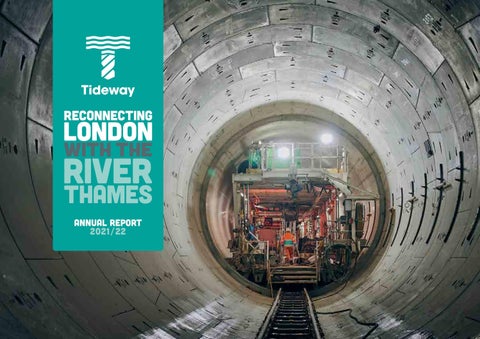
Create a flipbook