The Heat and the Beat Never Sleep Down in New Orleans by Dick Cooper
Cities have personalities shaped as much by their geography, history and climate as by their inhabitants. No city in America owes as much to those factors as New Orleans. It sits on a low isthmus between the winding, final course of the Mississippi and the brackish, estuarial waters of Lake Pontchartrain. Unlike the staid Protestant leaders who governed the English colonies to the north and east, New Orleans and its surroundings were founded 300 years ago by French noblemen with their joie de vivre approach to the world. The moist, sub-tropical winds from the Gulf of Mexico give the air a warm, sticky texture, and the denizens of the nearby swamps add a sense of unkempt danger. The city’s people
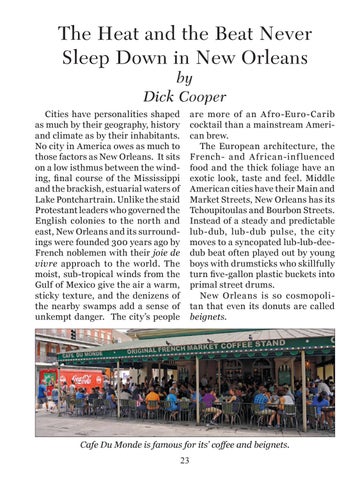
are more of an Afro-Euro-Carib cocktail than a mainstream American brew. The European architecture, the French- and A frican-inf luenced food and the thick foliage have an exotic look, taste and feel. Middle American cities have their Main and Market Streets, New Orleans has its Tchoupitoulas and Bourbon Streets. Instead of a steady and predictable lub-dub, lub-dub pulse, the city moves to a syncopated lub-lub-deedub beat often played out by young boys with drumsticks who skillfully turn five-gallon plastic buckets into primal street drums. New Orleans is so cosmopolitan that even its donuts are called beignets.
Cafe Du Monde is famous for its’ coffee and beignets. 23