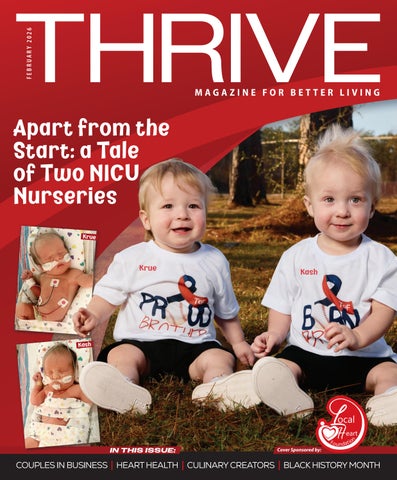
Apart from the Start: a Tale of Two NICU Nurseries


![]()


•
•

•
•


by Kerri Cooke
Your favorite restaurant is only as good as the chef. How to bring out the flavors in food, what ingredients complement each other and cooking times are skills chefs have to know to get the best tasting food to your palette.
In Louisiana, savory food is a big part of the culture. Only the best food will keep people coming back. Meet three standout chefs in Lake Charles who keep churning out some of the best dishes in SWLA.


When Chef John McGrew was in his early 20s, he was hired to work in a kitchen. He discovered his love of cooking while there and enrolled in SOWELA’s culinary arts program. He worked at the old Coyote Blues on Ryan Street before becoming sous chef at The Bekery. He continued his career at the Pioneer Club before settling in at Crying Eagle Brewing Company—University.
Chef John’s varied experience helped him adapt to cooking the cuisine at Crying Eagle. The Bekery allowed him to be familiar with dough for Crying Eagle’s
pizzas, and the Pioneer Club taught him fine dining, which helped when coming up with special menu items. In fact, the first special he worked on, the Crying Eagle Smash Burger, is one of the best-selling items on the menu.
He’s been at Crying Eagle for three years and says the primary reason he loves to work there is because the company gives back to the community, citing fundraisers for Ball’s Fried Chicken and Area 337 when these locally owned restaurants faced hardship.


Chef Lyle Broussard is a well-known name in the local culinary scene, but that didn’t happen by accident. He is a Lake Charles native and the only jobs he has ever held have been in the culinary arts scene. He worked his way up from dishwasher at age 18 to chef at Crying Eagle’s lakefront location.
Chef Lyle’s great-grandmother owned a small restaurant named Lewis’ Drive-In and grew up surrounded by great family cooking. He attended SOWELA’s culinary arts program for a little while, before receiving further education at the Culinary Institute of America in New York.
After working at Harrods Casino for a brief time, Chef Lyle switched to L’Auberge Casino shortly before Hurricane Rita struck SWLA in 2005. He became the chef de cuisine in 2009, working at what was then Jack Daniels, continuing as it transformed into Barstool Sportsbook and then ESPN Bet. In total, Chef Lyle worked at L’Auberge for two decades before he made the move to Crying Eagle—Lakefront.
“I met Eric (Avery) at the Louisiana Winter Beer Fest downtown. Crying Eagle—University wasn’t built yet,” Chef Lyle says. “At the festival we made a menu based on the beers. Eric and I kept in touch, and after Crying Eagle was built, it was the first local brewery, so we pushed the beer out of the restaurant in L’Auberge.”

Eric Avery would then offer Chef Lyle the top position in the kitchen at Crying Eagle—Lakefront. “It was scary to leave the security of somewhere you’ve worked for 20 years,” Chef Lyle says. “At L’Auberge, I had a lot of freedom, but I was still working for a corporation. At Crying Eagle, my decisions directly affect the outcome of the business. I hired every dishwasher and cook, tested every recipe.”
The opening menu for Crying Eagle was a collaborative effect between Chef Lyle; Eric Avery, president; Chef John McGrew (at the University location); Fran Avery, vice president; Ryan Ozment,
They ate at restaurants in New Orleans and Little Big Cup in Arnaudville to decide what direction the food at Crying Eagle—Lakefront would take. All six people met every other day from 9:00 a.m. to 5:00 p.m. to submit their own menus, ideas and work out what would be on the menu or how to tweak a dish they knew would be offered. This process lasted the summer of 2025, and Chef Lyle says dishes were still being perfected up to two weeks before opening. The bestselling Tuna Nachos was altered 10 times before the group knew what direction they were going to take with the dish.
“I love Louisiana,” Chef Lyle says. “I love Lake Charles. Sometimes Lake Charles gets lost. The first thing people think about Louisiana food is New Orleans. I think we have one of the best cuisines
in the country. It’s a little bit Texas, a mix of Creole and Cajun, and a little Caribbean. Being a chef here is competitive because 85% of people already know how to cook.”
The menu is undergoing some changes. A few items will be discontinued and replaced by new creations. There will also be Valentine’s Day specials. The real test will be how the business does during its first full summer in business. At the end of the day, Chef Lyle encourages, “Find inspiration wherever you can find it. If you put your heart into it, you will be successful.”


Chef Eric McCree was in the kitchen early. He grew up in a “predominantly female household”, observing his grandmother, mom and nanny experimenting with savory dishes and desserts. The atmosphere during family dinners was warm and played a role in Chef Eric’s future career goals.
While attending LaGrange High School, Chef Eric attended the College Vocational Center for culinary arts and studied under Cory Aguillard. However, his passion was baking, and to further his knowledge of the trade, he attended Johnson and Wells in Miami for instruction on baking and pastry making. Once he graduated, he came back to Lake Charles to work at 1910 as sous chef.
The road to becoming a chef wasn’t easy. Chef Eric says, “Cooking was fearful to me. I watched Julia Child on YouTube. She didn’t fear anything. She taught me how to keep trying. Also, baking is very precise. Even if the temperature is a few degrees

off, everything can fall apart. That taught me patience.”
Chef Eric’s next job was at Tia Juanita’s, where he would learn more about running a restaurant as general manager. This job taught him how to handle a new level of stress. However, after a short while, he transferred to Luna Bar & Grill.
One day, Dave Evans, owner of Luna, asked Chef Eric if he “wanted to go back home?” Andrew Green of 1910 was close friends with Evans and had offered to let him take over the space after 1910 closed. That’s when Evans began brainstorming about what is now Augustine. Giving Chef Eric the title of executive chef, he and Evans composed the menu together. “He is a different type of chef,” Chef Eric says. “He taught me you can have a cool head and still produce good food.”
At only 26 years old, Chef Eric is leading the kitchen. “At first it was stressful, but I learned stress is what you make it. Now I come in and say, ‘We’re

going to have a great day!’ I’m grateful the team accepts me and my authority even though I’m younger than them.”
Some dishes Chef Eric recommends are the Shrimp Rockefeller, Blue Crab Spaghetti, Augustine Burger, Lobster Roll, and Fish Augustine. As far as desserts go, he recommends the trifle, which changes with the seasons.
“Stay bold with the flavors and don’t be afraid to experiment” is the advice Chef Eric gives to others interested in the culinary arts. Since pastries are his passion, he says his 10-year plan is to open his own bakery and he would love to bring Creole flavors to the Northeast. In the meantime, he continues to hone his craft and create new masterpieces in Augustine’s kitchen.

The Louisiana Food & Wine Festival is a showcase of everything that makes Louisiana so special, from its scenic waterways to its culinary superstars. Experience authentic Louisiana’s unique Creole, and Cajun cuisine in a variety of all-inclusive tasting events with hundreds of varieties of wines, beers, and spirits from all over the world. Make plans to attend today!


The Louisiana Food & Wine Festival, a culinary and beverage celebration hosted by Visit Lake Charles, takes place March 12–15. The festival is a showcase of culinary expertise, beverage options and music that highlights Louisiana’s unique culture and heritage. There will be celebrity guest chefs, local chefs, celebrity winemakers/proprietors, artisans, farmers, musicians, local craft spirits and beers, along with renowned wine, spirits and beer brands from around the world.
“The festival is now just over 30 days away and we’re so excited to be moving to March with cooler weather and in crawfish season," says Jan Gourley, festival founder and director. “We’re currently planning Crawfish & Cocktails to be a part of the VIP Experience at the Grand Tasting, sponsored by Louisiana Crawfish, which will be a huge crawfish boil and festival signature cocktails. Louisiana Crawfish spokesperson, Chef Yvette Bonnano, will also be doing a special crawfish tasting as part of the VIP Experience.”


Thursday, March 12 - Louisiana’s Best Taste Awards
New Location: L’Auberge Casino Resort Lake Charles, 6:30-8:30 p.m.
An interactive walk-around of delicious creations from some of the state and region’s best chefs! This professionally judged event will reveal the winners of Louisiana’s Best Taste Awards. Beverage tasting stations include wine, beer, spirits and craft cocktails, along with indoor and outdoor seating and tasting stations with live music.
Friday, March 13 - Fire on the Lake Bord du Lac Park, Lake Charles, 6:30-8:30 p.m.
A quintessential Louisiana celebration of live fire cooking, overlooking beautiful the beautiful shores of Lake Charles. The event features a variety of slow-cooked, grilled, and smoked meats and
Louisiana seafood and vegetarian creations from some of the South’s most celebrated pitmasters, chefs and grill masters. Enjoy unlimited tasting bites, wine, beer and spirits with a souvenir glass.
Saturday, March 14 - Louisiana Food & Wine Festival, Grand Tasting
Bord du Lac Park, Lake Charles 2:00-5:00 p.m.
VIP Experience at the Grand Tasting, 1:00 – 2:00 p.m., Bord du Lac Park, Lake Charles, includes Grand Tasting general admission ticket with Early Access to Grand Tasting at 1:30 p.m.
A fun afternoon of culinary and beverage tastings, with live music in the beautiful surroundings of the Bord du Lac Park. Tickets are all-inclusive for food and beverage tastings, including a souvenir glass for unlimited beverage tastings


from hundreds of wines, beer and spirits exhibitors. The Cooking Demo Stage will showcase some of Louisiana’s best chefs from regions around the entire state. Enjoy an Artisan Market and live zydeco music from Geno Delafose & French Rockin’ Boogie.
Sunday, March 15 - Sunday Jazz Brunch
New Location: Ember Grille & Wine Bar, L’Auberge Casino Resort Lake Charles
This signature Jazz Brunch is one like no other, with an all-inclusive priced ticket featuring unlimited beverage tastings with a souvenir glass, live music, a lavish brunch with carving stations, Louisiana Seafood stations, made-to-order omelet stations, a variety of desserts and more. There will be live jazz music by The Sharp 9’s. A variety of the festival’s official beverage partners will participate with bottomless Bloody Mary’s, Mimosas, sparkling wines, sprits, wine, and beer and more.

SOWELA Technical Community College is the festival’s official charity partner, with a portion of the proceeds from the festival being donated to SOWELA. The Imperial Calcasieu Museum is also a festival charity partner, with 100% of the proceeds from the Wine & Whiskey Pull on Saturday, March 14, at the Grand Tasing, donated directly to the museum. The most up-to-date festival information is available on the website, Louisiana Food & Wine Festival and the festival’s social media channels Facebook and Instagram.


For National Heart Month, it’s important to remember that our hearts are a vital organ in our bodies. We associate emotions with the heart, and while our feelings do affect the heart due to stress, the brain is really the organ that determines our feelings. Don’t get distracted by all the heart imagery this month. It’s essential that you look after your heart health to ensure a long and prosperous life. Learn how to maintain a healthy heart and what to do if you’re having issues in the section ahead.

Inspired Health and Wellness specializes in weight loss medicine and non-invasive cosmetic procedures in the Lake Charles area. We offer medical weight loss management, neurotoxins, dermal fillers, laser services, PDO threads, and more. At the heart of our practice lies a fundamental belief in the power of personal connection. We take pride in providing a personalized approach to each patient, recognizing that every individual has unique needs, concerns, and aspirations.

Parents of premature babies are often prone to worry about the health of their children, as preterm birth can come with complications. Taylor and Taylor Cryer (both parents share the same first name) were expecting twins when Taylor gave birth to premature sons, Kash Alvin and Krue Allen. Their physician, Dr. Jessica Cole at Lake Charles Memorial, informed them that the twins would likely have to stay in the NICU for an extended period. However, the Cryers were not overly concerned at first, especially since both boys were born at nearly six pounds and appeared healthy.
On their fourth day in the hospital, the pediatrician detected a heart murmur in Kash and ordered an echocardiogram. From there, things quickly took a turn for the worse. Both parents were visiting the twins when Kash was taken for testing. Taylor recalled sending her husband to work, confident that nothing serious would be found. Shortly after, doctors informed her


that Kash had Tetralogy of Fallot, which is a combination of four different heart defects that can only be remedied via open-heart surgery. Suddenly, Kash’s oxygen saturation began to drop, and the NICU team called for him to be life-flighted to New Orleans for further evaluation.
Kash arrived at Manning Children’s Hospital in New Orleans just 11 days after birth. Upon arrival, doctors determined his diagnosis was more severe than originally thought; he needed to gain weight before surgery could be safely performed. Meanwhile, Krue remained in the NICU at LCMH. He had been checked for heart defects and was found to have a small patent foramen ovale, a hole in the heart, though this condition was expected to resolve on its own.
During this crisis, the Cryer family was introduced to the Local Heart Foundation. Stacie Adams, the foundation's director, initiated contact and offered assistance with travel expenses. Taylor and Taylor decided to stay in Kash’s hospital room to be as close to him as possible. “Stacie arranged food and gas money for the driving back and forth we would be doing to get from twin to twin,” Taylor says. “In the midst of an absolute heartbreaking and life-changing event, the Local Heart Foundation was our saving grace. It allowed us to be there for both of our boys, along with our three other children, without the financial worry of ‘How are we going to do this?’”
Balancing an entire family while under such emotional stress was difficult, but the Local Heart
Foundation helped there too, as the team and their network were familiar with these specific challenges. “The experience of having your babies in two separate towns is probably the hardest thing I’ve ever had to experience,” Taylor recalls. “I cried myself to sleep a lot. We were back and forth; whoever wasn’t with Kash was with Krue. Our older children were bouncing between grandparents and friends.”
Kash’s surgery was a success, and today both boys are excelling. “They are full of personality and growing like they should,” Taylor says. “Krue gets yearly check-ups, and his first showed his PFO has closed. Kash gets a check-up every six months. So far, nothing but good reports. If everything continues to grow with him, he should not need another surgery later in life. We thank God


every day for answered prayers!”
Taylor and Taylor originally met playing "incrediball." Today, they use that same game to honor families navigating the uphill climb of a medical battle. Driven by a desire to give back to the community that supported them, they created the “Kash Bash” to pay forward the support they received. What started as a tribute has grown into a movement. Last year, 22 teams played for the cause. “This year, we’re aiming for 30. We play so that the Local Heart Foundation can continue providing a lifeline to those who need it most.”


Beyond the tournament, Taylor’s commitment to the cause is deeply personal. She has stepped into the role of mentor, offering a steady hand to other mothers navigating the terrifying "what-ifs" of a diagnosis. “I am more than happy to be a listening ear or to answer any questions. It’s scary when something unexpected happens, and there’s comfort in being able to talk to someone who can relate. My husband and I love seeing the updates the Local Heart Foundation provides on social media. They give their all to every single person they come in contact with, and if we can be even the smallest bit of help, I’m all in.”


Heart disease is considered a silent killer because it often goes undetected before crisis events such as a heart attack. However, heart defects are another problem those of all ages can face. From infants being born with various heart conditions to older adults collapsing because of an undiagnosed defect, heart problems can affect anyone. The Local Heart Foundation is a local nonprofit that seeks to help families going through hardship due to their loved one suffering from a heart ailment. Below we hear from Stacie Adams, executive director of the foundation.
How long have you been in this nonprofit role?
I’ve had the honor of serving as executive director since October 2022. My journey here is deeply personal. In 2019, my family found ourselves in Houston for my daughter’s third open-heart surgery, and the foundation was our lifeline—providing the lodging, meals and gas

we needed to get through that difficult time. Having walked in the shoes of those we serve, I am incredibly passionate about giving back to the community that supported us.
What is the overall goal of the organization?
Our overall goal for the organization is to financially assist families who live in SWLA and must travel outside of this area to receive critical and crucial heart disease treatment. No family should have to worry about how to afford travel when fighting heart disease. We are dedicated to easing the financial burden for members of our SWLA community by assisting with the costs of seeking specialized care outside our area, providing hope and relief during life’s most difficult moments.
What are your top three immediate priorities?
A heart disease diagnosis is often urgent and lifechanging. We provide direct financial assistance to help families navigate the unexpected traveling expenses, ensuring they can focus on healing rather than the sudden burden of expenses due to the need to travel outside SWLA for heart disease treatment.
We are dedicated to connecting families navigating similar journeys, recognizing that while every experience is personal and
unique, there is invaluable support in shared understanding.
We are also dedicated to streamlining our application process, which goes through the cardiologist’s office, to ensure families receive the support they need without unnecessary delays.
Our work is made possible by the proud support of our local businesses. By partnering with us, these businesses are reinvesting in the very same community and customers who support them every day. This shared commitment creates a heartfelt bond across SWLA, connecting the community and local businesses to build a more resilient and united community for everyone who calls southwest Louisiana home.
What is the everyday impact you see in the local community stemming from your organization?
In Southwest Louisiana, many families are walking the difficult path of battling heart disease. Because SWLA currently lacks a pediatric heart surgical center, these families—especially those with small children—must often travel far from home for life-saving treatment. We are here to bridge that gap, connecting local families with similar journeys and providing the support they need while they are away from home. We take pride in connecting families for emotional support during difficult times.
What do you wish people knew about your organization that you feel is not understood?
Our heart and our mission are for the entire community. While many of our families have small children requiring travel for cardiac surgery, we provide support to individuals of all ages. From newborns to seniors, we are dedicated to anyone in SWLA navigating the challenges of heart disease.


Heart health is rarely shaped by a single moment. More often, it is built—and rebuilt— over time, influenced by education, access to care and the support systems that surround a person before, during and after a heart event.
For many individuals and families, heart health becomes personal only after a diagnosis or emergency. But the reality is that the choices made, resources available and support offered long before that moment can significantly influence outcomes.
Understanding risk factors, recognizing early warning signs and learning how everyday habits affect heart health can help prevent serious complications. Community-based education plays an important role in that awareness. Initiatives such as HeartiGras, led by The Foundation at Lake Charles Memorial Hospital, encourage conversations around prevention, routine screenings and heart-healthy lifestyles. By bringing heart health education into the community, these efforts help individuals take proactive steps long before a medical emergency occurs.
Education also helps break down common misconceptions, including the belief that heart disease only affects certain age groups or appears without warning. As interventional cardiologist Ahmad Awan, MD, explains, “While we can’t change factors like family history or
age, we can manage and reduce some risks by treating high blood pressure, diabetes, obesity and quitting smoking.” Encouraging routine screenings and open conversations with healthcare providers helps individuals recognize when it’s time to seek care and reduces hesitation around taking that first step.
Lifestyle choices also play a critical role in longterm heart health. “If you smoke, your heart will thank you if you quit,” says cardiologist Kevin R. Young, MD. “Over time smoking takes a toll on your blood vessels and increases your risk for heart disease.”
When a Heart Condition Is Diagnosed, Guidance Becomes Essential
A heart event or new diagnosis can feel overwhelming, often accompanied by uncertainty and difficult decisions. Care under a cardiologist provides clarity and continuity during this critical time. At Lake Charles Memorial Health System’s Heart and Vascular Center, patients are supported by a coordinated team led by cardiovascular and thoracic surgeon J. Gregory Lugo, MD; cardiologist Kevin R. Young, MD; and interventional cardiologists Ahmad Awan, MD, Edward Bergen, DO, Karl Duncan, MD, Kurt Duncan, MD, and Lam Nguyen, MD.
During this stage, having a coordinated care team helps patients feel supported rather than overwhelmed. Regular communication, consistent follow-up and a clear understanding
of next steps allow patients to focus on their health instead of navigating the healthcare system alone.
After a Heart Event, Recovery Is About Rebuilding Strength and Confidence
Healing often continues well beyond hospital care. Cardiac rehabilitation provides a structured environment where patients can safely regain endurance and return to daily routines through supervised exercise, education and encouragement. At Memorial, recent renovations to the cardiac rehabilitation gym offer updated equipment and a refreshed space, while the same familiar care team continues to support patients throughout recovery. This combination of experience and improved tools helps patients rebuild confidence and move forward toward the lives they enjoy.
Heart health is a journey that unfolds in stages. With education before, expert care during and rehabilitation after, individuals are better supported at every step along the path to a healthier heart.
For more information about heart and vascular services available at Lake Charles Memorial Health System, visit lcmh.com/medical-services/heartvascular. To learn more about HeartiGras, the heart health education campaign led by The Foundation at Lake Charles Memorial Health System, visit lcmh. com/giving/events/hearti-gras.
Helping to ensure healthy hearts across SWLA. Heart and Vascular Physicians with Lake Charles Memorial Health System proudly support HeartiGras


Heart disease strikes nearly
55 or older or postmenopausal. One reason is the decline in the hormone estrogen (which offers women some heart protection) that occurs after menopause.
High blood pressure. arteries. In addition, women are more prone to heart disease if they had high blood pressure during pregnancy, a condition known as pre-eclampsia.


High cholesterol. Too much LDL cholesterol (the bad kind of cholesterol) in the blood can clog arteries in the heart, triggering a heart attack.
Diabetes. Or if you have its precursor, prediabetes.
Family history of early heart disease. If your father or brother had a heart attack before age 55 or your mother or sister had one before age 65, your risk rises too.
Overweight or obese. Extra weight is hard on the heart.
Unhealthy lifestyle choices. These include eating unhealthy foods, smoking or not exercising. Talk to your doctor about your personal risk for heart disease and how to lower it.
To learn about scan the QR code. Call 911 if you experience any of these symptoms.
• Chest pain or discomfort
• Discomfort in other areas of the body. These can include one or both arms, the back, neck, jaw, or stomach
• Shortness of breath
• Breaking out in a cold sweat
• Nausea
• Syncope (feeling faint or light-headed)
by Kristy Como Armand

When it comes to protecting heart health, many people think first of cardiologists and specialized testing. But for most patients, heart care begins with their primary care provider.
“Primary care is where heart disease prevention should start,” says Brenton Smith, MD, family medicine physician with Imperial Health. “Long before symptoms appear, we’re tracking the risk factors that can quietly impact heart health over time and taking needed steps to lower that risk.”
Dr. Smith says routine primary care visits play a critical role in identifying and managing the conditions most closely linked to heart disease. Blood pressure, cholesterol levels, blood sugar, weight and family history are all monitored regularly during checkups, even when patients feel

healthy. “These measurements help detect early warning signs, allowing us to address any problems before they become more serious.”
Two significant risk factors for cardiovascular disease—high blood pressure and elevated cholesterol— do not usually cause noticeable symptoms,” Dr. Smith explains. “That’s why regular visits matter. If we wait until someone doesn’t feel well, we may already be behind.”
Primary care providers also help patients understand what their numbers mean and what steps can be taken to improve them.
Conversations about diet, physical activity, sleep, stress and tobacco use are often just as important as lab results. These discussions allow care plans to be tailored to a patient’s lifestyle, goals and overall health.
“Heart health isn’t one-size-fits-all,” adds Dr. Smith. “Our role is to look
at the whole picture and work with patients on realistic changes they can sustain.”
Another key health advantage of primary care is continuity. Seeing the same provider over time allows for trends to be tracked, medications to be adjusted thoughtfully and progress to be measured. This longterm relationship helps build trust and encourages patients to speak openly about concerns they might otherwise dismiss.
“We get to know our patients—not just their charts,” Dr. Smith said. “That ongoing relationship helps us catch subtle changes and have honest conversations about risk.”
Primary care also serves as a smoother gateway to specialty care when needed. If a patient’s risk increases or symptoms develop, a primary care provider can coordinate referrals to testing
and specialists. “We have excellent cardiovascular specialists and resources within the Imperial Health Group, giving our patient the convenience and confidence that their care is connected and comprehensive,” says Dr. Smith.
By helping patients understand routine wellness exams as not just something they are supposed to do, but as a vital part of protecting their heart health, Dr. Smith hopes more people will prioritize regular visits and establish a relationship with a primary care provider.
“Taking care of your heart shouldn’t start with a crisis,” adds Dr. Smith. “It starts with regular conversations, simple screenings and a proactive approach to your heart health.”
Dr. Smith is accepting new patients. Call 337-433-1212 to schedule an appointment.
We are so grateful to the generous donors who help strengthen our community’s health care facilities and enhance access to advanced technology and equipment. You help us to ensure that every individual experiences God’s healing presence and love, as we strive daily to extend the healing ministry of Jesus Christ.


To purchase tickets or for more information, call (337) 430-5353 or scan the QR code.


Heart disease remains one of the leading causes of illness and death in the United States, yet many heart-related conditions develop quietly, often without noticeable symptoms. According to Dr. Chris Thompson, cardiologist at West Calcasieu Cameron Hospital (WCCH), one of the most effective ways to protect your heart is also one of the simplest: regular monitoring.
“Heart health monitoring allows us to catch potential problems early, sometimes years before a serious event occurs,” Dr. Thompson says.
“The earlier we identify risk factors, the more options we have to prevent long-term damage.”
Blood pressure is often the first and most familiar heart health number—for good reason. High blood pressure, also known as hypertension, is frequently called the “silent killer” because it typically causes no symptoms while significantly increasing the risk of heart attack, stroke and kidney disease.
“Many patients are surprised to learn their blood pressure is elevated,” Dr. Thompson says.
“That’s why routine monitoring is so important. You can feel perfectly fine and still be placing stress on your heart and blood vessels.”
Blood pressure readings include two numbers: systolic (the top number) and diastolic (the bottom number). While normal ranges can vary slightly by individual, consistently elevated readings should be discussed with a healthcare provider. Home blood pressure monitors can be a helpful tool when used correctly and paired with regular medical follow-ups.
While blood pressure is a key indicator, comprehensive heart health monitoring involves more than a single measurement. Providers often evaluate several factors together to better understand a patient’s overall risk.
Cholesterol levels, for example, play a major role in heart health. High levels of LDL, or “bad” cholesterol, can lead to plaque buildup in the arteries, increasing the likelihood of heart attack or
stroke. Blood sugar levels are another important consideration, as diabetes and prediabetes significantly raise cardiovascular risk.
Other measurements, such as body weight, waist circumference, resting heart rate and heart rhythm, can also provide valuable insight. “Each of these numbers tells part of the story,” Dr. Thompson says. “When we look at them together, we’re able to develop a clearer picture of a patient’s heart health and create a plan that fits their needs.”
Monitoring heart health goes hand in hand with lifestyle choices. Nutrition, physical activity, sleep quality and stress levels all influence cardiovascular wellness. Reducing sodium intake, staying physically active, managing stress and avoiding tobacco use can have a measurable impact on heart health over time.
“The goal isn’t perfection,” Dr. Thompson says. “Even small, consistent changes can lead to meaningful improvements and
reduce long-term risk.”
Adults should have their heart health numbers checked regularly, especially those with a family history of heart disease or conditions such as high blood pressure, diabetes or high cholesterol. If readings are consistently elevated, or if symptoms such as chest pain, shortness of breath or irregular heartbeat occur, it’s important to seek medical evaluation.
At WCCH, patients have access to preventive screenings, primary care providers and specialized cardiology services designed to support heart health at every stage of life.
“Knowing your numbers is one of the most powerful steps you can take for your heart,” Dr. Thompson says. “It’s about being informed, proactive and partnering with your care team to protect your health.”
Learn more about cardiology services at WCCH at wcch.com.

Tuesday, March 3 | 2 pm 1757 Imperial Blvd., Lake Charles
Located in south Lake Charles, we offer advanced outpatient surgical procedures in a wide range of medical specialties.
When it comes to heart health, experience, trust and access matter. At West Calcasieu Cameron Hospital, cardiology care is delivered by a dedicated team focused on prevention, diagnosis and treatment, close to home. From routine heart screenings to advanced cardiac interventions, you have the power to make the right choice for your heart.


Heart disease remains the leading cause of death in the United States, but early detection, expert treatment and a healthy lifestyle can help reduce your risk of serious complications. Allen Parish Community Healthcare (APCH) provides comprehensive cardiopulmonary care for patients to breathe easier, live stronger and protect their heart health.
Cardiopulmonary care includes diagnoses and treatment for a variety of conditions that affect the heart and lungs.
“Heart and lung conditions can affect the way we live,” says Cheryl Ogea, director of cardiopulmonary services. “When breathing or circulation is compromised, it can limit sleep, work and time with loved ones. Our goal is to help patients get back to living fully and comfortably.”
by Tori Whittaker
APCH offers a wide range of diagnostic services including electrocardiograms (EKGs), holter monitoring, echocardiograms, stress testing, pulmonary function testing and advanced imaging to evaluate heart and lung performance.
“These tests help us detect conditions such as coronary artery disease, heart rhythm disorders, heart failure, asthma, chronic obstructive pulmonary disease (COPD), and sleep-related breathing disorders,” says Ogea. “By identifying problems early, we can create a personalized treatment plan to minimize damage to the heart and lungs.”
Treatment may include medication management, minimally invasive procedures, respiratory therapies or cardiac rehabilitation programs designed to restore strength and confidence.
“Identifying the root cause is the first step in helping patients regain their quality of life,” says Ogea.
While medical care plays a critical role, a hearthealthy lifestyle can reduce the risk of heart disease, improve energy levels, and support overall wellness at any age.
“Heart health is shaped by the choices we make every day,” Ogea adds. “Regular physical activity, nutritious eating, stress management and routine checkups all play a major role in keeping the heart and lungs functioning at their best. Small, consistent changes can have a powerful impact on long-term health.”
For more information, visit allenhealth.org.


all that romantic to some to run a business as husband and wife, but the process involves a deep and loving bond for the business and marriage to continue working. Couples learn how to compromise and fully trust each other for better success. Discover the love that brought these local couples together and how they support each other in business.
Photos by Chris Brennan Photography


Bayou Boards by Gabrielle is known as the go-to place in SWLA for customized charcuterie spreads. By using high quality ingredients and providing a wide range of foods to choose from, your board is tailored specific to event and taste.
You’ve probably eaten from Bayou Boards’ famous grazing tables at local events such as weddings, business openings, baby showers or work meetings. They also offer holiday-themed boards and regular boards for any event.
Having been in business for five years, Bayou Boards by Gabrielle also offers a daily lunch menu consisting of hot sandwiches and flatbreads. Other amenities include wine and charcuterie nights, private charcuterie classes, private rental of the building and indoor and outdoor seating.


It was an on-campus love story for Bianca and Quinn Thomas. They met while studying at McNeese State University. Quinn says, “It didn’t take long for me to realize she was different. What started as a connection turned into a real partnership over time. Our love story is really built on growth. The biggest part of our story is that we didn’t just fall in love; we decided to build a life together on purpose.”
After college, Bianca was involved in ABA, Applied Behavior Analysis, and began training to be a Board-Certified Behavior Analyst. Quinn describes Bianca as being “passionate about the work” while
maintaining ethics and quality of care. At the same time, Quinn was working in corporate roles. He “learned how systems work, how to build processes and how to lead teams.”
A year before Bianca and Quinn were married, they decided to founded Brite ABA Therapy together after Bianca parted ways with her previous employer. “Instead of looking at it like a setback, we look at it like an opportunity,” Quinn says. “I encouraged her to go into business together and build something of our own. From the beginning, we were intentional about how we would divide responsibilities. I would take care of the business side—operations,
structure and growth. She would focus on the clinical side and make sure the quality of care was top tier.”
The most challenging aspect of being married and running a business together is how it’s not easy to separate work life from home life. Quinn says, “You don’t get to ‘clock out’ from the relationship or the business, so you have to be intentional about how you communicate and how you handle pressure.”
Quinn has some words of wisdom for other couples thinking about going into business together. “Don’t go into business together just because you love each other. Go into business together because
you trust each other, respect each other and you’re willing to communicate, even when it’s uncomfortable.” A few things he recommends are:
• Define roles early. Somebody has to have the final say or decisions will drag on forever.
• Protect the relationship. Business stress can spill into the home fast if you don’t set boundaries.
• Have hard conversations about money, expections, time, responsibilities and what happens when you disagree.
• Play to each other’s strengths. Complement each other; don’t compete.
• Remember the mission.

It was 2017, and Gabrielle and John Wainwright’s love story was almost like two ships passing in the night. Gabrielle was in the waiting room of a massage parlor inside Gigi’s Downtown while her best friend was in her session. Meanwhile, John, who was training for an ironman triathlon, was also in the waiting room before his own massage. John introduced himself to Gabrielle and showed interest. However, John failed to ask for Gabrielle’s number. That night, Gabrielle
told her friend about what had occurred. “You are going to marry that man,” she said.
John kept frequenting the massage parlor, hoping to see the girl he couldn’t get off his mind, but they didn’t cross paths again. He finally tracked Gabrielle down on social media and asked her to dinner. They had their first date downtown at Luna Bar & Grill, and the two were married in February 2019.
Before opening Bayou Boards by Gabrielle, which offers custom charcuterie boards and more, in late 2019, Gabrielle was a special education teacher.
While John still works in the LNG industry, he assists the business by using his financial management skills to run payroll, assess costs and ensure the business is in compliance.
Gabrielle and John have a family, which makes business more challenging. Gabrielle, creator, marketer and designer, says, “We are grateful for what this business has done for our family and also this community. We both support the business in a way that caters to our strengths.”
Gabrielle’s advice to other couples in business together
or hoping to start one is “Don’t ever lose sight of what is most important, which for us is God, our marriage and our family. Schedule time to ‘talk business’ and also prioritize time to focus on your relationship and your family. Learn to listen to understand, not just to respond. You each bring a special skill to the business. Harnessing those skills is important to your success. Remember, you are on the same team.”

Some love stories begin with grand gestures.
Hayleigh and Cody Simmons’ began in 2015 by pure accident. “Cody and I started out as friends and quickly realized how many similarities we shared and how naturally comfortable we were together,” Hayleigh says. “Neither of us had the easiest childhoods, and that shared understanding shaped our work ethic, honesty and determination to create a better life—not only for ourselves but for our children. There isn’t anyone else in the world I would rather build a life, a business and a future with.”
In the early stages of the relationship, Cody had just opened Cody Simmons Mobile Home Transporters. Business ownership was new territory for him, and the
manufactured housing industry was completely unfamiliar to Hayleigh. “We learned quickly how to navigate it together,” she says. Cody focused on hauling and installing homes, while I handled the paperwork and administrative side, gradually stepping into the role of secretary. That teamwork became our foundation and ultimately opened the door for us to dream bigger—owning a dealership and becoming a retailer.”
After the two married, and while Hayleigh was pregnant with their second child, they made the decision to move forward fully with LA Manufactured Homes.
“Between Cody’s knowledge, determination, and hands-on experience in the industry, and my eagerness to take on responsibilities and manage the business side, we knew we could
build something meaningful together,” says Hayleigh.
LA Manufactured Homes was born during an incredibly challenging time. Between the uncertainty of COVID and the devastation caused by Hurricane Laura, the couple faced obstacles that tested them in ways they never expected.
“Working with your spouse is not easy. Patience is tested, stress is constant and emotions can run high,” says Hayleigh. “But we’ve always faced every challenge side by side, solving problems together and leaning on one another through both the difficult and rewarding moments.
The couple’s strengths balance each other. Cody brings deep industry knowledge and determination, while Hayleigh focuses on organization, paperwork and keeping the
business moving forward. Every day is a combination of teamwork, communication and shared responsibility. “The most rewarding part of it all is the people we help along the way— seeing families find homes and knowing we played a role in their journey,” says Hayleigh.”
For couples considering going into business together, the Simmons’ advice is simple: “There is no better business partner than someone you truly trust, rely on and who motivates you to succeed. There will be moments of doubt and challenges along the way but facing them together makes the rewards even greater. Building a business as a couple strengthens not only your professional partnership but your relationship and your family as well.”
21% of small businessES involve spousal co-ownership
people employed by spousal co-owned businesses
409,504,687
ROUGHLY 3/4 (or family member) would improve the quality of their work
55% of Americans would consider working with someone they’re close to of people say working with a significant other
52% Of couple business owners earned a 4-year degree
65% of couple businesses are older than 8.5 years
16% of couple businesses state that keeping the business in the family or the opportunity to work with family was a primary objective. OF Couples in business have 18% million-dollar businesses
90% of couple businesses reported happiness levels between 6 to 10 points compared to
75% for other businesses


The story of Dr. Niazy Selim and Naima begins on two different continents, shaped by two different cultures and two ambitious hearts. Naima grew up in France, carrying with her a global outlook and a quiet determination. Dr. Selim was raised in Egypt, where his passion for medicine and teaching took root early.
Before ever stepping foot in the United States, Dr. Selim had already built a remarkable career. He became a professor of surgery in Egypt, completed his first surgical residency and fellowship, and earned a PhD, supported by extensive research contributions. His dedication to advancing surgical education made him a respected figure among trainees and colleagues alike.
When Dr. Selim moved to the United States, he chose to challenge himself even further. He redid his entire surgical residency and completed
a second fellowship at Emory University, one of the nation’s most prestigious training centers. His commitment to excellence didn’t stop there.
For more than 20 years, Dr. Selim has served as a proctor and trainer in robotic surgery, teaching physicians across the United States and around the world. His expertise helped shape the next generation of surgeons and brought advanced robotic techniques to countless hospitals globally.
This rare combination of academic leadership, dual training and international teaching experience makes him one of the most uniquely qualified surgeons practicing today.
Dr. Selim and Naima’s personal story began while Naima was studying as an international student in Michigan and Dr. Selim was completing his residency in Kansas City, Missouri. Introduced through mutual
friends, they formed a connection strong enough to bridge the miles between them. Their long-distance relationship grew through late-night conversations, weekend visits, and a shared belief that something special was unfolding.
Eventually, the couple wanted to build a life side by side. Naima made the courageous decision to transfer schools and move to Little Rock, Arkansas, where Dr. Selim had accepted a surgical position. Living in the same city allowed them to grow closer, and before long, they chose to get married.
Dr. Selim and Naima’s next chapter took them to Overland Park, Kansas, where they welcomed their three children: Noorhan, their first daughter; Adam, their spirited middle son; and Jay, the youngest and final addition to their family. In 2015, they moved to Louisiana, ready to begin a new chapter. Dr.
Selim opened his private practice, and in 2017, they purchased their own surgical facility. Over the next two years, they poured their energy into renovating and transforming it into a fully licensed Ambulatory Surgery Center.
Today, with a dedicated team beside them, they are bringing state-of-theart procedures, advanced surgical techniques and innovative cases to Lake Charles—many of which had never been performed in the region before. Their mission is rooted in gratitude and purpose: to elevate the quality of life for the community that welcomed them so warmly.
From France and Egypt to the heart of Louisiana, their story is one of courage, partnership, and vision. Together, they built a family, a practice and a legacy—proving that when two people share a dream, distance becomes irrelevant and anything becomes possible.


Oak Crossing has donated $25,000 to the Brimstone Historical Society in Sulphur to help fund operations and events of the Brimstone Museum Complex and the Henning Cultural Center.
“Our family has a rich history in Sulphur, and we’re proud to support the mission of the Brimstone Museum and Henning Cultural Center, which is to preserve and promote the shared community history of Southwest Louisiana,” says William “Dub” Henning Jr., owner of Oak Crossing in Lake Charles.
Thom Trahan, Executive Director of the Brimstone Historical Society adds, “This gift directly funds our organization’s mission to provide free programming and cultural enrichment and will help us continue building spaces where our stories can be celebrated, our communities can come together and our heritage can be protected for generations.”
Originally housed in a restored 1915 Southern Pacific Railway Depot, now temporarily moved into an original Sulphur Mines cottage, the Brimstone Museum Complex is a place where Sulphur’s rich history still comes to life through stories, artifacts and local heritage.
Built in 1904 by the first Henning to locate in Sulphur, Reverend John Henning, the historic Henning family home has been given new life as the Henning Cultural Center. The restored home now serves as a hub for arts and culture, featuring gallery exhibitions, performances, classes and community events, including the annual Holiday House, that celebrates community, creativity and local talent.
Oak Crossing also gave back to the community with a $50,000 donation to The Salvation Army of Southwest Louisiana’s Red Kettle campaign, helping support shelter services and other support for individuals and families in need.
The Salvation Army serves the Southwest Louisiana region by offering emergency shelter,
disaster response, food assistance and support programs designed to help individuals and families regain stability and hope. Money raised in the organization’s annual Christmas Red Kettle campaign provides funding for year-round services.
We are grateful for Oak Crossing’s generosity and commitment to our community,” says Major Michael Knott, Commanding Officer with The Salvation Army- Lake Charles. “This support helps ensure our shelter remains a place of safety and dignity for those who need it most.”
“At Oak Crossing, we believe strong communities


are built by caring for one another,” says William “Dub” Henning Jr., owner of Oak Crossing.
“Partnering with The Salvation Army allows us to help meet immediate needs while supporting the important work they do every day for our neighbors.”
Oak Crossing, a premier event venue and business park in Lake Charles, is committed to investing in Southwest Louisiana through community partnerships, charitable giving and initiatives that strengthen the quality of life for residents across the region.
Learn more at OakCrossing.net.


Located in DeRidder, LA, AMERISAFE has been providing specialty workers’ compensation insurance for more than 30 years. Operating in 27 states, we serve small and mid-sized employers in high hazard industries like construction and trucking.
Driven by our understanding that success comes from the people who work for us, we encourage both personal and professional growth through continuous development opportunities.
AMERISAFE is committed to taking care of our own. We provide full benefit packages, including:
Medical
As we celebrate Black History Month, we should remember the United States wouldn’t exist today in the same way, shape of form without the Black community. As an integral part of innovation and our national economy, sometimes we focus so much on the now that we forget the past—the forerunners. We explore this history with one of the most prominent Black families in Lake Charles—the Ball family. Also, catch up with Creole musician Sean Ardoin in his own words. Then dive into the history of the local Black community’s contribution to Louisiana cuisine.


Sean Ardoin is a five-time Grammynominated Kreole Rock & Soul artist from Lake Charles, Louisiana. He's also a Cannes Silver Dolphin Award winner for the documentary on Louisiana that he Amplify: Louisiana. He can most readily be found singing on stage while wearing his signature glasses.
You are part of the bloodline of Cajun/Creole/ zydeco music. What's it like being connected to the history of a musical tradition?
Being a part of that musical legacy is an honor, a privilege and something I don't take lightly. I'm a fourth generation Creole accordionist. It started with Amede Ardoin, who was the father of modern Creole and Cajun music, of the songbook. Then my grandfather, Alphonse “Bois Sec” Ardoin. He was a living legend until his passing. And then my dad, Lawrence “Black” Ardoin. Everybody got a nickname. I don't have a nickname, but it's all good. I also have a pretty famous little brother in this area, Chris
You’ve said you don’t play zydeco. You play Creole music. How would you define the difference?
It's just the way it's played is different. If you'd ask my grandfather, he would say, I play Creole music. Because he didn't do Zydeco. But after Boozoo got famous and then Bo Jacques became the No. 1 guy, everything with a Black man and an accordion became zydeco, right?
by Matt Dye
But zydeco proper is played with a piano accordion or a three-row accordion and scrub board. Creole music is played with a diatonic Cajun accordion, a violin and fiddle.
Today there's only a couple of Creole bands. There's Jeffrey Broussard. Geno's doing Creole music. But there are no Creole violinists. The only fiddler we have left is Ed Poullard, so we need some new Creole fiddlers to pop up somewhere. But I'm not looking. I did the traditional music for so long. But the whole time I was doing it, I saw myself doing something different.
You wanted to evolve it further.
I wanted to evolve it from the minute I even had a concept of what could be.
I created the Christian Zydeco in ‘09. And then in 2018, I created Kreole Rock and Soul. And that got me two Grammy nominations. And since 2018, I've put out an album every year.
How many albums does that put you at currently?
28.
In 2022, I did an album with LSU. LSU's marching band is now Grammy nominated because I brought them in on my album. I'm an LSU grad and a marching band alumnus, so I'm super excited about that. We have a double album vinyl, a commemorative vinyl that people can get on my website.
In 2024, I put out the album 25: Back to my Roots, because in ‘24, it had been 25 years since my start as a solo artist in 1999.
How did Kreole Rock & Soul come to you?
Kreole Rock & Soul happened because when I came back after taking a break of 10 years, there was a gap in the industry. The local zydeco artists, who are the mainstay of the I-10 circuit, which I call the Boudin Circuit, they don't leave because they don't have to.
Why would you leave your house to go to Philadelphia for $3,500? It's going to cost you to do that, right? Why go when you can sleep in your own bed at night and play three nights a week and be good? That left a gap in the
industry because now cover bands in all of these cities are now the ones who are playing and representing zydeco. And so, whenever I'm calling and trying to go, they're thinking zydeco from 30, 40 years ago. Because that's what they have in those cover bands.
That's all they know.
Exactly. So, they either love that or they hate that. And I'm neither of those. So, how can I accurately set myself apart in this industry, while also staying true to the culture and the mission, which is to take the culture and the music to the world?
I started with alternative Creole. Shopping this thing. Going to all these booking conventions. And they go, what's that? And then I got to explain it. And so, I came up with Kreole Rock & Soul. And then when I did the Kreole Rock & Soul self-titled album, and I got two Grammy nominations from it, I was like, “OK, God, I'm on the right track.”
What’s it like being nominated for a Grammy?
It really is surreal. I know it's something significant, but when I go through the city, there's still a whole bunch of people who don't know who I am or what I do. I'm at the top of the mountain. I'm top five in the world. But I walk through, and nobody knows who I am.
But I can tell you this. When I turned 40, my life became about legacy preservation. What is my legacy? You know, what am I leaving? Everything became about that. From that point of view, being Grammy nominated the first time, and the two-for-one album, I was like on top of the world. There's literally no words to explain it. And then when it happens again and again and again . . . . But the other thing that's not happening—I'm not winning. The competitor/legacy person in me is like, “Yeah, but I got to win.”
Have the Grammy nominations opened up doors or allowed for unexpected collaborations?
On 25, I’ve got a song, We Doin’ It. And I'm calling people like Ricky Kedj, who's a six- or seven-time Grammy award-winning artist from
India. He's a superstar in India. He's on that song I did. I just did a mashup and had artists do different versions of it. I had Cupid, Rissi Palmer, Paul Wall, Leela James, who is an R&B artist, Wendy Moten, Ricky Cage, Mano Beats, a Haitian artist, and Shradha Ganesh, who's an Indian singer. All those people are on one song. It just started happening. You know, it's amazing, man. But everybody loves Louisiana. Really. Musicians. Musicians love Louisiana.
So, what’s happening with Sean Ardoin in 2026?
I'm producing two festivals this year.
The first one is Dat Zydeco Fest in New Orleans. The tagline is, “We bring the soul of Southwest Louisiana to the heart of the city.” We're doing it at the Broadside in New Orleans on March 21st.
The other festival idea that I have in mind is called the Good Music and Food Festival, and I want to do it right here in Lake Charles. I'm just looking for a few sponsors because it's something that we've never had here. And it's something that I believe is going to be phenomenal.
What else?
I also have a coffee line called Kreole Rock & Soul Coffee.
Once my eyeglasses became a thing, I knew I had to figure it out. I didn't want to have an eyeglass company per se. But I'm at a position now where I need to consider it and consider how to do it the best way.
I started a marriage podcast called Better Marriage Daily. We have 37 episodes up already. It's everywhere. Everywhere you listen. If you want to watch us go back and forth, on YouTube you can do that.
There’s a lot going on in the world of Sean.

by Kerri Cooke
The Ball family legacy in Lake Charles began with Reginald McWilliam Ball Sr. who grew up In Winnfield, Louisiana, before moving to Lake Charles. By the age of 18, he was already a business owner three times over.
His portfolio included two dance halls and a taxi cab company. His impact on the city of Lake Charles began in the 1940s when he purchased the 1200 block of St. John Street where Lake Charles Vocation Institute was built, a trade school for Black WWII veterans. To the right of the trade school was Ball’s Drive Inn Café, where his wife, Evelyn Walker Ball, was the chef. The café was known for its fried chicken and stuffed shrimp, but the fried chicken quickly became the bestselling item.
The vocational school closed in the mid-1950s and the space became an entertainment venue called Ball’s Auditorium from then through the 1960s. Entertainers included Ike and Tina Turner, Fats Domino, Marvin Gaye, Little Richard and Duke Ellington. Ball’s Auditorium became known as one of the premier black-owned entertainment venues in the South. Around the same time,

Reginald Ball Sr. partnered with George Duhon to connect the school/auditorium to Ball’s Drive Inn Café. This created a lounge area which became known as the Rose Room, a nightclub.
Reginald Ball Sr. and Evelyn had four children which included Reginald Ball Jr., Gladwin Ball, Lucion Ball and Brenda Ball. Reginald “Reggie” Ball Jr. would become an essential part of keeping the Ball family’s food enterprises going, while Gladwin Ball, who had worked in most of the Ball companies, tried to keep the historic legacy of the school/auditorium alive by having it listed as a historic landmark. Unfortunately, he was unsuccessful, and the building was torn down in 2007. However, in 2014, the Calcasieu Historical Preservation Society labeled the spot where it had been built as a lost landmark.
After the auditorium closed, Ball’s Drive Inn Café was still serving up its signature spicy fried
chicken, and on July 7, 1971, a second location opened on Enterprise Boulevard, knows as Ball’s Fried Chick-N. By 1972, there were a total of five locations. Then, by 1976, none of the locations were still active. In 1977, Reginald Ball Sr. founded a seasoning company called Ball’s Creole Seasoning Company. He determined the right ratio of ingredients in his seasoning with the help of the community.
Back to Reggie Ball Jr. After some time in Los Angeles as an adult, he moved back to Lake Charles and married Eva “Rita” Landry Ball. He took over the seasoning company when his father died in 1983 and renamed it Reggie Ball’s Cajun Foods. It’s now called Ball’s Cajun Foods. It was also in 1983 that the Enterprise Boulevard location of Ball’s Fried Chick-N reopened before a hiatus between 1990-2002. Even in his late 80s, Reggie Jr. continues to be active with the seasoning company.


Ball’s Fried Chick-N took on new life when Reggie Ball Jr.’s son Reginald “Reggie” Ball III reopened Ball’s Fried Chick-N on Enterprise. Reggie Ball III married Angela Brown in 1999, and despite the two both having full-time careers, they decided to keep the Ball Family business alive. On April 25, 2003, Ball’s Fried Chick-N reopened at 606 Enterprise Blvd. His father, Reggie Ball Jr., would open a second location on Common Street. Business went smoothly until Hurricane Laura on August 27, 2020.
Due to the devastation, the Common Street location was torn down and the Enterprise location would need intense fixing. Ball’s Fried Chick-N was about to open to the public when an Ef-2 tornado hit the building on April 10, 2024. This could’ve been the death blow to the family business, but with the help of God and the community, Reggie III and Angela persevered.
The Iowa High School baseball team helped clean up the building, outside help was offered with construction and Crying Eagle Brewing hosted a fundraiser to go straight to Ball’s Fried Chick-N.
Finally, on April 28, 2025, Ball’s Fried Chick-N reopened at 606 Enterprise Blvd. Locals were so excited, they had arrived hours before opening to get a place in line, which is a testament to how highly regarded the Ball family is and how beloved their fried chicken is.
In conclusion, Angela Brown-Ball says, “Reggie Ball Jr. will be 87 years old this year and enjoys watching his son, Reggie Ball III, and his grandchildren continue the Ball Family Legacy. Kiersten and Reggie Ball IV work alongside their dad at the restaurant and enjoy the love the community shows them every day. Kiersten and Reggie Ball IV are the fourth generation who will continue what their great grandfather, Reggie Ball Sr., started 79 years ago.”


age of 86 years


African Americans have a storied legacy of commerce in Southwest Louisiana. Consider the Ball and Price families and many others who weighed the risks, acted on their dreams and opened their business doors to eager customers. That same entrepreneurial spirit is still evident today, including at the Charlestown Farmers Market in Lake Charles.
Here you’ll read about several pop-up shops and the women who own them. These ladies exhibit the drive and determination needed to go to the market week after week, set up their tents and tables, display their wares and greet their clients.
Lona Cross and her husband, Andrus, sell a popular citrus drink made with fresh lemons and oranges mixed with mango, pineapple and coconut concentrates with plenty of ice. Lona says it’s a family recipe that originated 34 years ago in El Paso, Texas, when she first made an orange and lemon beverage for her children and grandchildren. The couple opened their popup shop in 2017 at the Moss Bluff farmers market and have peddled their fruity concoction at the Charlestown market since 2022. They also serve the drink at local events.
Dana Clarke started crocheting around age ten. She became known by friends and family for her beautiful crocheted blankets. During the COVID lockdown in 2020, she crocheted even more to pass the time, adding smaller items to her yarnbased repertoire. As an outlet for her creations, Clarke opened her pop-up shop at the Charleston Farmers Market in 2023. Her table showcases colorful hats and scarves, whimsical stuffed animals (the octopus is adorable), charming keychains, dolls and more.
As a child, Mona Braxton watched her grandmother bake. A long-time baker herself, Braxton strives to keep the “old-school” classic recipes that her grandmother baked alive by featuring nostalgic items such as sweet dough pies (in a variety of flavors including sweet potato and blackberry), 7-Up cake and pecan pralines. Her business got a kickstart when her friend Claude Ringmaiden challenged her to perfect a sweet dough pie. Now a staple at both the Saturday Charlestown and the Tuesday Farm & Table markets, her baked goods can also be found at Heaven on Earth BBQ & Seafood on Prater Rd. in Westlake.
Owned by sisters Melody, Dell, Indrea and Gwen, Yep’s Gourmet Popcorn was founded in 2012 and is operated both in Lake Charles and Atlanta, Georgia. Melody says she and her sisters are popcorn lovers. They bought popcorn so often they decided to start making it themselves. “It’s so good we wanted to share it with our communities. And it’s profitable,” Melody says. “Once you taste it, you’ll say, ‘Yep, dat’s good!’” Yep’s offers a variety of flavored popcorn and is available at the Charleston Farmers Market, local events, through their website and at private events.

After a decade of working with a local industry, and considerable coaxing from friends, Ona-Lee Davis switched gears and opened her own home bakery in September 2025. She’s been a baker since high school and says she’s elevated her baking skills over time. She offers a rotation of sweet treats featuring seasonal flavors and weekly treat drops. Davis offers cookies, mini-cakes and specialty items, such as banana pudding brownies and dark chocolate cherry cookies. Look for her Mardi Gras-themed cookies and chocolate-covered strawberry cookies for Valentines Day. Davis attends various markets and was recently found at the Lake Charles Meet Me at the Market event, a monthly companion market to the Charlestown Market.
Heavenly
Monica Turner is passionate about pralines. She started making this southern confection over 30 years ago and opened her business, Heavenly Treats, last year. Monica recalls making pralines as a child with her father. “Every holiday my father would make a large pot of candy. My sister and I would sit on stools while stirring until it thickened. When the pralines were ready, he poured it into several pans. I loved the smell of vanilla and the creamy taste of the pecan praline.” Turner also sells coconut pecan pralines, praline popcorn and nutty brownies. In addition to the Charlestown Market, her treats can also be found at Heaven on Earth BBQ & Seafood and The Red Cardinal in Welsh.


by Madelaine Brauner Landry

More than just nutritious and delicious, soul food reflects a proud heritage for many African American communities. In SWLA, many restaurants and festivals showcase soul food, promoting cultural awareness of a cuisine that has both blended with and influenced Cajun and Creole cooking styles. In simple terms, soul food relies on local staples like rice, beans and seafood. It means preparing and serving dishes that depend upon recipes passed down by show-and-tell. It contains both the tangible and intangible legacy of its people, served at celebrations and gatherings to further strengthen community and cultural bonds.
“My view of the history of soul food in my community has changed,” says Mama Reta, Mama Reta’s Kitchen in Lake Charles. “We’ve taken soul food to another level, so all who experience its flavor can allow it to bring back some of their favorite memories. For some of us, that means remembering our mother or granny’s style of cooking.”
After four years in the food industry, Mama Reta knew how to calculate portions of food to feed the numbers at her restaurant. But she also admits that being the youngest of eight siblings taught her how to cook just for herself.
Simply stated, soul food is a fusion of food cooked with different available ingredients, many of which were brought or found here by slaves. It’s dishes that were once prepared by them with “anything that didn’t bite back.” Think crawfish, frogs, raccoon, opossums, alligators,
wild pigs and squirrel. For slave labor, the goal was maximum nourishment with minimal cost. Recipes couldn’t be written down, but part of soul food's lingering magic is it's prepared from memory via recipes passed down orally for generations.
In her book, Creoles of South Louisiana, Three Centuries Strong, Dr. Elista Istre explains that after the Civil War ended, food shortages forced every cook to make do with whatever they caught or grew themselves. “There are no surviving cookbooks published prior to 1885, so self-sufficiency, farm living, ample hunting and fishing, abundant gardens and the passing on of recipes orally ensured the soul food style of Créole cooking would not only survive but thrive.” Therefore, the kitchen, inside or outside, became not merely a way to sustain one’s survival but a way to sustain family ties, community life and cultural traditions.
“Passing the torch to someone who loves to cook for others and who has the passion and dedication, that’s what’s kept the soul food culture alive,” agrees Mama Reta. “It will be here for generations to come, but its various tastes are totally up to the individual. When you’re cooking soul food, you’re presenting your love for the recipes and ingredients you’re putting together, your way. I have to stay consistent in my restaurant because that’s what my customers look for, but they desire food that tastes like mommy’s. My favorite dishes are baked chicken, yams, smothered cabbage, smothered okra and my homemade cornbread. I do put love in every bite.”
Big Brothers Big Sisters of SWLA is committed to igniting the power and promise of youth through oneto-one mentoring relationships. By matching community members with the leaders of tomorrow, the organization believes youth can achieve their full potential, reach higher aspirations, develop greater confidence, build better relationships, avoid risk behaviors and accomplish educational success.
Big Brothers Big Sisters currently has over 75 littles, like these three, ready to be matched with a Big.
Juston is an easygoing and thoughtful 15-yearold who loves football, basketball, track, and gaming, and he dreams of becoming a quarterback at his new school. He’s a strong communicator, a natural leader, and someone who opens up once he feels comfortable. He hopes for a Big Brother who can cheer him on, toss a football, and encourage his goals. Could YOU be the mentor who shows up for him in this next chapter?
Landon is a curious and creative 12-year-old who shines in robotics and loves building with Legos. He enjoys Minecraft, bowling, and is always up for discovering something new. Landon is hoping for a Big Brother who’s kind, encouraging, and shares his love for tech and hands-on fun. Could YOU be the one to inspire Landon as he builds toward his future?

Dion is an energetic and loving 11-year-old who enjoys biking, being outside, and going to fun places. He’s sensitive, funny, and happiest when he has someone to talk to or laugh with. Dion is hoping for a Big Brother who likes to be active and can give him consistent, positive one-on-one time. Could YOU be the one to make a lasting difference in Dion’s life?


by Desirée Pete

Nestled on the banks of the Neches River, Beaumont’s historic founding as a “boomtown” is a very fitting connection to its modern booming arts scene. And for Mural Fest 2026, that connection is being highlighted by local and international artists alike.
Beaumont’s fifth annual Mural Fest will be held March 21-22 of this year with the newly reinvigorated Riverfront Park serving as the main hub for the citywide arts event. After being severely damaged in 2017 during Tropical Storm Harvey and a subsequent multiyear closure, the park and the attached Beaumont Civic Center complex will serve as the host site for more than 20 artists from around the world.
John Beaver, director of tourism for the Beaumont Convention and Visitors Bureau (CVB) had this to say about this year’s festival: “We are excited to

host the fifth annual Beaumont Mural Fest. Not only does this festival add vibrant and impactful displays of public art to our historic downtown, but it also provides an opportunity for our locals and visitors to talk with the artists, participate in making lasting art that will be in our community for
years to come and reintroduce themselves to our newly renovated Riverfront Park on the Neches River." This year’s event will feature interactive stations for attendees to immerse themselves in the art, food trucks, music and more.
Festival curator J. Muzacz is returning to lead the celebration

of art again this year, along with his longstanding partners Min Dai and the Beaumont CVB. With Muzacz being an artist and art studio owner himself, the desire to grow the Beaumont arts scene became the driving force behind ensuring the success of this event each year. Part of that success is the festival’s powerhouse artist lineup each year. Mural Fest 2026 will feature 10 headlining artists, 10 returning artists and 8 local artists. Renowned creatives like Speker, Gabriel Prusmack and Nicky Davis will serve as a few of the festival headliners this year. Muzacz is also the lead artist on a community mosaic installation that will be installed at the city hall entrance to Riverfront Park.
In addition, festival artists will be working on a continuing tradition of adding art to local outdoor spaces. "The local and returning artists
participating this year will be creating eight-foot mural cubes and temporary walls that will be added to our growing outdoor art gallery in Tyrrell Park," Beaver said. This beautification project began during the 2024 festival and has contributed to adding several pieces of art to the sprawling park and nature center campus.
Year after year Mural Fest has grown to become one of the most highly anticipated events in Beaumont for locals and tourists alike. While
locals love the artistic additions to the city, the event has also become a tourist destination thanks to the intersection of the arts, history, food and culture. From art to eats, Beaumont always has a little something extra to offer.
The Beaumont CVB partners with Mural Festival each year to help travelers make attending and participating a seamless process. Visit VisitBeaumontTX.com for a mural guide, details for hotels, recommended itineraries and more.


Arts and culture are often described as amenities, but in Southwest Louisiana, they are increasingly recognized as infrastructure. As Just Imagine SWLA looks toward a more connected, vibrant region, the Nellie Lutcher Cultural District is
emerging as a powerful example of how cultural identity can shape economic momentum, walkability and community pride.
This month’s Thrive conversation explores that evolution through the lens of recent and planned investments, from the Mardi Gras Museum’s permanent home to the growing constellation of theaters, parks and historic restorations that together form a cultural corridor. We sat down with Lee Ann Stenvick, executive director of the Arts & Humanities Council of Southwest Louisiana, to discuss how arts programming, legacy storytelling and collaborative activation can transform the Nellie Lutcher Cultural District into a living economic asset that supports everyday life downtown and sets the stage for long-term growth across the region.
The Mardi Gras Museum is now anchored in the Nellie Lutcher Cultural District. How does that concrete investment change the way Just Imagine SWLA imagines downtown activation and cultural corridors?
A reason I love the Just Imagine plan, and why it aligns so closely with the work of the Arts & Humanities Council of Southwest Louisiana, is that it treats cultural identity not just as a point of pride but as a long-term economic differentiator.
The Mardi Gras Museum’s permanent home in the Nellie Lutcher Cultural District marks a quiet but meaningful shift: instead of asking how to program downtown, we start by recognizing where the community has already chosen to invest. When this investment is considered alongside
the impending capital campaign to rebuild Lake Charles Little Theatre, the City’s reinvestment in Nellie Lutcher Park, the work of ACTS Theatre and the restoration of the Cash & Carry, a larger picture emerges. These are not isolated projects. They are interconnected elements of a cultural ecosystem.
Together, they establish a walkable spine of culture, a corridor where arts and culture function as essential infrastructure. This spine supports daily activity, strengthens small businesses and creates the conditions for long-term private investment. Downtown becomes more than a place to visit. It becomes a place to live, work and thrive.
The master plan frames the Nellie Lutcher District as a catalytic project for dining, entertainment and walkability. How can arts
programming and festivals, from small pop-up events to Mardi Gras season, be used to accelerate private investment and everyday foot traffic?
With the cultural spine established, arts programming becomes the engine that brings it to life. Small, recurring events such as live music, street performances and artist markets create consistent patterns of use that show downtown can support everyday activity, not just occasional events. Programs like the City’s Nellie Fest already show the power of these activations.
Larger cultural moments, particularly Mardi Gras season, act as accelerants. They expand the audience, reinforce the district’s identity, and generate measurable spikes in visitation that help investors and business owners understand the market’s potential. Collaboration across the district’s institutions strengthens this effect. Shared calendars, co-produced events and cross-promotion allow each activation to build on the last.
This creates a unified, walkable experience that signals vibrancy and market potential.
When investors see consistent activity backed by public support and aligned infrastructure, risk decreases and confidence grows, accelerating private investment. When citizens see this growth, they experience a more vibrant downtown, more cultural opportunities and a stronger sense of community pride. When potential employers see this growth, they recognize the district as a place that attracts talent and supports a thriving local economy, making it easier to invest in jobs and long-term development.
Nellie Lutcher’s legacy and our music traditions are powerful place-making tools. How would you fold Nellie Lutcher’s story into museum programming, public art and school or youth engagement so the district’s cultural identity becomes a living economic asset?
Nellie Lutcher’s name is synonymous with excellence, and her legacy sets the bar for the talent this region has always produced. To honor her fully, it would be a disservice to this legacy not to use the district to celebrate all our region’s exceptional artists while keeping her achievements at the forefront.
The district’s cultural institutions have a real opportunity to collaborate, not just to honor Nellie Lutcher, but to showcase the broader lineage of excellence that has emerged from Southwest Louisiana. The Nellie Lutcher District can tell a collective story that makes this place truly unique. An example I think about often is the Kushner family, from Dr. Kushner’s leadership of the Lake Charles Symphony to Tony Kushner’s award-winning work as a playwright and screenwriter. There is potential for the district’s institutions to feature and celebrate these local talents, weaving their stories together

while maintaining Nellie Lutcher’s central role.
Through collaborative programming, public art and youth engagement, these stories become tangible. When young people see excellence as something that comes from their own backyard, arts education and cultural institutions stop being just amenities and become engines for workforce development and economic growth. The success of the Nellie Lutcher District does not stop at its borders. Its vibrancy and reputation create ripple effects across the city and region, inspiring investment and setting a standard for how culture can drive economic and civic growth across Southwest Louisiana. In this way, the district’s cultural identity becomes a real, living asset for the community.


Dr. Kedrick Nicholas
McNeese State University
Interim President

McNeese has locked in a partnership agreement with GTI Energy to work with us to develop curricula for our Post-Baccalaureate Certificate in LNG that will be hosted in the LNG Center of Excellence. GTI Energy is a world-known leader in research, development and education related to energy efficiency and safety. GTI President and CEO, Dr. Paula Gant, is a proud McNeese graduate and Louisiana native. This certificate program gives engineers in the LNG sector, and those interested in entering it, access to specialized, industry-focused courses that can be completed at a flexible pace from anywhere in the world. The center will open later this spring, and courses will begin this fall.
McNeese’s First Year Experience celebrated a successful first semester! Freshman students had support through mentors, tutoring and special events that eased their transition to college and helped them find success. One student reported that her mentor helped light the way when classes were overwhelming or stressful. Another student appreciated the encouragement from FYE to get involved on campus and said it helped him find his place.
An exciting season for McNeese men’s and women’s basketball is still going on! Don’t miss the few home games that are left before the Southland Conference Tournament. Grab your tickets and I’ll see you at the game!


Jagger Morvant, a senior accounting major from Moss Bluff at McNeese, turned an internship into a significant role, and a full-time job offer, with HUNT Refined Repellent.
A Southwest Louisiana company, HUNT offers a cleaner and more refined insect repellent for outdoor enthusiasts. The company’s founders planted their roots at the Business Incubator of Southwest Louisiana in the Henning SEED center at McNeese. The company had an idea, a small team and some Louisiana grit, but it needed a few McNeese students.
“I discovered how much goes into starting a business from the ground up,” Morvant said. “It is challenging

but rewarding! Everyone must work together, or it will not be successful, and everyone learns something new every day.”
Garbriel Fontenot, HUNT co-founder, explained that Morvant played a big role in shaping HUNT early on by working in accounting and marketing. He handled HUNT’s accounting software and worked directly with its accountant. Morvant also worked on marketing, branding, social media, web design and merchandising.
Working with all the different aspects of running a business gave Morvant a good perspective for his future. He says to move into leadership roles one needs to understand every area of a company.

Genevieve “Genny” Cook will spend the spring semester in Tokyo, Japan, learning and studying Japanese at Toyo University.
The Ragley junior English major at McNeese, received a Benjamin A. Gilman International Scholarship to study a critical need language. This
McNeese students and professors presented their research to the National Council on Family Relations (NCFR) conference in Baltimore, Maryland, in November.
The students worked closely with assistant professor Dr. Ilya Okhotnikov in the department of social sciences as they conducted a systematic literature review and analysis. Assistant professor Dr. Elizabeth Wroten also presented research at the conference.
Cheyenne Guillory, a Reeves senior sociology major with a concentration in family science, presented her research on state-funded childcare in Louisiana
and how it can help the economic growth in the state. She says she chose this topic because she has seen first-hand how the cost of childcare can drive a family who is already struggling deeper into hardship.
cultural exchanged program is administered by the U.S. Department of State.
Cook has family connections to Japan and an interest in Japanese anime, and she is looking forward to new foods, new friends and enjoying the culture.

Christiana Aseyomi, a senior nursing and psychology major from Nigeria, also presented research on college students’ well-being related to physical activity and social support.
Aseyomi said she enjoyed the workshops and breakout sessions where she met people who shared their experiences.


“Undergraduate research is incredibly valuable. It helps you grow academically, builds your professional confidence and opens doors you might not have known existed,” Guillory explained. “Presenting at NCFR showed me what I’m capable of and helped clarify the kind of work I want to pursue. It’s an experience that can shape your future in ways you don’t expect.”

It’s February. While the month largely focuses on romantic love, we should not forget to love ourselves. Don’t just invest in others. Invest in yourself, and you’ll show up better for others in the long run. Discover how to feel better in your clothes, revamp your skincare routine, find locally made bath products and invest in your health through continued exercise. Your cortisol levels will stabilize, and you might just find yourself happier than before.


Did you know there is a branch of psychology related to color?
consumer behavior and mood. Some colors, such as red, elicit a strong emotional response in our brains. For example, the red on a stop sign or red lipstick on a woman. Even Pablo Picasso said, “Colors, like features, follow the change of the emotions. Already a consideration in interior design, the power of color can be harnessed in our wardrobes if we want a boost of joy or boldness for the day. But remember, shades of the same color can promote completely different feelings. Ashley Lambert and Marla Bernauer with Bloom in Color, a local business which offers a 12-season color analysis, give us their take on why the color of your clothing matters.
“I remember this soft yellow shirt I wore in high school, and it just made me happy every time I put it on,” says Lambert. “Now I know it’s because that shade really worked for me. Colors stick with us! When we’ve felt good or gotten compliments in a certain color, our brains remember that, and it affects how we feel when we wear it again. I always tell people, if a color makes you feel good, there’s usually a reason. Maybe you wore it during a really happy time. Those experiences shape how color affects our mood and confidence.”
Bernauer says, “We see every day how transformative the right color palette can be. Clients often describe feeling more confident, more comfortable and more at ease once they’re wearing colors that truly work for them. Color has the ability to unlock emotion. We’ve seen clients become overwhelmed in the best way, moved to tears by the confidence and relief they feel when they finally see themselves in the right colors.”

So, what are the color trends for 2026 you will be seeing at local boutiques?
by Kerri Cooke
Pantone listed the color of the year as “Cloud Dancer,” which is a white shade. While some declared the shade boring after the announcement, there’s no doubt that this color is a popular staple in minimalist and maximalist closets. White is a building block color and matches everything.
In a world where many issues are beyond our control, the choice to dress a certain way can empower us. Lambert says this year trending colors are “calm but happy—cheerful yellows, bold blues and fresh pastels. The fun part is that these shades exist in different versions, so when you find the ones that really work for you, they feel even better to wear.”


Monthly Made is a new, monthly feature on local businesses and entrepreneurs who excel in making homemade and handmade items. This month, we feature Beauty & The Bath, a company by Heather Magee that offers a variety of personal hygiene and fun bath products for those who like to soak or have an “everything shower.”
When did you found Beauty & The Bath and what was your goal at the beginning?
Beauty & The Bath was founded in 2023 with the goal of creating highquality, handcrafted bath and body products that balance indulgence with care. What began as a creative passion quickly grew into a purpose-driven business. From the beginning, my focus was on building a brand rooted in quality, consistency and intention, which meant offering products people could trust and enjoy as part of their everyday self-care routine.
What does your product line look like and what are your best sellers?
Our product line includes handcrafted bath bombs, foaming sugar scrubs, whipped body butters, goat milk soaps, bubble bath scoops and fun bathtime items for children. All products are made in small batches using organic oils and butters, blended with phthalate-free fragrance oils and/or essential oils. Our best sellers include our foaming sugar scrubs, body butters and bath bombs, which customers return for because they are both effective and luxurious.
What do you enjoy the most about making these products?
What I enjoy most is knowing that something I created becomes part of someone’s daily routine. Self-care is often overlooked, especially for busy families, and it’s incredibly rewarding to know our products provide moments of comfort, relaxation and indulgence. From the first lather to the last bubble, each product is designed to turn everyday routines into a spa-like experience.
Beauty & The Bath products are sold online through our website, at local markets and events throughout Southwest Louisiana, and in select local retail locations, including The Rustic Wren in DeQuincy, The Flower Shop in Iowa and Lake Charles, and Gulf Coast Carpets & Decor. Supporting, partnering with and building lasting relationships with other small businesses within our community is an important part of our brand.
Do you have a loyal consumer base and what are your hopes for the brand in the future?
Yes, we do. We are fortunate to have a loyal and growing customer base that truly values the care and quality behind our products. One of the most rewarding parts of this business is the connection we share with our customers. Whether we’re at events or simply around town, it means so much when customers stop to share how much they love our products. Meeting new customers and watching them fall in love with something you not only created but genuinely enjoy making is incredibly fulfilling and reinforces why we do what we do. Many of our customers have supported us since the beginning, and that continued trust means everything. Looking ahead, my hope is to continue growing Beauty & The Bath while remaining handson and true to our values—creating safe, high-quality products that encourage people to slow down, care for themselves and enjoy intentional moments of self-care that is good for them.
For more information, visit beautyandthebathco.com.

by Kerry Andersen
The start of a new year often inspires fresh goals, including healthier, more radiant skin. According to Kara Babaz, FNP-C, master injector at Williamson Cosmetic Center in Lake Charles, a true “New Year skin reset” isn’t about chasing trends or overhauling everything at once. It’s about intention, consistency and quality.
“A skin reset is a journey not a race,” Babaz says. “One product or one treatment won’t change everything, but consistency will and your best skin starts at home.”
Babaz encourages patients to declutter their skincare routines and focus on products they’ll actually use. “You can have the best medical-grade products, but if you don’t use them, you’re obviously not doing yourself any good,” she says. She adds, “My advice is to choose quality over quantity and build a routine you can stick with, especially when using proven lines.” She likes ZO Skin Health, SkinBetter Science, and SkinMedica.
At Williamson Cosmetic Center, Babaz works with patients to pair strong at-home routines with in-office treatments for visible renewal. Popular options include:
• Morpheus8 for skin tightening and texture improvement
• Microneedling to address fine lines, acne scarring and under-eye texture
• Erbium laser for superficial resurfacing
• IPL to target pigmentation and even skin tone
“My favorite right now is microneedling with a ‘glass skin’ approach,” Babaz shares. “It’s traditional microneedling with add-ons that make the skin incredibly smooth and bright.”
She notes that most treatments deliver the best results in a series of three, spaced four to six weeks apart, and always begin with a personalized consultation from a skin expert.
Looking ahead, Babaz predicts a shift toward subtle, regenerative aesthetics. “I fully expect 2026 to be about natural, regenerative change,” she says. While hyaluronic acid fillers still have their place, bio stimulants like Sculptra and Radiesse are gaining popularity for stimulating the body’s own collagen to regenerate.
In skincare, peptides and growth factors are also emerging stars. These ingredients help signal collagen production, speed healing, reduce inflammation and improve firmness. Retinoids and vitamin C remain gold standards but are now available in gentler formulations that improve consistency and compliance without irritation.
The skin barrier is the outermost layer on our faces, acting as a protective “brick wall” to keep moisture in and harmful substances out. Babaz emphasizes that skin barrier health should be a priority and something that you maintain rather than "fix." Her approach includes cleansing the face gently, hydrating in layers—think treatment product first, then serum followed by cream— and using active ingredients strategically. She says it’s important to choose a daily cleanser that is not going to strip your skin of necessary moisture, lipids and proteins and reminds patients not to ignore internal factors. “Much of our skin health comes from the inside. Lowering stress and cortisol is just as important as your topical routine.”
Skincare Do’s and Don’t
DO
• Exfoliate 1-2 times weekly
• Use sunscreen daily
• User retinoids 2-4 times weekly
• Be patient: allow 3-6 months to see full results from a new skin care regimen

• Over exfoliate
• Stack a bunch of actives (vitamin C, retinol, acne medicine) just to do it; be strategic
• Ignore stressed skin, redness and stinging
• Chase every TikTok skin trend
• Don’t expect topicals to do all of the work; focus on lowering cortisol and stress levels
Williamson Cosmetic Center is located at 5400 Nelson Road in Lake Charles. Visit williamsoncosmeticcenter.com or @williamsoncosmetic on Instagram for more information, or call 337-508-2559. Open weekdays 8am-5pm.


Have you thought about how many times you have not honored your commitments to yourself? Have you considered how many times you have let yourself down or put yourself last?
Don’t get me wrong. There are things in our lives that are urgent and must take precedence. But how many times are essential things not considered urgent? This is why we must schedule time for them.
Why do so many people choose exercise and taking better care of themselves as a new year resolution but quit shortly after? Most don’t even make it to February. Why do so many people put other things on their schedule and stick to them, but not their new year’s exercise routine? Matthew Kelly in his book, Resisting Happiness, names it, “resistance.” Kelly explains resistance as that feeling of not wanting to do something that you know is good for you, or the desire to put off something you know you should be doing now. Resistance is always ready to sabotage and control you. Resistance shows up in various ways in your life, such as procrastination, fear, doubt, excuses or laziness. Resistance is your enemy, and you must be ready to “slay it daily.”
So how do you conquer resistance to exercise and take care of yourself? You must be vigilant. You must begin to recognize it, name it and be aware when resistance shows up to sabotage you. Once you can recognize it for what it is, then you
can move past it and develop new positive habits. Kelly explains, “good habits effortlessly defeat resistance.” Then and only then will “resistance” not have power over you! You will begin to do what you know is good for you (good habits) . . . therefore defeating resistance. Before you know it, your new good habits will transform your lifestyle. You will begin to honor your commitments to yourself. You will have your exercise resolution on your schedule, and you will label it urgent and important.
Don’t allow resistance to have power over you and don’t be a quitter. Be aware, be vigilant and take care of you!


Ready for a spring? Maybe you’re in the market for a new home. If so, discover the trends in the world of real estate, brought to you by a local Realtor.
Or are you looking forward to doing a home remodel? Replacing floors or installing the latest tech are small additions that have a big effect on how your home looks and runs.
Don’t forget your landscaping. Get in the spirit of gardening through some flower-inspired reads.


by Katelynn Mouton

As Southwest Louisiana looks toward the spring real estate season, the market is showing signs of stability rather than dramatic swings according to Debbie Holt, Realtor with Century 21 Bono Realty.
“Nationally, buyers and sellers are adjusting to higher, but more predictable, interest rates, and that consistency is helping confidence return. Inventory is slowly increasing, and while the pace has cooled from recent years, demand remains steady for wellpriced homes.”
In Southwest Louisiana, Holt adds that the market continues to show more balance than what is seen in larger metro areas. As a result, she says that homes in good condition and priced correctly are still selling
more quickly than overpriced properties. “Save yourself time and adjustments by listening to the experts.”
“Opportunities are improving. Buyers are seeing more room for negotiations, especially regarding inspections and repair requests,” explains Holt. “Preparation is key; strong pre-approvals and realistic expectations help buyers move quickly when the right home becomes available.”
Holt adds that first-time buyers are facing less competition than in recent years and may benefit from seller concessions or allowances and that affordability, insurance costs and long-term value are top priorities across all buyer groups.
“The market has shifted to a strategy-driven approach, meaning pricing a home correctly from the start and presenting it well are critical,” says Holt. “Today’s buyers are paying close attention to condition, repairs and overall value.”
She encourages buyers to remember that once their home hits the market, it becomes a product and will be scrutinized just as any major purchase would. “Try not to take any recommendations from your Realtor or potential buyers personally; they are looking out for their future needs and concerns.”
In closing, Holt says that overall, this spring market favors
informed buyers and sellers who understand local trends and work with experienced local guidance on the home-buying and selling process. “A trusted local Realtor will be able to connect you to all the experts from lenders, inspectors, insurance and repair work. She also notes that patience and communication are proving just as important as timing, especially with many transactions now involving more thoughtful negotiations over rushed decisions. “With realistic expectations on both sides, this spring can be the ideal season to make a move in Southwest Louisiana.”
To learn more, visit debbieholtrealtor.com.


Many things come into play when remodeling, building or purchasing a new home. A house is an expensive investment, so you want to love every aspect of it. Let’s look at three major features to keep in consideration in 2026.
Tupper Homes suggests that the popularity of an open floor plan is not going anywhere.
In Southwest Louisiana, especially around Lake Charles, open floor plans are still a favorite because they simply fit the way people live here. Our homes are gathering places for family dinners, football games, holidays and those long conversations that start in the kitchen and spill into the living room. An open layout keeps everyone connected, whether someone’s cooking, visiting or keeping an eye on the kids, and it makes a house feel welcoming from the moment you walk in.
Our climate plays a big role, too. With long warm seasons and plenty of sunshine, open floor plans allow natural light to fill the home and create an easy flow from indoors to out. Covered patios and back porches feel like a natural extension of the living space, giving families more room to relax and entertain without needing extra square
footage. It’s a practical, comfortable way to live in this part of the state.
Open floor plans may have evolved, but they’re not going anywhere in Southwest Louisiana. Today’s designs offer a more thoughtful kind of openness—spaces that feel connected but still comfortable and livable. In the end, these homes
reflect what matters most here; togetherness, simplicity and a place that feels like home the minute you step inside.
A real wood floor is one of those luxuries that continues to remain a staple in Louisiana architecture and


can increase a home’s value. Wood flooring can range from light shades to a deep chocolate shade. However, the wood can always be refinished in a color of your desire. The selling point of a wood floor is they are durable and last longer than most other materials. Wood floors also don’t cling onto quite as much dust and dirt as tile or laminate.
Reclaimed wood is another material that Louisiana has plenty of and can be used for flooring or made into tables or chairs. Cypress is often reclaimed here and is resistant to termites. However, cypress is a softer wood than others, so wear might show quicker than with other woods.
If you can’t afford the real things, laminate imitating wood is a popular and economical choice. The interlocking material mimics the pattern of wood and is a great option for people on a budget. It can easily be changed out if you want to upgrade your floors later.
Today’s home technology trends are less about flashy gadgets and more about convenience, efficiency and peace of mind. Buyers are increasingly drawn to homes where lighting, climate, security and entertainment systems work together seamlessly rather than operating as standalone features. Platforms like Control4 enable homeowners to manage these systems through a single, intuitive interface, creating a more comfortable and modern living experience.
From smart security and energyefficient climate control to wholehome audio and automated lighting, integrated technology is playing an increasingly significant role in how buyers assess a home’s value. Homes with thoughtfully designed smart systems often feel more move-in ready and futurefocused, appealing to buyers who

want both functionality and long-term livability. At Smart AV/ IT, they focus on designing Control4-powered systems that are customized to the way homeowners & business owners actually live & work—technology that enhances comfort and peace of mind without overwhelming the space.


With spring around the corner, you might start thinking about landscaping. Perhaps you want to add some blue hydrangeas or a magnolia bush to your garden. Get inspired with some reads that heavily focus on flowers. The first book is a poetry collection from local author S.E. Sumpter exploring the link between decaying flowers and the human psyche.

by S.E. Sumpter
Elegy for Flowers is a slow, deliberate walk through the ruins of memory, love and time. These poems do not seek light. They linger in the rot, in the silence after the last breath, in the soil where names are forgotten.


Grief is not a wound but a companion, Death is not an ending but a presence that hums beneath every line.
Though Time brings healing, beauty is only what we’ve embalmed.
This is poetry for the ones who stay behind.
For the ones who remember. For the flowers that want to bloom again but don’t know how.
S.E. Sumpter is a local indie author from Lake Charles who has an undying love for poetry, her firefighter husband and her beloved corgi. From a young age she constantly found herself lost
in books and daydreamed about becoming a writer. As a hopeless romantic, an advocate for mental health and a huge fan of Edgar Allen Poe, she now finds herself writing her own collections. Once only a dream, she now has her books sitting on the shelves in some of Lake Charles’ local artisan and book shops. When she’s not writing or supporting the local business scene, you can find her studying to become a mortician or behind her camera.
An Amazon Editors’ Pick for Best Books of the Year 2025 and a CALIBA Golden Poppy finalist, the following book invites you into a world full of royalty—think Anne Boleyn and flower magic with hints of Hamlet.
by Autumn Krause
Princess Madalina and her twin sister, Inessa, were born attached at the hand and separated right after. That’s the only time the sisters ever held hands. The girls’ personalities have been shaped in the Sinet family’s drive to make their kingdom more than what it is: unrespectable and loathsome, a damp place where deceit fills the palace walls like mold.
Madalina is different from her family. She’s considered the weak one and only finds peace in the garden, tending her magical flowers, which are pejoratively called grave flowers because they are ideal for torture and torment. Secretly, she dreams of escape and a new life.
Then Inessa, who was betrothed to the heir of a wealthy kingdom—Prince Aeric—gets trapped in Bide, a terrifying purgatory, and begs Madalina to set her free. Now, not only must Madalina take her sister’s place as Aeric’s brideto-be, but she also must finish Inessa’s secret mission: Inessa wasn’t just sent to marry Prince Aeric, but to kill him, too, and solidify a profitable pact with his traitorous uncle.
On behalf of her family, Madalina will need to resist the infuriatingly clever prince—as well as her own heart—if she’s to free her sister and finish the job.
Autumn Krause is a writer and young adult author. She’s a gothic romantic at heart and loves spinning stories full of macabre magic.
She was born and raised in Los Angeles, California, where her morbid imagination ran rampant—so much so that her parents became concerned and told her stop writing stories where everyone dies at the end.
She is the critically acclaimed author of Grave Flowers and Before the Devil Knows You're Here. Her next book is coming fall 2026 and is titled The God's Will Sing Our Song
Most often, she can be found in Orange County, California, wearing a black lace dress while spending time with her husband and three children. Other times, she can be found out with lanterns in the tradition of Emily Dickinson, searching for herself and stories.

When Cody Simmons began transporting mobile homes at just 15 years old, few could have predicted the impact he would have on the manufactured housing industry in Southwest Louisiana. Now the proud owner of LA Manufactured Homes, Cody is carrying on a family legacy with passion, innovation and a deep commitment to community.

A third-generation mobile home mover and installer, Simmons launched his first business— Cody Simmons Mobile Home Transporters—at just 24 years old. By the age of 30, he had grown his vision into LA Manufactured Homes, the only locally owned and operated manufactured home dealership in the area.
Today, LA Manufactured Homes is a trusted source for high-quality single, double, and triple wide homes, all manufactured and modular. What sets this company apart isn’t just the homes—they’re beautiful, modern, and affordable—it’s the personalized care and hands-on approach every customer receives.
“We don’t just sell homes,” Cody explains. “We guide people through the entire process—from land prep and utility connections to the final walk-through. We make sure they’re supported every step of the way.”
And that dedication hasn’t gone unnoticed. LA Manufactured Homes has been voted Best Manufactured Home Dealer in Lagniappe Magazine’s Best Of competition three years in a row. The company is a proud member of the SWLA Chamber of Commerce and was recently featured in FACES of SWLA.
But perhaps the most inspiring part of LA Manufactured Homes’ story is how deeply it’s rooted in service.
Each year, the company donates food and gift cards to families in need during the holidays. They sponsor school newspapers and athletic programs at Sam Houston High School, Westlake High School and Vinton High School—supporting the very communities they serve.
As parents to two boys on the autism spectrum, Cody and his wife Hayleigh are also passionate about supporting other families navigating similar journeys. Together, they plan to partner with the Autism Society of SWLA, working to raise awareness and provide meaningful resources for children and families across the region.
“We believe in doing business the right way,” Hayleigh shares. “That means helping our neighbors, lifting up our community and making sure every family we serve feels at home.”
At LA Manufactured Homes, the dream of homeownership is more than a transaction—it’s a promise. A promise of quality, care and a place to truly call home.