E. coli was found in routine water testing at Lovett Hall, according to a Rice Alert sent out to the campus on Monday at 7:41 p.m.
An exterior hose hub at Lovett Hall was the source of the contamination, according to Rice Emergency Management.
A boil water notice was issued. Students were instructed not to drink water from campus sources and not to use unboiled water for brushing teeth, making ice, or preparing food or baby formula.
According to the alert, tap water is safe to use for handwashing and bathing and toilets remain functional.
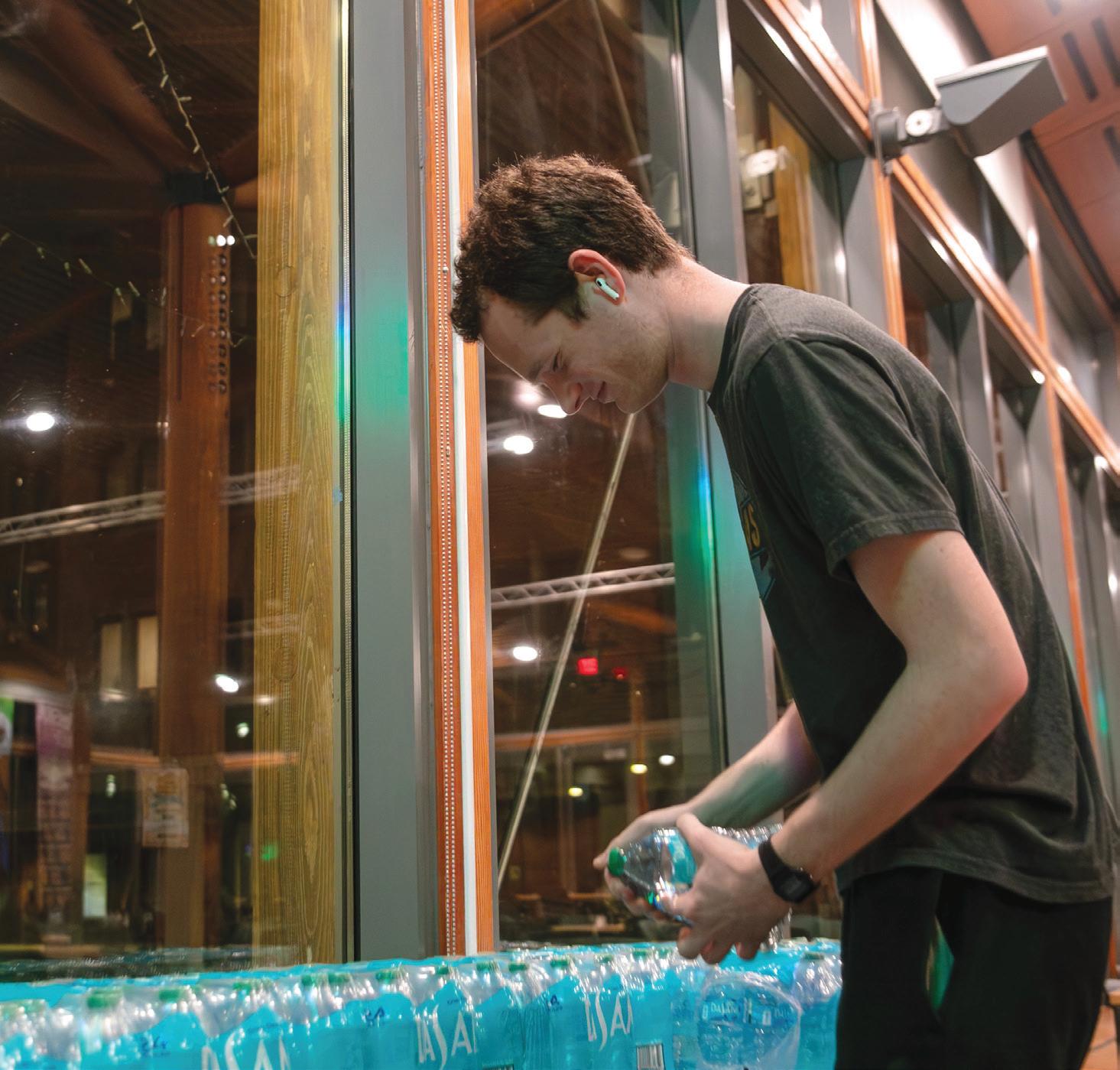
Bottled water was distributed to residential colleges shortly a er the notice went out with instructions for students to take two to four bottles, depending on their college.
Seyaul Kim, a Brown College senior, said he was worried about the timing of the notice.
“My main concern is the fact that we have nals soon,” Kim said. “I hope I don’t get E. coli for nals.
E. coli is a type of bacteria, according to the Center for Disease Control. While many forms of E. coli are harmless and naturally occur in people, certain forms of the bacteria can make people sick.
In milder cases, it can lead to diarrhea, urinary tract infections, pneumonia, sepsis and other illnesses.
Certain types of E. coli can lead to more serious complications, which can cause kidney failure, permanent health problems and death.
When E. coli enters water sources, it is o en from animal or human fecal matter, according to the Environmental Protection Agency.
“E. coli can enter a water system through infrastructure issues, stormwater intrusion or equipment failure, or it can occur through sampling contamination,”
Elmer Whitehead, assistant vice president of facilities, engineering and operations, wrote in an email to the Thresher. “It is used as an indicator that other organisms could be present, which is why issuing a boil water notice is the standard safety protocol.”
According to Whitehead, there have been no reported cases of E. coli at Rice connected to the water contamination.
On Tuesday at 4:48 p.m., Rice Emergency Management released an update that additional testing was being conducted around campus.
With help from H-E-B, more water will be distributed around campus Wednesday, according to the email.
SEE E.COLI PAGE 2
Two students robbed at gunpoint in parking lot
Two Rice students were robbed at gunpoint by three unidentified suspects, according to a campuswide emergency notification that went out at 9:37 p.m. Sunday.
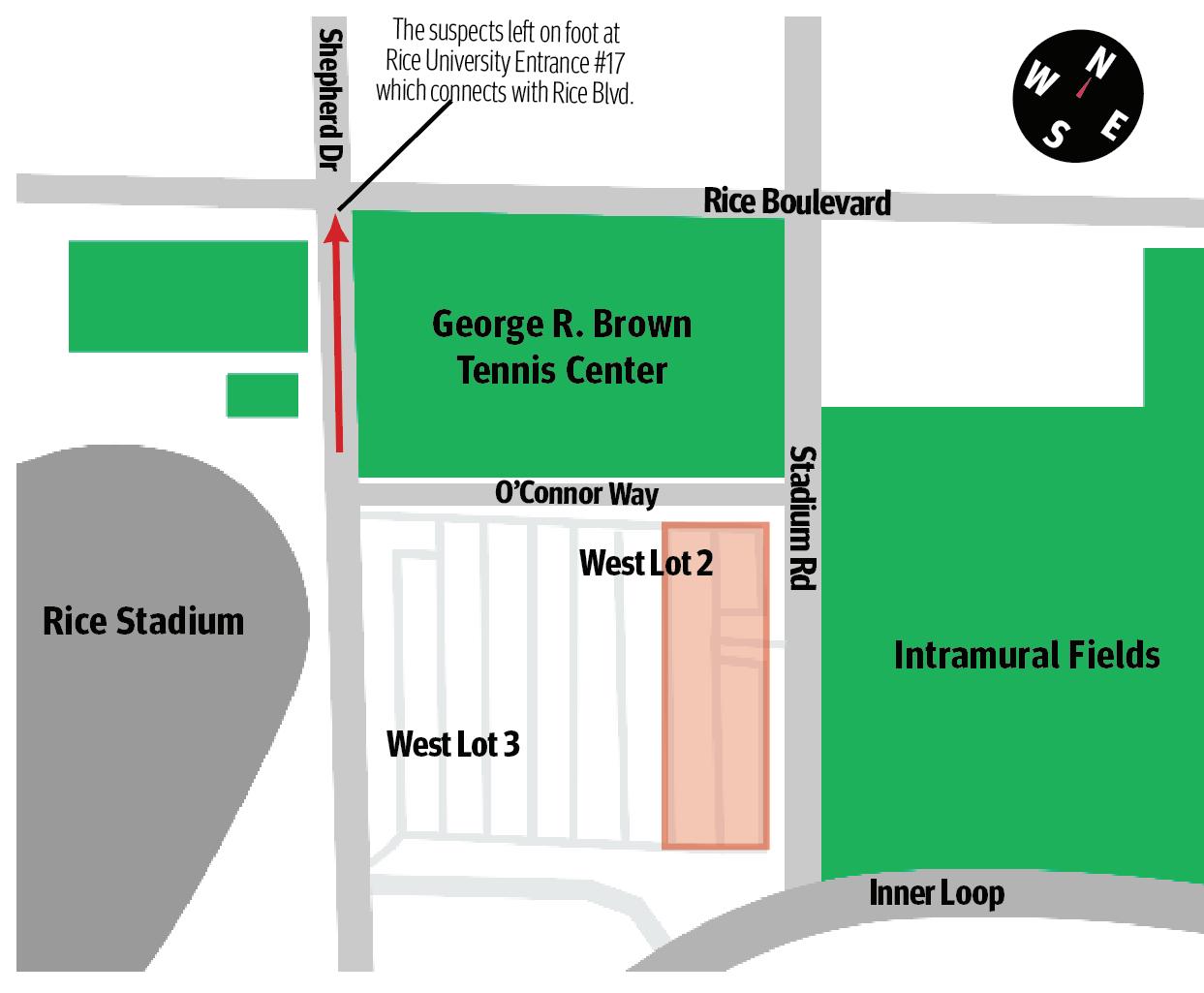
The Rice University Police Department responded to a call at 8:19 p.m. that night about the robbery in West Lot 2, between Rice Stadium and the intramural elds.
The students were not injured in the robbery.
“The three suspects ran o on foot towards the area of Rice Blvd and Rice University Entrance #17 and have not been apprehended,” the email read. “All three suspects were described as males in their 20’s with slim athletic builds. One suspect was wearing a gray beanie, with a green top and gray pajama pants.”
Chief of Police Clemente Rodriguez said RUPD is actively investigating the robbery.
“The safety of our campus community is our top priority,” Rodriguez wrote in an email to the Thresher. “In addition to utilizing all our resources to conduct this investigation, we have also noti ed our law enforcement partners in the area in case they encounter any individuals matching the description of our suspects.”
intensity of the robbery.
“When it said a robbery, at rst I thought it meant, oh, someone
or something, and then, ‘at gunpoint.’ It took a second to process that,” Serdar said. “That’s not something I considered being a possibility.”
Baker College freshman Estevan Ortegon said the incident made him concerned about campus safety.
“I didn’t expect that to happen on campus. The same day the robbery happened, that was the rst day I’ve ever brought my car to campus, and I parked it literally at the edge,” Ortegon said. “I was thinking, oh, should I have moved it somewhere else? So I got a little bit more concerned about the safety of it.”
Martel sophomore Anika Gupta said she had just returned from Thanksgiving break and was intending to walk to Rice Village for food when she received the noti cation.
“I was so hungry because I had just gotten home from the airport, and I open my phone and there’s a robbery,” Gupta said. “I no longer want to walk to West Lot alone.”
RUPD is reviewing all current video camera footage from the area, according to the noti cation.
“RUPD advises the community to be alert, especially at night and to avoid walking alone in isolated areas and to always report suspicious activity to RUPD,” the notification reads.
Students expressed shock about the crime on campus. Baker College freshman Ersel Serdar said he was surprised at the
stole a bike
ABIGAIL CHIU SENIOR WRITER
JESSICA XU / THRESHER
BRANDON NGUYEN / THRESHER
Max Phillips grabs a bottle of water in Duncan College Commons. Students were provided with bottled water after E. coli was found in the water at Lovett Hall.
Restricted seating at Brochstein raises concerns during nals
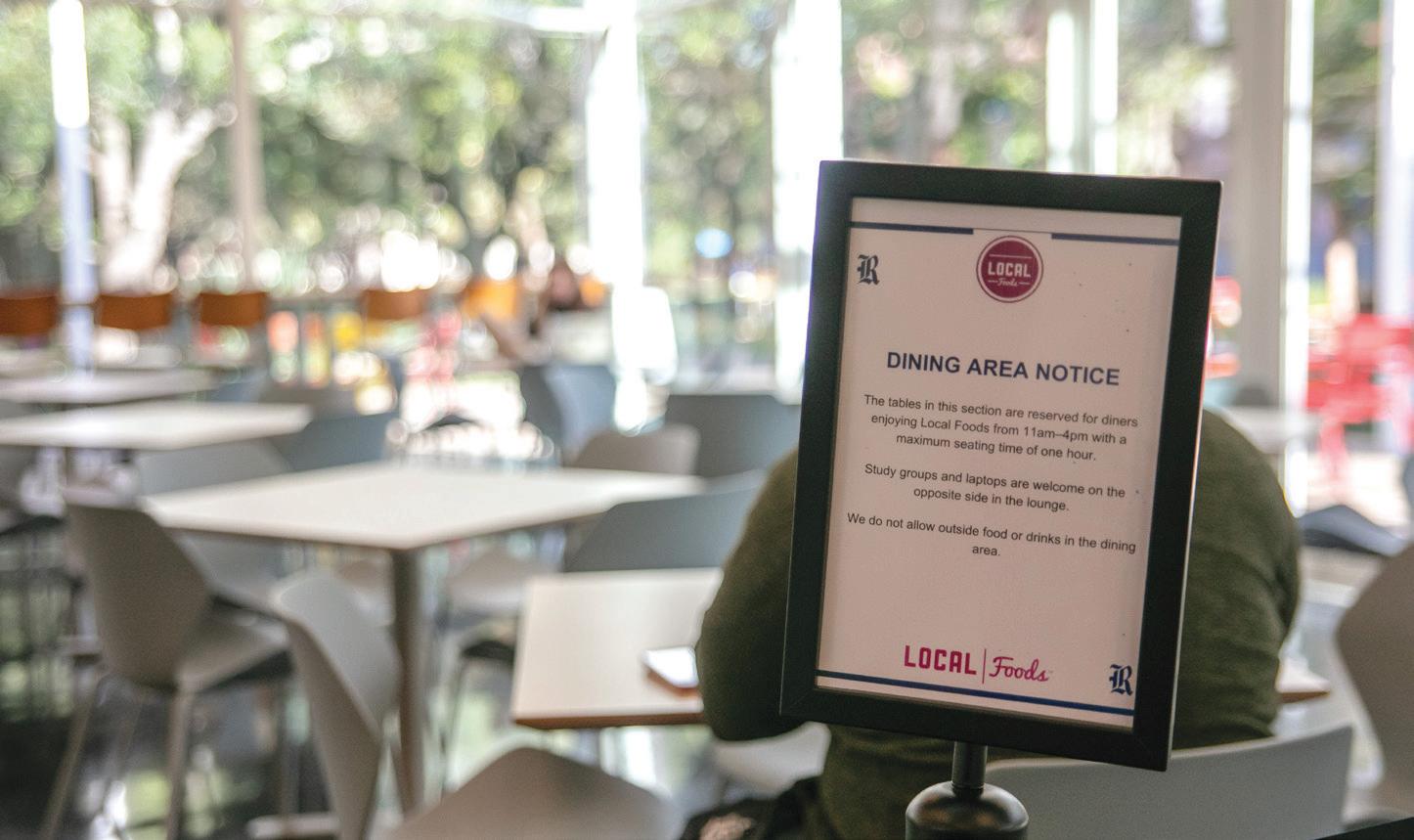
Local Foods has implemented a restricted seating policy on the table areas inside Brochstein Pavilion: Black retractable belt barriers now section o half of the space for paying customers. The new policy began on Nov. 25 and reserves 17 tables and four window counter seats for customers from 11 a.m. to 4 p.m. with a one-hour seating limit. Outside food and drinks are prohibited in the dining areas, according to the posted notice.
On the other side of the wall, the section with booths is still open to the public, in addition to the outdoor seating surrounding the Brochstein Pavilion.
Susana Cabrera, assistant dining director of retail and catering, said seating in the Brochstein Pavilion becomes limited during the lunch rush. As a result, Local Foods has reserved certain areas to ensure that guests who have purchased food can nd a place to sit while still maintaining space for those who need to study.
Amelia Pillar, who said she studies at the Brochstein Pavilion nearly every day, found being asked to leave the tables frustrating.
“I think they’re trying to make it more like a restaurant vibe, which clashes with the way that people have been using the space in the past, for just studying or meeting to work on group projects,” said Pillar, a Sid Richardson College senior. “I feel it is the space for students to go.”
Pillar said the policy disrupts a key campus routine for students who rely on the Brochstein Pavilion as a social study hub.
FROM FRONT PAGE E. COLI
Kyle Sanderfer, a Duncan College senior, said he was surprised that Rice’s water supply could possibly be contaminated with E. coli. About 75% of Rice’s water comes from an independent underground well. Most buildings west of Alumni Drive are supplied by Houston city water, which was not found to be contaminated.
“I was actually very surprised, because I thought that Rice’s water was in a well, or some kind of separate reservoir,” Sanderfer said. “I kind of assumed that it would have never happened that there would be some kind of contamination in it.”
The bacteria were not found in the underground well that supplies water to most of the campus, suggesting that the bacteria are limited to Lovett Hall, Whitehead said. However, a er viewing the results, the Texas Commission on Environmental Quality told Rice that a boil water notice had to be issued for the entire water supply.
My main concern is the fact that we have finals soon. I hope I don’t get E. coli for finals.
Seyaul Kim BROWN COLLEGE SENIOR
“We tested the well twice, along with upstream locations of Lovett Hall, and all results were negative,” Whitehead wrote. “That strongly suggests the issue is isolated to an exterior location at Lovett
“I study with a lot of my friends at Brochstein, and that’s a spot that I know a lot of people like to go to,” Pillar said. “It de nitely will shi where people are going to study for nals. O en we’ll get co ee, but you don’t necessarily want to spend money to go study somewhere.”
Dylan Murray, chef-partner of Local Foods, wrote in an email to the Thresher that the restriction aims to address recurring issues in the dining space.
Local Foods sta noted that tables are o en occupied for hours by students who purchase little or no food, sometimes bringing in outside meals.
Some faculty have held informal classes and even brought catering without permission, which Murray wrote hurts consumers’ experience and Local Foods’ ability to operate in a nancially sustainable way.
Members of the Student Association dra ed Senate Resolution No. 8 on Nov. 18, urging Local Foods to end the restricted seating policy and asking the Rice administration to rea rm the Brochstein Pavilion as a student-serving space.
The resolution passed unanimously at the Dec. 1 Senate meeting.
Brown College Senator said many students have voiced concern about the new policy.
“I know at least 20 people who have expressed dissatisfaction to me personally,” said Menchaca, a sophomore.
In January, Local Foods will receive more chairs and tables that will not be in the reserved section, Murray said in his email. This will decrease Local Foods’ reserved section to under 40% of indoor
Local
seating and less than 30% when including the 100-plus seats outside.
Murray said as long as there is enough seating for Local Foods’ dining customers, students are welcome to use the seating for as long as they like.
“One reality of doing business on a college campus is that we are an obvious place for students to want to come in and study. We welcome this, and we think it helps make our restaurant a more fun and lively environment,” Murray wrote. “That being said, as a business, we must have some guardrails that allow us to thrive and stay open to serve this community.”
Menchaca said the policy suggests the
Brochstein Pavilion is shi ing away from being a shared campus resource.
“Local Foods is in the Brochstein Pavilion,” Menchaca said. “It’s not a restaurant. It’s not something that we should have to pay for to use. We already paid tuition. The fact that they’re trying to kind of restrict our access to this isn’t fair.”
Pillar said the change has made the Brochstein Pavilion feel less welcoming as a study space.
“I’ll de nitely switch to other places to study, because it seems less like an accessible space,” Pillar said. “The booths and the outside tables usually get lled up pretty quickly.”
At residential colleges, water bottles
distributed
Hall. To ensure accuracy, we have engaged a second independent testing company to conduct additional sampling today at eight locations across campus.”
Rice does not yet have an estimate on when the boil water notice will be li ed.
“The notice can be li ed once we receive two consecutive rounds of negative test results. Testing is already underway,” Whitehead wrote. “As part of our investigation, we have already replaced nine vacuum breakers around Lovett Hall and are evaluating other equipment,
a boil
including back ow preventers. We are working to have this issue resolved as soon as possible.”
Johnny Curet, director of campus dining, said that following the release of the notice, Housing and Dining immediately stopped using tap water.
“Upon receiving the notice, Dining halted the use of tap water for any food preparation, washing, or service-related activities,” Curet wrote in an email to the Thresher. “Sta switched exclusively to bottled or pre-boiled water for cooking,
handwashing, and any processes requiring potable water. In some areas, we also moved to single-use service items until water safety could be veri ed.”
In addition, Curet said any food that may have come in contact with unboiled water was immediately discarded.
This is the second time this semester that Rice has issued a water notice, following elevated lead levels found in two buildings.
Hongtao Hu contributed reporting to this article.
RUBY GAO THRESHER STAFF
KONSTANTIN SAVVON / THRESHER
Foods, located in Brochstein Pavilion, recently implemented a restricted seating policy reserving some tables only for paying customers. Students have raised concerns about study spaces and accessibility.
KONSTANTIN SAVVON / THRESHER
were
after
water notice due to E. coli being found in Lovett Hall.
Former Houston mayor urges students to engage politically at Q&A
HOPE YANG ASST. NEWS EDITOR
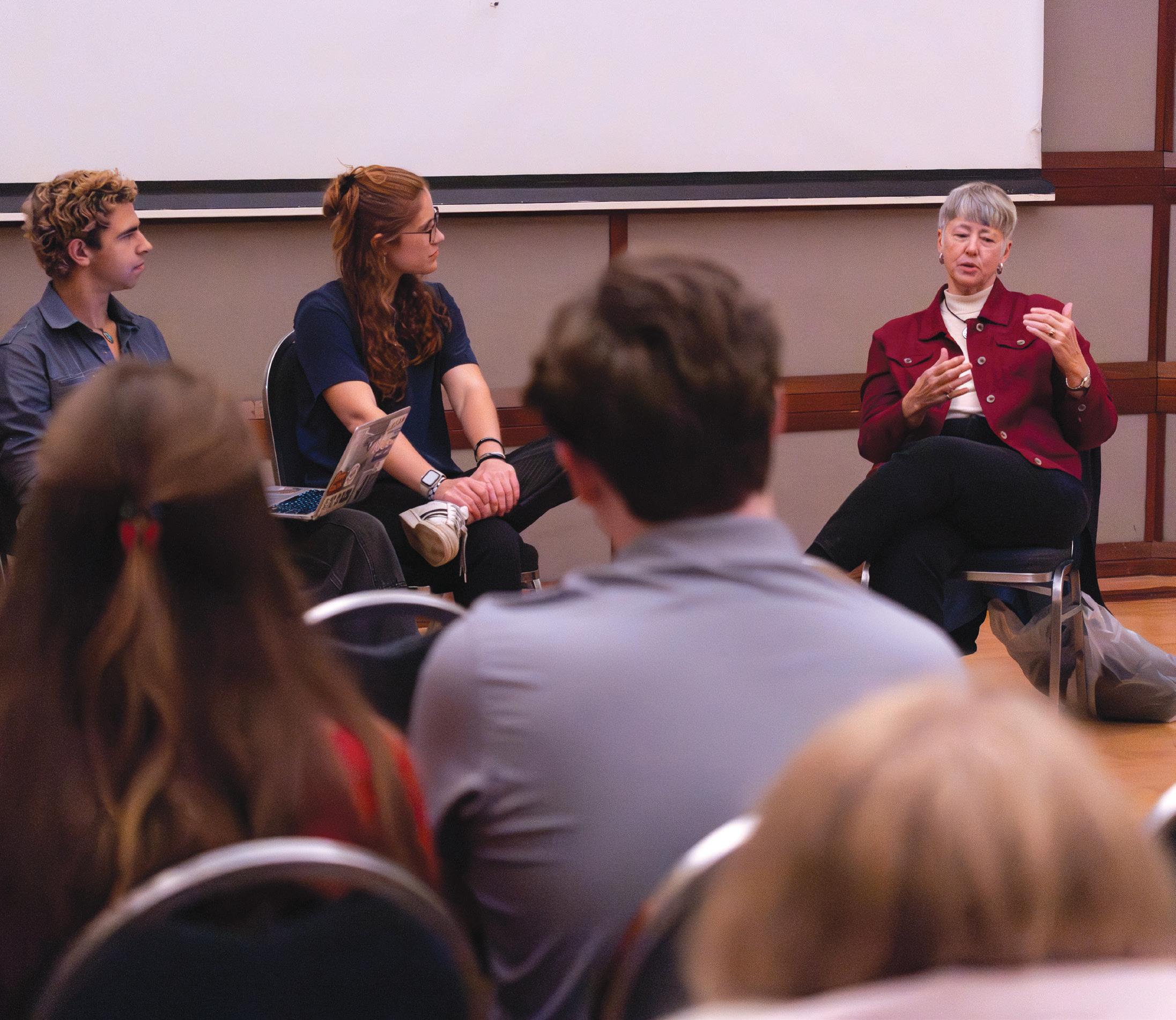
All eyes were on Former Houston Mayor Annise Parker ’78 Monday night as 24 students settled into Farnsworth Pavilion. Refusing the mic, she took a seat and waved students in the back forward.
In an hour long Q&A organized by Rice Young Democrats, Parker talked about topics ranging from climate change and immigration to her own political career and nonprofit work.
Parker has served as a Houston City Council Member, Houston City Controller and Houston Mayor from 2010-2016. She is running for Harris County Judge next spring, an administrative position overseeing four county commissioners.
A Rice alumna and co-founder of Rice PRIDE in 1979, Parker’s 2009 election marked her as one of the first openly gay mayors of a major U.S. city. She attributed her victory to Houston’s preference for action over identity.
“I think it’s partly because there’s a little bit of that frontier mentality where people don’t care who you are if you can do the job,” Parker said.
To Parker, every decision a person makes is political in nature, and she encouraged students to get involved.
“I hear all the time folks who — they’re not inspired by candidates and they’re turned off by politics. They don’t think one person can make a difference,” Parker said. “If there’s anything I experience in my life, it’s the power of just showing up.”
In an interview with the Thresher, Parker emphasized the importance of students taking action on issues they are passionate about.
“Part of life belongs to people who show up, get involved,” Parker said. “It is absolutely possible for one person to make a big difference and ultimately change the world.”
Parker said given the women’s suffrage and Civil Rights movements, it can feel frustrating when people don’t want to vote.
“That said, I focus on people who will show up,” Parker said. “If you don’t like the way the country’s going, if you don’t like the things that are happening, if you’re horrified at what [the U.S. Immigration and Customs Enforcement] is doing, or if you’re horrified at the degradation of our planet, the only option you have is to get involved and do your part and make it better. Because if you just sit on the couch, nothing will change.”
RYD co-president Sammi Frey said that Parker had an “incredible perspective” to share with students.
“She has spent her life doing things for the city of Houston,” said Frey, a Hanszen College junior. “I think we
need politicians who are willing to care and willing to act for people they’re representing.”
Part of life belongs to people who show up, get involved. It is absolutely possible for one person to make a big difference and ultimately change the world.
Annise Parker FORMER MAYOR
OF HOUSTON
Frey stressed the importance of civic engagement in Houston.
“Annise Parker was elected mayor by eight percent of Houston,” Frey said. “16 percent of Houston showed up to vote and eight percent voted for her, therefore, she
became mayor. We need to make sure that as many Houstonians and as many people and students are voting as possible, and getting to know the politicians is an incredible way to do that.”
For the rst 15 minutes of the conversation, Parker touched on the 20 years she spent working in the oil and gas industry — and then with her work in C40 and Climate Mayors.
“I helped create this problem before we realized what the problem was, and now I’m going to do what I can do to unwind some of that if I can,” Parker said.
For Parker, using economic arguments to connect with her audience is key. Her policies have led to Houston replacing about 80% of its 165,000 street lights with LEDs, an initiative that cuts street lights’ energy use by half and greenhouse gas emissions by 5%.
“You can expend our energy trying to change the system or you can spend your energy trying to master the system you have. I did a little bit of both,”
Parker said.
José Negroni Cicerchia, a lecturer from the department of modern and classical languages, literatures and cultures, said the talk had “enormous resonance” for him and his former students that attended the event.
“We certainly considered former mayor Parker an important voice as someone who has made a difference,” Negroni Cicerchia wrote in an email to the Thresher. “Ms. Parker’s comments on how to resist through exercising rst amendment rights were very heartwarming and encouraging.”
Saran Tugsjargal, a youth policymaker who spoke with Parker at the event, said the conversation challenged her thinking on current systems, but also energized her.
“It gave me momentum to keep doing what I do,” said Tugsjargal, a Sid Richardson College freshman. “I think Annise Parker made me ask that question, the question I ask a lot at tables. At big tables I ask: ‘Who asked for this?’”
Record donation prompts Baker Institute to rename U.S. and Mexico center
JAMES CANCELARICH NEWS EDITOR
The Baker Institute for Public Policy received a $7.5 million gi from businessman Claudio X. González, renaming the research hub on U.S. and Mexican relations in his name. The gi is the single largest individual contribution in the Baker Institute’s history.
González is the president of KimberlyClark de México, a leg of the multinational manufacturer and marketer of products including disposable diapers, feminine care products, napkins, hand towels and bathroom tissue, according to a company website. From 1973 to 2007, he was chairman of the board and C.E.O. The center focuses on the economic and business analysis of relations between the two countries.
“The relationship between Mexico and the United States is one of the most consequential in the world,” González said in a news release. “It is my sincere hope that this contribution will strengthen understanding, advance cooperation and promote prosperity on both sides of the border. It is a privilege to support the excellent work of Rice University and the Baker Institute in advancing this vital mission.”
Recently, the Baker Institute released its annual Mexico Country Outlook report, nding that Mexico’s democratic backsliding and increasingly uncertain international relations would reduce economic growth and increase social problems. The report is aimed at policymakers, business leaders and the public, with the aim of creating more informed decision-making.
The relationship between Mexico and the United States is one of the most consequential in the world. It is my sincere hope that this contribution will strengthen understanding, advance cooperation and promote prosperity on both sides of the border.
Claudio X.
González
BAKER
INSTUTUTE DONOR
The report also analyzed the Trump administration’s policies toward Mexico,
including heightened tari s, increased immigration enforcement and a crackdown on drug cartels.
“This extraordinary commitment by Claudio X. González underscores the Baker Institute’s role as a trusted forum for evidence-based dialogue,” said David M. Satter eld, director of the Baker Institute, in a news release. “This support allows us to expand our reach, deepen our impact and continue to serve as a bridge between academia, policy and the public.”
Rice President Reggie DesRoches said in a press release that the gi aligns with the university’s Momentous initiative to establish a global presence.
“This historic investment strengthens Rice and the Baker Institute in our shared commitment to studying, understanding and addressing the world’s most complex challenges,” DesRoches said.
DORIAN ECHASSERIAU / THRESHER
Former mayor of Houston Annise Parker talks with AJ Jacobs and Sammi Frey of the Rice Young Democrats about political engagement. In the dicussion, Parker, a Rice alumnus, answered student questions ranging from climate change to immigration policy.
Shepherd School to launch only U.S. undergraduate conducting major
ABIGAIL CHIU SENIOR WRITER
The Shepherd School of Music will o er a bachelor’s degree in music with a major in orchestral conducting beginning fall 2026. While other schools o er concentrations in conducting, o en under performance or music, Rice now stands apart as the only program in the country to o er the major to undergraduates.
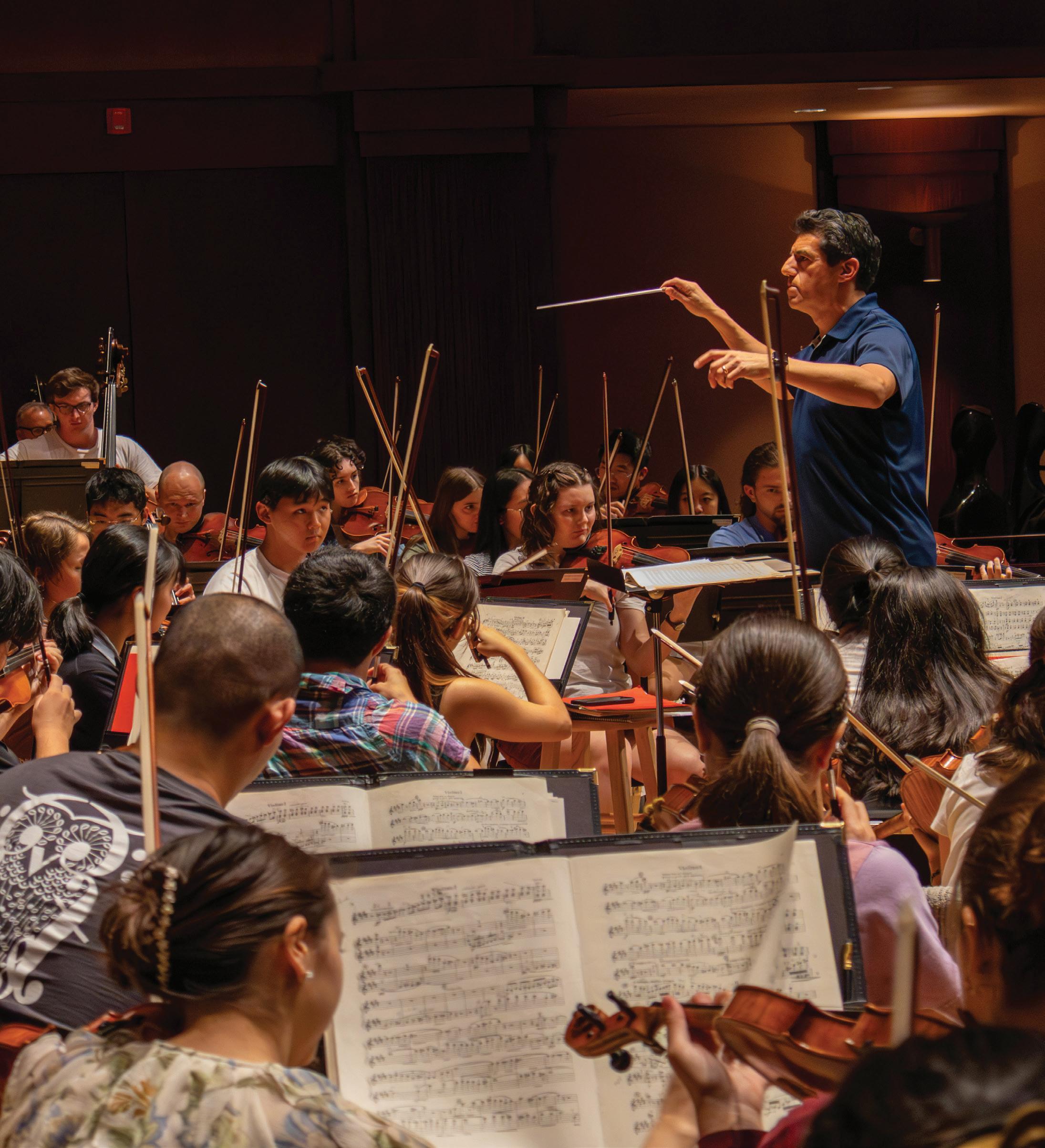
Only one or two students will be selected from the incoming application pool to study under Miguel HarthBedoya, distinguished resident director of orchestras and professor of conducting, who came to the Shepherd School in 2024.
It’s one thing to be able to teach how to move in front of an orchestra. You really can’t teach your own personal connection with the music.
Kyle Haake MASTER’S STUDENT IN CONDUCTING
The few students selected will receive individual tutelage from HarthBedoya himself, as well as from the two current master’s students in orchestral conducting, Kyle Haake and Ana Spasovka.
“It’s usually a very small program, just because it’s extremely hands-on. We can’t just practice conducting, like someone can practice the violin or something. It’s a lot of very philosophical study and study of the music,” Haake said. “Our learning is silent, and we don’t know how much we’ve learned or how well we’ve prepared until we’ve stepped in front of an orchestra.”
American music institutions such as the Juilliard School or the Curtis Institute of Music used to o er majors in conducting. These disappeared throughout the early and mid-2000s, said Haake, due to a shi ing belief that the study of conducting required students to rst attain mastery of an instrument.
When Harth-Bedoya came to Rice, bringing back undergraduate training in conducting was part of his vision for the Shepherd School.
“While the rest of the world continued doing this — particularly in Europe — somehow, in the U.S., we dropped the training at the foundational stages,” Harth-Bedoya said. “The undergraduate conducting is like pre-med before you go to med school.”
Haake, who majored in music education and piano performance at Indiana University Bloomington’s Jacobs School of Music, said this undergraduate program will offer students an additional four years of serious observation and study.
“I wouldn’t say that Americans are behind, but we just have less exposure to this art form, to this cra , before we go o
into the professional eld,” Haake said.
“I think we’re going to see a generation of young conductors from this institution be catapulted into the professional world.”
Harth-Bedoya said he has already received email inquiries from prospective students from all across the world — including South Korea and Hong Kong — expressing interest in pursuing the major at the Shepherd School.
Musicality and expression, sensitivity to sound and having a strong basis in music theory are key qualities for those admitted to the program, Haake said.
“Being an instrumentalist, a pianist or a violinist, you really only have to study one or two lines of music. Being a conductor, you have to study 10 or 20 lines of music and be able to t their pieces together,” Haake said. “It’s one thing to be
able to teach how to move in front of an orchestra. You really can’t teach your own personal connection with the music.”
While the rest of the world continued doing this — particularly in Europe — somehow, in the U.S., we dropped the training at the foundational stages.
Miguel Harth-Bedoya CONDUCTOR AT THE SHEPHERD SCHOOL OF MUSIC
the other master’s student
in the program, said she was thrilled when she heard about the major. To her, the undergraduate major expands the learning a student would gain from a graduate degree.
“I have always believed that becoming a great conductor — and a complete musician — requires far more than just two years of graduate study,” Spasovka wrote in an email to the Thresher.
Beyond the basic training, HarthBedoya said he’s looking for students who will have the passion to carry their careers.
“I’m not looking for knowledge, particularly in the beginners, because they’re here to learn,” Harth-Bedoya said. “I’m training people that will go to the top right way. But this profession doesn’t go one step at a time. You jump once you have that background.”
This week, at the final Senate meeting of the year, the Student Association released results for the Fall 2025 Survey of All Students.
The overall student survey response rate was 94.2%, up 0.1% from the previous SAS.
Earlier this year, Senate discussed changing their name, as their current abbreviation is often used in online discourse to refer to sexual assault.
In the survey, the most supported name was RSA, with 45%, while 34% of respondents voted to keep the name the same.
Following Rice’s 70-spot decline on Foundation for Individual Rights and Expression’s 2026 College Free Speech Rankings, the Fall 2025 SAS sought to gain more information on how comfortable students felt about free speech.
Across four principle-based items — allowing offensive views, hearing controversial ideas, administrative neutrality and engaging with people you disagree with — the data indicates broad support for open discussion and institutional neutrality, with all questions having a median response between 6 and 7 on a 1-10 scale where
one is the worst and 10 is the best.
However, Rice students were much more hesitant to voice controversial opinions themselves. When presented with the statement “I personally feel comfortable voicing unpopular opinions in class or on campus”, the median response was a 5, with the mean below 5 and the data generally right-skewed.
When asked what the barriers to expressing their views at Rice were, around 50% of students said fear of social pressure or backlash from peers was the primary factor. In contrast, only 13% of students said fear of administrative consequences was the primary factor.
The survey also revealed students were generally dissatisfied with the value for the cost of the meal plan.
This data follows recent changes to the meal plans, as the price of the required on-campus meal plan was increased by $150 and changed from 375 meal swipes to unlimited meal swipes. This change also only gave ten guest meal swipes per semester, when previously students could donate meal swipes to fellow students through the SA’s meal swipe donation program.
Around 75% of students responded between 1 and 3 when asked how satisfied they were with the value of the meal plan.
Spasovska,
ISAAC URE / THRESHER
Miguel Harth-Bedoya conducts an orchestra rehearsal. The Shepherd School of Music will soon o er a bachelor’s degree in music with a major in orchestral conducting, which Harth-Bedoya will lead.
Magisters host Thanksgiving celebrations for students staying over the break
Leading up to Thanksgiving break, Baker College freshman Sebastian Liu thought he’d need nearly a dozen packs of instant ramen to make it through. He said he chose not to fly back home to Pennsylvania for financial reasons; it was not feasible to buy plane tickets for only a few days. However, he ended up not eating a single ramen packet.
“I thought it would be hard with everyone gone, but it’s actually been pretty good,” Liu said. “Since it was just the people left on campus, I got to talk to people I hadn’t really talked to before and learn more about them.”
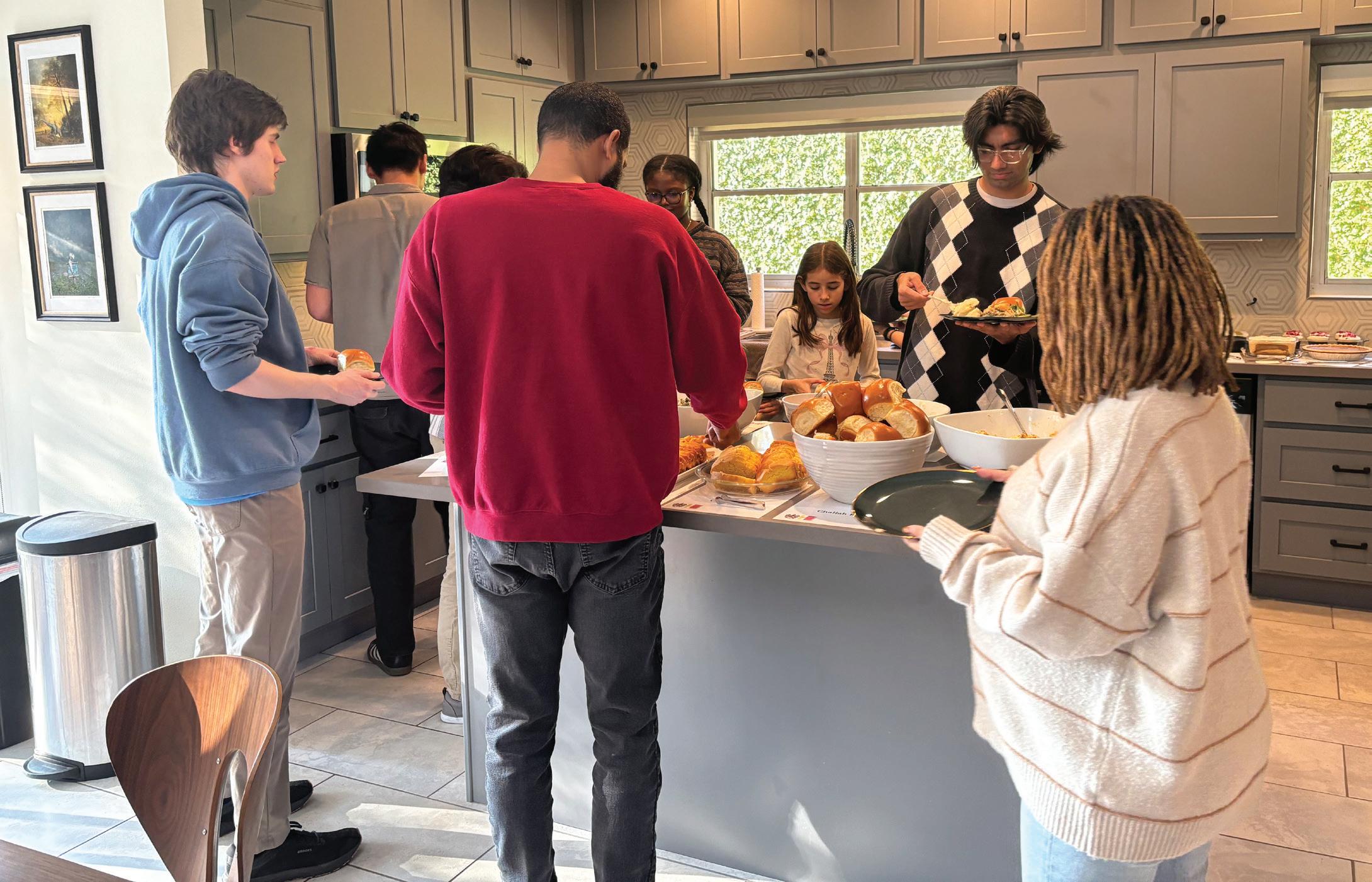
While many take Thanksgiving as an opportunity to visit home and spend time with family, Baker College magisters Cassy Romano and Leonardo DueñasOsorio continued their three-year long tradition of hosting a Thanksgiving dinner for those who stay at Rice.
Dueñas Osorio, a professor in civil and environmental engineering, said the event started simply because they were in town and recognized that many students would not have access to meals.
“We have a cohort of international students, and they really don’t have close friends or anywhere to go,” Dueñas Osorio said. “Some students stay for all kinds of reasons, but some just have to. Altogether, it’s a population it would be nice to get to know better, for us to get to them, through food.”
Romano said the dinner helps her connect with students who do not typically attend regular college events.
“I get to have conversations I haven’t had with other students before,” Romano said. “It’s a good way to reach more people, sometimes people who are more quiet, and they all come out.”
At Hanszen College, magisters provided boxed Thanksgiving meals for students to pick up, followed by brunch the next morning. Hanszen freshman Austin Meng, who stayed due to the high cost of flying to his home in California for the short recess, said the campus was emptier than he anticipated.
At the Baker College magisters’ house, students gather for a Thanksgiving celebration over the break. For students who did not travel, they said the events gave them a sense of community.
“I didn’t realize how sparse the campus would be,” Meng said. “I thought more serveries and facilities might stay open. I didn’t realize how the campus
I get to have conversations I haven’t had with other students before. It’s a good way to reach more people, sometimes people who are quiet, and they all come out.
Cassy Romano BAKER COLLEGE MAGISTER
totally shut down for Thanksgiving.”
At Martel College, freshman Rocco Colditz described the holiday as somber without family. Like other students, Colditz noticed how quiet campus became as the week went on.
“I honestly expected more people to be here,” he said. “Campus is really, really dead. But it’s also nice, I get to go places I’m usually competing for. I’ve had the fifth floor, the commons, the kitchen all to myself.”
Colditz said he hopes that for next year, the residential colleges would stock up some basic foods in each kitchen before Thanksgiving day so students would have options for food when all the serveries are closed.
However, Colditz said the community
that stayed in Houston helped him pass the break.
“It felt good that I wasn’t alone,” Colditz said. “The magisters at Martel had a Thanksgiving dinner, and one of my suitemates who lives in Houston invited me over. It was sad to be away from my family, but it felt good to bond with other people too.”
Colditz said he did not know the Martel magisters very well before the dinner, but was pleasantly surprised.
“They were so welcoming and excited to see me,” Colitiz said. “It was a big round table with people from Martel. They had the Lions and Packers game on and had great food. They talked to me, and it really made me feel like part of the Martel community, part of the Rice community.”
From Austin to Washington, student researchers advocate for academia
considered food deserts.”
As research in higher education grows increasingly contentious — faced with funding cuts, threats of federal interference and numerous lawsuits — the Office of Undergraduate Research and Inquiry is preparing a cohort of students on how to influence policy at the national level.
The Scholars Transforming Through Research program is an initiative spearheaded by the Council on Undergraduate Research, a national organization of higher education professionals that aims to increase access to undergraduate research opportunities.
As a part of the STR program, teams of undergraduate students, representing over 30 universities from across the country, travel to Washington, D.C. to meet with lawmakers and convey their individual research experiences.
Sammi Frey, a 25-26 STR participant, is a social policy analysis and biosciences major interested in developing strategies to reduce food insecurity in the Houston area. As part of her social policy analysis capstone, Frey is collaborating with Second Servings of Houston, a nonpro t that redistributes healthy food to underserved communities.
“Stores o en overstock and then they aren’t able to put [food] out on the shelves and that’s a massive waste,” said Frey, a Hanszen College junior. “[Second Servings] basically collect that food and bring it to places within Houston that are
Frey’s research studies the impact of Second Servings on the Houston population. She said bringing her research to the forefront of policymaking discussions is a step forward in finding solutions to systemic issues such as food insecurity.
“Being able to explain why work like Second Servings is important to a politician who theoretically should be supporting the constituents … is a really crucial opportunity,” Frey said.
Before students make the trip to Capitol Hill in March, they attend a series of online trainings throughout the school year.
“As the students go through the trainings, they learn about ways to bring their research to di erent communities,”
OURI Director Elizabeth Eich said. “They learn about writing op-eds. They learn about writing letters directly to their representatives or Congressmen. They learn how to write short articles that might appear in non-scholarly journals that are a more accessible way to share their research.”
This academic year marks Rice’s second time participating in the STR program. Students were selected from engineering, humanities, social sciences and natural sciences, according to an email from Abby Schuh, associate director of OURI.
Prasi Desai, an STR participant this year, is a chemical and biomolecular engineering major and focuses on researching cell therapies for type 1 diabetes.
“As a researcher, a lot of the scienti c
communication that you’re doing, whether it be through a poster presentation or research talk, is always to other scientists,” said Desai, a Sid Richardson College junior. “There’s not enough of an emphasis in research on training individuals to be able to communicate their research to a broader audience.”
As researchers, a lot of the scientific communication that you’re doing, whether it be through a poster presentation or research talk, its always to other scientists. There’s not enough of an emphasis in research on training individuals to be able to communicate their reserach to a broader audience.
Prasi Desai SID RICHARDSON COLLEGE JUNIOR
Desai emphasized the current disconnect between scientists and policymakers. She said keeping lawmakers in the loop regarding current research e orts is necessary to ensure these e orts receive the support that they need.
“Researchers can make advances in
labs, but ultimately it’s policymakers who are able to help communicate those e orts to the public and be able to decide which research priorities are speci cally going to be funded,” Desai said.
Earlier this fall, Rice STR participants attended the Texas Tribune Festival held in Austin. Hosted by the Texas Tribune newspaper, the festival is a three-day gathering at which high-pro le lawmakers and journalists convene to discuss pressing sociopolitical issues within the state. Desai said the event served as an opportunity to explore the intersection between science and policy.
“I went to, for example, a discussion on the future of public transportation within the state … a big part of that is science and engineering,” Desai said. “How are we going to engineer the public transit system to ensure that it serves as many people as possible?”
Eich said many STR participants join the program with a motivation to advocate for the resources needed to implement their own research-backed initiatives in their individual communities.
While STR participants o en aim to pursue outcomes directly related to the subject matter of their research, students are also encouraged to have broader conversations about the importance of maintaining funding for undergraduate research opportunities.
“Taking my own personal anecdotes, my own stories, and then zooming out and being able to apply that in a more general sense to a ect research based policy development is the goal,” Frey said.
LINA KANG THRESHER STAFF
NANDINI DASARI THRESHER STAFF
COURTESY CASSY ROMANO
Brochstein Pavilion should remain a student space
The decision to restrict indoor seating at Brochstein Pavilion from 11 a.m. to 4 p.m. for Local Foods Market customers marks a fundamental shi in the perceived purpose of one of Rice’s few shared spaces outside of the classroom or the residential college.
While we understand the restaurant’s desire to create a financially sustainable environment for its operations, this policy sends a clear message during finals: Rice doesn’t care about student study and social spaces.
Brochstein Pavilion has long served as a flexible space where students, faculty, staff and visitors gather to work, talk and unwind. As one of the only central campus third spaces — spaces that are distinct from both home and work and are not cost prohibitive — its function is crucial to campus life.
Especially around nals, Brochstein
Pavilion becomes not just a place to grab lunch, but a hub for informal study groups, catch-ups with friends and quiet moments of decompression between project deadlines.
To now tell students they can’t sit at certain tables unless they buy a $14 salad or $6 latte from Local Foods is antithetical to what this space has represented for years. The idea that “guests who have purchased food” deserve prioritized access while those who bring outside food or buy nothing at all do not introduces a tiered system into a space shared by all.
Brochstein Pavilion is not a restaurant. It is a university building subsidized by our tuition and designed to serve the Rice community. Local Foods is just a tenant. The current policy, enforced by retractable belts and “reserved seating” signs, erodes this distinction and creates a hostile environment, especially for students navigating nancial
stress, dietary restrictions or a simple desire to exist in campus space without needing to buy something.
Brochstein Pavilion is not a restaurant. It is a university pavilion subsidized by our tuition and designed to serve the Rice community. Local Foods is just a tenant.
This policy also exacerbates a longstanding issue: Rice simply doesn’t have enough accessible cafe spaces. Since Audrey’s shuttered due to construction, students have relied more heavily on Rice Co eehouse and
Brochstein Pavilion. Chaus wait times can stretch beyond 20 minutes, and Dandelion Cafe is a trek from the South colleges and on the pricier side.
Local Foods was never a perfect replacement for Little Kitchen HTX, and its introduction to campus previously sparked controversy, given its owner’s open support for the Israeli military amid the ongoing genocide in Gaza.
If this policy continues, it may hurt business more than it helps. Students who once saw Brochstein Pavilion as a casual and welcoming hangout spot may now look elsewhere — that is, if they can nd space at all.
Rice needs more places for students to gather, not fewer. Any vendor operating in the heart of campus should understand that student space is not optional, it’s the whole point.
Ask a Rice philosopher: Is it worth su ering now for gains later?
Today’s questioner asks, “Is it worth su ering now for the bene t of gains later? Or is it OK to entertain yourself at every moment?”
You’ve likely been taught one answer to this question: You suffer through organic chemistry now to buy a Porsche later. You save for retirement and then have fun when you retire. You practice guitar until your fingers bleed so that one day you’ll win over the crowd with your smooth cover of “Hotel California.”
Is there anything to be said for the other answer?
You can’t put o all happiness. Having fun in the present is necessary for keeping up morale, nding love and not wasting opportunities. The best time to enjoy a cool autumn day is today, not the middle of next August.
Some people jokingly talk about their present selves and their future selves as di erent people. “I’m having fun tonight,”
I might say. “If future Tim is tired, that’s his tough luck.”
What about that attitude?
It’s obviously a joke, but there’s still something to it. Suppose you love playing sports, and you know that if you keep going hard you’re going to have wrecked knees by the time you’re 60. It’s normal to say something like, “That’s too bad, but I love sports too much to worry about regrets I’ll have so far in the future.”
Economists love this line of thought. They think that rational people discount their future goods relative to present goods. In the same way that it’s better to have $1,000 today than $1,000 in ve years, it can also be better to have great sporting experiences now than good knees when you’re 60: Maybe you’ll die before you turn 60, and you can get a lot of great things out of living an active sporting life right now.
If you’re going to su er now for future bene t, the future bene t has to be greater than the present su ering — a lot greater, if the future bene t is in the far future.
Things get really complicated when
you start honestly wondering whether the “you” in the future will be someone you respect — or even the same person.
Suppose you’re a young, radical nobleman. You might want to give your land to the peasants who work on it, leaving yourself with little remaining wealth.
Now, suppose you think young radicals almost always age into old conservatives who want to cling to every penny, and you believe you won’t be any di erent. If you follow your young conscience, when you’re old you’ll bitterly curse yourself. Does that a ect what you should choose now?
Philosopher Derek Par t asks us to imagine a person who just doesn’t care what happens to him on future Tuesdays. He plans ahead like anyone else, but when it comes to future Tuesdays, they don’t count. Such a person would be irrational, says Par t. We all need to care about the future just as much as about the present.
So, what is it? Eat, drink and be merry? Or struggle with Problem Set 5? I think the right answer depends on what genuinely matters to you.
Required Reading: Callender, C. 2021. “The Normative Standard for Future Discounting.” Australasian Philosophical Review 5, 227-53. Extra Credit: Par t, D. 1984. Reasons and Persons. Oxford: Clarendon.
Dr. Tim Schroeder is a professor in the department of philosophy. If you have a question about reality, knowledge, ethics, consciousness, truth, beauty or other abstract theoretical realms (or about how they apply to what your roommate just did), why not ask him about it? Email your questions to askaricephilosopher@rice.edu.
An urbanist’s guide to Houston: Why are Houston’s streets so dangerous?
JACOB JORDAN & NICOLAS COOKER THRESHER STAFF
On Nov. 19, the Washington Post reported that Westheimer Road was the most dangerous street in the nation with 19 fatalities between 2021 and 2023.
Just two days later, a truck hit and killed an elderly woman on a stretch of Westheimer in west Houston. The Washington Post report illuminates a type of violence that has largely been made invisible in Houston. It also o ers us the chance to move beyond the immediate tragedy of these incidents and analyze the infrastructural choices that caused them to happen.
The Houston Chronicle reported in 2018 that Houston’s roads and drivers were the deadliest in the nation, noting that the death toll was equivalent to “three fullyloaded 737s crashing each year at Houston’s
airports, killing all aboard.” It’s important to note that this public health crisis on Houston’s streets disproportionately affects young people, poor people and Black people.
How did we let our streets get so dangerous?
One simple answer is speed. Montrose Boulevard, a major pedestrian and vehicle corridor through the Montrose neighborhood, has an average vehicle speed of 45 miles per hour on a posted speed limit of 30 mph. The pedestrian crash mortality rate for a minivan collision at 45 mph is 32%, over three times higher than the mortality rate at 30 mph.
Speeding can and should be tackled through harsher enforcement of tra c laws, as has begun on I-45 and I-69 this year, but this is infeasible on a larger scale for smaller inner-city streets. This is why designing selfenforcing roads, which encourage driver
speeds that are consistent with posted speed limits through their physical infrastructure, is so important.
Speeding can and should be tackled through harsher enforcement of traffic laws, as has begun on I-45 and I-69 this year, but this is infeasible on a larger scale for smaller inner-city streets.
Designs such as medians, slight curves and raised crosswalks narrow the road and limit sightlines. They have been shown to improve safety by forcing
slower traffic speeds and increasing driver attention levels.
Some of these solutions have already been implemented in Houston, particularly near Rice. A few residential streets north and south of campus already have speed humps, and Mandell Street, Sunset Boulevard and Southgate Boulevard all contain large treelined medians. By slowing tra c, these designs make these areas not just safer for drivers, but more walkable as well.
With slower vehicle speeds comes greater pedestrian safety, so given that the majority of Houstonians want to live in a walkable neighborhood, implementing these designs throughout the city can help create the kinds of communities that people want to live in.
Reducing the design speed of Houston’s roads is necessary not only to combat its severe tra c fatality problem but also to help build the city into a more friendly place to live, work and play.
TIM SCHROEDER PROFESSOR OF PHILOSOPHY
JOANNA LI / THRESHER
Jacob Jordan is a Baker College junior studying civil engineering with a minor in environmental studies. Nicolas Cooker is a Martel College sophomore studying computer science with a minor in environmental studies. They believe every Rice student should be well-informed about their built environment and have the knowledge necessary to advocate for their interests in and beyond Houston.
Global chats: Discovering Thanksgiving
“Are you going home for Thanksgiving break?” I stared into people’s faces as they asked this question. I had never thought about going home for Thanksgiving. It just didn’t make sense to me.
Why would I? If I were to go, it would only add to my student travel expenses and I would stay at home stressed out by all of the work I have to do.
Besides, isn’t Thanksgiving just about eating until you feel sick and then shopping to contribute to the consumerist society?
“No,” I said, “I’m staying here.” However, as I soon discovered, my perceptions of Thanksgiving were wrong.
On Tuesday a ernoon, as I sat at my desk working on my nal architecture project, my peers went by with their suitcases, ordered Ubers together and called home to check on their families. As people kept leaving, a feeling of loneliness gradually invaded my body.
By Wednesday night, the situation in the architecture school was hectic.
I remember walking by one of the studios and seeing three bags of bread, two macaroni and cheese boxes, tons of instant noodles and peanut butter containers lined up in one
of the corners.
As it turns out, a lot of us don’t go home at all during Thanksgiving. People stay in the white hospital-like building all day to work on their models and stare at a computer screen for hours.
Trash cans would ll up quickly with cardboard food boxes, matboard pieces and wood. A line of cars would be parked outside during the night and people wouldn’t leave until the earliest hours of the morning.
My past perceptions were wrong. Thanksgiving is not about food or shopping. It is about getting together with people and saying thanks for anything you are grateful for.
On Thursday, I felt myself slowly deteriorating by the hour. My eyes were burning from the light of my laptop screen and my head was spinning from the sleepless nights. Nonetheless, I decided to
go to Thanksgiving dinner at the Duncan magisters’ house.
As I stepped into their house, the smell of baked sweet potato, turkey and hot apple pie brought me back to life. I grabbed a plate and sat at a big table with international students and other people I had not met before. We talked, we smiled, we laughed. The dinner was exquisite and at the end of it, everybody said something they were grateful for this year.
It was then that I nally understood.
Yes, people may eat a lot and go shopping during Thanksgiving, but the simple act of sitting around a table to have a meal and express what you are grateful for keeps you going, especially during dark and stressful times.
A er dinner, I went back to the studio. However, I felt more energized and determined than before. Joy and connection lled my chest, powering me to push through and nish my model.
Now I can say that I understand why people celebrate Thanksgiving. My past perceptions were wrong. Thanksgiving is not about food or shopping. It is about getting together with people and saying thanks for anything you are grateful for. It’s about human connection. And now, I would like to keep celebrating it in my years here at Rice.
Valeria Revatta is a Duncan College freshman majoring in architecture. After living all her life in Mexico City, she brings a unique voice and perspective on international students’ experiences.
EDITORIAL STAFF
* Indicates Editorial Board member
Kathleen Ortiz* Editor-in-Chief
Sarah Knowlton* Editor-in-Chief
Juliana Lightsey* Managing Editor
NEWS
James Cancelarich* Editor
Belinda Zhu Asst. Editor
Hongtao Hu Asst. Editor
Hope Yang Asst. Editor
OPINION
Jenna Perrone* Editor
FEATURES
Noa Berz* Editor
Emily Nguyen Asst. Editor
ARTS & ENTERTAINMENT
Arman Saxena* Editor
Chi Pham Asst. Editor
SPORTS Andersen Pickard* Editor
Evie Vu* Editor
BACKPAGE
Charlie Maxson Editor
Max Scholl Editor
Will Howley Editor
Rykelle Sandidge Senior Writer
COPY
Shruti Patankar Editor
Julianne Ma Editor
PHOTO, VIDEO, & WEB
Ayaan Riaz Director of Digital Media
Francesca Nemati Photo Editor
Konstantin Savvon Asst. Photo Editor
Steven Burgess Video Editor
Fiona Guo Social Media Manager
DESIGN
The hungry owl: Late night bowls aren’t that bad
ANDREW RYNSBURGER THRESHER STAFF
COLUMN Upon entering West Servery at 9 p.m. sharp, I receive a to-go box and faint anticipation. Students line the perimeter of the servery, queuing up for their late night meal of choice.
Late night dining is available for students from 9 to 11 p.m., currently stationed at West
CATHERINE ZHOU / THRESHER
Servery. It o ers a smorgasbord of to-go meals — poke bowls, chicken tenders, wa es and perhaps most popularly, Chipotle-style bowls.
The options for bowls included a variety of meats, toppings and salsas. I selected white rice and chicken for my base and lettuce, onion, black beans, pico de gallo, cilantro and guacamole for my toppings. The red chipotle salsa caught my eye, so I added it. Finally, I decorated the bowl with Sriracha sauce — more out of habit than necessity.
I mixed the ingredients with a compostable fork, folding the chipotle salsa into the rest. I smelled the salsa’s smoky, vinegary and almost woody scent, pinpointing the avor before it even met my tongue. Would I regret adding it?
Not at all. Yes, the chipotle salsa dominated with its avor, but it added muchneeded spice to the otherwise bland chicken.
While unseasoned, the chicken was shredded and tender, breaking apart cleanly. The grilled chicken (referred to colloquially as “water chicken”) served ubiquitously in Rice serveries tends to be tough and overcooked, so this was a pleasant surprise.
What I like about meat from Chipotle is the bold spicing and consistent charring. Unfortunately, this was not present in the
protein I got from late-night dining.
The bowl also needed some lime. There is a reason why it’s incorporated into nearly every Mexican dish: It brightens the palate and complements spice. Chipotle is a warm chile, so a chipotle salsa should have enough lime to balance the acidity.
If I were a night owl, I would come back for late night dining.
To add more umami, I would have liked some cotija cheese, an aged Mexican cheese that’s salty and rich. Even chile con queso would have been a great addition, as it’s a popular option from Chipotle and other TexMex restaurants.
Still, if I were a night owl, I would come back for late night dining. The ingredients are fresh and the chicken is reliably so . While the o erings are not vast, they don’t need to be. The enticement of this bowl is enough to dissuade me from spending money on DoorDash. There was nothing revelatory, but I could go back with the con dence of knowing that I’d leave satiated.
Andrew Rynsburger is a Duncan College freshman majoring in political science. Hailing from Michigan, he brings a breadth of experience from cooking, recipe creation and his passion for culinary literature. When he’s not writing, you can find him reading in Fondren Library, playing the piano or on his bike.
Jessica Xu Art & Design Director
Magnolia Hickey-Zamora News
Sydney Chang Opinion
Jose Eleuterio Features
Alexa Bu Arts & Entertainment
Kirstie Qian Sports
Brandon Nguyen Backpage
Richard Li Design Consultant
BUSINESS
Soren Freund Business Manager
Alina Zhong Advertisement
Rahul Santhanam Advertisement
ABOUT
The Rice Thresher, the official student newspaper of Rice University since 1916, is published each Wednesday during the school year, except during examination periods and holidays, by the students of Rice University.
Letters to the Editor must be received by 5 p.m. on the Friday prior to publication and must be signed, including college and year if the writer is a Rice student. The Thresher reserves the right to edit letters for content and length and to place letters on its website.
Editorial and business offices are located on the second floor of the Ley Student Center: 6100 Main St., MS-524 Houston, TX 77005-1892
Phone: (713) 348 - 4801
Email: thresher@rice.edu
Website: www.ricethresher.org
The Thresher is a member of the ACP, TIPA, CMA and CMBAM.
Yearlong theses allow students to test run research
Alejandro Lopez spent Thanksgiving break dipping wire into soap film. The McMurtry College senior wanted to show his mom what a minimal surface looks like, the same mathematical concept he’s been studying in his honors thesis on general relativity.
“I want most people in my life to be able to understand the math that I’m doing,” Lopez said. “Math can get pretty lonely otherwise.”
Lopez is writing a senior thesis, a yearlong independent research project supervised by a faculty mentor. The option exists across departments but remains underused, according to faculty and students who say they stumbled into it almost by accident.
“I reached out to him to get some advice for what grad school might look like,” Lopez said of his advisor, Christos Mantoulidis, an associate professor of mathematics. “He ran the suggestion of doing a senior thesis.”
That conversation led to an independent reading course, a summer research fellowship and now a thesis surveying cutting-edge tools in mathematical relativity.
“Alejandro is studying things that came out just a few months ago, which is something that is pretty unlikely to happen in an actual basic course in math,” Mantoulidis said.
Across campus, Lovett College senior Jahnavi Mahajan is asking a different kind of question: whether artificial intelligence poses a threat to human creativity. Her thesis, advised
by professor and department chair of philosophy Robert Howell, sits at the intersection of her two majors, computer science and philosophy.
I see myself growing, I see my philosophical muscles stretching the more I work on this project.
Jahnavi Mahajan
LOVETT COLLEGE SENIOR
“I always wanted to do one project that combines both of those backgrounds,” Mahajan said. “The senior thesis is a wonderful opportunity to do that.”
Mahajan found her way to the project through a tech ethics reading group in the philosophy department, where she met Howell. When she learned the department offered a thesis option, she emailed him to ask if he would advise her.
Unlike Lopez, Mahajan does not plan to attend graduate school immediately. But she said the research has already changed how she thinks.
“I see myself growing,” Mahajan said. “I see my philosophical muscles stretching the more I work on this project.”
Her approach, Howell said, has been to focus not on de nitions of creativity but on why humans need it in the rst place.
“Instead of focusing upon something that’s just arbitrarily set, she’s looking at what we value in human creativity and then asking whether or not that sort of thing is what we can get from artificial intelligence,” Howell said. “She’s good at seeing how creativity ties into things
like moral psychology and ethics.” Mahajan said the question feels urgent on a campus where AI use has become widespread.
“We value creativity a lot at Rice,” Mahajan said. “With the rise of AI, I think we’ve all seen our classes and our classmates sort of infiltrated with this use of AI. So there’s a genuine question: are we going to see AI as a threat to our creative faculties?”
Lopez meets regularly with Mantoulidis to discuss recent papers and refine his understanding of mathematics.
Mahajan meets weekly with Howell for hourlong conversations about creativity, ethics and AI.
“We read something, then we discuss it,” Mahajan said. “That conversation is where everything happens because philosophy is basically just all dialogue.”
She said she has not written a word of her thesis yet. The entire fall semester has been reading, research and discussion.
“What I’ve been very surprised with is that the senior thesis is more of an exploration,” Mahajan said. “What my thesis is going to look like now is actually very different from what I came in with.”
Lopez described a similar openness in math, where proving a new theorem cannot be scheduled the way a lab experiment might.
“You certainly can’t anticipate, ‘I will have this theorem proven by this date,’” Lopez said. “It’s a bit more exploratory, a little jazzy. You play it by ear.”
Faculty members said that independence is part of the point. Mantoulidis, who completed an undergraduate thesis himself before eventually pursuing a Ph.D., said the
experience helped him even when grad school was not in his immediate plans.
“I did it purely for the fulfillment reason,” Mantoulidis said. “I did eventually go to grad school, and having done the thesis really helped with my chances of having gotten into good programs.”
Howell said he hopes more students learn that the option exists.
“I don’t think we’ve done the best job of letting majors know that this is an option for them,” Howell said. “There’s definitely people who would benefit from it that don’t avail themselves of it.”
You certainly can’t anticipate, ‘I will have this theorem proven by this date.’ It’s a bit more exploratory, a little jazzy.
Alejandro Lopez
MCMURTRY COLLEGE SENIOR
He added that thesis work benefits Rice, not just the students involved.
“Whenever you have students working at a high level with professors, whether or not they go into that discipline, it helps them see what the value of that discipline is,” Howell said. “The whole campus is enriched as a result.”
For Lopez, the thesis has changed how he sees himself.
“When I came into Rice, I didn’t see myself as capable of ever doing math research,” Lopez said. “A few projects in and doing a senior thesis now, it’s like, yeah, I think it’s difficult. But I can do it.”
CHARLIE CRUZ THRESHER STAFF
ASHLEY ZHANG / THRESHER
subatomic particle
Final Fantasy and Kingdom Hearts
publisher Square ____
Desert state, abbr.
Japan, in Japan
Unconditionally support, colloquially
What one might peruse at a restaurant
Female sheep
Mario’s preferred vehicle
Volleyball statistics for good liberos
Influential punk out t ___ Pistols
In addition
Freshmen bring weekly dating advice table to quad
was a good feeling. Some people drop by seriously and other people drop by to joke around, and we like to welcome both sides.”
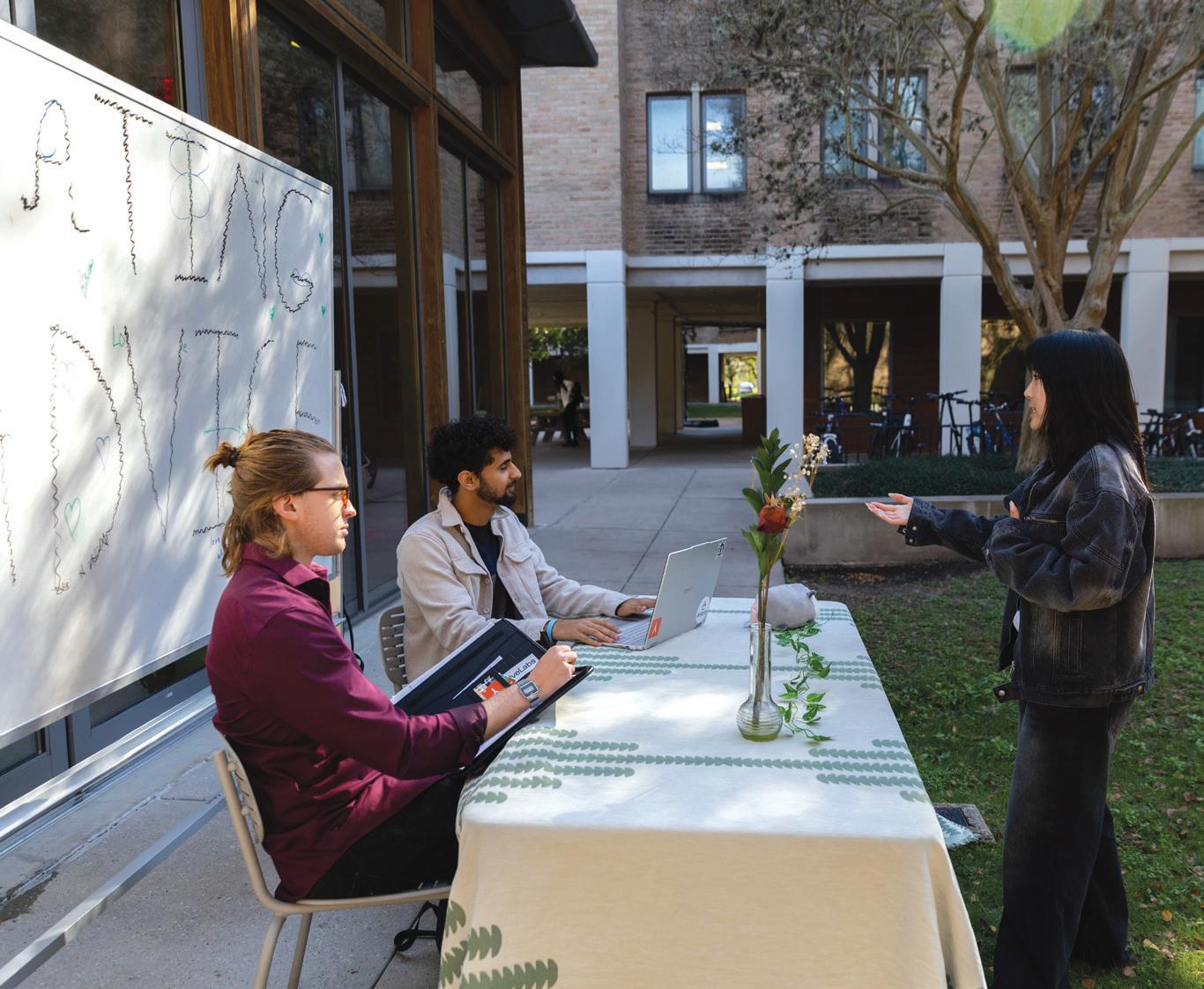
Students passing through the Academic Quad smile, laugh and take pictures of students sitting at a foldable table. Behind the students, a whiteboard reads “Dating Advice” in large black letters.
The setup can be found in the heart of the quad on Thursdays: a dating advice table, free and open to all.
When McMurtry College freshman Adam Towner thought about how many complaints he heard each day about the Rice dating scene, he decided to make a di erence. He pitched the idea for a free dating advice table to Antony Saleh, also a McMurtry freshman. The rst day they set up the table was Oct. 30.
“I just thought to myself and I was like, YOLO,” Saleh said. “We met up the next day and we brought the table, carried it over to the middle of campus, and we kind of just started.”
While Towner acknowledged that the table can seem like a gimmick to passersby, he doesn’t see it that way.
“I think the end goal is to give everyone a chance at Rice the opportunity to nd someone,” Towner said.
Saleh said the dating advice table has become increasingly popular over the past four weeks, in part due to a Fizz post that received around 1,000 upvotes. Towner estimated around 40 to 50 people visit the table each Thursday from 11:30 a.m. to 1 p.m., and he hopes to help students approach dating di erently.
“The average day is a pattern,” Towner said. “I think it’s about breaking that pattern. So I see us as more like artists and provocateurs. I think we make people think about dating in a new way.”
Saleh said the dating table provokes genuine smiles and laughter. Even if people are laughing out of shock or skepticism, he said it still brings him a positive feeling.
“For me, it became nice to see people just walk by and smile,” Saleh said. “It
Towner said one of the most common questions asked at the table is what the group’s qualifications are to give dating advice.
“I’ve been in a very good relationship, and I’ve seen what it takes to build that,” Towner said. “Realizing how good a working, loving relationship can be really does qualify you, because you realize how special it is and you want to help people nd that.”
Lovett College freshman Kate Klapach said she was pleasantly surprised by her experience.
“I didn’t really expect them to give me serious advice,” Klapach said. “But we ended up having a good conversation and I do feel like I got something out of it.”
Although he thinks a month is too soon to see long-lasting relationships form from the table, Towner said the table is a success because it got people to step outside of their comfort zone.
“For those people who commit to it, I think it can be a rewarding experience,” Towner said. “And in some cases, they come back like, ‘I’m about to go on a date tonight.’ The biggest successes we’ve had are just people who weren’t doing anything and who are now putting themselves out there.”
Towner said his optimism towards the future of dating at Rice extends to the advice he gives.
“If you have the opportunity to nd or have love, go for it,” Towner said. “Be willing to be wrong a lot. Go for it. ”
Saul Brauns, a Hanszen College freshman who recently joined the group that mans the dating table, said he has done a lot of research on the modern dating scene as part of his process to create a dating app aimed at revolutionizing the dating scene for young professionals.
In his rst few days giving advice,
Brauns said he has noticed common themes between people on the Rice campus.
“I o en nd myself telling people that what’s stopping you is fear,” Brauns said. “That’s the most common thing. Like, ‘What would you do if you weren’t scared?’ comes up a lot.”
Towner said he is excited to see how the project can be scaled up to reach a bigger part of the Rice population. He said he hopes to eventually move the table outside Brochstein Pavilion and see the creation of competing advice tables.
“As far as scale, I don’t think there’s an upper bound of where I’d be satis ed,” Towner said. “If this means taking more people on, creating content, maybe creating the Tinder for Rice, I think it’s all hands on deck.”
Already, Towner said he has seen
signi cant changes heralding growth for the dating advice table. His favorite moment so far has been when the table had so many people that he had to create multiple lines for each of the people giving advice.
“Each time we do it, we’re getting more and more people,” Towner said. “I actually was on a bike ride and someone came up next to me. They started asking me for dating advice, or I’ll be sitting in commons and people are like, you’re the dating advice guy. Let’s have a chat. People call me up to their table in Brochstein.”
Towner said he hopes people take away from the table that it is important to take an active role in one’s life.
“I think love is beautiful,” Towner said. “If we can help people nd that, I think that’s the goal at the end of the day.”
SHYLA JOGI THRESHER STAFF
FIONA SIK / THRESHER
A student asks for dating advice at Adam Towner and Anthony Saleh’s table. The pair have run the table on Thursdays since Oct. 30.
SEAPI Night celebrates Southeast Asian food, heritage
YILIAN JIANG & CARLOS MENDOZA THRESHER STAFF
On a warm Friday night, the Rice Memorial Center buzzed with energy as students, Houston community members and visitors from across Texas gathered to watch a three-hour showcase of Southeast Asian and Paci c Islander talent, shop from local vendors and taste regional foods.
The Rice Vietnamese Association and the Thai Student Association jointly hosted their second annual SEAPI Night on Nov. 21. This year’s theme, “A Thousand Lanterns,” held special signi cance, SEAPI Night Logistics Head Vivian Ha said.
People talk a lot about the ‘Rice Bubble.’ I think [SEAPI Night] is one of the platforms where we’re able to really connect with the Houston community and bring them to Rice.
Ethan
Tran
VSA CO - PRESIDENT AND SEAPI NIGHT TICKETING HEAD
“Lanterns in SEAPI culture [represent] mainly guidance and protection,” said Ha, who also serves as a co-president of VSA. “This year, we wanted to have more prominent symbolism on leading the way in representation and having hope in darkness.”
The mission of SEAPI Night, Ha said, is to increase cultural awareness of Southeast Asian and Paci c Islander cultures and foster cross-community interactions between Rice, other local universities and community organizations. Students from Texas A&M University, Baylor University, the University of Houston and the University of Texas at Austin, as well as Houston-area high schools, participated in the event as vendors, performers and attendees.
While the event’s signature night market — modeled after the lively openair night markets prevalent across Southeast Asia — was open to the Rice student body, tickets were required to attend the performance showcase.
Ha, a Sid Richardson College senior, said SEAPI Night provides an opportunity to highlight various Southeast Asian cultures on a campus where she observed that the Asian population is mostly East Asian.
“Last year was the rst time we had SEAPI Night, and we saw how big it was, how many people loved it, and how much representation it gave groups like Indonesian, Laos, Cambodian and Vietnamese,” Ha said. “We really wanted to do that again and make it bigger and better.”
The night’s two-act showcase invited participants to exhibit their SEAPI heritage, from the Philippines to Tahiti, through music and dance.
The rst act included a mix of performances from Houston community members and Rice students, including Dulles Vietnamese Fan Dance, W3 and South Seas Productions. Rice Lions — Rice’s student-run lion dance team — also performed in collaboration with College Station’s Crimson Lotus Lion Dance and the Baylor Lions, marking the first time all three teams have performed together at Rice.
“Lion dancing originates in China and Vietnam and is especially signi cant during Lunar New Year,” Alex Yu, one of the copresidents of Rice Lions, wrote in an email to the Thresher. “Because Vietnam is a Southeast Asian country, performing at
SEAPI felt like a meaningful way to honor the cultural roots and importance of lion dance.”
Yu, a Wiess College junior, said working with other teams is a valuable learning opportunity that involves exchanging expertise and blending their unique styles into a cohesive storytelling experience.
“Performing together is our way of supporting each other’s growth while building community through the art of lion dance,” Yu said. “We’re grateful for their expertise in movement, expression and storytelling.”
After a brief intermission, the second act included performances from UH’s Thang Long Phong, Dulles Tinikling and Sabaidee Sisters. The night culminated with VSA’s presentation of various Vietnamese dance forms, including ribbon, hat, fan and V-pop dance.
While performances went on inside of the RMC’s Grand Hall, attendees were invited to peruse the event’s night market in Ray’s Courtyard, where vendors offered
foods like Polynesian sliders, Cambodian skewers and other cultural staples.
Carla Romero, a founding member of Elixir Lounge, a mocktail bar based in Spring, Texas, sold drinks at the night market.
“We’re a family-friendly bar with alcohol alternatives from southeastern Asia and the Micronesian and Polynesian area,” Romero said.
Several student-run businesses also sold a variety of handmade goods and original designs, including flower bouquets, crocheted figurines and 3D-printed keychains.
Katelyn Nguyen, a UH junior and one of over 20 vendors at the event, said this was her first time selling her products at SEAPI Night.
“I’m selling handmade crochet plushies, and I also design and draw my own keychains and stickers,” said Nguyen, who sells her products under the store name Kaewibaby.
Additionally, attendees could win free food coupons by playing select activities: lantern making, candle guessing and a language matching scavenger hunt.
I genuinely believe that there’s no other event on campus that offers this wide of an array of opportunities, activities, games and exposure to this much culture in a single night.
Vivian Ha
VSA CO - PRESIDENT AND SEAPI NIGHT LOGISTICS HEAD
Re ecting on the evolution of SEAPI Night, Ethan Tran, co-president of VSA and the event’s ticketing head, said this year’s iteration emphasized the inclusion of locally based organizations in both the showcase and night market.
“People talk a lot about the ‘Rice Bubble,’” said Tran, a Martel College junior. “I think [SEAPI Night] is one of the platforms where we’re able to really connect with the Houston community and bring them to Rice.”
The e orts to coordinate the event re ected these values, said Chaianan Pongpraset, president of TSA and marketing head for SEAPI Night.
“SEAPI is more than just supporting SEAPI culture, but also uniting schools in Texas,” said Pongpraset. “[The schools] coming to Rice to be a part of this is really special.”
Last year’s SEAPI Night was the start of a legacy to celebrate and upli SEAPI culture, and this year’s event continues the same mission, Ha said.
“Anyone can be a part of SEAPI culture to any extent and enjoy our music, dance, performance and cuisine,” said Ha. “I genuinely believe that there’s no other event on campus that o ers this wide of an array of opportunities, activities, games and exposure to this much culture in a single night.”
COURTESY NATHAN LE
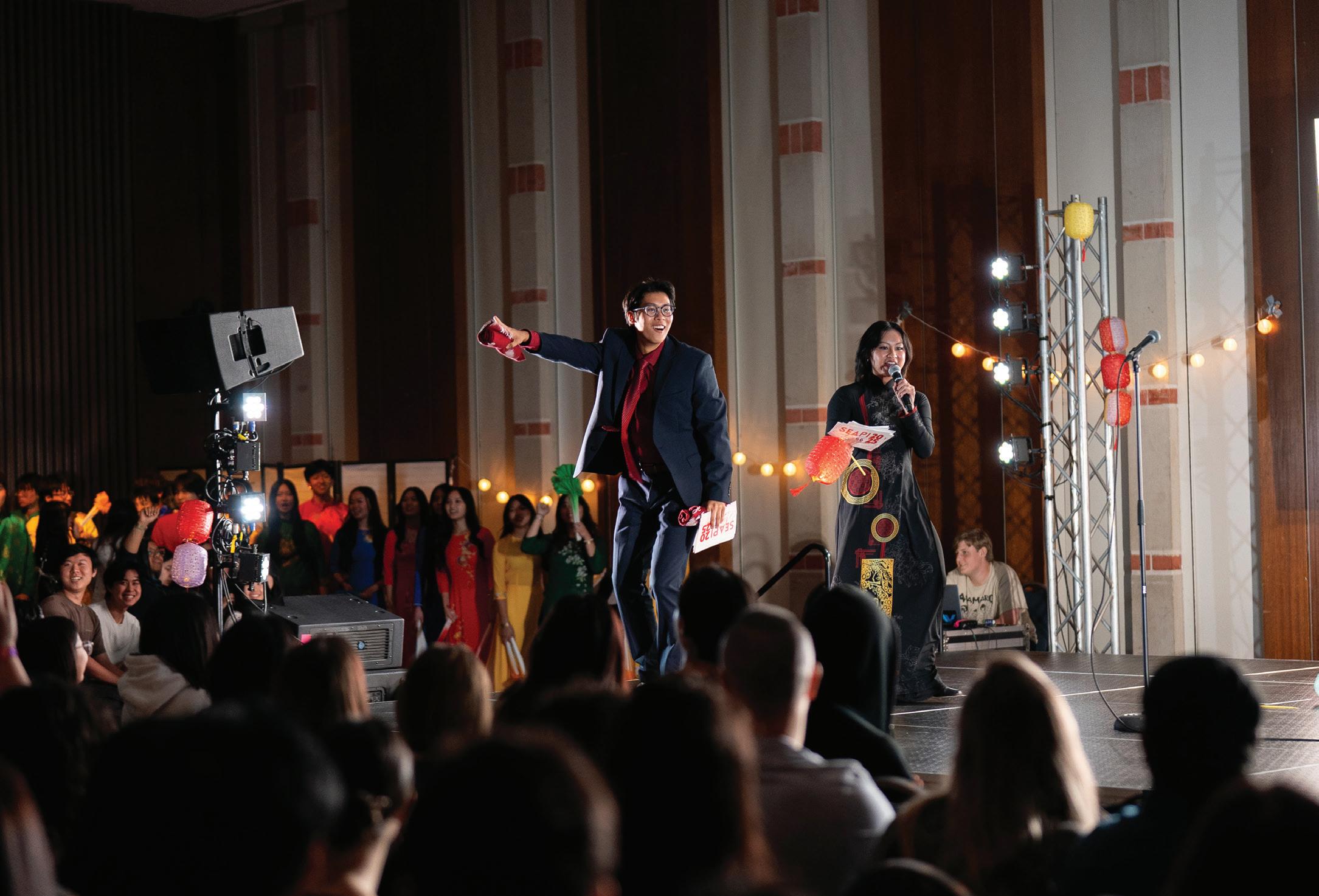
Emcees Connor Nguyen and Vivian Ha address the crowd at SEAPI Night on Nov. 21 in Rice Memorial Center’s Grand Hall.
COURTESY NATHAN LE
Members of the Vietnamese Student Association perform the fan dance at SEAPI Night.
Media to help survive this winter break
SOFIA KALOFONOS THRESHER STAFF
Winter break is analogous to shaking up a snow globe — serene on the surface, then instantly swirling with chaos the moment everything starts moving. At rst, there’s the initial thrill: the thought of being o campus for a month, no Canvas noti cations and no roommates setting 7 a.m. alarms.
Then comes the rush of seasonal joy in those first few days. Streets glow with holiday lights and the air smells faintly of cinnamon and nutmeg, all to the soft soundtrack of Mariah Carey and Michael Bublé.
Eventually, the holidays roll over in waves of warmth, nostalgia and family dysfunction. The blissfully lazy hours start piling up — initially indulgent, then suspiciously empty, then demanding to be lled with something other than doomscrolling and reorganizing your childhood bedroom.
Luckily, we’ve got you covered. Here’s your winter break survival guide: shows, movies and music to help you survive, recharge or simply pass the time until classes start again.
Shows
“Gilmore Girls,” season 1, episode 8:
Love and War and Snow is aptly titled and airs perfectly with hot chocolate and marshmallows on a frost-bitten morning. A cozy episode involving a snow-in and a car breakdown turned into a rst date — quintessential comfort television.
“Planet Earth,” season 1, episode 1:
David Attenborough commentary + widescreen frozen vistas + cute baby penguins = pure serotonin. This episode sweeps from the Arctic to the Antarctic in a simultaneously educational and aweinspiring way.
“Severance,” season 1, episode 1:
The pilot of “Severance” is a clean, icy plunge into corporate sci- horror. Nothing says seasonal depression like uorescent lighting, snow-covered parking lots and the looming question: “What if I surgically separated work from the rest of my life?”
An Audrey Hepburn classic that has the sheen of old Hollywood and a deep appreciation for winter fashion. This campy thriller opens with après-ski air and unravels into a murder mystery that keeps twisting until the nal scene.
“Die Hard”:
Bruce Willis plays a disgraced cop given one chance to save his marriage and a building full of hostages on Christmas Eve. Explosions, quips and holiday chaos — what more do you need?
“Love Actually”: Holidays bring out a natural sentimentality and renewed appetite for
Rice Dance Theatre’s fall
rom-coms. This star-studded lm follows eight interwoven couples navigating love, loss and loyalty with chaotic charm and quotable confessions.
Alternatives: “A Charlie Brown Christmas,” “The Holiday,” “The Shining”
Music
“Ella and Louis” by Ella Fitzgerald and Louis Armstrong: When the replace embers are fading and the night settles into its quieter hours, the moment calls for jazz. Fitzgerald and Armstrong are masters of the genre with soulful, syrupy tones perfect for a winter evening.
“Fruitcake” by Sabrina Carpenter:
Is it possible that someone still has a fresh take on Christmas songs? This EP highlights Carpenter’s sly humor and her love for wordplay. A perfect pop palate cleanser if you need a break from the classics.
“LONG.LIVE.A$AP” by A$AP Rocky: For when winter calls for something darker, moodier, and a little gritty. The album blends hazy production, cold metallic beats and Rocky’s smooth ow — perfect for late-night drives and long airport layovers.
showcase sells out, draws record crowds
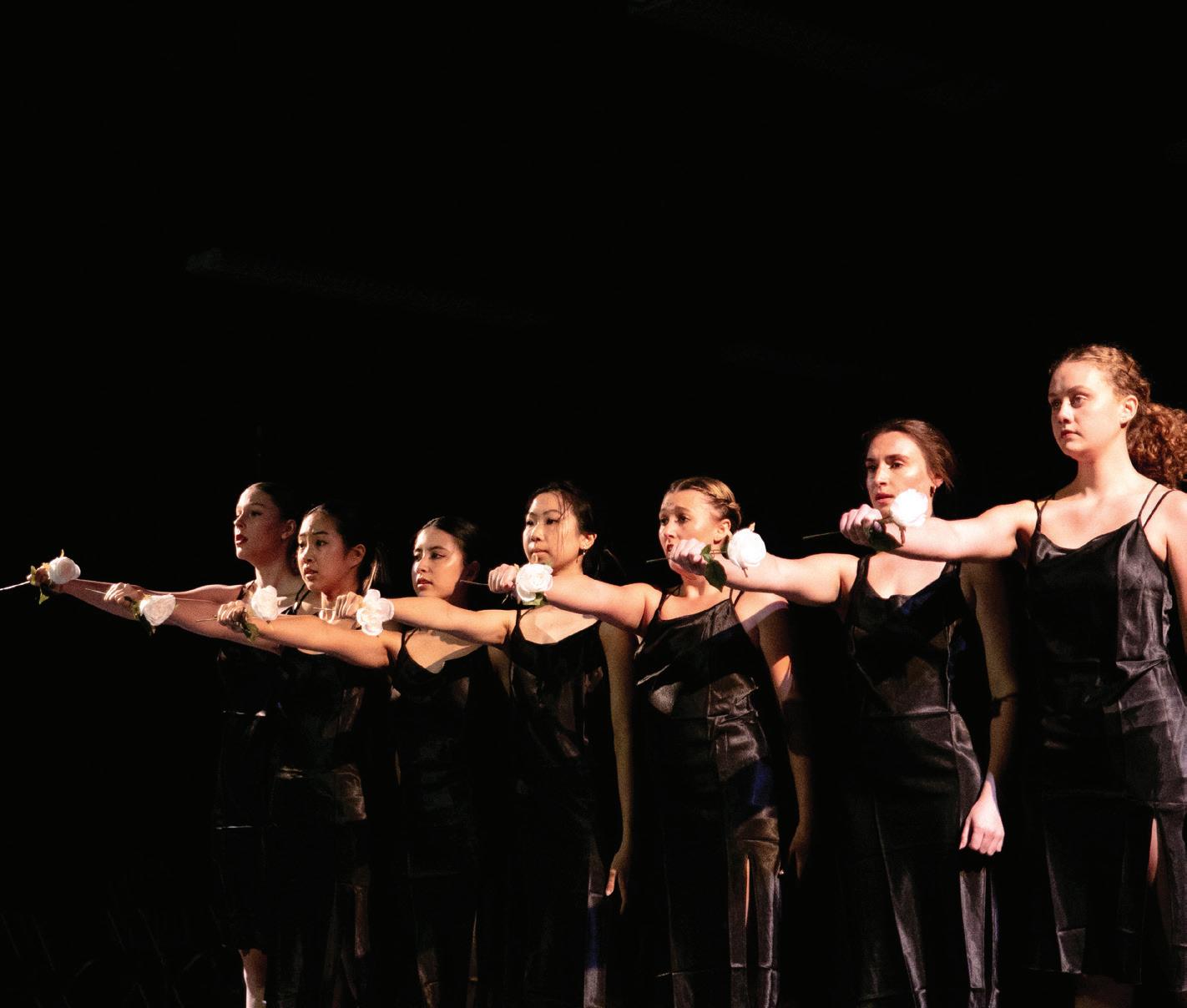
The line for Rice Dance Theatre’s fall showcase “Continuum” stretched past the door of the Gibbs Recreation and Wellness Center’s Multipurpose Room 4. The matinee on Nov. 22 sold out before showtime. Latecomers hoping for walkin tickets were turned away; while inside, more than 20 performances ran almost without pause.
“We had to turn away many people looking for walk-in tickets, which has happened maybe one or two other times in my time,” said Avery Janenda, interim president of Rice Dance Theatre. “Across all three shows, we had just over 600 attendees. Family members made up around 114 of those.”
For Rice Dance Theatre, which
has been on campus since the 1970s, “Continuum” was part performance and part proof of concept. The result was a two-hour program featuring pop, ballet, contemporary and cultural pieces.
“Every Rice Dance Theatre show has the same feel of everyone coming together as a community to appreciate an art form we do not have a ton of access to on campus,” said Janenda, a McMurtry College senior. “All the girls in RDT love to share their passion for dance, and it is a great way to express ourselves and our creativity in a format we might not get through academics.”
Hanszen College sophomore Bailee Byrd, the showcase coordinator, said the team’s growth created new logistical hurdles. Presale tickets were capped at around 180 per show, with an additional 20 to 25 sold at the door.
“RDT used to be a very small
organization, but now we have around 40 dancers and our show ends up being about 25 dances long,” Byrd said. “It is really hard to set the show in a way that dancers do not have pieces back to back. If people are in two dances with no break, there is no time to change costumes and reset.”
The showcase included two guest choreographers from the Houston dance community as well as a performance by Rice BASYK, a K-pop/hip-hop dance group.
Jones College freshman Mika Chang said she attended “Continuum” as a rsttime audience member.
“The show was unlike anything I have ever seen before,” Chang said. “I really enjoyed how it expressed a lot of different dance styles and exposed me to forms of contemporary dance I was not aware of before.”
One piece, “Murder Mystery,” she recalled, featured a stage full of dancers in black and one dancer in white with red blood on her shirt.
“It was really interesting because it felt like they were acting out a story,” Chang said. “Beyond pure dancing, a lot of the art comes from the way that the human performers express their humanity. In that case, it could be physical facial expressions or their costume choices. Sometimes they use props, which I thought was really cool. It made everything seem a lot more real. And the dance just added an element to the whole performance. It was more than dance, it was art.”
RDT dancer Yilan Ruan said she thinks about storytelling from the inside out.
“In each piece, I treat myself as living as a character in the setting of the dance,” said Ruan, a Jones junior. “Each dance tells a di erent story, and I live through it every time I dance that piece.”
Behind that onstage polish is a set of routines. Ruan said the company rehearses one hour each week per piece to master the choreography.
History lecturer Quan Gan attended “Continuum” on Saturday, he said, a er a friend invited him. What struck Gan most was the range of styles performed by the same dancers.
“You see similar faces recurring, but
in completely different music and dance genres,” Gan said. “One minute they were dancing jazz, the next minute ballet and 10 minutes later a K-pop-inspired group dance.”
Learning that Rice does not have a dance major gave him respect for the company, Gan said.
In each piece, I treat myself as living as a character in the setting of the dance. Each dance tells a different story, and I live through it every time I dance that piece.
Yilan Ruan
RICE DANCE THEATRE PERFORMER
“The performers are not doing this for a degree,” Gan said. “They are doing it purely out of passion.”
Byrd said she hopes the show gives students a chance to step outside their academic routine.
“All the dancers are full-time Rice students, and I think as students we can get into a mindset of only working on school and not taking time to appreciate art,” Byrd said.
Janenda, who has danced with RDT for all four years at Rice, said she is thinking about what comes next. Her freshman class doubled the company’s size, and 18 dancers will graduate this spring.
“We are definitely trying to prepare all the underclassmen and make sure they have the tools and training to continue to run RDT so it can keep growing,” Janenda said.
For Gan, the show was an entry point into a side of Rice harder to see from the classroom.
“Being there made me feel ten years younger, and more determined to create art together with others in this intellectual and artistic community,” Gan said.
COURTESY 20TH CENTURY STUDIOS
CHARLIE CRUZ THRESHER STAFF
KONSTANTIN SAVVON / THRESHER Students dance onstage at Rice Dance Theatre’s fall showcase, “Continuum.” The matinee on Nov. 22 sold out before showtime.
‘Marty Supreme’ and the pursuit of greatness
ARMAN SAXENA A&E EDITOR
“What do you plan to do if this whole dream of yours doesn’t work out?” Marty is asked.
Marty barely blinks: “That doesn’t even enter my consciousness.”
The line is both absurd and sincere, perfectly capturing the fevered pursuit at the heart of “Marty Supreme.” Josh Safdie’s latest lm is a breathless character study of a man who refuses to consider failure, even as a theoretical concept.
At its center is Timothée Chalamet, delivering the most electric performance of his career as Marty Mouser, a table tennis obsessive who chases greatness with the manic conviction of a man who’d sprint through a brick wall if it would make him number one.
Loosely inspired by the real table tennis legend Marty Reisman, “Marty Supreme” strips away any illusion of documentary fidelity. Safdie probably glanced at the biography, nodded once and sprinted in a much stranger direction. What remains is a fictional Marty who bears the shape of a folk hero.
The film hinges on Timothée Chalamet’s performance, and he meets the role with a level of ferocity he’s hinted at for years. There’s a jittery physicality to his work here that makes Marty feel like someone vibrating at a higher voltage than the people around him.
Safdie surrounds him with an ensemble that feels deliberately mismatched in a way that becomes the film’s strength. Odessa A’zion as Mouser’s lover and childhood friend is a live wire, her scenes charged with a
manic warmth. Gwyneth Paltrow as the movie star years past her prime brings an unexpectedly luminous melancholy. Even Kevin O’Leary, whose casting as a scheming capitalist pen tycoon is a stroke of genius, turns in a performance that lands with unnerving, easily hateable precision.
The film’s tone oscillates with Safdie’s signature confidence. A scene may begin in pure farce and end in something close to tragedy. The effect recalls fellow New Yorker Scorsese — think the propulsive intensity of “Goodfellas” laced with the absurdity of “After Hours.”
Visually, it’s one of Safdie’s most exhilarating films. Darius Khondji’s cinematography finds beauty in chaos, shooting table tennis like hand-tohand combat. The score, courtesy of ambient music giant Daniel Lopatin aka Oneohtrix Point Never, thrums underneath, an electronic pulse that blends seamlessly with the film’s 1980s needle drops.
easily shades into self-destruction.
There is also a political undercurrent. The film’s world, filled with hustlers, strivers, losers and opportunists, mirrors the broader American landscape. Everyone is selling something, angling for advantage and clawing their way out of obscurity. What emerges is not didactic commentary but a portrait of a nation powered by ambition and eroded by it, where the pursuit of greatness
Safdie explored similar territory once before with “Uncut Gems,” but while that film trapped us in the downward spiral of a man already drowning, “Marty Supreme” flips the trajectory. It follows a dreamer doing everything in his power to race upward, fueled not by desperation but by an almost innocent delusion that greatness is his “purpose.”
Marty embodies that contradiction. He is arrogant, abrasive and often unbearable. Yet the film never mocks his yearning. The desire to be the best, even in a discipline the world barely takes seriously, becomes something moving. Greatness, the film suggests, isn’t always noble. Sometimes it’s delusional.
Sometimes it’s embarrassing. But it is always human.
If the lm stumbles, it’s only in its sprawl. “Marty Supreme” doesn’t aspire to narrative tidiness. It wants propulsion and immediacy, something akin to the sensation of running downhill without brakes.
Earlier this year, after winning Best Actor for his performance in “A Complete Unknown” at the Screen Actors Guild awards, Chalamet said he is “in pursuit of greatness.” That proclamation drew some mockery, but “Marty Supreme” feels like the answer. It’s a film about ambition made by people who are unembarrassed to admit their own. Not quietly, not modestly — but loudly, earnestly and without irony.
Rosalia’s ‘LUX’ is a maximalist and immersive pop opera
A central tension between wanting to be pop or redefining the category itself has defined Rosalía’s entire career.
“My sister, she says — and I don’t know if I agree — that my music is not pop. But she says I am,” Rosalía told The New York Times’s Popcast. “I need to think that what I’m doing is pop, because otherwise I don’t think then that I am succeeding.”
Rosalía turned flamenco nuevo into pop on “El Mal Querer,” gave her take on reggaeton with the hypermodern burst of “MOTOMAMI” and now, on “LUX,” she attempts something even more audacious — a classical-pop opera that moves through 13 languages, London Symphony Orchestra flourishes and the weight of religious myth.
“LUX” is her most maximalist vision yet. It’s an album that wants to be universal, devotional and deeply human all at once.
On “LUX,” she returns to her roots as a Spanish vocalist trained in flamenco, but wraps that training in operatic scale, choral harmony and Romanticera dynamics. Aided by collaborators like Estrella Morente, Björk and Caroline Shaw — the award-winning composer and Rice graduate — Rosalía aims for nothing short of the heavens.
On the track level, “LUX” unfolds in four movements, each carrying its own emotional and stylistic charge. The opener, “Sexo, Violencia y Llantas,” acts as a full overture. Its orchestral surges, choral harmonies and a sense of immediate drama announce the album’s scale.
“Reliquia” follows with one of the
album’s most gorgeous arrangements, blending operatic strings and glitchy electronic accents into something hypnotic. It’s the clearest version of the classical-pop hybrid “LUX” aims for, patient and intricately layered. “Divinize” shifts into the darker territory of shadowy piano, trip-hop echoes and a slow-building arrangement that recalls the moodiness of Björk-esque sweeping electronica.
“Porcelana” mixes virtuoso pop lines with Dougie F’s experimental hip-hop touches. On “Mio Cristo Piange Diamanti,” Rosalía pivots into something closer to Western classical Romanticism. Her vocals stretch heavenward, framed by sweeping strings and a devotional weight that suggests an aria more than a pop song. This is where her training shows most clearly: Her voice is the spine of an entire composition, powerful enough to anchor orchestral excess.
Then comes “Berghain,” the album’s maximalist summit and one of its purest shocks. A choral opening gives way to Björk’s trembling incantations, followed by Yves Tumor’s jagged invocation of Mike Tyson. The track teeters between the divine and the grotesque, between prayer and threat. It doesn’t entirely cohere, but that volatility is part of its power.
“La Perla,” influenced by Mexican folk traditions, eases the tension with gentle guitar and breathy clarity. It’s lovely, if unexpectedly safe after “Berghain.” “Mundo Nuevo,” the next song, never quite ignites, drifting without the ingenuity that supports the album’s stronger pieces.
into a waltz-like crescendo, one of the album’s most emotionally direct moments. “Sauvignon Blanc,” though beautifully sung, feels indistinct within the record’s sonic and thematic density.
But the late triumph “La Rumba Del Perdón,” featuring Estrella Morente and Silvia Pérez Cruz, is magnificent. It’s a dramatic piece that traverses flamenco, choral pop and operatic drama with ease. “Magnolias” closes the album in pure devotional mode, returning “LUX” to the holy terrain where it began.
Rosalía’s Popcast quote lingers over the entire project. She needs to believe she makes pop because pop, in her mind, has reach — it’s an art made for many, not the few. But pop is often also simplification. Rosalía is too meticulous for that. Her best work is ornate and built on precision and excess. She needs big frameworks to shine. And “LUX,” for all its inconsistencies, gives her the biggest one yet.
“De Madrugá” revives momentum with fast-paced flamenco inflections and a seductive rhythmic drive. The third movement starts with “Dios Es Un Stalker.” The track is sharp and unsettling, reframing divine love as surveillance.
So where does “LUX” land? It is a grand attempt at bringing classical music into pop’s vocabulary with real seriousness. It is the closest she has come to her version of Björk’s “Homogenic,” though not as fearless. It’s also the closest she has come to a pop opera, though not as seamless as it hopes to be.
“La Yugular” swells
But it is a work of ambition at a scale few mainstream artists even attempt. And for Rosalía, ambition has always been the point.
Top Track: ‘Berghain’
COURTESY A24
COURTESY COLUMBIA RECORDS
ARMAN SAXENA
EDITOR
Houston hears ‘A Beautiful Noise’ at the Hobby Center
I was de nitely one of the youngest people at “The Neil Diamond Musical: A Beautiful Noise,” and that was the only problem I had with it. The show was hilarious, the sets were stunning, the costumes bright and the energy vibrant. The audience even sang along during the encore.
Jukebox musicals — shows featuring a soundtrack composed of preexisting music — o en elicit skepticism, but this one does not deserve such doubts.
The story begins with Neil Diamond himself, in his senior years, going to therapy. The narrative unfolds through Diamond’s descriptions and his therapist’s analyses of his life. Throughout the next two hours, the audience learns rsthand how ‘Neil from Flatbush’ became Neil Diamond, the superstar.
A testament to the American dream, Diamond’s parents immigrated from Russia and Poland. He grew up in a humble home where he felt pressured by his parents to do something practical with his life. And yet, he chose impracticality, and a er years of writing music to sell rather than perform, he was discovered.
Diamond’s life story is told through his dramatized senior self’s therapized ruminations and ashbacks, bringing the ashy vibrancy of 1970s Los Angeles to Houston. Actor Nick Fradiani, who played young Neil, compellingly showed the musician’s transition from the shy guy who felt apprehensive about even the
thought of performing to the diamondstudded eight-shows-a-week performer at the renowned The Greek Theater. Fradiani captivated the audience members, bringing them to the different concert venues and even to the little rundown motel where “Sweet Caroline” was born.
The austere creation of “Sweet Caroline,” now an American classic, concluded the rst act of the show, just before a riveting encounter with organized crime and a demand for the “next big hit.” In hindsight, it’s safe to say he delivered.
The set featured beautiful juxtaposing
elements — from his small home with his rst wife to his mansion with his second and from the tiny local establishment where he rst performed to sold-out arenas, the show tracks his journey from modest beginnings to luxury and fame. There was also an ethereal moment with the lighting where dozens of lamps hung down from the ceiling and created a lovely intimacy between the characters and the audience.
Later on, during Diamond’s nal huge performance, the concert stage lights were so bright, they had the audience squinting — although that may also be explained by the neon lights, diamondstudded suit and sequin bell bottoms. During that last show, I wished I had been around in the 1970s.
“A Beautiful Noise” was not only about a star’s rise to fame, but it also showed the allure of that road, the toll it can have on one’s relationships and how art can still be a beautiful outlet. Diamond talked of clouds entering his life and said that whenever he sang, those clouds disappeared. He explained that he felt most himself when he was performing. Regardless of age, even if you only know “Sweet Caroline” and “I’m A Believer,” the energy of this wonderful musical will have you jumping out of your seat.
On ‘Troy,’ UnoTheActivist attempts to reinvent himself
UnoTheActivist has been building anticipation for his newest project for months.
“The wave is coming,” UnoTheActivist told the Thresher after his sold-out Sept. 12 performance at Pub at Rice. “It’s me … that’s the best way I can put it.”
If “Troy” makes anything clear, it’s that Uno sees this new era of his music not as a continuation of the past but as a conscious recalibration. Since the mid-2010s, the Atlanta-based rapper has been a defining figure of the SoundCloud underground.
He’s an architect of rage rap whose early collaborations with Playboi Carti and Young Nudy helped shape the aesthetics that would define internetborn hip-hop for years. Tracks like “Astral Plane (High as Me),” “Not One of Dem” and “Slave” established his trademark of boastful, hedonistic lyrics over lush, atmospheric trap beats.
But “Troy,” his second project of 2025 following “Omega Music Reloaded,” reaches for something more ambitious. It’s a tight, 10-track album that positions Uno not as a veteran of a bygone era but as an innovator of a new “wave,” pushing trap into stranger, if still too safe, directions.
“Troy” threads together nearly a decade of Uno’s sonic instincts — the ethereal haze, the melodic drift and the confident flows — but frames them within something more sculpted. The album opens with “Pink Stones,” a banger laid out over the buzzing synths Uno is known for as well as additional lush production.
“Sometimes I Wanna Fight” is the
project’s sharpest left turn, leaning into alt-rock with a ragged, guitardriven sincerity that doesn’t fully gel but signals his hunger to evolve. That experimentation locks in on “The Wave,” a standout that threads emo rap aesthetics through a slow-moving trap beat, letting Uno drift into hypnotic patterns.
The energy carries into “Don’t Wake Me Up,” a spacey highlight where he feels suspended inside the production, the kind of textured, atmospheric zone where he’s always thrived.
The album’s middle stretch brings things back toward traditional trap, though still filtered through Uno’s idiosyncrasies. “I’m Famous” and “God as My Witness” return to the boastful, narcotic style of his early work, but with cleaner execution and more control.
A surprising emotional pulse arrives on “Southside Love Story (Follow Me)” which brings back the alt-rock influence, this time with a sensual trap beat and some vaporwave aesthetics. “You Won” and “300 for Lunch” end the project on a sincere but familiar note, cementing
that this album doesn’t go far enough in renewing Uno’s artistry. In the end, “Troy” is less a reinvention than a widening of UnoTheActivist’s field of vision. The alternative rock touches, the atmospheric trap and flashes of melodic vulnerability don’t always land cleanly, but the ambition is undeniable. Uno isn’t chasing the past anymore. He’s sketching the outline of something new, something still forming beyond the horizon. “Troy” doesn’t fully define the wave he speaks of, but it proves he’s still capable of generating one.
ISABELLA REGAN THRESHER STAFF
COURTESY JEREMY DANIEL
The cast of ‘A Beautiful Noise’ gathers onstage at the Hobby Center. The show retraces the singer Neil Diamond’s life.
COURTESY REPUBLIC RECORDS
ARMAN SAXENA A&E EDITOR
Top Track: ‘Pink Stones’
Column: Reflecting on the rst season of the Abell era
ANDERSEN PICKARD SPORTS EDITOR
Rice football concluded its 2025 season with a 52-3 loss to the University of South Florida last Saturday. The Owls nished their rst year under head coach Scott Abell with a 5-7 record (2-6 in the American Conference).
Rice’s ve wins surpassed Dra Kings Sportsbook’s preseason line of 3.5 victories, and Abell became just the third Rice football head coach since 1972 to win at least ve games in their rst season at the helm.
However, Rice’s two conference wins represented their lowest mark since joining the American Conference in 2023, and they were outscored 370-200 in games against Football Bowl Subdivision opponents. Playing competitive football against strong opponents remains a weakness for Rice.
This season saw Rice implement its new gun triple option o ense, which Abell brought to South Main from his previous role at Davidson College. The system is relatively simple for a quarterback to operate; they can give the ball to the running back, pitch it to the slot receiver or keep it themselves.
Redshirt sophomore quarterback Chase Jenkins was the o ense’s centerpiece. He became the rst Owls quarterback to start every game since Driphus Jackson in 2015.
Junior linebacker Ty Morris had 2.5 sacks and a 80.5 PFF tackling grade. Redshirt senior linebacker Andrew Awe nished the year with 2.5 sacks and a team-high 101 tackles, being nominated for the 2025 Burlsworth Trophy awarded to the nation’s top walk-on. Redshirt senior safety Plae Wyatt was also recognized on a national level for his contributions to the community beyond the hedges.
A er missing bowl eligibility by just one game, Abell said the Owls could build o of a framework that has become very familiar in the American Conference. Programs like the University of South Florida and the University of North Texas were previously below .500, but they bounced back with at least nine wins this season.
One major advantage for the Owls will be Abell and his staff having extra time to construct the 2026 roster. Last year, Abell had less time to prepare for the offseason and transfer portal given that he was hired in November. Now, he has a full year under his belt and can put his own stamp on the offseason — a stamp that should include adding schemeappropriate linemen and skill players to Rice’s gun triple option offense.
Abell will immediately turn his focus to next year’s roster, beginning with a press conference Wednesday to introduce Rice’s 2026 signings.
2025 Rice football season superlatives
Before we close the book on the college football season, let’s hand out some endof-year awards to Rice’s most worthy players and moments.
Most Valuable Player
Quinton Jackson, Running Back Redshirt junior running back Quinton Jackson led the back eld with 811 rushing yards and seven total touchdowns. The Owls distributed the ball to plenty of skill players this season, but Jackson was Rice’s primary option out of the back eld. His best game of the year was Oct. 25 against the University of Connecticut when he totaled 248 yards and four touchdowns, including the gamewinner in overtime.
O ensive Player of the Year
Chase Jenkins, Quarterback Jenkins didn’t have to throw a lot in the Owls’ o ense, but when he did, he found success. The converted wide receiver nished the year 119for-172 passing with 1,025 yards, nine touchdowns and two interceptions through the air. His career 69.1% completion rate currently ranks as the greatest in Rice football history among quali ed quarterbacks. The Katy native also made an impact on the ground, rushing for 531 yards and an additional ve touchdowns.
Defensive Player of the Year
Tony Anyanwu, Defensive Lineman
Graduate defensive lineman Tony Anyanwu made an immediate impact in his rst and only season with Rice a er transferring from Stephen F. Austin State University. He had 53 tackles, 6.5 tackles for loss, one fumble recovery and a team-high ve sacks. His 82.8 PFF defense grade led all Owls in 2025.
Special Teams Player of the Year
Alex Bacchetta, Punter Redshirt junior punter Alex Bacchetta had a strong second season with the Owls and was added to the Ray Guy Award watchlist. The award is presented annually to the nation’s best collegiate punter, and Bacchetta improved his candidacy with 45 yards per punt. Of his 53 punts, 12 landed inside the 20-yard line.
Freshman of the Year
D’Andre Hardeman Jr., Running Back
The Owls featured a variety of running backs this season, and D’Andre Hardeman Jr. worked his way into the mix despite being a true freshman. He finished the year with 78 carries, 319 rushing yards and two touchdowns. Over Rice’s final four home games, he had two trips to the end zone and 5.1 yards per carry.
Transfer of the Year
Aaron Turner, Receiver
The Owls welcomed key contributions from graduate transfer receiver Aaron Turner, who had 230 rushing yards, 374 receiving yards and six touchdowns. He was the only Owl with more than 75 rushing and receiving yards this year. His best game came in the loss to North Texas, where he had eight catches, 58 receiving yards, nine carries, 78 rushing yards and two total touchdowns.
Game of the Year
37-34 double overtime win against UConn Rice was successful in non-conference games this year, going 3-1 against opponents from outside the American. A er an ugly loss against the University of Texas at San Antonio, Rice returned from its bye week and took down the University of Connecticut, which quali ed for a bowl game and recently received votes in the Associated Press Top 25 poll. A strong second-half defensive performance held the Huskies to just two third-down conversions and allowed Rice to force overtime, where they would eventually win the game.
Quote of the Year
Quinton Jackson a er the UConn win
A er scoring four touchdowns against UConn, Jackson said, “To be honest, I’m exhausted. I could just lay down right now.” A nap was a fair reward for the Owls’ standout running back a er he became the rst player in Rice history to score a 70-plus-yard rushing touchdown and a 70-plus-yard receiving touchdown in the same game.
HONG LIN TSAI / THRESHER
KAIRI MANO / THRESHER
Rice football head coach Scott Abell celebrates with his team following a 37-34 double overtime victory Oct. 25 against the University of Connecticut. The Owls nished 5-7 (2-6 in the American Conference).
Volleyball wins 17 straight, clinches No. 7 seed in tourney
PATRICK
SHUKIS THRESHER STAFF
Rice volleyball will continue its historic season Friday after finishing the season at No. 21 in the nation and securing an at-large bid to the NCAA Tournament for the sixth time in program history. This marks the team’s first NCAA Tournament bid since 2022, and their first as a part of the American Conference, which they joined in 2023.
This team is a family and has put their heart and souls into preparing for this moment.
Genny Volpe VOLLEYBALL HEAD COACH
Rice will compete in the Southern Methodist University Regional, where they will square off against the University of Florida on Friday at 4 p.m. in Dallas.
“This team is a family and has put their heart and souls into preparing for this moment,” head coach Genny Volpe said.
The Owls received their bid to the NCAA tournament a er reaching an all-time program record 17 straight wins before falling short in the conference championship in Tampa, Florida, at the American Conference Tournament Nov. 21-23.
The Owls had a 4-7 start in their preseason gauntlet that included matchups against six teams in the American Volleyball Coaches Association Top 25 and four in the Top 10. They nished the regular season on a 15-game winning streak, placing them atop the American Conference with a 15-1 conference record and a 19-8 record overall.
The team rode their late-season momentum into the tournament, capturing
a decisive 3-0 quarter nal win over No. 8 seed University of Texas at San Antonio in the rst round.
Senior outside hitter Taylor Preston and freshman outside hitter Aaliyah Smith led the Owls with 14 and 13 kills, respectively. Rice also found success attacking up the middle, as senior middle blocker Lademi Ogunlana recorded nine kills on 11 attempts for an .818 hitting percentage.
“We were trying to get our middles involved early all weekend, which we were pretty successful doing in the quarter nals and the semi nals,” Volpe said.
Rice’s win against the Roadrunners vaulted them into the semifinals, where they faced Wichita State University, whom the Owls were 2-0 against during the regular season.
For the second time this season, the Owls found themselves in a ve-set battle against the No. 5 seed Shockers a er dropping a hard-fought fourth set, 30-28. In the end, it was the Owls’ defense that closed out the match, with Ogunlana and freshman outside hitter Sydnee Peterson combining for the game-winning block at 15-12.
“Defensively, I was very pleased with our blocking and our floor defense,” Volpe said.
Volpe said she loved her team’s h-set energy, allowing them to pull o the win.
“That was huge,” Volpe said. “Our team has been extremely resilient in tight situations, which I think shows strong maturity and leadership from our senior class.”
Following their semifinal victory, Owls geared up for a finals faceoff with No. 3 seed University of Tulsa, whom the Owls defeated in a five-setter earlier in the season. With the Owls’ streak already at a program record 17 wins, they also had a chance to make history yet again by winning their first ever American Conference Tournament.
Rice snagged a marathon second set 35-33 to tie up the match, but the Tulsa
attack ultimately proved too strong as the Owls fell in four sets, ending their hopes of a conference title.
Preston, Ogunlana, Peterson and junior outside hitter Kellen Dorotik all recorded double kills, but it was the Owls’ 16 service errors that ultimately cost them the win in close third and fourth sets.
“I think we honestly let a bit of fatigue get to us from the match on Saturday,” Volpe said. “We were uncharacteristically making some serving errors and the
setter-hitter connection was a bit off to start the match. Our offensive numbers actually ended up being pretty good, but Tulsa played incredible defense and definitely won the transition game.”
As the Owls look toward Friday, they look to start another win streak and make a deep run in the NCAA Tournament.
“I trust that they will lean on each other and perform to their best abilities,” Volpe said. “In the end, we just need to trust ourselves and the process.”
Portrait of a student athlete: Lineman emerges as STEM standout
PATRICK SHUKIS THRESHER STAFF
Amid the academic pressures of pursuing a mechanical engineering degree, redshirt sophomore Aquantis Clemmons has been racking up quarterback pressures this season on the Owls’ defensive line. Clemmons has been named a Go Bowling Military Bowl STEM Scholar-Athlete.
The Go Bowling Military STEM ScholarAthlete Program honors a football player at each university in the Atlantic Coast Conference and American Conference
who is studying science, technology, engineering or math.
“It’s definitely a complete honor for me,” Clemmons said. “I’m thankful for this — for the opportunity to be recognized and somebody seeing my hard work, seeing what I do on the daily. Recognizing that validates the work I put in, the person I’m trying to be, and it motivates me to continue to go on, continue to push forward and try to be my best self.”
Clemmons hails from Atlanta and attended Carver High School, where his
defensive skills led the Carver Panthers to the Georgia AAA State Championship in his junior season and the state semifinal the following year. Clemmons totaled 20 sacks and 86 tackles for loss between his final two high school seasons.
Clemmons said making the transition to American Conference football has been a difficult but rewarding adjustment.
“[College] is just a different level, different step in competition,” said Clemmons, a Martel College junior. “Everyone is good in some way, so it pushes me to be on top of my game in every way and be the best that I can be.”
Since coming to Rice, Clemmons said he has developed his skills both on and off the field.
“I’ve grown as a human and a player,” Clemmons said. “Learning how to be a student of the game and a student athlete, just being someone that can go in and watch lm, go in and ask questions, to really dissect and understand the X’s and O’s.”
Clemmons’ approach earned him a spot on the football eld, as he played in every game this season and started in two of them. Clemmons totaled 20 tackles and a sack in the Owls’ 2025 campaign.
For Clemmons, though, it’s not just about athletics, as finding a balance between engineering and football is something he continues to work on.
“I feel like it’s an ongoing process,” Clemmons said. “I’m adjusting every day, finding new ways to grow and be better. I need to make sure I’m being efficient with my time and use it to its maximum potential, to make sure I’m successful and I can hold up my end of the bargain.”
None of this would be possible, Clemmons said, without his values and support from his family and community back home.
“I was put on this earth for a reason, and I kind of always circled back to that,” Clemmons said. “I have a foundation at
home that brings me that energy, my mom, my church and just a lot of my family that instilled a lot of those qualities.”
Clemmons said he’s found a great support system with Rice football and that he loves learning from his teammates and coaches.
It feels like there’s love running up and down the hallways, regardless of who you talk to or where you go.
Aquantis Clemmons DEFENSIVE LINEMAN
“I feel like it’s a community here; it’s very family-oriented,” Clemmons said. “It feels like there’s love running up and down the hallways, regardless of who you talk to or where you go. There’s always some type of advice that people can give me, and just being able to soak that up, I love it.”
Defensive coordinator Jon Kay said Clemmons stands out when it comes to the intangibles.
“He’s the poster child of a Rice guy,” Kay said. “He’s someone who can blend academics, someone who can embrace being the athletic underdog and then find a way to be successful. He just goes out there and plays, and he is out there balling against some great talent.”
The two players whose teams compete in the 2025 Go Bowling Military Bowl will be recognized at the bowl game Dec. 27 in Annapolis, Maryland. Clemmons will not have that opportunity after Rice finished 5-7 and failed to clinch bowl eligibility, but he said he is still incredibly grateful to be recognized for his hard work both in the classroom and on the gridiron.
COURTESY MIKE CARLSON / RICE ATHLETICS
Senior outside hitter Taylor Preston prepares to spike the ball during the American Conference Tournament in Tampa, Florida. The Owls lost in the championship but quali ed for the NCAA Tournament.
CAYDEN CHEN / THRESHER
Redshirt sophomore defensive lineman Aquantis Clemmons matches up against an opposing o ensive lineman during Rice’s 56-24 loss against the University of North Texas at Rice Stadium Nov. 22.
The Backpage is the satire section of the Thresher, written this week by Charlie Maxson, Rykelle Sandidge and Max Scholl, and designed by Brandon Nguyen. For questions or comments, please email realricethreshero cial@rice.edu.
CLASSIFIEDS
Rice Alum hiring well-quali ed tutors for all levels of STEM, Humanities, and Social Sciences. Reliable transportation required. Pay $35/hr+. Email resume to sri.iyengar@ sriacademicservices.com
ADVERTISING
The Thresher accepts display and classified advertisements and reserves the right to refuse any advertising for any reason. Additionally, the Thresher does not take responsibility for the factual content of any advertisement. Printing an advertisement does not consititute an endorsement by the Thresher. Display advertisements must be received by 5 p.m. on the Friday prior to publication; see ricethresher.org for pricing. Classified advertisements must be received with cash, check or credit card payment by 12 p.m. on the Friday prior to publication; see ricethresher.org for pricing.