We are pleased to present Issue 22 of our HNW Litigation & Advisory Magazine, dedicated to the dynamic and evolving world of contentious trusts This issue examines the shifting legal landscape, highlighting significant case law, regulatory developments, and the emerging themes influencing trust disputes today.
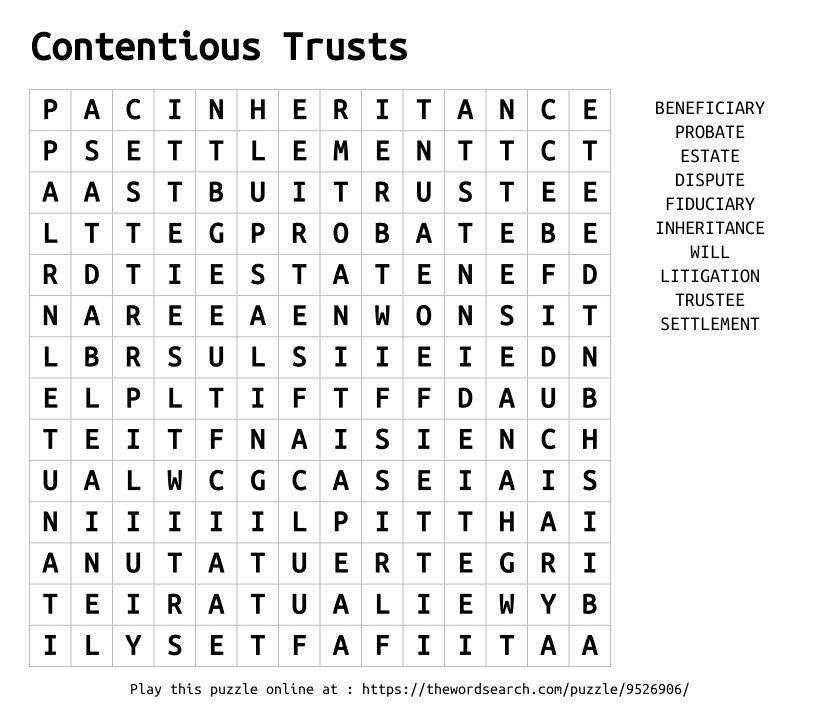
Featuring commentary from leading practitioners, the issue offers nuanced perspectives on fiduciary responsibilities, dispute‑resolution strategies, and the increasing complexity of modern trust arrangements. You’ll also find interviews with our Corporate Partners, who share insights into their professional journeys and the evolving challenges shaping their work. Additionally, we have included our HNW Litigation & Advisory Wordsearch, fill in to redeem a 15% discount to one of our HNW events.
NAVIGATING THE ADMINISTRATION OF CONTENTIOUS STRUCTURES
Authored by: Stefan Le Marquand (Manager, Private Capital) - Highvern
It is no secret that one of the most critical qualities clients seek in their advisors is the ability to be proactive –sometimes even expecting us to predict the future. Whilst foresight and robust governance frameworks are essential, they cannot always prevent structures from becoming contentious.
Even the best designed structures and the closest families can fracture, creating financial, emotional, or administrative distress. Our role as professional trustees is to cut through the noise, bring the right people together at the right time, and guide a structure through turbulence with independence and integrity.
Beneficiary Disputes
These are arguably the most common and often the most challenging. Ensuring separation from personal grievances and fiduciary decision making is critical.
Example 1:
A multigenerational trust holding a family business becomes strained when the eldest sibling, managing the company, receives higher distributions due to their operational involvement. Younger siblings challenge the fairness of this, alleging preferential treatment. Though the trustee’s decisions align with the trust deed and letter of wishes for the settlor to encourage their family into the business, differing expectations quickly turned the matter contentious. Managing perceptions became as important as managing legal obligations.
Example 2:
A beneficiary undergoing divorce sought to use trust assets as part of a marital settlement, leading to tension among other beneficiaries concerned about protecting the trust’s independence.
Financial Disputes
Concerns about financial health escalate quickly, especially in illiquid structures.
Example 1:
A structure owning a portfolio of commercial property encountered significant liquidity pressure when a key tenant defaulted and required legal action. Cash reserves were quickly depleting, but liquidation risked long term losses. Some directors pushed for immediate liquidation; others demanded strategic patience. Balancing divergent views while preserving the structure needed external advice and collaboration between accountants, lawyers, and ourselves.
Example 2:
A trust had been established from a will, which was responsible for the long term maintenance of a vulnerable beneficiary, but it was becoming impossible to generate enough income from the capital, whilst balancing the costs and fees. It ended up becoming necessary to wind the structure up, under advice from lawyers and execution by ourselves.
Administrative Disputes
Many disputes originate from legacy drafting or documents not updated to reflect modern realities.
Example 1:
An interest in possession trust deed from the 1970s lacked clear provisions in respect of the appointment of capital, during a time when family lines had diverged, and it was no longer efficient for them to be beneficiaries. A lack of a power to vary resulted in the need for court interjection and clarification.
Example 2:
The same trust also had outdated definitions of “issue” and “spouse” which meant that one arm of the family were not able to benefit in the same way as the others.
Pathways to Resolution
A contentious structure does not automatically require litigation. Most matters progress through phased, constructive steps:
1. Education & Prevention
Clarifying the purpose and mechanics of the structure often diffuses early tension. Utilising family charters, or video recordings is often a clear solution.
2. Mediation
A neutral mediator can reframe entrenched positions; for example, helping siblings recognise shared long term goals rather than short term grievances.
3. Arbitration
Particularly useful in financial disputes where parties accept the facts but require a binding determination.
4.
Court Intervention
Reserved for matters involving trustee powers, legal interpretation, or irreconcilable breakdown.
Conclusion
Contentious scenarios do not signify failure. It can arise naturally from evolving families, shifting priorities, and increasingly complex assets. Success is not about avoiding conflict altogether, but managing it with professionalism, empathy, and independence. When families embrace transparency, foster dialogue, and seek expert support at pivotal moments, even the most contentious structures can emerge stronger and more resilient.
CORPORATE FUNDS PRIVATE CAPTIAL
Cayman Islands | Guernsey | Ireland | Jersey | Norway | South Africa | Sweden | UK
SAUNDERS V VAUTIER, RUSNANO AND THE RECENT
AMENDMENT TO ARTICLE 43 OF THE TRUSTS (JERSEY) LAW 1984: CRISIS AVERTED?
Introduction
So called Red Cross trusts can be useful vehicles for would be settlors who wish to keep the primary beneficiaries of the trust confidential. They have traditionally been common in offshore jurisdictions. They typically feature a charity – often the Red Cross – as the sole or default beneficiary, and the trustee, protector or other power holder has a power to add beneficiaries. There will typically be a Letter of Wishes explaining the settlor’s wishes about when and in whose favour the power to add should be exercised. The trustee will generally consider these objects of the power to add, and not the charity, as the primary beneficiaries of the trust. The primary beneficiaries are therefore not readily identifiable on the face of the trust instrument.
The principle in Saunders v Vautier1 has generated some recent concern that a common purpose of these trusts – to settle property for beneficiaries in as confidential manner as possible – has been threatened, particularly following litigation on this issue in Guernsey.
This article first explains the principle in Saunders v Vautier and the debate about this principle in the context of Red Cross trusts and other trusts where there is a power to add beneficiaries. It then summarises the 2019 Guernsey Court of Appeal decision of Rusnano Capital AG (in liquidation) v Molard International (PTC) Limited and Pullborough International Corp2 (“Rusnano”) and the recent amendment of the Trusts (Jersey) Law 1984. It concludes by offering the authors’ views on the wider implications of this amendment to Jersey’s trust law.
The Principle in Saunders v Vautier
The longstanding principle in Saunders v Vautier states that where all persons entitled absolutely and indefeasibly to the whole of the income and capital of the trust property have been ascertained, and have full legal capacity to act in their own right, they are entitled to call for the termination of the trust and the distribution of the assets to them.
Authored by: Peter Steen (Partner, Head of Private Wealth Disputes) & Emily Bueno (Managing Associate) - Mishcon de Reya
The Application of the Principle in Saunders v Vautier to Red Cross Trusts
The application of the principle in Saunders v Vautier is not always simple. One key debate is whether a trust can be terminated, and the assets distributed, where there is a power to add beneficiaries. If so, this would mean that Red Cross trusts can be collapsed by the sole or default beneficiary – typically a charity whom the settlor never intended to benefit, as explained above. This would be a great result for the charity in question (although, in practice, they are almost always unaware of their beneficial status) but not for settlors and potential beneficiaries of Red Cross trusts yet to be added.
The Rusnano Litigation
This debate reached the Guernsey Court of Appeal in Rusnano. In this case, the Court of Appeal upheld the lower court’s decision that a sole beneficiary can use section 53(3) of the Trusts (Guernsey) Law 2007 (the local statutory approximation of the principle in Saunders v Vautier) to bring a trust to an end, notwithstanding there being a power to add beneficiaries.
The relevant wording of section 53(3) is (emphasis added):
“[…] where all the beneficiaries are in existence and have been ascertained, and none is a minor or a person under legal disability, they may require the trustees to terminate the trust and distribute the trust property among them.”
The Court held that, by reference to other provisions in the 2007 Law and the Jersey case of In re Exeter Settlement3, a distinction is to be drawn between someone who is a beneficiary and someone who is a potential beneficiary under a power of addition. They held that an object of a power to add does not fall within the words in bold above. That being the case, the applicant could use section 53(3) to collapse the trust in its favour.
Amendment to the Trusts (Jersey) Law 1984
It is therefore not surprising that Jersey has recently amended Article 43 of its Trusts (Jersey) Law 1984, which mirrored section 53(3) of the Trusts (Guernsey) Law 2007, to prevent the termination of a trust where there is power to add beneficiaries. Thus, the following sub paragraph 3A has been interpolated into Article 43:
(3A) But paragraph (3) does not apply in relation to a trust:
(a) if there are any other persons who could become beneficiaries in accordance with the terms of, or pursuant to the exercise of any power under, the trust; or
(b) if the terms of the trust provide for the disposition of trust property for a charitable or non charitable purpose.
This means the termination of a trust will be precluded where the terms of the trust include a power: to add beneficiaries, vary the trust so that new beneficiaries can be added, and/ or to appoint trust assets onto new or different terms for different beneficiaries.
The Wider Implications of the Amendment to Article 43 of the Trusts (Jersey)
Law 1984
In the authors’ view, this amendment injects welcome certainty into Jersey law. The prevailing view had been that the existence of a power to add beneficiaries would prevent a trust being terminated under Article 43(3). However, the decision in Rusnano, had generated some uncertainty, particularly given that Guernsey jurisprudence is persuasive in Jersey. The amendment should ensure that the intentions of settlors of Red Cross trusts are protected.
This amendment is also in line with the prevailing view in English law that the existence of a power to add beneficiaries will prevent a termination of a trust under the principle in Saunders v Vautier.
Upcoming Events
Contentious Trusts Circle Europe
22 - 24 April 2026 | Le Mirador Resort & Spa, Vevey, Switzerland
The HNW Tax and RIG Regime Forum
19 May 2026 | One Whitehall Place, London, UK
Transatlantic Tax & Estate Planning Circle
4 - 5 June 2026 | Ashdown Park Hotel, UK
Private Client Advisory and Litigation Forum: Paris
10 - 12 June 2026 | Waldorf Astoria, Versailles, France
Private Client Summer School
26 - 28 August 2026 | Downing College, Cambridge, UK
Transatlantic Tax & Wealth Planning
15 September 2026 | Central London, UK
HNWs in Disputes: Retreat
23 - 25 September 2026 | Hilton London Syon Park Hotel & Spa, UK
Offshore Trusts Disputes Forum - ConTrA
29 - 30 September 2026 | The Royal Yacht Hotel, Jersey, Channel Islands
Private Client Middle East Circle
14 - 16 October | The Ritz-Carlton, Ras Al Khaimah, Al Wadi Desert, UAE
Private Client Circle of Trust UK
4 - 6 November 2026 | Royal Berkshire Luxury Country Hotel - Ascot, Berkshire, UK
For event and speaking enquiries please contact Seth on +44 (0) 20 3433 2282 or email seth@thoughtleaders4.com
For partnership enquiries please contact Rachael on +44 (0)20 3398 8560 or email rachael@thoughtleaders4.com
NAVIGATING CONTENTIOUS TRUSTS
PRACTICAL SOLUTIONS FOR TRUSTEES
Authored by: Jodie Gray (Director, Private Client) - Fairway Group
It’s often said that navigating disputes within a trust can be one of the most challenging aspects of trusteeship. Even with strong governance and an experienced trustee in place, managing conflict is rarely straightforward. While risks can be mitigated through careful planning and oversight, certain circumstances will inevitably give rise to contentious situations that require measured and deliberate handling.
Jersey is a world-leading finance centre, with a robust legal and regulatory framework, making it an attractive jurisdiction for the establishment of discretionary trusts.
Traditionally used to assist affluent families in achieving their wealth preservation goals, ensuring that the ‘family silver’ is safeguarded for generations to come, increasingly trusts are being established for a different type of clientele.
Entrepreneurs, often young entrepreneurs with many years of business ahead of them, may wish to
set up structures that are less static with the aim of supporting growth and commercial activity as opposed to preserving. In this scenario, trusts are often established as part of wider corporate structures, which can increase the risk to potential disputes. Although these arrangements can increase the scope for more contentious trusts, that’s not to say that disputes don’t arise in traditional family trust set ups too. What’s important when setting up or transferring a trust, is having confidence in your trustee, confidence that they will be able to anticipate potential issues early, by taking a proactive approach, not a reactive one, while remaining within the proper scope of the trustee’s role.
Common Factors that can Lead to a Contentious Trust
There are a number of factors that can lead to a contentious trust situation. It could be when a trustee has acted outside the scope of its powers, births, deaths, marriages, the sale of a family business/asset, not adhering to advice, or unforeseen developments such as changes in legislation or a beneficiary changing residency or a corporate dispute (which could be shareholder disputes, issues around the winding up of entities, misuse of fiduciary powers etc.)
As a trustee, we are increasingly required to be sector experts as well as expert trustees. We are often asked to sit on boards of corporate entities, and a lot of our work can now be at corporate subsidiary level. When taking on this role, the trustee needs to be confident they have the right level of knowledge,
as when sat on the board of a holding company or a trading company, there is always a live possibility of dispute.
What can a Trustee do to Minimise the Risk of a Contentious Trust Situation?
Building a strong, trusting relationship with clients and relevant parties is essential, underpinned by the consistent delivery of exceptional service. This level of engagement enables a trustee to truly understand the aims, objectives and personalities of the beneficiaries – which can be key to anticipating potential areas of contention.
Importantly, it’s never too late to make changes; even when issues begin to surface, proactive steps and open communication can help steer matters back on course and reduce the risk of escalation.
A trustee must also respect the differing opinions of beneficiaries while keeping sight of the bigger picture, remaining objective and acting in accordance with fiduciary duties and the best interests of the beneficial class as a whole. For example, younger family members may hold strong views on ESG and criticise the family business for perceived instability. Balancing these perspectives requires experience, diplomacy and skill, without advocating for individual interests.
In a family trust, a mechanism such as a family charter can be put in place. If the trustee is new, and aware of potential conflicts, conditions can be put in place ahead of the transfer of the trust which can go some way to mitigate potential future conflict.
Corporate disputes can take many forms and become complex when they involve trading companies and holding entities.
At the outset, it is recommended detailed conversations about disputes are recorded and agreed. It may be that discussions take place about the role of the trustee in any subsidiary trading businesses, taking a more passive role and allowing the trading entities to be managed by their own boards.
Trusteeship is not just about managing assets, but about managing relationships and expectations. Contentious trusts disputes are on the rise and are increasingly common, but with flexible forward thinking solutions, clear communication, and a deep understanding of the trust’s dynamics, trustees can navigate these complex situations effectively. Ultimately, this skilled approach ensures the trust remains a source of stability and confidence for the current beneficiaries, both now and for generations to come.
What has been the best piece of advice you have been given in your career?
You spend a third of your life at work, so make sure you work somewhere you feel happy, with people that you enjoy being around and with whom you can be your authentic self.
60 SECONDS WITH...
CAROLINE BROWN
CLIENT DIRECTOR, PRIVATE CLIENT
FAIRWAY
What does the perfect weekend look like?
Taking Buddy, our 5-year-old cockapoo, to the beach for a run with the ball, followed by a potter around the shops and an evening out for dinner or a trip to the theatre. Sundays are for restorative yoga, then a homecooked roast and unwinding in front of a movie.
What motivates you most about your work?
Relationships are what motivate me most. Getting to know clients on a deeper level, understanding their stories, what drives them and the reasons behind the creation of their trust structures. Also, working with my team, where we know each other so well that words often aren’t needed, and the trusted network of contacts around me; having people you can rely on to help deliver the best outcomes is truly invaluable.
Dead or alive, which famous person would you most like to have dinner with, and why?
Miriam Margolyes – endlessly funny, wonderfully articulate and never afraid to say exactly what she thinks. She is growing old disgracefully and I absolutely love it!
Where has been your favourite holiday destination and why?
New York in the spring vibrant, fast paced and glamorous, just like it is in the movies. It feels so familiar, but grand and full of energy. A meander along the High Line taking in all the sights and sounds, Sunday brunch in the sunshine in the chic Meatpacking District, the buzz and chaos of Times Square. I love it - frantic and calm in equal measure.
What would you be doing if you weren’t in this profession?
I would be an event planner, with my headset and clipboard at the ready. The details required to create and deliver those special moments to perfection. It would be an absolute privilege. What advice would you give to your younger self?
Be brave. Life is short so seize opportunities with both hands, say yes and don’t hesitate. Also, if you can, invest in Apple!
If you had to sing karaoke right now, which song would you pick?
Don’t Stop Me Now by Queen – Freddie Mercury was an icon. What is one important skill that you think everyone should have?
Is kindness a skill? I believe it is – often described as a soft skill but one that matters a great deal. Kindness costs nothing but means everything, particularly in the role of a trustee. Be kind, take the time to care and listen while always remaining prudent and fair.
What has been your most memorable experience during your career so far?
It’s hard to top my visit to Buckingham Palace for a private audience with Princess Anne. A delayed flight meant we were ushered in via the backstairs and after a ‘behind the scenes’ peek at the Big House we arrived in the grand room just moments before her entrance. She was absolutely delightful – warm, witty and thoroughly engaging.
CONWAY V CONWAY
PROPRIETARY
ESTOPPEL, FAMILY PROMISES AND THE LIMITS OF INFORMALITY
Authored by: Maddie Dunn (Legal Director) - Charles Russell Speechlys
Family farming disputes are fertile ground for proprietary estoppel claims. However, the High Court’s recent decision in Conway v Conway [2025] EWHC 33314 (Ch), on appeal following a first instance decision in the County Court, provides a timely reminder that, as powerful a remedy as proprietary estoppel can be it isn’t a panacea. The law remains sceptical of informal promises, particularly where they collide with statutory formalities governing land transactions.
While proprietary estoppel continues to provide a route to relief in appropriate cases, Conway illustrates the courts’ increasing insistence on clarity, evidence and proportionality. As we consider in this week’s edition of Field Notes, it also provides an important discussion of the relationship between equitable doctrines and the formal requirements of the Law of Property (Miscellaneous Provisions) Act 1989.
The appellant, Peter Conway, was the registered owner of “Church Farm”, which included 20+ acres of land and buildings including a property known as “The Barn”. In March 2019, discussions took place between the appellant and the respondents, being his cousin, Stephen Conway, and his wife Amber Meek, who were interested in buying The Barn from Mr Conway. A purchase price of £150,000 was agreed orally, a figure significantly below market value to reflect the works that would be required to renovate the property into a residence for Stephen and Amber and their children. However, key terms, including whether there would be a “buy back option” for Peter, were still not agreed when the respondents commenced renovation works.
transfer to them and injunctive relief enabling them to access the property.
In the County Court at first instance, Stephen and Amber’s counterclaim succeeded, with the court finding a clear assurance by Peter, “clear cut” reliance by Stephen and Amber, and considerable detriment suffered in the form of “vast sums of money spent” and the “substantial time they invested” carrying out the renovations. The County Court made an order enforcing the oral agreement to sell the property to Stephen and Amber for £150,000 with no buy back option for Peter. The decision was subsequently appealed by Peter, taking the matter to the High Court.
The Factual Background
The dispute arose from a familiar pattern in family farming: informal assurances about future ownership, reliance by a family member, and a subsequent breakdown in relationships.
For the next two years, Stephen and Amber spent over £230,000 renovating The Barn into their dream home, with the payment of £150,000 to Peter being deferred while works were ongoing, with Stephen and Amber making interim payments of £600 per month to Peter. However, while attempting to belatedly formalise their oral agreement, the relationship between Peter and Stephen and Amber broke down and in 2022 Peter issued a claim seeking a declaration that Stephen and Amber were not entitled to enter Church Farm, along with an injunction preventing access and damages for trespass. Stephen and Amber promptly filed a defence and counterclaim based on proprietary estoppel seeking The Barn’s
The Legal Framework: Proprietary Estoppel Revisited (Again)
On appeal, the High Court reaffirmed the orthodox elements of proprietary estoppel (considered in more detail in previous editions of Field Notes):
1. Assurance: a clear and unequivocal representation or promise – in this case relating to rights in land.
2. Reliance: the claimant must have relied on that assurance.
3. Detriment: reliance must have resulted in substantial detriment.
4. Unconscionability: it must be unconscionable for the promisor to resile from the assurance.
Vague statements of future intention are not enough, expressions of hope or expectation do not amount to binding assurances, and the Court was clear that the fact assurances were made in the context of family relationships does not lower the evidential threshold. The court drew a clear line between genuine promises and what it described, in substance, as “familial optimism”.
The Law of Property (Miscellaneous Provisions) Act 1989
A central issue in Conway was the interaction between proprietary estoppel and the statutory formalities governing land contracts.
Section 2(1) of the Law of Property (Miscellaneous Provisions) Act 1989 requires that contracts for the disposition of an interest in land must:
• be in writing;
• incorporate all expressly agreed terms; and
• be signed by or on behalf of each party.
There are some exclusions - section 2(5) contains an express exception for “resulting, implied or constructive trusts” – but nothing in section 2(5) explicitly mentions proprietary estoppel.
Peter’s alleged assurances failed to satisfy the requirements of section 2(1). The question for the High Court was whether, in light of section 2(5), proprietary estoppel could nonetheless operate to circumvent the statutory scheme.
Proprietary Estoppel as a Form of Constructive Trust
Proprietary estoppel can function as a form of constructive trust, in that it enables courts to prevent a landowner/ promisor from enforcing their strict legal rights when, by offering assurances
and promises, they have encouraged another to reasonably believe that they will acquire an interest in the land. If the claimant acts to their detriment based on this promise, equity can intervene to prevent unconscionability, which can mean imposing a constructive trust –declaring that the promisor (or, perhaps, their estate) hold land on trust for the promisee to satisfy the claim.
However, the Court in Conway reiterated that proprietary estoppel is not a mechanism for undermining Parliament’s intentions and circumventing section 2(1).
This meant that in Conway the Court considered that even where proprietary estoppel was made out, section 2 of the Law of Property (Miscellaneous Provisions) Act 1989 precluded it from granting specific performance of an (invalid) oral contract for the sale of an interest in land, as such relief would effectively enforce a contract that Parliament had declared void. The doctrine is an equitable safety valve, not an alternative route to enforce informal land agreements.
In particular, the Court emphasised that:
• equity will not enforce what is, in substance, an incomplete or uncertain land contract dressed up as estoppel;
• the court must be alive to attempts to use proprietary estoppel to sidestep statutory formalities; and
• the stronger the resemblance to a failed land contract, the stronger the evidential burden on the claimant.
This is significant. The Court’s reasoning signals a tightening of the boundaries between equity and statute. Proprietary estoppel remains available, doesn’t override the requirements of the 1989 Act.
Remedies
On remedy, the Court reiterated the principle that the aim of proprietary estoppel is not to fulfil expectations but to avoid unconscionability. Any award must be proportionate to the detriment suffered, not the promise allegedly made. In Conway, this meant resisting the temptation to award a wholesale transfer of property based on uncertain and informal assurances.
As Stephen and Amber had put their case on an “all or nothing” basis they were at risk of receiving nothing despite all their time and expense renovating The Barn. Justice is still key though, and the court recognised the existence of a proprietary estoppel in Stephen
and Amber’s favour and that it would be “deeply unfortunate and unjust” for there to be no remedy at all. The High Court accordingly remitted the matter to the County Court for determination of another equitable remedy, such as compensation, which would satisfy the established equity in Stephen and Amber’s favour but without enforcing a void contract.
Why Conway Matters for Farming Families
The practical implications of Conway v Conway are potentially stark.
First, it confirms that informal succession arrangements sit on legally fragile foundations. Conversations in farm kitchens, however sincere, do not displace the formal requirements of land law.
Secondly, it demonstrates that proprietary estoppel is no longer treated as a broad brush instrument of fairness. Courts are increasingly reluctant to convert family expectations into proprietary rights, particularly if doing so would conflict with statutory formalities.
Thirdly, it underscores that succession planning is not merely prudent but legally essential. Where farming families fail to document intentions, they leave their futures to the narrow and uncertain margins of equity.
Conclusion
Conway v Conway is not a rejection of proprietary estoppel, but it could be seen as a clarification of its limits. The Court has made clear that equity will not routinely rescue families from the consequences of informality, nor will it be used to circumvent or bypass section 2 of the Law of Property (Miscellaneous Provisions) Act 1989 where proprietary estoppel would result in enforcing a void agreement.
For farmers and landowners, the message is unmistakable: if the future of the farm matters, it is more important than ever that it is recorded, structured and documented in a legally sound way, not just informally promised. Otherwise, when succession is left to assumption, the Court becomes the final arbiter of who owns the land, which is expensive, time consuming and stressful for everyone involved.
CONVERSION POSSIBILITIES
OF LIECHTENSTEIN TRUSTS
Liechtenstein Trusts
Liechtenstein is the only civil law jurisdiction that has adopted the legal institution of the trust. Like the common law trust also the Liechtenstein trust has no legal personality. Nevertheless, in Liechtenstein it is feasible to convert a trust into a legal entity with legal personality without liquidating and dissolving the trust by applying for a framework deviating from the general conversion rules relating to legal entities. If a foreign trust is to be converted the trust must first be relocated to Liechtenstein and subsequently converted accordingly. However, the feasibility of such procedure (i.e. relocation and conversion) must always be assessed on a case by case basis.
Relocation of Trusts
As a trust has no legal personality and thus also no registered seat it is technically not possible to relocate the seat of a trust from abroad to Liechtenstein, rather the trust may be relocated by changing its proper law, appointing a Liechtenstein trustee and transferring the trust assets to the Liechtenstein trustee. This procedure
is not provided for by Liechtenstein law but follows from the trust relationship according to Liechtenstein trust laws, which is essentially left to private autonomy and as the trust is no legal entity but rather special purpose assets assigned to the trustee, the “seat” of a trust basically depends on the seat of the trustee. The feasibility of this procedure is both confirmed by Liechtenstein legal doctrine and also by the long standing practice of the Liechtenstein commercial register but requires in each individual case (i) the comparability of the respective foreign trust with a Liechtenstein trust, i.e. the trust under the foreign law must meet the legal characteristics of a Liechtenstein trust and (ii) the consistency with the respective trust deed, i.e. the procedure must be in line with the respective trust deed.
Authored by: Hannes Arnold (Senior Partner) & Samantha Gabriel (Senior Associate) - Gasser Partner
Conversion of Trusts
Unlike some other European jurisdictions, in Liechtenstein conversion law is relatively inconsistent and incompletely regulated. Some conversion options are not explicitly pro vided for by law at all but are –such in the case of the conversion of a trust – rather based on Liechtenstein legal practice and the interpretation and recognition of such conversions by the Liechtenstein commercial register. With regard to the conversion possibilities of a trust the so-called Liechtenstein trust companies play a particularly important role.
this conclusion in legal doctrine is not confirmed or recognised by the Liechtenstein commercial register. Rather, the Liechtenstein commercial register confirms a more reduced approach to it as it is not recognised that a trust may be directly converted into any legal entity or legal form with legal personality. This would simply contradict the conversion provisions according to Liechtenstein corporate laws. In contrast to this, an indirect conversion is confirmed and accepted. This is where the trust company without legal personality comes into play.
The Liechtenstein commercial register generally and in line with the constant practice thereto recognises the conversion of a trust during the legal existence of a trust (i.e. not just in the case of the demise of the settlor) into the only comparable Liechtenstein legal institution, the trust company without legal personality, always provided that the conver-sion is in line with the trust deed, otherwise such legal basis may also be established by a variation of the trust deed if this is permitted under the respective deed. As the conversion may not be used to circumvent or override provisions of the trust deed the respective deed constitutes the most important barrier for any conversion possibility. This applies in particular to the purpose of the trust, for which special amendment options may apply and which may not be circumvented by the conversion.
Liechtenstein thus offers extensive possibilities for the conversion of trusts without any liquidation or dissolution procedure, even though also Liechtenstein trusts by nature have no legal personality. After a relocation of the trust to Liechtenstein the trust may be indirectly converted into any other Liechtenstein legal entity with legal personality which is a very rare opportunity for asset restructuring in trust jurisdictions.
Trust companies are divided into (i) trust companies without legal personality which have in common with Liechtenstein trusts the lack of legal personality and (ii) trust companies with legal personality.
Although a Liechtenstein trust has no legal personality, Liechtenstein trust law includes a special provision, which enables the trustees to convert a trust into a trust company with or without legal personality in the case of the settlor’s demise, to limit or exclude their liability. Based on this conversion possibility provided for by law, in legal doctrine it is concluded that such conversion is permissible not just in this limited case but rather in principle, i.e. also during the lifetime of the settlor provided that this is in in line with the respective trust deed. However,
Subsequently, i.e. after the conversion into a trust company without legal personality, Liechtenstein trust laws explicitly provides for that a trust company without legal personality may be converted by the trustees into a trust company with legal personality (and vice versa) at any time with a respective legally valid conversion resolution, i.e. without any specific legal basis in the trust deed but again provided that this is in line with the trust deed, i.e. it must not be excluded. Subsequently, i.e. after the conversion into a trust company with legal personality, Liechtenstein trust law explicitly provides for that a trust company with legal personality may be converted into any other legal entity or association. In practice and doctrine this provision is to be interpreted that a trust company with legal personality may be converted into any other legal form with legal personality provided for by Liechtenstein laws including e.g. also Liechtenstein foundations, but again provided that this is in line with the trust deed, whereby this option may also be provided for accordingly within the framework of the conversion procedure.
DO I HAVE TO SELL THE BUSINESS?
Authored by: James Laycock (Partner) - Irwin Mitchell
Imagine:
the growing friction between the partners running the family business erupted into open hostility at a recent family gathering. The partners have ceased all direct contact with each other. They communicate through their solicitors. The fall out is irreversible.
The breakdown has sounded the death knell of the family business. Dissolution is inevitable. It is such a shame for the profitable family enterprise.
Will the family business definitely have to go?
The Usual Position
Section 39 of the Partnership Act 1890 provides as follows:
“On the dissolution of a partnership every partner is entitled, as against the other partners in the firm, and all persons claiming through them in respect of their interests as partners, to have the property of the partnership applied in payment of the debts and liabilities of
the firm, and to have the surplus assets after such payment applied in payment of what may be due to the partners respectively after deducting what may be due from them as partners to the firm; and for that purpose any partner or his representatives may on the termination of the partnership apply to the Court to wind up the business and affairs of the firm.”
If there is no partnership agreement which addresses the consequences of dissolution or, absent any such document, the partners cannot agree the next steps, the Court will normally order the sale of the business’ assets, because it is considered that a sale on the open market is commonly the best way to get the highest value for the assets.
But, must this happen?
This is not a rule. There may be exceptional circumstances which mean that one of the partners can invoke the Court’s discretion to make a different order as demonstrated in the 19th century case of Syers v Syers and Paraire (1876) 1 App. Cas. 174.
Syers Order
The case involved the Court having to determine, amongst other things, whether a partnership existed between two brothers, and if it did, whether there was any exceptional circumstances meaning that it was appropriate to decree something other than the sale of the partnership’s assets on its dissolution. It was held that a partnership did exist and it was ordered that the majority owning brother could buy out the other brother’s one eighth interest on the basis of a valuation. The usual practice of what would have been the sale of the partnership’s assets was departed from, not least because of the small size of the minority stake and the resultant injury (unfairness) which would arise to the majority owning brother (who had built the business) if the business was sold on the open market.
But what other exceptional circumstances might exist to allow the Court to exercise its discretion in this manner?
Bahia v Sidhu
In Bahia v Sidhu & Anor [2024] EWCA Civ 605, Andrew LJ gave some examples:
1. where one partner has a very small stake in the partnership, and selling the partnership business as a going concern would create disproportionate injury to the majority partner(s) and/or to third parties such as customers of the business;
2. where, as in Hammond v Brearley, a sale in the open market is obviously not going to maximise the value of anyone’s share in the partnership, because the assets are worth little or nothing if sold separately from the goodwill, and selling both together would be disproportionate;
3. where, even if its terms were breached, the partnership agreement makes provision for a buy out on termination of the partnership, or it can properly be inferred that this is what the contracting parties intended; and
4. (possibly) where it is established that one partner intends to use the auction process to drive up the price artificially, to the detriment of the other partner who wants to buy the property.
The list is not exhaustive as confirmed in the case of Cobden v Cobden [2025] EWCA Civ 1612.
Cobden v Cobden
This case involved two brothers, Matthew and Daniel, farming in partnership (the third brother having had his interest in the partnership bought out some years prior to the dispute arising, but around which time a critical conversation took place between Matthew and Daniel about Matthew buying out Daniel’s interest at some point in the future).
Matthew and Daniel fell out and Matthew made good offers to purchase Daniel’s share. Ultimately Matthew served notice of dissolution and issued a claim by which he sought, amongst other relief, a declaration that Daniel was required to sell his interest in the partnership at a fair value by virtue of a term of the partnership or because Matthew had the “benefit of an equity”. The High Court made a Syers order in favour of Matthew, allowing him to buy Daniel’s interest in the partnership at a price set by the Court by further to an expert’s valuation.
Daniel appealed the decision on the basis that the correct order should have been a sale of the partnership’s assets on the open market with both parties free to bid for them.
In essence, the High Court established that:
1. Matthew and Daniel had an understanding that Matthew could buy Daniel out at a fair price at the end of the partnership;
2. Matthew had devoted himself to the business in reliance on that understanding and, despite taking drawings as a partner, his contribution to the success of the business amounted to detriment; and
3. That understanding, reliance and detriment gave rise to an equity in favour of Matthew.
The Court of Appeal held that “the Judge [in the High Court] was entitled to find that the “proprietary estoppel ish” equity had arisen and that, as a result, it would be “unfair and unjust” to order sale.”
Generally speaking however, nothing beats a written record of agreements (which should be regularly revisited) on which the partners can rely during the currency of the business and at its end to help them deal with the consequences of dissolution without involving the Court.
Conclusions
An equity based on the doctrine of proprietary estoppel can be a further example of an exceptional circumstance which would support the making of a Syers order in the context of a partnership dissolution. The case shows the Court’s discretion to move away from the usual practice of ordering a sale of the business’ assets if to do so would produce an unjust result.
THE GREAT WEALTH TRANSFER, TRUSTS, AND TRUSTEES
There is much noise surrounding “The Great Wealth Transfer”, which estimates that more than £5 trillion in assets will pass between generations between now and 2050. Of specific interest to private client lawyers is the 2024 study published by Saffery and Historic Houses in collaboration, which found that almost half (42%) of their survey respondents, representing combined estate values of more than £300 million, acknowledged that they did not currently have a plan or process in place to prepare the next generation to run the family estate.
This highlights the importance of meaningful succession planning to prepare not only for the passing of family wealth to the next generation, but the passing of expertise, experience and maintaining generation long relationships. As expected, one of the strongest weapons in the private client lawyer’s armoury is the Trust, but even then, there must be careful consideration of family intricacies to avoid potential intergenerational friction. Throughout this article we consider how to navigate this potentially complex area
the forefront of the dispute.
Trusts
The role of the trust has evolved from being an instrument used primarily for tax efficiency to becoming a central mechanism for responsible and effective wealth management. Modern trusts are required to balance multiple, and often competing, interests while safeguarding assets for future generations.
While wealth and assets held within trusts do not pass down the generations in the same way as personal wealth, there are clear parallels with the broader
Great Wealth Transfer. As assets are transferred from one generation to the next, trust practice is increasingly reflecting a corresponding shift in power, responsibility, and stewardship within estates and trust structures, as influence and control move to a new generation.
The Safferys report states that “effective succession planning, including preparing the next generation to assume control of the family’s legacy and, in some cases, main source of income, has a much wider role, not least maintaining family cohesion and minimising the risk of disputes, as well as protecting assets from being broken up or liquidated.”1
This transition of wealth brings with it the potential for tension and division between generations as control, influence, and decision making move to new custodians. As litigators, we are seeing a marked increase in contentious work around this ‘family cohesion’. Further, this next generation brings with it fresh and invigorating ideas, and often a want to diversify trust assets to reflect modern practices.
1 David Chismon of Saffery, comments on the Saffery and Historic Houses: succession survey report, 12 May 2024
and look at a recent case where interfamilial conflict was at
The Honourable William Francis Seymour, Earl of Yarmouth V Ragley Trust Company Limited & Ors
Perhaps the best illustration of the consequences of these intergenerational tensions is the recent Judgment in The Honourable William Francis Seymour, Earl of Yarmouth v Ragley Trust Company Limited & Ors [2025] EWHC 1099 (Ch), handed down last summer.
unparticularised allegations. [enlarge] In his judgment, Master Brightwell provided some much needed structure by way of organisational headings, which included, but were not limited to the trustees’ strategy and approach to the administration of the trusts, the alleged influence of Lord and Lady Hertford on the trustees and the relationship between the claimant and the trustees. In respect of the latter of these headings, the claimant submitted that there had been an irretrievable breakdown in trust and confidence between himself and the trustees, making their removal necessary to protect the welfare of the beneficiaries and ensure competent administration of the trusts
beneficiaries from making attempts to do just that. The obvious question that comes to mind is what can be done to try to avoid such unnecessary litigation and ease the potential intergenerational tensions that may arise. As an initial starting point, the following checklist may prove useful when setting up a family trust or managing intergenerational transfer of wealth:
- Ensure the education of the next generation begins from a young age including starting to build the relationships with any key advisors
- Encourage transparency in relation to trust affairs between settlor, beneficiaries and trustees
The case, in which the claimant sought removal of the trustees of the £85 million family trust, garnered huge headlines in the press.
The claimant was William Seymour, the Earl of Yarmouth, eldest son and heir of the Marquess of Hertford. The defendants included his parents, Lord and Lady Hertford, their three other adult children, and the trustees of several trusts that hold different parts of the family’s ancestral home, Ragley Hall.
The Earl’s case was that his parents and the trustees had assured him he would assume responsibility for managing the Ragley estate upon turning 30. Yet, a year later, this transfer of stewardship had not taken place. He attributed this delay in large measure to his parents’ disapproval of his wife. The Marquess, however, took a different view. Dissatisfied with his son’s failure to complete his agricultural college degree, he had come to doubt whether his eldest son would be a suitable steward for the estate. Unsurprisingly these familial strains (which included the Earl sending a seven-page letter to his mother raising concerns about his father’s mental capacity) had an impact on the Earl’s relationship with the trustees of the family trusts who, as he claims, closed ranks against him.
Accordingly, the Earl sought the removal of the trustees. The Grounds of Removal, served in 2024, set out 58
The trustees strenuously denied any wrongdoing but told the court that they would not cling to office if the court considered they should stand aside. In what we consider an important lesson to disgruntled beneficiaries: Master Brightwell dismissed the claim on the basis that “it has not been established that they [the trustees] have acted contrary to their duties or applied an impermissible strategy or incorrect understanding of the purpose of the trusts” [para 202].
Master Brightwell also commented that it was material that the other adult beneficiaries wanted the trustees to stay because of “their understanding of the unique nature of the trust property and of how it has been administered”[para 203]. The expertise of experienced trustees is an important factor and something that should be taken into account when considering replacing them with a new guard.
In these circumstances, the intergenerational conflict between the claimant and his parents led to many of the grievances raised against the trustees. Master Brightwell was clear that it was not his role to comment on the breakdown of familial relations but noted that there was an intrinsic link between this and the complaints raised against the trustees. He held that “the subjective view that the claimant has reached to the effect that he cannot deal with the trustees is a feature of the damaged and fractured relationship he now has with his parents. This does not itself mean that either side is unable to deal with the other, nor that the welfare of the beneficiaries as a whole will be compromised, whether or not the claimant elects to do so” [para 205].
A breakdown in relations is, therefore, simply not enough to warrant the removal of trustees from a family trust. Obviously, that does not stop
- Ideally, there will be open conversations to explain the reasoning behind the trust strategy to date
- Regular reviews and scenario running – to include so called ‘stress testing’ if intergenerational conflict is deemed a potential risk
- Consider the need for a protector and his/her potential identity.
As the Safferys report concluded: “there is a clear need for managing expectations and good communication between family members. Mutual understanding and effective handover planning is key.”
However, even with the best intentions and the most fastidious preparation, human nature will often prevail and unhappy beneficiaries will demand for action be taken. In these circumstances it may be necessary to open another section of the armoury and consider the various dispute resolution options available.
What has been the best piece of advice you have been given in your career?
Never stop learning because those who take their foot off the pedal, will be left behind. As a partner I am still taking courses/exams, reading case and legislation updates and staying on top the latest judicial guidance.
What motivates you most about your work?
Client contact – real people with real problems who generally come to me following a pivotal event in their lives. It is the human-interest element that drew me to private wealth disputes, and I meet some truly remarkable people from all walks of life who have led fascinating lives. Whilst no two cases are ever the same (thankfully), a common connection is the emotion that disputes evoke in everyone and helping clients navigate that within the legal framework, efficiently and effectively, is a huge motivator for me.
Where has been your favourite holiday destination and why?
Generally, anywhere hot and sunny is a big draw for me. However, St Mawes on the South Cornwall coast never fails to deliver in any weather; it is hard to beat the sea air, fish and chips and bracing harbour wall jumps. What does the perfect weekend look like?
A total change of scenery – whether that is being at home with the family, a trip to visit friends in the countryside or travel further afield. Last weekend we went to the local junior park run, had friends over for lunch and board games, made pizza and settled in for Home Alone 2 (again), which was great.
60 SECONDS WITH... AMY WILLIAMS PARTNER SINCLAIR GIBSON
What would you be doing if you weren’t in this profession?
With a mix of science and humanities at A-level, I considered a career in medicine and part of me wonders how that would have panned out. Otherwise, I have always liked the idea of a career in food, mostly due to my love of cooking and eating. Either way, I was clearly destined for a client facing job, with demanding working hours.
What advice would you give to your younger self?
It is ok to make mistakes. Not something to strive towards, but you do learn from them, and you shouldn’t be immobilised from taking action for fear of making them. Plus, if you do make one, you are highly unlikely to ever do it again!
If you had to sing karaoke right now, which song would you pick?
It would have to be Celine Dion, It’s All Coming Back to Me Now (last performed on the Algarve c. 20 years ago), or any song from the Greatest Showman given it has been on repeat in the car all year.
If you could give one piece of advice to aspiring practitioners in your field, what would it be?
You do not need to be aggressive to be a good litigator. Long and angry correspondence inevitably increases costs and the temperature of any matter and will rarely be in the best interests of the client(s). The best litigators I know are knowledgeable, authoritative and succinct, but also know when to pick up the phone to try and find a way forward. At the
end of the day, you will be opposite your professional peers many times in your career so rather than drawing battle lines, make and maintain good working relationships.
Oh, and I find it is seldom advisable to be ‘surprised’ or ‘disappointed’ about anything in correspondence.
What has been your most memorable experience during your career so far?
At the start of my career, I worked on a complex probate dispute, with capacity issues, multiple wills, 1975 Act claims, undue influence from multiple people, a possible White v Jones claim (the lot!) which was memorable in itself for the fantastic legal exposure it gave me. However, a moment at the start of one of many consultations has stuck with me, when Leading Counsel thanked me for turning around fact finding and notes of all discussions and advice so quickly as events unfolded. Such a small gesture but as a trainee, I remember being so chuffed by the recognition for being part of the legal team, albeit a very junior one, and I have taken that act of kindness with me as a minimum standard for professional relationships throughout my career.
What is the biggest life lesson you have learned?
Life is short – trust your instincts and you can rarely go wrong (and if you do, see above).
HOW TO CONSTRUE CONTENTIOUS TRUSTS LESSONS FROM RECENT CASES
Introduction
As the complexity of families and their wealth structures is increasing, so too is the use of semi-contentious trust applications for remedies like construction declarations, rectification and rescission orders to right trusts which have gone wrong.
Global mobility, crossborder assets, and the dynamics of divorce, remarriage and cohabitation create fertile ground for disputes when the meaning of trust documents is unclear.
The practical question for settlors, trustees, beneficiaries and their advisors, is how best to anticipate the way trust documents will be interpreted when unforeseen scenarios arise.
In this article we consider the principles applying to the construction of trust documents. We explore three recent
cases to demonstrate different contexts where these principles may come into play and how trust drafters can reduce the prospect of beneficiary disputes or third-party attacks on trusts.
The application of the objective test is not limited to contracts. When construing a will or a trust, the court finds the meaning of the relevant words in light of (a) the natural and ordinary meaning of those words, (b) the overall purpose of the document, (c) any other provisions of the document, (d) the facts known or assumed by the parties at the time that the document was executed, and (e) common sense. In this process, the court ignores subjective evidence of any party’s intentions.
The General Rule
In Investors Compensation Scheme Ltd v West Bromwich Building Society [1998] 1 WLR 896 (“ICS”) Lord Hoffmann described construction as “the ascertainment of the meaning which the document would convey to a reasonable person having all the background knowledge which would reasonably have been available to the parties in the situation in which they were at the time of the contract.” This is the “objective test”.
The “Four Corners” Principle
The four corners principle emphasises the priority given to factors (a), (b) and (c) above. It indicates that the meaning of a written document should be determined primarily from the text
Authored by: Sarah Moore (Senior Associate) & Ailsa Lewis (Trainee Solicitor) - Charles Russell Speechlys
within the four corners of the page, without resorting to extrinsic evidence. This principle is rooted in the need for certainty: parties are bound by what they have signed, and the document speaks for itself.
However, courts recognise that language is not always clear or unambiguous. Where the language of a document is ambiguous or produces an absurd result, the courts may look beyond the four corners to the matrix of facts to ascertain the objective meaning.
The Matrix of Facts and Admissible Evidence
In relation to trusts, it has been said that the court needs to sit in the settlor’s armchair and construe the objective meaning of the words in light of the relevant factual matrix. The relevant factual matrix may include the state of their knowledge about financial affairs of the family for example. It would not include declarations made later about the settlor’s subjective intent. In ICS Lord Hoffmann identified this as an important matter of policy. If courts were to admit evidence of what a party privately intended or hoped, the certainty and predictability of written documents would be undermined, and litigation would become mired in self serving evidence that could arise once a dispute has occurred. Note that this limitation on admissible evidence does not apply in rectification cases.
Mr Sofer, and the Australian Taxation Office concerning trusts he helped to establish, a settlement was reached which effectively created a tax-free corpus. This corpus of funds was intended to benefit three beneficiary trusts.
As a result of amendments made in 2015, each of the beneficiary trusts contained two different clauses defining the trust corpus in inconsistent ways. The inconsistency was principally due to explanatory words placed in parentheses after one of the definitions. Those words, on the face of it, reduced the tax-free corpus to one-third of its original size under the settlement between Mr Sofer and the ATO. This did not make commercial or fiscal sense. By treating the extra words as inserted in error, and therefore meaningless, the full tax free corpus was able to be utilised, instead of merely part of it. The court observed that it was usually easier to ignore superfluous words in the construction of a document than it was to write extra words into it. This case demonstrates how making amendments to trust deeds over time can easily produce interpretation problems and so extra consistency checks are required.
Anticipating Factual Developments
Unexpected factual developments can also put pressure on the interpretation of trust documents. In Marcus v Marcus [2024] EWHC 2086 (Ch) a settlor created a discretionary trust in favour of the settlor’s “children and remoter issue”. The settlor died believing he had two biological children (who would, therefore, be the beneficiaries). However, the High Court found that, on the balance of probabilities, one child was a stepchild rather than a biological child. The High Court had to determine whether the stepchild fell within the definition of the beneficial class.
Application in Practice – Takeaways for Settlors, Trustees, Beneficiaries and Advisors
Avoiding Fraught Trust Amendments
The meaning of trust documents can become contentious simply because inconsistent words are used. In SwissIndependent Trustees SA v Sofer and others [2023] EWHC 12 (Ch), a professional trustee asked the High Court to construe provisions of Englishlaw trusts. Following a dispute between
Considering the surrounding circumstances at the time the trust was created – and acknowledging the stark inequity a narrower reading would produce – the Court held that “children and remoter issue” included a stepchild. That child was therefore entitled to benefit from the trust assets. This type of ambiguity can be avoided by articulating a beneficial class in greater detail. For example, many trusts expressly include stepchildren, adopted children and children whose parentage is established under applicable law (including laws addressing assisted reproduction and surrogacy).
Considering Legal Trends
Legal nuances and developments can also have a very significant effect on trustees, beneficiaries and their advisors. The New Zealand decision of Cooper v Pinney [2024] NZSC 181 arises from a line of cases concerning the characterisation of trust rights and powers as relationship property (property divisible on the breakdown of a marriage or de facto relationship). The Supreme Court considered whether Mr Pinney’s rights and powers as settlor, discretionary beneficiary and the sole appointor of new trustees, fell within the definition of “property” that may be subject to division under the relationship property regime. The answer to this question turned on whether his powers were personal or fiduciary in nature and required construction of the trust deed.
Looking at the document as a whole, the Supreme Court found that in exercising the power to appoint trustees, Mr Pinney was required to act in good faith, for a proper purpose, rationally and for good reason. These fiduciary constraints meant that Mr Pinney did not have effective control to appoint trust capital and income to himself. His interest in the trust was not property and therefore not susceptible to division. The case demonstrates the importance of taking a clear view on the nature of the powers when creating a trust and making this as clear as possible in the trust instrument. Drafters should keep in mind the implication of these decisions in case relationships should break down, or other contentious situations arise.
Conclusion
Communications between settlors, trustees, beneficiaries and their advisors about the meaning of trust documents is an opportunity to strengthen relationships and it is central to the proper administration of a trust. The cases demonstrate that trust documents will be construed by reference to their text, structure, purpose and factual context, rather than subsequent claims about the settlor’s subjective intention. Therefore, clear drafting and applying a dispute-avoidance lens, are key. Where disputes are unavoidable, trustees and beneficiaries have the ability to apply to the court for remedies, but with advance planning, the scope for such issues will reduce.
What has been the best piece of advice you have been given in your career?
Work hard, get on with people, say yes to things that stretch you and the rest will follow.
What motivates you most about your work?
The people. My colleagues, and the range of experience they bring with passion and energy for our purpose, making CAF all the richer, and the generous, thoughtful clients we serve; from the steadfast regular commitment from our corporate clients’ employees to small local causes to individual’s eight figure donations.
Where has been your favourite holiday destination and why?
At the end of last year, I ran a half marathon around Angkor Wat in Cambodia at dawn. The holiday was a fusion of awe-inspiring temple sights, important recent history which I knew shamefully little about, sunshine, good food, time with far flung old friends, and wholesome exercise.
What would you be doing if you weren’t in this profession?
Making some use of my languages’ degree, teaching French/Italian, and writing the great novel that I believe exists inside us all.
60 SECONDS WITH... PHILIPPA CORNISH CLIENT RELATIONS DIRECTOR
What advice would you give to your younger self?
Comparison is the thief of joy. It’s often attributed to Theodore Roosevelt but I think it works even if you’re not a US President.
If you had to sing karaoke right now, which song would you pick?
Think Twice, Celine Dion. Though I’m probably more convincing at her kooky stage patter than hitting a note in tune.
If you could give one piece of advice to aspiring practitioners in your field, what would it be?
If I consider philanthropy and responsible business, I’d say: media and political cycles are inevitable. But giving (to charity) is an essential part of our social fabric – it is what makes us human and humane. It is a practice that needs to be nurtured whether you sponsor a friend to do a wild sporting pursuit, make a significant donation from company profit, inherit a significant sum, or think about what legacy you’d like to leave after you die. So, when news headlines feel out of our control, supporting bold and brave organisations that are tackling complex global problems – as well as the donors that support themgives you some agency in the chaos, and knits you closer to your community – and makes for a very fulfilling and varied career.
What has been your most memorable experience during your career so far?
Getting to attend COP29 in Baku was a fascinating experience. From the macro - who will fund the planet’s future - to the detailedsoil reporting - it was an intense time of learning. Despite some determinedly cynical voices, I felt there must be gold panned from a range of perspectives across geographies, from the scientific to the political to the commercial to civil society, all in the same place. Plus, I never expected to find myself dining on three types of meat roulade between energy ministers and Google execs!
What is the biggest life lesson you have learned?
This too - like everything - will pass. Cherish the highs and hold tight through the lows.
60 SECONDS WITH... SEAN KNIGHT SENIOR ASSOCIATE PAYNE HICKS BEACH
What is one work related goal you would like to achieve in the next five years?
I am originally from Hong Kong and would love to build up a case load relating to estates/trusts and make more professional connections over there so I can practice and use my Cantonese.
What cause are you passionate about?
Animal welfare - as someone who is vegetarian and who adopted a three-legged whippet cross I believe there is much more we can all do to think about animal welfare and the impact we have on them.
What does the perfect weekend look like?
Going out for an evening meal with friends on the Saturday and a countryside walk with my dog followed by a roast on the Sunday.
What has been the best piece of advice you have been given in your career?
Never to be afraid of contributing or expressing your opinion. Especially as a more junior member of a legal team, it is easy to defer to counsel and/or those more senior. Everyone has a different role in a legal team and invariably will have something positive to add to the conversation or pick up a point that has not been considered at all or enough.
What do you see as the most rewarding thing about your job?
To see the real-life impact of a successful resolution of a dispute for clients and their families. Private client litigation is often so personal and can be incredibly stressful - it is amazing to hear from clients about what they plan to do once they are able to move on with their lives.
How do you deal with stress in your work life?
I find it helpful to step back and consider what the important issues are for each case and how best to address them. By looking at the overall picture, more often than not, you see matters with more clarity and are able to ask for support and prioritise matters.
What is one important skill that you think everyone should have?
Adaptability there are so many issues and situations we are unable to control and it is important to be able to adapt accordingly and not be overwhelmed by unforeseen circumstances and events.
What book do you think everyone should read, and why?
The Lord of the Rings - an epic story that highlights the importance and power of friendship and loyalty.
What’s your go to relaxing activities to destress after a long day at work?
Opening a bottle of wine and cooking one of my and my wife’s favourite meals.
What is the best film of all time?
The Last of the Mohicans
Specialist Legal Services
A distinguished full-service law firm providing tailored legal advice and litigation services for domestic and international high-net-worth individuals, families, family offices, and commercial clients.
ESTATE & SUCCESSION PLANNING
UK & OFFSHORE TAX ADVICE
CONTENTIOUS TRUSTS & PROBATE
FAMILY, CHILDREN, DIVORCE & SURROGACY
Payne Hicks Beach LLP is a firm of solicitors who take pride in building strong client relationships based on trust, integrity and the vision to succeed.
THE MODERN FAMILY
DISPUTES, DYNAMICS AND DEFINITIONS
Authored by: James Sheedy (Partner) - Collas Crill
The nature of litigation is that it can often drop out of a clear blue sky. Disputes over large amounts of private wealth are no different, although they are often triggered by a death (or some other radical change in family dynamics), often combined with some kind of mismatch in expectations between the departing and those left behind.
Many private wealth disputes (setting aside what the arguments between the parties are really about) are ostensibly about the correct interpretation of seemingly innocuous words.
An area in which tension is likely to emerge is where trust instruments, perhaps drafted decades ago, have not kept pace with the radical changes that have taken place to the structure of modern families.
The beneficial class in many offshore trusts and wills will often be defined by reference to the relationship of ‘children or remoter issue of X’. ‘X’ may be the settlor or testator themselves or perhaps a relative in the settlor’s family.
What is a ‘Child’?
Who is to be treated as a child for the purpose of construing how an offshore trust or will is supposed to operate? This is a deceptively simple question –surely we all know what a child is?
This issue was brought to the fore in a starkest term in the 2024 case of Marcus v Marcus, an English case which held that a non biological child (unknown to the settlor during his lifetime), could be his ‘child’ for the purposes of his family trust.
The case raises interesting and sensitive questions about how seemingly innocuous ‘terms of art’ fall to be interpreted in trusts and wills and how that fits with well established principles in interpreting documents having regard to the ordinary, natural meaning of words and the intention of the party making the document.
It is easy to imagine a similar dispute to Marcus arising by the use of the term ‘spouse’ or ‘widow/widower’ in circumstances where it transpires that a marriage ceremony was not a valid legal marriage (e.g. a religious ceremony or foreign marriage was erroneously believed to give rise to a legal marriage).
Legitimate v Illegitimate Children
As well as pure construction disputes like Marcus, something else to be aware of is the gradual liberalisation and a levelling of historic distinctions in many western societies of who the law will recognise as a child, and a statutory widening of the paths by which a parent/ child relationship can come about as a result of societal developments as well as advances in medical technology.
Jersey, for example, has recently enacted radical changes to its law which have done away with traditional distinctions between legitimate and illegitimate children as well as provided a much clearer statutory regime for the legal status and rights of:
• Children resulting from a surrogacy arrangement
• Children resulting from fertility treatment; and
• Children of same-sex relationships.
Advice is being taken by many with existing wills or trust structures governed by Jersey law about the impact of these changes. In the case of wills for example, in order to preserve any distinction in the rights of legitimate and illegitimate children now requires an amendment by the testator/testatrix.
The changes to Jersey law putting surrogacy arrangements on a proper statutory footing have been widely welcomed but the key point for international families is to know that surrogacy arrangements vary between jurisdictions. Jersey will not automatically recognise a foreign surrogacy arrangement (i.e. a surrogacy arrangement that has occurred outside Jersey, under the laws of a different jurisdiction). That gives rise to the potential for a child resulting from a surrogacy arrangement in one jurisdiction not to be recognised as a child of the receiving parents for the purposes of law in another.
Step-Children
There also remains scope for dispute arising from a lack of definition around ‘step-children’. Being regarded as a ‘step-child’ of another person does not require the step child to have been the product of a sexual union between their parents (or in fact to have any biological connection between themselves and either of their parents).
A step child, for example, is not a child for the purposes of légitime rights under Jersey inheritance law.
While a step-child will, in Jersey law, be treated as the child of (at least) their legal parent(s) – they will not be a child of their step-parent unless the step-child is adopted by them or the step parent is granted a Parental Order in respect of their step child.
The concept of a ‘child of the family’ (i.e. someone treated as a de facto child) is also fraught with some difficulty because that term is used to describe how a child is regarded and treated by others. Whether a particular person falls within that definition (on which opinion may vary between family members) is therefore highly context specific and calls for a bespoke drafting solution when it comes to will and trusts.
settlor. This gives rise to a measure of uncertainty and risk in drafting because what the document means inherently turns on the subjective intention of the settlor about what it is they mean.
• Be aware that the strict legal meaning of terms like ‘parent’ and ‘child’ and who the law will recognise as a child have changed significantly in the last 50 years. These rules are still changing in key jurisdictions where offshore trusts are often centred. Depending on the cultural background and expectations of the settlor, the strict legal interpretation of these terms in e.g. Jersey law, might not be in alignment with the settlor’s assumptions and should be discussed as part of the drafting process.
• When drafting, is it worth discussing with the settlor whether it is preferable to refer to intended beneficiaries by name rather than by class or a particular status or relationship, if the individual(s) are known and easily identifiable.
Three Key Takeaways
• First, words commonly regarded as ‘terms of art’ like ‘child’ or ‘spouse’ might not be given their strict legal meaning under the governing law of the trust if that meaning conflicts with the meaning clearly intended by the
60 SECONDS WITH... STEPHEN WEAVER HEAD OF CLIENT ACCOUNTING ACCURO
What has been the best piece of advice you have been given in your career?
“The best advice I have received is “You get out what you put in.” It has shaped my approach to both my, personal and professional life. I firmly believe that the effort and commitment you invest will ultimately determine the best results at the end.
What motivates you most about your work?
As an accountant by background, I take pride in providing clients with meaningful financial data which they can use to make accurate, informed decisions. Building trust with clients and helping them navigate even the most complex situations is incredibly rewarding and motivating.
Where has been your favourite holiday destination and why?
Hawaii has been my favourite holiday destination. I was lucky enough to visit four of the islands and take in the variety of nature there, from climbing an active volcano, diving with manta rays and everything in between was also an incredible experience.
What does the perfect weekend look like?
An early morning lake swim, hiking or skiing in the mountains, and then a well-earned relaxing evening with family or friends.
What would you be doing if you weren’t in this profession?
I would likely pursue something outdoors and service driven. I like being active and helping others. Anything which combines these would be a natural fit!
What advice would you give to your younger self?
I would tell my younger self to have confidence in yourself and not to worry too much about what others may think. Be bold but humble and listen carefully to the advice of those with more experience.
If you had to sing karaoke right now, which song would you pick?
I would choose something to get everyone singing along to – Oasis, “Don’t look back in Anger” or one of my favourite songs by the Beatles – “I want to hold your hand”.
If you could give one piece of advice to aspiring practitioners in your field, what would it be?
Spend time mastering the fundamentals but also remain curious and open to change. Commit to continuous learning, set both short and long term goals to help guide your progress throughout your career.
What has been your most memorable experience during your career so far?
Relocating internationally, first to France and then to Switzerland. Moving countries on my own was a significant challenge and came with some sacrifices but has also been incredibly rewarding. As well as developing my self confidence, it has been enriching meeting people from different backgrounds, learning a new language and adapting to different cultures!
What is the biggest life lesson you have learned?
Not to be afraid to step out of your comfort zone, even though it can be challenging. Surround yourself with decent and honest people that give you good advice and believe in your abilities and, keep pushing forward. Often the most difficult experiences turn out to be the most rewarding.
Our Circle events are bespoke, invitation-only experiences fashioned for senior legal practitioners. Curated by a committee of expert advisors, each Circle brings together a complementary mix of 40 handpicked delegates to participate in Chatham House style discussion over one and a half days. Welcome to TL4 Circle, where exceptional experiences await.
Find out more: https://thoughtleaders4.com/circle/
WHEN INSOLVENCY MEETS TRUSTS
Trusts are a familiar feature of high-value personal and commercial planning. They are commonly deployed for succession planning, asset management and tax efficiency, often sitting at the centre of complex family and corporate structures. Difficulties arise, however, when insolvency intervenes. At that point, trust arrangements that appeared uncontroversial in times of solvency frequently become the focus of creditor challenge, particularly where valuable assets appear to sit beyond reach.
Contentious trust disputes often crystallise only once insolvency becomes inevitable. The legal and commercial analysis then changes from whether a trust is formally valid to whether it represents a genuine transfer of ownership and control, or whether it operates in practice as a mechanism to shield assets from creditors and enforcement.
This article considers how trust structures are scrutinised once insolvency arises, when trusts may be challenged as shams, and— crucially—the practical tools available to insolvency office holders seeking to maximise recoveries for creditors.
Trust Structures Under Insolvency Scrutiny
The existence of a trust does not, of itself, place assets beyond the reach of creditors. When an individual is made bankrupt, or a company enters liquidation or administration, insolvency office holders must assess the true nature of the debtor’s interest in any trust assets. This requires a forensic assessment of legal ownership, beneficial entitlement and, critically, the degree of control exercised in practice.
In personal insolvency, only property held by the bankrupt automatically vests in the trustee in bankruptcy. Trust assets will not necessarily vest in the trustee merely because the bankrupt is a settlor or beneficiary. However, where the bankrupt has retained effective control, or where the trust has not operated as it purports to, the position may be materially different.
In corporate insolvency, liquidators and administrators face similar questions as to the extent of assets that sit in the insolvency estate. Assets transferred
into a trust, or other vehicle, prior to insolvency are scrutinised to determine whether the transaction was genuine, for a proper purpose and fair value. The key question is often whether the transaction is capable of challenge using an insolvency practitioner’s statutory toolkit. Insolvency reframes the analysis. Structures that appeared legitimate while creditors were being paid may look very different once they are not.
In practice, insolvency practitioners and their advisers are increasingly encountering contentious trust issues in both corporate and personal insolvency processes. By utilising statutory investigation powers such as obtaining disclosure from third parties including former advisers, solicitors, banks, trustees, creditors and accountants – it is often possible to look beyond the label applied and assess whether an asset truly sits outside the insolvency estate. This analysis is often more difficult for a creditor where the debtor is not in an insolvency process.
Authored by: Maria Koureas Jones (Partner) - Francis Wilks & Jones
Sham Trusts: Form Versus Reality
Where a creditor is concerned that a debtor has implemented a “sham trust” to put assets beyond the reach of creditors, the form of the alleged trust can vary significantly from a two page declaration of trust subject to English Law, to a hundred page trust deed subject to the laws of an off shore jurisdiction.
Where an insolvency practitioner is appointed, they need to assess whether they can show that the trust is indeed a sham with a view to bringing the trust asset into the estate for creditors.
The leading definition of a sham trust remains that of Diplock LJ in Snook v London and West Riding Investments Ltd describing a sham as acts or documents intended to give the appearance of creating legal rights and obligations different from those which the parties actually intended to create. Applied to trusts, the question is whether the trust documentation was a façade, masking a reality in which the settlor continued to enjoy control over the assets notwithstanding what may have been said on the face of the trust documents.
In practical terms, a sham trust is a structure that was never intended to operate as a trust at all. The settlor intends to retain control; the trustee intends to permit that control, or is reckless as to the true purpose; and together they present a false picture to the outside world.
The evidential threshold is deliberately high. Allegations of sham involve dishonesty, and the courts approach them with caution. Because intention lies at the heart of any sham allegation, evidence is decisive. Courts are not confined to the wording of the trust deed itself and they can, when assessing intention, apply significance to “missing” contemporaneous documents. The Courts are entitled to examine how the arrangement was conceived and how it operated in practice. They will look at the available contemporaneous evidence to do so.
An insolvency practitioner’s ability to obtain disclosure from third parties, under their statutory investigative powers, allows for collation of evidence that goes to the heart of intention, control and operation of the trust. An insolvency practitioner’s ability to seek disclosure of documents such as emails, draft trust deeds, professional
advice provided, trustee minutes and investment decisions, is eminently helpful for creditors, when a debtor relies on a trust.
An insolvency practitioner’s ability to undertake compulsory oral examinations of a debtor and third parties, also presents creditors with a route to “evidence gather” that is ordinarily unavailable in trust litigation.
An insolvency practitioner’s statutory powers can make a significant difference to the prospect of successfully evidencing a sham trust and to bringing the “sham trust” asset into the estate, for the benefit of creditors.
In addition to sham trust claims, which are often difficult to prove from an evidential perspective, expensive and fact-sensitive, insolvency law provides alternative claims that are often more straightforward and cost effective to pursue in practice.
Trust arrangements may for example be challenged as a transaction at an undervalue or as a transaction defrauding creditors, under the Insolvency Act 1986, using the specialist Insolvency and Companies Court.
These remedies often offer procedural and commercial advantages and are designed to maximise recoveries for the collective body of creditors.
An insolvency practitioner’s ability to plead these Insolvency Act claims in addition to a sham trust, helps to widens the net for creditors and increase the prospect for recovery.
Strategic Considerations for Creditors
Insolvency fundamentally alters the strategic landscape. It is often wrong to assume that bankruptcy or liquidation marks the end of recovery prospects.
Advisers can add value to creditors by advising them regarding whether insolvency can be used a strategic tool rather than a last resort. For example, utilising a creditors’ debt claim to implement an insolvency process so that an office holder can use their investigative powers to collate documents and conduct an oral examination of a debtor, may be a more straightforward and cost effective route for a creditor when compared with trust litigation outside of an insolvency process.
Conclusion: Insolvency as a Forensic Lens
Trusts play a legitimate and important role in wealth planning and asset management. Insolvency does not render trusts inherently suspect. It does however sharpen the focus on intention, control and fairness to creditors.
When insolvency meets trust litigation, the analysis becomes forensic and pragmatic. Form will not prevail over substance, and structures will be judged by how they operate in reality.
High net worth advisors should assess whether insolvency is a strategic tool for their creditor clients faced with a debtor relying on a trust.
TRUSTS AND MODERN FAMILY STRUCTURES LESSONS FROM MARCUS V MARCUS AND THE NEED FOR MODERN TRUST DRAFTING
Family structures have evolved significantly over recent years. ‘Blended’ families, stepchildren, half siblings, and children conceived through assisted reproduction are now more commonplace. Many older trust deeds simply do not cater for these scenarios. Drafted against the backdrop of biologically defined, traditional nuclear families, they rely on generic conventions that provide little or no guidance when those assumptions no longer hold.
The decision in Marcus v Marcus [2025] EWHC 1695 (Ch) illustrates the risks inherent in drafting conventions rooted in historic assumptions about family relationships. It underscores the importance of careful definition of beneficiary classes, to avoid emotionally charged, costly and avoidable disputes.
The Decision in Marcus v Marcus
The appeal concerned the proper construction of the term “children” in a discretionary trust settled in 2003 for the “the children and remoter issue of the Settlor”. The settlor, Stuart Marcus, had raised two boys, Edward and Jonathan, as brothers and treated them as such throughout their lives. It was only after Stuart’s death that it emerged that Edward was not his biological child. This discovery prompted Jonathan to challenge Edward’s status as a beneficiary of the trust on the basis that “children” should be confined to biological children.
In June 2025, Sir Anthony Mann dismissed the appeal, agreeing with Master Marsh in the High Court, that Stuart had intended both Edward and Jonathan to benefit from the trust.
At the date of settlement, Stuart had believed Edward to be his son, had raised him as such, and made no distinction between the two brothers when creating the trust. In those circumstances, Edward fell within the class of “children” for the purposes of the trust.
Whilst the outcome reflects a purposive, modern and fact sensitive approach to construction, the case demonstrates the significant risks involved in leaving such questions to judicial determination.
Litigation of this nature is costly, uncertain and can be psychologically damaging.
Different evidence such as whether Stuart had known Edward was not his biological son, or if there were any attendance notes which suggested that Stuart considered excluding Edward may well have produced a different outcome. Reliance on judicial discretion is therefore risky, reinforcing the need for careful drafting at the outset.
Modern Families and Traditional Drafting
The decision in Marcus v Marcus forms part of a wider trend of trust construction disputes arising from older trust documents that include undefined beneficiary class terms which no longer reflect modern family structures. Many trusts drafted in previous decades adopt open textured terms such as “children”, “issue”, or “descendants”, often without definition. Historically, such language was assumed to refer to biological relationships within a nuclear family. In
today’s context, those assumptions can give rise to uncertainty and may stand to be disputed.
Blended families are now a common feature of private client practice. Step children may be raised as part of the family unit for decades, with no meaningful distinction in the eyes of their parents. Similar difficulties arise where a trust instrument refers to “a wife” without specifying whether the wife who becomes the settlor’s widow should continue to benefit from the trust on the settlor’s death. Where trust documents fail to anticipate these issues, the scope for dispute is clear. For legal advisers, the risk is not merely litigation between beneficiaries, but potential exposure to professional criticism where foreseeable ambiguity has not been considered or addressed.
Such measures not only reduce the risk of litigation but also provide trustees with clearer guidance when exercising their discretions.
Marcus v Marcus demonstrates that the courts will seek to give effect to a settlor’s intentions where they can be properly discerned from the evidence. However, reliance on judicial intervention is an inherently uncertain and costly way of resolving ambiguity. As family structures continue to evolve, anticipating potential issues at the drafting stage is no longer optional but essential.
The growing number of construction disputes emphasises the importance of proactive tailoring and designing of trust structures to meet modern needs. Modern trust structures should be drafted with sufficient flexibility and clarity to accommodate evolving family circumstances without inviting dispute.
In practice, this may include:
• Express definitions of beneficiary classes, addressing whether “children” includes stepchildren, adopted children, and children born through assisted reproduction.
• Use of named beneficiaries, at least for the primary generation, to reduce ambiguity.
• Incorporation of powers of addition and exclusion, enabling trustees to respond to changing family dynamics.
• Regular review of trust instruments, particularly following significant life events such as remarriage, separation, or the birth of further children.
COMPLEX REMUNERATION STRUCTURES
Divorce proceedings involving complex remuneration structures can be daunting, especially when partnership arrangements, bonuses, stock options, and other incentive packages are involved. Clients navigating these issues often need clear, informed guidance to ensure every element is properly understood and fairly represented.
At Kingsley Napley, we take time to understand each client’s unique financial landscape. Our Family Law and Employment teams work collaboratively, offering tailored, tax-aware advice with discretion and care. With extensive experience in high-net-worth cases, we support clients in securing strategic settlements that protect their interests and future financial wellbeing - when it matters most.
For more information, please scan the QR code to visit our webpage or give us a call.
+44 (0)20 7814 1200
PROTECTOR, INTERRUPTED
The role of a protector is one which requires careful consideration at the outset of the drafting process to define the role the protector is intended to play and to manage settlor expectations around what can be achieved.
A protector may have a fiduciary role, or they may have personal powers depending on the way in which the trust instrument is drafted and the governing law of both the trust and forum of administration. Historically, a protector’s role was often a personal one without fiduciary powers with a view to enabling the settlor to retain control over the trust (i.e. by effectively enabling the protector to act as their “eyes and ears”).
With increased clarity around the fiduciary nature of protector’s powers, the recent decision In the Matter of the Billevese Trust [2025] GRC060 is relevant in re-examining the test for the removal of protectors and fiduciaries.
It also shines a light on the issues that can arise where more complex governance structures are adopted.
Background
In Billevese, there was a Board of Protectors for the trust, divided into Class A Protectors and Class B Protectors.
The powers of all protectors (including both Class A and Class B) were expressly stated be “fiduciary in nature”.
All members of the Board had equal voting rights.
The distinction between the Class A and Class B was not one of their powers, but rather their method of appointment and removal. Importantly, the life tenant and sole beneficiary of the Trust, Cynthia Bernheim (“Cynthia”) retained the power to remove Class B Protectors, but not Class A.
As such, when Cynthia believed that the Class A Protectors had acted in breach of their fiduciary powers, she was required to advance a Court application to seek their removal. This was only possible because of their fiduciary standing.
Authored by: Kieran Leahy (Senior Associate, Estate, Trust and Will Disputes team) & Sarah Cormack (Partner, Private Client team) - Mills & Reeve
The Complexity of Protectorship Structures
The nature of the distinction between the Class A Protectors and the Class B Protectors is indicative of the growing trend of strong governance and complex protectorship structures within offshore trusts. It is common to have multiple classes of protector constituting a protector committee with subtly different powers and/or methods of appointment and removal. This is often a way to balance either: (i) family influence with professionalisation, or (ii) the involvement and influence of different generations.
In this case, the Class A Protectors were originally chosen due to extensive experience in investment and asset management, with the Class B Protectors seemingly having a broader remit.
Where the powers of the protectors remain the same (notwithstanding the distinction between Class A and Class B Protectors) and they are all fiduciary in nature, it is vital that all protectors ensure they act in accordance with their duties.
In this instance, it was alleged the Class A Protectors had acted in breach of their fiduciary duties by:
• Abusing their position to protect advising investment management companies in which they had a personal interest – given they had been appointed due to their financial expertise and had subsequently instructed companies to which they were affiliated to advise the Trustee;
• Misunderstanding their role as protectors by insisting upon the attendance of intermediaries and legal advisors for the purpose of meetings with the Class B Protectors and the Trustee; and
• Their relationship with the Class B Protectors had broken down, meaning the Board of Protectors was unable to take decisions unanimously as required.
The Test for Removal of a Protector
The guiding principles for the Court in deciding whether to remove a fiduciary (whether a protector or a trustee) are: (i) the welfare of the beneficiaries; and (ii) the competent administration of the trust. As established above, it was clear from the trust instrument that the Class A Protectors were fiduciaries.
It is not necessary for there to be evidence of positive misconduct for a fiduciary to be removed. It is instead for a potential applicant to make a good arguable case that the continuance of the relevant fiduciaries in their role will prevent the trust from being properly executed.
What Does this Mean in Practice?
Whilst this judgment re affirms the test for the removal of fiduciaries, it also draws into clarity the importance of properly identifying the powers and role of a protector (or protectors) at the outset of a trust. It is important to consider whether it is appropriate to have multiple classes of protector and if so to define clearly the mechanism by which they are removed (and appointed), together expectations around their respective roles and clarity around how a deadlock or dispute can be resolved.
The Court’s Decision
The Court ordered that the Class A Protectors be replaced by reason of the following conduct:
• They had personal interests in the investment management companies and failed recognise and manage the conflict, (demonstrated by their refusal to attend meetings with the Trustee due to the potential removal of all assets from the investment management companies);
• They insisted upon an intermediary liaising with the Trustee – which had resulted in further delays (and that intermediary himself had a conflict of interest given his role in the investment management companies) and excessive costs being incurred;
• They were protectors of other family trusts, the beneficiaries of which had a fractured relationship with Cynthia which put them in a position of a potentially conflicting interest; and
• They failed to recognise the hurt and distress their actions had caused Cynthia – suggesting their duty of trust and confidence had been breached.
Regardless of intentions, it is clear the Court will be prepared to take steps to remove a protector where they have not acted in the welfare of the beneficiaries and in the competent administration of the trust.
A CAUTIOUS APPROACH IS ADVISED FOR THE TIME-BEING TRUSTEE APPLICATIONS FOR COURT APPROVAL
The 2023 Court of Appeal decision in Denaxe Ltd v Cooper [2024] 2 WLR 142 altered the way trustee applications for court approval are understood. In that case, the court equated the protection provided by court approval with issue estoppel. In this case, the claimants sought procedural relief (the joinder of a professional representative) to facilitate the best protection that might be provided by court approval (the substantive relief they will be seeking in due course).
Context
The claimants are the trustees of three family trusts. The first defendant, the Marquess of Bath, is the life tenant of one of those trusts. The claimants decided to exercise a power of advancement for the benefit of the first defendant, and they now seek the court’s approval of their decision. The decision is aimed at securing the first defendant’s second son as a beneficiary of the trusts. The court’s approval is sought based on the jurisdiction as described in Public Trustee v Cooper [2001] WTLR 901, under the first and/ or second category defined therein. (Under the first category, the court is empowered to consider whether the decision falls within the trustees’ powers; under the second category, the court is empowered to consider whether the decision amounts to a proper exercise of the trustees’ powers, given that it is a ‘particularly momentous’ one.)
Until recently, the law and procedure applicable to a claim under the second category was relatively settled. However, following the recent Court of Appeal judgment in Denaxe Ltd v Cooper, the position is less certain.
The claimants therefore brought this application to resolve a preliminary question; specifically, how best to constitute the main claim to enable the court to decide the issues raised. To that end, the claimants applied to join the second defendant, an independent and suitably qualified solicitor, to represent the other beneficiaries.
The first defendant did not object to the application, having confirmed his agreement to the trustees’ approach, and the second defendant was willing to be so joined.
Authored by: Mark Townsend (Barrister) - New Square Chambers
Impact of Denaxe
Before Denaxe, when trustees sought the court’s approval of a decision (under the second category), they were required to establish (a) that they had made the decision in question, (b) that their decision was rational given their powers, and (c) that the decision was not vitiated by any conflict of interest. The court’s approval could be obtained even without any defendant/s being joined to the claim, the court’s primary concern being that all sides of the argument were presented, rather than about who the parties were. Importantly, the court’s approval provided the trustees with protection: if the trustees had given full and frank disclosure, they were protected against claims based on breach of trust.
In Denaxe the Court of Appeal explained that the protection provided by the court’s approval is most easily understood as a bar on subsequent proceedings resulting from an issue estoppel.
The written judgment of HHJ Paul Matthews in this case described Denaxe as ‘a significant departure from the law of trustee directions as previously understood’.
In this regard, the judgment emphasises how Denaxe appears to require the joinder of at least one defendant, ‘otherwise there can be no issue estoppel, and thus no protection’.
The judgment methodically traces the development of the principles and procedure applicable to the provision of guidance by the court to trustees: it covers case precedent from 1675, legislation passed in 1859, 1893, and 1896, the rules of court made in 1883, 1965, and 1998, and commentary over the centuries, including the last edition of Lewin for which the original author was responsible (in 1875).
The judgment also raises a serious concern: trustees who have previously obtained court approval, and who have believed themselves to be protected, might nonetheless be exposed in claims where issue estoppel cannot be relied on as a defence. This is the very vulnerability the claimants wish to avoid.
• One way of doing so is the joinder of defendants (including representative defendants – who need not always be affected beneficiaries) who can provide any appropriate arguments against the implementation of trustees’ decisions.
• For those trustees facing a claim where issue estoppel cannot be relied on as a defence, this judgment will likely prove a valuable resource: it traces the development of the relevant principles and procedure; it contextualises Denaxe; and it highlights potential incongruities that arise from Denaxe – including, for example, that in tracing the history, HHJ Paul Matthews had looked for any suggestion that the protection was based on issue estoppel, but had not found any.
Decision
The court concluded that the claimants were entitled to join the second defendant to the claim by way of an ‘issue based representation order’; that is, an order through which the second defendant would represent the interests of those beneficiaries who might be prejudiced by the trustees’ decision and provide any appropriate argument against its implementation.
In making this decision, the court highlighted (a) the uncertainty created by Denaxe on trustee applications for court approval, (b) how trustees seeking the court’s approval must now act cautiously, and (c) how a cautious approach will likely involve increased costs for trustees and ultimately beneficiaries.
Key Takeaways
• Denaxe involved a significant shift in the way trustee applications for court approval are understood.
• The shift has created uncertainty regarding applications of this kind.
• Trustees seeking the court’s approval must therefore act cautiously until there is more clarity.
Tackling tricky legal questions, complex transactions and difficult conversations for over 300 years.
With confidence. With consideration.
With care.
www.hunterslaw.com
INHERENT RISK
We advise our clients daily that litigation is risky. By its nature a dispute involves a divergence of views, and either one of these could be borne out in the course of a contested hearing.
Analysis of the success rate of claims brought in the Courts of England and Wales over the past 10 years bear out this theory.
Only 38.2% of claims have succeeded and 16.9% succeeded only in part.
This statistic supports the general proposition that if you bring litigation to resolve a dispute, you are more likely than not to be unsuccessful on all or part of your claim. Likewise, if you defend a claim to court, you are more likely than not to lose on at least one part. A salutary reason to try ADR if ever there was one.
On closer analysis of Trust claims brought in the Chancery division, however, that success rate rises to a punchy 57.6%, climbing to 70.7% succeeding in whole or in part.
These are remarkable odds when compared with all other courts over the same period, averaging 20.6% more likely to succeed than a claim brought in any other court.
So, what accounts for this? “Chancery counsel are particularly skilled!” I hear them cry. Perhaps. More likely the answer lies firstly with the supervisory role of the Chancery Court.
Unlike a binary, adversarial dispute, in claims brought under the supervisory jurisdiction the Court is able to consider a trust holistically, protecting the interests of both trustees and beneficiaries.
For trusts to exist trustees must be willing to take on a delicate fiduciary role, personal liability and wide ranging responsibility.
One facet of the Court’s supervisory function is to protect Trustees in taking hard decisions within the remit of their power. Without this support Trustees would be readily deterred, reluctant to act and ultimately scarce. The governance and sustainability of private trusts, charities and public bodies would be significantly undermined.
In practice this involves a high number of applications by Trustees, primarily under Part 64 and 57 of the Civil Procedure Rules. These claims can involve seeking directions, remedies or blessings from the Court.
This subject matter highlights two other reasons why the statistics read so favourably. Seeking directions and protection is generally a prudent step, and Trustees taking such prudent steps would be ill advised to ask the court for that which is far beyond reasonable. This self-selecting type of claim tends naturally to those with a higher chance of success.
Finally, trustees mainly litigate with trust funds for the benefit of the trust. Trustees are not wagering for personal gain but acting on behalf of others for their ultimate benefit. In litigating they risk personal costs exposure in the event they fail or engage outside a mandated course of action. Again this bakes in a natural caution and tends towards claims with good prospects of success.
That said, the lines are often blurred and make no mistake the Chancery Trust courts are ripe with exciting, adversarial and complex litigation, with winners and losers alike.
Authored by: Sarah Lee (Partner) - Penningtons Manches Cooper
NEW TRUSTEES
A CHANCE FOR CHANGE OR THE NEXT
HEAD ON THE CHOPPING BLOCK?!
Authored by: Kelly Watson (Director) - Reckon
How Do Families Pick a New Trustee? How Should They? What Happens to Distressed Structures?
Wealth brings many benefits to those who enjoy it – freedom, security, opportunity, convenience. Wealth can also bring many burdens –responsibility, isolation, complexity, stress. For those that can afford them, trusts are a well-known, much used tool to help reduce the burdens borne.
The origins of trusts hark back to a simpler time - one-person entrusting responsibility for an important asset to a close friend or family member. Selection of the right trustee was less complicated. Finding someone who was approachable, efficient, knowledgeable and respected was sufficient.
Over the years, the use of trusts has extended, as has the choice of trustee and the scope of the role.
Today, trustees are commonly professional persons or institutions, who hold and manage assets of significant size and value. Whilst the provision of services by a professional trustee means that trusts are more likely to be well structured and managed, there are circumstances when things go wrong, relationships falter and structures become distressed. Sometimes it becomes necessary for change and for a family to pick a new trustee.
Finding and appointing a new trustee is however, rarely an easy and straightforward process. In more challenging circumstances, it can often seem insurmountable, particularly if the incoming trustee is worried about being the “next head on the chopping block”. Identifying a replacement with the following key characteristics can help to ensure that it is not impossible.
Independence
The independence of a trustee is always important, whether that be independence of thought or duty. Independence helps to reduce the opportunities for conflict both for the trustee and for the trust structure. This is especially the case in relation to the management of distressed structures.
When a trust becomes contentious, it frequently relates to conflict between one or more of the parties to the trust.
A trustee must avoid taking the side of one or more family members over another and ensure that they properly consider all of the beneficiarieseasier said than done, but very necessary.
The personal feelings of a trustee, notwithstanding the length and extent of relationship with the family, often have to be put aside in order to occupy the position of neutrality. This is always an easier position to achieve when the trustee is independent with no pulls in any direction.
Trustees often “wear” multiple hats within a structure. It is not uncommon for a trustee entity to be related to the entity acting as director of any underlying corporate vehicles. A trustee must ensure that they don’t try to wear too many hats at once. There are often simple ways of achieving this such as the imposition of Chinese walls between decision makers i.e. different directors acting in relation to each of the trusts and / or companies. Having separate “wearers of the hats”, will allow the trustee to focus on their primary responsibility and not be distracted by others.
On occasion, the assets of a trust may be managed by an entity related to the trustee entity. For example, management of an investment portfolio or provision of bank lending may be carried out by the same bank that owns and provides the trustee. If the matter giving rise to the contention between the parties relates to those services, say issues with investment selection or performance, or onerous lending terms, the arising conflict for the parties can make life very difficult for all concerned. Appointing a trustee without such conflicts can be a big step towards avoiding contentious circumstances.
Specialist Expertise
Specialised expertise, particularly in handling distressed trust structures, cannot be overrated. As a matter becomes increasingly contentious, it is not uncommon for a number of lawyers to be instructed to act for the various parties. Appointment of a trustee who is legally qualified and has experience in operating structures involved in litigation can be extremely useful.
Most trustees are well versed in trying to avoid contentious situations but few run towards them. A trustee who is also a lawyer will more than likely be well used to dealing with matters that have not worked out as planned and ended up as contentious, especially those with
a litigation background. They will be able to anticipate the trajectory of legal proceedings, often working with families in a pro-active and productive manner to stave off or resolve them as swiftly as possible.
The benefits of a legally qualified trustee extend not just to the family connected to the trust, but also to the lawyers acting for the various family members.
Being able to “speak the same language” as all of the externally instructed lawyers can be invaluable to the trustee, to the beneficiaries, and to the external lawyers, often saving time and money.
Conclusion
Whether it be by virtue of desire or need, managing the appointment of a new trustee can be challenging for a family, and even more so if a trust structure is in a distressed state.
Keeping the above key characteristics in mind when selecting a new trustee can help to focus the process. Appointment of an independent trustee with specialist expertise will help avoid difficult situations from escalating, assist with resolution and help to ensure a long and healthy relationship for all of the parties involved with a trust structure.
We are trusted advisors to families, and more than this, to governments,
Communities
Commercial Litigation , International Arbitration & Mediation
A specialist community connecting private practice lawyers, barristers and industry experts involved in complex, crossborder commercial litigation and international arbitration.
Fraud Insolvency Recovery Enforcement
The global Asset Recovery community bringing together key practitioners across contentious insolvency, fraud litigation and international enforcement.
Contentious , Non -contentious , Tax , HNW Divorce
With decades of expertise and a network spanning 38+ jurisdictions, we specialise in exclusive, high-impact events for the private client wealth industry. Our mission is to foster crossborder referrals, collaboration, and growth through trusted networking and insightful content.
CompetitionLaw
CompetitionLiti ation
A unique community connecting practitioners from both Competition Law and Litigation.
A Unified Community for Legal, Financial & Advisory Professionals in the Middle East
WHEN TRUST OR ESTATE ADMINISTRATION BREAKS DOWN
NAVIGATING DEADLOCK AND THE ROLE OF INDEPENDENT ADMINISTRATORS
AND TRUSTEES
Trust and estate administration does not always proceed smoothly. Relationships fracture, personal representatives and trustees become incapacitated, and conflicts of interest emerge. When administration reaches an impasse, practitioners and beneficiaries alike need to understand the mechanisms available to break the deadlock and the advantages of bringing in independent expertise. This article examines the tools available for removing trustees and personal representatives in favour of the appointment of an independent trustee or administrator, and explores why independent administration is increasingly the solution of choice.
Removing a Trustee
The Trustee Act 1925 provides a framework for removing and replacing trustees without court intervention.
Section 36 permits removal where a trustee has died, has remained abroad for over twelve months, wishes to be discharged, refuses or is unfit to act, or is a minor.
The power to appoint a replacement typically vests in a person nominated for
that purpose in the trust instrument. In the absence of such nomination, it falls to the surviving or continuing trustees, or to the personal representatives of the last surviving trustee. Any such appointment must be made in writing.
Where these statutory mechanisms prove inadequate, Section 41 of the Act allows a trustee or beneficiary to apply to the court for the appointment of new trustees where it is expedient to do so and impracticable to achieve without judicial assistance. Importantly, this power extends only to replacement, not removal alone. The court also retains an inherent equitable jurisdiction to remove or replace trustees, though it will not leave a trust with an insufficient number of trustees remaining in office. When exercising this jurisdiction, the court’s guiding principle is the welfare of the beneficiaries, and it will not remove a trustee simply because beneficiaries are dissatisfied; there must be a sound basis for concluding that removal is in their best interests.
Removing a Personal Representative
The position of personal representatives differs somewhat. Where concerns arise before a grant has been issued, and the personal representative has not yet intermeddled in the estate, they may simply renounce their position. Once intermeddling has occurred, renunciation is no longer available, though the personal representative may still agree to stand down by consent a court order will be required, but such matters can usually be resolved relatively quickly.
Where a personal representative refuses to step aside voluntarily, a formal application under Section 50 of the Administration of Justice Act 1985 becomes necessary. This is a more substantive process, requiring the applicant to demonstrate grounds justifying removal, such as misconduct, incapacity, or a fundamental breakdown in relations. The court will not remove a personal representative lightly, and applicants should be prepared to adduce clear evidence of the difficulties that have arisen.
Practitioners are encountering a growing number of cases in which the appointment of an independent administrator or trustee becomes essential. Two recent High Court decisions illustrate the courts’ approach to removal applications and the circumstances in which independent professional appointments may be warranted.
Fernandez v Fernandez [2025] EWHC 2373 (Ch)
This appeal concerned the removal of Julian Fernandez as executor of his parents’ estates and trustee of a family discretionary trust in favour of independent professionals. HHJ Paul Matthews dismissed the appeal, upholding the district judge’s removal order. The court confirmed that misconduct need not be proved; the relevant question is whether removal serves the welfare of beneficiaries and the proper administration of the estate.
The court identified multiple conflicts of interest: Julian had power to appoint trust funds to himself and held interests in estate properties, creating situations in which his personal interests diverged from those of other beneficiaries. These conflicts meant he could not be trusted to exercise discretionary powers impartially. The court emphasised that where a trustee’s personal interests conflict with beneficiary interests, removal may be appropriate even in the absence of dishonesty or breach of duty. The risk of partiality itself justifies removal to protect the trust’s integrity.
Smith v Campbell & Ors [2025]
EWHC 3011 (Ch)
This case concerned a discretionary trust established by the will of Graham Cheslyn Curtis. The claimants, being discretionary beneficiaries of the trust, sought removal of all four trustees on several grounds.
The court held that the welfare of beneficiaries must be the principal guide, and that misconduct is not a prerequisite for removal. Whilst rejecting five of the six grounds advanced by the claimants, the court found that one trustee, Paddy, had expressed deeply hostile views about the claimants’ character, describing them as “entitled and greedy.” This hostility gave rise to reasonable concern that he
could not administer the trust impartially. A second trustee, Malcolm, was also removed for endorsing these views. However, two trustees who had not demonstrated animosity were retained, with a professional trustee appointed alongside them.
As these cases demonstrate, the circumstances giving rise to removal applications are varied. A breakdown in the relationship between those administering the estate or trust and the beneficiaries may render continued progress impossible. Trustees or personal representatives may have failed to discharge their duties properly, whether through misappropriation of assets, acting in bad faith, or departing from the terms of the trust. Conflicts of interest can impair the ability to act impartially, whilst incapacity, criminal conviction, or bankruptcy may render an executor or trustee unfit to continue. In the case of discretionary trusts, the exercise of discretion, often the most important aspect of the trustee’s role becomes particularly difficult where relationships have deteriorated or trustees cannot agree on how to exercise their powers.
In other cases, the difficulty lies in inaction rather than misconduct: matters simply fail to progress. Complex estates or trusts may require expertise that existing officeholders lack. Intestate estates with multiple potential administrators who cannot agree upon who should act present their own challenges. In such circumstances, the appointment of an independent administrator or trustee can sidestep disputes and allow the estate or trust to be administered without the delay and expense of contested proceedings.
by dispute, this neutrality can prove invaluable. An independent party serves as a buffer between warring factions, bringing objectivity to decisions that might otherwise become mired in family politics.
The appointment of a trust corporation, being a legal entity authorised to act as administrator or trustee offers particular advantages. Trust corporations bring professional expertise, with boards typically comprising specialists in estate and trust administration equipped to handle complex matters efficiently. They operate under rigorous regulatory oversight, providing beneficiaries with assurance that administration will be conducted in accordance with strict professional and ethical standards.
Perhaps most significantly, a trust corporation offers continuity. Unlike individual trustees or personal representatives, a corporate trustee/ administrator is unaffected by illness, retirement, or death, ensuring seamless administration over time. Trust corporations also possess enhanced powers: they may give a valid receipt for capital monies, take out a grant in their own name, and discharge a retiring trustee without the need for additional appointments.
The Benefits of Independent Administrators & Trustees
Appointing an independent party to take on the role of administrator or trustee can transform a deadlocked administration. Independent professionals have no personal interest in the outcome and can act impartially, prioritising the best interests of the estate and its beneficiaries. For families fractured
Conclusion
When trust or estate administration breaks down, the path forward can seem unclear. Yet the law provides wellestablished mechanisms for removing those who are unable or unwilling to act, and for appointing replacements who can restore momentum. As estates grow more complex and family dynamics more fraught, the need for independent administrators and trustees is likely to continue to rise. For practitioners advising clients caught in administrative deadlock, understanding these options and their practical benefits is essential.
Paul Barford Founder / Managing Director 020 3398 8510
email Paul
Chris Leese Founder / Chief Commercial Officer 020 3398 8554 email Chris
Danushka De Alwis Founder / Chief Operating Officer 020 3580 5891 email Danushka James Baldwin-Webb Director, Private Client Partnerships 07739 311749 email James
Yelda Ismail Group Marketing Lead 020 3398 8551 email Yelda
Dan Sullivan Business Development & Partnership Manager 020 3059 9524 email Dan Jamie
Through our members’ focused community, both physical and digital, we assist in personal and firm wide growth. Working in close partnership with the industry rather than as a seller to it, we focus on delivering technical knowledge and practical insights. We are proud of our deep industry knowledge and the quality of work demonstrated in all our events and services. Become a member of ThoughtLeaders4 High Net Worth and...
• Join a community of experts, referrers and peers
• Attend events in all formats
• Interact using our digital Knowledge Hub
Our Corporate Partners ABOUT
• Learn and share expertise through the Community Magazine
• Grow your network and business
• Build relationships through a facilitated Membership directory