WEDNESDAY 25TH MARCH 2026

Page 1


FG Eyes Fresh $500m Support from $11.5bn Global Education Fund, Unveils Reform Gains

www.thisdaylive.com

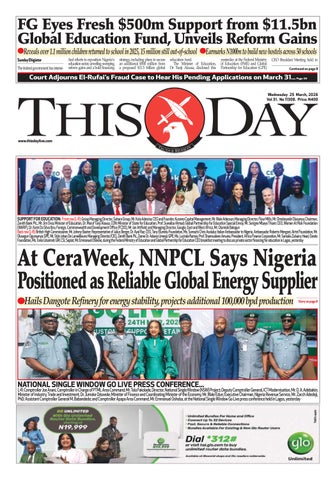
SUPPORT FOR EDUCATION: Front row (L-R): Group Managing Director, Sahara Group, Mr. Kola Adesina; CEO and Founder, Kuramo Capital Management, Mr. Wale Adeosun; Managing Director, Flour Mills, Mr. Omoboyede Olusanya; Chairman, Zenith Bank Plc., Mr. Jim Ovia; Minister of Education, Dr. Maruf Tunji Alausa, CON; Minister of State for Education, Prof. Suwaiba Ahmad; Global Partnership for Education Special Envoy, Mr. Serigne Mbaye Thiam; CEO, Women At Risk Foundation (WARIF), Dr. Kemi Da Silva Ibru; Foreign, Commonwealth and Development Office (FCDO), Mr. Ian Attfield; and Managing Director, Google, East and West Africa, Mr. Olumide Balogun Back row (L-R): British High Commissioner, Mr. Johnny Baxter; Representative of Julius Berger, Dr. Ayal Raz; CEO, Tony Elumelu Foundation, Ms. Somachi Chris Asoluka; Italian Ambassador to Nigeria, Ambassador Roberto Mengoni; Airtel Foundation, Mr. Olusegun Ogunsanya; GPE, Mr. Stijn Johan De Lameillieure; Managing Director/CEO, Zenith Bank Plc., Dame Dr. Adaora Umeoji; GPE, Ms. Lucinda Ramos; Prof. Shamsudeen Amuwu; President, Africa Finance Corporation, Mr. Samaila Zubairu; Head, Oando Foundation, Ms. Tonia Uduimoh; GM, CSI, Seplat, Mr. Emmanuel Otokine, during the Federal Ministry of Education and Global Partnership for Education CEO breakfast meeting to discuss private sector financing for education in Lagos, yesterday

At CeraWeek, NNPCL Says Nigeria Positioned as Reliable Global Energy Supplier

Hails Dangote Refinery for energy stability, projects additional 100,000 bpd production Court Adjourns El-Rufai’s Fraud Case to Hear His Pending Applications on March 31...

L-R: Comptroller Joe Anani, Comptroller in Charge of PTML Area Command; Mr. Tola Fakolade, Director, National Single Window (NSW) Project; Deputy Comptroller General, ICT Modernisation, Mr. O. A. Adebakin; Minister of Industry, Trade and Investment, Dr. Jumoke Oduwole; Minister of Finance and Coordinating Minister of the Economy, Mr. Wale Edun; Executive Chairman, Nigeria Revenue Service, Mr. Zacch Adedeji, PhD; Assistant Comptroller General M. Babandede; and Comptroller Apapa Area Command, Mr. Emmanuel Oshoba, at the National Single Window Go Live press conference held in Lagos, yesterday

Beyond
Survival

Governance
&
 Culture
as
the
 Foundation
of Lasting
Family
 Legacies

Prof
Enase
 Okonedo

Vice
Chancellor Pan-Atlantic
University

Prof
Olayinka
 David-West Dean, Lagos
Business
School

Dr
Okey
 Nwuke Director Family
Business
Initiative,
 Lagos
Business
School

Mr
Rasheed Sarunmi Group
CEO Saroafrica-SIAT
Group,
 Chairman
FBI
Advisory Commitee

PANEL
SESSION
1
-
Governance
as
a
Lifeline
–
Role
of
Boards
in
Family
Business
Sustainability

MODERATOR PANELLISTS

Mr
Kunle Elebute Chairman,
 Gerrard
Capital
Advisory

Barr.
(Mrs) Bernadette
 Eyisi
 Chief
Corporate
 Service
Officer
&
Executive
 Director,
SIMS
Nigeria
Ltd.

Mrs
Toyin
 Bakare
 COO/Executive
Director,
 SAS
Textiles
Ltd

Engr
Alfred
 Okoigun Founder/ Group
Managing
Director ARCO
Group

Mrs
Kemi
 Ojenike
 Managing
Director,
 Meristem
Family
Office

Dr
John
 Momoh
OON. Founder/Chairman,
 Channels
Media
Group
 Channels
Television

Thursday March
26,
2026

Time 8꞉00
a.m.

PANEL
SESSION
2
-
Culture
as
the
Glue꞉
Driving
Engagement,
Innovation,
and
Longevity
in
Family
Enterprises.

Dr
Belinda Nwosu Director,
 Hospitality
Initiative Lagos
Business
School

Ms
Kenechi
 Chidolue
 Executive
Director Chelsea
Hotel

Mr
Mahmud Tukur
 Founder Ashgrove
Group Chief
 Okechukwu
Ikoro Chairman/MD Camela
Vegetable
Oil
 Company
Ltd. A.
U.
 Mustapha SAN. Principal
Partner,
 A.U.
Mustapha
&
Co.

Ecobank
Pan
 African
Centre
 (EPAC),
 270
Ozumba
 Mbadiwe
Avenue,
 Victoria
Island,
 Lagos.

Register
here꞉
www.lbs.edu.ng/lbs-fbi-conference-2026

CORONATION ASSET MANAGEMENT GETS BEST INVESTMENT MANAGER FOR PRIVATE CREDIT AWARD...

for Private

to

At PenCom Board Inauguration, FG Urges Robust Risk Management,

Corporate Governance to Safeguard N28tn Pension Assets

Akume: while board is responsible for oversight, management must be allowed to handle day-to-day operations Oloworaran assures on partnership with board to advance pension industry objectives NECA hails swearing-in

James Emejo in Abuja and Dike Onwuamaeze in Lagos

Secretary to the Government of the Federation (SGF), Senator George Akume, has inaugurated the Govern- ing Board of the National Pension Commission (PenCom), urging members to uphold the highest standards of corporate governance risk management to safeguard over N28 trillion in pension assets under the Contributory Pension Scheme (CPS).

He said the board must reinforce public confidence in the pension system and assure contributors that their savings are safe, secure, and wellSpeakingmanaged. at the inauguration in Abuja, Akume called for zero tolerance for misconduct, urging the board, led by Agbaje Opeyemi Olukayode, to prioritise strong internal controls, robust risk management, and transparency in decision-making.

This came as the Nigeria Employ- ers’ Consultative Association (NECA) commended the federal government for the inauguration PenCom

NECA described the development as a critical step toward strengthen- ing governance, transparency, and accountability in Nigeria’s pension industry.Akume however, noted that

PenCom remained a critical pillar of the financial sector, entrusted with the retirement savings of millions of Nigerians, adding that the event demonstrates the government’s com- mitment to a pension system that is transparent, resilient, and trusted.

The SGF also described the board’s role as one of national importance as members are expected to provide strategic direction, policy guidance, and effective oversight in line with the Pension Reform Act 2014 (PRA) and other relevant frameworks.

He further drew a distinct correlation between governance and administration, stressing that while the board is responsible for oversight, management must be allowed to handle day-to-day operations.

According to him, any interference in operational matters would weaken accountability and undermine institutional effectiveness.

On the scale of responsibility before the new board, the SGF said that the pension industry had grown significantly with assets currently exceeding N28 trillion including millions of contributors depending on the CPS for financial security in retirement.

Further reaffirming the govern- ment’s commitment to the sector, the SGF said the administration of President Bola Tinubu remained resolute in meeting pension obligations.

He noted that steps have been taken to address outstanding liabilities and restore confidence, with a focus on ensuring that retirees receive their benefits with dignity, certainty, and timeliness.

Akume however, expressed confidence that members would deliver exemplary leadership, disciplined governance, and sustained commitment to the Nigerian people.

In her remarks, Director General, PenCom, Ms. Omolola Oloworaran, thanked the SGF for offering strategic leadership with clarity and purpose prior to the inauguration, as well as contributing to key achievements recorded since her assumption of office – a period the commission operated without a board.

She reaffirmed her commitment to working collaboratively with

the board, anchored on a shared responsibility to serve the interests of Nigerians, and stressed that every decision of PenCom board must ultimately deliver tangible benefits to contributors and retirees.

Oloworaran further described the inauguration as timely and signifi- cant as it strengthens governance within the commission by restoring oversight function.

She said she looked forward to a productive and collaborative working relationship with the Board.

The PenCom boss assured that both board and management would continue to deliver on the commission’s mandate, expressing confidence in a strong partnership with all board members in advancing the objectives of the pension industry.

However, speaking on behalf of

members, Olukayode expressed appreciation to the president for finding the board members worthy of the national assignment.

He reaffirmed the board’s full commitment to upholding the ideals articulated by the SGF, particularly in the areas of corporate governance, integrity, strong leadership, and a clear distinction between governance andTheoversight.chairman pledged the board’s determination to advance the administration’s agenda by leveraging pension funds as a catalyst for national development, mainly in infrastructure, housing, and other critical sectors of the economy.

However, in a statement, Director General of NECA, Mr. AdewaleSmatt Oyerinde, yesterday noted that the inauguration came after a

prolonged delay which had raised concerns among employers and stakeholders regarding the oversight of pension assets and the overall integrity of the Contributory Pension Scheme (CPS).

Oyerinde said, “The constitution of the PenCom Board is both timely and commendable. It addresses a significant governance gap and reinforces confidence in the manage- ment of pension funds, now valued at over N28 trillion, which represent the retirement security of millions of Nigerian workers.”

He particularly commended the government, under the leadership of President Bola Ahmed Tinubu, for taking decisive action to restore the statutory governance structure of PenCom in line with the provisions of the Pension Reform Act 2014.

Zenith Bank Appoints Okwudili Executive Director, Effective May 1

Nume Ekeghe

Zenith Bank Plc has announced the appointment of Kennedy Onuwa Okwudili as an Executive Director, with effect from May 1, 2026, in a move that underscores the Bank’s

long-standing culture of internal talent development and leadership succession.

The elevation is expected to bolster the bank’s executive management team, drawing on Okwudili’s extensive institutional knowledge

Nigeria, Finland Sign MoU on Digitalisation, Innovation

Oghenevwede Ohwovoriole in Abuja

The federal government has signed a Memorandum of Understanding (MoU) with the Finish government on digitalisation and innovation, marking a significant milestone in the deepening of bilateral cooperation in the digital sector.

In a statement, Special Assistant on Media and Communications to the Minister of Communications, Innovation and Digital Economy, Isime Esene, disclosed that the MoU was signed in Abuja by the minister, Dr. ‘Bosun Tijani, and

Mr. Jarno Syrjälä, Under Secretary of State (International Trade) of the Ministry for Foreign Affairs of Finland.

According to the statement, “The Memorandum of Understanding strengthens the framework for collaboration in key areas such as digital government, emerging technologies, digital public infrastructure, cybersecurity, innovation ecosystems, and capacity building.

“It reflects both countries’ shared ambition to leverage digital transformation as a driver of sustainable economic growth, efficient public services,

and inclusive innovation.

“Today’s MoU-signing marks an important step in strengthening the partnership between both countries as we work to build a more inclusive, innovation-driven digital economy.”

The minister said, “This agreement is a significant next step following our engagements in Helsinki in February, where we met with key stakeholders including Finnvera and Finnfund, and held productive discussions on advancing collaboration around digital infrastructure, the Data Exchange Platform, and opportunities for Finnish

participation in Project BRIDGE.”

He added, “We are confident that this partnership will unlock meaningful opportunities for both countries, enabling us to leverage digital transformation as a catalyst for sustainable growth and shared prosperity.”

Syrjälä said, “Finland is very pleased to deepen its partnership with Nigeria in building resilient, secure, and human centric digital societies.”

The under secretary added, “Digitalisation is at its best when it empowers people, strengthens trust, and creates new opportunities for innovation.

and cross-functional experience within the organisation.

Okwudili graduated with a Bachelor of Science (Honours) in Accounting in 1998 from the University of Maiduguri, Nigeria, with a Second Class Upper division. He obtained a Masters of Business Administration (MBA) from the Ahmadu Bello University, Zaria, Nigeria in 2008 and a Masters of Science in Accounting from Veritas University, Abuja, Nigeria in 2021.

Zenith bank in a statement added: “Okwudili has over twenty-five years of cognate banking experience spanning credit and marketing, treasury, compliance as well as operations and had at different times worked in various zones and departments of the bank.

“He is a Fellow of the Institute of Chartered Accountants of Nigeria (ICAN), 2013, a Fellow of the Chartered Institute of Bankers of Nigeria (CIBN), 2024 and an Associate of the Chartered Institute of Taxation of Nigeria (CITN), 2016.

“He has attended several Execu-

tive Education Programmes both within and outside the country, including: Senior Leadership Development Programme at the Lagos Business School, Corporate Directorship Programme at the Harvard Business School and Oxford Advanced Management and Leadership Programme at the University of Oxford, SAID Business School. He is currently the President of Catholic Bankers Association of Nigeria (CBAN) and a member of the Noble Order of the Knights of St. John International (KSJI).”

L-R: Mr. Kayode Akindele, Managing Partner, Coronation Capital Limited; Mr. Amol Rajan, podcaster and host of University Challenge; Mrs. Ngozi Akinyele, Chief Marketing and Communications Officer, Coronation Group; Mr. Aigbovbioise Aig Imoukhuede, Managing Director/CEO, Coronation Asset Management; Mr. Mayowa Ikotun, Head, Coronation Infrastructure Funds; and Mr. Daniel Shane, Global Head of Private Banking, Euromoney, at the presentation of the Best Investment Manager
Credit award
Coronation Asset Management Limited at the Euromoney Private Banking Awards 2026 in London
Okwudili

FROM SWITZERLAND WITH LOVE...

Vice President Kashim Shettima (R) and Vice President of Switzerland, Mr. Ignazio Cassis, during a meeting at the Presidential Wing of the Nnamdi Azikiwe International Airport, Abuja, yesterday

Ahead NSW Phase 1 Launch Tomorrow, FG Says Technology Will Solve 73% of Port Delays

Zacch Adedeji: Project’s funding fully captured in NRS’ budget

As preparations towards tomorrow’s launch of the National Single Window (NSW) Phase 1 initiative intensifies, the federal government has stated that the technology would directly solve 73 per cent of delays at the seaports which are process-related.

The NSW was designed as a single integrated digital platform which connects all relevant government agencies involved in trade regulation and cargo clearance, and aims to simplify trade processes, eliminate duplications, and significantly reduce cargo clearance timelines from several weeks to days.

A document from the office of the Minister of Finance and Coordinating

Minister of the Economy, Mr. Wale Edun, revealed that Nigeria had taken a decisive step to modernise its trade ecosystem with the launch of Phase 1 of the NSW.

According to the document, Thursday’s planned launch of NSW coincides with last week’s deal to upgrade Apapa Port (built 1913) and Tin Can Port (built 1977).

“This is a coordinated reform designed to cut cargo dwell time, reduce trade costs, and unlock economic growth.

“As of 2025, cargo dwell time in Nigerian ports averaged 18–21 days. This is approximately 475 percent higher than the global average of 4 days,” the document stated.

It noted that this leads to high cost of doing business, delays for importers and exporters, and reduced competitiveness of Nigerian goods.

It noted that 73 per cent of cargo dwell time is “transaction dwell time”, stressing that time is spent on documentation, Customs processing, and regulatory approvals

“This means the primary bottleneck is not physical infrastructure alone — it is process inefficiency,” the brief said, adding that the government adopted a dual reform approach, which is deliberate and integrated.

It noted that Phase 1 of the NSW to be launched on Thursday directly targets the 73 per cent transaction delay component by introducing

one single digital platform for trade documentation, eliminating multiple agency visits and duplicative processes.

NSW also enables electronic submission of licences, permits, certificates (LPCOs), digital manifest processing, centralised risk management across agencies, and transparent electronic payments.

The NSW is expected to impact on dwell time, culminating in faster document processing, reduced human interface and bottlenecks, predictable and transparent timelines.

On the other hand, the upgrade of Apapa and Tin Can Ports, which handle 70 per cent of Nigeria’s trade, addresses congestion at terminals, inefficient cargo handling, outdated

Tinubu Rallies Global Support for Skills Acquisition for Millions of Nigerian Youths

Shettima calls for coordinated results to drive economic growth

President Bola Tinubu rallied global development partners, industry leaders, and policymakers to deepen investment in the federal government’s ongoing skills acquisition drive targeting millions of Nigerian youths.

That was as Vice President Kashim Shettima called for clarity, collaboration, and coordinated results from relevant stakeholders. Shettima emphasised the need for investments in a more coherent national system, where skills led to jobs enterprising enough to drive economic growth.

The vice president spoke in Abuja on Tuesday while declaring open the National Skills and Industry Alignment Roundtable Series (Q1 2026), with the theme, “Bridging Skills Supply and Labour Market Demand.” It was convened by the Office of the Vice President, with support from the European Union (EU).

Represented by Deputy Chief of Staff to the President (Office of the Vice President), Senator Ibrahim Hadejia, Shettima commended EU for its continued partnership and support for Nigeria’s job creation

and youth development agenda.

According to him, the collaboration has been instrumental in strengthening coordination and advancing collective efforts to create opportunities for young Nigerians.

Shettima stressed that Nigeria stood at a decisive moment in its history, stating that the country is home to one of the largest youth populations in the world, with millions entering the labour market each year—full of ambition, energy, and potential.

He observed that the vast majority of available jobs were informal, unstable, and not fully connected to productivity and growth, requiring sustained and targeted interventions to ensure graduates are job-ready and equipped with relevant skills.

Shettima stated, “This tells us one thing very clearly—the challenge is not simply job creation; it is alignment. Nigeria does not have a talent problem. Until skills meet industry demand, job creation will remain below its full potential.”

The vice president affirmed that the Tinubu administration was determined to address the challenge.

He said, “We are moving away

from fragmented programmes, isolated interventions, and uncoordinated investments toward a more coherent national system—one where skills lead to jobs, jobs lead to enterprise, and enterprise drives economic growth.

“Last year, under the leadership of the vice president and with the support of the European Union, the Office of the Vice President undertook a mapping of the national job creation ecosystem and convened a National High-Level Policy Dialogue on Job Creation.

“That engagement made it clear that sustainable employment will not come from government alone, but from a coordinated ecosystem where the private sector leads and government enables. It is in continuation of that effort that we are gathered here today.”

Shettima stated that the roundtable series was designed as a structured platform for engagement, bringing together policymakers, industry leaders, development partners, and institutions to align efforts, build trust, and drive practical solutions.

He stated that beyond ongoing multi-faceted investments, the federal

government sought to move from dialogue to deliberate action, connecting the dots between training and employment, education and industry, and policy and outcomes.

infrastructure, and impact on dwell time.

The upgrade also leads to faster cargo discharge and evacuation, reduced port congestion, and improved turnaround time for vessels and trucks.

The document noted that the NSW and port upgrades are mutually reinforcing, explaining that NSW results in faster approvals while port upgrades lead to faster cargo movement.

Meanwhile, ahead of tomorrow’s launch of the NSW, key government stakeholders and industry leaders yesterday underscored the significance of the reform as a cornerstone of Nigeria’s economic transformation agenda.

They spoke at the newly-opened National Single Window support center in Lagos, where the Minister of Industry, Trade and Investment, Jumoke Oduwole, described the initiative as a “game-changer” that will enhance Nigeria’s competitiveness on the global stage.

According to her, the platform is designed not only to ease the cost of doing business but also to empower local industries and attract foreign investment.

Echoing this sentiment, the

Minister of Finance, Mr. Wale Edun, emphasised the fiscal implications of the initiative.

Edun noted that the NSW will significantly improve revenue collection through transparency, reduce leakages, and strengthen Nigeria’s economic resilience in a rapidly evolving global market.

In the same vein, the Executive Chairman of the Nigerian Revenue Service (NRS), Dr. Zacch Adedeji affirmed that the NSW initiative is fully funded within the federal government’s approved budget, and is designed to improve business efficiency, not merely boost revenue. He noted that the project’s funding is already captured in the agency’s appropriation and complies strictly with the national budget approved by the National Assembly, with no extra-budgetary spending involved. Adedeji explained that the initiative includes investments in digital infrastructure and system integration, while assuring that it will not replace the roles of agencies such as the Nigerian Maritime Administration and Safety Agency (NIMASA), Nigerian Ports Authority (NPA), and National Agency for Food and Drug Administration and Control (NAFDAC).

British Council Celebrates Nigerian Leaders in Social Impact, Business, Culture

The British Council, yesterday, honoured some distinguished Nigerian professionals who have leveraged their United Kingdom education to drive impact in social change, business, culture, and science.

The 2026 Study UK alumni awards, held in Lagos, brought together leaders from government, academia, and industry, alongside accomplished alumni whose contributions reflect the enduring value of UK higher education and its influence on Nigeria’s development.

The awards recognised individuals across four categories for their

outstanding contributions.

In the Social Action category, Kola Alapinni, an international human rights lawyer, was honoured for his advocacy in defending freedom of religion and belief in Nigeria. His legal interventions in high-profile blasphemy cases in Kano led to overturned convictions on appeal, while his broader advocacy continues to challenge the constitutionality of such laws.

For Culture, Creativity and Sport, Yemisi Sophie Odusanya, popularly known as Sisi Yemmie, was recognised for her influence in digital storytelling and food media.

Through her YouTube platform, she has built a strong global audience

showcasing Nigerian cuisine and culture, contributing to the country’s cultural visibility.

In the Business and Innovation category, Dimeji Sofowora, cofounder of Helium Health, was honoured for advancing healthcare technology across Africa. His organisation has digitised millions of patient records and provided financing support to healthcare providers, improving service delivery across the sector. Similarly, a professor at Bayero University Kano, Abdulazeez Ahmed, received recognition in the Science and Sustainability category for his contributions to hearing healthcare.

Funmi Ogundare
Deji Elumoye in Abuja
Ndubuisi Francis in Abuja

COURTESY VISIT TO THE INSPECTOR GENERAL OF POLICE...

Executive Secretary/CEO, Lagos State Security Trust Fund (LSSTF),

visit to the IGP at the Force Headquarters, Abuja, yesterday

Energy Crisis: LCCI

Urges FG to Enforce PIA’s Stipulated 300,000 barrels Crude Oil Allocation to Local Refineries

Lagos Chamber of Commerce and Industry (LCCI) has tasked the federal government and Nigerian National Petroleum Company Limited to implement the domestic crude supply obligations under the Petroleum Industry Act (PIA) by ensuring consistent allocation of more than 300,000 barrels per day of crude oil to local refineries, particularly, Dangote Refinery.

LCCI expressed the view yesterday in a public statement on rising oil prices, adding that petrol pump prices are trending towards N1,500/litre.

Director-General of LCCI, Dr. Chinyere Almona, who signed the statement, said, “The federal government and the Nigerian National Petroleum Company Limited must urgently enforce domestic crude supply obligations under the Petroleum Industry Act, ensuring consistent allocation of more than 300,000 barrels per day to local refineries, particularly the Dangote Refinery.

“This should be complemented by a transparent and scalable naira-for-crude framework to reduce FX exposure, lower production costs, and stabilize output.”

Almona stated, “At the regulatory level, the Nigerian Midstream and Downstream Petroleum Regulatory

Authority should implement a clear, rules-based pricing framework that reflects verifiable cost fundamentals while preventing abuse of market dominance without undermining deregulation.

“Simultaneously, the government must accelerate the operationalisation of other licensed and modular refineries to reduce concentration risk, while maintaining strategic imports as a short-term buffer to stabilise prices.

“Addressing binding constraints, especially FX volatility, logistics inefficiencies, and distribution bottlenecks, remains critical to improving market efficiency.”

She said the current oil price shock was a decisive stress test of Nigeria’s energy and economic architecture.

Almona stated, “LCCI maintains that sustainable fuel price moderation will not be achieved through administrative controls, but through structural reforms that expand domestic supply, foster competition, and reinforce transparency across the value chain.

“With disciplined execution and strong public-private collaboration, Nigeria can turn this challenge into a catalyst for building a more resilient, competitive, and self-sufficient energy ecosystem, firmly positioning the country and the wider West African region for long-term stability and growth.”

The LCCI director-general said beyond securing the country’s fuel needs, “We expect the government to work towards a holistic restructuring of the oil and gas sector to enable Nigeria to become an alternative oil and gas supplier to other African countries and Europe.

“With the ongoing crises in the Gulf region, European and Asian countries are seeking new deals from new regions as an alternative.

“We must look ahead to proactively position ourselves as a veritable alternative to oil and gas supplies from Russia and the Gulf region.”

LCCI stated that the surge in global crude oil prices, to about $112 per barrel, was intensifying pressure on the Nigerian downstream petroleum segment and rapidly transmitting inflationary shocks across transportation, food, and industrial production.

According to Almona, the fourth

upward review of Dangote Refinery’s gantry price to approximately N1,245/ litre, signalled intensifying pressure in Nigeria’s downstream market, with pump prices trending towards N1,500/litre.

She said, “This development is rapidly transmitting inflationary shocks across transportation, food, and industrial production.”

Almona added, “LCCI underscores that this persistent fuel affordability

challenge is fundamentally a reflection of a structural supply deficit, where Nigeria’s daily petrol demand of over 50–53 million litres continues to outpace effective domestic refining capacity, thereby amplifying price pressures as supply becomes increasingly concentrated.

“In this context, government intervention must be anchored on strategic market stabilisation rather than price suppression.”

Tinubu Felicitates Long-time Aide, Tunde Rahman, At 60

Lauds his loyalty and commitment to duty over the years

Deji Elumoye in Abuja

President Bola Tinubu has felicitated his Senior Special Assistant on Media and Special Duties, Mr Tunde Rahman, on his 60th birthday. Tinubu lauded him for his commitment to duty and loyalty over the years.

The president, in a congratulatory message issued on Tuesday by his Adviser on Information and Strategy, Bayo Onanuga, used the occasion of his aide’s 60th birthday to shower encomiums on him for his many years of unflinching dedication to duty as his former Adviser on Media and now senior

Isoko Culture, Says Ibori

aide in the presidency.

Tinubu stated that Rahman displayed strong leadership and an extraordinary work ethic throughout his service as adviser on media, especially during the period leading up to the last presidential election, when he played an active and prominent role as a political liaison and media strategist.

The president described Rahman as a conscientious journalist and newspaper editor who applied himself to professionalism and used journalism to promote public good and social justice.

The president said, in the

statement, “I especially celebrate Tunde Rahman for his outstanding qualities on the celebration of his 60th birthday. He is a dedicated, humble and extraordinarily loyal personal aide who serves with utmost dedication.

“I appreciate his contributions to our progressive ideals and promotion of good governance in our country. Tunde is a steadfast and reliable personal aide whose advice and suggestions are sincere and free of any hidden agenda.

“On this diamond birthday celebration, my prayer for Tunde is that God should grant him

REA Emerges Tops in ICPC’s Integrity Compliance, Ethics Ranking

Sylvester Idowu in Warri

Former Delta State Governor, James Ibori, has dismissed claims linking the Ozoro incident to any traditional festival, insisting that no such practice exists in Urhobo or Isoko culture.

Reacting to the controversy, Ibori, in a statement issued yesterday, said he was shocked when he first heard reports suggesting the existence of a festival associated with violence against women.

“I must confess that this is the first time I am hearing of a festival of this nature,” he said.

The former governor, who said

he has lived all his life in Urhobo land, including his eight years as governor, described the reports as misleading and dangerous.

“You can imagine my shock when I was contacted. My initial reaction was, ‘This cannot be true, but let me verify,’” he added.

Ibori noted that after making inquiries, including consultations with the traditional institution in Ozoro, findings showed that the alleged event was not authorised.

“Even the custodian of our tradition whose authority is required for such festivals was not consulted,” he said.

He warned against generalising

the actions of a few individuals to entire ethnic groups.

“It is unfair to ascribe such violence to the entire Isoko people, and most unfortunate that the Urhobo people have also been implicated,” he stated.

The ex-governor also debunked claims linking the Ekene festival to acts of sexual violence.

“One commentator made a pronouncement implicating the Ekene festival in orgies. This is totally untrue,” he said.

According to him, festivals in Urhobo and Isoko communities are rooted in history, spirituality and moral values.

The Rural Electrification Agency (REA) has emerged tops within Nigeria’s power sector, as ranked by the Independent Corrupt Practices and Other Related Offences Commission (ICPC), in the recent Ethics and Integrity Compliance Ranking and Performance Outlook 2025.

The milestone, it was learnt, reflects not only the agency’s adherence to ethical standards, openness and transparency but also the strength of its governance structures, operational processes, and compliance culture in the last two years.

Also, the REA has been ranked

among the top 15 Ministries, Departments, and Agencies (MDAs) under the Anti-Corruption and Transparency Unit (ACTU) Effectiveness Index (AEI), a key performance indicator assessing the efficiency of ACTU across public institutions.

A document seen by THISDAY showed that current ranking holds an even more significant relevance for the agency and the nation at large when compared to the last ICPC ranking circle, released by the commission in the year 2020.

That year, the REA was ranked 157 out of 220, placed at 31.4 per cent in overall performance, while the agency’s current overall performance ranking is

71.98 per cent, over 50 per cent improvement.

According to the ICPC, the design of the ranking embodies its preventive approach to combating corruption combining the focus of enforcement and building resilient systems that promote transparency, ethics, and compliance.

“It encourages MDAs to institutionalise integrity as a governance principle, thereby reducing opportunities for misconduct, misuse of public resources, and administrative inefficiencies.

The 2025 EICS Report represents the commission’s ongoing effort to entrench integrity and good governance practices within public institutions.

good health, greater wisdom for greater
Dr. Ayo Ogunsan (L) and Inspector General of Police, IGP Olatunji Rilwan Disu, during his courtesy
Tunde Rahman

Strong Bilateral Ties, Security, Trade, Others Top Agenda as Shettima, Swiss VP Meet

Switzerland to return Benin bronzes, artefacts to Nigeria Pledges support to combat insecurity in Noth-east

in Abuja

Nigeria and Switzerland on Tuesday agreed to actively strengthen bilateral relations, focusing on a multi-faceted approach that spans trade, security, economic cooperation, skills acquisition, migration, and cultural exchange.

That was the outcome of a meeting between Vice President Kashim Shettima and his Switzerland counterpart, Mr. Ignazio Cassis.

Shettima received his Swiss counterpart and his spouse, Paola Rodoni Cassis, at the presidential wing of Nnamdi Azikiwe International, Abuja, where they met behind closed doors.

Addressing newsmen after the meeting, Cassis, who is also

Foreign Minister of Switzerland, disclosed that the discussions dwelled on improved bilateral relations, free trade agreement, skills acquisition, migration, cultural exchange, and support for Nigeria in tackling the security situation in the North-east region.

He said, “We are considering improving our bilateral relations. We are considering to analyse the opportunity of making a free trade agreement with the AfCFTA family and Nigeria.

“Secondly, we are working together very much in diplomatic efforts to address the many different conflicts in the north eastern part of Nigeria.

“Thirdly, we are contributing to vocational training in Nigeria, with

the Swiss companies in Nigeria creating the best conditions for young people to peacefully live together by being skilled enough to have jobs for the future.”

Cassis stated that the two countries also agreed to improve cultural cooperation, including restitution of cultural materials.

According to him, “We also have cooperation in migration issue, and every year, we are meeting together, where we explore every facet of this cooperation.”

He expressed gratitude to Nigeria for its continuous presence in the World Economic Forum (WEF) held annually in Davos, just as he congratulated the country for the Nigeria House inaugurated in Davos this year.

Shedding more light on the outcome of the meeting, Minister of Foreign Affairs, Ambassador Yusuf Tuggar, said the discussions were a continuation of the old relationship between both countries that dated back to 1961.

Tuggar said, “Vice President Cassis expressed keenness to see Nigeria and Switzerland sign a free trade agreement, and this is a very welcome development. There were other discussions about Swiss businesses and investments. There are so many of them, and that is why from here he goes to Lagos to engage with the private sector.”

The minister disclosed that the Swiss government also agreed to return bronzes and artefacts belonging to the Benin Kingdom

in Edo State, as part of efforts to strengthen cultural ties between both countries.

He said, “There was a general assurance that we need to strengthen the relationship between the two countries not just when it comes to business but also cultural aspect of the relationship.

“So, there are Benin bronzes that are going to be returned from Switzerland. He informed the vice president that the Swiss Minister of Culture will be visiting Nigeria shortly, and this was something that was highly appreciated.”

Tuggar stated that Shettima welcomed the developments “and assured that Nigeria will continue to engage with Swit-

zerland and continue

were some uncertainties as to whether it will remain in Davos or not.”

AT CERAWEEK, NNPCL SAYS NIGERIA POSITIONED AS RELIABLE GLOBAL ENERGY SUPPLIER

Emmanuel Addeh in Abuja and Peter Uzoho in Houston, Texas

At a time of global energy supply shock occasioned by ongoing US-Israel war on Iran, Nigeria is regaining its footing as a reliable global energy supplier, Nigerian National Petroleum Company Limited (NNPC) said yesterday.

NNPCL said the country was reclaiming its global energy standing on the back of improved security in the Niger Delta and a more stable policy environment.

But Nigeria’s improved position also came against the backdrop of the US-Israel war against Iran, which had resulted in the targeted destruction of oil facilities across the Middle East and the closure of the Strait of Hormuz through which approximately 20 per cent of world oil supply passes, creating major disruption to global energy supply.

The national oil company also projected a moderate increase in oil production in the coming months, with crude output expected to rise moderately by about 100,000 barrels per day, despite the country’s 1.84 million bpd budget benchmark for 2026.

Lagos, where top private sector leaders and development partners gathered to align investments with the government’s reform agenda.

Alausa said the global replenishment initiative, expected to raise $11.5 billion to support foundational learning across 80 countries, presents a major opportunity for Nigeria to deepen ongoing reforms.

“As part of this conference cycle, if everything goes well, Nigeria will benefit from another $500 million to support our foundational education,” he said.

He stressed that education remains the most strategic investment for national growth, noting that increased funding yields significant economic returns.

“Investment in education is the best investment that gets the highest return. For every one per cent increase in spending, productivity rises by six per cent. Every additional year of schooling leads to about a 5.7 per cent increase in earnings, even higher for women,” he added.

Providing a progress report, the minister revealed that over 1.1 million out-of-school children had been reintegrated into classrooms within the past year, describing it

Group Chief Executive Officer (GCEO) of NNPCL, Mr. Bayo Ojulari, made the disclosures during a Fireside chat at the ongoing CeraWeek 2026 in Houston, Texas, United States, organised by S&P Global, with the theme, “Convergence and Competition: Energy, Technology and Geopolitics.”

At the session anchored by Senior Vice President (Upstream Solutions) at S&P Global, Daniel Pratt, Ojulari told global energy investors and stakeholders that the new NNPCL prioritised project execution discipline and excellence, adding that they would define the company’s success in the next five to 10 years.

Speaking on the outlook for the sector, Ojulari said enhanced operational autonomy granted by President Bola Tinubu had strengthened the company’s ability to take commercially driven decisions. He stressed that disciplined project execution will be key to sustaining performance.

Ojulari hailed Dangote Refinery for helping to reduce Nigeria’s exposure to global supply volatility, stating that growing domestic refining capacity is improving energy security and cushioning the country

as a significant milestone.

“In the last 24 months, we’ve been able to move well over 1.1 million children from the streets back to school,” he said.

However, he acknowledged that the country still faces a deep-rooted education crisis, with approximately 15 million children out of school.

“Today, we still have about 15 million out-of-school children in our country, with a high concentration in the North-east and North-west,” he added.

Alausa also highlighted the alarming rate of learning poverty, explaining that millions of children were unable to read age-appropriate texts by the age of 10.

A major concern raised by the minister was the sharp drop in enrolment between primary and junior secondary education, which he attributed largely to inadequate infrastructure.

“Today, we have about 32 million children in primary schools, but when you move to junior secondary school, you find only about six million. There’s a drop-off of almost 22 million children,” he said.

He explained that the disparity was driven by the limited number of junior secondary schools compared

against external shocks.

Ojulari credited Tinubu for granting the national oil company greater operational autonomy, which he said had strengthened decision-making and improved efficiency.

He emphasised that strict project execution discipline would be critical to sustaining growth and unlocking value across the sector.

Ojulari stated, “Nigeria is a destination for all the investment we’re talking about. The president has given NNPC the autonomy to be able to act on behalf of government to sort and consolidate commercial solutions that are long-lasting is a refreshing development for Nigerians.

“We’ve had almost 100 per cent availability of all our pipelines over the last year, achieved through a more strategic collaboration between the government security forces and a very innovative collaboration with the community. The solution is far more sustainable. So, we are in a more secure environment.”

He stated that the Petroleum Industry Act (PIA) 2021 had freed up NNPC to be a commercial entity, allowing it to compete with other private companies, describing it as

to primary schools nationwide.

“We have about 78,000 primary schools, but only about 9,000 junior secondary schools. That tells you clearly that access is a major issue,” he stated.

To tackle infrastructure deficits and improve learning conditions, Alausa disclosed that the federal government has earmarked N100 billion for the construction of new student hostels across tertiary institutions.

“This year, we’ll be spending about N100 billion in building new student hostels across universities and polytechnics to expand access and improve learning conditions,” he said.

He added that additional investments are being channelled into rehabilitating engineering workshops, medical schools, and technical institutions to boost capacity in critical sectors.

“We are investing heavily in STEM and technical education because that is where the future lies,” he noted.

On basic education financing, the minister said reforms have significantly improved access to Universal Basic Education Commission (UBEC) matching grants

a huge transformation.

Building on that, the GCEO said the first piece of that transformation in terms of restructuring had happened over the last couple of years and NNPC was now at a stage where it was beginning to transform the culture and deepen the partnerships it had.

Instructively, Ojulari said the company had been able to review the full portfolio of all its businesses, which it concluded last year, adding that this year, NNPC is beginning to implement actions from the portfolio review.

Ojulari told the global investment community in the audience, “We’ve also begun to strengthen the partnerships that we have. Again, very important for us, our best ambassadors are existing partners, the IOCs: Exxon, Chevron, Shell, Total, ENI.

“Our first focus was to get the right feedback on what is good, what is going well, what we need to improve, and so far, I think that partnership has deepened, and we’re beginning to see how we can move forward and grow the business.”

Having removed some of the bottlenecks hindering investments

by state governments.

“Before we came in, we had almost N240 billion sitting as unaccessed matching grants. Today, through improved collaboration, over N140 billion has been accessed and deployed by states,” he said.

According to him, the funds are being used to build classrooms, provide furniture, and improve sanitation facilities in schools.

He added that the government was also pushing legislative changes to increase UBEC funding.

“We have a bill at the National Assembly to increase UBEC funding from two per cent to four per cent, which will further strengthen foundational education,” he said.

Alausa further revealed that the ministry has deployed a nationwide digital platform to track students across their educational journey, a move aimed at improving planning and reducing dropout rates.

“For the first time in the history of our country, we now have a digital platform where every child can be tracked from primary school through their education journey.

“We know where these children are, and as they drop out, we know the reasons and can intervene accordingly.”

in the Nigerian oil and gas industry, Ojulari pointed out some positive outcomes.

He explained, “Over the last couple of months, you would have heard about significant projects that have either committed towards Final Investment Decisions (FIDs) or agreements, and disputes that have been there for several years that have been resolved, like the case of the ENI-operated OPL245.

“Those are significant projects. Recently we also heard about the Shell-operated Bonga Southwest project --$20 billion. These are implications that the international community is already building more confidence in NNPC and in Nigeria, I suppose.

“I think that’s the fundamental, but down by me, though, I would say the federal government itself, through the ministries, NNPC itself, working on its own internal structures, but also all our key partners as well.

“We have the resources, we have the markets, and we’ve built an environment that is investable. The point now is to prove it. Execution discipline is key to unlocking Nigeria’s energy potential.”

He described the initiative as a game-changer that would enable data-driven policymaking and accountability.

Earlier in her remarks, the Minister of State for Education, Prof. Suwaiba Said Ahmad, emphasised the need for stronger collaboration with the private sector to achieve large-scale“Educationtransformation. remains the cornerstone of national progress, and no nation can achieve sustainable growth without a strong, inclusive, and forward-looking education system,” she said.

She noted that the breakfast meeting was deliberately designed to move beyond dialogue to actionable partnerships.

“This platform is designed to deepen engagement with the private sector, encourage innovative partnerships, and foster collaborative solutions that will accelerate transformation across all levels of education,” she added.

Ahmad also highlighted the role of development partners in supporting reforms.

“The GPE Grant continues to play a pivotal role in advancing Nigeria’s education reform priorities and expanding access to quality

He outlined NNPC’s strategy to drive growth and transform Nigeria into a major player in the global energy market, pointing to execution discipline as the singular most important factor that will define the company’s success over the next five to 10 years.

He stated, “We’ve seen prior examples where investments and finances come into the country, but there are delays in projects. We want to be able to deliver these projects on budget, deliver them on time, and ensure that the promises of those projects in terms of productivity are achieved.”

The GCEO also hinted at the likely commissioning of the NLNG Train7 before the end of this year to enable Nigeria ramp up its gas export and domestic supplies. The $5 billion Train7 kicked off in 2019, when its FID was signed by NNPC and its co-NLNG shareholders, Shell, TotalEnergies and ENI.

While the news is being expected about Train7, Ojulari said they were also looking at expanding to the eighth and ninth trains. With Nigeria boasting over 200

Continued on page 27

education,” she said.

The ministers reiterated that sustainable financing remains central to the success of the Nigeria Education Sector Renewal Initiative (NESRI), which aligns with the Renewed Hope Agenda of President Bola Ahmed Tinubu.

Continuing, Alausa disclosed that new fiscal measures, including a development levy, are being implemented to boost funding for education, with a significant portion earmarked for key agencies in the sector. He also highlighted progress in student financing, noting that over one million students have benefited from government-backed education loans.

Despite the gains, both ministers stressed that the government alone cannot meet the scale of investment required.

“The private sector remains a critical partner in driving innovation, expanding infrastructure, and ensuring that our education system produces globally competitive graduates,” Ahmad said. Alausa added: “We are building a system that is transparent, accountable, and results-driven, but we need collective action to achieve lasting impact.”

to attend the World Economic Forum in Davos because there
Shettima

BOOK LAUNCH...

L-R: Convener, The Peak Performer and Principal Performance Strategist at CHAMP, Dr. Abiola Salami; Founder and CEO, WVL Development Advisers Ltd and Former Acting MD/CEO, Bank of Industry, Dr. Waheed Olagunju; Author of Mindset Styling and Founder of Exquisite Magazine and ELOY Awards Foundation, Dr. Tewa Onasanya; Former Minister of Science and Technology, Senator Adeleke Olorunnimbe Mamora; Former Chairman, Access Bank PLC, Mrs. Mosun Belo Olusoga; COO, Society of Corporate Governance Nigeria, Dr. Omotola Bamigbaiye Elatuyi; and Special Adviser on Climate Change and Circular Economy to the Governor of Lagos State, Mrs. Titi Oshodi, at the official launch of the books: Rule Your Mind – How to Style Your Mind to Live the Life You Desire Intentionally and Convince Yourself First – How Entrepreneurs Can Overcome Self Doubt to Live Their Best Lives, authored by Dr. Tewa Onasanya, held in Lagos over the weekend

Fagbemi: Money Laundering Remains Significant Threat to Economic Stability in West Africa

Threatens economy, security, says ICPC Idris: Tinubu positioning Nigeria for global fight against financial crimes

Attorney-General of the Federation (AGF) and Minister of Justice, Prince Lateef Fagbemi, SAN, has warned that money laundering, including terrorist financing, are significant threats to the stability of Nigeria’s economy and the West African sub-region.

Fagbemi sounded the warning on Tuesday in Abuja at the national Anti-Money Laundering and Counter Financing of Terrorism (AML/CFT) Media Outreach.

Chairman of Independent Corrupt Practices and Other Related Offences Commission (ICPC), Dr. Musa Aliyu, also identified money laundering and terrorist financing as major threats to Nigeria’s economy, national security, and democracy.

Aliyu, who was represented at the outreach by ICPC spokesman, John Odeh, said the destructive effect of financial crimes had continued to erode public trust, weaken governance, and deprive citizens of resources needed for development.

Equally speaking at the event,

Minister of Information and National Orientation, Mohammed Idris, said President Bola Tinubu was positioning Nigeria as a responsible player in the global fight against financial crimes by taking deliberate steps to address corruption and illicit financial flows.

Idris, represented by Executive Secretary and Chief Executive Officer of Nigerian Press Council, Dr Dili Ezughah, explained that recent reforms had strengthened the country’s financial intelligence system, improved monitoring of suspicious transactions, and enhanced compliance with global

Anti-Money Laundering and CounterTerrorism Financing standards.

The outreach was organised by Inter-Governmental Action Group Against Money Laundering in West Africa (GIABA). It had in attendance representatives from Nigeria Financial Intelligence Unit (NFIU) and ICPC, as well as journalists.

In his opening address, Fagbemi, represented by Mr. Olubunmi Ikupolati, observed that the menace of money laundering and terrorism financing required a concerted effort to eradicate.

He stated, “Money laundering and

Malami Cries Out over Seizure of Property, Says EFCC Acting Unilaterally, Unlawfully

The immediate past Attorney-General of the Federation (AGF) and Minister of Justice, Mr. Abubakar Malami, SAN, has faulted what he described as unlawful and unilateral seizure of his properties by the Economic and Financial Crimes Commission (EFCC).

According to the former AGF, the anti- graft agency besides acting without a valid court order, usurped the functions and duties of the judiciary, in a matter where it is also a party.

The former minister and some members of his family were late last year arrested and arraigned on charges bordering on alleged money laundering and illegal possession of firearm.

They pleaded not guilty to the charges and has been admitted to bail to enable them defend the charges against them.

However, the EFCC on Tuesday invaded and evicted Malami’s family from their residence at number 2, Coronak Crescent, off Amazon Street, Maitama, Abuja, and then sealed off the premises.

The move is believed to be anchored on an order of temporary forfeiture against Malami’s properties.

Recall that Justice Joyce Abdumalik of a Federal High Court in Abuja, had while ruling in an exparte application brought by the EFCC ordered the

temporary forfeiture of 57 properties linked to Malami on the claim that the said properties are believed to be acquired from illicit funds.

Reacting to the invasion and subsequent eviction of his family from the Maitama property, the former minister condemned the action of the agency, describing it as unprecedented in the history of the country.

“There was an attempt yesterday by the EFCC, which indeed was a co-litigant, in respect of pending criminal proceedings before Federal High Court against my person.

“Arising from that criminal proceeding, there was an order dated January 6, 2026, an interim order of forfeiture that was granted. But the most interesting part of the order, there was no clear directives or instructions in the order that the premises would be taken over forthwith or perhaps be sold, or perhaps evicting the occupants of their respective premises.

“But the most interesting part of it is, an application was filed at my instance for setting aside the order. And the court fixed a date against April 20, 2026 for the hearing of an application filed at my instance challenging the propriety or otherwise of the order.

“Conventionally and traditionally, by the act of securing the order by the EFCC and by the act of joining issues on my part, by way of filing

an application seeking for the court order to be set aside, issues are joined by the parties.

“So, it is only natural, logical, legal and judicial that no party is expected to overreach by way of taking unilateral steps that would place a court in a situation of helplessness”, he said.

Malami alleged that without further recourse to the court, without seeking for an order to seal his properties, without seeking for an order to evict him and his family members from the property, without seeking a court order for the appointment of receiver manager, the EFCC on Monday came to effect forceful eviction.

“They were unable to conclude the process yesterday (Monday) and reinforced this morning with a lot of personnel that are armed and indeed forcefully take over possession of my family residence and the family members who are equally taken out of possession.

“It is commonplace and it is in line with the tradition of the judicial process that when a matter is pending before a court, you cannot unilaterally act as a party to take steps in, I mean, or perhaps to take steps that will render the court helpless.

“Traditionally, when you are a party before the court, you cannot on your own embark on execution exercise. Executions of the court orders and processes are exclusive functions of the court bailiffs, court

sheriffs and judicial processes and are not in any way exclusive preserves and prerogatives of a party to the litigation.

“So, what happened by way of forcing, forceful eviction of my family members, forceful taking over of my properties and forceful perhaps invasion of these properties of mine is legally and judiciously unprecedented in the Nigerian history and Nigerian legal system”, he said.

UNODC

terrorist financing remain significant threats to the stability of our economy and that of the West-Africa sub-region as a whole.

“The credibility of our institutions, and the safety of our citizens are also at stake. These crimes are often complex, transnational, and constantly evolving, requiring a coordinated, informed, and proactive response from all stakeholders.”

Fagbemi said over the years, the federal government had demonstrated unwavering commitment to strengthening its AML/CFT framework, through legislative reforms, institutional capacity building, regional and international collaboration, as well as enhanced inter-agency partnership.

He assured that government would continue to align with global standards and best practices.

The AGF stressed that beyond laws and enforcement mechanisms, public awareness and understanding were indispensable in winning the war against money laundering.

He stated, “This is where the media comes in. The objective of this outreach programme is to deepen your understanding of AML/CFT issues, enhance accurate and responsible reporting, and foster a collaborative partnership between government

institutions and media practitioners.

“This outreach is, therefore, aimed at equipping you with the necessary knowledge and tools needed to ensure that information disseminated to the public is not only accurate but also impactful.”

Fagbemi said, “We must collectively work to demystify technical concepts, expose illicit financial activities, and promote a culture of transparency and accountability. When the public is well-informed, it becomes more difficult for criminal networks to operate undetected.

“I urge you therefore to take full advantage of this media outreach and engage actively, ask questions, and share insights. Your contributions are vital in amplifying the message and ensuring that our collective efforts yield meaningful results.”

In his opening remarks, DirectorGeneral of GIABA, Mr. Edwin Harris Jr, stated that the media was a veritable channel for increasing awareness among the populace, hence, the need for collaboration.

Represented by Mr. Timothy Melaye, Harris disclosed that GIABA had been working and building partnerships with media groups and individual journalists to bring to public awareness the negative consequences of ML/TF.

Unveils New Strategy to Tackle Crime, Corruption, Terrorism in Nigeria

Michael Olugbode in Abuja

The United Nations Office on Drugs and Crime (UNODC) has unveiled plans for a comprehensive new strategy aimed at strengthening Nigeria’s fight against crime, corruption, terrorism and drug trafficking over the next five years.

Speaking at a media dialogue in Abuja on Tuesday, UNODC Representative in Nigeria, Cheikh Toure, said the initiative—the UNODC Nigeria Country Programme 2026–2030—was designed to address the country’s evolving security and governance challenges through a coordinated and forward-looking framework.

The dialogue held at the United Nations House Abuja brought together journalists and UN officials to discuss the new programme and the role of the media in shaping public awareness around issues such as drug trafficking, organized crime and violent extremism.

Toure commended the Nigerian media for their consistent support in highlighting critical national and global concerns related to crime and security.

“Over the years, you have not only reported on our work; you have amplified critical issues, shaped public understanding, and helped draw both national and international attention to the challenges of drugs,

crime and terrorism in Nigeria,” he said.

He noted that while Nigeria remains a country of enormous potential and regional influence, it also faces complex and interconnected threats, including organized crime, corruption, terrorism and emerging technology-driven risks.

According to him, these challenges require coordinated responses that bring together justice, security, governance and social protection systems.

“For over three decades, UNODC has worked alongside the Government of Nigeria and the Nigerian people to address these issues. But the landscape is evolving,” Toure said.

Alex Enumah in Abuja
Alex Enumah and Olawale Ajimotokan in Abuja

MEDIA BRIEFING BY TRADITIONAL RULERS IN BADAGRY ON ZONING OF LAGOS GOVERNORSHIP TO BADAGRY...

Amid Declining Nationwide Power Supply,

Adelabu Gives Account of Stewardship

Minister apologises for prolonged blackouts Nigeria to see improvement in two weeks, FG assures Sector revenue rises from N1tn to N2.3tn in two years Adelabu says gas producers exporting products despite supply shortages Insists only performing Discos will have their licences renewed in 2028

The Minister of Power, Adebayo Adelabu, yesterday offered a detailed account of his stewardship amid worsening electricity supply across the country, attributing the recent decline largely to gas shortages while assuring Nigerians that improvements should begin within the next two weeks.

Speaking during a briefing in Abuja, Adelabu apologised for the prolonged blackouts experienced nationwide in recent weeks, describing the situation as temporary and largely driven by constraints outside the direct control of the power sector, especially given the current Middle East crisis.

He said the downturn marked a sharp contrast to the noticeable improvements recorded between 2024 and 2025, when many households and businesses enjoyed more stable electricity supply.

According to him, the immediate challenge stems from inadequate gas supply to thermal power plants, which account for about 75 per cent of Nigeria’s electricity generation. He explained that gas producers have been prioritising export markets, where prices are significantly higher, over domestic supply, especially as payment challenges persist within the local power sector.

Adelabu disclosed that many gas suppliers are reluctant to commit volumes to power generation companies due to outstanding debts and poor payment assurance, noting that only a fraction of invoices is currently being settled.

He added that ongoing repairs on key gas pipelines have further constrained supply, worsening the generation shortfall and triggering widespread load shedding by distribution companies.

In explaining the cause of the worsening power supply nationwide, Adelabu said: “The main issue we have today is gas supply shortage to the power plants.

Like I mentioned before, 75 per cent of our power plants are using gas, while 25 per cent are using water. If there’s no gas supply, there’s nothing the generation companies can do. Their turbines will just be lying alone without being used.

“To start with, the Middle East crisis has caused a global gas shortage. There’s a lot of pressure on gas exports from Nigeria because gas is locally produced in Nigeria… Today, the power plants are paying the lowest price for local supplies.

“These gas companies have the option of selling it as exports at more than double of what local plants are paying. Beyond that,

when they supply to the power plants, they are not getting paid.

“They are only getting a proportion of what the sector pays, which today is about 35 per cent to 40 per cent. So they are being owed. This is even outside the legacy debt of N4 trillion that we are talking about, which has not been defrayed.

“So the gas companies are worried. Number two, if they do the correct supply, will they be able to get their money? No, they are not getting it. And I can tell you, out of the 32 power plants that we have today, only two have firm gas supply contracts with the gas suppliers. Others don’t have firm

supply contracts. They only take what they supply them.”

Stressing that the many of the Generation Companies (Gencos) are currently operating on bestendeavour basis with the gas companies, he stated the gas suppliers will have to satisfy their export customers and gas-to-industries customers locally before they sell the remnant to the power plants.

“So this is what we are battling with today,” he explained.

According to him, some repairs are also going on on some gas pipelines, with some pipelines only generating just about 30 per cent of their normal capacity, leading

to a shortage in gas supply to the power plants.

Despite the current setbacks, the minister maintained that the sector had recorded measurable progress under his watch since 2023. He said reforms across the electricity value chain had helped to boost generation capacity, improve transmission infrastructure, and strengthen regulatory oversight, even though structural challenges remain.

He noted that sector revenue had more than doubled within two years, rising from about N1 trillion in 2023 to N2.3 trillion in 2025, largely driven by tariff adjustments

Malnutrition May Hit Frightening Level in FCT, Experts Warn

Child stunting, wasting, underweight now rampant

Onyebuchi Ezigbo in Abuja

Nutrition experts and stakeholders have said the Federal Capital Territory (FCT), Abuja may face serious malnutrition crisis if the administration fails to urgently intervene and provide funds and nutrition commodities to arrest the situation. They said that stunting, wasting

and underweight amongst children are becoming more pronounced in the capital city.

In a presentation by the Executive Secretary of the Civil Society–Scaling Up Nutrition in Nigeria (CS-SUNN),, Mr. Sunday Okoronkwo at the One-Day State-Level Media Dialogue and Stakeholder Engagement on the Child Nutrition Fund (CNF) and

the Implementation of Six-Month Paid Maternity Leave in the FCT, held on Tuesday, the organization said that despite its status as the nation’s capital, FCT continues to face a significant and complex malnutrition burden.

Quoting statistics from the Nigeria Demographic and Health Survey (NDHS 2023/2024) Okoronkwo, said that 16 percent of children in

Rating Agency to Train Journalists on Influence of AI Tools on Financial Reporting, Analysis

Nigeria’s technology-driven Credit Rating Agency (CRA), DATAPRO, will on Thursday hold a virtual training programme for media practitioners in order to equip them with a practical understanding of how Artificial Intelligence (AI) tools are reshaping financial reporting and analysis. Participants at the event themed,

“Reporting Finabcial Analysis in the Age of AI, will be drawn from the print and electronic media, editors of publications in the capital market, financial analysts, communication officers as well as financial industry influencers. The annual training programme was conceived by the company in 2021 as part of its Corporate Social Responsibility (CSR) projects in order to enhance the awareness

of the investing public about the value propositions of the credit rating industry. Speaking on the theme of the training, “Reporting Financial Analysis in the Age of AI,” DATA PRO’s Executive Director/Chief Rating Officer, Mr. Oladele Adeoye noted that: “Financial reporting is no longer just about numbers; it is about trust, transparency, and resilience. In the age of AI, media

practitioners must be equipped to interpret dynamic data and communicate it in ways that empower society.”

A statement issued by Senior Financial Analyst, Victoria Balogun, explained the primary objective of the training is to equip media practitioners with a practical understanding of how AI tools are reshaping financial reporting and analysis.

FCT are stunted, 7 percent wasted while 22 percent are underweight.

He also said that only 29 percent of infants are exclusively breastfed in the first six (6) months of life.

The nutrition advocate, noted that micronutrient deficiencies have remained a significant public health concern, with nearly half of women of reproductive age and more than two-thirds of children under five (5) affected by anaemia.

“These figures underscore critical gaps in maternal and child nutrition, with far-reaching implications for cognitive development, educational attainment, workforce productivity and overall development outcomes.

“The situation is further complicated by the emerging double burden of malnutrition, where undernutrition exists alongside rising levels of overweight, obesity and non-communicable diseases such as hypertension and diabetes.

“This dual challenge is placing increasing pressure on families, communities and the health system, while silently undermining productivity and economic

growth in the FCT. Yet there is an opportunity,” he said.

CS-SSUN’s Executive Secretary emphasized the importance of the Child Nutrition Fund (CNF) as a means addressing the challenges of malnutrition.

He called on the FCT Administration to seize opportunity by prioritizing nutrition as a central pillar of development.

“This includes committing adequate financial resources, establishing strong governance and accountability mechanisms and institutionalizing nutrition across relevant sectors. It also requires decisive action to approve and implement six-month paid maternity leave and to fully leverage the opportunities presented by the Child Nutrition Fund,” he said.

The State Nutrition Officer for FCT, Mrs. Chinyere Ekwueme, who delivered a paper at the workshop said that 35 out 100 children living in the FCT are severely malnurished while more than half of women in the capital city within 49 years are anaemic.

L-R: Oniworo of Iworo Awori Kingdom, His Royal Majesty, Oba Oladele Friday Kosoko; The Akweno of Kweme, Badagry, Oba Sejuro James; Aholu Sano of Ikoga Zebbe Kingdom, Oba Fabiyi Jimoh Athanhode; Jakavi I of Age Mowo, Oba Jonah Solomon Egbenayon; and the Ajara I of Agamathen Kingdom, His Royal Majesty, Aholu Agano Toniyon, during the media briefing by traditional rulers in Badagry and environs on the request for zoning of the Lagos governorship seat for the 2027 election to Badagry and declaration of support for the re election of President Bola Ahmed Tinubu held at the Badagry Town Hall, Lagos…recently

#HERSAFETYHERPOWER NATIONAL STORYTELLING COMPETITION WINNER...

L-R: Actor, Screenwriter, and Movie Producer, Ruth Kadiri; Manager of Sponsorships and Alliances, MTN Nigeria, Njide Ken-Odogwu; first prize winner, Safety For Every Girl National Storytelling Competition, Chinonso Mercy Dickay; and Founder of Safety For Every Girl Foundation, Chioma Nwigwe, during the presentation of the competition winner’s cheque at the 2nd

Cardoso: African Regulators Must Work to Counter Cross Border Risks

Reaffirms CBN’s commitment to robust corporate governance Declares zero tolerance for infractions

Governor of the Central Bank of Nigeria (CBN), Mr. Olayemi Cardoso, yesterday urged African financial regulators to strengthen cooperation in managing cross-border risks.

Cardoso reaffirmed CBN’s commitment to entrenching robust corporate governance in Nigeria’s financial system.

He spoke at the fourth Annual IMF/AFRITAC West 2 High-Level Executive Forum for Financial Sector Regulation and Supervision, held at the CBN headquarters in Abuja. In a statement, the apex bank governor emphasised that as African banks and financial systems became increasingly interconnected, collaboration among regulators was not optional but essential to safeguard stability and ensure shared prosperity

across the continent.

He urged African regulators to deepen cooperation in managing cross-border risks, emphasising that regional financial integration is outpacing political coordination.

Cardoso also called for the adoption of shared prudential principles tailored to Africa’s realities, stating that this framework would enable regulators to respond jointly and effectively to emerging vulnerabilities

while supporting inclusive growth.

Building on the continental vision, the governor outlined how Nigeria’s regulatory and supervisory reforms exemplified proactive leadership.

He recalled that in 2024 CBN anticipated upcoming challenges and launched the Banking Sector Recapitalisation Programme to strengthen the resilience of Nigerian banks.

He said that proactive policy

Edo Govt Denies Interference with Okuokpellagbe of Okpella’s Election, Warns Trouble Makers

The Edo State government has described as mischief for anyone to accuse Governor Monday Okpebholo of meddling with the affairs of the election of Okuokpellagbe of Okpella, HRM Michael Sado.

The State Commissioner for Communication and Strategy, Kassim Afegbua, made this known in in a statement in Benin yesterday.

He said Okuokpellagbe’s election by the kingmakers followed due process in electing the present King, reminding that those who were not satisfied with the outcome went to court, but lost the case.

According to Afegbua, Governor

Monday Okpebholo did not interfere with the process. He disclosed the local government representatives were present as observers to witness the process that produced the current Okuokpellagbe of Okpella.

“In fact, since Governor Okpebholo assumed office, he has neither interfered with traditional matters nor foisted anyone into the position of King on any community in the state. He upholds that traditional issues be left in the hands of those who are custodians of the traditions in the various communities by law.

“By that resolve, he has been able to restore peace and tranquility to many communities that were hitherto embroiled in Chieftaincy

squabbles. He deserves the commendation of all for insisting that due process be followed in such sensitive matters of culture and tradition,” the commissioner stressed.

The government warned that it has placed the relevant security agencies on alert about the activities of troublesome elements working very hard to foment trouble.

He emphasised that the present Okuokpellagbe of Okpella is a King that endeared himself to the hearts of the people by his developmental strides undertaken throughout the community.

He noted that majority of Okpella people endorse his leadership ap-

Gbenga Hashim Warns Wike Faction Against Factional Convention, Urges Unity

Chuks Okocha in Abuja

Presidential hopeful on the platform of the Peoples Democratic Party (PDP), Gbenga Olawepo-Hashim, has cautioned the faction loyal to the Minister of the FCT, Nyesom Wike, against staging another factional convention, warning that such a move could further fracture the party.

Olawepo-Hashim described the plan as a serious threat to the unity and survival of the

PDP, stressing that both camps had earlier agreed to pursue a unity convention before the recent judgment of the Court of Appeal.

According to him, the reconciliation process was derailed by what he termed the activities of a “fifth columnist,” who allegedly sabotaged efforts in pursuit of external interests.

“I urge the Wike faction not to renege on the gentleman’s agreement already made. This is about the survival and integrity

of the PDP,” he said.

The PDP chieftain also warned against alleged moves to tamper with the executive committees of state chapters, particularly in Plateau, Nasarawa, Kaduna and Kano States, noting that such actions would violate the party’s constitution.

He maintained that the tenures of state executives were fixed and could not be arbitrarily altered, cautioning against exporting the national leadership crisis into otherwise stable state structures.

proach, and the level of inclusion they experience in his decision making processes.

“According to the King, the era of sharing community resources into private pockets was gone. Resources accruing to the community should be used to develop the community for the benefit of all.” he said.

However, the Edo State Government stated it will not hesitate to invoke the full wrath of the law on anyone or their sponsors, trying to create ill-conceived crises to disrupt the peace of Okpella.

inspired similar reforms across Africa. He added that Nigerian banks, despite navigating subsidy removals and exchange rate reforms, attracted N4.61 trillion in new capital, nearly 27 per cent from foreign investors, while even expanding their footprint across African markets.

Cardoso reaffirmed the bank’s commitment to robust corporate governance, emphasising decisive measures, such as ending years of regulatory leniency and restricting banking services to chronic defaulters.

He said, “Our stance on corporate governance is unequivocal: zero tolerance for violations. By ending years of regulatory forbearance, we have reinforced accountability, tightened supervision, and elevated compliance standards across the sector.”

He added, “In line with this, we have implemented a restriction of banking services to non performing large ticket obligors.

“This decisive step underscores our commitment to credit discipline, financial integrity, and accountability. By curbing access to banking services for chronic defaulters, we are reinforcing the culture of repayment, protecting depositors, and safeguarding the stability of

the financial system.”

On the policy front, Cardoso reiterated that CBN was firmly anchored ion orthodox monetary policy, focused on restoring price stability, strengthening policy credibility, and anchoring expectations through discipline and consistency.

Speaking on the transformative role of financial technology, the governor outlined the bank’s deliberate strategy to engage and regulate Fintechs in a way that balanced innovation with stability. He said CBN’s Fintech Policy Report and structural reforms were part of ongoing efforts to build supervisory capacity for a fast evolving digital financial ecosystem. Cardoso stated that the forum should continue to serve as a platform for collective learning and action, where regulators could analyse shared challenges, exchange insights, and develop a cohesive African response to global financial trends.

He visualised a future where collaboration among African regulators would become the continent’s strongest defence and greatest asset, transforming its financial systems into catalysts for sustainable growth and development.

FG Moves to Strengthen Accountability, Reform in Correctional Service

The federal government has reaffirmed its commitment to transparency, accountability, and institutional reform with the formal presentation of the report of the Independent Investigative Panel on alleged misconduct within the Nigerian Correctional Service.

The report was unveiled during a high-level stakeholders’ engagement convened by the Ministry of Interior, bringing together representatives from government institutions, the justice sector, security agencies, civil society organisations, and development partners to review the panel’s findings and chart a path for reforms.

Speaking at the event, the Minister of Interior, Dr. Olubunmi Tunji-Ojo, said the decision to establish the panel reflected the government’s determination to undertake a comprehensive and honest assessment of challenges within the correctional system.

According to him, the panel, inaugurated on November 24, 2024, completed its assignment after 16 months of investigations, consultations with stakeholders, and detailed analysis.

“The work of this panel represents a significant step toward strengthening transparency, accountability, and institutional integrity within our correctional system,” Tunji-Ojo said. “We chose to confront the problem

directly because we believe that every challenge presents an opportunity for lasting reform.”

The investigation was initiated following allegations of corruption, abuse of authority, and human rights violations in some correctional facilities.

The minister noted the findings highlighted the need to realign the operations of the service with principles of justice, professionalism, and respect for human dignity. He stressed that correctional facilities must evolve beyond their traditional custodial roles to become centres of reformation, rehabilitation, reintegration, and societal transformation.

Period Summit held in Lagos…recently
Michael Olugbode in Abuja
Felix Omoh-Asun in Benin
James Emejo in Abuja and Nume Ekeghe in Lagos

Acting Group Politics Editor DEJI ELUMOYE

Email: deji.elumoye@thisdaylive.com

08033025611 sms only

Abdullahi: APC Has Failed Nigerians, Can’t Win Free, Fair Polls in 2027

National Publicity Secretary of african Democratic Congress, Mallam Bolaji abdullahi, in this interview speaks on current national issues including the forthcoming general elections in 2027 and submitted that the ruling all Progressives Congress cannot win a free and fair polls in the country as, according to him, the party has failed the teeming Nigerian populace. Hammed shittu brings excerpts.

Some Nigerians are of the view that President Bola Tinubu should be allowed to complete two terms like others from other geo-political zones before him. What’s your take on this?

The Nigerian constitution that provides for second term does not make it automatic. It says that after four years you do what? You renew your mandate. That’s why it allows for election after four years. If the Nigerian constitution envisaged automatic eight years, the constitution will just simply say you are elected for eight years. It didn’t say that.

It said you are elected for four years. Then after four years, you go back to the people, then they will decide whether to re-elect you or not. And you don’t get to mark your own script. Nigerian people will mark your answer sheet and decide whether you have passed or you have failed. And what Nigerians are saying resoundingly, is not about anybody letting him or not letting him. It’s about whether you have improved the lives and livelihood of the people. And the verdict today is that the APC government has failed. That is a verdict.

Look, we are talking about the Borno bomb blast. Do you know how many Nigerian soldiers are killed every single day? People’s children, people’s husbands slaughtered for offering to defend their own country. More people have died under President Tinubu than have died even in any country of the world where there is war.

The numbers are there. I’m not making it up. When you leave here, go and check the Afro barometer report 2025, 94% of Nigerians said they are not happy with the direction that the country is going.

So, what other verdict do you need? They can do propaganda, but they don’t get to mark their own answer sheet. Nigerians will. And Nigerians are saying that they have failed. The only way they can come back is to rig this election. That’s the only way. And they know, and that’s why they are doing all that they are doing.

And that’s why they are making all kinds of funny laws. They don’t care whether they pull down the country in the process. The APC government is reducing Nigeria to its low ethical standards. Because in what other clime will you see a National Assembly make a law that says certificate forgery is no longer a basis to challenge election results?

What are we telling children? And the question we are asking is where is ASUU? Where are the students unions? A national representative of the people made a law that says if someone forges a certificate, or claim to have gone to University of Ibadan for example, forged a certificate in Oluwole or wherever they forge certificate. As long as his party did not stop him and he managed to win the election. The constitution of Nigeria by the way is very clear on this, but they don’t care what the constitution says. So, if on the basis of that forged certificate you are elected, then nobody has the right to challenge your election. So, what are we telling children? Go ahead and forge certificates? We have become a nation of certificate forgers.

APC has destroyed the moral fabric of our society. They now say children can go ahead and forge certificates. They will tell you, oh the reason we did it is, so that it should be pre-election litigation. It shouldn’t be post-election litigation. So, if an armed robber robs a house, as long as you didn’t catch him at the venue of stealing, so he can get away with it? So as long as he gets away with it and he was not caught at the crime scene, then you can no longer challenge him for armed robbery. That is the meaning of what they are saying.

What should be the role of Nigerian

electorate in all this as it is?

You see, it is not ordinary people that provide leadership in times like this. There are nucleuses of power in every society in organized form. I asked earlier, where is, ASUU? Where is the Nigerian Labour Congress? As a matter of fact, where is the media? Where is the civil society organizations? Civil society organizations now, they have been demobilized since 1999. They are just doing election monitoring, voter education. And what we fail to realize is that a bad civilian government is more difficult to remove than a bad military government. How do I mean? A bad military government is fundamentally illegitimate. So, anything you do to remove it is legitimate. Now, a bad civilian government, no matter how bad, is fundamentally legitimate because it can claim that it was elected by the people.

So, anything you do other than democratic process is illegitimate. That’s why it makes it more difficult to remove a civilian, a bad civilian government than a bad military government. Now, the only way to deal with a bad civilian government, we have agreed, is only through legitimate means. Protest. Election. And the constitution provides for all this. That people can come out and express to say, no, we don’t agree with this, you cannot do this.

Because when the elected representative of the people conspire against the very

people that elected them, then who protects the people? So, it seems that everybody has surrendered and left the job of opposition to the politicians alone. But there has never been a time in the history of Nigeria where it’s the politicians alone that fought for this country. What is going on?

You’ll expect that ASUU will feel insulted that this is what we do. We teach children, you cannot make a law that legitimizes certificate forgery. But ASUU says nothing. NLC says nothing. You only hear them when they are demanding for more salaries. But NLC, labour has always been at the forefront of protecting the conscience of this nation.

As a matter of fact, where is the media? All through the Abacha era, all through the civilian era, the media was at the forefront of protecting the conscience of Nigeria and Nigerians. Everybody now appears demoralized, and I use that word technically and consciously. And we leave the job to just the politicians alone.

What is the opposition doing about this?

Opposition is not doing enough. At what point did we leave it to only politicians to fight for this country? Can’t we see that the fight ahead of us is a fight for Nigeria, it is a fight for the soul of this country? After pauperizing the people, did you see what is going on? I saw one video clip where people are to collect one kilo of rice, you show your PVC. Who exploits the people that way? And you say you are a Muslim, that you are fasting. And you’re asking them to come and show their PVC for you to give them rice to be able to eat iftar. Who does that?

nigerian people will mark your answer sheet and decide whether you have passed or you have failed. And what n igerians are saying resoundingly, is not about anybody letting him or not letting him. It’s about whether you have improved the lives and livelihood of the people.

So, you pauperize the people, then you weaponize their poverty against them. People are dying every day, people are being kidnapped every day for ransom, and the only response is President Tinubu sharing rice. Do dead people eat rice? But they don’t care. Because they treat Nigerians as a conquered people. They don’t care. No matter what they do, ADC will issue statements and people move on. They know the worst that will happen is ADC will issue a statement. Right? When we said that 63% poverty level in Nigeria, since the removal of subsidy has climbed from 40% to 63%, they responded. What did they say? They started abusing the opposition. They say we are inciting the people. Did we need to tell Nigerians that they are poorer? Did we need to tell Nigerians that they are hungrier? It’s the daily reality of people. Right? So, we said that they are plotting to make President Tinubu the sole candidate in 2027. How did they respond? They abused us. You see, sometimes they forget that they are a ruling party, that they are not the opposition party. Do you understand? Then when we criticize, they say, hey, what is your option? What alternative do you have? You are the ruling party. Have you forgotten? The work of the opposition is to oppose you. You are the ruling party but they tend to forget that they are the ruling party.

And their only response is to abuse the opposition. Where did you ever hear that it is the ruling party abusing opposition? We don’t abuse them. We only point out what they do that is wrong. But they respond by abusing us. And you see this righteous indignation. As if, how dare you challenge President Tinubu? How dare you? They look at us like, how dare you? As if we are a conquered people. At least if you must enslave us, conquer us first. You must go through the trouble of conquering us first before you enslave us. But if you have not conquered us, you can’t enslave us.We are free citizens. If the only weapon we have is our voice, we will use it. If we are irritating you, we are sorry, you ask for the job, do it.

Abdullahi

Rate Hits Record 20 Years High

Despite the gradual reduction of the Monetary Policy Rate (MPR) by the Central Bank of Nigeria (CBN), the average maximum lending rate in the Nigerian banking sector increased to 32.68 per cent in January 2026, the highest since 2006.

According to the CBN ‘Money Market Indicator’ data, the average maximum lending rate was at 29.32 per cent in December 2025 and 29.79 per cent in January 2025.

The 32.68 per cent high is on the back of reduction of interest rate to 27 per

cent from 27.50 per cent (currently 26.50 per cent) by the Monterey Policy Committee (MPC).

The maximum lending rate refers to the highest permissible interest rate that lenders can charge borrowers. It is often defined as the rate that is one percentage point above the benchmark prime lending rate, which is determined by the CBN. This rate is crucial for ensuring fair lending practices and protecting borrowers from excessive interest rates.

The average maximum lending rate moved from 29.79 per cent in January 2025 to 29.32 per cent in

December 2025, at the time interest rate was hovering between 27.50 per cent and 27 per cent.

With interest rate at 27.00 per cent, commercial banks typically add a margin of 300–500 basis points above the interest rate to cover credit risk, inflation, and operational costs.

In the move to tackle inflation and stabilise the naira at the foreign exchange market, the CBN since November 2024 retained interest rate at 27.50 per cent from 27.25 per cent

In December 2024, the maximum lending rate was 29.71 per cent, when

Blessing Ibunge in Port Harcourt

The Niger Delta Chambers of Commerce, Industry, Trade, Mines and Agriculture (NDCCITMA) has said it is working to catalyse up to $5billion in structured investment commitments in the next over five years. Chairman, NDCCITMA, Idaere Gogo-Ogan disclosed this during a press conference

held in Port Harcourt, Rivers State, ahead of the Niger Delta Economic and Investment Summit (NDEI Summit), scheduled to hold in May this year. Gogo-Ogan explained that the summit is not simply another gathering, but a deliberate platform for investment mobilisation, enterprise growth, industrial expansion, and regional coordination.

He revealed that the summit which will honour the presence of President Bola Tinubu as a special guest, feature the Prime Minister of Barbados, as the keynote speaker, bringing a global perspective on economic transformation and strategic development.

It would recalled that in 2024, the Manufacturers Association of Nigeria (MAN) had revealed

the MPC voted to retain the MPR at 27.50 per cent

The steep increase in the interest rate has sparked concerns regarding the potential impact on the cost of credit for businesses already facing economic hardships due to foreign exchange unificiation and fuel subsidy removal by the Federal Government.

Early in 2024, CBN data showed a 27.07 per cent average maximum lending rate in January 2024 when MPR was at 18.75 per cent, while in March 2024, it closed at 29.38 per cent as MPR stood at 24.75 per cent in March 2024.

When the MPR increased from 26.75 per cent in August 2024 to 27.25 per cent, the average maximum lending rate also rose from 29.93 per cent to 30.21 per cent in September 2024.

The banking sector lending rate in Nigeria averaged 14.17 per cent from 1961 until 2024, reaching an all-time high of 37.80 per cent in September of 1993 and a record low of six per cent in April of 1975.

In 2020, the average maximum lending rate reached a peak of 30.73 per cent when the MPR rate stood at 13.5 per cent

According to CBN data,

the average prime lending rate increased to 19.54 per cent in January 2026 from 18.02 per cent in December 2025. The reported 19.54 per cent average prime lending rate is the highest so far since 2006. The prime lending rate indicates the possible rate offered to the most creditworthy customers by Nigerian banks. Nigeria’s average prime lending rate reached an all-time high of 19.66 per cent in November 2009 and a record low of 11.13 per cent in March 2021.

that 767 manufacturers shutdown operations while 335 became distressed in 2023 in the country.

In ensuring the Niger Delta region remains a hub of industries and investments both international and locally, the NDCCITMA boss said with the summit “Is a moment to move from discussion to delivery, from potential to productivity, and from a region known

mainly for extraction to a region recognised for value creation, innovation, and shared prosperity “.

He recalled that in a recent Niger Delta Business Roundtable where policy leaders, investors, entrepreneurs, development institutions, and strategic stakeholders were brought together from across the nine Niger Delta States, and discussed on how to urgently

transit their discussion from ambition to implementation. He said, “We must organise ourselves more effectively, deepen private sector participation, Unlock bankable opportunities, and align practical outcomes that our people can see and benefit from. The summit is our collective response to that challenge.”

Kayode Tokede

Ministry of

Umahi to Tanker Drivers: Stop Destroying Nigerian Roads

in abuja

The Minister of Works, David Umahi, has raised serious concerns over the damaging practice of parking fuel tankers and other heavyduty vehicles on newly constructed roads, warning that such actions pose direct threat to the durability and lifespan of critical national infrastructure.

The minister made this known during an inspection of the Aleto Bridge project,

Rivers State, a statement in Abuja by his spokesman, Francis Nwaze, explained. He emphasised that no road infrastructure is designed to withstand prolonged static loading from heavy vehicles. “No road project anywhere in the world is designed for static loads, they will destroy the road,” he added.

With the total project cost exceeding N230 billion, that is, N156 billion for phase one and N83 billion for phase two, the minister stressed that such

TCN: Rehabilitation of Amuwo Substation to Last 122 Days

The Transmission Company of Nigeria (TCN) has announced that rehabilitation works at its Amuwo 132/33kV Gas Insulated Substation (GIS) in Lagos will last for 122 days, as part of efforts to strengthen power supply infrastructure in the area.

In a notice issued by the Lagos Region of the company, TCN stated that the project, being handled by an Engineering, Procurement and Construction (EPC) contractor, commenced on March 18, 2026, and is

expected to be completed by July 30, 2026.

The company explained that to enable the safe kick-off of the rehabilitation, a temporary power interruption was carried out on March 18 to allow for the decommissioning of the Amuwo substation. The outage affected the Apapa, Ilashe, and Atlas Cove 132/33kV substations, resulting in a brief disruption of electricity supply to customers within those areas, it said.

investments must be protected.

The minister expressed satisfaction with the pace and quality of work being delivered by the contractor, RCC, while also commending President Bola Tinubu for his decisive intervention in sustaining the project.

Group Business Editor

Eromosele abiodun

Deputy Business Editor

chinedu Eze

Comms/e-Business Editor

Emma Okonji

Asst. Editor, Energy

Emmanuel addeh

Asst. Editor, Money Market

Nume Ekeghe

Correspondents

KayodeTokede(CapitalMarkets)

James Emejo (Finance)

Ebere Nwoji (Insurance)

Reporter Peter Uzoho (Energy)

However, TCN, in a statement signed by the General Manager, Public Affairs, Ndidi Mbah, clarified that power supply was restored to the affected substations later the same day after the decommissioning process was successfully concluded.

To cushion the impact of the rehabilitation on electricity consumers, the company disclosed that 40MVA and 30MVA mobile transformers have been deployed at the Amuwo Transmission Substation.

These, it said, will enable both Eko Electricity Distribution Company (EKEDC) and Ikeja Electricity Distribution Company (IKEDC) to continue offtaking power for distribution to their customers during the project period.

He explained that although funding by the Nigerian National Petroleum Company Limited (NNPC) ceased in August 2025, the President promptly approved an alternative funding mechanism, ensuring that work continued uninterrupted.

Umahi described the Aleto Bridge Project as a landmark engineering effort, incorporating modern concrete pavement technology, solar-powered lighting, environmental landscaping, and reinforced structural features. In line with the federal government’s commitment to human capital development, the minister disclosed plans to integrate young Nigerian engineers into the project through a mentorship programme championed by Tinubu.

Skypixels Takes Storytelling Skyward with Nigeria’s First Mega Drone Display

Skypixels, a pioneering indigenous tech company, has unveiled Nigeria’s first large-scale drone light show, ushering in a new era of aerial digital displays powered by cutting-edge drone technology and signalling a bold shift in entertainment, advertising, and storytelling experiences.

As part of the soft launch, Skypixels brought together a fleet of 1,000 drones, each equipped with GPS and Real-Time Kinematic (RTK) positioning systems that ensure precision, stability, and

synchronisation during flight. Operated autonomously, following pre-programmed flight paths designed by a team of specialists, the drones were a delight to watch while the remarkable show lasted

The event, held Lagos, is a defining moment in Nigeria’s creative and technology landscape. Speaking at the launch, founder and CEO of Skypixels, Rotimi Makanjuola, described the innovation as “the next stage in advancing entertainment technology,” noting that while fireworks

offer bursts of colour and sound, drone shows deliver far more dynamic and programmable experiences.

“What we have here tonight is called a drone show. if you look at past innovations, we used to have fireworks, which people use during most celebrations. The use of fireworks has its own safety concerns aside the impact on the environment. So, there has been a shift from that entertainment style into something that is more contemporary and modern.

“The advantage of is drones are used to do something similar to fireworks but even more than what the firework does. Fireworks can just give you some colour displays and sounds but this is able to give you graphics and text and in an animated way as well. These are GPS-enabled drones, with ROTK that hooks up a GPS that enables it to have stability during flight. So, you need the programmers who would work on the sequence, or flight path that it is going to take,” Makanjuola stated.

BP to Sell Refinery in $20bn Cost-cutting Plan

BP has agreed to sell its giant German oil refinery site in Gelsenkirchen to the investment firm Klesch Group as part of the British oil company’s plan to sell off $20 billion worth of assets and cut its costs.

The value of the sale was not disclosed but BP said it would save the oil company

about $1 billion of underlying operating expenditure at the complex, which processes about 12 million tonnes of crude oil every year, mainly as fuel for cars and aircraft.

The sale has also enabled BP to raise its cost-cutting target to between $6.5 billion and $7.5 billion by 2027, or almost a third of

its cost baseline in 2023. It will also move forward the embattled oil company’s divestment programme, which has now reached more than $11 billion of its $20 billion target by the same year, the Guardian UK reported.

As BP’s third chief executive in under five years,

Meg O’Neill, who takes over in April is expected to face pressure from disgruntled shareholders, including the New York activist hedge fund Elliott Management, to improve the company’s fortunes as well as renewed calls from green groups to end their contribution to the climate crisis.

Group Backs FG’s Planned Pipeline Surveillance Reforms

yearnings of the people.

The National Youth Council of Nigeria (NYCN) has pledged its support for the planned move by President Bola Tinubu in reforming pipeline surveillance contracts in the country.

The group, in a statement, said that unlike administrations in the past, Tinubu’s government has demonstrated a remarkable commitment to remaining in touch with the voices and

According to the NYCN, responsiveness to issues affecting grassroots communities and marginalised stakeholders, reflect a governance philosophy that values dialogue, inclusivity, and national cohesion.

Signed by the Rivers State Chairman of NYCN, Nwisabari Bani, the council insisted that Tinubu has remained attentive to the genuine yearnings and aspirations of the people of

the Niger Delta and prepared to take decisive steps in the interest of fairness, equity, and sustainable peace in the region.

He said: “Over the years, we have consistently raised concerns about the monopolisation of pipeline surveillance contracts by a limited number of actors.

Our position has always been that such an arrangement undermines inclusivity and denies many competent and capable stakeholders the opportunity to contribute meaningfully to the

protection of critical national assets, and ultimately threatens the internal security architecture of host communities.

“Accordingly, we have continued to advocate for the decentralisation of pipeline surveillance responsibilities, particularly in states such as Rivers State, where numerous qualified and experienced youths possess the Legal capacity, local knowledge, and commitment required to effectively safeguard oil and gas infrastructure.

Blessing Ibunge in Port harcourt
L-R: Permanent Secretary,
Education, Science and Technology, Oyo State, Mrs Oyinlola Toyin; Commissioner for Education, Science and Technology, Olusegun Emmanuel Olayiwola; Director General, Nigerian Maritime Administration and Safety Agency (NIMASA), Dr Dayo Mobereola, and Vice Principal, Administration, St. Patrick’s Grammer School during a visit by Mobereola to the ministry in Ibadan… recently

FEaturEs Locating the Nexus between Nigeria Entertainment and Economic Roundtable, National Security

Nigeria is making a renewed push to reposition its tourism, culture and creative industries as engines of economic growth and national security, writes Charles Ajunwa

The upcoming 3rd Nigeria Entertainment and Economic Roundtable is setting the tone for what many stakeholders describe as a long-overdue shift toward diversification.

Scheduled for April 14, 2026, at the Nicon Luxury Hotel in Abuja, the high-level policy dialogue is expected to convene a powerful mix of government officials, investors, creatives, development partners and members of the diplomatic community.

At the heart of the gathering is a clear objective: to move the conversation beyond rhetoric and into actionable strategies that can unlock the economic potential embedded in Nigeria’s rich cultural assets.

Leading the charge are top government figures, including George Akume, Secretary to the Government of the Federation, and Christopher Musa, the Honourable Minister of Defence, whose participation signals the growing recognition that economic stability and national security are deeply intertwined.

Their presence underscores a broader federal commitment to elevating the creative and tourism sectors as central pillars of national development.

The theme of this year’s roundtable, 'Harnessing Tourism, Culture and Creative Industries for Rapid Economic Diversification and National Security', reflects an evolving policy mindset.

For decades, Nigeria’s economy has leaned heavily on oil revenues, often at the expense of other viable sectors. However, with global shifts and domestic pressures mounting, attention is increasingly turning to industries capable of generating jobs, stimulating innovation and fostering

social cohesion.

Beyond the rhetoric, the roundtable is expected to deliver tangible outcomes. One of its most significant highlights is a landmark Memorandum of Understanding between Afrocultour Limited and the National Bureau of Statistics (NBS).

The agreement will institutionalise a comprehensive system for tracking the contributions of tourism and creative industries to both national and sub national economies.

At the centre of this initiative is an annual report titled: 'Cultourmetre Nigeria', a first of its kind framework designed to generate evidence-based data on sector performance across all 36 states and the Federal Capital Territory (FCT), Abuja.

For industry players and policymakers alike, this represents a critical turning point. For the first time, Nigeria will have a structured mechanism to measure, compare and rank the economic impact of its cultural and creative assets.

This development is widely seen as a game changer. For years, one of the biggest challenges facing the creative and tourism sectors has been the absence of reliable data to support investment decisions and policy formulation.

Without credible metrics, contributions from film, music, fashion, festivals and heritage tourism have remained largely undervalued and underreported.

By addressing this gap, Afrocultour is not just introducing a reporting tool, it is laying the groundwork for a new era of accountability

and strategic planning.

It is believed that with accurate data, governments at both federal and state levels will be better positioned to design targeted interventions, attract investment, and monitor progress over time.

Equally notable is the roundtable’s focus on human capital development as the organisers have announced scholarship awards for deserving scholars in arts, culture and tourism related disciplines.

The initiative is aimed at nurturing a new generation of researchers and practitioners who can drive innovation and sustainability within the sectors.

The event will also feature key contributions from policymakers such as Minister of Budget and Economic Planning, Abubakar Atiku Bagudu and Hannatu Musa Musawa, the Honourable Minister of Art, Culture, Tourism and Creative Economy, who serves as the official host.

Their roles highlight the importance of cross ministerial collaboration in ensuring that policy frameworks are aligned and effectively implemented.

For industry stakeholders, the roundtable represents more than just another conference but a strategic platform for engagement.

Designed by Afrocultour in partnership with the Federal Ministry of Art, Culture, Tourism and Creative Economy and the Federal Ministry of Budget and Economic Planning, the Roundtable has steadily evolved into Nigeria’s foremost interface between government and the private sector

in these critical industries.

Discussions are expected to explore how tourism development, cultural preservation, and creative enterprise can serve as tools for youth engagement, job creation and conflict prevention. In a country where youth unemployment and insecurity remain pressing concerns, the stakes could not be higher.

The linkage between culture and security, though often overlooked, is gaining traction as experts argue that when young people are meaningfully engaged in creative ventures, whether in music, film, fashion or digital arts, they are less likely to be drawn into crime or extremism.

At the same time, a thriving tourism sector can stimulate local economies, promote community pride and strengthen national identity.

As Nigeria stands at a crossroads in its economic journey, the outcomes of the 3rd Nigeria Entertainment and Economic Roundtable could prove pivotal.

With stronger policy commitments, improved data systems and enhanced collaboration between stakeholders, the country has an opportunity to redefine its growth trajectory.

What remains to be seen, however, is whether the momentum generated at the roundtable will translate into sustained action. Put pointedly, would stakeholders join forces and work in harmony for the purpose of optimising the opportunity presented by this year’s Roundtable?

For now, expectations are high, and the message is clear that Nigeria’s cultural wealth is no longer just a source of pride, but a strategic asset capable of driving prosperity and securing the nation’s future.

Minister of Art, Culture, Tourism and Creative Economy, Hannatu Musawa
Secretary to the Government of the Federation, Senator George Akume

With Diaspora Mortgage, FMBN Seeks Capital Inflow, Improved Housing Delivery

Nigeria’s housing sector has long stood at the intersection of opportunity and deficit. With the country’s housing gap running into millions of units, the need for innovative, sustainable financing solutions has never been more urgent, writes Emmanuel Addeh

Millions of Nigerians living abroad continue to remit billions of dollars annually to support families and invest back home. According to available data, Diaspora Nigerians totaling about 17 to 20 million persons remitted $20.1 billion dollars to the country in 2024 alone.

This figure excludes unrecorded sums sent through informal channels. Yet, despite this massive financial pipeline, much of these funds remain outside structured investment channels, often flowing into consumption or informal real estate deals riddled with risk.

The task of bridging the two realities of Nigeria’s housing deficit and the huge remittances from the Diaspora Nigerian community therefore presents a powerful opportunity which the Federal Mortgage Bank of Nigeria (FMBN) Diaspora Mortgage Loan initiative is designed to unlock.

An initiative of FMBN in collaboration with the Nigerians in Diaspora Commission (NiDCOM), it represents more than just a housing product. It is a strategic financial instrument that can transform diaspora remittances into structured capital, unlock foreign exchange inflows and accelerate housing delivery at scale.

The Diaspora Mortgage Loan

At its core, the NHF Diaspora Mortgage Loan is designed to provide Nigerians abroad with a structured, secure pathway to homeownership in Nigeria without the need for physical presence. As the Managing Director and Chief Executive, Shehu Osidi said during the current management’s two-year-in-office press conference, the scheme presents a golden opportunity for Nigeria to tap into the huge diaspora economy and translate remittances into homes that Nigerians- whether home and abroad- truly need.

Under the scheme, eligible Nigerians (18 years and above) in the diaspora must first register with the National Housing Fund (NHF) through the dedicated digital platform created by FMBN. Thereafter, Verification is conducted in partnership with NiDCOM to ensure credibility and transparency.

Participants are then required to make monthly contributions in foreign currency (dollar) based on their income levels, typically ranging from $100 to $200. This contribution phase is critical, as it establishes eligibility and demonstrates repayment capacity. To qualify for a loan, a contributor must make monthly contributions for a period of at least 12 months.

Once qualified, applicants can apply for mortgage loans up to N100 million through accredited Primary Mortgage Banks, which serve as intermediaries for loan processing, credit checks and documentation.

The loans are offered at a competitive singledigit interest rate of 9 per cent, with a maximum repayment tenor of 10 years. Beneficiaries are also required to provide a minimum equity contribution of 10 percent of the property value.

A key feature of the scheme is that loan disbursements are made directly to verified developers or owners of approved housing units, thereby ensuring that funds are tied strictly to property acquisition and eliminating the risk of diversion.

The financed property itself serves as collateral, and comprehensive insurance coverage is included to protect against risks such as fire, burglary and unforeseen events. Repayment is made in naira, with flexible options allowing monthly, quarterly or annual payments.

Importantly, contributors can complete the entire process from registration to loan application and repayment digitally, making the scheme accessible to Nigerians regardless of their location.

Turning Remittances into Structured Capital

For decades, diaspora remittances have served as a financial lifeline for millions of Nigerian

households. However, much of these funds remain fragmented, flowing into consumption or informal real estate deals that often expose investors to fraud and inefficiencies.

The NHF Diaspora Mortgage Loan, according to the FMBN, introduces a disciplined framework that transforms these remittances into structured, investment-grade capital. Nigerians abroad can now contribute systematically in foreign currency, build eligibility and access mortgage financing to own homes in Nigeria without being physically present.

This critical shift from informal transfers to institutionalised contributions is a leverage that ensures that funds are pooled, tracked and efficiently deployed within the housing finance ecosystem, creating a steady stream of liquidity that can be reinvested into further housing development. If effectively scaled, the implications are enormous. Even conservative projections suggest that capturing a fraction of the diaspora population could generate inflows running into tens of billions of naira monthly, far exceeding traditional domestic mortgage funding sources.

A New Non-oil FX Pipeline

Nigeria’s dependence on oil revenues and volatile foreign capital has long exposed its economy to shocks. The Diaspora Mortgage Loan presents a compelling alternative, a stable, non-oil source of foreign exchange inflow anchored in human capital. Unlike portfolio investments that can exit at the slightest hint of instability, diaspora funds are inherently more resilient and stable, driven by long-term planning, family ties and the desire to maintain roots back home. By denominating contributions in foreign currency and channeling them into mortgage financing, the scheme creates a reliable foreign exchange inflow mechanism that can support macroeconomic stability.

Solving the Trust Problem

A major barrier to diaspora real estate investment has been trust. Stories of fraudulent land deals, abandoned projects, and unverifiable developers have discouraged many from committing their hard-earned money into housing investments. Many Nigerians abroad have lost money through unverified agents, unclear land titles, fraudulent intermediaries and abandoned projects.

The Diaspora Mortgage Scheme directly addresses this through strong institutional safeguards.

Applicants are verified through the NiDCOM, while accredited Primary Mortgage Banks conduct due diligence and credit checks.

Funds are disbursed directly to developers, not individuals, ensuring accountability, while properties serve as collateral and are insured, significantly reducing risk and boosting investor confidence. For a Nigerian professional in the UK or a tech worker in Canada, this structure offers something that has long been missing – confidence.

Stimulating Housing Supply

Housing delivery is often constrained by lack of financing and bankable demand. Developers are reluctant to build at scale without assurance of demand backed by credible funding. This is where the Diaspora Mortgage Loan creates a game-changing dynamic.

By pre-qualifying diaspora contributors for mortgage loans, the FMBN effectively creates a ready pool of financed buyers. This reduces market uncertainty and encourages developers to embark on large-scale housing projects.

Cities such as Abuja, Lagos, Enugu, Port Harcourt, Kano and others stand to benefit from structured housing developments driven by this demand. The result is a cycle: structured financing drives demand, demand drives construction and construction expands housing supply.

Catalyst for Economic Growth

The housing sector has one of the strongest multiplier effects in any economy. Increased construction activity stimulates industries such as cement, steel, transportation and labour. By channeling diaspora funds into housing, Nigeria would convert external remittances into domestic economic activity driving job creation, boosting GDP and expanding urban infrastructure.

Additionally, the FMBN Diaspora Mortgage Loan goes beyond the numbers in economic impact to a deeply human story.

For instance, a Nigerian nurse in Manchester contributing $150 monthly towards a future home in Abuja, or a software engineer in Toronto aspiring to secure a property in Lagos does this as both an investment and a retirement plan.

For many in the diaspora, owning property in Nigeria is more than a financial decision. It is about identity, belonging and legacy. It is about having a place to return to, a tangible connection to home and an asset to pass on to future generations.

The NHF Diaspora Mortgage Loan makes this aspiration not only possible, but also secure and structured.

Financial Inclusion through Digital Innovation

Another defining feature of the Diaspora Mortgage Scheme is its strong digital backbone, designed to make participation seamless for Nigerians in the diaspora. Through an integrated online platform, subscribers can conveniently register, make contributions, upload required documents, track their accounts and apply for mortgage loans from anywhere in the world. Through this integrated online platform, traditional constraints of distance and time are completely eliminated.

Beyond convenience, the platform significantly expands financial inclusion by bringing formal housing finance within reach of Nigerians who previously faced barriers to accessing such services from abroad. It aligns with global best practices in digital financial services, where speed, accessibility and user-centric design are critical.

Equally important, the digital framework enhances transparency and accountability. Automated processes reduce human interference, minimize errors and cut down bureaucratic delays that often slow service delivery. For users, this translates into a smoother, faster and more reliable experience.

In an era defined by fintech innovation and digital banking, this approach positions FMBN, which is Nigeria’s premier mortgage finance institution and the housing finance system at large, to compete globally while meeting the evolving expectations of a tech-savvy diaspora population.

The FMBN Diaspora Mortgage initiative further aligns strongly with the housing and economic vision of President Bola Ahmed Tinubu, whose administration has consistently emphasized the need to unlock private capital, deepen homeownership and expand access to decent and affordable housing as part of its broader economic reform agenda. By leveraging diaspora remittances as a structured source of long-term funding, FMBN is supporting the delivery of mass housing while also advancing the Tinubu-led administration’s agenda of creating sustainable, non-oil revenue streams. The Diaspora Mortgage Loan, in this regard, represents a practical demonstration of how policy direction can be translated into impact, mobilising global Nigerian capital to drive domestic growth, strengthen the mortgage ecosystem and bring the dream of homeownership closer to reality for millions.

Path Forward

To fully realise the potential of the FMBN Diaspora Mortgage Loan, several strategic steps are essential. These include: Aggressive awareness campaigns targeting diaspora communities, stronger partnerships with credible developers and continuous improvement of digital platforms. Others are policy consistency, regulatory support, and integration with broader economic and housing policies. If all these elements are aligned, the scheme could evolve into one of Nigeria’s most impactful financial innovations.

The FMBN Diaspora Mortgage Loan is a strategic lever for economic transformation. By harnessing the financial power of millions of Nigerians abroad, the FMBN says it is not only expanding access to homeownership but also creating a new pipeline for capital inflow, strengthening the mortgage market and accelerating housing delivery.

With FMBN’s push for recapitalisation still to yield tangible results, the scheme, it explains, can serve as a major boost to its financial capacity and ability to support more Nigerians in their homeownership quest.

If effectively implemented, the Diaspora Mortgage Loan could become one of the country’s most reliable sources of foreign exchange, a catalyst for mass housing development and a lasting bridge between Nigeria and its global citizens.

FMBN

How Dangote’s N241m Education Intervention is Transforming Learning in Ibeju-Lekki

Dangote Petroleum Refinery and Dangote Fertiliser Limited recently donated school materials worth N241 million to 3,704 students in host communities in Ibeju-Lekki, Lagos, as part of efforts to support education and promote inclusive community development. Funmi Ogundare reports that the intervention reflects a broader commitment to improving access to learning and ensuring that industrial growth delivers social benefits

In a strategic move to deepen access to education and strengthen community development, Dangote Petroleum Refinery and Dangote Fertiliser Limited donated school materials valued at N241 million to 3,704 students across host communities in Ibeju-Lekki, Lagos.

The intervention, unveiled during the sixth Dangote scholarship award programme, underscores the growing recognition of education as a critical pillar for sustainable development, particularly in rapidly industrialising communities where economic expansion must be balanced with social inclusion.

Bridging learning gaps through social investment

The initiative involved distributing school bags, uniforms, sandals, and sanitary materials to 1,348 primary school pupils in five schools, as well as to 2,356 secondary school students across four schools. Beyond providing basic learning materials, the intervention aims to address barriers to school attendance and improve the overall learning environment for students in the host communities.

For many families in Ibeju-Lekki, where major industrial projects have reshaped livelihoods and settlement patterns, such interventions offer not only educational support but also a sense of inclusion in the broader economic transformation unfolding in the region.

Education as catalyst for community transformation

Speaking at the event, Vice-President, Oil and Gas at the Dangote Group, Edwin Devakumar, reaffirmed the organisation’s belief

in education as a catalyst for societal progress, saying, “The scholarship scheme, launched in 2019, has steadily expanded in reach and impact, supporting hundreds of students annually despite a temporary pause during the COVID-19 pandemic.”

He disclosed that 442 students are benefiting from the 2025 scholarship cycle, reflecting the programme’s continued evolution and the company’s sustained commitment to human capital development.

Beyond scholarships, the initiative has also focused on vocational train-

ing and employment pathways. Notably, 22 youths from host communities recently completed City and Guilds of London Institute certification programmes in Electrical and Mechanical Engineering, with 19 already employed by the company.

“This integration of education, skills acquisition and job placement highlights a development model that seeks to move beneficiaries from dependency to selfreliance, while simultaneously addressing local capacity gaps in technical fields,” Devakumar stated.

He restated the organisation’s community development philosophy, saying that it is

anchored on the belief that business success must go hand in hand with the prosperity of host communities.

“Education and skills initiatives align with global development priorities focused on quality education, poverty reduction and the creation of decent work opportunities,” said Devakumar.

He urged scholarship recipients to take advantage of the support provided to pursue academic excellence and contribute meaningfully to the development of their families, communities and the nation.

Community voices and the call for expansion

Community leaders described the intervention as both timely and impactful. The Executive Chairman of Lekki Local Council Development Area, Rasaki Bamidele Kasali, lauded the organisation’s sustained investments in host communities while appealing for similar initiatives to be extended to neighbouring areas.

The Onilekki of Lekki Land, Oba Kazeem Olumuyiwa Ogunbekun, noted that the company’s consistent interventions over the years have strengthened community relations and positively impacted livelihoods.

“Our communities are happy with what Dangote has been doing over the past six to seven years. We encourage them to sustain these efforts, and we will continue to support initiatives that have a human face and promote community development,” he said.

NOTE: Interested readers should continue in the online edition on www.thisdaylive.com

Students to Compete for N1.7m Prizes as 2026 Mike Okonkwo National Essay Opens

Senior and junior secondary school students across the country have been invited to enter the 2026 Bishop Mike Okonkwo National Essay Competition. Entries opened on March 16 and will close on June 30, 2026.

The topic of this year is ‘Democracy at the Crossroads: Electoral Credibility, Judicial Integrity and the Future of Nigeria’.

Interested students must submit an essay of not more than 1,200 words, including their full names, location/address, telephone number, class, age, school name and location, principal’s name, and principal’s telephone number.

All entries should be emailed to essay@trem. org. Hard copies can also be submitted at the TREM International Headquarters, Gbagada, Lagos.

The star prize is N800,000, a laptop, and a plaque. The winner’s school will receive a desktop computer and a plaque. The first runner-up will receive N500,000, a laptop, and a plaque, and the school will receive a desktop computer. The second runner-up will get N400,000, a laptop and a plaque. The school will also get a desktop computer.

According to Rev. Anthony Samuel, Corporate Affairs Department, TREM International Headquarters, Lagos, since its establishment in 2004, the annual essay competition aims to develop good writing skills, foster critical thinking, and encourage engagement with trending national issues through academic narratives.

“It has attracted over 20,000 student participants and serves as a significant platform for intellectual discourse on national issues,” said Samuel.

He said that the competition was instituted as part of the corporate social responsibility of Bishop Mike Okonkwo, the Presiding Bishop of The Redeemed Evangelical Mission (TREM), adding that it is tied to his annual birthday celebration, enabling Nigerian students to display and engage in intellectual discourse on national issues.

With over 30 years of dedicated ministry, Okonkwo preaches the power of the Word to a multicultural audience and leads a ministry with more than 180 branches in Nigeria and ten countries worldwide.

Recognised as an apostle to this generation,

he has impacted millions, serving as a father to many and a pastor to pastors globally. Beyond the pulpit, he is a conference speaker, crusade evangelist, author, and television and radio host, as well as a respected voice advocating balanced Christianity in Nigeria.

He studied at the Morris Cerullo School of Ministry and Covington Theological Seminary in the USA and holds several doctoral degrees and honorary awards.

As a committed advocate for the less privileged, Okonkwo founded the Empowerment for the Less Privileged (ELP) Foundation, an NGO that alleviates hardship through hospital donations, free vocational training centres, preparatory schools for secondary students, health awareness campaigns, and scholarships for talented students.

World Literacy Foundation Launches TLFC Webinar Series in Lagos

A pioneering initiative aimed at transforming education in crisis-affected environments is set to kick off in Lagos.

The World Literacy Foundation, a global non-profit dedicated to eradicating illiteracy worldwide, through its African programme, Sun Books Literacy Initiative, in collaboration with CODE, has announced the launch of the Teaching and Learning in Fragile Contexts (TLFC) Webinar Series.

The project is supported by the Government of Canada through Global Affairs Canada.

In a statement, the foundation noted that the TLFC Webinar Series, is part of a larger research project designed to deepen understanding of how education systems can better support literacy and

learning for children living in crisis-affected environments.

Across many parts of the world, education continues to be shaped by displacement, conflict, natural disasters, and prolonged instability. Teachers and schools are therefore required not only to deliver learning, but also to respond to the complex social and emotional needs that accompany these realities.

Scheduled for March 27, the TLFC project brings together researchers and education practitioners to examine these challenges across different contexts and generate evidence that can inform policy, practice, and programming in fragile settings. A research component of the project explores practical approaches to

improving literacy outcomes for children living in crisis situations, focusing on areas such as trauma-informed pedagogy, the use of digital tools in disrupted learning environments, and play-based approaches for early childhood literacy.

Findings from the research are intended to contribute to stronger education responses in fragile contexts and support educators working on the frontlines of crisis. The TLFC Sun Books Webinar Series provides a platform for participating researchers to present their findings and engage with the wider education and international development community.

For three months, the series will explore three thematic areas emerging from the research: Trauma-informed Pedagogy, Digital Tools, and Play-based Learning. Each session will feature researchers involved in the project presenting

evidence from their respective contexts and engaging participants in discussion on the lessons emerging from their work.

The first webinar, ‘Trauma-informed Pedagogy: A Critical Support for Learning and Literacy for Students in Crisis Situations’, will hold on March 27, featuring contributions from renowned researchers from Nigeria, Ghana, Rwanda, and the Democratic Republic of Congo. This opening roundtable will examine how trauma experienced by students and teachers affects classroom learning in environments shaped by disaster, displacement and conflict.

The webinar series is open to educators, researchers, development practitioners, policymakers, and partners working in education in emergencies, literacy, and international development. Registration is available through the provided link.

L-R: Chairman, Lekki LCDA, Razaki Bamidele Kasali; Vice President, Oil and Gas, Dangote Industries Limited, Devakumar Edwin; scholarship beneficiaries, Faith Amos and Blessing Olowodasa, students of Community Junior High School, Akodo; and the Onilekki of Lekki, HRM Oba Olumuyiwa Ogunbekun at the sixth Dangote scholarship award programme, and the distribution of school kits to students in Ibeju Lekki... recently

THE KNEELING ORDER: JUDICIAL POWER MISUSED

PAT ONUKWULI argues that there is no statutory basis for compelling a lawyer to kneel in court

21

AI, JOB GAINS AND LOSSES

There is nothing to worry about. AI is helpful tool for bridging gaps, writes SONNY ARAGBA-AKPORE

The Elumelu model insists Africa’s future must be deliberately built by those willing to align vision with action, writes KALU OKORONKWO

ELUMELU: WHEN POLICY SHIFT MEETS BOLD CHOICE

At times, history does not merely unfold; it is deliberately shaped. Such moments are forged at the intersection of vision and courage, where policy ceases to be abstract and becomes a living instrument of transformation. For Tony Onyemachi Elumelu(TOE), Chairman, UBA Plc and Heirs Holding, that intersection came as a decisive convergence: the 2010 policy of the Central Bank of Nigeria under Lamido Sanusi Lamido, which compelled him to step down as Managing Director of UBA after a decade of leadership.

Elumelu, who initially described the policy as a “big surprise” and even considered legal action with his board, ultimately made a choice that would not only redefine his personal trajectory but also reshape the contours of African enterprise. Where others saw disruption, he saw direction: both a policy signal and an opportunity.

Reflecting on that pivotal moment, Elumelu said: “But I spoke and told the board members that there are five critical stakeholders: the customers of UBA, will they like to hear that we took our regulator to court? No. Then the staff of UBA; will they be comfortable working in a bank that took their regulator to court? No. Then the shareholders, and then the regulator wouldn’t like it.

So, four constituents will not like us going to court; there is only one that may like it and that’s Tony Elumelu. That makes it one over five, 20 percent, which is certainly not enough to go to court. And by the way, 10 years is not bad.”

That decision marked a turning point. Rather than remain confined within the walls of a single institution, Elumelu expanded his horizon through Heirs Holdings, a vehicle designed not just for profit, but for pan-African impact. It was a strategic pivot that mirrored his evolving philosophy. As he would later assert: “Africa’s private sector must take the lead in driving development. Governments alone cannot do it.” This conviction became the operational doctrine of his entrepreneurship.

To understand Elumelu’s trajectory is to appreciate the power of ideas translated into systems. Early in his career, the dominant economic narrative about Africa was rooted in dependency, aid-driven frameworks, extractive investments, and short-term profit models that rarely built enduring institutions. Africa, in that framing, was a market to exploit, not a continent to empower.

By stepping away from a single banking platform, Elumelu was compelled to think beyond sectoral dominance toward ecosystem building. Today, his

investments span power, hospitality, financial services, and healthcare; each aligned with the broader goal of driving economic transformation across Africa.

The policy shifts also sharpened his ideological clarity. In its aftermath, Elumelu more forcefully articulated Africapitalism: the belief that long-term private sector investment is the key to unlocking Africa’s prosperity. As he puts it, “We must create economic and social wealth simultaneously,” a philosophy that seamlessly blends profit with purpose.

Equally significant is the human dimension of his legacy. The establishment of the Tony Elumelu Foundation (TEF) marked a shift from boardroom influence to grassroots empowerment. Through the Foundation, thousands of budding African entrepreneurs have gained access to funding, mentorship, and opportunity. In his words, “Empowering one entrepreneur creates many jobs,” a simple yet powerful acknowledgment of the multiplier effect of opportunity.

At a virtual press conference announcing the 2026 cohort of 3,200 beneficiaries, the Foundation’s CEO, Somachi ChrisAsoluka, revealed that since its launch, the Foundation has disbursed $100 million to support about 24,000 young entrepreneurs across 54 African countries.

She noted that beneficiaries have collectively generated approximately $4.2 billion in revenue and created over 1.5 million direct and indirect jobs. In March 2026 alone, the Foundation received over 265,000 applications from across the continent, underscoring Africa’s vibrant entrepreneurial energy and the critical role of early-stage funding. Key sectors included agriculture, artificial intelligence, healthcare, and the green economy.

The 2026 programme empowered 3,200 entrepreneurs across various partnerships: 1,751 through Heirs Holdings Group companies; 1,049 in collaboration with international partners such as the European

Commission, OACPS, BMZ, and GIZ; and additional cohorts supported by institutions including Sèmè City, DEG, the IKEA Foundation, UNICEF’s Generation Unlimited, the Dutch Government, UNDP, and the Rwandan Ministry of Youth and Arts.

What makes Elumelu’s journey compelling is not merely the scale of success, but the nature of the pivot. Many are shaped by policy; few convert policy shocks into platforms for reinvention. He did so by aligning personal conviction with structural change and transforming what could have been an ending into a powerful beginning.

There is a broader lesson here. Policy, often seen as an external constraint, can become a catalyst for innovation when met with courage. In fragile economies, reforms are frequently resisted because they disrupt comfort zones. Yet, as Elumelu’s experience demonstrates, disruption can also be the birthplace of enduring value.

He did not merely advocate Africapitalism, he operationalized it. Through strategic investments, institutional reforms, and the deliberate nurturing of entrepreneurial ecosystems, he translated theory into practice. The banking consolidation era provided an early proving ground, forcing institutions to evolve or disappear. Elumelu chose to evolve boldly.

It is perhaps through the Tony Elumelu Foundation that the full weight of his policy response becomes most evident. Here, philosophy takes human form: thousands of entrepreneurs empowered not just with capital, but with capacity and confidence. This is policy as empowerment, not prescription, development driven from within, not imposed from without.

The analytical question remains: what makes this convergence of policy and personal decision so consequential?

First, it disrupts the traditional divide between public policy and private initiative. Elumelu’s model demonstrates that visionary private actors can originate and scale development frameworks.

Second, it reframes risk. In volatile environments, caution is instinctive. Yet, Elumelu shows that calculated risk is essential for structural transformation.

Third, it introduces a moral dimension to capitalism. Africapitalism insists that profit must coexist with purpose, challenging both governments and corporations to pursue inclusive prosperity, not just growth.

Okoronkwo is a communications strategist, a leadership and good governance advocate

There is nothing to worry about. AI is helpful tool for bridging gaps, writes

AI, JOB GAINS AND LOSSES

A little over a week ago, a webinar held with a thematic discussion on the Artificial Intelligence (AI) and healthcare in Africa. With the advent of AI globally, fears have been expressed in strong terms that jobs will be lost to it, especially in the medical field and across the workplace. But the webinar dispelled the sceptics' belief that there is nothing to worry about. While AI appears to be a visible threat, the hosts of the webinar told participants that medical personnel and medical practices, with all their protocols, will be complemented by AI, and that it will be a win-win for medicine.

The webinar hosts, Newmark, with the theme “AI in Healthcare: Opportunities and Challenges,” told participants that AI’s growing presence in hospitals and national health systems is intended to strengthen clinical decision-making, not sideline medical professionals. Co-Founder of RX Health Info System, Daniel Marfo, recalled how unthinkable such a conversation would have been just five years ago. Marco explained that “Healthcare is built on protocols, training and years of experience. So naturally, there was scepticism.” But what we are seeing now is that AI is sharpening clinical focus, not replacing it.” According to him “in many hospitals today, AI tools are embedded within Electronic Medical Records, ( EMRs) as doctors document patient symptoms and history, AI assistants can suggest possible diagnoses, highlight patterns and prompt additional questions that may otherwise be overlooked in a busy clinic” adding that “AI helps doctors process large volumes of information within limited consultation time,” stating further that, “it does not make decisions, it supports the decision-maker.” The webinar suggested that AI is helpful, especially for bridging gaps in wait times for unavailable specialists. “In some facilities, where patients wait days because a specialist is unavailable, AI tools are helping to bridge that gap by offering preliminary insights that clinicians can act on quickly.” AI does not issue definitive diagnoses independently. Rather, it functions as a second set of eyes, enhancing accuracy and efficiency. “Beyond clinical interpretation, AI is easing administrative pressures that often drain healthcare professionals’ time and energy. “From automated medical transcription to intelligent claims-processing systems in health insurance, AI is reducing paperwork, cutting delays and allowing doctors to devote more time to patient care instead of documentation.” Though participants expressed great fears about possible job losses not only in the medical field but also in other professions, these fears were allayed earlier by the International Telecommunications Union (ITU). On December 2, 2025, the ITU held a standardisation conference in collaboration with other global standardisation organisations to

address standards for AI technology and its impact on humanity. The organisations signed a working statement to guide all.

Known as the Seoul, South Korea statement, these international standardisation bodies pledged to cooperate on standards for artificial intelligence (AI), aiming to help build an open, sustainable and secure future for all. At the global conference, the International Electrotechnical Commission (IEC), the International Organisation for Standardisation (ISO), and ITU issued a joint commitment to advance the well-being of humanity through AI standards. This International Summit on AI Standards explored the complex challenges posed by AI and the opportunity to bridge digital divides through effective international standards. The Seoul Statement enshrines a joint approach by the three organisations to advance AI standards for the benefit of everyone worldwide. “Standards are technical tools to uphold the principles we want to live by,” said Seizo Onoe, Director of the Telecommunication Standardisation Bureau at ITU.

“The vision set out by this joint statement calls for diverse expertise and global commitment to collaboration and consensus – exactly what drives our standards work and exactly the spirit needed to create the future we want.” The statement set out a joint vision and commitments from ITU, ISO and IEC on how technical standards can support the development and deployment of trustworthy AI systems that benefit society, drive innovation, and uphold fundamental rights. “AI has the potential to bring profound benefits to people and economies across the globe,” said ISO President Sung Hwan Cho. “But to ensure this potential is realised equitably and responsibly, International Standards are essential. This joint statement reflects our commitment to strengthening cooperation across our organisations to deliver relevant, robust and human-centric standards that guide the responsible design and use of AI technologies.”

The summit brought together over 300 participants from 65 countries to share perspectives from government, industry, academia, civil society, the public and private sectors, international organizations and UN agencies.

Aragba-Akpore is a member of THISDAY Editorial Board

PAT ONUKWULI argues that there is no statutory basis for compelling a lawyer to kneel in court

THE KNEELING ORDER: JUDICIAL POWER MISUSED

There are defining moments in the evolution of any legal system when an isolated incident transcends its immediate context and becomes emblematic of a deeper institutional question. The reported directive by Justice Mohammed Umar of the Federal High Court, Abuja, allegedly ordering a legal practitioner to kneel during court proceedings, presents one such moment. It is an episode that demands not only scrutiny but principled condemnation, for it touches the foundational values of constitutional governance, professional dignity, and judicial restraint.

It is beyond dispute that judges are vested with considerable authority to regulate proceedings before them. The courtroom is, and must remain, a forum of order, discipline, and respect. However, judicial authority is not unbounded; it is circumscribed by law, guided by precedent, and restrained by the very Constitution that confers it.

Section 36(1) of the Constitution of the Federal Republic of Nigeria 1999 (as amended) guarantees every person the right to a fair hearing before a court constituted in a manner that ensures its independence and impartiality. Impartiality, in this context, extends beyond adjudication into conduct. A court that resorts to measures of humiliation risks undermining the very fairness it is constitutionally mandated to uphold.

More directly, Section 34(1)(a) of the Constitution affirms that “every individual is entitled to respect for the dignity of his person,” and prohibits any form of inhuman or degrading treatment. If accurately reported, compelling a legal practitioner, an officer of the court, to kneel as a punitive measure would be difficult to reconcile with this constitutional guarantee. It would neither be recognised by law nor defensible as a legitimate exercise of judicial power.

The suggestion that such a directive could fall within the ambit of contempt jurisdiction is, at best, doubtful. The law on contempt is well settled: it is governed by defined procedures that safeguard fairness, including notice of the alleged misconduct and an opportunity to be heard. Sanctions for contempt are structured and recognised, fines, committal, or other lawful orders, not improvised acts of public degradation. There appears to be no statutory or jurisprudential basis for compelling a lawyer to kneel in court.

The Rules of Professional Conduct for Legal Practitioners (2007) indeed impose on counsel a duty of respect and decorum. Yet these obligations operate within a reciprocal framework of dignity. Professional respect cannot be equated with enforced subservience. The relationship between the Bench and the Bar is one of mutual obligation under the law, not hierarchical submission outside it.

The Nigerian Bar Association (NBA) has already expressed concern over the reported incident, affirming that no judge possesses the authority to order a lawyer to kneel in court. This position is not merely declaratory; it reflects the settled

understanding of the limits of judicial power within a constitutional democracy.

At the heart of this issue lies a critical distinction: that between authority and excess. Judicial authority is legitimate precisely because it is exercised within legal bounds. Once those bounds are exceeded, authority gives way to arbitrariness. The danger is not confined to a single incident; it lies in the precedent, formal or informal, that such conduct may establish if left unaddressed.

It is trite that a judge must never descend into the arena of counsel. The reported order compelling a lawyer to kneel illustrates the danger this principle guards against precisely. A judge is a referee, not a ruler; once the Bench becomes personally entangled in the contest, the equilibrium of justice is compromised and authority risks degenerating into excess.

The enduring image of Themis, the blindfolded goddess of justice, reinforces this restraint. Her blindness signifies that justice must remain indifferent to personalities, status, or provocation, seeing only the law. A judge must therefore remain unmoved by who stands before the court, whether counsel, plaintiff, or defendant, prominent or obscure, and resist the impulse to convert momentary irritation into coercive command.

Equally concerning is the subtle conflation of respect with submission. A legal practitioner is duty-bound to address the court with courtesy, to comply with procedural directives, and to maintain decorum. However, respect in law is institutional, not personal; it is owed to the office, not demanded as an act of physical abasement. To require kneeling is to import into the courtroom a symbolism alien to the traditions of the common law and inconsistent with constitutional norms. This is precisely why institutional response is imperative. The NBA must not allow this matter to dissipate into mere commentary. It is responsible for defending the integrity of the legal profession and ensuring that its members are not subjected to unlawful or degrading treatment in the course of their duties.

Dr. Onukwuli is a legal scholar and public affairs analyst. patonukwuli2003@yahoo.co.uk

Editor, Editorial Page PETER

Email peter.ishaka@thisdaylive.com

ERADICATING ALL FORMS OF SLAVERY

Government must do more to reduce poverty

Slaveryis the “status or condition of a person over whom any or all of the powers attaching to the right of ownership are exercised,” according to the Slavery Convention of the League of Nations (now United Nations) adopted in 1926. “It refers to the situation of exploitation that a person cannot refuse or leave because of threats, violence, coercion, deception, and/or abuse of power.” To worsen the impact of the practice, the exchange could be with or without the victim’s prior knowledge, most are usually unaware of the full extent of the predicament at the beginning.

As Nigeria therefore joins other countries to mark the 2026 International Day of Remembrance of the Victims of Slavery and the Transatlantic Slave Trade, we must not only remember the past but also work for a future in which our people would not be in any form of slavery. The theme for this year’s celebration, ‘Justice in Action: Confronting History, Advancing Dignity, Empowering Futures’, advocates fostering dignity for people of African descent by confronting historical truths. But as it has been demonstrated over the years across the continent, someone does not have to be in chains and ferried across the Atlantic Ocean or Sahara Desert to be a slave. They become slaves when transaction is made with them as commodities.

in our country to deal with the challenge. But slavery manifests in different forms in our country today.

What makes the Nigerian condition more worrisome is its ignoble recognition as one of the world’s leading culprits in three critical areas: source, transit and destination. Europe and North Africa have continued to benefit from the growing incidence of emigration among Nigerians in search of the proverbial greener pastures. But instead of actualising their dreams, many of them end up being sexually exploited - one of the most widespread forms of present-day captivity - or trapped in other ways. Sadly, not even stories of the tortuous and precarious journeys through the Sahara to Libya and then, less frequently to Europe have been able to dissuade our young men and women from gambling with their lives. But perhaps the greater forms of slavery is practiced within our domestic environment.

The WFF gives the main factors promoting this contemporary bondage as poverty, economic crises, physical conflicts and environmental disasters

EDITOR SHAKA MOMODU

DEPUTY EDITOR WALE OLALEYE

MANAGING DIRECTOR ENIOLA BELLO

DEPUTY MANAGING DIRECTOR ISRAEL IWEGBU

CHAIRMAN EDITORIAL BOARD OLUSEGUN ADENIYI

EDITOR NATION’S CAPITAL IYOBOSA UWUGIAREN THE OMBUDSMAN KAYODE KOMOLAFE

The Global Slavery Index (GSI) 2026 by the Walk Free Foundation (WFF) is worthy of attention by authorities in Nigeria and critical stakeholders. Since vulnerability to slavery scores range from One to 100, with lower scores indicating less vulnerability and higher scores indicating greater vulnerability, the 76 score for Nigeria indicates a prevalence of this malaise. With government response scores also ranging from One to 100, with lower scores indicating less government action and higher scores indicating increased government action, we can infer that the score of 54 indicates that efforts are being made by the authorities

T H I S D AY N E W S PA P E R S L I M I T E D

EDITOR-IN-CHIEF/CHAIRMAN NDUKA OBAIGBENA

GROUP EXECUTIVE DIRECTORS ENIOLA BELLO, KAYODE KOMOLAFE, ISRAEL IWEGBU

DIVISIONAL DIRECTORS SHAKA MOMODU, PETER IWEGBU, ANTHONY OGEDENGBE

DEPUTY DIVISIONAL DIRECTOR OJOGUN VICTOR DANBOYI

SNR. ASSOCIATE DIRECTOR ERIC OJEH

ASSOCIATE DIRECTOR PATRICK EIMIUHI

CONTROLLERS ABIMBOLA TAIWO, UCHENNA DIBIAGWU, NDUKA MOSERI

DIRECTOR, PRINTING PRODUCTION CHUKS ONWUDINJO

TO SEND EMAIL: first name.surname@thisdaylive.com

Letters to the Editor

Most of the affected persons are forced into domestic, industrial and commercial labour, marriages or are simply given out to relations under innocuous circumstances. Not surprisingly, the shameful Nigerian profile is a reflection of the severity of the scourge across the African continent that is identified as home to the largest prevalence of slavery on earth, with more than seven per cent of every 1000 people as victims.

Interestingly, the WFF gives the main factors promoting this contemporary bondage as poverty, economic crises, physical conflicts and environmental disasters. The abundant presence of these evils in Nigeria today requires bold, well-designed and executed government interventions which could hopefully serve as catalysts for more productive involvement of the private sector in this campaign. Only concerted, collaborative efforts aimed at empowering the populace and restoring the dignity of the citizenry can effectively curb or eliminate the current manifestations of servitude.

Letters in response to specific publications in THISDAY should be brief (150-300 words) and straight to the point. Interested readers may send such letters along with their contact details to opinion@thisdaylive.com. We also welcome comments and opinions on topical local, national and international issues provided they are well-written and should also not be longer than (750- 1000 words). They should be sent to opinion@thisdaylive. com along with photograph, email address and phone numbers of the writer.

WHEN WILL THE KILLINGS STOP?

On March 16, 2026, fierce explosions rocked Maiduguri, the Borno State capital, leaving about 23 persons dead and more than a hundred persons injured.

If the explosions were the culmination of the unrest recorded in what has been a largely chaotic month, tragic events elsewhere in Borno State generated a lot of background noise. In the space of two weeks, multiple attacks by ISWAP terrorists have been launched against some communities, cutting down civilians and soldiers alike, as Nigeria’s insecurity has taken a particularly deadly turn.

The father who lost four of his sons, who went to buy eyeglasses for Sallah but were instead caught up in the explosion, should be inconsolable. So should be the families of the soldiers and vigilantes killed in Borno State and in Plateau State. So should Nigeria as a country.

The question that should engage the mind of every Nigerian, working their lips in equal measure, should be when will the killings stop? When will the government do something definitive and decisive about the killings? How many more Nigerians have to die before the unbridled bloodlust

of the marauding terrorists is checked?

After every attack, what usually greets Nigerians reeling with pain and shock is usually either silence or rehearsed assurances, which have since run out of comfort.

Since Boko Haram cut loose in Maiduguri in 2009, Nigerians never could have imagined that what started as a largely inconsequential insurrection would have such grave consequences for their security. For more than ten years now, the country has not been able to find any solution. Instead, it has been from one casualty to the other.

Borno State has disproportionately suffered the deleterious effects of terrorism. Its long-suffering people deserve a long-overdue break.Unfortunately, no break appears in sight. As long as the government remains reluctant to tackle the sponsors of terrorism head-on, it will remain such a massive problem here. As long as the government refuses to bite the bullet and take comprehensive action against those who sponsor terrorism in Nigeria and their foot soldiers, the monster will remain.

As for Nigerians, many of whom can no longer feel safe

in their country, the time for self-delusion is up. They must have no doubt that the insecurity ravaging their country is a consequence of leadership failure and nothing else.

It is only under an incompetent government that citizens and security personnel are slaughtered from year to year with no solution or respite in sight.

Nigeria must now change course and tackle what is clearly proving to be an existential threat. The kid gloves with which the country has been confronting terrorists must now be ripped off. Whatever the country has been doing in the past decade has simply not worked. Instead, the threat has become more sinister and sophisticated.

The Nigerian government must summon enough political will to destroy all the structures and systems of terror in the country. This means that individuals who sponsor terrorism and their networks must be put down without delay.

If the government cannot do this, Nigerians must then act decisively to form a government that can.

Ike Willie-Nwobu, Ikewilly9@gmail.com

ProPerty & environment

Sanwo-Olu Approves Demolition of Distressed School Buildings in Yaba

The Lagos State Government has approved the demolition of distressed classroom buildings at Mainland Senior High School, Onayade Street, Fadeyi, in Yaba Local Council Development Area (LCDA), in a move aimed at preventing a potential tragedy and ensuring the safety of pupils and staff.

The development followed sustained advocacy by the Building Collapse Prevention Guild (BCPG), Yaba Cell, which had raised repeated alarms over the structural integrity of the buildings and the dangers they posed to the school community.

In a press statement issued by the guild, the group expressed relief that the distressed classroom building, which had long constituted a threat to the safety of students and teachers, was finally being deconstructed.

The guild said the decision demonstrates that when public concerns are taken seriously, it strengthens the resolve of professionals and stakeholders who engage in whistleblowing

to rid the built environment of practices that compromise safety.

According to the statement, the three-storey classroom building was first tested and marked as distressed on April 4, 2019. However, despite the structural warning, the building remained unattended for several years, leaving residents and stakeholders anxious about the possibility of a collapse.

For nearly seven years, the guild noted, the community remained on edge, fearing that the tragedy that befell Ohen Nursery and Primary School on Lagos Island might be repeated.

The BCPG recalled that the five-storey building occupied by Ohen Nursery and Primary School at 63 Massey Street, ItaFaaji, Lagos Island, had earlier failed structural integrity tests and was marked distressed on October 15, 2015. Despite the warning, no decisive action was taken until the building collapsed on March 13, 2019, killing about 20 pupils and injuring several occupants.

The incident, the guild said,

remains a painful example of how delay and indecision can lead to avoidable disaster.

The statement explained that renewed attention was drawn to the distressed buildings at Mainland Senior High School following the intervention of the traditional ruler of the community, the Onisabe of Igbobi-Sabe, HRM Oba Owolabi Adeyemi Adeniyi.

Acting on the monarch’s concern and the invitation of the BCPG Yaba Cell, officials of the Lagos State Building Control Agency (LASBCA) conducted a visual inspection of the school building on December 4, 2025.

The guild also disclosed that it alerted the Chairman of Yaba LCDA, Hon. Bayo Adefuye, to the looming danger that the distressed structures posed to the academic environment of the school.

Subsequently, on January 30, 2026, the BCPG wrote to the Lagos State Commissioner for Education, urging the state government to take proactive steps to avert what it described as a “predictable calamitous

building collapse.”

In response, the Chairman of the Special Committee on Rehabilitation of Public Schools in Lagos State, Mr. Hakeem Smith, a quantity surveyor, directed that fresh non-destructive structural tests be conducted on the school’s three separate three-storey classroom buildings.

The results of the tests, according to the guild, were disturbing.

Only one of the three buildings was found suitable for continued use, while the other two were declared defective. More alarming was the discovery that one of the visually impressive classroom buildings had hidden structural defects, adding to the earlier defective building identified in 2019.

The guild emphasised that periodic non-destructive structural integrity tests on school buildings should become mandatory in order to prevent similar situations in the future.

It also stressed the importance of proper maintenance

of public buildings, especially educational facilities that accommodate large numbers of pupils daily.

The BCPG further revealed that rebuilding each of the classroom buildings, measuring approximately 58.51 metres in length and 9.05 metres in width, would cost about N940 million.

Despite the huge financial implication, the guild argued that retrofitting defective buildings might not be the safest option, noting that many parents would be uncomfortable allowing their children to study in structurally compromised buildings that had merely been repaired.

It also referenced another building collapse in Yaba on September 12, 2025, involving a five-storey structure at 335 Borno Way, Alagomeji, which resulted in five deaths. The building, it was alleged, collapsed while undergoing retrofitting.

The guild further cited the recent narrow escape of pupils and staff of Yemco Schools in Ogba, Ojodu, Lagos, from a building collapse on March 9,

2026, as another reminder of the urgency of proactive decisions on distressed structures.

Earlier in February, the Chairman of the BCPG Lagos State Chapter, Town Planner Joseph Akande, accompanied by leaders of the Yaba Cell, held a meeting with the General Manager of LASBCA, Builder Florence Gbaye, at the agency’s headquarters in Ikeja, where the fate of the buildings was discussed.

At the meeting, demolition of the distressed structures was considered inevitable.

The guild therefore commended Governor Babajide Sanwo-Olu for approving LASBCA’s recommendation to demolish the buildings despite the economic implications.

According to the BCPG, the decision reflects the government’s commitment to prioritising human lives and safety over financial considerations.

However, the guild raised questions about accountability in the construction of the defective buildings.

Rite Foods Partners RecyclePoints on “Waste-Is-Naira” Initiative

Fadekemi Ajakaiye

Rite Foods Limited has reinforced its commitment to environmental stewardship and regulatory compliance with the launch of its “Waste-Is-Naira”

(W.I.N) initiative, in partnership with RecyclePoints. It is an ambitious, community-driven programme designed to advance Extended Producer Responsibil-

ity (EPR) while transforming plastic waste into a viable source of income for Nigerians.

The initiative, unveiled at the company’s corporate headquarters in Opebi, Lagos, marks a significant step in Rite Foods’ long-term sustainability strategy, aligning its operations with national environmental priorities and global best practices in post-consumer

waste management.

The partnership with RecyclePoints, a leading waste-to-wealth social enterprise and recycler, is supported by key regulatory and industry stakeholders, including the Lagos State Ministry of the Environment, Lagos Waste Management Authority (LAWMA), Lagos State Environmental Protection Agency (LASEPA), the Food

L-R: President, Independent Network for Corporate Social Responsibility, Dr. Eustace Onuegbu; Executive Secretary, Food and Beverage Recycling Alliance (FBRA), Arese Onigise; Head of Corporate Affairs and Sustainability, Rite Foods Limited, Ekuma Eze; Assistant Chief Scientific Officer, HOU/Recycling, Lagos State Waste Management Authority (LAWMA), Oguntola Omolara; and Director of Waste Management, Lagos State Ministry of Works and Water Resources, Adeoye Babajide, at the launch of the Waste Is Naira (W.I.N) initiative by Rite Foods Limited, in partnership with RecyclePoints... recently

and Beverage Recycling Alliance (FBRA), and community leaders, among others.

The W.I.N initiative operationalises EPR principles by creating a structured system for the recovery, collection, and recycling of post-consumer packaging. Through this model, Rite Foods is not only taking responsibility for the lifecycle of its packaging materials but also enabling consumers to actively participate in sustainable waste management.

The programme allows residents to exchange used plastic bottles and beverage cans for cash, effectively converting waste into economic opportunities. With a projected annual recovery of over 750 tonnes of plastic waste, the initiative is poised to significantly reduce environmental pollution, improve circularity in packaging use, and stimulate grassroots economic activity.

Speaking at the launch, Ekuma Eze, Head of Corporate Affairs and Sustainability at Rite Foods Limited, described the initiative as a natural evolution of the company’s sustainability journey and a deliberate move to embed EPR into its business model.

“This initiative goes beyond clean-up efforts. It reflects our responsibility as a producer to close the loop on our packaging materials. With ‘Waste-Is-Naira’, we are institutionalising a system where post-consumer waste is recovered, reintegrated into the value chain, and translated into tangible socio-economic benefits for Nigerians.”

He further noted that following years of impactful coastal clean-up campaigns under the Riteon thebeach initiative, the company is now scaling its efforts inland through a more structured, incentive-based recycling framework that drives behavioral change at the community level.

Daniel Oderinde, Programme Manager at RecyclePoints, explained that participants are provided with designated ‘Waste-Is-Naira’ sack bags to encourage proper waste segregation at the source. Once filled, these materials are delivered to designated collection hubs, where they are weighed, logged, and digitally recorded. Payments are subsequently processed, ensuring transparency, traceability, and financial inclusion for participants.

Providing additional insight, Akin Disu, Founder of Popbeachclub and Rite Foods’ partner on the Riteonthebeach project, emphasised the broader societal impact of the initiative, noting that it represents a paradigm shift in how waste is perceived and managed.

“What we call waste is simply value in the wrong place. When producers take responsibility, and systems are designed to connect people to opportunities, we unlock not just environmental benefits, but livelihoods. ‘Waste-Is-Naira’ is a powerful example of how EPR can work effectively at the grassroots.” Regulatory stakeholders also commended the initiative for aligning with environmental standards and strengthening public-private collaboration. Mrs. Adedayo Adebayo, Director of Environmental Sustainability at LASEPA, highlighted the importance of compliance and structured frameworks in delivering long-term impact, while Mrs. Oguntola Omolara of LAWMA described the programme as a timely intervention that supports the state’s waste management objectives.

Court Halts Further Action on Lekki Property, Directs Parties to Maintain Status Quo

A High Court in Lagos State has ordered all parties to maintain the status quo in a land dispute involving Advance Lincon Limited, the Lagos State Government, and other defendants over a property located in Lekki Peninsula Scheme II, Lagos. Justice B.O. Kalaro, sitting at Court 53, J.I.C. Taylor Courthouse, Igbosere, made the order on Tuesday, March 10, 2026, after hearing an Originating Motion Ex-Parte filed by the

claimant/applicant, Advance Lincon Limited.

The suit, marked LD/5991LM/2026, lists the Lagos State Government, Attorney General of Lagos State, Land Use and Allocation Committee, Land Bureau of the Lagos State Ministry of Lands, and Lincoln Advanced Radiology Service Limited as defendants/respondents.

According to the enrolled order, the claimant sought an interim injunction restraining

the respondents, their agents, privies, servants, or representatives from allegedly invading, leasing, selling, auctioning, disposing of, acquiring, or alienating the disputed property.

The land in dispute measures 3,913.359 square metres and is covered by a statutory Certificate of Occupancy dated April 11, 2014. It is described in the court documents as Plot Advance Lincon Limited, Block 69H, Lekki Peninsula Scheme

II, Lagos State, and is said to be registered as No. 49 at page 49 in Volume 2014G at the Lagos State Lands Registry.

The claimant also sought to stop any further steps toward the sale or disposal of the property to any third party pending the completion and expiration of the Pre-Action Protocol process, as well as the determination of the Motion on Notice already filed and the impending substantive suit.

After reviewing the affidavit

in support deposed to by Wale Arowosaye, a litigation officer of 136, Awolowo Road, Ikoyi, Lagos, and after hearing counsel to the claimant/ applicant, Akinlabi Apara, the court noted that there was no legal representation for the respondents at the proceedings.

In its ruling, the court ordered that all parties must maintain the status quo on the land pending compliance with the Pre-Action Protocol; the applicant must comply with the

preparation of the Pre-Action Protocol within seven days from March 10, 2026, and serve same on the respondents; and the claimant must serve the Motion on Notice for Injunction and the court’s order on the respondents.

Justice Kalaro subsequently adjourned the matter to March 17, 2026, for a report of compliance with the Pre-Action Protocol.

The matter has been adjourned till April 17, 2026.

Bennett Oghifo

Legend, Spectranet Merge to Transform Nigeria’s Broadband Market

Legend Internet Plc, a Nigerian broadband operator has announced that it is in the advanced stages of a merger with Spectranet, an internet service provider.

The transaction, it said in a statement, is expected to be completed in Q2 2026.

In a corporate disclosure statement signed by it’s Company Secretary, Erinma Onuoma, the proposed merger is subject to approval from relevant regulatory bodies, including the Federal Competition and Consumer Protection Commission (FCCPC) and the Nigerian Communications Commission (NCC).

The combined company will have an estimated market capitalization of N80 billion, making it Nigeria’s largest Internet Service Provider. Upon completion, the merger

will create a stronger national platform with the scale and infrastructure required to meet the country’s growing demand for high-speed connectivity.

“The merger is expected to generate substantial synergies, including optimized network infrastructure, operational efficiencies, and more strategic investment in technology. These synergies will enhance profitability and position the company for sustainable growth.

“Shareholders will benefit from the enlarged scale, stronger market presence, and increased ability to capture growth opportunities in Nigeria’s rapidly evolving broadband market. The transaction will strengthen Legend Internet’s positioning ahead of potential future initiatives, including a public offering later in 2026,” the statement reads in part.

Chairman, Legend Internet, Dr Ladi Bada, said: “With a stronger capital base and improved infrastructure, we are now well positioned to invest in next-generation technologies, expand into new markets, and deliver a full range of digital services. This moves us closer to our ambition of building a nationwide, future-ready digital infrastructure platform that will drive Nigeria’s economic and technological advancement.

Echoing his remarks, Aisha Abdulaziz, CEO of Legend Internet Plc, said: “This marks a pivotal moment for Nigeria’s broadband industry. Our merger with Spectranetpositions us to build a future-ready digital platform that delivers world-class connectivity to Nigerians while creating sustained value for our shareholders.”

Report: Clean Cooking Can Save Money, Improve Health

A new international study has found that switching to clean cooking energy in Nigeria can reduce long-term household costs, improve respiratory health, and ease pressure on the healthcare system.

The study, co-led by Davies Adeloye of Teesside University, UK, was conducted under the C2REST Nigeria Study—a three-year programme funded by the Medical Research Foundation. The research brings together experts from the United Kingdom, Nigeria, Benin, and Kenya to examine the links between climate, environment, and health in rapidly growing urban communities.

The findings come at a critical time. As Nigeria experiences rapid urbanisation and rising energy demand, millions of households still rely on firewood, charcoal, and

kerosene for cooking. These fuels contribute to harmful indoor air pollution and increase the risk of respiratory and other health conditions.

The study was carried out in Alimosho (Lagos State) and Ado-Odo/ Ota (Ogun State), two areas that reflect the realities of modern Nigeria, with fast population growth, industrial activity, and mixed-income households. This makes the findings highly relevant for many urban and periurban communities across the country.

Speaking on the findings, Professor Adeloye emphasised that clean cooking is one of the most practical and immediate ways to improve public health

while supporting economic development. He noted that the issue goes beyond environmental concerns, directly affecting household finances, disease burden, and national productivity.

The study also highlights important inequalities. Lower-income households, larger families, and communities with limited infrastructure are less likely to adopt clean cooking solutions. This points to the need for targeted and inclusive policies to ensure that no group is left behind.

To address these challenges, the study calls for stronger government action. This includes subsidising clean energy costs, improving supply chains, expanding access to clean fuels, and integrating clean cooking into national health and climate strategies.

NIMASA Boss Bags Award of Recognition from Alma Mater

The Director General of the Nigerian Maritime Administration and Safety Agency (NIMASA), Dr. Dayo Mobereola has been honoured with an Award of Recognition by his alma mater, St. Patrick’s Grammar School, Ibadan in appreciation of his impactful mentorship and commitment to the development of younger generations.

The recognition was conferred during the school’s 64th Founders’ Day celebration held in Ibadan, where the DG joined other alumni and stakeholders to celebrate the institution’s enduring legacy of excellence.

Commenting on the

award, Mobereola expressed profound appreciation to the school’s management and the Old Boys’ Association for the honour, noting that the recognition holds deep personal significance.

He reflected on his formative years at the school saying “attending the 64th Founders’ Day of St. Patrick’s Grammar School, Ibadan, brought back a flood of nostalgic memories.

“Fifty years after walking through those gates where many of my formative years were shaped, I remain deeply grateful for the friendships, guidance from teachers, and the bond of classmates. I

also wish to sincerely appreciate the Old Boys’ Association for the recognition accorded me this year. I do not take this honour for granted,” he said.

He reiterated his commitment to mentoring younger people saying “I remain committed to serving as a role model to the younger generation and to mentoring young men as they navigate their own paths.”

He further encouraged the students to remain focused, disciplined, and committed to excellence, emphasizing the importance of mentorship and positive role models in achieving success.

The price of OPEC basket of twelve crudes

stood at $63.14
barrel on Monday, according to OPEC Secretariat calculations.
The OPEC Reference Basket of Crudes (ORB) is made up of the following: Saharan Blend (Algeria), Djeno (Congo), Zafiro (Equatorial Guinea), Rabi Light (Gabon), Iran Heavy (Islamic Republic of Iran), Basrah Medium (Iraq), Kuwait Export (Kuwait), Es Sider (Libya), Bonny Light (Nigeria), Arab Light (Saudi Arabia), Murban (UAE) and Merey (Venezuela).
OPEC DAILY

Demand for Airtel, 36 Others, Lift Stock Market by N1.1trn

The Nigerian stock market yesterday closed on a positive note, advancing by N1.1 trillion, driven by renewed buy interest in Airtel Africa Plc and 36 others.

As Airtel Africa gained 10 per cent, the Nigerian Exchange Limited All Share Index (NGX ASI) went up by 1,691.86 basis points or 0.85 per cent to close

at 200,705.88 basis points. Market breadth closed positive, with 37 gainers against 23 losers. John Holt, Consolidated Hallmark Insurance, Legend Internet and Airtel Africa recorded the highest price gain of 10 per cent each to close at N14.30, N4.95, N6.60 and N2, 497.00 respectively, per share.

Zichis Agro-Allied Industries followed with a gain of 9.97 per

cent to close at N10.37, while Premier Paints up by 9.94 per cent to close at N28.20, per share.

On the other hand, NPF Microfinance Bank led the losers’ chart by 6.29 per cent to close at N6.56, per share.

Royal Exchange followed with a decline of 5.32 per cent to close at N1.78, while CWG declined by 4.82 per cent to close at N20.75, per share.

Kapital Assurance

depreciated by 4.21 per cent to close at N2.05, while UPDC declined by 3.88 per cent to close at N4.95, per share.

Also, the total volume traded rose by 25.01 per cent to 1.292 billion units, valued at N 65.335 billion, and exchanged in 89,949 deals.

Transactions in the shares of Access Holdings topped the activity chart with 266.788 million shares valued at N6.022

billion. GTCO followed with 184.379 million shares worth N19.393 billion, while Wema Bank traded 182.483 million shares valued at N4.779 billion.

United Bank for Africa (UBA) traded 119.050 million shares valued at N5.752 billion, while Zenith Bank sold 42.706 million shares worth N4.574 billion.

On market performance, Imperial Asset Managers Limited said, “the market closed

on a positive note, supported by gains in the Banking, Consumer Goods, Insurance, and Commodities sectors, while overall market breadth remained positive, indicating continued selective buying interest. “In the near term, the market is expected to trade with a cautiously optimistic bias, as investors continue to position in fundamentally strong and dividend-paying stocks.”

PRICES FOR SECURITIES TRADED AS OF MARCH 24/26

OMBUDSMAN’S

Delta

VISIT TO THE GOVERNOR...

Court Adjourns El-Rufai’s Fraud Case to Hear His Pending Applications on March 31

Ex-Kaduna gov files for bail Obi: democracy under threat, condemns arrest of Kaduna cleric

A Federal High Court sitting in Kaduna State, yester-day, adjourned to March 31 a case of multiple fraud preferred against former governor of Kaduna State, Nasir El-Rufai, to enable it hear his pending applica-tions.

The case was brought before the court by Independent Corrupt Practices and Other Related Offences Commission (ICPC).

Although counsel to El-Rufai, Obong Abang, said they had already filed for a bail, being one of the applica-tions to be heard on March 31, the trial judge, Justice Rilwanu Aikawa, adjourned the matter to March 31 for the hearing of the pending applications, including his bail.

Journalists were barred from covering the proceedings, and no reason was given for restricting their access to the courtroom.

Abang, who spoke with journalists after the proceedings, said the adjournment was to allow the court hear applications that might be pending.

He stated, “The charges against Mallam El Rufai amount basically to allegations of deposit of money into his domiciliary account and monetisation of his earnings.

“They finally joined Joel Adoga

on the 10th count. Out of 10 counts, they joined him on only one.

“What we have now is that they (ICPC) applied to arraign, and I respectfully pointed out that since Madam El- Rufai has proceeding pending, with respect to the judge himself, the judge cannot proceed.

“The judge, in his wisdom, decided to proceed with the arraignment and in his own wisdom, also adjourned the matter for applications that may be pending to be heard on the 31st of March.

“That’s all that happened. Bail was filed today, and it was adjourned to March 31 for hearing.”

Counsel to ICPC left the premises immediately after the proceedings.

El-Rufai was brought to the court premises by security operatives about 9am in a Hilux vehicle and was held there for about 25 minutes before being escorted into the courtroom.

He was dressed in a light green babanriga with a matching cap.

Security was tight within and around the court premises, with armed operatives deployed along the busy Anguwan Sarki to Kawo axis, causing heavy traffic congestion.

Family members of the former governor, including his two wives and his son, Bello El-Rufai, a federal lawmaker representing Kaduna North, were present at the sitting.

The former governor had been in

the custody of ICPC since February 19 over allegations bordering on corrupt practices.

Obi: Democracy Under Threat, Condemns Arrest of Kaduna Cleric

Presidential hopeful, Mr. Peter Obi, raised the alarm over what he described as “troubling developments” in Nigeria’s political space, following the reported arrest of a Kaduna-based Islamic cleric, Sheikh Ahmad Tijjani Umar.

In a statement shared on Tuesday via his X (formerly Twitter) account, Obi said he was informed early in the day that the revered religious leader was arrested by authorities shortly after hosting him in Kaduna on Sunday.

The former Anambra State governor described the development as a disturbing reflection of the state of democracy in the country, warning that citizens’ fundamental rights are increasingly under threat.

Obi said, “This development underscores the deeply troubling state of our nation and our democracy, where freedom of speech and movement is increasingly threatened, and where citizens and perceived political opponents face harassment and unnecessary persecution.”

He stressed that such actions, if left unchecked, could erode democratic

values and further weaken public trust in governance.

Obi called on the authorities to uphold constitutional rights, insisting that freedom of expression must be protected at all times.

He stated, “This country must defend freedom and free speech, which are the hallmarks of every democratic society. Suppression and intimidation of dissent can never stand in a democratic society.”

Obi urged those in positions of power to desist from actions capable of undermining Nigeria’s democratic foundations, and, instead, embrace the rule of law in dealing with citizens.

“I respectfully call on all those bent on undermining our already fragile democracy to please stop and apply the rule of law and tenets of democracy in dealing with citizens,”

Nwuche Calls

he added.

Democracy Watch Initiative Commends ICPC Over El-Rufa’s Prosecution

Democracy Watch Initiative (DWI) commended ICPC for what it described as swift and decisive action in concluding investigations into allegations against El-Rufai.

In a statement issued by its Director of Strategic Communication, Tunji Bamidele, the group described the development as a significant step in the fight against corruption and the promotion of accountability in public institutions.

Bamidele stated that the allegations against the former governor were serious, including conversion and possession of public property as well as money laundering, as contained

in suit number FHC/KD/73/2026.

“The ICPC’s commitment to upholding the rule of law and ensuring that all individuals, regardless of their status, are held accountable for their actions is commendable,” he said. He disclosed that beyond the federal charges, ICPC had also initiated proceedings in the State High Court, with case number KDH/KAD/ICPC/01/26. The charges included abuse of office, fraud, and intent to commit fraud, among others.

According to the group, the simultaneous filing of charges in both federal and state jurisdictions on March 18, 2026 underscored ICPC’s dedication to a thorough and comprehensive approach in addressing corruption at all levels of government.

for Reconciliation in PDP, Urges End to Internal Disputes, Litigations

Former

2027: Southern, Middle Belt Leaders Seek Southern President, Push for State Police

Say 70 per cent of the nation’s territorial space ungoverne

Seek end to importation of refined petrol, support for local crude refining

Sunday Aborisade in Abuja and Yemi Kosoko in Jos

Leaders of the Southern and Middle Belt regions, yes-terday, raised the stakes in the build-up to the 2027 general election, declaring that Nigeria’s next president must come from the south, while also demanding the immediate establishment of state police to tackle worsening insecurity across the country.

The position was part of the resolutions reached at the meeting of

Southern and Middle Belt Leaders Forum (SMBLF), held at the Pan Niger Delta Forum (PANDEF) secretariat in Abuja.

The high-level meeting, attended by prominent regional leaders, including Oba Oladipo Olaitan, Bitrus Pogu, John Azuta-Mbata, and Godknows Igali, also featured participation from delegates across member states and National Christian Elders’ Forum led by Samuel Danjuma Gani. In a communique issued at the

end of deliberations, the forum insisted that all political parties must zone their presidential tickets to southern Nigeria, describing the arrangement as critical to national stability and consistent with Nigeria’s democratic evolution since 1999.

The group recalled its earlier position ahead of the 2023 elections, when it advocated power shift to the south following the eight-year tenure of former President Muhammadu Buhari. It warned

against any deviation from what it described as an emerging national consensus on rotational presidency.

Beyond politics, the forum painted a grim picture of the country’s security situation, warning that Nigeria is fast sliding into a dangerous state of lawlessness.

According to the communique, more than 70 per cent of the country’s territorial space was currently “ungoverned and unmanned” by security forces, a development it described as deeply alarming.

called for reconciliation and unity within the party.

Nwuche made the call ahead of the factional national convention of PDP by a group loyal to Minister of the Federal Capital Territory, Nyesom Wike, on Saturday.

Nwuche urged all aggrieved party leaders and members to set aside differences and embrace peace for the overall good of the party ahead of the 2027 general election.

Speaking after the faction’s National Executive Committee (NEC) meeting, Nwuche urged stakeholders to return to PDP and take advantage of the ongoing reconciliation and consolidation ahead of the national convention.

He said, “We held the 107th NEC meeting of our party on Monday under the leadership of the FCT Minister, Ezebunwo Nyesom Wike, and in attendance were senators, members of the House of Representatives, former governors, ministers, legislators, key stakeholders, and party executives from the national and state levels.”

Nwuche appealed to party stalwarts to bury the hatchet and

embrace sincere reconciliation, emphasising that internal cohesion and unity remain the party’s greatest strengths as it prepares for future political contests.

Considering the recent Court of Appeal ruling, Nwuche urged the executive committee that emerged from the Ibadan convention, led by Kabiru Turaki, not to further delay the reconciliation process by further litigating already settled issues.

According to the former deputy speaker, “Enough of division, enough of court cases. It is time to end further litigations and come together to forge a common front, especially as we look ahead to the 2027 general election.

“The task before us now requires unity, trust, and a shared commitment to repositioning and strengthening our party. There is a time to fight and a time for peace.”

He also extended his appeal to the Board of Trustees (BoT) of the mainstream PDP, led by Senator Adolphus Wabara, urging its leadership and members to prioritise peace and cohesion within the party.

Chuks Okocha Folalumi Alaran in Abuja and John Shiklam in Kaduna
Chuks Okocha in Abuja
Deputy Speaker of the House of Representatives and member of the Board of Trustees (BoT) of Peoples Democratic Party (PDP), Hon. Chibudom Nwuche,
State Governor, Rt. Hon. Sheriff Francis Oborevwori (L), with Tax Ombudsman and Chief Executive, Dr. John C. Nwabueze, during the ombudsman’s visit to the Governor of Delta State, yesterday

POCARI SWEAT PARTNERSHIP VISIT TO THE LAGOS STATE SPORTS COMMISSION...

L-R: Deputy Managing Director, Pocari Sweat, Ms. Dei Puteri; Managing Director, Pocari Sweat, Mr. Yoshishiro Bando; Director General, Lagos State Sports Commission, Mr. Lekan Fatodu; Marketing Manager, Pocari Sweat, Mr. Rie Kigawa; and Brand Communication Lead, Pocari Sweat, Mr. Toheeb Wahab, during the Pocari Sweat partnership visit to the Lagos State Sports Commission held in Lagos…recently

2027: INEC Concludes Clause-by-Clause

Realignment of Its Regulations, Guidelines

There must be no lapses in Ekiti, Osun guber polls, IPAC warns

Adedayo Akinwale in Abuja

Chairman of Independent National Electoral Commission (INEC), Professor Joash Amupitan, said the commission had concluded a clause-by-clause realignment of its regulations and guidelines to ensure they were not only legally airtight but also operationally in sync with the new Electoral Act ahead of the 2027 elections.

Amupitan made that known yesterday in Abuja at a consultative meeting with leaders of political parties on the review of INEC regulations and guidelines for political parties.

He stated that they met not merely as regulators and political actors, but as joint custodians of Nigeria’s democratic future.

Amupitan recalled that earlier this month, the commission commenced

trillion cubic feet (TCF) of proven gas reserves and an estimated 600 TCF yet to be explored, Ojulari said NNPC was focused on leveraging the PIA to drive commercial viability and attract investment in the Non-Associated Gas (NAG) to increase production, accelerate domestic consumption for power and industrialisation as well as for export.

“Nigeria is essentially a gas country. We have huge gas resources, and our focus is on transforming the gas sector to meet domestic needs and export demands,” he said.

The GCEO highlighted several key initiatives aimed at accelerating optimisation of Nigeria’s gas, including the development of gas infrastructure, such as the Ajaokuta-Kaduna-Kano (AKK), the Obiafu--Oben--Obrikom (OB3) pipeline, and the expansion of the country’s liquefied natural gas (LNG) capacity.

a rigorous technical retreat to review and reconstruct the regulations and guidelines for political parties, 2022.

He explained that the regulations had been formulated under the powers granted to INEC by the 1999 Constitution and the Electoral Act.

He stated, “They represent a significant review of the regulations made in 2022, now meticulously aligned with the recently enacted Electoral Act of 2026. We cannot navigate a 2027 horizon using a 2022 map.

“In particular, mention must be made of Section 93(2) of the Electoral Act 2026, which states that election expenses incurred by a political party for the management or the conduct of an election shall be determined by the commission in consultation with the political parties.

“Consequently, we would like the political parties to take special note

He stated, “We need to build facilities - the pipelines that take the gas to NLNG for export, and also for Nigeria and the rest of West Africa, we need to build the main infrastructure. The infrastructure is the next thing that is very critical for us.”

He praised Dangote Refinery for its significant impact on Nigeria’s energy landscape, saying the plant has reduced the country’s exposure to volatilities of supplies, cutting the country’s reliance on imported products and providing a guaranteed destination for crude.

“The refinery has achieved its nameplate capacity, and that’s a great thing for Nigeria and for the rest of West Africa,” Ojulari said He added, “It has changed the game for us. One, it is very important. It’s giving us a guaranteed destination for some of our produced crude, as well as a good domestic supply network that we’re able to build down to the refinery.”

When asked about balancing domestic needs with export opportunities, Ojulari said, “For us, balance is a dynamic thing. We have enough gas resources to meet export demands and domestic needs. We’re deepening our domestic gas market, and we’re also looking at major industrial parks in different geopolitical zones to drive economic growth.”

With a clear strategy and a commitment to execution, he said

of Clause 40(4) & (5) of the draft regulation dealing with election expenses of political parties for the management of party primaries and for the conduct of elections.”

Amupitan said, “Therefore, the commission has concluded a clause-byclause realignment of our Regulations and Guidelines to ensure they are not only legally airtight but operationally in sync with the new Act.

“It is our hope that these updated guidelines will foster a more transparent, fair, and equitable electoral landscape for all stakeholders involved.”

He said with the presidential and National Assembly elections fixed for January 16, 2027 and governorship and state Houses of Assembly elections fixed for February 6, 2027, the commission was operating in a compressed timetable as a result of the reduction in the various timelines in the

Nigeria was poised to become a major player in the global energy market.

According to him, “The point now is to prove it. Execution discipline is key to unlocking Nigeria’s energy potential.” With the right approach, Nigeria’s energy sector is set to flourish, driving economic growth and prosperity for the country and its people.”

Other top members of the Nigerian delegation at the event included Authority Chief Executive of the Nigerian Midstream and Downstream Petroleum Regulatory Authority (NMDPRA), Mr. Saidu Mohammed; Executive Chairman of AA Holdings, Mr. Austin Avuru; former Managing Director of Shell Nigeria, Mr. Osagie Okunbor; Group Chairman of Waltersmith, Abdulrazak Isa; and Chief Executive Officer of Seplat Plc, Roger Brown. Others were Chief Financial Officer of Seplat, Sampson Ezugworie; Executive Vice President Upstream, NNPC, Udobong Ntia; Executive Vice President Gas, Power and New Energy, NNPC, Olalekan Ogunleye; Executive Director, NNPC, Dr David Ige; General Manager, External Affairs and Sustainable Development,

Electoral Act, 2026, “which demands what I call surgical precision.”

He assured that the review had been guided by empirical data, specifically findings from the Political Party Performance Index (PPPI).

Amupitan stated, “This diagnostic tool, developed with the support of the Westminster Foundation for Democracy (WFD), highlighted a disturbing gap between party constitutions and grassroots realities.

“The newly drafted regulations encompass crucial areas that are central to the operations of political parties in our democratic framework.”

Amupitan said the commission had streamlined the process to ensure that it was more accessible while maintaining a robust framework that upheld democratic principles.

He explained that clear guidelines had been instituted to govern the

NLNG, Dr Sophia Horsfall; Group Chief Corporate Communications Officer of NNPC, Mr. Andy Odey; Senator Victor Umeh; and Rep Ikenga Ugochinyere, among others.

However, Ojulari’s pronouncement that Nigeria could increase oil production by about 100,000 barrels per day over the next few months remained conservative, given the federal government’s benchmark output of 1.84 million barrels per day in the 2026 budget.

During a fireside chat with Reuters, Ojulari stated that since he took over last year, NNPC had continued to build capacity, stressing that in the coming months, the national oil company intends to add 100,000 bpd to national oil production.

THISDAY recalls that in January, total liquids output, according to the Nigerian Upstream Petroleum Regulatory Commission (NUPRC), averaged about 1.63 million barrels per day, falling short of the 1.84 million barrels per day target by roughly 210,000 barrels per day. In the same vein, in February, the shortfall widened significantly, with production averaging about 1.48 million barrels per day, leaving

day-to-day functioning of political parties, ensuring compliance with the laws and promoting accountability.

He said that was aimed at sanitising party primaries, and ending the era of opaque processes that imposed unpopular candidates, fuelling voter apathy and a deluge of avoidable litigations.

The INEC chairman said the commission recognised the critical role of primary elections in the political system, adding that the electoral body has outlined procedures that could uphold fairness and transparency within political parties.

Amupitan said the commission had put in place regulations to ensure that campaign activities were conducted peacefully and respected the rights and dignity of all citizens.

He explained that the commission had also established clear standards

a gap of around 360,000 barrels per day. The 100,000 bpd forecast is, therefore, inadequate to cover Nigeria’s expected oil and condensate production this fiscal year.

According to an analysis of the NUPRC report, over the course of the two months, the daily deficits accumulated into the overall shortfall of about 16.6 million barrels, reinforcing the scale of Nigeria’s underperformance relative to its fiscal assumptions.

Nigeria’s oil production has struggled in recent years, frequently falling below both its quota under the Organisation of the Petroleum Exporting Countries (OPEC) and domestic fiscal projections. The government’s 2026 budget benchmark of 1.84 million bpd underscores its ambition to ramp up output, but actual production has continued to hover significantly lower, constrained by several bottlenecks.

Ojulari stated during the programme organised by S&P Global that although Nigeria was not in the class of Saudi Arabia when it comes to production, it could contribute to reducing the global shock brought about by the crisis in the Middle East.

regarding the financing of political activities, emphasising the need for transparency and accountability in managing party funds and campaign expenses.

Amupitan stated, “We have also included provisions that define the circumstances under which a political party may be deregistered, ensuring that the process is just and equitable. “We have also embedded measurable benchmarks for the participation of women, youth, and Persons with Disabilities (PWDs).”

Chairman, Inter-Party Advisory Council (IPAC), Dr. Yusuf Dantalle, said IPAC was duty-bound to draw both national and international attention to evident shortcomings in the current electoral and legal framework, shortcomings that had the potential to impede, weaken, and destabilise the hard-earned democracy.

He said, “We are building ⁠that capacity,” he said, though he added “we are not like Saudi (Arabia),” referring to the top OPEC member. “But we can contribute.” Besides, Ojulari said NNPC completed a full portfolio review of its business last year and was ⁠beginning to implement changes this year, stressing that one focus is working to improve execution and ensuring ⁠projects are delivered on budget and on time, after previous delays.

The GCEO articulated a strategic shift, moving from resource ownership to resource monetisation. He emphasised that unlocking Nigeria’s significant proven but undeveloped reserves required commercial discipline, competitive fiscal frameworks, and strong partnerships.

Ojulari said deepwater remained a priority because it offered scale, was less exposed to onshore challenges, and attracted global capital.

CERAWeek 2026, hosted by S&P Global, runs March 23–27 in Houston, Texas, bringing together over 10,000 global energy leaders, executives, and officials to explore the convergence of energy, technology, and geopolitics.

LAUNCHING OF SKYPIXELS...

L-R: Director of Show, Skypixels, Jeremy Leon; President, Lagos Polo Club, Adeyemo Alakija; Founder and CEO of Skypixels, Rotimi Makanjuola; Chairman, Caverton Offshore Support Group (COSG), Mr. Aderemi Makanjuola, and former President, Lagos Polo Club and Chief Executive Officer, Caverton Offshore Support Group (COSG), Mr Olabode Makanjuola, during the soft launch of Skypixels, Nigeria’s first drone light show company in Lagos...recently

Shettima: End to Nation’s Insecurity in Sight,

Tinubu Not Relenting in Peace Efforts

Ndume says Nigeria risks losing Borno, N’east to terrorists, visits attacked Ngoshe, Pulka Again, terrorists kill two vigilantes in Kwara Theatre commander hints troops killed over 300 terrorists in weeks

Deji Elumoye, Linus Aleke in Abuja and Hammed Shittu in Ilorin

Vice President Kashim Shettima has assured Nigerians that an end to insecurity is in sight. Shettima stressed that President Bola Tinubu was working hard to ensure that peace was sustained in all parts of the country.

He prayed for unity, progress, and peaceful coexistence under the Tinubu administra-tion, reiterating that the president is doing all within his powers to secure life and property across the Shettimacountry. made the comments in Gusau, the Zamfara State capital, when he formally received Governor Dauda Lawal and his supporters into All Progressives Congress (APC), from Peoples Democratic Party (PDP), on behalf of Tinubu.

He said, “We pray for more unity and progress under President Bola Tinubu because as our leader is working very hard to ensure the safety of lives and property across Nigeria.”

Shettima maintained that the security challenges in Zamfara State and other troubled states would be addressed, saying the coming of Lawal would help achieve that.

The vice president said opposition parties, like African Democratic Congress (ADC), PDP, and other parties, would not thrive in Zamfara State because all major politicians in the state were now together in the ruling party.

He expressed support for the governor, and applauded the people of the state for supporting their governor and APC.

Earlier, Deputy Senate President, Senator Barau Jibrin, who represented Senate President, Senator Godswill Akpabio, said members of the National Assembly on the platform of APC were in total support of Lawal’s defection to the party.

Jibrin said, “The governor will now be working together with other governors to help address the problems of the state and further enhance development.”

He stressed that security challenges were not peculiar to Zamfara or Nigeria, adding that the problem is surmountable.

He said, “The solution lies in collaboration and team work. The state governor’s collaboration with other governors and the federal government will enable him overcome present challenges. His joining the APC shows wisdom.”

Jibrin urged the people of Zamfara State to vote APC in 2027 in order to reap more dividends of democracy.

Speaker of the House of Representatives, Hon. Tajudeen Abbas, said history had been made in Zamfara with the defection of the governor to APC.

Abbas said the state was part of the progressives in the past, expressing delight that Lawal has returned the state to the progressive fold.

“Today there is no opposition in Zamfara State,” he said, wishing the governor and the state well in their political journey.

Abbas urged the governor to carry everybody along.

He also advised the people of Zamfara to support Lawal in order to bring about more development.

Chairman of Progressive Governors Forum (PGF), Governor Hope Uzodimma of Imo State, said governors elected on the platform of APC were happy to welcome Lawal into their fold.

Uzodimma thanked the people of the state for supporting the governor at all times, saying, “It is a win-win situation for Zamfara. APC is a moving train and we are happy that the state has joined that train. All governors of APC will support Governor Lawal to do more for this state.”

APC national chairman, Professor Nentawe Yilwatda, stated that Zamfara was now entirely an APC state, as all the former governors of the state had assured him of their support for Lawal.

Yilwatda said he was impressed with the performance of the governor, particularly the enhancement of development in the state through the implementation of massive infrastructural projects, including the construction of a brand new airport.

Yilwatda later handed over the flag of APC and a broom, the symbol of the party, to Lawal, symbolising his grand entry into the party.

Lawal, in his brief remarks, thanked former governors of the state, including Minister of State for Defence, Bello

Matawale, and Senator Abdulazeez Yari, among others, for their support and cooperation.

He pledged to work for the success of APC at all levels in next year’s general election, saying, “I will embrace all my predecessors, and I will work hard for the progress of Zamfara State.”

In their separate remarks, Yari and Matawale pledged their support for Lawal and Tinubu in next year’s general election. Matawale announced that contrary to reports making the rounds in some quarters, he would not contest the governorship in 2027, declaring that his only governorship candidate is Lawal.

Ndume: Nigeria Risks Losing Borno, N’East to Terror-ists, Visits Attacked Ngoshe, Pulka

Former Senate Leader and senator for Borno South, Ali Ndume, warned that the state and the entire North-east

LP Zones

zone might be lost to Boko Haram insurgents.

Ndume called on the federal government to ensure that the Nigerian Army was fully equipped to win the battle against insurgency and banditry.

He had over the weekend visited two of the affected areas – Ngoshe and Pulka – in company with Borno State Governor, Professor Babagana Zulum.

Ndume, who spoke with newsmen yesterday, expressed grave concern that the military were initially overwhelmed in some parts of Borno State by terrorist groups.

He stated, “I am calling on the federal government to double its efforts in equipping the army with sophisticated arms and ammunitions.

“I gathered that our soldiers lack adequate ammunitions and they ran away from Ngoshe and Pulka because the terrorists overwhelmed them.

“It was days after reinforcement that they regained the place. Nothing was left standing in Ngoshe and Pulka

by the terrorists.” The ranking senator, who commended Zulum for seizing the initiative to visit the ravaged communities and the residents in the Internally Displaced Persons (IDPs) camps, urged the federal government to assist the Borno State government in rebuilding the communities and giving immediate succour to the displaced people.

He said, “I have visited Ngoshe, it isn’t something you can describe but for somebody that has seen it, it has been brought down to ground zero. That’s what I have seen. The destruction is complete.

“There is nothing left standing except one small mosque. The people are resilient, the governor is determined to rebuild Ngoshe and there is an urgent need for federal government intervention.”

Ndume said, “I will talk with my colleagues at the National Assembly and we will collectively in both houses, do a motion but before then we are

expecting that the federal government will intervene.

“This is necessary because the people are still resilient. I have interacted with them, they are determined, some of them even refused to go into the cities, they want to go back home. Since they have that determination, government must rebuild the place.”

He said, “I must commend the Nigerian Army for taking back Ngoshe again. After we came back, the governor spent a night in Pulka and I must commend him. I see the psychological effect of that and we just want to thank him on behalf of my people. It is something that we will never forget.”

Terrorists Kill Two Vigilantes in Kwara

Suspected terrorists struck again yesterday, when they invaded the ancient town of Igana in Ifelodun Local Government Area of Kwara State, killing two vigilantes.

2027 Presidential Ticket to South

S’East stakeholders endorse Otti, pass vote of confidence on leadership

Labour Party (LP) has zoned its presidential ticket to the south ahead of the 2027 general election. With this decision, the party had effectively barred the running mate to Mr. Peter Obi in 2023, Datti Baba-Ahmed, and other aspirants from the north from contesting the position on its platform in the coming elections.

Chairman of the party, Nenadi Usman, added that the decision was a firm policy shift intended to provide clarity for prospective aspirants ahead of the next general election.

Usman gave the hint in Abuja at the end of a consultative meeting with Independent National Electoral Commission (INEC). She stated, “We have one certain decision that we have taken. That is to say that we will certainly not field any aspirant from northern Nigeria. We

have zoned the position to southern Nigeria. So if any northerner comes now to want to contest elections, we certainly will not accept that.”

Usman added that the party remained committed to internal democracy and would not handpick any individual.

She said, “As for who, I can’t tell you now because then it won’t be democratic anymore. When the aspirants come, whoever the people like and vote for during the primaries, then whoever it is that wins the primaries, then we put them in the position.”

Usman revealed that a suit filed at a high court in Yenagoa, Bayelsa State, against the National Caretaker Committee was dismissed for lacking merit.

According to her, “To God be the glory, the case was thrown out. The court discovered that they had no locus standi. I believe the judge did very well by standing on truth and the

case is now thrown out, so it is over.”

On the party’s upcoming congresses, initially scheduled to begin on Thursday, March 26, Usman hinted at a possible adjustment to the timetable to accommodate a “surge” of new members.

Meanwhile, stakeholders and chairmen of LP in the South-east zone passed a vote of confidence on Abia State Governor Alex Otti and his deputy, Ikechukwu Emetu, citing their leadership and commitment to the growth of the party.

The position was contained in a communiqué presented to the deputy governor, where the stakeholders expressed appreciation to the Abia State leadership for what they described as tireless efforts in strengthening the party and providing visionary direction.

The communiqué was signed by key stakeholders across the region, including Hon. Chidiebere Darlington Anyanwu (CHYDON), Comrade Eze

and several state partyThechairmen.stakeholders also reaffirmed confidence in the party’s national leadership.

According to the communique,

“The Labour Party South East zone expresses profound gratitude to His Excellency Dr. Alex Chioma Otti OFR, Governor of Abia State, and His Excellency Engr Dr Ikechukwu Emetu, Deputy Governor, for their tireless efforts in strengthening the labour party and providing visionary leadership.

“We hereby pass a vote of confidence on Governor Dr. Alex Chioma Otti and Deputy Governor Engr Dr. Ikechukwu Emetu, acknowledging their exceptional performances and endorsing them for a second term in office.”

Oko Splendour, Hon. Dr. Ezeh Emmanuel Ezeh, Chief Edozie Ezeugwa, Hon. Chuks A. Okolo, Deacon Chuka Solomon Obaego,
Chuks Okocha, Adedayo Akinwale and Folalumi Alaran in Abuja

LETTER OF PROTEsT…

Chief of Staff to Delta State Governor, Johnson Erijo(left), and President-General, Ofagbe Community, Isoko North Local Government Area, Cyril Jeke, during a protest over the prolonged delay and alleged poor execution of the 24-kilometre Isoko Ring Road project in Asaba...recently

Retired ECWA Cleric Abducted as Church Mourns 3 Members Killed in Road Crash in Jos

A retired cleric of the Evangelical Church Winning All (ECWA), Rev. Prof. Sunday B. Agang has been abducted by gunmen in the Farin Gada area of Jos, Plateau State, heightening concerns over rising insecurity targeting Christian communities.

The incident occurred in the

early hours of yesterday when armed men, said to be about four in number, invaded his residence in Jos North Local Government Area and whisked him away at gunpoint.

A family source disclosed that the assailants stormed the home around 5 a.m., forcing their way in while the household was still asleep. The intruders reportedly held the family hostage before

Nnanna: Iran Conflict to Lift Nigeria’s Inflation by 100bps

Nume Ekeghe

Nigeria’s inflation outlook is set to deteriorate further with prices likely to climb by at least 100 basis points in the near term as geopolitical tensions in the Middle East ripple through global supply chains and energy markets, Chief Economist at the Development Bank of Nigeria (DBN), Prof. Joseph Nnanna, has said.

Speaking at the inaugural Investors Roundtable hosted by VNL Capital Asset Management, in Lagos yesterday, Nnanna warned that the escalation involving Iran is already feeding into global price pressures, with Nigeria

exposed to the spillovers.

“I guarantee you, minimally, you will see at least 100 basis points increase in inflation in the next CPI report,” he stated.

Nnanna argued that the shock extends well beyond crude oil, with second-round effects expected across food, logistics and business costs, reinforcing already elevated inflationary conditions.

“When I talk about inflation, I don’t exaggerate, because it cuts across every facet of our lives, transportation costs, cost of doing business, and even just living generally. Food will go up, energy prices will go up, everything happens at once,” he said.

Don’t Blame Tinubu for Opposition Woes, Says PDP Chieftain

James sowole in abeokuta

A chieftain of the Peoples Democratic Party (PDP) and Convener of a political movement, The Alternative, Otunba Segun Showunmi, has said that President Bola Tinubu should not be blamed for problems bedeviling the opposition parties, adding that nobody is strangulating political parties in Nigeria. Showunmi, in a statement entitled: ‘Democracy Is Not Your Scapegoat: Accountability Is Not Authoritarianism’, which was made available to journalists in Abeokuta, Ogun State, said that the people should be careful not

to conflate personal political setbacks with the collapse of democracy.

He said President Tinubu did not invent political contestation, nor is he responsible for the opposition’s inability to present a coherent alternative, adding that: “A competitive system demands resilience, organisation, and credibility, not perpetual claims of victimhood.”

According to Showunmi, “Democracy is not weakened because the opposition is struggling; it is weakened when leaders refuse introspection and instead reach for alarmist rhetoric.

taking the cleric to an unknown destination.

“Before the family could raise the alarm, the kidnappers had disappeared with their

victim in a car brought by the undesirable elements,” the source said.

Another source within the ECWA headquarters

in Jos confirmed that the church leadership has notified security agencies and is working closely with them to track the abductors.

As of the time of filing this report, the kidnappers had not contacted the family or the church regarding ransom demands.

ABSU Researchers Develop Treatments for Prostate Cancer, Wounds, Diarrhea

Boniface OkoroinUmuahia

Researchers at Abia State University, Uturu (ABSU), are making significant strides in developing treatments for various diseases.

The ABSU Vice Chancellor, Prof. Ndukwe Okeudo, disclosed this at a preconvocation press conference

yesterday, where he also said that 10,255 students are set to graduate on March 27, 2026.

Also, the triple convocation ceremony would be used to honour three distinguished Nigerians, including the Oni of Ife, His Royal Majesty, Oba Adeyeye Enitan Ogunwusi; the Chief Executive Officer of Air Peace Limited; and the

Managing Director/Chief Executive Officer of Emzor Pharmaceuticals Limited, Dr. Stella Okolie.

Prof. Okeudo stated that researchers have investigated medicinal plants for treating prostate cancer, wounds, and diarrhea, identifying bioactive compounds for drug development.

Other breakthroughs by the eggheads include producing fruit wines and developing a machine to convert agricultural biomass into solid fuel briquettes.

The university is also exploring circular economy practices in Nigeria’s packaging sector, promoting sustainable alternatives to conventional plastics, the VC said.

APC Leadership Urged to Uphold Bauchi Congress Results

segun awofadejiinBauchi

A coalition of All Progressives Congress (APC) stakeholders and support groups loyal to President Bola Ahmed Tinubu in Bauchi State has called on the national leadership of the party to uphold the outcome of the recently concluded state congress,

warning that attempts to alter the results could undermine the party’s prospects ahead of the 2027 general election.

The coalition of 75 groups within the ruling APC appealed last Monday at a press conference held at the Double Four Event Centre in Bauchi, where they expressed concern over what

they described as efforts by “a few stakeholders” to overturn the decisions reached during the congress held between March 3 and 4, 2026.

The press conference was jointly addressed by Jibrin S. Jibrin, chairman of the coalition, and Ibrahim Y. Muhammad, who served as secretary.

According to the coalition, the congress, monitored by INEC, security agencies, the media, and other observers, produced a new set of state executives, including Alhaji Muhammad Hassan Tilde as chairman; Alhaji Mustapha Zirami as secretary, and Alhaji Yakubu Muhammed as the organising secretary.

Signature Bank Appoints Alex Alozie as Deputy Managing Director

The management of Signature Bank has announced Mr. Alex Alozie as the new Deputy Managing Director. Alozie is a distinguished banking executive with over two decades of leadership experience in banking operation, technology, digital banking, retail banking and business development. His career is marked by a series of high-impact roles at premier institutions, including Diamond Bank, Access Bank, and United Bank for Africa (UBA).

A specialist in strategic transformation, Alex has earned a reputation for integrating

technological innovation with operational excellence and business growth. He has a proven track record of optimizing complex processes, driving sustainable cost efficiencies, expanding businesses, and scaling business portfolios within highly competitive market segments.

Alex has held several leadership positions, including Head, Bankwide Operations at Diamond Bank; Group Head, Digital and Centralised Operations at Access Bank; and Group Head, Operations/ Transformation, Executive Director (North), and Group Chief Operating Officer at UBA.

As Deputy Managing Director

of Signature Bank, Alex leverages his extensive expertise in service transformation and profitability delivery to foster institutional growth and deliver long-term value for shareholders.

Commenting on the appointment, the Chairman of the Board, Alhaji Tijjani M. Borodo, said:

“We are delighted to welcome Mr. Alex Alozie to Signature Bank as our Deputy Managing Director.

“Alex brings a wealth of experience spanning several decades in the banking industry, with a strong reputation for driving operational excellence, business growth, and service transformation. His disciplined leadership style

and deep understanding of business strategy and back-office operations will further strengthen our management team.

“We are confident that his strategic insight and industry expertise will support our vision of building a resilient, customerfocused institution, while expanding our market presence and delivering sustained value to our customers, partners, and stakeholders.”

This appointment is part of the Bank’s repositioning strategy to harnesses the power of technological innovation, service excellence, strong governance practices, and sustainable value creation.

Agege LG Chairman Emerges Continental Vice President of YELO

The Chairman of Agege Local Government Area, Abdul-Ganiyu Vinod Obasa, has been elected the vice president of the Young Elected Local Officials (YELO) Network for Africa, while also

retaining his position as president of the West African region of the organisation.

The continental election was concluded yesterday in Nouakchott, Mauritania, following a series of strategic engagements among young

elected local government leaders from across Africa. Obasa’s emergence at the continental level comes shortly after his election as the West African president, a role he continues to hold. ßThe process followed deliberations at the YELO

Summit held in Dakhla, Morocco, where participants focused on youth inclusion in governance, leadership development, peer learning, and the strengthening of local government institutions across African cities and territories.

FIBA Decides Kida’s Tenure as NBBF President to Terminate October 15

Insists no amendment to NBBF statutes until after Women’s World Cup New elections in October

Duro Ikhazuagbe

World basketball governing body, FIBA, has laid to rest the controversy over when the present executive committee of the Nigeria Basketball Federation (NBBF) led by Amadu Musa Kida will terminate.

In a letter to the NBBF dated March 16, 2026 and signed by FIBA Secretary General, Andreas Zagklis, the basketball governing

body, stated clearly that the mandate of the present NBBF board remains valid until October 15, 2026.

This is the position of Kida that some basketball stakeholders opposed and took the matter to FIBA to decide.

FIBA also ruled in the letter that elections into the executive committee of the NBBF must be conducted strictly after the conclusion of the 2026 FIBA Women’s

Basketball World Cup and no later than October 15, 2026, with the inauguration to assume office on October 16, 2026.

According to Zagklis, “ FIBA recognises the current NBBF board’s mandate until 15 October, 2026;

“Elections for the NBBF governing bodies must take place after the conclusion of the FIBA Women’s Basketball World Cup

Eagles’ Camp Opens in Turkey with Iwobi Among Early Birds

Super Eagles star Alex Iwobi is one of the early arrivals in Antalya, Turkey, ahead of friendlies against Iran and Jordan, and he has also dismissed as “fake news” that his London home was burgled at knife point.

It has been widely reported that Iwobi’s house was burgled and he lost 200,000 pounds along with other valuables.

However, a team official of the Super Eagles told Scorenigeria.com.

ng that “Alex is in Camp, he’s one of the three players who have arrived.

“As per the buglary story, he said nothing like that happened. He debunked it as fake news.”

The Super Eagles will take on Iran on March 27 and four days later face Jordan in a second international friendly. Both Iran and Jordan will feature in the 2026 World Cup in USA, Canada and Mexico while Nigeria missed the cut for the second edition consecutively.

Brazilian Teams Show Interests as 40 Clubs Set for 3rd Spires 5-Aside Championship

Forty teams are set to lock-horns in the 3rd edition of the Spires 5-Aside Naija Street Soccer divisional qualifiers, even as some grassroots teams from Brazil have shown interests to be part of the tournament.

The tournament will be played across the five divisions in Lagos, and three teams from each division will secure their spot in the state championship later in the year.

The representatives of the respective teams, which consisted of coaches, players, team managers, and other technical staff, were present at the draws ceremony help at the Spires headquarters in Victoria Island on Tuesday.

In the Lagos Island division Loverboy FC will file out against Dolphin FC, JS Sport FA will be up against The Alphas FC, it will be Greater Tomorrow Kings FC, while Cohesion All Stars will entertain White Tigers.

In Epe, Prime 11 will host Abayomi

FC, Prodigy football club will be up against Netbreakers FC, Angos Sports FC will file out against Top football club, and The Crown FC will square up against Papa SA. In Ikorodu, it will be Godbless FC against Better Tomorrow, Oreon & Leon FC will lock-horns against Amuludun football club, Adhoc FA will take on Diamond FC, and Lofty Skills will square up against New Generation Football Club.

The fixtures for Ikeja Division paired Dboss FA versus Blood and Sand FC, Zion FC will file out against Usefulyouth FC, Akanbite FC host ASD Academy, and Osykay FC will match-up against Wasola FA.

Action in the Badagry Division will see Royal FC host Smiller All Champions, Divinely Blessed FC will entertain Chekas United, Rising Star FC will square up against All Saints football club, and Olhan FA will battle Emaljus FC.

(13 September 2026) and by no later than 15 October, 2026. The newly elected NBBF Board shall start its mandate on 16 October 2026;

“FIBA will not recognise any amendments to the NBBF statutes before the electoral process is completed. Therefore, the upcoming elections must be conducted under the current statutory framework and in compliance with FIBA General

Statutes and Internal Regulations.”

FIBA however stressed that if the stakeholders who are insisting that the Kida board’s mandate expired in January 2026, four years after elections were conducted, are not satisfied with this decision, they are free to contest it before the FIBA Appeals Panel in accordance with the provisions of Book 1 of the FIBA Internal Regulations.

Winners in the 2026 edition of the Ikeja Golf Club Captain’s Day tournament were celebrated massively last Sunday as outgoing President, Abdulrasheed Adebisi and his executive committee members, spared nothing to ensure that their last outing leaves memories to treasure. Every year, members of the club look forward to the Captain’s Day tournament. But this particular edition which started on March 16 gave members, guests, staff of the club as well as the caddies the opportunity to play and earn some cool cash.

Speaking at the dinner/ Prize Presentation Ceremony to cap the event, Captain of the club, Abdulrasheed Adebisi, thanked his executive committee members and others for making it possible to achieve the lofty heights that the Exco has put the club both in human capacity and infrastructure.

“As my time as Captain draws to a close, I look back with gratitude on the journey we have shared,” began the Captain. Adebisi revealed that serving the club was one of his ambitions as a member.

South Africa’s U19 Team Returns to Winning Ways against Zimbabwe in Lagos

South Africa’s U-19 team returned to winning ways with 28 runs victory over their Zimbabwean counterparts at the ongoing 5th edition of the Nigeria Women’s Invitational T20 International (WT20i) Tournament

at the Tafawa Balewa Square Cricket Oval, Lagos.

After the Monday rest day for all the five nations participating at the invitational tournament involving over 200 girls in Lagos,

Baffi Furniture Cup Targets Discovery of Future Football Stars

Abdulrasheed Adebisi Leaves Lasting Memories with 2026 Ikeja Golf Club Captain’s Day Appoints Henry Abiodun as Ambassador Rwanda defeat Nigeria by 6 wickets for their fourth straight win

The organisers of the Baffi Furniture Cup have unveiled plans for a youth football tournament aimed at discovering and developing the next generation of football talent, positioning the competition as a pathway to professional opportunities.

Designed as an Under-19 invitational tournament, the Baffi Furniture Cup will feature some of the most promising young players, providing them with a platform

to showcase their abilities before international scouts and football stakeholders.

The competition, organised by Total Dazzlers FC and sponsored by Baffi Furniture, is structured to go beyond regular youth tournaments by integrating a talent identification and development framework.

According to the organisers, scouts from countries including Spain, Russia, Italy, Azerbaijan, and Portugal are expected to attend, offering participants rare exposure to global football opportunities.

Speaking on the initiative, the Managing Director/CEO of Baffi Furniture, Bahtiyar Nalbant, emphasised the company’s commitment to youth empowerment through sports development.

The tournament will also focus on long-term growth for participants, with organisers highlighting plans to incorporate educational support and scholarship opportunities. This, they say, will ensure young athletes are equipped for success both on and off the pitch.

In a related development, the organisers have announced the appointment of Henry Abiodun as the official ambassador of the competition. His involvement is expected to boost the tournament’s credibility and strengthen its developmental objectives. With its blend of competitive football and structured career pathways, the Baffi Furniture Cup is set to serve as a gateway for emerging talents seeking to break into the global football scene.

the clash between both Southern African countries was more than just a game.

It was a revelation sort of as both countries are using the Lagos event to fine tune their preparation for the ICC U-19 Women’s Women’s World Cup, interwoven with some element of bragging rights.

South Africa won the toss and elected to bat first with Chanel Venter and Ashley Barnard leading the charge.

At the end of 4 overs both openers were 16 runs each off 13 and 11 balls respectively with South-Africa on 47 runs. And it was the South African ladies that were on 62 runs at the end of 6 overs of power play.

Venter departed immediately off the 1st ball in the 7th over to introduce captain Mieke Van Voorst. Mieke was dismissed almost immediate followed by the 3rd and 4th wicket as Zimbabwe Women’s U-19 fought back.

The 5th wicket dropped at 9.5

overs to leave South Africa Women’s U-19 on 82 runs. 6th wicket fell in the 12th over which meant that South Africa lost 6 wickets for 25 runs.

South Africa reached the century mark in 14.2 overs. They picked up the pace with Miya Lalor and Daneli Boshoff to take the score to 126 runs. Boshoff was next to depart with 25 runs off 17 balls.

South Africa Women’s U-19 eventually finished with 145 runs for the loss of 7 wickets in 20 overs. Salem Museka got 2 wickets, conceding 26 runs in 4 overs, supported by Tadiwa Garutsa with 2 wickets, conceding 16 runs in 4 overs.

Also yesterday, Rwanda defeated Nigeria by 6 wickets for their fourth straight win in the 5th edition of the Nigeria Women’s Invitational T20 International (WT20i) in Lagos. Nigeria won the toss and elected to bat first with Captain Lucky Piety and Eguakun Omosigho leading proceedings.

Alex Iwobi...first Eagle in camp in Turkey
Amadu Musa Kida...FIBA confirm his tenure to end in October
Michael Olugbode in Abuja

BEYOND THE RED CARPET: THE UK STATE VISIT IS AN INVESTMENT IN NIGERIA’S FUTURE

to expand its presence in Nigeria’s remittance ecosystem, lowering transfer costs and ensuring that more income earned abroad reaches Nigerian families. We secured commitments to enhance business mobility through streamlined UK visa and eVisa processes, reducing longstanding friction for Nigerian entrepreneurs and investors.

Nigeria is not only receiving capital; we are also deploying it. The expansion of Nigerian banks into the United Kingdom, including Zenith Bank’s growing footprint in Manchester, reflects Nigeria’s increasingly confident and globally competitive position.

Beyond infrastructure and finance, our creative industries were also showcased during the state visit. The spotlight on Nigerian music, film, and art at Tate Modern signals our readiness for global investment. It opens doors for international partnerships, licensing, touring, and broader investment across the creative economy.

Finally, we signed agreements to strengthen

cooperation on counter-terrorism, organised crime, and intelligence sharing, reinforcing our

GOVERNMENT, OPPOSITION AND THE RED LINE

Historically rooted in various contexts, the concept of a red line has evolved into both metaphorical and literal interpretations. In diplomatic discussion, leaders often establish these lines to signify non-negotiable terms. For instance, when one party states they cannot accept certain conditions because it crosses their red line, they are drawing a firm boundary around what they deem acceptable.

In everyday life, we encounter our own personal lines too----whether it’s tolerating disrespect from friends or colleagues or setting boundaries within family dynamics. These limits help us maintain our values and protect our well-being.

Ultimately, whether we’re discussing international diplomacy or individual rights at home, understanding what constitutes a red line’ helps clarify expectations and responsibilities among parties involved.

Presidential election in Nigeria is always awaited with much anxiety but this coming one, looks more deadly than the previous ones.

I remember with Nostalgia, the 1959 general election, it was held on December 12, 1959. The Governor General, Sir James Wilson Robertson (27 October 1899 – 23 September 1983) issued a declaration on October 8, 1959. I was then a student at Methodist School Otapete, Ilesha, along with Olu Malomo, Bola Olojo, Bisi Fatunwase, then Miss Bolanle Jegede, late Shiyan Malomo and others.

Our interest in politics grew then, because the first National Vice President of the NCN, Sir Odeleye Fadahunsi’s house was at the back of our school. And because of the activities in his house, we took special interests in party politics. My guardian and teacher at that time was late Mr. Fatunwase while our Head master was one, Mr. Esan.

Elections were to be held in 312 single member constituencies throughout the country (election for 8 seats for Southern Cameroons representatives was suspended pending the outcome of the plebiscite on the future of the Territory to be held before March, 1961) of which 174 were in Northern Nigeria, 62 were in Western Nigeria, 73 were in Eastern Nigeria and 3 were in Lagos.

The dissolved House was elected in 1954 and consisted of 184 elected members and 6 special members to represent special interests (commerce, shipping, banking, etc.). On August 29, 1957, the first Prime Minister of the Federation, Alhaji Abubakar Tafawa Balewa (December 1912 – 15 January 1966), was appointed and a coalition government was formed.

No less than 26 parties were registered to contest the elections but by common consent the main contests lay between the Northern People’s Congress of Northern Nigeria, the Action Group of Western Nigeria and the National Council of Nigeria and the Cameroons of Eastern Nigeria. Each of these parties was contesting the elections either directly or through its allies throughout the Federation.

For the first time voting was by secret ballot throughout the country. All registered adults in Western and Eastern Nigeria were eligible to vote and all registered adult males were eligible in Northern Nigeria.

An amendment to the Constitution Orders in Council provided for the establishment of a Senate consisting of not less than 56 appointed members plus those members of the Federal House of Representatives who were Members of the Council of Ministers. The Governor-in-Council of each Region and the Commissioner of the Cameroons would each appoint twelve for Lagos (one being the Oba of Lagos and one from the White Cap and War Chief of the Capital) and four were appointed by the Governor-General, Senators should not be less than 40 years old.

By January 1959, the Premier of Eastern Nigeria, Dr. Nnamdi Azikiwe GCFR (16 November 1904 – 11 May 1996), and Chief Obafemi Awolowo (6 March 1909 – 9 May 1987), Premier of the Western Region had decided to stand as candidates in the Federal Elections that would take place in December. Dr. Azikiwe’s decision followed a unanimous resolution

of the executive committee of the N.C.N.C. expressing the belief that “in the interest of the nation and the party and in consonance with the wishes of the people, Dr. Azikiwe should be a member of the Federal Legislature”.

The Sardauna of Sokoto of the N.P.C. and Premier of the Northern Region, Sir Ahmadu Bello GCON, had stated that he did not intend to try to enter the Federal House. It was believed that Dr. Endeley, Premier of the Southern Cameroons, would not stand as a federal candidate either.

In October, Professor Eyo Ita, a member for Calabar in the Eastern House of Assembly and the Leader of the United National Independence Party resigned from the party and joined N.C.N.C. In accordance with the dictates of his conscience and in obedience to the chiefs and members of his constituency. The professor was for many years the first national Vice-President of the N.C.N.C. From 1952 to May 1953, he was the leader of Government Business and Minister of Natural Resources in the East. During the Constitutional Crisis in 1953, he resigned and formed the National Independence Party, which later merged with Mr. Alvan Ikoku’s faction to become the U.N.P. Professor Ita was the leader of the opposition from then until March 1957, when he was displaced by Mr. S.G. Ikoku of the Action Group. He resigned from C.O.R. state movement in September 1959.

By October 25, 1959, the Political leaders were fully engaged in election Campaign. There were accusations of intimidation, bribery, hypocrisy, etc. Each Party’s representatives had made official complaints to the Governor General about their treatment in the Regions controlled by their opponents. At a press conference held in Lagos, Mr. K. Bovell, Inspector-General of the Nigerian Police described actions which police were taking to ensure fair and orderly elections. There would be 5,000 Nigeria policemen, 1,200 L.A. police and 6,000 Special Constables to maintain order. Polling stations would number 25,400; 9,600 in the North;8,000 in the East, 7,500 in the West; and 300 in Lagos. Nine million people would be entitled to vote. The Statistics of registration were as follows: Northern Region---3,885,000(entitled to register); 3,640,284 (Actual registration) and 93.7% (percentage registration), Eastern Region---3,423,000(persons entitled to register), 2,598,234 (actual registration) and 75.7% (percentage registration), Western Region---2,759,000 (entitled to register), 2,653, 188(actual registration) and 96.2 (percentage registration) and Lagos---1777,000(persons entitled to register) , 144,000 (Actual registration) and 81.6%(percentage registration).

In the north where the N.C.N.C. claimed that party supporters had been attacked at Bida and the N.E.P.U. claimed that N.A. had been obstructive, Dr. Nnamdi Azikiwe said that he hoped that the rulers of the

joint commitment to security as a foundation for growth. It reflects a simple truth: without security,

Region would realise social upheaval could not be resolved by harsh laws and imprisonment. In their turn, the Northern Government blamed disturbances on visiting politicians for bad manners and lack of tact, although Alhaji Aliyu Makama Bida had said that Chief Obafemi Awolowo and his supporters had violated Northern traditions, for which they would never be forgiven.

Alhaji Bida also described Action Group campaign by helicopter as both expensive and unreasonable. Arising from a N.P.C. tour of Western Nigeria, the Sardauna of Sokoto had officially complained of ‘Action Group Hooliganism’, and the Northern Minister Health, Alhaji Ahman Pategi, had declared that the main cause of disorder was A.G. and N.E.P.U. leaders use of abusive language about their opponent.

In the Eastern Region, Dr. Mbadiwe, leader of the D.P.N.C., had also complained of N.C.N.C. hooliganism, while Chief Awolowo had described Dr. Azikiwe as a ‘born Dictator’. Continuing his tour of Northern Nigeria, Dr. Azikiwe warned N.P.C. leaders that “the Regions taxpayers were dissatisfied and that the opinion of the common man was not being respected. This was a situation conducive to the growth of communism’. Dr. Azikiwe said, allegations of hooliganism and violence by all political parties were regularly claimed by their opponents.

Chief Awolowo said that he would ask Sir James Robertson to bring all Nigerian Police directly under the command of Mr. Bovell, Inspector General of Police.

In reply, the N.P.C. issued a statement accusing the A.G. of thus trying to woo the N.C.N.C., and said it would oppose any move to curtail the Northern Region’s internal autonomy. The N.C.N.C. leaders, pointed out that until recently the A.G. had advocated regionalisation of all Nigeria Police.

In October 28, 1959, the Governor-General of Nigeria, Sir James Robertson dissolved the Federal Parliament. The Governor called for an end to hooliganism in political campaigning. In a broadcast, Sir James Robertson warned that if the wave of hooliganism now sweeping the country the country was not checked by party leaders, he would instruct police to use sterner measures. He added that he had written in the most solemn language to leaders of major political parties to asl their party organisations to put an end to acts of violence or encouragement to violence. He said that on the eve of Nigerian Independence it was unfortunate that campaign meetings should feature lorry loads of cutlasses, broken bottles and rods to beat up political opponents.

Despite obstacles erected by their opponents, all the main politicians were busy touring the country and the Action Group’s ubiquitous helicopter continued to attract attention. From December 7, 1959, Chief Awolowo had been moving along the middle Belt, starting in Adamawa on December 7, and reaching Jos. His helicopter had continued to provide advertisement and excitement, calling the women to leave the Benue ferry to listen to him in Numan. The helicopter took him into remote villages, where no major political leader had penetrated before.

As the windmill descended, its slogan of “Full Employment for All” was suddenly hidden in the cloud of dust. Chief Awolowo emerged for organized women to rush forward, only to be drowned in a second choking storm as the helicopter left the football field.

At Jimeta, Chief Awolowo’s theme was the N.A. and alkalai oppression of Action Group Supporters in the North. At Jos, much of the speech was devoted to ‘Votes for Women’. At Bornu, the Shehu of Bornu was annoyed at leaflets fluttering from the helicopter into the most secrets part of his palace. The A.G. in addition to lavish promise, gave ‘handout’ ‘give away’. The Sardauna said that people should take money offered for their votes but not betray their children by voting that way. There was therefore more to “give-away” than pencils and match-boxes marked with palm Excludingtrees.the eight seats allocated to Southern Cameroons not being contested because the territory had

sustained economic growth is not possible. Taken together, what we saw in the UK was Nigeria aligning her strengths with global opportunity; deliberately and with purpose. The visit was a focused negotiation, anchored in outcomes. It showed that when a nation puts its house in order and engages the world with clarity, the response is not just applause; it is capital, partnership, and opportunity.

But the real test is not what was said in the UK; it is what is delivered in Nigeria. It will be measured in days shaved off port clearing times; in prices that begin to ease in our markets; in jobs created across logistics, industry, and services; and in a growing sense that progress is tangible.

The red carpet is not the achievement. The value to our economy is. I am proud to report that the President and his administration secured real, measurable value from this state visit.

•Wale Edun is Honourable Minister of Finance and Coordinating Minister of the Economy

expressed the desire to opt out of Nigerian Federation with which, since 1920 it had been administered by the U.K. as a mandate by the league of nations. 312 seats were contested. By December 5, nomination lists had closed. Mr. R. Okafor administration Secretary of N.CN.C., candidate for Owerri West was returned unopposed.

For the 174 seats in the North, 550 candidates were nominated --- 170 by N.P.C. and its allies, 156 by N.E.P.U. and N.C.N.C., 167 by A.G. and U.M.B.C. and 53 Independents. For the East 73 seats there were 183 nominations N.C.N.C. 73; A.G. 43 and 22 D.P.N.C. In the West 170 nominations were received for the 62 seats, with the A.G. and N.C.N.C. supplying an equal number of Candidates.

On Saturday, December 12, 1959, the Federal elections took place in orderly atmosphere, although the electoral campaign was vigorous and large number of people were injured, windows broken. The poll was heavy, no grave incidents occurred and only about 50 people were arrested for the alleged electoral offences. The numbers who voted were 7,185,555. In the Northern Region—3,258,520 (votes cast) and 89.4% (Percentage Poll), Eastern Region---1,929,754(votes cast) and 75.3% (Percentage Poll), Western Region---1,887, 209 and 71.2% (Percentage Poll), Lagos---110,072 (Votes cast) and 76.2% (Percentage Poll).

All prominent Nigerian political leaders were returned. These were Alhaji Tafawa Balewa, Dr. Nnamdi Azikiwe, Chief Obafemi Awolowo and all the members of the outgoing Federal Cabinet. The General Election went so well that in the New Year broadcast, the Governor General admitted that the quiet and orderly way in which the election took place on the 12th of December was a major triumph for all those who had planned it.

The Northern People’s Congress was returned as the largest party. The final results announced on December 21 stated that—Northern People’s Congress----142, National Council of Nigeria and the Cameroons and its ally NEPU—89, Action Group---72 and other Parties---9.

There were some difficulties in forming the Federal Government when once the election was over, not one single party had won enough seats to form the government alone, nor was there desire to form another National Government. As leader of the largest party, Alhaji Abubakar Tafawa Balewa was invited by Sir James Robertson, Governor General, to form a new Federal Cabinet.

Sir Abubakar, the former Prime Minister accepted the invitation. On his arrival in Lagos, Alhaji Alhaji Abubakar who was accompanied by the Sardauna of Sokoto, Sir Ahmadu Bello, Premier of the Northern Region, said that he had not ruled out the possibility of forming a coalition government but added that “we certainly cannot compromise” on the suggestion that a leader of another party might become Prime Minister.

After discussion between the N.P.C. and the N.C.N.C., officially described as friendly and cordial, a new Federal Government was formed on December 20, 1959. N.P.C. had ten Minister and N.C.N.C. seven. The Coalition Government members were Alhaji Abubakar Tafawa Balewa (Prime Minister), Alhaji Muhammadu Ribadu (Lands and Lagos Affairs), Chief Festus Okotie-Eboh (Finance), Mr. Raymond Njoku (Transport and Aviation), Alhaji Inuwa Wada (Works and Survey), Mr. Z.B. Dipcharima (Commerce and Industries), Mr. Jospeh Johnson (Labour and Welfare and Mr. Aja Nwachukwu (Education).

Others were Mallam Maitama Sule (Mines and Power), Mallam Shehu Shagari (Economic Development and Natural Resources, Mr. Olu Akinfosile (Com- munications), Mallam Usman Sarki (Internal Affairs), Mr. Theophilus Benson (Information), Mallam Waziri Ibrahim (Health), Mallam Yisa Yar’adua (Pensions, Establishment and Nigerianisation) while Mr. Matthew Mbu and Mr. Olanrewaju were both Ministers of State.

Continues online

President Tinubu
Late Obafemi Awolowo

CLOSING GONG CEREMONY IN HONOUR OF THE MINISTER OF WOMEN AFFAIRS...

L – R shows Non-Executive Director, Nigerian Exchange Group (NGX Group), Mrs. Fatima Wali-Abdurrahman; Director General, Securities and Exchange Commission (SEC), Dr. Emomotimi Agama; Honourable Minister of Women Affairs and Social Development, Hajiya Imaan Sulaiman- Ibrahim fsi; Managing Director/CEO, Central Securities Clearing System (CSCS) Plc, Mr. Shehu Yahaya Shantali; Group Chairman, NGX Group, Alhaji Umaru Kwairanga; GMD/CEO, NGX Group, Mr. Temi Popoola; Chairman House Committee on Women Affairs, Honourable Kafilat Ogbara; and CEO, Nigerian Exchange Limited (NGX), Mr. Jude Chiemeka during the Closing Gong Ceremony in honour of the Minister of Women Affairs and Social Development in Lagos... yesterday

WALE EDUN GUEST COLUMNIST

Beyond the Red Carpet: The UK State Visit is an Investment in Nigeria’s Future

As President Bola Ahmed Tinubu and Prime Minister Keir Starmer met at 10 Downing Street to discuss the future of our two countries, I felt a quiet but unmistakable sense of pride. What I witnessed was not the old posture of a junior partner seeking favour. It was two leaders and two teams engaging with clarity, confidence, and purpose.

That tone had been set earlier at Windsor Castle, where the President was received by His Majesty King Charles III. The ceremony and pageantry spoke to the regard the United Kingdom holds for Nigeria and its leadership.

That regard was not always there, and it cannot be taken granted. For decades, Nigeria was regarded as a country of promise. That perception is shifting. Increasingly, we are being engaged as a country delivering measurable progress.

That perception is shifting as the global economy

is also changing. Rivalry, conflict, and shifting alliances are reshaping trade and investment.

ERIC TENIOLA

Capital is more selective, and countries are choosing their partners more deliberately. In this new environment, Nigeria is acting deliberately. We are pursuing partnerships that are strategic and mutually beneficial; relationships where both sides create value together.

That is what the UK state visit was about. It was about working with a partner to deliver investment, growth, and jobs in the Nigerian economy. That is the standard; and that is exactly what this visit delivered.

One key outcome of this visit was the £746 million export finance agreement signed with the United Kingdom to fund the redevelopment of the Lagos Port Complex and Tin Can Island Port. Backed by UK Export Finance, this is a classic project finance structure in which the increased revenues generated by the upgraded ports are used to service and repay the loan.

Today, clearing goods through our ports can take up to 18 days. With the upgrade, that timeline could fall to as little as 5 days.

That is transformational. It means cheaper goods for Nigerian households, as logistics costs fall across the value chain; and it makes it easier for farmers and local manufacturers to move their products to market and to export competitively. While port modernisation secures our trade backbone, we also concluded targeted agreements across industry, finance, and the digital economy.

We brought new manufacturing capacity into Nigeria through a £24 million investment by Associated British Foods; the first of its kind in Africa; creating jobs, deepening local value chains, and strengthening “Made in Nigeria” at scale. We advanced financial inclusion by enabling Wise, the UK-based global payments platform,

Continued on page 31

Government, Opposition and the Red Line

Mr. Timothy Omo-bare was deputy Inspector General of Police when he attended the Aburi Peace meeting held in Ghana on 4th and 5th January, 1967. The meeting was designed to bring peace to Nigeria and prevent a possible Civil war in the country. Other senior officers that attended the Aburi meeting were the then Head of State, Lt-Colonel Yakubu Gowon, Colonel Adeyinka Adebayo, Lt-Colonel Odumegwu Ojukwu, Lt-Colonel David Ejoor, Lt-Colonel Hassan Katsina, Commodore J.E.A. Wey, Major Mobolaji Johnson, Alhaji Kam Salem and Mr. T. Omo-Bare.

The Secretaries who attended the meeting were Mr. S.I.A. Akenzua (Permanent Under-Secretary, Federal Cabinet Office, Mr. P.T. Odumosu, Secretary to the Military Government, West, Mr. N.U. Akpan, Secretary to the Military Government, East, Mr. D.P. Lawani, Under-Secretary, Military Governor’s Office, Mid-West and Alhaji Ali Akilu, Secretary to the Military Government, North. Senior Military Officers with extremist views

including Major Murtala Mohammed and Captain T.Y. Danjuma were excluded from the Aburi meeting

which was called by the Ghanian Head of State, General Joseph Arthur Ankrah (18 August 1915 – 25 November 1992).

On the second day of the meeting, there was a serious deadlock with Mr. Omo-bare, playing the role of a peacemaker. Mr. Timothy Omo-bare was born in January 26, 1913 in Uzebba in Edo state. He had his education at St. Peter’s School, Benin City, Government School, Kwale and St. Peter’s Training College, Benin. He joined the Police Force in 1933, became the Commissioner of Police between 1964 and 1966, deputy Inspector General of Police, 1966- 1968 and a Federal Commissioner for Rehabilitation between 1968 and 1970.

Mr. Omo-Bare told the deadlocked meeting on that day “We cannot sit here and divide up Nigeria, because the way things are now moving is towards regionalization of everything, and I do not think it is safe or that we are right to divide up Nigeria at this table”. But it had appeared that Mr. Omo-bare’s appeal fell on deaf ears and in few months later,

those military officers came back home to fight a senseless civil war, the scars that are still with us today. I think Mr. Omo-bare’s words of wisdom are better directed to Nigeria’s political class today. It appears there is desperation in the air. Both the opposition and the ruling party, have crossed the redline. Each is determined to finish the other by all means. They need to be reminded that they have no right to break up this great country because of the coming election. They need also to be reminded that there is no safe haven for them if Nigeria breaks up and that there is no country on earth where they will enjoy their loot like Nigeria. A red line is more than just a phrase; it embodies boundaries and limits that, once crossed, signal unac- ceptable behaviour or actions. Imagine you’re in a negotiation---perhaps over something as significant as peace talks or even personal relationships. The term red line serves as an ultimatum: cross this boundary, and there will be consequences.

Continued on page 31

President Bola Tinubu
Late Nnamdi Azikiwe
GUEST COLUMNIST

Turn static files into dynamic content formats.

Create a flipbook