WEDNESDAY 18TH MARCH 2026

Page 1


Tinubu Orders Political Appointees Seeking Elective Offices in 2027 to Resign by March 31... Page 6

www.thisdaylive.com

Trump’s Counter-terrorism Chief Resigns as Israel Announces Killing of Iran’s Security Chief

Number of US troops wounded in war against Iran rises to 200 Trump: US no longer needs NATO Iran’s new supreme leader rejects de-escalation proposals

Emmanuel Addeh in Abuja

The United States’ security architecture was thrown into turmoil yesterday after President Donald Trump’s Counter-terrorism Chief, Joe Kent, resigned amid deepening divisions over the war with Iran. The resignation of Kent signalled a rare internal dissent at the highest levels of Washington’s national security establishment, with disagreements centred on the justification of US involvement in the conflict. The development coincided

8 with Israel’s confirmation that it

Tinubu Mourns as Atiku, Saraki, Amaechi, Kwankwaso Condemn Maiduguri Attacks

President directs service chiefs to relocate to state Shettima: no religion sanctions killing of innocent citizens PDP, ADC, governors’ forum lament carnage

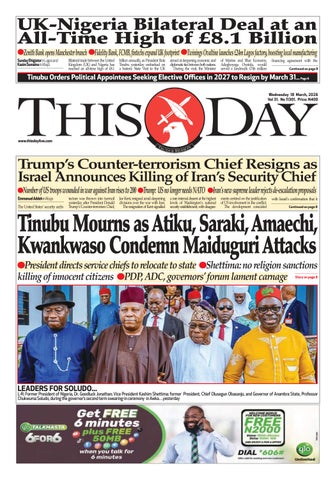
LEADERS

L-R: Former President of Nigeria, Dr. Goodluck Jonathan; Vice President Kashim Shettima; former President, Chief Olusegun Obasanjo, and Governor of Anambra

Professor Chukwuma Soludo, during the governor’s second term swearing-in ceremony in Awka…yesterday

Ehigiator in Lagos and Kasim Sumaina in Abuja

TINUBU’S

STATE VISIT TO

THE UNITED KINGDOM...

Minister of Solid Minerals, Mr. Dele Alake, exchanging greetings with President Bola Ahmed Tinubu, while Minister of Education, Dr. Tunji Alausa watches, during the president’s arrival at the Fairmont Hotel, Windsor, ahead of the state visit, yesterday

LCCI Calls for Policy to Sustain Moderation of Inflation Pressure

The Lagos Chamber of Commerce and Industry (LCCI) has called for a deliberate policy to sustain the current moderation of domestic inflation pressure.

The LCCI made this call yesterday in a statement titled: “Consolidating on Inflation Moderation in the Face of New Threats,” in reaction to the latest Consumer Price Index that showed a deceleration in Nigeria’s headline inflation rate to 15.06 per cent in February 2026 from 15.10 per cent in January 2026.

The Director General of LCCI, Dr. Chinyere Almona, said government should prioritise exchange-rate stability by improving foreign exchange liquidity and boosting non-oil export earnings.

Almona added: “Strengthening food security through improved agricultural productivity, addressing insecurity in farming communities, and investing in storage and logistics infrastructure will also help moderate food prices.

“Furthermore, accelerated reforms in the power and energy sectors are critical to lowering production costs for businesses. Reliable electricity supply and improved energy infrastructure would significantly reduce cost

pressures across manufacturing, trade, and services.

“The LCCI also stresses the need for greater efficiency in transportation and trade infrastructure, including improvements to port operations, cargo evacuation systems, and digital trade processes, to reduce logistics costs that significantly contribute to consumer prices.”

The LCCI said sustaining the marginal decline in inflation would depend on consistent macroeconomic management, structural reforms, and policies that enhance domestic productivity.

It added: “Urgent actions are needed to assuage the fears in many quarters that price pressures will reverse the deceleration of our inflation rate.

“The month-on-month inflation rates since the start of this year already indicate a fragile grip on inflationary pressures. Supply-side interventions will be more realistic than price controls imposed on manufacturers and investors.”

The chamber said this marginal decline, alongside the significant drop from 26.27 per cent recorded in February 2025, reflected the gradual easing of inflationary pressures in the economy.

However, the chamber noted that underlying inflation risks remained

significant as, “the month-on-month inflation rate rose to 2.01 per cent in February, after contracting in January, indicating that price pressures remain persistent.

“In addition, food prices remain the major driver of inflation, reflecting structural challenges in Nigeria’s food supply chain, high logistics

costs, and production constraints.”

Almona said from the perspective of the organised private sector, the slight moderation in inflation offers cautious optimism for businesses and households, as high inflation has significantly eroded purchasing power, increased production costs, and weakened consumer demand

across several sectors.

“Nevertheless, the chamber warns that several emerging domestic and global risks could reverse the deceleration gains we have recorded in recent months.

“Rising geopolitical tensions linked to the Iran conflict in the Middle East could trigger volatility

in global energy markets, potentially increasing fuel, transportation, and logistics costs.

“Nigeria has an opportunity to partially insulate itself from volatile oil prices in international markets by expanding local refining capacity and boosting crude supply to local refineries to meet local needs.

NLNG Inaugurates 6.5-tonne Gas Dispensing Facility, Inducts 103 Trainees

Nigeria LNG Limited (NLNG) has commissioned a 6.5-tonne gas dispensing facility in Rumuji, Rivers State, explaining that the infrastructure will help solve daily energy challenges in the area.

Besides, the company has announced the induction of 103 trainees into its 2026 Vocational Innovation Business and Empowerment Scheme (VIBES), in a dual push to deepen community development and economic empowerment.

The gas facility, delivered through NLNG’s Global Memorandum of Understanding (GMoU) framework in partnership with the Rumuji Cluster Development Foundation (RCDF), is expected to provide residents with

safer and cleaner access to cooking energy.

According to a statement from the organisation, the initiative is designed to reduce dependence on firewood and kerosene, while addressing everyday energy challenges in the community.

NLNG noted that the project forms part of a broader intervention in Rumuji under the GMoU structure, which also includes housing development, road infrastructure, scholarship awards for 29 students, and empowerment support for 200 women farmers aimed at enhancing long-term socio-economic outcomes.

“The opening of a 6.5-tonne gas dispensing facility in Rumuji, Rivers State, marks a major milestone in community development. Deliv-

ered through the NLNG GMoU framework and the Rumuji Cluster Development Foundation (RCDF), this facility provides local families with a safer, cleaner alternative to firewood and kerosene.

“The facility provides a practical solution to daily energy challenges, giving residents easier access to cooking gas and reducing reliance on firewood and kerosene.

“This project is part of the broader GMoU development efforts in Rumuji, including principal housing, road infrastructure, scholarships for 29 students, and empowerment for 200 women farmers to support long-term community prosperity. At NLNG, we believe in partnerships that empower communities to shape their own futures,” the company stated.

INTERPOL: 45,000 Malicious IP Addresses Taken Down in International Cyber Operation

Scores

of countries, including Nigeria participate, 94 arrested

Emmanuel Addeh in Abuja

An international cybercrime operation targeting phishing, malware and ransomware has seen the INTERPOL take down more than 45,000 malicious IP addresses and servers, the organisation has announced.

Law enforcement from 72 countries and territories took part in Operation Synergia III (18 July 2025 – 31 January 2026), coordinated by INTERPOL, it said, noting that the operation led to the arrest of 94 people, with another 110 individuals still under investigation.

During the operation, INTERPOL,

according to a statement, said it transformed data into actionable intelligence, facilitated cross-border collaboration, and provided tactical operational assistance to member countries.

Preliminary investigations, it said, led to a series of coordinated actions by national authorities, including raids on key locations and the disruption of malicious cyber activities. In total 212 electronic devices and servers were seized, it announced. According to the organisation, participating countries and territories included: Nigeria, Angola, Argentina, Austria, Bahrain, Bangladesh, Bolivia,

Bosnia and Herzegovina, Botswana, Brazil, Brunei, Burkina Faso, Burundi, Cameroon, Colombia, Democratic Republic of Congo, Eritrea, Eswatini, France, Gambia, Georgia, Greece, Guatemala, Guinea, Guinea Bissau, Guyana, and Honduras.

Others were: Iceland, India, Iraq, Ireland, Israel, Japan, Jordan, Kazakhstan, Kenya, Kuwait, Latvia, Lebanon, Lesotho, Liechtenstein, Macao (China), Madagascar, Malaysia, Maldives, Moldova, Mongolia, Niger, North Macedonia, Oman, Pakistan, Palestine, Paraguay, Philippines, Poland, Qatar, Singapore, South Africa, South Sudan, Spain, Sri

Lanka, Switzerland, Tanzania, Togo, Türkiye, Uganda, Ukraine, United Arab Emirates, United Kingdom, Venezuela, Zambia and Zimbabwe.

INTERPOL’s Director of the Cybercrime Directorate, Neal Jetton, commenting on the development said: “Cybercrime in 2026 is more sophisticated and destructive than ever before, but Operation Synergia III stands as a powerful testament to what global cooperation can achieve.

“INTERPOL remains at the forefront of this fight, uniting law enforcement agencies and private sector experts to dismantle criminal networks, disrupt emerging threats

and protect victims around the world.”

Although several investigations are still ongoing in participating countries, preliminary reports of key cases, it said, demonstrate the breadth of the criminal tactics employed, including fraudulent websites, romance scams and credit card fraud.

For instance, law enforcement in Macau, China identified more than 33,000 phishing and fraudulent websites, related to fake casinos and critical infrastructure, such as official bank, government and payment service sites.

In a related development, the company inducted 103 new beneficiaries into its VIBES programme at a ceremony held in Port Harcourt. The initiative, which focuses on entrepreneurship and skills development, is structured to equip participants with practical business knowledge and provide access to funding opportunities.

The newly admitted trainees are expected to undergo a series of capacity-building sessions covering areas such as financial management, marketing, business strategy, and basic legal frameworks. The programme will culminate in a competitive pitching phase, where participants will present business proposals for evaluation, with the most viable ventures receiving support.

At the same event, 26 participants from the previous cohort graduated, marking the completion of their training cycle.

NLNG disclosed that many of the beneficiaries have recorded measurable progress one year after receiving grant support, including improved financial practices, expanded customer reach, and increased production capacity.

Speaking during the ceremony, NLNG’s General Manager, External Relations and Sustainable Development, Sophia Horsfall, said the initiative reflected the company’s sustained commitment to fostering inclusive growth in its host communities.

She stated that the simultaneous graduation of one cohort and induction of another underscores the continuity of NLNG’s investment in youth empowerment and enterprise development.

Dike Onwuamaeze
Emmanuel Addeh in Abuja

GROUND BREAKING CEREMONY OF TOTAL RECONSTRUCTION OF ARMY CHILDREN’S SCHOOL...

L-R: Executive Chairman, Ikoyi-Obalende, Local Council Development Area (LCDA), Hon. Bola Oladunjoye; Representative of the Garrison Commander 81 Division Nigerian Army, Major Sunday Maikasuwa; Former Chairman, Ikoyi-Obalende, LCDA, Hon. Fuad Atanda-Lawal; General Manager, Lagos State Printing Corporation Hon. Kolawole Peregrino; and Executive Chairman, Lagos State Universal Basic Education Board (LASUBEB), Dr. Hakeem Shittu, at the Ground Breaking Ceremony of Total Reconstruction of Army Children’s School and Dodan Barrack Primary School by Fuad Atanda -Lawal Foundation held in Obalende-Ikoyi, Lagos ... yesterday

Tinubu Orders Political Appointees Seeking

Elective Offices in 2027 to Resign by March 31

President Bola Tinubu has directed all political appointees in his administration with the ambition of contesting elective offices in the forthcoming 2027 general election to resign their appointments on or before March 31, 2026.

A statement by the Head, Information and Public Relations on behalf of the Secretary to the Government of the Federation, Dewan Nengak Goshit, stated that the directive was pursuant

to the provisions of Section 88 (1) of the Electoral Act, 2026, as well as the timetable issued by the Independent National Electoral Commission (INEC) for party primaries ahead of the 2027 general elections.

A circular which was issued by the Permanent Secretary General Services Office, Dr. Ibrahim Abubakar Kana, affirmed that the resignation requirement applied to all categories of presidential political appointees either seeking participation in the forthcoming party primaries or nomination

for any elective office.

This category, he said, included ministers, ministers of state, special advisers to the president, senior special assistants to the president, special assistants the president, personal assistants to the president, all directors-general, and chief executive officers of federal government parastatals, agencies, commissions, and governmentowned companies, as well as all other political appointees of the President.

The statement added that the affected officials, were accordingly,

required to submit their formal resignation letters through the Office of the Secretary to the Government of the Federation not later than March 31, 2026.

“President Tinubu emphasised that the measure is necessary to ensure full compliance with electoral laws, uphold transparency in the political process and promote a level playing field for all aspirants ahead of the elections.

“He urged all concerned officials to take note of this directive and ensure strict compliance, reaffirming the administration’s

Gov Abiodun: Ogun Retirees to Earn Up to 280% Benefits Under New Pension Scheme

Ogun State Government has announced that retirees in its civil and public service will earn significantly higher benefits under the Contributory Pension Scheme (CPS) following the introduction of Additional Pension Benefit (APB) initiative, which offers between 116 per cent and 280 per cent of Total Annual Emoluments (TAE).

Governor Dapo Abiodun disclosed the new scheme on Tuesday during the official presentation of cheques to retirees at Oba’s Complex.

Represented by Secretary to the State Government, Tokunbo Talabi, the governor said between 70 and 80 per cent of retiring workers would receive higher benefits as gratuity under the new arrangement.

He explained that while the

federal government provided gratuity equivalent to 100 per cent of a retiree’s final annual salary, Ogun State had exceeded this benchmark by approving a minimum of 116 per cent, rising to as high as 280 per cent, depending on years of service.

He stated, “What this means is that, unlike in the past when gratuity payments were delayed, retirees will now receive improved and timely benefits.

“Our minimum is 116 per cent, going up to 280 per cent, which is significantly higher than the 100 per cent benchmark.”

Abiodun said his administration inherited substantial pension and gratuity liabilities but had since taken deliberate steps to address them comprehensively.

He said beyond settling

outstanding obligations, the government ensured that retirees received returns on delayed remittances, thereby enhancing the value of their entitlements.

He explained that under the new framework, retirees now received a one-off lump sum as Additional Pension Benefit, while their full pension contributions remained intact with Pension Fund Administrators (PFAs), leading to improved monthly pension payments.

The governor added, “Previously, about 25 per cent of total pension savings would be taken as a lump sum. Now, that deduction is no longer necessary, as the APB serves as the lump sum, leaving the full contributions to generate stronger monthly pension payments.”

FG Declares Two-day Public Holidays for Eid-ul-Fitr

Michael Olugbode in Abuja

The federal government has declared Thursday, March 19 and Friday, March 20, 2026, as public holidays to mark this year’s Eid-ul-Fitr celebration.

The announcement was made by the Minister of Interior, Olubunmi Tunji-Ojo, who congratulated the Muslim faithful across the country on the successful completion of the holy

month of Ramadan.

In a statement issued on Tuesday by Permanent Secretary in the Ministry of Interior, Dr. Magdalene Ajani, on behalf of the federal government, the minister urged Muslims to uphold the core values of love, generosity, peace, tolerance, and sacrifice, which define the Ramadan period. He emphasized the need for Nigerians to reflect on these virtues beyond the fasting season

as part of efforts to build a more harmonious society.

Tunji-Ojo also called on citizens, regardless of religious affiliation, to use the festive period to pray for national peace, unity, and sustained progress, noting that collective responsibility remains key to the country’s stability.

He further encouraged Nigerians to celebrate responsibly and extend kindness to the less privileged, in line with the spirit of the season.

He reaffirmed that despite competing fiscal demands, his administration had prioritised retirees’ welfare, describing their well-being as a moral obligation.

In his remarks, Head of Service, Kehinde Onasanya, described the initiative as a “game changer” that bridged the gap between the old Defined Benefit Scheme and CPS, ensuring retirees receive immediate financial support upon exit from service.

commitment to strengthening democratic institutions and pro-

moting credible electoral processes in Nigeria,” the statement said.

Adherence to Rules of Engagement Supports Intelligence-driven Operations, Declares COAS

Linus Aleke in Abuja

The Chief of Army Staff (COAS), Lieutenant General Waidi Shaibu, has urged military commanders to strictly adhere to international humanitarian law, rules of engagement, and established operational protocols, saying such discipline not only protects civilians but also strengthens public trust and enhances intelligence-driven operations.

Addressing commanders at all levels, the COAS emphasised the importance of upholding the fundamental human rights and safety of all Nigerians while carrying out constitutional responsibilities.

He noted that respect for human rights was essential to operational success and national stability.

The remarks were delivered during a lecture on his Command Philosophy to participants of the

Army War College Course 10/2026 in Abuja.

General Shaibu explained that his command’s philosophy was “To advance the transformation of the Nigerian Army into a more adaptable, combat-ready, and resilient force capable of decisively discharging its constitutional responsibilities within a joint, multi-agency environment” as the foundation of his command approach.

In a statement, Acting Director of Army Public Relations, Colonel Apollonia Anele, quoted the COAS as highlighting that the Nigerian Army has, over the years, developed concepts that guided its response to evolving security challenges.

He urged participants to embrace his Command Philosophy, centred on the Soldier First Concept, which prioritised the welfare of personnel.

Odu’a Investment Completes Strategic Minority Stake Acquisition in FCMB Pensions

Sunday Okobi

Odu’a Investment Company Limited (OICL) has announced the completion of its acquisition of a 10 per cent minority equity stake in the issued share capital of FCMB Pensions Limited, a subsidiary of FCMB Group Plc.

The acquisition followed the receipt of the requisite approvals from the regulatory authorities – National Pension Commission (PenCom) and Central Bank of Nigeria (CBN). The Securities and Exchange Commission (SEC) had also been duly notified.

The transaction, according to a statement signed and issued by the organisation’s Head of Branding and Communication,

Victor Ayetoro, represents a strategic investment by Odu’a in Nigeria’s growing pension industry, “a resilient and steadily expanding segment of the country’s financial services sector.

“It also strengthens FCMB Pensions’ shareholder base, bringing together two established institutions with complementary strengths and a shared commitment to long-term growth and value creation.”

Ayetoro stated that Group Chairman of Odu’a Investment Company Limited, Otunba Bimbo Ashiru, while commenting on the investment, said, “This investment reflects Odu’a’s strategy of partnering strong institutions operating in sectors that are central to Nigeria’s long-term economic stability and growth.

“The pension industry plays a critical role in mobilising long-term savings and strengthening the financial system. FCMB Pensions has built a solid platform serving contributors across Nigeria, and we see a significant opportunity to support its continued growth and impact.”

The statement quoted Group Managing Director of OICL, Mr. Abdulrahman Yinusa, as saying, “Our partnership with FCMB Group Plc reflects confidence in FCMB Pensions’ strategy, leadership and long-term potential. Together, we will work to expand its reach, support its strategic objectives, and deliver sustained value to contributors and other stakeholders.”

Olawale Ajimotokan in Abuja

L–R:

Popoola, Group Managing Director/CEO, Nigerian Exchange Group (NGX Group) at the International Finance Corporation Conference in Cairo, Egypt recently

Iran War: NACCIMA, NECA, Varsity Dons Task FG on Proactive Policy Incentives

for Nigerian Fertiliser Manufacturers

Fear fertiliser scarcity may lower crop production by 20 to 50% Canvass revisiting Nigeria’s fertiliser policy to create strategic fertiliser reserves

As Iran’s blockage of shipping along the Strait of Hormuz squeezes global fertiliser supply chain, National Association of Chambers of Commerce, Industry, Mines and Agriculture (NACCIMA), Nigeria Employers’ Consultative Association (NECA), and some university dons have advised the federal government to adopt proactive policy incentives that would encourage fertiliser blending plants in Nigeria to produce more and sell their products to Nigerian farmers this planting season.

They stressed, in separate interviews with THISDAY, that policy incentives, such as temporary tax concessions, logistics support, and guaranteed bulk purchases, were urgently needed to ameliorate the effect of the global squeeze on shipment of fertiliser raw materials and products.

The incentives would protect Nigeria’s food and nutrition security, avert potential decline in crops production, and tame high food inflation, the groups said. They advised the government to revisit Nigeria’s fertiliser policy to provide for strategic fertiliser reserves.

Chairman of NACCIMA Agricul-

ture Trade Group, Mr. Kabir Ibrahim, told THISDAY that the way forward “is to properly and transparently subsidise local fertiliser production for three to five years”.

Ibrahim asserted that almost 100 fertiliser blending plants in Nigeria “are up and doing and can work optimally if both the farmers and the blenders are directly subsidised by government in order to be able to produce affordably priced fertilisers”.

He added that National Farmer Soil Health Scheme should be used to “reinvigorate fertiliser blending and utilisation so that we can produce soil and crop specific fertilisers going forward”.

Director-General of NECA, Mr. Adewale-Smatt Oyerinde, said, “At a time when global supply chains are facing disruptions, expanding domestic blending capacity and ensuring steady access to raw materials will be essential to maintain fertiliser availability for farmers and support national food security.”

Oyerinde added that Nigeria had made significant progress in fertiliser production with three major urea plants that had combined production capacity of about 6.5 million metric tonnes annually.

He said, “Nigeria’s response should focus on strengthening resilience within the agricultural input supply chain.

“Key priorities should include expanding domestic fertiliser production and blending capacity to reduce dependence on external supply shocks.”

He also canvassed “supporting private sector investment in fertiliser manufacturing and distribution” as well as “improving logistics and

distribution networks so that fertiliser can reach farmers across the country efficiently”.

Oyerinde said, “Strengthening domestic production and ensuring efficient distribution will be essential to stabilising food supply and protecting farmers from global market volatility.”

Speaking in a similar vein, Professor of Agricultural Economics, Afe Babalola University, Ado Ekiti, Professor Samuel Igbatayo, told THISDAY that the Nigerian government should adopt

a proactive policy aimed at providing sufficient fertiliser for the upcoming cropping season.

Igbatayo said, “It should be emphasised that the best approach is to source the product from domestic producers at market prices and refrain from forcing them to abandon exports, which would discourage investors and lead to a loss of confidence in the Nigerian economy.”

He added, “This should be supplemented by importation of

sufficient quality for the Nigerian farmers at subsidised prices, owing to the resource poor condition of the farmers.”

Similarly, Senior Lecturer at the Department of Agricultural Economics, University of Nigeria, Nsukka, Dr. Chris Onyekwe, told THISDAY that crop yields would likely decline significantly for the next two seasons if farmers failed to have access to fertiliser products this planting season.

FG Won’t Surrender Aviation Sector to Foreign Interests, Says Keyamo

The Minister of Aviation and Aerospace Development, Mr. Festus Keyamo, has defended the federal government’s decision to halt the proposed Nigeria Air project, declaring that Nigeria will not cede control of its aviation sector to foreign interests.

The minister declared the position of the government while speaking on Frontline, a public affairs

programme of a private radio station, Eagle 102.5 FM located in Ilese Ijebu, Ogun State.

In the broadcast monitored by THISDAY, the minister said the earlier Nigeria Air model would have undermined indigenous airlines and weakened the country’s long-term aviation independence.

He said, “We cannot hand over our entire aviation system to another African country and then kill all our local operators.

“The better approach is to support and strengthen local airlines to compete globally.”

Keyamo warned that the Nigeria Air arrangement mirrored models

in some African countries where foreign airlines dominate national carriers, often controlling operations behind local branding.

Citing examples, he said such systems risk total dependency on foreign operators, noting that if dominant foreign partners withdraw, entire national aviation structures could collapse.

According to him, Nigeria’s size and market potential make it too strategic to adopt such a model.

Rather than establishing a foreign-backed national carrier, the government is prioritising the growth of domestic operators.

Keyamo identified limited access

to credit facilities and aircraft leasing as major constraints facing Nigerian airlines.

“The problem is simple—our local operators do not have access to the same financing and leasing arrangements available to major global airlines,” he said. He added that reforms are underway to improve access to funding and restore international confidence in Nigeria’s aviation sector.

The minister disclosed that government has engaged major global manufacturers such as Airbus and Boeing to unlock better financing opportunities for Nigerian airlines.

The Nigerian Meteorological Agency (NiMet), Tuesday unveiled its Strategic Plan 2026–2030, marking what the agency described as a major milestone in its drive to strengthen performance, service delivery and climate resilience across Nigeria.

Speaking at the launch in Abuja, the Director-General/CEO and Nigeria’s Permanent Representative with the World Meteorological Organization, Prof. Charles Anosike, said the new plan reflects NiMet’s long-standing role in safeguarding lives and property for more than 140 years.

Anosike said the Nigerian

Meteorological Agency (NiMet) is implementing a comprehensive Strategic Plan (2026–2030) as a performance management roadmap to align its weather and climate services with Nigeria’s national vision.

As it operationalises this plan, the agency he disclosed is set to become the first public institution in Nigeria’s aviation sector to fully institutionalise this world-class system across five pillars of Employee Growth and Development, Strategic Partnerships, Technology and Innovation, Quality Service Delivery, and Revenue Diversification.

The launch, he maintained highlights NiMet’s strong performance under the federal government’s

results-driven governance framework coordinated by the Central Results Delivery Coordination Unit (CRDCU).

“The unit was institutionalised at the beginning of the administration of President Bola Ahmed Tinubu and appointment of the Honourable minister of Aviation and Aerospace Development to strengthen performance monitoring across Ministries, Departments and Agencies through a Presidential Performance Bond and results-based budgeting system.

On his part, Managing Consultant/ CEO of Balanced Scorecard West Africa (BSWA), Kayode Sufianu, commended NiMet for adopting the Balanced Scorecard as its strategic management framework.

UK State Visit Triumph for Common Man, Praises Tinubu’s Historic Outing

Folalumi Alaran in Abuja

The Grassroots Mobilization Initiative (GMI), has joined millions of Nigerians in celebrating and commending President Bola Ahmed Tinubu on his historic state visit to the United Kingdom, at the invitation of King Charles III, describing it as a “Triumph for the Common Man.”

As an organization that represents the streets, markets, and rural communities, GMI emphasized that this

visit, the first of its kind in 37 years, is far more than a ceremonial photo opportunity, noting it signals that Nigeria is back on the global stage, not as a spectator but as a respected powerhouse.

In a statement by the GMI National Coordinator Samaila Musa highlighted the significance of the visit for ordinary Nigerians.

Musa said: “Why this visit matters to the grassroots, while the diplomatic ceremonies at Windsor

Castle catch the world’s eye, the GMI is particularly excited about the practical “bread and butter” gains that President Tinubu has secured for the ordinary Nigerian:

“Fixing Our Ports, Lowering Prices: The £746 million deal to refurbish the Apapa and Tin Can Island Ports is a direct win for the local trader. Better ports mean faster goods clearance, which will ultimately help reduce the skyrocketing cost of commodities in our local markets.

James Sowole in Abeokuta
Mr. Muhammad Sani Abdullahi, Deputy Governor, Economic Policy Directorate, Central Bank of Nigeria (CBN); Dr. Emomotimi Agama, Director General, Securities and Exchange Commission (SEC); Mr. Olayemi Cardoso, Governor, CBN; and Mr. Temi
Kasim Sumaina in Abuja

2025 Oil Licensing Round: NUPRC Shortlists Pre-qualified Firms for 50 Oil Blocks

Notifies successful applicants

Emmanuel Addeh in Abuja and Peter Uzoho in Lagos

The Nigerian Upstream Petroleum Regulatory Commission (NUPRC) yesterday announced that it had completed the pre-qualification stage of the 2025 Licensing Round and has notified successful pre-qualified applicants accordingly.

In a statement issued yesterday, signed by its Head of Media and Strategic Communication, Eniola Akinkuotu, the NUPRC said the notification of pre-qualified bidders was done on March 16, 2026 in line with the 2025 licensing round guidelines.

With the pre-qualification stage

now successfully completed, the commission said it will from Tuesday permit successful applicants to lease data in preparation for the technical and commercial bid submissions.

The 2025 oil licensing round marks one of the most closely watched upstream exercises in Nigeria in recent years, coming at a time when the country is seeking to reverse declining crude oil production and attract fresh investment into its hydrocarbons sector.

The exercise is being conducted under the framework of the Petroleum Industry Act (PIA), which restructured the industry and created the NUPRC as the body responsible for regulating and

administering licensing rounds in a more transparent and commercially driven manner.

In the current round, a total of 50 oil and gas blocks have been put up for bidding, spanning onshore, shallow water, deep offshore, and frontier acreages across multiple sedimentary basins. The breadth of the assets is designed to attract a wide range of investors, from indigenous firms with strong onshore capabilities to international oil companies with deepwater expertise, while also opening up less-explored frontier regions.

Nigeria has struggled in recent years to meet its Organisation of Petroleum Exporting Countries

(OPEC) production quota, largely due to a mix of underinvestment, ageing infrastructure, crude theft, and regulatory uncertainties that persisted before the enactment of the PIA in 2021.

Output has fluctuated significantly below installed capacity, heightening pressure on the government to unlock new reserves, optimise existing assets, and restore investor confidence in the upstream segment.

In the statement, the agency noted that pre-qualified applicants were mandated to lease data only from the two data sources (as applicable) and upload evidence of payment as a pre-requisite to the submission of bids.

“The Nigerian Upstream Petroleum Regulatory Commission (NUPRC) wishes to inform the public that it has completed the pre-qualification stage of the 2025 Licensing Round and has notified successful pre-qualified applicants accordingly.

“This was done on March 16, 2026 in line with the 2025 Licensing Round Guidelines. With the prequalification stage now successfully completed, the commission will from today (yesterday), March 17, 2026, permit successful applicants to lease data in preparation for the technical and commercial bid submissions.

“Please note, pre-qualified applicants are mandated to lease data

NUPRC boss, Mrs. Oritsemeyiwa Eyesan

only from the two data sources (as applicable) and upload evidence of payment as a pre-requisite to the submission of bids,” the NUPRC stated.

TINUBU MOURNS AS ATIKU, SARAKI, AMAECHI, KWANKWASO CONDEMN MAIDUGURI ATTACKS

Deji Elumoye, Chuks Okocha, Adedayo Akinwale, Sunday Aborisade, Linus Aleke, Folalumi Alaran in Abuja, Hammed Shittu in Ilorin, Ahmad Sorondinki in Kano, Esther Oluku in Lagos and Muhammad Sabiru in Maiduguri

President Bola Tinubu, yesterday, mourned Monday’s terrorist attacks on Maiduguri, the Borno State capi-tal, assuring Nigerians that the country will not succumb

to the fear of terror and insecurity. Responding to the attacks, Tinubu immediately directed all the service chiefs to relocate to Maiduguri and take immediate charge of the situation.

That was as prominent Nigerians, including former Vice President Atiku Abubakar, Bukola Saraki, Chibuike Amaechi, and Rabiu Kwankwaso, as well as Nigeria Governors’ Forum, Peoples Democratic Party (PDP) and African Democratic Congress (ADC),

among others, condemned the attacks, which claimed about 25 lives.

Vice President Kashim Shettima, while expressing grief over the deaths, said no religion sanctioned the killing of innocent lives, because the sanctity of human life is a core tenet of major faiths.

In his reaction to Monday’s terrorist strikes in Maiduguri, Tinubu declared that terrorists will not find safety anywhere in Nigeria.

He reiterated his administration’s

resolve to confront and defeat security threats, particularly terrorism, across the country.

According to him, “There is no place in Nigeria where terrorists will find safety. We will locate them, confront them, and completely defeat them. Nigeria will not succumb to fear.”

Mourning victims of the latest Borno attacks, Tinubu disclosed that he had directed all the service chiefs to relocate to Maiduguri and take

TRUMP’S COUNTER-TERRORISM CHIEF RESIGNS AS ISRAEL ANNOUNCES KILLING OF IRAN’S SECURITY CHIEF

had eliminated a central figure in Iran’s leadership hierarchy, Ali Larijani, a move expected to further destabilise Tehran’s command structure and intensify hostilities across the region.

Besides, the scale of the conflict has become more evident, with the number of wounded American troops rising to about 200, highlighting the intensifying operational tempo of the war.

Also, in a statement that could reshape global security alliances, Trump yesterday declared that the US no longer needs the North Atlantic Treaty Organisation (NATO), signalling a potential departure from decades of transatlantic defence cooperation.

Israel Announces Killing of De Facto Iranian Leader

The Israeli military said yesterday that it had killed one of Iran’s highest-ranking leaders, Ali Larijani, in an overnight airstrike near Tehran, dealing another severe blow to a power structure already decimated by three weeks of US-Israeli strikes.

The killing of Larijani who became Iran’s de facto leader after US-Israeli airstrikes killed the upper echelons of Iran’s government and military removes one of Iran’s most prominent voices of defiance. But Larijani was also an influential pragmatist who was seen as having the clout to negotiate with the United States.

His death could embolden even more hard-line Iranian leaders who believe that the Islamic Republic can survive only by doubling down, the New York Times reported.

Similarly, the Israeli military also said on Tuesday that it had killed Gholamreza Soleimani, the head of the Basij, Iran’s powerful plainclothes militia. The Iranian authorities and state media did not comment on the Israeli announcements. But two Iranian officials, who spoke on condition of anonymity to discuss the sensitive matter, said

they believed Larijani and Soleimani had been killed.

Larijani, the head of Iran’s Supreme National Security Council, was a close confidant of Ayatollah Ali Khamenei, the supreme leader who was killed in an Israeli airstrike at the start of the war on February 28. Larijani in effect ran Iran behind the scenes even before Ayatollah Khamenei’s death, leading the brutal crackdown early this year on protests against Islamic rule.

He took on a more prominent role in key decision making during the war, including after the appointment of Mojtaba Khamenei as supreme leader. Larijani had opposed that choice, lobbying for a more moderate option.

Larijani’s killing on Tuesday showed that Israel was not slowing in its effort to eliminate top leaders of a regime it considered an existential threat. “We are undermining this regime in the hope of giving the Iranian people an opportunity to remove it,” Prime Minister Benjamin Netanyahu of Israel said, although he conceded that would “not happen easily.”

The death of Larijani also renews serious questions about Trump’s endgame for the war: He has not clearly articulated his goals or how the assault on Iran might end, and he has acknowledged that many of the Iranian officials that the United States might have negotiated with have been killed.

“We don’t even know their leaders,” Mr. Trump said on Monday. “We have people wanting to negotiate,” he added. “We have no idea who they are.”

US Director of Counterterrorism Resigns, Says Iran Posed No Imminent Threat

Also yesterday the Director of the US National Counterterrorism Centre, Joe Kent, announced his resignation, citing his concerns about the justification for military strikes in Iran and saying he “cannot in

good conscience” back the Trump administration’s war.

Kent said on social media that Iran “posed no imminent threat to our nation, and it is clear that we started this war due to pressure from Israel and its powerful American lobby,” per AP.

Kent, a former political candidate with connections to right-wing extremists, was confirmed to his post last July on a 52-44 vote. As head of the National Counterterrorism Centre, he was in charge of an agency tasked with analysing and detecting terrorist threats.

His resignation reflects unease within Trump’s base about the war and shows that questions about the justification for the use of force in Iran extend to the right of President Donald Trump’s base and to senior members of the administration.

UK that would deliver the most ambitious modernisation of Nigeria’s seaport infrastructure in nearly half a century, transforming the country’s principal maritime gateways and repositioning its port system for global competitiveness.

The visit, scheduled to commence today comes on the back of a wave of multi-million-pound investments by Nigerian and British firms across key sectors, including financial services, fintech, manufacturing, education and the creative industries.

The latest developments are expected to generate hundreds of new jobs in both countries, reinforcing the UK’s position as a global business hub while highlighting Nigeria’s growing role as a source of innovation and capital.

Among the notable investments, Zenith Bank has opened a new branch in Manchester, with the capacity to create up to 30 direct jobs, further strengthening its international expansion strategy. The bank is also exploring a potential listing on the London Stock Exchange by 2027.

Group Managing Director/

Trump has offered shifting reasons for the strikes and has pushed back on claims that Israel forced the US to act. Earlier this month, House Speaker Mike Johnson, suggested that the White House believed Israel was determined to act on its own, leaving the Republican president with a “very difficult decision.”

A spokesperson for Director of National Intelligence Tulsi Gabbard did not immediately respond to questions about Kent’s resignation.

The White House also had no immediate comment on Kent’s resignation.

Before entering Trump’s administration, Kent ran two unsuccessful campaigns for Congress in Washington state. He also served in the military, seeing 11 deployments

CEO of Zenith Bank, Dame Dr. Adaora Umeoji, said the move reflects the bank’s commitment to deepening cross-border business relationships.

“The United Kingdom remains a key global financial centre. The opening of Zenith Bank, Manchester, therefore, marks another important milestone in our international expansion strategy, enabling us to deepen relationships with our customers, support trade and investments, and connect businesses between Africa and the UK more effectively,” a statement quoted her to have said.

In a similar vein, Fidelity Bank has expanded its UK presence through the acquisition and rebranding of Union Bank UK into FidBank UK, with plans to double its workforce by 2026 and position London as its global hub.

First City Monument Bank has also selected the UK as the first international destination for its digital cross-border payments platform.

“Collectively, seven Nigerian banks now operate in the UK,

immediate charge of the situation.

Describing the latest attacks as desperate acts of evil-minded terrorist groups, the president expressed optimism that the country’s gallant military and civilian task forces would curtail and put them down.

Tinubu, in a nine-paragraph release, stated, “The recent news from Maiduguri, Borno State, is profoundly upsetting. I mourn those who lost their lives, sympathise with the injured and stand in solidarity with the people of Borno during this challenging time.

“I want to make it categorically clear that these acts of terror are the final desperate and frantic attempts by criminals and terrorist elements trying to instil and spread fear, as they are under constant pressure from our brave armed forces and security agencies operating in various theatres.

“We will continue to intensify our efforts against all criminal elements, wherever they may be. I must commend the courage and fighting spirit of our patriotic troops, who successfully repelled the coordinated attacks by these terrorists on military positions in the state.”

The president said, “The Monday attacks were desperate acts of the evil-minded terrorist groups. Our gallant military and civilian task forces will curtail and put them down.

“Just last weekend, during a security meeting with leaders of

supporting no fewer than 1,000 jobs.

“Nigerian fintech firms are also scaling up their investments. LemFi plans to invest £100 million over the next five years as it establishes London as its global headquarters, while Moniepoint aims to grow its London workforce to 100 employees by 2026. Kuda is equally strengthening its UK base as a springboard for global expansion.

“On the industrial front, UKbased Twinings Ovaltine has launched a £24 million manufacturing facility in Lagos; it’s first in Africa, creating over 100 direct jobs and boosting exports across West Africa,” the statement added.

Furthermore, it noted that the creative sector is also witnessing increased collaboration, with EbonyLife set to establish EbonyLife Place London, creating up to 40 jobs while promoting African storytelling on the global stage.

“The surge in investments is being driven in part by the UK-Nigeria Enhanced Trade and Investment Partnership (ETIP), which continues to unlock opportunities across

security and intelligence agencies, I approved additional equipment and operational support to enhance their capabilities. This effort is already in progress.

“Additionally, I have directed security chiefs to move to Maiduguri to take charge of the situation. I have also directed the emergency agencies to provide proper care for the injured.”

Death Toll Hits 23, Victims Face Blood Shortage

Nigeria Police, Borno State command, announced that a total of 23 people lost their lives, while 108 others sustained various degrees of injuries in multiple explosions in Maiduguri.

A statement issued by Police Public Relations officer, ASP Nahum Kenneth Daso, said preliminary investigation revealed that the assaults were carried out by suspected suicide bombers.

Chief Medical Director of University of Maiduguri Teaching Hospital (UMTH), Professor Ahmed Ahidjo, said the hospital had received over 100 victims of the attack.

Ahidjo said the hospital had recorded 25 deaths, while over 70 were hospitalised.

Health workers said victims, especially those in critical conditions, were battling blood shortage, which

priority sectors such as technology, infrastructure, education and advanced manufacturing,” it added.

Speaking on the growing partnership, UK Business and Trade Secretary Peter Kyle said the relationship was delivering tangible benefits for both countries.

“The UK and Nigeria share a belief in the power of enterprise, innovation and education to transform lives, and today’s commitments show exactly that,” he said. Also commenting, UK Deputy Prime Minister David Lammy said the partnership is creating new pathways for growth.

“The UK and Nigeria’s strategic partnership is bringing momentum and opportunity to innovators in both our countries. We are reducing barriers, creating jobs and opening new pathways for growth,” he said. Beyond trade and investment, both countries are also strengthening cooperation in education and culture, with leading UK universities expanding into Nigeria and new creative exchange programmes in the pipeline.

RMB ECONOMIC FORUM 2026...

L-R: Independent Non-Executive Director, RMB Nigeria Asset Management, Michael Oyebola; Chairman, Investment Committee, RMBN Asset Management/Founder, BloomBox Platform, Inyang Sami-Orungbe; Executive Director/Chief Risk Officer, Rand Merchant Bank Nigeria, Taiwo Gabriel; Independent Non-Executive Director, Rand Merchant Bank Nigeria, Abiodun Odubola; MD/CEO, Financial Derivatives Company Ltd, Bismarck Rewane; Executive Director/Treasurer, Rand Merchant Bank Nigeria, Yetunde Ogunremi; Head, Consulting Agusto Consulting Ltd, Jimi Ogbobine and, Executive Director/Head, Investment Banking, Rand Merchant Bank Nigeria, Chidi Iwuchukwu during the RMB Economic Forum 2026 held in Lagos...recently

NELFUND Records Milestone, Disburses Over N206bn to Students Across 270 Institutions in 23 Months

Nigerian Education Loan Fund (NELFUND) has disbursed more than N206 billion to students in 270 institutions nationwide within 23 months of its launch by President Bola Tinubu.

The latest figures, which indicate its growing impact in expanding access to tertiary education, show that 1,751,669 applications have been received since the portal opened in

May 2024, out of which 1,164,222 students have successfully benefited from the scheme.

A breakdown of the disbursement shows that N128.84 billion has been paid directly to 270 beneficiary institutions as tuition fees, while N77.45 billion has been released to students as upkeep allowances. This is to ensure that both academic costs and living expenses are addressed, making higher education more accessible to indigent students.

The fund has also maintained steady growth, recording 969 new applications in its most recent update, representing a 0.1 per cent increase, an indication of sustained interest and public confidence in the programme.

Managing Director of NELFUND, Mr. Akintunde Sawyerr, assured Nigerian students that no eligible beneficiary of the education loan scheme would be barred from sitting for examinations due to

financial constraints.

While speaking in a recent interview on Arise TV, Sawyerr stated that the scheme, introduced by Tinubu, was designed to eliminate financial barriers to tertiary education through interest-free loans with flexible repayment terms.

He stated, “We started the scheme of His Excellency, President Bola Ahmed Tinubu, GCFR, to provide students with loans, interest-free loans, with very,

Oba of Benin Sanctions Queen, Chiefs, Staff over Peller’s Unauthorised Access to Palace

Felix Omoh-Asun in Benin

Oba of Benin, Oba Ewuare II, has sanctioned an unnamed wife, chiefs, and some staff of the palace for allowing social media personality Habeeb Hamzat Adelaja, aka, Peller, unauthorised access to the palace.

The Benin Traditional Council (BTC), which disclosed the action yesterday in Benin, said the palace sanctioned a queen to the Oba, chiefs, and staff for allegedly allowing the influencer into the palace without proper verification.

Secretary to the traditional council, Frank Irabor, said, in a statement made available to newsmen on Tuesday, that a staff of the council, identified as Mr. Omuemu, had been detained by the police. The statement said the staff would

be charged to court for allegedly causing a breach of the peace and abetting the unauthorised entry.

Irabor added that the queen, who featured in the viral video, was now facing serious disciplinary proceedings in accordance with Benin traditions and customs.

He said the proceedings might inadvertently result in her removal from the palace.

The statement said, “The Benin Traditional Council wishes to address the public regarding a serious breach of protocol and desecration of the sacred precincts of the palace, which occurred on Friday, March 6, 2026.

“The council confirms that an individual, Habeeb Hamzat Adelaja, a social media influencer, popularly known as ‘Peller’, gained

unauthorised access to the palace premises on the said date.

“Mr. Adelaja and his entourage entered the palace without the requisite permission from the council, and their subsequent conduct caused significant embarrassment and a breach of the peace within the palace grounds.

“The Benin Traditional Council views this incident with the utmost gravity. The palace is not a public thoroughfare or a location for frivolous content creation, it is the ancient and spiritual seat of the Oba of Benin, governed by centuries of tradition, custom, and sacred protocols.”

Irabor explained that the council had conducted a preliminary investigation into the circumstances that allowed the unauthorised access.

Dangote Refinery, Fertiliser, Donate N241m School Materials to 3,704 Lagos Students

Peter Uzoho

Dangote Petroleum Refinery and Dangote Fertiliser Limited have donated school materials valued at N241 million to 3,704 students across host communities in Ibeju-Lekki, Lagos, as part of their ongoing commitment to education and community development.

The initiative, unveiled during the 6th edition of the Dangote Scholarship Award Programme, saw the distribution of school bags, uniforms, sandals, and sanitary materials to 1,348 primary school

pupils in five schools, as well as 2,356 secondary school students across four schools.

In a statement issued yesterday, Dangote Group said the intervention was aimed at improving access to quality education and enhancing the learning environment for students in the host communities.

Speaking at the event, Vice President, Oil and Gas, Dangote Industries Limited, Edwin Devakumar, reaffirmed the Group’s belief in education as a catalyst for societal transformation. He noted that since the launch of

the scholarship scheme in 2019, the programme has steadily expanded in both reach and impact, supporting hundreds of students annually, despite a pause in 2020 due to the COVID-19 pandemic.

According to him, 442 students were benefiting from the 2025 scholarship cycle.

Providing a breakdown of the programme’s growth, Devakumar said 56 secondary school students benefited in 2019, while the initiative resumed in 2021 with 138 beneficiaries, comprising 117 secondary and 19 tertiary students.

He added that stringent disciplinary measures had been taken against palace staff and chiefs, who aided the mischievous act.

Irabor stated, “Specifically, a chief who was implicated in the incident has been suspended indefinitely from the palace. A staff member of the Benin Traditional Council, identified as Mr. Omuemu, has been detained by the Nigeria Police Force. He has been charged in court for causing a breach of the peace and abetting the unauthorised entry.

very soft terms, to ensure that the situation we’ve had in this country for so long, where so many cannot commence tertiary education or are forced to drop out because of lack of funds, is addressed.”

Sawyerr said while NELFUND was committed to swift disbursement, government funding necessitated strict institutional processes to prevent misappropriation.

Recently, in a statement by Director of Strategic Communication at NELFUND, Mrs. Oseyemi Oluwatuyi, Sawyerr commended the management of Delta State University, Abraka, for its studentfriendly directive.

The directive, issued via an internal memorandum from the Office of the Deputy Vice Chancellor (Academic), permited students whose NELFUND status read “Verified” or “Disbursed” to sit for their first semester 2025/2026 examinations upon presenting evidence of their NELFUND status.

Sawyerr described the move as a commendable example of institutional collaboration in support of Nigerian students.

He stated, “We warmly welcome this student-centred approach by Delta State University. It reflects a

clear understanding of the purpose of the NELFUND scheme, which is to ensure that no Nigerian student is denied access to education because of financial constraints.

“At NELFUND, we are very pleased to see institutions taking practical, youth-friendly steps that allow students who have successfully completed the application process to continue their academic activities without disruption.”

He added that such actions reinforced the broader objective of the NELFUND programme: to expand access to higher education while promoting fairness and inclusivity across Nigeria’s tertiary institutions.

Reacting to the success of the scheme in barely two years, Tinubu Media Support Group (TMSG) described the achievements of NELFUND as a major milestone and a transformative intervention in Nigeria’s education sector. Chairman of TMSG, Emeka Nwankpa, and Secretary, Dapo Okubanjo, said the fund had emerged as a key driver of the Renewed Hope Agenda of Tinubu, particularly in promoting inclusive access to higher education.

Nigeria Using Tech to Fight Tuberculosis Scourge, Says FG

Approves drug procurement worth $54 million

Onyebuchi Ezigbo in Abuja

The federal government has said the country is adopting technology and innovation to speed up eradication of tuberculosis and other infectious diseases. It also said $54 million had been approved for the procurement of drugs, especially for treatment of tuberculosis and HIV, to prevent stock-outs of life-saving medicines.

Speaking at the 2026 Pre-World Tuberculosis Day briefing in Abuja, organised by Stop TB Partnership Nigeria, Director, Public Health at the Federal Ministry of Health and Social Welfare, Dr. Charles Nzelu, said the present government was making giant strides in addressing challenges in the health sector. Nzelu said the ministry, under

the leadership of Professor Muhammad Pate, had prioritised TB as a major pillar of the health agenda.

As part of the implementation of National Strategic Plan (20212026), Nzelu said the ministry had adopted technology to help achieve the target of stopping tuberculosis from constituting a public health risk in the Nigeria.

He stated, “To bridge the gap, we are leading with innovation. Specifically, this year, the National Tuberculosis and Leprosy Control Programme (NTBLCP) is spearheading the national rollout of the Pluslife Mini Dock diagnostic platform.

“This near-point-of-care technology is a game-changer, allowing us to bring molecular-grade testing to the most remote communities,

ensuring that no Nigerian is left behind due to geography.

“Nigeria is rolling out over a thousand of this diagnostic equipment. But technology is only as strong as the systems that support it.

“We are currently focused on strengthening our electronic reporting systems to ensure real-time data flow from the facility level to the national dashboard.”

Nzelu said transparency allowed the ministry to manage the supply chain effectively and prevent stock-outs of life-saving medicines.

In her remarks, Board Chair, Stop TB Partnership Nigeria, Dr. Queen Ogbuji-Ladipo, said the country had witnessed remarkable milestones in the fight against tuberculosis.

Kuni Tyessi in Abuja

QUEST WOMEN’S NETWORK INITIATIVE’S 2026 INTERNATIONAL WOMEN’S DAY CELEBRATION...

L-R: Head Customer Care Unit, Quest Merchant Bank, Adenike Odujoko; Chief Financial Officer, Quest Merchant Bank, Olamide Adeosun; Head, Audit, Quest Merchant Bank, Folu Ayo-Kadeba; Head, Marketing and Corporate Communications, Quest Merchant Bank, Adefisayo Akinsanya at the Quest Women’s Network (QWN) initiative during the bank’s celebration of the 2026 International Women’s Day in Lagos...recently

EFCC Fined N500,000 for Seeking

Multiple Adjournments in Emefiele’s Trial

Justice Hamza Muazu of a Federal High Court, Abuja Division, yesterday imposed a N500,000 fine on the Economic and Financial Crimes Commission (EFCC) for seeking multiple adjournments in the trial of a former Governor of the Central Bank of Nigeria (CBN), Mr. Godwin Emefiele.

However, the Commission was granted permission to call its last witness and the N500,000 fine to be paid to Emefiele.

The anti-graft agency is prosecuting Emefiele on an amended 20-count charge bordering on criminal breach of trust, forgery, abuse of office, conspiracy to obtain by false pretence, and obtaining money by false pretence while serving as CBN Governor.

The EFCC, in the charge marked: FCT/HC/CR/577/2023 alleged that the former CBN boss knowingly obtained, by pretence, the sum of $6,230,000, purportedly meant for international election observers for the 2023 general election.

Additionally, the anti-graft agency claims that Emefiele conferred corrupt advantages on two companies—April 1616 Nigeria Ltd and Architekon Nigeria Ltd — in the award of contracts.

He had, however, denied all the counts preferred against him

in the charge.

When the matter was called yesterday, Mr. Abbas Mohammed, who represented the prosecution, informed the court that in line with the prosecution’s request at the proceedings of March 5, 2026, the prosecution had obtained the certified copies of the Code of Conduct forms of the defendant and would be substituting the 2014 with that of 2019.

Mohammed added that following the above, he has been communicating with the witness, DCP Eloho Okpozoiakpo, who only told him that before he could appear in court, leave must be sought from the Inspector General of Police.

He added that the witness is also unavailable for the day’s proceedings as he was scheduled to appear before another court.

The prosecution counsel thereafter requested “an adjournment to call our last witness.”

Responding, Emefiele’s lawyer, Mr. Mathew Burkaa said, “We are opposed to that application,” because the prosecution has exceeded the number of times it can ask for an adjournment in the trial.

He listed the dates the EFCC had requested for adjournment to include: November 28, 2023; March 7, 2024; August 24, 2024; October 21, 2024; November 13, 2024; February 3, 2025; September 23, 2025; adding that the request of March 16, 2026,

makes it “the eight at the instance of the prosecution.”

“At the proceedings of September 23, Mr. Wara appeared before the court and stated that they are going to call their last witness. After that, they have called two; yesterday, it was adjourned at the instance of the prosecution.”

Citing Section 396 of the Administration of Criminal Justice Act ACJA, 2015, Burkaa argued that nobody should be entitled to more than five adjournments, adding that this would be the eighth adjournment

the court would be granting the prosecution.

Delivering ruling, trial judge, Justice Hamza Muazu held that Section 396 of the ACJA also cloths the judge with the discretion to grant an adjournment.

While stating that the witness is one that he was not ready to shut out, Justice Muazu held that, “I shall grant the prosecution the adjournment to call their last witness in terms of N500,000 as cost.

“The money to be paid before the next adjourned date”.

He subsequently adjourned to April 27, for the EFCC to call its last witness against Emefiele, in the alleged procurement fraud trial.

So far, the anti-graft agency has called 12 witnesses in its bid to establish the charge against the former CBN boss.

Oyetola to Unveil £746m UK Deal for Nigeria’s Biggest Port Upgrade in 50 Years

Meanwhile, the Minister of Marine and Blue Economy, Adegboyega

Oyetola, is set to unveil a landmark £746 million financing agreement with the UK that would deliver the most ambitious modernisation of Nigeria’s seaport infrastructure in nearly half a century.

The historic financing arrangement, secured with the backing of UK Export Finance (UKEF), he said, would fund the comprehensive modernisation and upgrade of the Lagos Port Complex Apapa, popularly known as Apapa Port, and the Tin Can Island Port Complex in Lagos.

OPA Defends Ribadu, Knocks Ishola Williams Over Call for NSA’s Removal

As Democracy Watch Initiative backs Ribadu

Folalumi Alaran in Abuja

Odua People’s Assembly (OPA) has defended National Security Adviser (NSA), Nuhu Ribadu, describing recent criticisms by retired Nigerian Army General Ishola Williams as irresponsible and counterproductive.

The group said Williams’ call for the removal of the NSA lacked factual basis and could undermine ongoing efforts to address Nigeria’s security challenges.

Williams had, during an interview

on Channels Television on March 15, called for a major overhaul of the country’s security leadership, including the dismissal of Ribadu.

In a related development, Democracy Watch Initiative (DWI) also strongly criticised the recent remarks by Williams, describing his call for sweeping changes in Nigeria’s security leadership as “misguided” and lacking an accurate understanding of the country’s current security architecture.

were driven by emotion rather than evidence and risked promoting a culture of “permanent pessimism”.

According to the group, such comments can weaken public confidence in security institutions and dampen the morale of personnel working to secure the country.

characterized by a lack of evidence and a destructive intent. Rather than engaging in a reasoned discourse that seeks to identify and address the challenges facing our nation, Williams resorts to unsubstantiated accusations and ridicule.

“This approach not only tarnishes the reputation of dedicated public servants but also distracts from the pressing need for constructive dialogue and collaborative solutions.”

Diagnosis

Plateau Boosts Healthcare with New Capacitybuilding Drive for Quality Malaria

Yemi Kosoko in Jos Stakeholders across Nigeria have called for stronger diagnostic capacity and improved professional skills to tackle malaria, as Plateau State hosted a four day national training aimed at upgrading laboratory standards and strengthening healthcare delivery.

The capacity building engagement held in Jos brought together health professionals from Plateau, Kebbi, and Benue States for refresher training and External Quality Assessment (EQA) on malaria diagnosis.

The initiative is supported by the U.S. Department of State through

the PMI REACH Malaria Project.

Professor Christopher Yilgwam, Chief Medical Director of Plateau State Specialist Hospital, said the program is critical to reducing maternal and child deaths linked to malaria.

“As a paediatrician, I know the number of women we’ve lost in pregnancy and also the number of children I have also lost, especially infants to malaria,” he said, emphasizing the importance of strengthening diagnostic quality. He noted that Plateau’s investment in health infrastructure has positioned the state as a national reference point.

“We now have one of the best

Pharma Great stores in terms of drug and medical commodity management,” he said, adding the state has fully operationalized its Basic Health Care Fund and expanded digital enrolment for the elderly.

Program Coordinator of the Plateau State Malaria Elimination Program, Nurse Ndak Kazito, highlighted the significance of the upgraded laboratory facilities.

“The quality of the microscopes and the upgrade that has been done is so marvelous,” he said, noting that national facilitators were impressed by the standards achieved under the administration of Governor Caleb Mutfwang.

Williams had during the television interview questioned Ribadu’s competence, and advocated major restructuring of Nigeria’s intelligence framework.

But, in a statement issued by its Chairman, Richard Olatunji Kayode, OPA said the retired general’s remarks

Kayode stated regarding the comments by Williams, “However, his assertions lack factual support and are driven more by emotional manipulation than by evidence-based reasoning. Such rhetoric contributes to a culture of “permanent pessimism” that undermines the morale of our security forces and the integrity of our national institutions.

“Irresponsible criticism, as exemplified by Williams’ comments, is

He added, “It is essential to recognise that true criticism should serve as a catalyst for improvement, offering actionable alternatives rather than merely identifying faults. General Williams’ call for the sacking of the NSA fails to present any constructive solutions to the complex security challenges we face.

NISE to Partner Regulatory Agencies in Ensuring Adherence to Safety Standards in Delta

The Nigerian Institution of Safety Engineers (NISE) has said it would collaborate with regulatory agencies to ensure adherence to safety standards in Delta State.

Delta State chairman of NISE, Engr Spencer Itive, made the disclosure yesterday during his investiture as the fourth substantive Chairman of the Delta chapter, an arm of the Nigerian Society

of Engineers. Itive, in his acceptance speech at the event held at Effurun in Uvwie Local Government Area of the state, also pledged to build strong partnerships with industries, government agencies and communities to promote safety awareness and compliance across the state.

He said the Institution, an arm of the Nigerian Society of Engineers (NSE) would initiate

community-based safety campaigns through practical training programmes at motor parks, marketplaces, airports and jetties.

The National Chairman of NISE, Engr Andrew Abanum, in his goodwill message, urged Nigerians to prioritise safety practices in their daily activities. He stated the call to imbibe safety culture at all time would help build a safer and more secure society.

Alex Enumah in Abuja

Zenith General Insurance Company Ltd

and our report thereon therefore, is not a substitute for reading the audited financial statements and our report thereon. 2

The Audited Financial Statements and Our Report Thereon

We expressed an unmodified audit opinion on the audited financial statements in our report dated 18 March 2026. That report also includes the

38,280,412 18,000,000 13,285,737 42,099,182 989,502 74,374,421 10,596,175 82,655,893 1,314,856 5,940,949 506,415 104,524,216 193,915 300,000 1,133,858 1,769,102 113,053104,524,216 17,830,855 1,264,465 3,649,913 2,034,554 1,958,810 741,333 27,479,930 12,000,000 13,285,737 50,523,527 1,235,022 77,044,286

Education

Guiding AI Use to Protect Quality Learning

In this report, experts say that universities must prioritise critical thinking and ethics alongside technical skills. With better teacher training and digital literacy, they argue that aI can strengthen learning without harming students’ creativity or originality and that when properly guided, it has the potential to support deeper thinking rather than weaken educational outcomes in Nigeria. Funmi Ogundare writes

The rapid rise of artificial intelligence is reshaping industries, economies and education systems across the world. In Nigeria, however, the growing fascination with the technology is assuming a unique dimension. Beyond its promise to transform learning and productivity, there are growing concerns that students’ enthusiasm for AI may be shifting attention away from the pursuit of knowledge toward the lure of quick financial gains.

Across secondary schools and universities, AI has become a popular subject of discussion. Yet, rather than focusing on its potential to deepen knowledge, stimulate creativity or support innovation, many students are increasingly drawn to how the technology can be used to make money quickly.

On social media platforms, tutorials and online courses promising easy wealth through AI-powered tools are gaining traction. From automated content creation and trading bots to freelancing shortcuts, these platforms present AI as a gateway to fast financial success. While these innovations can offer legitimate economic opportunities, experts warn that the growing obsession with quick returns could gradually erode students’ commitment to deep learning, skill development and long-term career growth.

learners.

system and the values being cultivated among young

During the 2025 International Week of the University of Lagos, the Vice-Chancellor, Prof. Folasade Ogunsola, underscored the transfor-

mative potential of AI, while cautioning that the technology must be approached strategically.

According to her, Artificial Intelligence is no longer a futuristic concept but a presentday reality shaping economies and societies around the world. For Africa, she noted that AI represents an opportunity to overcome longstanding developmental limitations and reimagine sectors such as education, healthcare, governance and industry.

Ogunsola restated that universities must go beyond teaching only technical skills. Instead, they must equip students with critical thinking, adaptability, and ethical reasoning, competencies that will remain essential in an increasingly AI-driven world.

Some industry watchers share similar concerns about how students are currently engaging with AI tools. They believe that with the right reforms, AI can become a powerful ally in strengthening Nigeria’s education system rather than weakening it, adding that targeted reforms, such as teacher training programmes and digital literacy initiatives, would enable educators to harness AI effectively in the classroom.

NOTE: Interested readers should continue in the online edition on www.thisdaylive.com

FCFMT Matriculates 1,200 Students, Awaits NIMASA/IMO COC’s Approval

Oluchi Chibuzor

As Nigeria continues to build its fisheries and blue economy workforce, the Federal College of Fisheries and Marine Technology (FCFMT) has matriculated 1,200 students.

This, the college said, is part of the President Bola Tinubu initiative and directive to properly align the college to the newly created Marine and Blue Economy Ministry, bringing more visibility in the eyes of global fisheries and marine communities.

Speaking at the matriculation ceremony for the 2025/2026 session, the Provost, Dr Onuoha Chuks, said the number is a milestone

for the college since its establishment.

“This is a marked departure from the low number of 298 students that matriculated in the 2019/2020 academic session when this administration came on board.

“Thanks to the college management for the passionate and diligent commitment in adopting not only the needed relevant strategies in improving the number and quality of academic programmes, but also the infrastructural facilities needed for them,” Chuks said.

He thanked President Tinubu for his initiative and directive to properly

align the college to the newly created Marine and Blue Economy Ministry.

“This action has brought more visibility to the college in the eyes of global fisheries and maritime communities,” Chuks said.

He also thanked the Minister of Marine and Blue Economy, Adegboyega Isiaka Oyetola, for his immense support for the college in the short period of the ministry’s existence.

“The college is now getting the desired attention from relevant national and global maritime organisations, especially NIMASA and the International Maritime Organisation (IMO),” stated Chuks.

To further encourage academic excellence

among students, the provost hinted at imminent approval from NIMASA/IMO for professional courses, to prevent students from seeking such training at exorbitant foreign-currency rates.

“The college has recently secured NIMASA/IMO approval of our ND, HND and professional programmes, with the final certification in view for our professional certificate programmes such as Certificate of Competency (COC), Certificate programmes in ECDISS, GMDSS, ARPA-RADAR, Resources Management, ship handling and manoeuvring using the newly acquired Full Mission Bridge Simulator Class A.

Olafenwa: Ronik Polytechnic Emerging as Legacy of Technical Education Dedicated to National Devt

The acting Rector, Ronik Polytechnic, Lagos, Dr Abiodun Olafenwa, has said that the institution is emerging as a legacy of technical education dedicated to national development.

Speaking at the institution’s recent 20th matriculation ceremony, he said that the management aspires to build a polytechnic that is not only a centre of teaching but also of innovation, industry collaboration, research, commercialisation, and technological consulting.

Olafenwa highlighted that the polytechnic is ready to equip students not only with theoretical knowledge but also with practical skills to prepare them to become tomorrow’s job creators.

He added that globally, higher education institutions are no longer defined solely by classroom teaching, “they are increasingly becoming innovation ecosystems where knowledge meets industry, where research drives economic solutions, and where graduates are equipped not only to seek jobs, but to create them. Ronik Polytechnic is deliberately positioning itself within this global paradigm shift.

“Through strategic reforms and institutional restructuring, we are transitioning from a tuition-dependent institution to a multi-revenue knowledge. We are leveraging the compositions of our governing council, expertise, innovation and industry

engagement to create value for society,” he said.

Olafenwa stated that in recent years, the polytechnic has expanded and strengthened its academic portfolio to reflect emerging global and national demands.

“These technology-inclined programmes were introduced to ensure that our graduates possess the skills required in the modern digital and industrial economy,” stated Olafenwa. “These programmes are designed with a strong industry orientation, ensuring that what you learn here aligns with real-world needs. At Ronik Polytechnic, education is not abstract theory. It is practical, innovative, and market-driven.”

The visitor of the polytechnic, Chris Alabi, who was represented by Vice-Chairman of the

Governing Council, Adeola Olubanjo, stated that matriculation goes beyond wearing gowns and taking pictures.

“It’s a responsibility for you. You are taking responsibility from today to be a student of Ronik Polytechnic and that you are going to uphold the values and qualities of the polytechnic,” he said.

Olubanjo, on his part, stressed that the institution is geared to ensure harmony between what it teaches and the current technological advancements ecosystem.

“We believe in technology. In fact, that’s why we went out to bring our deputy rector, who has a PhD in technology, and he has been enhancing our effort to specialise in the area of technology.

Sugarland Charity Foundation Donates 100 Combination Desks, Benches to Schools in Bonny

Sugarland Charity Foundation, a non-profit organisation, has donated 100 combination desks and benches to schools in Finima, Bonny Island, Rivers State, as part of its support to improve learning conditions and encourage school attendance in the area.

The donation was presented by the Chairman of the Board of Trustees of Sugarland Charity Foundation, Utitofon Edoho, during the 50th annual general meeting of the organisation, in

Finima, Bonny Island. In his remarks, Edoho said that the organisation has executed projects across the country and has decided to donate benches to public schools in Finima as part of its investment in the country’s educational development. He charged members of the organisation to continue investing more in charity work, as the benefits are always overwhelming.

The furniture was received on behalf of the beneficiaries by the Amadabo of Finima, Aseme Se Alabo, Dr Dagogo Lambert Brown, represented by the Secretary of the Finima Divisional Council of Chiefs, Alabo Airiagha Goni Brown, who was also accompanied by Aseme Alabo Amoni Hart Brown and Aseme Alabo Vincent AP Brown.

He commended the foundation for the gesture and promised that the gift would be put to

good use by the beneficiaries.

The CEO of the foundation, Mrs Emem Ubong Creativity, thanked the BOT and members of the organisation for their steadfastness and compassion for selfless services through outreach programmes, support initiatives, and community interventions. She noted that the organisation will continue to pursue its mission of supporting various communities and vulnerable people through charity.

This shift in mindset has raised critical questions about the future direction of Nigeria’s education

FEaturEs

Mutfwang’s Birthday Gift: Revamping Education, Water Supply, Roads and Boosting Traditional Institutions in Plateau

In Plateau State, a leader with a compassionate heart and a clear focus on providing practical solutions to the daily challenges confronting the people has emerged in Governor Caleb Manasseh Mutfwang. The Governor has consistently made it clear that he is not a conventional politician; rather, he views politics as a mission field—an opportunity to serve humanity and to change the stereotype that politics is a deceitful game, demonstrating instead that it is fundamentally about purposeful service.

Governor Mutfwang has remained a strong pillar and rallying point for the people—supporting school pupils, uplifting disadvantaged communities, mentoring young people, and providing political leadership that inspires many to serve God and humanity with sincerity and dedication.

Recently, Governor Mutfwang marked his 61st birthday—an occasion that reflects a life shaped by God’s grace and years of selfless service. Rather than celebrate with fanfare, the Governor chose to roll out impactful initiatives aimed at improving the living standards of the people and building a stronger future for Plateau State.

EDUCATION FOR ALL

Governor Mutfwang, a firm believer in the transformative power of education—especially at the primary level—has invested significantly in revitalizing the state’s education sector. His administration is committed to providing a conducive learning environment for pupils and students across communities, from primary to tertiary institutions.

Records indicate that no administration in Plateau State has made the level of investment in education achieved by Governor Mutfwang’s government within such a short period. This position was reaffirmed recently by respected academicians in the state who noted that since 1999, no governor has demonstrated the same deliberate and consistent commitment to strengthening the education sector as Governor Caleb Manasseh Mutfwang.

To commemorate his birthday, the Governor flagged off the distribution of teaching and learning materials across the state to strengthen education and promote academic excellence. He reiterated his administration’s determination to restore confidence in public schools and improve learning outcomes.

The event also featured the commissioning and inspection of a newly constructed administrative office block, as well as the decoration of pupils who brought honour to Plateau State at the National Basic Education School Sports (BESS) Competition held in Bauchi.

According to the Governor: "We made up our minds from the onset that we must get public education right. If public education is not right, we cannot claim that education is right.”

He expressed optimism that ongoing reforms in infrastructure development,

teacher welfare, training, and the provision of instructional materials would restore Plateau State’s reputation as a hub for quality education.

Governor Mutfwang inherited a near-collapsed educational system. Rather than dwell on blame, he rolled up his sleeves and got to work. His administration cleared the state’s counterpart funding for 2022/2023 and 2023/2024, enabling Plateau State to access grants from the Universal Basic Education Commission (UBEC). This intervention has significantly bridged infrastructural gaps in the Universal Basic Education system and improved access to quality learning environments.

Through his visionary leadership and deliberate policy direction, the narrative of challenges in the education sector is steadily changing. Today, the Plateau State Universal Basic Education Board (SUBEB) prides itself as one of the most up-to-date in counterpart funding compliance.

With the funds accessed, the state has constructed 397 classrooms, renovated 557 classrooms, provided 33 motorized boreholes, and distributed over 33,685 sets of furniture, including plastic chairs and desks for pupils since 2024.

For 2026, the administration has projected the construction of 68 new classrooms, the renovation of 313 classrooms, and the drilling of 20 additional boreholes across the three senatorial districts.

To further support less privileged pupils, the Governor distributed 143,931 textbooks, 6,675 pairs of sandals, 6,675 dozens of pencils, 6,675 school bags, and 6,675 exercise books.

“I want to pledge to the people of Plateau State that, by the grace of God, by the time we exit office, public schools will once again become the schools of first choice for parents,” the Governor affirmed.

WATER FOR LIFE

As part of efforts to ensure access to clean water and promote good hygiene, Governor Mutfwang has also prioritized the revitalization of water infrastructure across the state.

During the activities marking his birthday, the Governor commissioned the rehabilitated Yelwa Water Treatment Plant, describing it as a significant milestone in his administration’s

commitment to providing clean and reliable water to residents of Bukuru, Gyel, and surrounding communities.

The commissioning ceremony was marked by jubilation, especially among women in the community who often bear the burden of sourcing water for their households.

“There is no better gift on my birthday than making people happy. The joy on the faces of the women says it all,” the Governor remarked.

Governor Mutfwang emphasized that although Plateau State is blessed with abundant water resources, the real challenge lies in treatment and distribution. He stressed that proper maintenance of water facilities is crucial, warning that negligence in water management could pose serious risks to public health.

In furtherance of efforts to strengthen water infrastructure, the Governor also signed a contract worth over ₦28 billion with Chinese firms China GeoEngineering Corporation and Shanxi Construction Investment Group.

The project, financed through a loan from the French Development Agency, will rehabilitate and expand key water treatment facilities and distribution networks to address longstanding water supply challenges.

Governor Mutfwang explained that the initiative will significantly boost water supply within the Jos metropolis while modernizing aging infrastructure dating back to the 1970s.

“The turbines at Laminga Dam were installed around 1973 or 1974 and have broken down several times, consuming a lot of energy. This project will also replace old and damaged pipes across the city to improve water quality and operational efficiency,” he explained.

The project is expected to strengthen water supply systems, improve service delivery, and ensure sustainable access to safe water for residents.

ROAD INFRASTRUCTURE

In another major development, Governor Mutfwang flagged off the construction of a 17-kilometre strategic road network linking Haske Gwafan and Kwanga A & B communities across Jos East, Jos North, and Jos South Local

Government Areas.

The project will also connect key institutions including Zion High School, Marysol Hospital, and Omega School, among others.

Governor Mutfwang described the project as more than just road construction, noting that it represents a deliberate effort to strengthen unity and improve the quality of life across the Jos metropolis.

“By the time this road is completed, nobody will notice the boundary between Jos East, Jos North, and Jos South. It is not just about constructing roads; it is about uniting our people, uplifting communities, and making life better for our citizens,” he said.

STRENGTHENING TRADITIONAL INSTITUTIONS

As part of efforts to strengthen traditional institutions and enhance community leadership, Governor Mutfwang also presented SUV vehicles to first-class traditional rulers in the state.

The gesture underscores the administration’s respect for traditional institutions and recognition of their vital role in governance and community stability.

“There is no gainsaying the fact that our traditional rulers are an integral part of the leadership structure of ourThey h society. ave been there from time immemorial, and even with modern systems of governance, their critical role as custodians of our communities remains indispensable,” the Governor stated.

Although some sections of the media have attempted to misrepresent the intention behind the donation of the vehicles, it is evident that Governor Mutfwang does not prioritize any segment of society above another. His administration continues to focus on education, infrastructure, and community development across the state.

Indeed, some circulating images of mud structures in rural communities have been wrongly portrayed as classrooms. These distortions, however, do not diminish the significant strides already made in improving educational infrastructure across Plateau State.

What remains clear is that Governor Mutfwang₦28 determined to improve the living standards of Plateau citizens, restore hope, strengthen welfare, and lay a solid foundation for infrastructural development, peacebuilding, and economic progress across the state.

•Dr. Bere is the Director of Press and Public Affairs to the Executive Governor of Plateau State.

Governor Mutfwang presenting trophy to school pupils at the inauguration of SUBEB office complex in Jos Yelwa Treatment Plan, Bukuru, Jos

Understated Excellence: The Quiet Prowess of Nigerian Airpower in Asymmetric Warfare

For more than 26 years of sustained operations in complex asymmetric conflict environments, the Nigerian Armed Forces, particularly the Nigerian Air Force (NAF), have demonstrated a rare blend of operational effectiveness and humanitarian discipline.

Conducting air operations in theatres where adversaries deliberately exploit civilian populations and fluid terrain, the NAF has consistently pursued mission objectives with a level of precision that has resulted in comparatively minimal collateral damage and limited air-related civilian fatalities. This record reflects not only tactical competence but an institutional commitment to balancing military necessity with the protection of innocent lives.

Asymmetric warfare presents some of the most difficult operational dilemmas in modern military history. Unlike conventional conflicts with clearly defined battle lines, it unfolds within communities, across rugged terrain, and amid evolving intelligence realities.

Aircrew and commanders are often compelled to make rapid decisions under pressure, where the distinction between combatant and civilian is deliberately obscured by insurgent tactics. Nigeria’s prolonged experience in counterinsurgency operations has therefore required continuous doctrinal adaptation, technological enhancement, and the strengthening of rules of engagement designed to safeguard both operational legitimacy and humanitarian standards.

When viewed within the broader global context, Nigeria’s operational experience offers important insights. Even technologically advanced militaries have recorded instances of collateral damage in asymmetric campaigns, particularly in densely populated conflict zones.

These occurrences underscore the inherent

unpredictability of irregular warfare and demonstrate that the risks associated with precision air operations are not easily eliminated, regardless of technological sophistication. They also highlight the importance of institutional learning, accountability, and the ethical application of force.

Over the years, the intensity and scale of counter-insurgency operations have necessitated sustained airpower engagement across vast operational theatres, particularly in the North-East. Thousands of sorties encompassing

intelligence, surveillance and reconnaissance missions, precision strikes, close air support operations, and humanitarian airlift tasks have been conducted in support of joint force objectives.

These efforts have contributed to the disruption of terrorist networks, the neutralisation of insurgent logistics, the liberation of previously occupied communities, and the restoration of civil authority. The cumulative impact of these sustained air operations underscores the critical role of airpower in shaping battlefield dynamics and stabilising affected societies.

Recognising the humanitarian complexities inherent in such operations, the Nigerian Air Force has continued to strengthen its civilian harm mitigation framework through improved intelligence integration, enhanced targeting protocols, rigorous adherence to rules of engagement, and expanded training in international humanitarian law.

In instances where unintended incidents occur, the Service has demonstrated transparency through prompt investigations, institutional reviews, and the implementation of corrective measures aimed at preventing recurrence. This commitment to accountability reinforces operational credibility while sustaining public confidence in the ethical conduct of military operations.

Despite these measurable efforts and sustained operational discipline, the humanitarian dimension of Nigerian airpower remains largely understated in public discourse. The NAF’s successes in minimising civilian harm and supporting ground operations are often overshadowed by isolated incidents, creating a perception gap that overlooks the steady evolution of a force committed to professionalism, restraint, and responsible force application in complex asymmetric environments. Ultimately, the story of Nigerian airpower in asymmetric warfare is one of resilience, institutional maturity, and strategic learning. Under the leadership of the Chief of the Air Staff, Air Marshal Sunday Kelvin Aneke, the Nigerian Air Force continues to advance the concept of smart airpower for safer communities, leveraging innovation, disciplined operational conduct, and forward-looking reforms to enhance national security while safeguarding the lives and dignity of the populations it serves.

•Air Commodore Ehimen Ejodame is the Director of Public Relations and Information, Headquarters, Nigerian Air Force.

Adebajo: Defining the Course of Consulting Engineering in Nigeria for the 21st Leadership Circle

The Association for Consulting Engineering in Nigeria (ACEN) recently took on a new leadership with the Investiture of Engineer Adekunle Adebajo as its 21st President. Esther Oluku reports that the event was not just a celebration of personal achievement as it also laid the foundation for ACEN's impact for its 21st leadership circle

The investiture ceremony of Eng. Adekunle Adebajo popularly addressed as Eng. Kunle Adebajo, as the 21st President of ACEN, was both a celebration of over four decades of professional excellence and a recognition years of exceptional leadership within various spheres of engineering practice in Nigeria garnering fellow engineering professionals, government officials and policy makers. The occasion also served as an opportunity to appraise ACEN's contribution to nation building in the past while charting the strategy for impact in a new era.

Coming at a time of ongoing fiscal reforms and mounting security pressures, Adebajo explained that journey ahead would require a shared commitment rooted in collective action and professional excellence. For Adebajo, his mission as the 21st President of ACEN is clear: "to build a stronger, more impactful profession, elevating the impact of consulting engineering internationally."

He noted that for the 21st administration of ACEN, the priority is to position consulting engineers as indispensable partners in Nigeria's development, moving beyond just the role of technical service providers, to becoming trusted advisors, policy influencers, and champions of sustainable growth.

Highlighting the challenges

According to him, some of Nigeria's current challenges include the need for good roads, power systems, water supply, digital networks, and industrial processes amongst others which he said has the potential to improve productivity, connectivity and overall quality of life for citizens.

As such, he opined that professionals within the consulting engineering space must as a matter of urgency work towards contributing to making the country greater.

"We cannot continue the way we are now, moving forward. We must not be left behind. It should be clear to everyone that we have a great deal to contribute towards developing this country.

"The development that we so desperately need in this country is

a unique one because every meaningful advance in society, whether it's infrastructure, healthcare, energy, technology- it requires the deliberate application of resources to transform ideas into practical solutions."

The need for investments, collaboration and advocacy in driving progress

He stated that Nigeria stands at crossroads with infrastructure deficit serving as a major barrier to economic growth and global competitiveness such that despite progress recorded, many still lack access to reliable

electricity, safe water, efficient transportation, and resilient public works.

The scale of the challenge, he noted, demands not just investment, but innovation, integrity, and collaboration.

"There is a need to focus on thinking beyond just our unique challenges. We need to advocate for infrastructure and policies that will serve generations to come. As consulting engineers, our expertise is dispensable in bridging the infrastructure gap and ensuring that projects meet global standards of safety, efficiency, and sustainability," he shared.

Upholding global standard, continuous professional development

Looking into the future, Adebajo stated that the professional body must not continue to assume that the successes and methods of the past will be enough for the future. He urged professionals to embrace the standard of global best practices and continuous professional development for global relevance.

"We can't continue assuming that what we have done in the past is okay for today. One of the things we must do is to ensure inclusivity and inclusion. Most young professionals are in their 20s. So, youth engagement is not just an oral imperative, it is essential.

"While engaging the standards of continuous professional development and knowledge sharing, we also need to embrace innovation and digital transformation, which means adapting to technological change."

The investiture, therefore, was more than a ceremonial milestone. It was a clarion call to action — a reminder that as ACEN comes of age under its 21st president, so too must the profession rise to meet the demands of a nation in search of sustainable progress.

Ejodame
Adebajo

SOLUDO

AND LIVEABLE MANTRA EMEKA EZEAJUGHI urges the Anambra governor to cement the gains of his first term in office

KALU OKORONKWO argues for a coherent national strategy that combines military strength, intelligence coordination, and regional cooperation

NIGERIA AND THE SURGE IN TERROR

THE TRIAL OF EL- RUFAI

Let due process of the law prevail, writes AHMED TUDUNWADA See page 21

On the morning after Christmas in 2025, a rare emotion swept across Nigeria’s battered security landscape: relief. For a nation exhausted by years of bombings, kidnappings, and insurgent raids, the news that the administration of President Donald Trump had authorized strikes on terrorists’ hideouts inside Nigeria landed as an unexpected moment of hope. The Christmas day operation, reportedly targeting camps linked to Boko Haram and Islamic State West Africa Province (ISWAP), was widely interpreted as the beginning of a more decisive international effort to dismantle terrorists’ networks around the country. Across homes, military barracks, and policy circles, many Nigerians believed the tide might finally be turning.

Yet, once again, Nigerians found themselves staring into a frightening resurgence of terror. In the past few weeks alone, Nigeria has mourned fallen soldiers, grieving families, and shattered communities as armed groups intensify attacks across the country. From the North East to the North-Central region and North West, the rhythm of violence is vibrating with alarming confidence. The troubling question in the minds of many Nigerians is simple, yet unsettling: where is the much-touted security partnership with the United States?

The recent killings of senior Nigerian military officers have shaken the armed forces. Among those reportedly slain in renewed terrorists’ attacks are Lt. Col. Umar Faruq, Lt. Col. S. I. Iliyasu, and Major U. I. Mairiga, alongside numerous soldiers who died defending the territorial integrity of Nigeria.

These attacks, largely attributed to factions linked to Boko Haram and ISWAP, demonstrate that the insurgency remains adaptive, strategic, and deeply entrenched despite years of military operations.

In Plateau State, another tragic episode unfolded in Wase Local Government Area, where gunmen ambushed a Nigerian military convoy on regular patrol in the evening of Friday, March 13. Reports indicate that about 14 soldiers, including senior officers, were killed in the brutal assault. The attackers struck with deadly precision, underscoring the growing boldness of armed groups operating across Nigeria’s Middle Belt.

The Plateau ambush is particularly troubling because it signals the widening geographic spread of insecurity. For years, Nigeria’s war against terror was

largely concentrated in the North East. Today, the threat landscape has expanded to include bandit in several states across Nigeria.

Kidnapping for ransom has become an industry of fear. Villages are raided, highways have become perilous, and entire communities now live under the shadow of armed gangs operating with increasing impunity.

Recent reports also indicate that the terrorists have intensified coordinated attacks on military installations in Nigeria’s North East and North West, overrunning bases, killing officers, and seizing weapons and military equipment. These raids are not random acts of violence; they are calculated operations designed to weaken the morale and operational capacity of the Nigerian military.

For years, Nigeria’s war against insurgency has been largely domestic, fought with immense sacrifice by soldiers battling insurgents across unforgiving terrain, often with limited resources. The Christmas Day strikes, however, appeared to signal something different: the visible entry of American fearsome military into the conflict.

The symbolism was significant. The United States had long been Nigeria’s security partner, but its involvement had mostly remained behind the scenes: through intelligence sharing, trainings, and occasional logistics support. Direct strikes against insurgent positions suggested a new level of urgency and commitment. To many Nigerians, the message seemed unmistakable: the world’s most powerful military had joined the fight.

The operation appeared to herald a new phase in bilateral security relations, one in which Washington would provide

intelligence, surveillance, and strategic support to help Abuja degrade terrorists’ networks operating across the country.

Following the strikes, a Nigerian delegation led by National Security Adviser, Nuhu Ribadu, traveled to Washington to discuss expanded security cooperation and counterterrorism efforts with U.S. officials. At the time, the Nigerian government praised the strikes and confirmed intelligence collaboration.

The message seemed clear: Nigeria would no longer confront terrorism alone. But barely months later, the reality on the ground appears to tell a different story. Insurgents are overrunning military positions. Senior officers are being killed in combat. Communities continue to suffer kidnappings and attacks.

If the December strikes represented the beginning of a deeper partnership, many Nigerians are now asking a simple question: what happened afterward?

The resurgence of attacks raises uncomfortable questions about the effectiveness or even the continuity of the Nigeria–U.S counterterrorism partnership. Did the strikes deliver only symbolic impact without sustained follow-up operations? Was intelligence cooperation strengthened in meaningful ways? Did Nigeria receive the operational support required to dismantle terrorists’ supply networks and safe havens?

These questions have become more urgent as these insurgents appear capable of regrouping, rearming, and launching coordinated attacks against military targets. Analysts have long noted that terrorists’ groups often exploit gaps in sustained military pressure, retreating temporarily only to return once pressure eases.

The diplomatic mission led by Nigeria’s National Security Adviser to Washington was intended to reinforce cooperation and reassure both countries of their shared commitment to combating terrorism. Looking back, some observers have begun asking a provocative question: was the delegation meant to deepen American involvement or quietly limit it?

The resurgence of attacks has created a troubling perception that the United States may have stepped back from any direct operational role, leaving Nigeria to shoulder the burden of terrorism largely on her own once again.

Okoronkwo is a communications strategist, a leadership and good governance advocate

Let due process of the law prevail, writes AHMED TUDUNWADA

THE TRIAL OF EL- RUFAI

Now about one month in detention without bail, it's quite clear that what's going on is a witch-hunt.

There's no attempt to hide it anymore as they have run short of excuses. At the face value, Mallam Nasir el Rufai was the immediate past governor of Kaduna State. He has been a notable public official in Nigeria for the past three decades.

On account of this alone, he can be bailed on self recognition. But as the story went, the former governor had been invited by the Independent Corrupt Practices Commission (ICPC) and he had agreed to report at their office on a scheduled date. But curiously, after he had been arraigned by the DSS/EFCC and granted bail, as he stepped out of the court, he was nabbed by the ICPC officials. All entreaties that he had an appointment with them in a couple of days fell on deaf ears.

They bundled him away and when they arraigned him a few days later, the judge slammed him with a long detention period, spanning up until April 23rd.

This is how come Mallam El Rufai has been kept in the slammer for onward of 30 days so far without bail. The initial statutory 14 days had elapsed with seemingly no report of any evidence against him.

His continued detention is therefore an assault on his fundamental human rights.

This writer by no means suggests that public officials should not be held accountable for their stewardship in office. Far from it.

On the contrary, everyone who ever held a public office must be held to account. But while doing so, the rule of law must be upheld. There should be no cherry picking; or witch-hunt. Everyone who served must be subjected to the same process of investigation and trial.

For instance, it's public knowledge that most former governors in Nigeria have one petition or the other against them at the various anti-graft offices. It's common knowledge that many of the members of the ruling APC who have serious cases of financial malfeasance have their "sins covered or forgiven" as they have boasted. One of them is former Kano State governor Abdullahi Ganduje.

And as many are asking, if Mallam El Rufai was still in the ruling party, would he be undergoing investigations or trial now? The answer is no. All the high profile cases by anti-graft agencies, EFCC and ICPC are all members of the opposition PDP and ADC. This writer stands to be corrected but there's no record of any former governor or minister currently being dragged to give account by these agencies. Even those caught with hands deep in the cooking jar were merely suspended and their matter was later swept under the carpet.

To therefore hunt down El Rufai and even former Attorney-General of the federation, Mallam Abubakar Malami, among others, smacks of political persecution.

In the case of Malami, the state government had to put out a public statement that it never presented any official petition to the EFCC.

Malami's troubles were said to have started when he indicated interest to vie for the governorship of Kebbi State.

Being an acolyte of the former president Muhammadu Buhari, many of them have gravitated into the emergent ADC coalition for the reason that they couldn't find accommodation in the APC.

Many of the Buhari men in the north are quite influential, having deep pockets and riding the political trajectory of late President Buhari.

There no doubt that elements like El Rufai, Malami, Aminu Tambuwal, immediate past governor of Sokoto State and Sule Lamido, to name a few, would prove to be a formidable force in the 2027 election.

It's common knowledge that the APC government under President Tinubu has not lived up to it's promises. If a free and fair election is held today, it would be very difficult for the ruling party to return to power.

More Nigerians have been hauled into poverty during the APC era more than at any other time. Suffering pervades the land as prices continue to soar.

Power supply has worsened, fuel price keeps rising and there's hardly any breathing space for the populace. Instead , taxes and more taxes are being imposed on everything. Corruption is so rife now that government doesn't talk about fighting it anymore. It's indeed a free for all looting spree now. At least this is the prevalent perception right now.

But worse is that government seems either clueless about how to resolve any of these problems or it has no intention of doing anything.

Going into election as the situation is currently would be a helluva task. This may explain why the incumbent is desperately muzzling opposition and brazenly closing down the democratic spaces.

Nearly all the governors in the land have been corralled into joining the ruling party. Notable opposition people are being hunted down and put through kangaroo trials.

Tudunwada, a journalist, writes from Sokoto

EMEKA EZEAJUGHI urges the Anambra governor to cement the gains of his first term in office

SOLUDO AND LIVEABLE MANTRA

Following the 8th November 2025 Anambra State election, the people of Anambra State made an emphatic statement, declaring that there is no vacancy at the newly, well-built Agu Awka governor’s lodge. Professor Charles C. Soludo (Charley nwa Mgbafor) and his APGA-led government clinched a whopping 72.4% of the total votes cast in the election, winning 21 out of the 21 Local Government Areas (LGA) in the state. For most of the four years while the governor and his team administered the affairs of the state, Anambra has been relatively peaceful with outstanding pockets of criminal elements to be cleaned out. Looking at a mix of potent variables that could upset the relative calmness enjoyed by Prof. Soludo and his team, such as a deadly fight over ‘political structure’, god fatherism, and all the other shenanigans that played out and continues to fester in the neighboring Rivers State, one can convincingly say that Charley nwa Mgbafor has earned another four years as the executive governor of Anambra State.

A cursory examination of the five pillars in his manifesto which he sold to the Anambra people while seeking for the office of governor, shows a well structured and articulated plan to indeed transform this corner of Nigeria. But plans are one thing, implementation is another. We have seen people come with well-worded, reasonable but borrowed plans and they never succeeded. Others came with little or nothing and stayed out their tenure with little to show for it. This time around, a change agent was hired by the Anambra people with his 5-Pillars or buckets of development plan. From what is happening in the state, it is clear that the plans were well thought out, not borrowed, not foisted. A recap of his key milestones may be necessary at this juncture. His first outing to Okpoko, a one-time modern-day slum on the 18th of March 2022, and the results that followed is an eye opener of where Anambra is heading. Since the Okpoko visit till now, Anambra has witnessed tremendous change. Up to 800km of quality roads founded on paved structural bases have been constructed in the last four years. The dualization of major trunk A-Roads in the state, namely, the Amawbia – Agulu – Ekwulobia Road through Uga to Imo State, the Agulu – Nnewi to Okija that joins the federal highway to Owerri, the Ekwulobia – Oko – Ufuma- Umunze Road that goes to Imo State and the 33 –Aguleri Road dualization to mention but a few are clear cases of re-engineering. These roads have hitherto been twoway, constrained width, thinly paved and asphalted carriageways inherited from the colonialists and patched over the years by successive governments. The completed Amawbia – Agulu – Ekwulobia Road is a complete transformation, having full width, a median strip which hosts the lightening medium, fully drained with gutters, with line markings and all other appurtenant elements obtainable in a modern road infrastructure. I incurred

the wrath of other drivers in January, who verbally abused and cursed me following a near miss to turn right into Awgbu junction, coming from a social visit to Nanka.

Other than road infrastructure, the gains in the areas of security, health delivery, economic transformation, governance and human value system and the environments which are all components of the governor’s five pillars of development are evident across the state. By embarking on the rebuilding of Onitsha main market, the governor has banished the fear of fear by going to where no one has dared to think about. Mr. Governor's urban development initiatives are revolutionizing the state's landscape. The once touted emerging Awka 2.0 and Onitsha 2.0 as Soludo’s vision for remodeling Anambra’s two main urban centers into modern cities and destinations for commerce and innovation hubs are becoming realities. Likewise, the Anambra Mixed Use City (AMIC) is rising in Orumba. The AMIC combines industrial, residential and recreational spaces with a view to creating a vibrant community.

With the level of development witnessed in the last four years under Soludo’s watch, it is clear that the 5-pillars of development espoused by the governor recognizes that despite the swings in the governance of Nigeria, that this is not the time to step away from demonstrating credible economically driven progress for ndi Anambra. As he starts his second tenure, the governor must ensure that the value driven efficiencies witnessed in his first four years and his mantra of making Anambra a liveable and prosperous homeland remain paramount objectives. It may be pertinent to ask at this juncture whether we are there yet. Have we made it to the liveable and prosperous homeland dream of his excellency?

The fundamentals of a liveable space are centered on the widespread availability of goods and services, reducing to bare minimum the risk to individuals, both inhabitants and visitors alike and above all, effective infrastructure delivery.

Dr. Ezeajughi (MCOREN) is a civil engineer and a public infrastructure consultant. He writes from Brisbane, Australia

DEALING WITH HEAT STRESS

Heeding NiMet’s advice may save lives

The World Meteorological Organisation (WMO) has consistently warned that record greenhouse gas concentrations are driving global temperatures towards increasingly dangerous levels. In recent weeks Nigerians have seen evidence of that across the country where temperatures are rising and the heat is so intense that it gives burning sensation. Last week, the Nigerian Meteorological Agency (NiMet) decried the escalating heat waves ravaging, including in coastal areas, saying it could lead to heat stress. This can occur due to a combination of factors, including high temperatures, humidity, poor ventilation, dehydration, clothing, and physical exertion.

The warning calls for urgent mitigation and adaptation strategies to stem avoidable deaths.

To survive the heat wave, NIMET has suggested some tips which include drinking more water to keep hydrated, avoiding alcoholic and caffeinated drinks, reducing intake of foods that are rich in protein because they increase metabolic heat; eating a lot of fresh food, fruits and vegetables, monitoring blood pressure and taking cold baths before going to bed at night. This is in tandem with a similar warning from the World Health Organisation (WHO) which says the number of people exposed to extreme heat is growing exponentially due to climate change.

and death from heat exposure.

In Nigeria, there is limited research on the impact of chronic (sustained) exposure to high temperatures and humidity. Awareness among health workers and the public also remains insufficient of the health risks posed by heat. We therefore urge the health authorities to adjust their guidance, planning, and interventions to account for increasing heat exposures. Health professionals should also be prepared to manage the acute increases in admissions associated with heatwaves. Practical, feasible and often low-cost interventions at the individual, community, organisational, governmental and societal levels can save lives.

NIMET has suggested some tips which include drinking more water to keep hydrated, avoiding alcoholic and caffeinated drinks, and reducing intake of foods that are rich in protein

T H I S D AY

EDITOR SHAKA MOMODU

DEPUTY EDITOR WALE OLALEYE

MANAGING DIRECTOR ENIOLA BELLO

DEPUTY MANAGING DIRECTOR ISRAEL IWEGBU

CHAIRMAN EDITORIAL BOARD OLUSEGUN ADENIYI

EDITOR NATION’S CAPITAL IYOBOSA UWUGIAREN THE OMBUDSMAN KAYODE KOMOLAFE

Heatwaves can acutely impact large populations for short periods of time, trigger public health emergencies, and result in excess mortality and, socioeconomic impact like lost work capacity and labour productivity. They can also cause loss of health service delivery capacity, when power shortages accompany heatwaves and disrupt health facilities, transport, and water infrastructure. Ordinarily, heat can affect health through a variety of direct and indirect mechanisms. Extended periods of high day and nighttime temperature conditions create cumulative stress on the human body, increasing the risk of illness

EDITOR-IN-CHIEF/CHAIRMAN NDUKA OBAIGBENA

GROUP EXECUTIVE DIRECTORS ENIOLA BELLO, KAYODE KOMOLAFE, ISRAEL IWEGBU

DIVISIONAL DIRECTORS SHAKA MOMODU, PETER IWEGBU, ANTHONY OGEDENGBE

DEPUTY DIVISIONAL DIRECTOR OJOGUN VICTOR DANBOYI

SNR. ASSOCIATE DIRECTOR ERIC OJEH

ASSOCIATE DIRECTOR PATRICK EIMIUHI

CONTROLLERS ABIMBOLA TAIWO, UCHENNA DIBIAGWU, NDUKA MOSERI

DIRECTOR, PRINTING PRODUCTION CHUKS ONWUDINJO

TO SEND EMAIL: first name.surname@thisdaylive.com

Letters to the Editor

Outdoor and manual workers, athletes and civil protection employees are exposed to excess heat because of their work, and susceptible to exertional heat stress. Urban and rural poor are often disproportionately exposed to overheating due to low quality housing and lack of access to cooling. Due to building materials, informal settlements are often hotter than other urban areas in some cities. Gender can play an important role in determining heat exposure, for example where women are primarily responsible for cooking indoors during hot weather.

The heat we currently experience neither reduces in the morning nor at night. To cushion its effects and prevent avoidable deaths, NiMet has urged the public to take essential precautions. Besides drinking plenty of water to stay hydrated, people are advised to remain in well-ventilated or air-conditioned spaces where possible, wear hats, sunshades, and sunscreen when outdoors. Light, breathable clothing keep infants cool, but they should never be left in closed, parked vehicles.

Unfortunately, as NiMet warns, the situation may not get better soon even when the negative health impacts of heat are predictable and largely preventable with specific public health and multi-sectoral policies and interventions. Action on climate change combined with comprehensive preparedness and risk management can save lives now and in the future.

Letters in response to specific publications in THISDAY should be brief (150-300 words) and straight to the point. Interested readers may send such letters along with their contact details to opinion@thisdaylive.com. We also welcome comments and opinions on topical local, national and international issues provided they are well-written and should also not be longer than (750- 1000 words). They should be sent to opinion@thisdaylive. com along with photograph, email address and phone numbers of the writer.

SOLUDO’S BOLD STAND AGAINST THE SIT-AT-HOME ORDER

For years, Mondays in the South-East have been defined by silence, empty streets, shuttered shops, and an economy deliberately paused. What began as a protest tactic gradually morphed into a culture of enforced inactivity, holding millions hostage and bleeding the region dry.

The sit-at-home order has effectively shut down commercial activity across much of the South-East every week. Based on estimates from the National Bureau of Statistics and SMEDAN, the Small and Medium Enterprises Development Agency of Nigeria, the region loses approximately N88.08 billion each Monday across trade, transport, banking, and services.

Over 52 Mondays a year, and across the last five years, this translates to an estimated N23 trillion in lost economic activity. This is a staggering drain equivalent to multiple years of combined state budgets in the South East.

Beyond the headline figures lies a deeper crisis. The South-East’s economy is powered largely by small and medium-sized enterprises. Losing one full business day each

week effectively reduces productivity by about 20%, forcing many businesses to operate on a four-day cycle instead of five.

For traders, artisans, transporters, and other daily wage earners, it is a weekly loss of livelihood.

The social consequences are equally severe. Students miss classes, academic calendars are disrupted, and learning outcomes suffer.

Investor confidence has waned, with some businesses quietly relocating to more stable regions. Industrial expansion has slowed, leaving the South-East trailing behind other zones in economic growth.

But that narrative is beginning to change. In Anambra State, Governor Chukwuma Soludo has taken a bold and decisive stand against the sit-at-home order, challenging a status quo long sustained by fear and resignation. What once seemed untouchable is now being confronted with resolve.

This is the kind of leadership the moment demands.

For too long, many leaders responded with hesitation,

choosing silence, political caution, or outright acquiescence while the region endured both economic decline and human cost. The result was a dangerous normalization of disruption and a steady erosion of prosperity.

Soludo’s approach signals a willingness to look problems straight in the eye and tackle the whole shebang. It echoes the same reformist instinct that defined his role in Nigeria’s banking sector transformation years ago, taking on challenges with clarity and conviction.

However, this cannot be a one-man effort. Restoring normalcy in the South-East requires collective action. Security agencies must stand up to be counted. Political leaders across the region must stop acting like an ostrich. Igbos, both at home and abroad, must align behind the urgent need to reclaim economic and social stability. Support from the federal government will also be critical in sustaining momentum. On that note, count me in Chiechefulam Ikebuiro, chiechefulamikebuiro@gmail.com

RATES AS AT M AR ch 17, 2026

Despite Tax Credit, 28 NGX Listed Firms

Despite the road infrastructure tax credit scheme of the federal government, 28 companies listed on the Nigerian Exchange Limited (NGX) paid an estimated N2.5trillion tax to Federal Inland Revenue Service (FIRS) and other revenue agencies in the financial year ended December 31, 2025.

This is about a 171 per cent increase over N924.2 billion paid in the financial year ended December 31, 2024. The 28 firms cut across

the banking sector, cement manufacturing, Fast Consumer Moving Goods (FCMG), power companies, Oil & gas, telecommunication, Insurance among other critical sectors of the nation’s economy.

Aside from paying the statutory 30 per cent income tax, companies operating in Nigeria are meant to pay Education tax, National Information Technology Development Agency (NITDA) tax and Nigeria Police Trust Fund levy.

The tertiary education tax is imposed on every Nigerian

company at the rate of 2.5 per cent of the assessable profit for each year of assessment, while the Act that established the Nigeria Police Trust Fund was meant to receive funds from a levy of 0.005 per cent of the net profit of companies operating a business in Nigeria and other various sources, which will be utilized for the training and welfare of personnel of the Nigerian Police Force.

The N2.5 trillion tax expenses in 2025 is an indication that most listed companies are the major contributors to Company

Nume Ekeghe

Nigeria’s diaspora inflows continued to show resilience, with total direct remittances reaching $1.22 billion in 2025 and sustaining strong momentum into the new year, according to the latest international payments data released by the Central Bank of Nigeria (CBN).

In January 2026,

remittances stood at $107.47 million, representing a year-on-year increase of 97.4 per cent compared to $54.44 million recorded in January 2025, underscoring improved inflow dynamics and growing traction in formal channels. A full month-on-month trajectory from January 2025 through January 2026 highlights the evolving

pattern of flows.

Remittances opened the year at $54.44 million in January 2025 before surging by 130.7 per cent to $125.59 million in February. This was followed by a mild moderation of 11.6 per cent in March to $110.98 million.

In April, inflows declined sharply by 66.0 per cent to $37.75 million, but rebounded strongly in May, rising by

Income Tax (CIT) revenue.

Recently, the National Bureau of Statistics (NBS), revealed that Nigeria’s CIT revenue rose to N2.96 trillion in the third quarter (Q3) of 2025, representing a 6.55 per cent increase from N2.78 trillion recorded in Q2 2025.

The NBS report showed that CIT performance in Q3 2025 was underpinned by contributions from both domestic and foreign sources.

Domestic CIT payments accounted for N1.21 trillion of the total collections, while foreign CIT payments contributed a larger share

of N1.75 trillion, reflecting continued profitability among multinational companies and cross-border operations.

THISDAY findings from the listed companies 2025 unaudited/ audited results released on NGX revealed that MTN Nigeria Communications Plc paid the highest tax expenses, followed by Dangote Cement Plc and Seplat Energy Plc.

The telecommunication giant saw its tax expenses at N583.18 billion in 2025, up by 289.07 per cent increase over N149.89 billion declared in 2024.

The company closed 2025 with profit before tax of N1.7 trillion, 408.2 per cent increase over N550.33 billion loss in 2024.

The Chief Executive Officer, MTN Nigeria Communications, Mr. Karl Toriola, expressed that the company rehabilitation of the 110-km Enugu–Onitsha Expressway under the Road Infrastructure Tax Credit Scheme continues to advance, with additional tax credits secured to offset tax liabilities from 2026.

107.6 per cent to $78.38 million. The recovery extended into June with a 4.8 per cent increase to $82.15 million.

July recorded a marginal dip of 8.7 per cent to $75.02 million, before flows strengthened again in August, climbing by 43.4 per cent to $107.55 million. The upward trend continued into September, with remittances

rising by 39.0 per cent to $149.49 million.

October saw a sharp correction, with inflows falling by 77.9 per cent to $33.02 million. However, this was followed by a significant rebound in November, where remittances surged by 404.0 per cent to $166.41 million, and further increased by 20.4 per cent to peak at

$200.31 million in December. The strong year-end performance created a high base, leading to a moderation in January 2026, where inflows declined by 46.4 per cent month-on-month to $107.47 million. Nonetheless, the January figure remained significantly above the level recorded a year earlier.

Nigeria Set for Biggest Port Upgrade as FG Unveils £746m Deal

The federal government has unveiled a landmark £746 million financing agreement with the United Kingdom that will deliver the most ambitious modernisation of Nigeria’s seaport infrastructure in nearly half a century, transforming the country’s principal maritime gateways and repositioning its port system for global competitiveness.

The historic financing arrangement, secured with the backing of UK Export Finance (UKEF), will fund the comprehensive modernisation and upgrade of the Lagos Port Complex Apapa, popularly known as Apapa Port, and the Tin Can Island Port Complex in Lagos.

Together, the two ports handle more than 70 per cent of Nigeria’s imports and exports, and serve as the central arteries of the nation’s maritime trade.

The landmark financing agreement will be formally signed during the state visit of President Bola Ahmed Tinubu to London on March 18 and 19, 2026, signalling a deepening of strategic economic cooperation between Nigeria and the United Kingdom while opening a new chapter in Nigeria’s maritime development.

In a statement issued by his Special Adviser, Dr. Bolaji Akinola, the Minister of Marine and Blue Economy, Dr. Adegboyega Oyetola, described the financing package as a transformative milestone for the country’s port system, noting that the scale and scope of the modernisation project mark the first comprehensive overhaul of the facilities since their establishment.

According to Oyetola, the project forms a central pillar of the federal government’s

NLNG Reaffirms Commitment to Sustainable Community

Nigeria LNG Limited (NLNG) has reaffirmed commitment to sustainable development in its host communities.

The General Manager, External Relations and Sustainable Development, Sophia Horsfall, said through targeted capacity

building, access to innovative support, and enterprise development opportunities, NLNG is strengthening the local economy across its host and pipeline communities.

This was as the International Oil and Gas Company’s economic empowerment initiative, the Vocational Innovation Business and Empowerment Scheme (VIBES), has inducted a new cohort of 103 trainees into its 2026 empowerment programme.

Group Business Editor

eromosele abiodun

Deputy Business Editor

chinedu eze

Comms/e-Business Editor

emma Okonji

Asst. Editor, Energy

emmanuel addeh

Asst. Editor, Money Market

nume ekeghe

Correspondents

KayodeTokede(CapitalMarkets)

James emejo (Finance)

ebere nwoji (Insurance)

Reporter Peter Uzoho (Energy)

The induction ceremony, held in Port Harcourt, marked a significant milestone in the scheme’s ongoing commitment to skills development and sustainable economic empowerment.

In her remarks at the induction ceremony in Port Harcourt, Sophia Horsfall, stated that “The VIBES programme reflects NLNG’s long-standing commitment to sustainable development in our host communities.

broader agenda to unlock the vast economic potential of Nigeria’s marine and blue economy while restoring efficiency and global competitiveness to the country’s maritime infrastructure.

“This financing agreement represents a defining moment for Nigeria’s maritime sector,” the minister said.

“For decades, Apapa Port and Tin Can Island Port have borne the weight of our national trade, yet their

infrastructure has not kept pace with the scale and complexity of modern global shipping. What we are set to do is not merely an upgrade, but a comprehensive transformation that will bring our ports into alignment with

international best practice.” He emphasised that the partnership with the United Kingdom reflects a shared commitment to strengthening economic cooperation and advancing sustainable maritime development.

ILAN Identifies Need for Enhanced Training, Capacity Building Among Adjusters

Ebere Nwoji

The President of Institute of Loss Adjusters of Nigeria (ILAN), Ikechukwu Udobi, has identified the need for enhanced training and continuous capacity-building programmes for Nigerian Loss Adjusters especially in specialised areas such as energy, oil & gas, and special risks. According to him, these efforts are crucial to elevating Nigerian loss adjusters to international standards. He also advocated for stronger collaboration between foreign and Nigerian loss adjusters to deepen knowledge-sharing

and industry development. Udobi stated this during a courtesy visit of leadership of ILAN, to the Commissioner for Insurance, Mr. Olusegun Ayo Omosehin, at his National Insurance Commission (NAICOM) Office in Abuja. He expressed profound gratitude to the Commissioner for Insurance for the successful revision of the Loss Adjusters’ Scale of Fees—an achievement he described as a significant milestone toward revitalising the profession after decades of stagnation.

WODDI Inaugurates 25 African Country Reps, 36 Nigerian Coordinators

The Women of Divine Destiny Initiative (WODDI) has significantly expanded its reach across Africa by inaugurating 25 Country Representatives (first batch) and their deputies from 24 African nations, alongside 36 State Coordinators covering all Nigerian states and the Federal Capital

Territory (FCT).

The virtual ceremony united women leaders, partners, and supporters continent-wide in a powerful display of unity, diversity, and commitment to women’s empowerment. Translation support in French and Arabic ensured inclusive participation,

while renditions of the African Union Anthem in multiple languages and a women’s anthem underscored WODDI’s pan-African vision.

In her welcome address, Executive Director Belinda Ujunwa Ezeofor praised the appointees for embracing leadership as a call to

nurture communities, inspire change, and create opportunities for women and families.

Founder H.E. Zinaria Nneoma Nkechi Rochas Okorocha, reflected on WODDI’s growth and urged the new leaders to lead with courage, vision, and service:

Consolidated Hallmark Holdings Marks International Women’s Day

Ebere Nwoji

Consolidated Hallmark Holdings Plc (CHH Plc) said it marked this year’s international Women’s Day in grand style.

It said its female workers transformed into a vibrant sea of green as they marked International Women’s

Day 2026. The female staff adorned themselves with elegant touches of green, while others embraced full, colourful green ensembles, symbolising growth, hope, and the enduring spirit of women worldwide.

According to the company, the theme of the day, “Give to Gain”, perfectly aligned with

the global IWD 2026 campaign, inspiring a powerful message: when we give support, opportunities, knowledge, and encouragement, we all rise together.

“Our distinctive approach at Consolidated Hallmark was spotlighted as one others can learn from; affirming we’re not just

participating, we’re leading the way, “said the company’s Chief Executive officer, Mary Adeyanju.

GHI Managing Director Mary Adeyanju, noted that Consolidated Hallmark Insurance Limited has come far from token representation to meaningful influence in boardrooms.

Falcon CEO Wants Sustained Appointment of Women to Top Leadership

The Chief Executive Officer of Falcon Corporation Limited, Audrey JoeEzigbo, has called on Nigeria’s energy industry to deepen its commitment to appointing women to top leadership positions, particularly across the gas

value chain, as the sector commemorates International Women’s Day 2026.

She made the call as part of the global celebration of women’s social, economic, and political achievements.

Joe-Ezigbo highlighted the growing presence of female chief executives and managing directors

in Nigeria’s energy sector, describing it as a pivotal transformation in the industry’s leadership structure, which has long been dominated by men.

She reflected on the remarkable progress made by women who have assumed top leadership roles in the energy sector

at the turn of this decade. She highlighted trailblazers and key national energy leaders, including Mrs. Olu Arowolo Verheijen, the Special Adviser to the President on Energy, whose policy advocacy has helped elevate strategic dialogue on energy reforms and sector investment.

Peter Uzoho
Oluchi Chibuzzor
L–R: Treasurer, Chartered Risk Management Institute of Nigeria (CRMI), Dr. Laurine Ubanozie; Registrar and Chief Executive Officer, CRMI, Dr. Victor Olannye; Chairman of the Occasion, Dr. Opeyemi Agbaje; President & Chairman of Council, CRMI, Mr. Kevin Ugwuoke; First Vice President, CRMI, Mrs. Eneni Oduwole and Director General, Lagos Chamber of Commerce and Industry (LCCI), Dr. Chinyere Almona, during the 2026 CRMI Annual Risk Outlook Launch held in Lagos… recently

Accelerating Insurance Sector Contributions to GDP

Going by recent report of the National Bureau of Statistics on contribution of the financial services sector to GDP, insurance sector’s growth was rapid in 2025, yet its contributions to GDP remains minimal, writes

Recent report by the National Bureau of Statistics (NBS) titled, “Nigerian Gross Domestic Product,” on contributions of the various sectors of the economy to the GDP for the Q4 2025, said the finance services sector, mainly banks and insurance contributed N6.58 trillion to the GDP. This is about 15 per cent increase over N5.74 trillion it contributed in the same period in 2024.

The NBS in the report revealed that banks recorded a growth of N5.87 trillion in 2025, representing an increase of 14.36 per cent from N5.13 trillion reported in 2024.

For the insurance sector, the report said it recorded N710.58 billion contribution in 2025, up by 16.04 per cent from N612.35 billion in 2024.

A breakdown revealed that both the banking and insurance sectors contribution to GDP in Q1 2025 was at N1.78 trillion, up by 15.03 per cent from N1.55 trillion in Q1 2024, while in Q2 2025, it was at N1.65 trillion, about 16.13 per cent high from N1.42 trillion in Q2 2024.

In Q3 2025, the finance and insurance sectors contribution to GDP stood at N1.51trillion, nearly 20 per cent increase over N1.26 trillion in Q3 2024. In addition, it was N1.64 trillion in Q4 2025, about 8.3 per cent growth over N1.51 trillion

in Q4 2024. According to the NBS report, the banking sector accounted for 90.43 per cent, while the insurance accounted for 9.57 per cent of the finance and

insurance sector in real terms growth in Q4 2025. Looking at the report, although neither the National Insurance Commission (NAICOM), nor the

Nigeria Insurers Association (NIA), the umbrella body of insurance underwriters has released its own figures as per performance of insurance sector in Q4 2025, one can easily see that in Q4 2025, Nigeria’s insurance sub-sector stood tallest in growth terms among other arms of the finances service sector, including banks.

Insurance sector growth

The NBS report said insurance recorded an impressive growth of 21.37 per cent in Q4 2025.

To insurance sector operators and other stakeholders, this is a cheering news and one that ignites hope of very bright future for insurance over other sectors. Indeed, insurance performance during the year under review as portrayed by the NBS report is a confirmation of analysts’ predictions on the sector ‘s outlook for 2025 as reported by THISDAY and other analysts early in the year.

In January 2025, THISDAY in its outlook report for the year stated: “Latest developments in insurance sector have raised high hopes among insurers that 2025 will be a year of good opportunities.”

The story continues online on www.thisdaylive.com

Kuku: Our Cashless Policy will Boost Airports’ Development

The Way Forward

We actually introduced a cashless policy on revenue collection last year. That was about July or so and we intensified the process in October. This year, we’ve seen quite a number of policy directives from the federal government asking us to stop cash-based activities.

There are actually two circulars that had been released by the federal government to this initiative. Now, if you look closely at our airport environment, I think Lagos and Abuja are two biggest markets, followed by Kano and then Port Harcourt. Lagos and Abuja are quite interesting.

In Abuja, most of the passengers going towards the airport area are using the airport as their end destination. There is a small community to the right, but I wouldn’t say that all of them are mobile. I would say that is a big contrast to Lagos.

The Managing Director/CEO of the Federal Airports Authority of Nigeria (FAAN), Mrs. Olubunmi Kuku, speaks on the gains of the full implementation of cashless policy at airports, insisting that it will boost infrastructural development among other gains. Chinedu Eze brings the excerpts: Kuku

In Lagos, if you look at the positioning of the Lagos toll gate; it is actually to the right of the international airport, where you have commuters who are either transitioning from international to domestic terminal or you actually have people who are going to other parts of, you know, Ikeja Oshodi, Isolo; unlike most of the other airports around the world where they have a 13-kilometre radius, the Lagos airport is actually positioned in communities.

Of course, in the implementation of the cashless policy, it made it quite hectic because a lot of the commuters and even some of the passengers, despite a lot of the awareness, did not believe that we would actually start the enforcement on March 1, 2026. It did create a huge bottleneck over the first few days, but we saw that it actually started to ease up. I gave some interviews where I reeled out some data from October where we actually started the implementation to March 3.

We’ve registered about 100,000 customers of which 62,000 of those were actually done in

the last three days. In Abuja, for example, we saw the traffic start to ease up. But despite that, we are an airport. Our ultimate goal outside of safety and security is also to make sure that our passengers and the neighbouring areas have a seamless experience. We’re grateful to Mr. President. He was able to step in.

Adopting Hybrid System

For him (the President), it wasn’t just about implementing a federal government directive. He understood the uniqueness of the airport environment and realised that if we implement the policy without

looking at a broader picture, some of the infrastructure challenges that the airport has, things around potentially widening the lanes, improving or increasing the number of payment channels that we had, we will continue to have a challenge. And in his right full mind, within the Federal Executive Council, we did get a waiver that allowed us to do both hybrid, meaning that we will continue to use some of the contactless cards that we have put out for non-cash payments, but we can use cash until we get a broader view in terms of the number of people who can actually use contactless payments so far.

I consider this a big win for the industry because it gives us more time to pilot, transition and put in the necessary infrastructure. Now, that is important. That’s getting to the big picture now, what we’re trying to achieve.

Because I look at this as trying to hit an elephant and where do we start from talking about our regional home foundations and also the rehabilitation of the airports here. And I’m thinking how do we compete, where do we start and how are we getting there. So, Nigeria, and especially the Murtala Muhammad Airport is one of the busiest airports across Africa.

Attracting More Travellers to Nigeria

But I will start by saying that if you look at the likes of Cairo, look at the Cairo International Airport and then look at the Oliver Tambo in Johannesburg, they’ve done something that works extremely well. So, look at Oliver Tambo, look at Addis (Bole Airport in Addis Ababa) and then look at Cairo. What works extremely well for them is the fact that they’ve not just made their airports a destination for passengers who are coming into their country, but they’ve made it a hub.

And what does that mean? A lot of people use the terminology hub very loosely. A hub is literally an environment or an airport environment where you’re able to have transit passengers move from one location to the other without necessarily making that country their end destination. In Nigeria, for example, when you look at the key factors that drive passenger traffic, the biggest is GDP.

When you look at the GDP of the Nigerian population and you compare it to our passenger traffic, it’s actually very low, it’s less than 2%. And what that means is that a lot of the passengers that are a lot of the Nigerian passengers are not traveling in contrast to all of the other areas.

The story continues online on www.thisdaylive.com

THISDAY in the outlook further said, “As business operators in various sectors open shops for start of another business year in 2025, insurance operators are starting the new year with enthusiasm, high hopes and new dreams. To the insurers, 2025 was a year of uninterruptible recapitalisation and renewed legislation that would dismantle every stronghold that had held the sector hostage against its growth and developmental dreams.”

The report further said insurers’ optimism in the new year was no doubt anchored on the passage, late in 2024, of the Nigerian insurance Industry reform bill by the upper legislative house and perhaps huge amount of N4 trillion allocation to infrastructural development by federal government in the 2025 appropriation bill which the presidency presented to the joint session of the National Assembly, shortly before proceeding on Yuletide holidays. “The insurers are optimistic that if the budget is passed into enabling Act, some portions of the infrastructural fund would definitely hit their vaults through insurances of those projects. The insurers believed that with the passage of the reform bill, going by the speed with which the present administration treats economic matters on its table, the bill will this time secure presidential ascent. They also believe that once the bill gets ascent from the presidency, the insurance sector is good to go in its efforts to secure its pivotal position in the finance services sector of the economy,” the report said.

In line with this outlook and forecast, the NBS report attributed the positive performance of both banks and insurance sectors to major reforms in the financial sector, increasing number of daily transactions banks and impact of innovations from Fintech companies that have played a critical role in financial inclusion.

According to the report, the recapitalisation exercise directive by the Central Bank of Nigeria (CBN) and the National Insurance Commission (NAICOM) dominated the sector in 2025.

Specifically, the objective of the CBN recapitalisation program is to strengthen the financial system, enabling banks to support long-term projects and economic growth. The exercise attracted foreign investors and inflows that has enhanced banks’ capital base”, the report stated.

Insurers confirmed the NBS attribution of the insurance sector growth to reforms going on in the sector. President of Nigeria Council of Registered Insurance Brokers (NCRIB), Ekeoma Ezeibe, in her submission on the huge growth recorded by insurance sector said, “I am happy and proud to see that this is happening during my presidency of the NCRIB which my tenure started at the beginning of Q4 2025.I will say that the main drivers of this is the signing of the Nigeria Insurance Industry Reform Act (NIIRA 2025) by president Bola Ahmed Tinubu.

“NIIRA is a transformative insurance legal framework that has provided for so many things among which are the increase in the share capital of insurance industry through risk based or minimum capital requirement whichever is higher.”

Speaking further on the relevance of the new insurance Act to the growth witnessed by the sector, Ezeibe said, “NIIRA also increased the professional indemnity of insurance brokers to N100bn or 50 percent of each company’s previous year’s revenue whichever is greater.”

NIIRA went on to strengthen claims processing measures so that customers’ trust in insurance is enhanced.

She noted that other protective measures it has put in place include shorter period of time to settle claims, creation of accident victim compensation fund for victims of uninsured drivers or hit and run drivers adding that it also created policy holders protection fund for insurance companies that have become insolvent.

“The act gave the regulator the power to settle claims from statutory deposit of any insurer with the CBN an insurer who have not settled claim within the time the law allows, it also increased fines and penalties that the regulator will give operators who have committed one infraction or the other,” she stated.

Insurance low contribution to GDP

But despite this much celebrated growth of insurance sector, judging by the specific contribution of each arm of finance services sector of the economy, insurance obviously still has a long way to go in terms of matching banking sector in contribution to the GDP.

Although the NBS in the report put contributions of the finance sector at 15 per cent growth in the Q4 of 2025, it went further to break it down that between banks and insurance the inequality in terms of contributions to GDP is very clear.

While Bank contributed 90.43 percent to the GDP, Insurance only contributed mere 9.57 percent showing that insurance contributions to the GDP is still less than 1 per cent as has been reported over the years. Whereas among Nigerian neighbours, insurance contributes significantly to their GDP. For instance South African’s insurance sector contributes 12 per cent to 14 per cent to the GDP of the country, Kenya’s insurance sector contributes 2 to 3 per cent, Namibia over 7 per cent, Mauritius over 4 per cent, Morocco over 4 per cent, Botswana and Tunisia over 2 per cent each. Egypt contributes over 1 per cent. Of these countries their population is much lower than the population of Nigeria raising the question on what should Nigeria do to match its population growth with insurance growth.

Operators’ reactions

Ezeibe in her chart with THISDAY said it was true that the NBS said that of the over N6 trillion contribution of finance services sector, insurance contribution was very minimal. She said while it is smaller in comparison the important thing is that the “needle is moving”.

“While it is still below one percent at the end of the day the needle is moving. The needle moved in by end of 2024, the needle kept on moving in 2025 by the end of Q4 2026 with all that are being done by both operators and regulators by the end of Q4 2026, the needle would have significantly moved,” she stated.

She highlighted efforts by operators to keep the growth moving saying, “For the NCRIB, we are meaningfully contributing and we have gone far in the arrangement with my Abia State pilot scheme of the major driver of my trust of office of insurance penetration. We have been in several meetings constituted the Abia state government team and NCRIB team,” she stated.

Commissioner for insurance

The commissioner for insurance, Olusegun Ayo Omusehin in his recent address to insurance stakeholders in one of the columns of the paper titled “The Reform Context said no stone will be left unturned in the present efforts to transform the insurance sector.

According to him, the transformation of the sector started before NIIRA 2025. He said however, the new Insurance Reform Act provided the impetus to scale the transform. “With NIIRA 2025 now in force, we have a once in a generation opportunity to modernise the rulebook, raise governance and prudential standards, accelerate digitisation, and expand access. Our regulatory agenda will focus on five mutually re-enforcing priorities.

On financial soundness — risk-based capital and ORSA c driven supervision that scale with complexity.

A Mutual fund (Unit Trust) is an investment vehicle managed by a SEC (Securities and Exchange Commission) registered Fund Manager. Investors with similar objectives buy units of the Fund so that the Fund Manager can buy securities that willl generate their desired return.

An ETF (Exchange Traded Fund) is a type of fund which owns the assets (shares of stock, bonds, oil futures, gold bars, foreign currency, etc.) and divides ownership of those assets into shares. Investors can buy these ‘shares’ on the

floor of the Nigerian Stock Exchange.

A REIT (Real Estate Investment Trust) is an investment vehicle that allows both small and large investors to part-own real estate ventures (eg. Offices, Houses, Hospitals) in proportion to their investments. The assets are divided into shares that are traded on the Nigerian Stock Exchange.

GUIDE TO DATA:

Date: All fund prices are quoted in Naira as at 13th March 2026, unless otherwise stated.

Popoola Highlights Nigeria’s Market Re-rating Amid Rising Global Interest

The Group Managing Director/Chief Executive Officer of Nigerian Exchange Group (NGX Group), Temi Popoola, has said Nigeria’s capital market is undergoing a re-rating as global investors begin to reassess the country’s economic trajectory and investment potential.

Speaking during a live interview in London, as part of broader investor and stakeholder engagements during President Bola Tinubu’s state visit to the United Kingdom, Popoola noted that recent market performance, combined with greater policy clarity, is contributing to a shift in how Nigeria is perceived within the global

investment community.

“What we are seeing is a gradual re-rating of Nigeria. Investors are beginning to look at the data more closely, the returns, the reforms, and the improving macroeconomic direction and that is changing sentiment,” he said.

He explained that Nigeria’s equity market has delivered strong returns in recent months, positioning it more competitively among emerging and frontier markets. According to him, this performance is helping to recalibrate long-held risk perceptions and attract renewed interest from international investors.

He added that improvements in Nigeria’s energy landscape, including increased

domestic refining capacity and ongoing sector reforms, are helping to reduce the economy’s exposure to external oil price shocks, further strengthening investor confidence.

Popoola emphasised that beyond short-term market movements, consistency in policy implementation will be critical in sustaining this shift in perception. “Global capital responds to clarity and consistency. As those elements become more evident, Nigeria naturally becomes more investable.”

He also highlighted the importance of sustained engagement with global financial centres, noting that platforms such as London play a key role in connecting Nigeria’s capital market to international pools of capital.

UK Property Goldmine to Deepen Nigeria-UK Investment Dialogue

The official launch of the highly anticipated book, UK Off-Plan Property Goldmine authored by renowned property investment strategist, Mr Deji Nehan has held in Lagos, setting a new benchmark for cross-border Nigerian-UK investment dialogue.

The unveiling took place in Lagos, drawing an impressive audience of high-net-worth individuals, real estate professionals, financial experts, and corporate executives.

The event formed a key highlight of the broader Nigeria–UK Investment Week, which focuses on fostering cross-border investment opportunities and strengthening economic ties between Nigeria and the United Kingdom.

In his opening remark,

the author, Nehan who is also a UK-based Mortgage & Financial Planning Consultant, declared, “real estate is not a transaction but a generational asset”.

He explained that the book was written to demystify the UK investment process for Nigerians, offering clarity on the steps, mindset, and structure required to build wealth abroad. He noted: “Real estate principles are universal. What changes are the processes, the legal frameworks, and the terminology. But the heart of it remains the same: Buy right plan well, and think long term.”

Overseas Director of Investment at IPG Durosinmi-Etim, spoke candidly about the contrast between Nigeria and the UK.

Nigeria, he

acknowledged, “Offers strong returns, but the UK offers something Nigerians crave: stability, protection, and predictability. Policies do not shift overnight. Income streams are structured. And investors can sleep at night knowing their assets are secure.”

He encouraged Nigerians to rethink their fears around foreign real estate, noting that joint ownership is one of the most powerful wealth building strategies available.

Rounding off the panel was Akin Opatola, President of FIABCI Nigeria, who brought a truly international perspective.

He spoke about the importance of leverage — the “best kept secret of the wealthy,” as he called it. In the UK, even the rich use mortgages because leverage fuels growth.

iCentra CEO Inducted into Chartered Institute of Bankers of Nigeria

Chief Executive Officer of iCentra and Group Chief Executive Officer of CellBourn Holdings, Taopheek Babayeju, has been inducted as a Chartered Banker by the Chartered Institute of Bankers of Nigeria (CIBN), joining over 2,000 professionals inducted nationwide on March 14, 2026.

The induction ceremony, themed, “Smarter Banking: The Power of Artificial Intelligence,” recognized professionals who have demonstrated competence, integrity, and commitment to advancing banking and financial practice in Nigeria.

Reacting to the recognition, Babayeju noted that strong financial institutions remain critical to sustainable economic development.

“Being inducted as a Chartered Banker reinforces the responsibility we all share in strengthening governance, trust, and institutional resilience within our financial system.

Babayeju, an entrepreneur, transformation strategist and business leader, with over 25 years of cross-sector experience, has built a distinguished career at the intersection of enterprise transformation, leadership development, and institutional strengthening.

Strong institutions are the backbone of sustainable economic growth,” he said.

Babayeju has led transformation initiatives across financial institutions, government agencies, global development organizations, and private enterprises. The company has expanded from its base in Nigeria to operations in Texas, United States, with a contact office in London, United Kingdom, serving clients globally.

He also serves as Group Chief Executive Officer of CellBourn Holdings, an Africa-focused investment group with interests in finance, technology, and capital projects.

The price of OPEC basket of twelve crudes stood at $63.14 a barrel on Monday, according to OPEC Secretariat calculations.
The OPEC Reference Basket of Crudes (ORB) is made up of the following: Saharan Blend (Algeria), Djeno (Congo), Zafiro (Equatorial Guinea), Rabi Light (Gabon), Iran Heavy (Islamic Republic of Iran), Basrah Medium (Iraq), Kuwait Export (Kuwait), Es Sider (Libya), Bonny Light (Nigeria), Arab Light (Saudi Arabia), Murban (UAE) and Merey (Venezuela).
OPEC DAILY BASKET PRICE As At 24 t H n OV e M be R , 2025

Market Cap Hits N130trn Record High on Gains in Key Sectors

The stock market section of the Nigerian Exchange Limited (NGX) yesterday sustained its positive momentum, with market capitalisation reaching a record high of N130 trillion, amid gains in key sectors and improved investor sentiment.

The NGX All Share Index

gained by 1,084.52 basis points or 0.54 per cent to close at 202,559.41 basis points from 201,474.89 it opened for trading. Also, market capitalisation rose by N696 billion to close at N130.026 trillion from N129.33 trillion it closed the previous day.

The momentum was driven by gains recorded in medium and large capitalised stocks, amongst which are; BUA Cement Plc, Nigerian Aviation

Handling Company (NAHCO), Zenith Bank Plc, Dangote Cement Plc and Guaranty Trust Holding Company Plc (GTCO).

The Group Managing Director and Chief Executive Officer of Nigerian Exchange Group, Temi Popoola in a statement had described the milestone as a sign of growing confidence in Nigeria’s capital market.

He added that, “Nigeria’s ongoing reforms are strengthening domestic capital formation, and the market is responding positively. Increased participation by local investors, improving corporate fundamentals, and continued market modernisation are reinforcing the role of the capital market as a catalyst for long-term wealth creation and sustainable economic growth.”

However, the market breadth was positive, with 39 advancing stocks surpassing 34 declining counters. BUA Cement followed with a gain of 10 per cent to close at N326.70, per share.

Premier Paints followed with a gain of 9.86 per cent to close at N23.40, while Zenith Bank up by 7.91 per cent to close at N111.15, per share.

NAHCO up by 7.14 per cent to close at N175.60, while R.T.

Briscoe and VFD Group rose by 6.67 per cent each to close at N11.20 and N12.00 respectively, per share. On the other hand, Presco led the losers’ chart by 10 per cent to close at N1,875.60, per share. Caverton Offshore Support Group followed with a decline of 8.70 per cent to close at N6.30, while Secure Electronic Technology declined by 7.69 per cent to close at N1.20, per share.

PRICES FOR SECURITIES TRADED AS OF MARCH 17/26

s DAy •

Acting Group Politics Editor DEJI ELUMOYE

Email: deji.elumoye@thisdaylive.com

08033025611 sms only

Ondo: Beyond Aiyedatiwa’s Quest for Power after 2028

Fidelis David reports that the recent judgement of the Federal High Court in akure restraining Governor Lucky aiyedatiwa from seeking another term has opened a fresh constitutional and political debate in Ondo State, a state long familiar with complex power struggles and legal battles over tenure.

In politics, ambition often stretches the boundaries of power, but in constitutional democracies, the law ultimately draws the line. That line appears to have been firmly drawn in Ondo State following a recent Federal High Court ruling restraining Governor Lucky Aiyedatiwa from seeking another term in office.

Delivering the judgement, Justice Toyin Bolaji Adegoke held that the Constitution of the Federal Republic of Nigeria does not permit a governor to remain in office beyond eight years under any circumstance. The court relied heavily on the precedent established by the Marwa v. Nyako decision of the Supreme Court of Nigeria, which settled the constitutional debate over tenure elongation for governors who inherited office.

The legal battle was initiated by a member of the All Progressives Congress, Akin Egbuwalo, who challenged the governor’s eligibility to contest another term in office. Through his counsel, Adeniyi Akintola, a Senior Advocate of Nigeria (SAN), the plaintiff asked the court to interpret Section 137(3) of the 1999 Constitution as it relates to the qualification of Aiyedatiwa to seek re-election.

Those listed as defendants in the suit included the Independent National Electoral Commission, the Attorney-General of the Federation and Minister of Justice, Governor Aiyedatiwa, the APC, and the deputy governor, Olayide Adelami.

Justice Adegoke noted in her judgment that the processes filed by the third to fifth defendants were deemed abandoned because they failed to participate in the hearing of the suit. According to her, only the submissions of the plaintiff and the first and second defendants were considered. The judge subsequently dismissed the objection raised by the first defendant, ruling that the suit was neither speculative nor academic.

She held: “This court finds that the action filed by the plaintiff discloses a valid cause of action and cannot be dismissed as speculative or academic.”

The court also emphasised that it possesses the inherent jurisdiction to interpret provisions of the Constitution whenever such interpretation is sought.

Justice Adegoke added: “Whenever a court is invited to interpret any provision of the Constitution, the court has the inherent jurisdiction to hear and determine such a matter because the court itself is a creation of law and must uphold the Constitution at all times.”

In the said landmark ruling, the Supreme court declared that the tenure of a governor is tied to the constitutional calendar rather than personal circumstances surrounding how the office was assumed.

Justice Adegoke echoed that position, stating that: “If the third defendant is allowed to contest and serve another four years, that will be against the position of the law in Marwa v. Nyako, where the Supreme Court held that a President or Governor cannot serve beyond eight years.”

Historically, Governor Aiyedatiwa’s political journey to power was anything but straightforward. He first assumed office in December 2024 after the death of his principal, Oluwarotimi Akeredolu, whose illness and prolonged absence from office had already triggered months of political tension in the state.

Aiyedatiwa’s elevation from deputy governor to governor was constitutionally automatic, but politically contentious. Many observers described him as an “accidental governor,” a phrase frequently used in Nigerian politics to describe leaders who inherit power through constitutional succession rather than electoral victory.

However, the real political battle began when he later secured the ticket of the All Progressives Congress for the 2024 governorship election. The primary process that produced him as the party’s candidate was fiercely disputed, with several aspirants alleging irregularities and threatening litigation.

Though the disputes were eventually resolved, the controversies left behind political fault lines

that continue to shape the state’s political environment.

No doubt, Nigeria’s political history is replete with court cases defining tenure limits. The precedent cited by the Akure court, Marwa v Nyako, arose when governors in Adamawa, Bayelsa, Kogi and Sokoto argued that their tenure should be extended because earlier elections had been nullified.

The Supreme Court rejected the argument, insisting that constitutional tenure begins from the first oath of office and cannot exceed eight years. The decision effectively ended the possibility of tenure elongation through technical interpretations.

Political analysts note that the Ondo case fits squarely within that legal tradition. “If the logic of the Supreme Court in Marwa v Nyako is applied strictly, the constitutional clock begins from the first oath of office. That is the principle the Federal High Court appears to have relied upon” a constitutional lawyer in Akure observed.

Meanwhile, on his part, Aiyedatiwa has dismissed the ruling as a distraction. In a live television interview, the governor insisted he had never declared any intention to seek another term.

“The truth is that I have never at any time declared to anybody that I am going to contest an election. It is not time for any governorship election in this state. There is no timetable and I

have not expressed interest at any time that I am going to run for the office again.”

He further maintained that his focus remains governance rather than political speculation. “I don’t feel any form of distraction. I will continue doing my work for the good people of Ondo State and ensure that I deliver on the promises I made.”

Whether the matter ends at the Federal High Court remains uncertain, as the legal process allows appeals up to the Supreme Court of Nigeria.

However, beyond the courtroom arguments, the controversy reflects deeper political rivalries within the ruling party while several political actors have openly criticised the circumstances surrounding Aiyedatiwa’s emergence.

One of them, Mogbojuri Kayode, co-chairman of Ondo Redemption, argued that the governor’s political rise was controversial from the start. “The present governor accidentally became the governor following the death of Akeredolu. When he completed the tenure of his principal, the party ticket was given to him through the backdoor.”

According to him, earlier legal battles by other aspirants were eventually resolved through political negotiations within the party hierarchy but the grievances never completely disappeared.

Of course, Ondo State has historically experienced intense political rivalries. From the days of the late Adekunle Ajasin and Olusegun Agagu to the turbulent years under Olusegun Mimiko, the state’s politics has often revolved around strong personalities and ideological divisions.

The unfolding constitutional debate in ondo state is therefore more than a legal dispute. It is a test of leadership, political maturity and respect for constitutional boundaries. While the courts will ultimately determine the legal interpretation of tenure limits, the political responsibility lies with those in power.

The Aiyedatiwa era appears to be entering a similar phase. Within the APC, internal alignments are already forming ahead of future electoral cycles. Even though the governor has publicly denied any rift with Interior Minister, Hon Olubunmi Tunji-Ojo, many observers believe the contest for political influence in the state is quietly intensifying.

For many observers, the more important question is not whether Aiyedatiwa can run again but how he will use the time he has in office. The governor still has years ahead in his current mandate. Those years, analysts argue, should be devoted to governance rather than speculation about future elections.

Particularly, Ondo State faces significant challenges, including infrastructure deficits, youth unemployment and security concerns in rural communities. Addressing these issues could ultimately define Aiyedatiwa’s political legacy far more than constitutional debates. Indeed, political strategists often argue that leaders who focus on delivering tangible development are more likely to shape the political future of their states.

Another option open to the governor is to focus on building a strong political structure and grooming a successor. Political succession planning has historically been a powerful tool in Nigerian politics. Leaders who successfully manage succession often maintain long-term influence even after leaving office.

For Aiyedatiwa, nurturing a credible successor within his party could help stabilise the political environment and prevent the intense factional struggles that typically accompany leadership transitions.

The unfolding constitutional debate in Ondo State is therefore more than a legal dispute. It is a test of leadership, political maturity and respect for constitutional boundaries. While the courts will ultimately determine the legal interpretation of tenure limits, the political responsibility lies with those in power.

For Governor Aiyedatiwa, the message from history is clear, political legacies are rarely defined by how long leaders stay in office, but by what they accomplish while they are there. The Sunshine State now watches to see whether the governor will turn the current controversy into an opportunity to focus on governance and shape the future of Ondo politics.

Aiyedatiwa

Proportional Representation as Sustainable Path to True Gender Mainstreaming

From a wider global perspective, Uche Anichukwu argues that while special seats for women bill is not a bad idea, proportional representation is the sustainable path to true gender mainstream.

In May 2017, former Deputy President of the Senate and Chairman of Senate Committee on Constitution Review, Senator Ike Ekweremadu interfaced with a delegation of the Youth Initiative for Advocacy, Growth and Advancement (YIAGA Africa), which was on a Not Too Young to Run Bill advocacy visit to his National Assembly office. While assuring them that he would work to ensure that the bill succeeded in the constitution review process, he said, left to him, age barriers should be entirely scrapped.

“For many years now, we have said that the youth are the leaders of tomorrow. But as far as I am concerned, tomorrow has come and people should be judged by their competence, integrity, and capacity, not their biological age. That is the global trend and we cannot be an exception,” he said, citing Emmanuel Macron, who had just been elected a few months earlier as president of France, a world power.

However, Ekweremadu also had sad news for them: the eventual passage of the Not Too Young to Run Bill would still not guarantee youth mainstreaming in politics.

According to him, it would take about several hundred million naira to effectively run for a National Assembly seat, wondering how many young Nigerians could afford such outrageous election costs. He reasoned that while the Not Too Young To Run would be a step forward, other factors, such as funding, could reduce it to a piece of kola nut in a toothless mouth.

As far as he was concerned, beyond the tokenism of the Not Too Young to Run Bill, the real deal would be for the Nigerian youths to commence the push for proportional representation immediately after the bill became law, saying such electoral system was the only guarantee that disadvantaged segments of the polity – youths, women, persons with disability (PWD), among others would be properly mainstreamed, politically.

Ultimately, the bill was passed later in 2017 to alter relevant Sections of the constitution to reduce the age qualification for president from 40 to 35, House of Representatives and State House of Assembly membership from 30 to 25. The late former president, Muhammadu Buhari, signed it into law on May 31, 2018.

However, after two election cycles (2019 and 2023), not much has changed for Nigerian youths in this regard. There has only been very marginal progress. According to a July 2023 report published by YIAGA Africa, youth candidacy plummeted from 34 per cent

recorded in 2019 in the wake of the pro-youth constitution amendment to 28.6 per cent in the 2023 election cycle.

Of the 15,336 candidates sponsored by 18 political parties in 2023, 4,398 were youths, with 43.2 per cent of them between ages 25 and 30, hence direct beneficiaries of the Not Too Young to Run struggles. However, it did not translate to electoral victories. For instance, only 1.17 per cent of the 993 State Assembly seats were won by youths under 30 years and only two out of 360 House of Representatives seats were won by youths under 30.

Today, the buzz is around the Special Seats for Nigerian Women Bill, a proposal to alter the constitution to create 37 additional seats in the House of Representatives, 37 seats in the Senate, and three each in each of the 36 State Houses of Assembly (totaling 108 seats).

It is, however, noteworthy that the proposed law contains a sunset clause, which seeks to have these additional seats in place for 16 years in order to address the abysmally low women representation in parliament, which is currently as low as about four per cent.

Laudable as this sounds, it is still all tokenism – just as the Not Too Young to Run constitutional provisions. Whereas it could sound plausible on the surface, it does not guarantee anything, especially when it is a sunset constitutional provision. After 16 years, what next?

Sometime in 2018, Nigeria placed a very distant 168th position in the Inter-Parliamentary Union (IPU)

ranking of women representation in national parliaments (particularly the lower chamber) worldwide, Nigeria has plunged since then to 177th position in the latest IPU ranking published in January 2026. Nigeria is only better than nations like Tonga, Maldives, Papua New Guinea, Vanuatu, Oman, Tuvalu, Yemen, and a few other unranked countries.

Conversely, Rwanda has maintained the first position for many years, with women currently occupying 51 of the 80 seats, representing 68.3 per cent. The closest African country to Rwanda is South Africa where women occupy 179 or 44.8 per cent of the 400 national parliamentary seats. Namibia placed 22nd, Ethiopia 23rd, Angola placed 25th, and Senegal 26th.

A common feature or difference maker among most of the high-ranking countries is proportional representation, as opposed to first past the post or preferential representation where the winner takes all.

Indeed, findings by the Electoral Reform Society, a UK-based independent organisation leading the campaign for proportional representation electoral system, fair votes and democratic rights since 1884 buttresses this.

“Proportional representation is the most popular form of democracy for countries in the world today. Proportional representation isn’t one electoral system though, it’s the simple idea that the strength of each faction in parliament should closely match their popularity in the country. For many people, that is what living in a democracy means.

“There are over 130 countries, which use either a Proportional Representation or a mixed system to elect their lower chamber across the world. Less than 55 use the First Past The Post system, a minority of countries globally, one of which is the United Kingdom.

Proportional representation increases the opportunity for smaller parties to secure seats in parliament because each party will get a piece of the cake proportional to the percentage of votes it garnered at the polls. This will equally make it quite difficult for one political party to dominate a parliament.

Those who still use First Past the Post tend to have it as a result of being former British colonies.”

For clarity, unlike the first past the post system where a candidate/party that polls, say 500,000 votes in a senatorial race, is declared winner, while a first runner up/party, which secures 499,000 votes goes home with nothing, proportional representation distributes seats to political parties in proportion to the percentage of their total votes across the country. For instance, if the All Progressives Congress (APC) garnered 100,000 votes and the All progressives Grand Alliance (APGA) garnered 70,000 votes, while Labour Party (LP) mustered 30,000 votes across Nigeria in a 200-member parliament, it would naturally translate to about 100 seats for APC, 70 seats for APGA and 30 seats for LP.

Meanwhile, it is useful to add here that to get to where they are today as the world’s number one in women representation in national parliaments, Rwandans amended their constitution in 2003 to expressly provide for a minimum of 30 per cent quota for women in all the decision-making bodies and organs, including the national parliament and leadership of political parties.

In the same light, Nigeria cannot claim to seek to confer any special political advantage on any gender under the 1999 Constitution (as amended). Since Section 42 of the 1999 Constitution (as amended) provides against any form of discrimination against any citizen by the reason of his or her community, ethnic group, place of origin, sex, religion, or political opinion, it becomes imperative to firstly alter that section to provide for the exception to guarantee the 35 per cent Affirmative Action. It means that after the National Assembly must have legislated proportional legislation into being, women are guaranteed at least 35 per cent of seats allocated to their respective parties based on their electoral performance. So, with the amendment to Section 42 of the constitution to affect the Affirmative Action, at least 35 per cent of the seats must constitutionally go to women. If this is done, gender mainstreaming will also become a major electioneering issue because any party promising to do more than the constitutional benchmark stands to get more support from women.

Akpabio Abbas
Bamidele

SOLUDO BEGINS SECOND TERM...

L-R: Anambra State Chief Judge, Justice Onochie Anyachebelu; Anambra State Governor, Prof. Chukwuma Soludo; and his wife, Mrs. Nonye Soludo, during the inauguration of Soludo as Governor of Anambra State for a second term at Dr Alex Ekwueme Square, Awka, yesterday

Soludo Inaugurated for Second Term, Shettima Hails Gov’s Contributions to Nation Building

Gov: Anambra back to winning ways Obasanjo, Jonathan, Anyaoku, Ngige, Ooni of Ife, others present him again and entrusted him with another term to hold the rudder of this great state and guide it farther into safe and prosperous waters.”

The Anambra State governor, Professor Chukwuma Soludo, yesterday took the oaths of allegiance and office as he was sworn in for a second term at the Dr Alex Ekwueme Square in Awka in the presence of guests comprising prominent Nigerians from within and outside the state.

Soludo arrived the venue of the swearing in ceremony in the company of top dignitaries, including Vice President Kashim Shettima, former presidents Olusegun Obasanjo and Goodluck Jonathan, among others, all of who witnessed his inauguration.

The event was also attended by elder statesmen, like former Secretary General of the Commonwealth, Chief Emeka Anyaoku, and prominent

traditional ruler, Ooni of Ife, Oba Adeyeye Ogunwusi. Soludo took the oath of allegiance at 11:50am and proceeded to the oath of office, which took about five minutes.

He was accompanied by his wife, Dr Nonye Soludo, who stood beside her husband as he took both oaths.

He quickly proceeded to sign the oaths in the presence of Chief Judge of Anambra State at 11:55am amid applause.

The event marked the beginning of a four-year journey that would terminate in 2030.

Shettima hailed Soludo’s contributions to nation-building, saying he has helped in fostering unity and strengthening the nation’s political, economic, and social institutions with his practical commentaries on the state of the nation.

He described Soludo as a man of ideas and honour who, despite coming into office at a time many politicians had started mortgaging integrity for relevance, and sowing seeds of discord, had remained committed to national growth and development.

Shettima spoke on Tuesday when he represented President Bola Tinubu at the inauguration and swearing-in of Soludo and his deputy, Dr. Onyekachukwu Ibezim, for a second term in Awka, the Anambra State capital.

The vice president said Tinubu’s policies had benefited immensely from Soludo’s constructive advice.

According to him, “The policies of His Excellency, President Bola Tinubu, have benefited from the candour, specialist insight, and patriotic counsel of this distinguished economist, this

restless thinker, this public intellectual of uncommon range, both in open fora and in private conversations. And that is how it should be.

“That is what it means to be in the business of nation-building. It means placing the welfare of the federation above the vanity of partisan fences. It means understanding that Nigeria is too precious a vessel to be abandoned to the storms simply because the rowers wear different colours.”

Observing that Soludo’s convictions transcended seminar halls, the vice president said the governor was “a reminder that leadership can unify without shouting, persuade without humiliating, and stand firm without surrendering its soul,” especially in a season of needless divisions.

He added, “It is, therefore, no surprise that his people have welcomed

Okuokpellagbe of Okpella Refutes Arrest Claims, Alleges Rumour Handiwork of Greedy, Dishonest Subjects

The Okuokpella of Okpella, Etsako East LGA of Edo State, HRH Michael Sado, has refuted claims that he was arrested by the Benin Zonal Office of the Economic and Financial Crimes Commission (EFCC).

Speaking with journalists in Benin yesterday, the traditional ruler said he was never arrested by the anti-graft body at any time, ascribing the arrest rumour to the handiwork of some greedy and dishonest subjects, who are not happy with the innovation he has carried out in the community within the short time he was elected as the monarch.

He admitted he was invited by the EFCC based on frivolous petition written by two of his subjects, and he honoured it the following day and that the meeting lasted for few minutes.

He said he was surprised and embarrassed the following day to read in the papers that he was arrested, adding he was never detained or arrested by the anti-graft commission.

He said those disgruntled he has stopped sharing of the money accruing from the Dangote and BUA

Cement factories’ royalties which has gone on for a long time are not happy with him.

“Last week the social media platforms and other media were awash over my alleged arrest by the EFCC. I was only there based on the invitation. There are a few issues that I explained to them. I’m sure a few people know Okpella very well.

“Okpella is a community that generates huge amounts of money daily and monthly, and this community cannot boast of one kilometre of road.

“What has been happening in the past is that those companies bring money, and they share it.

“So, when I came in, I called the Okpella Traditional Council. I explained to them that all these have to stop, and that we need to have a community bank account for the purpose of developing the entire community”, he said.

The monarch was reported to have been arrested over fraud amounting to N250million belonging to the community.

A petition by A. O. Osagie & Associates, counsel to the Ukhomuyo Council of Village Heads,

purportedly written on behalf of the community had accused the traditional ruler of allegedly converting the entire Ukhomuyio community into his personal estate by allegedly collecting huge sums due to the community from the natural resources in the area into his personal account.

They accused him of disrespecting the people and usurping the

Alliances

constitutional powers of the Edo State Government.

They also alleged he breached the subsisting Community Development Agreement (CDA) between Okpella Cement Plc. (Dangote Cement) and Ukhumuniyo Community.

They said the agreement was drawn from provisions of section 116 of the Nigerian Minerals and Mining Act 2007.

Shettima declared that “the people of Anambra are today renewing not just a mandate, but a covenant with competence.

“And as Dr. Onyekachukwu Ibezim takes this oath once again beside him, the state is also affirming that leadership is not only about the brilliance of the man at the top, but also about the steadiness, loyalty, and discipline of those who help translate vision into order, and order into progress”.

Shettima identified some of the lessons learnt from Soludo, including “that differences in political parties need not be invitations to hostility” but opportunities for collaboration.

“Professor has shown, too, that it is possible to see beyond the dangerous shenanigans that so often pass for politics in our clime, and to keep faith with the higher calling of public life,” he said.

On the governor’s “practical commentaries on the state of the nation,” the vice president stated that whether on the economy or political matters, they “have become such permanent tenants in the media space that, once the professor clears his throat, half the country reaches for a pen and the other half braces for impact”.

He pointed out that Soludo’s maturity of purpose had nurtured a “cordial and productive relationship between Anambra State and the Federal Government.”

Shettima said the outcome had been a stability of engagement that had allowed the governor “to demonstrate that he came not to be consumed by the old habits of power, but to prove that genuine change is possible in a land where many others only gamed the language of change”. Under Soludo’s watch, according to Shettima, deliberate effort had been made “to restore order to public life, strengthen security, and confront the criminality that had cast a shadow over parts of the state”. He expressed confidence that Soludo’s second term would be a return to consolidation and building higher on foundations already tested. Shettima assured that the “Federal Government remains committed to partnering with states led by men and women who understand that the ultimate meaning of power is the improvement of human life.” Soludo, in his acceptance speech, gave a rundown of his tenure so far, and declared that his first four years was for foundation laying, and state had returned to winning ways. He said the foundation for infrastructure, tackling insecurity, and also chasing away ritualists and other native doctors who encouraged wealth without enterprise, had been laid.

He said, “Four years ago we were sworn in and we started working immediately in Okpoko; the largest urban slum in Nigeria. We made a solemn promise then to make you proud.

for Africa, IMSU Collaborate against Sexual Harassment, Launch ‘Baseline Survey Findings’ in Nigerian Varsities

Amby Uneze in Owerri

In commemoration of the International Women’s Day 2026 celebration, Alliances for Africa (AfA), in collaboration with the Centre for Gender Studies, Imo State University, recently launched the findings of a baseline survey on sexual harassment in Nigeria’s public tertiary institutions.

The survey conducted under National Campus Climate Baseline Survey on Sexual Harassment in Tertiary Institutions in Nigeria,

included Imo State University (IMSU) among twelve institutions selected for the pilot phase.

During a press conference and visit to the university’s management, the Director of the Centre for Gender Studies, Dr. Ngozi Chuma Umeh, said the newly released data exposes the prevalence of sexual harassment across Nigeria’s public universities.

She explained that the survey aimed to establish a comprehensive baseline on the issue nationwide.

According to her, the findings

revealed that many students seeking education and better opportunities are subjected to intimidation, coercion, and various forms of sexual and gender-based violence.

She added that many survivors often refuse to speak out due to distrust, fear for their safety, and the absence of confidential reporting channels.

Chuma-Umeh urged universities “to prioritize the safety and dignity of their communities” in order to change the narrative

surrounding sexual harassment and gender-based violence on campuses. She also commended IMSU for its efforts to discourage such acts and for taking steps to bring perpetrators to justice.

The director further called on the federal and Imo State governments to introduce policies that would ensure the prevention of genderbased abuses, provide support for survivors, and enforce strict punishment for offenders both on campuses and beyond.

Felix Omoh-Asun in Benin
Deji Elumoye in Abuja and DavidChyddy Eleke in Awka

OGUN PUTS SMILES ON FACES OF RETIREES...

L–R: A labour leader with the Trade Union Congress; Omolara Sansa, State Chairman, Trade Union Congress; Akeem Lasisi; Chief Economic Adviser and Commissioner for Finance, Dapo Okubadejo; representative of the Governor of Ogun State, Dapo Abiodun, CON, and Secretary to the State Government, Tokunbo Talabi; Head of Service, Kehinde Onasanya; during the official presentation of cheques for Additional Pension Benefits (APB) to Olaifa Idowu Akano and other retirees under the Contributory Pension Scheme (CPS) at the Oba’s Complex on Tuesday.

TINUBU MOURNS AS ATIKU, SARAKI, AMAECHI, KWANKWASO CONDEMN MAIDUGURI ATTACKS

had put many lives at risk.

Some of the hospital officials, who spoke in confidence, pleaded with good Samaritans to urgently donate blood to save lives.

“Please, if you or anyone you know has blood Group A and can donate, kindly reach out immediately. Your support can save a life,” one health worker said.

According to the hospital staff, some blood donors, who usually volunteered, were now constrained by the Ramadan fast.

Shettima: No Religion Sanctions

Killing Innocent Citizens

Vice President Kashim Shettima expressed grief over the deaths in the multiple explosions at different locations across Maiduguri, saying no religion sanc-tions the killing of innocent lives, because the sanctity of human life is a core tenet of major faiths.

Shettima, who spoke during the closing of the Annual Ramadan Tafsir at State House Mosque, and ahead of his trip to Maiduguri, prayed the Almighty Allah to grant the souls of those killed in the terror attack eternal rest, reward them with Aljannah firdaus, and give their families the fortitude to bear the irreparable loss.

Praying Almighty Allah to also vanish all agents of terror from the surface of the earth, the vice president said, “May the lives of innocent souls – 25 of them – that lost their lives in Maiduguri last evening rest in peace.

“May Allah grant their souls eternal rest and reward them with His Aljannah firdaus, and may Allah also grant their families the fortitude to bear the irreparable losses.

“May Allah bring this madness to an end. No religion sanctions the killing of the innocent. Whatever that is motivating them, may Allah either guide them on to the right path or May Allah vanish them from the surface of the earth.”

Shettima emphasised the need for all Nigerians to continue to pray for the country across every sector, as well as pray that the Almighty should continue to grant Tinubu and members of his cabinet wisdom, courage, sincerity, and equity in service.

He stated that each season of Ramadan reminded Muslims of a truth that power often tried to hide from man, and that no seat was permanent, just as no office was ultimate and no human being stood above his dependence on his creator.

The vice president stated, “In the presence of Allah, the distance between the mighty and the unknown vanishes. What remains is character,

what remains is accountability, what remains is what we did with the trust placed in our hands.

“This is why gatherings such as this matters. They rescue public lives from arrogance; they retain soul to scale; they teach those entrusted with authority that the nation is not built by policy alone but by conscience; not by proclamation alone but by restraint; not by ambition alone but by fear of Allah.”

Shettima called on the Muslim faithful to continue to live in the teachings and lessons of the month of Ramadan.

He said, “The question before us is not whether Ramadan is ending. The question is whether its teachings will continue to live in us after the moon has changed.

“It is quite easy to cut the head when the atmosphere is charged with devotion. The harder task is to carry it into ordinary days, into the market, into the office, into the home, into the chamber of power, and into the private corners where only Allah sees what we are doing.

“So, as we close this year’s Tafsir, let us not return to the habits that weaken our common lives; let us not go back to bitterness, to reckless speech, to indifference dressed as sophistication. A believer doesn’t spend the whole month learning only to become a captive again of anger, greed and division.

“Nigeria needs homes where children encounter good examples before good advice. Nigeria, indeed, needs leaders in every spare who understand that influence is a trust, not a license.”

IGP in Maiduguri as Military Warns Residents of Infiltration by Multiple Suicide Bombers

Inspector General of Police (IGP), Olatunji Disu, visited victims of the Improvised Explosive Devices (IEDs) explosions at University of Maiduguri Teaching Hospital (UMTH).

During the visit, the IGP also went to the Monday Market, one of the sites targeted in the explosions, to carry out an on-the-spot assessment of the area.

According to a statement from the Nigeria Police, Disu further visited Borno State Government House and the State Police Command Headquarters to review security arrangements and strengthen coordination among security agencies.

The IGP commiserated with victims and the families of those affected by the tragic incidents, assuring residents of the force’s unwavering commitment to dismantle the networks responsible and prevent future attacks.

He emphasised that security had

been significantly enhanced across Maiduguri, with increased police deployments, heightened surveillance, and robust joint operations aimed at safeguarding life and property.

Military Warns Residents of Multiple Suicide Bombers Infiltration

The Nigerian military warned residents that multiple suicide bombers had infiltrated Maiduguri, advising them to always be on the alert and report suspicious elements.

“Preliminary information indicates that the terrorists may have deployed multiple suicide bombers into Maiduguri with the intention of carrying out coordinated attacks at crowded locations,” the military said in a statement by its spokesman, Lt-Col Sani Uba.

The statement added that troops of Operation HADIN KAI, in collaboration with the Nigeria Police Explosive Ordnance Disposal (EOD) unit and other security agencies, responded swiftly by securing and cordoning off the affected areas to prevent further harm.

The army stated that medical teams were already attending to the injured across various health facilities, while rescue and evacuation operations were also ongoing.

“To prevent a recurrence, security forces have intensified surveillance, patrols, and counter-IED measures across the city,” it said.

Atiku Decries Attacks, Urges Strategy Change

Former Vice President Atiku Abubakar condemned the latest terrorist violence in Maiduguri, including the resurgence of suicide attacks.

Reacting to the incident in a statement by his media office, Atiku said, “I am very sad at the latest terrorist attacks in Borno State and the resurfacing of suicide bombing that were hitherto defeated.”

According to the chieftain of African Democratic Congress (ADC), the increased wave of killing of soldiers and civilians by terrorists was reviving sad memories of 2014, when Boko Haram was most active in the country.

He stated, “While I commend the sacrifices of our servicemen in the conduct of unconventional warfare, the Tinubu administration should review its strategies. The resurgence of terrorism is capable of eroding public confidence in the ability of the government to protect its own citizens.

“Nigerians are not impressed with the government’s statements condemning terrorist attacks. They

are more concerned about results. Results speak louder than the tough government’s rhetoric.”

Atiku expressed concern that the Tinubu government appeared to be more obsessed with crushing opposition politicians than fixing the worsening security challenges.

He regretted that despite Tinubu’s so-called marching orders, terrorists were still on the offensive.

Saraki Outraged over Maiduguri Bomb Blast

Former Senate President, Dr. Bukola Saraki, expressed shock at the bomb blast in Maiduguri that claimed several lives.

In a statement, Saraki said, ‘’I am outraged by the explosions in Maiduguri yesterday evening, which claimed the lives of over 20 people and left more than 100 others injured.

“It is a despicable act of cowardice that defies our shared humanity and warrants the unreserved condemnation of every person of conscience.

‘’In the face of this tragedy, I urge the residents of Maiduguri, and indeed all Nigerians, to remain calm yet exceptionally vigilant, and to promptly report any suspicious persons, movements, or objects to the appropriate authorities.”

Saraki added, ‘’Our security agencies must intensify ongoing operations to track down those responsible, ensure they are brought to justice, and reinforce efforts to eliminate these threats entirely. Every necessary measure must be taken to fortify our defences and prevent further incidents.

‘’I extend my heartfelt condolences to the victims, their families, the Borno State Government, and all those affected by this senseless act of violence. May the Almighty grant the families of the deceased the fortitude to bear this loss, grant the injured a speedy recovery, and restore peace across our nation.’’

NGF: Maiduguri Suicide Bombings Cowardly

Nigeria Governors’ Forum (NGF) described the multiple suicide bombings in Maiduguri on Monday night as shocking and despicable.

Condemning the attacks as evil and unacceptable, the forum said the incidents were a reckless waste of human lives, and tasked the security forces to degrade the capacity of the terrorists to carry out such attacks.

Chairman of NGF, Governor AbdulRahman AbdulRazaq of Kwara State, made the comments in a statement yesterday.

AbdulRazaq stated, “Our condolences and sympathies are with the people and government of Borno State on this sad development. We

stand in firm solidarity with them, and will continue to work with the Federal Government to totally defeat terrorists in any part of the country.

“We condemn the Maiduguri cowardly attacks on civilians and government offices, and we reassure our security forces of our continued support for the operations to end this menace.”

Northern Senators Rally Support for Borno

Northern Senators Forum condemned the deadly bomb explosions that struck Maiduguri, pledging solidarity with victims and assuring residents that the federal government will act decisively to restore security.

In a condolence message by its Chairman, Abdulaziz Musa Yar’Adua, the forum described the attacks, which occurred shortly after Iftar, as shocking and tragic.

The senators expressed sympathy with the government and people of Borno State, particularly families, who lost loved ones in the incident.

“We are saddened by the devastating bomb explosions that rocked Maiduguri… claiming precious lives and injuring many,” the statement read.

Reaffirming their commitment to the region, the lawmakers said they stood firmly with residents during what they described as a difficult period, emphasising that the federal government will take necessary steps to rebuild public confidence in the city’s safety.

“The senators are with you in these trying moments, standing in solidarity with the families of the victims and the people of Maiduguri. We assure you that everything will be done by the Federal Government to ensure that the people regain confidence in the city,” the statement added.

The forum also called on Nigerians to remain calm and cooperate with security agencies as efforts intensified to apprehend those responsible for the attacks.

It stressed the importance of public support in ongoing security operations aimed at restoring peace in the region.

Ndume Asks FG to Prioritise Security Not 2027

A member of the 10th National Assembly, Senator Ali Ndume, charged the Tinubu administration to play down on the politics of 2027 and prioritise security.

Ndume advised the federal government to focus on governance, particularly the security of life and property and welfare of the citizenry, which is the primary responsibility of government.

Reacting to Monday’s explosions in Maiduguri metropolis, the ranking senator expressed grave concern over killings of people in the North-east and other regions at the mercy of insurgents and bandits.

Speaking in an interview with newsmen, Ndume declared, “We seem to have abandoned the people for politics. The people that will vote are dying. President Tinubu should concentrate on governance. He should address safety of Nigerians and their welfare first.

“If there is no improvement in their welfare and security, the government becomes their enemy. He should walk his talks on this emergency on security. The people should see that he is addressing their welfare. “We are in a state of emergency and he should be seen to be addressing the scary security situation, convincingly. A lot of people are still missing from the Ngoshe massacre.”

Amaechi: Tinubu Failing to Protect Nigerians

Former Minister of Transportation, Chibuike Amaechi, accused the APC government of Tinubu of persistent failure in protecting the life and property of Nigerians, calling him ‘’abysmally incompetent.’’

In a statement, yesterday, Amaechi while commiserating with the families of the victims of the Maiduguri bombing, said Nigerians could not continue to mourn and live in fear, while Tinubu and his lackeys at the helms failed to take decisive actions to put an end to raging insecurity.

Amaechi said, “This government is literally destroying lives. He has failed in the most sacred duty of protecting the lives of its citizens. The Monday bombings in Maiduguri is not just a tragedy, it is a damning indictment of a leadership that has grown complacent, incompetent, and indifferent to the sufferings and death of Nigerians in the hands of ravaging bandits.

“While families mourn and communities live in fear, those in power issue hollow statements and make empty promises. In fact now, they don’t bother to make promises anymore. They just move on as if nothing happened. They just don’t care!

“How many more lives must be lost before they admit their failure? How many more communities must be shattered and destroyed before they take decisive action? Insecurity has become the daily reality of ordinary citizens, and yet the government continues to stumble, unprepared and unwilling to confront the menace with the seriousness it demands.”

VOTERS REGISTRATION AWARENESS WALK...

L-R: Member, Lagos Community Youth Development Initiative, Mr. Olatunbosun Idowu; Secretary, Peg Care Foundation, Mr. Edino David; Editor, Citizen Trust Network, Mr. Joshua Esio; Executive Director, Peg Care Foundation, Mrs. Mary Ebueze; Executive Director, Spring Well Development Initiative, Mrs. Feyikemi Omoniyi; Lagos State Yiaga focal representative, Mr. Ogunsola Micheal; and Assistant Secretary, Not Too Young to Run Lagos Movement, Mr. Kushimo Babatunde, during the voters registration awareness walk held in Ojo Local Government Area, Lagos State… recently

ICPC Denies Seeking Fresh Remand Order for El-Rufai

Alex Enumah in Abuja

The Independent Corrupt Practices and Other Related Offences Commission (ICPC), has denied report claiming it is seeking fresh remand order for former governor of Kaduna State, Mallam Nasir El-Rufai.

The commission in a statement

clarified that contrary to report in some news outlets, the former governor is being held under a valid court order issued on February 19, which was further extended for another 14 days on March 5, 2026.

Head, Media and Public Communication, ICPC, John Okor Odey, in the statement issued on Tuesday explained that it was necessary to

correct inaccurate reports by some media outlets suggesting that the commission was in court on Tuesday to seek a fresh extension of his detention.

“The Commission appeared in Court today for the hearing of Mallam El-Rufai’s application, dated and filed on March 6, 2026, which seeks to overturn the court

order renewing his remand issued on March 5, 2026.

“During today’s proceedings, counsel to Mr El-Rufai was served with our response to his application. The lawyer subsequently requested an adjournment to respond to the Commission’s response. Consequently, the Magistrate adjourned the hearing of the application

to March 31, 2026 to allow Mr El-Rufai’s team sufficient time to react to our response”, the statement read in part.

Odey added that to keep the public informed, the commission provides the following timeline of the court authorised detention, stressing that the initial remand order was granted, allowing the commission to detain the suspect for 14 days to investigate allegations of money laundering and abuse of office.

He said upon the expiration of the initial order, the Commission applied for a 14-day extension to complete its investigations, which the court acceded to on March 5, 2026.

TRUMP’S COUNTER-TERRORISM CHIEF RESIGNS AS ISRAEL ANNOUNCES KILLING OF IRAN’S SECURITY CHIEF

as a Green Beret, followed by work at the CIA.

“After much reflection, I have decided to resign from my position as Director of the National Counterterrorism Center, effective today. I cannot in good conscience support the ongoing war in Iran. Iran posed no imminent threat to our nation, and it is clear that we started this war due to pressure from Israel and its powerful American lobby.

“I support the values and the foreign policies that you campaigned on in 2016, 2020, 2024, which you enacted in your first term. Until June of 2025, you understood that the wars in the Middle East were a trap that robbed America of the precious lives of our patriots and depleted the wealth and prosperity of our nation.

“In your first administration, you understood better than any modern President how to decisively apply military power without getting us drawn into never-ending wars. You demonstrated this by killing Qasam Solamani and by defeating ISIS.

“Early in this administration, high-ranking Israeli officials and influential members of the American media deployed a misinformation campaign that wholly undermined your America First platform and sowed pro-war sentiments to encourage a war with Iran. This echo chamber was used to deceive you into believing that Iran posed an imminent threat to the United States, and that should you strike now, there was a clear path to a swift victory.

“This was a lie and is the same tactic the Israelis used to draw us into the disastrous Iraq war that cost our nation the lives of thousands of our best men and women. We cannot make this mistake again.

“As a veteran who deployed to

combat 11 times and as a Gold Star husband who lost my beloved wife Shannon in a war manufactured by Israel, I cannot support sending the next generation off to fight and die in a war that serves no benefit to the American people nor justifies the cost of American lives.

“I pray that you will reflect upon what we are doing in Iran, and who we are doing it for. The time for bold action is now. You can reverse course and chart a new path for our nation, or you can allow us to slip further toward decline and chaos. You hold the cards. It was an honor to serve in your administration and to serve our great nation,” Kent wrote.

Trump: US No Longer Needs NATO

Trump yesterday said the United States does not need NATO after being rebuffed by a number of the organisation’s member countries over his appeal for a multi-national naval force to reopen the key strait of Hormuz trade route closed by Iran.

Speaking to reporters from the Oval Office, the US president described the rejection of his calls as a “very foolish mistake”, adding without evidence: “Everyone agrees with us, but they don’t want to help. And we, you know, we as the United States have to remember that because we think it’s pretty shocking.”

Trump added that he thought Europe would have sent minesweepers to assist the with the operation in the strait, adding that it was “not a big deal” but was “unfair” to the US.

Once again among Trump’s targets was the British Prime Minister, Keir Starmer, who Trump said he was disappointed with, adding that

the relationship with the UK had been good before Starmer took office.

The US president’s remarks came after Starmer said on Monday that while the UK would be “taking the necessary action to defend ourselves and our allies, we will not be drawn into the wider war”. British government sources said there was no plan for UK ships to be deployed in the strait.

A number of US allies have questioned Trump’s changing logic for, and the necessity of, the US-Israeli war against Iran, now in its third week, the Guardian UK reported.

In an earlier post on his Truth Social network, Trump also called out Japan, Australia and South Korea for saying they would not be sending warships. “Because of the fact that we have had such military success, we no longer ‘need,’ or desire, the NATO Countries’ assistance _ We Never Did!” he wrote.

His remarks came in the midst of an escalating crisis in the Middle East, which has seen Iran attack cargo vessels transiting the strait of Hormuz bringing oil shipments from large parts of the Gulf to a halt and triggering sharp rises in the global price of oil.

On a typical day, ships carrying about a fifth of the world’s oil travel through the narrow passageway but Iran has said it would not now allow “even a single litre” to be shipped to its enemies. That has sent oil prices above $100 per barrel and threatened a surge in inflation for the global economy.

In response to reports that he was considering potential ground operations by American or Israeli forces – either in the shape of taking over the Kharg Island oil port complex or in the area of Isfahan where Iran has stored stores much of its of

highly enriched uranium – Trump said, “I’m really not afraid of that. I’m really not afraid of anything” when asked if such a move might risk a Vietnam-style quagmire.

Iran’s New Supreme Leader Rejects De-escalation Proposals

Iran’s new supreme leader has rejected de-escalation proposals conveyed to Tehran by intermediaries, demanding Israel and the United States first be “brought to their knees”, a senior Iranian official said on Tuesday.

Ayatollah Mojtaba Khamenei had held his first foreign policy session since being named supreme leader, and had taken a stance for revenge against the US and Israel that was “very tough and serious”, the official said, without clarifying whether the leader attended in person or remotely.

The senior official, who asked not to be identified, said two intermediary countries had conveyed proposals to Iran’s Foreign Ministry for “reducing tensions or ceasefire with the United States”.

The official did not give further details of the proposals or the intermediaries. The supreme leader had responded that it was not “the right time for peace until the United States and Israel are brought to their knees, accept defeat, and pay compensation,” Reuters reported.

Advertisement · Scroll to continue

The supreme leader has the final say in all matters of state in the Islamic Republic. No new images have been released of him since his selection over a week ago by a clerical assembly to replace his father, Ayatollah Ali Khamenei.

Some Iranian officials have said he was lightly injured in the strikes that killed his father. US officials

have suggested he suffered severe injuries.

Report: Trump Was Warned of Likely Iranian Retaliation on Gulf Allies

Trump was warned that attacking Iran could trigger retaliation against US Gulf allies despite his claims on Monday that Tehran’s reaction came as a surprise, said a US official and two sources familiar with US intelligence reports.

Pre-war intelligence assessments did not say that Iran’s response was “a guarantee, but it certainly was on the list of potential outcomes,” said one source, who like the other two requested anonymity to discuss the issue.

The president twice on Monday said that Iran’s retaliatory strikes against Qatar, Saudi Arabia, the United Arab Emirates, Bahrain and Kuwait were a surprise, the first time at a Kennedy Center board meeting in the White House.

“They (Iran) weren’t supposed to go after all these other countries in the Middle East,” he said. “Nobody expected that. We were shocked.”

Trump’s assertion followed other administration claims that have not been backed by US intelligence reporting, such as that Iran would soon have a missile capable of hitting the US homeland and that it would need two to four weeks to make a nuclear bomb and would then use it.

Those allegations and an imminent threat posed by Iran to the US and its forces in the region have been among varying reasons that Trump and some top aides have given to justify his decision to join Israel in launching their air war against Iran on February 28.

Trump was also briefed ahead

of the operation that Tehran would likely seek to close the economically vital Strait of Hormuz, according to two other sources familiar with the matter, Reuters said. Over the past two weeks, Iranian drones and missiles have struck targets in the Gulf states that have included US military bases and an Emirates base hosting French troops, civilian structures, including hotels, airports, and energy facilities.

Number of US Troops Wounded Rises to 200

The number of US troops wounded in the war against Iran has risen to about 200, the US military said, as the conflict entered its third week. The US military’s Central Command said the vast majority of those wounded had suffered minor injuries and 180 troops had already returned to duty. Ten of the injuries are serious, it said.

Troops had been injured in Kuwait, Saudi Arabia, United Arab Emirates, Jordan, Bahrain, Iraq, and Israel, Central Command added. Thirteen US troops have been killed since Iran launched strikes against US military bases following the start of the conflict on February 28.

Iranian attacks have also struck diplomatic missions, hotels and airports, and damaged energy infrastructure in Arab Gulf states.

Last week, Reuters reported that as many as 150 US troops had been wounded in the conflict, highlighting the danger from Iranian strikes.

The United States, meanwhile, has carried out strikes against more than 7,000 targets in Iran.

About a dozen MQ-9 drones have been destroyed in the war, said a US official on Monday, speaking on condition of anonymity.

TINUBU MOURNS AS ATIKU, SARAKI, AMAECHI, KWANKWASO CONDEMN MAIDUGURI ATTACKS

The former minister said, “Nigerians deserve safety, peace, and dignity, not negligence and continued excuses. If those in power cannot guarantee that, then they have no business clinging to authority.

“Leadership is not about rhetoric, it is about responsibility, action, and making the right decisions for the good of the people. Right now, this government has abandoned that responsibility, and the nation is paying the price.”

Kwankwaso:

FG Should Up Anti-terror Efforts

Former Governor of Kano State, Dr. Rabiu Kwankwaso, condemned the multiple suicide bombings in Maiduguri, urging the Tinubu-led federal government to up its antiterror efforts.

Posting on X, Kwankwaso described the attacks as horrific and a setback to peace in the region and the country at large.

He stated, “I am deeply saddened by the horrific multiple suicide bombings in Maiduguri, Borno State, which claimed the lives of 23 innocent people and injured over 100 others, as confirmed by the Nigeria Police Force.

“These latest attacks, following other recent incidents in Borno signal a disturbing resurgence of senseless terrorism that threatens the peace our communities have struggled so hard to rebuild after years of relative calm. This cannot be tolerated.”

The former minister said, “Now is not the time for defensiveness or complacency. Our gallant armed forces must be fully empowered to take decisive, proactive action against these enemies of Nigeria.

“The federal and state governments must leave no stone unturned in providing all necessary resources and support to enable our troops to decisively defeat these terrorist networks.”

He urged the federal and state governments to take urgent steps to address the security situation and support security agencies.

PDP: Attack is Evidence

Tinubu’s Lost Battle

Peoples Democratic Party (PDP) described the Maiduguri bomb blast as evidence that the Tinubu government had lost control of the

security situation in Nigeria

In a statement by the party’s National Publicity Secretary, Ini Emeombong, PDP said, “The recent multiple bombings in Maiduguri, resulting in at least 23 deaths and injuring more than 100 people, are another incontrovertible piece of evidence of the inability of the APC-led federal government to curb the growing insecurity in the country.

“This bombing is an unfortunate addition to the numerous acts of grave insecurity that have occurred under the watch of President Bola Tinubu, who was the loudest campaign voice for the APC, promising to end insecurity immediately if his party is elected.

“Sadly, 11 years later, insecurity has not only increased significantly in the Northeastern part of Nigeria; it has spread almost uncontrollably to many other parts of the country that were hitherto very safe and peaceful.”

Emeombong said despite the glaring failure, the APC-led presidency had devoted more time, energy, and resources to the task of political genocide against the opposition, instead of deploying the same to combat the growing insecurity that had become the lived reality and new normal of Nigerians.

He stated, “There is no one, including the President, who will not agree that our country was safer in 2015 than it is today.

“While we sympathise with the families who have been affected by this dastardly and most condemnable act, we call on the federal government to move beyond rhetoric in security matters and engage strategic stakeholders, especially community leaders, as part of a whole-of-society approach to combating insecurity.”

Return Home from UK, ADC Tells Tinubu

African Democratic Congress (ADC) asked Tinubu to re-turn home from his state visit to the United Kingdom, following Monday’s attack on Maiduguri.

In a statement by Mallam Bolaji Abdullahi, the party expressed sympathy with the victims and their families.

ADC also raised concerns about what it described as a lack of leadership focus at a critical moment, stating that Tinubu is currently outside the country while senior

officials responsible for national security are reportedly engaged in partisan political activities.

According to ADC, the protection of life and property must take precedent over political distractions and diplomatic ceremonies. It called on Tinubu to urgently return to the country and attend to his primary job of protecting lives.

ADC said the bomb blast had shaken Maiduguri, leaving innocent Nigerians dead and many others injured.

Abdullahi stated, “Our hearts go out to the victims, their families, and the people of Maiduguri, a city that has endured more than its fair share of pain over the years. Terrorism anywhere in Nigeria is an attack on all Nigerians. At moments like this, the country must stand together with the people who have been affected.”

Frank

Berates

Tinubu over UK Trip

Former Deputy National Publicity Secretary of APC, Timi Frank, described Tinubu’s state visit to the United Kingdom, despite renewed bombings in Maiduguri, as callous and indefensible.

Frank demanded the immediate cancellation of the UK trip, insisting that any departure from Nigeria at such a moment would amount to “a cruel abandonment of grieving citizens.”

He stated, “This is not just another attack – it is a national emergency. Our people are being slaughtered, our soldiers are under relentless assault, yet the President is preparing for a ceremonial outing in UK. That is not leadership; that is abdication of responsibility.

“No responsible leader boards a plane to wine, dine and dance when his country is burying its dead,” he said.

“A president with empathy goes to Maiduguri, not London. He stands with victims, not with banquet hosts,” Frank stated.

He said the timing of the visit sent a dangerous and insulting signal that Nigerians were expendable and governance failures could be overlooked for the sake of ceremonial photo opportunity.

PFN Calls Out Sultan over Killings in North

Pentecostal Fellowship of Nigeria (PFN) called on Sultan of Sokoto, Muhammad Sa’ad Abubakar, to state his position on the killings happening in Chris-tian-dominated communities in the northern part of the country, alleging that his silence on the matter can be interpreted as complicity.

Speaking at a Special Ministers’ Empowerment Conference, organised by Calvary Grace International College of Bishops (CGCOB), National President of PFN, Bishop Francis Wale Oke, challenged the sultan to take a position on the issue as a prominent Islamic voice in the interest of national unity.

According to him, “I want to throw a challenge to His Eminence, the Sultan of Sokoto, who is the head of all the Islamic affairs in Nigeria. Your Eminence, think again, why is it that the noble religion that we have is the birthplace, the birth bed of the terrorists that are troubling Nigeria?

“Why can’t you, Your Eminence, if indeed you love Nigeria, call your children, these murderous children, to order and say, ‘hey, excuse me, stop it. You are messing with the name of a religion. You are killing the name of a religion. Hey, stop it. Stop it’.

“If you are truly interested in the unity of Nigeria, that is the right thing to do. But your silence means complicity. Either you are complicit and part of the trouble, or you are happy with it, so you are keeping quiet.

“But to prove that you are not, Your Eminence, I challenge you in the name of God Almighty, stop this evil. If you call them to order, it will stop. That it’s going on and on means you are complicit.”

He stated that the state should not have anything to do with religion, but it should be regulated and left as a private issue for individuals to decide.

Troops Foil Terrorist Attempts to Overrun Four Military Locations in N’East, Inflict Casualties

Troops of Joint Task Force North East, Operation Hadin Kai (OPHK), successfully foiled coordinated terrorist attacks on four military positions in Njimtilo, Baga, Buratai, and Damboa communities.

The failed assaults came just two days after troops repelled three separate attempts within 24 hours by terrorists to capture military formations in the North-east.

According to the military, these successes underscore the superior combat readiness and tactical dominance of Operation Hadin Kai forces.

In a statement, Media Information Officer of the Joint Task Force, Lieutenant-Colonel Sani Uba, said the attacks took place in the early hours of March 16.

He said the terrorists launched assaults from multiple directions in a desperate bid to overrun military positions and gain propaganda advantage.

At Ajiri Cross, near Njimtilo, the attackers attempted to infiltrate positions held by Sector 1 troops. However, vigilant soldiers, anticipating the move, engaged the assailants decisively.

Similar attacks at Baga, Buratai, and Damboa were met with determined resistance. Troops leveraged superior firepower and were supported by timely close air support from the Air Component and Nigerian Army Aviation.

Precision airstrikes disrupted the terrorists’ formations and compounded their losses as they attempted to withdraw.

During the operations, several terrorists were neutralised, including a key leader who had spearheaded the Buratai attack. Many others were injured while fleeing.

Despite some destruction of equipment and a few wounded personnel on the military side, troops maintained firm control of all locations and continued exploitation operations to pursue the fleeing terrorists.

Security Operatives, Local Vigilantes Repel Terrorists Attacks on Kwara State Community

Security operatives and local vigilantes deployed to maintain law and order in Oro-Ago community in Ifelodun Local Government Area of Kwara State, reportedly, repelled suspected terrorists that had invaded the ancient town.

The incident, according to THISDAY checks, happened on

Monday night when the residents of the town were said to be set for sleep.

It was gathered that the development caused tension as the residents were said to be running from pillar to post in order to prevent them from being kidnapped by the suspected terrorists.

Following the situation, residents of the town were said to have made contacts through telephone to the security operatives and local vigilantes in the town and they responded quickly for urgent action.

Upon getting to the scene, according to locals, the security agencies and local vigilantes were said to have opened fire on the suspected terrorists, which led them to retreat to the forests in the town.

A source, who spoke on condition of anonymity, told journalists, “A swift joint response by local vigilante groups, police operatives and soldiers of the Nigerian Army forced the attackers to retreat after a brief confrontation.”

According to residents, security operatives quickly mobilised to the area following distress calls from locals who noticed the armed men moving towards the community.

Group: Nigeria Mustn’t Return to Era of Terror

Coalition of Northern Groups (CNG) condemned the deadly bomb attacks in Maiduguri, warning that Nigeria must not slide back into an era of terrorism, fear, and mass killings.

In a statement by its National Coordinator, Jamilu Charanchi, the group described the coordinated explosions in Maiduguri as “barbaric and cowardly”.

CNG said the attacks were not only heinous but also a troubling indication that the terrorist elements were once again testing the resolve of the nation.

Charanchi stated, “Let this be stated with absolute clarity that, Nigeria must never, and will never, return to the dark era of bomb blasts, fear, and mass killings. Never again!

“These despicable acts are not only an attack on innocent lives but a direct assault on our collective humanity, our national stability, and the fragile peace that the people of Maiduguri and indeed the entire North-East have worked so hard to rebuild.”

Joe Kent, who resigned yesterday as Director of the US National Counterterrorism Centre in objection to the Iranian war

RaMadaN LECTURE…

L-R: Chairman, Eleganza Group of Companies, Chief Rasaq Akanni Okoya; Alhaji Tajudeen Okoya, and Prince Philip Kola Abamere, during the annual Ramadan lecture and Iftani hosted by Chief Okoya, at his residence in Ajah, Lagos…recently

CRMI: Macroeconomic Pressures, Cybersecurity, FX Volatility Top Major Drivers of Risk in Nigeria

The 2026 Chartered Risk Management Institute of Nigeria (CRMI) Risk Outlook has highlighted macroeconomic instability, foreign exchange volatility, regulatory and policy risk, and cyber and technologyrelated exposure as major drivers of risk in Nigeria going into 2026.

This is because the report explored risk perceptions and exposure across selected sectors, banking and financial services, oil and gas/ energy, manufacturing and infrastructure development, and the Public Sector, drawing on survey responses, sectorspecific indicators, and recent economic developments.

Speaking at the launch of the report in Lagos yesterday, the President/Chairman

of Council, CRMI, Kevin Ugwuoke, said this outlook provides the strategic tools for the various stakeholders across the economy.

According to him, “The Annual Risk Outlook serves as a strategic thought leadership publication designed to provide insights into emerging risks, critical trends, and key developments that are likely to shape the operating environment for organisations in the year ahead.

“The 2026 Risk Outlook highlights key economic, financial, technological, environmental, and geopolitical risks that organisations must proactively consider in their strategic planning and decision-making processes.

The Risk Outlook we launch today is therefore

Ododo’s Commitment to Tackling Insecurity Commended

ibrahim Oyewale in Lokoja

The former member of the Kogi State House of Assembly, Ododo Idoko, has lauded the state Governor, Usman Ododo, for his unwavering commitment to providing adequate security for the citizens, as well as the administration’s resilience in tackling insecurity in the state.

Idoko, who was formerly the Minority Chief Whip, represented Dekina/ Biradu state constituency between 2015- 2023, gave this commendation while speaking in a chat with journalists in Lokoja yesterday, scored Governor Ododo high, stressing that the administration has etched its name in gold for quality style of leadership in the state.

He noted that Kogi State was labeled as one of the states notorious for activities of the bandits and kidnappers in the recent past, noting

that with a high sense of responsibility, the government, in collaboration with the security agencies, is up to the task in fighting the spate of insecurity in the state.

Idoko also pointed out that the 21st Battalion of the Nigerian Army is currently under construction in Kogi East, adding that the army has already taken charge in the zone, thereby reducing the security threat.

He expressed thanks to the governor for his quick response to the closure of schools recently,y when the security reports indicated that there may be bandit attacks on Kogi and Kwara States, es respectively, and everyone saw what later happened in the Kwara community.

On the workers’ welfare, the former lawmaker noted that Governor Ododo has now changed the narrative by making payment of salary before the end of the month a culture across the state.

more than a report - it is a strategic guide designed to help organisations anticipate emerging risks, strengthen preparedness, and make informed decisions in an

increasingly uncertain world.”

On other sectors not captured in the report, he urged sector leaders to always respond to the survey to enable the institute to capture

their sector appropriately in the expected annual report.

Delivering the report, Partner and Head of Financial Services Risk Management, Ernst & Young (EY), Mr.

Allegations: CRG Hails LPDC Verdict Clearing Deputy Speaker Kalu

Wale igbintade

The Centre for Responsible Governance (CRG) has welcomed the decision of the Legal Practitioners Disciplinary Committee (LPDC) dismissing a complaint filed against the Deputy Speaker of the House of Representatives, Benjamin Okezie Kalu, describing the ruling as a clear affirmation of due process and institutional integrity.

In a statement issued by its spokesman, Obande George,

the organisation said the decision of the disciplinary body had vindicated the Deputy Speaker and confirmed its earlier position that the allegations against him lacked merit.

The LPDC, in its ruling that referenced BB/LPDC/1954/2026, held that no prima facie case had been established against Kal and, accordingly, dismissed the complaint in its entirety.

According to George, the verdict underscores the importance of allowing competent

institutions to objectively examine allegations rather than rushing to judgment in the court of public opinion.

“From the outset, the Centre for Responsible Governance maintained that justice must take its course. We insisted that competent institutions should be allowed to examine the issues without political pressure or sensationalism. The LPDC’s ruling has now clearly shown that the allegations had no foundation,” he said.

George added that the decision reinforces the Deputy Speaker’s reputation, noting that he has built a distinguished profile both as a legal practitioner and a legislator.

Honourable Benjamin Kalu is a respected member of the Nigerian Bar and an accomplished lawmaker. Attempts by some individuals to impugn his reputation through unfounded allegations were unfortunate and unnecessary,” he stated.

Odu’a Investment Completes Strategic Stake Acquisition in FCMB

sunday Okobi

Odu’a Investment Company Limited (OICL) has announced the completion of its acquisition of a 10 per cent minority equity stake in the issued share capital of FCMB Pensions Limited, a subsidiary of FCMB Group Plc.

The acquisition followed the receipt of the requisite approvals from the regulatory authorities–the National Pension Commission (PenCom) and the Central

Bank of Nigeria (CBN). The Securities and Exchange Commission (SEC) has also been duly notified.

The transaction, according to a statement signed and issued by the organisation’s Head of Branding and Communication, Victor Ayetoro, represents a strategic investment by Odu’a in Nigeria’s growing pension industry, “a resilient and steadily expanding segment of the country’s financial services

sector. It also strengthens FCMB Pensions’ shareholder base, bringing together two established institutions with complementary strengths and a shared commitment to long-term growth and value creation.”

Ayetoro noted that the Group Chairman of OICL, Otunba Bimbo Ashiru, while commenting on the investment, said: “This investment reflects Odu’a’s strategy of partnering strong

Pensions

institutions operating in sectors that are central to Nigeria’s long-term economic stability and growth.

“The pension industry plays a critical role in mobilising long-term savings and strengthening the financial system. FCMB Pensions has built a solid platform serving contributors across Nigeria, and we see a significant opportunity to support its continued growth and impact.”

RMB Nigeria Cites Reforms, Sustainable Finance as Catalysts for Growth

RMB Nigeria has reaffirmed that sustained policy reforms, institutional strengthening, and scalable sustainable finance solutions are critical to unlocking Nigeria’s long term economic potential.

This was the central message at the RMB Nigeria Economic Forum 2026, which convened policymakers, investors, and business leaders to examine Nigeria’s macroeconomic outlook and the expanding opportunities in transition and sustainable finance.

Held under the theme “Charting Nigeria’s Future: Reforms, Resilience and Growth,” the forum featured two high level sessions: Building Stability, which explored global and domestic economic dynamics, and Financing the Future, which examined how sustainable finance can support Nigeria’s energy transition and industrial development.

In the CEO’s welcome address, Bayo Ajayi, Chief Executive Officer, RMB

Nigeria, noted that Nigeria stands at a defining inflection point in its economic journey, with ongoing reforms and institutional strengthening presenting a unique opportunity to accelerate growth, deepen financial markets, and rebuild investor confidence.

The forum’s keynote address was delivered by renowned economist Bismarck Rewane, Managing Director, Financial Derivatives Company Limited, who underscored

the importance of Nigeria’s reform agenda in building economic resilience amid global uncertainty. He highlighted fiscal discipline, monetary stability, exchange rate realignment, and structural transformation as critical pillars for sustainable growth, emphasising that strong institutions, predictable policy frameworks, and accelerated industrialisation remain essential to attracting investment and sustaining long term growth.

Abiodun Ogunoiki, explained that this risk outlook report is informed by a risk survey distributed to 260 senior risk leaders across Nigeria’s key sectors.

2027: Abia APC Suspends Ex-Minister for Supporting Otti’s Second Term Bid

Boniface Okoro in Umuahia

Uncomfortable with exMinister Uchechukwu Sampson Ogah’s solid support for re-election of Governor Alex Otti of Abia State in 2027, the state chapter of All Progressives Congress (APC) has “resurrected” a four-year old suspension allegedly slammed on the ex-Minister. The action followed the

declaration of Dr. Ogah, the party’s 2019 gubernatorial candidate and a former Minister of Mines and Steel Development, that his support for re-election of both President Ahmed Bola Tinubu and Governor Otti, was not negotiable.

Speaking last Saturday, during a civic reception by Isuikwuato Local Government Council in honour of their son

Otu Assures Navy of Stronger Partnership on Security

Cross River State governor, Bassey Out, has reaffirmed his administration’s commitment to strengthening security collaboration with the Nigerian Navy, declaring that “security remains the foundation upon which every meaningful development must stand,” as he received Commodore Shuaib Ahmed , Commandant of NNS Victory, on a courtesy visit in Calabar.

Governor Otu expressed delight at the visit, describing it as “a significant step in consolidating the enduring partnership between Cross River State and the Nigerian Navy.”

He added: “Your presence here today is not only symbolic of institutional respect but also a reaffirmation of our shared resolve to keep our state safe and secure.”

The governor stressed that peace and stability remain non-negotiable prerequisites for progress, noting that “no society can truly prosper where insecurity thrives.”

According to him, “our vision for Cross River is anchored on sustainable development, and that vision can only be realised in an atmosphere of peace, order, and collective vigilance.”

God’s Kingdom Society Organises Lecture on Bible

God’s Kingdom Society (GKS) has invited the general public, especially lovers of truth and righteousness to a two-day lecture to enlighten the people on some important Bible topics. The programme, slated to hold from Friday, March 20 to Saturday, March 21, will take place at NEPA Office Ground, Aragba Orogun, Ughelli North Local Government Area, Delta State.

A statement by the Convener and Coordinator Emmanuel Akporherhe and Joshua Oweibo, respectively, explained that highlights of the lecture include: free medical checks and care; free hotel accommodation

for attendees and free feeding for the duration of the public lectures for all attendees.

According to the statement, 10 kg bags of rice will be distributed to 500 attendees (200 to GKS members and 300 to non GKS members). Also free doctrinal tracts will be distributed to attendees.

“Topics to treated by ministers of the gospel are: God’s Kingdom The Hope of Suffering Humanity; Identifying The True Church; Are there Three Persons in one God?; Ordination of Women Pastors- Does the Bible Support it?; The Doctrine of Ancestral Curses.

and Abia State’s AttorneyGeneral and Commissioner for Justice, Barr. Ikechukwu Uwanna, for his recent elevation to the rank of Senior Advocate of Nigeria (SAN),

Ogah once again publicly voiced his support for Otti’s re-election.

The business mogul has maintained that he was supporting Otti to return to

Government House in 2027 based on his track record of performance.

Delivering his goodwill message at the event, the influential APC chieftain

acknowledge and commended Governor Otti for his “visible and impactful, people-centered governance” across Abia and reaffirmed his 2027 support.

‘Rising Temperatures Triggering Tropical Diseases Harmful to Kidneys’

ayodeji ake

Medical experts have warned that rising global temperatures are contributing to the spread of tropical diseases capable of damaging the kidneys and further worsening the burden of kidney disease globally.

Medical experts stated

while observing the World Kidney Day.

The day is a global health campaign to raise awareness about kidney health and the increasing prevalence of kidney-related illnesses.

Speaking during the 20th World Kidney Day and St. Nicholas Hospital 26th anniversary of Kidney

Transplant with the theme: ‘Kidney Health for All, Caring for the People, Protecting the Planet’, which was held in Lagos, a Nephrologist, Doctor Ebun Bamgboye, who is also the clinical director at the hospital, described kidney disease as a growing global health crisis that requires

urgent attention. He said: “This is World Kidney Day, celebrated every year to sensitise governments, civil society, and the public about how serious kidney disease has become. Studies have shown that about 10 per cent of any population is living with chronic kidney disease.

Groups Call on Adekanmi to Contest for Okitipupa/Irele Federal Constituency Seat

Various groups across communities in Okitipupa/ Irele federal constituency in Ondo South senatorial district, Ondo State, at the weekend called on Prince Kenny Adekanmi to contest and represent the people of the constituency at the National

Assembly.

A statement issued and made available to THISDAY at the weekend by Prince Kenny Adekanmi in Osogbo said there have been widespread calls from stakeholders in the area to contest and represent the people of Okitipupa/Irele federal constituency at the National Assembly.

He opined that the call and speculations were intensified a few days ago when he confirmed during a live radio programme that there had been persistent pressure on him from various communities across the federal constituency to join the race.

He said: “There is a persistent and consistent pressure on me to contest to represent Okitipupa/ Irele federal constituency at the National Assembly.

“Different groups across various communities in the constituency have been reaching out to me to run, and I am already consulting and will make my decision known very soon.”

Alleged N175m Fraud: Businessman Testifies against Ex-Banker

Wale igbintade

A Nigerian businessman, Dr. Jude Ndudi, has testified before a Federal High Court in Lagos in the ongoing trial of a former bank manager, Fidelis Egueke, over an alleged N175 million fraud.

Ndudi gave his testimony as the first prosecution

witness before Justice Alexander Owoeye in a case marked FHC/L/298C/2020, filed by the Force Criminal Investigation Department (FCID), Alagbon Annex, Lagos.

The defendant is standing trial on a 16-count amended charge bordering on conspiracy, fraud, unlawful conversion, obtaining by false pretence, unauthorised withdrawals, and forgery.

Led in evidence by the prosecution counsel, Morufu Animashaun, the witness told the court that he travelled from the United States to Lagos on December 4, 2018, in connection with a proposed business transaction

involving a loan arrangement. He said he was introduced to the transaction through the defendant, who coordinated meetings with other parties connected to the deal.

According to him, the meeting arrangements experienced several changes in location before eventually taking place in Lagos.

50 Countries Billed for 2026 Egba Cultural Festival

James sowole in abeokuta

No fewer than 50 countries from Africa, the Caribbean, Pacific, and Europe had been billed to participate in the 2026 Lisabi Festival scheduled to take place from March 16 to 29, 202,6 at various locations in Abeokuta, the Ogun State capital.

The Founder and Chief Executive Officer of an Abeokuta-based socio-cultural and economic group, Lai Labode Heritage Foundation, Chief Lai Labode, disclosed this at a news conference held on the roles that the foundation would play during the socio-cultural festival.

The foundation is the promoter of a fashion brand known as Egbaliganza, which has been adding colour and glamour to the yearly celebration of the Lisabi Festival in recent years.

The participating countries, whose representatives shall be part of the Egbaliganza Runway, he said, are already

hoisting their flags at Ake Palace Pavilion in Abeokuta. He said: “This year marks a historic milestone. For the first time, over 50 countries will participate in the festival. Delegations will attend to honour Egba heritage, and a Parade of Nations will showcase global cultural unity.

COURTEsy VisiT..… Governor of Cross River State, Bassey Otu (left), and Commandant, NNS Victory, Commodore Shuaib Ahmed, during a courtesy visit by Ahmed to the governor in Calabar

NFF May Appeal to CAS as FIFA Rejects Nigeria’s Petition against DR Congo

Nigeria’s hope of playing at summer’s World Cup has finally been nailed as world football governing body, FIFA, has rejected the country’s petition to get DR Congo disqualified for fielding ineligible players against the Super Eagles in the final African playoffs in Morocco last November.

WORLD CUP PLAYOFFS

However, the Nigeria Football Federation (NFF) is not accepting the verdict of “No show” against Nigeria and has commenced the process of appealing the decision of the FIFA Disciplinary Committee to the Court of Arbitration for Sports (CAS).

Morocco Awarded AFCON 2025 Title after CAF Overturns Result

Morocco have been declared the winners of the 2025 Africa Cup of Nations (AFCON) after the Confederation of African Football (CAF) overturned the result of their final defeat to Senegal.

Senegal beat Morocco 1-0 in the finalon 18 January in a match which was overshadowed when the Senegalese players refused to playafter the hosts were awarded a stoppage-time penalty with the match goalless.

Following a delay of around 17 minutes, the players did eventually return and Brahim Diaz’s penalty was saved before Senegal’s Pape Gueye scored a winner.

However, that result has now been overturned by African football’s governing body.

A statement from CAF said that Senegal are “declared to have forfeited the final match” with the “result of the match being recorded as 3–0 in favour” of Morocco.

Real Madrid Knockout Man City as Bernado Silva Sees Red

Captain Bernardo Silva’s first-half red card proved critical as Vinicius Junior’s double helped perennial winners Real Madrid heap more Champions League misery on Manchester City by knocking Pep Guardiola’s side out of the competition for the third consecutive season.

City had a monumental task on their hands by aiming to overturn a 3-0 first-leg deficit at the last-16

RESULTS

Sporting 5-0 Bodo/Glimt (Aggregate 5-3)

stage and though they started on the front foot with bags of attacking impetus, Silva’s first dismissal for City killed any hope of a remarkable comeback.

The Portuguese was stood on the goal-line when he leant into Vinicius shot with his arm, and after a lengthy check by the video assistant referee (VAR) and on-field official Clement Turpin reviewing the incident on the pitch-side monitor, Silva was shown a straight red and a penalty was awarded to the visitors.

Vinicius had seen a spot-kick saved by Gianluigi Donnarumma last week, but the Brazil international made no mistake this time, sending the Italy number one the wrong way to silence an expectant Etihad crowd. Real could have settled the tie in the opening minute when the Bernabeu’s hat-trick hero Federico Valverde found himself through on goal, but was unable to get enough lift on a shot which dribbled through to Donnarumma.

Henry Nwosu’s Body Arrives Owerri for Burial

The body of former Green Eagles legend, late Henry Nwosu, MON, has been moved by his family from the Lagos State University Teaching Hospital, Ikeja, Lagos, to his ancestral home, Owerri, Imo State.

Nwosu died three days ago after a brief illness aged 62 years.

His former teammate in the 1980 AFCON winning Green Eagles, Chief Segun Odegbami disclosed the movement of the body of the late midfielder in a post on a social

medial WhatsApp group yesterday.

“This is the first step in the process of preparation to his laying him down to mother-earth,” Odegbami announced.

“His immediate family will be meeting with other family members and stakeholders soon, to determine how to give the legendary, exceptionally-gifted, Nigerian football hero a befitting burial,” he noted. Nwosu is survived by his wife, four children and three sisters.

“We have received the decision of the FIFA Disciplinary Committee on our petition, but we are not satisfied

with the decision, which rejected our petition.

“I want to assure Nigerians that the NFF has immediately commenced the process of appealing the decision,” said NFF General Secretary, Dr Mohammed

Sanusi yesterday. Football insiders however revealed last night that what worked against Nigeria’s petition against DR Congo was the lateness in submission of the petition to FIFA after the November

16, 2025 Playoff final in Rabat, Morocco. It was learnt that the Disciplinary Committee did not even look at the merit or otherwise of the Nigerian protest against DR Congo as the petition was not submitted within the acceptable timeframe for such. It was also learnt that the accompanying protest fee was not paid.

The NFF had presented a petition to world football-governing body, FIFA days after the said match, based on perceived fraud in the issuance of passports that qualified a number of players of the Democratic Republic of Congo for the Playoff. Both teams were level at 1–1 after regulation time and extra time before the Congolese side prevailed in a sudden-death penalty shootout to secure victory.

Nigeria’s protest was based on what the NFF described as perceived fraud in the issuance of passports that enabled a number of DR Congo players to qualify for the playoff.

With the initial complaint now dismissed by FIFA’s Disciplinary Committee, the NFF will seek a review of the case through the appeal process in an effort to overturn the ruling. It was also speculated last night that the NFF may head to the Court of Arbitration for Sports (CAS) in the bid to upturn the FIFA decision despite the InterConfederation Playoffs involving six nations is barely a week to kick off in Mexico.

NSC Salutes Sarah Ogoke as She Retires from D’Tigress in France

Former D’Tigress Captain, Sarah Ogoke, 35, received plaudits from the leadership of the National Sports Commission (NSC), as she officially retires from the team at a colourful ceremony organised by Xejet, the official partners of the Nigeria senior women’s basketball team in Lyon-Villeurbanne, France on Monday.

Sarah Ogoke, OON, who first played for the Nigerian senior basketball team in 2017, is a five times Afrobasket champion with the D’Tigress. She also won silver and bronze medals at the 2011 and 2015 All African Games for Nigeria.

She’s leaving the team as as an accomplished Medical Doctor, a mother and Wife.

Chairman of the National Sports Commission, Mallam Shehu Dikko, who was physically present at the ceremony in Lyon said the entire country is very proud of Sarah Ogoke’s achievements in over one decade as a national team player.

”We are so proud of you as a Commission and President Bola Ahmed Tinubu, GCFR, is also very proud of you for all you have given to the country.

”Another person who is also extremely proud of you is our mother, the First Lady, Senator Oluremi Tinubu who connects so much with how well you have inspired millions of women and girl-child all over Nigeria and beyond with your shared resilience, determination and purpose as a player, a mother , a wife and a doctor.

”I am particularly happy to witness

this event here in Lyon and I want to thank the leadership of the NBBF and their sponsors, Xejet, for putting this

together to honour and celebrate you for all you have done for our great Nation.

”It even gladens my heart more that you are retiring at a time like this where we have a President who does not joke with the wellbeing of Nigerian athletes and this is why you are retiring with a national honour and other incentives,” concludes the NSC Chairman.

Director General of the NSC, Hon. Bukola Olopade, also said Sarah Ogoke is a living legend in Nigerian basketball whose inspiring story is a perfect picture to inspire the next generation of Nigerian athletes across boards.

”We don’t have too many of Sarah Ogoke around and for us at the NSC, you mirror what Nigerian sports should truly look like. You excelled in all you do combining successful sports career with quality education as a medical doctor and a successful married life.

Okpekpe International 10km Road Race Set for Thrilling Return on May 23

The Okpekpe International 10km Road Race, Nigeria’s most prestigious road-running event, is set to make a grand comeback on May 23, 2026, with organizers promising new innovations and an even bigger spectacle for its 11th edition.

Mike Itemuagbor, CEO of Pamodzi Sports International, who confirmed the return, emphasized that the race will be stronger than ever after unforeseen circumstances forced the cancellation of last year’s edition.

“The Okpekpe race is coming back stronger in 2026. Circumstances beyond our control ensured we could not hold last year. We have received a lot of inquiries from both athletes and officials who wanted to participate in the event and we explained to them that the race will come back this year for its 11th edition,” Itemuagbor said.

The Okpekpe Road Race has carved a special place in Nigerian sports history. It was the first roadrunning event in the country to have

its course measured by a World Athletics-certified measurer and, in 2015, became the first road race in West Africa to earn label status. Since then, it has grown from bronze to gold label, attracting elite athletes from Kenya, Ethiopia, Uganda, Morocco, Bahrain, and Nigeria. Beyond its athletic prestige, the race has transformed the Okpekpe community in Edo State, opening up the rural town to the world and bringing economic and tourism benefits.

Victor Osimhen... devastated Nigeria to miss another World Cup after similarly failing to qualify for Qatar 2022.
Sarah Ogoke...retires from D’Tigress

Beyond Bakassi: Renewed Debate Over Offshore Oil Wells Rekindles Cross River’s Claim to Oil-Producing Status

Long after the Bakassi judgment, fresh legal and technical questions are emerging, raising doubts about whether Cross River State was fairly stripped of its oil-producing status. Writes Wale Igbintade

Over 20 years after the International Court of Justice (ICJ), settled the Bakassi Peninsula dispute, fresh legal and technical questions are emerging over the ownership of offshore oil wells, raising concerns whether Cross River State was unjustly excluded from Nigeria’s oil-producing states due to flawed boundary interpretations and incomplete technical assessments

While the 2002 ICJ ruling settled the territorial dispute between Nigeria and Cameroon, it also triggered a chain of domestic legal and administrative decisions that continue to shape the distribution of oil wealth in Nigeria’s coastal region.

At the centre of the controversy is the ownership of 76 offshore oil wells, which became the subject of litigation before the Supreme Court of Nigeria.

In its judgment, the apex court relied heavily on hydrographic data and maritime boundary reports prepared by federal agencies. Based on these technical submissions, the court concluded that the disputed wells were located within maritime territory attributed to Akwa Ibom State.

The decision led to the removal of Cross River from the list of oil-producing states, effectively denying it access to derivation revenue under Nigeria’s revenue allocation framework. However, more than a decade after that judgement, a growing body of legal, technical and community-based arguments suggests that the matter may not be as conclusively settled as it appears.

Central to this position is the contention that the Supreme Court judgment was limited in scope, addressing only the specific 76 offshore wells presented before it, and not the entirety of hydrocarbon resources potentially located within Cross River’s maritime and coastal domain.

Analysts argue that reliance on earlier hydrographic data, much of which predated advances in geospatial mapping and offshore delineation technologies, raises legitimate questions about the accuracy of the boundary determinations used in the case. As such, there are increasing calls for a fresh technical review of offshore oil well coordinates using modern mapping tools. This argument is reinforced by claims that

additional oil wells, estimated in some quarters at about 67, may exist within onshore and nearshore formations located in areas such as the Ikang mangrove zone, Western Bakassi and the Calabar estuary. These locations remain firmly within Nigerian territory and are historically associated with Cross River State.

Geologically, these formations are linked to the Cross River Basin, also known as the Calabar Flank, a sedimentary structure widely recognised as part of the hydrocarbon-rich Gulf of Guinea system. Exploration activities in this basin date back to the 1950s, when multinational oil companies first drilled exploratory wells across southeastern Nigeria.

Although early exploration yielded limited commercial success, advances in drilling technology and renewed global interest in frontier basins have revived attention on the Calabar Flank. Industry presence in the area has remained consistent over the years. Notably, Moni Pulo Limited operates Oil Mining Lease 114 near the mouth of the Calabar River, where oil was discovered in 1990 and production commenced in 1999.

This development is frequently cited as evidence that commercially viable hydrocarbon deposits exist within zones historically linked to Cross River.

Beyond geological considerations, a critical dimension of the debate centres on the status of the western portion of the Bakassi Peninsula that was not ceded to Cameroon. Community stakeholders maintain that several islands in this axis, including Dayspring 1, Abana, Dayspring 2 and Kwa Island, remain within Nigeria’s territorial jurisdiction and are administered by Cross River State.

This position is supported by administrative realities. The Independent National Electoral Commission has delineated electoral wards and polling units in these areas, with elections conducted there consistently since 2011. Such continued governmental presence, stakeholders argue, underscores Cross River’s enduring littoral status and its legitimate access to the Gulf of Guinea.

Legal analysts further point to the provisions of the United Nations Convention on the Law of the Sea, which governs maritime boundaries and coastal entitlements. Under UNCLOS, the configuration of

coastlines and proximity to maritime zones play a critical role in determining rights over offshore resources.

Applying these principles, some experts contend that Cross River’s coastal geography and the existence of unceded Bakassi territories could justify a reassessment of its maritime claims. Questions have also been raised about the role of federal institutions responsible for boundary demarcation and petroleum regulation, particularly the National Boundary Commission and the Nigerian Upstream Petroleum Regulatory Commission.

Critics argue that inconsistencies in mapping exercises, as well as delays in implementing aspects of the 2012 Supreme Court directives relating to coordinate verification, may have contributed to the current dispute.

In addition to legal and technical concerns, the issue has taken on a socio-economic dimension. Community leaders in Bakassi have expressed dissatisfaction over what they describe as the misallocation of benefits intended for host communities under the Petroleum Industry Act 2021.

Particular attention has been drawn to the Abana Host Communities Development Trust, with allegations that it has been improperly linked to communities outside Cross River State.

Such concerns have heightened feelings of marginalisation among residents of Bakassi, who argue that they continue to bear the environmental and social impacts of offshore oil operations without corresponding economic benefits.

Observers warn that failure to address these grievances could pose risks to peace and stability in the region, especially given the strategic importance of the Gulf of Guinea to Nigeria’s oil production.

At the constitutional level, the dispute highlights a delicate balance between federal ownership of natural resources and the rights of states to benefit from resources located within their territories. While Section 44(3) of the Constitution of the Federal Republic of Nigeria vests ownership of all minerals in the Federal Government, Section 162(2) guarantees derivation revenue to oil-producing states.

The challenge, therefore, lies in accurately determining which state qualifies as a resource-

producing entity. For Cross River State, the consequences of its exclusion have been profound. The loss of derivation revenue has significantly impacted its fiscal capacity, limiting its ability to fund infrastructure and development projects. In contrast, Akwa Ibom State continues to benefit substantially from offshore oil production, reinforcing its position as one of Nigeria’s leading oil-producing states. Against this backdrop, the renewed calls for a technical and legal reassessment of offshore oil well locations appear less like a challenge to established authority and more like an attempt to correct what stakeholders perceive as historical and administrative inaccuracies.

Proponents insist that such a review is necessary not only for equity but also for maintaining public trust in Nigeria’s resource governance framework. Ultimately, the Bakassi question has evolved into a broader test of Nigeria’s ability to reconcile international obligations, constitutional provisions and local realities. As new data emerges and stakeholder advocacy intensifies, the debate over offshore oil wells in the Gulf of Guinea is likely to remain a defining issue in the politics of resource control.

For Cross River, the path forward may lie not in revisiting old conflicts, but in pursuing a factbased reassessment that aligns legal outcomes with present-day technical realities.

Whether such efforts will succeed remains uncertain, but what is clear is that the story of Bakassi, far from being settled, continues to unfold in ways that could reshape the economic future of Nigeria’s coastal states.

Ultimately, the Bakassi dispute has evolved beyond a settled international boundary issue into an ongoing test of Nigeria’s commitment to fairness in resource governance.

For Cross River State, the path forward lies not in reopening old territorial conflicts, but in pursuing a transparent, fact-based reassessment of offshore oil well locations. Whether through fresh technical reviews or policy intervention, the resolution of this lingering controversy will be crucial in ensuring that legal outcomes reflect present-day realities and that no state is unjustly excluded from its rightful economic benefits.

Akwa Ibom State Governor, Pastor Umo Eno
Cross River State Governor, Prince Bassey Otu

KAYODE KOMOLAFE

Saving Cuba from America

The people of the great nation of Cuba currently live in anguish. No thanks to the chokehold that Ameri-can imperialism has on the tiny Caribbean Island.

Most people in Cuba lack electricity supply as the national grid has collapsed following the energy squeeze on the country. This is in the aftermath of American intervention in Venezuela. For some years, Cuba had relied on Venezuela for fuel supply in exchange for educational and medical services. Severe shortages of food, water and medicine have made living unpleasant for millions of Cuba. This is the dis-tressing state of things in the socialist political economy.

Tension is naturally mounting among the people of a nation that has been celebrated globally for its re-silience and national pride.

President Donald Trump has threatened a “friendly takeover” of the island. Trump is believed to have asked Cuban President Miguel Diaz-Canel to step down as condition to lift the yoke of imperialism.

Indeed, Trump has put the matter like this: “The Cuban government is talking with us and they’re in a big deal of trouble… They have no money, they have no oil, they have no food. And it’s right now a na-tion in deep trouble and they want our help…”

Only two days ago, Trump said of Cuba: “I can do whatever I want…”

The cynicism and inhumanity in Trump’s policy on Cuba could not be more patent.

Talk about arrogance of power!

However, to be fair to Trump things didn’t start with this American president.

The economic blockade that defines the AmericanCuban relations is 66 years old. The Cuban economy has suffered from the blockade by America for that long. President Dwight Eisenhower began pres-sures on Cuba with trade restrictions in 1960. All the 10 American presidents after Eisenhower till date have essentially sustained the economic strangle to break the spirit of the Cuban revolution. Yet the revolution led by Comrade Fidel Castro for 57 years before he died 10 years ago has survived all the machinations of America. Remarkably, one of the American presidents under whose leadership the blockade has been sustained is President Barrack Obama, who was born a year after the imposition of the American embargo began! Incidentally, Obama moved to ease the American -Cuban relations. All the steps taken by the Obama administration to improve diplomatic relations between the two countries were reversed in the first term of Trump. President Joe Biden hardly did any better. So, for decades America has maintained trade embargo, restricted financial transactions and travel bans on Cuba. There is even an extraterritorial dimension to the sanction- companies from other countries doing busi-ness with Cuba are liable to penalties by the U.S. In the book of America, Cuba’s crime is that the tiny nation opted for a socialist path to development

with the January 1, 1959, revolution.

Yet, this developmental option by Cuba has recorded irrefutable positive outcomes.

The literacy rate in poor Cuba is higher than those of many developed countries including the United States, the richest country in the world. Even an unyielding critic of the Cuban experiment, The Econo-mist of London, once described the health sector of Cuba as “first-world.” Life expectancy figures in Cu-ba match those of America. Thousands of Cuban doctors have saved lives in different parts of the world especially rural Africa. Remarkably, Cuba has long banished polio, diphtheria, meningitis, tetanus and measles. Britain is currently battling with meningitis. Infant mortality rate at six in 100, 000 births in Cuba is one of the lowest globally. Besides, Cuba established the Latin America School of Medicine where poor students from Latin America, Africa and Asia have been trained free as doctors.

It is noteworthy that the latest imperialist assault on the Cuban revolution is coming 10 years after the departure of Fidel Castro.

Ironically, in a tribute entitled “History Will Absolve Castro” published on November 30, 2016, this col-umn observed inter alia: “Doubtless, the Cuban revolution is a human experiment with its inherent con-tradictions. The Cuban revolutionaries are by no means utopians. Armed with the scientific tool of his-torical materialism,

“Cuba

the leadership of the Cuban revolution is more aware of the contradictions than the cynics. The people live with the shortages of consumer goods, the deprivations and the grave human issues.

“They are confronting the socio-economic and political costs of the revolution. The momentum for great-er economic opportunity and widening of the popular democratic space will continue after Castro. But the resolution of these contradictions will certainly not be dictated by Trump’s America, for that matter. The gains of the Cuban people’s experiment with the creation of a just, humane and popular- democrat-ic society will surely outlive Castro.”

Tragically, 10 years after, the foregoing extrapolation about the dynamics of the Cuban revolution is be-ing tested by Trump in his bullying antics.

To be sure, Cuba deserves the unwavering solidarity of progressive humanity in this difficult hour of its national evolution. After all, the signature foreign policy of Cuba in almost 70 years has been solidarity with peoples of other nations. Cuba has supported the struggles for genuine freedom, social justice and a humane social order.

The history of Cuba justifies this clarion call for solidarity. A few examples of the Cuban acts of solidarity could be summoned here to demonstrate this position. For instance, one of the greatest issues of de-mocracy in the second half of the 20th century was colonialism with its untold inhumanity inflicted es-pecially on Africa. Cuban troops shed their blood fighting for freedom and the dignity of human person in Southern Africa. The Battle of Cuito Cuanavale fought between 1987 and 1988 was one of the fierc-est ever fought on the African soil. At issue was freedom – the independence of Namibia and sovereign-ty of post-colonial Angola.

At the end of the battle, South Africa withdrew its troops from the Angolan territory and the process for Namibian independence was hastened. Cuba supported the struggle of the South African people against apartheid. This was at a time when America opposed economic sanctions against the white minority regime. America preferred “constructive engagement” to economic sanctions!

But from across the Atlantic, almost 5,000 miles away, Cuban soldiers came to Africa to defend genuine freedom.

About 36, 000 soldiers of the Cuban Revolutionary Armed Forces (FAR) fought in the war out of which 4, 300 died. This is the undisputed Cuban record in the pursuit of genuine freedom and real human rights.

It should be contrasted with the American dubious democracy projects which have large-ly served as pretexts to break other nations and thereafter abandon them in a state of anarchy. Take yet another sample of Cuban foreign policy imbued with solidarity. Cuban doctors showed the humanity implanted in them by the revolution when other countries found themselves in crisis situa-tions. Cuban health workers have been put on their mettle during hurricanes and earthquake in Haiti. Twelve years ago, Cuban doctors were on ground to combat Ebola in Liberia, Sierra-Leone and Guinea. Later, in an October 14, 2014, editorial entitled “Cuba’s Impressive Role on Ebola,” an American news-paper, the New York Times, had this to say about Cuba’s achievement in the health sector: “The global panic over Ebola has not brought forth an adequate response from the nations with the most to offer. While the United States and several other wealthy countries have been happy to pledge funds, only Cu-ba and a few non-governmental organizations are offering what is most needed: medical professionals in the field.” The newspaper called on the United States to swiftly restore diplomatic relations with Cu-ba. At the height of the COVID pandemic, Cuba sent over 2, 500 health personnel to at least 28 countries including those of Europe in an act of solidarity. This happened while western capitalist countries were busy fighting for turf in the economics of vaccine production to the detriment of poor countries. Some British citizens stranded on a ship were denied disembarkation in some countries. It was only Cuba that accepted them despite the epidemiological risk prevalent during the pandemic. All this happened be-cause the socialist Cuba looked at our common humanity in the COVID crisis while there was fixation on profits in some capitalist quarters. The huge success of Cuba’s response to COVID-19 has been widely acknowledged.

The resolve by American imperialism to collapse the Cuban revolution is indeed an assault on the rules-based global order. Cuba may appear helpless in the circumstance. But a wider view of things should show that what Trump is doing to Cuba is a metaphor for how America sees the whole world. It is a world in which international law seems to have vanished from the arena. America is somewhat saying farewell to the post-1945 rules-based order. Meanwhile, experts in diplomacy have been reminding the public that America led the West in writing these rules which have been accepted by other nations. For the right-wing pundits who may try rationalising America’s actions, Trump’s interventions in Venezuela, Greenland, Iran and now Cuba could only find justification in the law of the jungle. In Trump’s universe, America is the socio-economic and political predator while other countries are mere diplomatic preys of varying strengths.

Such actions certainly constitute a dent on civilisation and a threat to human progress.

US President Donald Trump
The Governor of the Central Bank of Nigeria, Mr. Olayemi Cardoso (left) and the President of the European Bank for Reconstruction, Madame Odile Renaud-Basso in a fireside chat at the Africa Capital Forum held at the Peninsula Hotel, London, on the sidelines of President Bola Ahmed Tinubu’s State Visit to the United Kingdom … yesterday

Turn static files into dynamic content formats.

Create a flipbook
WEDNESDAY 18TH MARCH 2026 by THISDAY Newspapers Ltd - Issuu