TUESDAY 9TH DECEMBER 2025

Page 1


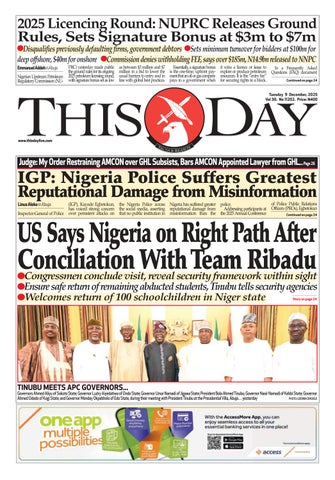
2025 Licencing Round: NUPRC Releases Ground Rules, Sets Signature Bonus at $3m to

Disqualifies previously defaulting firms, government debtors Sets minimum turnover for bidders at $100m for deep offshore, $40m for onshore Commission denies withholding FEF, says over $185m, N14.9bn released to NNPC PRC) yesterday made public the ground rules for its ongoing 2025 petroleum licensing round, with signature bonus set as low

as between $3 million and $7 million in a bid to lower the usual barriers to entry and in line with global best practices.

Essentially, a signature bonus is the one-time, upfront pay- ment that an oil or gas company pays to a government when it wins a licence or lease to explore or produce petroleum resources. It is the “entry fee” for securing rights to a block. Continued on page 24 In a Frequently Asked Questions (FAQ) document

www.thisdaylive.com

IGP: Nigeria Police Suffers Greatest Reputational Damage from Misinformation

Linus Aleke in Abuja Inspector-General of Police (IGP), Kayode Egbetokun, has voiced strong concern over persistent attacks on the Nigeria Police across the social media, asserting that no public institution in Nigeria has suffered greater reputational damage from misinformation than the police. Addressing participants at the 2025 Annual Conference

US Says Nigeria on Right Path After Conciliation With Team Ribadu

Congressmen conclude visit, reveal security framework within sight Ensure safe return of remaining abducted students, Tinubu tells security agencies Welcomes return of 100 schoolchildren in Niger state Judge: My Order Restraining AMCON over GHL Subsists, Bars AMCON Appointed Lawyer

President

meeting with President Tinubu at the Presidential Villa, Abuja… yesterday

Emmanuel Addeh in Abuja
Nigerian Upstream Petroleum Regulatory Commission (NU-
TINUBU MEETS APC GOVERNORS...
Governors Ahmed Aliyu of Sokoto State; Governor Lucky Aiyedatiwa of Ondo State; Governor Umar Namadi of Jigawa State;
Bola Ahmed Tinubu; Governor Nasir Namadi of Kebbi State; Governor Ahmed Ododo of Kogi State; and Governor Monday Okpebholo of Edo State, during their

NBCC PREMIUM MEMBERS’ EXCLUSIVE SESSION...

L-R: Vice President Nigerian-British Chamber of Commerce (NBCC), Tajudeen Ahmed; President/Chairman of Council, Abimbola Olashore; immediate past President Afreximbank, Benedict Okey Oramah; Deputy President, NBCC, Akin Osuntoki, and Vice President, NBCC, Lara

at an exclusive session of NBCC premium members with Oramah, in Lagos…recently

To Drive Transparency, Accountability, FG Bans

Physical Cash Transactions for Government Revenues

Issues 45-day deadline for deployment of PoS terminals, orders immediate stoppage of direct deductions from government revenues collected through dedicated portals, others Issuance of federal treasury e-receipt commences January 1, 2026, says document now only mandatory, recognised proof of revenue collection

Adopts RevOP as approved platform for end-to-end revenue optimisation, reconciliation, treasury visibility, others

James Emejo in Abuja Accountant General of the Federation (AGF), Mr. Shamseldeen Ogunjimi, yesterday, prohibited the collection and/or acceptance of physical cash, in Naira or other currencies, for all revenues due to the federal government.

Ogunjimi said going forward, all revenue collections, for and on behalf of the federal government, must be made via electronic processing.

The AGF disclosed the changes in a flurry of circulars to Ministries, Departments and Agencies (MDAs) of government aimed at plugging revenue leakages and ensuring accountability and transparency in financial transactions.

Ogunjimi said the federal government had observed with great concern the continued physical cash collection of government revenues at various transaction centres of MDAs.

He said the action contravened the provisions of e-payment policy; Treasury Single Account (TSA) policy; and its Implementation Guidelines covered in extant circulars.

He said, “Regrettably, persistent violations of this regulation by MDAs and parties in government transactions are being noticed. This trend is unacceptable as physical cash collection negates government policies and extant regula- tions; as well as weakens the integrity of federal government e-collection and e-payment systems.”

Ogunjimi declared that going forward, all MDAs and Federal Government-owned Enterprises (FGOEs) were required to immediately sensitise their staff, parties, and the general public transacting with them on the newThepolicy. AGF added that notices stating a “No Physical Cash

Receipt” and ‘No cash pay- ment” in official transactions of the government must be conspicuously displayed at all revenue collection points.

He stressed that all payments to the government must be

made via electronic channels duly approved by the OAGF and integrated to the appropriate TSA accounts.

Ogunjimi also said MDAs/ FGOES currently collecting physical cash at various revenue

centres or locations, must within 45 days of the circular, ensure the deployment of functional POS terminals or other approved electronic collection devices at all such locations.

The AGF further stressed

that accounting officers were to enforce the directive, as they will be held accountable for any breaches traceable to official transactions of their MDAS/ FGOES.

Continues online

NDPHC Completes Maintenance of Geregu Plant, Restores 450MW to National Grid

Begins work to recover 225MW Gbarain plant in Bayelsa Commences construction of 7.5MVA injection substation in Umuahia

The Niger Delta Power Holding Company (NDPHC) yesterday announced that it has successfully restored additional 450MW generation capacity to the national grid, following the completion of scheduled maintenance on the Geregu National Integrated Power

Globacom Acquires Additional Spectrum, Boosts Data Speed, Eliminates Congestion Nationwide

Globacom has announced large-scale upgrades to its network infrastructure, driven by major spectrum acquisitions and expanded data resources, designed to deliver faster internet speeds, wider coverage and a congestion-free user experience across Nigeria.

The initiatives, activated since Thursday, 4th December 2025 form part of the company’s strategy to build a future-proof communications network capable of supporting the country’s

digital growth. According to the company, the acquisition of additional capacity has significantly strengthened Glo’s nationwide broadband performance.

The expanded spectrum allows the network to handle greater volumes of data at higher speeds, enabling faster downloads, improved upload capability, seamless video streaming and clearer voice calls even during peak usage periods.

Globacom explained this

advanced spectrum capability is being complemented by increased physical infrastructure deployment. Thousands of LTE sites installed this year are being reinforced with hundreds of new sites currently in Thousandsprogress. of additional sites are also scheduled for roll-out over the next twelve months to deepen broadband penetration and strengthen indoor and outdoor connectivity in cities, towns and rural communities across the country.

Project (NIPP) plant.

The four-week extended minor inspection, undertaken by Siemens Energy, was executed to enhance the facility’s opera- tional reliability, performance, and efficiency, thereby extending the plant’s Equivalent Operating Hours (EOH) and operational life span, a statement by the Head, Corporate Communica- tions and External Relations, Emmanuel Ojor, said.

Managing Director and Chief Executive of the NDPHC, Jennifer Adighije, confirmed that in

the last one year the company has recovered six previously dormant gas turbines across the NDPHC fleet of gas turbines.

These, she said, include GT4 at the Calabar NIPP, GT1 at Omotosho II, GT1 and GT2 at Benin NIPP, GT4 at Sapele NIPP, and currently GT3 and GT4 at Alaoji NIPP on standby for pre-commissioning after gas supply remedial works.

According to her, these restored units collectively would have a cumulative 875MW additional capacity to

NDPHC’s mechanical available generation, adding significant boost to national power generationAdighijecapacity.further announced the commencement of restoration works on the 225MW Gbarain NIPP plant, which has been out of service since 2020, describing it as a major step toward recovering dormant national power in a bid to commercialise the output of the plant to serve critical commercial and industrial clusters within the Niger Delta region.

NYSC Reform: N2bn Innovation Fund to Digitalise Scheme Proposed in New Act

The federal government has commenced the process of reviewing the National Youth Service Corps (NYSC) Act, with a N2 billion innovation fund to support the digitalisation of the scheme’s activities proposed. Special Adviser to the President on Policy and

Coordination, and Head of the Central Results Delivery Coordination Unit (CRDCU), Hadiza Bala Usman, stated this, Monday at the NYSC Reform Stakeholders’ Consultative Engagement Forum, organised by the review committee in Abuja She said the NYSC was obsolete and in need of a review that will meet the digital

challenges.

“The NYSC Act is obsolete and inadequate for digitalenabled administration, gender inclusion safeguards, cybersecurity or remote service options. The NYSC Act was last substantively reviewed in 1993, long before the digital age, the Fourth Industrial Revolution, and the new demands of our economy.

Emmanuel Addeh in Abuja
Kayode,

INAUGURATION OF NIGERIA’S FIRST TELE-VETERINARY CALL CENTRE...

L-R: Asst. Chief Veterinary Officer, Dr. Olawale Olatunde; a Director in the Veterinary Services Department, Dr. Gboyega Idris; Director, Veterinary Services, Dr. Rasheed Macaulay; Commissioner for Agriculture & Food Systems, Ms. Abisola Olusanya; Perm Sec, Ministry of Agriculture & Food Systems (MAFS), Mr. Emmanuel Audu; Director, Livestock, Mr. Babatunde Shonekan; and Asst. Chief Veterinary Officer, Dr. Tolulope Akin-Oluwole, at the commissioning of Nigeria’s first Tele-Veterinary Call Centre at the Lagos State Animal Hospital, Oko-Oba, Agege

CBN Licenses 82 BDCs Under New Guidelines, Signals Stronger Forex Market

The Central Bank of Nigeria (CBN) has confirmed the

issuance of final operating licenses to 82 Bureaux De Change (BDCs) under its revised 2024 Regulatory

and Supervisory Guidelines, ushering in a new era of transparency and resilience in Nigeria’s retail foreign

exchange market.

In a statement signed by Acting Director of Communications,Corporate Hakama

Kukah: I Never Said There’s No Persecution of Christians in Nigeria

Emmanuel Addeh in Abuja

Catholic Bishop of the Sokoto Diocese, Matthew Kukah, yes- terday pushed back on reports alleging that he said there was no persecution of Christians in Nigeria, stressing that the imputation was untrue.

In a statement tagged: “Of the Persecution of Christians in Nigeria : My Response,” Kukah said he was baffled that despite the clarity of his position, there appeared to be determined efforts to ascribe to him a position as saying that there is no persecution of Christians in Nigeria.

However, newspaper reports had quoted the cleric as chal- lenging the narrative of Christian persecution in the country. “If you are a Christian in Nigeria and you say you are persecuted, my question is: how?

“ At least 80 per cent of edu- cated Nigerians are Christians, and up to 85 per cent of the Nigerian economy is controlled

by Christians. With such figures, how can anyone say Christians are being persecuted?”, he was quoted to have said.

But Kukah posited that he was only calling for the unity of Christians in the country, stressing that given the resources at their disposal, the greatest challenge for Christians was unity and solidarity.

“For over a week, I have been in the news on the basis of multiple claims that I had said that there was no persecution of Christians in Nigeria. The outpouring of emotions is understandable especially against the backdrop of the inviolability of life, the extermination of which must not be undermined by any debates on numbers or intent.

“I am grateful to my col- leagues at The Kukah Centre, who issued a Statement while I was caught up with a tight schedule. I nevertheless believe that is no substitute for my personal responsibility.

“First, let me say how sincerely sorry I am to be as- sociated with representations that understandably are a source of great pain and mental anguish to so many of my brothers and sisters within the body of Christ. The outpouring of emotions suggests to me the investment of trust in me, an onus I do not take lightly.

“I am baffled that despite the clarity of my position, there appear to be determined efforts to ascribe to me a position as saying that there is no persecu- tion of Christians in Nigeria. Nothing could be further from the truth.

“So, for the record, I did not say that Christians are not perse- cuted in Nigeria! Addressing an audience of the Catholic Knights of St. Mulumba in Kaduna on November 28th, I had spoken about the challenges of bearing witness to Christ in a time of persecution. I drew lessons from history and the stories of brave men and women in Nigeria and

Vestergaard, Harvestfield Launch ‘SNG Health’, to Produce Cutting-edge Mosquito Nets

Sunday Ehigiator

Vestergaard Sàrl and Harvestfield Industries Limited yesterday marked a historic milestone with the ground-breaking of a first-of-its-kind joint venture to transform malaria prevention and strengthen health security through direct investment in mosquito net manufacturing in Nigeria.

The new joint venture, named SNG Health, will manufacture

PermaNet Dual, Vestergaard’s latest dual-active-ingredient pyrethroid-chlorfenapyr net, designed to combat insecticide resistance.

Production at the state-ofthe-art facility is scheduled to commence in April 2026, with an annual capacity of 10 million nets, resulting in the creation of 600 skilled jobs.

The ground-breaking ceremony took place at the site in Ogun State, with contributions from

the National Coordinator of the President’s Value Chain Initiative (PVAC), Dr. Abdu Mukhtar; Director of Public Health at the Federal Ministry of Health and Social Welfare, Dr. Godwin Ntadom; Director and National Coordinator of the National Malaria Elimination Programme, Dr Nnenna Ogbulafor; Consulate General of Switzerland in Lagos, Nigeria, Ms. Cornelia Camenzind; and Task Team Leader, World Bank Nigeria, Mr. Onoriode Ezire.

Africa as models of witnessing in times such as these.

“ I concluded that the greatest challenge for Christians was unity and solidarity. Given the huge human and mate- rial resources that we have as Christians in Nigeria, if only we stood together, I argued, we would have no reason to be victims of persecution. Nothing here implied a denial of the fate of Christians,” the renowned cleric stated.

Over the years, he stressed that he had spoken extensively on the theme of persecution of Christians and had argued then as now that by whatever name it is described, the bloodshed needed to end as soon as yesterday because common humanity is at stake.

Sidi-Ali, the apex bank said the licenses took effect from November 27, 2025, and only operators listed on its official website are authorised to conduct business. The CBN stressed that operating without a valid license constitutes a punish- able offence under Section 57(1) of the Banks and Other Financial Institutions Act (BOFIA) 2020.

The licensing mile- stone follows the CBN’s recapitalisation drive, which raised minimum capital requirements in May 2024 to N2 billion for Tier 1 BDCs and N500 million for Tier 2 BDCs, up from the previous N35 million threshold. The reforms, according to the Bank, are designed to strengthen oversight, curb illicit financial flows, and ensure that only well-capitalised operators participate in the market.

It states: “The Central Bank of Nigeria (CBN), in exercise of its powers con- ferred under the Bank and Other Financial Institutions

Act (BOFIA) 2020, and the Regulatory and Supervisory Guidelines for Bureaux De Change Operations in Nigeria 2024 (the Guidelines), has granted Final Licenses to 82 Bureaux De Change (BDCs) to operate with effect from November 27, 2025.

“By this notice, only Bureaux De Change listed on the Bank’s website are authorised to operate from the effective date. While the CBN will continue to update the list of Bureaux De Change with valid operating licences for public verification on our website the Bank advises the general public to avoid dealing with unlicensed Foreign Exchange Operators.

“For the avoidance of doubt, operating a Bureau De Change business without a valid licence is a punish- able offence under Section 57(1) of the Banks and Other Financial Institutions Act (BOFIA) 2020. Members of the public are hereby advised to note and be guided accordingly.”

Dangote Cement Leads Road Safety Awareness Campaign

communities.

Dangote Cement Ibese Plant, Ogun State, has intensified its road safety campaign with a robust sensitisation programme for commercial drivers and motorcycle riders, held recently, emphasising the dangers of speeding and the life-saving importance of understanding a truck’s blind spots when driving or riding.

The event, held at the bustling Ilaro Motor Park, attracted hundreds of drivers and commercial motorcyclists from Ilaro and neighbouring

The campaign aims to curb preventable crashes by promoting responsible driving and riding habits as vehicular traffic surges towards the year-end.

The safety awareness campaign also saw the cement company distributing some safety kits to the commercial motorcyclists. Items such as helmets, reflective jackets, as well as safety goggles were freely gifted to the excited riders.

Addressing the drivers and riders at Ilaro Motor Park, Assistant Corps Commander,

Sulaiman Kolawole Oluwadumiye, Unit Commander of the Federal Road Safety Corps (FRSC), warned that excessive speed remains a leading cause of fatal crashes.

“Speed is sweet; the engine sounds powerful, the road looks open, and you feel in control. But the same speed that feels good for one minute can destroy a family in another second.

“The road has no respect for confidence or experience. There is no medal for the fastest driver and rider, only sorrow for the careless one.”

Sunday Ehigiator
Nume Ekeghe

Navy Chief Launches Annual Sea Exercise with I6 Warships

Reaffirms Nigeria’s maritime readiness

To personally evaluate the operational capability of the national fleet and adherence to standard operating procedure during real-time maritime operations, Chief of the Naval Staff (CNS), Vice Admiral Idi Abbas, yesterday, flagged off the Nigerian Navy’s Annual Sea Exercise.

With the full complement of 16 naval warships, Abbas flagged off the two-day exercise, themed, “Exercise ERU OBODO,” meaning “Guardian of the Nation,” onboard Nigerian Navy Ship KADA at the BEECROFT jetty in TheLagos.naval vessels included NNS KADA, NNS IKOGOSI, DB ABUJA, NNS GURARA, NNS IKENNE, NNS IBENO, NNS KANO, NNS EKULU, NNS ABA, NNS CENTENARY, NNS MAMBILA, NNS FARO, NNS SOKOTO, NNS CHALAWA, NNS OLOIBIRI, and

NNS ZUR.

While reaffirming the navy’s unwavering commitment to safeguarding Nigeria’s maritime domain and contributing to security across the Gulf of Guinea, Abbas described the exercise as a central pillar of the Nigerian Navy’s operational calendar and a critical platform for testing fleet readiness, operational effectiveness, and combat preparedness.

He stated that Nigeria’s maritime environment was strategically vital as a corridor for commerce, a source of immense natural resources, and a frontline of national security, and, as such, the navy’s ability to dominate the maritime space, guarantee freedom of navigation, and deter criminality remained non-negotiable.

Abbas explained that EX ERU OBODO had been carefully structured to mirror real-world operational challenges.

The exercise will test a broad

range of naval competencies, including fleet manoeuvres, advanced gunnery, anti-piracy operations, suppression of illegal oil bunkering, search and rescue missions, and Visit, Board, Search and Seizure (VBSS) operations.

The exercise would also evaluate inter-agency cooperation with key maritime

stakeholders, as well as the navy’s capacity for logistics support and combat sustainability at extended ranges from shore bases.

Beyond Nigeria’s waters, the CNS reiterated that the Nigerian Navy was a key stabilising force in the Gulf of Guinea, contributing significantly to the reduction of piracy, protection of

shipping lanes, and promotion of maritime governance in the region.

Under the leadership of the President and Commander-inChief of the Armed Forces, President Bola Tinubu, Abbas affirmed that the navy stood fully prepared to undertake any mission assigned to it. He stated, “Exercises like

this strengthen our readiness and ensure that we remain a reliable guardian of Nigeria’s maritime interests and regional maritime security.”

Addressing participating ships, helicopters, special forces, and supporting units, the naval chief urged personnel to view the exercise not as a routine drill but as battle preparation.

Tech Experts Move to Address Genderbased Violence, Demand Accountability

Technology leaders and advocates have made an urgent call to rethink how digital platforms serve and protect female users amid rising online violence and exclusion. The move was aimed at addressing the safety and empowerment of women and girls online.

Seplat’s TTC Trains 850 Technicians in 30 years

Okon Bassey in Uyo

Seplat Technical Training Center (TTC) in Eket Local Government Area of Akwa Ibom State has since inception 30 years ago trained over 850 technicians now playing leading roles in Nigeria’s oil and gas industry.

The TTC was created with a visionary purpose: to build a world-class pipeline of indigenous technicians equipped to compete globally and to contribute meaningfully to Nigeria’s industrial and energy development.

The Chief Executive Officer,

Seplat Energy Plc, Mr. Roger Brown disclosed this at the graduation of Apprentice Group 13, commending the centre and the graduands for attaining two million incident- free offshore man-hours without a recordable incident in its offshore operations.

Brown, represented by Seplat’s Chief Operations Officer, Samson Ezugworie, described the ceremony as “a celebration of a journey that began thirty years ago and has evolved into something exceptional.”

He said the theme of the event, “From Roots to

Results - Three Decades of Growth,” perfectly reflects the transformational path that the TTC has traveled since its establishment.

“It was a belief that developing local talent would strengthen operational excellence and shape the future of Nigeria’s energy landscape. Those were our roots - and today, the results speak for themselves,” the CEO said.

He lauded the host community for being supportive and commended the graduands on achieving an important step in their professional journey.

They made the call in Abuja during the TfGBV Policy Roundtable, organised recently by Leading Ladies Africa and TechHerNG, as part of strategic advocacy efforts for the 16 Days of Activism global campaign.

Founder of TechHerNG, Chioma Agwuegbo, opened the conversation by highlighting the critical intersection of power, profit, and women’s digital participation.Agwuegbo, who ad- dressed what she called

the “darker side” of the digital economy, said, “We acknowledge the harm and the darker side of the digital economy, which is the fact that a lot of women are not allowed to play, because things like gender-basedtech-facilitated violence stops them.”

She also pointed to an exponential rise in online harms targeting women and girls over the past three years.

In her keynote address, Regional Portfolio Director,

Africa at Luminate, Toyin Akinniyi, underscored the double-edged nature of technology, celebrating its unprecedented possibilities while confronting its vulner- abilities.

Akinniyi said, “Technology has given us unimaginable power but it has also given us a new terrain of vulnerability.”

She stated that harassment, exploitation, and tech-enabled violence had continued to shape women’s online experiences.

Sanwo-Olu Inaugurates TY Logistics Park, Lekki Free Zone Alaro City

As Lagos continues to take giants strides in business promotion, Governor Babajide Sanwo-Olu yesterday led dignitaries to inaugurate the TY Logistics Park at the Free Zone Enterprise (FZE).

The Logistics Part which is to service the Lekki Deep

Sea Port is equipped with state-of-the-art logistics platform designed to strengthen trade flows and enhance supply chain operations across West Africa.

The project which is a brainchild of Nigeria’s former Chief of Army Staff, General T.Y. Danjuma (Rtd) will strengthen the nation’s logistics competitiveness

and support regional trade.

“Today, that vision stands before us in the form of two world-class facilities with a combined 29,000 square metres of premium free zone space.

“We set out to redefine how goods move across Nigeria and West Africa, and this facility delivers exactly that.”

thE 100 rEsCuEd sChOOl ChildrEn... Cross section of rescued abducted school children In Minna ... yesterday

LAWYER

Firearms in Private Hands: The Pros and Cons

Firearms

in Private Hands: The Pros and Cons

Quotables

‘My immediate priority, is to make defence take its place fully in the country. The synergy between the Armed Forces and other security agencies, and all Nigerians being carried along…..It is this synergy that we need to build. I can assure you that within the shortest possible time, Nigerians will see results.’ - Rtd General Christopher Musa, Minister of Defence, Federal Republic of Nigeria

'....We are still facing attacks .... orchestrated.... organised...meant to damage the image of democracy. And, all these things started with just a tweet from President Trump.' - Senator Godswill Akpabio, GCON; Lawyer; Senate President, 10th National Assembly, Federal Republic of Nigeria

Proof of Defamatory Statements Uttered in Language other than English

Page IV

NBA Lagos Hosts End-of-Year Dinner, Celebrates Outstanding Members

Page V

2025 NIALS Fellows’ Lecture: Celebrating Legal Excellence and Academic Impact

Page V

Babalakin & Co. Bids Farewell to Professor Bayo Adaralegbe After 34 Years of Distinguished Service

Page V

The Segun Awolowo I Knew

Page X

Insecurity: And Trump Stirs Nigeria to Action

Teaching Nigeria Values from Outside

The Yorubas have a proverb, that a child who refuses to imbibe the good values taught at home, will be taught those values outside (but will possibly have to learn those lessons in a harder way). This is what appears to be happening to Nigeria, courtesy of President Trump’s utterances, threat, and USA’s stand on Nigeria, which appears to be the magic wand that has finally spurred the Nigerian Government into positive action to secure the country (see Section 14(2)(b) of the 1999 Constitution of the Federal Republic of Nigeria (as amended)(the Constitution). Nigeria is being taught from outside, by President Trump and the American Government! And, it is becoming clear that Nigeria needs these lessons, since successive governments have refused to teach themselves, even in the face of deteriorating security.

In fairness to former President Jonathan, his administration must have identified some of the obstacles to Nigeria fighting the insecurity alone, and so, they quietly engaged foreign military contractors to fight the insurgents, an initiative which President Buhari promptly cancelled on his assumption of office. The lackadaisical attitude of the Buhari administration to the fight against insecurity, cosseting terrorists and turning a blind eye to the so-called Farmer-Herder attacks in the North Central, certainly didn’t help matters; and in the last decade, these heinous attacks flourished.

At its inception in 2023, the failure of the Tinubu administration to take out the measures it is now taking, until President Trump’s prompt, affirms the assertion that Nigeria needed to be taught these lessons from outside. Hopefully, Nigerians will begin to see the positive results from the lessons when the examination scripts are marked, the new measures now being put in place, being the answers to the questions in the promotion examination.

The Promotion Examination

Last week, three important things that occurred, were questions that would necessarily have been part of the promotion examination that would result in the outcome of whether the Government of Nigeria secures the country better (pass) or not (fail).

1) Senatorial Screening of Rtd General Musa I laughed when I heard the Senate President’s reaction to Senator Sani Musa who suggested that the nominee for Minister of Defence take a bow, instead of facing proper screening. Isn’t that what the Senate has been doing hitherto? Just confirming people, whether they are qualified or not? Nigerians watched an old video of the Minister of State of Defence, Bello Maitawalle, possibly from when he was Governor of Zamfara State, in which he spoke in support of terrorists and bandits, offering useless excuses on their behalf, as reasons for their heinous crimes, instead of being concerned about the security and welfare of the people of Zamfara, which was his primary constitutional mandate. The fact that such a person was confirmed by the Senate as a Minister of the Federal Republic of Nigeria, still leaves many bewildered to this day. It is true that strangely, in Nigeria, Ministers are screened blindly, without their portfolios, but with Mr Maitawalle’s record, not only should he not have been confirmed, to make matters worse, he was taken to Defence where he had previously failed abysmally. Indeed, the former Chief of Defence Staff who is the new Minister of Defence, Rtd General Christopher Musa, appears to tick all the boxes. But, the Senate President, Godswill Akpabio, still took exception to the Senator Musa’s ‘take-a-bow’ suggestion, alluding to the fact that security is too important to ask someone to just take a bow, stating that Nigerians had a lot of questions to ask the Ministerial nominee, and that President Trump was on their neck! Suddenly, SP Akpabio realises the importance of screening nominees properly because of President Trump, while people such as Mr Maitawalle who had shown from the get-go that they were not fit for purpose, sailed through the Senate’s hitherto lack lustre screening process with ease. Maybe by 2027, Nigeria would have metamorphosed to screening Ministers with their portfolios already attached to them. in order to ascertain that each nominee is fit for purpose.

Today, Nigerians are wondering how Mr Maitawalle can continue as Minister of State of Defence, when his weak, over-conciliatory and friendly approach to the handling of terrorists and insurgents seems to directly contradict the stand of his new Principal, Rtd Gen Musa, who has stated unequivocally that there will be no negotiation with terrorists, and they will be faced head on. On Sunday, Nigerians received the good news of the rescue of 100 students of St Mary’s Catholic School, Papiri, Niger State, who were kidnapped a few weeks ago. How were the students rescued? If there was a rescue operation in which the kidnappers were engaged, why weren’t all the victims rescued? What has happened to the over 100 that are still not accounted for? Even if the details of the modus operandi of the rescue operation must remain vague for security reasons, how many of the kidnappers were apprehended?

2) Bad Optics in Abia State Governor’s Visit to Nnamdi Kanu

A few days ago, the Governor of Abia State, Alex Otti surprised most right thinking people, by wasting the scarce resources of Abia State to make an ill-timed visit

oNIkEpo BraIThwaITE

onikepo.braithwaite@thisdaylive. com onikepob@yahoo.com

“The lackadaisical attitude of the Buhari administration to the fight against insecurity, cosseting terrorists…certainly didn’t help matters…..At its inception in 2023, the failure of the Tinubu administration to take out the measures it is now taking, until President Trump’s prompt…. video of…Bello Maitawalle… in which he spoke in support of terrorists and bandits, offering useless excuses on their behalf….Alex Otti…an ill-timed visit to a convicted terrorist, Nnamdi Kanu, in prison in Sokoto.The optics are bad… Hopefully, Nigeria is hearing and learning, albeit from the external pressure of President Trump and USA”

to a convicted terrorist, Nnamdi Kanu, in prison in Sokoto. The optics are bad. What message are we sending to the world, at a time when President Trump has designated Nigeria as a CPC? That the Nigerian Government and/or top Government Officials support terrorism, and care more for convicted terrorists than their innocent victims? That Kanu, a person who was found guilty by a court of competent jurisdiction, of multiple acts of terrorism that resulted in the deaths of many innocent people of Igbo extraction like himself, and over 70 law enforcement officers, the destruction of government infrastructure, and orchestrating monumental financial losses in the Southeast as a result of the unlawful Monday sit-at-home order which was sustained for years, intimidation of the governments and people of the Southeast, has done nothing wrong in his bid to further his cause for the actualisation of Biafra? In Charge No. FHC/AB/CR/383/2015

FRN v Nnamdi Kanu per Omotosho J, the trial court had this to say on Page 142 of the judgement: “It is interesting to note that the Defendant who claims to be a freedom fighter, has even caused more harm to his own people who are predominantly of Christian faith. Can this be said to be agitation of self- determination? Not at all. Agitation for self-determination, cannot be detrimental to people who are supposed to be beneficiaries of the said self-determination. The usual sitat-home orders, primarily affects his own people. The killings of people who disobey the order, are his own people. Ordering of closure of churches and schools as well as markets, also affects his own people. They are unable to trade, go to school, farm or even worship on such days. The threat of

violence and death, have prevented the people from going about their legitimate business. Are these acts of the Defendant consistent with agitation for self-determination, the answer is in the negative”. I concur. Acts of terrorism are heinous, as can be seen in the Terrorism (Prevention and Prohibition) Act 2022 (TPA 2022) and the punishments of up to death sentence prescribed therein. In Karumi v FRN (2016) LPELR-40473(CA) per Joseph Shagbaor Ikyegh, JCA, the Court of Appeal couldn’t have said it better when it held thus: “The gravity of the offence of terrorism which involves the use of violence or force to achieve something, be it political or religious, is a grave affront to the peace of society, with attendant unsalutary psychological effect on innocent and peaceful members of the society who may be forced to live in perpetual fear. It is an offence that may even threaten the stability of the State. The sophisticated planning and execution of the acts of terrorism, show it is an offence that requires premeditated cold-blooded organisation.The circumstances under which such a crime is organised calls for appropriate sentencing, to deter its recurrence by potential or prospective offenders". Also see Abdulmumini v FRN (2017) LPELR-43726(SC) per Kudirat Motonmori Olatokunbo Kekere-Ekun, JSC (now CJN).

The visit of Governor Otti combined with the ridiculous statement of former Counsel to Nnamdi Kanu, Aloy Ejimakor, while making a statement to the press upon Kanu’s conviction, isn’t only capable of inciting Kanu’s supporters to violence having been deliberately misled

into thinking that Kanu is innocent, but promotes the impression that Government isn’t particularly concerned about the effect of terrorism on the people, bringing perpetrators to book or making them pay for their crimes. This playing to the gallery, can result in negative consequences. Instead of simply stating that they were dissatisfied with the judgement and would go on appeal, Mr Ejimakor, a former Counsel in Kanu’s case, who is obviously conversant with Section 2 of the TPPA which has several definitions of acts that amount to terrorism, is aware that the provisions state clearly that a person doesn’t have to be physically present in Nigeria to commit acts of terrorism, and that what he refers to as Kanu simply talking, for example, amounts to incitement and instigation in Section 2(2)(g) of the TPPA.

Mr Ejimakor said something to the effect that, he had never seen anybody convicted because of what they had said, implying that Kanu was convicted simply for talking innocently. If what a person says cannot spur people into action, why has the Nigerian Government made noticeable changes to its security apparatus and appointed Ambassadors since President Trump’s CPC ‘talk’ a few weeks ago? If what a person says cannot translate into a criminal offence, why then was Simon Ekpa convicted in Finland? After all, he wasn’t physically present in Nigeria, AK 47 in hand, forcing people to stay home on Mondays, or shooting anybody. Just like Kanu, he was instructing, directing, encouraging, inciting, instigating and insisting by broadcast, from wherever he was. This constitutes an offence, under Section 2(3)(c) of the TPPA. In Kaza v State (2008) LPELR-1683(SC) per Niki Tobi, JSC, the Supreme Court held thus: “An encouragement here means an act of making someone to feel brave or confident enough to do something, by giving active approval in support of the crime. Incitement also has the element of encouragement. By incitement, the person is provoked by a strong passion or feeling to commit an offence….the act of instigating, means something happening by the action or conduct of a person, who is the starter. By the act of instigation, the co-accused is propelled or gingered to commit an offence”. Mr Maitawalle’s utterances which showed a Governor’s soft spot for terrorists, and another Governor, Mr Otti’s ‘esprit de corps’ visit to Kanu, a convicted terrorist, certainly gives the impression that the Nigerian Government may not have been ready to take the bull by the horns to fight insecurity, and may have required a push from the outside. It also gives the impression that though the Constitution provides for equity, equality and fairness in its Preamble, contrary to Section 42(1)(b) thereof, some criminals, such as terrorists, are given special privileges that other ‘ordinary’ criminals do not enjoy.

3) Non-Consideration of the Sharia Issue

The Constitution makes provision for Customary and Sharia Law, but only in their civil personal sense. What Customary Law is to Southern Nigeria, is what Sharia Law is to the Muslims in the North. The Northern Christians, also have their own various customary laws. Even if Sharia is mentioned one million times in the Constitution, there is nowhere in the Constitution that it is provided that Nigeria is an Islamic country, nor are Sharia and Customary Courts endowed with criminal jurisdiction. See Sections 262, 267, 277 & 282 of the Constitution.

I heard an argument on television last week about the doctrine of sovereignty, and how America cannot tell Nigeria what to do about Sharia Law. The truth is that, America is only teaching the Nigerian Government that as provided in Section 1(1) thereof, the Constitution is supreme, and the provisions of the Constitution must be obeyed by all; that the 12 Sharia States must obey Sections 10 and 277 of the Constitution. What America, or Senator Ted Cruz is saying in his Nigeria Religious Freedom Accountability Bill 2025 (NFRAB), have their origins in the Nigerian Constitution, they aren’t dictating to Nigeria. This Sharia issue which can certainly not be divorced from a great deal of the violence that obtains in Northern Nigeria today, has been ignored from the administration of President Obasanjo, when it should have been nipped in the bud, to date. America is simply pressuring the Nigerian Government into doing what it should have done in this regard, decades ago. Nigeria is hearing and learning. Hopefully, Nigeria is hearing and learning, albeit from the external pressure of President Trump and USA.

Conclusion

Successive Governments’ failure to thoroughly examine persons of interest in matters relating to terrorism, or to follow obvious leads that may have resulted in the arrest of terrorists, leaves any reasonable person with the irresistible conclusion that outsiders may need to intervene to ensure that Nigeria does the right thing for her people that are being kidnapped, hurt and killed almost on a daily basis. Additionally, one justification for breaching the doctrine of sovereignty, is humanitarian grounds, as the right to life and security are globally accepted fundamental rights, sacrosanct and must be protected.

I end with the Yoruba proverb I started with: “Omo tí kò gbo nílé, yóò gbo lóde” (a child who doesn’t hear at home, will hear outside). Hopefully, Nigeria is hearing and learning, albeit from the external pressure of President Trump and USA.

Proof of Defamatory Statements Uttered in Language other than English

Fact

s

The Respondent instituted the action at the High Court of Imo State against the Appellant, for slander. He alleged that during a vigil held in honour of the Appellant’s late father, the Appellant made the following defamatory statement against him in Igbo language: “Onye wu ahu kporo ya Dibianta. Awum Dibraukwu, Ganu kpo Dibianta Iheanacho bu a rat nga mno ihe oma eme bun ani igbu madu. Obia ngaa na abiala, o ga eji oso gbalaga” which translates to: “Who is that person that calls himself Dibianta? I am Dibiakwu. Go and call Iheanacho to come here. Dibianta Iheanacho is a rat to me; the only thing he knows how to do is to kill people. If he comes here tonight, he will take to his heels.”

The Respondent claimed the defamatory statements made in Igbo Language were understood by those present, and this caused harm to his reputation.

At the trial, the Respondent testified as PW1 and called four additional witnesses. Among them, PW2 and PW3, who also attended the vigil, testified to hearing the slanderous statements, while PW5, a Higher Executive Officer attached to the High Court, Owerri, who was called to testify as a sworn interpreter, interpreted the alleged defamatory words to English language. The Appellant, on his part, denied uttering any defamatory words, asserting that he only preached at the vigil.

After the conclusion of trial, the trial court found that the Respondent proved his claim and awarded him damages in the sum of N500,000.00. Dissatisfied, the Appellant appealed to the Court of Appeal. At the Court of Appeal, the Appellant relied on IBEANU v UBA (1972) 2 ECSLR 194, to argue that the defamatory words must be recorded in the exact language in which they were uttered. In its judgement dismissing the Appeal and affirming the judgement of the trial court, the Court of Appeal held that the uncontroverted testimonies of PW1–PW3, who all heard the said defamatory words and also testified in Igbo language, were sufficient and constituted a valid exception to the rule in IBEANU v UBA (Supra). The Court of Appeal also found that the fact that the Appellant failed to produce the video recording of the vigil despite pleading same, meant that the evidence would have been unfavourable to him, and the Court of Appeal invoked the doctrine of withholding evidence in Section 149(d) [now 167(d)] of the Evidence Act against him.

Displeased, the Appellant appealed to the Supreme Court.

Issues for Determination

The Supreme Court adopted the two issues distilled by Counsel for the Appellant, for the determination of the appeal as follows:

i) Whether the Court of Appeal was right in upholding the finding of the trial court, that the Respondent had proved his case of slander against the Appellant.

ii) Whether the Court of Appeal was right in distinguishing the case of IBEANU v UBA (1972) 2 ECSLR 194 from the present case, on appeal to the Supreme Court.

Arguments

On the 1st issue, Counsel for the Appellant argued that in an action for defamation, it is a requirement of law that the exact words complained of must be proved at trial. Counsel argued that where the defamatory words were not spoken in English, the record of the trial court must record the words used as uttered in their original language during the testimony, and the Plaintiff must prove through a sworn interpreter that the translation pleaded in the Statement of Claim is accurate. Counsel submitted that since the words as pleaded were not in English, the fact that the records of the trial court only contained the English translation of the words meant that the exact defamatory words were not proved at the trial. Counsel also argued that that the Court of Appeal was wrong for invoking Section 167(d) of the Evidence Act against the Appellant, because since the Respondent failed to prove the

In the Supreme Court of Nigeria Holden at abuja

On Friday, the 11th day of april, 2025

Before their lordships mohammed Lawal Garba adamu Jauro

Jummai Hannatu Sankey moore aseimo abraham adumein abubakar Sadiq umar Justices, Supreme Court SC.370/2010

Between

prINCewIll oDIKaNwa appellaNt

And CHIeF JoSepH DIBIaNta IHeaNaCHo reSpoNDeNt

(Lead Judgement delivered by Honourable Adamu Jauro, JSC)

precise words uttered, there was no need for the Appellant to lead evidence in rebuttal.

On the 2nd issue, Counsel for the Appellant argued that there was no basis for the Court of Appeal to distinguish the facts of the case from the facts in IBEANU v UBA (1972)

2 ECSLR 194. Counsel argued that the only recognised exception to the rule in the IBEANU case is where the Defendant admits the defamatory words, and this is not the case here.

Responding on issue 1, Counsel for the Respondent argued that both the slanderous words and their English translation were specifically pleaded in the Respondent’s Amended Statement of Claim. Counsel argued that the Respondent, and his two witnesses who attended the vigil, gave consistent testimony establishing the defamatory words as pleaded. Counsel submitted that although Igbo Language is not the official language of the court, the trial court understood the language and properly appreciated the evidence given.

Similarly, in response to the Appellant’s arguments on issue 2, the Respondent’s Counsel submitted that the learned Justices of the Court of Appeal were right in distinguishing this case from IBEANU v UBA (SUPRA), since

“……..what the law requires is that the persons who heard the words understand the language in which they were uttered or published, that the words both in their original form and English translation be set out in the Statement of Claim, and that the meanings of the words in English be proved by an expert sworn interpreter”

vernacular in the court’s record, in view of the fact that the official language of Nigerian Courts remains the English Language, and it is expected that the trial Judge would record the proceedings in English Language as translated from the original language. The Court held that all that is necessary, is to show that the words were given in evidence in that original language and in the instant case, the record showed that the Respondent as PW1, as well as PW2 and PW3 testified exclusively in Igbo language, and they gave evidence of the slanderous words. This Court held that their testimonies were not disputed by the Appellant, hence, there was no basis to hold that the slanderous words were not proved.

Furthermore, the Supreme Court held that the lower court rightly relied on the case of TOURNIER v NATIONAL PROVINCIAL AND UNION BANK OF ENGLAND (1924) 1 KB 461, in which the Court of Appeal of England and Wales held that in an action for slander, it is not necessary for the Plaintiff to prove the exact words as pleaded in the statement of claim, and it suffices if he proves the substance of the slanderous words pleaded. The Apex Court held that the crucial requirement is for the pleadings and evidence of the Plaintiff’s witness to support the claim that the defamatory/ slanderous words were made, hence, the Plaintiff must discharge the burden placed on him by law of proving that the Defendant made a false defamatory statement about him which was communicated to a third party and caused the Plaintiff harm.

the slanderous words were duly pleaded and the witnesses testified in Igbo language.

Court’s Judgement and Rationale

On the 1st issue, the Supreme Court held that in all cases of defamation, whether libel or slander, the onus is on the Plaintiff to prove the defamatory word, and in an action founded on slander, the defamatory words may be proved by pleading the words in a Statement of Claim and establishing same by oral evidence. The Apex Court held further that where slanderous words were uttered in a language other than English Language, whether vernacular or foreign language, what the law requires is that the persons who heard the words understand the language in which they were uttered or published, that the words both in their original form and English translation be set out in the Statement of Claim, and that the meanings of the words in English be proved by an expert sworn interpreter. The Apex Court relied on its earlier decision in ORUWARI v OSLER (2012) LPELR – 19764 (SC).

The Court held that there was no doubt that PW5 who was called by the Respondent at the trial to interpret the alleged defamatory words to English Language, a civil servant who was a Higher Executive Officer attached to the High Court, Owerri as an interpreter, thus, eminently qualified as an expert witness in the circumstance. The Court held further that his interpretation was also materially and substantially the same as the pleadings as contained in the Amended Statement of Claim, and was thus, sufficient proof of the defamatory words.

The Supreme Court also held that contrary to the argument of the Appellant, there is no requirement that the alleged defamatory words must be written in the foreign language/

The Supreme Court held that the lower courts were right to have accepted the uncontroverted evidence of the Respondent which showed that, since the publication of the slanderous words, the Respondent no longer commanded the public respect he used to have and that his clientele as a traditional healer had considerably diminished. The Apex Court further held that by virtue of Section 133(1) and (2) of the Evidence Act, the Respondent having successfully discharged the burden of proving his claim on the balance of probabilities, the onus shifted to the Appellant to adduce contrary evidence to rebut the evidence led by the Respondent; however all the Appellant could offer were bare assertions which were not proved by evidence. The Court held that this was more so as the Appellant failed to tender the video recording of the vigil despite asserting in his pleadings that he would tender the same and the Court of Appeal rightly invoked the presumption of withholding evidence as contained in Section 149(d) of the Evidence Act against the Appellant. On the 2nd issue as to whether the Court of Appeal was right to have distinguished the case of IBEANU v UBA (1972) 2 ECSLR 194 from the present case, the Supreme Court held that the doctrine of stare decisis or judicial precedent which postulates that where the facts in a subsequent case are similar or close to facts in an earlier case that has been decided by the same court or a higher court, judicial pronouncements in the earlier case are utilised to govern and determine the decision in the subsequent case, only mandates lower courts to abide by the decisions of higher courts and not the other way round. The Court held that by the hierarchy of courts created by the Constitution, the East Central State High Court which decided the IBEANU case is lower in hierarchy and subordinate to the Court of Appeal and the Supreme Court. The Court held that thus, the decision in the IBEANU case rendered by the East Central State High Court was not binding on the Court of Appeal or the Supreme Court, and the question whether the Court of Appeal was right to distinguish the facts of this case from the decision in the IBEANU case is of no moment.

Appeal Dismissed

Representation

A. I. Nwachukwu for the Appellant.

O. D. Atoyebi for the Respondent.

Reported by Optimum Publishers Limited, Publishers of the Nigerian Monthly Law Reports (NMLR)(An affiliate of Babalakin & Co.)

Honourable Adamu Jauro, JSC

NBA-SPIDEL Elects New Leadership at Uyo AGM

The Nigerian Bar Association Section on Public Interest and Development Law (NBASPIDEL) has elected a new leadership to steer the affairs of the influential NBA section. The election

took place on Thursday during the Section’s Annual General Meeting (AGM), held at the IBOM Hotel & Golf Resort in Uyo, Akwa Ibom State. Renowned Prison Reform advocate, Professor Uju Agomoh, emerged as the new Chairman of

the Section, marking a significant moment for SPIDEL, which plays a central role in public interest advocacy within the legal profession. Senior Advocate of Nigeria, Mr Paul Daudu, was elected Vice Chairman, while Mr Enome Amatey, Chairman

of the NBA Calabar Branch, was returned as Secretary. The Electoral Committee, constituted earlier for the purpose of conducting the polls, oversaw the election which drew participation from NBA-SPIDEL members across the country. The newly elected Council

was formally sworn in on Friday, December 5, 2025, marking the beginning of a new administrative cycle. In a statement issued after the AGM, NBA-SPIDEL highlighted the broad representation within the new Council, noting that its composition includes Senior

Babalakin & Co. Bids Farewell to Professor Bayo Adaralegbe After 34 Years of Distinguished Service

Babalakin & Co. announces the departure of Professor Bayo Adaralegbe, a longserving Partner whose 34-year journey with the firm has been defined by

unwavering dedication, excellence, and impact. Throughout his tenure, Professor Adaralegbe made a profound impact on shaping the firm’s

identity and reputation. His exceptional leadership in Arbitration and ADR, significant contributions to the Energy and Natural Resources practice, steadfast

2025 NIALS Fellows’ Lecture: Celebrating Legal Excellence and Academic Impact

The Nigerian Institute of Advanced Legal Studies (NIALS) recently hosted its 2025 Fellows' Lecture and 19th Conferment of the Institute’s Honorary Fellowships on Tuesday, 2nd December, 2025, at the Shehu Musa Yar’Adua Centre in Abuja.

During the event, the Director General, Professor Abdulqadir Ibrahim Abikan, reiterated the Institute's dedication to excellence and societal impact. He highlighted the significance of the Fellows' Lecture, in driving scholarly discussions and promoting intellectual capacity within Nigeria's legal system.

The Honorary Fellowships were bestowed upon four distinguished jurists and legal scholars, including two former Ministers of Justice: Chief Kanu Godwin Agabi, SAN, and Mr Muhammed Bello Adoke, SAN, as well as the immediate past Director General of the Institute, Professor Muhammed Tawfiq Ladan, and Professor Yusuf Ali, SAN. These individuals were recognised for their academic achievements, professional integrity, and service to the legal community and the nation.

Chief Justice of Nigeria (CJN) Justice Kudirat KekereEkun remarked on the theme

of the Fellows Lecture: "Law, Politics, and Economic Development: Nigeria at Crossroads", emphasising the pivotal role of the law in maintaining political stability, ensuring economic confidence, and upholding freedoms and responsibilities in society. She stressed that amidst Nigeria's current socioeconomic challenges, the rule of law is paramount, particularly for the Judiciary in fulfilling its vital role.

Guest lecturer, Mr George Etomi, highlighted Nigeria's governance struggles, citing institutional weaknesses, electoral distrust, and public disillusionment. Nigeria's low ranking in the Rule of Law Index, indicates a need for enhanced adherence to legal principles. Addressing issues in key sectors like oil and gas, telecommunications, and banking, he underscored the importance of good governance for national development. He proposed strengthening institutions, promoting transparency, and fostering accountability, as crucial steps to address governance deficiencies.

Responding on behalf of the awardees, former Director General Professor Mohammed Tawfiq Ladan thanked the Institute for the Honorary fellowship award, and pledged continued

support for research and scholarly work at the Institute. He expressed gratitude to the current Director General, Professor Abdulqadir Ibrahim Abikan, for sustaining the Fellows lecture.

commitment to mentoring young Lawyers, and unwavering pursuit of legal excellence have collectively defined a legacy that will continue to inspire generations to come.

As he embarks on a new chapter in his professional and academic life, the firm celebrates his remarkable contributions and the path he has paved for future generations.

Reflecting on the moment, Wale Akoni, SAN, Managing Partner of Babalakin & Co., shared: “Professor Adaralegbe’s

NBA Lagos

contributions to this firm and to the legal profession in Nigeria, are immeasurable. His dedication, intellect, and mentorship have left an indelible mark on all of us. While we will miss his daily presence, we wish him continued success in his future pursuits.”

“Babalakin & Co. extends its deepest appreciation to Professor Adaralegbe and looks ahead with confidence, continuing to build on the foundation he helped establish.”

Advocates, Bar leaders, and long-standing contributors to public interest litigation. The leadership is expected to expand the Section’s work in justice sector reforms, citizens’ rights advocacy, and policy engagement. Other elected officers include Saadatu Abdullahi Mohammed as Treasurer, Barbara Tosan Onwubiko as Financial Secretary, and Mojirayo Ogunlana as Public Relations Officer. The Council also features several prominent legal figures such as Prof Paul Ananaba, SAN, Dr Monday Ubani, SAN, Kunle Edun, SAN, John Aikpokpo-Martins, Princess Frank-Chukwuani, and Sir Ejike Ezenwa, SAN, among others.

With the election concluded, the incoming Council is expected to build on NBA-SPIDEL’s expanding national profile and intensify engagement on issues affecting public interest, governance, justice delivery, and the rule of law across Nigeria.

Hosts End-of-Year Dinner, Celebrates Outstanding Members

The Nigerian Bar Association (NBA), Lagos Branch, recently held its annual End-of-Year Dinner and Awards Night at a gathering that drew Judges, Senior Advocates and Practitioners to the Harbour Point Events Centre. The event celebrated the Branch’s accomplishments, and rewarded excellence within the legal community.

Chairman of the Lagos Branch, Uchenna Ogunedo Akingbade, welcomed all members and guests with a call for unity and professionalism. “Tonight reminds us of how far we have come as a Branch and how much more we can achieve when we work together” she said. NBA President, Mazi Adam Osigwe, SAN,

who attended the event praised the Lagos Branch for its consistency and leadership. “Lagos remains the heartbeat of legal practice in Nigeria. Your activities this year have once again set a benchmark for innovation, service and integrity within the Bar,” he added The evening featured the presentation of several awards recognising excellence, service and commitment, to recipients’. Branch officials noted that the awards reflected contributions across litigation, human rights advocacy, professional development and pro bono service.

Guest speaker at the event, Charles Adeyemi Candide-Johnson, SAN, commended the NBA for its work in defending the

rule of law. “At a time when our justice system faces numerous challenges, the Bar must continue to serve as the conscience of the nation”, he stated.

Guests enjoyed music, comedy and dinner, with many describing the atmosphere as uplifting.

Members of the Young Lawyers Forum, said the evening highlighted the

Branch’s strong support for capacity-building and mentorship. The event closed with a toast by the Chairman, who urged members to embrace the new year with renewed dedication. He said, “Our duty is to uphold justice at all times. Let us continue to stand firm for the profession, and for society”.

Obi, SAN Set to Unveil New Book on Tort

Nigerian jurisprudence would be enriched on Wednesday, December 10 with the public presentation in Lagos of the book ‘Contemporary Law of Tort in Nigeria’. Authored by Uche Val Obi, SAN, the book will be launched under the chairmanship

of Chief Wole Olanipekun, SAN and reviewed by Prof Fabian Ajogwu, SAN. Obi, SAN who is the Founding Partner of Alliance Law Firm has authored many scholarly works, including the pioneering book ‘Class Action in Nigeria’.

Mr George Etomi (left) and Chief Justice of Nigeria, Hon. Justice Kudirat Kekere-Ekun, GCON at NIALS Fellows' Lecture
L-R: NBA President, Afam Osigwe, SAN, Chairman NBA Lagos, Uchenna Ogunedo Akingbade and NBA 2nd Vice President, Bola Animashaun

Firearms in Private Hands: The Pros and Cons

as Nigeria continues to descend into the abyss of lawlessness and insecurity occasioned by the unrelenting assault on the citizenry, insecurity appears to be spiralling out of the control of an overwhelmed security architecture. North east, North West, North Central and South east have not been spared from the reign of bloodletting insurgents, terrorists and kidnappers. as President bola ahmed Tinubu recently declared a state of emergency on security, in addition to ordering the withdrawal of Police personnel from protection of Very Important Persons, many have pondered about whether Nigerians should not be legally permitted to bear firearms for self-defence. Ken Ahia, SAN; Jonathan Gunu Taidi, SAN; Kunle Edun, SAN; chief Aikhunegbe Anthony Malik, SAN and Marx Ikongbeh express their views on the complex issue, in the face of these challenges

Firearms in Private Hands? Too Dangerous

Ken Ahia, SAN

In considering whether Nigerians should be permitted to bear firearms for self- defence, it is necessary to confront our realities honestly.

Confronting Our Realities

My view is that, the present condition of our society, together with our legal and institutional weaknesses, makes widespread civilian access to guns not only unsuitable, but dangerous. We are not yet a disciplined society. A significant number of our citizens, do not possess the emotional

restraint required for responsible gun ownership. Ordinary disagreements between friends, neighbours, motorists or even relatives frequently escalate into violence involving bottles, knives, sticks or machetes. Introducing guns into this already volatile environment, would convert petty quarrels into permanent tragedies. Many people do not have the temperament, to carry a weapon without misusing it when provoked. Anger, frustration, alcohol and ego often govern reactions, more than calm judgement.

The institutional context, presents even greater concerns. Nigeria’s systems

“….the present condition of our society, together with our legal and institutional weaknesses, makes widespread civilian access to guns not only unsuitable, but dangerous. We are not yet a disciplined society…. Introducing guns into this already volatile environment, would convert petty quarrels into permanent tragedies”

for licensing, identity verification and data management, are not reliable enough to control firearms effectively. Our national identity database is incomplete. Address verification is weak. Mental health screening is almost non existent. Criminal history records are not harmonised nationwide. Effective regulation of firearms depends on strong data systems. Without such systems, the State cannot reliably determine who is fit to possess a gun, nor can it track misuse, diversion or theft. Once a weapon enters the system, recalling it becomes extremely difficult.

Moreover, any licensing framework presupposes honesty, transparency and administrative integrity. Yet corruption remains entrenched in many parts of our public institutions. Processes that should be objective are frequently compromised

by influence, shortcuts or outright bribery. If firearm licences become subject to the same weaknesses that affect other regulatory systems, weapons will certainly end up in the hands of persons who should never possess them, including political thugs, violent groups, and individuals who simply seek to display status.

Legal Impediments

There are also serious legal impediments. The Firearms Act is highly restrictive, and centralises authority in the Nigeria Police Force. Liberalising gun ownership would require a substantial amendment of that law, and would raise constitutional issues. Section 214 of the Constitution prohibits the creation of any other Police Force, outside the one established by the Constitution. A heavily armed civilian population, even if licensed, begins to resemble an unregulated parallel security structure, that may be inconsistent with the structure of the Constitution. In addition, Section 33 of the Constitution imposes on the State, a duty to protect life. A policy that foreseeably increases gun-related deaths, may be challenged as a breach of this duty.

Practical Consequences

Assortment of private firearms

Firearms in Private Hands: The Pros and cons

Beyond culture and legality, the practical consequences of widespread access to guns would be severe. Domestic disputes would become more lethal. Road rage would escalate into shootings. Neighbourhood disagreements would quickly get out of hand. Stolen or misplaced firearms, would strengthen criminal gangs. Political contestation, which is already intense, would become even more violent as actors arm themselves under the guise of legality. The dangers, clearly outweigh any perceived benefits.

The Constitution places the security of lives and property firmly on the Federal Government. The proper response to insecurity is not to arm every citizen. It is to strengthen policing institutions, improve intelligence capacity, deploy technology and build effective community security structures. The inability of the State to fully discharge its duty does not justify transferring that responsibility to civilians in a manner that may produce greater insecurity than the one it seeks to address.

For all these reasons, which include cultural realities, legal restrictions, institutional weaknesses and practical dangers, I do not support the liberalisation of civilian firearm ownership in Nigeria. The country must first develop stronger institutions, better citizen discipline, reliable data systems and more effective security mechanisms. Until then, widespread access to guns will cause far more harm than good.

Ken Ahia, SAN, Constitutional Lawyer, Lagos

Challenge of Licensing of Private Guns in Nigeria

Jonathan Gunu Taidi, SAN Introduction

Should Nigerians be permitted to own and carry firearms for self-defence? This work answers with a conditional policy recommendation. Unrestricted access to private arms would worsen insecurity, given Nigeria’s porous borders, abundant illicit weapons, weak regulatory capacity, and the prevalence of violent crimes. However, a carefully designed, tightly regulated, limited licensing regime, focused on competency, accountability, and enforcement, can be considered as part of a broader security strategy. The regime must be implemented only after significant improvements in registration systems, policing capacity, border control, and anti-corruption safeguards.

The analysis below is evidence based, cites primary legal texts and international research, and ends with concrete modalities, safeguards, and a bibliography.

Current Baseline Facts and Risks

The principal domestic law is the Firearms Act which frames possession and licensing, and states that licences are not granted as of right. Licensing, prohibited weapons, safe custody and ammunition control are regulated under the Act. Independent surveys estimate that millions of civilians already hold firearms in Nigeria, with the Small Arms Survey estimating roughly 6.4 to 6.5 million firearms in civilian hands at the time of its survey, and household firearm prevalence varying by region. High numbers

“Allowing

of illicit small arms, are a core driver of violence. Nigeria faces high recorded crime, and violent incident levels. The National Bureau of Statistics reported tens of millions of household crime incidents during a recent 12-month window, underscoring the demand for protection and the broader governance challenges. International systematic reviews show mixed results on the public safety benefits of increasing civilian access to guns. Evidence generally indicates that, flagrant access combined with weak controls, frequently increases firearm deaths and misuse. Evidence on whether armed civilians reduce their personal risk is contested, and often context dependent. Policy effects depend heavily on enforcement capacity, background checks, training requirements, and the relative prevalence of illicit weapons.

Core Policy Question Reframed

The binary question of whether or not to permit everyone to have licensed firearms for self-defence, is the wrong policy frame. The better policy question is this: Given Nigeria’s security environment, what limited, accountable licensing model, if any, would enhance public safety without exacerbating armed violence?

Legal and Constitutional Considerations

The Robbery and Firearms Act already contemplates licensing as not a right but a regulated privilege, and gives the State discretion. Any expansion must be enacted by legislation or subsidiary regulation consistent with the Act, and accompanied by appropriation for enforcement. Judicial review is likely, if licenses are issued arbitrarily or rights are violated.

International Lessons that Matter

Countries with permissive ownership but strong institutions, low inequality, high social cohesion, and rigorous training and storage requirements can

blanket legal carriage of firearms for self-defence in Nigeria would likely increase harm, given current illicit stockpiles and enforcement gaps. A narrowly tailored, rigorously enforced licensing model, with limited eligibility, comprehensive training, digital registration and strong anti-corruption mechanisms…..”

have low gun homicide rates. The Swiss example is often cited, but its social and institutional context limits transferability. In nations with significant illegal arms flow and weak licensing enforcement, licensed firearms commonly leak into criminal markets. South Africa tightened laws but still suffers high illegal firearm use, because illicit weapons dominate violent crime. Systematic reviews show that targeted policies that combine background checks, mandatory training, safe storage, tracking of sales and ammunition, and rapid license revocation on breaches, produce the most favourable safety outcomes. Where enforcement is weak, these measures fail.

Recommended Policy Stance for Nigeria

It is recommended that, instead of allowing universal easy access, Nigeria should implement a restricted, conditional licensing regime for defined categories of civilians, accompanied by foundational system reforms. The regime should be pilot tested in a limited geography, before any national roll out.

Who Should be Eligible

Permit licences only to persons over thirty years and are:

Security professionals and private security personnel registered under Nigerian private security law, subject to agency oversight.

People in documented high risk occupations, where State protection is demonstrably inadequate, and only after approval by a security authority.

Residents in clearly defined high threat localities under a pilot programme, subject to strict vetting and oversight.

Hunters and licensed sporting clubs, with specialised licensing for hunting arms, separate from self-defence carriage.

Universal citizen carriage for self-defence is not recommended, until system reforms are proven.

Modalities for Issuance and Control

Implement the following integrated modalities simultaneously:

Licensing Regime

Competency licence and separate carry licence. Applicants must hold a competency licence first. Competency licence requires background checks, psychological screening, certified training and practical assessment.

Renewal every two years.

Carry licence issued only after additional justification, limited to concealed carry in specified areas. Public carry in crowded spaces, should be presumptively prohibited.

Type Restrictions: Allow only low calibre manual firearms for civilian ownership. Prohibit automatic and military grade weapons for civilians.

Waiting Periods: Minimum cooling off waits of some months/weeks between application and issuance to allow vetting.

Background checks and vetting: Centralized digital registry that links licence, firearm serial numbers, owner identity and biometric ID.

Automated checks against criminal records, domestic violence reports, and mental health flags. Offline records must be digitised. Mandatory disclosure of recent travel to conflict zones, and prior military service that included weapons offences.

Training and Certification: Mandatory certified training on safe handling, de-escalation, legal use of force, first aid and secure storage. Certified providers audited by the Inspectorate.

Periodic Requalification.

Safe storage and ammunition control

Legal requirement for secure safes in homes, and locked storage for vehicles. Random audits and inspections on reasonable cause, with court approved warrants.

Ammunition sold only to registered licence holders, and recorded per transaction. Limit on quantity stored at home.

Registration and ballistic tracing Forensic ballistics tagging and central database of weapons, serial numbers and ballistic signatures where feasible. New sales must be recorded immediately, into the central registry.

Mandatory reporting of loss or theft, within 24 hours under penalty.

Insurance and Liability

Require holders to maintain a minimum liability insurance, that covers wrongful shootings and accidental harm. Insurance premiums linked to compliance history.

Revocation and Penalties

Immediate licence suspension on arrest for violent offences or domestic violence, pending revocation proceedings.

Stiff criminal penalties for illegal transfer, failure to report loss, illegal possession and evidence tampering. Confiscation powers must be operational and enforced.

Data, Audits and Transparency

Publish quarterly anonymised statistics on licence numbers, revocations, firearm related incidents involving licence holders, and seizures of illicit weapons.

Independent oversight board with civil society, Police, and legal profession representation to review policy and abuse.

Measures to Prevent Abuse and Leakage into Criminal Markets

Border control and anti-smuggling operations

Since illicit weapons are the main driver of armed crime, strengthen customs, border patrol, and regional policing cooperation. Nigeria must invest in interdiction capabilities,

clergywoman bearing arms

Firearms in Private Hands: The Pros and cons

and intelligence sharing.

Criminal justice reforms to ensure swift prosecution of illegal firearm offences, reducing incentives to traffic arms.

Tighter controls on private security companies, including mandatory registration of company inventories and audited transfers.

Ballistic databases, mandatory reporting and trace-back procedures to detect diversion.

Robust anti-corruption safeguards within licensing agencies, including digitalised workflows, audit trails, and external oversight to reduce bribery and licence issuance fraud.

Buyback programmes and incentives for voluntary surrender of illegal firearms where feasible, to reduce the stock of illicit weapons. Previous schemes elsewhere show partial success, when paired with trust building and credible guarantees.

Pilot Area Selection: Choose two States with differing security profiles, one urban and one rural, with local buy in and policing capacity. Limit licences to registered security professionals, and a narrow category of civilians. If pilot meets safety thresholds, scale gradually. If not, suspend and recalibrate. Build the digital registry and ballistic linkage, before issuing new licences.

Run comprehensive training programmes, and certify trainers.

Six-month conditional pilot, with real time monitoring and external evaluation at months three and six. Metrics: Changes in violent crime involving firearms, number of licence revocations, reported accidental discharges, and leakage incidents.

Risks and Mitigation

Risks: Licensed guns leaking into illicit market. Mitigation: Strict transfer controls, serialisation, audits, strong penalties, border control.

Increase in domestic firearm incidents, accidental deaths, domestic violence escalations. Mitigation: training, safe storage enforcement, immediate suspension for domestic violence reports. Evidence shows households with guns have higher domestic homicide risk unless storage and screening are strict. Corruption in licensing. Mitigation: digital workflows, external audits, civil society oversight.

False sense of security leading to escalation of conflict. Mitigation: public communications, integrate with community policing.

Conclusion

Allowing blanket legal carriage of firearms for self-defence in Nigeria would likely increase harm, given current illicit stockpiles and enforcement gaps. A narrowly tailored, rigorously enforced licensing model, with limited eligibility, comprehensive training, digital registration and strong anti-corruption mechanisms could be piloted as part of a broader strategy that prioritises reducing the illicit weapon stock, strengthening policing, and improving border security. The success of any licensing regime depends more on institutional reform and enforcement, than on law design alone.

Bibliography

Small Arms Survey. Nigeria national reports and estimates of civilian firearm holdings. Key findings on prevalence and regional distribution.

National Bureau of Statistics Nigeria. Crime incidence survey reporting 51 million household crime incidents in a 12-month period. Media coverage and NBS report. RAND Corporation. What Science Tells Us About the Effects of Gun Policies. Review of evidence on background checks, concealed carry and other policy levers.

Greenberg et al. systematic review on firearm legislation impacts and firearm mortality. Peer reviewed synthesis on policy effects.

UNODC Firearms Protocol and Techni-

cal Guide. International standards for preventing illicit manufacture and trafficking and guidance for national implementations. Research on South Africa Firearms Control Act implementation and limitations, comparative lessons on illegal firearms supply. Analysis on Swiss gun policy and the limits of direct comparisons. AOAV critique and academic analysis. Recent Nigerian literature on proliferation of SALW and policy recommendations. Academic articles and policy briefs analysing smuggling routes and institutional weaknesses. Technical guides on small arms control and UN best practices.

Jonathan Gunu Taidi, SAN, former General Secretary, Nigerian Bar Association

The Right to Self Defence is Sacrosanct

Kunle Edun, SAN

Right to Life and Self-Defence

The right to self-defence is a legal right, which is a natural consequence of the constitutional right to life. A Citizen has the legal right to do everything legally possible to defend himself and protect his life, against any form of attack. The primary responsibility of Government, is to provide welfare and security for its citizens. The failure of the enforcement of this constitutional responsibility has seen the lives of thousands of Nigerians being lost, properties destroyed and communities massacred by bandits, kidnappers and terrorists in the last few years. Only recently, a Nigerian

“Only recently, a Nigerian Brigadier-General was captured by bandits and killed. The nation did not mourn his death. We have all since moved on. No value attached to a human life”

was

by

and

The nation did not mourn his

We have all since moved on. No value attached to a human life.

I know that the President of Nigeria has since taken some steps towards tackling this menace that may spell doom for this country if we are not serious, but more proactive actions are needed. Banditry, terrorism and abduction for the past 15 years were treated with levity by Government, with speculations that the enablers and sponsors are in Government. Many Nigerians have been chased away from their communities. Refugee camps are springing up everywhere, even now, in the Southern part of Nigeria. Travelling on Nigerian roads, is no longer safe. The airlines are business tyrants. We cannot continue living like vagabonds in our own country.

Nigerians have been passing through a hellish time. If it is not the daily harassment and extortion on the road by armed Policemen, it will be threat of kidnapping and fear of being killed by bandits.

I am afraid, the way things are getting worse, Nigerians may have to take the admonition of General Theophilus Danjuma to defend themselves. It is now obvious that the Federal Government and our Security agencies, cannot adequately protect every Nigerian. State Policing that would have been a viable option is mired in politics, while hundreds are being killed or kidnapped every now and then.

Within three weeks, not less than 1000 Nigerians have been abducted by bandits. Most of the cases of abduction are never reported, so the number can be very high. It’s not a surprise, that Government announced the release of some of the abduction victims, but strangely no news of the arrest, attack or killing of a single bandit. What is really happening? Was ransom paid? Farmers can no longer go to their farms, and this has led to the sharp rise in the cost of food products. The average Nigerian is now struggling to survive in his own country, while the politicians continue their mad invasion of the treasury with no consequence.

Recently, the President directed all Policemen attached to VIPs and other private individuals and institutions, to be withdrawn. That directive has been disrespectfully disobeyed, because there is selective enforcement of the Presidential directive. We still see on the roads and at private residences, armed Policemen still being used as security escorts, gatemen

and personal guards; some are still following oga madam around, while more than 230 million Nigerians are left un-policed. The Way Forward

The way forward, should be fast. State policing is a must. It is long over due. With all its flaws, the benefits outweigh the perceived drawbacks. In fact, we also need Local Government policing. Each of the regions should set up its own security outfit like the South West did, and legislation or Special Presidential directive be given that they should be armed. Furthermore, the NYSC scheme be converted to a Military Training Programme for one year. Nigerians must start learning how to handle weapons. We need to build up a good reserve base, to be called on when needed. If the enemy knows that I have a gun, he would think twice before attacking. Like we say in Warri, “somebody go die that day”. Nigerians of a particular category, preferably professionals like Lawyers, Doctors, Engineers and Accountants recommended by their professional bodies, should be licensed to carry guns. All ex-service personnel who retired with good records, should be allowed to carry weapons. They are part of the reserve base. The bandits and terrorists carry heavy weapons but are not licensed, so why not other Nigerians who are more reasonable. Corruption

Finally, corruption is a major bane in the fight against terrorism. Many service personnel and politicians have been indicted for stealing security funds, and nothing happened. The Court even set some of them free. Security funds are now like a windfall to some people in Government, and in the security circles. Security votes are now a looting avenue, because they are never accounted for. Government must flush out the criminals, bandits and traitors that are within the Government circle. Placating captured bandits or paying compensation or ransom, as was said to have been done by some State Governments in the North, is not a solution. It has actually worsened an already bad situation.

Kunle Edun, SAN, former National Publicity Secretary, Nigerian Bar Association

Security, Self-Defence and Regulation: Rethinking Firearms Ownership in Nigeria

Aikhunegbe Anthony Malik, SAN

Background

From the attack on a Cherubim and Seraphim Church at Ejiba in Yagba West Local Government Area of Kogi State, which resulted in

Brigadier-General
captured
bandits
killed.
death.
reverend Father bearing arms

Firearms in Private Hands: The Pros and cons

the abduction of the church pastor, his wife and several worshippers, to the attack on the Christ Apostolic Church (CAC) in Oke Isegun, Ekiti Local Government Area of Kwara State during an evening programme, and from the abduction of 25 students in Kebbi State to the kidnapping of over 300 students in Niger State, Nigerians in recent weeks have woken to harrowing tales of insecurity and violence. These incidents have dominated headlines, and created deep apprehension across the country. “Who will be next?” is the dread that now grips many Nigerians, especially those in the lower class. More than ever, the security climate in Nigeria has deteriorated, and unfortunately, the Government appears unable to guarantee the safety of its citizens.

Shift in Policy

It is, therefore, unsurprising that many Nigerians are calling for a shift in policy and legal framework as to make it possible for them to possess firearms for purposes of self-defence. Given the apparent incapacity of the State to tackle and or deal headlong with banditry, terrorism and communal violence across several States, it is understandable that citizens seek ways to protect themselves. Against this backdrop we must ask: should responsible, law-abiding Nigerians be permitted to legally own and carry firearms strictly for self-defence?

Some will quickly reject the idea for fear of abuse, or the potential of worsening insecurity. I hold a different view. A carefully regulated right to possess and carry firearms for self-defence could yield a net public benefit, if accompanied by a robust regulatory framework.

In several developed countries such as the United States, Finland, Canada and Switzerland, private ownership of firearms is legal, and subject to regulations that balance individual rights with public safety. Importantly, the agitations which culminated in regulated private ownership in those jurisdictions, was driven by concerns about rising insecurity. The Nigerian proposal, therefore, finds precedent in responses adopted elsewhere when citizens felt inadequately protected.

Where firearms possession is lawful, licensing regimes typically include rigorous background checks, licensing tied to a demonstrable purpose, mandatory training and certification, registration and periodic renewal or inspection by authorities. These are designed to prevent misuse, and promote responsible ownership. The Nigerian Government can take a cue from such models and work to develop institutional capacity, to implement a licensing regime that suits our context.

Challenges

That said, Nigeria faces significant gaps that may complicate the introduction of a comprehensive firearms licensing scheme. These challenges stem from the existing statutory framework on firearm possession, weak enforcement institutions, fragmented data systems, poor inter-agency coordination, socio-economic vulnerabilities, public distrust of security agencies, and the pervasive circulation of illegal arms. Notably, the Firearms Act, Cap F28, LFN 2004, already contemplates private ownership of firearms in Nigeria, albeit under stringent and clearly defined conditions. Accordingly,

what is required now is a legislative amendment of the Firearms Act to ease the onerous requirements imposed by the current regime, particularly as they affect ordinary Nigerians.

Conclusion Notwithstanding these challenges, the Government must be prepared to consider this reform. If it is not prepared to strengthen and fulfil its constitutional obligation of securing the lives of Nigerians, then it must be ready to yield the ground for a tightly regulated system that permits for lawful self-defence ownership, alongside measures to curb illegal arms, enhance policing, improve data and promote community trust.

Chief Aikhunegbe Anthony Malik, SAN, Constitutional Lawyer, Abuja Guns Don’t Kill People, People Kill People!

Marx Ikongbeh

Political Philosophy

The title of this article has been described as the first article of faith of the National Rifle Association, a powerful gun lobby group in the United States of America, where gun rights remain a top tier determinant of political ideology. It was Max Webber, the political philosopher, who postulated the concept of monopoly of violence as an attribute of State sovereignty. He did this standing on the shoulders of renowned thinkers such as Jean Bodin and Thomas Hobbes, who identified the State as having a monopoly of applying coercive force

“…. the NYSC scheme be converted to a Military Training Programme for one year. Nigerians must start learning how to handle weapons. We need to build up a good reserve base, to be called on when needed… All ex-service personnel who retired with good records, should be allowed to carry weapons. They are part of the reserve base”

to command compliance. Sovereign Monopoly of Violence

Bringing this home to Nigeria at the present time, and in view of the clamour for liberalisation of gun control, the question that juts out, is whether the Nigerian Government is truly possessed of its sovereign monopoly of violence at the moment.

The answer is easy to observe, all around us. Non-State actors roam freely, exercising the monopoly of violence and exacting the populace.

Whole swaths of Nigerian territory have fallen under the hold of gunslinging terrorists who now wield de facto this most prime aspect of State sovereignty. Of note is the humbling news or perhaps, rumours that 20 out of 34 Local Government Areas in Katsina State entered into a peace deal with these bloodthirsty overlords.

To think that this same Katsina is the beloved home State and final resting place of a man who was for 8 years the Commander-in-Chief and trustee of this monopoly, suggests quite credibly that the Nigeria State has lost its grasp on one of its most prized attributes.

So, with this state of affairs, can anyone be faulted who advocates that Nigeria should liberalise its gun licensing regime, and allow citizens to own and carry guns?

Self-Defence

To appreciate this question, it is important to understand that one cardinal exception to the concept of state monopoly of violence is the carve out for self-defence. Self-defence is an exculpatory ground for appropriating the monopoly of violence without prior consent of the State, and to still walk away unscathed and unsanctioned by the court of law.

By default position of law, a citizen who kills or applies physical force to another person is liable to be punished by the State. But, where he can show that he acted in self- defence, then his action would be excused.

However, the law not being dumb, realises that this exception can be abused easily. It could become a justification to kill or harm others, and then attempt to shelter under its warm embrace. For this reason, the law as a wise sage, set guardrails for the application of self- defence. One of the most important guardrails, amongst others, is the concept of proportionality. This stipulates that in resorting to self-defence, the medium of response must be proportional to that of the attack.

It is thus, not self-defence when a person slaps or attempts to slap you

with his fist, and you retaliate with a hefty plank of wood to his head. So, the proverbial man who brought a gun to a knife fight, cannot be accommodated under the umbrella of self-defence. Neither would the man who used a sledgehammer to kill an ant who stung him escape culpability, if it was possible for the ant kingdom to establish a court to try such a case.

Posers

So, in all of this, the posers that agitate the mind are;

• how is a Nigerian citizen supposed to enjoy his right of self-defence in response to the gun totting terrorists who seek him daily? With his bare knuckles, or with his table knife?

• Without access to gun ownership, is the right of self- defence not rendered otiose?

• Is the same State that has balked to the marauders, justified to still prevent access to the necessary and commensurate implements of self-defence for the hapless citizens?

• Does the same State that cannot disarm the agents of death and doom, have any moral justification to prevent citizens who have been left to their own devices from acquiring the necessary kinetic response to this anarchy?

Of course, there are very credible arguments on the other side of the pendulum. Liberalising gun access, might precipitate many more horrors. The liberal regime might mean that criminals alike, have enhanced access to guns. More guns also equal more opportunity for violence. Guns in every hand, also diminishes the authority of the Government and can ultimately lead to a state of Hobbesian recrudescence where might is right, and the longest and most powerful gun equips its possessor with the right to have the final say.

Conclusion

Anyhow it is looked at, the present state of affairs calls for action with respect to gun rights in Nigeria. The Government cannot leave the citizens, to be canon fodder for criminal elements. The principal law regulating gun control, the Firearms Control Act, must be reviewed to provide greater access to guns, but with necessary safeguards, such as eligibility criteria that filters out persons of questionable standing and provides for adequate training and oversight.

The National Assembly seems to have made such an attempt with the introduction at one point of the Firearms Act Cap F28 LFN (Amendment) Bill 2022 (SB. 889) and the Control of Small Arms and Light Weapons Bill, 2021. None of them has, however, successfully completed their sojourn through the legislative chambers. There is now a pressing need, for this to be revisited.

Marx Ikongbeh, Legal Practitioner, Abuja

clergyman bearing arms in church

Introduction

The news of the demise of Mr Segun Awolowo shook me beyond my imagination. I knew he was sick, but I had no premonition that he will leave us this soon.

A Shaky Start

My first contact with Segun Awolowo was in November 2013 when he assumed duty as the Executive Director/CEO of the Nigerian Export Promotion Council. A few weeks into his tenure, I went to visit him in his office to formally introduce myself as the Legal Adviser of the NEPC. The moment I stepped into the office, I perceived something was wrong. It appeared that my presence made him uneasy and uncomfortable. His response to my greeting was anything but courteous. Based on my experience in the public service, I knew that someone must have told him negative things about me that influenced his reaction towards me. I was no stranger to the Public Service, and its antics of backstabbing and mudslinging. I left his office unperturbed. I never visited him again. In fact, I deliberately avoided him until it became absolutely necessary for us to meet. My principle was that my work will speak for me.

The relationship got more strained when I was asked to handle a particular project. I had a contrary opinion and this further widened the already existing gulf between us. I kept my space until he called me on phone and verbally queried my position on the issue. I explained the rationale behind my "dissenting and unpopular" submission. I told him my job was to protect the system, and also protect him. I reiterated that as professional colleagues, I would not want to see him being misled by people who were poised in achieving their pecuniary interest. I insisted on my position, and told him that as CEO he could overrule me in the file, but should be ready for the consequences that may arise from that decision. He listened attentively, and eventually agreed with my position. The issue was resolved, and laid to rest.

Two years later, a plethora of petitions were written against him by some aggrieved staff of the NEPC who failed the 2015 promotion exams. The petitions which were widely publicised in both the conventional and social media, were premised on half truths or outright lies. Interestingly, one of the main issues that was raised in that petition was the same issue I had earlier taken the “uncompromising" position he never liked. Unknown to the petitioners, the matter had been adequately and procedurally handled, with a Ministerial approval to back up the action.

The Beginning of a Wonderful Working Relationship

When the petition was brought to his attention, Mr Awolowo called me to his office and gave me a bear hug. He thanked me profusely for being a brother and a friend, and for insisting on my position, despite the pressure he mounted on me. That was the beginning of a wonderful working relationship with Mr Awolowo. He later informed me that, he thanked God he listened to his inner spirit. According to him, based on the “information” he received, he was to redeploy me outside Abuja, far away from headquarters. This “information" explained his initial reaction, when he first assumed office at the NEPC. Coincidentally, I was to later succeed him

The Segun Awolowo I Knew

Segun Awolowo went to be with the Lord, on November 20, 2025. This emotionally laden Tribute to him by Dr ezra Yakusak, his immediate successor as Executive Director/CEO of Nigerian Export Promotion Council (NEPC), who worked closely with him, gives an insight to whom Segun Awolowo was, as a Boss, a Colleague, and most importantly, as a person. May his soul rest in peace

as both Executive Director/CEO of the NEPC and President of the ECOWAS TPO Network in 2021.

Papa Awolowo’s Influence on Him

While working with him, I realised that he was a very humane and easy going person that loves life. His views about life were largely influenced by his grandfather, Chief Obafemi Awolowo, GCFR, SAN. He shared how his grandfather insisted, that he must school in Nigeria. He deeply appreciated his grandfather for that singular decision, "where would I have seen my beautiful and caring wife, if not for Papa's decision", he would often say.

I believe that Papa Awolowo’s influence on him reflected on the way he accepted and worked with everyone, without first determining their tribe or religion. The Segun Awolowo I worked with, was a true Nigerian that was highly detribalised. For the years we worked together, until his death, none of his personal staff were from his ethnic affiliation - the drivers, cook, orderlies, security, etc.

Amiable and Humorous

One of the virtues you couldn’t take away from late Mr Awolowo, was his amiable and humorous spirit. I remember each time we chatted about something risky, he will jokingly scream “Ah Ezra, leave me

“The Segun Awolowo I worked with, was a true Nigerian that was highly detribalised. For the years we worked together, until his death, none of his personal staff were from his ethnic affiliation - the drivers, cook, orderlies, security, etc….In a tone that was weak, feeble and yet so caring, Mr Awolowo requested for my bank account details, so that he could assist in defraying my son's medical bills. I was moved to tears. I couldn't comprehend, such profound love and generosity. This was a man that was terminally ill, almost helpless and barely audible…..”

alone oh, na only me my Mama get". In his jovial moments, Mr Awolowo doesn't only smile, but laughed hard. His laughter was simply infectious, as he would laugh heartily with his mouth wide open and his head bending backwards.

The Emotional Side

As CEO of NEPC, one could easily mis-judge Mr Awolowo as a very hard and uncompromising personality, because of his work ethics. However, the Segun Awolowo I knew and worked with had an inner softness, and was sometimes very emotional. In December, 2016, during the launch of my daughter’s book "After they Left”, he obtained a copy which he intended to read during the Christmas period. On his return from the Christmas break, he invited me to his office and "insulted” me for “ruining” his Christmas. Enquiring further, he told me that he literally cried when he read through the book. He confessed that the plot and intrigues struck a cord with him, and the characters came alive impacting him deeply.

The second instance Mr Awolowo exhibited his emotional side, was after the expiration of his eight year tenure as CEO of NEPC. As his successor, I visited him along with some of the Management staff in his Abuja home. By the time we left, he couldn't hold back his tears. He was deeply moved by our presence. I cannot remember how many times he thanked me, for that visit.

Appreciative, Generous and Compassionate

Segun Awolowo is one of the few people I know that is highly appreciative. A seemingly "insignificant" gift would attract shower of gratefulness from him. He was mostly likely to show off that gift, and appreciate you each time he uses it. I vividly remember him sending me his

picture with a top Government functionary with the caption “see how your suit fits. Thank you my brother”.

As I write, I recall Mr Awolowo’s generous spirit. I still have some cuff links, ties and many other memorabilia he bought for me during his trips abroad. How can I forget the fact that, he paid off the medical bills I incurred for a surgery I had in year 2020. The Awolowo I knew was not only generous, but also compassionate.

On 15th October, 2025, Mr Segun Awolowo called me from his sick bed, after hearing that my 34 year old son was also sick. He expressed deep concern about my son's illhealth and told me not to worry, assuring me that my son will be well. In an emotion laden voice, he lamented that "some of us as parents can go through this, but not our children, certainly not your son". In a tone that was weak, feeble and yet so caring, Mr Awolowo requested for my bank account details, so that he could assist in defraying my son's medical bills. I was moved to tears. I couldn't comprehend, such profound love and generosity. This was a man that was terminally ill, almost helpless and barely audible, yet, his focus, thoughts and attention was to provide me some financial assistance, and ensure that my son gets adequate medical attention. Despite his insistence, I respectfully declined the offer.

That day, as we spoke and bade farewell, I had no idea that would be the last time I would hear his voice. As fate would have it, my son and Mr Awolowo both passed to the great beyond in the same month of November 2025, and within two weeks interval.

If I ever had an iota of pride or haughtiness in me, my son and Mr Segun Awolowo's death completely erased that and humbled me completely. Farewell, my Boss, my predecessor and my friend. Rest in perfect peace.

Ezra Yakusak, PhD, Immediate Past Executive Director/CEO of Nigerian Export Promotion Council

Dr ezra Yakusak (left) and late Segun Awolowo

BII, FCMB Support MSMEs in Northern Nigeria with $50m Credit Facility

British International Investment (BII) and First City Monument Bank (FCMB), have announced a $50 million credit facility aimed at driving growth and economic inclusion for Micro, Small, and Mediumsized Enterprises (MSMEs) in Nigeria.

Under the partnership, BII will provide the credit facility to FCMB for onward lending to MSMEs. 70 per cent of the facility is dedicated to financing MSMEs in northern Nigeria, an area that is historically underserved by capital providers.

The remaining 30 per cent will be directed towards empowering women-owned businesses nationwide.

Managing Director and Chief Executive Officer, FCMB, Yemisi Edun said: “Our partnership with British International

Investment strengthens our ability to channel resources where they matter most, deepen financial access for underserved groups, and create pathways for long-term economic participation across the country. As of September 2025, we provided over N533 billion credit lines to thousands of businesses nationwide.”

British Deputy High Commissioner in Lagos, Jonny Baxter said: “This investment is one of many examples of the UK’s commitment to partnering with Nigeria to drive inclusive growth and mutual prosperity. By empowering Nigerian SMEs, particularly those in underserved regions, we are not only creating jobs and driving inclusion but also strengthening the foundations for deeper UK-Nigeria trade and investment partnerships

now and in the future. In addition, by supporting FCMB to innovate its approach to deploying finance, this investment will help catalyse systemic change in how SMEs are financed across Nigeria.”

Managing Director and Head of Africa at BII, Chris Chijiutomi said: “We are delighted to partner with FCMB to directly address long-standing barriers to financial access, empowering Nigerian entrepreneurs who have faced significant challenges in securing affordable financing. Through this investment, we are unlocking opportunities for businesses particularly in Northern Nigeria where our support is needed most. This aligns with our commitment to supporting MSMEs and women-led businesses that are key to creating jobs and accelerating inclusive prosperity across Nigeria.”

Stanbic IBTC Empowers over 800 Nigerian Youths with Digital Skill

Stanbic IBTC Holdings has empowered over 800 Nigerian youths with advanced digital skills via its Digital Skills Empowerment Programme (DiSEP) and inducted 250 candidates for DiSEP 5.0 cohort.

Stanbic IBTC disclosed this last week during the formal certificate presentation ceremony for participants of the DiSEP) 4.0 and the induction of DiSEP 5.0 cohort.

Speaking during the ceremony, the Chief Executive Officer of Stanbic IBTC Holdings, Mr. Chuma Nwokocha, reaffirmed the organisation’s

long-term commitment to youth development and digital inclusion, stating that “at Stanbic IBTC, we believe that empowering the next generation with relevant skills is fundamental to Nigeria’s growth.

“DiSEP is more than a training programme; it is a movement that creates sustainable careers and drives innovation. We are proud of every graduate and excited to welcome the DiSEP 5.0 participants into this lifechanging journey.”

Nwokocha, who presented

certificates to the DiSEP 4.0 graduates, commended their dedication and emphasised the impact the programme would have on their professional development and career opportunities.

During the event, the Country Head, People & Culture, Stanbic IBTC Holdings, Ms. Ezinne Chidi Anosike, announced the establishment of the DiSEP Alumni Network, a structured platform designed to foster continuous engagement, mentorship, and career support for all current and former participants of the programme.

Nigerian Female Data Analyst Wins 10Alytics Global Hackathon

Uzodufa’s exceptional time management, clarity, and compelling presentation style set her apart from top contenders across Ghana, Kenya, and Nigeria. She secured 81.71% from the judges, ahead of Ishaq Kofi (Nigeria) who placed second, while Ghana’s Kwame Otchere and Kenya’s Nicholas Otieno tied with 77.71%, earning the third position.

This year’s hackathon challenged participants with the critical theme:

“Unravelling Africa’s Sovereign Debt Crisis: Paths to Sustainability.”

Leveraging data-driven analysis, contestants were tasked with uncovering actionable insights, exposing cross-country fiscal behaviours, and contributing to global solutions aimed at improving public financial management. The first prize went home with $1000 cash prize, second prize- $600, third prize- $400. The 4th to 6th position were offered UK internship experience while the 7th and 8th winners got AI Automation course scholarship. The 9th and

10th winners got 2 months CV Matchly AI access.

According to CEO, 10Alytics, Chukwuemeka Ikpa, “Data sits at the core of life and development. Africa holds an abundance of untapped social data, and when properly analysed, it can reshape planning, governance, and economic transformation. Since 2021, 10Alytics has become a launchpad for African data talent, hosting six successful hackathons in four years, four open to the public and two exclusive to 10Alytics alumni.”

Paradigm Initiative Awards 10 Scholarships to Lagos Students

The Paradigm Initiative Foundation has awarded 10 educational scholarships to financially disadvantaged students in Lagos, aiming to empower future generations through access to quality education.

The scholarships were presented by Gbenga Sesan, CEO of the nongovernmental organization, at the 2025 Taiwo Bankole

Award Ceremony. Sesan described the initiative as a means to bridge the gap caused by a lack of resources and as a way of giving back to the community where the organization was established. The scholarships are primarily focused on students pursuing university degrees in

technology-related fields, including Information Technology, Software Development, and Computer Engineering.

Eligible applicants must be residents of Ajegunle, provide a reference letter, have an admission letter, maintain a CGPA of 3.5, and remain committed to their studies.

Saharan Blend
(Gabon), Iran Heavy (Islamic Republic
Basrah Medium (Iraq), Kuwait Export (Kuwait), Es Sider (Libya), Bonny Light (Nigeria), Arab Light (Saudi Arabia), Murban (UAE) and Merey (Venezuela).
L–R: Non-Executive Director, Eterna Plc, Mr. Emmanuel Omuojine; Executive Director, Mrs. Bunmi Agagu-Adu; Non-Executive Director, Mrs. Godrey Ogbechie; Managing Director/CEO, Mr. Olumide Adeosun; Chairman, Board of Directors, Dr. Gabriel Ogbechie; Executive Director, Corporate Services, Mrs. Phoebean Ifeadi; Company Secretary, Mr. David Edet and Executive Director/Chief Operating Officer, Mr. Okechukwu Ashiegbu at the signing ceremony for the Rights Issue of Eterna Plc in Lagos…recently

Agama: Transition to T+2 Settlement Major Milestone for Capital Market

The Director-General, Securities and Exchange Commission (SEC),, Dr. Emomotimi Agama, yesterday expressed that the transition from T+3 to T+2 settlement for equities marked a major milestone for the Nigerian capital market and in line with global best practice.

Speaking at the second Capital Market Committee (CMC) meeting for 2025 in

Lagos, he announced a series of wide-ranging reforms aimed at strengthening market efficiency, deepening investor confidence, and accelerating the digital transformation of Nigeria’s capital market.

He disclosed that Nigeria is moving towards a T+1, and eventually T+0 settlement cycle. In his address, Agama explained that shorter settlement cycles will enhance liquidity, reduce counterparty

risk, and accelerate capital reinvestment.

The reform now applies across the Nigerian Exchange, NASD OTC Securities Exchange, and Lagos Commodities and Futures Exchange.

The SEC DG outlined broader market developments since the last CMC meeting in May, including the upgrade of Nigeria’s sovereign credit rating and the country’s

removal from the FATF grey list. He said these achievements have boosted investor confidence and improved prospects for capital inflows. Inflation has also moderated, with the headline rate easing to 16.05 per cent year-on-year in October, the lowest level since March 2025.

Agama reported strong capital-raising activities between April and October, with significant transactions

approved across debt, equity, and commercial paper markets.

Notable programmes include the N500billion Climate Funding SPV and the N200billion Elektron Finance bond, reflecting growing investor interest in infrastructure and sustainable finance. The commercial paper market remained active, with over N753billion issued across sectors such as manufacturing,

energy, and agriculture. He said these figures demonstrate sustained confidence in the market’s regulatory framework. Despite these positives, the market faced headwinds in November when the Nigerian Exchange recorded its steepest monthly decline on record. Market capitalization fell by N6.54trn, while the All-Share Index dropped nearly seven per cent.

PRICES FOR SECURITIES TRADED ASOFDECEMBER/8/25

A Mutual fund (Unit Trust) is an investment vehicle managed by a SEC (Securities and Exchange Commission) registered Fund Manager. Investors with similar objectives buy units of the Fund so that the Fund Manager can buy securities that willl generate their desired return.

An ETF (Exchange Traded Fund) is a type of fund which owns the assets (shares of stock, bonds, oil futures, gold bars, foreign currency, etc.) and divides ownership of those assets into shares. Investors can buy these ‘shares’ on the

floor of the Nigerian Stock Exchange.

A REIT (Real Estate Investment Trust) is an investment vehicle that allows both small and large investors to part-own real estate ventures (eg. Offices, Houses, Hospitals) in proportion to their investments. The assets are divided into shares that are traded on the Nigerian Stock Exchange.

GUIDE TO DATA:

Date: All fund prices are quoted in Naira as at 04 December 2025, unless otherwise stated.

Offer price:

BUSINESS WORLD

RATES AS AT DEC E mb ER 8, 2025

Nigeria’s electricity Distribution Companies (Discos) experienced their most dramatic financial upturn in the first three quarters of 2025, with new regulatory data showing that by the end of September 2025, the Discos already hauled in over N1.71 trillion, effectively matching and exceeding their total revenue of N1.7 trillion for the entire 2024 financial year.

With the surging collection coming three

months ahead of schedule, a THISDAY projection showed that given an average monthly revenue of roughly N200 billion, the power distributors may be on their way to raking in as much as N2.3 trillion this year, an increase of over 35.2 per cent compared to 2024.

A review of figures from the Nigerian Electricity Regulatory Commission (NERC) revealed that between January and September 2025, the Discos generated N1.713 trillion, underscoring how steep the collections have

been, despite the fact that the revenue increase has not matched with expected service improvement.

According to the analysis, revenue in January 2025 climbed to N178.68 billion, nearly 88 per cent higher than the N95 billion collected in January 2024. February’s N191.75 billion represented almost a 98 per cent jump from the N97 billion recorded a year earlier. March collections of N188.89 billion were almost 88 per cent higher than the N100.44 billion generated in March 2024.

The upward trajectory

continued through the second quarter, as April 2025 yielded N199.85 billion, compared to N142.92 billion in April 2024, an increase of 40 per cent. May’s N191.57 billion exceeded the N139.23 billion collected in May 2024 by about 38 per cent, while June revenue of N182.11 billion surpassed the N150.86 billion posted in June 2024 by roughly 21 per cent.

Momentum strengthened further during the third quarter, as the Discos took in N193.96 billion in July 2025, followed by N191.11

billion in August. In 2024, July and August receipts were N162.14 billion and N168.7 billion respectively.

The July improvement came to about 20 per cent, while August collections rose by roughly 13 per cent compared with the previous year.

With the addition of N196.26 billion in September 2025, the distributors crossed the symbolic N1.7 trillion threshold, the data revealed.

Taken together, the performance marked the strongest nominal revenue growth the distribution

segment has recorded since privatisation began in 2013. For a sector long characterised by persistent cash shortfalls, weak operational discipline, and customer dissatisfaction, the figures represent a remarkable shift.

The analysis showed that a major catalyst was the tariff adjustment implemented in April 2024, which significantly raised the rates paid by Band ‘A’ customers, those guaranteed at least 20 hours of supply daily.

Amid Surging Collections, Discos Exceed 2024 Revenue, Set to Smash N2.3tn Mark Report: Global Upstream Oil Capital Expenditure to Hit $504bn in 2026

Global Exploration and Production (E&P) Capital Expenditure (CAPEX) has been projected to reach $504 billion by 2026, with Africa contributing about $41 billion, driven by spending in offshore prospects, including in Mozambique, Nigeria and Angola.

Besides, Africa’s oil and gas production is expected to reach 11.4 million barrels of oil equivalent per day (MMboe/d) by 2026, with Nigeria at the forefront in terms of remaining recoverable resources, mainly located in the Niger Delta region.

This was disclosed in the latest ‘State of African Energy 2026 Outlook Report’ released by the African Energy Chamber (AEC).

However, the report stated that growing production will depend on a number of factors, including access to opportunities, sub-surface success and the ability of host governments to adjust terms and conditions to changing investor appetites.

“African investors may benefit from the global rig market’s surplus capacity and declining rates, as low day rates are projected

to persist through 2027, potentially helping move a raft of projects forward depending on project economics, contractual terms and risk.

“As explorers look to make needle moving discoveries, Africa’s abundance of immature and frontier basins are increasingly attracting exploration drilling with potentially game-changing high impact wells…,” the report added.

According to the AEC report, ongoing and planned licensing rounds across Africa provide significant opportunities for foreign investors over the coming year, offering onshore and offshore acreage in both mature and frontier basins.

As part of renewed efforts to attract investment, the trend toward more favourable terms , it said, will continue, both through targeted incentives as well as broadly revised contract terms.

The report stated that in the first half of 2025, global upstream Mergers and Acquisitions (M&A) reached $51 billion, with Africa’s deals totalling $2.7 billion, notably including Vitol Group’s $1.65 billion acquisition of Eni assets in Côte d’Ivoire and the Republic of Congo.

Emmanuel Addeh in Abuja

FG Begins Payment of N185bn Gas Debt

The federal government has said it has taken a decisive step to revitalise the gas industry and stabilise power generation after President Bola Ahmed Tinubu authorised the settlement of N185 billion in long-standing debts owed to natural gas producers.

The move endorsed by the National Economic Council (NEC) headed by Vice President Kashim Shettima, according to the Minister of State Petroleum Resources (Gas), Ekperikpe Ekpo, marked one of the most significant interventions in Nigeria’s energy sector in recent years, the government said.

The N185 billion legacy

government obligations to gas producers for past supplies had strained cash flow and hindered operations, discouraged further exploration and production, and reduced gas supply for power generation, thereby worsening Nigeria’s power shortages and unreliable electricity supply.

The payment, to be executed through a royalty-offset arrangement, is expected to restore confidence among domestic and international

gas suppliers who have long expressed concern about persistent indebtedness in the sector.

Minister of State Petroleum Resources (Gas), Ekpo, described the approval as a “decisive step towards revitalising Nigeria’s gas sector and strengthening its powergeneration capacity in a sustainable manner,” a statement by his spokesman, Louis Ibah, said.

Ekpo praised Tinubu’s leadership, noting that the

intervention aligns with the ‘Decade of Gas’ initiative, which aims to unlock more than 12 billion cubic feet per day (bcf/d) of gas supply by 2030.

Ekpo said clearing the arrears will deliver wideranging benefits, beginning with restoring investor confidence in the sector.

In his intervention, Coordinating Director of the Decade of Gas Secretariat, Mr Ed Ubong, said the approved plan to clear gas-to-power debts sends a powerful signal

of commitment from the President to address structural weaknesses across the value chain.

“This decision underlines the federal government’s determination to clear legacy liabilities and give gas producers the confidence that supplies to power generation will be honoured. It could unlock stalled projects, revive investor interest and rebuild momentum behind Nigeria’s transition to a gas-driven economy,” Ubong said.

Nigeria’s business landscape is embracing the digital revolution, with industry experts and thought leaders gathering at the Digital Growth Summit to discuss the future of digital marketing in the country. The summit, held in collaboration with Intense Group and Leadway Group, highlighted the importance of digital transformation, data-driven decision-making, and customer-centric strategies in driving business growth across various sectors.

CEO of Intense Group, Leye Makanjuola, emphasised the need for businesses to be data-focused.

“The biggest mistake is not being data-focused... You need to know how much you’re putting into it and how much

you expect digital to bring out of that experiment or out of that campaign.”

Makanjuola also stressed the importance of partnerships between businesses and agencies to achieve revenuegeneration goals.

“You can’t do it alone, especially when it comes to revenue generation. It has to be a partnership where you have the marketing team or the data team on the client side partnering with the agency side to achieve these goals.”

Executive Director of Leadway Pensions, Femi Adebayo, highlighted the importance of digital transformation in the financial services industry.

“The digital side of the digital transformation today is an area that is very critical to our own aspirations... We need to take advantage of digital platforms to capture people’s attention and turn it into purchase decisions.”

Adebayo added that digital transformation is essential for reaching a larger audience and acquiring new customers.

Head of Digital Business at Leadway Holdings Group, Diana Mulili, discussed the company’s digital roadmap.

Comms/e-Business

Asst.

Asst. Editor, Money Market

Nume Ekeghe

Correspondents

KayodeTokede(CapitalMarkets)

James Emejo (Finance)

Ebere Nwoji (Insurance)

Reporter Peter Uzoho (Energy)

“We believe technology will play a big role in driving the future in terms of engagement with customers... We’re aligning with the likes of Intense on a digital roadmap, such that we can fully integrate into a process where people can assess product service lines via a digital platform, ease of doing business, ease of access.”

The Minister of Finance and Coordinating Minister of the Economy, Mr. Wale Edun, has inaugurated the National Tax Policy Implementation Committee (NTPIC) at the Federal Ministry of Finance in Abuja. The Committee, established by President Bola Ahmed Tinubu, is chaired by Mr. Joseph Tegbe, a renowned accountant and tax expert.

The committee has a mandate to drive the coherent

Oil prices hovered at twoweek highs yesterday, as investors expected a likely U.S. Federal Reserve interest rate cut this week to lift economic growth and energy demand, while monitoring geopolitical risk that threatens Russian and Venezuelan supply.

Brent crude futures rose 9 cents, or 0.14 per cent, to $63.84 a barrel, while US West Texas Intermediate crude was at $60.16, up 8 cents, or 0.13 per cent.

The Nigerian Electricity Regulatory Commission (NERC) has urged compliance officers across the Nigerian Electricity Supply Industry (NESI) to ensure full adherence to industry standards.

This directive was handed down by the regulator when the players convened on Abuja for a strategic review session focused on strengthening adherence to operational standards in the power sector.

implementation of ongoing tax reforms, strengthen inter-agency coordination, deepen public engagement, and ensure that the reforms enhance revenue generation while supporting a more competitive and resilient Nigerian economy. A key priority is to ensure broad public ownership of the reforms and build trust in the nation’s tax system through effective communication and

Both contracts closed Friday’s trading session at their highest levels since November 18. Markets are pricing in an 84 per cent chance of a quarter-point cut at the Fed meeting on Tuesday (today) and Wednesday (tomorrow) data showed.

However, board member comments indicate the meeting is likely to be one of the most divisive in years, intensifying investor focus on

Speaking at the session, NERC’s Commissioner for Legal, Licence and Compliance, Dafe Akpeneye, acknowledged notable progress in recent times, but called for renewed commitment.

In her remarks, NERC’s Head of Compliance, Hauwa Yakubu, explained that the meeting was designed to assess licensees’ compliance performance across the

transparent processes.

In his remarks, the Edun described the Committee’s work as a significant milestone in Nigeria’s fiscal reform process. He emphasized the importance of broad stakeholder engagement, inclusive consultation, and building public confidence to ensure successful implementation of the reforms.

Speaking on behalf of the

the bank’s policy direction and internal dynamics, a Reuters report said.

In Europe, progress in Ukraine peace talks remains slow, with disputes over security guarantees for Kyiv and the status of Russianoccupied territory still unresolved. US and Russian officials also have differing views on the peace proposal tabled by the administration of the US President, Donald Trump,

entire electricity value chain. She highlighted key enforcement actions taken between January and November and underscored the significance of new regulatory frameworks.

Key highlights included: Review of compliance performance across NESI; assessment of Key Performance Indicators (KPIs) and Health, Safety and Environment (HSE)

Committee, the Chairman, Mr. Joseph Tegbe, expressed appreciation for the confidence reposed in the members and reaffirmed their commitment to professionalism, transparency, and promoting shared ownership of the reform process. He assured that the Committee will work diligently to deliver outcomes that strengthen Nigeria’s fiscal sustainability and foster trust in the nation’s tax system.

“The various potential outcomes from Trump’s latest push to end the war could release a swing in oil supply of more than 2 million barrels per day,” ANZ analysts said in a client note. Commonwealth Bank of Australia analyst Vivek Dhar said a ceasefire is the main downside risk to the outlook for oil prices while sustained damage to Russia’s oil infrastructure is a significant upside risk.”

indices; evaluation of financial reporting obligations and status update on metering implementation and adherence to standards.

“Compliance officers from licensed operators across the industry participated in the review session, reinforcing NERC’s commitment to promoting accountability and operational excellence in the sector,” the power sector regulator said.

Nigeria’s Evolutionary Journey Towards ESG Adoption

A report published by Nigeria Employer’s Consultative Association in collaboration with the International Labour Organisation outlined prospects, progress and challenges facing Nigeria’s journey towards ESG adoption, writes Dike Onwuamaeze

The level of maturity in adopting the Environmental, Social and Governance (ESG) reporting among corporate entities in Nigeria varies significantly. Also, embracing the adoption of the ESG is driven in the country by regulatory exposure, access to capital, international market integration and operational risks.

These are among the key findings of the report titled the “ESG State of Play Report in Nigeria,” which was released on Friday. The report is published by Nigeria Employers’ Consultative Association (NECA) in collaboration

with the International Labour Organisation (ILO) to strengthen employers’ capacity, awareness and participation in ESG practices in Nigeria.

According to the Director General of NECA, Mr. Adewale-Smatt Oyerinde, the report embodied the overall perception of Nigeria’s private sector, regulators, development partners and the civil society through stakeholder consultations, validation sessions and engagements across the sectors to depend understanding, strengthen awareness and

foster collective action on ESG practices among employers and key stakeholders across the country.”

Another finding of the report is that Nigeria’s ESG landscape is constrained by systemic and sector-specific challenges such as limited data availability and quantity, regulatory gaps and overlaps, financial constraints, capacity and technical skills gaps, low awareness and cultural restraints and infrastructure limitations.

The report stated that the most frequently cited ESG challenges in

Nigeria among respondents were lack of clear national ESG standards (or frameworks). Other notable barriers, according to the report, include the complexity and cost of ESG reporting, limited incentives, low management commitment and insufficient financial resources, which appeared less frequently but still highlighted structural constraints that slow ESG adoption.

NOTe: The story continue online on www.thisdaylive.com

www.thisdaylive.com

opinion@thisdaylive.com

GOING HOME FOR CHRISTMAS

The Southeast is at at a crossroads - between disciplined non-violence of MASSOB and the fear-laden militancy associated with IPOB, writes KALU OKORONKWO

GOLD BACKED SECURITIES AS NEXT INVESTMENT FRONTIER

The securities allow investors to benefit from gold’s stable, long-term value and protection against inflation, argues

CHIDI ANSELM ODINKALU expresses fears on the workings of state police

POLICE STATE OR STATE POLICE?

On 26 November 2025, Nigeria’s president, Bola Ahmed Tinubu, announced in a statement personally signed by him that he had “decided to declare a nationwide security emergency” to be accompanied by some measures, including the recruitment by the Nigeria Police Force (NPF) and the Armed Forces of 20,000 and 50,000 new personnel respectively. In the fortnight preceding the announcement, a flurry of frightening terror incidents had created among populations and communities around the country a heightened state of fear. It also reinforced the perception of a normalization of insecurity and of the traumas associated with it.

Yet, the text and terms of the president’s announcement were odd, to say the least.

Nigeria’s 1999 Constitution empowers the president to declare or proclaim a “state of emergency.” Under the terms of the Constitution, an emergency proclamation is time-bound (for an initial period of not more than six months) and must be confirmed by a joint resolution of a qualified majority of both chambers of the National Assembly within 48 hours of the proclamation.

The predicate conditions for the proclamation of a state of emergency in Nigeria under Section 305(3) of the constitution are that the country is at war or in imminent danger of invasion or of entering into a war or suffering from a breakdown of public order and safety or in imminent danger of such breakdown. The flood of casualties would seem to suggest that the predicate condition of a country at war exists.

Apart from thousands killed and many more unaccounted for, reports of 7,568 people abducted in 1,130 incidents across the country in just one year between July 2023 and June 2024 suggest also that there is significant breakdown in public safety. However, the president was unwilling to cite any of these as grounds for his action, probably because it would represent an admission of how bad things have become under his watch.

Moreover, a formal acknowledgement of the existence of an armed conflict would entail the application of the norms of international humanitarian law under the Geneva Conventions Act, which could lead to the recognition as belligerents the motley crowd of insurgent groups presently afflicting the country. That is considered a step too far for a country that has already survived a brutal civil war from July 1967 to January 1970.

Howsoever it is looked at, this “nationwide security emergency” declared by President Tinubu does not sound like

the “state of emergency” authorized by the constitution. The use of “emergency” to describe the measures announced by the president was artful, designed to create the public impression that the administration was at last waking up to its primary responsibility to assure the safety and security of all who live in Nigeria. In reality, none of the measures announced by the president requires the existence of an emergency for their accomplishment nor does it make sense why the administration had to wait until now to consider them for implementation. Moreover, the socalled “emergency” is open-ended. It is not hedged by duration and there has been no effort to take it before the National Assembly.

In an innocuous insertion in the announcement, however, the president invites “the National Assembly to begin reviewing our laws to allow states that require state police to establish them.” In this sentence, President Tinubu commits the sleight of hand of suggesting that “state police” will be merely optional only for those states who want it. Of course, he knew better than even suggest that.

State police has become a very emotive expression in Nigeria’s political and security lexicon. Politicians who cannot be bothered to do the most basic of things to protect their people somehow create the impression that they could have accomplished that and more if only they had the magic wand of state police. The evidence to the contrary is very stark and conveniently buried.

First, the record of state security initiatives has been very abysmal. Native Authority policing was abolished following the onset of military rule in 1966 because of the tendency to make them instruments of decentralized despotism. Writing in 2018, pioneer post-colonial public servant, Ahmed Joda, recalled the record of the Native Authority Police: “first generation pioneer opposition politicians of the forties and fifties and up to the end of the civilian era in 1966 experienced hell…. Many of them, especially at election times were simply rounded up at rallies, walked to the Native Authority courts, promptly

convicted and sent to another Native Authority institution: the Native Authority Prison for long enough periods to take them out for the election period and render political opposition prostrate. Some were simply abducted and disappeared for the period of the elections.” There is nothing to suggest that State police this time will be any less despotic. On the contrary, the omens indicate that it could be worse.

Second, when he introduced Islamic criminal law of Huddud (crimes against God) into Zamfara State at the beginning of a wave of Sharia insertion into northwest Nigeria in October 1999, then governor, Sani Yerima, justified it with reference to the need to upgrade public safety and security in the state. Despite his best spin, public safety and security in Zamfara State did not get better. Instead, it has disintegrated.

Zamfara State was far from the only state to experience this trend. In the Middle Belt, Benue State adopted a vigilante law in 2000, creating armed volunteer guards supposedly to enhance the protection of the state. Far from enhancing safety and security in Benue, the State turned into a haven of insecurity. Around the same time, Anambra State in the south-east launched its own Anambra Vigilante Service (AVS) under cover of state law in 2000. Under that law, then Governor Chinwoke Mbadinuju claimed authority to invite and establish the Bakassi as an armed, anti-crime vigilante in the state. Anyone who wants to understand how insecurity subsequently prospered in south-east Nigeria must return to the origins of the story in the atrocity-with-impunity franchise that the Bakassi became.

Third, when it reported to the presidency in August 2012, the Parry Osayande Presidential Committee on Police Reform recommended quite strongly against the clamour for State police. At the submission of the report, the Chairperson of the Committee, Parry Osayande, a former Deputy Inspector-General of Police, feared that the country lacked the institutional wherewithal to oversight, train, or professionalise a proliferation of armed police units across the country. He recommended effective de-centralisation of the existing NPF “with effective participation of state governors; financial autonomy and better professionalism for the police.” Six years later, Ahmed Joda supported “the need to decentralize our policing system.”

The question now is how to achieve that goal.

The Southeast is at at a crossroads - between disciplined non-violence of MASSOB and the fear-laden militancy associated with IPOB, writes KALU OKORONKWO

GOING HOME FOR CHRISTMAS

For nearly 30 years, the South-East’s quest for self-determination has unraveled as a tale of two movements, similar in aspiration yet profoundly different in character and consequence. What began under Ralph Uwazuruike’s MASSOB as a disciplined, non-violent campaign built on civil resistance, symbolic marches, and community mobilisation gradually morphed into a confrontational and militarised push under Nnamdi Kanu’s IPOB.

In this shift from persuasion to fear, from civic agitation to armed defiance, the region has slipped into a vortex where the dream of justice and dignity now competes with the haunting reality of insecurity. The once hopeful anthem of identity revival has been overwhelmed by the echoes of violence, leaving the SouthEast divided, emotionally drained and economically emaciated. People are now wondering how a legitimate quest for equity became marred in cataclysm.

Today, the phrase “going home for Christmas” has become a quiet prayer for safety. A land once defined by enterprise, hospitality, and communal warmth now grapples with curfews, killings, disappearances, and the suffocating presence of armed non-state actors. Understanding how agitation degenerated into mayhem requires tracing the contrast between two eras: the disciplined non-violence of MASSOB and the fear-laden militancy associated with IPOB.

Founded in 1999, the Movement for the Actualization of the Sovereign State of Biafra (MASSOB) emerged as a platform advocating for an independent Biafran state in the Igbo-dominated South-East. MASSOB argued that since the end of the Nigerian Civil war (1967–1970), successive Nigerian governments have continued to marginalise the Igbo, justifying a renewed push for self-determination.

Led by Chief Ralph Uwazuruike, the group adopted a non-violent 25-stage campaign that would culminate in a United Nations’ supervised referendum.

Uwazuruike anchored MASSOB on the principles of Mahatma Gandhi and Martin Luther King Jr. civil disobedience, symbolic protest, and cultural awakening. The group organised rallies, hoisted flags, enforced boycotts, and built networks of loyalists without establishing an armed wing. Its methods were more symbolic than confrontational, but they were effective in raising consciousness.

MASSOB’s activities; flag raisings, commemorations, and peaceful demonstrations kept the agitation visible yet non-threatening. The group operated under a defined leadership structure, thereby minimising rogue actions. Although MASSOB had its flaws, including allegations of extortion in some areas, it did not weaponise fear or unleash violence. Internal discipline helped prevent the emergence of armed splinter factions.

For many Igbo people, MASSOB represented agitation with dignity, a platform for political expression that did not endanger communities. Even the state, though often repressive, did not see MASSOB as an existential threat because

it lacked the machinery of violence.

But the entry of Nnamdi Kanu’s IPOB in 2012 changed the trajectory dramatically, transforming what had been a largely peaceful struggle into a storm of fear, splinter militias, and ceaseless violence. Under Kanu, agitation shifted from symbolic protest to charged confrontation. Leveraging radio broadcasts, diaspora funding, and digital mobilisation, Kanu framed the struggle as a revolution rather than advocacy.

The creation of the Eastern Security Network (ESN) in 2017, initially a response to insecurity and herdsmen attacks, soon spiraled beyond oversight or discipline. It evolved into a parallel armed force, triggering military backlash, and became a magnet for criminal opportunists.

Clashes between ESN and security forces destabilised communities, eroded trust, and militarised the South East region. IPOB gradually lost internal discipline. ESN morphed into an armed militia whose operations, though praised in online Biafra spaces, deepened insecurity on the ground.

As IPOB fractured, violent splinter groups emerged, many claiming IPOB affiliation to legitimise their activities. The anonymity of agitation became a cover for criminals. Communities, caught between state crackdowns and militia violence, suffered heavily. This breakdown created a security vacuum in rural areas and birthed the “unknown gunmen” phenomenon.

What began as ESN factions or criminal opportunists exploiting the Biafra agitation soon turned into a reign of terror: targeted assassinations of politicians, traditional rulers, and security personnel; attacks on police stations; communities displaced during military raids, journalists, lawyers, and activists abducted or intimidated, businesses crippled by enforced sit-at-home orders, students unable to take exams due to lockdown and highways transformed into kidnap hotspots.

The once peaceful agitation for self-determination now resembles an internal conflict, one that has shredded the social fabric of Igbo society and undermined its economic prospects.

Ironically, IPOB continues to claim that “Biafrans have officially asked to leave Nigeria.” Yet, to date, there has been no formal, documented request for secession from the South-East; no petition, no referendum process, no legal motion, no record anywhere. Secession is not protected under the Nigerian Constitution.

Okoronkwo

is a communications strategist, a leadership and good governance advocate

The securities allow investors to benefit from gold’s stable, long-term value and protection against inflation, argues SOLA ONI

GOLD BACKED SECURITIES AS NEXT INVESTMENT FRONTIER

It may sound quite literally that Nigeria is standing on the brink of a golden opportunity. But this is the reality with the recent revision of the National Pension Commission (PenCom) Investment Regulation now allowing pension funds to invest in gold-backed securities. The country is positioning itself for a new era of diversified and resilient investing.

Gold-backed securities are financial instruments whose value is directly linked to physical gold which, which serves as the underlying asset. In essence, investing in these securities means purchasing a share or unit that represents a specific quantity of real gold stored securely . Investors gain exposure to gold prices without having to buy or store the metals themselves. This type of investment is a form of derivative trading, recognised as an important asset class in modern portfolios.

Instead of holding and keeping gold yourself, you can invest through products like Gold Exchange-Traded Funds (ETFs) or other gold-linked instruments traded on a regulated exchange. These securities allow investors, including pension funds and individuals to benefit from gold’s stable, long-term value and protection against inflation, without the risks or costs of physically owning and storing the metal. It should be mentioned that many exchange-traded funds (ETFs) are backed by physical gold and are listed on major stock exchanges like the New York Stock Exchange (NYSE) , New York Mercantile Exchange (NYMEX) and Shanghai Gold Exchange (SGE) in China.

In the Nigerian financial market, goldbacked securities is not just another policy tweak. It represents a strategic shift that connects long-term capital with realsector assets, unlocking value in one of the world’s most reliable stores of wealth, gold. If properly harnessed, it could reshape Nigeria’s financial landscape, deepen the commodities space and enhance investor confidence across the board.

At the heart of this transformation are three institutions whose collaboration will define its success: National Pension Commission (PenCom), the Lagos Commodities and Futures Exchange (LCFE), which represents the Commodities ecosystem and the Securities and Exchange Commission (SEC). Alongside them, government must play the enabling role, ensuring stability, policy coherence, and investor protection.

As regulator of Nigeria’s pension industry, PenCom manages one of the country’s largest pools of patient capital, with assets now surpassing ₦18 trillion. Its decision to approve gold-backed instruments for pension investment is a visionary step that broadens the horizon of opportunities available to Pension Fund Administrators (PFAs). Beyond regulation, however, PenCom must ensure that such investments are guided by transparency, prudence, and robust risk management.

To achieve this, the Commission should strengthen its supervisory frameworks

and provide continuous training to PFAs, enabling them to assess and manage exposure to commodity-linked assets. Pension funds should also embrace goldbacked Exchange-Traded Funds (ETFs) as part of their diversification strategy, instruments that combine the safety of physical gold with the liquidity of the capital market.

The Lagos Commodities and Futures Exchange (LCFE) symbolises the operational engine of this evolution. The overriding role of every commodities exchange is to facilitate transparent, efficient, and credible trading in gold and other assets. By this development, commodities exchange in Nigeria must continue building investor trust through product innovation, strong custodial frameworks, and seamless market operations.

LCFE’s efforts to introduce gold-backed ETFs, standardized gold contracts, and fractional gold ownership options will provide accessible entry points for both institutional and retail investors. Transparent pricing, verified reserves, and secure warehousing are essential to ensuring that these instruments reflect real value. By deepening liquidity and promoting awareness, commodities exchanges can bridge the gap between Nigeria’s commodities sector and the financial markets that sustain it.

Equally critical is the role of the Securities and Exchange Commission (SEC), the apex regulator of Nigeria’s capital market. SEC’s establishment of a dedicated derivatives and commodities oversight committee is a major step forward.

This body’s work, from refining disclosure standards to coordinating with PenCom and the Central Bank of Nigeria (CBN), will ensure that gold-backed investments are well-regulated, credible, and globally competitive.

Strong oversight by SEC and the managers of Self-Regulatory Organisations (SROs) will attract both domestic and foreign investors who are seeking secure exposure to emerging markets like Nigeria. The credibility of regulation is the bedrock upon which investor confidence rests.

Oni,

an Integrated Communications Strategist, Chartered Stockbroker, Commodities Broker and Capital Market Registrar is the Chief Executive Officer, Sofunix Investment and Communications

Email peter.ishaka@thisdaylive.com

BETWEEN POLITICIANS AND THE BENCH

The electoral law should leave no room for ambiguities

Nigerian politicians are good at outsourcing their problems to external bodies. Before, during and after elections, most of them use the courts to ‘resolve’ their internal disputes thereby dragging the judiciary into partisan politics. But one of the resolutions in the communique issued at the end of the just concluded 2025 All Nigeria Judges Conference is that pre-election matters should be non-justiciable and be addressed internally by political parties. “Pre-election litigation is one of the challenges currently burdening the Nigerian Judiciary, and it contributes significantly to the backlog of cases before the Courts,” the Judges concluded. Perhaps, if politicians know that Judges will no longer help them, they will learn to help themselves.

This could be a watershed moment. Pre-election matters have not only burdened the courts, but they have also been the sources of allegations of corruption levelled against Judges. At every election season since 1999, several people always lay claims to the tickets of many of the political parties with the Independent National Electoral Commission (INEC) and the courts caught in between. What the ensuing crisis that usually follows suggests is that our democracy is still very much open to manipulation by all manner of mischief makers. But they are mostly enabled by the antics of some senior members of the bar and unscrupulous judicial officers. Once politicians cannot put their house in order on the basis of democratic principle, opportunists will always take advantage of internal crisis to cause confusion. But the courts cannot be lending helping hands.

Nigeria. “Justice must never be for sale, and the Bench must never become a sanctuary for compromise. Corruption in any arm of government weakens the nation, but corruption in the Judiciary destroys it at its core,” the president told the men and women on the Bench. “These perceptions, whether wholly justified or not, cannot be ignored. They call upon us to reflect, to reform, and to restore.”

Corruption in any arm of government weakens the nation, but corruption in the Judiciary destroys it at its core

The Judges are now putting the blame on the inability of politicians to manage their own affairs. But evidence on the ground does not support that, especially considering the never-ending drama in the main opposition Peoples Democratic Party (PDP) that is being fuelled by the courts. It is a sour reminder that Judges are not going to hand off issues relating to the internal affairs of a political party easily. This is where the National Judicial Council (NJC) must stand firm and should not hesitate to wield the big stick.

We hope that the Judges will abide by their own resolution. At the opening of the conference, President Bola Tinubu had highlighted difficulty in accessing justice, delayed judgments, questionable conduct and other issues militating against the dispensation of justice in

T H I S D AY

EDITOR SHAKA MOMODU

DEPUTY EDITOR WALE OLALEYE

MANAGING DIRECTOR ENIOLA BELLO

DEPUTY MANAGING DIRECTOR ISRAEL IWEGBU

CHAIRMAN EDITORIAL BOARD OLUSEGUN ADENIYI

EDITOR NATION’S CAPITAL IYOBOSA UWUGIAREN THE OMBUDSMAN KAYODE KOMOLAFE

T

EDITOR-IN-CHIEF/CHAIRMAN NDUKA OBAIGBENA

GROUP EXECUTIVE DIRECTORS ENIOLA BELLO, KAYODE KOMOLAFE, ISRAEL IWEGBU

DIVISIONAL DIRECTORS SHAKA MOMODU, PETER IWEGBU, ANTHONY OGEDENGBE

DEPUTY DIVISIONAL DIRECTOR OJOGUN VICTOR DANBOYI

SNR. ASSOCIATE DIRECTOR ERIC OJEH

ASSOCIATE DIRECTOR PATRICK EIMIUHI

CONTROLLERS ABIMBOLA TAIWO, UCHENNA DIBIAGWU, NDUKA MOSERI DIRECTOR, PRINTING PRODUCTION CHUKS ONWUDINJO TO SEND EMAIL: first name.surname@thisdaylive.com

Letters to the Editor

Meanwhile, the NJC can also spearhead an amendment to the Electoral Act to give clarity to the position taken at their conference. In the controversial case between a former Senate President, Ahmad Lawan and Bashir Machina, the Supreme Court handed over the All Progressives Congress (APC) senatorial ticket for Yobe North to the former whereas the provisions of Section 115(d) of the Electoral Act forbid a person from signing a nomination paper or result form as a candidate in more than one constituency at the same election. But the apex court based the judgment on grounds that the internal affairs of a political party should be resolved within. That lower courts still find ways to avoid following the long line of apex court decisions in this regard is why many stakeholders deride the Judges.

We call on the National Assembly to amend the Electoral Act to reflect the Supreme Court decision. Once the law is clear, no judge will be able to circumvent it without consequences.

Letters in response to specific publications in THISDAY should be brief (150-300 words) and straight to the point. Interested readers may send such letters along with their contact details to opinion@thisdaylive.com. We also welcome comments and opinions on topical local, national and international issues provided they are well-written and should also not be longer than (750- 1000 words). They should be sent to opinion@thisdaylive. com along with photograph, email address and phone numbers of the writer.

THE TREASONABLE BOY SCOUTS OF COTONOU

Why did they think all it requires are a couple of rifles and a TV station and Benin Republic would be theirs? They bent their helmets too probably thinking that the bent headgear was what helped Traoré in the land of the upright people! But they did not notice that Traoré's own was a beret worn on a head with brain!

Yes there was jubilation on the streets when they announced their pustch. They must have heard complaints on the streets and grumbling among their colleagues-onarms on how things are not going well for the populace. But they failed to notice that there are always complaints in democracies elsewhere.

It looks like they also did not learn the craft of what they tried to do. They thought taking the Presidential palace

and making a TV announcement was all it required. To call that 'boy scout thinking' does discredit to the image of that respected movement founded by Lord Baden-Powell.

The leader's dress and appearance (comportment) was totally uninspiring. I could not understand what he was spewing in French but it must have been as disorganised as his disheveled look.

Now these pustchists have provided opportunity for NAF to shine by using them for target practice. How can you without an Airforce worth its name declare your airspace closed? How would you enforce it?

Nigeria has also used this opportunity that came on a platter of gold to pay an IOU to France for medical services rendered in the last two years. Quid pro quo deliv-

ered via missile strikes. President Macron must be grinning from ear to ear, having got a surrogate to fight his African battles and put both his puppets and their adversaries on leash.

The lessons are many. Talon should thank his stars and listen to the people and do his best for them henceforth. He should find out why they were jubilating when the pustch was first announced. He should never think it is misgovernance that was validated. Rather, it was democracy that was protected. Nigeria did not want another bad example on its western border while Cameroun on the east is in a state of suspended animation. Austin Isikhuemen, Lagos

Bagudu: Amid Global Funding Decline, 2026 Budget to Prioritise Security, Infrastructure,

Ward-based Development,

Says losses from crude oil and gas, critical mineral sectors will be curtailed

James Emejo in Abuja

Minister of Budget and Economic Planning, Senator Abubakar Atiku Bagudu, yesterday said the 2026 budget will prioritise ward-based development, infrastructure, security and stronger domestic output amid a global aid cut.

The minister spoke at a stakeholders’ engagement with the International NonGovernmental Organisation (INGO) Forum, in Abuja.

He stressed that the next budget cycle will support the country’s audacious ambition towards a $1 trillion economy

The US yesterday softened its stance toward Nigeria, shifting from weeks of combative rhetoric to a markedly conciliatory tone as Washington moved to calm diplomatic tensions and signal a renewed willingness to work with Abuja on its security challenges.

The recalibration followed consultations between both countries, amid mounting criticism that its earlier posture marked by threats, sharp warnings and allegations of state-backed abuses risked undermining cooperation with Africa’s largest democracy.

After a recent visit by a team from Nigeria led by the National Security Adviser (NSA), Nuhu Ribadu, Senior US officials at the weekend reciprocated the gesture, with some of the most vocal critics of the Bola

directed all police PROs to be more proactive in countering falsehoods. He urged them not to wait until misinformation saturated the public space before reacting, saying they should anticipate emerging issues, prepare credible narratives, and intervene early.

Egbetokun emphasised that responses must be swift, factual, respectful, and backed by evidence, rather than assumptions. According to him, a single unguarded remark can undermine months of diligent work, while a timely, accurate, and empathetic message has the power to ease tension, prevent crises, and strengthen public trust.

He stated that the increasing wave of deceptive content spreading online emanated largely from old videos recirculated as new incidents, edited images presented as genuine, and deliberately manipulated narratives designed to mislead the public.

Egbetokun stressed that

byHe20230.pointed out that the Medium-term Expenditure Framework (MTEF) approved by the Federal Executive Council (FEC) sets out the assumptions for the 2026 fiscal year, including revenue projections, production targets and the new strategy to drive growth at community level.

Bagudu said, “Mr. President and the state governors have met and approved the Renewed Hope Ward Development Plan, where in each of the 8,809 wards, the programmes will be designed ward-specific to ensure that

Tinubu administration, now appearing to be in support of “constructive engagement,” a notable departure from the confrontational language that had defined recent exchanges.

This new direction came from no less a person than a member of the US House of Representatives, Riley Moore, leader of the US delegation detailed by President Donald Trump on a fact-finding mission to Nigeria.

This occurred as President Bola Tinubu on Monday hailed the security agencies for their tireless efforts in securing the freedom of the 100 students of Papiri Catholic School in Niger State, directing that others still in kidnappers’ den must be rescued safely and unhurt.

But in a statement after concluding the visit to Nigeria, Moore stated yesterday in the statement that the Tinubu administration and US delega-

while it was impractical for the IGP or Force Headquarters to refute every misleading claim, silence was no longer an option.

He stated, “The responsibility lies with you, the Public Relations Officers across Commands and Formations, to respond swiftly, accurately, and responsibly when such misinformation emerges.

“You are the first line of defence in the information ecosystem, and your vigilance, clarity, and professionalism are vital to ensuring that falsehoods do not become accepted truths.”

The IGP reminded the officers that in an age where silence was often misinterpreted and information gaps were easily exploited, they must be ready not only to speak, but also to speak with intention; not only to clarify, but to engage; and not only to respond, but to lead.

He said, “Do not wait for misinformation to dominate the space before you respond. Anticipate issues, prepare credible narratives, and

economic prosperity in those wards is enhanced.

“Secondly, the Renewed Hope Infrastructure Fund. The state governors have agreed with Mr. President that there is an irreducible minimum of infrastructure investment that we need to continue making in order to sustain the trajectory of macroeconomic reforms that we are achieving. Equally, more investment in security by all the three tiers of Hegovernment.” said, “Already, Mr. President has set up a com- mittee, and training institutions of security agencies are being

tion discussed concrete steps to improve the security situation in the country, stressing that the talks were productive and positive.

The leader of the US team to Nigeria noted that the US’ sense of urgency on its concerns was positively received, highlighting that a cooperative security framework was within sight.

“I want to thank National Security Advisor @NuhuRibadu for a productive and positive conversation with the US Congressional delegation to Nigeria.

“There were concrete steps and actions discussed at length that, if fully executed, I believe will enhance security across the country for all Nigerians, disrupt and destroy terrorist organisations in the north-east and stop the killing of Christians (a specific concern for @POTUS and myself) - particularly in the Middle Belt of the country,”

engage early. Where false narratives emerge, issue swift, factual, and respectful rebuttals. Communicate with evidence, not assumptions.”

Egbetokun also cautioned PROs to uphold confiden-

released by the commission, the Gbenga Komolafe-led organisation further stated that the broad objectives of the exercise included: to grow Nigeria’s oil and gas reserves; enhance Nigerian content development; attract Foreign Direct Investment (FDI); as well as contribute to a long-term global energy sufficiency.

NUPRC also stated that the licensing round sought to boost Nigeria’s oil and gas produc- tion; expand the opportunity for gas utilisation; create job opportunities; and create value for the Nigerian government and investors.

In addition, the document stressed that winners of the 50 Petroleum Prospecting Licences (PPLs) will have the right to carry away and dispose of crude oil or natural gas won

assessed under a committee led by the governor of Enugu state. And they have presented an initial report where they indicated that an initial sum of $100 billion will be required to boost some of those training institutions. And recall that Mr. President had even directed recruitment of more security agencies, as well as the recall of security agents that are serving in non-operational areas.

“Equally, Mr. President and the National Economic Council have approved a programme to ensure that loss of revenue is minimised from crude oil and gas sector, as well as the

Moore said in the statement posted on his X handle.

Moore also had kind words for the Nigerian government for rescuing 100 students among those that were forcibly taken away by terrorists in Niger State recently.

“I want to thank the Nigerian government and @officialABAT for rescuing the 100 innocent and precious Catholic school children. This is a positive demonstration of the government’s increasing response to the security situation and shows commitment to the emergency declaration laid out by President Tinubu.

“The US’ sense of urgency on our concerns was positively received. I feel that a cooperative security framework is within sight. The now established joint task force between Nigeria and the US is a great example.

“It is clear that there is an openness and willingness on the

tiality in sensitive matters, warning against revealing details that can compromise investigations, endanger victims, undermine prosecutions, or expose operational strategies.

or extracted during the drilling of exploration or appraisal wells as a result of production tests.

While the licence was for an initial duration of three years, with a possible extension of another three years for onshore and shallow waters, and five years for deep water and fron- tier assets, NUPRC stated that the process will be concluded within an eight-month period, beginning November 17, 2025 and ending July 17, 2026.

NUPRC stated, “The exercise is open and non-discriminatory to both local and foreign com- panies. A foreign company does not need to register in Nigeria to participate in the bid but the PPL shall only be awarded after such a company has been duly registered under the Companies and Allied Matters Act (CAMA) as stipulated in the PIA.

critical mineral sector. There are allegations that a lot of our precious stones, a lot of our gold, are being mined illegally. So, all steps have been taken.

“Last but not the least, the President agreed with the state governors that we should embark on more measures to support domestic production.”

He said the meeting was part of a wider engagement with international NGOs to improve coordination, strengthen capacity at local levels and support Nigeria’s 2026-2030 growth plans.

He said the government is

part of the Nigerian government to work with the United States to tackle these critical issues. Now, that openness has to translate to concrete action.

“There is much work still to be done, but things are moving in the right direction. I look forward to the next steps with the Nigerian government and the continued open dialogue. Peace be with you all. God bless the great people of Nigeria,” Moore stated.

The friction started soaring when Trump threatened possible military intervention in Nigeria over allegations that Islamist militants were “killing Christians in very large numbers.” He also warned the US might halt aid and take other measures if the situation did not improve.

In reaction, the Nigerian government rejected accusations of targeted religious persecution, arguing that violence in Nigeria affects citizens across religious and ethnic divides.

Despite the harsh rhetoric, both countries have now agreed to strengthen cooperation on security, even after Trump’s “guns-a-blazing” and “disgraced country” remarks.

On November 1, 2025, Trump posted on his socialmedia platform that he had

“An Applicant is ineligible or may be disqualified at any time, on the following grounds, if it or any of its members: Is indebted to the government; has not operated a previously awarded licence or lease vigor- ously and in a business-like manner in accordance with applicable laws; is or becomes insolvent and has not or does not comply with applicable laws, among others.”

The commission said two major considerations were: technical competence in the upstream sector of the oil and gas industry, and finan- cial viability and capacity as highlighted in paragraph 13.2 of the 2025 licensing round guidelines.

According to NUPRC, techni- cal competence will be evalu- ated using work experience

Others

using the meeting to review what works, what needs to change, and how both sides can improve cooperation across federal, state, and local levels, beyond financial support.

ordered the US United States Department of War to begin preparing for possible military action in Nigeria. In the post, he declared that the US would “immediately stop all aid and assistance to Nigeria” if the Nigerian government did not stop what he described as the killing of Christians.

He went further to threaten that the US might “go into that now disgraced country, ‘gunsa-blazing,’ to completely wipe out the Islamic Terrorists who are committing these horrible atrocities.”

“If we attack, it will be fast, vicious, and sweet, just like the terrorist thugs attack our Cherished Christians!” he said, urging the Nigerian government to “move fast.”

Also yesterday, Tinubu hailed the security agencies for their tireless efforts in securing the freedom of the 100 students of Papiri Catholic School in Niger State.

While expressing his joy over the safe return of the students, the President, in a statement issued by his Adviser on Information and Strategy, Bayo Onanuga, equally charged the security agencies to ensure the swift release of the remaining

Continued on page 29

across work areas, including: geological and geophysical capabilities; drilling and well engineering; reservoir evaluation and management; production engineering and technology; as well as development planning and facilities engineering and management.

It said, “All bidders shall be required to submit a bid within a range of $3 million and $7 million as approved by the minister of petroleum for the reduction of entry barriers. Bids submitted below the prescribed range shall be deemed non-compliant and shall not be evaluated.”

The upstream regulator stated that the minimum financial requirement for an entity to participate in the licensing round included average annual

Continued on page

Bagudu

The experience’ 20Th concerT...

The Metropolitan of All House On The Rock and Convener, The Experience Lagos, Pst. Paul Adefarasin; Senior Pastor, Streams of Joy, Jerry Eze; Managing Director, Deutsche Bank Nigeria,Mr. Andreas Voss; Consul General, German Consulate Lagos,Mr. Daniel Krull; and wife of Pastor Paul Adefarasin, Pastor Ifeanyi Adefarasin, at ‘The Experience’ 20th Concert held at TBS Square in Lagos ..recently

In Major Twist, Paramount Makes

$108.4bn

Hostile Bid for Warner Bros

We will review proposal within 10 days, says company

emmanuel Addeh in Abuja

Paramount Skydance yes- terday launched a hostile bid worth $108.4 billion for Warner Bros Discovery in a last-ditch effort to outbid Netflix and create a media powerhouse that would challenge the dominance of the streaming giant.

Netflix had emerged victorious on Friday from a weeks-long bidding war with Paramount and Comcast, securing a $72 billion equity deal for Warner Bros Discovery’s TV, film studios and streaming assets. But Paramount’s latest attempt means the jockeying for Warner Bros and its prized

HBO and DC Comics assets will not come to a conclusion swiftly.Paramount argued that its $30-per-share, all-cash offer for the entirety of Warner Bros Discovery is superior to Netflix’s bid, providing shareholders $18 billion more in cash and an easier path to regulatory approval. It also

Trump’s comments raise doubts over Netflix’s $72bn offer

argued that the combination of Paramount and Warner Bros would be in the best interest of the creative community, movie theatres and consumers, who would benefit from enhanced competition.

“We believe our offer will create a stronger Hollywood,” Paramount CEO David

SSANU Demands Increased Funding for Varsities, Wage Review for Workers

The Senior Staff Association of Nigeria Universities (SSANU) has asked federal and state governments to increase their funding for the running and the Universities in the country.

It called for an urgent and meaningful wage review that reflects current economic realities, alongside expanded social protection measures specifically targeted at education sector workers.

The union said gov- ernment should ensure

adequate funding, predictable timely releases, and that strict accountability mechanisms are emplaced to monitor usage of funds.

SSANU also charged the government to ensure that resources voted for the institutions directly address critical needs in teaching, research, infrastructure, digital systems, and administrative services.

The union expressed worry over what it described as ever-widening gap between the increasing needs of Nigerian universities and the inadequate level

of government funding.

In a communique issued after its 53rd National Executive Council (NEC) meeting held at the University of Jos in Plateau State, SSANU demanded predictable and adequate funding, expressing concern over the severe economic pressure facing university workers.

It noted that inflation, fuel price increases, transportation difficulties, and escalating costs of essential goods have continued to erode the already stagnant salaries.

72 Bag First Class as Achievers University Holds 15th Convocation

Fidelis David in Akure

The Acting Vice-Chancellor, Achievers University, Owo, Ondo State, Prof. Oyesoji Aremu, has announced that a total of 72 students will bag First Class honours as the institution graduates 705 students during its 15th Convocation Ceremony. Prof. Aremu, who

disclosed this during a pre- convocation press briefing and 18th Foundation Day celebration said the figures reflect the university’s steady rise in academic excellence, institutional growth and national relevance. According to him, “At this year convocation ceremony, 705 students across first - and higher-

degree programmes, will graduate. Of this number, 656 students are awarded First Academic Degrees. 72 of them have distinguished themselves with First Class Honours, 318 are in the Second Class (Upper Divi- sion), 223 earned the Second Class (Lower Division), and 40 are in the Third-Class category.

The communique signed by SSANU president, Mo- hammed Haruna Ibrahim, said that most of the public universities in the country are having dilapidated infrastructure.

Part of the communique read: “NEC noted with deep worry the ever-widening gap between the increasing needs of Nigerian universities and the inadequate level of government funding.

Ellison said in a statement reported by Reuters.

Netflix’s offer comes with a $5.8 billion break-up fee and was likely to face strong antitrust scrutiny; U.S. Presi- dent Donald Trump raised questions about the offer over the weekend. The bid has already drawn sharp criticism from bipartisan lawmakers and Hollywood unions over concerns that it could lead to job cuts as well as higher prices for consumers.

Shares of Paramount were up 3.7 per cent in morning trading following the company’s bid. Warner Bros Discovery jumped 6.7 per cent, while Netflix shares fell 3.6 per cent.

However, Paramount’s bid could also face its own level of scrutiny. A Paramount- Warner Bros combination would boost its dominant position in the studio busi- ness that some also worry could lead to job losses as the industry rapidly consolidates.

Reuters had already

reported, citing sources familiar, that Paramount had raised its offer to $30 per share on Thursday for the entire company, but that the Warner Bros board had concerns about the financing. In its appeal to share- holders, Paramount said it submitted six proposals over the course of 12 weeks, but Warner Bros Discovery “never engaged meaning- fully” with these proposals. The $30 cash offer represents a 139 per cent premium over the company’s undisturbed stock price, and bests Netflix’s $27.75 offer that mixes cash and stock.

“The Warner Bros Discovery acquisition is far from over. Netflix is in the driver’s seat but there will be twists and turns before the finish line. Paramount will appeal to shareholders, regulators, and politicians to try to stymie Netflix. The battle could become prolonged,” said eMarketer senior analyst Ross Benes.

FIRS Condemns Arewa Youth Group Over ‘Baseless’ Call for Adedeji’s Suspension

The Federal Inland Revenue Service (FIRS) has condemned the Arewa Consultative Youth Movement for calling on its Executive Chairman, Dr. Zacch Adedeji, to step aside to be investigated over what it described as “ambiguous and spurious” allegations. Reacting to the group’s demand, the Technical Assistant on Broadcast Media to the Executive Chairman of

the Federal Inland Revenue Service (FIRS), Arabinrin Aderonke Atoyebi, said the call was not only baseless but also amounted to an attack on the Nigerian economy given Adedeji’s track record of reforms and revenue performance.

In a statement titled “Arewa Consultative Movement: The Hand of Esau and the Voice of Jacob,” Atoyebi accused the youth group of working for unnamed interests bent on

undermining the agency’s success and discrediting its leadership.

“Ordinarily, the campaign by the Arewa Consultative Youth Movement on an ambiguous, spurious and veiled allegation for which they are asking the FIRS Chairman, Dr. Zacch Adedeji, to step aside should be ignored. It can at best be described as economic sabotage given the sterling performance of the head of the Revenue Service of the country.”

Folalumi Alaran in Abuja
onyebuchi ezigbo in Abuja

WHEN TWO REGULATORY BODIES MEET...

L-R: Co-ordinating Director, Broadcast Monitoring, National Broadcasting Commission (NBC), Dr. Susan Obi; Executive Commissioner, Technical Services, National Communications Commission (NCC), Engineer Abraham Oshadami; Executive Commissioner, Stakeholder Management, NCC, Mrs. Rimini Makama; Director-General, NBC, Mr. Charles Ebuebu; Executive Vice-Chairman/CEO, NCC, Dr. Aminu Maida; Secretary to the Commission, NBC, Mrs. Gloria Makinde; and Commission Secretary, NCC, Mr. G. T. Mohammed, when a team from the NBC, led by the D-G, paid a courtesy visit to NCC… recently

Judge: My Order Restraining AMCON over GHL

Subsists, Bars AMCON Appointed Lawyer from GHL

Justice Ambrose Lewis-Allagoa of the Federal High Court in Lagos, yesterday, stopped a senior lawyer, Oluseye Opasanya, SAN, from appearing as counsel for General Hydrocarbons Limited (GHL) in a suit between the oil firm, Asset Management Cor- poration of Nigeria (AMCON) and three others.

Justice Lewis-Allagoa based his decision on the grounds that Opasanya’s purported appointment by AMCON- appointed Receiver/Manager, Seyi Akinwunmi, was improper and in violation of a subsisting court order.

The court had on September 23, 2025 granted an order re- straining the defendants from acting or taking any steps or continuing with any steps or

enforcing any rights against the applicant pending the outcome of the Motion on Notice.

Justice Lewis-Allagoa observed that Mr. Bidemi Ademola-Bello, SAN, who represented the defendants at the September 23 court sitting equally undertook to abide by the decision of the court.

But the very next day after his undertaking, he instituted another action (Suit 2159), before Justice Aluko, of the same Federal High Court, Lagos, in violation of the valid order of the court (in the name of the claimant in purported receivership) and suppressed relevant key information before Justice Aluko. Lewis-Allagoa noted that Aluko without being informed of the proceedings before his court (Lewis-Allagoa) granted orders sought by the purported

Military Reviewing 2017 Joint Structure to Reflect New Realities, CDS Oluyede Declares

Linus Aleke in Abuja

The Chief of Defence Staff (CDS), General Olufemi Oluyode, has announced that the Armed Forces of Nigeria were undertaking a compre- hensive review of the 2017 joint structure to ensure it reflected current security realities and emerging strategic challenges.

He explained that the review aimed to strengthen coordination among the services, enhance operational effectiveness, and align the nation’s defence architecture with global best practices.

According to General Oluyode, evolving threats, rapid technological advancements, and the demand for a more agile force make it essential to modernise the existing framework.

The ultimate goal, he said, was to bolster national security and overall readiness.

He made these remarks at the opening of the 2025 NISECEXPO–DICON International Defence and Security Show, organised by Nigeria Security and Confer- ence in collaboration with the Defence Industry Corporation of Nigeria (DICON), and held at the National Defence College (NDC) in SpeakingAbuja. on the topic

“Strengthening Military Opera- tions Through Integrated Joint Command and Multi-Domain Platforms: Modern Approaches to the Nigerian Military Ap- proach,” the CDS noted that ongoing reforms wouldshape future acquisitions, guide force design, and enhance operational preparedness.

receiver.

While frowning at the appointment of Opasanya, Justice Lewis-Allagoa stressed that the position of the law was very clear, which was that a subsisting order of the court of competent jurisdic- tion must not be disobeyed and continues to subsist until otherwise determined.

Meanwhile, the judge ap- proved Dr Abiodun Layonu, SAN, as the legitimate lawyer representing General Hydrocar- bons Limited in the case.

At the previous proceedings both Layonu and Opasanya had announced their appearance on behalf of the plaintiff, a situation that led the court to ask them to address the issue.

In his submissions, Layonu informed the judge that he remained the official counsel for GHL, having complied with court directives by submitting an application and affidavit on December 3, 2025.

He asked the court to confirm his status as the company’s proper representative, arguing that AMCON’s purported

appointment of a Receiver/ Manager violated existing court orders.

However, Opasanya submit- ted that AMCON appointed a Receiver/Manager on September 18, 2025, and that he had tendered his appointment document in an affidavit dated December 2, 2025.

He explained that once a Receiver was appointed, the company’s directors would lose their authority—including the power to appoint legal counsel—and any lawyer acting on their instructions no longer hasHeauthority. failed to disclose that AMCON was barred by the Federal High Court from continuing with any such appointment until the determination of the case.

However, in his ruling, yesterday, Lewis-Allagoa held that Opasanya’s appointment was improper, but that Layonu’s authority was backed by a letter of instruction dated September 17, 2025, and that he had initiated the case and appeared regularly in court.

The judge also found that

after reviewing the instruction evidence from both lawyers, Layonu possessed a letter from GHL dated September 17, 2025, while Opasanya had a letter from Seyi Akinwunmi, the alleged receiver appointed by AMCON, dated November 14, 2025.

The Court further stated that Layonu had been instructed by GHL, initiated and signed the suit’s originating processes, and had consistently appeared in court.

Conversely, Opasanya’s instruction came nearly two months after a court order prohibited further actions by anyThereceiver. Court emphasised that court orders must be obeyed until they were formally overturned, and that Opasanya’s appoint- ment, having failed to follow the proper procedure, constituted a violation of existing court orders.

The court also addressed the issue of conflict of interest raised by Layonu, who argued that Opasanya was actually AMCON’s lawyer and could not represent GHL in a suit

against AMCON. After referring to minutes from a July 2025 settlement meeting involving AMCON, GHL, and First Bank of Nigeria Limited, where Opasanya represented AMCON and had acted on its behalf in similar matters, the judge took a position. He held that, “The minutes, which were prepared by his law firm, Messrs. Olaniwun Ajayi LP, on their letterhead, confirmed his instructions to represent AMCON. Opasanya did not dispute this, and the court deemed the allegation accepted as true.

“Since Opasanya’s law firm also represents the defendant in this case, the court found it in the interest of justice to prevent him from representing both sides,” the judge held. Consequently, the court dis- missed Opasanya’s appearance as GHL’s counsel, along with any other lawyer appointed by Seyi Akinwunmi in breach of court orders.

The case was adjourned to January 30, 2026, for the hearing of all pending applications.

Mshelbila Wants Bottlenecks in LNG Supply, Pricing Removed

Says high prices pushing developing markets back to coal

Nigeria LNG has called for a new era of global collaboration to strengthen Liquefied Natural Gas (LNG) supply, improve affordability for emerging markets, and safeguard energy expansion in a world increasingly shaped by geopolitical fragmentation and trade uncertainty.

Managing Director and Chief Executive Officer of NLNG, Philip Mshelbila, made this call while speaking

at the panel titled “Energy Expansion in a Challenging Global Trade Environment” at the World LNG Summit & Awards held in Istanbul, Turkey.

Mshelbila emphasised that only coordinated effort across the LNG value chain can prevent a widening energy divide and keep natural gas central to a balanced, lower-carbon global future, a statement from the company saidHeyesterday. said: “In order to

safeguard global energy security from the risks of geopolitics and unilateral (national and regional) policies and sanctions, LNG contracts must evolve from merely defining volume and price to actively managing sovereign risk, through diversification of supply sources, delivery routes and contract terms.”

He stated that global energy expansion will stall unless structural bottlenecks in LNG supply, pricing, financing, and decarbonisation are urgently

addressed and warned of the negative implications of retaining the status quo.

While speaking on shifting trade dynamics in the industry, Mshelbila noted that the LNG market had moved from a period dominated by shortterm contracting to heightened interest in long-term commit- ments after the 2022 supply shock, emphasising that both contract types are now in strong demand, driven by elevated global risk and uncertainty.

Alex Enumah in Abuja
Emmanuel Addeh in Abuja

MY CONDOLENCES, PLEASE...

L-R: Former Senate President, Dr. Abubakar Bukola Saraki commiserating with Sheikh

yesterday

PDP Decries Wike’s Camp Caretaker Committee, Insists They Are Deepening Illegality

Sets up Turaki-led appeal panel for Osun primary

Peoples Democratic Party (PDP) has decried the setting up of a national caretaker committee by a group in the party led by Minister of the Federal Capital Territory (FCT), Nyesom Wike, describing it as an absurdity and the deepening of illegality.

In a statement by National Publicity Secretary of PDP, Comrade Ini Ememobong, the party said the so-called national caretaker committee was “clearly designed to coordinate their personal political affairs”.

Ememobong said the committee would have passed unnoticed, just like the audience of

their sympathy party, if they had not attempted to falsely cloak it in the name of PDP, a party that had duly expelled them, with certificates as evidence.

The statement said, “The activity they claim to have undertaken is one they clearly lack the authority to carry out, even if they were still members

of the “Forparty. the avoidance of doubt, all organs of our party, particularly the National Executive Committee and the Board of Trustees, remain intact and under the legitimate leadership of Kabiru Tanimu Turaki, SAN.

“These organs are led by dignified individuals, who

Arrest of Indigene, Neglect: Delta Community Threatens to Shut Down Heritage Energy Operations

Stakeholders of Orogun Community in Ughelli North Local Government Area of Delta State have threatened to disrupt the operations of Heritage Energy Operations Services Ltd (HEOSL) over continued detention of an indigene, Barrister Moses Oddiri, without trial over the alleged instigation infractions. They are also demanding the oil firm pay all necessary dues to the community, which the said Oddiri had been agitating for, leding to his arrest by the Department

of State Security (DSS) on the directive of the Economic and Financial Crimes Commission (EFCC).

The stakeholders warned that their peaceful disposi- tion should not be taken for weakness threatening to disrupt the operations of the oil firm if their demands were not met.

His Royal Majesty, The Okparauku of Orogun Kingdom and Custodian of the Orogun People, over the weekend, condemned the “unjust” arrest and continued detention of Oddiri because of his fearless advocacy for

the marginalized community.

“With a solemn heart and unwavering resolve, I, His Royal Majesty, the Okparauku of Orogun Kingdom, address the people of Nigeria and the international community regarding the unjust arrest and ongoing detention of our son, Barrister Moses Oddiri, who has been held since 10 November 2025, without trial.

“Barrister Oddiri is a proud and accomplished son of Orogun, known for his steadfast dedication to justice, his integrity, and his fearless advocacy for

the marginalized”, he said.

The Royal Father noted that his sudden and unexplained incarceration by the Department of State Security, reportedly at the behest of the Economic and Financial Crimes Commission (EFCC), raises profound concerns, not only about his personal liberty but also about the integrity of democratic institutions and the sanctity of due process.

cannot be procured or com- modified in the manner that has become the signature modus operandi of this group of former members.”

PDP added, in the statement, “It is important to remind the public that Minister Wike, acting through his agents Alhaji Mohammed Abdulrahman and Senator Sam Anyanwu, filed a suit on 21st November 2025 at the Federal High Court, Abuja, before Honourable Justice J.O. Abdulmalik, seeking among other things, the nullification and non-recognition of the PDP Convention and its outcomes.

“Their application for an interim injunction was refused, while all parties were cautioned against taking actions that could render the court’s eventual judgment nugatory.

“By proceeding to announce a fictitious National Caretaker Committee, they have acted in clear contempt of the court and have fundamentally altered the status of the two plaintiffs in that suit.”

PDP stated, “This latest drama represents nothing but a further deepening of the trenches of illegality they have been digging since 2023 in their bid to politically incapacitate the PDP and obstruct its role as the main opposition party in Nigeria.

“Their absurdity has now graduated into a full-fledged tool in the ruling party’s playbook, weaponised by this Wike-led band of APC apologists.”

Meanwhile, National Working Committee (NWC) of PDP set up an appeal panel ahead of the Osun State governorship primary election.

PDP said the panel would consider appeals from the primary election with the aim of settling disputes.

A notice by National Organis- ing Secretary, Theophilus Shan, named National Chairman, Kabiru Turaki as chairman of the panel, with Taofeek Arapaja as secretary, and 22 other members.

Tinubu to Nigerians: Be Ambassadors of Truth and Not Weapons of Misinformation

AltBank Opens in Effurun, Targets

Kuni Tyessi in Abuja

SMEs, Traders, Others

The Alternative Bank (AltBank) has opened a branch in Effurun, Delta State, extending its non-interest banking operations to the wider Edo/ Delta corridor. The new branch is intended to serve individuals, businesses, and community institutions seeking alterna-

tives to conventional banking, particularly in a region known for its commercial activity and large informal sector.

At the opening ceremony, Chukwuemeka Agada, Divisional Head (South) of AltBank, said the establishment of the branch reflects the institution’s intention to work more closely with communities in and around

Warri.

“By establishing a presence here, we are initiating a transformation in the way banking serves the people of Delta,” he said, noting the bank aims to adapt its services to the needs of the area’s traders, small and medium-scale enterprises, and growing population of young professionals.

President Bola Tinubu has charged Nigerians to be ambassadors of truth and not weapons of misinformation but to always highlight the progress, innovation, and peace the country was making.

He also tasked the citizenry to embody the Citizens’ Charter of National Values through integrity, patriotism, diligence, tolerance, and excellence.

He spoke at the official launch

of “My Nigeria, My Responsibility” with the theme ‘Reigniting Patrotism through responsible citizenship and leadership’.

The president, represented by Minister of Information and National Orientation, Mohammed Idris, declared “Your responsibility is to own our story: Be an ambassador of truth. In the digital age, do not weaponise misinformation. Highlight the progress, the innovation, the peace.

“Your responsibility is to live our values: Embody the Citizens’

Charter of National Values through integrity, patriotism, diligence, tolerance, and excellence, in your workplace, community, and online interactions.”

He said citizens patriotism was in the taxes they pay, adding that it was the most concrete transaction of trust between a citizen and the state.

The president hinted of plan to launch the National Media and Information Literacy (MIL) Institute, come February 2026 to empower Nigerians.

Sayyid Ibrahim Dahiru Bauchi, son of the late Islamic scholar, Sheikh Dahiru Usman Bauchi, who passed recently at the family house in Bauchi...
Deji Elumoye in Abuja
Sylvester Idowu in Warri
Chuks Okocha in Abuja

Tinubu Meets Six APC Govs, Wike Boasts

President’ll Build More Houses for Judges

and Olawale

President Bola Tinubu, yester- day, met behind closed-doors with six governors elected on the platform of the ruling All Progressives Congress (APC) at State House, Abuja.

The governors were Monday Okpebholo (Edo), Nasir Idris (Kebbi), Umar Namadi (Jigawa), Biodun Oyebanji (Ekiti), Aliyu Sokoto (Sokoto), and Usman Ododo (Kogi).

The purpose of the meeting, which lasted about two hours, was not immediately known, and details of the agenda were not disclosed at press time.

Although no presidency official was forthcoming on the reason for the meeting, it came amid mounting security challenges facing the country. It also coincided with ongoing national political consultations and preparations ahead of key party and governance engagements.

Already, APC had scheduled its national caucus and National Executive Committee (NEC)

meetings for next week at the Banquet hall of State House, Abuja.

The governors also declined comments, when approached by newsmen shortly before departing State House.

Meanwhile, Minister of the Federal Capital Territory (FCT), Nyesom Wike, stated that Tinubu would continue to support the judiciary to enhance productivity, reduce delay, and uphold the independence and integrity of the judiciary. Wike disclosed this yesterday in his goodwill message at the Special Court session formally mark- ing the commencement of the 2025/2026 Legal Year of the Court of Appeal in Abuja.

The minister disclosed that budgetary provisions had been made to construct additional residential houses for FCT High Court judges to mitigate housing shortages and ensure all judicial officers were appropriately accommodated.

“Well-equipped court facilities, chambers, and sup- port infrastructure ensure that judicial work is conducted in a

professional, safe, and conducive environment,” Wike said.

He added that under the president’s decisive action, the FCT administration had formally handed over the Certificate of Occupancy for the Supreme Court’s land, adding that the swift intervention has given the apex court the leverage to disseminate justice.

Wike listed the various presidential interventions for the judiciary through the FCTA to include the ongoing construction of residential quarters for heads of courts within the FCT and ongoing construction of a new Magistrate Court Complex in Jabi District to expand access to justice for FCT residents and reduce the burden on existing court infrastructure.

Others were construction of staff quarters for the Nigerian Law School in Bwari and design and construction of the Court of Appeal, Abuja Division Complex, as well as residences of the Justices of the National Industrial High Court, Abuja Division, and Federal High Court, Abuja Division.

Kwankwaso Decries Untrained Vigilante Security Outfits, Proliferation of Light Arms

Former Kano State Governor, Rabiu Kwankwaso, has decried the proliferation of untrained, unofficial security groups in Nigeria, warning, “This well-meaning policy has unintentionally fuelled the unchecked spread of small arms and light weapons in the country.”Kwankwaso, in his verified X account, stated that the federal government was overwhelmed, as evident in its tacit endorsement of al-

lowing state governments to establish and deploy vigilante security outfits with little or no professional training.

The former Minister of Defence expressed profound personal concern over the recent developments in the country, voicing dismay about the cur- rent state of national affairs.

Kwankwaso stated, “Having served within the system for many years, I am aware that the primary responsibility for tackling the escalating insecurity in Nigeria rests with the federal government, in collaboration

with state and local govern- ments as well as other critical stakeholders.

“Regrettably, it appears the federal government is over- whelmed. This is evident in its tacit endorsement to allow state governments to establish and deploy vigilante security outfits with little or no professional training.

“Such a policy, however well- intentioned, has inadvertently facilitated the uncontrolled proliferation of small arms and light weapons across the country.

Wike said the projects were meant to directly support judges in the performance of their du- ties, adding that the reasoning of the Tinubu administration is that providing comfortable and secure accommodation allows judges to focus on the timely and efficient administration of justice, free from the distractions of inadequate living conditions.

He stated, “The FCT Administration remains resolute in its determination to further

support the implementation of justice reforms. Our priorities for the 2025/2026 Legal Year are focused on consolidating the gains made and expanding support where it is most needed.

“We will aggressively push for the timely completion of the new residential quarters for Heads of Courts and the Jabi Magistrate Court Complex to ensure prompt utilisation.

“Furthermore, we have made budgetary provisions to construct

additional residential houses for FCT High Court Judges to mitigate housing shortages and ensure all judicial officers are appropriately accommodated.”

Wike added, “We will continue to collaborate with the various FCT-based judiciaries (including the Court of Appeal) to support the digitization of court proceedings and registries to improve efficiency, reduce manual processes, and accelerate the dispensation of justice.

Senator Abiru Launches 48 Cooperatives with N480m Grants

Sunday Ehigiator

It was a moment of joy for residents of Lagos East Senatorial District, as the Senator representing the district, Senator Mukhail Adetokunbo Abiru, formally unveiled 48 cooperative societies with take-off grants of N480 million, and also distributed empowerment items to about 2,000 constituents and food packs to over 12,000 households across the 98 wards, in the 16 LGAs/ LCDAs of Lagos East.

The event, which priori- tised sustainable economic

support, social intervention and a reaffirmation of people-focused leadership, was largely judged by beneficiaries as one of the largest empowerment exercises in the district’s history.

In his address, Senator Abiru, who also chairs the Senate Committee on Banking, Insurance and other Financial Institutions, said the programme was a continuation of his commitment to delivering “greater good to a larger number” of his constituents across Lagos East Senatorial District.

“Beyond the ceremonial, your presence here affirms our shared belief that governance must be responsive, compassionate, and firmly rooted in meeting the genuine needs and aspirations of the people,” he said, setting the tone for a programme. According to the senator, since his election to the National Assembly, his leadership philosophy has remained consistent: translating public office into measurable value and lasting hope for ordinary people.

Lagos Launches Nigeria’s First Veterinary Call Centre

The Lagos State Government, through the Ministry of Agriculture and Food Systems, has launched Tele-Vet, Nigeria’s first Tele-Veterinary Call Centre, marking a groundbreaking milestone set to transform access to expert animal healthcare using mobile technology. Speaking at the event held

at the Lagos State Ministry of Agriculture and Food Systems, Animal Hospital, Oko-Oba, Agege, the state’s Commissioner for Agriculture and Food Systems, Ms. Abisola Olusanya, described Tele-vet as a transformative initiative that strengthens animal health systems, improves food safety, and accelerates agricultural in-

novation across the state and beyond. She stated that technology continues to redefine global food systems, and Lagos, under the leadership of Governor Babajide Olusola Sanwo-Olu, remains committed to deploying digital solutions that enhance efficiency, empower farmers, and safeguard public health.

Deji Elumoye
Ajimotokan in Abuja
L-R: Papal Nunciature to Nigeria, Archbishop Michael Francis Crotty; National Secretary, NBA, Mr Bolaji Ojibara; FCT Minister, Nyesom Wike; Former President, Court of Appeal, Justice Ayo Salami; former Chief Justice of Nigeria, Justice Olukayode Ariwoola and President of the Court of Appeal, Justice Monica Dongban-Mensem, at the Special Court session formally marking the commencement of
Photo: FCTA
Ahmad Sorondinki in Kano

EXCELLENCE AWARDS IN PUBLIC SERVICE...

L-R: Dr. Nafisat Shehu Mohammed, President Road Safety Officers Wives Association (ROSOWA) and Wife of Corps Marshal, FRSC, Shehu Mohammed; Corps Marshal, FRSC, and Senator Ibrahim Hassan Hadejia, Deputy Chief of Staff to the President, Office of the Vice President, during the award presentation to the Corps Marshal by Excellence Awards in Public Service (NEAPS) in Abuja, on Sunday

Barau: With Tinubu’s Swift Action in Benin Coup, Nigeria Leads Democracy’s Defence

Chuks Okocha and Sunday Aborisade in Abuja

Deputy President of the Senate and First Deputy Speaker of the ECOWAS Parliament, Senator Jibrin Barau, has described Nigeria’s swift military intervention in Sunday’s attempted coup in the Republic of Benin as an action in decisive defence of democracy in West Africa.

Democracy collapsing around Nigeria, Benin coup awarning shot, declares Baba-Ahmed ADC welcomes FG’s intervention, demands similar resolve in fighting insecurity leaders across the region have themselves become the biggest threat to democracy by failing to govern effectively.

That was as African Democratic Congress (ADC) welcomed Nigeria’s intervention in the Benin coup attempt, but urged the federal government to apply similar decisiveness in combating insurgency and banditry in Nigeria.

In a statement by his Special Adviser on Media and Publicity, Ismail Mudashir, Barau commended President Tinubu for “swiftly acceding” to Benin’s request and ensuring that democratic governance was protected from military disruption.

But elder statesman and former federal Permanent Secretary, Dr. Hakeem Baba-Ahmed, warned that the surge in military interventions across West Africa signalled a dangerous collapse of democratic governance that could threaten Nigeria if urgent corrective steps were not taken.

The failed Sunday morning coup unfolded when soldiers, operating under the banner of Military Committee for Refoun- dation (CMR), announced the removal of President Patrice Talon in a broadcast on Benin’s state television.

But within hours, Nigerian Armed Forces, acting on the formal request of the Beninese government, moved in to support efforts to restore democracy and constitutional order.

Barau said, in the statement, “I commend the President and Commander-in-Chief of the Armed Forces of the Federal Republic of Nigeria, His Excellency President Bola Ahmed Tinubu, GCFR, for promptly

2025 L I cenc I ng Roun D : nu PR c Re

turnover of $100,000,000.00 for deep offshore blocks and $40,000,000 for onshore and shallow water blocks, among others.

It stated that no bidder, whether participating indi- vidually or as a member of any consortium, shall submit applications for more than two assets in total across all applications.

NUPRC said, “Participation in more than one consortium shall count towards this limit. For the avoidance of doubt, where a company has equity, direct or indirect ownership, or management involvement in multiple consortium vehicles, all such applications shall be aggregated and treated as a single bidder’s applications.”

NUPRC reiterated that a

newly registered company, consortium or special purpose vehicle could participate in the 2025 licensing round, provided its shareholders, or consortium members (as applicable) met the pre-qualification criteria. Meanwhile, the commission dismissed reports that it was withholding the Frontier Exploration Fund (FEF) from Nigerian National Petroleum Company Limited (NNPC Ltd).

Head of Media and Strategic Communication, Eniola Akinkuotu, said $185, 123, 333 had been approved, along with N14.9 billion, explaining that the fund was not domiciled in the commission but in an account controlled by Central Bank of Nigeria (CBN).

The commission added that its role was simply to evaluate

responding to the call from the government of the Benin Republic.

“Military rule has no place in our society. Regardless of the situation, democracy remains the best option for our subregion and continent.”

Barau stressed that the speed and effectiveness of Nigeria’s response reaffirmed the country’s leadership role in safeguarding democratic stability across West Africa, especially at a time when the region faced a string of unconstitutional political upheavals.

He added that ECOWAS institutions, including its Parlia- ment, remained committed to strengthening regional cooperation, deepening democratic governance and enhancing security coordination to prevent future disruptions.

Baba-Ahmed: Democracy is Collapsing Around Nigeria, Benin Coup Warning Shot

Baba-Ahmed warned that the

the Work Programme submit- ted by NNPC after which an approval would be given for the release of the fund.

“We approve funds based on certified activities and contracts awarded. So, if a contract has not been awarded, we cannot approve payments,” a statement by the commission read.

The statement said NUPRC, in a bid to promote transpar- ency, had contracted PwC to evaluate NNPC’s claims before the final approval of the fund.

It stated, “So far, there is no outstanding sum. The NUPRC approved the final release on November 27, 2025 to the tune of $140,000,000. We have documents to back this up. Earlier, N14.9 billion and $45 million were released.

“Anyone interested can also

surge in military interventions across West Africa indicated a dangerous collapse of democratic governance that could threaten Nigeria, unless urgent corrective steps were Speakingtaken. on Arise News Channel’s Daybreak programme, Baba-Ahmed described the attempted overthrow of the Beninese government, which was halted with the support of Nigerian troops, as “a very worrying development” that should jolt Nigeria’s leadership into recognising that regional democracy was under severe strain.

The former political adviser to Tinubu said, “All around Nigeria, countries are going under. Democracies are collapsing. The truth is that democracy is under attack. Democracy is failing in Africa, particularly in West Africa and the Sahel. This is very Accordingworrying.” to him, while coups are unacceptable and harmful, democratically elected

reach out to the NNPC rather than rely on faceless individuals seeking to tarnish the image of the commission.”

The statement stressed that the fund was solely for the use of NNPC and it would be absurd for any operator to make spurious claims.

The upstream regulator added that Minister of State for Petroleum, Senator Heineken Lokpobiri, had earlier issued a statement denying investigating NUPRC over the handling of the fund.

“The honourable minister had issued a rebuttal on the so-called investigation on November 17, 2025. It amounts to mischief for anyone to refer- ence a statement which has been denied by the purported author,” the commission said.

“There must be a marked difference between leaders, who come by force and those who say ‘give me a mandate’. People are not seeing that difference,” he said.

Baba-Ahmed, who is a lecturer at the National Institute for Leg- islative and Democratic Studies (NILDS) in Abuja, warned that the growing frustration of citizens across West Africa, including in Nigeria, created a fertile ground for military adventurists to exploit public anger.

The Arewa Consultative Forum (ACF) chieftain said, “The main reason people start talking about bringing back the military is that they will say the government has abandoned them.

“We don’t want a coup in this country. We don’t want a military government. But we must say very clearly to those elected freely and openly: you need to improve your game.”

Baba-Ahmed said Nigeria

must treat the Benin incident as a wake-up call, adding, “This region may collapse if elected leaders don’t change course.”

ADC Welcomes FG’s Intervention, Seeks Similar Resolve in Fight Against Insecurity

ADC welcomed Nigeria’s swift intervention in the Benin Republic after a coup attempt, and urged the federal government to apply similar decisiveness in combating insurgency and banditry in the country.

In a statement by its National Publicity Secretary, Mallam Bolaji Abdullahi, ADC noted the gov- ernment’s ability to act quickly, but also its slow and haphazard response to the banditry and violent crimes devastating communities across Nigeria.

The party expressed great con- cern about growing democratic reversal in the region, stressing that the best safeguard for democracy is good governance anchored on improved livelihood for the majority and tolerance for opposition.

u S S AYS nI ge RIA on R I g HT PATH Af T e R c onc ILIATI on W ITH Te A m R IBAD u

115 students and their teachers who are still held hostage.

Tinubu assured the parents that both the federal and the Niger State governments are working closely to reunite all the abducted students with their families.

“I have been briefed on the safe return of 100 students from the Catholic School in Niger State. I rejoice with Governor Umar Bago and commend our security agencies for their steadfast work in ensuring the safe return of the students to their families since the unfortunate incident on November 21.

“My directive to our security forces remains that all the students and other abducted

Nigerians across the country must be rescued and brought back home safely. We must account for all the victims.

The federal government will continue to work with Niger State and other states to secure our schools and make the learning environment safer and more conducive for our young ones.

“From now on, our security agencies, working with the governors, must prevent future kidnappings. Our children should no longer be sitting ducks for heartless terrorists intent on disrupting their education and subjecting them and their parents to unspeakable trauma,” the President added.

BOOsTiNG JOB OPPORTUNiTiEs FOR yOUTHs...

The Chairman and Chief Executive Officer, of Nigerians in Diaspora Commission (NIDCOM), Hon Abike Dabiri-Erewa(right), and Founder, InnoPower Africa, Mr. Emil Ekiyor, during the signing of a Memoranda of Understanding (MOU) to connect young Nigerian professionals with remote job opportunities in Abuja…recently

Alleged Fraud: EFCC Seals Off Timipre Sylva’s Abuja Residence

Special Assistant on Media and Public Affairs to former Minister

Timipre Sylva, Chief Julius Bokoru, yesterday condemned the sealing off of Sylva’s Maitama residence in Abuja by the Economic and Financial Crimes Commission (EFCC).

Bokoru, in a statement titled “A Grave Breach of Decency:

EFCC’s Attempted Raid and Defacement of Sylva’s Family Home,” said the anti-graft agency carried out its action without a letter, subpoena, warrant, notification, or any adherence to lawful process.

He has therefore, criticized EFCC ‘s action as not only procedurally flawed, but also

Desperados Launches December Campaign

KayodeTokede

Nigerian Breweries has officially launched its annual Christmas campaign, with Desperados taking the lead in bringing entertainment and festive experiences to young audiences across the country.

The brand, known for its appeal among Gen Z consumers, kicked off the campaign themed Clock The Vibe with the much-anticipated Homecoming Party, setting the tone for a month of concerts and cultural events.

According to the company, Desperados is set to feature prominently at several major December events, like the month-long Detty December

Fest in Lagos.

The brand is also set to join Davido’s 5 Alive Nationwide Tour, which will take at Eagle Square on December 14, contributing to the concert’s energy and atmosphere.

Later in the month, Desperados will be part of Flytime Fest 2025, also in Lagos, from December 22 to 25. The festival will feature top Afrobeats artists, including Olamide, Davido, Asake, and Flavour, and is expected to draw large crowds to the Eko Senior Brand Manager, Desperados, Onyebuchi Allanah, stated that the goal is to create an innovative and immersive experience to connect Nigerians and bring a blend of culture and lifestyle.

South-South Stakeholders’ Forum Holds Tomorrow

segun James

As part of efforts to chart a regional course for sustainable development in the Southsouth geopolitical zone, leaders will be brain storming on the way forward for the region from its stagnant situation.

It is based on this that the South-South Stakeholders Engagement Forum be taking place tomorrow, December 10, 2025 in Asaba, Delta State.

The forum will bring together influential policymakers, industry leaders, academics, and development experts to address the most pressing socio-economic

challenges facing Nigeria’s oil-rich region.

In a press statement, the Editor -in-Chief, Vijon International Magazine, Mr. Ben Edejor, noted that despite serving as Nigeria’s primary petroleum hub, the region continues to grapple with environmental degradation, inadequate infrastructure, and slow economic diversification.

“This forum aims to provide a strategic platform for designing practical, inclusive, and innovation-driven solutions capable of transforming the South-South into a resilient and diversified economic powerhouse,” he said

distressing to Sylva’s household, highlighting that it was executed without prior warning or engagement with the family.

According to him, the operation represented a violation of basic legal and ethical standards, asserting that Sylva had always demonstrated a willingness to cooperate with

regulatory authorities, including the EFCC, under proper legal frameworks.

The former minister’s aide called on the EFCC to follow due process in all future actions and ensure that any enforcement measures are transparent, lawful, and respectful of personal and property rights.

He said: “No courtesy. No procedure. No humanity. It is behaviour unbecoming of any institution that claims to act in the national interest. What unfolded today at the Maitama residence of His Excellency, Chief Timipre Sylva, was nothing short of an affront to decency and a troubling assault on the very principles

that underpin a civilised society. “Officers of the EFCC attempted yet another aggressive intrusion into his home and proceeded to spray-paint his walls in stark red, emblazoning the words “EFCC — Keep Off” as though marking the property of a fugitive rather than the home of a respected statesman”.

Again, Bandits Abduct Three Members of the Same Family in Kwara

Army thwarts attack by terrorists in Sokoto

Hammed shittu in Ilorin and Onuminya innocent in sokoto

Suspected bandits have reportedly abducted three people of the same family at Agboro community in Patigi local government area of Kwara State.

However, troops of the Nigerian Army’s Operation Fansan Yanma launched a rapid-response operation near Gatawa village, Sabon Birni Local Government Area of Sokoto State foiling attack by terrorists.

The victims in Kwara, according to THISDAY

investigations, were abducted on Sunday on their way back from condolence visit to their family member that passed away few days ago.

Sources told journalists in Ilorin yesterday that the names of the victims include, Abiodun Abidemi and Abiodun Olumide (brothers of the deceased) and Ayomide Moses (son of the deceased.

Sources said that the victims were said to be indigenes of Agboro, a community in the local government. It was gathered that, the three victims were kidnapped at about 7:a.m on the ill-fated day.

Fubara to Inaugurate Strategic Projects in Rivers

Blessing ibunge

Despite the alleged secret‎ renewed crisis in the political space of Rivers State, Governor Siminalayi Fubara, has continued to deliver peopleoriented projects in the state.

This is the governor expressed his readiness

to inaugurate 10 strategic projects that will positively benefit both residents and indigenes of the state.

The Secretary to the State Government (SSG), Dr. Benibo Anabraba, who revealed this to journalists yesterday during a media briefing in Port Harcourt, said Governor Fubara is dedicated

to delivering democratic dividends to the people.

Benibo, who hailed President Bola Tinubu for his intervention and magnanimity, which ensured the return of the Fubara-led administration, assured the state that the governor would continue to fulfill his obligation to the people.

The SSG said: “As a government that secured its electoral victory on the popular mandate of the good people of Rivers State, we pledged at the inception of this administration to make the welfare of our citizens a priority of our social contract, and this we have assiduously worked to protect and provide.”

Gani Adams Decries Rising Insecurity, Calls for Devolution of Power

The Aare Ona Kakanfo of Yorubaland, Iba Gani Adams, has decried the rising insecurity in the country and the encroachment of perpetrators on Yorubaland.

Gani Adams spoke yesterday a Security

Stakeholders’ Summit themed, ‘Towards a United Front Against Insecurity in Yorubaland’ and featured over 30 Yoruba interest groups.

According to him, the summit served as a platform to harness shared resources, knowledge, and resolve to build safer communities and ensure sustainable security for all residents of Yorubaland.

He said: “Kidnapping for ransom is already creating fear all over the country, and these bloodthirsty maniacs are already moving into some parts of Yorubaland.

Everything must be done to stop them. That is why we are here today. Our governors must not just bombard people with semantics of ‘We are on top of the situation’. Yoruba people want to see action so that insecurity becomes history in the land.

Seamfix, PAPSS Partner on Cross-border Payments in Africa

sunday Okobi

Seamfix has entered into a new partnership with the Pan-African Payment and Settlement System (PAPSS), operated by Afreximbank, to boost compliance, as well as build a governance platform that supports real-time cross-border payments across Africa.

The collaboration has, however, introduced PGATE, a compliance and transaction-governance layer built by Seamfix.

In a statement made available yesterday to THISDAY, by the Group Chief Executive Officer of Seamfix, Chimezie Emewulu, the organisation said the platform links identity, payment behaviour, and regulatory checks in a single workflow, giving central banks, commercial banks, and other financial institutions a unified view of cross-border transactions and helps them enforce thresholds and spot suspicious activity without slowing payment flow.

in Port Harcourt

T IN ubu’ S bENIN R E publ I c Exp EDITI o N

This is a grand example of the fallacy of false equivalence. The circumstances are not the same. The issues are different. Nigeria has a responsibility under international law to protect its citizens (R2P), yet, its sovereignty is sacred. Even when a state fails to observe the R2P doctrine, the machinery for intervention is through the United Nations not through the unilateral violation of a country’s sovereignty, and even at that the future of the doctrine is complex, tricky and uncertain as earlier seen in Somalia, Rwanda, former Yugoslavia, Libya and Somalia. Article II of the American Constitution empowers the American President to defend the American people against real and present danger in form

of drug cartels targeting America (Honduras, Venezuela, Panama) but Article 1, section 8 of the same Constitution makes it clear that only Congress has the power to declare war. Some US Presidents may have over-stretched their roles as Commander in Chief under Article II but the War Powers Resolution of 1973, requires the American President to report to Congress within 48 hours of committing American forces to conflict, and the forces must be withdrawn within 60 to 90 days unless Congress approves. This principle of legislative approval for the use of force is a live subject in the United States as it is in other democracies to prevent the abuse of executive powers.

As for those in Nigeria who are insisting that Donald Trump must send troops guns a-blazing to Nigeria, to protect Christians, they must be reminded that by de-marketing their country, by trying to sabotage their own country while hiding under the banner of freedom of expression, they may be walking within the coastlines of treasonable felony. There is no broad consensus yet either among US lawmakers or Nigerians that there is a case of Christian genocide in Nigeria. What is known is that we are all victims of a general regime of insecurity – Christians, Moslems, animists, all of us including the President himself who has been told by a bandit commander that

their plan is to kidnap him and at least one governor! Instigating the invasion of Nigeria by inciting foreigners or others against Nigeria is a criminal offence under Section 38 of the Criminal Code Act. Cap C38 (Laws of the Federation of Nigeria, 2004). There are so many people out there who are busy calling on America to come and invade Nigeria. Should the Tinubu administration decide to identify such persons, their accomplices and their platforms, let no one claim that they are being persecuted, abused or victimized. From President to the ordinary man on the street, Nigerians must begin to learn to live within the bounds of law and decency.

At Ouattara’s Inauguration, Shettima Says Nigeria Devoted to Regional Stability, Peace

World Bank hails Tinubu’s reforms, pledges more partnership in job creation, energy, others

Vice-President Kashim Shettima, yesterday, at the inauguration and swearing-in ceremony of President Alassane Ouattara for another term as President of Côte d’Ivoire in Abidjan, reiterated Nigeria’s continued commitment to regional peace and stability.

This was just as the World Bank, has applauded the reforms of the President Bola Tinubu administration, pledg- ing to heighten its partnership with the nation on energy, job creation and gender empowerment initiatives.

At the presidential inaugura- tion that brought together West African leaders and international dignitaries in Abidjan, Shettima who represented President Tinubu also conveyed the warm congratulations of the Nigerian leader to President Ouattara on his swearing-in.

The inauguration took place at the Presidential Palace, where President Ouattara took the oath of office, pledging to prioritise national reconciliation and economic stability as he began another term.

Shettima expressed confi- dence in Ouattara’s continued leadership and wished him success in his new mandate.

The vice-president reaffirmed

Nigeria’s commitment to deepening the strong partner- ship between both nations and working together to advance peace, stability, security, and prosperity across the West African region.

He noted that both countries would further strengthen their economic ties through agriculture and trade relations.

In his inaugural address, President Ouattara thanked all visiting leaders, who came to show solidarity and friendship with the I’voirans, promising to continue to work for the well-being of his citizens and engage more robustly in diplomatic relations for mutual benefits.

Other leaders who attended the event included the Presidents of South Africa, Liberia, Senegal, Gambia, Angola, Ghana among others, and former Nigerian President, Dr. Goodluck Jonathan.

The United States was represented by a Presidential Delegation led by Under Secretary of State for Economic Affairs, Jacob Helberg.

High-level personalities and delegates from ECOWAS and other nations also graced the occasion.

Meanwhile, the World Bank has applauded the reforms of the Tinubu administration,

pledging to heighten its partnership with the nation on energy, job creation and gender empowerment initiatives.

The global financial institu- tion stated this in Abidjan, Cote d’Ivoire, when Shettima received in audience, its Managing Director, Operations, Ms. Anna Bjerde, on the sidelines of

the presidential inauguration. He told Bjerde that the administration of President Tinubu, from inception, had to contend with negative impact of the oil subsidy regime on the economic growth of the country, just as he outlined the positive results of the administration’s bold reforms.

The vice-president further told the World Bank Director that the ongoing tax reforms of the Tinubu administration had yielded positive result, saying, “We have crossed the rubicon.”

He pointed out that though the impact of the reforms might have been painful at

the initial stage, it has started showing the dividends. According to him, in order to turn the demographic bulge into demographic dividends, the administration was focusing on gender empowerment initiative, investments in the digital economy and agricul- ture for enhanced productivity.

28 Years After, Atiku Honours Yar’Adua, Speaks on Type of Union Nigeria Deserves

Okocha

Former Vice-President Atiku Abubakar, yesterday, paid tribute to a former Chief of General Staff, General Musa Yar’Adua, just as he identified the type of Union Nigeria Deserved as a nation.

According to Atiku, “Twenty-eight years have passed since Shehu left us, yet I feel his presence in the rhythm of our political discourse and in the heart of every Nigerian, who believes in justice and in the promise of this country.

“For me, and for many of us, who shared that long, uncertain road of struggle, Shehu was more than a

Court Refuses Nnamdi Kanu’s Exparte Application for Transfer from Sokoto Prison

Alex Enumah in Abuja

fellow traveller; he was a mentor, a brother-in-arms, a partner in vision, a trusted confidant, and a moral compass.

“Ours was a friendship tempered by adversity and a relationship forged in the furnace of a shared conviction that Nigeria could, and must, be governed by truth.

“When the political tides turned dark, and the cost of conviction seemed unbearable, Shehu would remind us that every genera- tion must pay its price for freedom. He never asked others to take a risk that he himself was unwilling to bear.

“He led from the front – fearless, thoughtful, and deeply humane. When men such as Shehu walk the earth, they leave footprints that endure.

“Though he departed too soon, the weight of his vision continues to whisper through our history and our hearts: a vision of Nigeria where service outshines ambition, and integrity conquers expedience.

“To speak of General Shehu Musa Yar’adua today is to address the ideals that still define our struggle for a just and united Nigeria. He was among the first to grasp the hard truth that

democracy is not sustained by elections alone but by institutions, by integrity, and by citizens who care enough to Speakingact.”further, Atiku noted that, “In the movement we built together, Shehu taught us that leader- ship must never become an instrument of privilege; it must remain a vessel of service.

“His vision was one of inclusion - to give ordinary Nigerians a voice in deci- sions that shape their daily lives; to make unity not just a word in our national anthem, but a lived experience for all.

Senate Asks NDLEA, NHRC to Re-Present Amended Drug-Control

Sunday Aborisade in Abuja

Bill After Presidential Rejection

Civil Society, Human Rights Defenders Forum and the Human Rights Expo in Abuja.

He brought an application before the court seeking amongst others, “an order compelling the federal government and/or the Nigerian Correctional Service (NCoS) to forthwith transfer him from the Sokoto Correctional Facility to a custodial facility within the jurisdiction of this court.”

In the application moved on his behalf by a lawyer

Justice James Omotosho of a Federal High Court, Abuja, hasrefused to grant an ex-parte application by the convicted leader of the proscribed Indigenous People of Biafra (IPOB), Nnamdi Kanu, seeking his transfer from the Sokoto Correctional Center, where he is currently serving jail Omotoshoterm.declined to grant the application on the grounds that the request contained therein could not be granted through an exparte application. Kanu was last month sentenced to life imprisonment upon conviction on terrorism offences.

from the Legal Aid Council of Nigeria (LACON), Demdoo Asan, healso prayed the court to in the alternative transfer him to the court’s “immediate environs, such as the Suleja or the Keffi Custodial Centre, for the purpose of enabling the applicant (Kanu) to effectively prosecute his constitutionally guaranteed right of appeal.”

But the court, in its ruling, held that the respondents ought to be put on notice for them to respond appropriately in the interest of justice, before the request could be granted.

The Senate on Monday urged the National Drug Law Enforcement Agency (NDLEA) and the National Human Rights Commission (NHRC) to urgently harmonise positions and re-present the amended National Drug Law Enforcement Agency Act for legislative reconsideration.

The advice followed President Bola Ahmed Tinubu’s refusal to sign the bill in June 2025.

Senate Leader, Senator Opeyemi Bamidele, issued the charge on behalf of the Red Chamber at a technical workshop of the NHRC,

He said the bill can return to the National Assembly once the constitutional conflict that led to the president’s rejection is resolved.

Represented by his Chief of Staff, Mr. Charles Luri-Bala, Bamidele explained the 10th National Assembly had com- pleted its review of the NDLEA Act, 2004 earlier this year.

He noted that President Tinubu withheld assent because one section of the amendment breached Section 58(4) of the 1999 Constitution.

The workshop has as its theme, “Towards a Compre-

hensive Drug Harm Reduction Strategy in Nigeria: Legislative Perspectives and Opportuni- ties.”

It focused on reforming Nigeria’s drug-control regime to ensure it delivers public-health outcomes rather than punitive consequences.

Bamidele applauded the NHRC and its partners for convening the forum, stressing that the challenge posed by illicit drug use requires a rights-based, multi-sectoral strategy.

“We recognise that illicit drug use demands approaches that uphold the rights of all citizens, especially vulnerable populations,” he said.

Deji Elumoye in Abuja
Chuks
in Abuja

inVESTiTURE oF LAGoS ChAmBERS oF CommERCE nEW pRESiDEnT...

L-R: Past President, Lagos Chamber of Commerce and Industry (LCCI), Asiwaju S.K. Onafowokan; Special Guest of Honour, Governor of Ondo State, Lucky Orimisan Aiyedatiwa; Past President, LCCI, Chief John Odeyemi, President and Chairman of Council, LCCI, Engr. Leye Kupoluyi, Immediate past President, LCCI, Mr. Gabriel Idahosa, FCA, Past President, LCCI, Hon.Toki Mabogunje and Chairman of the Occasion, Senator Otunba Gbenga Daniel, during the Investiture of Engr. Leye Kupoluyi as the 44th President and Chairman of the Council of the Lagos Chamber of Commerce and Industry at Eko Hotel and Suites on Saturday

TUESDAY

abati1990@gmail.com

REUBEN ABATI

Tinubu’s Benin Republic Expedition

In the early hours of Sunday, December 7, 2025, there was the shocking news of a military intervention in the Republic of Benin, led by one Lieutenant Colonel Pascal Tigri who seized the Beninese National TV, along with his co-putschists and announced that President Patrice Talon had been deposed, all borders leading to and out of Benin closed and that all democratic institutions had been suspended. Coming barely 11 days after the coup in Guinea Bissau, the threat of a spreading democratic retreat in West Africa and the continent was writ large. Five out of ECOWAS member states are now ruled by the military: Mali, Burkina Faso, Niger, Guinea and Guinea Bissau. Mali, Burkina Faso, and Niger had quit earlier to form the Alliance of Sahel States (AES).

Nor is the spectre of coups restricted to West Africa: other African countries where coups have taken place between 2020 and now include Chad, Madagascar, Sudan, and Gabon signalling a creep- ing failure of the democratic project in Africa. The coup in Benin is too close to home. Such is the contiguity between Benin and Nigeria that its former President Thomas Boni Yayi used to refer to the Republic of Benin as Nigeria’s 37th state and Nigerian Presidents as his brothers. Yayi called President Jonathan his brother. He regarded President Obasanjo as “a father.” Besides, both countries share very strong cultural and historical affinities, they share a border on the Eastern flank of about 809 km from the tripoint with Niger in the North down to the Bight of Benin in the South. Patrice Talon who succeeded Yayi in 2016, has maintained a haughty mien towards Nigeria, but when he ran into trouble on December 7, he called on Nigeria for help. This was the second time an attempt would be made on his government. In September 2024, the Benin authorities had discovered a coup plot led by Olivier Boko, a businessman, which was nipped in the bud.

But this time around the coup plotters went as far as seizing the National TV. The Nigerian authorities have reported that Benin made two requests in a Note Verbale: first, they asked Nigeria to help secure the country’s airspace and dislodge the coup plotters, and second to send ground troops to help secure the constitutional order and protect institutions and the population. Nigeria acceded to both requests. A few hours later, loyal forces assisted by Nigeria took control and flushed out the coup plotters who are now on the run. Fourteen of the coup plotters have been arrested.

Calm has been restored in Benin. President Talon has since gone on the same state television to thank loyal forces and has promised retribution.

“This treachery will not go unpunished”, he said. The last successful coup in the Republic of Benin was in 1972. It is strange that President Talon did not deem it necessary to thank Nigeria – not even a mention. In Nigeria, President Bola Ahmed Tinubu has commended the Nigerian Armed Forces for helping to protect democracy in Benin Republic. And here is where the problem lies: Tinubu is Commander-in-Chief of the Armed Forces of Nigeria. But on whose authority or on which authority did he acquiesce to the request by the Republic of Benin and deployed Nigerian troops out of the country to get involved in the Benin crisis, going guns-a-blazing? The Nigerian Presidency has said that it “acted within the ambit of the ECOWAS Protocol on Democracy and Good Governance.”. The relevant authorities in that regard would be Chapter 8 of the UN Charter which talks about “regional arrangements” and authorizes regional bodies like ECOWAS to prevent conflict in their regions and enforce peace, but with UN authorization. This is further reflected in the idea of an ECOWAS Standby Force, referred to by ECOWAS in its statement on the Benin coup attempt and defined in Articles 21 and 25 (e) of the ECOWAS Protocol for the Mechanism on Conflict Resolution. As at the time of the coup attempt in Benin, there was no standby ECOWAS force in place, and that is why what is called ECOWAS Force is basically often a Nigerian Force. Whereas Nigeria can be

a signatory to international conventions, it also has obligations under its own domestic law as a sovereign country especially where deployment of troops to another country is involved. The question then is: did President Tinubu act lawfully by deploying Nigerian troops to the Republic of Benin, based on a note verbale from the country? Did he act in. line with the supremacy of the Nigerian Constitution which he swore to uphold?

Section 5(4) of Nigeria’s 1999 Constitution says “the President shall not declare a state of war between the Federation and another country except with the sanction of a resolution of both Houses of the National Assembly sitting in a joint session and (b) except with the prior approval of the Senate, no member of the armed forces of the Federation shall be deployed on combat duty outside Nigeria.” Section 5(5) says the President “may in consultation with the Defence Council deploy members of the armed forces of the Federation on a limited combat duty outside Nigeria if he is satisfied that the national security is under imminent threat or danger” And if he does that, the President shall, “within seven days seek the consent of the Senate and the Senate shall thereafter give or refuse the said consent within 14 days.” Section 305 dealing with the procedure for proclamation of state of emergency at Sections 305(2) and Section 305 (3) also stresses the role of the legislature in affirming any proclamation by the President in the face of war or imminent danger.

A community reading of these Constitutional provisions, with the deliberate use of the phrase “shall” at every turn is to prevent the President of Nigeria becoming a dictator acting unilaterally, to ensure the separation of powers (checks and balances), and to the extent that the deployment of troops would involve huge cost - human and material – to ensure accountability. Did President Tinubu consult the Defence Council? Did he engage a joint session of the National Assembly before sending our troops to Benin? Was Nigeria under any imminent danger arising from the situation in Benin Republic?

It may be said that a purist application of the law, that is strict legality, may not always serve in certain extra-ordinary circumstances, hence the framers of the law provided the caveat in Section 5(5) that even when the President sends the Nigerian Armed Forces on limited combat duty, he shall still seek the consent of the National Assembly. Apparently, President Tinubu owes us an explanation, and he is duty bound to approach the National Assembly and secure a

ratification for his actions in Republic of Benin within the stipulated seven days. He should have done so by now to show good faith. It must be on record that the National Assembly and the National Defence Council are in the know for proper record purposes, and should they decide that Nigerian Armed Forces should stay away from Republic of Benin, so be it. In 2023, President Tinubu had asked for permission to deploy Nigerian troops to Niger Republic as part of an ECOWAS force to dislodge the coup plotters in that country. The request was rejected and that was it. It is important that the Nigerian Presidency does not choose when it is convenient to respect the basic law of the land.

A possible cover story is to argue that the President acted reasonably, Benin is too close to home, and a successful coup in that country could put ideas in some people’s heads. The Tinubu administration has had to break the law to demonstrate that such impunity will not be tolerated anywhere close to its doorstep and that the Nigerian Armed Forces are ready and capable to foil any attempt to disrupt the Constitutional Order. Nigerian soldiers not only moved on the ground in Benin, working with their Beninese counterparts, they used fighter jets to track and attack the fleeing coupists. They displayed gallantry in the course of that military adventure. But can they please show the same alacrity, promptitude and courage in fighting the Boko Haram insurgents and terrorists in Nigeria? The Save Nigeria Group USA raises a pertinent question when it questioned why the Tinubu administration is unable to protect its own citizens at home but it is so excited flexing muscles in a nieghbouring country. “Nigeria is bleeding, yet its leaders are projecting power outside its borders”, their statement said. “A President must first remove the log in his own eye before acting as a regional policeman. Nigerians deserve protection, not foreign adventures,” the statement added.

There is much wisdom in the position of the Save Nigeria Group USA, but what is curious is the attempt by some other commentators to stretch the argument to the point of absurdity by saying that if Tinubu can go to Benin Republic, guns-a-blazing, then there is nothing wrong in President Trump threatening to come to Nigeria to save Christians who are victims of an alleged genocide.

Continued on page 31

President Bola Tinubu

Turn static files into dynamic content formats.

Create a flipbook
Issuu converts static files into: digital portfolios, online yearbooks, online catalogs, digital photo albums and more. Sign up and create your flipbook.
TUESDAY 9TH DECEMBER 2025 by THISDAY Newspapers Ltd - Issuu