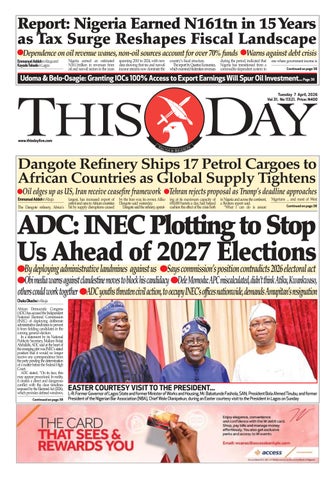
TUESDAY 7TH APRIL 2026

Page 1


Report: Nigeria Earned N161tn in 15 Years as Tax Surge Reshapes Fiscal Landscape

Dependence on oil revenue wanes, non-oil sources account for over 70% funds Warns against debt crisis

www.thisdaylive.com

Dangote Refinery Ships 17 Petrol Cargoes to African Countries as Global Supply Tightens

Oil edges up as US, Iran receive ceasefire framework Tehran rejects proposal as Trump’s deadline approaches

The Dangote refinery, Africa’s largest, has increased export of petrol and urea to African countries hit by supply disruptions caused

by the Iran war, its owner, Aliko Dangote said yesterday.

Dangote said the refinery, operat-

ing at its maximum capacity of 650,000 barrels a day, had helped cushion the effect of the crisis both

in Nigeria and across the continent, a Reuters report said. “What I can do is assure

Nigerians ... and most of West

ADC: INEC Plotting to Stop Us Ahead of 2027 Elections

By deploying administrative landmines against us Says commission’s position contradicts 2026 electoral act

Obi media warns against clandestine moves to block his candidacy Dele Momodu: APC miscalculated, didn’t think Atiku, Kwankwaso, others could work together ADC youths threaten civil action, to occupy INEC’s offices nationwide, demands Amupitan’s resignation

Chuks Okocha in Abuja

African Democratic Congress (ADC) has accused the Independent National Electoral Commission (INEC) of deploying deliberate administrative landmines to prevent it from fielding candidates in the coming general election.

In a statement by its National Publicity Secretary, Mallam Bolaji Abdullahi, ADC said at the heart of the emerging plot was INEC’s stated position that it would no longer receive any correspondence from the party pending the determination of a matter before the Federal High Court.

ADC stated, “On its face, this may appear procedural. In reality, it creates a direct and dangerous conflict with the clear timelines imposed by the Electoral Act (2026), which provides defined windows,

Continued on page 38

EASTER COURTESY VISIT TO THE PRESIDENT...

L-R: Former Governor of Lagos State and former Minister of Works and Housing, Mr. Babatunde Fashola, SAN; President Bola Ahmed Tinubu; and former President of the Nigerian Bar Association (NBA), Chief Wole Olanipekun, during an Easter courtesy visit to the President in Lagos on Sunday

Emmanuel Addeh in Abuja and Kayode Tokede in Lagos
Emmanuel Addeh in Abuja

WHEN ARE YOU COMING TO OPEN A REFINERY IN OSUN … ADELEKE SEEMS TO BE ASKING DANGOTE...

Ogun State at the weekend

Paramount in Talks for Gulf Backing in $110bn Warner Bros Discovery Takeover

Emmanuel Addeh in Abuja

Paramount Skydance is in talks to secure signed equity commitments of almost $24 billion from three sovereign wealth funds led by

Saudi Arabia to help back its takeover of Warner Bros Discovery (WBD), the Wall Street Journal has reported. The U.S. entertainment giant in February said it has agreed

Firm Launches Integrated Mega Dealership Ecosystem to Unlock Billion-Naira Solar Projects

Raheem Akingbolu

DYQUE Energy has launched Nigeria’s first integrated Mega Dealership Program, a structured renewable-energy partnership ecosystem designed to channel billion-naira solar and hybrid power projects through its dealer and engineering network nationwide.

The announcement was made at the DYQUE Energy Business Summit 2026 held recently in Lagos, where the company convened current Mega Dealers, prospective Mega Dealers, EPC partners (designated Supa Dealers) and financing institutions to unveil the new large-scale project delivery framework.

The initiative positions Dyque Energy not just as a power-solutions provider, but as a renewable-energy ecosystem builder connecting technology, financing and execution partners across Nigeria’s solar value chain.

Under the Mega Dealership Program, Dyque Energy is introducing a coordinated pipeline that enables large-scale solar deployments across B2B, B2C and B2G segments through a clearly defined partnership structure.

The company has stated that aside the national distributors supply products at scale, there will also be mega dealers handle bulk product movement nationwide.

It was further stated the integrated model is designed to remove longstanding structural bottlenecks that previously slowed adoption of largescale renewable-energy infrastructure in Nigeria.

Speaking at the summit, General Manager of Dyque Energy, Fang Yu, described the programme as a major shift in how solar projects are originated and delivered in the country.

He said, “This Mega Dealership Program creates a coordinated ecosystem where dealers, EPC partners and financiers work together to deliver large-scale energy solutions more efficiently. It is designed to unlock access to structured project pipelines and expand opportunity across our partner network.”

Meanwhile, the energy company had earlier pointed out that the ceentral objective of the programme is to strengthen the commercial capacity of Mega Dealers by increasing access to high-volume product movement through National Distributors without requiring them to manage project execution complexity.

According to the company, through the new structure, there will be Mega Dealers benefit from increased product turnover; revenue opportunities expand through participation in large-scale deployments; and Operational risks tied to project engineering remain with EPCThisspecialists. ensures dealers can scale business volume while maintaining their core strengths in distribution and market expansion.

For engineering partners identified as Supa Dealers, the programme creates a steady flow of structured, pre-financed turnkey projects aligned with their technical capabilities.

According to the National Sales Director of the company Samson Akejelu, “What this model does is remove the uncertainty around project sourcing for EPC partners. Instead of spending resources chasing opportunities, they now have access to a coordinated pipeline backed by financing and supported by our distribution network.”

buy its peer in a $110 billion deal - with an equity value of $81 billion - that they expect to close in the third quarter.

The merger would combine major studios and networks such as CNN and CBS, enabling them to compete more aggressively as streaming draws audiences away

from traditional linear TV.

To help back the takeover, Saudi Arabia’s Public Investment Fund (PIF) has agreed to provide roughly $10 billion, the WSJ reported citing people familiar with the matter.

The other backers are likely to include Qatar Investment

Authority and Abu Dhabi’s L’imad Holding, the WSJ reported. PIF, Qatar Investment Authority and L’imad Holding did not respond to Reuters’ emailed requests for comment outside of regular business hours. Paramount declined to comment.

The Gulf backers will not

have voting rights in the new Paramount-Warner entity, the WSJ reported. Paramount executives do not expect the funds’ involvement to trigger a review by the Committee on Foreign Investment in the U.S. or Federal Communications Commission, the Journal said.

Despite High Cost of Aviation Fuel, Airfares Stable During Easter Holiday

Domestic airlines did not increase fares during the Easter holiday despite the high cost of aviation fuel, which rose from N995 per litre in January to between N2, 700 to N3000 per liter as at yesterday, THISDAY investigation has revealed.

The Managing Director and CEO of Aero Contractors, Captain Ado Sanusi, told THISDAY that the airline made some calculations on how to increase fares due to the increase in the prices of aviation fuel and the management realized that the fares would be too high for passengers.

The airline also considered the fact that it had already sold out 60 to 70 per cent of its tickets to travelers who purchased the tickets in advance due to the Easter celebration.

“So, we decided not to increase the fares but to make sure we sold out all our seats at the subsisting prices to reduce our losses, but ultimately, we will increase fares.

“But we would not do it drastically but strategically in order not to drive away passengers. It is not only aviation fuel price that has increased; the price of diesel has also increased and some of our equipment use diesel. So, we will raise fares that will cushion the losses and offset the cost of operation,” he said.

Spokesman of United Nigeria Airlines, Chibuike Eloka, told THISDAY in a telephone interview that airlines have resisted the pressure to increase the cost of flight ticket to reflect the high cost of aviation fuel, which increased by over 100 per cent due to the US-Israel- Iran war.

Eloka said airlines have decided to subsidize the cost of operation, hoping that the price of aviation fuel, known as Jet A1, will revert to the January figures if the war comes to an end soon.

According to him, due to less demand of seats this season, United Nigeria Airlines did not exhaust its low inventory tickets, which ranged from N95, 000 to N150, 000.

He noted that if the airlines were to reflect the cost of aviation fuel on the ticket, travelers could be buying lowest ticket for one hour flight at N300, 000.

“We did not increase fares in Easter; unlike in December. We are using our money to subsidize our operation. After the war started in Iran in the last day of February, cost of ticket rose from N1,200 to N1, 700 and now it is between N2, 700 to N3000,” he said.

Eloka alleged that some marketers are hoarding the product because they envisage that the price may go up again after the holiday, adding that the hoarding has further increased the cost of the product.

Air Peace Head of Communication, Efeoghene Osifo-Whiskey, confirmed the allegation that some marketers could be hoarding aviation fuel hence the high prices of the product.

He said that the price of aviation fuel is usually lowest in Lagos and highest in northern parts of the country, disclosing that marketers sell at different prices, adding that a litre could be sold for N2, 700 in Lagos and N2, 900 in Kano.

Osifo-Whiskey expressed doubt that airline operators could continue to sell flight tickets at the current prices if aviation fuel price continues to be at the current benchmark.

“We did not increase fares but there was discussion to that effect and I strongly feel that the airlines may increase fares if aviation fuel continue to sell between N2, 700 to N3, 000 per litre.

“Airlines have called on the federal government and urged it to review downwards the taxes airlines are paying currently to help them survive this austere period,” he said.

THISDAY also spoke to the Chairman of Ndano Energy, aviation oil marketing company, Chris Ndulue, who said there is no indication that the cost of aviation fuel will go down soon; unless the Iranian war comes to an end.

He said that marketers are still

sourcing for products “from here and there” noting that Dangote Refinery is the major supplier of Jet A1 because the marketers may have exhausted the product that was imported.

Ndulue said the price of the product at the Dangote Refinery is quoted but it could change at delivery; so, the company usually request to retain 10 per cent of the cost of the purchase but that has increased to 25%.

“That is, if you wish to buy product for N100, 000, N90, 000 will be sold to you. You might get the 10% later or 5% per cent or nothing, depending on the price the product is finally sold. But that has increased to 25%. This means that if you want to buy N100, 000 worth, N75, 000 will be sold to you. You may get the 25% back or less than that,“ he explained.

He said that prices of the product are volatile and uncertain because of the war going on in Iran.

“The price two weeks ago at Dangote was N2, 600 per litre; that may still be the price they will sell this week. Some marketers sold imported aviation fuel, which I think they have exhausted and some sold Dangote’s old stock,” he said.

Ndulue added that government approved importation of the product to ensure stable and competitive pricing.

Chinedu Eze
L-R: President, Dangote Group of Companies, Alhaji Aliko Dangote and Osun State Governor, Senator Ademola Adeleke at the official inauguration of the Gateway Airport, Ilishan in Iperu,

In First Official Home State Visit, Tinubu to Commission Six Sanwo-Olu’s Legacy Projects in Lagos

Ojota-Opebi link bridge, 19 football pitches, Tolu Schools in Ajegunle among projects for unveiling during Tinubu’s two-day visit 500 LASTMA personnel to manage traffic, movement

Segun James

Key legacy projects of the Governor Babajide Sanwo-Olu administration will be inaugurated by President Bola Tinubu in his first official visit to Lagos State.

The iconic projects to be commissioned by Tinubu during the two-day visit to his home state included the newly constructed Ojota-Opebi Link Bridge, Lagos State Geographic Information Service (LAGIS) building, and Lagos Multi-Agency Building in Alausa.

Other notable projects were Lagos Fresh Food Hub in Abijo, Ajah, Tolu

Schools Complex in Ajegunle, and Maracana Stadium, comprising 19 mini-football pitches, built side-by-side in Ajegunle.

The details of the presidential visit were revealed during a press briefing held by the state government on Monday in Alausa, where Commissioner for Information and Strategy, Mr. Gbenga Omotoso, said Tinubu was expected to inaugurate the listed projects on Wednesday and Thursday.

The projects, Omotoso said, reflected the Sanwo-Olu administration’s commitment to Lagos development and improved living standards of

the residents. He stressed that the infrastructure was carefully conceived and executed to address the growing needs of the population, ease mobility, stimulate economic activities, and enhance social welfare.

The commissioner said the projects testified to the administration’s unwavering commitment to building a Greater Lagos that was inclusive, sustainable, and globally competitive.

He added that the development highlighted the importance of continuity in governance and the value of visionary leadership in driving development.

He stated, “The presence of Mr.

President in Lagos at this auspicious occasion further reinforces the strong partnership between the federal government and Lagos State.”

He added, “We are confident that these projects will not only serve the immediate needs of our people but also stand as enduring legacies for generations to come. All the iconic projects represent progress in action and hope for a better future.

“As we prepare for this historic visit, we assure residents of Lagos that all arrangements have been put in place to ensure a smooth, secure, and successful event.

“We urge the public to cooperate

Adelabu Links Rising ‘Attacks’ to Oyo Governorship Ambition

Minister of Power, Adebayo Adelabu, has raised concerns over what he described as a sustained campaign of misinformation targeted at discrediting him, warning that the spread of falsehoods poses a threat not only to his reputation but also to public trust.

Adelabu specifically debunked a viral statement attributed to him in which he was quoted as saying he had “accumulated enough money to never be broke again,” insisting that he never made such a remark in any setting, whether public or private. He described the claim as entirely fabricated and intended to mislead the public.

In a statement issued yesterday by his Special Adviser on Strategic Communications and Media Relations, Bolaji Tunji, the minister denied any connection to the controversial comment, urging Nigerians to disregard it in its entirety. The minister stressed that the statement did not emanate from him and was part of a deliberate attempt to tarnish his image.

According to Tunji, the develop-

ment reflects a coordinated pattern of disinformation directed at the minister. He noted that the circulation of the alleged quote followed closely on the heels of another false narrative involving a purported resignation letter, which had earlier been widely shared but was subsequently exposed as fake.

The statement argued that the recurrence of such incidents points to an orchestrated campaign aimed at undermining Adelabu’s credibility and public standing. It described the trend as a “calculated campaign of calumny,” designed to malign both the individual and the office he occupies through the dissemination of fake news and deliberate falsehoods.

The minister’s camp further linked the wave of misinformation to his growing political profile, particularly speculation surrounding his interest in contesting the governorship seat in Oyo State. According to the statement, Adelabu’s perceived ambition under the platform of the All Progressives Congress (APC) has unsettled certain political interests, thereby triggering attempts to

weaken his public image.

Although the minister has not formally declared his candidacy, his name has continued to feature prominently in political discussions within Oyo State, fuelling speculation about a potential run.

The statement maintained that the timing and consistency of the false reports were not coincidental, but rather indicative of a deliberate strategy to sow doubt and confusion among the public.

“The false claim is coming on the heels of a recently circulated ‘resignation letter’ by the minister, which has also been exposed as fake…Both incidents point to a

calculated campaign of calumny designed to discredit the minister.

“This is not an isolated attack. It is part of a sustained effort to malign the person and office of the Honourable Minister through the spread of fake news and deliberate falsehoods,” the statement explained, linking what it described as the wave of disinformation to Adelabu’s reported interest in contesting the governorship seat in Oyo State on the platform of the APC.

Adelabu argued that the intensified attacks were driven by political interests threatened by his growing influence.

with the authorities, especially in areas where there may be temporary traffic adjustments or security protocols.”

Speaking on the impact of the projects, Omotoso said the Opebi-Ojota Link Bridge was initiated to address traffic challenges within the Ojota, Maryland, Mende, Opebi, and Allen axes. He said the corridor served as a major route for commuters moving between the mainland and key commercial districts.

The newly constructed Opebi-Ojota Link Bridge, the commissioner said, had created a direct and efficient linkage between Central Business District of Ikeja and residential areas in Ojota, which hitherto had limited and indirect road connections.

He stated, “The Opebi-Ojota Link Bridge project was originally conceived over 20 years ago, during the administration of former Lagos Governor Bola Tinubu.

“It was revived and officially flagged off in January 2022 by Governor Sanwo-Olu, making the infrastructure both a legacy project and a continuation of long-term urban planning in Lagos.”

The regenerated Tolu Schools, established in 1981, is a cluster of schools comprising 16 Senior Secondary Schools, 15 Junior Secondary Schools and five Primary Schools, where some 20,000 pupils in the densely populated Ajegunle, Ajeromi-Ifelodun Local Government Area, learn.

Before Sanwo-Olu’s intervention, which led to the upgrade of the schools, Omotoso said buildings in the schools were in different stages of dilapidation.

The commissioner said the governor directed full regeneration of the school complex with the addition of 13 new classrooms to the existing buildings and a vocational training centre.

He said, “The Tolu Schools complex is now an all-inclusive school where no child will be left behind, with the two newly constructed buildings for People Living with Disability (PLD), which consist of vertical lift facilities to aid movement from the ground floor to the last floor.

“The regenerated schools will bring learning closer to pupils. Proximity in education is not a minor consideration; it is fundamental. When schools are accessible, attendance improves. When attendance improves, learning outcomes improve. And when learning outcomes improve, opportunities expand.”

Lagos State Infrastructure Asset Management Agency (LASIAMA) will take charge of the maintenance of the school building to avert deterioration, it was learnt.

Omotoso said the newly completed Multi Agency Building would bring different government agencies into a single, integrated environment, reducing physical and administrative distance between decision points. Commissioner for Agriculture and Food Systems, Ms. Abisola Olusanya, said the Lagos Fresh Food Hub in Abijo would create a sustainable food distribution network in Ajah, ramping up the supply of fresh produce to residents of communities within Eti Osa corridor, while decentralising food access beyond traditional markets.

FG Moves to Acquire New Emergency Care Helicopter

Onyebuchi Ezigbo in Abuja

The Coordinating Minister of Health and Social Welfare Prof. Muhammad Ali Pate has said that President Bola Ahmed Tinubu, approved the procurement of emergency care helicopter for handling healthcare emergencies

Pate said in statement that the Ministry has commenced

negotiations with Europe’s leading Aerospace Corporation, Airbus, on the development of Nigeria’s new Integrated National Ground-To-Air Health Emergency Management System.

The statement said Pate met with Airbus executives, and used the opportunity to inspect an Airbus Emergency Care Helicopter at a French Government-supported

Air Ambulance facility in Lyon, France,

According to the minister, the initiative is part of the Federal Government’s broader health sector renewal investment drive targeted at improving emergency medical services nationwide.

He said, “In line with the health sector renewal investment initiative, we are expanding Nigeria’s

public health infrastructure, as well as private sector capacity for medical care, including emergencies.

“The National Emergency Medical Services and Ambulance Scheme is being revamped with urban ambulances for cities and rural emergency systems. Now, we are looking at helicopter emergency medical services.”

EASTER RIVIERA...
Fun seekers at Ndubuisi Kanu Park during the 2026 Easter Monday celebration in Lagos, yesterday
Emmanuel Addeh in Abuja

NIGERIA NAVY SECONDARY SCHOOL OJO OLD STUDENTS ASSOCIATION...

L-R: Rear Admiral Paul Nimmyel; Sir Tolulope Omoniyi; Private Secretary to President BAT, Hakeem Muri Okunola (HMO); Air Vice Marshal Saeed Madaki; and Tunde Gbajumo, at the Nigeria Navy Secondary School (NNSS) Ojo reunion of the Old Students of 1988 to 1994 Set held at Lagos Sheraton Hotel Ikeja…recently

Rewane: Rising Crude Oil Prices Will Increase Oil Theft Revenue to $16m Per Day

Cause oil militants to jettison security contracts, escalate pipeline vandalism

Chief Executive Officer of Financial Derivatives Company Limited (FDC), Mr. Bismarck Rewane, has projected that rising crude oil prices in the international market, from $64 per barrel (pb) to $110, would increase illegal revenue from illicit sale of crude oil by 136.80 per cent, from an estimated $3 million per day (pd) in January to $16 million pd April 2026. Rewane stated this in his April 2026 presentation at the Lagos Business School Breakfast Session, captioned, “Inflation Surge, Externally Induced, Internally Magnified: Six-Dimensional Impact Analysis.”

Rewane said the surge in revenue from oil theft and bunkering would provide incentives for pipeline vandalism and cause oil militants in the Niger Delta not to be interested in security contracts for protecting oil infrastructures at $50 million per month.

He stated, “Higher oil price can worsen leakage and insecurity”.

Rewane added that “not all oil gains translate to national benefit”.

He estimated that 100,000bpd were diverted illicitly in January when oil price was $64pb and sold at discounted price of $30pb for $3 million revenue per day, which made providing security for government at $50 million per month a viable alternative.

But in April, with crude oil price as high as $110pb, Rewane projected

that 200,000bpd would be stolen and sold at discounted price of $80pb for $16 million daily revenue, which would make the militants “no longer interested in security contracts”.

Speaking on “Oil Militants (Creek Economics),” Rewane said there will be “incentive for vandalism, oil theft and bunkering in the illicit market will increase” due to “increase profitability of illegal diversions.”

He also foresaw “increased pipeline vandalism, higher security costs to government and escalation in production losses.”

Using a particular brewery (name withheld) as a case study, Rewane said the profitability of Nigerian manufacturing sector would be compressed by 60 per cent.

According to him, this brewery recorded a revenue of N299.49 billion and recorded N25.41 billion profit in 2025, when it’s costs for raw materials, logistics, power and others were N149.02 billion, N3.76 billion, N11.82 billion and N109.42, respectively.

But following increase in price of diesel by between 80 and 100 per cent, costlier imports due to foreign exchange pressure and falling demand, Rewane projected that the new reality for thie brewery would be a revenue of N310 billion and a fall in profit to N10.80 billion.

He attributed the new reality to the rise in costs of raw materials, logistics, power and others to N165.70 billion, N5.4 billion, N17.3 billion and

N110.8 billion, respectively.

He said rising input and energy costs will significantly compress profit margins, increase working capital pressure, and build inventory levels as sales slow.

Rewane stated, “Cost push inflation will erode industrial margins quickly.

“Even though Nigeria is among the beneficiaries of the oil price revenue, external shocks will continue to impact the economy as the country is increasingly integrated with global market.”

Rewane said the effect of military conflict in Iran that had disrupted global commerce through blockage of the Strait of Hormuz will trim Nigeria’s projected GDP growth of 3.8 per cent in the Q1’2026 to 3.2 per cent, squeeze private sector’s margins, trigger worker layoffs despite government revenue gains.

According to him, “Net employ-

ment will decline, consumption declines due to falling real incomes, investment remains flat showing limited sector response, exports increase while marginal propensity to import decreases.”

He further projected that the energy-induced shock would squeeze the middle class to financially fragility and push traders and SMEs to loss of profit.

According to him, the energyinduced shock of the ongoing United States of America/Israel war against Iran would be more impactful than all the previous Gulf wars combined.

Rewane said a salaried employee in Lagos with a wife and a child, who saved N150,000 monthly from his N1.2 million income in January would be in deficit of N110,000 by April.

He said, “A mid-level professional in Lagos, commutes daily, supports family, within 45 days, savings decline

significantly as expenses outpaces income and discretionary spending reduces sharply.

“In 90 days, he would cut savings to zero, start borrowing/using credit, and cut food quality, visits to family and friends and discretionary spending

“Therefore, middle class gets financially squeezed into fragility as consumption drops, feeding directly into economic slowdown.”

According to him, a hypothetical trader, who is importing or buying goods wholesale and selling in local market would experience 50 per cent decline in profit between January and April 2026.

He attributed that to slowing inventory turnover, tightening cash flow, and significantly shrinking profit margins as costs rise faster than prices.

“Therefore, SMEs get hit from both sides of rising costs and fall-

ing demand. Leading to a rise in unemployment,” he said. Using Kaduna State Government as a case study, Rewane projected that the state’s monthly FAAC would grow from N28 billion in January to N40 billion in April and reduce its deficit spending from N28 billion to N16 billion.

Rewane said Kaduna State’s “higher FAAC inflows reduce fiscal deficit and improve cash position” to enable the state to meet salary and debt obligations more comfortably, projecting that the state may spend productively by investing in infrastructure, pay contractors or increase recurrent and political spending and reintroduction of subsidies for the short term. He also foresaw resurgence of inflation with headline inflation equalling 15.85 per cent, food Inflation 14.94 per cent, and core Inflation 14.35 per cent.

FG Directs MDAs to Halt New Policies Pending Full RIA Compliance

The federal government has directed all Ministries, Departments and Agencies (MDAs) to suspend the introduction and rollout of new policies, regulations, or major regulatory

changes until full compliance with the Regulatory Impact Analysis (RIA) Framework is achieved.

The directive, issued by the Director General of the Presidential Enabling Business Environment Council (PEBEC), Princess Zahrah

Oyebanji Moves to Unlock Ekiti Tourism Potential, Assures Communities of Custodial Rights

Gbenga Sodeinde in Ado Ekiti

Governor Biodun Oyebanji of Ekiti State has reaffirmed his administration’s commitment to developing the state’s tourism sector, assuring host communities that their custodial rights over tourism assets will remain protected.

The assurance came on Monday during the official opening of the Ugele Rock and Cave in Ugele, Ikere-Ekiti, to the public and prospective investors. Represented by his deputy, Mrs.

Monisade Afuye, the governor said the move became necessary to allay concerns among host communities over possible loss of ownership, stressing that government intervention would be driven by partnership, not displacement.

According to him, the state government’s priority is to collaborate with local stakeholders to transform tourism sites into viable economic hubs capable of generating revenue and creating jobs.

He specifically urged the Olotin family, the traditional custodians

of the Ugele Rock and Cave, to ensure proper maintenance of the site, noting that its tourism potential rivals other globally celebrated attractions.

“Once development begins here, Ikere will begin to reap the economic value of tourism. Within the next two years, this site will not only create employment for our youths but also boost commerce and accelerate community development,” he said.

Oyebanji also called on residents, particularly youths, to be hospitable and supportive of visitors to en-

hance the site’s appeal as a tourist destination.

Earlier, the Director-General of the Ekiti State Bureau of Tourism Development, Amb. Wale Ojo-Lanre, disclosed that the state’s tourism policy and development master plan had been completed and was ready for implementation.

He noted the administration was prepared to invest significantly in the sector, emphasizing the groundwork laid through the policy framework would drive sustainable tourism development.

Mustapha Audu, is part of efforts to strengthen regulatory quality, ensure policy coherence, and improve the ease of doing business in Nigeria.

According to the statement, the RIA Framework, which was formally implemented in January 2025, requires that all new policies or amendments introduced after the date must undergo review and approval in line with its provisions.

She noted the framework has already been circulated to MDAs by the Office of the Secretary to the Government of the Federation and is also accessible on the PEBEC website.

MDAs are therefore expected to familiarize themselves with the framework and align their policy development processes accordingly.

Audu emphasized that while the government remains committed to working collaboratively with regulatory institutions, no new reform or policy would be allowed to proceed without being backed by clear and verifiable evidence.

She explained the directive aims to prevent policy shocks that could

negatively affect businesses, investors and citizens, eliminate inconsistencies and frequent policy reversals, and institutionalize evidence-based policymaking across government.

The directive also seeks to enhance transparency, improve predictability, and boost stakeholder confidence in public policies, while ensuring adequate engagement to minimize resistance prior to implementation. Consequently, all MDAs have been instructed to suspend any planned policy rollouts that have not yet been implemented, ensure that new policy proposals are supported by comprehensive RIA and necessary approvals, and integrate the RIA process into their internal policy formulation procedures. They are also required to undertake structured and inclusive stakeholder engagement as part of policy development to improve acceptance and implementation outcomes. The PEBEC boss added that MDAs can access the RIA Framework through its website or seek technical support from the council’s secretariat.

Michael Olugbode in Abuja

This advertisement appears as a matter of record only

Issuing House

RC986761

Planet Capital Limited

On behalf of

ETERNA PLC

RC 124136

Announces the result of the Rights Issue of 978,108,485 Ordinary Shares at ₦22.00 per share on the basis of 3 new Ordinary Shares for every 4 Ordinary Shares held as at the close of business on Thursday, 27 November 2025

1. With respect to the Rights Circular dated 02 December 2025, a total of 1,402 applications for 882,064,158 ordinary shares were received and found to be valid based on the terms of the Issue.

2. A total of 882,064,158 ordinary shares were allotted out of the 978,108,485 ordinary shares offered. The Issue was therefore 90.18% allotted.

3. A total of 12 application for 896,006 ordinary shares were received in respect of rights tradeable on Nigerian Exchange Limited (“NGX”).

4. A total of 1,342 shareholders fully accepted their rights totaling 725,381,529 ordinary shares.

5. A total of 48 shareholders with provisional allotment of 2,064,900 ordinary shares partially accepted their rights totaling 934,722 ordinary shares, thereby renouncing 1,130,178 ordinary shares.

6. Of the 1,342 shareholders that accepted their rights in full, 757 shareholders applied for additional 154,851,901

shares, of which 154,851,901 were allotted in line with the Securities and Exchange Commission (“SEC”) Rules. A breakdown of the 882,064,158 ordinary shares allotted is provided below:

The above stated basis of allotment, as well as this announcement has been cleared by the SEC. Shares allotted will be credited immediately to the CSCS accounts of allottees by the Registrars to the Issue, Greenwich Registrars & Data Solutions at 274, Murtala Muhammed Way, Alagomeji-Yaba, Lagos, Nigeria. In accordance with the SEC Directive on Dematerialization of Share Certificates, allottees without CSCS accounts will have their shares credited immediately at the CSCS using a Registrar Identification Number. All surplus monies will be returned after clearance of the allotment by the SEC and not later than Thursday, 9 April 2026, being five (5) business days after clearance of the basis of allotment by the SEC

Notice of Annual General Meeting

Notice is hereby given that the Annual General Meeting (“AGM”) of MTN Nigeria Communications PLC (“the Company”) will be held virtually on Thursday, 30 April 2026, at 11.00 a.m. to transact the following business:

A. ORDINARY BUSINESS

1. To lay before the members of the Company the Audited Financial Statements of the Company for the financial year ended 31 December 2025 and the Reports of the Directors, Auditors, Board Evaluation Consultant and the Audit Committee thereon.

2. To declare a dividend

3. To re-elect the following Directors retiring by rotation:

3.1 Dr. Ernest Ndukwe (77)

3.2 Mrs. Ifueko M. Omoigui Okauru

3.3 Mr. Jens Schulte-Bockum

3.4 Ms. Tsholofelo Molefe

3.5 Mr. Mohammad K. Ahmad OON (72)

4. To authorise the Directors to fix the remuneration of the Auditors of the Company.

5. To disclose the remuneration of Managers of the Company.

6. To elect members of the Statutory Audit Committee.

B. SPECIAL BUSINESS

To consider and, if thought fit, to pass the following as an ordinary resolution of the Company:

7. “That the remuneration for Non-Executive Directors for the financial year ending 31 December 2026, be and is hereby fixed at ₦167,977,679 (One hundred and sixty seven million nine hundred and seventy seven thousand six hundred and seventy nine Naira) for the Chairman, and ₦108,368,288 (One hundred and eight million three hundred and sixty eight thousand two hundred and eighty eight Naira) for each of the other Non-Executive Directors respectively. Such remuneration to be payable quarterly in arrears or at such intervals as approved by the Board and is subject to the application of an annual inflation adjustment for succeeding years.

8. “That a general mandate be given to the Company to enter into recurrent transactions with related parties for the Company’s day-to-day operations, (including without limitation, the procurement of goods and services on normal commercial terms and the indemnification of directors whether directly by the Company or by obtaining appropriate insurance in accordance with the Company’s Articles); in compliance with the Nigerian Exchange Limited (“NGX”) Rules Governing Transactions with Related Parties or Interested Persons and other applicable Nigerian statutory and/or regulatory requirements. The Directors be and are hereby authorised to take all steps and do all acts necessary to give effect to this resolution.”

9. To consider and, if thought fit, to pass, the following sub-joined resolutions as an ordinary resolution:

i. That the Proposed Structural Separation Transaction is hereby approved and the Company be and is hereby authorised to enter into and implement the Proposed Transaction.

ii. That the Board be and is hereby authorised to take all such steps and undertake all such acts and deeds (including without limitation executing such agreements and documents, amending or varying the terms thereof, appointing professional advisers and other parties, and complying with requirements or directives of any regulatory authority) which may be incidental, ancillary, supplemental, consequential or otherwise necessary to give full effect to the Proposed Transaction.

NOTES

Attendance and Voting at the AGM

A member entitled to attend and vote at the AGM can appoint a proxy to attend and vote in his/her/its stead.

For the appointment of a proxy to be valid, executed proxy forms must be deposited at the office of the Registrar, Coronation Registrars Limited, 9, Amodu Ojikutu Street, Off Saka Tinubu Street, Victoria Island, Lagos, or via email to eforms@coronationregistrars.com; not less than 48 hours before the time fixed for the meeting. A blank proxy form is enclosed.

Voting during the meeting proceedings would be done via the Coronation Virtual platform. A personalised voting code would be sent by the Registrar to eligible shareholders 24 hours before the meeting, specifically on 29 April 2026.

Voting by Interested Persons

In line with the provisions of Rule 20.8 (c) (8) of the Rules Governing Related Party Transactions of Nigerian Exchange Limited, interested persons have undertaken to abstain, and ensure that their proxies, representatives, or associates shall abstain from voting on resolutions 8 and 9 above.

Stamping of Proxy Forms

The Company has made arrangements, at its cost, for stamping the duly completed and signed proxy forms submitted to the Company’s Registrar within the stipulated time.

Statutory

Audit Committee

In accordance with section 404(6) of the Companies and Allied Matters Act No. 3 of 2020 (as amended) (“CAMA”), any shareholder may nominate a shareholder for appointment to the Statutory Audit Committee. Such nomination should be in writing and reach the Company Secretary at least twenty-one (21) days before the AGM.

Kindly note that by virtue of the provisions of Section 404 (5) CAMA, all members of the Statutory Audit Committee (“SAC”) should be financially literate, and at least one member must be a member of a professional accounting body in Nigeria established by an Act of the National Assembly. In view of the foregoing, nominations to the SAC should be supported by the curriculum vitae of the nominees.

Profile of Directors

The profile of Directors presented for re-election is included in the Annual Report and can also be accessed on the Company’s website www.mtn.ng.

Virtual Meeting Link

The link for the meeting is https://www.mtn.ng/investors/shareholders/annual-general-meeting/and will be available on the Company’s website at www.mtn.ng.

Dividend

If the dividend recommended by the Directors is approved by the shareholders at the AGM dividend will be paid on Tuesday, 5 May 2026, to shareholders whose names appear in the Company’s Register of Members at the close of business on Wednesday, 8 April 2026.

Closure of Register

The Register of Members of the Company will be closed from Thursday, 9 April 2026, for the purpose of dividend payment and updating the register.

Right of Shareholders to Ask Questions

Shareholders have a right to ask questions at the AGM and also in writing before the meeting. Questions should be submitted to the Company Secretary at the Company’s Head Office or via email (investorrelations.ng@mtn.com) no later than 21 April 2026.

Electronic Annual Report

The electronic version of the Annual Report is available online for viewing and download from our website at www.mtn.ng. Shareholders who have provided their email addresses to the Registrar will receive the electronic version of the Annual Report via email. Furthermore, shareholders interested in receiving the electronic version of the Annual Report should request it via email at eforms@coronationregistrars.com or by calling +234 0201 2272 570.

Unclaimed Dividends

All Shareholders are encouraged to complete an e-dividend Mandate Form to ensure that all outstanding dividends are paid electronically. A list of unclaimed dividends will be circulated with the Annual Report and will also be available on our website. Please click this link https://crlselfservice.coronation.ng/ to complete the E-mandate Form. You can also update your information using the same link.

Dated this 2nd day of April 2026 BY ORDER OF THE BOARD

Uto Ukpanah FCIS Company Secretary (FRC/2014/NBA/00000005748)

MTN Plaza Falomo, Ikoyi, Lagos.

EXPLANATORY NOTES TO THE RESOLUTIONS TO BE PROPOSED AT THE ANNUAL GENERAL MEETING (AGM)

Dear Shareholders,

We welcome you to the Annual General Meeting (AGM) of your Company, which will be held virtually on Thursday, 30 April 2026, at 11:00 a.m.

Explanatory Notes are provided below for the resolutions set out in the Notice of Annual General Meeting. At the meeting, you will be requested to vote in favour of the proposed resolutions. Please note that if you abstain from voting, you will not be counted in the calculation of the proportion of votes for or against a resolution.

A. ORDINARY BUSINESS

Resolution 1: Annual Report and Accounts

Pursuant to the requirements of Section 377 (1) of the Companies and Allied Matters Act, 2020, Directors of the Company are mandated to prepare Financial Statements for each year. In line with this provision, the 2025 Audited Financial Statements have been prepared and included in the 2025 Annual Report and Accounts. The Report also contains the Auditor’s Report, the Audit Committee’s Report, the Directors’ Report and the report of the External Consultants on the 2025 Board Evaluation.

The Directors are required under Section 388 (1) of the CAMA 2020 to lay before the Company in General Meeting for each financial year copies of the financial statements of the Company made up to a date not exceeding nine months prior to the date of the meeting. This provides shareholders with the opportunity to ask questions about the content of the Annual Report and Financial Statements.

We urge you to vote in support of the motion to receive these reports and the audited financial statements.

Resolution 2: Declaration of Final Dividend

By Section 426 (1) of CAMA, the Company in General Meeting is empowered to declare dividends in respect of any year or other period only on the recommendation of the directors. Furthermore, Section 426(3) provides that the General Meeting shall have the power to decrease the amount of dividend recommended by the Directors, but shall have no power to increase the recommended amount.

If the final dividend of N15 per 2 kobo ordinary share, recommended by the Directors, is approved, this will bring the total dividend for the year ended 31 December 2025 to N20. The said final dividend, net of withholding tax, will be payable on 5 May 2026 to shareholders on the Company’s register of Members as at 9 April 2026.

Kindly vote in support of the motion to approve the payment of the proposed Dividend.

Resolutions 3(1) -3(5): Re-Election of Directors

Section 285 of CAMA 2020 provides that unless there is a contrary provision in the Articles of Association of a Company, all the directors of the Company shall at the first Annual General Meeting (AGM) retire from office and at subsequent AGMs, one-third of the directors, or if their number is not three or a multiple of three, the number nearest to one-third shall retire. In line with this provision of CAMA 2020, the directors to retire every year are those who have been longest in office since their last election.

In accordance with statutory requirements, five directors will be retiring at this meeting. They are Dr. Ernest Ndukwe (77); Mrs. Ifueko M. Omoigui Okauru; Mr. Jens Schulte-Bockum; Ms. Tsholofelo Molefe and Mr. Mohammed K. Ahmad (72). Being eligible, they have offered themselves for re-election. Their profiles are contained in the Annual Report and are also available on the Company’s website www.mtn.ng.

In view of the foregoing, we urge you to vote in support of the motion to re-elect directors retiring by rotation to the Board.

Resolution 4: Approval of Auditors’ Remuneration

Section 408(1) (b) of CAMA 2020 provides that the remuneration of Auditors may be fixed by the Company in General Meeting or in such manner as the Company in General Meeting may determine. In line with the referenced provision of CAMA 2020, it is usual practice to ask the General Meeting to authorise the Board to negotiate and fix the remuneration of the External Auditor.

The Board will be guided in this regard by the Audit Committee in line with the provisions of Section 404(7)(e) of CAMA 2020, which provides that the Audit Committee shall make recommendations to the Board regarding the appointment, removal and remuneration of the company’s External Auditors.

Messrs. Ernst and Young (EY) are the External Auditors of the Company.

We request that you vote in support of the motion to authorize the Directors to fix the remuneration of EY in respect of the period ending at the end of the next Annual General Meeting.

Resolution 5: Disclosure of the Remuneration of the Managers of the Company

Section 257 of CAMA 2020 sets out the requirement to disclose the compensation of a company’s managers to members of the Company as part of the ordinary business to be transacted at an AGM.

For the year ended 31st December 2025, a total sum of ₦13.458 billion was paid to the managers of the Company. Shareholders will be requested to note the disclosure on the compensation of the managers of the Company as contained in the Annual Report.

No resolution is required for this item.

Resolution 6: Election of Statutory Audit Committee

The provisions of Section 404(2) of CAMA 2020 mandate all public companies to establish a Statutory Audit Committee (SAC) to ascertain whether the accounting and reporting policies of the Company are in accordance with legal requirements and agreed ethical practices. The Committee shall have a maximum of five (5) members, including three (3) shareholder representatives and two (2) NonExecutive Directors.

In accordance with Section 404(6) of CAMA 2020, any shareholder may nominate another shareholder for appointment to the SAC. Such nomination should be in writing and must reach the Company Secretary not less than 21 days before the AGM.

The duties and role of the SAC are enumerated in Section 404 (4) and (7) of CAMA 2020. At the AGM, Members will be required to elect three shareholder representatives to serve on the SAC.

We urge you to vote in support of the election of shareholder representatives to serve on the Statutory Audit Committee for the 2026 financial year.

B. SPECIAL BUSINESS

Shareholders will be requested to consider the following special business and pass same as an ordinary resolution of the Company.

Resolutions 7: Approval of Non-Executive Directors’ Remuneration

The Board has reviewed and recommended the remuneration payable to the Chairman and other NonExecutive Directors, having due regard to the findings of a remuneration survey conducted by external consultants. The remuneration was reviewed against that paid to the Non-Executive Directors of a comparator group of listed companies. The particular skills, experience and capabilities of all the NonExecutive Directors were also considered. The remuneration levels proposed in resolution 7 are to ensure that their remuneration remains market-related and in accordance with the increasing level of responsibility placed on them. The resolution also includes applying an annual inflation adjustment to the remuneration of Non-Executive Directors in successive years. Shareholder approval will be sought for any further increase above the adjustments.

In view of the foregoing, we urge you to vote in support of the motions to fix the remuneration of all the Non-Executive Directors.

Resolution 8: Approval for General Mandate for recurrent transactions with Related Parties (specifically, the procurement of goods and services on normal commercial terms and indemnity for Directors)

The resolution is proposed in accordance with Rule 20.8 of the NGX Rulebook 2015. Rule 20.8 of the NGX Rulebook provides that a company may seek a general mandate from securities holders for recurrent transactions of revenue or trading nature or those necessary for its day-to-day operations, such as the purchase and sale of supplies and materials, but not in respect of the purchase or sale of assets, undertakings or businesses. A general mandate is subject to annual renewal.

VOTING BY INTERESTED PERSONS

In line with the provisions of Rule 20.8 (c) (8) of the Rules Governing Related Party Transactions of Nigerian Exchange Limited, interested persons have undertaken to abstain and ensure that their proxies, representatives, or associates shall abstain from voting on resolution 8 above.

Kindly vote in favour of the motion to grant a general mandate to the Company.

Resolution 9: Approval of the proposed Structural Separation Transaction

For this purpose, the “Proposed Structural Separation Transaction” refers, in summary terms, to the entry into and implementation of the transaction steps required to effect the structural separation of MoMo Payment Service Bank Limited (MoMo PSB) and Y’ello Digital Financial Services Limited (YDFS) from the Company (resulting in MoMo PSB and YDFS ceasing to be subsidiaries of the Company), including any transfer of shares by the Company and any ancillary transactions and the restructuring required to situate MoMo PSB and YDFS under a new financial holding company to be owned by the Company and MTN Group Fintech Holdings B.V.

Detailed Explanatory notes on the proposed Structural Separation are provided in the Annual Report.

VOTING

BY INTERESTED PERSONS

In line with the provisions of Rule 20.8 (c) (8) of the Rules Governing Related Party Transactions of Nigerian Exchange Limited, interested persons have undertaken to abstain and ensure that their proxies, representatives, or associates shall abstain from voting on resolution 9 above.

Kindly vote in favour of the motion to approve the proposed structural separation transaction.

Coalition Urges FG to Decentralise Pipeline Surveillance for Stability, Peace in N’Delta

Blessing ibunge in Port Harcourt

A Coalition of Concerned Youth Bodies in Rivers State has urged the federal government to decentralise pipeline security contracts in the Niger Delta rewgion.

In a statement signed by Mr Charles Malford on behalf of the coalition in Port Harcourt, the coalition urged President Bola Tinubu to

take further decisive steps towards achieving lasting peace and stability in the region by decentralising the surveillance contracts.

The coalition expressed gratitude to Tinubu for his ongoing developmental efforts in the region, noting the president’s commitment to improving the welfare of the oil-producing communities.

The youth bodies emphasised that decentralising

pipeline security contracts is essential for creating job opportunities for youths, who make up the majority of the region’s population.

The group said: “Concentration of contracts in the hands of a single company is neither equitable nor sustainable. Local communities should be involved directly in securing infrastructure to promote ownership and accountability.

Lagos Pushes for Clean, Renewable Energy for Agencies

segun James

Lagos State Government has stressed the need to aggressively develop and promote the use of clean, renewable, and sustainable energy through the installation of solar power systems in its facilities.

In his address at the unveiling of a 150 KVA outdoor solar system for Radio Lagos and Eko FM, the state Commissioner for Information and Strategy, Mr. Gbenga Omotoso, said the need for adequate, sustainable electricity power supply informed the installation of the solar system in the station. Omotoso, flanked by the state Commissioner for Energy and Mineral Resources, Mr. Abiodun Ogunleye, and the Permanent Secretary, Ministry of Information and Strategy, Mr. Lanre Bajulaiye, said:

‘’Solar is the way to go! We have spent money on diesel, but didn’t get any value for it; however, with solar, all shall be well. I remember when we started complaining about street lights, that we were also in darkness, and I went to do my research, to also ask the question, what we could do about street lighting, and I discovered that we were spending about N600 to N800 million per month to fuel generators that powered the street lights.

‘’And the government said it didn’t make any sense, and that it was not sustainable, and that in any case, we were not getting the value for the money. And at that point, we started considering how to try solar power. I am very happy today that it’s not just that we see that it’s working, we also see it as a transformation, a total

transformation to renewable energy, a healthy source of energy, and a transformation to a system that is simple, safe, and secure, as well as healthy and progressive.”

In his opening address, the General Manager, Radio Lagos, Eko FM, Mr. Jide Lawal, said the radio stations have been committed to discharging their duties of bringing to listeners reliable, quality information, entertainment, and community engagement round the clock.

According to him, ‘’But we all know that the challenge of power supply in our country has often tested our resilience. Today, I say with pride and with the immense support of the state governor and by extension that of the commissioners and our permanent secretary that that chapter has changed.

2027: Kwara PDP Vows to Win Elections

Hammed shittu in Ilorin

Thousands of members of the Peoples Democratic Party (PDP) in Kwara State on Monday declared their readiness to reclaim power in the 2027 general election.

They said that the party has emerged stronger and more united following its recent national convention.

The state Chairman of the party, Hon. Issa Bawa Adamu, stated this in Ilorin during a post-convention rally held in Ilorin, the state capital.

Addressing party supporters, Adamu described the gathering as a turning point for the party and the state. “Today

is not just another political gathering; it is a declaration that Kwara State is ready for a new direction, and that hope is alive again,” he said. Adamu noted that the PDP had consolidated its internal structures after the national convention, positioning itself as a credible alternative to the ruling party.

“Following our successful national convention in Abuja, our party has emerged more solid, more cohesive, and better positioned to offer Kwarans a credible and people-oriented alternative in 2027,” he stated.

He added that the party was fully prepared to present

competent candidates capable of restoring what he described as “good governance” in the state.

The PDP chairman criticised the current administration, linking the state challenges to what he termed the failure of governance since 2019.

“Since the ‘Otoge’ experiment brought accidental leaders into power, the story of our state has been that of backwardness,” he said.

He alleged that insecurity had worsened across the state, claiming that hundreds of residents had been killed by bandits in recent times, adding that: “Insecurity has taken root in our communities.

APGA Calls for Unity, Peaceful Co-existence

Onyebuchi Ezigbo in abuja

The All Progressives Grand Alliance (APGA) has appealed to Nigerians to embrace love, tolerance, and peaceful co-existence.

A statement issued and signed by the National Chairman of APGA, Chief Sylvester Ezeokenwa, said Nigerians should choose compassion over conflict, understanding over suspicion, and unity over division, to build a peaceful and harmonious nation.

“Easter is a profound expression of sacrifice, renewal, and victory over adversity. It speaks to the enduring power of faith, the triumph of hope, and the responsibility placed on all of us to live lives guided by love, truth, and selflessness.

“In a time when divisions and tensions can easily take root, the message of Easter calls us to embrace love, tolerance, and peaceful coexistence. It urges us to look beyond our differences and see one another through the lens of shared humanity.

“Engaging local youths meaningfully in pipeline security will reduce tendencies toward crime, drug abuse, and other social challenges.

“Decentralisation promotes better grassroots participation and enhances the protection of critical infrastructure by involving community members intimately familiar with their local environments.”

The coalition further urged the Nigerian National Petroleum Corporation (NNPC) to clarify and unbundle the existing contracts relating to pipeline and wellhead surveillance

to ensure clear roles and responsibilities.

They stressed that “this call for decentralisation is timely, fair, and necessary for fostering inclusiveness, better security, and strengthened regional cooperation.”

Speaking further, the National President, Rivers Youths Federation, Patrick Saviour, said it would be unfair to bring someone from elsewhere to monitor or do a project which people in the locality have the capacity to handle.

“So, I want to plead with the president to please look into it. It should not be a

situation where one person will have a contract and make it look like a family business. When such a contract is given to a single person, sabotage can easily come into it. Let us continue to maintain our peace because we know that the president will hear our cry, as we all know that he has a listening ear, and as a father, he knows what is best for us. Also, we want peace in this region,” he stressed.

Adding his voice to the matter, a Rivers Youth Leader, Benson Ati, said it is better to localise the contract for effectiveness and better results.

Isoko Stakeholders Reject Senatorial Endorsement, Demand Apology IDU Leader

s unday Okobi

A major rift seems to have emerged within the Isoko nation in Delta State following the controversial endorsement of Senator Joel Onowhakpor-Thomas for a second term by the President-General of the Isoko Development Union (IDU), Professor Chris Akpotu.

The Isoko Development

Network (IDN), in a statement issued yesterday, distanced the Isoko people from the endorsement, describing it as “unconstitutional, premature, and a gross misrepresentation of the collective will of the Isoko nation.”

The statement, signed by Igho Anthony Monina on behalf of IDN, alleged that the IDU president

“gate-crashed” a private political gathering in Emede attended by supporters and associates of the senator, where he proceeded to publicly declare support for his re-election.

“This singular act has gone down in history as one of the lowest points in the modern Isoko leadership structure,” the statement noted.

ASI Engineering Secures a ₦60 Billion Regional Power Investment in Kaduna Electric

“By choosing compassion over conflict, understanding over suspicion, and unity over division, we can build stronger communities and a more harmonious nation.

“As we celebrate this sacred season, let its meaning find expression in our daily conduct and collective aspirations.”

Ezeokenwa urged Christians to use the period of Easter to strengthen their resolve to rise above present challenges and work together in pursuit of a peaceful, just, and prosperous Nigeria.

Kaduna Electric is proud to announce a transformative ₦60 billion investment commitment secured by its core investor ASI Engineering Limited from the Kaduna, Kebbi, Zamfara, and Sokoto State Governments, with each contributing ₦15 billion for a 5.54% equity stake in the company.

Unveiled at the London Energy Investment Summit with the State Governors of Kaduna, Sokoto, Kebbi Zamfara in attendance; the landmark funding will drive critical distribution grid upgrades, network expansion, and a sustainable financing framework, directly enhancing Kaduna Electric’s ability to deliver safe, reliable power to customers across Northwestern Nigeria.

Customers can expect significant improvements in service reliability, extended access to underserved communities, and a major boost to industrial and economic activity in the region. Backed by strong regulatory alignment and publicprivate collaboration, ASI Engineering will lead execution and technical delivery, leveraging its majority stake to drive performance, efficiency, and long-term value. This partnership establishes a new regional model for power sector investment; anchored on shared ownership, aligned incentives, and scalable infrastructure delivery. Kaduna Electric is entering a new era of strengthened operations and unwavering commitment to powering lives safely and reliably within its franchise States.

Seating (L-R) Hillary Dukor, Dafe Akpeneye, HE Idris Gobir, HE Uba Sani, HE Dauda Lawal, HE Nasiru Idris Standing (L-R) Idris Idris, Rhoni Ikhide, Umar Hashidu, Dr. Abdulkadir Muazu Mayere (SSG Kaduna state) Chairman Kaduna Electric (Aminu Abubakar Suleiman) SSG Zamfara State (Abubakar Mohammad Nakwada) SSG Kebbi State (Alhaji Yakubu Bala Tafida)

MRS. ALICE ONYEMA

Vice Chairman Air Peace Limited

On behalf of the Board, Management , and Staff of Veritas

Kapital Assurance Plc, we warmly celebrate you on your 60th birthday.

Vice Chairman Air Peace Limited

We honor an exceptional woman whose leadership, integrity, and dedication continue to inspire and make a lasting impact .

On behalf of Veritas Kapital you on

We honor leadership, integrity, and dedication a lasting impact.

As you mark this milestone, we pray for continued grace, good health, and greater accomplishments. May the years ahead be filled with joy, fulfillment , and enduring prosperity.

As you mark this milestone, we pray for continued grace, good health, and greater accomplishments. May the years ahead be filled with joy, fulfillment, and enduring prosperity.

Signed Management .

Signed Management.

LAWYER

Palm Sunday Plateau Killings: Nigeria Is Under Siege

LAWYER

PalmSundayPlateauKillings: Nigeria Is Under Siege

Quotables

‘We must look at these people, as enemies of State. We must fight to protect the territorial integrity of this country….It is not a time of appeasement. It is not a time, to placate anybody. Criminals must be taken out of our midst.' - Caleb Mutfwang, Governor of Plateau State

‘Let me be clear, I am not afraid, and I will never and not be intimidated. Journalism grounded in ethics and global best practices, remains a duty to the public….I will continue to do what I love, asking the necessary questions, holding power to account and working in the interest of Nigeria and its progress.If that commitment comes at a cost, so be it. Truth must endure.'

- Seun Okinbaloye, Anchor, Channels TV’s Politics Today

Propriety of Conviction of Accused on a Retracted Confessional Statement

Lagos Moves to Decongest Correctional Centres and Upgrade Facilities, Frees 43 Inmates

After 13 Years, Court Moves to Fast-Track N1.4bn Subsidy Fraud Case

ADC, the Law and INEC No-Win Situation

Incessant Intra-Party Disputes

Most of our Politicians and so-called leaders, particularly in this Fourth Republic, have proven to be unworthy, unqualified and non-performers, hence, Nigeria has found herself in a downward spiral in the last two decades. Even within their parties, Politicians are unable to manage themselves, yet, they want to manage the country! In Dahiru & Anor v APC & Ors (2016) LPELR-42089 (SC) per Olabode Rhodes-Vivour, JSC, the Supreme Court held that: “an intra-partyfhh dispute is a dispute between members of the party inter se, or between a member or members on the one hand or and the party on the other hand….”. While some intra-party issues, such as primaries not being conducted in accordance with the Electoral Act may be justiciable, some are not. For instance, in Emenike v PDP & Ors (2012) LPELR-7802(SC) per John Afolabi Fabiyi, JSC, the Supreme Court held inter alia that: “… matters relating to nomination of the candidate of a political party are regarded as domestic affairs, and are generally treated as not justiciable”.

I have not seen the statement of claim in the Hon. Gombe/African Democratic Congress (ADC) case at the Federal High Court (FHC), and though some have argued about the justiciability of his case, this is left for the court to decide. Be that as it may, we have also heard that there may be allegations of forgery of Hon. Gombe’s resignation. Such an allegation is certainly justiciable, as it borders on criminality.

With no particular ideology, apart from that of joining the political party where one is most likely to be able to fulfill one’s aspirations/win elections, it is easy to jump from one party to another quicker than butterflies jump from flower to flower. Even Legislators who Sections 66(1)(g) & 109(1)(g) of the 1999 Constitution of the Federal Republic of Nigeria (as amended)(the Constitution) set conditions that must be met before they can ‘defect’ to another political party without losing their seats, have become experts in manipulation, so much so that, they are able to jump from one party to another freely, without a care in the world! It even appears that the constitutional role of the courts, adjudicating in all manner of disputes (see Section 6(6)(b) of the Constitution) has been greatly diminished to mainly electoral disputes, particularly about 18 months to the general elections running up to at least a year after the elections, as there are pre-election matters, and then elections which have become two-fold in Nigeria - the actual elections, and the ensuing litigation, turning the courts into a political battle field - see Section 287 of the Constitution.

The Latest Battle: ADC Leadership Tussle In addition to the PDP and Labour Party battles, the latest battle is that of ADC (which appears to be the major opposition party presently), concerning its recognised party officials. I recall when the Senator David Mark Group (SDMG) moved into ADC, there appeared to be a problem right from the get-go, as the ADC 2023 Presidential Candidate, Dumebi Kachikwu had protested on various platforms that SDMG had sought to hijack the party unlawfully, alleging that the former Chairman, Mr Ralph Nwosu’s tenure had expired in 2022, and therefore, he had no power to handover to SDMG. He went to court to challenge SDMG’s leadership, but his case was dismissed on the ground that it was an intra-party matter which the court lacked jurisdiction to entertain. See Emenike v PDP & Ors (Supra).

Another ‘Protester’, Hon. Nafiu Bala Gombe, who was the ADC Deputy National Chairman, also filed a case against SDMG at the FHC, contesting the party leadership. Last week, by virtue of an order of the Court of Appeal in CA/ABJ/145/2026 Mark v Gombe, Independent National Electoral Commission (INEC) & Ors, an interlocutory appeal stemming from the FHC case, INEC removed the name of SDMG members from the INEC Portal as Chairman and Secretary of the ADC, citing two conflicting letters from Counsel of SDMG and Hon. Gombe, the pending FHC case and the Court of Appeal ruling, which had inter alia, ordered that the parties be returned to the ‘Status Quo Ante Bellum’ (SQAB) pending the determination of the case at the FHC, so that the outcome of the case is not rendered negatory.

Status Quo Ante Bellum and Status Quo Ante Litem In Akapo v Hakeem-Habeeb & Ors (1992) LPELR-325 (SC) per Philip Nnaemeka-Agu, JSC, the Supreme Court held that: “…the literal meaning of status quo ante bellum, is the state of affairs before the beginning of hostilities”.

In Dangote Industries Ltd & Anor v Ocean Bean Golf and Leisure Resorts Ltd & Ors (2021) LPELR-53464(CA) per Obande Festus Ogbuinya, JCA (now JSC), the Court of Appeal held that “…status quo ante bellum is the state/ situation of things/affairs that existed before the something else, the case/controversy, occurred”. In Ayorinde v AG and Commissioner for Justice, Oyo State & Ors (1996) LPELR-685(SC) per

onikepo braithwaite

oNIkEPo BrAIThwAITE

onikepo.braithwaite@thisdaylive. com onikepob@yahoo.com

“There is a controversy as to what the Status Quo Ante Bellum (SQAB) is in the ADC matter, particularly as the Court of Appeal didn’t expressly state it…. It must not be confused with ‘Status quo ante litem’ (SQAL), which is the position of things after the conduct complained of took place, but before the suit was instituted… While SQAB means the situation before the war, SQAL means the situation before the litigation….These two scenarios, are not always the same. Some also argue that SQAB is the last ‘peaceable situation’, before the hostilities and litigation...We all appreciate the undesirability of Nigeria becoming a one-party State…. action…appears to be neutral, potentially leaves ADC hanging in limbo…..”

Anthony Ikechukwu Iguh, JSC, the Apex Court had held thus: “Status quo means the position prevailing, when the Defendant embarked upon the activity sought to be restrained”.

There is a controversy as to what the SQAB is in the ADC matter, particularly as the Court of Appeal didn’t expressly state it. And, at a Press Conference held last week, SDMG stated that INEC should have approached the Court of Appeal for an interpretation of the SQAB, before taking action. It also prompted SDMG to state that, by INEC removing their officers from the portal, INEC has shown bias against them. SQAB is the position before the wrongful act or conduct, that gave rise to the dispute. It must not be confused with ‘Status quo ante litem’ (SQAL), which is the position of things after the conduct complained of took place, but before the suit was instituted. These two scenarios, are not always the same. While SQAB means the situation before the war, SQAL means the situation before the litigation. Some also argue that SQAB is the last ‘peaceable situation’, before the hostilities and litigation. It appears that INEC has interpreted the SQAB to be, the last peaceable time before SDMG. This position, however, would appear to leave ADC’s leadership empty because former ADC Chairman, Mr Nwosu and his Exco who SDMG succeeded, had resigned from office.

On the other hand, SDMG has interpreted the SQAB to be when it took over the leadership of ADC, seeing as it had been recognised by INEC and had started functioning as such.

See Ayorinde v AG and Commissioner for Justice, Oyo State & Ors (Supra). Though it is clear that INEC didn’t choose Hon. Gombe or SDMG, there is no one left to man the affairs

of ADC pending the outcome of the FHC case, and this is probably why the Court of Appeal ordered an accelerated hearing at the FHC.

SQAB is to ensure that neither party to the litigation enjoys any gains until the dispute is resolved, and this is why the Court of Appeal may have held that it was ordering the SQAB to prevent a ‘fait accompli’. This points to the fact that the SQAL may not have been what was intended, since one can safely conclude from this, that the Court of Appeal didn’t want either of the two factions to be in the driver’s seat of ADC, until the FHC decides.

The argument of those who therefore, assert that the SDMG members should continue to act in those positions until the court may decide otherwise, appears to go against the Court of Appeal’s ruling - it would amount to allowing the SQAL, which in this scenario doesn’t appear to be the SQAB that the Court of Appeal intended. It would also translate to INEC breaching the court order, if SDMG were left in the driver’s seat before FHC has decided the substantive matter, prejudging the matter at an interlocutory stage before evidence has been led. In Odutola Holdings Ltd & Ors v Ladejobi & Ors (2006) LPELR-2260(SC) per Walter Samuel Nkanu Onnoghen, JSC (later CJN), the Apex Court held that “… courts should desist from making positive pronouncements on substantive matters pending before them while dealing with interlocutory applications, as the practice prejudges the real matter in controversy between the parties“. In Agwu & Ors v Julius Berger (Nig) Plc (2019) LPELR-47625(SC) per John Inyang

Okoro, JSC, the Supreme Court held inter alia that “….in determining an interlocutory application pending the trial of a substantive case, care should be taken not to make pronouncements which may prejudice the trial of claims filed and still pending before the court. To do otherwise, is to prejudge the matter, in respect of which evidence is yet to be led”.

In making a determination as to the SQAB, the court must examine the pleadings, to ascertain when the actionable wrong or the conduct being complained about, took place. In the case of the ADC leadership tussle, the SQAB would seem to refer to the state of affairs before the SDMG took over the reins of the party, as the SDMG purported takeover is part of the subject-matter of not only Hon. Gombe’s FHC case, but also Dumebi Kachikwu’s matter previously.

For INEC to have kept SDMG in the driver’s seat, may have been tantamount to deciding the leadership tussle at an interlocutory stage, and disobedience to the court order. In BPE & Anor v BFI Group Corp (2024) LPELR-62011(SC) per Tijani Abubakar, JSC, the Supreme Court held thus: “It is a well-established principle of our constitutional law that a court order must be obeyed, unless and until it has been set aside or varied by the Court….The duty to obey a court order which has not been set aside is a rule of law, and not merely a matter of good practice, and this duty persists, even where it is perceived or contended that the Court order is a nullity”. It is trite law that disobedience of court orders, amounts to contempt of court. In Ezekiel-Hart v Ezekiel-Hart (1990) LPELR-1354(SC), the Supreme Court held inter alia that, contempt of court “….is civil, when it consists of disobedience to the judgements, orders, or other process of court….”. Another side of the argument I have heard is that, the Court of Appeal made preservatory orders, and that by de-recognising SDMG, ADC has been stifled and denied of functioning of as a political party, instead of being preserved, left in limbo without the requisite leadership to function. But, a perusal of the Court of Appeal order however, indicates that the Court was referring to the preservation of the subject-matter of the FHC case, so as not to prejudice those proceedings.

These are the type of informed conversations that we should be having in the ADC circumstances, instead of taking refuge in politics, ethnicity and playing blame games to destroy INEC’s already dented credibility. INEC, a party to the action, is bound by the ruling of the Court of Appeal.

The argument as to whether or not Hon. Gombe had resigned from ADC, and has absolutely no locus standi to institute his action at the FHC, is part of the subject-matter of the suit for the FHC to decide after taking evidence, and not at this interlocutory stage. So also, ADC stating that their leadership tussle is an intra-party dispute, which is outside the jurisdiction of the court, as per Section 83(5) of the Electoral Act 2026 (EA). Also see Sections 82 & 83 of the EA. The issue of jurisdiction or the lack of it, isn’t so straightforward, because even the issue of convening of Congresses and Conventions concerns INEC.

Conclusion

We all appreciate the undesirability of Nigeria becoming a one-party State, and that INEC’s refusal to accept correspondence or monitor the activities of either ADC faction, Hon. Gombe’s or SDMG’s, an action which on the face of it appears to be neutral, potentially leaves ADC hanging in limbo, seeing as if the SQAB is pre-SDMG or before any leadership issue, there’s a vacuum, since the Ralph Nwosu Exco had resigned, thereby fuelling the narrative that INEC is biased in favour of the APC. Even the claim that the Deputy National Chairman should have taken over the reins of the party upon the resignation of the Chairman, is that what the ADC Constitution provides?

The moral of the story for Politicians here is that, when taking over an already existing party structure, everyone within that old structure must be carried along to avoid future ‘wahala’. The new members must be one step ahead, in order to checkmate mischief makers. Ensure that resignation letters are properly written and executed, videotape the handover of the resignation letter and acceptance of same by the Ward Chairmen, to avoid those who have resigned returning to recant in the future. The fact that people who are alleged to have resigned from a political party subsequently deny their resignation, is an indication that there are loopholes in the process of resignation from political parties which mischief makers are able to exploit, and they must be blocked to make the resignation process unimpeachable.

It is trite law that where the interlocutory prayers may coincide with the prayers in the substantive case, the court orders accelerated hearing - see Dustin Pharmaceutical & Chemical Co. Ltd v Beneks Pharmaceutical & Cosmetics Ltd & Ors (2009) LPELR-974(SC) per Francis Fedode Tabai, JSC, where the Supreme Court held thus: “it has often been advised that in appropriate cases, a recourse to an order of accelerated hearing should be preferred to an interlocutory injunction….”.

Propriety of Conviction of Accused on a Retracted Confessional Statement

Facts

The Appellant and two other persons were charged before the High Court of Gombe State for the offences of criminal conspiracy, trial by ordeal and culpable homicide punishable with death, contrary to Sections 214(b) and 221 of the Penal Code. The case of the Respondent was that on 28th February, 2014, one Musa Barde (deceased), Zainab Musa (PW4) and Idris Sambo (PW6) were invited by the Appellant who is a native doctor in collaboration with some other persons, to answer to an allegation of witchcraft against them.

The Appellant and her accomplices were said to have subjected the deceased, PW4 and PW6 to an unlawful trial by ordeal which lasted for 2 days during which they were tied with ropes, tortured and denied food and water, to compel them to confess to the allegation of witchcraft against them. The deceased was said to have succumbed to the injuries he sustained from the unlawful trial by ordeal, while PW4 and PW6 sustained various degrees of injuries.

The Appellant pleaded not guilty to the charge. In proof of its case, the Respondent called nine witnesses which included PW 4 and PW6. At the conclusion of trial, the trial court found the Appellant and the second accused person guilty of all three counts, and sentenced them to death by hanging. The 3rd accused person was found guilty only on the 1st and 2nd counts, and sentenced to ten years and six months imprisonment respectively. Aggrieved by the decision of the trial court, the Appellant appealed to the Court of Appeal. However, the Court of Appeal affirmed the judgement of the trial court. Dissatisfied, the Appellant lodged a further appeal at the Supreme Court.

Issue for Determination

The Apex Court considered the following issue in its determination of the appeal: Whether the lower court rightly affirmed the conviction and sentence of the Appellant by the trial court.

Arguments

Counsel for the Appellant submitted that there were material contradictions and inconsistencies in the Respondent’s case, which discredited its case. He argued that the testimony of the medical doctor called by the Respondent (PW9) contradicted the evidence of other material witnesses (PW1, PW4, PW5, and PW6) regarding the cause of death of the deceased, creating a substantial doubt as to whether it was the Appellant’s action that actually led to the deceased’s death.

Counsel contended that that there was no evidence proving that the substances used on the deceased, PW4 and PW6 were the actual cause of the deceased’s death, particularly since PW4 and PW6 who underwent the same ordeal did not die. Counsel maintained that the prosecution failed to establish a causal link, between the Appellant’s acts and the deceased’s death. Counsel also argued that the Respondent failed to adduce any credible evidence of any prior agreement or common intention among the Appellant and the co-accused persons, to commit the offence of unlawful trial by ordeal and culpable homicide punishable by death. Finally, Counsel submitted that the Court of Appeal was wrong to have upheld the trial court’s reliance on the Appellant’s retracted extra-judicial statements (Exhibits C and C1) to convict the Appellant, arguing that the statements lacked independent corroboration and that the procedure followed in recording them — where the same person acted as recorder, translator, and interpreter — lacked independence and violated the principles of fair hearing and natural justice. Counsel for the Appellant submitted that the Respondent failed to prove the offences against the Appellant beyond reasonable doubt, and urged the Apex Court to set aside the conviction and sentence of the Appellant.

In response, Counsel for the Respondent submitted that the death of the deceased as a result of the torture and trial by ordeal meted out to him by the Appellant was proved beyond reasonable doubt through the testimony of PW4 and PW6, alongside the Appellant’s own confessional statement. Counsel emphasised that the eyewitness accounts provided by PW4 and PW6 regarding their torture, ordeal and resultant death of the deceased were never cross-examined on material points, which, in law, meant the Appellant had accepted their testimony as true. It was further argued that medical evidence could be dispensed with, because the cause

In the Supreme Court of Nigeria Holden at abuja

On Friday, the 13th day of June, 2025

Before their lordships

Muhammad Lawal Garba Moore aseimo abraham adumein Obande Festus Ogbuinya Jamilu yammama Tukur abubakar Sadiq umar Justices, Supreme Court SC/CR/810/2021 Between

SaUDe MUSa appellaNt And

tHe State reSpoNDeNt (Lead Judgement delivered by Honourable Mohammed Lawal Garba, JSC)

of death was obvious from the surrounding circumstances — specifically, the dastardly acts and torture inflicted on the deceased. Counsel highlighted that PW5 found the corpse covered in injuries behind the Appellant’s room, and that PW1 had witnessed the Appellant and the co-accused torturing the deceased. On the offence of conspiracy, the Respondent’s Counsel submitted that the joint participation of the Appellant and her co-accused in the torture and ordeal, established their common intention.

The Respondent’s Counsel submitted that, the Appellant had failed to show that the findings of the two lower courts were perverse; hence, there was no reason for the Apex Court to interfere with their concurrent findings.

Court’s Judgement and Rationale

The Apex Court held that it is firmly established that the prosecution must prove beyond reasonable doubt, the commission of an offence by (a) direct evidence of eye-witness; (b) circumstantial evidence; (c) confessional

“…. a court can convict on a confessional statement retracted at trial, if it is satisfied that the accused person made the statement in circumstances which give credibility to the content….if it is satisfied that it was made voluntarily, and it is supported by corroborative evidence which make it probable that the confession was true”

of PW4 and PW6, on how they were held captive alongside the deceased, persistently beaten and tortured, denied food and water for days by the Appellant and her accomplices on the allegation of witchcraft, and how the deceased who was a visibly old man, died as a result of the torture meted out to him. The Court also referred to the eyewitness testimonies of PW1 and PW5 on how they saw the deceased, PW4 and PW6 tied up and beaten by the Appellant, and how they subsequently saw the deceased’s corpse in a pool of blood with injuries on his body.

The Court held that from the totality of this evidence which were credible, positive and unequivocal, it was proved beyond reasonable doubt that a trial by ordeal over which the Appellant presided took place, and the deceased died from injuries sustained from the barbaric treatment he was subjected to during the trial by ordeal.

The Court noted that the Appellant complained about contradictions between the evidence of PW9 (the medical doctor) and the testimonies of the Respondent’s other witnesses as to whether the Appellant caused the death of the deceased, and these contradictions were as to the testimony of PW1 and PW6 that they observed injuries on the deceased’s body and that the corpse was found in a pool of blood behind the Appellant’s house, and PW9’s testimony that that he examined the corpse and found that there were no external injuries, whereas, under cross-examination, he said that he did not conduct an autopsy on the body, but wrote his report based on the information he received from the Police officer that brought the corpse to him.

In addressing these contradictions, the Court held it was apparent that the Court of Appeal in affirming the conviction and sentence of the Appellant by the trial court, jettisoned the evidence of PW9 and Exhibit F (medical report) which it classified as worthless hearsay, but rather, relied strictly on the compelling and reliable eyewitness testimonies of PW1, PW4, PW5 and PW6, and the photographs of the corpse of the deceased which showed that there were extensive external injuries on the head and body of the deceased. The Supreme Court held that the issue of contradiction had therefore, clearly been overtaken by events, and was of no moment in the appeal.

The Supreme Court held that in any event, where there is direct evidence of an eye witness as to the cause of death, as in the instant case, or where the cause of death of the deceased has been proved beyond reasonable doubt by the prosecution, medical evidence may be dispensed with by the Court.

statement of the accused person.

The Court held that although the term “trial by ordeal” is not specifically defined in the Penal Code; from the provision of Section 214 of the Penal Code by which punishment for it is prescribed, it can be described as an unlawful, wicked and barbaric practice by which people are subjected to physical and mental torture, on grounds of wild and outrageous beliefs and allegations of possession of supernatural powers of witchcraft. The Court held that by the said section, in order to secure punishment for the offence of trial by ordeal, punishable by death under Section 214(b), the prosecution is required to establish that (a) an unlawful trial by ordeal took place; (b) the accused presided over or was present at the trial by ordeal; and (c) the trial by ordeal resulted on the death of the accused.

The Court held further that, to succeed in a charge of culpable homicide punishable by death under Section 222 of the Penal Code, the prosecution is required to prove conjunctively that (a) the deceased died; (b) the death was caused by the act of the accused; and (c) the act of the deceased was done with the intention to cause death. The Court held that testimonies of the Respondent’s witnesses - PW4 and PW6 who suffered the trial by ordeal alongside the deceased, PW1 and PW5 who were eyewitnesses to the trial by ordeal, as well as the Appellant’s confessional statements and the photograph of the deceased tendered by the Respondent, proved the ingredients of these offences against the Appellant beyond reasonable doubt.

The Apex Court referred to the direct accounts

On the issue of conspiracy, the Apex Court held that where there is no direct evidence of a conspiracy hatched in secrecy to commit a crime, the offence is often proved by inference from the attitude of the accused persons, as well as from the surrounding facts and circumstances of the case. The Court held that the confessional statement of the Appellant that she and the co-accused persons tortured the deceased, PW4 and PW6, clearly showed that the Appellant and the co-accused persons acted in concert to commit the offences of trial by ordeal and culpable homicide.

On the argument of the Appellant that the court wrongly relied on the retracted extra-judicial statements of the Appellant to convict the Appellant, the Apex Court held that a court can convict on a confessional statement retracted at trial, if it is satisfied that the accused person made the statement in circumstances which give credibility to the content. The Court held that a court can safely convict on a confessional statement retracted during trial, if it is satisfied that it was made voluntarily, and it is supported by corroborative evidence which make it probable that the confession was true. The Apex Court found that, in this case, the Appellant’s confessional statements, though retracted at trial, were corroborated by the evidence of PW1, PW4, PW5 and PW6 on the trial by ordeal and the happenings that led to the death of the deceased, and the trial court rightly convicted the Appellant, even though she retracted her confessional statement. The Court relied on FRIDAY v STATE (2024) 14 NWLR (PT. 1957) 121.

Appeal Dismissed.

Representation

Adebayo Adesina with Victor Akpeji for the Appellant. Sadiya Adamu Jauro for the Respondent.

by

Honourable Mohammed Lawal Garba, JSC

Lagos Moves to Decongest Correctional Centres and Upgrade Facilities, Frees 43 Inmates

Lagos State Governor, Babajide Sanwo-Olu, has approved the release of 43 inmates from correctional centres across the State, as part of ongoing efforts to decongest custodial facilities and strengthen the criminal justice system. This follows the December 2025 release of 91 inmates, under similar measures.

The move was carried out under the Governor’s prerogative of mercy powers, as provided in Section 212 of the 1999 Constitution (as amended), based on recommendations from the State Advisory Council on the Prerogative of Mercy. The released inmates had not yet completed their sentences, but were carefully vetted according to established legal and administrative guidelines.

Lagos State Attorney-General and Commissioner for

Justice, Lawal Pedro, SAN, said the exercise reflects the Government’s commitment to justice, fairness, and the rule of law, while proactively addressing overcrowding in correctional centres. “Our goal is to create conditions that support rehabilitation, ensure public safety, and uphold the rights of inmates”, he stated.

reduce delays in criminal trials caused by logistics challenges.

In furtherance of these reforms, the State Government procured and delivered two coaster buses to correctional services last year to facilitate the secure and timely transportation of inmates to courts, aiming to

The Government has also embarked on renovations and upgrades of several correctional buildings, strengthening custodial infrastructure and improving living conditions for inmates, with the aim of modernising facilities and supporting rehabilitation programmes.

Pedro noted that, under current constitutional provisions placing custodial and correctional services on the Concurrent Legislative List, it would be appropriate for the Federal Government to consider transferring management of one Lagos correctional centre, where most inmates are State Law offenders to the Lagos State Government. This, he said, would enhance oversight, transparency and funding, while addressing overcrowding challenges.

After 13 Years, Court Moves to Fast-Track N1.4bn Subsidy Fraud Case

Justice Ismail Ijelu of the Lagos State High Court, Ikeja, has directed the Economic and Financial Crimes Commission (EFCC) to conclude its prosecution within three months in the long-running N1.4 billion oil subsidy fraud case against Nadabo Energy Limited and its Managing Director, Abubakar Ali Peters.

The directive was issued on Tuesday, following the re-arraignment of the Defendants after the case commenced afresh (de novo), consequent upon its reassignment from Justice Christopher Balogun, who recently retired.

Expressing concern over the age of the case, which dates back to 2013, Justice Ijelu warned that the court

would no longer tolerate delays, stressing the need for an expeditious hearing.

The EFCC is prosecuting Peters and his firm on a 27-count charge bordering on alleged forgery and obtaining by false pretences, involving N1,464,961,978.24, said to have been fraudulently obtained as oil subsidy from the Federal Government.

Lagos Court Freezes World Oil Accounts Over N407m Diesel Debt

The Lagos State High Court sitting in Tapa, Lagos Island, has ordered the freezing of all bank accounts linked to World Oil Industries Limited and its Director, Kunle Abiodun Enitilo, over an alleged debt of N407,125,000 owed to Q&M Oil & Gas Limited for diesel supplies. The order aims to prevent the Defendants from dissipating assets, ahead of the resolution of the dispute.

Justice (Dr) Rosul O. Olukolu granted the injunction following an ex-parte application filed by Q&M Oil & Gas Limited through its legal team in Suit No: LD/851CM/2026. The ruling included a Mareva injunction restraining multiple financial institutions, from releasing or allowing transactions on any funds connected to the Defendants up to the total claim.

The freeze affects accounts across several banks, including Guaranty Trust Bank, Access Bank, Ecobank, Fidelity Bank, First Bank of Nigeria, United Bank for Africa, Zenith Bank, and other commercial and digital financial service

providers. Justice Olukolu directed banks to immediately halt withdrawals, transfers, or dealings involving funds linked to the Defendants, their agents, subsidiaries, or companies tied to the director’s Bank Verification Number (BVN).

The court also ordered the banks to disclose within seven days the balances of any accounts maintained by the Defendants as of the date of the order. The legal action stems from a diesel supply agreement dated February 3, 2025, under which Q&M Oil & Gas Limited supplied diesel valued at approximately ₦1.85 billion to meet the fuel demands of World Oil Industries’ customers.

In an affidavit deposed by Tossa Godwin Oluwasegun, the Claimant alleged that despite benefiting from the full supply, the Defendants failed to settle invoices totalling ₦407,125,000. The affidavit further claimed the Defendants had begun dissipating assets, including leasing or transferring petrol stations and other property to third parties, potentially

frustrating any eventual judgement.

Lawyers for Q&M Oil & Gas urged the court to preserve the Defendants’ assets, pending the substantive hearing. Justice Olukolu agreed, granting interim reliefs that also restrain the Defendants

from selling, transferring, assigning, or otherwise dealing with traceable assets during the pendency of the suit.

Substituted service of court documents was permitted by pasting at the 2nd Defendant’s last known address in Ikota Estate, Lekki.

According to the prosecution, the Defendants, on April 3, 2012, allegedly obtained N978,401,732.09 by falsely claiming it as subsidy for the importation of 19,488,992 litres of Premium Motor Spirit (PMS), whereas only 6,505,140.04 litres were actually imported, and also forged a Certificate of Marine Insurance purportedly issued by Staco Insurance Plc, to facilitate the claims under the Petroleum Support Fund scheme.

Peters pleaded not guilty, to all the charges. While prosecution Counsel, Seidu Atteh, sought a trial date and urged the court to remand the Defendant,

defence counsel, Emmanuel Isiramen, opposed the request, noting that his client had been on bail since December 19, 2012, complied with all conditions, and never absconded. The court consequently, allowed the Defendant to continue on the existing bail, ordering the sureties to appear and the defence to undertake to produce him for trial.

The case forms part of a wave of high-profile prosecutions arising from Nigeria’s controversial oil subsidy regime, which has been plagued by allegations of widespread fraud and regulatory lapses. The matter was adjourned to May 19, 20 and 21, 2026, for trial.

Police Urged to Pay Fares, Uphold Conduct in Lagos Transport Sector

The Assistant InspectorGeneral of Police (AIG) in charge of Zone 2 Command, Mr Olohundare Jimoh Moshood, has directed that officers must pay fares before boarding commercial vehicles, warning against any abuse of authority. He made the declaration on Wednesday during a sensitisation meeting with drivers and transport workers at Obalende Garage, Lagos State, marking National Police Day 2026.

Jimoh emphasised that the relationship between the Police and the public should be rooted in partnership rather than coercion, urging voluntary support from both sides. “No

Police officer has the right to enter your vehicle, without paying. We should assist one another willingly, not by force”, he said.

Addressing concerns about tensions between officers and transport unions, the AIG dismissed perceptions of persistent friction, describing the relationship as cordial and based on mutual respect. He called for stronger cooperation to maintain safety and order on Lagos roads.

The senior Police officer warned against extortion and misconduct within the Force, stressing a zero-tolerance policy for unprofessional behaviour. “I don’t collect money from

officers. We don’t arrest people arbitrarily. If you have issues with any officer, report directly to me”, Jimoh advised.

He urged the public to report harassment or any form of police misconduct, giving assurance that complaints would receive prompt attention and action. Drivers were advised to avoid confrontations with officers, and to channel grievances through proper authorities.

On road safety, Jimoh cautioned against speeding, drunk driving, and substance abuse, including chemical stimulants that impair judgement and increase the risk of accidents. He

also emphasised vehicle maintenance, noting that faulty vehicles could endanger lives if they break down. “If you drink, do not drive. Ensure your vehicle is roadworthy”, he stated.

Reaffirming the Police’s commitment to sustained engagement with transport unions, Jimoh stressed the importance of discipline, patience, and compliance with traffic rules. He noted that personal well-being and stable homes enhance performance, and called on both officers and drivers to work together to build trust, reduce conflict, and promote nationwide road safety.

Lagos State Governor, Babajide Sanwo-Olu
Chief Judge of Lagos State, Hon. Justice Kazeem Alogba

Palm Sunday Plateau Killings: Nigeria Is Under Siege

a few years ago, former Nigerian Bar association President, dr Olisa agbakoba, SaN told THISday LaWyeR in an interview that ‘Nigeria is in a law grade war!’ He appears to have been vindicated, in the face of recent mass killings of Christian faithfuls in Plateau State on Palm Sunday, and incessant massacres in other Middle Belt States, including Benue State over the easter weekend. Similarly, on 2025 Palm Sunday, there was an attack in Bassa Local Government area of Plateau State, in which up to 50 people were alleged to have been murdered. Jonathan Gunu Taidi, SAN; Kunle edun, SAN; Dr Akpo Mudiaga odje; emmanuel Nnadozie onwubiko and Felix eghie Patrick Sugaba in this discourse distill the worrisome issues in these troubling developments of incessant attacks on innocent citizens, while proffering feasible solutions to the seemingly intractable state of affairs

Opinion Based on Facts of What Happened On Palm Sunday

Jonathan Gunu Taidi, SAN Background

On Palm Sunday, March 29, 2026, gunmen on motorcycles, wearing as yet indeterminate camouflage, attacked communities in Jos North, Plateau State, killing between 20 and 30+ persons. The attack mainly occurred in Angwan Rukuba, a largely Christian community, during evening gatherings. Victims were shot indiscriminately, in a very coordinated

attack, for which no group has claimed official responsibility. However, the brutal nature of the incident fits into the longstanding cycle of violence in the Middle Belt, particularly in Plateau State.

“Nigeria is experiencing a convergence of insurgency, communal conflict, and State fragility, with episodic religious targeting embedded within it…..Both the Federal and the State Government, are not serious about resolving the issue. Is it not shocking that, with all the murders on the Plateau, no serious arrests and prosecution have happened?….Who is actually profiting, from these senseless killings?”

As often, there are a few competing narratives:

a. Some advocacy groups, including the Mission Network News, frame it as a targeted attack on Christians during a holy period when the people are most vulnerable.

b. Others declaim it as a FarmerHerder conflict, banditry, and or a regular criminal violence, and AP News suggests that these are the likely criminal drivers.

Is it “Christian Genocide”?

A Balanced Legal And Policy Assessment

The Genocide Threshold (Legal Perspective) Under international law (Genocide Convention), genocide requires:

i. Intent to destroy a protected group (religious, ethnic, etc.);

ii. Systematic or coordinated pattern.

Current Reality

There is evidence of repeated attacks on Christian communities, especially in Plateau, Benue, and Southern Kaduna. However, several arguments have been made against

the submission, that Nigerian Christians are facing genocide.

Why the Label Genocide is Contested

1. Multiplicity of Motives

The fact is that much of the violence in Nigeria is the result of a number of factors, ranging from land disputes to ethnic tensions, resource competition and criminal opportunism.

2. Victims are Not Exclusively Christian

In the main, victims of violence cut across religious groups, as seen in the recent Kwara massacre which affected mostly Muslims.

3. Absence of a Single Centralised Extermination Policy

Nevertheless, despite the arguments against giving it a genocide designation, there are clear patterns of targeted mass violence against Christian communities in certain regions.

The Bigger Picture: A MultiLayered Security Crisis Nigeria is not dealing with one war. It is managing, four overlapping conflict systems. This is a poly-centric security breakdown, not a single insurgency.

President Bola Ahmed Tinubu, GcFr
Plateau State Governor, caleb Mutfwang

Palm Sunday Plateau Killings: Nigeria Is Under Siege

In different parts of the country, the threat emanates from various sources, and the motives are likewise varied.

1. Terrorism (Northeast)

Boko Haram / ISWAP, example: Borno attacks killing dozens in 2026.

2. Banditry (Northwest)

Zamfara and Katsina have become kidnapping economies.

3. Farmer-Herder Conflict (Middle Belt)

Plateau, Benue, Nasarawa; rooted in land/mineral resources disputes, climate change fallout, migration crisis.

4. Emerging Extremist Cells IS-linked groups (e.g., Lakurawa) trying to expand their influence across new territories.

Is this a Failure of Nigeria’s Security Architecture?

While one can easily answer this in the affirmative, several structural failures abound which, eventually, account for the failures in the Nigerian security architecture.

Key Structural Failures

(1) Reactive, Not Preventive Policing: Attacks often occur without timely response. Example: The historic delays by security forces in responding to attacks in Plateau State, have often compounded the crisis there.

(2) Over-centralisation of Security: Nigeria operates a unitary policing system. The complex chain of command structure, results in unnecessary delays. Moreover, local intelligence is patently lacking or weak.

(3) Intelligence Gaps: Poor surveillance in rural communities, accounts for the absence of a viable early warning system.

(4) Prosecution Deficit: Arrests rarely translate into convictions, and this creates, and reinforces, a culture of impunity.

(5) Political Will Deficit: Security is often politicised, arising from inconsistent Federal-State coordination, and poor coordination among various security agencies.

Has U.S. (Or Foreign) Intervention Helped?

US involvement, which followed threats by President Donald Trump that he was sending military forces to wipe out all terror groups intent on killing Christians, has been largely tepid. However, authorities of both countries have revealed that interventions have been going on in the manner of training and advisory support, intelligence sharing and limited troop presence for advisory roles, as well as a direct confrontation on terrorist sites. Be that as it may, while foreign intervention is usually supportive, it is generally not very effective or efficient in addressing security issues. An overview of US involvement in the Nigerian situation, may be summed up as follows: Positive Impact:

• Improved counter-terror operations in Northeast.

• Tactical capacity building.

Limitations:

• No particular reduction in the spate of violent attacks.

•No direct involvement in Middle Belt conflicts.

• Cannot solve land disputes, ethnic tensions and governance failures.

Why the Violence Persists (Root Cause Analysis)

This is where strategic clarity matters.

1. Land and Resource Competition

2. Climate Change

3. Weak State Presence

4. Weapon Proliferation

5. Identity Politics

6. Criminal Economies.

How Can this be Stopped?

This requires a multi-layered intervention model.

1. Establishment of a well regulated State Police.

2. Rural Security Architecture, including tech-enabled surveillance (drones, GIS mapping).

3. Intelligence Fusion Centres.

4. Special Terrorism and Mass Atrocity Courts.

5. Fast-track prosecution.

6. Witness protection frameworks.

7. Land Use Reform.

8. Enhanced conflict Mediation Mechanisms.

9. Rural Economic Development

“The President visited Jos on Thursday, but stopped at the Jos Airport….the victims' families were brought to the airport to receive Mr President….The promised help from the Americans, has not improved anything. Zamfara, Borno, Katsina, Kwara and other States in the North, are still hotbeds of banditry. If the military is overwhelmed, Nigerians should be armed to protect themselves”

and Youth employment programmes.

10. Disarmament and reintegration initiatives.

11. Promote fact-based conflict framing.

12. Counter hate speech and polarisation.

Conclusion

To be clear, the Plateau Palm Sunday killings are real, tragic, and another calamitous example of unacceptable mass violence. There is a history of religious targeting in the past, especially during Christian holy periods, which no doubt casts a long shadow on the narrative of this particular incidenteven as the facts remain inconclusive.

However, the broader crisis is not reducible to a single narrative like “Christian genocide”. Nigeria is facing a complex, multi-causal security breakdown. The best that could be said is that, Nigeria is experiencing a convergence of insurgency, communal conflict, and State fragility, with episodic religious targeting embedded within it.

As usual, the problem of insecurity in Nigeria does not a lend itself to a simple narrative, or a single solution.

Jonathan Gunu Taidi, SAN, former General Secretary of Nigerian Bar Association; Life Bencher

Plateau Killings: This Bloodletting Must Stop

Kunle Edun, SAN

Frequency of Plateau Killings

The killings on the Plateau, have been too frequent. I want to be very frank. Both the Federal and the State Government, are not serious about resolving the issue. Is it not shocking that, with all the murders on the Plateau, no serious arrest and prosecution have happened?

What the Government now does, is to commiserate with the families of the victims, and after that, everyone goes back home. Nothing happens. A State of emergency was declared in River State for no justifiable reason, but in States where innocent Nigerians are being killed in their hundreds, the Government only tells the families of the victims to bear their losses. Who is actually profiting, from these senseless killings?

Presidential Airport Visit

The President visited Jos on Thursday, but stopped at the Jos Airport. He did not enter the town. The shocking thing was that, the victims' families were brought to the airport to receive Mr President. The President did not visit the homes of the families of the victims, or any of the locations where the murders happened. The whole airport reception or campaign reception did not take more than 20 minutes, and after then, the President jetted out of the State. Does that show any seriousness in tackling the issue, or is it because the victims are not important enough to deserve some respect and visitation by the Government? Are we this inhuman?

As long as the Service Chiefs, GOCs, Brigade Commanders and the security Chiefs comfortably remain in their offices while Nigerians are being killed daily, and no one pays for this gross inefficiency, we will continue to be deceiving ourselves. No one is safe.

The promised help from the Americans,

Archbishop Daniel okoh

Palm Sunday Plateau Killings: Nigeria Is Under Siege

has not improved anything. Zamfara, Borno, Katsina, Kwara and other States in the North, are still hotbeds of banditry. If the military is overwhelmed, Nigerians should be armed to protect themselves. The communities can protect themselves, but they must be armed first. The communities should set up their own defence mechanisms, to protect themselves. Waiting for a response from Abuja may take too long, in the event of attacks by these bandits. If the people want to live, they should start defending themselves now.

Kunle Edun, SAN, former National Publicity Secretary, Nigerian Bar Association

The Jos Palm Sunday Massacre, Our Constitution and Challenges of Christendom in Nigeria

Dr Akpo Mudiaga Odje

Introduction

Nigeria and Her Obligation to All Religions Under National and International Laws

The Nigerian Federation under her extant and international laws including treaties, is under a lucid and unflinching directive by the comity of nations to protect all religions and their adherents within and even without her jurisdiction. This is because the issue of religion is a very sensitive and inflammable concept and belief system that must be handled with utmost care, deep patience and sometimes scarce wisdom. And, as such, nations are encouraged and admonished to allow people all over the world, to freely profess their respective religions and beliefs

The Palm Sunday Massacre in Jos, Plateau State

A massacre too many indeed. It's was very disappointing and discouraging to read of this callous murder and premeditated genocide against these innocent and defenceless citizens of Nigeria, who are of the Christian faith. We, in the down South of Nigeria, remain in strong and deep solidarity with our brethren in the yonder of Nigeria, over this recurring tragedy, We now realise sadly, that we were hitherto wrong in our thoughts that there will be an end to this profanity of sadness and banal lunacy being displayed by these marauders of murders. Now, We Know! No doubt and by now, these recurring decimals of arson and murder against Christians in Nigeria, urgently requires global attention. It's

obviously now that there is an existential threat to Christians in country, especially those residing in the Northern part of Nigeria.

Section 10 of our 1999 Constitution outlaws State Religion, and this Guarantees Freedom of Worship, as well as Secularism in the Practice of any religion.

Instructively, Section 10 of the above Constitution has made it clear that there is no State-recognised religion in Nigeria, all religions are to be treated as equal and also equally protected at all times. In fact, Section 15(2) directs for national integration including religion and none should discriminated upon in that regard, on the ground of religion. And, Section 14(2)(b) pungently asserts that:

" The primary purpose of government, is to promote the welfare and security of the people".

In this context can it be said that Nigerian Governments so far, including this present one, have at anytime, actually protected Christians, or ever promoted their welfare?

As the great Poet Bob Dylan sang: "The answer is blowing in the wind"!

American Intervention in Protecting Christians in Nigeria from these Exterminators

Upon proper reflection and deep introspection, we feel ashamed that we had to require the intervention of the United States to help us fight against the apparent elimination of Christians in the country. This is a huge embarrassment, not only to the Government, but indeed, to every Nigerian living anywhere in the world. The Government’s inability to decisively tackle this grave incubus, led to the American concern and

“The Governors of these affected States of Plateau, Benue, Zamfara and Kwara, must now join forces together to repel these repeated attacks on Christians in their States. Having a regional bloc, will ensure an integral and more comprehensive response to these incidents in their States”

intervention. Even at that, the problem remains our problem, and not the problem of the United States. If the Government realises this axiomatic fact, then it should sit up and reclaim the battle to liberate Christians in Nigeria, from the Americans

American Intervention Requires Time and Patience to Positively Impact and Protect Christians in Nigeria

A journey of a thousand miles, like my father says in the Chinese parable : "Is begun by one step".

The American Intervention is therefore, a one step in the right direction, and also requires time, patience and our cooperation for same to eventually succeed. Recall that these terror strikes started since 2009 and has regrettably embedded itself into our polity, especially by those who give them intelligence and support within us. So to root and rout them out of the nation also requires time, training and retraining of our security operatives, and overhauling their operations.

The US recently flew in through the all time Hercules, some security apparatuses and sophisticated military equipment and wares to support their presence here. And, some of these weapons will need to be handled and operated by our security operatives. Thus, that means they have to be trained as to their operational and combative potentials, to enable our soldiers to put these equipment into effective usage.

Accordingly, we accentuate pungently that the American intervention is indeed, very helpful and has brought confidence to Christians, and put fear into these murdering marauders. If not, the situation though still bad, would have been worse by now

The Challenges of the Nigerian Security Architecture in Curbing these Incessant Killings of Christians in Nigeria

There is no doubt that the land though green in physical, is never-

theless, still equally deadly red in our hearts as Nigerians in view of these carnages. According to the Grammy winning, Fela Anikulakpo Kuti in one of his paradoxical protest songs: "Them leave sorrow, tears and blood .. Na dem regular trademark ". That song originally done against Police brutality, equally now readily fits into the brutality of these terrorist attacks against Christians. As the aftermath of their dastardly acts, is the same trail of leaving sorrow, tears and blood. Our security operatives and architecture, appear to be no longer in strong contention on this matter. They seem to have been overwhelmed and overstretched, by the well orchestrated attacks on Christians by these dare devils. In addition, morale is low, as the reward system in case of death on the battlefield is a non-starter. International Collaboration Urgently Required Including Rejigging the Fight Against Terror Attacks on Christians in Nigeria

Nigeria in the light of these ceaseless and unpredictable attacks against Christians, must now urgently seek collaboration and assistance from the comity of nations, to effectively combat this ugly trend of events

And, such will include, but is not limited to:

1) Seeking military assistance.

2) Technological guide and empowerment.

3) Financial support.

4) Purchase of arms for her security operatives from solicited assisting countries.

5)Training and re-training of the security operatives as to operations of military weapons, equipment and wares.

6) Activating neighbouring countries into a joint defence force, united against these terrorists notwithstanding the Sahel exit.

7) Arraignment and conviction of any arrested terrorist and their accomplices.

8) Conscripting more young and able Nigerians into the military.

9) The reward system needs immediate upward review and rejigging, to

divine
Plateau State Governor caleb Mutfwang, addressing the crowd at scene of the Jos Massacre

Palm Sunday Plateau Killings: Nigeria Is Under Siege

boost morale. Government can take life insurance policies for any dead or fatally wounded security operative,;so that they will be paid something good and emboldened to fight as Patriots on the battlefield.

10)Gathering intelligence from the communities on the actions of fifth columnists, terror sponsors and their informants as well.

11)The Governors of these affected States of Plateau, Benue, Zamfara and Kwara, must now join forces together to repel these repeated attacks on Christians in their States. Having a regional bloc, will ensure an integral and more comprehensive response to these incidents in their States.

12)The Federal Government itself, must gather the requisite political will and will power, now necessary to truncate these attacks.

13) Funding for the security operatives and its architecture, must now be uppermost in our budgets. A well funded army is a collective asset, and of tremendous benefit to a nation

And, conversely too, an underfunded security and her architecture, is a collective liability and national shame of any nation

Conclusion

Nigeria being a member of the United Nations, Commonwealth and AU, which all have resolutions, legislations and treaties that require any and/or all of them to protect any religion from genocidal attacks and existential threats, is under both national and international legal compulsion to protect Christians in Nigeria from further acts of bombardment, killings, arson and kidnapping in Nigeria, especially in its Northern hemisphere.

To default in that regard, will overtly amount to a vicious violation of Section 14(2)(b ) of our Constitution, and the rules of International Law on the Protection of Religion and her Adherents Anywhere in the World.

Prince (Dr) Akpo Mudiaga Odje, LLD, LLM ( Merit (London) BL; Member, British Council; Constitutional Lawyer

Palm Sunday Terrorists Attack: A Clear Failure of Political Leadership in Abuja and Plateau State

Emmanuel Nnadozie Onwubiko

Caleb Mutfwang and President Bola Ahmed Tinubu’s Government, for the persistent failures of intelligence and crass failures of leadership to curb the incessant bloodletting and Terrorists attacks specifically targeting the Christian natives of Plateau State by alleged Fulani terrorists.

This writer suggests that Nigerians demand accountability and therefore, task President Tinubu to tell Nigerians how many more Nigerians should be killed by these terrorists before he sacks his non-performing National Security Adviser (NSA), Mr Nuhu Ribadu, whose kinsmen are said to be the ones terrorising different communities all around Nigeria.

Prior to these dastardly attacks, two major revelations emerged from the Kaduna based Islamic Cleric, Sheikh Gumi, that President Tinubu’s Government has the correct information about where the terrorists killing citizens namely Fulani terrorists, Islamic terrorists of Boko Haram and ISWAP, live and hibernate.

shoulders, even as the Governor who is elected primarily to protect the lives and property of the people of Plateau State in my view, has manifested crass irresponsibility and massive absence of tact, strategy and effective actionable approaches to halt the persistent wasting, slaughter and massacre of his own brothers and sisters and other Nigerians who have made Plateau State their home, known for hospitality of the real indigenes who are mostly Christians and Indigenous ethnicities.

"Why have President Tinubu and his so-called NSA, Nuhu Ribadu, not been able to design and build up implementable mechanisms and strategies that soldiers and other security forces are obliged by law to deploy, to prevent the constant genocide of Christians in Plateau State?

student residential areas. Residents described scenes of panic, as gunmen opened fire in the affected communities.

"However, a separate account from local sources alleged that attackers, described as Fulani militia, arrived on motorcycles, fired sporadically at residents, and retreated towards nearby mountainous areas after the assault. Casualties from this account include multiple deaths and injuries, though exact figures remain unverified.”

“Witnesses also reported sporadic gunfire at Angwa Rukuba Junction, where several casualties were recorded. Parts of the area were said to be on fire at the time of reporting.”

“Students living in Angwa Rukuba, Eto Baba, and the surrounding school environments have been advised by local sources to remain indoors and limit movement, due to ongoing security concerns".

"As of the time of filing this report, there has been no official statement from security agencies regarding the incident or the identity of the attackers.”

Even as reports circulate that at least over 40 Christians were killed in a Palm Sunday attack in Jos, Nigeria, a critical look at how the entire scenarios unfolded showed evidently, that the blame lies squarely on the table of the Plateau State Governor

Corollary, the former Chief of Army Staff, Lieutenant General Tukur Yusuf Buratai (Rtd), also corroborated the revelations of Sheikh Gumi. So why is this Government not decisively crushing the terrorists? I think that this Government sympathises with terrorists, and pampers them for politics of 2027 second term ambition of the incumbent President, who though he has under-performed, is still desperate for re-election.

President Tinubu is constitutionally the Commander-in-Chief of the Armed forces of Nigeria, and legally, has the responsibility for protecting Nigerians through proactive, effective and efficient deployment, control and command of the Armed Forces of Nigeria and the weak Nigeria Police Force rests on his Presidential

“The Federal Government itself, must gather the requisite political will and will power, now necessary to truncate these attacks”

"What about the Governor, Mr Caleb Mutfwang, who is one of them and is a self acclaimed Christian and a native of Plateau State? Why is the Governor not doing anything to stop Fulani terrorists from killing his kinsmen, women and children including students of University of Jos? The Governor owes the State the duty, to ensure that strangers like Fulani terrorists aren't unleashed on his people who rightly own all of Plateau State without any shadow of a doubt. Seeing Governor Mutfwang hide inside an armoured vehicle before gingerly venturing out to address survivors of the terrorist attack in Angwa Rukuba, Jos, was embarrassing to say the least.

From information made available in the media and quoting a humanitarian worker who stated that “at least 10 Christians killed; official toll yet to be released”. At least 10 people have been confirmed dead following an attack on student-populated communities in Jos, Plateau State, on Sunday, according to a humanitarian worker. Conclusively, over 40 citizens were murdered.

The Palm Sunday incident reportedly occurred in and around Angwa Rukuba, Eto Baba, and nearby

Angwa Rukuba is a densely populated area in Jos, the capital of Plateau State in Northcentral Nigeria. The city and surrounding communities have experienced repeated attacks in recent years involving armed groups, including insurgents and bandits, with disputes over land, religion, and ethnicity often cited in previous incidents.

It could be recalled that, the Palm Sunday's attack this last week follows last year’s Palm Sunday attack that killed 54 people, also in Plateau State. Palm Sunday is the Sunday before Easter, that commemorates Jesus’ triumphal entry into Jerusalem. It marks the beginning of the holiest of Christian holy weeks, that culminate on Easter Sunday.

"What on earth is wrong with the NSA the Chief of Army Staff, the Chief of Defence Staff and the IGP? These are the Officers directly responsible for preventing such terrorist attacks.

Why is there no actionable intelligence and why is the third Division of the entire Nigerian Army located less than 30 minutes from the Angwa Rukuba killing fields of Fulani terrorists, unable

Minister of Defence, General christopher Gwabin Musa (rtd)

Palm Sunday Plateau Killings: Nigeria Is Under Siege

to prevent this genocide since 2023?

The Governor must either use the State House of Assembly to set up Armed vigilantes who should be equipped with military grade weapons and well trained to defend their people, or he resigns forthwith, because protection of people of Plateau State is his primary constitutional duty.

President Bola Tinubu must give law abiding Nigerian adults, the freedom to own and use AK-49 rifles to defend their Right to Life. which if deprived, doesn't have any redress since the victim is already dead.

President’s Condolence Visit to Plateau State

The President visited Plateau State to console those whose family members were killed, but instead of reaching the scenes of the mass murders which is far from the Heipang Airport, the President chose to stop at the Airport, addressed a motley rented crowds and then disappeared back to Lagos from where his political visitations to some South West States took place. This attitude of President Tinubu shows a man who is insensitive. and has no empathy for the lives needlessly wasted.

The President has failed in the area of securing the lives of citizens. which is the fundamental reason of the widespread insecurity and attacks by terrorists. If this Government isn’t dining with terrorists, why are terrorists operating freely and the Chief of Defence Staff annoyingly describing terrorists as 'prodigal sons' meaning that the terrorists ought to be pampered, not killed and sent to meet Satan.

The Plateau State Governor, is very insensitive too. He went to check on the venue of the attacks and hid inside a militarised Armoured vehicle to address victims of these attacks. Such foolery is intolerable, and absolutely despicable. Nigerians must persistently demand accountability and actions by this government to arrest, prosecute and execute terrorists who have blood of citizens in their filthy hands. The President must be told in plain terms that he has failed, as far as security is concerned.

Comrade Emmanuel Nnadozie Onwubiko, former National Commissioner, National Human Rights Commission of Nigeria ; Founder and National Coordinator of the Human Rights Writers Association of Nigeria (HURIWA)

Let Us Reset Nigeria

Felix Eghie Patrick Sugaba

The recent mass murder in Jos is heinous and traumatic, to say the least. However, it would be naïve to say it was unexpected. To say the incident

or the magnitude of it are isolated. would be equally naive. Nigeria is on a tragic trajectory, the route of which no one can confidently predict. The incident, as many others of that pattern have proven, is simply a gruesome symptom of the many challenges bedevilling the country. Not surprisingly, the recurrent decimal the incidence throws up, is the rush to embrace the narrative of a Christian genocide. It may well be. But. to narrow this incidence, and of course, similar others, to simply a genocide against Christians, is in my opinion, a synecdoche that blinds us to the greater threat to Nigeria as a nation.

Another danger, is the undercurrent division it creates. Sentiments create alignments that serve to obscure overriding issues. Let me be clear. There is glaringly a Christian genocide at play in Nigeria. The latest incident in Jos, is stark evidence of it. My argument is that, the more we embellish this narrative, the more we create semantic divisions that undermine the obvious and required mobilisation, necessary to confront it head on. The murderous attack against Christians in Jos on

“There is glaringly a Christian genocide at play in Nigeria.….The murderous attack against Christians in Jos on a Christian Palm Sunday. was not only an attack on Christians. It was an attack by murderers, terrorists, invaders and Islamic buccaneers, against the State of Nigeria. They cannot be too stupid to know that, to Islamise Nigeria is a mission impossible. The goal is to create as much lawlessness as possible, make the country ungovernable and ultimately decimate the State”

a Christian Palm Sunday. was not only an attack on Christians. It was an attack by murderers, terrorists, invaders and Islamic buccaneers, against the State of Nigeria. They cannot be too stupid to know that, to Islamise Nigeria is a mission impossible. The goal is to create as much lawlessness as possible, make the country ungovernable and ultimately decimate the State. If this is the goal, one would expect the authorities to see the entire scenario through this prism. and unleash every available tool to put an end to it. Whether the tools are unavailable, or whether the political will is insufficient to do the needful, is a question we probably have no answer to.

But, the various killings across the country, are simply part of the nation’s many problems. It may well be one of the multiplier effects of what we have done, or failed to do as a nation. This nation lacks electricity, which is fundamental to meaningful development. This nation lacks portable water, which is essential to life. This nation lacks good roads, necessary for transportation of goods and services. As if this yoke was too light, this murderous insecurity came to be. Besides the motley crowd of Boko Haram, ISWAP and other organisations whose origins we prefer to conveniently trace to outside our shores, we have in our hands a luxuriant murderous strain that has metamorphosed into a well-oiled industry. That is, kidnapping for ransom.

What is next? Nigeria is in a dire situation. We are making mouth as usual, deceiving ourselves that it is a phase that will pass on. We are even subjugating our sovereignty to other countries, to help us out. Really, how did we get here?

Deep-Rooted Challenges

Something is fundamentally wrong with a nation that cannot obey even the first commandment of God, Let There Be Light. This

may sound simplistic. But, it is crucial. Without electricity, the nation’s hours of productivity is at best eight out of twenty-four hours (less than 34%). That is barely enough. to sustain a country of 250m population. A nation that cannot put basic things in place. cannot be trusted to do otherwise when confronted with huge challenges like insecurity. A nation that harbours the magnitude of corruption in our midst, cannot be serious. A nation whose Judiciary is in the hands of rogue elements, cannot be serious. A nation that selects or elects sick men and criminals to lead it, is headed for doom.

There is no doubt that, these challenges are offshoots of deep-rooted issues that the nation needs to examine. There is no number of personnel changes and security fine-tuning, that can redeem the country. There is no amount of foreign intervention, that can redeem the country. Those who are advocates of this element, are missing the point. They have no proper understanding of the workings of nation states. Has Iraq become stable? Has Libya become stable? Is Afghanistan stable? These are all countries, that had a taste of imperialist intervention. The lesson is palpable for us to see, and learn from.

Conclusion

Nigeria must go back to the drawing board and ask itself difficult questions. Our problems are not imported. They are not foreign. They are home grown. We must provide home grown solutions, to solve them.

How did we get here? Until we confront our challenges and provide answers, no matter how difficult and painful, we will continue this path that leads to nowhere, but doom. For instance, is it too much to jettison elections for once, and form a national government to confront our problems? Is it too much to create a national platform that is devoid of politics, and share partisanship to address these problems? Until something unusual is done, we will continue to move in circles. History will continue to repeat itself, on a trajectory that is truly tragic.

Aftermath of Jos Attack

ADC at Crossroads: Structure, Legitimacy and Limits of Political Experimentation POLITY

Nigeria’s democratic evolution continues to present recurring lessons—none more important than the centrality of structure, legality, and institutional discipline in the pursuit of political power.

The current situation surrounding the African Democratic Congress (ADC), particularly its internal disputes and regulatory challenges, provides a timely opportunity to reflect on the difference between political aspiration and political capacity.

Founded in 2005 and formally registered in 2006, ADC emerged with a clear ideological positioning as a reform-driven alternative to Nigeria’s dominant political parties. It sought to appeal to citizens disenchanted with entrenched political practices, promising a new direction anchored on inclusivity, youth participation, and a departure from elite-driven politics.

Over time, the party gained modest visibility, particularly during periods of political realignment when segments of the political class explored alternative platforms.

One of its most notable moments came in 2018 when a prominent national coalition adopted it as a vehicle for broader political engagement.

That development temporarily elevated ADC’s profile, projecting it as a potential rallying point for a “third force.”

However, political visibility is not synonymous with electoral viability.

Electoral Performance: The Hard Data

Nigeria’s electoral system is one of the most demanding in Africa, requiring not just national presence but deep, coordinated structures at the ward, local government, and state levels.

Electoral success is determined by sustained grassroots mobilisation, financial capacity, party cohesion, and legal stability.

Measured against these criteria, ADC’s performance has remained modest.

In the 2019 presidential election, the party’s candidate secured fewer than 100,000 votes nationwide—placing it far behind the leading contenders.

While the party succeeded in winning a small number of seats in the House of Representatives, this represented only a marginal presence within a 360-member legislative body.

By the 2023 general elections, the party’s electoral standing had further declined.

Its presidential candidate polled just over 80,000 votes, and significantly, the party failed to secure representation in both the Senate and the House of Representatives.

These figures are not merely statistics; they reflect structural limitations.

Across multiple election cycles, ADC has demonstrated the ability to participate—but not to compete at scale.

National Spread Versus Electoral Penetration

ADC maintains a nationwide presence in terms of registration and candidate nomination.

It has positioned itself as a party with national reach and ideological clarity. However, the true measure of a political party is not its geographical listing, but its electoral conversion.

On this metric, ADC has struggled.

A party may exist in all states, but without the capacity to mobilise voters effectively, protect its votes, and sustain political engagement between election cycles, that presence remains largely symbolic.

This distinction—between presence and penetration—is where ADC’s limitations become most evident.

Internal Dynamics and Questions of Legitimacy

Beyond electoral performance, ADC has faced recurring internal disputes relating to leadership, control, and founding authority.

Such conflicts are not unique in Nigerian politics, but their persistence within a relatively small party

raises deeper concerns about institutional stability. Political parties function as vehicles of collective organisation.

When internal cohesion is weakened, the ability to coordinate national campaigns, conduct credible primaries, and maintain discipline across structures is compromised.

More importantly, internal disputes often spill into the legal arena, inviting regulatory scrutiny and judicial intervention. In such circumstances, the legitimacy of party actions—including conventions, leadership changes, and candidate nominations—can become contested.

This creates uncertainty not only for party members but also for prospective candidates and voters.

INEC’s Regulatory Framework and Historical Precedent

The Independent National Electoral Commission (INEC), as the constitutional regulator of political parties, is vested with significant powers to ensure compliance with legal and electoral standards.

Nigeria has previously witnessed decisive regulatory action.

In 2020, INEC deregistered 74 political parties for failing to meet constitutional thresholds relating to electoral performance. This action was subsequently upheld by the courts, reinforcing the Commission’s authority to enforce compliance.

The implication is clear: political parties operate within a regulated framework, and adherence to that framework is not optional.

Any party navigating internal disputes or legal challenges must exercise caution, particularly when undertaking major institutional activities such as national conventions. Actions taken in defiance of regulatory guidance or under conditions of legal uncertainty risk invalidation and potential sanctions.

Comparative Perspective: How Viable Platforms Emerge

Nigeria’s major political parties did not achieve national dominance by accident. They were built through deliberate processes—mergers, regional consolidation, sustained grassroots engagement, and years of organisational development.

The formation of dominant platforms in Nigeria’s Fourth Republic reflects a clear pattern: successful

parties are those that combine ideology with structure, ambition with discipline, and visibility with operational capacity.

They are not improvised vehicles; they are engineered institutions.

In contrast, smaller parties often struggle to transition from advocacy platforms to electoral machines. They may attract attention during periods of political dissatisfaction, but without deep structural foundations, they rarely sustain momentum.

ADC’s trajectory fits this pattern.

The Strategic Miscalculation

The decision by some political actors to consider ADC as a platform for national electoral ambition reflects a broader misjudgment—confusing moral appeal with political strength.

ADC’s messaging resonates with a segment of the electorate seeking alternatives. Its reformist posture and outsider narrative offer a degree of credibility in public discourse.

However, elections in Nigeria are not determined by sentiment alone.

They require:

Extensive grassroots networks, Strong financial and logistical capacity, Cohesive leadership structures, Legal clarity and institutional stability.

ADC has not consistently demonstrated these attributes at the scale required for national victory.

At its peak, it secured only a handful of legislative seats.

In its most recent outing, it secured none.

Its presidential vote share has remained marginal. Its internal structure has been contested. These realities suggest that the party, while relevant in discourse, has not evolved into a competitive national platform.

A Moment for Reflection

The current challenges facing ADC should not be viewed solely as a party-specific issue.

They offer broader lessons for Nigeria’s political class.

First, political ambition must be grounded in structural reality. Aspirations for national leadership require platforms capable of sustaining nationwide mobilisation and governance.

Second, institutional discipline matters. Political parties must operate within the framework of the law, respecting regulatory guidance and judicial processes.

Third, strategic choices have consequences.

The selection of a political platform is not a symbolic act; it is a foundational decision that determines the trajectory of any political project.

Conclusion: Structure Over Sentiment

ADC remains part of Nigeria’s democratic landscape. It contributes to political plurality and offers an alternative voice within the system.

However, based on its historical performance, structural capacity, and current challenges, it has not demonstrated the attributes required to serve as a viable vehicle for winning national power.

The lesson is neither partisan nor personal—it is structural.

In Nigeria’s democracy, elections are not won by rhetoric, visibility, or temporary coalitions. They are won by organisation, discipline, and institutional strength.

Structure defeats sentiment. Always.

The National Patriots Reaction.

The National Patriots emphasise that nationbuilding requires discipline, foresight, and respect for institutional frameworks.

Political platforms are not mere vehicles of convenience; they are the foundation upon which governance is built. The unfolding situation within ADC highlights the consequences of misjudgment and lack of strategic clarity.

A party facing internal disputes, legal uncertainty, and limited electoral strength cannot credibly support a national leadership project. Nigeria’s democratic process demands that political actors align ambition with structure and legality. Attempts to bypass these fundamentals risk undermining both the party and the broader system. The lesson is clear: strong nations are built on strong institutions, and strong institutions require order, transparency, and compliance with the rule of law. Political leaders must therefore prioritise stability over experimentation and credibility over convenience in their pursuit of national service.

•Princess Gloria Adebajo-Fraser MFR. President, the National Patriots.

ADC National Chairman, David Mark

Acting Group Politics Editor DEJI ELUMOYE

Email: deji.elumoye@thisdaylive.com

08033025611 sms only

Abdullahi: There’s Broader Conspiracy to Weaken Opposition Ahead of 2027 Poll

National Publicity Secretary of the african Democratic Congress, Mallam Bolaji abdullahi, in this interview speaks on the party’s national leadership challenges including the interference of the Independent National Electoral Commission in its internal affairs. Chuks okocha brings excerpts.

How do you mean that INEC lacks Powers to Remove Party Leadership, is INEC not the regulatory body?

We in the ADC challenge INEC’s authority over party leadership matters, whatever actions INEC is taking now is unconstitutional and inconsistent with established legal precedents. We maintain that political parties operate as voluntary associations whose internal affairs cannot be dictated by external bodies, we dare say that INEC’s role is limited to supervision.

INEC does not have the power to remove leadership of a political party. Fundamentally, a political party is a voluntary association, and if you are not a member of our family, you cannot come and remove the head of that family.

The role of INEC is supervisory, not administrative, not to control political parties and decide how they run their affairs. What they have done goes completely against established legal principles and the very foundation of democratic practice in Nigeria.

On court ruling and status quo interpretation. How do you react?

The Court of Appeal ruling at the centre of the dispute, to maintain “status quo ante bellum” had been misinterpreted by INEC.

The ruling referred to maintaining the condition of the party before the conflict initiated by Nafiu Bala, a period during which the leadership under David Mark was already in place and recognised.

The Court of Appeal ruling was very clear when it said maintain status quo ante bellum, which simply means return to the situation before the conflict started. Now, before Bala went to court, Mark was already the duly recognised chairman of the party following the NEC meeting of July 29, 2025 which INEC monitored and acknowledged.

So how does maintaining status quo suddenly translate into removing an existing leadership and leaving the party without direction? That interpretation is not only fraudulent, it is dishonest and completely self-serving.

What’s your take on Nafiu Bala’s position that he didn’t resign?

Bala’s claim is baseless, he was never chairman of the ADC, there were several deputy national chairmen. At what point was Bala ever the chairman of ADC? That answer is clearly no. He was one of the deputy national chairmen, one among six, and there was a resolution taken on July 25, 2025 that all members of the executive should resign, which he duly did. If he is now claiming that his signature was forged, that is a criminal offence. Has he reported to the police? Is there any official complaint anywhere? There is none, and that tells you everything you need to know about the credibility of that claim.

On his allegations of Forgery Claims and Linguistic Evidence

We challenge him to provide evidence of any formal complaint to law enforcement authorities that his signature or any documents was forged. Forgery is a criminal offence that requires official reporting and investigation, which he Bala had failed to initiate.

There is ample evidence available that shows he resigned, and beyond that, we even looked at his linguistic fingerprint. He has a peculiar way of writing certain words, and everything aligns with what we have on record, including the resigna-

tion letter.

But even if, for the sake of argument, we accept that his signature was forged, the next NEC meeting dissolved the entire executive and brought in a caretaker committee led by Mark. INEC was present, they monitored it, and they documented it.

So this argument does not stand on any serious legal or factual ground.

Who are the people giving these warnings?

Some of those who claim that there were warnings were Leke Abejide who had publicly declared support for President Bola Tinubu ahead of 2027 and was expelled for anti-party activities. Dumebi Kachikwu had also been expelled before we even came on board.

So, how do individuals who are no longer part of the party sud -

denly become authoritative voices on its internal affairs? These are distractions, and we know exactly who is pushing them and for what purpose,

How do you defend allegations of political interference?

There is a broader political conspiracy to weaken opposition parties, aiming to leave only one viable candidate ahead of the 2027 elections. All these things you are seeing are meant to achieve a particular end, which is to ensure that by 2027 there will be only one candidate on the ballot.

That is the direction things are going if Nigerians do not pay attention.

You can see what is happening across parties, how structures are being destabilised and weakened systematically. This is not accidental; it is coordinated, and it is dangerous for the future of democracy in Nigeria,

Is ADC following up this legal battle as it moves to Court of Appeal?

The ADC approached the Court of Ap -

That is the direction things are going if n igerians do not pay attention. you can see what is happening across parties, how structures are being destabilised and weakened systematically. This is not accidental; it is coordinated, and it is dangerous for the future of democracy in n igeria

peal despite the matter still being before the Federal High Court, citing Supreme Court rulings limiting jurisdiction over internal party affairs.

The reason for going to the Court of Appeal was to establish that the Federal High Court does not have the locus to entertain this matter at all. The Supreme Court has already ruled clearly that issues relating to the internal affairs of political parties are not justiciable. So it is not about rushing; it is about ensuring that the law is properly interpreted and applied. The Court of Appeal itself acknowledged this and asked that the status quo be maintained while the matter is resolved, Is ADC proceeding with the convention as planned?

The ADC would proceed with its planned national convention, having complied fully with the law and notified INEC within the stipulated timeframe. We have complied fully with the law by giving INEC the required 21 days’ notice, and they acknowledged it.

The Electoral Act clearly states that INEC may attend, not that it must attend, especially for internal administrative processes like electing party officers. There is absolutely nothing unlawful about proceeding with our convention, and we will not allow illegal directives to derail our activities. Doing so would mean we are complicit in undermining democracy, and we will not accept that, Nigerians deserve democracy and we understand their expectations. What’s your take on this?

Democracy thrives when there is a strong and credible opposition, and that is what we are working towards. We will continue to engage, to organise, and to ensure that the voices of Nigerians are not silenced. This is bigger than ADC; it is about the future of democratic participation in this country.

How do you think that excluding the ADC will affect democracy?

The crisis is seen as a defining moment for Nigeria’s democracy, voicing confidence in courts and the judiciary. What is at stake here is not just the ADC; it is Nigeria’s democracy itself. We believe in the courts, and we believe that there are still judges who understand their duty to this country.

We will pursue this matter to its logical conclusion because we know we are on solid legal ground. We are not intimidated, we are not discouraged, and we will continue to participate fully in the democratic process regardless of the challenges before us.

We criticise government’s handling of national crises and the suppression of opposition parties. Did you see the killings in Benue? Did you see the killings in Kaduna yesterday? People are celebrating Easter, and our president went to Jos and stopped at the airport and was blaming them for not having electricity, and they had only 10 minutes to spend with them at the airport, and he left for Abeokuta to go and enjoy himself.

Is that the kind of thing we want to continue? We know they don’t have anything to present to Nigerians. We know Nigerians have rejected them, and that is why they are doing all this. Why would they destroy PDP, destroy Labour Party, destroy SDP, destroy NNPP? Now they see that ADC, the only last hope of common man in Nigeria, is rising. Now they want to truncate it. But it will not happen. Nigeria is bigger than any individual, no matter how powerful he thinks he is.

Abdullahi

As Soludo Consolidates on Building a New Anambra...

In this report, David-Chyddy Eleke looks at some of the most strategic achievements Prof. Chukwuma Soludo registered in his first four years as Governor of a nambra state.

There is no doubt that Anambra State Governor, Prof. Chukwuma Soludo registered some remarkable achievements in his first four years as governor of Anambra State.

The governor was recently sworn in for another four year term, but truth remains that with the lofty promises of the governor, his achievements seemed to have been swallowed by the enormous expectations of the people of the state.

For a man who is known for excellent performance in all areas he has been involved in, many swallowed hook, line and sinker his promises in 2021 when he was campaigning for the position. His promise of making Anambra Africa’s Dubai-Taiwan was also not accepted in the philosophy behind it, but was taken as meaning physical transformation of the state to a first world society with skyscrapers, orderliness and the kind of grandeur that can only be seen in advanced economies. No one talked about the length of time it took such economies to attain their status, but for many in the state, so long as it was a promise by the same Soludo who achieved the recapitalization dream of banks in Nigeria, everything was possible.

Not even the sorry state of security, dilapidated infrastructure in the state, and others did they believe needed the solid foundation upon which the attainment of a Dubai Taiwan can begin. But Soludo consistently preached to the people about the need to not just build skyscrapers, but be sure to set the foundation right so that the legacies he plan to build would last.

After four years in office, Soludo has been boasting that he has laid the foundation for the Anambra of his dream, and believes that in the next four years the dreams of a world class state would have been achieved after laying the foundation. Some of these foundation include infrastructure, education, security, orderly politics, healthcare, among others. They form some of the achievements he was able attain for the state

Infrastructure

Before Soludo arrived on the scene, Anambra was in a sorry state, infrastructure-wise. Many roads were dilapidated, with mountains of refuse very visible on every corner of the state, especially in Onitsha, Awka and Nnewi cities. But today, Soludo has achieved high infrastructure mark in the state, with several hitherto impassable roads already up, especially in remote locations, thereby giving value to properties in such places, while agricultural produce that were previously stuck in their places of cultivation and sold for pittance have now been able to find their way into urban centres were they exchange for their real worth. So far, Soludo has constructed 600 kilometers of roads already, this is out of over 900 kilometers he awarded, meaning that about 300 kilometers were still being worked upon.

Education

Soludo believes that students in Anambra should be taught by the best teachers in the world, and not just by the ones that hail from same village as them. For this, the Anambra State government has a teacher’s recruitment policy that has nothing to do with state of origin, but merit, no matter where they hail from. In this way, Soludo employed a total of 8,000 teachers in his first three years in office. He continually insists that he did it to “end the era of schools without teachers”.

Not ending there, Soludo within his first term declared free education in all public schools, both primary and secondary schools, spanning kindergarten, nursery, primary, junior secondary and senior secondary, until they write their West African School Certificate Examination and leave. He called it absolute free education, away from the era of free education on paper, where children were levied many items and monies that were never documented, but putting strains on the pocket of guardians

who had already conditioned their minds to free education.

Security

Before Soludo came to power, there was a free reign of kidnappers, armed robbers, cultists and native doctors in the state. At some point, no week passed without multiple incidences of kidnap. Cultists operated brazenly, to the point of beheading rivals gang members and playing soccer on the street with their heads, while making video recordings. On the other hand, native doctors controlled the social media, dominating public functions and displaying bales of cash as proceeds of their work. They openly advertised their rituals and how much they bring to their patrons. But within his four years in office, Soludo has brought sanity to the state, cleared over 60 camps operated by criminals who hid under Biafra agitation to operate. He has also arrested, prosecuted and jailed native doctors, and today the term Oso Soludo is widely recognized in the state as a call for decorum and for unconforming persons to leave.

Orderly Politics

This may remain silent or may at best be considered an insignificant feat, but it tells a lot about the level of decorum and sanity the governor has brought into politics. Soludo himself is a product of zoning arrangement which has become an unspoken rule in the state. He has gone further to ensure that it trickles down not just in governorship positions where the seat rotates among the three Senatorial

zones, but ensuring that it is also adopted in Senate, House of Representatives, House of Assembly, Local Government Chairmanship position, among others.

For example, Soludo in the last Senatorial District election to replace late Senator Ifeanyi Ubah adopted a conclave election where the aspirants in his party went in to choose among themselves who is most favoured. In doing this, zoning and the needs of the less visible and most marginalized areas of the state are taken into perspective. Also, in the recent primary election of the All Progressives Grand Alliance (APGA) for chairmen and councilors of Local Government Areas, Soludo respected the zoning arrangements of various council areas and as the national leader of the APGA, he insisted that the right thing is done. This has cut wasteful spending in politics and brought decorum and orderliness in political processes, while also putting an end to bickerings.

With an arrangement like this, every politically aware person in Anambra is already sure that the next governor after Soludo will come from the Central Senatorial Zone. Many are however advocating already that the zoning arrangement be cascaded down to the grassroot like ensuring that most marginalized or deprived areas be considered for certain positions. Like in the next governorship contest which comes from Anambra Central, proponents of this are of the view that since the zone is made up of Idemili block, old Njikoka and Awka block, the block that hasn’t had a shot at the office will be considered.

Healthcare

In this area, the governor did well through the building of general hospitals in all the zones, including equipping the

After four years in office, Soludo has been boasting that he has laid the foundation for the Anambra of his dream, and believes that in the next four years the dreams of a world class state would have been achieved after laying the foundation.

tertiary healthcare facility in the state, Chukwuemeka Odumegwu Ojukwu University Teaching Hospital, Amaku-Awka with various facilities. The introduction of telemedicine and the recruitment of medical doctors and other health officials also boost the sector. It is also on record that Soludo also declared free medicare in the state for free antenatal and delivery services for rural women, even up to the point of ceasarian sections.

Going forward

With the above foundations already laid, the governor believes that this second term is for Anambra to attain cruising heights. Already, Soludo has started dreaming high, as after his swearing in, he had declared that there is no limit to the height Anambra can attain, especially with the basic things already set in place. Soludo is already working on Anambra’s second airport, and revealed during the swearing in ceremony that his ambition if for Anambra to have three airports, all of which would boost the entrepreneurial drive of the people. He said: “In a few years, the second airport and a thriving nascent city around it will be delivered, and we will secure space for the third airport—laying foundations for future generations. Securing the future is urgent. Many audacious and disruptive transformations are not options—they are imperatives. Over the next four years, we are changing to Gear 4.0 to consolidate the ongoing transformations across all sectors, accelerate actions to secure the spaces and pillars for the prosperity of generations yet unborn, and institutionalize change within a “built to last” framework. We move with urgency—running at the speed of 1,000 km per hour in multiple directions simultaneously.

“Security and electricity will remain priorities. Anambra’s land mass is rapidly being developed in a haphazard and chaotic manner, making a physical masterplan an emergency. That is why we are intentionally securing strategic land spaces as a “Land Bank” for future developments. With an estimated population of about 40 million by 2070 and nearly 50 million by 2080, the state will require at least three airports, but in the next ten years there will hardly be any space for them except we act today. We have already planned and investing in four new cities and a district simultaneously: New Niger City near Onitsha, Awka 2.0, the Anambra Mixed-Use Industrial City (AMIC), an Aerotropolis, and the Innovation District-- our own Silicon Valley. The CPCS of Canada has completed for us the Anambra’s Rail Masterplan, and our Gas Masterplan is also ready.

“Electricity remains a national binding constraint, and we are determined to find some local solutions in partnership with private investors and the FGN. Our Electricity Regulatory Commission has set out to guarantee a competitive electricity market. The Mixed-Use Industrial City and Aerotropolis have been approved as an Economic Free Trade Zone, and construction is well underway. A 5-star hotel at our International Convention Centre is under construction, while the Coordinated Wholesale Centre (CWC)—the largest drug market in West Africa—is set for commissioning in the first quarter of 2027. These projects are not just buildings and infrastructure; they are foundations for a better life. They will create thousands of jobs, improve access to reliable electricity and transportation, enhance business opportunities, expand trade, and attract private investment. By securing land for the future, building new cities, and modernizing our infrastructure, we are ensuring that Ndi Anambra will enjoy sustainable economic growth, improved livelihoods, and a prosperous environment for generations to come. The above present huge opportunities for private investment, and we invite all Ndi Anambra and investors to seize these opportunities and be part of the transformation that will define the state’s future.”

Soludo

FEaturEs

Boosting Economic Resilience in Abuja Barracks for Military Wives, Widows

In commemoration of International Women’s Day in March, the Naval Base Abuja Barracks Empowerment Initiative 2026 recently brought together women from the naval community, government officials, and military leadership in a shared commitment to strengthening families and promoting self reliance among wives and widows of Nigerian Navy personnel. Chiemelie Ezeobi writes that the event reinforced the message that when women are supported and empowered, families grow stronger, communities become more resilient, and national development is better secured

In a renewed effort to strengthen families within military communities and promote self reliance among women, the Naval Base Abuja recently launched a targeted empowerment initiative for wives and widows of its personnel in Abuja.

The programme, held in commemoration of International Women’s Day 2026 in March, reflected a growing recognition within the Armed Forces that national security is not sustained on the battlefield alone, but also within the stability of homes and communities that support those in uniform.

At the Naval Base Abuja Pavilion, women from across the barracks community gathered for training, mentorship, and support designed to build confidence, improve livelihoods, and enhance economic independence.

According to the Commander of Naval Base Abuja, Commodore O. E. Oladipo, the initiative, themed “Give to Gain,” underscored the Navy’s commitment to welfare and community development under the leadership of the Chief of the Naval Staff, Vice Admiral Idi Abbas.

Recognising Women as Pillars of Stability

Describing the programme as a deliberate step to recognise the critical role women play in sustaining the morale and effectiveness of naval personnel, Commodore Oladipo emphasised that the empowerment initiative was carefully designed to equip women with practical skills and financial support that would enhance their resilience and independence. He noted that the strength of the military institution is closely linked to the wellbeing of families at home.

He stressed that women remain the backbone of families and communities within the barracks environment, adding that their contributions are central to maintaining social and economic stability.

“Women are the backbone of our families and communities. Their resilience, dedication, and contributions continue to shape the social and economic stability of our environment,” he stated.

The naval commander further explained that the initiative was aimed at providing participants with knowledge, skills, and motivation that would promote self reliance, entrepreneurship, and personal growth among wives and widows of Nigerian Navy personnel in the Abuja area.

Linking Family Stability to National Security

Beyond economic empowerment, the programme highlighted the strategic importance of family stability in supporting operational effectiveness within the Armed Forces. According to Commodore Oladipo, modern security challenges require a whole of society approach in which families play a central role.

“In contemporary security discourse, it is widely acknowledged that national security requires a whole of society approach, where every segment of the society plays a meaningful role in fostering peace, stability, and development,” he explained.

He noted that when service personnel are confident that their families are supported and secure, they are better able to focus on their duties and responsibilities.

“The stability of the home front is essential for operational effectiveness. When our personnel are confident that their families and communities are stable, supported, and empowered, they are better positioned to focus on their duties and responsibilities in service to the nation,” he added.

In line with the theme of the programme, the commander announced that selected women would receive capacity building opportunities, as well as financial and material support to help them overcome economic challenges.

“In line with the theme ‘Give to Gain’, we shall be giving to selected women from NN Barracks in Abuja Area in the form of capacity building, as well as financial and material support. This will help them overcome the challenges of low financial and knowledge base,” he said.

He encouraged participants to take full advantage of the programme by actively engaging in the sessions and applying the knowledge gained to improve their livelihoods.

Reflections on Sacrifices by Women in Military Families

Speaking as the Special Guest of Honour, the Mandate Secretary of the Federal Capital Territory Women Affairs Secretariat, Dr. Adedayo Benjamin Laniyi, commended the Nigerian Navy for recognising the importance of empowering women within the barracks community.

“Let me begin by commending the leadership of the Nigerian Navy, particularly the Commander of this Naval Base, for recognising that empowering women within the barracks community is essential to building stronger families and ultimately a stronger nation,” she said.

Drawing from her personal background, she shared her deep connection to the naval community, noting that her late father served as a naval officer on NNS ARADU and that she grew up within a naval base in Apapa, Lagos.

“Because of that experience, I

understand the unique environment and the strong sense of community that exists within naval life,” she said. She reflected on the sacrifices made by women in military families, describing them as pillars of strength who sustain households while their loved ones serve the nation.

“These women are not just supporters of service members. They are pillars of stability, nurturing families and sustaining the very fabric of the naval community,” she stated.

Dr. Benjamin Laniyi emphasised that empowerment programmes go beyond training to create lasting opportunities for women to build better futures for themselves and their families.

“Empowerment is more than a word; it is a commitment to creating opportunities, building confidence, and equipping women with the skills and knowledge needed to thrive,” she said.

She assured participants of the continued commitment of the FCT Women Affairs Secretariat to supporting initiatives that promote skills development, entrepreneurship, and social empowerment across communities.

Building Stronger Families and Communities

The Naval Base Abuja Barracks Empowerment Initiative represents a broader shift within the Nigerian Navy toward strengthening welfare programmes that support personnel and their families. By investing in the economic and social wellbeing of women, the service aims to build stronger households, improve community resilience, and enhance the overall effectiveness of its operations.

As participants engaged in training sessions and received support through the programme, the message from naval leadership remained clear: empowering women is not only a social responsibility but also a strategic investment in national stability and development.

The Naval Base Abuja women empowerment initiative held in conjunction with The Ekundayo Foundation
The Special Guest of Honour, the Mandate Secretary of the Federal Capital Territory Women Affairs Secretariat, Dr. Adedayo Benjamin Laniyi; and the Commander of Naval Base Abuja, Commodore O. E. Oladipo, flanked by some beneficiaries
The Mandate Secretary receiving a plaque from the Naval Base Abuja Commander Cross section of beneficiaries

How Tinubu’sVisit to Jos After Angwan Rukuba Killings Rekindled a 30-year Quest for Peace

President Bola Ahmed Tinubu’s visit to Jos in the aftermath of the Angwan Rukuba killings was more than a routine show of federal presence; it was a moment of reckoning for a state burdened by three decades of recurring violence. Standing before weary leaders and grieving communities, the President confronted not only the latest tragedy but the long, painful history that has shaped Plateau’s fragile peace. His message was clear: the cycle of bloodshed must end, and the promise of peace and prosperity must finally replace the fear that has lingered for a generation. Yemi Kosoko reports

The soft, cool wind swept across Yakubu Gowon Airport, carrying a chill heavier than the weather—a chill shaped by grief, memory, and the ghosts of three decades of violence. As President Bola Ahmed Tinubu stepped into the reception lounge in Jos, the air was thick with tension.

Leaders from across Plateau State stood waiting, their faces marked by fatigue and the familiar dread that follows yet another attack, this time in Angwan Rukuba. This was not a routine presidential stop. It was a confrontation with history.

A President Facing a Wounded Land

Tinubu’s voice, when he began to speak, carried the weight of a man who had reached his limit. “Why is the past not a source of lesson for us?” he asked, his gaze sweeping across traditional rulers, political leaders, and security chiefs.

“I don’t want to be here constantly to see killings and unrest. I want to be here to establish peace.” There was no applause. Only the heavy silence of a room that knew the truth of his words.

The President reminded Governor Caleb Mutfwang of the mandate they share. “We were elected on the promise of peace and prosperity not to comfort and create widows and widowers.”

It was a rebuke, a plea, and a challenge all at once. Then, in a symbolic gesture, Tinubu raised an object meant to represent the breaking of chains.

“I brought the symbol of this camp to break the shackle; the shackle of violence, ignorance, poverty, hopelessness. We must break it together.”

For a moment, the room seemed to hold its breath, with everyone present ruminating through a crisis of three decades in the making.

Plateau’s Long Descent into Conflict

To understand the weight of Tinubu’s words, one must trace Plateau’s long descent into conflict, a descent that began quietly in the 1990s and has since carved deep scars into the state.

In the 1990s, early tensions over land, grazing routes, and political identity simmered beneath the surface. The 1994 Jos North crisis exposed the first major rupture.

In 2001, a dispute at a mosque spiralled into days of bloodshed. Hundreds died. Plateau’s innocence died with them.

Between 2002 to 2004, retaliation and a State of Emergency as rural communities burned. The 2004 Yelwa–Shendam massacre forced the Federal Government to declare emergency measures.

In 2008, local council elections triggered another wave of killings in Jos, further fracturing trust between communities.

In 2010, Dogo Nahawa, where over 200 people were slaughtered in a night of horror that still haunts survivors.

Between 2011 to 2015, bombs and raids, Christmas bombings, night-time attacks. Entire villages emptied. Conflict became more complex, criminal, and unpredictable.

Between 2016 to 2018, the assassination of Saf Ron Kulere in Bokkos and the

Ladi mass killings of over 200 highlighted targeted ethnic attacks and drew international attention.

Between 2020 to 2022, a fragile calm returned, with investors tiptoeing back and in 2023, Christmas Eve massacres killed more than 150, reigniting the cycle of violence with 2026 when the Angwan Rukuba became the latest heartbreak, the latest test of leadership.

This is the history that stood silently in the room as Tinubu spoke, a history that Plateau’s people carry like a second skin.

A Governor’s Plea for Unity

Governor Mutfwang rose to speak, his voice steady but heavy. He acknowledged the progress Plateau had made—the return of investors, the slow rebuilding of trust—and the pain of seeing it threatened again.

“The incident of last Sunday is a temporary setback. But by the grace of God, we will overcome and remain on our path toward peace and prosperity,”

he said.

He reminded the room that this crisis has confronted every governor before him—Dariye, Jang, Lalong—and now it was his turn to face the storm. Yet he offered a glimmer of hope.

“The gap in unity among our leaders is narrowing. We will join hands so that enemies of the state do not infiltrate our communities.”

Military Reinforcements and the Weight of Now

On the streets outside the lounge of the stakeholders’ meeting, the rumble of military trucks echoed through Jos. Earlier that morning, the Chief of Army Staff, Lieutenant General Waidi Shaibu, had ordered the deployment of over 850 additional troops from Abuja and Kaduna. The reinforcements were absorbed into Operation ENDURING PEACE, a mission stretched thin by years of recurring violence.

At the Joint Task Force Headquarters, the COAS addressed the troops with a stern message: protect lives, restore calm, confront the killers. The Army had provided the logistics. Now, it was time for action. For Plateau, Tinubu’s visit was more than a political gesture. It was a reckoning, a moment when the weight of 30 years of conflict collided with the urgency of now.

In Angwan Rukuba, families were still burying their dead. In Jos, fear lingered like smoke. But for the first time in months, there was also a flicker of something else: the possibility that the cycle might finally be broken.

Fragile Hope

Tinubu’s final words captured that fragile hope. “Our promise was progressive development not to bury, but to build.” Whether Plateau rises from this latest tragedy will depend on unity, discipline, and resilience, the same qualities that have carried its people through three decades of turmoil. For now, the state stands at a crossroads: bruised, grieving, but still fighting for the peace it once knew.

Josphine Ezeaja @70: Celebrating an Amazon, Her Footprint of Love, Spirit of Service

All through her walks, footprints and journey on earth, Mrs. Josephine Nkemdilim Ezeaja, a woman operating under the ever flowing Grace of God and anointing could certainly not have imagined how a day like Sunday 29 March, 2026 would shape out.

To her, the day marking the auspicious birthday stands clear in her memories even as she count days to gain more heart of wisdom, devoting her life in wisdom and in the spirit of service to God and humanity as stated in Psalm 90: 12 –“Teach us to number our days that we may apply our heart of wisdom.”

There is no doubt that the woman of irrepressible charm, a disciplinarian and worker in God’s vineyard was born in the month of March 1956 – it was indeed her day, a day looked forward to offer thanks to God, in full appreciation of the way God made her with the virtues of a mother.

She looked on the day with open heaven, prayers, bated breath, stock valuation, a moment cast in joy, fun and love as she looked around to see her children/grandchildren, family, friends, and well-wishers gathered at the Redeemed Christian Church of God (RCCG) House of God Parish, Nyanya, Abuja, to celebrate her much expected 70th birthday.

To the Ezeajas, the day marked a turning point in their lives because in the spirit realm, 70th birthday connotes a spiritual milestone of fulfilment, completion, fullness, wisdom and

t he celebrant and her family

perfection of God’s immeasurable blessings and therefore such a day cannot go unnoticed.

As the household of Mr. Emmanuel Ezeaja, of blessed memories celebrates their iconic amazon and pillar, Psalm 128:3 (b part), resonates with a clear and deep manifestation devoted to their mum and grandmother that they often referred to as Jewel of Inestimable Value because the way she laboured

to bring them up with the fear of God. At Federal Ministry of Information, where she eventually worked and retired, she is known for her uprightness, charm and ever ready to make sacrifices to help and support the needy. The day was indeed loaded as the event attracted friends from the North, South, East and West to join in celebrating the exemplary life she is bequeathing to generations to come through her children and adorable grand-children. Indeed, the day was indeed a testimony

and testament of Mrs. Ezeaja's impactful, remarkable life, marked by love, strength, and unwavering faith.

Overwhelmed with gratitude and thanksgiving to God, looking at the sea of personalities that have come to grace the momentous occasion, she expressed gratitude to God, citing Psalm 103 as her favourite scripture, saying, "I thank God for life, serving God is the best thing in my life. Mothers, let us be prayerful and patient because not all that glitters is gold."

Married to late Mr. Emmanuel Mankwuo Ezeaja in 1972, the Platinum Celebrant tenacity for compassion kindness, hospitality, and generosity resonate across barriers – close and extended families, friends and those she met in the course of her 70 years journey.

No doubt, family and friends describe her as a peaceful, firm, yet gentle woman who carries everyone along. The celebration highlighted Mrs. Ezeaja's achievements as a wife, mother, and grandmother, as well as her dedication to her faith and community. She is an Elder in the Redeemed Christian Church of God and is loved by her neighbors, who affectionately call her "Grandma."

In honour of her 70th birthday, family and friends presented tributes and celebrated her legacy - a testimony of the warmth she radiates and the wisdom she carries. The event concluded with prayers and best wishes for her continued health, strength, and happiness.

President Bola a hmed tinubu commiserating with family members of a ngwan r ukuba attack
Barkin

ProPerty & environment

Sanwo-Olu Inaugurates Irele Tower at Lagos Free Zone, Unveils Sustainable Commercial Landmark

Bennett

Lagos State Governor, Mr. Babajide Olusola Sanwo-Olu, has inaugurated the Irele Tower, the first commercial building within the Lagos Free Zone, describing the project as a significant milestone in the ongoing transformation of the Lekki economic corridor into a major hub for commerce and industry.

The nine-storey building, which is EDGE-certified, represents a major step in the development of modern and sustainable workspaces in the Ibeju-Lekki axis, one of the fastest-growing economic corridors in Nigeria.

Speaking at the inauguration ceremony on Thursday, March 26, 2026, Sanwo-Olu said the completion of the commercial tower aligns with his administration’s THEMES development agenda, which seeks to position Lagos as a 21st century economy driven by innovation, infrastructure development and private sector investment.

The governor noted that projects such as Irele Tower are crucial to unlocking the full economic potential of the Ibeju-Lekki corridor, particularly with the presence of major infrastructure projects including the Lekki Deep Sea Port and several industrial investments within the Lagos Free Zone.

According to him, the state government remains committed to deepening collaboration with private sector players to drive

sustainable urban development, create employment opportunities and strengthen Lagos’ position as a leading investment destination in Africa.

“The commissioning of Irele Tower is a clear demonstration of what can be achieved through strong collaboration between the public and private sectors,” Sanwo-Olu said.

“This development not only enhances the infrastructure profile of the Lagos Free Zone but also strengthens our vision of making Lagos a premier destination for investment and economic activities.

“We will continue to support initiatives that promote industrial growth, create employment opportunities, and improve the overall business environment in our state.”

Irele Tower was developed as a sustainable “green building” designed to promote efficiency and environmental responsibility. The building records about 26 per cent reduction in energy use and 46 per cent savings in water consumption when compared with conventional commercial structures.

The facility is certified under the Excellence in Design for Greater Efficiencies (EDGE) system, an innovation of the International Finance Corporation (IFC), a member of the World Bank Group. The EDGE certification framework enables developers in emerging markets to design and construct resource-efficient buildings that are environmentally sustainable and cost effective.

Architecturally, the tower draws inspiration from maritime design elements, reflecting its proximity to the Lekki Deep Sea Port and the coastal environment of the Lekki axis. The structure is designed not only to provide commercial office space but also to complement the broader industrial and logistics ecosystem emerging within the Lagos Free Zone.

In her remarks, the Managing Director and Chief Executive Officer of Lagos Free Zone, Mrs. Adesuwa Ladoja, described the project as a defining milestone in the zone’s development strategy.

She said the commercial tower reflects the organisation’s commitment to building an integrated industrial and commercial ecosystem where businesses can thrive with access to modern infrastructure, efficient logistics and a strategic location.

According to Ladoja, the tower was conceptualised to meet the growing demand for high-quality commercial facilities within the economic zone, especially as investor interest continues to grow following the operationalisation of several major projects in the Lekki corridor.

“The commissioning of Irele Tower represents a defining milestone in our journey to build a world-class industrial and commercial hub,” she said.

“This development reflects our commitment to providing high-quality infrastructure that supports ease of doing business

and enhances operational efficiency for our tenants.

“As the first commercial tower within the Lagos Free Zone, Irele Tower sets a new benchmark for quality workspace in this corridor and reinforces our position as a preferred destination for investment and enterprise.”

The development combines elegance, functionality and efficiency to support seamless business operations. With a gross floor area of about 12,000 square metres, the tower offers modern office spaces designed to meet evolving corporate and commercial needs.

The facility also features a mix of complementary

amenities including retail outlets, shared workspaces, ample parking facilities and a rooftop cafeteria designed to create a dynamic business environment for companies operating within the zone.

Industry observers note that the emergence of commercial infrastructure such as Irele Tower is expected to accelerate business activities within the Lagos Free Zone, especially as the Lekki Deep Sea Port continues to attract global trade and logistics operators.

Promoted by Singaporebased Tolaram, Lagos Free Zone is the first privately-held deep sea port-based free trade zone in Nigeria. Located in

Lagos State, the commercial centre of West Africa’s largest economy, the zone spans approximately 860 hectares and is fully equipped with world-class infrastructure. The free zone also operates a single-window clearance system designed to simplify regulatory procedures and enhance the ease of doing business for investors.

With direct access to the Lekki Deep Sea Port, businesses operating within the zone are positioned to connect seamlessly with regional and international markets, further strengthening Lagos’ role as a gateway for trade and investment in West Africa.

Your Business is Growing Your Systems are Silently Killing It

A Lagos-based trading company was processing dozens of orders every week. Business was booming. The owner had built something real with a customer base, a reputation, a team. Then one afternoon, a long-standing client placed an order worth over four million naira. Two members of staff recorded it; one in a WhatsApp group, one in a spreadsheet. Each assumed the other was handling it. Neither followed through. The order was never fulfilled. The client never came back.

The business did not lose that client because of bad staff. It

lost that client because it had no system.

The Real Problem Nobody Is Naming Walk into almost any growing Nigerian business today whether it is a trading company, a logistics firm, or a professional services outfit, and you will find the same thing underneath the surface. Orders tracked across five WhatsApp groups. Client information scattered between personal phones, shared spreadsheets, and someone’s memory. Inventory managed by a stockkeeper whose knowledge exists nowhere else. Monthly reports that take two full days to compile by hand.

These businesses are not small. Many of them are turning over tens of millions of naira every year, some every month. But they are running on tools designed for individuals, not for organisations. They have outgrown their systems and their systems are quietly costing them money every single day.

This is not a staff problem. It is a systems problem.

What Operational Chaos

Actually Looks Like

It rarely arrives as a single dramatic failure. It accumulates quietly, in ways that become so familiar that business owners stop noticing them. Consider the stockkeeper who has been with a company for six years. He knows the warehouse by memory. He knows where everything is, when to reorder, which suppliers are reliable. Then he resigns. Or falls ill. Or simply asks for a salary increase that the business cannot afford. Suddenly, operations grind to a halt. Not because the business lacked inventory. But because the inventory existed only in one person’s head. Or consider the business owner who has not taken a real holiday in three years. Every time she tries to step away, something falls apart like a client query that only she can answer, an approval that only she can give, a report that only she knows how to generate. She is not indispens-

able because she is exceptional. She is indispensable because her business has never been given proper systems. Everything runs through her because there is nowhere else for it to run.

Or consider the operations manager who spends every Monday morning pulling figures from three different spreadsheets, cross-referencing WhatsApp messages, calling two staff members for missing information, and manually compiling a report that should take twenty minutes but consistently takes two days. The data exists. It is just trapped in formats that cannot speak to each other.

These are not edge cases. They are the daily reality of thousands of Nigerian businesses that are too big for manual processes but have not yet found systems that actually fit how they operate.

“But

We Already Use Software”

Some business owners have tried to solve this. They have heard of Zoho, Odoo, or similar platforms, and they have invested time and money trying to implement them. Many have given up.

The reason is simple. Generic software is built for generic businesses. It comes pre- loaded with assumptions about how a business should operate; assumptions built around foreign markets, foreign workflows, and foreign business contexts. When

a Nigerian company tries to force its operations into a system designed for a European retailer, one of two things happens: either the business spends months trying to reconfigure the software to fit its reality, or the staff simply abandons the system within weeks and goes back to WhatsApp because it is faster and more familiar.

The software was not wrong. It was just not built for that business.

What Actually Works

The businesses that have solved this problem have done so by building internal tools designed around how they actually operate; their terminology, their workflows, their team structure, their specific pain points.

Not a one-size-fits-all platform. Not a foreign software product with a hundred features they will never use. A custom system built for their business, the way their business actually works.

This might be an inventory management system that tracks stock across multiple locations in real time, so that no single person’s presence is required to know what is available. It might be a client management portal where every interaction, every order, and every follow-up is recorded in one place; visible to anyone who needs it, dependent on no one’s personal phone. It

might be an approval workflow that processes requests, escalations, and sign-offs automatically, without the business owner needing to be physically present. When these systems are in place, the business owner can take that holiday. The stockkeeper can resign without causing a crisis. The monthly report can be generated in minutes. And four-million-naira orders do not fall through the cracks because two people assumed the other was handling it.

The Question Worth Asking

Every growing business reaches a point where the tools that got it here cannot get it to the next level. WhatsApp is a messaging app. Excel is a personal productivity tool. They were never designed to run a business doing fifty million naira a year and the cost of pretending otherwise shows up slowly, then suddenly, often in ways that cannot be recovered.

The question is not whether your business needs better systems. Every growing business does.

The question is how much it will cost you before you decide to fix it.

-Barakat Awoyemi is the founder of Barola Technologies Limited and a Business Systems Developer info@barolatech.com . www.barakatawoyemi.com.

The Irele Tower
Awoyemi

A LEGACY OF INNOVATION

Zacch Adedeji, NRS boss, is galvanising human capital, funds and technology to achieve set goals, writes JACK OKUDE

RE: CONFUSING SIGNALS FROM NASARAWA

Tanko Al-Makura’s record speaks with clarity, argues MUHAMMADU USMAN

TUNDE OLUSUNLE contends that the condolence visit could have been better managed

STILL ON TINUBU’S WHISTLE-STOP IN JOS

In spite of a public profile which cast him as some sort of superhuman, President Olusegun Obasanjo availed himself of help from his aides at various levels whenever the need arose. His capacity for work, mental and physical, remains legendary. He pores through documents with the thoroughness of an examiner, often inputting comments and markings in green ink. He continues to play his favourite sport of squash at almost 90. But he also listened to those engaged to support him, despite the facade of all-knowingness. They were not mere ornamental figures. They were a part of his holistic official and operational machinery. Manning a schedule which placed me at close proximity to the President, an amalgam of special duties and media management, I observed for instance that there were times I had to slip notes to the President during his official engagements, to guide his thoughts and pronouncements. It required utmost attentiveness, creativity and proactiveness from me, to keep pace with every strand and segment of the President’s functions. I did brisk bullet points of what he needed to speak to and what to skip, which added pointedness, quality and better public appreciation of his pronouncements. Obasanjo was indeed compelled to adapt to my occasionally scrawny handwriting which would wave and wind as I tried to capture as much information as possible in my notepad and scribble same at jetspeed. Indeed, as Obasanjo wielded his scalpel on the eve of his inauguration for a second term in May 2003, on the list of his aides who would continue with him, my name survived. A government official who was privy to the development before it was made public congratulated me privately and said Obasanjo found me indispensable. He said in Yoruba: *Ti a ba bi eni, ka tun ara eni bi.*

President Bola Tinubu has drawn tremendous flak for the manner of the handling of his visit to the troubled capital of Plateau State, Jos, Thursday April 2, 2026. The "Palm Sunday" bloodbath of March 29, 2026, which claimed about 30 lives and accentuated insecurity in the state, necessitated Tinubu’s visit. For many observers, it was bad enough that it took a whopping 84 hours for the President to visit a state which is less than a threehour (now about four hours because of the deplorable road) drive from his office in Abuja, after such a tragedy. Eventually, what was supposed to be a sombre condolence, however, turned hugely controversially cacophonous. This was due largely to utterances by the President which could have been better presented. It heightened public discourse about

official insensitivity, and the question of disproportionate prioritisation of presidential programmes.

This is not intended to be a rehash of those avoidable gaffes so as not to stoke public angst afresh. My reading of the incident is that the security and protocol departments who were part of the planning of the visit, were substantially culpable in the Jos fiasco. True, the President had to receive his Chadian colleague, Mahamat Idris Deby Itno, who was on an unscheduled visit to Nigeria. It was for the security and protocol departments to have quickly met and decided if the visit to Jos had to proceed thereafter or not, for it to make any meaning to the bereaved people of Plateau State, and to watching Nigerians. In the circumstances of scheduled project commissioning visits to Ogun, Lagos and Bayelsa States for the President within the next few days, Plateau State had to be prioritised given the grievousness of the killings.

Why wouldn't the President therefore, have been advised to begin his Friday April 3, 2026, in Jos? That would have allowed for the deployment of security assets to the various locations he intended to visit within Jos city, especially Rukuba, the epicentre of the murderous madness. Roads are typically closed for presidential visits so the question of traffic gridlock would have been a non-issue. What is the job of the Minister for Defence; the Chief of Army Staff, (COAS); the Inspector-General of Police, (IGP) and the Director-General of the Department of State Services, (DG-DSS), if they cannot secure just one state for the duration of a presidential visit? Have our military and security services become so timid and dysfunctional? The President could also have chosen to meet the people at the headquarters of the Third Armoured Division of the Nigerian Army in Jos, where, as Commander-in-Chief of the Armed Forces, he would also have been able to address his troops.

The President could have finished all of these in three well-managed hours in Plateau State and flown to Ijebu-Ode,

Ogun State for the commissioning of the new cargo airport, same Friday. The latter is a more high octane event. His hosts will demonstrate understanding and empathy that the President’s schedule had to be tweaked for a very compelling reason. We all are members of the larger Nigerian family and we shouldn't all lose our humanity in the same fare. This way, he would have covered two critical programmes on his itinerary within the same day, with still plenty of time to retire to Lagos to take other events as prearranged.

If the President had to have his meeting at the Yakubu Gowon Airport, Heipang, Jos, after seeing off President Deby Itno, that Thursday April 1, the protocol unit should have taken full charge from the very beginning of the meeting. The State Chief of Protocol, (SCOP), with the President’s permission, should have made an announcement at the very beginning of the meeting. He should be a very senior and experienced diplomat at the rank of substantive Ambassador, so he's high up in the governance scheme. Now I'm nostalgic about Ambassadors Oluwole Coker, OON, and the late Wisdom Baiye, SCOP and Deputy SCOP to Obasanjo in our time. He sets the tone for the solemnity of the visit and moderates proceedings himself. He would have previously, privately enjoined Governor Caleb Muftwang who had already briefed the President in Abuja to help ensure brevity, beginning with cutting off needless elaborate salutations and recognitions which has become the bane of government events.

Thereafter, the SCOP should have manned the microphone himself and mastered the programme. Fully conscious of the shortness of time, he would have guided the microphone round select representatives of the audience who the President needed to hear. The President was in Jos primarily to see the ordinary folks who lost loved ones. His entourage, despite the brevity of the visit, should have had a few women government officials who themselves are mothers, talking of female Ministers, Senators and Heads of Agencies. By so doing, the SCOP would have prioritised speaking opportunities for a few of the bereaved. The women officials would have mingled with their fellow women on behalf of the President, to give them succour. Political bigwigs and traditional rulers would always have opportunities to meet with the President in Abuja.

Olusunle, PhD, Fellow of the Association of Nigerian Authors, (FANA), teaches Creative Writing at the University of Abuja

Zacch Adedeji, NRS boss, is galvanising human capital, funds and technology to achieve set goals, writes JACK OKUDE

A LEGACY OF INNOVATION

When a nation’s economy is tanking such that it prints cash to meet governance cost, what can the tax chief do to help reflate that economy? This was the challenge before Zacch Adedeji, the Chairman of the Nigeria Revenue Service (NRS), formerly the Federal Inland Revenue Service (FIRS).

That also was the economy that President Bola Tinubu inherited. A belly-up economy, anaemic, punctured by debt, low productivity, galloping inflation and dwindling investor confidence.

Under such circumstance, the tax office should ensure it plugs leakages to collect more taxes and ramp up revenue. It achieves this through transformative leadership, tech-driven tax management scheme that is robust enough to connect the dots between technology and the people.

The tax office also engages in advocacy and public enlightenment to convince the public that when they pay tax, they also pay themselves because the tax they pay is used to provide them with healthcare, good roads and general infrastructure among other amenities. One other duty of the chief tax officer is that he steels himself to rally the public to trust the tax process by ensuring transparency in tax administration. Since September 2023 when President Tinubu appointed him, Adedeji, who flaunts a first-class degree in management and accounting, has clinically aggregated these key duties into a performance module that has seen him triumph where his predecessors stumbled.

The result is a telling improvement in the efficiency of the nation’s tax administration ecosystem. Adedeji stands at the epicentre of Nigeria’s tax history. Under his watch, Nigeria experienced the most profoundly comprehensive tax re-engineering leading to the overhaul of tax administration. By January 1, 2026, the nation’s tax system was consolidated into four new tax laws repealing over a dozen legacy tax laws. It’s a journey to transition the nation’s tax administration into a smarter, tech-enabled framework that promotes openness, efficiency and above all, that helps to build public trust in public finance management.

On this score, rather than continue with the old order of multiple tax schemes and muddled governance structure, the nation now has the Nigeria Tax Act, Nigeria Tax Administration Act, Nigeria Revenue Service (Establishment) Act, and Joint Revenue Board (Establishment) Act. All driven in a pulley-like integrated system. This sits well with Adedeji’s vision of innovative tax administration anchored on transparency and driven by technology.

Right from 2023, Adedeji showed he’s a ready man. Not a rookie; neither a novice. He’s the nerd who is not just

woke, but alive to his duties. Easily ranked as one of the best appointments of President Tinubu, Adedeji has demonstrated a clear understanding of his duties as the chief taxman in a strained economy. His primary duty is to ensure that previously embedded leakages are blocked and safety valves built into the system. And he has achieved this over time. The balance sheet shows a progression in tax revenue in recent years but the real spike happened under Adedeji.

In 2021, ₦6.405 trillion was collected in tax bettering the ₦6.401 trillion target set for that fiscal year. It ratcheted to ₦10.1 trillion in 2022. However, the rhythm began to change in pleasant tunes in 2023 when ₦12.3 trillion was raked in as tax revenue. By the end of 2024 when Adedeji had settled down and taken charge, stamping his imprints of transformative leadership, the tax haul jumped to ₦21.7 trillion, a figure that exceeded the ₦19.4 trillion target for that year. This is a bold expression of President Tinubu’s Renewed Hope and it speaks to the diligence and effective deployment of critical technology to drive the revenue collection processes.

By 2025, the engine has rumbled to a higher rev with a whopping ₦22.59 trillion collected within nine months, from January to September of that year. The agency had projected to collect ₦25.2 trillion for the full year, but it got more, a record ₦28.3 trillion in total tax revenue collection. The 2025 tax revenue obviously worked up the nerve of Adedeji and his troop to aim higher. This time, the NRS has set an ambitious target of ₦40.7 trillion revenue for 2026.

Recently, while appearing before the House of Representatives Committee on Appropriations alongside members of President Tinubu’s economic team, Adedeji attributed the tax revenue leap to sweeping tax reforms which transferred petroleum royalties and other mineral revenues to the agency.

He said that non-oil taxes generated ₦21.46 trillion, exceeding projections by ₦3.4 trillion.

Okude, a public policy analyst, writes from Abuja

Tanko Al-Makura’s record speaks with clarity, argues MUHAMMADU USMAN

RE: CONFUSING SIGNALS FROM NASARAWA

There is a certain kind of article that does not so much inform as it performs. It arrives dressed as analysis, speaks in the cadence of authority, and yet collapses under the lightest scrutiny. The recent piece on Nasarawa politics, belongs squarely in that category. One reads it not for insight, but for clues about who commissioned it.

At first glance, it pretends to lament “confusing signals.” On closer inspection, it is the signal. A carefully arranged chorus of insinuations, conjectures, and half-digested talking points, all straining to achieve what facts have stubbornly refused to deliver.

Let us begin with the central illusion the writer labours to sustain, that Senator Tanko Al-Makura is somehow a destabilising force within the political architecture he painstakingly built. It is a curious claim, rather like accusing an architect of weakening a house simply by standing inside it. One is tempted to ask, with genuine curiosity, who exactly laid the foundation upon which the present structure rests?

History, inconvenient as it may be, is not so easily rewritten. Governor Abdullahi Sule did not emerge in a vacuum. His ascent was not an act of spontaneous political combustion. It was engineered, guided, and ultimately made possible by the very man the article now seeks to diminish. Against prevailing currents and competing interests, Al-Makura provided the platform, the structure, and the credibility that made Sule’s candidacy viable. That is not mythology. It is political fact.

Which raises an unavoidable question. Who is Sule without Al-Makura?

The writer, in his eagerness to impress, glosses over this inconvenient lineage. Instead, he offers a revisionist tale in which the beneficiary becomes the benefactor, and the architect is recast as an afterthought. It is a bold attempt, though not an especially convincing one. One cannot erase political parentage simply by refusing to acknowledge it.

We are then invited to believe that Governor Sule, in a grand gesture of magnanimity, retained his predecessor’s appointees out of a noble commitment to continuity, only for those same individuals to abandon their former benefactor. It is a charming story. It would be even more compelling if it were true.

What the writer carefully avoids confronting is the more plausible interpretation, that internal fractures within the state are not the product of Al-Makura’s supposed overreach, but rather the consequence of mismanaged power, insecure consolidation, and a growing disconnect between authority and loyalty. It is far easier to blame a predecessor than to account for present realities.

Indeed, the suggestion that Al-Makura is “misleading aspirants” or playing the “lord of the manor” reads less like analysis and more like projection. One might gently observe that those who feel

threatened by influence often attempt to recast it as interference. It is a familiar tactic, though rarely an effective one. More revealing still is the article’s anxious preoccupation with “cracks” within the party. Here, the writer abandons even the pretence of balance and drifts into open speculation. Internal politics, he implies, is being distorted by Al-Makura’s manoeuvres. Yet those with even a passing familiarity with the state’s political dynamics understand that the tensions in question have far more to do with current leadership choices than with any imagined rebellion from the past.

In truth, the entire argument rests on a delicate fiction, that Al-Makura’s stature is diminishing. One wonders on what evidence this conclusion is based. Certainly not on his continued relevance at the national level. Certainly not on his appointment as Coordinator of the Renewed Hope Ambassadors in the North Central. Certainly not on his enduring influence across political, institutional, and regional lines.

It takes a certain audacity to argue that a man entrusted with coordinating a critical geopolitical zone is somehow losing relevance within a single state. Audacity, or perhaps desperation.

The attempt to frame Al-Makura as out of step with “timing, restraint, and strategic alignment” is particularly ironic. If anything, his political career has been defined by precisely those qualities. He is widely regarded, across party lines, as a unifier, a bridge builder, and an elder statesman whose influence extends well beyond Nasarawa. That reputation was not manufactured overnight. It was earned over years of disciplined leadership and consistent engagement. By contrast, what we see in the article is a rather transparent effort to elevate Governor Sule by diminishing the man who made his rise possible. It is an approach that might have succeeded had it been anchored in reality. Instead, it relies heavily on suggestion, selective memory, and the hope that repetition might pass for truth.

Usman writes from Nasarawa

Editor, Editorial Page PETER ISHAKA

Email peter.ishaka@thisdaylive.com

PLATEAU STATE AND ITS ENDLESS CARNAGE

The crisis on the Plateau leaves a trail of awkward questions

After a relative period of calm, Plateau State has once again relapsed into fullscale violence. There have also been fresh waves of violence in Kaduna, Taraba, Nasarawa, Niger States, and indeed Benue, and others where many innocent people were killed in cold blood, triggering fears of rising insecurity, amid disruption of lives. In Kaduna for instance, 13 persons were shot dead and many others abducted when gunmen attacked a wedding ceremony at Kahir, a village in Kagarko local government area.

In Jos, President Bola Tinubu pledged to deploy a network of artificial intelligence-enabled cameras to help law enforcement agencies break the pervasive “shackles of violence” in the area. The president spoke while on a condolence visit to the bereaved families in the wake of the Palm Sunday attack in Angwan Rukuba, Jos North local council, where dozens of innocent people were murdered. And in what is increasingly becoming a ritual, Tinubu also directed the security chiefs, many of whom were present in Jos, to unearth and apprehend those responsible for the killings.

their ancestral homes due to continued insecurity. Indeed, former Governor Jonah Jang noted that over 160 communities have been destroyed and occupied forcefully by armed groups.

In the bid to contain the problem, various administrations had set up several panels of inquiries to get to its roots. From the Fiberesima Commission through to Niki Tobi, and others, the causes of the pogrom have been outlined in black and white. But heaps of recommendations towards ending the crisis are gathering dusts in shelves.

A major cause of the violence and aggravated tension in Plateau State and several other theatres across the country is over access to land, especially between nomads and peasant farmers

EDITOR SHAKA MOMODU

DEPUTY EDITOR WALE OLALEYE

MANAGING DIRECTOR ENIOLA BELLO

DEPUTY MANAGING DIRECTOR ISRAEL IWEGBU

CHAIRMAN EDITORIAL BOARD OLUSEGUN ADENIYI

No government, as far as we are aware, has been able to summon the courage to tackle the issues involved. Indeed, last week, former Governor Simon Lalong was bold enough to admit that all the past governors, including the current one, know what the problems are. But another former Governor, Jonah Jang, counters that the recent violence had nothing to do with farmer/herder conflicts, while blaming the federal government for the problem. “There have been incidents where suspects linked to these crimes were transferred to Abuja,” said Jang, “only for cases to lose momentum, with little or no accountability.”

In the Palm Sunday violence in Jos, gunmen who rode on motorbikes reportedly opened fire indiscriminately on residents who were going about their routine duties in the early evening. Students were also caught in the bloody incident, prompting some neighbouring states to hurriedly evacuate their wards from the University of Jos for safety. Particularly haunting was a viral video of a woman clutching the bloodied corpse of her son, killed in the attack.

Since 2001, Plateau State has been embroiled in a consistently patterned and ruinous crisis that has claimed thousands of lives. Hundreds of thousands of others have also been uprooted from their homes, with some taking refuge in Internally Displaced Persons (IDP) camps. Decades after, many are yet to return to

EDITOR NATION’S CAPITAL IYOBOSA UWUGIAREN

THE OMBUDSMAN KAYODE KOMOLAFE

EDITOR-IN-CHIEF/CHAIRMAN NDUKA OBAIGBENA

GROUP EXECUTIVE DIRECTORS ENIOLA BELLO, KAYODE KOMOLAFE, ISRAEL IWEGBU

DIVISIONAL DIRECTORS SHAKA MOMODU, PETER IWEGBU, ANTHONY OGEDENGBE

DEPUTY DIVISIONAL DIRECTOR OJOGUN VICTOR DANBOYI

SNR. ASSOCIATE DIRECTOR ERIC OJEH

ASSOCIATE DIRECTOR PATRICK EIMIUHI

CONTROLLERS ABIMBOLA TAIWO, UCHENNA DIBIAGWU, NDUKA MOSERI

DIRECTOR, PRINTING PRODUCTION CHUKS ONWUDINJO

TO SEND EMAIL: first name.surname@thisdaylive.com

Letters to the Editor

Community elders as well as political and religious leaders who ordinarily should help in maintaining the peace are most often the ones who lead the rhetoric of hate that in turn ignites the spiral of violence. A major cause of the violence and aggravated tension in Plateau State and several other theatres across the country is over access to land, especially between nomads and peasant farmers. As we have stated repeatedly, the solution is to address headlong the perennial problem of grazing rights. The pastoral lifestyle as an aspect of our inherited culture has become a national security challenge and is no longer tenable.

We welcome the need to install intelligent cameras to enhance security on the Plateau and beyond, in addition to putting more boots on the ground. However, conscious effort must be made to address decisively issues of land and related ones.

Letters in response to specific publications in THISDAY should be brief (150-300 words) and straight to the point. Interested readers may send such letters along with their contact details to opinion@thisdaylive.com. We also welcome comments and opinions on topical local, national and international issues provided they are well-written and should also not be longer than (750- 1000 words). They should be sent to opinion@thisdaylive. com along with photograph, email address and phone numbers of the writer.

IBRAHIM MASARI’S EVOLVING ROLE AS A TRUSTED ALLY

In politics, the term “placeholder” is often misunderstood, mistaken for passivity or mere temporality. Yet, in the case of Ibrahim Kabir Masari, Special Adviser to the President on Political and Other Matters, the role has evolved into something far more significant. It has become a symbol of trust, loyalty, and strategic relevance within the highest levels of governance. From the outset, Masari’s proximity to President Bola Ahmed Tinubu has not been accidental. It is the product of consistency, discretion, and an ability to navigate complex political terrain with clarity and purpose. To be entrusted with such responsibility by the President is, in itself, a testament to a relationship built over time and grounded in proven competence and unwavering dependability.

Masari’s contributions, though often understated, have been evident in key political moments. The recently concluded APC convention, alongside his visi-

ble presence at major official engagements, reflects not just participation but influence. These are not ceremonial appearances. They are indicators of a man deeply embedded in the advisory framework of the administration, offering insight and perspective at critical moments.

In governance, proximity to power is one thing, sustaining the confidence of power is another. President Tinubu’s continued reliance on Masari underscores a clear pattern, one of repeated validation. Trust at that level is neither given lightly nor sustained without merit. It is earned, tested, and reaffirmed over time, and Masari has consistently met that standard.

More importantly, his role as an adviser goes beyond routine counsel. It speaks to a broader responsibility, helping to shape decisions that influence national direction. In this regard, Masari has demonstrated not only loyalty but sound judgment, aligning with the

President’s vision while contributing meaningfully to its execution.

Nigeria’s evolving political landscape demands individuals who combine experience with foresight, and loyalty with intellect. Ibrahim Kabir Masari reflects this balance. His journey from being perceived as a placeholder to becoming a dependable ally within the Presidency highlights both personal capacity and institutional trust.

Ultimately, leadership is not only about those at the forefront, but also about those who stand firmly behind, guiding, advising, and reinforcing the structure. In Ibrahim Masari, President Tinubu has found not just a supporter, but a steady hand, one that continues to play a quiet yet impactful role in shaping the course of governance.

Samuel, Abuja

Ade

FEDERAL MINISTRY OF AGRICULTURE AND FOOD SECURIT Y SPECIAL AGRO-INDUSTRIAL PROCESSING ZONES (SAPZ) PROGRAM

General Procurement Notice

Government of: Federal Republic of Nigeria

Project/procuring entity: Special-Agro Industrial Processing Zones (SAPZ)

GPN version: 2.1

th

GPN publication date: 7 March, 2026

The Federal Government of Nigeria has received financing from the International Fund for Agricultural Development (IFAD) towards the cost of Special Agro-Industrial Processing Zones (SAPZ) Program and intends to apply part of the financing to payments for contracts for goods, works and services for 2026 period.

The procurement program for the 2026 period will include the following:

Procurements for 2026

Procurement of Goods to include:

The Programme intends to procure ICT equipment and agricultural inputs to support project implementation and beneficiary farmers, particularly in Kano and Ogun States.

Indicative goods to be procured include, but are not limited to:

digital extension and beneficiary data hosting;

approximately 3,750 dry season farmers and 8,750 wet season farmers in Kano State);

17,600 bags for Kano and 3, 900 bags for Ogun State) to support targeted farmers;

farmers in both Kano and Ogun states. 55,800 litres for Kano state and 108,000 litres for Ogun state. Also, 2.035 improved seedlings of Groundnuts, Rice and Tomatoes for Kano state, and 400kg of improved seedlings of Rice and Cassava stems for Ogun state.

production inputs for MSMEs and agribusinesses;

such as posters, pictorial charts, pamphlets, and nutrition training materials for information dissemination.

Procurement and distribution of agricultural inputs will primarily benefit farmers and farmer organizations located in Kano and Ogun States, with selected goods also supporting activities at the National Coordination Office (NCO).

Procurement of Works to include:

The Programme intends to undertake civil works to improve rural infrastructure and agro-industrial facilities in Kano and Ogun States.

Indicative works include: and Ogun States);

Kano and 4 boreholes in Ogun)

Kano, 2 in Ogun); in Ogun);

commodity storage facilities; each in Kano and Ogun States.

These works will be implemented in specific LGAs where applicable.

Procurement of Consulting and non-consulting services to include:

The Programme will procure consulting and non-consulting services to support planning, implementation, monitoring, and policy development. Indicative services include: analyses for rice and cassava; value-chain actors; agribusinesses and enterprise support organizations; action plans;

system in line with IFAD ICT4D standards.

These services will be implemented across Kano State, Ogun State, and the National Coordination Office (NCO)

Contracts for goods, works and services will be implemented according to the principles, rules and procedures set out in the 2019 versions of the IFAD Project Procurement Guidelines and IFAD Procurement Handbook as well as the Project Procurement Arrangements (PPA) for Special Agro-Industrial Processing Zones (SAPZ) program.

Specific Procurement Notices for contracts to be tendered under the competitive bidding procedures will be announced as they become available on selected portals, in local newspapers, and

REQUEST FOR EXPRESSIONS OF INTEREST

(CONSULTING SERVICES – INDIVIDUAL CONSULTANT)

Federal Republic of Nigeria

ENGAGEMENT OF ENVIRONMENTAL SAFEGUARDS AND SOCIAL SAFEGURADS SPECIALISTS

TO SUPPORT PHASE II OF THE SPECIAL AGRO – INDUSTRIAL PROCESSING ZONES (SAPZ) PROGRAM.

Sector: Agriculture

Loan No: 2000200005159/5050200001351

Project ID No: P-NG-AAA-002

1. This request for expression of interest follows the General Procurement Notice (GPN) for this project that appeared in UNDB th online of 17 April, 2023 and on the African Development Bank Group's Internet Website

2. The Federal Government of Nigeria (FGN) has received financing from the African Development Bank towards the cost of the Special Agro-Industrial Processing Zones (SAPZ) Program Phase I, being implemented in the five (5) participating States of Kaduna, Oyo, Cross River, Imo and Ogun and intends to apply part of the agreed amount of the loan to payments under the contract for the engagement of environmental safeguards and social safeguards specialists to support phase II of the Special Agro – Industrial Processing Zones (SAPZ) Program

3. the assignments and scope of services include:

A. Environmental Safeguards Specialist

i. Environmental Safeguards Management

· Provide technical oversight for the implementation of environmental safeguards frameworks and instruments applicable to SAPZ Phase II.

· Review and clear environmental safeguards instruments prepared by participating states, including Environmental and Social Impact Assessments (ESIAs), Environmental and Social Management Plans (ESMPs), Environmental Audits, and related action plans.

· Ensure screening, categorisation, and management of all SAPZ sub-projects in line with AfDB ISS and national environmental regulations.

· Review and provide technical input into Terms of Reference (ToRs) for environmental safeguards studies to ensure alignment with AfDB requirements.

· Standardise environmental safeguards documentation, templates, and reporting tools across participating states.

· M a i n t a i n a n d r e g u l a r l y u p d a t e a n e n v i r o n m e n t a l safeguards tracking system for SAPZ Phase II activities.

ii. Monitoring, Compliance, and Reporting

· Coordinate collection of environmental baseline data for project sites as required for safeguards instruments.

· Conduct regular field supervision and environmental compliance monitoring missions to SAPZ Phase II sites.

· Verify implementation of mitigation and corrective measures outlined in approved ESMPs.

· C o o r d i

activities and ensure quality control of monitoring outputs.

· P

submission to AfDB

· Support mid-term and completion reviews with respect to environmental safeguards performance, impacts, and outcomes.

iii. Climate and Environmental Risk Management

· Integrate climate change mitigation and adaptation considerations into environmental safeguards planning and implementation.

· Provide guidance on resource efficiency, pollution prevention, biodiversity conservation, soil and water management, and climate resilience.

· Support implementation of environmental action plans related to climate risks, land use, ecosystem protection, and sustainable natural resource management.

iv. Capacity Building and Technical Support

· Support the design and delivery of environmental safeguards training and capacity-building programmes for national and state-level project staff.

· Provide hands-on technical support to state project teams on environmental safeguards compliance.

· Liaise with national and state regulatory authorities to facilitate approvals, permits, and disclosure of safeguards documents.

v. Coordination with Social Safeguards Specialist

· Work in close collaboration with the Social Safeguards

S

environmental and social risks and impacts under SAPZ Phase II.

· Coord

including field supervision missions where environmental and social risks intersect.

Engagement Plans (SEPs), Resettlement instruments

Mechanism (GRM).

· Promptly communicate environmental incidents with potential social implications to the Social Safeguards Specialist for coordinated response and reporting in line with AfDB requirements.

· Contribute to consolidated environmental and social safeguards performance reporting as required by the programme and development partners.

B. Social Safeguards Specialist

i. Social Safeguards Management

· Provide technical oversight for the implementation of social safeguards frameworks and instruments applicable to SAPZ Phase II.

· Review and clear social safeguards instruments prepared by participating states, including Resettlement Action Plans (RAPs), Abbreviated RAPs, Livelihood Restoration Plans, Stakeholder Engagement Plans (SEPs), Labour Management Procedures (LMPs), and related action plans.

·

management of all SAPZ sub-projects in line with AfDB ISS and national legal requirements.

· Review and provide technical input into Terms of Reference (ToRs) for social safeguards studies to ensure alignment with AfDB requirements.

· Standardise social safeguards documentation, templates, and reporting tools across participating states.

· Maintain and regularly update a social safeguard tracking system for SAPZ Phase II activities.

ii. Land Acquisition, Resettlement, and Livelihoods

· Provide technical guidance on land acquisition processes to ensure avoidance and minimisation of involuntary resettlement.

· Oversee preparation and implementation of resettlement a

·

acquisition or economic displacement is unavoidable.

restoration measures are implemented in a timely, transparent, and equitable manner

· Monitor restoration of livelihoods and living standards of affected persons in accordance with approved safeguards instruments.

iii. Stakeholder Engagement and Grievance Redress

· Oversee implementation of the Stakeholder Engagement Plan (SEP) across national and state levels.

· Ensure meaningful consultation with project-affected persons, host communities, vulnerable groups, and other stakeholders throughout the project lifecycle.

·

establishment and operation of the Grievance Redress Mechanism (GRM).

· Track, analyse, and report on grievances received, resolved, and outstanding, ensuring timely resolution and feedback.

iv. Labour, Gender, and Social Inclusion

· O v e r s e e i m p l e m e n t a t i o n o f L a b o u r M a n a

·

Procedures (LMPs) in line with AfDB requirements and national labour laws.

workers' grievance mechanisms.

· Ensure integration of gender considerations, inclusion of vulnerable groups, and mitigation of social risks such as gender-based violence (GBV), sexual exploitation and abuse (SEA), and sexual harassment (SH).

· S u p p

activities related to social inclusion and community safety

v. Monitoring, Compliance, and Reporting

· Conduct regular field supervision and social compliance monitoring missions to SAPZ Phase II sites.

· Verify implementation of social mitigation measures outlined in approved safeguards instruments.

· Coordinate third-party social monitoring activities and ensure quality control of monitoring outputs.

· Prepare and consolidate monthly and quarterly social safeguards performance reports for submission to AfDB

· Support mid-term and completion reviews with respect to

social safeguards performance, impacts, and outcomes.

vi. Coordination with Environmental Safeguards Specialist

· Work in close collaboration with the Environmental

management of environmental and social risks and impacts under SAPZ Phase II.

· Participate in joint planning and joint field supervision missions where environmental and social risks intersect.

· E n

measures across ESIAs, ESMPs, RAPs, SEPs, and the Grievance Redress Mechanism (GRM).

· Coordinate response and reporting for incidents with combined environmental and social implications in line with AfDB requirements.

· Contribute to consolidated environmental and social safeguards performance reporting.

More details on the assignment can be found in the separate Terms of Reference which can be obtained from the address below between the working hours of 9am –4pm (local time) daily or uploaded from the SAPZ website: www. sapz.gov.ng

4 National Coordinating Office (NCO) of the Special AgroIndustrial Processing Zones (SAPZ) Program now invites eligible individual consultant to submit their Resumes, description of similar assignments, experience in similar conditions, availability of appropriate skills, a written technical proposal (maximum 2 pages) and a financial proposal.

5. The estimated duration of the assignment is twelve (12) months with the possibility of extension based on program needs, satisfactory performance and conduct. The estimated starting date is June 1, 2026.

6. Eligibility criteria, establishment of the shortlist and selection procedure shall be in accordance with the Procurement Policy for the Bank Group Funded operation (October 2015), which is available on the Banks website at http://www.afdb.org.en/projectsandoperations/procuremen ts/new-proedure-policy

7. The proposals to be submitted by the consultants will be evaluated on the basis of the following technical criteria:

a Appropriate skills and qualifications (academic record , professional certification and general work experience)

points

b Quality of the proposed methodology and workplan (2 paged) 20 points

c Technical Competency and Experience in undertaking similar assignment

d Similar Experience working with any donor funded project (AfDB and World Bank, IFAD, etc)

e Communication skills in English

Only Individual Consultants scoring a mark of 75 points or more will be considered for the respective assignment. The Consultant scoring the highest in each of the categories will be selected provided that the financial offer is within the limits of the available budget.

8. Interested Individual Consultants may obtain further information at the address below during the office hours of 09:00am and 04:00pm (Local time; Mondays–Fridays)

9. Expression of Interest must be delivered to the address below st in person not later than 21 April, 2026 at 12:00 noon local time. Clearly indicate on your envelop the category you are applying for and marked “Engagement of a Technical Assistant to …………..to Support the SAPZ Program at the National Coordination Office'' Late submissions will NOT be accepted. Only shortlisted candidate will be contacted

Signed Dr. Kabir Yusuf

National Program Coordinator, SAPZ National Co-ordination Office (NCO) # 3 Aguleri Street, off Gimbiya Street, Area 11, Abuja, admin@sapz.gov.ng; +234 8168088308, +2348035949354

REQUEST FOR EXPRESSIONS OF INTEREST (REOI)

CONDUCT OF COMMUNICATION AUDIT ON KNOWLEDGE, ATTITUDES, AND PRACTICES (K AP) ON NUTRITION AMONG TARGETED BENEFICIARIES IN K ANO AND OGUN STATES (CONSULTING FIRM)

COUNTRY: Federal Republic of Nigeria

NAME OF PROJECT: SPECIAL AGRO-INDUSTRIAL PROCESSING ZONES PROGRAM Ref No: NCO/SAPZ/IFAD/CONS/ICS/018/2025

1. The Federal Republic of Nigeria has received financing from the International Fund for Agricultural Development (“the Fund” or “IFAD”) towards the cost of Special Agro-Industrial Processing Zones Project (SAPZ), and intends to apply part of the proceeds for the recruitment of consulting services, for which this REOI is issued.

The use of any IFAD financing shall be subject to IFAD's approval, pursuant to the terms and conditions of the financing agreement, as well as IFAD's rules, policies and procedures. IFAD and its officials, agents and employees shall be held harmless from and against all suits, proceedings, claims, demands, losses and liability of any kind or nature brought by any party in connection with Special Agro-Industrial Processing Zones program.

2. This request for expressions of interest (REOI) follows the general procurement notice th that appeared in Thisday and Daily Trust newspapers on 17 April 2023, on the IFAD website th and on UNDB on 17 April 2023.

3. The client now invites expressions of interest (EOIs) from legally constituted consulting firms (not individual consultants) (“consultants”) to conduct a communication audit on knowledge, attitude and practices (KAP) on Nutrition among targeted beneficiaries in Kano and Ogun States. The services include:

· Conduct SAPZ communication needs and recommend the best strategy and implementation approach.

· Map out SAPZs key audience and best possible engagement approach for each target groups

· Assess current knowledge, attitudes, and practice of SAPZ's beneficiaries in relation to their awareness and information about Agro-Industrial Hubs, Agricultural transformation Centers, Agricultural production and productivity enhancement, climate smart agriculture and other aspects of agricultural business and rural enterprises particularly for women and youth.

· Examine organization's knowledge needs, existing knowledge assets/resources, knowledge flows, future knowledge needs, knowledge gap analysis as well as the behavior of program staff in sharing and creating knowledge.

· Provide external and internal communication and knowledge management baseline data relevant for KMC program, follow up activities, monitoring and evaluating progress in the participating states.

· Recommend quick win knowledge translation activities and long-term interventions to transform knowledge resources (tacit, explici t, individual, organizational, internal, external) in SAPZ into actionable knowledge by considering the organization's strengths, weaknesses, and opportunities as well as threats.

· Present a detailed report of the assessment including findings, recommendations, quick-win solutions, and sustainable long-term interventions.

· Develop a knowledge management and communications strategy for SAPZ.

More details on this consulting services are contained in the Terms of Reference (TOR) which can be obtained from the address below between 10am – 4pm on working days or obtained from the website: sapz.gov.ng as Annex 1

The consultant may sub-contract selected activities provided that said services do will not exceed 20% of the total consultancy work.

4 Before preparing its EOIs, the consultant is advised to review the preliminary terms of reference attached as Annex 1, which describe the assignment and Annex 2 that details the evaluation of the technical qualifications. The two annexes as well as the EOI submission forms can be obtained at www.sapz.gov.ng

5. The consultant shall not have any actual, potential or reasonably perceived conflict of interest. A consultant with an actual, potential or reasonably perceived conflict of interest shall be disqualified unless otherwise explicitly approved by the Fund. A consultant including their respective personnel and affiliates are considered to have a conflict of interest if they a) have a relationship that provides them with undue or undisclosed information about or influence over the selection process and the execution of the contract, b) participate in more than one EOI under this procurement action, c) have a business or family relationship with a member of the client's board of directors or its personnel, the Fund or its personnel, or any other individual that was, has been or might reasonably be directly or indirectly involved in any part of (i) the preparation of this expression of interest, (ii) the selection process for this procurement, or (iii) execution of the contract. The consultant has an ongoing obligation to disclose any situation of actual, potential or reasonably perceived conflict of interest during preparation of the EOI, the selection process or the contract execution. Failure to properly disclose any of said situations may lead to appropriate actions, including the disqualification of the consultant, the termination of the contract and any other as appropriate under the IFAD Policy on Preventing Fraud and Corruption in its Projects and Operations.

6. All consultants are required to comply with the Revised IFAD Policy on Preventing Fraud and Corruption in its Activities and Operations (hereinafter, “IFAD's Anticorruption Policy”) in competing for, or in executing, the contract.

a. If determined that a consultant or any of its personnel or agents, or its subconsultants, sub-contractors, service providers, suppliers, sub-suppliers and/or any of their personnel or agents, has, directly or indirectly, engaged in any of the prohibited practices defined in IFAD's Anticorruption Policy or integrity violations such as sexual harassment, exploitation and abuse as established in IFAD's Policy to Preventing and Responding to Sexual Harassment, Sexual Exploitation and Abuse in competing for, or in executing, the contract, the EOI may be rejected or the contract may be terminated by the client.

b In accordance with IFAD's Anticorruption Policy, the Fund has the right to sanction firms and individuals, including by declaring them ineligible, either indefinitely or for a stated period of time, to participate in any IFAD-financed and/or IFAD-managed activity or operation. The Fund also has the right to recognize debarments issued by other international financial institutions in accordance with its Anticorruption Policy.

c. Consultants and any of their personnel and agents, and their sub-consultants, subcontractors, service providers, suppliers, sub-suppliers and any of their personnel and agents are required to fully cooperate with any investigation conducted by the Fund, including by making personnel available for interviews and by providing full access to any and all accounts, premises, documents and records (including electronic records) relating to this selection process or the execution of the contract and to have such accounts, premises, records and documents audited and/or inspected by auditors and/or investigators appointed by the Fund.

d. Consultants have the ongoing obligation to disclose in their EOI and later in writing as may become relevant: (i) any administrative sanctions, criminal convictions or temporary suspensions of themselves or any of their key personnel or agents for fraud and corruption, and (ii) any commissions or fees paid or to be paid to agents or other parties in connection with this selection process or the execution of the contract. As a minimum, consultants must disclose the name and contact details of the agent or other party and the reason, amount and currency of the commission or fee paid or to be paid. Failure to comply with these disclosure obligations may lead to rejection of the EOI or termination of the contract.

e. Consultants are required to keep all records and documents, including electronic records, relating to this selection process available for a minimum of three (3) years after notification of completion of the process or, in case the consultant is awarded the contract, execution of the contract.

7 The Fund requires that all beneficiaries of IFAD funding or funds administered by IFAD, including the client, any consultants, implementing partners, service providers and suppliers, observe the highest standards of integrity during the procurement and execution of such contracts, and commit to combat money laundering and terrorism financing consistent with IFAD's Anti-Money Laundering and Countering the Financing of Terrorism Policy

8. Procedure: the selection process will be conducted using the Consultant Qualification Selection (CQS) Method as laid out in the IFAD Procurement Handbook that can be accessed via the IFAD website at The client will evaluate the www.ifad.org/project-procurement EOIs using the criteria provided in Annex 2. The shortlisted consultant(s) will be provided with the detailed TORs and asked to submit a detailed technical and financial offer The evaluation will include a review and verification of qualifications and past performance, including a reference check, prior to the contract award.

9. Consultants may associate with other firms to enhance their qualifications but should indicate clearly whether the association is in the form of a joint venture and/or a subconsultancy In the case of a joint venture, all the partners in the joint venture shall be jointly and severally liable for the entire contract, if selected.

10. Any request for clarification on this EOI including the PTOR should be sent via e-mail to st the address below no later than 1 April, 2026 at 12 noon local time. The client will provide th responses to all clarification requests by 8 April, 2026.

11. Submission Procedure: please submit your expression of interest using the EOI submission forms provided for this purpose, which can be downloaded from the website referred to above. Your EOI should comprise one (1) original copy of each EOI form annexed st to this document. EOIs shall be submitted to the address below no later than 21 April, 2026 at 12 noon local time. LATE SUBMISSION SHALL NOT BE ACCEPTED

Signed Dr. Kabir Yusuf

National Program Coordinator, SAPZ

National Program Co-ordination Office (NPCO)

Federal Ministry of Agriculture and Food Security, No. 3, Aguleri Street, off Gimbiya Street, Area 11, Abuja, admin@sapz.gov.ng; +234 8168088308, +2348035949354

BUSINESS WORLD

RATES AS AT M AR ch 30, 2026

Amid Deepening FG, States’ Revenue Surges 14.2% in 2026

The federal, state and local governments recorded a 14.2 per cent increase in revenue from the Federation Account Allocation Committee (FAAC) in the first two months of 2026 compared to the same period in 2025, even as poverty indicators continue to point to worsening economic conditions for households across the country.

Official data from FAAC seen by THISDAY showed that while disbursements for January and February 2025 stood at N1.703 trillion and N1.678 trillion respectively, bringing

Peter Uzoho

Chairman and Managing Director of ExxonMobil Affiliates in Nigeria, Mr. Jagir Baxi has refuted claims that the American oil giant is hindering the Bonga Southwest deepwater project valued at about $20 billion from achieving Final Investment Decision (FID).

Rather, Baxi explained that the posture of the company on Bonga Southwest has

total allocations for the first two months of 2025 to N3.381 trillion, in contrast allocations rose to N1.969 trillion for January and N1.894 trillion for February 2026, resulting in a combined total of N3.863 trillion.

This represented an increase of N482 billion, or about 14.3 percent year-on-year (YoY) growth in net distributable revenue to the three tiers of government.

In January 2026, the federal government received N653.5 billion, states received N706.4 billion, and local government councils got N513.2 billion, reflecting stronger statutory revenue performance and improved federally collected

been to help and support the operator, Shell Nigeria Exploration and Production Company Limited (SNEPCo) and other partners to do the necessary work to improve the project’s readiness for FID.

Bonga Southwest is one of the big deepwater oil assets in Nigeria with a reserve size of about 820 million barrels and estimated production capacity of 150,000 barrels per day and 140 million

revenue streams.

Besides, January 2025 saw total FAAC allocation of N1.703 trillion, while January 2026 rose to N1.969 trillion. February 2025 stood at N1.678 trillion, compared to N1.894 trillion in February 2026, showing consistent expansion in nominal allocations across all tiers of government.

For context, since 2022, revenue accruals to the three tiers have more than doubled. From N9.18 trillion shared among them in 2022, the figure rose to N10.9 trillion in 2023, jumped to N15.26 trillion in 2024, and hit N18.54 trillion between January and October 2025.

However, this upward

standard cubic feet (Scf) of gas daily once fully operational.

Aside from Shell, other partners in the Bonga Southwest asset are ExxonMobil, TotalEnergies, Eni SpA and Nigerian National Petroleum Company Limited (NNPC). Barring any change in plans, Shell anticipates taking FID on the project by 2027.

Last month, NNPC announced that it had

trajectory in government revenue has continued to exist alongside persistent and deepening economic hardship among Nigerian households. According to the World Bank’s Nigeria Development Update, recent macroeconomic reforms, including the removal of fuel subsidies and exchange rate unification, have contributed to significant inflationary pressures and income shocks.

The report estimated that approximately 15 million Nigerians were pushed into poverty between 2023 and 2024 alone, reflecting the immediate welfare cost of adjustment policies despite long-term

secured presidential approval for a targeted fiscal incentive package aimed at unlocking the long-delayed FID on the Bonga Southwest Aparo project.

Part of the fiscal package approved by President Bola Tinubu included an enhanced Production Tax Credit as well as the resolution of issues arising from the 2021 dispute settlement agreement between the government and contractors.

reform objectives. Besides, the National Bureau of Statistics (NBS) before it stopped publishing its Multidimensional Poverty Index, the most comprehensive national poverty assessment available in the country, estimated that about 133 million Nigerians, or roughly 63 per cent of the population, lived in multidimensional poverty.

This means they face overlapping deprivations in education, healthcare, housing, sanitation, and access to basic infrastructure. While a more recent full national update has not yet been released, subsequent inflation trends and

But speaking during an interview with THISDAY, the ExxonMobil Chair in Nigeria, Baxi, said the company was working collaboratively with Shell and other partners to progress Bonga Southwest to FID, but didn’t mention the actual date for it.

According to him, part of what has been needed was an enabling fiscal structure that now exists for the project.

Baxi explained: “Allow me to at least express our view

cost-of-living pressures strongly suggest that conditions have not improved materially. Globally, the World Bank continues to classify Nigeria among countries with the largest populations of extremely poor people in the world. Its poverty and inequality assessments point to structural weaknesses in productivity, heavy reliance on informal employment, and persistent inflation as key drivers sustaining poverty levels despite fiscal expansion and rising government revenues.

on Bonga Southwest. So, there’s definitely a way one can describe it, which is that we are not blocking the FID on Bonga Southwest. That’s not our posture on Bonga. “Our posture on Bonga Southwest has been to help and support the operator and the partners to do the necessary work to improve its readiness for FID.

Foo D Commo DITI

Again, OPEC Snubs Nigeria, Raises Output Quota for S’Arabia, Others

The Organisation of Petroleum Exporting Countries and its allies (OPEC+) have once again adjusted crude oil output among key producers, excluding Nigeria from the latest production increase as the group moves to stabilise the global oil market.

At a virtual meeting held at the weekend, eight member countries, including Saudi Arabia, Russia, Iraq, United Arab Emirates, Kuwait, Kazakhstan, Algeria and Oman agreed to increase production by a combined 206,000 barrels per day

starting in May 2026.

The adjustment formed part of a gradual unwinding of the 1.65 million bpd voluntary production cuts first announced in April 2023. The group noted that the increases could be paused, accelerated, or reversed depending on evolving market conditions, underscoring a cautious approach to managing supply.

Nigeria, Africa’s largest oil producer, was not included among the countries benefiting from the latest output adjustment, reinforcing a pattern in recent OPEC+ decisions where the country has been sidelined due to its inability

FG: Alleged CNG Bus Explosions in Kaduna Under Probe

The Presidential Initiative on Compressed Natural Gas & Electric Vehicles (Pi-CNG & EV) has said it is investigating the explosion of some buses powered by Compressed Natural Gas (CNG) in Kaduna at the weekend.

A statement by the Head, Brand & Communications of the organisation, Onyekachi Eke, stated that at the moment, there is no confirmed information on the specific cause of the incident.

The office insisted that

CNG remains a safe, reliable, and cost-effective fuel option, with the added benefit of supporting cleaner energy and improved air quality, urging the public to remain calm and avoid speculation or sensational reporting while investigations are ongoing.

The incident reportedly happened in the early hours of Sunday after three luxury buses belonging to Silver Transport Company were destroyed in the explosion at Mando Motor Park. The vehicles had been parked ahead of scheduled interstate trips. The explosion reportedly occurred around 3am, impacting other close vehicles around the park.

Group Business Editor

Eromosele Abiodun

Deputy Business Editor

Chinedu Eze

Comms/e-Business Editor

Emma Okonji

Asst. Editor, Energy

Emmanuel Addeh

Asst. Editor, Money Market

Nume Ekeghe

Correspondents

KayodeTokede(CapitalMarkets)

James Emejo (Finance)

Ebere Nwoji (Insurance)

Reporter Peter Uzoho (Energy)

“The Presidential Initiative on Compressed Natural Gas & Electric Vehicles notes with concern reports of a vehicle explosion that occurred in the early hours of today (Sunday) in a motorpark in Kaduna. This is a deeply unfortunate incident, and our thoughts are with those affected.

“At this time, there is no confirmed information on the specific cause of the incident, as investigations are ongoing. The Initiative is working closely with relevant state and federal authorities to establish the facts,” the statement added.

to consistently meet existing production quotas.

The eight countries reiterated their commitment to market stability and full compliance with the Declaration of Cooperation (DoC), with output levels to be closely monitored

by the Joint Ministerial Monitoring Committee (JMMC). They also pledged to compensate for any overproduction recorded since January 2024.

Nigeria’s OPEC quota is set at 1.5 million barrels

per day (bpd) under the current OPEC+ framework, but despite this target, Nigeria has repeatedly produced below that quota for many years.

Rather than improving, it has deteriorated in recent months with 1.45 million

bpd output in January 2026. In December 2025, Nigeria’s production was approximately 1.42 million bpd, off the 1.5 million bpd quota mark, while in February it dropped massively to 1.3 million bpd.

Relief for Nigeria’s Oil Sector as Seplat Workers Halt Strike Action

There was a sense of relief in Nigeria’s oil and gas sector at the weekend after senior workers at one of Nigeria’s most prolific energy companies, Seplat, called off a strike action that would have negatively impacted Nigeria’s efforts to raise oil production.

The workers had walked out on Friday after wage negotiations stalled, raising

concerns about oil and gas output at a time when Nigeria is seeking to maximise output amid rising global oil ⁠prices amid the ongoing Middle East crisis.

In an April 4 letter to Seplat’s Chief Executive Roger Brown seen by Reuters, Nigeria’s Petroleum and Natural Gas Senior Staff Association (PENGASSAN) said it had directed members

at Seplat Energy to immediately suspend industrial action after negotiations resumed with the Nigerian National Petroleum Company Limited (NNPC).

The union said talks on a 2026 collective bargaining agreement would continue, with the aim ⁠of concluding outstanding issues by

April 13. The union has not disclosed what pay demands it is seeking. This year, Seplat is targeting an output of up to 155,000 barrels of oil equivalent per day this year, up from an average of 131,506 boepd last year as it seeks to scale production while remaining a major supplier of gas to Nigeria’s domestic power market.

TCN to Begin Upgrade of Alaoji-Onitsha Transmission Line

The Transmission Company of Nigeria (TCN), in partnership with African Development Bank (AfDB), has commenced the implementation of Resettlement Action Plan (RAP), including acquisition and clearing of Right of Way (RoW) for the proposed reconstruction and upgrade of the 138km Alaoji–Onitsha 330kV transmission line.

The project will upgrade the existing single-circuit line to a 330kV double-circuit quadconductor transmission line, significantly enhancing the grid’s capacity and efficiency, a statement in Abuja by the company said.

Highlighting the significance of the project, Adole said: “The existing line is a single

circuit, while the new line will deliver four times that capacity, fundamentally transforming bulk power delivery in the South East.” He added that the project is expected to be completed within 18 months.

Acting Project Manager for the Nigeria Transmission Expansion Project (NTEP-1) under TCN-AfDB Project

Implementation Unit (PIU), Obiora Alexander, representing the General Manager Program Coordination, Aminu Tahir, lauded the federal government for the timely release of funds. He noted that the federal government provided the counterpart funding to ensure that all PAPs were compensated fairly and promptly.

Edo: Expert Seeks State Electricity Regulator to Tackle Monopoly

Worried by the continuous monopoly of the Benin Electricity Distribution Company (BEDC) and its inability to deliver reliable power supply in Edo State, an energy expert and Lead Consultant to the Nigeria Governors Forum (NGF), Mr. Odion Omonfoman has called on Governor Monday

Okphebholo to immediately set up the Edo State Electricity Regulatory Commission (ESERC).

Omonfoman argued that the legal foundation for establishing ESERC already exists as the Edo State Electricity Law 2025 creates and gives powers to the ESERC to license and regulate all aspects of the electricity value chain -

from generation, transmission and distribution - within Edo State.

In a statement, the NGF consultant stated furthermore that the Nigerian Electricity Regulatory Commission (NERC) has already issued the order to transfer regulatory oversight to the state.

“Edo State has the law; Edo State has the federal clearance. What is outstanding is to

institute the ESERC —the “engine room” to bring the Edo State Electricity market to life”, Omonfoman said. Reiterating the need to break the electricity monopoly in the state through regulation, he noted that the primary grievance of electricity customers in Edo State and nationwide was the lack of choice of electricity service providers.

JMG Drives Solar Adoption, Expands Integrated Energy Solutions

JMG Limited, a provider of integrated electro-mechanical solutions, has taken its advocacy for sustainable engineering beyond corporate spaces, into the streets of Lagos, with its Engineering Walk in support of engineering sustainability and solar adoption. The initiative was designed

to deepen awareness around sustainable engineering practices and promote inclusive energy solutions across Nigeria.

Held to commemorate World Engineering Day for Sustainable Development, the walk commenced from JMG’s head office in Victoria Island, Lagos and attracted strong participation from key stakeholders, including engineering students from the University of Lagos and

Yaba College of Technology.

Reinforcing this position, Plant Manager at JMG, Fouad El Chami, noted: “Sustainable engineering is about continuous development, improving how we use energy and how we integrate new technologies into our systems.

Solar plays an important role because it helps reduce overall consumption and supports a cleaner environment. But beyond that, it’s about

creating efficient, cost-effective engineering solutions that respond to today’s energy realities.

He further highlighted that amid increasing concerns around power supply, rising energy costs, and environmental impact, integrated engineering solutions supported by cleaner energy sources remain critical to building a more resilient and sustainable future for both homes and businesses.

Stories by Emmanuel Addeh in Abuja
Peter Uzoho
Peter Uzoho

Building Trust across Generations: UTL Trustees at 60

Oluchi Chibuzor posits that UTL Trustees has, over six decades, evolved from a small bank subsidiary into an independent, innovative, and technology-driven trust services company, while remaining firmly committed to its core fiduciary responsibilities

The concept of trust in Nigeria has evolved significantly over the decades and today spans public, corporate, and private assets. From pre-colonial customary systems, where community leaders and family heads managed land and assets on behalf of their people, effectively acting as trustees, to the post-independence era, trust services have become more structured, formalised, and regulated. Trusts are now widely applied in areas such as consortium finance, sovereign debt, and estate administration, playing a critical role in managing both private and public assets.

However, in any discussion of the history of trust services in Nigeria, a prominent place must be reserved for UTL Trust Management Services Limited (“UTL Trustees”). Established in 1966 as a subsidiary of Barclays Bank Nigeria, the company initially focused on basic nominee and custodial services.

Following the 1979 Indigenisation Policy, Barclays’ local operations were absorbed into Union Bank of Nigeria, leading to the company’s rebranding as Union Trustees Limited. During the 1970s, Union Trustees expanded steadily, becoming a more established player in pension funds, security trust services, and estate planning.

A major turning point came in 2015 when the business was strategically restructured and repositioned, paving the way for modernisation. This momentum culminated in its rebranding as UTL Trustees in 2018, reflecting a more forward-looking organisation with a stronger emphasis on innovation and technology.

In essence, UTL Trustees has, over six decades, evolved from a small bank subsidiary into an independent, innovative, and technology-driven trust services company, while remaining firmly committed to its core fiduciary responsibilities.

Industry leadership

Over the years, UTL Trustees has played an integral role in shaping the growth of the trust services industry, consistently setting benchmarks through best practices and innovation.

Its participation in numerous public debt transactions and structured finance deals has contributed significantly to market development and investor confidence. In its capacity as trustee on these transactions, the company has demonstrated high standards of governance, accountability, and transparency; standards that have, over time, strengthened the broader financial services industry.

In addition, UTL Trustees has promoted financial literacy and encouraged conversations around intergenerational wealth transfer through its private trust services. This has facilitated the reshaping of the perceptions of estate planning in Nigeria, reinforcing the idea that it is not exclusively for the ultra-wealthy but essential for individuals and families across all income levels.

Innovation remains central to the company’s service delivery. Its solutions are technology-driven, including its online will-writing platform, WillPower, the first of its kind in the industry, which has made will writing more accessible and convenient. The deployment of world-class trust software has further enhanced service delivery across its operations, transitioning trust services from traditional, paper-based processes to more efficient, client-friendly solutions. Moreover, its strong emphasis on professionalism and governance continue to

Managing

reinforce confidence in the system. By consistently upholding high standards in executing its fiduciary duties, UTL Trustees has contributed meaningfully to the credibility and growth of the industry.

Ahead in the game

Reaching 60 years is a remarkable milestone, and UTL Trustees’ journey has been marked by several defining achievements.

Among these, its thougAht leadership stands out, particularly in developing innovative solutions tailored to clients’ needs. In the 1990s, the company pioneered the consolidation of mortgages and debentures, eliminating the need for multiple security arrangements for borrowers. This innovation significantly reduced the costs associated with perfecting security documentation. It also registered the first Transfer of Charge Agreement at the Corporate Affairs Commission.

In 2005, UTL Trustees was appointed sole trustee to the Lagos State N15 billion bond issuance, the first double-digit billion-naira bond in Nigeria.

More recently, its impact has been driven by innovation and expansion. The launch of WillPower in 2019, an award-winning platform, revolutionised private trust services by making will writing simple, affordable, and widely accessible.

Another key milestone was the establishment of its asset management subsidiary, UTL Asset Management Limited, in 2021. While the company already possessed capabilities in investment and wealth management, this move enabled it to

further institutionalise and deepen its offerings, positioning it to better serve the evolving needs of its clients.

A culture of innovation

Innovation has been embedded in UTL Trustees’ DNA since its inception. According to Olufunke Aiyepola, Managing Director/Chief Executive of UTL Trustees, a core element of the company’s innovation culture lies in its deliberate focus on designing systems and solutions with the client’s needs at the centre.

“Our knack for innovation is driven by our passion for trusts and a clear, deliberate focus on delivering value,” she noted.

UTL Trustees has consistently challenged itself to move beyond traditional approaches, delivering simpler, more efficient solutions. Its client-centric philosophy drives it to identify market gaps and develop practical solutions like WillPower that address real needs.

Looking forward

As UTL Trustees marks its 60th anniversary, it expresses deep appreciation to its clients and stakeholders, while reaffirming its commitment to excellence.

“Over the years, your trust and confidence have been the foundation of our success. This milestone is not just a celebration of longevity, but a tribute to the enduring relationships, shared values, and collective achievements that have defined our journey,” said Aiyepola.

Through changing markets and evolving opportunities, clients’ continued belief has strengthened the company’s com-

mitment to integrity, professionalism, and service excellence.

The company thanks God for the legacy it has built - one grounded in accountability, innovation, and a strong sense of responsibility in safeguarding entrusted interests.

Looking ahead, UTL Trustees remains focused on strengthening its capabilities, embracing innovation, maintaining transparency, and delivering sustained value in an increasingly dynamic environment.

On behalf of its Board, Management, and Staff, the company extends sincere gratitude to all its stakeholders and looks forward to building the next 60 years and beyond together.

Olufunke Aiyepola, the Managing Director and Chief Executive of UTL Trustees, leads with the authority of a career built circa forty distinguished decades at the pinnacle of Nigerian banking and trust services.

Academically accomplished, she trained in Law at the renowned Obafemi Awolowo University and the Nigerian Law School, later adding a Master of Business Administration from the Pan African University to her credentials.

Her professional journey has traversed some of Nigeria’s most respected financial institutions, where she rose through the legal and trust functions of Union Bank of Nigeria Plc. and Union Trustees Ltd. to positions of significant leadership.

She is equally distinguished in industry governance, having held senior roles within the Association of Corporate Trustees, UBN Insurance Brokers Limited, and the Association of Investment Advisers and Portfolio Managers. She was also the Chairperson for the Committee responsible for Reporting Requirements during the drafting of the Pension Reform Act.

AI Generated Crisis Management in the Digital Era

The use of Artificial Intelligence has brought a lot of innovation in the technology space, making information sourcing much easier and timely. Conversely, AI can be used to generate misinformation, disinformation, deformation and character defamation in today’s digital age, a development that calls for proactive crisis management, writes Emma Okonji

Acquiring Artificial Intelligence (AI) skills has its good, its bad and its ugly sides in today’s digital age. When responsibly used, AI can boost innovation in the technology space, and it can be used to develop credible solutions, build trust, enhance business agility and reduce the time of completing a given task. But if maliciously used, it can generate management crisis for organisations, especially when used for character defamation through the cloning of human voices and images to perpetrate evil.

In todays’ digital era, there are rising cases of character defamation through the manipulative use of AI skills, leading to court cases, fines and imprisonment. In several cases, it has brought about huge embarrassment to organisations, whose staff members are involved in the manipulative use of AI technology.

To nip it in the bud, CMC Connect, a perception consulting firm, recently held its Crisis Management Advocacy Month Flagship Conference, themed: ‘Crisis Management in the AI Milieu: New Threats, Smarter Responses’, where experts proffered solutions that would address AI generated crisis management in today’s digital era.

As a further solution to AI generated crisis management, CMC Connect has developed a crisis management platform called Crisis-X, designed to protect organisational reputation before it is damaged, to preserve trust before it is broken, and to stop misinformation and disinformation before they spread.

AI MIsusE

Addressing the manipulative us of AI technology, which has led to misinformation, disinformation and character defamation, the Director General and Chief Executive Officer of the Advertising Regulatory Council of Nigeria, (ARCON), Olalekan Fadolapo, who represented the Minister of Information and National Orientation, Mohammed Idris Malagi, at the AI crisis management conference, raised concerns about the growing misuse of Artificial Intelligence by unregulated content creators to spread misinformation and amplify negative narratives. He therefore urged stakeholders to deploy AI more responsibly in support of national development.

Delivering the keynote address, the Minister of Communications, Innovation and Digital Economy, Dr. Bosun Tijani, highlighted the growing importance of data, technology, and coordinated systems in managing modern crises.

He stressed the need for a forward-looking approach, stating that while crises are inevitable, responses can be shaped through preparedness.

“With the right data and systems, organisations can move from reacting to crises to anticipating risks and managing them in real time,” Tijani

said.

According to him, AI can escalate crisis, but organisations must be ready and prepared in managing such crisis because AI has come to stay with us, adding that organisations must leverage the use of data and digital technology in managing crisis.

“It’s important that people understand that what separates organisations, entities, and individuals that are able to do well with crisis is simply preparedness. Organisations must be prepared to deal with any AI generated crisis, and turn it into opportunity for economic development.

“Crisis don’t have to be a disaster. Our ability to prepare is what helps us to be able to see how we deal with crisis. The role of information and institutions in managing crisis is key because information shapes behaviour. The way that crisis is communicated is important because information will shape how people behave and react to crisis. So it is important that organisations see crisis as opportunity for renewal and economic development,” Tijani further said, adding that technology doesn’t prevent crisis, but it dramatically improves the ability to manage it as well.

AI ChAllEnGEs

Chairman, Nigeria Sovereign Investment Authority (NSIA), Dr. Segun Ogunsanya, in his capacity as the Chairman of the Crisis Management Advocacy Month Flagship Conference, spoke about the challenges of AI.

According to him, the advent of computer and AI ushered in lots of opportunities, but sadly some people have tuned the opportunities into something negative and disturbing.

“AI presents opportunities for its users, but the issue is about how to manage such opportunities and how to manage AI generated crisis in the age of Artificial Intelligence. AI is not only a design frontier, it is also shaping economies, influencing societies, and redefining the boundaries of human capabilities. But with this power comes vulnerability. The very systems designed to enhance our resilience can also expose us to new forms of risk. A crisis is always an accident waiting to happen. AI has the good side and the bad side, but we must choose the good side in order to use AI responsibly,” Ogunsanya said.

According to him, “Today, we face crises both from certain groups, data and digital ecosystems. Consider misinformation campaigns amplified by AI, cyberattacks powered by machine learning, data leaks by AI scripts, or ethical dilemmas in autonomous decision-making. These are not hypothetical, making the show nearly theoretical.

Highland for Kumuyi in Thailand PERSPECTIVE

Among Thailand’s over 71 million citizens are some one million+ Christians boxed into Catholics, Baptists, Methodists, Presbyterians, Anglicans, along with other independent groups, like the Church of Christ in Thailand (CCT), which is considered the oldest and largest Protestant umbrella organisation in this southeast Asian kingdom.

Muslims post a figure of 7.5 million. But there’s an overwhelming majority of tens of millions of followers of Buddhism, one of the globe’s largest faiths, which teaches an oriental version of Stoicism. Founded about 3,000 years ago by Gautama Buddha, it is the national non-theistic religion and philosophy of Thailand.

Now, when foremost evangelist of our age, Pastor William Folorunso Kumuyi of Africa, arrived in Thailand for a three-day Global Crusade with Kumuyi (GCK), from March 13, and met a religious potpourri on the ground, he discovered what many have called a strange harmlessness of sharp differences. Theirs aren’t contumacious contentions capsizing the Thai order, as disparities of this nature do elsewhere; the system is a benign arrangement made possible by a consistent government tradition that not only protects marginal sectarian groups, but also budgets princely sums to aid them to quietly practise their faiths.

The founder and General Superintendent of Deeper Christian Life Ministry (DCLM) saw them all as one single mass of humanity needing less of denominational and doctrinal disharmony, whether benevolent or bestial. Human beings weren’t created by God for destructive discriminations. Preacher Kumuyi also recognised the Thais as those Jesus Christ came to die for under God’s Salvation plan for man to make Heaven, regardless of colour, class, culture or caste. But accessing this afterlife programme designed for all men and women must be at God’s own terms. Generational man-made contraptions have failed, leading to Divine intervention.

Therefore, each day of the Crusade at the National Sports University, Mahasarakham Campus (Physical Education) Stadium venue of the Thailand GCK, Kumuyi mounted a higher plane away from the jaded religious teachings that didn’t help man in pre-Christ era. He delivered his trademark messages: salvation, holiness, thirst for Heaven, and hope for a beleaguered world.

The Nigerian preacher warned that man is wont to assume that he needs to go first for his needs of physical security, health, food, shelter, clothing etc., before being given homilies on spiritual imperatives.

Kumuyi said he had been sent by God to present the Thais and the entire world a better deal. He spoke of Jesus Christ as the Solution to those challenges that had repeatedly defeated them and denied them the joy their Creator has for them. All this benevolent God desires to measurelessly satisfy those material expectations is for man to uproot his sinful nature. That sinful state cannot attract His blessings. It will birth the reverse: poverty, deprivation, destitution, acrimonious divisions, wars, sorrow, violence, famine, plagues, failure of policy at all levels of governance, supranational, national and subnational.

Why? Because every product of crooked and transgressing man is destined to be correspondingly wayward, flawed and froward and, therefore, incapable of processing an agreeable end. His conduct has alienated him and his society from a Holy God and His Heaven. The best of our strides in civilisation and science and technology won’t help. The more of these without the God factor would only give us the anguished experience of the mariner in Samuel Taylor Coleridge’s 1798 poem, The Rime of the Ancient Mariner.

The sailor and his crew were dying of thirst in the midst of a vast expanse of undrinkable sea water. He cried, “Water, water, every where, And all the boards did shrink; Water, water, every where, Nor any drop to drink.”

Our world with all its totems of prosperity and advancement, the greatest man has witnessed, isn’t living in the peace and joy promised by those conditions and their modern inventions and discoveries. Their sophistication is glossy tinsel. They can’t transition from potentiality to reality, from promise to performance. Deep in the midst of latent plenty, there’s lingering poverty.

Pastor Kumuyi told the teeming Thai attendees of his outreach that the way out of this suicidal snowballing snare is to accept the Salvation programme of God through Christ. The convener of GCK said, ‘’We have come together to learn more about Jesus Christ, the Saviour of the world…He brings light to those who sit in darkness… He will touch and transform every life. He will heal the sick, and whatever the problem is, Christ is the Solution. He is saying to all, Come unto Me, all that labour, and I will give you rest…This is the Saviour calling all sinners to repentance. He is the Healer and

the Conqueror Who can deliver the world from its sicknesses and plagues brought by Satan through man’s rejection of God’s commandment in the Garden of Eden.”

This is the message that must issue from true messengers of God prior to any pronouncement of prayer of healing, prosperity, healing or deliverance. The Power of the Gospel of Christ is what Kumuyi feeds on to reach Heaven for miracles, signs and wonders in his Ministry. Remarkably, faith in Jesus as the Precursor to all blessings was also the theme of Kumuyi’s Daily Manna devotional on Friday, March 13, the first day of the Thai crusade.

The Lord was there again for the revered cleric as he preached and asked the Thais to give their lives to Christ and then expect Him to heal the sick, to make the lame to walk, the deaf-mute to be delivered, the blind to see, the demon-possessed to be liberated, the weak to receive strength, the hopeless to savour hope, the dead to live again.

Reports have trickled in of ‘’an unforgettable, heaven-on-earth experience’’ as Kumuyi pleaded for the Thais to have an encounter with the supernatural. ‘’Lives were transformed and faith was ignited’’ as crutches were lifted

to announce the healing of the lame. From among the massive crowds were verified claims of blind persons seeing after the prayer of the man of God. It was an electrifying atmosphere rarely seen in Thailand. If, as all the world reasonably expects, the Thais won’t easily let go of such a gripping evidence of the supernatural visitation through Kumuyi’s GCK, there’s a grave summons from God for more follow-up to the work of Kumuyi in the land of the Buddhists. They aren’t going to be satisfied with the one-touch trip of GCK. They would want more on a regular basis, until the Gospel is firmly rooted in this land with more than 90 per cent of its citizens Buddhists. Pastor Kumuyi has cleared the way for more missionary expeditions in Thailand. His success there has proved that the Lord has scant consideration for cultural or religious resistance to the Word. He is also not moved by our timidity or weakness. What He wants is to get willing vessels of honour to deliver His Gospel, resistance or not, fear or not. His Word will fill the missing link, as it did when Kumuyi took it to Thailand. •Ojewale is a writer in Ota, Ogun State, Nigeria.

Kumuyi

Udoma & Belo-Osagie: Granting IOCs 100% Access to Export Earnings Will Spur Oil Investment

Says CBN’s move signals shift from liquidity controls to investor-friendly FX framework

The recent move by Central Bank of Nigeria (CBN) to grant International Oil Companies (IOCs) access to 100 per cent of their export proceeds mark a decisive shift in the country’s foreign exchange management strategy, experts at Udo Udoma & Belo-Osagie have said.

Describing the policy as a turning point for upstream investment competitiveness, the corporate and commercial law firm, covering energy, finance, telecoms, cross-border transactions, among others, stated that the development shifted the country from economic controls to investor-friendly FX framework.

In a policy brief, titled, “A Strategic Reset for Nigeria’s Upstream Sector: Implications of the CBN’S 2026 Cash Pooling Reforms,” the firm maintained that for banks, that also implied a

ADC:

INEC

heavier compliance burden, with potential sanctions for lapses under existing foreign exchange regulations.

In a circular issued on March 25, 2026, the apex bank had dismantled the cash pooling restrictions introduced in 2024, effectively allowing oil firms to freely repatriate all export earnings without retention requirements.

The directive, which took immediate effect, replaced earlier rules that mandated oil companies to retain half of their proceeds within the domestic banking system for up to 90 days.

According to Udoma & BeloOsagie, the development reflects a broader recalibration of policy priorities, shifting from an earlier emphasis on foreign exchange liquidity retention to a more market-oriented framework designed to attract and sustain capital inflows into Nigeria’s oil and gas sector.

The law firm stated that the 2024

framework emerged at a time of acute foreign exchange pressures, when authorities sought to stabilise the naira and deepen liquidity by temporarily restricting capital outflows. Under that regime, authorised dealer banks were permitted to pool only 50 per cent of export proceeds on behalf of oil companies, with the balance subject to delayed repatriation.

While that approach supported short-term macroeconomic stability, Udo Udoma and Belo-Osagie argued that it also introduced operational constraints for international oil companies, particularly in managing global treasury functions and meeting financing obligations tied to upstream projects.

The new directive, however, restored full treasury flexibility, aligning Nigeria’s regulatory environment with prevailing global practices in the oil and gas industry, the firm stated. It

said the policy was also critical at a time when competition for upstream capital had intensified, with investors increasingly favouring jurisdictions that offered predictable and efficient capital mobility.

Udoma & Bello-Osagie stated that the removal of cash pooling requirements would enhance liquidity management for oil firms, improve cash flow predictability, and simplify intercompany funding structures, all of which were essential for largescale exploration and production investments.

The firm added that the policy also signalled regulatory responsiveness, indicating that authorities are willing to adapt frameworks in line with evolving market conditions and stakeholder engagement.

But despite the liberalisation, the firm said the central bank had retained strict compliance obligations

PLOTTING TO STOP US AHEAD OF 2027 ELECTIONS

including the mandatory 21-day notice period and subsequent submission requirements, within which political parties must complete critical electoral processes.”

According to Abdullahi, ‘’We are compelled to raise serious concerns about a developing situation that appears designed to prevent the African Democratic Congress (ADC) from fielding candidates in the upcoming elections.

‘’It is based on documentary evidence, which we are now placing before the Nigerian public, including certified INEC records, attendance

logs, monitoring reports, and excerpts from the commission’s own sworn affidavit. Taken together, these documents establish a clear and consistent record of events.

‘’INEC received formal notice of the July 29, 2025 National Executive Committee (NEC) meeting of the ADC. It deployed officials to monitor that meeting. It documented the proceedings and received formal reports from its field officers.

‘’Following this, INEC updated its internal records and uploaded the names of the new leadership, including Senator David Mark as

National Chairman and Ogbeni Rauf Aregbesola as National Secretary. These are not claims. They are facts contained in INEC’s own records.

“In addition, the commission’s sworn affidavit before the Federal High Court, in its response to Nafiu Bala Gombe on 12 September 2025, particularly in Clauses 14 to 19, affirms key legal principles: that the leadership transition had already been completed and recognised.

“That such internal party matters fall outside the scope of judicial interference, that completed acts

DANGOTE REFINERY SHIPS 17 PETROL CARGOES TO AFRICAN COUNTRIES AS GLOBAL SUPPLY TIGHTENS

Africa, Central Africa, and East Africa, we have the capacity to supply them,” Dangote said during a tour of the refinery on the edge of commercial capital Lagos.

He said the facility had shipped some 17 cargoes of petrol to other African nations and exports of urea fertiliser had also recently risen, as buyers sought alternative sources of supply.

“In the last couple of days, we’ve been looking to mostly African countries, which we were not doing before,” he said, referring to the fertiliser shipments, without giving figures, Reuters added.

The refinery has capacity to produce up to three million metric tons of urea annually, most of ⁠which is typically exported to the United States and South America, officials say.

Fuel prices in oil-producing Nigeria have reached record-high levels, industry figures show, as maximum output from Dangote refinery has not offset the effect of high crude prices.

Dangote said the refinery hoped to get more crude cargoes priced in local currency to help curb fuel costs.

Two trade sources and a refinery official told Reuters last week that state oil firm Nigerian National Petroleum Company Limited (NNPC) was allocating seven May cargoes for Dangote refinery, up from five in previous months.

Meanwhile, oil prices inched up in choppy trade on Monday, as investors awaited clarity on the status of talks between the U.S. and Iran and remained wary about sustained supply losses due to shipping disruptions.

Brent crude futures were up 0.1 per cent to $109.13 a barrel, even as U.S. West Texas Intermediate

(WTI) crude futures were trading up 0.69 per cent, or 77 cents, at $112.31 per barrel.

U.S. and Iran received the framework of a plan to end hostilities, but Iran rejected immediately reopening the Strait ⁠of Hormuz, after President Donald Trump threatened to rain “hell” on Tehran if it did not make a deal by the end of Tuesday.

Iran also said it had formulated its positions and demands in response to recent ceasefire proposals conveyed via intermediaries. The Strait of Hormuz, which carries oil and petroleum products from Iraq, Saudi Arabia, Qatar, Kuwait and the United Arab Emirates, remains largely closed due to Iranian attacks on shipping after the war began on February 28.

Some vessels, however, including an Omani-operated tanker, a French-owned container ship, and a Japanese-owned gas carrier, have passed through the Strait of Hormuz since Thursday, shipping data showed, reflecting Iran’s policy to allow passage for vessels from countries it deems more friendly, Reuters reported.

The Middle East supply disruptions have led to refiners seeking alternative sources for crude, particularly for physical cargoes in the U.S. and Britain’s North Sea. Spot premiums for U.S. West Texas Intermediate crude has jumped to all-time highs on competition between Asian and European refiners.

On Sunday, OPEC+ agreed to a modest rise of 206,000 barrels per day for May. Saudi Arabia also set the official selling price of May Arab Light crude oil to Asia at a record premium of $19.50 a barrel, above the Oman/Dubai average, an increase of $17 from

the previous month, Aramco said.

At the same time, Iran on Monday rejected a 45-day ceasefire proposal and said it wanted a permanent end to the war, even as Israel attacked a major gas field and Trump’s Tuesday ultimatum to open the Strait of Hormuz loomed.

“We only accept an end of the war with guarantees that

Continued on page 43

cannot be reversed by injunction, and also recognises the David Mark-led NWC.

‘’Yet, despite this clear documentary trail, INEC has now taken the position that it will no longer receive any correspondence from the ADC pending the determination of a matter before the Federal High Court. This is where the contradiction becomes dangerous.”

Making further reference to the laws, the ADC national publicity secretary stated, ‘’The Electoral Act imposes strict timelines on political parties, including the 21-day notice requirement and submission deadlines. INEC itself has fixed May 10 as the deadline for the submission of relevant documents.

‘’However, by refusing to receive communication from the ADC within this same period, the commission is effectively preventing the party from complying with the law.

‘’In simple terms, INEC is effectively threatening that unless the courts deliver judgement on the ADC leadership issue by May 10, it will prevent the ADC from producing candidates.

for authorised dealer banks, which must now ensure proper documentation of all transactions and submit monthly reports to the regulator’s Trade and Exchange Department. It explained that this marked a transition from pre-transaction approvals to a post-transaction monitoring system aimed at maintaining transparency without stifling operational efficiency.

Udoma & Bello-Osagie stated, “In practical terms, the directive restores full treasury flexibility for IOCs while maintaining a structured compliance and reporting framework through ADBs.

“The removal of the cash pooling requirement is a significant liberalisation measure with several important legal and commercial consequences, particularly within the upstream petroleum sector where export proceeds underpin project economics.”

‘’This places the ADC in an impossible position and creates a clear pathway to artificial noncompliance, which can then be used to justify excluding the party from fielding candidates. That is the landmine.”

Abdullahi declared, ‘’INEC has claimed that its April 1 decision was taken to avoid rendering the proceedings before the Federal High Court nugatory. The reality is the opposite.

“By intervening in a matter already before the court and issuing a pronouncement with clear legal and operational consequences, the commission has itself undermined the very process it claims to protect.”

He stated, ‘’What is even more concerning is that this position contradicts INEC’s own prior conduct and legal stance. The same commission that monitored, documented, recognised, and swore to an affidavit confirming the ADC leadership is now acting in a way that contradicts its earlier position.

‘’We, therefore, call on the commission to immediately reverse this position, resume the acceptance

REPORT: NIGERIA EARNED N161TN IN 15 YEARS AS

increasingly driven by taxes rather than oil exports.

The firm in its report titled: “Nigeria Unshackled: Inside the Steady Rise of a Fiscal State,” stated that N80.6 trillion or 49.99 per cent was generated from oil-related sources or activities and N80.57 trillion or 50.01 per cent from non-oil sources.

The report also revealed that between 2023-2025, an estimated N62.3 trillion was earned from taxes alone, with the non-oil sector contributing the highest proportion. This transformation, it said, followed more than a decade of economic shocks, policy reforms and structural adjustments triggered by the 2014 global oil price crash.

Before that crisis, it said that oil accounted for roughly three-quarters of Nigeria’s public revenues, leaving government finances highly vulnerable to external shocks.

Between 2014 and 2024, following the oil price crash of 2014, it explained that Nigeria’s Gross Domestic Product (GDP) per capita plunged from over $4,000 to about $1,120, while poverty levels surged, with an additional 65 million Nigerians falling into poverty by 2023.

But over the past decade, and particularly in the last five years, it stated that Nigeria has aggressively expanded its non-oil revenue base through tax reforms, improved collection mechanisms and administrative changes.

“During the 15-year period between 2010 and 2024 (both years inclusive), the Nigerian federation earned N161.1 trillion in revenues: 80.6 trillion (49.99 per cent) from oil-related sources or activities and 80.57 trillion (or 50.01 per cent) from non-oil sources,” it added.

By 2024, it maintained that oil revenues accounted for just about a quarter of total federation revenues, a dramatic decline from pre-crisis levels. In contrast, tax revenues surged, contributing as much as 87 per cent of total revenues, with non-oil taxes forming the bulk of that increase.

With tax revenues nearly tripling between 2022 and 2025, rising from just over N10 trillion to more than N28 trillion, it stressed that within the same period, Nigeria generated about N62 trillion in taxes, with the non-oil sector contributing over 70 per cent.

According to the report, in 2025, tax collection grew by 30 per cent,

Heineken Lokpobiri

On the implications for IOC operations and investment agreements, the brief added, “IOCs that have incorporated the previous cash pooling framework into their intercompany treasury arrangements, joint operating agreements, or financing documents should review whether any consequential amendments are required.

of all lawful correspondence from the ADC, and uphold its constitutional responsibility to ensure a level playing field for all political parties.

‘’We also call on Nigerians to be wary and remain vigilant about these dangerous machinations to subvert Nigeria’s democracy and impose a civilian dictatorship on the country.’’

Peter Obi Media Office Warns Against Clandestine Plot to Block His Candidacy

The Media Office of Peter Obi alerted the country and the international community to a sinister scheme by President Bola Tinubu and his ruling All Progressives Congress (APC) to deny Obi a platform in the January 2027 elections.

In a statement, the spokesman for the media office, Umar Ibrahim, said the underhand plan had been in motion since the conclusion of the 2023 general election, with the deliberate injection of crisis into

Continued on page 44

also driven primarily by non-oil taxes, which accounted for nearly 84 per cent of the growth in federally collected taxes. “Within three years, Nigeria’s tax revenue nearly tripled from N10.18 trillion in 2022 to N28.29 trillion in 2025,” it stated.

It noted that Nigeria’s recent progress with revenue growth and composition may still be modest in view of ongoing reforms in fiscal policy and revenue administration processes.

The report noted that over the last five years, and especially since 2023, Nigeria’s federation revenue grew rapidly and from previously underrated sources, stressing that the revenue growth showed stability and healthy diversification.

“As of 2024 year-end, total revenue was nearly 4x 2019 revenue, and by 2025 year-end, tax collections were more than 5X 2019 levels,” the report revealed.

The analysts at Quartus Economics noted that a decade after the oil price collapse, Nigeria’s revenue base has shifted from concentrated dependence on oil and dominance of non-tax revenue towards a resilient and sustainable mix.

“The contribution of oil to total federally collected revenues is down

from 73.9 per cent in 2010 to 25.8 per cent in 2024. Non-oil revenue grew from 25 per cent in 2010 to nearly 75 per cent of revenues by 2024.

“From 44.5 per cent in 2014, non-oil taxes now account for nearly three-quarters (75.9 per cent) of federally collected taxes, as the contribution of oil taxes dropped from nearly 55 per cent in 2015 to less than a quarter in 2025,” it explained.

Despite these gains, the report warned that the legacy of the 2014 crisis continues to weigh heavily on the economy. Chief among these, it said, is the rapid rise in public debt. As revenues collapsed in the years following the oil price crash, the government, it stressed, resorted to borrowing to finance deficits and invest in infrastructure.

As a result, Nigeria’s debt-to-GDP ratio has more than tripled over the past decade, while debt service costs have surged significantly, it stressed.

Debt service as a share of revenue, it pointed out, rose from under 7 per cent in 2012 to nearly 40 per cent in recent years, highlighting the growing burden of repayments on government finances.

CUTTING CAKE TO MARK RECOGNITION OF AMNESTY INTERNATIONAL NIGERIA...

L-R: Executive Director, Amnesty International Nigeria, Isa Sanusi; Board Member, Amnesty International, Godfrey Nyoni; Chairman, Board of Trustees, Amnesty International Nigeria, Auwal Musa Rafsanjani and Secretary General, Amnesty International, Agnes Callamard, cutting the cake to mark the recognition of Amnesty International Nigeria as a section of Amnesty International at the Africa, Middle East and North Africa Regional Forum held in Nairobi, Kenya…recently

Tinubu Pays Glowing Tribute to Ex-Ogun Governor, Otunba Gbenga Daniel

at 70

As Gov Abiodun, Pastor Adeboye praise statesman, entrepreneur at 70

President Bola Tinubu has paid glowing tributes to his long-time ally, friend, and former Governor of Ogun State, Otunba Gbenga Daniel, on the occasion of his 70th birthday.

Ogun State Governor, Prince Dapo Abiodun, and General Overseer of the Redeemed Christian Church of God (RCCG), Pastor Enoch Adeboye, also yesterday praised the former governor of Ogun State on his birthday In his birthday greetings issued on Monday, Tinubu hailed Daniel for his professional exploits, governance

strides, and political achievements.

In a 10-paragraph tribute, Tinubu stated, “Today, I celebrate Senator Gbenga Daniel, a renowned engineer, successful entrepreneur, prominent politician, and longtime ally and friend, on his milestone 70th birthday on April 6, 2026.

“I salute Otunba Daniel for his professional exploits, governance strides and political achievements. He accomplished the feats by dint of hard work, tenacity, wisdom, and courage.

Tinubu stated, “Otunba has carved a niche for himself over the years. He has been in national reckoning for

his rich professional career, service and contributions to Nigeria.

“He was born into a strict Christian family, with his father a notable missionary of the Church of the Lord. Otunba was gifted a sound ethical education, which adequately prepared him for the impactful life he has lived thus far.

“After his educational pursuits and professional training, he founded the electro-mechanical engineering firm Kresta Laurel in 1990.”

The president added, “The enviable heights the company has attained at present should not be surprising given Otunba’s business acumen, hunger

for success and determination. Kresta Laurel has handled major engineering projects and has become a leader in elevator installation and maintenance in Nigeria.

“OGD, as we fondly call him, was to replicate the success he recorded in the private sector in politics and governance. His election as governor of Ogun State in 2003 was the icing on the cake.”

He stated, “Imbued with innovative ideas and the need to leave a lasting legacy, the Gbenga Daniel administration focused on industrialisation, public-private partnerships, education, and infrastructure development.

Aiyedatiwa Unveils Plans for State- owned Beach Resort, Woos Investors

Says

Araromi coastline will become a major tourism

Governor Lucky Aiyedatiwa of Ondo State has intensified efforts to attract private investment into the state’s coastal tourism sector, declaring that his administration is targeting between five and ten investors to transform the Araromi coastline into a vibrant leisure destination.

The governor revealed this on Monday during Araromi seaside carnival in Ilaje Local Government Area, stressing the importance of strategic partnerships to harness the area’s vast economic potential.

Governor Aiyedatiwa noted that although the coastline, stretching about 72 kilometres remains one of the longest in Africa, it has yet to attract the level of investment required to maximise its benefits.

He said the state government had begun deliberate steps to change the narrative by showcasing the coastal asset to a global audience.

According to the governor, the initiative was designed to draw attention to the beach and stimulate

investor interest, a move already yielding positive responses.

He disclosed that private participation had commenced, citing the intervention of a private operator, who has introduced basic facilities such as shelters and a mobile kitchen to improve visitors’ experience.

The governor described this as a sign of growing confidence in the area, noting that such contributions were gradually enhancing the beach’s attractiveness.

Addressing residents and visitors, the governor reflected on the universal appeal of beach resorts, stressing that vacations are often incomplete without the serene backdrop of the ocean.

He traced the historical importance of waterways, recalling his own journey from Obenla to Lagos in 1976 via water, and noting the role of oceans in trade and exploration, including during the transatlantic slave trade.

“The ocean has always been part of our civilisation. It is one of God’s wonders. From Araromi,

you can connect with the world. That is why people gather by the seaside to relax, enjoy nature and breathe fresh, uncontaminated air,” he said.

Governor Aiyedatiwa encouraged attendees to embrace relaxation as a means to renew strength and clear the mind, emphasising the health and recreational benefits of the ocean.

He disclosed the state has already measured the land and finalised designs for a new beach resort, which he assured will be operational by next year.

“We are intentional about this. The state government will lead, but we welcome investors to partner with us. Land is available for anyone ready to develop the beach into a convenient and relaxing resort,” he said.

Addressing concerns over safety, Governor Aiyedatiwa guaranteed that the Ilaje Local Government Area and the beach resort will be among the safest locations in Nigeria.

“There is no kidnapping, no

hub

banditry. Maximum security will be ensured. The Atlantic Ocean flanks the area and the only access road will be properly manned. Our people know how to handle any threat,” he assured.

He added the state government would take the lead in establishing a standard beach resort, which would be designed, built and operated by the government. Construction is expected to commence this year and be completed within a year, catering to tourists from across the country seeking alternative destinations.

The governor further stressed that ongoing and planned infrastructure projects, including road upgrades and the Lagos–Calabar Coastal Highway, would play a crucial role in supporting investment and improving access to the coastline.

He explained that the proximity of the highway to the beach corridor, with an estimated five-minute drive, would significantly boost visitor turnout and economic activities.

“Part of his legacy as governor included the initiation of the first agro-allied cargo airport in the state and the establishment of Tai Solarin University of Education. Otunba continued his contributions to the state by being elected in 2023 as Senator representing Ogun East.”

The president said, “As a mark of the close relationship Otunba and I have built, in the build-up to my election and inauguration as governor of Lagos State in 1999, OGD worked closely with me and others to ensure my election victory, a successful inauguration, and a seamless transition.

“I recall that he also mobilised the Heritage Group, comprising Yoruba professionals, to support my election.”

Tinubu said, “I must also highlight Otunba Daniel’s political trajectory and commend his doggedness. OGD is a progressive politician and a true Afenifere. Though after we all worked together as members of the Alliance for Democracy in 1998/99, Otunba defected to the Peoples Democratic Party, on which platform he was elected governor in 2003.

“However, I’m glad that he has returned to the progressive fold, and he is today a frontline leader in our governing All Progressives Congress.”

Tinubu thanked Daniel “on behalf of our teeming APC members and the entire nation, for his service to Ogun State and Nigeria, and his commitment to the socio-political and economic development of Nigeria”.

The president wished the former governor health and unceasing meaningful contributions to Nigeria, saying, “I pray that his impact will continue to grow and endure.”

Ogun State Governor, Prince Dapo Abiodun and General Overseer of the Redeemed Christian Church of God (RCCG), Pastor Enoch Adeboye, among others, also poured encomiums on the former governor and Senator representing Ogun East during a Special Thanksgiving Service, held at Abraham’s Tabernacle, Sagamu, Ogun State.

Abiodun’s speech was read by his deputy, Alhaja Noinmot Salako-

Oyedele, while Pastor Adeboye gave his commendation when he was preaching at the service.

The service drew dignitaries from all walks of life, including top traditional rulers, senators, his successor, Senator Ibikunle Amosun, religious leaders, political associates, among others.

Abiodun said Daniel contributed a lot to the development of Ogun State and Nigeria. He said, “Attaining the age of 70 is a remarkable milestone, one that calls for reflection on a life marked by impactful service, enterprise, and sustained engagement with society. It is a moment to recognise his immense contributions not only to his state but also to the nation at large.

“An engineer by training and a visionary entrepreneur, he has built an outstanding reputation in both the private and public sectors. As a leading figure in Nigeria’s engineering space, he has demonstrated innovation, professionalism, and leadership, earning respect across industries.”

Abiodun also said regarding Daniel, “His ventures and initiatives have contributed significantly to economic growth and development. Transitioning into public service, he has continued to distinguish himself through dedication and excellence.

“In his current role as Senate, he has provided purposeful leadership, championing legislation, effective representation, and policies that advance the welfare of his constituents and Nigerians as a whole.”

Delivering his sermon, Pastor Adeboye described Daniel as original Omoluabi

“Let me say this, Otuba Gbenga Daniel is the original Omoluabi,” he stated.

Adeboye said, “When he was governor, there was nothing he promised that he did not do.

“I had been living in Ogun State since 1983, among governors that have governed Ogun State, he is exceptional.”

The general overseer said he had to alter his programme for Daniel, when he was contacted to preach at the service.

Fidelis David in Akure
Deji Elumoye in Abuja and James Sowole in Abeokuta

2026 EDITION OF DYQUE BUSINESS SUMMIT...

L-R: Regional Sales Manager, Dyque Energy, Mr. Isaac Kome Unumuemeho; Key Account Director, Dyque Energy, Mr. Christian Hu; Global General Manager, Dyque Energy, Mr. Fang Yu; National Sales Director, Dyque Energy, Mr. Samson Akejelu; and Branch Head, Zenith Bank PLC, Mr. Eyituoyo Arenyeka, at the

edition of Dyque Business Summit held in Victoria Island, Lagos…recently

Okpebholo Hails Class 91 Auchi College Alumni for Massively Reconstructing School

Sylvester Idowu in Warri

Edo State Governor, Senator Monday Okpebholo, yesterday, expressed excitement at the contributions of Association of Great Achievers Class of 91 of Auchi College and Mr. Peter Omoh Dunia in the reconstruction of the college.

Okpebholo gave the commendation during the commissioning of the reconstructed Auchi College in Auchi Etsako West Local Government Area of the state.

Virtually all sectors and departments were touched in the reconstruction work, with new facilities, such as a modern ICT/CBT centre with 300 computers, which will also serve as a digital library.

An excited Okpebholo, while commissioning the project, commended the facilitators, Association of Great Achievers, Class of 91.

He stated, “It is with great honour and deep appreciation that I join you today for the commissioning of the reconstructed Auchi College. A project that stands as a shining example of unity, commitment, and love for community.

“What we are witnessing here is more than the rebuilding of structures; it is the restoration of hope, the revival of legacy, and a

bold investment in the future of our children.

“I sincerely commend the Association of Great Achievers, Class of 91, and the chief host of this event, Mr. Peter Omoh Dunia, for this remarkable initiative.”

He said, “Your sacrifice, generosity, and dedication have not only rebuilt a school but have also renewed hopes and created opportunities for generations yet unborn. May Almighty God bless you richly for this noble act.

“Your actions have once again shown that when people come together with a shared vision, great things happen. This is the spirit we must continue to promote across Edo State.”

Okpebholo called on other former student groups and well-meaning individuals to emulate the worthy example, stating that government cannot do it alone.

He stated, “Sustainable development requires partnership, collective responsibility, and a genuine

commitment to the common good.

“To the students of Auchi College, this is your opportunity. This school has been rebuilt for you, make the most of it. Study hard, remain disciplined, and strive for excellence.”

President of Class 91, Auchi College, Prince Omokhigho Momoh, said the event was made possible by the uncommon generosity of Mr. Peter Omoh Dunia, fondly known as “Peter Black” as well as “Mr. Project”, his classmates and friends.

Chief Host and financier of the project, Mr. Peter Dunia, stated that the purpose was not to replace government, but to support and strengthen it.

“We are simply giving back to the school that gave so much to us,” he stated.

Dunia recalled that noticeable infrastructure decay and declining standards at the college compelled his group to embark on the rehabilitation project.

He appealed to the governor to

support the group’s initiative “by deploying highly qualified teachers to complement the world-class infrastructure already established”. Principal of the college, Mrs. Adam Obetaru-Jato, described the reconstructed facility as a testament to good vision that met commitment. “A school that was once completely dilapidated has now been transformed into a place of renewed purpose – modern, functional and ready to serve generations to come,” she stated.

Development Experts, Policymakers Laud Gov AbdulRazaq, Advocate Policy Continuity for Kwara’s Sustainable Growth

Hammed Shittu in Ilorin

Development experts, policymakers and key stakeholders in Kwara State yesterday converged in Ilorin, Kwara State capital to laud the giant strides of Governor AbdulRahman AbdulRazaq since assumption of office till date. The affected stakeholders spoke on education, empowerment agriculture, health care delivery, security among others. They however underscored the importance of policy continuity

and people-focused governance as essential pillars for achieving longterm development and prosperity in the state.

The event was a high-level policy dialogue organised by the Greater Kwara Foundation to commemorate the 63rd birthday of development advocate, Dr. Oluwatoyin Tajudeen Alabi.

Speaking at the forum, the celebrant, Dr. Alabi, stressed that sustainable development in Kwara would largely depend on successive

administrations building on existing policies rather than discarding them.

“Our duty goes beyond the present. It is about sustaining and improving on what has already been achieved. We must preserve institutional memory and ensure continuity of impactful policies,” he said.

He cautioned against short-term, politically driven governance, noting that consistent and deliberate planning remains key to lasting development.

“Prosperity must not be seasonal. It should be structured in a way that lifts people out of poverty and improves their standard of living,” Alabi added, emphasising the need for governance to prioritise citizens’

welfare and security.

In his keynote address, development expert, Dr. David Olayemi, urged stakeholders to embrace strategic policies capable of transforming Kwara into a leading economic hub, drawing lessons from rapidly growing Asian economies.

“This gathering is not just a celebration but an opportunity to shape the next phase of development in our state. With intentional efforts, our aspirations can become reality,” he said.

Olayemi cited countries like South Korea and Singapore as examples of nations that achieved remarkable progress through deliberate investments in education, industrialisation

and consistent policy direction. He urged Kwara to adopt similar approaches.

“There are clear indications that the state is laying a solid foundation. What is needed now is continuity and expansion of these efforts to achieve sustainable prosperity,” he noted, referencing ongoing reforms in education, healthcare, infrastructure and social investment.

He further highlighted human capital development as critical to economic transformation.

“If we fully invest in human capital, we will raise a population that is healthy, educated and equipped with the skills required for industrial growth,” he added.

Political stakeholders in the Idanre/ Ifedore Federal Constituency of Ondo State have called for fairness and balance in the selection of a candidate for the 2027 general elections, expressing support for All Progressives Congress (APC) aspirant, Prince Aderosoye Fadola.

The group named “stakeholders for equity and fairness” emphasised the need to uphold the principle of rotation in the constituency, noting that deviations from this arrangement in the past have led to divisions between two dominant political blocs led by Hon. Festus Akingbaso and Hon. Tajudeen Adefisoye.

As Prince Fadola prepares to contest, the group, led by Akinbami Henry, Bamisile Adebowale, Omopariola Franklin, and Ibukun Bode, reaffirmed their commitment to equity, fairness, and balanced representation.

In a press statement signed by its Public Relations Officer, Adewale Adejayan, the stakeholders described Fadola, an indigene of Ifedore, as a unifying figure capable of stabilising the constituency.

They warned that returning the ticket to Idanre, especially if zoned to either faction, could trigger internal conflicts, protest votes, and possible electoral defeat.

The statement read: “At the national level, Nigeria has sustained

an unwritten but respected principle of power rotation between the North and the South, typically within an eight-year cycle.

“At no point has power been concentrated in one region for twelve consecutive years. This same spirit of inclusivity must guide political decisions at the grassroots.

“Within the Idanre/Ifedore Federal Constituency, historical precedent since 1999 reflects a commendable pattern of fairness, with each local government enjoying two terms of four years each. Even during slight deviations, no side retained power for twelve uninterrupted years. This precedent must not be ignored.

Ibrahim Oyewale in Lokoja

Governor Usman Ododo of Kogi State and Visitor, Prince Abubakar Audu University ( PAAU), Anyigba, has appointed Professor Mohammed Audu as the 7th Pro-Chancellor and Chairman of Governing Council, PAAU, Anyigba, Kogi State.

This was contained in a press statement signed by the Public Relations Officer, Uredo Omole, with a copy made available to journalists in Lokoja yesterday.

This appointment honours Professor Audu’s distinguished academic career, exceptional leadership experience and outstanding contributions to higher education in Nigeria.

With over two decades of teaching, research, and administrative experience, Prof. Audu has held numerous key positions, including serving twice as Deputy Vice-Chancellor (Academic) at the Federal University Lokoja, Head, Department of History and International Studies, Dean, Student

Affairs, Coordinator and Director of General Studies amongst others. Professor Audu also served as two-term Internal member of the Governing Council of Kogi State University, Anyigba (now Prince Abubakar Audu University, Anyigba, PAAU, during the administration of late Professor Francis Idachaba. He also served as a member of Governing Council of the Kogi State College of Education (Technical), demonstrating his deep understanding of institutional governance.

2026
Mary Nnah

10TH BUSINESS TODAY ANNUAL CONFERENCE...

L-R: President, Nigerian Council of Registered Insurance Brokers, Ekeoma Ezeibe; Convener and Publisher, Business Today Nigeria, Nkechi Naeche Esezobor; Head, National Insurance Commission, Lagos Control Office and Representative of the Commissioner for Insurance, Mr. Julius Odidi; President, Chartered Insurance Institute of Nigeria, Yetunde Ilori; Acting Chief Executive Officer, Pension Fund Operators Association of Nigeria (PenOp), Anthonia Ifeanyi Okoro; Past President, Nigerian Council of Registered Insurance Brokers, Mr. Tunde Oguntade; and Managing Director CEO, Unitrust Insurance Company Limited, Adedayo Arowojolu, during the 10th Business Today Annual Conference and Exhibition themed, “Youth Advantage: Redefining Insurance and Pensions for a New Era,” held in Lagos…recently

Foundation Demands Apology, Condemns

Wike over Alleged Threat to Journalist Seun

APC chieftain alleges opposition parties politicising FCT minister’s comment

Glide Media Foundation called for immediate and unreserved apology from Minister of the Federal Capital Territory (FCT), Nyesom Wike, over what it described as reckless and alarming threat directed at journalist Seun Okinbaloye.

But a chieftain of All Progressives Congress (APC) in Rivers State,

Princewill Dike, accused opposition political parties of playing politics with the “shoot” comment used by Wike during a media chat.

In a statement by Executive Director, Glide Founda-tion, Arabinrin Aderonke, the foundation said such rhetoric was dangerous and amounted to a direct affront to press freedom and democratic principles.

It stressed that it was unacceptable

for any public official to resort to threats, particularly against members of the media.

The organisation said journalists, as members of the fourth estate, played a critical role in holding power to account and informing the public, adding that they should not be treated as adversaries of the state.

“Journalism is not a crime, and no journalist should be threatened,

harassed, or intimidated for carrying out their professional duties,” the statement read.

The foundation warned that such comments, if left unchecked, could set a troubling precedent and embolden further attacks on press freedom, thereby undermining Nigeria’s democratic institutions. It urged relevant authorities to take appropriate steps to ensure the safety of media practitioners

ADA Raises Concern over Registration of NDC, Seeks Legal Option

Olusegun Samuel in Yenagoa

A wave of controversy has erupted following the recent registration of the National Democratic Congress (NDC), as the All Democratic Alliance (ADA) has raised concerns over the legitimacy of the process.

Promoters of the ADA claimed that the NDC was registered by allegedly bypassing the guidelines established by the Independent National Electoral Commission (INEC).

During an appearance on Arise News Morning Show and Trust TV, Dr. Umar Ardo, a key figure in the ADA, criticised INEC for allegedly deviating from its procedures by registering a political party that he claims did not go through the official screening process.

Ardo revealed that initially 171 political associations expressed inter-

est in registration, but only 14 were shortlisted by INEC. On September 15, 2025, INEC published the list of the 14 associations that advanced to the next stage, involving verification of their offices nationwide.

Out of the 14 groups, only eight proceeded to the verification stage on INEC’s portal. Ardo asserted that the ADA adhered to all requirements and actively participated in the process but was denied registration.

He said, “It is shocking that a political association that did not submit an application, was not shortlisted among the 14, and did not make the final eight, suddenly appeared with a registration certificate,” he said.

Ardo rejected INEC’s explanation that the NDC was registered on the basis of a court order, describing the claim as untenable. He argued that due judicial process

would require proper filings and INEC’s participation in court proceedings.

“For a court to give such an order, there must have been submissions, and INEC must have been served and represented. We intend to obtain Certified True Copies of the court processes from the Federal High Court in Lokoja to understand what transpired,” he added.

In contrast, he alleged that the NDC was absent throughout the stages. He expressed disbelief that a political association that did not apply, was not shortlisted, and did not make the final cut suddenly obtained a registration certificate.

Ardo contested INEC’s explanation that the NDC was registered based on a court order, arguing that proper judicial procedures would involve INEC’s involvement in court proceedings.

Gov Aliyu Condoles with Jega over Demise of Wife

Governor Ahmed Aliyu Sokoto

State has condoled with the former Independent National Electoral Commission (INEC) Chairman and Special Presidential Adviser on Livestock Development, Attahiru Jega, over the demise of his wife, Hajiya Hadiza Jega. Governor Aliyu described the death of Hajiya Hadiza as a great loss not only to the family but also to the nation at large.

He appealed to Prof. Jega and other members of the family to take heart and accept the loss as the will of Almighty Allah, noting that death is inevitable.

The governor prayed to Almighty Allah to forgive the deceased her shortcomings, grant her Jannatul Firdaus, and comfort the bereaved family.

Late Hajiya Hadiza Jega died at the age of 40. Her funeral

prayer was observed at the Abuja National Mosque, after which she was buried in accordance with Islamic rites.

Governor Aliyu was accompanied on the condolence visit to Prof. Jega’s residence in Gwarimpa, Abuja, by the Senior Special Assistant on Administration and Legal Matters, Gandi Umar Muhammad, and Ahmed Gohe Tafida, a political ally of the governor.

Ardo likened the situation to awarding a contract to a bidder who did not participate in the bidding process, emphasising that such actions undermine fairness and transparency.

Ardo also refuted rumours linking the ADA to Peter Obi, asserting the group’s independence. He confirmed that legal action has been initiated and emphasised the ADA’s commitment to upholding due process in Nigeria’s political landscape.

across the country, insisting that those who attempt to erode press freedom must be held accountable.

The group reiterated its demand for a public apology, emphasising that safeguarding journalists is essential to the sustenance of democracy.

But Dike accused opposition political parties of playing politics with the “shoot” comment by Wike.

In a chat with journalists in Port Harcourt, yesterday, Dike said Wike’s metaphorical comment was twisted out of context by desperate political opponents.

He claimed, “I view with concern the deliberate misrepresentation of a light-hearted remark made by the Minister of the Federal Capital Territory, Nyesom Ezenwo Wike, by frustrated political actors desperate to score cheap points against the administration of Bola Tinubu.”

The Port Harcourt-based lawyer faulted the Atiku Abubakar Media Office for elevating what he described as “clearly a figure of speech made in a conversational media setting, into a narrative of violence and authoritarianism”.

Dike said, “No reasonable person expects that anyone could ‘shoot’ another through a television screen. Such exaggeration only exposes the

weakness of their argument.

“The comment in question bears all the hallmarks of casual political banter—something not uncommon in Nigeria’s vibrant and often animated public discourse. To now recast it as a literal threat is to wilfully distort reality for partisan advantage.

“It is ironic that those who now cry wolf over supposed ‘violent rhetoric’ are themselves engaged in a campaign of misinformation aimed at discrediting public officials and undermining confidence in democratic institutions.”

The APC chieftain stated, “Let it be clearly stated, there was no threat, real or implied, against Seun Okinbaloye or any member of the Nigerian media. What exists, instead, is a calculated attempt by opposition elements to weaponise humour and turn it into controversy.

“This pattern of sensationalism reflects a broader strategy by critics of the Tinubu administration to manufacture crises where none exists.

“Unable to engage substantively on policy or performance, they resort to amplifying trivialities in hopes of misleading the public. Such gimmick cannot earn them votes. No.”

Easter Message: Bala Wunti Says Elections Should Strengthen Democracy, Not Cause Division or Conflict

Segun Awofadeji in Gombe

Prominent philanthropist and chieftain of the All Progressives Congress (APC), Dr. Bala Maijama’a Wunti, has extended warm Easter greetings to Christians across Nigeria, calling on them to use their sacred period of Easter to promote peace, unity, and national cohesion.

In his Easter message issued by the Chief Communication Officer of Bala Wunti Support Organisation, Abubakar Al-Sadique, made available to Journalists on Monday, Dr. Wunti emphasized the significance of the season, noting it symbolizes sacrifice, hope, and

renewal, some of the values that are critical to Nigeria’s progress, especially at a time when the nation is preparing for general elections.

The gubernatorial aspirant in Bauchi State urged Christians to dedicate the period to fervent prayers for the peace and unity of the country, stressing that Nigeria’s strength lies in its diversity and collective commitment to harmony.

“Easter is a time for reflection, sacrifice, and renewed faith. I call on all Christians to use this solemn occasion to pray for our dear nation, that peace, love, and unity will continue to prevail among diverse groups and across all regions,” he said.

Dr. Wunti also called on politicians across party lines to shun divisive and inflammatory politics, urging them instead to embrace issue-based campaigns that promote cohesion, national interest and democratic stability.

Dr. Wunti further appealed to religious leaders, particularly clergymen, to use their platforms to preach messages of peace, tolerance, and responsible civic and political engagement ahead of the 2027 polls.

The APC chieftain stressed the crucial role of the Church in guiding moral conduct and shaping public attitudes during the electioneering period.

Blessing Ibunge in Port Harcourt and Folalumi Alaran in Abuja

FCWAMCO

HOST

REGULATORY PARLEY...

L-R: Marketing Manager, Three Crowns, Chioma Igwe; Head, Regulatory Affairs and Compliance, Adebukola Akanmu; Executive Director, Corporate Affairs, Ore Famurewa; General Manager, Lagos State Consumer Protection Agency (LASCOPA), Mr. Afolabi Solebo, ESQ; Marketing Manager, Peak, Omolara Banjoko; and Manufacturing Director, Arnoud Mather, during the Regulatory Parley organised by FrieslandCampina WAMCO Nigeria Plc in Lagos…recently

Ariko Terror: IGP Orders DIG Nadada to Relocate to Kaduna to Manage Operations

State forces uncover bandits’ planned reprisal in Zamfara after killing of notorious bandit, Aliero’s son, 65 others Obi hits Tinubu over Easter killings, says another failed promise Troops apprehend five suspects over Ille-gal firearms use APC condemns Benue Easter Day killings Three killed, one injured as terrorists attack Heipang community in Plateau Group dismisses army’s claim on rescue of abducted Kaduna church worshippers

The Inspector General of Police (IGP), Olatunji Disu, has ordered Deputy Inspector-General of Police (DIG) in charge of operations, Shehu Nadada, to relocate to Kaduna State to coordinate security operations following the recent terror attack in Ariko Village near Gurara Dam.

According to a statement by Force Public Relations Officer, DCP Anthony Placid, the attack occurred on April 5 when armed terrorists stormed ECWA and Catholic churches in the community and opened fire indiscriminately.

“The assault left five people dead, while about 14 others were abducted,” Placid said.

In response, the IGP directed an immediate operational intervention, deploying the DIG Operations to assess the situation on the ground and lead coordinated efforts aimed at restoring order and ensuring the safe return of the abducted victims.

During the ongoing operation, a joint team led by Nadada, working in collaboration with the Nigerian Army and Department of State Services (DSS), successfully rescued seven of the kidnapped victims.

The victims were subsequently taken to Katari Hospital for medical attention and were reported to be in stable condition, pending reunion with their families.

The IGP said operations were continuing to secure the release of the remaining victims and track down those responsible for the attack.

He also called on members of the public to remain vigilant, cooperate with security agencies, and provide credible information to support the ongoing efforts.

Forces Uncover Reprisal Plot in Zamfara After Ado Aliero’s Son, 65 Others Killed State security forces uncovered

plans by armed bandits to launch a coordinated reprisal attack in communities in Zamfara State following recent operations that led to the killing of notorious bandit leader, Ado Aliero’s son, and about 65 other fighters.

The planned retaliation was believed to be in response to sustained offensives by Nigerian military personnel, working alongside hybrid security units under Operation Fansan Yamma.

The operations targeted bandit hideouts in Tsafe Local Government Area and adjoining forest corridors, dealing a significant blow to the criminal network.

Security sources said the offensive resulted in the neutralisation of several high-profile commanders linked to Ado Aliero, a notorious figure associated with years of violent attacks, kidnappings, and cattle rustling across Zamfara and neighbouring states.

Among those killed was Kachalla Iliya Sarki, identified as Aliero’s son, alongside other key field commanders who played critical roles in coordinating attacks in the region.

Equally reportedly eliminated were Dogo Sule, Iliya Mai Rasha, and other senior operatives who had led attacks across Tsafe, Maru, and nearby communities.

The losses were said to have disrupted the operational structure of the group, weakening its command and control capacity.

Despite thE setback, intelligence reports indicated that surviving members were attempting to regroup, with plans to carry out retaliatory attacks targeting security formations and vulnerable communities.

The mobilisation was said to involve large-scale movement of fighters along forest routes, with motorcycles deployed for rapid coordination across multiple locations.

According to sources, more than 200 motorcycles were sighted conveying suspected bandits assembling around the Unguwar Tsamiya forest axis.

The movement had also been linked to another notorious bandit leader, Bello Turji, raising concerns over a broader

coordinated response.

Further details revealed that the operations also led to the dismantling of several bandit enclaves in Munhaye and nearby forest belts, disrupting supply lines and facilitating the rescue of abducted victims.

Among those neutralised was Kachalla Biyabiki, who was reportedly holding captives at the time, as well as Kachalla Dogon Bete.

Intelligence officials said while the recent offensive significantly weakened Ado Aliero’s network, it might also provoke retaliatory violence from remaining fighters seeking revenge.

Obi Hits Tinubu over Easter Killings, Says Another Failed Promise

Presidential hopeful, Peter Obi, criticised President Bola Tinubu over the continued wave of killings across the country, declaring that recent assurances by the president have not translated into improved security.

In a statement posted on X, Obi referenced the president’s visit to Jos on April 2, where he had assured grieving residents, “I promise you that this experience will not repeat itself.”

However, Obi lamented that less than 24 hours after the pledge, another deadly attack occurred in Nyamgo Gyel, Jos South Local Government Area, resulting in the loss of innocent lives.

He described the development as troubling, stating that the country has since witnessed a series of violent incidents across multiple states.

The former Anambra State governor cited fresh attacks in Nasarawa State, where gunmen reportedly killed at least 11 persons in Akyawa and Udege Kasa communities, forcing residents to flee while homes were destroyed.

In Zamfara State, Obi pointed to the abduction of about 150 persons in Kurfa Danya and Kurfan Magaji communities, describing it as one of the most significant mass kidnappings in recent times.

He highlighted incidents in Borno State, where attackers stormed Chibok,

killing security personnel and razing houses, as well as renewed violence in Benue State on Easter Sunday, which left several people dead and communities devastated.

Obi pointed to recent killings and abductions in parts of Kaduna State, including attacks on worshippers and residents in Kachia Local Government Area.

Reacting to the developments, Obi stressed that the continued loss of lives across the country contradicted Tinubu’s assurance that, “This experience will not repeat itself.”

He described the situation as a failure of leadership and responsibility, adding that Nigerians are paying the price with their lives.

Obi stated that the persistence of such attacks sug-gested that perpetrators were emboldened by inaction. He questioned how such a strong presidential promise could be followed almost immediately by renewed violence across different parts of the country.

According to him, the primary duty of any government is the protection of life and property, a responsibility he said was currently not being effectively discharged.

He warned that citizens were increasingly unsafe in their homes, communities, and even in places of worship.

Describing the situation as a national emergency, Obi said, “Nigeria is bleeding, and the situation is worsening and increasingly helpless.

He urged authorities to take urgent and decisive steps to address the security crisis.

Troops Arrest 5 over Illegal Use of Firearms

Troops of Operation Hadin Kai apprehended five suspects over the illegal use of firearms in Borno State, following an incident that resulted in the death of a young girl during a social event.

The arrests were made in the Ngomari general area, where troops, in

collaboration with the Civilian Joint Task Force (CJTF), tracked down individuals linked to the unauthorised discharge of weapons at a wedding celebration.

According to a statement by Media Information Officer of the Joint Task Force (North East), Operation Hadin Kai, Lieutenant-Colonel Sani Uba, the incident occurred about 2pm on April 4 at the Umaru Musa Yar’Adua Teachers Staff Quarters.

Vigilantes later identified as members of an escort team attached to a local government chairman, reportedly, engaged in sporadic gunfire during the event.

The reckless discharge of firearms led to the death of a young girl, prompting immediate response from security personnel.

Acting swiftly, troops traced and arrested five suspects identified as Muhammad Husaini, Abba Jiddu, Abba Kolo Mohammed, Ali Adam, and Nura Mohammed.

The suspects, currently in custody, were expected to be handed over to the appropriate authorities for further investigation and prosecution in accordance with the law.

The theatre command condemned the incident, describing it as unprofessional, unauthorised, and a violation of established regulations governing the use of firearms.

It emphasised that the Civilian Joint Task Force operated strictly in a support capacity and was not permitted to engage in the indiscriminate use of weapons, particularly in civilian areas.

Authorities commenced a comprehensive investigation, in collaboration with relevant state officials, including the Office of the Senior Adviser on Security to the Borno State Government, to determine the full circumstances surrounding the incident and ensure accountability.

APC Condemns Benue Easter Day Killings

All Progressives Congress (APC), Benue State Chapter, condemned what it termed gruesome and unprovoked

killing of innocent citizens by armed Fulani bandits in in Agena, Mbatsada, Mbalom, in Gwer-East Local Government Area of Benue State.

APC said in a statement by its publicity secretary, Mr. Dan Morgan, that the reported killing of over 30 persons, with 17 corpses already recovered and several others still missing, was not only barbaric but also a direct assault on the peace, dignity, and existence of the Benue people.

Morgan said the senseless act of violence was one attack too many and bore all the markings of a calculated and coordinated genocide against a people.

APC said it stood in solidarity with the grieving people of Mbalom and the entire Gwer-East community in this painful period of loss and mourning.

The party stated, “Our thoughts and prayers are with the families who have lost loved ones and those still searching for missing relatives.

“We call on the Executive Governor of Benue State, Rev. Fr. Hyacinth Alia, to, as a matter of urgency, visit the affected communities to commiserate with the victims and provide immediate relief and support.”

Morgan said, “Leadership demands empathy and presence, especially in times of tragedy, as demonstrated by governors in other parts of the country facing similar crises.

“Furthermore, we urge the Benue State Government to rise to its primary constitutional responsibility of protecting lives and property. The continued vulnerability of our rural communities is unacceptable and must be decisively addressed.”

Three Killed, One Injured as Terrorists Attack Heipang Community in Plateau State

Three youths were killed and another critically injured when armed terrorists launched a midnight attack on Pwomol Village in Heipang District of Barkin Ladi Local Government Area of Plateau State.

Chuks Okocha, Linus Aleke in Abuja, John Shiklam in Kaduna, George Okoh in Makurdi and Yemi Kosoko in Jos

LASG BRIEFS THE PRESS ON TINUBU’S TWO DAY VISIT TO LAGOS...

L-R: Special Adviser to the Governor on e-GIS and Urban Development, Dr. Olajide Babatunde; Commissioner for Agriculture and Food System, Ms. Abisola Olusanya; Commissioner for Information and Strategy, Mr. Gbenga Omotoso; and Special Adviser to the Governor on Works, Dr. Adekunle Olayinka during a press briefing on the two day official visit of President Bola Tinubu for inauguration of projects across the state, held at the Bagauda Kaltho Press Centre, the Secretariat in Alausa, Ikeja, yesterday

NDC: INEC Registration Followed Due Process, Faults Umar Ardo

Sunday Aborisade in Abuja

Nigerian Democratic Congress (NDC) has dismissed allegations by Dr. Umar Ardo of All Democratic Alliance (ADA) that its registration by Independent

National Electoral Commission (INEC) violated due process.

NDC insisted that its emergence as a political party followed lawful procedure and was backed by a valid court order.

In a statement by its National

Secretary, Mr. Ikenna Enekweizu, the party described Ardo’s claims as false and misleading, accusing him of repeatedly peddling the narrative, despite failing to substantiate it in court.

NDC said its registration

process predated the timeline being cited by Ardo, stating that it first applied for registration in 2017 as part of the initial batch of 171 political associations seeking recognition. According to the party, it ap-

proached the Federal High Court after INEC declined to advance its application, citing objections to its logo, which the commission claimed bore resemblance to that of All Progressives Congress (APC).

Group Dismisses Army’s Claim on Rescue of Abducted Kaduna Worshippers

Shiklam

The Kuturmi Development Association (KUDA) has dismissed claims by the Nigerian Army that it rescued 31 worshippers abducted during an Easter church service in Ariko community, Kachia Local Government Area of Kaduna State, describing the assertion as false.

Bandits had invaded the community on Sunday, attacking three churches, killing six persons, and abducting 36 others.

In a statement issued hours after the incident and published on its X handle, the Nigerian Army Headquarters stated that troops

had rescued 31 victims abducted during the attack.

According to the Army, the troops, on receipt of information about the attack, “promptly mobilised to the scene and with the support and guidance of members of the Ariko community, advanced in pursuit of the fleeing terrorists and engaged the criminals in a fierce firefight, overwhelming them with superior firepower.”

The Army added that: “The pressure mounted by the advancing troops forced the terrorists to abandon 31 hostages, including one injured victim who is currently receiving medical attention.”

DANGOTE REFINERY SHIPS 17 PETROL CARGOES TO AFRICAN COUNTRIES AS GLOBAL SUPPLY TIGHTENS

we won’t be attacked again,” Mojtaba Ferdousi Pour, head of Iran’s diplomatic mission in Cairo, told The Associated Press. He said Iran no longer trusted the Trump administration after the U.S. bombed the Islamic Republic twice during previous rounds of talks.

Iran’s state-run IRNA news agency said Tehran conveyed its response through Pakistan, a key mediator.

Yet, a regional official involved in the talks said efforts had not collapsed. “We are still talking to both sides,” he said, speaking on condition of anonymity to discuss closed-door diplomacy.

Trump later stepped up his threats against Iran, telling a press conference: “The entire country can be taken out in one night, and that night might be tomorrow night.”

Iranian and Omani officials were working on a mechanism for administrating the strait, through which a fifth of the world’s oil is shipped in peacetime. Iran’s grip on it has shaken the world economy. Tehran has refused to let U.S. and Israeli vessels through after they started the war on February 28. Word of Iran’s rejection came while Trump addressed an Easter event on the White House lawn, and it was not clear whether he was aware.

He threatened to go further on Iran. “If I had my choice, what would I like to do? Take the oil,” he said, suggesting it could be done easily, but “unfortunately the American people would like to see us come home.”

Asked if Tuesday, 8pm Washington time was his final deadline, Trump replied simply, “Yeah.”

However, KUDA, in a statement issued on Monday and jointly signed by its President, J.D. Ariko, and Publicity Secretary, Manasseh Samuel, described the Army’s claim as “false, misleading.”

The group stated that the bandits had contacted representatives of the victims to confirm that those abducted were still in their custody.

“Our attention has been drawn to reports alleging that the Nigerian Army has successfully rescued 31 persons who were abducted by bandits during the Easter service in Ariko, Kachia Local Government Area of Kaduna State.

“We wish to categorically state that this claim is entirely false, misleading, and does not reflect

the current situation. Contrary to the reports being circulated, all the abducted persons are still in captivity with their abductors.

“The families and representatives of the victims remain in contact with the bandits, who have confirmed the safe arrival of the victims at their camp. This clearly invalidates any claim of a successful rescue operation.

“While we recognise and appreciate the efforts of security agencies in tackling insecurity across the country, it is deeply troubling that such inaccurate information is being disseminated to the public. False reports of this nature create unnecessary confusion, give families false hope, and undermine public trust

in official communications,” the group stated.

KUDA called on the Nigerian Army and relevant authorities to ensure that only verified and factual information is released to the public, especially on sensitive matters involving human lives.

“The safe return of the abducted persons remains our utmost priority, and we urge all stakeholders to intensify genuine and coordinated efforts toward securing their immediate and unconditional release.

“We stand in solidarity with the affected families during this difficult time and assure the public that updates will be provided as credible information becomes available,” the group said.

The party, however, challenged the decision in court, arguing that the rejection was arbitrary and an infringement on its fundamental right to freedom of association.

“The court, after hearing all arguments, ruled that the logos were clearly different and that INEC’s position was untenable. It consequently ordered the commission to register the NDC,” the statement said.

It added that INEC complied with the court order and did not file an appeal within the stipulated period, thereby affirming the legality of the party’s registration.

NDC disclosed that it had since commenced full political activities, including holding its maiden National Executive Committee (NEC) meeting, which it said was duly monitored by INEC after the required statutory notice was given.

The party also revealed that it had notified the electoral body of its forthcoming congresses and convention in line with regulatory requirements.

While questioning Ardo’s persistence on the issue, NDC alleged that ADA failed to secure registration due to internal disputes and leadership controversies.

Security: Police Laud Akwa Ibom People for Support, Cooperation

Okon Bassey in Uyo

The Akwa Ibom State Police Command has praised the people of the state for their unwavering support, cooperation, and partnership with the Police to maintain security in the state.

The command made the commendation in a statement issued yesterday by the Police Public Relations Officer (PPRO) of the Command, Timfon John.

The command noted that the successes recorded in crime prevention, intelligence gathering, and operational breakthroughs across the

state are largely attributable to the trust, timely information, and collaboration extended by members of the public, community leaders, youths, and other critical stakeholders.

“This synergy has significantly strengthened the command’s capacity to protect lives and property and maintain public order,” the PPRO stressed.

The Police command said the ongoing Police Week in the State serves as a period of reflection, community engagement, and renewed commitment to professional policing.

The command reassured

residents of its resolve to sustain and improve on the gains recorded, adding “the Command remains firmly committed to intelligence-led policing, enhanced visibility patrols, and proactive operational strategies aimed at ensuring a safe and secure environment for all.”

While appreciating the overwhelming support received, the Command issued a strong warning to all criminal elements. “Akwa Ibom State is hostile to crime. Individuals involved in cultism, kidnapping, armed robbery, drug trafficking, and other criminal

activities are hereby advised to desist immediately or vacate the state.

“The command will continue to deploy all lawful and strategic measures to identify, apprehend, and prosecute offenders. There will be zero tolerance for criminality, and anyone found culpable will face the full wrath of the law.

“The Akwa Ibom State Police Command therefore calls on all residents to remain vigilant and continue to support security agencies with credible and timely information, as security remains a collective responsibility,” the statement said.

John
in Kaduna

13TH ANNUAL GENERAL MEETING OF AFRICA PRUDENTIAL PLC...

L-R:

Troops Kill Terror Suspects, Arrest Kidnapper in Plateau

The Nigerian military has recorded significant breakthroughs in its ongoing counter insurgency operations across Plateau State, neutralising terror suspects, arresting a kidnap suspect, and dismantling multiple criminal hideouts in a series of coordinated missions between April 4 and 5.

According to the Joint Task Force

Operation Enduring Peace, troops operating under the special mandate of Operation Wutan Daji launched intensive clearance operations in Wase Local Government Area, targeting insurgent routes within the Babangida, Adua and Bokayi axis of the Dutsen Zaki forest.

During the operation on April 4, troops working alongside local vigilantes engaged armed terrorists along the Babangida–Adua road.

The military reported that two suspects were neutralised in the firefight, while others fled with gunshot wounds into the surrounding forest. A subsequent search of the area led to the recovery of a locally fabricated firearm, a belt containing 105 rounds of 7.62mm PKT ammunition, 30 rounds of 7.62mm special ammunition and a cutlass. In a separate operation on April

ADC: INEC PLOTTING TO STOP US AHEAD OF

Obi’s then Labour Party (LP) to prevent him from securing a foothold in the election.

Ibrahim said, ‘’Despite Obi’s relentless efforts to restore peace within the party, government infiltrators, aided by a compromised judiciary, have consistently thwarted these attempts.

‘’In April 2025, the Supreme Court of our land delivered a ruling regarding the rightful control of the party. Yet, the ruling party has cavalierly disregarded this decision, using lower courts to undermine the authority of the Supreme Court effectively.”

Ibrahim said, ‘’When credible intelligence indicated that internal turmoil would persist until Obi was ousted, he made the difficult decision to exit the party to safeguard its future.

‘’As predicted by this scheme, when Obi left on December 31, 2025, the courts that had previously ignored the Supreme Court’s ruling suddenly took action on January 7, 2026, dismissing the meddlesome intrusions of Julius Abure and his faction.

‘’After fully aligning with the African Democratic Congress (ADC) coalition and bringing renewed vigour to the party, the ruling party escalated its efforts to sabotage him.

“They pursued bizarre legislative changes that culminated in a detrimental amendment to the Electoral Act, explicitly designed to exert pressure on the ADC and undermine Obi’s presidential ambitions.’’

The Obidient Movement also accused APC of plotting to deny

Obi a platform ahead of the 2027 presidential election.

National Coordinator of the movement, Yunusa Tanko, alleged that the delisting of the ADC leadership by INEC was part of a broader strategy to prevent Obi from contesting in the next presidential poll.

Speaking with journalists, Tanko stated the alleged plan had been on since the 2023 general election, describing it as a serious threat to Nigeria’s democracy.

He said, “This underhanded plan has been in motion since the 2023 election, deliberately injecting crises into Obi’s former party, the Labour Party, to prevent him from securing a foothold.”

Tanko also accused the APC government at the centre of extending its sabotage to ADC following Obi’s defection to the party on purpose to deny him a platform ahead of the 2027 presidential election.

He stated, “The ruling party escalated its sabotage, pursuing legislative changes that led to a damaging amendment to the Electoral Act, explicitly designed to pressure the ADC and undermine Obi’s presidential ambitions.

“Obi’s visit on March 22, 2026 to former Kano Governor and 2023 NNPP presidential candidate, Senator Rabiu Musa Kwankwaso, where he was warmly received by Kwankwasiyya members, only intensified the ruling party’s hostility.

“The tipping point came at the ADC’s massive rally in Kano on March 30, 2026, where Kwankwaso officially joined the ADC. In a desperate move, the government manipulated INEC to reinterpret an

5, troops stationed in the Namu District of Qua’an Pan Local Government Area intercepted four suspected terrorists following credible intelligence on suspicious armed movement. The suspects were found with 100 rounds of 7.62mm special ammunition. While attempting to locate the suspects’ hideout, troops said they came under heavy fire from armed associates of the arrested

2027 ELECTIONS

appeal court ruling, leading to the delisting of the ADC’s leadership.”

Dele Momodu: APC Miscalculated, Didn’t Think Atiku, Obi, Kwankwaso Could Work Together

A chieftain of ADC, Dele Momodu, said APC miscalculated by thinking that former Vice President Atiku Abubakar, Peter Obi, and Rabiu Kwankwaso could never work together.

Speaking on Arise Television’s Morning Show, yesterday, Momodu alleged that APC was trying to weaken the opposition parties.

He stated, “The truth is, they first let the ADC stay out of it, hoping that Peter Obi, Atiku Abubakar, and Kwankwaso would never team up together. It was a miscalculation.

“The APC, proud of its power, tried to create problems in all the main opposition parties. The way INEC approved the PDP faction so quickly says a lot.”

Reacting to concerns over the courts’ increasing involvement in the determination of election results, Momodu said top government officials were trying to control the judiciary, and they were using economic problems to gain more political power.

He said trying to create a system where only one party was allowed, or putting all power in one person’s hands would eventually not work.

Momodu said, “High-level government officials are putting a lot of resources into the judiciary as part of their overall plan. When you use poverty as a weapon, people end up relying on getting rice given

out to them.

“It’s really shocking that they want to turn Nigeria into a country ruled by just one party or one person. It might take some time, but it won’t work.”

ADC Youths Threaten Civil Action, Vow to Occupy INEC Offices, Want Amupitan Out

The National Youth wing of ADC issued a 72-hour ultimatum to INEC to recognise the David Mark leadership of the party or face a massive nationwide protest.

The ADC youth wing also demanded immediate resignation of Professor Joash Amupitan as Chairman of INEC.

Addressing a press conference in Abuja, in conjunction with Coalition of Civil Society Organisations (CSOs), ADC National Youth Leader, Hon. Balarabe Rufai, said if INEC failed to comply within 72 hours, “We will initiate nationwide, peaceful, and lawful civic action across all 36 states and the FCT.”

According to Rufai, “On July 29, 2025, the African Democratic Congress held a lawful NEC meeting under the full supervision of INEC. That meeting dissolved the previous National Working Committee (NWC), produced a new leadership led by Senator David Mark.

“INEC received the outcome, verified the process, officially uploaded and recognised this leadership on September 9, 2025. There was: No dispute. No objection. No ambiguity. So, what changed? Power, pressure and political interference.

individuals. In the ensuing chaos, three of the four suspects attempted to escape and were fatally struck by gunfire from their own group, the military said. Meanwhile, at about 9:35am the same day, troops in Shendam Local Government Area, acting on information from local residents, apprehended a suspected kidnapper in Gidan Mangoro village. The suspect is believed to be connected

“Months later, individuals, who had already resigned resurfaced to challenge a process they had no legal standing in. While the matter remains before the courts, the Court of Appeal ordered, maintain status quo ante bellum, the last uncontested position.

“That position is clear, the leadership under Senator David Mark. Yet INEC chose to ignore established facts, disregard due process, and unlawfully interpret a court order.”

The ADC youth leader said, “Let it be stated unequivocally: INEC has no constitutional authority to interpret court orders. That duty belongs strictly to the courts. What INEC has done is not neutrality. It is complicity, partisanship and institutional sabotage.

“We ask the INEC chairman directly: on what legal basis did INEC act on letters and an ex parte motion that has neither been heard nor determined by a court of competent jurisdiction? Why did INEC act on pending motions? Rely on letters instead of binding court orders?”

Ex-INEC Director Faults Commission on ADC

A former Director of Voter Education and Publicity at INEC, Mr. Oluwole Uzzi, faulted the electoral body’s interpretation of the Court of Appeal ruling on the leadership dispute in ADC.

Uzzi said the law did not envisage that at any given time there will be no leadership in a party. He warned against a situation that could leave a political party without leadership.

to a kidnapping incident reported on April 3.

All arrested individuals are currently in custody as investigations continue, the military added.

The Joint Task Force stated that the operations reflect the military’s sustained commitment to restoring peace and stability across Plateau State, urging residents to remain vigilant and report suspicious activities to security agencies.

While questioning INEC’s position on maintaining the “status quo ante bellum”, Uzzi insisted that there had to be leadership of a political party at all times.

Uzzi expressed the concerns when he featured on Arise Television.

The former INEC director said while he acknowledged the legal competence within the commission, the electoral body’s interpretation of the ruling of the Court of Appeal was questionable.

He stated, “The chairman of the commission is a respected academic and a Senior Advocate of Nigeria, and there is a very vibrant legal department in the commission. I want to think they carefully studied that judgement. But in its interpretation, I have reservations.”

Uzzi declared that INEC misinterpreted the appeal court ruling by suspending recognition of Mark and Aregbesola’s leadership of ADC. He said the Court of Appeal’s directive was limited to preserving the integrity of the ongoing legal process and not to determine leadership within the party.

Uzzi expressed serious concerns over INEC’s decision to withdraw recognition of the Mark-led leadership of ADC.

He said, “I disagree with the conclusions reached by the commission. In INEC’s extrapolation of the Court of Appeal’s order, I have reservations; the court did not instruct INEC to withdraw recognition from either faction.

“It simply stated that all parties to the action should refrain from doing anything that would render the likely judgement nugatory.”

Yemi Kosoko in Jos
Director, Capital Market, Africa Prudential Plc, Bukola James Cole; Managing Director and Chief Executive Officer, Dr. Catherine Nwosu; and Company Secretary, Africa Prudential Plc, Joseph Jibunoh, at the 13th Annual General Meeting of Africa Prudential Plc held in Lagos…recently

corporate social responsibility outreach to the school in Lagos…recently

Emulate Mbah’s Security Strategy, Methodist Prelate Advises Leaders

Gideon arinze in enugu

The Prelate of Methodist Church Nigeria, His Eminence, Dr. Oliver Ali Aba, has commended Governor Peter Mbah’s security strategy, including huge investment in technology, urging other state governors to understudy him.

Aba described Mbah’s approach as a model for combating insecurity and safeguarding lives and property.

He made the call on Easter Monday during a birthday Eucharistic service held at Wesley Cathedral to mark the 60th anniversary of the

Archbishop of the Methodist Archdiocese of Enugu, Most Rev. Christopher Ede, and his twin brother, Hon. Peter Ede.

Speaking at the service the Prelate recounted his visit to the state’s Command and Control Centre, where he observed what he described as advanced, technology-driven security infrastructure put in place by Governor Mbah.

According to him, the facilities have the capacity to monitor activities across the state in real time and aid swift response to security threats.

“The other day, I was with

500m Libel Suit Rocks Kosofe LGA as Chairman, Ex-Aide Clash

Wale igbintade

A former Supervisory Councillor on Boundary Matters in Kosofe Local Government, Ganiyu Oyebanjo, has defended his decision to petition Nigeria’s anti-corruption agencies against the council chairman, Moyo Ogunlewe, insisting that his actions were taken in good faith and in the discharge of his official duties.

Oyebanjo made this known in his statement of defence filed before the Lagos State High Court, Ikeja, in response to a N500 million libel suit instituted against him by Ogunlewe.

The suit, marked ID/12984GCW/2025 and pending before Justice Adenike Shonubi, also names Ashiroff Oyebanjo and Ibrahim Oyebanjo as co-defendants.

Ogunlewe is seeking N500 million in damages over petitions allegedly written by the defendants to the Economic and Financial Crimes Commission, (EFCC) and the Independent Corrupt Practices and Other Related

Offences Commission, (ICPC), which he claimed contained defamatory statements that damaged his reputation and threatened his political career.

He is also asking the court to grant a perpetual injunction restraining the defendants, their agents, or associates from further publishing any statements or materials concerning him.

In an affidavit supporting the suit, Ogunlewe alleged that between January 2024 and March 2025, the third defendant authored multiple petitions to anti-graft agencies, the contents of which he described as false and malicious.

According to him, the petitions portrayed him as a corrupt politician and fraudster, thereby causing significant reputational harm.

However, in their defence, the defendants denied any wrongdoing, although they admitted submitting petitions to the anti-graft agencies.

Oyebanjo maintained that the petitions were written in good faith and addressed actions he reasonably believed required investigation by relevant authorities.

Governor Peter Mbah. He took me to the Command and Control Centre and I saw the whole Enugu State. And because I wanted to test him, I said ‘Can you show me where my Archbishop lives?’ and before I knew it,

he zoomed the cameras wider and I saw workers walking around… and I said, ‘Oh my God.’”

The Prelate commended the governor for prioritising the safety of residents, noting that his administration had

demonstrated a strong commitment to protecting lives and property.

“You’re a man of the people, and when it comes to security you don’t joke with it. Whoever cares for others, I will like to queue

with the person,” he added. In his remarks, Archbishop Ede expressed gratitude to the governor for honouring the occasion, describing his presence as a demonstration of genuine support and appreciation.

Group Vows to Resist Attempt to Drag Traditional Institutions into Kwara Politics

Hammed shittu in ilorin

A pressure group in the Kwara South senatorial district of Kwara State, Kwara South Mandate Group, yesterday cautioned politicians in the state against dragging the name of traditional institutions into political calculations of the state ahead of the 2027 elections.

The group, however, said that they would resist any move to influence traditional rulers in the area to endorse

one of the 15 governorship aspirants for the 2027 general election.

A statement issued in Ilorin yesterday by the group and signed by its Chairman, Chief Olayemi Afolayan, said that the sacred stools occupied by revered Obas are not instruments for political manipulation.

Afolayan, who said that the alleged act is disrespectful, added that traditional leadership has, for generations, served as a pillar of cultural

identity, unity, and moral authority in society, and should not be reduced to tools in any form of partisan contest.

According to him, “Our traditional rulers are custodians of our heritage, symbols of our collective dignity, and embodiments of the values that bind our communities together.

“To attempt to drag them into the murky waters of political endorsement, particularly through coercion or undue influence, is to

undermine the very essence of their revered positions.”

Afolayan added: “We wish to state clearly and respectfully that our kings must be accorded the honour and dignity they deserve.

“They (royal fathers) are fathers to all, irrespective of political affiliations, and must remain neutral arbiters who unite rather than divide their people. Any attempt to compromise this neutrality is both unacceptable and dangerous.

2027: See Elections Beyond Politics, Analyst Urges Youths

An economist and data analyst, Daramola Omoyele, has urged Nigerian youths to view participation in the 2027 general election as a critical economic decision rather than a mere political exercise.

Omoyele gave the advice in an interview with the News Agency of Nigeria (NAN) yesterday in Abuja.

The United Kingdom-based analyst said electoral choices had long-term implications for national prosperity and

economic development.

He appealed to the younger generation to move beyond emotional politics and hold candidates accountable for their economic blueprints.

“Your vote is an economic decision; it is a development decision.

“It is a decision that can shape your future opportunities, your standard of living, and your long-term prosperity.

“My appeal to young people

is that do not vote on sentiment alone. Vote on policy. Vote on competence. Vote on economic direction,” he said.

Omoyele advised youths to support leaders who prioritise job creation and present clear, measurable economic programmes rather than empty rhetoric.

He also urged young voters to back candidates committed to skills development, enterprise growth, the digital economy and institutional strengthening

to enable businesses to thrive.

“Before you cast your vote, ask hard questions such as will this candidate expand economic opportunity or narrow it?

“Will their policies reduce unemployment or worsen it?

Do they understand how to build a productive economy beyond campaign promises?

“These questions matter because the consequences of poor leadership are real and measurable” he advised.

Leave Tinubu Out of Your Woes, APC Chieftain Tells ADC

A chieftain of the All Progressives Congress (APC), Hon. Olatunbosun Oyintiloye, has warned the David Mark-led leadership of the African Democratic Congress (ADC) to leave President Bola Tinubu out of its ‘woes’. Oyintiloye, who noted that pointing fingers at Tinubu

over the matter is ‘disturbing and inaccurate,’ said the delisted ADC leadership must be courageous enough to tell Nigerians the truth, rather than tag Tinubu as being responsible for the crisis within the party.

The APC chieftain made this statement while speaking with journalists yesterday in Osogbo, Osun State.

He noted that Tinubu is

president, not a court of law that directed the ADC to revert to its pre-merger executives, pending the determination of a case at the Federal High Court, instituted by one of its members.

“I will advise the ADC to put its house in order and stop blaming Tinubu for its crisis. The president is a true democrat and does

not need to destabilise any party to secure re-election in 2027.

“Tinubu is not a member of the Court of Appeal that delivered the judgment, nor does he have the time to poke his nose into unnecessary political matters. “If the ADC is looking for anyone to blame, targeting Tinubu is a miscalculated move,” he stated.

President, Markets Dealers Association of Nigeria (FMDA), Mrs. Anwuli Femi-Pearse(middle), some management and staff members of FMDA and members of staff and students of Ejigbo High School, during association’s

Osimhen’s Coach Under Pressure to Halt the Drift or Get Sacked!

As Victor Osimhen prepares to return from injury sideline, speculations are rife in the Turkish capital city that Head Coach, Okan Buruk faces imminent sack.

The Super Eagles striker injured his right forearm in a UEFA Champions League tie at Liverpool last month.

According to Turkish news medium, Aksam newspaper, Osimhen will return to full-team training with Galatasaray on April 20 and so will be available for the Intercontinental Derby against Fenerbache on April 26. Osimhen injured his right forearm in a UEFA Champions League tie at Liverpool last month.

Turkish football pundit, Rasim Ozan Kütahyalı, has claimed that Galatasaray could make a drastic managerial decision before the return of injured Nigerian striker Victor Osimhen, Soccernet.ngreports.

The outspoken analyst warned that Head Coach, Okan Buruk, is under serious pressure following a dip in form that has blown the Süper Lig title race wide open. Galatasaray’s 2-1 defeat by Trabzonspor on Saturday has cut their lead at the top to just one point, with rivals closing in fast.

Despite still sitting first with 64 points after 27 matches, the Istanbul giants are no longer in control of their own comfort. Fenerbahçe and Trabzonspor both sit just behind on 63 points, increasing the tension ahead of a decisive run of fixtures.

Recent performances show a mixed picture. Galatasaray have won four of their last five league matches, but the loss to Trabzonspor exposed deeper issues. Away form has been particularly worrying, with four consecutive defeats in all competitions on the road. More importantly, the absence of Osimhen has disrupted the team’s attacking rhythm, with the side losing five matches he has missed this season.

Kütahyalı did not hold back in

his assessment, warning that despite Buruk’s achievements, he risks getting dismissed should Galatasaray fail to win their next two games.

“If Galatasaray fails to win the Göztepe and Kocaelispor matches, Okan

pundit.

discussing a game...recently

Rice, Gabriel Boost for Arsenal Ahead Sporting Clash Today

Arsenal’s Declan Rice and Gabriel have trained before today’s Champions League quarter-final clash with Sporting.

Midfielder Rice, 27, left the England squad following a medical assessment during March’s international break and missed Saturday’s FA Cup quarter-final loss to Southampton.

Brazil defender Gabriel, meanwhile, was forced off with a knee issue after taking a knock during the defeat on the south coast.

Both players were involved in first-team training at the club’s

base on Monday before Mikel Arteta’s side travel to Lisbon for the first leg.

Belgian winger Leandro Trossard also returned to training but Bukayo

Saka was not involved after he also left the England camp early.

Premier League leaders Arsenal will seek to avoid a third straight defeat on Tuesday (20:00 BST), after the FA

Cup exit followed their Carabao Cup final defeat by Manchester City. They are nine points clear of second-placed City as they chase a first league title since 2003-04, and return to pursuing that target at home to Bournemouth on Saturday.

Heineken Spreads UCL Experience as ‘Fans Have More Friends’ Across Nigeria

Ahead of tonight’s UEFA Champions League quarterfinal fixtures in Madrid and Lisbon, Portugal, Heineken is expanding its UCL experience across Nigeria with a multi-city activation campaign that will run till the final, as part of its global “Fans Have More Friends” platform.

Following the success of its Round of 16 events in Lagos, the brand is taking the match-day experience to more cities, giving fans across the country the chance to enjoy Europe’s biggest club competition together.

The nationwide rollout will begin in Port Harcourt, which hosts the quarter-final first-leg viewing events on 7 and 8 April. Attention will then shift to Aba and Owerri for the second-leg matches on 14 and 15 April.

For the semi-finals, Abuja and Lagos will stage the first-leg viewing experiences on 28 and 29 April, before the second-leg matches move to Lagos and Benin City on 5 and 6 May.

The campaign will culminate with the Champions League final on 30 May, with major viewing events scheduled for Lagos and Abuja.

Across all locations, fans can expect premium match-viewing setups with large screens, live music, interactive “predict and win” games, and

chances to win Heineken-branded merchandise — all complemented by ice-cold drinks and a lively social atmosphere.

The Portfolio Manager for Premium Beer at Nigerian Breweries Plc, Maria Shadeko, said the expansion reflects the importance of shared football experiences among Nigerian fans.

“The Champions League brings people together across Nigeria, and we have seen how fans connect through the game,” she said. “With the ‘Fans Have More Friends’ campaign, we are extending that experience to more cities, creating more opportunities for fans to gather, celebrate and enjoy football together.”

The quarter-final stage is expected to raise the intensity of the competition, with every match carrying higher stakes. Heineken’s multi-city activations are designed to match that energy, turning each game into more than just football, but a full entertainment experience.

The campaign builds on a simple idea — that football is best enjoyed together. In Nigeria, this culture is already strong, with fans gathering in viewing centres and lounges to watch matches, share opinions and celebrate key moments.

NPFL: Ikorodu City Slip up on the Plateau as Rangers, Rivers Lead

Lagos clubside, Ikorodu City, slipped in their Nigeria Premier Football League (NPFL) title race yesterday, beaten 4-1 by Plateau United at the Lafia City.

Instead of consolidating and joining leaders Rangers International at the summit of the Nigerian topflight Ikorodu City are now three points behind both Rangers and Rivers United who are tied at 55 points with just five games to end the season.

Plateau who are playing away at neighboring Nasarawa State capital, raced to two goals lead Kazeem Adeyanju and Ossy Martins giving them the edge in the 50th and 72nd minutes. Ali Moses however pulled back one for Ikorodu to dream of sharing honours on this Easter Monday clash.

But Martins scored the second of his brace in the 88th minutes while Victor Dawa effectively nailed Ikorodu’s coffin of defeat in the added minutes to give Plateau United all three points.

The win also moved Plateau to eighth position on the log with 46 points from same number of matches. Elsewhere, Abia Warriors boosted their chances of securing a continental ticket following a 1-0 win over Bayelsa United. Former NPFL top scorer, Emeka Obioma, scored the winning goal two minutes before the hour mark.

Abia Warriors moved to fourth position with 52 points, while Bayelsa United stay in 16th position with 40 points.

Okpekpe Race Organisers Celebrate Oshiomhole at 74

Organisers of the Okpekpe International 10km Road Race have sent a passionate congratulatory message to Comrade Adams Aliyu Oshiomhole, former two-time governor of Edo State as he marked his 74th birthday on Good Friday.

Oshiomhole also doubles as ex-national chairman of the All Progressives Congress (APC), and current senator representing Edo North. He’s widely regarded as the man who made the historic race possible through the construction of the roads in the Imiegba area, which opened up Okpekpe town.

Without that road, the race, now Nigeria’s first internationally certified road running event, would never have taken place.

Since its inception in 2013, the Okpekpe race has grown into a landmark sporting event.

In 2015, it became the first road race in Nigeria to have its course measured and certified by World Athletics, and the first in West Africa to earn a World Athletics Label status.

A label status signifies that a race meets strict international standards for organization, safety, and course accuracy, ensuring that performances

are recognized globally for rankings and records.

Mike Adoga Itemuagbor, promoter and originator of the race, praised Oshiomhole’s vision and commitment.

“Comrade Oshiomhole is more than a leader; he is a race himself. He literally gave us the Okpekpe race, and through it, Nigeria entered the global road-running map. His legacy deserves to be celebrated not only in politics but in athletics,” Itemuagbor said.

Beyond his role as a pioneer, Oshiomhole also participated as a runner in several editions of the race, embodying its spirit and inspiring others.

Buruk will be sacked,” Kütahyalı said as per Habersarikirmizi.
“This is Galatasaray. Know this. Okan Buruk, you too should play this team without Osimhen,” warned the influential
Victor Osimhen (left) and coach Okan Buruk
Comrade Adams Oshiomhole (left) and the Promoter of the Okpekpe 10km Road Race, Mike Itemuagbor at one of the editions of the race...
London Colney

2027: BETWEEN INEC AND ADC determine the leadership of any political party. They said he can no longer be trusted and so, he and his National Commissioners should either resign or be sacked, because in any case, the ADC would go ahead with the party’s Congresses on April 9 and the Convention on April 14, and there is nothing that INEC can do. They insisted that whether INEC likes it or not, ADC would be part of the forthcoming Gubernatorial elections in Ekiti and Osun States! “This attack on democracy will not stand!”, Senator David Mark declared. I had an hour-long interview with the INEC Chairman, which has since been aired on Arise News, first as a preview, and then a fuller interview subsequently. Professor Amupitan reacted to all the allegations and denied being used as anybody’s tool. He affirmed that he would be eventually remembered as a fair-minded umpire who respected the rule of law and served his country to the best of his ability. INEC even issued another statement to proclaim its good faith. It has been a tough week for INEC. When it was not ADC attacking the organization including being labelled “an organization of criminals”, other voices in civil society have claimed without proof that Professor Amupitan was blackmailed into getting INEC to take the position it took, or that INEC officials were given landed properties by the ruling party to disenfranchise the majority of Nigerians through such schemes as voter registration, and the revalidation of Voter’s cards.

The INEC Chairman is a victim of circumstance. The opposition never gave him a chance since he assumed office. They have ploughed upon him and INEC their misgivings about the 2027 electoral process. But the truth is that the allegation of Nigeria becoming a one-party

NEWS

state is a weighty one. It is not in anybody’s interest. The opposition says we are on our way to a one-party rule, and that the ruling APC, by sabotaging other political parties, and using INEC or other agents, is determined to ensure that Nigerians do not have any option besides the incumbent President in 2027. The hallmark of democracy is the competition and the scope for freedom and choice that it offers. A ruling party that becomes a one-party rule would ultimately shoot itself in the foot. Such a

party would leave no room for the expression of differences, invariably become a pressure cooker, with various competing interests, that being the pristine nature of politics, until the same party thinking it has secured ultimate power begins to implode under the weight of its own contradictions. In a multi-party, plural, participatory democracy, the possibility of an alternative introduces a diversity that imbues the people generally with hope that change is possible. It would not be in the interest of

the ruling APC in Nigeria to lock the people in a cage. There are 21 political parties on the field. The prominent ones among them: the PDP, ADC, Labour, NNPP and the SDP all blame their internal problems on the APC. But how are the parties themselves, and their leaders? The major problem should be traced to the character of Nigerian politicians and the state of our political parties. It is sad that most Nigerian political parties are cash and carry Special Purpose Vehicles, and hence, the parties are fragile, the members are peripatetic, the pattern of loyalties is seasonal. Some of the opposition parties have threatened that they would boycott the 2027 elections. Political boycott of elections may be symbolic and raise questions of legitimacy, but it is only those who vote that win. Leaders of such boycotts tend to end up in exile after the ruling party would have had its way as we have seen in Cote d’Ivoire, Cameroon, Uganda, Togo and Republic of Benin. Those opposition parties including the Taminu Turaki-led faction of the PDP and the African Action Congress (AAC) toying with the idea of a boycott in 2027 would only make it easier for the APC to win. A boycott may make the news, but it does not have any legal effect. Voter turn-out may be low but only the votes available will be counted. The ADC at its press conference on April 2 called on the international community to keep an eye on the Nigerian situation. Okay. To do what exactly? The best option going forward for the professional political class, whatever may be the label, is to put Nigeria first. INEC also has an urgent duty to rebuild confidence and trust across board, and avoid the trap that has already been carefully, and so far, successfully laid for it, convicted as it is, even before trial.

Iran Rejects Ceasefire as Trump Threatens

Entire Country Can be ‘Taken Out’

Iran said yesterday it wanted a lasting end to the war with the United States(US) and Israel, and pushed back against pressure to reopen the Strait of Hormuz while US President Donald Trump warned the country could be “taken out” if it did not meet his Tuesday night deadline to reach a deal.

Responding to a US proposal

through mediator Pakistan, Tehran rejected a ceasefire and said a permanent end to the war was necessary, the official IRNA news agency reported.

The Iranian response consisted of 10 clauses, including an end to conflicts in the region, a protocol for safe passage through the Strait of Hormuz, lifting of sanctions and

reconstruction, the agency added. Trump, who has threatened to rain “hell” on Tehran if it did not make a deal by 8 p.m. EDT Tuesday (midnight GMT) to open the Strait of Hormuz, a vital route for global energy supplies, rejected the Iranian response and said his deadline was final.

At a news conference, Trump

said Iran could be “taken out” in one night “and that night might be tomorrownight,” referring to Tuesday. He vowed to destroy Iranian power plants and bridges, brushing off concerns that such actions would be a war crime or alienate Iran’s 93 million people.

Without an agreement with Tehran, Trump said: “Every bridge in

Group Distributes Education Materials for Fulani Herders to Tackle Insecurity in Kano

The Centre for Information Technology and Development (CITAD) has flagged off the distribution of educational materials to Fulani pupils as part of its effort to curb insecurity in the country.

In his speech at the ceremony held at Bakin Kamanda Nomadic School in Danshoshiya community, Kiru Local Government Area, the Execu-tive Director of CITAD, Dr. Yunusa Yau, said the gesture aimed to support education in hard-to-reach rural communities, particularly among Fulani nomads.

He described lack of education as a major factor contributing to insecurity, stressing that supporting education would help reduce involve-ment in criminal activities.

According to Ya’u, encouraging school attendance among the pupils requires providing basic learning needs such as uniforms, books, and pencils.

“We supported the pupils with 100 uniforms today, it is no longer news that many individuals engaged in banditry and other

crimes are linked to lack of education. Supporting education will help curb insecurity,” he added.

The Executive Director called on government and relevant stakeholders to intensify efforts in supporting schools across the state, especially in underserved communities.

He assured the people CITAD would sustain such interventions within its capacity, noting that a similar exercise had earlier been

carried out in Sumaila Local Government Area. He added that the organisation remains committed to supporting communities while drawing govern-ment attention to areas in need of intervention.

Ealier In his remarks, the Village Head of Dangora, Yusuf Harisu, who represented the District Head of Kiru, urged parents to prioritise their children’s education.

He emphasised that while Islamic education remains

important, Western education is equally vital for Fulani nomadic children, as it equips them to better support their families and avoid social vices.

On his part, the Deputy Director of Nomadic Education at the Kano State Universal Basic Education Board, Ghali Sulaiman, commended CITAD for the initiative, noting that he had not witnessed such an intervention in the school since its establishment.

Iran will be decimated” by midnight EDT (0400 GMT) on Wednesday and “every power plant in Iran will be out of business, burning, exploding, and never to be used again.”

Iran’s top joint military command in turn said Trump was “delusional” and called Trump’s warnings “rude, arrogant rhetoric and baseless threats,” according to a statement by spokesperson Ebrahim Zolfaqari on state TV.

After Trump’s latest comments, Iran’s deputy sports minister, Alireza Rahimi, called on artists and athletes to form human chains at power plants across the country on Tuesday(today).

“We will stand hand in hand to say: Attacking public infrastructure is a war crime,” Rahimi said on X.

Independent experts have also said strikes on civilian infrastructure such as power plants and bridges would constitute war crimes. Trump said Iranians are “willing to suffer that in order to have freedom” and the U.S. has intercepted messages asking for bombings.

After the US and Israel attacked on February 28, Iran effectively closed Hormuz, a conduit for about a fifth of the world’s oil and natural gas supply. The waterway’s stranglehold on the global economy has proved a powerful bargaining chip, and Tehran is reluctant to relinquish it too easily.

The Pakistani-brokered framework for ending the war proposed an immediate ceasefire, followed by talks on a broader peace settlement to be concluded within 15 to 20 days, a source aware of the proposals said. Iran also threatened to avenge a US-Israeli attack early Monday on Sharif University of Technology in ⁠Tehran, one of the country’s top science institutions, where Iran’s WANA news agency said an artificial intelligence data centre and other facilities were damaged.

“Aggressors will see our might” in response to the Sharif bombing, Iran’s Foreign Minister Abbas Araqchi said on X. Iran’s science minister has accused the United States and Israel of attacking some 30 universities in the war.

Group Mobilises Support for Tinubu, Akpabio, Eno, Set for Inauguration

Mary Nnah

The Arise with Renewed Hope Initiative, Lagos Chapter, is gearing up for its formal inauguration on April 12, with a clear mission to drum up support for President Bola Tinubu, Senate President Godswill Akpabio, and Akwa Ibom State Governor Umo Eno’s re-election bids.

In an interview with THISDAY at a meeting during the weekend, ahead of its formal inaugura-

tion, the Lagos Coordinator, Otuekong Jackson, revealed the driving passion behind his community service and leadership, citing Eno’s agenda as a major inspiration.

“I have not been a politician before, but when I look at the man of that calibre, I have now decided to be a politician overnight,” Jackson said, expressing his enthusiasm for the group’s mission.

According to Jackson, the

group is a movement aimed at promoting and supporting Eno’s agenda, with a broader goal of securing a second term for Tinubu, Akpabio as Senate President, and a second term for Eno.

The group said its strategy involves bringing together Akwa Ibomites from the three Senatorial Districts - Eket, Ikot Ekpene, and Uyo - to mobilise support and participate in the electoral process.

The inauguration will also see the official launch of the

group’s “give back” initiative in Lagos and galvanise support for the three leaders. With its grassroots approach and clear message, Arise with Renewed Hope Initiative said it is poised to make a significant impact on the 2027 elections.

Also, the Organising Committee of the initiative, has announced that planning activities for the inauguration are progressing, with key milestones achieved and implementation activities

on schedule.

General Secretary and Chairman of the Inauguration Organising Committee, Kingsley Mbre, exuded confidence in the committee’s ability to deliver a successful event. “The Inauguration Organising Committee remains confident that the event will be delivered successfully as a well-coordinated, impactful, and memorable inauguration ceremony that will surpass all expectations,” Mbre said.

Senator David Mark
Ahmad Sorondinki in Kano

FOC WESTERN NAVAL COMMAND HOSTS INDONESIAN NAVY SHIP...

TUESDAY

abati1990@gmail.com

REUBEN ABATI

2027: Between INEC and ADC

Members of the African Democratic Congress (ADC) are incensed by the de-recognition of the leadership of their party by Nigeria’s electoral umpire, INEC, relying on a March 12, 2026 judgement of the Court of Appeal in Abuja (Appeal No. CA/ABJ/145/2026) viz: Senator David Mark v. Hon. Nafiu Bala Gombe & Ors. This move by the INEC has turned out to be a big, destabilizing blow to the ADC which was fast emerging as the most dominant opposition party to the ruling APC. Prior to the throwing of this curve ball which has now disoriented the ADC and exposed fissures within its ranks, the party had emerged with the second largest number of representatives in the National Assembly, and perhaps from the national to the grassroots level. It boasts among its ranks, political bigwigs such as former Vice President Atiku Abubakar (ex-PDP), Peter Obi (ex-Labour), Rotimi Amaechi (ex-APC), Nasir El-Rufai (ex-APC), Dr. Rabiu Musa Kwakwanso (ex-NNPP). Its advertised Chairman is former Senate President, Senator David Mark, with former Governor of Osun state, Ogbeni Raufu Aregbesola (as Secretary) and a host of other tested politicians and foot soldiers who share more than a casual familiarity with the intrigues, texture and the patterns of the Nigerian political terrain. They are united by one ambition, long articulated by Malam Nasir El-Rufai, now in ICPC anti-corruption detention – which is to remove both President Bola Ahmed Tinubu and his ruling party, the All Progressives Congress from power in the 2027 general election. With the arrival of Dr. Kwankwaso, the calculations for the outlook of the likely ADC Presidential ticket reached a frightening pitch. On April 1, INEC burst the ADC bubble. The party is now in a state of animated suspension, if not confusion, and outrage.

The facts of the matter are as follows: On July 29, 2025, Ralph Okey Nwosu, the erstwhile Chairman of the ADC at a NEC meeting of the party resigned his position and ratified the appointment of the present members of the National Working Committee of the party led by Senator David Mark. Nafiu Bala Gombe who was the Deputy National Chairman of the party raised an objection that he should have been the person to take over from Nwosu, not David Mark and others who had just joined the party. He was reminded by the Nwosu-backed group that he had resigned as Deputy Chairman

through a letter he signed on May 17, 2025, which had since been forwarded to INEC and duly received and acknowledged by August 12, 2025. Nafiu Bala Gombe denied that he ever resigned. On September 2, 2025, he filed a case at the Federal High Court, Abuja (Hon. Nafiu Bala Gombe v. ADC & 4 Ors.), a motion ex parte and a motion on notice, to seek an order of interlocutory injunction restraining David Mark and others from parading themselves as leaders of the ADC. The matter was heard by Justice Emeka Nwite on September 4. His Lordship did not grant the ex parte application but he ordered that parties be put on notice. Upon which the David Mark-led ADC group went ahead to file an appeal. On March 12, the Appeal Court gave a preservatory order to wit: “parties are hereby directed to maintain the status quo ante bellum and shall refrain from taking any step or doing any act capable of foisting a fait accompli on the court or otherwise rendering nugatory the proceedings before the trial court.” A cost of N2 million was awarded in favour of the first respondent.

The David Mark-led group continued with their preparations for the 2027 general election with the registration of members, including defections into the party, meetings, preparations for congresses scheduled for April 9, 2026 and the party Convention on April 14, 2026. It

was obviously at this point that Nafiu Gombe kicked again. INEC reportedly received two letters: one from Suleiman Usman SAN & Co, urging INEC not to recognize Nafiu Gombe on account of the pending suit in the Federal High Court, Abuja; the second letter came from Summit Law Chambers asking INEC to enforce the judgment of the Court of Appeal which required INEC to (a) cease recognition of Senator David Mark and Ogbeni Rauf Aregebesola as National Chairman and National Chairman respectively of ADC; (b) remove their names from the Commission’s portal; and (c) refrain from dealing with or recognizing any actions taken by them in respect of the party in line with the preservation orders made by the Court of Appeal. Subsequently, Summit Law Chambers protested that INEC erred to have invited the David Mark group to a political parties meeting on Tuesday, March 24 and for monitoring a NEC meeting of the group. After what INEC calls “a careful consideration” of court processes – both the Federal High Court and the Court of Appeal - the body resolved to maintain the “status quo ante bellum”, remove the names of Senator Mark and Ogbeni Aregbesola from its portal pending the determination of the case at the Federal High Court, Abuja. It also refused to accede to the request of Nafiu Gombe’s lawyers to allow him take over the leadership of the party. Thus, the African Democratic Congress (ADC) was thrown into limbo. INEC insists that it has only complied with judicial orders strictly, and with neutrality and impartiality in the matter. Nonetheless, hell has since broken loose between INEC and ADC. It is not the kind of hell fire President Donald Trump has promised in Iran but it is still hot enough to raise serious questions about the state of Nigerian democracy, the plight of the opposition, the prospects of Nigeria’s 2027 general election, the conduct of political parties and the role of civil society. It would appear that the major source of conflict has to do with the interpretation of the phrase “status quo ante bellum”, referred to by the Court of Appeal and relied upon by INEC, which would now hereafter occupy a prominent place in the grammar of politics in Nigeria. Status quo ante bellum: While this phrase may be clear to any sophomore student of law, it can be confusing to an average Nigerian. Nigeria’s official language is English, and that as a second language is still a major test for many of our

compatriots who may prefer to speak pidgin English or better still their native tongues. To foist upon such people another layer of expression, such as Latin, a dead language for that matter, may serve the purpose of lawyers who are used to such imponderables and pompous turns of phrase, an affectation of being learned, but to the ordinary man, those Latin phrases may seem arcane. Nigerian lawyers and judges can learn a lesson here. They should begin to speak clearly, concisely and precisely. Judges should give clear, exact orders, and not speak tongue-in-cheek.

On Thursday, April 2, the ADC, led by Senator David Mark held a World Press Conference at the Musa Yar’Adua Conference Centre in Abuja where the group submitted that the INEC Chairman acted beyond his powers, took sides, and chose the path of dishonour by misinterpreting what the Court of Appeal meant by status quo ante bellum. The whole idea of this restraining order is to prefer the res, that is the substance of the dispute, until the court determines the issue(s) at stake. But with conflicting interests at stake, what the status was before the commencement of hostilities is now a subject of differing interpretations. The Appeal Court could have been clearer by putting a specific date to that part of its judgment. Our courts must learn to use Latin, if they must, rather sparingly, and pay greater attention to clarity. But now that there is a dispute over what is status and what ante bellum means, and INEC has taken a decision based on its own reading, the best place to still return to for a proper interpretation is the court of law. Those who are threatening to resort to self-help and adopt extra-judicial means to push their point are better advised not to. Rather than keep whimpering, the ADC should file an application of urgency to ask the Appeal Court to interpret its status quo ante bellum, while arguing that the emergence of the David Mark group in the ADC being “a completed act,” there is no ante bellum to speak of. Senator David Mark, and his allies have continued to pour out a lot of vituperations. INEC was specifically accused of working for the President and the ruling party to impose the dictatorship of a one-party rule on Nigeria in 2027. The ADC faction told Professor Joash Amupitan very bluntly that his INEC

cannot
INEC chairman, Prof. Joash Amupitan
L-R: The Flag Officer Commanding (FOC) Western Naval Command, Rear Admiral Abdullahi Abubakar Mustapha with the Commanding Officer of KRI Canopus 936, Captain Indragiri, when the Indonesian Navy Ship visited the command recently to strengthen defence cooperation between both nations

Turn static files into dynamic content formats.

Create a flipbook