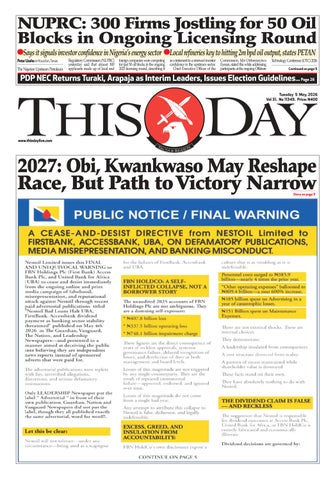
TUESDAY 5TH MAY 2026

Page 1


wellness within reach

with W Health loan

The W Health Loan provides women with access to financing for eligible healthcare services

*Terms and conditions apply

PUBLIC NOTICE / FINAL WARNING

* Regulator y capital requirements

* Earnings quality

* Provisioning levels

* Prudential guidelines

ey are not determined by any single borrower.

e mischievous narratives contained in the paid advertorials are therefore deliberate falsehood designed to mislead the public, the market and to damage Nestoil's reputation.

In June 2025, it was widely published in these same newspapers that the CBN had through a circular signed by Dr Olubukola Akinwunmi, Director of Banking Super vision, temporarily suspended dividend payments and deferred executive bonuses for Firstbank and other banks bene ting from regulator y forbearance. is directive was a regulator y action. e consequence, is that banks operating under forbearance conditions such as Firstbank are not permitted to declare dividends until their balance sheets are cleaned up.

To now put out an advertorial in the media that Nestoil is to be blamed for the suspension and non payment of dividends, beats the imagination. is is a dangerous and grievous blackmail that MUST stop!!.

MEDIA COMPLICIT Y WILL AT TRACT CONSEQUENCES

Any media organisation that publishes paid, unveri ed, and defamator y material under the guise of news reporting is not a neutral platform—it is a participant.

e Guardian, Vanguard, e Nation, are hereby put on notice:

Failure to clearly distinguish advertorials from editorial content, especially where such content contains defamator y claims, creates direct legal exposure.

Nestoil will pursue all available legal remedies against any platform that continues to disseminate such material.

TO FBN, ACCESS BANK, AND UBA: THIS MUST STOP NOW

FBN Holdings Plc (First bank), Access Bank Plc, and United Bank for Africa (UBA) are hereby issued a nal directive:

Immediately halt all media campaigns, advertorial placements, and third-party publications targeting Nestoil.

Retract and publicly correct all false and misleading statements already circulated

Cease attempts to manipulate public opinion and prejudice ongoing legal processes.

Any continuation of this conduct will be interpreted as willful defamation and malicious injur y, and will be met with swift and decisive legal action.

TAKE YOUR CL AIMS TO COURT — OR WITHDRAW THEM

If these institutions genuinely believe they have claims:

* Present them in court with evidence.

* Stop circulating sensational and unveri ed gures

* Stop engaging in media theatrics

* Stop attempting to bypass due process

e courts—not paid publications—are the proper forum for determining liability

We call on the Central Bank of Nigeria to determine whether these banking institutions are operating within the bounds of responsible banking and to sanction any institution found to be engaging in market manipulation, misleading disclosures, or conduct detrimental to Enterprise.

FBN HoldCo's ₦407.8 billion loss and ₦748.1 billion impairment and their failures to pay dividends to shareholders are the results of its own actions —recklessness, poor judgment, weak governance, and unchecked excess.

e inability of Accessbank and UBA to pay dividends to their own shareholders, are directly attributable to how they have either managed or mismanaged their institutions.

It has absolutely nothing to do with Nestoil and are not, in any form or manner, attributable to Nestoil.

Any further attempt to assert other wise will be treated as Defamation, Malicious falsehood, Intentional reputational harm.

Nestoil Limited is fully prepared to pursue maximum legal remedies against all responsible parties

Signed:

Management

COURTESY CALL AT LAGOS HOUSE...

To Revive Warri, Port Harcourt Refineries

NNPC Signs MoU with Two Chinese Firms

Oil company’s March revenue climbs to N2.77trn as gas output rises Profit jumps to N276bn in March from N136bn in February Statutory remittances hit N2.89tn in Q1

Emmanuel Addeh in Abuja and Peter Uzoho in Houston, Texas

The Nigerian National Petroleum Company Limited (NNPC) has again moved to revive its ailing refineries, announcing yesterday the signing of a Memorandum of Understanding (MoU) with two Chinese companies for a potential Technical Equity Partnership (TEP) for the completion and operation of the facilities in Port Harcourt and Warri.

The Chinese firms, a statement from the national oil company disclosed, are: Sanjiang Chemical Company Limited as well as Xingcheng (Fuzhou) Industrial Park Operation and Management Co. Ltd.

The development took place as the NNPC in its Monthly Report Summary for March released yesterday said that its revenue during the month rose to N2.77 trillion from N2.68 trillion in February, representing a modest month-on-month increase.

The MoU to revamp the refineries was signed by the Group Chief Executive of the NNPC, Bayo Ojulari; Chairman, Sanjiang Chemical Company, Guan Jianzhong, and Chairman of Xinganchen (Fuzhou) Industrial Park Operation and Management Co. Ltd, Bill Bi, in Jiaxing City, China.

For years, the NNPC has tried to bring the refineries back online, but has failed at every attempt. The last

effort before this, which is currently a matter before the Economic and Financial Crimes Commission (EFCC), gulped almost $3 billion.

But the potential framework, according to the NNPC, would cover completion of outstanding work at the two refineries, together with operating and maintaining both facilities to achieve best-in-class, sustainable performance.

Planned expansion and upgrades would elevate both facilities to cleaner, more profitable product standards, it added.

The potential collaboration, it stressed, also contemplates expanding the refineries’ petrochemical capacities and harnessing gas and downstream opportunities through the development of co-located, gas-based industrial hubs.

Speaking shortly after the signing, the GCEO of NNPC, Ojulari, described the MoU execution as a significant milestone, following more than six months of concerted engagement between the technical and management teams of NNPC and the two Chinese partners, Sanjiang and Xinganchen.

“All parties recognise mutually beneficial opportunities for the development and long-term sustainable profitability of NNPC’s refining assets in Nigeria, and the collective weight required for success,” Ojulari noted.

The GCEO further stated that the MoU is an important step on

the journey towards identifying potential technical equity partner(s) to restart and expand NNPC’s refineries, and to explore opportunities in colocated petrochemicals and gas-based industries.

The MoU, the NNPC explained, reflects the parties’ shared intent to progress discussions in good faith, with any definitive arrangements to follow in due course and subject to customary approvals.

Meanwhile, the NNPC recorded improved financial and operational performance in March 2026, with

revenue rising to N2.77 trillion and profit rebounding, supported by higher crude oil output and increased gas production.

Figures from the company’s March Monthly Report Summary showed that revenue rose from N2.68 trillion in February to N2.77 trillion, representing a modest month-on-month increase and indicating continued stabilisation after the volatility experienced earlier in the year.

Besides, profitability saw a more significant turnaround, with Profit After Tax (PAT) increasing to

N276 billion in March from N136 billion recorded in February, when it weakened substantially despite higher revenue.

Crude oil and condensate production averaged 1.56 million barrels per day (bpd) in March, up from 1.51 mbpd in February. The improvement marked a reversal of the 7.9 per cent decline recorded in February, when production was impacted by the outage of the Trans Forcados Pipeline, start-up challenges at the Agbami Gas Turbine facilities, delays at the Sterling Ogualli flow station, and ramp-up constraints

at Enyie wells. A month-by-month trend in the report indicated that production has largely hovered within a narrow range in recent periods, reflecting ongoing operational constraints even as incremental gains are recorded. Gas production maintained a steady upward trajectory, rising to 7,731 million standard cubic feet per day (mmscfd) in March from 7,458 mmscfd in February. The increase built on earlier growth and reinforced the relative stability of the gas segment compared to crude oil operations.

ALAT at 9: Wema Bank Celebrates Nine Years of Redefining Digital Banking in Nigeria

Wema Bank Plc is celebrating the 9th anniversary of ALAT by Wema, Africa’s first fully digital bank, marking nine years of transforming how Nigerians experience banking.

Launched in 2017, ALAT by Wema was introduced as a bold response to the limitations of traditional banking, long queues, physical barriers, and slow processes.

By eliminating these constraints, Wema Bank redefined banking as a fully digital, instant, and accessible experience, enabling customers to open accounts, transact, and manage their finances seamlessly from anywhere.

Over the past nine years, ALAT has evolved beyond convenience into a comprehensive digital ecosystem designed to meet the changing needs of individuals, businesses, and a new generation of financially aware users.

Gov Adeleke Reaffirms Commitment to State Industrialisation

Directs strict enforcement of 45 days for processing of C-of-O

Yinka Kolawole in Osogbo

Governor Ademola Adeleke of Osun State has reaffirmed the commitment of his administration to the industrialization of Osun State using a public-private-partnership model.

Addressing a group of Chinese investors who are setting up factories around Ile Ife, the governor said the state government deliberately enforced the ease of doing business from 2022 to date to facilitate inflow of investors and industrialists, locally

and internationally. According to the governor, tax payments and administration were harmonised to remove multiple taxation on businesses, a policy he said reduced the burden on small businesses across the state.

“The state government also digitised the tax payment system alongside deployment of technology for a one stop shop for investors”, the governor noted, adding “we upgraded the state investment agency to speed up responses and services to investors.

“We remove bureaucratic bottlenecks in securing business permits.

From the Ministry of Commerce and Industry to the Ministry of Land, a strict timeline is enforced to attend to businessmen and citizens alike.

“Our free trade zones neglected for more than twelve years are back on stream. We encourage foreign investors to join other investors who are already securing spaces at the free trade zone. Several companies are already taking positions in the zone.

“We pioneered the 45 day window

for the processing of certificates of occupancy. Huge successes are recorded in this area. I have received calls from state clients and residents who have gotten their C-of-O within the stipulated timeframe.

“I am hereby directing that there should be no slowing down on the implementation drive. As much as I commend the ministry of land for doing a good job in the land reform sector, I task the management of the ministry never to slow down. The 45-day window must be sustained.

From enabling structured savings through features like ALAT Goals to simplifying payments and expanding access to financial services, the platform has consistently delivered solutions that empower users and drive financial inclusion at scale.

This journey of continuous innovation has positioned ALAT not just as a digital banking product, but as a platform that adapts, grows, and evolves alongside its users.

To commemorate this milestone, Wema Bank has launched the ALAT at 9 campaign, a series of customer-focused activities, rewards, and interactive experiences designed to celebrate users while deepening engagement.

As part of the anniversary celebration, customers can access their personalized ALAT Wrapped, offering a simple, visual summary of their journey on the platform, which can be downloaded and shared across social media.

Customers can also participate in the 9 Features in 9 Days experience by engaging with a designated feature each day. Completing all nine activities unlocks rewards, encouraging consistent and active

use of the platform.

In addition, customers who complete their 9th transaction at exactly 9:00am or 9:00pm will receive instant rewards.

The celebration also features the ALAT Evolution Jingle Challenge, inviting customers to create and submit the second verse of the ALAT jingle for a chance to win rewards.

Speaking on the milestone celebration, Managing Director and Chief Executive Officer of Wema Bank, Moruf Oseni, said;

“ALAT at 9 is not just a celebration of time. It is a reflection of how far we have come and a clear indication of where we are going. Over the years, we have continued to evolve with our customers, building a platform that is not only functional but also engaging and rewarding.

“This campaign is designed to give back to our users while reinforcing our commitment to innovation and customer experience.”

Also commenting, Chief Digital Officer of Wema Bank, Olusegun Adeniyi, noted that the anniversary campaign was designed to merge everyday banking with meaningful engagement.

Bennett Oghifo
L-R: Denmark Ambassador to Nigeria, Mr. Jens Ole Bach Hansen; Denmark’s Tech Ambassador, Mrs. Anne Marie Engtoft Meldgaard, receiving a Lagos State Government plaque from the Governor, Mr. Babajide Sanwo-Olu; and the Danish Consul General in Lagos, Ms. Jette Bjerrum, during a courtesy call at Lagos House, Ikeja, yesterday

EKO SCHOOL ART AND CRAFT COMPETITION...

L-R: Lagos State Tutor General/Permanent Secretary, Education District 2, Mr. Omotayo Sanni; Lagos State Permanent Secretary, Ministry of Basic and Secondary Education, Mrs. Abisola Dokunmu-Adegbite; Lagos State Permanent Secretary, Ministry of Tourism, Arts and Culture, Mrs. Bopo Oyekan-Ismaila; and Lagos State Permanent Secretary, Ministry of Waterfront and Infrastructural Development, Esv. Wasiu Adebayo Olayinka, during a press conference on the Eko School Arts and Crafts Competition for Secondary Schools and Tertiary Institutions 2.0, held at the Ministry’s Conference Room, Alausa, yesterday

World Press Freedom Day 2026: Lagos, Bauchi Govts Recommit to Press Freedom, Democratic Accountability

Salute journalists’ courage, resilience

The governments of Lagos and Bauchi States have congratulated journalists on the occasion of the World Press Freedom Day, stating that a free press remains one of the strongest pillars of democracy.

On its part, the Lagos State Government further pledged it will continue to support initiatives that promote press freedom and strengthen democratic accountability, according to Governor Babajide Sanwo-Olu, in a message delivered by Information and Strategy Commissioner Gbenga Omotoso.

Meanwhile, Governor Bala Mohammed of Bauchi State commended the resilience, courage, and professionalism of journalists

who continue to uphold the principles of truth, accountability, and public enlightenment despite numerous challenges.

The theme of this year’s celebration in Lagos is: “Shaping a Future at Peace: Promoting Press Freedom for Human Rights, Development and Security.”

“Today presents yet another opportunity for us to deliberate, review our progress over time, and reassess the level of commitment, particularly among key stakeholders, to the true ideals of press freedom,” Omotoso quoted the governor as saying.

The theme aptly underscores the critical role of the media in fostering peace, strengthening institutions, and advancing sustainable development.

A free press remains one of the strongest pillars of democracy as it gives voice to the voiceless, holds leaders accountable, and serves as a vital bridge between the government and the people.

“In today’s rapidly evolving information landscape, the responsibility placed on the media has never been more significant.”

He said: “More than ever, the current realities in our country, especially the various reforms being undertaken at different levels of government, make it imperative for members of the Fourth Estate of the Realm to remain committed to objective, balanced, and professional reporting that critically examines government policies while ensuring accountability in a fair and unbiased manner.”

The Lagos State Government remains committed to promoting transparency, openness, and constructive engagement with the media. “We firmly believe that a well-informed society is fundamental to peace, security, and inclusive development. At the same time, the media must continue to discharge its responsibilities without fear or favour.

“The challenges confronting the media today, including the\ growing threats of misinformation and disinformation, coupled with economic pressures and safety concerns for journalists, and poses significant risks to national stability and development.

“These challenges call for stronger collaboration among government, media practitioners,

Amid Rising Instability, ECOWAS Tells West African Leaders Democracy Must Deliver

Michael

FWest African leaders have issued a joint warning that democracy in the region is under growing strain and must begin to produce visible results for citizens, while also stressing that peace cannot be imposed but must be deliberately built through dialogue and cooperation.

The concerns were raised at the opening of the 2026 First Ordinary Session of the ECOWAS Parliament held on Monday in Abuja, where regional lawmakers gathered amid rising insecurity, democratic reversals, and increasing public dissatisfaction across parts of West Africa.

Speaker of Nigeria’s House of Representatives, Tajudeen Abbas, warned that the survival of democratic governance in the sub-region now depends on its ability to deliver tangible outcomes in security, economic stability, and public welfare.

He said while citizens across West Africa continue to reject military rule, their patience with democratic

systems is weakening due to poor governance outcomes and rising socio-economic hardship.

Abbas noted that declining voter trust, weak institutions, and recurring unconstitutional changes of government reflect deeper structural problems that democratic systems must urgently address.

“The issue is not whether democracy remains the preferred system, but whether it is delivering sufficiently to sustain that preference,” he said, warning that governance failures could further expand the space for instability.

The Nigerian Speaker also pushed for a stronger and more empowered ECOWAS Parliament, arguing that its current advisory status limits its ability to respond effectively to regional crises.

He renewed calls for reforms, including enhanced legislative authority, stronger oversight powers, and improved enforcement mechanisms for regional agreements.

According to him, previous proposals to strengthen the Parliament have yet to be fully implemented,

but the present instability across the region makes such reforms more urgent.

“A Parliament with limited influence cannot adequately respond to democratic reversals, security pressures, and economic uncertainty,” Abbas said.

Abbas also defended Nigeria’s recent economic reforms, including fuel subsidy removal and exchange rate unification, describing them as difficult but necessary decisions taken within a democratic framework.

He said early results show increased fiscal inflows to subnational governments and improved capacity for infrastructure and social investment, while acknowledging that challenges persist.

He argued that Nigeria’s experience demonstrates that even tough reforms can be implemented without resorting to military intervention, warning against a growing tendency toward unconstitutional power shifts in parts of the region.

In a separate address, the Speaker of the ECOWAS Parliament, Hadja

Mémounatou Ibrahima, stressed that peace in West Africa cannot be declared or imposed by authority, but must be carefully built over time.

civil society, and other stakeholders to safeguard the integrity of our information ecosystem. As we approach another electoral cycle in our country, the role of the media becomes even more critical.

“The press will undoubtedly serve as a key stakeholder in shaping public discourse during the electioneering process. This makes it essential for all actors to uphold the principles of ethical journalism, fairness, and national interest,” the governor said.

He also stressed the need for sustained investment in media literacy, support for ethical journalism, and the creation of an enabling environment where the press can operate freely without undue interference.

“I wish to assure you that the Lagos State Government will continue to support initiatives that promote press freedom, protect journalists, and strengthen democratic accountability,” SanwoOlu said.

In a message marking World Press Freedom Day, celebrated annually on May 3, Governor Bala Mohammed extended warm felicitations to journalists

in Bauchi State and across Nigeria, acknowledging the vital role of the media in strengthening democracy, promoting transparency, and fostering good governance.

Governor Bala Mohammed, a media professional and longstanding advocate of responsible journalism, emphasised that a free, independent, and responsible press remains the cornerstone of any progressive society.

“As a government, we recognise and deeply appreciate the sacrifices made by journalists in ensuring that citizens are well-informed. Your commitment to truth and fairness contributes immensely to the growth and stability of our democracy,” he stated in a press release issued by his media aide, Mukhtar Gidado. He reaffirmed his administration’s commitment to sustaining a media-friendly environment in Bauchi State, where journalists can operate freely and responsibly without fear or intimidation.

The governor also urged media practitioners to adhere strictly to the ethics of the profession by ensuring accuracy, objectivity, and the promotion of national unity in their reportage.

Ardo: NDC Registration Will Be Cancelled

Says they’re in court already Declares no documents showing NDC applied to be registered as a political party

The promoter of the All Democratic Alliance (ADA) and League of Northern Nigeria, Dr Umar Ardo, yesterday, said the registration of Nigeria Democratic Congress (NDC) by the Independent National Electoral Commission (INEC)would soon be cancelled as it was registered by subterfuge

In an interview with THISDAY, Ardo said, “We are in court over NDC irregularities in registration by INEC. The court will cancel the NDC registration.

“The emergence of the NDC

should be of serious concern to every true Nigerian citizen, most especially the Nigerian opposition. This is largely due to the glaring irregularities in the process surrounding its registration literally on a platter of gold within 33 days.

“Unlike other political associations that painstakingly fulfilled every requirement, from the caterpillar to the needle, NDC secured recognition through a court judgment despite clear noncompliance with the requirements of the Constitution, the Electoral Act and INEC Guidelines.

“And INEC’s swift issuance of

its certificate, and decision not to appeal, has further made the entire thing suspect, especially against the backdrop of accusations of government influencing both INEC and judiciary against the opposition.”

According to Ardo, a close ally of former Vice President Atiku Abubakar, “Equally troubling is the delayed public disclosure of the judgment ordering the registration of NDC raising questions about transparency and intent. The judgment was secured on 3rd December, 2025, but INEC never announced it till 5th February, 2026.

Olugbode in Abuja
Segun Awofadeji in Bauchi

2026 INTER MINISTERIAL BRIEFING ON WORLD PRESS FREEDOM DAY...

L-R: Director, Protocol, Department of State Security (DSS), Mrs. Mabel Chukeuka; representative of the Inspector General of Police, DCP Anthony Okon Placid; Minister of Information and National Orientation, Alhaji Mohammed Idris; and Permanent Secretary in the Ministry, Dr. Binyerem Chigbonwu Ukaire, during the inter ministerial press conference in commemoration of the 2026 World Press Freedom Day in Abuja, yesterday

Nigeria Signs Landmark MoU with Airbus to Boost Aerospace Development

The federal government has signed a landmark Memorandum of Understanding (MoU) with Airbus, one of the world’s leading aircraft manufacturing giants, as part of the working visit of Minister of Aviation and Aerospace Development, Festus Keyamo, to the company’s global headquarters in Toulouse.

The agreement marks a significant milestone in Nigeria’s efforts to reposition its aviation sector and accelerate the development of a robust and sustainable aerospace ecosystem.

Under the terms of the MoU, Airbus and Federal Government of Nigeria will collaborate to accelerate the growth of Nigeria’s civil aviation ecosystem through targeted support in aviation infrastructure development and human capital enhancement.

Speaking at the signing ceremony, Keyamo described the agreement as a strategic leap forward for Nigeria’s aviation sector:

In a statement issued on Monday by his Special Adviser on Media, Tunde Moshood, Keyamo said, “We are deeply honoured to

engage in a long-term partnership with Airbus.

“This agreement aligns with the federal government’s commitment to accelerating the development of Nigeria’s aeronautical ecosystem in all its dimensions.”

President of Airbus for Africa and the Middle East, Gabriel Semelas, emphasised Nigeria’s strategic importance in the global aviation landscape.

Semelas stated, “Nigeria is at the heart of Africa’s aerospace

opportunity, driven by its large population and growing economy. This agreement reflects our shared ambition to scale the civil aviation ecosystem in the country.

“By leveraging local talent and infrastructure, we are committed to fostering long-term growth and developing human capability to secure the continent’s aviation future.”

As part of the partnership, Airbus will provide comprehensive technical support, including

aviation market intelligence, crew and maintenance training, and advisory services on Maintenance, Repair, and Overhaul (MRO) operations.

The collaboration will also explore Nigeria’s potential role in Sustainable Aviation Fuel (SAF) production, while supporting the training and development of the next generation of Nigerian aviation professionals.

The agreement builds on Airbus’ longstanding presence in

Africa, supported by a workforce of approximately 3,000 employees across the continent. It reinforces the company’s commitment to strengthening Africa’s aerospace ecosystem through local partnerships, skills development, and the advancement of technical expertise.

According to Airbus’s latest Global Market Forecast, Africa is projected to require approximately 1,490 new passenger and cargo aircraft by 2044. Furthermore, demand for

skilled aviation personnel is expected to surge significantly, with the continent needing over 20,000 pilots, 20,000 maintenance engineers, and 21,000 cabin crew members to meet anticipated growth in air travel.

The MoU represents a bold step towards positioning Nigeria as a leading aviation hub in Africa, while unlocking new opportunities for economic growth, job creation, and technological advancement in the aerospace sector.

Nigeria Moves to Transform Career Guidance System as Ministries, UNESCO, GIZ Push New National Policy Framework

Nigeria has taken a decisive step towards overhauling its career guidance and counselling system with the launch of a high-level policy dialogue aimed at developing a National Career Guidance and Counselling (CGC) Policy Framework.

The dialogue organised at the United Nations House in Abuja, brought together key stakeholders from Federal Ministry of Education, Federal Ministry of Labour and Employment, Federal Ministry of

Youth Development, United Nations Educational, Scientific and Cultural Organisation (UNESCO), Deutsche Gesellschaft für Internationale Zusammenarbeit (GIZ), and other development and technical partners.

Speaking at the opening session, Permanent Secretary, Federal Ministry of Education, Mr. Abel Enitan, described the workshop as a milestone in ongoing education reform efforts.

Enitan emphasised that career guidance must be repositioned as a strategic pillar rather than

a peripheral service in Nigeria’s education system.

He stated that the changing global economy—driven by automation, digital transformation, and industrial shifts—demanded that students were equipped not only with academic knowledge but also with structured guidance that connected learning to real labour market opportunities.

According to him, the proposed framework will help align individual aspirations with national economic needs, particularly in priority sectors, such as agriculture value chains,

construction, and digital skills.

“Counselling in our institutions has been treated as a secondary service rather than a strategic necessity,” he said, adding, “In today’s world, students need more than a syllabus; they need a compass.”

He stressed that institutionalising a national policy would ensure integration of labour market intelligence into school counselling systems, elevate Technical and Vocational Education and Training (TVET) as a first-choice pathway, and improve employment outcomes as a measurable result of

Xenophobia: Nigeria Tightens Diplomatic Pressure on South Africa Over Protests

Michael Olugbode in Abuja

Nigeria has stepped up diplomatic engagement with South Africa over renewed anti-foreigner demonstrations, pressing for stronger protection for its citizens and the urgent rollout of a bilateral mechanism aimed at detecting and defusing tensions before they spiral.

The move followed the summoning of South Africa’s Acting High Commissioner to Ministry of Foreign Affairs in Abuja, where Nigerian officials conveyed concerns over recent protests in parts of South Africa calling for the removal of foreign nationals.

Addressing journalists after the meeting, Ministry of Foreign Affairs Spokesperson, Kimiebi Ebienfa, said the federal government was deeply troubled by videos and reports emerg-

ing from South Africa, warning that such developments could undermine relations between both countries.

Ebienfa said, “Nigeria is monitoring the situation closely through our missions in Pretoria and Johannesburg. The images and rhetoric circulating are disturbing and do not reflect the longstanding relationship between our two countries.”

He disclosed that beyond the protests, Nigeria had also raised concerns over the deaths of two Nigerians in April in separate incidents reportedly involving security personnel.

According to him, one Nigerian allegedly died in detention, while another reportedly succumbed to injuries after an assault.

“These are matters of serious concern to the Nigerian government because they directly affect the safety

and confidence of our citizens living abroad,” Ebienfa stated.

Nigeria has requested full investiga- tion into both incidents and demanded regular diplomatic updates from South African authorities.

At the heart of Abuja’s diplomatic push is the implementation of a newly agreed early warning framework between both countries, intended to provide faster communication and coordinated intervention whenever social or security tensions began to build.

Officials said the mechanism could become a critical tool for preventing future crises, especially against the backdrop of recurring anti-immigrant sentiments in South Africa.

“Rather than waiting for situations to deteriorate, this framework allows both governments to engage early,

share intelligence, and manage issues before they escalate,” Ebienfa explained.

He stressed that Nigeria expected more than public assurances, insisting that South African authorities must demonstrate commitment through visible action.

“We expect concrete measures. Statements are important, but what is more important is what follows — investigations, accountability, and preventive action,” he said.

Nigeria also flagged concerns over hostile messaging and mobilisation by groups accused of promoting anti-foreigner sentiments, urging South African authorities to rein in inflammatory rhetoric capable of triggering violence.

The acting high commissioner, according to Nigerian officials, assured that South Africa remained opposed

to unlawful attacks or intimidation against foreigners, and said he would relay Abuja’s concerns to the authorities in Pretoria.

The situation triggered anxiety within Nigeria’s diaspora community, with over 100 Nigerians reportedly expressing willingness to return home voluntarily if conditions worsened.

Ebienfa said the government was assessing the situation and reviewing possible options for affected nationals.

“At this point, we are engaging constructively, but Nigeria will continue to evaluate developments and take decisions necessary to protect its citizens,” he said.

Although he declined to elaborate on possible retaliatory measures, he indicated that diplomatic options remained open should tensions escalate further.

education investments.

Acting Head of Education Sector at UNESCO, Abuja, Mr. Oladeji Adeyemi, reaffirmed that career guidance and counselling were the critical bridge between education and employment, warning that even strong education systems cannot achieve their full impact without a coordinated CGC structure.

Adeyemi explained that the new framework was designed to move Nigeria from fragmented interventions to a fully integrated system that connected education, labour, and youth development sectors.

“Career Guidance and Counselling is not an add-on — it is the bridge that connects learning to livelihoods,” he said.

Adeyemi emphasised the need for stronger institutional collaboration and shared ownership, stating that no single institution can effectively deliver career guidance in isolation. He called for a system where roles were clearly defined and stakeholders were fully accountable for implementation.

He also stressed the importance of alignment among stakeholders, describing the workshop as a platform to harmonise perspectives, validate earlier technical work, and agree on a coherent implementation pathway for the policy.

Over the next two days, participants are expected to engage in technical discussions, review international best practices, and jointly define the structure and pillars of the proposed national framework.

Kasim Sumaina in Abuja
Michael Olugbode in Abuja
PHOTO: ENOCK REUBEN

Oil Surges 5.8% to $114 after Iran Strikes Energy Facility in UAE

Four-week truce falters after attacks U.S. military fires at Iranian forces, sink six boats

Oil prices jumped yesterday as critical energy infrastructure and tankers in the Middle East came under attack, marking a significant escalation in the US-Iran hostilities and jeopardising a four-week-old ceasefire.

Brent futures surged 5.8 per cent to settle above $114 a barrel after an Iranian drone strike caused a fire in a key oil industrial zone in Fujairah. The UAE also issued several missile alerts to its residents and said its defense systems were actively engaging with threats, a Bloomberg report stated.

Prices rallied earlier in the session as tankers linked to multiple nations reported coming under fire in the critical Strait of Hormuz.

2027:

The wave of attacks represents the most notable increase in tensions since the US and Iran agreed to a fragile ceasefire in early April.

The global market loses millions of barrels of oil supplies for every day that the key shipping lane remains blocked, heightening fears of demand destruction and a global economic recession.

Fujairah is a major hub for both crude and fuels, and has taken on increased significance for both the UAE and global markets because of its position outside the Strait of Hormuz. However, on Monday, Iran redefined the “control zone” in the strait, stretching from south of Mount Mobarak in Iran to south of Fujairah, semi-official Tasnim reported.

At least 13 ships have already diverted from the area after the

report that Iran had extended its maritime reach, threatening to worsen the global supply crunch.

The US has imposed a naval blockade of Iranian ports since mid-April. The blockade, a major sticking point in bringing Tehran to the negotiating table, is choking off Iranian crude exports — the only flow out of the Persian Gulf since the war began at the end of February.

Monday’s escalation came after US President Donald Trump announced plans by the US military to try and restore transit through the strategic waterway and help stranded vessels exit the Persian Gulf, the Bloomberg report added.

But several shipowners and a ship manager contacted by Bloomberg said more concrete details would be

needed about the ability to again transit through Hormuz, as well as assurances around key concerns including mines and safety from Iranian attacks. They asked not to be named given the sensitivity of the issue.

US Central Command said that two American-flagged merchant vessels successfully navigated the strait, as part of a broader effort to open a lane through the vital waterway.

Admiral Brad Cooper said Iran has tried to interfere with vessels in the area over the last 12 hours, and the US successfully repelled both drone and missile attacks.

This means that the four-week truce in the Middle East has faltered, as the United Arab Emirates said that Iran had launched attacks on its territory, and the U.S. military said

it sank six Iranian military boats.

The Emirati authorities blamed Iran for a drone attack that caused a fire in the Fujairah Oil Industry Zone, the largest oil storage area in the Emirates, in the first such assault since a cease-fire was reached on April 7.

Also, the U.S. military said it fired on Iranian forces and sank six small boats targeting civilian ships as it moved to reopen the Strait of Hormuz on Monday.

The United Arab Emirates, a key American ally, said it had come under attack from Iran for the first time since a fragile ceasefire took hold in early April.

The attacks appeared to be in response to U.S. President Donald Trump’s latest efforts to reopen the strait, a critical waterway for

global energy. The U.S. military said two American-flagged merchant ships had successfully transited the strait on Monday as part of a new initiative.

The UAE Defense Ministry said its air defenses had engaged 15 missiles and four drones fired by Iran. Authorities in the eastern emirate of Fujairah said one drone sparked a fire at a key oil facility, wounding three Indian nationals. The British military reported two cargo vessels ablaze off the UAE.

Obi, Kwankwaso May Reshape

Race, But Path to Victory Narrow

Opposition fragmentation

deepens

after shift from

ADC to NDC 2023

voting patterns likely

to influence next

contest Regional strongholds give both candidates leverage, not dominance

Emmanuel Addeh in Abuja

Nigeria’s political landscape ahead of the 2027 general election is beginning to take shape, with emerging alignments and deepening fractures within the opposition raising fresh questions about the viability of alternative power blocs.

But at the centre of this evolving dynamic are a former Governor of Anambra, Peter Obi and that of Kano, Rabiu Kwankwaso, two influential figures whose political movements could significantly alter the trajectory of the race, even as doubts persist about their ability to secure outright victory without opposition solidarity.

On Sunday both men exited the African Democratic Congress (ADC), which hitherto sheltered opposition elements, gravitating instead toward a reconfigured platform under the National Democratic Congress (NDC) promoted by former Bayelsa Governor, Seriake Dickson.

While the shift has been interpreted in some quarters as an attempt to consolidate a new opposition front, it has also exposed deeper weaknesses within Nigeria’s non-ruling political ecosystem, again throwing the landscape to the dynamics of pre-2023 presidential polls. Overall, the fragmentation of the opposition will remain one of the most defining features of the current political moment as the country steadily moves towards 2027. In 2023, multiple opposition candidates split the vote, allowing the ruling party to retain power with a plurality rather than an overwhelming majority. Early reading of the ecosystem already suggests that a similar pattern could re-emerge in 2027, particularly if efforts at coalition-building fail to yield a unified presidential ticket.

Both Obi and Kwankwaso enter the unfolding contest with established political bases and distinct ideological appeals. Obi, who built significant momentum in the last election cycle, continues to command strong support among urban voters, young Nigerians, and sections of the middle class, particularly in the south. His message of fiscal prudence, governance reform, and institutional accountability resonated widely in 2023 and remains a central pillar of his political identity.

Kwankwaso, on the other hand, retains a formidable grassroots structure anchored in the North-west, especially in Kano State, where his political movement has demonstrated resilience over multiple electoral cycles. His appeal is rooted in long-standing networks, loyalty-driven mobilisation, and a reputation for direct engagement with constituents.

The critical question, however, is whether these individual strengths can translate into a cohesive national coalition capable of challenging an incumbent-backed structure. Political analysts argue that without a formal alliance or strategic accommodation between the two camps and potentially other opposition actors the likelihood of replicating the fragmented outcome of 2023 remains high.

A closer examination of the 2023 electoral map provides insight into the possible trajectories for 2027. Obi secured victories in several states across the South-east, including Anambra, Imo, Enugu, Ebonyi, and Abia, while also making inroads in Lagos and the Federal Capital Territory (FCT). Apart from the south-east states, he also won in Edo, Plateau, Cross River, Delta and Nasarawa.

If the current dynamics remain the same until the election, Obi , just like in 2023, is also expected to do well in Benue, Rivers, Taraba, Bayelsa and Akwa Ibom. But are these enough to win a presidential poll?

Although his performance in Lagos in 2023, in particular, signaled the potential to disrupt traditional voting patterns in Nigeria’s most politically significant state, not many believe that that shocking feat can be re-enacted in 2027.

Kwankwaso, meanwhile, massively dominated in Kano, one of the country’s most populous states, underscoring the strategic importance of the North-west in any national electoral calculation. Kano’s voter population alone makes it a critical battleground, and Kwankwaso’s continued influence there positions him as a key player in any serious contest.

Looking ahead to 2027, these regional strongholds are expected to remain largely intact, barring significant political realignments. Obi is likely to maintain dominance in the South-east and retain competitive strength in urban

centres such as Lagos, Abuja, and parts of Rivers and Delta states. Kwankwaso is expected to hold Kano and potentially extend influence into neighbouring states within the North-west, although this may be contested by other northern political heavyweights like Atiku.

Despite these advantages, both candidates face structural constraints that could limit their national reach. Nigeria’s electoral system requires not only a plurality of votes but also a spread across at least two-thirds of the states. This makes regional dominance insufficient on its own and places a premium on cross-regional appeal and coalition-building.

The shift from ADC to NDC, rather than resolving these challenges, appears to have introduced additional layers of complexity. While the move may provide a fresh platform, it also risks further fragmenting opposition support

if it leads to parallel candidacies rather than consolidation. Questions remain about the organisational strength of the NDC, its ability to attract broader alliances, and whether it can present a unified front capable of mobilising voters nationwide.

Compounding the situation is the likelihood that the ruling party will leverage incumbency advantages, including established structures, resource access, and nationwide networks. In such a context, a divided opposition faces an uphill battle, regardless of the individual popularity of its leading figures.

Besides, the window for meaningful coalition-building is narrowing. For Obi and Kwankwaso, the strategic choices made in the coming months whether to align, compete, or negotiate powersharing arrangements will be decisive in shaping the outcome of the election. There is also the question of voter

behaviour. The 2023 election saw an unprecedented level of youth engagement and a shift toward issue-based voting in certain demographics. Whether this trend will persist into 2027 remains uncertain, particularly in the face of economic pressures, voter fatigue, and evolving political narratives.

At the same time, regional and identity politics continue to play a significant role in Nigeria’s electoral dynamics. Both Obi and Kwankwaso will need to navigate these complexities carefully, balancing their core support bases with the need to build broader national appeal.

The emerging picture, therefore, is one of both opportunity and constraint. Obi and Kwankwaso possess the capacity to significantly influence the direction of the 2027 race and could, under the right conditions, mount a credible challenge. However, in the absence

of a unified opposition strategy, their impact may ultimately be limited to reshaping vote distributions rather than securing outright victory. Contacted on his views, a senior figure in the All Progressives Congress (APC) who preferred anonymity said: “What we are seeing is the same confusion that defined the opposition in 2023. Nigerians prefer stability and tested leadership. Fragmentation in the opposition only reinforces the confidence people have in the APC to continue delivering governance.”

But a chieftain of the NDC, who declined to be named, in his response, countered the APC stalwart. He said: “This is not fragmentation; this is evolution. Nigerians are tired of recycled platforms. What we are building is a fresh coalition that reflects the aspirations of a new generation of voters across regions.”

NUPRC: 300 FIRMS JOSTLING FOR 50 OIL BLOCKS IN ONGOING LICENSING ROUND

in Houston, Texas, USA.

This was just as the Chairman of the Petroleum Technology Association of Nigeria (PETAN), Mr. Wole Ogunsanya, said Nigeria is on the verge of achieving 1 million barrels per day of active refining capacity, adding that technology and partnerships were critical to ramping oil production to three million barrels per day in five years.

Speaking at the ‘NUPRC/ PETAN Evolution Exchange’ session at the Nigerian pavilion at the global event, Eyesan said the response by investors underscores renewed confidence in Nigeria’s petroleum landscape.

She said the Petroleum Industry Act (PIA) and the bold initiatives of the current administration led by President Bola Tinubu have boosted investor confidence in the upstream sector, as shown by the growing interest of applicants in the licensing round.

“As the Commission Chief

Executive of NUPRC, we are constantly in the market by virtue of PIA, to open our bridges to would-be investors. The interesting phenomenon, we only have 50 assets, we have almost 300 applicants for those 50 blocks. That tells you that the opportunities are there,” she said.

Eyesan, who assumed office in December 2025, linked the surge in interest to sweeping reforms and a more competitive regulatory environment under PIA.

According to her, the PIA provided clarity to the rules of engagement and made the industry more competitive in terms of the systems and even the regulatory environment.

“When we enacted the PIA, we thought we had achieved competitiveness. However, within a few years of implementing the PIA, when we did a global benchmark, a global study, we found that the PIA terms were not as competitive

as they were two years prior. So the current administration, the current government has been very responsive to constantly evaluate where we are and ensure that they provide incentives to attract and retain investment in Nigeria”, Eyesan explained.

The NUPRC boss also pointed to the removal of fuel subsidies as a catalyst for energy transition and domestic gas growth. She noted that the policy has enabled the use of alternative sources of energy for mobility as seen by the growing increase in the utilisation of Compressed Natural Gas (CNG) for mobility.

On Nigeria’s climate commitments, she expressed confidence in Nigeria meeting targets of ending gas flaring by 2030, and achieving net zero by 2060, citing the Nigeria gas flare commercialisation programme as part of the ways to zero out flaring.

Eyesan emphasised NUPRC’s

dual role as enabler of business and enforcer of guidelines, noting that her role is to ensure that industry players operate by the rules.

“And since I assumed office in December, we have made that very clear. We have a listening ear. We’ve told the industry we will be an enabler for business. But at the same time, we will also ensure that the rules are adhered to”, she stated.

Looking ahead, she positioned Nigeria as Africa’s energy anchor, describing the country as a beacon of Africa.

For his part, the Chairman of PETAN, Ogunsanya, who also spoke at the OTC, said Nigeria is on the verge of achieving 1 million barrels per day of active refining capacity, adding that technology and partnerships were critical to ramping oil production to three million barrels per day in five years.

Continued on page 28

President Donald Trump

In

infrastructure and fragmented service delivery, it is not unusual for high-performing institutions to operate without significant public visibility

One such example appears to be Grandville Medical Group.

A closer look at the organisation reveals a healthcare platform that has grown steadily over the past decade, not

t h r o u g

investment in systems, technology, and continuity of care.

Founded in 2013 in Surulere, Lagos, Grandville has expanded into a multi-location network spanning Lagos and Abuja, with patient volumes reportedly exceeding 40,000.

W

specialty, Grandville appears to be evolving into a more integrated model—one that attempts to manage the full patient journey from diagnosis to recovery

A Shift Toward Integrated Care

What stands out on closer inspection is the breadth of services now operating under one system.

B e y

reconstructive surgery, the Group provides general and s

diagnostics, emergency medicine, and structured postoperative recovery Clinical coverage spans cardiology, p a e d i a t r

n e u r o s u r g e r y, e

management.

This level of integration is still relatively uncommon in many private healthcare settings in Nigeria, where patients often navigate multiple disconnected providers.

Infrastructure and Technology as a Foundation

Perhaps more notable is the scale of diagnostic and clinical infrastructure supporting these services.

At its Lekki diagnostic hub, the facility houses a 1.5 Tesla MRI, 64-slice CT scan, digital X-

advanced ultrasound and echocardiography, stress ECG, and automated laboratory services. These are complemented by blo

o

providers such as GE Healthcare.

I

investment suggests a deliberate focus on reliability and clinical accuracy

Movement Toward Advanced Surgical Systems Grandville's surgical capabilities also appear to be evolving beyond conventional approaches.

T h e i n

intraoperative imaging systems such as C-arm technology, indicates a shift toward precision-based surgical care. While still emerging in Nigeria, such capabilities are typically associated with more advanced healthcare environments.

The implication is not just improved surgical technique, b u t p o t e n t

complication rates when appropriately applied.

Addressing a Critical Gap: Emergency and Trauma Care

One of the more significant observations is the Group's investment in emergency medicine.

The Grandville Trauma and Diagnostic Centre in Lekki operates as a 24-hour facility with ICU-level monitoring, ventilatory support, ambulance services, and intensivist-led care. In a country where timely emergency response remains a major challenge, facilities of this nature play an outsized role in patient survival and outcomes.

Across its locations, the Group maintains 37 bed spaces, 10 ICU beds, and dedicated aftercare recovery homes( 14 bedded ) —an extension of care that continues beyond discharge from the operating theatre.

Continuity Beyond Surgery

particularly noteworthy

In many healthcare systems, recovery is often left to p

Grandville's model, which incorporates dedicated recovery environments, suggests an attempt to close this gap by providing monitored post-operative care.

underappreciated aspects of clinical outcomes in the private sector

Locations

Leadership and Strategic Direction

Aranmolate, a plastic and reconstructive surgeon with training exposure across Nigeria, the United States, and Europe.

While clinical leadership remains central, the broader direction of the Group appears to reflect a systems-oriented

scalability over individual practice. T

healthcare delivery, where outcomes are increasingly linked to systems design rather than isolated expertise.

Looking Ahead

There are indications that Grandville is positioning for further expansion, including planned development within the Lekki Free Trade Zone. Such a move would align the Group with industrial, expatriate, and medical tourism markets, suggesting ambitions beyond its current footprint.

A Broader Implication

In many ways, Grandville Medical Group illustrates a broader point about the evolution of private healthcare in Nigeria.

W

challenges, there are emerging examples of institutions

healthcare platforms within the same environment. These developments may not yet dominate headlines, but their cumulative impact could become increasingly significant in shaping the future of healthcare delivery in the country

Lekki – Plastic & Reconstructive Surgery Clinic, Plot 106 Taju Okoya Close, Eleganza Garden Estate, Opposite VGC, Lekki, Lagos

Lekki – Trauma & Diagnostic Centre, Plot 004 Eleganza Shopping Mall, Opposite VGC, Lekki, Lagos

Surulere – Multi-Specialty Hospital, 76 Femi Ayantuga Street, Surulere, Lagos

Abuja – Specialist Centre, 5B Lephalala Close, Off Ganges Street, Maitama, Abuja

Contact Phone: +234 916 000 7927, +234 916 000 7937, +234 916 000 7940

Email: info@gml.com.ng Instagram: @grandvillemedlaser

1.5 MRI Tesla Machine at Grandville Diagnostics
CT Scan Machine
Operating Theatre at Grandville
Grandville Medspa and Physiotherapy Facility
The Lounge at Grandville MedSpa
The Medical Laboratory

Acting Group Politics Editor DEJI ELUMOYE

Email: deji.elumoye@thisdaylive.com

08033025611 sms only

What Obi, Kwankwaso’s Exit from ADC Says about Nigeria’s Democracy

Iyobosa Uwugiaren argues that Peter Obi and Rabiu Musa Kwankwaso’s exit from the a frican Democratic Congress is not just another resignation; it is a moment of reckoning—one that forces a closer look at the role of the judiciary, the instability of political parties, and the uneasy reality of a democracy that increasingly feels as though it is being decided far from the ballot box.

The news broke like a spark in dry harmattan air. Within minutes, it soared from newsroom alerts to heated roadside debates: Peter Obi and Rabiu Musa Kwankwaso had resigned from the African Democratic Congress (ADC).

In a newsroom in Abuja, a junior political reporter paused mid-sentence, staring at the headline glowing on his phone. Only weeks earlier, during an editorial meeting, he had spoken with cautious optimism about opposition coalitions—about the possibility that new alignments under the ADC could reshape Nigeria’s political future. Now, he leaned back, exhaled slowly, and asked no one in particular: “So… where does that leave us now?”

It was a simple question. But like many questions in Nigerian politics, it carries a complicated answer.

Because Obi and Kwankwaso’s exit is not just another resignation. It is a moment of reckoning—one that forces a closer look at the role of the judiciary, the instability of political parties, and the uneasy reality of a democracy that increasingly feels as though it is being decided far from the ballot box.

In Nigerian politics, timing is rarely accidental. The resignation of Obi and Kwankwaso from the troubled ADC would have been significant under any circumstance. But set against the backdrop of recent Supreme Court pronouncements that deepen internal party disputes, the move begins to look less like routine repositioning and more like a calculated escape from a looming legal and electoral trap.

This is where the story shifts—from individual ambition to institutional weakness; from party crisis to what some interpret as systemic political engineering.

To many observers, what Nigeria is witnessing is not merely the unraveling of a party. It is a revealing moment in the country’s democratic journey, where legal uncertainty, political strategy, and institutional fragility are converging in ways that could redefine the road to the 2027 general elections. Obi and Kwankwaso are not minor play-

ers. They represent distinct political movements, regional strengths, and ideological appeal. That both exited the ADC within the same political moment sends a message that cannot be ignored: something fundamental has shifted.

On the surface, the explanations are familiar—internal party crises, leadership disputes, and concerns over transparency and fairness. These are recurring features of Nigeria’s political landscape. But when two major contenders independently arrive at the same conclusion—that a party is no longer a viable platform—the issue goes beyond internal disagreement. It signals a deeper loss of confidence, not just in the ADC, but in the system within which it operates.

To fully understand this moment, one must look beyond party headquarters and into the courtroom. The evolving posture of the Supreme Court on party disputes has fundamentally altered the calculus of political participation. The message is clear: internal party legitimacy is no longer a mere technicality—it is the foundation upon which candidacy stands or falls.

A politician can emerge from a primary, campaign nationwide, even win an election, and still be unseated if the courts later determine that the process that produced them was flawed.

In a party like the ADC, already

entangled in factional disputes, this creates a precarious situation. Which faction has the authority to conduct primaries? Is it that led by Nafiu Gombe or that associated with David Mark? Which leadership will the courts recognise? Which candidate will ultimately be deemed legitimate?

For aspirants of Obi and Kwankwaso’s stature, these are not academic questions—they are existential risks.

Seen in this light, their resignations appear less like isolated decisions and more like parallel responses to the same structural threat. Remaining within the ADC would have meant stepping into a legal minefield: parallel primaries, conflicting candidates, and the ever-present risk of judicial nullification.

In such a scenario, political ambition becomes hostage to legal ambiguity.

Their exit, therefore, can be read as an act of self-preservation—a strategic withdrawal from a party that no longer guarantees a clear path to the ballot, let alone to victory. But this raises a troubling question: if major contenders cannot trust a political party to carry their ambitions through the electoral process, what does that say about the system itself?

The situation becomes even more complex when viewed alongside recent developments involving the federal government. In a move that surprised many, the Attorney-General of the Federation and Minister of Justice, Lateef Fagbemi, approached a Federal High Court in Abuja seeking the dissolution of the ADC.

For critics and opposition voices, this

o bi and Kwankwaso are not minor players. They represent distinct political movements, regional strengths, and ideological appeal. That both exited the ADC within the same political moment sends a message that cannot be ignored: something fundamental has shifted.

reinforces a long-held suspicion—that legal processes are increasingly being deployed as strategic tools in political competition. If the courts can be activated in ways that reshape party structures, then legal maneuvering becomes not just defensive, but offensive. Within this framework, crises in opposition parties like the ADC begin to appear less like isolated incidents and more like part of a broader pattern—one in which internal weaknesses are amplified and, ultimately, weaponised.

Admittedly, direct evidence of coordinated interference is difficult to establish. Nigerian parties have long struggled with internal divisions, and many crises are self-inflicted. Yet the convergence of legal action, political timing, and party instability creates a perception that is difficult to dismiss. And in politics, perception matters.

What is emerging is a fragile dynamic: the transformation of internal party disputes into instruments of political elimination. In a healthy democracy, parties resolve disagreements through negotiation, consensus, and transparent internal processes. Courts serve as a last resort—not the primary battleground.

But when legal recognition determines legitimacy, and court rulings carry decisive electoral consequences, party crises cease to be internal matters. They become vulnerabilities—points of entry for legal and political intervention.

The ADC’s current predicament illustrates this vividly. What might once have been a manageable disagreement has escalated into a crisis that threatens the party’s very ability to field candidates.

For Obi and Kwankwaso, the calculation is straightforward: why risk everything on a platform that may collapse under legal scrutiny? Nigeria’s multiparty system is often celebrated as evidence of democratic vibrancy. But the events surrounding the ADC challenge that narrative. A true multiparty democracy is not defined by the number of parties, but by their strength, coherence, and stability.

NOTE:

Kwankwaso
obi

LAWYER

'Women

Must Aim for Leadership, in All Areas of Human Endeavour'

alhaji Lateef Olufemi Okunnu, CON, SaN

LAWYER

alhajiLateefOlufemiOkunnu,CON,SaN

'Women

Must Aim for Leadership, in All Areas of Human Endeavour'

Quotables

‘It is tough to develop, if you don’t have peace.' - HE Bola Ahmed Tinubu, GCFR, President, Federal Republic of Nigeria

‘The basis upon which INEC acted to remove the name of Senator Mark and his Exco, has been removed by the Supreme Court agreeing that the order of status quo ante bellum made by the Court of Appeal was unwarranted…unnecessary, but, affirmed that we should go and raise the question of jurisdiction before the trial court.' - Jibrin Samuel Okutepa, SAN

Whether Convening General Court Martial Must be Signed Solely by Commanding Officer

Federal High Court Begins Full Digital Filing Era

Wike Hails Appellate Courts, Ukala, SAN, at Book Presentation

Sanitation Exercise Returns to Lagos With Controlled Movement Policy

Extrajudicial Killing of Mene Ogidi: A Test Case for Police Accountability in Nigeria

The Dangers of a One-Party State

Between Journalistic Sensation and Legal Accuracy

Sensational Headlines

Most Journalists love to use sensational headlines to attract readers, and this is fine, particularly when the contents of the story are equally as stunning and accurate. Of course, if the contents turn out to be dull, beneath expectation or not exactly matching the ‘juicy’ headline, there’s an anti-climax.

Last week, I saw a headline that made the rounds on social media: “AGF to Court: Deregister ADC, Accord, and 3 Others Now”. A somewhat sensational headline, suggesting to readers that Nigeria’s present leadership/ruling party, APC, which is perceived to be constantly trying to muscle out ADC and any other opposition, has again made another attempt, this time by using the AGF to apply to the court to have opposition parties deregistered, thereby further riling Nigerians who are already uncomfortable with the thought of a one-party State. It is lawful for the Independent National Electoral Commission (INEC) to deregister political parties that don’t meet the constitutional thresholds; they do nothing but clutter the ballot, and make the electoral process more expensive. Anyway, the headline certainly had the desired effect, as it made me curious enough to read the story.

Summary of Section 225A of the Constitution Section 225A of the 1999 Constitution of the Federal Republic of Nigeria (as amended) (the Constitution) which was inserted via the 2017 Fourth Amendment to the Constitution, aims at removing non-viable political parties from the scene, in order to de-clutter the system. INEC can deregister a political party that either violates registration necessities, or fails to meet the specified electoral performance thresholds set out in Section 225A of the Constitution. These thresholds include winning at least 25% of votes in designated Presidential or Governorship elections, or securing at least one seat/ward at the National Assembly, State Assembly, Chairmanship, or Councillorship levels (see Section 225A(b) & (c) of the Constitution). See NUP v INEC (2021) LPELR-58407(SC) per Adamu Jauro, JSC on the interpretation of Section 225A of the Constitution.

The Deregistration Case

Once I started reading, I saw that the AGF (Attorney-General of the Federation) couldn’t have been the one making the request in the news story’s headline from the onset, which was the impression the headline sought to portray, because the AGF is not a Plaintiff, but the 2nd Defendant in Suit No. FHC/ABJ/CS/2637/2026 Incorporated Trustees of the National Forum of Former Legislators v INEC, AGF & Ors (Deregistration case), which is the subject-matter of the story. It is the Plaintiff that institutes actions to pray the court for specific orders, while normally, a Defendant responds to a Plaintiff’s claim, usually asking the court not to grant the Plaintiff’s prayers. In response, a Defendant denies or admits the Plaintiff’s claim, or says they don’t know. It is trite that every allegation of fact must be specifically denied, if not, it is taken as admitted. See Odiba & Anor v Muemue (1999) LPELR-2216(SC) per Emmanuel Obioma Ogwuegbu, JSC on the effect of allegations not specifically denied. The story went on to state that, the AGF aligned himself with the Plaintiff’s allegations. Then instead, maybe the headline should have read something like “AGF Backs Plaintiff in Case to Deregister ADC,….”. When a Defendant admits to facts pleaded by a Plaintiff, the Plaintiff doesn’t have to prove those facts as they are no longer in issue between the parties. See Antonio Oil Co. Ltd v AMCON (2024) LPELR-62610(SC) per Stephen Jonah Adah, JSC.

In the news story, the Plaintiff in the Deregistration case, Incorporated Trustees of the National Forum of Former Legislators (ITFL), are the ones praying the court for orders, including one to deregister certain political parties that they allege have failed to meet the conditions set out in Section 225A of the Constitution, which allow the parties to maintain their registration. Generally, in civil cases, there are several scenarios in which a Defendant may align with a Plaintiff’s claim - 1) where there’s a consent judgement - see CBN v Interstella Communications Ltd & Ors (2017) LPELR-43940(SC) per Olabode Rhodes-Vivour, JSC where the Supreme Court defined consent judgement thus: "Where parties to a suit in Court have agreed with each other as to how to settle their dispute, they are to approach the Court to give judgement on the terms they have agreed upon. Such judgement when given is a consent judgment….”; 2) where

“The…Deregistration Case news story headline demonstrates the increasing propensity in Nigerian journalism, to prioritise sensation over accuracy. By portraying the AGF as the aggressor initiating the action in the Deregistration case, the headline unfairly fuels narratives of executive interference and an advancing, unwanted oneparty State, when in reality the suit was instituted by ITFL, with the AGF merely aligning with/ admitting to aspects of the claim as may be customary for a Defendant to do when necessary. As the Chief Law Officer of Nigeria, it behoves the AGF to uphold the Constitution and the laws of the land, without fear or favour”

the Defendant admits to part of the claim; and 3) where the Plaintiff and Defendant conspire, because they want a similar or the same outcome, but may be expedient for the Defendant not to be the party to institute the action. In some cases, the Defendant may even admit to all the Plaintiff’s allegations of fact, but, still argue that the Plaintiff isn’t entitled to judgement. See the case of Ojikutu v Ojikutu (1971) LPELR-2375 (SC) per George Baptist Ayodola Coker, JSC.

It appears that the news headline may have been accusing the AGF of taking the third option, that is, colluding with ITFL to have the political parties deregistered. Is this accusation of collusion also enhanced by the fact that, when a Defendant admits to a Plaintiff’s allegations, evidence on the admitted fact becomes irrelevant or unnecessary? See Bunge & Anor v Governor Rivers State & Ors 2006 12 N.W.L.R, Part 995 Page 573 at 600. It is therefore, apposite that we interrogate two pertinent issues in this case - 1) whether the Plaintiffs have locus standi to institute the action, thereby giving the court jurisdiction to entertain the matter; and 2) whether there is merit in ITFL’s claim, that is, whether some of the political parties may have actually failed to meet the constitutional thresholds set out in Section 225A of the Constitution, and therefore, be ripe for deregistration.

Locus Standi of ITFL

In Barbus & Co (Nig) Ltd & Anor v Okafor-Udensi (2018) LPELR-44501(SC) per John Inyang Okoro, JSC, the Supreme Court held thus: “The expression "Locus standi", denotes legal capacity to institute proceedings in a Court of law….A person has locus standi to sue in an action, if he is able to show to the satisfaction of the Court, that his civil rights and obligations have been or are in danger of being infringed. There are two tests for determining if a person has locus standi. They are:- 1. The action must be justiciable. 2. There must be a dispute between the parties….”. In AGF v AG Abia & Ors (2024) LPELR-62576(SC) per Jamilu Yammama Tukur, JSC, the Supreme Court also held thus: “The hallowed principle of locus standi is predicated on the pedestal that, no Court is obligated to adjudicate a claim in which the Plaintiff has a remote, hypothetical or no sufficient interest at all”. While the Deregistration case may be justiceable, it is unlikely that ITFL has sufficient interest in it, or its rights are directly affected, or have been infringed by the non-deregistration of any political party, or that there’s any dispute between ITFL and the Defendants, seeing as ITFL is nothing more than a non-governmental

organisation interested in good governance. It is trite that it is the law that endows a party with locus standi, and that parties cannot by agreement, confer locus standi on themselves, as the AGF appears to have sought to do, by responding that ITFL has sufficient interest to question constitutional infractions in the electoral system. See Odey v APC & Ors (2023) LPELR-59695(CA) per Ugochukwu Anthony Ogakwu, JCA on statute conferring locus standi. In Waziri v PDP & Anor (2022) LPELR-59174(SC) per Kudirat Motonmori Olatokunbo Kekere-Ekun, JSC (now CJN), the Supreme Court held that “Where a Plaintiff lacks the locus standi to institute an action, the Court would have no jurisdiction to entertain it”. Additionally, in State v Vuyor (2025) LPELR-80234(SC) per Mohammed Lawal Garba, JSC, the Apex Court held that “The consequence of lack of jurisdiction on the part of a Court of law to adjudicate over a matter is so ominous and elementary, that all proceedings conducted otherwise by the Court are rendered an exercise in futility for being null, void and of no legal effect howsoever”.

The sum total of these authorities is that, if the court finds that ITFL doesn’t possess the necessary locus standi to institute the action, the proceedings would be declared null and void and of no effect, and accordingly, struck out because of court’s lack of jurisdiction to hear a case that isn’t properly constituted. See Madukolu v Nkemdilim 1962 2 SCNLR 341.

Merits of the Deregistration Case

Even though in one instance the court may lack jurisdiction to entertain a matter, doesn’t mean that the grounds of a claim are not sustainable in law, or have no merit - they may be/have. So, if the action is instituted by the proper party so to do, at the proper venue, there could be a likelihood of success, if the case has merit.

However, since the case is before a court of law, it is for the court to determine whether the political parties sought to be deregistered meet the thresholds set in Section 225A of the Constitution. See NUP v INEC (2021) LPELR-58407 (Supra). But, how does Section 225A of the Constitution affect a situation where elective officers, subsequent upon winning elections on previous political party platforms, defect to other political parties that may have previously fallen within the realm of non-performance? For instance, Governors Demola Adeleke, Peter Mbah and Dauda Lawal who won their elections on the PDP platform, moved to Accord and APC, respectively. So, even if Accord didn’t have elective office holders to meet the Section 225A threshold previously, Accord Party now has a Governor, Would Accord still qualify to be deregistered?

Senator Ireti Kingibe who won her seat on the Labour Party platform, is now a member of ADC. But, Hon. Abejide won his House of Representatives seat in the 2023 election under ADC. If the Section 225A threshold is interpreted based on the performance of the parties during the 2023 elections, meaning that the victories would be credited to their previous and not current parties, does this mean that ADC doesn’t qualify for deregistration?

If there is any truth to any of the allegations levelled by ITFL in their claim, the Defendants would be constrained to admit those allegations where they are true, and obviously deny those that are false. So, if for example, ITFL rightly averred that Party X didn’t meet any of the thresholds whether Presidential or Local Government, any, and the averment is true, the Defendants cannot deny the allegation. allegation, though they can choose to respond that they don’t know!

Conclusion

The above-mentioned Deregistration Case news story headline demonstrates the increasing propensity in Nigerian journalism, to prioritise sensation over accuracy. By portraying the AGF as the aggressor initiating the action in the Deregistration case, the headline unfairly fuels narratives of executive interference and an advancing, unwanted one-party State, when in reality the suit was instituted by ITFL, with the AGF merely aligning with/admitting to aspects of the claim as may be customary for a Defendant to do when necessary. As the Chief Law Officer of Nigeria, it behoves the AGF to uphold the Constitution and the laws of the land, without fear or favour. As long as this is done in the Deregistration or any other case the AGF is party to, then hopefully, sensational journalism orchestrated to erode public trust, will ultimately be ignored and not taken seriously. Beyond media responsibility, the Deregistration case raises fundamental constitutional questions, that require answers. onikepo

President, Nigeria Union of Journalists, Comrade Alhassan Yahya Abdul

Whether Convening General Court Martial Must be Signed Solely by Commanding Officer

Fact

s

The Appellant, a commissioned officer of the Nigerian Navy, was assigned to maintain security over the MT AFRICAN PRIDE, a vessel arrested in October 2003, for transporting stolen crude oil belonging to the Federal Government of Nigeria. During his duty period of 29th October to 4th November, 2003, the Appellant allegedly connived with unknown persons to facilitate the unlawful trans-shipment of the cargo in the vessel, and its replacement with sea water. Upon discovery, an internal investigation was conducted, leading to the convening of a General Court Martial under the Armed Forces Decree No. 105 of 1993 (as amended). The Appellant was arraigned on a three-count charge of stealing and conduct prejudicial to service discipline, convicted on counts 1 and 3, and sentenced to terms of imprisonment and dismissal from service.

Dissatisfied by the decision of the General Court Martial, the Appellant unsuccessfully appealed to the Court of Appeal, which court affirmed the conviction and sentence. The Appellant further appealed to the Supreme Court.

Issues for Determination:

The following issues were raised in the Appellant’s Brief of Argument:

i. WERE the learned Justices of the Court of Appeal right to affirm the conviction and sentence of the Appellant of the alleged offences, when Exhibits 3 and 5 (report of investigation and result analysis of the vessel) taken together with the evidence of PW5, PW6 and PW7 clearly shows that the alleged stealing did not take place at the time the Appellant was on duty of the vessel?

ii. WERE the learned Justices of the Court of Appeal right to affirm the conviction and sentence of the Appellant, on the sole evidence of PW1, PW2 and PW3 who were accomplices and whose evidence were substantially hearsay, contradictory, irreconcilable and uncorroborated?

iii. WERE the learned Justices of the Court of Appeal right to hold that the Naval Court Martial Rules 3 of BR 11 could override the provisions of Section 123 of the Armed Forces Act, Laws of the Federation 2004, which makes conduct of investigation by an accused commanding officer and signing of the report mandatory before a court martial may be convened?

iv. WERE the learned Justices of the Court of Appeal right to hold that the circumstantial letter recommending the convocation of a court to try the Appellant was valid, when it was not signed by the Appellant’s commanding officer?

Arguments

Arguing the first issue, the Appellant submitted that the standard of proof in trials before the Court Martial under Section 143(1) of the Armed Forces Act (the “Act”) must be proof beyond reasonable doubt, relying on AFOLALU v STATE (2010) 18 NWLR (Pt. 1220) 584. He contended that the lower court erred in failing to properly evaluate Exhibit 3, the investigation report tendered through PW5, which showed that the Appellant had handed over duty on the 4th November, 2003 while the sample analysis indicating loss was dated the 5th December, 2003, well outside the Appellant’s duty period. He argued that the exclusion of Exhibit 3 amounted to improper “picking and dropping” of evidence, as condemned in OLOWOYO v STATE (2012) 17 NWLR (Pt. 1329) 346. He emphasised that PW5 acknowledged the Appellant wasn’t on board when the incident allegedly occurred, that material contradictions existed between the evidence of PW6 and PW7’s scientific reports, and that PW1 to PW3 were accomplices whose uncorroborated testimony should have been treated with caution.

In response to issue one, the Respondent submitted that the attack by the Appellant on evidence of the prosecution lacked merit. Relying on NWANKOALA v STATE (2006) 14 NWLR (Pt. 100) 286, it was argued that the unchallenged testimony of PW4 regarding the deviation by the Board of Inquiry from its mandate, sufficiently undermined the credibility of the findings of the Board, which the Appellant failed to rebut. That the original NNS Beecroft test result was unsworn hearsay and inadmissible, and there was no material contradiction between the evidence of PW6 and PW7 since PW7 personally extracted the sample and his evidence was inherently more reliable. The Respondent posited that the lower courts were entitled to rely on the collective and corroborative weight of the evidence, and that the Appellant’s challenge should be dismissed.

On issue two, the Appellant submitted that the lower court failed to properly evaluate the entire evidence, particularly that of PW4 to PW7 and Exhibits 3 and 5 and instead, relied unduly on the inconsistent and unreliable testimonies of PW1, PW2 and PW3. Counsel argued that PW1, PW2 and PW3 were accomplices whose evidence required corroboration by independent and credible evidence before it could ground a conviction, in line with the decision in ISHOLA v STATE (1978) 9-12 SC 81, and maintained that no such corroboration existed. He contended further that the testimony of PW1 was hearsay, the evidence

Honourable Tijjani Abubakar, JSC

In the Supreme Court of Nigeria Holden at abuja

On Friday, the 4th day of July, 2025 Before their lordships

John Inyang Okoro Tijjani abubakar

Habeeb adewale Olumuyiwa abiru Jamilu yammama Tukur

Mohammed Baba Idris Justices, Supreme Court SC/897/2014

Between

lt. CDr M.C. aBUBaKar appellaNt And

1tHe NIGerIaN NaVY

(Lead Judgement delivered by Honourable Tijjani Abubakar, JSC)

of PW2 was riddled with contradictions regarding the switching-off of lights and the alleged bribe, and the evidence of PW5 merely repeated what he heard from PW1 to PW3 and lacked probative value. He urged the court to hold that the failure to seek independent corroboration was a fundamental misdirection fatal to the case of the prosecution, warranting the setting aside of the conviction and sentence.

Reacting to the submission, the Respondent countered the argument on corroboration of the evidence of an accomplice, relying on Section 198(1) of the Evidence Act 2011, which permits conviction on uncorroborated evidence of an accomplice, provided the court directs itself on the inherent risk. It argued that PW1 was not in fact, an accomplice, since he was serving punishment on board, and only became aware of the theft after the event, making his evidence corroborative rather than tainted.

Regarding the third issue, the Appellant argued that the pre-court-martial investigation procedure under Section

“Section 123 Act makes no reference to a circumstantial letter, nor does it prescribe that a Commanding Officer may issue one…. There is no statutory requirement that the circumstantial letter, must emanate from the Commanding Officer of the accused. To insist on such requirement would be to judicially legislate where the law is clear, explicit and unambiguous”

Court’s Judgement and Rationale

The Supreme Court considered and resolved the first and second issues together. The court emphasised that findings of guilt must rest on legally admissible evidence, rationally evaluated, and not upon speculation or suspicion. Their Lordships examined Exhibit 3, the investigative report authored by PW5, and held that, although PW5 did not personally witness the trans-shipment, the report distilled accounts and observations of witnesses, reconciled physical and forensic evidence, and traced a clear chain of events surrounding the vessel MT AFRICAN PRIDE. The report narrated that under the Appellant’s watch, the vessel departed its lawful anchorage on 31st October, 2003, was steered to an unauthorised rendezvous where crude oil was pumped for approximately six hours, after which N250,000 was disbursed among the Appellant and three ratings, none of which was logged or reported officially. The Supreme Court held that these assertions were grounded in the consistent, clear, and unshaken testimonies of PW1, PW2, and PW3, crew ratings who served on board the vessel. On the Appellant’s contention that Exhibit 5 (the crude sample analysis) fell beyond his period of command, the court held the argument disingenuous, noting that “a forensic sample taken at a later date does not dilute the evidentiary value of earlier acts”. As to the alleged inconsistency between the scientific findings of PW6 and PW7, the Supreme Court held that this concerned weight, and not admissibility of the evidence, relying on the authority of NEPA v ROLE (2000) 7 NWLR (Pt. 663) 69.

On the testimony of an accomplice, the court noted that Section 198(1) of the Evidence Act 2011 permits conviction on uncorroborated accomplice testimony provided the court appreciates its susceptibilitiesILOUNO v STATE (2023) LPELR-59882 (SC). The Supreme Court concluded that there was no justification to interfere with the concurrent findings of the trial and the appellate courts, as the findings on evidence adduced were properly evaluated. The first and second issues were resolved in favour of the Respondent.

Deciding the third and fourth issues, the Apex Court examined whether the pre-court-martial investigation procedure under Section 123 of the Act was complied with, and whether the Appellant was denied fair hearing at the investigation stage. Section 123 of the Act provides that allegation against a person subject to service law “shall be reported to the Commanding Officer in the form of a charge.” The court acknowledged that the use of “shall” is mandatory, relying on S.P.D.C.N. v EKWEMS (2023) 4 NWLR (Pt. 1874) 213, but held that delegation within the command structure was permissible under Section 181(1) of the Act and Chapter 150 NCMR 3 of the Royal Navy’s BR 11 Manual of Naval Law, particularly where the accused is an officer, or the matter is sufficiently complex. It is not obligatory for the Commanding Officer to personally conduct the investigation. It suffices that the accused is informed of the nature of the allegation, and that appropriate steps are taken to initiate disciplinary proceedings. Thus, the requirement of investigation “in the prescribed manner” must be construed in the light of the procedural instruments of the military, which the Armed Forces Act recognises and adopts. The law must be interpreted purposively and contextually. The maxim - generalia specialibus non derogant, applies here.

reSpoNDeNt

123 of the Act is mandatory, not discretionary, and that the investigation in this case was fundamentally flawed because the Appellant was neither afforded a fair hearing nor given the opportunity to confront adverse witnesses before the report was finalised. He contended that the investigator failed to obtain the statement of the Appellant or visit the scene prior to concluding the report, and that cross-examination at trial cannot cure defects in the preliminary inquiry.

The Respondent, on its part, submitted that the investigation and trial stages are legally distinct, and that the investigative phase does not attract the same fair hearing requirements as a trial. It pointed out that the witnesses the Appellant claimed he could not confront, did testify and were cross-examined at trial, and that the Appellant was invited to make a statement during investigation but declined to do so, which cannot constitute a breach of fair hearing.

On the fourth issue, the Appellant challenged the validity of the circumstantial letter recommending the court-martial, arguing that it was signed by Commodore M. Ajadi (Chief Staff Officer) rather than the Appellant’s Commanding Officer as required by Section 123 of the Act. That the Act contemplates a single chain of responsibility from investigation to recommendation, and that the substitution of another officer rendered the circumstantial letter a nullity, depriving the court-martial of jurisdiction.

In response, the Respondent submitted that Section 123 of the Act merely requires that a Charge be reported to the Commanding Officer for investigation, and nowhere mandates that the circumstantial letter be signed solely by the Appellant’s Commanding Officer. Counsel argued that the circumstantial letter was validly signed by Commodore M. Ajadi, whose rank carried the requisite authority under Section 131(1)(d) of the Act.

On fair hearing, the Supreme Court reiterated the distinction between investigation and trial, holding that “the investigative stage is merely inquisitorial and preparatory; it does not, by law or nature or logical deduction, attract the same constitutional rigours of fair hearing as a trial. An investigation is not a trial, and does not attract the full panoply of rights available to an accused during trial - F.B.N. PLC v MAINASARA (2005) 2 NWLR (Pt. 909) 42. More so, the evidence shows that the Appellant was afforded an opportunity to make a statement, but exercised his right not to do so. This decision by the Appellant cannot be turned into a sword to impugn the process.

On the circumstantial letter, the court held that Section 123 Act makes no reference to a circumstantial letter, nor does it prescribe that a Commanding Officer may issue one. It is clear from the records that the circumstantial letter was signed by Commodore M. Ajadi, the Chief of Staff to the Flag Officer Commanding (Western Naval Command), who under Section 131(1)(d) of the Armed Forces Act, possessed the statutory authority to convene a General Court Martial. There is no statutory requirement that the circumstantial letter, must emanate from the Commanding Officer of the accused. To insist on such requirement would be to judicially legislate where the law is clear, explicit and unambiguous. It is the duty of the Judge to declare the law, not to make it – judicis est jus dicere, non dare. The third and fourth issues were resolved against the Appellant. The Court thereby, affirmed the decision of the Court of Appeal.

Appeal Dismissed.

Representation

M. Adekola, SAN with A. Kilani, A.A. Agoroi, and A.R Ajibade for the Appellant. J.A. Adamu with N. Nnanta and G.A. Sadiq for the Respondent. Reported by Optimum Publishers Limited, Publishers of the Nigerian Monthly Law Reports (NMLR)(An affiliate of Babalakin & Co.)

Sanitation Exercise Returns to Lagos With Controlled Movement Policy

The Lagos State Government has clarified that the reintroduction of the monthly environmental sanitation exercise does not violate residents’ fundamental rights, contrary to widespread media reports. The clarification follows renewed public debate over the legality of restricting movement during sanitation hours.

The State’s Attorney-General and Commissioner for Justice, Lawal Pedro, SAN, stated that the subsisting judgement of the Court of Appeal of Nigeria delivered

on November 23, 2021, upheld the legality of the sanitation exercise. He explained that the court ruled in favour of the Government, affirming that the exercise is backed by law and does not breach fundamental rights.

According to him, the case was instituted by Ebun Adegboruwa, SAN,

who later appealed the decision to the Supreme Court of Nigeria after the ruling did not go in his favour. Pedro noted that the Apex Court is yet to overturn the Court of Appeal’s judgement, making it the prevailing legal position. He further dismissed reliance on an earlier 2019 appellate decision in Faith Okafor v

Lagos State Government, stating that it no longer reflects the current state of the law. The AttorneyGeneral maintained that the 2021 judgement of the same court, effectively supersedes the earlier ruling and remains binding.

Pedro explained that the present policy does not impose a total

restriction on movement, but introduces a system of controlled access. He said residents are still free to move through roads and streets not directly affected by sanitation activities, while temporary restrictions may apply in areas where cleaning is ongoing for safety reasons. He emphasised that the approach strikes

a balance between public health objectives and individual rights, noting that temporary traffic control is necessary to protect both sanitation workers and residents. The Government, he added, remains committed to ensuring that the exercise is conducted within the bounds of the law.

Federal High Court Begins Full Digital Filing Era

The Federal High Court of Nigeria has officially phased out manual filing of court processes with the launch of its electronic filing (e-filing) system in the Lagos Division, marking

a significant shift in the administration of justice in Nigeria.

The Chief Judge of the court, John Tsoho, who presided over the inauguration, described

Court Orders EFCC, Bank to Produce Evidence in Fraud Trial

The Lagos State Special Offences Court sitting in Ikeja has adjourned the trial of a Fidelity Bank staff member, Nweke Chukwuebuka, to allow the prosecution and the bank produce key documents and video evidence requested by the defence, in an alleged unauthorised account access case.

The trial Judge, Justice Ismail Ijelu, granted the adjournment after the Defendant formally opened his defence, denying involvement in the alleged fraudulent withdrawal of N1 million from a customer’s account and insisting he was wrongly implicated in the incident.

The Economic and Financial Crimes Commission had earlier charged Nweke in Charge No. ID/26820C/2025 for alleged unauthorised access to a computer system with intent to commit further offences, contrary to Section 386(1) of the Criminal Law of Lagos State, 2011.

According to the

amended charge, the Defendant was alleged to have accessed a workstation assigned to another staff member on June 21, 2025, thereby facilitating the withdrawal of N1 million from the account of a customer identified as Leelee Dumbari, domiciled with Fidelity Bank.

Testifying in his defence, Nweke told the court that the workstation in question was not restricted to a single staff member, and could be used by multiple personnel on night duty depending on operational demands, especially when handling customer complaints.

He further claimed that he only attempted to resolve network issues on the system and later escalated a reported debit alert to his supervisor, adding that, he was surprised when he was later accused by the Bank’s internal investigation unit and subsequently invited by the EFCC. Following arguments by defence Counsel, Ejiofor, the court ordered the EFCC and

Fidelity Bank to produce desktop records and CCTV footage of the Defendant’s statement-taking session, and adjourned the matter to May 14 for continuation of trial.

the development as a necessary transformation rather than an optional reform, stressing that the Judiciary must adapt to modern technological realities. He explained that the move is aimed at strengthening transparency and reducing systemic risks associated with physical case files, including loss, damage, and tampering, which have long affected court operations.

Justice Tsoho further noted that, the new system introduces a complete digital footprint for all judicial processes,

making it impossible to backdate filings or circumvent established procedures, while also ensuring accountability in fee collection.

According to him, litigants can now file processes remotely from any location with internet access, while court registries are no longer bound by traditional closing hours, as digital access remains continuous.

He added that filing fees will now be processed through integrated payment platforms, ensuring that all revenues are

properly recorded, while Lawyers are encouraged to adopt digital signatures and utilise the e-affidavit system for sworn documents.

Also speaking at the event, Chairman of the Judicial Information Technology Policy Committee, Hon. Justice Kashim Zannah, cited the resilience of digital systems, referencing how courts in Borno State continued operations during a major flood without losing records, as all documents were safely preserved in the cloud.

Wike Hails Appellate Courts, Ukala, SAN, at Book Presentation

Minister of the Federal Capital Territory, Ezenwo Nyesom Wike, has applauded Appellate Courts in the country for their highly skilled manpower and quality of justice dispensation, noting that his appearances before them as a professional litigant, has deepened his knowledge and understanding of the law and deep respect for appellate adjudication.

He spoke at the public presentation of "Ukala's Manual on Appellate Practice" by Emmanuel C. Ukala, SAN, in Abuja on April 29, 2026. Mr Wike highlighted the need for high-level discipline, precision,

and intellectual rigour in appellate advocacy.

“Do not just celebrate this book; use it. Let it challenge and refine you. Excellence in this profession, is a deliberate pursuit.

“I am a direct beneficiary of the work done at the appellate level, having had the privilege, as a party in numerous disputes, to prosecute and defend cases before appellate courts. These experiences have deepened my appreciation of the discipline, rigour, and institutional value of appellate adjudication”, he said.

He described the legal profession as

one that demands continuous learning, clarity of thought, and discipline, particularly at the appellate level.

Advocacy at appellate courts differs markedly from trial proceedings, requiring greater precision, structured reasoning, and a firm grasp of both substantive and procedural law.

Wike endorsed the manual, describing it as a practical guide rather than a purely academic work, noting that it would be useful to both young and experienced legal practitioners.

“This is not the kind of book, that will sit quietly on a shelf. It is one that

will be consulted often, especially in moments when a Lawyer must get it right”, he said. He also disclosed a personal connection to the author, revealing that he began his legal career at Ukala’s law firm, where he acquired foundational values that continue to shape his professional and public life.

The event was attended by senior judicial officers including the Chief Justice of Nigeria, the President of the Court of Appeal, Justices of the Supreme Court and Court of Appeal, members of the Body of Benchers, and Senior Advocates of Nigeria.

Chief Judge of the Federal High Court, Justice John Tsoho
L-R: FCT Minister, Ezenwo Nyesom Wike, CON; Emmanuel Ukala, SAN, and his wife, Mrs Ukala

Extrajudicial Killing of Mene Ogidi: A Test Case for Police Accountability in Nigeria

This article by Okechukwu Nwaguna examines the extrajudicial killing of Mr Mene Ogidi by Officers of the Delta State Police command, and demands for accountability as opposed to business as usual, where after an initial outcry, there’s a lack lustre investigation, radio silence and no tangible results. He raises many pertinent questions, concluding that this is an opportunity for the Police to show that accountability is possible

Introduction

The extrajudicial killing of Mr Mene Ogidi by operatives of the Delta State Command of the Nigeria Police Force, is not just another incident of excessive use of force - it is a defining moment that will test whether Nigeria’s policing system is capable of accountability, or remains trapped in a culture of impunity.

Disturbingly, as more facts emerge, they generate more questions than answers. This is often the hallmark of cases where there may be attempts - subtle or overt - to obscure the truth.

At the centre of this case, is the issue of a waybill allegedly linked to firearms. Critical questions remain unanswered: Who sent the package? Who was the intended recipient? If Mene Ogidi was merely an errand bearer, as suggested, then the investigation must move beyond the victim to uncover the network behind the transaction. Anything less, would suggest either investigative incompetence or deliberate diversion.

A Pattern of Concealment?

Equally troubling, is the reported delay in the circulation of the video evidence. That such a disturbing incident only surfaced publicly three days later, raises legitimate concerns. Did the Police hierarchy become aware of the video, before it went viral? If so, what actions were taken? If not, what does this say about internal accountability

systems?

Under the Administration of Criminal Justice Act 2015 (ACJA) and corresponding State laws, there are clear obligations regarding documentation, reporting, and investigation of serious crimes, especially those involving loss of life. Failure to promptly act on such evidence, may constitute obstruction or dereliction of duty.

Where is the Body? A Question of Dignity and Evidence

The uncertainty surrounding the whereabouts of Mene Ogidi’s remains, is both disturbing and unacceptable. The handling of a victim’s body is not merely procedural - it is fundamental to justice. It affects autopsy, forensic analysis, and ultimately, prosecution.

The Police Act 2020 imposes duties on the Police to respect human rights and uphold the dignity of persons, even in death. Any failure in this regard, is a violation, not just of law, but of basic humanity.

Command Responsibility and Institutional Silence

The role of senior officers - including the Area Commander and the leadership of the Delta State Command - must be thoroughly examined. What did they know? When did

“The extrajudicial killing of Mr Mene Ogidi by operatives of the Delta State Command of the Nigeria Police Force, is not just another incident of excessive use of force - it is a defining moment that will test whether Nigeria’s policing system is capable of accountability, or remains trapped in a culture of impunity….Nigeria has witnessed too many cases of Police killings followed by weak investigations, compromised prosecutions, and eventual silence”

they know it? What actions did they take?

Command responsibility is a recognised principle, in both domestic and international law.

Supervising officers cannot evade liability where abuses occur under their watch, especially where there is evidence of negligence, acquiescence, or cover-up.

Blurring the Lines Between Law Enforcement and Lawlessness

Another deeply troubling dimension, is the presence of individuals in mufti at the scene. Were they Police officers or civilians? If civilians, under what authority were they involved in an armed operation? If officers, why were they not properly identified?

This raises serious concerns about the outsourcing or informalisation of coercive State power - a dangerous trend, that undermines legality and accountability.

Who Are the Suspects? Why the Secrecy?

Reports indicate that, some officers have been arrested and transferred to Abuja. Yet, their identities and roles remain undisclosed. Transparency demands that Nigerians know who is being investigated, for what, and under what legal processes.

Secretive disciplinary procedures, have historically enabled impunity. This must not be another case where the public is asked to “trust the process”, while justice quietly evaporates.

The Role of Oversight Institutions

This case must not be left solely in the hands of the Police. Independent oversight is essential.

The Police Service Commission has the constitutional responsibility, for discipline and oversight of Police personnel. The National Human Rights Commission must also exercise its mandate, to investigate human rights violations.

In addition, if credible progress is not made, there is a strong case for a judicial commission of inquiry, as was done following the #EndSARS protests. While imperfect, such Panels provided

victims with a platform, and compelled some level of public accountability.

Use of Force: A Clear Breach of Standards

The use of lethal force in this case, appears to be prima facie, unjustifiable.

Both Nigerian law and international standards

- including the United Nations Basic Principles on the Use of Force and Firearms - require that lethal force be used only as a last resort, strictly necessary to protect life. From available evidence, these standards were grossly violated.

Will this Case be Different?

Nigeria has witnessed too many cases of Police killings followed by weak investigations, compromised prosecutions, and eventual silence. The question is, whether this case will follow that familiar trajectory.

For this to mark a turning point, the following must happen:

- Full disclosure of all officers and individuals involved

- Immediate, independent, and transparent investigation

- Public release of findings

- Prosecution conducted in open court

- Protection of witnesses and evidence

- Continuous public updates on the progress of the case

Anything short of this, will reinforce a dangerous message - that the lives of ordinary Nigerians can be taken without consequence.

Conclusion

The killing of Mene Ogidi is not an isolated incident. It is a reflection of systemic failures, within policing in Nigeria. But, it is also an opportunity - an opportunity to demonstrate that accountability is possible.

If the authorities fail this test, they will not only deny justice to one man - they will deepen a crisis of legitimacy, that continues to erode public trust in law enforcement.

Okechukwu Nwaguna

Inspector-General of Police, Tunji Disu

Introduction

The plurality of the entity known as the Federal Republic of Nigeria has never been in doubt, given the history of its founding and composition. A multiethnic, heterogenous and multi-religious Federation, cannot be ruled through a monolithic political structure. The way and manner of the practice of politics since 1999 leaves no one in doubt that it is not about service to the people, but rather self-interest for the political elite. A careful analysis of the manifestoes of the political parties reflects crass neglect of any ideology to drive the process, resulting in the rush to join any government in power, followed with the gale of defections that we have witnessed over the years. This has become more pronounced since 2023, under the present dispensation. In a country that boasts of 36 States, one political party has captured thirty-one and it is still counting, the real aim being to impose a unitary political structure.

A forceful political dominance to create monopoly will not augur well for Nigeria, especially when it is not executed in the overall interest of the people. The contrived defections are all orchestrated, towards perpetuating a political dynasty for the benefit of only a handful of loyalists, associates and supporters of those in power. In March 2026 alone, a major shift saw Governors and lawmakers leave their parties for greener pastures in another political vehicle. Nigeria, as a democratic republic, should operate under a multi-party system in which political power is shared among a variety of political parties. This will ensure checks and balances, promote a pluralistic approach to governance, and prevent the concentration of power in the hands of a single entity. However, there has been growing concern that the country could, and is indeed, drifting toward a one-party State, either de facto or de jure, where only one political party dominates, limiting political competition, civil liberties, and the democratic process. The dangers of such a shift for Nigeria’s political and legal environment, cannot be overemphasised.

Erosion of Democracy and Political Pluralism

One of the most immediate and glaring dangers of a one-party State in Nigeria, is the erosion of the core principles of democracy. The Constitution of the Federal Republic of Nigeria, in Sections 40 and 42, guarantees the right to freedom of association and the right to form and join political parties. These rights provide the foundation for the multiparty system, which ensures that no single party can dominate the political landscape unchecked. In a one-party State such as is being foisted by the ruling All Progressives Congress (APC), these rights would be undermined as opposition parties would be either marginalised or completely outlawed.

In the present dispensation, democratic process has lost its vibrancy, as citizens have no meaningful choice, but to support the ruling party. Without political competition, free and fair elections lose their significance, and the country’s electoral process would become a mere formality, rather than a genuine contest of ideas and leadership. In the absence of fair competition, mediocrity will be entrenched.

Concentration of Power and Authoritarianism

The existence of multiple parties, no doubt, prevents the concentration of power in a single group. However, a one-party system opens the door for the consolidation of power by a single political entity. This results is an authoritarian regime, where the ruling party controls all aspects of governance, including the Executive, Legislature, and Judiciary. In a one-party State, there is often a lack of accountability. Since the ruling party holds absolute power, there would be little to no pressure, to ensure that the government acts in the best interest of the citizens. The checks and balances that normally exist between branches of government would weaken, and the separation of powers enshrined in the Nigerian Constitution could become meaningless. People begin to pander to the so-called body language of the man in power, as there is mortal fear hovering over everyone under the authority. The concentration of power may also lead to widespread corruption, as political leaders feel immune from scrutiny and oversight. When one party dominates, the lack of political competition incentivises leaders to exploit their positions for personal gain, rather than focus on public welfare. They become unquestionable, resort to arbitrariness and favouritism, as weapons to deploy to weaken the opposition. It is difficult in the current circumstances of Nigeria to determine the motive of luring or compelling everyone to join the APC, beyond the lust for power.

Suppression of Opposition and Civil Rights

The Dangers of a One-Party State

This article by Ebun-Olu Adegboruwa, SAN warns of the dangers of the emergence of a one-party State to democracy, such as what the all Progressives Congress (aPC) appears to be trying to create in Nigeria with the gale of defections to aPC among the politicians, including but not limited to concentration of powers in the hands of a group leading to a total lack of accountability, no viable opposition, corruption, arbitrariness, diplomatic isolation and decline in foreign investment

In a functioning democracy, the existence of a vibrant opposition is vital for holding the government accountable. However, a one-party State often results in the suppression or banning of opposition parties and the curtailment of civil liberties, including freedom of speech and freedom of the press. In such a system, political dissent is frequently seen as a threat, and opposition members are often harassed, arrested, or even killed. Political opponents are silenced, and the media is restricted or co-opted to reflect the ruling party’s interests. There are too many instances to recall, in present-day Nigeria. These actions violate fundamental human rights, and individuals or groups who challenge the government’s decisions may face persecution or imprisonment. The chilling effect on civil society stifles healthy debate and the exchange of ideas, which are essential for the growth and development of the country. Furthermore, the absence of political opposition prevents the electorate from engaging in informed discussions about national policies, and holding elected officials accountable. Everything is to be seen from the perspective of the ruling party only, which is extremely dangerous and ominous.

Impediment to Social and Economic Progress

A one-party State can also hinder the country’s social and economic progress. A diverse range of political perspectives is critical for addressing Nigeria’s complex challenges, such as poverty,

“In the present dispensation, democratic process has lost its vibrancy, as citizens have no meaningful choice, but to support the ruling party. Without political competition, free and fair elections lose their significance, and the country’s electoral process would become a mere formality, rather than a genuine contest of ideas and leadership….In a one-party State, there is often a lack of accountability. Since the ruling party holds absolute power, there would be little to no pressure, to ensure that the government acts in the best interest of the citizens”

unemployment, and security. When only one party has control, policy decisions are often made in a vacuum, without taking into account the views or interests of marginalised groups or sectors of society. The failure to accommodate opposing viewpoints may result in policies that lack depth, inclusivity, or foresight, as with the power sector that has defied any solution from the present administration. Moreover, the absence of competition can lead to policy stagnation—where the government, feeling no pressure to innovate or adapt, fails to address evolving issues effectively.

In the absence of meaningful opposition, the ruling party may prioritise its own political survival over the well-being of the country’s citizens. In this regard, the anti-corruption mantra is seen as a means of coercing the opposition. Additionally, economic reforms that are critical to addressing the country’s vast developmental challenges may be delayed or mismanaged, as there would be little external scrutiny or ideas to guide them. The fuel subsidy removal and the floatation of the Naira, are clear examples.

Risk of Ethnic and Regional Marginalisation

Nigeria is a multi-ethnic and multi-religious society, and its political system, ideally, reflects this diversity. The existence of a variety of political parties allows for the representation of different ethnic, religious, and regional interests. In a one-party State as we currently appear to have however, the ruling party may only prioritise the interests of the ethnic or regional group to which it belongs, leading to the marginalisation of other groups, as seen in the various appointments so far made by the President. This exclusion can exacerbate tensions between Nigeria’s diverse ethnic groups, fostering resentment, alienation, and potentially violence. The political system, under such a regime, might become increasingly polarised, with citizens from excluded groups feeling disconnected from the State and its institutions. This fragmentation of society, can undermine the national unity that Nigeria desperately needs. This should be non-negotiable.

International Repercussions and Isolation

A shift towards a one-party State, could also harm Nigeria’s standing on the international stage. Many international organisations, such as

the United Nations and the African Union, emphasise the importance of democratic governance, human rights, and political freedoms. A country that moves towards autocracy and limits political pluralism risks facing sanctions, diplomatic isolation, and a reduction in foreign investments. It is bad enough that some of the Ambassadors that were recently appointed by the President, have been rejected. Furthermore, Nigeria’s regional leadership within Africa, especially in issues of democracy and governance, would be undermined. The country has long played a key role in supporting democratic movements across the continent, but a slide into authoritarianism would diminish its credibility and moral authority in promoting democratic ideals elsewhere.

Legal Implications and Constitutional Violation

Finally, the legal consequences of establishing a oneparty State in Nigeria would be severe. As mentioned earlier, Nigeria’s Constitution enshrines the rights of individuals to form political parties and participate in the democratic process. A move toward a one-party State for the APC, would likely require amending or violating the Constitution, which could undermine the rule of law. Such actions could be challenged in court by civil society organisations, political parties, and citizens, leading to a constitutional crisis. The courts might find themselves under immense pressure to conform to the will of the ruling party, thereby compromising judicial independence and the principle of justice for all.

Conclusion

In conclusion, the dangers of a one-party State in Nigeria are far-reaching, and would significantly undermine the country’s democratic fabric, legal rights, social cohesion, and economic progress. Nigeria’s constitutional framework and democratic structures are designed to protect the pluralism, competition, and checks and balances that are essential for healthy governance. Moving toward a one-party system would undermine these principles, and endanger the political stability, freedom, and development of the nation. It is critical for the people of Nigeria, political leaders, and civil society to remain vigilant and committed to upholding the principles of democracy, freedom of association, and the protection of human rights. A strong, multiparty system is the bedrock of Nigeria’s future prosperity and political stability.

Ebun-Olu Adegboruwa, SAN

Ebun-Olu Adegboruwa, SAN

'Women Must Aim for Leadership, in All Areas of Human Endeavour'

at 93, Alhaji Lateef olufemi okunnu, coN, SAN still possesses sharp intellect and runs a thriving law firm. He is up-to-date, and has views on most things. In an interview with onikepo Braithwaite and Jude Igbanoi last week, he engaged us on his hope for a better Nigeria, a better Lagos, while also expressing his views about the Lagos-Calabar Coastal Road. The former Federal Commissioner for Works and Housing in General yakubu Gowon's Government, challenged Nigerian women to aspire for the leadership positions in every human endeavour, encouraging them to do so as of right, and not by legislative action

Learned Silk Sir, you have been in governance from the earliest days of Nigeria. We recently marked International Women’s Month. What would you say about the evolution of women in politics and governance in Nigeria, from the 1950s to date? Have they done well? Or is the gender equality gap still too wide?

If you had been told in the earlier days that by 2026, Nigeria would have had only one female Governor, and

only for a brief period, would you have believed it?

1) Abba women's Riots, 1929

2) Mrs Olufunmilayo RansomeKuti, with her Women's League whose agitation against tax led to the abdication of Sir Adedamola Ademola, the Alake of Abeokuta, from the throne of Egba Land, and led to his exile from Abeokuta. Sir Adedamola was the father of Sir Adetokunbo Ademola, the first indigenous Chief Justice of Nigeria.

“Mrs Priscilla Kuye remains alone in Nigerian legal history, as the first female President of Nigerian Bar Association to date..… Chief Justice, Mrs Justice Kudirat Kekere-Ekun, GCON, the second in Nigeria’s history, following the footsteps of Mrs Justice Mariam Aloma Mukhtar, GCON, who is the first female Chief Justice of Nigeria….I am not in favour of the current agitation for legislative action to empower women, or create seats in the legislatures for women. I am all out for women to stand for elections at all levels of government, and to be elected as of right….They can do it”

3) Mrs Priscilla Kuye (nee Adekogbe) remains alone in Nigerian legal history, as the first female President of Nigerian Bar Association to date.

4) Mrs Olu Maduka remains the only woman President in the history of Nigerian Society of Engineers. She followed the foot steps of her husband, Engr. Vincent Dele Ifeanyi Maduka. She remains a sole figure.

5) Mrs Olubukunola Ejiwumi made history by becoming the first woman to lead the National Institute of Architects, the main professional organisation for Architects in Nigeria. There has been no other female President since her tenure.

6) In the Judiciary, Nigeria has been blessed with female State Chief Judges, such as in Lagos. Two daughters of Mr Justice Williams of Fafunwa Street, Victoria Island were Chief Judges of Lagos State. The elder one was Mrs Justice Ayotunde Phillips, and the younger daughter, Mrs Justice Oluwafunmilayo Atilade. In our legal profession Sir, even though these days there are as many women being called to the Bar as men, we see the gender

disparity, even in the composition of the Justices at the highest level of the Judiciary, the Supreme Court. The number of women who have taken Silk too, is minuscule compared to the men. What do you think is responsible for this gap? Is it that the women of today aren’t fighting hard enough for positions? Or is it that they are satisfied with the tokenism allowed by the men? How do you think the gender gap can be bridged? Are you in support of the Reserved Seats for Women Bill currently being considered?

Today, Nigeria is blessed with a female Chief Justice, Mrs Justice Kudirat KekereEkun, GCON, the second in her history, following the footsteps of Mrs Justice Mariam Aloma Mukhtar, GCON who is the first female Chief Justice of Nigeria. There are several other female Supreme Court Justices presently serving.

Past female Justices of the Supreme Court were Mrs Justice Claira Ogunbiyi, Mrs Justice Olufunlola Adekeye, Mrs Justice Amina Augie, and Mrs Justice Mary Peter-Odili.

I must take this opportunity to denounce wholeheartedly in retrospect the judicial

Alhaji Lateef olufemi okunnu, coN, SAN

'Women Must Aim for Leadership, in All Areas of Human endeavour'

injunction of a former Chief Justice of Nigeria, Mr Justice Walter Onnoghen, who by Judicial Order said that a female Judge must be addressed as "my Lord", and that women Lawyers must use the suffix, esquire, after their names!

Women are there in large numbers, in all professional fields. Leadership is within their grasp. They can do it. They must go in for leadership either in politics or at the Bar, or in the Nigerian Society of Engineers, or among Estate Surveyors and Valuers, or in the medical profession, or in the profession of architecture, or any other professional bodies. Women should aim at running for leadership, in all areas of human endeavour.

In the coming 2027 General Elections whether State, Federal or Local Government elections, I would like to see Nigerian women as candidates for Governors, members of the National and State Assemblies, and Chairwomen of Local Government Councils in large numbers and in different parties. This is the time now, that party conventions are on and the various parties are nominating their front runners.

I am not in favour of the current agitation for legislative action to empower women, or create seats in the legislatures for women. I am all out for women to stand for elections at all levels of government, and to be elected as of right. They have the numbers. Under all our Constitutions, women have equal rights as men to be elected into all elective offices, or professional associations, or as Chairwomen in all public institutions, and in the private sector as citizens of Nigeria. I call on all Women of Nigeria. You Have Nothing To Lose, But Your Chains. Go out in large numbers, to join the various political parties - APC, ADC, PDP, Labour Party and others, now that they are having their conventions and presenting their candidates for the various offices, like Governors, Deputy Governors, Legislators, party leadership and so on. This Is The Time. Women are doing marvellously well on the world stage in all fields of human endeavours, including Nigerian women. I call on all Nigerian Women again, to be up and doing. Do Not Leave It Alone To Men!

If I had been told that, today, Nigeria would boast of only one Female Governor, or 2 Female Chief Justices, possibly less than 10 female Supreme Court Justices, and a handful of female State Chief Judges, I would never have believed it. If some people had suggested to me in the late 1950's as Secretary General of the Nigeria Union of Great Britain and Ireland with 32 branches in the U.K., or in the 1960's that only a minuscule number of Nigerian Women would be in leadership positions in the past 30 years of civil government, I would never have believed it.

What is responsible for this state of affairs? Male chauvinism, or female inertia - or both?

The gender inequality can only be bridged by women themselves, not by tokenism or the legislature, but by producing more and more women like Mrs Olufunmilayo Ransome-Kuti and Margaret Ekpo. There was Hajiya Gambo Sawaba, who was very widely regarded as the pioneer of the struggle for liberation of Women in the Northern Region, born in 1933 and died in 2001. There was also Aishat Jummai who was the first elected female Governor in Nigeria - and none ever since! There was Franca Afegbuwa who represented Bendel North as the second female Senator in Nigeria; Chief Mrs Wuraola Esan, Iyalode Ibadan, was the first female Senator in Nigeria. How many female members in the Senate

since Senator Oluremi Tinubu and a handful of others to date?

Those were bygone days!

The suggestion about reserved seats for Women in our legislatures, does not appeal to me. Hajiya Aisha, on occasion, publicly criticised her husband, President Buhari. Today, President Tinubu's wife, Senator Oluremi Tinubu is carrying out public duties, promoting several causes in support of her husband's government.

I am not in support of the agitation for reserve seats for women, in the legislative councils in the country.

I am in support of emergent Mrs Ransome-Kutis, new Margret Ekpos, more emergent Gambo Sawabas, to rise up and remove the chains on their necks NOW, in this season when the political parties are nominating their candidates for Federal, State and Local Government elections, and fight for their rights for elective offices and churn Tokenism. They should Now say to men - We Are Removing The Chains, you have put on our necks.

Today Is The Time, Not Tomorrow, Tomorrow Will Be Too Late

All political parties must include women in all political offices as their candidates, at least one-third or half of all candidates of the coming 2027 elections. I saw very few female faces at APC, and also ADC party conventions held a few weeks ago - very few. Nigerian women should tell ALL party leaders that, if you do not nominate us as candidates in all elective offices soon, we will not vote for men in any party in the coming 2027 elections. If you fail to offer us elective offices in this Election Season (2026 - 2027), we will not

“If you ask me about Lagos - Calabar Coastal Road, I will say "YES". But, I am not in favour of the process of choosing the contractor. I, as Federal Commissioner for Works and Housing in General Gowon's Government, would have gone through the public tender procedure. The best contractor, would then have emerged thereby”

vote for you in the coming elections. I have said enough already about Nigerian Women. There are too many male faces at campaign rallies, on the television. Women should remove the iron chains on their necks.

With hindsight, as a former Federal Commissioner for Works, what is your view about the Lagos-Calabar Coastal Highway and the furore it has elicited? Many have complained that the mere 700-kilometre road is overpriced and not worth it. Many of the owners of properties demolished along the route are also said to have been inadequately compensated, or not compensated at all

If you ask me about Lagos - Calabar Coastal Road, I will say "YES". But I am not in favour of the process of choosing the contractor. I, as Federal Commissioner for Works and Housing in General Gowon's Government, would have gone through the public tender procedure. The best contractor, would then have emerged thereby.

I now come to road development. When, at the end of the civil war in 1970, I mooted the idea of LagosOndo - Warri - Port Harcourt. Road network, Prof Chike Obi came to Lagos and said to me: if you created LagosWarri - Port Harcourt road, you would kill Lagos - Shagamu - Benin - Onitsha trade. I abandoned the idea, because central State was still suffering from the effect of the civil war.

In a few months, Nigeria will be 66. As an elder Statesman, does this country meet your aspirations? As a foremost nationalist, is this the Nigeria of your dreams?

The question may be asked: is Nigeria today the Nigeria of my dreams as a young nationalist ? Certainly not.

At King's College 1948-1953, I learnt the rudiments of democracy. I was elected by the students as the Secretary to the Students Council, set up by the principal (J. R. Bunting), to share governance with him by a vote of 53 to 46 for my opponent. The electorate was over 60% of the student population. Earlier as a primary school boy, Alhaji Okunnu was a supporter of N.C.N.C./Democratic Alliance led by Mr Herbert Macaulay

and Dr. Nnamdi Azikiwe. "Demo lo ni eko".

The opposition party was Nigeria Youth Movement, let by Dr Akinola Maja, Chief H.O. Davies, SAN, Chief T.A. Doherty, and Dr Kofo Abayomi. Prominent politicians between 1940 (when I was growing up) and 1956 were men and women of means, mostly Lawyers and Doctors. They were independent people by profession. They did not depend on the colonial government, for their means of livelihood.

Unfortunately today, most of our politicians live on what they get from the governments at all levels - Federal, State or Local Government. Most of the politicians in modern times are like nomadic people, moving from one party to another - PDP, in the night, Labour Party or ADC in the morning, and APC in the afternoon. Most of them have no principle, to guide them. Most politicians are there for what they can grab from the Governments. The parties have no manifestos to present to the public before elections, like the Action Group in 1950's in its manifesto which introduced free education and free health care for all Nigerians.

This is the time for all the parties to tell the public what they will offer Nigeria in their political manifestos, or what they will perform when they gain political power.

Then there’s population explosion. In my youth, the country's population was said to be 25 million. Later, it was 60 million, from 60 million it rose to 100 million, and today, our population is said to be 200 million, rising to 230 million people.

The pundits shout about lack of electricity, drinking water, food to eat, lack of housing to live in. We expect government to provide all these amenities for us, with tight budgets. Nigerians rely largely on oil - the farmlands are occupied by bandits! Yet, the government must keep their election promises to the people.

The Tinubu Administration has been criticised for being tribalistic, and their appointments not reflecting Federal character vis-a-vis Section 14(3) of the Constitution. One major

Alhaji Lateef Olufemi Okunnu, CON, SAN

'Women Must Aim for Leadership, in All Areas of Human endeavour'

complaint is that most of the crucial national/political appointments are skewed towards a particular tribe. What is your view on this?

In answer to the question whether Tinubu's appointments and his administration are skewed towards the Yorubas, I will say that the taste of the cake is in the pudding.

The proper question in my view is, Has President Tinubu fulfilled the requirement of Section 147(3) of the 1999 Constitution, rather than public interest in 3 Lagos State Commissioners President Tinubu brought from Lagos, such as Mr Wale Edun (Ogun State), and the Mineral Resources Minister, Dele Alake (Ekiti State).

I do not share the view that crucial/ national political appointments made by President Tinubu, are skewed towards the Yoruba.

One word about ethnicity. Its place should promoting our diverse culture. Culture should not be mixed with politics in my view, people like Sunday Igboho are grossly misguided. He is completely out of tune. Like Hubert Ogunde, the Yoruba playwright of blessed memory, he should divert his energy to promoting Yoruba Culture. Hubert Ogunde devoted his life and plays on Yoruba cultural life. What I have said about Igboho also applies to Nnamdi Kanu, in his advocacy for a New Biafra. The Republic of Biafra died on the return of Odumegwu Ojukwu from Ivory Coast, and joining N.P.N under President Shagari. I remember Alex Ekwueme’s younger brother, Prof Lazarus Ekwueme, Nigeria musicologist and composer. There were Ben Enwonwu, Nigeria famous painter and sculptor with his icon in front of NEPA building at the Marina. We should never forget Ladi Kwali, the great pottery expert whose pottery gained international acclaim, and whose image is featured on the Nigerian 20 Naira notes today.

I condemn all purveyors of ethnicity into politics. To me, it is like fire in water! Yoruba culture, Fulani Culture, Igbo Culture, the great Benin Culture, and equally famous Nok Culture on display at Jos Museum, Ibibio Culture, in South South of Nigeria, or Nupe, or the Ijaws - all Cultures should be separated from politics. We are Nigerians, and we should regard ourselves as Nigerians since 1st October, 1960. We should be very proud to be Nigerians, at all times. I believe in Nigeria, indivisible: if all members of Nigeria's first eleven members in (Football) team come from Awka or Otukpo, or Yola or Ilesha, I, Femi Okunnu will support such a team, selected in all honesty. That is how my father and my mother brought me up, throughout my childhood, my student years at King's College, Lagos. That is how I am today. You still run a busy Law Chambers, at over age 90. You are one of the foremost Senior Advocates of Nigeria. How does the practice of law today, compare with the 1960s and 1970s? Today, we see many Lawyers being involved in scandals, while the Judiciary has also come into question. Was it quite like this in the past? What can be done to improve the narrative?

To your question that at 93 years of age, I still run a busy Law Firm. Yes, I do. But politics, like law, has also been in my blood since my childhood. Yes, I am the 4th oldest member of the Inner Bar or SAN. I still report at my table in chambers at about 10am, Monday to Sunday, receiving visitors, clients, members of the family and friends.

How does legal practice look today, compared with 1960s and 1970s? Little or no comparison with the giants of the past, much less with my early years at the Bar. Too many cooks spoil the broth today.

According to Coleman, in his Nigeria Background to Nationalism: Published in 1958 at page 134, there were "12 Yoruba Barristers" in the early 1920's. I read about the giants of the Bar, called to the four Inner Courts in London with their wonderful, and memorable dinners four terms a year. The list included Alhaji Jubril Martins and Alhaji L.B. Augusto, famous for having tea frequently with Archbishop Leo Taylor of the Catholic Church of Nigeria. Others included Mr Alex Taylor, and his eldest son, J. I. C. Taylor; Dr G.B.A. Coker, Chief Rotimi Williams, Chief Fani Kayode, Dr T.O. Elias, Dan Ibekwe, and others.

Among other Judges of note were Justice Mbanefo of Justice Ademola's Supreme Court, and Justice Charles "Daddy" Onyeama of Lagos High Court. Both of them later served as Justices of the International Court of Justice at the Hague.

Chief Bode Thomas, Mr Kehinde Sofola, Mr M.E.R. Okorodudu (Mero) of the Coker Commission of Enquiry into the performance of six statutory corporations under Chief Obafemi Awolowo's Government in the Western Region, with Chief Sobo Sowemimo as his Junior Counsel must be recognized.

We must also include on this list, Mr G.O.K. Ajayi, and Mr A.G.F. Abdul Rasaq who stood tall in the Northern Bar at Kaduna. We must take note of other Supreme Court Justices of late 1970/1980, who included Justices Irikefe, Idigbe, Obaseki, Nnamani, and Uwais and Aniagolu.

“I Do Not Want American Boots Or Any Other Nation On Nigerian Soil. American, British or French, Russian, Chinese military aid - financial or hardware - Yes! Foreign forces, No to American or Israeli Military under whatever pretext in Nigeria. At 93 years, in my wheelchair, I will organise resistance against any foreign boots on Nigerian soil as I did in 1960 against the Anglo-Nigerian Military Pact!”

The Bar and the Bench had their Most Glorious Years, in the Years 1960 to 1980.

Lawyers involvement in scandals? I cannot remember any scandals associated with any Lawyers in public in 1960 to 1993, when President Shagari's Government was overthrown by General Buhari (1983-1986). General Buhari was in turn overthrown by General Babangida (1985-1993). General Abacha was tyrant who entertained no opposition, until he is alleged to have been poisoned by C.I.A. along with MKO Abiola in 1998.

I was the leader of N.P.N in Lagos State, during President Shagari's administration. He presided over a second coalition government in Nigeria's history - N.P.N and N.P.P of Zik.

I cannot remember any Lawyer or the Judiciary involved in any scandals, in the 1960s and 1970s. But, today, too many cooks spoil the broth. The Judiciary, in my view, is under stress by the press, politicians and perhaps, by some State Governments.

The Nigerian Bar today, should look into the mirror at its Annual General Meeting, and ask itself whether its members today are satisfied that Lawyers are playing the game according to the rules as members of the Inner and Utter Bar.

Your psychological attachment to the city of your birth, Lagos, is legendary. What would you suggest must be done to make the mega-city better, more peaceful and more liveable?

You ask about my psychological attachment to Lagos, the city of my birth, with firm roots from my four lineages?

Ko si ibi ti a o fi Eko we, City o! Lagosians are known to be very accommodating. But, I do not want it to be like the Kikiyus of Kenya, who allowed the white settlers to put in their toes in Kikiyu's house to avoid rain fall, followed by his legs, then his hands, head, and proceeded to put in his whole body to oust the Kikiyu man from his house.

Jomo Keyntta stood his ground, and said: "No, to the whiteman". He led Kenya to independence.

The incursions of terrorists and

irredentists into the SouthWest, is a serious cause for concern. Ekiti, Ondo, Oyo are almost at the mercy of these criminals. What would you suggest as the panacea? Do you believe that State Police is part of the solution to insecurity?

I am asked about the danger of the incursion of irredentists into South West Nigeria ? I am against terrorism in Makurdi between the Tivs and the Fulanis, as I am against "Boko Haram". Rasululai said in his life time: “Read, even if it took you to China!”

Terrorists are everywhere in Nigeria: Boko Haram in the Northeast, so are so also in Borno area from Chad Republic. There are terrorists in North West, around Sokoto. Terrorists are in Kwara State, and in the Middle Belt. Terrorists are threatening all over Nigeria, moving Southwards, killing Nigerians in Churches and Mosques alike, destroying towns, villages and arresting men and women, children male and female.

The Nigeria Army, Air Force, Navy and Police are overwhelmed by these terrorists. I believe that Nigeria will overwhelm and defeat them, like Malaysia did many years ago, without foreign military boots on their land. I Do Not Want American Boots Or Any Other Nation On Nigerian Soil. American, British or French, Russian, Chinese military aid - financial or hardware - Yes! Foreign forces, No to American or Israeli Military under whatever pretext in Nigeria. At 93 years, in my wheelchair, I will organise resistance against any foreign boots on Nigerian soil as I did in 1960 against the Anglo-Nigerian Military Pact!

State Police - men and women? I welcome the establishment of State Police, men and women to keep law and order in our towns and cities, our villages and on our roads as well.

The Yoruba tribal activist, Sunday Igboho is said to have been accorded amnesty and allowed to return to Nigeria. He has not changed his position of ethnic self-determination of the Yorubas. How do you view such agitations in Nigeria’s current political disposition?

I have very great faith in ONE Nigeria, great and indivisible.

Thank you very much, Learned Silk Sir.

Alhaji Lateef olufemi okunnu, coN, SAN

ProPerty & environment

A CSR Journey Where Innovation Meets Humanity and Communities Feel the Difference

While there has been a recent spike in the popularity of CSR strategies, evidence of businesses’ concern for society and social responsibility can be traced back to practices dating to the Industrial Revolution.

In the mid-to-late 1800s, there was growing concern among industrialists about workers’ well-being and productivity, while criticisms of the emerging factory system, working conditions, and women’s and children’s labour were being brought to light, especially in the United States.

This notion first gained traction in the 1950s when companies started to view themselves as stakeholders in society. Organisations recognised that they had a duty beyond simply maximising profits, and the idea of CSR was born.

While rooted in earlier industrial paternalism, the formal concept emerged in 1953 when Howard Bowen published ‘Social Responsibilities of the Businessman,’ urging companies to align actions with societal welfare.

However, it wasn’t until the 1970s that CSR began to take flight in the United States. In 1971, the concept of the ‘social contract’ between businesses and society was introduced by the Committee for Economic Development, and this brought forward the idea that companies function and exist because of public consent, and therefore, there is an obligation to contribute to the needs of society.

By the 1980s, early CSR continued to evolve as more organisations began incorporating social activities into their business plans and also to stakeholders’ engagements.

In Nigeria, the private sector is blazing the trail in CSR initiatives, pushing it beyond borders towards elevating communities and areas of operations through impactful projects, from organisations in diverse sectors of the economy.

In the fast-moving consumer goods (FMCG) industry, Rite Foods Limited has made a considerable impact through the donation of educational materials to 2,000 pupils in 10 schools across Lagos, Ogun State, and the Federal Capital Territory, Abuja, as part of its CSR initiative, in celebration of Children’s Day, marked annually on 27th May.

The educational materials donated to the schools include school bags and exercise books aimed at supporting pupils in underserved communities in their academic journey. This was during visits to schools in Ososa (IjebuOde), Ogun State, and the Oworonshoki area of Lagos on May 28 and 29, respectively, to enhance learning standards.

But a remarkable CSR project experienced in the integrated energy sector in the country in 2025 was from JMG Limited, an electromechanical company, which proved that the true measure of corporate strength is not only found in megawatts generated or systems installed, but in lives improved.

Across Lagos and beyond, the company translated technical expertise into tangible human impact. From restoring power in a primary healthcare centre to supporting children battling cancer and autism, JMG’s CSR initiatives reflected a deeper corporate philosophy, one rooted in empathy, sustainability, and purposeful innovation.

It became a strategy at the core of its operation, and it is within this global evolution that its 2025 CSR journey finds deeper context.

At the heart of that philosophy is a clear belief articulated by Rabi Jammal, the Company’s Chief Commercial Officer: “At JMG, our approach to corporate responsibility is deeply human-centred. We believe businesses have a responsibility to apply innovation and technology in ways that directly improve lives, whether by empowering communities, protecting the environment, or ensuring healthcare facilities have reliable energy to save lives.”

That belief shaped every intervention in 2025. The year opened not only with technology installations, but with human

connection.

JMG’s CSR team visited Bales of Mercy Orphanage, Compassionate Orphanage, and the Missionaries of Charity/Contemplative Gift of Mercy Home in Lagos. Food items, hygiene supplies, educational materials, and essential household provisions were delivered.

But what lingered long after the cartons were unpacked was not the volume of donations, but the smiles on the faces of the less privileged.

Employees sat with children, listened to their stories, shared meals, and played games. In those moments, corporate titles dissolved into human interaction. The encounters reinforced a profound truth: corporate presence can be as powerful as corporate provision.

For children whose futures depend heavily on collective support systems, such visits strengthened bonds and reaffirmed JMG’s long-standing commitment to vulnerable communities. It was a reminder that CSR is not only about infrastructure, but about inclusion.

On World Clean-Up Day 2025, executives and employees of the company stepped out of offices and into Gbagada, Lagos, addressing textile and fashion waste, one of the fastest-growing environmental concerns worldwide. Armed with gloves and collection bags, staff worked alongside community members to remove waste and raise awareness about responsible disposal and recycling.

The initiative aligned with the foremost organisation’s broader

sustainability agenda, which includes solar installations at its headquarters and the deployment of renewable energy solutions across communities.

As Jammal emphasised: “Environmental responsibility begins with action. Sustainability cannot remain a policy statement; it must be visible, measurable, and shared.”

For residents of Gbagada, the clean-up symbolised something larger than a one-day exercise. It represented corporate accountability, a company willing to protect the very environment in which it operates.

Perhaps the most transformative intervention of the year came in the healthcare sector.

Across Nigeria, unreliable electricity continues to disrupt medical services. Vaccines risk spoilage, emergency procedures are delayed, and maternity wards operate under the constant anxiety of power failure.

Recognising this challenge, JMG installed a solar hybrid power system at the AgboyiKetu Primary Health Care Centre in Lagos. Emergency care at the centre now runs uninterrupted, maternity services are conducted without fear of sudden darkness, vaccines remain preserved at stable temperatures, and diagnostic equipment functions consistently.

This initiative addresses the harrowing reality faced by healthcare facilities in Nigeria, where sudden power outages can jeopardise complex, life-saving procedures, such as a mother undergoing an emergency C-section or a patient on life support. By installing a robust solar solution, JMG ensures the centre operates with continuous, reliable electricity, transforming power from a luxury into a constant, fundamental resource required for human health.

The commissioning event was well-attended by representatives from the Lagos State Commissioners for Environment and Health, traditional leaders, and the company’s top

A remarkable CSR project experienced in the integrated energy sector in the country in 2025 was from JMG Limited, an electro-mechanical company, which proved that the true measure of corporate strength is not only found in megawatts generated or systems installed, but in lives improved

management team.

In his remark, Jammal stated, “Healthcare reflects our belief that reliable power is a right, not a privilege. And energy access is essential to life, to health care and to human progress, so through this project and what we did last year in Bariga and hopefully following projects, reaffirms JMG’s commitment to a cleaner, greener and more sustainable future.”

The newly installed solar power solution, featuring a 10-kilowatt hybrid (KWH) inverter, 18 N-Type solar panels, and a high-capacity 20.48 KWH Lithium battery, guarantees the healthcare centre has access to clean, uninterrupted energy.

This constant supply is vital for supporting critical services, including emergency operations, immunisation storage, maternity care, and laboratory diagnostics, ensuring doctors and nurses can focus on healing without fear of a sudden blackout.

At the event, Otunba Francis Meshioye, OFR, President of the Manufacturers Association of Nigeria (MAN) and Executive Director of JMG Limited, highlighted that investing in community healthcare forms a core part of the company’s corporate social responsibility (CSR) strategy, building upon a similar successful donation to the Primary Healthcare Centre in Bariga, Lagos, in 2024.

Commending JMG’s efforts, the Permanent Secretary, Lagos State Health District 2, Dr. Dayo Lajide, called on other organisations to emulate the laudable gesture, recognising its alignment with the state government’s plan for quality healthcare delivery.

Similarly, the Director, Sanitation Services, Lagos State Ministry of Environment, Dr. Hassan Sanuth, noted that the reliance on renewable energy also significantly advances the state’s commitment to environmental sustainability and climate change mitigation.

Dr. Mariam Oshodi, the Medical Director of Ketu Primary Healthcare Centre, applauded JMG for the donation, noting that the initiative would immediately and significantly improve the reliability of services at the centre. This sentiment was echoed by the Executive Chairman of the Agboyi Ketu Local Council Development Area, Hon. Adetola Abubakar.

For Awodele Eniola Naomi, Chief Nursing Officer at the centre, the impact is deeply personal:

“The introduction of solar power has transformed our health centre. The light brings comfort and happiness to our patients, and the community response has been remarkable. We sincerely thank JMG for the immense support.”

This intervention demonstrates how JMG’s technical capabilities, particularly in hybrid and renewable energy systems, can directly reinforce public healthcare delivery. It bridged infrastructure gaps with sustainable solutions, creating a replicable model for healthcare electrification in underserved communities.

Consequently, CSR at JMG also extended to children facing life-threatening illnesses. By supporting cancer awareness initiatives and sponsoring the Foundation’s annual Basket of Love Christmas celebration, the company helped provide care kits, financial assistance, and emotional relief to children undergoing treatment.

The festive event, filled with music, gifts, and shared laughter, created space for joy in the midst of medical battles. For families navigating hospital corridors and treatment schedules, such moments offered psychological strength.

Korede Akindele, Chief Operating Officer of the Foundation, acknowledged the significance of the partnership:

“Having a partner like JMG strengthens our ability to fulfil our mission of ensuring uninterrupted access to care. This support is helping us improve access to both healthcare and education.”

www.thisdaylive.com

Rabi Jammal, Chief Commercial Officer, JMG Limited

FEaturEs Akume’s Quiet Reset in Benue to Bring Peace, Shared Sense of Purpose

For a state long defined by its struggles with insecurity and political division, Benue is beginning to chart a different course. At the heart of this shift is a decisive reconciliation effort led by Secretary to the Government of the Federation, Senator George Akume, whose intervention has brought warring political factions to the same table. Beyond the politics, the move signals something deeper, a recognition that lasting development in Benue must be built first on peace, unity, and a shared sense of purpose. Chiemelie Ezeobi reports

Benue has long carried the weight of a state blessed with fertile land and industrious people, yet burdened by recurring security challenges and deep political fractures.

For years, communities have lived between hope and hesitation, as cycles of violence and political discord affected the pace of development and strained the social fabric of the society.

In such a climate, the promise of prosperity has often felt just out of reach. Roads can be built, investments can be attracted, and policies can be drafted, but without peace, progress struggles to take root. It is within this fragile context that a new chapter is beginning to unfold as one shaped not by confrontation, but by reconciliation.

A State Searching for Calm

Across Benue, from Makurdi to the rural farming communities that form the backbone of its economy, the impact of instability has been deeply felt. Farmers, who should be focused on cultivating crops, have at times been forced to abandon their lands.

Families have had to rebuild lives disrupted by conflict. And within the political space, divisions have often mirrored, and sometimes magnified, the tensions on the ground.

The internal crisis within the All Progressives Congress (APC) in the state only added another layer of uncertainty. What began as disagreements following the 2023 general elections gradually evolved into a full-blown factional struggle, splitting loyalties and weakening cohesion within the ruling party.

The situation deteriorated further in March 2026 when parallel congresses produced rival party executives, deepening divisions and raising concerns about the party’s future in the state.

For many observers, it was a dangerous trajectory, one that risked not only political instability but also the broader goal of restoring peace and economic confidence in Benue.

The Intervention that Changed the Tone

It was against this backdrop that the Secretary to the Government of the Federation and Leader of the North Central, Senator George Akume, stepped in.

In a move widely seen as both strategic and statesmanlike, Akume convened a widely representative stakeholders’ meeting aimed at ending the long-running crisis. But beyond the political calculations, his intervention carried something more fundamental, an understanding that unity at the top often shapes stability on the ground.

The high-level meeting, held on Sunday, brought together all warring

factions and ultimately led to a reconciliation between Governor Alia and his political adversaries.

Years of intra-party conflict within the APC in Benue were, at least for now, brought to a close.

Those familiar with the process describe Akume’s approach as measured and inclusive. Rather than impose a solution, he created a platform for dialogue, allowing grievances to be aired while steadily guiding stakeholders toward common ground.

His role as a long-standing figure in Benue politics and a respected voice across the Middle Belt proved crucial in building trust among the divided camps.

Peace as a Political and Economic Strategy

While the reconciliation has clear political implications, its significance goes beyond party unity. For Benue, peace is not just a political achievement; it is an economic necessity.

The state’s vast agricultural potential has often been cited as a key driver of growth, yet insecurity

and instability have limited its full realisation. Investors are cautious where uncertainty persists, and communities cannot thrive where divisions dominate.

By restoring cohesion within the ruling party, Akume’s intervention is expected to create a more stable environment for governance. With fewer internal distractions, the government can refocus on policies that drive development, from improving rural infrastructure to supporting farmers and attracting investment.

As part of the reconciliation framework, Akume proposed the adoption of automatic tickets for elected officials, including Governor Alia and members of the National and State Assemblies.

The move is seen as both a peace incentive and a strategic effort to reduce internal competition, thereby stabilising the party structure and allowing leaders to concentrate on governance.

Party insiders suggest that the initiative is also aligned with broader efforts to strengthen the APC ahead of the 2027 general elections and support the re-election of President Bola Ahmed Tinubu.

However, within Benue, its immediate

impact is likely to be felt in the form of reduced political tension and a renewed focus on delivering results.

The Human Side of Reconciliation

For ordinary residents, political agreements are often judged not by the statements issued in meeting rooms, but by the changes they bring to daily life

In communities that have experienced both insecurity and political neglect, the hope is that this newfound unity will translate into tangible improvements like safer environments, better access to farmlands, and a government that can act decisively without being held back by internal disputes.

There is also a psychological dimension to peace. When leaders set aside differences and work together, it sends a powerful signal to the wider society. It suggests that cooperation is possible, even after prolonged conflict, and that shared interests can outweigh personal ambitions.

Observers note that Akume’s “fatherly posture” throughout the reconciliation process marked by restraint, patience, and a willingness to listen, played a significant role in calming tensions. In a political landscape often characterised by rivalry, such an approach stood out.

A Fragile but Promising Path Forward

With the peace deal now in place, attention is turning to its durability. Political agreements can be fragile, particularly in environments where mistrust has taken root over time.

Maintaining unity will require continued dialogue, mutual respect, and a commitment from all parties to prioritise the collective good.

Yet there is cautious optimism as many stakeholders view the reconciliation as a turning point and an opportunity to reset not just the APC in Benue, but the broader trajectory of the state. If sustained, the peace could create the conditions needed for long-term stability and growth.

For Senator George Akume, the development reinforces his standing as more than a federal appointee. It underscores his role as a stabilising force and elder statesman within the Middle Belt, someone capable of bridging divides and steering complex negotiations toward resolution.

For Benue, the implications are even more profound as after years of navigating uncertainty, the state is being offered a chance to rebuild on a foundation of unity.

The road ahead may still be challenging, but the message is clear: prosperity begins with peace, and peace, when carefully built and genuinely sustained, has the power to transform not just politics, but lives.

SGF, Akume

Bello Danchadi: In Sokoto, Gov Aliyu is Own Main Opposition

Nimble Sokoto State’s Commissioner for Information and Orientation, Alhaji Sambo Bello Danchadi, reveals that a sense of urgency is driving Governor Ahmed Aliyu’s governance trajectory and by serially prioritizing capital expenditure - 70% allocated in 2026 budget – the development-hungry state is being transformed. He also tells LOUIS ACHI that the state’s main opposition is the governor himself whose sharp, critical administrative focus has swept fragmented antagonists aside

You once referred to a palpable urgency defining Governor Ahmed Aliyus administration seeking to correct the eight years of underdevelopment under the previous government. Three years into his tenure, how has this sense of urgency shaped the governance priorities and actions so far?

Nearly three years into the administration of Governor Ahmed Aliyu, that sense of urgency that defined its early days has continued to shape governance in the state, rather than wane. From the outset, the governor recognized the depth of the developmental gaps he inherited and moved quickly to restore basic functionality in critical sectors while ensuring that speed did not undermine planning or due process.

Guided by his 9 Point Smart Agenda, his administration focused on areas that directly affect the daily lives of the people - security, infrastructure, education, healthcare, agriculture, and youth empowerment - while swiftly rebuilding confidence in the capacity of government to deliver services.

A key early step was reforming the civil service to ensure discipline, efficiency, and the timely payment of salaries, pensions, and gratuities. We have since put the issue of the over N14 billion in unpaid gratuities to retired and deceased civil servants behind us with the governor’s immediate release of N4 billion and a structured payment of N500 million monthly to clear the outstanding backlog and an additional N300 million monthly to prevent accumulation.

The administration has also implemented the N70,000 minimum wage across state and local government workers, including primary school teachers. In the education sector, the government embarked on major improvements, constructing more than 1,175 classrooms, rehabilitating over 1,000 others, providing classroom furniture, learning materials, and carrying out comprehensive reconstruction of several secondary schools such as Nagarta College and Government Girls’ College Sokoto, with upgraded laboratories, staff quarters, and the construction of internal roads.

At the tertiary level, the administration equally cleared outstanding debts owed to higher institutions, thus ensuring that our children could continue their studies. It also supported our students studying abroad— in India—and facilitated the relocation of students affected by the Ukraine crisis into Nigerian universities so they could complete their education.

Importantly, the government has complemented its rapid implementation of projects and policies with reflection and review, including a midstream assessment of the 9-Point Smart Agenda to ensure that the immediate actions remain aligned with the long-term development goals of the administration and that sustainable institutions—not just projects—are being built.

The clearest evidence of this balance is the administration’s willingness to review its own flagship 9- Point Smart Agenda. By subjecting a working framework to structured interrogation, the governor has demonstrated that urgency and reflection are not mutually exclusive.

The review process is about asking whether today’s solutions will still make sense tomorrow, whether implementation mechanisms are strong enough. In a nutshell, what am saying reflects the governor’s sense of urgency.

What we are dealing with is beyond the need to correct eight years of underdevelopment. The governor came in with a strong awareness of time. He has four years in the first instance to execute his mandate. Therefore, he is focused on critical sectors such as public service, education, water, health, and security—areas where he believes he needed to make an immediate impact.

Coincidentally, these areas form part of the government’s nine-point agenda, upon which it secured the mandate of the people of Sokoto State. From the outset, the governor understood that time was not a luxury the state could afford because the people had suffered from lack of governance.

The administration’s sense of urgency has shaped its priorities and actions by its strong focus on high-impact sectors such as education, healthcare, water, security, and public service—areas where citizens needed quick interventions. It has led to a result-oriented approach

to governance, which is reflected in the allocation of over 70% of the 2026 budget to capital projects and a firm commitment to fiscal discipline, with zero tolerance for borrowing.

This urgency has translated into swift project execution, with contractors mobilized promptly, with clear timelines, and strict cost-control measures such as no-variation clauses.

At the same time, the government balanced speed with caution by verifying obligations and clearing inherited debts before it initiated new projects, ensuring sustainability, which has helped the government to avoid legal and financial setbacks.

During one of the State Executive Council meetings, the governor described his tenure so far as highly successful across all ministries. Do you agree with this rosy tenure characterization?

The governor’s description of his tenure as highly successful reflects a combination of policy direction, visible outputs, and institutional re-ordering across key sectors. Though the administration itself has repeatedly stressed that its work is still in progress, there are clear areas where intent has translated into action and measurable outcomes.

The governor has significantly delivered but he is someone who has set a very high standard for himself so he continues to emphasize that more work lies ahead, and for members of the Executive Council to prepare for increased efforts in 2026. Notably, over 70% of the 2026 budget is allocated to capital projects.

This demonstrates a clear focus on capital development rather than recurrent expenditure. This is unprecedented.

In infrastructure, the government has constructed over 350 roads across the state. Sokoto State has experienced visible transformation—new roads, improved urban planning, and enhanced commercial activity, even at night because of the installation of solar power streetlights.

In rural areas, numerous roads have also been built to connect communities and support agriculture. These projects have helped improve access to markets and enhanced economic productivity. Most importantly the administration has also completed several projects initiated by the previous administrations, demonstrating that development transcends political differences.

Examples include, completion of the overhead bridge along Sultan Abubakar Road, the dual carriageway from Tashar Illela to More, Achida/Illela road. His total commitment to the completion of the Sokoto State University Teaching Hospital and other key health facilities.

In the health sector, the government has recruited over

800 nurses and midwives. It has also introduced policies requiring medical graduates who were trained by the government to serve in rural areas for a period of two years.

This has helped address the issue of manpower shortages in the rural health facilities. In the health sector, the government prioritised restoring basic service delivery.

Primary healthcare centres have received renewed attention through rehabilitation, re-equipping, and improved staffing, particularly in underserved communities.

Policy emphasis has been placed on maternal and child health, disease prevention, and the strengthening of referral systems. The measurable outcome has been improved functionality of facilities, increased utilisation of public health centres, and a more coordinated health delivery framework aligned with state-wide planning and budgeting processes.

In local government administration, the administration has pursued reforms aimed at restoring functionality, accountability, and service delivery at the grassroots. Policies have focused on strengthening administrative oversight, improving financial discipline, and reasserting the developmental role of local councils.

By aligning local government activities with state development priorities, the administration has sought to ensure that governance is felt closer to the people, not just concentrated at the centre.

I must remind you that Local Government Autonomy is one of the 9- Point Smart Agenda of Governor Aliyu. Across these sectors, perhaps the most significant measurable outcome is the improved coherence in governance.

Ministries and agencies now operate within a clearer policy framework anchored around the 9-Point Smart Agenda. Budgeting is more closely aligned with stated priorities, inter-ministerial coordination has improved, and projects are increasingly conceived as part of a broader development logic rather than isolated achievements.

In summary, the governor’s assessment of success is grounded not only in the completed projects and implemented policies, but in the restoration of direction and discipline in governance. While challenges remain and it’s important to stress that the administration itself acknowledges that development is a continuous process, the combination of tangible sectoral gains and stronger institutions provides a credible basis for that confidence.

What structural reforms have been introduced to prevent past challenges?

The administration has introduced a wide range of structural reforms designed to prevent the recurrence

of past challenges, particularly in the area of financial management, project execution, and public accountability. First, it has institutionalized strict fiscal discipline by ensuring that contracts are only awarded when the funds are available, thereby eliminating the practice of accumulating unpaid obligations and abandoned projects.

The Sokoto State Procurement Agency has been reinvigorated. The state has reinforced upfront contractor mobilization—often up to 30% - and firm contractual clauses that prohibits cost variations, which had protected the state from inflated project costs.

Secondly, the government has strengthened verification and due diligence mechanisms across sectors; liabilities, pensions, and contracts are thoroughly audited and validated before payments are made, thus reducing fraud and ensuring transparency.

In addition, the adoption of digital revenue collection systems (e-payment platforms) has blocked leakages, minimized human interference, and improved the internally generated revenue. The administration has also introduced structured provisions for recurring obligations, such as setting aside dedicated monthly funds for pension payments, to prevent future backlogs.

Furthermore, it has embraced continuity in governance by completing projects inherited from previous administrations, thereby reducing waste and promoting long-term planning.

Institutional oversight has been enhanced through committees tasked with monitoring project implementation and certifying completion before final payments.

Altogether, these reforms represent a shift toward a more disciplined, transparent, and systems-driven model of governance that minimizes risk, improves efficiency, and ensures sustainable development.

There has been some measurable improvement in Sokoto’s Internally Generated Revenue (IGR). What changed?

The significant improvement in internally generated revenue is largely the result of deliberate structural reforms introduced by the Governor Aliyu administration since 2023. Before then, revenue collection was heavily manual, fragmented, and prone to leakages, with limited accountability and weak monitoring systems.

What has made the difference is the shift to a fully digitized revenue framework, where collections are now processed through e-payment platforms, eliminating cash handling and drastically reducing opportunities for diversion or fraud.

The Key here is the blockage of leakages. In addition, the government has strengthened oversight by tracking revenue streams more closely and ensuring that all Ministries, Departments, and Agencies (MDAs) remit what is due.

Another key factor is the expansion of the revenue base through strategic investments, particularly in agriculture and economic activities that has brought more people into the formal system.

By supporting farmers with storage facilities, irrigation, and market access, the government is not only increasing productivity but is also creating taxable economic value that was previously lost to inefficiencies such as post-harvest waste.

For instance, new storage facilities for onions will reduce post-harvest losses and increase farmers’ income. This will also enable better monitoring and taxation of agricultural output.

Furthermore, the administration’s emphasis on transparency and accountability has improved compliance, as citizens and businesses are more willing to pay due to visible development outcomes like roads, schools, and healthcare facilities.

What is the update on Sokoto’s security situation and also on the Internally Displaced Persons (IDPs) camps? Governor Aliyu’s strong commitment to improving the security situation is driven fundamentally by the governor’s sense of responsibility to his people. For him, it is not about constitutional technicalities or the fact that security is primarily the responsibility of the federal government; it is about doing what is right and necessary to ensure the safety and well-being of the citizens of Sokoto State.

Alhaji Danchadi

Coinage Fund Secures SEC Approval to Operate as Portfolio Manager

Esther Oluku

Coinage Fund Management Limited, has said that it has received approval from the Securities and Exchange Commission (SEC) Nigeria to operate as a Fund/ Portfolio Manager.

The approval, it said, allows it to function as a fully licensed investment and portfolio management outfit providing tailored solutions to a broad spectrum of clients.

The firm’s Board Chairman, Dr. Victor Gbenga Afolabi, speaking to the firm’s role as a catalyst for smarter capital deployment, said: “Too many individuals and businesses leave capital idle or poorly managed due to limited access to the right expertise. We are here to change that.”

On his part, the Chief Executive Officer of the firm, Biodun Oke, described the approval as both a validation of the

firm’s strategic direction and a launchpad for its long-term ambitions.

“At Coinage, we are building Nigeria’s next generation of wealth and retirement future. We are committed to helping our clients achieve financial security, retirement readiness and sustainable wealth creation through ethical management practices, informed decision-making and a long-term investment philosophy,” he remarked.

NDDC Trains Staff in AI, Drone Operations, Digital Content Production

The Niger Delta Development Commission (NDDC) has commenced intensive technical training sessions for its personnel in corporate affairs and protocol departments, focusing on drone piloting, media content creation, video editing, and the use of artificial intelligence tools.

The training, themed, “Promoting Innovative Media: Integrating AI Knowledge, Drone Piloting and Content Creation,” is aimed at strengthening the capacity of staff in the Corporate Affairs Department to effectively project the Commission’s activities.

Speaking at the session, Dr. Oluwatimilehin Bada, Assistant Director, office of the Executive Director, Corporate Services, who represented the Executive Director, lfedayo Abegunde, commended the leadership of the Commission for prioritizing innovation.

He particularly lauded the Managing Director/ Chief Executive Officer, Dr. Samuel Ogbuku, for his commitment to leveraging emerging technologies to improve institutional storytelling. According to him, the initiative is designed to empower corporate affairs personnel, who serve as

the image makers of the Commission, with the necessary skills to harness AI-driven creativity and modern media tools.

He said, “We must appreciate the ingenuity and the commitment of the MD/CEO, Dr Samuel Ogbuku, who believes that adequately harnessing innovative technologies, we will be able to tell our story very well.”

In her remarks, Dr. Selina Dan-Albert, Head, New Media Unit, and Deputy Director, Corporate Affairs, stressed the importance of adopting modern tools to meet the demands of fast-paced information management.

Ahimie Elected First Female President of CIS

Fiona Ahimie has been elected the 14th President and Chairman of Council of the Chartered Institute of Stockbrokers (CIS), making her the first woman to occupy the role in the Institute’s more than three-decade history, a development widely lauded across the financial market as a glass-ceiling breakthrough.

Her election by the council marks a significant milestone for gender inclusion at the highest level

of the Institute. Ahimiesucceeds the 13th President, Oluropo Dada, whose tenure recorded several notable achievements. She is scheduled to be formally inaugurated on June 25. In line with the Institute’s succession framework, Ahimiepreviously served as 2nd Vice President and later as 1st Vice President.

Following her elevation, former 2nd Vice President, Dr. Akeem Oyewale,

has now assumed the role of 1st Vice President, while a new 2nd Vice President will be announced in due course.

Speaking on the transition, Dada expressed confidence in the new leadership.

“Fiona Ahimie brings proven expertise, strong leadership, and a clear vision for the Institute’s future. I am confident she will build on the progress made and further strengthen the Institute’s role in the financial services sector,” he said.

Addosser Insurance Brokers Marks Five Years of Growth

Addosser Insurance Brokers Limited is proud to mark its fifth anniversary, cementing its place as a trusted name in Nigeria’s insurance industry. Licensed and regulated by the National Insurance Commission (NAICOM), Addosser Insurance Brokers commenced operations in May 2021 and has since built a reputation for delivering accessible, reliable insurance solutions to individuals and businesses across Nigeria. Its operating licence

has been renewed consecutively in 2023 and 2025, a testament to its compliance and corporate governance standards. In five years, the company has grown from a startup to a high-performing brokerage, processing an average of 2,000 policies monthly and recording a cumulative policy count exceeding 120,000. Its product portfolio spans over 10 categories — including motor, group life, agric, professional indemnity, and directors & officers liability insurance,

ensuring clients are covered across life’s key risks.

The numbers speak clearly: a 90% client retention rate, 30% average annual revenue growth, and a 98% claims settlement record; figures that reflect not just financial strength, but a consistent commitment to doing right by every policyholder. “Five years in, we remain committed to what we started — making insurance simple, affordable, and impactful for every client we serve,” said Kemi Ampitan, Non-Director, Addosser Insurance Brokers.

The price of OPEC basket of twelve crudes stood at $63.14 a barrel on Monday, according to OPEC

made up of the following: Saharan Blend (Algeria), Djeno (Congo), Zafiro (Equatorial Guinea), Rabi Light (Gabon), Iran Heavy (Islamic Republic of Iran), Basrah Medium (Iraq), Kuwait Export (Kuwait), Es Sider (Libya), Bonny Light (Nigeria), Arab Light (Saudi Arabia), Murban (UAE) and Merey (Venezuela). OPEC DAILY BASKET PRICE As At 24 t H n OV e

Stock Market Begins May on Positive Note, Up 0.4%

The Nigerian stock market yesterday opened trading for the month of May 2026 on a strong note, as investors’ investment grew by 0.4 per cent.

As a result, the Nigerian Exchange Limited All-Share Index (NGX ASI) gained 881.16 basis points or 0.4 per cent to close at 243,158.97 basis

points, market capitalisation rose by N63 billion to close at N156.057 trillion.

The upturn was driven by price appreciation in large and medium capitalised stocks amongst which are; Stanbic IBTC Holdings, Chemical and Allied Products (CAP), BUA Cement, UACN and Dangote Sugar Refinery. By sectors, the Insurance (+1.3per cent), Industrial Goods (+1.1per cent),

Consumer Goods (+0.8per cent) and Banking (+0.4per cent) indices closed higher, while the Oil & Gas (-0.9per cent) index pared.

Market breadth was broadly positive as 44 gainers outpaced 34 losers. FTN Cocoa Processors and Consolidated Hallmark Holdings emerged the highest price gainer of 10 per cent each to close at N6.05 and N5.72 respectively, while CAP followed with a gain of

9.99 per cent to close at N159.70, per share.

AIICO Insurance increased by 9.98 per cent to close at N4.74, while Dangote Sugar Refinery added 9.97 per cent to close at N76.65, per share.

On the other side, Nigerian Aviation Handling Company (NAHCO) led others on the losers’ chart with 23.00 per cent to close at N198.65, per share.

International Energy Insurance followed with a decline of 9.82

per cent to close at N2.48, while UPDC shed 9.18 per cent to close at N4.45, per share. Learn Africa lost 9.14 per cent to close at N8.45, while NEM Insurance depreciated by 8.02 per cent to close at N28.10, per share.

Meanwhile, the total volume traded decreased by 24.79 per cent to 1.408 billion units, valued at N57.982 billion, and exchanged in 133,071 deals. On market outlook for this

week, United Capital Plc said, “the Nigerian equity market is expected to sustain its bullish bias this new week, supported by continued foreign investor interest, elevated oil prices, and improving corporate earnings momentum as Q1 2026 results season gathers pace. Banking, Building Materials and Oil & Gas stocks are likely to remain in focus, with strong results from leading names capable of driving index gains.

PRICES FOR SECURITIES TRADED AS OF MAY 4/26

A Mutual fund (Unit Trust) is an investment vehicle managed by a SEC (Securities and Exchange Commission) registered Fund Manager. Investors with similar objectives buy units of the Fund so that the Fund Manager can buy securities that willl generate their desired return. An ETF (Exchange Traded Fund) is a type of fund which owns the assets (shares of stock, bonds, oil futures, gold bars, foreign currency, etc.) and divides ownership of those assets into shares. Investors can buy these ‘shares’ on the

floor of the Nigerian Stock Exchange. A REIT (Real Estate Investment Trust) is an investment vehicle that allows both small and large investors to part-own real estate ventures (eg. Offices, Houses, Hospitals) in proportion to their investments. The assets are divided into shares that are traded on the Nigerian Stock Exchange.

GUIDE TO DATA:

Date: All fund prices are quoted in Naira as at 30 April 2026, unless otherwise stated. Offer

BUSINESS WORLD

RATES AS AT M A y 4, 2026

Discos’ Revenue Jumps by over N600bn Despite Weak Operational

Emmanuel Addeh in Abuja

Electricity Distribution Companies (Discos) in Nigeria recorded up to N610 billion increase in revenue in 2025, despite persistent declines in key performance indicators across the power value chain, raising fresh concerns about the disconnect between consumer payments and service delivery.

An analysis of data from the Nigerian Electricity Regulatory Commission (NERC) showed that total revenue collected by the Discos rose significantly to about N2.31 trillion in 2025, up from N1.7 trillion in 2024

and N1 trillion in 2023.

The figures indicated a steady upward trajectory in consumer spending on electricity, especially with the implementation of the ‘Band A’ policy, even as generation constraints, infrastructure limitations and service inefficiencies continue to weigh on the sector.

An analysis of the commercial performance of the Discos revealed that while they issued a total of N3.025 trillion in electricity bills in 2025, only N2.311 trillion was recovered, translating to a collection efficiency of 77.38 per cent. This left an outstanding N684.41 billion

in uncollected revenue, underscoring lingering liquidity challenges within the Nigerian Electricity Supply Industry (NESI). Quarterly breakdowns showed a gradual rise in collections over the year. In the first quarter, Discos collected N559.32 billion, which increased marginally by 2.5 per cent to N573.53 billion in the second quarter. Collections rose further to N581.33 billion in the third quarter before recording a more notable 6.8 per cent increase to N621.19 billion in the fourth quarter. Monthly data also indicated that collections peaked toward

the end of the year, although December recorded a slight dip to N207.49 billion from N208.78 billion in November.

But the increase in revenue comes against a backdrop of declining operational performance, particularly in power generation and plant availability. NERC’s fourth quarter 2025 report showed that the average available generation capacity of grid-connected power plants dropped by 0.55 per cent, from 5,430.34 megawatts in the third quarter to 5,400.38 megawatts in the fourth quarter.

Out of the 28 plants connected to the national

grid, 17 recorded declines in available capacity during the period. Notable reductions were observed in plants such as Ibom Power, Geregu, Omotosho, Ihovbor and Afam, reflecting ongoing technical and operational challenges. Alaoji power plant remained completely unavailable throughout the period, with zero capacity recorded across both quarters. However, hydropower plants showed mixed performance. While Shiroro experienced a drop in available capacity due to maintenance-related shutdowns, other plants such as Kainji, Jebba and Zungeru

recorded improvements, largely driven by seasonal increases in water levels during the rainy period. The seasonal inflows typically boost hydro generation between the third and fourth quarters of the year. Besides, the overall Plant Availability Factor (PAF) , a critical measure of generation performance, remained weak. The average PAF stood at 39.64 per cent in the fourth quarter, indicating that over 60 per cent of installed generation capacity was unavailable for dispatch at any given time.

The Lagos Chamber of Commerce and Industry (LCCI) has identified agriculture, agro-processing, manufacturing, energy, infrastructure and human capital development as pivotal drivers for Nigeria’s sustainable economic expansion in 2026.

The LCCI said that unlocking these sectors

would require decisive implementation of programmes and projects that would scale irrigation and agro-value chains, reduce power and logistics costs for manufacturers.

Other initiatives, according to the chamber, include accelerating the delivery of critical infrastructure through Public Private Participations (PPPs), sustaining oil and gas sector reforms, and

aligning education and skills development with private-sector needs. It said: “Finally, the chamber emphasises the urgent need to accelerate economic diversification by prioritising manufacturing, reducing reliance on imports, and strengthening domestic productive capacity to build a more resilient, self-sustaining economy.”

These views were

expressed by the President of LCCI, Mr. Leye Kupoluyi, when he addressed a press conference that reviewed the state of Nigerian economy last week. Kupoluyi also urged the federal government to resolve constraints in the manufacturing sector.

He said: “The manufacturing sector’s contribution to tax revenue collections in Nigeria maintained an upward

trend in 2025, contributing a total of N1.17 trillion in Value Added Tax (VAT), an increase of 45.61 per cent over the N803.53 billion in 2024.

“The sector’s Company Income Tax (CIT) contribution rose to N881.29 billion, marking a 32.83 per cent increase from N663.46 billion recorded in 2024.

“This strong year-on-year growth reinforces the

sector’s expanding role in generating government revenue and in Nigeria’s industrial development.

“Following these results, we call on the government to invest more in productive infrastructure and economic policies that drive growth through job creation, lower production costs, and fiscal interventions.”

They Call Him the MoneyMan, We Call Him an Inspiration: A Toast to Dr. Mike Adenuga Jr. @73

Dr. Michael Ishola Adenuga stands as a titan of industry, a billionaire whose unique flair for business is matched only by his unparalleled track record of success. From the high-stakes world of Oil and Gas to the fast-paced realms of Banking and Telecommunications, he has not merely participated in the Nigerian economy—he has dominated it. A true “business guru,” his legacy is defined by a series of strategic victories across every major sector.

The foundation of his empire was laid early; at just 26, Adenuga hit his first million while managing family interests. His ascent was characterized by a rare combination of speed and precision, catapulting him into the elite ranks of the nation’s entrepreneurs by his early thirties. Every move he made was tactical, marked by an uncanny ability to identify and seize opportunities before they were visible to others.

Academic Roots and Early Conquests

Armed with an MBA from Pace University in the United States, Adenuga returned to Nigeria with a global perspective. By age 36, he already controlled two major financial institutions: Equitorial Trust Bank and Devcom Merchant Bank. Not content with banking alone, he pivoted toward the petroleum sector in his early forties, displaying the relentless tenacity of a “Bull” as he carved out a significant presence in the nation’s oil industry.

Ownership was only half the story; management was the other. Adenuga ensured his enterprises were run with surgical efficiency. Under his watchful eye, fledgling companies didn’t just grow—they evolved into market leaders in remarkably short timeframes, becoming case studies for excellence and operational discipline.

Visionary Choice

Renowned publisher Mike Awoyinka once noted that Adenuga’s trajectory was defined by a single, pivotal choice. While his parents envisioned

a traditional path at the University of Ibadan, Adenuga harbored an “American Dream.” He secured admission to a U.S. university in secret, a move that eventually won his mother’s blessing. It was in America, under the tutelage of marketing experts like Professor West, that his intellectual and commercial instincts were sharpened, laying the groundwork for his future triumphs.

Revolutionising Telecommunications

The landscape of Nigerian telecommunications shifted forever in the early 2000s. While the NCC initially licensed operators like MTN and Airtel in 2001, the market was ripe for a local champion. By 2002, Globacom was licensed as the country’s Second National Operator. This paved the way for a unified licensing regime in 2007, which brought 3G technology and further competition to the Nigerian shores.

Adenuga’s entry into the GSM space was a masterclass in resilience. After an initial setback in the 2001 bidding process, he returned with a more ambitious vision. The result was Globacom, which remains the only major indigenous telecommunications firm in Nigeria—a homegrown giant that continues to outpace international competitors through sheer local insight and grit.

Legacy of Innovation

On August 29, 2003, Globacom (Glo) launched its services with a level of panache that stunned the industry. Since that day, the company has functioned as a catalyst for national empowerment. By prioritizing value-driven services, Glo has moved beyond being a mere service provider to becoming a vital engine for economic participation for millions of Nigerians. Over the last 22 years, Globacom has consistently acted as the industry’s pacesetter. Despite entering the market two years after its rivals, it notched an incredible list of “firsts”:

Per-Second Billing: Breaking the industry standard of per-minute billing.

Technological Leadership: First to implement 2.5G, 3G, and 4G LTE networks.

Global Connectivity: Launching the GLO 1 submarine cable to revolutionize broadband speed.

Modern Solutions: First to introduce Blackberry and advanced data roaming in Nigeria.

Cultural and Social Impact

Beyond the balance sheets, Adenuga has been a staunch patron of African arts. Through Glo, he has poured immense resources into Nollywood and Ghollywood, appointing iconic actors as brand ambassadors. By sponsoring major cultural festivals, the company has helped preserve and promote African heritage, ensuring that its corporate success translates into social pride.

The story continues online on www.thisdaylive.com

At Valedictory Meeting, Adelabu Accrues Discos of Failing to Invest

The erstwhile Minister of Power, Chief Adebayo Adelabu, has expressed concern that Distribution Companies (Discos) have largely failed to meet their investment obligations since the 2013 privatisation, urging the government to critically review their licences when due.

Adelabu also urged sustained commitment to ongoing reforms in Nigeria’s power sector, stressing the need for continuity and consistency in policies designed to reposition the industry.

He noted that while some of the reforms may appear unpopular, they are necessary to guarantee stable, efficient, and affordable electricity supply for Nigerians.

Adelabu made this call during the formal handover of the ministry to the Permanent Secretary in Abuja. He charged top civil servants to ensure that the incoming minister builds on the existing foundation, in line with President Bola Tinubu’s vision of delivering reliable power as a critical component

of his administration’s agenda. According to him, years of inadequate attention by successive governments contributed to the sector’s challenges, and addressing them required deliberate and strategic planning, efforts he said were pursued during his two years and eight months in office.

He emphasised that sustaining the reforms would require courage from both technocrats and political leaders to firmly establish the power sector value chain on a sound footing.

“These reforms are a journey, not an immediate destination. If the process is disrupted, it could derail

progress. Civil servants and technocrats must therefore guide the incoming leadership to sustain and build on what

may not be visible, they are critical to long-term success.

NEMSA, NERC Collaborate on Safety Enforcement in Power Sector

The Nigerian Electricity Management Services Agency (NEMSA) and the Nigerian Electricity Regulatory Commission (NERC) have reaffirmed their commitment to stronger institutional collaboration aimed at enhancing safety oversight, regulatory compliance, and technical standardisation across the Nigerian Electricity Supply Industry (NESI).

Inspector of the Federation, Olusegun Adesayo, visited the leadership of NERC in Abuja.

Both organisations made the commitment when the Managing Director/Chief Executive Officer of NEMSA and Chief Electrical

The high-level engagement centred on deepening cooperation in critical areas including electrical safety enforcement, technical inspection, certification of installations, metering compliance, infrastructure monitoring, and coordinated regulatory oversight across the generation, transmission, distribution, and end-user segments of the power value chain.

Report: Nigeria’s Petrol Price Dropped

The average retail price of petrol in Nigeria declined by 15.6 per cent year-on-year in February 2026, according to official figures released by the National Bureau of Statistics (NBS), signalling evolving dynamics in the country’s downstream oil market.

The NBS reported that the average price of the product stood at N1,051.47 in February 2026,

compared to N1,245.80 in the corresponding period of 2025.

However, on a monthon-month basis, prices rose slightly by 1.62 per cent from N1,034.76 recorded in January 2026, highlighting persistent fluctuations in fuel costs despite the broader annual decline.

The bureau stated that the data was derived from a nationwide survey spanning

15.6% Y-o-Y

all 774 local government areas, with over 10,000 respondents sampled across fuel stations. More than 700 field officials participated in the data collection process.

Breakdown by states revealed notable disparities in pricing across the country. Yobe recorded the highest average retail price at N1,134.73, followed by Sokoto at N1,116.81 and Akwa Ibom at N1,109.44.

On the other hand, Lagos posted the lowest average price at N966.61, while Oyo and Kaduna recorded N973.45 and N1,000.07 respectively, reflecting differences in supply chains and cost structures.

At the regional level, the North-East zone recorded the highest average price at N1,084.41, while the South-West had the lowest at N1,023.89.

Speaking during the visit, Adesayo emphasised that stronger synergy between both institutions is essential to addressing persistent safety challenges within the sector, including electrical accidents, substandard installations, equipment failures, and noncompliance with approved technical regulations.

In his response, the Chairman of the NERC, Musiliu Oseni, welcomed the initiative and reaffirmed the commission’s readiness to work closely with NEMSA in advancing sector reforms, strengthening safety enforcement, and improving overall sector performance.

Adenuga
has been achieved,” he said. Adelabu likened the reform process to laying a foundation on swampy
terrain, explaining that while initial efforts

Business Special

CBN’s Reforms Bolstering Economy’s Resilience, Rekindling Growth Prospects

Some of the reforms introduced by the Central Bank of Nigeria are serving as buffers against global economic shocks, helping to sustain confidence of investors and raising growth prospects, writes Ayodeji Ake

The reforms instituted by the Olayemi Cardoso-led Central Bank of Nigeria (CBN) have prepared the nation’s economy to withstand tough times brought by global headwinds, by creating buffers that safeguard its resilience. Global and domestic business leaders recognised that Nigeria is now well positioned to withstand external shocks and sustain confidence of investors. The stability exchange rate and continued inflows into external reserves present great opportunity for economic resilience and sustained growth.

The Nigerian economy has experienced major transformation in recent years, following reforms in the sector. From exchange rate unification, increasing regulatory guidance, improved transparency in the forex market operations to enhanced surveillance in financial flows to the economy, which have all led to sustained growth.

A large part of these reforms and policy implementations have brought significant benefits to the economy including providing buffers for stability and growth.

A major milestone is that despite headwinds necessitated by the ongoing Middle East crisis, the Nigeria economy remains sound and able to attract global investors.

The investors have continued to scramble for Nigerian assets as the impact of the CBN reforms in the financial sector spreads to key segments of the economy.

How it started

The CBN had embarked on a series of bold reforms to attract more foreign capital to the economy, achieve price and exchange rate stability. Over two years ago, the new administration and the CBN, led by Cardoso, liberalised the foreign exchange market, stopped central bank financing of the fiscal deficit, and reformed fuel subsidies. The government also strengthened revenue collection and took strategic steps to reduce surging inflation rate.

Since these reforms were implemented, international reserves have increased, and people can now access foreign exchange in the official market.

Besides, Nigeria successfully returned to international capital markets last December and was recently upgraded by rating agencies. A new domestic, private refinery is positioning Nigeria up the value chain in a fully deregulated market.

CBN’s policies, including the currency reforms, led to investment inflows from abroad, and reduced interventions in the domestic forex market.

The unification of exchange rates and the clearing of over $7 billion FX backlog raised the country’s investment outlook, with multilateral organisations, like the World Bank, describing it as bold intervention to improve the economy’s sustainability in the long run.

Also, Nigeria’s sovereign risk spread has fallen to the lowest level since January 2020, erasing the premium accumulated during the pandemic and subsequent strain on its economy. All these are deliberate efforts to woo investors and sustain capital inflows to the economy.

Cardodo explained that in addressing Nigeria’s economic challenges, collaboration is key.

“Managing disinflation amidst persistent shocks requires not only robust policies but also coordination between fiscal and monetary authorities to anchor expectations and maintain

investor confidence. Our focus must remain on price stability, the planned transition to an inflation-targeting framework, and strategies to restore purchasing power and ease economic hardship,” he said.

The CBN also focused on strengthening the banking sector, introducing new minimum capital requirements for banks (effective March 2026) to ensure resilience and position Nigeria’s banking industry for a $1 trillion economy. These reforms and developments reflect the bank’s commitment to creating an enabling environment for inclusive economic development.

However, achieving macroeconomic stability requires sustained vigilance and a proactive monetary policy stance.

“As we shift from unorthodox to orthodox monetary policy, the CBN remains committed to restoring confidence, strengthening policy credibility, and staying focused on its core mandate of price stability,” Cardoso stated.

Continuing, he said monetary policy easing became necessary following a review of macroeconomic developments.

According to him, the decision by the Monetary Policy Committee (MPC) to ease the policy stance was made in the light of improving inflation trends.

“The committee’s decision to lower the monetary policy rate was predicated on the sustained disinflation recorded in the past five months, projections of declining inflation for the rest of 2025 and the need to support economic recovery efforts,” Cardoso said.

Rising foreign capital inflows

Cardoso recently announced that Nigeria makes roughly $600 million monthly from Diaspora remittances inflows to the economy. He said Nigeria’s experience indicates that spillover effects have been

relatively contained reflecting positive reform outcomes, including exchange rate stability, stronger reserve offers and an enhanced monetary policy framework.

He said recent gains, including lower inflation, FX market stability and stronger reserves, have boosted investor confidence and capital flows.

Cardoso noted that within the banking sector, the sector remains robust with key indicators reflecting a resilient system.

To ensure that our banking system can effectively support the growth of our economy, efforts to strengthen banks’ capital buffers were announced in 2023 with a two-year implementation window.

“I am pleased to note the banks have raised the required capital through right issues and public offerings. I believe that the banking sector is in a strong position to support Nigeria’s economic recovery by enabling access to credit for MSMEs and supporting investment in critical sectors of our economy,” he said.

X-raying the economy

The Global Economic Prospects report of the World Bank upgraded Nigeria’s economic growth forecast for 2026 to 4.4 per cent, from the 3.7 per cent projection it had announced for the country in June 2025.

The report said: “Growth in Nigeria is forecast to strengthen to 4.4 per cent in both 2026 and 2027—the fastest pace in over a decade. This further firming of growth is anticipated to be underpinned by a continued expansion in services and a rebound in agricultural output, with a modest acceleration in non-oil industry.

“Economic reforms, including in the tax system, along with continued prudent monetary policy, are expected to continue supporting activity. They are also expected to improve investor

sentiment and reduce inflation further. Higher oil output is expected to offset lower international oil prices this year, helping to boost fiscal revenues and strengthen the external balance.”

The apex bank appeared to have set the ball rolling in terms of forecasting positive economic outlooks for the country, when in its macroeconomic outlook for 2026, released last month, it made optimistic projections for the nation’s economy.

The apex bank stated: “The year 2026 presents a realistic window of opportunity for macroeconomic stabilisation. The Nigerian economy is expected to continue expanding, with growth projected at 4.49 per cent in 2026. The projection is hinged on continued gains from broad-based structural reforms and a gradually easing monetary policy stance.

Growth Prospects for Sub- Saharan Africa

The World Bank said Sub-Saharan Africa would achieve 4.1 per cent growth this year. It also listed risks stalling growth in the region. In its Africa Economic Update, it said geopolitical risks—including the conflict in the Middle East, high debt service burdens and longstanding structural constraints, continue to weigh on the region’s capacity to accelerate growth and create jobs.

The report, formerly titled Africa’s Pulse, finds that growth for 2026 in Sub-Saharan Africa is holding at 4.1 per cent, the same pace as in 2025, but downside risks are mounting. Rising fuel, food, and fertilizer prices, alongside tighter financial conditions, are likely to push inflation higher, disrupt economic activity, and disproportionately affect the most vulnerable households which spend a larger share of their income on food and energy.

“In the short term, governments should target scarce resources to protect the most vulnerable households. At the same time, maintaining macroeconomic stability—by controlling inflation and exercising prudent fiscal management—will be essential to navigate the current shock and position African countries for a faster recovery once the crisis subsides,” World Bank Group Chief Economist for the Africa Region, said Andrew Dabalen, said.

High public debt and rising debt service costs continue to limit countries’ ability to fund development priorities and invest in foundational infrastructure needed to create more and better jobs.

Nigeria faces lower risks over M’East crisis

Nigeria and other countries able to export oil and gas without hitches despite the ongoing Middle East crisis will face the smallest headwinds or risks, the Managing Director, International Monetary Fund (IMF), Kristalina Georgieva, has said.

A report, “How the Middle East War Has Affected Oil Exporters and Importers”, released at the weekend, explained her position, highlighting that countries directly hit by the conflict, including major oil and gas exporters in the Middle East, bear the brunt of the impact.

Cardoso

OBASANJO, INSECURITY AND ECONOMY

MOHAMMED HAYATUDEEN argues for the strengthening of the Multinational Joint Task Force to fight the insurgency

See page 21

A REWARD FOR LOYALTY

The appointment of Uba Sani as renewed hope ambassador for the party’s outreach demonstrates the President’s confidence in him, reckons SHEHU ABUBAKAR

See page 21

EDITORIAL

FELIX OLADEJI argues a rethink to xenophobic violence

DIPLOMATIC PROTESTS, PERSISTENT PREJUDICE

The recent decision by the Nigerian government to summon the acting South African High Commissioner over xenophobic attacks on Nigerians has been widely interpreted as a necessary diplomatic response to a recurring crisis. At face value, the move signals official concern, an assertion of national responsibility, and a willingness to engage through formal diplomatic channels. Yet, beneath this response lies a more pressing question: can diplomatic protests alone address a pattern of violence that has persisted for over a decade?

Xenophobic attacks against Nigerians and other African migrants in South Africa are not new. They have occurred in cycles—erupting into public attention through violence, followed by diplomatic condemnation, and then receding without sustained resolution. This repetitive pattern suggests that while diplomatic actions may provide immediate reassurance, they have yet to disrupt the underlying conditions that give rise to such hostility.

Diplomacy, by its nature, operates within the framework of state-to-state relations.

Summoning a high commissioner is a symbolic and procedural act, one that communicates dissatisfaction and demands accountability. However, xenophobic violence is not solely a diplomatic issue; it is a societal one. It emerges from complex interactions between economic pressures, social perceptions, and political narratives within host communities. Addressing it therefore requires more than formal protest—it requires engagement with the structural and social dynamics that sustain it.

In South Africa, recurring xenophobic tensions have often been linked to unemployment, inequality, and competition over limited economic opportunities. Migrants, particularly those from other African countries, are frequently positioned as visible targets within these struggles. This framing simplifies deeper structural challenges into narratives of external blame, allowing frustration to be redirected toward vulnerable populations. In such a context, violence becomes not only an expression of prejudice but also a symptom of broader socio-economic strain.

Nigeria’s response, while justified, also raises important questions about consistency and scope. Diplomatic engagement is essential, but it must be complemented by broader strategies that extend beyond reactive measures. This includes sustained bilateral dialogue,

regional cooperation through African institutions, and the development of frameworks that address the protection of citizens across borders. Without such continuity, each diplomatic intervention risks becoming an isolated response within a recurring cycle.

The role of continental institutions is particularly significant. The African Union has long emphasized principles of unity, free movement, and collective responsibility. Yet, the persistence of xenophobic violence challenges these ideals. If African integration is to move beyond rhetoric, mechanisms for addressing intra-African tensions must be strengthened. This requires not only policy commitments but also enforcement and accountability structures that can respond effectively to violations.

Another dimension of the issue lies in public discourse. Political rhetoric and media narratives can either mitigate or exacerbate xenophobic sentiment. Where migrants are portrayed as economic threats or security risks, such narratives can legitimize exclusionary attitudes. Conversely, framing migration within the context of shared African identity and economic interdependence can help shift perceptions. Governments, civil society, and media institutions therefore play a critical role in shaping the environment within which such tensions either escalate or subside.

The economic relationship between Nigeria and South Africa further complicates the situation. Both countries are among the largest economies on the continent, with significant investments and business interests spanning multiple sectors. These ties create a paradox: strong economic interdependence coexists with recurring social hostility. Resolving this contradiction requires aligning economic cooperation with social integration, ensuring that the benefits of bilateral relations are not undermined by grassroots tensions.

There is also a need to consider the

protection mechanisms available to migrants. Many Nigerians living in South Africa contribute to local economies, engage in entrepreneurship, and participate in community life. Yet, their vulnerability during periods of unrest highlights gaps in both host-country protections and home-country support systems. Strengthening consular services, improving communication channels, and developing rapid response mechanisms are essential steps in addressing these gaps.

Ultimately, the summoning of a diplomat is an important gesture, but it is not a solution in itself. It represents a moment of accountability within a broader and more complex challenge. Without sustained efforts to address the structural drivers of xenophobia—economic inequality, social fragmentation, and political rhetoric—such gestures risk becoming part of a predictable cycle rather than a pathway to resolution.

If this cycle is to be broken, both Nigeria and South Africa must move beyond episodic responses toward comprehensive strategies. This involves not only diplomatic engagement but also social, economic, and institutional interventions that address the root causes of hostility. It also requires a reimagining of African solidarity—not as an abstract ideal, but as a practical commitment to the safety and dignity of all citizens across the continent.

The current moment, while troubling, presents an opportunity for reflection and recalibration. The question is no longer whether governments can respond to incidents of xenophobic violence, but whether they can develop frameworks capable of preventing them. Until that shift occurs, each diplomatic protest will risk becoming another entry in an ongoing cycle of reaction without resolution.

Oladeji writes from Lagos

MOHAMMED HAYATU-DEEN argues for the strengthening of the Multinational Joint Task Force to fight the insurgency

OBASANJO, INSECURITY AND ECONOMY

Former President Olusegun Obasanjo said something recently that every Nigerian already knows in their hearts, but that too few leaders have been willing to state plainly: a government that cannot guarantee the security of lives and property has forfeited its right to exist.

When he says Nigerians must not accept kidnapping as a way of life, the meaning is unmistakable. The normalisation of this horror, the quiet acceptance that families must endure such trauma and the gradual numbing of our collective outrage is itself a form of national defeat.

But it is not enough to agree with President Obasanjo’s diagnosis. The more important question now is not whether the current government has failed on security: it manifestly has. The real question is: what must be done?

That is the conversation the ADC should be leading. We must focus on offering Nigerians clear, credible answers to the deep-rooted challenges that are making them poorer and less safe with each passing year.

Let me contribute to that conversation by outlining my priorities.

On security, we need a comprehensive, full-spectrum response, a firehose approach that tackles the crisis from every direction simultaneously. First, Nigeria must urgently re-engage its neighbours to rebuild regional intelligence-sharing and joint military operations, particularly the Multinational Joint Task Force. This force, comprising Nigeria, Niger, Chad and Cameroon, was once a cornerstone of the fight against insurgency in the Lake Chad Basin. At its peak, it coordinated cross-border offensives, disrupted terrorist supply lines and reclaimed territory.

Today, however, that cooperation has significantly weakened. Political tensions, especially with Niger, and a lack of sustained diplomatic engagement have eroded trust and operational effectiveness. What was once a robust regional mechanism is now functioning below capacity at a time when it is needed most. President Obasanjo is right: Nigeria cannot confront this crisis in isolation. Repairing these relationships and restoring coordinated action is mission-critical.

Second, we must reclassify banditry and kidnapping as acts of terrorism and dismantle the culture of impunity that allows these criminal enterprises to operate openly and profitably. Special courts should be established to ensure swift and certain justice, replacing a system where cases linger for years without resolution.

Most importantly, we must confront the economic roots of insecurity. Without jobs, opportunity and hope, the appeal of criminal networks to desperate young Nigerians will persist.

On the economy and cost of living, the situation is equally urgent. Nigerians are poorer today than they were three

years ago. Macroeconomic reforms were poorly sequenced, and the burden has fallen disproportionately on ordinary citizens. When the price of a staple like rice doubles within a short period, that is not misfortune, it is policy failure.

We must bring public spending under control, aggressively support local agriculture and reduce our dependence on imports. Nigeria has been here before. Previous efforts to boost domestic rice production, in particular, through interventions, border controls and support to farmers, initially showed promise but were not sustained. Today, those gains have largely unravelled, and the country has slipped back into heavy reliance on rice imports, exposing Nigerians to global price shocks and currency pressures.

This cycle must be broken. We need consistent, long-term policies that support farmers with inputs, financing, storage and market access, not stop-start interventions that collapse under their own inconsistency.

At the same time, government waste must be decisively cut, and every naira saved redirected into critical infrastructure: roads, schools and power.

In parallel, we must launch a national jobs drive through a large-scale public works programme, funded by strategic partnerships between government and the private sector. Jobs remain the most direct and sustainable answer to both poverty and the insecurity it fuels.

These are not abstract promises. They are grounded in over four decades of experience creating jobs, reforming institutions and leaving every organisation I have led stronger than I met it.

Nigeria stands at a critical juncture. What President Obasanjo described is not merely a political challenge, it is a national emergency. The ADC must offer Nigerians a genuine alternative, rooted in seriousness, substance and competence.

Let us elevate this conversation and provide real solutions. Nigerians have run out of patience for anything less.

Hayatu-Deen (OON), a businessman and former Chairman of the Nigerian Economic Summit Group, is a presidential aspirant on the platform of the ADC

The

appointment of Uba Sani as renewed hope ambassador for the party’s outreach demonstrates the President’s confidence in him,

reckons SHEHU ABUBAKAR

A REWARD FOR LOYALTY

Governor Uba Sani’s steady ascent within Nigeria’s political landscape is neither accidental nor cosmetic, it is a product of deliberate leadership, tested loyalty, and a governance style that has begun to resonate beyond Kaduna State. His recent appointment by President Bola Ahmed Tinubu as Renewed Hope Ambassador Deputy Director-General for the All Progressives Congress outreach, engagement, and mobilisation is a political gesture, and strategic endorsement that speaks volumes about his growing relevance in national politics.

At a time when the ruling party is recalibrating ahead of the 2027 general elections, such a role demands more than administrative competence. It requires political intelligence, grassroots credibility, and the ability to unify diverse interests within a complex national framework. In Uba Sani, the president appears to have found a figure who embodies these attributes.

In Nigeria’s fluid political environment, loyalty is often proclaimed but rarely sustained under pressure. Uba Sani, however, has distinguished himself as a consistent ally of President Tinubu, both in moments of political contestation and governance challenges. His loyalty is not the loud, performative type that dominates headlines; rather, it is measured, strategic, and anchored in a shared ideological direction.

This consistency has not gone unnoticed. President Tinubu’s decision to entrust him with a central role in shaping the APC’s outreach architecture suggests a deep level of confidence, not just in Sani’s allegiance, but in his capacity to translate party vision into tangible public engagement.

The timing of the appointment is equally significant. Coming shortly after the release of the 2027 general elections timetable by the Independent National Electoral Commission (INEC), it underscores the urgency with which the APC is approaching the next electoral cycle. Preparation, as the president noted, is critical, and Uba Sani is now positioned at the heart of that preparation.

What makes Uba Sani’s rising profile particularly compelling is that it is grounded in governance outcomes rather than mere political maneuvering. Since assuming office as governor of Kaduna State in 2023, he has pursued a reform-oriented agenda that prioritises security, economic revitalisation, and institutional efficiency.

Kaduna, once plagued by deep-seated insecurity and socio-economic fragmentation, has witnessed notable shifts under his leadership. Through a combination of kinetic and non-kinetic strategies, including the establishment of military bases, community peace dialogues, and reintegration programmes, the state has begun to reclaim stability in previously volatile areas.

These efforts have not only restored confidence among citizens but also repositioned Kaduna as a viable destination for investment. By facilitating over $700 million in investments across key sectors, Sani has demonstrated an understanding of the symbiotic relationship between security and economic growth.

Such governance achievements enhance his credibility within the APC and make him a persuasive advocate for the party’s “Renewed Hope” agenda. After all, political messaging is most effective when it is backed by demonstrable results.

One of the enduring challenges for political parties in Nigeria is the gap between policy articulation and public understanding. Complex reforms are often poorly communicated, leading to skepticism and resistance among citizens. Uba Sani’s new role directly addresses this gap.

As Deputy Director-General for outreach and mobilisation, his mandate goes beyond traditional campaign activities. He is expected to “galvanise, promote and disseminate” the party’s programmes, ensuring that citizens not only hear about government initiatives but also understand their purpose and impact.

This is where his political sagacity becomes crucial. Sani has shown an ability to engage diverse constituencies, from rural farmers to urban professionals, using language and approaches that resonate with each group. His emphasis on inclusive governance, particularly through financial inclusion programmes and social protection schemes, reflects a nuanced understanding of Nigeria’s socio-economic dynamics.

By opening over 2.5 million bank accounts for previously unbanked citizens and deploying targeted financial support to vulnerable groups, his administration has created a template for people-centered governance. These are the kinds of stories that can strengthen public confidence in the APC when effectively communicated.

Abubakar writes from Kaduna State

Editor, Editorial Page PETER ISHAKA

Email peter.ishaka@thisdaylive.com

ARREST OF A WILDLIFE TRAFFICKER

The authorities could do more to protect the environment

After spending five years running from the law, a notorious wildlife trafficker, Shamsideen Abubakar, has been apprehended in a joint enforcement operation by the National Environmental Standards and Regulations Enforcement Agency (NESREA), Nigeria Customs Service (NCS) and Wildlife Justice Commission (WJC). Previously declared wanted by the Federal High Court in Lagos, Abubakar had been on the run since September 2021 following a coordinated operation by the WJC and NCS that led to the arrest of his associates, Sunday Ebenyi and Salif Sandwidi. That operation also resulted in the seizure of 1,009.50 kilograms of pangolin scales in the Ikeja area of Lagos.

Wildlife trafficking is one of the most serious environmental and transnational crime challenges in Nigeria. The interception by the NCS of a consignment of more than 1,620 endangered birds at the Murtala Muhammed International Airport, Lagos last August indicates that this age-old illicit trade is still alive and thriving. And it poses a huge threat to Nigeria’s biodiversity and security. The birds consisted of ringneck parakeet’s parrots and green and yellow fronted canaries. Transporting them legally to Kuwait would have required proper documentation and permit from the Convention on International Trade in Endangered Species of Wild Fauna and Flora (CITES). But despite being a signatory to CITES treaty, Nigeria has over the years become a notorious hub and transit route for illegal wildlife trafficking.

Department of Forestry, where the CITES desk is located. In-house scientists will assess the request, and if approved, the origin and destination of the birds are recorded, customs in both countries are informed, and the birds undergo health checks before being transported, according to the explanation by the Nigerian Conservation Foundation (NCF). Since no such process was followed, the intercepted birds were being smuggled out of Nigeria.

This is not just a case about birds. It is about security, biodiversity conservation, and Nigeria’s international obligations

T H I S D AY

EDITOR SHAKA MOMODU

DEPUTY EDITOR WALE OLALEYE

MANAGING DIRECTOR ENIOLA BELLO

DEPUTY MANAGING DIRECTOR ISRAEL IWEGBU

CHAIRMAN EDITORIAL BOARD OLUSEGUN ADENIYI

EDITOR NATION’S CAPITAL IYOBOSA UWUGIAREN THE OMBUDSMAN KAYODE KOMOLAFE T

EDITOR-IN-CHIEF/CHAIRMAN NDUKA OBAIGBENA

There are legal procedures for moving birds or other biological resources from one country to another. And it is not a crime if done with the proper permits. For example, if a parrot species no longer exists in Kuwait but is found in Nigeria, Kuwait can apply to reintroduce it. The request is sent to the Federal Government of Nigeria through the Ministry of Foreign Affairs, then to the Ministry of Environment, and finally to the Federal

GROUP EXECUTIVE DIRECTORS ENIOLA BELLO, KAYODE KOMOLAFE, ISRAEL IWEGBU

DIVISIONAL DIRECTORS SHAKA MOMODU, PETER IWEGBU, ANTHONY OGEDENGBE

DEPUTY DIVISIONAL DIRECTOR OJOGUN VICTOR DANBOYI

SNR. ASSOCIATE DIRECTOR ERIC OJEH

ASSOCIATE DIRECTOR PATRICK EIMIUHI

CONTROLLERS ABIMBOLA TAIWO, UCHENNA DIBIAGWU, NDUKA MOSERI

DIRECTOR, PRINTING PRODUCTION CHUKS ONWUDINJO

TO SEND EMAIL: first name.surname@thisdaylive.com

Letters to the Editor

Wildlife crime is often underestimated by law enforcement officers who may see it as harmless. However, it is linked to other serious crimes, including insurgency and banditry. For instance, according to the NCF, an elephant tusk can sell for about $20,000, and certain rare birds for $40,000. With that kind of amount, armed groups can buy many AK-47 rifles, which cost around N1.5 million each. This shows how wildlife trafficking can directly fund violence. Tracing where these birds came from can also reveal areas where armed groups operate, since the birds are taken from the wild. Unfortunately, Nigeria is both a source and a transit country for wildlife trafficking.

The NCS has said the birds will be handed over to the National Parks Service (NPS) to prevent them from re-entering the illegal trade. Wildlife can be used sustainably, but it must follow legal procedures to avoid overexploitation. To regulate biodiversity conservation in Nigeria, we have the Endangered Species Act of 2004, which incorporates CITES principles, and the National Park Service Act. These are the main laws protecting these species. While the Ministry of Environment handles policy, enforcement is done by NESREA, an agency established to ensure a cleaner and healthier environment. It functions as a parastatal of the Federal Ministry of Environment and is responsible for enforcing environmental laws, regulations, and standards. This is therefore not just a case about birds. It is about security, biodiversity conservation, and Nigeria’s international obligations. Authorities in Nigeria must take wildlife crime more seriously.

Letters in response to specific publications in THISDAY should be brief (150-300 words) and straight to the point. Interested readers may send such letters along with their contact details to opinion@thisdaylive.com. We also welcome comments and opinions on topical local, national and international issues provided they are well-written and should also not be longer than (750- 1000 words). They should be sent to opinion@thisdaylive. com along with photograph, email address and phone numbers of the writer.

WORSENING INSECURITY IN EKPOMA

I write with a heavy heart, deep pain, and growing anger over the worsening insecurity in Ekpoma, Esan West Local Government Area of Edo State. What was once a peaceful university town has, in recent months, become a theatre of fear, bloodshed, and helplessness.

The recent wave of kidnappings and killings, some occurring within hours of each other, has shaken the very soul of the community. The tragic killing of a businessman who reportedly resisted abduction, alongside other incidents in areas such as GT Extension, Efe Block, and Ojo Street, underscores a frightening reality: nowhere is safe anymore. Homes are no longer sanctuaries. Roads are now ambush points. Even moments meant for joy, like family celebrations, are turning into scenes of mourning.

Ekpoma is not just any town, it is home to Ambrose Alli University, a centre of learning that should inspire hope and development. Instead, students now live in

fear, parents worry endlessly, and academic life is being disrupted. Businesses are closing earlier than usual, farmers are abandoning their lands, and residents are trapped in a daily struggle between survival and despair. What is even more troubling is that this is not a new crisis. Earlier protests in January reflected the people’s frustration, yet here we are again, counting bodies, negotiating ransoms, and issuing statements. While we acknowledge efforts by security agencies and the government under Monday Okpebholo, it is painfully clear that more decisive, intelligence-driven, and sustained action is urgently needed.

How many more lives must be lost before Ekpoma receives the protection it deserves? How many families must be torn apart? The silence of fear is gradually replacing the voice of a once-vibrant community. Elvis Eromosele, Ekpoma

REDUCING THE SIZE OF AN ENVIRONMENTAL PROBLEM

Despite environmental concerns, some manufacturers are making bigger and bigger vehicles, especially work-related ones, but is there a limit?

A work vehicle I saw recently wouldn't fit in a standard car park, too wide and too long, therefore taking up much of four spaces, hardly fair.

Another, unexpected but shameful, approach is the increasing number of large vehicles that are parked in handicapped parking spaces as they are the only spaces large enough to use.

Governments that are concerned with pollution, and fairness, should restrict vehicle sizes to 90% of a car parks dimensions. It might also encourage some people, including myself, to go on a diet so we can get in and out easily.

Be a big enough person to use a small car.

Dennis Fitzgerald, 28 Landale St, Box Hill, Vic, Australia

FUTURE OF COMMERCE SUMMIT 2.0...

L-R: Head of Commercial, Glovo Nigeria, Kolawole Adeniyi; General Manager, E-Commerce, Food Concepts Plc, Oyindamola Medeiros; General Manager, Glovo Nigeria, Reni Onafeko; and Regional Director Africa, Glovo, Dima Rasnovsky, during the presentation of Street Favorite Award, to Glovo partner-Food Concepts Plc as the most loved and popular brand with products by users on the Glovo platform at the Future of Commerce Summit 2.0 held in Lagos, at the weekend

Alleged N15.6bn Fraud: EFCC Arraigns

Former Skye Bank Chairman, Tunde Ayeni

Alex Enumah in Abuja

Economic and Financial Crimes Commission (EFCC) has arraigned former Chairman, Board of Directors of the defunct Skye Bank Plc, Tunde Ayeni, over alleged N15.6 billion fraud.

Ayeni was arraigned on Monday, on a 17-count charge, before Justice Jude Onwuzuruike of the High Court of the Federal Capital Ter-

ritory (FCT), Apo, Abuja.

He was specifically charged with alleged criminal breach of trust, misappropriation, and conversion of investors’ funds to the tune of N15,665,085,429.

At the beginning of proceedings, EFCC’s lawyer, Ekele Iheanacho, SAN, informed the court that the matter was slated for arraignment and prosecution was ready for trial.

“We have before the court

17-count charges dated April 28, 2026; we humbly apply that the charge be read to the defendant,” Iheanacho said.

Ayeni pleaded not guilty to all the counts read against him.

In view of his “not guilty” plea, Iheanacho prayed the court for a trial date and urged the court to remand the defendant in a correctional centre, pending the commencement of trial.

Responding, Ayeni’s lawyer, Mr. Ahmed Raji, SAN, while drawing the court’s attention to the fact that the charge was given to the defendant on a public holiday, prayed the court to release the defendant to him or return him to the custody of EFCC.

In his ruling, Onwuzuruike adjourned the matter to May 13, 2026, for hearing of the bail application, and ordered that

Yilwatda: Self-serving Politicians Could Derail Northern Economic Renewal Agenda

National Chairman of All Progressives Congress (APC), Professor Nentawe Yilwatda, has cautioned against the actions of those he called self-serving politicians whose ambitions could derail the progress of deliberate and strategic investments of the President Bola Tinubu administration in northern Nigeria.

Yilwatda called on stakeholders in the region, including traditional rulers, political leaders, youth groups, business communities, and civil society, to rally behind the Tinubu administration to ensure the successful implementation of the transformative initiatives.

In a statement issued Monday by his Special Adviser on Media and Information Strategy, Abimbola Tooki, Yilwatda stated that the scale, depth, and intentionality of ongoing federal government interventions underscored a clear commitment to repositioning the north as a hub of productivity, trade, education, and infrastructure-driven growth.

He said the region, given its geographical advantage and economic potential, was strategically positioned to serve as a gateway to neighbouring countries, such as Niger Republic, Chad, Cameroon,

and Benin Republic.

The APC national chairman stressed that the ongoing infrastructure revolution, spanning roads, rail, agriculture, energy, and education, would not only stimulate local economies but also deepen cross-border trade, enhance regional integration, and position northern Nigeria as a commercial nerve centre for the sub-region.

According to him, Tinubu’s vision for northern Nigeria goes beyond politics, and is a well-thoughtout economic and development strategy aimed at unlocking the vast potential of the region.

Yilwatda underscored the expansion and rehabilitation of major road corridors linking northern states to key commercial hubs, facilitating seamless movement of goods and people.

He stated, “The ongoing rail modernization projects, including extensions that connect Northern cities to ports and southern markets, thereby reducing logistics costs and boosting trade competitiveness.

“Strategic investments in energy infrastructure aimed at improving power supply to industrial clusters and rural communities across the region.”

Yilwatda added, “The development of agricultural value

chains through irrigation projects, mechanisation support, and agroprocessing zones to ensure food security and export readiness.

“Within the lifetime of this administration, the North will emerge as a strong economic powerhouse, driven by infrastructure, human capital development, and strategic investments.

“This is a defining moment for the North and for Nigeria. We must not allow narrow personal interests to truncate a historic opportunity for regional transformation. The future we seek requires collective commitment and unity of purpose.”

Yilwatda pointed out that the projects were not isolated initiatives but part of a coordinated national strategy to integrate the north into the global value chains while strengthening its role within the African Continental Free Trade Area (AfCFTA).

He said enhanced security measures, combined with targeted support for farmers, were gradually restoring confidence in rural communities and boosting agricultural productivity.

Yilwatda said the administration was prioritising food security through large-scale farming initiatives; support for livestock development and modern ranching systems;

access to financing for farmers and agribusinesses; and revitalisation of dams and irrigation infrastructure.

He said the efforts will not only feed the nation but also position the north as a leading exporter of agricultural products to neighbouring countries.

the defendant be remanded at the Kuje Correctional Centre pending determination of his bail application.

Count three of the charge read, “That you, Tunde Ayeni, whilst being the Chairman, Board of Directors of the defunct Skye Bank Plc between 21st of October, 2014 and 19th November, 2014 at Abuja within the jurisdiction of this Honourable Court and having dominion over depositors funds domiciled in the defunct Skye bank Plc’s Suspense Account, committed criminal breach of trust when you dishonestly misappropriated the aggregate sum of Three billion, Two hundred and One million, Five Hundred and Thirty Five Thousand, Four Hundred and Twenty Nine Naira, Forty two kobo(N3,201,535,429.42) by transferring same to Misa Limited’s account No: 1011295717 and 1011295718 domiciled with Zenith Bank in Violation of the Prudential Guidelines and other

regulations and thereby committed an offence contrary to Section 311 of the Penal Code and punishable under Section 312 of the same Act.

Count five read, “That you Tunde Ayeni, whilst being the Chairman ,Board of Directors of the Defunct Skye Bank Plc on or about 27th November, 2014, at Abuja within the Jurisdiction of this Honourable Court and having dominion over depositors’ funds domiciled in the defunct Skye bank Plc’s Suspense Account, committed criminal breach of trust when you dishonestly misappropriated the sum of Five Billion, Seventy Eight million, Five hundred and Fifty thousand Naira(N5, 078,550,000) by transferring same to Union Registrar Limited’s Account No: 0003490559 domiciled with Union Bank in violation of the Prudential Guidelines and other Regulations and thereby Committed an offence contrary to Section 311 of the Penal Code and Punishable under Section 312 of same Act.”

Education Minister Appoints Ikharo Attah Special Adviser on Media

Kuni Tyessi in Abuja

The Minister of Education, Dr. Tunji Alausa, has approved the appointment of Ikharo Attah as his Special Adviser on Media and Communication.

The appointment was conveyed in a letter dated April 28, 2026, as part of ongoing efforts by the ministry to strengthen public engagement, enhance transparency, and ensure effective communication of reforms and initiatives within the education sector.

In his new role, Attah is expected to provide strategic leadership in shaping and managing the minister’s media and communication agenda.

His responsibilities will include

overseeing media relations, coordinating public communications, supervising digital and social media engagement, and ensuring consistency in messaging across all platforms.

He will also advise the minister on high-level communication strategies and support crisis communication efforts aimed at safeguarding the ministry’s public image.

A seasoned broadcast journalist, Attah brings over two decades of experience in the media industry.

He began his career at DBN Television and currently serves at Independent Television, where he rose to the position of Manager of News and Current Affairs, earning a reputation as a respected media

professional. Beyond journalism, he has held several public service roles, including serving as Chairman of the FCT Task Force on Traffic Decongestion in 2019 and Chairman of the FCT Task Force on Enforcement of COVID-19 Protocols in 2020. He was later appointed Senior Special Assistant on Monitoring, Inspection, and Enforcement in the FCT Administration in November 2021.

Announcing the appointment, Special Adviser, Strategy and Implementation, to the Minister, Lanre Lamina, said the move aligns with the minister’s commitment to strengthening institutional communication.

Adedayo Akinwale in Abuja

OPENING SERVICE OF THE 36TH SYNOD OF THE DIOCESE OF LAGOS...

L-R: Chancellor, Diocese of Lagos, Anglican Communion, Hon. Justice Adedayo Oyebanji; Deputy Governor of Lagos State and APC 2027 Governorship Aspirant, Dr. Obafemi Hamzat; Governor, Mr. Babajide Sanwo-Olu; Diocesan Bishop of Lagos, Anglican Communion, Rt. Rev’d. Ifedola Okupevi; his wife, Mrs. Modupe Okupevi; and erstwhile Bishop of Lagos and Dean Emeritus of the Church of Nigeria, Rtd. Bishop Ephraim Ademowo, during the opening service of the 36th Synod of the Diocese of Lagos at Our Saviour Church, Tafawa Balewa Square, Lagos, yesterday

2027: Benue Gladiators Sheathe Swords, Grant Automatic Ticket to Gov, Serving National, State Assembly Members

The political crisis rocking the Benue State chapter of All Progressives Congress (APC) has been finally laid to rest with political gladiators in the state agreeing to work together for the party’s victory in the 2027 general election.

Following the decision of the warring factions to give peace

a chance, it was agreed that the governor, Hyacinth Alia, National Assembly and state Assembly members who were elected on the platform of APC in 2023 be returned in the 2027 elections. Their resolution was contained in a communique issued on Monday following the peace meeting held on Sunday in Makurdi.

The communique was jointly

signed by the deputy governor of Benue State, Sam Ode; Minister of Water Resources and Sanitation, Professsor Joseph Utsev; Executive Secretary of Tertiary Education Trust Fund (TETFund), Sonny Echono; and Speaker of Benue State House of Assembly, Hon. Emberga Alfred, among others.

The meeting was convened by the governor and Secretary to the

Government of the Federation (SGF), Senator George Akume. It attended by party leaders, political appointees, national and state legislators, stakeholders, and APC National Vice Chairman, North-central, Muazu Bawa

The communique said the governor made a passionate appeal, saying APC is a family born out of dialogue, tolerance,

and peace. He added that they must have the courage to forgive each other and maturity to listen to each other as leaders.

It said Akume reiterated that APC was not a battlefield but a movement of hope, discipline, and purpose, stressing that victory at the polls starts with peace within the family.

Akume acknowledged that

Group Queries FG’s Failure to Upload 2026 Budget, Issues 48-Hour Ultimatum

A leading civil society organisation, Centre for Social Justice (CSJ), has queried the federal government’s failure to upload the 2026 budget on the website of the Budget Office of the Federation (BoF), 17 days after it was signed into law by President Bola Tinubu, in contravention of constitutional and statutory rights of Nigerian citizens.

In a statement signed by CSJ’s Lead Director, Eze Onyekpere, and made available to THISDAY, Monday, the organisation stated with regret what it described as “the continued grievous violation of the constitutional and statutory right of Nigerians to information on the details of the allocation and management of public expenditure and resources at the federal level”.

The statement, titled, “Where is the 2026 Federal Budget?” said from the scheme and trajectory of events, the denials were deliberate and targeted at frustrating the exercise of the right of Nigerians to participate and make informed input into the fiscal governance system.

It recalled that Tinubu signed and assented to the 2026 federal budget on April 17, 2026.

The statement said, “Today (Monday) is May 4, 2026 and seventeen days after the assent to the budget. A review of the budget segment of the website of the Budget Office of the Federation (BOF) which normally hosts the federal budget reveals that it has not been uploaded to the website.

“Furthermore, the approved

budget is not available on any other public electronic portal of the federal government. This continues the trajectory of the deliberate restriction of information and gross dereliction of duties by the BOF and the Ministry of Budget and Economic Planning, considering that the executive budget proposal which was presented by the President to the National Assembly on the 19th of December 2025 was only uploaded to the website on January 8 2026 - twenty days after presentation.”

The statement added, “We are aware that uploading a soft copy of the approved budget to the website of the BOF is an exercise that will not take up to twenty minutes. So, what exactly is responsible for the delay?

“Pray, is the budget still being reviewed and worked upon in the manner of the Tax Bills that were altered after legislative approval? The BOF needs to explain to Nigerians.”

CSJ also stated that it was a matter of grave concern that 17 days after the presidential assent, BOF, Minister of Budget and Economic Planning, and the Coordinating Minister of the Economy had not deemed it fit to have a budget briefing or breakdown session with Nigerians through the media, where the details and economic policy lead behind the budget were explained and clarified.

Citing Section 48 of the Fiscal Responsibility Act (FRA), CSJ reminded the Budget Office of the Federation and the respective ministers of the provisions of the relevant section.

The section states, “The Federal Government shall ensure that its fiscal

and financial affairs are conducted in a transparent manner and accordingly ensure full and timely disclosure and wide publication of all transactions and decisions involving public revenues and expenditures and their implications for its finances.”

According to CSJ, “This deliberate refusal by the BoF to perform a statutory duty runs contrary to the entire gamut of the Freedom

of Information Act and the constitutional fundamental objective of participation by the people in their fiscal governance - because no one can participate or make informed contributions without the requisite information.”

CSJ, therefore, demanded that Director-General of BoF took immediate steps to upload the assented 2026 federal budget on the website

of the office within 48 hours of its media statement.

It added, “This is not a request for a favour. It is a demand for the performance of a constitutional and statutory duty. If the leadership of the BOF is not ready and willing or not in a position to timely and meticulously perform this duty as they have shown by their previous failure, the option is very clear.

2026 PEARLs Quiz Competition:

In their usual corporate social responsibility practice, the NNPC Upstream Investment Management Services (NUIMS)/Seplat Energy Joint Venture has reaffirmed commitment to educational advancement and youth development with the successful hosting of the PEARLs Quiz and STEAM Competition Grand Finale in Owerri, Imo State.

The Seplat PEARLs Quiz is an annual academic competition for secondary school students in the company’s operating areas, aimed at promoting excellence and raising the quality of education.

The programme involves qualifying tests and a head-to-head competition, with winners receiving prizes.

Commenting on the initiative, Chioma Afe, Director, External Affairs and Social Performance, Seplat Energy Plc, described the

day as a celebration of intellect, discipline, perseverance, confidence, curiosity and the boundless promise of young people.

She said, “The PEARLs Quiz is our flagship education quiz programme targeted at secondary schools in the various states where we operate. We discovered through years of research and needs assessment that one of the critical needs within our communities is education.

This programme was designed to encourage discipline, rigour, academic excellence, sharpness, and improving the minds of students.”

She noted the world today demands more than memorised answers, calling for young people to think critically, challenge assumptions and apply knowledge to real-life situations.

“At Seplat Energy and our JV partner, NNPC Limited, we believe that education is one of

the most powerful investments any organisation can make in the future of people. That is why our social investment approach is rooted in long-term impact,” she said.

According to her, the initiative complements other educational interventions, including the Seplat Teachers Empowerment Programme and Science Innovators Programme, aimed at strengthening educational development within host communities.

This year’s edition recorded participation from over 200 schools across Imo State, with students undergoing rigorous assessments and qualification stages before progressing to the live quiz competition and STEAM exhibition.

She further closed that by reaffirming Seplat Energy’s resolve to ensure no talent goes unnoticed. “We remain steadfast in our resolve to power lives, empower minds, and ensure that no brilliance is overlooked

as a political family, APC had a space for every voice, which included the elders, women and the youth.

The communique stated, “The SGF further conveyed the desire of Mr. President that the governor, National Assembly members and State Assembly members who were elected on the platform of the APC in 2023 should be returned in the 2027 elections.

“That the APC family in Benue State is united with one purpose to re-enact the victory that was achieved in 2023 by closing all loopholes of internal disunity.

“That the governor, the SGF and all relevant stakeholders should take necessary steps to actualise the desire of Mr. President, and should follow this resolution and put the unity and reconciliation to action.

“That a peace and reconciliation committee should be set up to drive the process. The meeting ended on a joyous note, and the communal spirit of the party was established. The meeting adjourned at 5pm.”

and no talent is left behind.”

The Acting Chief Upstream Investment Officer, NUIMS, Olanrewaju Igandan represented by Minanengiyeofori Loveday, Lead Community Relations, NUIMS, described the event as a testament to the commitment of both organisations to fostering education and intellectual growth among students in Imo State.

“As we reflect on the journey since the inaugural edition, I am thrilled to see how this event has evolved into a significant platform for young minds to showcase their knowledge and skills. Our partnership with Seplat Energy exemplifies our commitment to investing in the future of our youth,” he said. He encouraged participants to look beyond the material rewards and embrace the learning, growth and peer connections that the competition affords, noting that the friendships forged and knowledge gained would serve them well in future endeavours.

Amby Uneze in Owerri
Ndubuisi Francis in Abuja
Adedayo Akinwale in Abuja

YEAR 2026 INTERNATIONAL NOISE AWARENESS DAY INTER DISTRICT ESSAY AND DEBATE COMPETITION...

L-R: Executive Assistant to the Governor on Environmental Protection, Ms. Tolulope Adebowale; Director, Noise Control Unit, Lagos State Environmental Protection Agency (LASEPA), Mrs. Abosede Natufe; Director, Alimosho Zonal Office, Mr. Kayode Bello; representative of the Special Adviser to the Lagos State Government on Environment and Director, Conservation and Ecology, Mrs. Tolu Adeyo; General Manager, LASEPA, Dr. Tunde Ajayi; representative of the Permanent Secretary, Lagos State Ministry of Basic and Secondary Education, Mrs. Olaniyan Taiwo; and Mrs. Olufemi George Ashiru of the Ministry of Science and Technology, at the Year 2026 International Noise Awareness Day Inter District Essay and Debate Competition organised by LASEPA for secondary school pupils, held in Alausa, Lagos... recently

Alleged Coup Plot: Court Admits Video Evidence against Two Defendants

A Federal High Court in Abuja has admitted in evidence video recordings wherein two of the six defendants undergoing trial for alleged plot to overthrow the President Bola Tinubu administration admitted knowledge of the offence.

The video recordings were contained in a hard disc tendered by the prosecution on Monday at the resumed trial of the six defendants.

Although, defence lawyers had raised objection against the admissibility of the video recordings on the grounds that their clients did not make the statements voluntarily, trial judge, Justice Joyce Abdulmalik, overruled them and subsequently ordered that the videos be played during the proceedings.

The judge stated that a trial-within- trial would be conducted to ascertain the voluntariness or otherwise of the statements.

When the video was played, two of the three defendants – retired Navy

DSS

Captain Erasmus Ochegobia Victor and Inspector Ahmed Ibrahim, second and third defendants, respectively – were seen admitting to investigators of their awareness of the coup plot.

However, the first defendant, retired Major General Mohammed Ibrahim Gana, denied knowledge of the plot.

The first interview session shown was that of Gana, who said he retired from the Nigerian Army in 2010 as Chief of Defence Logistics and had since lived a quiet life.

The retired general, while maintaining that he had never been in any act of indiscipline or crime, admitted knowing the alleged mastermind of the plot, Colonel M. A. Ma’aji. He said he learnt Ma’aji had issues with his promotion, but did not know he was planning a coup.

Gana explained that if he was aware of the coup plot, he would have reported.

He said his name first came up in connection with the alleged plot in relation to a N2 million transfer,

which investigators linked to him.

He also admitted sharing, via WhatsApp, a copy of the coup speech read by Joshua Dongayaro during an earlier coup in the country.

He also confessed sharing, through the same means, some messages containing anti-government rhetoric, but explained that he only forwarded the material as received and did not edit or originate it.

When confronted by investigators that the coup speech recovered from Ma’aji was tailored in line with the coup related speech he forwarded, he denied any knowledge.

Gana also denied allegations of conducting reconnaissance at the Presidential Villa, participating in efforts to raise funds, including claims of sourcing billions from a former governor.

During his own interrogation, the second defendant admitted knowing Ma’aji and being aware of the plot to overthrow the government, but did not report to any security agency because

of his relationship with him (Ma’aji).

He said Ma’aji had complained about his stalled promotion and “out of anger, he said he wants to overthrow the system”.

The retired naval officer claimed he advised against such act and suggested that the officer consider retirement instead.

Victor admitted in the video that he was approached to render financial support, assist in raising funds for the plot or help them to acquire an apartment with an assurance of being offered an appointment when the coup succeeded.

The retired Navy Captain said he declined involvement in the plot, confirmed that he continued communication using a secure messaging platform, and acknowledged that coded language was used in discussions.

He insisted that he was not part of any operational arrangement and that he never rendered any assistance as requested by Ma’aji.

Victor said his relationship with

Ma’aji beclouded his thoughts, adding that if there was no relationship between them, he would have reported to security agencies, like the Navy, which is his constituency.

The retired Navy Captain said he regretted his action of not reporting the plot.

Victor, who looked remorseful, expressed regret that he failed to report the plot to the appropriate authorities when he ought to and appealed for clemency.

He said, “I feel so bad that I find myself in this situation,” likening his situation to being at the wrong place at the wrong time.

Victor added, “I am pleading for clemency,” stating that the Almighty God Himself said he regretted creating man, but still continued to show man mercy.

He said if the government could grant amnesty to terrorists and bandits who had taken the lives of innocent souls, called them repentant and reintegrated them into the society, he also should be forgiven because he had served the country meritoriously in the Navy.

The third defendant, Police Inspector Ibrahim, who was attached to State House, told investigators he was initially approached to help facilitate Ma’aji’s promotion through contacts within government circles.

N1.4 million and N1.5 million and participating in reconnaissance operations around the Presidential Villa, including Aguda House.

He said he took photographs of some parts of the presidential villa, including the president’s residence and surrounding terrain, and discussed possible access routes.

The inspector further confirmed that coded terms, such as “fertiliser” and “farming”, were used during conversations to refer to funding and the alleged operation.

He maintained, however, that his involvement stemmed from misplaced judgment influenced by his relationship with the principal suspect.

Ibrahim said he merely played along with the alleged plotters because he knew it would be impossible for them to access the state house.

It was noted that at the beginning of every interview session, the investigators always explained to the defendants the rationale behind the audio-visual recording of the session, which they said was in line with the provisions of the Administration of Criminal Justice Act (ACJA).

The Department of State Services (DSS) on Monday brought Chidiebere Justice Mark before the Federal High Court in Abuja over alleged cybercrime-related offences.

Mark, who was arrested over the weekend, is facing a three-count charge linked to the circulation of a viral video and accompanying posts on his X account.

The prosecution alleges that the content contained false claims about the welfare of Nigerian Army personnel, particularly regarding their feeding conditions.

At the commencement of proceedings, the presiding judge, Justice Joyce Abdulmalik, asked defence counsel, Marshall Abubakar, whether a bail application had been filed.

The defence responded in the negative.

Following this, the court

adjourned the case to May 25, 2026, for the commencement of trial and possible hearing of a bail application.

The judge also ordered that the defendant be remanded in DSS custody pending further proceedings.

According to the first count, Mark is accused of knowingly disseminating false information via his social media handle, @ JusticeCrack, with the intent to provoke public discontent, an offence said to be punishable under Section 24(1)(b) of the Cybercrimes (Prohibition, Prevention, etc.) Act, 2015 (as amended).

The second count alleges that the defendant published and circulated a video and related statements that triggered widespread public reactions and could incite fear or disturb public peace, contrary to Section 59 of the Criminal Code Act.

In the third count, Mark is

accused of attempting to commit a felony by distributing content deemed capable of causing public

unrest, an offence punishable under Section 509 of the Criminal Code Act.

Ibrahim said discussions between him and Ma’aji later shifted from promotion matters to alleged plans to overthrow the government.

He admitted receiving between

A former Nigerian Ambassador to the Republic of Togo, Debo Adesina, has called on the leadership of the All Progressive Congress (APC) to be wary of any consensus arrangement that does not take cognizance of the Oke-Ogun axis of Oyo State.

Adesina said age-long injustice against the people of Oke Ogun must inform the choice of the party’s governorship candidate in the 2027 election.

The former envoy, who is one of the leaders of the Ireakari Group, said that Oke Ogun, forming at

least 31% of the voting population of Oyo State coupled with having about 60% of the landmass of the state, deserves more reasonable consideration in the choice of who the flagbearer of the party is for the next governorship election.

Any consensus arrangement, Adesina stated, which creates impressions of exclusiveness, injustice, and lack of regards for the people of Oke-Ogun has the capacity to hurt the party in the general elections.

“As loyal party people, as a progressive-minded populace,

the people of Oke-Ogun cannot be against the party, especially with President Bola Ahmed Tinubu at the helm. However, after many decades of clear injustice and lopsidedness, it is only fair that the entire political establishment at all levels ponder how a people contributing about 31% of total voting population can continue to be sidelined persistently and endlessly,” Adesina said

The former envoy, who is also a former Editor-in-Chief and Chief Operating Officer of The Guardian newspapers, said there are more than enough qualified and capable

The investigators added that the recording was being done to ensure that the statements made by each of the defendants were voluntarily made and not under coercion, torture or promise of any favours.

They were also told that they had the right to remain silent if they chose not to say anything.

Hearing continues Tuesday.

personalities in the APC from OkeOgun who can be considered as a consensus candidate for the party if, for once, according to him, the party wants to ensure justice and fair play

Adesina concluded: “I, on behalf of our people, appeal to the leadership of the party to look at this issue dispassionately and ensure that the people are not sidelined unjustly.” Adesina, who is also one of the leaders of the Justice Forum in Oyo State is the founder of Omi Aanu Foundation.

Linus Aleke in Abuja
Alex Enumah in Abuja

LAUNCH OF SABIVEST BY AFRICAPRUDENTIAL...

L-R: Managing Director, Heirs Technologies, Mr. Obong Idiong; Group Chief Executive Officer, Transcorp Plc, Mrs. Owen Omogiafo; Chairman, Africa Prudential Plc, Mrs. Christabel Onyejekwe; Managing Director, Africa Prudential Plc, Mrs. Catherine Nwosu; Head, Diaspora Banking, UBA Group, Mr. Anant Rao; and Executive Director, Afriland Properties Plc, Mr. Kayode Odebiyi, during the launch of Sabivest by Africa Prudential in Lagos ... recently

PDP NEC Returns Turaki, Arapaja as Interim Leaders, Is-sues Election Guidelines

Wike faction issues disclaimer

The 103th National Executive Committee (NEC) meeting of Peoples Democratic Party (PDP), loyal to Oyo State Governor Seyi Makinde, has appointed Kabiru Tanimu Turaki and Toafeek Arapaja as Chairman and Secretary of the interim National Working Committee (NWC) of the party.

The committee released guidelines for the 2027 general election immediately after it was inaugurated.

That was as Makinde called for quick release of the certified true copy of last Thursday’s judgement of the Supreme Court on the PDP case.

But the faction led by Minister of the Federal Capital Territory (FCT), Nyesom Wike, issued a disclaimer about the Turaki interim leadership, alleging no such meeting held.

However, the meeting, convened by two-thirds of PDP NEC members at the instance of the Board of Trustees (BoT), also returned all the former NWC members elected in Ibadan last year, which was later nullified by the Supreme Court.

Before the commencement of the meeting, the NEC member from Delta State, Esther Udehi, moved a motion that BoT Chairman, Senator Adolphus Wabara, be appointed pro tem Chairman to preside over the 103th NEC meeting.

The motion was seconded by a House of Representatives member, Fred Agbedi.

The 103th NEC meeting was attended by Makinde; Wabara; founding PDP National Secretary, Professor Jerry Gana; former Niger State Governor Mu’Azu Aliyu; his Plateau State counterpart, Jonah Jang; former Women Affairs Minister, Hajiya Inna Ciroma; former PDP Women Leader, Hajiya Zainab Maina; as well as former Osun State Governor Olagunsoye Oyinlola.

The newly appointed members included Turaki as national chairman, and Arapaja as national secretary.

Others were Hamza Akuyam Kishi, Daniel Woyengikuro, Richard Iheduuwa, Isa Abubakar, Theophilus Dakas Shan, Adewale Idowu, Ogbu Antonia, Umar Dan Aji, and Ini Emeombong.

They were immediately sworn in by a public notary.

Turaki, in his acceptance speech, said PDP would field candidates

in all elective positions in the 2027 general election, while pledging to ensure that the party did not die

Speaking after the swearing-in of the committee members, Makinde said, “We are in an unusual situation, democratically, in Nigeria today. I think what I can say right now is we will not give up.

“This is a battle, you know, for democracy, for plurality in Nigeria’s democratic space. So, we will not give up. We will keep pushing on.”

On the certified true copy of the Supreme Court judgement, he said, “Nobody has seen it. It is not out. Maybe it will be out today. We were even surprised, you know, at INEC, that they went ahead to update the ADC leadership on their website because nobody has seen the certified true copy of the judgement itself.

“So, I do not understand how a national institution, you know, will be hasty—will go ahead and update those data without even seeing the judgement.

“It is concerning to us because what it means is somebody can whisper a court judgement and then they will go ahead on their website and update that.

“I don’t think that is how an organisation that is being professionally run should operate. Those are some of the challenges that we have that we have to keep confronting.”

On the legality of the interim national committee that was set up and the meeting of NEC, the Oyo governor said, “Yes, we had in attendance two-thirds of the NEC members.

“If you go to the constitution of PDP, you know who your NEC members are by that constitution, and two-thirds of that membership, they came here. So, it is legally constituted.”

Answering questions on whether INEC was notified of their actions, he said, “We will write to them, and we do hope that they will do their work, you know, and allow the democratic space to accommodate opposition.”

Earlier, Chairman of PDP BoT, Wabara, who chaired the NEC said, “As you are already aware, the Board of Trustees under my chairmanship assumed administrative leadership of our party in line with the empowering provisions of the constitution of the PDP (as amended

in 2017) following the judgement of the Supreme Court, which on Thursday, 30th April, 2026, stripped the PDP of a National Working Committee.

“The action of the BoT was to avoid a leadership vacuum as the Supreme Court’s invalidated the 2025 National Convention that produced the Kabiru Turaki-led National Working Committee as well as upheld the suspension of key conveners of the March 29th to 30th contentious convention in Abuja thereby also invalidating that exercise and nullifying its outcome.”

Commenting on the state of the nation, Wabara said, “As I address you today, Nigerians are earnestly praying for the PDP to rise again, take centre stage and rescue our nation from the claws of the Tinubuled APC administration.

“The APC has subjected Nigerians to the worst kind of hardship, torture and misery. Today, the hope of millions of Nigerians lies in the return of the PDP to power in 2027.

“This is why the APC, in collaboration with certain suspended members of our party, have been desperate to destroy our party, but like I always say, the PDP will never die.

“These individuals hatched evil plans against our party, instituted groundless damaging litigations, compromised some officials in the judiciary, the Independent National Electoral Commission (INEC) and security agencies.

“They conducted illegal party exercises, all in their failed plot to take over and frustrate our party. Despite their propaganda, lies and claims to our colours, Nigerians know that they are imposters, renegades and procured agents of the APC.

“As we set a new course today, I call on all genuine and loyal members of the PDP to set aside all personal and group interests and come together for the greater good.”

Wabara added, “Nigerians have cried enough. In fact, they have no more tears left. Their oppressors, the APC, does not know pity; instead, the APC relishes in inflicting pain on the people. It is, therefore, time to reposition our party as the platform for Nigerians to kick out the APC with their votes in 2027.

“In the last five days, the BoT has

taken bold steps to stabilise, stimulate and put our party back on solid footing. Such steps include engaging in very wide consultations among critical stakeholders and leveraging the consent of two-thirds members of NEC to convene this crucial 103rd NEC meeting. We have also duly notified INEC as required by law.”

He said, “This 103rd meeting is, among other things, principally convened to fashion out ways to chart a new course for our party. Central to this is the appointment of an Interim National Working Committee (INWC) to pilot the affairs of the party at this critical time.

“We shall be presenting a crop of tested party leaders to NEC for approval, inauguration and onward transmission to INEC. I urge INEC to respect the judgement of the Supreme Court and update its portal with the Interim National Working Committee.

“I charge those to be appointed into the Interim National Working Committee to know that the task before them is enormous. Millions of our party members, supporters and the general public will be looking up to you for direction and we cannot afford to let them down.”

PDP Releases Election Guidelines

The PDP caretaker committee released guidelines for the 2027 general election.

The party said the presidential nomination form would cost N90 million, while the Expression of Interest form would cost ten N10 million

It said women were exempted from paying the nomination fees, but they will pay Expression of Interest fees for the positions they aspired for.

Youths and people living with disability were to pay 50 per cent of the nomination fees for the offices of their choice.

A statement by National Publicity Secretary of the party, Ini Emeombong, said NEC considered and approved the timetable for preelection activities and guidelines for the party.

It stated, “The following activities are scheduled as follows: Sales of Expression of Interest and nomination forms May 5 - May 13, 2026;

Last Date for submission of already completed forms May 14, 2026; Screening of aspirants May 15-18, 2026; Screening Appeals May 21, 2026

“Publication of all cleared aspirants May 22, 2026, Ward Primaries for all offices May 27, 2026

“Appeals on All Primaries May 28, 2026; NEC Meeting to approve all nominated candidates May 29, 2026 Special Convention (candidates’ ratification) May 30, 2026.”

He said the costs for nomination of forms were as follow: House of Assembly Expression of Interest, N500,000; Nomination form, N1,500,000.

House of Representatives Expression of Interest, N2,000,000 and Nomination form, N5,000,000; Senate Expression of Interest N3,000,000, Nomination form, N7,000,000; Governorship Expression of Interest N5,000,000, Nomination form N35,000,000.

Presidential Expression of Interest N10,000,000, Nomination form N90,000,000.

Emeombong STATED, “Women are exempted from paying for nomination forms, they will pay only the Expression of Interest, while youths and people living with disability are to pay 50% of nomination form for the offices of their choice.”

Wike’s Faction Issues Disclaimer

The Nyesom Wike faction of PDP issued a disclaimer regarding the interim national committee led by Turaki

In the disclaimer by the group’s national publicity secretary, Mohammed Jungudo, it said, “The PDP wishes to categorically state that no such meeting was convened by the leadership of the party.

“Consequently, any resolutions, announcements, or claims emanating from that gathering are null, void, and of no effect.

“It is both ironic and disappointing that individuals, who previously argued that the party’s constitution does not provide for the establishment of a caretaker committee have now contradicted themselves by claiming to have constituted one.

“This glaring inconsistency exposes the lack of credibility and coherence in their actions.

This contradiction underscores the opportunistic and self-serving nature of their actions.

“Even if for the sake of argument, they possessed the legal authority to convene such a meeting (which they do not) they have once again failed to comply with the provisions of the Electoral Act 2026.

“Specifically, the mandatory requirement to give the Independent National Electoral Commission (INEC) a minimum of 21 days notice for such a meeting was blatantly ignored. There is no evidence of compliance, nor was INEC in attendance as required by law. This alone renders their actions null and void.”

The group claimed, “Furthermore, the involvement of Senator Wabara in this matter is equally troubling. Having been expelled at his ward level by the party for anti-party activities, following his open support for the election of Governor Alex Otti, lacks the moral and constitutional standing to assume any leadership or oversight role within the Party.

“The attempt to cloak these actions under the authority of the Board of Trustees (BoT) is misleading, as the BoT is clearly designated as an advisory body without any executive powers.”

Jungudo explained that it was equally concerning that respected members of the legal profession, including a Senior Advocate of Nigeria, would lend themselves to actions that fell far below the standards of professionalism and ethical conduct expected of them.

Jungudo said, “We urge the appropriate regulatory bodies to take note and consider necessary disciplinary measures.

“This entire episode is yet another unfortunate attempt to mislead the public and create confusion within the Party. Nigerians will recall that a similar gathering recently branded as an ‘opposition political summit’ ended in failure. Today’s purported NEC meeting is nothing more than a continuation of that charade.

“We, therefore, call on all Party members, stakeholders, and the general public to completely disregard this illegitimate assembly and its outcomes. It has no constitutional basis, no legal standing, and no binding authority whatsoever.”

Chuks Okocha in Abuja

SMA MOVEMENT GENERAL ASSEMBLY STRATEGIC MEETING...

L-R: Leader of the SMA Movement and APC Governorship aspirant, Dr. Samuel Mawuyon Ajose; Chairman SMA Movement, Dr. Babatunde Olaide-Mesewaku ; Director General of SMA Movement, Mr. Biodun Coker, and former member of the House of Representatives, Hon. Rafeequat Arinola Onabamiro, during the SMA Movement General Assembly Strategic meeting with the Local Government and LCDAs Coordinators across Lagos State held in Ikeja, Lagos ... recently

Again, APC Extends Deadlines for Sale and Forms Submission, Adjusts Screening Dates

Consensus arrangement suffers setback in some states Nasarawa gov, Sule, obtains senatorial form Primary elections will still hold despite consensus arrangement, Bamidele declares

Adedayo Akinwale in Abuja

All Progressives Congress (APC) has approved a further extension of the timelines for the sale and submission of completed Expression of Interest and Nomination Forms, as well as the screening process for the 2027 general election.

National Publicity Secretary, Felix Morka, in a statement yesterday, revealed that the sale of forms had been extended to midnight, Wednesday, May 6, 2026.

Morka added that submission of forms had also been extended to midnight, Thursday, May 7, 2026, while screening of aspirants was scheduled to hold between Friday, May 8, 2026 and Tuesday, May12, 2026.

Morka stated that the publication of screened aspirants would take place Wednesday, May 13, 2026. Meanwhile, the consensus arrangement of the ruling party hit the rock in some of the state chapters with aspirants kicking against it.

For instance, former Secretary to

the Yobe State Government (SSG), Baba Wali, was announced as the consensus governorship candidate. However, he had a retired Inspector General of Police, Usman Alkali, to contend with for the ticket of the party.

Addressing journalists in Abuja after submitting his form, Alkali said he planned to continue and improve on where the present governor, Mai Mala Buni, would stop by 2027.

Despite the governor’s announce- ment of a successor, Alkali said he did not participate in any meeting where it was agreed that a particular aspirant should be nominated as consensus candidate.

“I have not seen where any consensus has taken place. I have not participated in any consensus meeting, and I have not agreed to support anybody. That is why I am here,” he stated.

Similarly, in spite of the fact that Benue APC stakeholders had resolved to grant automatic ticket to the governor, Hyacinth Alia, as well as serving national and state

Assembly lawmakers, the governor would have to contest with former Executive Director, Housing Finance and Accounts of the Federal Housing Authority, Mathias Byuan, for the party’s ticket.

Byuan said while party leaders could decide to pick a consensus, their decision could not override the Electoral Act.

Byuan stated, “This (consensus) is the wish of the leader of the party, who wants to reconcile people. But the Electoral Act says something different. We have to go to the field.

“I bought a form, I and the governor will test the ground. If he is popular, let him win. If I’m popular, I will win. The party and Mr. President have said people should go and test their popularity.

“Even today, I was just telling the committee here in the hall; don’t allow the governor to submit names that will run with the election materials. Bring the materials in Benue, sit one place with the security, allow us to go to our various local governments to vote.

“The governor did nothing in the state. He did not work. I asked them, as the National Working Committee of the party, have you been invited one day to come and commission one project in Benue?

“They said no. There’s no project for three years. So my people in Benue are there to vote for me. And I will assure you I will win that election before 2pm.”

While the governor of Adamawa State, Ahamadu Fintiri, had yet to announce the consensus candidate for the party in the state, a governorship aspirant from the state, Dr. Salihu Girei, said he was convinced that the race was open and would be free and fair.

Girei stated, “I am very much convinced that it is an open race because, one, Mr. President, His Excellency, Bola Ahmed Tinubu is a true democrat, who has fought for democracy throughout his life.

“He fought against military dictatorship and also against the then PDP-led system. He ensured transparency in all his dealings. The

2023 Elections: Court Rules against INEC, Upholds Voter’s Right to ‘Vote Must Count’

Says judiciary can no longer watch helplessly under the guise of not rocking the boat

Alex Enumah in Abuja

A High Court of the Federal Capital Territory (FCT), yesterday, dismissed the objection of the Independent National Electoral Commission (INEC) to the suit seeking compensation for alleged harm caused by the commission’s publication of alleged false and altered results during the 2023 general election.

Justice Peter Kekemeke, who dismissed the Notice of Preliminary Objection filed by INEC, held that Nigerians including voters, who participated in an election “have a legal right to hold the defendant (INEC) accountable by insisting

his vote must count.

“The judiciary can no longer sit back and watch helplessly under the guise of not rocking the boat,” adding that as society progresses, accountability must be demanded from government agencies.

The claimant, Dr. Ephraim Obinna Okoye, had shortly after the 2023 general election, sued the electoral umpire for uploading a different results on its Irev server, different from what was declared at his Finance Quarters Polling Unit in Wuye, Abuja. According to the claimant, the action of the Commission caused him serious pain and trauma, having taken his time out to vote,

waited for hours for votes to be counted, collated and entered into the BVAS machine at the polling unit, only for a different result to be found in INEC’s Irev server.

Among reliefs sought in the suit marked CV/2910/2023, included a declaration that in the conduct and transmission of results from the polling units, the defendant owed the claimant a duty of care to ensure the results transmitted were the actual results from the polling unit.

“A declaration that the results for Finance Quarters 1, Wuye eventually uploaded on INEC Server by the defendant as the result of Presidential Elections

held on the 25/02/2023 are not the actual results from the said unit.

“An order of this Honourable Court directing the defendant to delete from the server the false results published for the claimant’s polling unit and a further order directing the defendant to publish the correct form EC8A for the Unit signed by Nkwuda Precious Chizoba dated 25/02/2023.”

Claimant further demanded the sum of N50 million as damages for “distress inflicted on him by reason of falsification of the results from his polling unit and another N100 million as damages for his man hour wasted by INEC on February 25, 2023.”

Electoral Act has clearly eliminated indirect primaries, which in itself is a form of imposition.

“So I have no reason whatsoever to doubt that there will be a free and fair contest under the watch of Mr. President, INEC, and the National Chairman of the APC.

“It is very clear to me that this race will be free and fair, and the winner will be someone genuinely voted for by members of the APC in the state.”

The senator Bauchi North Senatorial District, Senator Samaila Kaila, on Monday, obtained his senatorial form to recontest his position.

Kaila stated, “Legislation is a continuous process that requires institutional memory, training, and other requirements.

“So any constituency that is fond of removing its legislator is not doing any good to the nation, is not doing any good to the legislature, nor are they doing anything good to the country. You can see the quality of our “Thelegislation. reason is that most of us in the Senate, almost 80 per cent, were new. So if you are changing your legislators without considering the fact that it is a process that requires training, a process that requires institutional memory and a lot of other things, then you are not doing anything good for the nation.

“That is why legislation is not very qualitative. But we hope that with this election, we are going to have enough experienced hands in the legislature, and we hope the legislation will be more qualitative and more in the interest of the nation.”

Governor of Nasarawa State, Abdullahi Sule, purchased the Nomination and Expression of Inter- est forms to contest for Nasarawa North Senatorial District in 2027.

Sule, who was represented by former Secretary to the Government of Nasarawa State, Timothy Anjide, said the people had unanimously called on the governor to contest for this position, even against his personal wish and desire.

According to him, “Normally, he

would have been here personally to submit his completed nomination form, but we insisted that, as a show of goodwill and to demonstrate that it is our collective request, we should present it on his behalf.”

In Gombe, APC had taken note of certain expressions of dissatisfaction from a few aspirants regarding the recently announced consensus candidates for the governorship, national assembly, and state assembly elections.

That was contained in a press release issued by Amb. Moses Kyari, State Publicity Secretary of APC. According to him, “The party wishes to set the record straight and provide the necessary context to correct any misinformation.

“First and foremost, the APC constitution explicitly provides for consensus as a legitimate and preferred option for emergence of candidates. It is designed to foster party unity, reduce acrimony, and save resources.

“In line with this, the party leadership painstakingly conducted broad-based consultations involving the Party Elders Committee, the State Working Committee (SWC), the State Executive Committee (SEC), and all aspirants.

“We affirm that every aspirant was duly informed and formally invited to participate in the consensusbuilding process. However, it is a matter of record that some of the individuals now complaining opted, for their own reasons, to decline participation.”

The statement added, “The party finds it surprising, and indeed disingenuous, that those who voluntarily absented themselves from the process would now turn around to question an outcome they refused to help shape, the party lamented.

“The party would like to make this very clear: the consensus decision is merely the party’s first option. It is our earnest attempt to bring all stakeholders together, preserve internal harmony, and prevent the rancour that often accompanies highly competitive political contests. The party has not shut the door on anyone.”

MOBILISING SUPPORT FOR SICKLE CELL ADVOCACY...

L-R: Communication Officer, Sickle Cell Advocacy and Management Initiative (SAMi), Mr. Abayomi Oyelami; Head of Administration, SAMi, Mr. Bolaji Ibrahim; Project Coordinator, Mr. Peter Osikoya; Polymath and Founder, Immerse Coaching Company, Mrs. Debola Deji Kurunmi; HR Manager, Mrs. Maureen Nwachi; and Programme Specialist, Mrs. Tobi Olaitan, at the Sickle Cell Advocacy and Management Initiative (SAMi) Volunteer Retreat and Awards Ceremony held in Lagos, weekend

ADC Not ‘Special Purpose Vehicle’ for Ambitious Politicians, Abdullahi Declares

Faction holds presidential primary May 24, warns against parallel congresses

Funmi Ogundare in Lagos and Sunday Aborisade in Abuja

The National Publicity Secretary of the African Democratic Congress (ADC), Bolaji Abdullahi, yesterday, stated that the party would not serve as a “special purpose vehicle” for politicians seeking easy platforms to contest elections.

He, however, stressed that only aspirants committed to the party’s ideology and policy direction would be accommodated.

Speaking in an interview on PrimeTime Arise TV, Abdullahi noted that the ADC was repositioning itself as a serious political alternative built on clear governance ideas, rather than a coalition of convenience.

He revealed that the party had established a manifesto committee that worked for several months to develop a comprehensive policy document outlining its positions on critical national issues.

According to him, “The party’s manifesto addresses key areas such as fuel subsidy, national security, and governance reforms.”

He added that any aspirant seeking to run on the ADC platform must demonstrate a clear understanding of these policy positions.

Abdullahi criticised some political figures for showing interest in the party without aligning with its ideological foundation, noting that such individuals were primarily interested in securing party tickets rather than contributing to nationbuilding.

He also dismissed suggestions that recent developments within opposition circles had weakened the ADC chances ahead of the 2027 general election, describing the situation as a temporary setback.

“We are recalibrating and will come back stronger,” he said, maintaining that the party remained committed to building

NUPRC: 300 FIRMS JOSTLING FOR 50 OIL BLOCKS IN ONGOING LICENSING ROUND

He said the push to increase oil output was critical for both the Organisation of Petroleum Exporting Countries (OPEC) quotas and domestic refineries now coming online. “This is telling us that the drive to ensure Nigeria increased production, not just for our quota in OPEC, but also for the refineries that we have in Nigeria.

“There will be, very soon, up to 1 million barrels of refining operating capacity. We’re not talking of installed capacity now. Very soon, Nigeria will have 1 million barrels of refineries that are operating”, Ogunsanya said.

He added that another 500,000 bpd of refining capacity remains idle, noting that the drive to increase oil and gas production was the most important thing for Nigeria. Ogunsanya acknowledged the challenge of boosting output after years of stagnation.

“In the industry, when you’ve not produced 2 million barrels of oil for the past 15 years, you

cannot just wake up overnight to do that. You’re going to need a lot of equipment because some of the old equipment will be obsolete. You need new technology today that will make that production and exploration easier, safer, and cheaper”, he explained.

Apart from Eyesan and Ogunsanya, other top Nigerian oil and gas stakeholders present at the occasion were Managing Director of Chevron Nigeria Limited, Jim Swartz; Chief Financial Officer of the Nigerian National Petroleum Company Limited (NNPC), Mr Adedapo Segun and Chairman of Independent Petroleum Producers Group (IPPG), Adegbite Falade. Others included the Chairman of Lee Engineering Group, Dr Leemon Ikpea; and Chairman of Energia Limited, Mr. Osten Olorunsola; Senior Technical Officer to Executive Secretary of the Nigerian Content Development and Monitoring Board (NCDMB), Austin Uzoka, among others.

a credible opposition capable of challenging the status quo.

On the possibility of a threehorse race in the next presidential election, Abdullahi argued that electoral success could not be predicated solely on past performance, insisting that the dynamics of future contests would depend on preparation, structure, and voter engagement.

Meanwhile, the National Executive Committee (NEC) of a faction of the ADC, backed by the party’s 2023 presidential

candidate, Dumebi Kachikwu, has announced May 24, 2026, as the date for its special convention and presidential primary, ahead of the 2027 general election.

In an official notice in Abuja, the faction, said the timetable for its non-elective congresses and special convention was in strict compliance with its constitution, the provisions of the Electoral Act, and a recent judgment of the Federal High Court, Abuja.

The notice was signed by the Chairman of State Chairmen,

Kingsley Temitope Ogga.

According to the schedule released by faction’s NEC, ward and Local Government Area (LGA) non-elective congresses would hold nationwide on May 7, followed by state congresses on May 8, while the presidential primary would take place during a special convention on May 24.

The notice stressed that all processes must be conducted strictly through the recognised structures of its NEC, warning members and stakeholders against

engaging with any parallel or unauthorised groups. It declared that any congress, convention, or primary election organised outside the NEC’s authority, particularly by caretaker committees or factions not recognised by the party, would be deemed “null, void, and legally ineffective.”

Ogga further emphasised that only delegates, nominations, and outcomes produced through NECapproved processes would be valid and binding for the 2027 elections.

Aondoakaa is Benue PDP Guber Candidate

A former AttorneyGeneral of the Federation and Minister of Justice, Michael Aondoakaa (SAN), has emerged the Peoples Democratic Party (PDP) consensus governorship candidate in Benue State for the 2027 elections.

Aondoakaa secured the ticket in Makurdi following a consensus process in which 10 other aspirants stepped down and unanimously endorsed his candidacy.

Sources within the party revealed that the consensus process followed weeks of consultations involving extensive deliberations among party leaders and key stakeholders.

Prominent figures who facilitated the process included the immediate past governor of the state, Mr Samuel Ortom, and Senate Minority Leader Senator Abba Moro.

Others were the PDP State Chairman, Mr Ezekiel Adaji, members of the State Executive Committee, and the PDP State Assembly caucus as well as influential blocs such as the G-14 and G-9.

The decision was formally ratified by all aspirants, each of whom affirmed the credibility of the process and pledged support for Aondoakaa.

Although a former Com-

missioner for Education, Prof. Dennis Ityavyar, said he had reservations over zoning, however, accepted the outcome of the process, saying it was in the interest of party unity.

Another aspirant, Mr Dominic Ucha, a two-term member of the Benue House of Assembly, congratulated Aondoakaa and pledged full support towards securing victory in 2027.

36 States Under Democracy Lens as Kimpact Unveils Governance Report

Folalumi Alaran in Abuja

A major assessment of democratic governance across Nigeria’s 36 states will be unveiled on Tuesday as Kimpact Development Initiative (KDI) launches its much-anticipated State of Democracy Performance in Nigeria Report in Abuja.

The report, described as the first comprehensive subnational review of democratic performance in the country, is expected to provide a data-driven scorecard on how democracy is working, beyond the federal level and within the states where citizens directly experience governance.

The unveiling will take place during a High-Level Stakeholder Policy Dialogue in Abuja.

In a statement signed by Executive Director of Kimpact Development Initiative, Bukola

Idowu, the organisation said the report offered an evidence-based examination of democratic realities across the states, focusing on whether institutions are delivering for the people.

According to the statement, the assessment covers key governance indicators, such as electoral participation, political inclusion, institutional effectiveness, transparency, rule of law, and civic space.

The report is expected to trigger fresh national conversations on accountability, citizen participation, and the quality of governance at the grassroots, especially amid growing concerns over democratic backsliding, weak institutions, and declining public trust.

KDI said the event would bring together governors, lawmakers, senior policymakers, diplomats, development partners, civil society

leaders, and governance experts to interrogate the findings and chart pathways for democratic reforms.

The organisation added that the report would serve as a living accountability tool to be updated periodically, enabling citizens, governments, and stakeholders to monitor progress, identify setbacks, and drive reforms.

The release of the report comes at a critical time when demands for transparency, stronger institutions, and inclusive governance are intensifying across the federation.

Kimpact Development Initiative is an independent non-governmental organisation focused on promoting citizenled democratic development through research, policy advocacy, institutional strengthening, and capacity development.

EMPOWERiNG ENTREPRENEURs…

L-R: Chief executive Officer, Piggyvest, somto Ifezue; former Chairperson of First Bank of Nigeria, dr. Ibukun awosika; former Vice President of the World Bank (africa Region), dr. Oby ezekwesili; Chief Host, Pastor Jerry eze, and his wife, eno eze, and other guests, during the Jerry eze Foundation Grant awards Ceremony in abuja…recently

Nigeria Moves to Strengthen Climate Accountability with New Transparency Committee

Michael Olugbode in abuja

The federal government has inaugurated a Project Steering Committee (PSC) to drive the implementation of the Global Environment Facility-backed Capacity Building Initiative for Transparency (CBIT), in a move aimed at improving Nigeria’s climate data systems and environmental accountability. The initiative, coordinated by the Federal Ministry of Environment, is designed to enhance the country’s ability to track, report and verify climate actions, particularly in line with its obligations under the Paris Agreement.

ministry, Halima Bawa-Bwari, described the committee as a strategic mechanism to strengthen coordination and oversight of the project.

Represented by Deputy Director, Aiwuyo Christopher, she noted that the PSC would provide policy direction, ensure

Speaking during the inauguration in Abuja, the Director of Forestry at the

NDC Delta Holds First Congress, Inaugurates Officers

The Delta State chapter of the Nigeria Democratic Congress (NDC) has expressed its determination to quickly turn around the fortunes of the party and make it the most sought-after by citizens in Delta State who are desiring to see a new Nigeria that truly works for all.

The NDC gave the assurance yesterday in Asaba at its first state congress and inauguration of its new executive committees at the different levels in rhe state.

In his post-inauguration address, the state chairman, Dr Angiamaowei Richman Oyindoubra, said that the large turnout of stakeholders across

the state and the seamless congress, was a new direction for the party and its readiness to serve Nigerians. He urged the people of Delta and Nigerians to rally round the NDC, saying that the party ideology was based on genuine service to the people, vowing that it was poised to tackle Nigeria’s lingering economic and security challenges.

According to him, the NDC is very concerned about the pervasive hardship facing most Nigerians especially under the present federal government that has exacerbated the cost of living of the average citizen and its leadership would do everything possible to ameliorate the excruciating pains of the people.

Oborevwori Celebrates Madam Esther Ahon at 100

Omon-Julius Onabu inasaba

Delta State Governor, Sheriff Oborevwori, at the weekend joined thousands of the state citizens and other Nigerians to pay glowing tribute to Mrs. Yadd Esther Ahon on the occasion of her 100th birthday.

The governor described Madam Ahon as a truly blessed woman who is “an embodiment of calmness, kindness, discipline, and exemplary motherhood.”

He was represented by the Chairman of Ughelli North Local Government Area, Olorogun Jaro Egbo, during a thanksgiving service held at Bishop Agori-Iwe Memorial Anglican Church, Ovwodavwaren, Ughelli, last

Saturday.

He noted that the centenarian’s life of dignity, humility, and moral rectitude stands as a profound inspiration to both present and future generations.

Oborevwori emphasised that Mrs. Ahon, who is the mother of his Chief Press Secretary, Sir Festus Ahon, deserves to be celebrated not only for attaining the remarkable milestone of longevity, but for the enduring values she represents, particularly her unwavering commitment to family, her role in raising responsible children, and her positive contributions to the community.

institutional alignment and address implementation challenges.

According to her, the CBIT programme, established under the Global Environment Facility following decisions reached at COP21 in Paris—supports countries in meeting enhanced

transparency requirements under the Paris Agreement.

For Nigeria, she said, the project is critical to improving the generation, management and reporting of greenhouse gas emissions data across major sectors of the economy.

She explained that the initiative would reinforce institutional frameworks for data management, build technical capacity among stakeholders and support the development of a digital platform to promote transparent and accessible climate data.

Lagos Guber: ‘Ajose ‘ll Contest, Except Ordered by Tinubu to Step Down’

segun James

A governorship aspirant under the All Progressives Congress (APC) in Lagos State and Convener of the SMA Movement, Dr. Samuel Mawuyon Ajose, has assured his stakeholders that he will stay on course with his governorship aspiration.

Ajose told his supporters at a meeting held in Ikeja that

he will continue to mobilise across the state, a situation which will translate into landslide victory for President Bola Tinubu in 2027 election.

He also noted that the capacity to deliver on the promise has been demonstrated overtime while urging members to ensure the message gets to the grassroots in order to prevent the repeat of results of 2023 presidential

poll in the state. Ajose, who gave this assurance during the SMA Movement General Assembly Strategic meeting with the local government and local council development areas(LCDAs) coordinators across Lagos State, insisted that he is in the race to ensure victory for the President and the governorship seat noted that he has brought huge party members together under the SMA Movement for the same goal. According to him, several consultations within the party are ongoing recalling that the President emerged the candidate of the party through primary and not consensus, asking the party to test the strength of aspirants and whoever wins will enjoy support of others.

Girei: My Vision for Adamawa Centres on Unity, Prosperity

One of the governorship aspirants on the platform of All Progressives Congress (APC) in Adamawa State, Dr. Salihu Bakari Girei, yesterday unveiled a policy thrust anchored on unity, inclusive growth, and poverty reduction.

Gerei spoke in Abuja shortly after submitting his

nomination form, declaring that the state’s diversity should be harnessed for development rather than division.

He lamented that despite abundant human and natural resources, poverty remains pervasive, insisting that deliberate policies were required to reverse the trend.

“My vision for Adamawa

State is centred on unity and prosperity,” he said.

He pledged to prioritise free, quality education for all children irrespective of their background, describing education as the bedrock of long-term development.

The aspirant noted that youths constitute about 60 per cent of the population,

stressing the need to equip them with practical skills to drive self-reliance amid shrinking public sector opportunities.

Gerei added that women would be empowered through education and targeted skills programmes to boost household incomes and community resilience.

‘No Previous Governor Has Developed Anambra Like Soludo’

david-Chyddy Eleke in awka

A chieftain of the All Progressives Grand Alliance (APGA), Dr Azubuike Ekweozor, has declared that the achievements of the Governor of Anambra State, Prof. Chukwuma Soludo, are visible to all, including the blind, and that no previous governor

has done better.

Ekweozor, an aspirant of the party for Awka North and South Federal Constituency for the House of Representatives, said the achievements of the governor in Anambra State in the last four years are overwhelming, and that every right thinking citizen of the state cannot afford not to support him.

He stated this in Awka yesterday, during an event to declare his intention to contest for a seat in the House of Representatives, saying that the governor needs people who can support him with policies from the National Assembly.

He said: “Our National leader, Prof. Chukwuma

Soludo, has shown what it means to serve the people with passion and dedication.

“Go round Anambra State and you will see his good works everywhere. He is the man who has given us hope in the party and shown us that everything is possible with diligence, passion and hard work.

Ibom Air’s Uyo-Accra Inaugural Flight Excites Passengers

Ibom Air made history at the weekend as the first state owned airline to operate scheduled international service when it marked its inaugural flight from the Victor Attah International Airport, Uyo, Akwa Ibom capital to Accra International Airport, Ghana.

The flight was operated by the airline’s iconic Bombardier

CRJ 900 with 86 passengers and four crew members on-board. The passengers, including high personalities from the state, were excited because it was the first time a scheduled commercial flight is connecting Uyo to another country from an airport owned by Akwa Ibom government, recently designated international by

the federal government.

According to one of the passengers, Etim Matthew, the most poignant indication that they have just arrived Accra on an international flight from Uyo came when there were waiting to have their passports stamped by immigration officials at Accra International Airport (formerly Kotoka International Airport).

“On the screens displaying incoming and departing flights, their origins and destinations, Uyo appeared among other international cities and Ibom Air listed as airline. It was a joyous occasion for the 86 passengers and crew who had travelled for 84 minutes on Ibom Air’s maiden international flight from the Akwa Ibom State capital.

Omon-Julius Onabu in asaba

Awoniyi’s Brace Dims Chelsea’s Hope of European Football Next Season

Duro Ikhazuagbe

Taiwo Awoniyi was involved in all three goals as Nottingham Forest hammered Chelsea 3-1 to take a major step towards Premier League survival. Forest are now six points clear of the relegation zone with three rounds of matches to end the season.

The Super Eagles forward who fell out of favour at Forest, opened scoring after just two minutes. Awoniyi who was left unmarked headed home after winger Dilane Bakwa beat Chelsea defender Marc Cucurella and delivered a nicely floated cross.

The same Forest pairing combined again in the 15th minute to win a

penalty - Awoniyi was pulled back in the area by Malo Gusto as he attempted to reach Bakwa’s cross, and Igor Jesus converted the resulting spot-kick down the middle.

In the 52nd minutes, Morgan Gibbs-White assisted Awoniyi for his second goal of the match following a VAR check on a tight offside call.

João Pedro belatedly pulled back one for Chelsea in the stoppage time to end the Blues goal drought. It was how a picture-book bicycle kick.

Chelsea’s dismal afternoon was summed up when Cole Palmer missed a first-half penalty. His low penalty kick towards the corner was then saved by Forest goalkeeper Matz

Sels at full stretch.

There was however scary moment after academy winger Jesse Derry, 18, sustained a serious-looking head injury on his first senior start.

Awoniyi’s goal for Forest opened a six-point gap over 18th placed West Ham in the relegation zone.

The match was Chelsea’s first Premier League game since Liam Rosenior was sacked, with interim head coach Calum McFarlane - who guided the club to a 1-0 FA Cup semifinal win against Leeds United last week - taking charge for the first time at Stamford Bridge.

Elsewhere, Everton were forced to o a 3-3 draw by Manchester City

last night. The draw has now thrown spanner into City’s quest to torpedo Arsenal from the top of the table.

The Gunners are five points ahead of City with three games to the end of the English topflight.

RESULTS

PREMIER LEAGUE

Chelsea 1-3 Nottingham

Everton 3-3 Man City TODAY

Arsenal v Atletico

WEDNESDAY

B’Munich v PSG

Monimichelle Sports Facility Boss Dedicates City PeopleAward to Bayelsa Governor

Chief Executive Officer of Monimichelle Sports Facilities Limited, Ebi Ezekiel Egbe, has dedicated the City PeopleMagazine Award presented to him to the Governor of Bayelsa State, Senator Douye Diri for the transformation that he has brought upon the state.

Egbe, a CAF/FIFA certified groundsman and licensed agent, is the leading stadium facility expert in the country with his Monimichelle stamp on no less than 15 stadiums across the country, the most recent is the ongoing massive reconstruction of the Yakubu Gowon Stadium in Port Harcourt.

Speaking shortly after he received his award from the guest of honour at the ceremony, Senator Ganiyu Solomon, Egbe, said the honour was not just a personal achievement for him but a reflection of the collective progress in Bayelsa.

“I am deeply honored and genuinely excited to receive this special recognition from City People. This award is not just a personal achievement, but a reflection of the collective progress

we are witnessing in my dear state of origin Bayelsa.

“I proudly dedicate this recognition to the Executive Governor of Bayelsa State Governor, Senator Douye Diri, whose deliberate and visionary commitment to connecting every part of Bayelsa

State through durable and quality road network. This is transforming lives, opening up creek communities, and driving real time development in our state.

“This honor belongs to a leadership that is working, and to a people whose

Monimichelle

Limited CEO, Ebi Egbe

future is being actively secured by his Excellency Governor Douye Diri,” observed the Monimichelle Boss who has thrown his hat into the ring to contest for a seat at the Federal House of Representatives.

Egbe is aspiring to represent the Southern Ijaw Federal constituency in the House of Representatives in the 2027 general election under the All Progressives Congress (APC).

He told THISDAY that he was answering the call of his people in the race to the National Assembly.

“It is time for me to answer the call. To be able to make appreciable impact, one needs to be at the centre where decisions are taken. For those of us in Sports, we cannot stand aside and be complaining. We have to be involved to effect policies to change Nigerian sports and other sectors for good.

Over the years, Egbe has remained actively involved in grassroots politics and the welfare of his people, earning respect and admiration across his constituency.

Lookman to Start in Atlético Make or Mar Arsenal Clash

Ademola Lookman will return to hometown London for tonight’s UEFA Champions League return leg semifinal against Arsenal after he was named by Atletico Madrid on their matchday squad.

There have been injury concerns over the Super Eagles forward after he first complained of discomfort around his abductor during the recent Copa

ago in the first leg, which ended in a 1-1 draw. He was one of many first-team players who were rested in the 2-0 win at Valencia at the weekend.

Dallas Mavericks Name Masai Ujiri Team President, Alternate Governor

The Dallas Mavericks are turning to one of the NBA’s most accomplished architects to lead their next chapter, naming Masai Ujiri Team President and Alternate Governor.

Ujiri will oversee all aspects of the Mavericks’ basketball operations, including roster construction, player personnel, and scouting while working with team leadership to shape the organization’s basketball philosophy and long-term direction.

“The Dallas Mavericks are committed to being a world-class organization with a strong culture and focused on winning championships. Masai Ujiri is one of the great basketball leaders of this generation and his addition to our franchise is a critical step in meeting our goals,” said Mavericks Governor Patrick Dumont. “We are honored to have him join the Mavs family. We welcome his energy and determination along with his leadership, experience and many

accomplishments as a basketball executive. We are very excited about the future of our team.”

Ujiri joins the Mavericks with more than a decade of experience leading NBA front offices, most recently serving as Vice Chairman and President of the Toronto Raptors, where he led the franchise to its first NBA Championship in 2019. Widely regarded for his ability to build competitive rosters and develop talent, Ujiri has consistently positioned his teams for long-term success while maintaining flexibility and discipline. Beyond basketball operations, Ujiri is the founder of Giants of Africa, a nonprofit organization he launched in 2003 focused on empowering youth across the continent through basketball, education, and leadership development. In 2025, he was named a United Nations Sustainable Development Goals Advocate, further reflecting his global impact.

Heineken Elevates Champions League Fever with Exclusive Lagos Viewing Experience

All roads lead to Ilubirin in Lagos this week as Heineken curates a premium, invitation-only viewing experience for the decisive semi-final second legs of the UEFA Champions League.

Set against Lagos’ iconic waterfront skyline, the event brings together top executives of Nigerian Breweries Plc, captains of industry, cultural influencers and select football fans for what organisers describe as a reimagined matchday experience—where football meets lifestyle, networking and curated entertainment.

Unlike conventional viewing centres, the Ilubirin activation is designed as an immersive social experience.

Guests will enjoy a blend of live football, music, interactive engagements and high-level networking, all in a setting crafted to foster connection and shared passion. It also serves as a build-up to the Champions League final on May 30, offering a glimpse of what promises to be an even grander showcase.

Speaking ahead of the event, Maria Shadeko, Portfolio Manager for Premium Beer at Nigerian Breweries, said the initiative reflects the brand’s

commitment to raising the bar as the tournament reaches its climax.

“As the competition gets bigger, the experience also gets better. We have seen how football connects people across different spaces, and for the semi-finals, we are creating a premium environment where those connections can thrive,” she said.

The Lagos gathering follows a successful series of activations in Port Harcourt, Aba, Owerri and Abuja under Heineken’s global “Fans Have More Friends” campaign—each delivering a fusion of football, music and shared fan moments with growing attendance.

On the pitch, the stakes are equally compelling.

Tuesday’s clash sees Arsenal FC host Atlético Madrid after a finely poised 1–1 first-leg draw. Nigerian interest will centre on Ademola Lookman, who could become the first Nigerian since John Mikel Obi in 2012 to reach the Champions League final—though divided loyalties are expected given Arsenal’s strong fan base in Nigeria.

Taiwo Awoniyi (right) and teammates celebrating Nottingham Forest’s 3-1 defeat of Chelsea at Stamford Bridge...on Monday afternoon
Sports Facilities
(right), receiving the City People Magazine Award from Senator Ganiyu Solomon last Sunday in Lagos
del Rey final against Real Sociedad. Lookman played the full duration against Arsenal a week

THE COALITION THAT BECAME A COLLISION

appellate court for going ahead to issue a preservative order, after striking out the appeal for being incompetent. The Supreme Court berated the Appellate Court, and set aside the order of a status quo ante bellum which it described as “unnecessary, unwarranted and improper.” The ADC broke out into jubilation, especially as the Independent National Electoral Commission (INEC) which had derecognized David Mark, Ogbeni Rauf Aregbesola and the faction’s National Legal Adviser, Professor Oserheimen Osunbor, promptly restored the names to its website but the David Mark faction celebrated too, early too soon for in the background, the Bala Gombe faction also interpreted the judgment to mean its own victory. There had also been another judgment from the court of Justice Joyce Abdulmalik of the Federal High Court, Abuja, which in the matter of Norman Obinna and 6 ors. vs David Mark and ors. which nullified the emergence of the David Mark faction as interim working committee of the ADC, state congresses and by extension the ADC Convention of April 14 at the Rainbow Event Centre in Abuja. With the unresolved original matter in the court of Justice Emeka Nwite, which was bypassed by David Mark, and to which it has been returned to respond to the original motion on notice and the outcome of the matter before Justice Abdulmalik, it was clear that there were still hurdles ahead of the David Mark-led faction.

Justice Stephen Adah delivered the lead majority judgement in the PDP matter, which was decided 3-2. The minority dissenting judgement was delivered by Justice Haruna Tsammani and Justice Abubakar Umar and this was clearly a case in which the minority opinion is as instructive as the majority judgement. The majority judgement nullified the Nov 15 -16, 2025 Convention of the PDP in Ibadan, Oyo state on the grounds that the appellants abused court process by going forum shopping to get a favourable order from a court of coordinate jurisdiction whereas there was a subsisting order from the court of Justice Peter Lifu in the case filed by Alhaji Sule Lamido, restraining the parties from proceeding with the Ibadan Convention. According to Justice Adah, “when a party refuses to obey the orders of a court, he must not be heard by the court.” Sound logic. By the same measure, the court also ruled that the cross appeal by Senator Samuel Anyanwu, on the question of the authentic National Secretaryship of the PDP was lacking in merit and hence, dismissed. Their Lordships Tsammani and Umar dissented, noting that the apex court lacked the jurisdiction to inquire into internal affairs of the PDP and that there was not enough ground to dismiss the party’s Ibadan Convention. Justice Tsammani faulted his colleagues for raising a matter, suo motu, when none of the parties raised it. Justice Umar observed that the sale of nomination forms does not fall within the categories of issues that a court could entertain and the Federal High Court had no jurisdiction to do so.

Thus, the ADC was returned to the Federal High Court. The PDP was left with a leadership vacuum, without a

recognized leadership, even if Nyesom Wike thinks otherwise, with the PDP now talking about the Board of Trustees (BOT) assuming control and a new national caretaker committee to be constituted. Both parties are now racing against time to meet INEC deadlines. The Supreme Court may have addressed legal issues such as jurisdiction, the sanctity of court orders, Section 83 of the Electoral Act 2026 on the courts and internal affairs of political parties, and whether or not the court can raise matters not before it, suo motu, but the court did not pronounce any clear victories. But what next for the ADC and the PDP? What would be the impact of the Supreme Court judgements? What we see is how the alliances on both sides have been thrown into disarray and how the coalition of opposition forces have been thrown into a collision, with attendant confusion. The ADC and the PDP are accidented vehicles, with the injured victims, blaming others, notably either the ruling party or imaginary cartels within the judiciary purportedly protecting the interest of the administration. A preliminary climax, definitely there would be more episodes ahead, was reached over the weekend when two of the chieftains of the ADC, in the David-Mark-led faction – Mr. Peter Obi (formerly of APGA, PDP, Labour Party, ADC) and Dr. Rabiu Kwankwaso (formerly of the SDP, APC, PDP, NNPP and ADC) , suddenly jumped ship, wisely out of fear, and defected to the Nigeria Democratic Congress (NDC) led by countryman Senator Seriake Dickson. Originally founded in 2017, but eventually registered in 2026 by court order, the NDC is the rescue ship in which Obi and Kwankwaso have now found accommodation just in time. The NDC is scheduled to hold its maiden National Convention on Saturday, May 9, having held its ward congresses on May 1 and May 2. The party’s

motto is “Service to the People.” Overnight, Peter Obi and Kwankwaso have transformed the NDC into a major opposition vehicle. The membership of the party has since swelled to over 10 million and may even grow exponentially in the coming weeks. What is not certain is whether or not either Kwankwaso or Peter Obi would emerge as the party’s flagbearer for the 2027 general elections. OK? Or KO? The days ahead would determine that. But there is no doubt that both politicians have brought a new momentum and pace to the NDC. Peter Obi brings with him an army of followers inherited from the 2023 elections in which he came third overall, and a social media-based Obidient movement. Kwankwaso is also a formidable politician, leader of the Kwankwasiyya movement with a cult-like following in Kano and Kebbi states. The spokesperson of the APC, Felix Morka has dismissed Peter Obi as “a political rolling stone that gathers no moss…roaming again in search of free, uncontested, unchallenged presidential ticket… never willing to remain to build any party… fare thee well, Nigeria’s inconsolable political drifter…” Morka’s assessment is harshly unfair. In rolling from one party to the other, Peter Obi has gained significant experience, and whatever anyone says, he is a major player in Nigeria’s contemporary politics. The Obidient movement alone places him on a pedestal in the assessment of youth culture and political mobilization and should he choose to write his memoirs tomorrow, he has a story to tell. He has already said that in every political party that he left, he was pushed. Whether he was pushed or he chose to jump out of the ADC, it is within his fundamental rights under the Constitution to do so. There is no law in Nigeria that ties any politician down to any political party, ideology or space. How would the life-boat called NDC fare? There

are already speculations that it may also run into troubled waters if not a storm like ADC and the PDP before it. This however is the relatively young party’s finest moment and a moment in the sun for its leader, Seriake Dickson (former AD, PDP, former Governor, Bayelsa state, 2012 -2020, Senator, Bayelsa West), who has risen to become one of the major players in Nigeria’s 2027 process. The NDC is also a wake-up call for the ruling APC party, a signal that the competitive spirit of Nigerian politics would be difficult to suppress. In the face of this, President Bola Ahmed Tinubu has chosen to play Rose Garden politics. He plays it calm. He projects an aura of stability; he jets off on a three-nation foreign trip – France, Kenya and Rwanda, but what the emerging calculus at home projects realistically is that the APC has a lot more work to do.

On its website, the Nigeria Democratic Congress (NDC) advertises itself as a party that promises “to put the needs of the people first in all we do, to govern with integrity and deliver measurable results that improve the lives of citizens, with a commitment to environmental justice, human rights, security, the rule of law, the empowerment of youth and women, building human capacity, inclusive opportunity, industrialization, true federalism, affordable housing, national infrastructure, transportation and transparency and accountability. These are at best familiar slogans. The party must post-haste come up with a detailed manifesto on all the key questions at play, in a language accessible to the electorate to project brand, and mobilize the electorate. The leaders must watch out for the usual headwinds in Nigerian politics by ensuring unity within the party and internal democracy. It is not surprising that at least one group, the All Democratic Alliance (ADA) led by Dr. Umar Ardo has serviced notice that it would proceed to the Appeal Court to argue that the NDC should not have been registered by INEC because it was not part of the 2025 screening process, never submitted a formal application and was not shortlisted. Senator Dickson has since dismissed this as a fake propaganda. Another group, a civil society organization, the Nigeria Democratic Rights Advocacy (NDRA) is also raising questions about an alleged violation of Section 77 of the Electoral Act 2026 by Reuben Egwuaba, who emerged as Legal Adviser of the NDC by court order while he was also the Legal Adviser of the Allied Peoples Movement (APM). The NDRA says it is seeking clarifications. Other critics of the newly emergent NDC opine that the best that the party can achieve is to become a safe haven for internally displaced politicians - the equivalent of Nigeria’s poorly managed IDP camps.

It is now up to the leaders of the NDC to make sure that they do not end up as an IDP camp but as a bankable alternative. The new joiners should resist the temptation to think that the party’s presidential ticket is their entitlement, otherwise they will meet in the NDC what they ran away from in the ADC or worse.

GOVERNING THE ECONOMY: CHOICES, TRADE-OFFS AND NATIONAL PRIORITIES II

and you can link it to the weakness of our institutions and the growing culture of populist opportunism.

This year holds a lot of importance to what will happen to our country and the states in the decades to follow because we are on the eve of another major election. This is the best time to take civic education seriously; the citizens must know what issues will be determined at the ballot next year and how all of it is tied to our future. As earlier mentioned, poverty and prosperity, employment and joblessness, security and anxiety, prudence and rascality will all be on the ballot in 2027. The nation and our different states and constituencies will go in whatever direction we choose; it is as simple as that. My only prayer is that efforts be made to properly educate the public on these options so they can make their choices with the benefit of full information. The truth, however, is that a political choice must be made in about nine months and the implication of our decision on the economy will be far-reaching.

To take the population out of the misery of unemployment and the indignity of poverty, two development indicators that are of express importance to majority of our people, certain trade-offs must be made because once you eat your cake, you cannot have it back, at least not immediately. Cutting our appetite for foreign goods and travels would be a good place to start but that would only be foundational. Evaluating the impact of social welfare expenditure vis-à-vis expected benefits from direct investments in productive ventures should follow quickly. The next consideration in this regard relates to the development of a holistic template to guide project conception, funding and delivery. The idea is that no project should be initiated if there are no clear provisions for full term funding, even after the lifespan of the administration that initiated it. It also follows that no similar project shall be introduced unless those earlier initiated are delivered, especially when there are no structural or legal impediments. Progress requires collective sacrifices from all stakeholder groups. At any rate, sacrifices in themselves are never enough, there must be clear goals and expectations; the public must know that their sacrifices will amount to something in the long-run, not self-punishment. If public expenditure decisions are made to draw resources away from social welfare programmes and push them to infrastructure development for example, the public must begin to see efforts in that regard immediately. Important questions about long term benefits must also be answered. It helps

to communicate all of these through regular stakeholder engagements to clear ambiguities and build confidence. Above all, the leaders must be at the forefront when it comes to making sacrifices in order to bolster trust.

The sincerity of officials within the leadership hierarchy must never be in doubt; when a decision on cutting down recurrent expenditure is made, all public spending related to the acquisition of luxurious vehicles, lavish state dinners and self-serving overseas trips must be frozen immediately. The message for all of us is that our people respond more to what we do, than what we say. Economic growth certainly requires trade-offs like putting more resources into capital projects and less to recurrent expenditure, higher investments in education and health over white elephant projects and prioritising public security over political patronage.

Since we assumed office in 2023, a central motor vehicle management policy was adopted to fix as many abandoned vehicles as can be fixed, invest more resources in the acquisition of locally-made vehicles and drastically cut down the number of functionaries entitled to official vehicles. We also looked deeper into the nominal roll to identify possible channels of malpractices; it was not long before we discovered thousands of ghost workers and other evidence of malpractices within the system.

We have since dealt with those, using technology tools and new evaluation processes that saved the State reasonable sums of money. We have also expanded our independent revenue base by more than 300% in the last 35 months through engagements with different economic groups and of course, the introduction of ICT tools in revenue mapping, mobilisation and remittances. However, the main reason we have done better at internal revenue mobilisation is that our people can see where their money is going to; they clearly understand our philosophy of governance as partnership between the government and the people. The lesson here is that citizens are much more sensitive than we appreciate, their response to government policies and programmes is tied to their everyday experiences. Fixing our economic governance template requires sending the right kind of signal — one that assures the people that the pains of the reforms would lead to enduring economic freedom for everyone in the fullness of time.

Beyond getting it right with political behaviour, our priority has been firmed on efforts at cutting multiple productivity barriers across economic frontlines. To address infrastructure gaps, our next focus is on power and public

transportation. It has to be made clear that small and medium sized generators, or generators of any size at that, cannot sustainably support our giant economic dreams. Latching on my previous encounter with Geometric power in Aba, we worked with the company to generate, transmit and distribute power to Aba and environs.

Having achieved that, we are now working on getting reliable power to the rest of the state. I am glad that the energy sector is now liberalised to accommodate participation by states. Abia is already taking advantage of this new window of opportunity to the fullest. We have already started an energy sector partnership framework where government lends its weight to de-risk initial outlays by independent investors but operations and governance must remain in the hands of the private sector for efficiency and transparency while regulation resides with the state.

Closely connected to power and energy, in the development equation, is transport infrastructure, particularly rail and road networks. This is directly linked to our broad spectrum of economic development aspirations including food supply, employment, reduced production costs and lower cost of living. It is my considered opinion that the development of the transport sector should be made a matter of urgent national priority with every tier of government committing a reasonable share of its periodic revenue to the development of the transport ecosystem within its domain.

In Abia, we are working with the private sector to develop a rail master plan for the state. While we understand that this is a long-term project, we also believe that the journey of a thousand miles starts with one step. We have no doubt that regional integration would benefit from rail networks —to link agro and industrial centres to markets within and outside the region.

I am convinced that a lot will change in our economic outlook if we get transportation right, starting with targeted investments in infrastructure, it is on the back of this that we launched our Electric Buses towards the end of last year and the fleet will be doubled by July. With respect to economic development, it is our opinion that nothing will change if the most reliable public transport system are commercial motorcycles, tricycles and mini-buses. Of course, investment in social infrastructure, particularly, health and education where we have consistently allocated 15% and 20% of our budget in the last 3 years cannot be overemphasised.

Lastly, and probably more importantly is the issue of

security. There is a reason security of lives and property is captured in our Constitution as the primary responsibility of government. For over 20 years, insecurity has taken so much from our national treasury while drastically cutting the volume of resources that could have been deployed to drive development outcomes in other needs areas. Insecurity stifles economic growth, steals talents and keeps production assets dormant. Given the sensitivity of this issue, one may not exhaustively discuss it here but it remains important that everyone gets involved in securing their environment. I’m glad that the issue of state police is receiving serious attention by this government. That is expected to localise policing and bring in more stakeholders into the mix.

Our security challenges, very much like every other setback in our economy, are not intractable but again, there must be a firm commitment on the part of every stakeholder to identify and deal holistically with all channels of disturbances, with particular respect to violent crimes, terrorism and activities that challenge the sovereignty of the Nigerian nation.

Let me conclude by returning to where we started: you cannot separate national economic realities from the decision of political actors. This is an open invitation to all of us, especially young professionals in the room to begin to show more than a passing interest in political discourse. Prudent application of public resources, respect for rule of law, independence of institutions and all such ethos that promote transparency in the public sector are down to the choice of leaders we make, our pattern of interaction with public institutions and the level of commitment we apply to our patriotic duties as citizens and stakeholders in the democratic process.

Our institutions need to become more resilient but again, that would not happen by just wishing or talking about it, we need to make committed and unwavering demands to move the needle. When we consistently elect the right leaders, build independent institutions to protect long term public interests and cut out abuses by political actors, we can then move the gear to monitoring the procurement process in public institutions, cutting waste and blocking channels of leakages because every kobo matters.

(Concluded)

The above is the concluding part of Governor Otti’s presentation at the 5th edition of The Niche Annual Lecture Series Held at the Nigerian Institute of International Affairs, Lagos, on Thursday, April 23, 2026.

Dr. Rabiu Kwankwaso
Peter Obi

OYEBANJI’S RE-ELECTION CAMPAIGN RALLY...

Ekiti State Governor, Mr Biodun Oyebanji; his deputy, Chief (Mrs ) Monisade Afuye with other chieftains of the All Progressives Congress (APC), during Oyebanji’s re-election campaign rally at Ikole, in Ikole Local Government Area...on Monday

abati1990@gmail.com

The Coalition That Became A Collision

The most remarkable incident in Nigeria in less than a week, is all things considered how a political coalition has turned out as a collision, literally and figuratively, in the lead up to the 2027 general elections. On Saturday, April 25, 2026, there was a meeting, the National Summit of Opposition Leaders, hosted in Ibadan by Governor of Oyo State, Seyi Makinde (PDP) and former Vice President Atiku Abubakar (ADC chieftain) at which about 14 registered political parties out of 21 Nigerian political parties resolved to field a single Presidential candidate to challenge the ruling All Progressives Congress (APC), and its sitting President Bola Ahmed Tinubu about whom there had been allegations of seeking to impose a one-man rule, and a one-party state on the country. In the communique from the summit, the

opposition leaders promised to (i) come up with a single presidential candidate, (ii) resist the idea of a one-party state and work as a united front against such a plan; (iii) insist on the removal or resignation of the current INEC Chairman, Professor Joash Amupitan on the grounds of bias; (iv) demand a review of the Electoral Act 2026; (v) demand an extension of party primaries till July 2026, and (vi) insist on the release of all political detainees. There were key political figures in attendance at the Summit. There were others who stayed away as well, including the APGA, the Action African Congress (AAC) led by Omoyele Sowore, who described the coalition as a gathering of recycled and failed politicians, and the pro-Tinubu Wike faction of the Peoples Democratic Party (PDP). The coalition looked formidable on paper but its politics looked uncertain given

the number of persons who wanted to be the flagbearer of the group, and the many problems of the opposition parties which raised doubts about the possibility of the emergence of a sole opposition Presidential candidate. The other challenges were the many court cases hanging on the necks of the key partners to the coalition particularly the PDP and the ADC. If the ruling party was bothered, it expressed itself in the shape of an outright dismissal of the conspiracy against it, as its spokespersons launched a barrage of attacks on the summit. They were soon joined in that dismissal by groups such as the Wike faction of the PDP, and the Nafiu Bala Gombe, Dumebi Kachikwu factions of the ADC. The prospects of the coalition reached a turning point with the delivery of the judgments of the Supreme Court in the matters involving both the PDP and

the David Mark-led faction of the ADC on Thursday, April 30. The two panels at the Supreme Court raised fine points of law, upheld its appellate and inherent jurisdiction, as a court of law and as a court of public policy, and spoke with the wisdom of Solomon, but ended up, on both sides, in causing more problems that threw both the ADC and the PDP into disarray.

In the matter of the ADC, the 5-man panel led by Justice Mohammed Garba, delivering the lead judgement held that the appellate court was right in its March 12 ruling to have dismissed the appeal of Senator David Mark for lacking in merit and for ordering the accelerated hearing of the original matter at the trial court. Justice Garba however faulted the

Continued on page 31

Governing The Economy: Choices, Trade-Offs and National Priorities II

It would help to note that in contemporary economic parlance, development goes beyond growth in nominal GDP, it is about the experiences of the population, the expansion of employment opportunities, consistent assault on the menace of poverty and measures at cutting extreme inequalities, driving inclusiveness and leaving no one behind. It is, therefore, not just enough to spend resources on the development of physical infrastructure; the expected social and economic returns have to be estimated in advance to determine the medium to long term benefits of such investments vis-à-vis other competing demands.

The same applies to social welfare programmes that prioritise cash handouts or the distribution of food items to poor households. The question of returns and sustainability has to be addressed: does it actually make long-term economic sense to commit humongous sums to short term consumption, what if such funds were directed transparently to investments in agriculture, power or public works so as to create real employment for the poor? This is about teaching the hungry to bake their own bread instead of the tokensim of receiving a small loaf every now and again. A productive alternative to economic handouts not only yields superior, long term economic

benefits; it preserves the dignity of the beneficiaries. Another area of concern is the size of public resources wasted on abandoned projects — infrastructure initiatives that are discontinued just because the administration that initiated them is out of office, even when such projects are clearly viable or on the verge of completion. How can genuine progress be made when governance is personality-driven?

The bottom line is that there are multiple channels of wastages that have to be closed and the savings arising therefrom redirected more prudently. Several nations of the world are doing better than us on multiple fronts, not because they are better endowed,

but for the simple reason that they have consistently made better political and economic choices. Democracy remains the best vehicle for inclusive growth and development but perhaps the time has now come to evaluate how ignorance amongst the voting public, weak internal governance mechanism within the party hierarchy and the near-absence of clarity in the disposition of critical state institutions can hamper the delivery of the full promises of democratic governance. Policy inconsistency amongst political leadership remains a major albatross in our polity

Continued on page 31

Turn static files into dynamic content formats.

Create a flipbook