TUESDAY 31TH MARCH 2026

Page 1


FG Targets MSMEs’ Access to $3.5trn AfCFTA Market, Launches Cross-border Digital Payments Report

The federal government has launched the “Cross-Border Digital Payments and Identity in Nigeria

Under the AfCFTA” report,

in

leadership of Federal Ministry of Industry, Trade and Investment. He disclosed that the cross-

Plateau Imposes 48 Hour Curfew, Governor Seeks Intelligence-driven Security Response

Pledges to secure justice for victims of attack Northern govs insist only state police can tackle insecurity, support Tinubu Bandits attack wedding party in Kaduna community, kill 13, abduct 28 Troops rescue 150 civilians in North-east, thwart mass abduction

John Shiklam in Kaduna, Segun Awofadeji in Gombe, Adedayo Akinwale, Linus Aleke in Abuja and Yemi Kosoko in Jos Plateau State Government has imposed a 48 hour curfew on Jos North Local Government Area following a deadly attack on Sunday that left several residents dead and many others injured in the Gari Ya Waye community of Angwan Rukuba. The incident, which occurred late on March 29, triggered widespread

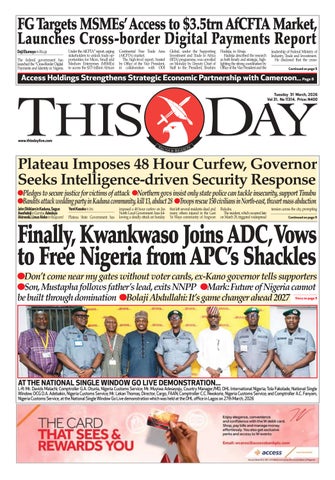
Finally, Kwankwaso Joins ADC, Vows to Free Nigeria from APC’s Shackles

Don’t come near my gates without voter cards, ex-Kano governor tells supporters Son, Mustapha follows father’s lead, exits NNPP Mark: Future of Nigeria cannot be built through domination Bolaji Abdullahi: It’s game changer ahead 2027

L-R: Mr. Davids Malachi; Comptroller G.A. Otunla, Nigeria Customs Service; Mr. Muyiwa Adeseyoju, Country Manager/MD, DHL International Nigeria; Tola Fakolade, National Single Window; DCG D.A. Adebakin, Nigeria Customs Service; Mr. Lekan Thomas, Director, Cargo, FAAN; Comptroller C.C. Nwokorie, Nigeria Customs Service; and Comptroller A.C. Fanyam, Nigeria Customs Service, at the National Single Window Go Live demonstration which was held at the DHL office in Lagos on 27th March, 2026

OANDO CLEAN ENERGY AGENDA ONE DAY WORKSHOP ON BIODEGRADABLE TECHNOLOGY...

L-R: Director II, Pollution Control and Environmental Health, Omotunde Adeola; Representative of the Hon. Commissioner of Environment and Climate Change, Kano State, Dr. Umar Saleh Anka; Hon. Minister of Environment, Mallam Balarabe Abbas Lawal; Vice President, Business and Opportunity Maturation, Oando Clean Energy Limited, Hadiza Adukonu; and Director, Pollution Control and Environmental Health, Engr. Bahijjahtu H. Abubakar, FNSE, at the Oando Clean Energy Agenda One Day Workshop on Biodegradable Technology in Single Use Plastics, held at the Federal Ministry of Environment, Maitama, Abuja …recently

Edun: FG Prioritising Capital Deployment, Project Expansion to

Drive Jobs, Sustainable Growth

FG, Islamic Development Bank seal deal

Nume Ekeghe and Funmi Ogundare

Minister of Finance and Coordinating Minister of the Economy, Wale Edun, yesterday, said the federal government was shifting focus towards aggressive capital mobilisation and large-scale project execution to drive job creation and sustain economic growth.

Edun, who spoke at the Islamic Development Bank (IsDB) Group Day in Lagos, said Nigeria was transitioning from a phase of macroeconomic stabilisation to one anchored on growth acceleration and investment mobilisation under the Renewed Hope Agenda of President Bola Tinubu.

The federal government, also yesterday, signed a partnership and strategic agreement on Country Engagement Framework with IsDB, aimed at deepening collaboration and expanding development financing in Nigeria.

According to Edun, the administration’s priority is to channel investments into productive sectors capable of expanding output, boosting incomes and reducing poverty.

He explained, “Clearly, we are moving from the stabilisation of the economy to a trajectory of growth, acceleration and investment mobilisation.

“It is investments that increase productivity, grow the economy, create jobs, give people incomes and reduce poverty, and that is the

overall aim of the macroeconomic agenda of the president.

“Our mission, as laid out by Mr President, is very clear: to build a $1 trillion economy powered by productive sectors, private capital, innovation and technology. To achieve this, we are prioritising a fundamental shift from reliance on public financing to mobilising private sector investment at scale.”

Edun added, “Our focus now is on mobilising capital, executing projects and creating jobs at scale. The range of projects across sectors technology, climate action and agriculture must be expanded to meet the needs of a large country with significant employment demands.

“Nigeria is building an economy that is resilient by design, inclusive in its approach and globally competitive in ambition. We are strengthening domestic production and refining capacity, enhancing resilience, and ensuring sustainable growth.”

The minister described Nigeria’s partnership with IsDB as strategic, stating that both parties are focused on attracting capital with purpose that delivers measurable social and economic impact.

He outlined four key pillars of the collaboration, including infrastructure development across energy, agriculture and digital networks; social inclusion aimed at bringing millions into productive activity; expansion of innovative finance instruments, such as Sukuk; and

strengthening regional cooperation.

He said the government designated 2026 as “Year of Social Development,’ with plans to integrate up to 10 million Nigerians into economic activity through job creation and skills development.

Edun stated that the government was scaling up the use of non-interest finance and blended funding structures to unlock investments in housing, digital services, and the creative economy, positioning Nigeria as a hub for Islamic finance in Africa.

He stated, “Our partnership with the Islamic Development Bank is both timely and strategic. We are working together to attract what we call capital with purpose investment that delivers not only

financial returns but also measurable social and economic impact.

“We are also focused on mobilising savings at all levels, including mass savings schemes, so that Nigerians can earn returns and participate in financing national growth.

“In this way, domestic savings will play a major role in supporting production and economic expansion.”

Speaking on the agreement framework, Edun explained that it would span three years, covering the period from 2026 to 2028.

He emphasised the critical role of investments that deliver both financial stability and tangible social outcomes.

According to him, as Nigeria transitions from economic stabilisation to a period of robust expansion

in 2026, “Our focus is firmly set on growth acceleration and investment mobilisation.”

He said, “This journey towards a $1 trillion economy by 2030 requires capital with purpose, investments that bridge the gap between financial stability and tangible social outcomes.”

He said the strategic partnership with IsDB and the country engagement framework 2026-2028 were key drivers of the ambition, adding that through it, Nigeria aims to modernise infrastructure, industrialise agribusiness, and integrate 10 million Nigerians into productive economic activity.

“Through our strategic partnership with IsDB and the implementation of the Country Engagement Framework

2026-2028, we are modernising our infrastructure, industrialising our agribusiness, and bringing 10 million Nigerians into productive economic activity,” Edun said. He emphasised that with about 600,000 graduates produced annually, the country must focus on job-rich investments capable of generating employment on a large scale, stressing that reforms must translate into measurable improvements in living standards.

Edun also emphasised the importance of resilience in the face of global political and economic uncertainties, stating that Nigeria must strengthen institutions, deepen strategic partnerships, and implement sound policies to cope with emerging challenges.

Tuggar Resigns from Tinubu’s Cabinet, Set to Join Bauchi Governorship Race

Michael Olugbode in Abuja

The rumoured interest of the Minister of Foreign Affairs, Ambassador Yusuf Tuggar in becoming the Governor of Bauchi State come 2027 may have been confirmed he resigned yesterday, to prepare ground for actualising his political ambition. The resignation was ahead of the

deadline set for political appointees seeking elective positions in the forthcoming general elections.

In a resignation letter submitted to the office of the Secretary to the Government of the Federation, Tuggar expressed gratitude to President Bola Tinubu for the opportunity to serve the country and contribute to the implementation of the administration’s Four-D

foreign policy strategy.

The former minister also appreciated the management and staff of the Ministry of Foreign Affairs and members of the diplomatic community for their cooperation and support throughout his tenure.

During his time in office, Tuggar was credited with advancing Nigeria’s foreign policy objectives through initiatives focused on

Oando Drives Policy Dialogue on Biodegradable Technology for Single-use Plastics

Emmanuel Addeh in Abuja

Oando Clean Energy Limited (OCEL), a subsidiary of Oando Plc, one of Africa’s leading indigenous energy solutions providers, in partnership with the Federal Ministry of Environment has convened a one-day workshop in Abuja workshop on advancing biodegradable technology solutions for single-use plastics in Nigeria. Major participants at the event included: Key government stakeholders, regulators, and

industry players, a statement by the company said. The workshop brought together representatives from the Federal Ministry of Environment, Standards Organisation of Nigeria (SON), National Agency for Food and Drug Administration and Control (NAFDAC) and State Commissioners for Environment.

Others were: The academia, other relevant agencies, and manufacturing stakeholders to address the growing challenge of plastic waste leakage and

explore scalable, science-driven interventions.

Delivering the keynote address, the Minister of the Federal Ministry of Environment, Mallam Balarabe Lawal, spoke passionately about the far-reaching effects of plastic pollution on the environment and agricultural activities.

He highlighted how plastic waste clogs waterways, degrades soil quality, and poses serious risks to livestock, which often ingest plastic materials, leading to illness or death. He further emphasised that plastic

pollution contributes to ecosystem imbalance, threatens biodiversity, and introduces microplastics into the food chain, ultimately impacting human health.

Providing a technical deep dive, the Chief Strategy Officer of Polymateria – Andrew Webster, demonstrated the company’s proprietary Biotransformation technology, noting its suitability for Nigeria’s climatic conditions.

“Nigeria is a perfect climatic environment for the technology as it combines high heat, high humidity,

moisture, and high exposure to sunlight, which are the factors that cause the plastic to biodegrade over a short period of time, breaking down into a recognisable food source for bacteria,” he explained.

The technology, delivered through a masterbatch additive incorporated at approximately 2 per cent during manufacturing, he said , remains stable throughout its intended shelf life and only activates when exposed to environmental triggers such as UV light, heat, and air.

people-centred diplomacy. These included humanitarian evacuations, facilitation of scholarships for Nigerians abroad, and sustained support for citizens in the diaspora. His tenure also witnessed increased diaspora engagement, including efforts to develop a structured database of Nigerians living abroad aimed at strengthening their participation in national development.

In addition, Tuggar strengthened bilateral and multilateral relations through strategic engagements with traditional partners and regional alliances, particularly across the Global South. His leadership also promoted regional security cooperation and supported the formation of the Regional Partnership for Democracy initiative. He also prioritised economic diplomacy, positioning Nigeria as an attractive destination for foreign investment, especially in the energy sector, while facilitating diplomatic interventions that secured the release of detained Nigerians in foreign countries and improved bilateral relations.

OLAWEPO-HASHIM ENGAGES ACCORD PARTY...

L-R: Salaudeen Abdulazeez Oyeniyi, Accord Party National Treasurer; Hon. Adebukola Abiola Ajaja, National Secretary, Accord Party; Dr. Gbenga Olawepo-Hashim; Barrister Maxwell Mgbudem, National Chairman, Accord Party; and Hon. Ibe ThankGod, Organising Secretary, Accord Party, during the visit over the weekend

Adelabu: FG’s N501bn Bond Signals End to Power Sector Liquidity Crisis

Stakeholders seek scaled-up energy efficiency in Nigerian industries

Emmanuel Addeh and Michael Olugbode in Abuja

The Minister of Power, Adebayo Adelabu, has said that the recently floated N501.02 billion bond issuance was a major step towards ending the prolonged liquidity in the power sector and repositioning the electricity market for long-term sustainability.

Special Adviser on Strategic Com- munications and Media Relations to the minister, Bolaji Tunji, in a statement in Abuja yesterday, recalled that the bond executed through the Nigerian Bulk Electricity Trading Plc (NBET) was part of a broader N4 trillion Presidential Power Sector Debt Reduction Programme approved by President Bola Tinubu. Adelabu stated that the move represents a strategic shift from ad hoc interventions to structured, market-driven solutions. Designed to clear a significant portion of the

over N6 trillion cumulative debt burden crippling the sector, the initiative, he said, underscores a reform-focused approach aimed at addressing long-standing structural inefficiencies.

“At the heart of the reform is the drive to stabilise the Nigerian Electricity Supply Industry (NESI) by improving cash flow across the value chain. Chronic revenue shortfalls, largely due to non-cost-reflective tariffs and underfunded subsidies, had left generation companies unable to meet obligations to gas suppliers and maintain critical infrastructure.

“The bond proceeds are expected to reverse this trend by settling legacy debts, restoring gas supply, and enabling improved plant maintenance—key factors in boosting electricity generation.

“Beyond immediate liquidity support, the intervention signals renewed investor confidence in

the sector. Backed by a sovereign guarantee and aligned with global financing standards, the bond is positioned to attract private capital, enhance bankability, and stimulate further investments in generation and infrastructure.

“Complementary reforms, including targeted subsidies for vulnerable consumers and ongoing tariff adjustments, reflect a broader policy framework aimed at achieving full commercialisation,” Adelabu stated.

Providing insight into the reform, Adelabu explained that the bond issuance is central to restoring confidence and unlocking growth across the electricity value chain.

He added:, “This intervention is not just about settling debts; it is about resetting the foundation of the power sector. By restoring liquidity, enhancing bankability, and creating a more predictable investment

climate, the government is laying the groundwork for sustainable growth and improved electricity supply.”

He stressed that the initiative, alongside targeted subsidies and tariff reforms, reflects a deliberate policy shift towards full commercialisation and long-term viability of the sector.

According to the minister, while challenges such as transmission constraints and revenue adequacy persist, the bond initiative marks a critical turning point and highlights a coordinated effort to move the sector away from systemic inef- ficiencies towards a more viable, investor-friendly model.

Meanwhile, stakeholders from government, the organised private sector, development agencies, and civil society have called for stronger collaboration and expanded financing to accelerate the adoption of energy-efficient and cleaner

Otti: Abia Moves to Exit from National Grid

Abia State is set to disconnect from the national grid once a 125-megawatt gas turbine is added to Geometric Power, Aba, which currently has 141 megawatts capacity.

Governor Alex Otti announced this at a media chat, citing efforts to generate, transmit and distribute the state’s own power.

The new gas turbine would boost Geometric Power’s capacity to 266 megawatts, enough to also supply power to Umuahia and environs, with excess power for sale.

Eight local governments in the Aba ring-fence area have detached from the national grid with Geometric Power’s operation and the state is concetrating efforts on providing independent power for the remaining eight local governments so as to detach them from the national grid.

Otti also announced that Abia State University, Uturu (ABSU), would also disconnect from the national grid upon completino of a 15-megawatt independent power project.

The Governor had earlier that day restored power to ABSU after 13

years of darkness by inaugurating a 5-megawatt substation.

He revealed that the 15 megawatts independent power station was a proposed bigger solution to the nagging power problem in ABSU and environs

At the monthly media chat tagged

“Alex Otti Speaks to Abians,” the Governor said: “Today again, we were able to restore public power to Abia State University.

“So, we had the honor and privilege to commission and switch on the substation. So anytime there is power in the grid, Abia State University will have power.

“We also have another solution that is coming and that is an independent power of about 15 megawatts which will be powered by gas turbines.

“We just signed off on that. It will take a little bit of time, but by the time it’s done, Abia State University may decide to detach from the national grid.

“Of course, the rest of the state will also be detaching from the national grid by the time we are done with the solutions we are trying to provide from Geometric, Aba,” he added.

The Governor disclosed that the Commissioner for Power and Public Utilities, Mr. Monday Ikechukwu, has identified a General Electricbuilt 125 megawatts gas turbine in the Netherlands for Geometric to acquire.

He said when that is added to Geometric’s three turbines which

currently generate 141 megawatts, the company would be able to extend power supply to Umuahia and environs which requires about 100 megawatts.

“If we are able to generate enough power from the existing independent power company, we don’t need to build one in Umuahia,” he said.

production practices in Nigeria’s industrial sector.

The call was made yesterday during a special project-specific interactive session and ‘Efficiency Champions Competition’ organised under the Global Environment Facility and United Nations Industrial Development Organisation Industrial Energy Efficiency and Resource Efficient and Cleaner Production project in Abuja.

The event brought together representatives of industries, non-governmental organisations, financial institutions, policy makers, and members of the media to review the progress of the initiative and explore opportunities for expanding sustainable industrial practices across the country.

Speakers at the session emphasised that improving energy efficiency and reducing waste in industrial operations are essential for lowering production costs, boosting competitiveness and promoting environmentally responsible manufacturing.

Opening the session, the project leadership said the initiative had recorded significant progress in promoting industrial energy efficiency and resource-efficient production methods within Nigeria’s manufacturing sector.

According to the National Project Coordinator, GEF-UNIDO IEE and RECP Project, Jacob Oladipo, the

project has supported capacity building programmes, cleaner production assessments, policy engagement and innovative financing mechanisms designed to help industries reduce energy consumption while improving productivity.

He explained that the project had demonstrated that sustainable industrial practices are not only environmentally responsible but also economically beneficial to businesses.

The session also provided an opportunity for stakeholders to review the outcomes of the project and identify lessons that could support the wider adoption of energy-efficient technologies and cleaner production systems across industries.

In a goodwill message delivered on behalf of the Nigerian Association of Chambers of Commerce, Industry, Mines and Agriculture, Mr. Kunle Fadare said the initiative was both timely and strategic for Nigeria’s industrial growth.

He noted that the industrial sector accounts for more than 30 per cent of the country’s total energy consumption but still operates far below optimal efficiency levels. Fadare said studies have shown that improvements in energy efficiency within Nigerian industries could lead to savings of between twenty and forty per cent in energy use.

Tinubu Names Ibrahim Ida CAC Chairman, Nominates Seven as National Population Commissioners

Confirms Bala Bello as Special Adviser on Political Economy

Deji Elumoye in Abuja

President Bola Tinubu has appointed Dr Ibrahim Ida as Chairman of Corporate Affairs Commission (CAC) and nominated seven people to fill vacant commissioner-positions at National Population Commission (NPC).

Ida holds an MSc in Banking and Finance from the University of Ibadan (1983) and an LLB from the University of Abuja (2003). Before being elected to Senate in 2017 to represent Katsina Central, he served as Commissioner for Finance in Katsina

State and Permanent Secretary, Federal Civil Service.

According to a release issued on Monday by presidential spokesperson, Bayo Onanuga, the seven people nominated as Federal Commissioners to represent their respective states in NPC are Kolawole Oladipupo Alabi – Ekiti State; Nasiru Mu’azu – Zamfara State; Usman Abubakar Tuggar – Bauchi State; Dr Isaka Alada Yahaya – Kwara State; Professor Sadiq Isah Radda –

Katsina State; Suleiman Umar – Jigawa State, and Hon. Chiso Abdullahi Dattijo – Sokoto State.

The appointments, which complement other Federal Commissioners already sworn in, are subject to confirmation by the National Assembly, according to the release.

The president also appointed Dr Yusuf Mohammed of Kano State as Chairman of Federal Polytechnic, Kaltungo.

Tinubu confirmed the appointment of Bala Mohammed Bello as his Special

Adviser on Political Economy. Bello, from Kebbi State, holds a Bachelor’s Degree in Accounting and an MBA from Ahmadu Bello University, Zaria. Before this appointment, he was a Deputy Governor at the Central Bank of Nigeria (CBN). He also served as Executive Director (Corporate Services) at Nigerian Export-Import Bank from 2017 to 2022. The statement said Tinubu believed in the capacities of the appointees to put in their best to further the administration’s commitment to a better lease of life for Nigerians.

Boniface Okoro in Umuahia

HIGH LEVEL ENGAGEMENT BETWEEN

L-R: Aigboje Aig-Imoukhuede, CFR, Chairman, Access Holdings PLC; Joseph Dion Ngute, Prime Minister of the Republic of Cameroon; and Patience Melone, Chairperson, Access Bank Cameroon, during a high level engagement between Access Bank and the Government of Cameroon in Yaoundé …recently

Access Holdings Strengthens Strategic Economic Partnership with Cameroon

Access Holdings Plc has strengthened its strategic engagement with the Government of Cameroon, as part of efforts to deepen economic cooperation and support the country’s long-term development agenda.

Chairman of the group Aigboje Aig-Imoukhuede led a delegation on an official visit to Cameroon, where he met with the country’s Prime Minister, Joseph Dion Ngute.

The engagement underscores the growing alignment between Access Holdings and the Cameroonian government, with both parties seeking to unlock investment opportunities and drive sustainable economic growth.

The holding in a statement noted that Aig-Imoukhuede was accompanied by senior executives of

Access Bank Cameroon, including Chairperson, Patience Melone; Managing Director, Ellis Nzo Asu; Deputy Managing Director, Ugochukwu Irechukwu; and Head, Public Sector, Rowland Mangwa.

It stated: “Discussions focused on strengthening collaboration between Access Bank Cameroon and the Government, particularly in priority areas critical to national development.

“These include enhancing public finance management frameworks, improving access to foreign exchange for key sectors, expanding infrastructure financing, and supporting the growth of sustainable and resilient economic systems.”

Speaking after the meeting, Mr. Aig-Imoukhuede, reaffirmed Access Holdings’ commitment to partnering the Cameroonian government to unlock economic opportunities,

stimulate investment, and drive inclusive growth.

Access Bank Cameroon also reiterated its dedication to sup-

porting the country’s long-term development objectives through the delivery of innovative financial solutions aligned with national

strategic priorities. This engagement further reinforces Access Holdings’ position as a trusted partner to governments

across Africa, leveraging its deep expertise and regional footprint to promote economic stability, growth, and shared prosperity.

Lalong: LGs Critical to Nigeria’s Socio-economic Transformation

Sunday Aborisade in Abuja

Former Plateau State governor and senator for Plateau South Senatorial District in the 10th Senate, Senator Simon Lalong, on Monday underscored the pivotal role of local governments in driving Nigeria’s socio-economic transformation, declaring that the third tier of government remains critical to national development.

Lalong made the assertion in Abuja at the inauguration of the new leadership of Association of Local Governments of Nigeria (ALGON), where he was also unveiled as patron of the body.

Acting National President of ALGON, Hon. Iliyasu Zakari, pledged that the association would take deliberate steps to popularise and implement President Bola Tinubu’s Renewed Hope Agenda

Women Group Canvasses Legislative Support for Equality, Increased Appointment, Others

The Renewed Hope Female Aspirants Network (RHFAN) has called on the legislature to create mechanisms that will support gender equality, electoral opportunities for female aspirants as well as capacity development and funding support for women.

According to the group, to progress in increasing women’s representation in Nigerian politics requires 35% affirmative action in political appointments at all govern- ment levels.

Speaking in Abuja on Monday during a press briefing themed “Women Rising: A Renewed Hope for Inclusive Political Participation”, the keynote speaker and national

spokesperson of RHFAN, Dr. Judith Ogbara, said the leadership of the group has been vocal about the need for deliberate inclusion of women in decision-making positions as the group aligns itself with President Bola Tinubu’s renewed hope agenda which emphasizes national develop- ment and democratic consolidation.

According to Ogbara, the group’s key demands include “increased political appointments for women, support for female candidates, and legislative backing for gender equality. They also seek capacity development and funding for female aspirants.

“RHFAN’s initiative has sparked hope for a more inclusive democracy. The coalition is mobilizing, mentoring, and supporting women across

Nigeria’s geopolitical zones.

“Government response has been positive, with President Tinubu’s administration showing commitment to the renewed hope agenda. However, RHFAN seeks concrete actions, including policy changes and support systems for female aspirants”.

She added that as RHFAN pushes forward, the focus is on collaboration with government, civil society, and stakeholders to build a more inclusive political landscape in Nigeria and the goal is a future where women are key decision-makers shaping Nigeria’s destiny. In her combined welcome address, the national coordinator of RHFAN, Hon. Tonbra Sebrina Ekiotenne, said when women are

added in decision making processes, governance becomes more inclusive, policies become more responsive, and national development becomes more balanced and sustainable.

She noted the country cannot truly thrive when half of its population is underrepresented in governance and for this reason, political parties, government institutions and all stakeholders must move beyond rhetoric and commit to real, measurable inclusion of women in elective and appointive positions.

She said, “As women, we are not just beneficiaries of this vision, we are key drivers of it. At RHFAN, we are committed to identifying, supporting, and empowering women across Nigeria to take their rightful place in leadership.”

across all the 774 local government areas in the country.

Lalong stressed that no meaningful national progress could be achieved without a functional and empowered local government system, stating that governance must be rooted at the grassroots to deliver real impact.

According to him, effective admin- istration at the local level holds the key to unlocking development across sectors, including infrastructure, healthcare, education, and agriculture.

“Local governments are central to national development because they are closest to the people. If governance does not work at that level, it will be difficult to achieve meaningful progress at the national level,” Lalong said.

He commended Tinubu for his consistent advocacy for local government autonomy, describing it as a critical reform necessary for deepening democracy and improving service delivery.

Lalong said Tinubu’s commitment to strengthening the third tier of government predated his presidency, adding that recent policy actions by the administration reflect a deliberate effort to reposition local governance in Nigeria.

He stated, “I know the president appreciates the role of local govern- ment chairmen and councillors. That is why he continues to emphasise autonomy and the need to give local governments the attention required for effective administration.”

The former governor revealed

that the National Assembly was working assiduously to resolve constitutional issues surrounding local government autonomy through ongoing amendment processes. He expressed optimism that the exercise would soon yield results, paving the way for the full implementation of reforms aimed at empowering local councils.

He added, “The constitutional amendment process is ongoing, and those issues are at the front burner. Very soon, Nigerians will see the outcome of these efforts geared towards strengthening governance at the grassroots.”

Lalong urged local government leaders to go beyond administrative functions by mobilising support for federal government policies within their respective domains.

He emphasised the need for synergy between federal, state, and local governments to ensure that development initiatives were effectively implemented across the country.Zakari, who also serves as Chairman of Agwara Local Government Council in Niger State, described his inauguration as a defining moment for ALGON, signalling a renewed commitment to aligning grassroots governance with national priorities.

He said the new leadership would strengthen collaboration with key stakeholders, particularly the Nigeria Governors’ Forum, to ensure that federal policies translate into tangible benefits for citizens at the local level.

Ribadu: Strategic Communication, Women’s Empowerment Key to National Security

Policies without effective communication mere ‘paper dreams,’ Bala Usman says

Sunday Aborisade in Abuja

National Security Adviser (NSA), Mallam Nuhu Ribadu, has underscored the critical role of strategic communication and women’s empowerment in strengthening Nigeria’s national security architecture, declaring that inclusive narratives are indispensable for fostering peace, resilience, and social cohesion.

Ribadu, represented by National Coordinator of the National Counter Terrorism Centre (NCTC), MajorGeneral Adamu Laka, spoke at a high-level event yesterday in Abuja to commemorate International Women’s Day.

The event was organised in collaboration with Nigerian Institute of Public Relations (NIPR).

It was attended by Deputy Governor of Ogun State, Noimot Salako-Oyedele; Chairman, Nigeria Governors’ Wives Forum, Olufolake Abdulrazak; female ministers and

heads of federal government ministries, departments and agencies, female envoys in Nigeria, development partners, among others.

Ribadu said Nigeria must move beyond traditional security responses and embrace preventive, people-centred approaches rooted in effective communication and gender inclusion.

Quoting the late poet Ntozake Shange — “Where there is a woman, there is magic” — Ribadu emphasised that the theme of the event, “Communicate to Balance, Gain Equity, Empower Women,” reflected the growing importance of narratives in shaping national outcomes, particularly in an era of complex security challenges.

He warned that narratives, if poorly managed, could deepen divisions, but when strategically deployed, could build trust, unity, and national cohesion.

“The way narratives are con-

structed and shared can either divide us or unite us. In today’s security environment, communication is not optional; it is central to achieving sustainable peace,” he said.

The NSA stressed that modern security threats, including terrorism and violent extremism, required a shift from purely kinetic approaches to preventive frameworks that prioritised inclusivity, community engagement and gender balance.

He stated, “For us at the NCTC, sustainable security goes beyond force. It is anchored on preventive strategies embedded in our national frameworks for countering violent extremism.”

He described women as critical actors in peace-building, early warning systems, and community stabilisation efforts.

Ribadu said, “Women are not just caregivers; they are leaders, mediators and educators whose influence cuts across generations. Their inclusion in

governance and security processes is not optional, it is essential.”

He stated that collaboration with NIPR underscored the importance of professional communication in shaping public perception, combating misinformation, and strengthening trust between government and citizens.

In her keynote address, Special Adviser to the President on Policy and Coordination, Hadiza Bala Usman, reinforced the argument that communication was the backbone of effective governance.

She warned that no matter how well-designed, policies could not succeed without proper dissemination and public understanding.

“A policy document gathering dust changes nothing. A brilliant initiative that cannot be explained to the people has no value beyond the paper it is written on,” she said.

Usman described communication as a transformative tool capable of

dismantling systemic inequalities, particularly those affecting women.

Drawing a distinction between equality and equity, she explained that while equality assumed uniform distribution, equity addressed structural disadvantages.

“Equality gives everyone the same shoe size; equity ensures everyone gets a shoe that fits,” she stated, stressing that poorly designed policies often exclude women.

Usman cited data indicating that Nigeria’s gender gap continued to hinder economic growth, stating that closing the gap in workforce participation can increase the country’s Gross Domestic Product by up to 30 per cent.

“Women reinvest as much as 90 per cent of their income into their families and communities. Investing in women is not just social justice; it is smart economics,” she added.

Usman identified barriers, such as limited access to finance, cultural

FINALLY, KWANKWASO JOINS ADC, VOWS TO FREE NIGERIA FROM APC’S SHACKLES

Chuks Okocha, Folalumi Alaran in Abuja and Ahmad Sorondinki in Kano

The strong man of Kano politics and former governor of the state, Senator Rabiu Musa Kwankwaso, yesterday finally registered as a card-carrying member of the fledgling opposition African Democratic Congress (ADC) after months of uncertainty about

his political future. In the presence of the massive crowd that had gathered to witness the epoch-making move, he told his supporters that going forward, he would not allow anybody to pass the gates of his house without the ADC and Independent National Electoral Commission (INEC) voter cards. This, he said, was a clear message on how seriously he considered the

2027 elections, and therefore, urged the people to go out and ensure that they register with the ADC and the INEC.

Kwankwaso’s movement yesterday ended the long, uneasy and unofficial courtship between him and the ruling All Progressives Congress (APC), collapsing in a spectacular fashion, after years of shadowy negotiations with President

Bola Tinubu and his party.

The final straw after prolonged talks appeared to be the calculated political poaching of his son-in-law and Kano’s sitting governor, Abba Yusuf, his political godson, by the APC, a development the former Kano governor has severally described as an act of betrayal.

THISDAY recalls that talks between Kwankwaso and the President

constraints, and workplace policies that disproportionately affected women, especially during childbearing years, urging leaders to create enabling environments that support women’s advancement.

She called for a shift from symbolic gestures to concrete reforms that addressed systemic inequalities and emphasised the need for data-driven storytelling to highlight the benefits of gender inclusion.

date back to the turbulent build-up to the 2023 elections, when backchannel efforts were first initiated to fold Kwankwaso’s formidable Kano politi- cal base into the orbit of the APC. At the time, negotiations stalled over irreconcilable demands, including Kwankwaso’s alleged insistence on getting the vice presidential ticket under the ruling party. Even after the 2023 elections,

PLATEAU IMPOSES 48 HOUR CURFEW, GOVERNOR SEEKS INTELLIGENCE-DRIVEN SECURITY RESPONSE

swift action from state authorities.

In a statement issued by Commissioner for Information and Communication, Hon. Joyce Ramnap, the government condemned the “barbaric and unprovoked attack on innocent citizens”.

Plateau State Governor Caleb Mutfwang urged security agencies to abandon routine peacekeeping tactics and adopt a more aggressive, intelligence driven approach.

Reacting to the latest carnage, Northern States Governors’ Forum (NSGF) reiterated the position that the nature and complexity of the country’s security challenges required localised, intelligence-driven responses that only state policing could effectively provide.

In other incidents, bandits attacked a wedding party on Saturday night at Kahir village, Kagarko Local Government Area of Kaduna State, killing 13 per-sons and abducting 28 others.

Troops of the Joint Task Force (North East), Operation Hadin Kai (OPHK), rescued more than 150 civilians and foiled a mass

abduction attempt by Boko Haram/ ISWAP terrorists on March 30. A statement by Media Information Officer of Operation Hadin Kai, Lieutenant-Colonel Sani Uba, said the incident occurred about 1450 hours in Sector 2.

The curfew in Jos North Local Government Area took effect from midnight on Sunday and would remain in force until April 1, the Plateau State government said. Government officials said the measure was necessary to prevent further breakdown of law and order while security agencies worked to track down perpetrators of the latest killings.

Mutfwang assured residents that security operatives had been deployed to restore calm and protect life and property.

While receiving Deputy Inspector General of Police in charge of Operations, Umar Shehu Nadada, who visited Government House, Jos, on the directive of Inspector General of Police, Olatunji Disu, Mutfwang described the killings as “cowardly and utterly senseless”.

The governor lamented that innocent citizens were attacked while going about their lawful activi-ties, warning that the incident signals a dangerous shift towards “urban terrorism”.

He stated, “It is deeply heartbreaking that a city we have long regarded as one of the most peaceful in the region has witnessed such horror. We are now confronted with an emerging phase of urban terrorism, and this demands a fundamental rethink of our security architecture, shifting from reactive responses to proactive, intelligence led operations.”

The governor disclosed that security agencies had already made progress, including the arrest of a suspect accused of circulating inciting information capable of escalating tensions.

He charged security operatives to intensify intelligence gathering and ensure that all perpetrators and their sponsors were tracked down and prosecuted.

While commending the youth and residents of the affected community

for maintaining calm, Mutfwang emphasised the need for stronger collaboration between government, security agencies, and local communities.

He insisted that criminal elements must be confronted decisively and treated as enemies of the state.

“The time for hesitation is over. We must deploy every available resource to defend our people, protect lives and property, and safeguard the territorial integrity of our state,” he declared.

Mutfwang assured the people of continued government support in logistics, coordination, and operational backing.

He said, “We will not allow Plateau to lose its testimony as a place of peace. Those responsible for this evil act will not escape justice. One of the individuals who issued threats on social media has already been arrested, and we will pursue the rest.”

The governor urged residents, especially traditional rulers, religious leaders, and community stakeholders, to remain vigilant and provide

timely information to security agencies.

“Without information, we cannot do much,” he added, appealing to youths to continue to exercise restraint and avoid taking the law into their hands.

He also directed community leaders to meet with government officials after the evacuation of the corpses to harmonise strategies for strengthening security and preventing further attacks.

Earlier, Nadada said his visit was part of a fact finding and operational assessment mission ordered by the Inspector General of Police.

He confirmed that additional personnel, including Police Mobile Force units and intelligence operatives, had been deployed to restore order and pursue those responsible for the attack.

“We are here to assess the situation first-hand and implement effective strategies to neutralise these criminal elements,” Nadada stated.

He added that security agencies

Tinubu seeking to broaden his governing coalition, resumed contacts with Kwankwaso, meeting at different times with him. Besides, emissaries shuttled between both camps through 2023 and into 2025, exploring a possible rapprochement that would see Kwankwaso align with the APC.

But the talks repeatedly ran aground on mutual distrust as Kwankwaso was said to be wary of being politically diminished within a party already dominated by entrenched interests, while the APC leadership remained cautious about conceding too much leverage to a rival power bloc with a strong independent base. But Kwankwaso spoke yesterday when he and his son, Mustapha, left their former party, the New Nigeria Peoples Party (NNPP) to pitch tent with the opposition ADC. Kwankwaso specifically vowed to free Nigerians from the shackles of the ruling APC after he officially registered with the ADC in Kano. The former presidential candidate of the NNPP, registered at his Miller road residence with the registration number 000201, in a ceremony where he was surrounded by party supporters and other opposition leaders.

In a short speech, Kwankwaso urged Nigerians to use their votes to free the country from the tight grip of the ruling APC’s alleged misgovernance, economic hardship, and insecurity.

“I am so happy today that I have collected my membership card, I urge

FG TARGETS MSMES’ ACCESS TO $3.5TRN AFCFTA MARKET, LAUNCHES CROSS-BORDER DIGITAL PAYMENTS REPORT

border payments report followed earlier milestones, including the development and launch of Nigeria’s Digital Trade Strategy and a capacity-building programme for subnational leaders.

According to him, Nigeria is increasingly assuming a leading role in shaping the digital trade agenda across the African continent, necessitating that the country remains at the forefront of AfCFTA implementation.

Hadejia said deepening engagement with AfCFTA and enabling businesses, particularly SMEs, to conduct seamless cross-border transactions will be critical to unlocking trade, fostering growth, and creating jobs.

He stated that efficient crossborder payments, supported by trusted digital identity systems, as recommended in the report, will be key to realising President Bola Tinubu’s Renewed Hope vision for Nigerian MSMEs. Hadejia also observed that while the report identified the Pan-African Payment and Settlement System as a critical platform for cross-border digital payments, Nigerian fintech firms, such as PalmPay and Moniepoint, which had some of the largest and most active user bases, will play a pivotal role in driving adoption. He assured that the federal government remained committed to strengthening critical infrastructure,

regulatory frameworks, and partnerships to ensure Nigeria was not only ready for digital trade but also continued to lead.

“I appreciate the efforts of all stakeholders and urge us to move AfCFTA beyond a continental agreement to a $3.5 trillion trade juggernaut that will reinvigorate our industries, unlock intra-African trade, and domesticate African prosperity,” he added.

Hadejia stated that intra-African trade will be driven not only by large corporations but also by small businesses empowered through digital trade and e-commerce. He said issues of trust, identity, and logistics, as highlighted in the report, must be addressed.

Commenting on the report, Special Adviser to the President on Job Creation and MSMEs, Temitola Adekunle-Johnson, said the report would significantly strengthen the MSME ecosystem.

Adekunle-Johnson explained that cross-border payments in Nigeria and across Africa had historically been largely informal and inefficient, said the emergence of the Bank Verification Number (BVN) and National Identification Number (NIN) systems was changing the landscape.

Adekunle-Johnson expressed optimism that the report’s findings and recommendations would enable Nigerian SMEs to achieve seamless access to continental

markets.

Earlier, Special Assistant to the President on ICT Policy, Office of the Vice President, Salihu Dasuki, disclosed that the office, in partnership with development partners, had developed a framework to fast-track seamless cross-border payments for MSMEs.

Dasuki added that a key pillar of Tinubu’s Renewed Hope Agenda was enabling Nigerians to access digital trade. He said this was what informed the capacitybuilding programme conducted for subnational governments last year.

Special Assistant to the President on Project Support, Office of the Vice President, Shuda Ahmed, commended ODI Global for

leading the research underpinning the report.

Ahmed stated that without seamless and affordable crossborder payment systems, MSMEs across the continent would be unable to scale beyond their domestic markets.

The event was attended by officials of ODI Global, representatives of AfCFTA, National Information Technology Development Agency (NITDA), National Identity Management Commission (NIMC), Nigerian Petroleum Development Company (NPDC), Federal Competition and Consumer Protection Commission (FCCPC), and MSMEs, among other key stakeholders.

Mallam Ribadu

SCALE WI iDI

iDICE Star tup Bridge offers solid foundations, strong operations, and practical tools for grow th to take your star tup to the next level.

WHO IT IS OPEN TO

* Nigerian Citizens 18 -35 years

* Individuals with tech startup ideas

* Idea and early-stage founders

* Star tups with MVPs ready to grow and scale

For more enquiries, visit www.idice.ng

Nigeria Sover eign Investment Authority - 2025 Ear nings

Acting Group Politics Editor DEJI ELUMOYE

Email: deji.elumoye@thisdaylive.com

08033025611 sms only

A Night of Horror in Jos: But Who Will Act?

Iyobosa Uwugiaren writes that the killings in Jos on Sunday, is not just another incident but a recurring horrendous, one that exposes, yet again, the deep cracks in Nigeria’s security architecture.

On Sunday night in Jos, the Plateau state capital sorrow arrived before dawn. It sneaked through narrow side road and broken doorways, settling heavily on homes where laughter had echoed just hours earlier. By morning, mothers were no longer calling their children to wake—they were identifying lifeless bodies in Angwa Rukuba Junction and surrounding areas in Jos.

Survivors were whispering the names of the dead like prayers, each one a painful reminder that in Jos, death has become too familiar, and safety too distant.

By morning – the next day, more than 40 lives had been snuffed. Even the arrival at the scene of Plateau State Governor, Caleb Mutfwang, could not comfort the grieving relatives of the victims. His presence, though important, did little to ease the raw agony or quiet the boiling anger of a community once again left to mourn its dead. And like someone said, it was unambiguous reminder that leadership, too often, appears after the tragedy—not before it.

For the people of Plateau State, this is not just another incident—it is a recurring horrendous. One that exposes, yet again, the deep cracks in Nigeria’s security architecture. Security experts have argued that what happened in Jos was not merely an attack; but a “systemic failure of intelligence, of coordination, and ultimately, of leadership.’’

At the heart of this tragedy lies a familiar weakness: intelligence failure. Because, attacks of this magnitude do not occur in a vacuum. They are often heralded by warning signs—unusual movements, rising tensions, even clear threats.

Yet, time and again, these signals are either missed or ignored. There are clear indications that Nigeria’s intelligence system remains fragmented, with agencies reluctant to share information or synchronize efforts. The result is predictable: a reactive attitude that arrives only after lives have been lost.

Equally troubling is the persistent lack of coordination among security agencies. The military, police, Department of State Services, and other paramilitary outfits are all present, at least in theory, but presence without synergy is inefficiency. In moments of crisis, confusion over command structures slows response time, turning critical minutes into deadly delays. The Jos killings once again highlight the urgent need for a unified command framework in conflict-prone regions.

There is also the issue of capacity. The Ni-

geria Police Force, constitutionally mandated to secure internal peace, is overstretched and under-resourced. Officers are too few, poorly equipped, and often inadequately trained for the complex challenges they face. In many rural and semi-urban communities across Plateau State, security presence is thin—sometimes nonexistent. This vacuum creates opportunities for attackers, who strike with precision and retreat with ease.

Natural features compounds the problem. Plateau’s rough terrain, scattered settlements, and difficult access routes provide both cover and escape paths for the evil men. Without advanced surveillance tools such as drones and real-time intelligence systems, security forces are left navigating blind spots. It is an uneven contest—one side swift and familiar with the terrain, the other constrained by logistics and outdated technology.

Beyond these operational deficits lies a more eroding issue: the erosion of public trust. In many communities, security agencies are no longer viewed as reliable protectors. Allegations of delayed responses, bias, or even complicity have deepened suspicion. Conversely, security personnel often lament the lack of credible intelligence from locals. This mutual distrust weakens the very foundation of effective security, which depends on cooperation between citizens and the state.

Compounding these challenges is the proliferation of small arms and light weapons. Nigeria’s porous borders have allowed a steady influx of illegal firearms, empowering not only organized criminal groups but also local militias.

Conflicts that might once have been controlled now escalate rapidly, becoming deadlier and more difficult to manage.

The politicization of security further complicates matters. Decisions about deployment and response are sometimes influenced by political calculations rather than strategic necessity. In a fragile environment like Plateau State, perceptions of bias can inflame tensions, deepening divisions and undermining the legitimacy of the state. Security must not only be effective—it must also be seen to be fair.

In response to these failures, many communities have resorted to vigilante groups and self-help arrangements. While these can provide immediate protection, they carry significant risks. Poorly regulated, they can become instruments of retaliation, perpetuating cycles of violence. Integrating such groups into a formal, accountable framework remains a delicate but necessary task.

Yet, perhaps the most fundamental issue is that security agencies are often deployed to manage crises that are not purely securityrelated. The conflicts in Plateau State are rooted in a complex web of land disputes, identity politics, economic marginalization, and historical grievances. Soldiers and police can suppress violence temporarily, but they cannot resolve these underlying tensions. Without parallel efforts in dialogue, development, and inclusive governance, peace will remain elusive.

This is where leadership becomes decisive.

As Commander-in-Chief, Bola Tinubu bears ultimate responsibility for the safety of Nigerian lives and territory. That responsibility is not symbolic; it is constitutional and moral. The recurring bloodshed in Plateau State, climaxing in the latest killings in Jos, demands more than routine condemnation. It requires decisive, visible, and sustained action.

The President must urgently recalibrate the nation’s security strategy. First, there must be

For President Tinubu, the moment is defining. The duty to protect n igerians is the foremost obligation of his office. The time to act— decisively, comprehensively, and transparently— is now. Anything less risks condemning the nation to an endless cycle of mourning.

a clear directive for improved intelligence coordination, breaking down the silos that have long weakened efficiency. Second, a unified command structure should be established in high-risk zones like Plateau State to eliminate operational confusion. Third, rapid deployment units, equipped with modern surveillance technology, must be strategically positioned to respond to threats in real time.

Beyond security deployments, the Tinubu administration must also confront the structural drivers of violence: investing in economic opportunities that reduce incentives for conflict. Security cannot succeed in isolation from governance.

Equally critical is accountability. The President must ensure that security failures are investigated transparently and that those found wanting—whether through negligence or complicity—are held accountable. This is not about assigning blame for its own sake; it is about restoring public confidence and preventing recurrence.

Technology offers a path forward, but only if it is embraced intentionally. Modern security challenges demand modern tools—data analytics, surveillance systems, and efficient communication networks. Nigeria cannot continue to rely on outdated methods in an era of evolving threats. Investment in technology must go hand in hand with training and institutional reform.

Equally important is the establishment of effective early warning and rapid response systems. Communities often sense danger before it erupts, yet there are few structured channels to translate these warnings into timely action. Security experts have consistently advised that building such systems—rooted in community participation and supported by technology—could significantly reduce response times and prevent attacks.

The killings in Jos are a national tragedy, but they must also be a turning point. For the people of Plateau State, the grief is immediate and weighty. For the rest of the country, the question is whether this moment will fade like so many before it—marked by outrage, followed by silence—or whether it will compel those in authority to act with the urgency the situation demands.

For President Tinubu, the moment is defining. The duty to protect Nigerians is the foremost obligation of his office. The time to act—decisively, comprehensively, and transparently—is now. Anything less risks condemning the nation to an endless cycle of mourning.

Tinubu
Disu mutfwang

LAWYER

Criminality and the Ozoro Fertility Festival

Ozoro Fertility Festival

Quotable

‘The drug challenge in Nigeria, is no longer a static threat; it is expanding and becoming more complex…We have strengthened enforcement, but, we have also expanded our focus on prevention, counselling and rehabilitation.' - Rtd Brigadier General Mohammed Buba Marwa, CON, Chairman, National Drug Law Enforcement Agency Court Slams UBA Over N57m Loan Dispute, Orders Refund to Customer

When Social Media Compels Accountability

Lack of Accountability

Over the years, Nigeria has developed a culture of lack of accountability fuelled by the attitude of politicians, a general decline in moral values, plus Section 6(6)(c) of the 1999 Constitution of the Federal Republic of Nigeria (as amended) (the Constitution), which ousts the jurisdiction of the courts when it comes to holding the Government accountable for not meeting its primary purpose and obligations to the people, as the Fundamental Objectives and Directive Principles of State Policy contained in Chapter II of the Constitution are not justiciable, not directly anyway. In Human Rights & Empowerment

Project Ltd/GTE v President of FRN & Ors (2022) LPELR-58230(CA) per Biobele Abraham Georgewill, JCA, the Court of Appeal held: “In law, it has been firmly settled that the provisions of Chapter II of the Constitution of Nigeria 1999 (as amended), as laudable as they are, including the provision of Section 14(2) thereof, are regrettably, not justiciable, and therefore, cannot be enforced in any Court of law”.

Of course, this encouragement of lack of accountability by the Constitution isn’t surprising, seeing as the Constitution is a Military decree/contraption, borne out of the command and obey before complaint culture; it also has absolutely nothing to do with the will of the people, it is the will of the Military. It could be this lack of accountability ethos, that has also led to the disregard/disdain for the rule of law.

Last week, Nigerians saw this penchant for lack of accountability, show up in different ways.

Inconsistency in Punishment: A Stimulant for Lack of Accountability

The cover of our publication this week, is about those who committed rape and other forms of sexual assault during the so-called Ozoro Festival in Delta State recently, and the call for all perpetrators to be prosecuted to the fullest extent of the law.

In the same breath, the Chief of Defence Staff, Lt General Olufemi Oluyede, also stated that repentant Boko Haram Terrorists should be forgiven, and reintegrated into society. This inconsistency in how offenders are held liable for their actions, cannot help society. Why the double standards? Should what is good for the goose, not also be good for the gander?

While it was not reported that the Ozoro Offenders committed murder, the Boko Haram Terrorists as a matter of ‘modus operandi’ kidnap, rape, kill, and also commit mass murder with their suicide bombings. They conspire amongst themselves, and their activities are premeditated, meaning that the requisite mens rea and actus reus for their heinous crimes, are complete. The malicious or willful intent to kill or do grievous bodily harm, are present - see Nwokearu v State 2013 16 N.W.L.R. Part 1380 Page 207 at 243. In Galadima v State (2017) LPELR-43469 (SC), the Apex Court held that: “Generally, homicide means the killing of one person by another. In other words, it is the act of purposely, knowingly, recklessly, or negligently causing the death of another human being….That the accused knew that his act in question will result in the death, or did not care whether the death of the deceased will result from his act”. In Chiroma v State (2025) LPELR-82091(SC) per Festus Obande Ogbuinya, JSC, the Supreme Court held inter alia thus: “….culpable homicide punishable with death. In the hemisphere of criminology in our corpus juris, it is a heinous crime. Its penalty, on conviction, is death, which usually dangles like the sword of Damocles in front of over an accused person. The punishment is mandatory, and the Court is disrobed of any exercise of discretion. A conviction for an abominable crime, such as that offence, attracts an inelastic penalty, as it does not admit of any allocutus oozing out from the convict. It is, therefore, a capital offence….”.

My point? The punishment for murder is clear. So, why should some people be rotting at Kirikiri Maximum for murder, waiting for the hangman, while others are ‘forgiven’ simply because they are terrorists who claim to be repentant? Why wouldn’t others find this kind of terrorism attractive, if they know that they can easily escape accountability by claiming to be repentant? Is this ‘forgiveness’ some kind of defeatist evasion, on the part of the authorities? Should we also ask the Controller of Prisons to go through all inmates to find out which of them is repentant, so they can be freed?

Social Media/Video Footages: Pressure for Accountability?

However, with the advent of technology, video footages, social media etc (TVSM), I have observed that people are now more aware of what is going on around them. No matter how bad social media can be when it comes to spreading fake news, it certainly has its advantages, as it is helpful when, with video footages taken in real time, truths are revealed and disseminated far and wide. Perhaps, this may be the beginning of introducing accountability into our society. Last week, several incidents reiterated this assertion that TVSM may just be an effective tool to promote and encourage accountability in all spheres in Nigeria, be it in the home, public, for political office

onikepo braithwaite

onIkepo BraIThwaITe

onikepo.braithwaite@thisdaylive. com onikepob@yahoo.com

The Advocate

“However, with the advent of technology, video footages, social media etc (TVSM)….with video footages taken in real time, truths are revealed and disseminated far and wide. Perhaps, this may be the beginning of introducing accountability into our society…. The people being able to voice their dissatisfaction and discontent through social media, and make it go viral - this new form of pressure can promote the much needed accountability that Nigerians are in such dire need of, from their so-called leaders. It is the recognition of this fact, that may have prompted Minister Adelabu’s ‘apology’…. TVSM is now here, the one to do the big ‘reveals’ that can hopefully, curb impunity….”

holders and what have you.

1) Anambra Governor Soludo paid an unscheduled visit to the Anambra State Secretariat, and many of the staff had not reached their offices at 10am! TVSM and traditional media showed all the empty desks, so that the public saw everything in real time. The absentee staff are apparently, to face suspension. If the visit wasn’t beamed in real time, by now, their Staff Union may have threatened that the workers would go on strike, instead of them being held accountable for absenteeism. Hopefully, this will be a lesson to civil servants all over the country, who have developed a reputation for chronic absenteeism, yet, still receive their salaries.

2) Mr Adelabu

The other day, the Minister of Power, Mr Adelabu, rendered an apology for the lack of electricity supply under his watch. His apparent failure doesn’t even require TVSM, as every Nigerian is bearing the brunt of epileptic electricity supply. But, still, it was reinforced for example, by video footages of University College Hospital, Ibadan (UCH) in a blackout and patients protesting that there was no water and electricity in the hospital in November 2024. Though this may not have been a direct fault of the Minister, as it was alleged that UCH was indebted to the Ibadan Electricity Distribution Company who disconnected their electricity, but, still, such an incident happening in the capital of the State where Mr Adelabu has run in the Gubernatorial elections twice and failed (2019 & 2023), and is now the Minister of Power during this unprecedented protest which went viral, the optics are bad for him. The lack of adequate electricity supply is something every Nigerian is feeling, so much so that Aso Rock Villa, the seat of the Presidency, has had to switch

from electricity grid supply to solar energy, an alternative source of power! If Mr Adelabu’s tenure as Minister of Power was positive, the Presidency wouldn’t have been constrained to take such a tell-tale step.

But, unfortunately for the Minister, many do not appear to be under any illusion that his apology is sincere; they believe that it is self-serving, seeing as he may want to secure his party, the APC’s ticket, for the 2027 Oyo State Gubernatorial race for the third time.

But, what would be the grounds for his or anyone already in public office’s suitability for Governorship? In a country where there’s accountability, suitability must be grounded upon one’s past performance in the positions that have been previously held.

The people being able to voice their dissatisfaction and discontent through social media, and make it go viral - this new form of pressure can promote the much needed accountability that Nigerians are in such dire need of, from their so-called leaders. It is the recognition of this fact, that may have prompted Minister Adelabu’s ‘apology’. The end of business as usual, and the beginning of Accountability. It may signal the beginning of the practilisation of Section 14(2)(a) & (c) of the Constitution, evincing the fact that even with Section 6(6)(c) of the Constitution ousting the jurisdiction of the courts, sovereignty, which is the ultimate political power, resides with the Nigerian people, and they have now become aware that they can participate in their Governments by spreading messages and making them go viral through so many social media platforms, either for or against a candidate. And, when the noise is loud enough, the powers that be will realise that their plans can be foiled if they insist upon an unpopular candidate.

TVSM may very well help to bring this ‘Chooso-cracy/ Selectocracy’ instead of democracy, that Nigeria has been practising in the Fourth Republic to an endwhere clueless people are forced on Nigerians by the powers that be, either because of lack of internal party democracy or unmerited appointments.

3) The North Just like what we keep hearing - that the North that assisted in no small measure to bring President Bola Tinubu to power, are unhappy with his administration. Is it the people of the North, or the Politicians of the North, or those elite in the North who choose their leaders, that are disgruntled? Is it President Bola Tinubu’s administration of less than 3 years, that is responsible for the now perverted Almajiri system, or terrorism in the North, or pervasive poverty there? Those Northerners who may have been singing these Philiphic, Jeremiad songs, Canards, know that they aren’t being particularly truthful. Let’s start with the people. If we look at the Fourth Schedule to Section 7 of the Constitution, Functions of a Local Government Council (LGC), we can see that the LGCs previously, were fully controlled by the State Governments/Governors by virtue of Section 162(5)& (6) of the Constitution, until the judgement in AGF v AG Abia & Ors (2024) LPELR-62576(SC) per Emmanuel Akomaye Agim, JSC, which wrestled the LGCs from the States. Section 5(2) of the Constitution vests the executive power of a State in the Governor, while Section 7 vests that of areas, in LGCs. Most of the everyday lives of the people are in the hands of the State Governments and LGCs - from primary, post-primary, adult, vocational, even University education (see Section 18 of the Constitution), to health services, agriculture, cattle rearing, and other natural resources except mineral resources, even electricity transmission and distribution. See AG Lagos State v AGF & Ors (2003) LPELR-620(SC) per Samson Odemwingie Uwaifo, JSC.

So, if the people are unhappy, a considerable amount of their complaints should go to their Governors and LGCs, who have a major role to play in the security and welfare of the people in their States, and not just the Federal Government. It is bizarre that these Complainants keep mute about failed local governance, and concentrate only on the Federal Government. Via TVSM, I saw a photograph of a Government Primary School in Dekina LGA, Kogi State. The little children were learning, sitting on the floor, as there were no desks and chairs in the classrooms. Yet, former Governor of Kogi State, Yahaya Bello, paid the school fees of his children at American International School, Abuja in advance, until they complete their education there. He’s now facing corruption charges, in excess of N100 billion. I also saw photos of a Government Primary School in Kano. Similarly, little children had no desks and chairs in their classrooms. Meanwhile, the former Kano State Governor, Dr Ganduje was caught by TVSM, stuffing his pockets with wads of Dollar bills, which could easily have funded the purchase of desks and chairs!

But, in Zamfara State, Governor Dauda Lawal has been able to make notable impact in education, declaring a state of emergency in the sector and proceeding to launch an intense rescue mission to save it and improve learning in his State; renovating schools, supporting Teachers, paying outstanding debts of his predecessor administrations to WAEC and NECO, and restarting the school feeding programme. TVSM has shown photos of children in the classrooms in Zamfara today, sitting with desks, chairs and books, learning in a conducive environment.

As for the Northern Governors, past and present, and Politicians, particularly those in governance positions, the truth is that they are the ones who have mostly failed their own people to the greatest extent. They are the ones, that the people should express their anger to. Their people should hold them accountable. TVSM shows a good number of them in the UK attending the graduation of their children, while the students in their States get a sub-standard education in an environment not conducive for learning.

Conclusion

TVSM exposed the bullies in the Igbinedion Education Centre, something that a former student testified had been going on there for decades, unchecked. Now, the bullies are being held accountable for their actions, with a call for them to be taken before Juvenile Court to be prosecuted. Similarly, TVSM has started exposing the failures of those in leadership positions, and for the first time in the Fourth Republic, making them render apologies. Even though the Electoral Act 2026 has been amended deliberately to give Politicians a softer landing, TVSM will start forcing them not just to have to explain themselves to the people, but make them realise that they are being watched closely, and if they have skeletons in their cupboards or don’t perform well in office, even their parties will not be able to foist them on the people, because of their failures will be in the public space. TVSM may very well be the beginning of wisdom for Politicians, particularly those seeking office. We have a saying in Yoruba: “Asegbe kan o si, ase pamò lo wa”, that nothing can be done with absolute impunity or stay hidden away forever; one day, it will be revealed. TVSM is now here, the one to do the big ‘reveals’ that can hopefully, curb impunity, and bring accountability that will improve the Nigerian system and society.

Whether WAEC is an Agency of the Federal Govt of Nigeria

Facts This appeal arose from a judgement of the Court of Appeal sitting at Ilorin. The Respondent, who was the Plaintiff at the trial court, had his employment with the Appellant terminated after working for over 14 years. Accordingly, the Respondent was paid his severance benefits, but without pension. This informed the filing of the suit at the Federal High Court, Ilorin, via originating summons. At the trial court, the Respondent claimed that having worked in the Appellant’s employment for more than fourteen years, he was entitled to pension. In his reliefs before the court, the Respondent sought inter alia, a declaration that the action of the Appellant in denying his entitlement to pension as stated in the letter of termination, is unconstitutional, illegal, null and void. He also prayed the court for an order compelling the payment of his pension with effect from February 2002. At the conclusion of the hearing, the trial court held that the Respondent was not entitled to the reliefs and consequently, dismissed his case. Dissatisfied with the judgement of the trial court, the Respondent successfully appealed the decision at Court of Appeal. The lower court found merit in the Respondent’s appeal, holding that he was unlawfully denied his pension, and ordering the full payment of his entitlements. The court equally regarded the termination of his employment as a retirement, having put in over fourteen years of permanent and pensionable service. Now displeased with the decision of the Court of Appeal, the Appellant appealed to the Supreme Court on 12 grounds and distilled five issues for determination therefrom. In issue one of its brief of argument, the Appellant raised the issues of the jurisdiction of the trial court to determine the suit, and limitation of action.

Issue for Determination

Based on the issue of jurisdiction distilled by the parties, the Supreme Court identified one issue for determination, to wit: Whether the West African Examinations Council (the Appellant) is an agency of the Federal Government pursuant to the provisions of Section 251 (1)(p), (q) and (r) of the Constitution of the Federal Republic of Nigeria, 1999 (as amended).

Arguments

On the issue of jurisdiction, the Appellant argued that the Federal High Court lacked jurisdiction to hear the suit in the first instance, as it can only assume jurisdiction in matters where any of the parties is the Federal Government or any of its agencies, relying on Section 251(1)(p), (q), and (r) of the Constitution of the Federal Republic of Nigeria, 1999 (as amended). The Appellant argued that in the instant case, it is neither the Federal Government, nor an agency of the Federal Government.

In response, the Respondent contended that the Appellant is an agency of the Federal Government, by virtue of the West African Examinations Council Act, Cap 648, Laws of the Federation of Nigeria 1990. By this enactment, the Federal Government can effectively exercise control over the Appellant and its operations with regard to the conduct of public examinations in Nigeria, particularly in instances where there is a change in the Federal Government’s policy on such examinations. The Respondent drew the attention of the court to the fact that, by Sections 1, 2, 14, and 24 of the West African Examinations Council Act, the Federal Government exercises control over the operations of the Appellant in Nigeria. The Respondent emphasised that it is immaterial whether or not the Federal Government fully, partly, or jointly controls the Appellant with other West African countries. This, according to the Respondent, establishes that the Federal Government is a “co-owner” and active stakeholder in the Appellant, and indeed, participates in the Council’s decision-making process. The Respondent, however, further prayed

In

On

Before their lordships

Mohammed Lawal Garba adamu Jauro

Moore aseimo abraham adumein Obande Festus Ogbuinya abubakar Sadiq umar Justices, Supreme Court SC/66/2010

Between weSt aFrICaN eXaMINatIoN CoUNCIl appellaNt

And

CaleB FolorUNSHo reSpoNDeNt (Lead Judgement delivered by Honourable Moore Aseimo Abraham Adumein, JSC)

in the alternative that, if the Supreme Court finds that the Appellant is not a Federal Government agency, the Court should invoke the provisions of Section 22 of the Supreme Court Act and accordingly, transfer the case to the National Industrial Court, Akure, which is entertaining employment matters emanating from Ilorin, relying also on Section 22 of the Federal High Court Act. The latter provides that where the Federal High Court lacks jurisdiction to entertain a matter before it, it should not strike it out, but rather, transfer it to the appropriate court with jurisdiction.

Court’s Judgement and Rationale

The Supreme Court noted that the courts have consistently held that jurisdiction is determined by the Claimant’s originating claim, relying on its decision in ANYAH & ORS v IYAYI (1993) 7 NWLR (PT. 306)

“….the Appellant is not an agency of the Federal Government, but a regional, supranational body established by multiple West African States, with an independent legal personality, and not subject to the control of the Federal Government of Nigeria”

290; AKINFOLARIN v AKINNOLA (1994) 4 SCNJ 30. Their Lordships reiterated that, the issue of jurisdiction can be raised at any stage of proceedings, even without the leave of court, as it is the foundation of any litigation exercise, relying on ISAAC GAJI & ORS v EMMANUEL PAYE (2003) 8 NWLR (PT. 823) 583; UNIVERSITY OF ILORIN v RASHEEDAT ADESINA (2014) 10 NWLR (PT. 1414) 158. A trial court is empowered to first determine whether it has jurisdiction before proceeding with a case, relying on NDIC v CBN (2002) 7 NWLR (PT. 766) 272 at 296.

Importantly, the Court noted that a clear distinction exists between jurisdiction and judicial power. Relying on the decision of the Supreme Court in H. TAI AJOMALE v JOHN ETHAKPEMI YADUAT (No.1) (1991) 5 SCNJ 172; (1991) 5 NWLR (PT. 189) 257 at 264; the Court clarified that jurisdiction is the authority of a court to hear and determine a matter, while power of a court refers to the ability of the court to make orders. Without jurisdiction, a court cannot validly exercise any power. Further, where a trial court lacks jurisdiction, its proceedings are null and void ab initio, and any appeal arising from such proceedings is equally incompetent - SLB CONSORTIUM LTD v NNPC (2011) 9 NWLR (PT. 1252) 317; C.G.C. (NIG.) LTD. v

ALH. MUSTAPHA ISA (2023) 9 NWLR (PT. 1888) 129.

On the question raised for its determination, the Supreme Court held that the words used in Section 251(1)(p)(q) (r) of the Constitution are clear, plain and unambiguous. The term “Federal Government” in Section 251(1)(p), (q), and (r) of the Constitution of the Federal Republic of Nigeria, 1999 (as amended) must be read holistically with other constitutional provisions, such as Sections 1(1), 1(2), 2, 4(1), 130(2), and 318. By the referenced provisions, the term “Federal Government” means the “Government of the Federal Republic of Nigeria.” Therefore, if the Government of the Federal Republic of Nigeria acts in conjunction with the Federal Government of The Gambia, Ghana, Sierra Leone, which are appointors of the “governing body” of the Council, in the proportions specified by paragraph 1(1) of the Schedule to the West African Examinations Council Act, then the Appellant cannot be an agency of the Federal Government of Nigeria”. Further, the Supreme Court referred to Sections 1(2), 14(1), 15, and 16 of the West African Examination Council Act and held that the Appellant is not an agency of the Federal Government, but a regional, supranational body established by multiple West African States, with an independent legal personality, and not subject to the control of the Federal Government of Nigeria.

Relying on Encarta World English Dictionary; Black’s Law Dictionary (Deluxe Ninth Edition); and Bouvier Law Dictionary (Compact Edition), the Supreme Court noted that a “government agency” is generally understood as a division of government responsible for carrying out administrative functions, a department or instrumentality of the executive branch, or any governmental unit to which authority has been delegated by the legislature, executive, or judiciary to formulate and enforce policies. Their Lordships noted further that, such agencies operate under Government control and within constitutionally defined limits. Applying these definitions, the Supreme Court concluded that the Appellant does not qualify as an agency of the Federal Government of Nigeria.

More importantly, the Supreme Court reaffirmed the trite principle of law that, for the Federal High Court to assume jurisdiction under Section 251 of the Constitution, the Federal Government or its agency and the subject-matter must fall within the constitutional provisions. In this case, neither requirement was satisfied. The court relied on the case of NATIONAL ELECTRIC POWER AUTHORITY v EDEGBERO (2002) 18 NWLR (PT. 798) 79 at 100, in emphasising that jurisdiction depends on both parties and subject-matter.

Notably, the Supreme Court acknowledged that, after the delivery of the decision, subject of this appeal, by the Court of Appeal, subsequent decisions of the Court of Appeal, such as WAEC v ALADE (2012) ALL FWLR (PT. 656) 526 AND WAEC v UZOWURU (2014) ALL FWLR (PT. 732) 1768, correctly held that the Appellant is not an agency of the Federal Government of Nigeria.

Ultimately, the Supreme Court unanimously resolved the issue of jurisdiction in favour of the Appellant, holding that the Federal High Court lacked the jurisdiction of determine the suit. The court, thereby, ordered the transfer of the case to the National Industrial Court, Akure Judicial Division, as the appropriate court for employment disputes, to be heard and determined expeditiously.

Appeal Allowed.

Representation

T.S. Olaosebikan with O.N. Zaid for the Appellant.

Chief R.O. Balogun, SAN with Umar Abdulhameed and Folafemi B. Adeyeye for the Respondent.

Reported by Optimum Publishers Limited, Publishers of the Nigerian Monthly Law Reports (NMLR)(An affiliate of Babalakin & Co.)

the Supreme Court of Nigeria Holden at abuja
Friday, the 13th day of June, 2025
Honourable Moore aseimo abraham adumein, JSC

NBA-SLP Secures Osinbajo for Fireside Session, Unveils 2026 Conference

The Nigerian Bar Association Section on Legal Practice (NBA-SLP) has intensified preparations for its 2026 Annual Conference, securing former Vice President, Professor Yemi Osinbajo, SAN, as a Keynote participant in a move that underscores the growing influence of the gathering.

Chairman of the Section, Mrs. Folashade Alli, SAN, disclosed this at a media briefing in Lagos, where she outlined the vision and scope of the Conference scheduled for April 7 to 10 at the National Theatre.

Mrs Alli said the Conference, themed “Evolving Trends: Nigerian Legal Practice, Global

Perspectives”, will serve as a strategic platform to reposition Nigerian Lawyers within a rapidly changing global legal environment.

According to her, the event will interrogate developments in legal technology, cross-border

transactions, corporate governance and dispute resolution, while also addressing regulatory and policy shifts impacting legal practice.

She further revealed that Professor Osinbajo will headline the first fireside chat session,

bringing his wealth of experience in governance, law and public policy to bear on discussions at the Conference.

Vice Chairman of the Section, Tonye Krukrubo, SAN, said the Conference is expected to attract a broad spectrum of participants,

including Jurists, Senior Advocates and emerging practitioners, from across jurisdictions.

Also present at the briefing were Chairman of the Conference Planning Committee, Mrs Abimbola Akeredolu, SAN, and Co-Chairman, Kelechi

Obi, SAN, alongside other members of the organising team.

The NBA-SLP described the Conference as a flagship intervention aimed at strengthening professional standards, and shaping the future trajectory of legal practice in Nigeria.

Court Slams UBA Over N57m Loan Dispute, Orders Refund to Customer

In a landmark judgement, the Tapa Commercial Division of the Lagos State High Court on Wednesday, dismissed a multi-million Naira debt recovery suit filed by United Bank for Africa Plc against its customer, Arueyingho Gbemi Mac, finding that the bank acted in breach

of regulatory and fiduciary obligations.

Justice A. M. Ipaye, who presided over the case (LD/146/2013), ruled that UBA failed to establish its claim that the Defendant owed N57.4 million under a 2007 mortgage facility, and instead found the customer is entitled to a credit

balance of N7,574,592.87.

UBA had sought to recover the alleged debt, charge interest at 22% per annum, and obtain a court order to sell a mortgaged property in Lekki Phase 1, Lagos, alleging the loan had become non-performing due to repayment defaults.

The Defendant, through

NBA Ikeja Ex-Treasurer Acquitted in N20.1m Fraud Case

In a dramatic courtroom verdict that has captivated the legal community, Justice Mojisola Dada of the Special Offences Court in Ikeja, Lagos, on Thursday cleared Kappo Aderinola of all charges in a high-profile N20.1 million fraud trial, bringing relief to the former Treasurer after years of legal battles.

Aderinola had faced a 30-count charge, including conspiracy, money laundering, and theft, alongside two former NBA Ikeja Chairmen, Adesina Ogunlana (late) and Yinka Farounbi, accused of mismanaging the Branch’s funds.

The trial, which began on May 22, 2019, centred on allegations that Aderinola and Farounbi, as authorised signatories to the Branch’s accounts, issued cheques without proper approval

and handed them to Ogunlana for withdrawal, collectively amounting to N20.1 million.

Farounbi served as Chairman from 2014 to 2016, with Aderinola as Treasurer during that tenure. Ogunlana later led the Branch from 2016 to 2018. All three faced conspiracy charges, while Ogunlana had additional allegations, including 15 counts of stealing and one count of money laundering; Aderinola and Farounbi were jointly charged with 13 counts of stealing. All pleaded not g

Delivering her judgement, Justice Dada held that the prosecution had failed to prove the case against Aderinola beyond reasonable doubt, describing the evidence presented as insufficient to warrant a conviction.

Following the ruling,

Aderinola was formally discharged and acquitted, a decision welcomed by his legal team as a vindication of his integrity and years of service to the NBA Ikeja Branch.

The trial continues for

Ogunlana and Farounbi, with the court yet to deliver judgement on the remaining charges, as the legal community keenly awaits further developments in this high-profile case.

his Lawyer, Emmanuel Umoren, countered that the bank imposed excessive and unauthorised charges, breached contractual and regulatory obligations, and prematurely called in the loan before the agreed 10-year tenure had expired.

Central to the judgement was an independent auditor’s report, commissioned via a courtapproved process involving the Chartered Institute of Bankers of Nigeria, which revealed unlawful charges totalling over N51.9 million, including inflated interest and unauthorised fees violations of CBN guidelines.

Justice Ipaye held that the bank had breached its fiduciary duty, and after removing the excess charges, the Defendant was not indebted to UBA. The court dismissed all claims, set aside an interlocutory judgement from 2014, and ordered UBA to return all title documents immediately.

Additionally, the Judge awarded the customer N7.57 million with 10% annual interest from the date of judgement until full payment, sending a strong signal to banks on the limits of their regulatory and contractual authority over customers.

Ikeja High Court Adjourns Bail Hearing of Businessman in $1.5m Oil Fraud Case

An Ikeja Special Offences Court has adjourned the bail application of businessman Joseph Ufoma, facing charges by the Economic and Financial Crimes Commission (EFCC) over a $1.5 million oil fraud, to today, March 31, following his absence in court.

Ufoma, who is being tried alongside Intermediate Investment Holdings Limited, faces a two-count charge of obtaining by false pretence and forgery, the alleged offences said to contravene Section 1(1)(a) and 1(3) of the Advance Fee Fraud

and Other Fraud Offences Act 2006 and Section 363 of the Criminal Law of Lagos State, 2015.

Justice Mojisola Dada adjourned the matter when lead defence Counsel, Olawale Akoni, SAN, sought to move the bail application in absentia. Mr Akoni told the court that two applications had been filed, but the first, which sought abridgement of time, had been overtaken by events.

EFCC Counsel, Babatunde Sonoiki, told the court that Ufoma has multiple cases pending in courts in Abuja

and Lagos, and is expected to face further charges by the Nigeria Police Interpol Department. He argued that logistical constraints would make it difficult to produce the Defendant in court on March 31, urging a further adjournment to April 13.

According to Sonoiki, Ufoma reportedly became a fugitive after being granted administrative bail, and subsequently, used legal actions to frustrate the investigation and obstruct the prosecution. The EFCC cited a counter-affidavit by investigator, Idi Musa,

stating that Ufoma failed to honour the terms of his administrative bail, and could not be reached alongside his sureties.

The Prosecutor added that the investigation established a prima facie case of obtaining by false pretence and forgery against the Defendant, prompting the filing of charges before the court.

The court adjourned the bail hearing to March 31, 2026 to allow sufficient time for the Defendant to be produced, as efforts continue to bring him before the court.

L-R: Kelechi Obi, SAN, Tonye Krukrubo, SAN, Mrs Folashade Alli, SAN, Mrs Abimbola Akeredolu, SAN and Dr Charles Ayodeji Adeogun-Phillips, SAN

Criminality and the Ozoro Fertility Festival

a number of women and girls were reportedly sexually assaulted, in the guise of an archaic ‘Ozoro Fertility’ Festival in delta State. Many asked that, if the Festival was really a traditional one where their ancestors and their gods were invoked on behalf of childless women, why the violence? Where was the Police? Where were the Community Leaders? Should such customs/festivals which have the propensity to become violent and a fertile ground for crimes, particularly those as heinous as rape and sexual assault, be prohibited? Prof ernest ojukwu, SAN; Dr Mudiaga odje; okechukwu Nwanguma; emmanuel Nnadozie onwubiko and Uju Peace okeke, visit the troubling issues in what many now refer to as the ‘Festival of Shame’

Time is Now to do Away With Repugnant Traditional Practices

Professor Earnest Ojukwu, SAN

It is sad that at this time of our advancement, we still have cultures that perpetuate abuse of human rights to the extent of using rape as a tool of festivals. In some Abuja communities, twins are still being killed; babies whose mothers died while breastfeeding them are buried with the corpse of the mothers; children that develop the upper tooth before the lower

one, killed, etc. We have our constitutional protections from our fundamental rights provisions of the Constitution, and many criminal laws that make these acts serious crimes. So, it means that we have not done enough education, re-education and reorientation. Our civil society organisations have done a lot of work but, the Governments at different levels of Nigeria have done little or nothing to support the efforts of the NGOs. One platform that can be invested in and used for this as a massive project, is the

“So, such festivities as in the Ozoro option, are carried out to appeal to and/or appease the gods and our ancestors, to come to the rescue of such childless persons in the community…The organisers of the Ozoro festival ought to have first arranged a proactive security architecture, from regular security to its vigilantes. This would have effectively curtailed the infiltrators, who came into Ozoro festival to cause the lamentable situation that occurred”

Legal Aid Council of Nigeria. One of the three themes of the Legal Aid Act, is the Community Legal Services. The objective of this community legal services, is providing outreach and legal empowerment to vulnerable groups, particularly through legal education and advice in rural or

Dr Akpo Mudiaga Odje

Introduction

underserved communities. There is a complete failure of Government, with respect to activating this community legal empowerment.

Professor Earnest Ojukwu, SAN, former Deputy Director General of the Nigerian Law School Ozoro Fertility Festival, Public Decency and the Rule of Law

Over the years of the world's evolution, culture and traditions have formed the foundation of human lives and even in some animals too, as anthropologist and behavioural social sciences teach us. Indeed, as a culture in fluidity, it is expected to permeate itself and like an amoeba, in perpetually changing features. This unique quality of cultures, traditions, festivals and customary laws, was highlighted and crystallised in the notorious case of Rotibi v Savage under the Nigerian legal system. No wonder the first African life time Grammy awardee 2026, Fela Anikulakpo

Delta State Governor, Sheriff Francis orohwedor oborevwori
Delta State commissioner of Police, olufemi Abaniwonda

criminality and the ozoro Fertility Festival

Kuti, in one of his satirical musical blasts titled "Teacher Don Teach Me Nonsense", asked rhetorically to wit: "Who be Government teacher?

And, he appositely answered thus : "Culture and Tradition"

That is the testimonial and axiomatic fact that cultures and traditions define our societies, nay governments. Cultures and Traditions Must Not Go Against Good Conscience, Equity or Public Policy

Notwithstanding the impact and guide of cultures and traditions in defining our society, same must however, be continually subjected to pass through the crucible of the repugnancy doctrine, before such a culture or tradition can be accepted and enforced by Government.

In other words, if any culture or tradition retains acts of barbarism or promotes harmful practices, and advertises violence, such will not be recognised, nor enforced by Government, and will face immediate expunction.

Our post-independence legal system which is made up of the common law and equity, provide safeguards and sanctions which have been entrenched therein, against unjust and cruel cultures and traditions, especially of pre- colonial times.

And, as a consequence, that imported legal system introduced the repugnancy doctrine, through which any culture or tradition must first pass through, in order to be recognised by the Government. By and large, the repugnancy doctrine became an instrument by which our otherwise peaceful and progressive cultures, festivals and traditions were thrown away through colonial prejudices.

Perhaps, this is the aspect of the repugnancy doctrine that prompted the Nigerian legal system law Lord, Professor Park, to posit thus:

"The repugnancy doctrine, like it's counterpart, the public policy, can be likened to an unruly horse which will take its rider to a place he knows not where".

The Ozoro Festival Particularly in Focus

Recently, we were astounded from the reports emanating from Ozoro, a hitherto sleepy town in Delta State. It was disclosed that a festival of fertility was celebrated, by a quarter of a section of the community. And, usually during such festivities, movements by women are also restricted, for the sake of the efficacy and spiritual success of the event. In this regard, during the festival, some females were allegedly molested and assaulted. Some reports even alleged raping of ladies, during the festival.

Unique Features of Culture and Traditions

As adumbrated above, every culture and tradition has its own features and guidelines. These, they say, are inherent, necessary restrictions, to guarantee the expected positive outcome of the festival of culture or tradition.

Accordingly, the Ozoro people during the said festival, usually and over the years restricted movement of women, to ensure good outcomes for their people who need children and want to make a family.

No doubt, childlessness is a traumatic condition, both medically and psychologically. Such persons are viewed by society as cursed, or being punished for the sins

of their ancestors. So, such festivities as in the Ozoro option, are carried out to appeal to and/or appease the gods and our ancestors, to come to the rescue of such childless persons in the community.

The Chief Priest sends out the template to celebrate such festivals and also sets out the restrictions arising therefrom.

The sequence above, shows how such cultures and traditions are innocuous and particularly geared towards the betterment of society.

Needless to accentuate further, that such festivals are good for humanity and promote spectacular care for the often neglected childless persons of society.

Was the Ozoro Festival Against Good Conscience, Equity and Public Policy?

In the light of the preceding postulations, the lucid answer to the above caption is naturally in the negative.

The Ozoro festival, in as much as it is focused on promoting fertility for childless people, is a very welcome and highly equitable culture and tradition.

The primary aim is to show love, and offer hope to the childless. And, above all, to also take pragmatic cultural and traditional steps towards redressing and addressing such afflictions, and reversing stereo typism by society against the childless.

Police Interim Investigation and Report on the Ozoro Festival

As expected from a social media age, this festival drew a multitude of concern and unstopping comments, most especially and understandably too, from the womenfolk in Nigeria.

The First Lady of Nigeria, Senator Oluremi Tinubu, strongly condemned the said assaults against ladies during the festival as conveyed vide the media. And, she called for an immedi-

“Practices that degrade, dehumanise, or endanger members of the community - especially women and girls - have no place in any modern society governed by the rule of law. To defend such acts as “tradition”, is to weaponise culture against the vulnerable. It is to place impunity above justice, and silence above truth…any culture that works against women whether in Ozoro or any other part of Nigeria is an anomaly, and belongs to the Nigerian societal dustbin”

ate investigation into the matter, and prosecution of the culprits.

The Police has now declared that "No One Was Raped", impliedly since none came forward, and that arrests have been made in respect of the assaults.

This report suggests that the Ozoro festival was indeed, peaceful and civilised, but same was unfortunately hijacked by the bad boys as it were. These findings find historical support, as there have been no such despicable incidents ever reported in the past many celebrations of the Ozoro festival since time beyond human memory.

Where and When Did the Ozoro Festival Go Wrong

The inability of the organisers of the Ozoro festival to properly synchronise security most especially, is where and when the Ozoro festival got its bad name and also got it wrong. The organisers of the Ozoro festival ought to have first arranged a proactive security architecture, from regular security to its vigilantes. This would have effectively curtailed the infiltrators, who came into Ozoro festival to cause the lamentable situation that occurred. This is because no sane Ozoro person would embark on disrupting a festival designed primarily for their common good, and even that of his childless brethren, as they are all in that together.

Public Decency and the Rule of Law

No doubt, the law already has an avalanche of robust regulations, both in civil and criminal jurisdictions, all sanctioning acts of public indecency or breach of the public peace and order. The acts of the infiltrators as arrested, violate both jurisdictions of the law, so, their victims are hereby strongly advised to press charges.

Indeed, our Constitution also guarantees our respective rights to life and privacy at all times. No one should therefore, be allowed to violate our laws with magisterial arrogance and left scot-free.

Role of Government and Law Enforcement Agencies in Public Celebration of Cultures and Traditions

Indeed, Government at all levels have at least one agency or department dealing with traditional matters and chieftaincy affairs. The kings working with the said Governments, are also the custodians of our culture and traditions. So, there is thus, a very significant attention being given to our cultures and traditions, which warrants periodic monitoring

from Government at all levels. The Governments by themselves, and acting in conjunction with the kings, ought to ensure that public celebration of cultures and traditions by way of festivals are conducted peacefully, and under the stern watch of law enforcement agents. The local government chairmen and their presidents general, should be held prima facie responsible whenever violence erupts in the celebration of such cultural festivals in their domains.

Government Should Prosecute Perpetrators of the Assault and Violence at the Ozoro Festival

The only duty the Government owes the citizenry at this moment of our collective shame, is to prosecute the culprits and promoters of the violence during the Ozoro festival. That will indeed, act effectively as a deterrent to anyone planning a future occurrence or recurrence. The Government should strive and ensure it gets credible evidence and people, to firmly prosecute these apparent agent provocateurs.

Conclusion

The Ozoro festival has brought to the fore again, the extreme dangers through inertia, that the Government and elders of society expose ourselves to and communities too, by allowing our youths to solely organise and celebrate our otherwise peaceful and progressive festivals; and yet, we expecte decency and public order to rule in such festivals.

A Cultural and Traditional Festival Maybe "Good", but Nevertheless Still "Badly" Celebrated as in the time long reassuring "Ozoro Fertility Festival".

Prince (Dr) Akpo Mudiaga Odje, LLD; LLM (Merit) (London); BL. Member, British Council; Constitutional Lawyer

Ozoro: When Culture Becomes Cover for Crime - A Call for Justice and Moral Clarity

Okechukwu Nwanguma

Reports emerging from Ozoro in Delta State of a so-called “festival”, during which women and girls were sexually assaulted in broad daylight are not only shocking - they are a national disgrace. That such acts could occur in 2026, under the guise of

The ovie of ozoro Kingdom, His royal Majesty, Anthony ogbogbo, Ibuka I

criminality and the ozoro Fertility Festival

tradition, raises urgent questions about our values, our institutions, and our collective humanity.

Let us be clear from the outset: rape is not culture. Sexual violence is a crime under Nigerian law, a grave violation of human rights, and an assault on human dignity. No tradition, no matter how old, can justify or excuse it.

The accounts - particularly involving female students - point to a deeply troubling environment, where impunity thrives.

Victims are left not only with physical harm, but also enduring psychological trauma: fear, shame, anxiety, depression, and in some cases, lifelong emotional scars. The silence or normalisation of such abuse compounds the injury, sending a dangerous message that women’s bodies are expendable in the name of cultural expression.

This is unacceptable.

What must be done to the Perpetrators?

Those responsible - whether direct perpetrators, enablers, or those who failed to act - must be identified, arrested, and prosecuted in accordance with the law. Sexual assault is criminalised under statutes such as the Violence Against Persons (Prohibition) Act and relevant State laws. Accountability must be swift and transparent. Anything less, would reinforce a culture of impunity.

What is the Role of Government and Law Enforcement?

The primary duty of the State, is the protection of life and dignity. The Delta State Government and law enforcement agencies must:

- Launch an immediate, independent investigation into the incident;

- Provide protection and support for victims, including medical care, psychosocial services, and legal assistance;

- Ensure that perpetrators are brought to justice without interference;

- Review and regulate public festivals, to ensure they do not become platforms for abuse.

The failure to anticipate and prevent such an occurrence, also calls into question the adequacy of policing and intelligence in the area. Where there were warning signs, they were clearly ignored.

Why Must Such Customs be Abolished ?

Culture is not static. It evolves with society’s moral and legal standards. Practices that degrade, dehumanise, or endanger members of the communityespecially women and girls - have no place in any modern society governed by the rule of law.

To defend such acts as “tradition” is to weaponise culture against the vulnerable. It is to place impunity above justice and silence above truth.

Nigeria cannot claim to uphold human rights while tolerating spaces where violence against women is ritualised or ignored.

A Call to Conscience

This moment demands more than outrage - it demands action. Community leaders, traditional rulers, youth groups, civil society,

and the media must speak with one voice: this must never happen again. There must be a clear and enforceable line: no cultural practice can override the law or violate human dignity. If we fail to act decisively, we risk normalising barbarity under the cloak of culture. But if we respond with courage and clarity, we can reaffirm a fundamental principle: that every Nigerian - regardless of gender - has the right to safety, dignity, and justice.

The time to act is now.

Nwanguma,

Condemning Sexual Violence

Disguised As Culture In Ozoro, Delta State

Sabastine Anyia

such as female genital mutilation, child marriage, and other harmful traditions have rightly been challenged and outlawed in many cases.

Sexual violence masquerading as tradition is not culture but is in fact, utter criminality. It is a distortion of communal values and a betrayal of the very people culture is meant to protect. No society that values human life and dignity can permit such acts to persist under any label or tag.

The impact of sexual violence extends far beyond the physical. The victims, many of whom are reportedly students and young women face severe psychological trauma, including post-traumatic stress disorder (PTSD), depression, anxiety, and long-term emotional scars which can disrupt their education, careers, relationships, and overall quality of life.

ment of our collective conscience. Traditions that harm, degrade, or dehumanize have no place in a just society and abolition of these practices is as moral as it is legal. The events reported in Ozoro must serve as a turning point. Silence, denial, or cultural relativism cannot be allowed to obscure the truth. Sexual violence will always be a crime, regardless of context.

The Nigerian Bar Association, Human Rights Institute pledges to take a leading role in advocating for justice, supporting victims, and pushing for systemic reforms. The fruitful steps we take against horror stories like this will be testament to the kind of society Nigeria chooses to be.

Sabastine Anyia, 1st Vice President, Nigerian Bar Association; Chairman, NBA Human Rights Institute

The reported incidents surrounding the so-called Ozoro Festival in Delta State, where women and girls were subjected to sexual assault and rape under the guise of tradition, represent a profound moral, legal, and societal failure. How did we get here as a society? Such acts are criminal and fundamentally incompatible with the values of human dignity and the rule of law that Nigeria claims to uphold. There is no cultural justification for violence, especially sexual violence. Any practice, regardless of its historical roots, that encourages the violation of human beings must be unequivocally condemned and abolished.

Moreover, such incidents create an environment of fear and insecurity, especially for women and girls.

The public spaces become unsafe for them. To them, violence against them seem normalised and so, society as they know it begins to fracture.

Under Nigerian law, rape and sexual assault are serious criminal offenses punishable by significant prison terms. The Violence Against Persons Act and various state laws provide clear frameworks for prosecuting such crimes.

Culture is often invoked as a shield to protect harmful practices from scrutiny. However, culture is not static. Culture evolves with society’s understanding of justice and human rights. Practices

“To suggest that any tradition permits the violation of women, is to fundamentally misrepresent culture itself. Even community leaders and Government officials in Delta State have been unequivocal in their condemnation, stressing that no cultural practice can justify harassment or assault”

Perpetrators of these heinous acts must be Identified, arrested, Prosecuted and Given penalties commensurate with the gravity of their crimes.

There must be no room for impunity. Failure to act decisively sends a dangerous message that such behavior is tolerated and thus further encourages this damning act.

To prevent the recurrence of such atrocities, a multi-pronged approach is essential. Traditional rulers, community leaders, and law enforcers must be engaged to reject and publicly denounce these practices. Cultural reform must come from within as well as from legal frameworks. Communities must be educated about human rights, consent, and the legal consequences of sexual violence. Universities and local institutions must ensure the safety of their students and collaborate with authorities in preventing such incidents. We must establish safe reporting channels, witness protection systems, and survivor-centered justice processes. Creation of oversight bodies to monitor festivals and public gatherings, ensuring compliance with human rights standards should be considered.

The continued existence of practices that enable sexual violence is an indict-

Ozoro’s Sexual Violence, an Assault on Human Dignity

Emmanuel Nnadozie Onwubiko

Right to Dignity of the Human Person

Experts say that at the heart of human rights, is the belief that everybody should be treated equally and with dignity – no matter what their circumstances. This means that nobody should be tortured, or treated in an inhuman or degrading way. It also means that nobody has the right to ‘own’ another person, or to force them to work under threat of punishment. And, it means that everybody should have access to public services, and the right to be treated fairly by those services. This applies to all public services, including the criminal justice system. For example, if you are arrested and charged, you should not be treated with prejudice and your trial should be fair. This right is one of the most intrinsic rights of a man, and can be seen as the determinant of personhood.

Article 1 of the Universal Declaration of Human Rights provides: "All human beings are born free and equal in dignity and rights. They are endowed with reason and conscience, and should act towards one another in a spirit of brotherhood".

The concept of human dignity and

Delta State Police Public relations officer, Bright edafe

criminality and the ozoro Fertility Festival

personhood, transcends the limitation of national constitutional provisions.

Section 34 of the 1999 constitution provides:

“Every individual is entitled to respect for the dignity of his person and accordinglyNo person shall be subjected to torture or to inhuman or degrading treatment.

No person shall be held in slavery or servitude; and

No person shall be required to perform forced or compulsory labour”.

With the above-mentioned facts and laws in mind, we can deduce that the disturbing events that unfolded in Ozoro, Delta State, on March 19, 2026, have shaken Nigeria’s conscience and forced a difficult but necessary national conversation. What was meant to be a celebration of cultural heritag reportedly descended into a chaotic scene of harassment, assault, and alleged sexual violence against women and girls (many of them students) under the guise of tradition. The very phrase now widely used to describe the incident, a “rape festival”, is as chilling as it is symbolic of a deeper societal failure.

Accounts from the community suggest that what occurred was not merely a spontaneous breakdown of order, but a systemic collapse of safeguards. Eyewitness reports indicate that women were chased, stripped, molested, and in some cases, allegedly raped in broad daylight, as mobs operated with impunity in an environment that blurred the line between festivity and criminality. The brazenness of these acts, carried out in public spaces, has heightened outrage and exposed glaring gaps in governance, security, and cultural accountability.

Yet, in the aftermath, conflicting narratives have emerged. While media investigations and public testimonies paint a grim picture of coordinated abuse, the Police have stated that no formal rape complaints have been recorded, even as they acknowledge incidents of sexual assault and confirm multiple arrests. This divergence is not unusual in cases of sexual violence in Nigeria, where stigma, fear of reprisal, and distrust of institutions often silence victims before they can come forward. The absence of official reports, therefore, cannot be simplistically interpreted as the absence of crime.

At the heart of this tragedy lies a fundamental question: how could such an environment be created in the first place? The answer appears to be a convergence of negligence, cultural ambiguity, and opportunistic criminality. Investigations suggest that the festival lacked proper authorisation, public communication, and security coordination. Without clear guidelines or prior notice, women and girls (including those unfamiliar with local customs) went about their daily activities, only to find themselves suddenly vulnerable in a hostile setting. In such a vacuum, criminal elements found fertile ground to operate.

The invocation of culture as a defence in this context, is both dangerous and dishonest. Culture, in its truest sense, is a repository of values, identity, and communal dignity. It is meant to preserve the collective ethos of a people, not to degrade it. To suggest that any tradition permits the violation of women, is to fundamentally misrepresent culture itself. Even community leaders and Government officials in Delta State have been unequivocal in their condemnation,

stressing that no cultural practice can justify harassment or assault.

This raises a broader issue that extends beyond Ozoro: the urgent need to interrogate and, where necessary, reform or abolish harmful traditional practices. Societies evolve, and so must their customs. Practices that may have once held symbolic or ritualistic significance must be reevaluated, in light of contemporary human rights standards. Where a tradition becomes a vehicle for abuse, it forfeits any moral legitimacy it might have claimed.

The psychological toll of the Ozoro incident, cannot be overstated. For the victims (many of them young women and students) the trauma is likely to endure far beyond the physical experience. Sexual violence inflicts deep emotional scars, including anxiety, depression, and post-traumatic stress. It erodes a person’s sense of safety, dignity, and belonging. In a society where victim-blaming remains prevalent, the burden becomes even heavier, as survivors must navigate not only their trauma, but also societal judgement.

Particularly troubling, is the impact on students of Delta State University, Ozoro, who were reportedly among those affected. Universities are meant to be spaces of learning, growth, and security. When students become targets of violence in their own academic environment, it represents a profound institutional failure. It also raises questions about the preparedness of educational institutions, to respond to crises and protect their communities. Accountability must therefore, be comprehensive and uncompromising.

The arrest of suspects is a necessary first step, but it is only the beginning. Perpetrators must be thoroughly investigated and prosecuted, in accordance with the law. Justice must not only be done, but must be seen to be done, in order to restore public confidence and deter future violations. The temptation to downplay or reframe the incident to protect communal reputation, must be resisted. Silence and denial only embolden perpetrators, and perpetuate cycles of abuse.

“This raised a broader issue that extends beyond Ozoro: the urgent need to interrogate and, where necessary, reform or abolish harmful traditional practices. Societies evolve, and so must their customs….Where a tradition becomes a vehicle for abuse, it forfeits any moral legitimacy it might have claimed”

However, focusing solely on individual perpetrators risks overlooking the systemic failures that enabled the incident. Where were the security agencies? Why was there no prior intelligence, or preventive deployment? How did an event of such scale occur without official oversight? These questions point to lapses in governance that must be urgently addressed.

The role of Government and law enforcement agencies, is critical in this regard. Beyond reactive measures, there must be proactive frameworks for regulating public gatherings, particularly those with cultural or traditional significance. Clear guidelines, mandatory approvals, and coordinated security presence should be non-negotiable. Community leaders, too, must take responsibility for ensuring that cultural events are conducted in a manner that upholds the dignity and safety of all participants.

Equally important, is the need for robust victim support systems. Survivors of sexual violence require access to medical care, psychological counselling, and legal assistance. The State must create an environment in which victims feel safe to report incidents without fear of stigma or retaliation. Public awareness campaigns, community engagement, and educational programmes can play a vital role in changing societal attitudes and encouraging reporting.

The Ozoro incident, also underscores the broader challenge of genderbased violence in Nigeria. It is not an isolated occurrence, but part of a larger pattern of systemic inequality and societal tolerance for abuse. Addressing this requires a multifaceted approach that includes legal reform, institutional strengthening, and cultural reorientation. Laws must be enforced consistently, institutions must be held accountable, and societal norms must evolve to prioritise respect and equality.

One of the most troubling aspects of the Ozoro case, is the ease with which criminal behaviour was allegedly cloaked in the language of tradition. This tactic is not new, but its consequences are particularly stark in this instance. When culture is weaponised in this way, it not only harms victims, but also undermines the integrity of the culture itself. It creates a dangerous precedent in which any act, no matter how reprehensible, can be justified under the guise of heritage.

This is why the call to abolish or reform such practices is not an attack on culture, but a defence of it. True cultural preservation involves safeguarding the

values that define a community - values such as respect, dignity, and justice. Practices that contradict these principles must be challenged and, if necessary, discarded.

Conclusion

The national outrage that has followed the Ozoro incident, is both justified and necessary. Public pressure has historically, been a catalyst for change, and it must be sustained in this case. Civil society organisations, the media, and ordinary citizens all have a role to play in demanding accountability and advocating for reform. The risk, as always, is that outrage will fade and the status quo will reassert itself. What must not be forgotten is that behind the headlines and debates, are real human beings whose lives have been irrevocably affected. Their experiences, must remain at the centre of this conversation. Justice for them is not merely a legal imperative, but a moral one.

Ultimately, the Ozoro incident is a stark reminder of the work that remains to be done, in building a society that truly respects and protects the rights of all its members. It is a call to action for Government, communities, and individuals alike, to confront uncomfortable truths and to commit to meaningful change.

If there is any silver lining to this tragedy, it lies in the opportunity it presents for reflection and reform. Nigeria must seize this moment to strengthen its institutions, challenge harmful practices, and reaffirm its commitment to human dignity. Anything less would be a disservice, not only to the victims of Ozoro, but to the nation as a whole.

The question is not whether such incidents should be condemned; they already have been. The real question, is whether that condemnation will translate into lasting change. The answer will determine whether Ozoro becomes a turning point, or just another entry in a long and troubling history.

Comrade Emmanuel Nnadozie Onwubiko, former National Commissioner, National Human Rights Commission of Nigeria; Founder, Human Rights Writers Association Of Nigeria (HURIWA)

Ozoro Festival and Alleged Assault in Delta State

Uju Peace Okeke

Introduction

Culture is commonly described as a people’s way of life. People here, implies men, women, and children. This indicates that every society has a culture that covers

criminality and the ozoro Fertility Festival

almost every aspect of life, making it authoritative. It sets a people apart from others, and cannot be said to be an archaic concept. It is passed down from generation to another, through socialisation. Participating in Culture is a Human Right Culture is globally recognised by human rights general and specific hard and soft laws, at the global and African regional levels. The elevation of cultural participation to human rights shows the importance of culture. The starting point is the Universal Declaration of Human Rights (UDHR) in Article 22, acknowledging everyone’s right to social and cultural rights and to freely participate in the cultural life of the community in Article 27(1). The International Covenant on Economic Social and Cultural Rights (ICESCR) safeguards peoples’ right to pursue their cultural development in Article 1, and the right of everyone to take part in cultural life in Article 15. The International Covenant on Civil and Political Rights (ICCPR) guarantees peoples’ right to pursue their cultural development in Article 1, while Article 27 protects peoples’ right to enjoy their own culture. The Convention on the Elimination of all forms of Discrimination against Women (CEDAW) recognises in the seventh and eleventh paragraphs of its preamble, that discrimination against women is an obstacle to their participation in cultural life. Article 1 acknowledges cultural field as one of the life spheres where women should live a discrimination-free life, while Article 3 urges States Parties to take measures to ensure full development and advancement of women in cultural field. Article 5 enjoins States to modify cultural patterns that drive prejudices of either superiority or inferiority of a particular sex. Article 13 (c) guarantees women the right to participate in all aspects of cultural life.

The Convention on the Rights of the Child (CRC) in the last paragraph of the preamble took into consideration the importance of traditional and cultural values in the child’s development. Article 17 urges the mass media to disseminate information of cultural benefits to children. In removing a child from family environment in his best interest, article 20 insists that the cultural background should be taken into consideration. Article 23 stipulates that provisions made for children with disabilities should take into consideration, their cultural development. Article 29 maintains that education of the child shall be directed to the development and respect for the child’s cultural identity. Article 30 guarantees children from minorities the right to enjoy own culture. By Article 31, the child shall freely participate in cultural life.

At the African region, the African Charter on Human and Peoples’ Rights (African Charter) in the fourth paragraph of its preamble, took historical tradition and the value of African values into consideration while paragraph 10 asserts that Africa attaches traditional importance to the protection of human and people’s rights.

Article 17 guarantees individuals, right to participate in cultural life, and the protection of traditional values. Article 22 guarantees people right to cultural development, and 29(7) imposes on individuals the duty of preserving positive African culture in the spirit of consultation and tolerance.

Article 2 of Protocol to the African Charter on the Rights of Women in Africa (Maputo Protocol) enjoins States to modify cultural patterns of conduct, so as to eliminate cultural and traditional practices that affect women.

Article 4 calls for the promotion of peace through the elimination of cultural beliefs that stereotype women. Article 10, in protecting right to peace, called for the maintenance of peace culture.

And, Article 17 safeguards right to live in positive cultural context, and participate in the development of cultural policies.

The African Charter on the Rights and Welfare of the Child (African Children’s Charter) in paragraph 3 of its preamble, acknowledges the peculiar cultural and traditional circumstances of African children that make their situations critical, and paragraph 6 takes into consideration the African cultural heritage. Article 1(3) discourages the practice of any cultural practice, that is inconsistent with the provisions of the Charter.

Article 11, in guaranteeing them right to education, insists that it shall be directed towards the preservation of African traditional values and culture.

Article 12 safeguards the right to freely participate in cultural life. Article 13 guarantees handicapped children, right to cultural development. Article 21 protects children from harmful cultural practices, while Article 31 imposes on them the duty of strengthening African cultural values.

On the soft laws, Article 4 of the United Nations Declaration on the Elimination of Violence against Women (UNDEVAW), called for the modification of cultural patterns, in order to eliminate prejudice that culminates in violence against women

“The Ozoro incident, also underscores the broader challenge of gender-based violence in Nigeria….Addressing this requires a multifaceted approach that includes legal reform, institutional strengthening, and cultural reorientation. Laws must be enforced consistently, institutions must be held accountable, and societal norms must evolve to prioritise respect and equality”

while the Convention on Ending Violence against Women and Girls (AUCEVAWG) in Article 4, called for the participation of people from different cultural institutions in coordinating related VAW preventive programs. Culture in Nigeria, Ozoro Cultural Festival Coming home to Nigeria, having ratified the foregoing treaties, the Constitution of the Federal Republic of Nigeria 1999 (as amended) (CFRN) recognises culture as Section 17(3) safeguards adequate facilities for cultural life; Section 21 protects, preserves and promotes the Nigerian cultures which enhance human dignity, and encourage the development of studies that enhance cultural values.

Flowing from the foregoing, it follows that the cultural festival of the Ozoro people and indeed, every part of Nigeria, is well grounded. However, the common ground from the treaties and the CFRN, is that they all insist on positive culture. This implies a cultural environment that promotes trust, social harmony, individual wellbeing, partnership, a strong sense of high self-esteem, identity and belonging. If culture is the way of life of a people, it is expected to unite these people giving them a similar worldview, by offering members of the cultural group a sense of security in anchoring them to their ancestry. Where people feel loved and supported, it is easier to shape morals, consciences and social concord. Consequently, the culture of Ozoro people cannot work against the women folk, part of whom have it as a way of life, otherwise, it becomes gender-based violence (GBV) prohibited by the Violence against Person’s (Prohibition) (VAPP) Act.

Even if this was the previous practice of negative culture, the current realities require its change. This is possible because, culture is not stationary, but ever changing. Change being the only constant thing on earth, it follows that any group which fails to move with the times, will be left behind. A striking example involving the change of bad culture is the killing or abandonment of twins in the pre-colonial times, which has given way to their celebration. This change may have been difficult, but with the benefit of hindsight, it is clear that it was a wise decision. A cultural shift will require the involvement of the Government, custodians and practitioners of the culture. Federal and State Governments, cannot be speaking from two sides of the same

mouth. Nigerian Government has ratified treaties on positive culture imposing the duties of respect, protect and fulfil. Duty to respect means that the Nigerian State must, through actions and inactions, refrain from interfering with the enjoyment of positive culture by women and other groups. Duty to protect means that Nigeria should protect Nigerian women and girls, individually and collectively, from private or public third parties, whether known or unknown, that will impede their enjoyment of positive cultural environment. Duty to fulfil is a positive obligation of performance, ensuring enjoyment of this right by Nigerian women by putting in place legislative, financial and other measures in achieving this goal. The guaranteeing of positive culture in the CFRN as well as the enacting of VAPP Act prohibiting harmful traditional practices evidences legislative measure. This Federal law was localised by Delta State in 2020. The implication is that, any culture that works against women whether in Ozoro or any other part of Nigeria is an anomaly, and belongs to the Nigerian societal dustbin. It follows that nobody should be allowed to perpetrate crime, under the guise of any culture.

It behooves Ozoro traditional and cultural leaders as cultural gatekeepers, to comply with the CFRN on cultural matters. They will do this through leveraging on the social authority to supervise cultural festivals and ceremonies, and lead their people in unlearning women discriminatory cultural practices and relearning women empowering ones. As transformation agents, they should through leadership, organise their people to engage in positive reinterpretation of social norms.

Recommendation

The Nigeria Police should investigate the allegations of Ozoro cultural festival assault, and prosecute anyone who is on the wrong side of the law. The Government at the Federal and State levels, should be seen condemning negative culture and promoting positive culture through the National Orientation Agency (NOA) and similar agencies.

What happened in Ozoro should be called out, where Police investigation confirms its veracity. The Ozoro traditional and cultural gatekeepers are expected to call out the perpetrators by naming and shaming them, otherwise their community will be known as a culturally backward society, as the alleged acts will become the mirror through which Ozoro will be viewed.

Uju Peace Okeke, Lecturer, Faculty of Law, University of Nigeria Nsukka, Enugu Campus (UNEC)

ProPerty & environment

UNILAG VC Harps on Collaborative Solutions as ACRC Lagos City Report Highlights Urban Challenges

The Vice-Chancellor of the University of Lagos (UNILAG), Prof. Folasade Ogunsola, has called for stronger collaboration among policymakers, researchers, and communities to address the complex urban challenges confronting Lagos, describing research-driven solutions as critical to building a more resilient and inclusive megacity.

Ogunsola made the call on Thursday, March 26, during the presentation of the African Cities Research Consortium (ACRC) Lagos City Report. The vice-chancellor, who was represented by the Director of the UNILAG Centre for Housing and Sustainable Development (CHSD), Prof. Timothy Nubi, said the report provided crucial insights into the opportunities and difficulties facing Africa’s largest city.

Speaking at the event, Ogunsola described the report as a comprehensive body of research that sheds light on Lagos’ unique political and

governance structures and how these influence development outcomes.

“This comprehensive research sheds light on Lagos’s urban challenges and opportunities,” she said.

According to her, the report highlights the distinctive political framework within which Lagos operates and the implications this has for policy implementation and development initiatives.

Among the key findings outlined in the report are persistent housing challenges, including rising costs and inadequate flood protection, as well as major gaps in infrastructure such as electricity, water supply, and road networks.

She also noted that issues of inequality, unemployment and insecurity continue to pose safety concerns for many residents, while climate-related threats, including extreme heat and rising sea levels, represent growing risks to the city’s sustainability.

“As a university, we are committed to contributing to

solutions. Our research and expertise can inform policy and drive innovation,” she added.

Ogunsola commended the ACRC research team for producing what she described as a valuable resource for policymakers, practitioners and academics.

She urged stakeholders to work collectively toward creating a sustainable and resilient urban future for Lagos.

“Let us work together to create a more sustainable, inclusive and resilient Lagos,” she said.

Also speaking at the event, Chairman of the Lagos State Community Development Advisory Council, Alhaji Hamzat Azeez, raised concerns about the worsening housing situation in the state, noting that many residents can no longer afford available housing options.

According to him, housing remains one of the most basic human necessities, yet the supply of affordable homes has remained grossly inadequate.

“Housing, as we all know, is a major necessity for any human being, and at the level at which we are today, it seems it’s becoming more difficult for people to be housed either by themselves or by government,” he said.

He lamented that existing

housing policies appear not to adequately address the needs of ordinary Nigerians, particularly low-income earners who struggle to meet rising accommodation costs.

“If you look at the cost of houses that are available, they are not affordable. People cannot afford them. Whatever provisions are being made are not addressing the needs of our people,” he said. Azeez argued that expecting a low-income worker to pay rents or mortgage payments of about N150,000 monthly was unrealistic.

NCF Seeks Youth Partnership to Drive Environmental Conservation Agenda

The Director General of the Nigerian Conservation Foundation (NCF), Dr. Joseph Onoja, has called on Nigerian youths and students to channel their energy, innovation and enthusiasm towards advancing environmental conservation in the country.

Speaking during an engagement with students who visited the foundation as part of an environmental learning initiative,

Onoja emphasised that the youth population represents a powerful force capable of transforming Nigeria’s environmental future if properly mobilised.

According to him, young people possess the creativity, drive and commitment required to move any national agenda forward, stressing that the same energy could be harnessed to promote sustainability and protect Nigeria’s fragile ecosystems.

“The youths have the energy, the innovation, the drive and the

enthusiasm to move any agenda forward, whether positively or negatively,” he said. “Partnering with the Nigerian Conservation Foundation on environmental issues will help move the agenda positively.”

He therefore urged students across the country to deploy their talents and collective strength in safeguarding nature, noting that environmental conservation ultimately protects humanity.

“We need to conserve Mother Nature so that Mother Nature

can conserve us,” Onoja said.

The NCF chief pointed out that Nigeria’s huge student population presents a unique opportunity for mobilising grassroots support for environmental protection. With an estimated 70 million students nationwide, he said even the smallest contributions, whether financial or through volunteer action, could make a significant impact.

“Imagine 70 million students in Nigeria. If they put their

minds to it, even if each person contributes just one naira, that is 70 million naira,” he explained.

“That shows the kind of strength and collective power students have when they come together for a cause.”

Onoja said the foundation was seeking stronger partnerships with young people as part of efforts to advance its Green Recovery Nigeria initiative, an ambitious programme designed to restore degraded ecosystems across the country.

He expressed concern that Nigeria currently has less than 10 per cent of its original forest cover remaining, describing the situation as a major environmental challenge that requires urgent and coordinated action. Under the Green Recovery Nigeria programme, the foundation is working with stakeholders at the national, state and community levels to reverse environmental degradation, particularly within the country’s forest ecosystems.

Ebonyi Crisis: Amasiri Traders Ask Nwifuru to Heed Tinubu’s Advice

Fadekemi Ajakaiye

Amasiri Traders in the Diaspora have urged Ebonyi State Governor Francis Ogbonna Nwifuru to heed the advice of President Bola Tinubu on the crisis between their community and Edda people over ownership of Okporojo, a farm settlement.

The traders, in a statement by their chairman, Edwin Oko Okpara and Secretary Agwu Aleke, recalled that President Tinubu on February 23, this

year, admonished Nwifuru to “temper justice with mercy” over the crisis that resulted in the loss of lives and arson.

Addressing reporters in Lagos at the weekend, the traders said the President’s admonition remained the most practical path to restoring lasting peace between the Amasiri and Edda people.

They quoted the President as saying, “Ebonyi Governor, I have read about the crisis in your state. Temper justice with mercy,” after an interfaith session

to break Ramadan and Lenten fast at the Presidential Villa in Abuja.

The group expressed concern that weeks after the appeal, the situation in Amasiri, where the curfew had been imposed two months ago, had led to deaths in the community and a humanitarian crisis. They added that the continued curfew and other sanctions on the community had deepened hardship.

The traders described the curfew as “punitive,” alleging

it had crippled economic and social activities.

“Schools, markets, churches and hospitals remain largely shut, while our people continue to suffer untold hardship,” they said.

The traders also faulted the sanctions imposed on the community, including the removal of political appointees, traditional rulers and dissolution of local leadership structures, saying they were carried out without due investigation.

They further alleged that the heavy security presence in the community had worsened the situation, with many residents displaced and properties destroyed.

“Our people are living in fear. Many have fled their homes, and those who remain face daily uncertainty,” said the traders..

The group also raised concerns over reported deaths linked to restricted movement and limited access to healthcare.

Calling for urgent interven-

tion, the traders appealed to the governor to adopt a more conciliatory approach in line with the President’s directive.

“Our request is simple: heed the President’s advice, lift the curfew and allow our people to breathe,” they said. They also called for the release of the detained traditional rulers of the community and indigenes, the setting up of an independent panel of inquiry into the violence and the provision of relief materials to affected residents.

Breaking Data Barriers: How Data Governance across Africa Will Define the Continent’s AI Future

Akua Gyekye

Africa’s digital future will be determined not only by how quickly artificial intelligence (AI) spreads across the continent, but by how deliberately Africa governs and shares the data that powers it. Across the continent, digital public infrastructure is expanding, connectivity is improving, and governments and businesses are increasingly exploring how emerging technologies such

as artificial intelligence can support economic growth and public service delivery. For Africa, the defining question is not only whether Africa participates in the AI economy, but whether value created from African data, talent, and deployment is captured within African economies. At the centre of this challenge lies data. AI systems rely on data to learn, adapt, and generate value.

African countries are increasingly recognising

data as a form of strategic infrastructure, similar to energy grids, broadband networks, and cross-border financial systems. Yet, across Africa, the governance structures that determine how data is shared, protected, and used remain fragmented. Without trusted and interoperable data systems, AI cannot scale responsibly across sectors or across borders.

Strategic opportunities for progress

Over the past decade, there has been significant progress in data governance across Africa. Current UN Trade and Development (UNCTAD) data show that 76% of African countries have data protection and privacy legislation in place. That is significant progress, but progress alone will not be enough if governance remains fragmented. Progress is being held back by persistent data silos and overly restrictive data localisation and cross-border transfer

restrictions. These barriers can limit innovation, constrain economic growth, and reduce opportunities for cross-border collaboration at a time when scale is increasingly important. Unlocking trusted crossborder data flows, while respecting national sovereignty and privacy protections, will be critical to enabling a digital economy that works across borders, not just within them. The risk is not only slower adoption, but reduced influence over how AI systems

are designed, trained, and deployed. Current data governance efforts across the continent also tend to focus heavily on data protection and privacy. These are essential, but there needs to be an equal focus on enablers such as data portability, interoperability and responsible localisation, which are just as crucial to unlocking a robust, future-oriented digital economy.

-Akua Gyekye, Government Affairs Director, Microsoft

Bennett Oghifo
L-R: Director, Lagos State Valuation Office, Dr Kunle Awolaja; Editor of City Synthesis Report, Dr (Ms) Lindsay Sawyer; Director, UNILAG Centre for Housing and Sustainable Development, Prof. Timothy Nubi; City Management Associate, African Cities Research Consortium(ACRC), Prof. Taibat Lawanson; Director, Uptake, ACRC, Prof. Ismail Ibraheem; and Lagos ACRC Team Lead, Dr Temilade Sesan, during the Lagos City Report launch and Roundtable held in Lagos... recently

Russia’s Expanding Security Footprint in the Sahel, Lessons for Nigeria and West Africa

Russia’s growing security presence in the Sahel has become one of the most consequential geopolitical shifts in West Africa in recent years. In countries such as Mali, Burkina Faso and Niger, military-led governments have turned to Russian security support amid worsening insurgencies and strained relations with Western partners, ushering in new alliances that combine defence cooperation with expanding economic ties. While these partnerships have been presented domestically as a pathway to restoring sovereignty and strengthening counter-insurgency efforts, conflict monitoring data, investigative reporting and policy analyses suggest that insecurity has persisted in several areas while questions around transparency, resource access and civilian protection have intensified. Nume Ekeghe writes

Over the past decade, Russia has steadily expanded its political, economic, and security engagement across Africa. Nowhere has this shift been more visible than in the Sahel, a vast and fragile region stretching across West Africa that has struggled with insurgency, military coups, and governance crises.

In countries such as Mali, Burkina Faso, and Niger, military-led governments have reduced cooperation with traditional Western security partners and instead deepened ties with Russia through a combination of formal state engagement and the deployment of private military actors.

Supporters of these partnerships have framed them as efforts to restore national sovereignty, diversify foreign alliances, and address persistent insurgent threats. Yet the outcomes have drawn increasing scrutiny from researchers, journalists, and international organisations.

Evidence from conflict monitoring groups and investigative reporting suggests that insecurity has persisted or, in some cases, worsened despite expanded Russian security involvement. At the same time, opaque agreements and economic arrangements linked to these partnerships have raised concerns about governance, transparency, and long-term national interests.

For countries such as Nigeria, which maintains diplomatic and economic relations with Russia but has not pursued comparable security arrangements, developments in the Sahel provide an important case study.

Examining what has unfolded in neighbouring states offers insights into how foreign security partnerships evolve, how they affect national decision-making, and what safeguards might be required to ensure accountability and public oversight.

Russia’s Strategic Re-entry into Africa Russia’s contemporary engagement in Africa accelerated in the mid-2010s, reflecting broader geopolitical competition and Moscow’s effort to rebuild influence on the continent. Security cooperation became one of the most visible pillars of this renewed engagement.

In several African states facing insurgency or political instability, Russian assistance has taken the form of arms transfers, military training, and the deployment of private military companies. One of the most prominent of these has been the Wagner Group, whose operatives have appeared in conflict zones across Africa and the Middle East.

Analysts note that such entities often operate in a grey zone between state policy and private enterprise, allowing Russia to project influence without formally deploying national military forces.

In the Sahel, Russian security involvement expanded at a time when many governments were reassessing longstanding partnerships with Western powers. Years of counter-terrorism operations led by France and supported by international coalitions had struggled to contain jihadist insurgencies linked to Islamic State and Al - Qaeda affiliates. Public frustration with persistent insecurity contributed

to political upheaval and a series of military coups between 2020 and 2023.

Against this backdrop, Russian engagement was often presented by new leaders as an alternative security partnership that would prioritise national sovereignty and reduce reliance on former colonial powers.

Mali: A Turning Point in Sahelian Security Alliances

The most significant shift occurred in Mali, where relations with Western partners deteriorated following the country’s military coups in 2020 and 2021. As diplomatic tensions escalated, the transitional authorities reduced cooperation with French forces and turned to Russian security support.

Reports from security analysts and international organisations indicate that Russian military advisers and private contractors were deployed to assist Malian forces in counter-insurgency operations.

According to research cited in policy studies and investigative journalism, these deployments coincided with the departure of French troops who had been stationed in the country under the Operation Barkhane.

While Malian officials argued that the new partnership would strengthen their ability to combat armed groups, conflict monitoring organisations observed that violence continued to spread across parts of the country. Some reports indicated that civilian casualties increased during certain operations, prompting international concern over accountability and human rights protections.

Investigative accounts from journalists and humanitarian groups have also documented allegations of abuses during joint operations involving Malian forces and Russianlinked personnel. These allegations include claims of mass killings and other violations against civilians during

counter-insurgency campaigns, though the Malian authorities and Russian representatives have rejected many of these accusations.

The persistence of insecurity despite expanded security cooperation has raised questions among analysts about whether the new arrangements have significantly altered the trajectory of the conflict.

Burkina Faso and Niger Following a Similar Path

Developments in Burkina Faso and Niger have echoed many aspects of the Malian experience. Both countries experienced military coups and subsequently reduced security cooperation with Western partners.

In Burkina Faso, the government has increasingly engaged with Russian officials on defence cooperation while distancing itself from earlier international security frameworks.

Observers have noted a growing presence of Russian security advisers as well as intensified diplomatic ties.

Niger’s trajectory has been similarly dramatic. After the 2023 coup that removed the elected government, relations with Western allies deteriorated rapidly. The new authorities expelled French troops and reassessed military agreements with several international partners. In this environment, Russia emerged as a potential security partner, reflecting broader geopolitical shifts across the region.

These developments have contributed to a realignment of regional alliances.

Mali, Burkina Faso, and Niger have since formed the Alliance of Sahel States, a political and security bloc that emphasises mutual defence cooperation and reduced dependence on traditional Western partners.

At the same time, the three countries have distanced themselves from Economic Community of West African States, the regional organisation commonly known as ECOWAS. This

shift has complicated regional coordination on security and diplomacy, raising concerns about fragmentation in West African political institutions.

Private Military Actors and the 'Securityfor-Resources' Debate

One of the most debated aspects of Russia’s involvement in Africa is the role of private military actors and their connection to economic interests. Researchers studying these relationships have identified a pattern in which security assistance is sometimes linked to access to natural resources.

In the Sahel, investigative reporting has highlighted the involvement of Russianlinked firms in extractive industries, particularly gold mining. In Burkina Faso, for example, reports suggest that companies associated with Russian interests have obtained significant stakes in major mining operations. Analysts describe these arrangements as part of broader 'securityfor-access' dynamics in which economic concessions accompany security cooperation. Such agreements are difficult to assess in detail because many are negotiated outside traditional parliamentary scrutiny. In several Sahelian states, military governments have ruled by decree or transitional charters, limiting public debate and legislative oversight.

Transparency advocates argue that the lack of publicly available contracts makes it challenging to evaluate whether such arrangements serve long-term national interests. Supporters, however, contend that governments facing urgent security threats may prioritise rapid partnerships over lengthy bureaucratic processes.

Civilian Protection and Human Rights Concerns

Beyond economic questions, the conduct of military operations involving foreign security actors has drawn international attention. Investigations by journalists and humanitarian organisations have documented allegations of civilian harm during counter-insurgency campaigns in parts of the Sahel.

In Mali, for example, reports from survivors and local observers have described incidents in which civilians were allegedly targeted during operations conducted by Malian forces alongside Russian personnel. Some investigations have included testimonies from displaced communities describing abuses, including killings and sexual violence. Human rights groups argue that the presence of private military contractors operating outside conventional command structures can complicate accountability mechanisms. In many cases, it remains unclear which authorities have jurisdiction to investigate alleged abuses or prosecute violations.

Governments involved in these partnerships often dispute such allegations, insisting that their security operations comply with international law and are necessary to combat extremist groups that threaten national stability.

The ECOWAS Nations before the secession by Burkina Faso, Mali and Niger

Mercy Obasi: Why I Left Banking, Aviation for Event Planning

With a thriving career in the banking and then the aviation sector, Mercy Itohan Obasi, founder of Cloud 9, left to pursue event planning, where she found fulfillment, independence and peace. In this interview, she speaks about her journey into the business, the challenges of building a reliable team, balancing family life with entrepreneurship, and how the profession transformed her from a shy person into a confident and outspoken businesswoman. Uzoma Mba brings excerpts

How did you become an event planner?

It was during COVID, six years ago. Naturally, I love working with kids. So, I started out by organising children’s parties. After I gave birth to my last child, I was bored at home as a nursing mother. So, I admired the business from afar, especially from what I saw on the internet. That was how I searched and went for the training here in Lagos, which lasted for two days. Within the two days, I paid attention to all the details and picked up everything I was taught because I was interested.

Event planning is very wide. What is your area of specialisation?

Right now, when one is interested in a profession, one does not leave anything behind. I do everything in events, including catering at events. Whatever I am called to do, I know how to handle it. If it is an 80th birthday, I know the class of guests to be expected. For example, an 80th birthday will have some of the celebrant’s mates, children and grandchildren, who will have their own friends and guests. For a 40th, it is different decoration, food, drink and even music. These are some of the background knowledge required in event planning. A 70th birthday and a wedding are not the same. I am also into corporate events. In fact, I am an all-rounder in my event business. I also consult and handle events outside Lagos.

Before event planning came your way, where were you?

After my graduation from the University of Benin, where I studied Banking and Finance, I did my National Youth Service in a bank. Afterwards, they found me worthy and retained me. That was how I worked in the bank for some years and resigned. Then I got employed at Air France. Within a few years too, I left. Then marriage was knocking on my door. After getting married, pregnancy followed immediately and I left my job. With pregnancy and keeping an eye on my marriage, I needed that break to deliver and re-strategise.

What has been your high point as an event planner?

One of the advantages of event planning is networking. Personally, before now, I used to keep to myself before the business exposed me to the point of meeting a lot of people. I also used to be very shy. I could stay on my own without communicating with others. But today, I have become a different person. My profession has presently made me become an outspoken and friendly person. In such a business, you must be friendly to people around you, both clients and your team. With event planning, a lot of people are involved.

Which particular event re-assured you that you were in the right place? Honestly, quite a number of them. I cannot pinpoint any particular one. I am proud of every single job that I have executed.

What are you doing differently from other event planners?

We have just added Cloud 9 Treat. Like the name sounds, it is a part of our business. The treat is for adults and children at every event. It is something we just put together by the side even as the event goes on. We have become a one-stop shop for everything in event planning.

What has been the challenge in running events as a planner?

For sure, there is no business without its challenges. Businesses and challenges differ and vary. The truth is that so many youths of this present generation do not want to work. So, we keep changing staff and personnel until one gets the right team. Sometimes, when a client wants you to execute a perfect job and you have a travelling engagement, your mind will not be at rest. You will be on the phone all through, trying to get your team to work. That panic is not good enough. But now, I have built a beautiful team, so I do not panic again even if I am not there.

Which schools did you attend?

We grew up in Lagos. My parents worked with the Federal Airports

Authority of Nigeria (FAAN) and lived in their quarters. Then the school was called Nigerian Airport Authority (NAA) Primary School. Now it is called Federal Airports Authority of Nigeria (FAAN) Primary School. From there, I proceeded to Ikeja High School before I gained admission to the University of Benin, where I studied Banking and Finance. I have a Master’s in Business Administration (MBA) from the University of Lagos (UNILAG), obtained in 2015.

From your course of study, you should have been in the banking industry.

When I was retained in the bank, I was a marketer and did not like it. It was just not for me.

Did you not like that smart outfit and high-heeled shoes?

That was the only good thing I liked about the sector. Others did not appeal to me. I have always wanted to be on my own and do my thing. I needed that freedom. Again, one’s private business will give the individual an opportunity to take care of her family, especially in a young marriage. In fact, most events take place over the weekends.

One of the advantages of event planning is networking. Personally, before now, I used to keep to myself before the business exposed me to the point of meeting a lot of people. I also used to be very shy. I could stay on my own without communicating with others. But today, I have become a different person

Only a few come within the week. So, from Monday through Friday, one will have time for her family.

How profitable is event planning? If it was not profitable, I would not be there.

What beauty routine has kept you glowing?

It is the grace of God. I do not specifically have a routine; God has been gracious to me. This is my nature.

You have been married for 14 years. How has it been?

Marriage is a beautiful thing. It is for couples to understand themselves. Everybody has challenges in their marriages, but they handle them with maturity.

How did you and your husband meet?

We met at the FAAN quarters where my parents used to live. He came to stay with his relatives within the quarters too.

What has been your high point? Raising my kids and seeing my business become successful, even though we are not there yet, have been my high point.

Well, raising kids in an internet space has been a challenge to most parents. What has been your experience?

It has been a big challenge in various homes. Personally, I regulate my kids’ screen time. Throughout the school period, they do not touch phones. But during the holidays, they have access to their tablets with moderation and monitoring. There is a lot on the internet that is not kid-friendly. But God will help us.

How was growing up? Talk about your family.

My growing up was under very strict circumstances. My parents were core disciplinarians. We grew up indoors and were never exposed to anything. For security reasons, the four of us siblings were usually kept inside the house as children. When our parents went to work, they locked us indoors. It was that bad. We had no friends and paid no visits to anyone. It really affected us because it made us a bit timid. As an undergraduate, when other students were having fun, I would think my parents were nearby watching me. But it had its advantages and disadvantages, though to my parents, it was about security and protection. In fact, that was the main reason I chose to go to UNIBEN because my parents did not want us out of their sight. They wanted us to be either at the University of Lagos or Lagos State University (LASU). Luckily then, there was no Banking and Finance at UNILAG. They had Accounting, and that was my escape route. But my other siblings were kept in Lagos schools for their chosen courses.

Obasi

MAKING KADUNA SAFER

Uba Sani’s inclusive leadership has turned the state on the path of progress, writes SEUN AWOGBENLE

CHETA NWANZE argues that the Gulf crisis is no more a distant spectacle as it has landed directly on Nigerian fuel pumps, and hit the dinner tables

THE DARK CLOUDS OF WAR

For just over 80 years, the United States led a global order in which certain rules were understood if not always followed: international law constrained the behaviour of even the most powerful, and the United Nations provided a forum, however imperfect, for resolving disputes. Building on a principle agreed at the Peace of Westphalia in 1648, and codified into US law by Ronald Reagan in 1981, heads of state were not legitimate targets for assassination. That order is now dead.

THE AFRICAN ENTREPRENEURIAL REVOLUTION

TEF is nurturing a generation of entrepreneurs poised to drive inclusive, longterm prosperity across Africa, argues DAN AIBANGBE See page 21

page 21

The evidence is no longer ambiguous. During the course of the current war, Israeli Minister of Defence Israel Katz has issued a statement authorising the military to assassinate any senior Iranian official without additional approval. This is not a secret policy. It is a declaration, made in public, that the assassination of state leaders has been normalised.

The US and Israel killed Iran’s Supreme Leader, Ayatollah Ali Khamenei, on 28 February, and in doing so made every head of state a legitimate target. What kind of world can we build with this kind of behaviour in the international arena? The answer is that we are not building. We are watching the old one burn.

A month into this war that was meant to last two days (World War I was meant to be over by Christmas), the United States and Israel have not achieved victory, instead, we're reading about troops being deployed for a potential ground offensive. The killing of Khamenei on day one was supposed to be a knockout blow. Instead, it has become a case study in strategic hubris. While their country has been relentlessly pummelled, Iran’s retaliation has been awful for the global economy. On 21 March, Iranian strikes injured over 100 people in the southern Israeli towns of Arad and Dimona, targeting the nuclear facility complex. The Israeli Foreign Ministry called it “pure terrorism.” But the strikes tell a deeper story: for the first time, Israel is suffering a pounding at the hands of an enemy. That changes a lot of the perceptions, and reality almost always mirrors perceptions.

The more significant damage has been to America's credibility as a military protector. Iran’s early strikes targeted US radar and surface-to-air missile staging posts across the region, blinding the very systems that would have provided early warning to Israeli targets. A couple of weeks ago, Arab countries quite openly complained that the US was more interested in protecting Israel than them. Despite a seeming hardening of postures against Iran especially by the Saudis and the Emiratis recently, when the smoke

clears, that choice will be remembered. Those countries are more than likely to hedge their bets going forward. Perhaps the most remarkable development has been the almost complete loss of the information battle. The Israeli Foreign Ministry’s posts on Twitter have been met with mockery rather than sympathy. Wars are won and lost in the information space as much as on the battlefield. When a country cannot control its own narrative, it cannot sustain domestic support, maintain alliance cohesion, or deter its enemies. While Iranian missiles strike Arab infrastructure and Israeli cities, President Trump has been preoccupied with domestic political enemies, mocking Robert Mueller’s death and calling Democrats the “greatest enemy America has.” Not a good look at all.

For us in Africa, the war is not a distant spectacle. It has landed directly on Nigerian fuel pumps, and based on preliminary data from a study that SBM Intelligence is currently conducting, will hit our dinner tables soon. At the beginning of 2026, Nigerians were paying around ₦774 per litre for petrol. Following the outbreak of regional conflict, prices have surged to ₦1,300 per litre. Despite being Africa’s largest oil producer, Nigeria remains vulnerable to global price shocks because crude oil is still priced in US dollars, despite the fiction we told ourselves when the Dangote Refinery opened in 2023. Dangote’s refinery was meant to meet all local demand and export surplus to the rest of Africa. The refinery must still buy feedstock in dollars. What it does is to eliminate transportation and logistics costs from Europe or South America, which were previously a major driver of pump prices. Yet the refinery’s existence does not insulate Nigeria from global shocks. Prices for liquefied petroleum gas have risen sharply, driven by events

such as force majeure declarations in Qatar, not by local government policies. The price hikes have hit commuters and those reliant on petrol and diesel generators for electricity, which is almost all Nigerians.

Zooming out meanwhile, strategically, Iran's standing has grown as various countries are rushing to cut deals with it so their energy supplies can be guaranteed. The most recent is Thailand, which has reached a deal to allow Thai tankers through the Strait of Hormuz. “An agreement has been reached to allow Thai oil tankers to transit safely,” the Thai prime minister announced. In other words, Iran, for now at least, is a significant player.

Whether you like them or not, there are lessons for middle powers to learn from the Iranians. The first lesson is about how to structure your armed forces, what kind of weapons and strategies to adopt to conduct asymmetrical warfare against much more powerful adversaries. It's a lesson that was learned by the Germans in Stalingrad, by the Americans in Vietnam, and by the Soviets and Americans in Afghanistan. But it appears that, perhaps because of no social media, the world didn't really take note. In a world full of Venezuelas, great powers can go on the rampage, imposing their will by military force. But in a world full of Irans, they will think twice about the costs.

Second is that the world is going back to protectionism. All of the noise about green energy and industrial policy has gone out of the window as various Western countries pursue their interests more nakedly. A recent statement by the World Bank acknowledging three decades of failed industrial policy guidance will be interpreted in more coherent Global South countries as Western nations finding justification to, yet again, change the narrative when it suits them. This is unlikely to be forgotten any time soon, so multilateralism is dead.

Another lesson, and for me personally, the saddest one, is that the United States is no longer a reliable partner. The countries that survive this moment will be those that diversify their alliances and prepare for a world where American power is no longer the dominant force. The world of certainty we have known for almost a century is now gone. The doors that have been opened will not close. The real question now is what will walk through them.

Nwanze is a partner at SBM Intelligence

Uba Sani’s inclusive leadership has turned the state on the path of progress, writes SEUN AWOGBENLE

MAKING KADUNA SAFER

If the Governor of Kaduna, Sen. Uba Sani had said three years ago that Kaduna would go from chaos to become the subnational model for peace it could have been deemed ambitious. Lest we forget, in May 2023, Kaduna was under the siege of violence, banditry, kidnapping, and insecurity. Several people displaced from their lands, communities deserted, schools and hospitals closed, and major markets shut.

Today, even his harshest critics agree that Kaduna is better off than it was three years ago. Uba Sani’s calm and level headed leadership has turned the state away from years of drift and placed it firmly on the path of progress. In less than three years, more than 500 schools that were closed are now open, about 300,000 children whose education were affected are back in school, farms, hospitals and major markets have also reopened.

In September 2025, the UK government reclassified Kaduna from red to amber, in recognition of the tangible improvements in the security situation and by the same token an endorsement of Sen. Uba Sani’s led effort through the much-vaunted Kaduna peace model. Indeed, a lot could be said about the reinvigoration of our security forces and their renewed effort to rid Kaduna of insecurity, but an important part of the conversation which must never be lost on us is that Kaduna now has a Governor who understands that development is only achieved when no one is left behind. For a long time, segments of Kaduna had felt overlooked, ignored and left in the proverbial lurch.

Today, Minority groups that once felt marginalised feel recognised and important again. An example is how Sen. Uba Sani, though a Muslim continues to attend the annual Christmas carol organised by the Christian Association of Nigeria (CAN) in Kaduna since 2023. Communities like Makarfi, Kudan and majority of southern Kaduna that have lacked government presence for about a decade now enjoy visible government impact. The Governor has restored a sense of fairness; ethnic and religious minorities that once felt alienated are back in the scheme of things. This is a reflection of Sen. Uba Sani’s strength of character, who has remained a shining example in leadership.

In less than three years, Uba Sani has laid the foundations of good governance and established Kaduna as a sub-national example in efficiency, innovation and development. From record investments in education and health, skills development, social protection, jobs, MSMEs, infrastructure, to record FDIs, jobs, and MSMEs, he is delivering for the people of Kaduna.

Sen. Uba Sani’s understands that to improve the prosperity of Kaduna people, it must make deliberate investment in their productive capacities. This is why the government has committed more than 25 percent of its annual spending to ed-

ucation and 15 percent on health, making it the most ambitious human capital investment in the history of Kaduna. So far, more than 62 new schools have been completed, 736 classrooms constructed and 1,220 renovated. Through its Reaching Out-of-School Children (ROOSC) project, it plans to return over 100,000 out of school children to the classroom within a four-year period.

The state is currently upgrading more than 255 Primary Healthcare centres from Level one to two, completed the Bola Ahmed Tinubu 300-Bed Specialist Hospital and plans to employ 1800 health workers annually for the next five years to improve access and delivery of quality healthcare.

As part of its broader poverty reduction strategy, it has established the Kaduna State Ultra-Poor Graduation Programme that is providing a lifeline of support to those in extreme poverty. In its first phase, more than 2,400 individuals would be receiving up to ₦300,000 in business funding. It has also established three modern vocational institutes in Rigachikun, Soba, and Samaru Kataf, that are providing young people with lifelong technical skills.

Kaduna Light Rail Transit (KLRT) and the Kaduna Bus Rapid Transit project (KBRT) are some of the infrastructure projects that demonstrate Sen. Uba Sani’s bold vision. The Kaduna Light Rail Transit, the first in Northern Nigeria, is a 30-kilometre Red Line and 20-kilometre Yellow Line, that connects different parts of the city. The Bus Rapid Transit project with 30 modern stations and 120 buses, is expected to move 160,000 people daily covering about 24-kilometre. The government has also since deployed 100 CNG buses for free which has transported more than 1.4 million passengers in less than five months and saved Kaduna residents an estimated ₦1.39bn in transport costs.

More than 140 road projects totaling about 1,335 kilometres are under construction and about 60 percent already completed. The government is also remodeling the Ahmadu Bello Stadium into a sports infrastructure that meet global standards, the first major upgrade since 1965.

Awogbenle, a Development and Public Policy Professional, writes from United Kingdom. He can be reached via seunawogbenle@gmail.com.

TEF is nurturing a generation of entrepreneurs poised to drive inclusive, long-term prosperity across Africa, argues DAN AIBANGBE

THE AFRICAN ENTREPRENEURIAL REVOLUTION

At the dawn of a century increasingly defined by Africa’s demographic dividend and its historically underutilized industrial potential, a singular institutional force is recalibrating the continent’s economic trajectory. The Tony Elumelu Foundation( TEF), stands at the vanguard of a structural transformation, one that deliberately replaces the old models of systemic dependency with the robust mechanisms of enterprise, traditional charity with the democratization of opportunity.

Rooted in the transformative philosophy of Africapitalism, the belief that the African private sector must play the lead role in the continent’s development, the Foundation is not merely a conduit for financial grants; it is the architect of a pan-African movement. By placing the levers of economic destiny squarely in the hands of indigenous innovators, TEF is nurturing a resilient generation of entrepreneurs poised to drive inclusive, longterm prosperity across Africa.

At the heart of this vision is Tony Elumelu, a figure whose career as a visionary banker and industrialist has been defined by a commitment to scalable, institutional impact. Elumelu’s leadership in the financial sector provided the blueprint for his philanthropic approach, a transition from giving to investing in human capital.

Unlike traditional aid systems that often perpetuate cycles of stagnation, Elumelu’s strategy is anchored on the radical empowerment of the individual as a primary creator of communal wealth. His guiding principle is as profound as it is pragmatic: Africa’s development cannot be an outsourced endeavor; it must be constructed by Africans themselves, fueled by domestic ingenuity and sustained by local markets.

This shift in the developmental narrative represents a move away from the poverty alleviation mindset toward a wealth creation framework that prizes dignity and self-reliance above all.

The operational excellence of the TEF is further codified in the clarity of its mission: to empower African entrepreneurs across all 54 sovereign nations. This is not a localized pilot program but a continental mandate designed to catalyze a transformation that is both inclusive of marginalized groups and sustainable across economic cycles.

At its core, the Foundation envisions a self-reliant Africa where entrepreneurship serves as the primary engine for job creation, technological innovation, and social stability. This mission is executed through a meticulously structured ecosystem that synthesizes $5,000 in non-refundable seed capital with rigorous business training, high-level mentorship, and unprecedented access to global markets. This holistic approach ensures that beneficiaries are not merely funded in a vacuum but are technologically and managerially equipped to navigate the complexities of competitive global environments.

Reinforcing this strategic direction is

the Foundation’s Chief Executive Officer, Somachi Chris-Asoluka, whose leadership has emphasized that TEF’s mandate transcends fiscal support to achieve the unlocking of human potential at a historic scale. In the administrative halls of the Foundation, an application is never viewed as a mere request for capital; it is scrutinized as a bold, nascent vision for Africa’s future. Under Chris-Asoluka’s stewardship, the Foundation has positioned entrepreneurship as a unifying socio-political force, a mechanism capable of dismantling the barriers of unemployment, gender inequality, and economic exclusion.

The true metric of success, in this view, is the multiplier effect, the phenomenon where one empowered entrepreneur becomes a localized anchor for dozens of livelihoods, creating a ripple effect of stability for entire regions.

This philosophy finds its most potent practical expression in the TEF Entrepreneurship Programme. Since its inception in 2015, the program has disbursed over $100 million to more than 24,000 entrepreneurs. The macro-economic implications are staggering: the initiative has facilitated the creation of over 1.5 million jobs and generated $4.2 billion in revenue. These figures are far more than clinical statistics; they represent a fundamental reimagining of the African future. They speak to revitalized communities where the youths no longer consider the Japa option as their only path to success, but instead see their own communities as fertile ground for innovation.

The Foundation’s 2026 milestone further underscores the accelerating momentum. In a landmark announcement that captured global attention, TEF unveiled 3,200 young entrepreneurs selected for its latest cohort, chosen from a staggering pool of over 265,000 applicants. Elumelu has described this initiative as a mission to "democratize luck and prosperity," a phrase that acknowledges the vast talent pool currently stifled by a lack of institutional support. His conviction remains steadfast, entrepreneurship is Africa’s most viable pathway to sustainable development. This perspective reframes the act of spreading wealth not as an act of altruism, but as "enlightened self-interest."

Aibangbe is a Media and Public Relations Consultant

NOW IS THE TIME FOR LAND REFORM

There is need for a comprehensive review of the Land Use Act

Promulgated on 29 March 1978 by the military administration of General Olusegun Obasanjo to modify the land tenure system in the country, what is now called the Land Use Act, Chapter 202, Laws of the Federation of Nigeria 1990, was a bold reform. Yet after 48 years, it is urgently in need of a comprehensive review because it has failed to achieve its objectives. Land prices have become prohibitive while the average Nigerian struggles to afford land, undermining economic mobility. Smallholder farmers cannot expand, and the system now benefits a narrow elite, with state governors turning land into a revenue tool at the expense of the public.

In addition, we now have an opaque and inefficient land market characterised by rent-seeking, bureaucratic bottleneck and corruption. Yet, according to PricewaterhouseCoopers (PwC), about $900 billion can flow into the economy if we get our land reforms right. The PwC report claims that the real estate market alone holds between $230 billion and $750 billion of value that is locked up. This is a compelling enough case for change.

Five, there may be a need to repeal Sections 34 and 36 of the law on transitional provisions on land. The objective of these provisions was to manage the transition into this law, and almost 50 years later, they are still in place. In addition, the sections on compulsory acquisition need to be updated to ensure market values determine compensation rates. Six, there is an urgent need to establish a seamless, open, and transparent land registration system. With the benefits of technology, any Nigerian should be able to access land information at any time.

Nigeria needs the reform to improve land administration, create an equitable system that promotes affordability, strengthen land

titling and property registration procedures, and reduce corruption in the Land Market

EDITOR SHAKA MOMODU

DEPUTY EDITOR WALE OLALEYE

MANAGING DIRECTOR ENIOLA BELLO

DEPUTY MANAGING DIRECTOR ISRAEL IWEGBU

CHAIRMAN EDITORIAL BOARD OLUSEGUN ADENIYI

Seven, there is a need to ensure the involvement of critical stakeholders in this review process. Lawyers, estate agents, city planners, and land surveyors should be part of the process. The late Professors Jelili Omotola and Akin Mabogunje, and others have played critical roles in the past. Any reform efforts will also benefit from the seminal work by Yomi Fawehinmi, 'The Essential Guide to Land Acquisition in Nigeria'. Besides, the Presidential Technical Committee on Land Reforms established by the late President Umaru Musa Yar’Adua, and led by Prof. Peter Adeniyi, has already done extensive work, including drafting the bill sent to the National Assembly.

To reform the sector, experts advocate that focus should be on seven key areas. One, the Act should be removed from the Constitution to allow flexible amendments without requiring a super majority of states. Two, the governor’s role as land trustee should be subjected to robust accountability, so that public interest is protected. Three, the legal requirement should shift from the governors' consent to simple notification to the Land Registry. Like transactions in other asset classes, land transactions should only be registered and reported, as it is done in many jurisdictions. Four, there should be a restraint on the governor’s powers, to ensure they serve as a check, not a bottleneck. Under the current legal regime, the powers donated to the governors are enormous, and there is no accountability for performance.

EDITOR NATION’S CAPITAL IYOBOSA UWUGIAREN THE OMBUDSMAN KAYODE KOMOLAFE

EDITOR-IN-CHIEF/CHAIRMAN NDUKA OBAIGBENA

GROUP EXECUTIVE DIRECTORS ENIOLA BELLO, KAYODE KOMOLAFE, ISRAEL IWEGBU

DIVISIONAL DIRECTORS SHAKA MOMODU, PETER IWEGBU, ANTHONY OGEDENGBE

DEPUTY DIVISIONAL DIRECTOR OJOGUN VICTOR DANBOYI

SNR. ASSOCIATE DIRECTOR ERIC OJEH

ASSOCIATE DIRECTOR PATRICK EIMIUHI

CONTROLLERS ABIMBOLA TAIWO, UCHENNA DIBIAGWU, NDUKA MOSERI

DIRECTOR, PRINTING PRODUCTION CHUKS ONWUDINJO

TO SEND EMAIL: first name.surname@thisdaylive.com

Letters to the Editor

Land reforms require careful thought, clear objectives, creation of appropriate instruments, and development of effective administrative mechanisms. All these to drive inclusion, transparency, and efficient customer service. While sustained land reforms cannot be based on knee-jerk reactions, the task of unlocking the wealth in our land resources can also not be delayed. Nigeria needs the reform to improve land administration, create an equitable system that promotes affordability, strengthen land titling and property registration procedures, and reduce corruption in the Land Market.

Therefore, President Bola Tinubu has a duty to advocate for a land system that serves all Nigerians, not just a few. And now is the time to act.

Letters in response to specific publications in THISDAY should be brief (150-300 words) and straight to the point. Interested readers may send such letters along with their contact details to opinion@thisdaylive.com. We also welcome comments and opinions on topical local, national and international issues provided they are well-written and should also not be longer than (750- 1000 words). They should be sent to opinion@thisdaylive. com along with photograph, email address and phone numbers of the writer.

ADC, DEFECTIONS AND THE BATTLE FOR 2027

The recent wave of political defections sweeping across Nigeria has once again exposed the fluid and often unpredictable nature of the country’s party system. What appears on the surface as routine political movement is, in reality, a deeper signal of realignment ahead of the 2027 general elections. At the centre of this unfolding shift is the growing attention around the African Democratic Congress (ADC), now emerging as a potential rallying point for opposition figures seeking relevance in a rapidly consolidating political landscape. Yet, beyond the headlines, the critical question remains whether this evolving coalition can mount a credible challenge to President Bola Ahmed Tinubu or whether it will dissolve under the familiar weight of internal contradictions.

For decades, the Peoples Democratic Party stood as Nigeria’s most formidable political structure, even after losing power in 2015. However, recent developments suggest a steady erosion of its internal cohesion and national influence. Persistent leadership crises, unresolved fac-

tional disputes, and the exit—or silence—of key political actors have significantly weakened its standing. While it would be premature to declare the PDP politically extinct, its current trajectory reflects a party struggling to redefine its identity in an increasingly competitive and fragmented opposition space. This vacuum has inevitably created room for alternative platforms like the ADC to reposition themselves.

The entry of influential figures such as Rabiu Musa Kwankwaso into the ADC framework underscores a broader attempt to construct a coalition capable of rivaling the ruling party. However, the ADC’s rise must be understood less as the emergence of a unified ideological movement and more as a convergence of political interests. Like previous coalition experiments in Nigeria, its strength lies in its ability to aggregate diverse actors, but its greatest vulnerability lies in managing the ambitions of those same actors. Without a clear ideological foundation or a consensus-driven leadership structure, the ADC risks

becoming another temporary alliance rather than a sustainable political force.

On the other side of the equation, President Tinubu enters the mid-point of his administration with a combination of structural advantages and emerging political tests. The consolidation of influence across several states and the strategic alignment of key political figures have strengthened the position of the ruling party. However, political dominance at the structural level does not automatically translate into electoral invincibility. Public perception, economic realities, and governance outcomes will ultimately shape voter sentiment as the next election cycle approaches. In this sense, the real contest may not be about party strength alone, but about performance and credibility. The viability of the ADC as a genuine opposition force will largely depend on its ability to overcome the historical pitfalls of coalition politics in Nigeria. Abdulhamid Abdullahi Aliyu, Abuja

BUSINESS WORLD

RATES AS AT M AR ch 30, 2026

Only 39% of Gencos’ Invoices Settled in 2025 as Unfunded Subsidies

Emmanuel Addeh in Abuja

Nigeria’s power Generation Companies (Gencos) recorded a weak cash recovery in 2025, with only 39.25 per cent of their total invoices settled, as unfunded government subsidies ballooned to N1.85 trillion in one year, weighing heavily on the liquidity of the electricity market.

Latest industry data seen by THISDAY showed that Gencos issued invoices totaling N3.16 trillion for electricity generated during

the year. However, cumulative payments amounted to N1.24 trillion, while actual cash remittances stood at N1.17 trillion, reflecting a settlement rate of just 39.25 per cent.

The Nigerian Electricity Regulatory Commission (NERC) data underscored a persistent structural gap in the Nigerian Electricity Supply Industry (NESI), where revenues fall significantly short of invoiced amounts, largely due to the non-payment of tariff shortfalls by the federal government.

Out of the N1.92 trillion

owed to Gencos in 2025, only N71.49 billion, or 3.7 per cent, was attributable to market shortfall linked to Distribution Companies (Discos). In contrast, N1.85 trillion, representing over 96 per cent of the outstanding amount, was due to unpaid subsidy obligations, highlighting the dominant role of government underfunding in the sector’s financial crisis.

The federal government had announced the ‘freezing’ of electricity tariffs for certain categories of consumers, in what was essentially a

subsidy mechanism designed to cushion households and small users from rising power costs.

The policy became more pronounced after the introduction of Nigeria’s service-based tariff system, where customers were grouped into Bands A–E based on hours of supply. While higher-end users (especially Band A) saw tariff increases, most other consumers had their tariffs held constant, creating a huge burden for the authorities.

Besides, the data showed

that the Distribution Remittance Obligation (DRO), which sets the expected payment threshold for Discos, averaged 39.07 per cent of total Gencos’ invoices in 2025. Within this framework, Discos achieved a remittance performance of 93.80 per cent relative to their obligated amount, indicating a high level of compliance with market expectations.

Further reinforcing this trend, Discos accounted for 93.80 per cent of total remittances recorded during the year, despite

their obligation covering less than 40 per cent of total invoices, suggesting that while inefficiencies in collections remain an issue, they are not the primary driver of the sector’s liquidity shortfall. A THISDAY review of the information indicated that Instead, the central pressure point remained the tariff gap, which is the difference between cost-reflective tariffs and regulated electricity prices, which necessitates government subsidy support.

Nigeria, Rwanda, Others to Benefit from

Grant for Climate Smart Agriculture

Dike Onwuamaeze

Nigeria, Rwanda, Uganda, Tanzania, Mozambique and Malawi have been listed as beneficiaries of €5 million Euro grant to strengthen the delivery of climate-smart agricultural technologies across Africa.

In furtherance of this

objective, the Technologies for African Agricultural Transformation (TAAT) convened a high-level Work Planning Meeting under its Phase II Addendum in Rwanda last week to strengthen its delivery. TAAT, with support from the African Development Bank (AfDB), brought

together key stakeholders, including the International Institute of Tropical Agriculture (IITA), CGIAR Centres, Advanced Agricultural Research Institutes (AARIs), National Agricultural Research and Extension Systems (NARES), government representatives, private-sector actors, and

development partners.

A major highlight of this phase is the implementation of a €5 million grant from Germany, administered through the AfDB’s Transition Support Facility (TSF Pillar IV).

The funding will support activities in Rwanda, Uganda, Tanzania, Mozambique,

Malawi, and Nigeria.

A statement by the AfDB said that the Work Planning Meeting would seek to review and validate the Work Plan and Budget, finalise implementation arrangements, and strengthen collaboration among partners to ensure effective rollout of programme activities.

The key areas of focus include strengthening seed systems, building institutional and technical capacity, promoting youth engagement in agriculture, and expanding digital advisory solutions to enhance productivity and climate resilience.

Foo D Commo DITI e S Pr IC e To DAY

At NESI Summit, Adelabu Says Tinubu’s Power Reforms Gaining Traction

The Minister of Power, Adebayo Adelabu, has highlighted significant progress in Nigeria’s power sector under the administration of Bola Tinubu, including the attainment of the highest electricity generation level recorded to date.

Speaking at the first quarter 2026 Nigerian Electricity Supply Industry (NESI) Stakeholders’

Meeting in Lagos, the minister praised ongoing reforms, particularly the president’s approval to settle longstanding debts owed to electricity Generation Companies (Gencos).

“We must commend President Bola Ahmed Tinubu for taking the bull by the horns and agreeing to clear the legacy debts. He deserves credit for that.

“We have also recorded the highest generation levels and improvements across

Brent Crude Heads for Record Month on Middle East Crisis

Stock markets slid in Asia yesterday as investors dug in for a protracted Gulf conflict that already has oil prices heading for a record monthly rise, bringing a spike in inflation and the risk of recession to much of the globe.

This is coming as Pakistan said it was preparing to host “meaningful talks” to end the conflict over Iran in coming days, even though Tehran accused Washington of preparing a land assault as the US military builds up forces in the region.

Group Business Editor

Eromosele Abiodun

Deputy Business Editor

Chinedu Eze

Comms/e-Business Editor

Emma Okonji

Asst. Editor, Energy

Emmanuel Addeh

Asst. Editor, Money Market

Nume Ekeghe

Correspondents

KayodeTokede(CapitalMarkets)

James Emejo (Finance)

Ebere Nwoji (Insurance)

Reporter Peter Uzoho (Energy)

To compound the impact of the Middle East crisis, Yemen’s Iran-aligned Houthis also launched their first attacks on Israel since the start of the conflict.

The clampdown on the strait has sent prices of oil, gas, fertiliser, plastic and aluminium surging, along with fuel for planes and shipping. Prices of food, pharmaceuticals and petrochemical products are all set to rise, a Reuters report said.

Brent crude rose 2.0 per cent to $114.90 a barrel yesterday, bringing its gains for the month to almost 59 per cent and outpacing the jump that followed Iraq’s invasion of Kuwait in 1990.

US crude climbed 1.8 per cent to $101.39, making a monthly rise of 51 per cent.

“The longer the Strait remains closed, the sharper the drawdown in buffer supplies that could spark dramatic increases in the price of crude oil, natural gas and other commodities,” warned Bruce Kasman, global head of economics at JPMorgan. A scenario in which the Strait remains closed for an additional month would be consistent with oil prices rising towards $150/bbl and constraints on industrial consumers of energy supply,” Kasman added.

other key indices in the last three years. Our reforms are yielding results, even though they take time to fully materialise,” Adelabu said.

At the event, a statement by the Nigerian Electricity Regulatory Commission (NERC) said the minister expressed optimism about a near-term improvement in electricity supply, noting that previously disrupted gas pipelines have been repaired, with gas supply now being ramped up

to boost thermal power generation.

“I believe we are on a positive trajectory. The current challenges will soon ease, and within the next two weeks, we expect a significant improvement as gas supply to power plants increases following the repairs,” he added.

Adelabu also urged stakeholders across the power sector value chain to strengthen collaboration and take collective responsibility for the

sector’s performance. “We must take ownership of the power sector. This is our country, and we must not be discouraged as someone has to do the job,” he said.

Earlier, Chairman of NERC, Dr Musiliu Oseni, commended the minister for his consistent engagement with industry stakeholders and active participation in NESI meetings.

In his closing remarks, NERC Commissioner for Legal, Licensing

and Compliance, Dafe Akpeneye, was said to have appreciated the minister’s leadership role in guiding the sector toward improved performance. The NESI quarterly meeting hosted by NERC, the commission said, continues to serve as a strategic platform for stakeholders to review reforms and set targets aimed at enhancing electricity service delivery across the country.

TCN Lauds NUEE for Industrial Peace, Pledges Enhanced Welfare

The Managing Director and Chief Executive Officer of the Transmission Company of Nigeria (TCN), Dr. Sule Abdulaziz has commended the national executive of the National Union of Electricity Employees (NUEE) for maintaining a sustained cordial relationship and mutual respect in the pursuit of

the company’s collective progress. Abdulaziz made these remarks during the National Joint Advisory Committee Meeting of the national executives of NUEE with TCN management at the corporate headquarters in Abuja, a statement by the company said.

According to Abdulaziz, the TCN management is committed to working with the union to enhance staff welfare and foster industrial harmony despite the current challenges facing the power sector in the country.

Speaking on behalf of the NUEE national executive, the President of the Nigeria

Labour Congress (NLC), Joe Ajaero, was quoted as praising the management of TCN for enhancing staff welfare and appealed for a better package amid the current economic situation. The meeting, according to the statement, discussed staff welfare and other issues that affect the efficient operation of TCN.

FG Hands Over 24 Housing Units to Osun Varsity, Promises Affordable Housing

The federal government has officially handed over 24 housing units constructed under the National Housing Programme (NHP) to the University of Ilesa, Osun State, as part of efforts to expand access to affordable housing and strengthen institutional development across the country.

Speaking at the ceremony held at the University campus, the Minister of Housing and Urban Development, Ahmed Dangiwa, represented by the Director, Public Buildings and Housing Development, Pemi Temitope, described the initiative as a strategic intervention aimed at improving staff welfare and enhancing productivity in key national institutions.

“The provision of decent and affordable housing remains a top priority of the federal government, as it is fundamental to the wellbeing of citizens and the overall development of the nation,” he stated.

He further noted that access to quality accommodation plays a critical role in promoting stability and efficiency across public institutions.

The minister emphasised that universities occupy a central position in national development, stressing that “as centres of knowledge, innovation and human capital development, universities must be supported with the necessary infrastructure, including adequate housing for their workforce.”

He added that the housing units delivered under the NHP are designed to provide a conducive living environment, noting that the intervention will not only improve staff welfare but also enhance productivity and support the University’s drive towards academic excellence.

Dangiwa commended the management of the university for its sustained collaboration with the ministry, describing it as a clear demonstration

of what can be achieved through effective synergy between government and public institutions. He also urged the university to ensure proper maintenance and optimal utilisation of the facilities to guarantee long-term sustainability.

The minister appreciated all stakeholders involved in the successful execution of the project, reaffirming that the federal government will continue to implement policies and programmes that promote access to affordable housing and improve the living standards of Nigerians.

In his remarks, the Vice Chancellor of University of Ilesa, Prof. Taiwo Asaolu, described the handover as a major milestone in the university’s development, particularly in advancing plans to establish a faculty of technology. He disclosed that the institution had been shortlisted by TETFund for its High Impact Intervention

Projects, adding that with the acquisition of the housing units, they now have the critical infrastructure required to actualise the faculty and expand academic programmes.

Asaolu noted that the development is historic, explaining that the university operated as a College of Education for over 47 years before its transition into a conventional university, and this marks another significant step in the growth journey. He further revealed that the university had faced serious accommodation challenges, especially in meeting accreditation requirements for programmes such as Law, Medicine, Nursing and Medical Laboratory Science.

“Despite the presence of these structures within our campus, we could not access them, and we were compelled to convert classrooms into temporary hostel facilities,” he said.

Stories by Emmanuel Addeh in Abuja

Banking Industry: How Wema Bank’s 4-yeaar

IWD Streak Dives Inclusive Empowerment

Oluchi Chibuzor posits that Wema Bank’s four-year International Women Day streak in driving inclusive empowerment in the banking industry

“The global advocacy for gender equality is a fundamental pillar upon which our collective progress rests. As of 2025, The UN Women body reported that 10% of women live in extreme poverty, and this number has not improved since 2020. It is projected that by 2030, over 350 million women and girls could still be trapped in extreme poverty. This is not because women aren’t working. It’s a ripple effect of the gap that still exists in gender inclusion”— a thought-provoking excerpt from the riveting Welcome Address given by the MD/CEO of Wema Bank, Moruf Oseni, at the Bank’s International Women’s Day 2026 Event.

The campaign for gender equality and women inclusion is one that dates officially as far back as the mid-1800s but has taken root since time immemorial. From securing basic legal rights for women to eliminating systematic inequalities that threaten the economic and political abilities of women across the world, the movement against gender inequality has progressed over the years. However, there remain prevalent gaps that must be bridged for the goal of gender equality to be attained. This has formed the basis of several individual, institutional and global efforts towards promoting gender inclusion and women empowerment. One of such is captured in the 5th United Nations Sustainable Development Goal (SDG), Gender Equality; a goal that cannot be achieved by the United Nations alone.

As the advocacy for gender equality has evolved, one thing has become clear—every person, institution and government must pull their weight in promoting inclusion at their respective levels. From the “little” actions like giving women’s voices a chance to be heard, to systemic actions that mandate inclusion, every individual and institution has a role to play in the advancement of the global movement for gender equality and inclusion. This is a concept that Wema Bank has fully grasped and shown intentional commitment to championing.

Over the years, Wema Bank, Nigeria’s oldest indigenous yet most innovative bank, has made significant and practical efforts towards promoting inclusion and empowering women. Two dates stand prominent in this regard—2013, when

the Bank launched the Wema Women Network, its internal community for women, and 2019, when it took the impact external with the launch of its women-focused proposition, SARA by Wema. Two platforms, one goal; to provide tailored support, resources and opportunities for women, towards accelerating growth in their personal and professional lives. Through the Wema Women Network, Wema Bank built a support system for female employees of the Bank, providing mentorship opportunities, career advancement, financial support, and other resources necessary for their career and personal development. But Wema Bank did not stop at its employees alone.

With learnings from the success of the Wema Women Network, Wema Bank took the bold step of extending the impact to its external customers, launching SARA by Wema, a community designed to help women across all parts of Nigeria, from all walks of life and across diverse demographics to attain better—better opportunities for growth, better support systems, better networks, better financial strength and an all-round better life.

For the young girls transitioning into women, Wema Bank, through SARA, provides financial and non-financial support towards helping them identify their strengths and choose the right path for themselves, be it business or career. For professionally inclined women, Wema Bank provides career opportunities, capacity building, networking opportunities, financial support, leadership trainings and more.

For business inclined women, Wema Bank provides 360-degree support ranging from financial support and grants to access to market, international trade opportunities, advisory services and more. What began as a proposition has over the past 7 years evolved into a full-fledged community that continues to thrive, with thousands of success stories to attest to the impact. But beyond the support and impact numbers, Wema Bank has stood out for another key thing—celebrating women at every given opportunity, especially on the annual commemoration of International Women’s Day.

WEMA BANK IWD CELEBRATION

Wema Bank has become the household name for International Women’s Day celebrations in the finance industry and arguably in Nigeria. Each year, the Bank has hosted what majority have referred to as the biggest International Women’s Day Event in the industry, a reputation well-earned in light of the Bank’s unique approach each year. Let us delve into the 4-year IWD streak that Wema Bank kickstarted in 2023.

2023: EMBRACE EQUITY

In 2023, Wema Bank set the tone for its longstanding reputation as the Bank that has consistently remained intentional in its support for women, hosting a grand event in alignment with the global IWD theme for 2023, “Embrace Equity”. With discussions on the topic of equity and achieving economic growth for women across career and business, Wema Bank’s 2023 IWD event featured many key women and men of influence across diverse industries, including Keynote speaker, Audrey Joe-Ezigbo, as well as panelists Tosin Olaseinde, Adenike OyetundeLawal and Fela Durotoye, all of whom shared their experiences, perspectives and practical tips on how women can navigate male-dominated industries and break down gender stereotypes to achieve their career objectives as the global gap in inequality persists.

A major highlight was the launch of the Bank’s Big Sister Project, an initiative pioneered by the Wema Women Network to provide mentorship, training and career guidance for employees navigating the corporate world and building their careers. Speaking on the objective behind the Big Sister Project, Oluwatoyin Karieren, Chairperson of the Wema Women Network said the idea was to build a more inclusive and supportive workplace where every woman has the support she needs to maximise her potential and attain her personal and professional goals.

Wema Bank’s 2023 International Women’s Day event also marked the

completion of one of the Bank’s most thoughtful gestures, the sponsorship of the first 40 beneficiaries of the Big Sister Project to a mentorship programme facilitated by renowned International Speaker and Coach, Fela Durotoye, and anchored by 10 world-class successful women coaches who have achieved success in their various fields across the corporate world.

Commenting on the 6-week journey, Durotoye emphasised the importance of intentional efforts like Wema Bank’s, towards bridging the gap in gender equality, adding, “Men have an edge in the gender race after several years of women’s suppression and subjugation. Correcting the inequality requires effective measures to bridge the gap through equal access to loan, granting them rights to promotion, among others”, all of which Wema Bank has continued to champion over the years.

The event culminated in the presentation of awards to some of Wema Bank’s female customers; The Oldest Female Customer, and the Most Engaging Female Customer on the SARA by Wema community. Thus began the 4-year streak that has transformed Wema Bank’s IWD celebrations from event to industry landmark and legacy.

2024: INSPIRE INCLUSION

Deriving from the global IWD 2024 theme “Inspire Inclusion”, Wema Bank hosted a week-long celebration on the topic “EmpowHERment Through Finance”, emphasising the indispensable role of financial inclusion in empowering women and bridging the gap in gender equality.

The week-long celebration which kicked off on March 3, 2024, featured key activities including the themed financial literacy training for women MSMEs anchored by “Smart Money Woman” author, Arese Ugwu; the first-ever He For She Awards through which the Bank recognised men who have been supportive to women as a way of encouraging more men to promote inclusion in the spaces that matter; and the training of 225 female students at Lagos Anglican Girls Grammar School in a mentorship and vision board creation session by the Wema Women Network.

L–R: Deputy Managing Director, Wema Bank, Oluwole Ajimisinmi; Chairman, Board of Directors, Dr. Oluwayemisi Olorunshola; First Lady of Lagos State, Dr Ibijoke Sanwo-Olu and Managing Director/CEO, Wema Bank, Moruf Oseni, at the Wema Bank International Women’s Day event in Lagos

Tinubu At 74: Legacy, And The Burden Of National Rebirth

At 74, President Bola Ahmed Tinubu stands at a defining threshold—not just of age, but of legacy. Leadership, at this level, is no longer about ambition; it is about consequence. It is about whether a leader chooses comfort or correction, applause or impact, preservation or transformation.

Nigeria today is not in need of cosmetic governance. It is in need of structural rebirth. That is the burden President Tinubu has chosen to carry.

THE COURAGE TO REBUILD, NOT TO PRESERVE

Nations decline gradually and recover deliberately. Nigeria’s challenges—economic distortions, institutional inefficiencies, security vulnerabilities—did not emerge overnight. They are the product of decades of compromises, avoidance of hard decisions, and the recycling of mediocrity for over 50 years.

President Tinubu’s approach has been fundamentally different.

He has not come to manage decline. He has come to interrupt it.

The removal of fuel subsidy, restructuring of the foreign exchange regime, tax reforms were not politically convenient decisions.

They were necessary corrections to a system that had become unsustainable.

These actions alone required a level of political courage that many before him avoided.

Reform is not painless. It is surgical.

And like every surgical process, it involves discomfort before recovery.

A PRESIDENT MISREAD THROUGH A NARROW

LENS

There is a growing tendency to interpret Tinubu’s leadership through narrow, often emotional lenses—ethnicity, religion, and regional sentiment. This is not only inaccurate; it is limiting.

The truth is more complex—and more instructive.

From the outset, President Tinubu signaled a shift away from identity politics. His decision to run on a Muslim-Muslim ticket was not merely political; it was philosophical.

It challenged Nigeria to confront an uncomfortable question: can competence take precedence over religious balancing?

For decades, Nigeria has allowed identity considerations to overshadow merit.

Tinubu’s decision disrupted that pattern.

It was a calculated risk—one aimed at moving Nigeria closer to global governance standards, where capability, not creed, determines leadership.

DISMANTLING THE MYTH OF ETHNIC BIAS

Critics have accused President Tinubu of ethnic bias, particularly in favour of the Southwest.

This argument does not withstand scrutiny when examined in full context.

If anything, the administration’s decisions reflect strategic balance rather than sectional preference.

The Vice President, Kashim Shettima, comes from the Northeast—a region that has not occupied that level of executive power since the era of Tafawa Balewa, over four decades ago.

That choice alone underscores a deliberate effort to include historically underrepresented regions in the highest levels of governance.

Beyond appointments, the Northwest has benefited from significant federal attention—major infrastructure projects, including hospitals, rail development, and road networks, alongside substantial allocations for safety nets and palliatives.

Yet, in an interesting twist, even within the Southwest, voices such as the MURIC Islamic association have raised concerns that Christians dominate appointments under a Muslim-Muslim administration.

This contradiction exposes a deeper truth: President Tinubu does not govern through the

lens of religion or ethnicity. He governs through the lens of suitability and competence.

MERIT OVER MEDIOCRITY: A NECESSARY SHIFT

Nigeria cannot progress if it continues to prioritize representation over performance.

This is the hard truth many are unwilling to confront.

As I have consistently stated: “A nation rises when it places square pegs in square holes and falls when it promotes mediocrity in the name of balance.”

President Tinubu’s leadership reflects this principle.

Appointments under this administration increasingly reflect a merit-driven approach—placing individuals in positions where their capacity aligns with national needs.

This is not exclusion; it is efficiency.

It is also worth acknowledging an uncomfortable but factual reality: the Southwest remains one of the most educationally advanced regions in Nigeria.

It is therefore logical—not preferential—that individuals from that region are frequently called upon to serve in roles requiring technical expertise and administrative capacity.

This is not bias. It is pragmatism.

Other regions must respond not with grievance, but with preparation—identifying and presenting their best talents for national service.

The era of symbolic appointments must give way to performance-based governance.

THE

DISCIPLINE OF FEDERALISM AND THE MISPLACED BLAME GAME

Another critical misunderstanding lies in the

allocation of responsibility within Nigeria’s federal structure.

President Tinubu has significantly increased financial allocations to states, providing governors with the resources required to implement palliatives and development initiatives. This is a clear demonstration of respect for constitutional roles.

Governors are the chief executives of their states. They are directly responsible for the welfare of their people.

The President can provide funding. He cannot micromanage implementation.

Yet, public discourse continues to hold the presidency accountable for failures at subnational levels.

This is not only inaccurate—it is counterproductive.

Accountability must be correctly assigned if governance is to improve.

A LISTENING PRESIDENT IN A TIME OF TRANSITION

Despite the scale of reforms, President Tinubu has demonstrated responsiveness. Policy adjustments, stakeholder engagements, and ongoing consultations reflect a leadership that listens and adapts.

But let us be clear: listening does not mean retreating.

It means refining implementation while maintaining direction.

Nigeria is in a transition phase.

The discomfort is real. But so is the necessity.

GLOBAL REALITY: THE WORLD DOES NOT WAIT FOR EMOTIONAL POLITICS

The global order is shifting rapidly—economically,

technologically, and militarily.

Nations that fail to adapt will be left behind. Nigeria cannot afford to remain trapped in outdated frameworks of thinking.

We must recalibrate—not just economically, but strategically.

Our defence infrastructure must evolve. Our institutional capacity must strengthen. Our leadership selection must prioritize competence over sentiment.

This is the direction President Tinubu is pushing Nigeria toward. It is not easy. But it is essential.

THE VICE PRESIDENTIAL FACTOR: COMPETENCE OVER CONVENIENCE

Vice President Kashim Shettima represents a critical component of this administration’s strategic architecture.

He is experienced, intellectually grounded, and administratively capable. His performance has not been found wanting.

His selection was not symbolic—it was strategic. It reinforces a key message: governance must be driven by capacity, not identity. Religion should never be the basis for leadership selection in a serious nation.

THE

BURDEN OF

NATIONAL REBIRTH

President Tinubu’s presidency must be understood for what it is: a reform-driven effort to reset Nigeria’s trajectory.

This is not a popularity contest. It is a restructuring process.

And restructuring is never comfortable. Some regions may feel temporarily disadvantaged. Some sectors may experience adjustment pains. But reform, by its nature, redistributes priorities before it stabilizes outcomes.

The critical question is not whether every group feels immediately satisfied. It is whether the nation is moving in the right direction.

A CALL FOR NATIONAL MATURITY

Nigeria must outgrow the politics of pettiness. We cannot continue to interpret national policy through narrow, sectional lenses.

We cannot demand excellence while rewarding mediocrity.

We cannot expect progress while resisting change. Regions with grievances must engage constructively—bringing forward solutions, ideas, and capable individuals—not narratives of division. Nation-building is a shared responsibility.

LEGACY IN MOTION

At 74, President Bola Ahmed Tinubu is not merely governing; he is shaping a legacy. It is a legacy defined not by comfort, but by courage. Not by consensus, but by conviction. He has taken decisions others avoided. He has stayed the course where others might have retreated. He has chosen reform over rhetoric. History has a way of correcting premature judgments.

Many leaders who were resisted in their time were later recognized as necessary figures in their nation’s evolution. Tinubu’s presidency is on a similar trajectory.

CONCLUSION: THE TEST OF TIME

No leader is perfect. That is not the standard. The standard is direction, intent, and impact. President Tinubu has demonstrated a clear commitment to national rebirth—through reform, through discipline, and through strategic governance. Nigeria is undergoing a necessary transformation. It is uncomfortable, but it is essential.

At 74, the President deserves not superficial praise, but thoughtful recognition of the burden he carries—and the courage with which he carries it. The work is ongoing. The outcome is unfolding. And in time, history will separate noise from necessity—and render its verdict.

•Princess Gloria Adebajo-Fraser MFR. President, The National Patriots.

President Bola Tinubu

Expert Urges Rivers State Government to Protect Tax Paying

A real estate strategist and Chief of Executive Officer of Mayor of Housing Limited, MyACE China, has appealed to the Rivers State government to protect businesses in the State paying taxes.

China asked the state government to prioritise the protection of companies paying tax from violent and fraudulent revenue collectors.

The real estate strategist spoke at a breakfast meeting jointly organised by BusinessDay Media Limited in collaboration with Rivers Internal Revenue Service (RIRS), in Port Harcourt.

China, who gave other things government can do to encourage voluntary tax compliance in the state said businesses

that pay taxes want to be free from multiple tax agents and violent tax collectors.

China stressed that a fraud-free tax collection system seems to emerge in Rivers State, but said this can be better if a one-stop-tax centre is created.

He said the sanity being brought into tax collection arena would help Rivers State witness fraud-free and violencefree tax system that would boost businesses and investments.

He suggested three things businesses want to see in the state in connection with tax collection including protecting the tax paying businesses, tax incentives, and harmonisation to make paying taxes easier and less bitter.

He said he could see an intent of ridding the state of these hoodlums

by ensuring that there’s an emergency number business people can call when these people harass them and an intent to not only arrest these people but to prosecute them.

He also called for land sanitisation with digital systems like Abuja did to make land acquisition and development seamless.

He commended the Rivers Internal Revenue Service led by the Executive Chairman, Israel Egbunefu, for bringing sanity in tax collection and for partnering BusinessDay to begin tax education and engagement series with the private sector in the state.

In his speech, the RIRS boss, Egbunefu, outlined measures put in place to end tax touting, saying the system is being digitised.

Consumers Commend Rite Foods for Putting People First

At a time when many Nigerians are dealing with the pressures of everyday life, a simple act of kindness has sparked a wider conversation and once again highlighted what it truly means to put consumers first.

The story of Ola Ogidan, an Ondo-born artisan, has resonated deeply across the country. What started as a tense moment, marked by stress and frustration during an encounter at a checkpoint, quickly turned into something unexpectedly positive.

In a calm and thoughtful move, a military officer, Onabamiji Praise Oluwatobi, offered Ogidan a bottle of Fearless

Energy Drink. It was a small gesture, but one that made an immediate impact. Within minutes, the tension eased, giving way to a sense of calm. Speaking on the moment, the Managing Director of Rite Foods Limited, Seleem Adegunwa, said: “Stories like this go beyond the product— they speak to the power of human judgment, empathy, and presence of mind. What the soldier demonstrated was not just quick thinking but a calm, responsible approach to de-escalating a tense situation. Seeing how he managed the situation, we couldn’t help but reach out to him. We are proud

to see one of our brands, Fearless Energy Drink, become part of such a positive and unexpected moment, used not just as a refreshment but as a simple tool to restore calm.

“It also reflects the strength and professionalism of our military men and women, who continue to show that service is not only about force but also about restraint, compassion, and doing what is right in the moment. At Rite Foods, we remain inspired by stories like this and committed to standing with our consumers through actions that truly matter, as a proudly Nigerian, world-class company.”

Dettol Cool Launches Initiative to Boost Hygiene in Nigeria

Mary Nnah

Leading hygiene brand in Nigeria, Dettol, has launched the second edition of its #OwnTheSweat campaign, powered by Dettol Cool Soap, encouraging Nigerians to embrace active living while staying protected against germs and body odour. The initiative is backed by a series of pop-ups in gyms across major Nigerian cities: Lagos, Abuja, Kano, and Port Harcourt, as well as school activations, over the next two months.

The campaign aims to promote freshness, confidence, and good hygiene habits among active Nigerians,

considering over 80% of Nigerians commute daily, and average temperatures range from 25°C to 35°C, making sweating a common occurrence. Dettol Cool soap is designed to help Nigerians stay fresh and confident no matter the heat, offering 99% germ protection, a cooling sensation that lowers skin temperature by up to 5°C, and long-lasting defence against body odour.

Through the gym pop-ups, Dettol Cool will partner with select fitness centres to host immersive games and fitness challenges that test participants’ endurance, agility, and confidence while reinforcing the brand’s

role in supporting active lifestyles and Nigeria’s growing fitness culture.

Marketing Director, Reckitt West Africa, Boma Harrison, said, “The success of the previous edition of Dettol Cool #OwnTheSweat showed us that Nigerians with active lifestyles are ready to embrace Dettol’s cooling confidence that prioritises hygiene. With #OwnTheSweat2.0, we are expanding the experience to reach even more people through gyms and schools, creating opportunities for Nigerians to celebrate movement, push their limits and stay confident knowing they are protected by Dettol Cool.”

The price of OPEC basket of twelve crudes stood at $63.14 a barrel on Monday, according to OPEC Secretariat calculations.
The OPEC Reference Basket of Crudes (ORB) is made up of the following: Saharan Blend (Algeria), Djeno (Congo), Zafiro (Equatorial Guinea), Rabi Light (Gabon), Iran Heavy (Islamic Republic of Iran), Basrah Medium (Iraq), Kuwait Export (Kuwait), Es Sider (Libya), Bonny Light (Nigeria), Arab Light (Saudi Arabia), Murban (UAE) and Merey (Venezuela).
OPEC DAILY BASKET PRICE As At 24 t H n OV e M be R , 2025

Stock Market Commences New Week on Profit-taking Note, Down N275.15bn

The Nigerian stock market yesterday commenced trading the new week on a negative note as investors profit-taking in Lafarge Africa Plc and 33 others dragged the capitalisation lower by N275.15 billion.

The Nigerian Exchange Limited All-Share Index (NGX

ASI) shed 428.63 basis points, or 0.21 per cent to close at 200,484.43 basis points from 200,913.06basis points as the Month-to-Date and Year-to-Date returns settled at +4.2per cent and +29.1per cent, respectively. Also, market capitalisation depreciated by N275.15 billion to close at N128.694 trillion from N128.969 trillion the stock market closed for trading last week. Sectoral performance

was largely bearish as the Insurance (-1.4per cent), Banking (-0.8per cent), and Industrial Goods (-0.5per cent) indices closed lower, while the Oil & Gas (+0.1per ent) index was the sole gainer of the day. Also, investor sentiment, as measured by market breadth, closed negative as 26 stocks advanced, while 34 declined. Austin Laz & Company emerged the highest price gainer of 9.98 per cent

to close at N4.41, per share. Zichis Agro Allied Industries followed with a gain of 9.93 per cent to close at N15.16, while Trans-Nationwide Express rose by 9.65 per cent to close at N2.84, per share. The Initiates Plc (TIP) increased by 9.60 per cent to close at N21.70, while Learn Africa advanced by 9.41 per cent to close at N9.30, per share. On the other side, Secure Electronic Technology

led others on the losers’ chart with 10 per cent to close at N1.17, per share. May & Baker Nigeria followed with a decline of 9.42 per cent to close at N38.00, while Legend Internet shed 8.67 per cent to close at N6.85, per share. Cutix lost 8.29 per cent to close at N3.21, while Fortis Global Insurance depreciated by 7.97 per cent to close at N1.27, per share. The total volume traded

declined slightly by 0.32 per cent to 593.10 million units, valued at N25.62 billion, and exchanged in 60,102 deals. Transactions in the shares of Access Holdings led the activity with 86.643 million shares worth N2.251 million. First HoldCo followed with account of 84.557 million shares valued at N4.257 billion, while Secure Electronic Technology traded 31.123 million shares valued at N37.356 million.

PRICES FOR SECURITIES TRADED AS OF MARCH 30/26

FACTIONAL PDP CONVENTION...

L-R: Peoples Democratic Party (PDP) National Secretary, Samuel Anyanwu; Minister of the Federal Capital Territory (FCT), Nyesom Wike; Former Governor of Benue State, Samuel Ortom; and Chairman, Board of Trustees, Senator Mao Ohuabunwa, at the PDP National Convention held at the Velodrome of the M.K.O. Abiola National Stadium, Abuja, on Sunday

BUA Foods Grows Revenue to N1.77tn, Assets N1.39tn in 2025

Posts N518.4bn profit, proposes N504bn dividend to

shareholders

Leading food manufacturing company, BUA Foods Plc, yesterday said it grew its revenue by 16 per cent to N1.77 trillion in 2025 compared to N1.53 trillion in the preceding year.

The performance reflected sustained demand across its product portfolio including sugar, flour, pasta and rice, as well as continued execution of its scale and market expansion strategy.

investment across its operations and value chain to support long-term growth.

According to its audited financial results for the year under review, the company maintained a solid financial position, with total assets increasing by 27 per cent to N1.39 trillion, a reflection of continued

The company’s Profit After Tax (PAT) also increased by over 95 per cent year on year to N18.4 billion, demonstrating strong revenue growth and reinforcing its commitment to creating value for shareholders.

The board also proposed a total dividend payout amounting to N504 billion subject to shareholders approval at the 2026 Annual General Meeting (AGM) later this year.

The proposed dividend translated to N28 per share, representing a 115 per cent increase compared to the N13 per share paid in 2024,

in line with its commitment to rewarding shareholders.

Commenting on the performance, Chairman, BUA Group, Abdul Samad Rabiu said, “Our 2025 performance reflects the strength of our growth strategy and our ability to consistently scale revenue in a dynamic operating environment.

“The significant increase in our

With 734.3MW Potential, UNIDO, China Agency Explore Nigeria’s 734.3MW Potential in Small Hydropower

Launch centre of excellence in Abuja varsity

The United Nations Industrial Development Organisation (UNIDO), with funding support from the China International Development Cooperation Agency (CIDCA), yesterday officially launched the “Establishment of a Small Hydropower Center of Excellence in Nigeria Project.”

The project, which is the first of its kind in Nigeria and the West Africa sub-region, will serve as a regional hub for knowledge transfer, technical training, and policy guidance in Small Hydropower (SHP) development.

To be situated at the University of Abuja, the project will also promote hybrid renewable energy solutions that combine SHP with solar and wind technologies to strengthen energy resilience, particularly in rural areas.

Speaking yesterday, during the

inception workshop and launch of the project in Abuja, Director and UNIDO Representative to ECOWAS, UNIDO Regional Hub Nigeria, Ambassador Philbert Johnson, stated that Nigeria is endowed with a tremendous amount of renewable energy resources, such as hydropower, solar, biomass, and wind.

He, however, noted that despite the country’s substantial SHP potential, less than 5 per cent has been developed due to technical, financial, and policy barriers.

Highlighting the great potential towards increasing access to affordable electricity and addressing climate change, he said: “The Centre will serve as a hub for SHP knowledge transfer, technical training, and policy guidance, benefiting Nigeria and the broader West African region.

“Additionally, the Centre will

support the integration of hybrid renewable energy solutions, combining SHP with solar and wind technologies to enhance energy resilience and sustainability.”

While appreciating the Chinese Delegation in Nigeria and the federal government for their invaluable support towards the project, Johnson emphasised that through this initiative, Nigeria can harness its hydropower potential, improve rural electrification, and drive socio-economic growth, setting a model for similar initiatives across Africa.

In his remarks, the Chinese Ambassador to Nigeria, Yu Dunhai, noted that the Centre is an innovative step to implement the outcomes of the 2024 Beijing Summit of the Forum of China-Africa Cooperation Forecast. Highlighting the hydropower potential of Nigeria, he said: “Nigeria

CP Akaninyene Ezima is Police National Cybercrime Centre’s New Director

Linus Aleke in Abuja

The Nigeria Police Force has appointed CP Akaninyene Ezima as the new Director of the National Cybercrime Centre (NPF-NCCC) in Abuja, following approval by the Inspector-General of Police, Olatunji Disu.

The appointment positions him at the helm of the Force’s strategic response to cybercrime and emerging digital threats.

According to a statement by

DSP Augustina Kuru, Police Public Relations Liaison Officer for the NPF-NCCC, CP Ezima previously served as Commissioner of Police at the Force Intelligence Department Annex in Lagos.

His extensive experience in intelligence and law enforcement is expected to guide the Centre’s operations in tackling sophisticated cyber threats.

CP Akaninyene Ezima joined the Nigeria Police Force on 18 May 1992 as a Cadet Assistant Superintendent

of Police (ASP).

Over a distinguished career spanning more than three decades, he has held key positions across multiple commands and formations, both within and outside the Force, earning a reputation for professionalism and dedication.

His notable assignments include serving as Deputy Commissioner of Police, Zone 17 CID, Akure, and as Zonal Head of the Economic and Financial Crimes Commission (EFCC) in Ibadan, Lagos, Benin, and Kano.

possesses abundant hydropower resources, yet much of this remains untapped. The country still faces significant challenges in providing reliable and sustainable power supply.

“This energy gap deepens social economic hardships and constrains industrial development. Small hydropower is a mature and efficient renewable energy solution. It is particularly suited for rural and remote areas and aligns perfectly with Nigeria’s needs.

“In view of this, the Chinese government has decided to jointly establish this Centre through trilateral cooperation with UNIDO and the

Nigerian government, with financial support provided by the Global Development and South-South Cooperation Fund of China.”

In his intervention, Vice Chancellor, University of Abuja, Prof. Hakeem Fawehinmi, lauded the project, as it would push the frontiers of renewable energy availability and accessibility in the country.

“This project will bridge the yearning energy gap which the country needs as of today, particularly in industrialisation, as part of the Sustainable Development Goals (SDGs) and also the renewable agenda of President Bola Ahmed Tinubu.

proposed dividend to N28 per share underscores our commitment to delivering enhanced value to our shareholders while continuing to invest in the future of the business.”

The significant increase further demonstrates strong value creation and consistent focus on delivering superior shareholder returns.

Managing Director/Chief Executive, BUA Foods, Mr. Ayodele Musibau Abioye, “Our focus remains on driving sustainable revenue growth through capacity expansion, market penetration, and improved end-to-end supply chain. The strong demand across our product categories reinforces our strategic direction, and we are well-positioned to build on this momentum.”

While profitability remained strong during the period, the company’s performance was primarily driven by revenue expansion, supported by improved operational efficiencies, optimized cost structures, and effective supply chain management.

With strong fundamentals, improved profitability, and continued investment across its value chain, BUA Foods said it remained well-positioned to sustain its growth trajectory while contributing to food security and economic development in Nigeria and other West African countries.

Nigeria Hosts Maiden ECOWAS

Zonal Meeting in Lagos

Nigerian has been slated to host the maiden zonal meeting of the ECOWAS Brown Card Insurance Scheme in Lagos.

The National Bureau of the ECOWAS Brown Card Insurance Scheme, announcing the meeting said it would hold from April 13 to April 16, 2026, at the Grand Ballroom, Eko Hotel & Suites, Lagos.

The Executive Secretary of the bureau, Dr. Raphael Abiiba, in a statement to the media said the ECOWAS Brown Card Scheme served as a regional motor insurance mechanism guaranteeing compensation for third-party victims of road

traffic accidents involving foreign motorists within member countries, thereby facilitating safe and seamless cross-border movement across the West African sub-region.

He further said the zonal meeting constituted a critical component of the scheme’s regional governance and operational framework, providing a platform for engagement among National Bureaux, regulatory authorities, insurance operators, and other key stakeholders within the ECOWAS sub-region.

According to him, the meeting will focus on advancing the effectiveness, efficiency, and sustainability of the Scheme, particularly in the areas of cross-border claims settlement,

operational standardisation, and institutional collaboration.

According to the bureau, the theme of the meeting, “The Digital Divide: Managing Change in the Brown Card Operational Strategy for Effective Cross-Border Claims Settlement,” reflects the growing imperative for digital integration and harmonisation of processes across member states. He listed key areas of deliberation at the meeting as strengthening cross-border claims management frameworks, enhancing data integrity, transparency, and real-time processing, addressing operational and technological disparities among member states as well as promoting regulatory alignment and institutional coordination.

PHOTO: GODWIN OMOIGUI
Ebere Nwoji
Emmanuel Addeh in Abuja
James Emejo in Abuja

MUTFWANG VISITS ANGWAN RUKUBA...

gunmen attack that left several people dead on Sunday night

Nigeria, China Seek Stronger Global Partnership on Pandemic Preparedness

Onyebuchi Ezigbo in Abuja Nigeria and People’s Republic of China have canvassed more global collaboration, including sustained bilateral cooperation, to address challenges posed by evolving disease pandemic.

As part of strategies to secure public health globally, Nigeria’s Coordinating Minister of Health and Social Welfare, Professor Muhammad Ali Pate, said there was need for sustained investment in pandemic preparedness.

Pate warned that future global health crises were inevitable and required proactive measures rather than reactive responses.

Speaking yesterday in Abuja at a high-level public health symposium on pandemic preparedness and response, with insights from China and Nigeria, Pate said infectious diseases posed constant threat to public health, citing recent scientific findings in Nigeria that revealed exposure to multiple deadly pathogens, including influenza, Ebola, and coronaviruses.

“That brought home the risk that we constantly face,” he said, stressing the strong link between human health, the environment, and animal populations.

The minister stated that pandemics did not just happen, but they evolved from one outbreak into epidemics

and eventually global crisis if left unchecked.

“Pandemics do not start overnight, they start from an outbreak and grow until they cover the entire world,” he stated.

He said, historically, from the Spanish flu to COVID-19, infectious diseases had been known to disrupt human activities.

Pate said pandemics did not only constitute major public health concerns but also economic and national security issues.

He stated, “It is not just a purely public health issue, it is an economic security issue and also a national security issue,” pointing to the massive global economic losses during COVID-19 and the disruption of economic activities in Nigeria during the 2014 Ebola outbreak.

Regarding the significant role played by Nigeria Centre for Disease Control (NCDC) in coordinating national responses, Pate said such efforts at “preparedness must be continuous, must be proactive, and that we must invest in it”.

He also underscored the importance of community trust, local manufacturing of medical supplies, and the protection of frontline health workers.

According to him, “Frontline health workers are the lifeblood of a response.”

Pate revealed that nearly 79,000 health workers had been retrained in recent years to strengthen emergency response capacity.

He advocated strengthening of research, innovation, and digital health systems, stating that Nigeria must transition from being a consumer of global health knowledge to a contributor.

Earlier, in his welcome remarks, Minister of State for Health and Social Welfare, Dr. Iziaq Adekunle Salako, said, “Pandemics are one of the most disruptive and most brutal killers in human history, which the world must always be prepared for.”

Salako stressed that the next global outbreak is “not if but when”.

Reflecting on the COVID-19 pandemic, which claimed over seven million lives globally, the minister stated that the crisis exposed deep weaknesses in health systems

worldwide.

He said both Nigeria and China offered valuable lessons for the world in managing future health emergencies.

“Our two countries therefore have a lot to learn from each other and to teach the world,” he said.

He urged stronger collaboration, investment in surveillance systems, and a whole-of-society approach to pandemic preparedness to ensure no country was left behind in future responses.

Equally speaking at the event, Ambassador of the People’s Republic of China to Nigeria, Yu Dunhai, called for stronger bilateral cooperation to address evolving global health challenges.

Dunhai said, “The threat of infectious disease remains complex and severe,” with rising risks from virus mutations and cross-border

transmission.

The ambassador highlighted the importance of strengthening partnerships between developing countries, stating that China is committed to supporting Nigeria’s health sector.

He stated, “China attaches great importance to cooperation with Nigeria in the public health sector and stands ready to work together.”

He emphasised the principles of mutual benefit and shared progress.

Dunhai highlighted the growing strategic relationship between both countries, stating that enhanced col- laboration in health and scientific innovation would improve preparedness and response capacity.

“Strengthening practical coopera- tion carries both immediate and long-term significance,” he added, reaffirming China’s commitment to global health cooperation and support for multilateral efforts.

The World Health Organisation’s Country Representative in Nigeria, Dr. Pavel Ursu, underscored the importance of global solidarity, saying no nation can tackle pandemics alone. Ursu stressed, “No country, regardless of its strengths, can face global health threats alone.” He said pathogens often spread faster than policies and systems designed to contain them.

Minister of Agriculture and Food Security, Senator Abubakar Kyari, represented by Minister of State, Aliyu Sabi, alongside Minister of Livestock Development, Idi Mukhtar Maiha, and Minister of Environment, Malam Balarabe Abbas Lawal, represented by Dr. Bahidjatu Abubakar, all reaffirmed the importance of early preparedness, cross-sector collaboration, and sustained investment in preventing future pandemics.

Africa’s First Female Professor in OHSE Charts Path for Safer Sustainable Workplaces

Africa’s first female Professor of Occupational Health, Safety, and Environment (OHSE), Cynthia Amaka Obiorah, has outlined a strategic

roadmap for safer and more sustainable workplaces and has called for urgent collaboration among stakeholders to address emerging global challenges. The professor further advocated improved risk management strate-

Group Insists on Decentralisation of Pipeline Surveillance for Equity, Economic Justice

Blessing Ibunge in Port Harcourt

An organisation under the aegis of ‘Niger Delta Economic Justice Movement’, has appealed for economic justice, inclusion and equity in pipeline surveillance and security contracts in the Niger Delta region.

The group made the appeal in a letter addressed to President Bola Tinubu and copied to the President, Nigerian Senate, Speaker, House of Representatives, Minority Leader, House of Representatives, Chairman, Committee on Host Communities, House of Representatives, Minister of the Federal Capital Territory, Minister of State for Petroleum Resources, and National Security Adviser to

the President.

According to the letter signed by Ogboka Umeda, Chief Charles Ekoro, Daniel Nwankwoala, Maxwell Ibelegbu, Nwakanma Owhonda, Moses Urang, Karl Chinedu, and seven others, the group wants the federal government to review and decentralise the pipeline surveillance and security arrangements in the region for a broader participation of host communities.

They urged the establishment of a structured framework that allows host communities to actively participate in the protection of oil and gas infrastructure located within their territories.

The group observed that “The Niger Delta agitation has historically taken

different forms across communities, but its core objective has always been economic justice, environmental protection and fair participation in the benefits derived from the region’s resources.

“Many communities have consistently maintained peaceful engagement and cooperation with government authorities and oil companies while advocating for development and fairness.

“It is therefore important that peaceful communities that have demonstrated commitment to stability and national unity are not overlooked in initiatives intended to protect vital national infrastructure.

“We respectfully submit that broader participation of host communities in

pipeline surveillance and security arrangements will strengthen accountability, enhance local cooperation and improve the protection of petroleum infrastructure across the Niger Delta.”

They also called on both chambers of the National Assembly to examine the current structure of pipeline surveillance contracts and consider measures that will promote transparency, fairness and inclusive participation.

The group expressed their belief in the administration of President, saying the president has both the moral authority and the political will to strengthen inclusion and ensure that host communities in the Niger Delta are fairly represented in initiatives affecting their region.

gies, ergonomic workplace designs, enhanced emergency preparedness, and the development of environmentally friendly communities.

Obiorah made this known yesterday during her inaugural lecture titled “Safeguarding Tomorrow: Navigating the Nexus of Occupational Health, Safety, and Environment,” held at the Florida University of Science and Theology.

In her address, Obiorah expressed gratitude for the honour while paying tribute to pioneers in occupational health, safety, and environmental studies whose contributions shaped the discipline.

She emphasized that OHSE remains critical to sustainable development, noting that a healthy workforce drives economic growth, while environmental neglect poses significant risks to livelihoods and future generations.

Addressing the interconnectedness of health, safety, and the environment, Obiorah identified key concerns such as workplace hazards, climate change, pandemics, mental health issues, and the impact of technological advancements associated with Industry 4.0.

She called for deliberate actions including fostering a culture of

safety and accountability, leveraging innovation and artificial intelligence, strengthening regulatory frameworks, and promoting sustainable practices across industries.

Calling on academics, professionals, and policymakers to work together, Obiorah stressed the need to build workplaces where employees can thrive without fear of injury or illness, while ensuring environmental sustainability.

She concluded by urging collective responsibility in safeguarding both human lives and the environment, noting that the future depends on actions taken today.

Earlier in a remark, Prof. Matusalém Alves Oliveira of Florida University of Science and Theology highlighted the importance of holistic approach to sustainable development, stressing the need to bridge the gap through culture, technology and policy that resonates deeply in our era of rapid technological advancement and environmental challenges.

As the first female professor of Occupational Health, Safety, and Environment in Africa, Obiorah’s achievement is a testament to her dedication and expertise.

Kuni Tyessi in Abuja
Gov Caleb Mutfwang addressing youths of Angwan Rukuba community in Jos North LGA following

BRIEFING TO ANNOUNCE DCHQ’S FORTHCOMING GLOBAL CAMP MEETING...

L-R: Head, Medical Team, Dominion City Headquarters (DCHQ), Dr. Godwin Efobi; Senior Pastor, DCHQ, Pastor Shola Olapade; President, Golden Heart Foundation and Senior Pastor, DC Lagos & Europe, Pastor Nobbert Onaga; Head of Security and Traffic Control (DCHQ), Camp Meeting 2026, Pastor Chuks Anochie and Head of Event & Programmes, DCHQ, Pastor Josh Tim Vaduchi, during the press briefing to announce DCHQ’s forthcoming Global Camp Meeting scheduled for April 1st to 6th at the Dominion City Headquarters (DCHQ), Lekki-Epe Expressway, Ajah, Lagos at the weekend

ADC: Factional Leader, Nafiu Gombe Threatens Contempt Proceedings against INEC Chair for Recognising David Mark-led Leadership

A factional leader of African Democratic Congress (ADC), Hon Nafiu Bala Gombe, has threatened to initiate contempt proceedings against the chairman of Independent National Electoral Commission (INEC), Prof Joash Amupitan, SAN, if he does not stop according recognition to the Senator David Mark-led ADC. Gombe, in a letter to the INEC chairman, dated March 27, 2026, claimed that the judgement of

the Court of Appeal delivered on March 12, which ordered status quo ante bellum effectively made him the leader of ADC, pending the determination of the suit before Justice Emeka Nwite of the Federal High Court, Abuja. Gombe had on July 2, 2025 dragged Mark and Ogbeni Rauf Aregbesola to court over their emergence as acting chairman and secretary, respectively, of ADC. He had also sued ADC, INEC and former national chairman of

the party, Chief Ralph Nwosu as respondents in the suit marked: FHC/ABJ/CS/1819/2025.

However, pending the hearing and determination of the suit, Gombe filed an ex parte application before the court seeking a restraining order against the defendants. But, the trial court in his ruling ordered that the respondents be put on notice to show cause why the motion against them should not be granted.

In their response, the Mark leadership approached the appellate

court to challenge the jurisdiction of the trial court to entertain the matter, which according to them, fell within the internal affairs of a political party.

Besides, they argued that the trial court had become functus officio, when he allegedly declined to grant the ex parte motion.

Delivering judgement in the appeal on March 12, the three-member panel of the appellate court led by Justice Uchechukwu Onyemenam, disagreed with the claims of the

Musa: Nation-building Requires Integrity, Accountability, Commitment from All of Us

Ex-Plateau Speaker condemns defence chief’s remarks, seeks sack over insult to terror victims

Linus Aleke in Abuja and Yemi Kosoko in Jos

Minister of Defence, General Christopher Musa, said nation-building required integrity, accountability, and commitment from all citizens, explaining that sustainable development and national stability can only be achieved through collective responsibility.

Musa stated that every citizen had a role to play in upholding ethical standards, supporting government initiatives, and promoting unity across the country.

The minister spoke during the Combined Convocation Ceremony of the Air Force Institute of Technology (AFIT), Kaduna, held on Saturday, March 28.

Musa’s views were contained in a statement issued by Director of Public Relations and Information of the Nigerian Air Force, Air Commodore Ehimen Ejodame.

Represented by Permanent Secretary of Ministry of Defence, Mr Richard Pheelangwah, Musa charged the graduating students to embrace patriotism, innovation, and excellence as they contribute meaningfully to national development.

He stated that their academic success came with the responsibility to contribute to the country’s growth and security.

Highlighting the scale of the ceremony, the minister disclosed that 3,003 students were awarded diplomas, degrees, and certificates,

describing the milestone as remarkable, particularly as AFIT only attained degree-awarding status in the 2018/2019 academic session.

He emphasised that the graduates were not merely leaving with academic qualifications but also as custodians of national responsibility, equipped with the knowledge and skills to address contemporary challenges.

He urged them to apply their expertise with strong moral values, stressing that Nigeria’s progress depends on individuals committed to integrity and accountability.

Musa underscored the importance of AFIT as a centre of excellence in technological education and professional training, highlighting its role in producing skilled manpower essential for advancing science, technology, and innovation.

However, former Speaker of Plateau State House of Assembly, Hon. Dewan Gabriel, criticised recent comments made by Chief of Defence Staff (CDS), Olufemi Oluyede, describing them as “an insult to every Nigerian family that has lost a loved one to terrorism”.

Oluyede had likened terrorists to the Biblical “prodigal son,” suggesting that they deserve rehabilitation.

The remarks sparked outrage among terrorism victims, communities, and security stakeholders.

In a strongly-worded statement, Gabriel said the comments were unacceptable at a time when Nigerians continued to face kill-

ings, displacement, and widespread insecurity.

“Such a remark trivialises the bloodshed and pain inflicted on innocent citizens and sends a dangerous signal that the lives of victims matter less than the comfort of perpetrators,” he said.

Gabriel stated that terrorists were not “misunderstood individuals” but violent actors who had waged war against the Nigerian state.

He insisted that any approach that appeared to prioritise sympathy over justice amounted to a betrayal of public trust.

The former speaker added that Oluyede’s statement undermined national morale and disrespected the sacrifices of security personnel who risked and often lost their lives in the fight against terrorism.

He stated, “Leadership at that level demands discipline, sensitivity, and unwavering commitment to justice.

“When a high ranking officer makes comments that weaken the fight against terrorism, it raises serious questions about judgment and fitness for office.”

In another development, Oluyode emphasised that maintaining physical, mental, and emotional fitness was essential for operational effectiveness.

“To defeat insurgency, other emerging security threats, we must keep physically, mentally, and emotionally fit,” he stated.

Oluyode highlighted that the

country’s complex security environment demanded personnel who were not only combat-ready but also resilient, disciplined, and capable of addressing security challenges with focus and determination.

Speaking at the closing ceremony of Chief of Defence Staff (CDS) Armed Forces Inter-Service Archery Competition 2026, Oluyede said given the security challenges facing the country, the timing of the competition was both apt and crucial for addressing threats through non-kinetic means.

APC

appellant, observing that trial court was yet to decide on the matter.

The court said, “From the foregoing analysis, two fundamental defects emerge. First, the appeal improperly raises the issue of jurisdiction which is already the subject of a pending preliminary objection before the trial court and which has not yet been determined. Secondly, and more importantly, the appeal challenges an interlocutory discretionary order without first obtaining the leave required by Section 242(1) of the Constitution.

“The combined effect of these defects is that the appeal is incompetent and this court lacks the jurisdiction to entertain it. Accordingly, the preliminary objection raised by the 1st respondent is upheld. The appeal is hereby struck out for being incompetent.”

In the main appeal, Onyemenam, observed that the appellant’s argument was largely founded on the wording of the Enrolled Order rather than the ruling of the court, adding, “Where a conflict exists between the two, the ruling itself prevails. Accordingly, the sole issue for determination is resolved against the appellant and in favour of the 1st respondent.

“This appeal lacks merit and is hereby dismissed. The ruling of the Federal High Court delivered on 4th September 2025 by Emeka Nwite, J., in Suit No. FCT/ABJ/

CS/1819/2025 is hereby affirmed.” While stating the need to protect the integrity of the proceedings and the eventual determination of the substantive suit pending before the Federal High Court in Suit No. FCT/ABJ/CS/1819/ 2025, the appellate court went ahead to make preservatory orders, directing parties to maintain status quo ante bellum in respect of the subject matter, pending at the trial court. Gombe, in his letter to the INEC boss, complained that the commission, despite receiving its letter dated March 16, 2026, in respect of the appellate court’s directive, did “not only invited Senator David Mark’s group to the political parties’ meeting hosted by INEC on Tuesday, March 24, 2026, but also proceeded to monitor the purported National Executive Committee Meeting of the group in blatant defiance of the Court of Appeals order in the above appeal”. He accused Amupitan of ignoring his letter, urging the commission to enforce the orders of the Court of Appeal in accordance with the provisions of section 287(2) of the 1999 Constitution as amended. He said, “We cannot fathom what could have warranted this wanton violation of the constitutional obligation of the commission and the oath of office sworn by the Honourable Chairman of the commission to uphold the Constitution of Nigeria.

National Youth Leader Hails

Convention, Unveils

The National Youth Leader of the All Progressives Congress (APC), Dayo Israel, has described the party’s recent National Convention as a resounding success, underscoring its role in strengthening internal unity and positioning the APC for victory in the 2027 general elections.

Israel said the convention demonstrated the party’s organisational strength and readiness, noting that it produced a renewed and credible National Working Committee (NWC).

“The convention reaffirmed the unity of our party and our preparedness for the task ahead,” he said.

Re-elected for a second term,

Strategy for 2027

Israel pledged to deepen youth engagement and grassroots mobilisation across the country. He emphasised that the convention coming on the heels of successful ward, local government, state, and zonal congresses has laid a solid foundation for the party’s next phase.

As part of efforts to expand participation, he announced the rollout of a digital mobilisation platform, the SWEEP App, designed to connect members at the polling unit level and enhance grassroots coordination. He also revealed plans to relaunch the Jagaban Army Movement 2.0 to drive door-to-door voter engagement

ahead of future elections. Israel noted the growing interest among young Nigerians, particularly Gen Z, in joining the APC, attributing the trend to sustained outreach and youth-focused initiatives. Also, he expressed confidence in the ongoing reforms under President Bola Ahmed Tinubu, citing signs of gradual economic stabilisation and expanded access to youth-oriented programmes, including student loans and consumer credit schemes. He further reiterated the party’s commitment to inclusivity, highlighting the increasing participation of women in party structures and leadership.

Alex Enumah in Abuja

KWANKWASO REGISTERS AS MEMBER OF ADC...

Senator Rabiu Musa Kwankwaso, registering as a member of the African Democratic Congress (ADC) after his formal defection to the party in Kano, yesterday

Tola Fakolade: National Single Window Platform Now Fully Operational

Portal simplifies trade, processes import licences, permits, certificates, cargo manifests seamlessly

Director of the National Single Window Project, Tola Fakolade, yesterday declared that the National Single Window (NSW) project has moved decisively from development into full-scale operations.

By this, he said the country had taken a decisive leap toward seamless trade facilitation as the NSW platform enables importers and exporters to process import licences, permits, and certificates entirely through a single digital portal.

Speaking during a live demonstration held at the NSW operations centre in Apapa, Fakolde said, “This is no longer a concept, it is live, active, and delivering results.”

He noted that the demonstration underscored the platform’s core capabilities including electronic submission, transmission to border systems, and the generation of rotation numbers.

He described the DHL activation as a critical proof point in demonstrating how logistics operators and regulatory agencies can leverage the platform to simplify cargo clearance, eliminate delays, and deepen transparency across Nigeria’s trade value chain.

Fakolade further emphasized the strength of collaboration driving the project.

He said, “In the beginning, we

could have some issues here and there, but what is important is that the technical teams are there to resolve them. We saw clear evidence of collaboration among stakeholders, and that collaboration is what has brought us to this point.”

He urged stakeholders nationwide to remain patient and committed as the system scales, noting that such teething challenges are typical of major digital transformations globally.

The Deputy Comptroller-General of the Nigeria Customs Service in charge of ICT and Modernisation, Oluyomi Adebakin, described the Go-live as a landmark success of the current administration which seeks to empower the trade community in a way yet to be experienced. She assured stakeholders that integrated technical teams, including the Customs Single Window unit, NSW engineers, and Trade Modernisation Project personnel, are working round the clock to ensure seamless functionality.

Adebakin highlighted the broader economic implications, noting that the NSW, alongside the B’Odogwu system, will significantly improve efficiency for traders and unlock measurable gains for the Nigerian economy. She added that the platform positions Nigeria to fully capitalize on opportunities under the African Continental Free Trade Area, enhancing its competitiveness across the continent.

Also lending institutional backing, the Managing Director, Nigerian Ports Authority, Abubakar Dantsoho, described the initiative as a transformational leap for port operations.

Represented by General Manager, Oladapo Fatai, Dantsoho noted that the NSW will drastically reduce bureaucratic bottlenecks and eliminate the need for port users to shuttle between multiple offices for documentation.

He said, “With multiple agencies now integrated into a single digital ecosystem, documentation and responses can be processed in a coordinated and efficient manner.”

At the aviation end, the Director

of Cargo Development and Services at the Federal Airports Authority of Nigeria, Lekan Thomas, projected significant gains in cargo efficiency, security, and data-driven planning.

He emphasized that the platform will tackle longstanding inefficiencies in cargo handling while reducing dwell time; a critical factor in improving Nigeria’s logistics competitiveness.

Thomas further highlighted one of the system’s most transformative features: unified data integration across agencies.

He said, “For years, inconsistencies in cargo and revenue data have limited effective planning. With NSW, we now have a single source of

truth that will empower better decision-making, boost revenue, and strengthen national economic performance.”

On the private sector front, the Managing Director of DHL, Muyiwa Adejeyoju, expressed pride in the company’s early adoption of the platform.

He noted that the initiative aligns with DHL’s global mission of connecting people and improving lives, while reaffirming the company’s commitment to regulatory compli- ance and trade facilitation.

“We are proud to be part of this accreditation process and the rollout of a system that will redefine trade in Nigeria. DHL remains committed to

supporting the government’s vision for a more efficient and modern trade environment,” he stated. With its successful first transactions now completed, the National Single Window signals the dawn of a new era, one defined by speed, transparency, coordination, and global competitiveness.

As Nigeria accelerates toward a fully digitized trade ecosystem, the message is clear: the future of trade is here, and it is unified.

However, stakeholders witnessed how these critical regulatory approvals—previously handled across multiple touchpoints, can now be initiated, processed, and approved within one unified system.

Fiscal Reforms Demand Transparency, Data-Driven Leadership,

Sunday Aborisade in Abuja

Director-General of National Institute for Legislative and Democratic Studies (NILDS), Abubakar Sulaiman, on Monday declared that Nigeria’s ongoing fiscal reforms required a new cadre of transparent, data-driven and strategically minded leaders.

Sulaiman charged commissioners of the Revenue Mobilisation, Allocation and Fiscal Commission (RMAFC) to rise to the challenge of strengthen-

ing the country’s fiscal governance framework.

Sulaiman, a former Minister of National Planning, made the assertions at the opening of a capacity-building programme for RMAFC commissioners at the NILDS complex in Abuja.

He said the success of Nigeria’s fiscal federalism would depend largely on the competence, foresight, and integrity of those entrusted with managing the country’s revenue architecture.

Global Leaders Canvass $20m Catalytic Fund to Drive Nigeria’s Gender-inclusive Energy Transition

Mary Nnah

Global leaders at the 70th session of the Commission on the Status of Women (CSW70) have sounded the alarm, calling for a $20 million catalytic fund to drive gender-inclusive energy transition in Nigeria.

A press release made available to THISDAY revealed that Nigeria’s Chargé d’Affaires to the United Nations, Syndoph Endoni, noted, while speaking at the high-level event in New York recently, that equitable access to energy is a central pillar of global development and economic inclusion. “Energy is far more than a commodity. It is an enabler of dignity, opportunity, and human progress”, he stated.

Endoni stressed that without deliberate efforts to integrate women into energy access, financing systems, and decision-making structures, Nigeria’s energy transition will remain incomplete and inequitable.

Dr. Omopeju Afanu, Chair of the CSW70 Planning Committee, highlighted that persistent energy gaps suppress market growth, particularly for women-led enterprises.

“Access to energy is access to economic participation,” she stated, noting that energy determines whether businesses can operate efficiently, supply chains function reliably, and communities integrate into formal economies.

The proposed $20 million fund aims to unlock larger pools of capital, de-risk innovation, and attract private finance.

He stressed that the commission occupied a pivotal position in Nigeria’s development process, given its constitutional mandate to monitor accruals into the federation account and advise on revenue allocation across the three tiers of government.

According to him, “The effectiveness of Nigeria’s fiscal federalism rests significantly on the strength, foresight and integrity of this commission.”

He underscored the urgency for commissioners to embrace transparency, innovation, and evidence-based decision-making in the discharge of their responsibilities.

The NILDS director-general conveyed the goodwill of Senate President Godswill Akpabio and Speaker of the House of Representatives Abbas Tajudeen, stating that the National Assembly remains committed to supporting institutional reforms aimed at stabilising public finance and boosting revenue generation.

He observed that Nigeria was currently navigating far-reaching fiscal and economic reforms designed to improve transparency and enhance efficiency in public finance management, but warned that the reforms were

not without significant challenges. Among the challenges, he listed revenue volatility, competing interests among sub-national governments, and increasing public demand for accountability as critical pressures confronting the system.

Sulaiman said, “It is within this context that the role of commissioners becomes even more critical.

“You are not only custodians of fiscal equity, but also key actors in fostering intergovernmental harmony, strengthening public trust, and ensuring that revenue allocation decisions are guided by data, fairness and national interest.”

He explained that the capacitybuilding programme was deliberately structured to equip participants with practical tools in key areas, such as revenue tracking, stakeholder engagement, conflict resolution, and results-oriented management.

Sulaiman expressed confidence that the training would enhance the ability of commissioners to translate strategic policy objectives into measurable outcomes, while strengthening collaboration with critical stakeholders across government.

CHEQUE PRESENTATION TO WINNERS...

L-R: Members of the winning team-Oluwanifemi Ogundeko; Adewara Pelumi and Ifeoluwa Olusegun; Lead Partner, Cardinal Professional Services, Mr. Emmanuel Onasami; Team Lead, Kayode Eniola; and Team Members, Boluwatife Omoniyi and Azeez Yusuf, during the cheque presentation of one million naira to the overall winners at the Cardinal Professional Services Accelerate Programme grand finale held in Lekki, Lagos…recently

Christian Leaders Tell FG Nigeria is at Crossroads, Fac-ing Toughest Political Season

Demand emergency on security, economy PFN says Tinubu’s salary donation to military commendable, but Nigerians also need reliefs Other faith leaders urge moral renewal amid economic hardship, global turmoil

Christian leaders in the country have warned that the country is at a dangerous crossroads, saying Nigeria is going through its toughest political season.

The faith leaders, under the aegis of Cross Campaign (CC), lamented that worsening insecurity, increase in hunger, and hopelessness now defined the state of the nation.

The clerics included former President of Pentecostal Fellowship of Nigeria (PFN), Dr. Felix Omobude; founder of The Redeemed Evangelical Mission

and Prophet Isa El-Buba.

They called on the federal government to declare a state of emergency, overhaul policing structures and ensure credible elections, warning that the country is “bleeding” and drifting towards instability.

Omobude, who spoke on governance and rule of law, called for the independence of the judiciary, warning that democratic institutions must not be undermined.

“We are calling on the judiciary

to be allowed to perform its duties without interference. Nobody should be above the law,” he said.

He stressed that the electorate must be enlightened, cautioning Nigerians against vote-buying, despite economic hardship.

“We understand that times are hard and that there is hunger, but people must recognise that their vote represents their conscience,” he added.

On security, Omobude renewed calls for decentralised policing, arguing that the current structure had failed.

He said, “The need for state policing is long overdue, the centralisation of

policing in this country has not helped the nation’s security system.”

He urged communities, including religious institutions, to take proactive steps to protect themselves within the ambit of the law, stating that “there is no law that prohibits self-defence”.

Okonkwo, in his intervention, described Nigeria’s economic situation as dire, saying hardship has reached alarming levels across the country.

He said, “It is no longer hidden that the economy has worsened significantly, people are struggling, and, painfully, some are resorting to scavenging for food in a country so richly endowed.”

He questioned whether those in authority were truly in touch with grassroots realities, and warned that the situation had become an emergency.

“The state of the economy has become an emergency that deserves urgent national attention,” he stated. Okonkwo decried the poor state of healthcare, education and infrastructure, stating that inequality is widening and fuelling insecurity.

“As the saying goes, a hungry man is an angry man,” he said, warning that neglecting economic distress could worsen unrest.

On the political process, Oritsejafor

FINALLY, KWANKWASO JOINS ADC, VOWS TO FREE NIGERIA FROM APC’S SHACKLES

all my supporters to immediately register with the party,” he said.

According to Kwankwaso, party registration alone was insufficient, stressing the importance of registering with the INEC to be eligible to vote.

“Registering with the party is only halfway. You must also register with INEC to ensure you can vote for change in the next general election..

“For you to understand what I’m talking about, from today I will not allow anybody to pass the gates of my house without ADC and INEC registered cards. Therefore, go out and ensure that you register accurately with our party and INEC,” he said.

Welcoming Kwankwaso, the ADC National Chairman, David Mark, described the event as a pivotal moment for Nigeria’s democratic process. He said the development signaled a collective response to calls by Nigerians for a cohesive opposition capable of safeguarding the nation’s democratic system.

Mark criticised the ruling APC, alleging that its actions posed a threat to multi-party democracy, warning against what he described as attempts to weaken opposition voices and concentrate power.

According to him, the ADC’s growing coalition reflected a commitment to ensuring that Nigerians retained the right to choose their leaders through an open and competitive political system.

“The future of Nigeria cannot be built through domination; it must be built through participation,” he stated, adding that leadership must

be earned through public trust rather than control.

Mark further described the ADC as a “rallying point of a new national movement” focused on inclusion, accountability, and people-centred governance. He called on Nigerians across ethnic, religious, and political divides to join the party’s movement, stressing the need for unity in addressing national challenges.

The ADC chairman also extended an invitation to other political parties, civil society organisations, and youth groups to form a broad coalition aimed at strengthening democracy and improving governance.

He said the moment should mark a turning point in Nigeria’s political landscape, urging citizens to embrace unity and collective action in shaping the country’s future.

Bolaji Abdullai: It’s Game Changer Ahead 2027

Also, welcoming him to the party, in a statement by its National Publicity Secretary, Mallam Bolaji Abdullahi, described him as a “game-changer” whose move signalled a growing coalition for change ahead of future elections.

The party said Kwankwaso has directed his supporters nationwide to join the ADC, a development already reflected in a surge of registrations on the party’s online platform within 24 hours.

ADC said it warmly welcomed the decision of the former governor of Kano State and presidential candidate of the NNPP in the 2023

general election to join the party at this important moment in the country’sAbdullahijourney. said this reflected a growing recognition that Nigeria needed a new direction, and that the time has come for leaders and citizens alike to come together around a credible alternative that puts people first.

‘’Senator Kwankwaso’s decision speaks to what many Nigerians already feel, that the country needs leadership that understands the challenges people face every day and is ready to take responsibility for fixing them.

“His experience in governance, his strong grassroots connection, and his ability to bring people together make him a valuable part of this collective effort to rebuild Nigeria.

‘’As part of this move, he has also encouraged members of his political movement and supporters across the country to join the ADC, adding strength to this growing coalition for change.”

Among the dignitaries, who attended the event were a former first national chairman of the APC, John Oyegun; former Governors of Rivers, Imo, Sokoto, Cross River, and Osun States, Rotimi Amechi, Emeka Ihedioha, Aminu Tambuwal, Liyel Imoke, and Rauf Aregbesola, who also served as the party secretary among others.

Kwankwaso’s Son Joins ADC

Meanwhile, Kwankwaso’s son, Mustapha, in a statement via his Facebook page, said his decision

to leave the NNPP was carefully considered and not taken lightly.

The letter read: “I want to inform the general public that as of today, I have officially resigned my membership from the New Nigeria People’s Party, NNPP.”

He announced that he was currently in the process of joining the ADC, describing the move as the beginning of a new chapter in his political journey.

“This decision has not been taken lightly, and I want to assure you that it is a deliberate and well-considered move. I am currently in the process of joining the African Democratic Congress, ADC, and I am excited about this new chapter in my political journey.

“My decision to join the ADC is driven by my conviction that it is best positioned to bring the desired change and progress to our country, Nigeria, and particularly to our state, Kano.

“I believe that the ADC, with its vision and values, offers a viable platform for us to work together towards achieving our shared goals of good governance, economic prosperity, and improved well-being for all.”

ADC Faction Tells Kwankwaso to Follow Due Process

In a related development, a faction of the ADC, led by Hon. Nafiu Gombe, has called on Kwankwaso to follow due process if he intended to join the party.

The party also emphasised that the ADC remained committed to

democratic values and the welfare of Nigerians, insisting that the party was “not for sale” and could not be taken over by any group seeking power for personal gain.

Gombe, in a statement, described his faction of the party as the “authentic” ADC, saying he respected the former Kano governor but was concerned about his alleged align- ment with what he called a “coalition of political power mongers.”

“The authentic African Democratic Congress under the leadership of Hon Nafiu Bala Gombe has stated that it holds respect for His Excellency Dr. Rabiu Musa Kwankwaso but is highly disappointed with his recent decamping from the NNPP to join a coalition of club of political power mongers who are currently fighting to hijack our political party, ADC.

“We are appealing to Kwankwaso to reconsider his political ultimate to join the African Democratic Congress through legitimate due process without aligning with the association of political jobbers who are desperate to acquire power anyhow to continue enriching themselves, family, and their associates.

“Please, Mr. Kwankwaso, if you truly want to join the African Democratic Congress, go to the proper channel of registering, except you have a hidden agenda.

“Those people you are trying to associate with have no respect for democracy, no sympathy for the poor and the general public, and yet ADC is not for sale, it is for Nigeria and Nigerians,” Gombe added.

criticised what he described as the monetisation of democracy, stating that elections in Nigeria have been reduced to financial contests rather than leadership contests based on competence and vision.

He said, “Today, elections seem to be less about competence or vision, and more about how much money one has.”

He stated that candidates who depended on borrowed funds or political sponsorship often prioritised repayment over governance.

“When individuals rely on borrowed funds, they enter office already indebted. The consequence is clear: governance becomes compromised,” he added.

Oritsejafor urged politicians to shun violence and desperation in their quest for power.

He counselled, “Do not harm lives or destroy the nation in pursuit of power, leadership is a call to serve, not an opportunity for personal gain.”

He also called on the Independent National Electoral Commission (INEC) to guarantee transparent and credible elections.

“It is unacceptable for electoral outcomes to contradict the clear will of the people,” he said, urging Nigerians to vote according to their conscience rather than party loyalty.

Assessing the security situation, El-Buba said Nigeria was facing coordinated and escalating violence across multiple regions, insisting that the crisis should no longer be downplayed.

He said, “Nigeria today stands at a dangerous crossroads. Our nation is bleeding.”

He cited recent killings in Plateau State and mass casualty incidents in other communities, describing them as acts of terrorism rather than communal clashes.

“These are not isolated incidents, these are deliberate acts of terrorism,” he said.

El-Buba disclosed that millions of Nigerians had been displaced, with over 12 million people now living in internally displaced persons’ camps, while many communities had been overrun by attackers. He accused authorities of failing to act decisively despite intelligence on the activities and locations of armed groups.

John Shiklam in Kaduna, Segun James and Mary Nnah in Lagos
(TREM), Bishop Mike Okonkwo; former President of Christian Association of Nigeria (CAN), Pastor Ayo Oritse-jafor;

PARTNERSHIP SIGNING BETWEEN VFD MFB AND WAWU AFRICA...

L-R:

Nigerians Yet to See Effect of Increase in Defence Budget, ADC Replies Presidency

Says with 31 governors, APC still nervous Ruling party says opposition’s outburst toxic, desperate, disgraceful

African Democratic Congress (ADC) said the tone of its message to President Bola Tinubu on his 74th birthday was not borne out of malice but meant to draw his attention to the everyday living realities of Nigerians.

ADC National Publicity Secretary, Mallam Bolaji Abdullahi, had in a statement on X on Sunday, while sending Tinubu good wishes on his birthday, also drawn his attention to the present

realities in the country. Abdullahi, in another statement yesterday, said the party noted the rebuttal by Sunday Dare, one of the president’s many media aides, in response to the ADC birthday message, but added that Dare avoided real issues raised by the party.

He said in the short time between ADC’s birthday message and the rebuttal, about 12 Nigerians were killed in Plateau State.

“This is why Nigerians expect urgency, not explanations,” Abdullahi

said.

He stated that the presidency’s defence had always been that the defence spending had increased, but pointed out that such had not translated into the safety of the people.

The statement said, “Nigerians are right to ask why they still feel unsafe in their homes, on their roads, and in their farms?

“And sometimes, it even feels like these government’s policies are harsher on Nigerians than the government is on terrorists and bandits, who, disturbingly,

have at times been referred to as ‘sons’ and ‘brothers.’”

He added that if the government was truly firm in its resolve, Nigerians deserved to see that firmness reflected, first, in the protection of innocent lives.

The ADC spokesperson stated, “What Nigerians expect is accountability. What we receive instead are lectures. Nigerians are often infantilised; told we complain only because we do not understand what the government is doing. They speak as if governance is a mystery.

“We are told that the hardship is

necessary. That this is reform. But Nigerians really want to know: when will this ‘necessary pain’ begin to produce relief that people can actually feel?”

ADC had earlier criticised APC over its alleged nervousness ahead of the 2027 general election, say-ing it remains jittery despite controlling 31 states and commanding about 90 per cent of members in the National Assembly. Abdullahi, who made the remarks during a television interview, questioned APC’s “growing anxiety” ahead of the

2027 general election. He said the ruling party’s dominance across political structures should ordinarily translate into confidence, but stated that the reverse appeared to be the case. Abdullahi stated, “Why is a party with 31 governors and about 90 per cent of the national assembly still panicking? Why are they still trying to destabilise other opposition parties?” Abdullahi stated that APC’s posture suggested a lack of confidence in its electoral prospects, particularly in the event of a free and fair contest.

PLATEAU IMPOSES 48 HOUR CURFEW, GOVERNOR SEEKS INTELLIGENCE-DRIVEN SECURITY RESPONSE were working closely to ensure the swift restoration of peace.

The deputy inspector general also announced plans to visit the attack site, meet community leaders, and engage key stakeholders as part of broader efforts to prevent further violence in Plateau State.

Citizens were urged to remain vigilant and cooperate with authorities by providing information that could aid ongoing investigations.

The attack also had immediate implications for academic activities at the University of Jos, whose staff and students reside in the affected area.

In a separate advisory, the institution announced the postponement of all examinations scheduled for Monday, March 30, and Tuesday, March 31.

Deputy Registrar, Emmanuel Madugu, advised members of the university community to exercise extreme caution, avoid early morning movements, and promptly report any suspicious activity to the university’s Security Division.

University management said it was working closely with security agencies to monitor developments and ensure the safety of students and staff.

Further updates were expected as the situation evolved.

National President of Berom Youth Moulders Association, Solomon Mwantiri, described the attack as both shocking and deeply troubling.

Mwantiri revealed that community intelligence had, for weeks, indicated the movement of terrorist elements into Plateau and other Middle Belt states.

Northern Govs: Only State Police Can Tackle Nigeria’s Insecurity, Support Tinubu

Northern States Governors’ Forum

(NSGF) reiterated that the nature and complexity of the country’s security challenges required localised, intelligence-driven responses that only state policing could provide.

Chairman of NSGF and Governor of Gombe State, Inuwa Yahaya, stated the position during a meeting of the forum yesterday in Abuja.

Yahaya recalled that when they met in December 2025, they were confronted with a deeply troubling security situation that demanded urgent, coordinated, and decisive action.

He said through collective efforts and the support of the federal government, the security situation across northern Nigeria had shown measurable improvement.

The governor stressed that there was absolutely no room for complacency, saying they must sustain and intensify their collective efforts to consolidate the gains recorded by neutralising emerging threats and ensuring that peace and security took firm and lasting roots across the region.

Yahaya maintained that the safety of the people remained the foundation upon which all development rested, adding that their efforts towards institutional strengthening and restructuring of NSGF are bearing fruits.

He stated, “The NSGF is at the forefront of the growing national conversation around the creation of state police as captured in our various communiques.

“We have consistently maintained that the nature and complexity of the security challenges we face require localised, intelligence-driven responses that only state policing can effectively provide.”

The forum commended President

Bola Tinubu for his leadership and support towards advancing the critical reform.

Yahaya pointed out that Tinubu’s commitment to working with the National Assembly to create the necessary constitutional framework for state policing in Nigeria was a significant step forward.

He said the governors must continue to lend their full support to the initiative as part of a broader strategy to secure the region.

Yahaya said, “While we confront these security challenges, we must not lose sight of their underlying causes. Insecurity in northern Nigeria is deeply intertwined with issues of illiteracy, poverty, unemployment, and underdevelopment.

“If we are to achieve lasting peace, we must invest deliberately and massively in education, human capital development, and economic opportunities for our people.

“The challenge of out-of-school children, in particular, remains a critical concern that requires urgent, continuous and coordinated action.”

In their communique, the governors renewed their collective resolve to confront prevailing security challenges and accelerate socio-economic transformation across the region.

They threw their weight behind Tinubu’s efforts to secure the country, while charting new pathways for institutional strengthening and economic expansion.

In the communiqué issued at the end of the meeting, and read by Yahaya, the governors reaffirmed their support for the federal government’s ongoing efforts to tackle evolving security threats.

They emphasised that peace and stability remained the cornerstone of development in northern Nigeria

and the country at large.

The forum called on Nigerians to support the president, the armed forces, and other security agencies in the collective task of safeguarding the nation.

The governors expressed satisfaction with the growing synergy among northern states in addressing security and development challenges. They stated that coordinated interventions were already yielding encouraging results across the region.

They stressed the need to sustain the momentum and scale up col- laborative actions to consolidate on the gains achieved.

Bandits Attack Wedding Party in Kaduna Community, Kill 13, Abduct 28

Tragedy struck Kahir village in Kagarko Local Government Area of Kaduna State on Saturday night, as bandits attacked a wedding party, killing 13 per-sons and abducting 28 others.

The incident was said to have occurred on Saturday around 11pm.

A resident of the community, Emmanuel Musa Kahir, a former Special Adviser to the Kagarko council chairman, disclosed in a telephone chat yesterday that the bandits came in large numbers and were armed with sophisticated weapons.

Kahir said the bandits invaded the venue of the celebration and opened fire indiscriminately, killing 13 persons on the spot, while 10 others sustained injuries.

According to him, nine of the injured victims were taken to General Hospital, Kagarko, while one severely wounded victim was referred to a hospital in Kaduna.

Several shops were also said to have been looted by the bandits who

made away with a lot of foodstuff.

According to Kahir, before the attack, a vigilante group in Kuratan, a neighbouring community, had sighted the bandits and sent a warning message advising that the gathering be dispersed.

However, while a few attendees heeded the warning and fled, others reportedly ignored the advice and fell victim to the attack.

He said, “The attack happened on Saturday night at around 11pm. They were celebrating bachelor’s eve“Theparty.bandits were sighted around Kuratan, a neighbouring community. The vigilante from Kuratan called my own village and informed that bandits had were sighted and the party should be stopped.

“Few of those at the party heeded the advice and ran away, those who ignored the advice were the victims.”

Kahir also disclosed that several government officials, including the council chairman, Deputy Speaker of Kaduna State House of Assembly, Commissioner for Internal Security and Home Affairs, and Kaduna State Commissioner of Police, had visited the community.

Troops Rescue 150 Civilians in North-east, Thwart Mass Abduction

Troops of the Joint Task Force (North East), Operation Hadin Kai (OPHK), rescued more than 150 civilians and foiled a mass abduction attempt by Boko Haram/ISWAP terrorists in Sector 2, reinforcing their commitment to the protection of vulnerable communities in the region.

According to a statement by Media Information Officer of Operation Hadin Kai, Lieutenant-Colonel Sani Uba, the incident occurred about

1450 hours on March 30.

Uba said the troops deployed at Dutse Kura, under Sector 2, came under attack while escorting civilians along the Buratai–Kamuya axis. While engaging the terrorists, surveillance assets detected the insurgents attempting to abduct a large number of civilians—men, women and children—using about 17 vehicles into the bush.

In a swift and coordinated response, a Quick Reaction Force was deployed to reinforce the troops at the scene.

The combined effort repelled the attack and triggered a pursuit towards the Mangari area.

Sustained pressure from the troops forced the terrorists to abandon both the captives and their vehicles, effectively thwarting the abduction attempt.

All rescued civilians were safely recovered and taken to Buratai for onward reunification with their families.

However, during the pursuit along the Bula Zarma–Mangari axis, troops encountered an improvised explosive device.

Five personnel sustained serious injuries and were promptly evacuated for specialised medical treatment.

The military stated that the incident underscored the resolve and sacrifice of its personnel in denying terrorists freedom of action and safeguarding civilian populations.

It added that the successful operation highlighted the vigilance, rapid response capability, and sustained operational presence of OPHK forces across the North-east, while reassuring residents of continued efforts to maintain security, particularly in the lead-up to the Easter period.

Chuks Okocha in Abuja and Segun James in Lagos
Managing Director, VFD Microfinance Bank (VBANK), Mr. Olawale Jekoyemi; Group Head, Retail Banking, VFD Microfinance Bank, Mrs. Adatugo Oyebanji; Chief Executive Officer, Wawu Africa, Mr. Emmanuel Lennox; and Chief Executive Officer, The Catalyst Consulting Firm, Mrs. Chioma Nwahiri, at the partnership signing between VFD MFB and Wawu Africa held in Lagos …recently

PRESENTATION OF LEADERSHIP IN INCLUSION AWARD TO UNION BANK OF NIGERIA...

PDP: Turaki Group Confident S’Court Will Have Last Say, INEC Recognises Wike’s Group

George says electoral body’s recognition of faction ‘absolute lunacy, deceitful, dishonest’

Reconciliation still possible after factional convention, says Olawepo-Hashim Aondoakaa joins PDP, Akinjide quits

Natasha charges members to put party above self Wike destroyed PDP, Delta gov’s aide says

Makurdi and Kemi Olaitan in Ibadan

Peoples Democratic Party (PDP) led by Tanimu Turaki, yesterday, said only the Supreme Court would have a final say on the leadership struggle in the party.

Turaki’s comments came as as Independent National Electoral Commission (INEC) recognised a faction of the PDP National Working Committee (NWC) sponsored by Minister of the Federal Capital Territory (FCT), Nyesom Wike.

In a statement by PDP National Publicity Secretary, Ini Ememobong, the party said, ‘’With the series of disturbing activities occurring in succession within the last 48 hours, genuine members of the Peoples Democratic Party across the country have expressed their concerns and are asking what the future holds for the party and our country’s democracy, by extension.

‘’To them, and other fair-minded, democracy-loving Nigerians, we reassure that we have taken this battle to the Supreme Court for the determination of all the issues relating to the leadership of our party, particularly as it relates to what constitutes an internal affair.

‘’With this appeal and the relevant concomitant applications filed and served on all the parties involved, we are hopeful that sooner, rather than later, the apex

court will, in the interest of democracy, expeditiously hear and adjudicate on this matter.

‘’For the avoidance of doubt, we state that the pre-Easter jamboree of APC sympathisers and members of ‘Wike’s Autocratic Party’, which they mischievously tagged a PDP convention, was held in contempt of the Court of Appeal, where parties had entered appearances and agreed with the Court on the way to proceed with the matter, only to turn around and undertake acts capable of destroying the rest.

‘’Furthermore, they were served with the processes of the appeal at the Supreme Court, as well as other suits challenging the holding of the said convention. The validity of that gathering is now a matter before the court, which we will diligently follow to its conclusion.”

PDP also stated, ‘’Additionally, the Federal High Court, Abuja, per Justice Abdulmalik, whom we had earlier applied to for recusal on the basis of her bias against us, expectedly delivered judgment this morning in favour of the Wike-backed APC apologists, granting them access to the PDP secretariat and directing security agencies to offer them protection while in occupation of the said secretariat.

“In response, we have directed our lawyers to immediately file an appeal and other relevant applications against this judgment. We must admit what

is already public knowledge– these are very trying times for us, the PDP, and all opposition parties in Nigeria.”

Ememobong explained, ‘’These crises are clearly orchestrated by the Bola Tinubu-led APC government, who have shown morbid fear for the existence of alternative political platforms, and are determined to foist a one-party state on the country.

‘’This fear is fuelled by their knowledge of the impending rejection Nigerians are waiting to serve them because of their abysmal performance in core governance issues like security, the economy, and social welfare.’’

The Turaki-led PDP urged members and all Nigerians to keep hope alive in the sincere expectation that the apex court would come to the rescue of multi-party democracy in the appeal before them.

‘’The Supreme Court now has the historic opportunity to uphold and defend the constitution of the Federal Republic of Nigeria and its earlier decisions on the jurisdiction of courts in internal affairs of political parties, when it has its final say,’’ it stated.

INEC Recognises Wike’s Faction of PDP

INEC recognised a faction of PDP’s NWC supported by Nyesom Wike.

Wike’s faction of PDP held its national convention on Sunday in Abuja, where new national officers of the party were

elected.

Members of the NWC were re-elected through consensus after the national caretaker committee was dissolved.

The commission, yesterday, reflected the development on its official website where it published the updated leadership of the opposition party.

George: INEC’s Recognition of Wike’s Group Absolute Lunacy, Deceitful, Dishonest

Former Deputy National Chairman of PDP, Chief Olabode George, described the recognition of the party’s faction, led by Wike, by INEC as absolute lunacy, deceitful, dishonest and “the greatest joke of the year”.

George, in a statement, reiterated his earlier posi-tion, saying, “Wike and some characters with him were expelled in Ibadan last November. They are just about two per cent of our party population.

“What INEC has just done has clearly confirmed what it wants to do during the 2027 presidential election. INEC doesn’t want any other party to field a presidential candidate to challenge Bola Tinubu.”

George said, “What INEC has just done by the recognition of Wike’s gang can only spell doom for this country because we are yet to attain nationhood with this type of pettiness.

“I am shocked that Prof. Amupitan

Ex-Vice President Atiku Dismisses Reports on Alleged Retirement, Declares It’s Fake

Chuks

The media office of former Vice President Atiku Abubakar, has condemned what it described as a coordinated attempt by “anti-democratic elements” to spread falsehood and create confusion within African Democratic Congress (ADC), amid growing political realignments ahead of future elections.

In a press release yesterday, in Abuja, the Atiku media office debunked reports suggesting that

the presidential hopeful had held a meeting with ADC stakeholders at the national level where he allegedly announced his decision to retire from active politics.

The statement described the claim as “entirely false and deliberately misleading”, stressing that no such meeting ever took place.

According to the media office, Atiku’s most recent engagement with members of ADC was limited to a meeting with stakeholders in Adamawa State last Thursday.

“The Waziri Adamawa has not in recent times held any such meeting with ADC stakeholders at the national level,” the statement clarified, dismissing the narrative as fabricated and lacking any factual basis.

The media office further stated that a decision of such magnitude—like withdrawing from active politics— could not be communicated through unofficial channels, rumours, or unnamed sources.

It maintained that any such development, if it were to occur, would be

formally announced through the appropriate and recognised communication channels of the Atiku media office.

Describing the reports as part of a broader disinformation effort, the statement alleged that the rumours were orchestrated to weaken political momentum and mislead the public.

It said the false claims bore “all the hallmarks of a coordinated disinformation campaign designed to create confusion, dampen momentum, and mislead the Nigerian public”.

assumed office only to recognise a less than two per cent of PDP membership, who are only renegades, who have sold the party to the APC.

“Those founding fathers of our party will perpetually be cursing them because this is unacceptable. It is a dereliction of civility, legality as well as a shock.”

He added, “In the past, some people tried this and they didn’t succeed. I pray this country doesn’t go up in flames. INEC has just brought the greatest insult to Nigeria and the Nigerian people by supporting these renegades.

“We are waiting, I am waiting. I call on our people to wait for the Supreme Court judgement which will see the liberation of this country from this shenanigan.

“The truth must prevail, the will of the people must prevail, not this devilish, destabilising, disgusting approach to addressing governance. Everybody who wants to contest on the platform of PDP must be allowed to do so.”

Olawepo-Hashim: Reconciliation Still Possible After PDP Factional Convention

A PDP presidential aspirant, Gbenga Olawepo-Hashim, said reconciliation within the party was still achievable despite the recent national convention held in Abuja by a faction backed by Wike.

While reacting to developments after the conven-tion, Olawepo-Hashim maintained that PDP could not afford to side-line any major bloc within its structure, warning that continued division could weaken its standing as a formidable opposition force.

“Nothing has changed to alter the necessity for reconciliation and unity,” he said, calling on leaders of the contending factions to urgently resume dialogue.

He emphasised the need to harmonise party structures in line with previous agreements.

Olawepo-Hashim stated that ongoing legal proceedings at the Ibadan Division of the Court of Appeal and the Supreme Court provided legitimate avenues for resolving the dispute, adding that a consent judgement remains possible if political compromises are reached. He underscored the importance of preserving PDP’s founding ideals as an inclusive platform, urging stakeholders to prioritise unity over factional interests.

According to him, reconciliation efforts should now focus on resolving structural divisions within the party, including the existence of parallel National Working Committees and conflicting state structures arising from separate congresses.

Aondoakaa Dumps APC for PDP

Former Attorney-General of the Federation (AGF) and Minister of Justice, Michael Aondoakaa, resigned his membership of the APC. Aondoakaa disclosed this in a statement he personally signed and available to journalists in Makurdi, the Benue State capital, on Sunday.

Andoakaa was a leading governorship aspirant on APC’s platform in Benue State. The former minister, who said his resignation took effect from March 28, explained that his decision to quit APC followed careful reflection and wide consultations with his family, political associates and supporters.

He stated, “While I remain grateful for the opportunity to serve and contribute to the growth of the party at various levels during my membership, prevailing circumstances have made it necessary for me to take this step in the overall interest of my people and democratic values.

“I wish to express my profound appreciation to President Bola Tinubu for the visionary leadership he has continued to provide for our nation as well as for the support and attention which Benue has enjoyed under his administration.” He said, “I assure him of my continued loyalty to his Renewed Hope Agenda. Furthermore, I deeply appreciate the Secretary to the Government of the Federation, Sen. George Akume, for the quality leadership he has provided to the APC family in Benue.

“I acknowledge his role in shaping the political landscape of our dear state and assure him of my enduring respect.

“Finally, I wish to sincerely appreciate the leadership and members of the party in Ushongo Local Government Area, the entire Benue and beyond for the cooperation and support extended to me over the years. The relationships built and experiences gathered remain invaluable.”

Andoakaa, who did not disclose his next political destination, was however seen participat-ing at the

Okocha in Abuja
Chuks Okocha, Adedayo Akinwale in Abuja, Segun Jamesin in Lagos, George Okoh in
PDP convention held in Abuja at the weekend.
L-R: Chief Brand and Marketing Officer, Union Bank of Nigeria, Mrs. Olufunmilola Aluko; Group Independent Director, Odua Investment Company Ltd, Mrs. Folusho Olaniyan, OON; and MD/CEO, Union Bank of Nigeria, Mrs. Yetunde Oni, at the presentation of the Leadership in Inclusion Award to Union Bank of Nigeria at the Women in Leadership Summit in Lagos, last Friday

BUiLdiNG FUTURE iNsURaNCE LEadERs…

L-R: The Rector, College of Insurance and Financial Management (CIFM), Dr. (Mrs.) Chizoba Ehiogu; Chairman, Board of Directors, CIFM, Mr. Akinjide Orimolade; the crowned Agency Ambassador of the year 2026, Mr. Odunayo Sunday of Enterprise Life; Deputy Director/Head, Lagos Control Office, National Insurance Commission (NAICOM), Dr. Julius Odidi, and the National President, Association of Registered Insurance Agent of Nigeria (ARIAN), Mr. Olatubosun Mayowa, during the grand finale of the maiden edition of the Bootcamp organised by CIFM and ARIAN in Lagos...recently

Troops Arrest 58 Suspected Illegal Miners, Rescue Two Female Kidnap Victims in Edo

Felix Omoh-asun in Benin

Troops of the Nigerian Army School of Electrical and Mechanical Engineering (NASEME) in Auchi, Etsako West Local Government Area of Edo State, have arrested 58 suspected illegal miners.

The suspects were allegedly arrested at an illegal gold mining site in the Ososo area of Akoko-Edo LGA of the state.

Also, troops of the 4 Brigade, in collaboration with others, have rescued two female kidnapped victims in the same local government area.

The Assistant Director of Army Public Relations, Captain Kennedy Anyanwu, in a statement made available to journalists yesterday, said the illegal mining suspects were arrested at about 1 p.m. on March 28, 2026, during a patrol conducted by the troops while acting on credible

intelligence.

He said the operation forms part of ongoing efforts to curb illegal mining activities and other criminal enterprises within Edo State and its environs.

Anyanwu said the suspects have been handed over to the Okpella Police Division for further action.

It was gathered that the troops stormed the mining site and arrested the suspects without resistance.

Meanwhile, Captain Anyanwu said the mission, which freed the two female kidnapped victims, was undertaken by troops of the 4 Brigade, Benin-City, and other security agencies.

According to him, the female victims identified as Odio Momoh, 17, and Sonia Momoh, 23, were rescued in conjunction with NASEME, the Security and Civil Defence Corps (NSCDC), the Nigeria Police Force, and

Ogun CP Calls for Collaboration to Fight Crime

The newly appointed Commissioner of Police in Ogun State, Bode Ojajuni, has called on members of the public to use the command’s Complaint Response Unit (CRU), accessible through telephones and social media handles, to report any misconduct by any policeman in the state.

Speaking recently while assuming his new office, the police chief said that “a few bad eggs within our ranks, will not be allowed to drag the good name of the Force into disrepute”, and urged the public who he says “are bosses to all policemen,” to be vigilant and report any ill manner they observe.

CP Ojajuni enjoined men of the force to exhibit respect for human dignity and maintain strict adherence to the law, noting that all complaints from the public about any misconduct by

any policeman will be handled with transparency and responsiveness in order to promote public trust and good image of the force.

He further implored other stakeholders, including traditional rulers, community leaders, the media and other security agencies to collaborate with the command to ensure effective combating of crime, while also calling on members of the public to feel very free to furnish the command with relevant information against any criminal activity.

Also, the new police chief stated that it is important that members of the public should co-operate with the force in civility and mutual respect in order to serve them responsibly, and enjoined members of the police force to serve in fairness, justice and equity in order to uphold the ethics of the profession, while assuring them that their welfare will be given priority attention.

local vigilantes.

He asserted that on March 27, the troops received a distress call on the kidnapping of the two girls from a house

behind the fence of NASEME in Auchi, Edo State.

“Immediately, troops of 4 Brigade, in conjunction with troops of NASEME and

vigilantes, initiated pursuit into the bush and towards the kidnappers. “Consequently, on noticing that they were almost

encircled, the criminals abandoned the victims and fled. The victims were rescued and subsequently reunited with their families,” he said.

Experts: Without Governance, Family Businesses Risk Collapse across Generations

sunday Okobi

Family business leaders and governance experts have raised concerns that many Nigerian enterprises may not survive beyond their founders unless deliberate systems are put in place to sustain them.

The warning was the

central message at the International Family Business Conference 2026 held at the Lagos Business School, where stakeholders shifted focus from business growth to long-term continuity.

Speaking at the conference with the theme: ‘Beyond Survival: Governance and Culture as the Foundation

of Lasting Family Legacies’, the Chairman of Channels Media Group, John Momoh, said many Nigerian businesses were never designed to outlive their founders.

He noted that while survival may help to start a business, it does not guarantee sustainability,

“because what builds a business is different from what sustains it.”

Momoh cited global statistics showing that about 70 per cent of wealthy families lose their wealth by the second generation, while 90 per cent lose it by the third, describing the trend as worrisome.

NGX Regco Imposes N219.29m Sanctions on CSL, Cowry, Meristem, Others

Tokede

NGX Regulation Limited, the regulating body of the Nigerian Exchange Group (NGX Group) has imposed a sum of N291. 29 million sanctions on CSL Stockbrokers Limited, Cowry Securities Limited, Meristem Stockbrokers

Limited, SMADAC Securities Limited and Associated Asset Managers Limited over stock market infractions.

Ugochi Eke on behalf of the NGX Rego in a signed letter addressed to the Director-General, Securities & Exchange Commission (SEC), dated March 27, 2026

with title, “Notification of Disciplinary action-sanctions of five trading license Holders” stated that the regulation and the New Business Committee (RNBC) of NGX Regulation Limited met on Monday , 16 March 2026 and Tuesday March 17, 2026 pursuant of Section 33 of the investments and

Securities Act 2025 (ISA) According to the document obtained by THISDAY, these five firms cases were referred by the investigation panel arising from its hearing held on February 25, 2026 and March 17, 2026 in respect of alleged market manipulation and illegal market dealings.

LP Boss, Usman, Pays Condolence Visit to El-Rufai

Chuks Okocha in abuja

The National Chairman of the Labour Party (LP), Senator Nenadi Usman, yesterday paid a condolence visit to former Governor of Kaduna State, Mallam Nasir El-Rufai, following the passing of his mother, Hajiya Umma El-Rufai. During the visit, Senator

ICA

Usman conveyed the heartfelt sympathies of the Labour Party to the bereaved family, praying that Almighty Allah should grant them the strength and fortitude to bear the loss. She extolled the virtues of the late Hajiya Umma, describing her as a woman of exceptional character who lived a life of dignity, compassion, and service to humanity.

A special prayer session was held during the visit, led by the National Treasurer of the party, Alhaji Hamisu Santuraki, wherein Senator Usman and members of her delegation prayed for the peaceful repose of the soul of the departed matriarch.

In his response, Mallam

El-Rufai expressed deep appreciation to Senator Usman and the Labour Party delegation for the visit and show of solidarity. El Rufai fondly recalled his last moments with his late mother in Cairo, noting that she remained steadfast in faith and offered prayers for her family until her final days.

Nigeria Brainstorms on Strategic Global Communication Shifts

The International Communication Association (ICA), Nigeria chapter, has ended its first national conference with reflections on intellectual exchange, collaboration, and strategic dialogue on global communication shifts and

research perspectives for Nigeria, the African continent, and the wider global community.

The conference, which was held at Nile University of Nigeria, Abuja, brought together communication scholars and practitioners, institutional leaders, and ICA chapters representatives from India, Indonesia, and Kenya.

The conference also had in

attendance government and national stakeholders in the media and communication sector.

They separately highlighted the role of the conference in addressing the critical need for development of the communication and media space in Nigeria, to strategically position Nigeria as a leader in Africa and globally.

In their separate speeches at the conference with the theme: ‘Global Shifts in Communication and Implications for Africa’, the delegates collectively call on young African scholars to continue to engage, innovate, and collaborate with established academics and infrastructure-rich countries of the West for global impact.

Blessing ibunge inPort harcourt
Becky Uba Umenyili

Maduka Okoye Injured, Out of Nigeria, Jordan Friendly in Turkey

Duro Ikhazuagbe

Udinese safe hands, Maduka Okoye, has suffered a thigh knock in training and will not be part of Super Eagles friendly against Jordan today in Antalya, Turkey.

Okoye who is just warming his way back to Eagles handlers after skipping the 2025 AFCON in Morocco, was in goal when Nigeria defeated Iran 2-1 on Friday at the same venue.

Super Eagles Media Officer, Promise Efoghe confirmed Okoye’s absence on Monday afternoon.

In Okoye’s absence, Francis Uzoho will reclaim the number 1 jersey against the Jordanians this evening.

Also going to be missed this evening is the duo of defenders Semi Ajayi and Bruno Onyemaechi (whose wife was delivered of a baby).

Goals by Moses Simon, early in the first half, and Akor Adams, early in the second period, lifted the Eagles above Iran’s Team Melli at the Corendon Airlines Park on Friday evening.

Despite Okoye’s absence, Head Coach, Eric Chelle, remains confident the Super Eagles will pluck another win when they confront their Jordanian counterparts.

Chelle is looking ahead to win with the 21 players available to take on the emerging Asian power. The Franco-Malian and his assistants again drilled the players in a training session on Monday evening.

FIFA World Cup-bound Jordan are no longer the paperweights they used to be considered as, with the squad having evolved greatly, and despite sitting at 64th in the current FIFA ranking, have lost only one of their last five matches.

That loss was a narrow 2-3 reverse to 2022 FIFA World Cup semi-finalists Morocco.

On the other hand, Al-Nashama as they are known by their fans, have beaten Saudi Arabia, Iraq and Egypt, and drew 2-2 with Costa Rica in a pulsating encounter on Friday.

Chelle must find a new partner for Czech-based central defender Igoh Ogbu, while Portugal-based Zaidu Sanusi is likely to take the place of Onyemaechi. Bright Osayi-Samuel will remain at right back. Calvin Bassey has been sidelined by back injury on

duty for club in England.

Alex Iwobi, set to win his 98th cap as he marches quietly but sure footedly towards the century mark, will work the middle with captain Wilfred Ndidi and any of Frank Onyeka, Fisayo Dele-Bashiru and Raphael Onyedika.

Paris FC of France’s Moses Simon, who is in line for his 97th cap, may once more be at the fore with two of Samuel Chukwueze, Akor Adams and

Ademola Lookman. Paul Onuachu, Chidera Ejuke and newbies Philip Otele and Collins Yira Sor are also available.

The Super Eagles remain unbeaten in regulation time in their past five matches, including a penalty shootout defeat of Egypt in the Africa Cup of Nations’ third-place match, and wins over Algeria, Mozambique and Iran. Nigeria and Jordan have met only twice previously at senior

DR Congo Waiting to End 52-year Wait Against Jamaica Today

Football fans in the Democratic Republic of Congo have been waiting a long time to right the wrongs of their solitary World Cup campaign in 1974.

That was the year US President Richard Nixon resigned over the Watergate scandal, the Rubik’s Cube was invented and Muhammad Ali beat George Foreman in the Rumble in the Jungle in the Congolese capital Kinshasa.

Victory for the Leopards in Tuesday’s intercontinental play-off final against Jamaica will end that 52-year wait and guarantee Africa a 10th representative at this year’s tournament in Canada, Mexico and the USA.

“I’d definitely consider it as the biggest game in my football career,” Burnley defender Axel Tuanzebe told

Sportsworld on BBC World Service, while former captain Gabriel Zakuani labelled it “the biggest game in our history”.

Should DR Congo win, over 110 million people back home, as well as a huge global diaspora, will pray things go better this time than they did in West Germany, when their country competed as Zaire.

That campaign kicked off poorly with a 2-0 defeat against Scotland, careened off the tracks in a 9-0 humiliation against Yugoslavia and descended into farce during a 3-0 loss to Brazil which produced one of the World Cup’s most memorable moments.

Victory against Jamaica today will see DR Congo join a group containing Portugal, Uzbekistan and Colombia.

Globus Bank Partners Falcon for World Corporate Golf Challenge 2026

When the 2026 edition of the famed World Corporate Golf Challenge, National Finals gets underway at the prestigious Ikoyi Club 1938 between May 29 and 31, it will be with great excitement as Falcon Golf Development Company (FGDC), the events franchise holder in Nigeria, has repositioned the tournament from a standard event to a high-tier networking tournament for Nigeria’s corporate elite.

With Globus Bank backing the new initiative, Remi Olukoya, the Chief

Executive Officer of FGDC, declared yesterday that the tournament will a must-play for every discerning golfer.

According to him, the 2026 edition emphasises raising the bar, with improved innovations and deeper corporate networking opportunities on-the-green for sponsors and participants even as this year’s edition is already generating lots of interest across the country.

As part of the innovations, FGDC will be fielding a second team based

on gross score only with the team with the lowest gross representing Nigeria’s Team 2 at the world finals on the road to Beijingin China. Team 1 would be chosen through Stableford, using ¾ of official Handicap, best score per hole between each player and partner.

“For those who are not competition inclined but are looking for an exclusive golf event, please join us for our VIP Guest Category, which will be based on individual Stableford using ¾ of official handicap. This is

all in our effort to raise funds for the Falcon Golf Academy for the development of young boys & girls to become Nigeria’s next educated golf professionals.

“We have done a lot to add value to 2026 World Corporate Golf Challenge. Apart from the usual winner-takes-all that we use to do, there is now an opportunity for gross players to also experience what it is like to play the World Finals of WCGC 2026”, Olukoya stressed.

Monimichelle Hails Adamu’s Appointment, Calls for End to Poor Pitches in Africa

Nigeria’s sports facilities expert, Ebi Egbe, has congratulated Mr. Samson Adamu, on his appointment as Ag. General Secretary of the Confederation of African Football (CAF).

Egbe who is the CEO of Monimichelle Sports Facilities Limited said in his congratulatory message to Adamu that hard work and diligence earned the Nigerian that exalted position in CAF.

“Congratulations Mr Samson Adamu. You deserve this top position having shown capacity and diligence in carry out your previous duties as Director of CAF’s Tournaments and Events. As the person in charge of managing logistics and overseeing major continental competitions, this elevation is a greater call to service and I believe you can make a difference on the job,” observed the Monimichelle chief executive.

Egbe however advised Adamu that as soon as he settles into office, he should make getting rid of poor pitches in Africa a priority. “CAF should make it mandatory for member- association to eliminate poor football playing surfaces in the continent. It is partly why our football has not been able to match the best globally despite

the abundance of talents in Africa.”

The FIFA/CAF certify groundsman, stressed further that apart from a few countries in Africa, “majority of the nations play football on pitches that are good only for horse racing and other equestrian sports. This should not be.”

Egbe insisted that the resources wasted in construction of artificial turfs with rubber infills should have been channeled to getting experts to do pitches with natural materials that are not injurious to players.

“Artificial turfs are been phased out in Europe. They are not in vogue anymore as they injure players and in some instances end careers of promising talents. This has to stop for Africa to move forward and take her place amongst top continents,” he pleaded.

Monimichelle Limited has been involved in the construction of some of the best playing surfaces in Nigeria. His latest work is the Remo Stars Stadium in Ikenne that received FIFA certification early this year. He’s also currently handling the Yakubu Gowon Stadium renovation in Port Harcourt as well as the Zamfara Stadium amongst several other top jobs.

Harlem Globetrotters Join Educational Basketball for Lagos Event

Lagos will command international attention as Educational Basketball partners with the Harlem Globetrotters for a two-day showcase on April 3 and 4, 2026, at the Federal Palace Hotel, Victoria Island.

The event, which will be filmed by Amazon Prime Video, positions Lagos and its emerging basketball talent on a global stage.

Day One will feature the Harlem Globetrotters Kids Camp, alongside a basketball robotics and artificial intelligence clinic hosted by Lab Zero from Harvard University and Massachusetts Institute of Technology, offering students insight into how AI is used to enhance performance in sports.

Day Two begins at 12 noon with multiple showcase games, including Tunez Squad, sponsored by DJ Tunez, and Team Mezie, backed by NBA player Chimezie Metu.

A Nigeria vs Ghana rivalry match at 7pm will precede the Harlem Globetrotters’ performance at 8pm. Supported by Nike, attendance is free, with registration required.

Educational Basketball is a youthfocused sports development platform committed to identifying, nurturing, and elevating basketball talent across Nigeria and Africa. With a strong emphasis on skill development, mentorship, and global exposure, the platform creates structured pathways for young athletes to access opportunities beyond local courts. Through strategic partnerships, training programs, and high-impact events, Educational Basketball is shaping the future of the sport by connecting emerging talent to international platforms while fostering discipline, education, and long-term growth both on and off the court.

international level, with honours shared. Goals by Emeka Akueme and Chukwudi Nworgu earned Nigeria a 2-0 in a LG Cup opener
in Lagos in April 2004, while Hatem Aqel scored from the penalty spot to give Jordan a 1-0 win in a friendly in Amman in October 2013.
Maduka Okoye...injured, out of Super Eagles clash with Jordan today
Ebi Egbe...hails Samson Adamu’s appointment

adjourn the case on compassionate grounds?

The root of the confusion can be traced to antiquity and folk wisdom. As a student of thanatomimesis, one of the favourite texts in the literature that I know is Sophocles’ Antigone which deals with the subject of death, honour, duty, and state authority. Antigone is an Athenian tragedy, written in the 5th Century by Sophocles. It tells the story of Antigone who insisted on the principle that the dead must be honoured, and that no one should speak ill of the dead. Antigone wanted a decent burial for her brother Polynices who had taken up arms against Thebes, and against his brother Eteocles who had refused to share power with him after the death of their father, Oedipus. Both died in the conflict. Their Uncle, Creon who assumed the throne after their death decreed that Eteocles should be buried with honour, while Polynices who started a civil war, and was considered a traitor by King Creon, should not be buried, left to rot away for the vultures to devour, and must not be mourned. Antigone defied the King. She buried her brother. She argued that divine law is superior to human law, and that the dead deserve honour, respect and duty. One of the lessons in Antigone is that power destroys when it goes too far. When power is wrongly used, it can make people appear mean and cruel. This is in line with traditional African philosophy that when people die, they should be mourned and buried properly. It is the same narrative in Hegel’s submission in the Phenomenology of Spirit that what we face herein is a confrontation between two values, the individual and the universal, but where there is such conflict, there can only be one resolution which instructively is mutual destruction, resulting in tragedy. Hegelian ethics, questioned by Nietzsche, recognizes how death serves a fundamental role in human institutions and how a delicate balance between family and the state may resolve the threat of tragedy. Human laws collapse in the face of death, a reminder of the mortality of all men, and rationality. It is perhaps from this understanding that the Tinubu administration, having learnt of the death of Nasir el-Rufai’s mother, decided to let him return home, temporarily, to bury and honour his mother, knowing fully well that death is the only certainty from which no man will find rescue. Thus, the state submits to folk wisdom and avoids the kind of resolution in Sophocles’ Antigone.

But if he were to be in the same situation, would Nasir El-Rufai do the same for another person? In 2021, he wrote on Twitter, as X was then known, that “We will write this for all to read. Anyone, soldier or not that kills the Fulani takes a loan repayable one day no matter how long it takes”. There is no evidence that it is the Nigerian state that killed Nasir el-Rufai ‘s mother, but as Africans, we understand how a mother seeing a crown child, which Mallam el-Rufai is to his mother, in distress is enough to translate into sudden aggravation and emotional death. Is he, el-Rufai, possessed of the same spirit of compassion that has been extended to him? It is however instructive to see the Tinubu administration, despite the conflict between the APC and el-Rufai, extending a gesture of support and solidarity to him in his moment of grief. If the order to release him came from President Tinubu, it shows that he, Tinubu believes like Antigone, and Hegelian ethics, that it is not always that the state can insist on its own rules, a major conflict in the contemporary interpretation of natural and state law, the argumentation of which is beyond the purview of our present commentary. In expressing his condolences, President Tinubu wrote:

“Nasir, please accept my heartfelt condolences on the passing of your beloved mother, Hajiya Umma which happened today in Cairo. As someone who had also lost an old mother, I share in your grief. I understand the depth of your loss… Losing a mother is a pain unlike any other. I know that no words can fully ease your sorrow, but I pray that the memories of her love, wisdom, and guidance bring you comfort in the days ahead… I also hope you find strength in the remarkable life she lived and the values she instilled in the entire family…” Kind, well chosen words by the President. But what I find curious is that most of those commiserating with Mallam Nasir El-Rufai are doing so for opportunistic reasons. His mother died. Suddenly he has become everybody’s friend. Everyone showed up at his house, at the Janaza prayers at the Abuja Central Mosque and they followed the corpse to the Gudu cemetery in Apo, Abuja. Nasir El-Rufai is old enough to know those who came to shed crocodile tears, and simply want to be seen taking photographs at his mother’s burial. Some of his sworn adversaries even got to the Mosque before him! He has been in detention since February 18 – EFCC and ICPC: please how many members of the funeral party tried to reach out to him? Nigerians are very quick to set up a mourning party but when fate throws you into the deep end, they will conveniently stay away. In one of the most hypocritical displays at Mama Ummar el-Rufai’s graveside, we saw former Minister Isa Ali Ibrahim Pantami, former Minister of Communications and Digital Economy (2019 – 2023) trying to reconcile Mallam el-Rufai and his successor as Governor of Kaduna State, Senator Uba Sani. Is that the appropriate place and occasion to act as mourner and mediator? Where has Pantami been all this while? His intervention at the cemetery is an ambush-like, opportunistic gesture, short of dismissing it as pure blackmail. Let him return to the obscure space from whence he has re-emerged. Let no one play cheap politics with the death of a noble mother. Some of the more prominent mourners have even been tittle-tattling away from sight that why did Nasir El-Rufai have to take his mother for medical care in Cairo, Egypt. As Governor for eight years in Kaduna State, he could not build a health facility good enough for his mother and everyone else?

Nasir El-Rufai’s mother has departed to the great

beyond in a Holy month for women: the month of celebration for women and also for mothers. Hers is a blessed womb, having given us Nasir el-Rufai who no matter anyone may think of him, remains one of the shining lights from contemporary Northern Nigeria in terms of intellect, presence, voice and courage. It is hard to agree with his politics or temperament, or sense of loyalty, but he cannot be ignored nonetheless, one of those vocal citizens who cross your path and leave an impression with their active involvement in the Nigerian project. We join others in commiserating with him. Mother is gold. Mother is precious. Every Mother that dies, leaves a message. Every orphan must seek the meaning of that message and navigate this troubled world more carefully. The suckle of a mother’s breast is the most personal, intimate, and original heritage that we all share.

That said, Nasir el-Rufai must return to the urgent task of responding to the ten charges before him in the courts of the land. It is not enough to push the beaten line that he is being persecuted by the Tinubu administration because of his loudly proclaimed opposition to it. He said he would do all that is possible to stop Tinubu in 2027, and yet the same Tinubu has been gracious enough to release him to go and bury his mother. He confessed that he had access to the National Security Adviser’s phone calls. The same NSA wrote a tribute to his mother and showed up to honour her. In the end, there is a subtle separation between that which is divine, natural, communal responsibility in law, and that which is statutory state law. His mother’s death cannot become an excuse for evading the law. The people of Kaduna state simply want to hear how their money was spent, how much el-Rufai collected as compensation for serving them for eight years, and whatever other questions may be raised by the prosecution. It is called transparency and accountability, and when any man is called to give account, that is beyond politics, even if there are persons who may argue that whatever El-Rufai benefitted means nothing under the “de minimis” rule. Nigerians do not accept that doctrine. Nobody is allowed to make away with any sum as a Governor and now turn around to say that “it is too small to matter”. The plight of the people and the future of the country matter.

TINUBU AT 74: A STATESMAN RECASTING NIGERIA’S GLOBAL IDENTITY AND STRATEGIC DIRECTION economy, these developments hold significant implications for trade efficiency and economic growth.

Extending Strategic Diplomacy: The France Engagement

If the United Kingdom visit signalled symbolic restoration of Nigeria’s global stature, President Tinubu’s state visit to France represents a consolidation and expansion of that momentum within continental Europe.

Welcomed by Emmanuel Macron at the historic Les Invalides complex in Paris, the visit marked the first official state visit by a Nigerian leader to France in more than two decades. The significance of this moment extends beyond ceremony. It situates Nigeria at the centre of France’s renewed strategic outreach to Anglophone Africa, particularly at a time when Paris is recalibrating its influence across the continent.

For Nigeria, the visit aligns directly with President Tinubu’s evolving doctrine of economic diplomacy. Discussions between both countries focused on key sectors including agriculture, security, education, health, youth engagement, innovation, energy transition, solid minerals, and trade. These are not incidental areas of cooperation; they are sectors critical to Nigeria’s domestic transformation agenda.

The engagement also reinforces Nigeria’s position as a major economic partner. As Africa’s most populous nation and leading oil producer, Nigeria represents a vast and dynamic market. This reality is reflected in trade relations, with Nigeria emerging as France’s leading trading partner in sub-Saharan Africa.

Importantly, the visit was framed around a “partnership of equals,” signalling a shift from historically asymmetrical relationships to one grounded in mutual respect, shared interests, and strategic balance. This framing is consistent with Nigeria’s broader effort to redefine how it engages with global powers—not as a peripheral actor, but as a country with agency, leverage, and clear economic priorities.

From a strategic standpoint, the France engagement underscores a deliberate pattern in President Tinubu’s foreign policy approach. It reflects geopolitical balancing across major European powers, diversification of economic partnerships, and a targeted focus on sectors capable of driving long term growth.

Furthermore, the visit positions Nigeria within France’s broader continental agenda, particularly ahead of the planned Africa–France Summit. In this context, Nigeria is not merely participating but helping shape the trajectory of future Africa–Europe cooperation.

Taken together, the engagements in London and Paris illustrate a coherent diplomatic continuum. They demonstrate that Nigeria’s renewed global posture is not episodic but structured, sustained, and strategically aligned with its national development objectives.

Global Sustainability and Strategic Capital: The UAE Engagement

Extending this trajectory beyond Europe, President Tinubu’s participation in the Abu Dhabi Sustainability Week (ADSW) 2026 in Abu Dhabi marks a critical expansion of Nigeria’s diplomatic reach into the Gulf, one of the world’s most important hubs for sovereign wealth, energy transition financing, and strategic investment.

Hosted under the leadership of Mohamed bin Zayed Al Nahyan, the summit provided a platform for Nigeria to articulate its emerging role at the intersection of climate policy, energy transition, and economic development. Unlike traditional diplomatic engagements, ADSW represents a convergence of global capital, policy innovation, and technological advancement, making Nigeria’s presence there strategically consequential.

In his national statement, President Tinubu positioned Nigeria not as a passive recipient of climate action frameworks, but as an active architect of a development-oriented sustainability model. Central to this is the “nexus approach,” which integrates climate action with energy access, job creation, industrial growth, and social inclusion. This framing aligns sustainability with national development, rather than treating it as a standalone obligation.

The policy substance underpinning this engagement is significant. Nigeria has introduced the National Carbon Market Activation Policy and established a National Carbon Registry, strengthening its regulatory architecture for climate finance and investor confidence. These measures signal to global markets that Nigeria is

building credible systems for measurement, reporting, verification, and investment protection.

Equally important is Nigeria’s evolving energy strategy. With reforms such as the Electricity Act enabling decentralised energy delivery, the country is positioning itself to expand access to underserved populations while integrating renewable solutions. Tinubu’s emphasis on technology transfer, artificial intelligence, and infrastructure modernisation reflects an understanding that future competitiveness will be driven by innovation-led energy systems.

From an investment perspective, the scale of ambition is clear. Nigeria’s Climate and Green Industrialisation Investment Playbook targets 25–30 billion dollars annually in climate finance, complemented by instruments such as the $500 million Distributed Renewable Energy Fund and the World Bank-supported DARES programme. These initiatives collectively position Nigeria as a high-value destination for green capital.

A defining outcome of the UAE engagement is the announcement of a Comprehensive Economic Partnership Agreement (CEPA) between Nigeria and the United Arab Emirates. This agreement represents a structural deepening of bilateral relations, covering sectors such as renewable energy, aviation, logistics, agriculture, digital trade, and climate-smart infrastructure. It is a clear demonstration of how diplomatic engagement is being translated into institutionalised economic cooperation.

Furthermore, Nigeria’s planned co-hosting of Investopia with the UAE in Lagos signals an intention to move from dialogue to execution—bringing together investors, policymakers, and innovators to convert commitments into tangible investments.

Strategically, the UAE engagement reinforces key pillars of Tinubu’s foreign policy doctrine:

Capital Alignment: Direct engagement with Gulf sovereign wealth and investment platforms

Energy Transition Leadership: Positioning Nigeria within the global shift toward sustainable energy systems

Policy Credibility: Demonstrating regulatory reforms that enhance investor trust

Global South Advocacy: Calling for fairer climate finance structures and blended financing models

In essence, while the United Kingdom engagement restored visibility and the France visit consolidated European partnerships, the UAE platform projects Nigeria into the future-facing domain of global sustainability, climate finance, and green industrialisation.

Equally significant in this broader repositioning is the recent announcement and deployment of a new cadre of Nigerian ambassadors and high commissioners across key global capitals. This move represents more than routine diplomatic reshuffling. It is a strategic rebuilding of Nigeria’s diplomatic infrastructure after a prolonged

period of limited representation.

The implications of these appointments are far reaching. First, they restore Nigeria’s continuous presence in countries that are critical to its economic and geopolitical interests. This ensures that engagements initiated at the presidential level are sustained, negotiated, and translated into concrete outcomes. Second, they enhance Nigeria’s capacity to attract foreign direct investment by placing skilled representatives in positions to engage governments, investors, and multilateral institutions on a daily basis.

Third, the strengthened diplomatic network is expected to improve support systems for Nigerians in the diaspora, a community that contributes significantly through remittances, estimated in billions of dollars annually. Effective representation can facilitate better consular services, stronger diaspora engagement, and increased participation in national development.

Fourth, these ambassadors serve as instruments of economic intelligence and strategic negotiation. In an era where global competition for investment is intense, having capable envoys who understand both international markets and domestic priorities is essential. They function not only as diplomats but also as economic advocates, trade facilitators, and policy intermediaries.

Finally, the renewed diplomatic presence enhances Nigeria’s voice within multilateral institutions and global governance platforms. It enables the country to more effectively articulate its positions on issues such as trade, climate policy, security, and development finance, thereby strengthening its influence in shaping international decisions that affect its future.

Recently, Nigeria and the United Kingdom signed a memorandum on immigration cooperation which establishes a framework to facilitate a regulated and safe migration flow between the two countries and to encourage further bilateral cooperation in the fight against irregular migration and associated acts by citizens of each country.

This approach which ensures that migrant to be returned must carry his legally acquired personal belongings to the country of destination, unlike in the past when migrants left with nothing, can only be thought through by a President whose priority is the dignity of his citizens.

This evolving diplomatic posture aligns with how Nigeria is now being framed in global discourse. In the words of King Charles III:

“ Your nation is an economic powerhouse, a cultural force and an influential diplomatic voice from a continent that is playing an increasingly important role in the world. “

•Olubunmi Tunji-Ojo is Minister of Interior
President Tinubu
El-Rufai

SYMPOSIUM ON FINANCIAL CONSUMER VULNERABILITY...

L-R Chairman, Creazioni Nigeria Limited, Otunba Ayodeji Osibogun; member, Churchfield Solicitors, Oluwatoyin Bashorun (SAN); President, Consumer Awareness and Financial Enlightenment Initiative, Lady Debola Osibogun; Founder, Consumer Advocacy Foundation of Nigeria, Sola Salako-Ajulo; Director, Consumer Protection and Financial Inclusion, Central Bank of Nigeria, Aisha IsaOlatinwo; and Chairman, Proshare Limited, Olufemi Awoyemi, during the 2026 CAFEi Symposium on Financial Consumer Vulnerability, held at the Bankers House in Lagos…recently

TUESDAY WITH REUBEN ABATI

abati1990@gmail.com

Nasir El-Rufai’s Release

The release of Mallam Nasir el-Rufai from the custody of the Independent Corrupt Practices Commission (ICPC), on temporary, compassionate grounds, on Friday, March 27, following the death of his mother, Hajiya Ummar El-Rufai in Cairo, Egypt, raises legal, philosophical and communal belief issues that are at once controversial and discernable. The release is wrong. It is an abuse of due process. Mallam Nasir el-Rufai was remanded in custody on the orders of the court of law. Many have questioned this, particularly as El-Rufai insisted that he has been a victim of political persecution. Except that the law is not governed by street sentiments or the emotions of those affected by it. Section 41 of the 1999 Constitution guarantees the freedom of movement, but no right under the Fundamental Human Rights provisions in Chapter IV of the same Constitution is absolute hence the caveat in section 41(2), a proviso that is further adumbrated in Sections 293 – 299 of the Administration of Criminal Justice Act (ACJA) 2015. Only a court of law can

give orders as to remand proceedings. The ICPC has no powers to release Nasir el-Rufai on compassionate

ground, or any other ground. The ICPC should have gone back to the Federal High Court that extended el-Rufai’s detention till March 31. The process is controlled by the courts to prevent a situation where any agency of government or individual can on its own overrule the courts of the land. It amounts to contempt, impunity and an overreach without a formal court application for such a variation. Nasir el-Rufai is obviously not the first detainee who would lose a loved one while in the custody of the state, and with a valid, subsisting order holding him. The ICPC in this case has clearly breached the doctrine of the equality of justice by overruling the Court. An ICPC spokesperson purportedly defended the agency’s action on the grounds that it is a sensitive matter: “Let us not talk about whether it is a court order or not. His mother died. It is very sensitive.”

So, who gave the order for his release? Who is that powerful figure who can so brazenly usurp the authority of the judiciary under Section 6 of the 1999 Constitution? It is an untidy development that can lead to a loss of

OLUBUNMI TUNJI-OJO

confidence in the supremacy of judicial decisions. The ICPC cannot possibly act on a whim. Mallam El-Rufai was initially arrested and detained by the EFCC based on a court order. He was re-arrested by the ICPC on February 18 following his release by the EFCC. The Federal High Court further remanded him in ICPC custody, after his arraignment on corruption charges on March 24. His motion for bail is scheduled for hearing on March 31, that is today. In the charges that were filed against him on March 18, the ICPC accused him of taking an inflated severance package of N289 million at the end of each of his two terms in office (totalling N579.7 million) instead of N40 million. He was slammed with ten charges under Section 18 of the Money Laundering (Prevention and Prohibition) Act, 2022. Neither the application for court bail nor the case has been determined. So, what happens today? Will the ICPC produce Nasir El-Rufai in court? Or will the Court

Continued on page 39

Tinubu at 74: A Statesman Recasting Nigeria’s

Global Identity and Strategic Direction

At 74, President Bola Ahmed Tinubu stands as a defining figure in Nigeria’s contemporary history. His presidency is increasingly framed not just as a tenure of governance, but as a strategic project aimed at repositioning Nigeria within the evolving architecture of global power, trade, and diplomacy.

This moment is not merely a celebration of age. It is a reflection on a presidency anchored in difficult choices, structural reform, and a deliberate recalibration of Nigeria’s place in the world. From the vantage point of governance, President Tinubu emerges as a leader who has prioritised long term national transformation over short term political convenience, choosing systemic correction over populist ease.

At the core of this transformation lies a clearly evolving foreign policy doctrine. Under President Tinubu, Nigeria’s foreign policy is no longer driven primarily by ceremonial diplomacy. It is increasingly

anchored in economic diplomacy with strategic intent, an approach that aligns external engagements directly

with domestic economic priorities such as investment attraction, infrastructure expansion, financial credibility, and institutional reform.

This doctrine was powerfully illustrated during President Tinubu’s recent visit to the United Kingdom, where he was received by King Charles III. The moment carried a symbolism that extended far beyond diplomatic protocol. It was a visual affirmation of Nigeria’s renewed relevance on the global stage, broadcast to the international community as a signal of respect, recognition, and restored stature.

For many Nigerians, this encounter represented a point of national pride. It underscored the country’s reemergence as a serious partner in global affairs and reflected the growing confidence of major world powers in Nigeria’s leadership and direction. In the language of diplomacy, such high level receptions are not merely ceremonial. They are indicators of trust, strategic interest, and geopolitical acknowledgment. The

optics of that meeting, witnessed globally, reinforced the narrative of a nation reclaiming its voice and visibility in international relations.

This perception of Nigeria’s renewed stature was not merely symbolic but explicitly affirmed at the highest level. As King Charles III declared at the Windsor Castle banquet:

“ Nigeria hasn’t merely changed. It has arrived. Yours is now a nation of over two hundred and thirty million people with the energy, ingenuity, ambition and resolve to address the great challenges of our age. “

Beyond symbolism, the United Kingdom engagement delivered substantive outcomes. With over 1.5 billion dollars in investment commitments secured, cooperation has expanded into port modernisation, trade systems, immigration coordination, and security collaboration. Given the centrality of Lagos ports to Nigeria’s maritime

Continued on page 39

President Bola Tinubu
El-Rufai

Turn static files into dynamic content formats.

Create a flipbook