EIB, BoI conclude €135 million deals to boost healthcare manufacturing, agriculture Olusi: partnership transitions Nigeria from major importer of essential health commodities to competitive producer, unlocking long-term, affordable finance for priority sectors Team Europe commitments to Nigeria hits €962.5m
Michael Olugbode and James Emejo in Abuja European Union yesterday an-
nounced a significant expansion of its strategic partnership with Nigeria, unveiling a €290 million investment package under its Global
Gateway Strategy to support digital infrastructure, healthcare manufacturing, agricultural value chains, and migration management.
The announcement was made during the Eighth Nigeria–EU Ministerial Dialogue held in Abuja and co-chaired by Nigeria’s Minister of Foreign Affairs, Yusuf Tuggar, and EU High Representative for Foreign Affairs and Security Policy and Vice President of European
www.thisdaylive.com
Wike Knocks Makinde, Warns Him
Not to Start a Fight He Can’t Win
PDP faction declares no victor, no vanquished, begins sale of forms ahead of national convention
Minister of the Federal Capital Territory (FCT), Nyesom Wike, yesterday, mocked Oyo State
Seyi Makinde, warning him not to initiate “a fight that he can’t fight”.
a purported
ICPC Arraigns El-Rufai Today over Multi Billion Naira Fraud Allegations
Atiku tells FG to release ex-gov, insists he can’t be detained for holding different ideology Leads solidarity delegation to Malami Alleges Tinubu strangling democracy, Nigeria slid-ing into authoritarian rule
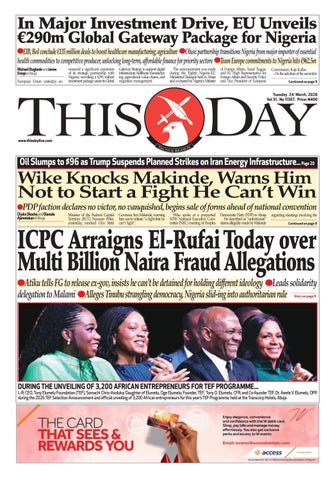
DURING THE UNVEILING OF 3,200 AFRICAN ENTREPRENEURS FOR TEF PROGRAMME...
L-R: CEO, Tony Elumelu Foundation (TEF), Somachi Chris-Asoluka; Daughter of Elumelu, Oge Elumelu; Founder, TEF, Tony O. Elumelu, CFR; and Co-founder TEF, Dr. Awele V. Elumelu, OFR during the 2026 TEF Selection Announcement and official unveiling of 3,200 African entrepreneurs for this year’s TEF Programme, held at the Transcorp
Hotels, Abuja
Wike spoke at
107th National Executive Committee (NEC) meeting of Peoples Democratic Party (PDP) in Abuja
described as “unfortunate” claims allegedly made by Makinde
Chuks Okocha and Olawale Ajimotokan in Abuja
CONSULTATIVE MEETING TO THE PRESIDENT AT DODAN BARRACKS...
L-R: Lagos State Governor, Mr. Babajide Sanwo-Olu; Leader of the Senate, Senator Opeyemi Bamidele; Executive Chairman, Nigeria Revenue Service, Dr. Zacch Adedeji; President Bola Ahmed Tinubu; Chairman, House of Representatives Committee on FERMA, Hon. Aderemi Oseni; Ekiti State Governor, Mr. Biodun Oyebanji and Chairman, Senate Committee on Appropriations, Senator Solomon Adeola after a consultative meeting to the president at the Dodan Barracks, Lagos …
Dele Oye: Despite $1.5bn Deals, Tinubu’s UK Trip Failed to Unlock $21bn Annual Diaspora Remittances, Others
Says visit exposed fundamental misalignment between president’s rhetoric about economic partnership, actual prioritisation of Nigerian business interests Alleges ministers of trade, agriculture invisible in business forum coverage
James Emejo in Abuja
Chairman, Alliance for Economic Research and Ethics (AERE), Hon. Dele Oye, yesterday, said despite striking deals worth about $1.5 billion during his recent state visit to the United Kingdom, President Bola Tinubu failed to explore a vital diaspora remittance channel to boost the economy.
Oye described Tinubu’s trip as a “squandered opportunity for comprehensive Nigerian business advancement”.
In a statement, he said the president should have worked out a deal that would unlock $21 billion in annual diaspora remittances from over 500,000 Nigerians living in the UK, among other business opportunities, adding that the trip could have been better explored for greater outcomes.
Oye, a former National President of Nigerian Association of Chambers of Commerce, Industry, Mines and Agriculture (NACCIMA), stated that while the visit recorded notable milestones, including trade and investment agreements, it ultimately fell short of translating diplomatic engagement into tangible benefits for Nigerian businesses and investors.
While acknowledging gains, such as infrastructure financing and
increased bilateral trade discussions, he stressed that the outcomes did not sufficiently address Nigeria’s need to boost exports, support local businesses, and attract sustainable investment.
Oye added that the president’s UK visit lacked clear, sector-specific strategies that could enable Nigerian small and medium-sized enterprises (SMEs) access UK markets or benefit from bilateral trade arrangements.
He said, “The visit entirely missed the chance to leverage the UK’s massive Nigerian diaspora. With over 500,000 people of Nigerian heritage in the UK sending home over $21 billion annually, the diaspora was celebrated for its cultural impact but ignored as an economic engine.
“There were no announcements of diaspora bonds, preferential investment windows, or creative industry export support.
“When compared to the aggressive, deal-driven state visits executed by nations like India or South Africa — which feature concurrent CEO forums, matched government-private sector participation, and real-time trade agreements — Nigeria’s approach feels antiquated.”
Oye stated, “President Tinubu’s UK visit will be remembered for its historical significance, and the $1.5 billion in deals are certainly
welcome. However, it represents a squandered opportunity for comprehensive Nigerian business advancement.
“It confirmed that while the government excels at diplomatic symbolism, it still struggles to effectively facilitate business.
The true test of this visit will not be measured in loans signed with UK Export Finance, but in what happens over the next six months.”
He added, “If Nigerian SMEs do not secure new UK market access, if creative industry exports do not surge, and if agricultural products
remain blocked from British shelves, then this historic trip will have been little more than an expensive, beautifully orchestrated photo opportunity.
“Nigeria is undeniably open for business, but it is time our diplomatic engagements put Nigerian businesses at home and abroad at the absolute centre of the stage.
“Until then, our state visits will remain celebrations of potential rather than catalysts for prosperity.”
Oye also said, “President Bola Ahmed Tinubu’s recent two-day state visit to the United Kingdom — the first by a Nigerian leader in
37 years — was a masterclass in diplomatic pageantry. With King Charles III rolling out the red carpet at Windsor Castle and toasting to the Yoruba phrase, ‘Naija No Dey Carry Last,’ the optics were undeniably historic.
“On paper, the numbers are equally impressive. Officials valued the resulting agreements at roughly $1.5 billion, with bilateral trade currently sitting at an all-time high of £8.1 billion annually. From a massive £746 million UK Export Finance package to refurbish the Apapa and Tin Can Island ports, to a $496
million integrated dairy platform to boost local food security, the visit undeniably unlocked a bundle of headline-grabbing wins.”
Oye said, “We saw British firms like Wise clearing hurdles for Nigerian licenses, and educational tie-ups bringing digital learning to millions of Lagos pupils. Simultaneously, Nigerian businesses proved their mettle on British soil. Fintech giants like LemFi, Moniepoint, and Kuda Bank announced massive UK expansions, while Zenith Bank proudly opened its Manchester branch, eyeing a 2027 London listing.
IYC Canvasses Inclusion of Niger Delta Ports in National Maritime Development Agenda
Urges Tinubu to balance development across all geopolitical zones
Olusegun Samuel in Yenagoa
Few days after Nigeria and the United Kingdom inked agreement to transform the Apapa and Tin Can Island ports, the Ijaw Youth Council (IYC) has called for the strategic inclusion of Niger Delta ports in the national maritime development agenda. The umbrella body of Ijaw
youths worldwide, while commending President Bola Ahmed Tinubu’s efforts in modernizing Nigeria’s port infrastructure stressed the importance of fairness, equity, and adherence to federal character principles in the distribution of national assets.
In a statement signed by Binebai Princewill, the IYC called for the development, rehabilitation, and
Surveyors Decry Insecurity, Lack of Recognition in Nigeria
Surveyors in Nigeria have identified inadequate land data, insecurity in the field, and poor public recognition as major challenges affecting the growth of the profession and national development.
President of the Nigerian Institution of Surveyors (NIS), Pius Eze, stated this in a message to mark the 2026 Global Surveyors’ Day.
Eze said this year’s theme: “Surveyors’ Challenges in Multi-Sectoral Growth,” highlights key limitations confronting practitioners, including lack of comprehensive land data,
insufficient capacity in sustainability practices and limited integration across sectors.
According to him, these challenges have continued to hinder effective planning, decision-making, and sustainable development in the country.
“The multi-sectoral approach in our profession is the only way to guarantee robust practice and support national development,” he said.
Eze, however, noted that despite the challenges, surveyors remain committed to innovation
and improved service delivery, urging professionals to continually upgrade their skills and adopt modern tools.
Also speaking, a fellow of the NIS, Charity Ola, highlighted the critical role of surveyors in national development, describing them as key contributors to infrastructure, land administration, and disaster management.
“Behind the roads and infrastructure you see are the hard work and labour of surveyors. Without surveyors, there will be no land titles and no land security,”
she said.
Ola also pointed to security risks faced by practitioners, particularly during field operations.
“Surveyors face serious hazards. In some cases, they are attacked, stripped and their equipment taken. Yet, there is no adequate insurance to cover these risks,”
she said.
She added that surveyors play vital roles in disaster mitigation, military operations and navigation systems, stressing that their contributions cut across multiple sectors.
operationalization of key ports in the Niger Delta region, including Burutu, Warri, Onne, Sapele, Bonny, Koko, Brass, Agge Deep Seaport, and Gelegele Seaport.
It said these ports are historically significant and possess strategic advantages for trade, logistics, and industrial expansion.
The IYC highlighted the need for balanced development across all geopolitical zones to decongest Lagos ports, stimulate economic growth, create job opportunities, enhance national security, and promote regional industrialization.
The council urged President Bola Ahmed Tinubu to ensure that port development projects reflect national balance and called on relevant agencies to initiate feasibility assessments and partnership frameworks for reviving these maritime assets.
The statement read: “The Ijaw nation, which has contributed immensely to Nigeria’s economic survival—particularly through oil and gas resources—deserves equitable access to infrastructure that will further unlock its economic
potential.
“We therefore urge President Bola Ahmed Tinubu to demonstrate statesmanship by ensuring that ongoing and future port development projects reflect true national balance. The principle of federal character must not be theoretical; it must be visible in tangible projects that impact the lives of all Nigerians.
“It is our considered position that Nigeria’s maritime development must not be disproportionately concentrated in Lagos State alone.
“The continued centralisation of port infrastructure in Lagos not only places undue pressure on existing facilities but also sidelines historically significant and economically viable ports across the Niger Delta and Ijaw territories.
“The current concentration of port development in Lagos—reportedly involving investments valued at over N1.3 trillion—raises serious concerns about regional imbalance and economic exclusion. Nigeria is a federation, and its development must reflect inclusivity across all geopolitical zones.
Sunday PHOTO: OFFICE OF THE LEADER OF THE SENATE
MBAH MARKETING ENUGU TO INVESTORS IN LONDON...
L-R: Founder/CEO
In London, Peter Mbah Ignites Investors’ Interest in Enugu
NGX, UBA affirm Enugu’s positioning as emerging investors’ haven
Gideon Arinze in
Governor Peter Mbah of Enugu State has ignited foreign investors’ interest in the state with prospective investors expressing readiness to key into opportunities across various sectors of the state’s economy.
Governor: Tinubu’s economic reforms most significant in decades
The governor, who was on
Mbah said investors should expect between 25 and 40 per cent return on their investments, stating that global manufacturers and international partners are already establishing a presence in the state, recognising its strategic position as well as the opportunities and reform agenda underway.
President Bola Tinubu’s entourage during the president’s visit to the United Kingdom, spoke at the UK-Nigeria Project Agglomeration Compact 2026, delivered by Mutandis Africa, a pan-African investment and trade facilitation platform, in collaboration with the Dr. Zacch Adedeji-led Nigeria
Revenue Service (NRS), in the House of Lords.
The investment forum, on the side-lines of Tinubu’s visit, brought Enugu State, senior federal government officials, and private sector leaders to engage directly with UK’s senior investor community, including private equity funds, sovereign
Rockefeller, Global Energy Alliance Invest over $100m to Expand Electricity in Africa
The Rockefeller Foundation as well as the Global Energy Alliance for People and Planet have announced the commitment of more than $100 million to date, support of ‘Mission 300’, the World Bank Group and the African Development Bank’s effort to connect 300 million people in Africa to electricity by 2030.
A statement made available in Abuja, said since the foundation and the alliance announced their first $10 million for Mission 300 in September 2024, they have helped strengthen government delivery capacity through technical assistance, mobilised private investment, accelerated project pipelines, and advanced electrification efforts in nearly two dozen countries.
Vice President for Power, Energy, Climate, and Green Growth at the African Development Bank, Dr. Kevin Kariuki, said: “Mission 300 is fundamentally about delivery, and turning ambition into results at scale.
“Catalytic capital from partners such as The Rockefeller Foundation and the Global Energy Alliance plays a critical role in strengthening government delivery capacity, derisking investments, and accelerating projects that can mobilise much larger flows of public and private finance.
President of The Rockefeller Foundation, Dr. Rajiv Shah, announced that the joint commitment had increased more than tenfold to $100 million during a fireside chat with the Secretary of the
US Department of Energy, Chris Wright, where they also discussed the importance of bringing clean cooking support to communities in sub-Saharan Africa – a key priority of Mission 300.
“The Rockefeller Foundation has made its biggest-ever bet on connecting people to electricity as the single best pathway out of large-scale poverty. Our investment in Mission 300 reflects our commitment to the best way of advancing human wellbeing in the 21st century.
“(This is) putting countries in the lead, harnessing frontier technology, and focusing relentlessly on achievable, measurable goals. We look forward to working with partners to continue the extraordinary momentum behind Mission 300
Boat Mishap: Nigerian Navy Rescues Seven Survivors in Bayelsa
Linus Aleke in
Abuja
The Nigerian Navy has rescued seven survivors following a boat mishap in the waterways of Bayelsa State, in a swift search and rescue operation aimed at saving lives after a collision.
The incident occurred at the Ogboinbiri waterways in Southern Ijaw Local Government Area, involving a Tantita patrol boat and a wooden market boat.
The rescue effort was launched immediately after a distress call alerted naval authorities to the accident.
In a statement, the Director of Naval Information, Captain Abiodun Folorunsho, said personnel of Nigerian Navy Ship (NNS) Soroh were promptly deployed to the scene. Their rapid response led to the successful rescue of seven victims, who were evacuated to a nearby medical facility for urgent treatment. He added that search efforts are ongoing to locate other missing persons from the incident.
The Navy noted the operation reflects its commitment to the vision
of the Chief of the Naval Staff, Vice Admiral Idi Abbas which prioritises not only maritime security but also the protection of lives within Nigeria’s waters.
It further highlighted its consistent track record in search and rescue missions across the country’s waterways, citing recent operations including the rescue of passengers during a sea robbery incident in the Ibaka–Calabar Channel, as well as multiple interventions involving distressed and burning vessels in Calabar waters.
and connect even more people in Africa, including its growing youth populations, to jobs, dignity, and prosperity,” Shah stated.
Currently, 730 million people still lack access to basic electricity, and an estimated 85 per cent of those live in sub-Saharan Africa, the statement said.
This shortage, it explained, hinders healthcare, education, digital inclusion, women and children empowerment, the creation of local jobs, building economic opportunity, and more. According to the Oxford Poverty and Human Development Initiative, lack of access to electricity is the single greatest predictor of extreme poverty.
wealth investors, development finance institutions, infrastructure platforms, pension capital, and family offices.
Mbah said, “We have numerous projects that have been curated for international investors: the international airport currently being expanded in Enugu is designed to serve a regional population of approximately 30 million people, thus, transforming Enugu into a gateway for the entire southeast economic corridor, linking surrounding states whose economies are themselves growing rapidly.
“In tourism and hospitality, Enugu’s natural landscape, a hill-top city surrounded by waterfalls, caves and remarkable scenery, is being repositioned as a destination for both leisure and business travel. New hotels, a conference centre and revitalised resorts are being developed to support this vision.
“In agriculture, we are modernising production through agritech and commercial farming initiatives that strengthen food security while building export-oriented value chains.
“Power drives every modern economy. Today, more than 50 per cent of the region still lacks reliable electricity, creating an opportunity to deliver dependable power to over
15 million people.”
The governor added, “In healthcare and education, we are expanding services across communities to build the skilled workforce and stable environment that serious investment requires.
“And at the heart of this transformation lies one of our most ambitious developments: a new smart city spanning approximately 10,000 hectares, currently breaking ground, designed to become a modern commercial and residential hub for the region.”
Mbah hailed Tinubu’s reforms, especially the structural shift, where he said states were being increasingly empowered to act as economic engines in their own right.
He stated, “Importantly also, under President Tinubu’s leadership, bold reforms have been implemented to restore macroeconomic stability and improve investor confidence.
“The foreign exchange market has been unified, fiscal reforms are strengthening transparency, and the Nigeria Tax Act is helping to create a modern fiscal architecture designed to support long-term investment.” He said Tinubu’s UK visit signalled a paradigm shift that enabled subnational governments to also drive economic growth.
Nigerian Navy Intercepts Illegal Fuel, Arrests Eight Suspects in Rivers
Sunday Ehigiator
The Nigerian Navy has intercepted about 44,000 litres of suspected illegally refined petroleum products and arrested eight suspects in Rivers State under its ongoing anti-crude oil theft operations.
The operation, conducted under Operation Delta Sentinel, took place in the Degema, Ogbogoro, and Ogbologo general areas following actionable intelligence on illicit activities.
In a statement issued yesterday, Director of Naval Information, Captain AA Folorunsho, said, “The Nigerian Navy has recorded another operational success under
Operation DELTA SENTINEL with the interception of a large consignment of illegally refined petroleum products and the arrest of suspected oil thieves in the Degema/Ogbogoro/Ogbologo general areas of Rivers State.”
Folorunsho added that personnel of Nigerian Navy Ship, NNS Pathfinder, deployed an anti-crude oil theft patrol team which led to the interception. he stated, “Acting on credible intelligence on ongoing illicit activities within the area, personnel of Nigerian Navy Ship (NNS) PATHFINDER deployed an Anti-Crude Oil Theft patrol team which led to the interception of two wooden boats laden with about 44,000 litres of suspected illegally refined Automotive Gas Oil
Folorunsho further disclosed that eight suspects were apprehended during the operation, while others escaped.
he said, “The operation also resulted in the arrest of eight suspects linked to the illegal activity, while additional armed accomplices fled the scene upon sighting the naval patrol team.”
He stated that those arrested would face further investigation.
The statement also said, “The arrested suspects and recovered products are currently in custody and will be handed over to the appropriate authorities for further investigation and possible prosecution.”
(AGO).”
Emmanuel Addeh in Abuja
Enugu
of Mutandis Africa, Chinelo Anohu; Member House of Lords, UK, Baroness Verma and the Governor of Enugu State, Dr Peter Mbah, during the UK-Nigeria Project Agglomeration Compact held at the House of Lords, Palace of Westminster, London, on the sidelines of President Bola Tinubu’s state visit to the United Kingdom.
SHETTIMA, YILWATDA, UZODIMMA, OTHERS WELCOME FINTIRI INTO APC...
L-R: Vice President, Kashim Shettima; Governor of Imo State, Hope Uzodimma, Governor of Adamawa State, Ahmadu Fintiri, and Chairman of All Progressives Congress(APC), Nentawe Yilwatda, at a rally to formally receive Fintiri to APC in Yola...yesterday
Dangote Refinery Leverages Middle East Shock as Cheap Imports Dry Up
Facility exports products to Cote d’Ivoire, Cameroon, Tanzania,
Ghana, Togo
Aliko Dangote: Prolonged Iran tensions leading to rising fuel prices
The Dangote Refinery is rapidly consolidating its position in Africa’s downstream oil market, capitalising on supply disruptions from the Middle East that have significantly curtailed the flow of cheap refined fuel imports into the continent.
The shock, triggered by escalating geopolitical tensions and attacks on key energy infrastructure in the Gulf, has tightened global product availability and driven up prices, creating a window of opportunity for the Lagos-based facility to expand its footprint.
With traditional supply routes from the Middle East under strain, several African countries that have long depended on imported petrol, diesel and aviation fuel are increasingly turning to the Dangote Refinery as a more reliable and geographically closer alternative, THISDAY learnt.
Already, the plant has ramped up shipments across West and parts of Central and East Africa, exporting refined products to Côte d’Ivoire, Cameroon, Tanzania, Ghana and Togo in recent weeks.
Quoting data from tanker-tracking firm, Kpler, a Reuters report stated that Nigeria’s exports of clean petroleum products which include petrol, diesel, kerosene and jet fuel have risen to about 214,000 barrels per day so far in March from an average of 100,000 bpd in February.
Shipments to other African countries have climbed to about 90,000 bpd from 38,000 bpd previously.
Besides, the 650,000 barrels per day Dangote refinery has sold 12 cargoes of petrol, totalling 456,000 metric tons, on a free-on-board basis to international traders, with shipments already delivered. The sales mark Dangote’s first exports of petrol since the plant reached full capacity in February.
The escalating Middle East conflict has pushed up global crude prices, lifting feedstock costs for refiners worldwide. At the same time, shipping disruptions and lower fuel availability from Europe and the Gulf have cut flows of low-cost refined products into West Africa. That has created opportunities for suppliers with shorter supply chains.
Dangote’s owner Aliko Dangote has been sparring with Nigerian regulators over continued petrol imports, which he contends undermine his refinery.
However, although disputed by the Dangote Refinery, the Nigerian Midstream and Downstream Petroleum Regulatory Authority (NMDPRA) recently announced that it halted granting imports licences to marketers. Since the Iranian war, domestic pump prices have risen more than 50 per cent as the conflict roiled energy markets.
The country consumes an estimated 50 million to 60 million litres of petrol a day, nearly one-fifth of Africa’s total demand, making fuel availability and pricing acutely sensitive to swings in global markets.
For decades, West Africa has depended heavily on imported fuel cargoes from Europe and the Middle East, often of lower quality,
leaving the region exposed to logistical delays and external supply shocks, the Reuters report added.
Preliminary data shows that Nigerian fuel imports are at a daily average of 90,000 bpd so far in March, according to Kpler, down from 209,000 bpd for the whole of February.
Arrivals from offshore Togo, which Dangote has previously accused of being the source of dirty fuel imports into the country, have fallen to zero so far in March, compared with 60,000 bpd in February.
Earlier, the Dangote Refinery said the new product routes will help “enhance energy security in West, East and Central Africa, reducing logistics and supply chain delays associated with long-distance fuel imports.”
“The products were sold on a FOB (Free on Board) basis to the end international traders for deliveries
to the above-identified countries of export. This accomplishment underscores the Dangote Refinery’s capability to not only meet but exceed Nigeria’s domestic fuel demands.
“It also demonstrates the refinery’s growing role in supplying high-quality Euro 5 gasoline and diesel to West Africa — a region long underserved and historically regarded as a dumping ground for lower-quality fuels, and other regions which have become destinations of exports,” it said.
The new approach, the refinery said, helps to reduce logistics and supply chain delays linked to longdistance fuel imports, easing cost pressures on regional fuel markets through closer sourcing, while also fostering stronger trade ties between Nigeria and key African economies.
Some African countries that have long depended on large refineries in the Persian Gulf for fuel are reportedly now looking to Dangote refinery as
an alternative source.
The ongoing disruption has altered long-standing trade flows, forcing importers to diversify sourcing strategies while reducing reliance on distant suppliers vulnerable to geopolitical shocks.
The Dangote Refinery, with its large-scale capacity and proximity advantage, is emerging as a key beneficiary, offering shorter delivery times and potentially lower freight costs compared to cargoes sourced from Europe or the Gulf.
Meanwhile, President of the Dangote Group, Aliko Dangote, has declared that although Nigeria has no direct role in the Middle East crisis, it will still feel its impact due to deep global economic interdependence.
Speaking with newsmen yesterday after paying a Sallah homage to President Bola Tinubu at his Ikoyi, Lagos residence, Dangote warned that the Middle East crisis driving global
oil volatility could have far-reaching consequences for Nigeria and African economies.
“We are part of a global village, and unfortunately, developments like this will affect us even if we are not directly involved,” he said.
According to him, prolonged tensions could trigger higher fuel prices, rising transport costs, inflationary pressures, and widespread hardship across African economies. “If the situation does not de-escalate, we will end up paying a heavy price, especially given existing economic challenges”.
Dangote submitted that governments could face mounting fiscal strain as subsidies rise and revenues fluctuate under unstable global oil market conditions. He added that Africa’s rising debt burden could worsen under prolonged instability, further limiting fiscal space and weakening economic resilience.
NECA: Rising Oil Prices Translating into Increased Energy Costs in Nigeria
Poses significant pressure for manufacturing, agriculture firms
Dike Onwuamaeze
The Nigeria Employers’ Consultative Association (NECA) has warned that rising global oil prices are translating into increased energy costs in Nigeria with significant consequences for firms in manufacturing, agriculture
Air Peace Denies Tax Suit with Lagos State Govt
Chinedu Eze
Nigeria’s leading carrier, Air Peace, has denied any tax suit with the Lagos State Government, saying the airline has met all corporate tax obligation, which has remained up to Thedate.airline also insists that none of its directors has legal issues concerning tax with the state government. In a statement signed by its management, Air Peace also denied the report that its Chairman/
Chief Executive Officer, Dr. Allen Ifechukwu Onyema, and Vice Chairman, Mrs. Alice Ojochide Onyema, are the subject of a tax suit by the Lagos State Government.
“We wish to state unequivocally that neither the Onyemas nor Air Peace has been served with any court summons or official notification regarding the purported suit. The claim that legal proceedings have been ongoing since February, without service or formal communication is quite surprising and shocking.
“We maintain that all personal and corporate tax obligations have been duly met and remain up to date, in full compliance with applicable laws and regulatory requirements.
“However, if there is any discrepancy in the computation of taxes, the Onyemas and Air Peace remain open to engaging the Lagos State Government to review and reconcile shortfalls if any in the interest of transparency, clarity, and due process.
and logistics, who are already under significant pressure
NECA gave this warning yesterday in its press statement titled “Oil Gains, Rising Costs: NECA Warns of Growing Pressure on Businesses and Households.”
The Director General of NECA, Mr. Adewale-Smatt Oyerinde, noted in the statement that the war in Iran is driving up international crude oil prices and escalating fuel prices and worsening inflationary pressures across the Nigerian economy.
Oyerinde stated the situation reflected a growing paradox, where increases in crude oil prices are pushing up domestic energy costs, placing pressure on businesses and eroding the purchasing power of citizens.
He said: “What we are witnessing is Nigeria’s oil paradox. Rising crude oil prices are pushing up domestic energy costs, squeezing businesses and worsening the cost of living for citizens.”
He noted that fuel prices have risen sharply in recent days, with petrol prices in some locations exceeding N1,300 per litre and diesel approaching N1,800 per litre, reflecting the impact of global oil price movements.
Oyerinde stressed that energy costs sit at the heart of Nigeria’s economy as energy is the engine of production and distribution.
He said: “Once fuel prices rise, the effects are immediate and widespread, transport costs increase, food prices rise, and the overall cost of doing business escalates.”
He stressed that businesses, particularly in manufacturing, agriculture, and logistics, are already under significant pressure.
“For many firms that rely on diesel for operations, current price levels are becoming increasingly difficult to sustain. Profit margins are shrinking, and businesses are being forced to either pass on costs or scale down
operations,” he said.
He further noted that global oil prices have surged in response to geopolitical tensions, with Brent crude prices rising above $110 per barrel, intensifying cost pressures across energy markets.
Oyerinde clarified that while the Middle East conflict have contributed to the rise in oil prices, the impact is exposing deeper structural weaknesses, underinvestment, weak infrastructure, and inefficiencies in Nigeria’s energy value chain.
“This situation is not only driven by external factors, it is also reflecting ongoing constraints within the energy value chain, including supply inefficiencies and infrastructure limitations.”
He warned that without urgent intervention the situation could escalate. “If this trend continues unchecked, we risk business closures, job losses, and a deeper cost-of-living crisis.”
Deji Elumoye and Emmanuel Addeh in Abuja
Trade Imbalance Hits £1.2bn as Nigeria, UK Seal Customs Cooperation Deal
A significant discrepancy of about £1.2 billion in recorded trade figures between Nigeria and the United Kingdom has prompted fresh moves to tighten customs cooperation, as both countries intensify efforts to enhance transparency, digital border management, and trade facilitation. Against this backdrop, Nigeria Customs Service (NCS) and His Majesty’s Revenue and Customs (HMRC) strengthened bilateral engagement to reconcile the disparities and improve efficiency along the Nigeria–UK trade corridor.
The renewed collaboration followed a high-level meeting held in London on March 18, under the Nigeria–United Kingdom Enhanced
Trade and Investment Partnership (ETIP), on the side-lines of President Bola Tinubu’s state visit to the United Kingdom.
Comptroller-General of Customs, Bashir Adewale Adeniyi, led the Nigerian delegation, while the UK team was headed by Megan Shaw, Head of International Customs and Border Engagement at HMRC.
In a statement issued Monday in Abuja and made available to THISDAY, National Public Relations Officer of NCS, Dr. Abdullahi Maiwada, said discussions focused on addressing structural gaps in trade data, advancing customs modernisation and strengthening operational cooperation between the two administrations.
NCS said both parties acknowl-
edged that discrepancies in bilateral trade statistics represented a systemic challenge requiring coordinated institutional response, particularly in an era of increasingly digitised global trade.
The statement read, “Available statistics indicate that while approximately £504 million in UK-origin goods were recorded as imports into Nigeria in 2024, the United Kingdom reported exports to Nigeria valued at approximately £1.7 billion for the same period.”
NCS said the development highlighted a gap that had raised concerns over data integrity, compliance monitoring, and revenue assurance.
To tackle the anomaly, Nigeria and the UK agreed to explore the establish-
ment of a structured pre-arrival data exchange framework between their digital customs platforms.
The initiative is expected to enhance risk management processes, improve reconciliation of trade data, and strengthen compliance monitoring mechanisms.
Adeniyi emphasised that effective customs cooperation remained central to economic growth and sustainable trade development, stating that both countries share a long-standing economic relationship spanning industrial goods, agriculture, energy and consumer products.
He stressed that customs authorities played a frontline role in ensuring that cross-border trade flows were transparent, secure and mutually beneficial, adding that bridging
data gaps is essential to boosting investor confidence and safeguarding government revenues.
The meeting also provided a platform for both sides to showcase their respective customs modernisation programmes.
The UK delegation highlighted advancements in artificial intelligencedriven trade tools, digital verification systems and real-time analytics, which were being deployed to improve border efficiency and detect irregularities in trade flows.
The innovations, officials said, presented opportunities for knowledge transfer and technical collaboration that could support Nigeria’s ongoing customs reforms.
The engagement produced key outcomes, including plans to develop
ICPC ARRAIGNS EL-RUFAI TODAY OVER MULTI BILLION NAIRA FRAUD ALLEGATIONS
Chuks Okocha, Alex Enumah in Abuja and Wale Igbintade in Lagos Independent Corrupt Practices and Other Related Offences Commission (ICPC) is set to arraign El-Rufai today before both the Federal High Court over allegations of multi-billion-naira fraud, abuse of office, money laundering, and related offences.
In a statement, yesterday, the commission disclosed that El-Rufai would be arraigned alongside an associate at the Federal High Court, Kaduna Judicial Division, today, March 24, in Suit No: FHC/ KD/73/2026.
This was as a former VicePresident, Alhaji Atiku Abubakar, has called on the federal government to release El-Rufai, and other political detainees, say-ing the government could not continue to detain people because they shared different political views.
Atiku, who led a solidarity visit to former Attorney-General of the Federation (AGF) and Minister of Jus-tice, Abubakar Malami, also sounded a warning to Nigerians about what he termed creeping fascism, saying President Bola Tinubuwas dismantling democracy and pushing Nigeria towards full-blown authoritarian rule,
A separate charge was also pending before the Kaduna State High Court, involving additional allegations and co-defendants, although a date had yet to be fixed for that proceeding.
with dangerous implications for West Africa.
However, ICPC said the charges stemmed from El-Rufai’s tenure as governor and centred on alleged financial impropriety, wrongful enrichment, contract irregularities, and abuse of official powers.
The commission accused the former governor of fraudulently inducing the Kaduna State government to pay N11 billion to Indokaduna MRTS JV Nigeria Limited, described as an unregistered entity, for a light rail project that was never executed.
He was also alleged to have approved and received severance payments of N289.8 million on two occasions in 2020 and 2023, far exceeding his lawful entitlement of about N20 million.
The prosecution further alleged that El-Rufai dishonestly disposed of $1,085,066.38, being part of a World Bank loan, in violation of the loan agreement.
ICPC claimed that El-Rufai awarded contracts running into billions of naira, including a N4.61 billion CCTV project and a separate $22.47 million contract to Singularity Network Security Limited, in breach of procurement laws.
In addition, he was accused of conspiring with Bashir Ahmad El-Rufai, who was said to be at large, to offer inducements to federal investigators abroad in a bid to compromise an ongoing investigation.
In the separate suit before the Kaduna State High Court, El-Rufai
WIKE KNOCKS MAKINDE, WARNS HIM NOT TO START A FIGHT HE CAN’T WIN
FCT minister and President Bola Tinubu, saying such assertions are misleading.
Wike alleged, “Unfortunately, I was watching my friend before, Seyi Makinde, when he went to Bauchi, he said that he had a meeting with me and the president, that I said we were in control of government as well as the judiciary, which gave us an ex parte order at Ibadan.
“It’s unfortunate a fight you cannot fight, you started. Politics is not a contract work and a business venture. Politics and business are two different things.
“Politics is not a contract of Shell. I didn’t go into politics to be a contractor. I went into politics to have power. You wanted money. You had contract of over $1.7 million. Hey, stay there. This is my own territory. Stay as a contractor.”
The FCT minister also cautioned party members not to be involved in double dealing, warning that those who fail to demonstrate loyalty to the cause risk being side-lined.
“After this NEC meeting, anybody that doesn’t show commitment to the convention, don’t come back after and say you are fully back. I will not accept that,” Wike said, while placing emphasis on party unity and genuine reconciliation among factions.
The chairman of the PDP National Caretaker Working Committee, a faction loyal to Wike, Abdulrahman Mohammed, declared a “no victor, no vanquished” outcome as he said the party had intensified efforts to reconcile ahead of the group’s
national convention scheduled to hold in Abuja. Mohammed, in his address to members at the meeting, described the convention as a defining moment for the party’s future.
“This convention is not merely a routine exercise; it is a critical milestone that will shape the future direction of our party,” he said.
He stted that the parry had made significant progress in stabilising its structures and restoring confidence in the light of recent legal and political challenges.
“The recent judicial pronouncements, approached with a spirit of reconciliation and inclusiveness, have further reinforced our commitment to unity. There is no victor and no vanquished, only a shared commitment to rebuild, reposition, and strengthen our party,” he Mohammedstated.disclosed that the ward, local government, state, and zonal congresses nationwide were successfully conducted, describing them as largely peaceful and reflective of the party’s democratic ideals.
He entreated party members to remain united and disciplined as the party approached the convention, stressing that PDP remains as one indivisible family.
The National Caretaker Committee said it had commenced the sale of nomination forms ahead of its forthcoming national convention.
The decision was announced yesterday in Abuja, where leaders reviewed preparations and timelines for the convention.
In a communiqué issued after the meeting, the faction called on interested aspirants to adhere
strictly to its guidelines.
The communiqué was signed by Mohammed, and Acting National Secretary, Samuel Anyanwu.
According to the communique of the meeting, “NEC noted that the sale of nomination forms for the forthcoming national convention has commenced.
“All interested aspirants are advised to comply with the approved guidelines and timelines as issued by the party.”
It said NEC also reaffirmed the zoning formula for national elective positions, indicating that the distribution of offices would follow established arrangements
designed to balance regional interests.
The communiqué stated, “The zoning arrangement shall serve as the guiding framework for the forthcoming national convention.
“NEC reaffirmed the party’s readiness for the forthcoming national convention and directed all relevant organs and committees to ensure seamless coordination for a successful, credible, and transparent exercise.
“NEC reiterated the supremacy of the Party and called on all members to remain united, disciplined, and committed to the collective interest of the PDP.”
was being arraigned, alongside Amadu Sule (Leda), on a 10-count charge bordering on fraud, abuse of office, conspiracy, and unlawful land dealings.
The state charges mirrored several of the federal allegations, including the N11 billion light rail transaction, which the prosecution said was obtained under false pretence for a project that was never executed.
The prosecution further claimed that the former governor unlawfully approved a N4.61 billion CCTV contract in 2015 in violation of Kaduna State procurement laws and conferred undue advantage on the same company through a separate contract valued at $22.47 million.
Amadu Sule was specifically accused of providing false information to Kaduna State Government in connection with a land application involving Old Port Trading Limited.
Both Sule and El-Rufai were also alleged to have conspired between 2018 and 2020 to revoke land belonging to Mohammed Umar Karage and reallocate it to Sule.
Another count related to the alleged unlawful exercise of control over land in Kaduna State during El-Rufai’s tenure, with further particulars to be provided.
The charges were brought under several laws, including the Corrupt Practices and Other Related Offences Act, 2000, Advance Fee Fraud and Other Fraud Related Offences Act, 2006, and Kaduna State Penal Code Law, 2017.
ICPC confirmed that El-Rufai had been formally served and reiterated its commitment to due process. The commission’s Head of Media and Public Communications, John Odey, stated that all defendants were presumed innocent until proven guilty by a competent court and assured that the prosecution would be conducted in line with the rule of law.
Atiku to FG: Release El-Rufai, You Can’t Detain Him for Holding Different Ideology
A chieftain of the African Democratic Congress (ADC), Atiku Abubakar, has called on the federal government to release former Kaduna State Governor, Nasir El-Rufai, and other political detainees, saying the government cannot continue to detain people because they share different political views.
In the message shared on X, the ADCchieftain stated that upon his return to Nigeria from Umrah, he led a delegation to Malami. Atiku said democratic governance must be anchored on respect for fundamental human rights, including freedom of expression and political association.
He stated, “Following my return to the country on Saturday night from Umrah (lesser Hajj), I led a delegation on a solidarity visit to the former Minister of Justice and Attorney General of the Federation,
Continued on page 22
IN MAJOR INVESTMENT DRIVE, EU UNVEILS €290M GLOBAL GATEWAY PACKAGE
Abuja, EIB Global, the development arm of European Investment Bank (EIB), and Bank of Industry (BoI) announced the signing of a €50 million financial agreement to boost the local healthcare sector in Nigeria to address unmet medical needs.
In addition, the parties signed an €85 million agreement to boost the development of Nigeria’s agricultural value chains.
At least 70 per cent of the loans will target cocoa and dairy value chains.
The health financing intervention will be delivered through a credit line to support local manufacturers of medicinal products and devices, such as pharmaceuticals, vaccines, and diagnostics.
The project is part of the Global Gateway strategy and responds to Nigeria’s national priorities in health and development sectors.
The healthcare deal was witnessed by Minister of Budget and Economic Planning, Senator
Abubakar Bagudu; Ambassador of European Union in Nigeria and ECOWAS, Mr. Gautier Mignot; Managing Director/Chief Executive, BoI, Dr. Olasupo Olusi; and EIB Head of Unit, Mrs Svetla Stoeva.
Olusi said, “This partnership marks a pivotal step in Nigeria’s journey from being a major importer of essential health commodities to becoming a competitive producer within regional and global value chains.
“By mobilising long-term, patient capital into local pharmaceutical, vaccine and diagnostics manufacturing, we are not only strengthening health security but also catalysing industrial growth, skills development and high-quality job creation.
“At the Bank of Industry, we view healthcare manufacturing as both a public health imperative and a strategic economic opportunity. Through this collaboration with EIB Global under the Human Development Accelerator, we are
building a sustainable financing architecture that empowers Nigerian enterprises to scale, innovate and meet international quality standards.”
He added, “ This initiative demonstrates how development finance, when aligned with national priorities and strong international partnerships, can unlock transformative impact-improving lives today while laying the foundation for a more resilient and self-reliant healthcare system for future generations.”
EIB Vice President, Ambroise Fayolle, said, “I am very pleased to announce this partnership with the Bank of Industry to improve public health and daily lives in Nigeria. By financing the development and local manufacture of essential medicinal and nutritional products, we enhance access to affordable, safe and high-quality treatments for diseases.
“We support national health security while improving the
resilience of supply chains. This is a concrete example of the added value of the EIB’s action in Africa as a key partner of Global Gateway.” European Commission’s Commissioner for International Partnership, Jozef Sikela, said, “This investment strengthens local manufacturing of medical products in Nigeria, giving companies better access to finance and the capacity to scale up production.
“We are investing so that Nigeria can produce more of what it needs at home and build stronger healthcare systems and regional value chains instead of relying on imports.”
The operation is part of the Global Gateway Health Package and aligns to the Team Europe Initiative for Manufacturing and Access to Vaccines (TEI MAV+). It also aligns with national and continental priorities, including
Continued on page 21
Sunday Aborisade in Abuja
a Customs Mutual Administrative Assistance Framework, commence technical scoping for capacity-building initiatives, and establish a joint technical engagement mechanism under the ETIP framework.
Customs boss, Bashir Adeniyi
DEALMAKERS ANNUAL AWARDS GALA FOR WEST AFRICA...
L-R: Head, Corporate Finance, Rand Merchant Bank, Nigeria & West Africa, Bimbo Oyeyiga; Corporate Finance Analyst, Rand Merchant Bank Nigeria, Damilola Owasanoye and Corporate Finance Transactor, Rand Merchant Bank Nigeria, Omoefe Agbontaen, with the Joint Individual DealMaker of the Year 2025, Private Equity Deal of the Year 2025, 2nd Financial Advisers by Transaction Value and 3rd Financial Advisers by Transaction Flow awards received at the DealMakers Annual Awards Gala for West Africa in Lagos...recently
FG to Roll Out Near-Preventive HIV
Drug-Injectable Lenacapavir in 8 States
52,000 doses to be deployed
Onyebuchi Ezigbo in Abuja
The federal government will today (Tuesday) flag-off the deployment of Lenacapavir, a long-acting injectable antiretroviral medication for prevention of HIV infection in eight states of the federation.
About 52,000 doses of the LEN has been provided to catalyse the introduction of LEN in the affected states for HIV prevention and control.
Lenacapavir is used to treat or prevent HIV infection. It is considered a major advancement in HIV care, reducing the need for daily medication and potentially increasing treatment adherence.
Speaking at the media sensitization on the introduction of Lenacapavir for pre-exposure Prophylaxis of HIV infection in Nigeria held on Monday in Abuja, the Minister of State for Health and Social Welfare, Dr. Iziaq Adekunle Salako, said: “The Government of Nigeria under President Bola Ahmed Tinubu remains committed to ending HIV/AIDS as a public health threat by 2030 through a comprehensive and multi-sectoral approach that prioritizes the expansion of prevention, treatment, and care services, alongside strengthened domestic financing and the elimination of mother-to-child transmission of HIV”.
under pilot phase
He said that a National PrEP Implementation Plan (2025 - 2028) has been developed to provide a clear and coordinated roadmap for scaling up PrEP services across Nigeria.
The minister said that Anambra, Ebonyi, Gombe, Kwara, Akwa Ibom, Cross River, Benue States and the Federal Capital Territory (FCT) were selected for the rollout of LEN PrEP in country under the pilot scheme supported by the Global Fund.
He said that 52,000 doses of the LEN have been provided at subsidized cost to catalyse the introduction of LEN for HIV prevention and control.
According to Salako the National AIDS, Viral, Hepatitis, and STIS Control Programme (NASCP) is coordinating the implementation and development of the Lenacapavir rollout plan.
Salako explained the implementation is in three phases – planning, preparatory and implementation phases and will be carried out in Anambra, Ebonyi, Gombe, Kwara, Akwa Ibom, Cross River, Benue States and FCT
In line with efforts to strengthen the national HIV response, Salako said the Ministry through NASCP is adopting innovative biomedical prevention options to improve HIV prevention outcomes.
Port Financing Deal: IYC, Onuesoke Canvass Inclusion of Niger Delta Ports in National Maritime Devt Agenda
Onueseko: UK has about 120 commercial seaports with 69m population Nigeria with over 200m people shouldn’t favour only Lagos ports
Olusegun Samuel in Yenagoa and
Few days after Nigeria and the United Kingdom inked agreement to transform the Apapa and Tin Can Island ports, the Ijaw Youth Council (IYC) has called for the strategic inclusion of Niger Delta ports in the national maritime development agenda.
The umbrella body of Ijaw youths worldwide, while commending President Bola Ahmed Tinubu’s efforts in modernizing Nigeria’s port infrastructure stressed the importance of fairness, equity, and adherence to federal character principles in the distribution of national assets.
In another related development, notable businessman and CEO of DAS Energy Limited, Chief Sunny Onuesoke, also faulted the federal government’s decision to exclude ports located in other parts of
Nigeria in the £746m agreement signed with the United Kingdom aimed at modernising Apapa and Tin Can Island ports in Lagos.
President Tinubu had witnessed the signing of a £746 million financing agreement in London between Nigeria’s Ministry of Finance, led by Wale Edun, and Citi Bank.
The agreement signed in the United Kingdom on Thursday is aimed at modernising Apapa and Tin Can Island ports in Lagos.
In a statement signed by Binebai Princewill, the IYC called for the development, rehabilitation, and operationalization of key ports in the Niger Delta region, including Burutu, Warri, Onne, Sapele, Bonny, Koko, Brass, Agge Deep Seaport, and Gelegele Seaport.
It said these ports are historically significant and possess strategic advantages for trade, logistics, and industrial expansion.
The IYC highlighted the need for balanced development across all geopolitical zones to decongest Lagos ports, stimulate economic growth, create job opportunities, enhance national security, and promote regional industrialization.
The council urged President Bola Ahmed Tinubu to ensure that port development projects reflect national balance and called on relevant agencies to initiate feasibility assessments and partnership frameworks for reviving these maritime assets.
The statement read: “The Ijaw nation, which has contributed immensely to Nigeria’s economic survival—particularly through oil and gas resources—deserves equitable access to infrastructure that will further unlock its economic potential.
“We therefore urge President Bola Ahmed Tinubu to demonstrate statesmanship by ensuring that ongoing and future port development
projects reflect true national balance. The principle of federal character must not be theoretical; it must be visible in tangible projects that impact the lives of all Nigerians.
“It is our considered position that Nigeria’s maritime development must not be disproportionately concentrated in Lagos State alone.
“The continued centralisation of port infrastructure in Lagos not only places undue pressure on existing facilities but also sidelines historically significant and economically viable ports across the Niger Delta and Ijaw territories.
“The current concentration of port development in Lagos—reportedly involving investments valued at over N1.3 trillion—raises serious concerns about regional imbalance and economic exclusion. Nigeria is a federation, and its development must reflect inclusivity across all geopolitical zones.
He further said the introduction of long-acting injectable PreExposure Prophylaxis (PrEP), will expand Nigeria’s HIV prevention toolkit and provide additional prevention options for individuals at substantial risk of HIV acquisition.
His words: “Following Nigeria’s expression of interest and in March 2025, and the approval of the ministry for the adoption of Lenacapavir (LEN PrEP) for HIV prevention, Nigeria was selected by the Global Fund as one of nine early adopter countries for the introduction of Lenacapavir starting in January 2026.
“About 52,000 doses of the LEN has been provided to catalyse the introduction of LEN in our armaments for HIV prevention
and control.”
The minister said that Nigeria has made significant progress in reducing new HIV infections through the scale-up of HIV prevention programs.
He said that the introduction of Lenacapavir into the national HIV prevention program is expected to accelerate the reduction of new HIV infections, expand prevention coverage among populations at substantial risk Improve equity and access to prevention services.
He added the new intervention will offer a discreet and adherence-friendly prevention option, contribute to long-term program sustainability by averting new infections and reducing future treatment costs.
New Book Hails FRC Boss, Olowo as Public Sector Reformer
Sunday Ehigiator
A new book, ‘Building a Legacy of Trust: Dr. Rabiu Olowo and the Reform of Financial Reporting in Nigeria,’ has cast the Executive Secretary/Chief Executive of the Financial Reporting Council of Nigeria (FRC), Dr. Rabiu Olowo, as a central figure in the country’s evolving accountability architecture, highlighting his role in strengthening transparency, institutional reform and public sector financial discipline.
The publication, authored by the Centre for Ethical Conduct Orientation and Empowerment, described as a “lasting documentation of leadership, reform and accountability,” provides a sweeping examination of Nigeria’s financial reporting ecosystem while projecting Olowo as a reform-driven technocrat committed to repositioning regulatory governance as a tool for national development.
At the heart of the book was the fact that credible financial reporting is not merely a technical obligation but a strategic national asset capable of deepening trust, strengthening
institutions, and driving economic confidence.
Within this framework, Olowo was portrayed as a steady reformer whose leadership has focused on consolidating systems rather than pursuing disruptive change.
The authors argued that under his stewardship, the FRC has increasingly aligned its operations with global expectations on transparency and accountability, while adapting to Nigeria’s unique institutional realities. His approach, the book notes, emphasises policy continuity, stakeholder engagement and gradual system strengthening—key attributes of sustainable public sector reform.
A significant portion of the work situates Olowo within the broader narrative of regulatory evolution in Nigeria, particularly the growing importance of financial reporting in both public and private sector governance. By reinforcing compliance culture and promoting awareness around reporting standards, the book suggested that his leadership has contributed to improving institutional credibility and investor confidence.
Sylvester Idowu in Warri
Otunola’s Inauguration as Mexico’s Honorary Consul Opens New Chapter in Nigeria–Mexico Ties
L-R: Mr Edmund Akwuba, Executive Assistant to the Honorary Consul of Mexico; Abiola Ayannuga, Consular Relation Manager, Mexico Consulate in Lagos; Mrs Teresa Miranda, wife of His Excellency Alfredo Miranda, Ambassador of Mexico to Nigeria; His Excellency Alfredo Miranda, Ambassador of Mexico to Nigeria; Mr Babajide Sanwo-Olu, Governor of Lagos State; 'Biodun Otunola, Honorary Consul of Mexico in Lagos; Mrs Favour Otunola, wife of ‘Biodun Otunola, Honorary Consul of Mexico; and Pepe Briseño-Jose, Deputy Head of Mission, Embassy of Mexico
L-R: His Excellency Alfredo Miranda, Ambassador of Mexico to Nigeria; 'Biodun Otunola, Honorary Consul of Mexico in Lagos and his wife Mrs Favour Otunola; Mr Lee Sang-ho, Consul General of the Embassy Branch Office of the Republic of Korea in Lagos; and Mr Philip Akesson, Honorary Consul of Sweden in Lagos.
L-R: His Excellency Alfredo Miranda, Ambassador of Mexico to Nigeria; Barrister Bimbola Salu-Hundeyin, Secretary to the State Government, Lagos State, representing His Excellency Governor Babajide Sanwo-Olu, Governor, Lagos State; 'Biodun Otunola, Honorary Consul of Mexico, in Lagos; and his wife, Mrs. Favour Otunola
L-R: Hon. Kayode Moshood Akiolu, Member, Federal House of Representatives, Lagos Island; His Excellency Alfredo Miranda, Ambassador of Mexico to Nigeria; Barrister Bimbola Salu- Hundeyin, Secretary to the State Government, Lagos State, representing His Excellency Governor Babajide Sanwo-Olu, Governor, Lagos State; and Hon. Idris Aregbe, Special Adviser to Governor of Lagos State on Tourism.
L-R : Otunba Lai Oriowo, Group Director, Odua Investment Company Limited; Mr Bayo Onanuga, Special Adviser to President on Information and Strategy; Taco Lady, Uzo Umeh; Biodun Otunola, Honorary Consul of Mexico in Lagos and His Excellency Alfredo Miranda, Ambassador of Mexico to Nigeria
L-R: Daniel Krull, German Consul General and 'Biodun Otunola, Honorary Consul of Mexico in Lagos.
L-R: 'Biodun Otunola, Honorary Consul of Mexico in Lagos and his wife Mrs Favour Otunola; Carlos Rojas-Arbulú, Deputy High Commissioner of Canada; His Excellency Alfredo Miranda, Ambassador of Mexico to Nigeria; and his wife Mrs Teresa Miranda.
L-R: 'Biodun Otunola, Honorary Consul of Mexico in Lagos and his wife Mrs Favour Otunola; His Excellency Alfredo Miranda, Ambassador of Mexico to Nigeria and his wife Mrs Teresa Miranda; and Pepe Briseño-Jose, Deputy Head of Mission, Mexico Embassy.
L-R: Mr Rick Swart, United States Consul General, Lagos and ’Biodun Otunola, Honorary Consul of Mexico in Lagos.
On Monday, 9 March 2026, ‘Biodun Otunola, a leading Nigerian businessman and infrastructure developer, was inaugurated as the Honorary Consul of Mexico in Lagos. The occasion drew a distinguished cross section of Nigeria’s public, diplomatic and business leadership, reflecting the significa nce of the moment. The engagements surrounding the inauguration included a meeting with the Governor of Lagos State, Mr Babajide Sanwo-Olu.
BOI -EIB PRESS CONFERENCE...
L-R Dr. Olasupo Olusi, MD/CEO, Bank of Industry; Mr. Massimo De Luca, Head of Cooperation, EU Delegation to Nigeria and ECOWAS and Dr. Doris Uzoka-Anite, Minister of State for Budget and Economic Planning at the press conference to announce the partnership Between Bank of Industry and European Investment Bank to strengthen Nigeria’s health security and drive productivity in the Agricultural sector
Falana: UK–Nigeria Deportation Agreement Unenforceable Without Legal Backing, Rights Safeguards
Wale Igbintade
Human rights lawyer, Femi Falana (SAN), has faulted the recently announced migration agreement between Nigeria and the United Kingdom, warning that it cannot be enforced in its current form due to constitutional, legal, and human rights concerns.
The agreement, signed during the state visit of President Bola Tinubu to the UK, is designed to fast-track the return of Nigerians without legal residency status, including failed asylum seekers and foreign offenders.
Central to the arrangement is the use of so-called “UK letters” in place of standard travel documents, alongside provisions for reintegration support.
However, Falana argued that the arrangement undermines due process and lowers the threshold for deportation by permitting removals without proper verification of identity or nationality.
According to him, reliance on informal documentation such as “UK letters” raises the risk of wrongful or arbitrary deporta-
tions, in violation of established international standards.
He further contended that the agreement is inconsistent with the provisions of the Nigerian Constitution, particularly the right to fair hearing, as it appears to allow deportations without giving affected individuals adequate opportunity to challenge their removal.
The senior advocate noted that bypassing established procedures for confirming citizenship could lead to cases of mistaken identity and unlawful repatriation.
Falana also maintained that the agreement conflicts with Nigeria’s obligations under international human rights instruments, including the African Charter on Human and Peoples’ Rights and the International Covenant on Civil and Political Rights.
He stressed that Nigeria is required to uphold human dignity, ensure access to legal remedies, and prevent individuals from being returned to situations where they may face harm.
Raising additional concerns, Falana said the policy could infringe on the right to family life
of Nigerians residing in the UK, many of whom have established homes, careers, and families.
He cited decisions of UK courts, including ZH (Tanzania) v Secretary of State for the Home Department and Huang v Secretary of State for the Home Department, which emphasise that deportation decisions
must consider the best interests of children and be proportionate to the circumstances.
He also criticised the lack of transparency surrounding the agreement, noting that there is no evidence it has undergone legislative scrutiny or public debate in Nigeria.
In a constitutional democracy, he argued, agreements affecting fundamental rights cannot be implemented solely by executive action.
Falana further warned that aspects of the agreement may be declared illegal by Nigerian courts, particularly provisions allowing convicted persons in the UK to serve prison sentences in Nigeria. He pointed out that under Nigerian law, including the Criminal Code Act and the Nigerian Correctional Service Act, no individual can be admitted into a correctional facility without a valid court order or warrant issued by a judge.
Johnvents Expands STEM Access for 100 Nigerian Girls to Bridge Gender Gap
A leading agribusiness and manufacturing conglomerate, Johnvents Group, has articulated a deliberate policy direction aimed at bridging the gender gap in science and technology fields, as it engaged over 100 female students in a nationwide STEM exposure programme to mark International Women’s Day 2026.
Speaking on the initiative, the Managing Director of Johnvents Industries Limited, Caroline Omo-
Katsina Targets Three Million Children for House-to-House Polio Campaign
The Katsina State Government has targeted three million children in its house-to-house polio immunisation campaign as part of intensified efforts to eradicate vaccine-preventable diseases and strengthen primary healthcare delivery in the state. At a mass mobilization dialogue with journalists, social media youth influencers and U-reporters on Monday, the Executive Secretary of the State Primary Healthcare Agency, Dr. Shamsudeen Yahaya, said the vaccination campaign would commence on 28 to 31 March, 2026.
The campaign is being implemented by the state government in collaboration with key development partners, including United Nations Children’s Fund (UNICEF), and forms part of a broader strategy to boost routine immunisation coverage across the state.
Yahaya further disclosed the vaccination campaign will focus on children aged zero to five years, with special emphasis on those between zero and nine months who are most vulnerable.
He explained that the exercise, which will run for four days, involves trained health workers moving from house to house, schools, markets, and hard-to-reach
communities to ensure that no eligible child is unvaccinated.
Admonishing parents and caregivers to open their doors to vaccination teams and take full advantage of the free, life-saving services, Yahaya said extensive preparations have been made, including the training of frontline health workers, community mobilisers, and volunteers.
Yahaya said: “Special teams have also been deployed to border areas, markets, and nomadic settlements, while supervisors have been assigned at various levels to ensure effective monitoring and accountability throughout the exercise.”
tosho said the event themed “Gain to Give,” underscores the Group’s strategic commitment to investing in future female talent while strengthening internal recognition of women’s contributions across its workforce.
She said the programme was implemented across 11 locations in Nigeria, reflecting the company’s most expansive intervention yet in promoting gender inclusion in technical fields.
“At the core of the policy-driven initiative was a structured student engagement programme that brought together 103 female secondary school students from 19 schools for hands-on exposure to careers in science, technology,
engineering, and manufacturing.
“The students were hosted within the company’s operational facilities, where they interacted directly with professionals and observed real-time industrial processes.
“The programme, held between March 9 and 11, represents the fourth consecutive year the Group has commemorated International Women’s Day with targeted interventions, signaling a sustained institutional approach rather than a one-off campaign.”
According to her, in Ondo State, the engagement sessions were hosted at four major facilities—Johnvents Industries in Akure, Johnvents Foods in
Industries Limited in Owo where participating schools nominated outstanding female students based on academic excellence, leadership potential, and interest in STEM disciplines.
“Activities at the various locations included guided facility tours, career talks, and interactive sessions designed to demystify industrial careers for young girls.
“Senior female executives within the Group led discussions on career pathways, drawing from their personal experiences to inspire the students and provide practical insights into navigating male-dominated sectors.”
Soludo Appoints Chiamaka Nnake as New SSG
David-Chyddy Eleke in Awka
Anambra State Governor, Prof. Chukwuma Soludo, has approved the appointment of Mrs. Chiamaka Nnake as the new Secretary to the State Government of Anambra State.
Chiamaka Nnake, MBA, FCCA, is from Nawfia in Njikoka Local Government Area of Anambra State and is a seasoned finance and public sector professional with over 13 years of experience spanning finance, strategy development, and economic planning.
A press release by the Press Secretary to the Governor, Mr. Christian Aburime stated her most recent positions to include; serving as the Commissioner for Budget and Economic Planning in Anambra State and as Chairman of Solution Fun City Limited. Aburime said: “As Commissioner for Budget and Economic Planning, she led the effective mobilization, planning, and allocation of state resources to drive socio-economic development. She also held key leadership
roles across several state boards and initiatives, including the Anambra State Investment Promotion and Protection Agency, the Internal Revenue Service Board, and the Small Business Agency. “As the state’s Reform Champion for Ease of Doing Business and focal point for Social Investment Programmes, she continues to champion reforms and inclusive growth. She also serves as Nigeria Chairperson for the Human Capital Opportunities for Prosperity and Equity (HOPE) Programme.
Idanre, Premium Cocoa Products in Ile-Oluji, and Noble Eagle
Fidelis David in Akure
Francis Sardauna in Katsina
Timi Frank Slams Tinubu over ‘Lagos-centric Agenda’
adedayo akinwale in abuja
A former Deputy National Publicity Secretary of the All Progressives Congress (APC), Timi Frank, has accused President Bola Tinubu of diverting major government decisions, investments, and agreements to Lagos State.
Fran, in a statement issued yesterday,y alleged that the “calculated actions” by Tinubu’s administration were aimed at relocating Nigeria’s federal capital from Abuja to Lagos, while sidelining other regions of the country.
He also alleged that federal appointments and development initiatives under Tinubu have been largely one-sided, warning
that such a trend undermines national unity.
Frank thought that Nigeria needs leadership that treats all regions fairly and ensures equitable distribution of opportunities, infrastructure, and governance.
He said: “It is now clear that the president’s long-term plan is to concentrate political and economic power in Lagos if given another term in office.
“No president should pursue personal interests at the expense of national unity. What we are witnessing is an unprecedented level of division among Nigerians across regions.
“There is a growing sense of alienation and division
among Nigerians that is deeply troubling.
“It appears to be a deliberate strategy to impoverish certain regions, especially the North, South, and South-east, so that citizens are economically weakened ahead of the 2027 election cycle.”
Frank accused the administration of worsening nepotism beyond previous governments, including that of former President Muhammadu Buhari.
He argued that while past administrations had been criticised for imbalance, “this is the worst,” alleging that key positions and benefits are disproportionately skewed.
‘Kwankwaso’s Exit Won’t Affect NNPP’
The factional National Chairman of the New Nigeria Peoples Party (NNPP), Agbo Major, yesterday said that the party’s crisis is over after a court ruling, dismissing concerns about the party’s future without Rabiu Musa Kwankwaso.
Speaking in an interview with Arise News yesterday, which was monitored by THISDAY, Major stressed that the party had a structure long before Kwankwaso joined, and remains solid despite his exit.
Recall that the leadership crisis followed the 2023 general election, as factions within the party clashed over control and direction, particularly over the influence of Kwankwaso and
his allies. The dispute was taken to the Federal Capital Territory High Court, which was on March 17 ruled in favour of the faction led by Major, affirming its leadership of the party.
He said: “Regarding the political reality, the court has spoken, so technically, the crisis is over.
“NNPP has always been winning elections, which means it has always had its structures even before Kwankwaso came. He added value, but his exit now has not changed anything because we hope to build and consolidate on what was existing before he arrived.”
Responding to questions about control of the party’s headquarters, Major said he
currently occupies the office of the national chairman.
“I am the one (the chairman). Before Kwankwaso came, we were in Wuse Zone 4 as the national secretariat. When he came in, he asked us to move to one of his private properties in Asokoro. When the crisis started shortly after the 2023 general election, we moved to our own new secretariat at Hassan Usman Katsina Street in Asokoro. That is the national secretariat of the party as we speak,” he said.
On whether the party can thrive without Kwankwaso, Agbo Major expressed confidence in the NNPP’s strength, insisting it had an established base long before Kwankwaso joined.
The retired Deputy Inspector General of Police (DIG), Taiwo Lakanu, has visited Oba Kayode Adenekan Afolabi at his Alapomu Palace in Osun State as part of his tour of some palaces in the South-West to sensitise traditional rulers on the police recruitment exercise.
Lakanu is the chairman of the Committee on all Police Matters and the representative of the
Southwest in the Police Service Commission (PSC). He was accompanied by some members of PSC and senior police officers from the Osun State Command.
Lakanu sensitised the community on the police recruitment exercise that is ongoing, by providing accurate information about the timeline, eligibility, physical screening, aptitude tests, and medical examination.
The visit also served as
a demonstration of the Police Service Commission’s commitment to building strong relationships with the traditional institutions.
However, in his remarks, Oba Afolabi, who is the traditional ruler of the ancient and historic town of Apomu, promised to encourage the people to spread awareness about the recruitment.
He equally promised the support and cooperation of his community in promoting peace, law, and order.
It’s My Turn to Govern Ogun, GNI Declares
James sowole in abeokuta
Like the prophetic ‘Emilokan’ declaration of President Bola Tinubu during the preparation for the All Progressives Congress (APC) presidential primary in 2023, a member of the House of Representatives, Hon Gboyega Nasir Isiaka, last weekend declared intention to contest for the 2027 gubernatorial election in Ogun State with the ‘It is my turn to govern Ogun State’ declaration.
SPECIFIC PROCUREMENT NOTICE
REQUEST FOR BIDS GOODS (ONE-ENVELOPE BIDDING PROCESS)
Country: Nigeria
Name of Project: Nigeria Distributed Access through Renewable Energy Scale-up Project
Contract Title: Procurement, Delivery and Installation of Office fitout Components to Operationalize the Premises of the REA HQ to Strengthen Institutional Capacity
Credit No.: 74680
RFB Reference No.: NEP/DARES/GO/RFQ/077/2026
1. The Federal Government of Nigeria has received financing from the World Bank toward the cost of the Nigeria Distributed Access Through Renewable Energy Scale Up (DARES) Project and Rural Electrification Agency, the implementation Agency and intends to apply part of the proceeds toward payments under the contract for Procurement, Delivery and Installation of Office fit-out Components to Operationalize the Premises of the REA HQ to Strengthen Institutional Capacity
2. The Rural Electrication Agency now invites sealed Bids from eligible Bidders for Procurement, Delivery and Installation of Office fit-out Components to Operationalize the Premises of the REA HQ to Strengthen Institutional Capacity
3. Bidding will be conducted through National Competitive Procurement using a Request for Bids (RFB) as specified in the World Bank’s “Procurement Regulations for IPF Borrowers” Seventh Edition, September, 2025 (“Procurement Regulations”) and is open to all eligible Bidders as defined in the Procurement Regulations.
4. Interested eligible Bidders may obtain further information from Head, Nigeria Electrification Programme (NEP, Attention, Head NEP, The Centurion Building, 15th Street, Constitution Avenue, Central Business District, FCT. Abuja, Nigeria, Floor/ Room number: 1st Floor, Head Nigeria Electrification Programme Office City: Federal Capital Territory (FCT), Abuja and inspect the bidding document during office hours. 0900 to 1700 hours at the address given below.
5. The bidding document in English Language may be purchased by interested Bidders upon the submission of a written application to the address below and free and downloaded on https://www.nep. rea.gov.ng/posts/tender-documents-rea-office-furnishing.html
6. Bids must be delivered to the address below on or before 21st April, 2026; 14.00 WAT. Electronic Bidding will not be permitted. Late Bids will be rejected. Bids will be publicly opened in the presence of the Bidders’ designated representatives and anyone who chooses to attend at the address below on 21st April, 2026; 14.00 WAT.
7. All Bids must be accompanied by a Bid Security of Thirteen Million, Five Hundred Thousand Naira (N13,500,000.00) only
The aspirant disclosed his intention to occupy the Okemosan, Abeokuta Governor’s Office, during an interactive session with journalists in Abeokuta, Ogun State.
The lawmaker, who said the move would mark his fourth attempt at the state’s top job, said he is the most suited and experienced among all other aspirants for the office.
Isiaka said that his ambition is driven by a desire to build a more economically viable state through industrialisation,
Isiaka, who is popularly known as GNI, represents the Imeko Afon/Yewa North federal constituency in the National Assembly on the platform of the APC and is the chairman of the House Committee on National Planning and Economic Development.
improved healthcare, education, and job creation.
He said: ‘In the past three weeks, he had been engaging in a “Meet and Greet People session.’As a major stakeholder, I should let you, the media, know that I am running for the governorship of the state for 2027, though a formal declaration will be made very soon.”
The lawmaker said his background and experience put him in a strong position to lead the state.
“I am a bona fide indigene of the state. I have no controversy or anything hidden about that, so I am eminently qualified to contest.
8. Attention is drawn to the Procurement Regulations requiring the Borrower to disclose information on the successful bidder’s beneficial ownership, as part of the Contract Award Notice, using the Beneficial Ownership Disclosure Form as included in the bidding document.
9. The address(es) referred to above is:
Nigeria Electrication Programme (NEP)
Rural Electrication Agency
The Centurion Building, 15th Street, Constitution Avenue,Central Business District, FCT, Abuja, Nigeria.
Tel: +234 803 325 2544.
Signed: Management
Chuks Okocha in abuja
yinka Kolawole in Osogbo
THISDAY Reporter Attacked in Ebonyi by Suspected LG Chair’s Thugs
NUJ condemns attack, demands probe
Suspected political thugs yesterday attacked Ebonyi State reporter of the THISDAY Newspapers and former state Vice Chairman of the Nigeria Union of Journalists (NUJ), Benjamin Nworie, in his Ugwuechara residence in the state.
Nworie alleged that his attackers were loyalists of the Chairman of Ishielu Local Government Area, Mrs. Peace Agwu.
In a petition addressed to the Ebonyi State Commissioner of Police and the state Director of the State Security Service (SSS),
Nworie said the attackers, who were three in number, aggressively stormed his residence, knocked at his gate, and started unleashing the attack on him in front of his 8-year-old daughter and wife.
According to him, “I was attacked by three thugs of the Chairman of Ishielu LGA, Mrs. Peace Agwu, at my residence in Ugwuechara, Abakaliki, the Ebonyi State capital, at the early hours of today (yesterday).
“The thugs aggressively stormed my residence, knocked at my gate, and
started quarrelling about why I shifted used bamboos out of my entrance gate. I was beaten in front of my 8-year-old daughter and wife.
“As I was trying to explain and calm the riotous situation, which I removed the bamboo because it was on the entrance to my house, which nearly
caused me an accident about three days ago, the thugs forcefully dragged and beat me, punching me severely on the face and mouth.
“They also threatened to kill my family and me. It took the intervention of the neighbours to save me from further attacks.
FG to Open Completed Portion of 15km Enugu–Onitsha Expressway
Gideon arinze in enugu
The federal government has announced plans to inaugurate a completed 15-kilometre stretch of the Enugu–Onitsha Expressway to traffic before Easter, in a move aimed at easing transportation challenges and boosting economic activities
Delta Community Demands Revocation of Isoko Ring Road Contract
Goddy Egene
Residents of Ofagbe Community in Isoko North Local Government Area of Delta State have staged a protest over the prolonged delay and alleged poor execution of the 24-kilometre Isoko Ring Road project, calling on Governor Sheriff Oborevwori to revoke the contract awarded to DoraDan Global Resources.
The protest, led by the President-General of the community, Mr. Cyril Jeke, saw demonstrators express frustration over what they described as the contractor’s inability to deliver on the critical infrastructure project despite multiple interventions by the state government.
Speaking during the protest in Asaba, Jeke accused the contractor of a “clear lack of
capacity and competence,” noting that the project has remained largely uncompleted years after it was awarded during the administration of former Governor Ifeanyi Okowa.
According to the community, the road, which traverses Ellu, Ovrode, Ofagbe, Orie-Irri, OkpeIsoko, Uro-Irri, and Ada-Irri, was initially scheduled for completion by December 2022.
in Nigeria’s South-east. This is even as the Minister of Works, David Umahi, has said that the government inherited a total of N13trillion in debts and over 2,068 projects across the country. Umahi disclosed this yesterday, during an inspection tour of ongoing federal road projects in Enugu. The visit
forms part of a nationwide tour across the six geopolitical zones to identify projects ready for inauguration ahead of May 29.
Addressing journalists, Umahi said that the completion of the road segment underscores the federal government’s commitment to infrastructure
development in the region. “The people of the Southeast ought to be very grateful to Mr President. We never had it like this,” he said. “There is no discrimination. The same quality you see in Lagos-Calabar is what we are bringing here. This is a national infrastructure revolution.”
NUJ Commiserates with THISDAY Correspondent over Father’s Dealth
The Nigeria Union of Journalists (NUJ), Ekiti State Council, has commiserated with the THISDAY Newspaper correspondent in the state, Mr. Gbenga Sodeinde, over the passing of his father, the Olu of Iiju-Gbalelefa, HRM Oba Olufemi Adisa Sodeinde, who died at the age of 100.
In a statement issued by the Council’s Chairman, Kayode Babatuyi, and signed by the Union’s Secretary, O’seun Ogunsakin, the NUJ described
the late monarch as a revered traditional ruler who lived an exemplary life marked by wisdom, integrity, and selfless service to humanity.
The Council noted that the reign of the late Oba brought peace, stability, and meaningful development to the Iiju-Gbalelefa community in Ogun State, adding that his legacy would continue to inspire generations to come.
The Union expressed its
deep sympathy to Sodeinde, his immediate family, the entire Sodeinde dynasty, and the people of Iiju-Gbalelefa over the irreplaceable loss. It prayed that God grant them the fortitude to bear the passing. While extolling the virtues of the late monarch, the NUJ urged the family and the community to take solace in the impactful and fulfilled life he lived, describing his transition as the end of a remarkable era.
LAWYER
The Bullying Incident at Igbinedion education Centre, edo State
Bullying: Appalling Failure of Parents, Schools and the Authorities
LAWYER
Bullying:AppallingFailure
of Parents, Schools and the Authorities
Federal High Court’s Jurisdiction in Trespass to Land
Alleged N20bn Fraud: Court Strikes Out Charge Against Businesswoman, Firm
UK-Based Blogger Granted N50m Bail in Defamation Case
Quotable
‘No religion, sanctions the killing of the innocent. Whatever that is motivating them, may Allah either guide them unto the right path, or may Allah banish them from the face of the earth.' -
Kashim Shettima Mustapha, GCON, Vice President, Federal Republic of Nigeria
Court Sets May 14 for Judgement in N60 Billion Facebook Case
The Bullying Incident at Igbinedion
Bullying, Bullying Everywhere!
Court Room Bullying
The online Cambridge Dictionary defines Bullying as: “the behaviour of a person who hurts or frightens someone smaller or less powerful, often forcing that person to do something they do not want to do”. Today, Bullying has taken on different forms, including extreme violence in schools, and court room bullying of Counsel by Judges, in the guise of contempt of court! Bullying aka intimidation, harassment, is a criminal offence - see Section 18(1) of the Violence Against Persons (Prohibition) Act 2015 (VAPPA). In the court room, the Judge is seen as the more powerful party, more so than Counsel, and threatening Counsel with citations for contempt of court, which could land them in prison for acts that do not actually amount to contempt, is a form of bullying and a gross abuse of power.
In Franklin Atake v AGF & Anor (1982) LPELR-586(SC) the Supreme Court held inter alia that, contempt procedure is for the protection of the court, and not the aggrandisement of the Judge who “should eschew any type of temperamental outburst, as would let him lose his own control of the situation and his own appreciation of the correct method of procedure”. That contempt in the face of the court, must include scandalous words spoken of the court or insults to the Judge in the exercise of his duty, and can be punished instanta by committing the contemnor to prison at the discretion of the Judge. In Re: A. U. Deduwa (1975) LPELR-937(SC) per George Baptist Ayodola Coker, JSC, the Supreme Court held that a court can punish a Contemnor summarily, which is simply, speedy punishment given to someone without a full trial, for minor offences.
In Ezekiel-Hart v Ezekiel-Hart (1990) LPELR-1354 (SC) the Apex Court held that Contempt: “is criminal, when it consists of interference with the administration of law, thus, impeding and perverting the cause of justice. It is civil, when it consists of disobedience to the judgements, orders, or other process of court, resulting or involving private injury”. Also see for example, Section 7(1) of Criminal Law of Lagos State (CLLS). Additionally, in Joseph A. Agbachom v The State (1970) LPELR-223(SC), the Supreme Court held thus: “To our mind, since a contempt of Court is an offence of a criminal character, it must be proved beyond reasonable doubt”.
Yet, usually without proof of any wrongdoing, Lawyers are bullied by Judges for irrelevancies, threatened with punishment for contempt of court, and Counsel are also subjected to degrading treatment in the bargain, contrary to Section 34(1)(a) of the 1999 Constitution of the Federal Republic of Nigeria (as amended) (the Constitution).
Inibehe Effiong and Marshall Abubakar
Remember the 2022 case of our learned colleague, Inibehe Effiong, who was committed to prison by the Chief Judge of Akwa Ibom State, Hon. Justice Ekaette Obot, for 30 days, without following due process, for allegedly daring to ask that a Reporter be left to remain in the court room during the proceedings, since the trial was a public one, and expressing his discomfort at the presence of two armed mobile Policemen in the court room! Mr Effiong had later stated that, the CJ had come into the court that day, already appearing to be temperamental - see Franklin Atake v AGF & Anor (Supra)
Recently, it was widely reported that Hon. Justice Mohammed Umar of the Federal High Court, Abuja Division, was said to have asked Counsel to Omoyele Sowore, Marshall Abubakar, who was alleged to have raised his voice in court, to kneel down, as if he was a child in primary school serving punishment for noisemaking, by being asked to go to the ‘naughty corner’ to kneel down, put his hands up and close his eyes, while being threatened with a citation for contempt of court. How demeaning and humiliating! Can the actions of both Counsel, be said to fall within the definition of contempt of court laid down in Ezekiel-Hart v Ezekiel-Hart (Supra)? I think not. Assuming without conceding that Mr Abubakar was actually in contempt, which law authorises a Judge to demand that Counsel kneel down as punishment? None! The punishment is to be committed to prison, until such contemnor is purged of his contempt.
Court room bullying, must be nipped in the bud. Judicial Officers who are proven to engage in this abuse of power, must be sanctioned.
School Bullying
Bullying as we knew it to be in our own school days in the 1970s, at least in many female schools, was about secondary school seniors trying to exert control over juniors, by making them do chores for the seniors, and running their errands. In the boys secondary schools, we heard that it went beyond that. That there were beatings and sometimes, sodomy/rape/sexual assault. Though these are serious criminal offences, they appeared to happen without any consequences for perpetrators. Was there a conspiracy of silence from the school authorities, even from those days? Has this silence, been an enabler to bullying in schools in Nigeria?
Today, bullying has evolved and escalated from emotional, verbal and psychological abuse which is condemnable and can be permanently damaging to victims (see Section 14 of VAPPA), into full blown violent criminal offences perpetrated by youngsters, such as attempted murder, manslaughter, assault
onikepo braithwaite
onIkepo BraIThwaITe
onikepo.braithwaite@thisdaylive. com onikepob@yahoo.com
“…. usually without proof of any wrongdoing, Lawyers are bullied by Judges for irrelevancies, threatened with punishment for contempt of court, and Counsel are also subjected to degrading treatment in the bargain,…. Today, bullying has evolved and escalated…. into full blown violent criminal offences perpetrated by youngsters, such as attempted murder, manslaughter, assault….Are we building a good, decent and just society, if delinquent youngsters are left to freely mature into adult criminals?” ...lack of accountability, is a strong stimulant for more wrongdoing....This kind of criminal, anti-social behaviour shows a lack of home training..."
with intent to cause grievous bodily harm, and the like - felony offences that carry harsh penalties upon conviction, such as life imprisonment and various prison sentences. Several years ago, we did a cover feature on some secondary schools in Delta State, and found that cultism had spread to secondary schools, and students are also bullied into joining cults.
In early 2022, I wrote two articles on late Sylvester Oromoni, a 12 year old student of Dowen College, who was bullied, and subsequently, died in November 2021, under questionable circumstances. In what can be considered to be his dying declaration, Sylvester stated that he had been bullied and forced by some seniors whose names he mentioned, to ingest some obnoxious substance, because he refused to join their ‘group’. This heinous act, attack with a harmful substance, is a breach of Section 21(1) of VAPPA and for an adult, attracts life imprisonment with no option of fine. Sylvester also had some physical injuries. It appears that neither the students who were mentioned, nor Dowen College suffered any consequences. Of course, we are all aware that lack of accountability, is a strong stimulant for more wrongdoing.
So, why are people shocked by the horrible incident that took place at Igbinedion Educational Centre, where the whole of Nigeria watched a video of some bullies who committed assault with intent to cause grievous bodily harm, some called it attempted murder, because of the way the victim was brutally kicked, in such a way that could cause permanent damage?
A young lady who was a student at the Igbinedion School about 25 years ago, testified to the fact that such bullying occurred in her time, and that she had tried to commit suicide to be able to get out of the hellish school; that her brother who died last year, developed a drug habit from their time at the School, which, unfortunately, he was never able
to kick. Outright felonies obviously happening within the walls of the school, Her testimony points to the fact that Igbinedion School covers up such incidents and has little tolerance for whistleblowers, so this violence has continued unchecked, without intervention by Government authorities.
USA and UK: Paula Cooper & Co I remember when I was a student of Economics in University in USA in the 1980s, there was the famous case of a minor, Paula Cooper, who at the age of 16 in 1986, became the youngest female in USA (Indiana) to be on death row. She and her 3 other female accomplices, though all between the age of 14 and 16 at the time they committed the crimes (Secondary School age), had been tried as adults because of the sheer viciousness of the crime they had committed, and the fact that they obviously knew exactly what they were doing. During the robbery in 1985, Cooper, then 15, had stabbed 78 year old Ms Pelke, 33 times, which clearly confirmed her intention to kill, they then stole her $10 and car. If my memory serves me right, Ms Pelke had been a Sunday School Teacher, and the criminals were able to gain access into her home on the pretext of making enquiries about Bible Lessons. Foolishly, they drove around in Ms Pelke’s car after the murder, and were sighted in it. Cooper was sentenced to death, though it was later overturned and commuted to 60 years imprisonment, while her co-Defendants bagged long prison sentences ranging from 25-60 years. Cooper served 26 years in prison. As young as they were, they paid for their crimes.
Last week, I also watched a video of a Nigerian boy in UK who was bullied, and beaten and kicked on the sidewalk by another fellow male student. His mother said, her son’s leg was broken
during the attack. The victim’s mother said she had reported to the Teacher, that the bully slapped her son from time to time, and that they were planning to beat him up, but, the Teacher did nothing to forestall the attack. Again, silence on the part of the school authorities, in spite of knowledge of criminal activities among the students. Had the Teacher done the needful, the attack may have been averted.
Accountability Now, people are outraged, and insisting that expulsion of the Igbinedion School bullies is inadequate; that they must face prosecution, as not only will this serve as a deterrent to others, it will show that there is zero tolerance for bullying in all educational institutions in Nigeria. It was reported last week, that they are facing prosecution in the Juvenile Court.
Recall the 2024 case of Maryam Hassan, a female student of Lead British School, Abuja, who repeatedly slapped another female student, Namtira Bwala. Like the video of the Igbinedion School beating, the video of Maryam’s bullying also went viral. Though I don’t believe any serious consequences arose from Maryam’s anti-social behaviour.
With the way bullies have been able to get away with their crimes, only compelled to make insincere apologies in the face of being outed by undeniable video footage, they appear to have become more brazen and vicious. Are we building a good, decent and just society, if delinquent youngsters are left to freely mature into adult criminals?
Accountability is three-fold - on the side of the bullies/ perpetrators; the schools, and the authorities.
1) Bullies In Nigeria, Section 21 of the Child’s Rights Act 2003 (CRA) lists persons under the age of 18 as minors. See also Section 494 of the Administration of Criminal Justice Act 2015 (ACJA). So, by virtue of Sections 149, 151(b), 152(4)(a), (b) & 204 of the CRA, the Family (Juvenile) Court of the Magistrate or High Court level, depending on the severity of the charges, should be the venue for matters concerning criminal proceedings against young offenders, Also see for example, the Child’s Rights Law of the various States on the Child Justice System, since most States have domesticated the CRA. Punishment for assault for an adult, depending on its severity, ranges from one year to life imprisonment. A young offender can be sentenced to a Borstal, or a Rehabilitation Centre, or held at the pleasure of the Governor. I do not think minors can be tried as adults, like Cooper.
2) Schools
Schools that do not protect their students from bullying, have a lot to answer for. They must be sanctioned, even closed down, if need be. Schools owe their students a duty of care and a safe environment, and failure to meet these obligations could amount to negligence, which can result in damages being awarded against such institutions. See Section 2(2) of the CRA. Specific legislation can be enacted, to prescribe punishments for schools found to ignore bullying, and/or cover it up. Those institutions that enter a conspiracy of silence, whether it is to protect their school’s image or protect some favoured students, are worse. However, some of the staff could be held personally liable and face prosecution, for failing to take the necessary steps, either to stop the bullying, or to ensure that perpetrators are punished. Furthermore, when you conceal a crime before it is committed, such person may be considered to be an accomplice. A person who covers up a crime, is an accessory after the fact to the offence. See Section 18(4) of VAPPA (attracts 6 months imprisonment or a fine) and Sections 19 & 20 of the CLLS.
3) Government and its Agencies
The security and welfare of all citizens, including children is the primary purpose of Government. See Sections 14(2)(b) & 17(3)(f) of the Constitution and Sections 3, 4, 6-11, 15 of the CRA on children’s rights. Consequently, Authorities must step up and monitor schools, to ensure that bullying, violent crimes and drug use do not occur there. There must also be transparency in the way such issues are handled, without any cover up or protection, particularly for privileged children who may be perpetrators.
It’s also time for laws against bullying to be specifically included in the CRA and various State Laws, laying down a clear procedure to be followed in cases of school bullying, cultism and the like, and prescribing clear punishments for those found guilty of same. And, these laws, must be enforced, no matter whose ox is gored, and not left as decoration.
Conclusion
Thank God for the advent of video recordings from mobile telephones, so that many of these attacks have been brought to light. Youngsters are committing heinous crimes, which hitherto, they have been getting away with. Now that there is concrete evidence of their criminal activities, especially because of video footages, there should be proper investigations into incidents, and perpetrators must be prosecuted. The existing laws against such actions, must be enforced, if not, society is allowing delinquent children of today to evolve into violent criminals of tomorrow! The society must show zero tolerance, for bullying, particularly in schools which are supposed to be safe havens and centres for learning. Finally, but, most importantly, what are Parents teaching their children at home? This kind of criminal, anti-social behaviour shows a lack of home training, on the part of Parents. The primary learning place of good moral values, is the home.
Federal High Court’s Jurisdiction in Trespass to Land
Facts
The Appellant instituted the action at the High Court of Benin, sitting at Asaba, seeking amongst other reliefs, the sum of N75,194,886.13, being special and general damages due and payable as compensation in accordance with the provision of the Oil Pipeline Act 1990, for the acquisition of the Appellant’s Land for the construction of an oil pipeline. The Appellant equally sought a declaration that the Appellant is the proper person entitled to claim from the Defendant, all money(s) due and payable as compensation, for the brazen act of trespass on the said land for the purpose of operating an Oil Pipeline access by virtue of Oil Prospecting, Oil exploration licenses granted to the Respondent without the consent of the Appellant. In proof of his case, the Appellant called four witnesses and tendered several documents which were admitted in evidence as exhibits. The Respondent called one witness, who testified on its behalf. At the conclusion of trial, the court delivered its judgement in favour of the Appellant.
Dissatisfied, the Respondent appealed to the Court of Appeal which allowed the Appeal, holding that the Appellant’s action relates to title to land, and the trial court lacked the jurisdiction to determine the suit. Thereafter, the Appellant being dissatisfied with the decision of the Court of Appeal, filed an appeal to the Supreme Court.
Issue for Determination
The Supreme Court adopted the sole issue distilled by the Appellant for the determination of the appeal, thus:
Whether the Court of Appeal was right when it held that the Appellant’s action before the trial court deals with, relates to and raises the issues of title to land, over which the trial court had no jurisdiction to entertain.
Arguments
For the Appellant, it was strenuously argued that the Court of Appeal erred in law when it held that the trial court lacked the requisite jurisdiction to entertain the Appellant’s action, on the ground that the claim raised issues relating to title to land. The Appellant submitted that a careful examination of the Writ of Summons, the reliefs sought, and the pleadings exchanged between the parties clearly shows that the action did not involve any dispute as to title to land, nor did it concern a claim for compensation arising from acquisition of land under the Land Use Act. He contended that the principal claim of the Appellant was for damages arising from the construction, operation, and maintenance of oil pipelines by the Respondent across the Appellant’s land, and not a claim for declaration of title to land. Relying on Section 251(1)(n) of the Constitution of the Federal Republic of Nigeria, 1999 (as amended) and Section 7(1) (n) of the Federal High Court Act, he argued that the Federal High Court has jurisdiction to entertain actions for compensation relating to land where the radical title is not in dispute. In this case, it is not in dispute that in the course of the Respondent’s construction and laying of oil pipelines across the Appellant’s family land for the transportation of crude oil from its flow station to its terminal, various damage was occasioned thereby. These included the desecration of the Appellant’s family shrines, ancestral burial grounds and graves, as well as the destruction of several economic trees. The Appellant contended that the Justices of the Court of Appeal confined themselves to Section 251(1)(n) of the Constitution, without considering Section 7(3) of the Federal High Court Act, 2004, which confers additional jurisdiction on the Federal High Court. He posited that in
Stephen Jonah Adah, JSC
In the Supreme Court of Nigeria Holden at abuja
On Friday, the 4th day of June, 2025
Before their lordships
uwani Musa abba aji emmanuel akomaye agim Chioma egondu Nwosu-Iheme
appellaNt (Suing for himself and on behalf of IMene Okotie family)
And
paN oCeaN oIl CorporatIoN (NIG.) ltD
(Lead Judgement delivered by Honourable Stephen Jonah Adah, JSC)
reSpoNDeNt
the exercise of its jurisdiction over civil causes and matters relating to mines and minerals, including oil fields, oil mining, geological surveys, and natural gas, the Federal High Court is also competent to determine ancillary questions relating to the identity of the person or persons entitled to compensation for land affected by the operations of a holder of an Oil Mining Lease or Licence under the Petroleum Drilling and Production Regulations No. 69 of 1969.
“The Federal High Court has the jurisdiction to entertain core matters relating to mines and minerals, and this is inclusive of “oil field” , “oil mining”, “geological surveys” and “natural gas”. When a court has jurisdiction over a particular issue, and there are offshoots of issues generated or orchestrated as a fallout from the original matter, the court, no doubt has the ancillary jurisdiction to entertain such orchestrated issues”
Responding to the submissions, the Respondent argued that the Court of Appeal was right in holding that the trial court lacked the jurisdiction to entertain the Appellant’s suit as it relates to ownership of land and trespass, which is outside the jurisdiction of the Federal High Court. That courts are creations of statute and derive their jurisdiction from the statutes establishing them; and as such, jurisdiction cannot be conferred by the courts themselves but only by the legislature. The Respondent posited that Section 251(1)(n) of the Constitution, does not confer the Federal High Court with jurisdiction to make declarations relating to title to land or to determine issues of ownership and trespass to land. That a careful examination of the reliefs endorsed on the Appellant’s claim before the trial court shows that the appropriate court with jurisdiction to entertain the action is the State High Court and not the Federal High Court. Counsel submitted that contrary to the Appellant’s argument, the Federal High Court Act has not expanded the exclusive jurisdiction of the Federal High Court beyond the limits prescribed by the Constitution. The courts are not permitted to enlarge the jurisdiction of the Federal High Court beyond the provisions of Section 251(1)(n) of the 1999 Constitution (as amended). He, therefore, urged the Court to discountenance the submissions of the Appellant, relating to jurisdiction
over matters concerning mines and minerals. Court’s Judgement and Rationale Resolving the sole issue, the Supreme Court reiterated the settled position of the law that Jurisdiction is a threshold issue and the lifeblood of any adjudication, the absence of which divest the court of any legitimacy on a cause or matter before it. It is a matter of strict application donated by the enabling statute or law that, for a court of law to assume any legal capacity to entertain any cause of action, such capacity must be properly rooted in the scope of the enabling statute. The Supreme Court held that the cause of action forms the basis for the reliefs of Plaintiff/Claimant, and that is the determinant of the subject-matter jurisdiction of the court. Their Lordships held that, from the facts of the case, the first and second reliefs of the Appellant before the trial court are the principal reliefs which bordered on specific and general damages as compensation for the destruction of the Appellant’s land and other ancillary reliefs of injunctions. The reliefs disclosed that the Appellant’s claim is on compensation by the Respondent whose trespass upon the land for pipeline operations led to the destruction of economic trees; desecration of ancestral shrines and burial grounds. In this case, the Respondent did not deny the fact that it carried-on pipeline and oil prospecting business on the land. It is, therefore, a misconception of the claim of the Appellant before the trial court, to say the claim is related to title to land. The Supreme Court held further that by the provisions of Section 251 of the 1999 Constitution (as amended), the Federal High Court has the jurisdiction to entertain core matters relating to mines and minerals, and this is inclusive of “oil field” “oil mining”, “geological surveys” and “natural gas”. When a court has jurisdiction over a particular issue and there are offshoots of issues generated or orchestrated as a fallout from the original matter, the court, no doubt has the ancillary jurisdiction to entertain such orchestrated issues – CONTROLLERGENERAL PRISONS v ELEMA (2021) 12 NWLR (PT. 1790) 234.
Regarding the submission of the Respondent that issues of compensation relating to Oil Pipeline can only be entertained by a Magistrate Court or a State High Court, the Supreme Court noted that the Oil Pipeline Act is a pre-existing legislation which is preserved under Section 315(1) and (3) of the Constitution. The Apex Court, however, emphasised on the supremacy of the Constitution over all other laws before or after the promulgation of the Constitution. At the time the Oil Pipeline Act was enacted, the 1999 Constitution had not given exclusive jurisdiction to the Federal High Court, on the subject. Section 19 of the Oil Pipeline Act giving jurisdiction to a Magistrate Court or State High Court is in conflict with the provisions of Section 251(1) of the Constitution, and it is ipso facto void in line with Section 1(3) of the 1999 Constitution. The situation is such that any law that clashes with the provisions of the Constitution, shall give way to the provisions of the Constitution - A.G. FEDERATION v A.G. LAGOS STATE (2013) LPELR – 20974 (SC).
Accordingly, the Supreme Court resolved the sole issue in favour of the Appellant, and set aside the decision of the lower court. The judgement of the trial court was restored.
Appeal Allowed.
Representation
S.O. Agwinede with P.A. Abdulimen for the Appellant. Eric K. Omale with Zeph Onwuzulike for the Respondent.
Reported by Optimum Publishers Limited, Publishers of the Nigerian Monthly Law Reports (NMLR)(An affiliate of Babalakin & Co.)
Honourable
Alleged N20bn Fraud: Court Strikes Out Charge Against Businesswoman, Firm
Stories by Steve Aya
Justice Akintoye Aluko of the Federal High Court, Lagos, has struck out a N20 billion alleged money laundering charge filed against a businesswoman, Taiwo Ibitola Taiwo, and her company, Lexhan Investment Limited.
The Defendants were arraigned on a fourcount charge bordering on conspiracy, fraud, conversion, and retention of proceeds of crime by the Police Special Fraud Unit (PSFU).
In the charge sheet marked FHC/ L/781/C/2025, the prosecution alleged that the Defendants, alongside others said to be at large, conspired on or before March 5, 2024, in Lagos to fraudulently convert shares and proceeds from assets reportedly bequeathed to Mrs Idowu Ashira and other beneficiaries
by their late father. The Police further claimed that the converted funds, estimated at about N20 billion, constituted proceeds of crime. However, at the resumed hearing of the matter, prosecuting Counsel, M.Y. Bello, informed the court that the prosecution had filed an application dated February 26, 2026, seeking to withdraw the charge.
Counsel to the Defendants, Prof Taiwo Osipitan, SAN, did not oppose the application, but urged the court to dismiss the case outright to prevent the possibility of it being refiled. Citing Section 108(3) of the Administration of Criminal Justice Act, Prof Osipitan argued that where a charge is withdrawn before a Defendant is called upon to enter a defence,
the court has the discretion to acquit the Defendant if deemed appropriate. He further contended that the alleged offences predated the enactment of the Money Laundering Act, adding that the Defendants could not be prosecuted under a law that was not in force at the time of the alleged acts. According to him, the dispute was essentially a family matter
involving inheritance and property rights, rather than a criminal issue.
In response, Bello maintained that the withdrawal was in the interest of justice and urged the court to discharge the Defendants, noting that the prosecution should retain the right to revisit the case if necessary.
In his ruling, Justice Aluko held that since
the Defendants had not appeared before the court and trial had not commenced, the appropriate order was to strike out the charge.
“The Defendants have never appeared before the court. Upon the notice of withdrawal dated February 26, 2026, this charge is hereby struck out and the Defendants are discharged”, the Judge
UK-Based Blogger Granted N50m Bail in Defamation Case
Justice Akintayo Aluko of the Federal High Court, Lagos, has granted bail to a United Kingdom-based Nigerian blogger, Maureen Badejo, in the sum of N50 million. The court also ordered her to produce two suitable sureties in like sum, one of whom must be a family member and the other a civil servant of grade level 14, each meeting specific property and tax requirements.
Badejo is standing trial for alleged conspiracy and defamation, charges brought by the Force Criminal Investigation Department (Force CID), Alagbon-Ikoyi, Lagos. The prosecution, led by Morufu Animashaun, told the court that the offences occurred around November 2021, involving defamatory statements and videos published via her YouTube channel and
Facebook platforms. The statements were directed against the General Overseer of Omega Fire Ministries International, Johnson Suleman, and one Dickson Osagie. The prosecution alleged that Badejo falsely portrayed Suleman as a cultist, rapist, assassin, and ritualist, placing both men in fear of death or bodily harm. The charges are based on Sections 376, 408(1),
Court Sets May 14 for Judgement in N60 Billion Facebook Case
The Federal High Court, Lagos, has fixed May 14, 2026, for judgement in the high-profile dispute between Facebook Nigeria Operations Limited (FNOL) and the Advertising Regulatory Council of Nigeria (ARCON) over a N60 billion fine.
The suit, marked FHC/L/CS/2205/2024, challenges ARCON’s powers to sanction FNOL for alleged breaches of the Advertising Regulatory Council of Nigeria Act, 2022. ARCON had accused FNOL of publishing advertisements on Facebook and Instagram targeted at Nigerian users, without prior vetting and approval by the Advertising Standards
Panel. The Regulator, consequently, slammed a N60 billion penalty on the company, citing infractions of Sections 34(3) and 54 of the ARCON Act. FNOL, however, argued that it neither operates nor controls Facebook or Instagram in Nigeria, stating that both platforms are owned by Meta Platforms Inc. in the United States. The company, through its Counsel, Mofesomo Tayo-Oyetibo, SAN, urged the court to nullify the sanction and restrain ARCON from imposing similar penalties, insisting that the Regulator’s action breached its right to fair hearing, and that only courts can impose criminal sanctions.
But, ARCON’s Lawyer, O. S. Kehinde, challenged the competence of the suit, arguing that the matter required a full trial
and not an originating summons, as Justice Bogoro subsequently, adjourned the case for judgement on May 14, 2026.
and 516 of the Criminal Code Act, 2004, as well as Sections 24(1)(b) and 24(2)(a) of the Cybercrimes (Prohibition, Prevention, etc.) Act, 2015.
Some of the offences, including alleged cyberbullying, carry penalties of up to ten years’ imprisonment and a minimum fine of N25 million. Badejo pleaded not guilty to the 11-count charge on March 6, and was remanded at the Nigeria Correctional Facility pending a ruling on her bail application.
In court, the lead defence Counsel, Dr Yinka Owoeye, argued that Badejo was entitled to bail based on the presumption of innocence and the bailable nature of the offences. The prosecution
opposed the application, describing her as a flight risk and noting that she had been on Interpol’s watchlist for some years.
Justice Aluko granted the bail, citing Section 162 of the Administration of Criminal Justice Act, 2015, and stating that it was in the interest of justice. The Judge directed that Badejo surrender her passports, refrain from publishing online content related to the case, and comply fully with the surety requirements before release.
The court also ordered the return of her personal items previously seized, including bank and credit cards, jewellery, and designer bags. Further hearing in the case has been scheduled for June 1, 2026.
14(b) of the NDLEA Act, Cap N30. Initially, the crew pleaded not guilty, but following negotiations under Section 270(4) of the Administration of Criminal Justice Act, 2015, they changed their plea to guilty. Their Counsel, Femi Atoyebi, SAN, confirmed the plea bargain, and urged the court to adopt its terms. Justice Faji adopted the agreement and delivered judgement accordingly, bringing an end to one of the year’s high-profile drug importation cases in Lagos. $5.35m Cocaine Case: Ship, 11 Crew Convicted
Justice Ayokunle Faji of the Federal High Court, Lagos, last Wednesday, convicted the vessel MV Nord Bosporus and 11 Filipino nationals, for conspiring to smuggle 20 kilograms of cocaine into Nigeria. The judgement followed a plea bargain agreement, reached with the Federal Government. Under the terms of the agreement, the court imposed a N100,000 fine on the vessel, and ordered the payment of $5.35 million in restitution to the Federal
Government.
The ship’s principal officers, including the Captain and senior crew, were each fined N100,000 and required to pay $100,000 in restitution, while the remaining crew members were fined N100,000 each, and ordered to pay $50,000 to the Government.
The Defendants, Eugene Quinos Corpuz, Mark Joseph Jardiniano, Alexis Navidad Evarrola, Francis Gerard Niones Carpio, Franz Jude Mayran, Mahinay Junniel Lagura, Mario Ganiban
Malvar, Hormachuelos Lordito Guivencan, Joshua Emmanuel Hufanda, and Edwin Baltazar Reyes, had been earlier arraigned by the National Drug Law Enforcement Agency (NDLEA) on charges of conspiracy and unlawful importation of cocaine. They were arrested on November 16, 2025, at Apapa Port, Lagos, after attempting to bring the 20 kilograms of cocaine aboard the MV Nord Bosporus from Santos, Brazil, into Nigeria. The offences violate Sections 11(b) and
Federal High Court, Lagos
P
Maureen Badejo
Bullying: Appalling Failure of Parents, Schools and the Authorities
Bullying is an evil, that appears to have always existed in Nigerian Schools. However, recent statistics indicate that bullying is not only escalating in nature, judging from some of the heinous bullying incidents that Nigerians have watched in various video footages, but seems to be almost intractable. What are the causative factors? Is Bullying a result of poor parenting? are the School authorities complicit, failing in their duty of care to students, and providing safe environments for them to learn? are the various State Governm`ents and Law enforcement turning a blind eye to what has evolved into a grievous menace, that has resulted in serious injuries, casualties and even death of victims? Or is this amplification in Bullying, the result of a combination of all of the aforementioned factors? olukunle ogheneovo edun, SAN; Jean chiazor-Anishere, SAN; Marx Ikongbe and Mandy DemechiAsagba examine the issues relating to Bullying thoroughly, proffering solutions for bringing this societal evil to an
Bullying in Nigerian Schools: Legal Framework, Systemic Failure and the Quest for Justice
Olukunle Ogheneovo Edun, SAN
Introduction
The incidents of bullying in schools, such as the recently reported incident that occurred at the Igbinedion School, Benin City and the tragic case of late Sylvester Oromoni, are deeply concerning and highlight significant challenges within our social and legal frameworks. These acts of violence and intimidation against students, demand a
thorough examination of the available legal remedies and the effectiveness of the justice system in addressing them.
Legal Framework Against Bullying and Intimidation
Violence Against Persons (Prohibition) Act 2015 In Nigeria, the Violence Against Persons (Prohibition) Act (VAPP Act) provides a crucial legal framework for addressing acts of violence, including intimidation and physical assault, which are often components of bullying.
Prohibition of Intimidation: Section
“Ultimately, addressing this pervasive problem, requires a concerted effort from all stakeholders: schools must uphold their duty of care and ensure accountability, law enforcement must diligently investigate and prosecute, the Judiciary must ensure timely and fair adjudication, and parents must actively engage in the moral and ethical development of their children”
18(1) of the VAPP Act, 2015 explicitly states that "A person who intimidates another commits an offence and is liable on conviction to a term of imprisonment not exceeding 1 year or to a fine not exceeding N200,000.00 or both". This provision directly addresses the psychological and emotional torment often inflicted through bullying. Furthermore, Section 18(3) extends liability to "A person who incites, aids, abets, or counsels another person to commit" by such acts, those who encourage or facilitate bullying can also be held accountable.
Protection Orders for Victims: The VAPP Act also empowers victims to seek Protection Orders as a cautionary preventive step. Section 28(1) of the VAPP Act, 2015 allows for "An application for a protection order... before the High Court following a complaint of
violence by the complainant." Such an order, if granted, is effective throughout Nigeria, and has no time limit. This provides a vital mechanism for victims to secure legal protection against further harm and harassment, compelling perpetrators to cease their actions.
These provisions demonstrate that there are clear legal prohibitions against the acts that constitute bullying, and avenues for victims to seek protection and redress.
The Role of the Justice System and Concerns About Quick Response
The concern that "culprits hardly get punished and victims never get justice", points to potential systemic failures in the enforcement and administration of justice. While laws exist, their effective application is paramount. The judicial process itself, can sometimes be a barrier to justice, particularly when delays occur.
The case of OGBUAGU v GEORGE (2022) LPELR-58619(CA), highlights the importance of timely judicial pronouncements. Although this case specifically deals with the constitutional requirement for courts to deliver judgements within three months of the conclusion of evidence and Final addresses (see Section 294(1) of the 1999 Constitution as amended), its underlying principle is relevant to the broader discussion of justice delivery. Delays in judgement can lead to a "miscarriage of justice", as noted in the referenced case of ESENOWO v SAM
Minister of education, Dr Tunji Alausa
Bullying: Appalling Failure of Parents, Schools and the Authorities
(2013) LPELR-21130 (CA).
When cases involving bullying are not swiftly investigated, prosecuted, and adjudicated upon, it can erode public confidence in the justice system and leave the victims feeling abandoned, thereby perpetuating the cycle of impunity. The perception that "nothing happened" in high-profile cases can be attributed, in part, to the challenges within the judicial process, including delays. It is no longer unusual, to see trials of criminal cases still going on after 7 years of arraignment of the Defendants. This is in spite of the fact that the Administration of Criminal Justice Act (ACJA) and its sister laws of the various States, have already made mandatory provisions for trial of criminal cases day by day.
Addressing Systemic Failures and Accountability
The question of whether these incidents represent a "failure of the system", "lack of parental diligence", or a "fault in our educational system" requires a multi-faceted approach.
Failure of the System: The legal framework, particularly the VAPP Act, provides tools to combat bullying. However, the "system" encompasses not just the laws, but also their enforcement by law enforcement agencies, the efficiency of the courts, and the willingness of institutions (like schools) to report and cooperate. If these components do not function effectively, even robust laws can appear toothless. The perceived lack of consequences for perpetrators can indeed, be seen as a systemic failure in enforcement and timely justice delivery.
Educational System's Role: While the provided legal context does not offer specific laws on the educational system's direct liability for bullying, schools generally have a moral and often an implied legal duty of care towards their students. This duty includes providing a safe environment, and taking reasonable steps to prevent harm. When school authorities are perceived to "cover up" incidents, it indicates a culture of acceptance of violence and therefore, a failure in upholding this duty and a lack of accountability. Such actions not only betray the trust placed in such schools by the parents of the students, but also hinder the justice process by obstructing investigations and protecting perpetrators.
Parental Diligence: The legal context does not provide specific laws directly addressing parental diligence in upbringing as a legal cause for bullying. However, parents have a fundamental responsibility for the upbringing and conduct of their children. While the VAPP Act focuses on the perpetrator's actions, the broader societal expectation is that parents instil values that prevent their children from engaging in violence, intimidation and other anti-social norms. When children commit acts of bullying, it often raises questions about the kind of guidance and supervision they receive at home, and the character of their parents or guardians.
The Child’s Rights Act and the Protection of Children
The Child's Right Act, 2003 (referred to as the Child's Right Act), is a foundational piece of legislation in Nigeria, aimed at protecting the rights and welfare of children. While the previously discussed Violence Against Persons (Prohibition) Act (VAPP Act) provides specific prohibitions against acts of violence and intimidation, the Child's Right Act offers a broader framework for understanding the legal status of children, including those involved in bullying incidents, whether as victims or perpetrators.
The overarching purpose of the Child's Right Act is to ensure the best interests of children are paramount in all actions concerning them. Although the provided sections do not explicitly define "bullying", the spirit of the Act inherently seeks to protect children from harm and ensure their well-being.
General Protection: The Act, as cited in Section 278, serves as the primary legal instrument for safeguarding children's rights in Nigeria. This includes the right to a safe environment, free from violence and abuse, which is directly contravened by bullying. While specific provisions against bullying are not detailed in the provided excerpts, the Act's general principles
would support measures to prevent and address such incidents.
Children in State Care: Section 176 of the Child's Right Act defines a "child who is looked after by a State Government" as one "in the care of the State Government" or "provided with accommodation by the State Government". This provision becomes relevant in situations where a child victim or perpetrator of bullying might require State intervention due to severe circumstances, such as neglect, abandonment, or if their home environment is deemed unsafe. In such cases, the State Government assumes a direct responsibility for the child's welfare and protection.
Addressing Child Perpetrators Under the Child’s Rights Act
A critical aspect of the Child's Right Act, is its approach to children who commit offences. This is particularly relevant when addressing the accountability of students who engage in bullying that constitutes a criminal act, such as assault.
Specialised Judicial Process for Children: Section 213(1) of the Child's Right Act mandates that "A child who is accused of having committed an act such as is contemplated in Section 209 of this Act shall be tried in the Court". While Section 209 itself is not provided, Section 213 clearly establishes a distinct judicial process for child offenders. This means that children involved in bullying incidents that rise to the level of criminal offences, are not treated in the same manner as adult offenders.
Child-Friendly Terminology: Crucially, Section 213(2) of the Child's Right Act stipulates that "The term 'conviction' and 'sentence' shall not be used in relation to a child dealt with in the Court, and any reference in any enactment or other law to a person convicted, a conviction or a sentence shall, in the case of a child, be construed as including a reference to a person found guilty of an offence, or to a finding of guilt or to an order made upon such". This provision underscores the rehabilitative and protective philosophy of the Act. It aims to avoid stigmatising children with adult
“Bullying behaviour, rarely emerges in a vacuum. Patterns of aggression, entitlement, or desensitisation to violence are often incubated outside the classroom. Parents and guardians, are the primary moral instructors of children. When empathy is not cultivated, when boundaries are inconsistently enforced, or when violent conduct goes unchecked, the consequences inevitably surface in social environments like schools”
criminal labels, focusing instead on their rehabilitation and reintegration into society. This does not mean that child perpetrators escape accountability; rather, the legal system is designed to address their actions in a manner appropriate for their age and developmental stage, often involving guidance, counselling, and restorative justice measures rather than punitive imprisonment.
Integration With the Broader Legal Framework
When considering bullying incidents, the Child's Right Act complements the VAPP Act. While the VAPP Act provides the specific legal prohibitions against violence and intimidation, the Child's Right Act dictates how a child, whether as a victim or perpetrator, should be treated within the legal system. For instance, if a child is a victim of intimidation under Section 18 of the VAPP Act, the Child's Right Act ensures that any legal proceedings or interventions are conducted with the child's best interests at heart. Similarly, if a child is accused of committing an act of violence, Section 213 of the Child's Right Act guides the judicial process, ensuring that the child is tried in a specialised court and that appropriate, non-stigmatising language and outcomes are applied.
The Child's Right Act is instrumental in shaping the legal response to bullying incidents involving children. It ensures that children, whether as victims or perpetrators, are afforded special protections and processes within the justice system, emphasising their welfare and rehabilitation. While the VAPP Act provides the direct legal tools to combat the acts of bullying, the Child's Right Act ensures that these tools are applied in a child-sensitive and rights-based manner.
Conclusion
The increasing incidents of bullying in Nigerian schools are a grave concern. While the VAPP Act offers clear legal avenues to address intimidation and violence, including the possibility of protection orders and criminal penalties, the effectiveness of these laws hinges on robust enforcement and a responsive justice system. Ultimately, addressing this pervasive problem, requires a concerted effort from all stakeholders: schools must uphold their duty of care and ensure accountability, law enforcement must diligently investigate and prosecute, the Judiciary must ensure timely and fair adjudication, and parents must actively engage in the moral and ethical development of their children. Only through such a comprehensive approach can the cycle of bullying be broken, and justice be truly served for victims.
Olukunle Ogheneovo Edun, SAN Bullying: A Disturbing Trend in Nigerian Schools
Jean Chiazor-Anishere, SAN
The disturbing reports emerging from Igbene-
dion Education Centre force a hard, necessary question into the public square: when a child is brutally bullied by peers, who has failed?
The instinct to locate a single point of blame - school, parents, or the legal system is understandable, but, ultimately misleading. What such incidents reveal is not a single failure, but a convergence of breakdowns across all three.
First, the School Schools occupy a position in loco parentis - they assume a duty of care over students during school hours. That duty is not abstract; it includes ensuring reasonable supervision, enforcing antibullying policies, and intervening decisively at early warning signs. Where violence escalates to brutality, it often indicates that warning signals were ignored, reporting mechanisms were weak, or discipline systems lacked credibility.
A school cannot merely educate academically; it must also actively secure the physical and psychological safety of every child within its gates.
Second, the Home Bullying behaviour, rarely emerges in a vacuum. Patterns of aggression, entitlement, or desensitisation to violence are often incubated outside the classroom. Parents and guardians, are the primary moral instructors of children. When empathy is not cultivated, when boundaries are inconsistently enforced, or when violent conduct goes unchecked, the consequences inevitably surface in social environments like schools. This is not to assign blanket blame to parents, but to recognise that character formation begins long before a child walks into a classroom.
Third, the legal and regulatory framework Nigeria’s legal system is not silent on child protection. Statutes such as the Child Rights Act impose obligations on institutions, and provide sanctions for abuse. However, enforcement remains the weak link. When consequences for bullying, especially severe physical assault, are uncertain or delayed, deterrence collapses. Schools may handle matters internally to avoid reputational damage, parents may resist accountability, and authorities may intervene only after public outrage. A system that reacts only after harm has occurred is, by definition, inadequate.
So, where does responsibility lie?
Responsibility lies in all three spheres, simultaneously. A failure in any one can be mitigated by
Igbinedion education centre
Bullying: Appalling Failure of Parents, Schools and the Authorities
the others; a failure in all three produces precisely the kind of tragedy now under discussion.
• A vigilant school, can correct behavioural lapses not addressed at home.
• Responsible parenting, can prevent children from becoming perpetrators.
• A firm legal response, can deter both institutional negligence and individual misconduct.
What must change?
This moment demands more than outrage. It requires structural response:
• Schools must implement zero-tolerance, transparently enforced anti-bullying frameworks, with clear reporting channels and documented consequences.
• Parents must re-engage in active moral and behavioural guidance, not outsourcing discipline entirely to institutions.
• Authorities must ensure swift, visible enforcement of child protection laws, including holding institutions accountable where negligence is established.
Ultimately, the measure of any society is how it protects its most vulnerable. When a child is beaten by peers within a place meant for learning, it is not merely a disciplinary issue - it is a societal indictment.
The question, therefore, is not who failed? It is whether we are willing to accept shared responsibility - and act decisively, to ensure that such violence does not become normalised in our schools.
Mrs Jean Chiazor-Anishere, SAN, Maritime Law Practitioner, Lagos
Bullying in Educational Institutions: Have Our Schools Become the Cradle of Terrorism?
Marx Ikongbeh
Introduction
Bullying in schools, has an insidious origin. As one who passed through a Nigerian boarding school, I witnessed it firsthand. It comes camouflaged as discipline, and training for toughness. Sort of a rite of passage, it is assumed. But, with the recent viral video from the highbrow Igbinedion Education Centre, and also remembering the sad and tragic loss of young Sylvester Oromoni, this trend can no longer be ignored. It must be unmasked, and treated. We intend to look at some of the socio-legal implications of bullying in educational institutions. How can we ensure our schools do not become a cradle for terrorism?
Legal Implications
The incident seen in the viral video from Igbinedion Education Centre, where two presumably senior students pounced upon and were pummelling an ostensibly junior student, is deeply troubling. The brutality visited upon the hapless victim while he begged for mercy. is most disheartening.
But, as troubling as these visuals are, speaking for myself, I believe this scene, perhaps, with less intensity, is not strange to anyone who attended a boarding secondary school in the 1980s and 1990s. Bullying in schools, has been with us for a while. But, it is certainly taking a worse turn and must be addressed. From a legal standpoint, bullying as was seen in the viral video amounts to an infraction of the law on multiple fronts, both in civil and criminal law. In civil law, it amounts to a tort, that is a civil wrong under the general species of Trespass to Person. Specifically, the assailants in that video, would be liable for the torts of
“The
assault and battery.
The Law With Respect to Assault and Battery Assault in its technical sense differs from the conventional sense, in that conventionally, the English word assault would mean the application of physical force to a person. But, in the law of tort, assault means an attempt or threat to apply unlawful force to the person of another, where the victim is put in fear of violence. Without any physical contact, the tort of assault is complete, once the victim is put in a state of apprehension. Words alone and verbal abuse may not qualify; except they are accompanied by some action such as menacing gestures. So, the threats and physical gestures that must have been issued to the victim prior to the pummelling we saw in the video, would amount to assault.
Battery on the other hand is complete once a person applies force, no matter how slight, to the person of another. A simple shove accompanied with words amounting to battery, would qualify. Using any item to hit a person, such as the violent lashes of the belt we saw in the video also amounts to battery. In fact, in an old English case, simply throwing water on a person in a fit of violent outburst was considered battery. So, the brutality we saw in that video qualifies in every wise.
On the criminal flank, beating up a person as we saw qualifies as a crime, both under the Criminal Code (of which a variant is applicable in Edo State where the incident took place) and also under the Penal Code, which regulates crimes in the Northern parts of Nigeria.
In criminal law, assault and battery takes on different dimensions, including spousal battery, under the Violence Against Persons (Prohibition) Act 2015 which provides special remedies including a protection order, to deter this particularly virulent strain of battery. Acts of cruelty to children are also criminalised under several heads by the Childs Right Act, amongst other laws that seek to stamp out this malaise.
Exceptions or Defences to Assault and Battery
One exception to the offences of assault and battery which the aggressors we saw in the video may seek to shelter under, is the carve out that allows reasonable chastisement in exercise of parental authority. For anyone familiar with the root cause of bullying in most schools, it stems from the implied right senior students have to administer punishment to junior students, for purposes of instilling discipline and enforcing respect for seniors. But, do they have this right?
school must take, a good chunk of the blame. How many of such incidents have gone unreported, because there was no camera or social media handy? Does the school have a policy on Anti-Harassment and Bullying?… The Government’s focus should be on ensuring that, schools have and implement an Anti-Harassment and Bullying Policy that has an effective early warning and whistle blowing mechanism”
Indeed, the carve out for reasonable chastisement has a constitutional origin. It is also part of the inherited common law of England which was imported with colonialism, but even more so, it is a part of our African heritage. It is further reinforced by religion, such as the admonition in the Bible that "Foolishness is bound up in the heart of a child; but, the rod of correction shall drive it far from him".
So, the question is, whether the assailants we saw in the video are allowed to get away with their heinous conduct on this footing. The law on reasonable chastisement for children, limits the persons who can administer that chastisement to parents or persons who stand in loco parentis, that is, persons who stand in the stead of parents, such as teachers. The law being that, the mere sending of a child to school confers an implied disciplinary right on the teachers. I would however, humbly say that fellow students whether seniors, who themselves remain children, do not qualify to stand in loco parentis. Our assailants cannot, slip through this safety valve. Would it be different for say a prefect in the school, who exercises some form of delegated authority to maintain discipline and order? I would suppose so. But. we do not know whether the present assailants are prefects.
But, however, more damning for them is that, what we saw was not reasonable chastisement. It was wholly unreasonable assault and battery. Not even a parent or teacher would be free of a charge of assault and battery, if they applied such crude force to a child. In the final analysis, what we saw in that video is assault and battery, unmitigated by any factors.
Bullying; akin to a rite of passage?
But, moving away from the legal periscope, we must look at this issue more deeply from a socio-cultural lens, to be able to fashion a solution.
Unwittingly, we have come to see boarding house from a cultural standpoint as a rite of passage, a time to toughen a child to face the rigours of society. Especially a society that has increasingly become attuned to violence and that has gradually built immunity to its horrors, because of the pervading terrorism that has become a fact of life in 21st century Nigerian existence.
Even if the hapless victim had complained about his apprehensions before this incident, the response he might have got would be to toughen up and face the rigours of school life! He might have even been jeered at, for being a sissy. Hence, sometimes the victims are forced into an oath of secrecy.
The thinking that the unpleasantness of boarding house life is akin to a rite of passage might have some sociological validity, but bullying as we saw in that video, is clearly not a part of it.
It was Camara Laye, in his seminal work, The African Child, that painted the picture of a solemn, yet, painful and fearful rite of passage for boys of the Malinke tradition centred around their circumcision and admission into adulthood. One also recalls the more terrifying rite of passage of ancient Sparta, where young boys entered the agoge at age 7 for rigorous military training, ending around age 18–20 with the krypteia—a secretive survival test involving stealth killings of helots. This was designed,
to raise valiant men. And, in the Malinke case, it was designed to draw a line in the sand for the young boys and beckon them unto the responsibilities of manhood. We can see the beauty in these socio-cultural constructs, that aid the seamless regeneration of societal norms. Clearly, bullying does not fall within this spectrum. Outsourcing discipline to purported “senior” students, who have themselves not yet transited to adulthood is a recipe for disaster, that taste of power will and does lead to corruption. I remember it clearly, from my secondary school experience, where any child who is a class higher than you and who themselves have not been purged of their puerile ways, would arrogate to themselves the privilege to discipline the younger. So, at the slightest hint of disrespect, the Senior can pounce upon the junior and pummel them into submission. A lot of times, the cause of this barbaric act is that the junior was disrespectful to the “senior”. This disrespect could be, that the junior had the temerity to walk on the same pathway as the “senior”! It was that mundane. But, this idea of instilling discipline and enforcing a sense of respect for seniority might not be unconnected to the wider gerontocratic tendency found in African society, where sometimes the obsession with seniority breeds abuse, even in governance and other sectors. While respect for age or seniority certainly has its benefits, it can also lead to abuse. The Biblical admonition of Elihu in Job 32 v 9 reminds us that “great men are not always wise; neither do the aged understand judgement”. This is very much true, amongst secondary school “seniors”.
Solutions
There is no easy solution. News Reports indicate that Igbinedion Education Centre promptly expelled the assailants, upon the issue coming to public consciousness. But, I wonder whether this is the solution, or we are merely curing a headache by cutting off the head!
The first question to ask is, who is the victim in all of this? Only the hapless junior student whom we saw trampled underfoot? What of the assailants? Are they not also victims of a system, that likely trained them to see such bullying as rightfully instilling discipline on juniors? From my experience in boarding house, they saw and likely experienced same as juniors and were only mirroring what had been modelled before them. Would expelling them, solve the problem suddenly? I bet not.
The school must take, a good chunk of the blame. How many of such incidents have gone unreported, because there was no camera or social media handy? Does the school have a policy on Anti-Harassment and Bullying? Does the School have a Personal Improvement Plan to help reorient bullies and help them make a turn around? Would simply expelling them, not postpone the evil day? Would it not make them become more recalcitrant, and make them more maladjusted to society?
While not intending to be uncharitable to the school, but they have a huge role to play here. But, we must also not forget the home. This is where it all starts, the primary responsibility for upbringing falls squarely here. What was modelled at home, that has made these boys behave so badly? The other extreme where we see parents assault teachers for assaulting their
edo State Governor, Senator Monday okpebholo
Bullying: Appalling Failure of Parents, Schools and the Authorities
children, is also not a solution.
Finally, the State, that is Government, also has a role to play. News reports indicate that, Edo State Government is threatening to prosecute the assailants. While their conduct is certainly deserving of punishment, it is important that Government recognises that it is dealing with young, impressionable and likely misguided minds, here. The emphasis should be on correction not punishment, at this stage. The Government’s focus should be on ensuring that, schools have and implement an Anti-Harassment and Bullying Policy that has an effective early warning and whistle blowing mechanism. The Government should ensure that, the policy also addresses who can exercise the right to reasonable chastisement. But, most importantly, implementation, not simply production of yet another White, Brown or Black paper. Implement!
At a time when the collective conscience of the nation is being desensitised to violence because of the pervasive insecurity we face as a nation, we must not allow our schools to be a cradle for terrorism where young Nigerians learn to see inflicting terror on others as a light matter!
Marx Ikongbeh, Legal Practitioner, Abuja Bullying and Paying a Deaf Ear to Parents’ Concerns
Mandy Demechi-Asagba
Bullying in Nigerian schools has reached alarming and intolerable levels, with devastating consequences for victims.
Bullying has been reported to be a major public health issue that escalates the risk of poor mental and physical health, as well as poor social and educational outcomes in childhood and adolescence. It is an act intentionally done to harm, belittle, humiliate, upset, shame or threaten and/or instil fear in another child.
Definition of Bullying
Bullying in school is defined as unwanted, aggressive, and repeated behaviour among school-aged children that involves a real or perceived power imbalance. It is intentionally harmful, causing physical, social, or psychological distress, and often continues over time. Bullying is a pattern of behaviour, rather than an isolated incident -UNICEF
Ingredients of School Bullying
Power Imbal-
ance: The bully uses strength, status, or popularity, to control or harm others.
Repetition: The behaviour happens more than once, or has the potential to be repeated.
Intent to Harm: The action is purposeful, calculated to cause physical, social, or emotional distress. It is characterised as “Power Abuse”.
Types of School Bullying
Physical: Hitting, kicking, tripping, pushing, or damaging property.
Verbal: Name-calling, teasing, taunting, or making inappropriate sexual comments.
Social/Relational: Spreading rumours, embarrassing someone in public, or intentionally excluding others.
Cyberbullying: Using technology, social media, or texting to harass, intimidate, or damage reputation.
Where and Who It Affects
Bullying can occur anywhere on school grounds, such as classrooms, bathrooms, school buses, or during breaks. It affects everyone involved, including the victim, the bully, and bystanders.
Warning Signs
Signs that a child may be experiencing bullying include unexplainable injuries, lost belongings, frequent headaches or stomach aches, reduced
appetite, fear of going to school, and sudden social withdrawal.
The recent incident at Igbinedion Education Centre, where a student was brutally beaten by 3 classmates, is a stark reminder of this menace. The assault, captured on video and widely shared on social media, revealed the animalistic nature of the perpetrators who unleashed terror on a fellow student. This has sparked outrage, and calls for action to rid our schools of terrorists.
This incident is not isolated; it's part of a larger problem. Studies revealed that 51.9% of students in Edo State experienced bullying, with 27.9% admitting to bullying others. Classrooms are often the breeding grounds, with classmates perpetrating most incidents. One is left wondering where the school authorities were, when this extreme case of man’s inhumanity to man took place.
The Igbinedion School bullying incident, is a stark reminder of the human rights violations that occur in educational institutions.
It is pertinent to note that the actions of these students, are in violation of the fundamental human rights of the victim to life, human dignity, protection from torture, inhuman and degrading treatment as enshrined in Chapter IV of the Constitution of the Federal Republic of Nigeria 1999 (as Amended) and other State, National. Continental and International Laws
Human Rights Violated
1. Right to Life and Dignity: The Constitution (Section 33 and 34) guarantee the right to life, dignity and protection from torture or cruel and inhuman treatment.
2. Right to Education
The African Charter on Human and Peoples' Rights (Article 17) and the UN Convention on the Rights of the Child (Article 28) emphasise the right to education without fear of violence.
3. Protection from Violence: The Child Rights Act (2003) and the Violence Against Persons (Prohibition) Act (2015), prohibit violence against children
National and International Laws
1. Nigerian Laws: The Child Rights Act (2003), Violence Against Persons (Prohibition) Act (2015), and the Constitution.
2.International Laws: UN Convention on the Rights of the Child (Article 19), African Charter on Human and Peoples' Rights (Article 5).
Arising from the above laws violated, it is worrisome to imagine that these students could, in full glare of fellow students, carry out such a dastardly act in the school premises. But, for the bravery of the student who made a video of this, one cannot but imagine
“Signs that a child may be experiencing bullying include unexplainable injuries, lost belongings, frequent headaches or stomach aches, reduced appetite, fear of going to school, and sudden social withdrawal….Studies revealed that 51.9% of students in Edo State experienced bullying, with 27.9% admitting to bullying others”
what would have become of the victim, and also if the school would have done anything drastic to stop future occurrence as bullying is never a one-off incident, but recurrent. It didn't seem like the first time they're doing this to a fellow student, they seemed confident with an air of “no shaking” “Heaven will not fall”.
The aftermath of such incidents often reveals systemic failures. Schools may cover up cases, and culprits rarely face punishment.
Sylvester Oromoni's tragic death in 2021, following a brutal beating by classmates, exemplifies this failure. Despite widespread outrage, justice remains elusive. While Gloria made it out alive, Alex Akpo’s family will never see their son again.
The incident represents a failure of duty of care, by multiple actors within the education and governance systems.
When abuse persists undetected or unaddressed, it signals failure of the structures responsible for safeguarding children. Effective school supervision mechanisms should detect early warning signs of abuse, tracking patterns of misconduct, and intervening before harm is done. This reveals the need for collective action, to prevent bullying and ensure accountability.
Factors Contributing to Bullying
•Family Environment: Often linked to a lack of warmth, love and care, or high conflict at home. Bullying in schools, highlights the gap in parenting. It is whatever they see their parents do, that they emulate.
•Emotional Need: Bullies often have a desire for control and high self-esteem, or they may be acting out due to frustration or trauma.
•Social Dynamics: Often peaks between the ages of 11 and 13.
Bullying is the umbrella term for verbal abuse, physical abuse, emotional abuse, and cyberbullying.
Reasons Why Students Bully
•To gain a sense of power among their classmates.
•To get attention or become popular.
•They are scared, so they try to scare others to hide their feelings.
•They are unhappy, and take it out on others.
•They are being bullied themselves.
•To get things they want.
•To copy someone they admire.
•To make themselves feel better when they are feeling bad about themselves, or jealous of someone else.
•Because they feel that another person is becoming more popular than they are, in their group.
•They hope to use it as a way, to make people be their friend.
Characteristics of a Bully:
•Aggressive behaviour
•Social intimidation
•Relational aggression
•Victimisation
•Power harassment
- Preventive Measures:
a. Robust Anti-Bullying Policies: Schools must develop and enforce antibullying policies, with clear consequences.
Nigeria lacks comprehensive national policies, with only Lagos State having a child protection policy in place. We urge other States, to take a cue from Lagos State.
b. Foster Open Communication: Encourage students to report incidents without fear. Schools must establish safe and confidential reporting channels for students to report bullying or abuse, take swift and appropriate action
c. Educate & Train: Teach empathy, respect, and conflict resolution skills. Ensure that teachers, guidance counsellors, and administrators receive continuous, mandatory training on safeguarding, child protection, psychosocial support, and trauma-informed care
d. Parent-Teacher Collaboration: Foster open communication, and joint responsibility.
e. Student Empowerment:
f. Teacher Training: Equip educators to understand the different types of bullying, and its impact on the mental health and well being of the victims, to recognise, address and prevent bullying.
g. Support Rehabilitation: Help bullies address underlying issues.
h. Parental Involvement: Engage parents in addressing incidents.
i. Transparency: Communicate actions taken to victims
j. Data on prevalence
The Edo State Government's response to the Igbinedion incident, including prosecution of parents and Police investigation, signals a shift towards accountability.
However, sustained efforts are needed, to create a culture of empathy and respect in Nigerian schools.
Ensuring Justice and Accountability
1. Investigate Promptly: Thoroughly investigate incidents & take action.
2. Fair Discipline: Impose fitting consequences for perpetrators, and incentivise whistle blowers. I am particularly worried to hear that the whistle blower was suspended from school, because he did not report to the appropriate school authorities, but warned and advised to always report such incidents to the appropriate authority rather than escalating it on social media.
Is this to discourage the boldness and bravery of this student who, without fear of being the next likely victim, made a video and shared same, and by so doing, calling for justice for the victim and prevention; thus saving other students from this deadly assault. I use this medium to call for the immediate recall of this student from suspension, and rather, be given a warning which is adequate, because the parties are children, and their best interest is given primary consideration.
The students should be educated to know that, just being present at the scene without taking action to stop the bullying, renders them culpable and are therefore, duty bound to report such immediately to the school authority. Injustice to one, is injustice to all.
Recommendations
• The Police Command has launched an investigation, and the culprits will face prosecution in accordance with the law
• School Accountability: Igbinedion Secondary School and or Education Centre, though has
Bullying
Bullying: Appalling Failure of Parents, Schools and the Authorities
expelled the perpetrators, however, the school cannot totally absolve itself of negligence from what we saw in that video. Schools with persistent and unresolved cases of abuse should face sanctions, including possible closure where necessary, to protect students.
•.Duty of Care to Students: The School owes every student a duty of care, while in the school premises. Thus, where it is found to have failed in this duty will face sanctions, as they owe the victim a duty of care to guarantee his safety and freedom from torture, cruel and inhuman and degrading treatment and violation of his rights
•Adequate School Supervision and Monitoring:
Increase staff presence in vulnerable areas, to monitor and supervise. Authorities should not overlook, nor downplay cases of abuse and threat to life, and/or dignity of students for any reason whatsoever nor downplay earlier incidents, thus, breeding monsters.
•Cultural Tolerance: Societal norms often excuse bullying as a "rite of passage" or "discipline". Torture, in whatever form or manner, must be prohibited in schools, as such is contrary to the Constitution - the supreme law of our land. Torture is not and cannot be discipline, and no student should be allowed to hit any student for any reason whatsoever
•Parents/Teachers should take a critical look into the incident and proffer solutions, to avert future occurrence.
•Parental Involvement: Parents should be actively involved in the training of their children, both at home and at School. Some parents prioritise protecting their own children, over addressing bullying.
•Support for Victims: The victim will receive counselling, protection and support, as well as thorough medical checkup to ensure no consequential immediate and/or future medical problem.
Key Strategies
1. Restorative Justice: Focus on repairing harm and promoting empathy;
2. Peer Mentoring: Train students to support and mentor each other;
3. Conflict de-escalation;
4. Early identification of warning signs;
5. Prevention of school-related gender-based violence (SRGBV) and sexual harassment, exploitation and abuse (SHEA);
6. Community Engagement: Involve local authorities and organisations.
By working together, we can create safe, supportive environments where bullying isn't tolerated, condoned and/or permitted for any reason whatsoever but rather frowned at, prohibited and condemned totally. Watching that video sent chills down my spine. This is the height of it! “are these students or terrorists?”
That stomp on the child's spine is a deadly blow, likely to cause future health issues if not immediate, the consequential effect of this inhuman blow is unimaginable.
Parental Role
Parents play a huge role in preventing bullying! They can:
- Model empathy and kindness at home
- Teach children to respect differences
- Encourage open communication about friendships and feelings
- Monitor online activities and friendships
- Collaborate with schools on anti-bullying efforts
- Zero tolerance for violence.
Schools Role
Schools also need to step up:
-Develop and enforce clear anti-bullying policies
- Provide staff training to recognise and address bullying
- Create safe reporting mechanisms for students
- Foster a culture of empathy and inclusivity
- Provide professional guidance and counsellors, in all schools. It is necessary that students build confidence, and confide in the counsellors about the challenges they face in school.
Holding Schools Accountable can help:
- Ensure incidents are taken seriously
- Drive policy changes and prevention efforts
- Provide support for victims, and consequences for bullies and their accomplices.
A joint effort – parents, schools, and communities working together can make a big difference! Violence is prohibited.
The United Nations Children’s Emergency Fund (UNICEF) revealed that a bully can be identified through three characteristics which are intent, repetition, and power.“A person who bullies intends to cause pain, either through physical harm or hurtful words or behaviour, and does so repeatedly. Boys are more likely to experience physical bullying, while girls are more likely to experience psychological bullying". UNICEF noted that children who bully usually come from a perceived higher social status or position of power, like children who are bigger, stronger, or perceived to be popular. UNICEF explained that a bully can be identified through three characteristics which are intent, repetition, and power. “A person who bullies intends to cause pain, either through physical isolated incident, UNICEF noted, while declaring that children who bully usually come from a perceived higher social status or position of power, like children who are bigger, stronger, or perceived to be popular Bullying is the umbrella term for verbal abuse, physical abuse, emotional abuse, and cyberbullying.
Note that encouraging, colluding, watching, and joining the child involved in bullying, is a form of bullying,
Unreported cases of agony of pupils bullied, tortured by classmates within school premises reported by Amarachi Okeh on June 1, 2024 in Punch Newspaper, revealed that many cases were unreported, and commends the use of social media in recent times to report and share the news attracting urgent intervention. She wrote on how the widespread use of smartphones, access to the internet and social media, is exposing the serious issue of bullying in Nigeria’s educational system. But, for smart phones, some of these cases would never have been heard.
Cases of Agony
Gloria Ajayi: In May, 2024, a video surfaced showing Opemiposi Bolaji, a 100-level student at Bamidele Olumilua University, Ikere-Ekiti, Ekiti State, mercilessly flogging her classmate, Gloria Ajayi, while bystanders did nothing.
The statement signed by the University’s public relations officer, Temitope Akinbisoye, partly read that “Opemiposi Precious Bolaji, a 100L Mass Communication student who was beating her colleague with a stick…was found guilty of misconduct and flagrant breach of her matriculation oath, and consequently, expelled with immediate effect.
“Genesis Osaro, a 100L Mass Communication student who provided the stick with which Gloria Ajayi was beaten was equally
“Impose fitting consequences for perpetrators, and incentivise whistle blowers. I am particularly worried to hear that the whistle blower was suspended from school, because he did not report to the appropriate school authorities, but warned and advised to always report such incidents to the appropriate authority rather than escalating it on social media”
expelled.
Alex Akpo: On 26 May, the 200-level student of Mechanical Engineering at Ajayi Crowther University succumbed to death, after enduring several hours of torture by his peers. The victim lay on the tiled white floor squirming for help, laboriously breathing as his assailants rained lashes on his naked body before he went silent. One of the students was heard in one of the recordings encouraging the other students to hit the deceased harder by shouting, “ Harder! Harder!” The deceased’s mother, Mrs Anthonia Ozegbe, hinted that her son was always requesting for money after being given his monthly allowance of N100,000. She believes “those bullies in school, were always asking him for money”. Sadly, the school authority came up with the lame excuse of not being aware of the incident, until the next day. Where were the School’s security, the hostel porters and other authorities responsible for the safety of students under their care? This is inde ed,worrisome.
Namtira Bwala: 2 videos in April 2024, showed Namtira being repeatedly slapped by her classmate Maryam. Namtira did not retaliate all through the duration of the abuse of 16 slaps at Lead British School. The School initially downplayed it, describing it as “an incident between minors”, until it was shut down for investigation for 3 days.
Don Davis: Another popular case is that of a pupil of the Deeper Life High School, Uyo, Akwa Ibom State, Don Davis, whose mother, Deborah Okezie alleged that her 11-year-old son, a Junior Secondary School student was physically and sexually molested by two of his seniors. She also said the young chap was starved by the school authority for bedwetting, while sharing photos of his unsightly transformation. The mother in the viral video narrated: “They will remove his boxer and push their legs and hands into his an*s.“Look at a child I sent to school. He came back with a broken anus”. But, one of the students named by the boy, Shalom Omoniyi, denied the accusation with a counter-story of the events. The school also denied the claim, alleging that Mrs Okezie was not the mother of Don Davis. Subsequently, the mother instituted a legal case against the school management including the alleged bullies but settled out of court in May 2022.
Karen-Happuch Akpagher’s Case: The dreadful passing on of Keren-Happuch Akpagher, a boarding student at a school in Abuja, who died from complications after she was sexually molested by an unknown male in her school, shook the public space. It was reported that condom remnants were found in the 14-year-old’s privates, which led to her suffering sepsis and death on June 22, 2021. Mrs Akpagher said she had withdrawn her daughter from the school after she called complaining of her health, asking her to come. Keren-Happuch’s Mum narrated that, after she didn’t feel well two days after she returned from school, the girl was rushed to a hospital where the condom and dead sperm were discovered. Unfortunately, the mother never got a chance to ask her daughter about the person who abused
her. In March 2022, Mrs Akpagher instituted a ₦10 billion suit against the school management over negligence and failure of duty of care to her daughter. To date, there has been no news of her rapist, three years later. Arising from the above incidents one cannot but imagine the many unreported cases via social media with the attitude of the schools concerned, the downplaying of the incidents, the lame excuses, the fear on the students not to talk, the very fact that the 2 security men were facing trial for rape and the absence of the porter got me thinking about whether our students are safe at all?
Describing a case of violence as an incident between minors et al. What this reveals, is the fact that reporting to the authorities is possibly endangering the reporter, and or frustrating same. It goes to the root of insecurity, in our schools. So, suspending who ever is bold enough to make a video of such event, is rather shutting the students out. It deters compromises also and haphazard investigations, leaving them at the mercy of whoever their assailant is. Despite the video, it still took the intervention of the Governor, for any arrest and investigation to be carried out in the Igbinedion School case. At this juncture if justice must be attained, it seems social media is the avenue to put all on their toes. It sure serves as a deterrent, knowing your action will be in public and justice will be served.
Going Forward
We call on school authorities to give a voice to the Nigerian child to speak out and be heard, but not to speak out and be endangered. Prevention they say is better than cure, bullying is a breeding ground for terrorism. Bullies in adulthood, suffer from maintaining social relationships. In the short term, it could result in an increased risk of truancy, poor school performance, and substance abuse. Victims of bullying suffer both long and short-term consequences, which could cause such a victim to become very timid, frightful, and ineffective in what they do. The long-term effects could be increased risk of suicide, selfharm behaviours, post-traumatic stress disorder, substance abuse, chronic depression, low self esteem, destructive tendencies and anxiety disorders, as well as difficulty establishing trust. We call for urgent and coordinated action from all relevant stakeholders, to strengthen child protection systems and prevent further abuse: The Federal Ministry of Education, State Ministries of Education, and relevant regulatory and oversight bodies, including the Universal Basic Education Commission (UBEC), Statelevel education Boards, the Federal Ministry of Women Affairs, and the National Human Rights Commission (NHRC), the 3 levels of government - Local, State and Federal, to go the extra mile in safeguarding frameworks to ensure stronger implementation, regular monitoring, and effective tracking systems, including realtime reporting mechanisms, so that all cases of abuse are identified early, properly documented, investigated, and resolved transparently across all schools, as well as ensure proper data is gathered for more effective policy making and implementation.
Mandy Demechi-Asagba, President, African Women Lawyers Association (AWLA)
Bullying
FEaturEs
Restoring Monthly Environmental Sanitation as Civic Responsibility to Confront Lagos’ Growing Waste Challenge
The Lagos State Governor, Babajide Sanwo-Olu and his deputy including cabinet members, recently stepped onto the streets of Mushin with broom in hand, leading sanitation workers and residents in a symbolic clean up that underscored the urgency of tackling the mounting waste crisis in Nigeria’s commercial capital. The governor’s action was not merely ceremonial; it marked the formal re-introduction of the Monthly Environmental Sanitation exercise, a policy designed to restore civic responsibility, strengthen environmental discipline and mobilise residents to confront the growing challenge of dirt and indiscriminate waste disposal across the state. Chiemelie Ezeobi reports
On a certain busy Saturday morning at Olosa Bus Stop in Mushin, Lagos State Governor, Babajide SanwoOlu stepped away from the usual confines of governance and into the streets, broom in hand, leading by example in a symbolic clean up exercise that set the tone for a renewed environmental campaign in Africa’s largest city.
Flanked by his Deputy, Dr. Obafemi Hamzat, and members of the State cabinet, the governor joined sanitation workers and residents in clearing refuse and sweeping parts of the neighbourhood. The act was more than ceremonial; it was a visual statement of intent, underscoring a growing urgency to confront the worsening sanitation challenge across Lagos.
It was in that setting that Sanwo Olu made a significant policy announcement, the re-introduction of the Monthly Environmental Sanitation exercise across the state.
A Return to Structured Sanitation
According to the governor, the sanitation exercise will now hold every last Saturday of the month between 6:30am and 8:30am. Unlike in the past, there will be no restriction of movement, a shift designed to align with legal considerations while still encouraging widespread participation. However, the absence of movement restrictions does not mean a lack of enforcement. Sanwo-Olu stressed that the exercise would be closely monitored by state officials, with appropriate sanctions imposed on erring neighbourhoods and markets that fail to comply.
“Every last Saturday of the month used to be a moment when citizens across the State would come together to clean their surroundings, their drains and contribute to a healthy environment across the metropolis,” the governor said.
“It used to be a collective civic responsibility. Many old residents will remember that the monthly environmental sanitation was voluntarily observed. Today, we are bringing back the era where we will all take collective responsibility for the cleanliness of our environment.”
Why The Return Became Necessary
The decision to revive the sanitation exercise is rooted in the visible decline of environmental discipline across the state. From refuse dumped along major roads to blocked drainage systems that worsen flooding, Lagos has, in recent years, struggled with the consequences of rapid urbanisation and inconsistent civic behaviour.
Sanwo-Olu acknowledged that the culture of voluntary environmental responsibility had weakened over time, particularly after the programme was suspended by a previous administration following a court judgement that challenged the legality of movement restrictions during sanitation hours.
“The commitment dropped, following the cancellation of the exercise by previous administration, resulting in haphazard environmental cleanup,” he noted.
While reaffirming the state government’s
respect for the rule of law, the governor explained that the sanitation model had now been reviewed to remove contentious elements, particularly movement restrictions, without abandoning the core objective of collective responsibility.
Environmental Strain
Across Lagos, the signs of environmental strain are difficult to ignore. In many communities, piles of refuse sit at road medians, while drainage channels clogged with plastic waste and debris continue to pose a serious threat, especially during the rainy season.
Markets generate tonnes of waste daily, much of which is improperly disposed of, while some households still resort to dumping refuse in open spaces or gutters rather than using designated waste collection systems.
The result is a cycle of dirt, flooding and public health risks that affects not only the aesthetics of the city but also its functionality and liveability.
Sanwo-Olu did not mince words about the implications.“The condition on our streets, markets, drainage channels, and public spaces underscored the need to bring back the monthly sanitation,” he said.
“Everyone must take responsibilities for the environment that we all share”.
“In a city that is as large and dynamic as Lagos, maintaining a clean and healthy environment must be a collective civic duty and responsibility. The residents, whose lives are at risk, must get involved.”
The Role of the Environment Ministry
Driving the implementation of this renewed push is the Ministry of the Environment and Water Resources, led by Commissioner Mr. Tokunbo Wahab. Under his leadership, the ministry has intensified advocacy, enforcement and operational strategies aimed at improving waste management and environmental sustainability.
Wahab described the re introduction of the monthly sanitation as a critical step towards safeguarding public health and ensuring a cleaner future for Lagos.
“The re-introduction of the monthly sanitation is a bold step towards improving the wellbeing of the residents as well as bequeathing a safe, clean and sustainable environment to the coming generation,” he said.
He explained that the initiative aligns with the Sanwo-Olu administration’s THEMES Plus Agenda, particularly its focus on creating a conducive and liveable environment for residents.
“Government is re introducing
the cleaning exercise and residents are encouraged to clean their homes, surroundings, drainages in front of their houses and streets while LAWMA officials would always be on ground to collect the waste and dispose them properly,” Wahab added.
Beyond Government Efforts
Despite the state’s investment in agencies such as the Lagos Waste Management Authority, which continues to expand its waste collection operations, officials insist that infrastructure alone cannot solve the problem.
The human factor remains central. To this end, Wahab emphasised the importance of behavioural change, urging residents to take ownership of their immediate environment and adopt responsible waste disposal habits.
“One of the goal of the event was to further educate residents on the need to take ownership of their environment and ensure they continually clean their surroundings, dispose waste responsibly and imbibe the culture neatness,” he said. He also warned that the government would not hesitate to enforce compliance where necessary. Communities that choose to defy the directive, he noted, should be mindful of the provisions of the Lagos State 2017 Environmental Protection Law, which provides the legal framework for sanctions against environmental offences.
Patriotism and Civic Duty
At its core, the renewed sanitation drive is as much about mindset as it is about policy. Lagos, with its sprawling population and economic significance, cannot afford to be overwhelmed by preventable environmental challenges.
The call from government officials is increasingly framed around patriotism and the idea that keeping Lagos clean is not merely a task imposed by authorities but a shared responsibility tied to civic pride and collective wellbeing.
Sanwo-Olu’s decision to personally participate in the clean up exercise sends a clear message: leadership is willing to act, but lasting change will depend on whether residents follow suit.
The Road Ahead
The reintroduction of monthly sanitation marks a return to an old practice with renewed urgency. But its success will depend not just on policy announcements or symbolic gestures, but on sustained commitment from both government and citizens.
For Lagosians, the challenge is straightforward but demanding to move beyond indifference and adopt habits that support a cleaner, healthier environment. As the cleanup returns every last Saturday of the month, the bigger question remains whether the culture of cleanliness can extend beyond those two hours and become a daily way of life.
If it does, the impact could be transformative. If it does not, the dirt will remain as a stubborn reminder that the battle for a cleaner Lagos is one that must be fought, and won, collectively.
L-R: Lagos State Deputy Governor, Dr. Obafemi Hamzat; Lagos State Governor, Babajide Sanwo-Olu; and members of the state cabinet during the recent sanitation at Olosa area in Mushin
L-R: Dr. Hamzat; the state governor, Babajide Sanwo-Olu; and Commissioner, Ministry of the Environment and Water Resources, Tokunbo Wahab
Rising Costs: NECA Warns of Growing Pressure on Businesses,
Kayode Tokede
The Nigeria Employers’ Consultative Association (NECA) has warned that rising global oil prices are translating into increased energy costs in Nigeria, with significant consequences for businesses and households.
The Director-General of NECA, Mr. Adewale-Smatt Oyerinde, in reaction to ongoing tensions in the Middle East and their impact on global oil markets, noted that the current trend is driving up domestic fuel prices and worsening inflationary pressures across the economy.
He stated that the situation reflects a growing paradox, where increases in crude oil prices are
Polaris
pushing up domestic energy costs, placing pressure on businesses and eroding the purchasing power of citizens.
According to him, “What we are witnessing is Nigeria’s oil paradox. Rising crude oil prices are pushing up domestic energy costs, squeezing businesses and worsening the cost of living for citizens.”
He noted that fuel prices have risen sharply in recent days, with petrol exceeding ₦1,300 per litre in some locations and diesel approaching ₦1,800 per litre, reflecting the impact of global oil price movements.
He stressed that energy costs sit at the heart of Nigeria’s economy, and energy is the engine of production and distribution.
“Once fuel prices rise,
Bank Highlights Gains of
Kayode Tokede
The Managing Director/ Chief Executive Officer of Polaris Bank, Kayode Lawal has said the Bank’s over two decades of unflinching commitment to women empowerment initiatives has entrenched a corporate culture guiding its operations and service to customers and communities. According to him, the Bank holds dear its commitment to creating an enabling environment where women can thrive professionally and financially. Lawal revealed this recently in his opening remarks at a seminar organised by the Bank to commemorate the 2026 International Women’s Day (IWD) celebrated annually worldwide on March 8.
Themed “Gender Equity as Business Imperative: The Give to Gain Advantage,” the seminar
the effects are immediate and widespread: transport costs increase, food prices rise, and the overall cost of doing business escalates.”
Oyerinde stressed that businesses, particularly in manufacturing, agriculture, and logistics, are already under significant pressure.
“For many firms that rely on diesel for operations, current price levels are becoming increasingly difficult to sustain. Profit margins are shrinking, and businesses are being forced to either pass on costs or scale down operations.”
He further noted that global oil prices have surged amid geopolitical tensions, with Brent crude rising above $110 per barrel, intensifying cost pressures across energy markets.
Commitment to Women Empowerment Initiatives
had in attendance women drawn from all walks of life, including customers. It featured two guest speakers; Tomi Somefun, a former Managing Director/ Chief Executive Officer of Unity Bank Plc and Belinda Nkechi Indimachi, Entrepreneurship Specialist at ALX Africa
“This theme speaks to a timeless truth - that the greatest progress societies make often begins with what we are willing to invest in others. When we give opportunities, we gain innovation. When we give support, we gain resilience. And when we give women the tools to thrive, we gain stronger families, stronger institutions, and stronger economies. At Polaris Bank, this principle has long guided our actions,” he explained. In her welcome address, the Bank’s Executive Director,
Abimbola Ozomah said the Bank sees women empowerment beyond performative corporate social responsibility but a strategic imperative. She also mentioned one of the Bank’s women-inspired initiatives – Women Connect Monthly Series established to nurture and prepare women for leadership positions.
“At Polaris Bank, we firmly believe that empowering women is not merely a social responsibility - it is a strategic imperative. When women rise, institutions grow stronger, perspectives become richer, and innovation flourishes. This is why gatherings such as this are not symbolic exercises for us; they are deliberate platforms designed to ignite conversations, build confidence, and shape the future leadership of our organisation,” she said.
Bitget Extends Market Access with Tokenised Stocks for Traders
Kayode Tokede
Bitget said it is expanding its spot market with a new batch of Ondo Global Markets tokenized securities, bringing major U.S. equities, index ETFs, and precious metals into a single trading environment alongside digital assets for Nigerian traders.
The rollout strengthens Bitget’s multi-asset model, allowing users to trade crypto and traditional market exposures side by side, around the clock, within one USDT-based account.
“Market movements are no longer bound by date and time, user expectations no longer stop at the boundary
between crypto and traditional finance.
This expansion with Ondo brings some of the world’s most watched equities, index products, and precious metals into our spot market in a way that feels native to how modern users already trade,” said Gracy Chen, CEO at Bitget..
“Bitget is now offering tokenized equities alongside crypto and becoming the everything app, powered by Ondo,” said Ian De Bode, President of Ondo Finance. “Ondo tokenized stocks, ETFs, and commodities are available for trading on every Bitget platform, in size.”
The new listings are set
to include some of the most recognized names in global markets. On the equities side, the lineup covers Tesla (TSLAon), NVIDIA (NVDAon), Apple (AAPLon), Alphabet (GOOGLon), Microsoft (MSFTon), Amazon (AMZNon), Meta (METAon), and AMD (AMDon).
The expansion also brings broader market exposure through index ETF products including SPYon, IVVon, QQQon, IWMon, and ITOTon, alongside commoditylinked assets such as IAUon and SLVon, giving users a direct way to access gold and silver-linked instruments from the same spot interface used for crypto trading.
of OPEC basket of twelve crudes
The price
The OPEC Reference Basket of Crudes (ORB) is made up of the following: Saharan Blend (Algeria), Djeno (Congo), Zafiro (Equatorial Guinea), Rabi Light (Gabon), Iran Heavy (Islamic Republic of Iran), Basrah Medium (Iraq), Kuwait Export (Kuwait), Es Sider (Libya), Bonny Light (Nigeria), Arab Light (Saudi Arabia), Murban (UAE) and Merey (Venezuela). OPEC DAILY
Stock Market Down N1.4trn on Profit-taking in MTN, 22 Others
Kayode Tokede
The Nigerian stock market opened the week on a negative yesterday note as investors’ investment declined by N1.4 trillion on profit in MTN Nigeria Communications Plc and 22 others.
The Nigerian Exchange Limited All-Share Index (NGX
ASI) depreciated by 2,142.84 basis points or 1.07 per cent to close at 199,014.02 basis points.
Also, market capitalisation shed N1.4 trillion to close at N127.750 trillion.
The downturn was driven by price depreciation in large and medium capitalised stocks amongst which are; MTN Nigeria Communications (MTNN), Guaranty Trust Holding Company (GTCO),
Nigerian Breweries, Zenith Bank and Wema Bank.
Despite the index decline, market breadth remained positive, as 43 stocks advanced, while 23 declined. Presco emerged the highest price gainer of 10 per cent to close at N1, 871.20, per share.
Zichis Agro Allied Industries followed with a gain of 9.91 per cent to close at N9.43, while John Holt rose
by 9.70 per cent to close at N13.00, per share. Premier Paints increased by 9.62 per cent to close at N25.65, while Fortis Global Insurance advanced by 9.45 per cent to close at N1.39, per share.
On the other side, Consolidated Hallmark Holdings led others on the losers’ chart with 9.64 per cent to close at N4.50, per share.
DEAP Capital Management
& Trust followed with a decline of 8.37 per cent to close at N5.91, while GTCO shed 8.18 per cent to close at N105.00, per share.
International Energy Insurance lost 7.67 per cent to close at N2.77, while Nigerian Breweries depreciated by 7.28 per cent to close at N70.00, per share. Also, the total volume traded depreciated by 86 per cent to 848.836 million units,
valued at N53.343 billion, and exchanged in 139,458 deals. Transactions in the shares of United Bank for Africa (UBA) led the activity with 114.168 million shares worth N5.541 billion. Wema Bank followed with account of 111.951 million shares valued at N2.917 billion, while Access Holdings traded 54.754 million shares valued at N1.423 billion.
PRICES FOR SECURITIES TRADED AS OF MARCH 23/26
The
Anioma project is a pathway to strengthening the Igbo position within the Nigerian equation, argues
OMENAZU JACKSON
THE CASE FOR ANIOMA STATE
I write today not out of mere concern, but from a position of deep anger, conviction and historical responsibility. The sustained and calculated attempt by some people to undermine the legitimate and historic demand for Anioma State is not only provocative but also a direct affront to the interest of Ndigbo. It is an insult to our collective intelligence, our shared heritage and the sacrifices of our progenitors who inhabited our lands before us.
The Anioma question is not negotiable. It is rooted in justice, identity, equity and the urgent need to correct a structural imbalance deliberately imposed on the Igbo nation.
For decades, Ndigbo have endured fragmentation across Delta, Rivers, Edo and beyond. Yet, we have remained resilient. The Anioma people are Igbo— by blood, by culture, by ancestry and by destiny.These ties predate colonial rule and were sustained for centuries. However, the administrative restructuring of Nigeria, particularly in the aftermath of the Nigeria Civil war resulted in their separation from the core. This separation did not erase identity and no artificial geopolitical boundary can erase this truth.
It is therefore both shocking and suspicious that what is being subtly promoted in some quarters is not Anioma State but an alternative construct, by the name “Anim State.”
The question to be asked boldly is : Why Anim instead of Anioma State? Let us not deceive ourselves. The misguided quest for Anim State is not about Igbo interest. This is about personal political ambition driven by sheer greed and selfishness.
The fundamental problem with Anim State is that it does not emerge from a coherent historical narrative. It is not anchored in a distinct identity that commands broad consensus among the people it purports to represent. It is an artificial construct, one that raises more questions than it answers. From a strategic standpoint, Anim State offers little in terms of advancing the collective interest of Ndigbo.
Anioma State, on the other hand, represents real substance, real value and real progress:
It will reunite a major segment of Igbo people artificially separated since the Nigerian Civil War. It will significantly increase the Igbo population base, strengthening demographic relevance with four million people. It will expand the geographical footprint of Ala Igbo and unlock vast human and natural resources for economic growth. It will also strategically position Igbo land for access to the sea through the River Niger, opening new frontiers for commerce and industrialization and add 7000 Sq miles to the land mass.
At a time when Muhammadu Buhari
once dismissed Igbo land as “a dot in the map,” it is both illogical and dangerous to pursue policies that further divide rather than expand that “dot.”
We must expand and not shrink, unite—not fragment.
The Anioma project is a pathway to strengthening the Igbo position within the Nigerian equation. It enhances viability, bargaining power, and national relevance. Anything contrary is a regression.
The quest for the creation of Anioma State is about heritage and sacrifice.
My grandfather resisted British colonial intrusion into our autonomous community. During the horrors of the Nigerian Civil War, when our humanity was queried, my father and mother provided refuge and care to displaced Ndigbo and over 230 orphaned children. They went on to establish one of the earliest orphanage homes east of the Niger—an act of selfless service recognized with a medal from UNICEF.
I must commend Ohanaeze Ndigbo for its principled and unwavering support for the creation of Anioma State. Its position is firmly rooted in its constitutional vision, which recognizes the broader framework of seven Igbo-speaking states within its cultural jurisdiction. The realization of Anioma State is therefore a critical step toward achieving a balanced and equitable structure for Ndigbo.
Anioma State is not just about numbers—it is about strength, viability, and strategic expansion. It represents the emergence of a vibrant, economically viable, and culturally grounded state that will significantly enhance the collective capacity of Ndigbo within the Nigerian federation.
I also commend the Governors of Ebonyi, Abia, and Anambra States for placing Igbo interest above narrow considerations and for demonstrating leadership anchored on unity and long-term vision.
I call on Ohanaeze Ndigbo, traditional rulers, political leaders, and all well-meaning Ndigbo to rise and resist any attempt—internal or external—to derail the Anioma project.
Chief Jackson writes from Abuja
Effective strategies require a combination of security operations, governance reforms, and community engagement, contends FELIX OLADEJI
BEYOND BATTLEFIELD NUMBERS
The recent report that Nigerian troops killed 61 fighters of the Islamic State West Africa Province (ISWAP) in Borno State has once again drawn attention to the evolving dynamics of Nigeria’s counterinsurgency operations. The announcement, presented as a significant operational success, highlights the continued efforts of the military to degrade insurgent capacity in the country’s northeast. Yet, as with similar reports over the years, it has also prompted a broader reflection on how progress in the conflict is defined and measured.
Military updates of this nature are rarely interpreted as routine briefings. Instead, they often carry symbolic and strategic weight, shaping public perception of the war and reinforcing narratives of momentum or control. In a conflict that has persisted for over a decade, such announcements inevitably raise deeper questions about the relationship between tactical gains and long-term security outcomes. They invite consideration not only of what has been achieved, but also of what remains unresolved.
The reported killing of 61 insurgents illustrates a familiar pattern within Nigeria’s counterinsurgency framework. On one hand, it reflects the operational capabilities of the armed forces and their ability to conduct targeted offensives against insurgent positions. On the other hand, it underscores the recurring nature of the conflict, where military successes are often followed by renewed attacks, shifts in insurgent tactics, or the re-emergence of threats in previously secured areas.
To understand the significance of such developments, it is necessary to situate them within the broader context of asymmetric warfare. Unlike conventional conflicts, insurgencies are not defined by fixed battle lines or decisive victories. Groups like ISWAP operate through decentralized networks, adaptive strategies, and fluid territorial presence. Their resilience lies not only in their numbers but in their capacity to regenerate, reorganize, and exploit gaps in state control.
In this context, casualty figures while important offer only a partial measure of progress. They capture immediate outcomes but do not fully account for the structural conditions that sustain insurgency. Issues such as limited state presence, economic marginalization, infrastructural deficits, and local grievances continue to shape the environment in which these groups operate. As long as these underlying factors persist, military gains risk remaining temporary.
This reality explains why analysts often emphasize the need to move beyond purely kinetic approaches. Military force is an essential component of counterinsurgency, but it is not sufficient on its own. Effective strategies require a combination of security operations, governance reforms, economic development, and community engagement. The objective is not only to neutralize insurgents but also to reduce the conditions that enable recruitment and
support.
However, the argument is not entirely one-sided. There is also a clear rationale for highlighting battlefield successes. Operational achievements can boost troop morale, signal state capacity, and reassure the public that progress is being made. In a security environment characterized by uncertainty, such signals play an important role in maintaining confidence in national institutions.
At the same time, the effectiveness of these operations must ultimately be evaluated in terms of their broader impact. The key question is whether tactical victories contribute to sustained reductions in violence, improved security for local populations, and the gradual restoration of normalcy in affected communities. Without these outcomes, the cycle of conflict may continue despite repeated operational successes.
Consider the wider implications for regions like Borno State, which remains central to the insurgency. Beyond the immediate security dimension, the conflict has had profound social and economic consequences. Communities have experienced displacement, disruption of livelihoods, and long-term instability. Addressing these challenges requires coordinated efforts that extend beyond the battlefield, involving humanitarian support, reconstruction initiatives, and institutional strengthening.
Nigeria’s counterinsurgency efforts must therefore be understood as part of a broader national and regional strategy. The transnational nature of insurgent networks in the Lake Chad Basin underscores the importance of collaboration with neighboring countries. Joint operations, intelligence sharing, and coordinated border management are critical for limiting insurgent mobility and disrupting supply chains.
Furthermore, the evolving nature of global security challenges adds another layer of complexity. Contemporary conflicts are increasingly shaped by factors such as technological adaptation, information dissemination, and shifting geopolitical dynamics.
Oladeji writes from Lagos
Editor, Editorial Page PETER
ISHAKA
Email peter.ishaka@thisdaylive.com
THE CAF DECISION ON SENEGAL
CAF’s decision to award Morocco the 2025 AFCON trophy is unfortunate
African football is currently going through a serious turmoil as a consequence of the decision by the Appeals Board of the Confederation of African Football (CAF) to strip Senegal of the 2025 Africa Cup of Nations (AFCON). After the country had won the trophy on the field of play, CAF now seeks to retrieve the trophy and hand it to Morocco after a controversial boardroom decision. That move has not only caused ripples in the continent but has also become a source of social media jokes. The global football community is also watching in an incredulous manner how the matter will pan out.
We all recall that Senegal defeated Morocco 1-0 in the final of the delayed 2025 AFCON played on 18 January 2026 in Rabat. That game was overshadowed by the refusal of the Senegalese players to continue playing after the host country was awarded a stoppage-time penalty with the match goalless.
Football authorities on the continent must learn lessons from this mess and get their act together. They cannot continue to act with dishonour and expect to gain the respect of the world
Senegal’s Head Coach, Pape Thiaw had encouraged his players to leave the field of play in protest, with only former Liverpool forward, Sadio Mane remaining. Following a delay of about 17 minutes, the players eventually returned and Brahim Diaz's penalty for Morocco was saved. Senegal's Pape Gueye later scored the winner.
However, last Tuesday, CAF announced that Senegal had been "declared to have forfeited the final match" with the "result of the match being recorded as 3–0 in favour" of Morocco. In reaching that decision, CAF’s Appeals Board, headed by a Nigerian Judge, Justice Roli Harriman, said Senegal contravened Article 82 and 84 of the competition regulations. Article 82 in particular states that if a team “leaves the ground before the regular end of the match without the authorisation of the referee, they are eliminated”.
Those contesting the decision of the Appeals Board point at the resumption of play by the referee when
EDITOR SHAKA MOMODU
DEPUTY EDITOR WALE OLALEYE
MANAGING DIRECTOR ENIOLA BELLO
DEPUTY MANAGING DIRECTOR ISRAEL IWEGBU
CHAIRMAN EDITORIAL BOARD OLUSEGUN ADENIYI
EDITOR NATION’S CAPITAL IYOBOSA UWUGIAREN THE OMBUDSMAN KAYODE KOMOLAFE
EDITOR-IN-CHIEF/CHAIRMAN NDUKA OBAIGBENA
GROUP EXECUTIVE DIRECTORS ENIOLA BELLO, KAYODE KOMOLAFE, ISRAEL IWEGBU
DIVISIONAL DIRECTORS SHAKA MOMODU, PETER IWEGBU, ANTHONY OGEDENGBE
DEPUTY DIVISIONAL DIRECTOR OJOGUN VICTOR DANBOYI SNR. ASSOCIATE DIRECTOR ERIC OJEH
the Senegalese players returned after their protest. Both Morocco and Senegal players and coaches had earlier been punished by CAF’s Disciplinary Committee for the events that led to the stoppage of the game after the penalty was awarded. The referee, Jean-Jacques Ngambo Ndala, did not call off the match when the Senegalese left the pitch. For the match to have resumed and the penalty played by Morocco, the position of the Board of Appeals is indeed questionable. Only the rule of the International Football Association Board (IFAB), football's lawmaking body for FIFA, can subsist here. For the referee to allow the game to resume and be concluded, only Rule 5.2 of the Laws of the Game can apply. That rule says: “The decisions of the referee regarding facts connected with play, including whether or not a goal is scored and the result of the match, are final.”
Expectedly, the Senegalese government has denounced CAF’s attempt to take the AFCON 2025 away from them. They also called for an "independent international investigation" into "suspected corruption" at African football's governing body. The “unprecedented and exceptionally serious decision" was based on "a manifestly erroneous interpretation of the regulations, leading to a grossly illegal and deeply unjust decision. Senegal unequivocally rejects this unjustified attempt at dispossession," their government claimed while giving notice that it will proceed to the Court of Arbitration for Sports (CAS) to appeal CAF’s decision. Since CAF must find a way to clean up this mess that can only further de-markets the AFCON brand, we hope that the CAS in Lausanne will save the situation with the appropriate decision. But football authorities on the continent must learn lessons from this mess and get their act together. They cannot continue to act with dishonour and expect to gain the respect of the world. Enough of conducts that cast aspersions on our people.
Letters in response to specific publications in THISDAY should be brief (150-300 words) and straight to the point. Interested readers may send such letters along with their contact details to opinion@thisdaylive.com. We also welcome comments and opinions on topical local, national and international issues provided they are well-written and should also not be longer than (750- 1000 words). They should be sent to opinion@thisdaylive. com along with photograph, email address and phone numbers of the writer.
STRATEGIC RESTORATION OF THE POLICE ARCHITECTURE
THE Nigerian Police Force (NPF) has, for too long, suffered from an identity crisis of structures. Over the past decade, the force devolved into a fragmented collection of overlapping tactical units, many of which operated with the autonomy of private militias rather than the discipline of a national security organ.
This "unit bloat" didn't just dilute the chain of command; it effectively paralyzed the ethical and operational heart of the institution.
However, the recent decisive mandate by Inspector-General of Police (IGP) Tunji Disu to disband these ineffectual structures and return the NPF to a streamlined, five-command tactical framework is more than a mere administrative reshuffle.
It is a tactical reset—a return to the foundational principles of specialized policing and strict institutional oversight. Before this intervention, the NPF was virtually weakened by a lack of organizational training in specific disciplines. Tactical teams were being created as reactive "special
squads" without clear doctrinal differences. This led to operational anarchy as multiple units (STS, IRT, Anti-Cultism, etc.) often tripped over the same case files, leading to jurisdictional friction.
This supervision gap with dozens of units scattered across states, the "Area Command" level lost its ability to monitor conduct, leading to the ethical decay that fueled public distrust. Ironically, this leads to resource dilution because budgetary allocations meant for high-end forensics and training were spread thin across hundreds of poorly supervised "tactical" officers.
By resolving to maintain only five tactical commands at the State and Zonal levels and strictly two at the Area Command level, IGP Disu is re-imposing the Span of Control—a fundamental requirement for any world-class security architecture. Disu’s strategy would engender specialized discipline over generalist brute force by restoring the original structure which allows the NPF to re-institutionalize discipline-specific training. Instead of "men in black" who do everything from traffic stops to anti-kidnap-
ping, these five commands can now be trained in distinct silos namely: Digital Forensics & Cyber-Intelligence, Urban Counter-Terrorism, High-Stakes Kidnap Rescue, Advanced Ballistics and Tactical Entry Civil Order and Riot Management. Secondly, is re-empowering the Area Command. The decision to limit Area Commands to only two tactical teams is a masterstroke in accountability. It transforms the Area Commander from a passive figurehead into a direct supervisor. When the number of teams is limited, the "Dark Room" where misconduct used to hide is illuminated.
Thirdly, is the Ethical Security Architecture. A security architecture is only as strong as its ethics. By disbanding the irrelevant teams, Disu is purging the culture of "tactical extortion." The remaining units are now easier to monitor, kit with body cameras, and audit for human rights compliance.
Nigeria Posts 16.6m Barrels Output Shortfall in Two Months, Misses Budget Target
Emmanuel Addeh in Abuja
Nigeria recorded a combined crude oil and condensate production shortfall of about 16.6 million barrels in January and February of 2026, according to a THISDAY analysis of data released by the Nigerian Upstream Petroleum Regulatory Commission (NUPRC).
The data highlighted a persistent gap between projected and actual performance in the oil sector, despite assurances by key government agencies, especially against the backdrop
of the 1.84 million barrels per day benchmark oil production in the 2026 federal budget.
According to the data, Nigeria produced a total of 50.5 million barrels of crude oil and condensate in January, while output declined notably in February, with total production dropping to approximately 41.6 million barrels, bringing cumulative output for the two months to 92 million barrels.
Based on the government’s benchmark in the 2026 budget, the country was expected to produce about 57 million barrels in January and 51.5 million barrels in February,
to reach about 108.6 million barrels for the period.
The daily production averages provided in the NUPRC report further illustrated the extent of the gap. In January, total liquids output, according to the data, averaged about 1.63 million barrels per day, falling short of the 1.84 million barrels per day target by roughly 210,000 barrels per day.
In the same vein, in February, the shortfall widened significantly, with production averaging about 1.48 million barrels per day, leaving a gap of around 360,000 barrels per day.
According to the report, over the course of the two months, the daily deficits accumulated into the overall shortfall of about 16.6 million barrels, reinforcing the scale of Nigeria’s underperformance relative to its fiscal assumptions.
A breakdown of the figures showed that crude oil production remained the dominant component of Nigeria’s output. In January, crude production averaged 1.46 million bpd, before declining to roughly 1.31 million barrels per day in February, dragging down overall output for the month.
On the other hand, condensate production, while significantly smaller in volume, provided some support to total output. It averaged just over 116,000 barrels per day in January and about 122,000 barrels per day in February.
At the same time, the production gap is coming at a period when global oil prices have shown signs of strength, offering oil-producing countries an opportunity to boost earnings. Higher prices typically allow producers to maximise revenue, particularly when supported by increased output volumes.
However, Nigeria’s inability to ramp up production in line with rising prices means it is unable to fully take advantage of favourable market conditions. Instead of benefiting from both higher prices and higher volumes, the country is currently constrained by sub-optimal production levels.
Checks by THISDAY indicated that the decline in production was driven largely by a broad-based drop in crude oil output across key terminals in the Niger Delta.
Adelabu Pledges Action on Gas Shortage as Power Supply Worsens
Amid Nigeria’s deepening electricity crisis, the Minister of Power, Adebayo Adelabu has stated that the federal government was moving to tackle the persistent gas shortages constraining generation.
The minister’s pledge came, as growing public frustration over erratic electricity
continues and as generation levels continue to fluctuate due largely to inadequate gas supply to thermal power plants, which account for the bulk of Nigeria’s installed capacity.
Industry data in recent months have shown repeated dips in output, with several plants, as much as 68 per cent of them, unable to operate optimally due to gas supply constraints and payment
disputes within the value chain.
Against this backdrop, Adelabu said the government had begun implementing targeted measures aimed at stabilising gas availability to power plants, expressing confidence that the interventions would gradually translate into improved supply for households and businesses.
The minister who spoke in a message in Abuja,
also urged Nigerians to sustain the spirit of sacrifice observed during Ramadan, linking individual discipline to national development, according to a statement by his spokesman, Bolaji Tunji.
He argued that the country’s current economic and structural challenges, including those in the power sector, should be seen as part of a broader transition towards long-term stability.
According to him, the reform agenda of President Bola Tinubu is designed to address systemic bottlenecks across critical sectors, with electricity identified as a cornerstone for industrial growth and economic recovery. He noted that improved coordination between the gas and power industries remains central to unlocking generation capacity and reducing the frequency
of grid instability.
Nigeria’s power sector has long struggled with a complex mix of challenges, including liquidity shortfalls, ageing infrastructure, and heavy reliance on gas-fired plants vulnerable to supply disruptions. Although the country has an installed capacity of over 13,000 megawatts.
Emmanuel Addeh in Abuja
LET EL-RUFAI GO HOME
An Open Letter to His Excellency, President Bola Ahmed Tinubu,
GCFR
Your Excellency,
I write with deep respect for your office and abiding belief in your lifelong commitment to justice, democracy, and the rule of law.
t his letter is an earnest appeal concerning the prolonged detention of Mallam Nasir a hmad elRufai, who has been in the custody of ICPC while he is being investigated. to keep a citizen in custody while he is being investigated is an anomaly in a constitutional democracy. While the protection of national security and public order is a fundamental responsibility of government, it is equally critical that such responsibilities are exercised within the clear bounds of the law and the Constitution.
your e xcellency, your personal history as a leading figure in the pro-democracy struggle, particularly your role within the National d emocratic Coalition, remains a defining chapter in Nigeria’s journey toward civil rule. d uring that period, you and your colleagues stood firmly against arbitrary detention, the erosion of civil liberties, and the abuse of state power. you experienced firsthand the consequences of a system where individuals could be deprived of their liberty without due process.
It is precisely because of this legacy that many Nigerians look to your leadership today with hope and expectation—that the democratic ideals you fought for will be preserved and strengthened. In this context, subjecting any citizen, including Mallam el-Rufai, to prolonged detention without charge risks evoking painful memories of that era and raises concerns about the quality and the consistency of our democratic consolidation.
It is also widely acknowledged that Mallam el-Rufai played a significant role in the political efforts that contributed to your emergence as President. I dare say, there is no single individual who did more to ensure your emergence as President than Mal Nasir el-Rufai, at least in Northern Nigeria if not throughout the federation. His strategic involvement and support during the electoral process were instrumental in consolidating key alliances. t hat he spent the e id-el-Fitr in detention, under your watch, is a huge dent on your record as President of Nigeria and does not portray your government in a positive light. Our character comes through not by the way we treat our friends but by the way we treat our enemies.
a t the heart of this appeal lies a fundamental legal principle: that any individual accused of wrongdoing must either be promptly charged before a competent court of law or released. Prolonged detention without formal charges undermines public confidence in our institutions and stands in tension with the constitutional guarantees of personal liberty and fair hearing.
Nigeria’s democracy has come a long way, due in no small part to the sacrifices of leaders like yourself. Preserving that legacy requires vigilance in ensuring that no Nigerian is subjected to the kind of injustices that defined the past.
In light of the foregoing, I respectfully urge your e xcellency to ensure that due process is strictly adhered to in this matter. If there are sufficient grounds for prosecution, let them be tested openly in a court of law. If not, justice demands that Mallam Nasir el-Rufai be released without further delay until the agencies that hold him are ready to charge him to court.
May wisdom guide your decisions in this and all matters of national importance.
yours faithfully,
Bashir Yusuf Ibrahim
PRESENTATION OF “BODIJA CONNECT MAGAZINE” TO THE OLUBADAN...
L-R: Olubadan of Ibadanland Oba Rashidi Ladoja; President, Bodija Estate Residents’ Association, Dr Muyiwa Bamigbose; Vice President, Mr Dipo Olasope; during the presentation of “Bodija Connect Magazine” to the Olubadan in Ibadan...recently
Shettima to Fintiri, Supporters: You’re Partners, Not Strangers in APC’s Mission
Says ruling party has shown progressive politics under Tinubu Adamawa gov now party leader in state
Deji Elumoye in Abuja
Vice-President Kashim Shettima, yesterday, assured the Adamawa State Governor, Ahmadu Umaru Fintiri and his teeming supporters that they were not joining the All Progressives Congress (APC) as strangers but as partners on a shared mission to build a Nigeria that works.
According to him, the governor’s entry into the governing party was a
reminder that democracy could also be sustained “by the responsibility of political leaders to make choices that strengthen the system they serve,” and not only by the people’s hallowed mandate.
Shettima spoke in Yola, the Adamawa State capital, when he formally received Fintiri and his supporters into the APC on behalf of President Bola Tinubu.
Addressing the crowd that
thronged the Mahmud Ribadu Square, venue of the grand reception, the vice-president told the new party entrants that their arrival was an alignment with a vision that placed Nigerians at the centre of governance as well as a party that understood that power was not an end, but a responsibility.
“On behalf of His Excellency, President Bola Tinubu, I extend a warm and sincere welcome to
you, Governor Fintiri, and to all your supporters who have made this journey today.
“You are not strangers to this house. You are partners in a shared mission—to build a nation that works, a democracy that delivers, and a future that rewards the aspirations of our people,” he said.
Shettima described democracy as the marketplace of choices, “where preferences are tested, where convic-
IGP Warns Senior Officers: There Will Be Zero Tolerance for Corruption, Dereliction of Duty
The Inspector General of Police (IGP), Olatunji Disu, has issued a stern warning to senior officers of the Nigeria Police Force, declaring zero tolerance for corruption, indiscipline and dereliction of duty across all commands and formations nationwide.
The warning was delivered during the decoration ceremony of newly promoted Deputy Inspectors-General (DIGs), Assistant Inspectors-General (AIGs) and Commissioners of Police (CPs) at the Goodluck Ebele Jonathan Peacekeeping Hall, Force Headquarters, Abuja.
Addressing the officers, the IGP stressed that their promotion comes with greater responsibility and heightened expectations, urging them to uphold professionalism,
accountability and the highest ethical standards in the discharge of their duties.
He made it clear they would be held accountable not only for operational outcomes but also for the conduct of personnel under their command.
He emphasised the critical role of effective supervision, noting that weak oversight often leads to misconduct, while firm and consistent leadership enforces discipline and standards.
According to him, senior officers must maintain full awareness of activities within their commands and take decisive action where necessary.
The IGP further underscored the importance of public trust, stating that intelligence gathering, crime prevention and law enforcement are significantly strengthened when
the police enjoy the confidence of the communities they serve.
As part of ongoing reform efforts within the Force, the police chief charged the newly promoted
officers to embrace innovation, improve operational efficiency and discard outdated practices that do not align with modern policing standards.
tions are weighed, and where the will of the people finds expression,” noting that under President Tinubu, the APC has shown progressive leadership.
“I am, therefore, excited to join you in yet another endorsement of the progressive politics the All Progressives Congress has demonstrated under the leadership of His Excellency, President Bola Tinubu,” he said, adding that they were in Yola because the party “has become a platform worthy of the trust of Nigerians.”
He observed that the exodus from other political parties to the APC fold was an indication “that when given alternatives, the people will always gravitate towards structure, towards vision, towards order, and towards a party that understands the burden of governance.
Acknowledging that the governing party needed the wisdom and fresh
ideas of those who have walked the long road of public service to keep it alive to current demands and future uncertainties, he said, armed with a well-established experience in governance, Fintiri’s entry into the APC was an infusion of new thinking into the party ranks. According to him, “Political parties, like nations, must breathe. They must adapt. They must draw strength from diversity of thought if they are to endure. This convergence, therefore, is not an end in itself; it is a renewal of purpose, a renewal of hope,” he added. Shettima lauded Fintri’s stewardship in Adamawa State, saying the roads, public works, and other quiet signs of development that greeted every visitor on arrival in Yola not only testified to his diligence and commitment but were also evidence of purposeful governance he has demonstrated.
The National Youth Council of Nigeria ( NYCN) has pledged its support for the planned move by President Bola Tinubu in reforming pipeline surveillance contracts in the country.
The group, in a statement, said that unlike administrations in the past, Tinubu’s government has demonstrated a remarkable commitment to remaining in touch with the voices and yearnings of
the people.
According to the NYCN, responsiveness to issues affecting grassroots communities and marginalised stakeholders, reflect a governance philosophy that values dialogue, inclusivity, and national cohesion.
Signed by the Rivers State Chairman of NYCN, Nwisabari Bani, the council insisted that Tinubu has remained attentive to the genuine yearnings and aspirations of the people of the Niger Delta and
prepared to take decisive steps in the interest of fairness, equity, and sustainable peace in the region.
He said: “Over the years, we have consistently raised concerns about the monopolisation of pipeline surveillance contracts by a limited number of actors. Our position has always been that such an arrangement undermines inclusivity and denies many competent and capable stakeholders the opportunity to contribute meaningfully to the
protection of critical national assets, and ultimately threatens the internal security architecture of host communities.
“Accordingly, we have continued to advocate for the decentralisation of pipeline surveillance responsibilities, particularly in states such as Rivers State, where numerous qualified and experienced youths possess the Legal capacity, local knowledge, and commitment required to effectively safeguard oil and gas infrastructure.
Linus Aleke in Abuja
DURING THE ELD EL-FITR PRAYER TO END RAMADAN...
L-R: Police Force Headquarters Chief Imam (ACP) Yakubu Alhassan; Consultant to the Federal Government on Environment, Mallam Idowu Salami; Inspector General of Police (IGP), Olatunji Disu and Deputy National President, Ansar Ud Deen Islamic Society, Dr Ibrahim Yusuf, during the Eld el-Fitr prayer to end Ramadan in Abuja...recently
Oil Slumps to $96 as Trump Suspends Planned Strikes on Iran Energy Infrastructure
Tehran denies US’ announcement of ongoing talks Goldman Sachs sees Brent at $110 in March, April LNG exports plunge to 6-month low
Oil prices tumbled yesterday after President Donald Trump said the U.S. and Iran had productive talks about ending the war and that he ordered a five-day halt on strikes against key energy infrastructure in the country.
Brent crude oil sank by as much as 14 per cent to $96 a barrel, having traded for as high as $114 earlier in the day, raising the hope that domestic fuel costs in Nigeria might also decrease, while West Texas Intermediate (WTI) was at $88.1 per barrel as of 10pm Nigerian time last night.
Also, Britain’s FTSE 100 rose 0.6 per cent after the US president’s post on his Truth Social platform, while the S&P 500 on Wall Street surged by as much as 1.8 per cent.
Trump issued an ultimatum to Iran over the weekend, giving Tehran 48 hours to reopen the Strait of Hormuz. However, on Monday morning he said that over the past two days Iran and the US had “very
good and productive conversations regarding a complete and total resolution of our hostilities in the Middle East”.
He said: “Based on the tenor and tone of these in depth, detailed, and constructive conversations, which will continue throughout the week, I have instructed the department of war to postpone any and all military strikes against Iranian power plants and energy infrastructure for a five-day period, subject to the success of the ongoing meetings and discussions.”
Trump’s announcement that he was holding off on his plan to hit Iran’s grid abruptly reversed a plunge in global markets. Iran has effectively closed the key Strait of Hormuz, through which about a fifth of global oil and liquefied natural gas flows.
Trump has demanded Iran open the strait, but Tehran says it will not do so until the United States and Israel call off their attacks.
One of the sources, briefed on Israel’s war plans, said Washington had kept Israel informed of its
Explosion Kills Scores in Kwara, Police Say Destroyed Niger Bridge Will Obstruct Operations
Hammed Shittu in Ilorin and Laleye Dipo in Minna
Scores of people were reportedly killed yesterday when a car exploded after driving over an IED suspected to have been planted by bandits at Nuku village, a settlement near Woro community in Kaiama Local Government Area of Kwara State.
This was as the Police in Minna, Niger State have said the bombed bridge linking Lunma and Babana in Borgu Local Government Area was done to “obstruct security operations”
However, THISDAY checks revealed that, the incident happened yesterday morning, with only one survivor reported, among occupants of the vehicle.
Eyewitness account stated that the explosion occurred just about 200 metres from Woro — a community still smarting from the February 3, 2026 attack by suspected terrorists,
which left nearly 200 people dead and about 176 others abducted.
It was gathered that the vehicle was moving toward the community when it suddenly detonated, causing a loud blast that sent panic across nearby settlements.
The exact number of casualties from the incident has yet to be officially confirmed, but residents said the impact was devastating.
Residents of the area said the incident had further heightened tension in the Kaiama Local Government and surrounding areas, expressing fear over renewed attacks.
They also called for increased security presence to prevent a recurrence, just as community leaders sued for calm.
Meanwhile, the Police in Minna, Niger State have said the bombed bridge linking Lunma and Babana in Borgu local government area was done to “obstruct security operations”
contacts with Tehran, and that it was likely to follow Washington in suspending any targeting of Iranian power plants and energy infrastructure.
More than 2,000 people have been killed in the war the U.S. and Israel launched on February 28.
Iran Denies Any Ongoing Talks with US
However in a riposte, Iran denied that it had engaged in negotiations with the United States and President Trump.
Iran’s powerful Parliament Speaker Mohammad Baqer Qalibaf said on X that there had been no such talks with the United States, and ridiculed the suggestion as an attempt to rig the financial markets.
“No negotiations have been held with the U.S., and fake news is used to manipulate the financial and oil markets and escape the quagmire in which the US and Israel are trapped,” he wrote.
“Iranian people demand complete and remorseful punishment of the aggressors. All Iranian officials stand firmly behind their supreme leader and people until this goal is achieved,” he added.
Also, Iran’s elite Revolutionary Guards said they were launching fresh attacks on U.S. targets, and described Trump’s words as “psychological operations” that were “worn out”.
“The contradictory behavior of the U.S. president does not cause us any negligence on the war front or the continuation of the battle with the hostile enemy,” the Guards said in a statement.
Although there was no immediate
confirmation that talks had already taken place as described by Trump, there were indications of outreach, with third countries acting as potential mediators or helping to set up contacts, Reuters reported. Iran’s foreign ministry described initiatives to reduce tensions, without giving further details.
A Pakistani official and a second source said talks on ending the war could be held in Pakistan as soon as this week. The Pakistani official said U.S. Vice President JD Vance, as well as Witkoff and Kushner, were expected to meet Iranian officials in Islamabad. A second Pakistani official said Islamabad was relaying messages between the United States and Iran.
Goldman Sachs Sees Brent at $110 in March, April
Goldman Sachs sharply raised its oil price forecasts on Monday, expecting Brent to average $110 in March and April, up from a previous forecast of $98, or a 62 per cent jump from the 2025 annual average. The bank also upgraded its WTI estimates to $98 in March and $105 in April.
“Assuming that Hormuz flows remain at 5 per cent (of normal flows) through April 10, prices are likely to trend higher over that period,” Goldman analysts said, adding that governments’ recognition of the risks surrounding concentrated supply and limited spare domestic capacity could further lead to greater stockpiling and long-dated prices.
Should Hormuz flows remain at 5 per cent for 10 weeks, daily Brent
prices will likely exceed their 2008 record level, Goldman said. Brent crude hit about $147 per barrel in July 2008 before collapsing to around $40 within months as the global financial crisis crushed demand.
Iranian state media insisted that Tehran would allow safe passage through the strait for all shipping except vessels linked to “Iran’s enemies.”
Fatih Birol, the Executive Director of the International Energy Agency (IEA), warned Monday that the situation in the Middle East is “very severe” and far worse than the two oil shocks in the 1970s as well as the impact of the Russia-Ukraine war on gas , put together.
IEA member nations on March 11 agreed to release a record 400 million barrels of oil from strategic stockpiles to address the supply disruption triggered by the Iran war.
The IEA chief said he had been consulting with governments in Asia and Europe on releasing more stockpiled oil “if necessary,” while stressing that the most important solution would be “opening the Hormuz Strait.”
LNG Exports Plunge to 6-Month Low
Worldwide LNG exports have plunged in the past week to a six-month low as Middle Eastern supply collapsed with the de facto closed Strait of Hormuz and the outage at the world’s biggest LNG complex in Qatar.
Global LNG shipments have slumped to about 1.1 million tons over the 10-day moving average, down by 20 per cent since the war
began, a Bloomberg analysis of Kpler vessel-tracking data showed. Qatar is the primary driver of the lost LNG supply following the halt of production and exports. Supply is also lost from the United Arab Emirates (UAE), whose shipments are choked and unable to move past the Strait of Hormuz.
At the end of last week, Qatar’s state firm QatarEnergy said the damage from Iranian missile strikes on the Ras Laffan LNG complex, the world’s single largest LNG-producing facility, would cost it about $20 billion per year in lost revenue and to take up to five years to repair.
The Iranian missile attacks on Ras Laffan Industrial City (RLIC) last week dashed hopes of quick resumption of Qatari LNG flows even if the Strait of Hormuz were to open to unimpeded and safe traffic today, oilprice.com said.
None of the other major LNG exporters, including the top exporter, the United States, can offset the lost Qatari supply, which sent European benchmark gas prices and Asia’s spot LNG prices to multi-year highs.
Netanyahu: Trump Sees Chance of Deal with Iran
Israeli Prime Minister Benjamin Netanyahu yesterday said that he had spoken with Trump, who sees a chance of reaching a deal with Iran. The US president believes it is possible to leverage “the mighty achievements obtained by (the Israeli military) and the US military to realise the goals of the war in an agreement, an agreement that will safeguard our vital interests,” Netanyahu said in a video statement released by his office.
Ozoro: Delta Attorney General Partners Police for Swift Investigation, Prosecution
Sylvester Idowu in Warri
Delta State Attorney General, Mr Ekemejero Ohwovoriole (SAN), yesterday, assured the people that the state government would support the police to ensure diligent prosecution of those found behind the alleged harassment of women last Thursday in Ozoro, Isoko North Local Government Area of the state. He said the prosecution would
serve as deterrence to other and ensure justice was served.
Ekemejero gave the assurance when he led a delegation to the office of the state Police Commissioner, CP Aina Adesola in Asaba.
The Delegation led by the AttorneyGeneral himself, Mr Ekemejero Ohwovoriole, SAN, had in attendance members of the Delta State Police Command management team.
The Attorney General, on behalf
of the state, expressed appreciation to the police leadership for their swift response in ensuring sanity was restored in Ozoro after the ugly incident, which sparked a lot of public outcry.
He reassured the police of the state government’s to support and diligent prosecution of those found culpable to serve as deterrence to others.
The CP, in his response, expressed
appreciation to him for the visit and the state for their support towards ensuring peace was restored in the affected area of Ozoro.
He also assured the government that such incidents would not occur again, as he had personally visited the area to engage stakeholders and charged the investigation team to ensure swift prosecution of those found to be directly involved in the ugly act.
Emmanuel Addeh in Abuja
MEDIA BRIEFING ON ROLL OUT OF INJECTABLE LENACAPAVIR DRUG FOR HIV...
Minster of State for Health and Social Welfare, Dr. Iziaq Salako flanked on the right by DG, NACA, Dr. Temitope Ilori and by the left by Director Public Health Dr.
Nzelu at the Media briefing on Roll-out of Injectable Lenacapavir drug for HIV ... yesterday
Ex-Accountant-General of the Federation, Nwabuoku, to Spend 8 Years in Jail for N868m Fraud
Alex
A former acting Accountant-General of the Federation (AGoF), Chukwunyere Nwabuoku, has been handed down a jail term of eight years, over offences bordering on fraud and corruption.
He was sentenced yesterday, by Justice James Omotosho of the Federal High Court, Abuja, who found him guilty in all the nine count criminal charge filed against him by the Economic and Financial Crimes Commission (EFCC).
Omotosho in his judgment held that the prison term was without
Nigeria’s goal to improve selfsufficiency in healthcare and the African Union’s target of producing 60 per cent of vaccines and essential medicines locally by 2040, as well as supports regional industrialisa- tion under African Continental Free Trade Area (AfCFTA), with potential export opportunities in ECOWAS market.
In addition, EIB Global stated that it had invested €2.3 billion since the start of its activities in Nigeria in 1978, supporting impactful and transformative investments in crucial areas for the country, such as sustainable urban transport, climate adaptation, innovation and digitalisation, agribusiness logistics and small and medium enterprises (SMEs), and Midcaps financing.
Separately, EIB Global and BoI also signed an €85 million agreement to boost the development of Nigeria’s agricultural value chains and support private sector companies across the agricultural value chains, including cooperatives, and MSMEs. It said at least 70 per cent of the loans will target cocoa and dairy value chains.
The operation will focus on the agriculture sector in compliance with Environmental and Social Standards (ESS).
The project, supported by the EU Global Gateway initiative, is aligned with Nigeria’s development objectives in sustainable agriculture and financial inclusion.
In a joint statement, EIB and BoI explained that the financing was fully dedicated to strengthening agricultural value chains with a focus on sustainable cocoa production and dairy supply
an option of fine.
The former acting AccountantGeneral was arraigned on January 15, 2025, on a nine-count amended charge, bordering on money laundering to the tune of N868 million.
He was in the charge marked: FHC/ABJ/CR/240/2024, accused of conniving with some companies and others at large to convert the funds belonging to the federal government into personal use.
Nwabuoku pleaded not guilty to the charge and was subsequently admitted to bail in the sum of N500 million with two sureties in the like
management.
Through its partnership with BoI, EIB Global will support increased value addition, improved productivity and stronger linkages across value chains, while enhancing incomes and livelihoods for processors and agribusinesses.
Furthermore, the project will support the sustainable transformation of Nigeria’s targeted value chains and ensure compliance with the EIB’s Public environmental and social standards, EU Regulation on Deforestation (EUDR) and EU standards.
It will also foster biodiversity conservation and reduce environmental externalities, while supporting inclusive rural development in line with the EIB Climate Roadmap and the EU Green Deal.
Olusi said, “This agreement reinforces the Bank of Industry’s commitment to unlocking longterm, affordable finance for priority sectors that drive inclusive growth.
“By partnering with EIB Global, BoI is scaling support for sustainable agriculture, strengthening critical value chains and enabling Nigerian agribusinesses to grow competitively while meeting international environmental and social standards.”
Fayolle said, “I am delighted that EIB is financing this project with the Bank of Industry (BoI) for the development of agricultural value chains in Nigeria, including sustainable cocoa. Such investment is important for the country in terms of employment, health, and economy, with real impact on local population. Our ambition is to support and accompany the sustainable transformation of
sum.
However, after over one year of trial the court came to the conclusion that the prosecution led by Ekele Iheanacho, SAN, was able to prove the nine-count money laundering charge beyond reasonable doubt.
Jutsice Omotosho, who convicted Nwabuoku in all the nine counts, sentenced him to eight years imprisonment in each of the counts, making a total of 72 years.
The judge, however, ordered that the counts shall run concurrently beginning from Monday, March 23.
“The defendant as the Director of
Nigeria’s targeted value chains, in line with EU Global Gateway Initiative of which EIB, as the EU bank, is a key actor and partner in Africa.”
Alongside the credit line, EIB is providing technical assistance to support BoI’s climate action strategy and to support capacity building of the agriculture sector in managing environmental and social risks.
Meanwhile, European officials at the summit said the seven new investment operations demonstrated a renewed political commitment to deepen cooperation between both partners while supporting Nigeria’s development priorities.
“In the current geopolitical context, the European Union is keen to enhance its partnership with Nigeria,” Kallas said. “Bringing more EU investment to Nigeria, aligning with the Renewed Hope agenda for the Nigerian Federal Government is a key priority for both sides,” he added.
EU Commissioner for International Partnerships, Jozef Síkela, said the investments were designed to support long-term economic growth while strengthening critical sectors.
“Together with Nigeria, we are investing in the modernisation of the digital sector, a stronger health system and in the development of agriculture,” Síkela said. He added, “These Global Gateway investments create quality infrastructure, sustainable jobs and long-term economic opportunities that benefit the Nigerian people while also creating new opportunities for Europe.”
The digital sector received the largest share of the investment
Finance at the Federal Ministry of Defence had monies entrusted to him.
“Monies meant for the security and defence of the nation. Instead, the defendant converted the monies to his use.
“The defendant expertly put the money through proxy into his portfolio account with Quantum Zenith Securities to buy and trade securities.
“This is a classic example of what money laundering does. It is the putting of dirty money into legitimate business which helps to clean the money.
package, with €131 million earmarked for improving connectivity, expanding digital services and strengthening digital skills.
Under the programme, EU will support the rollout of approximately 90,000 kilometres of fibre-optic cable across Nigeria in partnership with European Bank for Reconstruction and Development.
The project aims to deliver secure and affordable internet access to an estimated 33 million Nigerians who currently lack reliable connectivity.
It will also support the development of secure and interoperable digital public infrastructure and contribute to Nigeria’s technical talent development initiative aimed at training millions of digital professionals.
Alongside the broader investment package, the development arm of European Investment Bank, EIB Global, signed a €50 million financing agreement with BoI to boost healthcare manufacturing in Nigeria.
The facility will support local companies producing pharmaceuticals, vaccines, diagnostic products and other medical devices through a dedicated credit line aimed at addressing financing gaps in the sector.
The agreement was announced in the presence of senior officials, including Olusi; Minister of Budget and Economic Planning, Abubakar Atiku Bagudu; and EU Ambassador to Nigeria and ECOWAS, Gautier Mignot.
Olusi said the initiative represented a major step towards building Nigeria’s domestic pharmaceutical and medical manufacturing capacity.
“The idea behind proving a predicate offence comes from what money laundering itself means.
“As a global phenomenon, money laundering means cleaning money from unlawful source to make it look clean and legal.
“Money laundering is a global scourge that affects countries worldwide, Nigeria not being an exception.
“It has been described as the washing of illegitimate money in a bid to make it appear clean or legitimate.
“It involves the process of transforming the proceeds of crime
“This partnership marks a pivotal step in Nigeria’s journey from being a major importer of essential health commodities to becoming a competitive producer within regional and global value chains,” he said.
“By mobilising long-term patient capital into local pharmaceutical, vaccine and diagnostics manufacturing, we are not only strengthening health security but also catalysing industrial growth, skills development and high-quality job creation.”
The initiative is financed under the Human Development Accelerator programme backed by the European Commission and implemented by the European Investment Bank in partnership with the Bill & Melinda Gates Foundation.
Vice President of the European Investment Bank, Ambroise Fayolle, said the partnership demonstrated the EU’s commitment to strengthening health systems across Africa.
“By financing the development and local manufacture of essential medicinal and nutritional products, we enhance access to affordable, safe and high-quality treatments for diseases while improving the resilience of supply chains,” Fayolle said.
The EU investment package also includes €86 million to support agricultural development, particularly in Nigeria’s cocoa and dairy value chains.
The financing will provide easier access to credit for smallholder farmers and agribusiness companies through the Bank of Industry while supporting climate-smart agriculture policies and sustainable production.
Officials said the initiative
into ostensibly legitimate money or other assets.
“Hence, any action or transaction emanating from legally obtained money cannot ground a charge of money laundering, let alone result in conviction for the offence,” he said. Justice Omotosho observed that Nwabuoku, in Exhibit DW1, had earlier stated that the monies paid into the four corporate accounts were for secret operations.
“However, the evidence before the court all show that they were rather used for the personal use of the defendant”, he said.
aligned with Nigeria’s ambition to expand dairy production and strengthen cocoa exports to European markets.
Another €16 million will support migration management programmes, including reintegration support for returning migrants and efforts to combat human trafficking networks.
The funding will provide social, economic and psychological assistance for voluntary returnees while strengthening Nigeria’s capacity to tackle smuggling and trafficking networks.
The latest commitments build on earlier EU investments in Nigeria in sectors, including urban transportation in Lagos, renewable energy, democratic governance and programmes to combat gender-based violence. With the new package, total Team Europe commitments to Nigeria since 2025 reached €962.5 million.
Officials said the growing portfolio highlighted EU’s intention to deepen economic cooperation with Nigeria while promoting sustainable development, industrialisation and private sector growth.
European Investment Bank alone had invested more than €2.3 billion in Nigeria since beginning operations in the country in 1978, supporting projects in infrastructure, climate resilience, innovation, agribusiness and small business financing.
European officials said the new investments were expected to strengthen Nigeria’s capacity to build resilient industries, create jobs, and expand opportunities for regional trade across West Africa.
Charles
Enumah in Abuja
COURTESY VISIT TO ABDULSALAMI ABUBAKAR...
L-R: Major General, Muyiwa Okunowo; former head of state, Abdulsalami Abubakar; Senator, Otunba Gbenga Daniel; Chief Executive Officer, Megastar Media Communications, Dr. Adeniyi Ifetayo; Special adviser to Otunba Gbenga Daniel, Mr. Soji Akin-Bankole; during a courtesy visit to former Head of State in Abuja...recently
APC Set for National Convention, Adoption of Tinubu, Say Ayade, Dogara, Masari, Others
We’ll be fair, just to all, Oyebanji pledges Ekwunife: we’ll return Tinubu, Shettima Progressive govs say party will retain zoning
and
Former Governor of Cross River State, Ben Ayade, former Speaker of the House of Representatives, Hon. Yakubu Dogara, and –ex-Governor of Katsina State, Hon. Aminu Masari, have declared that the leadership of All Progressives Congress (APC) is set for its National Convention and adoption of President Bola Tinubu as the sole presidential candidate of the party for the 2027 general election.
They made the declaration yesterday in Abuja during the Environment and Sanitation subcommittee meeting, headed by Kogi State Governor Usman Ododo, ahead of the convention scheduled to hold on Friday and Saturday.
In another development, Progressive Governors’ Forum (PGF), following a meeting in the early hours of today, resolved to retain the zoning formula for the election of party executives at the national level.
Speaking yesterday, Ayade said as a party, they were repositioning to create a new Nigeria that would
Abubakar Malami, SAN.
‘’I wish to serve notice to the authorities detaining former Governor of Kaduna State, Mallam Nasir El-Rufai, @elrufai, and all other political detainees to release them henceforth.
“No one should be detained simply because they do not share the same ideology or political platform with the government of the day.”
On the general state of the nation, he accused President Bola Tinubu of dismantling democracy and pushing Nigeria towards full-blown authoritarian rule, with dangerous implications for West Africa.
Atiku, who gave the warning yesterday in a post on his X handle, condemned alleged state-sponsored siege on the residences and businesses of Malami, describing it as lawless, vindictive, and politically motivated.
He said the Department of State Services (DSS) swooped in to seal Malami’s properties, despite the matter being before the courts.
be focused on a clear agenda to put people first, above every consideration.
He stated, “We are particularly happy with the management of the FCT for the cleanliness that we have seen across our patrol route.
“I want to say that we will end this with a calisthenics dance, a dance that shows that we are indeed prepared for the elections come next year.
“Indeed, it is very clear that our president has done so well. And so we are here to celebrate the convention and, of course, an adoption of sort of President Bola Tinubu.”
Chairman of Convention Central Coordination Committee, Aminu Masari, stated, “We are ready, you can see that we are ready. And we are waiting for 2027, and our convention. We are ready for it, come Saturday.”
Dogara said what they had witnessed was a pointer to what they hoped the convention would achieve, stating that the focus would not just be on domestic issues in Nigeria but also the global agenda.
Dogara stated, “We have walked around, we have seen how clean this city is and like the co-chairman has said, kudos to whoever is managing
“This is not governance. This is intimidation. This is a regime weaponising state power to silence dissent,” Atiku declared.
He warned that Nigeria was witnessing the rapid erosion of democratic norms under Tinubu, with state institutions now reduced to tools of political persecution.
“What we are seeing is the naked abuse of power — security agencies deployed not for national security, but for settling political scores. This is how democracies die,” he said.
Atiku accused the Tinubu administration of running a deliberate and coordinated campaign to crush opposition voices and impose total political control ahead of the 2027 elections.
He stated, “Let it be said clearly: this government is terrified of competition. That is why it is resorting to brute force — harassing, intimidating, and attempting to break opposition leaders into submission.”
He further alleged that the sustained targeting of figures
the FCT administration.
“Of course, the emphasis is on Nigerians. I want everybody to know that just as injury has pain, the healing process, too, carries pain. The reforms being embarked upon will take time.
“I’m happy that we have President Tinubu; someone who is courageous, someone who is dedicated to the progress of this country. As benefits of these reforms begin to crystalise, Nigerians will see clearly why we should return him back.
“As far as I’m concerned, this convention has offered us the opportunity not only to showcase what the party can do, but to render an account to the teeming populace, ahead of the 2027 election.”
Chairman of Aspirants’ Screening Sub-committee and governor of Ekiti State, Biodun Oyebanji, assured aspirants of fairness and justice, adding that no aspirant would be victimised during the process. Oyebanji stated this yesterday in Abuja at the inaugural meeting of the panel.
He said the committee would be guided by the guidelines, constitution
like Nasir el-Rufai and Malami was part of a broader strategy to coerce them into abandoning opposition politics and falling in line with the ruling All Progressives Congress (APC).
“This is political extortion at the highest level—join us or be destroyed. That is the message being sent,” Atiku said.
The former vice president warned that Nigeria was dangerously close to becoming a one-party state.
He said, “When opposition is criminalised and dissent is punished, elections become a mere formality. If Tinubu wants to run unopposed, then let INEC stop wasting public funds on a sham election.”
Atiku likened the current trajectory to the infamous Abacha-era self-succession plot.
He said, “We have seen this script before. It ended in national disgrace. What is happening now is a dangerous replay—one that Nigerians must resist.”
He accused the Tinubu administration of using anti-corruption
of the party, and the Electoral Act in carrying out its assignment.
He stated, “We are going to be transparent. We are going to be fair. We are going to be just to all of them (aspirants). They are party members and the party has guidelines that guide what we’re going to do.
“We are going to do everything in accordance with the constitution of the party and Electoral Act. So they don’t have anything to fear.”
Co-chairman of the committee and governor of Kogi state, Usman Ododo, assured that the panel would deliver on its mandate.
Ododo stated, “Mine is to appreciate all of you for laying a very good foundation for us to learn from you. I was shocked when I sighted Distinguished Senator Ken Nnamani and others.
“It is a very good example for us that this is a selfless service to our party and nation. This is not about APC but for the country.”
Secretary of the committee, Senator Uche Ekwunife, declared that the ruling party was not just prepared for convention, but also for the 2027 elections.
agencies as instruments of political coercion, forcing elected officials to defect under pressure.
“Governors and political leaders are being railroaded into the APC under threat of persecution. This is not politics—it is state capture,” he said.
He questioned the moral basis of a system where one man sought to bend the entire political structure to his personal ambition, warning, “No individual has the right to hijack the destiny of over 200 million Nigerians just to cling to power. Leadership is not ownership.”
The former vice president stated, “Freedom of choice is the lifeblood of democracy. Once you kill it, dictatorship takes over. What Tinubu is engineering is nothing short of a civilian coup – denying Nigerians real options while pretending to run a democracy.
“A confident leader welcomes competition. Only a weak and insecure one fears it. This administration’s actions expose its fear—and Nigerians are watching.”
Ekwunife said, “Let Nigerians know that APC is prepared. We are not just prepared for the convention, we are prepared for the 2027 elections, when we are going to return our president, President Bola Ahmed Tinubu, and our Vice President, Senator Kashim Shettima.
“We want to let them know that we are not just green, we are ready, we are prepared, we are confident that in 2027, APC is going to win landslide, 90 per cent of all the votes cast in Nigeria. President Tinubu is coming back.”
APC to Retain Zoning Formula, National Execu-tive, Declare Progressive Governors
Days after the party’s leadership held the same posi-tion, Progressive Governors’ Forum (PGF), a forum of APC governors, rose from a meeting in the early hours of today and resolved to retain the existing zoning formula in the election of the APC national executive.
At the meeting, which ended at 01.45am, the governors said since
the president remained in position, there was no need to re-zone the par-ty offices.
Chairman of PGF and Governor of Imo State, Hope Uzodimma, who disclosed the position while answering questions from reporters, stressed that the forum also discussed the war in the Persian Gulf and the implication for Nigeria.
PGF, in a statement by Uzodimma, said they deliberated “on development of the nation, the obligations of state leadership, and the duty of progressive governors to translate national reforms into visible improvements in the lives of Nigerians”. It said the meeting reaffirmed the forum’s commitment to principled governance, democratic stability, and the Renewed Hope Agenda of President Bola Tinubu.
It stressed that the major thrust of the engagement was the president’s commitment to addressing the security situation in the country “alongside the broader imperatives of economic renewal, social welfare, infrastructure, food systems, and deepening cooperative federalism”.
2027: Observers Seek Protection for Credible Polls
Chuks
Okocha in Abuja
A coalition of independent election observers, has raised concerns over the safety of its members, calling on authorities to guarantee protection and ensure a credible electoral process nationwide.
The appeal was made yesterday by leader of a national delegation of independent observers drawn from groups, Chief Dr Lazarus Nwachukwu, in a statement.
The groups included the Centre for the Promotion of Peace and Unity, the National Council of NGOs and Civil Society Organisations of Nigeria, and the Forum of Independent Election Observers of Nigeria.
In the statement by Alhaji Bashiru Mohammed on behalf of the delegation, Nwachukwu urged President Bola Ahmed Tinubu and the country’s security agencies to ensure that the 2027 elections were conducted without intimidation,
harassment, or misuse of state institutions.
He emphasised that observers must be allowed to operate freely before, during, and after the elections, noting that their role was vital to strengthening democracy and public confidence in the electoral process.
“We will not allow anyone, regardless of status, to intimidate or undermine the work of this delegation,” Nwachukwu said, stressing the group’s commitment to impartiality and transparency. According to him, the delegation comprised seasoned professionals and administrators with decades of experience in election observation.
He reiterated the group’s longstanding procedures, which included formally notifying electoral and security authorities of their activities, conducting courtesy visits to relevant institutions, and organising press briefings at various stages of the electoral process.
Segun James in Lagos, Adedayo Akinwale in Abuja
Daji Sani in Yola
PHOTO: KINGSLEY ADEBOYE
TINUBU AND THE GLORY: WHO BENEFITS?
the context was one of power, destiny, glory, personal accomplishment, privilege, duty and reward for diligence. Access to power brings many opportunities. This is why Nigerians would do anything to gain access to the corridors of power. I did not see any of that any-how-ness that often defines the behaviour of Nigerian public officials – everyone tried to behave properly!
The state visit was a big boost for the global profile of Nigeria – a country that is gradually finding its voice and re-discovering its leverage on the international stage after eight years of misdirection under the Buhari administration. It was also a positive public relations moment for the British royalty. For the two days that the Nigerians were in town, the weather in London was warm, bright and sunny. Our people practically took the sun to the city, and the King did everything to make sure nothing went wrong. One Nigerian was so excited he told SkyNews: “I feel like a proud Nigerian… seeing my President”. At the Banquet, the King demonstrated his mastery of the art of diplomacy with the common touch that he often brings to the fore. He started his speech speaking Yoruba (“E kaabo, se daa daa ni) – perfect ice breaker. He praised the contributions of Nigerians in the UK, more than half a million of them who are doing well in every field of human endeavour and who have chosen Britain as their home. He told his guests that “Nigeria hasn’t merely changed, it has arrived.” That is supposed to make us feel good. Then he spoke about Nigerian jollof, diplomatically noting that he could not remember which is the best between Nigerian jollof, Ghanaian jollof, or Senegalese jollof. Nice one. His Majesty is aware of the jollof wars among West Africans. The bulk of his speech covers his acknowledgement of how Nigeria is “an economic powerhouse, a cultural force and an influential diplomatic voice.” He added that “the friendship between our two countries is a partnership of equals that has brought us both enormous benefits…a deep bond”. Reading this, I am not sure there would be many Nigerians who will agree with the use of the phrase “equals” in this context. Friendship, partnership, bond – yes. But equals? No! Look at trade between both countries for example, which is put at 8.1 billion pounds a year. Nigeria’s exports to the UK, valued at one billion pounds is mainly crude oil, UK’s export to Nigeria led by refined oil is about 1.6 billion pounds. Overall, the UK maintains a healthy trade surplus of over 3.6 million pounds. Most of the Nigerians living in the UK are products of the “Japa syndrome” – Nigerians in search of better life elsewhere because of the deprivation back home. Many of them openly despise Nigeria, like Kemi Badenoch, Nigerian-British leader of the Conservative Party, who openly stayed away from the Nigerians throughout the visit. The King spoke further about “lessons that both countries can learn from each other” illustrating his speech with three proverbs: Yoruba, Igbo and Hausa. In a final gesture of affection, he said: “Nigeria no dey carry last!” Well, well, well. President Tinubu also spoke very well
drawing attention to the shared history and heritage between the UK and Nigeria: colonial linkage, common law, parliamentary institutions, civil service structures and how Britain laid the foundation for democratic ideals beginning with the Magna Carta of 1215, and the writings of Thomas Hobbes, John Locke, and Edmund Burke. President Tinubu also mentioned Shakespeare and Charles Dickens. He paid tribute to the Nigerian community in the UK which he calls “one of the most dynamic diaspora communities worldwide” including many Nigerian doctors in the NHS – I am not so sure that this is something that the President should hail though, considering the inadequacy of doctors back home, but he was on firmer ground when he referred to Nigerian athletes doing well in Britain in football, rugby and other professions - Maro Itoje, Bukayo Saka, Eberechi Eze, Anthony Joshua and others. Good thing he ignored Kemi Badenoch! He spoke about partnership between Nigeria and the UK on the vexed matter of insecurity in the Sahel region in West Africa. He recalled his days in exile in London and the protection offered by the Metropolitan Police. Whatever the President said about security did not impress many Nigerians. On the eve of his departure to the UK, there were suicide bombing incidents in three different locations in Maiduguri: the Monday market, the Post Office area and the front gate of the University of Maiduguri signalling a resurgence of terror attacks in that part of
the country. The Police have since confirmed that 23 persons died, 108 others were injured. It was felt that the President could have shown empathy by travelling to Maiduguri before leaving for the UK. My unpopular view is that the ritual of showing empathy has been staged so often that it has become too familiar. It is unfortunate that terror now provides photo-ops for our leaders _ statements issued, visits to the hospitals, and then promise of relief materials until the next terror attack and the same routine is repeated. What Nigerians deserve is the safety of their lives and property, results not talk, action not statements. In the Global Terrorism Index 2026, just released by the Institute for Economics and Peace, Nigeria is ranked 4th in the world in the impact of terrorism survey with a 46% rise in deaths and a 43% increase in incidents in 2025. Whatever security partnerships the Tinubu administration enters into with the US, UK or France can only be meaningful if there is a measurable improvement in the country’s security situation. President Tinubu held bilateral meetings with Prime Minister Keir Starmer at 10 Downing Street. He also met with the Nigerian community in the UK and attended an exhibition on Nigerian Modernism at the Tate Gallery where he said: “We have come to renew everybody’s hope…” The Ministers also held meetings with their UK counterparts on matters of trade, business, climate change, investment, technology, immigration and cultural exchange. There were however too
AFRICA CAN SHAPE THE FUTURE OF GLOBAL TRADE
blocs that divide the global economy. But the future legitimacy of the WTO will depend on whether countries see its rules as fair. Trade agreements already include provisions designed to help developing countries adapt to new rules and build the capacity to compete. These provisions must work in practice so poorer countries can adopt new technologies, meet sustainability standards, and participate fully in global markets.
When climate standards or new trade rules are developed without the meaningful participation of developing countries, they risk becoming barriers rather than bridges to global commerce. Reform must therefore focus not only on new rules, but also on ensuring that all countries have the tools to implement them.
Encouragingly, reform discussions are gaining momentum. A structured process led by the Norwegian Ambassador to the WTO is examining governance, fairness, and emerging issues such as climate policy and digital trade. This work is unfolding under the steady leadership of WTO Director-General Ngozi Okonjo-Iweala, whose focus on practical results has helped stabilize the institution at a difficult moment.
For African governments in particular, the
many Nigerians who for one reason or the other followed the President to London. Before March 17, there were delegations already in London to attend the Commonwealth Investment Summit, and the celebration of Nigerian Diaspora in the UK by King Charles II at St. James’s Palace. After both events, the Nigerians participants stayed back waiting for the President. On the President’s entourage from March 17, there were at least 10 Ministers and other state officials such as Governors, Senators and others. In 2024, President Tinubu, to reduce the cost of governance, had capped his delegation on foreign trips at not more than 20, the VP’s at 5, and the First Lady’s at 5. It looked like there were more than 25 persons on the President and the First Lady’s delegation to the UK. Even the City Boy movement, led by Seyi Tinubu, was very well represented. But beyond all the ceremonies, what substance did we return with?
Who stands to benefit?
One: Nigeria and UK signed a 746 mil- lion pounds MOU for the modernization of the Apapa and Tin Can Island ports in Lagos, with a finance package guaranteed by UK Export Finance, and Citibank UK. In the arrangement, 236 million pounds worth of contracts will go to British firms, another 70 million pounds will go to British Steel to supply 120, 000 tonnes of steel to Hitech Nigeria and ITB Nigeria for the port upgrades. An Export Finance Deal is a loan, structured to benefit the UK first. Another MOU was signed to speed up the deportation of Nigerians with visa overstays, failed asylum seekers, and Nigerians in UK prisons. Zenith Bank opened a branch in Manchester. Fidelity Bank also expanded its presence in the UK. In the area of education, a deal was struck to have Coventry University set up a campus in Alaro City, Lagos State. Twinning Ovaltine is also to set up a 24 million pounds manufacturing facility in Lagos. How nice would it have been if Nigeria’s steel companies were involved, but all our rolling mills and steel plants are in a terrible state of disrepair and abandonment. Why is a Nigerian bank also not part of the ports deal? And why do we need Coventry University to come and set up in Lagos when we can upgrade local universities? Why is the focus on Lagos ports alone whereas there is a need to develop ports in other parts of Nigeria and decongest Lagos?
The signing of MOUs is not enough. There must be follow-up and follow through by the relevant departments of government and a proper assessment of timelines and goals met. Since 2023, the Tinubu administration must have signed over 35 MOUs, in ad- dition to the boxes of abandoned MOUs inherited from past administrations. This has prompted Dr. Leena Koni Hoffman in a Chatham House commentary on President Tinubu’s State Visit to argue that his global diplomacy efforts have yielded very little for the average Nigerian. That should never be the case. Her observations should be noted and addressed, not caterwauled against as spokespersons are wont to do.
and how transparency and participation are organized will ultimately determine whether the trading system reflects the realities of today’s membership. Indeed, if governance reforms are designed well, they can unlock progress across other areas that have been put forward as key priorities for Africa. MC14 will not resolve every tension in global trade. But it can signal whether governments are prepared to update the system together or allow it to erode through neglect.
The WTO is not a relic of the past. It remains the most credible forum the world has for managing competition, coordinating climate action, and preventing trade disputes from spiraling into economic conflict.
In an increasingly fragmented world, that role may matter more than ever. If Africa and the Global South engage the reform debate with confidence and clarity, the next chapter of global trade governance will not simply happen to them; it will be written with them.
•Dr. Ese Stephen Owie serves as Senior Advisor of the Remaking Trade for a Sustainable Future Project, CEO of the University of Oxford Climate Alumni Network (OxCAN), and Associate Professor of Public International Law and Policy at EUCLID (Pôle Universitaire EUCLIDE/Euclid University
Dr. Ngozi Okonjo-Iweala
President Tinubu
SWEDISH SECRETARY FOR FOREIGN TRADE, PAYS COURTESY VISIT TO SANWO-OLU...
abati1990@gmail.com
Tinubu And The Glory: Who Benefits?
President Bola Ahmed Tinubu’s recent state visit to the United Kingdom, March 17 -19 on the invitation of King Charles III, and his wife, Queen Camilla has all the trappings of a fairy tale at a personal level. Here is a man who was brought up under humble circumstances, grew up in modest neighbourhoods - Aroloya, Agarawu, Isale Eko - our own Omo Alhaja, the City Boy himself, whose critics had dismissed as a man who every step of his life hustled his way into relevance – there he was at Windsor Castle as a guest of the King of England. He did not attend Eton College, Harrow, or Cambridge, not even our own prestigious foremost Nigerian universities, nor can he provide a drop of blueness in his blood. Growing up in colonial Nigeria, he must have been one of those Nigerian children to whom Empire Day meant so much. He could never have imagined that,
one day, the same Britain would roll out the carpets for him. He even once sought refuge
in London, during his years in exile, fleeing from the murderous military dictatorship of General Sani Abacha. One or two of his old, NADECO associates often publish photos of their days together in London, pounding the streets as aluta continua democrats. But Tinubu’s trip this time was different, a major psychological awakening.
Arriving as President of Nigeria and royal guest, he was received with pomp and pageantry, the visit was historic, symbolic, and carried much personal, cultural significance. Tinubu is the first Nigerian President to be received on a state visit to the UK in the last 37 years. The last state visit was by a military leader, President Ibrahim Babangida in 1989. Nigeria returned to civilian rule in 1999 – Tinubu is also the first to be invited in the last 27 years, and the first Nigerian leader to be received at Windsor Castle. Others before him went to
ESE STEPHEN OWIE
the UK either for official or private visits. A state visit is distinguished by its ceremonial diplomatic colour. I tried to imagine what could have been going through our President’s mind as he rode in the King’s horse-driven carriage, inspected a guard of honour at the Windsor Castle quadrangle, and got treated to what came across as a brilliant display of British hospitality and affection. Even if the President was calm and measured in his comportment, some members of his entourage couldn’t hold their excitement as they grinned from ear to ear like village boys who just strayed into the palace. Yorubas have a saying for this: when a child gets to a place of fear, he would have no option but to succumb to the emotion of fright. For the various Nigerians on that trip who sat at Banquet with the King and the Queen,
Africa Can Shape the Future of Global Trade
As Trade Ministers from around the world gather in Yaoundé, Cameroon later this week to discuss the future of the global trade system, the future of the World Trade Organization is in balance. But abandoning the WTO would not end trade conflicts; it would multiply them, leaving countries to navigate a maze of tariffs, retaliation, and competing standards with no common rules to hold the system together. For Africa and the broader Global South, this moment presents a strategic choice. The instinct to defend the status quo, while grumbling about its failures, is understandable. Many developing countries fear that reform could narrow the limited policy space they currently possess. Yet resisting change risks leaving others to shape the system without them. A more effective strategy is to engage the reform agenda proactively and help shape the rules that will govern the next phase of global trade. In diplomacy as in strategy, the
best defence is often an offence. The multilateral trading system did not
emerge by accident. It was constructed through decades of negotiation, from Bretton Woods in 1944 to the Marrakesh Agreement in 1994, to constrain economic power through rules and to turn rivalry into predictability. Yet many of these rules were designed in a very different political world, before the wave of decolonization reshaped global economic participation. Much of today’s membership joined a system whose foundations had already been laid without them.
Without a common rulebook, trade governance splinters into rival standards, subsidy races, and retaliatory measures. This increases uncertainty and undermines investment and growth. The WTO remains one of the few institutions capable of keeping trade relations predictable even when political trust is thin. At its best, the WTO functions less like a global referee and more like the operating system of world trade. It provides a shared framework of rules and information that allows countries to understand each other’s
policies. Through transparency and regular reporting, governments can see what others are doing and raise concerns before tensions escalate into conflict.
This coordinating role is becoming even more important as climate policy reshapes the global economy. Governments are increasingly using trade tools such as carbon border measures, green standards, and clean energy subsidies to pursue climate goals. Without coordination, these policies risk sliding into green protectionism that fragments markets and slows climate progress.
Trade governance is also being transformed by technology. Data flows, digital platforms, and artificial intelligence now shape competitiveness and supply chains. Tariffs, export controls, and subsidies are increasingly deployed to secure technological advantage. Without international coordination, these measures could harden into competing
L-R: Sweden’s State Secretary for Foreign Trade, Ms. Diana Janse with Governor of Lagos State, Mr. Babajide Sanwo-Olu during a courtesy visit to the governor, at Lagos House, Marina ... yesterday
Minister of Industry, Trade and Investment, Dr. Jumoke Oduwole