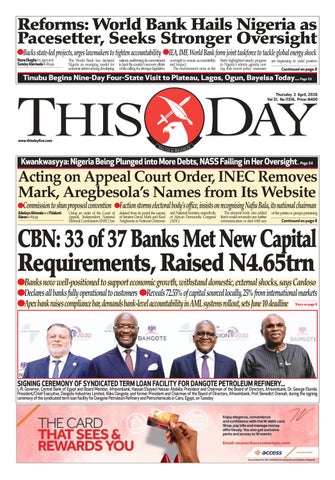
Reforms: World Bank Hails Nigeria as Pacesetter, Seeks Stronger Oversight
Backs state-led projects, urges lawmakers to tighten accountability IEA, IMF, World Bank form joint taskforce to tackle global energy shock
www.thisdaylive.com
![]()
Backs state-led projects, urges lawmakers to tighten accountability IEA, IMF, World Bank form joint taskforce to tackle global energy shock
www.thisdaylive.com
Commission to shun proposed convention Faction storms electoral body’s office, insists on recognising Nafiu Bala, its national chairman
Banks now well-positioned to support economic growth, withstand domestic, external shocks, says Cardoso
Declares all banks fully operational to customers Reveals 72.55% of capital sourced locally, 25% from international markets
Apex bank raises compliance bar, demands bank-level accountability in AML systems rollout, sets June 10 deadline

SIGNING CEREMONY OF SYNDICATED TERM LOAN FACILITY FOR DANGOTE PETROLEUM
L-R: Governor, Central Bank of Egypt and Board Member, Afreximbank, Hassan Elsayed Hassan Abdalla; President and Chairman of the Board of Directors, Afreximbank, Dr. George Elombi; President/Chief Executive, Dangote Industries Limited, Aliko Dangote; and former President and Chairman of the Board of Directors, Afreximbank, Prof. Benedict Oramah, during the signing ceremony of the syndicated term loan facility for Dangote Petroleum Refinery and Petrochemicals in Cairo, Egypt, on Tuesday


Nigeria, His Excellency, Olusegun Obasanjo;
The federal government has launched a $2 billion digital economy research cluster to boost innovations in academia.
The Minister of Communications, Innovation and Digital Economy, Dr. Bosun Tijani, stated this while speaking at the launch of the Digital Economy Research Clusters, a flagship initiative under Project BRIDGE (Building Resilient Digital Infrastructure for Growth), in Abuja.
The Project BRIDGE is financed by the World Bank and will engage university-led research consortia to deliver high-quality, policy-relevant research across six thematic clusters.
He said, “The digital economy is a knowledge-driven sector. We cannot rely only on ideas developed elsewhere. We must generate our own insights rooted in our realities.
“This is not just about output, but about building credibility, strengthening our research base, and contributing to global knowledge.
Tijani stated that the newlylaunched Digital Economy Research Clusters would bring together universities, researchers and global partners to focus on key areas.
According to him, the areas include connectivity and meaningful access, digital public infrastructure and government services, skills and human capital, jobs and the digital economy, trust and consumer protection, as well as AI and emerging technologies.
“These research clusters are practical and impactful. They will deepen Nigeria’s ability to adopt, shape and deploy technology effectively.
“Our ambition is clear: We want Nigeria to contribute to shaping the global digital economy, and this requires new thinking, evidence and talent.
“This initiative places our universities and researchers at the centre of that ambition,” he said.
In his remarks, the Minister of
Education, Dr. Tunji Alausa, said that Nigerian universities needed to evolve beyond theoretical learning centres into institutions that nurture innovators, entrepreneurs and problem-solvers capable of competing globally.
“These clusters will help us build innovators and develop solutions
that can transform lives in Nigeria and globally,” he said.
Earlier, the Vice-Chancellor, Olabisi Onabanjo University, Prof. Ayodeji Agboola, who spoke on behalf of other vice chancellors present at the event, said the initiative needed more awareness so that the youth would key into it.
Michael Olugbode in Abuja
The 14th Ministerial Conference of the World Trade Organisation (WTO) ended in deadlock in Yaoundé, Cameroon, after member countries failed to reach consensus on extending a long-standing moratorium that prevents governments from imposing tariffs on digital transmissions.
The impasse occurred after Brazil and Turkey blocked a proposed agreement supported by most of the WTO’s 164 members to extend the moratorium on customs duties on electronic transmissions until
December 31, 2030.
The breakdown halted progress on broader reform proposals championed by the United States and exposed deep divisions among member states over the future of global digital trade governance.
Reacting to the outcome, United States Trade Representative Jamieson Greer, expressed frustration over what he described as a lack of seriousness among some members, noting that months of negotiations had failed to produce a compromise.
Greer said the inability to reach consensus on a digital trade issue
after nearly three decades of the moratorium was a troubling signal for the future relevance of the global trade body.
“It is particularly frustrating that the WTO could not achieve consensus to make the e-commerce moratorium permanent or even extend it beyond a short period,” he said.
The moratorium, first adopted in 1998, has been periodically renewed to prevent tariffs on electronic transmissions such as software, digital media, and online services, which form a critical component of the modern digital economy.
According to Greer, despite the failure within the WTO framework, the United States has secured commitments from several major trading partners not to impose tariffs on American digital transmissions.
He added that Washington would pursue alternative arrangements outside the WTO if consensus remains impossible within the organisation.
“If the WTO cannot achieve this commonsense objective, the United States will work with willing partners to establish a plurilateral agreement on e-commerce tariffs,” he said.
Also commenting on the outcome,
Onyebuchi Ezigbo in Abuja
The European Union and investment experts in Nigeria have expressed worry that businesses capable of delivering real climate impact and boosting the country’s green economy lack access to finance.
The concern by stakeholders came just as the Women Leading Climate Action (WLCA) disclosed that Nigeria mobilises an estimated $2.5 billion annually in climate finance.
Speaking at a Forum in Abuja organised by WLCA, the Ambassador of the European Union to Nigeria and ECOWAS, Gautier Mignot, said the Green economy was not just about mobilising finances, but how to connect such capital to the right entrepreneurs, especially those already building solutions on the ground, which would remain underserved and
under-recognised.
“It is about building investment pipelines that are diverse, financial systems that are accessible and ecosystems that connect entrepreneurs to opportunity,” he said.
He said Nigerian women were already leading in the area of the green economy, adding that Women currently represent over 70 percent of Nigeria’s informal economy.
According to the Ambassador, women constitute between 50 and 70 percent of small holder agricultural labor, and they are key actors in local markets and regional value chains.
“Yet despite the central role, they remain underrepresented where it matters most, in access to finance, in investment pipelines and in leadership and decision making spaces shaping the green economy,” he said.
While laying the tone for discus-
sion by participants, the Convener of the dialogue session and Founder of WLCA, Mrs. Amanda ArchibongDoukouré said Nigerian women play a prominent role in MSMEs in Nigeria but lack the financial visibility that match their efforts.
For instance, Archibong-Doukouré said women dominate the last-mile distribution, agro-processing and clean energy adoption.
“We are talking about nearly 40 million MSMEs in Nigeria, the vast majority at micro level.
A $158 billion financing gap and almost half of micro-enterprises are owned by women. So the question is no longer whether women are participating. The real question is: who is designing the system and who is it designed for? “ she said.
In specific terms, she there was a $320 billion global credit gap representing unmet demand for investment in women-led businesses.
Archibong-Doukouré said the issue was not just lack of capital but misaligned capital, stating that, “Nigeria mobilises an estimated $2.5 billion annually in climate finance, (only about 8% of what is actually required).”
However, she said the concern was that most of this capital were not structured for early-stage businesses but designed for: larger ticket sizes and proven scales with strong collateral.
Archibong-Doukouré spoke on the aim of the dialogue session, saying, “it about building women who can shape decisions, not just implement them, positioning women-led solutions to access capital, not just grants and generating the data and intelligence that makes these systems visible.”
She said without such alignment of objectives, the country would continue to fund climate ambition
without funding climate reality.
She also said Nigeria was standing at a defining intersection, undergoing a major energy transition, while simultaneously opening up one of the largest single markets in the world through AfCFTA.
Former Vice President, African Development Bank (AfDB), Ms. Cecilia Akintomide, said Nigeria has demonstrated a strong investor appetite for green finance, citing multiple government issuances that were oversubscribed.
“The market is there, but women are not necessarily benefiting from it,” she said.
Akintomide identified barriers, including limited access to education, financing structures beyond the scale of micro, small, and medium enterprises, and concentration of funding in sectors where women are underrepresented, such as large infrastructure projects.
Deputy United States Trade Representative and U.S. Ambassador to the WTO Joseph Barloon said Washington remains committed to pushing reforms within the global trade institution despite the stalemate.
Barloon noted that although many member countries engaged constructively during the negotiations, the refusal by a few members to support the moratorium extension prevented a broader agreement that could have strengthened digital trade rules globally.
The ministerial conference, the highest decision-making forum of the WTO, brought together trade ministers and senior officials from member states to negotiate global trade policies and reforms.
During the week-long talks in Yaoundé, Greer held meetings with several counterparts including Cameroon’s trade minister Luc Magloire Mbarga Atangana, who chaired the conference, as well as representatives of least-developed countries coordinated by The Gambia. The United States delegation also presented reform proposals aimed at modernising WTO operations and improving its capacity to address emerging trade challenges, particularly those linked to digital commerce.
However, the collapse of the talks highlighted growing tensions among WTO members over how global trade rules should adapt to the rapidly evolving digital economy.
Analysts said the failure to extend the e-commerce moratorium could introduce uncertainty for global digital trade, as countries may now consider imposing tariffs on cross-border electronic transmissions once the current arrangement expires.

DURING LAUNCH OF ZENITH BANK VISA SIGNATURE CARD...
Group Managing Director/CEO, Zenith Bank Plc, Dame Dr. Adaora Umeoji, OON (left), and Senior Vice President/Group Country Manager, Visa West and Central Africa, Aminata Sane, during the launch of Zenith Bank Visa Signature Card at Zenith Bank Headquarters in Lagos, on Monday
In spite of the establishment of the Frontier Exploration Fund (FEF) from which over N450 billion was realised by the Nigerian National Petroleum Company Limited (NNPC) in 2025 alone, Nigeria’s oil reserves have declined in at least the last three years, a THISDAY review has shown.
This is coming as the Nigerian Upstream Petroleum Regulatory
Commission (NUPRC) yesterday announced that the country’s crude reserves slumped by 0.74 per cent as of January 2026 to 37.01 billion barrels.
For context, in 2025, Nigeria’s crude oil reserves stood at 37.28 billion barrels, falling from 37.50 billion barrels in 2024, the NUPRC announced at the time.
At its core, Nigeria’s frontier exploration fund was created under the Petroleum Industry Act (PIA) in 2021 to finance exploration in
frontier basins of the country where hydrocarbons are suspected but not yet proven or commercially developed.
In plain terms, it was designed to search for new oil and gas deposits in underexplored regions, expand Nigeria’s reserves base beyond the traditional Niger Delta and de-risk exploration in difficult or unproven terrains where private investors are usually reluctant to go.
These frontier basins include places like the Chad Basin,
Sokoto Basin, Anambra Basin, Benue Trough, Dahomey Basin, and others. Before President Bola Tinubu stopped its administration by the NUPRC and the NNPC early this year, instructing direct payment to the Federation Account, the law mandated that about 30 per cent of NNPC’s profit from oil and gas production-sharing contracts was set aside for this purpose.
But in a media release yesterday updating Nigerians about the country’s hydrocarbons stock, the
commission stated that in keeping with its mandate, it remained committed to improving upstream sector performance.
Besides, it reiterated its commitment to enhancing the growth of oil and gas reserves and ensuring stable production for shared prosperity via operationalisation of the Petroleum Industry Act, 2021 (PIA), and implementation of the strategic pillars of the commission.
The Chief Executive of the NUPRC, Oritsemeyiwa Eyesan,
Chief Executive Officer of Sahara Group, Kola Adesina, has joined the Mission 300 Private Sector Council, a high-level initiative aimed at expanding electricity access to 300 million Africans by 2030.
The council, convened by the World Bank Group, the African Development Bank (AfDB), and The Rockefeller Foundation, brings together senior business leaders to mobilise investment and shape policy direction around Africa’s electrification drive.
Adesina’s appointment underscores the growing role of private capital in addressing what remains
one of Africa’s most binding constraints to economic growth, the limited access to reliable power.
Roughly half of the continent’s population still lacks dependable electricity, a gap that continues to stifle industrialisation, weaken productivity, and slow digital innovation.
In a statement following his appointment, Adesina described his inclusion in the council as an opportunity to advance collaborative solutions to Africa’s energy challenges. He noted that delivering electricity at scale would depend on “coordinated partnerships, sustained private investment, and a strong pipeline of bankable projects” capable
of translating policy ambition into tangible outcomes.
Drawing on Sahara Group’s footprint across energy and infrastructure, he pointed to the company’s experience in developing, financing, and operating power assets as a basis for contributing to the council’s objectives.
Through its subsidiary, Sahara Power Group, the firm, he said, has been involved in electricity generation and distribution projects designed to support industrial activity and broader economic transformation.
“I am honoured to join the Mission 300 Private Sector Council, a high-level platform convened by the World Bank Group, the
Michael Olugbode in Abuja
The federal government has declared Friday, April 3, and Monday, April 6, 2026, as public holidays to enable Christians across the country celebrate Easter.
The announcement was made by the Minister of Interior, Olubunmi Tunji-Ojo, on behalf of the federal government, according to a statement issued by the Permanent Secretary of the Federal Ministry of Interior (Nigeria), Magdalene Ajani.
The minister congratulated
Christians in Nigeria and in the diaspora on the celebration, describing Easter as a period that reflects the enduring values of sacrifice, renewal and hope.
He urged Nigerians to emulate the virtues of selflessness, forgiveness, patience and love as demonstrated in the life and teachings of Jesus Christ.
Tunji-Ojo also called on citizens to strengthen the spirit of tolerance, unity and peaceful coexistence, stressing that these values remain critical to national cohesion.
According to him, the federal government remains committed to policies and decisions aimed at promoting national renewal, economic growth and shared prosperity for all Nigerians.
He further wished Christians across the country a peaceful and joyful Easter celebration.
Easter is one of the most significant events in the Christian calendar, commemorating the resurrection of Jesus Christ and symbolising victory over death and the promise of new life for believers.
African Development Bank, and The Rockefeller Foundation, with a shared ambition: to connect 300 million Africans to electricity by 2030.
“Today, about half of Africa’s population still lacks access to reliable power. Closing this gap will require coordinated partnerships, sustained private investment, and a strong pipeline of bankable projects that translate policy ambition into measurable impact.
“Through Sahara Power Group,
a Sahara Group subsidiary, we have spent decades developing, operating, and financing power assets that support industrial growth, economic transformation, and inclusive development across the continent. Building on this experience, Mission 300 offers a credible platform to deepen collaboration between governments, development institutions, and the private sector to deliver electricity responsibly and at scale.
while breaking down the numbers, explained that 2P (proven plus probable) crude oil and condensate reserves currently stand at 31.09 billion barrels and 5.92 billion barrels, respectively, amounting to a total of 37.01 billion barrels.
In the same vein, Eyesan explained that 2P Associated Gas (AG) and Non-Associated Gas (NAG) reserves stand at 100.21 Trillion Cubic Feet (TCF) and 114.98 TCF, respectively, resulting in total Gas reserves of 215.19 TCF.
“In view of this, I am pleased to present to you an overview of the nation’s oil, condensate, associated gas, and non-associated gas reserves as of January 1st, 2026, as follows: 2P crude oil and condensate reserves stand at 31.09 billion barrels and 5.92 billion barrels, respectively, amounting to a total of 37.01 billion barrels.
“2P Associated Gas (AG) and Non-Associated Gas (NAG) reserves stand at 100.21 Trillion Cubic Feet (TCF) and 114.98 TCF, respectively, resulting in total gas reserves of 215.19 TCF,” Eyesan explained. The NUPRC chief executive emphasised that currently, Nigeria’s crude oil can serve the nation for the next 59 years while the gas assets can last the next 85 years.
The Minister of Aviation and Aerospace Development Festus Keyamo has attributed the poor growth of Nigerian airlines to their inability to secure financing for the acquisition of modern aircraft to boost their fleet.
Keyamo made this known in his key note address at the on-going maiden Nigeria Aircraft Acquisition and Investment Summit (NAAIS) 2026, holding at the Federal Palace Hotel, Victoria Island, Lagos.
He noted that for decades, access to affordable and dependable aircraft financing has remained one of the most significant constraints for Nigerian operators.
The minister said this has limited fleet renewal, constrained route development, weakened competitiveness, and increased operating costs.
“That is precisely why this administration has treated aircraft financing not as a private challenge for airlines alone, but as a national challenge,” he said. He therefore called on global investors to seize emerging opportunities in Nigeria’s aviation sector, citing strong reforms and other key drivers of growth in the sector.
“Under the leadership of President Bola Ahmed Tinubu, we have taken deliberate steps to de-risk aviation investment in Nigeria. The most consequential of these has been the strengthening of Nigeria’s implementa-
tion of the Cape Town Convention and Aircraft Protocol.
“Specifically, on September 12, 2024, Nigeria issued the Federal High Court Cape Town Convention & Aircraft Protocol Practice Direction, 2024 to fully implement this very important treaty on aircraft leasing, thereby enhancing investor confidence in the nation’s aviation sector.
“And on October 16, 2024, Nigeria went a step further by officially issuing the Irrevocable De-Registration and Export Request Authorisation (IDERA) Advisory Circular, intended to improve deregistration and export-remedy procedures, thus strengthening the legal framework for aircraft leasing,” he said.

First Lady of Nigeria Senator Oluremi Tinubu (left) with the wife of the Inspector General of Police and President, Police Officers Wives Association, Mrs.
during her visit to the First Lady at the State House, Abuja, on Tuesday
950,000 barrels of crude exported
Emmanuel Addeh in Abuja
Nigeria has exported the first cargo of its new Cawthorne export grade, a spokesperson for the Nigerian National Petroleum Company Limited (NNPC) has told Platts, with shiptracking data showing it heading to India.
“NNPC shipped the first cargo of the new Cawthorne crude at the weekend. A total of 950,000 barrels of crude was exported from the FSO Cawthorne,” the NNPC spokesperson told Platts, part of S&P Global Energy.
Other recently introduced Nigerian grades include Obodo, launched in 2025, and Utapate, introduced in 2024, reflecting sustained efforts by NNPC to diversify export streams and stabilise production.
Ship-tracking data from S&P Global Commodities at Sea showed the cargo is being delivered to India’s Sikka port. Sikka is home to the 1.36 million bpd Reliance-owned Jamnagar refinery, which has sought to diversify its crude slate following sanctions on Russian energy and amid the Middle East war.
NNPC said previously that the new grade is light and sweet,
comparable to Nigeria’s flagship Bonny Light crude, the S&P report added.
Cawthorne crude is being produced from OML 18, in the eastern division of the Niger Delta, which has long been plagued by crude theft and sabotage. NNPC is the operator of the block, which contains the Awoba and Buguma fields. OML 18 was previously operated by supermajor Shell.
Sahara Group – NNPC’s partner in OML 18 – also confirmed to Platts, March 30, that the first barrels of Cawthorne had lifted over the last weekend, adding that FSO facility would be “strategic in strengthening Nigeria’s energy security through its reliable production, storage and evacuation infrastructure”.
“The successful commencement of crude lifting from FSO Cawthorne is a significant milestone for the
OML 18 partnership and a strong demonstration of what can be achieved through shared vision, technical discipline and committed collaboration,” a company statement quoted Sahara’s head of commercial and planning, Tosin Etomi, as saying. Etomi said advanced technologies were deployed on the 2.2-millionbarrel FSO Cawthorne, incorporating cutting-edge systems supported by artificial intelligence.
NNPC and Sahara Group are joined by Lagos-based Eroton E&P and Bilton Energy in the ownership of OML 18, which should hit peak production of 50,000 bpd, according to industry data.
Nigeria has been pushing to boost its crude production and exports since the election of President Bola Tinubu in May 2023. Demand for West African crude has been rising with the US-Israeli war in Iran hitting
crude supply from the Persian Gulf, the Platts report stressed. The country pumped 1.48 million b/d in February after the huge Bonga deepwater field went offline for scheduled maintenance, according to government estimates. Nigeria’s total production capacity is said to be around 2.2 million bpd, but years of underinvestment, field maturation and crude theft have tanked output over the past decade, it noted.
Nigeria is intensifying efforts to channel more than $20 billion in annual diaspora remittances into productive investments as the Nigerians in Diaspora Commission (NiDCOM) unveiled plans for a major global investment conference aimed at mobilising Nigerians abroad to drive economic growth at home.
Chairman and Chief Executive Officer of the commission, Abike Dabiri-Erewa, announced on Wednesday that the Nigeria Diaspora Economic Conference (NIDEC) 2026 will take place
from August 13 to 15 in Mississauga, Toronto, Canada.
Speaking at a press conference at the Federal Secretariat Complex in Abuja, Dabiri-Erewa said the summit represents a strategic push to redirect diaspora remittances—one of Nigeria’s largest sources of foreign exchange—toward long-term investments in key sectors of the economy.
“While remittances have long supported families and communities, the focus now is to transition from remittances for consumption to remittances for investment,” she said.
Bayelsa Set to Inaugurate Independent Power, 630-Metre Bridge, Dual Carriage Road Projects
Olusegun Samuel in Yenagoa
After months of anxiety and high expectations, the independent power project of the Bayelsa State Government is set to be inaugurated this month.
Also awaiting inauguration are the 630-metre-long AngiamaOporoma bridge across the River Nun in Southern Ijaw Local Government Area, and one of the newly constructed dual carriage roads linking the New Yenagoa City from the Gbarantoru axis of the state capital. Governor Douye Diri, who disclosed this on Tuesday during the March edition of the monthly Praise
Night at the King of Glory Chapel, Government House, Yenagoa, said the 60-megawatt gas-fired turbine plant was set for test-run and would be inaugurated by President Bola Tinubu.
According to a press statement by the Chief Press Secretary, Daniel Alabrah, Senator Diri said when fully operational, the power plant situated at Elebele community in Ogbia Local Government Area would boost socio-economic development and catalyse industrial growth.
The Bayelsa governor appreciated people of the state for their patience, support and understanding on the project, which he noted had earlier been earmarked for completion by
December 2025.
He also explained that consumption of electricity would be metered and paid for through the pay-as-you-go billing system so that consumers would not be overcharged.
He said: “The state’s gas turbine project is 99 per cent completed. I was there today, and l saw things for myself. We are bringing no less a person than the President of the Federal Republic of Nigeria, Senator Bola Tinubu, to inaugurate it.
“With what l have seen and been assured, April 2026 will not pass us by. However, we must also test run the facility before it fully comes on stream.
“This conference will create a platform for diaspora professionals and investors to connect directly with credible opportunities in Nigeria.”
She explained that Canada was selected as host country because of its rapidly growing and highly accomplished Nigerian community, particularly in sectors such as healthcare, technology and finance.
Dabiri-Erewa noted the conference, themed “Invest Nigeria, Thrive Abroad,” will serve as a bridge between Nigerian entrepreneurs and diaspora investors by creating structured opportunities for partnerships, technology transfer and capital mobilisation.
Unlike traditional conferences, she said the event is designed as a results-
driven investment marketplace, where investors and businesses can negotiate deals, hold business-to-business meetings and sign memoranda of understanding.
Key sectors expected to be highlighted at the summit include fintech and digital innovation, agriculture and agro-processing, mining and renewable energy, healthcare and pharmaceuticals, real estate, infrastructure and financial services.
Dabiri-Erewa also disclosed that the conference will be organised in collaboration with the Nigerian High Commission in Canada and the Canadian High Commission in Nigeria to ensure smooth participation for delegates.
Beyond the investment forum, the
conference week will feature cultural and entertainment activities celebrating Nigerian excellence, including the Flavours of Nigeria Festival and the internationally recognised The Headies music awards, which are scheduled to hold in Canada for the first time. She urged Nigerian state governments, financial institutions, entrepreneurs and diaspora professionals to take advantage of the platform to showcase viable projects and attract global capital.
Dabiri-Erewa added that discussions are ongoing with Canadian authorities to introduce a special event visa facilitation process for legitimate participants, while a dedicated registration portal for the conference will soon be launched.
Ibrahim Oyewale in Lokoja
Worried by bad Nigerian roads, the attendant carnage and high cost of maintenance, the President, Kogi State Chamber of Commerce and Industry, Dr. Femi Ajisafe, has tasked the federal government to explore alternative transportation mode through Inland waterways to ease pressure on roads. Ajisafe in his lecture titled: “Bad Roads: Looking for Alternative Mode through the Inland Waterways CorridorPassenger and Cargo Transportation in
Nigeria,” delivered at the just concluded 2026 Press Week organized by the Correspondents’ Chapel, Nigeria Union of Journalists ,Kogi State Council in Lokoja.
Ajisafe pointed out that inland waterways infrastructure is, in all, about 10,000 Kilometers and about 3,000 Kilometers of Nigeria’s inland waterways are seasonally navigable, stressing that the rivers Niger and Benue are Nigeria’s principal rivers which merge into a confluence at Lokoja.
“They both account for about 1,900 Km of waterways before letting their waters into the Niger Delta or entering the Ondo waterways on to the Lagos lagoon.
“Nigeria’s Rivers Niger and Benue are the lifeblood of the nation’s economy, supporting agriculture, fishing, and Commerce. However, their potential as transport arteries remain largely Untapped. With congested roads and underutilized rail networks, it’s time to tum these waterways into bustling transport hubs.
Emmanuel Addeh in Abuja
Adeleye Falade has officially assumed office as the Managing Director and Chief Executive Officer of Nigeria LNG, a statement by the General Manager, External Relations and Sustainable Development, Sophia Horsfall, said yesterday. He took up the role on Wednesday at the company’s Corporate Head Office in Port Harcourt, succeeding Philip Mshelbila, who was recently appointed Secretary-General of the Gas Exporting Countries Forum (GECF).
According to the release, Falade brings nearly three decades of experience in the global oil and gas
industry, with extensive leadership exposure across the LNG and petro- leum value chain. Over the course of his career within the Shell Group, he has built a distinguished record across upstream and midstream operations in Europe, Asia, the Middle East, Russia, and Africa. His professional expertise, NLNG said, spans gas and petroleum operations, production optimisation, engineering, operational excellence, business improvement, and change management.
He has also held several senior technical and leadership roles within Shell and its affiliated companies, gaining broad exposure to complex operational environments,
multinational joint ventures, and the management of diverse, multicultural teams, the statement added.
Prior to his appointment as managing director and chief executive officer of NLNG, Falade served as Managing Director of Brunei LNG Sendirian Berhad, a position he assumed in April 2024. In that role, he led one of the world’s established LNG producers and oversaw strategic operational delivery within Brunei’s LNG sector.
“Earlier in 2023, he was appointed Country Chair for Shell Namibia, where he provided strategic leadership for Shell’s operations and stakeholder engagement
in the country. Before taking on these international leadership assignments, Falade held key senior roles at NLNG.
“Between May 2019 and September 2023, he served as General Manager, Production, where he was responsible for ensuring production reliability, plant performance, and operational safety across NLNG’s world-class LNG facilities on Bonny Island.
“Earlier in his career, he served as Operations Manager at NLNG from July 2015 to May 2018, overseeing plant operations and operational performance. He later moved to the Netherlands as Regional Asset Management
James Emejo in Abuja and Nume Ekeghe in Lagos
The Central Bank of Nigeria (CBN), yesterday disclosed that Nigerian banks had raised a total of N4.65 trillion in new capital within 24 months, in a recapitalisation exercise that ended on March 31, 2026, strengthening the resilience of the financial system and enhancing industry capacity to support the economy.
The central bank also announced the successful conclusion of the banking sector recapitalisation programme that was initiated in March 2024.
The CBN, in a statement signed by its Director, Banking Supervision, Dr. Olubukola A. Akinwunmi, and acting Director, Corporate Communications, Mrs. Hakama Sidi Ali, stated that the exercise
recorded strong participation from both domestic and international investors, with 72.55 per cent of capital sourced locally and 27.45 per cent from international markets, reflecting sustained confidence in the Nigerian banking sector.
Also yesterday, the CBN indicated that it has raised the regulatory bar for anti-money laundering compliance, directing banks and other financial institutions to take full ownership of their control frameworks, even as it set a June 10, 2026 deadline for the submission of implementation plans under its new automated AML standards.
Commenting further on the success of the recapitalisation exercise, CBN Governor, Mr. Olayemi Cardoso said, “The recapitalisation programme has strengthened the capital base of Nigerian banks, reinforcing the
resilience of the financial system and ensuring it is well-positioned to support economic growth and withstand domestic and external shocks.”
The central bank further confirmed that 33 of the 37 banks in the country met the revised minimum capital requirements established under the programme.
The apex bank however failed to name the bank four banks that failed to meet the new capital requirements.
The statement, however, noted that a limited number of institutions remained subject to ongoing regulatory and judicial processes, which are being addressed through established supervisory and legal frameworks.
All banks remain fully operational, ensuring continued access to banking services for customers,
the apex bank added.
The CBN further stated that the recapitalisation programme has strengthened Capital Adequacy Ratios (CAR), with the sector maintaining levels above international Basel benchmarks.
Minimum CAR thresholds remained at 10 per cent for regional and national banks and 15 per cent for banks with international authorisation.
The recapitalisation, implemented alongside an orderly exit from regulatory forbearance, it noted, has improved asset quality, thereby reinforcing balance-sheet transparency and overall financial system stability.
To safeguard these gains, the CBN has also strengthened its risk-based capital adequacy framework, requiring banks to conduct regular stress testing across defined scenarios and
ACTING ON APPEAL COURT ORDER, INEC REMOVES MARK, AREGBESOLA’S NAMES FROM ITS WEBSITE
the affairs of the party and would not monitor any meeting, congress or convention convened on behalf of ADC by any group until the matter was decided by the Federal High Court, Abuja.
INEC National Commissioner and Chairman, Information and Voter Education Committee, Mohammed Haruna, in a statement, said the deci-sion was to ensure it did not act in any way capable of foisting a fait accompli on the court or otherwise rendering nugatory the proceedings before the trial court.
Haruna stressed that the commission was in receipt of a letter from the law firm of Suleiman Usman SAN & Co dated March 16, 2026, titled, “Re: Notice of pending proceedings before the Federal High Court and caution against any purported recognition of Mr. Nafiu Bala Gombe as Acting National Chairman of the African Democratic Congress (ADC).”
The commission said the letter was written on behalf of concerned stakeholders within ADC.
It also acknowledged receipt of another letter from the law firm of Summit Law Chambers dated March 16, 2026, titled, “Demand for enforcement of the orders made by the Court of Appeal Abuja division in appeal no: ca/ ABJ/145/2026 SENATOR David Mark v Hon. Nafiu Bala Gombe & 4 ors,” written on behalf of Hon. Nafiu Bala Gombe.
Haruna stated that the letter from Suleiman Usman SAN & Co requested the commission not to recognise Mr. Nafiu Bala Gombe as acting National Chairman of ADC on account of the pending
litigation in Suit No. FHC/ABJ/ CS/1819/2025 before the Federal High Court Abuja, where the question of the leadership of the party was presently being contested.
He stressed that the letter from Summit Law Chambers, on the other hand, attached the certified True Copy of the judgement of the Court of Appeal in Suit No. CA/ABJ/145/2026 Mark v Gombe & Ors and requested the enforcement of the orders made therein and specifically asked INEC to stop recognising Mark and Rauf Aregbesola as National Chairman and National Secretary of ADC. The court also directed that their names be removed from INEC’s website and refrain from receiving any correspondence from them or attending any of their meetings, congress or convention ordered or authorised by them in line with the preservation orders made by the Court of Appeal in Appeal No. CA/ABJ/145/2026.
Haruna said the commission further received another letter from the law firm of Summit Law Chambers dated March 27, 2026, titled “Demand for enforcement of the orders made by the Court of Appeal Abuja Division in appeal no: CA/ABJ/145/2026 Mark V Gombe & 4 Ors,” accusing the commission of inviting the Mark group to the political parties meeting hosted by INEC on Tuesday, March 24, 2026 and also monitoring the National Executive Committee meeting of the party in disobedience of the orders of the Court of Appeal in Appeal No. CA/ABJ/145/2026.
Haruna stated, “They further drew the attention of the commission
to the motion ex-parte and motion on notice filed by their client on December 15, 2025, seeking to prevent the 1st Defendant (ADC) from holding any convention, congress, conference, or Meeting and to stop INEC from attending, monitoring, observing or recognising any activities of the ADC.
“They accordingly requested INEC to invalidate the NEC meeting held by Senator David Mark’s group on 25th March, 2026, remove the name of Senator David Mark’s group from the INEC portal, stop recognising or acknowledging
correspondence from them until the determination of the pending suit before the Federal High Court, Abuja and allow Hon. Nafiu Bala Gombe to take over the affairs of ADC pending the determination of the case, and that INEC should respect the orders of the Court of Appeal in Appeal No. CA/ ABJ/145/2026.”
Haruna explained that the Court of Appeal, after dismissing the appeal of Mark in the interlocutory appeal, made the following orders:
Continued on page 34
System (AMS) Implementation Manager at Shell in The Hague between May 2018 and April 2019.
In that role, he led the deployment of asset management systems aimed at improving operational efficiency and reliability across Shell’s global assets,” the company pointed out.
It stressed that Falade has a Bachelor’s degree in Electrical/Electronics Engineering at the University of Ibadan and also obtained a Master of Business Administration (MBA) from Henley Business School, University of Reading, United Kingdom, further strengthening his strategic and leadership capabilities in the global energy sector.
Falade is a Fellow of the Nigerian
maintain appropriate capital buffers.
It pointed out that key regulatory measures, including prudential guidelines and the supervisory framework, were subject to periodic review to support ongoing strengthening of governance, risk management, and sector resilience.
“The recapitalisation programme was carried out without disruption to banking services, ensuring continuous access for individuals and businesses throughout the process.
“The successful completion of the programme establishes a stronger and more resilient banking system, better positioned to support lending, mobilise savings, and withstand domestic and global shocks,” it added.
The central bank further reaffirmed its commitment to maintaining a stable, transparent, and resilient financial system that inspires confidence among depositors, investors, and the broader public, and to advancing the sustainability of the nation’s financial architecture.
Meanwhile, the CBN has raised the regulatory bar for anti-money laundering compliance, directing banks and other financial institutions to take full ownership of their control frameworks, even as it has set a June 10, 2026 deadline for the submission of implementation plans under its new automated AML standards.
In a circular addressed to banks, mobile money operators, international money transfer operators, and other financial institutions, the apex bank underscored that compliance with its newly issued

Baseline Standards for Automated AML/CFT/CPF Solutions would be assessed at the institutional level, rather than based on the capabilities of technology vendors.
The move signals a shift away from a “tick-box” approach to compliance, amid growing reliance on third-party solutions, as the regulator seeks to strengthen governance, effectiveness, and integration of anti-money laundering and counter-terrorism financing frameworks across the financial system.
Signed by Olubunmi AyodeleOni for the Director, Compliance Department, the circular stated: “The CBN recently issued the Baseline Standards for Automated AML/ CFT/CPF Solutions (the Baseline Standards) to strengthen the effectiveness, governance, and integration of AML/CFT/CPF control frameworks across financial institutions.
“Following this issuance, the CBN has observed increased industry engagement, including commentary and representations from technology service providers regarding alignment with the Baseline Standards.
“While this reflects positive responsiveness, there is a growing risk of misinterpretation of regulatory expectations, particularly where compliance is framed primarily in terms of system features, vendor capabilities, or technology solutions.” The apex bank reiterated that the implementation plan must
Continued on page 33
REFORMS: WORLD BANK HAILS NIGERIA AS PACESETTER, SEEKS STRONGER OVERSIGHT
outcomes and positioning the country as a reference point for others pursuing similar economic transitions.
Speaking during a meeting with the Senate Committee on Capital Market in Abuja yesterday , the World Bank Country Director for Nigeria, Mathew Verghis, said the institution remains fully aligned with Nigeria’s reform trajectory and is ready to deepen its support across key sectors.
He revealed the Bank’s Managing Director recently visited Nigeria and commended the pace and direction of reforms, describing the country as a growing example for nations seeking to stabilise and reposition their economies.
Verghis, however, stressed that sustaining the gains of these reforms would depend significantly on effective parliamentary oversight, particularly for projects funded by development partners.
According to him, legislative
scrutiny is essential to ensuring transparency, proper utilisation of funds and the overall success of intervention programmes. He urged lawmakers to apply oversight constructively, noting that it should strengthen implementation rather than hinder progress.
“Legislative oversight remains a critical pillar for ensuring accountability and effectiveness, especially in projects supported by the World Bank,” he said.
The Country Director also disclosed that the Bank has, in recent years, adopted a decentralised implementation approach in Nigeria, with a growing number of projects now executed at the state level.
He explained that while the federal government, through the Ministry of Finance, remains the borrower responsible for repayments, state governments are increasingly driving project execution.
This shift, he said, aligns with Nigeria’s federal structure and has improved delivery outcomes by bringing implementation closer to the people. Verghis said: “Over the past four to five years, we have increasingly moved implementation to the states. This has enhanced efficiency, but participation is based on clearly defined eligibility criteria,” he added.
He noted that only states that meet these benchmarks can access World Bank funding, while others may opt out, a system designed to promote accountability and performance.
On sectoral priorities, Verghis highlighted women’s empowerment as a central pillar of the Bank’s development strategy in Nigeria, describing it as crucial to achieving sustainable economic growth.
He disclosed that several ongoing programmes are aimed at boosting women’s participation in the economy, alongside a forthcoming
early childhood development initiative focused on maternal health, child welfare, early education and improved access to learning opportunities.
The bank also expressed readiness to strengthen collaboration with the National Assembly on environmental project oversight, calling for further engagement to address existing challenges and identify practical solutions.
“We would welcome a follow-up discussion to better understand the challenges and how we can address them,” he said.
In his remarks, Chairman of the Senate Committee on Capital Market, Osita Izunaso, welcomed the World Bank delegation and reiterated the committee’s commitment to effective oversight of development programmes. He announced plans to convene a technical session in the third week
Continued on page 35

L-R: Agency Secretary, National Drug Law Enforcement Agency (NDLEA), Shadrach Haruna; Country Attache, United States Drug Enforcement Administration (US DEA), Ms.
Chairman/CEO, NDLEA, Brig. Gen. Mohammed Buba Marwa (Rtd); Special Agent, US DEA, John Dreskler; and SA to the Chairman, NDLEA, Col. Yakubu Bako (Rtd), during the
of a Bilateral Strategic Counter Narcotics Workshop by NDLEA and US DEA, held at the
A prosecution witness, Mr Chinedu Emere Eneanya, has confirmed that former President Muhammadu Buhari, gave his approval for the local production of the redesigned naira notes by the Central Bank of Nigeria (CBN) in 2022.
Eneanya, who is an investigator with the Economic and Financial Crimes Commission (EFCC), made the confirmation on Wednesday before a High Court of the Federal Capital Territory (FCT), Maitama, Abuja, where the former governor of the
CBN, Mr Godwin Emefiele is been prosecuted over alleged illegalities in respect of the redesigned naira notes. Meanwhile, the witness also confirmed before the court that he was not aware if members of the public wrote any petition to the EFCC complaining against the redesigning of the naira.
Emefiele is standing trial before Justice Maryanne Anenih, of the High Court of the FCT, on a four-count charge bordering on disobedience to the direction of law and illegal act causing injury to the public.
The anti-graft agency in the charged
marked: FCT/HC/ CR/264/2024, alleged that Emefiele between October 19, 2022 and March 5, 2023 disobeyed the direction of Section 19 of CBN Act by approving the printing of 375,520,000 pieces of colour swapped N1,000 notes at a total cost of N11,052,068,062 without the recommendation of the CBN Board and strict approval of the President, Federal Republic of Nigeria, which caused injury to the public.
The commission claimed that the offences allegedly committed by the former CBN governor violated Section 123 of the Penal Code, Cap 89 Laws
of the Federation, 1990 and punishable under the same law.
He, however, pleaded not guilty to the charge and was admitted to bail to enable him adequately defend the charge against him.
At Wednesday’s proceedings, which was the continuation of cross examination, Eneanya, who is the seventh prosecution witness (PW7), observed that Exhibit N1 earlier tendered by the prosecution through him was the extrajudicial statement of the Managing Director, Nigerian Security Printing and Minting Company (NSPMC), Ahmed
The Code of Conduct Bureau is proposing that compliance to assets declaration should be make a condition for payment of emoluments to public officers.
Southeast Zonal Director of CCB, Mr. Akinfolarin Feyishola, dropped the proposal on the table of Abia State governor, Dr. Alex Otti, when he visited the governor, disclosing the agency has begun digitising the processes for Assets Declaration.
Feyishola suggested that governments should make evidence of compliance to the Code of Conduct (CCB’s Asset Declaration) one of the requirements for payment of emoluments to public officers.
“We are looking at a situation where compliance with Code of Conduct will be tied to some incentive in the public service.
“So, evidence of compliance with Code of Conduct can be part of the paper they submit before they even start receiving their emolument from the state government,” the Zonal Director stated.
Mr. Feyishola disclosed that CCB has commenced automation of the assets’ declaration processes, as the agency has already stopped issuing physical forms for exercise as was the practice in the past.
“The Code of Conduct is no more issuing out asset declaration forms like we did when you were coming into office,” he told Governor Otti.
“We are about automating the whole system now. We are going online, and maybe in about the third
quarter of the year, we are going to be fully online,” he added.
The CCB Southeast boss hailed Governor Otti for encouraging his officers and appointees to comply with the mandatory subscription to the CCB.
He used the opportunity to appeal to the governor to assist the agency in executing its proposed sensitisation for all political office holders in Abia State while commending the governor for the giant strides he has made in the state.
Welcoming the delegation, Governor Otti noted that CCB was germane to Nigeria’s democracy, stressing that compliance with assets declaration should be a minimum standard for every public office holder.
According to him, no public officer should have any excuse for non-compliance.
“The Code of Conduct Bureau is a necessary part of our democratic system and, for me personally, it is a minimum standard for people who want to operate in the public sector space,” he said.
The governor further disclosed that his deputy and himself duly declared their assets before assuming office, adding that all political appointees and public officers in the state must comply with that constitutional requirement.
He therefore directed the Secretary to the State Government, Dr. Emmanuel Meribeole, to work with relevant officials to ensure full compliance by all officers required to declare their assets.
Additionally, he also directed the Commissioner for Lands, Mr.
Chaka Chukwumerije, to inspect the CCB office in Umuahia with a view to upgrading the facility, while pledging that the state would also consider the request for an official vehicle to support its operations in the state by the CCB.
He commended the agency for moving to digitise its operations, particularly, the Assets Declaration processes.
Governor Otti stated that CCB’s digital transition plan aligns with global best practices and Abia State
government’s reform agenda.
“We look forward to a situation where someone can sit in the comfort of his home, fill the form and return it electronically; that is where the world has gone.
“This is also the direction this (Abia State) government is going. Even Certificates of Occupancy are processed and signed electronically,” Gov. Otti said, explaining the state embraced digital governance to improve efficiency and service delivery.
Halilu.
He disclosed that Halilu was invited by EFCC investigating team that investigated the naira redesign to shed more light on the redesign, which was the subject of the charge before the court.
According to him, Halilu stated that the NSPMC commenced and eventually produced the redesigned naira notes locally as directed by the late President Buhari.
Asked if in the course investigation the EFCC team found out any documents or statements that was contrary to what Halilu told EFCC, Eneanya said there was nothing contrary to what the team was told by the Halilu as contained in Exhibit N1.
He further informed the court that CBN paid NSPMC for the production of the redesigned naira notes.
On whether Emefiele disobeyed presidential directive, since the notes were produced locally, the witness told the court that the defendant disobeyed the CBN Act.
He said, “Investigation conducted by the team showed that the defendant disobeyed the provisions of the Section 19 of the CBN Act, 2007 that stated that the CBN must have board recommendation to the president before currency must be redesigned”.
The witness added that what was produced was not the samples of the N200, N500 and N1,000 notes shown
the then president. “The defendant in his 11-paged memorandum to the president attached three samples or sketches of the notes of N200, N500 and N1,000 to be changed and the president approved the design and directed that it should be produced locally.
“Investigation showed that what was eventually produced as N1,000, N500 and N200 was not what was showed to the president for approval”, he claimed.
The witness in addition stated that the old naira notes that were redesigned were designed by De La Rue of the United Kingdom.
He further confirmed to the court that Halilu did not state in his extrajudicial statements as contained in Exhibits N1 and N2 that NSPMC was the company that designed the Nigerian currency notes which were later redesigned.
When asked if his investigating team obtained statements from the secretaries of CBN’s committee of governors and the apex bank’s board of directors, the witness informed the court that the team did.
He added that he was not aware if EFCC received petitions from members of the public on the naira redesigned and insisted that he was not in a position to know that, adding that no petition was forwarded to his team by the anti-corruption commission.
Michael Olugbode in Abuja
Minister of Environment, Balarabe Abbas Lawal, has called on the media to take a more active role in confronting the country’s growing environmental challenges, stressing that responsible reporting and public awareness are crucial to safeguarding Nigeria’s ecological future.
Speaking on Wednesday at a media engagement workshop held in Abuja, Lawal described journalists and digital communicators as strategic partners in the national effort to address climate change, environmental degradation, and biodiversity loss.
He noted that the media, widely recognised as the Fourth Estate of the Realm, plays a critical role in shaping public understanding of
environmental issues at a time when the country faces mounting ecological pressures.
“The environment is not an abstract concept. It is the air we breathe, the land that feeds us, the rivers that sustain communities, and the climate that shapes the future,” the minister said.
Lawal highlighted a range of environmental threats confronting Nigeria, including desertification spreading across northern regions, severe flooding and erosion in the South-East and South-South, oil pollution and gas flaring in the Niger Delta, widespread deforestation, and the growing impacts of climate change on livelihoods and food security.
He explained that under the leadership of Bola Ahmed Tinubu and the administration’s Renewed
Hope Agenda, the Federal Ministry of Environment has intensified efforts to promote environmental sustainability while supporting economic development.
According to him, government initiatives in 2025, including the Agro-Climatic Resilience in Semi-Arid Landscapes (ACReSAL) project and the National Agency for the Great Green Wall, restored more than 1.14 million hectares of degraded land and facilitated the planting of over 1.5 million trees across Nigeria.
“These achievements demonstrate our national commitment to building a cleaner, greener, and more resilient Nigeria,” he said.
The minister, however, stressed that greater media attention is required to elevate environmental reporting in the country.
He observed that environmental issues are often treated as secondary despite their direct impact on agriculture, public health, and economic stability.
He urged journalists to adopt more data-driven and solutions-oriented reporting approaches that highlight both environmental challenges and innovative responses to them. Lawal also encouraged media professionals to take advantage of digital and social media platforms to engage Nigeria’s youthful population and amplify awareness about climate action and environmental protection. He reaffirmed the ministry’s commitment to strengthening collaboration with the media through improved access to environmental data, field activities, and information resources to support effective reporting.


Acting Group Politics Editor DEJI ELUMOYE
Email: deji.elumoye@thisdaylive.com
08033025611 sms only
With the 2027 general elections approaching, the Peoples Democratic Party recently convened a landmark gathering at the MKO abiola National Stadium in abuja, a meeting that could well determine its political trajectory. The convention tested party cohesion and highlighted the strategic acumen of former Senate President, Dr Bukola Saraki, whose foresight continues to guide the PDP through turbulent waters. In this report, Wale Igbintade examines the convention’s implications and Saraki’s pivotal role in navigating the party through uncertainty.


The Velodrome convention has emerged as one of the most consequential political gatherings in recent times, not only for the decisions made but for the crisis it sought to resolve and the future it now attempts to shape. At a moment when the Peoples Democratic Party (PDP) was enmeshed in litigations, factional rivalries, and procedural ambiguity, the Abuja gathering was less ceremonial than strategic. It was, above all, a calculated intervention to prevent the party from being sidelined in the 2027 elections.
Across the Federal Capital Territory, political activity had intensified as parties raced to meet deadline for the Independent National Electoral Commission’s (INEC) timetable. While others focused on routine leadership transitions, the PDP confronted a deeper challenge, its very eligibility to participate in the electoral process.
The urgency arose from the unresolved dispute over the controversial Ibadan convention, whose outcomes were nullified by both the Federal High Court and the Court of Appeal. With the matter now before the Supreme Court, the legitimacy of the party’s leadership remained in question.
Ordinarily, a political party might await judicial clarity. But with deadlines for submitting party registers and conducting primaries imminent, delay risked disqualification. Within this narrow, unforgiving window, the PDP chose to act.
The Velodrome convention must therefore be understood as an act of necessity rather than consensus. It was convened not because all disputes had been resolved, but because the cost of inaction had become too high. By proceeding with the election of a new National Working Committee (NWC), the party sought to establish a leadership capable of securing INEC’s administrative recognition.
That objective appears, at least for now, to have been achieved. INEC officials were present at the convention, and the newly elected leadership has since been reflected on its portal, providing the PDP a lifeline to field candidates in the forthcoming elections.
Yet, while the convention itself was central, the forces shaping it reveal a deeper layer of
political calculation, none more significant than the role of former governor of Kwara State, Dr Bukola Saraki. At a time when the party risked paralysis, Saraki’s intervention brought decisive clarity. His insight was simple but profound: internal disagreements, however intense, must not jeopardise the party’s participation in the electoral process.
This perspective reflects political wisdom often absent in crises. Where others saw a contest for control, Saraki saw a threat to institutional survival. By reframing the debate, he shifted focus from factional dominance to collective interest.
His approach was also informed by a keen understanding of Nigeria’s legal environment. Compliance with regulatory requirements is non-negotiable. A party failing to meet these standards, particularly regarding recognised leadership, risks exclusion, regardless of its popularity or historical significance.
Saraki’s urgency was strategic, not alarmist. He recognised that waiting for the Supreme Court’s decision, however desirable, could be politically fatal. By advocating immediate action, he ensured the PDP retained relevance within the electoral framework.
Equally important was his emphasis on reconciliation. In a party fractured along multiple lines, unity cannot be imposed, it must be negotiated. Saraki’s call for a “give and take” approach was pragmatic, not idealistic.
A divided party cannot mount an effective electoral challenge; any victory achieved through exclusion would ultimately be self-defeating. In this regard, Saraki acted as a bridge-builder, engaging factions and encouraging compromise. This is not to suggest divisions have been fully resolved, but a foundation has been laid for managing them.
Saraki’s calculation extends beyond the immediate crisis. Within PDP circles, there is a growing belief that the party stands to benefit from potential realignments within the ruling establishment. Nigerian politics, with its history of defections and shifting alliances, rewards parties that remain structurally intact and electorally viable.
By stabilising the PDP, Saraki positions it as a ready alternative, capable of absorbing returning members and capitalising on discontent elsewhere. Early signs of this dynamic are already emerging, lending weight to his projections. At the state level, the implications are equally significant.
In Kwara State, Saraki’s political base remains aligned with the PDP. For his supporters, the party is not merely a national platform but a practical vehicle for reclaiming power. Ensuring its survival has direct consequences for local political ambitions.
This dual focus, national relevance and local strength, highlights the depth of Saraki’s strategy. Political influence in Nigeria is built from the ground up even as it projects nationally.
Notably, Saraki has chosen not to seek immediate office, underscoring his long-term outlook. Rather than scramble for positions, he has concentrated on rebuilding structures and
For saraki, the convention validates his strategic judgment and marks a starting point for a broader political project. His intervention has not solved all the PDP’s problems, but it has ensured the party remains in contention.
shaping the party’s trajectory. This restraint reflects a deliberate effort to conserve political capital while laying the groundwork for future opportunities.
Such an approach contrasts with the prevailing shortsightedness, and narrow-mindedness in Nigerian politics. It speaks to a broader vision, seeing the current moment not as an end, but as part of a trajectory extending beyond the 2027 elections.
The success of the Velodrome convention must be measured not only by what it achieved, but by what it enables. While it has resolved the immediate question of leadership recognition, it has not eliminated underlying tensions.
The pending Supreme Court case, grievances of aggrieved factions, and the challenge of conducting credible primaries all remain.
The task before the new NWC is formidable. It must consolidate the convention’s gains by fostering unity, strengthening the organisational base, and ensuring processes inspire confidence among members and the electorate.
Failure in any of these areas could undermine progress. Yet, despite these challenges, the convention’s significance cannot be overstated. By acting decisively, the PDP prioritised survival over division. It has secured its place in the electoral process and created a fragile but real opportunity for renewal.
For Saraki, the convention validates his strategic judgment and marks a starting point for a broader political project. His intervention has not solved all the PDP’s problems, but it has ensured the party remains in contention.
In Nigerian politics, where parties can fade as quickly as they rise, that achievement is no small feat. As the country approaches another electoral cycle, the aftermath of the Velodrome convention will be closely watched. Whether the PDP can transform this moment of survival into a platform for resurgence remains uncertain. What is clear is that the decisions made in Abuja, and the strategic thinking behind them, have reshaped the party’s immediate future. For now, the PDP lives to fight another day. In the high-stakes arena of Nigerian politics, survival is often the first victory from which all others flow.
When MT Asharami Ghana, an ultra-modern Liquefied Petroleum Gas (LPG) vessel, was commissioned in Ulsan, South Korea, it marked a decisive moment in Sahara Group’s long-term commitment to Africa’s clean energy transition, and a practical intervention in Ghana’s evolving energy needs, writes Uzoma Mba

For Ghana, a country with a population of more than 35 million people, access to reliable cooking fuel is increasingly central to public health, household stability and economic activity. Liquefied Petroleum Gas (LPG) now supports everyday cooking in homes, sustains roadside food businesses and small enterprises, and underpins catering across schools, hospitals and commercial institutions. As urbanisation and population growth continue to drive demand, the reliability of LPG supply has become a national priority rather than a sectoral concern.
With the prospects of ensuring clean cooking, healthier environments and economic growth and development, Asharami Ghana, the 40,000-cubic-metre dual-fuel LPG carrier secured for Sahara Group specifically for the Ghanaian market, carries huge hope in its sails.
Presidential Endorsement, a Nation’s Clean Quest
Asharami Ghana could not have had a better christening ceremony, as Ghana’s President, John Mahama, was in Ulsan, South Korea, to witness the historic event. Mahama commended Sahara Group for working with and in Ghana to deliver sustainable solutions in the energy sector. Mahama reaffirmed his administration’s commitment to expanding access to clean cooking fuels as a cornerstone of Ghana’s energy and public health agenda. He noted that sustained investment in LPG infrastructure, spanning import capacity, storage and distribution, remains critical to reducing reliance on traditional fuels, improving health outcomes and supporting inclusive economic growth.
Asharami Ghana is a mid-size gas carrier designed to transport LPG cargoes such as propane and butane safely and efficiently, while meeting stringent global environmental standards. Powered by a dual-fuel Liquid Gas Injection Propane (LGIP) engine, the vessel can operate on both conventional IMO-compliant fuels

and LPG cargo as fuel. This enhances fuel flexibility, operational efficiency and reduces emissions.
Advanced emissions-control systems, including Selective Catalytic Reduction (SCR) technology, significantly lower emissions. These features reflect Sahara Group’s broader approach to infrastructure investment: deploying assets that are fit for current demand and aligned with the environmental and regulatory expectations shaping the future of global energy logistics.
Why Shipping Is Critical to Ghana’s LPG Market
In Ghana, imported LPG supplies a significant share of national consumption under the regulatory framework administered by the National Petroleum Authority. This means the availability of vessels, and the predictability of their schedules, directly affect supply to bottling plants, cylinder exchange points and retail outlets across the country.
Dedicated shipping capacity such as Asharami Ghana improves import reliability, reduces logistics bottlenecks and lowers exposure to vessel availability constraints. In practical terms, it helps ensure that households and businesses are not forced back to charcoal or firewood when supply disruptions occur.
This reliability is essential as Ghana pursues its clean cooking ambitions.
Household LPG adoption currently stands at about 30 per cent, with national policy targeting 50 per cent adoption by 2030. Achieving this goal requires not only policy alignment, but infrastructure capable of supporting
rising demand at scale.
From Ship to Shore: An Integrated Infrastructure Strategy
Asharami Ghana forms part of Sahara Group’s integrated LPG infrastructure strategy spanning shipping, storage and downstream distribution.
In Ghana, this approach includes the development of a 6,000-metrictonne LPG storage terminal in Tema, scheduled for completion in the second quarter of 2026. The facility will strengthen the link between maritime imports and domestic distribution, supporting bottling plants and enhancing supply reliability as the country advances the implementation of the Cylinder Recirculation Model, a key reform aimed at improving safety and access in the LPG sector.
Across Africa, Sahara Group is complementing its maritime investments with onshore LPG infrastructure developed in partnership with governments and national oil companies. These projects span Ghana, Nigeria, Côte d’Ivoire, Senegal, Tanzania and Kenya, reinforcing a coordinated, regional approach to clean energy delivery.
With the commissioning of Asharami Ghana, Sahara Group’s LPG carrier fleet has grown to six delivered vessels, bringing total delivered LPG shipping capacity to 202,000 cubic metres. Developed in collaboration with partners including WAGL Energy and NNPC Limited, the fleet
For Ghana’s population, LPG infrastructure translates into tangible outcomes. Cleaner cooking fuels reduce indoor air pollution, improve respiratory health, particularly for women and children, and ease environmental pressure from biomass fuel use
reflects Sahara’s long-standing approach to partnership-led growth.
Wale Ajibade, Executive Director, Sahara Group, says the energy and infrastructure conglomerate and its partners are already working on adding 270,000 cubic metres of capacity to the fleet by 2028. This bold move, in the words of Yaa Serwa Alifo, Managing Director, Asharami Ghana, “positions Sahara Group as a long-term player in regional and global LPG markets, capable of supporting sustained growth in African demand.”
For Ghana’s population, LPG infrastructure translates into tangible outcomes. Cleaner cooking fuels reduce indoor air pollution, improve respiratory health, particularly for women and children, and ease environmental pressure from biomass fuel use.
By strengthening the logistics that deliver LPG into the country, Asharami Ghana reinforces the supply backbone needed to serve a population of more than 35 million people, ensuring that as adoption grows, access can be sustained reliably and affordably. The vessel also enhances Ghana’s role as a regional LPG logistics hub, supporting supply to neighbouring and landlocked West African markets.
The commissioning of Asharami Ghana comes in a year when Sahara Group marks its 30th anniversary, guided by the Sahara Beyond XXX milestone. Rather than a retrospective celebration, the theme reflects forward momentum, reaffirming the Group’s focus on building an enduring enterprise that balances commercial growth with social impact and environmental responsibility.
As Asharami Ghana sets sail, it carries more than LPG cargo. It signposts a hopeful transition to cleaner energy for a growing population, and the confidence that African-led infrastructure solutions, like this initiative by Sahara Group, can meet global standards while delivering real benefits at home.

For decades, Nigerians have struggled with the burden of healthcare costs, often facing financial ruin when illness strikes. But today, a new dawn breaks as Ultimate Health HMO launches GIFSHIP, a game-changing health insurance package designed to make quality healthcare accessible to all.
Writes
MARY NNAH

For years, Nigeria’s healthcare system has been plagued by inadequate funding, poor infrastructure, and a lack of access to quality care. But with GIFSHIP, Ultimate Health HMO is leading the charge to change this narrative.
In a bold move to accelerate Nigeria’s journey towards universal health coverage, Ultimate Health HMO has launched the Group, Individual, and Family Social Health Insurance Programme (GIFSHIP), a comprehensive health insurance package designed to make healthcare affordable, accessible, and equitable for all Nigerians.
GIFSHIP is more than just a health insurance package - it’s a lifeline for millions of Nigerians who have been denied access to quality healthcare. With a premium of ₦38,718 per person per annum, GIFSHIP is affordable, accessible, and equitable.
The package is regulated by the National Health Insurance Authority (NHIA) and offers a robust benefits package, including coverage for primary, secondary, and tertiary healthcare services.
Speaking at a press briefing in Lagos recently, Managing Director/CEO of Ultimate Health HMO, Otunba Lekan Ewenla, emphasised the importance of shifting from assumptions to action, citing the National Health Insurance Authority (NHIA) Act 2022, which makes health insurance mandatory for all Nigerians.
“We need to shift from merely treating illness to creating health. A healthy nation is a wealthy nation,” Ewenla declared.
“The GIFSHIP package is a strategic step to strongly focus on the objectives of making healthcare affordable, accessible, and equitable”, he added.
The GIFSHIP package, priced at N38,718 per person per annum,
offers a robust benefits package, including coverage for primary, secondary, and tertiary healthcare services.
Ewenla highlighted that the package is designed to cater to the needs of individuals, families, groups, and corporate organizations, with a focus on the mass market.
“This is a game-changer for Nigeria’s healthcare sector,” Ewenla said. “The premium is not negotiable, the quality of care is guaranteed, and the premium is affordable. We are committed to delivering quality healthcare services to Nigerians, and GIFSHIP is a significant step in that direction.”
He explained that the NHIA Act 2022 has empowered the regulatory authority to approve and code private health insurance products, ensuring that HMOs deliver quality healthcare services to Nigerians.
“The Authority shall ensure that health insurance is mandatory to every Nigerian and final residents. The NHIA shall enforce the basic minimum package of health services for all Nigerians across all health insurance schemes operating within
the country, including federal, states, and the federal capital territory – FCT, as well as private health insurance schemes”, he noted.
The launch of GIFSHIP is expected to address the challenges of poor health indices in Nigeria, with Ultimate Health HMO targeting a significant increase in enrollment numbers.
According to Ewenla, the package is designed to address the challenges of the past, including arbitrary premium reductions and varying benefit packages.
“We adopted the Health Risk Management Framework of the social health insurance program for the private health insurance packages, which recognizes two Risk Managers. In the social health insurance programme, the primary healthcare providers are the risk managers at the primary level, while the health maintenance organizations are the risk managers at the secondary and tertiary levels of care,” Ewenla explained.
The Capitation is a concept of transferring the health risk management responsibility at the primary level of care to the primary health providers, with 65% of the premium paid for a minimum of actuarially recommended population of at least 2,500 enrollees. The capitation is paid to the primary providers by the NHIA through the health maintenance organizations.
Ewenla also highlighted that the health maintenance organizations earn 10% of the public sector social health insurance premium as an admin fee, as they speak.
We are changing the narration of our poor health indices, and we invite everyone to join us on this journey,” Ewenla said. “The GIFSHIP package is a strategic step to strongly focus on the objectives of making healthcare affordable, accessible, and equitable. We are committed to delivering quality healthcare services to Nigerians, and GIFSHIP is just the beginning
The fee-for-service paid to the health maintenance organizations was to settle defined and denominated healthcare services through pre-authorization codes that must be issued by the HMOs.
“The good news is that all the challenges enumerated in the course of this briefing have been adequately addressed by the NHIA Act 2022, section 3, which says that the NHIA shall ensure that health insurance is mandatory for every Nigerian and legal residents,” Ewenla said.
The GIFSHIP package is regulated by the National Health Insurance Authority – NHIA and is very robust.
The healthcare providers are familiar with the services covered at the three levels and have a better understanding of the operational process like calling the HMOs for pre-authorization codes and utilizing the NHIA tariffs for the secondary and tertiary services.
“We are changing the narration of our poor health indices, and we invite everyone to join us on this journey,” Ewenla said.
“The GIFSHIP package is a strategic step to strongly focus on the objectives of making healthcare affordable, accessible, and equitable. We are committed to delivering quality healthcare services to Nigerians, and GIFSHIP is just the beginning.”
Ultimate Health HMO has already made significant strides in providing healthcare coverage to Nigerians, with a reasonable number of public sector enrollees and corporate organizations already on board.
The launch of GIFSHIP is expected to further boost the company’s efforts, with Ewenla calling on Nigerians to join the journey towards universal health coverage.
“We are targeting the mass market with GIFSHIP,” Ewenla said. “We want to make healthcare accessible to every Nigerian, regardless of their social status or income level. We are committed to delivering quality healthcare services to Nigerians, and GIFSHIP is a significant step in that direction.”


Mutfwang is on the right path, reckons YAKUBU DATI

Security policy must move beyond reactive triumphalism, contends FELIX OLADEJI See

This Passion Week presents a good opportunity for personal change and hope, especially for persons who are overwhelmed by life’s vicissitudes, writes MONDAY PHILIPS EKPE
Thomas Hardy, renowned 19th/20th centuries English writer, explored the familiar themes of the self-sabotaging nature of pride, predictability of character-enabled tragedies and certainty of fate in his timeless novel, The Mayor of Casterbridge. Michael Henchard, its protagonist, sufficiently embodied those features and more. A key summation of that epic work is stated within its lines: “Happiness is but an occasional episode in the general drama of pain.” This assertion goes against the core tenets of epicureanism, a school of philosophy that revolves around the pursuit of pleasure as the predominant (or only) existential goal. Not debauchery. Not profligacy. Neither wanton hedonistic behaviours nor reckless indulgence of the senses but a validation of anything that leads to liberty from physical and mental pain.
To be fair to the Epicureans, whether they do it consciously or not, most human beings are often attracted to and favourably disposed towards comfortable and tranquil existence. Those philosophers can’t, therefore, be accused of promoting abstract or unrealistic theories. Every Nigerian child or adolescent, for instance, knows instinctively that energy in whatever form is preferable to the bouts of darkness which confront him or her at every turn. The screams of “up NEPA!” that greet light restoration are both impulsive and symptomatic of deep longings for the good life. So, getting anyone to learn to live with discomfort or agony is like admonishing someone to get used to headaches, even as curable as they are.
The image of Jesus of Nazareth crucified on the Cross of Calvary is, arguably, Christianity’s most iconic representation. The Passion Week is underway in many parts of the world. Even those who doubt the authenticity of this fundamental truth about the faith are confronted with it, directly or otherwise. It’s simply a message that won’t just go, be brushed aside or wished away. One of Hollywood’s all-time best movies, Mel Gibson’s The Passion of the Christ released 22 years ago, attempted to reenact the total dehumanisation, torture and excruciation of the one who doubled as the son of man and son of God. Not unexpectedly, and the film’s remarkable successes notwithstanding, the wellpresented, passionate depiction fell short of conveying the complete picture of that pivotal point in history.
How could Jesus pull that moment off? According to Timothy Keller, pastor, theologian and Christian apologist, “When Jesus looked down from the


cross, he didn't think ‘I am giving myself to you because you are so attractive to me.’ No, he was in agony, and he looked down at us - denying him, abandoning him, and betraying him - and in the greatest act of love in history, he stayed. He said, ‘Father, forgive them, they don't know what they are doing.’ He loved us, not because we were lovely to him, but to make us lovely.” No doubt, there must be a lofty motivation for that sort of mission. Sophocles, ancient Greek’s tragedian and philosopher who predated Jesus, put this phenomenon succinctly: “One word frees us of all the weight and pain of life: that word is love.” That Sophoclean remedy, symbolised and exhibited by Christ, must be otherworldly. God’s beloved son was going through what was clearly his loneliest, most traumatic experience at Golgotha. Even his heavenly father who was his quarterback throughout his earthly stay abandoned him at a point. Yet, he remained glued to his assignment. Ironically, travail in whatever form can be interesting. Here’s a bouquet of relevant statements by persons who should know: Benjamin Disraeli: “There is no education like adversity.” Bob Dylan: “Behind every beautiful thing, there’s been some kind of pain.” Mahatma Gandhi: “Nobody can hurt me without my permission.” Julius Caesar: “It is easier to find men who will volunteer to die, than to find those who are willing to endure pain with patience.”
Theodore Roosevelt: “It is only through labour and painful effort, by grim energy and resolute courage, that we move on to better things.” Rollo May: “One does not become fully human painlessly.” Arthur Schopenhauer: “Life without pain has no meaning.” Bob Marley: “You never know how strong you are until being strong is your only choice.” Robert Greene: “Too many people believe that everything must be pleasurable in life, which makes them constantly search for distractions and short-circuits the learning process.”
Tony Robbins: “Change happens when the pain of staying the same is greater than the pain of change.” Neale Donald Walsch: “Life begins at the end of your comfort zone.” Arnold Schwarzenegger: “Pain makes me grow. Growing is what I
want. Therefore, for me, pain is pleasure.” James Dyson: “Excellence is the capacity to take pain.” Walt Disney: “After the rain, the sun will reappear. There is life. After the pain, the joy will still be here.” Leo Tolstoy “If you feel pain, you’re alive. If you feel other people’s pain, you’re a human being.” Mary Tyler Moore: “Pain nourishes courage. You can’t be brave if you’ve only had wonderful things happen to you.” Maxime Lagacé: “You must go through that short-term pain to reach long-term gains. A meaningful life is about growth, not comfort.”
Back to Jesus Christ. It was one thing for him to develop the stamina that saw him through that agony; but quite another to remain focussed in the midst of that unprecedented distress. Or, perhaps, his rationale produced the strength. Chapter 12 of the Book of Hebrews in the Holy Bible provides a clue: “Keep your eyes on Jesus, who both began and finished this race we’re in. Study how he did it. Because he never lost sight of where he was headed – that exhilarating finish in and with God –he could put up with anything along the way: Cross, shame, whatever. And now he’s there, in the place of honour, right alongside God. When you find yourselves flagging in your faith, go over that story again, item by item, that long litany of hostility he ploughed through. That will shoot adrenalin into your souls! Others have suffered far worse than you, to say nothing of what Jesus went through – all that bloodshed! So, don’t feel sorry for yourselves….”
Encouraging people to embrace the example of Christ – enduring in the face of daunting odds – in order to see the light at the end of the proverbial tunnel may be herculean but, is there really any reasonable option? Sadly, those who end their own lives abruptly or take dangerous routes to achievements do so when the vision of a better future fails. But, luckily, tomorrow could actually hold the fruits we desire. And many more.
Dr Ekpe is a member of THISDAY Editorial Board
X: @monday_ekpe2

Mutfwang is on the right path, reckons
DATI

Governor Caleb Mutfwang's visit to Angwan Rukuba, immediately after the community was attacked by armed men has served to calm frayed nerves and dispel narratives that the government is indifferent to the plight of the people.
It also implies three things: The first is that the Governor does not take issues of securing the lives and property of his people lightly; secondly, that he is prepared to hear from the affected communities on a first- hand basis and the third is that he is ready to confront the situation frontally without budging.
There have been recurring security challenges in Plateau State and various approaches and strategies have been deployed to resolve them as well as bringing the perpetrators to book.
Building on that, Governor Mutfwang has decided to take the more difficult path of taking the bull by the horns by going to the communities and hearing from them when tensions are high and in the process establish and sustain a direct link with them.
This is tantamount to carving out a leadership identity shaped by resilience, visibility, and courage.
At a time when many would have retreated behind bureaucracy or rhetoric, send third-party delegations and engage in blame game, Mutfwang has chosen to stand up tall in the face of crisis.
He was at the door steps of the people, listened to their cries, saw their wounds; empathized with them and sent a strong message to those behind the heinous crime.
The message to the victims is that the government shares in their grief while to the perpetrators, it means that such actions would no longer be tolerated.
On the surface, Plateau’s history of communal tensions and violent disruptions appears to present no easy terrain for governance as each incident tests not only the capacity of security agencies but also the emotional strength of leadership.
In such a situation, hesitation can deepen fear. Fortunately, Mutfwang seems to understand this as his responses have consistently leaned toward applying the right approach at every given time, rather than withdrawal.
One of the defining features of his approach has been his physical and political presence. By visiting affected communities and speaking directly to citizens, he reinforces a simple but powerful message: the government is with the people.
This visibility becomes a stabilizing force, countering narratives of neglect and reassuring residents that their plight is neither ignored nor forgotten in times of crisis.
Equally significant is his measured but firm tone. Mutfwang has avoided inflammatory rhetoric, opting instead for calls to unity, restraint, and justice.
This balance is critical in a state where words can either calm tensions or inflame them. His communication reflects an understanding that leadership in crisis

is as much about what is said as how it is said.
Beyond symbolism, there is a deliberate effort to strengthen collaboration with other tiers of government and agencies recognizing that security is multi-layered issue.
Hence, Mutfwang has worked to align state actions with federal security structures while engaging traditional and community leaders. This inclusive approach enables a broader strategy—one that acknowledges that sustainable peace cannot be imposed but must be collectively built.
Of course, courage alone is not the only path towards ensuring peace. The Governor understands that,and that is why he is putting in place the structures that would lead to the final destination.
He has for instance allowed the third tier arm of government, which is closer to the people, to thrive under democratic institutions which has reduced tensions and unnecessary bickering in crisis-prone areas.
He has also sent reports to the federal government as acknowledged by the President Bola Ahmed Tinubu who commended the Governor for rising to the occasion.
Naturally when results are seen, the people, who expect to see further improvements demand for faster and more visible outcomes since they know that there's the political will and courage to apply the right solutions by the leadership.
These pressures are valid and necessary in a democratic setting.
However, people must understand that leadership must first establish direction before it delivers transformation.
In choosing to confront crisis with openness, empathy, and resolve, Mutfwang has set a tone that contrasts sharply with avoidance or indifference. His stance may not yet have solved all Plateau’s deep-rooted issues, but it has redefined the posture of leadership in difficult times.
In moments of instability, citizens look not just for answers, but for assurance. And in this regard, Governor Mutfwang’s courageous stand offers something essential: even amid uncertainty, leadership is present, engaged, and unwilling to yield.
Sustainable peace in Plateau depends on courageous leadership, active engagement with communities, and long-term strategies that combine security, empathy, and cohesion to break the cycle of violence.
Dati
is a former Commissioner in Plateau State
The recent rescue of 157 passengers abducted by suspected Boko Haram/ ISWAP terrorists along the Buratai–Kamuya road in Borno State has once again drawn national attention to the enduring complexity of Nigeria’s security crisis. At first glance, the operation stands as a commendable success for troops under Operation Hadin Kai, who reportedly engaged the insurgents, forced them to retreat, and secured the safe release of the civilians.
Yet beyond the immediate relief and justified commendation lies a deeper and more urgent national question: what does it mean when the rescue of over 150 civilians becomes another recurring headline within Nigeria’s conflict landscape?
Security operations of this nature are rarely understood as isolated events. They carry broader symbolic meaning, reflecting both the operational resilience of the armed forces and the continuing vulnerability of civilian spaces in conflict-prone regions. While the successful rescue deserves recognition, it also exposes the persistent reality that major transport routes in the northeast remain sites of insecurity, ambush, and civilian risk.
The fact that insurgents were reportedly able to seize occupants of about 17 vehicles in broad daylight before military intervention is itself deeply revealing. It raises critical questions about the security architecture surrounding major roads in Borno and the extent to which mobility, commerce, and civilian movement remain threatened by insurgent activity.
In many ways, the rescue operation reflects the duality that has long characterized Nigeria’s counterinsurgency narrative: tactical military success existing alongside strategic insecurity.
On one hand, the swift response of the troops demonstrates the continuing operational capacity of the military to react decisively under pressure. The pursuit of the fleeing insurgents into the bush and the eventual recovery of all victims points to improved field coordination and rapid response mechanisms.
On the other hand, the incident simultaneously underscores how insurgent groups continue to retain the ability to disrupt civilian life, challenge state control, and impose fear on public spaces.
This contradiction lies at the heart of Nigeria’s security dilemma. For over a decade, public discourse around insurgency has often revolved around casualty figures, territorial recoveries, and rescue operations. While these metrics are important, they do not always provide a full account of the broader security condition. A rescue headline may signal success, but it can also reveal the scale of the threat that made rescue necessary in the first place.

In this case, the larger issue is not merely that 157 passengers were saved; it is that 157 passengers were vulnerable enough to be abducted in transit on a major route.
This distinction is crucial.
Security policy must move beyond reactive triumphalism toward a deeper assessment of structural vulnerabilities. Roads in the northeast are not simply transportation corridors; they are lifelines for commerce, humanitarian access, local mobility, and state legitimacy. When such routes become repeatedly contested by insurgent groups, the issue transcends isolated attacks and becomes a question of territorial governance.
The incident also draws attention to the evolving tactics of insurgent groups. Contemporary insurgency in the Lake Chad region is no longer limited to attacks on military installations or rural settlements. Increasingly, insurgents target mobility networks, supply chains, and civilian movement as a means of asserting presence and undermining public confidence in the state.
Such tactics are strategically significant. By disrupting travel routes and creating zones of fear, insurgents seek to extend psychological control beyond their physical strongholds. The objective is not only abduction but the cultivation of uncertainty—making civilians question whether movement itself is safe.
This psychological dimension is often underappreciated in public discussions of military success. Moreover, the reported injury of a soldier caused by an improvised explosive device during the pursuit further illustrates the dangerous adaptability of these groups. The deployment of IEDs indicates that insurgents continue to rely on asymmetric methods designed to slow military pursuit, inflict casualties, and complicate tactical dominance.
This is why isolated operational successes must be situated within a broader strategic framework.
Oladeji writes from Lagos

Editor, Editorial Page PETER ISHAKA
Email peter.ishaka@thisdaylive.com
The health authorities should do more to stem the scourge
Arecent report, ‘Lost Before Their First Breath: The Reality of Stillbirths in Nigeria’, by the Nigeria Health Watch has once again drawn attention to a major health issue that has plagued the country for decades. That the challenge is hardly ever discussed is the critical point. “Nigeria ranks among the top six countries with the highest number of stillbirths”, according to the report which listed India, Pakistan, DRC, Ethiopia and Bangladesh as other countries that account for almost half of the estimated global number of stillbirths and 36 per cent of global live births in 2021. “That means one out of every four stillbirths in sub-Saharan Africa happens in Nigeria. Yet, discussions on maternal and child health rarely highlight this crisis.”
It is bad enough that most of about annual 2.6 million third trimester stillbirths occur in these six countries, including Nigeria. What should even be of greater concern to the health authorities in the country is that two-thirds of those stillbirths happen in rural areas, where skilled birth attendants, in particular midwives and physicians, are not always available for essential care during childbirth and for obstetric emergencies, including caesarean sections.
We believe that this report should spur action on the part of the health authorities. As things stand, many of the rural communities in the 36 states lack cottage hospitals and medical facilities that will address these challenges. Where they exist, there is shortage of manpower, while medical tools are obsolete. Many a time, pregnant women have had to die in the process of commuting from their homes to a medical facility.
It is very much evident that the Universal Health Coverage (UHC) has failed to tackle the challenge of stillbirths and other hiccups associated with pregnant women and infants. In a recent case, a woman in Enugu State gave birth to a baby inside a tricycle popularly known as ‘Keke NAPEP’. Were it not for the intervention of some passers-by, the pregnancy would probably have ended in stillbirth.
We must end the agony and tears of mothers who carry pregnancy for nine months only for their babies to be dead on delivery
EDITOR SHAKA MOMODU
DEPUTY EDITOR WALE OLALEYE
MANAGING DIRECTOR ENIOLA BELLO
DEPUTY MANAGING DIRECTOR ISRAEL IWEGBU
CHAIRMAN EDITORIAL BOARD OLUSEGUN ADENIYI
EDITOR NATION’S CAPITAL IYOBOSA UWUGIAREN THE OMBUDSMAN KAYODE KOMOLAFE

The report is very useful for the relevant authorities because it shows very clearly that there is a link between poverty and stillbirths, especially considering that they happen mostly in low-income countries and in the rural areas. But the report has also attributed the huge number of stillbirths in these countries to five main causes including childbirth complications, maternal infections in pregnancy, maternal disorders, especially pre-eclampsia and diabetes, fetal growth restriction and congenital abnormalities.
T H I S D AY N E W S PA P E R S L I M I T E D
EDITOR-IN-CHIEF/CHAIRMAN NDUKA OBAIGBENA
GROUP EXECUTIVE DIRECTORS ENIOLA BELLO, KAYODE KOMOLAFE, ISRAEL IWEGBU
DIVISIONAL DIRECTORS SHAKA MOMODU, PETER IWEGBU, ANTHONY OGEDENGBE
DEPUTY DIVISIONAL DIRECTOR OJOGUN VICTOR DANBOYI
SNR. ASSOCIATE DIRECTOR ERIC OJEH
ASSOCIATE DIRECTOR PATRICK EIMIUHI
CONTROLLERS ABIMBOLA TAIWO, UCHENNA DIBIAGWU, NDUKA MOSERI
DIRECTOR, PRINTING PRODUCTION CHUKS ONWUDINJO
TO SEND EMAIL: first name.surname@thisdaylive.com
We must put the blame largely on the state governments and the lack of attention by many of them to primary health care system at the grassroots. It is even worse that most of them have rendered prostrate the local government administration in their states, leaving healthcare delivery at that level in bad shape. The solution therefore goes beyond mere formulation of some policies by the federal government in Abuja. There should be a framework where states and local governments are held accountable for maternal child health care services in their domains.
Going forward, we believe the National Primary Health Care Development Agency (NPHCDA) should be strengthened in such a manner that enables it effectively to collaborate with health authorities in the states. There is also a need to go beyond rhetoric and promises, to actionable plans to address all the existing gaps in the primary health sector. We must end the agony and tears of mothers who carry pregnancy for nine months only for their babies to be dead on delivery.
Letters in response to specific publications in THISDAY should be brief (150-300 words) and straight to the point. Interested readers may send such letters along with their contact details to opinion@thisdaylive.com. We also welcome comments and opinions on topical local, national and international issues provided they are well-written and should also not be longer than (750- 1000 words). They should be sent to opinion@thisdaylive. com along with photograph, email address and phone numbers of the writer.
In the annals of Kano politics, few events have signaled a shift in power and moral authority as clearly as Governor Abba Kabir Yusuf’s emergence as an independent political force, challenging the long-standing dominance of Senator Rabiu Musa Kwankwaso.
Once the undisputed “godfather” of Kano politics, Kwankwaso saw his authority humbled as Abba Yusuf asserted his mandate directly from the people, refusing to be constrained by the expectations of patronage politics.
Kwankwaso’s political machinery, known as Kwankwasiyya, thrived on loyalty and personal allegiance. That state Governor, legislators, and appointees were expected to defer to his directives, subordinating democratic mandates to the desires of their patron. Abba Yusuf, elected on his own merits and vision for Kano, refused to operate as a proxy. By governing according to his own judgment and the explicit interests of his constituents, he silently challenged the godfather
system head-on, proving that electoral authority resides not in patrons, but in the will of the people.
Kwankwaso’s scholarship program, long hailed as a crowning achievement, exemplified his method of converting gratitude into political obligation. Beneficiaries were often expected to act as instruments of his continued control.
Abba Yusuf, however, rose above this culture of conditional loyalty. By appointing capable individuals based on merit rather than patronage, he exposed the transactional nature of Kwankwaso’s legacy, demonstrating that genuine service and governance could exist without coercive moral leverage.
Yusuf’s leadership also redefined political success in Kano. Where Kwankwaso measured influence through obedience and orchestrated loyalty, Yusuf showed that credibility and moral authority stem from transparency, accountability, and service to the electorate.
By making decisions in the public interest even
when they contradicted Kwankwaso’s expectations he proved that a leader’s moral compass is validated not by followers’ gratitude, but by the alignment of governance with the welfare of the people.
The rise of Abba Kabir Yusuf signals a crucial lesson for Kano: the era of unquestioned political godfathers is waning.Kwankwaso’s long held influence has been tested, and the electorate has seen the efficacy of principled leadership over patronage politics. Yusuf’s success humbled the former godfather not with attacks or rhetoric, but through governance itself, a quiet yet unmistakable demonstration of moral and political superiority. In this unfolding chapter of Kano’s democracy, Abba Yusuf has shown that leadership is earned not by manipulating loyalty, but by honoring the trust of the people—a lesson Kwankwaso, for all his political skill, now confronts starkly.
Abba Dukawa, Kano

The registration and renewal of Nigeria’s .ng domain name took a downward trend with a record of 1,121 new domain name registrations in the month of February 2026, according to the latest statistics released by the Nigeria Internet Registration Association (NiRA), the body responsible for managing Nigeria’s country code Top Level Domain (ccTLD).
The net increase of 1,121 domain registrations, showed a drop in the volume of registrations, when compared with previous statistics on
domain name registrations and renewals that were released by NiRA.
From previous statistics, fresh .ng domain name registrations reached 10,047, while renewals of existing .ng domain names reached 5,816 in December 2025.
In November 2025, a total of 17,385 .ng domain activities were recorded during the month, comprising new registrations and renewals. The performance in November registrations according to NiRA, underscored the steady expansion of the .ng namespace and its increasing relevance as a trusted
digital identity for Nigerian individuals and organisations.
Although NiRA did not give the total domain name registrations recorded as at February this year, previous statistics however showed that the total .ng domain name registration, renewal and restoration, reached 234,083 in January 2025, but dropped slightly to 232,853 in February 2025, with a further drop to 231,556 in March 2025, before dropping again to 229,250 in April 2025.
The ccTLD .ng domain name is Nigeria’s identity in cyberspace, which has the .ng at the suffix of every official

email address that originates from Nigeria. In the United Kingdom, all official email addresses end with .co.uk. In United States of America, they end with .com, while in South Africa, the official email addresses end with .co.za. But despite industry perceived views about the decline in domain name registrations and renewals, NiRA is of the view that the 1,121 domain name registrations recorded in February this year signaled a growing confidence in Nigeria’s local internet ecosystem and a rising awareness of the importance
of owning a distinct digital identity.
According to a statement from NiRA, “Over 80 per cent of the 1,121 new registrations in February 2026, representing 839 domains, were recorded across industry-focused extensions such as .com.ng, .org.ng, .name.ng, .gov.ng, and .edu.ng. This concentration reflects a more intentional approach to domain adoption, where individuals, businesses, and institutions are aligning their online presence with clearly defined identities and functions.”
The statement further said: “Notably, commercial
domains continue to drive this growth. More than 60 per cent of the 839 industryfocused registrations were within commercial extensions such as .com.ng, highlighting a strong shift among Nigerian businesses toward establishing credible and structured digital platforms. This signals that more businesses are moving beyond reliance on social media platforms and are instead investing in owned digital assets that enhance trust, improve discoverability, and strengthen brand positioning.”
Emma Okonji
Africa has built more digital infrastructure in the last decade, yet the continent continues to capture only a small fraction of global compute capacity as hyperscale and AI-driven investments continue to accelerate globally.
This was revealed by the Managing Partner at Xalam Analytics, Guy Zibi, who spoke during the Africa Hyperscalers Conversations webinar that examined
how the next phase of Africa’s digital infrastructure growth could depend less on connectivity expansion alone and more on where workloads are actually run.
According to Zibi, Africa today hosts roughly 500 to 600 megawatts of live data centre IT capacity alongside about 60 subsea cables, 145 cable landing points, approximately 1.4 million kilometers of terrestrial fiber and around 150 cloud and content delivery network points of presence, yet the
continent still accounts for less than one per cent of global compute capacity.
According to the discussion, anchored by the Director, Africa Hyperscalers and host of ‘A Global View Conversations’, Mr. Temitope Osunrinde, the shift reflects a structural change in global infrastructure investment rather than a slowdown in African deployment. Hyperscale campuses and AI-driven compute clusters are increasingly being built at gigawatt scale in the United
States, Europe, the Gulf and parts of Asia, expanding the global capacity base faster than emerging markets can catch up with.
Zibi noted that the key distinction was between absolute infrastructure growth and relative global positioning, explaining that while Africa’s connectivity footprint has expanded significantly, the continent’s share of global public cloud usage remains around 0.3 per cent, with roughly 0.2 per cent of global AI compute
resources located locally.
The session also highlighted the role of “meaningful connectivity” as a prerequisite for local compute market formation.
Roughly 700 million Africans now use 4G, 5G or fiber-based broadband, creating a foundation for digital service expansion, though sustained workload concentration remains necessary before large-scale cloud regions typically emerge, the discussion revealed.
Public-sector digitization
was identified as one of the most important drivers of early compute demand across emerging infrastructure markets. National identity systems, regulatory platforms and financial infrastructure were cited as examples of government workloads that can anchor local hosting ecosystems and reduce uncertainty for investors.
“When governments localize workloads, infrastructure follows,” Zibi noted.

L–R: The Managing Director and Chief Executive Officer, Nigerian Ports Authority (NPA), Dr Abubakar Dantsoho; the Consul-General of the United States in Nigeria, Mr. Rick Swart at the NPA Headquarters in Marina, Lagos… yesterday
Stories by Emma Okonji
The Minister of Communications, Innovation and Digital Economy, Dr. Bosun Tijani has reiterated the comment of the federal government to provide fibre-
based internet connectivity for all Nigerians, including those in rural and under-served communities, through its ongoing 90,000km fibre optic cable project.
Tijani who restated the commitment in Lagos at a
The Chairperson of the Association of Chief Audit Executives of Banks in Nigeria (ACAEBIN), Aina Amah, has called on Chief Audit Executives (CAEs)
to be at the cutting edge of emerging digital innovation to guard against emerging cyber security threats while strengthening climate resilience in line with global standards.
This according to her is because the rapid pace of digital innovation is being matched by an equally aggressive rise in cybercriminality with an urgent need for digital readiness within the auditing space.
Group
Eromosele Abiodun
Deputy Business Editor
Chinedu Eze
Comms/e-Business Editor
Emma Okonji
Asst. Editor, Energy
Emmanuel Addeh
Asst. Editor, Money Market
Nume Ekeghe
Correspondents
KayodeTokede(CapitalMarkets)
James Emejo (Finance)
Ebere Nwoji (Insurance)
Reporter Peter Uzoho (Energy)
Amah made the call at the Association’s Annual Retreat/Conference and General Meeting which was held in Lagos recently, themed, ‘Navigating Future Technology and Governance Risks in the Nigerian Financial Sector’.
Speaking on the urgency on the subject, she said: “In the last three years, the trend of digital innovation has been on the increase and digital innovation comes with attendant risks.
technology event organised by industry stakeholders, said through the project, every region and every state in the country would have access to its fibre optic cable that would boost internet connectivity among the people.
“Nigerians that play in the technology sector know that one of the projects of
the federal government that is dear to my heart is the development and delivery of 90,000 kilometers of fibre to our country, which means that every region, every state, and every ward in Nigeria will have a point of presence for fiber. This will enable Nigerians to have internet connectivity
and consume data from any location in the country.
The project has commenced and it’s already improving connectivity access. So even when we’re talking about the quality of connectivity that we get today, most of us don’t realise that the connectivity is coming through the federal government fibre optic cable project,” Tijani said. Talking about the role that digital technology plays in strengthening society, the minister said in many developed countries, governments could tell their citizens what is happening in different parts of the country, because they have access to robust internet connectivity.
Kayode Tokede
One year after making a decisive break from industry norms, Sterling Bank is marking the anniversary of its Zero Transfer Fees policy, an initiative that has returned over N2 billion directly to customers, fundamentally reshaping the cost of everyday banking in Nigeria. Launched on April 1, 2025, the policy eliminated transfer
charges on Sterling’s digital platform, OneBank, making it the first major Nigerian bank to waive revenue from customer online transactions.
At its core, the decision was a deliberate redefinition of value in banking, shifting away from earning on customer activity, to enabling it. In a market where fees had long been accepted as standard, Sterling’s move challenged the status quo
and reframed the relationship between banks and the people they serve.
“We made a deliberate decision to stop charging for the movement of money and to build our model around delivering real value instead. One year on, the outcome has validated both the principle behind that choice and the strength of the model itself,” said Abubakar Suleiman,
Chief Executive Officer of Sterling Bank.
“Our transformation was never about technology for its own sake,” Suleiman added. “It was about building enduring capacity to serve, to scale, and ultimately to deliver more value to our customers. When that capacity matured, we made a conscious decision to return the benefits to the people who make the system work.”
Google has partnered Slum2School Africa and a team of celebrated Nigerian creators to unveil “Stories from Our Home,” a first of its kind Nigerian folktale and cultural colouring book for children.
The collaborative initiative aims to bridge the shortage of educational materials in Nigeria by placing 1,000 books directly into the hands of primary school
pupils in underserved communities.
A group of creative contributors led by Broda Shaggi, alongside Falz, Layi Wasabi and others, gathered at an Imagination Workshop to share memories and cultural stories. The storytellers used the generative AI tool to translate their cultural ideas and heritage narratives into high-quality art that
children can now take pride in and colour. The finished work was designed and published by Inked Memory, ensuring the final pages met appropriate educational and child-centered standards.
Founder, Slum2School Africa Otto Orondaam, said: “At Slum2School Africa, we have always believed that education is the most powerful tool for breaking the cycle of poverty.”
He noted that education begins long before a child enters a classroom, starting with the stories they hear and the materials they hold.
“Stories from Our Home is an extension of everything we stand for, ensuring that every child, no matter where they are born, has access to the resources and the identity that will shape their future,” Orondaam said.

Oghenevwede Ohwovoriole in abuja
The federal government has launched a $2 billion digital economy research clusters to boost research and innovation in education.
The Minister of Communications, Innovation and Digital Economy, Dr. Bosun Tijani, who spoke at the launch in Abuja, said the initiative would bring together
universities, researchers and global partners to focus on key areas.
The initiative under Project BRIDGE (Building Resilient Digital Infrastructure for Growth), is financed by the
Truecaller, the leading global platform for safe and trusted communication, has announced a milestone of surpassing 500 million users worldwide, marking a significant milestone in the company’s mission to build trust in communication.
CEO of Truecaller, Rishit Jhunjhunwala, said: “This is an important milestone for us, but it also says something bigger about the world we
live in. More and more people need help navigating spam, scams, and unwanted communication every day.
Reaching 500 million users shows the scale of that need, and the trust people place in Truecaller to help make communication safer.
Our commitment remains focused on continuously strengthening Truecaller with smarter technology and new
capabilities that protect users before, during, and after every call or message. Ultimately, our aim is to build a safer, more trusted communication ecosystem for everyone. We now have our sights set on the next milestone- one billion users.”
With half a billion people using the platform every month, Truecaller has evolved beyond just Caller ID.
Ouranos Technologies Limited has strengthened its board with the appointment of Mr. Tajudeen Ahmed as Chairman of the Board of Directors, effective January 1 2026, alongside other leadership appointments.
Commenting on the appointments, the Managing Director of Ouranos Technologies Limited, Mr. Mfon Okon, also confirmed the appointment of Mrs.
Omokunbi Adeoti and Mr. Olalekan Olabode as NonExecutive Directors, further strengthening the Board’s strategic oversight as the company continues its regional expansion and technology leadership.
Tajudeen Ahmed brings over 25 years of leadership experience spanning consulting, banking, manufacturing, capital markets, and large-scale corporate strategy execution.
Ahmed currently serves as Associate Director (Deal Origination) at Lead Capital Plc, where he continues to drive strategic business growth.
Joining the Board as NonExecutive Director, Mrs. Omokunbi Adeoti brings over 24 years of leadership experience in human capital strategy, governance, organisational transformation, and customer experience across Sub-Saharan Africa.
Konga, Nigeria’s leading composite e-commerce platform, has announced the launch of its Easter Homecoming campaign, which commenced on April 1st, 2026. The strategic seasonal initiative promises to deliver exceptional value to Nigerian consumers through mouth-watering deals across multiple categories, offering Nigerians a timely opportunity to shop genuine products and celebrate the season for less.
from gifting tech and entertainment upgrades, to fashion refreshes and kitchen essentials, Konga has curated a comprehensive promotional calendar designed to address
every aspect of the Easter celebration experience.
Commenting on the launch, a Konga representative noted that the campaign goes beyond discounts.
Word Bank, and will engage university-led research consortia to deliver high-quality, policyrelevant research across six thematic clusters.
“The digital economy is a knowledge-driven sector. We cannot rely only on ideas developed elsewhere. We must generate our own insights rooted in our realities.
“This is not just about output, but about building credibility,
strengthening our research base, and contributing to global knowledge,” Tijani said.
According to him, the areas include connectivity and meaningful access, digital public infrastructure and government services, skills and human capital, jobs and the digital economy, trust and consumer protection, as well as AI and emerging technologies.
In his remarks, the Minister
of Education, Dr. Tunji Alausa, said Nigerian universities needed to evolve beyond theoretical learning centres into institutions that nurture innovators, entrepreneurs and problem-solvers capable of competing globally.
“These clusters will help us build innovators and develop solutions that can transform lives in Nigeria and globally,” Alausa said.
The Easter Homecoming campaign represents Konga’s strategic response to the seasonal surge in consumer demand as Nigerians prepare for Easter festivities and family reunions. Recognising that homecoming periods create unique shopping needs, Interswitch, a leading Africafocused integrated payments and digital commerce enabler, has expanded its partnership with KCB Group within the East Africa region, marking a significant milestone in the drive to accelerate seamless, secure, and inclusive digital payments across the region.
delegation from the company’s Lagos and Nairobi offices, including Interswitch’s Kenya Country General Manager, Bernard Kinara, in highlevel discussions with KCB leadership.
During a recent executive engagement at KCB Group Headquarters in Nairobi, Interswitch Founder and Group CEO, Mitchell Elegbe, led a cross-functional
The engagement reinforced both organisations’ shared commitment to scaling digital payment infrastructure and delivering innovative financial solutions that meet the evolving needs of individuals, businesses, and institutions across the region.

Edited by Oke Epia | e-mail: sostainability01@gmail.com

Imagine a system where a company that cuts down fewer trees, builds cleaner energy plants, or reduces industrial pollution can earn money for doing so, and another company with unavoidable emissions can buy those ‘savings’ as credits to offset its own carbon footprint. That, in simple terms, is what a carbon market does. It puts a price on carbon dioxide and other greenhouse gases, turning the act of reducing pollution into a tradable, valuable commodity. For Nigeria, this is not just an environmental story. It is an economic opportunity. With one of the largest forest wetland ecosystems in Africa, vast agricultural lands, enormous renewable energy potential, and a young population desperate for jobs and prosperity, Nigeria is sitting on a goldmine of potential carbon credits. The country is now formally reaching for that opportunity.
In 2025, President Bola Tinubu approved the National Carbon Market Framework (NCMF), activated the Climate Change Fund, and reinstated the National Council on Climate Change (NCCC) into the national budget. These decisions signal Nigeria’s most serious attempt yet to participate in the global carbon economy and potentially unlock $3 billion every year in carbon finance over the next decade. But as exciting as this sounds, a policy announcement is just the beginning. The harder, more important work lies in building the systems, rules, institutions, and confidence that will make this framework actually deliver on its promise.
What the National Carbon Market Framework Seeks to Do
The NCMF is Nigeria’s blueprint for accessing the global carbon trading system. At its core, the framework establishes rules for how Nigeria will generate carbon credits, who can participate in the market, how credits will be traded, and how revenues will be managed. Let us break this down into plain language. A carbon credit represents one metric tonne of carbon dioxide that has been reduced, avoided, or removed from the atmosphere. If a company plants trees that absorb CO2, invests in solar energy that replaces dirty diesel generators, or captures methane from a waste dump, it can earn carbon credits for those actions. Those credits can then be sold to companies elsewhere in the world that are trying to meet their emission reduction targets. Nigeria’s framework engages with two main types of carbon markets. The first is the Voluntary Carbon Market (VCM), where companies and organizations voluntarily buy carbon credits to offset their emissions, often as part of sustainability or ‘net zero’ goals. The second operates under Article 6 of the Paris Agreement, the international architecture for countries to trade emission reductions between themselves — a government-to-government mechanism with stricter rules and higher standards. Nigeria currently has 57 registered voluntary carbon projects, mostly in household energy, renewable power, and forestry. The government has already issued 5.8 million carbon credits through these projects. The NCMF aims to rapidly scale this pipeline while building the institutional backbone needed for the more demanding international market.
The Ambitious $3 Billion Target
The NCMF’s headline target is striking. Nigeria aims to generate up to 124.7 million tonnes of CO2 equivalent in emission reductions by 2030 and unlock between $2.5 billion and $3 billion in market value through carbon finance. Nigeria has come a long way from simply signing international climate agreements and doing little else. The framework acknowledges Article 6 of the Paris Agreement, creates a roadmap for a national carbon registry, and signals the government’s willingness to use market-based tools to fight climate change. But there are significant gaps between ambition and architecture as the country faces serious regulatory gaps, limited technical capacity, and the absence of a comprehensive framework to guide market development. These concerns have been expressed by experts who understand


precisely what stands between ambition and delivery. They argue that implementation is left largely to ministerial discretion, memoranda of understanding, and the goodwill of participating institutions. The NCMF leans heavily on voluntary carbon markets, where participation is entirely optional and largely driven by corporate reputation or sustainability pledges. While voluntary markets are a useful starting point, they are inherently limited in scale, price stability, and enforcement rigor. The regulated, compliance-based carbon market, where companies are legally required to reduce emissions or purchase credits, is vastly larger and growing rapidly in global market share. Countries like South Africa and Kenya are already moving towards compliance-based systems anchored in law. Nigeria’s framework does mention a future domestic emissions trading system, but it remains vague on timelines, sectoral coverage, and enforcement mechanisms for that transition.
The Methane Question and Probable Solutions
Nigeria is one of the world’s largest sources of gas flaring, the burning off of natural gas during oil extraction. These flaring releases methane, which is around 80 times more potent than CO2 as a greenhouse gas over a 20-year period. Yet the NCMF gives insufficient attention to methane capture and reduction as a priority sector for carbon credit generation. Adressing gas flaring alone could generate an enormous volume of high-quality carbon credits, attract significant international investment, and simultaneously improve air
quality for communities that have suffered from decades of pollution. The good news is that these weaknesses are not irreversible. Nigeria is still in the early stages of building its carbon market, which means there is time to get the foundation right. One of the most common complaints from carbon project developers in Nigeria is that the rules are unclear. What projects qualify for carbon credits? What sectors are eligible? How does a developer obtain the letter of no objection needed to trade credits? What standards must a project meet to earn government authorization? The lack of clear answers to these questions has stalled actual market activity even as policy ambitions have grown. Nigeria must publish a detailed, publicly accessible manual of procedures that spells out exactly how to participate in the market, step by step, without requiring insider connections or expensive foreign consultants. Transparent rules also mean publishing information about which projects have been approved, which have been denied and why, and what the government’s criteria for authorization are. Carbon markets only attract serious, reputable investors when the rules of the game are clear and consistently applied. There is a need to build solid MRV (Measurement, Reporting, and Verification) structures as the backbone of any credible carbon market. Here is the simple reason why: the entire value of a carbon credit depends on the claim that a specific amount of CO₂ was actually reduced or removed. If you cannot measure it accurately, report it honestly, and verify it independently, the credit is worthless or worse, fraudulent. Nigeria faces significant capacity gaps in MRV. Many government

officials and local project developers lack the technical training to design proper baseline measurements, track emissions reductions over time, and prepare reports that meet international standards. The country has been over-reliant on expensive foreign consultants to fill this gap, which raises costs and creates dependency. The government must urgently invest in building local MRV capacity: training Nigerian engineers, environmental scientists, and data analysts; establishing sector-specific MRV methodologies for forestry, agriculture, energy, and waste; and deploying digital monitoring technologies that reduce the cost and time of verification. A national MRV framework backed by law and overseen by a competent independent body is not optional; it is the foundation of the entire system.
Nigeria Climate Investment Summit London Nigeria’s vast carbon market opportunities are up for showcase at the Nigeria Climate Investment Summit (NCIS) during this year’s London Climate Action Week. Convened by SOStainability and GLOBE Legislators - the Focal Point of the UNFCCC Parliamentary Group, the summit is designed precisely for the kind of structured, high-level dialogue that can accelerate the transition from climate policy ambition to investable action. The summit is not just a showcase: it is a signal to the world that Nigeria’s market is open for credible, transparent, and mutually beneficial business. And pertinent entities, including federal and subnational governmental bodies, private sector players, and foreign investors, are already signing up to engage in June in London.
Placing Communities at the Centre
One of the most repeated criticisms of carbon market development in Africa is that it often happens to communities rather than with them. Developers negotiate deals with national governments, credits are issued, revenues flow to corporate accounts, and the local communities whose forests, land, and labour made those credits possible see little to none of the benefit. Nigeria must build genuine community inclusion into the DNA of its carbon market, not as a box-ticking exercise but as a structural requirement. This means requiring all carbon projects to conduct free, prior, and informed consultation with affected communities before registration. It means establishing clear, legally mandated benefit-sharing arrangements that direct a defined percentage of carbon revenues to host communities. And it means creating grievance mechanisms through which communities can raise concerns and expect real responses. Beyond communities, meaningful stakeholder engagement must also extend to civil society organizations, academic institutions, private sector players, and state governments. Carbon governance cannot be a closed-door conversation between the federal government and a handful of international investors.
Edited by Oke Epia |

Nigeria is quick to make policy but slow on implementation. And even slower in course-correction. This is why last week’s announcement that President Bola Tinubu has approved the expansion of the mandate of the Presidential Initiative on Compressed Natural Gas (CNG) to include Electric Vehicles (EV) did not elicit much cheer. On the surface, it is a bold climate policy, but action often speaks louder than words.
For context, Nigeria is not short of climate and environmental protection policies. The country has a 2060 carbon neutrality pledge, enacted a landmark Climate Change Act in 2021, and crafted one of Africa’s most ambitious Energy Transition Plans, etc. The challenge is often connecting the dots in coordination. This is why this policy move on CNG and EVs should be taken with caution, especially given that the transport sector is not a footnote in the country’s emissions story but a chapter that demands urgent rewriting. According to the International Energy Agency (IEA), transport accounts for around one-fifth of global CO2 emissions, or 24 percent for only energy-related CO2 emissions. Road travel alone accounts for three-quarters of all transport emissions, making it the single largest contributor within the sector. Africa’s largest economy has one of the world’s most fuel-dependent transport ecosystems, with millions of ageing petrol vehicles choking its cities, generating particulate matter that kills quietly and consistently. Lagos alone, the commercial heartbeat of the country, ranks among the world’s most air-polluted megacities. The health costs are staggering and disproportionately borne by the poor.
Launched in 2023, the Presidential CNG Initiative was partly a cushion against the shock of the sudden removal of petrol subsidy and as a pivot toward cleaner fuel. Nigeria holds over 200 trillion cubic feet of natural gas reserves, one of the largest in the world. This endowment makes CNG a logical bridge fuel: cheaper than petrol, domestically abundant, and significantly less polluting at the tailpipe level. The CNG initiative aligns with Nigeria’s Energy Transition Plan (ETP), which designates gas as a transitional fuel while projecting a shift towards electrification in the long run. The ETP envisions electric vehicles driving approximately a 97 percent reduction in transport-sector emissions by 2060, an extraordinarily ambitious target that requires the groundwork to begin now, not in 2040. Every year of delay in establishing EV charging infrastructure, in developing local assembly capacity, in creating consumer financing pathways, is a year that makes 2060 harder to reach. It is therefore understandable that the presidential initiative set an ambitious target of converting one million vehicles to run on compressed natural gas and began deploying conversion centers and refueling stations across the country. But implementation soon ran into the predictable walls: a shortage of refueling stations outside of major urban centers, an underdeveloped


conversion kit supply chain, high upfront costs that deterred the average driver, and an unreliable gas supply infrastructure. Without adequately addressing these challenges, the government has decided to widen the mandate of the presidential initiative. On the surface, this expansion tends to connect Nigeria’s immediate economic pressures and its long-term environmental commitments. By housing both CNG and EV mandates under a single coordinating body, there is a suggestion of a coherent national clean mobility strategy, one where policy signals, infrastructure investments, and financing instruments speak to each other rather than operate in silos. But certain critical questions must be answered.
It is tenuous to pursue a national EV strategy
in a country with a broken power supply. Nigeria’s electricity grid remains profoundly unstable, with grand-scale collapses occurring with alarming regularity. This is on top of the fact that an estimated 40–45 percent of the population is still without access to the grid. If Nigerians charge their EVs on diesel generators, which is what will happen in the absence of a reliable public power supply, the emissions benefit evaporates. The EV strategy must be twinned, inseparably, with an aggressive grid-stabilization and renewable-energy deployment plan. Otherwise, we are selling the dream of clean transport while delivering a diesel-powered imitation. The directive explicitly acknowledges that conversion kits and financing must be accessible to ordinary Nigerians. This is correct and necessary. But the history of Nigerian government financing programmes, from agricultural credit schemes to small business funds, is a history of leakage, inaccessibility, and elite capture. The announced


partnership with CreditCorp Nigeria and other financial institutions must be structured with rigorous accountability mechanisms, with specific targets for low-income beneficiaries, and with transparent monitoring of uptake. Affordability declared is not affordability delivered. Will Nigeria’s EV rollout primarily benefit foreign manufacturers and importers, or will it catalyze domestic assembly, local battery technology, and indigenous supply chains? The economic opportunity embedded in an EV transition is enormous, but only if Nigeria positions itself as a participant in the value chain and not merely a market for finished goods.
Accountability Before the Next Big Leap Before Nigeria’s clean transport conversation leaps forward to electric vehicles, it must first reckon honestly with what it has already started and not yet finished. The CNG initiative was touted as a move to reduce transportation costs, clean up the air, and stimulate development across the gas value chain. In June 2025, the House of Representatives launched an investigation into the implementation of the scheme with a committee mandated to assess the safety, viability, and sustainability of the programme, determine whether CNG conversion centres had been equitably distributed across the country’s six geopolitical zones, and review the adequacy of existing regulatory and legal frameworks governing the rollout. The committee promptly raised pointed questions about how a N500 billion palliative fund had been spent. It also challenged the authenticity of a N760 billion private sector investment claim amid uneven infrastructure distribution, inadequate technical training, and whether proper environmental impact assessments had been conducted. This was not a routine oversight check; it was a formal signal from the legislature that something had gone wrong, or at the very least, that key questions remained unanswered. There are no answers to these questions yet.
This pattern of ambitious announcement, weak implementation, and suspended accountability is precisely what Nigeria cannot afford to repeat as it now sets its sights on electric vehicles and a broader clean transport agenda. The EV transition is worth pursuing. The carbon market opportunity is real. The climate investment narrative is compelling. But none of it will be believed by international investors, development finance institutions, or the Nigerian public if the government cannot first demonstrate what happened to the CNG billions, why conversion centres remain geographically uneven, and who is responsible for the gaps between the policy on paper and the reality on the ground.
Ebere Nwoji Pension Fund Administrators (PFAs) are looking to invest a substantial part of its over N28 trillion assets in the capital market and infrastructure as a way of contributing to the general economic development of the country
The sector’s investment in capital market currently stands N4 trillion, a major shift from previous stand, which do not favour investment in stocks and infrastructure.
Director General of the National Pension Commission (PenCom), Omolola Oloworaran, believe the choice of infrastructural to invest pension funds is part of efforts towards Nigeria’s economic development.
She stated this while addressing the media at the first Quarter 2026 Pension Industry Leadership Council (PILC) held in Lagos.
“If the economy does well, pension sector will do well infrastructure addresses gaps in
housing, creates job opportunities, gives the people financial capacity to be able to save so infrastructural vestment is a win win business because it appreciates a lot,” she explained.
She said pension fund administrators would continue to diversify their investment portfolio, hence, seeing equities market as an outlet that would give good returns.
According to her, unlocking infrastructure financing through the proposed Nigerian Pension Industry Investment Consortium, which aims to channel pension funds into bankable national development projects while ensuring risk mitigation and sustainable returns, is a major concern to the commission.
She emphasised that investments in infrastructure would not only bridge critical gaps in the economy but also create jobs, boost
productivity, and enhance long-term returns for pension contributors.
She further said, the council would accelerate digital transformation across the industry, strengthen cybersecurity frameworks, and update risk management systems in response to emerging challenges.
Oloworaran, also said deepening financial inclusion in the pension industry through the Personal Pension Plan (PPP), particularly targeting the informal sector was a major concern of the commission.
She was optimistic that nationwide sensitisation campaigns conducted across the six geopolitical zones have significantly increased participation, especially among women and small-scale entrepreneurs and would go further long way to enable the commission fulfil its dream of sweeping every Nigerian worker and business owner under pension net.
Leading financial services company, Zedcrest Group, has announced the appointment of Luke Ofojebe, CFA, as Chief Investment Officer (CIO), in line with its commitment to strengthening its investment management capabilities and enhancing the delivery of expert, research-driven advisory services to clients.
Ofojebe’s appointment comes at a time when Zedcrest is accelerating its growth and deepening its position as a provider of integrated financial solutions that deliver long-term value to individuals
and institutions across markets.
Group Managing Director of Zedcrest Group, Adedayo Amzat who made the announcement at a media parley held in Lagos, noted that Ofojebe steps into the role following a successful tenure as Head of Research & Portfolio Management at Zedcrest Wealth, where he designed and executed strategies that significantly grew the company’s Assets Under Management (AUM). According to him, “Luke’s appointment demonstrates our commitment to investment excellence.
His proven track record, deep market insight, and disciplined approach to portfolio management position him well to drive performance and deliver stronger outcomes for our clients. We are confident that under his leadership as CIO, we will achieve even greater results.
“Ofojebe, is an accomplished finance professional with nearly a decade of experience in investment research and portfolio management.
Prior to his appointment as Chief Investment Officer (CIO) at Zedcrest Group, he served as Head of Research & Portfolio Management at Zedcrest Wealth.”
PMI Agile Alliance has released the Manifesto for Enterprise Agility, a leadership guide for organisations facing frequent disruption and rising pressure to reinvent.
PMI global C-suite research showed that reinvention remained the norm, as 93 per cent of senior executives said they must rethink and challenge assumptions of their operating models or business approaches at least every five years, while 65 per cent said they are doing so every two years or faster.
Managing Director, Project Management Institute (PMI), subSaharan Africa, George
Asamani, said: “Most organisations don’t struggle with strategy; they struggle with turning strategy into coordinated action. Enterprise agility is about building organisations that can adapt quickly without losing alignment, so leaders can respond to disruption while keeping their people and priorities focused on delivering value.”
Co-author of Superagency, Greg Beato, said: “Twentyfive years after the Manifesto for Agile Software Development presented a new way to think about software development, it’s time to apply similar thinking to enterprises as a whole, not just to projects or products.”

CEO of GE Appliances, Kevin Nolan, said: “Today’s business landscape demands rapid adaptation and greater agility. Agile organisations adapt faster and take the lead, while those not embracing agility risk falling behind as collaboration becomes essential in a dynamic environment.”
Former CEO and cofounder of Rebel Foods, Sagar Kochhar, said: “Enterprise agility is less about frameworks and more about leadership courage - the courage to reset the vision, dismantle legacy assumptions, and trust teams to execute within systems designed for speed.”
Kayode Tokede
The Central Securities Clearing System Plc (CSCS) yesterday announced enhancements to its investor onboarding processes aimed at improving efficiency, strengthening service delivery, and enhancing the overall experience for participants in the Nigerian capital market.
The enhancements are designed to support faster account creation, improve the processing of investor data, and enable more seamless interaction across market participants, including exchanges, brokers, registrars, commercial banks, fintech companies, and other operators.
As part of these improvements, CSCS is implementing upgrades to its Account Opening System
(AOS), alongside additional services and support to ensure stakeholders can transition smoothly and benefit from a more efficient onboarding framework. The enhancements will also provide clearer processes for obtaining and retrieving Clearing House Numbers (CHN), improved system performance, and better integration across the market ecosystem. Stakeholders will continue to receive
timely updates on system enhancements, operational changes, and any scheduled downtime as the initiative progresses.
Speaking on the initiative, the Managing Director/Chief Executive Officer of CSCS, Mr. Shehu Yahaya Shantali, stated: “These enhancements reflect our continued commitment to improving the efficiency of the Nigerian capital market and delivering better service to our
stakeholders. By strengthening our onboarding processes and support framework, we are enabling easier access to the market and positioning it for sustained growth.”
Also commenting, the Divisional Head, Business Technology & Digital Innovation, Mr. Tobe Nnadozie, highlighted the operational impact:
“The enhancements to our onboarding systems are focused on delivering greater
speed, reliability, and scalability. Beyond the technology, we are also ensuring that stakeholders have the necessary support and guidance to navigate these improvements seamlessly.”
CSCS will continue to engage stakeholders through structured communication, technical onboarding sessions, and industry sensitization initiatives to ensure readiness and alignment as the initiative progresses.


L-R: Senator Shehu Sani; President Bola Ahmed Tinubu; Speaker, House of Representatives, Hon.
and
during the Kaduna State stakeholders’ visit to the President at the Presidential Villa, Abuja, yesterday
Deji Elumoye in Abuja
The federal government and the United Nations Development Programme (UNDP) are poised to transform Nigerian universities into Artificial Intelligence (AI) innovation and digital talent hubs.
That emerged as Vice President Kashim Shettima was scheduled to on Tuesday, April 7, perform the official flag off the first University Innovation Pods (UniPods) in Africa at the University of Lagos.
UniPods, an initiative of UNDP, in partnership with the federal government, aims to reconfigure Nigeria’s development architecture to transform universities into engines of innovation and enterprise creation, among other objectives.
Deputy Chief of Staff to the President, Senator Ibrahim Hassan Hadejia, who disclosed the initiative to newsmen yesterday in Abuja, said UniPods “underscores the federal government’s commitment to repositioning our universities as drivers of economic growth, innovation, and enterprise development, addressing the disconnect between formal education and labour market outcomes”.
Hadejia stated, “The UniPods are designed to address this by providing structured platforms within our universities where ideas can be developed, tested. financed, and translated into viable enterprises for societal impact and economic development.”
On the benefits of the programme, Hadejia said the initiative “is not merely an infrastructure intervention but a deliberate step towards building a coherent national innovation system - one that links talent, research, industry, and investment in a more purposeful manner.”
He said the rollout would commence with the University of Lagos Artificial Intelligence Pod, with additional UniPods to follow in Abia, Akwa Ibom, Nasarawa, Benue, and Borno states.
On the implementation model, Hadejia said the interventions under the programme were central to government’s efforts to harness the potential of Nigeria’s youth population by embedding innovation and enterprise within the university environment where students and researchers will have access to the skills, tools, mentorship,
and financing required to develop practical solutions and build scalable ventures.
UNDP Nigeria Resident Representative, Ms. Elsie Attafuah, said Nigeria was the first country in Africa to take the UniPods model to scale through direct government investment.
According to Attafuah, the planned flag-off positions Nigeria as a continental leader in building a knowledge-driven economy.
Giving insight into the national rollout, the UN official said, aside from UNILAG, a series of UniPod launches will take place across the country, including Nasarawa State University, Keffi – Mining Technol-
ogy; University of Uyo, Akwa Ibom – Green and Blue Economy; Michael Okpara University of Agriculture, Umudike (Abia) – Manufacturing and Trade; Benue State University, Makurdi – Agriculture and Food Systems; and University of Maiduguri – Resilience and Recovery.
Attafuah said the hubs were already established, equipped, and ready for activation, with energy solutions, connectivity, and operational teams in place.
“Together, they form the first cohort of a national innovation network spanning all geopolitical zones,” she added.
She explained that with over 220 million people—more than 60
per cent of whom were under the age of 25—the country held one of the most powerful demographic assets globally.
Attafuah said the UniPods will be fully operationalised under the National Innovation and Digital Transformation Partnership Programme (NIDTPP)—a joint platform between UNDP and TETFund designed, among other interventions, to transform public investments into living innovation ecosystems.
She stated, “Through the expanded national investment case, Nigeria aims to scale to over 50 universities nationwide; reach over 500,000 learners with
advanced digital and AI skills; support 1,500–2,000 startups and student ventures; and unlock largescale job creation and enterprise growth.”
Attafuah said the interventions will position Nigeria as a hub for digital talent, a leader in AI and innovation ecosystems, and a driver of industrial and economic transformation in Africa. She expressed appreciation to Shettima for his visionary leadership and unwavering commitment to advancing human capital development, innovation, digital transformation, and economic diversification under President Bola Tinubu’s Renewed Hope Agenda.
James Emejo in Abuja
The Comptroller -General, Nigeria Customs Service (NCS), Mr. Bashir Adewale Adeniyi, has declared
Boniface Okoro in Umuahia
Governor Alex Otti of Abia State has given approval for NEPAL Energies Ltd. to take over and manage Afro Beverages, Aba. Afro Beverages is one the companies the state government recently acquired from Asset Management Corporation of Nigeria (AMCON).
Governor Otti gave his approval in principle when he received a delegation from NEPAL Energies led by the Chief Executive Officer of the company, Dr. Mrs. Ngozi Ekeoma, saying he was confident the firm has the capacity to run Afro Beverages.
The governor explained that
in acquiring Afro Beverages, his government had no plan to run the company but to hand it over to the private sector for effective management, job creation and increased Gross Domestic Products (GDP).
“We don’t even want to run any business. We want to create an environment for businesses to run, make money, create jobs, improve GDP and reduce poverty,” he said, adding, “profitability is the last thing that we think about.”
The governor said the state would retain a minority stake of not more than 20 per cent in Afro Beverages.
Earlier, the NEPAL Energies CEO, Dr. Ngozi Ekeoma, had told the
governor that the management team came to present a proposal for the final take-over of Afro Beverages Company.
Mrs. Ekeoma thanked Governor Otti for providing conducive environment that has made Abia a preferred investment destination.
The Deputy Governor Ikechukwu Emetu, Secretary to the State Government, Dr. Emmanuel Meribeole, Chief of Staff to the Governor, Pastor Caleb Ajagba, Commissioner for Industries and SMEs, Mazi Mike Akpara, and Director General, Strategic Communication Bureau, Barr. Onyebuchi Ememanka, among other government appointees, were present at the meeting.
that going forward, the service’s Corporate Social Responsibility (CSR) interventions at at Government Secondary School (GSS) Wuse, Abuja will be based on its academic progress.
He spoke at an event to mark one- year anniverssary of the Customs CARES initiatiative, held at the school’s premises.
Through the NCS CSR named: “Customs Cares,” the service on March 20, 2025, renovated the school hall, installed streetlights and Close Circuit Cameras (CCTV) to improve security in the school.
The School Principal, Mrs. Josephine Ugwu, while appreciating the service’s gesture, requested for further assistance to furnish the school with chairs and tables that befit the beautifully renovated hall. However, responding to the request, Adeniyi said the essence of the intervention in the school was to encourage academic performance, adding that he expected to witness improvement in academic performance.
The CGC urged the school to raise a sub committee to set the
Key Performance Index or targets in English, Mathematics and Sciences in the school.
The target, according to him, will be used to review the school’s 2025 and 2026 West African School Certificate (WASC) results to determine their merit for more assistance.
Adeniyi said, “There is a small condition that is attached to this. This facility is put in place to encourage academic performance and I want to begin to see results. We want to start seeing that result that encourages us.
“So, what I will charge the school, the principal and the teachers is that we want to see demonstration of improvement in your next WASC results.
“We will have to see the results of 2025 WAEC, and then 2026 results.
“We will sit down and we will look at it, we will see what was missing before that we did not have. By what percentage can we improve performance in English, in Mathematics, in the Sciences.
“We will have a sub committee that will sit down with you and and then we set a very soft target. We might say improve this performance
by 5 per cent .” Adeniyi commended the students on their basketball skills and dancing performances.
He admonished the students to work hard in the academics in order to be able to also hold positions of responsibility from which they can also intervene in other places in future.
Meanwhile, a student, Marcus Bimbo, who spoke on behalf of the school said the the renovated hall was a model of hope, patience and expectation before the NCS intervention.
She however stressed that the dream came to fruition as the intervention exceeded their expectations.
Highlights of the ceremony was the One - Year Anniversary of the Customs Cares and the official commissioning of a project at the school.
It also included tree planting in the school and a basket ball match between NSC and the school. With 46 goals, the school triumphed over the NCS that scored 31 goals.

L-R: Permanent Secretary, Ministry of Local Government, Chieftaincy Affairs and Rural Development, Mrs. Kikelomo Bolarinwa; her Office of Drainage Services counterpart, Engr. Mahamood Adegbite; Honourable Commissioner for the Environment and Water Resources, Mr. Tokunbo Wahab; and Chairman of Conference 57 in Lagos State and Executive Chairman, Ibeju Lekki, Hon. Sesan Olowa, during a strategic meeting on the reintroduction of the Monthly Environmental Sanitation in Lagos State with the Conference 57 Chairmen, held at Assibifi Event Hall, Ikeja, Lagos State, yesterday
The Minister of Budget and Economic Planning, Abubakar Atiku Bagudu, has stressed that to defeat insurgency and other forms of violent extremism in Nigeria, the country’s youthful population must understand the drivers of conflict.
Speaking at a workshop to revise the first-ever National Action Plan on Youth, Peace and Security in Abuja yesterday, the Minister identified convoluted and senseless religious messaging as well as a lack of understanding of the drivers of conflict, among other factors, as reasons why violent extremism has continued to persist despite
coordinated efforts by government and other relevant stakeholders to address both its immediate and root causes.
He also queried how AK-47 rifles and other sophisticated weaponry find their way into the hands of non-state actors behind insurgency and violent extremism in Nigeria, even though the country does not manufacture such weapons.
To address these identified challenges, the Minister advocated using the National Youth Service Corps (NYSC) as a platform to enlighten young people on the primary and secondary drivers of conflict in the country, with a view to permanently addressing these issues.
He further advised that the curricula of higher institutions be reviewed to include these drivers of conflict, particularly within the General Studies divisions of such institutions.
He said: “Our youths do not always have sufficient opportunities to reflect on peace, relate it to security, or understand where they are both victims and potential actors in preventing conflict. Workshops like this draw attention to these gaps.
“During my time as governor, I consistently observed that many young people could not articulate or explain the drivers of conflict in their communities. If they do not understand these drivers, or if
they make assumptions about them, they cannot effectively contribute to solutions.
“Peace and security are prerequisites for development. The first challenge is ensuring that our youth understand these drivers and the mechanisms available to address them.
“We must ask ourselves: do we understand the common drivers of conflict? Can we propose a shared understanding and communicate it effectively? How can institutions—including religious bodies—enhance understanding and support peacebuilding?
“Religious leaders, whether Muslim or Christian, often wield significant influence, and their
A civil society organisation, the African Leadership Strategy and Transparency for Development Initiative (ALSDI), has urged President Bola Ahmed Tinubu to refrain from assenting to the Bill seeking to establish the Chartered Institute of Digital Forensics of Nigeria, describing the legislation as statute-barred under the provisions of the 1999 Constitution.
The group made the call during a press briefing in Abuja, recently, where its Executive Director and Convener, Nelson Ossaieze, warned that any presidential assent to the Bill beyond the constitutionally stipulated timeframe would amount to a violation of the Constitution.
Ossaieze disclosed that official records indicated that the National Assembly transmitted the Bill to the President through the office of the Clerk of the National Assembly under a covering letter dated February 23, 2026.
According to him, the Presidency acknowledged receipt of the document on February 25, 2026.
Citing Section 58(4) of the 1999 Constitution (as amended), he noted that the law clearly stipulates that the President must either signify assent or withhold assent to a Bill
within 30 days of its transmission.
“By operation of this provision, the constitutional window for presidential action on the Bill expired on March 25, 2026. The implication is clear and definitive. The Bill has become statute-barred and is no longer eligible for presidential assent,” Ossaieze stated.
He cautioned that granting assent after the expiration of the constitutional deadline would not only contravene the constitution but also establish a troubling precedent capable of undermining the integrity of Nigeria’s democratic governance.
According to him, the constitutional provision leaves no room for administrative discretion or manipulation once the stipulated timeframe has elapsed.
The civil society group also expressed concern over reports that some promoters of the Bill were allegedly making efforts to circumvent due process in order to secure presidential assent.
Ossaieze described such moves as unacceptable and warned that any attempt to influence the process outside constitutional procedures would erode public confidence in democratic institutions and weaken the authority of the Constitution.
He further revealed that during the public hearing stage of the
Bill at the National Assembly, several critical institutions within Nigeria’s security, regulatory and anti-corruption architecture raised strong objections to the proposed institute.
Among the institutions he listed were the Office of the National Security Adviser (ONSA), the Economic and Financial Crimes Commission (EFCC), the Independent Corrupt Practices and Other Related
Offences Commission (ICPC), the National Information Technology Development Agency (NITDA), and the Computer Professionals Registration Council of Nigeria (CPN).
According to the ALSDI executive director, these organisations expressed concerns about the necessity, structure and potential implications of establishing the institute.
messaging can either mislead or guide communities.”
He added: “The President’s approach to governance emphasises a whole-of-society strategy, recognising that while government resources are important, sustainable solutions require active participation from all sectors, particularly young people.
“Our youth can be agents of change. Through education, social engagement, sports, and civic collaboration, they can build trust across religious and ethnic lines, creating communities where cooperation replaces conflict.
“This approach mirrors how successful Nigerians of previous generations lived in harmony, confident in interacting across regions, religions, and cultures without fear or intimidation.
“We must also recognise the impact of land pressure, resource scarcity, and external influences on insecurity, such as armed groups exploiting vulnerable areas.
“Understanding these dynamics is essential for developing strategies that empower youth to prevent and resolve conflicts constructively.
“Search for Common Ground plays a critical role in this process by helping to define the drivers of conflict, communicate them effectively, and promote a shared understanding across communities.
“By educating our youth and equipping them with the necessary knowledge and tools, we can foster a more prosperous, harmonious,
and inclusive Nigeria—one where religion, tribe, or origin does not divide us, and where young people grow up collaborating, sharing, and building for the common good.”
The Minister of Youth Development, Ayodele Olawande, said the workshop provided an opportunity to reflect on how far Nigeria has progressed in implementing the National Action Plan on Youth, Peace and Security, and to explore ways of advancing it further.
Represented by a Senior Aide, Tayo Olosunde, the Minister stressed that when conversations turn into conflicts, finding common ground becomes even more essential.
The Permanent Secretary, Ministry of Youth Development, Dr. Maryam Ismaila Keshinro, said the workshop formed part of a framework designed to engage young people in frontline roles as vanguards of peace and security.
Represented by the Director of Education and Youth Development, Despan Kwarden, the Permanent Secretary added that the concept of community-based collaboration, such as the Civilian Joint Task Force (JTF) in Maiduguri, aligns with the philosophy underpinning the plan.
“Even before the plan was developed, the ministry had been working on peacebuilding and conflict resolution initiatives. As far back as 2008 and 2009, we established peace vanguards in universities across the country,” he said.
Kuni Tyessi in Abuja
Rising fuel costs are pushing Nigerians towards electric vehicles (EVs), as industry players, financiers and policymakers say lower running costs and flexible financing are making the shift increasingly practical.
According to them, the shift is being driven by everyday pressure, noting that as petrol prices rise and transport costs take a bigger share of incomes, EVs are beginning to look less like a futuristic option and more like a practical way for people and businesses to stay afloat. These views were shared by stakeholders at the Abuja Compact
on Electric Mobility Roundtable, which brought together government officials, financiers, operators and clean energy experts through keynote addresses, panel discussions, a closed-door session and an open strategy dialogue on scaling electric mobility in Nigeria.
Omolara Obileye, who represented the Chairman, Presidential Initiative on Compressed Natural Gas and Electric Vehicles (Pi-CNG & EV), Barr. Ismaeel Ahmed, said the financial case for EVs is becoming harder to ignore, especially after the removal of fuel subsidies.
“Today, charging an electric vehicle for a 200-kilometre journey would cost approximately N4,500.
The same journey on petrol would cost about N22,500. That represents a five-to-one cost advantage in favour of electric vehicles,” she said.
She explained that government’s approach is not to choose one solution over another, but to manage a gradual transition.
“What we are navigating is not a choice between CNG and EVs.
It is a deliberate, phased energy transition. The goal is a balanced energy mix: one that serves Nigerians today while building the infrastructure required for tomorrow,” she said.
Still, she acknowledged that the road ahead is not without obstacles, pointing to gaps in
electricity supply, infrastructure and affordability.
“What we need now is visible momentum, driven by all the stakeholders represented here today,” she added.
Yusuf Suleiman, Chief Executive Officer of Bankrol Camel EV and Blue Camel Energy Ltd, said the opportunity goes beyond transportation, describing electric mobility as a gateway to broader economic growth.
“It is a pathway to improved energy access, a driver of industrialization, and a foundation for economic resilience, reducing our dependence on imported fossil fuels,” he said.

L-R: Executive Secretary/CEO, Lagos State Security Trust Fund (LSSTF), Dr. Ayo Ogunsan; Commissioner of Police, Lagos State Command, CP Fatai Tijani; and Executive Governor, Lagos State, Mr. Babajide
To commiserate with Plateau govt over recent gun attacks that claimed lives in Jos Observe Good Friday in Lagos
Scheduled to inaugurate cargo airport, two aircraft in Ogun Saturday Inaugurate projects in Bayelsa before returning to Abuja on April 10 Sanwo-Olu inspects complex ahead of visit
Deji Elumoye in Abuja and Segun James in Lagos
President Bola Tinubu will today begin a nine-day four-state visit to Plateau, Lagos, Ogun and Bayelsa states.
Presidential spokesperson, Bayo Onanuga, in a statement, said the president’s initial trip on Friday to Iperu, Ogun State, to flag off operations at Gateway International Cargo Airport had been postponed by a day.
Onanuga said Tinubu will now head to Jos, capital of Plateau State, to commiserate with the government and people of the state over the recent gun attacks, which claimed the lives of innocent citizens.
From Plateau, the president will travel to Lagos to observe Good Friday.
On Saturday, April 4, Tinubu will travel to Ogun State for the inauguration of the cargo airport and the inauguration of two commercial aircraft for the export and import of goods, aimed at boosting the state’s economic growth.
He will also inaugurate the new edifice of Federal Operations Unit of Nigerian Customs Service and its operational vehicles.
The president will thereafter return
to Lagos to continue the Easter holiday, during which he would inaugurate projects undertaken by the administration of Governor Babajide Sanwo-Olu. They include the iconic Ojota/Opebi Link Bridge; Lagos State Geographic Information System Building; MultiAgency Complex named after the president, and a school complex.
Before returning to Abuja, Tinubu will visit Bayelsa State on April 10 to inaugurate some projects completed by Governor Duoye Diri.
Sanwo-Olu, while hinting at the visit, inspected some of the newly constructed projects, including Tolu Schools Complex in the Ajegunle area of the state.
He said barring any last-minute change, Tinubu was expected to commission the 36 schools in the Tolu Schools Complex built by the Sanwo-Olu administration.
The newly built Tolu Schools Complex in the Ajegunle community comprises 16 junior and 15 senior secondary schools, as well as five primary schools with a population of over 20,000 students.
The schools complex is bordered by the lagoon and is built on 11.73 hectares of land. It has many sporting facilities,
such as football field, basketball and volleyball courts, among other sporting and social amenities.
It is the largest school community in the whole of Africa.
Sanwo-Olu, during the inspec-
tion of the schools, which lasted for over two hours, reiterated his administration’s commitment to infrastructure development as well as quality and affordable education for Lagos students.
Berates Mohammed as unstable, dishonest
Olawale Ajimotokan in Abuja
Minister of the Federal Capital Territory (FCT), Nyesom Wike, has dismissed accusations by Bauchi State Governor, Bala Mohammed, that he was an agent planted by All Progressives Congress (APC) to destroy Peoples Democratic Party (PDP).
Wike spoke with journalists yesterday while inspecting ongoing projects in Jahi and Kuje districts of Abuja.
He said the claim by Mohammed was “embarrassing, baseless and a product of an unstable and inconsistent mind-set.
“Why can’t we tell Nigerians the simple truth? These accusations of me being planted is not new. They have always accused me and all those who
Chuks Okocha in Abuja
Despite the leadership crisis plaguing Peoples Democratic Party (PDP), the Tanimu Turaki-led party claimed it had registered over 4.2 million Nigerians as mandated by Independent National Electoral Commission (INEC) for the digital e-registration of members.
The party said the number was ongoing at the end of the initial deadline of March 31, 2026, before the extension by INEC.
The party further said male members stood at 2,336,069, outnumbering the females by a little above nine per cent (1,928,606).
Addressing newsmen to give
an update on the e-registration of members of political parties, as directed by INEC, PDP National Publicity Secretary, Ini Emeombong, said, “Data on our portal indicates that our Ward Registration Agents, as at midnight of March 31, 2026, recorded a total of 4,264,675 (four million, two hundred and sixty-four thousand, six hundred and seventy-five) members.
“While our members are clearly more than this number, it is needful to commend those who have kept faith despite the current challenges we have faced in the recent past.
“This, for us, is a constant reminder of the responsibility that we carry to ensure that the political future of these millions of Nigerians is not
put in jeopardy, nor their decision made to be subservient to another party, especially the All Progressives Congress (APC).”
Emeombong said, “If they wanted to join the ruling party, they would have easily registered with them, with the numerous enticements that are usually concomitant with registering there.
“This digital membership registration has shown clearly that the politicians are defecting, not the electorate.”
He said, “Looking beyond the total, there is need to disaggregate this data to see what it says about critical demographics and other profound contexts.
accused me, where are where now?
They’re in APC.
“So, who now has told the truth?
If you’re accusing me that I’m the agent to destroy your party, you (Bala Mohammed) have now left your party to join them. I am not there. So, who has told the truth?
“I have said I will not leave PDP. I have said that I will continue to support Mr. President because that has been my position from 2022 to 2023. And people should come out and tell people the truth.”
Wike dismissed the Bauchi State governor as an inconsistent politician. He alleged that before the recent PDP national convention stance, Mohammed had approached him and asked to produce the PDP national secretary, a request he said was declined.
Wike stated, “But, luckily, if you heard what he said, he said he has tried. That he has now seen that even
APC does not want him. Even the PDP does not want him again. So, the only alternative he has to go to ADC.
“But this was the same man, and I want Nigerians to hear, in 2022-2023 when the president emerged as the presidential candidate of APC, this same Bala Mohammed, no shame, no character, flew down to Port Harcourt to meet me that ‘look, we have to work for Asiwaju Bola Ahmed Tinubu’, that he can never work with Atiku.
“It didn’t take days, the same man, who came to lure me has now moved to the same Atiku. Even this meeting he came to meet me, he said, ‘you know that Atiku hates me’. That’s why we should make sure that since he cannot go to APC, let us be in the PDP.
“I agreed. The same man now has also moved to the same Atiku’s party. What kind of character? This is what I have always said. They don’t even know that Nigerians are watching them.
be submitted in accordance with the CBN Implementation Plan Template attached. An editable version of the template (in Microsoft Word format) will be provided to facilitate completion.
“The template sets out the minimum information required.
“It’s very embarrassing. He (Bala Mohammed) says one thing in the morning, in the afternoon he says a different thing. But for us, we are very happy that he has told Nigerians who he is —that he’s never been stable.” Wike mocked Mohammed’s demand for the position of National Secretary of PDP for his faction, describing him as a “conquered person” who should negotiate from a position of weakness, rather than asking for the most important position.
“You’re already conquered, you lost. You’re talking from a weak point and you want to demand secretary? That is not done,” Wike said. Wike said the PDP convention had silenced doubters, who predicted its failure, saying the convention has shown that PDP is alive and kicking. He also reaffirmed his intent to remain in PDP, while vowing his support for Tinubu.
CBN: 33 OF 37 BANKS MET NEW CAPITAL REQUIREMENTS, RAISED N4.65TRN cover all requirements set out in the Baseline Standards, clearly identify current state, target state, and actions required, include defined timelines, ownership, and governance arrangements and demonstrate how effectiveness, integration, and defensibility will be achieved.
“In line with this requirement, all financial institutions are required to submit an implementation plan outlining how they will achieve compliance with the Baseline Standards.
“Implementation plans must comprehensively address all requirements set out in the Baseline Standards.
“The implementation plan must
Financial institutions may provide additional relevant information where necessary, provided that such information is clearly structured and does not replace the required format.”
On submission and timeline, it added: “All financial institutions are required to submit their implementation plans within three months of the issuance of the Baseline Standards, i.e., June
10, 2026. Submissions should be made electronically in both editable (Word) and final (PDF) formats.
The regulator warned that incomplete or inconsistent submissions could attract supervisory action, noting that the implementation plans would form the basis for subsequent regulatory engagement and assessment.”
It further stated: “The CBN will continue to engage with financial institutions as necessary to support effective implementation and ensure alignment with regulatory expectations. Please ensure that this directive is brought to the attention of relevant officers within your institution for immediate action.”

L-R: Board Chairman, Baobab Nigeria, Rotimi Oyekanmi; Deputy Director/Representative of the Director of Other Financial Institutions Supervision Department (OFISD), Central Bank of Nigeria, Amonia Opusunju; Chief Executive Officer, Baobab Microfinance Bank, Eric Ntumba; Accountant General and Permanent Secretary of the State Treasury Office (STO)/Representative of Lagos State Governor, Dr. Muyiwa John Adetola; and Group Chief Executive Officer, Baobab Group, Philip Sigwart, at the
Kwankwasiyya Movement, a group loyal to former governor of Kano State, Rabiu Musa Kwankwaso, has raised the alarm over Nigeria’s rising debt profile, accusing the federal government of reckless borrowing and the National Assembly of failing in its constitutional oversight role.
In a statement on Tuesday by spokesperson of Kwankwasiyya Movement, Dr. Habibu Sale Mohammed, the group said the continued approval of
borrowing requests without adequate scrutiny posed a serious threat to the country’s economic stability.
Mohammed stated, “It is deeply concerning that Nigeria is being plunged into further debt without transparent justification, broad consultation, or a clear framework for equitable utilisation.”
He said the pattern of borrowing, coming shortly after recent debt arrangements, raised critical questions about fiscal discipline and long-term sustainability.
“This trend raises serious concerns about accountability and the future of our economy. Borrowing without clarity or restraint risks mortgaging the future of generations yet unborn,” he stated.
The statement also expressed concern over an alleged imbalance in how borrowed funds were being allocated and deployed across the country.
Mohammed said, “Even more troubling is the perception that these resources are being skewed in favour of a particular part of the country. Such
imbalance undermines national unity and deepens inequality in an already fragile federation.”
He criticised the National Assembly for what he called an apparent alignment with the executive arm of government, rather than acting as an independent check on power.
“The legislature is expected to safeguard the interests of Nigerians, but what we are witnessing is a pattern of uncritical approvals with little debate, resistance, or accountability,” he said.
According to him, the erosion of
“Finally, it is necessary to make preservatory orders to ensure that the subject matter of the dispute pending before the trial court is not prejudiced as Courts have inherent powers to control and regulate proceedings to ensure justice.”
He said in order to protect the integrity of the proceedings and the eventual determination of the substantive suit pending before the Federal High Court in Suit No. FHC/ABJ/CS/1819/2025, the court ordered that Suit No. FHC/ABJ/ CS/1819/2025, be and is hereby granted accelerated hearing in view of the Electoral Time Table released by the 4th Respondent.
Haruna said the court directed that the parties maintain the status quo ante bellum and shall refrain from taking any step or doing any act capable of foisting a fait accompli on the court or otherwise rendering nugatory the proceedings before the trial court.
The court also awarded the cost of N2 million in favour of the first respondent.
Haruna stated, “The commission, after a careful consideration of the judgement of the Court of Appeal in Appeal No. CA/ABJ/145/2026 and the processes filed by the parties in Suit No. FHC/ABJ/CS/1819/2025 pending before the Federal High Court in Abuja wishes to observe as follows:
“That the National Working Committee (NWC) of the party (ADC) came into being following the National Executive Council meeting of 29th July, 2025 after all the Mr. Ralph Okey Nwosu Exco members resigned and ratified the appointment of the present members of the National Working Committee (NWC) led by Senator David Mark.
“That Hon. Nafiu Bala Gombe, who was the Vice-National Chairman, denied he ever resigned from the party and claimed that
following the resignation of the Chairman of the party Mr. Ralph Okey Nwosu, he Hon. Nafiu Bala Gombe automatically ought to take over as the Chairman of the party, being the only Vice-National Chairman left behind in accordance with the constitution of the Party.
“That Hon. Nafiu Bala Gombe, through an originating summons, instituted Suit No. FHC/ABJ/ CS/1819/2025 before the Federal High Court in Abuja on 2nd September, 2025 for an order of injunction restraining Senator David Mark’s group (2nd & 3rd Defendants) from parading themselves, dealing or continuing to deal with INEC as National Chairman and Secretary of the 1st Defendant (ADC),
“An order restraining INEC from recognising, dealing with or continuing to deal with the 2nd and 3rd Defendants as the National Chairman and Secretary of the 1st Defendant (ADC), an order directing INEC to recognise the Plaintiff (Hon. Nafiu Bala Gombe) as the acting National Chairman of the 1st defendant (the ADC), an order of the Honourable Court restraining INEC from parading the 2nd and 3rd Defendants (Senator David Mark’s group) as officials of the1st Defendant (ADC) etc.
“Along with the originating summons were motion ex parte and motion on Notice restraining INEC from recognising Senator David Mark’s group.”
The commission explained that the motion ex parte was heard on September 4, 2025 and the trial Judge, Justice Emeka Nwite, directed that the respondents, including INEC, be put on notice to show cause why the motion ex parte should not be Harunagranted.stated that the second defendant, Mark, decided to appeal against the order of Nwite, J on December 18, 2025 to the Court
of Appeal, Abuja, challenging the jurisdiction of the trial court.
He revealed that on March 12, 2026, the Court of Appeal in Abuja (after about six months the appeal was filed) dismissed the appeal of the second defendant and, in addition, made the above-quoted preservatory orders.
Haruna said the plaintiff also filed another motion ex parte and motion on notice on September 15, 2025 before the trial court seeking to prevent the first defendant (ADC) from holding, convening or summoning any convention, congress, conference or meeting and to stop the fourth defendant (INEC) from attending, monitoring, observing, or recognising any activities organised by the first defendant pending the determination of the suit.
Haruna said after the judgement of the Court of Appeal, the commission received letters from the solicitors to Mark’s group and Gombe, making claims and counter-claims to the leadership of the party and making several demands on INEC.
He added that the commission also received on March 31, 2026 a letter dated March 28, 2026 from Mark’s group notifying the com- mission of the schedule of ADC Congresses and National Convention as well as the revised schedule of activities earlier contained in their letter of February 27, 2026.
Haruna said the request, through a letter dated July 29, 2025, for the submission of the names of the New Principal Officers of ADC for upload on the commission’s portal was received by INEC on September 4, 2025 and it was approved by INEC on September 9, 2025.
He stated, “Given the above scenario, at the meeting of the Commission on Tuesday, 31st March, 2026, the commission resolved as follows:
“To maintain the status quo ante
effective opposition within the legislature weakens democratic governance and concentrates excessive power in the executive.
Mohammed said, “When critical decisions such as massive borrowing requests are passed without rigorous scrutiny, it undermines the very essence of representative democracy.”
The Kano born-politician warned that weakening institutional checks and balances could have far-reaching consequences for Nigeria’s unity and stability.
He said, “Nigeria is built on fairness, justice, and shared prosperity. Any policy that tilts resources disproportionately or weakens democratic institutions threatens these foundations.” He called on civil society organisations, opposition parties, and citizens to demand greater accountability and transparency in governance.
“We urge all well-meaning Nigerians to rise to their constitutional responsibility of holding government accountable and resisting any attempt to weaken democratic institutions,” he said.
AREGBESOLA’S NAMES FROM ITS WEBSITE
bellum as directed by the Court of Appeal based on the facts and position of the parties existing before 2nd September 2025, when the case was filed by the plaintiff.
“That the commission would, in accordance with the order of the Court of Appeal in Appeal No. CA/ ABJ/145/2026 refrain from taking any step or doing any act capable of foisting a fait accompli on the court or otherwise rendering nugatory the proceedings before the trial court, having regard to all the processes filed before the trial court.
“The commission refused to accede to the request of the plaintiff’s solicitors to allow Hon. Nafiu Bala Gombe to take over the affairs of ADC pending the determination of the case.
“The commission shall not, given the reliefs claimed in the originating summons and the pending motions, receive any further communication or deal with any of the parties or groups pertaining the affairs of the party and will not monitor any meeting, congress or convention convened on behalf of the African Democratic Congress (ADC) by any group until the matter is decided by the Federal High Court, Abuja so as not to do any act capable of foisting a fait accompli on the court or otherwise rendering nugatory the proceedings before the trial court.
“Since the names of the current National Working Committee members led by Senator David Mark were uploaded on 9th September, 2025 by INEC (7 days after the suit was instituted), the names would be removed from the INEC portal pursuant to the order of the Court of Appeal to maintain the status quo ante bellum until the matter is decided by the trial court.
“Steps be taken to ensure that the originating Summons is heard and determined expeditiously as ordered by the Court of Appeal.”
The commission reiterated its commitment to remain impartial and unbiased and requested the political parties not to do anything that would jeopardise the schedule of activities contained in the INEC timetable for the 2027 election.
ADC Faction Storms INEC Office, Insists on Gombe’s Recognition as National Chairman
A group in ADC yesterday staged a peaceful protest at the headquarters of INEC in Abuja, demanding the recognition of Nafiu Bala Gombe as the party’s national chairman.
The protesters, led by Gombe, called on INEC to comply with a subsisting Court of Appeal judgement and cautioned against any actions capable of undermining ongoing judicial proceedings.
Speaking during the demonstration, Abimiku Monday urged the commission to respect the March 12, 2026 judgement delivered by the Court of Appeal, Abuja Division.
They also called on citizens to stand firm in defending constitutional order, chanting slogans, such as “Obey the Court,” “Respect the Constitution,” and “No to impunity.”
Monday explained that the judgement directed all parties to maintain the status quo ante bellum and refrain from actions that could prejudice pending proceedings before the Federal High Court.
He emphasised that the ruling was binding on all authorities, citing Section 287(2) of the 1999 Constitution (as amended), which mandated strict compliance with decisions of the Court of Appeal.
He said the party had formally notified INEC through its legal representatives on March 15, 2026, and followed up with another letter on March 27, demanding full
compliance within seven days or risk contempt proceedings against the commission’s leadership. He said, “The persistent refusal of INEC to comply with a valid court order is a matter of grave concern. This disregard for judicial authority undermines the rule of law and threatens the very foundation of our democracy. It is imperative to recognize that no institution in Nigeria is above the law.
“When a public body, particularly one tasked with overseeing elections, chooses to ignore the orders of a superior court, it sends a dangerous message that the rule of law is optional.
“Such actions not only erode public trust in our institutions but also set a precedent that could have far-reaching implications for the future of our democracy.”
Monday stressed that no institution was above the law, warning that disregard for judicial authority could erode public confidence in democratic institutions and set a dangerous precedent.
Convener of the protest, Abdul- lahi Ahmed, said the demonstration was aimed at reinforcing the rule of law and protecting the integrity of Nigeria’s democratic system. Ahmed warned that failure by INEC to comply with the court order could weaken public trust in the electoral body and democratic governance.Responding, INEC’s Assistant Director of Security, Mohammed Hamma, said the commission’s leadership was currently out of Abuja attending an official engagement in Lagos.
Hamma stated, “Unfortunately, the chairman is not around. They are all in Lagos attending a workshop. INEC does not have anything to hide. If representatives return after the break, they can follow up on the matter.”

Says agencies have restored normalcy in Jos Seadogs tell FG to stop treating Nigerian lives with kid gloves
Northern group condemns killings, worries over security concerns Tension as UNIJOS students caught in skirmishes, alumni, lawyers raise the alarm
Plateau State Governor, Caleb Muftwang, yesterday, said President Bola Tinubu had approved additional security measures for the state after he was briefed on last Sunday’s attack by terrorists in the state.
In his update, Muftwang disclosed that security agencies had restored normalcy in the area.
The governor revealed the developments yesterday while speaking with newsmen after a closed-door meeting with Tinubu at State House, Abuja.
Muftwang reiterated that security forces had restored calm after fresh disturbances involving looters on Wednesday morning.
He stated, “What happened on Sunday evening was quite unfortunate, but the situation has been brought under control now. We imposed a curfew, which we relaxed yesterday into this morning. I mean, we relaxed this morning from 8am to 3pm
“Unfortunately, this morning (Wednesday) there were some looters who tried to disrupt the peace again, but I’m glad that the security forces working together were able to calm the situation at noon, and so presently the situation is well under control.”
Describing the attack that left over a dozen people dead and many others injured as barbaric and an act of terrorism, the governor stated that he was able to fully brief the president on the incident.
He said, “The meeting was, first of all, for me to brief him first-hand
about what actually happened, what are the steps we have taken, and to also offer suggestions. I mean, what are our plans going forward? Immediately after the crisis, we convened a security council meeting.
“I have been able to agree on certain steps that we need to take, and the president has agreed that those steps should be taken. The president commiserates with the entire state, and as a matter of fact, he’s contemplating coming to the state personally to commiserate with the people.
“It’s something that has touched him personally, and he wants to show the people his love and affection for them, and so he has approved certain measures that we need to take further in conjunction with the security forces.
“What I can assure you is that this has become a decisive turning point that I’m sure going forward we’re going to see more proactive actions.”
Asked what could have been the motive behind the attack, Muftwang emphasised that it would be difficult to adduce a particular reason for such dastardly act.
He stated, “Well, in a crisis of this nature, you can’t reduce it to one reason. It’s a mixture of multiple reasons, and sometimes you can only deduce the actual reasons when you are able to get two groups of people.
“First, the victims, and then the attackers. Unfortunately, we’ve not been able to lay hands on the attackers yet to know their identities and their motive, but of course, the victims would normally speak like you have
HERE WE GO AGAIN!
Why have we designed a system that virtually guarantees governance disruption every election cycle? Why must the Nigerian people accept that their ministers and commissioners will effectively be part-time public servants, dividing their attention between the responsibilities of office and the machinations of the next campaign?
The answer, I suspect, lies in the peculiar nature of Nigerian politics itself. In this country, elective office is no longer a position of service but the primary pathway to wealth, influence, and social standing. The competition for these positions is therefore not a contest of ideas or policy vision, but a scramble for access to resources. A minister who does not begin
said, but we are seeing this as an act of criminality.
“It’s barbaric. We condemn it. It’s an act of terrorism, because whatever religion you belong to, it does not give you any basis to come and do the kind of actions that were done on Sunday. We’re, therefore, hoping that going forward, we’ll deal with this as criminality and make sure that
these kind of actions do not repeat themselves.”
National Association of Seadogs (NAS) condemned the killing of no fewer than 30 residents in the
Anguwan Rukuba area of Jos, describing the incident as yet another tragic indication of the government’s failure to adequately protect life and property.
The group, in a statement by its Cap’n, Dr Joseph Oteri, expressed outrage over the Sunday night attack, warning against what it termed the continued trivialisation of Nigerian lives amid recurring violence across the country.
Oteri stated, “We are deeply saddened and outraged by the recurring killings in Jos and other communities across Nigeria. The sanctity of human life must never be treated casually or with kid gloves. Every Nigerian life matters and must be protected with the full weight of the law.”
REFORMS: WORLD BANK HAILS NIGERIA AS PACESETTER, SEEKS STRONGER OVERSIGHT
of April to enhance lawmakers’ understanding of World Banksupported initiatives and clarify their roles in ensuring successful implementation.
According to him, the session would provide an opportunity for detailed briefings, particularly for first-time legislators who require orientation on the workings of international development programmes.
“During this session, a representative will walk us through the programme and clearly explain the expected role of parliamentarians in World Bank-supported activities,” Izunaso said.
Meanwhile, heads of the International Energy Agency (IEA), IMF, and World Bank Group have agreed to establish a joint coordination group aimed at strengthening the global response to the escalating energy and economic fallout from the war in the Middle East.
In a joint statement, the institutions warned that the conflict has triggered one of the most severe supply disruptions in the history
positioning for a governorship well before the formal resignation deadline is a minister who has already lost the race. The consultations, stakeholder engagements, strategic alignments, and all such rituals begin long before any formal letter of resignation is drafted. By the time the deadline arrives, the minister’s departure is a formality. Their mind left the office months ago. The cost of this dysfunction is borne by ordinary Nigerians. When a minister leaves, the new occupant of that office, assuming one is even appointed promptly, will spend months getting up to speed, only to be serving during the final, often lame-duck phase of the administration. But this is not a partisan issue. Every
of global energy markets, with farreaching and uneven consequences across economies. They noted that the shock is already reverberating through higher oil, gas and fertiliser prices, while also stoking concerns over rising food costs and inflationary pressures globally.
“ The Heads of the International Energy Agency, International Monetary Fund, and World Bank Group have agreed to form a coordination group to maximize their institutions’ response to the energy and economic impacts of the war in the Middle East.
“The Middle East war has caused major disruptions to lives and livelihoods in the region and triggered one of the largest supply shortages in global energy market history. The impact is substantial, global, and highly asymmetric, disproportionately affecting energy importers, in particular low-income countries.
“It is already transmitted through higher oil, gas and fertilisers prices, and is triggering concerns about food prices as well.
Global supply chains including of helium, phosphate, aluminium, and other commodities are affected, as is tourism due to flight disruptions at key Gulf hubs. The resulting market volatility, weakening of currencies in emerging economies, and concerns about inflation expectations raise the prospect of tighter monetary stances and weaker growth.”
“At these times of high uncertainty, it is paramount that our institutions join forces to monitor developments, align analysis, and coordinate support to policymakers to navigate this crisis. This is especially the case for countries that are most exposed to the downstream impacts from the war and those confronting more limited policy space and higher levels of debt,” the global financial institutions said.
They stated that to drive a more coordinated response, they have agreed to establish a joint group that will evaluate the scale of the crisis across countries and regions through shared data on energy
administration in this Fourth Republic has suffered the same haemorrhage. It is a structural flaw embedded in our political and electoral architecture, and it will continue to produce the same results until we summon the courage to confront it. If we are truly serious about governance, and I sometimes wonder whether we are, then we must ask whether the resign-to-run requirement, as currently implemented, serves the public interest or merely the interests of politicians who see government appointments as stepping stones.
I concede the fact that Nigerian democracy has matured in many ways since 1999. But on this fundamental question of whether public office exists
prices and markets, trade flows, fiscal and external pressures, inflation trends, export restrictions on key commodities, and supply chain disruptions.
The group will also align response mechanisms, including targeted policy guidance, assessment of financing needs, provision of financial support particularly concessional funding and the deployment of appropriate risk mitigation tools.
In addition, it will mobilise key stakeholders across multilateral, regional, and bilateral institutions to ensure timely, coordinated, and effective support for countries most impacted by the crisis.
“The group will work with, and draw on, other international organisations’ expertise as needed. We are committed to working together to safeguard global economic and financial stability, strengthen energy security, and support affected countries and people on their path to sustained recovery, growth, and job creation through reforms,” they explained.
to serve the people or to serve the career ambitions of the officeholder, we remain stubbornly juvenile. The political system we have institutionalised is a product of ‘sharing the national cake’ philosophy and that explains why we have a public service essentially designed to serve private interests. Therefore, we need a serious national conversation around an appropriate political design that can help to harness the potential of our country for the greater good of our people. Until there is a constituency for good governance that is louder and more insistent than the constituency for political self-interest, it will be difficult for Nigeria to develop.

L-R: Wife of Dr. Bukola Saraki, former President of the Nigerian Senate, Mrs. Toyin Saraki; Governor of Akwa Ibom State, Pastor Umo Bassey Eno; children of the deceased, Kufre and Anietie Effiong James; SSA to the Governor of Akwa Ibom State in Lagos and former Ovation Editor, Mr. Michael Effiong James, during the service of songs held in honour of his late wife, Oluwakemi Oyeteju James, Tuesday, at Daystar Christian Centre Headquarters, Ikeja, Lagos
APC resumes electronic membership registration ADC alleges planned protest against Mark’s leadership, demands clarity from INEC on purported voter re-validation plan
Barely 24 hours after members of African Democratic Congress (ADC) visited Governor Bala Mohammed to lure him to its fold, National Chairman of All Progressives Congress (APC), Professor Nentawe Yilwatda, has also paid a private visit to the governor.
In company with the APC chair- man was Governor of Kano State, Abba Yusuf, and other party leaders.
The delegation, which was at the Governor’s Office for undisclosed reasons arrived in the afternoon, and went into a closed-door meeting with the governor and a few members of the National Assembly; Speaker of the House of Assembly, Rt Hon Abubakar Suleiman; Secretary to the State Government (SSG), Aminu Hammayo; and Chief of Staff, Dr Aminu Gamawa, among others.
Although details of the meeting were not officially disclosed, sources indicated that the discussions might not be unconnected to ongoing political realignments ahead of the 2027 general election.
THISDAY checks revealed that the visit was a reaction to the move by the governor and his supporters to move to ADC based on what the governor had said. The meeting lasted about an hour.
As soon as they came out of the governor’s office, they headed into their respective vehicles, left for the airport, and back to Abuja
The governor, too, declined any comments when journalists tried to speak to him about the meeting.
The governor is expected to announce today the next political party he will join alongside his supporters, as he promised.
When the ADC delegation visited Mohammed on Tuesday, he said the national chairman of ADC,
Senator David Mark, “has asked them to come to me, to reconnect to me with the umbilical cord of the opposition, the one that I have always been.
“I said to him as a leader of the PDP, I also discovered that there is still some bitterness while our party is headless. Of course, I have pursued all avenues for reconciliation, but it has not worked. And our people are putting me under extreme pressure.
“We have set up two committees, one in Abuja at the national level because of my position as a leader of the party on the other side, and one here to look at where to go. We left all our options on the ground, including the ADC itself.”
He said sadly, he and his supporters had discovered that they could not be where they were wanted, but, “We have to find a place within the opposition. That’s where our faith and positive destiny will take us to. And ADC happens to be very
and vibrant, and of course, a more acceptable platform.”
APC Resumes Electronic Membership Registration
APC announced the resumption of its electronic membership registration exercise.
National Publicity Secretary, Felix Morka, in a statement said the eregistration exercise was designed to digitise the party’s membership register.Morka stated that the exercise was also to ensure the integrity of records, enhance efficient access to membership data for planning and management decisions, promote internal democracy, and strengthen the party’s commitment to democratic innovation in Nigeria.
He said, “As the electronic membership registration exercise resumes in all wards and designated locations nationwide, we urge
existing members to validate their membership while new members are encouraged to register and join the progressive family.
“Registrants must be 18 years or older and must possess a valid National Identification Number (NIN).”
ADC Alleges Planned Protest Against Mark
ADC, yesterday, said it had uncovered a plot by APC to sponsor a protest against the leadership of Senator David Mark today.
ADC National Publicity Secre- tary, Mallam Bolaji Abdullahi, in a statement on X, disclosed that the latest plot was arrived at after the ruling party failed to pressure Independent National Electoral Commission (INEC) into taking illegal actions to destabilise the party, following the defection of former Kano State Governor Rabiu Kwankwaso to ADC.
individual who resigned his position and was subsequently expelled from the ADC, to the position of National Chairman of a party he no longer belongs to”.
Abdullahi alleged that the APC government wanted to hijack the leadership of ADC, which he said was the only viable opposition party left in the country.
The ADC spokesperson stated that APC was not just afraid of the adoption of ADC by Nigerians, but was also afraid of what would happen “when the Nigerian people start paying attention and begin to believe that change is possible”.
ADC Demands Clarity from INEC on Purported Voter Revalidation Plan
DSS nabs cross-border ammunition supplier, 200 rounds recovered
Theatre Commander, Joint Task Force North-East, Operation Hadin Kai, Major-General Abdulsalam Abubakar, revealed that troops eliminated over 280 terrorists during the Ramadan period, while also disrupting their logistics networks and rescuing abducted civilians.
Abubakar stated that the successes were achieved through sustained offensive and defensive operations across the theatre. He disclosed this while presenting a comprehensive operational brief to Minister of Defence, Major-General Christopher Musa (retd), alongside Minister of State for Defence, Dr Bello Muhammad Matawalle, during their operational visit to Headquarters, Theatre Command, Joint Task Force (North-East), Operation Hadin Kai, in Maiduguri.
Abubakar outlined future operational projections and assured the ministers of the unwavering
commitment, high morale, and determination of troops to decisively defeat terrorism in the North-east.
In a statement, Media Information Officer of Joint Task Force (North-East), Operation Hadin Kai, Lieutenant-Colonel Sani Uba, explained that the visit was aimed at assessing ongoing operations, reinforcing the federal government’s commitment to the fight against terrorism, and engaging key stakeholders within the theatre.
As part of the visit, the ministers paid a courtesy call on the Shehu of Borno and the state government. They also laid wreaths and paid solemn tribute to gallant troops who paid the supreme price in defence of the nation at the military cemetery in Maiduguri.
Musa reiterated the government’s commitment to sustaining military operations and strengthening collaboration with the state government.
He assured of intensified efforts to enhance security across the region.
Department of State Services (DSS) arrested 25-year-old Nafisa Usman, a woman allegedly involved in interstate ammunition supply, with 200 brand new rounds recovered.
The suspect was arrested at a major Kano motor park while transporting the ammunition from Nassarawa State to Kankara, Katsina State.
The secret police stated that the suspect, a native of Zango village in Kankara Local Government Area of Katsina State, was intercepted in Kano during a targeted operation based on intel.
Usman admitted that the ammunition was supplied to her from Lafia, Nasarawa State, and taken to Unguwa Uku motor park in Kano for onward transport to Katsina for a bandit in the Kankara forest.
She further claimed that she had been involved in the trade for about two months, adding that one “Teso,” whom she described as working with
a soldier in Lafia, used to send the consignments to her.
Abdullahi stated that the objective was that a protest would “give oxygen to a case already suffocating in the courts under the weight of its own Accordingillegality”. to him, a paid crowd, posturing as aggrieved party members, would take to the streets demanding “David Mark Must Go.” He said this would be to create public pressure on “the INEC chairman to magically upgrade and recognise an
ADC called on INEC to urgently confirm the authenticity of a leaked memo suggesting plans for a nationwide voter revalidation exercise, warning that if true, the move would be a “recipe for chaos” capable of disenfranchising millions of Nigerians ahead of the elections. In a statement by Abdullahi, the party stated that requiring already registered voters to revalidate their details less than 10 months to the polls would suppress turnout, deepen voter apathy, and unfairly exclude those unable to travel, adding that the only likely beneficiary of such confusion is the ruling party.
Say Muslims, Christians now united in state
Deji Elumoye in Abuja
Speaker of the House of Representatives, Hon Tajudeen Abbas, and other political stakeholders in Kaduna State, including Senators Sunday Marshall and Shehu Sani, have assured President Bola Tinubu that the state would give total support to his re-election in 2027.
Addressing newsmen yesterday after a meeting with Tinubu at State House, Abuja, Abbas stated, “We are here to just pay a courtesy visit to Mr. President, our father, to brief him about the progress of APC in Kaduna, and to tell him that APC has been accepted 100 per cent in all the nooks and crannies of
Kaduna, and to assure him as well that 2027 is guaranteed – landslide from zone one to zone two to zone three.
“In the other dispensations, Kaduna has not been too lucky for APC because the acceptability of APC was just limited to zone one and zone two.
“But because of the ingenuity of our governor, he has been able to reach out to zone three, which used to be predominantly PDP, to come and join us in APC and today, the story is, APC is the dominant party in all the three zones.”
Abbas added, “My brother, Senator Sunday Marshall, not quite two months ago, decamped
from PDP to join us in APC, along with all the other Rep members and House of Assembly from the PDP extraction.
“So we just came to say hello to him and also to assure him that Kaduna is ready, battle ready to ensure that Mr. President and all other candidates under the APC platform will get land slide victory come 2027 election. In summary, that’s what we are here for.” Marshal, representing Southern Kaduna Senatorial zone, said, “We’ve done our homework and we are still working, trying to woo those who are still sitting on the side-lines to ensure that they come and embrace the APC.
By Louis Achi
The puzzling or even dodgy pussyfooting by the federal government in naming and prosecuting terrorism financiers in Nigeria came to the front-burner last week when the former Chief of Army Staff, retired Lt-General Tukur Buratai, again addressed the troubling issue within the context of the intractable insecurity blighting President Biola Ahmed Tinubu’s first tenure.
Significantly, in dissecting Nigeria’s unsettling insecurity conundrum, General Buratai dispensed with diplomatese. Despite being the nation’s former Ambassador to the Republic of Benin, he chose candour over foggy rhetoric. In a period of significant uncertainty, the hard truth, as well as clarity, are imperatives.
In a television interview last week, General Buratai told Nigerians that individuals and entities financing terrorism in Nigeria are known to authorities but have not been publicly named for undisclosed reasons.
He also held that the mere identification of those financing terrorism would be insufficient to address Nigeria’s security challenges, urging the federal government to act specifically against terror financiers, explaining that the military alone cannot rout insurgents.
His words: “You cannot say I should be responsible for naming the financiers of terror… It’s not just about mentioning names; those agencies know why the names are not released. Action should be taken; these individuals are still within society today, and they are known. I take responsibility for certain things that are strictly the Nigerian Army’s responsibility.”
Buratai correctly stressed that while he accepts responsibility for matters strictly within the purview of the Nigerian Army, decisions regarding the exposure of terrorism financiers lie with appropriate authorities. He also clarified that the policy of rehabilitating repentant members of Boko Haram was initiated by the government rather than the military – another important issue but not the focus of this analysis.
It’s worth noting that the clamour for disclosure of individuals and entities allegedly funding insurgency in Nigeria have persisted over the years, particularly following assurances by the federal government in 2021 that identified sponsors would be exposed and prosecuted.
Agencies such as the Nigerian Financial Intelligence Unit have previously indicated that suspicious financial flows linked to terrorism were being tracked, while investigations into funding networks have continued. Alas, the identities of the alleged financiers remain largely undisclosed, drawing criticism from civil society organisations and security analysts who argue that transparency is critical to ending impunity.
Nigeria has grappled with a prolonged insurgency in the North-East, which has unfortunately morphed into other contiguous zones where Boko Haram and its splinter factions have been responsible for thousands of deaths and widespread displacement over more than a decade.
Tracking back, the kernel of General Burrata’s submission is that it is outside the constitutional purview of the Nigeria Army to name or prosecute terrorism financiers. That crucial responsibility actually lies elsewhere.
The Federal Government of Nigeria has the legal authority to identify, name, and sanction individuals and entities financing terrorism within the country. The Nigeria Army provides intelligence, but the official designation is conducted through established legal and security committees, often approved by the president.
The primary legal framework here is the Terrorism (Prevention and Prohibition) Act, 2022, which empowers the federal government to identify, designate, and freeze assets of terrorism financiers. Within this legal space, the Nigeria Sanctions Committee, NSC, operating under the Office of the Attorney General of the Federation

(AGF) and the National Security Adviser (NSA), is responsible for reviewing intelligence and officially adding names to the Nigeria Sanctions List.
The role of the military, including the Army is to provide intelligence and surveillance data to the NSC. As General Buratai correctly noted, the relevant security agencies including the military know terrorism financiers, but the formal naming and legal action rests with the federal government.
According to the Terrorism (Prevention and Prohibition) Act, 2022, the AGF, NSA, or Inspector General of Police can apply to the president to designate individuals or entities. Once approved, the Nigeria Sanctions Committee publishes the list, and financial institutions are mandated to freeze their assets.
It could be recalled that in early 2024, the FG named 15 entities - including nine individuals and six Bureau De Change (BDC) operators - as alleged terrorism financiers, with Tukur Mamu listed as a key suspect. The Chief of Defence Staff has reportedly stated that the process of identifying and prosecuting more financiers is ongoing, involving collaboration with international partners. Nigerians wait.
In conclusion, while the Army tracks the financiers, the legal power to publicly designate them lies with the Federal Government of Nigeria through the Nigeria Sanctions Committee.
But as the cancer of terrorism continues to gnaw at the innards of Nigeria’s sovereignty and statehood, how much longer can the nation hang on before it is irreversibly compromised, ultimately leading to a horrendous state failure.
It bears repeating, why has stern action not been taken against these individuals, and entities. It could be recalled that in April 2019, Dubai (UAE) convicted six Nigerian nationals for financing Boko Haram. The Abu Dhabi Federal Court of Appeal found them guilty of setting up a Boko Haram cell in the UAE to raise funds and provide material assistance to the terrorist group in Nigeria. Specifically, in April 17, 2019, two individuals - Surajo Abubakar Muhammad and Salihu Yusuf
Adamu - were sentenced to life imprisonment. The other four - Ibrahim Ali Alhassan, AbdurRahman Ado Musa, Bashir Ali Yusuf, and Muhammad Ibrahim Isa - were sentenced to 10 years in prison.
In December 2019, a UAE federal supreme court upheld the convictions, confirming the sentences.
These fellows were accused of transferring funds for Boko Haram between 2015 and 2016. Reports indicate that some of these funds were transferred via Bureau De Change (BDC) operators in Nigeria.
The UAE official designation of these individuals as terror sponsors followed their conviction. Their conviction triggered international action. Following the UAE conviction, the U.S. Department of the Treasury’s Office of Foreign Assets Control (OFAC) sanctioned these six individuals in March 2022.
If Dubai, an entity of the UAE, could recognize the danger of terrorism enablers or financiers operating within their realm and subsequently moving swiftly and decisively against them, why can’t Nigeria directly taking the damage do the same.
The former COAS and ex-ambassador is certainly not a greenhorn when it comes to matters of national security. In his interventions in arenas of national concern, he has always brought clarity and candour in dissecting troubling issues. He had previously canvassed strategic autonomy and security sovereignty for Nigeria.
This footing is also reflected in his current call on the federal government to act against terror financiers, clarifying that the military alone cannot rout out insurgents. He has correctly described Nigeria’s insurgency as a complex and deeply rooted challenge that cannot be resolved quickly or through military force alone.
His words: “Our focus has often been on the army, that the army must do everything: clear, dismantle, and wipe out all insurgents, but it is not like that. It is more or less an embedded problem within society, and it requires everyone’s effort.
“It would be wishful thinking for anyone to say that this type of insurgency can be cleared overnight. These are people with ideology and beliefs who think they have a mission. Once they
establish it, they imagine a perfect society, which is not realistic in the Nigerian context.”
Tracking back, General Buratai recalled: “At the time I was leaving office to take up an ambassadorial role, I warned that this was a cankerworm that could persist much longer than expected. I did not say this for attention, but because I understood that it is not just the military’s responsibility.”
Moving beyond kinetic solutions, he cited ongoing challenges in parts of the North-east and North-west, including poor infrastructure, difficult terrain, and ungoverned spaces. According to him, addressing insecurity requires sustained investment in development, including roads, rail, social services, and job creation, to tackle the root causes of instability.
He further added that while the military had made progress and was not overwhelmed, it continued to face operational challenges, including a limited workforce and equipment relative to the vast terrain of the North-east.
His words: “I don’t see that the insurgency is overwhelming the troops. We are okay, but we need more enablers such as drones and additional platforms. The landmass is enormous, and troops are widely dispersed.”
According to the former army boss, lasting peace would depend not only on military operations but also on sustained government action, institutional coordination, and societal involvement in addressing the drivers of insurgency.
He has also consistently stressed that fighting insurgency requires community resilience and local commitment arguing that the war against insecurity is a collective responsibility of all Nigerians, not just the military.
Throughout his career, General Buratai has always pushed for a professional, well-equipped and disciplined military that is dedicated to national integrity. Today, his positions have not changed. His stand on dealing with terrorism financiers speaks to a foundational challenge, a key oxygen driving the terrorism fire. This needs to be quenched now by resolute state action.

L-R: Board Member and Executive Sales Director, Explomar, Jonathan Wang Jianhang; Chief Executive Officer, Caverton Offshore Support Group (COSG), Mr. Olabode Makanjuola, and Founder and CEO Explomar, Alex Dong Jiang, during the signing of Memorandum of Understanding between Caverton and ExploMar to partner and electrify African waterways at the Shanghai Boat Show in China…recently
Michael Olugbode in abuja
The federal government has successfully evacuated 1,230 stranded Nigerians from neighbouring Niger Republic, reinforcing its commitment to protecting citizens abroad amid emerging regional challenges.
The evacuation, coordinated by Nigeria’s Ministry of Foreign Affairs, involved the voluntary repatriation of Nigerians who had been stranded in Niamey, the capital of the Niger Republic.
According to a statement issued yesterday by the spokesperson of the ministry, Kimiebi Ebienfa, the returnees arrived in Nigeria in two separate batches. The first
group of 708 Nigerians was received on March 23, 2026, while the second batch of 522 arrived on March 29, bringing the total number of evacuees to 1,230.
He said the humanitarian operation was carried out in partnership with the International Organization for Migration (IOM), whose logistical and technical support ensured the smooth movement and reception of the returnees.
On arrival in Kano, the evacuees were received by a coordinated team of government agencies and humanitarian partners tasked with ensuring an orderly reception and immediate support for the returning
As artificial Intelligence (AI) continues to redefine industries globally, communication professionals are being forced to confront a critical question: how much of their work should be handed over to machines?
At the Knowledge Hub session organised by the Public Relations Consultants Association of Nigeria in Lagos, that question took centre stage as industry leaders examined the growing influence of AI on storytelling, reputation management, and media intelligence.
The consensus was clear that AI may be transforming the speed and scale of communication, but it cannot replace the human judgment required to build trust.
Leading the conversation, Chief Executive Officer of Burson Africa, Karl Hæchler, delivered a nuanced perspective on what he described as the “over-automation risk” in modern communications.
Speaking on the theme:
‘AI-Driven Strategic Communication: Mastering Algorithmic Disruption and Digital Volatility’, Hæchler argued that while artificial intelligence is now embedded in nearly every stage of communication—from research to content creation—its role must remain controlled and deliberate.
According to him, the future of effective communication lies in a hybrid model where AI supports, but does not dominate professional output.
He said: “AI should not be doing all the work. At best, it should account for about 30 per cent, while 70 per cent must still be driven by human thinking, judgment, and creativity.”
On the ‘Rise of AI in Communication Workflows’, he said that across industries, AI tools are increasingly being deployed to automate routine communication tasks. From drafting press releases to analysing audience sentiment and mapping stakeholders, “what once took days can now be completed in hours.”
citizens.
Agencies involved in the reception included the National Commission for Refugees, Migrants and Internally
Displaced Persons, National Emergency Management Agency, National Agency for the Prohibition of Trafficking in Persons, Nigeria Immigration
Service, and the Nigeria Security and Civil Defence Corps.
Other participating bodies were the International Committee of the Red Cross,
the Nigeria Police Force, and the Department of State Services (DSS), as well as officials from the Kano and Katsina State Governments.
Blessing ibunge in Port harcourt
The Palace of the Amanyanabo of Okochiri Kingdom in Rivers State, His Majesty, King Ateke Michael Tom, has cautioned a former President of the Ijaw Youth Council (IYC), Mr. Udengs Eradiri, against attempts to drag the stool
of Okochiri Kingdom into what he described as ‘petty, self-serving political narratives.’
The palace, in a statement yesterday, expressed concerns over a recent video allegedly released by Eradiri, in which he made allegations regarding activities at the Okochiri Palace, describing the claims
by Eradiri as misleading, unnecessary, and capable of inciting tension in the oil-rich Niger Delta region.
The statement, signed by the Special Assistant on Media to King Ateke, Ifeanyi Ogbonna, said it is troubling that instead of Eradiri promoting peace, unity, and sustainable development in the region, he focuses
on creating division and misunderstanding through unsubstantiated claims. Eradiri had alleged in the said video that the Okochiri palace was being used as a venue for discussions that oppose the federal government, particularly on the issue of decentralisation of pipeline surveillance contracts.
Muhammad sabiru in Maiduguri
Borno State Governor, Professor Babagana Umara Zulum, has donated the sum of N150 million to the families of the three slain military officers who lost their lives in recent attacks in the state.
The gesture, made on behalf
of the state government, is part of Governor Zulum’s sustained support for families of fallen heroes and those personnel wounded in action during counter-insurgency operations across the state.
In addition to military and security personnel, the governor also extended assistance to families of
volunteer forces killed in action, including scholarship programmes for their orphaned children.
As part of efforts to personally identify with the bereaved families, Governor Zulum yesterday visited the families of the late Lieutenant Colonel Umar Farouq, Lieutenant Colonel
Salihu Iliyasu, and Lieutenant Colonel Aliyu Saidu Paiko. The governor first visited the family of late Lt. Col. Salihu Iliyasu in Abuja, where he was received by the deceased’s wives, Na’ima and Rakiya. He expressed his condolences and paid tribute to the officer’s service to the nation.
Omon-Julius Onabu in asaba
The final rites of passage has been performed by the family of the late lawyer, Ogbueshi Mark-Anthony Nduka-Eze in strict compliance with the burial customs and traditions of Asaba Kingdom of Delta State.
The last funeral rites were conducted for the deceased, who passed away in Lagos late last year, on Thursday, March 26, 2026, at Umuaji village in Asaba, the Delta State capital.
The ceremony featured thrilling cultural dances by
relevant groups, including the famous Egwuota of Umuaji; Otu Ofuobi; Otu Agbalajundo; Nkeonye New; Otu Awele; Ilologalonye; Nwamaluya; Okwulagwe Umuaji, and the Okwulagwe Umuonaje.
The chief mourner, legal luminary and the Isama Ajie of Asaba Kingdom, Chief
Chuck Nduka-Eze, who is the younger brother of the deceased, had a busy time hosting guests that included ranking chiefs like the Okpala Ukwus, Obis, Olinzeles, Ogbueshis, Umuadas, Okwulagwes, as well as a host of other dignitaries from far and near.
Tech4Dev Appoints Abraham Akpan as Nigeria, Sub-Sahara Africa Country Manager
Technology for Social Change and Development Initiative (Tech4Dev), a global nonprofit organisation driving economic mobility for young, underserved populations by equipping them with highquality technology knowledge and skills to access decent jobs and entrepreneurship opportunities, has appointed Abraham Akpan as Country Manager for Nigeria and Sub-Saharan Africa.
The appointment is a key milestone in Tech4Dev’s growth strategy as the organisation builds on its presence in 30 African countries and continues to scale its programs, partnerships, and policy engagement into additional countries in the region.
Akpan’s leadership will support efforts to deliver on Tech4Dev’s 2030 vision of expanding access to economic opportunities at scale through inclusive skills development, leveraging artificial intelligence.
Duro Ikhazuagbe
There was no movement for Nigeria’s Super Eagles in the latest FIFA Ranking released yesterday. The Nigerian senior men’s football team that finished third in the 2025 AFCON in Morocco last January retained their 26th standing from the March release.
Sadly, the three-time African champions will be missing from the 48-team line up when the 2026 World Cup kicks off in North America in June.
According to FIFA on Wednesday, the Super Eagles who narrowly defeated Iran 2-1 on Friday and drew 2-2 with Jordan on Tuesday in Turkey, remained unchanged in both global and African standings at 26th and 3rd positions respectively.
Eagles opponents in the International friendlies Iran and Jordan dropped to 21st and 63rd in the latest April
rankings.
Eagles are behind Africa’s top team Morocco who are also 8th in global ranking while the second best team in Africa, Senegal, dropped two spots to 14th.
Behind Nigeria in the African standing is Algeria while Egypt’s Pharaohs are 5th. Côte d’Ivoire, Tunisia, Cameroon, Congo DR, and Mali completed the Top 10 of the African rankings.
On the global stage, France overtook
European champions Spain to claim the top spot in the April rankings.
Two wins in France’s most recent friendlies have seen Les Bleussurge back to the summit for the first time since September 2018.
They have leapfrogged Spain (2nd, down 1) and World champions Argentina (3rd, down 1) in the process, with virtually nothing to choose between the three. The reigning European champions’ push to preserve the pole position they had occupied

The line-up for the FIFA World Cup 2026 has been completed with six teams clinching the remaining places among the 48 that will make the upcoming tournament in North America the most inclusive ever.
Iraq were the last team to qualify, defeating Bolivia in the FIFA World Cup 2026 Playoffs Tournament at Monterrey Stadium, Mexico, to earn the final spot in Group I alongside France, Senegal and Norway and bring to an end a global qualifying campaign that totalled 899 matches over 937 days.
A day of high drama began in Europe where from Zenica to Solna, Pristina to Prague, the remaining four of the continent’s 16 representatives were decided. Czechia, Bosnia and Herzegovina, Türkiye and Sweden came through gripping play-off games to claim a place in FIFA World Cup 2026 Groups A (Czechia), B (Bosnia and Herzegovina), D (Türkiye), and F (Sweden) respectively.
The focus then switched across the
Atlantic to Mexico where the FIFA World Cup 2026 co-hosts provided the stage on which the remaining two places were determined. Fans of DR Congo can now look forward to seeing their team play Portugal on 17 June in Houston, Texas after they defeated Jamaica 1-0 in Guadalajara to clinch the final spot in Group K.
It was fitting that the final berth at the FIFA World Cup 2026 came down to a match between Iraq and Bolivia. Iraq (21) played the most matches throughout qualifying, with Bolivia – as well as United Arab Emirates and Indonesia – featuring in 20.
Iraq’s Aymen Hussein netted the last of the global qualifying campaign’s 2,527 goals, which were scored at an average of 2.8 goals per game, as a journey that started on 7 September 2023 came to an end.
104 matches will be played across the 16 Host Cities in Canada, Mexico and the United States from 11 June to 19 July.

World Athletics has officially renewed the Gold Label status of the Okpekpe International 10km Road Race, reaffirming its place among the world’s elite road races and cementing its reputation as Africa’s premier 10km road running event.
Since its inception in 2013, the Okpekpe International 10km Road Race has grown from a local dream in the hills of Edo State into a global spectacle.
In 2015, it became the first road race in West Africa to earn a World
Athletics label, progressing from Bronze in 2015, to Silver in 2018, and finally achieving Gold in 2022.
The 11th edition of the race will take place on Saturday, May 23, 2026, and will hold the unique distinction of being the only Label road race scheduled worldwide on that day.
This ensures that the global spotlight will once again shine on Nigeria, Edo State, and the rustic town of Okpekpe.
The race begins at Apana Road and winds through tarred roads
and rolling hills before finishing in Okpekpe town, covering a distance of 10 kilometres, a true test of endurance and strength.
Kenya’s Daniel Ebenyo holds the men’s course record with a time of 28:28, while Kenya-born Kazakhstani, Caroline Chepkoech Kipkirui set the women’s record at 32:38, highlighting the world-class talent the event attracts year after year.
Beyond athletics, the Okpekpe race has become a cultural and economic showcase for Edo North Senatorial
District.
Each edition transforms the town into a hub of commerce, tourism, and celebration, offering visitors a chance to experience not only the thrill of competition but also the rich hospitality and beauty of Edo State.
“The renewal of our Gold Label status is a testament to the standards we have set and maintained over the years. Okpekpe is not just a race; it is Africa’s pride and Nigeria’s gift to the world,” said Zack Amodu, the director of organisation.
It is going to be another gathering of who-is-who is Nigerian sports as the 6th edition of Sportsville Special Recognition Award holds tomorrow, Friday April 3,2026 in the nation’s commercial capital.
The event, fixed for 6pm at the Lagos Country Club, will have as Chairman, Dr. Larry Izamoje, the founder of Brila Media Group.
Among the dignitaries already in town include; Hon Sunday Dare, former Sports Minister, and now the Special Adviser to the President, Dr Danladi Bako OON, Dr Amos Adamu, Chief Segun Odegbami M.O.N and the Managing Director of LAPO, Dr Godwin Ehigiamusoe PhD.
Other top guests are; the Director General of the National Sports Commission, Hon Bukola Olopade, who is leading a retinue of NSC officials to the event. The list also includes the President of the Nigeria Football Federation, Alhaji Ibrahim Gusau, Coach Fanny Amun, the NOC Scribe, Tunde Popoola and Olympians Prince Henry Amike and Olumide Oyedeji
The former Marketing Director of
ground for the annual event.
The A-list personalities also include, Super Sports General Manager, Chief Felix Awogu, Charles Anazodo, Dr Kweku Tandoh, Effiong Nyong, Lagos All Stars President, Mojeed Adegbindin and Ayodeji Omotoyinbo.
Ex internationals like Waidi Akanni, Friday Elaho, Wasiu Ipaye, Loveday Omoruyi and Sarah Igunbor, are among several others expected to grace the event.
Speaking on what to expect, Frank Ilaboya, the Chief Executive Officer of Sportsville Communication Services Limited, the organizers of the yearly award ceremony, said he is looking forward to another night of glitz and glamour the award is known for.
“The annual Sportsville Award has become a gathering of the crème de la crème of sports personalities in Nigeria and this is exactly what we are expecting tomorrow night,” Ilaboya concluded.
Gov. Sanwo-Olu to Receive Autistic Cyclist, Kanyeyachukwu Tagbo-Okeke,
The Lagos State government on Wednesday warmly welcomed 16 yearold autistic cyclist, Kanyeyachukwu Tagbo-Okeke, as he arrived the state with his team on an endurance journey from Enugu State.
The visit is part of Kanyeyachukwu’s “Ride with Kanye” campaign, aimed at raising autism awareness.
The team will be formally received by Lagos State Governor, Babajide Sanwo-Olu, at the State House today as part of World Autism Awareness Day activities.
Kanyeyachukwu, accompanied by his parents, members of the Kanyeyachukwu Autism Foundation, cycling officials, and a medical support team, was received by Lagos State Commissioner for Youth and Social Development, Mobolaji Ogunlende. Ogunlende who praised Kanyeyachukwu’s courage and determination, commended his parents for their dedication.
“As you can see here we have our Ibile Youths and Leadership Academy that was inaugurated couple of weeks ago. They are here to receive Kanye again. In our youth inclusion, we ensure everybody is carried along as no one is ultimately left behind. This is deliberate on our part and intentional also to ensure we have people on ground to welcome Kanye.
The commissioner also stressed that the Babajide Sanwo-Olu administration in the state is an all-inclusive one that gives room to youths and those with disability to flourish.
“Under our Youth and Social Development, as you are aware, we have the Lagos State Office for Disability Affairs and of course, tomorrow (Thursday) is World Autism Day where we will show how we care for our young ones. There is also the Lagos State Sports Commission handling everything about youth and sports,” Ogunlende stressed.
“Our Governor, Babajide Sanwo-Olu will officially receive Kanye and his entire team tomorrow (Thursday). This is to show that we practice an all-inclusive government because there’s ability in disability and the young person and young people are very important to any development of any country. We will continue to showcase this though avenues like this,” Mobolaji Ogunlende concluded.


L-R: Executive Commissioner, Operations, Securities and Exchange Commission (SEC), Mr. Bola Ajomale; Chief Executive Officer, CSCS Plc,Mr. Shehu Shantali; Chief Executive Officer(CEO), Bourse Régionale des Valeurs Mobilières (BRVM) Dr. Felix Edoh Kossi Amenounve; Head of Origination and Deals, Capital Markets Unit, Johannesburg Stock Exchange (JSE), Mr. Samuel Mokorosi; Head of Listings, Ghana Stock Exchange (GSE), Ms Joyce Boakye; Chairman, Nigerian Exchange Group, Alhaji Umaru Kwairanga; President and Chief Executive, Dangote Group, Alhaji Aliko Dangote; Director-General, SEC, Dr. Emomotimi Agama; Group Managing Director and CEO, NGX Group, Temi Popoola; Chief Executive Officer, Nairobi Stock Exchange (NSE), Mr. Frank Mwiti; Chief Operating Officer, Ethiopia Securities Exchange, Yodit Kassa, and CEO, NGX, Jude Chiemeka, during a strategic meeting on enhancing Pan-African capital market collaboration through upcoming listing opportunities in Lagos...yesterday.

On Tuesday, the curtain fell on one of the most predictable rituals of Nigerian democracy. Political appointees biding their time in government, eyes firmly fixed on the next election, formally tendered their resignations. The directive from President Bola Ahmed Tinubu and Governors of the 36 states required all political appointees with electoral ambition to step down on or before 31st March, in compliance with Section 88(1) of the Electoral Act, 2026, and the timetable released by the Independent National Electoral Commission (INEC) for party primaries ahead of the 2027 general elections.
On the surface, the directive is unremarkable. It is the law. Those who wish to contest elections must resign. No serious person would quarrel with that principle. But beneath that procedural veneer lies a deeper, more troubling question that Nigerians have long been too polite or too exhausted to confront: If, for instance, a minister, commissioner, special adviser, head of government agency etc. was appointed in August 2023, and is now walking out the door barely two and a half years later to contest election, it goes without saying that the office was merely a staging post. The gubernatorial seat, the senatorial ticket, the House of Representatives slot, etc. were always the real destination.
Consider the arithmetic. President Tinubu’s ministers were sworn in on 21 August 2023. The presidential term runs until 29 May 2027. Therefore, any minister resigning now would have spent roughly two years and seven months in office out of a four-year presidential tenure. And this is after many of them had spent their first several months in office merely ‘settling in.’ The pertinent question: How much governing actually happened in between? At the state level, the exodus is even more dramatic, with commissioners, advisers, and agency heads scampering towards party primaries in a political marketplace where governance has become an afterthought.
Now, I do not begrudge anyone their political ambition. That is a constitutional right. And it is not even about them. My main concern is the structural absurdity that allows an entire governance architecture to be hollowed out every election cycle. Effectively, we now run a system where a four-year tenure loses nearly two years to the rituals of political transition: the first several months to cabinet formation and the learning curve, and the final eighteen months or more to the gravitational pull of the next election. What remains in the middle is a sliver of actual governance, delivered by officials whose minds are often already elsewhere. And this is where the conversation must shift from the personal to the systemic. The resign-to-run provision in our Electoral Act is anchored on a legitimate democratic principle: Those who hold public trust should not leverage their offices for personal electoral advantage. Fair enough. But the implementation, in a country with Nigeria’s governance deficits, has produced unintended and

devastating consequences. It has turned public service into a revolving door where the most critical positions in government are occupied by transient figures with eyes on something ‘juicier’.
Here is what makes it even more troubling. In many of the world’s most functional democracies, this problem simply does not exist because it was never created in the first place. In the United Kingdom, cabinet ministers are themselves Members of Parliament. They do not need to resign to contest elections. When a general election is called, every member of the House of Commons including the Prime Minister stands for re-election in their constituency. Governance continues uninterrupted until the very eve of the election. A British Home Secretary or Chancellor of the Exchequer does not abandon his or her portfolio 18 months early to ‘consult with stakeholders.’ They govern right up to polling day. Indeed, in the Netherlands and Sweden, when an MP is appointed as a minister, their parliamentary seat is temporarily filled by a substitute from the party list for the duration of their service. The system is designed to ensure continuity, not disruption.
In the United States, from where we photocopied the presidential system of government, cabinet secretaries are not elected officials. The concept of mass resignations ahead of an election cycle, as we witness in Nigeria, would be unthinkable in Washington DC. Only five American states even have formal resign-to-run laws for elected officials, and those have been the subject of
considerable legal controversy. At the federal level, no such requirement exists for appointed officials. In France, the resign-to-run principle applies only in limited circumstances, and the dual mandate system has historically allowed politicians to hold multiple offices simultaneously. It is a practice that was reformed not because it disrupted governance, but because it concentrated too much power. Even in Ghana, our West African neighbour whose democratic trajectory bears some resemblance to ours, the requirement for appointees to resign to contest party positions has been the subject of intense debate, with the ruling NDC recently setting staggered deadlines ranging from April to June 2026 for various categories of officials. In South Korea, public officials are required to resign 90 days before an election, not eighteen months or two years. That is the kind of proportionality that respects both democratic competition and the continuity of governance. I highlight these examples not to suggest that Nigeria should blindly copy any foreign model. Our context is unique, and our challenges are particular. But the comparison is instructive because it forces us to ask a fundamental question:
Continued on page 35
Iwas at the Gudu Cemetery in Abuja last Sunday afternoon for the burial of the late Hajiya Umma El-Rufai, mother of the former Kaduna State Governor, Mallam Nasir el-Rufai. Having come straight from Church, I was one of the first set of people to arrive the cemetery so I witnessed the preparation of the grave. And I made a number of mental notes. Arranged by the order of ‘arrival’, the el-Rufai matriarch was simply allocated the next available small space in the row of graves. That was a lesson in itself. But the greater lesson was in the solemnity of the occasion, as it is with the way Muslims bury their dead, which I have always admired.
Wrapped in a white shroud, the deceased was eventually buried without a casket in a ceremony devoid of any extravagance or drama. Well, that may not be entirely correct because someone actually intruded into the occasion with his own political drama, evidently just for ‘content creation’.
Ordinarily, there is this feeling of deep sorrow whenever a man, no matter how old or accomplished, is burying his mother. It is a traumatic ritual for those of us who have had the experience. It therefore came as no surprise that the El-Rufai who arrived Gudu Cemetery last Sunday to bid his mother goodbye was visibly shaken. But that still did not prevent the former

Minister of Communications and Digital Economy, Mallam Isa Pantami, from ambushing him (El-Rufai) for a ‘reconciliation’ handshake with his estranged successor, Governor Uba Sani that quickly went viral.
As we all left Gudu Cemetery last Sunday afternoon, the prevailing sentiment was that Pantami chose a solemn moment and hallowed ground to play politics. “Forgiveness is a personal journey of the heart, not a public performance for the cameras,” Muhammed Bello Buhari, a freelance journalist, wrote in his post on the
sordid drama. I agree. Whatever may be the problem between Uba Sani and El-Rufai—and I don’t dabble into those strained political relationships on which one would never hear the full story—any genuine reconciliation effort must involve honest dialogue to address underlining grievances from both sides, repair broken relationship and rebuild trust. In any case, since Uba Sani does not have the power to stop the various charges for which El-Rufai is currently being ‘roundtripped’ by three federal agencies—the Economic and Financial Crimes Commission (EFCC), State Security Service (SSS) and the Independent Corrupt Practices Commission (ICPC)—has Pantami not set the governor up for opprobrium with his futile ‘reconciliation’?
Whichever way one looks at it, Pantami’s opportunistic grandstanding at Gudu Cemetery serves no useful purpose. Besides, for him to use the graveyard of a mother to extract nothing but sheer emotional blackmail from her grieving son smacks of insensitivity. Meanwhile, since we are talking about the grave, tomorrow is Good Friday which commences the most important weekend in Christendom. And as Christians all over the world mark the death and resurrection of the Lord Jesus Christ, there can be no better time to reflect on the essence of our faith.
I wish all my Christian readers Happy Easter!