THURSDAY 26TH MARCH 2026

Page 1


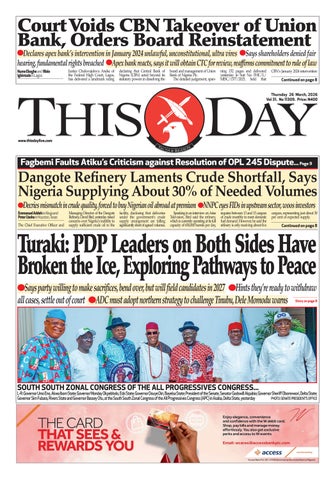
Court Voids CBN Takeover of Union Bank, Orders Board Reinstatement

Declares apex bank’s intervention in January 2024 unlawful, unconstitutional, ultra vires Says shareholders denied fair hearing, fundamental rights breached Apex bank reacts, says it will obtain CTC for review, reaffirms commitment to rule of law

Justice Chukwujekwu Aneke of the Federal High Court, Lagos, has delivered a landmark ruling

declaring that Central Bank of Nigeria (CBN) acted beyond its statutory powers in dissolving the

board and management of Union Bank of Nigeria Plc. The detailed judgement, span-

www.thisdaylive.com

Dangote Refinery Laments Crude Shortfall, Says Nigeria Supplying About 30% of Needed Volumes

Decries mismatch in crude quality, forced to buy Nigerian oil abroad at premium NNPC eyes FIDs in upstream sector, woos investors

The Chief Executive Officer and

Managing Director of the Dangote Refinery, David Bird, yesterday raised concerns over Nigeria’s inability to supply sufficient crude oil to the

facility, disclosing that deliveries under the government’s crude supply arrangement are falling significantly short of agreed volumes.

Speaking in an interview on Arise Television, Bird said the refinery, which is currently operating at its full capacity of 650,000 barrels per day,

requires between 13 and 15 cargoes of crude monthly to meet domestic fuel demand. However, he said the refinery is only receiving about five

cargoes, representing just about 30 per cent of expected supply.

Continued on page 8

Turaki: PDP Leaders on Both Sides Have Broken the Ice, Exploring Pathways to Peace

Says party willing to make sacrifices, bend over, but will field candidates in 2027 Hints they’re ready to withdraw all cases, settle out of court ADC must adopt northern strategy to challenge Tinubu, Dele Momodu warns

SOUTH SOUTH ZONAL CONGRESS OF THE ALL PROGRESSIVES CONGRESS...

L-R:

Delta State; Governor Sim Fubara, Rivers State and Governor Bassey Otu, at the South South Zonal Congress of the All Progressives Congress (APC) in Asaba, Delta State, yesterday

Nume Ekeghe and Wale Igbintade in Lagos
Governor Umo Eno, Akwa Ibom State; Governor Monday Okpebholo, Edo State; Governor Douye Diri, Bayelsa State; President of the Senate, Senator Godswill Akpabio; Governor Sheriff Oborevwori,
Emmanuel Addeh in Abuja and Peter Uzoho in Houston, Texas

SOUTH EAST APC ZONAL CONGRESS...

L-R: Former President of the Senate, Senator Ken Nnamani; Deputy Speaker, House of Representatives, Hon. Benjamin Kalu; Governor of Imo State, Senator Hope Uzodimma; Governor of Enugu State, Dr. Peter Mbah; Governor of Ebonyi State, Hon. Francis Nwifuru and the Deputy National Chairman (South) of the All Progressives Congress (APC), Chief Emma Eneukwu, during the South East APC Zonal Congress held at Hotel Presidential, Enugu, yesterday

CBN Directs IMTOs to Open Naira Settlement Accounts to Deepen Diaspora Inflows

As part of new measures to deepen diaspora remittances and enhance transparency in the foreign exchange market, the Central Bank of Nigeria (CBN) has directed International Money Transfer Operators (IMTOs) to open naira settlement accounts with authorised dealer banks.

In a circular issued by the apex bank, which was signed by the Director of Trade and Exchange Department, Dr. Musa Nakorji, the directive forms part of broader efforts to improve traceability of remittance flows, strengthen compliance, and boost efficiency in Nigeria’s FX ecosystem.

Additionally, the CBN also rolled out new measures to boost diaspora remittance inflows and improve transparency in the foreign exchange market, alongside tighter operational rules for International Money Transfer Operators (IMTOs) and Authorised Dealer Banks (ADBs).

The circular stated: “As part of measures to enhance diaspora remittances, strengthen transparency, traceability, and effective monitoring of all transactions, this circular is hereby issued accordingly, all IMTOs, ADBs and the general public are required to note the following: All IMTOs are hereby directed to open Naira settlement accounts and ensure that all transactions are routed strictly through their

designated settlement accounts, maintained with Authorised Dealer Banks (ADBs) in Nigeria.

“This means that all transactions arising from international money transfer operations, including disbursements to beneficiaries and any related settlements, must be processed exclusively through the IMTO’s settlement accounts) held with any ADB of their choice.

“IMTOs may use their discretion to designate their existing accounts or open new settlement accounts and may operate accounts with multiple ADBs in line with their business strategy.”

The directive which takes effect from May 1, 2026, reinforces the CBN’s push to formalise remittance inflows and strengthen a key source of foreign exchange for the economy.

It added: “Settlement accounts shall only be credited with remittance flows and proceeds of foreign exchange conversions by licensed IMTOs (or their agents) with authorised market participants in the Nigerian Foreign Exchange Market (NFEM).

“IMTOs shall ensure that their settlement accounts are properly designated for this purpose and operated in accordance with existing regulatory guidelines. A list of designated settlement accounts shall be advised by each licensed IMTO to the Director, Trade and Exchange Department, and updated

regularly as necessary.

“In order to support market efficiency and enhance pricing outcomes for IMTO transactions, ADBs may process foreign currency

transfers from IMTO settlement accounts to other ADBs and approved market participants, including licensed BDCs.

“IMTOs shall observe real-time

market prices from the Bloomberg BMATCH and utilise this as guidance for pricing transactions with their customers and Authorised Dealers. This will improve price

discovery. Reduce information asymmetry between IMTOs and banks. Encourage increased participation in the official FX market.”

AI Generated Crisis Management Will Shape Nigeria’s Economy, Says Minister

Emma Okonji

Minister of Communications, Innovation, and Digital Economy, Dr. Bosun Tijani, has said the crisis generated from Artificial Intelligence (AI) skills, if proactively managed, could turn out to be an opportunity for organisational renewal that would boost economic development in Nigeria. Tijani said this in Lagos yesterday during his keynote address at the Crisis Management Advocacy Month Flagship Conference, organised by CMC Connect, a perception consulting firm, with the theme, “Crisis Management in the AI Milieu: New Threats, Smarter Responses.”

According to him, AI can escalate crisis, but organisations must be ready to manage such crisis because AI has come to stay.

Tijani added that organisations must leverage the use of data and

digital technology in managing crisis.

He stated, “It’s important that people understand that what separates organisations, entities, and individuals that are able to do well with crisis is simply preparedness.

Organisations must be prepared to deal with any AI generated crisis, and turn it into an opportunity for economic development.

“Crisis don’t have to be a disaster. Our ability to prepare is what helps us to be able to see how we deal with crisis. The role of information and institutions in managing crisis is key because information shapes behaviour. The way that a crisis is communicated is important because information will shape how people behave and react to the crisis. So it is important that organisations see the crisis as an opportunity for renewal and economic development.”

Tijani said organisations must

move from just reacting to situations, in order to predict what was coming next. He said Nigeria must move from fragmented responses to more coordinated responses when addressing issues.

In his welcome address, Lead Partner, CMC Connect, Yomi Badejo-Okusanya, said the agency developed a crisis management platform called CrisisX, which gives organisations the power to act in the moment that matters the most.

According to him, the platform is built for speed and intelligence, and it protects reputation before it is damaged, preserves trust before it is broken, and stops misinformation before it spreads.

Badejo-Okusanya stated, “False information spreads six times faster than the truth. And nearly 70 per cent of leaders are not prepared. These are not just statistics, they are more than that. The real crisis is not just technology, it is the gap

between how fast threats are evolving and how slow they are being addressed. The industry and government officials are still too slow in handling crisis management. We are reactive and we are still too hesitant. But the truth is that no one can outpace an algorithm with hesitation.”

He said trust was vital in crisis, and trust was earned through moments of clarity, moments of courage, and moments when people learn to act.

The speed of crisis using AI skills will increase, and the pressure will intensify, as people will continue to turn peoples’ voices on their own images, Badejo-Okusanya stated.

Highlight of the conference included a panel session that discussed the implications of AI-generated crisis for organisations and the economy and how organisations could nip it in the bud.

NCC Moves to Expand Broadband Access to Underserved Communities in Plateau

Nigerian Communications Commission (NCC) has reaffirmed its commitment to fully leverage its mandate to deliver broadband access to underserved communities.

NCC said this was central to its broader effort to improve access to the opportunities that robust connectivity could unlock.

The commission made the commitment during a courtesy visit by its Executive Commissioner, Stakeholder Management, Ms. Rimini Makama, to Governor of

Plateau State, Caleb Mutfwang, at Government House, Jos.

During the visit, NCC described Plateau State as a strategic and indispensable partner in the advancement of Nigeria’s national broadband agenda, citing the state’s strong educational base, growing innovation ecosystem, youthful population, and policy direction that support digital transformation. Makama said, “The NCC has identified Plateau State as a pivotal partner in Nigeria’s broadband agenda; not ceremonially, but strategically. You have the edu-

cational institutions, the growing innovation ecosystem at nHub and beyond, the youth talent, and now a Governor whose public commitments; from the Right of Way policy to the TechFest declaration, signal the political will that digital infrastructure demands.”

She added, “We have taken notice. At the same time, we must be honest: many rural LGAs remain underserved, cut off from the digital economy that could transform their livelihoods. Bridging that divide is a shared responsibility, and the NCC is ready to fulfil its part.”

Makama said the visit was the beginning of a conversation, stressing that NCC has a genuine desire to explore how its mandate and instruments can align with Plateau State’s development agenda, from supporting the operationalisation of Right of Way policy, to exploring how NCCs Universal Service Provision Fund (USPF) can reach underserved communities across local government areas in the state.

Makama said the commission’s recognition of Plateau State was based not on symbolism, but on clear indicators of digital potential

already visible in the state. She pointed to ongoing reforms, including Right of Way policy support and commitments made by the state government at the Plateau TechFest, as evidence of the administration’s willingness to create an enabling environment for broadband expansion and innovation-led growth. According to her, such policy alignment is critical to building the infrastructure foundation required for sustainable digital development. The executive commissioner had observed that despite the state’s growing digital promise, many rural

local government areas remained underserved and excluded from the benefits of reliable connectivity. She stated that the persistence of access gaps in such communities continued to limit opportunities for education, enterprise, innovation, and access to digital services.

The governor commended the commission’s recognition of Plateau State’s digital potential. He described the visit as both timely and significant, aligning with the administration’s declaration of 2025 as the year of digital innovation.

SANWO-OLU MEETS WITH THE AMIRAH, FOMWAN...

Governor of Lagos State, Mr. Babajide Sanwo-Olu, flanked by the Amirah and executive members of the Federation of Muslim Women’s Associations in Nigeria (FOMWAN) during a courtesy visit at Lagos House, Ikeja on Tuesday, March 24, 2026. With them: Special Adviser to the Governor on Religious Matters (Islamic), Alhaji Abdullahi Jebe (left); his counterpart for Housing, Barr. Barakat Odunuga-Bakare (second left); Commissioner for Home Affairs, Hon. Olanrewaju Layode (third right); his counterpart for Special Duties and Intergovernmental Relations, Mr. Gbenga Oyerinde and Special Adviser, Parastatal Monitoring Office, Mr. Ibrahim Obanikoro

Tunji Bello: FCCPC Tackling Regulatory Weaknesses Allowing Unsafe Products into Market

James Emejo in Abuja

Declares businesses under obligation to ensure products’ safety, others environment.

Executive Vice Chairman/Chief Executive, Federal Competition and Consumer Protection Commission (FCCPC), Mr. Tunji Bello, yesterday said it was deepening coordination with sector regulators and the national standards body to address weaknesses that permited unsafe products to enter or remain in the Nigerian market.

Bello said the move included structured collaboration, information sharing, and joint interventions where necessary.

The FCCPC boss spoke in Abuja at the commemoration of World Consumer Rights Day 2026, with

the theme, “Safe Products, Confident Consumers,” and the 9th National Young Consumers Contest Awards. Bello reaffirmed the commission’s effort to effectively monitor and enforce compliance across markets. He stressed that though the consumer rights commission did not control prices, fair pricing remained an essential part of a well-functioning market.

Represented by FCCPC Director, Surveillance and Investigations, Mrs. Boladale Adeyinka, Bello stated that the theme for the year’s celebration, “captures a simple but important truth: where safety is uncertain, confidence declines. And where confidence

declines, markets become weaker, less efficient, and less trustworthy”.

He pointed out that across several sectors, the commission continued to encounter products that did not meet basic safety and quality standards, including improperly labelled goods, products that fell short of essential safety requirements, and, in some cases, conduct that raised concerns about misrepresentation.

He said some of the failures arose from weak internal controls while others reflected gaps in compliance culture.

Bello stated that in certain instances, there were indications of deliberate disregard for legal and regulatory obligations.

He said, “The effect is immediate and serious. Consumers are exposed to avoidable risks, trust in the market is weakened, and law-abiding businesses are placed at a disadvantage.

“Product safety, therefore, cannot be treated as a secondary matter. It is a core obligation, with clear public interest consequences.

“This approach aligns with the federal government’s ongoing economic reform programme under the administration of President Bola Ahmed Tinubu, which focuses on strengthening market integrity, improving consumer confidence, and promoting a rules-based business

WMD: NiMet DG Calls for Urgent Investment in Weather Observation Systems

Director-General of Nigerian Meteorological Agency (NiMet), Professor Charles Anosike, Wednesday called for urgent investment in weather observation systems, stressing that Nigeria’s ability to predict and survive extreme climate events hinges on the quality of data collected today.

Anosike, in his remarks at the 2026 World Meteorological Day celebration in Abuja, anchored his message on the theme, “Observing Today, Protecting Tomorrow.”

He emphasised that accurate and timely weather observations were the foundation of all forecasts, early warnings, and climate projections.

He stated that the increasing frequency of extreme weather events driven by climate change had made reliable meteorological data more critical than ever.

Anosike pointed to findings from NiMet’s 2025 climate report, which showed that at least 23 Nigerian cities recorded extreme daytime temperatures of 40°C and above, with Nguru experiencing up to 100 days of such intense heat.

He also identified a rising trend in

flooding across the country, underscoring the need for proactive measures to mitigate the effect of these events.

According to him, “These realities underline a simple truth, without strong observation systems, we cannot accurately predict or effectively respond to climate risks.”

The NiMet boss highlighted ongoing efforts by the agency to modernise its infrastructure, including the expansion of surface and upper air observation networks, satellite data systems, and automatic weather stations. He said these were already supporting critical sectors, such as aviation safety, agriculture, disaster management, and maritime operations.

However, Anosike maintained that government efforts alone were insufficient to meet growing demands, emphasising the need for deeper collaboration with the private sector. He said global trends showed increasing private investment in weather technologies, such as remote sensing, data analytics, and artificial intelligence-driven forecasting models, which were essential for building a sustainable and comprehensive national observation system.

“Every weather station installed today

strengthens our ability to safeguard lives and economic activities in the future,”

Anosike said, describing investment in meteorological infrastructure as “critical and imminent”.

He also revealed that NiMet was

extending its technical expertise beyond Nigeria, providing advisory support to countries, such as Liberia, Niger, Somalia, and Burkina Faso, under international cooperation frameworks coordinated by the World Meteorological Organisation.

“Consumer protection is a key part of that effort. When markets are safe, reliable, and transparent, they support sustainable growth and give investors greater confidence to participate.”

According to him, the Federal Competition and Consumer Protection Act, 2018 provides a clear legal framework.

He said under the law, consumers were entitled to goods that were safe, durable, and fit for purpose.

Bello maintained, “Businesses are under a duty to ensure that the products they place on the market consistently meet these standards. Where a product presents a risk, the law requires prompt corrective action, including withdrawal, recall, and proper notice to consumers.

“These are not optional expectations. They are statutory duties. Non-compliance attracts regulatory consequences.”

He said, “As a result, the commission has expanded market surveillance and strengthened product testing in priority sectors. Where conduct raises concerns about consumer safety, such matters are investigated.

“We will continue to act where conduct undermines fairness,

transparency or safety, or otherwise harms consumers in breach of the law. Where breaches are established, appropriate enforcement action is taken in line with our mandate.”

The consumer protection chief executive emphasised the need for institutions to work in concert, saying that is when they are more effective.

Present at the event also were representatives from of Competition and Consumer Protection Tribunal, Standards Organisation of Nigeria (SON), National Agency for Food and Drug Administration and Control (NAFDAC), and Manufacturers Association of Nigeria (MAN). Bello explained that each of the institutions or trade associations played an important role in ensuring that products met acceptable standards before and after entering the market.

He said, “Effective outcomes depend on alignment in standards, consistency in enforcement, and clarity in institutional responsibilities.

“The media also remains an important partner in this work. Accurate and responsible reporting helps consumers make informed choices, draws attention to harmful practices, and supports public accountability.

Nigeria, EU Strengthen Strategic Alliance with New Investments, Security, Climate Cooperation

Michael Olugbode in Abuja

Nigeria and the European Union (EU) have reaffirmed their strategic partnership and announced new areas of cooperation spanning trade, security, climate action, digital transformation and development investments following the Eighth Nigeria–EU Ministerial Dialogue held in Abuja.

The high-level meeting was co-chaired by Nigeria’s Minister of Foreign Affairs, Yusuf Maitama Tuggar, and the EU High Representative for Foreign Affairs and Security Policy, Kaja Kallas.

In a joint communiqué issued after the dialogue, both sides described the meeting as an important opportunity

to consolidate longstanding relations built on friendship, mutual respect and shared values, particularly at a time of global geopolitical uncertainty.

They reaffirmed their commitment to expanding cooperation in ways that deliver tangible benefits to citizens while contributing to a more stable, prosperous and sustainable international order.

Nigeria and the EU reiterated their support for multilateral cooperation, democracy, human rights and the rule of law, stressing the need to protect fundamental freedoms including gender equality, freedom of expression, freedom of religion and protection against discrimination.

The EU also reaffirmed its support

for reforming the United Nations Security Council to make it more inclusive, transparent and representative, particularly by strengthening the voice of African countries.

Both parties expressed support for peaceful resolutions to conflicts around the world, including in Ukraine, the Middle East, Sudan, South Sudan, Democratic Republic of the Congo, the Sahel and Somalia, emphasising the importance of respecting international law, sovereignty and territorial integrity.

Both sides reaffirmed their commitment to implementing the Paris Agreement on Climate Change and advancing climate action through stronger cooperation on renewable energy and energy transition.

Discussions highlighted Nigeria’s strong potential for solar, wind and clean hydrogen energy, with both partners agreeing to enhance investments and collaboration in these sectors. They also pledged to strengthen climate resilience and adaptation efforts for vulnerable communities, particularly those affected by environmental pressures in the Lake Chad Basin.

On Regional Security and West Africa, the EU acknowledged Nigeria’s critical leadership role in promoting democracy, peace and stability in West Africa. Both sides agreed to strengthen cooperation on regional security challenges, particularly threats emanating from the Sahel.

Kasim Sumaina in Abuja

NCC’S COURTESY VISIT ON THE PLATEAU STATE GOVERNOR...

L-R: Deputy Director, Legal and Regulatory Services, Nigerian Communications Commission (NCC), Lawrence Abang; Plateau State Deputy Governor, Mrs. Josephine Piyo; Executive Governor, Plateau State, Barr. Caleb Mutfwang; Executive Commissioner, Stakeholder Management, NCC, Rimini Makama and Director, Digital Economy, NCC, Helen Obi during the Commission’s courtesy visit on the Plateau State Governor in Jos, Plateau State

Adeniyi Rallies Global Customs Chiefs to Intensify Enforcement Against Illicit Trade

Says stronger cooperation key to securing borders, global economy WCO inaugurates landmark enforcement session with joint leadership Saunders warns vigilance, technology critical to tackling emerging threats

Sunday Aborisade in Abuja

The Chairperson of the Council of the World Customs Organisation (WCO) and the ComptrollerGeneral of the Nigeria Customs Service, Bashir Adewale Adeniyi, on Tuesday led a global call for stronger Customs enforcement, declaring that enhanced cooperation among administrations worldwide was critical to protecting societies, securing trade, and strengthening the global economy.

Adeniyi, according to a statement made available to THISDAY in Abuja yesterday, made the declaration while jointly opening the 46th Session of the WCO Enforcement Committee alongside the Secretary-General, Ian Saunders, at the organisation’s headquarters in Brussels.

Speaking from the chair, Adeniyi commended Customs administrations across the globe for their sustained efforts in combating transnational organised crime and safeguarding borders against illicit trade.

He stressed that the rapidly evolving nature of global threats demands deeper collaboration and a unified enforcement strategy among member states.

“When Customs administrations work together, enforcement becomes stronger, trade becomes safer, and the global economy becomes more resilient,” he said.

He emphasised that collective action remains central to addressing cross-border criminal networks, noting that no single administration can effectively tackle the complexity of modern illicit trade alone.

Adeniyi’s remarks underscored the growing importance of multilateral cooperation in Customs

operations, particularly at a time when global supply chains are increasingly vulnerable to exploitation by criminal elements.

Also speaking at the session, Saunders highlighted the critical role of the Enforcement Committee in advancing the core mandate of Customs administrations worldwide.

He described enforcement as a cornerstone of efforts to protect society and ensure the integrity of international trade.

According to him, Customs enforcement serves multiple interconnected purposes, including preventing the movement of illicit and hazardous goods, safeguarding government revenue, and ensuring

that legitimate trade flows efficiently and securely.

“Customs protects society by preventing the movement of illicit and hazardous goods.

“It safeguards trade integrity and revenue by ensuring that commercial activity is lawful and transparent, and it supports economic and regulatory compliance, enabling legitimate commerce to flow efficiently and securely,” Saunders said.

He further stressed that achieving these objectives requires sustained vigilance, supported by modern tools, robust systems, and effective procedures to anticipate, detect, and respond to emerging threats.

The session marks a historic milestone for the organisation, as it is the first time both the Council Chairperson and the Secretary-General jointly declared open the Enforcement Committee meeting.

The development signals a renewed institutional resolve to elevate enforcement as a strategic priority within the WCO.

Established in 1983, the Enforcement Committee remains one of the organisation’s key statutory bodies.

This year’s meeting is being held in a revamped format designed to deepen policy-driven discussions and enhance operational effectiveness among member administrations.

Participants at the session are expected to deliberate on critical issues shaping global Customs enforcement.

These include the review of the Committee’s Terms of Reference and Rules of Procedure, as well as the adoption of new and updated enforcement instruments aimed at strengthening global responses to illicit trade.

Discussions will also focus on the growing role of data and technology in tackling emerging threats, ongoing operations and projects, and broader strategic policy directions for the future of Customs enforcement.

Dangote Group Unveils Expansion Plans, Backs Nigerian MSMEs

Dangote Group has reaffirmed its commitment to industrial expansion and support for Micro, Small and Medium Enterprises (MSMEs) as

key drivers of Nigeria’s economic growth.

Chairman of the group Aliko Dangote made this known in Enugu yesterday during the company’s Special Day at the ongoing 37th

NDDC Rallies Communities to Take Ownership of Projects in Their Domain

The Edo State Director of the Niger Delta Development Commission (NDDC), Mrs. Mercy Babawale, yesterday, told communities to take charge of projects in their domain.

The director who gave this advice at stakeholders meeting in Benin, said it was the responsibility of communities and youths to make sure NDDC projects in their areas are protected for the benefit of all.

The director who spoke to crowd of stakeholders, made up of mostly youths, from communities across the Niger Delta in an event themed: “Capacity Building Engagement: Community Ownership & Protection of NDDC Projects,” said communities and youths are to take ownership of projects cited in their area.

According to her, “You have to take charge of the projects. You take charge of that which we are bringing to your community. You people should help ensure that these projects are properly developed and maintained.”

She explained the projects are theirs, “we bring them to the community. Yes, we actually initiate them. But eventually, they are your projects at the community level when completed.”

Babawale noted that from this point of completion the communities are owners of the projects, saying you can now “take charge of that which we are bringing to your community, you people will help ensure that these projects are properly developed and maintained.”

Urging the participants to be part of the projects by making sure the

standard is met, she called on them to call the commission’s attention to sub-standard jobs by contractors.

She tasked the participants to monitor any projects even before they get to the finishing stage to confirm if they are executed poorly or not. All through this process, the community is supposed to be a huge part of it.

“So, you know that when projects come to a community, it is not a stranger who just runs them. From that point on, we expect that you will also be a part of the development of the projects. When there is a problem with the standard, you have to call us and say, what we are seeing now is not what is projected.”

She referenced event in the past when people had complained of low standard and immediate action was taken.

Enugu International Trade Fair with the theme “Empowering MSMEs for Global Competitiveness”.

Dangote, represented by the South East Regional Director of Dangote Cement Plc, Olatunbosun Jinadu, said the group’s long-term “Vision 2030” strategy is designed to address major constraints facing MSMEs, particularly the high cost of energy, raw materials and infrastructure.

He noted the theme of this year’s fair highlights the critical role small businesses play in both local and global economies, while stressing

the need to create an enabling environment for their growth.

Jinadu disclosed the group has concluded plans to expand its petroleum refinery capacity from 650,000 barrels per day to 1.4 million barrels per day, a move expected to significantly increase output and improve efficiency.

He added that the company is also scaling up its fertilizer production capacity to 12 million metric tonnes annually, alongside ongoing expansion of its polypropylene plant to meet rising demand across industries including packaging,

NERC, State Regulators

textiles, automotive, medical and construction.

The regional director emphasised that the expansions are driven by the group’s belief that Nigeria’s economic transformation must be anchored on local production and industrial self-reliance.

Earlier, President of ECCIMA, Nnayelugo Onyemelukwe, commended Dangote for consistently sponsoring the fair for over five years, while also urging the group to consider citing its plants in the Southeast region which contributes to the economy of the country.

Inaugurate

Forum to Improve Power Regulation

The Nigerian Electricity Regulatory Commission (NERC) has inaugurated a new group, the Forum of Nigerian Electricity Regulators (FONER) aimed at enhancing coordination and effectiveness in electricity regulation across Nigeria.

Speaking at the first quarter 2026 regulatory meeting with State Electricity Regulators (SERs) in Lagos, NERC Chairman, Dr Musiliu Oseni, described the initiative as a

major step in Nigeria’s transition to a multi-level electricity market.

Inaugurating the forum, Oseni emphasised the need for collaboration to prevent regulatory loopholes within the sector.

FONER, he said, is expected to drive key regulatory objectives, including fostering dialogue between NERC and states, promoting harmonised approaches in tariff setting, market operations, consumer protection, and supporting capacity-building through peer

learning. The forum, according to him, will also serve as a consultative platform for electricity market reforms while advancing transparency, accountability, and national regulatory benchmarks.

“Electricity is the oxygen for economic growth and prosperity. Unfortunately, our industry is fraught with varying challenges which require effective coordination and synergy among the captains of the industry.

Gideon Arinze in Enugu
Felix Omoh-Asun in Benin

Oil Exploration: NUPRC Seals Deal for Acquisition, Processing of Seismic Data

FG inaugurates committee on operationalisation of HCDTs

The Nigerian Upstream Petroleum Regulatory Commission (NUPRC) has signed a Petroleum Exploration Licence (PEL) No. 5 agreement with SeaSeisGeophysical Limited (SeaSeis), authorising the company, in partnership with the commission and TGS, to undertake the acquisition and processing of new 3D seismic and gravity data.

The three-year agreement also empowers the partnership to issue data-use licences, with revenues to be shared between the company and the Commission.

The official execution of the agreement between SeaSeisGeophysical Limited and its partner, TGS, was held at the Commission’s headquarters in Abuja, a statement

by the company’s spokesman, Eniola Akinkuotu, said yesterday.

The major seismic data acquisition project, PEL No.5, covers an area of 11,700 square kilometres offshore the Eastern Niger Delta in water depths of 400-2800 meters.

The licence is expected to unlock stronger prospectivity, enhance subsurface understanding, and support more efficient development of Nigeria’s hydrocarbon resources in line with Section 71(1-10) of the Petroleum Industry Act (PIA) 2021, the NUPRC said.

Speaking at the event, the Commission Chief Executive, Mrs. Oritsemeyiwa Eyesan, said the issuance of the PEL5 licence reflects the commission’s continued commitment to data-driven exploration, transparency, and long-term

value creation for Nigeria and the oil and gas sector.

Eyesan noted that exploration is fundamentally driven by confidence in data and processes, adding that the PELNo. 5 initiative underscores the importance of credible partnerships in achieving national production and reserve growth targets.

“The PIA recognises that we assign licences on non-exclusive acreages to contractors who are willing to carry out exploration activity, and as the chief superintendent of the industry, we also ensure that we maintain our production targets, including reserves and the only way we can achieve that successfully is if we have partners who are willing to explore,” the CCE said.

The NUPRC boss further stated that the execution of the PEL No. 5

licence signals a growing appetite for exploration activities within the sector.

In his remarks, the Managing Director of SeaSeisGeophysical Limited, Mr Goke Adeniyi, described the PEL5 as the company’s largest project in Africa, noting that it underscores the scale of opportunity within Nigeria’s upstream sector.

He further noted that the PEL 5 area have been carefully selectedcovering approximately 11,700 sq km in the Outer Fold & Thrust Belt of the eastern Niger Delta — Nigeria’s most prolific but geologically complex region.

“We are confident that the resultant High fidelity 3D seismic data will provide operators with the data quality needed to evaluate prospects with greater confidence,”

he stated.

Meanwhile, the federal government has inaugurated an interministerial committee to drive the operationalisation and management of Host Community Development Trusts (HCDTs), in line with the provisions of the Petroleum Industry Act (PIA).

The inauguration, which took place in Abuja was presided over by the Permanent Secretaries of the Ministry of Petroleum Resources and the Ministry of Regional Development, marking a significant step toward strengthening coordination and enhancing the delivery of development initiatives to host communities.

In her address at the inauguration ceremony, Permanent Secretary, Ministry of Petroleum Resources, Mrs.

Patience Oyekunle, underscored the strategic importance of the committee in advancing the implementation of HCDTs and ensuring that benefits accrue meaningfully to host communities. She noted that the inauguration builds on a series of engagements convened by the ministry since 2025 to deepen collaboration among key stakeholders.

TURAKI: PDP LEADERS ON BOTH SIDES HAVE BROKEN THE ICE, EXPLOR-ING PATHWAY TO PEACE

Chuks Okocha in Abuja and Yinka Kolawole in Osogbo

After two days of meeting, the Tanimu Turaki-led Peoples Democratic Party (PDP) has disclosed that the factional leaders on both sides have broken the ice and are already exploring various pathways to a lasting resolution.

Turaki said the party was willing to make sacrifices for peace, including bending over and backwards. But he insisted PDP would field candidates for all positions in next year’s general election.

He assured members that all hopes towards reconciliation were not lost, but said such efforts must be within the dictates of the party’s constitution.

Addressing a press conference after a meeting of the National Working Committee (NWC), Turaki said, “I can unequivocally confirm that, as of today, leaders on both sides have broken the ice and are exploring various pathways towards a lasting resolution.

“We urge our supporters across the board to immediately de-escalate high-tempered communications and actions, so as not to jeopardise the ongoing peace efforts.

“To all aspirants who have stood with us thus far, we assure you that, by the grace of God, our party will field candidates for all elective offices, in compliance with Article 6(2) of the Constitution of the PDP

(as amended in 2017).

“In obedience to the advisory of the Court of Appeal, Ibadan, a few weeks ago, the parties in the suit should explore reconciliation to save the party from further strife and provide a platform for aspirants to seek elective offices in the coming elections.”

Turaki said, “The Board of Trustees of the party, ably led by His Excellency, Senator Adolphus Wabara, GCON, constituted a highpowered committee to interface with our estranged party members, with a view to resolving outstanding issues and repositioning the party for the elections.

“In furtherance of this, the National Working Committee im-

mediately issued a notice postponing the National Executive Committee and National Caucus meetings earlier scheduled to be held two days later, as a demonstration of good“Wefaith. also de-escalated combative communication on all fronts.”

However, he said, “While we expected a reciprocal gesture, what we have witnessed instead is the weaponisation of hurtful rhetoric and the issuance of derogatory statements.

“Notwithstanding, we remain mindful of the far-reaching implications of this dispute, particularly within the tight timelines of the extant Electoral Act. We, therefore, call on the leadership of the other

REFINERY LAMENTS CRUDE SHORTFALL, SAYS NIGERIA SUPPLYING ABOUT 30% OF NEEDED VOLUMES

He explained that the gap undermines the effectiveness of the Crude-for-Naira arrangement, a policy designed to supply crude to local refiners at international prices but without foreign exchange exposure.

According to him, while the initiative has helped stabilise Nigeria’s foreign exchange pressures, its implementation has been inconsistent, particularly in terms of both volume and crude quality allocation.

“We have been very vocal that there is an existing arrangement in place under the Crude-for-Naira programme commonly misunderstood as a pricing regime, it is not. It is priced at full international benchmark crude oil pricing, however, without the foreign exchange implication.

“That has been very successful in stabilising the FX and I think Nigeria and our relationship with NNPC and Dangote, we should all be very proud of that. That agreement, however, is not only just from volume but also a quality allocation perspective not being met.

“And our demand of the government is just to be transparent with that allocation methodology because what we see under that agreement, we should be getting about 13 to 15 cargos a month and that’s what we could process to meet the domestic fuel requirements of Nigeria. Currently we’re only getting five.

“So that’s an underperformance against that pre-agreed volume contract. Second to that is quality. So Nigeria has a wide variety of crude grades all exported from different terminals and we have

a preference,” he stressed.

Bird noted that the refinery’s hardware is optimised for specific crude slates, and while it can process a range of Nigerian grades, consistent supply of preferred blends is essential for efficiency. The failure to meet these specifications, he said, has forced the refinery to turn to international markets.

In a development he described as troubling, Bird disclosed that the same Nigerian crude grades not allocated to the refinery are being sold on the global market, where the company is then compelled to repurchase them in dollars at significant premiums.

“However, given our preference for Nigerian grades, we go back into the international market and we find those very same grades that we have preferenced that were denied to us now being offered on the international market in US dollars.

“And so we do purchase those and right now there’s obviously a global thirst for crude, no matter where it comes from. So that has meant there’s a significant premium being attached to Nigerian crude grades upwards of $18 a barrel premium for those same Nigerian crude grades.

“So 30-35 per cent under Crude-for-Naira, we get allocated with no discount, no subsidy. It is international benchmark pricing. Then we have to pay international benchmark freight rates and freight has also been severely impacted and gone up, insurance rates, etc. So there is a misunderstanding that the Crude-for-Naira programme is somehow a discount or a subsidy. It is not. There’s arm’s length

relationship.

“We purchase that crude, we transport that crude, we insure that crude as if we are fully arm’s length at international benchmark pricing. And every one of those cost inputs has been impacted by this crisis. Then we’re still finding and so far we continue to see those other Nigerian crude grades appearing on the market and we’re still willing to pay that premium.

“However, it’s disappointing that it’s coming back to us on the open market and that value between the purchase price and the premium

was unlawful, unconstitutional, and taken in excess of its powers under the Banks and Other Financial Institutions Act (BOFIA) 2020.

The suit was filed by Titan Trust Bank Limited, Luxis International DMCC, and Magna International DMCC, as plaintiffs, against the apex bank’s Governor, CBN, Mr. Bayo Adeleke, Mrs. Yetunde B. Oni, Mrs. Oluyinka Abimbola Morgan, Mr. Ibrahim Musa Oruma, Mrs. Chiamaka Ezenwa, Mr. Muhammed Balarabe, Mrs. Eileen C. Shaiyen, Dr. Mojisola Olateru-Olagbegi, Mr. Mannir U. Ringim, Mr. Taiwo Shote, Mr. Kelechi Nwagba, and Union Bank of Nigeria Plc, as respondents.

The applicants challenged CBN’s decision to dissolve the board and management of Union Bank of Nigeria Plc, appoint a new leadership, and initiate a recapitalisation process that allegedly diluted their shareholding and excluded them from participating in key corporate decisions.

that we’re now seeing is money that Nigeria is leaking to the international trading community and we believe that is unnecessary and would like to understand the allocation methodology,” he stressed.

This, he added, represents a loss of value to Nigeria, as the margin between the domestic allocation price and international resale accrues to foreign traders rather than the local economy.

Despite the supply constraints, Bird said the refinery has relied on its

However, in a statement signed by Acting Director, Corporate Communications, Hakama Sidi Ali, yesterday, CBN said it was currently obtaining the Certified True Copy of the judgement for detailed review, while reaffirming its commitment to due process and the rule of law.

In his judgement, Aneke resolved the core issue in favour of the applicants, holding that CBN and its governor acted ultra vires (beyond the scope of their legal authority), when they dissolved the bank’s board and replaced it.

“The acts of the 1st and 2nd respondents in the dissolution of the erstwhile Board… were not done in compliance with Section 34 of BOFIA but were ultra vires,” the court held.

The judge granted a series of consequential orders that effectively nullified the entire regulatory intervention.

Among the reliefs was an order

group to act in the overall interest of our numerous party members who look to our platform to pursue elective offices.

“We also sincerely appreciate Nigerians across the country who have continued to show interest in our party and have registered via our e-registration platform, www. iampdp.org.

“Despite recent challenges, the faith of our core supporters remains unshaken. It is for them that we are making every effort to resolve the issues before us.”

The PDP leader stated, “As we are aware, democracy is not merely about the periodic conduct of elections; it also requires a virile opposition and an active civil society to hold government accountable.

“As Nigeria’s only surviving legacy party in the current republic, with the rare privilege of having led this country for 16 years, we remain committed to defending and consolidating our democracy, even as an opposition party.”

He said, “We call on those in authority to remain conscious that they are delegates of the people, and that their actions must, at all times, align with the will of the people. Ultimate power resides with the people; it must therefore remain the centre piece of governance.”

Turaki conveyed the NWC’s “unanimous vote of confidence passed on Governors Bala Moham-

of certiorari quashing CBN’s public announcement dissolving Union Bank’s board, as well as all actions taken by the regulator-appointed management.

The court also issued an order of mandamus directing the immediate restoration of the former board and management of the bank, led by its erstwhile Chairman, Mr. Farouk Mohammed Gumel.

In addition, the court restrained CBN and all respondents from exercising any powers relating to the governance of the bank, including restructuring its share capital, altering its ownership structure, or taking steps capable of affecting the applicants’ proprietary interests.

Of particular significance, the court halted the ongoing recapitalisation programme initiated under the CBN-appointed board, including the “accelerated two-stage investor selection process” involving financial advisers, such as Absa Capital Markets Nigeria Limited and

med and Seyi Makinde for their resilience and steadfast leadership in the face of recent challenges”. He reassured Nigerians that PDP was “alive and will participate in the forthcoming elections, offering a credible platform for robust political contests at all levels, so that power may truly return to the people”.

Fielding questions at the press conference Turaki stated, ‘’We have hope and confidence that we can still work together. We have confidence that in life there are times to fight and there are also times to make peace. But even when you choose to fight and go to war and win the war, you also need to win the peace. ‘’So, if you have a pathway to winning the peace without necessarily going to war, why not take peace and forego the war?’’ Turaki said, ‘’Let me also add that we understand that in human life, every time something good is coming your way, there are people from unimaginable and unbelievable quarters – sometimes those you think are friends or family – who will be the first to rise and truncate those good things coming your way.

‘’I am not saying there are no good elements on both sides whose sole intention is to preserve peace in this country. I am saying there are some people fighting so that this party will go down.

Vetiva Advisory Services Limited. The court held that all such actions, having flowed from an unlawful foundation, could not stand.

Beyond the issue of statutory authority, the court made strong findings on the conduct of the regulator, holding that the applicants’ fundamental rights were breached in the course of the intervention.

Aneke found that the applicants were sanctioned based on alleged regulatory infractions without being afforded a fair hearing. According to the court, although CBN relied on findings from a purported special examination of the bank, the affected shareholders were neither given an opportunity to respond to the allegations nor were their representations considered. The court further stated that the applicants’ shareholding was reduced from 100 per cent to 40

NUPRC boss, Oritsemeyiwa Eyesan

2026 ACCESS BANK EURO MONEY PRIVATE BANK AWARD...

L–R: Representative, Private Banking, Euromoney, Amol Rajan; Head, Personal Banking Sector, Access Bank Plc, Adaeze Kingsley-Anyanwu;

Bolaji; Relationship Manager, Private Banking, Access Bank Plc, Catherine Idubor; Chief Investment

Fagbemi Faults Atiku’s Criticism against Resolution of OPL 245 Dispute

Says nation’s interest shouldn’t be sacrificed on altar of hidden agendas

The Attorney-General of the Federation (AGF) and Minister of Justice, Prince Lateef Fagbemi, SAN, has faulted those criticizing the successful resolution of the dispute surrounding the OPL 245 oil block.

Fagbemi in a statement accused those condemning the resolution of the nearly three decades of promoting personal and parochial interest over that of the country.

“The attention of the Attorney- General of the Federation and Minister of Justice has been drawn to media reports attributed to the Atiku Abubakar Media Office, which contain misrepresentations concerning the recent resolution of disputes associated with the OPL 245 oil block.

“In that publication, the former Vice-President sought to downplay what is, by all objective standards, a landmark achievement of the current

administration in brokering the settlement of a protracted dispute spanning nearly three decades”, he said.

Giving a background of the dispute, the AGF recalled that the block was originally awarded to Malabu Oil & Gas Ltd (Malabu) in April 1998, revoked in July 2001, and subsequently allocated to Shell Nigeria Ultra-Deep Limited (SNUD) in May 2002, adding that the actions gave rise to extensive litigation and public hearings before the National Assembly.

“The disputes arising from the revocation and reallocation were eventually addressed through the 2011 Resolution Agreement involving the Federal Government of Nigeria (FGN), Malabu, SNUD (now succeeded by Shell Nigeria Exploration and Production Company Limited – SNEPCo), and Nigerian Agip Exploration (NAE)/ Eni entities.

“Under that Agreement, Malabu relinquished all claims and interests in

UN, FG Rally Judiciary, Stakeholders to Tackle Justice Gaps Facing Nigerian Women, Girls

Calls for stronger legal protections and more responsive institutions for women and girls dominated discussions in Abuja on Wednesday as justice sector leaders, United Nations agencies, and civil society groups convened a high-level dialogue to mark the International Women’s Day.

The event, themed “Equal Justice for Women and Girls in Nigeria: Strengthening Inclusive Gender-Responsive Justice Systems,” was jointly organised by the Federal Ministry of Justice and the United Nations Gender Theme Group and held at the Federal Ministry of Justice.

Speaking on behalf of the UN Resident Coordinator, Mohamed Fall, the UN system emphasised that ensuring justice for women and girls remains central to building inclusive societies.

The UN called for stronger partnerships between government institutions, the judiciary, law enforcement agencies and communities to address barriers that continue to prevent survivors of violence from accessing justice.

Delivering opening remarks on behalf of the UN Resident Coordinator, the Representative of UN Women to Nigeria and the Economic Community of West African States, Beatrice Eyong, warned that the scale of gender-based violence in Nigeria remains alarming and demands

urgent action.

Citing data from the 2024 Nigeria Demographic and Health Survey, she noted that 21 percent of Nigerian women aged 15 to 49 have experienced physical or sexual violence, while 58 percent of survivors never seek help or report the abuse.

“More than half of women who experience violence never seek help, not because they do not need it, but because they are not confident that the systems meant to protect them will do so,” she said.

Eyong also pointed to harmful social attitudes that continue to undermine justice for women, noting that 22 percent of women and 16 percent of men in Nigeria still believe a husband is justified in beating his wife.

Resident Representatives of the United Nations Population Fund (UNFPA), Ms. Muriel Mafico, highlighted the links between gender-based violence and broader development challenges such as child marriage and harmful traditional practices.

She noted that nearly 38 percent of Nigerian women aged 25–49 were married before the age of 18. The agency stressed the need for stronger prevention strategies alongside effective justice mechanisms.

She says that: “Across Nigeria, countless women and girls remain silenced by fear, stigma, and the absence of adequate support

when seeking justice. For many survivors, justice remains more an aspiration than a lived reality—not because laws do not exist, but because the system often feels out of reach.

“Nigeria has made commendable progress in establishing legal frameworks designed to protect women and girls. However, the real test lies in ensuring that these laws are accessible, responsive, effective, and centered on the dignity and protection of survivors.”

She added that: “Today’s fireside discussion represents an important step in confronting these gaps. By bringing together justice sector actors, legal professionals, civil society organisations, and human rights institutions, we have an opportunity to move beyond commitments and toward concrete, measurable action.

“At the United Nations Population Fund (UNFPA), we believe that access to justice is fundamentally a human rights imperative. It is about restoring dignity, strengthening protection mechanisms, and ensuring that no woman or girl is left to navigate injustice alone.

“As we align this dialogue with the global momentum of the Commission on the Status of Women, our shared goal is clear: to transform justice systems into inclusive and accountable institutions that respond effectively to the needs of those most often

left behind.”

Mafico also said: “Over the years, UNFPA has partnered closely with the Federal Ministry of Women Affairs and the Federal Ministry of Justice to strengthen access to justice for survivors of gender-based violence.

“For example, UNFPA has supported capacity-building initiatives for judges, lawyers, and law enforcement agencies on gender-based violence response and survivor-centred care, particularly in emergency and humanitarian settings.”

OPL 245 for valuable consideration, while the Federal Government reallocated the block to SNUD (SNEPCo) and NAE as joint license holders. The Agreement also required the Federal Government to convert OPL 245 into an Oil Mining Lease (OML).

“Subsequently, the transactions and actions arising from the 2011 Agreement were subjected to rigorous judicial scrutiny in multiple criminal and civil proceedings across jurisdictions, including the United States, the United Kingdom, and Italy. These proceedings did not establish any wrongdoing against Eni, SNEPCo, or the transaction as a whole”, he said.

The minister explained that following the conclusion of these litigations, and in light of the federal government’s delay in converting OPL 245 into an OML, Eni entities and Nigerian Agip Exploration Limited initiated arbitration proceedings against the Federal Republic of Nigeria at the International Centre for Settlement of Investment Disputes (ICSID).

He noted the complainants contended that the delay constituted a breach of Nigeria’s obligations under the Nigeria–Netherlands Bilateral Investment Treaty.

According to him the development resulted in Nigeria facing a potential liability exceeding US$2 billion in

damages and associated costs.

“It is noteworthy that although the ICSID arbitration, which commenced in 2020, received considerable public attention, none of the stakeholders now being referenced by the former Vice-President participated in those proceedings.

“The arbitration was not concerned with questions of ownership of Malabu or internal disputes within the company. Rather, it focused strictly on whether Nigeria had wrongfully delayed or refused the conversion of OPL 245 into an OML, and whether such actions breached its treaty obligations to foreign investors”, the AGF clarified.

He added that at no point did the individuals now laying claim to interests in Malabu initiated proceedings in that forum, nor did they possess a legal basis to intervene in a dispute centered on sovereign obligations and licensing decisions.

Meanwhile, the minister observed that OPL 245, located in deep offshore waters approximately 150 kilometres from Nigeria’s coastline, has long been regarded as one of the country’s most commercially promising hydrocarbon assets but, remained largely undeveloped for decades due to persistent legal and political disputes.

Sanwo-Olu Presents Official Vehicles to Directors in Lagos Civil Service

Tasks beneficiaries on better service delivery

Lagos State Governor, Babajide Sanwo-Olu, yesterday, presented brand new official vehicles to Level 17 officers in the state’s Public Service, to enhance efficiency and service delivery in the machinery of governance in the state.

The beneficiaries, who cut across Ministries, Departments, and Agencies (MDAs), were in the director cadre in the civil service.

The gesture was part of the moves by the Sanwo-Olu administration to boost morale and excellence among the state workforce.

The vehicles were presented at a brief ceremony held at the State

House in Alausa, marking the third time such gesture would be accorded to directors in the state’s public service.

The governor, while handing over the vehicles to the beneficiaries, said a motivated public service remained central to effective governance and delivery of development goals, stressing that the gesture would promote a high sense of responsibility, diligence, and commitment to duty.

“It is important to emphasise that this government is not only ensuring that the environment in which our public servants work in conducive for delivering their

best, it is also making sure that our public service workers get to the highest level of their career and be the best among their peers in their areas of endeavour across the nation.

“This vehicular support is our modest gesture not only to reward the services being rendered by the beneficiaries, the intention and idea behind it is to further boost the morale, renew the sense of responsibility, diligence and commitment of our workers to public service. This gesture will encourage officers in the lower cadres to work hard and give their best in service.”

Head, Private Banking Group, Access Bank Plc, Abiola
Officer, Private Banking, Access Bank Plc, Frank Senyo Dewotor; and Global Head, Private Banking, Euromoney, Daniel Shane at the Euromoney Private Banking Awards 2026 in the United Kingdom, where Access Bank was named Nigeria’s Best Private Bank…. recently
Michael Olugbode in Abuja
Alex Enumah in Abuja

OMNIVERSE AFRICA SUMMIT 3.0...

L–R: German Cooperation (GIZ), Dr Thuweba Diwani; Director, Innovation Support Network, Dr Samuel Jackson; Co-Chair, Badung Africa, Yetunde Asika; Inga Stefanowicz, Head of Section, Green and Digital Economy, European Union;, Co-Convener, Omniverse Africa, Charles Emembolu; representative of IHS Towers, Yemisi Akande; Head of Trade, Embassy of Finland, Eero Toivainen; National Information Technology Development Agency (NITDA), Ijeoma Akande; and General Manager, Megaletrics Limited, Deji Awokoya during a press briefing held on Tuesday, to announce the Omniverse Africa Summit 3.0, Africa’s foremost convening of leaders across technology, entrepreneurship, policy, and the creative industries, scheduled for June 2–5, in Lagos

Report: Nigeria Remains Sub-Saharan Africa’s Top Arms Importer, as Morocco Leads the Continent

Ukraine, India, Saudi Arabia, Qatar, Pakistan emerge five largest arms recipients globally in 2021-25

Ndubuisi Francis in Abuja

Nigeria retained its position as the biggest arms importer in Sub-Saharan Africa, while Morocco overtook its North African neighbour, Algeria, to emerge overall importer of arms in Africa, according to new data released by Stockholm International Peace Research Institute (SIPRI).

Meanwhile, the five largest arms recipients globally in 2021-25 were Ukraine, India, Saudi Arabia, Qatar, and Pakistan.

Morocco increased its arms imports by 12 per cent between the 2016-2020 and 2021-2025 periods, ranking 28th globally with a one per cent share of total global arms imports.

Across the African continent, arms imports fell by 41 per cent between the two periods. The main suppliers to the region were the United States at 19 per cent, China at 17 per cent, Russia at 15 per cent, and France at 8.3 per cent.

However, Sub-Saharan Africa bucked the continental trend, increasing imports by 13 per cent, and accounting for 2.2 per cent of total global imports.

Nigeria was the largest recipient in Sub-Saharan Africa at 16 per cent of sub-regional imports, followed by Senegal at 8.8 per cent, and Mali at 8 per cent.

China was the top supplier to Sub-Saharan Africa at 22 per cent, followed by Russia at 12 per cent, and Türkiye at 11 per cent.

According to the SIPRI report, the

United States supplied 60 per cent of Morocco’s arms imports between 2021 and 2025, while Israel was the second largest supplier at 24 per cent.

Morocco had pending arms imports from several states, including Spain and the United States, followed by France at 10 per cent as of the end of 2025

For long, Algeria, the dominant arms buyer on the African continent, saw its imports collapse by 78 per cent over the same period.

The country dropped to 33rd globally with a 0.9 per cent share of global imports.

Russia remained Algeria’s top supplier at 39 per cent, followed by China at 27 per cent, and Germany at 18 per cent.

Algeria’s imports had reached a peak during 2016-20 before the sharp decline.

SIPRI stated that the long-running tensions between Morocco and Algeria remained a major driver of both countries’ arms imports.

However, it observed that Algeria was often secretive about its arms deals, adding that several unverified reports about army agreements with Russia during the 2021-2025 period suggest that its estimates for Algeria may be on the low side.

Worldwide, the volume of major arms transferred between states rose by 9.2 per cent between 2016-20 and 2021-25, the biggest increase since 2011-15, driven overwhelmingly by surging European demand.

European states more than tripled their arms imports, with the region’s

imports jumping 210 per cent.

Europe received 33 per cent of all global arms imports, making it the largest recipient region for the first time since the 1960s.

Ukraine alone accounted for 9.7 per cent of all global imports, becoming the world’s top arms recipient.

At least 36 states supplied major arms to Ukraine since the start of the conflict with Russia in 2022. Poland’s imports surged by 852 per cent, with South Korea supplying 47 per cent, and the United States 44 per cent.

The 29 current European NATO member- states saw their combined arms imports grow by 143 per cent.

The United States supplied 58 per cent of those imports, followed by South Korea at 8.6 per cent, Israel at 7.7 per cent, and France at 7.4 perThecent.United States further cemented its dominance as the world’s top arms supplier, accounting for 42 per cent of all exports, up from 36 per cent in 2016-20.

United States arms exports rose 27 per cent, reaching 99 recipient states.

Europe overtook the Middle East as the primary destination for US arms for the first time in two decades, receiving 38 per cent of US exports.

Saudi Arabia remained the single largest recipient of US arms at 12 per cent.

France ranked second globally at 9.8 per cent, with exports rising 21 per cent. India received 24 per cent of French arms, followed by Egypt at 11 per cent and Greece at 10 per cent.

France’s arms exports within Europe rose more than fivefold.

Russia was the only top-ten supplier whose exports declined, falling 64 per cent. Its global share shrank from 21 per cent to 6.8 per cent.

Nearly three-quarters of its remaining exports went to just three states – India at 48 per cent, China at 13 per cent, and Belarus at 13 per cent.

Germany overtook China to become the fourth largest exporter at 5.7 per cent. Almost a quarter of German exports went to Ukraine as aid.

Court Orders Final Forfeiture of $13m Linked to Aisha Achimugu’s Company

Justice Emeka Nwite of a Federal High Court in Abuja, has ordered the final forfeiture of the sum of $13 million linked to a firm, Oceangate Engineering Oil & Gas Ltd, owned by Lagos socialite, Mrs. Aisha Achimugu.

The judge made the order on the grounds that neither Oceangate nor Achimugu was able to prove that the money was legitimately earned.

He subsequently ordered that the funds traced, found and recovered by the Economic and Financial Crimes Commission (EFCC) from Nigeria Upstream Petroleum Regulatory Commission Commission (NUPRC)’s

account domiciled with the Central Bank of Nigeria (CBN) be forfeited to the federal government, having been reasonably suspected to be proceed of unlawful activities.

The order of the court was made during a ruling in a motion for final forfeiture of the said funds by the Economic and Financial Crimes Commission (EFCC).

In arriving at his decision, Nwite dismissed claims by Oceangate’s lawyer, Darlington Ozurumba, that the $13 million came from gifts to Achimugu and earnings from gas and oil-related contracts.

The court also disagreed it lacked jurisdiction to have granted the

interim forfeiture order made on August 22, 2025, while the court sat as a vacation court.

According to the judge, the respondent/applicant (Oceangate) failed to demonstrate before the court how Oceangate was able to earn the funds sought to be forfeited.

“All that is contained in the affidavit to show cause before this honourable court are mere insinuations that the said sums are proceeds from gift and earnings from oil and gas-related contracts.

“The interested party herein has not shown the particulars of the individuals who gave this huge and mind-blowing gifts.

satisfied the requirements for the grant of its application for final forfeiture.

“Consequently, I made the following orders: I hereby made final forfeiture order forfeiting to the Federal Government of Nigeria the sum of 13 million United States of American dollars traced, found and recovered from Nigeria Upstream Petroleum Regulatory Commission Commission’s account domiciled with the Centtral Bank of Nigeria which sum is reasonably suspected to be proceed of unlawful activities.”

Recall that Justice Nwite had, on August 22, 2025, issued an order of interim forfeiture of the said sum over allegations that the fund was a proceed of unlawful activity.

ABSU Researchers Develop Treatments for Prostate

Cancer, Wounds, Diarrhea

Varsity graduates 10, 255 students

Boniface Okoro in Umuahia

Researchers at Abia State University, ABSU, Uturu, are making significant strides in developing treatments for various diseases.

ABSU Vice Chancellor, Prof. Ndukwe Okeudo, announced this at a pre-convocation press conference on March 24, 2026, where he said that 10,255 students are set to

graduate on March 27, 2026. Also, the triple convocation ceremony would be used to honour three distinguished Nigerians, including the Oni of Ife, His Royal Majesty, Oba Adeyeye Enitan Ogunwusi; Chief Executive Officer of Air Peace Ltd., Dr. Allen Onyema, and Managing Director/Chief Executive Officer of Emzor Pharmaceuticals Ltd., Dr. Stella Okolie.

Prof. Okeudo stated that researchers have investigated medicinal plants for treating prostate cancer, wounds, and diarrhea, identifying bioactive compounds for drug development.

Other breakthroughs by the eggheads include producing fruit wines and developing a machine to convert agricultural biomass into solid fuel briquettes.

The university is also exploring circular economy practices in Nigeria’s packaging sector, promoting sustainable alternatives to conventional plastics, the VC said, adding that Social Sciences researchers were working on peace and conflict resolution in Nigeria.

He said that several of the studies have been patented and published in reputable journals.

“In any event, the said Aisha Achimugu, who purportedly received these gifts, had not shown cause before this honourable court while these sums should not be forfeited.

The judge however agreed with the submission of the EFCC’s lawyer, Rotimi Oyedepo, SAN, that relevant laws, including Order 46(5) of the FHC, Section 17 of the Advance Fee Fraud Act, 2006, and others, were complied with in granting the order.

“In the final analysis, I am of the view and I so hold that the respondent applicant (Oceangate) had not discharged the legal obligation placed on it to show to this honourable court the legitimacy of the funds sought to be forfeited and appplicant/respondent (EFCC) had

The judge had also directed the EFCC to publish the order in a national daily for interested person(s) to show cause within 14 days why the fund would not be permanently forfeited to the federal government.

In an affidavit deposed to by Usman Aliyu, an investigation officer with the anti-graft agency, the applicant claimed it received a credible intelligence report alleging that a company known as Oceangate Engineering Limited, without following due process, used funds reasonably suspected to be proceeds of unlawful activity to acquire oil blocks from NUPRC.

Alex Enumah in Abuja

FEaturEs Inside Gombe’s Basic Education Reform

A partnership between Gombe State and EIDU is helping 11,000 children beat learning poverty, Uzoma Mba reports

On most mornings in Gombe town, school bells ring against a backdrop of slow-moving traffic, open-air markets and children in neatly pressed uniforms hurrying to class. Among them is nine-year-old Ibrahim Mohammad, whose steps are quicker these days.

“He doesn’t want to be late anymore,” says his teacher, MallamaRayyanatu, who has taught for nearly two decades.

Mohammad is one of 11,000 children across six local government areas benefiting from a digital learning programmeintroduced by the Gombe State Government in partnership with EIDU. The initiative focuses on strengthening foundational literacy and numeracy skills among early-grade learners.

Something deep is happening. Confidence is returning and curiosity is growing among the children. Those who once struggled are beginning to believe they can learn.

“There is clear evidence that things are improving,” Rayyanatusays. “You can see it in how they hurry to school, solve basic math problems and handle reading and spelling tasks. They are more engaged, now than before.”

Beyond Access, Toward Learning

In Nigeria, where more than 10 million children are out of school and many others struggle to read at the expected level, the challenge is no longer just access to education but learning itself.

“There is a learning crisis where children finish school without being able to read and write fluently,” says Professor Aishatu Umar Maigari, Gombe State’s Commissioner for Education. “So, in Gombe we have taken the bull by the horn.”

That response is rooted in political will.

“From his first day in office, His Excellency, Governor Muhammadu Inuwa Yahaya, declared a state of emergency in education,” she says. “Since then, he has not relented in driving reforms to improve learning outcomes.”

The governor has consistently framed education as central to the state’s future. “Education is a core concern of this administration because it is about the lives of our children, who are the leaders of tomorrow,” he said early in his tenure.

That vision led to the partnership with EIDU, a global organisation that has expertise in tackling the challenge of learning poverty.

How the Model Works

The partnership with EIDU is a shift from traditional teaching methods toward structured, technology-supported learning.

“In Gombe, education is not just about enrolling children,” Professor Maigari explains. “It is about ensuring they acquire foundational skills and remain in the system long enough to benefit from it.”

With the EIDU model, teachers are provided with smartphones containing structured, step-by-step lesson guides. Pupils interact with exercises tailored to their learning level, often sharing devices in small groups.

“It enriches the normal classroom pattern where a teacher stands in front of the class and everything is teacher-centred,” she says. “Now we have individualised learning using digital tools.”

Lessons are delivered in clear stages,

guiding children through essential literacy and numeracy skills. Each child progresses at their own pace.

“We are ensuring that every child goes through the foundational steps of literacy,” Professor Maigari adds. “If one step is missing, the whole process is affected.”

At the same time, the system generates real-time data.

“We can monitor learning from the classroom level to the state level,” she says. “If engagement drops in a classroom or school, we see it immediately.”

Evidence Beyond Gombe

Implementation of this approach is not unique to Gombe. The same models have been implemented in other countries with encouraging results.

In Kenya, programmes using structured digital lesson guidance have recorded measurable improvements in early-grade reading and numeracy.

Teachers report that lessons are easier to deliver and more consistent, while pupils show higher levels of engagement.

In 2025, a peer-reviewed study identified EIDU’s method as one of the most impactful education interventions in low- and middleincome countries. The research was conducted across 291 public schools in Kenya, measuring improvements in literacy and numeracy after 13 months of use.

The programme was fully embedded within the public education system, delivered by teachers and aligned with the national curriculum.

Results show significant learning gains, demonstrating the method’s effectiveness at scale within regular classroom settings.

What stands out is not just the technology itself, but how it is used.

Structured pedagogy, combined with real-time feedback and continuous monitoring, allows education leaders to track progress daily rather than rely on periodic assessments which may come long after the situation

may be almost irredeemable.

There is also evidence of improved teacher effectiveness. With clear lesson pathways, teachers spend less time improvising and more time supporting pupils. In large classrooms, this consistency can make a significant difference.

Retention has also improved.

Interactive and personalisedlearning experiences encourage children to attend school more regularly, reinforcing long-term educational outcomes.

A Shift in the Classroom

Back in Gombe, these patterns are becoming visible.

Before the programme, Mohammad was quiet and hesitant. Reading felt difficult. Numbers were confusing.

“He was attentive, but not confident,” his teacher recalls.

That has changed.

Now he arrives early, eager for his turn with the device. Lessons are broken into smaller steps, allowing him to learn at his own pace. The system adapts to his progress, building confidence along the way.

Across classrooms, similar changes are unfolding. Children who were once passive are becoming active participants. Attendance has improved and engagement has deepened.

For many pupils, the technology itself is part of the attraction.

“When a child touches the phone and sees their progress, it motivates them to come back,” Professor Maigari says. “Very many children are now eager to be in school. And more girls are now in school.”

Teachers have also noticed the shift.

“The children want to learn,” one teacher says. “They ask every day when it’s EIDU time.”

Supporting Teachers, Strengthening Systems

The programme is not replacing teachers. It is supporting them.

EIDU training has introduced

new teaching methods and tools for assessment, helping educators manage classrooms more effectively.

“The teacher’s role has become easier because the lesson plans are already structured,” Professor Maigari explains. “It allows them to focus more on the child.”

For education administrators, where there was once a gap in data for decision making, that is no longer the case. Real-time data made available by the programme offers clarity. Today, learning outcomes are no longer abstract but measurable.

At a broader level, the initiative fits into a wider reform agenda that includes teacher development, infrastructure improvements and targeted interventions for out-of-school children.

“What we are doing is not just introducing technology,” Professor Maigari says. “We are building a system that ensures children are enrolled, retained and able to learn.”

Scaling the Impact

The early success of the programme has already prompted plans for expansion.

“His Excellency has approved scaling,” Professor Maigari says. “We are moving from eleven thousand to fourth-four thousand learners.”

The goal is to extend digital learning across more schools and reach more children across the state.

A Quiet Transformation

At the end of the school day, Mohammad lingers near the EIDU Corner, glancing back at the device before heading home.

His teacher says the biggest change is not only academic.

“He believes he can learn now.”

That belief is subtle but powerful. It is the difference between showing up and engaging, between attendance and progress.

For children like Mohammad, the programme is more than a policy intervention. It is a reason to come to school, to try, and to imagine a different future.

A teacher giving instructions at an EIDU corner Gombe State Governor, Muhammad Inuwa Yahaya

Shades of Survival Documentary Powered by Adasi Foundation as a Landmark Call for Equity in Women’s Health

The acclaimed international documentary “Shades of Survival”, directed by BritishNigerian filmmaker David Ayeni, held an exclusive screening last Saturday at EbonyLife Place, Victoria Island, Lagos, in an event sponsored by the Adasi Foundation.

The powerful gathering drew an influential audience of policymakers, health advocates, industry leaders, creative professionals, and international partners — reaffirming the nation’s growing commitment to confronting the urgent crisis of breast cancer care for African women.

The film, already celebrated across global stages including screenings at the UK Houses of Parliament, the African International Film Festival in Lagos and the Pan-African Film Festival in LA, has been described as a ground-breaking cinematic campaign for healthcare equity.

It shines light on the disparities in breast cancer diagnosis and outcomes between African women and their counterparts in high-income nations and tells deeply moving stories of survivors across Nigeria, South Africa, the UK, and the USA.

“Shades of Survival exists to spark change and save lives,” said David Ayeni, who developed the film following the loss of a close friend to breast cancer.

“The five-year survival rate for breast cancer is 32 per cent in Nigeria, 40 per cent in South Africa, and around 90 per cent in high-income countries.

“Even within high income countries, Black women’s survival rates are significantly worse than for their white counterparts. Those numbers are unacceptable — and they will only change if we confront stigma, improve awareness, and increase access to care.”

The documentary stars Victoria Ekanoye, a British-Nigerian actress, breast cancer survivor, and Executive Producer of the film. Her personal journey—navigating diagnosis while nursing her infant son— anchors the film’s unflinching portrayal

of the resilience and determination of Black women worldwide.

The Adasi Foundation’s sponsorship of the Lagos screening underscores its commitment to advancing women’s health, medical education, and life-saving awareness initiatives across Nigeria.

“Adasi Foundation believes that effective healthcare interventions begin with knowledge, empathy, and access,” said [insert spokesperson name/ title]. “Supporting Shades of Survival aligns perfectly with our mission — to shine light where silence has too long prevailed.”

The event included remarks from [Insert dignitaries/guests of honour –government officials, health sector leaders, creative industry icons, diplomats, etc.], whose presence reinforced the national importance of combating breast cancer stigma and investing in early detection and treatment.

Guests were visibly moved by the film’s blend of exquisite cinematography, real survivor testimonies, and stirring creative elements of poetry and music.

The standing ovation that followed affirmed the film’s message: that no woman, anywhere, should lose her life because of late diagnosis, limited access, or skin colour.

Across multiple continents, Shades of Survival has become a unifying call to action, backed by partnerships with research and advocacy organisations.

Following the successful Lagos event, discussions are already underway for wider community screenings, education and collaborations aimed at scaling early detection, awareness, and treatment campaigns across the country.

“Films like this do more than tell stories,” said David Ayeni. “They mobilize communities. They help save lives.”

Directed by David Ayeni, and produced

by Creative Rhino, Shades of Survival is an international feature documentary capturing the journeys of breast cancer patients and the insights of medical experts across three continents.

The film won the audience award for best documentary at Cambridge Film Festival, and the award for Best Feature Documentary at London’s Movie Director Talent Awards. It has been screened at the UK Houses of Parliament, at Cambridge Film Festival, African International Film Festival (AFRIFF) in Lagos, and Pan-African Film Festival in LA. HR

The Adasi Foundation is a Nigerian nonprofit organisation dedicated to improving lives through strategic investments in healthcare, education, mentorship, and community empowerment. Through partnerships with institutions and creative changemakers, the Foundation aims to inspire lasting impact in the lives of women, youth, and underprivileged communities.

Three Crowns Milk Celebrates Mother’s Day with Heartwarming Surprises for Mums

Mary Nnah

Three Crowns Milk rolled out the red carpet for three deserving mothers in Lagos, giving them an unforgettable Mother’s Day experience. In line with the brand’s purpose of caring for mums, these women were treated to a full day of pampering and relaxation in recognition of their love, sacrifice, and dedication to their families, often at the expense of their own well-being.

“We wanted to put smiles on the faces of everyday mums. Mothers are the backbone of their families, constantly pouring out love and care. Our inspiration is to care for the hearts that keep giving, sacrificing, and nurturing their families,” said, Brand Manager, Three Crowns Milk, Lilian Elue.

The surprise celebration began with a random selection of mothers selling goods on the bustling streets of Lagos. The lucky beneficiaries: Remilekun Odia, Adenike Adegbite, and Kafayat Tajudeen, were treated to a day of pure joy, which included luxurious spa treatments, stunning hair makeovers, and photoshoot sessions in stylish outfits. Remilekun, a pastry vendor, was overwhelmed with emotion. “I was so surprised and excited. It felt like a dream because I never expected it. Sometimes when you see things like this on the street, you think it might be a prank. I didn’t believe it until it happened to me, and even now

it still feels unreal.”

Adenike, a widow and mother of three, shared similar sentiments. “I sell snacks to school children to take care of my kids, and I wasn’t expecting this at all. The massage and makeover, everything was amazing. I felt like I was in a different world.” Kafayat, a bean cake seller, expressed her gratitude with a bright smile. “I have never had a massage before. I am just so happy. I will use the cash gift to boost my business and take care of my family. I am very grateful to Three Crowns Milk.” Each mother received a cash gift of ₦200,000 alongside Three Crowns Milk products,

a gesture that will make a meaningful difference in their lives.

“The money is a big help,” Remilekun said, her voice filled with emotion. “I will pay my daughter’s school fees, and the rest will go towards taking care of my children. I am truly grateful.” Adenike also shared how impactful the support will be. “I will use the money to buy more goods for my business so I can better provide for my children. I make about ₦20,000 to ₦25,000 a day, but it’s not always enough to cover all our needs. This support will help solve many financial challenges.” Kafayat added, “I will buy beans and corn for my bean

cake production to grow my business. I am just really happy because I never expected this today.”

Through this initiative, Three Crowns Milk not only celebrated these incredible mothers but also spotlighted the everyday sacrifices many women make for their families. “When mums are cared for, they are empowered to care even more for their families. We believe that healthy mums make happy families,” Lilian Elue added.

The beneficiaries’ reactions were deeply moving with tears of joy and heartfelt gratitude. As Remilekun expressed, “This experience will stay with me for life. It’s beyond what I imagined. I thank God for this.”

As the mothers departed with smiles and renewed confidence, they left with more than just a memorable experience, they left feeling seen, valued, and appreciated.

“This Mother’s Day campaign embodies the purpose of Three Crowns Milk, caring for society by caring for mums. Mothers give so much of themselves every day, and it was important for us to remind them that their love and sacrifices are seen and deeply appreciated. Witnessing the joy on the faces of these mums was truly heartwarming and reinforced why we are passionate about what we do. At Three Crowns, we remain committed to celebrating and supporting mothers in meaningful ways,” said Marketing Manager, Three Crowns Milk, Chioma Otisi-Igwe.

L-R: Kunle Iluyemi, Professor Sola Oni, David Ayeni (Producer & Director, Shades of Survival); Seun Oyinlola, CEO, ADASI Foundation;, Ayotade Oyinlola and Onyechi Anosike
The lucky beneficiaries- Remilekun Odia, Adenike Adegbite and Kafayat Tajudeen

Acting Group Politics Editor DEJI ELUMOYE

Email: deji.elumoye@thisdaylive.com

08033025611 sms only

Convention: As APC Moves to Return Yilwatda, Other NWC Members...

The National Convention of the all Progressives Congress scheduled to hold on Friday and Saturday will be devoid of drama, scheming, anxiety and serious politicking as the ruling party has resolved to return the current members of the National Working Committee through voice vote. Adedayo Akinwale reports.

All is set for the National Convention of the All Progressives Congress (APC) scheduled to hold on Friday, March 27 and Saturday, March 28, 2026 following the screening of aspirants for various National Working Committee (NWC) positions.

Interestingly, this would be the first time a ruling party would have 32 governors in its fold going into a general election.

In spite of this, the ruling party has decided not to rock the boat to avoid any intended crisis and implosion leading to next year’s general

election. It is on this premise that the ruling party decided to stick with the current members of the NWC and asked them to “bow and go”.

This singular decision of the party to adopt a consensus agreement and allow the current NWC members to continue in their respective positions has made the forthcoming convention lose its drama, suspense, scheming, politicking, anxiety and any form of surprise that may happen before or

during the convention.

Prior to the screening of aspirants, the party assured all contestants for various national offices of fairness and justice, saying no aspirant would be victimised during the process.

Chairman of the Aspirants’ Screening Subcommittee of the APC National Convention, 2026 and Governor of Ekiti state, Biodun Oyebanji gave the assurance at the inaugural meeting of the panel in Abuja on Monday.

He assured that the committee would be guided by the guidelines, constitution of the party and the Electoral Act in carrying out its

assignment. “We are going to be transparent. We are going to be fair. We are going to be just to all of them (aspirants). They are party members and the party has guidelines that guide what we’re going to do. We are going to do everything in accordance with the constitution of the party and Electoral Act. So they don’t have anything to fear,” Oyebanji said.

NOTE: Interested readers should continue in the online edition on www.thisdaylive.com

Mato: There’s Need to Follow through All Agreements Reached During Tinubu’s UK Visit

an enterpreneur and chieftain of the all Progressives Congress in Ondo State, Mr Mathew Oyerinmade Mato, in this interview speaks on President Bola Tinubu’s recent state visit to the United Kingdom, assesses the Renewed Hope agenda, and outlines his preparedness to secure the aPC ticket and deliver meaningful representation for people of Ondo South Senatorial District. Folalumi Alaran brings excerpts.

What are the key benefits of the Nigerian President’s recent state visit to the United Kingdom, and how will it impact Nigeria’s economy and global standing?

In my view, the recent state visit by the Nigerian President to the United Kingdom should be understood not as a ceremonial outing, but as a deliberate and strategic engagement aimed at advancing Nigeria’s economic and institutional interests.

Based on the available reports and expert commentary, there are already clear indications that the visit is yielding tangible benefits. One of the most significant outcomes is the advancement of concrete economic cooperation. For instance, the agreement securing approximately £746 million in export finance for the refurbishment of Lagos and Tin Can Island ports represents a major step forward.

This is not abstract diplomacy; it directly impacts trade efficiency, logistics, job creation, and Nigeria’s competitiveness as a regional commercial hub. When our ports work better, our economy performs better.

Beyond that, the visit has strengthened Nigeria’s trade and investment relationship with the United Kingdom. It reinforces existing frameworks designed to attract foreign direct investment and expand market access for Nigerian businesses. At a time when Ni-

geria is implementing key economic reforms, such engagements help to build investor confidence and signal that the country is serious about economic recovery and growth. There is

also a broader strategic dimension. This visit, being the first of its kind in several decades, sends a powerful message to the international community that Nigeria is re-engaging at the highest diplomatic level.

In global affairs, perception plays a critical role. When a country demonstrates stability, openness, and leadership through high-level engagements, it strengthens its credibility, and that credibility often translates into partnerships, investments and opportunities.

In addition, such engagements typically deepen cooperation in areas like security, financial regulation, and governance systems. The UK has strong institutional capacity in these areas, and Nigeria stands to benefit from knowledge exchange, technical support, and collaborative frameworks that can improve regulatory effectiveness and strengthen anticorruption mechanisms.

Of course, the true measure of success will lie in implementation. Agreements must be followed through, and commitments must translate into measurable outcomes for the Nigerian people. However, based on the tangible developments already emerging, it is fair to say that this visit goes beyond symbolism; it reflects a purposeful effort to position Nigeria for economic growth, stronger institutions, and greater global relevance. Ultimately, diplomacy creates opportunity, and we are seeing an administration that is beginning to turn those opportunities into real, practical gains for the country.

NOTE: Interested readers should continue in the online

on www.thisdaylive.com

Basiru
mato
yilwatda
oyebanji

G AM in G W EE k

AGE 2026 Unveils Grand Tapestry with Mesmerising 1XBet Cocktail Soirée

In a dazzling prelude befitting the stature of Africa’s foremost gaming convergence, the third edition of the Africa Gaming Expo (AGE 2026) unfurled its sails upon an evening steeped in elegance, rhythm, and radiant conviviality. Like the opening notes of a symphony destined for grandeur, the 1XBet-sponsored cocktail reception set the tone for an extraordinary gathering—where industry, culture, and celebration intertwined in a spectacle of refined indulgence, writes, Nseobong Okon-Ekong

True to the lofty promises heralded by its distinguished conveners— Africa Gaming Expo Limited and the Lagos State Lotteries and Gaming Authority—the much-anticipated third instalment of AGE commenced last Tuesday, March 24 with an evening that shimmered with enchantment. It was not merely an event, but an experience; an orchestration of fine tastes, delightful aromas from diverse Nigerian cultures, and spirited exchanges, all generously underwritten by the international betting powerhouse, 1XBet. Earlier in the day, the stately Eko Convention Centre came alive with a flurry of purposeful activity as delegates from across the continents of Europe, Asia, Africa, and the Americas were seamlessly accredited. This meticulous exercise, entrusted to Eventful’s seasoned hands, unfolded

with admirable precision, setting the stage for the evening’s opulence.

As twilight draped Lagos in its golden hues, guests were conveyed in comfort and style to the resplendent Anthonia Hall along Queens Drive in Ikoyi, where the evening’s enchantments awaited at a venue that enveloped the picturesque, Cowries Creek, the body of water flowing between Ikoyi and Victoria Island. There, amid soft lighting and an atmosphere humming with anticipation, the arrival cocktail blossomed into a vibrant tableau of elegance and connection.

At the heart of this gathering stood two pillars of the expo’s vision, Charles Ekundayo, the dynamic Chief Executive Officer of Africa Gaming Expo, and Bashir Are, the esteemed CEO of the LSLGA. With warmth and affable grace, they moved through the gathering, receiving guests and fostering the very spirit of camaraderie that defines the

AGE experience.

The evening sparkled further with the presence of notable personalities, including Mark Pace, Gossy Ukanwoke, Arinze Arum, and Babajide Boladuro, whose attendance lent an added sheen of prestige to the already luminous affair.

Within this carefully curated ambience, conversations flowed as effortlessly as the fine drinks, while laughter and introductions wove an intricate tapestry of human connection. The air itself seemed to dance, animated by the vibrant rhythms of Afrobeats spun masterfully by DJ Chocolate Thunder, whose selection of trending hits kept spirits buoyant and feet gently tapping.

Yet, as with all memorable evenings, it was the unexpected flourish that elevated the night into legend. Enter the electrifying cultural ensemble, ‘The Wow Factor’, a troupe of 15 vibrant performers led by Justin Ezirim. With

breathtaking precision and infectious energy, they transported guests across the rich cultural landscapes of Africa—blending Delta, Igbo, and Yoruba artistic expressions into a dazzling showcase of rhythm, movement, and ancestral storytelling. Their drum ensemble, pulsating with primal vitality, seemed to echo the heartbeat of the continent itself.

Guiding the evening with poise and effortless charm was the inimitable Kitan the Great, whose mastery of protocol and engaging presence ensured that every moment unfolded with seamless grace. Thus, beneath the soft glow of Ikoyi’s evening lights, AGE 2026 began not merely as an event, but as a celebration—an ode to innovation, culture, and the boundless possibilities of Africa’s gaming future. It was a night where elegance met energy, where strangers became collaborators, and where the promise of the days ahead shimmered as brightly as the glasses raised in cheerful toast.

The Wow Factor Cultural Troupe
Female foreign delegate flanked by Gossy Ukanwnoke (left) and Babajide Boladuro (right)
Bashir Are, Chief Executive officer, Lagos State Lottery and Gaming Authority (l) with Babajide Boladuro, Director General, oyo State Gaming Board
Charles Ekundayo (m), Chief Executive officer of Africa Gaming Expo flanked by Victor ikpeba (left) and Daniel Amokachi Guests at the 1XBet cocktail
The 1XBet team
Adetoun Adeyemi (m) flanked by two delegates
Mark Pace (right) with a colleague from the international Gambling Standards Association

MAKING LAGOS HEALTHIER

Sanwo-Olu reintroduced environmentalmonthly sanitation exercise in Lagos, writes SAMUEL HUNDEYIN

NIGERIA AND THE RULE OF LAW

The trial of El-Rufai is a lesson to today's men of power, contends NNAEMEKA MADUAGWU See page 21

21

IFEANYICHUKWU AFUBA argues for fair representation of regions in strategic institutions in the country

THE SOUTHEAST AND MARGINALISATION

Although I never studied journalism, formally, I learnt long ago that news was about what draws attention, the unusual. Accordingly, one of the elementary ways of explaining the subject was this contrast: "Dog bites man", is not news but "man bites dog" is something else. Who would be so trivial to cast the headline: Policeman Accepts Bribe! Who would choose to bore with the trite line: Power outage occurs in Nigeria! Similarly, the marginalisation of the southeast in Nigeria's power structure is no longer news. General Yakubu Gowon laid the foundation with a skewed 12 state creation in 1967. And subsequent regimes perpetuated the plot of making the southeast a minority by military fiat or democratic inaction. In the present dispensation, state creation under Constitution review is not about righting the wrong against the southeast. Rather than adopt an affirmation framework of creating an additional state in the region only, the establishment continues to encourage proliferation of demands for states across the country.

From the base of structural disadvantage, came schemes of shortchanging. In appointments, siting and funding of projects, the southeast must take a distant last. Ex Senate President, Chuba Okadigbo, was so disgusted by the trend, he called on the people of the region to "make noise and shout against" the injustice wherever it occurs. Shouting does help but Jericho’s wall will take more than media protests to fall. For Muhammadu Buhari's provincial presidency, shrinking the southeast's rights was a directive, though unwritten principle. Buhari's 1984 Supreme Military Council had only Navy Captain Ebitu Ukiwe as member from southeast in an 18 -man ruling body. Yet, those who knew his antecedents, including Wole Soyinka, were enthusiastic about his second coming. In eight years of aloof presidency, the southeast was shut out from Buhari's security architecture. There were initial hopes that President Bola Tinubu's outlook would be broad and fair. But statistics on the administration's appointments indicate that profile of activism do not guarantee balanced treatment. In the articles, 'Between Obasanjo and Dare', (December 12, 2024) and 'Again, Southeast Excluded From National Projects' (May 29, 2025), I showed the extent of discrimination against the southeast by this government. There is currently a viral document on social media listing 33 positions occupied by persons from the southwest under the current system. None of the government's spokesmen has come out to fault the compilation.The last controversy on dispossession of the southeast was about

appointment of Appeal Court judges. An association of lawyers, Otu Oka Iwu, had in February this year petitioned the Chief Justice of Nigeria over alleged underrepresentation of the southeast in the process for selection of 14 new justices of the appellate court. The outcome of Otu Oka Iwu's protest is yet unknown. But it's curious that the plan for recruitment of federal high court judges, which commenced a month earlier in January was also trailed by complaints of regional neglect. Matters are not helped by the historicity of the contentions. In 2017, there were similar allegations of southeast denial in the appointment of another 14 jurists in the second highest courts. National Judicial Council, Director of Information, Soji Oye, had at the time said the charge was not true. In 2021, Alaigbo Development Foundation sued the NJC over geographical lopsidedness in the appointment of 18 judges to the Court of Appeal. It's important to note that the suit was only dismissed on technical ground of lacking locus standi.

Well, it's the wisdom of our fathers that when handshake goes past the elbow, it has become something else. Since the southeast will not ordinarily get it's due as other components of the federation, it behoves the zone to take measures to start cutting it's losses. Where is the Ohaneze Ndi Igbo? What interventions has the leadership made on this red - hot subject? The missiles of marginalisation represent not just an assault on the Igbo psyche. The unwritten policy constitutes a threat to the cohesion of the Igbo subnation. Why then is the vaunted apex socio - cultural body silent over a force that seeks to disempower it's constituents? Socio - cultural mandate does not preclude the civic space, socialisation, living conditions in the polity. Culture does not exist in a vacuum. It finds expression within time and space. What may be avoided is partisan politics. But standing up for citizenship rights is not politicking. Many Igbos have a problem

of functional value with Ohaneze. This poverty of relevance in the eyes of younger generations endures with the kind of resignation displayed on marginalisation. Ohaneze should be leading the campaign against marginalisation. It is expected not only to have dossiers on distribution of offices and appointments but to task the Federal Character Commission (FCC) on redress of the inequities.

The 1999 Constitution (amended) has mandated the FCC to stop the sectional dominance of public service positions and government - funded organisations. Or so it seems. Under the Third Schedule, Part 1 of the Constitution, Section 8 gives the Commission the responsibility to 'work out an equitable formula subject to the approval of the National Assembly for the distribution of all cadres of posts in the public service of the Federation and of the States, the Armed Forces of the Federation, the Nigeria Police Force and other government security agencies, government owned companies and parastatals of the States." Really! It goes ahead to state in sub section c that the FCC has the authority to 'take such legal measures, including the prosecution of the head or staff of any Ministry or government body or agency which fails to comply with any federal character principle or formula prescribed or adopted by the Commission.'

These provisions may well be news for many Nigerians. First, you wonder why the content does not feature in analyses, debates and discussion in the media about governance generally and abuse of appointive power specifically. Secondly, you cannot help but wonder if the several FCC boards since 1999 were aware of these letters of the Constitution. Yes, the FCC has come up with some allocation percentages in the composition of public offices. By the Commission's prescription, a State should take no more than three percent of the manpower in a federal establishment. On zonal basis, the limit for the six geo - political zones is 18 percent of the workforce. These parameters are hardly known to Nigerians. And that says a lot about the effectiveness of the FCC. The Commission rarely responds to the outcry about ethnic or regional domination of strategic institutions in the country. If the Commission had been engaging the public, it's interventions on prominent cases would be well known, and perhaps appreciated too. A situation where the Commission's exercise of it's mandate is shrouded in obscurity raises questions about both leverage and responsibility.

Afuba writes from Anambra State

Sanwo-Olu

reintroduced monthly environmental sanitation exercise in Lagos, writes

SAMUEL HUNDEYIN

MAKING LAGOS HEALTHIER

In the complex and often chaotic rhythm of megacities, leadership is defined by well-thought out policies and symbolic actions that resonate with everyday realities. In Lagos, Nigeria’s bustling commercial nerve centre, such symbolism came alive when Governor Babajide Sanwo-Olu and his deputy, Obafemi Hamzat, stepped into the densely populated community of Mushin for sanitation.

Clad in overall with necessary protective gears, the governor, and other top government functionaries joined residents and environmental workers in clearing refuse at Olosha, Idi-Oro. This was not just another government initiative; it was the symbolic flag-off of the reintroduced monthly environmental sanitation exercise, a policy many Lagosians remember as once central to the state’s culture of cleanliness.

Yet beyond the optics, the governor’s physical presence in Mushin, a community known for its density, vibrancy, and environmental challenges, spoke volumes about the seriousness of the government’s renewed commitment to sanitation. It was a deliberate choice, a calculated statement that governance must go where the problems are most visible.

In a society where public officials are often accused of being detached from grassroots realities, Sanwo-Olu’s approach offers a refreshing contrast. By participating directly in the clean-up exercise, he bridged the often wide gap between policy formulation and lived experience.

His message to residents was both candid and compelling: the environment many people complain about is, in fact, a reflection of collective habits. Standing amid heaps of refuse, he challenged residents to confront an uncomfortable truth, cleanliness is not solely a government responsibility but a shared civic duty.

This hands-on leadership style reinforces a critical principle: people are more likely to follow policies when leaders visibly embody them. Sanwo-Olu did not merely instruct; he demonstrated.

The choice of Mushin for the flag-off was equally far from accidental. Historically, Mushin has been one of Lagos’ most densely populated areas, with significant pressure on infrastructure, sanitation systems, and waste management processes. By taking the sanitation campaign to such a location, the government signaled its willingness to confront environmental challenges head-on.

Sanwo-Olu himself acknowledged the visible level of filth in the area, describing the exercise as a “defining moment” in the state’s renewed sanitation drive. His remarks underscored a broader truth: urban cleanliness cannot be achieved through selective interventions; it must address the most vulnera-

ble and most congested areas first.

In this sense, Mushin became both a testing ground and a statement of intent, a place where policy meets reality.

For many Nigerians, the concept of monthly environmental sanitation evokes nostalgia. There was a time when the last Saturday of every month was dedicated to cleaning homes, streets, and drainage systems. It was more than a policy; it was a civic culture.

However, following a legal challenge and subsequent court ruling that nullified compulsory restriction of movement during sanitation hours, the practice gradually faded. The absence of legal backing weakened enforcement, and over time, public participation declined.

Sanwo-Olu’s reintroduction of the exercise represents an attempt to revive this lost culture, albeit with a modern twist. Unlike the past, the new approach does not impose restrictions on movement. Instead, it emphasizes voluntary participation, community ownership, and sustained public education.

This shift reflects an important evolution in governance: moving from enforcement-driven compliance to value-driven participation.

The sanitation initiative is deeply embedded in the administration’s broader development framework, particularly the THEMES+ Agenda. This policy blueprint prioritizes transportation, health, environment, education, and social inclusion.

Environmental sanitation sits at the intersection of several of these priorities. A clean city is not just aesthetically pleasing; it is fundamental to public health, flood control, and economic productivity. Poor sanitation contributes to disease outbreaks, clogged drainage systems, and ultimately, urban flooding, a recurring challenge in Lagos. By reinvigorating sanitation practices, the government is addressing these interconnected issues simultaneously.

Beyond the governor’s personal involvement, the initiative is supported by a network of environmental agencies, including the Lagos Waste Management Authority (LAWMA), Lagos State Environmental Protection Agency (LASEPA), Lagos State Parks and Gardens Agency (LASPARK), and the Kick Against Indiscipline (KAI) Corps.

Hundeyin writes from Badagry

The trial of El-Rufai is a lesson to today's men of power, contends NNAEMEKA MADUAGWU

NIGERIA AND

THE

RULE OF LAW

For over 35 days, former governor of Kaduna State and minister of FCT Mallam Nasir El Rufai was in detention without being charged to court. It is particularly worrisome that he voluntarily submitted himself to EFCC and the other security agencies who proceeded to clamp him on a long detention.

That a person of his stature and one of the major persons that helped birth this administration can be so treated shows the level to which the rule of law has descended in Nigeria.

Nasir el-Rufai was supposed to be one of Nigeria's untouchables. That he is being so treated today is a big lesson to today's men of power and influence.

Chapter 4 of the Nigerian Constitution provides for fundamental human rights with section 35 providing for right to personal liberty and protection from unlawful detention.

Section 36 also provides for right to fair hearing within reasonable time. These are no ordinary laws but constitutional provisions and expression of the grundnorm of the country. They are the country's basic laws which is an expression of the basic agreements constituting the fundamental principles of our nationhood.

Courts are enjoined to enforce them without fear or favour.

But what do we have today? A corrupt, timid and compromised judiciary. Which is one of the greatest shames of this blessed but disfunctional country.

"How are the mighty fallen, publish it not in the streets of ashkellon", so lamented king David upon hearing of the death of Saul and his son Jonathan.

The once proud Nigerian judiciary of the likes of Adetokunbo Ademola who in the landmark case of Lakunmi vs Attorney General of Western Nigeria in 1971 held that military decrees cannot completely remove judicial powers or override the 1963 Constitution, has totally fallen and it's shame is on all the streets of Nigeria.

To imagine that we once had such a fearless supreme Court at the height of military rule immediately after the civil War. The Once revered Nigerian judiciary that exported judges to most African countries including their chief justices. The Nigerian judiciary of the Oputas, Kayode Esos, Orojos, Mohammed Bellos, Taslim Elias', Pats Acholonus and Darnley Alexanders, etc. Judges that confronted power even in military governments to protect citizens in many landmark cases is now a judiciary of technicalities. It's now a judiciary that seems to hold that all known legal principles in administrative law made in pursuance of an election cause is not enforceable even if such leads to justice.

Today it's El- Rufai, yesterday it was Dasuki, tomorrow it could be any

person and we continue to descend into the destruction of the rule of law and anarchy.

The irony is that Mallam El- Rufai was one of the architects of the APC party and as stated earlier, this administration.

The APC is a party that has flaunted it's susupposed "progressive " credentials with Tinubu a president that claims to be a democrat but who has been anything but progressive and democratic.

As bad as Nigerians felt about PDP, it was by far a better assembly for nationbuilding.

Comparing PDP with APC is like comparing light and darkness. PDP made visible attempts to contain our faultlines, they governed inclusively, they introduced zoning to encourage inclusive participation. But APC from the Buhari days widened the gulf between us. Nepotism became a policy of state, 'We vs Them' is the consciousness of the APC party. Buhari did it, Tinubu amplified it.

On the issue of corruption APC made PDP look clean. Buhari, the supposed anti corruption czar who said "we must destroy corruption before it destroys us" presided over possibly the most corrupt Nigerian government.

But the worst and most frightening part is the assault by the APC governments on the rule of law and citizens rights. While PDP allowed opposition to organize and operate - the current president was famous for opposition activities and he enjoyed unfettered freedom. Today, his APC doesn't tolerate it, look at how they massacred youths during the 'End Sars' protest. See all the efforts at decimating opposition political parties with the active connivance of the captured courts. Now they have taken it to opposition figures with the current case of El Rufai, a man who volunteered himself.

If this trend continues unchecked it would mark the end of our pretences to democratic culture and of course, move us steeper into the journey to self destruction.

Maduagwu, a lawyer, writes from Owerri, Imo State

Editor, Editorial Page PETER

Email peter.ishaka@thisdaylive.com

ENDING TB SCOURGE IN NIGERIA

The authorities should do more to contain the disease

The World TB Day 2026 held on Tuesday with the theme, ‘Yes! We can end TB!’ While some critical stakeholders marked the day by reminding Nigerians of the disease burden, health authorities did not show sufficient concern about Tuberculosis, better known by its acronym TB, even when it still constitutes a major health problem in the country. Indeed, the World Health Organisation (WHO) has consistently ranked Nigeria among countries with one of the highest prevalence of TB in the world. What the theme for this year says most poignantly is that with sufficient commitment by critical stakeholders, decisive leadership from health authorities, and increased domestic and international investment, ending TB is achievable.

Tuberculosis is perhaps the single leading cause of death from any single infectious agent. It is caused by a bacterium which most commonly affects the lungs and transmitted from person to person through air droplets. TB affects all species of vertebrates and though control measures had reportedly limited the spread through animals, they (particularly cattle) still constitute a significant source of risk in countries like Nigeria where meat and milk inspection by health officials are often overlooked. Statistics from the National Tuberculosis and Leprosy Control Programme (NTBLCP) has always been chilling.

situation is compounded by funding gap. Only about 27 per cent of the estimated $405 million required for TB control programmes in 2024 was funded, leaving a shortfall of roughly 73 per cent. On Tuesday, the Network Head, Anglo-West Africa, Roche Diagnostics, Roberto Taboada, urged the federal government to increase funding for TB response in the country by placing stronger emphasis on cost-effective, scalable solutions aligned with national priorities.

There is an urgent need for the federal government to support the local manufacturing of TB drugs, and there must be enlightenment campaign on preventive measures

EDITOR SHAKA MOMODU

DEPUTY EDITOR WALE OLALEYE

MANAGING DIRECTOR ENIOLA BELLO

DEPUTY MANAGING DIRECTOR ISRAEL IWEGBU

CHAIRMAN EDITORIAL BOARD OLUSEGUN ADENIYI

EDITOR NATION’S CAPITAL IYOBOSA UWUGIAREN THE OMBUDSMAN KAYODE KOMOLAFE

Data from the World Health Organisation (WHO) reveals that TB-related deaths reduced in Nigeria by about 63 per cent between 2015 and 2024 but the infection rates have not declined significantly, indicating ongoing transmission within communities. With an estimated 510,000 new cases in 2024, Nigeria ranks first in Africa and sixth worldwide, accounting for about 4.6 per cent of global TB cases. Nigeria also accounts for 23 per cent of TB deaths in Africa, while undetected TB carriers in the country are capable of infecting between 12 per cent and 15 per cent of the population annually. The

T H I S D AY N E W S PA P E R S L I M I T E D

EDITOR-IN-CHIEF/CHAIRMAN NDUKA OBAIGBENA

GROUP EXECUTIVE DIRECTORS ENIOLA BELLO, KAYODE KOMOLAFE, ISRAEL IWEGBU

DIVISIONAL DIRECTORS SHAKA MOMODU, PETER IWEGBU, ANTHONY OGEDENGBE

DEPUTY DIVISIONAL DIRECTOR OJOGUN VICTOR DANBOYI

SNR. ASSOCIATE DIRECTOR ERIC OJEH

ASSOCIATE DIRECTOR PATRICK EIMIUHI

CONTROLLERS ABIMBOLA TAIWO, UCHENNA DIBIAGWU, NDUKA MOSERI

DIRECTOR, PRINTING PRODUCTION CHUKS ONWUDINJO

TO SEND EMAIL: first name.surname@thisdaylive.com

Letters to the Editor

Globally, some 13 per cent of TB patients are also afflicted with HIV and said to be the leading cause of death among people living with HIV. But tuberculosis is a curable disease. That, of course, depends on early detection and correct diagnosis aided with proper treatment. The challenge in Nigeria is that patients afflicted with TB do not complete the therapy and even worse, many do not make themselves available for treatment. Indeed, failure to complete the treatment and the mismanagement of drugs account for the death of many patients and the increase in variants of the disease that are drug resistant in the country. Nigeria has the second highest multi-drug resistance tuberculosis (MDR-TB) burden in Africa and the 13th highest in the world.

The world health body is particularly worried because a substantial number of the people infected in Nigeria are unreported or undiagnosed. By WHO statistics, no fewer than 15 per cent of the three million people undiagnosed for TB around the world are in Nigeria, most of them women and children in slum neighbourhoods where poor ventilation and squalor abet the spread of the disease. To end the TB scourge, there is an urgent need for the federal government to support the local manufacturing of TB drugs, and there must be enlightenment campaign on preventive measures. Health authorities like National Agency for Food and Drug Administration and Control (NAFDAC) must also work to halt the proliferation of fake and adulterated drugs that compound the problem of TB in the country.

Letters in response to specific publications in THISDAY should be brief (150-300 words) and straight to the point. Interested readers may send such letters along with their contact details to opinion@thisdaylive.com. We also welcome comments and opinions on topical local, national and international issues provided they are well-written and should also not be longer than (750- 1000 words). They should be sent to opinion@thisdaylive. com along with photograph, email address and phone numbers of the writer.

OPEN LETTER TO GOV BABAJIDE SANWO-OLU

I write this letter with a deep sense of anguish, patriotic concern, and moral urgency to appeal for your immediate intervention to rescue First Consultants Medical Centre, Ikoyi, Lagos, a hospital that occupies a sacred place in Nigeria’s medical and public health history.

This hospital is not just another private medical facility. It is hallowed ground in Nigeria’s fight against global pandemics. It was at First Consultants Medical Centre that the Ebola Virus Disease was first detected in Nigeria, when the late Dr. Ameyo Stella Adadevoh, with rare courage, professional vigilance, and selfless patriotism, isolated the Liberian index patient, Mr. Patrick Sawyer, thereby preventing what could have been a national catastrophe. She paid the ultimate price with her life so that Nigerians might live.

As if that sacrifice was not enough, the COVID-19 pandemic further devastated the hospital. Some of its key medical staff lost their lives in the line of duty, and since then, this once-celebrated centre of medical excellence has steadily declined. Today, the hospital that once stood as a symbol of hope, professionalism, and national pride has

become a shadow of itself — almost a ghost of its former glory.

Your Excellency, a nation that forgets its heroes and allows its historic institutions to die is a nation at risk of moral collapse.

Permit me to add a personal dimension to this appeal. In April 1996, the great Nigerian doctors delivered my triplets at First Consultants Medical Centre. The professionalism, care, and compassion shown to me during that defining moment of my life remain unforgettable. Those triplets are alive today because of that hospital. Two of them have since become medical doctors practicing in the United States of America.

During the recent Christmas holidays, I asked my son (the boy among the triplets) who was in Nigeria for the festive season and intended to experience a bit of “Detty Lagos” to stop by the hospital on behalf of the family to extend our compliments and explore ways of expressing appreciation for the kindness shown to us nearly three decades ago.

His report broke my heart. What he found was not the vi-

brant institution that once saved lives and made history, but a struggling facility gasping for survival. That report filled me with anguish and compelled me to write this appeal.

Your Excellency, this hospital must not be allowed to die in pain. Saving First Consultants Medical Centre is not a favour to a private institution; it is a national duty. It is about: preserving a national medical heritage, honouring the sacrifice of Dr. Stella Adadevoh and other fallen health workers, restoring a symbol of medical excellence and emergency preparedness, and ending a powerful message that Nigeria values institutions that stand firm in moments of national danger.

I humbly appeal that your office considers urgent intervention, whether through strategic financial support or intervention funding by way of Public–Private Partnership arrangements or Institutional support through Lagos State and Federal health agencies.

Hon. Emma Okah, PhD Port Harcourt, Rivers State

Report: Despite Africa’s 4.7m Strong Developer Base, Gender Gap Still Limits Continent’s Full Digital Potential

Boston Consulting Group (BCG), which empowers global organisations to grow and build sustainable competitive advantage, has released its latest report, revealing how Africa’s software and applications developer community is scaling fast at 21 per cent annually.

The report however said although Africa currently has 4.7 million developers, and competing with regions such as Europe with 27.5 million and Asia with 73.9 million developers, the

continent still struggle with low representation of women in its software developer communities.

The report highlighted that women remained vastly underrepresented in Africa’s fast growing developer population, a strategic gap, the report said, if closed, could significantly accelerate the continent’s digital capacity.

The report showed that while South Africa, Egypt and Nigeria have the largest absolute numbers of developers, countries like Tunisia, Kenya and Morocco have distinguished themselves in both scale and momentum.

According to the report, Tunisia stands out as a continental leader, reaching 24 per cent women developers by 2024, the highest on the continent, driven by a decade of focused growth and inclusion efforts, adding that by contrast, major tech hubs such as Morocco and Egypt count fewer than 14 per cent women developers, despite their large and rapidly expanding tech ecosystems.

“This disparity demonstrates that population size alone does not define digital strength or gender inclusion. Instead, countries that have invested in

education systems, digital policies, research networks and supportive tech ecosystems are emerging as leaders. Tunisia’s progress provides strong evidence that gender inclusion responds to intentional policy choices, and that scaling women’s participation represents an untapped growth lever for many African markets,” the report said.

The report however noted that the rapid acceleration of Africa’s software developers’ communities signaled a major economic opportunity for African countries to strengthen

their competitiveness and build industries powered by homegrown digital skills. It therefore called for increased participation of women in software development, where several markets remain significantly underserved despite proven potential.

“Africa’s growth is remarkable not only for its speed but for the structural shifts underpinning it.

The continent’s youthful population, expanding digital access, rising urban tech hubs and targeted national policy choices are converging to create a deep and dynamic talent pool.

“At the same time, nations like Ethiopia and Angola are recording some of the fastest increases in developer activity from modest starting points, underscoring how intentional ecosystem design can change national trajectories,” the report added.

Giving additional insights, Managing Director and Senior Partner at BCG, Casablanca, and Head of BCG’s Tech Hub in Africa, Hamid Maher, explained that the shift was both intentional and transformative.

Mobile communications experts from the International Telecommunications Union (ITU), the United Nations agency responsible for global regulation of digital technologies, have agreed on the performance requirements for IMT-2030, also known as 6G technology.

The draft requirements, adopted by consensus by a key ITU expert group in February, mark a major step forward in shaping the next generation of wireless connectivity and communication systems.

Working Party 5D, part of the ITU Radiocommunication Sector (ITU-R), finalised these as unified requirements

The experts have developed unified technical requirements to evaluate 6G radio interferences and they are pushing for its approval in December this year, when the parent study group will meet for further discussions.

to evaluate the 6G radio interfaces, with formal approval expected to follow when the parent study group meets in December.

The 6G technology builds on the existing standards for today’s 5G networks with enhanced capabilities envisaged to support more advanced, immersive user experiences and novel forms of collaboration.

The working party’s draft technical requirements outlines 20 technical

performance requirements (TPR), with seven of them new and specific to describe the 6G performances.

The full set of technical requirements is based on six proposed usage scenarios for 6G networks: Immersive communication (IC); Hyper reliable and low latency communication (HRLLC); Massive communication (MC); Ubiquitous connectivity (UC); Artificial intelligence (AI) and communication (AIAC);

and Integrated sensing and communication (ISAC).

The newly defined 6G requirements build on the IMT 2030 framework that ITU first published in December 2023 as a globally harmonised foundation for next generation connectivity.

The recommendation also defines the overarching principles for future network design, notably: Sustainability; Security and resilience; Connecting the unconnected; and Ubiquitous

intelligence. According to a statement from ITU, the agency aims for the 6th generation of mobile communications (6G) to enable affordable, resilient, energy efficient networks for health, education, agriculture and disaster response. Advanced networks also present a way to close the persistent digital divide that today leaves many people in low-income countries behind.

Emma Okonji

NSIA, UK Firm Sign MoU to Develop $496m Livestock Production in Nigeria

The Nigeria Sovereign Investment Authority (NSIA) has signed a Memorandum of Understanding (MoU) with UK based Asset Green Ltd to advance the development of a large scale integrated dairy livestock production and processing platform set to transform Nigeria’s dairy industry and strengthen national food security.

Signed in London, the MoU outlines the framework for collaboration and the project development cost commitments leading up to the formal shareholders’ agreement.

The initiative represents

one of the most ambitious integrated dairy investments ever undertaken in Nigeria.

Speaking during the signing ceremony, British Deputy High Commissioner, Jonny Baxter, said: “Over a decade ago, the UK provided pivotal support to Nigeria in establishing the NSIA, offering legal and financial expertise that helped lay the foundation for its successful launch and strengthening its governance and credibility. That early institutional investment has paid dividends, helping to build a resilient Nigerian institution capable of creating jobs and driving transformational, long term development.”

NGX Lifts Suspension on Zichis Agro-allied Shares

NGX Regulation Limited has officially lifted the suspension on trading the shares of Zichis Agro-Allied Industries Plc, after an investigation into the company’s market activities.

The decision, communicated via a market bulletin, marks the return of the agro-allied firm to the daily official list of the Nigerian Exchange.

The suspension, which was

Group Business Editor

Eromosele Abiodun

Deputy Business Editor

Chinedu Eze

Comms/e-Business Editor

Emma Okonji

Asst. Editor, Energy

Emmanuel Addeh

Asst. Editor, Money Market

Nume Ekeghe

Correspondents

KayodeTokede(CapitalMarkets)

James Emejo (Finance)

Ebere Nwoji (Insurance)

Reporter

Peter Uzoho (Energy)

originally socio-economically triggered on February 23, 2026, had frozen all transaction activities involving the company’s securities to allow for a regulatory review.

The suspension, which was announced on 23rd February, was triggered by an extraordinary surge in the company’s share price — a climb of 772 per cent to N17.36 from its listing price of N1.81 on January 20th, a movement that prompted NGX Regulation Limited to intervene.

After NGX actions, the stock price of Zichis Agro Allied Industries tumbled by 50.58 per cent.

According to information obtained by THISDAY, the stock price moved from N17.36 per share, about N8.78 per share or 50.58 per cent decline to N8.58 per share on the floor of the Exchange.

In the bulletin signed by Head of the Issuer Regulation Department, Mr. Godstime Iwenekhai, the exchange clarified that the intervention was necessary to maintain the sanctity of the trading floor.

NSIA Managing Director/ CEO, Aminu Umar Sadiq, said: “NSIA is pleased to partner with Asset Green on this transformative investment. With a project size of almost US$500 million, this is one of the most

ambitious initiatives aimed at strengthening Nigeria’s food and nutrition security in a generation. By combining climate smart farming, advanced processing capacity, and inclusive out grower participation, we are laying

the foundation for a modern, competitive dairy sector that reduces import dependence, creates meaningful jobs, and delivers long term value for Nigerians.”

Asset Green Ltd Director & Agrium Capital Limited

CEO, Rod Bassett, said: “This partnership between NSIA and Asset Green is the business and investment innovation required to unlock the potential of the agriculture sector in Nigeria, with the development of such a future

Firm Wins Grant to Transform Digital Healthcare

Boldcare Prosthetics, a pioneering healthcare company specializing in customized prosthetic and orthotic solutions, has emerged as a primary grant recipient in the fourth edition of the ‘Be Empowered’ initiative. The initiative, a flagship project of the Noella Foundation co-founded by Layal Tinubu, concluded its

Lagos 2026 cycle by awarding N70 million in total grants to a select group of women-led businesses poised for systemic impact across Nigeria. cost.

Speaking about the grant, Omotosho said: “The grant is a catalyst for a transformation we have been preparing for. Winning this support allows us to hedge against inflation,

and improve precision in our fittings. This doesn’t just improve the fit; it reduces patient waiting time from weeks to days. We are literally putting people back on their feet faster.”

The Be Empowered initiative, sponsored by Moniepoint, includes an intensive 8-week bootcamp to help beneficiaries scale.

Speaking during the presentation, Tinubu said: “I am incredibly proud of the innovation demonstrated this year. At the Noella Foundation, we believe access to funding must be matched with capacity building. Boldcare is a prime example of an enterprise that is deeply invested in the impact they create within their communities.”

LG Electronics Launches Dehumidifier

LG Electronics has launched its Smart Dehumidifier in Nigeria to address microbial growth in homes, caused by rising humidity levels particularly during the rainy season.

During the rainy season and in coastal cities, indoor spaces face growing challenges, from

damaged furniture and mold growth to compromised air quality, caused by microbial organisms like bacteria and fungi, which the LG Smart Dehumidifier seeks to address.

Speaking at the launch in Lagos, General Manager, Eco Solutions, LG Electronics Nigeria, Mr. Joonkyu

Song, said the product launch underscored the company’s understanding of the changing lifestyle needs of Nigerian consumers.

“With the LG Smart Dehumidifier, we are introducing a solution that not only improves comfort but also protects

homes, supports healthier living and delivers energyefficient performance suited for our environment,” Song said. The launch is centred around two models, the 34L (DD20GMWE1) and 28L (MD16GQWE0), both featuring LG’s dual inverter compressor technology.

Airtel Announces Successful Data, Messaging Testing of Starlink Mobile

Airtel Africa and SpaceX have announced the successful testing of data and messaging services with Starlink Mobile in Kenya, in a significant step towards bringing satellite-to-mobile connectivity to millions of people across Airtel Africa’s 14 markets, Nigeria inclusive. The testing was done in “no connectivity” areaslocations where terrestrial

mobile networks did not have a signal. In these areas, Starlink Mobile was seamlessly activated, allowing 4G compatible smartphones access to Starlink’s constellation of 650 launched satellites to keep them connected.

Chief Executive Officer, Airtel Africa, Sunil Taldar, said: “We are thrilled to move from announcement

to actionable steps with our partners at SpaceX. This testing phase in Kenya is a testament to our commitment to expanding global access.

By integrating Starlink Mobile’s technology, we are ensuring that our customers remain connected even when they travel beyond our terrestrial network.”

Following this testing in Kenya, Airtel Africa and

Starlink Mobile plan to leverage the insights gained to expand the service across Airtel Africa’s 14 markets, which include Nigeria in line with country-specific approvals. Additionally, the partners plan to launch voice calling and expanded data capabilities using Starlink Mobile V2 technology that will enable broadband directly to mobile phones.

Coy Launches First Structured Crypto Prediction Market in Nigeria

Luno, the global cryptocurrency platform founded in Africa, has launched a structured Crypto Prediction Markets product in Nigeria.

The new feature enables customers to apply their market knowledge to short-

term crypto price events and earn USDC when their insights are correct.

Speaking about the launch, CEO of Luno Nigeria, Ayotunde Alabi, said: “We are seeing a clear shift in how Nigerians want to engage with crypto assets.

Many already follow price movements closely and form strong market views; we want to lead with education as well as provide a safe and secure platform to help them apply that knowledge. This feature is designed to be a natural extension for those who enjoy forecasting. By tying this to our ongoing educational initiatives, such as our scholarships with AltSchool, we are encouraging users to apply what they have learned about market analysis into a practical, responsible framework.”

Kayode Tokede
L–R: Africa Head of Sustainable Finance & Associate Director, ESG Services, KPMG, John Boateng Akuoko-Tawiah; CEO, Sterling One Foundation, Olapeju Ibekwe; Manager, Education Outcomes Fund, Christopher Burningham and Head of Social Performance for First E&P, Ayebatonye Basuo at the Exclusive Education Breakfast Session in Lagos… recently

Manufacturing Amidst Global Economic Disruptions

As the ongoing United States of America and Israel’s combined military operation in Iran is disrupting global shipping and crude oil supply, Nigeria’s manufacturing sector is once again exposed to the vagaries of tempestuous global supply chain, writes Dike Onwuamaeze

The global economy is experiencing the third wave of disruptions in six year. The first was the COVID-19 pandemic that paralysed the entire world economy following a luckdown to contain its spread. The second was in 2022 when the outbreak of the Russia War in Ukraine caused significant supply chain disruption in the commodity market, especially gas and wheat.

Now the global economy is reeling under the strain of the ongoing United States of America (USA) and Israel’s combined military assults on Iran, which is tagged “Operation Epic Fury” and “The Lion Roars” by the USA and Israel respectively.

However, Iran’s response to the bombardment of its oil and defence infrastructures and calculated eliminations of its political and military leaders, which included the blockage of the Strait of Hormuz and targeting of crude oil and petroleum facilities in Arab countries like Saudi Arabia, United Arab Emirate, Kuwati, etc. is taking tool on global commerce and supply of crude oil and refined petroleum products.

The effects of the Iran’s response has spiraled the price of crude oil to $120 as at Friday and has caused shortage in the supply of fertilizer products and the raw materials required for its production. Iran threat to bomb any ship sailing across the Strait of Harmuz has forced major insurance companies to withdraw their covers ob ships sail along that route.

All these developments are having telling impacts on the Nigerian economy, especially its industrial sector which is bearing the brunt of higher energy costs and the agricultural sector that may be deprieved of fertilizer input during this crucial crop planting period.

Economists have warned that these developments would increase the costs of doing business, revive the declining inflationary pressure, accentuating low food production and high food prices, which might undermine the current macroeconomic gains being recorded by the Nigerian economy.

Professor of Economics and former member of the Monetary Policy Committee of the Central Bank of Nigeria, Professor Mike Idi Obadan, said: “Already, through very high energy costs, manufacturers are under serious cost pressures. Cost of production has risen sharply through high increased prices of diesel, petrol, and aviation fuel.

“The energy price stabilising force of the Dangote Refinery has now been disrupted with petrol price per litre rising from about N830.00 pre-US-Iran war to the present N1,300 and above depending on the location. Diesel price per litre has similarly risen from about N950.00 to 1,650.00.

“These rising prices of energy and imported input costs have adversely affected production and productivity in production enterprises, especially manufacturers.”

Speaking in the same vien, the Director General of NECA, Mr. Adewale-Smatt Oyerinde, noted that the war in Iran is driving up international crude oil prices and pushing up domestic energy costs, thereby placing pressure on businesses, especially firms in manufacturing, agriculture and logistics and eroding the purchasing power of citizens.

Oyerinde stressed that energy costs sit at the heart of Nigeria’s economy as energy is the engine of production and distribution.

He said: “Once fuel prices rise, the effects are immediate and widespread, transport costs increase, food prices rise, and the overall cost of doing business escalates.”

He stressed that businesses, particularly in manufacturing, agriculture, and logistics, are already under significant pressure.

“For many firms that rely on diesel for operations, current price levels are becoming increasingly difficult to sustain. Profit margins are shrinking, and businesses are being forced to either pass on costs or scale down operations.

“This situation is not only driven by external factors, it is also reflecting ongoing constraints within the energy value chain, including supply inefficiencies and infrastructure limitations,” he said.

He warned that without urgent intervention the situation could escalate.

“If this trend continues unchecked, we risk business closures, job losses, and a deeper cost-of-living crisis.”

Oyerinde therefore called for immediate action by the government to stabilise the downstream sector and support vulnerable industries.

He said: “Government must act swiftly to ease supply constraints, stabilise prices, and provide targeted relief for critical sectors.” According to him, “Nigeria’s resilience will not be determined by oil prices, but by how effectively we manage them. This is a moment to strengthen institutions, improve transparency, and invest in sustainable energy solutions.”

He cautioned that if properly managed, this could strengthen our economy adding that, “if not, the gains from rising oil prices will be completely eroded by inflation and economic hardship.”

For the Chief Executive Officer of Centre for the Promotion of Private Enterprises (CPPE), Dr. Muda Yusuf, the operating environment would be extremely challenging for businesses, especially the Small and Medium Enterprises (SMEs) as energy, logistics and raw material costs are elevated, while weak consumer demand limits pricing flexibility.

The result, according to Yusuf, is a tightening squeeze on margins, declining profitability and rising business vulnerability, particularly in consumer-facing sectors.

He said that the transmission channels are direct and profound as rising global oil prices are already feeding into the Nigerin economy via higher petrol and diesel prices, increasing transportation and logistics costs, rising production costs across sectors, renewed exchange rate pressures and escalating food prices driven by input and distribution costs.

Yusuf stated that Nigeria’s exposure to energy-driven inflation is intensified by structural weaknesses in the domestic economy. “The heavy reliance on petrol and diesel for power generation, due to unreliable electricity supply, creates a

strong and immediate pass-through from global oil prices to domestic inflation.

“Estimates indicated that unreliable electricity imposes annual economic losses of between N7 trillion and N10 trillion, while spending on generators exceeds N3.7 trillion annually.

“This structural dependence means that energy price shocks quickly translate into higher production costs, transport costs and general price levels across the economy,” Yusuf said.

There are also fears that the blockage of the Starit of Hormuz would impat negatively on local production of urea fertilizer and the importation of NPK fertilizer.

A Senior Lecturer, Department of Agricultural Economics, University of Nigeria, Nsukka, Dr. Chris Onyekwe, pointed out that Iran’s defensive strategy through the closure of Strait of Hormuz has far-reaching consequences that are well beyond crude oil prices.

Onyekwe stated that it also has consequences for crop production, fertiliser availability, food inflation, and national food security.

He added, “My personal view and contention are that fertiliser is one of the foremost critical inputs in Nigeria’s crop production system. The interruption of fertiliser shipments during the planting season could have several serious consequences.

“Firstly, crop yields would likely decline significantly for the next two seasons because Nigerian soils are generally nutrient-depleted due to continuous cultivation and limited soil management practices.

“Without adequate fertiliser application, farmers cultivating staple crops such as maize, rice, sorghum, cassava, and vegetables may experience yield reductions ranging from 20 to 50 per cent depending on the crop and region.

“Secondly, reduced yields would translate into reduced supply in the domestic markets, which will in turn trigger demand pull inflation. Consequently, fertiliser shortages during the planting season could accelerate food inflation later in the year.

“Thirdly, food security risks would increase. It is evident that smallholder farmers account for the majority of Nigeria’s food production. If they cannot access fertilizer in time, the harvest cycle will be compromised, leading to reduced household incomes for farmers and reduced food availability nationally.

“In essence, fertiliser supply disruption today could manifest as

higher food prices, increased import dependence, and greater food insecurity within the next harvest cycle.”

Onyekwe contended that it is time to initiate a strategic move to revive dormant and moribund fertiliser blending plants in Nigeria.

Nigeria previously developed several fertilizer blending plants under public and private sector arrangements, but many became inactive due to policy inconsistency, poor management, and supply chain challenges.

He said that revitalising these facilities could provide several benefits such as reduced dependence on imported finished fertilisers, enable local customisation of fertiliser blends based on soil nutrient profiles in different agro-ecological zones, improved distribution efficiency to farmers across the country and generating employment in agro-industrial value chains.

“However, revival should be accompanied by private sector participation, transparent management structures, and strong regulatory oversight to avoid the inefficiencies that led to their earlier decline,” Onyekwe said.

He also said that the current situation has highlighted the need to revisit Nigeria’s fertiliser policy with a focus on resilience and self-reliance.

Key areas that require review include the establishment of strategic fertiliser reserves similar to strategic petroleum reserves, provision of incentives for domestic production and blending and ensuring efficient distribution systems that would reduce middlemen and ensure that fertiliser reaches farmers on time.

Onyekwe noted that a modern fertiliser policy should prioritise availability, affordability, and sustainability and the integration of organic fertilisers and soil health programs to reduce excessive reliance on imported chemical inputs.

He said that the way forward is for the government to immediately assess national fertiliser stocks and supply pipelines and engage domestic fertiliser manufacturers to guarantee supply for the current planting season.

He suggested that government should in the short term, “facilitate emergency logistics and import alternatives if necessary and provide targeted subsidies or credit support to farmers to cushion rising input costs.

“While in the medium to long term, the government should develop a national fertiliser security strategy that include reviving and modernising domestic fertiliser blending plants through public–private partnerships and investing in soil fertility research and extension services.”

He said: “Promote integrated soil nutrient management combining organic and inorganic fertilisers. Establish strategic fertiliser reserves to cushion future global supply shocks.

“The disruption of global shipping routes such as the Strait of Hormuz demonstrates how geopolitical events can quickly translate into agricultural and food security risks for import-dependent countries.

“Nigeria must therefore treat fertilizer availability as a strategic national priority, particularly during the planting season.”

Onyekwe believed that the urgency of the moment warranted that the government should persuade local fertiliser producers to prioritise Nigerian domestic market.

He said: “Nigeria’s large fertiliser manufacturers are globally competitive and understandably export part of their output.

NECA Commends Federal Government for PENCOM Board

The Nigeria Employers’ Consultative Association (NECA) has commended the federal government for the inauguration of the Governing Board of the National Pension Commission (PenCom), describing the development as a critical step toward strengthening governance, transparency, and accountability in Nigeria’s pension industry.

The Director-General of NECA, Mr. Adewale-Smatt Oyerinde, in a statement issued in Geneva, Switzerland, noted that the inauguration comes after a prolonged delay which had raised concerns among employers and stakeholders regarding the oversight of pension assets and the overall integrity of the Contributory Pension Scheme (CPS).

According to him, “The constitution of the PenCom Board is both timely and commendable. It addresses a significant governance gap and reinforces confidence in the management of pension funds, now valued at over N28 trillion, which represent the retirement security of millions of Nigerian workers.”

NECA particularly applauded the federal government, under the leadership of President Bola Ahmed Tinubu, GCFR for taking decisive action to restore the statutory governance structure of PenCom in line with the provisions of the Pension Reform Act 2014.

The Association also aligned with the position of the Secretary to the Government of the Federation, Senator George Akume, who charged the

Board to uphold the highest standards of corporate governance, ensure strict oversight, and avoid interference in the dayto-day operations of Management.

Oyerinde emphasised that a clear separation between governance and management is essential for institutional effectiveness, noting that “strong oversight, without operational interference, is fundamental to sustaining accountability and safeguarding contributors’ funds.”

“The business community remains committed to fulfilling its statutory obligations under the CPS. However, this commitment must be matched with strong governance frameworks that guarantee the safety, security, and efficient management of pension contributions,” he added.

NGX Group, Women Affairs Ministry Collaborate to Drive Inclusion in Capital Markets

economic participation.

Nigerian Exchange Group Plc (NGX Group), has partnered with the Federal Ministry of Women Affairs and Social Development to advance women’s economic empowerment and promote greater gender inclusion in Nigeria’s capital markets.

This was highlighted during a strategic visit by the Minister of Women Affairs and Social Development, Hajiya Imaan SulaimanIbrahim, to NGX Group, which culminated in a ceremonial Closing Gong to signal a shared commitment to expanding financial access and unlocking opportunities for women across the country.

Welcoming the Minister, the Group Chairman of NGX Group, Umaru Kwairanga, commended the Ministry’s leadership in promoting women’s development and

He stated, “Women are central to Nigeria’s economic progress. As we work towards a more inclusive and resilient economy, the capital market remains a vital platform for expanding access to finance, supporting women-led enterprises, and enabling broader participation in wealth creation. NGX Group remains committed to partnering with the Ministry to drive sustainable impact and empower the next generation of women leaders.”

Also speaking, the DirectorGeneral of the Securities and Exchange Commission (SEC), Dr. Emomotimi Agama, emphasized the importance of deliberate inclusion.

“Behind every successful market are women. For Nigeria’s capital market to reach its full potential, we must be intentional about empowering women as active participants. Current

participation levels do not yet reflect our population or potential. Collaborations like this send a strong call to action for more women across Nigeria to engage with the market and contribute to national growth.”

In her remarks, Imaan Sulaiman-Ibrahim underscored the urgency of inclusion in achieving national economic ambitions. “The capital market reflects our collective choices, who participates, who has access, and who benefits. Women remain underrepresented in formal finance despite their critical role in Nigeria’s productivity. Through strategic partnerships and targeted interventions, we are working to change this narrative and expand opportunities for women across the economy. Achieving a one-trillion-dollar economy requires the full participation of Nigerian women.”

Coronation Insurance, Assurance to Host Raffle Draw

Coronation Insurance

Plc and Coronation Life Assurance Limited have announced that the raffle draw for the ongoing Insure & Win Promo 2.0 will take place soon, marking the next milestone in a campaign designed to reward policyholders and reinforce the value of financial protection. The raffle draw, scheduled for this week will see participants win a range of household appliances, including generators and other essential items. The campaign

will culminate in a grand finale, with one lucky winner driving away in a brand-new car.

Speaking ahead of the raffle draw, CEO of Coronation Insurance Plc, Olamide Olajolo in a statement said insurance is ultimately about protecting value and preserving stability. Through Insure & Win 2.0, we are rewarding customers who have chosen to safeguard their assets and businesses. The upcoming raffle draw

and the grand finale reflect our appreciation for their trust and reinforce the practical benefits of staying insured.

Also commenting, CEO of Coronation Life Assurance Limited, Adebowale Adesona said: “ Life insurance is a disciplined step towards long-term financial confidence. This campaign allows us to engage customers in a meaningful way while highlighting the importance of protection and forward planning.

price of OPEC basket of

Kayode Tokede
The
twelve crudes stood at $63.14 a barrel on Monday, according to OPEC Secretariat calculations.
The OPEC Reference Basket of Crudes (ORB) is made up of the following: Saharan Blend (Algeria), Djeno (Congo), Zafiro (Equatorial Guinea), Rabi Light (Gabon), Iran Heavy (Islamic Republic of Iran), Basrah Medium (Iraq), Kuwait Export (Kuwait), Es Sider (Libya), Bonny Light (Nigeria), Arab Light (Saudi Arabia), Murban (UAE) and Merey (Venezuela).

Stock Market Gains N141bn to Maintain Positive Momentum

The Nigerian stock market yesterday gained N141 billion to maintain its positive momentum for consecutive trading sessions helped by buy interest in select banking, telecom, and consumer goods stocks.

At the close of trades, the Nigerian Exchange Limited All Share Index (NGX ASI) gained by 219.87 basis points

or 0.11 per cent to close at 200,925.75 basis points from 200,705.88basis points when it opened for trading.

Also, market capitalisation gained N141 billion to close at N128.977 trillion as against N128.836 trillion it opened for trading.

Market breadth was broadly flat, as 32 stocks declined, narrowly outpacing 31 advancers. Legend Internet recorded the highest price gain

of 10 per cent to close at N7.26 and N7.15, while Zichis Agro Allied Industries and Premier Paints followed with a gain of 9.93 per cent each to close at N11.40 and N31.00 respectively, per share.

John Holt increased by 9.79 per cent to close at N15.70, while Consolidated Hallmark Insurance up by 6.26 per cent to close at N5.26, per share.

On the other hand, Fidson Healthcare led the losers’ chart

by 9.97 per cent to close at N94.85, per share. Austin Laz & Company followed with a decline of 9.89 per cent to close at N4.01, while LivingTrust Mortgage Bank declined by 7.08 per cent to close at N4.46, per share.

Secure Electronic Technology depreciated by 7.04 per cent to close at N1.32, while Sterling Financial Holdings Company declined by 5.56 per cent to close at N7.65, per share.

Meanwhile, the total volume traded declined by 58.34 per cent to 236.487 million units, valued at N9.991 billion, and exchanged in 20,919 deals. Transactions in the shares of Access Holdings topped the activity chart with 266.788 million shares valued at N6.022 billion. GTCO followed with 184.376 million shares worth N19.393 billion, while Wema Bank traded 182.483 million shares valued at N4.779 billion. United Bank for Africa (UBA)

traded

million shares valued at N5.752

while Zenith Bank sold 42.706 million shares worth N4.574 billion. On market performance, Imperial Asset Managers Limited said, “overall, the session reflects sustained but cautious investor interest, with selective buying observed in fundamentally sound and midcap stocks, while profit-taking persisted in some banking and growth stocks.”

PRICES FOR SECURITIES TRADED AS OF MARCH 25/26

SOStainability Week ly

WashingandHushing

NNPCL: Beyond the N210 Trillion Unanswered Question

The controversy around the ₦210 trillion unaccounted funds in the audited financial statements of the Nigerian National Petroleum Company Limited (NNPCL) has refused to die in a hurry. It raises inevitable questions of accountability, oversight, and the credibility of public institutions. It also raises deeper questions about whether reform efforts and donor engagements in Nigeria’s petroleum and energy sectors are yielding expected results.

In 2025, the Senate Committee on Public Accounts, led by Senator Aliyu Wadada, flagged ₦210 trillion in financial discrepancies from NNPCL’s audited accounts covering 2017 to 2023. These figures were reportedly extracted from audit reports by the Office of the Auditor General of the Federation. The amount is broadly divided into ₦103 trillion in accrued expenses and ₦107 trillion in receivables that lack adequate supporting documentation. The Senate has been consistent in stating that this is not an allegation of theft, but rather that the amounts are “unaccounted for and unjustified based on available records.”

Despite repeated summonses, notice deadlines, written queries, and deadlines including a three week ultimatum to provide detailed explanations, NNPCL’s responses have so far been considered insufficient, inconsistent, or evasive by lawmakers. At a public hearing in November 2025, the Senate explicitly rejected NNPCL’s written explanations and described the management’s failure to appear before the committee as “offensive evasiveness.” The panel went so far as to direct that the ₦210 trillion must be refunded to the federation account unless credible justification is provided. One cannot underestimate how extraordinary this is: a budgetary figure larger than Nigeria’s annual appropriation being publicly questioned with no clarity.

Two Years of Senate Oversight: Why Has Nothing Changed?

On the surface, it looks like the Senate has been thorough: documented audit queries, repeated directives, and formal rejections of insufficient evidence. But dig deeper, and structural weaknesses emerge. The Nigerian Senate can summon, question, reject explanations, and even recommend refunds of funds, but it cannot enforce compliance or punish obstruction. Actual enforcement depends on other agencies, which are often bureaucratic, under resourced, or aligned with political leadership rather than independent enforcement. Accountability isn’t driven by a single point of authority. Even though the Auditor General flags discrepancies, the Public Accounts Committee identifies them, and the Senate demands answers, enforcement relies on agencies like the Economic and Financial Crimes Commission (EFCC) or the courts which tend to move slowly in high profile cases.

What the Petroleum Industry Act (PIA) Demands

The Petroleum Industry Act (2021) was designed to fix exactly this kind of opacity. Under the PIA, NNPCL is no longer a traditional state-owned corporation. It is now a commercial entity with clear obligations: Publish audited financial statements annually, operate with commercial discipline and transparency, and ensure traceability of revenues, costs, and remittance. But laws do not enforce themselves. The PIA created institutions specifically tasked with ensuring compliance. So if NNPCL’s financial disclosures remain difficult to verify, then the issue is not the absence of legal frameworks. It is whether those frameworks are being enforced. At first glance, it might seem surprising that two years of inquiries have

yielded few concrete outcomes. But to understand why this is not simply about political will, we must look at structural realities. NNPCL was transformed under the Petroleum Industry Act (PIA, 2021) from a statutory corporation into a limited liability company, with an expectation under the reform to publish audited accounts and operate with commercial discipline. Yet despite these reforms, financial disclosures remain complex, hard to independently verify, and difficult for the public to interpret. In effect, the audit findings are public; the reasons behind the numbers remain opaque. This undermines not just transparency, but public trust in the efficacy of Nigeria’s institutional checks and balances.

NNPC and the Energy Transition

In recent years, NNPCL has publicly embraced energy transition. The company’s sustainability framework, grounded in the goals of the Petroleum Industry Act and Nigeria’s climate commitments, recognizes the need to engage in renewable energy business and decarbonization. Under this commitment, subsidiaries like NNPC New Energy Limited (NNEL) have been set up to focus on low carbon initiatives electric vehicle (EV) charging stations. While NNPC’s publicly stated mission embraces energy transition, there is no publicly accessible, independently verified mechanism

showing how funds directed at renewable projects are tracked, audited, and reported in real time. Unlike oil revenues that still poses a struggle to reconcile, renewable energy project financing, especially those backed by international donors and development partners, requires detailed impact metrics, environmental and social safeguards, and periodic disclosures. Are these readily available in a way that builds confidence in NNPC’s renewable agenda? If NNPCL cannot clearly account for historical oil revenue figures, how will it transparently manage climate finance and renewable investments? Without clear answers, the risk is that energy transition becomes another space where activism or rhetoric outpaces accountability. Questions are also raised about the role of the Nigerian Upstream Petroleum Regulatory Commission (NUPRC), which provides oversight over the NNPCL upstream operations, where the bulk of Nigeria’s oil revenues are generated. The Commission is expected to monitor production volumes, verify costs, track revenues, and ensure that operators— including NNPCL—comply with financial and operational regulations. On this N210 trillion controversy, what has the NUPRC done? Has it conducted independent reconciliations between NNPCL’s reported figures and actual production and sales data? Has it done enforcement where reporting falls short? If the regulator cannot

clearly account for the financial flows within the sector it oversees, then regulation risks becoming procedural rather than effective. Besides the NUPRC, the Financial Reporting Council of Nigeria (FRC), also has some responsibility since NNPCL, as a limited liability company, is required to comply with international financial reporting standards. Has the FRC interrogated these controversial NNPCL figures? Beyond financial reporting, the FRC is also responsible for advancing sustainability disclosures under global standards like IFRS S1 and S2. NNPCL has publicly embraced energy transition and sustainability initiatives. But are these backed by standardized, independently verifiable disclosures? Or are they still largely narrative commitments? If Nigeria is positioning itself within global climate finance frameworks, then the credibility of its largest oil company’s disclosures is not optional. It is foundational.

Accountability Gaps Have Environmental Consequences Accountability isn’t only about finance; it has real environmental and social impacts. Nigeria’s petroleum operations have a long history of environmental harm: oil spills, gas flaring, land degradation, and carbon emissions that contribute to climate change and local health issues. If financial transparency is weak, environmental governance follows the same pattern. For example, penalties and remediation obligations related to gas flaring are supposed to be tracked, published, and audited, yet substantive public reporting on compliance is limited or buried in company disclosures that lack independent verification. In this context, accountability gaps enable environmental degradation to continue unchecked. Without clear, independent monitoring of fund flows, especially those meant for environmental remediation or community infrastructure, polluters cannot be held to account, and communities suffer indefinitely in silence. The story of ₦210 trillion unaccounted funds is not just about numbers. It is about a system that produces complex financial records without transparent, enforceable accountability. Two years of oversight have produced extensive hearings and public debate. Yet without enforcement, clear metrics, independent verification, and genuine participatory monitoring, even the most detailed audit is just a bureaucratic exercise. For Nigeria, this is pivotal. The country’s economic future, from oil revenues to climate financing, depends not just on tracking funds but on ensuring they are auditable, accountable, and applied where they matter most: community development, infrastructure, environmental protection, and a just energy transition. And until that happens, ₦210 trillion will not be a mystery to solve but a warning unheeded.

• Oritsemeyiwa Eyesan CCE NUPRC
• Bayo Ojulari CEO NNPCL
• Rabiu Olowo ES/CEO FRC

SOStainability Week ly

Trends and Threads

Cash, Carbon Sinks and Nigeria’s Deforestation Crisis

Last week, the world marked International Day of Forests. It was a moment to reflect on Nigeria’s deforestation crisis and the opportunity costs of carbon sinks. Deforestation is not just about trees disappearing. It is less an environmental accident and more a failure of governance. And that failure is no longer manifest within forests as insecurity, deepening climate stress, and rising health issues are sprouting fast from the tree.

The Stark Reality of Deforestation Nigeria’s forest loss is not anecdotal: it is measurable, consistent, and alarming. Between 2001 and 2022, the country lost about 12 percent of its tree cover, with an average loss estimated at over 160,000 hectares per year. More recent assessments show that 1.33 million hectares of tree cover have disappeared since 2000, releasing hundreds of millions of tons of carbon. Yet what is striking is not just the scale but the disconnect. Nigeria has policies. It has frameworks. It has international commitments. The Climate Change Act, for instance, was widely praised for introducing carbon budgets and institutional coordination through the National Council on Climate Change. The National Forest Policy outlines sustainable forest management. Under the UN-backed REDD+ Programme, Nigeria has received support to reduce emissions from deforestation. On paper, these are strong frameworks. But on the ground, something is clearly not working. Therefore, the real question is not what policies exist, but why they are not translating into measurable outcomes.

The Climate Change Act introduced carbon budgeting, institutional coordination, and climate governance structures. In theory,

Spotlight

deforestation should now be tracked, reported, and reduced, but even as these frameworks expand, forest loss continues at scale. A 2025 World Bank analysis confirms that agriculture and fuelwood remain the dominant drivers of deforestation, pointing to systemic economic pressures that policies have failed to address. But there is another layer, which is enforcement failure and weak monitoring systems. In many forest reserves, logging permits are issued, fees are collected, and conservation rules exist, but there is little follow-through. Monitoring is often manual, fragmented, and vulnerable to manipulation. In reality, there is a system where policies are declared at the national level but enforcement collapses at the state and local levels.

An example is the Omo Forest Reserve in Ogun State, where an investigation by Associated Press revealed that illegal cocoa farming is happening deep inside protected conservation zones, and that licensed buyers knowingly purchase cocoa grown from deforested land and enforcement agencies are either absent or compromised.

Rangers on the ground consistently report cases of bribery, threats, and a lack of consequences for offenders and this is where the issue becomes unavoidable: If funds are collected and projects are funded, but forests are still disappearing, who is being held accountable?

From Forest Loss to Frontline Conflict Deforestation does not just remove trees: it reshapes how land is used, who controls it, and who is fenced out. Across Nigeria, especially in the Middle Belt and up North, environmental degradation is intensifying competition over land. Research consistently shows that disappearing forests push communities into new territories, often triggering conflict. As forests shrink, farmers move into marginal lands, pastoralists migrate further south in search of grazing and previously stable boundaries collapse. This is where environmental stress turns into violence. In states like Benue and Nasarawa, farmer–herder conflicts are no longer just about ethnicity or politics; they are rooted in shrinking ecological space, and once violence

Gender Inequality and Nigeria’s Host Community Trusts

When Nigeria created Host Community Development Trusts (HCDTs), the idea was simple: communities where oil is extracted should finally have a say in how benefits are shared. However, a report by Policy Alert, a civil society group, has revealed an important perspective in the evaluation of how the trusts have operated in recent times. The group’s recently released 2026 Host Communities Development Index concludes that not everyone in the communities has a voice, and that women are most missing from that voice.

Across 18 Trusts assessed in the 2026 Host Communities Development Index, women are present, but mostly as beneficiaries. They receive support through programmes, but when it comes to decision-making: who sits on boards, who approves projects, who controls funds, they are largely absent, and that’s not a small gap but a core problem because development is not just about who benefits. It’s about who decides. Under the United Nations Sustainable Development Goal 5 (Gender Equality), inclusion isn’t just about involvement; it’s about equal participation in leadership and decision-making. Therefore, the question is simple: if women are not in leadership positions, can we really say that development is inclusive?

The Petroleum Industry Act (PIA) established HCDTs as institutions meant to give host communities a formal stake in resource governance. But while the law mandates funding structures and governance frameworks, it remains largely

silent on gender representation thresholds. When there is no clear rule, the default system takes over and that system often excludes women from positions of power. In governance systems, diversity is not symbolic, it improves decision-making quality, accountability, and long-term planning. So, the real issue is not whether gender inclusion is desirable, it is whether the absence of it is undermining the effectiveness of HCDTs themselves. If the trusts are designed to reflect community interests, how can they do so when half the population is missing from the table? There’s another layer to this: the world is shifting away from fossil fuels.

Energy transition is happening, slowly but steadily. And communities that depend on oil will be affected the most. Therefore, decisions being made today are not just about current projects, they are about future survivals and if governance structures are already excluding women, then half the community is being left out of planning for that future.

According to a media statement by Policy Alert, the Index assessed Trust performance across four key pillars, including governance and accountability, gender and social inclusion, environmental sustainability, and preparedness for the global energy transition. It said of the 18 Trusts evaluated across Rivers and Akwa Ibom States, “many still struggle with women’s representation, transparency, environmental responsibility, and readiness for the global energy transition, stressing: “women remain significantly under-represented in the governance structures of most Trusts. In most instances, Trusts were making noticeable investments in gender-focused development programmes, but not supporting women’s participation in governing structures. Of the Trusts assessed, only one - Foursome HCDThad up to 40 percent of Board positions held by women. Two Trusts scored zero across all environmental sustainability indicators, despite operating in environmentally vulnerable coastal communities. It also found that energy transition preparedness remains weak, with no Trust among the 18 assessed having developed a comprehensive transition strategy.” Policy Alert produced the Index under its AGILE Project (Advancing Gender, Innovation, and Local Engagement in HCDTs), supported by the Canada Fund for Local Initiatives (CFLI).

begins, it creates a feedback loop: communities abandon farms; land becomes ungoverned; and armed groups occupy forested areas. The forest, once an economic and ecological asset, becomes a security liability. Nowhere is this more visible than in Northern Nigeria, where the region is already under pressure from desertification, which now affects 15 states, with the Sahara advancing southward at approximately 0.6 km per year, declining rainfall patterns, and the shrinking of water bodies like Lake Chad by about 90 percent since the 1960s, undermining livelihoods for millions. The World Bank notes that climate shocks, including drought and land degradation, are already threatening livelihoods at scale. The Akpanta killings are one of many recent examples. At least 38 people were killed in March 2025 in Benue State in a conflict rooted in disputes over land and grazing routes, disputes intensified by environmental degradation and migration patterns. Similarly, the 2021 Nasarawa massacre, which left over 50 people dead, reflects long-standing tensions over land use exacerbated by overgrazing and ecological stress. These are not isolated incidents but symptoms of a systemic failure to manage environmental change.

Big Cash Limited Impact

Nigeria has attracted substantial international funding for reforestation, land restoration, and climate resilience. Programmes linked to REDD+, World Bank interventions, and other donor-backed initiatives are worth hundreds of millions of dollars. One major initiative is the Agro-Climatic Resilience in Semi-Arid Landscapes (ACReSAL), a $700 million World Bank-supported programme aimed at restoring degraded landscapes in Northern Nigeria. Yet, despite such large-scale investments, key questions remain largely unanswered: How are these funds tracked at the project level? What independent monitoring systems verify reforestation outcomes? How many hectares have actually been restored versus reported? What proportion of funds reach local communities versus administrative overheads? There is limited publicly accessible, verifiable data that connects funding inputs to measurable ecological outcomes, and this creates a dangerous accountability gap: projects exist on paper, funding flows are announced, but ground-level impact remains unclear or inconsistent. At the same time, Nigeria is improving its technical reporting systems such as submitting updated forest monitoring data to the UN climate framework, and this raises a critical tension: Improved reporting does not always mean improved outcomes; there is still limited public clarity on how much forest has been restored versus reported, how funds are distributed across federal, state, and local actors and whether independent verification exists beyond official reports And this leads to uncomfortable but necessary questions: Are donors relying too heavily on government-reported data? Who independently verifies that reforestation actually happens? What happens when projects fail, are funds withdrawn, or simply restructured and renamed? Without clear answers, there is a risk that success is being measured by funding disbursed, not forests preserved.

Untapped Sink Capacity and the Politics of Monetisation At the most basic level, forests function as carbon sinks by absorbing and storing carbon dioxide through biomass and soil systems. In a carbon-constrained world, this ecological function is now monetised through carbon credits— tradable units representing one tonne of avoided or sequestered CO₂. Nigeria’s entry into this space is no longer theoretical. The federal government has begun to formalise this transition. The approval of a national carbon market framework is projected to unlock between $2.5–$3 billion annually in carbon finance, positioning Nigeria as a potential hub in Africa’s carbon economy. This signals a clear policy shift: forests are no longer just environmental assets; they are fiscal instruments tied to climate finance, foreign investment, and national revenue ambitions. However, this ambition raises a deeper governance question: who controls the carbon stored in Nigeria’s forests, and who benefits from its monetisation?

• Hyacinth Alia Benue State Governor
• Saleh Abubakar DG, National Agency for the Great Green Wall
• Sen. Abubakar Kyari Minister of Agriculture and Food Security

Service Beyond The Barracks: NAFRC Commandant Marks 100 Days with Community Medical Outreach

Air Vice Marshal Nnaemeka Ignatius Ilo, Commandant of the Nigerian Armed Forces Resettlement Centre (NAFRC), Oshodi, Lagos, recently marked his first 100 days in office with a community-focused medical outreach at the Ladipo International Auto-Parts Market. The initiative delivered free healthcare services to traders and residents, reflecting the centre’s commitment to public health and strengthened civil-military relations. Chiemelie Ezeobi reports

L-R: Chairman of Mushin Local Government Area, Tunbosun Atuwe; Air Vice Marshal Nnaemeka Ignatius Ilo, Commandant of the Nigerian Armed Forces Resettlement Centre (NAFRC), Oshodi, Lagos; President-General of the Ladipo Auto Spare Parts Market Association, Prince Africanus Ogudoro; and NAFRC Deputy Commandant, Major General AO Oyelade

In a move that blends leadership reflection with tangible community impact, the Commandant of the Nigerian Armed Forces Resettlement Centre (NAFRC), Oshodi, Lagos, Air Vice Marshal Nnaemeka Ignatius Ilo, recently marked his first 100 days in office with a large-scale medical outreach at the bustling Ladipo International Auto-Parts Market.

Held on Thursday, March 12, 2026, the initiative brought free healthcare services directly to traders, artisans and residents, reinforcing the Centre’s commitment to public health and civilmilitary cooperation.

The outreach formed a key highlight of activities lined up to commemorate the Commandant’s milestone in office, while also demonstrating a broader institutional philosophy anchored on community engagement.

A Milestone Rooted in Giving Back

Addressing participants during the outreach, AVM Ilo reflected on the significance of the moment and the rationale behind the initiative.

“It is with a deep sense of humility that I stand before you at this very important event held in commemoration of my first 100 days in office. I assumed duty as the 42nd Commandant of the Nigerian Armed Forces Resettlement Centre, Oshodi, on the 15th of December 2025 and would be achieving the milestone in a few days’ time. I therefore considered it wise to organize this medical outreach as a way of giving back positively to the society within which we operate.”

Beyond marking a personal leadership milestone, the Commandant noted that the outreach aligns with a broader vision of strengthening ties between the military and its host communities.

“This event also marks another

significant initiative towards ensuring that the military maintains a strong and meaningful relationship with the communities around,” he said.

Healthcare Meets Enterprise

The choice of Ladipo Market was both strategic and symbolic. Known as one of Nigeria’s largest autoparts hubs, the market represents a thriving ecosystem of enterprise and resilience.

“Let me also acknowledge the remarkable role that this market plays to the economy of our nation. It is not only a hub of commerce but also a symbol of Nigerian ingenuity, resilience and entrepreneurship. Every day, thousands of hardworking men and women gather here to render vital services that keep vehicles operational, businesses moving, and families earning a legitimate livelihood,” AVM Ilo stated.

He further emphasised the link between health and productivity, noting that economic vitality depends heavily on the wellbeing of the workforce.

“A centenary of days provides a natural vantage point for reflection. While our primary mission remains the seamless transition of our gallant personnel into productive civilian life, we recognize that our institutional strength is deeply intertwined with the well-being of the society within which we operate. This Medical Outreach at the Ladipo International Market is a tangible manifestation of our ‘Service beyond the Barracks’ initiative.”

He added: “We believe that a secure nation is built on the

at the NAFRC-sponsored community-focused medical outreach

foundation of a healthy citizenry. By stepping out of our gates and into one of Lagos’ most vibrant commercial arteries, we are reaffirming that the Nigerian Armed Forces is not just a shield for the people, but a partner in their progress. Health is the ultimate currency of trade and productivity.”

Wide-ranging Medical Support

The outreach delivered an extensive range of free medical services. Teams of healthcare professionals from NAFRC provided general consultations, health education, dental and eye screenings, and laboratory investigations. The programme also included cervical cancer screening, HPV vaccination for girls aged 9–14 years, and deworming for children under five.

In addition, beneficiaries received medications, corrective glasses and insecticide-treated mosquito nets, among other essential supplies.

The intervention drew large participation from traders and residents, many of whom described it as timely and impactful, particularly in a community where access to affordable healthcare can be limited.

Partnership and Community Response

AVM Ilo underscored the importance of collaboration in delivering the outreach, acknowledging the role of corporate and institutional partners.

“The scale of this intervention would not have been possible without the synergy of our esteemed corporate partners. True leadership is collaborative, and we are immensely grateful to the organizations that have contributed in no small measure to support this vision,” he said.

He specifically appreciated organisations including Swipha, Fidson Healthcare Plc, Golden Penny, Providus Bank, Drugfield Pharmaceuticals and Multipro Consumer Products, alongside Fidelity Bank,

Greenlife Pharmaceuticals, NAFRCOWA, Drugstoc, Sangdid Foundation for Family Wellbeing and the Mushin Local Government Area.

“You have proven that when the military and the private sector align, the primary beneficiary is the Nigerian citizen,” he added, while also thanking the Ladipo International Market Association for its cooperation.

In response, the Chairman of Mushin Local Government Area, Tunbosun Atuwe, commended the Commandant’s proactive leadership, noting that his first 100 days had “inspired confidence among residents” and strengthened collaboration between military and civil authorities.

Similarly, the President-General of the Ladipo Auto Spare Parts Market Association, Prince Africanus Ogudoro, described the outreach as the first of its kind in the market and urged traders to take full advantage of the free medical services.

Sustaining The Momentum

Reaffirming NAFRC’s commitment to continued community impact, AVM Ilo expressed appreciation to the Chief of Defence Staff, Service Chiefs, and other senior officials for their support, as well as to President Bola Ahmed Tinubu for providing the enabling environment.

“I assure you all that the Nigerian Armed Forces Resettlement Centre will continue to explore ways of supporting initiatives that improve the lives of our people and strengthen the enduring bond between the Armed Forces and the citizens we are privileged to serve,” he said.

For many at Ladipo, the outreach was more than a commemorative event, it was a practical demonstration of how institutions can extend their reach beyond their primary mandates, delivering real value where it matters most.

AVM Ilo
at the Ladipo International Auto-Parts Market
Traders who benefited from the medical outreach
AVM Ilo with a mother and her child

SYMPOSIUM IN COMMEMORATION OF 2026 WORLD TUBERCULOSIS DAY...

L-R: Permanent Secretary, Lagos State Health Service Commission and Chairman, Office of the First Lady TB Steering Committee, Dr. Abimbola Mabogunje; Special Adviser to the Governor on Health, Dr. (Mrs.) Kemi Ogunyemi; Chairperson, Itire-Ikate Local Council Development Area (LCDA), Mrs. Vivian Odunayo; First Lady of Lagos State, Dr. (Mrs.) Claudiana Ibijoke Sanwo-Olu; Commissioner for Health, Lagos State, Prof. Akin Abayomi and Permanent Secretary, Lagos State Ministry of Health, Dr. Dayo Lajide, during the symposium in commemoration of 2026 World Tuberculosis Day held in Alausa, Lagos…recently

Jury Finds Meta, Google Liable for Role in Woman’s Mental Health Issues

Companies fined $3 million in compensatory damages

The jurors concluded that Meta and Google should pay the woman $3 million in compensatory damages, with Meta on the hook for 70 per cent of that amount.

The jury also decided that Meta and Google’s actions should trigger

A California jury yesterday found that Meta and Google were to blame for the depression and anxiety of a woman who compulsively used social media as a small child, awarding her $3 million in a rare verdict holding Silicon Valley accountable for its role in fueling a youth mental health crisis.

punitive damages, which means there will be a separate phase of the trial where the jury will decide what amount of damages are appropriate to punish the multi-trillion-dollar companies for their conduct.

As the verdict was read, the plaintiff, known only as Kaley, looked straight ahead stony-faced,

while her lawyers shook their heads in approval. The lawyers for Meta and Google did not react to the jury’s decision.

The verdict from a Los Angeles jury over the harms of social media came a day after a separate jury in New Mexico ordered Meta to pay $375 million in damages

UCH Inaugurates Occupational Health Dept to Boost Workplace Safety, Specialist Training

The University College Hospital (UCH), Ibadan, yesterday, inaugurated its Department of Occupational Health and Safety, in an effort aimed at improving workplace safety, preventing workrelated illnesses, and strengthening specialist training in Nigeria’s health sector.

Speaking at the ceremony, the Head of Department, Occupational Health and Safety, Prof. Folasade Omokhodion, noted the establishment of the department was aimed at promoting the physical, mental and social wellbeing of workers while safeguarding them from hazards associated with their occupations.

She noted that although the department was approved by the hospital’s Board of Management in October 2018, infrastructure challenges delayed its

full take-off until now.

She explained the initiative was conceived following a 2016 presentation by the Occupational Health Unit in the Department of Community Medicine, which highlighted widespread health and safety risks within the hospital environment and the need for preventive measures.

According to her, the new department would provide occupational health services across hospital units, extend support to workers in the informal sector, and train doctors in the subspecialty of occupational health.

“Occupational Health and Safety is the interaction between work and health. It is a discipline that promotes the highest level of physical, mental and social wellbeing of workers in all occupations and safeguards them from adverse effects of work exposures,” she said.

She observed that while multinational corporations, particularly in the oil and gas sector, maintain strong occupational health programmes, many public sector institutions lack structured systems to protect workers, often relying only on staff clinics after illnesses occur.

The HOD stressed the need for occupational health services became more evident during the Ebola and COVID-19 pandemics, which exposed healthcare workers to significant risks, underscoring the importance of preventive strategies.

She further noted that workplace accidents such as fires, falls and machinery-related incidents continue to contribute to disability among workers, particularly in factories and poorly regulated workplaces.

Stressing the department’s capabilities, she said it had acquired equipment

IPCR Strengthens National Conflict Early

The Institute for Peace and Conflict Resolution (IPCR) has unveiled details of Nigeria’s National Conflict Early Warning Early Response System (NCEWERS), describing it as a strategic framework designed to proactively detect and address emerging threats before they escalate into violent conflict.

Speaking during a media briefing at the Early Warning Situation Room in Abuja, the Director-General of the institute, Dr. Joseph Ochogwu, explained the initiative represents a major shift in Nigeria’s conflict management approach—from reactive crisis response

to preventive and intelligence-driven interventions.

According to him, the system strengthens Nigeria’s capacity for early conflict detection, coordinated response, and community-based peacebuilding across the country.

“Nigeria’s conflict environment is complex and shaped by local dynamics such as farmer–herder clashes, ethnoreligious tensions, resource competition, climate-induced pressures, illicit mining, and youth vulnerabilities,” he said. “These dynamics vary from region to region, which means responses must be context-specific.”

He stressed the framework adopts

to measure workplace hazards such as noise, dust, and heat, enabling environmental audits and occupational risk assessments.

She added: The department had previously trained departmental safety representatives across the hospital in 2018 and collaborated with the COVID-19 task force to develop risk management plans that helped mitigate infection transmission.”

Omokhodion disclosed the department had received accreditation from the National Postgraduate Medical College to train resident doctors in occupational health, making UCH the first centre in Nigeria to commence such subspecialty training.

She expressed optimism that the inauguration would encourage other institutions to establish similar programmes and ultimately improve occupational health services nationwide.

for failing to protect young users from child predators on Instagram and Facebook. The New Mexico jury found Meta responsible for misleading consumers about the safety of its platforms, declaring that the tech company had flouted state consumer protection laws, NPR, a US broadcast organisation reported.

The blockbuster verdicts land against the backdrop of school districts and state lawmakers around the country limiting or banning phone use in schools. This week’s verdicts mark the first time juries have decided that tech companies are at least partially liable for online and off-line dangers kids and teenagers encounter after incessantly using social media.

Over a more than month-long trial in Los Angeles, the jury of five men and seven women heard competing narratives about what role social media platforms played in the mental health struggles of a woman identified as KGM, or Kaley, a now-20-year-old from Chico, Calif., who said she first started using YouTube at 6 years old and Instagram when she was 11.

Lawyers for KGM argued that Instagram and YouTube were deliberately designed to be addictive and the companies knew the platforms were harming young people, while the tech companies countered that its services cannot be blamed for complex mental health issues.

KGM’s legal team showed the

jury internal documents from Meta in which Meta CEO Mark Zuckerberg and other executives described its efforts to attract and keep kids and teens on its platforms. One document said: “If we wanna win big with teens, we must bring them in as tweens,” and another internal memo showed that 11-yearolds were four times as likely to keep coming back to Instagram, compared to competing apps, despite the platform requiring users to be at least 13 years old.

Under questioning about these documents, Zuckerberg told the jury that keeping young users safe has always been a company priority. “If people feel like they’re not having a good experience, why would they keep using the product?” Zuckerberg said. The trial is a test case, known as a bellwether, tied to about 2,000 other pending lawsuits brought by parents and school districts arguing that social media giants should be considered manufacturers of defective products for hooking a generation of young people to social media feeds. Google and Meta are expected to appeal. Throughout the case, the compa- nies insisted that there is no scientific proof that social media causes mental health issues, suggesting that they are being used as a scapegoat for the multi-faceted emotional issues children face that can have many root causes.

Warning System to Improve Peace, Security in Nigeria

a citizen-first approach, placing communities at the centre of conflict prevention since citizens are often the first to detect warning signs of violence.

At the heart of the system is the Early Warning Situation Room (EWSR), which serves as the operational hub for gathering and analyzing information related to potential conflicts across Nigeria.

The facility is equipped with advanced information and communication technology infrastructure, including mobile and web applications, toll-free reporting lines, and SMS platforms that enable citizens and field monitors to report incidents in real time.

Data received through these channels is processed and verified by trained analysts before being transformed into actionable intelligence for security agencies and relevant government institutions.

The Director-General noted the system allows authorities to intervene early, preventing disputes from escalating into violent confrontations.

He explained that NCEWERS operates through a coordinated structure spanning national, state, and community levels.

Ochogwu said at the national level, the Early Warning Response Group (EWRG) provides strategic coordination

and includes representatives from security agencies, government institutions, traditional leaders, and civil society organizations.

Key government partners include agencies such as the National Boundary Commission, the Federal Ministry of Justice, the Federal Ministry of Women Affairs, the Federal Ministry of Humanitarian Affairs and Poverty Reduction, the National Orientation Agency, and the Department of State Services.

At the grassroots level, the system relies on Conflict Early Warning Indicator Monitors (CEWIMs), Community-Based Reconciliation

Committees (CBRCs), and Gender Focal Persons, including representatives of persons with disabilities.

These community structures are responsible for monitoring early warning indicators, reporting incidents, and implementing non-violent interventions such as dialogue, mediation, and reconciliation.

He further explained that volunteers and local actors are trained to identify warning signals that may indicate impending violence. These include suspicious movements of strangers into communities, sudden mobilization of groups, or disputes that could escalate into conflict.

Michael Olugbode in Abuja
Funmi Ogundare

2026 LAGOS FANTI CARNIVAL...

Mark: APC Has Proven to Be Incapable of Arresting Insecurity, ADC Will Do Better

Party NEC approves ward congress for April 7, LG for April 9, state congresses April 14 Local arms production key to ending terrorism in Nigeria, W/Africa, says CDS Terrorists demand N1bn ransom for eight abducted ECWA worshippers in Kwara

National Chairman of African Democratic Congress (ADC), Senator David Mark, says the ruling All Progres-sives Congress (APC) has proven to be incapable of ar-resting the deteriorating security situation in the coun-try, charging his party to rise up to the challenge be-cause it can do better.

Mark made the remarks yesterday in Abuja during the party’s National Executive Committee (NEC). He called on ADC to step forward to rescue a nation wallowing in all manner of ills.

According to him, “Nigeria is now bedevilled by unabating insecurity, kidnapping and violence of immense proportion. Unfortunately, these ills

are now the new normal.

“The ruling APC has shown incompetence. They have shown that they are incapable of arresting the situation.

“Our party, the ADC, must rise up to the occasion to address these ills. We are prepared to do things differently and make Nigeria a better and safer society.”

Mark stated, “As we deliberate today, I urge us to approach our discussions with open minds, patriotism, and a shared vision for a better Nigeria. Let our decisions reflect the aspirations of millions of Nigerians who look up to the ADC as a beacon of hope.

“We must also continue to work with like-minded individuals and groups who share our vision of

rescuing our nation from its current challenges. The time for collaboration, constructive engagement, and strategic alignment is now.”

He told NEC members that the journey ahead might be demanding, but with unity, discipline, and commitment, victory will be achieved.

Mark said the second NEC meeting came at a critical moment in the life of the party and, indeed, the country.

He stated, “Nigerians across all walks of life are yearning for purposeful leadership, equity, justice, and a government that truly serves the people. The responsibility before us, therefore, is not just political—it is moral and historic.

“As leaders of this great movement, we must rise above personal interests and remain united in our

resolve to build a strong, disciplined, and people-oriented party. Internal cohesion, respect for party structures, and adherence to democratic principles must remain our guiding pillars.”

The ADC national chairman added, “Our task is clear: to reposition the ADC as the foremost platform for national renewal. We must continue to strengthen our internal mechanisms, expand our grassroots reach, and engage meaningfully with Nigerians across all regions, religions, and generations.

“Let me emphasise that unity within our ranks is non-negotiable. Recent developments have shown that while challenges may arise, our collective will to remain focused and united is stronger than any divisive tendencies. We must therefore close ranks, deepen

consultation, and reinforce confidence in our leadership and processes.”

Meanwhile, the ADC NEC approved dates for the congresses in the states and the national convention.

According to National Publicity Secretary, Mallam Bolaji Abdullahi, NEC upheld the dates for the national convention and the ward congresses.

Abdullahi said, “The polling unit and the ward congresses will come up on the 7th of April, the Local Government Congresses will come up on the 9th of April.

“The state congresses will come up on the 11th of April and the National Convention on the 14th of April.”

He said the national convention would take place in Abuja.

“Already, the guidelines for these congresses have been published and

the forms have been distributed across the country,” he said, adding that the national convention committee has been set up.

CDS: Local Arms Production Key to Ending Terrorism, Banditry in Nigeria, West Africa Chief of Defence Staff (CDS), General Olufemi Oluyede, said boosting local arms production was crucial to ending terrorism in Nigeria and across West Africa.

Oluyede stressed that indigenous manufacturing would reduce dependence on foreign suppliers, ensure timely access to military equipment, and strengthen operational efficiency needed to restore lasting security in the region.

DANGOTE REFINERY LAMENTS CRUDE SHORTFALL, SAYS NIGERIA SUPPLYING ABOUT 30% OF NEEDED VOLUMES flexible design to source alternative crude from the international market, with between 30 and 40 per cent of its feedstock now coming from foreign sources.

He credited the vision of Aliko Dangote for building a refinery capable of processing a wide variety of crude types, noting that this flexibility has helped sustain operations despite domestic supply challenges.

However, he warned that reliance on international crude exposes the refinery fully to global market volatility, particularly amid the ongoing tensions in the Middle East, which have driven up crude prices, freight costs and insurance rates.

“These cost pressures are across the board, not just crude prices, but logistics, shipping and even supplier contracts,” Bird said, adding that such increases inevitably feed into the final cost of refined products.

Addressing concerns over rising petrol prices, he maintained that the refinery operates on a fully commercial basis, with no subsidy or discount on crude inputs. As a result, pricing is directly influenced by global market conditions.

He explained that while the refinery tries to maintain price stability within a commercially viable range, sustained increases in input costs make it difficult to shield consumers entirely from global shocks.

Bird also pushed back against the perception that the Crude-for-Naira programme provides preferential pricing to the refinery, stressing that crude is purchased at full international benchmark rates, with the only benefit being reduced exposure to foreign exchange transactions.

He called for greater transparency in how crude allocations are determined, arguing that a clearer and more consistent framework would improve efficiency and reduce unnecessary costs within the system.

Beyond crude supply, he pointed to other structural challenges, including regulatory charges and the general cost of doing business, urging the government to take a more holistic approach to supporting domestic refining.

He noted that fuel prices remain one of the most visible indicators of economic pressure for households, reflecting cost-of-living challenges driven by global energy dynamics.

While acknowledging the strain on consumers, Bird expressed optimism that fuel prices would eventually moderate, noting that the oil market is ‘cyclical’ and that periods of high prices are typically followed by corrections.

“What goes up always comes down,” he said, adding that the refinery’s focus is on maintaining efficiency and resilience through

both upturns and downturns in the market.

He emphasised that Nigeria remains in a relatively advantageous position globally, given its crude resources and growing domestic refining capacity, but warned that maximising these advantages depends on resolving supply inefficiencies and strengthening coordination across the oil value chain.

Meanwhile, Nigeria’s oil and gas industry is on a steady growth trajectory with projects coming up in quick succession as the Nigerian National Petroleum Company (NNPC) Limited has disclosed that two big upstream projects are expected to hit Final Investment Decisions (FIDs) in a couple of months time.

Executive Vice President (Upstream) at NNPC, Mr. Udobong Ntia revealed the expected new FIDs while speaking on a panel at the ongoing CeraWeek 2026 in Houston, Texas, United States, with the theme: “Convergence and Competition: Energy, Technology and Geopolitics.”

Ntia, who shared his insights on a high-level session titled: “Data-Rich, Infrastructure Ready: The Competitive Edge of Proven Super Basins”, did not disclose the identity of the assets expected to achieve the FID. But he said one of the FIDs would happen before

the end of this year.

He described Nigeria’s growing attractiveness as a prime destination for global energy investment, citing strengthened fiscal stability, regulatory predictability, and a commercially driven governance framework as critical enablers of renewed investor confidence.

He expressed optimism about the future of Nigeria’s oil and gas industry, highlighting the vast opportunities in the matured Niger Delta hydrocarbon basin.

“We’re moving towards two big Final Investment Decisions (FIDs) in the next few months. One of them is coming in before the end of the year.

“That’s because the market has seen the industry in Nigeria. It’s now thriving. The things they used to worry about in terms of security and governance issues are being assuaged”, Ntia said.

In recent times, Nigeria’s oil and gas has been witnessing remarble rebounds after over a decade of decline that saw oil production crashed below one million barrels per day at a time and capital investment dropped to an all time low.

Regretably, during the period of decline, the country was unable to achieve a single FID on big ticket projects after the Egina project and NLNG Train7.

This was attributed to a number of factors including the high rate

of insecurity in the Niger Delta resulting to pipeline vandalism, high scale crude oil theft, increased divestment by the international oil companies (IOCs) from the onshore and shallow water assets as well as ageing production facilities.

But the advent of the Petroleum Industry Act (PIA) in 2021 became a silver bullet that is now turning things around because of the reforms that ushered in an attractive fiscal regime and improved governance framework for the sector.

Consequently, in the last few years, some big projects literally forgotten have finally achieved FID and are under execution including the Total’s Ubeta project and Shell’s Iseni and Bonga North projects with cumulative are currently under construction.

Recognising these positive developments in the sector, Ntia openly called on the global oil and gas investors to come and invest in Nigeria and make their money as the investment climate is now favourable.

He also reiterated that the convergence of robust data ecosystems, infrastructure readiness, and advanced analytics was redefining how proven basins compete globally, positioning Nigeria to fully capitalise on its extensive resource base.

He emphasised the importance of technology in unlocking the value of super basins, citing the need for

data-driven decision-making and asset optimisation.

Ntia attributed the improved business environment to the PIA, which has helped to unlock opportunities in the sector.

He also praised the current government for its marketoriented approach and the NNPC’s commercial-driven management.

“We’ve got government folks that are market-oriented now. They’re coming up with policies that help. We’ve got a commercial-driven NNPC, both board and management. We focus on what’s important in doing things. And we’ve got opportunities like AI that can help us as well,” Ntia said.

The NNPC executive emphasised the importance of creating a favorable business environment, stating the need to maintain the tempo of the fiscal stability, predictability, and contract sanctity.

He, however, noted that the industry is working to address other challenges still lurking around the sector in order to create a lasting conducive environment for existing and prospective investors and partners of the company.

“Investors come in. Come help us grow the volumes. We’re ready for that. Whoever comes in, there’s money to be made. You make money, I make money. We increase the size of the pie, everybody’s happy,” Ntia stated.

L-R: General Secretary, Brazilian Descendants Association, Mr. Remi Da Costa; Project Manager, Lagos Fanti Carnival, Bolaji Animashaun; Lagos State Commissioner for Tourism, Arts and Culture, Mrs. Toke Benson-Awoyinka; and Adviser for Fanti Carnival, Mrs. Aduke Gomez, during a press conference for 2026 Lagos Fanti Carnival held at Lagos Island, yesterday
Chuks Okocha, Linus Aleke in Abuja and Hammed Shittu in Ilorin

WORKING TOUR TO BADAGRY AND COTONOU...

L-R: Special Adviser to Lagos State Governor on Works, Engr. Adekunle Olayinka; Lagos State Commissioner for Tourism, Arts and Culture, Mrs Toke Benson-Awoyinka; Chairman, Lagos State House of Assembly Tourism, Arts and Culture, Hon. Solomon Bonu, during a 2-day working tour to Badagry and Cotonou, Republic of Benin... recently

Wike: There’s No Faction in PDP

Dickson says opposition party risks becoming APC’s clone, moves to rebuild it

Olawale Ajimotokan and Sunday Aborisade in Abuja

Minister of the FCT, Nyesom Wike, has downplayed alleged division within the Peoples Democratic Party (PDP), saying disagreements within the party ahead of its National Convention scheduled for March 29-30, did not amount to a split.

Wike, who spoke with journalists yesterday after inspecting some ongoing and completed projects in Abuja, said the party remained united although a few individuals might be nursing grievances.

He conceded that while griev-

TURAKI:

ances were integral to politics, they did not imply split within the party’s structure.

The minister also acknowledged that although some aggrieved members had reached out for rapprochement, those initiatives were personal reconciliations rather than formal negotiations.

“We have only one PDP, no faction. I don’t know which camp you are talking about, so it will be wrong for me to say the other camp.

“Naturally, there are some individuals that may not be happy. Yes, some may not be happy and have called to say ‘let bygones be

bygones’ but there is no faction. There is only one PDP.

“That there is convention does not mean there will be no reconciliation. Everything has its own time,” he said.

Though he noted that with the Independent National Electoral Commission (INEC) revised timetable for the 2027 elections, political parties have no time to waste, adding that the planned convention would hold as scheduled.

Dickson: PDP Risks Becoming APC’s Clone

Former Bayelsa State governor and senator representing Bayelsa West, Seriake Dickson, has declared that Nigeria’s major political parties were in crisis, warning that a sweeping political “hurricane” was forcing a realignment ahead of the 2027 general election.

Speaking at the maiden National Executive Committee (NEC) meeting of the Nigeria Democratic Congress (NDC) in Abuja, Dickson said the country’s dominant political platforms were collapsing under internal contradictions, urging displaced politicians to find refuge in the new party.

He said, “All political houses are on fire right now. This hurricane that has come is driving most of them out of their houses. Most of their houses are collapsing. We must be ready to accommodate them.”

He extended a direct invitation to members of the PDP and the Labour Party, as well as other opposition elements, to defect to the NDC, which he described as a fresh, people-oriented platform.

Dickson lamented the decline of the PDP, once regarded as Africa’s largest political party, warning that it risked losing its founding identity.

“I call on loyal members of the PDP who do not want to be part of a party that will become a clone of the APC. What will be left of the PDP will no longer be the party we used to know,” he said.

Although he did not dwell extensively on the ruling All Progressives Congress, Dickson criticised what he described as a culture of governance driven by power and money rather than service to citizens.

“To us, power is for the sake of the people. Without service, what is the end of power?” he asked.

LEADERS ON BOTH SIDES HAVE BROKEN THE ICE, EXPLOR-ING PATHWAY TO PEACE

‘’From last night, these two elements have been identified and flushed out in the discussions between the two sides.

“Matters in court continue. Even as I speak, there are cases filed by both parties, including appeals at the Court of Appeal. Some appeals have been filed by them, others by us, though some have not been taken.”

Turaki said, ‘’As a senior lawyer, I can say that the best judges would advise parties to explore out-of-court settlements whenever possible. In Nigeria, once parties go to court, more issues emerge, and relationships rarely recover.

‘’We have chosen the path of peace in the overall interest of party members, particularly our teeming supporters, who want PDP to remain an effective platform for the forthcoming elections.

“As soon as we reach agreeable terms, which we will honour even in the Court of Appeal, we will willingly withdraw all cases—whether at the Federal High Court, Court of Appeal, Supreme Court, or elsewhere—to give peace a chance.

‘’All cases will give way for peace as soon as we reach that point.”

He said, “On the issue of compromise, we are willing to bend as far as our necks and backs allow. We are ready to make all sorts of sacrifices in the overall interest of the party.

‘’PDP will not die. Everything possible will be done to make this reconciliation work; nothing is impossible. Issues such as attendance at the convention are among those to be discussed. Once these matters are deliberated, the

parties and delegates will decide whether the convention needs to continue.

‘’These issues are on the table and will be considered carefully.”

Turaki identified resilience as a unique feature of PDP, saying, “We have internal shock absorbers that allow us to come together and resolve differences in a family manner, without giving room for outside speculation.

‘’For PDP to have survived as the only legacy party since 1990 demonstrates something special and unique about us. These unique features will be deployed to reunite PDP’s family. I want to assure Nigerians that PDP is alive and all hope is not lost.”

Dele Momodu: ADC Must Adopt Northern Strategy to Challenge Tinubu in 2027 Polls

A chieftain of the opposition African Democratic Congress (ADC) and media entrepreneur, Basorun Dele Momodu, urged the party to adopt a clear-cut, strategy-driven approach if it hoped to unseat President Bola Tinubu in the 2027 general election.

Speaking during a television interview, Momodu stressed that the battle ahead would require unity, experience, and technical planning rather than mere popularity.

Momodu dismissed the narrative of an unwritten North-South agreement on zoning and power rotation as misleading.

He said, “Let us stop promoting this falsehood. There has never been a time when the north did eight years and the south automatically

had to do eight years. The constitution does not stop anyone from contesting.”

He advised ADC to focus its strategy on northern Nigeria, citing growing discontent within the ruling All Progressives Congress (APC).

“If I am to advise ADC, go to the north, where there is crisis and dissatisfaction. Those who worked for Tinubu are angry and feel abandoned. That is where the opportunity lies,” he said.

Momodu stressed, “What it takes to win an election is not just the crowd; it is not just the noise; it is not just your ideas; it is not how brilliant you are.

“Tinubu is so formidable that you are not just going to produce a candidate who can take him out. It doesn’t work that way.”

He emphasised the importance of political structure and experience, recalling past elections.

He explained, “You need structures. I was part of the Buhari movement. The amount of money spent on monitoring every polling unit nationwide – that is what wins elections.

“The three major factors that affect elections are ethnicity, religion, and a lot of cash. Time is not on our side. We must come together immediately and make a decision. How? I don’t know, but it must be done.”

On the issue of party leadership and candidacy, Momodu insisted that no individual should dominate ADC, saying, “There is no one in our party who can say he owns the party, not Atiku Abubakar, not Peter Obi; nobody can make such a claim. ADC will determine who

gets the ticket based on strategy, not the dictate of one man or woman.”

He pointed out that the party already had credible contenders, including Atiku and Obi, stating, “You do not need to reinvent the wheel. You already have people who have gone through this process and understand the challenges.”

Pressure on Atiku to Step Down as Obi, Kwankwaso Rekindle Plot to Unseat

Tinubu

At the ADC National Executive Committee (NEC) meeting, yesterday, pressure was mounted on former Vice President Atiku Abubakar to step down his presidential ambition to make way for younger persons.

The pressure came following the announcement by the national chairman of Labour Party (LP), Nenadi Usman, that the party had zoned its presidential ticket to the south.

As expected, APC will at its Saturday national convention announce Tinubu as the ruling party’s presidential candidate.

But no agreement or decision had been reached on where ADC would zone its presidential ticket.

Some ADC members known to have presidential ambitions include Atiku, Obi, Chubuike Amaechi, and Chukwuemeka Nwajiuba.

The PDP group loyal to Minister of the Federal Capital Territory, Nyesom Wike, had also concluded all arrangements to announce their support for the president in 2027.

According to members of ADC NEC, who spoke anonymously, it is expedient that the party zones

its presidential ticket to the south as other parties have done.

But others argued that the north would vote en bloc for Atiku, should he insist on contesting the coming election.

However, last Sunday’s Sallah visit to the leader of Kwankwasiyya Movement, Rabiu Musa Kwankwaso, in Kano State, by the 2023 presidential candidate of LP, Obi, has continued to reinvigorate the need to zone the ADC presidential ticket to south as other political parties are doing.

According to a post shared on X by Dr. Yunusa Tanko, Coordinator of the Obidient Movement, following Obi’s meeting with Kwankwaso, the engagement focused on “strategising for our collective interest to make Nigeria work again for all of us.”

The visit stirred fresh speculation about a possible alliance between the two men whose separate ambitions in 2023 might have cost them a collective opportunity.

There were also speculations about moves by former President Olusegun Obasanjo to rally key opposition figures ahead of the 2027 general election.

It was gathered that a committee set up by Obasanjo in December had already initiated talks involving Obi and Kwankwaso, with stakeholders working towards a possible alliance.

It is believed that any successful coalition would likely require the involvement of all major opposition figures, including Atiku and Amaechi, to achieve a unified front.

The meeting in Kano indicated that Kwankwaso was now under pressure from political stakeholders to reconsider joining a broader

opposition alliance.

The success of the proposed coalition would depend on the ability of ADC leaders to manage competing interests and build consensus among the various political blocs ahead of 2027.

National Legal Adviser of New Nigerian Peoples Party (NNPP), Magaji Mato, said Nigerians were increasingly calling for a political alliance between Obi and Kwankwaso ahead of the 2027 elections.

Mato made the remarks while speaking on Arise Television’s Morning Show on Tuesday, where he described the emerging political alignment as one long anticipated by many Nigerians.

According to him, the combination of Obi and Kwankwaso represents a new generation of leadership that Nigerians consider capable, experienced, and physically fit to Hegovern. said both men had been tested in leadership and enjoyed a level of trust among citizens who were seeking change in the country’s political direction.

A public affairs analyst and communication expert at Peaceland University, Enugu, Nduka Odo, described the recent meeting between Obi and Kwankwaso as a critical turning point for Nigeria’s opposition ahead of the 2027 elections.

Odo said the alliance talks were long overdue, stating that both politicians should have initiated such discussions as far back as 2022.

He described the recent Kano meeting as a “shocker” in Nigeria’s

PDP

SIGNING CEREMONY OF THE SERIES 1 ISSUE OF THE N100BILLION RMBN PRIVATE MARKETS EQUITY FUND...

L-R: Greenwich Registrar & Data Solutions (the Registrars to the Offer), Anne Mutuah; Renaissance Securities

Limited (Fund Manager to the Offer), Kike Mesubi ; Partner at UUBO (Solicitor to the Offer), Christine

the Offer), Abiodun Akinnusi at the signing ceremony of the Series 1 Issue of the N100billion RMBN Private Markets

APC Elects Zonal Executives in S’West, S’South, S’East, N’West at State Congresses

Akpabio rallies support for Tinubu in

John Shiklam in Kaduna, Segun James in Lagos, Sunday Aborisade in Abuja, Emmanuel Ugwu-Nwogo and Gideon Arinze in Enugu Leadership of the All Progressives Congress (APC), yesterday, held its zonal congresses across the country, during which it elected its executives for each of the zones.

This was as the Senate President, Godswill Akpabio, has rallied support for President Bola Tinubu at the South-south congress, boasting to mobilise huge votes and support for the president.

South West Zonal Congress

The South West, for instance, elected a new executive at a zonal congress held in Lagos.

The newly elected Chairman for Southwest, Dr. Isaac Kekemeke, used the opportunity to declare that the region would deliver the highest number of votes for Tinubu in the 2027 general Kekemeke,election. who made the declaration while delivering his victory speech, expressed confidence in the party’s strength across the Southwest, assuring that the APC

would secure victories in the governorship off-season elections in Osun, Ekiti, and Oyo States in 2027.

Kekemeke also promised improved performance from his leadership team, stating that they would surpass their achievements of four years ago and work tirelessly to ensure victory for both President Tinubu and the APC.

Lagos State Governor, Mr. Babajide Sanwo-Olu, said the peaceful conduct of the congress reflected the region’s tradition of orderliness and political maturity.

COURT VOIDS CBN TAKEOVER OF UNION BANK, ORDERS BOARD REINSTATEMENT

per cent and they were barred from participating in the recapitalisation of the bank, actions for which, the judge held, no legal basis was established.

“These acts show bad faith and breach of the applicants’ fundamental rights,” the court declared.

The judgement also addressed CBN’s argument that its actions were part of routine supervisory and prudential oversight aimed at safeguarding depositors and ensuring financial system stability.

The apex bank had relied on findings from its examinations of Union Bank, which reportedly revealed severe financial distress, including a negative capital adequacy ratio of 22.44 per cent, a capital shortfall of over N224 billion, and a non-performing loan ratio of 37.48 per cent.

While acknowledging the regulatory role of CBN, the court held that such powers must be exercised strictly within the confines of the law.

It emphasised that failure to comply with statutory provisions, particularly those governing intervention in financial institutions, rendered such actions invalid, regardless of the underlying jus- tification.

On whether the court had jurisdiction in light of Section 51 of BOFIA, which limits actions against CBN, Aneke held that the provision did not bar judicial review where a public authority was alleged to have acted outside its powers.

The court also ruled that the actions of the CBN-appointed board and management were subject to judicial review, describing them as agents of the apex bank whose decisions could not stand independently of the principal’s authority.

Addressing procedural objections raised by the respondents, including alleged non-compliance with the Federal High Court (Civil Procedure) Rules, the court held that such rules were directory, not mandatory, and that any non-compliance did not invalidate the proceedings.

Another key aspect of the judgement was the court’s recognition of a “continuing injury” suffered by the applicants.

Aneke stated that between January 2024 and December 2025, no meetings of the bank were convened with the applicants, who were the sole shareholders, nor were they involved in any management or decision-making processes.

The court held that their exclusion from the affairs of the bank, coupled with major decisions taken during the period, including the commencement of recapitalisation, constituted a continuing violation, thereby exempting the case from statutory limitation periods.

On damages, the court held that while the respondents admitted that the applicants invested $190 million in Union Bank, additional claims could not be granted in the absence of oral evidence.

The judge reiterated that claims for damages must be strictly proved through viva voce evidence, and

accordingly declined to award further monetary relief beyond the admitted sum.

The judgement also dismissed multiple interlocutory applications and preliminary objections filed by the respondents seeking to set aside earlier court orders or strike out the suit, paving the way for a determination on the merits.

CBN Affirms Union Bank’s Stability, Says Operations Remain Unaffected by Court Judgement

Meanwhile, Central Bank of Nigeria (CBN) said the status of Union Bank of Nigeria Plc (UBN) remained unchanged following a Federal High Court judgement delivered in Lagos on March 25, 2026, relating to its regulatory action on the lender in January 2024.

In a statement, signed by Acting Director, Corporate Communications, Hakama Sidi Ali yesterday, the apex bank said it was currently obtaining the Certified True Copy of the judgment for detailed review, while reaffirming its commitment to due process and the rule of law.

It stated, “The Central Bank of Nigeria (CBN) acknowledges the judgment delivered on Wednesday, March 25, 2026, by the Federal High Court in Lagos concerning its regulatory action on Union Bank of Nigeria Plc (UBN) in January 2024.

“The Bank is currently obtaining the Certified True Copy of the judgment and will review it carefully, reaffirming its unwavering commitment to the rule of law.

2027

He also acknowledged the presence of officials from the Independent National Electoral Commission (INEC).

Sanwo-Olu commended delegates and party members for their discipline, noting that their conduct demonstrated unity within the Southwest.

“We are here to congratulate the newly elected Southwest APC leadership. With this congress, we have shown that the Southwest is united and a formidable region.

“We have also demonstrated that we have learned a lot from our leader and President of Nigeria, Asiwaju Bola Tinubu,” he said.

South-south Zonal Congress

At the South-south congress, the President of the Senate, Godswill Akpabio, charged stakeholders to mobilise massively and deliver the highest votes in the country for the re-election of Bola Ahmed Tinubu

in 2027.

Akpabio, according to a statement by his Media Office, gave the directive at the APC South-south Zonal Congress held in Asaba, Delta State, where all six governors from the region attended, signalling a significant consolidation of political strength within the party.

In his speech of unity and political dominance, the Senate President expressed appreciation to President Tinubu and the APC leadership for what he described as long-overdue recognition of the South-south zone, noting that it had been about 45 years since the region last produced a Senate President.

According to him, the party had demonstrated goodwill towards the region, which he said had been reciprocated through increased membership and political alignment with the ruling party

In his remarks, Governor Sheriff Oborevwori, described the congress

as a defining moment for the APC in the region, emphasising the strategic importance of the South-south in Nigeria’s political and economic landscape.

“The South-south is very key to this nation, and this is the first time the region is coming together under one political party,” he said. The highlight of the congress was the election of a new South-south zonal executive council of the party through a consensus arrangement, reflecting what party leaders described as internal cohesion.

Chief Victor Giadom was reelected as the APC South-south National Vice Chairman, alongside other members of the executive. South East Zonal Congress

The APC in the Southeast held a decisive zonal congress at Hotel Presidential, Enugu, electing a new set of leaders through a consensus arrangement.

TURAKI: PDP LEADERS ON BOTH SIDES HAVE BROKEN THE ICE, EXPLOR-ING PATHWAY TO PEACE

political landscape, warning that the growing dominance of the ruling APC, poses a threat to opposition politics.

18 Osun Lawmakers Set to Dump Accord Party Amid Leadership Crisis, Court Battle

Fresh political uncertainty started to brew in Osun State, as no fewer than 18 lawmakers of the state House of Assembly were reportedly set to dump Accord Party, months after defecting from Peoples Democratic Party (PDP).

But Osun State House of Assembly dis-missed the report as speculative and misleading.

THISDAY findings revealed that one Yusuf Adegboye, Secretary of the Accord Liberation Movement of Osun, signed a statement that the planned exit was being driven by growing discontent over the party’s internal instability, particularly the unresolved leadership crisis currently before the court.

It was also linked to the lingering legal battle over who controlled the party structure, which had reportedly created confusion and weakened con-

fidence among key stakeholders.

Insiders revealed that the lawmakers, who had initially moved to Accord in what was seen as a strategic political realignment, were now reconsidering their positions amid fears that the party might not provide a stable platform required for their political survival.

A source familiar with the development said the situation within the party had become increasingly untenable.

“There is no clear leadership direction at the moment. The issue of who is in charge is still in court, and that uncertainty is affecting everyone,” the source said.

The crisis was compounded by the resignation of Hon. Adesina Atanda Rabiu, the lawmaker representing Iwo State Constituency, whose exit was widely viewed as a signal of deeper cracks within the party.

Observers believed his departure might have emboldened other aggrieved members to consider leaving.

Meanwhile, in a statement by Chief Press Secretary to the Speaker, Olamide Tiamiyu, the Assembly described the publica-

tion as inaccurate and riddled with misinformation, insisting that no member is planning to leave.

The statement clarified what it described as a fundamental error in the report, stating that the lawmakers are members of Accord and not the Accord Party as stated.

“The honourable members of the house are members of Accord and not the Accord Party, as erroneously stated in the report,” the statement said, adding that the mistake reflects “the confusion and misinformation that underpins the entire publication”.

The Assembly further rejected claims of internal crisis within the party, stating that recent developments have already addressed such concerns.

The statement added, “It must be stated unequivocally that there is no crisis within the party. The recent publication by the Independent National Electoral Commission (INEC) of candidates for the forthcoming gubernatorial election has since put to rest any insinuations of internal instability or leadership uncertainty.”

Nigeria Ltd (the Issuing House to the Offer), Dipo Ogunbiyi; CEO of RMB Nigeria Asset Management
Sijuwade; Evercorp Industries (the Technical Adviser), Sakeenat Bakare and Ernst & Young (the Auditor to
Equity Fund under its N250billion Programme held in Lagos ... recently

aPC asPiRaNTs sCREENiNG COMMiTTEE… L-R: Member, Aspirants Screening Committee of APC 2026 National Convention, Senator Umaru Tanko Al-Makura; Ekiti State Governor/ Chairman of Committee,

and former Senate President, Ken

during the screening of aspirants in Abuja…recently

Group Commends Tinubu, Urges Accelerated Action on State Police

Michael Olugbode in abuja

A good governance advocacy group, the Hope Alive Initiative (HAI), has commended President Bola Tinubu for his commitment to addressing Nigeria’s security challenges and for rallying state governors toward a framework for the establishment of state police. In a press statement

issued yesterday in Abuja by its Director of Press and Communications, Ernest Omoarelojie, the group said lasting peace and stability in the country require a multi-layered approach that empowers communities while strengthening national coordination. According to HAI, the establishment of state police would enhance citizens’

UNODC Strengthens Nigeria Police on Fight against Cybercrime

and technologically sophisticated response to crimes committed in and through cyberspace.

The United Nations Office on Drugs and Crime (UNODC), in partnership with the Nigeria Police Force National Cybercrime Center (NPF-NCCC), has enhanced the capacity of police officers in the fight against crimes, with a focus on cybercrime.

The NPF-NCCC was established to operationalise the Cybercrimes (Prohibition, Prevention, etc.) Act 2015 and to serve as the nation’s first responder for combating the scourge of cybercrime.

The Centre is a specialised hub for technology-driven investigations, providing a coordinated, intelligence-driven,

The beneficiaries selected from across the South-south region, at the training ongoing in Port Harcourt, Rivers State, are frontline police officers who receive complaints/reports of cybercrime from the public/ victims.

The participants were equipped with the knowledge of cybercrime fundamentals, cybercrime law, digital evidence, cybercrime trends and modus operandi, introduction to cybercrime investigation, identification and seizure of digital evidence, cybercrime scene management, and a victim-centred approach.

100 Undergraduates Get N10m Scholarships in Rivers

Blessing ibunge in Port harcourt

A non-governmental organisation, the Tekena Thankgod Ikpaki Foundation, has awarded scholarships to 100 undergraduate students from Okrika and Ogu/Bolo Local Government Areas in Rivers State.

The foundation also distributed assistive aids to persons with disabilities in the same communities.

The outreach was part of activities marking the birthday of the foundation’s Director, Tekena Thankgod

Ikpaki. Speaking at the event, Ikpaki said the initiative, which began over a decade ago, is aimed at empowering indigenes of Okrika descent to build a better future and steer clear of social vices. Ikpaki, who is also the chairman of the Independent Petroleum Marketers Association (IPMAN), Port Harcourt branch, vowed to use every opportunity of his life to assist humanity, urging well-meaning and well-todo individuals to strive to support others for a better society.

participation in security matters and align with Nigeria’s federal system.

The group noted that many states already operate regional security outfits and

vigilance groups, stressing that legislative backing is necessary to ensure such initiatives function efficiently and complement the federal government’s

security architecture.

HAI said localised policing would allow officers to better understand the terrain, culture, and unique security challenges

within their communities, thereby improving rapid response and strengthening public trust in efforts to combat crime and insurgency.

AIGs Akpanudom, Jimoh, Miller, Eribo Others Redeployed

CP Eloho Okpoziakpo Heads SFU, Lagos

Linus aleke in abuja

The Inspector General of Police, Olatunji Disu, has approved a major redeployment of senior officers across the Nigeria Police Force, as part of efforts to strengthen operational efficiency, enhance leadership capacity and improve service

Stakeholders in Ibadanland, Oyo State, have intensified calls for a comprehensive development agenda tagged ‘Ibadan 4.0’, urging urgent interventions in job creation and infrastructure renewal to reposition the ancient city for sustainable growth.

Foundation

delivery nationwide.

The development was disclosed in a statement by the Force Public Relations Officer, DCP Anthony Placid, who explained that the postings are aimed at reinforcing the Force’s command structure and ensuring the strategic deployment of personnel across commands, formations and departments.

The demand formed the core of discussions at the 2026 Ibadan Conference organised by the Central Council of Ibadan Indigenes (CCII) in honour of the Olubadan of Ibadanland, Oba Rasidi Ladoja.

The conference with the theme: ‘Ibadan: Remembering our past, understanding our present, designing our future’,

Among the redeployed officers are: AIG Simeon U. Akpanudom, posted to the FCID Annex, Lagos, while AIG Olohundare Moshood Jimoh takes charge of Zone 2, Lagos. AIG Miller G. Dantawaye has been assigned to the Department of Operations at the Force Headquarters, Abuja. Others include: AIG Ado Emmanuel to Research and Planning; AIG Joseph Eribo to the Department of Armament; AIG Henry Ifeanyi Uche to Training and Development; and AIG Olanrewaju Peter Ogunlowo to Police Accounts and Budget, all at the Force Headquarters, Abuja.

held at the Bode Amao Hall, Ibadan House, Oke-Aremo, drew participants from across traditional institutions, academia, and the professional class.

Speaking at the event, the Chairman of the occasion and Pro-Chancellor, Abiola Ajimobi Technical University, Ibadan, Dr Adesola Adeduntan, described

the ‘Ibadan 4.0’ concept as a necessary shift from rhetoric to coordinated action, warning that the city risks stagnation without deliberate planning. According to him, “Ibadan is not just a city; it is a civilisation built on structure, discipline, and communal responsibility. But great cities do not drift into greatness. “

Empowers Petty Traders, Small Business Owners in Delta

sylvester idowu in Warri

The Chief Francis Omasteye Foundation yesterday doled out cash to 1,200 traders and small business owners as part of its support to boost local entrepreneurs.

The cash support ranges from N100,000 to N1, 500, 000 depending on the requirements of the beneficiaries after needs

assessment by the management of the foundation.

The initiative aims to boost local entrepreneurship and provide financial assistance to those in need.

The Founder and Visioner of the foundation, Chief Francis Omatseye, said he had desired to give back to society from what God had blessed him with.

“Coming from a background filled with common vicissitudes of life and looking back to where I am coming from, one of my prayers to God was that God should empower me to help humanity.

“As years roll by, I am amazed at how God has answered those prayers by empowering me to reach out to those in my immediate

community and humanity in general,” he said.

Chief Omatseye said he gave Glory to God after noticing a number of those who had benefited from his previous empowerment efforts and programmes had been able to gain different levels of financial freedom, stressing that many were now well established in their businesses.

WAP: Superstory TV Drama Begins 2026 With ‘Game Boys’

sunday Okobi

The multiple-award-winning producers of Superstory, Papa Ajasco & Company, and Akpan & Oduma, Wale Adenuga Productions (WAP), has announced that a fresh season of Superstory, titled ‘Game Boys’, would start airing across Nigeria and the

world from March 26, 2026.

According to the management of WAP, “The Superstory: ‘Game Boys’ tells the story of Toyin, who dates a renowned internet fraudster, D-Boy, despite warnings from her brother, Ladi. All the while, she believes she is not directly committing any crimes. However, she soon

finds herself drawn deeper into the dangerous world of cybercrime as her beauty catches the attention of bigger players who are ruthless and diabolical in nature.

“To save the family, Ladi must go to extreme lengths before it is too late.

The star-studded cast of Superstory includes: Toyin

Alausa; Gloria Anozie; Nifemi Bruce; Saheed Bayonle; Bukky Ogunnote; Abiola Ajibike; Adeyoju Oluwaferanmi; Tolu Ogungbade; Jerry Smart; Mercy Effiong; Omolara Adenuga; Ifeoluwa Shobande; Christiana Nnamani; Favour Tawo; Yarima Shammah; Eniola Matonle, and many of your favourite stars.”
Blessing ibunge in Port Harcourt
Mr. Biodun Oyebanji; Senator Orji Uzor Kalu
Nmamani,

Injury Knocks out Calvin Bassey as Super Eagles Camp Bubbles with Full House

Nigeria and Fulham Centre-back, Calvin Bassey, has been ruled out of Super Eagles international friendlies against Iran and Jordan starting this weekend.

The hard tackling defender who was outstanding for Nigeria’s backline at the AFCON 2025 in Morocco in January, suffered a back injury and as such will not be available for the two games in Antalya, Turkey.

Meanwhile, the arrival of Captain Wilfred Ndidi to Eagles camp yesterday afternoon drew the curtain on players expected for the two matches.

All the 22 expected players joined the team’s first training on Wednesday evening.

Head Coach, Eric Chelle, will have to make do with the group of 22, as he plots his tactics and strategies for Friday’s encounter against Iran.

The two countries have met only twice previously at senior level, with Nigeria winning one and the other drawn.

Ahmed Garba scored a second half goal that separated both teams at the Carlsberg Cup in Hong Kong in January 1998, while the two teams’ Group F clash in Curitiba at the 2014 FIFA World Cup finals in Brazil ended scoreless.

On Friday, Coach Chelle will have a mix of the wise old heads and the ambitious youth to pick from, with 96-cap Alex Iwobi and 95-cap Moses Simon embedded in his squad.

There are also captain Wilfred Ndidi, goalkeeper Francis Uzoho and forwards Paul Onuachu and Samuel Chukwueze.

Atletico Madrid’s Ademola Lookman, goalkeeper Maduka Okoye, defenders Semi Ajayi, Bright Osayi-Samuel, Zaidu Sanusi and Bruno Onyemaechi, midfielders

INTERNATIONAL FRIENDLIES

Onyeka, Fisayo Dele-Bashiru and Raphael Onyedika, and forwards Akor Adams and Chidera Ejuke are established in the

The clash with Iran’s Team

at 4pm Turkey time

time) on Friday, while the encounter with the Jordan senior men’s team will kick off at 8pm Turkey time (6pm Nigeria time) on Tuesday, 31st March.

Nigeria Edge S’Africa Women’s U-19 in Super Over in a Nail-biting Clash

With both Nigeria and South Africa already recording losses in the tournament, it was clear that a victory for either team would re-establish belief and confidence going forward at the ongoing 5th edition of the Nigeria Women’s Invitational T20 International (WT20i) Tournament at the Tafawa Balewa Square Cricket Oval, Lagos.

South Africa Women’s U-19 won the toss and elected to bat first.

Nigeria had a dream start when Ashley Bernad was dismissed off the last ball in the first over with South Africa recording no runs. Jeze Campher was the next to depart in 3.4 overs, contributing just 1 run. After 4 overs, South Africa had 2 runs on the board for the loss of 2 wickets.

At the end of the power play of 6 overs, South Africa were on 18 runs for the loss of 3 wicket.

Captain Mieke Van Voorst took the game back to Nigeria, unbeaten at 23 runs off 19 balls which helped South Africa to reach 42 runs after 10 overs.

South Africa grew into the game as Van Voorst played a captain’s innings, scoring 69 runs off 47 balls to get her team to a respectable total of 133 Runs for the loss of 6 wickets in 20 overs.

Siphokuhle Masilela had a late charge of 20 runs off 15 balls, and

CRICKET

Jae Leigh Filander with 16 runs off 21 balls as the best batting contribution for Team South Africa Women’s U-19.

Nigeria however responded in the second innings with the opening pair of Amusa Kehinde and Christabel Chukuonye starting slowly and perhaps playing with the handbrakes on. Amusa was dismissed in the 4th overs after contributing just 9 runs off 12 balls with Nigeria on 13 runs.

The game continued in like manners till midway into the innings with

Nigeria on 47 runs still for the loss of 1 wicket. Christabel on 13 runs off 25 balls and Eguakun Omosigho on 16 runs off 23.

South Africa on the front foot dismissed Eguakun Omosigho for 18 runs off 28 balls to introduce captain Lucky Piety.

Like a leader on a mission, Piety took matters into her own hands and beyond a captain’s innings, she rescued her team from collapse to force a super over after hitting an outstanding 66 runs off 35 balls including a 24runs over.

Christabel Chukuonye played the

night watchman till she was retired out for 26 runs off 43 balls.

Nigeria continued the super over with Piety and Salome.

The team managed just 10 runs in the super over but were able to restrict South Africa Women’s U-19 to 9 runs to emerge victorious in what would be considered as the closest and most entertaining match of the tournament so far. Lucky Piety was named player of the tournament.

Elsewhere, new tournament record of 226 runs was set as Zimbabwe’s Women U-19 beat Ghana by 180 runs in the other fixture.

of

DR Congo in the Mix as Six Teams Chase Two Tickets to World Cup

The race for the final places at the FIFA World Cup 2026 enters its decisive phase beginning from today as six nations set to compete in the FIFA InterConfederation play-off tournament in Mexico.

Africa’s representative, DR Congo along with Bolivia, Jamaica, Iraq, New Caledonia and Suriname will battle for the two remaining tickets to complete the expanded 48-team global finals, bringing years of qualification campaigns down to a handful of decisive matches.

The InterConfederation matches will be played at Guadalajara and Monterrey, where semi-finals will take place on 26 March before the finals on 31 March.

In Guadalajara, New Caledonia will face Jamaica in the opening semi-final,

with the winner advancing to meet DR Congo in the decisive clash. For DR Congo, this represents a chance to return to the World Cup for the first time since 1974, when they competed as Zaire. Their journey to this stage has been remarkable, having eliminated continental heavyweights Cameroon and Nigeria in African qualifying in Morocco.

Jamaica also will be seeking a first World Cup appearance since France 1998. They will rely on the attacking threat of players such as Leon Bailey, while New Caledonia are chasing a historic debut on the global stage. The winner of this pathway will advance to a challenging group featuring Colombia, Portugal and Uzbekistan at the World Cup.

Basketball Africa League Names Puma as Official Outfitter for the Season

The Basketball Africa League (BAL) and PUMA, one of the world’s leading sports brands, yesterday announced a multi-year collaboration that makes PUMA the Official Outfitter of the BAL.

The collaboration, which will begin with the 2026 BAL season that will tip off tomorrow, Friday, March 27 at the SunBet Arena in Pretoria, South Africa, will see PUMA supply all official BAL team, fan and referee apparel, including game uniforms, warm-up gear, practice wear, accessories, and branded tops for participants in the league’s social impact and player programming.

The fanwear, which reflects the energy, diversity and creativity of African basketball culture, will be

available this season at BAL arenas, the BAL’s e-commerce store at BALStore. NBA.com, PUMA’s e-commerce store at za/puma.com, and at the three NBA Stores and two PUMA stores in South Africa.

“Our collaboration with PUMA reflects our shared commitment to elevating the African sports industry and basketball in particular,” said BAL President Amadou Gallo Fall. “PUMA’s innovation, creativity and deep connection to the continent’s sports ecosystem and our game make them an ideal partner to help us continue to raise the standard of African basketball, enhance the experience for teams, players and fans, and drive the BAL’s continued growth.”

Lakowe Lakes Hosts Sunshine Devt Tour Q-School in Lagos

The management of Lakowe Lakes Golf Club has announced that it will host the Sunshine Development Tour Qualifying School from Monday, April 13 to Wednesday, April 15, 2026, in Lagos.

This landmark event marks a significant milestone in the growth of professional golf in Nigeria and across West Africa. It is the first time, a Sunshine Tour Qualifying School will be held in Nigeria, creating a historic pathway for regional talent to access Africa’s most respected professional golf circuits.

The qualifying school is set to attract top professional golfers from across the region, including players from Nigeria, Ghana, Togo, Cameroon, Senegal, and Gabon, all eager to secure a place on the prestigious Sunshine Tour.

The event,

According to Golf Manager at the Lakowe Lakes Golf Estate, Femi Olagbenro, the event underscores the commitment to elevating the standard of golf and providing competitive opportunities for emerging and established talents.

Speaking on the significance of the event, Olagbenro stated: “At Lakowe, we believe in consistently pushing the boundaries of growth for the game. We are also supportive of innovation and the Sunshine Development Tour’s Qualifying School is our drive to support several initiatives in this direction.”

This groundbreaking 54-hole event signals a new era for golf development in the region. Beyond offering immediate qualification opportunities, the initiative is expected to pave the way for international tournaments and developmental programs in Nigeria and West Africa.

Frank
family, but defender
Emmanuel Oluwasegun Fernandez and forwards Collins Yira Sor and Philip Otele are stepping into the patio for the first time.
Melli starts
(2pm Nigeria
Calving Bassey...hard as nail defender ruled out of Nigeria’s friendlies against Iran and Jordan
Players
Nigeria’s senior cricket
team celebrating Lucky Piety’s Captain’s Innings play that contributed to the host country’s victory over South Africa yesterday in Lagos

OZORO AND THE FESTIVAL OF SHAME

culture, or tradition should be used as a tool to persecute women from one generation to the next. But beyond what happened in Ozoro, we must also deal with the issue of rape which is prevalent. This is compounded by the fact that our society has chosen to criminalise the victims who often suffer in silence, making it very easy for culprits to get away.

I have written several columns on this vexatious issue. My 22nd September 2011 column illustrated this point with a real-life story of a gang of armed robbers who invaded the home of a wealthy family in Lagos. After dispossessing them of cash and valuables, they also decided to rape the women, including a young lady whose wedding was only two weeks away. Done with their despicable act, the robbers left as the violated bride-to-be began to wail. But the mother, who was equally raped, told her to keep quiet: “Why are you crying? You want to draw attention to yourself? Nothing happened! What did I say? I said nothing happened because your wedding must go on.”

I remembered that story last Friday night. At Heathrow airport in London on my way back to Abuja, one of the books I picked up was ‘Shame

Has to Change Sides: A Hymn to Life’, by Gisele Pelicot, the French woman whose husband of 50 years had been drugging her and inviting dozens of men to rape his own wife at their home while filming. I read the book on the flight and it was torturing. It is an act of uncommon courage for Pelicot to use her horrific experience to shed light on how sexual violence can occur even within supposedly loving families. Shame, as she argued, must be pushed to the culprits not the victims. That message will serve us in Nigeria where victims shy away from drawing attention to their pain because of the stigma that follows reporting such incidences, even at the police station.

I am delighted that the First Lady, Mrs Oluremi Tinubu, has waded in on the Ozoro matter. She has demonstrated over the years that she stands with Nigerian women on matters like this and I crave the indulgence of readers to digress here with a personal experience to buttress my point. Early in 2020, I was the subject of a barrage of online attacks over the content of a blurb in my book, ‘NAKED ABUSE: Sex for Grades in African Universities’. While I took the blurb (two out of ten paragraphs) from an online statement by the African

Feminist Initiative (AFI) and names of signatories on grounds of Fair Use and proper attribution, I was made to understand that not securing their permission undermined the concept of consent, which is a key message of the book. Fortunately, the 5,000 copies printed were yet to be distributed for sale at the time. So, I distributed them free to 14 universities and 13 NGOs involved in the area of combating sexual violence against women and girls, with each of these institutions receiving between 100 and 400 copies. I also removed any reference to the AFI statement in subsequent editions. And for the sake of transparency, in my column on Ist October 2020, I listed how I shared copies of the book. I also sent copies to all the female federal lawmakers and ministers.

Two weeks later, I received a letter from Senator Oluremi Tinubu. Not only had she (Mrs Tinubu) read the book, but she also highlighted its significance in a long message where she thanked me for adding my voice to the issue. She remains the second person, after the late Comrade Uche Chukwumerije, who would send me a very thoughtful letter based on the content of my book—as distinct from the perfunctory, ‘I acknowledge the receipt of your

book...’ bla bla bla messages which I also get from time to time. I still cherish Mrs Tinubu’s presence of mind, especially coming from someone I had never (still haven’t) personally encountered. Now that she is in a position of influence, I believe she can make a difference on the Ozoro lawlessness by nudging the governor of Delta (which happens to be her ancestral state) to set up an enquiry. She can also encourage other governors to pay special attention to the abusive practices against women that are hidden behind the convenient veil of ‘tradition’ in their states.

At the end, it is incumbent on all of us to address the larger issue of cultural practices that target women. Every society makes choices about what it carries into the future and what it discards. The wisdom of Baba Kekere’s community in Ekiti State, where the elders decided that no tradition was worth the blood of anyone, must become the guiding principle for every community in this country. Now, the question is not whether we must reform many of our traditions. The question is how many more women must be stripped, shamed, mutilated, and mourned before we summon the will to do so. Enough, as they say, is Enough!

Agora: Nigeria’s FX Stability Remains Fragile, Needs Urgent Structural Reforms

Seeks inflation targeting, stronger non-oil forex supply

A new policy memo by Agora Policy has warned that Nigeria’s recent foreign exchange stability is built on a fragile foundation of high-interest-rate inflows rather than durable structural improvements, cautioning that the country remains exposed to external shocks that could quickly reverse recent gains.

In the new brief, the Waziri Adioled think tank acknowledged that the sweeping reforms introduced in 2023 under President Bola Tinubu marked a necessary and significant correction to longstanding macroeconomic distortions.

At the time, it said Nigeria faced a combination of an overvalued exchange rate, an unsustainable petrol subsidy regime, and a central bank heavily involved in quasi-fiscal interventions.

According to the report,

the removal of fuel subsidies, liberalisation of the exchange rate, and tightening of monetary policy helped restore a degree of credibility to the FX system. These measures, it explained, dismantled the previous regime of multiple exchange-rate windows and administrative rationing, allowing for improved price discovery and a more market-driven determination of the naira.

But nearly three years after those reforms, Agora stressed that the gains represent only the first phase of reform and do not yet amount to a resilient or self-sustaining FX system. It argued that the apparent stability of the naira in 2025 and early 2026 has been largely supported by foreign portfolio inflows attracted by elevated domestic interest rates, rather than by strong underlying fundamentals.

The report described this as

“rented stability,” warning that such inflows are inherently volatile and can reverse rapidly in response to changes in global financial conditions, oil prices, or investor risk appetite. It noted that as inflation declines and global markets become more uncertain, the yield premium that currently attracts foreign capital could narrow, exposing the naira to renewed pressure.

Providing further context, Agora pointed to Nigeria’s external bal- ance sheet vulnerabilities. While the country recorded a current account surplus of $12.1 billion in the first nine months of 2025, driven largely by oil exports and remittances and saw external reserves rise to about $50 billion by February 2026, these improvements, it argued, masked deeper structural weaknesses.

Although the exchange rate is

now broadly competitive following the sharp depreciation of 2023–2024, Agora cautioned that this alone does not guarantee stability. It emphasised that Nigeria’s historical experience shows that even periods of apparent equilibrium can be followed by episodes of FX shortages, capital outflows, and exchange-rate crises.

Against this backdrop, the think tank argued that Nigeria must move decisively into a second phase of reform aimed at building what it termed “earned stability”, a system anchored in durable sources of foreign exchange, credible policy frameworks, and stronger market institutions.

A central pillar of this transition, according to the memo, is the recalibration of monetary policy. Agora criticised the current use of the Central Bank of Nigeria’s Open Market Operations (OMO) as a

Atiku Demands Immediate Release or Prosecution of Sheikh Sani Khalifa

Former Vice President Atiku Abubakar, has called for the immediate release of Kaduna-based cleric, Sheikh Sani Khalifa Zaria, describing his continued detention without trial as a grave violation of his fundamental rights.

Sheikh Khalifa has reportedly been held since December 2025 over allegations of involvement in a coup plot, yet has not been formally charged before any court of law.

This prolonged detention, without due process, raised serious constitutional and human rights concerns.

In a statement issued on Wednesday, Atiku noted that even a subsisting order of the Federal High Court directing that the cleric be presented in court has been ignored, an action he described as a direct affront to the rule of law and judicial authority.

According to the African Democratic Congress (ADC) leader, “There can be no democracy without strict adherence to the rule of law. No security agency is above the Constitution, and none has the power to treat the rights of citizens as privileges to be dispensed with at will.”

He further warned that the continued detention of Sheikh Khalifa—without access to his family, legal counsel, and adequate medical care—amounted to a gross violation of his constitutional rights.

Atiku cautioned that normalising such conduct by security agencies posed a significant threat to Nigeria’s democratic foundations and risked eroding the fundamental rights guaranteed to all citizens.

He also expressed concern over growing public speculation surrounding the cleric’s condition, noting that the silence of the authorities has only deepened

uncertainty and mistrust.

“Nigeria cannot continue to claim the status of a democracy while the rights of its citizens are routinely and brazenly violated,” he stated.

Atiku, therefore, called on

the relevant security agencies to either release Sheikh Sani Khalifa immediately or charge him before a competent court without further delay, insisting that anything short of this constitutes unlawful detention and an abuse of power.

de facto external borrowing tool designed to attract foreign capital through high yields. It warned that this approach creates a dependency that forces authorities to maintain elevated interest rates even as inflation moderates.

This, the report said, distorts domestic financial conditions, weakens the transmission of monetary policy to the real economy, and subordinates domestic objectives, such as price stability and credit growth to the need to sustain foreign inflows.

To address this, Agora recommended a gradual shift toward a more conventional monetary framework in which interest rates are primarily used to manage inflation and liquidity. It suggested aligning the policy rate more closely with OMO rates and reducing the reliance on instruments such as high cash reserve requirements, which raise the cost of financial intermediation.

The report also called for a clearer and more credible exchange-rate regime. While acknowledging that the 2023–2024 reforms moved Nigeria away from a rigidly managed system, it argued that the next step is to institutionalise exchange-rate flexibility by making the naira a genuine shock absorber rather than an implicit policy target.

In particular, Agora urged the adoption of a transparent, rules- based intervention framework that clarifies when and how the central

bank intervenes in the FX market. It also recommended making inflation targeting an explicit and binding objective, with a defined timeline of 18 to 24 months, to anchor expectations and improve policy credibility.

The memo warned that Nigeria’s current approach, where inflation targeting is nominally adopted but exchange-rate stability is pursued in practice, creates inconsistency and undermines confidence. Establishing a clear hierarchy of objectives, it said, would help resolve this tension and strengthen the overall policy framework.

Beyond monetary policy, Agora emphasised the need to expand and diversify sources of foreign exchange supply. It identified remittances, non-oil exports, and foreign direct investment as key areas with significant untapped potential.

Although Nigeria is already one of the largest recipients of remittances globally, the report noted that a substantial portion of these flows still bypasses the official FX market due to high transaction costs and regulatory barriers. It called for measures to reduce transfer costs, expand fintech channels, and introduce competitive diaspora investment instruments to attract more of these inflows into formal channels.

In the non-oil sector, the report highlighted agriculture and solid minerals as major opportunities.

Rising Energy Prices: Petrol Retailers Seek FG’s Temporary Intervention

The Petroleum Products Retail Outlets Owners Association of Nigeria (PETROAN) yesterday urged the federal government to implement immediate but temporary intervention measures to protect citizens and businesses from the compounding effects of rising petroleum prices.

In recent weeks, the steady escalation in pump prices has placed significant financial pres-

sure on citizens, businesses, and the national economy.

According to the National President of PETROAN, Dr. Billy Gillis-Harry, these costs have triggered a ripple effect, manifesting in inflated transportation fares, rising prices for essential goods, and a significant decline in household purchasing power.

In a statement signed by PETROAN spokesman, Dr. Joseph Obele, PETROAN said it

recognised the impact of global market dynamics on domestic pricing, but emphasised that without pragmatic and timely interventions, the economic burden on households and small-scale enterprises will continue to stifle productivity and threaten broader economic stability.

To address these challenges, PETROAN recommended some short-term measures, including transportation relief; Naira-

for-crude policy optimisation; refinery optimisation; food security support and alternative energy adoption.

It said: (The government should) implement immediate measures to offset transportation costs and alleviate the direct impact of high fuel prices on the populace. Strategically bolster the supply framework of the Naira-for-Crude initiative to enhance local refining capacity and stabilize domestic pricing.

Chuks Okocha in Abuja
Emmanuel Addeh in Abuja

WCO ENFORCEMENT COMMITTEE MEETING HOLDS IN BRUSSELS, BELGIUM...

L-R: Secretary-General of the World Customs Organisation, WCO, Ian Saunders; His Excellency, the US Ambassador to Belgium, Bill White, and Chairperson of the Council, the Comptroller-General of the Nigeria Customs Service, Adewale Adeniyi during the WCO Enforcement Committee Meeting in Brussels , Belgium.....on Tuesday

OLUSEGUN ADENIYI

THE VERDICT

olusegun.adeniyi@thisdaylive.com

Ozoro and the Festival of Shame

In her remarkable piece published last Saturday, former Ekiti State First Lady, Mrs Bisi Adeleye-Fayemi, recounted a haunting story that ended in tragedy at the family compound of a man renowned as a chronic debtor. The community had held its annual festival for publicly calling out social offenders. Apparently incensed, the man, called ‘Baba Kekere’, emerged from his room with a machete and beheaded one of the young men who had come to shame him. According to Adeleye-Fayemi, that was the last year the festival was held in the Ekiti State community. In their wisdom, the traditional ruler and elders agreed that no tradition was worth the blood of its citizens.

I recall this story because it speaks directly to what happened in Ozoro, Delta State, last week. The images that emerged from what community leaders described as the ‘Alue-Do’ Festival were an indictment on every structure that allowed such an abomination to occur under the pretext of cultural observance. Trending videos reveal mobs of young men chasing women through the streets, ripping their clothes, groping and molesting them in broad daylight. Female students of Delta State University, who were going about their normal activities, suddenly found themselves trapped in a nightmare.

The response of the community leaders has followed a familiar script. The President-General of Ozoro Kingdom, Chief Berkley Asiafa, and the Secretary-General, Prince Obaro Egware, have explained that ‘Alue-Do’ is a traditional fertility celebration during which married couples without children are teased and sand is poured on women as a symbolic invocation. Even if we accept this explanation at face value, and I don’t, the pertinent question is: What kind of fertility ritual publicly humiliates women who are already dealing with the private agony of childlessness? Besides, it says much about the tradition that when a couple is childless, it is the wife that should bear the brunt of being publicly shamed.

The Delta State Police Command has since arrested 15 suspects, including the chief priest and community head. The ‘Alue-Do’ Festival has now been banned. These are welcome steps, but they address the symptom rather than the disease. What happened in Ozoro was the predictable mutation of a nationwide cultural practice rooted in the subjugation of women. Across Nigeria today, women remain prisoners of cultural practices that have long outlived whatever purpose they may once have served.

The ‘Oro’ festival in parts of Yorubaland is perhaps the most striking example. During the festival, women are forbidden from stepping outside their homes, sometimes for days. The penalty, according

to tradition, is death. Markets close. Schools are shut.

Women in gainful employment lose working days.

In a February 2018 perpetual injunction granted community leaders in Ipokia whose residents could no longer leave with daytime processions, Justice Owodunni Sikiru of the Ogun State High Court restrained the ‘Oro’ adherents, “their privies, agents and cohorts from declaring or imposing a daytime curfew, or carrying out activities in any manner that interferes with the fundamental rights of the people to freedom of movement.” Even when the injunction still stands, enforcement has been patchy at best. As recently as June 2025, residents of Ikorodu in Lagos State were still pleading with the government to stop daytime ‘Oro’ processions that effectively place women under house arrest. In 1999, in Sagamu, Ogun State, a Hausa woman who ventured outdoors during the ‘Oro’ festival was killed, triggering an inter-ethnic communal crisis that claimed 68 lives.

Let us be clear about what is at stake here. Whatever spiritual significance it holds for adherents, ‘Oro’ festival operates on a simple premise: Women are so inferior, so ritually contaminating, that the mere sight of them can defile a ‘deity’. This is not theology; it is misogyny dressed in the garments (literally and metaphorically) of religion. Striped of all pretensions, the men who suddenly become ‘deities’ that women must not see were born by women and many of them have female wives and daughters!

But this problem extends far beyond festivals. In some parts of the Southeast, a widow is still expected to drink the water used to bathe her husband’s corpse to prove she did not cause his death. She may be locked in a room with the body, forced to sleep on the bare floor, compelled to eat from

broken plates, and have her head and pubic hair shaved by kinswomen. Also, in some parts of the North, child marriage persists as a “cultural” or “religious” obligation, pushing girls as young as twelve into unions that amount to legalised sexual violence. Meanwhile, an estimated 20 million Nigerian women and girls have undergone female genital mutilation, a figure that represents ten percent of the global total, and not a single conviction has been secured under the laws that prohibit it.

The common thread in all these practices is the treatment of women’s bodies as communal property, available for regulation, punishment, and control by men and, in many cases, by other women acting as enforcers of patriarchal norms. This is how deeply these toxins have seeped into our cultural bloodstream. As a fallout of the Ozoro incidence, Adeleye-Fayemi has proposed the establishment of a Panel of Enquiry on Harmful Traditional Practices. I support this call entirely. But I would go even further. Every state in the federation should be compelled to conduct an audit of cultural practices within its borders and identify those that violate the constitutional rights of women. Traditional rulers and religious leaders, who are often the custodians and enforcers of these practices, must be brought into the conversation not as obstacles but as partners in reform.

However, we must also be honest about what is fuelling the Ozoro-type impunity. Male entitlement, youth unemployment, drug abuse, and the toxic amplification of social media have created a generation of young men who believe women exist for their ‘enjoyment’. The hoodlums who descended on

those women and girls in Ozoro did not suddenly become monsters during a festival. They were monsters already. The festival simply gave them a cover. Any serious intervention must address the structural conditions that produce such men, even as it dismantles the cultural alibis they exploit. I am aware that raising these issues invites the predictable accusation of ‘cultural imperialism’. Which is why I must state very clearly that I believe in our cultures and traditions. History teaches that no political order can endure without effective symbols that project the values and beliefs of the people. The issue in contention is that there are practices that might have been acceptable in the past, but which are no longer sustainable. What has become clear from the sexual and physical molestation of women during the ‘Alue-Do’ festival in Ozoro Kingdom is the conflict between a traditional observance and the fundamental rights of citizens in a secular modern state. The point here is not in committing cultural suicide, but rather how to do away with practices that are counterproductive to the health of our society.

As I have argued before, traditions were never meant to be static. They evolve with the times. In advanced societies, the practices that endure are those that serve the common good, promote social harmony, and uphold human dignity. The ones we are discussing today, the use of festivals as cover for sexual violence, do not represent the best of who we are. And we must have the courage to say so plainly, and discard it. No religion,

or more than three decades, Tunde Rahman (who clocked 60 yesterday) and I had a pet name for each other: Omoluabi. It all started in 1993 from a hilarious conversation both of us had with the late Chief Ishola Filani who was at that period the National Publicity Secretary of the defunct Social Democratic Party (SDP) during the aborted Third Republic. Tunde was then reporting for Daily Times newspapers while I was with the African Concord magazine. We would later both become colleagues at THISDAY. Although the ‘Omoluabi’ nickname started from a joke, I have discovered from my association with Tunde (now a Special Assistant to the President on Media and Special Duties) over the years that he is indeed an Omoluabi in the truest sense of that Yoruba virtue. May the good Lord grant him long life and good health.

Hannatu Musawa, Minister of Arts, Culture, Tourism and Creative Economy
Tunde Rahman

Turn static files into dynamic content formats.

Create a flipbook