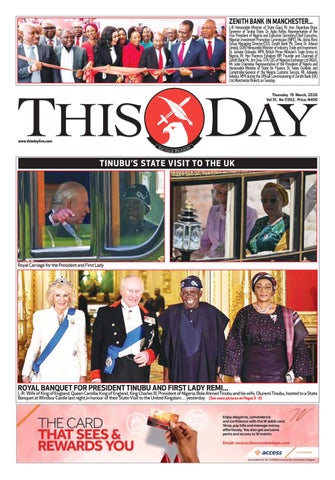
L-R: Honourable Minister of State (Gas), Rt. Hon. Ekperikpe Ekpo; Governor of Taraba State, Dr. Agbu Kefas; Representative of the Vice President of Nigeria and Executive Secretary/Chief Executive, Nigerian Investment Promotion Commission (NIPC), Ms. Aisha Rimi; Group Managing Director/CEO, Zenith Bank Plc, Dame Dr. Adaora Umeoji, OON; Honourable Minister of Industry, Trade and Investment, Dr. Jumoke Oduwole, MFR; British Prime Minister’s Trade Envoy to Nigeria, Rt. Hon Florence Eshalomi MP; Founder and Chairman of Zenith Bank Plc, Jim Ovia, CFR; CEO of Nigerian Exchange Ltd (NGX), Mr. Jude Chiemeka; Representative of the President of Nigeria and Honourable Minister of State for Finance, Dr. Taiwo Oyedele, and Comptroller-General of the Nigeria Customs Service, Mr. Adewale Adeniyi, MFR during the Official Commissioning of Zenith Bank (UK) Ltd, Manchester Branch, on Tuesday.
www.thisdaylive.com
ROYAL BANQUET FOR PRESIDENT TINUBU AND FIRST LADY REMI...
L-R: Wife of King of England, Queen Camilla; King of England, King Charles III, President of Nigeria, Bola Ahmed Tinubu and his wife, Oluremi Tinubu, hosted to a State Banquet at Windsor Castle last night,in honour of their State Visit to the United Kingdom… yesterday (See more pictures on Pages 5 - 8)
Royal Carriage for the President and First Lady
TINUBU’S STATE VISIT TO THE UK
IMAGES FROM TINUBU’S STATE VISIT TO THE UNITED KINGDOM
King Charles lll and Queen Camilla welcoming President Bola Ahmed Tinubu to Windsor Castle to mark the commencement of his two-day historic state visit tot he United Kingdom on the invitation of Their Majesties
King Charles lll welcoming Nigeria’s First Lady, Senator Oluremi Tinubu to Windsor Castle while President Tinubu watches
President Bola Ahmed Tinubu in a royal carriage during the procession in honour of Nigeria’s first family
Queen Camilla and First Lady Oluremi Tinubu in a royal carriage
IMAGES FROM TINUBU’S STATE VISIT TO THE UNITED KINGDOM
L-R: President Bola Ahmed Tinubu; King Charles lll; Queen Camilla; First Lady Oluremi Tinubu; Prince William and Princes Catherineat Windsor Castle… yesterday
The band of the Grenadier Guards performing both the Nigerian and British national anthems
United Kingdom flag sandwiched between two Nigerian flags, symbolising the cordial relationship between both nations
L-R: President of the Nigerian Senate, Godswill Akpabio and Minister of Finance and Coordinating Minister of the Economy of Nigeria, Wale Edun in one of the royal carriages
The Grenadier Guards leading a procession at the entrance of the Windsor Castle’s quadrangle
R-L: Nigerian Minister of Art, Culture, Tourism, and the Creative Economy, Hannatu Musawa and National Security Adviser, Nuhu Ribadu
President Bola Ahmed Tinubu inspecting the royal troops mounted in his honour with King Charles walking just behind
IMAGES FROM TINUBU’S STATE VISIT TO THE UNITED KINGDOM
King Charles III and President Bola Ahmed Tinubu
The Queen and the First Lady
IMAGES FROM TINUBU’S STATE VISIT TO THE UNITED KINGDOM
Queen Camilla, President Tinubu, King Charles III and Nigeria’s First Lady, Oluremi TInubu at Windsor Castle
President Tinubu and First Lady being shown a display of objects from The Royal Collection Trust in the Green Drawing Room at Windsor Castle
L-R: President, Federal Republic of Nigeria, Bola Ahmed Tinubu; King Charles 111; Queen Camilla, and First Lady, Remi Tinubu at Windsor Castle, during the two-day visit by Tinubu in London...yesterday
President Tinubu and wife, Oluremi being shown round Windsor Castle by King Charles lll and Queen Camilla
NAFRC GRADUATES MIDDLE AND SENIOR LEVEL OFFICERS...
L-R: Major General AO Oyelade; Commandant of the Nigerian Armed Forces Resettlement Centre (NAFRC), Oshodi, Lagos, Air Vice Marshal Nnaemeka Ignatius Ilo; and Country Representative of EMPRETEC Nigeria Foundation, Dr. Onari Duke, at the graduation of participants of the Middle and Senior Level Officers Entrepreneurship and Management Course 17/2026 from NAFRC, yesterday
Tinubu Seeks UK’s Support to Curb Terrorism in Nigeria, Africa
Highlights nation, Britain’s historical decades-long ties, to meet UK Prime Minister, Keir Starmer, today Praises Britain for protection during his pro-democracy activities King Charles III says Nigeria has shown people of different faiths can coexist in peace
Deji Elumoye and Emmanuel Addeh in Abuja
President Bola Tinubu has called on the United Kingdom to maintain and strengthen support for Nigeria in addressing terrorism, emphasising that bilateral cooperation remained pivotal to the security and stability of West Africa.
Speaking at a state banquet at Windsor Castle, yesterday, Tinubu highlighted the decades-long historical ties between Nigeria and Britain, describing the two nations’ shared history, culture, and institutions as a strong foundation for collaboration on security, economic, and social issues.
Addressing an audience that included King Charles III, Queen Camilla, Prince William, and Catherine, the Princess of Wales, the president described the occasion as historic, noting that he was the first Nigerian leader to speak at Windsor Castle, a symbol of Britain’s continuity
and governance traditions.
On regional security, Tinubu pointed to terrorism challenges in the Sahel and West Africa, noting that Nigeria carried a significant responsibility in safeguarding regional stability.
He said partnership with the United Kingdom remained essential for intelligence sharing, training, and coordinated counterterrorism measures.
The president also disclosed that his visit to the UK included a scheduled meeting with Prime Minister Keir Starmer later today, where discussions would focus on security cooperation, economic collaboration, and strengthening trade and investment ties.
“Our West African region faces complex terrorism challenges with roots in the Sahel. Nigeria carries an enormous responsibility to help safeguard regional stability.
“In confronting these threats,
partnership with the United Kingdom remains essential and I look forward to my meeting with Prime Minister Keir Starmer tomorrow (today)” he stated.
Tinubu traced Nigeria’s legal and institutional frameworks to British influence, highlighting the adoption of English common law in the judiciary, parliamentary traditions in legislative structures, and administrative models in the civil service.
He said these foundations had helped Nigeria build a stable and resilient democratic system while adapting British models to the Nigerian context.
The president also celebrated the Nigerian diaspora in the United Kingdom, noting their contributions to the National Health Service, business, education, and sports.
He cited Nigerian-trained doctors and nurses as critical to the success of UK’s healthcare system and highlighted prominent Nigerian-descended
athletes including footballers, Bukayo Saka and Eberechi Eze, rugby star Maro Itoje, and boxing champion Anthony Joshua, as living symbols of the enduring connection between the two nations.
Tinubu emphasised Nigeria’s potential as a nation of young, dynamic people and innovative entrepreneurs, even as he expressed confidence in the country’s ability to harness its human and natural resources for economic growth and social development.
The Nigerian leader noted that collaboration with the UK through the Commonwealth of Nations provided an additional platform for strengthening trade, investment, education, and governance links across 56 member states.
Tinubu reflected on Nigeria’s history, recalling the support extended by the United Kingdom during the country’s pro-democracy struggle in the 1990s.
He personally acknowledged that his life and those of other prodemocracy advocates were protected while in exile in the UK, with the Metropolitan Police providing surveillance to safeguard him against threats from the military junta.
“Your Majesty, I wish to express Nigeria’s deep gratitude to this great nation for the refuge and support it extended during the dark years of military dictatorship.
“Like many Nigerians involved in the pro-democracy struggle, I found safety here, and I recall that my residence was placed under Metropolitan Police surveillance for protection following threats from agents of the junta.
“That solidarity remains etched in our collective memory, and it is deeply humbling for me to stand before Your Majesty today as the President of a democratic Nigeria,” Tinubu said.
Discussing historical ties, Tinubu
also highlighted shared values, including respect for democracy, rule of law, and civic responsibility, noting that British thinkers such as John Locke, Edmund Burke, and Thomas Hobbes, had influenced democratic principles that underpinned governance in both countries.
At the same time, he cited British literary figures, including William Shakespeare and Charles Dickens, whose work has shaped the English language globally, which remains Nigeria’s official language and a bridge for trade and cultural exchange. Besides, economic cooperation featured prominently in Tinubu’s remarks, noting that Nigeria and the UK were working together to expand trade, attract investment, and support innovation in multiple sectors. He highlighted Nigerian entrepreneurs and businesses as vital drivers of growth, particularly in agriculture, technology, and creative industries, while stressing UK’s role as a longstanding partner in these efforts.
He expressed the hope that despite its many problems, Nigeria was on the verge of renaissance.
Be Decisively Confronted
Shettima: Those Behind Recent Attacks Across Nigeria Will
Visits victims of Maiduguri attacks with DG NEMA, vows FG will defeat terrorism CDS urges Borno, Yobe to own fight against
Deji Elumoye, Linus Aleke in Abuja and Muhammad Sabiru in Maiduguri
Vice President Kashim Shettima, yesterday, said those behind recent attacks across Nigeria will be decisivelyShettimaconfronted.
reiterated the federal government’s resolve to defeat terrorism.
terrorism, as Troops kill over 80 terrorists in Borno, NAF thwarts criminal invasion
He spoke in Maiduguri during a visit to Borno State, alongside Director-General of National Emergency Management Agency (NEMA), Zubaida Umar, in the aftermath of Monday’s terror attack on the Borno State capital.
The vice president disclosed that beyond the presidential directive
to the security chiefs to relocate to Maiduguri to take immediate charge of the anti-terrorism fight, the federal government was investing more in equipment and other logistics to boost the war against terrorism across the country.
Condemning the multiple explosions in Maiduguri on Monday in which more than 100 people were
affect-ed, with over 20 confirmed dead, he described the perpetrators as barbaric, stressing that no cause justifies the killing of innocent people.
He said his visit was to sympathise with the injured and the families affected by the tragedy.
Shettima assured the victims of government’s support through
NEMA, North East Development Commission, and Borno State Government.
He was accompanied by Borno State Deputy Governor, Usman Kadafur; Umar; Chief Medical Director of University of Maiduguri Teaching Hospital, Professor Ahmed Ahijo; and other top government
Continued on page 12
“Despite these challenges, Nigeria approaches the future with hope and confidence. We are a nation of diverse and vibrant people, of young people dreaming big, of entrepreneurs with a global outlook, and of a hopeful people determined to realise their full potential,” he stressed. Tinubu, therefore, expressed gratitude to the United Kingdom for its historical support and for nurturing the enduring friendship between the two nations.
He invited attendees to raise a toast to the continued partnership, reaffirming Nigeria’s commitment to working with the UK in building security, prosperity, and mutual understanding.
Continued on page 33
HUMAN CAPITAL DEVELOPMENT PROGRAMME...
L-R: Project Manager (Pigging), MJD Oilfield Services Ltd, Chief Austin Ugboaja; Managing Director(MD), Language and Skills Development Consulting, Ms. Stella Nnodi; MD, MJD Oilfield Services Ltd, Olayemi Familusi; MD, Doret Technologies Ltd, Dr Daniel Thomas; Manager, Human Capital Development, Nigerian Content Development and Monitoring Board (NCDMB), Mrs Tarilate Bribena-Teide; Head, Pipelines RoW, Encroachment Management & Emergency Repairs, Renaissance Africa Energy Company, Gbenga Alabuja; Funsho Alabi of Renaissance Africa Energy Company, and Supervisor, Human Capital Development, NCDMB, Ayimovie Ikiogha, at the kickoff of the MJD/Renaissance/NCDMB-sponsored Nigerian Content Human Capital Development (NC-HCD) training programme in Port Harcourt, Rivers State… recently
Crude Price Crosses $110 as Iran Vows
Retaliation after Attack on Oil Facilities
Iran’s intelligence minister, Esmaeil Khatib, killed Qatar expels Iranian envoy after missile attack British military experts sent to US to work on reopening Strait of Hormuz
Brent crude spiked more than 5 per cent to over $110 a barrel yesterday after Israel struck the world’s largest natural gas reserve located in Iran in a coordinated operation with the United States.
The attack marked the first time Iran’s upstream oil and gas
Sunday Ehigiator
The Terra Academy for the Arts (TAFTA), in partnership with the Mastercard Foundation, has empowered over 2,000 women at the Women Kreatives Connect Summit 2.0, reinforcing the need for increased access to opportunities in Nigeria’s creative industry.
The summit held recently in Lagos, brought together participants from diverse backgrounds, including persons with disabilities, to address challenges such as limited access to networks, funding, and sustainable career pathways.
Speaking at the event, the Founder of TAFTA, Bolanle Austen-Peters, emphasised the importance of creating
infrastructure, as opposed to those in the gulf, has been targeted since the war began on February 28 as the crisis entered its 19th day.
Iran shares its massive South Pars gas field with Qatar, which uses its side to supply roughly a fifth of the world’s LNG. Qatar’s foreign ministry condemned the strikes as “a dangerous and irresponsible step.”
Iran’s response was a bit tougher. Tehran sent out a list of energy facilities it planned to strike, including those in Saudi Arabia, the UAE, and Qatar, naming specific targets including Saudi Aramco’s Samref refinery and Jubail petrochemical complex and the Al Hosn gas field in the UAE. Iran’s military joint command said it would escalate the war “in new ways.”
The price moves came on top of what has already been one of the strongest oil rallies in years. Brent has surged roughly 80 per cent since the conflict began, driven largely by the near-total shutdown of tanker traffic through the Strait of Hormuz, the chokepoint that handles about 20 per cent of global oil and gas flows.
The International Energy Agency
platforms that amplify women’s voices and expand opportunities.
“At TAFTA, we believe women have an important role to play in shaping the future of the creative industry.
“Women Kreatives Connect was created to remind women that their stories matter, their voices deserve to be heard, and that even when the odds seem difficult, resilience and collaboration can open new doors.”
The summit featured panel discussions with industry leaders, including Joke Silva and Osas Ighodaro, who shared insights on resilience, consistency, and community support.
Speaking during the Women Versus the Odds session, Silva said:
“Every journey in the creative industry comes with challenges. What matters is the willingness to keep learning, stay consistent, and remain true to your purpose. When women support one another, the path becomes clearer and the possibilities become greater.”
Participants were also connected to practical opportunities, including access to content creation tools through TAFTA’s partnership with Ulanzi, aimed at supporting their transition from learning to earning.
Speaking on her experience, a participant, Fatima Usman, said the event helped reshape her perspective on navigating the industry.
“I realised that my experience is not isolated. Hearing others speak about similar challenges gave me
Court Slams $6m Fine on
10 Filipino Sailors Over Cocaine Trafficking
Michael Olugbode in Abuja
A Federal High Court in Lagos has convicted 10 Filipino sailors and a merchant vessel, MV Nord Bosporus, over the trafficking of 20 kilogrammes of cocaine into Nigeria, imposing a total fine of $6 million and additional penalties amounting to N1.1 million.
The judgment, delivered on Wednesday, March 18, 2026, by Justice Ayokunle Faji, followed the arrest of the crew and seizure of
the illicit drug by operatives of the National Drug Law Enforcement Agency (NDLEA) at the Apapa seaport on November 16, 2025.
According to a statement on Thursday by the spokesman of the anti-narcotics agency, Femi Babafemi, the vessel and its crew were arraigned on a four-count charge before the Federal High Court in Lagos after investigations revealed the cocaine shipment originated from Santos, Brazil.
The defendants later entered into
a plea bargain agreement, pleading guilty to the charges.
In his ruling, Justice Faji found the vessel guilty under the NDLEA Act and ordered it to pay a penalty of N100,000 as well as restitution of $5.35 million to the Federal Government of Nigeria.
Three principal officers of the ship were each fined N100,000 and ordered to pay $100,000 in restitution, while the remaining seven crew members were fined N100,000 each and directed to pay $50,000 apiece.
a different perspective on what is possible,” she said.
In addition, winners of the Women Entrepreneurship Development Program (WEDP) pitch competition; Halimah Ayomide Dunmoye, Victory Ajaja, and Uwaechie Maryanne Chidinma, were awarded grants of up to N750,000 to support their businesses.
The event also saw the unveiling of the Creative Catalysts Report, which highlighted structural challenges facing women in Nigeria’s creative sector and outlined actionable pathways for inclusive growth.
Wale Igbintade
Justice Yelim Bogoro of the Federal High Court, Lagos, yesterday fixed May 14, 2026, to deliver judgment in the high-profile legal battle between Facebook Nigeria Operations Limited (FNOL) and the Advertising Regulatory Council of Nigeria (ARCON) over a disputed N60 billion fine.
Filed under FHC/L/ CS/2205/2024, the suit challenges ARCON’s authority to summarily impose fines on FNOL for alleged breaches of the Advertising Regulatory Council of Nigeria Act 2022 (ARCON Act).
The dispute arose from a notice dated October 21, 2024, in which AR-
(IEA) last week announced the largest emergency reserve release in its history—400 million barrels—and the U.S. committed to tapping 172 million barrels from the Strategic Petroleum Reserve over 120 days. So far, the reserves have done little to contain prices. Gas prices have spiked to the highest levels since 2023, up nearly a dollar since the war with Iran began.
But the spike in WTI crude, the benchmark for Texas oil, is nothing compared to what’s happening across the Pacific. Dubai crude—the pricing benchmark for Asian buyers—hit an all-time high above $150 a barrel last week. Oman crude settled above $152 on Monday.
WTI, meanwhile, is trading around $96 in the U.S. That’s an unprecedented $50-plus gap for the same commodity, which normally has a spread of $5-$8, Fortune Media reported. Physical crude in Asia is also trading at a nearly $40 premium over its paper equivalent, a sign that actual barrels are far scarcer than futures suggest.
Analysts fear that the shortage in Asia could conflagrate into a more dire global scenario if the war continues.
Rory Johnston, a commodities analyst specialising in oil, wrote that the longer
the Strait stays closed, the more Asia’s supply shortage becomes everyone’s problem.
Iran Hits Qatar’s Ras Laffan in Retaliation
Also yesterday, the Ras Laffan industrial complex sustained damage after a missile attack, QatarEnergy said. “Emergency response teams were deployed immediately to contain the resulting fires, as extensive damage has been caused,” QatarEnergy added.
Qatar’s interior ministry attributed the attack to Iran and said that it has “gained preliminary control over the fire at Ras Laffan, with no reported injuries”.
Tehran earlier on Wednesday listed the 305,000 b/d Ras Laffan refinery in Qatar among five downstream facilities it said it would attack shortly in retaliation for what it described as US-Israeli strikes on Iranian gas treatment plants at the South Pars gas field.
It was not immediately clear whether the refinery or the nearby 77mn t/yr LNG export terminal were directly attacked or sustained any damage.
CON alleged that FNOL repeatedly displayed advertisements targeting the Nigerian market on Facebook and Instagram without prior approval from the Advertising Standards Panel.
ARCON subsequently imposed a N60 billion fine, citing violations of sections 34(3) and 54 of the ARCON Act.
FNOL, however, argued that it neither operates nor controls the platforms where the alleged violations occurred.
The company emphasised that Facebook and Instagram are owned and managed by Meta Platforms, Inc., a Delaware-registered company in the United States.
Through an originating summons,
FNOL sought declaratory and injunctive relief to nullify ARCON’s notice and prevent similar fines in the future, asserting that imposing fines without a fair hearing violates both the Constitution of the Federal Republic of Nigeria and section 57(4) of the ARCON Act, which guarantees a fair hearing.
During yesterday’s proceedings, FNOL’s lead counsel, Mofesomo Tayo-Oyetibo, SAN, told the court that the Constitution guarantees a fair hearing, particularly when criminal allegations are involved. He stressed that FNOL has never operated Facebook or Instagram in Nigeria and therefore could not have committed the alleged infractions.
Emmanuel Addeh in Abuja
IGP PANEL ON STATE POLICE VISITS BARAU...
Deputy President of the Senate, Senator Barau I. Jibrin (4th from left ), the Chairman of the IGP Committee on State Police, Professor Olu
and other members of the IGP’s committee during a courtesy visit to the Deputy Senate President in Abuja on Tuesday
Sultan of Sokoto Declares Friday as Shawwal for Celebration of Eid-el-Fitr
Kebbi governor greets Muslims on Eid-el-fitri, pledges continued development in state Police, NSCDC, deploy operatives across states, urge residents to be vigilant
Michael Olugbode, Adedayo Akinwale in Abuja, John Shiklam in Kaduna, Fidelis David in Akure, Onuminya Innocent in Sokoto and Yemi Kosoko in Jos
The Sultanate Council Sokoto has announced Friday, March 20, as the first day of Shawwal 1447AH, following the non-sighting of the crescent that signals the end of Ramadan.
The announcement was made in a statement yesterday by the council’s Advisory Committee on Religious Affairs, in collaboration with the National Moon Sighting Committee Nigeria.
The statement was signed by Sambo Wali Junaidu, Chairman of the Advisory Committee on Religious Affairs, Sultanate Council, Sokoto.
The statement said no credible reports were received from across the country confirming the sighting of the Shawwal moon on Wednesday, March 18, which marked the 29th day of Ramadan.
“Therefore, Thursday, March 19, 2026, shall be the 30th day of Ramadan 1447AH,” the committee stated.
Based on the report, Sultan of Sokoto and President-General of Nigerian Supreme Council for Islamic Affairs, Muhammad Sa’ad Abubakar, approved the declaration of Friday as the day for Eid-el-Fitr.
“His Eminence has accepted the report and accordingly declared Friday, 20th March 2026, as the first day of Shawwal 1447AH (Day of Eid-el-Fitr),” the statement read.
The sultan congratulated Muslims on the successful completion of Ramadan and called for sustained prayers for national unity and development.
“He urges the Muslim Ummah to continue to pray for peace, progress and development of the country,” the statement added, while also wishing Muslims Allah’s guidance andTheblessings. Islamic calendar is based on lunar observations, with the end of Ramadan determined by the sighting of the new crescent.
In Nigeria, Nigerian Supreme Council for Islamic Affairs, led by Sultan of Sokoto, oversees the
coordination of moon sighting reports through committees nationwide to ensure a uniform decision.
Kebbi State Governor, Comrade Nasir Idris, congratulated Muslims in the state on the successful comple- tion of Ramadan and Eid-el-Fitri celebration.
In a statement by his Special Adviser on Communication and Strategy, Abdullahi Zuru, Idris expressed gratitude for the people’s dedication to prayers and sacrifices. He acknowledged their resilience and support for his administration’s achievements, especially, in education, infrastructure, agriculture, and economic empowerment.
The statement said, “Governor Idris highlighted the recent distribution of Ramadan palliatives and dry season farming inputs, saying efforts were doubled compared to previous years.”
The governor said that dem- onstrated his administration’s commitment to improving the people’s well-being.
He reassured of his commitment to security by training volunteer youths to support the security agencies.
He said, “Hundreds of youths volunteers are being trained by a combined team of security personnel drawn from the military, police, state security service and Nigerian Civil Defence Corp.”
The governor thanked traditional rulers, Islamic scholars, All Progressives Congress (APC) stakeholders, civil servants, and non-governmental organisations (NGOs) for their cooperation and support.
He promised to sustain development programmes, and announced more initiatives to improve the people’s well-being and economic prospects.
Police, NSCDC Deploy Men Across Nigeria
Nigeria Police and Nigeria Security and Civil Defence Corps (NSCDC) deployed their men across the federa-tion ahead of the Muslim festivities.
Sokoto State Police Command issued a security advisory urging residents to remain vigilant and law-abiding during the Eid-el-Fitri
celebrations.
In a press release signed by Public Relations Officer, DSP Ahmad Rufa’i, the command stated that Area Commanders, Divisional Police Officers (DPOs), and Tactical Commanders had been directed to intensify patrols, intelligence-led operations, and visible policing to ensure peaceful festivities.
The command expressed concern over potential security threats, particularly phone snatching, pickpocketing, and traffic offences, and advised parents and guardians to monitor their wards to prevent reckless behaviour.
Residents were urged to report suspicious activities to the nearest police station or Command Control Centre on 08026451719.
Kaduna State police command also put robust security measures in place to ensure a peaceful and hitch-free Eid-el-Fitr celebration across the state.
In a statement, spokesperson of the command, Mansir Hassan, said tactical commanders, intelligence operatives, and other personnel had
been deployed to every nook and cranny of the state. This included Eid prayer grounds, recreational centres, markets, highways, and other strategic locations to guarantee the safety of residents before, during, and after the festivities, Hassan said.
He warned that the use of knockouts, fireworks, and other explosives remained strictly prohibited.
On its part, NSCDC announced a sweeping nationwide deployment of more than 53,500 operatives.
The directive issued by Commandant General, Ahmed Audi, was aimed at pre-empting security threats and ensuring a peaceful atmosphere before, during, and after the festivities.
The deployment spanned all 36 states and the Federal Capital Territory (FCT), underscoring the scale of the operation.
The directive stated, “Security presence is to be significantly heightened at identified flashpoints, including Eid prayer grounds, mosques, churches, shopping centres, motor parks, and recreational hubs.
“The corps is adopting a dual-
layer strategy that combines visible policing with covert intelligence operations to deter criminal elements and swiftly neutralize any emerging threats.”
Audi, while reaffirming the corps’ readiness, stressed that security was a collective responsibility.
He urged citizens to remain alert and cooperate with law enforcement agencies by reporting suspicious activities. He also appealed to parents and guardians to guide young people away from actions that could disrupt public peace.
As Muslims across Nigeria prepared for the Eid-el-Fitr celebrations, security agencies in Ondo State deployed 4,000 personnel across the 18 council areas of the state to ensure a peaceful and hitch-free festivity.
The police and NSCDC in the state announced separate operations, detailing coordinated strategies aimed at safeguarding lives, property, and critical infrastructure before, during, and after the Sallah celebrations.
A statement by the state’s Police Public Relations Officer, Jimoh
Abayomi, said the command had deployed 3,000 officers across the state under the directive of Commissioner of Police, Adebowale Lawal, as part of proactive measures to forestall any breakdown of law and order.
The statement explained that the personnel would be strategically stationed at Eid prayer grounds, major highways, markets, recreational centres, and other public places expected to witness large gatherings.
“The deployment forms part of proactive security measures aimed at safeguarding lives and property before, during, and after the festive period,” the police boss stated. Similarly, in Plateau State, the police command announced sweeping security measures ahead of the Sallah celebrations, including a temporary ban on commercial tricycles, popularly known as Keke Nape, across Jos Bukuru metropolis. Commissioner of Police, CP Bassey Ewah, said the decision was part of a broader strategy to ensure a peaceful and hitch free celebration across the state.
Nigeria, Sweden Deepen Ties on Trade, Innovation, Regional Stability
Michael Olugbode in Abuja
Nigeria and Sweden have reaffirmed their commitment to strengthening bilateral relations, with renewed focus on trade, innovation, and regional cooperation, as both countries seek to expand mutually beneficial partnerships.
This formed the outcome of a high-level meeting between Nigeria’s Minister of Foreign Affairs, Yusuf Tuggar and Sweden’s Ambassador to Nigeria, Anna Westerholm, held at the Ministry of Foreign Affairs in Abuja.
During the engagement, Ambassador Westerholm expressed Sweden’s appreciation for Nigeria’s hospitality since assuming office in August 2025, describing bilateral relations as cordial and built on strong goodwill. She
reaffirmed Sweden’s readiness to deepen cooperation across key sectors of shared interest.
Central to the discussions was the expansion of economic ties, with Sweden identifying trade, investment, and strategic partnerships as priority areas.
The envoy highlighted Sweden’s interest in supporting Nigeria’s transition towards a green and digital economy, particularly through collaboration in digital infrastructure, innovation, and technology development.
As a globally recognised innovation-driven economy, Sweden sees significant opportunities to partner with Nigeria in enhancing digital connectivity and strengthening its technological ecosystem.
Beyond technology, both countries
explored potential collaboration in the energy sector and the creative industry.
Westerholm pointed to Nigeria’s growing global influence in music—especially Afrobeats—as a gateway for partnerships that could merge Swedish expertise in music production and business models with Nigeria’s vibrant creative economy.
In a move signaling stronger commercial engagement, Sweden recently established a trade office in Lagos, led by a governmentappointed Trade Commissioner.
The development follows earlier high-level engagements, including a visit by Sweden’s Crown Princess, underscoring Stockholm’s commitment to expanding trade and investment links with Africa’s largest economy.
On the multilateral front, Sweden commended Nigeria’s role as a reliable partner in promoting a rules-based international order, particularly through cooperation at the United Nations and other global platforms. Regional security and political developments also featured prominently in the talks, with both sides exchanging views on the evolving situation in West Africa. Discussions focused on the Sahel region and the role of Economic Community of West African States in maintaining stability, including its engagement with the Alliance of Sahel States (AES). Both parties acknowledged Nigeria’s strategic role in driving regional integration and fostering dialogue amid shifting geopolitical dynamics.
The Nigeria Sovereign Investment Authority (NSIA) has signed a Memorandum of Understanding (MoU) with UK-based Asset Green Ltd to develop a $496 million integrated dairy livestock production and processing platform aimed at boosting Nigeria’s food security and reducing dependence on imports.
The agreement was signed in London ahead of President Bola Tinubu’s ongoing state visit, outlining a framework for collaboration and project development commitments leading to a formal shareholders’ agreement.
Described as one of the most ambitious dairy investments in
Nigeria, a statement yesterday, explained that the project would combine 20,000 hectares of climatesmart and regenerative crop and forage production with a modern 10,000-milking cow dairy operation.
It would also feature a state-ofthe-art processing facility capable of producing fresh milk, milk powder, butter, cream, and up to 15,000 metric tonnes of infant formula annually.
The initiative is expected to significantly reduce Nigeria’s reliance on imported milk powder, modernise agricultural practices, and improve nutrition outcomes. It will also integrate up to 10,000 rural households into the value chain through out-grower schemes.
Once operational, the platform is projected to generate over $620 million annually and create about 2,500 direct jobs and 5,000 indirect jobs nationwide.
British Deputy High Commissioner, Jonny Baxter, said the partnership reflects the longstanding economic ties between both countries.
“Over a decade ago, the UK provided pivotal support to Nigeria in establishing the NSIA, offering legal and financial expertise that helped lay the foundation for its successful launch and strengthening its governance and credibility. That early institutional investment has paid dividends, helping to build a resilient Nigerian institution
capable of creating jobs and driving transformational, long-term development.
“The NSIA and Asset Green partnership is a powerful example of how that groundwork continues to deliver impact, a full-circle moment that reflects the long-term economic cooperation between the UK and Nigeria and the shared commitment to deepening sustainable, privatesector-driven growth,” he said.
NSIA Managing Director and Chief Executive Officer, Aminu Umar-Sadiq, described the deal as a landmark investment in the country’s agricultural future.
“NSIA is pleased to partner with Asset Green on this transformative investment. With a project size of
almost $500 million, this is one of the most ambitious initiatives aimed at strengthening Nigeria’s food and nutrition security in a generation. By combining climate-smart farming, advanced processing capacity, and inclusive out-grower participation, we are laying the foundation for a modern, competitive dairy sector that reduces import dependence, creates meaningful jobs, and delivers long-term value for Nigerians,” he said.
Director at Asset Green and CEO of Agrium Capital Ltd, Rod Bassett, said the investment would unlock the potential of Nigeria’s agricultural sector.
“This partnership between NSIA and Asset Green is the
At Africa Capital Forum in London, Cardoso Declares Reforms Have Bolstered Shock Resilience, Confidence
Says foreign investors account for 28% of banking recapitalisation inflows Wale Edun: FG seeks collaboration to fund growth Baxter: next phase should convert renewed investor interest into long-term sustainable investments Gray: reforms providing transparency, building confidence
James Emejo in Abuja and Nume Ekeghe in Lagos
Governor of Central Bank of Nigeria (CBN), Mr. Olayemi Cardoso, yesterday, said Nigeria’s ongoing monetary and financial sector reforms were strengthening the economy’s resilience to external shocks while reinforcing investor confidence, as policy discipline and structural adjustments yielded measurable stability gains.
That was as international investors continued to express support for ongoing reforms in the Nigerian financial sector, maintaining that the objectives remain a credible adventure.
Cardoso spoke at the Africa Capital Forum, with the theme, “From Stabilisation to Capital Mobilisation,” which was jointly hosted by CBN and UK Foreign, Commonwealth and Development Office (FCDO), at The Peninsula, London.
The event was hosted on the sidelines of President Bola Tinubu’s State Visit to the UK.
The CBN governor disclosed that foreign investors accounted for about 28 per cent of total inflows into the ongoing banking sector recapitalisation programme, underscoring renewed global confidence in Nigeria’s financial system.
He told investors and development partners that the central bank had “cre-
SHETTIMA: THOSE BEHIND RECENT ATTACKS ACROSS NIGERIA WILL BE DECISIVELY CONFRONTED
officials.
Still on the Maiduguri tragedy, Chief of Defence Staff (CDS), General Olufemi Oluyede, urged communities in Borno and Yobe states to take ownership of the fight against Boko Haram/ISWAP terrorists.
Fielding questions from journalists shortly after a close-door meeting with Chief of Army Staff (CAS), Lt-Gen Waidi Shuaib, the CDS said some residents were complicit in sabotaging troops’ efforts in the fight against terrorists.
The service chiefs arrived Maiduguri around 11:21am yesterday based on the directive of President Bola Tinubu to take direct charge of the situation in Maiduguri, following multiple bomb blasts that killed about 26 people and injured 146.
Oluyede stated, “We are here to review our strategies in the fight against Boko Haram/ISWAP terrorists in the North-east.
“As you are aware, in the last one month, there were attacks launched by terrorists, which is their usual tactics during the holy month of Ramadan Kareem.
“I want to put it clearly this afternoon that for us to end this act of terrorism, the people of Borno State and Yobe must take ownership of this problem.
“The bulk of the people perpetrating this heinous act are from these states, they are our brothers, sisters, cousins, and we know them.
“Let me give you an example. When Kukawa was attacked, while we were conducting cordon and search afterwards, we discovered
that two of the wounded terrorists were inside that village.
“Therefore, the people in these two states – Borno and Yobe – must take ownership of the crisis to end this war. That is my message to the people of Yobe and Borno.”
On drones and other technologies being used by terrorists, the CDS said, “We are responding with German drones, and we are getting more of those drones; we are on top of the situation.”
In Borno, Troops Kill Over 80 Terrorists, NAF Thwarts Fatori Community Invasion
Troops of the Joint Task Force (North East), Operation Hadin Kai (OPHK) dealt a decisive blow to terrorists, killing over 80 fighters, including key commanders, during a coordinated five-pronged attack on military positions at Mallam Fatori, Sector 3, in the early hours of yesterday.
The success came barely 24 hours after the troops repelled a separate ISWAP and Boko Haram attempt to overrun four military locations across the North-east.
Recent reports confirmed that similar assaults on Njimtilo, Baga, Buratai, and Damboa were also thwarted, demonstrating the resilience and tactical superiority of OPHK forces.
A statement by Media Information Officer of OPHK, LieutenantColonel Sani Uba, explained that the terrorists advanced in large numbers on foot and deployed armed drones
in a desperate attempt to breach troop defences, particularly at the 68 Battalion frontage along Bravo Company, from Duguri.
Uba stated that anticipating the assault, troops had prepared an offensive-defensive operation designed to disrupt and annihilate the attackers.
Through disciplined fire control, coordinated manoeuvres, and superior tactics, the insurgents were routed in disarray, with no fewer than 80 neutralised, he said.
The operation was further reinforced by precision close air support from the NAF Air Component, complemented by rapid strikes from allied Nigerien air assets, putting additional pressure on the fleeing insurgents.
Follow-on operations recovered a substantial cache of weapons and equipment, including 52 AK-47 rifles, eight PKT machine guns, seven RPG tubes, five general-purpose machine guns, over 3,000 rounds of ammunition, 21 RPG bombs, nine improvised explosive devices, multiple magazines, communication radios, and components of armed drones.
Notably, the operation eliminated three high-profile terrorist commanders – Mallam Abdulrahman Gobara, Mallam Ba Yuram, and Abou Ayyuba – alongside several identified fighters, including Zarkawi, Ba Bunu, Rawa Fannami, Abowor Suwurti, Bulama Mil, Abu Aisha, Suleimana, Abu Rijal, Abu Ali, Abba Gana Kawiyya, and Ahmodu Hirasama.
ated stronger capacity to withstand shocks,” through disciplined policy and institutional reforms.
He also stated that Nigeria’s foreign exchange market now enjoyed far greater transparency and liquidity, with a new foreign exchange (FX) manual eliminating many former capital control measures and simplifying trade and investment processes.
Cardoso announced that the central bank had finalised a new Payments System Vision for Nigeria, to be launched soon, aimed at positioning the country as a regional leader in digital and cross-border payments.
He reported significant progress in the bank recapitalisation programme, stating that more than 30 banks have met the new capital requirements, with verification ongoing for the rest.
He said, “About 28 per cent of investment in the recapitalisation came from foreign sources,” adding that the outcome reflects renewed confidence in Nigeria’s financial stability.
Cardoso explained that diaspora remittances had grown significantly,
helping diversify the country’s foreign exchange reserves, which were now more resilient to global volatility.
He stated, “Our focus going forward is to protect the hard earned stability we have accomplished so investors and stakeholders can plan with confidence.”
He added that CBN under his leadership would remain open and transparent, provide constant communication, and raise the bar of the people’s expectations, to guard against past missteps.
Highlighting the bank’s digital finance agenda, Cardoso said CBN was working closely with Nigeria’s fintech sector to address regulatory and operational bottlenecks and support innovation that strengthened financial inclusion across Africa.
He reaffirmed the importance of close collaboration between fiscal and monetary authorities, stating that the presence of representatives of the fiscal authorities on the CBN Board and Monetary Policy Committee “engenders the coordination that is so critical for sustainable growth.”
Cardoso confirmed that inflation had fallen sharply, exchange rate stability had improved, and reforms had positioned Nigeria’s economy “for significant growth driven by domestic investment, oil sector reforms, and renewed global trust”.
He said, “We will continue to maintain stability, not only on inflation, but in the FX market, with more transparency and consistent reporting.” On inflation, he said CBN would remain vigilant to ensure inflation was managed as effectively as possible. The apex bank governor stated that Nigeria’s macroeconomic reforms had shifted the country from the phase of stabilisation to one of capital mobilisation, encouraging investors to see Nigeria as “an economy to watch very closely”, as its growth drivers deepen and its banking system becomes one of the strongest in Africa.
Cardoso said management was reviewing CBN’s policies with a view to developing meaningful policies and establishing a predictable policy framework to minimise discretion.
RETURN OF THE SUICIDE BOMBERS
and terror killings have become commonplace. Yet when such tragedies become the norm, lives of ordinary citizens matter little and people in government will only continue to proceed with mere rituals. That is a very bad place to be as a nation which is why we must deal with this challenge. But perhaps the bigger issue here is the state of our military preparedness.
First, we need to have neighbouring countries on our side. Not necessarily because we need them as friends but rather because we cannot afford to have them as our enemies. Regrettably, we have mismanaged the relationship with Niger Republic and the reality is that this must have weakened the cohesion within the Multinational Joint Task Force (MNFTF). To compound the problem, there are reports of deficits in arms, ammunition and critical battle winning equipment as well as in the number of our troops, resulting in insurgents sacking
military battalions and carting away arms and ammunition. In fact, I have it on good authority that more than 70 percent of the arms and ammunition insurgents deployed in their war against our country are “captured arms” looted from the armouries of our military.
While Nigerian soldiers are as valiant as their counterparts, what has come out of the recent joint military operations is that our neighbours have superior weapons which is a shame considering the resources of our nation compared with these smaller countries. For instance, information from the theatre shows a gross lack of air assets to support the troops who are mostly located in remote areas with difficulties for their reinforcement when attacked. Even Cameroon that has not given as much commitment to fighting the insurgents has been helpful in the deployment of its air assets and support for the offensive by providing requisite surveillance and some of
the military hardware that we lack.
In a special report yesterday on Nigeria, the Financial Times described the approach to the security challenge as piecemeal: “Solders have struggled to cope with the hit-and-run tactics that motorbike-riding bandits and terrorists use across Nigeria, and have responded too slowly to intelligence warnings of impending attacks.” Shortly before leaving Nigeria on Tuesday, President Tinubu said he had given approval for the procurement of military hardware. While that is commendable, equipment procurement should not be done in piecemeal, as hinted by the FT and confirmed by some of the military officers with whom I have spoken in recent days. With the right equipment and sufficient ammunition, as well as adequate motivation for the fighting troops whose numbers need to increase, we can defeat the insurgents. And in the interest of our country, it is a battle we must win!
required to unlock the potential of the agriculture sector in Nigeria, with the development of such a future dairy food system.
NSIA MD, Aminu Umar-Sadiq
Politics
Acting Group Politics Editor DEJI ELUMOYE
Email: deji.elumoye@thisdaylive.com
08033025611 sms only
Second Term: Has Soludo Anything Special for Ndi Anambra?
David-Chyddy Eleke reports that Governor Chukwuma Soludo on Tuesday began a fresh four-year tenure in anambra state and asks if he’ll be able to consolidate on the achievements recorded during his first term in office.
On Tuesday, March 17, 2026, the Governor of Anambra State, Prof Chukwuma Soludo was sworn in for a second term in office. The exercise kick starts a fresh journey for further transformation of Anambra State as the governor has always desired.
Long before he achieved his goal of becoming governor, Soludo had first given the position a shot in 2010, when he had just left office as the Governor of Central Bank of Nigeria (CBN).
Then, Soludo had first wooed the citizens of the state with the promise of making Anambra Africa’s Dubai-Taiwan. Though the dream of that period had been truncated with the re-election of incumbent governor, Mr Peter Obi, 11 years after in 2021, Soludo got his chance after another failed attempt that ended at the primary election stage. He was in November, 2021 elected as governor and sworn in, on March 17, 2022. His ascension to office was an opportunity to show Anambra people what he has for years craved to deliver, and within the last four years, Soludo believes he has delivered.
As the celebration of the second tenure swearing in held at the Alex Ekwueme Square in Awka on Tuesday went on, THISDAY found it was a huge contrast to the ceremony that held in 2022, when only a few persons witnessed the event in front of the governor’s office in the old government house. But convinced that his government has rolled out a solid foundation for Anambra in the last four years, Soludo rolled out the drums and celebrated his second coming with an elaborate event that was witnessed by a wide range of dignitaries from Anambra and beyond.
The arena was colourfully decorated, with huge inscriptions that echoed the believe of both the governor and citizens. Among the many billboards in the state were some with inscriptions like: Anambra is on the rise, a solid foundation has been laid for Anambra, we can now consolidate, solution continues for another four years, among others.
Many of the citizens of the state who turned up for the ceremony praised the governor for his work so far, with many paying glowing tributes, but the governor is not also unmindful of his own achievements in the state as he took time to give account of what he has achieved so far within four years. In a very lengthy speech, the governor said: “Four years ago, my deputy (Dr. Onyekachukwu Ibezim), and I took the
oath of office before you at the old Governor’s Office in Agu Awka. It was a quiet ceremony attended by fewer than fifty guests, and immediately afterward we went straight to work.
“We were clear that the moment did not call for celebration. On that very day, we worked for eight hours and 45 minutes—no fanfare, no parade, no celebrations of any kind—just work. We declared a state of emergency.
The very next day, we began at Okpoko, the largest urban slum in the Southeast. That visit symbolized our priorities: to start where the need was greatest and to focus on the people who had long been left behind. We made a solemn promise to you then—to work 24/7 to rescue our state and make you proud.
“As a technocrat in politics, our administration set out to test a simple but profound hypothesis: can the politics of transformation and development (rather than the politics of transactions) translate into political capital and popular support? Barely three years in office, after delivering more than 90% of the promises we made for our first term, it was you, Ndi Anambra who proudly proclaimed that Anambra is back and rapidly rising.”
The governor insisted that within three years, he had already delivered more that 90 percent of his campaign promise to Anambra people, and that most of his works were not captured as promises he made to Anambra people. “Indeed, several of the major projects we delivered were
not in our Manifesto (e.g. new Ekwulobia, Fun City, Light House, etc.). In affirmation, all the senatorial zones bestowed on us the title “Oluatuegwu Anambra” (the one who does not fear work or the one who relishes the challenge of difficult tasks).
“Then came the governorship election in November last year: Umunne m Ndi Anambra, what you did was unprecedented in Nigeria’s political history. You organized rallies at your own expense, knocked on doors across communities, and donated massively to support our campaign. It was a spontaneous movement of the people, an extraordinary demonstration of ownership of the “project Anambra”. The unprecedented 73% of the votes cast at the polls was therefore more than an electoral victory; it was a near-unanimous affirmation of the path we have chosen together and a resounding call to do even more. I am certain that political scientists will one day write volumes about what many now call the Anambra phenomenon.
“Today, we stand in awesome gratitude to the Almighty God and to you, the special people of Anambra. We are gathered here at the remodeled and massively expanded Ekwueme Square not merely to mark the inauguration of a Second Term, but above all to celebrate you, Ndi Anambra—for your love, your patriotism, and your partnership in the journey of rebuilding our homeland (albeit that the “celebration” is muted with only Made in Anambra/Nigeria foods/drinks). Be assured that we will never take your historic support for granted. And as the Americans would say and as we promised during the campaigns: “you ain’t seen nothing yet”!”
True to most of the comments captured in his address, Soludo has actually wooed Anambra people with his works, but many others believe he lauded himself more than
As another four-year term begins, soludo believes that the foundation for success has been laid, and that the state is set to attain cruising height. He said after chairing Anambra Vision 2070 committee, he’s left with no option than to visualize the condition of the state decades to come, and this spurred him to work.
his works. But among some of Soludo’s most noticeable project is his fight against insecurity in the state. Soludo ascended the governorship seat at a time when eight out of the 21 local government areas of the state was under siege. Gunmen masquerading as freedom fighters for the independent state of Biafra had seized towns within these local government areas, building camps within them and practically annexing them as their colony, and running them as they wished, including levying indigenes for social activities and asking for donations for the procurement of arms and ammunition.
In fact, the election that brought Soludo to power, which was in 2021 was during the very thick of the agitation, making it difficult for all the candidates to be able to campaign but worse in areas like Ihiala, Nnewi South Local Government Areas. In fact, one candidate who entered the area to campaign was not lucky as he was abducted and declared missing and has not been found, five years after. Soludo himself was a victim as he was attacked during an event in his community, Isuofia, Aguata Local Government Area, and three police escorts within his convoy killed.
Upon swearing in, Soludo went to work and today, all local government areas previously held have been liberated. The return of security in the state helped the governor to move into other areas and also achieve, especially in the area of infrastructure, where the governor prides himself as having built thousands of kilometers of roads across all the 21 local governments in the state.
As another four-year term begins, Soludo believes that the foundation for success has been laid, and that the state is set to attain cruising height. He said after chairing Anambra Vision 2070 committee, he’s left with no option than to visualize the condition of the state decades to come, and this spurred him to work.
He said: “So far, every step, every project, program, law, or policy is intentional and with one question in mind: how does it align with the long-term vision? Where will it leave Anambra not only in the immediate and medium term but more fundamentally over the next 50- 100 years? Inter-generational sustainability and alignment to the destination drive our thinking and actions. This is a new chapter on how we do business in Anambra. Our aspirational alternative future is possible but must begin with disruptive but sure-footed steps founded on existing realities.”
soludo (centre raising the Holy Bible up with his right hand) taking oath of office for second term in Awka, Anambra state capital... Tuesday
Can Mustapha Break through Kwara’s Political Ceiling?
Senator Saliu Mustapha’s growing popularity across key segments of Kwara State has fueled speculation about his governorship bid. yet with the influence of incumbent governor, abdulrahman abdulrazaq looming large over party structures, the path ahead may prove politically complex. Jonathan Eze writes.
As political calculations gradually begin to shape the landscape ahead of the 2027 governorship election in Kwara State, attention within the ruling All Progressives Congress is increasingly converging on a handful of influential figures believed to possess the structure, reach, and resources required to compete for the state’s top office.
Among them, one name that continues to dominate conversations across political, traditional, and professional circles is Saliu Mustapha, the senator representing Kwara Central Senatorial District in the National Assembly.
Young by political standards, financially strong, and well connected across the national political spectrum, Mustapha has steadily emerged as one of the most widely discussed potential contenders ahead of the 2027 contest.
Yet his journey toward the governorship appears far from straightforward. His political calculations are unfolding amid growing speculation that the incumbent governor, Abdulrahman Abdulrazaq, may seek to influence the succession race while also positioning himself for the Kwara Central senatorial seat currently occupied by Mustapha.
The unfolding dynamic raises a critical question within the state’s political circles: how far can the senator go?
Born more than five decades ago to an Ilorin father and an Okun mother, Mustapha’s heritage reflects the complex socio-political diversity that defines Kwara.
His early education began at Saint Bartholomew Primary School in Wusasa, Zaria, followed by Command Secondary School in Kaduna. He later attended Kaduna Polytechnic where he obtained a National Diploma in Mineral Resources Engineering in 2000. However,
it was politics—not engineering—that would ultimately shape his career.
Mustapha’s early political exposure began in 2000 when he served as the protem National Publicity Secretary of the Progressive Liberation Party. Within
a short period, he rose to become National Organising Secretary of the Progressive Action Congress and later Organising Secretary of the Conference of Nigerian Political Parties. His political relevance grew significantly through his association with late General
Muhammadu Buhari during the years of opposition politics. He was an active member of The Buhari Organisation and later played strategic roles in the All Nigeria Peoples Party presidential campaigns between 2003 and 2007. His influence expanded further when he became a founding leader of the Congress for Progressive Change, where he served as Deputy National Chairman.
He was also among the political actors who played a historic role in the negotiations that produced the All Progressives Congress in 2013 through the merger of CPC, ACN and ANPP, a political realignment that significantly reshaped Nigeria’s democratic landscape.
Beyond politics, Mustapha also built a formidable reputation in business as a real estate investor and contractor, establishing networks that strengthened his influence.
When he entered the Senate in 2023, few observers predicted how quickly he would emerge as a visible actor within the chamber. His most defining moment came during the leadership contest that produced Senator Godswill Akpabio as Senate President.
Political insiders say Mustapha played a strategic role in mobilising support among first-time senators to consolidate the victory of Akpabio, the preferred candidate of President Bola Tinubu.
The move significantly elevated his profile within the National Assembly. He was subsequently appointed chairman of the Senate Committee on Agriculture and Agricultural Production Services, one of the more influential committees given Nigeria’s growing emphasis on agricultural development and food security.
NOTE: Interested readers should continue in the online edition on www.thisdaylive.com
As Akwa Ibom State is now Bank Debts Free...
Etim Etim writes that much as the news of akwa Ibom state being free of any outstanding bank debts is good news to the ear, there is the need for the establishment of State Wealth Fund that’ll ensure fixed income serve as savings and portfolio investments for future generations.
Akwa Ibom State government announced recently that it had cleared all outstanding bank debts totaling N39.831 billion, including principal and interests and reduced gratuity backlog owed retired workers from N110 billion inherited from the previous administration to N80 billion as at December, 2025. State Commissioner for Finance, Emem Almond Bob, addressing a press conference in Uyo, said the government also grew its investment portfolio from N6 billion to N10 billion and recorded returns of N260.646 million for year ended June, 2025. But the details of the portfolio were not given, neither did the commissioner say if the state has also exited foreign obligations.
The government however noted that it has commenced publication of annual financial statements in line with international standards on fiscal transparency.
The liquidation of all bank loans by Governor Umo Eno administration is commendable. The bulk of these loans were obtained under the Godswill Akpabio and Udom Emmuael administrations, and at a time, the Debt Management Office (DMO) rated Akwa Ibom as one of the most highly indebted states. The then Minister of Finance and Coordinating Minister of Economy, Ngozi Okonji-Iweala was particularly alarmed at the Akwa Ibom situation which was characterized by mounting debts in the mid of improved federal allocations.
She said the projects Akpabio was implementing were not worth more than 10% of the allocation the government was receiving from FAAC. It was a stinging and embarrassing attack against the ‘’uncommon transformer governor’’.
Of course, the Akpabio administration pushed back vigorously against the minister’s intemperate allegations. But she was not yet done as she also accused other governors of indulging in ‘’reckless borrowing’’, and warned against the possibility of long-term debt crisis for those states. Such
robust exchange is rare these days.
The minister also criticized some governors of rushing to buy dollars with their monthly allocations as soon as FAAC allocations were shared in order to stash such funds away. She got into a fight with the Governors’ Forum over the Excess Crude Account.
While she preferred the savings to be used as a buffer against hard times, the state executives wanted the account depleted and shared. To promote transparency, Okonjo-Iweala authorized publication of monthly allocations to
state governments in national newspapers. The publications were an eye-opener for some of us in the business of holding governments to account. We need more ministers like Okonjo-Iweala.
Under the Udom Emmanuel administration in the state, judicious use of resources was never the forte of the government. Bank loans kept mounting. UBA, Zenith and later Globus Bank were the main lenders to the state, but the saddest aspect of it all is that there was not much to show for these loans in terms of physical development. Instead, the government went into executing harebrained projects like building coconut refinery! Sometime in 2017 (or thereabout), the
government took over N2.7 billion loan from Zenith Bank ostensibly to fund the purchase and installation of cameras on major roads in Uyo. Till today, there is no sign of a single camera on any road in the city. It turned out that the money may have been diverted to funding political and other dubious expenses. I am on record for persistently calling out the then governor for the opacity with which our resources were managed.
By the time President Muhammadu Buhari took office in 2015, many states were in very bad financial position, with most unable to pay salaries. The federal government then arranged a N804.7 billion bailout package (non-interest bearing loans with easy repayment terms) to the states.
Akwa Ibom secretly took the bailout loan, but the former governor denied benefitting from it. In addition to benefitting from the bailout, states also resorted to borrowing from foreign sources to fund their capital projects. This is why the news of the exit of these obligations by Akwa Ibom is heartening.
Just like the other 35 states, Akwa Ibom has benefitted from improved funding since President Tinubu’s reforms kicked in; and with prudent management of resources by the Umo Eno administration, the state is well positioned to pursue important developmental goals without reckless borrowings. Savings from debt servicing will now go into more productive areas. Eno’s prudence and transparency are notable, but he should do more. There is a need for a law to establish Akwa Ibom Wealth Fund that would mandate the government to keep away fixed income as savings and portfolio investments for future generations.
A debt-free Akwa Ibom is an important achievement, but building for the future is a nobler thing to do.
-Etim writes from Uyo, Akwa Ibom state capital.
Mustapha
Amadi
FEaturEs Need to Evolve The Office of the NSA Beyond Coordination to National Defence Strategy Nerve Centre
As security threats grow more complex and interconnected, the role of the National Security Adviser (NSA) has become increasingly central to how nations coordinate defence, intelligence, and policy. In Nigeria, the Office of the NSA sits at the heart of this architecture, yet questions persist about whether it is sufficiently empowered to meet the country’s evolving security demands. Uzoma Mba reports that given the structure of comparative global models, there is urgent need to strengthen the NSA’s influence within Nigeria’s security framework
From medieval battle formations to the complex web of modern intelligence systems, nations have always sought one central objective: survival. What has changed, however, is the nature of threats and with them, the architecture designed to confront them.
Today, security is no longer confined to the battlefield. It is dispersed across cyberspace, economic systems, public health, and transnational crime networks.
In this evolving landscape, the Office of the National Security Adviser (NSA) has emerged as the nerve centre of national defence strategy.
Yet, in Nigeria, a fundamental question persists: is the NSA truly empowered to function as the strategic engine room the country urgently needs?
Amb. Taiwo Oluwadamilare Mogobojuri, National Executive Chairman, Joint National Transport Safety Committee of Nigeria, who examined this question in detail, argues that while the structure exists, its influence remains constrained. As he puts it, “considering the numerous security challenges being experienced in Nigeria, the powers and influences of the NSA is limited.” This observation forms the crux of an ongoing debate about whether Nigeria’s security coordination model is fit for purpose in an era of increasingly complex threats.
The NSA as the Hub of Modern Security
Modern national security systems, across the world, are built around a central coordinating authority. This hub brings together intelligence, defence, law enforcement, and policy making institutions into a unified framework. Without such coordination, even the most sophisticated agencies risk operating in silos.
In Nigeria, this responsibility rests squarely on the Office of the National Security Adviser (ONSA), currently headed by Mallam Nuhu Ribadu. The office is not merely advisory; it is statutorily backed by the National Security Act, which positions the NSA as a “Principal Staff Officer in the Office of the President.”
This legal foundation gives the Nigerian NSA a level of permanence that many of its global counterparts lack. It also places the office at the intersection of intelligence flow, policy formulation, and inter agency coordination. As Mogobojuri notes, the NSA serves as “the principal adviser to the President on matters relating to national security and intelligence coordination.”
But legal authority alone does not automatically translate into operational effectiveness.
Strategy Without Command: A Structural Limitation
At its core, the Nigerian NSA’s role revolves around “STRATEGIZING, SUPERVISION and COORDINATION” of security agencies. It is a powerful mandate on paper, encompassing strategic planning, intelligence integration, and policy advisory functions.
However, there is a critical limitation: the NSA does not command troops or directly control field operations. That authority remains with the military, police, and other security services.
This distinction is consistent with global practice. As Mogobojuri explains, “the National Security Adviser is a strategic coordinator,” while “field operations remain the responsibility of military and law enforcement agencies.” Even in advanced systems like the United States, the NSA acts as an “honest broker,” ensuring that the President receives balanced policy options rather than issuing operational directives.
Yet, in Nigeria’s case, this separation raises concerns. With multiple security agencies often operating under overlapping mandates, the absence of stronger central authority can slow decision making, weaken accountability, and create gaps in response particularly during crises.
Lessons From Global Models
A comparative look at other countries reveals that while the titles may be similar, the structures vary significantly.
In the United States, the NSA derives influence not from statutory power but from proximity to the President and control over process. The role is deeply embedded in policy coordination, ensuring that intelligence and defence perspectives are harmonised.
The United Kingdom adopts a more collective approach. Its NSA operates within the Cabinet Office, coordinating strategy but relying heavily on ministerial collaboration. This “conference type” model diffuses power, avoiding over centralisation. Australia and Canada offer perhaps the most instructive lessons. Both countries have developed highly institutionalised systems, where the advisory role is supported by a
permanent cadre of specialised staff.
In Canada, for instance, the National Security and Intelligence Adviser plays a central role in intelligence management and crisis coordination, ensuring that decision makers receive actionable, timely information.
Israel, on the other hand, demonstrates the importance of integration. Its National Security Council not only advises but also facilitates crisis decision making and coordinates diplomatic and military strategy in real time.
Ghana introduces an additional innovation: a dual structure that separates advisory and operational coordination roles. This ensures that strategy formulation does not overwhelm implementation oversight.
Against this backdrop, Nigeria’s model stands out for its strong statutory backing but relatively limited institutional depth.
The Case For a Stronger NSA Office
The challenge, as Mogobojuri identifies, is not the absence of structure but the need for enhancement.
“There is therefore the need to equip the office with more powers and influence to enable the NSA to have a direct influence in the overall security and defence architecture,” he argues.
This does not necessarily mean turning the NSA into an operational commander. Rather, it points to a more nuanced reform agenda focused on capacity, authority, and institutional support.
First, there is a need for deeper institutionalisation. Unlike countries where the NSA is supported by a
permanent and highly specialised staff system, Nigeria’s ONSA still relies heavily on secondments from various agencies. While this fosters collaboration, it can limit continuity and long term strategic planning. Building a dedicated professional corps within the NSA’s office would strengthen analytical capacity and institutional memory. Second, intelligence integration must be enhanced. The NSA already plays a role in synthesising intelligence from agencies such as the DSS, NIA, and DIA. However, the speed and coherence of this process are critical. A more robust system for real time intelligence fusion supported by technology and clear protocols would significantly improve decision making. Third, crisis coordination requires sharper definition. In high pressure situations, delays or ambiguities in authority can be costly. Granting the NSA clearer powers to direct inter agency responses during emergencies within a defined legal framework could improve national resilience.
Beyond
Structure: The Question of Influence
Power in national security is not only about formal authority; it is also about influence. In many countries, the effectiveness of the NSA stems from the ability to shape decisions at the highest level.
Nigeria’s NSA already occupies a privileged position as the President’s chief security adviser. However, translating this proximity into systemic impact requires more than access. It demands a well coordinated ecosystem where policies are not only formulated but effectively implemented across all security institutions.
As Mogobojuri’s analysis suggests, “evaluating national security outcomes typically requires examining multiple institutions working together rather than attributing responsibility to a single advisory office.” This underscores the importance of strengthening the entire architecture, with the NSA serving as its central pivot.
Towards a More Responsive Security Architecture
Nigeria’s security challenges from insurgency to cyber threats and organised crime are not static. They evolve rapidly, often outpacing traditional response mechanisms. In such an environment, the role of the NSA cannot remain static either.
The path forward lies in recalibration, not reinvention. By expanding institutional capacity, refining coordination mechanisms, and clarifying authority during crises, the Office of the National Security Adviser can better fulfil its mandate as the strategic heart of Nigeria’s security system.
Mogobojuri captures this urgency succinctly, noting that enhancing the NSA’s role “may require legal framework.” That, perhaps, is the next frontier: aligning Nigeria’s legal and institutional structures with the realities of modern security threats. Until then, the NSA remains a powerful coordinator but one that could become far more decisive in shaping Nigeria’s security future if properly equipped.
Nigeria's Dabota Lawson Champions African Beauty Worldwide
In a milestone moment that brought together Africa's financial, business, and creative leaders, Nigerian beauty entrepreneur Dabota Lawson clinched a blockbuster deal that propels her brand, Dabota Cosmetics, onto the global stage. The high-profile partnership with Woodhall Capital International, sealed in the presence of Afreximbank's top leadership and Nollywood sensation, Funke Akindele, marks a major turning point in Lawson's entrepreneurial journey - one fueled by vision, grit, and an unrelenting passion to make African beauty shine globally. Writes Mary Nnah
In a significant milestone for Africa's beauty and creative economy, Nigerian entrepreneur and founder of Dabota Cosmetics, Dabota Lawson, has signed a strategic Memorandum of Understanding with Woodhall Capital International, securing a structured international facility to support the global expansion of the Nigerian beauty brand.
The agreement was executed during an evening hosted by Mrs. Mojisola Hunponu-Wusu, Founder and President of Woodhall Capital International, bringing together influential leaders from Africa's financial, business, and creative sectors.
The signing ceremony was witnessed by some of the continent's most respected economic figures, including Professor Benedict Oramah, GCON, President of the African Export-Import Bank, one of Africa's most powerful trade finance institutions, and Mrs. Kanayo Awani, Executive Vice President of the Intra-African Trade Bank at Afreximbank. Also present was renowned Nigerian filmmaker and global creative icon Mrs. Funke Akindele, whose work has played a pivotal role in elevating African storytelling on the global stage.
The partnership signals a new chapter for Dabota Cosmetics Ltd, positioning the brand to expand internationally while showcasing the growing power of African beauty brands within the global market.
Speaking after the signing, Lawson reflected on the significance of the moment and the journey that led to it.
"About a year ago, I sat with Mrs. Mojisola Hunponu-Wusu at Harrods in London, where she graciously stepped into the role of mentor, sharing guidance and insight on building sustainable African enterprises. To see that conversation evolve into a structured international facility within a year is a testament to the power of vision, mentorship, and faith”, ," Lawson said.
For Lawson, the agreement represents
more than a business milestone. It marks the evolution of a brand built from conviction and long-term strategic vision. "What we are building with Dabota Cosmetics is not simply a beauty brand," she said. "It is a platform that represents African creativity, enterprise, and the possibility of global scale." The brand's focus on quality, innovation, and customer satisfaction has resonated with consumers, driving its growth and positioning it for international success.
The event also highlighted the growing intersection between Africa's financial institutions and its rapidly expanding creative industries, signaling a shift toward stronger financial backing for African-founded
brands seeking international relevance. Observers noted that the presence of Afreximbank's leadership at the signing underscores the increasing recognition of the creative and beauty sectors as important drivers of economic growth across the continent.
For Mrs. Hunponu-Wusu, whose firm has championed African entrepreneurship and investment advisory services across global markets, the moment reflects the importance of supporting visionary founders. "Dabota Cosmetics is a shining example of African excellence, and we're proud to partner with Lawson on this journey," she said. Lawson also expressed gratitude to her team and the Woodhall Capital advisory team for
their professionalism and commitment to executing the partnership. Industry analysts say the agreement could position Dabota Cosmetics as one of the emerging African beauty brands to watch in the coming years, particularly as global demand for African-founded beauty brands continues to rise.
Reflecting on the milestone, Lawson summarised the moment simply: "For me, this represents years of disciplined building, reinvention, and faith in God's timing. By God's grace, we are building something that will endure and open doors for generations to come." With the agreement now signed, the next phase for Dabota Cosmetics begins – one that aims to carry African beauty, creativity, and entrepreneurship onto the global stage.
Barakat Morolayo Olaniyan, a fashion designer and creative entrepreneur, is gaining recognition in the fashion industry through her brand, BethanyKulture, which focuses on Afrocentric design, bespoke tailoring and ready to wear collections.
With seven years of professional experience, Olaniyan has built a reputation for blending African heritage with contemporary fashion aesthetics. Through BethanyKulture, she creates custom made garments that celebrate identity, culture and craftsmanship while appealing to modern fashion tastes.
Her work includes designing for private clients, producing fashion collections and organising fashion events. She has also collaborated with creatives across different areas of the industry, including styling, modelling and fashion education.
Beyond design, Olaniyan contributes to the development of the fashion industry through training and
mentorship, where she shares sewing and styling knowledge with aspiring designers, particularly
through digital platforms. BethanyKulture’s clientele cuts across diverse communities, including Africans in the diaspora, professionals, creatives,
students and fashion enthusiasts. The brand has attracted customers from Canada, the United States and other international audiences who appreciate culturally inspired bespoke fashion.
According to Olaniyan, the brand is designed for individuals seeking unique, high quality garments that reflect individuality and cultural elegance.
Clients of BethanyKulture have consistently praised the brand for its attention to detail, originality and ability to translate personal stories into wearable designs. Many customers also highlight the craftsmanship and precision fit of the garments.
Feedback from clients further reflects appreciation for the brand’s professionalism and reliability, with many saying they experience a strong sense of confidence and joy when wearing BethanyKulture pieces.
Through her work, Olaniyan continues to promote African inspired fashion while building a brand that connects culture, creativity and craftsmanship with a global audience.
L-R: Founder and President of Woodhall Capital International, Mrs. Mojisola Hunponu-Wusu; Nigerian Filmmaker and actress, Funke Akindele; Executive Vice President of the Intra-African Trade Bank at Afreximbank, Mrs. Kanayo Awani; President of African Export-Import Bank, Professor Benedict Oramah, GCON; Founder of DABOTA Cosmetics, Dabota Lawson, and Head of Finance, Woodhall Capital, Francis Ibe, during the signing of a Memorandum of Understanding between Dabota Cosmetics and Woodhall Capital International
Olaniyan
Olaniyan
NIGERIA’S NATIONAL SINGLE WINDOW
Reform courage must be matched by architectural wisdom, argues BISI ADEGBUYI
See page 21
THE MISSING LINK IN COMMODITIES MARKET GROWTH
SOLA ONI argues for strong policy support for commodity exchanges
See page 21
Law enforcement should be shared responsibly between federal and state governments, writes MONDAY PHILIPS EKPE
AS STATE POLICE GATHERS MOMENTUM
Late last month, during an interfaith breaking of fast at the Presidential Villa, Abuja, President Bola Tinubu let out a plea directed at his guests, primarily members of the Nigerian Senate. “We are facing terrorism, banditry, and insurgency. But we will never fail to make a right response to this cause. What I will ask for tonight is for you to start thinking of how best to amend the constitution to incorporate the state police for us to secure our country, take over our forests from marauders, and free our children from fear….” Stating the obvious and expecting nothing less than a speedy compliance.
It is for decency that one would not tag what transpired between the president and senators as an instruction from someone who has had virtually all his legislative prayers granted without objections of any sort from those whose duty it is to ensure that the first arm of government, with the numerous statutory edges it has over the other two, does not become absolutely selfreporting. No effort is being made here to begrudge President Tinubu what appears to be his unprecedented luck or favour with this set of federal legislators who are wired to always view his intentionsstated or otherwise - as good enough for the country.
Now that Tinubu has publicly appealed to the Senator Godswill Akpabio-led Senate to make state police a constitutional reality, Nigerians who have been canvassing for it can go home, rejoice and sleep with the assurance that it’s a fait accompli. And those who are prone to worries can be concerned about the degree of intellectuality, practicality and pragmatism that’ll be invested in this potentially transformative and definitive legislation, especially in the chamber where the lawmakers will frame it. Politically, the president and his journeymen and women have a lot to gain if states are allowed to legally own and operate the police. They belong to the clan of the political elite who love to be seen as progressives and who have for decades promoted concepts like restructuring, true federalism and fiscal federalism. The idea of state police has always been on that exotic list. But then, all those over-romanticised terms have problems with unambiguous definitions and operationalisations.
It is, therefore, unwise to follow the frenzy and rejoice that a long-sought law is underway. It’s in order, though, for people to be happy about this development. Sustainable security is arguably one area of our national life today that’s a quarter away from total failure. So, any major step towards thinking and acting outside the box or concretising enduring relevant aspirations should be embraced. However, the nation runs the risk of merely pursuing a theoretical posturing or
half-baked reform instead of a workable, lasting answer to a protracted existential issue if not properly guided.
As Nigeria attempts to tinker with Section 214 of its constitution which brings all its policing apparatus under one national police force, it must engage the diverse arguments surrounding it. For the record, policing hadn’t always been this centralised. All through its various stages of political history, the country had been policed by agencies that didn’t have to take directives directly or indirectly from the centre. But all that changed in 1966 after the nation’s first military coup. Like many of the nation’s other components, the police fell to the overriding motivation of the adventurers in government which was to “unite” structures under one chain of command and control. Thus, police in Nigeria became a colossus watching over everyone via the stroke of the Forces Acts (Amendment) Decree of 1966.
And now, precisely six decades after, a major surgery is being prepared to alter that arrangement. Whoever thinks we should maintain the status quo is either an unshakable or a deluded optimist. For, nothing exemplifies our dire need of security more than the current numbing of national consciousness to news of abductions, violence, bloodshed, and unconscionable, multiple and mass murders. Without external aggression and wars, this country has in recent times lost more of its citizens to crimes and criminalities that border of inept or disabled policing than any other causes in its existence.
And those who uphold the centralisation of the police do so for two main reasons. One, the fear that state governors would hijack this critical pillar of nationhood to pursue their own parochial interests. Two, the inability of most states to rise to the challenge of owning the police due to material, monetary and institutional constraints, a situation that can inexorably result in costly social disequilibrium around the country with the attendant grave consequences. These and more
apprehensions expressed over the years can’t easily be discountenanced. But, curiously, the premises for their own rebuttal are inbuilt.
At the moment, governors in Nigeria are, without doubt, the undisputed principalities of their individual domains, sorry, states. In virtually all the states, the legislatures are firmly in their pockets. The judiciaries don’t fare better, sadly. Letting the chief executives have and hold their own instruments of coercion and law enforcement could be all that we need to further undermine our sovereignty and internal cohesion. Think of trying to cope with self-asserting despots all over the place. But then, successive presidents have also been accused of using the police to suppress dissenting voices and interests. Lack of adequate resources in some states shouldn’t also be a prime concern. Many state governments have already established some forms of policing entities, anyway. South West formed “Amotekun” in 2020. Kano has “Hisbah” to implement Shariah law. Benue launched Civil Protection Guards in 2024. Zamfara had done so earlier that year when it instituted Community Protection Guards. And others. Even now, most governors donate heavily to the police to enhance their capacities.
Somehow, I wish the president’s request had come earlier than it did, considering the present reality which prioritises the political survival of the legislators over critical assignments like this proposed amendment. Fundamental to the matter at hand are: lines between federal and state policing responsibilities, areas of collaboration, maintenance of standards, consistent monitoring and more. The argument that state police will bring law administration closer to the people to ensure adequate, rapid response isn’t completely unimpeachable. In a nation where citizenship is still vulnerable to the indigene/settler dichotomy, state police can degenerate to tools for entrenching ethnic and religious biases. Surely, decentralised policing isn’t perfect anywhere. Not in Brazil where the state-level military police sometimes fall short of set rules. Not in India where central paramilitary formations work with state police. Not even in the United States where thousands of local security agencies collaborate with their federal counterparts. But they keep pushing forward against the odds. The least we can do now is move towards change, having stood on the same spot for too long with clear waning chances of winning.
Dr Ekpe is a member of THISDAY Editorial Board
X: @monday_ekpe2
Reform courage must be matched by architectural wisdom,
argues BISI ADEGBUYI NIGERIA’S NATIONAL SINGLE WINDOW
The proposed launch of Nigeria’s National Single Window (NSW) for trade facilitation marks yet another bold attempt by the Federal Government to modernize the nation’s trade ecosystem, enhance revenue assurance, and improve Nigeria’s competitiveness in global commerce.
The initiative aligns with President Bola Ahmed Tinubu’s reform-driven economic agenda and deserves commendation for its ambition and strategic timing. In a world where seamless digital trade systems increasingly determine national economic strength, Nigeria cannot afford to lag behind.
However, history demands that reform enthusiasm be balanced with architectural realism.
Nigeria has attempted variations of trade single-window reforms on at least three previous occasions. Each effort began with promise, high-level political endorsement, and international technical support. Yet, each eventually stalled — not primarily due to lack of software, funding, or goodwill — but because foundational structural gaps in the national digital ecosystem were not addressed.
If these gaps persist, the current initiative risks becoming another ceremonial launch that fails to translate into sustained trade transformation.
The Illusion of Software-Driven Transformation:
Successful single-window systems in countries such as Singapore, India, and Brazil are not merely technology portals. They are the visible front-end of deeply integrated national digital infrastructures.
Behind their operational efficiency lie robust layers of: deterministic digital addressing and geolocation intelligence; interoperable identity verification systems; federated compliance data rails; decentralized yet coordinated institutional architectures; real-time logistics visibility across national territory.
In these environments, trade transactions are not just digitally processed — they are digitally anchored in verifiable physical and institutional realities.
Nigeria’s challenge is fundamentally different.
Without a nationally scalable framework that enables accurate digital determination of cargo origin, warehouse locations, logistics nodes, consignee identity footprints, and inland economic activity clusters, a single-window platform risks functioning merely as a transactional interface sitting atop an opaque trade landscape.
Software cannot compensate for structural opacity. Centralization Risk in a Federal Trade Geography. Nigeria’s trade economy is not port-centric alone. It is deeply distributed across border communities, inland aggregation hubs, informal logistics corridors, and local government-level production ecosystems.
A centralized single-window archi-
tecture that is overly ministry-driven or port-focused may therefore encounter execution friction across subnational layers.
Trade facilitation in Nigeria must reflect the country’s cooperative federal structure — a federated lattice of economic activity rather than a linear administrative hierarchy.
If local government economic nodes, state logistics ecosystems, and informal sector trade actors remain digitally unintegrated, compliance enforcement may weaken while parallel systems emerge. Such fragmentation could undermine both revenue optimisation and trade transparency objectives.
Data Sovereignty and Indigenous Digital Foundations: Another critical risk lies in the absence of sufficiently indigenous digital verification infrastructure.
For reforms of this scale to achieve sustainability, they must be anchored on domestic technological capabilities that ensure: sovereign control over trade intelligence; long-term system adaptability; cost-efficient nationwide scaling; public sector institutional ownership.
Without such foundations, Nigeria may find itself perpetually importing digital interfaces while exporting strategic economic control.
The ultimate goal of the National Single Window should therefore extend beyond automation of procedures. It should catalyze the development of foundational national digital utilities that can support taxation reforms, border security, logistics intelligence, supply-chain financing, and regional trade expansion under the African Continental Free Trade Area (AfCFTA).
The Informal Economy Blind Spot: Perhaps the most significant architectural vulnerability lies in Nigeria’s vast informal trade sector. A large proportion of goods entering and leaving Nigeria do not originate from formally registered production centers or pass through fully documented logistics channels.
Barrister Adegbuyi is a lawyer, digital federalism advocate, and infrastructure innovator whose work focuses on sovereign technology systems for governance, trade, and revenue modernization in Africa. He served as Postmaster-General of Nigeria.
SOLA ONI argues for strong policy support for commodity exchanges
THE MISSING LINK IN COMMODITIES MARKET GROWTH
I received my training and certification at the Nigeria Commodity Exchange (NCX) in Abuja and was also certified as a pioneer commodities broker at the Lagos Commodities and Futures Exchange (LCFE). As a result, I naturally feel a sense of affinity for both exchanges. Anyone familiar with the history of NCX will understand why, more than two decades after its establishment, it still appears to be drifting like a rudderless boat. There are, of course, other commodity exchanges in the country, but many of them are not without their own structural weaknesses.
Despite the efforts of the promoters of LCFE to leverage an array of innovative products to position Nigeria within the global commodities ecosystem, the elephant in the room remains the absence of coherent and effective government policy.
For decades, Nigeria has spoken about the need to diversify its economy beyond crude oil. Yet one critical market institution capable of unlocking the value of the country’s vast agricultural and mineral resources remains largely underutilised: the commodity exchange. While Nigeria produces a wide range of agricultural commodities from cocoa and sesame to maize and rice the absence of strong policy support for commodity exchanges has limited the country’s ability to build transparent, efficient and investmentdriven commodity markets.
Commodity exchanges are structured platforms where commodities are traded using standardised contracts under transparent rules, including the use of electronic receipts. In well-developed markets, these exchanges serve as the backbone of agricultural commerce by providing reliable price discovery, reducing transaction risks and connecting producers directly with buyers, processors and investors. For Nigeria, where agriculture employs millions of people and contributes significantly to national output, an efficient commodity exchange system could significantly improve incomes across the value chain.
One of the biggest structural weaknesses in Nigeria’s spot commodity markets today is the lack of transparent price discovery. Farmers in many rural communities often rely on informal markets dominated by middlemen, leaving them with little bargaining power and limited access to accurate pricing information. Commodity exchanges address this challenge by providing real-time market prices and standardised grading systems that allow buyers and sellers to trade on equal terms.
By improving transparency and market efficiency, exchanges can help ensure that producers receive fair value for their output.
However, commodity exchanges cannot operate effectively without the support of an enabling policy environment. Their success depends heavily on complementary infrastructure such as certified warehouses, commodity grading laboratories, clearing systems and warehouse receipt financing frameworks. These institutions ensure that commodities traded on exchanges meet established standards and that transactions are settled securely. In Nigeria, weaknesses in storage infrastructure and commodity standardisation have historically undermined the development of structured commodity markets. Addressing these gaps will require deliberate policy intervention and targeted investment from government. Another important role of commodity exchanges lies in expanding access to finance within the agricultural sector. Through warehouse receipt systems, farmers and traders can deposit their commodities in certified warehouses and receive electronic receipts that can be used as collateral for bank loans. This system enables producers to access working capital without being forced to sell their harvest immediately at low prices. With appropriate regulatory backing and collaboration with financial institutions, commodity exchanges can therefore unlock much-needed liquidity within agricultural value chains.
Encouragingly, there are signs that Nigeria’s financial ecosystem is beginning to explore innovative commodity-based investment instruments. The Lagos Commodities and Futures Exchange (LCFE) has introduced initiatives aimed at expanding commodity trading and deepening investor participation in the sector. Among these innovations is the Eko Gold Coin, a physical gold asset designed to provide investors with structured exposure to precious metals through an exchange-backed instrument. Such initiatives highlight the potential for commodity exchanges to create new asset classes that connect the capital market with real-sector assets. However, for these innovations to achieve scale and attract broader participation, they must be supported by coherent national policies and strong institutional frameworks.
Oni,
an Integrated Communications Strategist, Chartered Stockbroker and Commodities Broker, is the Chief Executive Officer, Sofunix Investment and Communications
Editor, Editorial Page PETER ISHAKA
Email peter.ishaka@thisdaylive.com
GROWING FATALITIES FROM LASSA FEVER
The authorities could do more to contain the scourge
Lassa fever is still on the rampage. Within the first nine weeks of 2026, the disease has claimed 109 victims, one of the highest in recent times. Also worrying, the country has continued to witness an increase in cases among health workers. According to the Nigeria Centre for Disease Control and Prevention (NCDC), about 37 health workers have been infected so far, with six health workers affected in one week alone.
Overall, 18 states across 69 local government areas in the country have recorded at least one confirmed case of the viral disease. It is however predominant in five states - Bauchi, Ondo, Taraba, Benue and Edo.
Lassa fever is an acute febrile illness which is caused by a virus with an incubation period of between six to 21 days. The onset of the disease is usually gradual, starting with fever, general weakness, before being followed by headache, sore throat, nausea, vomiting, cough, and bleeding from mouth and nose. However, because the symptoms of Lassa fever are so varied and non-specific, clinical diagnosis is often difficult, especially early in the course of the disease. For that reason, steps should be taken by the government, at all levels, to emphasise routine infection prevention and control measures.
efforts in the past to contain the scourge, the country has been witnessing frequent outbreaks in recent years. This, according to the World Health Organisation (WHO), “could be attributed to reduced response capacity in surveillance and laboratory testing.” The NCDC has noted that late presentation of cases to health facilities contributes to the high fatality rate, in addition to poor health-seeking behaviour linked to the cost of treatment, and poor environmental sanitation.
The authorities should take both preventive and long-term measures so that we do not continue to lose our citizens to a preventable disease
T H I S D AY
EDITOR SHAKA MOMODU
DEPUTY EDITOR WALE OLALEYE
MANAGING DIRECTOR ENIOLA BELLO
DEPUTY MANAGING DIRECTOR ISRAEL IWEGBU
CHAIRMAN EDITORIAL BOARD OLUSEGUN ADENIYI
EDITOR NATION’S CAPITAL IYOBOSA UWUGIAREN THE OMBUDSMAN KAYODE KOMOLAFE
T H I
EDITOR-IN-CHIEF/CHAIRMAN NDUKA OBAIGBENA
GROUP EXECUTIVE DIRECTORS ENIOLA BELLO, KAYODE KOMOLAFE, ISRAEL IWEGBU
Experts have advised that people should ensure their food (cooked or uncooked) is properly covered, in additional to normal healthy habits, including regular handwashing. Humans are typically infected through exposure to food or household items contaminated with the urine or faeces of infected rats. Besides, the bush around the home should be cleared regularly while windows and doors of the house should be closed, especially when it is nighttime.
Endemic in Benin Republic, Ghana, Sierra Leone, and some other West African countries, Lassa fever has been a serious health challenge in Nigeria since it was first diagnosed in Lassa (the village after which it was named) in Borno State in 1969. Even though there have been
DIVISIONAL DIRECTORS SHAKA MOMODU, PETER IWEGBU, ANTHONY OGEDENGBE
DIRECTOR, PRINTING PRODUCTION CHUKS ONWUDINJO TO SEND EMAIL: first name.surname@thisdaylive.com
Letters to the Editor
Unfortunately, despite repeated commitments by various stakeholders to prevent a recurrence of this disease, what the current outbreak has shown clearly is that the preventive strategies are not working. We believe that the authorities need to do more if we are ever to rid the nation of the disease that claims the lives of dozens of our citizens on an annual basis. With effective coordination, the current outbreak can be contained before it becomes another national epidemic. We need concerted efforts from all stakeholders to deal with this recurring health challenge. We hope the authorities – both at federal and the states - will take both preventive and long-term measures this time around so that we do not continue to lose our citizens to a preventable disease.
Letters in response to specific publications in THISDAY should be brief (150-300 words) and straight to the point. Interested readers may send such letters along with their contact details to opinion@thisdaylive.com. We also welcome comments and opinions on topical local, national and international issues provided they are well-written and should also not be longer than (750- 1000 words). They should be sent to opinion@thisdaylive. com along with photograph, email address and phone numbers of the writer.
FAREWELL, MAMA MONICA NNAJI
She shorn like a bright star in the firmament, beacon of hope for many disadvantaged and the less -privileged in her Akpugo community of Nkanu West Local Government of Enugu State and the environs. In recognition of her philanthropy and assistance to the needy, less privileged and the vulnerable, as well as her avowed commitment to her Christian faith and community development, she was christened Nne Okwukwe (Mother of Faith).
It is not always that you find in a society men and women who devote their lives to serving others selflessly, but in her 77 years sojourn on earth Mama Monica Nnenna Nnaji (Nee Nneji) had impacted her community members and the Christian faithful so much that her funeral would turn out a carnival of some sort – not because of her affluent disposition but because her demise is seen as a community loss.
No wonder then thousands of Akpugo community members are returning home in droves from far and near to give
her a befitting farewell.
Mama Monica Nnaji will be sorely missed, but will also be remembered as the “Mother Theresa” of our time who found joy in relating and catering for the less privileged in the society despite her high station in life.
Married to late Chief Obed Nnaji, a prominent businessman and timber merchant in the Eastern region (South East and South South) in the 60s and 70s, Nne Okwukwe as she was fondly called committed herself to selfless service, altruism and devotion to the works of God.
This exemplary life is also manifesting in her children and grandchildren who derive joy in the growth and development of the society through their works of charity to others. Farewell, Nne Okwukwe and may God grant your soul repose in Heaven!
Chukwudi EnekweChi, Abuja Kwechis19@yahoo.com
HEADING FOR THE BOTTOM?
Is there a bottom to how far the USA, under President Trump, can sink? The State Department is looking at stopping aid to Zambia for HIV treatment. The demand to be met is they allow the USA to gain more access to the country’s minerals. Is this a case of terrorism as it is the use of a weapon, medical, to achieve a political outcome? It may not involve direct violence but more people will die as a consequence of this action if it happens.
Dennis Fitzgerald, Melbourne, Australia
Report: Africa’s Infrastructure Boom Faces 57% Construction Talent Gap
Stories by Emma Okonji
As African governments accelerate infrastructure investment across the continent, a new research report from Project Management Institute (PMI) has warned that the region faces a 57 per cent talent gap in construction project professionals by 2035, one of the highest growth rates globally.
Demand for construction project professionals across sub-Saharan Africa is projected to rise from about 260,000 in 2025 to more than 410,000 by 2035, leaving a shortfall of
nearly 150,000 professionals. The challenge is part of a broader global trend, with PMI estimating that nearly 2.5 million additional construction project professionals will be needed worldwide by 2035 to meet growing infrastructure demand.
The report underscores a defining paradox in the region’s growth story, where construction is one of the most powerful contributors to GDP expansion and job creation, yet it remains one of the most complex and waste-prone sectors of the economy.
The PMI data showed that approximately 10 per cent of
global project investment is lost annually due to poor performance. In a region deploying hundreds of billions of dollars into infrastructure, that inefficiency translates into billions in unrealised value, the report said.
Giving details of the report, Managing Director of PMI sub-Saharan Africa, George Asamani, said: “Construction sits at the heart of the region’s development ambitions. From transport corridors and energy infrastructure to housing, healthcare, and digital connectivity, projects are the vehicles through which we build our future. But without
the right project management capabilities, we risk delays, cost overruns, rework, and ultimately, lost value.”
According to him, that urgency is underscored by the pace of activity on the ground.
Across sub-Saharan Africa, large-scale infrastructure investment is accelerating, driven by demographic growth, urban expansion, and regional trade integration.
PMI’s research identifies the region as having the highest percentage growth in demand for construction project professionals globally.
Countries such as Ethiopia are leading this surge, with
projected annual demand growth rates of 7.8 per cent, among the highest worldwide.
“Construction projects are inherently complex, involving one of the largest stakeholder mixes of any industry, including governments, regulators, contractors, financiers, communities, environmental bodies, and international partners, among others. Misalignment among these groups can lead to inefficiencies, duplication, and costly rework. The report clearly explains that inadequate communication and collaboration remain persistent challenges, often
resulting in financial waste and subpar outcomes. In an industry where design and scope changes are common, poor coordination between on-site and off-site teams can quickly escalate into delays and budget overruns,” Asamani said. He further said:
“Construction is highly visible and deeply scrutinised. Every bridge, hospital, or power plant carries public expectations. When projects go wrong, the impact is felt not just financially, but socially and politically.
Lagos State Governor, Mr. Babajide Olusola SanwoOlu, has joined industry stakeholders to raise awareness on the rights of consumers across Nigeria and the world at large.
He said the global consumer movement has grown into a powerful force spanning over one hundred countries, reminding governments and businesses alike that the strength of any economy ultimately rests on the confidence of its consumers.
The governor said this in Lagos during the 2026 World Consumer Rights Day celebration, organised
According to him, celebrating the annual World Consumer Rights Day will continuously remind everyone that the rights of consumers must be respected and protected, and above all, must be guided against market abuses and social injustices, which undermine rights of consumers.
by the Lagos State Consumer Protection Agency (LASCOPA) with the theme: ‘Safe Products, Confident Consumers’.
The governor was represented by the state’s Attorney General/ Commissioner for Justice, Mr. Lawal Pedro (SAN).
World Consumer Rights Day, which has a long and important history, is observed every year on March 15, a date inspired by the landmark address delivered in 1962 when consumer rights
were first articulated as fundamental rights that governments must protect.
“Globally, unsafe or substandard products and poorly regulated services cause millions of injuries each year, and billions of Naira are lost annually through defective goods, unsafe appliances, counterfeit medicines, and misleading marketing practices. Even more concerning is the rise of cross-border digital commerce where products banned in one
country may still find their way to consumers in another through online platforms.
“Today consumer protection is no longer a peripheral concern; it is a matter of public safety, economic stability, and social justice.
In Lagos State, the issue is even more significant.
Lagos is not only Nigeria’s commercial capital; it is one of the largest consumer markets in Africa. Every day, millions of residents interact with businesses — buying
food, medicines, household appliances, digital services, and a wide range of products that affect their daily lives. This dynamic marketplace is a source of opportunity, innovation, and growth. But it also places a profound responsibility on government to ensure that the goods and services circulating within our economy are safe, reliable, and fairly presented,” Sanwo-Olu said.
NETWORK SECURITY CERTIFICATIONS…
L-R: Special Project Manager (SPM), Oluwaseyi Omoloja; Head, Audit & Control, Iriowen Osemwegie; Chief Operating Officer (COO), Mrs. Bimbo Ikumariegbe; Group Managing Director, Biodun Omoniyi; Chief Technology Officer, Yemi Oladele; Team Lead, Service Quality Improvement, Oluwasanmi Kehinde and Head, Network Service, Busuyi Ojarotade, all of VDT Communications
displaying the latest certifications: ISO/IEC 27032:2023 for Cybersecurity and ISO/IEC 27001:2022 for Information Security, awarded to the company… recently
Easybuy Set to Recruit 10,000 Nigerians through Expansion Plan
Stories by Emma Okonji
Easybuy, Africa’s leading smartphone and electronics financing provider and a pioneer in the continent’s Buy Now Pay Later (BNPL) sector, has announced plans to recruit up to 10,000 new business developers across Nigeria in a bold expansion
move expected to accelerate job creation and deepen financial inclusion.
Giving details of the programme, Chief Executive Officer, Newedge Finance Limited, Jessica Ugwuoke, said. “This win-win partnership with Nigerians, on whose support we’ve come this far, reflects our continuous
Firm Unveils ICT Centre in Adeleke Varsity
In a major boost to technology education and digital innovation in Nigeria, New Horizons Systems Solutions Limited, a subsidiary of New Horizons Worldwide, has unveiled a state-of-the-art ICT facility at Adeleke University, Ede, Osun State.
The facility, named as Elder (Dr.) Egbuta ICT Centre, was constructed and donated to the university by New Horizons Nigeria as part of
its commitment to equipping Nigerian universities with modern infrastructure capable of preparing students for global competitiveness in the digital economy.
In her remarks, she commended New Horizons Nigeria for its sustained investment in the university and reaffirmed the council’s commitment to strengthening the partnership in the years ahead.
Forum to Shape Future of Digital Commerce, AI
Payments Forum Nigeria (PAFON), the country’s leading industry platform for digital finance stakeholders, has officially announced the third edition of its flagship event, PAFON 3.0.
The high-level gathering is scheduled to take place in April thus year, at the Oriental Hotel, Lagos, bringing together the brightest minds in banking, fintech, and regulation.
Under the central theme of exploring emerging trends, PAFON 3.0 will unite over 600 industry professionals and over 20 expert speakers.
Group Business Editor
Eromosele Abiodun
Deputy Business Editor
Chinedu Eze
Comms/e-Business Editor
Emma Okonji
Asst. Editor, Energy
Emmanuel Addeh
Asst. Editor, Money Market
Nume Ekeghe
Correspondents
KayodeTokede(CapitalMarkets)
James Emejo (Finance)
Ebere Nwoji (Insurance)
Reporter Peter Uzoho (Energy)
Speaking on the vision for this year’s event, Co-convener of PAFON, Mr. Chike Onwuegbuchi, emphasised the forum’s role in national development. According to him, “PAFON 3.0 is more than just a conference; it is a policy-industry dialogue designed to shape the future of our digital economy. We are bringing together regulators like the CBN, NITDA, and NCC alongside infrastructure providers to ensure that Nigeria’s payment ecosystem remains fair, accessible, and technology-driven.
investment in people. Selected applicants of the Easybuy Sales Talent Programme would be empowered with training and the opportunity to become financially independent. Like
everything we do at Easybuy, this Sales Talent Programme is driven by our vision of equal financial access for an easier life for everyone.”
The programme is
positioned as a strategic response to Nigeria’s unemployment challenge, targeting the country’s young, vibrant population.
According to the National
Bureau of Statistics (NBS), youth unemployment stood at 6.5 per cent among Nigerians aged 15–24 in Q2 2024, a figure analysts expect to remain a pressing concern into 2026.
Coy Secures IATA Certification
Quickteller Travel, the travel and tourism service powered by Interswitch, has officially received certification from the International Air Transport Association (IATA), a milestone that places the brand among a global network of trusted and accredited travel service providers.
The IATA accreditation reinforces Quickteller Travel’s operational credibility, compliance standards, and ability to deliver secure, efficient, and globally recognised travel services.
Commenting on the certification, Vice President,
Transport Ecosystem, Interswitch, Nnenna Ajanwachuku, said: “The IATA certification is a strong validation of Quickteller Travel’s operational standards, governance, and commitment to excellence. It enhances trust for travelers, corporate partners, and global
airline stakeholders who rely on accredited platforms for secure and transparent travel transactions. For Interswitch, this milestone reinforces our mission to build technologyled solutions that unlock access, simplify commerce, and connect Africa to the global economy.”
Firm Equips Women with Fintech
PalmPay Nigeria has expressed commitment to increasing women’s participation in the financial technology sector, as the company hosted the third edition of its Purple Woman Masterclass, designed to equip young women with digital and professional skills.
Speaking at the event, Managing Director of PalmPay Nigeria, Chika Nwosu, said the initiative was launched to address the low representation of women in fintech and the broader technology ecosystem.
“This initiative is because we noticed that there are not
so many women in fintech and in the tech industry, and we intend to bridge that gap.
We want to see a whole lot of women in leadership positions in fintech,” Nwosu said.
Skills
The programme, organised in commemoration of the 2026 International Women’s Day, forms part of PalmPay’s broader effort to create an inclusive digital economy and empower women with technology-driven skills. According to Nwosu, empowering women produces long-term social and economic impact.
MFB Appoints New Board Members
FairMoney Microfinance Bank, one of Nigeria’s leading technology-driven financial institutions, has announced the appointment of seasoned banking professionals, Gbenga Shobo as Chairman of the Board, and Debo Aderoju as Executive Director and Chief Risk Officer.
The appointments are part
of the bank’s ongoing efforts to strengthen its corporate governance structure and executive leadership capacity respectively, as it expands its footprint in Nigeria’s fast-growing digital financial services sector.
The strategic appointments mark a significant milestone in FairMoney’s institutional
evolution, underscoring a deepened commitment to world-class corporate governance, regulatory excellence, and sustainable growth. As the organisation transitions from a high-growth fintech to a full-service microfinance bank, the integration of these seasoned industry leaders strengthens
its governance framework and operational capacity.
Shobo, a former Deputy Managing Director at First Bank of Nigeria Limited, brings over 35 years of experience in the banking industry to FairMoney. He is a celebrated “titan” of African banking. During his tenure at FirstBank, he played
Nigeria’s Digital Access Expand with Retail Centre
New Horizons Nigeria has opened a new retail centre in Akute, Ogun State, in a bid to expand digital access to the people. Speaking on the broader vision behind
the expansion, the Founder and Chief Executive Officer, New Horizons Nigeria, Mr. Tim Akano, emphasised that the future of the nation’s economy would depend
largely on accessible and practical tech education. He noted that in today’s digital economy, virtually 100 percent of jobs require some level of IT skill, regardless of one’s
field of study. From finance and healthcare to agriculture, media, engineering and public administration, technology now drives productivity and competitiveness.
Firm Positions as Africa’s AI Development Academy
Bloom Academy for Artificial Intelligence (BAFAI), Nigeria’s foremost AI education institution has announced the expansion of its curriculum and facilitator faculty, cementing its role as the leading AI leadership development academy for Africa and the global south.
AI education looks like for emerging economies.
With a bold new suite of courses, world-class industry partners, and a mission to close the global AI skills gap, BAFAI is redefining what accessible, high-impact
Commenting on the latest development, Founder and CEO, BAFAI Academy, Dr. Lola Olukuewu, said: “Africa and the global south do not need to wait for the world
to bring AI to us. We are building it ourselves, one leader, one expert at a time. BAFAI exists to ensure that geography is never a barrier to opportunity. The future of AI must include Africa, and BAFAI is making that future
Deepening PPP through Inclusiveness
The National Pension Commission, recently used the opportunity of International Women’s Day to educate market women on the importance of opening and saving into their Personal Pension Plan to avert old age poverty, writes Ebere Nwoji
The National Pension Commission (PenCom) in earnest search for ways of achieving penetration of its Personal Pension Plan (PPP) among informal sector operators in Nigeria, recently found a solace in this year’s International Women’s Day celebration (IWD).
The commission with its team and managers of various pension fund administrations, rode in the van of the women’s day to hit major markets in the country including Mile 12 food stuff market in Lagos, where the Director General of PenCom, Ms Omolola Oloworaran, met one on one with the real market women and spoke mouth to mouth with them in their native Yoruba language on the need for them to key into the personal pension plan in order to have something to fall back on in their old age.
Oloworaran also assembled the women folk of over 32 trade associations of market men and women at the popular Adeyemi Bero Auditorium, Alausa Secretariat Ikeja. She related the success story of the pension scheme practiced in the country at present, encouraging them to be part of it because it is safe and secure.
The Personal Pension Plan introduced 2025 to replace the Micro Pension Plan launched in 2019, but could not achieve its target of bringing in informal sector operators into pension net, is a new, flexible, and more inclusive way for Nigerians to save for their future.
PenCom in the past seven years has been pushing to ensure the acceptance of the micro pension plan but could not achieve the desired result throughout the seven years of its experimentation. The Micro pension plan yielded only a total ofN1.06 billion; while only 172936 contributors registered into it.
Irked by this apparent slow growth of the plan, the erstwhile Director General of PenCom, Mrs Aisha Dahiru Umar, accused pension fund operators of not being serious with the marketing of the Micro pension scheme.
But with the coming on board of Oloworaran, the stage seems to be set for PFAs to smile to their banks due to mass embracing of the personal pension plan. Oloworaran made her debut by introducing the personal pension plan to women at the international Women Day celebration. PenCom, first of all, explained reasons for the introduction of Personal Pension Plan to informal sector operators,
saying that it was mainly to provide financial protection to people in the informal sector of the economy, especially women, whom she noted, work their entire lives contributing so much to the economy without financial protection at their old age. Oloworaran, addressing market women on the Personal Pension Plan, said this was why the commission decided to celebrate this year’s International Women’s Day in a special way with market women to sensitise them on the need to key into the personal pension plan and save themselves from old age poverty.
Explaining the need for the informal sector women operators to key into the personal Pension plan, the PenCom DG said: “At the National Pension Commission, we believe that every Nigerian woman deserves dignity, security, and independence in old age. That is why we introduced the Personal Pension Plan. This plan allows market women, traders, artisans, farmers, and other self-employed Nigerians to start saving small amounts today for a secure tomorrow.”
“You can start with as little as N1,000, you can contribute daily, weekly, or monthly, depending on how business goes. And your savings will be professionally invested to grow over time,” she explained.
Oloworaran further explained, “Today, Nigeria’s pension industry manages over N28 trillion in pension assets for more than 11 million Nigerians. The system is safe, transparent, and trusted. And now we are extending those same benefits to women in the informal sector. And because this is International Women’s Day, we are doing something special. From 9 to 13 March, every contribution made
by a woman into her Personal Pension Plan account will receive a matching contribution, up to a specified limit.”
She also called on all workers in the informal sector—including artisans, traders, and gig workers—to secure their future by tapping into the impressive investment returns currently being recorded in the pension industry.
She noted that the grand average Return on Investment (ROI) of 16.81 per cent serves as a compelling reason for nonsalary earners to embrace the pension culture.
She noted that the commission had strategically rebranded and restructured the Micro Pension Plan (MPP) into the Personal Pension Plan (PPP) to make it more flexible, tech-driven, and attractive to those outside the formal employment bracket.
According to the PenCom boss, the newly minted Personal Pension Plan is designed to bridge the gap in Nigeria’s social safety net. She added that the plan has been stratified to cater for various levels of the informal economy, from roadside artisans to high-earning entertainers and sportsmen.
“We are building a pension system that is transparent, inclusive, and unshakable, with the Personal Pension Plan, we have simplified on-boarding using FinTech solutions. Saving for retirement should now be as easy as withdrawing money from a POS terminal,” she stated.
At both Mile 12 market and Alausa secretariat where thousands of market women in their various trade associations were assembled, managers of Pension Fund Administrative firms were seen registering the market women most of who were highly elated at the opportunity provided by the commission.
In Port Harcourt, Rivers State, the commission featured women and enlightened them on the need to embrace Personal Pension plan.
Acting Director, States Operations Department, National Pension Commission, Akinsola Adeseun, said the initiative was aimed at giving self-employed women the opportunity to save for their retirement.
According to him, ”This programme is an initiative of the National Pension Commission to promote a new product called personal pension plan. Personal pension plan is a program for informal sector workers, the artisans, the traders, the farmers, hair dressers, anybody that is selfemployed, that is not worth with the federal government, or state government or local government or any big corporate organization.
“If you’re self-employed, this programme is for you because you’re not covered under the formal pension plan which is the contributory pension scheme. This plan is an initiative of the National Pension Commission to bring these people into the fold because these people (the self-employed), according to statistics, make up to 90% of our population and when they retire, they have nothing to fall back on,” he said.
“Market women and members of various women organisations have been brought together to this epoch-making event to bless their lives and that of their families. Market women and small business owners will be acquainted with the PenCom officials on how to register and plan for life savings to achieve financial stability. I thank you all for finding time to be part of this year’s celebration. Happy international best day,” she said. Sector observers admired the winning spirit in the present PenCom Director General, saying she could go places if given the chance.
Transcorp Eyes Long-term Strategic Objective in Power, Other Sectors
Kayode Tokede
The management of Transnational Corporation Plc (Transcorp Group) said its major target for long-term strategic objectives is to sustain market leadership in power, energy, and hospitality sectors while leveraging interbusiness synergies to enhance productivity and reduce costs.
This was disclosed during a virtual analysts and investors’
call about the group’s audited full year ended December 31, 2025 financial results released on the Nigerian Exchange Limited (NGX) and outlined its strategic priorities for this year.
During the call, the President/group CEO of Transcorp, Owen Omogiafo, expressed that the conglomerate in 2025 financial year affirmed the resilience of its investments across its diversified operations.
Omogiafo noted that :“Our performance for the year was
robust. We recorded significant revenue growth and sustained strong profitability, underpinned by disciplined execution and the strength of our diversified portfolio.
“Despite sector-wide challenges, including gas constraints, grid instability, and inflation, our power business expanded capacity significantly to reinforce national supply, while hospitality delivered robust growth. With a strengthened
balance sheet and reduced leverage, Transcorp is wellpositioned for sustained expansion and long-term value creation.”
Responding to a question about the role of Transcorp in Nigeria’s power challenges, she said: “Power remains critical to the sustainable development of any economy, especially in Nigeria.
Initiatives like Grid Asset Management Company (GAMCO), alongside the
Electricity Act, are key to revitalising the power sector and ensuring long term sustainability.
In hospitality, through Transcorp Hotels Plc, the owners of the iconic Transcorp Hilton Abuja, the Group is redefining hospitality standards in Africa.
She maintained that “we will not rest on our oars. We remain committed to delivering a diverse and enriching experience for our
guests, while sustaining and improving the strong occupancy levels we have achieved.
According to her, Transcorp is driving an integrated energy strategy that positions the Group at the forefront of Nigeria’s energy transition.
Also speaking, the MD/CEO of Transcorp Power, Mr. Peter Ikenga, said the group’s ability to sustain generation despite financial delays is a testament to its internal resilience and diversified gas strategy.
Rite Foods Felicitates Muslim Faithful on Eid al-Fitr Nigerian Breweries GetsTop Employer Certification in Nigeria
As the crescent moon marks the end of Ramadan, Rite Foods Limited joins millions of Nigerians in celebrating Eid al-Fitr with Muslim faithful across the country.
Eid is a special time that brings people together in gratitude, reflection, and celebration after a month of fasting, prayer, and giving. It is also a moment for families and friends to reconnect, share meals, and create lasting memories.
“Eid al-Fitr reminds us of the strength that comes from sacrifice, the joy in gratitude, and the importance of community. We celebrate with Muslim families across Nigeria and encourage everyone to carry forward the values of patience, kindness, and generosity beyond the season.” He added that the spirit of Eid reflects Rite Foods’ commitment to refreshing lives not just through its products, but through authentic relationships that bring people together.
“At Rite Foods, we stay
In a goodwill message, the Company’s Managing Director/Chief Executive Officer, Seleem Adegunwa, congratulated Muslims on the successful completion of Ramadan and commended their dedication and resilience.
close to our consumers and the moments that matter to them. Occasions like Eid give us the opportunity to be part of those shared experiences, helping people celebrate in simple, refreshing ways.”
Also speaking, Ekuma Eze, Head of Corporate Affairs and Sustainability, reaffirmed the company’s commitment to unity and inclusion.
“Nigeria’s strength lies in its diversity. Eid is a reminder that, despite our differences, we are united by common hopes for peace and progress. Rite Foods will continue to support initiatives that bring people together and strengthen our communities.”
Nigerian Breweries Plc, has earned the 2026 Top Employer Certification in Nigeria, following an independent assessment of its people practices by the Top Employers Institute.
The Top Employer Certification is a globally recognised benchmark that recognises organisations that demonstrate excellence across critical human resource areas, including people strategy, talent acquisition, learning and development, leadership development, diversity and inclusion, employee wellbeing, and work environment.
Nigerian Breweries Plc achieved the recognition after successfully completing the
Top Employers Institute’s rigorous HR Best Practices Survey, validation, and audit process.
Speaking on the certification, the Human Resources Director, NB Plc, Grace Omo-Lamai, explained that the recognition underscores the company’s deliberate investment in its workforce and its commitment to nurturing talent.Omo-Lamai noted that the certification aligns with the company’s ambition to build a resilient and future-ready workforce.
“At Nigerian Breweries, we are committed to fostering a workplace where our employees feel valued, empowered, and inspired
to perform at their best. Being recognised as a Top Employer for 2026 affirms that our people practices meet global standards while remaining locally relevant. It validates our ongoing efforts to create a work environment that enables our people to grow, innovate, and contribute meaningfully to our success,” she said.
Receiving the 2026 Top Employer Certification award, Head of Employee Relations, Nigerian Breweries Plc, Nkechi Juwah, described the honour as a testament to the quality of the company’s human resources and the enabling environment created for its workforce.
A Mutual fund (Unit Trust) is an investment vehicle managed by a SEC (Securities and Exchange Commission) registered Fund Manager. Investors with similar objectives buy units of the Fund so that the Fund Manager can buy securities that willl generate their desired return.
An ETF (Exchange Traded Fund) is a type of fund which owns the assets (shares of stock, bonds, oil futures, gold bars, foreign currency, etc.) and divides ownership of those assets into shares. Investors can buy these ‘shares’ on the
floor of the Nigerian Stock Exchange.
A REIT (Real Estate Investment Trust) is an investment vehicle that allows both small and large investors to part-own real estate ventures (eg. Offices, Houses, Hospitals) in proportion to their investments. The assets are divided into shares that are traded on the Nigerian Stock Exchange.
GUIDE TO DATA:
Date: All fund prices are quoted in Naira as at 13th March 2026, unless otherwise stated.
Fintech Launches Faster Payment Platform for Crossborder Transactions
Dike Onwuamaeze
OneDosh, an emerging fintech platform, has launched a reliable crossborder payments system that is designed for today’s interconnected world.
OneDosh is a fintech company with focus on cross border payments infrastructure, which launched its platform in Nigeria.
It stated that it has received a Mobile Money Operator (MMO) licence from the Central Bank of Nigeria.
A Co-founder of OneDosh, Mr. Jackson Ukuevo, said that the platform is built to address the gap between modern global lifestyles and outdated financial infrastructure.
Ukuevo said: “People today live and work across borders, but many financial
systems still operate with delays that no longer make sense in a digital world.
“OneDosh was created to remove those barriers and give users the speed, transparency, and global access they need to move money confidently,” he said.
He said that OneDosh is designed around a simple principle that financial tools should be as seamless as the digital lives people already lead.
“By integrating modern payment infrastructure, stablecoin-powered settlement, and a globally accepted Visa card, the platform enables users to move funds across borders, hold multiple currencies, and spend globally within a single experience.
“For freelancers, entrepreneurs, and globally connected families, the
impact is immediate: payments arrive faster, cross-border transfers become simpler, and users gain greater confidence in managing finances across different markets,” he said.
According to him, OneDosh is meant to reflect a broader shift in financial technology that is moving away from fragmented systems toward unified, borderless financial infrastructure.
“As global work, digital commerce, and international collaboration continue to expand, demand for faster and more transparent payment systems is expected to grow.
“Companies building solutions that reduce friction in financial transactions are likely to shape the next phase of fintech innovation,” he said.
Dun & Bradstreet Earns Second Consecutive Responsible AI Certification
Dun & Bradstreet, a global provider of business data and analytics, has received the TRUSTe Responsible AI Certification from TrustArc for the second consecutive year, following an independent review of the company’s artificial intelligence governance and oversight practices.
According to a statement by the company, the certification assesses how organisations develop, deploy, and manage artificial intelligence systems, with a focus on responsible use, transparency and risk management.
“This year’s certification covers a broader range
of Dun & Bradstreet’s AI-powered tools, including both clientfacing applications and internal systems,” the company said.
Artificial intelligence is increasingly embedded across Dun & Bradstreet’s data and analytics platforms, supporting businesses with insights for credit decisions, risk management, compliance and market intelligence.
As the use of AI expands, the company said it has strengthened its governance frameworks to ensure the technologies are deployed responsibly.
The TRUSTe Responsible AI Certification evaluates
whether organisations have appropriate safeguards in place to manage the ethical, operational and regulatory risks associated with AI systems. It also reviews internal oversight processes, data governance structures and accountability mechanisms.
The company noted that the certification underscores its efforts to formalise controls around how artificial intelligence is used within its operations and products, while ensuring alignment with responsible AI principles and global data stewardship standards. WEDNESDAY,
SCAN To Celebrate Nigerian Dockworkers
The Shipping Correspondents Association of Nigeria (SCAN) has announced the forthcoming SCAN Dockworkers’ Day 2026, dedicated to honoring the tireless efforts and contributions of Nigerian dockworkers.
This year’s celebration will emphasise the importance of environmental-friendly practices and modern technologies in Nigeria’s seaports, reflecting the ongoing commitment to sustainability within the maritime industry.
Scheduled for May 28, 2026, at Rockview Hotels Apapa, Lagos, the event is slated for 10 am prompt. This year’s theme: “Green Ports: Sustainable Practices For Dockworkers,” will guide discussions among major stakeholders in the maritime sector, including industry leaders, policymakers, and environmental advocates.
Green Port initiative aims to enhance the
environmental performance of seaports while maintaining their economic viability and supporting maritime trade.
Participants will explore the achievements of dockworkers in sustaining the nation’s economy and outline pathways for enhancing their roles in the emerging green economy.
SCAN, in a statement jointly signed by it’s Chairman, Moses Ebosele and the Organising Committee Chairman, Yusuf Babalola, said: “SCAN Dockworkers’ Day serves as a platform to acknowledge the essential contributions of dockworkers to our economy, while also addressing the urgent need for sustainable practices in our ports,”
“As the shipping industry evolves, it is crucial that we equip our dockworkers with the knowledge and tools necessary to thrive in a green economy,” the
statement said.
According to the organisers, the event will feature the President, Nigerian Chamber of Shipping, Alhaji Aminu Umar, as the keynote speaker, while the Deputy President, Nigerian Labour Congress (NLC) and former President-General, Maritime Workers’ Union of Nigeria (MWUN), Comrade Adewale Adeyanju will be the Chairman of the occasion.
Goodwill messages would be given by the Managing Director, Nigerian Ports Authority (NPA), Dr. Abubakar Dantsoho; Director-General, Nigerian Maritime Administration and Safety Agency (NIMASA), Dr. Dayo Mobereola; Executive Secretary, Nigerian Shippers Council (NSC), Dr. Pius Ukeyima Akutah and the Acting Managing Director of the National Inland Waterways Authority, Alhaji Umar Yusuf Girei, among others.
The price of OPEC basket of twelve crudes stood at $63.14 a barrel on Monday, according to OPEC Secretariat calculations.
The OPEC Reference Basket of Crudes (ORB) is made up of the following: Saharan Blend (Algeria), Djeno (Congo), Zafiro (Equatorial Guinea), Rabi Light (Gabon), Iran Heavy (Islamic Republic of Iran), Basrah Medium (Iraq), Kuwait Export (Kuwait), Es Sider (Libya), Bonny Light (Nigeria), Arab Light (Saudi Arabia), Murban (UAE) and Merey (Venezuela).
OPEC DAILY BASKET PRICE As At 24 t H n OV e M be R , 2025
Stock Market Down N900bn on Profit-taking in Aradel, 37 Others
Kayode Tokede
The Nigerian stock market closed on a negative note with a loss of N900 billion, as profit-taking activities in key sectors particularly Banking and Oil & Gas weighed on overall market performance.
The Nigerian Exchange Limited All Share Index (NGX
ASI) lost by 1,402.55 basis points or 0.69 per cent to close at 201,156.86 basis points. Also, market capitalisation shed N90 billion to close at N129.126 trillion.
The overall downturn was impacted by losses recorded in medium and large capitalised stocks, amongst which are; Aradel Holdings, Presco, Guaranty Trust Holding Company (GTCO), Nigerian
Exchange Group and Red Star Express.
Market breadth closed negative, with 38 declining stocks outpacing 31 advancing counters. Secure Electronic Technology recorded the highest price gain of 10 per cent to close at N1.32, per share. Guinness Nigeria followed with a gain of 9.92 per cent to close at N423.20, while John Holts up by 9.72 per cent to close at N11.85,
per share. Sovereign Trust Insurance rose by 9.57 per cent to close at N2.06, while Linkage Assurance appreciated by 9.33 per cent to close at N1.64, per share.
On the other hand, Red Star Express led the losers’ chart by 9.98 per cent to close at N25.70, while Aradel Holding followed with a decline of 9.68 per cent to close at N1, 210.30, while Presco declined by 9.30 per cent
to close at N1,701.10, per share. LivingTrust Mortgage Bank depreciated by 8.40 per cent to close at N4.80, while DAAR Communications shed 7.50 per cent to close at N1.85, per share. Meanwhile, the total volume traded appreciated by 246 per cent to 6.061 billion units, valued at N130.060 billion, and exchanged in 58,562 deals. Transactions in the shares of FCMB Group topped the
PRICES FOR SECURITIES TRADED AS OF MARCH 18/26
SOStainability Week ly
Edited by Oke Epia | e-mail:
WashingandHushing
Carbon Emissions: From Disclosure to Accountability
Businesses keep meticulous records of revenue, assets, liabilities, and shareholder returns. In the corporate world, financial reporting has long been a legal obligation. But there is non-financial reporting, which is arguably just as important in today’s age of climate change. On this, many businesses still struggle with accurate and transparent disclosure of their greenhouse gas emissions.
This struggle is remarkable considering the scale of corporate influence on the planet. The largest corporations collectively represent a massive share of global economic activity and environmental impact, with studies showing that they account for roughly 30 percent of global carbon dioxide emissions. Yet despite the scale of their impact, emissions disclosure remains inconsistent with transparency and accountability gaps every now and then. Many companies speak confidently about sustainability ambitions while revealing little about the carbon footprint of their operations. For climate responsibility and accountability, this is a serious data gap.
Disclosure: The Data Behind Climate Commitments
The transparency of carbon emissions begins with measurement. Emissions reporting generally follows the internationally recognized framework of the Greenhouse Gas Protocol, which categorizes emissions into three levels: Scope 1 – direct emissions from company operations; Scope 2 – indirect emissions from purchased energy; and Scope 3 – emissions across the value chain, including suppliers and further down the product life cycle. These categories are not arbitrary classifications. They are designed to reveal the full climate footprint of corporate activity from factory smokestacks to electricity consumption to supply chains spanning multiple continents. The significance of this reporting goes far beyond environmental advocacy. Emissions data is now treated as financially material information, meaning investors increasingly view it as essential to evaluating corporate risk. Investment decisions are driven by a company’s business model - whether or not it depends heavily on fossil fuels, carbon-intensive infrastructure, or fragile supply chains vulnerable to climate regulation. Carbon disclosure therefore, functions as a risk disclosure mechanism for the global economy. This is why environmental disclosure platforms such as the Carbon Disclosure Project (CDP) have become central to corporate transparency. In 2023 alone, over 23,000 companies representing more than $67 trillion in market capitalization reported environmental data through CDP, illustrating the scale of the growing transparency movement.
Corporate disclosure statistics often appear encouraging at first glance. Thousands of companies now publish environmental information annually. But a deeper look reveals a troubling reality: disclosure is expanding faster than accuracy and accountability. Research examining emissions reporting across hundreds of companies found that one in five firms reported different greenhouse-gas figures in their sustainability reports compared to the data they submitted through disclosure platforms. In some cases, the discrepancies exceeded 50 percent. This is not a minor accounting error, when companies publish inconsistent carbon data it undermines trust in the entire sustainability reporting system. Even more concerning is the issue of incomplete disclosures. Globally, only about 65 percent of large and mid-sized companies disclose emissions data, leaving a significant portion of corporate carbon footprints unreported. The implication is clear: the global climate data landscape still contains large blind spots and these blind spots make it difficult for regulators, investors, and the public to assess whether corporate climate commitments
are genuine or merely rhetorical or simply greenwashing. Yet disclosure does not always equate to transparency. While more companies are reporting emissions, the quality, completeness, and consistency of the data remain deeply uneven. In Nigeria, the transparency gap is often more basic. Many companies do not publish comprehensive emissions data at all. Corporate sustainability reports frequently highlight renewable energy investments, environmental community programmes, or tree-planting campaigns. Yet the total carbon footprint of corporate operations including energy consumption, industrial processes, and supply-chain emissions is rarely disclosed in a comprehensive and comparable format. This selective disclosure creates a governance blind spot. Policymakers attempting to implement climate regulations may lack the very data needed to measure compliance.
Data Blindspot in Nigeria’s Climate Governance
Nigeria’s Climate Change Act and Energy Transition Plan signal strong national ambition to address climate change through carbon budgets, energy transition policies, and international climate commitments. However, a major structural weakness threatens the effectiveness of these efforts: the lack of mandatory corporate emissions disclosure. Climate governance depends on accurate data. Without companies reporting their greenhouse-gas emissions, Nigeria cannot reliably measure progress on carbon budgets, monitor energy transition goals, or track reductions required under the Paris Agreement. Many industries responsible for large emissions, such as oil and gas, manufacturing,
transportation, and power, still operate within largely voluntary reporting frameworks, leaving policymakers with incomplete information. This gap also affects financial markets and development finance. While institutions like the Nigerian Exchange Limited, Securities and Exchange Commission (SEC), and Central Bank of Nigeria (CBN) encourage sustainability reporting, most disclosure rules are not strictly enforced. As a result, companies can publish sustainability narratives without providing detailed emissions data, limiting investors’ ability to assess climate risks. The absence of reliable corporate emissions data also constrains Nigeria’s ability to attract climate finance, since global funding mechanisms increasingly require transparent, verifiable emissions accounting. Ultimately, Nigeria’s climate ambitions risk being weakened by a data deficit. Without mandatory corporate emissions disclosure, carbon budgets cannot be monitored, energy transition progress cannot be measured, and national climate commitments cannot be credibly verified. As climate governance evolves globally, Nigeria may eventually need to shift from voluntary to mandatory reporting, making corporate carbon disclosure a central pillar of climate accountability. The absence of emissions reporting becomes particularly visible when examining specific sectors of Nigeria’s economy. Investigations conducted through the SOStainability’s Sustainability Visibility Scans (SVS) published on this page have repeatedly exposed the disconnect between climate policy ambitions and corporate accountability.
For example, the SVS of the aviation industry found that Nigerian airlines are doing virtually nothing on climate governance, despite aviation being one of the fastest-growing sources of global
emissions. Detailed emissions reporting is largely absent from corporate disclosures within the sector. Similarly, our SVS of Nigeria’s construction industry revealed that climate considerations remain largely absent from infrastructure planning, even though cement production and building materials contribute significantly to global emissions. The real estate sector presents another example. Nigeria’s urban expansion has produced a wave of high-rise residential and commercial developments, yet energy efficiency standards and climate performance benchmarks remain largely unaddressed within the industry. These scans highlight a broader pattern: climate discussions often occur at the policy level through government commitments and international agreements. But within corporate governance structures, transparent disclosure remains limited. Without disclosure, it becomes difficult to determine whether industries are aligning with Nigeria’s climate goals or quietly expanding the country’s carbon footprint.
Why Corporate Compliance Remains Low
The common explanation for low disclosure is that emissions reporting is complex or technically difficult. While this claim cannot be dismissed, it is far from the whole story. The deeper reasons are institutional, strategic, and sometimes political. First, many companies lack internal carbon accounting systems. Measuring emissions requires collecting data across operations, energy consumption, transportation networks, and supply chains. In organizations that have historically prioritized financial reporting alone, building this infrastructure requires investment and expertise. Second, emissions data can expose uncomfortable truths. High carbon intensity may reveal operational inefficiencies, outdated technologies, or environmental risks that investors might interpret negatively. For some companies, non-disclosure becomes a form of reputational risk management. Third, voluntary reporting frameworks create incentives for selective transparency. Companies may publish sustainability narratives highlighting renewable energy investments or community projects while quietly omitting comprehensive emissions figures- in such cases, disclosure becomes storytelling rather than an accountability measure. Finally, there is a structural issue within the global governance system itself: enforcement remains weak. Without strong regulatory oversight, companies face limited consequences for failing to publish complete emissions data. The result is a reporting ecosystem where compliance is superficial but accountability remains uneven.
• Rabiu Olowo CEO of FRC
• Emomotimi Agama DG of SEC
• Yemi Cardoso Governor of CBN
• Temi Popoola CEO, Nigeria Exchange Group
SOStainability Week ly
Edited by Oke Epia |
Spotlight
NCIS London: Opportunity to Showcase Climate and ESG Credentials to a Global Audience
The world’s creme de la creme in global climate diplomacy, climate finance, and the business and investment community will gather in London for the Nigeria Climate Investment Summit (NCIS) in June. Designed as a key event of this year’s London Climate Action Week, the Summit will deepen engagement on Nigeria’s recent climate policy strides, transition finance, and structured capital
mobilization for bankable projects by public and private sector entities.
Hosted by SOStainability in partnership with GLOBE Legislators, the NCIS will convene senior Nigerian officials, including the leadership and members of the National Assembly, Heads of Ministries, Departments and Agencies, key regulators, corporate organisations, and other pertinent actors alongside members of the UK investment community, Development Finance Institutions,
Trends and Threads
regulators, institutional investors, businesses, and diaspora capital networks. The Summit offers curated opportunities for corporate positioning within global climate policy and diplomacy architecture, institutional profiling, and targeted visibility for companies and other organisations. Specifically, it presents partners and participating institutions the opportunity to network and highlight their sustainability and
ESG achievements, climate alignment, and transition finance positioning in a format tailored to international audiences.
Billed to hold at a premium and historic location in the centre of London’s finance and business precinct, NCIS will feature plenary, technical, and panel sessions as well as the formal public presentation of SOStainability’s Policy Paper on the Climate Governance and ESG Positioning of Companies in Nigeria. This policy paper focuses on Development Finance Institutions (DFIs) and the financial services sector of the country. For context, the London Climate Action Week has evolved into the leading and most consequential global climate platform, working with the COP Presidencies and the UNFCCC to build momentum and shape diplomacy and shape investment ahead of COP31 in Antalya.
Nigeria: Accountability and Development Partnerships
International development partnerships play important roles in development practice. Governments mobilise loans and grants from multilateral lenders, global institutions, and bilateral partners to fund projects that promise to transform lives. In Nigeria, these partnerships support major interventions in water supply, agriculture, climate adaptation, energy access, and poverty reduction. They are central to achieving the global development agenda embodied in Sustainable Development Goal 17, which calls for strong partnerships that mobilise resources and expertise for sustainable development.
Yet beneath the language of cooperation and financing commitments lies a salient but troubling question: when development cash enters Nigeria’s public systems, who actually tracks where it goes and whether it achieves the outcomes it was designed to deliver?
Recent revelations surrounding missing funds in a World Bank–supported water project and the stalled release of billions of naira in agricultural intervention financing are cases that amplify these questions. They reveal systemic weaknesses in monitoring, transparency, and accountability within Nigeria’s development finance architecture.
Following
the Money: The $32 million water project controversy
In its FY2024 Sanctions System Annual Report, the World Bank disclosed that it had uncovered financial irregularities linked to a water project in Nigeria. A forensic financial review revealed that $32 million associated with the project could not be properly accounted for. The discovery triggered sanctions against a Nigerian engineering company and its managing director after investigators determined that fraudulent misrepresentation had occurred during the procurement and implementation process. The Bank also instructed Nigeria’s Central Bank to reimburse $22 million, while $6 million were identified as unspent funds remaining in a project account. The irregularities were detected through a forensic investigation conducted long after project implementation had begun. This shows that routine monitoring systems that should have tracked project finances in real time failed to identify the problem before millions of dollars had already moved through the system. This raises a critical question about the architecture of oversight in donor funded projects. If a discrepancy of this magnitude can persist until a forensic investigation exposes it, what does that say
about the reliability of existing monitoring frameworks? Development partners often emphasise strict procurement guidelines and fiduciary safeguards, yet this case suggests that those safeguards may not be enough, especially when projects transition from donor domains to implementation.
Agricultural Funds That Never Reached Farmers
While the water sector case exposes weaknesses in financial accountability, a controversy within Nigeria’s agricultural sector reveals another form of governance failure: development finance that becomes immobilised within government systems before it can reach intended beneficiaries.
Nigeria’s House of Representatives Committee on Agricultural Production and Services launched an investigation into the non release of ₦174.26 billion in agricultural intervention funds secured from international development partners. These funds were intended to support programmes designed to strengthen food production and support smallholder farmers. One component of the funding originated from a $134 million loan facility secured from the African Development Bank (AfDB) to support the National Agricultural Growth Scheme. Parliamentary investigation found that nearly $100 million had already been disbursed but the funds had not been transferred to implementing agencies responsible for distributing agricultural inputs. Another component came from a loan provided by the Japan International Cooperation Agency JICA, amounting to 15 billion Japanese Yen. The first tranche of 12 billion Yen (about N 118.96 billion) had already been disbursed in 2025, yet reports suggested that the funds
remained within government accounts rather than reaching agricultural programmes. For farmers, the consequences were immediate and measurable. Delays in releasing fertilizer and seed support meant that planting windows were missed in several regions. Agricultural output projections were revised downward, and the disruption threatened subsequent farming cycles. What was designed as a response to Nigeria’s food security crisis risked becoming another example of how bureaucratic inertia can undermine development policy. These cases raise an uncomfortable possibility: sometimes development funds do not disappear through corruption but through administrative paralysis that prevents them from reaching those who need them most.
Development Projects and the Transparency Imperative
These cases do not exist in isolation. They are part of a broader pattern affecting several donor supported programmes across Nigeria’s development landscape. The Nigeria Erosion and Watershed Management Project, financed largely by the World Bank, aimed to combat severe environmental degradation and flooding. While the project delivered several successful interventions, independent evaluations repeatedly highlighted issues with delayed implementation, procurement disputes, and weak monitoring of contractors responsible for site rehabilitation. Similarly, parliamentary hearings have examined aspects of Nigeria’s solar electrification initiatives implemented through the Rural Electrification Agency. These programmes, supported by international climate and energy financing, were designed to expand electricity access through solar mini grids and standalone systems. However, questions have emerged
regarding contractor selection, verification of installations, and the transparency of project monitoring systems. Accountability concerns have also surfaced within the National Social Investment Programme (NSIP), which includes the Conditional Cash Transfer scheme intended to support vulnerable households. Audits and legislative reviews have raised questions about beneficiary databases, payment transparency, and financial management structures. Environmental programmes linked to global climate initiatives have not escaped scrutiny either. Nigeria’s participation in the Great Green Wall initiative, a regional effort aimed at combating desertification across the Sahel, has experienced significant delays and concerns about how allocated resources are utilised at state and local levels. Taken together, these cases suggest that the challenges confronting development finance in Nigeria are structural rather than episodic. They reflect deeper institutional weaknesses that cut across sectors.
The SDG 17 Paradox: Partnerships Without Accountability
The recurring controversies surrounding donor funded projects highlight a fundamental tension within the global development framework. SDG 17 emphasises partnerships as the central mechanism for achieving development outcomes: governments, international institutions, civil society organisations, and private sector actors are expected to collaborate in mobilising resources and expertise. However, the Nigerian experience reveals a paradox. Partnerships can mobilise billions of dollars in financing while still struggling to guarantee accountability once funds enter national systems. Financial commitments are celebrated, yet monitoring mechanisms remain fragmented. Multiple institutions share responsibility, yet no single entity maintains comprehensive oversight. For citizens and communities, this creates a troubling disconnect. Development partnerships produce large funding announcements and ambitious project launches, but the tangible improvements in infrastructure, food security, or environmental protection may be slower or more limited than expected. When this happens repeatedly, the credibility of development partnerships themselves begins to erode. SDG 17 was intended to strengthen cooperation in pursuit of measurable progress. Yet without strong accountability mechanisms, partnerships risk becoming mere vehicles for financial mobilisation rather than instruments of transformative change.
• Adejoke Orelope-Adefulire SSA to the President on SDGs
• Joseph Utsev Minister of Water Resources and Sanitation
• Sen. Abubakar Kyari Minister of Agriculture
G AM i NG W EE k
Edited by NSEOBONG
Five Years on, Gamble Alert Sets Pace for Responsible Gaming in Nigeria
What started as a series of distress calls from punters to Fisayo Oke while he served as an officer of the Oyo State Gaming Board materialised into Gamble Alert and recently marked its five-year milestone, writes Iyke Bese
The occasion was commemorated with an elaborate ceremony at the Radisson Blu Hotel, Ikeja, where he revealed the organisation’s roadmap for the next half-decade.
Oke’s vision for Gamble Alert was to follow a holistic path to players’ protection and industry sustainability by working with regulatory bodies and operators to strengthen regulatory commitment through training and advisory roles, revising regulatory policies, and providing
counselling and education to young people.
So far, 20 operators have integrated Gamble Alert’s support infrastructure into their own platforms, allowing visitors to access counselling and responsible gaming assistance directly through their websites.
“To an extent, working at the Board, I understood what the industry was about. I could explain the operations of things,” said Oke. “Also, I understood compliance, but what I couldn’t find was a Nigerian organisation solely dedicated to protecting players — an independent,
structured responsible gaming non-profit like those operating in other jurisdictions.”
In the absence of any non-profit actively pursuing responsible gaming, Oke pivoted from regulation to pioneer the cause himself.
“So, I thought to myself, if there was no responsible gaming non-profit in Nigeria, then perhaps the responsibility
All Set for AGE 2026: Africa’s Gaming Industry Gathers Momentum in Lagos
Nseobong Okon-Ekong writes that the stage is set for the 2026 edition of the Africa Gaming Expo 2026 (AGE 2026), as industry stakeholders, innovators, regulators, and enthusiasts prepare to converge in Lagos for one of the continent’s most influential gaming and technology gatherings
S cheduled to take place at the iconic Eko Convention Centre, this year’s expo promises to be bigger, bolder, and more transformative.
Now in its third consecutive year, the Africa Gaming Expo has rapidly evolved into a premier platform for dialogue, dealmaking, and discovery within Africa’s fast-growing gaming ecosystem. With over 11,000 delegates expected from across Africa and key international markets, AGE 2026 reflects not only the scale of the industry but also its increasing importance to the continent’s digital economy.
A key highlight of this year’s edition is its expanded focus beyond traditional gaming to include esports, game development, fintech integration, and emerging technologies such
as artificial intelligence and blockchain. This broader scope underscores a deliberate shift toward positioning Africa not just as a consumer market, but as a creator and exporter of gaming content and innovation.
One of the most anticipated features of AGE 2026 is ‘AfriPitch’, a startup showcase designed to spotlight emerging African gaming and tech entrepreneurs. The initiative aims to connect innovators with investors, offering a launchpad for ideas that could define the future of gaming on the continent. Complementing this is the official AGE mobile app, a digital tool created to enhance networking, scheduling, and real-time engagement among participants.
Industry leaders and policymakers will also take centre stage in a series of
panel sessions and keynote addresses, tackling critical issues such as regulation, responsible gaming, taxation, and crossborder collaboration. With regulatory frameworks continuing to evolve across African jurisdictions, these conversations are expected to shape policy directions and foster a more harmonised operating environment.
Esports, in particular, will enjoy unprecedented prominence at AGE 2026. With Africa’s youth population driving a surge in competitive gaming, the expo will feature live tournaments, exhibitions, and discussions aimed at unlocking opportunities within this rapidly expanding segment.
was ours to create one. That’s our story: we don’t start with funds but with conviction,” said Oke.
Director-General of the Oyo State Gaming Board, Olajide Boladuro, lauded Oke’s vision and resilience, particularly as one of his protégés. He said:
“Fisayo’s journey as the CEO of Gamble Alert began under my leadership, during his time at the lottery board,” Boladuro explained. “I remember him as a young professional who was committed to getting things right—he carried himself with discipline and quiet determination.”
Busayo Ayinde (Head of Compliance, Aropsaid); Alberto Cuomo (Director, bet9ja); Fisayo Oke (CEO, Gamble Alert); Veronique Dos Reis (Head of Legal, Easygo); Olabimpe Akingba (Group Head, Responsible Gaming, pawatech); Olajumoke Odudimu (Company Secretary, Velex Advisory Nigeria); Olafadeke Akeju (Managing Partner, WYS Solicitors/SLEC Africa)
L-R: Bimpe Akingba of Pawatech, Fisayo Oke and Veronique Dos Reis, Head of Legal, Easygo
OFFICIAL LEASING AGREEMENT SIGNING...
L-R: General Manager, Transcorp Hilton Abuja, Martin Zarynicky; Managing Director & Chief Executive Officer, Transcorp Hotels Plc, Uzoamaka Oshogwe; Chairman, Elevate Concepts, Val Nwandu; Director, Sora, Johnny Hakim, and Managing Director, Sora, Monah Maidan, at the official leasing agreement signing, establishing Sora Restaurant held at Transcorp Hilton Abuja…recently
Umahi: Road Projects Under My Watch Open to ICPC, EFCC Scrutiny
The Minister of Works, David Umahi, yesterday disclosed that all road projects under his watch as minister were subject to independent scrutiny by anti-corruption agencies, insisting that operations within the Ministry of Works remain very transparent.
Speaking in Abuja while receiving the “Personality of the Year” award from Aljazirah Newspaper, Nigeria, Umahi said the ministry wrote to the Independent Corrupt
King Charles: Nigeria Has Shown People of Different Faiths Can
Live Together in Peace
British monarch, King Charles III, has said Nigeria has shown that people of different faiths could live together in peace, harmony and shared purpose.
Speaking last night in London at a state dinner in honour of President Bola Tinubu, the monarch recalled earlier in the day when “you and I witnessed one such example of how we are learning from one another when we met leaders of the British Christian and Muslim communities.”
According to him, “The gathering was a deeply meaningful symbol of what Nigeria has long shown: that people of different faiths can, do, and must live alongside one another, in peace, in harmony and in shared purpose.
“It was also a timely reminder
Practices Commission (ICPC) and the Economic and Financial Crimes Commission (EFCC), inviting them to conduct independent investigations into federal road projects nationwide.
“So there is nothing we do in the Ministry of Works that we cannot defend. And I know that to change from asphalt to predominantly concrete, you know, we fought a battle. And that is why there is no battle that we are afraid of, provided that God is with you and that you put God and the people before any
of the importance of standing with you – and in us strengthening your Quick Reaction Forces, or in providing food, nutrition and protection services in Northern Nigeria – when challenges disturb the age-old balance between these communities.”
The monarch also told President Tinubu that Nigeria was an economic powerhouse, a cultural force and an influential diplomatic voice from a continent that is playing an increasingly important role in the world.
He stated: “In a vastly interconnected global environment, one that is changing at unimaginable speed, that leadership brings responsibility – and opportunity. I heed the Yoruba wisdom – and forgive me if I say it in English… that ‘rain does not fall on one roof alone’.
“As you observed so astutely before the Commonwealth Heads of Government Meeting in Samoa in
other interest.
“ Let me tell you something. We wrote to ICPC to go around and investigate all our projects. Not on paper, but to go around and investigate the physical accomplishment of what the president is doing. We also wrote to EFCC. Now, ICPC has concluded their own.
“And we are giving them a space here to check our procurement processes. They have started their work. Nobody is interfering. I’m told that EFCC will start their own
2024, ‘if we didn’t have this global alliance… of fifty-six member states, 2.7 billion people and a combined G.D.P. forecast soon to surpass twenty trillion U.S. dollars… there would be a need to create one’.
“I believe firmly that, when rain clouds gather, we can tighten the grip of friendship between us and, in so doing, reinforce the central role of the Commonwealth in our shared future.”
He further talked about examples of living bridge especially economic ties that joined Britain and Nigeria together.
His words: “As the connections between our nations deepen every day, so too do the economic ties. Your visit has provided the opportunity to celebrate the fact that Nigeria is investing in Britain’s future as much as Britain is investing in Nigeria’s – leading Nigerian banks have chosen the City of London as a global base, examples of the
after the Sallah. We are not hiding anything because we feel for the people,” he stressed.
According to him, the ICPC has already concluded part of its assignment and is currently reviewing procurement processes within the ministry, while the EFCC is expected to begin its investigation after the Sallah break.
The minister explained that the ministry’s costing system allows for detailed breakdown of materials and construction processes.
best Nigerian companies have listed on London’s Stock Exchange, and U.K. Export Finance is supporting investment in Nigeria’s ports.
“In education, British schools and universities are opening their doors in Nigeria, and British and Nigerian technology companies are forming ever closer partnerships. I was pleased to see that visitors from Nigeria spent £178 million in Britain in 2024, and 251,000 people from Britain travelled to Nigeria and spent just as much, in return.
“In January of this year, Nigeria became the United Kingdom’s biggest export market in Africa and whilst I hear that in Nigeria the phrase ‘Made in U.K.’ has always symbolised the highest quality, it evidently now has a distinctively Nigerian flavour…
“The friendship between our two countries, Mr President, is a partnership of equals that has brought us both enormous benefits.
“If you ask me about any project cost, we can disaggregate it: Cement, sand, chippings, equipment everything is accounted for,” he said.
He noted that the shift from asphalt to concrete roads, though initially resisted, was in the public interest.
“We fought that battle because we believe concrete roads will last longer and serve Nigerians better,” he said.
The minister added that poor road infrastructure restricts movement and economic activities.
“When a road is cut off, it is like
It has been described to me as a deeply spiritual connection – beyond churches and mosques – a deep bond through which we have strengthened our shared security, ensured our economies are more prosperous, and empowered each other to believe in a more hopeful future.
“The many dynamic connections between our two nations have deep roots and yet I do not pretend that those roots are without a shadow.
There are chapters in our shared history that I know have left some painful marks. I do not seek to offer words that dissolve the past, for no words can.
“But I do believe, as I know you believe, Mr President, that history is not merely a record of what was done to us – it is a lesson in how we go forward together to continue building a future rooted in hope and growth for all, and worthy of those who bore the pains of the past.”
putting people in prison. That is what we are trying to change,” he said, reiterating that concrete roads will last up to 100 years even without maintenance.
“And whatever road that we are building now, mostly on concrete, is going to last 100 years, and there will be no maintenance, “ Umahi emphasised.
On his part, the Chief Executive Officer of the platform, Williams Bassey, said the award followed a rigorous evaluation and peer review process.“After months of rigorous evaluation and peer consultation, the committee unanimously selected David Umahi as ‘Personality of the Year 2025’ in the category of Infrastructure Transformation,” he said.
Bassey described Umahi as a public servant whose leadership has driven significant infrastructure improvements under the Renewed Hope Agenda of President Bola Tinubu.
“This honour recognises your remarkable strides in infrastructure development and your role in elevating road construction standards across the country,” he said.
He added that the organisation had conducted extensive investigations into allegations surrounding the ministry’s operations without finding evidence of wrongdoing. “In 2024, we deployed our highest level of investigative resources within and outside Nigeria, and no evidence of corruption was established,” Bassey stated.
Barau Urges Accountability, Public Trust in State Police Framework
Sunday Aborisade in Abuja
Deputy President of the Senate, Senator Jibrin Barau, on Wednesday charged a high-level committee of the Nigeria Police Force to address widespread public concerns over the proposed establishment of state police, insisting that any framework must guarantee accountability, prevent abuse, and inspire public confidence.
Barau gave the directive in Abuja while receiving members of the police steering committee set up to develop a framework for
state policing.
The committee, inaugurated on March 4, 2026, by the InspectorGeneral of Police, Olatunji Disu, is tasked with recommending modalities for decentralising policing in the country.
Led by its Chairman, Olu Ogunsakin, the delegation briefed the Deputy Senate President on its mandate and sought legislative input to strengthen its eventual report.
Speaking during the meeting, Barau, who also chairs the Senate Committee on the Review of the 1999 Constitution, emphasised that
the success of state policing would depend largely on how well the framework responds to citizens’ fears and expectations.
He said, “You must, most importantly, work on a structure that creates a robust public safety mechanism and engenders a secure nation.
“During public hearings on constitutional amendments, Nigerians raised serious concerns about state police. We must create a system that allays their fears.”
Barau stressed the need for safeguards to ensure that state
police structures are not misused by political actors or compromised by weak oversight mechanisms.
He urged the committee to prioritise accountability measures and design an operational model that promotes professionalism and transparency.
He also called for a nationwide public enlightenment campaign to educate citizens on the objectives, benefits, and safeguards of state policing, noting that public buy-in would be critical to the initiative’s success.
The Deputy Senate President
commended the Inspector-General for aligning the initiative with the security objectives of President Bola Ahmed Tinubu’s Renewed Hope Agenda, describing the move as a step towards strengthening internal security architecture.
“The Inspector-General is working in tandem with the Renewed Hope Agenda to ensure that Nigeria is fully secured. This initiative is timely, but it must be handled with care and inclusiveness,” he added.
Earlier, Ogunsakin said the committee was committed to producing a comprehensive and workable
framework that would guide the establishment of state police in a manner consistent with constitutional provisions and democratic principles. He noted that collaboration with the National Assembly, particularly the constitutional review committee, was essential to ensure that the recommendations align with ongoing legislative efforts.
One of the key bills currently before the Senate Committee on the Review of the 1999 Constitution seeks to amend the Constitution to provide for the establishment of state and community police.
Emmanuel Addeh in Abuja
IGP VISIT TO BORNO STATE BOMB VICTIMS...
WHO: Africa Needs US$4.5
TB Response
Onyebuchi Ezigbo in Abuja
The World Health Organization (WHO) has said that the African region requires an estimated US$4.5 billion annually to implement a comprehensive TB response.
It expressed worry that between 2023 and 2024, the proportion of drug-resistant patients receiving six-month regimens surged from almost zero to about 40 percent, the fastest adoption rate of any WHO region.
The organization however said that African region has already made significant progress, adding that between 2015 and 2024, TB deaths have declined by 46 percent while TB incidence has also fallen by 28 percent.
In a message to mark the World Tuberculosis Day 2026, WHO Regional Director for Africa, Dr. Mohamed Janabi, said that families of tuberculosis patients face devastating financial consequences.
He said that nearly 70 percent of households affected by TB experience catastrophic costs, with the African region accounting for the highest proportion.
“These challenges are com-
pounded by insufficient investment.
The African region needs about US$4.5 billion annually to mount a comprehensive TB response. Yet current funding remains far below this level, with a US3.6-billion shortfall,” he said.
WHO said that several African countries have reached key global milestones, with South Africa meeting the 2025 target for reducing TB incidence, while Mozambique, Tanzania, Togo and Zambia achieved a 75 percent reduction in TB deaths.
The apex health organization said that rapid diagnostic technologies
are being scaled up, and shorter, more effective six-month all-oral treatment regimens are transforming outcomes for people with drugresistant TB.
According to WHO, the revolutionary six -month all-oral BPaLM regimen has achieved success rates exceeding 85 percent, with the African region leading the global uptake.
“Between 2023 and 2024, the proportion of drug-resistant patients receiving six-month regimens surged from almost zero to about 40%, the fastest adoption rate of any WHO region.
“This progress demonstrates that determined leadership, strengthened health systems and community engagement can deliver measurable results.
“At the same time, major gaps continue to slow progress. Each year, an estimated 600 000 people with TB in the African Region are not diagnosed or treated.
“Only just over half of all patients have access to WHO-recommended rapid diagnostic tests, leaving hundreds of thousands undiagnosed, or diagnosed too late. In addition, an estimated 62 000 people still develop rifampicin-resistant TB
annually,” he said.
Janabi said that WHO remains committed to supporting member states through technical guidance, capacity strengthening and partnership.
He also pledged to continue working with countries to expand access to rapid diagnostics, accelerate the rollout of improved treatment regimens, strengthen laboratory and surveillance systems, and integrate TB services within primary health care.
“Today, I call on governments to increase domestic investment and accelerate implementation
of national TB strategies, in line with the commitments made at the UN High-Level Meeting. I call on partners and donors to help close the critical funding gap and support country-led priorities.
“And I call on communities and civil society to continue their essential role in reaching vulnerable populations, and holding us all accountable.
“Ending TB is within our reach. With sustained leadership, adequate investment and empowered communities, the African region can end tuberculosis as a public health threat,” he said.
Fubara to Inaugurate N80.8bn Elele-Omoku Road in May
Blessing Ibunge in Port Harcourt
Governor Siminalayi Fubara of Rivers State has said the 33.5-kilometre Elele–Umudioga–Egbeda–Ubimini–Ikiri–Omoku dual carriageway is nearing completion and will be ready for inauguration by early May.
Speaking after inspecting the
project yesterday, the governor disclosed the N80.8 billion road project, currently at about 90 percent completion, is on track for delivery before the end of April.
“From my assessment, about 90 per cent of the job is already done, and what is remaining will be delivered before the end of April. I feel very happy because this is
NIMC Targets Diaspora Expansion as Tinubu’s UK Visit Boosts Digital Identity Drive
Michael Olugbode in Abuja Nigeria’s push to build a robust and inclusive digital identity system has gained fresh momentum, as the National Identity Management Commission (NIMC) unveiled plans to significantly expand National Identification Number (NIN) enrolment among citizens living abroad.
The development comes on the heels of the ongoing state visit of Bola Tinubu the United Kingdom, where top government officials, including NIMC Director-General Abisoye Coker-Odusote, are leveraging high-level engagements to deepen cooperation in digital in-
novation and identity management.
While the visit, hosted by King Charles III and Queen Camilla, carries strong diplomatic symbolism, it is also serving as a springboard for concrete policy actions, particularly in bridging identity gaps for millions of Nigerians in the diaspora.
A statement on Wednesday by the Head, Corporate Communications, National Identity Management Commission, Dr. Kayode Adegoke read that at the centre of NIMC’s renewed push is an aggressive expansion of NIN enrolment infrastructure across the UK, widely regarded as one of the largest hubs of Nigerian migrants. He said the plan includes open-
ing additional enrolment centres, streamlining verification processes, and deploying more efficient digital platforms to eliminate long-standing bottlenecks.
Coker-Odusote, speaking during engagements on the sidelines of the visit, stressed that the Commission is determined to remove barriers that have historically limited access to identity services for Nigerians overseas.
“We are taking deliberate steps to ensure that every Nigerian, regardless of location, can seamlessly obtain their NIN and access essential services tied to it,” she said, underscoring the Commission’s commitment to inclusivity.
not just a road but a signature project of our administration. It is a road corridor that connects Ikwerre, Emohua and Ogba/ Egbema/Ndoni Local Government Areas,” Governor Fubara said.
The project, which links Ikwerre, Emohua and Ogba/Egbema/ Ndoni local government areas, was awarded to Craneburg Construction Company with a 24-month completion timeline.
Fubara expressed satisfaction with the pace of work, describing
the road as a landmark achievement of his administration. He noted that beyond infrastructure, the project symbolises progress and purposeful governance.
Highlighting its economic and security value, the governor said the road serves as a vital link to Omoku, a major gas hub, and would significantly enhance business activities in the area.
He recalled that the corridor was previously notorious for kidnapping and armed robbery but
said the ongoing development had transformed the security outlook. According to him, improved accessibility will enable security agencies to respond swiftly to emergencies, effectively curbing criminal activities that once plagued the route.
Governor Fubara also commended the contractor for adhering to the project timeline, expressing confidence that the road would soon be completed and opened to the public.
NYSC, SEC Sign MoU on Financial Literacy for Corps Members
Oghenevwede Ohwovoriole
in Abuja
The Securities and Exchange Commission (SEC) and the National Youth Service Corps (NYSC), have signed a Memorandum of Understanding (MoU) on financial literacy for corps members.
The MoU was signed in the office of the NYSC Director General (DG), Brig. Gen. Olakunle Nafiu, with the SEC team led by its DG, Dr. Emomotimi Agama.
A statement signed and issued
by the Director, Information and Public Relations (DIPR) of the NYSC, Caroline Embu, on Wednesday quoted Agama as saying that with sound financial literacy, corps members will be able to make better financial decisions and become financial leaders in the society.
“There’s need to expose corps members to financial education and financial freedom, which would help them as they grow and attain leadership roles in their endeavors.
“Corps members are great assets
that would effectively pass the message of financial literacy to residents at the grassroots,” he added.
He also applauded the scheme for its immense contributions to the nation, adding, “The essence of NYSC cannot be over-emphasised in terms of culture, association, networking and future relations.” In his remarks the NYSC DG, Gen. Nafiu urged corps employers to give corps members serving in their institutions good mentorship so that they can become good leaders.
L-R: Commander, Rapid Response Squad, Borno State, ACP Abioye Babalola; IGP Tunji Disu and Borno State Commissioner, CP Nasiru Abdulmajid, during IGP visit to Borno State bomb victims on Tuesday.
WOMEN SDG ADVOCATES CONFERENCE...
L-R: Founder, Jewels Network and Lead Strategist, The Scratch Board, Mrs. Ihotu Eritosin-Gregory; Executive Director, Circular Economy Innovation Partnership, Dr. Natalie Beinisch; Research Assistant, BudgIT Nigeria, Kofoworola Awotoye; Executive Director, Food and Beverage Recycling Alliance, Agharese Lucia Onaghise; Founder, African CleanUp Initiative, Dr. Alexander Akhigbe; Chief Executive, CSR-in-Action, Dr. Bekeme-Masade Olowola; and Executive Director, Fresh Fountain Consulting Limited, Dr. Monica Nwosu, during the Women SDG Advocates Conference held in Victoria Island, Lagos recently
UN Report: Nigeria, Africa Bear Brunt as
4.9m
Children Die Before 5th Birthday
Malaria, diarrhoea, pneumonia remain major killers
Nigeria and other Sub-Saharan African nations have accounted for the overwhelming majority of global child deaths, with as many as 4.9 million children dying before reaching their fifth birthday in 2024, a new report by the United Nations Inter-agency Group for Child Mortality Estimation has said.
The report said the region alone contributed 58 per cent of all the under-five deaths worldwide,
reflecting deep structural challenges including weak health systems, limited access to essential care, persistent poverty, and the growing impact of conflict and climate-related shocks.
According to the report, infectious diseases remain the leading cause of death among children in sub-Saharan Africa, accounting for 54 per cent of fatalities in the age group.
It said malaria continues to be the single largest killer of children aged between one month and five years, responsible for 17 per cent of
deaths, with the burden concentrated in a handful of countries, including Nigeria, Chad, Niger and Democratic Republic of the Congo.
The report attributed the persistence of these preventable deaths to gaps in access to proven interventions such as insecticide-treated nets, timely diagnosis, effective treatment, and broader primary healthcare services, particularly in rural and conflict- affected areas.
Beyond infectious diseases, the report said newborn deaths
continue to account for nearly half of all under-five mortality globally, a trend that is also evident across many African countries.
It said complications from preterm birth contributed 36 per cent of neonatal deaths, while complications during labour and delivery accounted for 21 per cent, highlighting deficiencies in maternal healthcare services, including access to skilled birth attendants and emergency obstetric care.
The report further said that severe acute malnutrition remains a critical
IGP Disburses Over N2bn Life Insurance Benefits to 1,075 Next-of-Kin of Deceased Officers
The Inspector General of Police, Olatunji Disu, has disbursed over N2 billion under the Group Life Assurance and IGP Family Welfare Schemes to 1,075 beneficiaries and next-of-kin of officers who died in active service.
The cheques were presented at the Force Headquarters in Abuja, where the IGP described the gesture as a demonstration of the Nigeria Police Force’s commitment to the welfare of its personnel and their families.
Disu disclosed the total sum of N2,435,421,584.11 covers multiple policy years, including 2018/2019
through 2025/2026, and includes recoveries from long-outstanding insurance obligations.
He noted the initiative reflects his administration’s resolve to prioritise the welfare of officers and men of the Force.
According to him, a police institution that demands the highest level of sacrifice from its personnel must also show responsibility and compassion towards them and their families.
He added the Force would leverage modern technology to improve record management, streamline claims processing, and ensure greater accountability in the administration of welfare
services.
The IGP described the ceremony as more than a routine disbursement, stating that it represents a solemn recognition of the courage and sacrifice of officers who served the nation with dedication.
He extended his condolences to the families of the deceased, acknowledging the irreplaceable loss of their loved ones.
He emphasised the fallen officers were not only members of the Force but also vital pillars of their families and communities, who carried out their duties with a deep sense of responsibility and commitment to national security.
Disu assured the beneficiaries
Wale Adenuga Clears Air on Papa Ajasco Poverty, Neglect Claims
Sunday Okobi
The Chief Executive Officer of Wale Adenuga Productions, Wale Adenuga, has cleared the air on claims by one of the actors in its TV series, Abiodun Ayoyinka, popularly known as Papa Ajasco, that he is broke.
Papa Ajasco recently made claims online of his alleged financial hardship despite his long-standing role in the popular TV series, Papa Ajasco and Company. Adenuga, in a statement per-
sonally signed by him and made available to THISDAY yesterday, strongly dismissed hints of neglect on the popular actor, describing the narrative as “false and misleading.”
While providing details about his relationship with the actor and the structure of their professional engagement in the statement, the veteran film producer said: “My first impression when I watched the Papa Ajasco video now trending on the internet, and local TV channels was: ‘Okay, so this guy has taken Papa Ajasco comedy into the public
space!’ It is all well and good. I am happy for him, as his moneymaking strategy using social media has apparently worked for him.”
He added: “Ayoyinka is a versatile actor who has played the role of Papa Ajasco so wonderfully well. He bears the closest resemblance to the cartoon version of the Papa Ajasco character, which I created on my dining table in 1976 during my publishing days. He is very close to me, and so far, there has been no irreconcilable difference between us.
that the Nigeria Police Force remains committed to supporting the families left behind and ensuring that the sacrifices of its personnel are not forgotten.
He reiterated that efforts would be intensified to strengthen welfare frameworks, eliminate delays, and ensure that benefits are delivered promptly and transparently.
He added that the goal of his administration is to build a responsive and compassionate police institution that stands firmly by its personnel and their families in times of need.
but often underreported contributor to child mortality. It estimated that more than 100,000 children aged one to 59 months died directly from the condition in 2024, while noting that the indirect impact is significantly higher, as malnutrition weakens immunity and increases vulnerability to common childhood illnesses such as pneumonia, diarrhoea, and malaria.
It added that many African countries are disproportionately affected by this dual burden of disease and malnutrition, driven by food insecurity, economic instability, and displacement caused by conflict and environmental stress.
“Beyond the first month, infectious diseases such as malaria, diarrhoea, and pneumonia were major killers. Malaria remained the single largest killer in this age group (17 per cent) – with most deaths occurring in endemic areas of sub-Saharan Africa. After steep declines between 2000 and 2015, progress towards reducing malaria mortality slowed in recent years.
“ Deaths remain concentrated in a handful of endemic countries – such as Chad, Democratic Republic of the Congo, Niger, and Nigeria – where conflict, climate shocks, invasive mosquitos, drug resistance, and other biological threats continue to affect access to prevention and treatment.
“Child deaths remain heavily concentrated in a small number of regions. In 2024, sub-Saharan Africa accounted for 58 per cent of all under-five deaths. In the region, the leading infectious diseases were responsible for 54 per cent of all under-five deaths,” it stated.
The report also said children living in fragile and conflict-affected settings, a category that includes several countries in sub-Saharan Africa , are nearly three times more likely to die before their fifth birthday than those in more stable environments, reflecting disruptions to healthcare delivery, immunisation programmes, and nutrition services.
While global under-five deaths have declined by more than half since 2000, the report said progress has slowed significantly since 2015, with the rate of reduction dropping by over 60 per cent. It warned that this slowdown is particularly concerning for high-burden regions such as Africa, where population growth continues to outpace improvements in child survival.
The report said shifting global development financing patterns are placing additional strain on maternal, newborn, and child health programmes, including vaccination, data systems, and frontline health services, raising concerns about the sustainability of past gains.
Court Adjourns Suit Challenging Shell’s
Divestment, Pollution in Niger Delta
Olusegun Samuel in Yenagoa
A Federal High Court sitting in Yenagoa yesterday adjourned a suit challenging the divestment of Shell from onshore assets until May 6 due to absence of legal representatives from the office of the Attorney-General of the Federation.
The Shell Petroleum Development Company of Nigeria Limited (SPDC) had challenged the jurisdiction of the court in a suit challenging the divestment by Shell UK Plc from onshore and shallow water assets hitherto operated by SPDC.
The plaintiffs in the suit alleged that the divestment by Shell did not
follow the stipulated guidelines in the Petroleum Industry Act (PIA) 2021.
The suit filed by King Bubaraiye Dakolo, traditional ruler of Ekpetiama in Yenagoa Local Government Area of Bayelsa State is also seeking redress and remediation of cumulative pollution of his domain for 40 years.
Environmental justice groups, Social Action and Health of Mother Earth Foundation (HOMEF) and Social Action are collaborating in supporting the impacted Ekpetiama community to seek legal remedy.
Ekpetiama community is in the neighbourhood and part of host communities to the Gbarain-Ubie gas plant and Gbarain oilfields.
When the case came up for hearing, Mr J.P. Kudo, Counsel to Shell UK Plc informed the court that counsel to the Attorney-General of the Federation had written a letter seeking an adjournment on the grounds that he was engaged at the Court of Appeal. However, counsel to the plaintiff, Dakolo, Mr Chuks Uguru who vehemently opposed the request urged the court to go ahead and hear the pending motion for preliminary objection by Shell.
He argued that the country’s legal jurisprudence has gone beyond the use of delay tactics and technicalities to frustrate indigent communities from getting access to justice.
Linus Aleke in Abuja
Emmanuel Addeh in Abuja
OFFICIAL OPENING OF THE NEW EMBASSY OF IRELAND...
R-L: Ambassador of Ireland to Nigeria, Peter Ryan, welcoming the Federal Capital Territory Minister, Nyesom Wike, to the Saint Patrick’s Day Reception and official opening of the new Embassy of Ireland in Abuja yesterday . With them were Prof Emmanuel Adibe and Minister of Public Expenditure, Infrastructure, Public Service Reform and Digitalisation, Mr Jack Chamber.
ADC: El-Rufai’s Detention Violates His Rights, Peti-tions Amnesty Int’l,
Group seeks release of Sylva’s aide
Chuks Okocha in Abuja and Blessing Ibunge in Port Harcourt
African Democratic Congress (ADC) has described the continued detention of one of its leaders, former Governor of Kaduna State, Mallam Nasiru El-Rufai, as a grave violation of his fundamental human rights.
El-Rufai has been held in Independent Corrupt Practices and Other Related Offences Commission (ICPC) custody for over 30 days.
In a statement, ADC described the detention as illegal and unconstitutional, alleging attempts to coerce El-Rufai into abandoning his political choice.
It called on ICPC to uphold the rule of law by immediately releasing El-Rufai from custody to enable him to prepare his own defence.
The party maintained that detaining a citizen interminably was the hallmark of dictatorship and had no place in a democracy.
It vowed to petition Amnesty International and other human rights groups if El-Rufai was not released immediately.
ADC, in the statement by its National Publicity Secretary, Bolaji Abdullahi, said the continued violation of the fundamental rights of El-Rufai
was a stain on the conscience of Nigeria’s democracy and a dangerous descent into lawlessness by the Bola Tinubu government.
According to the ADC spokesman, ‘’Thirty-two days ago, the former Governor of Kaduna State, Mallam Nasiru El-Rufai, honoured an invitation by the EFCC in good faith, an act that should define a law-abiding citizen in a democratic society.
“Two days after his release, he was taken again, this time by the ICPC. Today, more than 30 days later, he remains in custody without arraignment, without formal charges, and under conditions that, by his own account include, restrictions from his family members and doctor; and coercion to abandon his political rights and associations as the price for his freedom.
‘’Let us be clear, this is not law enforcement. This is the weaponisation of state institutions against political participation. It is illegal. It is unconstitutional. It is an affront to the very idea of Nigeria as a democratic country.”
ADC said, ‘’Freedom is not a privilege that is granted at the pleasure of the executive branch. It is a right that is guaranteed by the Constitution. The right to liberty.
The right to fair hearing. The right to political participation.
“These are not negotiable. They are not conditional. And they are not to be negotiated in dark rooms under threat by agencies that report to President Tinubu and his appointees.”
The statement said, ‘’We must speak plainly, a government that detains without charge, intimidates without evidence, and demands silence in exchange for freedom is not acting like a democratic government, it is behaving like something else entirely.
‘’If President Bola Tinubu intends
Other
to govern as though the constitution is optional, then he owes Nigerians the honesty to say so openly. He must declare, without pretence, that the rules of democracy no longer apply.
“And if that is the path that he chooses, then Nigerians, citizens, institutions, the international community, and the opposition, will know that what stands before us is not democracy, but a dictatorship in disguise.
‘’But if President Tinubu still claims allegiance to the rule of law, then we challenge him to prove it in ac-tion.”
ADC demanded the immediate
Rights Groups
and unconditional compliance of all relevant state actors with the Constitution of the Federal Republic of Nigeria.
Group Seeks Release of Sylva’s Aides
A human rights group, Centre for Justice and Equity (CJE), called for the release of four aides of former Minister of State for Petroleum Resources, Timipre Sylva, arrested by security agencies.
Citing serious concerns over human rights and due process, the
rights group lamented the continued uncertainty surrounding the detention. The group, in a statement by Chief Igoni Williams, said they were concerned that the aides had remained in detention since October 25, 2025, following a raid on the Maitama, Abuja, residence of the former minister.
CJE listed the aides arrested as Paganengigha Anagha, younger brother and domestic aide to Sylva; Musa Mohammed, driver to Sylva; Ayuba Reuben, plainclothes police detail; and Friday Lusa Paul, escort driver to Sylva.
Akpoti-Uduaghan Validates PDP Membership, Mobilises for e-Registration
Senator Natasha Akpoti-Uduaghan has validated her membership of Peoples Democratic Party (PDP), urging Nigerians, particularly youths and party loyalists, to register as part of a broader push to strengthen the opposition
2027: LP Sets Presidential Primaries Date
Chuks Okocha in Abuja
Labour Party (LP) set May 23 as date for its presidential primaries in the party’s approved timetable ahead of the 2027 general election. This was contained in a communique issued after a meeting of LP National Executive Council (NEC) held and observed by officials of the Independent National Electoral Commission (INEC), in Abuja, on Tuesday.
The communique, which was made public on Wednesday, stated that the party would submit its membership register to INEC on April 15, 2026, while governorship, Senate, House of Representatives, and House of Assembly primaries will be held on Friday, May 15, 2026.
NEC also expressed satisfaction and ratified the actions of the national leadership of the party under the direction of Senators Nenadi Usman and Darlington Nwochocha regarding the conduct of ward, local government, and state congresses scheduled for March 26, 28, and 31, 2026, respectively, as well as the National Convention slated for April 11, 2026.
NEC, the highest decisionmaking organ of the party after the National Convention, equally reviewed recent developments within the party.
The communique read in part, “Following a thorough review of the report and recommendations of the Peace, Reconciliation and Disciplinary Committee, chaired
by Comrade Salisu Mohammed (BOT Secretary), NEC invoked its disciplinary powers and approved the suspension of the following members for acts of indiscipline, anti-party activities, and complicity in the desecration of the party’s national secretariat.”
Those suspended included Eneyi G. Zidougha, Hilda Doukubo, Lincolin Charles, Muhammed Sabitu Aliyu, Ogar Osim, Vincent Okwuokei, Casmir Agbo Uchenna, Simon Zubairu Bamga, Abduljamid Sa’ad Suleiman, Emmanuel Agida, Auwala Ahmed, Ularama Jubrila, Grace Zafara Posat, Suleiman Abdurahman Abdul, Ajibade Adekunle Samson, Alexander Emmanuel Ombugu, Elizabeth Ativie and Godwin Jioke.
platform. The Kogi Central senator disclosed this via her verified social media handles, confirming the completion of her membership validation through the party’s electronic registration portal. She emphasised that PDP remained the country’s foremost opposition party and required active participation from members nationwide to deepen democratic engagement and promote inclusiveness.
“The domain for PDP eregistration, pdpnigeria.org, is now secure. I have validated my membership; do yours too. Register now. It is simple and easy,” Akpoti-Uduaghan stated.
She called on Nigerians, especially young people, to take advantage of the digital registration process to formally identify with the party and contribute to shaping the country’s political future.
Her membership validation came amid ongoing efforts by the PDP leadership to digitise its membership database and reinvigorate grassroots participation ahead of future political activities. Reaffirming her commitment to the party’s ideals, the senator stressed that robust member participation was critical to strengthening democratic opposition and ensuring accountability in governance.
Alleged Forgery: EFAB Boss, Nwaora for Arraignment April 22
Alex Enumah in Abuja
The Chief Executive Officer of EFAB Properties Limited, Fabian Nwaora, would on April 22, be arraigned on a seven-count forgery charge by the Inspector General (IG) of Police.
Justice Aliyu Shafa of a High Court of the Federal Capital Territory (FCT) fixed the date for arraignment after confirming the defendant had been duly served with a copy of the charge against
him. Nwaora was scheduled for arraignment on Monday but, was not in court, despite being aware of his arraignment, prosecution counsel, Mr. Wisdom Madaki had claimed.
Defendant’s lawyer Mr. Ezekiel Egbo however, explained his client could not attend the proceedings because he had already travelled out of town before the legal documents were served on his secretary.
The Police in the charge marked:
FHC/HC/CR/748/2025, is accusing Chief Nwaora of forging an international passport No. A01646675 in the name of Kenneth Chinedu Ogbogu, purportedly issued by the Nigeria Immigration Service on April 5, 2024.
The prosecution is claiming the defendant used the forged passport as genuine and altered a certificate of incorporation for Ke Keneco Investment Ltd (registration No. 619680), signed by A. Almustapha, Registrar General.
PHOTO: FCTA
Sunday Aborisade in Abuja
WHEN KADCCIMA VISITED RAW MATERIALS RESEARCH AND DEVELOPMENT COUNCIL...
L-R: Director, Raw Materials Research and Development Council, Mallam Ahmed Kolere; Alhaji Tijani Ahmed Musa; Chief Tajudeen Kareem; President Kaduna Chamber of Commerce, Industry, Mines and Agriculture, Alhaji Farouk Suleiman; DG, RMRDC, Prof. Nnanyelugo Martin Ike-Muonso; Alhaji Saidu Jallo; Dr Mrs Edith Obi; Dr. Mrs Udodirim Ugonna and Mallam Ahmed Yaro when a delegation of KADCCIMA visited the Council in Abuja....recently
Wike: Tinubu Will Be Unbeatable in FCT in 2027
Ajimotokan
He said the president had gained the confidence of the people from the level of transformation under the current administration.
“It is very difficult for anybody to win an election in the FCT
Minister of the Federal Capital Territory (FCT), Nyesom Wike, has boasted that President Bola Tinubu would sweep the stakes in the FCT in the 2027 presidential election. Wike stated this yesterday shortly after inspecting some projects currently under construction across the FCT Satellite towns.
against Mr. President because, to them, it is surprising what they have seen in their lives,” Wike said.
He ascribed what he called the growing support to the administration’s deliberate policy of extending development beyond the city centre to rural and satellite communities.
Wike stated, “We were told clearly that there is overconcentration of development in the city, and we must go to the satellite towns.”
The minister expressed satisfaction with the pace and quality of the ongoing projects,
PDP Group Loyal to Wike Unveils Convention Plan, Says INEC Has Approved All Activities
Reconciliation moves between the Tanimu Turaki-led Peoples Democratic Party (PDP) and the faction loyal to Minister of the Federal Capital Territory (FCT), Nyesom Wike, might have failed, as the Wike faction yesterday unveiled its national convention programme slated for March 29.
The Wike faction further said the Independent National Electoral Commission (INEC) had approved all its elections from the ward to the national level.
Addressing a news conference ahead of the convention, National Caretaker Committee, Publicity Secretary, Haruna Mohammed, said,
‘’The purpose of our gathering here today is to give a pre-convention press briefing to enable you to have an idea of what we are expecting from today, tomorrow, till the date of the convention.
‘’The schedule of activities starts from tomorrow, Thursday, March 2026, at which we expect to publish the names of all the convention committees.’’
Mohammed added, ‘’The committee has the following subcommittees: Venue, Security, Entertainment, Welfare, Accreditation, Media and Publicity, Protocol, Accommodation and Transport, Electoral Committee, Zoning, Screening, Medical, the National Convention Monitoring Subcommittee, which is pursuant to Article 1.3(c)(i) of the electoral guidelines, and then we have Secretariat Subcommittee.
‘’We expect to publish the names and membership of these
committees and subcommittees tomorrow.’’
Giving further details of the alleged national convention, Mohammed said, ‘’Saturday, 21st March 2026, there will be the inauguration of all these committees. It will be by 8 p.m., and the venue will also be announced tomorrow.
“Sunday, 22nd March 2026, the Zoning Committee will meet to zone various positions across all the geopolitical zones. This will hold on Sunday, as stated, 22nd March.
‘’And then, Monday, 23rd March, there will be an emergency NEC meeting. It shall hold by 12 noon at the FCT Minister’s Lodge, Life Camp, Abuja.
and said residents’ reactions across communities inspected highlighted the positive impact of the interventions.
“You can see the happiness of the people. When the people are happy, you have no choice but to be happy,” he said.
The Minister of Aviation and Aerospace Development, Festus Keyamo, has clarified the recent security breach at Akure Airport in Ondo State did not involve a direct attack on aviation infrastructure, insisting the facility was never the intended target of the intrusion.
He made this known while speaking in an exclusive interview on a public affairs program at Ilese-Ijebu, Ogun State, where he addressed growing public concerns over safety within Nigeria’s airport system.
Recall that on Monday, the Federal Airports Authority of Nigeria (FAAN) reported that four suspected bandits were arrested around the Akure Airport following a joint security operation triggered by a distress alert over suspicious movements near the airport perimeter.
However, the Nigeria Police Force in Ondo State, in a statement by its spokesperson, Abayomi Jimoh, dismissed the claim as misleading,
insisting that no such arrest took place at the airport.
The police clarified that only two suspected logistics suppliers aiding kidnappers were apprehended along the Eleyewo and Ilu-Abo axis, not within the airport facility.
The minister explained the incident, which generated conflicting narratives between aviation authorities and the police, must be properly understood within context, noting what occurred was an external security situation that spilled into airport premises rather than a deliberate attempt to compromise aviation safety.
According to Keyamo, “Okay, there are two angles to this. The first is the conflicting statements and the second of why they will gain access in the first place. Of course, the first one, the conflicting statements; you know, when people sit down in Lagos and Abuja and rely on information of their lieutenants on the ground, sometimes, not all the time; sometimes you are bound to have them such discrepancies
because you are not physically there,” he said;
He emphasized that available accounts indicate that individuals, suspected to be fleeing from a security situation involving bandits or kidnappers, gained access to the airport through a vulnerable section of the perimeter fence, rather than targeting passengers or airport operations.
According to him, the distinction is critical in preventing unnecessary panic and preserving public confidence in the safety of Nigeria’s aviation sector.
Keyamo acknowledged discrepancies in reports issued by aviation agencies and the police, attributing the inconsistencies to bureaucratic communication gaps rather than deliberate misinformation.
He noted that in large institutional structures, especially within government, reports often pass through multiple layers before reaching decision-makers, which can sometimes result in variations in the details presented.
‘’Sales of forms will commence on Monday immediately after the NEC meeting, and it is expected to last till Wednesday, March 25, 2026.’’
UNAIDS Sounds Alarm as Senegal’s Anti-LGBTQ Law Threatens Lives,
Michael Olugbode in Abuja
The United Nations’ HIV/AIDS agency, UNAIDS, has issued a stark warning over Senegal’s new legislation imposing harsher penalties on same-sex relations, calling it a potential disaster for public health and human rights.
On 12 March 2026, Senegal’s Parliament passed a bill criminalizing “unnatural acts,” including homosexuality, and penalizing anyone promoting or encouraging LGBTQ rights.
While the law technically exempts authorized health organisations, UNAIDS cautioned that fear of prosecution could push vulnerable communities away from essential HIV prevention, testing, and treatment services, threatening to undo years of progress.
Senegal has long been a model for HIV response in West Africa. Today, 79% of people living with HIV receive lifesaving antiretroviral therapy.
Yet new infections rose 36%
Public Health
between 2010 and 2024, making Senegal one of only four countries in the region seeing an increase. Experts warn that criminalization will deepen stigma, reduce access to care for the most vulnerable, and risk a public health setback of national and regional significance.
UNAIDS called on President Macky Sall and government authorities to fully implement the law’s public health exemption, provide clear legal protections for health workers, safeguard patient confidentiality, and allow community-based organizations to continue lifesaving work without fear.
The agency also urged Senegal to maintain international funding and partnerships critical for sustaining HIV services.
“Criminalization is not just a human rights issue—it is a public health emergency,” UNAIDS said. “Ending AIDS requires reaching everyone, particularly those most at risk. Senegal must ensure that fear and stigma do not become barriers to life-saving care.”
Stock Price of Zichis Agro Allied Industries Slumps by 50.58% Amid Corporate Actions
Following a corporate action, the stock price of Zichis Agro Allied Industries Plc has tumbled by 50.58 per cent on the Nigerian Exchange Limited (NGX).
According to information obtained by THISDAY, the stock price moved from N17.36 per share, about N8.78 per share or 50.58 per cent decline to N8.58 per share on the floor of the Exchange.
A source attributed the 50.58 per cent decline to a mark down for price adjustment comprising a bonus of 1 for 1 and a dividend of 20kobo after the closure of the register on March 17, 2026.
As at the time of filing this report, the management of the Exchange has not announced lifting suspension on the agro-allied company that was listed by introduction 600,000,000 units of shares at N1.81 per share on January 20, 2026.
The company in a corporate action said, “A final dividend of 20 kobo per 50 kobo ordinary share, subject to withholding tax, and on approval will be paid to shareholders whose name appear in the share register of members as at the close of business on the 16 March, 2026.
“Proposed Bonus Bonus shares in the ratio of One (1) new share for every One (1) existing share held by shareholders whose names appear in
the Register of Members at the close of business on March 16, 2026, subject to the approval of the shareholders at the annual general meeting.”
The source revealed to THISDAY that suspension placed on Zichis Agro Allied Industries was expected to be lifted next week after the regulators concluded their investigations. The company was on March 2, 2026 placed on suspension due to an extraordinary price surge of over 800per cent within a month of its listing. The suspension was triggered by the company’s shares, which rose from N1.81 per share to N17.36 per share, representing an 859per cent increase.
Kasim Sumaina in Abuja
Kayode Tokede
Chuks Okocha in Abuja
Olawale
in Abuja
CELEBRaTiNG WOMEN…
sunday Okobi
Peju Babafemi, during the 2026 International Women’s Day Celebration at Ekiti Parapo Pavilion , Ado- Ekiti...recently
Co Yoruba Ronu Flays N’Assembly over Exclusion of Certificate Forgery in Election Petitions
A South-West sociopolitical group, Yoruba Ronu Leadership Forum, has faulted the National Assembly over the exclusion of certificate forgery and qualification issues as grounds for election petitions in the Electoral Act 2026 (as amended).
The group also called
on the federal government to make public the full details of the law, rather than releasing it piecemeal since it was signed.
In a statement issued yesterday by the President of the forum, Akin Malaolu, it condemned Section 138(1) of the amended Act, which provides that an election may only be questioned on two grounds, whether
Agege LG Chairman to Represents Nigeria at Continental Summit
segun James
The Executive Chairman of Agege Local Government Council, Abdul-Ganiyu Vinod Obasa, will be representing in Dharklan, Morocco.
Organised under the auspices of the United Cities and Local Governments of Africa (UCLG Africa), the summit, will drew representatives from almost 40 countries and the five major regions in Africa.
Obasa, who is currently Nigeria’s youngest serving local government chairman, is participating in the Young Elected Local Officials (YELO)
Network Summit, a strategic gathering that brings together emerging political leaders from across Africa to shape the future of local governance on the continent.
The summit focuses on strengthening youth participation in governance, enhancing leadership capacity, and promoting inclusive local policies that reflect the aspirations of Africa’s growing young population. It also provides a platform for peer learning, policy dialogue and the exchange of best practices in territorial governance, urban management and service delivery.
St. John’s Secondary School Mourns Dr. Friday Owuna
Onuminya innocent yusuf
The 1997 Set of St. John’s Secondary School, Amoke in Benue State, is in deep mourning following the sudden passing of their colleague, Dr. Friday Owuna Junior, who died at the age of 48 after a brief illness in Edinburgh, United Kingdom.
The late academic was described by his peers as a brilliant individual who “slept in the Lord” in the early hours of his life, bringing an abrupt end to a life marked by intellectual pursuit and promise.
According to family sources and alumni members, Dr.
Owuna’s remains will depart St. John’s Hospital Mortuary, Howden Road West, Livingston, Edinburgh on March 19, and arrive at the Nnamdi Azikiwe International Airport, Abuja, on March 20, where it will be received by family members before being conveyed to his hometown of Ikor, Ochekwu in Apa Local Government Area of Benue State for burial rites.
The news of his passing has sent shockwaves across the St. John’s Secondary School 1997 alumni community, with tributes pouring in from classmates who remember him as an exceptional scholar and a source of inspiration.
it was invalid by reason of corrupt practices or non-compliance with the provisions of the Act, or that the respondent was not duly elected by a majority
of lawful votes cast.
He noted that subsection (3) further prescribes penalties of not less than N5 million for counsel and N10 million for petitioners
who file cases outside the stipulated grounds.
According to the group, the omission of “qualification,” including allegations of certificate
forgery, marks a significant departure from previous electoral frameworks where such issues were recognised as valid grounds for election petitions.
FG Drives Collaborative Efforts on Inmate Reintegration, Social Protection
Kuni Tyessi in abuja
The federal government has reiterated its commitment to strengthening collaboration with the Nigerian Correctional Service to ensure inclusive social protection, effective rehabilitation, and sustainable reintegration of inmates into society.
It has also revealed that the National Social Register, as a critical tool for identifying and reaching vulnerable populations, currently captures over 19.7 million households across the country through a rigorous, community-driven, and geo-referenced data
collection process.
The Minister of Humanitarian Affairs and Poverty Reduction, Dr. Bernard Doro, made this known while receiving the Controller-General of the Nigerian Correctional Service, Mr. Sylvester Ndidi Nwakuche, during a courtesy visit to the Ministry in Abuja.
In a statement signed by the Director of Information and Public Relations, Janet McDickson, Doro described the visit as both timely and significant, noting that it serves as a critical reminder of the need to pay closer attention to a segment of vulnerable Nigerians that is often overlooked.
Solad Hits Carbon Market with First Renewable Energy Certificate Sale
Peter Uzoho
Investor and operator of distributed energy solutions, Solad Power Group, has through its subsidiary, Solad Integrated Power Solutions, marked a major milestone in Nigeria’s clean energy transition with the successful sale of its first International Renewable
Energy Certificates (I-RECs).
Facilitated through a partnership with Rivy, a major energy-finance platform, Solad said this achievement underscored both emerging climate leadership and the importance of Nigeria’s expanding carbon market.
The company announced the breakthrough in a statement,
noting that the milestone represents a new chapter for Nigeria’s carbon economy.
I-RECs are globally recognised market-based tradable instruments that certify electricity generated from renewable sources such as solar and wind.
Each certificate represents a megawatt-hour of clean energy produced. For companies seeking to reduce their carbon footprint, Solad assured them that I-RECs play a transparent, verifiable and crucial role to offset greenhouse gas emissions while guaranteeing the sustainability and continued operations and maintenance of clean energy projects.
NCDMB, Firms Launches Pipeline, Engineering Corrosion Control Training
MJD Oilfield Services Limited, a leading indigenous oil & gas construction and servicing company, in partnership with the Nigerian Content Development and Monitoring Board (NCDMB) and Renaissance Africa Energy Company Limited, has officially commenced a comprehensive 12-month Nigerian Content Human
Capital Development (NCHCD) training programme.
The programme is designed to equip 33 Nigerian graduates in engineering and related disciplines with advanced technical competencies in pipeline pigging, corrosion control, and integrity monitoring, thereby strengthening local capacity within the oil and gas sector.
This intensive, year-long initiative integrates both theoretical instruction and practical, hands-on training, with the objective of developing highly skilled and industry-ready professionals capable of contributing meaningfully to Nigeria’s energy infrastructure.
Speaking at the official kickoff ceremony, the Managing
Director of MJD Oilfield Services Ltd., Mr. Olayemi Familusi, emphasised the significance of the programme and urged participants to take full advantage of the opportunity. He also commended the NCDMB for its sustained contributions to the growth and transformation of the Nigerian oil and gas industry.
Nairametrics Money Fair to Boost Financial Literacy, Smart Investing in Nigeria
Kayode Tokede
Nigeria’s drive towards wealth creation through knowledge has taken a centre stage as Nairametrics, in a two-day event, hosted its flagship Money Fair WISE 1.0 in Lagos, bringing together top financial experts, regulators, and market leaders.
The Minister of Finance, Wale Edun, delivering his keynote address described the initiative as timely, noting that it aligns with ongoing efforts to strengthen economic reforms of President Bola Tinubu and deepen financial inclusion.
He emphasised that empowering citizens with the
right financial knowledge is critical to building a resilient economy, particularly at a time when Nigeria is implementing key fiscal and monetary reforms.
He further noted that initiatives like the Money Fair play an important role in bridging the information gap between policymakers,
financial institutions, and everyday Nigerians. By promoting awareness around savings, investments, and risk management, he said such platforms can help individuals make informed financial decisions, support capital market participation, and ultimately contribute to sustainable economic growth.
L-R: Wife of Ekiti State Governor, Dr. Olayemi Oyebanji: Wife of the Chief of Staff to the Governor, Mrs. Nireti Adebayo; Ekiti State Deputy Governor, Chief (Mrs.) Monisade Afuye, and Commissioner for Women Affairs and Social Development, Mrs.
Osimhen, Nwabali, Aina Left out of Chelle’s Eagles for Iran, Jordan Friendlies
Duro Ikhazuagbe
Super Eagles Head Coach, Eric Chelle, left out Victor Osimhen, Stanley Nwabali and Ola Aina from his 23-man list for the International friendlies against Iran and Jordan later this month.
Osimhen is suspected to be nursing injury as reflected in his poor form against Liverpool in the second leg of the Last 16 round of the Champions League in Anfield last night. He was replaced by Leroy Sané in the 46th minute of the clash the Reds mauled Galatasaray 4-0 to qualify for the quarter finals.
Nwabali is without a club since leaving Chippa United by mutual understandings while Aina has returned to full fitness and struggling to regain his form before the injury that stopped him from the AFCON 2025 with Nigeria.
Apart from the usual regulars like captain Wilfred Ndidi, midfield ace Alex Iwobi and forward Ademola Lookman, there are three new faces in the squad. They include; Scotland-based defender Emmanuel Oluwasegun Fernandez; Germanybased forward Philip Otele and KRC Genk of Belgium’s Collins Yira Sor, a former junior international.
Chelle also called Italy-based goalkeeper Maduka Okoye, defender Oluwasemilogo Ajayi, midfielder Frank Onyeka, and forwards Simon
Moses, Samuel Chukwueze, Akor Adams and Paul Onuachu in the 23-man squad for the international friendly matches against Iran and Jordan, which have now been moved from the Jordanian capital, Amman
to the city of Antalya in Turkey.
The Super Eagles will take on Iran’s senior men football team in Antalya on Friday, 27th March (with kick off set for 4pm local time), and then the Jordan senior men national
team on Tuesday, 31st March (with kick off set for 8pm local time).
Originally scheduled for the 17,000-capacity Amman International Stadium and the 62,000-capacity King Abdullah Sports City Stadium (also
Senegalese Govt Rejects CAF’s Decision to Strip Teranga Lions AFCON 2025 Title
To contest the decision at Court of Arbitration for Sports
The Senegalese government has called for an “independent international investigation” into “suspected corruption” at African football’s governing body after it stripped Senegal of the 2025 Africa Cup of Nations title and awarded it to Morocco.
Senegal beat Morocco 1-0 in January’s final but the Appeals Board of the Confederation of African Football (CAF) overturned the resulton Tuesday because Senegal’s players walked off the pitch in protest when hosts Morocco were awarded a stoppage-time penalty.
The players returned after a 17-minute delay, and Brahim Diaz’s ‘Panenka’ penalty for Morocco was saved before Senegal’s Pape Gueye scored an extra-time winner.
Following an appeal by the Moroccan FA (FRMF), CAF ruled that Senegal had forfeited the match, with the “result being recorded as 3-0 in favour” of Morocco.
In a statement the Senegalese government said the “unprecedented and exceptionally serious decision” was based on “a manifestly erroneous interpretation of the regulations, leading to a grossly illegal and deeply unjust decision”. It said: “Senegal unequivocally rejects this unjustified attempt at dispossession.”
In a statement on Wednesday, FRMF said it “welcomes” the ruling by Caf, which “upholds respect for rules that are necessary for the proper functioning of international competition.”
It added: “This decision helps to clarify the framework applicable
Senegal government to protest to Court of Arbitration for Sports over the stripping of Teranga Lions the AFCON 2025 title to similar situations in the future and contributes to the consistency and credibility of international competitions, particularly African football.”
CAF President Dr Patrice Motsepe said the incidents that took place during the final undermined the work the body had done to ensure “integrity, respect, ethics, governance, as well as credibility of the results of our football matches”.
“It is important that the decisions of our CAF disciplinary board and the CAF appeals board are viewed with the respect and integrity that is very important to us,” he added.
Earlier on Wednesday, the Senegalese Football Federation (FSF) said it would appeal against CAF’s decision at the Court of Arbitration
for Sport (CAS), calling it “an unfair, unprecedented and unacceptable decision which brings discredit to African football”.
“This decision is a breach of trust that is not based on any rule of law,” FSF Secretary General Abdoulaye Seydou Sow told Senegalese TV channel RTS 1.
“We felt that the jury wasn’t there to uphold the law, but to carry out an order.
“We will stop at nothing. The law is on our side. The fight is far from over. Senegal will defend its rights to the very end.”
Motsepe said CAF will “adhere” to and “respect” the decision taken by CAS.
Some Senegal players have suggested they will not relinquish their
winners’ medals.
“We know what we experienced that evening in Rabat. And no-one can take that away from us,” Senegal and Everton midfielder Idrissa Gueye said on social media.
The walk-off by Senegal prompted the International Football Association Board (IFAB), football’s lawmaking body, to open a consultation on how to deal with situations when “players unilaterally decide to leave the field of play, or team officials instigate such action, as a means of protest against a referee’s decision”.
Senegal’s players, apart from Sadio Mane, left the pitch after the award of a penalty for Morocco by referee Jean Jacques Ndala shortly after he had disallowed a goal by Ismaila Sarr at the other end.
in Amman), the games had to be moved to a new venue following the outbreak of military conflict in the Middle East.
Midfielders: Alex Iwobi (Fulham FC, England); Frank Onyeka (Coventry FC, England); Wilfred Ndidi (Besiktas FC, Turkey); Raphael Onyedika (Club Brugge, Belgium); Fisayo Dele-Bashiru (SS Lazio, Italy) Forwards: Ademola Lookman (Atletico Madrid, Spain); Samuel Chukwueze (Fulham FC, England); Simon Moses (Paris FC, France); Chidera Ejuke (SevillaFC, Spain); Paul Onuachu (Trabzonspor AS, Turkey); Akor Adams (Sevilla FC, Spain); Philip Otele (Hamburger SV, Germany); Collins Yira Sor (KRC Genk, Belgium)
Ademola Lookman’s Atletico Cruise into Q’finals, Galatasaray Crash out
Nigerian international, Ademola Lookman, will play in the quarterfinals of the UEFA Champions League in just his first season with Atletico Madrid.
The Spanish LaLiga side lost the second leg of the Last 16 fixture against Tottenham Hotspur 3-2 in London but the 5-2 win in the first leg gave Atlético aggregate 7-5 victory to cruise into the quarterfinals.
Lookman was denied getting on the scorer’s sheet as early as the sixth minute when he tapped in a drill by Giuliano Simeone but was flagged offside. Few minutes later the former Atalanta man, was again denied another chance when he was intercepted by Cristian Romero in the six yard box.
However, in the 63rd minute, the Super Eagles forward was pulled out by Coach Diego Simeone for Alexander Sørloth with Atletico one goal behind with Spurs leading 2-1. David Hancko leveled for Atletico in the 75th but Xavi Simons sealed first win for new coach Igor Tudor. It was however not enough to see Spurs in the Last eight.
Elsewhere at Anfield, Victor Osimhen and his Galatasaray teammates were sent packing from the Champions League with a dominant 4-0 defeat. It effectively cancelled the 1-0 slim advantage the Turkish team took to England from the first leg.
Liverpool delivered a scintillating performance to put four goals past
Galatasaray and set up a Champions League quarter-final against reigning champions Paris St-Germain. Trailing 1-0 after defeat in Istanbul last week, Arne Slot’s side levelled the tie on aggregate when Dominik Szoboszlai converted a well-worked set-piece.
On the brink of half-time, Mohamed Salah had a penalty saved by Ugurcan Cakir but Liverpool scored three goals in the space of 11 second-half minutes to put the tie to bed. Hugo Ekitike tapped in from close range after a superb ball from Salah before Ryan Gravenberch finished after Salah’s effort was saved by Cakir.
Stanley Nwabali...left out of Super Eagles for Iran and Jordan friendlies
Ademola Lookman contributed an assist last night as Atlético Madrid lost 3-2 but qualified aggregate 7-5 for the quarterfinals of the Champions League
WELCOME TO THE UK, MR PRESIDENT...
Minister of Education, Dr. Maruf Olatunji Alausa, (L) welcomes His President Bola Ahmed Tinubu to London, ahead of his official state visit, which includes meetings with King Charles, investors and global partners to advance Nigeria’s priorities on the Global stage on Tuesday
OLUSEGUN ADENIYI
THE VERDICT
olusegun.adeniyi@thisdaylive.com
But (Not) Always as Friends
The title of this column is adapted from the controversial memoir of Sir Bryan Sharwood Smith (1899 to 1983), easily one of the most consequential British colonial officers in Nigeria. Arriving our country in 1921 as an assistant District Officer, the late Smith spent 36 years before retiring in 1957 as the last colonial Governor of Northern Nigeria. Interestingly, he took his memoir’s title, ‘But Always as Friends: Northern Nigeria and the Cameroons (1921–1957)’ from a speech delivered by his friend and then Prime Minister, Sir Abubakar Tafawa Balewa. The British, according to Balewa in the speech, were regarded by Nigerians “first as masters, then as leaders, finally as partners, but always as friends.”
Considering the exploitation by the British colonialists who adopted a divide and conquer approach between Northern and Southern Nigeria that still haunts even till today, there is a huge question mark on the genuineness of that ‘friendship’. But we cannot discount our colonial experience which perhaps accounts for the significance of President Bola Tinubu’s current State Visit to the UK, 37 years after the last one by then Nigerian military leader, General Ibrahim Babangida. Yesterday morning at the Fairmont Hotel Windsor, Tinubu and the First Lady, Oluremi, received in audience the Prince and Princess of Wales (William and Kate) who later travelled with them to Datchet Road, where they were first hosted to a ceremonial welcome before joining King Charles III and Queen Camilla in a carriage procession to Windsor Castle.
The Royal pomp and pageantry continued last night with a State Banquet. This morning, the President will visit No. 10 Downing Street for a bilateral meeting with Prime Minister Keir Starmer. But perhaps more significantly, Mrs Tinubu’s itinerary this morning begins at the Lambeth Palace where a short church service is being held in her honour before being invited to preach at the chapel. She will also join a reception with representatives from the Church of England and faith charities including Christian Aid and Mothers’ Union, who have supported work in Nigeria. The first lady’s Christian faith has obviously become a huge political asset for her husband.
Meanwhile, on the sidelines of the presidential visit, there have been many Nigerian events in recent days organised by both the private and public sector actors. These include the Central Bank of Nigeria (CBN), Nigeria Revenue Service (NRS), Presidential Enabling Business Environment Council (PEBEC) as well as commercial banks and oil companies. Quite expectedly, many of our governors are participating in these sessions. I am also in London to attend some of these conversations whose main objective is to drive investment in Nigeria. But my attitude has always been that as good as these forums may be, they must translate into concrete action in order to advance our people. Besides, charity must begin at home.
I started the piece on the premise of our colonial history and the exploitation that went with it. On that score, let me say something quickly before I conclude. While I do
not discount the harm of colonialism, we cannot use that experience as justification for our failings. Nigeria, I have always argued, is what it is today because of the choices we have made since independence. I once referenced a 1947 newspaper advertisement in the UK where then Colonial Secretary, Creech Jones, asked a visiting delegation from Manchester to suggest how Nigeria could help the UK to overcome its economic challenges at the period. Even when it was largely agrarian, since we are talking about a pre-oil period, the fundamentals of our economy were stable in the years before independence. That is not the story today.
I repeat: We cannot continue to blame colonialism or the UK for our woes. After all, Cyprus was not only colonised like Nigeria but also shares with our country the same Independence Day: 1st October 1960. Like Nigeria, Cyprus has faced wars, military coups and all manner of disruptions, instigated from within and without. But
with a per capita income of $38,000 to our $2,900, Cyprus has done relatively well for itself. Indeed, in practically all indicators of development, Cyprus has fared far much better than Nigeria.
But back to the presidential State Visit. Beyond the fact that the UK is home to many Nigerians, we should also not ignore the painful reality that thousands of our young people are desperately doing all kinds of jobs just to earn their stay. Many of them are qualified professionals in different fields. Yet we cannot continue to pretend that it is in our long-term interest to deny them opportunities for self-advancement in their own country, leaving them little choice but to flee. And while this may be an inconvenient issue for many Nigerians, we also cannot continue to breed a largely unproductive population that is growing at an exponential rate without consequences. A reminder here: At independence in 1960, the population of Nigeria was 46 million while that of
the UK was 52 million. Which means our population was far less than theirs at the time. Today, our population is almost four times that of the UK, despite lacking the resources even for basic things.
The paradox of Nigeria, as I have written in the past, is that while we may not be doing well as a nation, many of our citizens are doing well as individuals—both at home and in the Diaspora. For instance, there was a story in The Guardian (of London) yesterday of how Nze Ed Emeka Keazor, an Anglo-Nigerian lawyer, historian and filmmaker has made Nigeria the first African country to place the archives of our cultural and literary records below “the Arctic permafrost of Svalbard”. The cold, dark and dry conditions the data storage facility offers will help preserve materials for more than 2000 years. Therefore, that our entire country remains far less than the sum of its parts is the real challenge of Nigeria that we must untangle.
Now the chips are down and truth calls. We must rein in the current madness. We need to create a new productivity-based economy and value system. We need to reinvent merit and play down the entitlement syndrome that defines our national conversation. We can also remain religious without replacing scientific consciousness with superstition as a national creed. Moreover, we need to redirect the Nigerian state to ensure the security of citizens and the welfare of all those who call this country home.
Considering that State Visits are high-level diplomatic tools that strengthen ties, the ongoing engagements in the UK by President Tinubu and members of his team are beneficial to Nigeria from both a cultural and developmental perspective. But while substantive agreements can be reached, especially with investors, Tinubu’s primary responsibility is to address the growing security and socio-economic challenges in Nigeria. Until that is done, engagements with the world through State Visits would be no more than mere rituals of ceremony and back slapping that do not in any way advance the common good at home.
Return of the Suicide Bombers
Monday’s multiple explosions in Maiduguri by suspected suicide bombers have taken more than the lives of dozens of our people. The peace of our nation has also been shattered. According to the police, preliminary investigations indicate that the explosions were carried out using improvised explosive devices (IEDs) by suspected suicide bombers. The gory and chilling videos of the tragic incident are sad reminders that insurgents are still very much engaged in their dastardly business.
The first suicide bombing attack in the nation’s
history occurred on 16 June 2011 at the premises of the Louis Edet House in Abuja, headquarters of the Nigeria Police Force. The bomber apparently targeted then Inspector General of Police Hafiz Ringim whose convoy he was following into the compound before being stopped by security. But the greater suicide bombing occurred two months later at the United Nations (UN) building. 23 people were killed and 116 injured. Then on Christmas Day, (25 December) of same year, at St. Theresa’s Catholic Church, Madalla, Niger State and Jos, Plateau State, no fewer than 43 worshippers lost their
lives with 75 others seriously injured. Obviously, the intention of the perpetrators of those heinous crimes was to provoke instability on a national scale. Fortunately, they failed.
From the April 2012 attacks at THISDAY offices in Abuja and Kaduna to the April 2014, early morning rush hour bombing at a bus station in Nyanya on the outskirts of Abuja, there have been many of these attacks. Even at that, before the latest suicide bombing in Maiduguri, multiple deaths
Continued on page 12
President Bola Ahmed Tinubu; and First Lady, Senator Oluremi Tinubu, during their arrival in the United Kingdom for a two day state visit... Tuesday