THURSDAY 16TH APRIL 2026

Page 1


Amid Higher Energy, Food, Commodity Prices, Inflation Rebounds

Severe in Bayelsa, Sokoto, Bauchi, others CPPE

The Consumer Price Index (CPI), which measures the rate of change in prices of goods and services, increased to 15.38 per cent in March, compared to 15.06 per cent in February and 27.35 per cent in

www.thisdaylive.com

Gulf Crisis: IMF Plans $50bn Support for Nigeria, Other Vulnerable Nations

Oil prices stable at $95 as US-Iran talks raise hope War ‘very close to over,’

Trump says Iran’s military threatens Red Sea shipping if US blockade continues

Eromosele Abiodun, Nume

Ekeghe in Washington DC and Emmanuel Addeh in Abuja

The International Monetary Fund (IMF) disclosed yesterday that it was preparing a potential $50 billion

support package aimed at cushioning Nigeria and other vulnerable economies from the economic shockwaves of rising geopolitical tensions in the Middle East, where fears of supply disruption have kept

Atiku: Tinubu Can’t Win Free, Fair Election in 2027 Yilwatda: ADC, Others Should Put Their House in Order

Emmanuel Addeh and Alex

Former Vice President Atiku Abubakar yesterday declared that President Bola Tinubu stands no chance of securing re-election in 2027, citing what he described as the administration’s poor performance and given the heavyweights in the opposition.

Atiku argued that the current administration has failed to meet expectations across key sectors, insisting that Nigerians are already bearing the brunt of policies that have deepened hardship and weakened confidence in government.

Besides, a former Secretary to the Government of the Federation (SGF) and chieftain of the African Democratic Congress (ADC), Babachir Lawal, alleged that the Tinubu government is pushing for a one-party system in the country.

But in a media chat, the leadership of the ruling All Progressives Congress (APC) urged the opposition

Continued on page 8

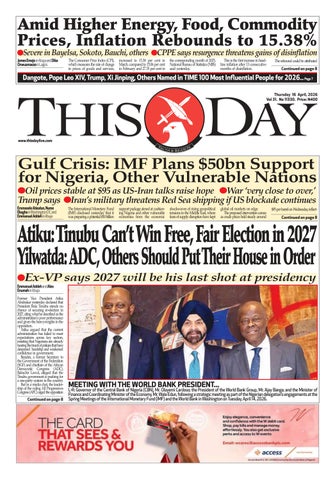
MEETING WITH THE WORLD BANK PRESIDENT...

L-R: Governor of the Central Bank of Nigeria (CBN), Mr. Olayemi Cardoso; the President of the World Bank Group, Mr. Ajay Banga; and the Minister of Finance and Coordinating Minister of the Economy, Mr. Wale Edun, following a strategic meeting as part of the Nigerian delegation’s engagements at the Spring Meetings of the International Monetary Fund (IMF) and the World Bank in Washington on Tuesday, April 14, 2026.

James Emejo in Abuja and Dike Onwuamaeze in Lagos
Enumah in Abuja

SENATORS

AT 152ND GENERAL ASSEMBLY OF INTERNATIONAL PARLIAMENTARY UNION IN ISTANBUL...

L-R: Chairman, Senate Committee on Niger Delta Development Commission (NDDC), Asuquo Ekpeyong; Minister Counsellor of the Nigerian Embassy in Turkiye, Abdullahi Madobi; President of the Senate, Sen. Godswill Akpabio; Governor of Nakirkoy, Recai Karal; Chairman, Senate Committee on North Central Development Commission (NCDC), Sen. Titus Zam; and Chairman, Senate Committee on Drugs and Narcotics, Sen. Ibrahim Dakwambo, at the 152nd General Assembly of International Parliamentary Union (IPU) in Istanbul, Turkiye, yesterday

Senate Directs Ojulari to Produce Kyari, Others for Probe Over N210trn Audit Queries, on April 29

Gives NNPCL management 2-week ultimatum to appear Demands detailed breakdown of disputed liabilities, expenditures Warns of legislative action over repeated snub of summons

Sunday Aborisade in Abuja Senate on Wednesday heightened pressure on Nigerian National Petroleum Company Limited (NNPCL), summoning its current and former top executives to appear before it on April 29,over alleged N210 trillion yet to be properly accounted for in audit reports spanning 2017 to 2023.

The directive, issued by Senate Committee on Public Accounts, specifically mandated Group Chief Executive Officer (GCEO) of NNPCL, Engineer Bayo Ojulari, to lead the immediate past GCEO, Mele Kyari, alongside former Chief Financial Officer, Umar Ajia, Dr. Bala Wunti, and the company’s external auditors to appear unfailingly before the panel.

The committee’s resolution followed a motion moved by Senator Osita Izunaso (Imo West) and seconded by Senator Adams Oshiomhole (Edo North), amid growing concerns over what lawmakers described as unsatisfactory responses from the national oil company to multiple audit queries.

Chairman of the committee, Senator Aliyu Wadada (Nasarawa West), made it clear that the senate would no longer tolerate vague or

generalised explanations regarding the massive sum in question, insisting that Nigerians deserve full transparency and accountability.

According to him, the N210 trillion flagged in the audit reports remains inadequately explained, particularly the N103 trillion, which NNPCL reportedly classified broadly as “liabilities.”

“This committee, and by extension the Senate, is not satisfied with

the blanket explanation given by NNPCL on the N103 trillion said to be liabilities,” Wadada said.

He added, “Liabilities are not a single line item. They comprise retention fees, legal fees, and audit fees. The specific amounts spent on each of these components must be clearly stated and justified.”

He demanded a comprehensive breakdown of the remaining N107

trillion, which the company claimed was expended on Joint Venture Cash Calls and debts allegedly owed by unnamed defunct banks.

“Detailed explanations must also be provided on the N107 trillion said to have been spent on JVC cash calls and funds tied to defunct financial institutions whose identities have not even been disclosed,” he added.

Wadada stressed that the committee

had already raised 19 separate queries on the issue, but said the responses received so far fell short of legislative expectations.

He said, “Explanations or answers given by NNPCL to the 19 queries raised are unacceptable. Nigerians are entitled to convincing and detailed explanations on how public resources of this magnitude were managed.”

Consequently, the committee granted

what it described as a final two-week window for compliance, warning that failure to appear on the scheduled date could trigger the invocation of the senate’s constitutional powers to compel attendance. Wadada stated, “NNPCL is hereby given an additional two weeks to appear before this committee unfailingly. The deadline for compliance is Wednesday, April 29, 2026.”

RSA Compliance: PenCom Solicits Support of TUC, Other Trade Unions, Vows to Make Life Unbearable for Non-Compliant Employers

National Pension Commission (PenCom) solicited the cooperation of Nigerian labour unions, such as Trade Union Congress (TUC) and Nigeria Labour Congress (NLC), as well as anticorruption agencies, like Independent Corrupt Practices and Other Related Offences Commission (ICPC), towards ensuring that all employers of labour in Nigeria put in place adequate pension plan for their workers.

Director-General of PenCom,

Ms Omolola Oloworaran, made the request at the maiden round table discussion with the leadership of TUC in Lagos on Tuesday.

Oloworaran informed the TUC leadership of various reforms made by the commission to ensure that Nigerian workers retired with dignity, but said compliance among formal sector employers had remained a major challenge.

She vowed to make life very unbearable and uncomfortable for employers who did not put in place pension plan for their employees.

Nigeria to Host High Level Global Meeting on Action Against Antimicrobial Resistance

Seeks 10% reduction in deaths by 2030

As part of efforts to reduce deaths caused by antimicrobial resistance, a high level global ministerial meeting on acceleration of action against antimicrobial resistance (AMR) will be held in Abuja in June.

The summit, which is the first of its kind to be hosted by an African country, is expected to draw delegations from over 100 countries, including presidents of some countries, such as, Botswana, Ghana and Nigeria.

Dr Ayoade Alakija of the Ministerial Global Envoy on AMR made the disclosures.

Speaking ahead of the meeting, Alakija said the conference would be

the first of such a high-level engagement on antimicrobial resistance (AMR) to be held on African soil.

“The larger objective is to advance and to sustain global efforts to curb AMR in Nigeria, Africa and globally,” said Alakija.

According to her, the summit, with the theme, “One Health Advancing Global AMR Commitments through Local Action,” would focus on translating global pledges into practical, country-level interventions that will accelerate measures to reduce AMR deaths.

Alikija explained that the high level global meeting would seek to fast-track action against AMR and to set the tone towards achieving

the target adopted at UN General Assembly High Level Meeting in 2024 to reduce AMR deaths by 10 per cent by 2030.

She stated, “The 5th High Level Ministerial Meeting on AMR would be different because not just ministers of health but also ministers of agriculture, environment and finance are being invited to take part to address AMR in all sectors (such as, animal health and livestock, food and agriculture and our environment) – and not just human health.

“AMR is not just about human health and protecting just our medicines but also about prevention and protecting our animals, plants and our environment.

The PenCom director-general said the round table discussion with TUC was part of her ongoing stakeholder engagement framework for ensuring that all Nigerian workers retired with dignity.

According to her, henceforth, there would be no hiding place for employers without adequate pension plan for their employees.

Oloworaran insisted that she would use every instrument at her disposal to make life unbearable for them.

She said the worst scenario was employers who deducted workers’ money but failed to remit same to their Retirement Savings Account (RSA).

She stated, “The reforms we have put in place are very important. I see brighter days ahead for pension

but the challenge is compliance with formal sector.

“It is, indeed, a challenge. We had meeting with one of the labour chapter persons on how they will support us for compliance and she is a very nice person we want collaboration with TUC and other labour unions on compliance by employers. We want to make life uncomfortable for employers who are not contributing to workers’ pension.

“We want to use everything at our disposal the TUC, NLC, including ICPC, so that we don’t have people who continue to work but employers are not putting up pension.”

Oloworaran said the commission was on a strong footing to move pension sector forward so that workers would not retire with pains.

She informed the TUC executive

members present at the forum that the commission needed their collaboration and partnership.

According to the PenCon directorgeneral, the purpose of the discussion, which she said would be a biennial event, was to look at critical areas of mutual cooperation and collaboration between the commission and TUC.

She informed the congress that last year the commission rolled out the largest reform ever since 2004, tagged, “Pension Revolution 2.0”, targeted at ensuring dignified retirement for Nigerian workers.

She said the revolution had a lot of reforms lined up for workers’ welfare.

According to her, having achieved stability in the pension system, the commission needs to move the pension sector from stability to visibility.

REA Hails New NERC Rules on Minigrids, Says Will Hasten Project Delivery

The Managing Director of the Rural Electrification Agency (REA), Dr Abba Aliyu, has lauded the newly released mini-grid regulations as a historic turning point that will fast-track large scale project delivery in Nigeria’s renewable energy sector.

The updated regulation released by the Nigerian Electricity Regulatory Commission (NERC), a statement from the

organisation said, followed two years of intense advocacy and technical submissions from the REA.

Aliyu stated that these regulations represent a shift from scarcity thinking to a strategy of scale and innovation, noting that for too long, vital projects were delayed and investments slowed due to a system that failed to match the ambition of the Nigerian people.

By aligning policy with the practical realities faced by

developers on the ground, the new rules, the REA chief executive said, are expected to unlock massive opportunities for millions of Nigerians currently living without reliable power in underserved areas.

The REA boss further expressed appreciation to the NERC Chairman, Dr. Musiliu Oseni, and the NERC team, stating that their openness to collaboration has effectively written their names in gold.

Ebere Nwoji
PHOTO: SENATE PRESIDENT’S OFFICE.
Onyebuchi Ezigbo in Abuja

EXCLUSIVE PREMIERE OF THE NIGERIA WEDDING STORY...

L-R: CEO, Wedding and Things Dishes, Chef Vivian; Managing Director, Busybee Event, Bisi Sotunde; Convener/Publisher, Wedding Planner Magazine, Modupe Adeniran; CEO,

Micheal

and Trendy

FG: Conventional Building Technologies Can’t

Deliver Affordable Housing to Nigerians

Explores partnership with Sinoma for innovative building materials

The federal government yesterday said that conventional building technologies were incapable of delivering affordable housing required by the target population, particularly workers in the middle cadre, highlighting the need to embrace innovative materials.

Minister of Housing and Urban Development, Ahmed Dangiwa, during a meeting with Sinoma New Materials Nigeria Company Ltd in Abuja, said the government was therefore exploring partnership opportunities in innovative technologies towards increasing delivery of affordable housing in Nigeria.

The partnership with Sinoma, which specialises in eco-friendly, fire and water resistant building materials with termite protection, Dangiwa said, focuses on the promotion of innovation, sustainable construction, and local manufacturing of building materials.

Speaking during the engagement, Dangiwa emphasised the priority of the federal government to ensure that low- and middle-income Nigerians can achieve home ownership within their working lifetime.

“We want a situation where the average Nigerian worker can achieve home ownership with his salary within the period of his service. That is why we are particularly interested in innovation and technology that

can make housing more affordable,” the minister said.

He also noted that the conventional construction methods have proven inadequate in delivering houses at an affordability scale required by the target population, particularly workers in the middle cadre.

According to him, while the government remains open to new construction technologies and building materials, such innovations must be properly demonstrated and proven to work effectively at a viable scale.

“We can only fully agree with you if you have demonstrated this somewhere and delivered it at scale. People must be able to

see and touch what has been built and understand its durability over time,” he added.

The minister also stressed the importance of construction speed in addressing Nigeria’s housing deficit. “If you are given land to deliver to 100 houses, how many days will it take you to complete them? These are important questions because speed in construction is critical in addressing the housing deficit in Nigeria,” he stated.

Dangiwa also highlighted the federal government’s plan to promote building materials manufacturing hubs across the country to support housing delivery, saying that such hubs will serve as centres for the local production of innovative

Appeal Court Affirms Injunction Against Banks, Upholds Sahara Power’s Right to Challenge Receivership

The Lagos Division of the Court of Appeal has dismissed an appeal filed by a consortium of financial institutions against companies affiliated with the Sahara Power Group, affirming the validity of an interim injunction and directing an accelerated hearing of the substantive suit.

In a unanimous decision delivered on Monday by a three-member panel, the appellate court held that the appeal was unmeritorious. It upheld the interlocutory orders earlier granted by the Federal High Court, which restrained the banks and their appointed receiver from taking further steps over the companies’ assets pending the determination of the case.

The dispute involves Kepco Energy Resources Limited, NG Power-HPS Limited, and New Electricity Distribution Company Limited, all linked to Sahara Power, which challenged the appointment of a receiver/manager by the lenders under a credit facility arrangement.

The companies contended that the move to enforce the facility and appoint a receiver was premature, unjustified, and in breach of agreed conditions.

At the heart of the appeal was

whether the respondent companies could validly institute the action without first obtaining the consent of the receiver/manager, Kunle Ogunba (SAN), who also acted as counsel to the banks.

Ogunba had argued that by virtue of Section 556(3) of the Companies and Allied Matters Act (CAMA), the companies’ directors were divested of authority to commence proceedings without the receiver’s approval.

However, counsel to the companies, Bode Olanipekun (SAN), countered that the law recognised a clear exception where the very appointment of a receiver was being challenged.

He maintained that requiring the companies to obtain consent from the same receiver whose appointment they were contesting would be legally untenable.

In resolving the issue, Justice Joseph Eyo Ekanem, in his lead judgement agreed with the respondents, holding that no such consent is required in circumstances where the legality of the receivership itself is in dispute.

The court reasoned that insisting on prior consent in such situations would effectively defeat a company’s right to challenge the validity of a receivership imposed on it.

It held that the case before the trial court raised serious triable issues, including whether the alleged debt had crystallised and whether the conditions precedent for appointing a receiver/manager had been fulfilled. The appellate court stated that evidence placed before the lower court suggested that the respondent companies were still receiving funds

at the material time, lending credence to their argument that enforcement actions may have been taken prematurely.

On the propriety of the interlocutory injunction, the court found that the trial judge exercised discretion judiciously in granting the order to preserve the subject matter of the dispute.

construction materials required to accelerate housing development and reduce construction costs.

“If you are able to deliver these products effectively, your factory could become part of the materials manufacturing hubs we are promoting to support mass housing construction in the country,” he said.

Dangiwa further explained that the government is encouraging partnerships with the private sector through Public–Private Partnership (PPP) arrangements, where government may provide land while developers bring technology, machinery and financing for construction.

“ Under such arrangements, the Federal Mortgage Bank of Nigeria (FMBN) can purchase completed houses on behalf of beneficiaries and pay developers upfront while recovering the costs gradually through mortgage schemes,” he stated

The minister directed relevant directors in the housing ministry to continue the engagement with the company to further refine their proposal and ensure alignment with the government’s housing priorities.

Earlier, leader of the Sinoma team, Eric, commended the commitment of the federal government to tackling Nigeria’s housing deficit through initiatives such as the Renewed

Hope Housing Programme. He said the company aligns fully with the government’s housing priorities, particularly in delivering affordable housing at scale, promoting industrialisation of construction materials, and encouraging innovation and sustainability in the built environment.

“Housing development should not only be seen as a social necessity but also as a key economic driver capable of creating jobs, strengthening industries, and stimulating national development,” he stated.

Among the products introduced by the company is SinoBoard Fibre Cement Technology, an advanced building solution designed to support modern, efficient and sustainable construction.

He explained that the technology enables faster construction through prefabrication and dry construction systems, while offering durability due to its resistance to moisture, fire, termites and harsh weather conditions.

Accordingly, he said that the solution is cost-efficient, reduces long-term maintenance costs, and supports environmentally friendly building practices suitable for green housing initiatives.

“Our technology can significantly enhance the delivery of mass housing projects across Nigeria,” he said.

FG Inaugurates NEMSA Board, Declares Zero Tolerance for Substandard Materials

Adelabu: Electrical accidents, system losses linked to weak compliance New board pledges to deliver, seeks minister’s support

The federal government yesterday inaugurated the board of the Nigerian Electricity Management Services Agency (NEMSA), declaring a zero tolerance policy for the use of inferior materials in Nigeria’s power sector, as part of efforts to curb electrical accidents and improve system reliability.

Speaking at the inauguration in Abuja, Minister of Power, Adebayo Adelabu, said persistent electrical

accidents, equipment failures and network inefficiencies across the country were largely due to weak compliance with technical and safety standards.

He stressed that NEMSA plays a central role in the Nigerian Electricity Supply Industry (NESI) as the statutory body responsible for enforcing technical regulations and ensuring that all electrical installations and equipment meet required standards.

According to him, the agency’s

responsibilities cut across the entire value chain, from generation to transmission, distribution and end-use, making it critical to the safety and integrity of the power system.

Adelabu noted that without strict enforcement of standards, efforts to build a modern, reliable and expanding electricity market would continue to face setbacks, insisting that substandard infrastructure has no place in the sector.

He emphasised that the

proliferation of poor-quality electrical materials has contributed significantly to system losses and avoidable accidents, adding that NEMSA must intensify its inspection, testing and certification processes to reverse the trend.

The minister urged the board to adopt a more proactive enforcement posture, ensuring that every component of the country’s power infrastructure meets the highest standards of safety, quality and performance.

Travel 2 Tour Nigeria, Otunba
Balogun;
Bee Events, Bisola Arigbe, at the Exclusive Premiere of The Nigeria Wedding Story held at EbonyLife Cinema, Victoria Island, Lagos, yesterday
Wale Igbintade
Emmanuel Addeh in Abuja

61ST ANNUAL INTERNATIONAL CONFERENCE AND EXHIBITION OF NIGERIAN MINING AND GEOSCIENCES SOCIETY...

L-R: Vice President, Nigerian Mining and Geosciences Society, Ignatius Ekwere; Head, Stakeholder Relations and Regional Manager, Nigeria, Savannah Energy, Nigeria, Nkoyo Etuk; Treasurer, Nigerian Mining and Geosciences Society, Waliu Adeolu; and Communications Manager, Savannah Energy, Nigeria, Okwudili Onyia, during the 61st Annual International Conference and Exhibition of the Nigerian Mining and Geosciences Society held in Uyo, Akwa Ibom State…recently

Dangote, Pope Leo XIV, Trump, Xi Jinping, Others Named in TIME 100 Most Influential People for 2026

Renowned African industrialist, philanthropist and Founder and President of Dangote Group, Aliko Dangote, has been named among TIME Magazine’s 100 Most Influential People in the World for 2026.

The remarkable recognition reaffirmed the billionaire businessman’s standing as one of the most successful and iconic business leaders of his generation.

Dangote joins global influential figures from multiple sectors, including political leaders such as the United States President Donald Trump, Chinese President Xi Jinping, Israeli Prime Minister Benjamin Netanyahu, Canadian Prime Minister Mark Carney, revered Pope Leo XIV, current head of the Catholic Church as well as other business and technology leaders, including Google CEO Sundar Pichai, and YouTube CEO Neal Mohan.

The annual TIME100 list, published on April 15, 2026, recognised global figures whose leadership, ideas, and actions are shaping the future across business, politics, culture, and society.

A statement by Dangote Group said Dangote’s inclusion placed him alongside prominent international figures drawn from diverse spheres of global influence.

It was Dangote’s second appearance on the prestigious TIME100 list, following his first recognition in 2014, when he was honoured for his exceptional impact on business and philanthropy.

His return to the list more than

a decade later underscores the consistency and scale of his influence on the global stage.

Dangote, who was being recognised for his African industrial drive, is the only Nigerian on the list and featured in the titan and innovators category.

Other prominent honourees named alongside Dangote in the titan category were Reid Wiseman, Commander of the Artemis II mission to the moon; Sundar Pichai, CEO of Google and Alphabet and Neal Mohan, CEO of YouTube.

Also featuring prominently under the titan category were Michael and Susan Dell, the high-profile American tech billionaires and philanthropists best known as the founders of the Michael & Susan Dell Foundation, a global non-profit that focuses on improving the lives of children living in urban poverty.

Included here also was the American designer and billionaire, Ralph Lauren, best known for founding the global lifestyle empire Ralph Lauren Corporation.

Recognised in the Pioneer category were individuals with breakthroughs in Science and Social Advocacy, such as Kiran Musunuru and Rebecca Ahrens-Nicklas, both of whom were cited for medical breakthroughs in genetic therapy as well as Aaron Williams, recognized for advancements in heart transplant readiness.

Influential figures recognised in global entertainment and culture included Ranbir Kapoor, prominent Indian actor; Dakota Johnson, recognised as an actress and cultural icon and Kate Hudson, included for her cultural influence.

As Founder and President of Dangote Group—Africa’s largest indigenous industrial conglomerate—Dangote has played a central role in advancing industrialisation across the continent.

Under his leadership, the group made landmark investments spanning cement manufacturing, sugar and food processing, agriculture, infrastructure, and lately energy, significantly reducing Africa’s reliance on imports while creating millions of direct and indirect jobs.

In its citation, TIME Magazine highlighted Dangote’s vision of building African industries with local resources for global competitiveness, saying his recent investments in large scale energy and manufacturing infrastructure are emblematic of his long term commitment to Africa’s economic transformation.

Beyond business, Dangote is widely acclaimed for his philan-

thropic leadership through the Aliko Dangote Foundation (ADF), one of Africa’s largest private philanthropic organisations.

The Foundation supports critical initiatives across healthcare, nutrition, education, disaster relief, and economic empowerment, contributing to improved outcomes for vulnerable communities across the continent.

The 2026 TIME100 recognition reflected a broader global acknowledgement of African leadership, innovation, and enterprise, with Dangote standing as a symbol of the continent’s growing influence in shaping global economic and development narratives.

This latest honour consolidates Dangote’s legacy as a visionary industrialist and philanthropist, whose work continues to drive sustainable development, inclusive growth, and long term value creation—both within Africa and beyond.

Aviation Safety Oversight: ICAO Begins Coordination Validation Mission to NCAA

As 100 flight operations, airworthiness inspectors undergo training at EASA institute, Comiso

The International Civil Aviation Organisation (ICAO) Wednesday began its Coordinated Validation Mission (ICVM) team to the Federal Republic of Nigeria through the Nigeria Civil Aviation Authority (NCAA).

The mission represents a critical

Lassa Fever Epidemic Claims 170 Lives in 14 Weeks

Onyebuchi Ezigbo in Abuja

The Nigeria Centre for Disease Control and Prevention (NCDC) has put the number of deaths resulting from Lassa Fever between January and the first week of April this year at 170.

In its Lassa Fever Situation Report for Week 14 (30th March - 5th April, 2026), NCDC said Nigeria recorded a total of 22 confirmed cases.

Also, the centre said the total number of new confirmed cases decreased from 26 in Epi week 13 of 2026 to 22.

The cases were reported in Edo, Bauchi, Ondo, Taraba, Kogi, Plateau, Ebonyi and Benue states.

According to NCDC, cumulative number of cases recorded for week 14 (2026) include; 22 confirmed cases and 170 deaths, Case Fatality Rate 24.8% (higher than 18.8% same

period in 2025).

It said that 22 states have recorded at least one confirmed case across 94 LGAs.

84 percent of confirmed cases were from Bauchi, Ondo, Taraba, Benue and Edo State.

The Centre said that the predominant age group affected remained 21- 30 years, while no new healthcare worker was affected as at Week 14.

milestone in Nigeria’s journey towards attaining global excellence in aviation safety oversight.

The ICAO Coordinated Validation Mission (ICVM) is an on-site, evidence-based audit designed to validate a state’s compliance with aviation safety standards and confirm the effectiveness of corrective actions (CAPs) taken to fix previously identified deficiencies

As a follow-up to the ICAO USOAP-CMA audit, conducted from August to September 2023, in which Nigeria recorded an Effective Implementation (EI) score of 70.12%, NCAA have remained resolute and steadfast in its commitment to improving Nigeria aviation safety oversight capabilities.

In his welcome address, the Director General, Nigeria Civil Aviation Authority (NCAA), Capt. Chris Najomo, noted the agency took the audit findings in good

faith and with the utmost seriousness that they deserved by conducting root cause analysis and promptly developing comprehensive Corrective Action Plans (CAPs) to address identified deficiencies.

Speaking during the opening ceremony of the event in Abuja, Najomo said: “I am pleased to note that these CAPs were subsequently validated by ICAO, providing us with a clear roadmap for implementation.”

The implementation of these corrective actions, alongside our traditional safety oversight responsibilities, Najomo asserted, included, but are not limited to, the following: “We actualized the deployment of EMPIC as the regulatory software for the Authority, specifically in the automation of personnel licensing and aeromedical processes. The Authority’s agreement with EMPIC will initially address four modules

and the full operationalization is scheduled for May, 2026.

“Nigeria had within this period entered into an agreement with NorthWest Data Solution for the deployment of the SMS Pro software as the digital software to entrench the centralization and digitalization of our safety data reporting and management system, ensuring compliance with the ICAO Annex 19 requirements on a Safety Data Collection and Processing System (SDCPS).”

The DGCA, opined that, “in fulfilling our responsibility under ICAO Critical Element 4 on qualified technical personnel, more than One Hundred flight operations and airworthiness inspectors underwent training on special authorization procedures at an EASA-approved training institution in Comiso, Italy and another training organization in Dubai, UAE.

Peter Uzoho

15 States Assume Power Regulation Under New Electricity Act

Fifteen states have formally assumed control of electricity market regulation within their jurisdictions, marking a significant shift in Nigeria’s power sector structure following the implementation of the Electricity Act 2023.

The transition, coordinated by the Nigerian Electricity Regulatory Commission (NERC), effectively decentralises key aspects of electricity governance, allowing subnational governments to establish and operate their own State Electricity Regulators (SERs).

These bodies are now responsible for licensing operators, setting tariffs, driving investments, and ensuring consumer protection within their respective states, a note by NERC said yesterday.

The legal basis for this transition is clearly provided in the new Act, which states that a state may “establish and regulate intra-State electricity markets,” while also mandating NERC to transfer regulatory oversight to state authorities that meet the required conditions.

It further clarifies that electricity markets in states that have not

exercised this option will continue to be regulated by the commission.

According to NERC, the reform is aimed at accelerating market development by bringing regulation closer to consumers and aligning policies with local economic realities. It is also expected to unlock subnational investments in power generation, distribution, and off-grid solutions.

According to NERC, the states that have completed the transition cut across multiple regions. Enugu, Ekiti and Ondo were among the earliest movers, concluding the process between October 22

and 23, 2024. Imo followed on December 31, 2024, while Oyo and Edo completed their transitions in early 2025.

Kogi joined in March 2025, while Lagos transitioned on June 4, 2025, a milestone given its status as Nigeria’s largest electricity market. Ogun and Niger followed in June and July 2025, respectively, further expanding the number of states with regulatory autonomy.

Besides, Plateau transitioned in September 2025, while Abia and Anambra completed their processes around the turn of 2026. The most recent additions are Nasarawa

and Bayelsa, which concluded their transitions in February 2026, bringing the total to 15 states.

However, under the new framework, NERC retains oversight of interstate electricity activities, including generation, transmission, and multi-state distribution operations. But states with functional regulatory systems now exercise authority over intrastate electricity markets, including embedded generation and mini-grid development.

The decentralisation is expected to stimulate competition, improve service delivery, and address longstanding challenges such as

Adebayo Adelabu

metering gaps and weak distribution infrastructure.

But industry watchers believe outcomes will depend on the technical capacity of state regulators, policy coordination, and the ability to maintain consistent standards.

GULF CRISIS: IMF PLANS $50BN SUPPORT FOR NIGERIA, OTHER VULNERABLE NATIONS

ing a fragile balance between easing expectations of US-Iran diplomatic engagement and persistent concerns over possible escalation in the region.

However, oil traders are closely watching developments after com- ments from US President Donald Trump suggesting that the Iran conflict may be “very close to over,” a statement that has helped temper short-term panic in energy markets.

But amid the uncertainty, the Managing Director of the IMF, Kristalina Georgieva, yesterday disclosed that the multilateral institution was considering a range of support measures for Nigeria and other vulnerable African economies that are presently burdened by the fallout from the escalating Middle East crisis, which has deeply strained macroeconomic conditions in a lot of energy-importing countries.

Speaking at the unveiling of the ‘Global Policy Agenda’ during the ongoing IMF/World Bank Spring Meetings in Washington DC, she indicated that the Fund was preparing to scale up its crisis response, with potential financing support projected at between $20 billion and $50 billion for countries facing heightened external shocks and limited fiscal space.

Georgieva said: “Let me first say that we have been very loud on the asymmetric impact of this war, and I have in my office a map of countries and where they fall in terms of their dependency on imports and their fiscal space.

“And it pains me that the majority of sub-Saharan African countries are in this quadrant of vulnerability, and therefore we are very determined to use this week

to identify which are the countries that most urgently need support and then come out of the week with discussions around the way we would support them.

“But let me emphasise that the most important thing we do for our members is to help them help themselves, to have strong policies during good times, to build buffers so that during bad times, they can protect their people. And I am impressed by how much countries have done, including countries in Sub-Saharan Africa.

“We have been closely watching the events in the Middle East. The war has already caused immense hardship and pain for people in the region and around the world. This is an asymmetric shock, with the biggest burden falling on countries that import energy and have limited

policy space. In many cases, these are low-income or fragile economies. These economies need attention and an important focus of our discussions this week is how we can best support them.

“As our Global Policy Agenda makes clear, the IMF serves as the firefighter for our member countries, and we are committed to helping them navigate this complex landscape.

“We anticipate near-term demand for IMF financial support to range from $20-$50 billion. This represents prospective demand for new programmes from at least a dozen countries, most of them in Sub-Saharan Africa.”

She reiterated that the fund was coordinating closely with the International Energy Agency (IEA), the World Bank, and other partners,

ATIKU: TINUBU CAN’T WIN FREE, FAIR ELECTION IN 2027 YILWATDA: ADC, OTHERS SHOULD PUT THEIR HOUSE IN ORDER

ADC and other political parties to put their house in order, rather than blaming Tinubu for their misfortunes.

Specifically, the National Chairman of the APC, Prof. Nentawe Yilwatda, as well as the National Secretary, Ajibola Basiru, who defended the Tinubu administration, affirmed that the ruling party remains resilient, open, and focused on providing effective governance nationwide. They also described the problems of the opposition as self-inflicted.

But speaking during an interview on Arise Television, Atiku also ruled out zoning as a constitutional requirement in the country, explaining that as it stands, the north has a deficit of eight years if the number of years spent in the number one position was collated.

He stated that while the coalition within the ADC may first pursue a consensus candidate, he remained committed to supporting whoever eventually secures the party’s ticket through either consensus or a competitiveAtiku,primary. who confirmed that the 2027 race would be his final attempt at the presidency, acknowledged that the stakes were significantly higher. He argued, however, that his long political experience positions him as both a bridge between Nigeria’s past and its future, insisting that younger leaders still require guidance from more seasoned figures.

“(With) a coalition candidate facing Bola Tinubu, Bola Tinubu is dead on arrival. This is not a slogan. It’s a fact. Look at the leaders of the coalition, where will Bola stand? Everything is wrong with President Tinubu. Perhaps, in my life, this is the worst administration I have seen in this country. I feel terribly disappointed,” he stated.

He expressed confidence in the opposition coalition, describing it

as far better and stronger than the 2015 coalition of the All Progressive Congress (APC) that wrested power from the then ruling Peoples Democratic Party (PDP), during the tenure of former President Goodluck Jonathan.

“I see a lot of future because within the broad coalition, you see people of my generation, you see people below my own generation down the line. So, you can see a clear succession pattern emerging. I did not see it in the APC,” he said.

When asked if he would step aside in the event a consensus candidate emerged, the former VP and former presidential candidate, stated that the question ought not to be whether he would step aside but whether he would support. “I will support anybody who emerges”, he said.

He disclosed that the party has planned to work out a consensus in selecting its candidate in the 2027 presidential election, but would proceed to an election if the consensus fails, assuring that the ADC as it is, boasts of matured politicians that would not rock the boat in the event they didn’t get the party’s ticket. “We have all agreed that this is the way to save democracy in this country,” he pointed out.

He dispelled insinuations that the coalition is more of rivalry than partnership, going by the calibre of personalities behind the coalition.

The Adamawa-born politician has been vying for the office of president for over three decades. His first attempt was in 1993 when he aspired for the position under the platform of the Social Democratic Party (SDP), before stepping down for the late Moshood Abiola.

Besides, there was a rumoured ambition in 2003, when he was VP to

then President Olusegun Obasanjo. Atiku however defected from the PDP to the Action Congress (AC) to contest the election against the late President Umaru Musa Yar’Adua in 2007.

He later returned to the PDP to slug the party’s ticket with then incumbent President Jonathan, in 2011 and lost the primary. He again moved to the then opposition coalition, APC, in 2015 and also lost the ticket to late President Muhammadu Buhari.

The former VP subsequently returned to the PDP to contest the 2019 presidential election, where he also lost to Buhari during the general election. Besides, he contested the 2023 presidential election still under

to the fallout of global headwinds occasioned by the current war in the Middle East between US-Israel and Iran, leading to higher energy prices among others.

Reacting to the renewed uptick in prices, Chief Executive, Centre for the Promotion of Private Enterprise (CPPE), Dr. Muda Yusuf, said it signalled a worrying resurgence of inflationary pressures, particularly on a month-on-month basis.

Yusuf said the report highlighted a critical development in the country’s inflation trajectory, where the earlier gains in disinflation were now being threatened by a resurgence of cost-driven pressures, particularly from energy, food and transportation.

According to the CPI report for March, month-on-month, the headline index stands at 4.18 per cent compared to 2.01 per cent in February.

Year-on-year, food inflation stood

the PDP and lost to President Bola Tinubu of the APC.

On the ADC coalition, Atiku described himself as a leading initiator, noting that he had long advocated a broad-based alliance following the electoral decline of the PDP. He maintained that historical patterns in Nigeria’s politics support coalition-building as a pathway to electoral success.

He admitted that the coalition is driven both by a shared vision and a determination to unseat the current administration, which he criticised sharply. Atiku described Tinubu’s leadership as disappointing, stating that he had expected better

Continued on page 33

at 14.31 per cent compared to 25.22 per cent in March 2025.

However, month-on-month, the food index was 4.17 per cent, representing 0.52 per cent decline compared to 4.69 per cent in the preceding month

The statistical agency attributed the moderation in food inflation to changes in the prices of yam, ginger, cassava tuber, groundnuts, irish potatoes, avenger (ogbono/ apon), tomatoes, cassava flour, among others.

Similarly, core inflation, which excludes the prices of volatile agricultural produces and energy, stood at 16.21 per cent, year-on-year in March compared to 27.12 per cent in same month 2025.

However, month-on-month, core index stood at 4.03 per cent in March, compared to 0.89 per cent in the preceding month.

Year-on-year, urban inflation stood at 14.64 per cent and 3.16

including at the regional level, to maximise a combined response in mitigating this crisis.

The IMF boss further noted that in the short term, maintaining macroeconomic and financial stability was key. According to her, while countries were naturally inclined to act boldly in response to a supply shock, they are advised to look before leaping.

Georgieva said: “On monetary policy, for countries where monetary policy was well calibrated before the shock and expectations remain anchored, ‘wait and see’ is the right approach. In other countries, early policy action may be required.

“On fiscal policy, we have been warning for some time that public debt is constraining fiscal space. Global public debt is on track to breach 100 percent of GDP in 2029, a level not seen since the aftermath of World War II.

“So, to maintain their fiscal policy credibility, policymakers need to strike a careful balance between safeguarding fiscal sustainability and protecting the most vulnerable. The good news is that many countries have so far avoided untargeted tax cuts, energy subsidies, and price controls.”

Georgieva revealed that she had a meeting with African Consultative Group on Tuesday, with ministers and central bank governors seeking policy advice.

Georgieva urged nations that need help financially not to hesitate to ask, so as to protect their economies and their people.

At a separate briefing on the Fiscal Monitor, Division Chief, Fiscal Affairs Department, IMF, Davide Furceri, pointed out that fiscal

per cent month-on-month in March, compared to 2.55 per cent in the preceding month.

Rural inflation stood at 17.22 per cent year-on-year in March while month-on-month, the index stood at 6.73 per cent, from 0.71 per cent in February.

At state level, year-on-year, headline inflation was highest in Bayelsa (27.37 per cent), Sokoto (26.03 per cent), and Bauchi (23.67 per cent), while Osun (5.25 per cent), Kano (9.85 per cent), and Kaduna (10.38 per cent) recorded the lowest rise in prices.

Month-on -month, however, the highest price increases were recorded in Zamfara (10.77 per cent), Bauchi (9.37 per cent), and Sokoto (9.05 per cent), while Lagos (1.54 per cent), Akwa Ibom (1.80 per cent), and Rivers (1.89 per cent) recorded the lowest rise.

Month-on-month, food inflation was highest in Sokoto (11.78 per

pressures were expected to persist, although unevenly distributed, with a clear divergence between oil-importing and oil-producing countries.

For oil exporters such as Nigeria, higher crude prices could generate temporary windfalls, he stressed, highlighting the importance of deploying such gains prudently to rebuild fiscal buffers and ease debt pressures.

Furceri said: “In Africa, we have seen not only energy prices going back, but we have also seen fertiliser prices going down, see increase in shipping costs. And these are the increasingly different types of prices. So, they are going to reduce output production, but also consumption. And in some countries that are more vulnerable, is a risk that is going to affect poverty and food security.

“So, the fiscal pressures stemming from all these costs are not likely to be federal. However, again, there is a differentiation between oil desperate countries, such as, for example, Nigeria, or other countries for which the oil price is going to generate some windfall.

“In those cases, it’s important these countries use this with windfall in revenue to clear as earlier and be the fiscal buffer and reduce interest rate. In the case of Nigeria, as well as other countries that have implemented the subsidy reform, (this) implies that the fiscal cost from increased energy prices is going to be lower.”

Oil Prices Stable at $95 as US-Iran Talks Raise Hope Oil prices were broadly stable

Continued on page 36

cent), Niger (8.59 per cent), and Gombe (8.10 per cent), while Katsina (0.09 per cent), Ogun (0.77 per cent), and Adamawa (1.30 per cent) recorded the slowest rise in food prices.

Yusuf said, “This emerging trend suggests that while inflation had been moderating on a year-on-year basis, underlying structural vulnerabilities remain largely unresolved, with recent month-on-month increases pointing to renewed price momentum.

“The situation calls for urgent and targeted policy responses, as failure to address these supply-side drivers could reverse the fragile stability achieved and deepen the cost-of-living challenges facing households and businesses.

“While disinflation trends remain evident on a year-on-year basis, the resurgence of monthly

Continued on page 35

Emmanuel Addeh in Abuja

AFRICAN DEMOCRATIC CONGRESS CONVENTION...

L-R: Former Governor of Sokoto State, Aminu Tambuwal; former Governor of Anambra State, Peter Obi, and former Vice President Abubakar Atiku, all members of Africa Democratic Congress(ADC), during the National Convention of the party held in Abuja...Tuesday

Pipeline Infrastructure Company Backs Resumption of Oil Production in Ogoniland

As Nigeria may have lost $226bn to over three decades shutdown Splashes scholarship worth N2bn to students of host communities

Pipeline Infrastructure Nigeria Limited (PINL) has expressed strong support for the resumption of crude oil production in Ogoniland, describing it as a strategic national priority that must be pursued through inclusive and sustainable frameworks.

The company made its position known during its monthly stakeholders’ meeting held in Port Harcourt,

Rivers State, where it highlighted the economic and developmental importance of restarting oil operations in the area after more than three decades of inactivity. PINL noted that Ogoniland, covered under Oil Mining Lease (OML) 11, has the potential to produce over 500,000 barrels of crude oil per day adding the continued shutdown of operations since 1993 has resulted in estimated revenue losses exceeding

$226 billion, underscoring the urgency of resumption.

The firm however stressed the process must go beyond production targets and be anchored on community participation, environmental sustainability, and transparency.

According to PINL, host communities must be fully involved as critical stakeholders in all phases of the resumption process to ensure long-term stability and trust.

It also emphasised the need to sustain ongoing environmental clean-up and restoration efforts in the area to address longstanding concerns.

The company further advocated the adoption of a community-based security framework, noting its experience in pipeline surveillance across the Niger Delta has demonstrated the effectiveness of local participation in safeguarding oil and gas

FG Unveils 2026 Outlook: 14,000 Communities Across 266 LGAs in 33 States Face High Flood Risk

As Federal Ministry of Environment issues flood caution

Alaran and Michael Olugbode in Abuja

No fewer than 14,118 communities across 266 local government areas in 33 states and the Federal Capital Territory are at high risk of flooding in 2026, the federal government disclosed on Wednesday.

The projection is contained in the 2026 Annual Flood Outlook (AFO) presented by the Nigeria Hydrological Services Agency (NIHSA) in Abuja yesterday.

In a related development, the Federal Ministry of Environment also issued a fresh flood warning cautioning that sustained heavy

rainfall over several days could trigger flooding in vulnerable communities.

The alert, released by the Ministry’s Erosion, Flood and Coastal Zone Management Department through the National Flood Early Warning Centre (NFEWS), indicates that parts of the country may experience intense rainfall between April 13 and April 17, 2026, with a high likelihood of overflow in low-lying and flood-prone areas.

The Minister of Water Resources and Sanitation, Joseph Utsev, said an additional 15,597 communities in 405 LGAs across 35 states would experience moderate flood risk, while

923 communities in 77 LGAs are expected to face low flood incidents during the year.

He listed states likely to experience high flood risk to include Abia, Adamawa, Anambra, Bauchi, Bayelsa, Benue, Borno, Cross River, Delta, Ebonyi, Edo, Enugu, Gombe, Imo, Jigawa, Kaduna, Kano, Kebbi, Kogi, Kwara, Lagos, Nasarawa, Niger, Ogun, Ondo, Osun, Oyo, Plateau, Rivers, Sokoto, Taraba, Yobe and Zamfara, as well as the FCT.

Utsev also warned of impending flash and urban flooding in major cities such as Abakaliki, Abeokuta, Abuja, Asaba, Benin City, Birnin Kebbi, Calabar, Ibadan, Kaduna,

Kano, Lagos, Makurdi, Onitsha, Port Harcourt and Yola, among others.

According to him, coastal and riverine states including Bayelsa, Cross River, Delta, Lagos, Ogun, Rivers and Ondo would experience flooding linked to rising sea levels and tidal surges.

The minister described the AFO as a critical planning tool for disaster preparedness, noting that early warning remained key to reducing the impact of floods on lives, infrastructure and the economy. Sunday

infrastructure.

PINL also called for economic inclusion of host communities, recommending that residents benefit directly through employment opportunities, contracts, and capacity development initiatives tied to the resumption of operations.

Speaking at the April edition of it monthly stakeholders’ engagement in Port Harcourt on Wednesday, Dr. Akpos Mezeh, General Manager, Community and Stakeholder Relations of PINL reaffirmed the company’s readiness to support the process by deploying its expertise in stakeholder engagement and infrastructure protection to ensure a peaceful and secure operating environment.

“At PINL, we stand ready to support this process by applying our experience in stakeholder engagement and infrastructure protection to ensure a peaceful, secure, and sustainable resumption, “ he said.

Mezeh lamented the over 32 years of inactivity in the area saying, “Available data shows that over $226.734 billion, has been lost due to the suspension of crude oil production from 96 oil wells in Ogoni land over the past 32 years. This clearly underscores both the economic cost of inaction and the immense opportunity that lies ahead”.

“The position of PINL aligns with

growing calls from stakeholders in the Niger Delta for the Federal Government to restart oil production in Ogoniland in a manner that balances economic benefits with environmental justice and community interests”.

Oil production in Ogoniland was halted in 1993 following widespread unrest and environmental concerns linked to decades of oil exploration activities.

Industry observers say any successful resumption will depend on building trust among stakeholders, addressing environmental issues, and ensuring that host communities play a central role in decision-making.

PINL maintained that with the right approach, the resumption of oil production in Ogoniland could significantly boost Nigeria’s output, increase national revenue, and contribute to broader economic growth.

During the event, over 1000 undergraduates and post-graduates from their host communities received scholarship grants from the PINL. While undergraduates got N500,000 each, post-graduates received N1million each to enhance their education.

Akpos explained that the essence of the meeting was to interact with their stakeholders and get feedback of the happenings within areas of their coverage.

31, 2026, representing a 48 per cent increase from N7.03 billion recorded in the corresponding period of 2025, as it declared an interim dividend of N2.00 per ordinary share. The company in a statement yesterday, revealed that its earnings per share rose to N4.74 from N3.21 in the prior year, reflecting improved profitability driven by operational efficiency and reduced finance costs. Revenue for the period grew by four per cent to N122.77 billion, while operating profit stood at N17.18 billion despite margin pressures. Net finance costs declined significantly to N1.43 billion from N7.72 billion in the same period last year, supporting the strong bottom-line performance.

distributable profits in line with Sections 426–428 of the Companies and Allied Matters Act 2020.”

“The interim dividend translates to a total payout of approximately N4.38 billion, based on 2.19 billion shares outstanding, with April 20, 2026, set as the qualification date. The dividend will be paid from

Chairman of the Board, Fabian Ajogwu, said: “The Board is pleased to declare this interim dividend, which reflects both the quality of earnings achieved in Q1 FY2026 and our commitment to disciplined capital stewardship. A 48 per cent growth in Profit After Tax is not accidental, it is the result of sustained governance oversight, strategic clarity, and the dedication of our management team and employees.”

The federal government on Wednesday re-arraigned former Attorney-General of the Federation (AGF) and Minister of Justice, Mr. Abubakar Malami and his son, Abdulaziz Abubakar Malami, on a five-count amended charge.

The new charge read against them before Justice Joyce Abdulmalik of the Federal High Court, Abuja, borders on alleged terrorism and unlawful possession of firearms.

At Wednesday’s proceedings, which was supposed to be the commencement of trial, Mr. Akinlolu Kehinde, SAN, who announced appearance for the prosecution,

informed the court of a new charge which he intended to substitute with the earlier one, adding the amended charge has already been served on the defendants.

Counsel to Malami and his son, Mr. Shuaibu Arua, SAN, who confirmed service, told the court that the defendants are not in objection.

Following, the no opposition to the amended charge, Justice Abdulmalik struck out the former charge and ordered that the new charge be read against the defendants.

They pleaded not guilty to all the counts and their lawyer prayed the court to permit them enjoy the

earlier bail granted them.

The request was granted by the court since the prosecution did not Recallobject. that the court had on February 27, granted them bail in the sum of N200 million each with two sureties in like sum. The court subsequently fixed May 26, for the prosecution to call witnesses and tender exhibits to prove its case against the defendants.

The former AGF and his son were arraigned on February 3, on a five-count criminal charge, bordering on abetting terrorism financing and unlawful possession of arms and ammunition.

Alex Enumah in Abuja
Folalumi
Blessing Ibunge in Port Harcourt

GROUNDBREAKING CEREMONY OF THE SPL UTOROGU GAS PROCESSING PLANT...

L-R: President-General of Iwherekan (host community) Evang. Ufuoma Omoberayen; Okobaro of Ughievwen, HM Igbi II; Commissioner for Oil and Gas (Delta), Chief Peter Uviejitobor; Minister of Petroleum Resources (Oil), Heineken Lokpobiri; NCDMB Director, Corporate Affairs, Abdulmalik Halilu, and representative of the Olu of Warri, Chief Tony Onuwaje during the groundbreaking ceremony of the SPL Utorogu Gas Processing Plant in Iwherekan, Delta State.

New Utorogu Gas Plant in Delta Expected to Provide 200m Standard Cubic Feet Per Day

As NLNG disburses N250m in 2026 VIBES business grants Ekpo lauds Southfield, NCDMB partnership over strategic gas investment

Sylvester Idowu in Warri, Blessing Ibunge in Port Harcourt and Peter Uzoho

A multi-billion-naira gas processing plant expected to provide 200 million standard cubic feet per day is being constructed by the Southfield Petroleum Limited (SPL) and the Nigerian Content Development and Monitoring Board (NCDMB) at Utorogu in Ughelli South Local Government Area of Delta State. Meanwhile, in another related energy sector development, the Nigeria Liquefied Natural Gas (NLNG) has disbursed N250 million in grants to 51 entrepreneurs at the conclusion of its 2026 Vocational Innovation and Business Empowerment Scheme (VIBES).

In a statement by the NLNG’s Manager, Corporate Communication and Public Affairs, Anne-Marie Palmer-Ikuku said the programme commenced with the induction of 103 participants from its host communities in Rivers State.

In his reaction, the Minister of State Petroleum Resources (Gas), Rt Hon Ekperikpe Ekpo, commended Southfield Petroleum Limited and the NCDMB for advancing Nigeria’s

gas development agenda through strategic infrastructure investments.

The multi-billion-naira Utorogu gas processing plant when completed next year will stimulate significant capital inflow, create direct and indirect employment opportunities and catalyze industrial growth across multiple sectors.

By increasing the availability of processed gas for the domestic market, the project will support power generation, boost manufacturing productivity and enhance Nigeria’s overall energy security.

Minister of State, Petroleum Resources (Gas), Rt. Hon. Ekperikpe Ekpo, while performing the SPL and NCDMB groundbreaking of the SPL Utorogu 200 MMSCFD yesterday said the project was a clear demonstration of collective commitment to unlocking the full value of Nigeria’s has potential under the decade of gas initiative.

He stated the production of natural gas liquids, particularly Liquefied Petroleum Gas (LPG) will deepen domestic gas utilization, reduce import dependence and stabilize supply within the local market.

“From an environmental perspec-

tive, this project is equally significant. By processing associated gas that would otherwise be flared, the plant will contribute meaningfully to Nigeria’s gas flare reduction commitments and broader climate objectives”, he said.

The minister, represented Mr. Raphael Chimba, Assistant Chief Petroleum Engineer, commended the board and management of

Southfield Petroleum Limited for the bold and strategic investment.

“This project is not only timely but also strongly aligns with the federal government’s vision of harnessing Nigeria’s vas gas resources as a catalyst for economic growth, industrialization and energy security”, he added.

Minister of State for Petroleum Resources, Senator Heineken

Lokpobiri commended Chairman of SPL, Dr. Patrick Ndiomu’s leadership for the very bold, huge, complex and ambitious project that “we are here to break the ground today.

This will, in no doubt, change the entire landscape in this part of the country. The communities, Delta State and even the country, will benefit. Industrial growth is bound to happen with this project.

It is based on that that the NCDMB decided to invest in this project”, he said. Senator Lokpobiri assured the federal government would do everything necessary to ensure completion of the project and sought maximum cooperation from all stakeholders including communities so as to have very smooth execution phase.

2027: Oyo APC Leaders Endorse Alli as Guber Candidate

As Senator donates N10m, bus to party

The aspiration of the leading governorship aspirant in Oyo State All Progressives Congress (APC), Senator Sharafadeen Alli, got a big boost on Tuesday as leaders of the party unanimously endorsed him as their preferred standard-bearer for the party in next year’s election.

The APC leaders, who are from Ibarapa zone, a critical part of Oyo South senatorial district which Alli currently represents at the Senate, cited his leadership qualities and widespread acceptability as the reasons for his endorsement.

The endorsement was announced at a well-attended stakeholder meeting to welcome Senator Alli, who was on a consultative visit to party stakeholders in the zone.

Among the leaders present were Chief Alarape Jolaoso, Apostle Zacchaeus Aderounmu, Chief Dayo Adeola, Chief T.A Adenrele, Chief Francis Babalola and Alhaji Olayide Abas.

Also present were all the three party chairmen, the three women leaders, three youth leaders and

BAT-IG Seeks Political Sanctions for Underperforming Leaders Ahead of Elections

Bennett Oghifo

A political group, BAT Ideological Group (BAT-IG), has called for strict political consequences for underperforming public office holders, urging President Bola Ahmed Tinubu to deny them opportunities to return to office.

In an open letter signed by its convener, Bamidele Atoyebi, the group said the approaching election cycle provides a critical opportunity to enforce accountability across all levels of government.

all the local government executive members from the three councils in the zone.

At the meeting presided over by the Ibarapa APC leader, Chief Alarape Jolaoso, party leaders, elders and grassroots mobilisers expressed confidence in Alli’s capacity to reposition the state for inclusive growth.

Speaking on behalf of the stakeholders, Jolaoso, noted that Alli’s track record in public service, coupled with his deep connection with the grassroots, made him the most suitable person to lead the party to victory in 2027.

ment also reflects the growing momentum behind Alli’s aspiration, as more political blocs and interest groups continue to align with his vision for a more prosperous and equitable Oyo State.

In his response, Alli expressed profound gratitude to the people and leaders of Ibarapa for the overwhelming show of support, assuring them that their trust would not be taken for granted. He pledged to run an inclusive administration that would prioritise development across all zones of the state, ensuring that no community is left behind in the governance process.

The group argued that elected officials who fail to translate increased federal allocations and resources into visible development projects should not be rewarded with party tickets or re-election bids. Atoyebi maintained that poor governance has contributed to persistent challenges such as insecurity, weak healthcare systems, and inadequate infrastructure, stressing that such failures should carry political costs.

ministers, heads of ministries, departments and agencies (MDAs), members of the National Assembly, and local government chairmen.

He urged the President to extend accountability measures beyond governors to include

According to the group, denying underperforming officials political opportunities would serve as a deterrent and compel leaders to prioritize service delivery.

He said that the decision to back the lawmaker was reached after extensive consultations across the three local government areas in Ibarapa, stressing that the zone remains united and committed to supporting a “credible and experienced candidate.”

The leaders further described Alli as a bridge-builder who has consistently demonstrated loyalty to the APC and “contributed significantly to strengthening the party structure” across Oyo State.

According to them, the endorse-

Meanwhile, Senator Alli has donated N10m and a brand new 18-seater bus to the party in the state, stressing the need to strengthen its operations.

Receiving the bus at the party secretariat during Alli’s visit on Wednesday, the state chairman and former deputy governor of the state, Chief Moses Adeyemo, described the donations as timely support aimed at enhancing party operations and administrative effectiveness statewide.

Email: deji.elumoye@thisdaylive.com

08033025611 sms only

Olosasa: Gov AbdulRasak’s Best Not Good Enough for Kwara Since 2019

a chieftain of the all Progressives Congress in Kwara State, alhaji Toyin Olosasa, in this interview bears his mind on the politics and other related issues affecting the State of Harmony. Adedayo Akinwale brings excerpts.

You recently stirred the hornet’s nest in Kwara by saying the Governor’s rating has dropped and that he cannot win any political position again in the state. What informed that position?

As long as I am alive, I will continue to speak truth to power. No amount of pressure or intimidation will silence me. The reality is that the people are tired of the Governor. They are not tired of the APC, and they are certainly not tired of President Bola Tinubu. However, if care is not taken, the Governor’s declining popularity could negatively affect the President politically in Kwara State. How can you say someone who has won the governorship twice cannot win even a councillorship seat now?

The Governor and I are from the same Ilorin West Local Government. I challenge him to test his popularity today. Let Governor Abdulrahman AbdulRazaq contest a councillorship position in Adewole Ward against someone like Yinka Otukoko of the PDP or even Comrade Musbau Eshinrogunjo who’s in prison as we speak. Let the people decide. The truth may be bitter, but it remains the truth: the Governor’s rating is at its lowest ebb across Kwara State. It has become so bad that some people are beginning to call for the return of the Saraki political structure. That is how serious the situation is.

But the APC is still widely regarded as a popular party in the state.

Yes, and there is a clear distinction between the party and the person. The APC remains popular because it is home to several credible and widely accepted stakeholders. I won’t begin to mention names, but Kwarans know those who command genuine respect and

followership. Additionally, Asiwaju Bola Tinubu still enjoys significant goodwill among the average voter in Kwara State. Unfortunately, the same cannot be said of the Governor. I believe even he and his close associates are aware of this reality. I would also be surprised if President

Tinubu is not aware.

What, in your view, accounts for this decline in the Governor’s political standing?

Consider his relationships across key segments of the state. What is his relationship with traditional rulers, religious leaders, and community stakeholders, particularly in the

Ilorin Emirate? What is his standing among the political elite in Kwara State? What’s his relationship with the youths of Kwara State, especially Ilorin Emirate?

We all know Alhaji Uthman Jagunma is the President of youth groups in Ilorin Emirate. If you ask him about the Governor now, he won’t have any good thing to say. This is an undeniable truth. Prof. Aisha Gobir is the President of Women Association, go and ask for a review of the person and administration of Governor Abdulrahman, the story is the same! What about the Kwara elites, especially his own kingsmen in Ilorin Emirate? These are very important segments of Kwara society. And this is not to talk about communities in the North and South that have been sacked completely. They all believe they’re suffering what they’re suffering as a direct result of the bad governance at the state level. But are all these enough reasons? They’re not enough? You must be joking. Even within his own party, the APC his relationships have been deeply strained. He has been in prolonged political battles with prominent figures. He is locked in a fierce rivalry with the Saraki political structure. That seems like a generational fight between the Abdulrazak and the Saraki families. He has also fallen out with every single major stakeholder in the APC, name them! These are individuals who could have been strong allies today, but those relationships have been damaged beyond repairs. In politics, relationships are everything. When you alienate too many stakeholders, the consequences are inevitable.

NOTE: Interested readers should continue in the online edition on www.thisdaylive.com

Alebiosu: Hardwork, not Godfatherism, is Hallmark of Politicians’ Success

a stute businessman and age-long friend of President Bola Tinubu, Otunba Busura adedeji a lebiosu, in this interview, talks about his involvement in politics since the Second Republic and offers candid advice to present day politicians. Folalumi Alaran brings excerpts.

Tell us about your childhood, where you were born, your upbringing, and the schools you attended. I was born in Ijasi quarters, IjebuOde. I attended Moslem School, IjebuOde, thereafter came to Lagos and served as a gas station attendant around Denton, Ebute Metta, Lagos. From there, I went to the United Kingdom to study first at the Hammersmith College of Arts and Building and then proceeded to Paddington Technical College to study Welding Engineering, after which I worked briefly before returning to Nigeria with my bosom friend, Hon Justice George Adesola Oguntade, formerly of the Supreme Court of Nigeria, who studied law at Holborn College, UK. It was after we got back to Nigeria that we set up our own companies.

What type of training did you receive while growing up

I trained in Britain. I returned to Nigeria in 1967 and worked briefly with GMI Structural Engineering. Later, I worked with a technical company. After about seven years, my very good friend, Justice Adeola Oguntade of the Supreme Court, and I established a company called LJ Engineering Nigeria Limited. I served as the Executive Director while he was the Chairman. We owned the company on a 50/50 basis.

Apart from Fela Anikulapo-Kuti, who were some of the people you grew up with?

I grew up with people like Justice Adesola Oguntade, a retired Justice of the Supreme Court, the late Kanbi Ishola Osobu, Frank Okonta, Ikomi, and several others.

Tell us more about the company you formed with Justice Oguntade.

Well, we eventually named the company Elios Engineering. I saved some money from where I worked, and Oguntade also saved some money, and we both invested in the business. With my own engineering background and his own legal background and training, we decided to combine resources and

form the company.

Initially, we called it Skyline Metalworks, then changed the name to Helios Engineering.

The business took off like a rocket, and we started making money. We were doing three shifts at the factory, morning, afternoon and evening. Our bankers were giving us credit facilities, and when we required and expanded

remarkably, honouring all our obligations and contracts, life was good.

Our major clients were Leventis Group at Iddo House, Pera Beam, a division of UAC and others.

How did you come into politics?

I joined politics in 1976 with Chief Obafemi Awolowo in Somolu Local Government. At that time, Somolu had just been created out of Mushin Local Government.

What was your relationship with Alhaji Lateef Kayode Jakande, who later became Governor of Lagos State?

I won a local council election and later became a member of the Lagos State House of Assembly during the Jakande administration. I won elections in both the first and second terms. The late Jakande and I were very close. He was like a father to me.

After the termination of the Second Republic by the military, what did you do as a politician?

A few of us formed a group behind the scenes. The group included me, Chief Tajudeen Olusi, Alhaji Hamzat, the late Rasheed Shitta-Bey, and several others.

We worked together politically, and it was through this network that we supported the emergence of Dapo Sarumi as a candidate for Governor of Lagos State.

Could that group have been Primose?

Yes, you are right. It was Primose. Chief Tajudeen Olusi was the chairman of Primose.

Alebiosu
olosasa

MTN Nigeria with a current subscriber base of 95.3 million and a market share of 51.69 per cent, has continued the lead in mobile number portability, maintaining the highest number of inward porting and the least number of outward porting in the last five months, statistics released by the Nigerian Communications Commission (NCC), has shown.

Inward porting refers to the number of subscribers that joined a particular network, using their

telephone numbers, in search of a better service quality, while maintaining the same number. Outward porting refers to the number of subscribers that left a particular network, using their telephone numbers, in search of a better service quality, while maintaining the same number.

According to the statistics, which THISDAY obtained from NCC’s website, MTN maintained the lead in mobile number porting in the last five consecutive months.

From the statistics, the total number of inward porting

as at February 2026 was 1,835. Out of the number, MTN alone gained 1,183 subscribers that ported into its network, followed by Airtel, which gained 428 subscribers that ported into its network, then Globacom, which gained 195 subscribers that ported into its network. T2 gained 21 subscribers that ported into its network, while VITEL gained only eight subscribers that ported into its network as at February 2026.

In October 2025, the total number of inward porting across all networks was 1,597. Out of the number,

MTN alone gained 937 subscribers that ported into its network, followed by Airtel, which gained 357 subscribers that ported into its network, then Globacom, which gained 277 subscribers that ported into its network. T2 gained 26 subscribers that ported into its network. In November 2025, the total number of inward porting across all networks was 1,392. Out of the number, MTN alone gained 827 subscribers that ported into its network, followed by Airtel, which gained 282 subscribers that ported into its network, then Globacom, which gained 264

subscribers that ported into its network. T2 gained 14 subscribers that ported into its network, while VITEL gained only five subscribers that ported into its network.

In December 2025, the total number of inward porting across all networks was 1,393. Out of the number, MTN alone gained 964 subscribers that ported into its network, followed by Globacom, which gained 217 subscribers that ported into its network, then Airtel, which gained 206 subscribers that ported into its network. T2 gained six subscribers that ported into its network, while VITEL also

gained six subscribers that ported into its network. In January 2026, the total number of inward porting across all networks was 1,468. Out of the number, MTN alone gained 740 subscribers that ported into its network, followed by Airtel, which gained 494 subscribers that ported into its network, then Globacom, which gained 215 subscribers that ported into its network. T2 gained 12 subscribers that ported into its network, while VITEL gained only seven subscribers that ported into its network.

Nigeria’s gig economy has grown to an estimated $5.17 billion, with ride-hailing platforms emerging as a key driver of flexible income opportunities, according to a new report commissioned by Bolt and conducted by Ipsos.

Gig economy is a short term labour market with flexible and on-demand online jobs, often facilitated by digital platforms.

The nationwide study highlighted the increasing role of platform-based work in Nigeria’s evolving labour market, as more individuals turn to digital platforms to navigate limited formal employment opportunities and persistent economic uncertainty.

With over 92 per cent of employed Nigerians operating within the informal sector, the report underscored the growing importance of flexible

earning models in bridging income gaps. Ride-hailing alone accounts for 24 per cent of gig economy participation, making it one of the most accessible entry points into digital work.

Contrary to the perception of gig work as temporary, the report findings revealed sustained engagement among participants. Nearly 59 per cent of ride-hailing workers remain active for over a year, indicating that the sector has become a

reliable source of ongoing income rather than a shortterm solution, the report said.

Analysing the report, Senior General Manager for West Africa at Bolt, Teddy AppaDankyi, said flexible work remained increasingly central to how Nigerians earn a living.

“Flexible earning opportunities are becoming an essential part of how many Nigerians earn today. The report shows that ride-hailing is not just

about mobility; it is enabling income diversification, helping people manage financial uncertainty, and supporting broader participation in the digital economy,” he said.

The report also pointed to youth-driven participation trends. Although Nigeria’s national unemployment rate has declined to 2.99 per cent, youth unemployment remains higher at 5.05 per cent, pushing more young people to explore gig work alongside

education, entrepreneurship, and migration plans. In terms of economic impact, the gig economy contributes approximately 2.8 per cent to Nigeria’s Gross Domestic Product, reflecting its growing relevance within the national economy, the report added. The study further explained that gig work would continue to improve livelihoods for many participants.

Emma Okonji

Dantsoho: Reforms, Oyetola’s Impact Responsible for Maritime Sector Transformation

Says Nigeria can Dominate Africa’s blue economy

Sunday Ehigiator

The Managing Director and Chief Executive Officer of the Nigerian Ports Authority (NPA), Dr. Abubakar Dantsoho, has attributed the transformation of the nation’s maritime sector to the impact of the Minister of Marine and Blue Economy, Dr Adegboyega Oyetola and the federal government reforms.

This was as Dantsoho assured investors that Nigeria has the capacity to dominate Africa’s blue economy, citing ongoing federal government reforms and increased private sector participation as critical drivers of transformation in the maritime sector.

Dantsoho gave the assurance while speaking at the Blue Economy Investment Summit in Abuja, where he

NIGCOMSAT Set to Renew Space Technology License

Following the December 2026 expiration date of its space station landing permit licence, which allows it to provide satellite services in Nigeria, the Nigerian Communication Satellite Limited (NIGCOMSAT), has assured Nigerians of its readiness to renew the licence before the December expiration date.

Managing Director/ Chief Executive Officer, NIGCOMSAT Limited, Mrs. Jane Egerton-Idehen, who disclosed this in Lagos, said the need to renew the

licence before its expiration date became necessary, following the important role that NIGCOMSAT plays in providing satellite services covering both geostationary and non-geostationary orbits.

As of 2020, the Nigerian Communications Commission (NCC) has issued over 55 of such permits to both local and foreign players in the space technology, with the list updated biannually, in compliance with the commercial satellite communications guidelines.

Foundation Graduates

46 Students in Tech Skills, Offers Laptops

The Yomi Denzel Foundation, which trains Nigerian youths on technology related skills, held its fourth graduation ceremony in Lagos, where it offered certificates to 46 students that graduated from its nine months intensive training designed to build local capacity in tech skills.

Among the 46 students, 25 of them were offered brand new HP laptops for their outstanding performances in Data Computing and Python while others were given

cash awards, alongside certificates of training.

In his keynote address, the Founder, Yomi Denzel Foundation, Mr. Yomi Denzel Olaniyi, who commended the graduating students for their commitment, said the students had nine months intensive training on Data Computing, Python, Computer Programming, AI Analytics and other tech related skills from two different campuses in Lagos and Ibadan.

stressed that Nigeria’s port system would play a pivotal role in unlocking strategic investments and accelerating economic growth.

He noted that the country must urgently refocus its economic priorities toward fully harnessing its vast marine resources in line with

global sustainability goals.

“The time has come for a paradigm shift in the structure of Nigeria’s economy towards the full utilisation of our

marine resources. Our port system, if properly harnessed, can serve as a major driver of economic growth,” Dantsoho said.

IHS Digitises over 200 Nigerian Artifacts to Boost Creative Economy

In a bid to preserve Nigeria’s cultural heritage and to boost the country’s creative economy, IHS Nigeria, a global telecoms infrastructure company, has invested in the national museum in Lagos by digitising over 200 Nigerian artifacts, as part of its efforts to renovate the entire national museum.

‘Volunteering

Managing Director, Project Management Institute (PMI), sub-Saharan Africa, George Asamani, has stated that volunteering is one of the most effective ways to build capability, credibility, and leadership, even though it has become Africa’s most underrated career accelerator.

Asamani who disclosed this in a statement, said:

Speaking at the unveiling of the renovated national museum, Senior Vice President and Chief Corporate Services Officer at IHS Nigeria, Dapo Otunla, said IHS decided to partner with the federal government on the project as part of its many sustainability projects in over 160 communities in Nigeria.

“The renovation and the digitisation of over 200 national

“Volunteering is often framed as an act of goodwill rather than a pathway to professional growth. This view misses an important point. In many cases, volunteering is one of the most effective ways to build capability, credibility, and leadership. April, designated as Global Volunteer Month, provides a timely opportunity to reconsider a

artifacts, speak to some of our sustainability pillars. If you look at the artifacts in the gallery, they’re reflective of our history, they’re reflective of our culture, and more importantly, they highlight the impact of sustainability, being able to preserve value and maintain objects that our forefathers created in their time and left for generations that came after them to enjoy,”

practice that remains widely misunderstood, particularly in emerging markets.”

Across Africa, the disconnect between education and employability remains a persistent concern.

According to the African Development Bank, 10–12 million young Africans enter the job market each year, yet employers continue to cite

Otunla said.

Director General, National Commission for Museums and Monuments Nigeria (NCMM), Olugbile Holloway, who commended IHS Nigeria for the initiative and commitment to investment, said in the last two decades the national museum in Lagos has not undergone any extensive renovation like what IHS did.

gaps in experience, problemsolving skills, and leadership readiness. The issue is not a lack of talent, but a lack of exposure. Traditional career paths, where progress depends on one’s level within an organisation, do not always provide the range of experience needed in a fast-changing economy, the statement said.

Digital Realty, IXPN Expand Peering Network to Boost Connectivity

Digital Realty, the world’s largest cloud and carrierneutral data centre platform, has announced the activation of a new internet exchange point of presence (PoP) for the Internet Exchange Point of Nigeria (IXPN) at its newly

commissioned data centre in Ibeju-Lekki, Lagos.

The development marks a significant milestone in strengthening Nigeria’s digital infrastructure and elevating West Africa’s connectivity.

Speaking about the

initiative, Managing Director, Digital Realty in Nigeria, Ike Nnamani, said:

“With improved access to IXPN at the Digital Realty’s Lekki campus, networks and service providers can benefit from expanded, resilient public peering options.

Will Build Capability, Leadership in Africa’ Competition Opens Opportunities for Nigerian Students

InterswitchSPAK, one of Nigeria’s leading national science competitions, designed to spotlight and support the next generation of Science, Technology, Engineering and Mathematics (STEM) leaders, is opening vista of opportunities for Nigerian students, the organisers have said.

Now in its eighth edition, InterswitchSPAK continues to identify, nurture, and reward some of the brightest Year 11 (SS2) students across the country, those with a strong passion for STEM, and the ambition to go further.

With registrations ongoing, this year introduces an important shift. Students

can now be registered not only through their schools, but also directly by their parents and guardians. This expanded access ensures that more talented students, regardless of circumstance, can take part in this transformative experience.

According to the organisers, at its core,

These enhancements can reduce latency, improve efficiency, support robust data exchange for content providers and cloud platforms, and enable enterprises to meet growing demands both locally and internationally.”

InterswitchSPAK is more than a competition. Over the years, it has evolved into a credible platform that offers real opportunities that shape academic and career journeys. It gives students the visibility, confidence, and support they need to pursue their aspirations in STEM.

From L-R: Divisional Head, Commercial Banking, Sterling Bank, Akporee Idenedo; Head, OneWoman Initiative, Ezinne Nwokafor; Group Head, Business Finance, Thelma Luke Nwoye; CEO/Founder, HerVest, ‘Solape Akinpelu; Chief Growth Officer, Sterling Bank, Edward Ogunmekan at the OneWoman Gender Lens Breakfast in Lagos… recently

Rensource Unveils New Leadership, Stratergy to Drive Expansion

Rensource Energy has announced a major restructuring with the unveiling of a new board of directors, executive management team and an expanded strategy aimed at positioning the company as a leading renewable energy partner across Africa.

The company said the repositioning marks a shift from project-based solar installation to a multitechnology energy platform, alongside a transition from founder-led operations to institutional governance and an expansion plan beyond Nigeria under a “Proven in Nigeria, Ready for Africa” strategy.

Rensource said the restructuring was undertaken to address execution gaps, strengthen governance and deepen leadership capacity while expanding its offerings beyond solar to a fullspectrum renewable energy platform.

“The board we have assembled is not ceremonial. Each member brings operational, financial and technical expertise to guide Rensource through its next phase of growth. We have moved from founder-led to institutionled governance. We are building an organisation that will power Africa’s industrial future for decades to come,” he said.

The executive management team is led by Chief Executive Officer, Olorunfemi Fapohunda, alongside Chief Operating Officer, Azizat Gbadegesin, and Chief Financial Officer, Segun Adebayo.

Fapohunda said the company’s transformation reflects a renewed focus on delivering reliable and affordable energy solutions to businesses.

Chairman of the board, Chikezie Nwosu, said the newly constituted board is designed to provide active oversight and strategic direction for the company’s next phase of growth.

“This is not the same Rensource of the past. We have new governance, new leadership, new discipline and a new vision. Our focus is simple: help Nigerian businesses replace diesel uncertainty with predictable, affordable, clean power. We finance, build, own and operate. Our clients focus on their core business. That is the Rensource promise,” he said.

Also, Gbadegesin said the company has developed an operational platform capable of delivering projects efficiently across markets.

“We have built a scalable operating platform that delivers projects on time, on budget and to specification. With 16 years of energy programme experience across Africa, I am confident that Rensource is now positioned to execute at a level the market has not yet seen. Our 99 per cent uptime target is not an aspiration, it is a standard,” she said.

SOStainability Week ly

Is Nigeria Ready for 2026 Floods? Trends and Threads

There is something deeply unsettling about how predictable disaster has become in Nigeria. The rains no longer arrive as a surprise. The floods no longer shock. The warnings come early, the risks are mapped, the vulnerable communities are known, yet when the waters rise, the country still behaves as though it has been caught off guard. Early 2026 projections from the Nigerian Meteorological Agency (NiMet) and the Nigeria Hydrological Services Agency (NIHSA) indicate above-average rainfall across several parts of the country, with heightened flood risks in coastal and riverine states. These projections follow a dangerous pattern seen in 2012, 2018, 2022, and 2024, where intense rainfall and poor drainage combined to produce devastating floods.

NiMet’s Seasonal Climate Prediction (SCP) consistently warns of early onset and delayed cessation of rainfall in many regions. NIHSA’s Annual Flood Outlook (AFO) has repeatedly identified high-risk flood zones along the Niger and Benue rivers, including states like Kogi, Benue, Bayelsa, Delta, and Rivers. These are not new findings. The science is clear. The risk is predictable. So why does the response remain reactive, uncoordinated, and unsustainable?

A Repeated Pattern of Flooding

In 2024, according to the United Nations Office for the Coordination of Humanitarian Affairs (OCHA) and the National Emergency Management Agency (NEMA), more than 5 million Nigerians were affected by floods across 35 states. Over 1,000 people died. More than 640,000 were displaced at peak. Some 98,242 homes were damaged or destroyed. Cholera broke out. Malnutrition spiked among children in the northeast. The Alau Dam in Borno State collapsed on September 9, 2024, submerging 70 percent of Maiduguri overnight, killing at least 150 people, and displacing over 400,000. The UN’s World Food Programme called what they witnessed ‘heartbreaking.’ Then came 2025. The numbers improved with 27 states affected instead of 35, and fatalities were down from over 1,000 to 241. But here is the fundamental problem: 241 people still died. Half a million people were still affected. The bar for success in Nigeria’s flood management is so low that ‘fewer people died’ passes as an achievement. Each time, the pattern repeats: warnings are issued, responses are delayed, and the consequences are devastating. So, the question is no longer whether Nigeria is aware of the risks. The question is whether Nigeria is willing to act on what it already knows. What the 2026 data means in plain language is that at least 13 states will experience rainy seasons longer than normal, including Lagos, Benue, Enugu, Ebonyi, Ogun, Oyo, Nasarawa, Anambra, Kwara, Kebbi, Kaduna, Gombe, and Taraba. Several states will receive more rain than their long-term averages. The south-south and Niger-Benue corridor, historically the hardest hit, is already flagged for early onset and potentially late-ending

seasons. This combination is a recipe for sustained, devastating flooding. Already, some parts of Lagos State, specifically Lekki, are experiencing flash flooding and traffic disruption from unusual off-season rains. Other states, including Ogun, Kogi, Anambra, and Ebonyi recorded atypical early rainfall, inundating drainage systems not yet prepared for the season. This is the forecast playing out in real time.

Who Is Responsible and Are They Ready?

Nigeria has the architecture of a functional disaster management system. What it lacks is the consistent political will and funding to make that architecture work before, not after disasters strike. NEMA has shown genuine improvement in coordination.

Its Director-General, Mrs. Zubaida Umar, convened a March 2026 stakeholder forum with NIHSA, NiMet, the Red Cross, and other partners. She acknowledged the systemic gaps and said the right words: ‘Preparedness must be proactive, not reactive.’ But NEMA

cannot do it alone. The agency is sometimes underfunded. Its mechanism requires it to lean on state governments, many of which have no functional disaster management protocols, no state emergency funds, and no working early warning dissemination to rural communities.

NIHSA produces the Annual Flood Outlook (AFO), which identifies the specific river basins, states, and communities most at risk. For 2026, the AFO was scheduled for release on April 15, and the agency has spoken of improved forecasting accuracy. NiMet’s accuracy has reached 74 percent. That is significant. But accuracy means nothing if the people who need to act on those forecasts do nothing about it.

Here is an uncomfortable truth: federal warnings are consistently issued. State governments consistently ignore them, delay evacuations, fail to dredge drains, fail to enforce building codes on flood plains, and then ask for federal emergency funds after the damage is done. The states with the most chronic exposure — Benue, Kogi, Anambra, Delta, Bayelsa, Rivers, Lagos, and Adamawa must stop treating flood season as an annual surprise.

What is the pre-positioned emergency response capacity for 2026? How many tonnes of food, how many emergency shelter kits, how many water purification units are already staged in the states forecast to be most severely impacted? These are not theoretical questions. They are the difference between life and death when floods hit in August and September or thereabout.

The Role of the SDGs Office

Flooding in Nigeria is not gender-neutral; it is a crisis that consistently falls hardest on women, children, and already marginalized communities, and the data from the 2022 floods make this impossible to ignore. According to the data from several sources, including NEMA and the UN OCHA, at least 3.2 million people were affected, over 1.4 million displaced, and more than 600 lives lost. But beyond these millions are the real disparities: displacement camps were largely filled with women and children, rural female farmers lost entire harvests, and low-income communities in flood-prone areas saw their homes and livelihoods wiped out with little or no safety nets. This is where SDG5 (Gender Equality) and SDG10 (Reduced Inequalities) are clearly failing because those who are already disadvantaged are the ones who suffer the deepest losses and face the slowest recovery.

The pattern extends into cities, where poor drainage, unplanned settlements, and weak enforcement of environmental laws continue to expose informal communities where the urban poor live to repeated flooding, directly undermining SDG 11 (Sustainable Cities and Communities). Children in these environments face disrupted education,

increased disease risks, and long-term social setbacks, while women shoulder the burden of rebuilding households with limited support. At the same time, the scale and frequency of these disasters reflect the growing intensity of climate impacts, placing SDG13 (Climate Action) at the center of Nigeria’s flood crisis. This is why attention must now turn sharply to the Office of the Special Adviser to the President on SDGs. With millions affected in just one flood season, what concrete, measurable steps has this office taken to ensure that flood preparedness and response strategies are gender-responsive and inequality-focused? Where is the publicly available, disaggregated data showing how women, children, and persons with disabilities are being protected before floods happen, not just counted after disaster strikes? And how is this office holding ministries, states, and local governments accountable for aligning flood response with SDG 5 (Gender Equality), SDG 10 (Reduced Inequalities), SDG 11 (Sustainable Cities and Communities), and SDG13 (Climate Action)? Because until flood policy is intentionally designed around those most at risk, Nigeria will keep reporting millions affected but failing the very people the SDGs were meant to protect.

Early warning without early action is negligence.

Nigeria does not lack data. It does not lack institutions. What it lacks is urgency, coordination, and the political will to prioritize prevention over reaction. Flood management cannot continue to be treated as a seasonal emergency; it must be addressed as a structural governance issue.

Some areas demand immediate attention. Urban drainage systems must be treated as critical infrastructure, not afterthoughts. Cities must invest in expanding and maintaining drainage networks before the rains begin, not during or after flooding has already occurred. Land use laws must be enforced without compromise. Building on floodplains should not be normalized, excused, or overlooked. The cost of inaction is measured in lives, not just property. Flood forecasting must translate into localized, actionable plans. Emergency preparedness must move beyond paperwork. Drills, awareness campaigns, and evacuation planning should be visible and consistent, not rushed reactions when a disaster is imminent. And above all, there must be transparency. Nigerians have a right to know how funds allocated for flood control are being spent. Who is tracking these expenditures? What benchmarks are used to measure preparedness? Who is held responsible when those benchmarks are not met? The 2026 rainy season is approaching with all the warning signs already in place. If the country once again finds itself overwhelmed by floods, it will not be because the disaster was unpredictable. It will be because the warnings were ignored.

• Professor Charles Anosike, DG NiMet-
• Zubaida Umar, DG NEMA
• Dr. Bernard-Mohammed-Doro, Minister of Humanitarian Affairs and Disaster Management
• Umar Ibrahim Mohammed, DG NIHSA

SOStainability Week ly

WashingandHushing

The Boom and Doom of Nigeria’s Real Estate

Nigeria is building. Cranes dot the skylines of Lagos and Abuja as new gated estates emerge where farmlands and wetlands once stood. Peri-urban corridors that were quiet a decade ago now hum with the machinery of construction. The real estate sector is booming, and by nearly every conventional economic measure, this is being celebrated as progress.

The country’s real estate market was valued at USD 29.2 billion in 2024 and is projected to climb to USD 40 billion by 2030. Lagos recorded a 39.5 percent surge in property prices in 2024 alone, and among the highest in Africa. Real estate now contributes roughly 5.45 percent to Nigeria’s GDP. Diaspora remittances, a significant share of which flows into property, reached USD 20.93 billion in 2024. By the logic of the press releases and the investor deck, Nigeria is thriving. But there is a question this boom has not answered, a question that no ribbon-cutting ceremony has been honest enough to ask: who, exactly, is all of this for?

The hard questions

Because the same country that celebrates a real estate market valued at over USD 40 billion is also burdened with a housing deficit of between 20 and 28 million units, according to the Federal Mortgage Bank of Nigeria (FMBN) and other industry estimates. It is the same country where cement prices have surged by over 80 percent between 2022 and 2024. It is the same country where effective housing finance rates climb close to 30 percent, reflecting prevailing lending conditions. And it is the same country where about 87 million people live below the poverty line, according to the World Bank. Nigeria needs investment, needs housing, needs infrastructure. But growth that is allowed to proceed without accountability, about who benefits, and who absorbs the cost, is not development. It is extraction dressed in the language of progress. And Nigeria has been dressing it that way for long enough.

In November 2025, SOStainability conducted a Sustainability Visibility Scan (SVS) across eleven of Nigeria’s leading real estate companies. The SVS is not a values audit or a corporate investigation: it measures one thing only: what these companies are willing to make publicly visible about their climate and environmental responsibilities. The rule is simple. If it is not on the official website, it does not count. No social media posts, no interviews, no third-party endorsements. Just what you communicate to show the public. The results were not surprising. Across all eleven firms, including Adron Homes, Landwey, Dutum Construction, UPDC, Land Republic, Sabreworks Real Estate, Besitz Group, Brains and Hammers, PWAN Homes, Veritasi Homes, and Knight Frank Nigeria, the SVS found a sector that is almost entirely invisible on climate. Most of these companies publish CSR pages. They announce donations. They photograph staff at community events. But not one of them publishes a structured climate policy. Not one of them discloses a measurable climate target. Not one of them reveals a governance structure, not alone a sustainability officer, or an ESG unit responsible for environmental decisions. The sole exception in the entire scan was a single ESG-themed knowledge document linked by Knight Frank Nigeria. Everything else: silence.

This is a sector building Nigeria’s physical future, consuming cement and steel, filling wetlands, running thousands of diesel generators, while telling the public absolutely nothing about the environmental consequences. And it is not doing so by accident. This is a strategic choice. When there is no climate policy, there is no accountability. When there is no reporting, the carbon footprint remains invisible. When there is no governance, no one is responsible. That is a very convenient arrangement for an industry

expanding this fast in a country with a fragile regulatory environment.

The SVS is clear: what cannot be seen cannot be managed. And what cannot be managed will not change. Nigeria’s residential sector already consumes roughly 60 percent of national electricity, most of it powered by diesel generators in every estate and apartment block across the country. Globally, buildings account for 34 percent of energy demand and 37 percent of energy-related carbon emissions. Yet the sector shaping Nigeria’s urban skyline has nothing to say about its role in the climate crisis. That is not an oversight. That is a decision, and it should be named as one.

The social cost missing from the balance sheet

There is a cost to this invisibility, and it is being paid not by the developers, not by the investors, not by the regulatory agencies who sign off on approvals. It is being paid by communities. It is being paid by the urban poor. It is being paid by the environment. And because none of these costs appear in any company’s financial or non-financial disclosure, the industry continues to grow without ever being asked to settle the bill.

Real estate expansion in Nigeria has become increasingly synonymous with displacement. Peri-urban communities are pushed off the land they have lived on for generations to make way for gated estates that will never be marketed to them. Wetlands that naturally manage floodwaters are filled for foundations, shifting the flood burden onto the unprotected low-income neighborhoods downstream. Building collapses, a persistent feature of the Nigerian construction landscape, turn structural negligence into human tragedy, leaving behind rubble, grief, and no accountability. And across the country, natural public spaces that once belonged to everyone are being quietly handed over to private interests, with gate fees attached.

This is what a sector without ESG governance looks like in practice. The cost does not disappear. It is simply transferred invisibly, systematically, to the people with the least power to resist it.

Jabi Lake: A city watching its commons disappear

In February 2026, the Federal Capital Territory Administration signed Development Agreements with two private companies for the development of what has been described

as a world-class recreational hub at Jabi Lake in Abuja. The FCT Minister, Nyesom Wike, spoke of turning Abuja into a destination city. One of the developer representatives promised a project comparable to Times Square in New York and the Dubai Fountain Water Show. Certificates of Occupancy were presented. Photographs were taken. It had all the trappings of a development success story.

But the residents of Abuja were not celebrating, which called for a deeper concern. Jabi Lake is a man-made reservoir covering approximately 1,300 hectares in the heart of the capital, built originally to supply water to Abuja’s early residents. After a larger dam took over that function, the lake became something else: a free, open, publicly accessible space where Abuja family’s picnic, young people jog, informal vendors trade, and the city breathes. In 2007, the area surrounding the lake was formally designated as Jabi Lake Park, written into the Abuja Master Plan as a protected recreational and ecological zone. That designation was not bureaucratic decoration. The Abuja Master Plan was built on the explicit principle that a planned capital must preserve green corridors, ecological buffers, and open civic spaces for all its residents, not just those who can pay for them.

That is why what followed the signing ceremony matters enormously. Within weeks, Abuja residents organized under the #SaveJabiPark movement. They cited excavation activity within the park. They raised concerns about the loss of one of the city’s few genuinely public spaces. They argued, compellingly, that the Abuja Master Plan was being set aside not because it had failed, but because it stood in the way of a profitable deal. And they asked, directly, a question that the FCTA has not yet answered with any real transparency: Who is this development for? This question matters more than any press release. Because in Nigeria, we have seen this story before. The language of modernization and world-class development has repeatedly been used to justify the conversion of shared public assets into privately managed amenities that price out the majority of users. The promise is always inclusion. The outcome is almost always exclusion. And by the time residents realise the distinction, the Certificates of Occupancy have already been signed.

Here is the diagnostic principle that should concern every Nigerian watching this story unfold: when the people who are supposed to benefit from a project are the loudest voices opposing it, that is not confusion, and it is not ignorance. It is intelligence. It is communities reading the pattern correctly, drawing on lived experience, and refusing to be told that this time will be different. Protest is not always resistance to progress. Sometimes it is the most accurate assessment of what progress actually means in this context and for whom.

This movement is not asking for the lake to remain frozen in time. Its organizers have made this point repeatedly. The ask is for development that is transparentand governed by the master plan rather than around it, and that genuinely preserves public access. That is not an unreasonable demand. That is, in fact, what a properly functioning government owes its citizens.

• Nyesome Wike, F CT Minister
• Alhaji Shehu Usman Osidi, MD FMBN

NSC Insists on Stakeholders’ Engagement Before New Tariff Implementation

The Nigerian Shippers’ Council (NSC) has insisted on comprehensive stakeholder engagement before the implementation of the proposed tariff hike.

Speaking at a one-day stakeholders’ forum on the planned increment, the Executive Secretary of the Council, Dr. Akutah Pius, said the earlier suspension of the tariff implementation in March, 2026 was a deliberate move to allow for broader consultations across the maritime value chain.

He told shipping companies, freight forwarders, importers and exporters that implementation of the new tariff would only commence after shipping companies conclude engagements with importers, shippers, clearing agents and other critical stakeholders.

Akutah assured that the approved 30 percent tariff increase would not destabilize the economy, explaining that it represents a ceiling rather than a fixed rate.

“Today’s engagement was productive. The

suspension of the tariff implementation last month created room for us to interact with stakeholders and address key concerns. The 30 per cent increase is the upper limit; shipping companies may implement 10 or 20 percent depending on the outcome of their consultations. It will be gradual,” he said.

He emphasised that the adjustment would not come as a shock to the economy, noting that some shipping companies had already commenced consultations and partial implementation.

He further explained that while shipping companies had proposed increases ranging between 150 and 200 percent, the Council settled for 30 percent to strike a balance between industry sustainability and economic stability.

“Shipping companies argued that 30 per cent is too low given inflation and rising operational costs, but we determined it was sufficient to avoid overburdening the economy,” he said.

President of the National Shippers’ Association of Nigeria

(NSAN), Dr. Jamilu Umar, said stakeholders were not opposed to the increment itself but to the process.

“We are not against the increase, but due process must be followed. There must be proper consultation, and all stakeholders must be carried along,” he said.

The Manufacturers Association of Nigeria (MAN) echoed similar concerns, urging that shipping companies be mandated to consult stakeholders before implementing any adjustments.

Also speaking, President of the Shipping Association of Nigeria (SAN), Boma Alabi, attributed the tariff hike to prevailing economic challenges, noting that the approved 30 percent increase fell short of industry expectations.

“The 30 percent approved is not entirely commercial. We initially proposed over 100 percent, but this reflects current realities. Shipping companies are also contending with rising costs, including a minimum wage of N200,000 in the subsector,” she said.

Energy Security: NCDMB, Firm Partner on Utorogu Gas Plant

Sylvester Idowu in Warri

The federal government has stepped up efforts to increase domestic gas supply for power generation and industrial use with the groundbreaking of a 200 million standard cubic feet per day (MMSCFD) gas processing plant in Iwherekan, Ughelli South Local Government area of Delta State.

The project known as Southfield Utorogu Gas Processing Plant is being executed through a partnership between the Nigerian Content Development and Monitoring Board and an indigenous company,

Southfield Petroleum Limited (SPL).

Minister of State for Petroleum Resources (Oil), Heineken Lokpobiri, who performed the ceremony, described the project as a major step toward solving Nigeria’s energy challenges, in line with President BolaTinubu’s Renewed Hope agenda to ensure energy security.

“Government is doing its part by partnering with companies that are investing in the mainstream of our oil and gas industry. One of our problem is bringing the gas to the market. This is a very high capital intensive project.

“NCDMB, as part of federal government’s commitment, decided to

invest in this project for the benefit of all Nigerians and for the purpose of ensuring that we have energy that will stimulate industrial growth in Nigeria,” he said.

Governor Sheriff Oborevwori, represented by the Commissioner for Oil and Gas, Chief Peter Uviejitobor, assured the management of NCDMB and SPL that the state government would activate all necessary machineries at its disposal to ensure that the project is completed timely.

Chairman of SPL, Dr. Patrick Ndiomu, said the project is focused on unlocking value from gas—from production to processing and supply.

Adewale to Speak on Cybersecurity at Forum

Digital Encode Limited has emerged the lead sponsor of the upcoming third edition of the PAFON 3.0 forum, where its Founder, Professor Adewale Peter Obadare, will deliver the keynote on ‘Cybersecurity and Trust’, the organisers have said.

Themed: ‘Fair Digital Payments as a Catalyst for Deepening Financial Inclusion in Nigeria’, the PAFON 3.0 Forum, scheduled to hold April 24, 2026 at the Oriental Hotel, Lagos, serves as a strategic platform

for senior executives from banks, fintechs, regulatory agencies, and technology innovators to address the evolving digital payment landscape.

As Nigeria transitions toward a cash-light economy, the forum will focus on critical pillars of sustainability, including transparency, pricing integrity, and system resilience.

Obadare, the Founder/ Chief Visionary Officer of Digital Encode will deliver a cybersecurity-

focused keynote address that connects trust, resilience, fraud prevention, and consumer protection to financial inclusion.

His session will provide a specialised perspective on how information security serves as the bedrock of financial inclusion; exploring the vital links between building infrastructure that consumers can rely on, protecting the ecosystem to allow inclusion to scale, and ensuring equitable and secure access for all Nigerians.

The price of OPEC basket of

The OPEC Reference Basket of Crudes (ORB) is made up of the following: Saharan Blend (Algeria), Djeno (Congo), Zafiro (Equatorial Guinea), Rabi Light (Gabon), Iran Heavy (Islamic Republic of Iran), Basrah Medium (Iraq), Kuwait Export (Kuwait), Es Sider (Libya), Bonny Light (Nigeria), Arab Light (Saudi Arabia), Murban (UAE) and Merey (Venezuela).

Ajogwu: Guinness Nigeria to Fortify Market Position For Stakeholders Benefits

The Chairman, Guinness Nigeria Plc, Prof. Fabian Ajogwu, yesterday said the multinational company under the new leadership is poised to fortify its market positioning and operating efficiency for growth , with positive benefits to all stakeholders .

Tolaram became majority

shareholder of Guinness Nigeria effective from October 12, 2024 and it has increased its shareholding from 58.02 per cent to 70.86 per cent.

Speaking at the company’s 75th Annual General Meeting (AGM) in Lagos, he expressed that there have been changes in the leadership of the company and the company has succeeded in retaining most

of its staff -including some in leadership roles.

“During the transition, we also welcomed some new members to the Board of Directors who bring a wealth of experience to the board.

“Transitions of this nature are often complex and disruptive in nature but I am pleased to report that Guinness Nigeria seamlessly transitioned to the new majority shareholder and

leadership team. As you have seen in our recent quarterly performance reports, Guinness Nigeria’s performance continued to improve during the year,” he said.

According to him, the company continued the source of its majority of ingredients locally (like Sorghum), reducing reliance on imports and supporting local agriculture through

partnerships with farmers and banks, aligning with Nigeria’s industrial policy and implementing strategies to enhance productivity , control costs and improve financial performance despite high inflation and currency volatility.

The company had reported a 144 per cent increase in revenue to N730.80 billion for an 18-month financial period,

following a change in its financial year-end from June 2024 to December 2025. Ajogwu explained that the adjustment resulted in the financials covering performance from July 2024 to December 2025.

“During the period, the company’s sales grew to N730.80 billion, marking a 144 per cent increase from N299.5 billion recorded in the previous period.

PRICES FOR SECURITIES TRADED AS OF APRIL 15/26

FEaturEs Dominion City's Global Camp Meeting Closes with Explosion of Miracles, Transformed Lives

In a spectacular display of spiritual fervor, Dominion City's Global Camp Meeting 2026 has concluded, leaving an indelible mark on the lives of thousands. The six-day international conference, themed "Redigging the Wells of Our Fathers," was a melting pot of miracles, salvation, and spiritual renewal, cementing Dominion City's position as a beacon of hope and transformation. Held simultaneously in Lagos and Enugu, the event drew over 60,000 in-person participants and millions of online viewers worldwide. Writes MARY NNAH

Dominion City's Global Camp Meeting 2026 has wrapped up, leaving a trail of transformative stories: miracles, salvation, deliverance, and spiritual renewal abound, solidifying its reputation as a catalyst for global revival and change.

The six-day international conference, themed “Redigging the Wells of Our Fathers,” was held simultaneously in Lagos and Enugu, drawing over 60,000 in-person participants and millions of online viewers worldwide.

The programme featured powerful teachings, intense worship sessions, and the widely anticipated “2 Nights of Glory,” which became a focal point for supernatural encounters.

The highlight of the conference was the "2 Nights of Glory," a period of intense worship and supernatural encounters. Testimonies poured in from participants who experienced remarkable miracles, including healing from cancer, deliverance from addiction, and restoration from partial blindness and deafness.

The atmosphere was electric, with participants reporting life-changing experiences that transcended geographical boundaries.

The first night of “Night of Glory” witnessed remarkable miracles, including the deliverance of a 14-year-old girl from a seven-year struggle with pornography, healing from cancer, restoration from partial blindness and deafness, and recovery from heart and severe skin infections. In addition, several children were reported to have been baptized in the Holy Spirit, with many seen praying in tongues, a development that further underscored the depth of the spiritual impact across all age groups.

"I arrived at the Enugu camp meeting

on crutches due to a bone fracture, but left completely healed, able to walk, run, and jump freely," testified Chinecherem S. "It's a miracle!"Faith from Lagos shared a similar experience, "I was healed of a fibroid. A previously noticeable lump in my abdomen had completely disappeared."

The impact of the conference went beyond physical healing, with many

reporting deep spiritual encounters and renewed purpose. "The meeting was a reawakening of God-consciousness," said Regina E. Participants also highlighted deep spiritual encounters and renewed purpose. Regina E. described the meeting as a “reawakening of Godconsciousness,” while Okechukwu C. T. said he gained a personal

understanding of the sacrifice of Jesus Christ, stating, “It felt like Jesus didn’t die for the world, but for me.”

For many, the impact extended beyond physical healing to clarity of purpose and commitment. Peter B. from Lagos shared that he received a clear sense of his calling to disciple others and rededicated his life to fulfilling God’s purpose, adding that he also experienced deliverance during a baptism session.

International participants were not left out. Ella M. from Namibia described the teachings as “uncompromising truth,” while Boikanyo M. from Botswana testified to experiencing God’s power remotely, expressing belief in an impending revival in her nation.

The meeting also featured ministrations from Dr. David Ogbueli and other global ministers, who emphasised moral renewal, spiritual growth, and leadership development. Participants were equipped not only spiritually but also through sessions addressing innovation, career growth, and societal impact.

Organisers noted that the conference also contributed to local economic activity while providing free transportation and medical services to attendees.

As the curtain falls on the 2026 edition, Dominion City reaffirmed its commitment to advancing global revival and preparing individuals for purposeful and impactful lives.

The church's mission to raise leaders and transform society through faith, truth, and practical living remains unwavering.

The Dominion City Global Camp Meeting 2026 will be remembered as a watershed moment in the history of the church, a moment when the power of God was unleashed, and lives were forever changed.

Investors Converge as ATC New Industrial Hub Signals Big Shift in Ogun State

The quiet town of Ode Remo in Ogun State burst into national prominence on a recent Tuesday as investors, traditional rulers and government officials converged for the inauguration of the ATC Business and Industrial Park, a project already being described as a defining economic milestone.

Chairman of Abejoye Trading Company Limited, Senator Oladipo Odujinrin, set the tone with a stirring welcome, declaring the event “history in motion” and unveiling a bold vision anchored on industrial growth, job creation and long term prosperity.

Representing Ogun State Governor, Dapo Abiodun, the Commissioner for Works, Ade Adesanya, reaffirmed the state’s commitment to industrialisation, noting that Ogun has steadily positioned itself as Nigeria’s leading investment destination.

Beyond the ribbon cutting, the ATC Park stood out as a functioning industrial hub rather than a speculative project, with infrastructure already in place and businesses actively operating within its ecosystem.

Spanning 10 acres, the park has four acres fully developed, boasting internal road networks, stable power supply and administrative facilities that have attracted and retained international companies.

Three fully completed warehouses, now fully occupied by foreign firms, offered clear evidence of demand, reinforcing confidence in the viability of the industrial cluster.

Situated minutes from the Gateway International Airport in Iperu Ilishan and within an hour of Lagos, the park enjoys prime access to Nigeria’s commercial

nerve centre and emerging logistics corridors.

Its proximity to the proposed Olokola Deep Sea Port further enhances its appeal, placing the development at the intersection of air, sea and road networks critical for trade and distribution.

Odujinrin described the park as

more than land, but a fully integrated ecosystem designed to support logistics, manufacturing, warehousing, aviation services and hospitality.

Attention quickly shifted to the next phase of development, with six acres earmarked for expansion through strategic partnerships and co investment opportunities.

The highlight of the expansion is a proposed shopping mall, whose groundbreaking was performed by Oba Babatunde Adewale Ajayi, symbolising a new commercial hub for the region.

Plans also include a four star business hotel and mixed use developments aimed at supporting a growing workforce and expanding population within the corridor.

With embedded power solutions incorporating gas, solar and hybrid systems, the park is positioned to overcome Nigeria’s long standing energy challenges and guarantee reliable supply for investors.

In an emotional reflection, Odujinrin linked the project to his late father’s legacy, describing the park as a continuation of a vision rooted in service, enterprise and generational impact.

As dignitaries applauded the commissioning, a clear message resonated across the gathering: Ode Remo is no longer on the margins but on the map, and early investors stand poised to shape the future of one of Nigeria’s fastest rising industrial corridors.

Pastor David Ogbueli
Chairman of Abejoye Trading Company Limited, Senator Oladipo Odujinrin with the representative of Ogun State Governor, Dapo Abiodun, the Commissioner for Works, Ade Adesanya and other dignitaries at the recent inauguration of the ATC Business and Industrial Park in Ogun State

Beyond the Headlines: UBEC’s Quiet Revolution in Nigerian Basic Education

Amid persistent headlines about funding gaps and un-accessed grants, a quieter but consequential transformation is taking shape within Nigeria’s basic education sector. Under the leadership of Executive Secretary Aisha Garba, the Universal Basic Education Commission (UBEC) is shifting focus from routine fund disbursement to deep, system-wide reform— strengthening partnerships, modernising teaching capacity, and expanding access for millions of children. What is unfolding is not merely administrative change, but a deliberate effort to rebuild the foundations of learning and restore confidence in public education across the country. Uzoma Mba reports

Recent reports concerning un-accessed matching grants have raised valid and legitimate concerns. However, they inadvertently present an incomplete picture of the genuine transformation unfolding across Nigeria’s basic education landscape.

This is because, since assuming leadership of the Universal Basic Education Commission (UBEC), the Executive Secretary, Aisha Garba, has prioritised not merely fund disbursement, but systemic reform that addresses the root causes of the education crisis. The narrative of “idle funds” obscures the complex governance challenges that the Commission is actively dismantling through unprecedented partnerships and institutional innovation.

Strategic Partnerships Driving Reform

In a powerful demonstration of collaborative action, a landmark partnership with the National Commission for Almajiri and Out-of-School Children Education (NCAOOSCE) has begun the process of reintegrating 600,000 children into the formal education system.

To empower a generation of modern educators and recognizing that learning outcomes are determined by teacher quality, UBEC has launched Nigeria’s largest-ever Teacher Professional Development (TPD) Program. Backed by an unprecedented ₦22 billion allocation, this program is designed to equip nearly 978,800 teachers with 21stcentury pedagogical skills, including digital literacy, inclusive education methods, and critical thinking.

This investment in human capital is complemented by a strategic collaboration with the Nigerian Educational Research and Development Council (NERDC) to overhaul the national curriculum to include vital skills like digital literacy, entrepreneurship, and critical thinking ensuring it is relevant, modern, and prepares students for the demands of the global economy.

To build a global coalition for Nigerian children, under Garba's leadership, UBEC has redefined stakeholder engagement, building a powerful ecosystem of partnerships at home and abroad. Regular engagements with State Universal Basic Education Board (SUBEB) Chairmen and Commissioners of Education. In early 2025, the Commission convened a series of listening sessions with State Commissioners for Education, providing a platform to identify coordination gaps between State Ministries of Education (SMoEs) and State Universal Basic Education Boards (SUBEBs). During these dialogues, UBEC advocated for increased state budget allocations to education, in line with UNESCO’s 15–20% benchmark. Commissioners raised concerns about unclear role definitions and operational overlaps, prompting UBEC to commit to mediating these challenges and fostering smoother collaboration.

On the global stage, the Commission is attracting significant support. It has successfully domiciled the Bilingual Education Project funded by the Islamic Development Bank, ourcollaboration with the World Bank represents a paradigm shift, moving from isolated interventions to integrated, evidence-based system strengthening. This partnership has introduced rigorous fiduciary standards and technical assistance that are already improving accountability frameworks in participating states. Nigeria's basic education system is on the cusp of a major transformation thanks to the HOPE-Edu Program, spearheaded by the Aisha Garba led Universal Basic Education Commission (UBEC) in collaboration with the World Bank. This ambitious reform aims to revolutionize foundational learning, ensure equitable access, and drive systemic change across

the nation. Backed by a substantial $500 million IDA credit and a $52.2 million Global Partnership for Education (GPE) grant, HOPE-Edu isn't just about spending money; it's about investing in results. The program strategically links funding to measurable outcomes through Disbursement-Linked Indicators (DLIs) integrated into state-level Basic Education Action Plans (BEAPs), ensuring accountability and tangible progress. The scale of impact is immense, with the program set to benefit over 29 million children and 500,000 teachers. Through these aligned efforts, UBEC and its partners are building a resilient, inclusive, and high-performing education system, truly striving to leave no child behind.

The Commission has already partnered the British Council on teacher training, Gates Foundation, Foreign Commonwealth and Development Office (FCDO) and the Commission in collaboration with the Korean International Corporation Agency (KOICA) in 2025 conducted the International Conference on Smart Education (ICSE) where participants were drawn from twenty-one (21) African countries. The conference facilitated dialogue on integration of emerging technologies into Africa’s education system to achieve digital literacy which is now a yearly activity. Another major milestone was the reinforcement of its strategic partnership with (KOICA). In March 2025, UBEC and KOICA initiated discussions to extend their Smart Education partnership through a new four-year Memorandum of Understanding (2025–2029). This collaboration, which has already expanded from six to 21 operational Smart Schools nationwide, is set to deepen Nigeria’s investment in digital learning.

Our UNICEF partnership, coordinated through the visionary leadership of the Honourable Minister of Education, has expanded access to foundational learning in crisis-affected regions and strengthened data systems that track out-of-school children with unprecedented precision. In April, 2025, UBEC collaborated with the UNICEF in conducting national capacity building workshop with the theme “Stimulating Teachers Resourcefulness in Digital Education (STRIDE) for effective classroom delivery where one hundred and eight (108) Master Trainers were trained to step-down the training at the 36 states SUBEB and FCT e-learning centers. These are not peripheral activities; they constitute the architecture of sustainable reform. UBEC and UNICEF co-developed the revised

template, aligning state-level planning with national and global best practices. This collaboration extends to the expansion of the SchoolBased Management Committee–School Improvement Programme (SBMC–SIP), which now empowers over 1,000 schools to lead localized development initiatives. While significant challenges remain, the momentum is undeniable. The decisive actions taken in 2025 signal a new era of promise for basic education in Nigeria. With the firm commitment and support of President Bola Ahmed Tinubu, GCFR placing basic education in the heart of the Renewed Hope agenda and the support of the Minister of Education, Dr. MaurufTunji Alausa and the Minister of State for Education, Prof. Suwaiba Said Ahmed. UBEC is not just building classrooms; it is building a resilient, equitable, and high-performing educational system for the nation's future.

Democratising Access to Counterpart Funds

Recent coverage correctly notes that counterpart funding remains prerequisite for accessing UBEC grants—a statutory safeguard ensuring state ownership and programmesustainability. However, the mechanics of this process demand careful explanation to avoid misinterpretation.

Federal Government counterpart funds are allocated monthly following FAAC disbursements, a procedural design intended to enhance predictability and facilitate planning. Here is what often escapes public attention: states typically access these accumulated funds during the subsequent fiscal year, following a twelve-month accumulation period. This cyclical pattern necessarily creates periodic lags in utilization metrics, lags that reflect procedural rhythm, not systemic dysfunction.

To be explicit: funds allocated for 2026 become accessible for state projects from January 2027. This is not bureaucratic obstruction; it is deliberate financial architecture ensuring resources align with implementation readiness and accountability frameworks. The evidence validates this interpretation. 2025 has already recorded the highest matching grant utilization in UBEC's institutional history, a milestone that fundamentally contradicts narratives of institutional paralysis. By mid-2025, 28 states and the FCT had successfully accessed ₦82 billion from previously unmatched UBE grants out of N121 billion in un-accessed allocations. This represents a remarkable 70% surge in fund utilization within eight months (January–August 2025), unlocking substantial resources for concrete educational interventions nationwide.

This progress did not emerge spontaneously. Garba has personally convened two high-level engagements with the Nigerian Governors' Forum in

2025 alone, securing direct commitments from state chief executives to prioritize basic education financing. These dialogues yielded actionable frameworks, including specific timelines for clearing counterpart funding arrears and establishing state education investment plans. The conversion of 28 states from non-accessing to accessing status within a single year testifies to the efficacy of this direct advocacy approach.

There is an obvious monumental stride in access, infrastructure, and learning. The results of these reforms are already visible in communities across Nigeria. In a determined effort to address the nation's 12.8 million out-of-school children, UBEC has made monumental strides in creating safe and conducive learning environments.

Key achievements between January and May 2025 alone include:

• The ongoing construction of 4,951 new classrooms and the renovation of 3,070 more.

• The establishment of 259 new schools and technology enabled Schools to drive digital literacy.

• The provision of over 353,625 units of school furniture and 1.79 million teaching and learning materials.

The characterization of state governments as uniformly neglectful overlooks significant progress. Fifteen states have maintained consistent compliance, demonstrating that where political will exists, results follow. Our strategy focuses on converting laggard states through technical assistance rather than public condemnation, which we have found more effective in securing sustainable commitments.

Addressing the Crisis Holistically

The 18.5 million out-of-school children statistic cited by UNICEF is not merely a funding problem, it reflects multidimensional poverty, insecurity, and cultural barriers that require coordinated multi-sectoral responses. UBEC's current interventions integrate community mobilization alongside infrastructure development.

We share Mr. Falana's urgency regarding the legal obligations under the Child's Rights Act and UBE Act. However, litigation alone cannot build classrooms or train teachers. Our approach combines legal advocacy with practical capacity-building. Adual strategy that is yielding measurable improvements in enrolment and retention rates in targeted states.

Conclusion: A Commission transformed

The challenges confronting Nigerian basic education remain formidable, but so too does the commitment to addressing them. Under Aisha Garba's leadership, UBEC has evolved from passive grant administrator to active catalyst for systemic renewal. The un-accessed funds represent not institutional indifference but a necessary transition period—as new accountability frameworks and partnership modalities mature,utilization patterns naturally adjust.

The Commission welcomes rigorous scrutiny; public institutions thrive under constructive oversight. However, balanced reporting demands recognition of both persistent challenges and genuine progress achieved through HOPE-Edu, UNICEF collaborations, and renewed sub-national engagement. With President Bola Ahmed Tinubu's steadfast commitment placing basic education at the heart of the Renewed Hope Agenda, supported by Minister of Education Dr. Maruf Tunji Alausa and Minister of State for Education Professor Suwaiba Said Ahmed, UBEC is not merely constructing physical infrastructure—it is building a resilient, equitable, and highperforming educational system worthy of Nigeria's children. Nigeria's children deserve our most innovative, collaborative, and persistent efforts. That is precisely what this Commission is delivering.

Universal Basic e ducation c ommission (UB ec ), the e xecutive s ecretary, Aisha Garba Basic Education Action Plan (BEAP)

Gamin G Week

Experts Urge Gaming Firms to Strengthen Data Protection Compliance

As Nigeria’s gaming industry continues to expand across digital platforms, questions around how operators collect, process and store user data are becoming harder to ignore, writes

With betting platforms handling large volumes of personal and financial information, compliance with data protection laws is increasingly central to how the sector operates.

These issues were the focus of a recent webinar organised by SLEC Africa, titled ‘Data Protection in Gaming: Compliance, Cross-Border Risk, and Audits’. The session examined how gaming operators in Nigeria can navigate regulatory expectations while managing the realities of a technology-driven industry in which data often crosses borders.

Speakers at the event included Principal Partner, Law Allianz, Yahaya Maikori, and DPO, KC Gaming Networks Limited (Bet9ja), Oluwafemi Fadeyi. Both speakers approached the topic from different angles: one from a legal standpoint and the other from the operational realities of compliance.

Opening the discussion, Maikori explained that the growing relevance of data protection is tied to the nature of modern technology. According to him, “tech is invasive”, particularly in how it enables the constant flow and sharing of information across platforms.

He noted that Nigeria’s data protection framework is rooted in the right to privacy guaranteed under Section 37 of the Constitution. That constitutional protection is further strengthened by the Nigerian Data Protection Act, which

established the Nigerian Data Protection Commission as the country’s regulatory authority for data governance.

Within the gaming sector, compliance with these rules goes beyond legal requirements and is also a business concern. Maikori pointed to the reputational risks operators face

when user data is mishandled or exposed.

Data breaches, he said, can erode customer trust and invite regulatory scrutiny.

At the same time, he argued that regulatory enforcement should not be seen purely as a punitive tool.

“The NDPC is probably one of the fastest-

Why Esports Is New Frontier for Workforce Devt

Iyke Bede writes that recognition for the burgeoning potential of the global esports sector and its accompanying career paths has encouraged educational systems worldwide to integrate competitive gaming into their curricula to ensure future-ready skill sets

In alignment with this global shift, the CEO of the Lagos State Lottery and Gaming Authority (LSLGA), Bashir Are, unveiled a strategic plan to introduce esports to roughly three million students across Lagos State. By embedding competitive play into the study of mathematics—specifically algebra—and psychology, the initiative aims to pivot the narrative of gaming from mere entertainment toward a sophisticated tool for cognitive development and academic excellence.

Despite these initiatives, the sector still faces unique challenges, revealing that growth on the local scene is gruelling, often fueled by a passion for impact. At the recently concluded All African Gaming Expo (AGE), panellists examined the broader socio-economic importance of the sector in a session themed ‘Esports as a Driver for Education, Entertainment, and Youth Inclusion,’ analysing the system’s key components and outlining ways to accelerate growth.

Moderated by the President of the Esports Federation of Nigeria, Yahaya Maikori, the panellists included the Founder and CEO of Estars, Mags Byrne; the President of the Malta Esports Association, Michele Magro; the founder and CEO of Game Evolution, Kunmi

Adenipebi; and the founder of Passport.GG, Ignat Bobrovich, and the President of the Esports Federation of Tanzania, Mshikilwa.

“The limitations that we’ve been having for at least a decade are basically because there is no proper infrastructure, at least from the government,” Adenipebi noted as he detailed the trajectory of esports in Nigeria.

He added, “We know that in most countries, whatever sector the government is involved with easily thrives. I know that for the past year now, the Esports Federation was formed. It was one of the problems we had. At the time, there was no federation monitoring what we were doing to assist us in growing.”

According to Adenipebi, creating grassroots awareness of how esports benefits various ecosystems in Nigeria is key to unlocking wealth generation, careers, and education beyond traditional means.

While the African esports sector is one of the fastest-growing in the world today, Mshikilwa highlighted a contrast between the local ecosystem and those of mature, established markets of the global West.

“Africa’s esports scene is accessible, but still lacks the structure of its global counterparts,” said Mshikilwa.

He further explained that growth is mainly driven by the expansion of mobile infrastructure and the availability of mobile devices; however, monetisation remains challenging, with the only silver lining being content creators who earn from brands.

Magro said, “The concept of people becoming professional esports players is a good idea. Some make a huge amount of money from that, but that’s a small percentage of people hoping to become successful esports players. That’s all well and good, but I think everyone needs to have realistic expectations.”

Instead, Magro advised that esports should be viewed as a powerful tool for youth empowerment, encouraging engagement in tasks they might otherwise ignore—a core principle of video gaming. The impact, he said, would be reflected in teamwork, practice, dedication, and skill acquisition applied in any area of their chosen career paths.

Turning to the role of esports education in making this a reality, Byrne suggested that universities must be active participants in the ecosystem.

The story continues online on www.thisdaylive.com

Iyke Bede

growing agencies in Nigeria. What this means is that, at the rate we are going, there is a punitive element to it… and a revenue-collection (element) to it. We need to be careful,” he said. Beyond reputational concerns, Maikori stressed that gaming remains one of the most heavily regulated industries globally. As such, operators must treat compliance as a core operational responsibility rather than an afterthought. He outlined several guiding principles that underpin data protection practices, including lawful collection, consumer consent, and data minimisation.

One of the more complex areas discussed during the session was cross-border data transfer. Many gaming platforms rely on international technology infrastructure, such as cloud storage and external servers. As a result, user data often leaves Nigeria’s jurisdiction during routine operations.

Maikori said this raises issues around data sovereignty, particularly because much of the digital infrastructure used by companies is hosted outside the country. While local data hosting remains an option, he acknowledged that some operators may still depend on foreign systems due to reliability or security concerns.

The law, however, places clear obligations on organisations that process user data. A central requirement is the appointment of a Data Protection Officer (DPO), whose role includes serving as an interface between the organisation and the regulator.

Failure to meet these obligations carries consequences. Operators may face financial penalties, legal action from affected users, or regulatory sanctions. In extreme cases, platforms could be restricted from operating if they fail to meet compliance standards.

To help organisations manage these risks, Maikori outlined a compliance roadmap that operators should adopt. This includes conducting annual data mapping exercises to identify the types of personal information they collect and how it flows within the organisation.

Fadeyi
Yahaya maikori

75TH ANNUAL GENERAL MEETING OF GUINNESS NIGERIA...

L-R: Managing Director/CEO, Guinness Nigeria PLC, Mr. Girish Sharma; Chairman and Independent Non Executive Director, Prof. Fabian Ajogwu; Independent Non Executive Director, Mrs. Vivian Shobo; Vice Chairman and Non Executive Director, Mr. Harkishin Aswani; and Independent Non Executive Director, Mrs. Bola Adesola, all of Guinness Nigeria PLC, at the company’s 75th Annual General Meeting held at the Civic Centre, Victoria Island, Lagos, yesterday

ADC Expels Members over Alleged Anti-party Activities, Kachikwu’s Camp Plans Convention

Knocks NBA, says its stance on parties’ disputes misguided, legally flawed

Ruling APC in panic, Momodu claims, backs Atiku-Obi presidential ticket

Chuks Okocha and Sunday Aborisade in Abuja

African Democratic Congress (ADC) has expelled some of its members following resolutions reached at its National Convention held on Tuesday in Abuja.

The affected individuals were Hon. Leke Abejide, Nafiu Bala Gombe, Mr. Kingsley Temitope Ogga, Mr. Don Norman Obinna, Mr. Kennedy Odion, Mr. Clement Ehigiator, Mrs. Stella Chukwuma, Patrick Ambut, Johny Tovie Derek, Duke Dick, and Elias Adikwu.

ADC said, ‘’This decision followed the consideration and adoption of a motion on the discipline of erring members, duly presented and ratified by delegates at the convention under the leadership of

performance both economically and institutionally.

On the issue of zoning, Atiku maintained that there is no constitutional basis for the practice in Nigeria, stressing that only the PDP formally incorporates zoning in its internal arrangements. He argued that broader political debates around power rotation are often driven by self-interest rather than legal or constitutional principles.

Despite criticisms that his candidacy may contradict the informal North-South power rotation principle, Atiku insisted that his position is aimed at ensuring long-term political stability. He noted that, historically, the South has held power longer than the North under the current democratic dispensation.

He also argued that Jonathan failed as Nigeria’s leader as a result of what he described as ‘ ‘inexperience’. “I know Goodluck Jonathan very well. A decent young man, but also inexperienced. That, I believe, contributed to his failure to manage the affairs of the country, particularly when he was faced with challenges,” Atiku emphasised.

Babachir Lawal: Tinubu, APC Cannot Win Free, Fair Polls

Meanwhile, a former Secretary to the Government of the Federation and chieftain of the ADC, Babachir Lawal, has alleged that the APC-

Senator David Mark, National Chairman of the party.”

In a statement by ADC National Publicity Secretary, Bolaji Abdullahi, the party said the decision was taken after the adoption of a disciplinary motion against members found to have acted contrary to its constitution and values. ADC said the affected individuals ceased to be its members with immediate effect and were free to explore other political platforms.

The party reiterated its commitment to discipline, internal democracy, and the rule of law.

Abdullahi said, ‘’With this action, the affected individuals cease to be members of the African Democratic Congress with immediate effect. Consequently, they are now at liberty to explore other

led government is pushing for a one-party system in the country.

Speaking on Channels Television yesterday, Lawal said the ruling party would be unable to win a free and fair election and was therefore seeking to remain in power without opposition.

He said: “They want a one-party system. Look, it is very clear, every Nigerian understands that this government cannot afford to go to an election in a free and fair manner because they will lose woefully.”

Despite the absence of officials of the Independent National Electoral Commission (INEC) at ADC’s recent national convention, the former SGF insisted that the exercise remained valid, stating that the party acted on the advice of its legal advisers. He added that the ADC would be on the ballot in the 2027 elections regardless of INEC’s position.

He stressed: “We don’t listen to INEC. They are not the Appeal Court, they are not the Supreme Court, not even the High Court. So, INEC can say whatever they want to say. We are going to be on the ballot whatever INEC says; we are going to participate in this election.”

Besides, Lawal argued that the adoption of a Muslim-Muslim presidential ticket in the 2023 general election has worsened perceptions of religious exclusion and contributed to what he described as increased

political platforms, and any political party that may wish to receive them is free to do so.’’

The party reiterated its unwavering commitment to discipline, internal democracy, and the rule of law.

According to the ADC spokesman, the party will continue to uphold the highest standards of accountability as it consolidates its position as a credible and viable alternative for Nigerians.

But a former presidential candidate of the party, Dumebi Kachikwu, said his group was planning its own national convention. Kachikwu disclosed this on Tuesday while addressing a press conference.

He stated, ‘‘The real ADC is preparing for her convention and is doing so within the ambits of the law.’’

persecution of Christians in parts of Nigeria.

He maintained that the ticket sent a dangerous signal to sections of the country, particularly Christians in the North.

“The Muslim-Muslim ticket is an issue of injustice to me. Not only that, it is the way it was portrayed, it implied that of all the millions of Christians in the North, none is good enough to be vice president,” he argued.

Similarly, he claimed that the perception created by the ticket had emboldened criminal elements and deepened divisions in the country, particularly in northern communities.

“It is the impression that he has created that has empowered everybody who has an AK-47 rifle to go and start killing,” he emphasised.

Yilwatda: Opposition Lacks Internal Democracy, Should Stop Blaming APC

During the live media chat yesterday, Yilwatda, who spoke in defence of Tinubu, affirmed that the ruling party remains resilient, open, and focused on providing effective governance nationwide.

Yilwatda maintained that if the ADC and other opposition parties lack internal democracy, the APC should not be blamed, reeling out several achievements of the Tinubu administration and why he deserves

Kachikwu, who slammed the Markled party for alleged abuse of the laws of the country, said, ‘’Can men who continue to flout court orders mean well for the ADC or Nigeria?

“The simple answer is no. They have one agenda and one agenda only and that is to instigate a complete breakdown of law and order in the country through political gangsterism.

‘’Their mission statement is if we can’t have it, no one else can. They would rather terrorise or the military take-over Nigeria than for anyone else to govern his country and they don’t pretend about this.

“What we all witnessed yesterday was a blame game show where they all tried to outdo each other on who had the harshest words for President

a second term.

“So, if they don’t have internal democracy, we have one. If they can’t manage internal democracy, we have a process, and we do it. The ADC and other opposition political parties should stop blaming the APC for their failure,” he said.

Speaking on the achievements of the Tinubu government, Yilwatda stated that the painful, bold, and necessary economic reforms introduced by the president were beginning to produce positive outcomes.

“Mr President took that bold step to make that change that was needed for us to have development in the country, and he did it. Today, we are seeing the benefits. There are macroeconomic improvements; there is more revenue to the states, to the local government, and to the federal government.

“If you see the infrastructure being built at the state level, you know it is massive. Most of the cities are built up, and they are not borrowing again; they are not taking bonds to borrow to implement those infrastructures.

“It is because the increase in revenue through that change in policy has led to all those changes that we are seeing. And we have economic growth also, from a tax surplus for the first time. Last year, we had a tax surplus of over N6 trillion. These are tax surpluses

Tinubu and the APC government.”

Kachikwu also attacked Nigerian Bar Association (NBA) over its position on political party disputes, while also outlining conditions under which the chairman of Independent National Electoral Commission (INEC), Professor Joash Amupitan, could resign.

Kachikwu described NBA’s stance that courts should refrain from interfering in internal party affairs as “misguided” and “legally flawed,” claiming that such a position can embolden impunity and destabilise Nigeria’s democratic system.

He alleged, “With all due respect, the NBA president was wrong in saying that these are internal affairs of a party.

If I wake up tomorrow and declare myself president of the NBA, would the

that we have never seen in many years.“We also saw that GDP is growing. Last year, we crossed about 4 per cent GDP growth over the year. Our foreign reserves have seen almost N50 trillion. So we are seeing a lot of improvement in the macroeconomy of the country,” Yilwatda explained.

According to him, Tinubu is now working on the microeconomic aspect so that the impact will be felt by Nigerians, pointing out that efforts were also underway to strengthen the economy through investments in human capital development, including student loans, support for vulnerable households, and other intervention programmes.

“These are things the federal government is doing to ease the pains that come with these reforms. We acknowledge the pains; it is real, it is factual, and it is a part we must go through as a country. We are doing our best, but we have not covered everybody yet. However, we are working to reach as many Nigerians as possible,” he emphasised.

Ajibola Basiru: Tinubu Working, Not Behind ADC, PDP Problems

During the programme, Basiru also defended Tinubu and his administration, cautioning the opposition ADC and PDP to take responsibility for their actions and

courts say it is an internal affair? That argument does not stand to reason.”

Dele Momodu: APC in Panic, Backs Atiku-Obi Presidential Ticket Media mogul, Basorun Dele Momodu, said a presidential ticket with Atiku Abubakar and Peter Obi would be a formidable choice for ADC. Momodu stated this during a television programme monitored in Abuja According to him, Atiku and Obi worked together in 2019 and they would attract the same people.

Momodu stated, “I’d pair him (Atiku) with Peter Obi because they worked together in 2019, so they already share a similar temperament.

stop fingering the president anytime they have issues.

“Now, talking about frustrating opposition. As of the last count, we have no less than 19 registered political parties in Nigeria. The political parties that were claiming that they have problems are not more than four or five. So the majority of Nigerian political parties do not have any problems.

“Speaking of facts, if out of 19 or so political parties, four have issues, the question you ask of them is: are they conducting affairs within the framework of the law in order to continue to act amid such a problem? Then, if you say APC is the source of the problem, have you seen any APC member challenging the internal processes of other political parties?

“And I will give today, the Supreme Court of Nigeria sat today to say that they rejected an application yesterday for a stay of execution, and the Court of Appeal would say that status quo ante bellum should be maintained in the case of the two ADC factions.

“The Supreme Court of Nigeria, in two established cases, one in 1982 and one in 1993, has stated what status quo ante bellum is, that is, the situation of things before hostility. Yet, some people still gather themselves in a bizarre manner and say that they are organising a convention, which is clearly in violation of the law,” he said.

ATIKU: TINUBU CAN’T WIN FREE, FAIR ELECTION IN 2027; YILWATDA: ADC, OTHERS SHOULD PUT THEIR HOUSE IN ORDER

LASHMA COMMUNITY ENGAGEMENT AND STAKEHOLDERS MEETING...

L-R: Permanent Secretary, Lagos State Health Management Agency (LASHMA), Dr. Emmanuella Zamba; Chairman, Odi Olowo

Lead, Eko Social Health Alliance (EKOSHA), Mrs. Tawa Oshinowo; Vice

Community

and Stakeholders

Local Council

Anyanwu’s Expulsion Appeal Fuels Unease, Anxiety in Nyesom Wike’s Faction of PDP

National Secretary of Peoples Democratic Party (PDP), Senator Samuel Anyanwu, has appealed the judgement of a High Court of the Federal Capital Territory (FCT), which affirmed his expulsion from the party.

The appeal coming three months after the judgement of Justice Y. Halilu, signaled increasing anxiety of the legitimacy of Anyanwu’s secretaryship of the party, going by the critical role the secretary plays in the party.

Anyanwu as scribe of PDP played a crucial and constitutional role in the appointment of Abdulrahman Mohammed as Acting National Chairman of a faction of PDP.

He was also a member of the National Caretaker Working Committee that organised the March 28 and 29 National Convention, which produced the current national officers of PDP, said to be loyal to Minister of the Federal Capital Territory (FCT), Nyesom Wike.

Barely two weeks after the emergence of the Mohammed-led leadership, concerns continued to mount over the validity of Anyanwu’s action, because of the judgement affirming his suspension and subsequent recommendation for sack by the Chief Tom Ikimi-led National Disciplinary Committee

(NDC) for allegedly engaging in anti-party activities.

National Working Committee (NWC) of PDP had on November 1, 2025 suspended Anyanwu as well as the faction’s national legal adviser, Kamaldeen Ajibade; national organising secretary, Bature Umar; and national auditor, Okechukwu Osuoha from the party.

The suspension was affirmed by the Abuja division of the Court of Appeal in its March 9, judgement wherein the appellate court nullified the convention that produced Tanimu Turaki.

Members of the faction were apprehensive that Anyanwu signed the letter to the Independent National Electoral Commission (INEC) appointing Abdulrahman Mohammed

as acting national chairman on November 3, 2025, while under suspension.

The situation, they feared, might have jeopardised all other activities of the faction, including its national convention, the composition of its National Working Committee, and capacity to validly nominate candidates for election.

The development was said to be creating some anxieties within the Wike faction of PDP, which was believed to have led to the move by Anyanwu to reverse the FCT High Court judgement against him.

Anyanwu, in the Notice of Appeal filed on April 10, 2026 by his lawyer, K. C. O. Njemanze, SAN, prayed the appellate court to set aside the judgement of the lower court and

annul the recommended expulsion from the party.

In the nine grounds notice of appeal, Anyanwu argued that Halilu erred in law when he held and declared that “the plaintiff’s failure to exhaust the internal remedies provided by the PDP constitution rendered his suit premature and incompetent, and the jurisdiction of this court is thereby ousted”.

In another ground, the appellant submitted that the trial court erred when it held that the plaintiff’s claims did not fall within any recognised exception, adding, “claim- ant invites the court to determine the propriety of acts undertaken by an organ of a political party pursuant to its constitution. This court cannot do that.”

According to the appellant, his complaints transcends the internal or domestic affairs of PDP, and the “suit is not premature and the lower court has the requisite jurisdiction to hear and determine the suit”.

The reliefs sought included an order allowing the appeal, setting aside the order of the lower court striking out plaintiff’s suit and, “to enter judgement in favour of the appellant.”

The Ikimi-led seven-member committee had on March 10, 2025 recommended the expulsion of Anyanwu from PDP for anti-party activities following findings arising from petitions by some party members.

The NDC report indicated that Anyanwu declined to appear before

the committee. Displeased, Anyanwu instituted legal action against the NDC and the former NWC led by Ambassador Iliya Umar Damagum at the High Court of the Federal Capital Territory, Abuja. In the suit marked: CV/1050/2025, Anyanwu had prayed the court to set aside the findings, decision and recom- mendation of the committee on the ground that it lacked competence to determine allegations made against him. He further urged the court to invalidate the decision of the committee claiming that it constituted a violation of his fundamental right to fair hearing under the constitution of PDP.

Tinubu’s Lifetime Salary Approval Sparks Relief as Retired Paramilitary Chiefs Hail ‘Historic Justice’

Michael Olugbode in Abuja

Retired senior officers from Nigeria’s key paramilitary agencies have applauded President Bola Tinubu for approving a lifetime salary structure for top-ranking officers, describing

the decision as a long-overdue act of justice that restores dignity to years of national service.

The commendation came on Wednesday in Abuja when former Controller-Generals and Deputy Controller-Generals from the Nigeria

Immigration Service, Nigeria Security and Civil Defence Corps, Federal Fire Service and the Nigerian Correctional Service paid a courtesy visit to the Minister of Interior, Olubunmi Tunji-Ojo.

Leading the delegation, former

Keyamo Signs Reviewed Nigeria, Morocco BASA Agreement At GISS

Engages ICAO, EU leaderships

Kasim Sumaina in Abuja

The Minister of Aviation and Aerospace Development, Festus Keyamo, Wednesday signed a Reviewed Bilateral Air Services Agreement with the Kingdom of Morocco as part of his high-level engagements with the leaderships of the International Civil Aviation Organization-ICAO and that of the European Union during the ongoing Symposium (GISS) holding in Marrakech.

As part of his official participation on the opening day of the symposium, the minister paid a courtesy visit to the President of the ICAO Council, Mr. Toshiyuki Onuma.

During the meeting, Mr. Onuma reaffirmed ICAO’s strong commitment to deepening cooperation with Nigeria, commending the country for the development of its comprehensive Civil Aviation Masterplan (CAMP).

He also acknowledged Keyamo’s insightful presentation on “The Future of Aviation’s Workforce,” delivered at the symposium.

The ICAO Council President further pledged enhanced support for Nigeria in the areas of aviation workforce development, capacity building, and the implementation of strategic programmes aimed at strengthening the nation’s aviation ecosystem. In response, the minister welcomed

these assurances and reiterated Nigeria’s full alignment with ICAO’s global standards, implementation priorities, and long-term vision for a safe, secure, and sustainable aviation sector.

On the sidelines of the symposium, Keyamo also held constructive discussions with the European Union (EU) delegation. The engagement built upon the existing cooperation framework between the EU and Nigeria’s Ministry of Aviation, exploring expanded opportunities for technical assistance, strengthened safety oversight, and deeper institutional collaboration.

Both parties reaffirmed their commitment to advancing Nigeria’s aviation reforms, enhancing regulatory

capacity, and supporting initiatives that will further modernize the sector in line with global best practices.

Keyamo also signed a Reviewed Bilateral Air Services Agreement (BASA) with the Kingdom of Morocco.

In a statement issued by his SA Media and Communications, Tunde Moshood, the landmark agreement, Keyamo said it represents a significant milestone in strengthening air transport relations between both countries.

“It establishes a modern and forward-looking framework that enhances connectivity, deepens commercial cooperation, and expands operational opportunities for airlines, airports, and regulatory institutions.

Comptroller-General of the NIS, Chukwura Udeh, said the gesture by the President has brought closure to years of neglect and uncertainty that trailed their retirement.

He noted that successive administrations had failed to resolve the issue, leaving many senior officers to endure financial hardship after dedicating decades to national security.

According to him, the newly approved lifetime salary structure represents more than a policy shift, but a recognition of sacrifice and a reassurance that service to the nation will not end in hardship.

“Kindly convey our deep appreciation to Mr. President. What was treated as a simple approval today subjected many of us to years of suffering in the past,” he said, recalling how some retirees felt abandoned despite their contributions to national stability.

Responding, Tunji-Ojo said the Tinubu administration places a premium on the welfare of security personnel, stressing that nation-building goes beyond infrastructure to prioritising the people who safeguard it.

He explained the President’s “Renewed Hope” agenda is anchored on improving the living conditions

of both serving and retired officers, insisting that no personnel should retire into poverty after years of meritorious service.

“The President does not consider your welfare a mere slogan but a duty. You have given the best years of your lives to Nigeria; the country must, in return, stand by you,” the minister said.

Tunji-Ojo further highlighted ongoing reforms within the paramilitary services, including the clearance of longstanding promotion backlogs and the conduct of promotion examinations across the agencies.

He said the reforms have restored morale among officers, enabling them to progress in their careers predictably and serve with renewed pride and professionalism.

“The service has never been this structured and forward-looking. Officers now wear their uniforms with pride, knowing their future is more secure,” he added.

The visit underscored growing confidence among retired personnel that recent policy interventions by the Federal Government are beginning to address systemic welfare gaps within Nigeria’s paramilitary architecture.

Ojuwoye
Development Area (LCDA), Hon. Seyi Jakande; Team
Chairman, Odi Olowo Ojuwoye LCDA, Elder Gbeminiyi Awodogbon; and Coordinator, Regulations, LASHMA, Mr. Tosin Awosika, at the LASHMA
Engagement
Meeting tagged Ilera Eko, Ilera Ibile held at Odi Olowo Ojuwoye LCDA Secretariat in Lagos, yesterday
Alex Enumah in Abuja

PINL SPLASHES SCHOLARSHIP WORTH N2BN ON STUDENTS OF HOST COMMUNITIES...

Group photograph of some of the beneficiaries of university scholarship grants by Pipeline Infrastructure Nigeria Limited (PINL), during the company’s monthly stakeholders meeting in Port Harcourt, Rivers State, yesterday

Afenifere Raises the Alarm over Rising Killings, Canvasses Peaceful 2027 Campaign

Plateau govt further relaxes curfew in Jos Selman donates N100m relief materials to Plateau, calls for hope amid tragedy

Ex-Speaker berates insensitivity of Kwara North politicians to worsening insecurity I warned South-west governors of insecurity, says Adams NIPSS DG says state police framework under-way, seeks clearer communication

Hammed Shittu in Ilorin, James Sowole in Abeokuta, Fidelis David in Akure and Yemi Kosoko in Jos Pan-Yoruba group, Afenifere, has warned politicians across the country to shun violence, thuggery, and smear campaign, insisting that the integrity of the democratic process must not be compromised.

The group, at the end of its caucus meeting held at the Akure residence of its leader, Reuben Fasoranti, stressed that electioneering should be devoid of violence, thuggery, and character assassination. It urged political actors to embrace peace as campaigns ap-

proached.

The communiqué, signed by its National Publicity Secretary, Jare Ajayi, stated that the meeting reviewed the evolving political landscape and expressed concern that rising tensions, if unchecked, could undermine national stability.

Beyond politics, Afenifere sounded the alarm over worsening insecurity, particularly in the South-west, describing the trend as deeply troubling.

It called on governors in the region to take more decisive actions to stem the tide of terror, including strengthening local security outfits and accelerating efforts towards the establishment of

state police.

“Afenifere is seriously concerned about the increasing terror acts in Yorubaland,” the communiqué stated, urging enhanced surveillance and stronger collaboration with neighbouring states, such as Kwara, Kogi, Edo and Delta, where criminal elements are believed to exploit forest corridors.

The group also advocated a multilayered approach to tackling insecurity, adding that the military and other security agencies should be better equipped and motivated, while also adopting both kinetic and non-kinetic strategies.Afenifere warned that internal col-

HIGHER ENERGY, FOOD, COMMODITY PRICES, INFLATION REBOUNDS TO 15.38%

inflation pressures signals that macroeconomic stability is still fragile.”

He said the policy response should shift from a narrow focus on monetary tools to a broader strategy that could address the structural drivers of inflation, particularly in energy, food, and transportation.

Yusuf stated, “Without decisive action in these areas, the gains recorded in inflation moderation may prove temporary, while households and businesses continue to grapple with significant cost pressures.”

He said the recent uptick in inflation was largely reflective of renewed energy price pressures, which had continued to permeate production, transportation, and distribution costs across the economy.

He emphasised that energy remained a critical cost driver in Nigeria because of the persistent reliance on gas, diesel and petrol for power generation, logistics, and industrial operations.

Yusuf said, “The implications are far-reaching as rising energy costs are quickly transmitted into higher transportation costs, increased food prices, escalating production and distribution expenses

“This cost-push dynamic explains the sharp increase in month-onmonth inflation and signals that the underlying inflationary pressures

are far from subdued.”

According to him, the CPI data clearly shows that food and transportation-related costs remain the most significant contributors to inflation, accounting for a substantial proportion—estimated about 70 per cent of inflationary pressures when direct and indirect effects are considered.

He said, “Food inflation stood at 14.31 per cent year-on-year, while core inflation—which captures broader price pressures—rose to 16.21 per cent.

“These figures are particularly troubling given their direct impact on household welfare.”

He said transportation costs, heavily influenced by fuel prices and logistics inefficiencies, had continued to exert strong upward pressure on prices across sectors.

He also pointed out that the dominance of food and transport in the inflation basket had profound welfare consequences because they were non-discretionary expenditures, meaning households cannot easily adjust consumption in response to rising prices.

The CPPE leader stated that a major structural concern highlighted by the inflation dynamics was the dominance of the private sector in public transportation, especially road transport that was highly unionised and possessed considerable pricing power with

limited regulatory restraint on fare adjustments.

Therefore, “In an environment of rising fuel costs, this structure enables rapid and often disproportionate increases in transport fares, which are quickly transmitted across the economy,” Yusuf said. He said this underscored a critical absence of efficient, affordable, and well-regulated public transportation systems, which left citizens exposed to price shocks and market inefficiencies.

Yusuf said, “Given the centrality of food and transportation to inflation and welfare, CPPE strongly recommends that governments at both federal and sub-national levels prioritise interventions in these sectors.”

According to him, “Boosting agricultural productivity is the most sustainable pathway to moderating food inflation, not importation.

“A more structured and efficient public transport system will significantly reduce inflationary pressures and improve welfare outcomes.

“CPPE reiterates that the current inflationary pressures are predominantly cost-push in nature, driven by energy, logistics and structural inefficiencies—not excess demand.

“We, therefore, strongly caution against using the recent uptick in inflation as a basis for additional monetary tightening.”

laborators within communities were fuelling insecurity. It urged security agencies to “look inward” and expose those aiding kidnappers, bandits and terrorist groups.

Plateau Government Further Relaxes Curfew in Jos North as Security Improves

Plateau State Government announced an additional relaxation of the curfew in Jos North Local Government Area following what officials described as a satisfactory improvement in the security situation across the area and its surroundings.

According to a statement yestersday, by Commissioner for Information and Communication, Hon. Joyce Lohya Ramnap, the curfew would now run from 7pm to 5am daily, effective immediately.

The curfew was imposed after the recent disturbances in the area, but authorities said cooperation from residents and the efforts of security agencies had contributed significantly to the restoration of calm.

The government urged residents to continue to comply with the adjusted curfew hours and remain vigilant. Citizens were also encouraged to report suspicious or unlawful activities to the security agencies to support ongoing efforts to maintain peace.

Selman Donates N100m Relief Materials to Plateau, Calls for Hope Amid Tragedy

Apostle Joshua Selman donated relief materials said to be worth more than N100 million to Plateau State Government to support victims of the recent attacks across several communities.

The donation was made during a courtesy visit to Governor Caleb Mutfwang at the Old Government House, Rayfield, Jos.

During the visit, Selman, accompanied by Pastor John Kennedy and Bestman Uwadia, said the gesture was an expression of solidarity with the people of Plateau State in a period of deep grief.

He explained that the delegation had also discussed ongoing efforts to strengthen security and improve the welfare of affected communities.

He described Plateau as a state “with good people, rich culture, and great potential,” acknowledging the pain

caused by the recent violence, while urging residents to remain hopeful.

He stated, “We’re here to lend our voice with the government and the good people of Plateau that there is still hope. In the midst of chaos and unfortunate incidents, God is still on the throne, and there is always a way out.”

Mutfwang expressed appreciation for what he described as a timely and compassionate intervention.

He said the support reflected a shared sense of responsibility and unity at a time when the state was working to rebuild trust and restore stability.

The governor also highlighted ongoing collaborations between the government and religious bodies to ensure that relief reached all affected persons, irrespective of religious background.

Yisa Berates Kwara North Politicians’ Insensitivity to

Growing Insecurity

Former Speaker of Kwara State House of Assembly and Chairman, Kwara North Critical Stakeholders of the All Progressives Congress (APC), Hon. Benjamin Ezekiel Yisa, said politicians from the zone canvassing for power shift in 2027 were less affected by the worsening insecurity in the region. Rather, Yisa said, their attention was focused on the zoning of the governorship seat to the region in 2027.

Yisa made the statement in Ilorin during a press conference organised by APC critical stakeholders from Kwara North senatorial district on the 2027 elections in the state.

He berated the mega rally in Ilorin this Tuesday, organised by the governorship aspirants from the district.

The stakeholders during the programme declared their support for the re-election of President Bola Tinubu and Hon Bashir Omolaja Bolarinwa’s governorship intention in 2027 general elections.

Yisa said, “While it remains our democratic right to seek for political power, it is deeply troubling that the same level of coordination and urgency have not been deployed to address the worsening security situation in Kwara North.

“Insecurity has plagued the region for over three years now. Our people have not been sleeping with their two eyes closed.

“Kwara North has experienced relentless attacks from daredevil terrorists and bandits resulting in loss of lives, mass abductions for ransom running into millions of Naira. Our people now seek refuge in neighbouring villages and communities.”

Yisa added, “Yet there has not been serious coordination and agitation from desperate political leaders to call for government attention to deal decisively on this menace affecting our people.

“Rather, these individuals organised a mega rally to address the issue of governorship seat to shift to Kwara North.

“It is on this basis that this press conference is organised to support Hon Bolarinwa. A leader that is caring, capable and some one that has leadership experience and qualities.”

Insecurity: I Warned S’West Govs, Says Adams

The Aare Ona Kakanfo of Yorubaland, Chief Gani Adams, yesterday, said he should not be blamed for the worsening insecurity across the South-west, as he had consistently warned political leaders, especially the governors, about the looming crisis long before it escalated. Adams, during a current affairs programme, Frontline, on Eagle 102.5 FM, Ilese-Ijebu, Ogun State, laid out a detailed account of intelligence alerts, strategic proposals, and failed engagements with state actors, stressing that the current situation is the consequence of prolonged inaction rather than lack of foresight.

He described the present security landscape as unprecedented in the history of Yorubaland.

He said the region, once considered relatively sta-ble, had been grappling with coordinated threats, ranging from kidnapping to armed incursions and killings.

Adams stated that the developments did not occur overnight but followed a pattern he had observed and warned against for years, particularly in agrarian belts and border communities, where early signs of infiltration were evident but largely ignored.

He said his concerns predated his installation as Aare Ona Kakanfo in 2018, revealing that he has already begun raising the alarm about movements of armed elements into parts of Oke-Ogun and Ibarapa.

LAUNCH OF STRATEGIC CAMPAIGN IMPLEMENTATION AGAINST CULTISM AND CRIMES IN LAGOS...

L-R: Director, Administration, Lagos State Security Trust Fund (LSSTF), Mr. Adegbola Lewis; Executive Secretary/CEO, LSSTF, Dr. Ayo Ogunsan; State Coordinator, Lagos State Security Trust Fund Campaign Against Crime, Cultism and Other Vices (LSSTF CACCOV), Dr. Moses Oladimeji; and Executive Assistant, LSSTF, Mrs. Adaobi Nwankwo, during the official launch of Strategic Campaign Implementation against Cultism and Crimes in Lagos at the fund’s office, Alausa Secretariat, Ikeja, yesterday

AON Says It May Suspend Flight Operations on April 30,

2026 over High Cost of Aviation

Calls on marketers to proportionally review Jet A1 price

Chinedu Eze

Airlines Operators of Nigeria (AON) has declared that the high price of aviation fuel (known as Jet A1) may force them to suspend operations on April 30, 2026 and urged marketers to review downwards the price of the product, which is currently N3, 300 per litre, to be commensurate with the rise in the global price of crude oil.

AON in a letter of April 14, 2026, titled ‘Urgent Call for Proportionate Review of Jet A1 Price’, addressed to Major Energy Marketers of Nigeria and signed by AON President, Alhaji Abdulmunaf Yunusa Sarina, explained that the current price of aviation fuel is outrageous and unstainable.

PTDF Unveils Nigeria-UK Scholarship Scheme, Shifts Focus to Practical Research

The Petroleum Technology Development Fund (PTDF) has introduced a transnational education model that allows beneficiaries of its scholarship scheme to study partly in Nigeria and partly in the United Kingdom

Head of Information Technology at the fund, Prof. Abdulkadir Alkali disclosed this in Kaduna during the second phase of the screening of shortlisted candidates for the PhD.

Overseas Scholarship Scheme (OSS) held at the College of Petroleum and Energy Studies, Kaduna.

According to him, the move is aimed at bridging global expertise with local industry needs in the oil and gas sector.

He said the fund has also shifted its focus towards solution driven research under the scholarship scheme as part of efforts to strengthen manpower development for the industry.

Alkali explained that the transnational model promotes collaboration between Nigerian academics and international partners while ensuring that research outputs are relevant to industry needs.

He noted that the screening process for PhD. candidates, which he supervised, involved strict credential verification and merit-based shortlisting, with emphasis on the practical relevance of research.

According to him, MSc candidates were assessed last week, while PhD.

candidates were interviewed this week.

Alkali said, “For years, PTDF has sponsored scholars abroad to acquire knowledge and return home to contribute to national development.”

A representative of the Federal Character Commission, Dalhatu Ibrahim, who monitored the Kaduna exercise, described the process as transparent and equitable.

In an interview with journalists, Ibrahim said the entire process, from application to shortlisting and interview of candidates, was fair and reflective of the federal character principle.

Members of the interview panel also expressed confidence in the process, noting that strict adherence to merit would ensure credible selection.

One of the panelists, Dr. Alowolodu Olufunsho, of the Federal University of Technology, Akure, said performance varied, with emphasis on practical and impactful research.

“We are looking for applicants who can contribute to knowledge and provide practical solutions, especially within the oil and gas sector,” she said.

Some of the candidates who spoke in an interview described the exercise as rigorous but engaging, noting that the panels tested both theoretical knowledge and the practical relevance of their research proposals.

“Permit us to further bring to your notice that the price of Jet A1 as sold by marketers has risen significantly from the initial N900/ litre as at February 28, 2026, to N3,300/litre as at today.

“This represents an increase of over 300%. This astronomical and artificial increase is not commensurate with the rise in crude oil prices and is well above international market benchmarks, which reflect approximately a 30% increase in crude oil cost.

“For the past four (4) weeks, airlines have endured this burden and continued operations out of patriotism and in the spirit of service

yesterday after steep falls in the previous session as shipping through the Strait of Hormuz remained constrained, countering expectations of the U.S.-Iran talks aimed at ending the war in the Middle East.

Forty-five days after Iran’s Revolutionary Guards declared the strait closed, effectively shutting in about 20 per cent of global oil and liquefied natural gas shipments, transit through the waterway remains at only a fraction of the 130-plus daily crossings seen before the war, sources said.

The U.S. has enacted a blockade of shipping leaving Iranian ports that its military said on Wednesday has completely halted trade going in and out of the country by sea.

Brent crude futures were up 49 cents, or 0.5 per cent, at $95.28 a barrel, after falling around 5 per cent in the previous session. U.S. West Texas Intermediate crude was up 9 cents, or 0.1 per cent, at $91.37. The contract had dropped 8 per cent the session before.

Refiners are desperately seeking alternative crude supply, pushing up the premiums they are willing to pay for oil from areas such as the U.S. Gulf Coast and North Sea. A cargo of WTI Midland for delivery to Rotterdam traded at a record premium of $22.80 a barrel above benchmark European prices,

to the nation. However, the situation has now become unbearable and clearly unsustainable,” the letter stated.

It further explained, “Currently, airline revenues are insufficient to cover the cost of fuel alone, which is only one of many operational expenses incurred daily. The situation continues to deteriorate.

“The actions of fuel marketers are effectively decimating the aviation industry and putting the nation’s economy, safety, and security at risk, as airlines are gradually being forced to suspend operations.

“For the avoidance of doubt, this arbitrary increase has already severely impacted one airline,

Reuters reported.

War Very Close to Over, Says Trump

President Donald Trump yesterday insisted the war was “very close to over.” The comments come amid growing market optimism that a diplomatic solution to the U.S.-Iran war can be found, despite the failure of peace talks last weekend.

A senior U.S. official, responding to a report that the countries reached an in-principle agreement to extend their ceasefire, told CNBC that the U.S. “has not formally agreed” to an extension.

The Iran war is “very close to over” with authorities in Tehran eager to agree to a peace deal, Trump said in an interview broadcast Wednesday.

“We’ve beaten them militarily, totally,” Trump told Fox Business Network’s “Mornings with Maria” in a prerecorded interview. “I think it’s close to over, I view it as very close to over. ... If I pulled up stakes right now it would take them 20 years to rebuild that country, and we’re not finished.”

“We’ll see what happens, I think they want to make a deal very badly,” he added.

The president’s latest comments come amid growing market optimism that a diplomatic solution

forcing it to ground all operations since March 13, 2026. This may become inevitable for other airlines if the situation does not change immediately,” the operators said.

AON explained that aviation “remains a sector of strategic national importance”, adding that the continued arbitrary rise in jet fuel prices is both unhealthy and detrimental to national wellbeing, remarking that airlines are now facing existential threats, with serious consequences for the broader economy.

The body further explained, “If ticket prices are adjusted to reflect the current cost of aviation fuel, flights will operate with low

to the U.S.-Iran war can be found, despite the failure of peace talks last weekend.

The Associated Press, citing regional officials, reported Wednesday morning that the U.S. and Iran have an “in principle agreement” to extend their fragile two-week ceasefire in order to allow for more diplomacy.

But a senior U.S. official told CNBC that the U.S. “has not formally agreed to an extension of the ceasefire.” “There is continued engagement between the U.S. and Iran to reach a deal,” added the official, who spoke on condition of anonymity to discuss the administration’s internal plans.

Multiple news outlets have reported that negotiations could restart before the ceasefire is set to expire next week. A White House official said that a second round of negotiations between Washington and Tehran was under discussion, though nothing had been officially scheduled as of that time.

Trump Trump downplayed global market turbulence sparked by the war and said oil prices, which have soared due to supply disruptions, would soon fall. He again defended U.S. military operations against Iran, saying, “We have to stop them from ever having a nuclear weapon.”

Trump predicted that when the

Fuel

passenger loads.

“Conversely, if airlines cease operations, financial institutions will be impacted, millions of livelihoods will be lost, and insecurity may increase.

“We, therefore, urge you to prevail on marketers to proportionately adjust jet fuel prices in line with international market realities, as airlines can no longer sustain purchases at the current exorbitant rates.”

AON added, “Accordingly, we hereby give notice that if this trend persists, all airlines in Nigeria will be compelled to suspend operations effective Monday, April 20, 2026. This serves as our final appeal.”

war is over, the “stock market is going to boom, it’s already booming.”

Iran’s Military Threatens Red Sea Shipping If US Blockade Continues

Meanwhile, Iran’s military has threatened to shut down shipping operations in the Red Sea as well as the Persian Gulf and Sea of Oman if the US continues its blockade of Iranian ports.

Maj. Gen. Ali Abdollahi, the commander of the Khatam al-Anbiya Central Headquarters, the unified command of Iran’s armed forces, described the blockade as “illegal” and said that if it continued it would be considered a violation of the ceasefireAbdollahiagreement. said Iran “would not allow any exports or imports to continue in the Persian Gulf, the Sea of Oman, and the Red Sea under such conditions,” state-run Tasnim reported.

Iran does not border the Red Sea but holds influence in the area through regional allies, namely the Houthis in Yemen who have previously targeted vessels there.

The US Central Command said Wednesday that the United States’ blockade of Iranian ports has been “fully implemented” and put a halt to most of Tehran’s economic activity in just a day and a half.

GULF CRISIS: IMF PLANS $50BN SUPPORT FOR NIGERIA, OTHER VULNERABLE NATIONS

aRCHBisHOP GOdday iBOyi MaRKs 50TH BiRTHday…

L-R: Wife of the General Overseer (G.O) of Promised Kingdom Ministry, Rev. (Mrs.) Peace Iboyi; the G.O and celebrant, Archbishop Godday Iboyi, and Delta State Governor, Sheriff Oborevwori, during the Archbishop’s 50th birthday thanksgiving service at the church in Okuovwori-Amukpe, Sapele…recently

Lagos APC Members Allege Plot to Impose Candidates, Demand Direct Primaries

sunday Ehigiator

A group of aggrieved members of the Lagos State chapter of the All Progressives Congress (APC) has raised the alarm over an alleged plan by some party leaders to impose candidates ahead of forthcoming legislative elections.

In a statement signed yesterday by one Mr. Tunde Samson on behalf of ‘concerned and vigilant members’, the group accused prominent party

figures, including James Faleke, Cornelius Ojelabi, and Mutiu Are, of holding clandestine meetings to allegedly draw up a predetermined list of candidates for the House of Representatives and the Lagos State House of Assembly.

The group claimed the meetings were being held at a private residence, describing the move as a “brazen conspiracy” aimed at undermining the party’s commitment to internal democracy through direct

Sulaiman’s Transformative Interventions in Kwara South Hailed

Kayode Tokede

Some Kwara South residents have commended Prof. Abubakar Olanrewaju Sulaiman’s transformative interventions, most especially in education, job creations among others.

For many in the region, leadership is not defined by recent visibility, but by sustained presence, consistency, and contributions that communities can point to over time.

Within this context, communities across Kwara South have continued to reference the longstanding

engagement of Prof. Sulaiman, fondly called Amana.

Although he is from Kwara Central, residents maintain that leadership is not about origin, but about impact and connection to the people. Many describe his activities as reflective of a unifying presence, noting that his interventions have consistently cut across communities within the South.

In the area of education, residents frequently point to the JAMB fees sponsorship programme as one of the most impactful interventions in the zone.

Mary Onyali Tasks Youths to Balance Sports with Education

Former Nigerian sprint queen, Ambassador Mary Onyali, yesterday called on young athletes across the country to maintain a balance between sports and education, stressing that academic excellence remains as important as sporting success for long-term development.

She stated this during the second of the ongoing MTN Champs Season 4 Grand Finale at the Lekan Salami Stadium, Adamasigba, Ibadan.

She said athletes who aspire to reach elite level must avoid prioritising sports at the expense

of their education, noting that both must progress side by side.

The global star explained that many successful athletes, who secured scholarships abroad were able to do so not only because of their sporting abilities, but also because they met academic requirements, including minimum Grade Point Average standards required by foreign universities.

According to her, “Sports and education must go hand in hand. Both are important and must be balanced. It is not enough to focus only on athletics or only on academics; success requires excellence in both areas.”

primaries.

According to the statement, “This stands in direct violation of the party’s unequivocal commitment to direct primaries. It is nothing short of a calculated assault on internal democracy

and an insult to the collective intelligence and rights of party members.”

The aggrieved members warned that they would resist any attempt to impose candidates, insisting that Lagos

APC “is not the private estate of a privileged few” and should not be reduced to “a playground for political manipulation and backdoor arrangements.”

They also referenced past

controversies surrounding local government elections in the state, alleging that previous processes were marred by imposition and irregularities, which they vowed would not be allowed to recur.

NIJ Honours Customs CG Adeniyi with Fellowship, Plans Multimedia Centre

ayodeji ake

The Nigerian Institute of Journalism(NIJ) has conferred a prestigious fellowship on the Comptroller-General(CG) of the Nigeria Customs Service(NCS), Bashir

Adewale Adeniyi, at a Special Convocation held yesterday in Lagos.

The ceremony, attended by top media professionals, academics and customs officers, celebrated Adeniyi’s contributions to public service, communication, and institutional reform.

Speaking shortly after receiving the honour, Adeniyi expressed deep appreciation, describing the recognition as both fulfilling and motivating.

“I feel so inspired and delighted. The recognition is a very big honour for me. It is also a personal challenge for me to continue to build the capacity of this generation of journalists and communication professionals,” he said.

Your Choice of Deputy Gov ‘ll Define Your Legacy, Expert Warns Yusuf

A public affairs analyst, Jabir Madaki, has warned the Kano State Governor, Abba Yusuf, that his eventual choice of a substantive deputy governor will play a decisive role in shaping the legacy of his administration.

Madaki made this known yesterday in a report titled: ‘Government Integrity and

Public Interest’, where he described the decision as a defining moment for the state government.

He cautioned that any misstep in the appointment process could have lasting political consequences, stressing that “your deputy appointment will either define this administration with honour or lead to consequences that may be

difficult to reverse.”

The analyst expressed concern over the rumored consideration of a candidate with litigation hanging over his neck, warning that such a move could undermine public confidence in the government.

According to him, “Appointing a candidate facing unresolved corruption allegations would contradict the administration’s

commitment to transparency and accountability.”

The analyst urged the governor to instead consider credible alternatives as a suitable candidate for the job. He stated that what you need now is “a seasoned professional with proven competence and integrity,” adding that such a considered appointment would strengthen governance and stability.

Stakeholders Endorse Bornu State House Deputy Speaker, Askira, for Senate

Kasim sumaina in abuja

Stakeholders within the Borno State chapter of the All Progressives Congress (APC) have endorsed the Deputy Speaker of the State House of Assembly, Abdullahi Musa Askira for the Borno South Senatorial District in the 2027 general election.

The endorsement signals a potential contest with Senator Mohammed Ali Ndume, a veteran lawmaker and one of the longest-serving members of the National Assembly, who has represented the district for multiple terms.

The stakeholders’ decision followed a series of consultations across

the district’s nine local government areas, reflecting increasing calls for power rotation and more inclusive representation within the zone.

Speaking on behalf of the group, Sule Gambo, a key figure in the region’s political development, said the demand for change was anchored on historical

precedent. He recalled that during the Second Republic, leaders from Askira/Uba supported the zoning of the senatorial seat to Gwoza in the interest of equity and inclusiveness. According to him, it was the people of Askira/ Uba, who initiated this arrangement.

APC Youths Support Return of Ogun Speaker to Assembly

James sowole in abeokuta

The All Progressives Congress (APC) youths from 10 wards in Odeda state constituency, yesterday rose in support of the return of the Speaker of the Ogun State House of Assembly, Hon Oludaisi Elemide, to

the Assembly.

The APC youths in their hundreds gathered at Odeda, the headquarters of Odeda Local Government Area, and declared that Elemide deserves to return to the House of Assembly.

The action of the youths was sequel to the rumours

that some leaders of the APC were planning to impose a son of the state chairman of the party as the candidate of the constituency.

Of the 10 wards in the constituency, eight youth leaders of the party were present with their followers w, where they declared that

the return of Elemide to the House is of advantage to the constituency and the Odeda Local Government Area.

One after the other, the APC youth leaders said that for Odeda constituency to retain the position of the Speaker, Elemide must return to the Assembly.

Kemi Olaitan in ibadan

PETER MBAH AND LEADERSHIP ‘IDENTITY’

‘Smart Green Schools’ in each of the 260 wards, introduced ‘Smart Secondary Schools’ in each of the 17 LGAs while reviving the technical schools which focus on training artisans with the aim to become respected and skilled professionals that are valued for their expertise.

The whole idea, as Mbah explained to me, is to replace the current outdated education curriculum that emphasises memorization or rote learning with a hands-on learning approach where individuals gain knowledge and skills through direct experience and reflection. But the numbers, impressive as they are, tell only part of the story. What is more significant is the ambition behind them and the way Mbah has been able to change the paradigm of governance. Such that capital expenditure far exceeds the recurrent in a nation where some governors expend more than 50 percent of their statutory allocations on ‘security vote’.

In 2024, for instance, recurrent expenditure in Enugu State accounted for just N107.2 billion, representing about 21 percent of the N521.5 billion budget for the year, while capital expenditure gulped N414.3 billion. That is 79 percent! It even got better in the 2025 budget, with N837.9 billion allocated to capital expenditure, representing 86 per cent of the N971 billion budget, while recurrent expenditure accounted for N133.1billion, representing only 14 per cent. For this fiscal year’s (2026) N1.62 trillion budget, about 80 per cent is being allocated to capital expenditure. And for context, before Mbah’s administration, the state’s total annual budget hovered between N100 billion and N120 billion with a ratio of about 25 to 35 percent spent on capital expenditure.

When I asked Mbah where he found the money for all the projects he has embarked upon and the ones still in the pipeline, he said there were two answers to the question. “One is fortuitous

ESC

because of the increase in allocations from the federation account while the second is that we were intentional and deliberate from Day One on what we intended to achieve and how to find resources for our projects.” Mbah then explained how he has been able to get money by blocking several leakages in the system. “Let me give you a simple example from the transport sector. You know all those N100 tickets that vehicles are charged at parks by touts. We immediately introduced e-payments and from N147 million a year, we started raking in N1.2 billion in a month.”

Available data supports Mbah’s efforts, especially in Internally Generated Revenue (IGR). The state’s IGR grew from N26.8 billion in 1922 to N37.4 billion in 2023, representing a 39.6 per cent increase. But Mbah’s administration scaled the IGR to N180.5 billion in 2024, representing a whooping 382.6 per cent growth. The state’s IGR further surged to N406.77 billion in 2025, which translates to 125.4 per cent revenue growth. Expectedly, Enugu State has leapfrogged in the national revenue chart. While the state placed 14th in 2022, the state placed 13th in 2023, and 5th in 2024. It placed 3rd in 2025 –although IGR data collation for 2025 is still ongoing and ranking subject to change.

Perhaps because of his private sector background, Mbah has also monetized several of the dormant assets, especially in the agriculture sector, with profitable partnerships. That, as he explained, is where he realizes a significant amount of funds. He denied the charge of overtaxing the people. “Don’t forget that taxation is in the Exclusive Legislative List. Whether it is Personal Income Tax, Company Income Tax, Value Added Tax or Withholding Tax, they can only be legislated by the National Assembly,” Mbah explained. “What we have done is to widen the tax net, introduce technology to cub leakages or sharp practices and

optimise and monetise our assets.”

According to Mbah, the percentage of direct tax from the people in the state’s IGR is really minimal. “The data is available and you can go and confirm. Out of the N406.77 billion revenue in 2025, only N51.5 billion or 12.6. per cent came from tax. We want businesses and our people to grow so they can pay more. That’s why every component of our programmes is tied to empowerment so that when the people are productively engaged, they can pay more for the social services we provide.”

Mbah said when he assumed office, he established a committee comprised of representatives of government, organized labour, civil society, and market leaders. “The committee established that some of the things people call tax came from the activities of illegal revenue collectors. The recently passed Enugu State Harmonised Taxes and Levies (Approved List for Collection) Law, 2026, will finally eliminate those unauthorised collections that have needlessly burdened our people,” said Mbah who recently banned collection of daily revenue of N100 and N200 from petty traders. “In fact, we have charged some people to court, even this week.”

At the memorial lecture last Thursday, many speakers, including Mr Patrick Okigbo III, Mrs Ndidi Nwuneli, and Prof Joy Ngozi Ezeilo, spoke about the leadership deficit we have in Nigeria, based on the paper presented by Amadi. The problem with Amadi’s presentation was in focusing almost solely on the federal government without paying much attention to the sub-nationalities. He is not alone on this. Most Nigerians have practically allowed the governors a free pass even when there can be no real development in our country until people in the states begin to feel the impact of those elected to superintend their affairs.

While I left Enugu last Friday convinced that Mbah is doing a very good job in his state, I am

also a bit apprehensive in passing judgement. In the last 27 years, I have seen promising beginnings in many states only to peter out into mediocrity, with bold visions dissolving into the comfortable haze of incumbency. So, at the end, the real test of governance in Enugu may not be what I saw on my visit, but what Mbah eventually leaves behind when the title passes to someone else. Fortunately, he understands that. As the governor told me during our chat, he is more concerned about projects and programmes that are sustainable and would last generations.

Meanwhile, my trip to Enugu was to honour Innocent Chukwuma who left behind the CLEEN Foundation, ‘Centre for Memories’, and many young people who carry his fingerprints on their careers. Beyond that, he left behind the proof that one life, lived with conviction and purpose, can alter the trajectory of an entire sector. That explains why five years after his passing, we would gather to honour his name, and his work. That is the ultimate distinction, as I pointed out in my tribute, Remembering Innocent Chukwuemeka Chukwuma (1966 – 2021) – THISDAYLIVE

For governors, ministers, and all who hold public office in Nigeria, the question is simple but unforgiving: When the title is gone, what will remain? Will your contribution be so clear, so unmistakable, that no one will confuse you with the dozens of others who held the same office? Or will you be just another name on a list, indistinguishable from those who came before and those who will come after?

Josephine Chukwuma found a practical solution to properly identify her husband; she simply uses his full name. But in public life, the solution is not in the name. It is always in the work. That precisely is what Peter Mbah is telling us in Enugu State.

Report: Despite Macroeconomic Stability, Structural, Legislative Constraints Hamper Competitiveness, Inclusive Transformation

Says business environment, regulatory, institutional

A new report has revealed that despite recent gains in macroeconomic stability, occasioned by reforms, their benefits remained uneven while long-standing structural and legislative constraints to the business climate continued to limit productivity, competitiveness, and inclusive economic transformation.

The “Baseline Report on Priority Legislative Actions to Foster a Business-Enabling Environment in Nigeria”, authored by the Ernest Shonekan Centre (ESC) in partnership with the Policy and Legal Advocacy Centre (PLAC)) with funding from the Foreign, Commonwealth and Development Office (FCDO), was launched yesterday in Abuja.

It stated that though recent reforms,

particularly the liberalisation and unification of the foreign exchange market, removal of fuel subsidies, fiscal consolidation measures, and renewed regulatory interventions - marked a decisive shift toward market-oriented governance – these actions are yet to improve the business environment significantly.

The report stated that despite Nigeria’s large market size, youthful

inefficiencies remain major challenges

population, and abundant natural resources, businesses operate under high-cost and high-risk conditions amid unreliable electricity supply, inadequate transport and logistics infrastructure, limited access to affordable finance, foreign exchange scarcity, regulatory unpredictability, insecurity, skills shortages, and sustained inflationary pressure.

The study further stated that a

BBC to Cut 2,000 Jobs in Biggest Downsize in 15 Years

Move to affect about 10% of staff

The BBC is to cut as many as 2,000 jobs in the biggest downsizing of the public service broadcaster in 15 years.

Staff were informed of the cuts, which will affect about 10 per cent of the BBC’s 21,500 employees, at an all-staff meeting on Wednesday afternoon, the Guardian UK reported yesterday.

The round of job losses, the biggest at the BBC since 2011, is being set in motion before the former top Google executive Matt Brittin takes over as director general next month.

The corporation announced a £600 million cost-cutting plan in February, saying that it would involve a reduction in headcount and the end of some programming.

Tim Davie, the outgoing director general, said at the time that the BBC would need to cut 10 per cent of its approximately £6 billion annual cost base over the next three years.

Davie left the BBC on April 2, having announced his resignation in November after controversy over coverage of issues including Donald

Trump, Gaza and trans rights.

Rhodri Talfan Davies, the BBC’s interim director general, led the all-staff meeting, news of which was first reported by the Financial Times. Davies will continue to head the corporation until Brittin arrives on 18 May.

After the meeting, Talfan Davies said in an email to staff: “As you know, the BBC is facing significant financial pressures, which we need to respond to with pace.

“Put simply, the gap between our costs and our income is growing. This is being driven by a number of factors: production inflation remains very high; our licence fee and commercial income is under pressure; and the global economy remains turbulent.

“To address this, we need to save an additional £500 million from our total annual operating costs of £5 billion over the next two years, with the bulk of the new savings required in 2027-28.

“Inevitably, these plans will also mean reducing the number of jobs in the BBC. While we still have to work through the details, we anticipate that the overall number

of jobs will fall by 1,800-2,000. I know this creates real uncertainty, but we wanted to be open about the challenge.”

Davies added that, in the short term, the broadcaster would introduce “additional group wide cost controls” with immediate effect in an attempt to improve its financial situation.

“A lot of good practice is already in place,” Talfan Davies said. “But we need to go further

and introduce tighter controls on recruitment and travel; cut spending on management consultancies; and reduce expenditure on attendance at conferences, awards, and events.”

He added that BBC divisions were now looking at “how they can reduce areas of duplication” and “what activity they might be able to stop”. Spending plans for each division in the 2027-28 financial year will be shared with staff in September.

comparative assessment over recent years indicated that many of these constraints have remained largely unchanged, suggesting that previous reforms have only delivered marginal gains rather than a structural transformation capable of significantly improving competitiveness.

Among other constraints of the business environment, regulatory and institutional inefficiencies are major challenges, citing the prevalence of complex and overlapping regulations, frequent policy shifts, weak coordination across agencies, and uneven sub-national implementation which impact compliance costs and create uncertainties for investors.

It stated that though reforms driven by the Presidential Enabling Business Environment Council (PEBEC)and the Business Facilitation Act have improved aspects of business registration and administrative efficiency, gaps remained in regulatory consistency, dispute resolution, contract enforcement, and policy predictability.

The report said, “These weaknesses dilute the effectiveness of broader economic reforms and discourage long-term domestic and foreign

investment.”

It stressed that legislative action remained central to consolidating reforms and unlocking a more competitive business environment, adding that priority interventions should focus on enacting businessfriendly laws and addressing gaps and inconsistencies in existing laws.

The publication was co-authored by Dr. Oluwasola Omoju, Dr. Olarenle, and Dr. Emily Ikhide. Other include Khadijat Akewushola, William Umoh, Onome Ebietomira and Osowo-Okime Obia.

It recommended the need to strengthen transparency, accountability, and inclusiveness throughout the legislative process, particularly for high-impact economic and businessrelated bills currently before the National Assembly.

The report recommded that bills originating from the executive arm should be introduced in the form of executive bills, rather than relying predominantly on private-member bills, especially where proposed legislation affects multiple ministries, departments, and agencies (MDAs).

In a strategic step to strengthen Nigeria’s maritime and logistics infrastructure, the federal government through the Ministry of Marine and Blue Economy has convened a high-level Stakeholders’ meeting for the collaborative review and validation of consultancy reports on the proposed Ijebu-Ode Inland Dry Port.

The Minister of Marine and Blue Economy, Adegboyega Oyetola, noted that the maritime sector remains a strategic component of Nigeria’s economy and a major gateway for international trade and industrial productivity.

Oyetola speaking at the event held at Green Legacy Resort, Abeokuta, Ogun State acknowledged that maximizing this potential requires sustained reforms and evidence-based

planning, which informed the Ministry’s decision to commission the consultancy.

Oyetola, in a statement Wednesday in Abuja by the Ministry’s Director, Information/Public Relation, Anastasia Ogbonna, stressed the gathering was not merely a presentation exercise but a genuine collaborative validation process designed to enrich the technical reports with the practical, institutional knowledge of operators

within the sector. Represented by the Permanent Secretary, Mrs. Fatima Sugra Tabi’a Mahmood, the Minister highlighted that through the inclusive platform, Stakeholders were scrutinizing the consultancy findings to identify potential implementation risks and ensure that recommendations are practical, actionable, and consistent with existing legal and policy frameworks.

Emmanuel Addeh in Abuja
James Emejo in Abuja

Ademola Lookman Insists Arsenal Top Team in their S’final Fixture

The Gunners through to the Last Four on aggregate 1-0 defeat of Sporting Lisbon

Nigerian International forward, Ademola Lookman, has insisted that his Spanish side, Atlético Madrid will be ready for Arsenal in the semifinal of the UEFA Champions League. The Gunner played goalless with

CHAMPIONS LEAGUE

enough to see the

to

on 3-2 aggregate.

Lookman’s strike in the 2-1 defeat of Atlético was vital as it became the winning goal that propelled Diego Simeone side to the Last Four stage of the competition. Lookman however admitted that Arsenal will be a tough customer in the semifinal clash.

Monimichelle Boss Urges Sports Administrators, Govts to Refocus on Quality of Stadium Turfs

Grounds Management Association (GMA) certified hybrid pitch expert, Ebi Egbe, has warned sports administrators and government officials directly involved in the award of contracts for the construction of football pitches must shift their focus away from the cosmetics of how such turfs looks to ascertaining if the facilities can withstand pressure from usage.

Egbe who is the CEO of Monimichelle Sports Facilities Limited, told THISDAY yesterday that the reason why most Nigerian stadium turfs fail to meet CAF/FIFA certification is because “our sports administrators only concern themselves with the lush green nature of football pitches rather than demanding to know from the contractors if the jobs they have done

can stand the pressure of usage. We keep building stadiums that impress visually but fail functionally.”

The Monimichelle Boss continues:

“Every pitch may look green from the stands, but not every green surface meets the standard required for elite football. It is only the end-users like the players, coaches, and match officials who can truly judge whether a pitch is good or not. Administrators are not end users, they can only judge from appearance, which is not enough.”

Egbe pointed at the Samuel Ogbemudia Stadium in Benin City; Lekan Salami Stadium in Ibadan and the Stephen Keshi Stadium in Asaba as some of the facilities whose playing turfs looked good when they were handed over to the various state governments but have failed over time.

“Take a look at Samuel Ogbemudia Stadium, Lekan Salami Stadium, and Stephen Keshi Stadium. At different points, all presented visually appealing green, 100% natural pitches, after construction or renovation. On the surface, they looked ready but football is not played on appearance.

“Over time, these pitches have struggled with sustainability, poor drainage, inconsistent grass coverage, rapid wear, under usage, and inability to support the speed and intensity of modern football. None of these facilities can reliably host top-level CAF competitions today,” observed Egbe who is perhaps, the best GMA certified groundsman in the country today. He therefore warned that until Nigerian sports administrators shift focus from how a pitch looks to how it performs and endures, “we will keep building stadiums that impress visually but fail functionally. A pitch is not judged on commissioning day; it is judged months and years later under match pressure. If it cannot maintain quality consistently, then the “green” was only cosmetic,” concludes Egbe.

Golf: Nigerian Pros Dominate SDT Q-School in Lagos

The 54-hole Sunshine Developmental Tour (SDT) Qualifying School concluded yesterday in Lagos with Nigeria’s Francis Epe emerging as the standout performer, finishing with an impressive nine-shot lead. Nigerian players dominated the field, claiming 14 of the 20 SDT tickets on offer.

Epe, a former Nigeria No. 1 ranked player and the country’s sole representative at the 2026 DP World Tour’s Magical Kenya Open held at Karen Country Club, returned rounds of 73, 69, and 67 for a total

score of 209 at the Lakowe Lakes Golf Course.

“I am happy to be the winner of this Qualifying School. It is an honour I truly cherish, and I look forward to making the best use of this opportunity,” Epe said after the event.

Dzadey Barry of Ghana, alongside Nigeria’s Bako Kamalu and Okoko Godwin, finished tied for second place after each posting a total score of 218 (+2) over three days.

Sunshine Developmental Tour Tournament Director, David Kihara,

noted that the event aligns with the Tour’s vision of strengthening African representation on the Sunshine Tour.

“I think the golf potential of Nigeria and other countries represented here is understated based on what I have seen in these few days of organizing the SDT (West Africa) Qualifying School. The facilities at Lakowe Lakes Golf Club and the level of talent on display were impressive,” he said.

The tournament featured top professional golfers from across West Africa, including Ghana, Togo,

and Ivory Coast, alongside the host nation, Nigeria.

Femi Olagbenro, Golf Manager of Lakowe Lakes Golf Estate, emphasized the importance of the Qualifying School in supporting the growth of professional golf in the region.

“We believe the exposure these SDT tickets provide will propel Nigerian and other West African professionals to greater global relevance. Lakowe is proud to support initiatives like this and looks forward to strengthening its partnership with the SDT in the future,” he said.

“Arsenal will be another strong team, another top team.

“We’re in the semifinals of the Champions League and any team you get will be top. That’s the occasion and we’re looking forward to playing them,” observed London-born Lookman who has been linked to this his home town club in transfer speculations.

Ademola Lookman is now number three in Nigeria’s all-time goal scorer in the UEFA Champions League. Victor Osimhen remains the top

man on 16 goals while Obafemi is second on nine goals. Lookman is third on eighth goals.

The Gunners came into the game with a 1-0 lead from the first leg thanks to Kai Havertz’s late goal in Portugal last week and that strike was enough to see Mikel Arteta’s team take their place in the last four of the competition.

Arsenal started the game in an extremely positive manner but despite the Gunners having more of the ball, it was visitors Sporting who came closest to scoring in the first half.

Late Goal Sends Bayern through to Semis as Real Crash

Bayern Munich set up a Champions League semi-final date with holders Paris St-Germain after they came out on top of a 4-3 seven-goal thriller against Real Madrid. The Bundesliga side who won the first leg 2-1 went through on 6-4 aggregate.

Five goals were scored in a blistering, breathless first half of a quarter-final second-leg cracker, before the game switched to a tactical battle after the break with both sides slowing down the tempo.

It looked like extra time would

be needed to settle the outcome, but Real Madrid substitute Eduardo Camavinga was shown a second yellow card for time-wasting four minutes from time following a foul by the French midfielder on Harry Kane.

With a minute left, Luis Diaz delivered a decisive blow with his 24th goal of the season. The former Liverpool forward played a one-two with Jamal Musiala before sending a curling strike into the top corner via a slight deflection.

Adegoke, Ezeakor Tie in Men’s 100m as Omokwe Storms to Women’s Title in Ibadan

The second day of action at the MTN CHAMPS Grand Final in Ibadan delivered high drama as the 100m finals in both the Junior and Senior categories took centre stage, with several athletes clocking Personal Bests (PBs) and Season’s Bests (SBs).

Heading into the Senior Men’s final, the spotlight was on Tejiri Godwin, who had set the tone with a blistering PB of 10.29s in the heats, alongside Chidera Ezeakor

and Enoch Adegoke, who posted 10.31s and 10.34s respectively. The final lived up to expectations and more, producing one of the standout moments of the competition. Ezeakor and Adegoke both stormed to identical times of 10.15s, sharing the title in a thrilling finish. The mark also represented a new Personal Best for Ezeakor. Osama Chibueze was not far behind, securing third place with a lifetime best of 10.35s.

In the women’s race, Maria Thompson Omokwe lit up the track at the Lekan Salami Stadium, powering to a sensational PB of 11.26s to claim the title. Her winning time ties with Miracle Ezechukwu for the fastest recorded on Nigerian soil in 2026. Omokwe showed consistency and class throughout the rounds, first lowering her PB to 11.35s in the semi-finals before delivering an even faster performance when it mattered most. Janet Sunday finished second with a PB of 11.66s, while Omoyemi Lydia Ajayi-Bibilomo also dipped into a new lifetime best of 11.69s to take third.

The Junior category was equally electrifying. Ejiro Peter claimed the women’s title in 11.39s, having earlier set a PB of 11.29s in the semi-finals. She was followed by Chigozie Rosemary Nwankwo (11.48s) and Team MTN’s Lucy Nwankwo (11.57s).

Portuguese side Sporting Lisbon in the second leg of their quarterfinal fixture at the Emirates Stadium last night. The 1-0 edge the North London
team secured from the first leg in Lisbon last week, was
Gunners progress
the semifinal to face Atlético who had earlier on Tuesday night eliminated Barcelona
Arsenal defeated Sporting Lisbon 1-0 aggregate to set up Champions League semifinal clash with Atlético Madrid
Duro Ikhazuagbe
MTN CHAMPS FINAL
Chidera Ezeakor

PROCEEDINGS AT ARDA WEEK 2026...

L–R: Farid Ghezali, Secretary General of the African Petroleum Producers Organization; Marie-Josephine Sidibé, President of the African Refiners and Distributors Association; and Saidu Mohammed, Authority Chief Executive of the Nigerian Midstream and Downstream Petroleum Regulatory Authority, during proceedings at ARDA Week 2026, currently underway in Cape Town, South Africa.

OLUSEGUN ADENIYI

olusegun.adeniyi@thisdaylive.com

Peter Mbah and Leadership ‘Identity’

We gathered in Enugu last Thursday for the 5th Year Memorial and 4th Annual Innocent Chukwuemeka Chukwuma Impact and Legacy Lecture. The lecture was delivered by former Nigerian Electricity Regulatory Commission (NERC) chairman, Dr Sam Amadi, at the Centre for Memories. And something happened that was both comical and instructive. In his opening remarks, Amadi made allusion to the way Mrs Josephine Effah-Chukwuma always referred to her husband by his full name, Innocent Chukwuemeka Chukwuma, suggesting that the habit was perhaps a deliberate act of cultural preservation.

However, with the unfiltered candour for which she is known, Josephine rose from her seat to set the record straight. The full-naming convention, she explained, had nothing to do with culture but rather to resolve a nagging confusion. There is, after all, another Innocent Chukwuma in Nigeria, the Nnewi-born industrialist who founded Innoson Vehicle Manufacturing (IVM), the country’s first indigenous automobile company. Both men are Igbo. Both bear the same first name and surname. Both are accomplished, though in vastly different spheres. But the mix-ups regarding who is who were constant and, at times, absurd, even by media houses that used their photographs interchangeably. The height of the crisis, Josephine told the audience, was when the two Innocent Chukwumas were assigned the same room at Transcorp Hilton in Abuja!

So, according to Josephine, calling her husband Innocent Chukwuemeka Chukwuma was the only reliable way to ensure that her Innocent was not mistaken for the other Innocent. A simple, practical solution to an extraordinary problem of identity. The room erupted in laughter. But as with most things that make us laugh, deeper lessons are also embedded. I have reflected on that anecdote since I left Enugu, because it also illuminates a question that applies far beyond the private frustrations of two men who share a name. For instance, in any field of human endeavour, there will always be others who share your title. What cannot be shared, or duplicated, is the quality of what you do with that title. In public life, as in private, the question of distinction matters.

Nigeria currently has 36 state governors. They all bear the same title, enjoy the same constitutional powers, and attend the same National Economic Council meetings, while sitting together at the same Council of State sessions with the President. Now the question: Does the title alone confer distinction, or must distinction be earned in the quality of one’s governance? These are the questions that Innocent Chukwuma’s life, and Josephine’s clarification, pose to every public office holder in this country. You can share a name, title, and even a hotel room

with another person. But if your work does not distinguish you, then you are, for all practical purposes, invisible. I raise this because what I witnessed in Enugu last week was not confined to the memorial lecture. The state itself has become something of a case study in what happens when a governor decides that the office must be filled with substance.

It all started on 19th March (just about a month ago) in London, when I was at the ‘UK-Nigeria Project Agglomeration Compact Dinner’ held at the British House of Lords, on the sidelines of President Bola Tinubu’s State Visit. It was an investment forum organised by Mutandis Africa, founded by Ms Chinelo Anohu to showcase various economic

opportunities that abound within the continent, especially Nigeria. Mbah used the occasion to sell what he is doing in Enugu State. The governor recounted the foundation he has laid in several sectors, including education, health, infrastructure, agriculture, housing etc. while promising huge returns on investments, for whoever would take the opportunity to come to Enugu.

Of course, I had read a lot about Mbah. But I was meeting him for the first time and was impressed by his engagement at the session. Since I had an already scheduled visit to Enugu, I told him I would like to see some of the things he claimed to have done. He promised that he would be available during my visit. So, the moment I arrived Enugu last week Wednesday (24 hours before the Innocent Chukwuma memorial programme), I was whisked by Mbah’s media people, led by my aburo, Uche Anichukwu, for a tour of projects that lasted until around 6.30pm when I met the governor in his office.

I can attest to the fact that in less than three years, Enugu State has undergone a physical and institutional transformation. The numbers alone are striking. The state has constructed or rehabilitated hundreds of kilometres of road and I journeyed through some of them. It has completed 260 ‘Smart Green Schools’ equipped with digital learning tools, science laboratories, and renewable energy, and I also visited a prototype. The state has rolled out primary healthcare centres that are powered by renewable energy, entered into a Joint Venture for a tractor assembly and service plant with a Danish company and another factory in partnership with the Chinese Haier Group to assemble smartphones, tablets, computers, smart boards, Android televisions, as well as train locals.

From Sunrise Flour Mills to Hotel Presidential (where I stayed) to Nigergas (now upgraded to produce significant volumes of medical and industrial oxygen) to Enugu United Palm Products Ltd., as well as Enugu Vegetable Oil Project, Enugu Songhai-Heneke Integrated Farm, and other hitherto abandoned projects, Mbah is reviving them while also establishing new projects, including farm estates. But it is not all of the governor’s projects that I agree with. For instance, I am firmly opposed to the idea of establishing airlines to which many governors, including Mbah, seem obsessed. Incidentally, the board of ‘Enugu Air’ is chaired by my egbon, Richard Agu who went out of his way last Thursday night to provide me delicious local chicken. And while the idea of a ‘New Enugu’ may seem attractive, the notion of aping Dubai to build luxurious skycrapers in an environment like ours does not appeal to me.

But there are many ideas of Mbah that I do agree with. I was at the ‘Command Centre’, the nerve end of security cameras mounted across the state for surveillance, and my conversation with the team leader helped me appreciate why Enugu is relatively safe. I am also impressed by Mbah’s investment in the education sector. In the 2024 budget, the administration allocated the sum of N134.9 billion, which represented 33 per cent of the entire budget of N521.5 billion to education. The sector also received a lion-share of N320.6 billion in the 2025 fiscal year, representing over 33.2 per cent of the total budget. Education got 32.27 per cent of the N1.62 billion 2026 budget. This huge investment has enabled Mbah to construct

The Military and Bombing Errors

The controversy over the legitimacy of the Jilli weekly market along the Borno-Yobe States’ border where another bombing error by the Nigerian Air Force (NAF) led to several fatalities is needless. What should concern all relevant authorities is that innocent lives were lost to what is fast becoming a recuring tragedy. Many of us can still remember that less than three years ago in Tudun Biri, Igabi Local Government Area of Kaduna State, dozens of people were similarly killed, and hundreds of others injured when a military drone bombed a gathering of residents who were reportedly celebrating Maulud. Nobody has heard anything about the report of the investigation ordered at the time or what happened to the victims who may have been abandoned.

Since we are dealing with people on the lower rung of the social ladder, the tendency is always to quickly forget about victims and move on in a nation where the lives of ordinary citizens count for little.

On 17 January 2017, a NAF fighter jet mistakenly dropped bombs on settlements harbouring Internally Displaced Persons’ (IDPs) in Rann, Kala Balge local government area of the same Borno State, leaving several people dead, with humanitarian aid workers of the International Committee of Red Cross (ICRC) among those seriously injured. Although the late President Muhammadu Buhari made the usual pledge to investigate “this regrettable operational mistake”, nothing happened in the aftermath. And apparently no sufficient lessons were learnt by military authorities because we continue to witness these

avoidable tragedies. Let me be very clear here. Anywhere there are military operations, there is collateral damage. And we must commend our armed forces for their sacrifice over the years as we confront insurgency, banditry and sundry other criminal cartels who work against the peace and progress of Nigeria. But it is not enough for the military to just own up to all these killings, apologise and move on. At all times and in all circumstances, people in uniform and under authorized orders are accountable for lives, even in combat zones. It is therefore important for Defence Headquarters to investigate this and other accidental mass killings of innocent people that have occurred in recent times with a view to ensuring they do not happen again.

Governor Peter Mbah of Enugu State

Turn static files into dynamic content formats.

Create a flipbook