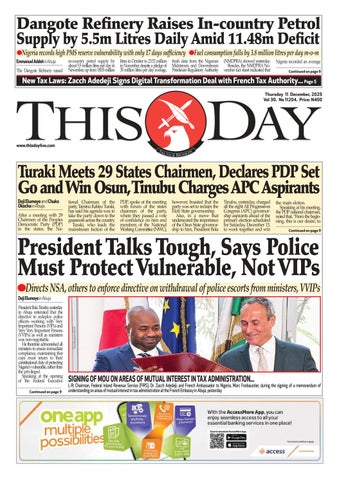
THURSDAY 11TH DECEMBER 2025

Page 1


Dangote Refinery Raises

In-country Petrol Supply by 5.5m Litres Daily Amid 11.48m Deficit

Nigeria records high PMS reserve vulnerability with only 17 days sufficiency Fuel consumption falls by 3.8 million litres per day m-o-m

Emmanuel Addeh in Abuja

The Dangote Refinery raised

in-country petrol supply by about 5.5 million litres per day in November, up from 18.03

litres in October to 23.52 million in November, despite a pledge of 35

New Tax Laws: Zacch Adedeji Signs Digital Transformation Deal with French Tax

www.thisdaylive.com

Nigeria recorded an average

Turaki Meets 29 States Chairmen, Declares PDP Set

Go and Win Osun, Tinubu Charges APC Aspirants

After a meeting with 29 Chairmen of the Peoples Democratic Party (PDP) in the states, the Na-

tional Chairman of the party, Taminu Kabiru Turaki, has said his agenda was to take the party down to the grassroots across the country. Turaki, who leads the mainstream faction of the

PDP, spoke at the meeting with forum of the states chairmen of the party, where they passed a vote of confidence on him and members of the National Working Committee (NWC),

however, boasted that the party was set to reclaim the Ekiti State governorship. Also, in a move that underscored the importance of the Osun State governorship to him, President Bola

Tinubu, yesterday, charged all the eight All Progressives Congress (APC) governorship aspirants ahead of the primary election scheduled for Saturday, December 13, to work together and win

the main elction. Speaking at his meeting, the PDP national chairman, noted that, “From the beginning, this is our desire, to

Continued on page 9

President Talks Tough, Says Police Must Protect Vulnerable, Not VIPs

Deji Elumoye in Abuja

President Bola Tinubu yesterday in Abuja reiterated that the directive to redeploy police officers working with Very Important Persons (VIPs) and Very Very Important Persons (VVIPs) as well as ministers wasHenon-negotiable. therefore admonished all ministers to ensure immediate compliance, maintaining that cops must return to their constitutional duty of protecting Nigeria’s vulnerable, rather than the privileged.

Speaking at the opening of the Federal Executive

Continued on page 9

SIGNING OF MOU ON AREAS OF MUTUAL INTEREST IN TAX ADMINISTRATION...

L-R: Chairman, Federal Inland Revenue Service (FIRS), Dr. Zacch Adedeji; and French Ambassador to Nigeria, Marc Fonbaustier, during the signing of a memorandum of understanding on areas of mutual interest in tax administration at the French Embassy in Abuja, yesterday

Deji Elumoye and Chuks Okocha in Abuja

NiYA StArt-Up GrANt 2.0 AND lAUNCh of NiYA GiGS...

L-R: Minister of Budget & Planning, Abubakar Bagudu, Minister of State for Finance, Dr. Doris Uzoka-Anite, Chief of Staff to the President, Femi

Minister of Finance and Coordinating Economy, Wale Edun, Minister of Youth Development, Ayodele Olawande and Minister of Women Affairs, Imaan Sulaiman-Ibrahim at the NiYA Start-Up Grant 2.0 and officially launched NiYA Gigs in Abuja on Tuesday

New Tax Laws: Zacch Adedeji Signs Digital Transformation Deal with French

Tax Authority

Unveils new brand identity as JTB transforms to JRB Adesokan pledges revenuefriendly environment FIRS rallies security agencies to strengthen revenue protection

James Emejo in Abuja and Nume Ekeghe in Lagos

Chairman, Federal Inland Revenue Service, (FIRS), Dr. Zacch Adedeji, yesterday signed a Memorandum of Understanding (MoU) with the French revenue agency, Direction Générale des Finances Publiques (DGFP) on areas of mutual interests and promotion of efficient tax administration.

Separately, Adedeji also unveiled a new brand identity for the Joint Tax Board (JTB) –now known as Joint Revenue Board (JRB). The transformation followed the signing into law of the Joint Revenue Board of Nigeria (Establishment) Act 2025 by President Bola Tinubu on June 26, 2025.

The developments came ahead of FIRS’ transitioning to the Nigeria Revenue Service (NRS) by January 2026, as mandated by the new tax laws recently assented to by Tinubu.

Speaking at the French Embassy in Abuja, the FIRS chairman said the agreement reflected a shared commitment to building a stronger, more resilient, and forward-looking

tax administrations for both countries amid expanding impact of digitalisation in the global economy.

The French Ambassador to Nigeria, Marc Fonbaustier, who also signed the agreement on behalf of DGFP, emphasised the importance of collaboration between the two countries.

Adedeji, in a statement by his Special Adviser on Media, Dare Adekanmbi, listed digital transformation as one of such critical areas where Nigeria can leverage France’s advanced technology in compliance management, taxpayer services, and data-driven enforcement.

Specifically, the FIRS boss said: “As economic activities become increasingly borderless, the ability of both our institutions to collaborate, share intelligence, and harmonise approaches will be crucial. This MoU provides exactly the platform we need to deepen that cooperation.”

He explained that in turn, France will gain “fresh perspec- tives from Nigeria’s rapid digital expansion, our agile adoption of new tools, and the unique solu- tions we are developing for a

fast-growing, technology-driven population.”

He stated that the two-way exchange is essential as both countries adapt to emerging challenges such as Artificial Intelligence (AI) deployment, cybersecurity, and cross-border taxation.

He stressed that Nigeria will deliberately engage more with similar global partners, noting that the partnership between

France and Nigeria will enable the tax institutions to exchange ideas, share innovations, and learn from each other’s experiences.

Adedeji said: “Another important aspect is workforce development. While we look forward to learning from France’s well-structured human capital sys- tems, particularly in professional standards, continuous learning, and organisational discipline, we also believe that our experience

in managing a young, dynamic and diverse workforce will offer valuable insights to DGFIP.

“Together, we can develop models that strengthen insti- tutional culture, build global competencies, and prepare our respective institutions for the future of public finance administration.

“We also anticipate strong bi- lateral cooperation in international taxation, exchange of information,

transfer pricing, and Base Erosion and Profit Shifting BEPS-related work.”

He said that as Nigeria moves into the era of the Nigerian Revenue Service, the partner- ship was a cornerstone of the transformation, one that will help build a revenue administration that is modern, trusted, innovative, and globally connected.

Tinubu Launches New Security, Economic Blueprint to Harness Nigeria’s Marine Wealth

Deji Elumoye in Abuja

President Bola Tinubu yesterday announced a new security and economic framework aimed at unlocking Nigeria’s vast marine and aquatic resources under the blue economy as one of the country’s most critical sectors for national transformation.

Owing to this, the President

directed all relevant ministries, departments, and agencies to immediately review and implement recommendations by the National Institute for Policy and Strategic Studies’ (NIPSS) comprehensive study on blue economy development.

Speaking at a Presidential Parley with participants of Senior Executive Course 47 of the National Institute for

Access Bank Harps on Africa Payment Integration

Nume Ekeghe

Access Bank, in a bid to promote instant and efficient cross-border payments within Africa, showcased its AccessAfrica platform at the PAPSS COWRY 2025 Forum, reinforcing its commitment to building

a more connected regional economy.

The event brought together policymakers, regulators, financial institutions, and payment experts to explore pathways toward “Building an interoperable and sovereign African payment ecosystem for trade

and economic growth.”

In alignment with the theme, discussions emphasised the importance of resilient, interoperable, and sovereign African payment infrastructure that empowers businesses, supports SMEs, and strengthens intra-African trade under

the AfCFTA.

Designed to facilitate instant, secure, and efficient cross-border transactions in local African currencies, PAPSS reduces dependency on third-party currencies, enhances settlement efficiency, and promotes regional economic integration.

Policy and Strategic Studies (NIPSS) at the State House, Abuja, the President, who was represented by Vice President Kashim Shettima, said his administration was committed to converting Nigeria’s maritime potential into a major driver of economic diversification, job creation and long-termAccordingprosperity. to him: “The blue economy offers a strategic pathway for diversifying our revenue base, creating sustainable employment and revitalising the ecosystems that sustain national development. If properly harnessed, this sector could become an anchor of shared prosperity for genera- tions.”

Tinubu welcomed findings of the NIPSS study on Blue Economy and Sustainable Development in Nigeria, de- scribing it as a timely resource

that outlines the “opportunities we must seize, the challenges we must confront and the policies we must refine.”

He praised the institute for sustaining what he called its tradition of analytical rigour, creativity, and patriotic duty.

The President noted that Nigeria’s marine endowments, including an 853-kilometre coastline, rich fisheries, extensive inland waterways, and a strategic location within the Gulf of Guinea, position the country to build new growth avenues.

He said his administration was prioritising aquaculture expansion, port and maritime corridor modernisation, coastal tourism, marine biotechnology and renewable ocean energy.

“These opportunities lie within our grasp if we act with discipline and intentionality,” he added.

Gbajabiamila,

TOWARDS NIGERIA’S ECONOMIC OUTLOOK IN THE NEW YEAR...

Tinubu Sets Up 7-Man Panel to Resolve N4trn Debt Owed 2,000 Contractors

FEC okays new industrial policy, 200 electric buses for NADDC, BOI HQ, Lekki infrastructure projects Approves major upgrades of navigational, communication systems across airports Keyamo: Govt has no legal right to regulate or fix air fares

Deji

President Bola Tinubu yesterday constituted a seven-man interministerial committee to resolve the age-long backlog of payments estimated at N4 trillion owed to no fewer than 2,000 contractors.

Presidential spokesperson, Bayo Onanuga, made this public while briefing newsmen after the Federal Executive Council (FEC) meeting presided over by President Tinubu at the Council Chambers of the State House in Abuja.

He described Tinubu’s engage- ment with ministers as “a very productive discussion,” noting that the accumulation of debts had created bottlenecks and slowed service delivery across critical sectors.

To tackle the issue compre-

Onanuga said the President received a fresh briefing on the scale and implications of the outstanding obligations and subsequently directed a coordinated solution.

hensively, he said the President approved a multi-ministerial mechanism to verify claims, reconcile records, and recommend sustainable financing options for clearing the Accordingbacklog. to the presidential aide, the committee comprises Ministers of Finance; Budget and Economic Planning; Works;

President Seeks Reps’ MTEF, FSP Approval

and Juliet

President Bola Tinubu has transmitted the Medium Term Expenditure Framework (MTEF) and Fiscal Strategy Paper (FSP) for 2026–2028 to the House of Representatives forThisapproval. comes as the House of Representatives called on the federal government, through the Central Bank of Nigeria (CBN), Nigeria Incentive-Based Risk Sharing System for Agricultural Lending (NIRSAL) Microfinance Bank, and the Federal Ministry of Finance, to immediately sus- pend all deductions on N419.42 COVID-19 intervention loans.

The President’s communication on the MTEF and FSP, addressed to Speaker Abbas Tajudeen, was read by the Deputy Speaker, Hon. Benjamin Kalu, during yesterday’s plenary. Tinubu, while expressing his pleasure in submitting the 2026–2028 MTEF and FSP to the House for its consideration and approval, explained that the Federal Executive Council had endorsed the documents on December 3, 2025, and noted that the federal government’s 2026 budget would be prepared using the fiscal assumptions

and parameters contained in the approved framework.

He also appealed to the National Assembly to act swiftly on the submission.

He cited Part II, Section 11(1) of the Fiscal Responsibility Act 2007, which requires the federal government, after consulting the states, to prepare and lay before the National Assembly a Medium-Term Expenditure Framework for the next three financial years within six months of the Act’s commencement; and subsequently no later than four months before each new financial year begins, to prepare another three-year framework.

Subsection (2) of the Act stated that the framework submitted must be reviewed and approved, along with any amendments deemed necessary through resolutions passed by both chambers of the National Assembly.Subsection (3) mandated that the MTEF must include a Macro-Economic Framework outlining economic projections for the next three years, the assumptions supporting those projections, and an analysis of macroeconomic performance over the previous three years.

As required by the Act, the FSP must present the federal

government’s medium-term financial objectives; its policies concerning taxation, recurrent (non-debt) spending, debt servicing, capital expenditure, borrowing, lending, and invest- ment; its economic, social, and developmental priorities for the next three years; and an explanation of how these goals and policies align with the economic objectives set out in Section 16 of the Constitution.

The document must also contain a revenue and expenditure framework, including projected total revenues for each financial year based on an agreed Com- modity Reference Price and expected tax revenues; projected total spending for each of the next three years; and minimum tax expenditure thresholds for each of those years.

These projections must be based on reliable, consistent data certified under Section 13(2)(b) of the Act; aim to achieve the macroeconomic targets listed in subsection (2)(a); align with the assumptions, objectives, policies, and priorities in the MTEF and FSP; a consolidated Debt Statement detailing the fiscal implications of the federal government’s debt and proposed strategies for reducing it and a statement outlining the

nature and fiscal significance of any contingent liabilities and quasi-fiscal activities as well as measures to prevent them fromSectionmaterialising.

12(1) further states that the National Assembly’s approved aggregate expenditure for each financial year must not exceed the projected total revenue plus a deficit capped at three percent of the estimated Gross Domestic Product, unless the National Assembly sets another sustainable limit.

Education; Housing and Urban Development; Director-General of the Budget Office, and Executive Chairman of the Nigeria Revenue Service.

“These ministers and senior officials are expected to sit together, harmonise data, and develop a comprehensive solution that will determine how and when the outstanding payments will be settled,” Onanuga said.

He added that Tinubu was determined to restore order, transparency, and credibility to the contractor-payment system, ensuring that only genuine claims are honoured while irregularities are eliminated.

Answering reporters’ questions, Onanuga said the President’s directive reflects a decisive shift from merely diagnosing the causes of the recurring problem to finally resolving it.

“We have gone beyond find- ing reasons or blaming anyone. The question now is: what is responsible for this persistent problem, and how do we solve it?” he said.

Onanuga stressed that as a

sovereign nation, Nigeria must honour its legitimate obligations, but insisted that payments must follow proper verification and dueHeprocess.disclosed that the committee held its inaugural meeting yesterday and was expected to submit recommendations soon.

“By the time the committee sits fully, I believe we will have clearer answers and a pathway to resolving all outstanding li- abilities,” the presidential media aideTheexplained. fresh move came amid mounting pressure from con- tractors who claim the Federal Government owes them over N4 trillion for completed projects, a situation that has triggered multiple protests at the Ministry of Finance and the National Assembly in recent months. Many of the affected contractors say the prolonged non-payment has pushed them into severe financial distress, leading to loan defaults, loss of property, deteriorating health, and in some cases, deaths.

Continued on page 36

UN Reaffirms Support for Nigeria’s Filmmaking to Advance SDGs

Michael Olugbode in Abuja

The United Nations Resident and Humanitarian Coordinator, Mr. Mohamed Fall has reiterated the organisation’s commitment to supporting filmmaking to advance Sustainable Development Goals (SDGs) in Nigeria. Speaking at the third edition of the SDGs short film challenge and awards grand finale 2025 on Tuesday in Abuja, said the UN remains committed to Sustainable Development Goals (SDGs) in Nigeria and

the rest of the world

The event with the theme: “Film as a catalyst for sustainable development: reimagining the future we want through the screen” was organised by the United Nations Information Centre (UNIC) and Office of the Senior Special Assistant to the President on SDGs.

Fall said although the UN in Nigeria invested in talent and amplified voices, more needs to be done; saying policymakers. private sector and partners should invest in

film stories to achieve SDGs. He said: “A film story can change life, change Nigeria and not only Nigeria, but the world. To Bollywood, to Afrobeat, to all the sexism and all sorts of art and creation we stand at a turning point.

“Less than five years remain to 2030 and this is time to attain the SDGs, yet the path we are today is not straight, inequality persists across the globe; Poverty remains, our climate crimes are under direct action and the world is waiting for us to step-up.”

L-R: Former Senate President, Dr. Abubakar Bukola Saraki and former Vice-President Namadi Sambo, during the Ignite Capital Africa’s launch of the Nigeria Economic Outlook 2026 dinner at Fraiser Suites Hotel, Abuja... Tuesday
Adedayo Akinwale
Akoje in Abuja
Elumoye in Abuja

PREMIERE OF THEMATIC CAMPAIGN “BEYOND BULDING” IN LAGOS...

L-R:

campaign, “Beyond Building” in Lagos, Nigeria ... yesterday

Remaining Niger State Schoolgirls Will Be Rescued Soon, Information Minister Pledges

Laleye Dipo in Minns

The Minister of Information, Alhaji Mohammed Idris Malagi, has given the assurance that the remaining school children and their teachers abducted from their school in Papiri Agwara Local Government Area of Niger State, would be rescued soon and reunited with their parents.

Idris gave the assurance in Minna yesterday, when he paid a sympathy visit on the Niger State Governor, Alhaji Mohammed Bago, over the abduction of the St Mary’s Catholic Primary/Secondary School two weeks ago.

Some 100 out of the 259 children had been rescued and we’re received by Bago on Monday before they were reunited with their parents in Papiri yesterday’s evening.

The Minister said the federal government “is committed to restoring peace and security in parts

of the country” bedeviled by insecurity as a result of bandits and terrorists attacks.

“President Bola Ahmed Tinubu is working seriously to ensure speedy recovery of the remaining school children and their teachers in captivity.

“The president is working with sub-nationals and international organisations to ensure that challenges of insecurity across some parts of the country are tackled.”

He described the abduction of the children and their teachers as “a call for deep and sober reflection”, pointing out that the issue of security should be a collective responsibility of all stakeholders.

Earlier, Bago had called on Nigerians to ensure that democracy was sustained in the country, adding that Nigerians must be patriotic and love one another irrespective of religion and culture for democracy to thrive in the

country.

The governor expressed gratitude to the minister for the visit and also appreci-

ated the collaborative efforts between the federal and the state governments in rescuing the abducted school children

of St. Mary’s Catholic School. Bago reassured them that by strengthening such collaborations, including all

critical stakeholders, the remaining abducted school children would be rescued in no distant future.

FG: We Won’t Allow Terror, Divisive Acts to Derail Nigeria, Charges Religious Leaders

Odumegwu-Ojukwu wants constitution order defended over coup, challenges ECOWAS Army chief commends troops for foiling coup in Benin Republic

Chiemelie Ezeobi in Lagos, Michael Olugbode and Onyebuchi Ezigbo in Abuja

Amid concerns over challenges of insecurity in the country, the federal government, yesterday, said it was ready to defend the sovereignty of Nigeria, adding that it would not allow terror or division to sink the ship of state.

It also said while it would continue to support measures that promote peaceful coexistence amongst citizens, it

Keyamo: Ekiti Airport Marks New Era in Nigeria’s Aviation Sector

The Minister of Aviation and Aerospace Development, Festus Keyamo, SAN, has described the Ekiti Agro- Allied International Cargo Airport as a “new era of aviation development in Nigeria,” following the successful commencement of commercial flight operations on Wednesday. Represented by the Permanent Secretary of the Ministry, Yakubu Adam, Keyamo said the inaugural commercial flight operated

by United Nigeria Airlines signaled a historic moment for Ekiti State and the nation’s aviationKeyamoindustry.praised the state government for delivering an airport that reflects President Bola Tinubu’s Renewed Hope Agenda, especially in job creation and infrastructure expansion.

“History is made in Ekiti with this inaugural flight,” he said. “This airport stands as a practical example of the President’s renewed hope agenda and his quest to sustain job creation. We congratulate the governor

of Ekiti State and reaffirm our commitment to initiatives that will drive growth and development in Nigeria.”

The first commercial flight, UN 0622, touched down at exactly 11:00 a.m., where it was received by Governor Biodun Oyebanji, former Governor Segun Oni, commissioners, and other dignitaries.

On board the flight were the Permanent Secretary, Yakubu Adam; former Governors Adeniyi Adebayo, Ayodele Fayose, Kayode Fayemi; and the Senate Leader, Opeyemi Bamidele.

would not hesitate to clamp down on those who use the airwaves or internet to spread negative narratives.

In a related development, the Minister of State Foreign Affairs, Bianca OdumegwuOjukwu, has called on members of the Economic Community of West African States (ECOWAS) to remain steadfast in defending constitutional order, promoting inclusive political dialogue, and supporting credible transitions that reinforce stability.

This was as the Chief of Army Staff (COAS), Lieutenant General Shaibu Waidi, has commended troops of the 81 Division, Lagos, for their swift

intervention in the Republic of Benin, which foiled the recent attempted coup.

Secretary to the Government of the Federation (SGF), Senator George Akume, who addressed Second Triannual Meeting of the Nigeria Inter-religious Council (NIREC ) held in Abuja, yesterday, said Nigeria has been under enormous stress in the last six months.

This, he contended, was “occasioned by internal security situation, heightened political rhetoric, and degraded mutual trust which was almost ebbing into religious conflict.”

The SGF regretted that Nigeria has come under international pressure for the

wrong reasons, orchestrated by mis-characterisation of her situation.

“In the midst of these challenges, we must remind ourselves as leaders of faith, as traditional rulers and as voices of reason that wield influence in the society that despite the trials that buffet us, Nigeria remains a strong, united, and sovereign nation.

“We have survived past crises including a gruelling civil war and emerged with a renewed commitment to unity in diversity. Our independence and sovereignty are non-negotiable, and we cannot allow terror or division to sink the ship of state.

Breach of Contract: Glo Mobile, NCC, Megatech Face N20bn Law Suit

Alex Enumah in Abuja

A N20 billion law suit have been instituted against a telecommunication giant, Glo Mobile Limited, Nigerian Com- munication Commission (NCC) and an indigenous company, Megatech Engineering Limited.

The law suit filed at the Abuja division of the Federal High Court, borders on alleged breach of contractual agreement. Mosakab Nigeria Limited

and its promoter, Mashood Mustapha, who initiated the suit are demanding the said sum as compensation for damages suffered as a result of the breach of their contractual agreement.

In the suit marked: FHC/ ABJ/CS/1534/2024, the two plaintiffs are praying the court for an order voiding or setting aside the sale of the Spectrum Licence in the 2.6 GHZ Band by Megatech to Glomobile on the grounds that the purported

sale was accentuated by fraud and illegality. The suit has Megatech Engineering Limited, Glo Mobile and NCC as 1st to 3rd defendants. The plaintiffs in the suit filed by George Ibrahim, SAN, of Ogwu James Onoja SAN law firm in Abuja, are also asking the court to order Megatech to honour its monetary obligation of $10 million due to them in their Consultancy Agreement executed on June 29, 2017.

Nollywood Actor, Richard Mofe-Damijo; Group Chief Executive Officer, Lafarge Africa Plc, Lolu Alade-Akinyemi; Nollywood Actress, Kate Henshaw; Chief Finance Officer, Lafarge Africa Plc, Zhigang Ke, and Commercial Director, Lafarge Africa Plc, Gbenga Onimowo, during the premiere of a thematic
Gbenga Sodeinde in Ado Ekiti

Fitch: Despite Nigeria, Africa’s Bright Economic Outlook, AGOA Expiry Poses Challenge

Predicts sub-Saharan Africa’s GDP to rise to 4.2% in 2026

The expiry of the African Growth and Opportunity Act (AGOA) duty-free access window presents an immediate challenge to Nigeria and Africa, particularly for African apparel exporters, a report by BMI, a Fitch Solutions Company, has said.

Now that AGOA preferences have lapsed in September 2025, several countries will be forced onto Most-Favoured Nation (MFN) tariff schedules, raising their effective costs of access to the United States market, the reportAddedadded. to this are Donald

Trump-era protectionist tariffs, which continue to weigh heavily on African textile-dependent economies.

In the event that AGOA is not renewed or re-engineered into a more flexible framework, apparel-exporting nations could experience sharper contractions in their US-bound shipments, Fitch said in the report tagged: “ Sub-Saharan Africa Monthly Outlook: Regional Resilience Despite Global Uncertainties”.

With a one-year extension unlikely, the report indicated that near-term demand constraints will persist, and African export- ers will have limited room for manoeuvre until governments

diversify their trade strategies or the African Continental Free Trade Area (AfCFTA) implementation accelerates.

Despite these structural hurdles, the continent’s broader macroeconomic picture appears increasingly optimistic. This is most evident in Nigeria, where easing inflation is already reshaping economic expectations.

After a turbulent period marked by soaring prices, currency reforms and tight monetary conditions, the Nigerian economy is projected to regain firmer footing from the second half of 2025.

Real Gross Domestic Product

(GDP) growth, which dipped earlier due to inflationary pres- sures and restricted consumer demand, edged up from 4.1 per cent year-on-year in Q2 to 4.2 per cent in Q3, buoyed by stronger gains in hydrocarbons and improved industrial output driven by the Dangote refinery.

BMI forecasts that Nigeria will experience an even more decisive lift in 2026, with domestic trade and real estate, two sectors previously strained by high inflation, expected to stabilise as price pressures retreat. Consumer spending, which had weakened significantly, is set to recover as households regain purchasing

power.

The improvement is tied directly to Nigeria’s inflation profile. Headline inflation, which had surged above 24 per cent at the beginning of 2025, fell back to 14.6 per cent by September. BMI expects disinflation to continue well into 2026, with inflation projected to average 14.2 per cent for theThisyear.shift, it said, gives the Central Bank of Nigeria (CBN) significant room to further ease its monetary stance, lowering interest rates to stimulate credit growth and household consumption.

The anticipated rate cuts

Pre SID en T TA lk S Tou GH , S AYS Pol IC e Mu ST Pro T e CT Vulner A ble, n o T VIP S Council (FEC) meeting in the State House Council Chamber, the President warned against non-compliance to the order, stressing that those who feel their cases were extraordinary should reach the Inspector General of Police (IGP).

“If you have any problem because of the nature of your assignments, please contact the IGP and get my clearance,’’ the President pointed out in a statement by his Special Adviser on

daily consumption of petrol of 52.9 million litres per day during the period under review, about 5.8 per cent above the 2025 daily demand benchmark of 50 million litres.

This came as the 650,000 bpd refinery recently announced plans to supply 1.5 billion of petrol monthly to the Nigerian market in December 2025 and January 2026, a move it said is aimed at ensuring uninterrupted nationwide fuel availability through the festive season and into the New Year.

President and Chief Executive of Dangote Industries Limited, Aliko Dangote, noted that the refinery will make available 50 million litres of Premium Motor Spirit (PMS) daily beginning December 1.

In the same vein, 71.5 million litres daily supply of petrol was recorded in November, with domestic fuel sufficiency at 16.5 days in November, up from 11.1 days in October, an analysis of the data showed, underscoring the country’s supply vulnerability if for any reason import dries up and Dangote refinery encounters anyHowever,challenges.the regulator at- tributed the rebound in supply to a combination of factors, including increased imports by the NNPC as supplier of last resort to rebuild inventories as well as the spillover of 12 vessels that were meant to discharge in October but discharged in November.

Information and Strategy, BayoTheOnanuga. federal government recently directed that police officers attached as escorts be withdrawn nationwide. According to the leadership of the Nigeria Police Force (NPF) under Kayode Egbetokun, a total of 11,566 officers were due to be recalled from VIP duties for redeployment.

The withdrawn officers are to be reassigned to “frontline policing” roles,

The mix lifted domestic discharges and helped bring the country back marginally above the benchmark level needed for routine consumption.

Diesel demand also strength- ened in November, with average daily consumption rising to 15.4 million litres, which is 10 per cent higher than the 2025 benchmark of 14 million litres per day, an uptick that reflects rising transport and industrial activity as the country heads into the peak commercial season.

On LPG or cooking gas, domestic supply averaged 4,958 tonnes per day while apparent domestic consumption was 3,992 tonnes per day in November, meaning domestic supply exceeded consumption

take the party back to the people and who will be our better partners in achieving this desire other than our state chairmen.

“The National Organization Secretary described you as Brigade Commanders. I want to correct that wrong impression.

“Today, PDP is on a new mission and this new mission is to reclaim Nigeria from the inept APC leadership. A leadership that, instead of taking Nigeria progressively forward, is taking us retrogressively backward.

that is regular policing duties such as community patrols, highway patrols, rural and urban security, anti-robbery operations, intelligence-led policing and rapid response to rising security threats.

According to the govern- ment, the move aims to address a manpower shortage in critical areas, including many remote and vulnerable communities that are underpoliced, as a disproportionate number of officers were tied

by roughly 24.2 per cent .

Despite that surplus on a tonnage basis, national LPG sufficiency was recorded at only eight days, underlining distribution and accessibility challenges for the cooking gas market even when overall tonnage improved. Also, prices remained in a wide retail band of N950–N1,500 per kg across the country in November.

The gas sector numbers in November also showed resilience, as total average daily gas supply stood at 4.684 billion standard cubic feet per day (Bscf/d). Of that total, gas to power accounted for 0.645 Bscf/d, approximately 13.8 per cent of total gas supplied, while gas to commercial users

“Today, Nigerians are living witnesses that the achievements, the progress that had been made in the 16 PDP’s glorious years have either been destroyed, or shattered, or reversed,” Turaki stated.

The PDP national chairman further stated, “So, when you look at 29 state chairmen sitting with us, with apologies coming from two, then when you also take into account the fact that there were some chapters that were dissolved, and so do not have leadership constituted presently, which

up securing VIPs and limiting police presence where ordinary citizens live.

But restating his position, the President directed the National Security Adviser (NSA) Nuhu Ribadu, Minister of Police Affairs, Senator Ibrahim Gaidam, and the Inspector General of Police, Egebtokun, to follow up on the implementation of the order.

The President noted that police officers were trained to

averaged 0.420 Bscf/d. NLNG’s train operations and major gas plants posted varied utilisation rates at 73.7 per cent utilisation, with exported LNG continuing alongside sizable domestic flows, reflecting continued prioritisation of gas- to-power and export obligations while maintaining domestic commercial supplies.

Refinery development and modular refinery activity remained an important part of November’s story. The regulator recorded one new refinery establishment license (LTE) issued during the month and one refinery construction license (LTC) issued, bringing ongoing development activity

Continued on page 36

we are planning to do in due course, then tell me, distinguished ladies and gentlemen, who is not here. If all the state chairmen are here with us, then who is it that is not with us?

“If all the state chairmen are supporting us, then who, sincerely speaking, can be fighting us? So, this is something for the whole world to see.

“These are known faces, these are veterans in their right, and they are here physically, not virtually, and they are here in person, not via representation. So as far

could become one of the strongest tailwinds for Nige- ria’s growth in 2026, it said, with lower borrowing costs supporting small businesses, expanding access to financing, and reviving segments of the retail and service sectors that were suffocated by expensive credit.

protect the lives and property of citizens, particularly the most vulnerable in society, and the protection of a select group of VIPs and VVIPs was not their responsibility.

Tinubu said the Minister of Interior, Olubunmi Tunji-Ojo, will make arrangements for the replacement of police officers by the Nigerian Security and Civil Defence Corps (NSCDC).

“The National Security and Civil Defence Corps are trained for VIP protection, and they are armed too,’’ he added. The President noted that the police would be mobilised appropriately to tackle the country’s security challenges.

He said the entire structure will be reviewed to better address vulnerable citizens and communities.

“We face challenges here and there of kidnappings, banditry and terrorism. We need all forces utilised. I know some people are exposed; we will make the exceptions. The Civil Defence is very much around,’’ the President stated.

Besides, the Nigerian leader said ministers should meet the Inspector General of Police and get his clearance for special assignments that

as PDP is concerned, I think it speaks for itself.

“People now know where the leadership of PDP is, and people know who the true leaders of the party are, and of course we are the leaders, the genuine bona fide leaders of the people,” Turaki stressed.

The party leadership also met senators and members of the House of Representatives.

Also yesterday, the party presented the certificate of returns to the Ekiti State governorship candidate, Dr. Oluyede Olueole.

require police protection. “NSA, take this very seriously,’’ he ordered.

The President also urged the Vice President, Kashim Shettima, who is the Chairman of the National Economic Council (NEC), to further sensitise governors and other stakeholders on the implementation of the reforms on ranching.

He directed the Minister of Livestock Development, Idi Maiha, to commence the mobilisation process, with particular emphasis on areas that are facing conflict.

“The Minister of Livestock, see which village or grazing area can be rehabilitated for ranching. We must eliminate this area of conflict and make livestock reform economically viable. The opportunity is there, let’s utilise it. You should emphasise the constitutional requirement that the land belongs to the state,’’ he added.

The President said villages and communities facing conflicts must be salvaged, insisting that implementing ranching will reduce conflicts between herders and farmers and attacks on the most vulnerable members of society.

The certificate of election was presented to him by the chairman of the Ekiti State governorship panel, the former governor of Gombe State, Ibrahim Dankwambo, who said Oluyede Oluwole won with 297 in an election monitored by INEC. The certificate of return as the PDP governorship was presented to him by the national chairman, Turaki, who also presented INEC documentation process as the authentic governorship candidate for the PDP. By implication, Turaki

Continued on page 34

Wale Edun

INAUGURAL PAN-AFRICAN PAYMENT AND SETTLEMENT SYSTEM...

L-R: John-Bosco Sebabi, Deputy CEO, PAPSS; Naco Bolote, Head of International Remittance & Payments for African Subsidiaries, Access Bank Plc; Gabriel Edgar, Chairman and Group CEO, Oakwood Green Africa; Vincent Chuunga, COO, Zambia National Commercial Bank (Zanaco); Mike Ogbalu, CEO, PAPSS; and Obi Ejimofo, Head of Commercialization, PAPSS, at the inaugural Pan-African Payment and Settlement System (PAPSS) COWRY 2025 Participants’ Forum held in Lagos, Nigeria… recently

2027: Lawan Predicts 75% Northern Votes for Tinubu, Accepts Role as Network Patron

President of the ninth Senate, Senator Ahmad Lawan, yesterday, made a bold projection ahead of the 2027 elections, saying President Bola Tinubu should secure over 75 per cent of the votes from the north if the region fully mobilised behind the All Progressives Congress (APC).

Lawan made the declaration

while receiving the leadership of Tinubu House-to-House Network, who visited him at the National Assembly to formally confer on him the position of National Patron of the grassroots mobilisation group.

The delegation, according to a statement by Lawan’s media aide, Mr. Ezrel Tabiowo, was led by the organisation’s national chairman, Comrade Yahaya Muhammad.

Expressing appreciation for the appointment, the former senate president said the group’s door-to-door strategy was key to ensuring deeper political education and support for the Tinubu administration.

Lawan said, “I feel very delighted that you have found me worthy of appointment as a Patron of this group. My hope is that you continue to expand and deepen your activities across

the country, particularly in the northern part of Nigeria,”

He endorsed Tinubu’s leadership, insisting that the administration has stabilised the economy and is steering it “in the right direction”.

He added that despite the security setbacks recorded in recent months, the government had shown a firm commitment to equipping the armed forces and strengthening national defence.

Guterres Calls for Recommitment to Protection of Fundamental Freedoms

United Nations Secretary- General António Guterres has urged the international community to recommit to the protection of fundamental freedoms, warning that human rights are increasingly under threat worldwide.

Guterres made the call in his annual message to mark Human Rights Day, commemorated globally.

Guterres, whose message was read by the United Nations Resident and Humanitarian Coordinator in Nigeria, Mr. Mohamed Fall, at the celebration of 30th Anniversary celebration

of National Human Rights Commission (NHRC), reflected on the legacy of the Universal Declaration of Human Rights, adopted nearly 80 years ago, describing it as a “philosophical and political breakthrough” that remains the foundation of modern international cooperation.

The declaration, he noted, laid out the basic civil, political, economic, social and cultural rights required for every person to “survive and thrive.”

He however cautioned the world is experiencing a disturbing erosion of these rights. “Recent years have brought a shrinking of civic space,” he said.

“We have grave violations that signal a flagrant disregard for rights, and a callous indif- ference to human suffering.”

He noted that despite these setbacks, change is possible when governments, institutions and citizens work together.

He highlighted the role of the United Nations in sup- porting vulnerable populations through activities such as food assistance, shelter provision, education support, election monitoring, environmental protection, women’s empower- ment and peacebuilding.

“This work depends on all people, everywhere, taking a stand,” he emphasised.

Lagos Launches Major Transportation Strategy to Tackle Road Menace

Segun James

The Lagos State Government has launched a new transportation strategy designed to tackle the menace of truck on the state’s roads and accidents associated with maritime and logistics operations in the state. This was disclosed at a Stakeholders’ Engagement

with Maritime and Logistics Practitioners yesterday in Ikeja, Lagos.With the theme, ‘’Charting the Future of Maritime Logistics: Safety, Sustainability and Stakeholder Partnership,’’ the meeting was attended by truck operators in the transport union, freight forwarders, shipping and

terminal operators, security agents, among others.

Speaking at the event, Governor Babajide Sanwo-Olu disclosed that free eye test has been introduced for all truckers throughout the state as part of the effort accidents on the road.

Also, to ensure usage of dependable trucks, the state

“When we protect the most vulnerable, when we refuse to look away, when we speak up for the institutions that speak up for us, we keep human rights alive.”

He stressed that human rights must never be sacrificed for political gain or economic interests.

“Our rights should never take second place to profit or power,” Guterres said. “Let us unite to protect them, for the dignity and freedom of all.”

Sunday Aborisade in Abuja

The commissioning of a fully equipped 21st-century maternity centre in Ihima, Okehi Local Government Area of Kogi State, on Wednesday became a major statement on transparency in public service as Senator Natasha Akpoti-Uduaghan declared the project was executed without a kobo from constituency allocations.

The centre, one of the most modern community-level ma- ternal facilities in Nigeria, was unveiled as part of activities

Lawan, who chairs the Senate Committee on Defence, said he remained convinced that continuity was in Nigeria’s best interest.

He said, “In the 2023 general election, the north gave about 63 per cent of the votes that brought President Tinubu to office. In

2027, we should give him more than 75 per cent to return him.

“The president is ensuring that every part of the country gets a fair share. We are better sticking with this president than trying somebody new who may not achieve half of what we have already seen.”

Jurisdictional Tussle Puts Imo Court System Under Scrutiny

he legal community in Imo State is abuzz with questions awaiting answers over an un- usual procedural fix in which a matter currently pending before a Magistrate Court has been inexplicably resurrected in a Customary Court. The case revolves around a dispute originally before the Magistrate Court, which took an unprecedented turn when the respondent allegedly bypassed standard legal channels. Court filings suggest that the respondent introduced the identical matter into a Customary Court, which will begin its own proceedings today, December 11, creating

a perplexing overlap. The charge sheet of the original case at the Magistrate’s Court of Imo State, Ahiazu Mbaise, suggested that the defendants, Ugochukwu Anyanwu and five others, were being prosecuted on a three-count charge bordering on stealing and destruction of property at the construction project site of Mr. Cyprian Ugo at Oru Ahiara Community. But curiously, the defendant, Ugochukwu Anyanwu, intro- duced the identical matter at the Ahiazu Mbaise Customary Court sitting at Obodo Ahiara, and ironically included Cyprian Ugo as defendant.

marking the senator’s 46th birthday and drew widespread commendation from community leaders, health professionals, women groups and traditional rulers across Kogi Central.

A statement from her Media Office explained the lawmaker, speaking at the ceremony, said the maternity complex was funded through a crowdfunding initiative largely supported by Nigerians outside her district.

She said, “About 99 per cent of the people who contributed to this project are not from Kogi State. This is a people-

driven gift, a labour of love, and entirely separate from constituency funds.”

Akpoti-Uduaghan said it was important to correct as- sumptions about the funding to ensure public clarity and strengthen confidence in ethical representation.

She noted that leadership should not be reduced to the disbursement of public funds but must reflect the ability to attract goodwill, inspire collaboration and mobilise resources for community development.

Michael Olugbode in Abuja
Sunday Aborisade in Abuja

2025 LAGOS ADVERTISING AND IDEAS FESTIVAL CREATIVE CONFERENCE...

L-R: Chairman, Lagos Advertising and Ideas Festival Management Board, Jay Chukwuemeka; Global Business & Marketing Leader | Marketing Director, Visa West Africa, Seun Adaramola; Co-Founder, Up In The Sky, Oje Ojeaga; Founder, Naija AI Film Festival, Obinna Okerekeocha; Founder, SAY Visionaries, Susan Younis; Moderator, Raphael Idu and President, Association of Advertising Agencies of Nigeria(AAAN), Lanre Adisa during a panel session titled” Future of AI in Communications” at the 2025 Lagos Advertising and Ideas Festival Creative Conference held in Lagos ... recently

Human Rights: Falana Seeks Sanctions for Attorneys- General Failing to Prosecute Terror Suspects

NBA says without security human rights lose ground, HURIWA criticises NHRC SERAP, NGE demand end to harassment of journalists, activists

Human rights activist Femi Falana (SAN) yesterday called for the sanctioning of state attorneys-general who have failed to prosecute suspected terrorists, bandits and other violent criminals arrested within their jurisdictions.

Falana predicated the call on the grounds that the Attorney General of the Federation in 2016, gave the Fiat or authority to all the AGs of states to prosecute terrorism, which is a federal offence.

He made the call specifically to the Nigerian Bar Association (NBA), while speaking at the 2025 International Human Rights Day, organised by the NBA’s Human Rights Institute (HRI).

“Up till today, no AG has ever charged anybody with terrorism in the state. As you are aware, culpable homicide

or murder, armed robbery and kidnapping are state offences. But how many state governments are charging people?

How many of our members who are AGs are doing so?

“In Benue and Plateau where a lot of reports are oozing out in the country; in fact, the killings there were alleged to be the reason why Donald Trump is threatening our country. You can quote me, in the last three years, not less than 1000 suspected bandits and terrorists had been arrested and paraded by police in those states.

“In spite of the fact that some of us have shouted ourselves hoarse, not up to 10 have been prosecuted successfully. So, the NBA must call to order and sanction Attorneys-General that fail to prosecute terror suspects, bandits and other killers in our country”, he said.

Speaking on the security situation in the country, Falana

advised the federal government to embrace and deploy technology rather than recruitment of more soldiers and police officers.

According to him, it is not about the number, but about equipping and motivating serving members of the armed forces and police.

“The man in charge of our

space technology has just come out to reveal that whereas the President approved funds of about N20 billion to acquire Satellite Facility in May this year, up till now, the fund has not been released,” he stressed.

Also, the rights activist expressed worry over the increase in the number of out-of-school children, especially in the north,

stressing that when the children of the poor are not cared for, they will make life unbearable for our own children.

Painting what he said is “the reality we face in the North”, Falana claimed that out of about 20 million out-of-school children in Nigeria, 80 per cent are in the North.

“Another troubling issue

involves the misuse of funds. Fifty million dollars was supposedly set aside, but no one seems accountable. The NBA must be interested in how this money will be recovered. State governments must also provide funds to secure schools before they are reopened.

Continues online

Alleged Fraud Charges: FG Arraigns Former Aviation Minister Stella Oduah

Alex Enumah in Abuja

The federal government on Wednesday arraigned former Minister of Aviation, Princess Stella Oduah, before a High Court of the Federal Capital Territory (FCT), Maitama, Abuja, on charges bordering on fraud. She was arraigned along- side one Gloria Odita, on a

Wema Bank Emerges Overall Winner for the 4th Time at Nigeria Bankers Game 2025

Wema Bank has emerged over- all winner at the just-concluded Nigeria Bankers Game (NBG) 2025 grand finale, marking the bank’s fourth consecutive win at the sporting event, setting a new industry record. With a tally of nine gold medals, Wema Bank clinched victories across various categories, including Table Tennis (Female Singles, Doubles, and Mixed Doubles), Volleyball, Scrabble, Video games, 100m Female, 200m Female, and the 4x100m Female Relay.

This year’s NBG also cel- ebrated individual excellence, with Oluwaseun Adewunmi an employee of Wema Bank earning the title of Nigeria Bankers Game 2025 Overall Outstanding Athlete.

According to the bank, her performances across various disciplines reflect deep commitment, discipline, and resilience, making her stand out as one of the tournament’s finestManagingcompetitors.Director and CEO of Wema Bank, Moruf Oseni, expressed his pride in the NBG achievement.

He said: “Wema Bank Plc has once again won the Nigerian Bankers Games title for the fourth consecutive year. This remarkable feat sets a new benchmark in the Nigerian banking industry.

“As we commemorate 80 years of impact and service, this victory carries even deeper meaning for us as an institution.

“We owe this incredible success to every staff who wore our colours and competed with passion, focus, and grit, our esteemed athletes, you are true champions.

five-count charge relating to obtaining by false pretence, and criminal breach of trust.

They were alleged to have in 2014, conspired to obtain a total of N2,469,030,738.90 from the Federal Ministry of Aviation through Broad Waters Resources Nigeria Ltd and Global Offshore Marine Ltd. under allegedly fraudulent claims.

They however pleaded not guilty to all the five-count charge read against them, following which their respective

lawyers moved for their bail applications.

While Chief Onyechi Ikpeazu (SAN), represented the former minister, Mr. Wale Balogun (SAN), represented Odita.

Ikpeazu pleaded with the court to grant Oduah bail on self-recognisance, noting that the first defendant has been a Minister of the Federal Republic of Nigeria and has voluntarily flown in from the United States to honour court summons and has been on administrative bail

granted her by the Economic and Financial Crimes Commission (EFCC). Responding, the Attorney- General of the Federation (AGF), Lateef Fagbemi (SAN), who appeared personally for the prosecution, said the government was not opposed to the bail application. He however insisted that the court should make an order directing the defendants to surrender to the court their travel documents.

Lagos Govt Warns: Remove Your Buildings from Under High-Tension Power Lines or We’ll Do it

Following repeated refusal of owners of buildings under high-tension power line, Lagos State Government has restated its determination to remove all such buildings and structures across the state.

The said that such encroachments pose severe safety risks to residents.

The Special Adviser to Governor Babajide Sanwo-

Olu on Electronic Geographic Information System (EGIS) and Urban Development, Olajide Babatunde, gave the warning on during an assessment tour of the Third Mainland Bridge corridor. Babatunde was accompanied by the Permanent Secretary, Ministry of Physical Planning and Urban Development, Gbolahan Oki, the General Manager of the Lagos State Urban Renewal

Agency (LASURA), Oladimeji Animashaun and senior officials of other relevant agencies. The inspection covered areas from Oworonshoki to Adekunle and the Makoko axis of Ebute-Metta, where the team identified several shanties and illegal structures encroaching on the bridge setbacks and violating the legally prescribed 50-metre right-of-way.

Bennett Oghifo

The Explainer

KEYAMO DISCUSSES IMPROVEMENT IN AVIATION SECTOR ON NOA X-SPACE WEBINAR

As part of the efforts by the National Orientation Agency to explain government policies to the public using online platforms, the Agency recently hosted an X-space webinar that focused on the aviation industry.

The webinar was titled “Federal Government’s Roadmap for Sustainable Air Transport: Strengthening Aviation Safety and Security in Nigeria,” and the guest speaker was the Minister of Aviation and Aerospace Development, Festus Keyamo, who engaged Nigerians on government policies and reforms in the aviation sector.

The X-Space webinar, the fifth in the series by the NOA, attracted more than 4000 online listeners asking questions on the subject matter and also making contributions.

During the session, Keyamo disclosed that the Federal Government is taking steps to ensure that local airlines acquire more aircrafts to make them more viable, improve the local aviation industry and strengthen their competitiveness in the global aviation ecosystem.

The minister stated that the acquisition

of more aircrafts will allow Nigerian airlines to expand their reach and gain access to more international routes, which has been a major challenge for local carriers over the years.

He explained that the government is working on policy frameworks that will make aircraft leasing and financing more accessible to Nigerian airlines, reducing the heavy financial burden involved in acquiring new planes.

Keyamo noted that inadequate aircraft availability has limited the ability of local airlines to compete favorably with foreign carriers, especially on international routes, leading to reduced participation by Nigerian operators.

The minister assured participants in the X-Space that efforts are being made to ensure fairness in the allocation of international routes under bilateral air service agreements, so that Nigerian airlines can benefit more from global aviation opportunities.

He also emphasised that strengthening local airlines will improve service

delivery, reduce flight cancellations and delays, and ultimately provide better travel experiences for passengers in Nigeria.

On national carrier, the Minister explained that in actual fact no nation completely funds its own aviation business justifying why the federal is is continually easing the business environment for operators in the system to access funding and open new routes inorder to expand their businesses.

“Let me explain to Nigerians where we stand on this. Across Africa, almost all the major airlines you hear about are either run or heavily supported by their governmentsRwandAir, Royal Air Maroc, EgyptAir, South African Airways, Ethiopian Airlines (which is the biggest in Africa), and many others. These carriers are operated by national governments.

I can say boldly, and they are free to challenge me, that apart from Ethiopian Airlines, almost all of them are subsidised. They are not run for profit. Around the world, many governments have stepped back from running national airlines because it is extremely capitalintensive, and government bureaucracy cannot sustain such operations.

Baze University’s Albert Ekanem Wins NOA’s Nigerian Identity Journalism Award

communication student of Baze University Abuja, Ubel Albert Ekanem has won the National Orientation Agency, (NOA) Nigeria Identity Journalism Award 2025. The award is among others given out at the 7th Campus Journalism Awards organised by Youth Digest Campus Journalism Initiative, and held at Transcorp Hilton, Abuja.

The NOA award category was introduced by Youths Digest in partnership with the National Orientation Agency (NOA) as part of the Agency’s efforts to promote its Nigerian Identity Project.

The award recognises young journalists whose work promotes the core values of the National Values Charter (NVC), which

include integrity, patriotism, unity, peace, and social responsibility.

The Baze University Student earned the honour with an article published in the Nigerian Tribune on October 1, 2025, titled “ From Heritage to Hope: Nigeria’s Journey at 65”. The piece, which highlighted the essence of the Nigerian Identity, was selected from 39 finalists shortlisted for the category.

Youth Digest and the NOA said the new award is designed to encourage young journalists to use their platforms to promote value-driven storytelling and strengthen Nigeria’s shared identity.

Also at the event, Usman Bashir Abubakar, a law student from the University of Maiduguri, emerged as the Overall Campus Journalist of the Year, excelling in an article writing competition and competitive public speaking before an independent jury.

In his remarks, the Convener of the Awards event, Gidado Yushau Shuaib, described the awards as a national youth-driven movement committed to truth, accountability, and transformational storytelling.

The convener noted that the initiative has grown to a network of more than 3,000 campus journalists from over 100 tertiary institutions since its launch in 2018.

He added that the 2025 edition attracted nearly 400 entries from over 80 institutions, bringing total submissions since inception to more than 2,500.

The Borno State Directorate of the National Orientation Agency (NOA) has reiterated its commitment to collaborative efforts aimed at addressing the root causes of violent extremism in the state.

This occurred during a high-level security dialogue held at the Allamin Foundation Office in Maiduguri, where findings from the Borno Women Peace Builders were shared with stakeholders.

The State Director, Mr Michael Daniel Bdliya, represented by the Assistant Director of Civics Values Democracy and Education (CVDE), Mala Abba Kyari, stressed the importance of identifying key drivers such as corruption, exclusion from leadership, and injustice which contribute to public mistrust and feelings of marginalisation.

The dialogue highlighted how economic challenges like poverty and unemployment leave many, especially youths, vulnerable to recruitment by extremist groups.

Participants, who proposed the solutions to include vocational training, economic empowerment, and targeted job creation, also identified weak social bonds and stigma as social drivers and called for stronger community engagement and reconciliation efforts. Key partners at the event included the military, police, ministries, and civil society groups.

The Ogun State Directorate of the National Orientation Agency (NOA) has sensitised the 2025 Batch “C” NYSC corps members on the importance of internalising national ethics and values, while also warning against fraudulent schemes targeting youths.

The sensitisation took place at the NYSC Orientation Camp in Sagamu, featured all 2,778 of the 2025 Batch “C” corp members posted to the state.

Speaking on behalf of the Acting State Director, Mrs Oyebisi Andu, the NOA Youth Engagement and Inclusion Desk Officer, Mr Femi Famure, emphasised the agency’s commitment to equipping young Nigerians with the right attitudes and national values.

The NOA team used the platform to expose corps members to the 7 for 7 National Values Charter, urging them to adopt core values such as integrity, patriotism, respect, and discipline for personal development and national advancement.

Mrs Andu, through her representative, warned the corps members about the dangers of falling prey to fraudulent schemes operating in the state, such as the Alabuga Special Economic Zone (SEZ) scam and the Q-Net syndicate.

Amass
Director General of National Orientation Agency (NOA) Mallam Lanre Issa-Onilu and the Executive Secretary of National Commission for persons with Disabilities, Hon Ayuba Gufwan with management of both agencies after a meeting between the two organisations at the NOA headquarters in Abuja.

AAU TRAGEDY: NOA SEEKS END TO SIGN OUT CULTURE

Following the tragic death of a final year student of the Ambrose Alli University, Ekpoma, who reportedly died in a motorcade accident after the completion of his examinations, the Edo State Directorate of the National Orientation Agency (NOA) has condemned the rising trend of reckless post-examination celebrations in tertiary institutions.

Speaking on the incident, the State Director of NOA, Barrister Osahon Woghiren, described the event as a painful and completely avoidable tragedy that should force a collective rethink of how students celebrate academic milestones.

Woghiren expressed that the Agency was deeply saddened that a moment of joy and happiness for the final students turned into a fatal crash that resulted in the loss of promising lives.

The state director also stressed that the NOA under the leadership of its Director General, Mallam Lanre Issa-Onilu, has repeatedly warned students and school authorities about the extreme ‘sign out’ practices.

According to the DG, the practice has grown increasingly dangerous and must be addressed decisively by the relevant stakeholders.

Issa-Onilu, who called on parents, student leaders, school managements, security agencies and community stakeholders to work with the NOA to end the practice, also stressed that the responsibility for shaping safer behavior among young people must be shared.

“Parents need to speak up.

Institutions must enforce stricter rules. Student unions must show leadership. And security agencies must not look away when convoys block roads or endanger other road users,” he added. “If we do not confront this now, we will continue to bury young people whose only offence is trying to celebrate the end of exams.”

The NOA Director also urged universities and polytechnics in Edo State to adopt more organised and value-oriented approaches to graduation and sign-out activities, saying there is nothing wrong with celebrating academic achievement, but everything wrong with doing so recklessly.

NOA, NCWS to Promote National Values Charter, Grassroots Development Among Women

The National Orientation Agency (NOA) and the National Council for Women Societies (NCWS) have reaffirmed their commitment to deepening collaboration for the promotion of national values, civic education, and development initiatives targeted at women, especially at the grassroots level.

This was the thrust of a high-level advocacy visit led by the NOA North Central Zonal Director of NOA, Princess Dr Priscilla Gondo Aluor, to the national headquarters of NCWS in Abuja.

Dr Priscilla, while speaking during the visit, commended NCWS for its consistent dedication to women empowerment and national development.

She praised the leadership of the President of NCWS, Princess Edna D.D. Azura, for her unwavering passion in advocating for the rights and advancement of women across Nigeria.

The Zonal Director explained that the purpose of the visit was to strengthen the existing partnership between both organisations and to formally introduce the Overseeing Director of the FCT Directorate to the leadership of NCWS.

She highlighted that NOA, with its presence in all 774 local government areas, is strategically positioned to

amplify the reach and impact of NCWS initiatives.

Dr Priscilla also gave insight into the upcoming official unveiling of the National Values Charter, also known as the National Identity Project, which she described as a strategic framework to instil patriotism, integrity, and civic responsibility in Nigerians, especially among children and young people.

She stressed that women’s groups like NCWS have a critical role in cascading these values into homes and communities.

Responding, the NCWS President, Princess Edna D.D. Azura, expressed appreciation for the Agency’s commitment to national development through partnerships, reaffirming the Council’s willingness to collaborate further with NOA in shaping the national value system.

She noted that NCWS, being the umbrella body for women-focused organisations in Nigeria, recognises the importance of working closely with NOA to ensure that national reorientation messages and programmes are deeply rooted in local communities where women play influential roles.

Oyo NOA Parleys Stakeholders for Ember Months Road Safety Awareness

In an effort to ensure safety on Nigerian roads, the Oyo State Directorate of the National Orientation Agency (NOA) has joined other stakeholders to organise the 2025 ember month road safety awareness campaign in capital city of Ibadan and other parts of the state.

The event was organised by the Road Accident Information and Rescue Organisation which held at the Multi-purpose Hall of the Federal Cooperative College, Eleyele in Ibadan.

Speaking at the event themed “Remember, Support, Act: Safer Roads for All”, the State Director, represented by the Deputy Director of Community Safety, Awareness and Compliance, Mrs Abidemi Adewale, highlighted the agency’s ongoing efforts to ensure an accident-free ember months season.

Mrs Adewale, who expressed concern over the absence of the Park Management System representatives, describing them as critical stakeholders in discussions on road safety, also reaffirmed NOA’s readiness to collaborate with organisations committed to public sensitisation and mobilisation on government policies and programmes.

The National Commander of the Organisation, Commander Bamgboye Okanlawon, expressed concern over the rising rate of road traffic accidents in the country. He disclosed that Nigeria recorded a 7% increase in accident cases since 2023, with overspending accounting for 42%, reckless driving 23%, mechanical failure 14% and poor road conditions 21% of the total incidents.

NOA Supports Diversity, Equity, Inclusion Bill in Ogun

The Ogun State Directorate of the National Orientation Agency (NOA) recently participated in a one-day stakeholders’ forum on the Diversity, Equity and Inclusion Bill at the Ogun State House of Assembly.

The bill, sponsored by Hon. Ajayi Bolanle Lateefat and co-sponsored by other honourable members, aims to address systemic inequalities and promote inclusive governance.

The forum was declared open by the Speaker of the House, Rt. Hon. Elemide Oludaisi, who commended the intent of the bill.

During the hearing, the Honourable Commissioner for Women Affairs and Social Development, Hon Adijat Adeleye, expressed strong support for the bill, noting it would address long-standing issues of bias and marginalisation.

In her remarks, the Acting State Director of NOA, Mrs Oyebisi Andu, reiterated that the bill aligns with the Agency’s core values of social justice, equality, and national cohesion.

Mrs Andu also noted that the proposed law would promote fairness, equitable representation, and protection from discrimination.

Acting Group Politics Editor DEJI ELUMOYE

Email: deji.elumoye@thisdaylive.com

08033025611 sms only

As Senate Moves to Redefine Kidnapping as Terrorism...

a s insecurity escalates nationwide, the red chamber of the National a ssembly advances sweeping reforms to redefine kidnapping as terrorism, dismantle ineffective oversight structures, and outlaw deradicalisation for terror offenders, reports sunday Aborisade .

As the wave of violent abductions continues to sweep across states in Nigeria, leaving families traumatised and communities destabilised, the Senate has launched one of its boldest legislative offensives yet against banditry, terrorism and the fast-expanding kidnapping industry. Central to the effort is a proposed amendment to the Terrorism (Prevention and Prohibition) Act, 2022, seeking to classify kidnapping and hostage-taking as acts of terrorism and impose the death penalty on perpetrators as well as their financiers, informants and logistical collaborators.

The initiative, perhaps the Senate’s strongest position on national security in recent years, has triggered fresh national debate about the

limits of deterrence, the failures of existing counter-terrorism strategies and the urgency of deploying a more coherent state response to a rapidly evolving security crisis.

For the red chamber, the last two weeks have been unusually intense. From extended plenary debates to emergency consultations with security chiefs and closed-door sessions, senators have been immersed in a flurry of legislative activity spurred by a sequence of deeply unsettling incidents of mass abduction. In Kebbi, Niger and Kwara States, coordinated attacks on schools and rural communities led to the abduction of more than 300 Nigerians, including about 250

schoolgirls.

Although some victims have since regained their freedom, the shock generated by the incidents and the growing evidence of organised criminal sophistication behind them propelled lawmakers into urgent action.

The perception within the chamber was that the country stood at a dangerous crossroads. Kidnapping, once episodic, now exhibits the structure, financing patterns and psychological objectives typical of full-blown terrorism.

Many senators argued that the existing legal framework was simply inadequate to address a phenomenon that had not only escalated in intensity but also grown into a parallel criminal economy feeding off weak institutions and porous borders.

One of the Senate’s earliest and most dra-

matic decisions was the dissolution of its Committees on Air Force and on National Security and Intelligence. The move, rare in Nigeria’s legislative history, was endorsed unanimously. Senate Leader Opeyemi Bamidele, who moved the motion, attributed the dissolution to what he described as “ineffectiveness” in the committees’ oversight roles over critical components of the nation’s security infrastructure. While he offered no detailed account of their lapses, Bamidele noted that persistent intelligence failures and operational weaknesses had contributed to the worsening security climate.

NOTE: Interested readers should continue in the online edition on www.thisdaylive.com

2027: Kalu Working with Other Stakeholders in South-east

James nwachukwu writes that Deputy Speaker of the House of Representatives, Rt. Hon Benjamin Kalu, has been busy engaging other critical political stakeholders in the South east region ahead of the 2027 re-election bid of President Bola Tinubu.

Last week, Wale Igbintade, hurriedly put up a piece tilted “Tinubu’s Choice of Uzodimma for South-east 2027 Campaign”, published in THISDAY Newspaper, spewing lies after lies. Rather than discussing real issues of national importance, his sole aim was to gleefully cast aspersions on the person of the Deputy Speaker, Rt. Hon. Benjamin Okezie Kalu. But he failed woefully.

Igbintade regaled himself with his concocted narrative that President Bola Tinubu did well by naming Governor Hope Uzodinma of Imo State the coordinator of Renewed Hope Ambassadors instead of the Deputy Speaker. But he wrote as it suited him and his paymasters, never minded his utter display of ignorance in the public space on a subject-matter he knows absolutely nothing about.

But masturbating garrulously and unabashedly on the pages of newspaper out of sheer ignorance, Igbintade sure needs some schooling to help him avoid this shameful lexical outing next time.

First, the notion that there exists a struggle for campaign supremacy in the South East is a patent falsehood, bereft of any semblance of truth. Kalu as a stalwart of the APC, has never, at any point, harboured ambitions to lead a political campaign. His role is clear: to lend his voice, influence, and expertise to the advancement of the President’s Renewed Hope Agenda, and this he has done religiously and unapologetically.

To further deflate Igbintade’s puerile argu-

ment and submission, it becomes very pertinent to ask him if other presiding officers of the national assembly who are also leaders in their geopolitical zones are leading political campaigns? If the answer is no as it is rightly so, his piece then becomes a manifestation of extreme

desperation to conflate the Deputy Speaker’s efforts with a purported campaign.

Second, like before, what the Deputy Speaker has done and still does is to set up an independent group to add value to the aspirations of the President just as he did when he partnered his colleagues in the House before

2023 presidential election to set up National Assembly Ambassadors for President Tinubu before his election.

Deeping his support, Kalu also thought it wise to take that route again, working on his own initiative at the Renewed Hope Partners (RHP) to further propagate the message and the deliveries of the President’s Renewed Hope Agenda since assumption on office. No contests, no aspiration for whatever positions in the forthcoming campaign.

If at all there are going to be contests on who should head a political campaign, it should be among the governors and certainly not between Governor Uzodinma and the Deputy Speaker who are working closely together for the good of their party, APC and the people in the South East region.

On this note, there is then no need for this orchestrated attempt to create confusion. The truth, unassailable and incontrovertible, is that the Deputy Speaker has embarked on a mission to promote the President’s Renewed Hope Agenda, leveraging his vast network and influence to galvanize support and drive positive change. This endeavour is neither a zero-sum game, nor is it a contest; it is a contribution to the party’s success.

-Nwachukwu writes from Umuahia, the Abia State capital.

on www.thisdaylive.com

Kalu
Bamidele
moro

PUBLIC NOTICE/ REJOINDER

RE: DIAMOND OAK’S FALSE CAVEAT: A DESPERATE AND MALICIOUS DIVERSION

Theattention of Pentonville Luxury Property Limited, has been drawn to a sensational and fundamentally misleading notice published on 8 December 2025 by Diamond Oak Properties Limited purporting to warn unsuspecting members of the public against dealing with Pentoville in respect of the property situate at Plot 26, Block 3, Oniru Chieftaincy Family Layout, Victoria Island Annexe, Lagos. Ordinarily, our company does not descend into exchanges driven by theatrics or commercial insecurity. Still, where a publication is intentionally crafted to discredit a lawful development, distort public understanding and unsettle legitimate stakeholder confidence, silence ceases to be an option.

The development referenced in Diamond Oak’s publication is governed by a valid, subsisting and mutually executed Joint Venture Agreement between our company and Diamond Oak. Under that arrangement, Pentonville Luxury Property Limited was expressly appointed as the developer, undertook the financing and construction obligations, and has driven the project to over 90% completion. Pursuant to that agreement, Pentoville legitimately subscribed purchasers to units allocated to it, while Diamond Oak itself also actively marketed, sold and profited from its own allocated units under the same development structure. For Diamond Oak to now pretend that Pentoville lacks legal authority over its own contractual allotments, despite having sold its own shares of the project to third parties, is not only contradictory but speaks to a level of commercial inconsistency unbecoming of a corporate entity.

Equally troubling is Diamond Oak’s mischaracterisation of Suit No. FHC/L/CS/1393/24 as an alleged legal basis for its alarmist notice. Diamond Oak did not institute that suit; it was filed by Pentoville’s Director, Mr Adetola Adekunle Bejide, against Diamond Oak and other parties arising from their conduct under the transaction. It is therefore legally untenable, and frankly audacious, for a defendant in a lawsuit

to weaponise the pendency of proceedings filed against it as though it conferred authority to restrict its contractual partner or issue warnings to the public. The timing of Diamond Oak’s publication is also revealing. Barely weeks ago, the Lagos State High Court, in Suit No. LD/5047CMW/2024 between Hammoud Constructing Limited, Diamond Oak Properties Limited, Said Hussein Hammoud v. Pentoville Luxury Property Limited & Ors, presided by Honourable Justice Anjorin Ajose, struck out the challenge mounted against Pentoville’s proprietary and development rights. It requires no special insight to see the linkage between this judicial outcome and Diamond Oak’s sudden attempt to manufacture public panic through an illegal caveat.

Pentonville Luxury Property Limited, therefore, wishes to assure subscribers, investors, and the general public that the referenced development remains secure, commercially grounded and legally insulated under the Joint Venture Agreement. Subscriber interests are neither threatened nor compromised, and the project is progressing towards completion and delivery. The public is strongly urged to disregard Diamond Oak’s publication as a reactionary distortion born not out of law or fact but desperation.

Our commitment remains unwavering to deliver on development, to protect our subscribers’ investments, and to defend our reputation against cheap, injurious publicity masquerading as legal caution. Diamond Oak’s publication should be recognised for what it is: a deliberate attempt to mislead, distract and destabilise. Pentonville Luxury Property Limited will continue to act within the law and will not hesitate to take appropriate steps against malicious communication designed to undermine public confidence.

For

the Elderly, Mentally-impaired,

It’s a New Dawn of Care at Seraphic Homes Foundation

For some of society’s most forgotten—the elderly and the mentally impaired, a new chapter of dignity, safety and compassionate care is emerging at the Seraphic Homes Foundation. Through the Zion Prayer Movement Outreach, the foundation has unveiled yet another landmark facility in Aguleri in Anambra State, offering fully free support to those who have long been neglected. Uzoma Mba writes that the initiative marks a decisive shift in how vulnerable lives are treated, signalling a true new dawn for those left behind

In a remarkable show of compassion and commitment to community welfare, the Zion Prayer Movement Outreach has once again demonstrated what it means to uplift society’s most vulnerable.

The unveiling of the Seraphic Orphanage and Home in Aguleri, Anambra State, its second dual-purpose facility for orphans, the elderly and the mentally impaired, marked the beginning of a transformative chapter for those who are too often forgotten.

More than a physical shelter, the Seraphic Home represents restored dignity and a sanctuary for the abandoned. Built by Evangelist Chukwuebuka Anozie Obi through the Seraphic Home Foundation, the facility provides free accommodation, food, medical care and education to its residents, while driving social and economic development across surrounding communities.

The Elderly, Orphans and MentallyImpaired: The Neglected Pillars of Society

Across Nigeria, the elderly, orphans and the mentally impaired, three of society’s most vulnerable groups, remain among the most neglected.

The elderly who once contributed to families and communities are often abandoned by relatives, friends and even the state. Orphans grow up without stable support, while mentally impaired individuals are left to roam the streets without treatment or protection.

As a result, many suffer emotional, psychological and physical hardship. Elderly citizens face loneliness and declining health, orphans battle insecurity and lack of opportunity, and the mentally impaired endure stigma and exposure to danger.

Despite their different struggles, all three groups share one painful reality:

they have been pushed to the margins of society.

Today, a new ray of hope is emerging. Through the Seraphic Orphanage and Home for the Elderly, the longstanding cycle of neglect is beginning to shift. The initiative represents a deliberate effort to restore dignity, provide shelter and deliver compassionate care to those who need it most.

The Seraphic Orphanage and Home for the Elderly

The Seraphic Home is the realisation of a long-held vision by the founder and Spiritual Director of the Zion Prayer Movement Outreach, Evangelist Chukwuebuka Anozie Obi. Through the Seraphic Home Foundation (SHF), a non-profit organisation dedicated to charity, education, health support and human welfare, the home was created as a safe space for vulnerable populations to receive care and compassion.

According to Evangelist Obi, the facility will also provide opportunities for community engagement, volunteerism, and a platform for skills development and capacity building for caregivers and staff. It is designed not just for shelter but for meaningful human interaction, bridging the emotional gap that abandonment creates.

The Seraphic Homes Foundation has long established itself as a lifeline for disadvantaged individuals. Its programmes include an extensive scholarship scheme reaching over 60 children yearly up to university level, and consistent funding for impoverished patients who cannot afford life-saving

treatment or hospital bills.

A New Dawn in Aguleri

This renewed mission found even greater expression in Aguleri in Anambra State, with the unveiling of the state-of-theart N1.6 billion free Psychiatric Hospital and Home for the Elderly. The project, inaugurated on Friday, September 19, 2025 by Anambra State Governor Professor Chukwuma Soludo, marks one of the most ambitious mentalhealth and elderly-care initiatives undertaken by a private foundation in the country.

The facility provides free psychiatric diagnosis, treatment, medication, rehabilitation, accommodation and general welfare.

Merely days after its inauguration, the hospital began its lifesaving work, admitting two mentally challenged individuals, one rescued from Nteje and another from the streets around Onitsha Main Market.

“The two were immediately assessed by psychiatric doctors and other health professionals who started treatment thereafter,” Evangelist Obi confirmed.

To expand its reach, the hospital will deploy four dedicated vehicles across Anambra to rescue mentally challenged persons roaming the streets. “This is my childhood vision,” he said, emphasising that in other parts of the world, no one allows mentally challenged individuals to wander helplessly on the streets.

“The vision behind the project is to create a society where the mentally challenged are no longer abandoned on the streets, but embraced, treated, rehabilitated and empowered to live meaningful lives after being integrated back

to society,” he added.

Governor Soludo, describing the initiative as monumental, pledged government support, including road construction and connection to the national grid, acknowledging the completely free nature of its services.

Like

Aguleri, Like Mgbirichi in Ohaji/Egbema

The Aguleri model follows the success of the first Seraphic Orphanage and Elderly Home inaugurated on April 21, 2025, in Mgbirichi, Imo State, by Governor Hope Uzodimma. The governor described the initiative as a watershed moment for social welfare in Imo, praising Evangelist Obi for “thinking home” and bringing meaningful development to the state.

The Imo home offers free shelter, food, clothing, education and healthcare to abandoned children and elderly individuals without caregivers, a lifeline for those who would otherwise have nowhere to turn.

Expansion Plans

Having successfully established major projects in Imo and Anambra, Evangelist Obi says the next destinations include Enugu, Ebonyi, Abia, Rivers and other states across the federation. His long-term ambition is clear:

“The vision behind the project is to create a society where the vulnerable are embraced, treated, rehabilitated and empowered to live meaningful lives,” he said. “To serve humanity with all I have is my calling, and this is what I am going to do for the rest of my life.”

Through these homes and hospitals, Zion Prayer Movement Outreach is not just building structures, it is rebuilding humanity, restoring dignity and rewriting the narrative for the elderly, the orphaned and the abandoned across Nigeria.

Governor of Anambra State, Prof. Charles Soludo (4th right); Spiritual Director of Zion Prayer Movement Outreach/Founder of Seraphic Homes Foundation, Evang. Chukwuebuka Anozie Obi (5th right), with other guests at the inauguration of the N1.6b free Psychiatric Hospital built by the foundation in Aguleri, Anambra State, recently Seraphic Psychiatric Hospital at Aguleri, Anambra State

A Landmark Honour for a Visionary Business Leader

The Chartered Institute of Directors Nigeria recently conferred one of its highest honours on Mr. Obum Igboanugo, Chief Executive Officer of The Bloc Group Limited, inducting him as a Life Member during its 2025 annual ceremony. Victoria Ojiako reports that this recognition celebrates his exceptional leadership, ethical pedigree, and transformative impact across real estate, clean energy, global trade, and environmental stewardship, qualities that strongly align with the CIoD’s mission to elevate corporate governance and professional excellence in Nigeria

The Chartered Institute of Directors Nigeria (CIoD), the nation’s premier professional body for directors, successfully hosted its annual induction ceremony last Thursday, 4th December, 2025.

The prestigious event welcomed a new cohort of distinguished executives into its fold, reinforcing its mandate to elevate corporate governance and leadership standards across the Nigerian economy and throughout the African business landscape.

The Institute, celebrated internationally for its significant and highly impressive strides in partnering strategically with the government, leading corporate bodies, bilateral chambers, and diplomatic missions, continues to attract an evergrowing pool of exemplary and highly qualitative members to its ranks, ensuring a dynamic source of ethical leadership for the nation.

The Crowning Moment: The Bloc Group CEO Honoured

A highlight of the evening was the announcement and celebration of one of Nigeria’s most astute and transformative business figure Mr. Obum Igboanugo, the Chief Executive Officer of The Bloc Group Limited.

Igboanugo, a leader whose illustrious career perfectly embodies strategic insight, operational excellence, and deep ethical commitment, was formally inducted as a highly coveted Life Member of the esteemed CIoD on December 4, 2025.

This rare recognition is reserved for individuals who have demonstrably made outstanding and sustained contributions to the national and continental corporate landscape, a group which Mr. Igboanugo is undoubtedly counted amongst.

This exceptional honour, according to widespread consensus and internal recognition within the industry, reflects Igboanugo’s distinguished leadership and his unwavering, career-long commitment to professional excellence and integrity in business practice.

The institutional praise underscores the impact of his character. Igboanugo’s strategic insight, integrity, and passion for excellence inspire every member of his team and set a formidable benchmark for the industry.

This distinguished recognition reaffirms confidence in the transformative direction he champions, celebrating his remarkable contributions to advancing ethical and visionary corporate governance.

Igboanugo’s life membership is a direct, palpable reflection of his profound business acumen, formidable leadership prowess, and deep understanding of the complexities inherent in the global business environment.

Under his innovative guidance, The Bloc Group Limited has not only expanded its foundational base but has strategically diversified its portfolio, successfully establishing major, high-impact interests across several critical sectors: real estate, Liquefied petroleum gas (LPG), International Trade, and Environmental Protection. This conglomerate structure minimises sectoral risk while maximising beneficial economic impact across diverse

areas of the Nigerian economy.

Shaping Nigeria’s Skylines and Communities

Given Nigeria’s pre-eminent status as Africa’s largest economy and the intense growth of its booming real estate market, a sector substantially driven by rapid urbanization, The Bloc Group is actively and strategically poised to address the critical housing deficit and fundamental infrastructure needs.

The company specialises in creating world-class real estate solutions that are not just aesthetically pleasing but are meticulously tailored to unique Nigerian requirements, encompassing comprehensive residential, commercial, and mixeduse projects. Their commitment extends far beyond conventional construction; they aim to deliver smart, eco-friendly housing for vibrant, sustainable communities, utilising cutting-edge innovation and strategic partnerships to bridge the gap between modern infrastructure demands and sustainable urban living.

Powering a Cleaner Future

Through its key subsidiary, The Bloc Global Energy and Petroleum Limited, The Bloc Group is established as a leading force actively contributing to the nation’s energy transition goals. This Liquefied Petroleum Gas (LPG) retail company is deeply dedicated to making clean energy accessible and affordable for both domestic and commercial consumers, specialising in the ethical distribution and retailing of LPG. In a direct and substantial move supporting the Federal Government’s comprehensive plan to significantly expand LPG use, the company has

established ultra-modern inland LPG Plants in various strategic locations, thereby ensuring a robust and adequate supply across regions and providing an efficient, environmentally friendly alternative to traditional, less sustainable fuels.

Global Commerce and Green Commitment

The Group also maintains a strong and reliable foothold in global trade, leveraging a dependable network of suppliers and buyers for the import, export, and distribution of high-quality products across diverse industries. Their focus areas, which include essential supplies like agricultural commodities, robust building materials, and cutting-edge technology products, decisively position them as a vital link empowering businesses through reliable, ethical, and innovative trading solutions that comply with international best practices.

Crucially, The Bloc Group has pledged a profound, long-term commitment to environmental stewardship, actively spearheading environmental initiatives and conservation projects within Nigeria, including exploring potential collaborations with the government for critical forest conservation. This dedication ensures that The Bloc Group’s pursuit of profitability is intrinsically balanced with ecological and social responsibility.

CIoD’s Core Values Reflected in the Honouree

The Chartered Institute of Directors Nigeria (CIoD) as a body is committed to its cardinal objective of sharpening the professional skills of Directors, business leaders, technocrats, top-level civil and public servants through

its internationally recognised Director Development Programmes.

The Institute’s advocacy over the years, has intensified the promotion of corporate governance and best practices in all tiers of government and the private sector with emphasis in the development of the nation’s top talents and fostering resourceful and ethical leadership in all the sectors of the economy.

The body is saddled with the vision of leading a world-class professional institute by consistently promoting best corporate governance practices, director development and advocacy.

The Institute, as a prime leadership organisation is also charged with responsibility of helping directors fulfil their legal and professional responsibilities for the benefit of business and society. The mission of this body is however, to build a capacity of directors by competent and committed professionals through well-developed programmes, mentoring schemes, sound ethical practices and enrich public policy through advocacy.

The success of the association is measured by its capacity to impact the quality of the overall governance index through its member-directors, many of whom are the most proficient and experienced business leaders in the country representing the full business and public service spectrum. Members of the body inculcate Integrity, Meritocracy, Professionalism, Accountability and Probity, Customer Centricity and Teamwork (IMPACT) as their core values.

Igboanugo’s Life Membership perfectly and powerfully encapsulates the modern director’s role: one who drives profitability and leads economic expansion while meticulously maintaining the highest standards of governance and social responsibility, thereby serving as an outstanding embodiment of the IMPACT values championed by the Chartered Institute of Directors Nigeria.

L- r : Otunba adetunji Oyebanji, f CIOD (President & Chairman Governing Council, Chartered Institute of Directors, Nigeria; Mr. Obum Igboanugo, MD/C e O, t he Bloc Group Limited and Life Member, Chartered Institute of Directors, Nigeria; Mrs. a mina Oyagbola, f CIOD, f irst Vice President, Chartered Institute of Directors, Nigeria; a lhaji Lamis s . Dikko, f CIOD, 2nd Vice President, Chartered Institute of Directors, Nigeria; and a lhaji tijjani M. Borodo, LLM, f CIOD, immediate past President, Chartered Institute of Directors, Nigeria

www.thisdaylive.com

LAGOS’ BUDGET OF SHARED RESPONSIBILITY

Every resident of the state has a role in the implementation of the budget, writes TAYO OGUNBIYI

THE

opinion@thisdaylive.com

BLESSING

TARFA argues that the ban misses the point

THE BAN ON MOTHER TONGUE INSTRUCTION

Nigeria’s decision to ban the use of indigenous languages in early education arrives at a moment when the rest of the world is moving toward decolonizing knowledge and reclaiming linguistic identity. The choice to ban Mother Tongue policy, also known as the Language in the Immediate Community reinforces a colonial mindset that has shaped our educational system for decades. Declaring the policy ineffective under our current educational conditions is disingenuous and there is a need to interrogate the justifications for the ban.

VALUE ADDITION BILL

It is a misguided bill that could derail the country’s industrial promise, argues EFFIONG AKPAN See page 21

Blaming indigenous languages for poor exam performance distracts from the actual, well-documented reasons Nigerian children struggle academically. Standard examinations such as WAEC, NECO, and JAMB have never been neutral measures of merit. Using these metrics to declare the Mother Tongue policy a failure completely ignores the structural barriers that define education in Nigeria. Overcrowded classrooms, absence of adequate materials, poor infrastructure, lack of access to WASH facilities, prolonged school closures due to insecurity and climate-related disasters, trauma, malnutrition, and poverty are the real issues that children grapple with that impact their academic outcomes. It does not matter whether a child is taught in English or in their mother tongue, as long as the basic amenities for a safe and quality learning environment is not met, the education outcomes will reflect these poor structures. Acknowledging that these examinations inevitably privilege students with access to well-resourced schools is important. Socio-economic conditions are a truer determinant of achievement gaps than solely language of instruction.

The ban also lacks empirical evidence that tracks where Mother Tongue instruction was effectively implemented and how those learners performed in Nigeria. There is no evidence that learners who were taught using the Language of the Immediate Community model could not transition to English or recorded poorer learning outcomes in foundational literacy and numeracy. It is methodologically inappropriate to link the JAMB, WAEC and NECO outcomes to a policy that does not immediately reach the children writing those exams. With this lack of data the comparative logic used to condemn the policy falls apart when examined closely. We are left with the classic conditioning of biased interpretations of regional educational outcomes under the cover of English proficiency, rather than a critical analysis of educational quality. Other countries have recorded the impact of Mother Tongue instruction in

improving enrollment rate. In Chile, the mother tongue policy led to an increase in enrollment by 50%. Nigeria has over 18 million out of school children, despite the UBEC free education policy of 2014. Learning about the scope of positive impact of the Mother Tongue policy is key to supporting implementation practices and identifying the dynamic importance of the policy.

Furthermore, the ban itself disregards the realities of teachers who have long used indigenous languages as a practical tool to bridge learning gaps in overcrowded classrooms. Mother Tongue instruction was not an ideological experiment to practitioners as much as it was a validation of what teachers were already doing to support learning. To suddenly criminalize a strategy that teachers depend on is to disregard their expertise and the challenges they face. Teachers understand the need for learners to learn in a language that they think, communicate and express themselves in coherently. Depending on English as a sole learning language creates faultlines in learners’ development. Such learners may express English proficiency through rote learning, but lose the tendency for critical thinking and the ability to transfer their learning into their own creation. A ban such as this sends a message that the system does not see the teachers, children, parents, and caregivers who make education possible. This policy was an opportunity to standardize and strengthen the practices that already worked, to support teachers, and to bring structure to a multilingual system. The ban discards all this potential.

It is also important to note that the Mother Tongue or Language of the Immediate Community (LIC) measures are part of the Language-in-Education model for the implementation of the National Language Policy, launched in 2022. This comes decades after the Sixth Edition of the National Policy on Education of 2013, which also recommends learning through Mother Tongue instructions. The combination of these policies recognises Nigeria’s vast linguistic

diversity and sought to standardize languages, develop orthographies, create curriculum materials, and expand the use of indigenous languages in media, administration, and the economy. Mother Tongue instruction is therefore ideally a significant component and core element of nation-building in a multilingual and cultural nation contrary to how the ban views this as solely an isolated experience that happens in classrooms between teachers and learners. Educated Nigerians live in communities that speak languages other than English, and they deserve an education that equips them to serve those communities. For a policy that seemed important enough to receive duplicate recognition and significance in education, suddenly banning it contradicts our awareness of its importance. It reveals a lack of commitment to long-term reform of the education sector in two ways. Firstly, the policy itself provided a ten-year window for piloting, refining, and scaling the implementation models including the Language-in-Education model. A policy cannot be declared a failure when the systems required for its implementation were never created. No large-scale teacher training was conducted. Instructional materials were not produced. No comprehensive pilots were run. There were no evaluation frameworks, and no substantial budget allocations. The current budget allocation for education is 7.9% which still falls below the recommended 15-20% stipulated by UNESCO. Realistically engaging with this policy would have required better investment. The government did not invest in building the scaffolding that such a significant reform required. Instead of a premature ban, an ideal response is addressing and confronting the chronic underinvestment that has crippled Nigerian education for decades.

Secondly, such a reform requires the acknowledgment of underlying nuances in the plights that face intercultural relationships within Nigeria. The sociolinguistic survey of language diversity and language use (National Educational Research Development Council NERDC 2008, revalidated 2021) found that there are 540 languages spoken in Nigeria. There is hardly a homogenous cultural community in Nigeria; all are richly diverse in language, cultural practices, dialects and religion. This diverse landscape, otherwise an asset, has been weaponized to drive polar relations between cultures over the years.

Tarfa writes from Abuja
Every resident of the state has a role in the implementation of the budget, writes TAYO OGUNBIYI

LAGOS’ BUDGET OF SHARED RESPONSIBILITY

With the growing pressures for enhanced service delivery in Nigeria and the challenges of budgetary crises and fiscal shocks, the need for improved budget processes and innovative financial management techniques is especially critical more than ever before.

The increasing significance of budgets in the economy has obliged the use of new techniques in managing them. It also calls for transparency and clarity of vision on the part of political leadership.

In Lagos State, especially in the past six years, prioritization of developmental needs and earmarking resources commensurate with the importance of each sector have been the compelling factors in budgetary estimates in Lagos State.

In the last six and a half years, the Lagos State Government has changed the paradigm not only in budgeting but in its implementation. The State has not only effectively monitored budget implementation; it has consistently delivered a budget performance of over 75%.

It has been the policy of the government to embark on periodic budget reviews. Repeated monitoring, critical examination, and diligent application of the process have positively impacted budget performance in the state.

The idea of periodic budget assessment speaks volumes of the pro-activeness of the government as it affords it a scientific basis for measuring its performance consistently while putting pressure on government departments and agencies to meet budgetary targets.

This amply reflects the commendable form of progress that is being made in terms of budget monitoring and implementation at the ‘Centre of Excellence’. More importantly, it is inspiring that the result of a recent impact assessment done by the government shows that critical sectors such as Health, Education, the Environment, and Security are experiencing marked improvements. Also, in terms of literacy level, the level in the state is above the National Average.

The implication of this is enhanced security, improved healthcare, and, invariably better quality of life. The number of patients to doctors is also improving, as reflected in life expectancy. Equally, the number of stillbirths and deaths is also gradually reducing.

Since the inception of the current administration in Lagos State, the government’s programmes, policies, and activities have been firmly anchored on the T.H.E.M.E.S+ Agenda — a framework that continues to guide the transformation of Lagos into a safer, smarter, greener, and more inclusive megacity.

Year after year, the administration’s budgets have been structured to move the State from stability to reform, from reform to expansion, and now, from expansion to shared and enduring

prosperity.

In the past six years, the administration’s fiscal journey has followed a clear and deliberate progression. In 2020, its ‘Budget of Awakening’ laid the foundation for a Greater Lagos, while the 2021 ' Budget of Rekindled Hope' stabilized the economy after unprecedented disruptions.

In 2022, the ‘Budget of Consolidation reinforced systems and institutional reforms, and the 2023 'Budget of Continuity' connected the administration’s firstterm gains to its long-term vision.

The 2024 ‘Budget of Renewal' aligns with the national Renewed Hope Agenda, while the 2025 'Budget of Sustainability safeguarded progress and strengthened resilience.

Each of these budgets has served as a building block —supported by discipline, rigorous planning, and the steadfast partnership of all stakeholders. Collectively, they have delivered measurable improvements in mobility, healthcare, education, housing, agriculture, technology, environmental management, and public safety.

It is, thus, quite cheering that the State’s ₦4.237 trillion Appropriation Bill for the 2026 is coming at a time when the focus of the government is on sustaining and surpassing the gains of the past six and half years through the completion of several ongoing projects such as the Massey Street Children’s Hospital, General Hospital, Ojo and Opebi-Ojota Link Bridge among others.

The budget is a bold and forward-looking financial plan designed to consolidate the current administration’s legacy in its final full year.

The Y2026 Appropriation Bill, ‘Budget of Shared Prosperity,’ is a reaffirmation of the government’s collective belief that Lagos can continue to rise, continue to lead, and continue to create opportunities for every resident of Africa’s preferred megacity.

The budget has a total revenue estimate of ₦3,993,774,552,141, supported by Internally Generated Revenue of ₦3,119,774,552,141 and Federal Transfers of ₦874 billion. This revenue projection leaves a deficit financing requirement of ₦243,332,457,167.

Ogunbiyi is Director, Public Enlightenment & Community Relations, Ministry of Information and Strategy, Alausa, Ikeja

It is a misguided bill that could derail the country’s industrial promise, argues EFFIONG AKPAN

THE VALUE ADDITION BILL

Nigeria stands at an economic crossroads.

President Bola Ahmed Tinubu’s Renewed Hope Agenda prioritizes inclusive industrialization by strengthening local value chains, boosting exports, and increasing domestic production. However, the proposed 30% Local Value Addition Bill, now before the National Assembly, could undermine these goals. The bill mandates that all raw materials must achieve at least 30% local processing before export and restricts imports of inputs considered “available locally.” Though wellintentioned, its current design contains structural and technical flaws that could disrupt manufacturing and agricultural value chains rather than strengthen them.

No one disputes the need to add value to Nigeria’s raw materials; the question is how.

The proposed bill applies a blanket 30% value-addition requirement without a clear framework for measurement, certification, or sector-specific standards. Analysts, including the Centre for the Promotion of Private Enterprise (CPPE), warn that determining what qualifies as “local availability” will be difficult when many domestic substitutes either fail industrial standards or exist in limited quantities. Without clarity, the bill could create export bottlenecks, restrict essential imports, and fuel investor uncertainty — undermining efforts to expand productive capacity and improve global competitiveness.

To understand why the 30% value addition proposal is problematic, it is important to revisit the mandate and achievements of the Raw Materials Research and Development Council (RMRDC), the agency being tasked to enforce it. Historically, from the tenure of leaders such as Dr. A. Aribisala, Dr. A.A. Aliyu, Prof. Peter Onwualu, Mr. A.A. Abubakar, and most recently Prof. H.D. Ibrahim, RMRDC has focused on research-driven industrial transformation, not regulatory policing. The Council has played a strategic role in advancing the government’s self-reliance and industrial development agenda through tangible, innovation-focused initiatives.

In recent years, RMRDC established the Technology and Innovation Complex (TIC) in Abuja, a pilot-plant facility created to promote value addition to Nigeria’s natural resources through applied research and technology demonstration.

It upgraded its Raw Materials Resource Centre and Analysis Laboratory, enabling industries to test and certify locally sourced raw materials to international standards, and launched an ISO 9001:2015 Certified Training Centre to strengthen quality compliance in manufacturing.

It has also deepened collaborations with the Manufacturers Association of Nigeria (MAN), boosting local sourcing across multiple sectors.

One notable success is the Aloe Vera Project, conducted with the National Research Institute for Chemical Technology (NARICT). This initiative produced powdered Aloe Vera for use

in the cosmetics industry, proving the viability of localized botanical inputs and demonstrating how research and commercialization can work in tandem.

These examples show that RMRDC’s strength lies in innovation, capacity building, and industrial facilitation — not in trade enforcement, export policing, or setting mandatory value-addition quotas.

Several key institutions have warned that the proposed 30% Value Addition Bill could harm trade, investment, and competitiveness. The NEPC argues that value addition should be driven by incentives and infrastructure rather than rigid export quotas, which could make Nigerian commodities less competitive. The FCCPC adds that the bill risks distorting markets and burdening SMEs, ultimately discouraging private-sector participation instead of advancing industrialization.

Beyond the policy logic lies a structural problem. The bill assigns enforcement responsibility to RMRDC, a body constitutionally designed for research and development. While the Council has proven expertise in laboratory analysis, product development, and value chain studies, it is not built for nationwide enforcement or certification of export ratios.

Such a task would require multi-agency coordination involving the Standards Organisation of Nigeria (SON), NAFDAC, Customs, and the Federal Ministry of Industry, Trade and Investment. Yet, the draft legislation provides no mechanism for that coordination, no transparent formula for determining percentage thresholds, and no transition plan for affected industries.

The result would be regulatory confusion — multiple agencies interpreting the same law differently.

If enacted as written, the bill could constrict Nigeria’s export base, raise production costs, and discourage investment in processing. Agricultural producers such as cassava, yam, sesame, and groundnut exporters could lose contracts if unable to meet the rigid requirement, while manufacturers relying on imported intermediates like resins, alloys, or chemicals may face shortages or price spikes. This would undermine the Renewed Hope Agenda’s focus on boosting domestic production and attracting investment.

Akpan writes from Abuja

THE CASE FOR MORE SEAPORTS

The economy will fare better if other ports are put to good use

Despite the ease of doing business initiative by the federal government, Nigeria ports have been rated as among the worst in sub-Saharan Africa. The maritime authorities have not be able to position the ports among the best on the continent as a result of a series of failed policies. Years of excessive reliance on Apapa and Tin Can ports have led to crippling gridlock, inefficiency, corruption and the collapse of traffic management systems. The problem persists despite the recent introduction of the electronic call-up system to manage the chaotic traffic. In the aftermath, most ships bringing goods to Nigeria prefer to go to other neighbouring ports, particularly Cotonou, Tema and Lome.

But after decades of missed opportunities measured in trillions of naira, the federal government seems to be taking seriously the need to decentralise the country’s seaports and unlock dormant economic potential. The Nigerian Ports Authority (NPA) is poised to build a maritime nation where every shoreline counts by transforming several waterways into corridors of commerce. The ongoing revitalisation of Warri and Koko Ports in Delta State promises to decentralise ports operations, besides creating more wealth for the entire nation.

cargo and maritime business?

A recent report by Dynanmar, a Dutch consultancy firm, revealed that Nigeria loses a staggering N20 billion daily at the ports due to poor infrastructure and inefficiencies. Benin Republic is reaping from Nigeria’s misfortune. Its port in Cotonou has remained a haven for most importers. Huge trade cargoes are also lost to Togo and other neighbouring countries from where they are offloaded and transshipped to Nigeria due to poor shipping connectivity and shallow draft of the port channels. “In the West and Central Africa region, 80 per cent of containers are destined for Nigeria, but less than 20 per cent actually arrive because of the decayed infrastructure, whether at Lagos, Port Harcourt, or other ports,” said maritime and commercial lawyer, Olisa Agbakoba, SAN.

There is sense in promoting increased patronage at the Warri, Onne, Calabar and other ports as part of strategy to decongest the heavily burdened Lagos ports

T H I S D AY

EDITOR SHAKA MOMODU

DEPUTY EDITOR WALE OLALEYE

MANAGING DIRECTOR ENIOLA BELLO

DEPUTY MANAGING DIRECTOR ISRAEL IWEGBU

CHAIRMAN EDITORIAL BOARD OLUSEGUN ADENIYI

EDITOR NATION’S CAPITAL IYOBOSA UWUGIAREN THE OMBUDSMAN KAYODE KOMOLAFE

Over the years, the chronic congestion in Lagos ports has inflated prohibitive logistics costs and dimmed Nigeria’s competitiveness in the maritime sector. Indeed, maritime stakeholders and others have been asking pertinent questions for which the authorities have failed to provide answers. Why is the nation unable to provide the necessary infrastructure and reduce the excessive pressure on the Lagos ports? Why can’t the Calabar port along with Port Harcourt, Warri and Koko ports be developed as a haven for importers in the region? And why can’t they be equipped with good infrastructure and capacity to compete in the growing

EDITOR-IN-CHIEF/CHAIRMAN NDUKA OBAIGBENA

GROUP EXECUTIVE DIRECTORS ENIOLA BELLO, KAYODE KOMOLAFE, ISRAEL IWEGBU

DIVISIONAL DIRECTORS SHAKA MOMODU, PETER IWEGBU, ANTHONY OGEDENGBE

DEPUTY DIVISIONAL DIRECTOR OJOGUN VICTOR DANBOYI

SNR. ASSOCIATE DIRECTOR ERIC OJEH

ASSOCIATE DIRECTOR PATRICK EIMIUHI

CONTROLLERS ABIMBOLA TAIWO, UCHENNA DIBIAGWU, NDUKA MOSERI

DIRECTOR, PRINTING PRODUCTION CHUKS ONWUDINJO

TO SEND EMAIL: first name.surname@thisdaylive.com

Letters to the Editor

There is a need to upgrade the South-South and Southeastern ports to be competitive in terms of tariff and infrastructure. The Onitsha River Port lies idle despite its potential to transform inland cargo movement. John Obasi, a port operator, underscored the need, especially for the Calabar port, because of its proximity to the northern states. “You can imagine how many trucks that move from Lagos to the North on a daily basis, so imagine when those trucks are diverted to Calabar. It means saving a huge amount of money, and it’s a great relief on Lagos and its roads.” The underutilised seaports in Nigeria have the capacity to significantly increase our national revenue and indeed our GDP. There is sense in promoting increased patronage at the Warri, Onne, Calabar and other ports as part of strategy to decongest the heavily burdened Lagos ports, and indeed make more money for the economy in the process.

The Lekki Deep Seaport in Lagos is a model for port modernisation. It is expectedly making a huge difference, attracting more than $20bn in investment. It is worthy of replication. The country needs more seaports to trade effectively, and indeed to stop the haemorrhage.

Letters in response to specific publications in THISDAY should be brief (150-300 words) and straight to the point. Interested readers may send such letters along with their contact details to opinion@thisdaylive.com. We also welcome comments and opinions on topical local, national and international issues provided they are well-written and should also not be longer than (750- 1000 words). They should be sent to opinion@thisdaylive. com along with photograph, email address and phone numbers of the writer.

NOISE POLLUTION IN THE FCT

This is to draw the attention of the FCT authorities on noise pollution and public nuisance by a park and garden, Palm D’or. Residents living around the Apo Bridge interchange, Garki district, are regularly tormented with noise. Palm D'or Parks and Garden have deliberately refused to moderate their sound system, and is using the area which is designated as a transport corridor in the original Abuja Master Plan, Plot 2324.

Noise pollution contravenes both the national regulations on acceptable noise levels and provisions of AEPB Act no 10 of 1997 which forbids making noise in any way that it will disturb the neighbourhood. In 2021, the Abuja Environment and Protection

Board intervened, and series of meetings were also held with the FCT Development Control Department over the issue, but the problem has remained unsolved till date.

It is unfortunate that despite the agony of the residents, the AEPB, FCT Development Control Department and the Parks and Recreation Department have continued to shield Palm D'or, as the Park has refused to moderate thier sound system.

We wish to appeal to the FCT Minister to investigate the allegations towards resolving the problem.

Chief Obidi I. Ume, for Residents of 1226, 1227 & 1228, Garki District, Abuja

ONLY IN BRITAIN

As someone who drives a family member with a handicap sticker, I am perpetually annoyed with the shortage of Accessible Parking spots, and let's not mention the parking bay thieves, but now I am going to try the British approach.

A British gentleman parked his car correctly, in South London, before going on a short holiday but returned to find it was now in a handicapped space, and he had four parking tickets. In between, the local council painted around his car and converted it to a handicap parking space.

Up to date, I just abuse the car park thieves and threaten to report them

to the police. Fortunately, I look like a biker and few Australians carry guns, but now I will just bring a can of paint and make my own spots. When I leave they will still be there for others to use and, eventually, there will be no need for me to abuse anyway. If only it was that simple.

Although a silly example it shows how things go wrong in the world for so many people when there is not enough planning.

Planners, please also include more accessible parking spaces.

Dennis Fitzgeral, Melbourne, Australia

08056356325

Nigeria’s Active Internet Subscribers Hit 142.6M as Mobile GSM Maintains Lead

Emma Okonji Nigeria’s active subscribers for data internet services reached a total of 142,631, 825 as at October 2025, up from 140,949,570 recorded in September 2025, statistics on internet subscribers released by the Nigerian Communications Commission (NCC), has revealed.

Although the 142,631,825 number cuts across each of the licensed service providers’ platform

The African Continental Free Trade Area (AfCFTA) represents a unique opportunity to seize the full potential of intra-Africa trade, if well implemented, according to a research report released by Boston Consulting Group (BCG).

The report, themed: ‘Africa Unleashed: Seizing Opportunity in a Shifting Geopolitical Landscape’, looked at how African countries would need to respond to a rapidlyevolving geopolitical

utilising the different technologies, such as Mobile GSM, Code Division Multiple Access (CDMA). Fixed Wired, Wired/Wireless and Voice over Internet Protocol (VoIP), the Mobile GSM technology has the highest number of active internet subscribers of 142,004,662 connected to it, making it the highest subscribed technology for internet connectivity in Nigeria.

Of the connected internet subscribers via Mobile

landscape and what this means for relationships with key trading partners

The report said it was imperative that the AfCFTA succeeds, and that leaders must respond to the new trade reality with clear priorities, coordinated action, and long-term vision.

Commenting on the report, Co-author and Managing Director and Partner at BCG Casablanca, Badr Choufari, said: “Geopolitical developments in 2025 have generated significant

GSM devices, MTN alone has 78,149,569 subscribers connected to its network, Airtel has 49,270,318, Globacom has 13,829,813 connected subscribers, while T2 has 754,962 connected subscribers as at October 2025.

According to the statistics, as at January 2025, the total number of internet subscriber data across all the different technologies, was 142,161,409, with Mobile GSM technology leading with 141,655,587

emotive commentary, often intensified through media narratives. Our objective with the report is to recentre the conversation around data-driven insights and a pragmatic view of the shifting landscape.”

According to the report, the insights are based on a survey of over 350 senior African executives, representing countries across key sectors and developed in conjunction with the Africa CEO forum.

Choufari explained

internet subscribers.

In February 2025, the total number of internet subscriber data across all the different technologies, was 141,250,113, with Mobile GSM technology leading with 140,741,377 internet subscribers.

In March 2025, the total number of internet subscriber data across all the different technologies, was 142,053,537, with Mobile GSM technology leading with 141,541,831 internet subscribers.

that the report drew on BCG’s proprietary global trade forecast model, a tool that leverages over 500 million data points, historical trade patterns, and expert-adjusted geopolitical assumptions.

While much of the narrative has been around short-term uncertainty, BCG believes that there are many reasons for Africa to feel optimistic about the future – provided that countries on the continent understand the key strategic levers they can draw on.

The BCG report projects

In April 2025, the total number of internet subscriber data across all the different technologies, was 141,985,207, with Mobile GSM technology leading with 141,471,371 internet subscribers.

In May 2025, the total number of internet subscriber data across all the different technologies, was 141,567,170, with Mobile GSM technology leading with 141,051,051 internet subscribers.

In June 2025, the total

that Africa’s total trade will grow by 3.5 per cent annually up to 2033, outpacing the European Union at two per cent, with the most significant shifts occurring toward Asia. The continent’s largest trade corridorwith China, is forecast to grow by $173 billion, more than any other partner. By comparison, trade with the (EU) is expected to grow by $100 billion, with India ($63 billion), ASEAN ($30 billion), and the US ($12 billion).

BCG Partner and

number of internet subscriber data across all the different technologies, was 141,171,679, with Mobile GSM technology leading with 140,643,046 internet subscribers.

In July 2025, the total number of internet subscriber data across all the different technologies, was 138,749,365, with Mobile GSM technology leading with 138,220,051 internet subscribers.

Associate Director, and Geopolitics and Trade expert, Tim Figures, said: “As global trade flows shift in response to geopolitical events, our projections show new opportunities for Africa –and the wider global south. Understanding the levers available to businesses and governments, and deploying them strategically, will be key to ensuring Africa benefits from these once-in-a-generation changes.”

Marketing Officer, Union Bank, Olufunmilola Aluko,

Marketing, Boluwatife Lawal; Products and Partnerships

Service Partner, Eduvie Ejakpomewhe during an award

Coy Commends Senate on Petrol Vehicle Phase-out Bill

MAX, a mobility and clean energy company, has commended the Nigerian Senate’s advancement of the bill proposing the gradual phase-out of petrol-powered vehicles, which has now scaled its second reading.

According to MAX, the development marks a significant milestone in the nation’s transition toward sustainable, affordable, and future-ready transportation.

“As Nigeria faces mounting challenges from rising fuel costs, carbon emissions, and urban congestion, the proposed legislation signals a bold step toward a cleaner,

healthier, and more economically inclusive future,” Co-founder and CEO of MAX, Adetayo Bamiduro, said in a statement.

Co-founder and President of MAX, Chinedu Azodoh, added: “The transition to clean mobility must be accessible, inclusive, and powered by practical solutions that work for everyday Nigerians. At MAX, we have already demonstrated how electric vehicles, battery swapping, and innovative financing models can lower costs for riders and businesses while reducing our collective environmental footprint. We look forward to collaborating closely with

Printing firm Rekindles Nigeria’s Resilience

Indigenous printing company, PromoPrint Ventures Limited, last week in Lagos, celebrated 25 years of operations in the country, where it rekindled Nigeria’s resilience in printing business.

The celebration, which held at the Lagos Motor Boat Club, brought together, business executives, clients and

stakeholders in the printing space to attest to the dexterity and Nigeria’s resilience in printing as demonstrated by the Founder and Chief Executive of the company, Mrs. Patricia Ojora, for sustaining the growth of PromoPrint in the last 25 years.

In her opening remarks, Ojora spoke about the challenges of PromoPrint in the past 25 years of its operation in Nigeria, saying it was not easy for the company.

Group Business Editor

Eromosele abiodun

Deputy Business Editor

Chinedu Eze

Comms/e-Business Editor

Emma Okonji

Asst. Editor, Energy

Emmanuel addeh

Asst. Editor, Money Market

Nume Ekeghe

Correspondents

KayodeTokede(CapitalMarkets)

James Emejo (Finance)

Ebere Nwoji (Insurance)

Reporter Peter Uzoho (Energy)

“We have been able to do it and we enjoy it. There’s nothing better than creation. To create something from nothing and do it so well, it’s a passion for me. It’s something that I really value. I am a great supporter of Nigeria, so I believe that we should be able to do things well in Nigeria. We don’t need to always import, that is why we are doing this today, to be able to collaborate with people.

policymakers to scale this transition nationwide.”

MAX currently operates

battery-

swapping infrastructure, solar-powered charging hubs, and a financing

or upfront payments.

Firm Drives Industry Dialogue on Alternative Credit

Interswitch, one of Africa’s leading integrated payments and digital commerce companies, took centre stage at the 2025 Committee of e-Business Industry Heads (CeBIH) annual conference in Lagos, leading high-level conversations on reimagining financial inclusion through

innovation, infrastructure, and cultural shifts in consumer credit.

The two-day gathering brought together senior policymakers, financial services executives, and technology leaders from across Nigeria’s digital finance ecosystem to explore

pathways for expanding credit access to underserved communities.

As a returning Gold Sponsor, Interswitch reinforced its long-standing commitment to strengthening Nigeria’s financial infrastructure and enabling inclusive growth through locally driven

solutions. The conference theme, “Reimagining Financial Inclusion through Cultural Shifts in Consumer Credit,” provided a timely platform for stakeholders to interrogate traditional lending models and explore adaptive, technology-led approaches to consumer credit.

Firm Offers Free 18GB Data

Imose Technologies has launched a festive campaign bundling its Omotab 2 and X3 tablets with 18GB of Glo data valid for six months for customers who purchase the devices at GloWorld outlets.

The Omotab 2 and X3 tablets are also available at Imose dealer outlets nationwide.

The latest Omotab 2 now comes with expanded memory capacity, that is, a 3GB RAM and 32GB ROM, while the X3 tablet stands out with its detachable keyboard, making it ideal for both study and creative tasks.

The Omotab 2 and X3 tablets are also preloaded with the Teesas Education app, which can be accessed

free of charge for three months, providing children from kindergarten to senior secondary school (SSS 3) with engaging video tutorials aligned to the national curriculum, and delivered by expert tutors.

Coy Unveils Shopping Festival to Power Festive Season

Nigeria’s leading composite e-commerce giant, Konga, has flagged off the Konga Naija Shopping Festival, a nationwide end-of-year shopping campaign designed to bring unmatched value, convenience, and festive cheer to millions of households.

The campaign, it said, aims to empower shoppers with massive discounts, special offers, and unique gifting opportunities as the country counts down to Christmas and New Year celebrations.

Coming on the heels of the successful Konga Yakata Black Friday sale,

the Naija Shopping Festival is positioned as a strategic continuation of Konga’s commitment to easing the financial pressure on consumers during one of the most demanding periods of the year. December spending often stretches family budgets, especially with the

rising costs of food, travel, entertainment, and gifts. In response, Konga is deploying its strongest holiday lineup yet, which will feature heavily discounted essentials, bulk-buy deals, premium hampers, and a curated Weeks of Wonder showcase across major product categories.

Microsoft Harps on Quality Education for African Children

Citing UNESCO’s report on Transforming Learning and Skills Development, which explains that delivering education well is not only a fundamental human right, it is also a critical ingredient of building solid foundations for the future, Microsoft

has reiterated the need for quality education for African children.

Explaining how technology can enhance learning, Microsoft narrated how a group of entrepreneurs started Afrilearn International Limited in 2020, after witnessing how young Africans were held back by

a lack of access to quality education.

According to Microsoft, their goal was simple, but ambitious: to democratise access to quality education across Africa using a mobilefirst solution.

“The company started with ClassNotes.ng, which quickly became

the #1 education platform in Nigeria, empowering students with curriculumbased class notes. By July 2022, Afrilearn had reached 1 million learners across Nigeria and Africa, a major step in delivering quality education to undeserved communities,” Microsoft said in a statement.

Finalists Showcases Innovation, Commitment at University Challenge

The Coderina Education and Technology Foundation, in partnership with the National Universities Commission (NUC), successfully hosted the Grand Finale of the Coderina University Challenge (COUCH) 2025 at the NUC Auditorium in Abuja.

The grand finale brought together, government officials, university leaders, industry partners, and the ten finalist teams selected from over sixty-two initial entries nationwide.

He highlighted COUCH as a platform proving that

research could become functional innovation.

In his keynote address, Minister of Innovation, Science and Technology, Dr. Kingsley Tochukwu, commended the COUCH programme for its role in moving research “from the shelves to the

marketplace,” a key priority under the ministry’s national innovation agenda.

Executive Secretary of NUC, Mallam Abdullahi Yusuf Ribadu, acknowledged the twelve universities nominated for the pilot edition by the commission.

L-R: Head, Strategic Communications and Media Relations, Union Bank, Olufisayo Adelekun; Chairman, Wonder Energy, Toju Koso; Chief Brand and
Team Lead, External Communication, Favour Ayeni; Executive Asst, Corporate Communication and
Specialist, Oghenemaro Ebrorhie; Team Lead, Digital Marketing, Abisola Oluyede; and Customer
presentation to Union Bank in Lagos… recently
Nigeria’s largest electric vehicle fleet, supported by decentralised
model that enables riders to own EVs without collateral

Agogbua: We Will Deliver World-class Data Centre Facilities

Founder and CEO, Kasi Cloud Data Centres, Johnson Agogbua, speaks about the near-completion stage of the Tier III data centres located in Lekki, Lagos, which promise to deliver world-class data centre services to Nigeria and to other West African countries, when completed. Emma Okonji presents the excerpts:

You are building massive data centres in Nigeria that will become the biggest in West Africa, when completed. Can you tell us more about it and the expected date of completion and the possible launch date?

Yes, Kasi is building massive data centres in Nigeria, precisely in Lekki, that can serve Nigeria and other West African countries, when completed. We are currently at the completion stage and we hope to launch before the second half of 2026.

The data centre is seated on 4.2 hectares of land, with minimum 32 megawatts critical IT load of power that goes to computers, routers, storage systems, which means we are bringing more power than that.

The building is designed to have two redundant fiberisers, and our fibers have to be buried at 1.8 meters below ground level.

The data centres have commercial area, security area, operations area, reception area, including conference rooms and meeting rooms, among others.

The building has four floors that will house four independent data centres. The cooling system is powerful. It absorbs heat and the heat rises through huge pipes, all the way to the chiller. So, the chiller will send chilled water, and these will return warm water, which the chiller will treat. So, at every point in time, the data centre will remain cool.

The data centre is designed to have four electrical lines and everything is radially configured.

How is Kasi Cloud Data Centre designed to meet the local needs of Nigerians and Africans?

Indeed, our fundamental focus when we started the design of our data centre, was that it must be world class. Anything less will not suffice. Our ultimate goal is that if you go to the UK, you go to Singapore and other developed countries of the world, what you see there you should be able to see here in Nigeria. Secondly, we have good plans to future proof our data centre. We know that cloud is where the action is but we also know that AI is the biggest future application period for data centres. So we designed it to accommodate any scale cloud and any scale AI. We designed it to be able to accommodate two orders of magnitude power density at any point. And that is an unheard of design target.

So we designed it such that users can do 1 kilowatt, 10 kilowatt and 100 kilowatts per rack, minimum, and we have delivered on that. And it takes a lot of work to arrange the mechanical, the electrical, the plumbing infrastructure, as well as the fiber infrastructure to accommodate this. It was a tall order and it took our team two and a half solid years to be able to lock down the design and build to that requirement. So what we have in Kasi are four different data centers on the four floors of the building.

It’s nice to know that the four data centres on each floor are independent of each other. How many racks can each of the four data centres take?

What we’ve built is a share-nothing architecture facility where each data centre does not share anything with the other data centre other than the common building itself. So you can be rest assured that if you deploy across the floors, you will have different availability zones even within our campus. Again, it is a prerequisite scale to be able to deploy cloud. So each of the data centre floors has two massive data halls, and when users deploy across them, they should be able to

do anywhere from 1,100 racks to 1,400 racks per data centre. So if you multiply that by four, you get a sense of the huge capacity that can be accommodated in our facility. Each one of them can run at eight kilowatt per rack and they can go all the way up to 100 kilowatt per rack. The power density that you select will decide the number of racks.

The latest McKinsey report says African data centers can generate between $20 and $30 billion dollars by 2030, in terms of revenue. How can Kasi Cloud Data Centre tap into Africa’s projected revenue stream for data centres?

It’s very simple. We have to deliver the Kasi Cloud Data Centre facility for cloud and Artificial Intelligence (AI) operations, and that is the most direct way to key into it. We have to further build it for the ecosystem that either consume or provide services to Cloud and AI, such as the enterprises, the telcos, and other service providers. So if we cater to these constituents, and we give them what they want, the ecosystem will easily key into the $30 billion projected revenue stream for Africa data centres. The ecosystem wants unstoppable scale, and the players want amazing deployment velocity. They want ultra-performance and they want proximity to critical elements to make these data centers feasible. The first proximity is power. So we are not just close to power, but power is in our facility. We have the largest substation of any data center in Africa inside of Kasi, capable of delivering 100 megawatts to our campus. That’s fundamental. Next proximity is the critical fiber paths. So we have cable landing stations all along the coastal road and our data centres sit right there next to them. Another is the

main artery of our national fiber, and we sit right next to it. And then we have conduits that bring all of those together into Kasi Cloud Data Centres. So if we can do these things for customers in the ecosystem and deliver on that promise, then we can key directly into the projected revenue stream.

The Mckinsey report also stated that for Africa to generate that type of revenue by 2030, Africa would need to invest close $ 20 billion dollars. So what are the investment plans of Kasi in terms of data centre, and how will such investment translate into economic growth in the future?

Indeed, we’ve already done that. We looked at Nigeria and decided that we’re going to invest heavily in our data centres in Lagos. We’re going to invest heavily in South-South region of Nigeria and we are going to invest heavily in Abuja also. So we acquired land in three places. We then further decided that we’re going to build up Lagos data centre first and deliver a world class facility to West Africa. Because we believe that Lagos will anchor West Africa. Nigeria will be the digital hub of not just West Africa, but parts of Central Africa, all the way down to Angola. So we have to build to that scale, and what we’ve done is that we looked at many instruments and we looked at many partners. Some from the US, including the National Sovereign Investment Authority (NSIA) in Nigeria, that have confidence in Kasi. They have been solid capital partners for us. We have now become quite choosy on who will be a capital partner to Kasi, because what we want is long term capital investment in Kasi that can build alongside with us. We are looking for partnerships not transactional entities.

Since data centers are built with standards, to what extent does the Kasi Data Centre meet international standards in terms of reliability and efficiency?

Indeed there are two metrics that are very important for you to appreciate the standards we maintain in our data centre facilities. One is the power efficiency metric. We’re building to be at or below 1.45 Power Usage Effectiveness (PUE), and we will continue to improve on it as we introduce solar. As we introduce liquid cooling, we’ll shift further on that and get it closer. So that’s really a hallmark of great design and great execution. Another one that’s really important is what the Central Bank of Nigeria (CBN requires of us, which is to be certified at a Tier III level. It doesn’t mean that we cannot do more than Tier III. It just means that we are compliant with what CBN requires of the banks where they deploy. Ultimately, the hyperscales decide the service level agreement (SLA) that they have with us or with any other data centre operators. The next item that’s really important is all the ISO standards and specifications. We are working on the prerequisite ones as we move into operations. So you will see us operate at the highest standard compliance level.

In all of these, how much have you invested so far and what are your investment financing models?

Let me put it this way. You know, we’ve put tens of millions of dollars so far into the facility. The way to think about it is that for every megawatt that you bring in, you approximately spend a huge amount of money. Some build at a higher cost, but that’s about the range. We’re a lot more capital efficient in the way we build and deploy. So I will leave that with you.

The way we think about our funding model is very straightforward. It mirrors how large scale startups do work globally. We went with those that are trusted in our industry to be the early investors because we need them to be partners with us.

We need them to advise us. So big investment banks came along in day one, and the next is to bring institutions that have vested interest in development across Africa.

So we brought in the sovereign investment authority and they’ve been wonderful. I mean, they’ve been more than superb working with us.

Now we are about to enter another phase and we’re going to follow that script, where we are bringing institutions that are chartered to develop Africa. We are also bringing institutions whose investments align very well with digital infrastructure and long term capital in Africa.

The total installed data centre capacity for Africa is still low compared to what is obtainable in France. How is Kasi Data Centre positioned to help boost data centre capacity in Africa?

We are at the early stages of digital infrastructure development in Africa. We’ve gone through the mobility transition and you saw how rapidly that scaled. We are at the other side of digital infrastructure development for cloud, AI and digital consumption. Africa data centre capacity is less than two per cent of the global data centre footprint, most of which are concentrated in South Africa and South Africa has well over 55 per cent of all data centres deployed in Africa.

Agogbua

ProPerty & environment

NCF, Ford Foundation Call for Policy on Plastic Bag Charges by Supermarkets

The Nigerian Conservation Foundation (NCF), in partnership with the Ford Foundation, has called on the Nigerian government to introduce policies mandating all supermarkets to channel proceeds from plastic bag charges to climate financing.

The NCF Director-General, Dr Joseph Onoja made the call at the Youth-Focused Climate Event, held at Ibeju-Lekki, Lagos.

Onoja was represented by the NCF Programme Development Manager, Mr Joshua Danzi.

Onoja stressed that climate change was already reshaping Nigeria’s environment, affecting farmlands, waterways and coastal communities.

He underlined the importance of grassroots engagement and noted that the collaboration with

the Ford Foundation aims to make climate education more relatable, especially for young people in vulnerable communities.

He also highlighted the need for stronger national policy direction, particularly regarding plastic pollution.

He observed that many supermarkets and restaurants have begun charging customers for plastic bags, but without a structured government mandate on how the collected funds should be used.

“These charges should not just serve as revenue for businesses.

“They must be directed into climate financing or environmental sustainability projects.

“Nigeria, as a signatory to the Paris Agreement, must ensure that every effort contributes to long-term climate solutions,”

he said.

Onoja added that Nigeria urgently needed structured policies especially on plastic usage to strengthen climate financing and secure environmental sustainability for future generations.

The event was also part of activities marking the Ford Foundation’s 65th anniversary.

The event gathered schoolchildren, teachers, community leaders and environmental advocates for a day of interactive sessions.

This is aimed at deepening awareness about climate change and empowering young people to become frontline voices in climate justice.

A climate advocate, Mr Shittu Usman presented a detailed talk on the impact of climate change on agricultural productivity, rising fire outbreaks and their links to

global warming.

Student voices dominated the programme, reinforcing the urgency of the climate crisis.

Mr Kasheen Abdulrasheed of Community Junior High School, emphasised that young people

must take proactive steps to protect the environment, starting with reducing plastic waste.

Miss Elizabeth Lawal of Magbon Alade Junior Grammar School, urged policy makers to stop deforestation, protect

forests and oceans, and enforce regulations on waste disposal. Students from Refiners School, Lekki, presented “The Cry of the Waters,” a gripping narrative about marine pollution and community responsibility.

Celebrating Kano’s Impressive Growth in Nigeria’s Climate Governance Ranking

On Tuesday, 14 October 2025, at a high-level event in Abuja, the results of the 2025 Subnational

Climate Governance Performance Rating and Ranking were unveiled. This landmark assessment — conceived by the Department of Climate Change, the Society for Planet and Prosperity (SPP), PACE of the UK FCDO and other partners — remains Nigeria’s first comprehensive attempt to rate climate action across all 36 states. Designed to spur healthy competition, inspire peer learning and motivate action, the ranking has become a powerful tool for strengthening climate governance nationwide.

One of the most striking outcomes of the 2025 edition was the dramatic and

unprecedented rise of Kano State from 35th position in 2024 to 4th position in 2025. This remarkable leap did not go unnoticed. It drew commendations across the climate community, national media and international partners. But as impressive as this milestone is, it is important to say clearly that this success was neither accidental nor cosmetic. It was the product of deliberate, strategic and courageous efforts to reform, strengthen and modernise climate governance in our State.

And at the heart of that transformation was the motivation and direction provided by the ranking

exercise itself. The 2024 results made it unambiguously clear where Kano stood, the gaps we had to confront and the areas where improvement was urgent. We embraced the ranking not as a judgement but as an opportunity — a mirror that showed us where we needed to go and how quickly we needed to act.

Under the visionary leadership of His Excellency Alhaji Abba Kabir Yusuf, we placed climate governance at the centre of our development priorities. The Governor’s clear directive was that Kano would no longer lag behind, and that environmental stewardship must translate into real

improvements in the lives of our people.

In the past year, therefore, we strengthened institutions and deepened environmental governance by implementing the Kano State Climate Change Policy, expanding renewable energy deployment, greening our urban spaces through the Urban Renewal Project and accelerating afforestation and erosion control across the state. Guided by the ranking template, every step we took was structured, intentional and measured.

But what truly propelled our rise was not policy on paper — it was implementation, and implementation that produced

Construction Kaiser Appoints Euchenhofer as New CEO

Fadekemi Ajakaiye

Construction Kaiser Limited (CKL) has appointed Stefan Euchenhofer as its Chief Executive Officer, beginning from January 3rd, 2026.

A statement issued by the company described the appointment as “an important milestone in our 32-year history,” adding that it was “a part of a planned leadership transition.”

This development reflects CKL’s commitment to continuity, strong governance, and a future-focused strategy for sustainable growth, the statement said.

Since founding CKL in 1993, Igbuan Okaisabor has led the organisation from a small indigenous construction startup into one of Nigeria’s most respected building and civil engineering companies. After 32 years of exceptional

leadership, he has initiated a structured transition designed to position CKL for its next phase of expansion and innovation. According to Okaisabor, “Stefan’s appointment marks an exciting new chapter for CKL. His leadership will strengthen our legacy and elevate our capacity for innovation, sustainability, and long-term growth.”

Stefan brings over 30 years of international experience

across Europe, Asia, and Africa, including 15 years of experience working in Nigeria. His expertise spans building construction, civil and structural engineering, infrastructure delivery, and senior business leadership. He has excelled in project implementation, contract management, cost control, commercial oversight, and turning around underperforming operations.

Before joining CKL, Stefan served as Managing Director

for several subsidiaries of PERI Formwork and Scaffolding in the Philippines, Thailand, Indonesia, and Nigeria. In these roles, he delivered significant achievements, including leading successful turnaround missions, improving governance systems, strengthening market competitiveness, and guiding the Nigerian business through both recession and the Covid 19 period while achieving notable revenue growth.

results in real communities. Our strategy was inclusive and bottom-up, ensuring that every intervention addressed real needs and delivered tangible benefits.

In early 2024, we signalled our commitment by championing the Northwest Climate Resilience Declaration, a regional compact with a sevenpoint agenda for coordinated action across the Northwest. This was a turning point — a shift from climate rhetoric to climate delivery.

-Dr. Dahir M. Hashim is the Commissioner, Ministry of Environment and Climate Change, Kano State

HEFAMAA Tasks Public, Private Health Facilities on Clean Environment

Fadekemi Ajakaiye

The Lagos State Health Facilities Monitoring and Accreditation Agency (HEFAMAA) has urged Surulere residents and the general public to report any public or private healthcare facilities operating in unhygienic environments to the agency. According to a statement by the Head, Public Affairs Unit, HEFAMAA, Rahmat Alabi, this call was made during the Sensitisation Campaign and Town Hall Meeting on “The Roles and Responsibilities of HEFAMAA in Lagos State”, held at the Surulere Local Government Secretariat.

HEFAMAA also wants members of the public to report to it public and private health facilities operating without government approval, engaging unqualified personnel, training auxiliary nurses, and using substandard medical equipment.

While addressing Surulere residents, during the sensitisation event, the Permanent Secretary of HEFAMAA, Dr. Abiola Idowu, represented by Dr. Olonire Olufemi, Head of Research and Statistics, reaf-

firmed the agency’s strong commitment to ensuring that all health facilities in Lagos provide safe and quality healthcare services to residents.

“Our officers have provided residents with vital information on how to identify and access registered health facilities in Lagos State,” she said. Dr. Abiola further emphasised that HEFAMAA, as an agency of the Lagos State Government, is mandated to regulate the operations of all public and private health facilities across the State.

Family Seeks Lagos Intervention to Preserve Ikate Land

Fadekemi Ajakaiye

A landowning family has made a passionate plea to the Lagos State Government to protect their rights and not attempt to deprive

them of their landed property located in Ikate, a fast-emerging middle-income neighborhood along the Lekki-Epe Expressway in Eti-Osa Local Government Area of Lagos State.

Until few days ago, the land had housed six yet-to-bedelivered, uninhabited duplexes. It also housed an uncompleted apartment complex.

Family sources added that

they had engaged an estate developer to build luxurious homes on their land within the emerging neighborhood.

However, they claimed that for unclear reasons involving the state

and the developer, the construction work was pulled down. They said the state government alleged that the developer had not complied with known laws of the state.

“From the first to the third

The demolition, they alleged, was carried out in a joint operation involving the Lagos State House of Assembly, the Office of Urban Development, and LASBCA.

Cross section of participants at the Business Advisory Group Launch by NCF in Abuja... recently
Bennett Oghifo
Hashim
Hashim

TRIBUTE

Premature Departure of a Firm Believer in the Family

By divine arrangement, he appeared destined to lead the life of a detribalised Nigerian. He was born in Surulere area of Lagos State into the family of late Pa Lambert Emenyonu and Mrs Philomena Emenyonu, both of whom hail from Umuogida Emeke Obibiezenna in Owerri North Local Government Area of Imo State.

Adibe was to spend much of his youthful years in Benin-City, the Edo State capital, where he had a variety of working experiences, including administrative duties, research development, and writing. However, his passion for journalism was obviously compelling. He eventually settled down to pursue a career in that trajectory.

After spending considerable time writing for The Week Magazine, where he oversaw events and features coverage in Edo and Delta states for the Lagos-based magazine, Adibe Emenyonu subsequently moved over to THISDAY Newspapers. In this regard, the kind intervention of Mr Simon Kolawole, a former editor in THISDAY and currently Chief Executive Officer at The Cable, a leading online publication in Nigeria, must be appreciated.

When, on July 14, 2001, the ever-smiling Adibe decided to walk down the aisle at Saint Paul Catholic Church, Airport Road, Benin-City, with his hearthrob, Mercy (Mrs Mercy Emenyonu), he graciously asked me to be his Bestman. I had then only been in Benin-City for a year following my transfer from THISDAY Newspapers head office in Lagos as the new Edo State correspondent of the newspaper. So, that kick-started our relationship that has lingered until Adibe’s sudden transition into higher glory, with our respective families remaining close.

Adibe’s love for his family was visibly incensed by his commitment to quality education. Thus, he prioritised the training of all his children to the tertiary level, defying the huge financial burden that the undertaking would place on him and his understanding and courageous wife. Today, only one of their four children is still an undergraduate. The others have graduated. He stoically embraced the challenging lot of most professional media practitioners in the country as he strove to remain the breadwinner of his family against all odds.

After his post-primary education at the

Community Secondary School, Obibiezenna in Owerri, Adibe Emenyonu pursued a mass communication degree programme in the University of Nigeria Nsukka (UNN) in Enugu State. He also obtained an HND in public administration from the Federal Polytechnic, Oko, in Anambra State.

Until his shocking passing in Benin-City on Friday, October 17, 2025, Adibe was an active member of the Nigeria Union of Journalists (NUJ). It was, therefore, not surprising that the Festus Alenkhe-led executive committee of the Edo State Council of the NUJ had taken an active

part in the events following his demise as well in preparations for his ultimate journey to the great beyond by his family and friends.

It is noteworthy that despite his long years of living outside his own state, Adibe was never found wanting whenever issues concerning his hometown and Imo State needed attention. He did not lose sight of his cultural or ethnic obligations. At different times, he had served as an executive officer in various community and socio-cultural associations, including the Benin-City chapter of the Owerri Development Union (ODU), which he served as its chairman.

He was a Christian till he breathed his last; and, the adherence to Christian principles of love for the family and others, unshakable faith in God Almighty, tolerance and forgiveness, remains a towering legacy that Adibe Austin Emenyonu has bequeathed to his family members, friends and professional associates.

While the deep grief prompted by the earthly departure of our friend, colleague and brother could not be ignored or wished away, we are also conscious of the fact that Adibe’s aged mother (Madam PhilomenaEmenyonu), his wife and children as well as other members of his extended family are struck with even more profound pain of the Nevertheless,loss.we all must find consolation in Jesus’ assurance to Martha and Mary - indeed to all humanity - when he said in the Gospel of John 11:25-26, “I am the resurrection and the life. The one who believes in me, even if he dies, will live. Everyone who lives and believes in me will never die - ever.”

Painful Exit of a Resourceful Journalist

He was convivial and exchanged banters with colleagues this morning of Friday, October 16, 2025 at the premises of the Secretariat of the Edo State Council of the Nigeria Union of Journalists(NUJ) in Benin City, popularly known as ‘Press Centre.’

No indication of ill-health was noticed in him, at least, in his appearance. He was his usual calm, quiet self.

The day wore on with bustling activities at the NUJ Centre and as usual, everyone went home at the close of work.

What followed was a devastating news in the early hours of Saturday, October 17, 2025. Information filtered out that Mr. Adibe Augustine Emenyonu, the Correspondent of THISDAY Newspaper in Edo State, has passed on!

Shock, disbelief, pain, wailing,

filled the air, as family members, colleagues and friends tried to verify the information, which had within minutes, spread to the length and breadth of the country like a harmattan fire. It was indeed confirmed that, death, the inevitable end of all mortals, had suddenly taken Mr. Emenyonu away from his family, colleagues and friends.

Born on January 22nd, 1963, Mr. Adibe Augustine Emenyonu attended Community Secondary School in Obibiezenna in Owerri North Local Government Area of Imo State. He later proceeded to the University of Nigeria Nsukka, UNN, where he studied Mass Communication.

He cut his teeth in Journalism at the Benin-based Nigerian Observer, one of the early Newspapers establishment that has produced doyens in the Newspaper Publishing industry across the country.

He had a stint with the defunct

Parfinder weekly Newspaper before joining Newsweek Magazine. He also worked with the Source Magazine from where he joined THISDAY Newspapers.

In fact, the Correspondents’ Chapel of the NUJ, Edo State Council, mourns with deep sorrow the passing of this our esteemed colleague, who was a committed journalist, a dependable friend, and a dedicated member of our Chapel.

Adibe was more than a professional; he embodied the true spirit of journalism—courageous, calm, principled, and consistently devoted to the pursuit of truth.

His work ethic, humility, and passion for storytelling left a mark on everyone who had the privilege of working with him.

Within the Chapel, Austin was known for his gentle disposition, his readiness to support colleagues, and his unwavering loyalty to the

Adieu, my friend and courageous Nigerian pen-pusher! Farewell, Adibe Austin Emenyonu! collective mission of strengthening the journalism profession.

He carried himself with dignity, never seeking the spotlight, yet always delivering excellence.

His passing is a profound loss, not only to his family and media organisation, but to the entire journalism community in Edo State. We grieve a colleague who served with honour, and we celebrate a life that inspired many.

Besides, he was good community man who cherished the communal spirit and joined forces with other members to serve and ensure the development of his community.

His legacy of dedication, professionalism and kindness will remain etched in our hearts.

Adibe, as your remains are committed to mother, we join family members, colleagues and friends to pray to God Almighty to repose your soul.

Adieu, Adibe Augustine Emenyonu!

Tony Osauzo
LateAdibeEmenyonu

Oni Tasks Audit Executives on Risk Models Amidst Global Disruptions

The Chief Executive Officer of Union Bank of Nigeria, Mrs. Yetunde Oni has tasked chief audit executives of banks in Nigeria to embrace risk intelligence models driven with data amidst global economic wave disruptions affecting economies.

This wave, she highlighted, includes cybersecurity incidents that grow in scale and sophistication, heightened regulatory expectations, rising demand for sustainability and transparent governance.

Speaking at the 63rd Quarterly General Meeting of Association of Chief Audit Executives of Banks In Nigeria (ACAEBIN), held in Lagos, she noted that the event themed, ‘Navigating the Next Wave: Audit Resilience Amid Emerging Risk and Regulatory Complexity”, reflects the realities shaping Nigeria’s banking ecosystem and indeed the wider global

financial landscape.

She explained that the nation is in a period where multiple waves of disruption intersect stressing macroeconomic pressures that test balance sheets and liquidity and exchange rate volatility that destabilises projections.

She further explained that other factors like expanding digital ecosystems that accelerate innovation but introduce new risk vectors, cybersecurity incidents that grow in scale and sophistication, heightened regulatory expectations, rising demand for sustainability and transparent governance, demands professionalism.

According to her, “We are in a period where multiple waves of disruption intersect: macroeconomic pressures that test balance sheets and liquidity; exchange rate volatility that destabilises projections; expanding digital ecosystems that accelerate innovation but introduce new

risk vectors; cybersecurity incidents that grow in scale and sophistication; heightened regulatory expectations; rising demand for sustainability and transparent governance.

“Against this backdrop, your roles as Chief Audit Executives have expanded dramatically. You are now strategic sentinels, key actors in strengthening institutional resilience, ensuring ethical conduct, and safeguarding public confidence in the financial system.”

On her part, the chairperson, ACAEBIN, Aina Amah also echoed that the world is moving faster than ever, testing institutional agility and demanding even greater professional courage.

Amah said across the industry, heightened regulatory expectations around AML/CFT, cybersecurity, data privacy, sustainability, and consumer protection are reshaping the boundaries of accountability.

Dun & Bradstreet Warns of $3.7trn ESG Financing Gap Holding Back Emerging Economies

Emerging markets risk falling further behind in the global sustainability transition as they face a $3.7 trillion annual Environmental, Social and Governance (ESG) financing gap, according to a new report by Dun & Bradstreet.

The report, titled “ESG Funding in Emerging Markets,” examines how data, regulation and financial innovation can accelerate sustainable capital flows across South Asia, the Middle East and Africa.

The global data and business intelligence firm said the shortfall represents the annual funding required for developing economies to meet the UN Sustainable Development Goals (SDGs) by 2030, highlighting a widening divide between developed and emerging markets in accessing sustainable capital.

“ESG finance has grown into a $3 trillion global market, with

investment flows accelerating as governments, corporates and institutions commit to climate and social impact targets,” the report noted.

It added that an estimated $1.6 million flows into sustainable funds every minute, and by 2025, one in three investment dollars worldwide will be ESG-linked. “But despite this momentum, the vast majority of capital continues to flow into developed markets, leaving emerging economies at the margins of the sustainability transition,” it said.

Dun & Bradstreet attributes this imbalance to structural constraints. Although emerging markets generate 60 percent of global GDP and account for 75 percent of global emissions, they remain disadvantaged by higher capital costs, limited long-term financing, weak disclosure standards and

fragmented regulation—factors that heighten investor risk perception and restrict crossborder ESG flows.

Africa remains the smallest participant in the global green bond market, accounting for less than 1 percent of total issuances in 2023. Europe continues to dominate, supported by stringent disclosure rules, carbon-pricing frameworks and strong institutional demand.

Despite the challenges, pockets of progress are emerging. Saudi Arabia is using its Green Financing Framework to channel capital toward low-carbon projects aligned with Vision 2030. Thailand issued Asia’s first sovereign sustainability-linked bond in 2024, while South Africa’s Just Energy Transition Partnership is backed by $5.1 billion in EU commitments to support its coal-to-renewables shift.

Awofisayo Joins CRC Credit Bureau

CRC Credit Bureau

Limited, Nigeria’s leading credit information solutions provider, is pleased to announce the appointment of Olawuyi Awofisayo, ANIPR, as its new Head, Brand and Corporate Communications. His appointment reflects CRC’s commitment to strengthening its brand presence, deepening stakeholder engagement, and advancing credit education across Nigeria’s financial ecosystem.

Commenting on the transition, the Managing Director, Dr. ’Tunde Popoola, said: “Olawuyi’s expertise aligns strongly with CRC’s long-term vision of deepening credit penetration, expanding financial literacy, and strengthening our engagement with

consumers and partners. We are confident that his leadership will add significant value to our brand and our mission.”

In this role, Olawuyi will lead the organisation’s brand strategy, corporate communications, media relations, internal communications, content development, and reputation management. He will also drive strategic initiatives that support CRC’s vision of promoting financial inclusion and fostering a stronger, data-driven credit culture nationwide.

A multidisciplinary expert in branding, communications, digital marketing, SEO, web development and cybersecurity, Olawuyi brings over six years of experience helping organisations

grow, stay visible, and remain competitive in an increasingly digital world.

Before joining CRC, he served as Branding & Marketing Communications Manager at Olisa Agbakoba Legal (OAL), where he led firm-wide branding, digital communication, events, stakeholder roundtables, CSR initiatives, mentorship programmes, and legal directory submissions.

He previously worked as Digital Communications Executive at J3 Holadings, and has consulted for various organisations including Slice Media and Davidorlah Farms, supporting projects in digital marketing, content strategy, and brand positioning.

(Gabon), Iran Heavy (Islamic Republic
Basrah Medium (Iraq), Kuwait Export (Kuwait), Es Sider (Libya), Bonny Light (Nigeria), Arab Light (Saudi Arabia), Murban (UAE) and Merey (Venezuela).
L-R: Brand Manager Leadway Group, Niyi Abiola; Managing Director, Leadway Asset Management, David Alao; Guinness World Record holder, Tunde Onakoya, Author & Publisher Ouida books, Lola Shoneyin; and Illustrator, Kayode Onimole, during the 2025 Lagos Festember Readalong initiative organised by Leadway and Ouida Books in Lagos ...recently

Stock Market Down 0.05% on Profit-taking in UACN, 22 Others

The Nigerian stock market ended yesterday trading on a downbeat note, continuing its negative trend, with the major market indicator dropping by 0.05 per cent on investors profit-taking in UACN and 22 others.

The Nigerian Exchange Limited All Share Index (NGX ASI) lost 78.28 basis points or

0.05 per cent to close at 146,862.01 basis points from 146,940.29 basis points it opened for trading.

Consequently, market capitalisation declined by N33.8 billion to close at N 93.625 trillion from N93.659 trillion it closed for trading the previous day.

The overall downturn was impacted by losses recorded in medium and large capitalised stocks, amongst which are; UACN, Nigerian Breweries,

Access Holdings, Oando and Haldane McCall.

Despite the index decline, market breadth was positive with 28 gainers surpassing 23 losers. Japaul Gold & Ventures recorded the highest price gain of 10 per cent to close at N2.53, per share. Prestige Assurance followed with a gain of 9.40 per cent to close at N1.63, while MeCure Industries rose by 7.72 per cent to close at N34.90, per

share.

Initiates Plc (TIP) appreciated by 7.30 per cent to close at N12.50, while Consolidated Hallmark Holdings up by 6.97 per cent to close at N4.30, per share.

On the other hand, Chams Holding Company led the losers’ chart by 10 per cent to close at N3.06, per share. Haldane McCall followed with a decline of 8.88 per cent to close at N4.00, while UACN declined by 8.18 per cent

to close at N80.80, per share.

SUNU Assurance depreciated by 6.98 per cent to close at N4.00, while Linkage Assurance declined by 4.35 per cent to close at N1.76, per share.

Also, the total volume traded fell by 63.25 per cent to 747.087 million units, valued at N12.426 billion, and exchanged in 19,161 deals.

Transactions in the shares of Cutix topped the activity chart

with 122.914 million shares valued at N369.084 million. FCMB Group followed with 80.668 million shares worth N879.252 million, while Consolidated Hallmark Holdings traded 71.176 million shares valued at N286.399 million. Fidelity Bank traded 63.839 million shares valued at N1.213 billion, while Tantalizer sold 57.837 million shares worth N136.451 million.

Edited by Oke Epia | e-mail: sostainability01@gmail.com |

Spotlight SOStainability Week ly

World anti-corruption day: Why transparency and accountability are sustainability drivers in the petroleum sector

On Tuesday, December 9, the world marked the 2025 International Anti-Corruption Day. While the theme focuses on uniting youths against corruption, the occasion brings to the fore the imperatives of transparency and accountability in the governance of key economic sectors like petroleum, which remains the mainstay of Nigeria’s economy. A vital sector riddled by a lack of transparency, accountability, and unbridled corruption constrains the ability of the country, and indeed, much of the international community, to achieve the Sustainable Development Goals (SDGs).

This is why the outcome of a recent stakeholders’ workshop on building ‘synergy for a transparent and accountable petroleum sector,’ held on in Abuja, calls for deep reflections. Convened by the Fiscal Responsibility Commission (FRC) in collaboration with the House of Representatives Committee on Petroleum Resources (upstream) and facilitated by OrderPaper, Nigeria’s foremost parliamentary monitoring organisation and policy think-tank with its signature commitment to legislative transparency, the workshop afforded participants the opportunity to identify gaps in the governance of the petroleum sector and recommend measures to plug them.

Setting the Stage: key participants and a policy brief

In the room were stakeholders whose roles, though different, intersect at the heart of petroleum governance. Lawmakers, regulators, civil society representatives, host community voices, industry operators, anti-corruption agencies, academics, journalists, and other organisations were brought together. Each entity came with its own perspective but participants shared a common concern that Nigeria’s petroleum sector is operating below potential, weakened by challenges that demand bold systemic reforms. The presence of sustainability advocates and climate-focused organisations like SOStainability revealed how petroleum governance must go beyond technical jargons and measurement metrics to embed environmental stewardship, community ownership, and long-term concerns for the climate. A key highlight of the workshop was the presentation of a policy brief produced by OrderPaper and the FRC which focused on petroleum sector governance and fiscal priorities for the 10th National Assembly. The document highlighted transparency and accountability gaps, especially around delayed and non-remittances of revenues into government coffers by entities like the Nigeria Upstream Petroleum Regulatory Commission (NUPRC), the Nigeria National Petroleum Corporation Ltd (NNPCL), Oil and Gas Free Zones Authority (OGFZA), the Nigeria Content Development and Monitoring Board (NCDMB), and the Nigerian Midstream and Downstream Petroleum Regulatory Authority (NMDPRA), among others. Data contained in the policy brief revealed that NNPCL last submitted its Annual Financial Statement (AFS) to the FRC, which is a legal and statutory responsibility, in 2018 and has a liability of N3,597,634,000,000 in the period between 2007 and 2018. Infractions like this are common to entities in the petroleum sector covered by the mandate of the FRC. The policy brief also examined how legislative

authority can be better deployed to shape transparency and ensure that petroleum revenues are properly tracked, reported, and utilised for the common good.

Insights from policy and technical presentations

The conversations drew attention to the painful but undeniable realities shaping the sector, emphasising a persistent inadequate adherence to, and sometimes utter disregard to, transparency and accountability principles and statutory provisions. FRC reports on operating surplus remittances and the annual audits of the oil and gas sector by the Nigeria Extractive Industries Transparency Initiative (NEITI) repeatedly reveal non-remittance of revenues from operators and regulators alike. This situation has bled Nigeria of billions of dollars annually - resources that could have been deployed for social services, security and welfare of citizens as outlined in the SDGs.

Subject matter experts such as Mr. Ademola Henry Adigun, Dr. Michael Uzoigwe, and Barr. Charles Abana unpacked various aspects of the Petroleum Industry Act (PIA) 2021, emphasising that while the Act represents one of Nigeria’s most significant regulatory overhauls, its full promise is yet to be realised. They discussed how the PIA’s fiscal, legal, and operational provisions were designed to solve structural problems including outdated governance systems, declining competitiveness, and opaque practices but progress has been hampered by gaps in transparency and accountability safeguards. The experts highlighted the importance of transparency provisions within the PIA, including contract disclosure requirements, beneficial ownership registers, and mandatory reporting systems. They also reflected on the limitations of the current implementation of the Host Community Development Trusts (HCDTs), which were created to reduce conflict and ensure communities benefit directly from petroleum resources. Relevant questions

raised in relation to the HCDTs, include: if the monies given to the host communities are accounted for and whose responsibility it is to monitor the monies disbursed.

Drawing from the expert presentations, participants reflected on fiscal inefficiencies and how revenue leakages, inaccurate reporting, outdated laws, and poor data systems have eroded public trust and limited the country’s ability to benefit optimally from its hydrocarbon resources, which unfortunately, are not only finite but also facing increasing pressures of the global transition to renewable energy.

Focus on Host Community Development Trusts

The conversation around HCDTs was particularly significant. As mandated by the PIA, these trusts are meant to provide host communities with a structured and transparent means of receiving benefits from petroleum operations. They are designed to support development projects, reduce tensions, and create a sense of shared responsibility for protecting infrastructure. The workshop acknowledged that if effectively implemented, HCDTs could help address decades of grievances tied to environmental degradation, exclusion, and neglect. However, the lack of enforcement weakens community trust and undermines the spirit of the PIA. The workshop emphasised the need to build stronger accountability mechanisms to ensure that host communities receive what they are entitled to, and that funds set aside for community development are not mismanaged or diverted.

Sustainability and the evolving narrative of petroleum governance

A recurring theme throughout the workshop was sustainability, a concept increasingly shaping global discussions on energy governance. Nigeria’s petroleum sector must now adapt to a world that is moving toward cleaner energy sources and demanding stricter environmental and social performance

from extractive industries. This is where the voice of organizations like SOStainability becomes essential. Their presence at the workshop signaled an understanding that petroleum governance is not an isolated topic but intertwined with environmental resilience, climate responsibility, economic diversification, and community well-being. At a time when environmental, social, and governance (ESG) standards influence both global investment decisions and local community expectations, the sector can no longer rely on traditional operating models. The workshop highlighted the need to integrate environmental management systems into upstream operations as a core part of achieving long-term sector sustainability.

Nigeria stands at a pivotal point in its petroleum industry. Transparency and accountability are not bureaucratic concepts; they are essential for national stability, economic growth, and international competitiveness. The country cannot continue losing billions to corruption, theft and leakages, nor can it operate without clear, enforceable structures that protect both communities and the climate. For host communities, transparency means fair treatment, reduced conflict, and meaningful development. For investors, it means predictability, reduced operational risk, and a justification for long-term commitments. For the country at large, it means revenue security, economic resilience, and the ability to plan beyond oil. The communiqué issued at the end of the workshop revealed a shared recognition of these issues and that the long-term prosperity of Nigeria’s upstream petroleum sector depends on the collective commitment of all stakeholders. Policymakers must show courage in reforming outdated frameworks. Regulators must enforce compliance with consistency. Operators must embrace responsible and sustainable practices. Civil society must continue to shine a light on gaps and demand accountability. Communities must remain engaged and informed.

SOStainability Week ly

Trends and Threads

Energy Transition : The ABCs of renewable energy and what it means for Nigeria

The world is witnessing a profound shift in how energy is produced, distributed, and used. What began as a response to climate change is evolving into a full-blown transformation of economies, societies, and livelihoods. For many countries, industrialized and developing, oil producers and importers alike, the energy transition represents a chance to rethink old models, unlock new opportunities, and make energy more accessible, affordable, and sustainable. For a country like Nigeria, with abundant natural resources and millions still lacking modern energy access, the promise of this shift is enormous but so are the challenges. In this article, we explore what the energy transition really means globally, why renewables are rising, how policies are accelerating change, what this means for businesses and workers, and what obstacles remain especially in Nigeria’s context. What the energy transition really means At its heart, the energy transition refers to a global movement away from an energy system dominated by fossil fuels: coal, oil, and gas, toward a system powered by renewable sources such as solar, wind, hydro, and, increasingly, emerging clean technologies like energy storage and green hydrogen. This is not just a technical swap of fuels. It is a transformation in how societies think about energy as a foundation for sustainable growth, equitable development, and long-term

resilience rather than short-term profit or export revenue.

The global drive toward an energy transition is shaped by two powerful and interconnected imperatives: climate science and energy equity. Together, these factors are redefining how nations think about energy, growth, and the future of the planet.

Climate science has established with overwhelming clarity that the continued reliance on fossil fuels is destabilizing the Earth’s climate system. Rising temperatures, intensifying extreme weather events, sea-level rise, and ecosystem losses underscore the urgent need to reduce greenhouse gas emissions. The energy sector, responsible for more than two-thirds of global emissions, stands at the center of this challenge. Transitioning into renewable energy sources such as solar, wind, and hydropower is therefore essential not only to slow global warming but also to stabilize economies and protect communities from escalating climate

estimated 600 million people in sub-Saharan Africa lack access to reliable electricity, a reality that constrains education, healthcare, economic participation, and human dignity. For these communities, the energy transition is not only about reducing emissions, it is about expanding opportunity.

The rise of renewable energy technologies

fair access. Much of this push ties back to agreements like the Paris Agreement, where countries pledged to limit global warming and reduce greenhouse gas emissions. Many nations have since developed national climate plans to align with those commitments.

A landmark moment was the High-level Dialogue on Energy (HLDE) convened by the United Nations in September 2021 in New York. At the Dialogue, more than 130 heads of state, ministers, international organizations, CEOs committed to a roadmap for universal energy access and accelerated decarbonization, backed by over US$400 billion in pledged investments and “energy compacts.” The HLDE reaffirmed that achieving universal access to modern, sustainable energy (as envisioned under Sustainable Development Goal 7) and shifting to low-carbon energy must go hand-in-hand. It urged no new coal plants, rapid scaling of renewables, energy efficiency, and mobilization of predictable finance especially for developing countries.

Yet energy transition is not driven by environmental science alone. Energy equity and development form the second pillar of this global shift. Today, an

Over the last decade and accelerating in recent years, renewable energy has moved from niche or experimental status to mainstream. The economics of renewables have shifted dramatically. According to a recent report by the International Renewable Energy Agency (IRENA), 91 percent of new utility-scale renewable power projects commissioned globally in 2024 produced electricity at a lower cost than the cheapest fossil-fuel alternatives. Solar photovoltaic (PV) power now commands a global average Levelized Cost of Electricity (LCOE) of roughly US$0.043 per kWh; and onshore wind stands at about US$0.034 per kWh.

In addition to falling generation costs, technological advances are improving the reliability and flexibility of clean energy. Battery energy storage systems (BESS), once prohibitively expensive are becoming more affordable- this allows solar and wind power to be stored when generated and dispatched when needed, mitigating intermittency challenges. Emerging technologies such as green hydrogen (produced from renewable electricity) hold the promise of decarbonising sectors that are hard to electrify directly: heavy industry, long-haul transport, and high-temperature processes.

This rapid cost decline and diversification of clean energy technologies have created what many now call a “tipping point.” Clean energy is not just environmentally desirable, but it is often the more economically rational choice. As more countries and businesses adopt renewables, economies of scale, innovation, and improved supply chains feed a self-reinforcing cycle, driving further deployment.

How policies are speeding the shift

No single country or company can solve the climate crisis or energy poverty alone. That’s why global cooperation policies matter. Over the past years, international agreement, climate science, and global momentum have shaped how nations plan for energy, often committing to reduce emission, expand clean energy, and ensure

At the national level, countries are embracing tailored transition strategies. For Nigeria, that strategy is the Nigeria Energy Transition Plan (ETP), launched in August 2022 and approved by the federal government. The ETP sets a pathway for Nigeria to achieve net-zero emissions by 2060, while tackling energy poverty and promoting inclusive, equitable growth. Under the ETP, Nigeria aims to transform five key sectors: power, cooking, transport, oil & gas, and industry which together account for about 65 percent of the country’s greenhouse gas emissions. For the power sector in particular, the plan sets ambitious targets: by 2060, total installed power capacity should reach 277 GW, powered significantly by renewables and energy-efficient systems. The ETP envisions phasing out many diesel-based decentralised generators, boosting renewables, expanding decentralised and off-grid solutions, and facilitating private-sector participation through incentives and reforms.

The policy also stresses the need for local manufacturing and job creation, technical training, and skill development especially for deploying solar panels, inverters, solar home systems, and even electric vehicles (EVs). In short: the global climate agenda, led by institutions like the UN, and national strategies like Nigeria’s ETP, are pushing the energy transition from ambition to action.

What the energy transition means for businesses and workers

The energy transition is not just about environmental or social goals; it is reshaping a whole-of-economy landscape. For businesses either large, medium, and small and for workers, the shift presents both opportunities and disruptions.

On the opportunity side, clean energy often means lower and more stable energy costs, especially as renewables outcompete fossil fuels. For businesses operating in energy-intensive sectors, this translates into improved profitability, less vulnerability to volatile fuel prices, and reduced exposure to carbon-related risks. The falling costs of renewables, particularly solar and wind, make them attractive investments.

In Nigeria, the ETP explicitly seeks to mobilize private sector involvement; the plan outlines significant potential for investment in off-grid solutions (mini-grids, solar home systems), utility-scale renewable projects, clean cooking technologies, EV deployment, and downstream industries such as

The story continues online on www.thisdaylive.com

•Sen. Heineken Lokpobiri, Minister of State, Petroleum
•Ekpo Ekperikpo, Minister of State Petroleum Resources (Gas)

Global Leaders Warn of Rising Child Deaths as Gates Foundation, MBZ Foundation Announce $1.9bn Push to End Polio

Global leaders gathering in Abu Dhabi have issued a stark warning that child deaths are projected to rise globally for the first time in 100 years, calling for urgent investment to reverse the trend and eliminate preventable diseases, starting with polio.

At Goalkeepers Abu Dhabi, co-hosted by the Gates Foundation and the Mohamed bin Zayed Foundation for Humanity, over 500 leaders from government, philanthropy, business, and civil society outlined a pathway to safeguard millions of young lives through innovation and renewed financing.

The event was held in the Middle East and North Africa region for the first time, underscoring the UAE’s expanding leadership in child health.

The call to action followed a major announcement earlier that day at Abu Dhabi Finance Week, where countries, foundations, and development partners unveiled US$1.9 billion in commitments to accelerate polio eradication efforts.

Of this, the Gates Foundation contributed US$1.2 billion, reaffirming its long-term vision of a world where “no mother, baby, or child dies from preventable causes, and where deadly infectious diseases like polio are eliminated forever.”

According to new data from the 2025

the most vulnerable children, and help the world stay on course to end polio for good.”

Much of the funding will support child survival, including expanding vaccine delivery, protecting newborns, and sustaining critical immunisation services in fragile and conflict-affected communities.

With polio now 99.9 per cent eradicated, leaders emphasised that completing the final phase is both an urgent moral duty and evidence that coordinated global action can defeat the toughest diseases.

Goalkeepers Report, the world is at a crucial turning point: global under-five deaths—long in decline—are projected to rise for the first time in a century. Leaders warned that this trajectory can only be reversed through bolder choices, increased financing, and scaling up lifesaving innovations over the next two decades.

During a pledging session convened by the Mohamed bin Zayed Foundation for Humanity, governments and partners committed US$1.9 billion, including US$1.2 billion in newly

In a remarkable showcase of compassion and community spirit, Stanbic IBTC Holdings, a prominent member of the Standard Bank Group, continues to scale new heights with its flagship Corporate Social Investment initiative, Together4ALimb.

Since its launch in 2015, this transformative program has brought hope and opportunity to children across Nigeria living with limb loss, and this year, the initiative stands poised to support its 200beneficiaries.

Every story has a heart, and for the children of the Together4ALimb initiative, that heart beats loudly with determination.

This year, 64 new beneficiaries will receive custom-fitted prosthetic limbs, along with an education trust worth

pledged funds, narrowing the remaining budget gap in the Global Polio Eradication Initiative’s 2022–2029 Strategy to $440 million. This financing is expected to strengthen health systems, broaden vaccine access, and boost immunisation in vulnerable regions.

“Far too many children are still dying from diseases we know how to prevent,” said Bill Gates, chair of the Gates Foundation. “The tools exist—vaccines, treatments, and proven delivery strategies—and countries are working hard to get them to those who need them most. The support announced today will strengthen those efforts, protect

“Polio eradication is within reach and today’s generous pledges bring us closer than ever to this goal,” said Her Excellency Dr. Shamma Khalifa Al Mazrouei, Acting Director General of the Mohamed bin Zayed Foundation for Humanity. “Both Goalkeepers Abu Dhabi and today’s pledging moment underscore what is possible when countries and donors act together: a world free from polio and a healthier, more resilient future for all.”

Under the leadership of His Highness Sheikh Mohamed bin Zayed Al Nahyan, President of the UAE, the Mohamed bin Zayed Foundation for Humanity has become a significant global force in health equity. Sheikh Mohamed has personally committed more than US$525 million to polio eradication since 2011, helping deliver vaccines to over 400 million children annually.

Stanbic IBTC’s #Together4ALimb Initiative Scales New Heights, Celebrates 200 Beneficiaries Milestone

The initiative reaches out to underserved children aged 0 to 18 years, whose lives

have been irrevocably altered due to accidents, medical conditions, or congenital disabilities.

The journey to this milestone has been

one filled with challenges and triumphs, but the heart of the initiative remains unwavering, it extends far beyond mobility, it’s about restoring confidence and nurturing potential.

China Nwokocha, Chief Executive, Stanbic IBTC Holdings, encapsulates this philosophy beautifully, stating, “We are not just fitting limbs for underserved children living with limb loss; we are also enabling futures. Our Together4ALimb initiative reflects our belief that every child deserves an equal chance to live fully and pursue their dreams.”

One of the most remarkable aspects of Together4ALimb is its ability to transcend geographical boundaries.

Stanbic IBTC proudly held the 11th edition of its Together4ALimb Walk on Saturday, November 15, 2025.

With Commitment in Health, Digital Media, CcHUB Champions Gender-equitable Storytelling for Creative Leaders

On Saturday, November 29, 2025, Lagos’ creative landscape came alive as innovators, culture-shapers, and storytellers gathered at CcHUB, Africa’s leading innovation and creative economy hub, to celebrate the ideas and individuals shaping the continent’s future.

For years, CcHUB has served as a meeting point for builders and dreamers. It is a space where technology meets imagination and purpose. African creators have found in the hub a platform to address real challenges, produce meaningful work, and elevate stories that demand attention.

Its commitment spans sectors from education and health to digital media, and it actively champions gender-equitable storytelling, ensuring that women’s voices and perspectives are represented and Pledge to end polio for every child

narratives that are inclusive, authentic, and representative of Africa’s diverse population.

The gathering was marked by energy, inspiration, and purpose. Attendees engaged in meaningful discussions, shared ideas, and witnessed initiatives that are driving growth and creativity across the continent.

The focus on gender equity in storytelling reinforced the commitment of CcHUB and its partners to ensure that women creators are visible, heard, and empowered.

Conversations

the room emphasised the role of gender-equitable storytelling in shaping

This event was more than a celebration. It was a statement that Africa’s creative sector is vibrant, forward-looking, and ready to claim its place on the world stage. CcHUB continues to stand as a beacon for those who believe in the continent’s potential and are committed to building a future where African stories, told by both men and women, are heard and celebrated.

L–R: Dr. Tolu Ajomale, Director, Special Projects, Representative, Honourable Commissioner for Health, Lagos State; Professor Rufai Yusuf Ahmad, Registrar / Chief Executive Officer, Medical Rehabilitation Therapists Registration Board of Nigeria (MRTB); Ejike Anih, Founder and Chief Executive Officer, IfeanHealth Orthopaedics; Chuma Nwokocha, Chief Executive, Stanbic IBTC Holdings; and Wole Adeniyi, Chief Executive, Stanbic IBTC Bank, during the 2025 Together4ALimb, held recently in Lagos
Uzoma Mba
leaders and cultural influencers. Guests included Ojoma Ochai, Ajoke Silva, Biodun Stephen, MI Abaga, and other prominent storytellers and thinkers.
Their presence highlighted the importance of community in fostering talent and giving African creators a strong voice on the global stage.
in
Ojoma Ochai Managing Director Co-creation Hub
(CcHUB) Africa with a guest
Donna McGowan and Dr Victor Odumuyiwa.
N1.5 million each, designed to support their academic journey.

“I think for me, it’s about the need. What people need,” Executive Director of Bet9ja Foundation, Ada Cuomo simply explained, capturing the ethos of the corporate social responsibility arm of the renowned sports betting operator as the GAMINGWEEK team of Nseobong Okon-Ekong, Iyke Bede, and Edith Iyoha sat down with Cuomo to understand what drives the foundation.

Empathy, strategy, or public relations? The answer is simple— they go where they are needed.

Nothing else matters.

“We actually speak to the people in the state to actually understand what they need. We don’t just go on an empathy ramble. We’re very focused. We’re very targeted. But yes, empathy is important,” said Cuomo.

She added, “Before we became a foundation, every single year, we gave more than N600 million through various activities—but it wasn’t visible. That’s why we decided to create the foundation: to

amplify that impact and do even more.

That’s how Bet9ja Foundation was born in July 2023. The owners themselves contribute their personal money and time—it’s something they’ve always valued, even when they started Bet9ja. Giving back has always been central to the way they do business.”

The foundation’s core missions are highlighted through five different pillars: healthcare, education, youth empowerment, sports development, and community

infrastructure. Since its inception, the foundation has recorded cumulative investments of N1.2 billion across over 220 projects in 34 states through its signature programmes, including market solar lighting, borehole projects, ICT training programmes, the annual FCT Boxing competition, and undergraduate scholarships, among others.

“I am very proud of all the projects, just

How AI-Powered Player Protection Is Becoming the Gaming Industry’s Biggest Advantage

The global gambling industry is undergoing a turning point—one defined not just by rapid digital expansion, but by an equally urgent demand for safer, more sustainable gaming environments. Around the world, regulators, investors, and players are converging around a single message: responsible gambling is no longer optional or secondary. What once functioned as an add-on compliance requirement is now a strategic imperative, shaping reputation, retention, and long-term profitability. Within this evolving landscape, Artificial Intelligence (AI) has emerged as the defining tool for operators who want to thrive, not just survive.

From passive compliance to active player care

Across major gaming markets, expectations for player protection have risen sharply. Regulatory agencies are no longer satisfied with slow, backwards-looking systems that flag problematic behaviour only after harm has occurred. Recent data underscores the consequences: in 2024, almost one-third of all enforcement actions in iGaming stemmed

from failures to detect or act on signs of problem gambling.

These shortcomings have deep societal and economic implications. Left unaddressed, gambling-related harm drives billions in annual costs tied to healthcare, social welfare, and law enforcement. For operators, the business impact is equally

and player safety are inseparable.

Where AI changes the game

AI provides the speed, accuracy, and scalability that traditional rule-based systems lack. By evaluating millions of data points in real-time, AI shifts the industry’s approach from reactive problem-solving to proactive care. Three practical applications illustrate this transformation:

1. Predictive risk scoring and behavioural detection

AI systems monitor a wide set of behavioural markers—deposit velocity, play frequency, time of play, and sudden changes in session patterns. By learning each player’s unique habits, machine learning models detect anomalies that signal emerging risk. A sudden spike in deposits or a shift from light entertainment to prolonged, solitary, high-stakes play can trigger early alerts. These insights allow operators to intervene well before a crisis develops.

2. Responsible personalisation through real-time financial insight

Personalisation has reshaped modern gaming, but AI makes it safer. With player consent, models can integrate open banking and financial risk data to conduct seamless affordability checks. Rather than blocking play abruptly or relying on rigid limits, AI dynamically adjusts spending caps, promotes safer tools, and ensures that high-risk individuals never receive aggressive promotional content.

The story continues online on www.thisdaylive.com

to emphasise, but I will specify a couple that are really, really dear to my heart. We have the Youth Empowerment Programme (YEP), but then we’ve now changed it to the Graduate Employability and Entrepreneurial Summit (GEES).

“We hosted one a couple of months ago, where we brought in over 400 youths across different parts of Nigeria. We taught them about the digital economy, leveraging fantastic speakers. We taught them CV writing, business cases, et cetera. Basically, we’re preparing them for the market, for the job market, and how to break into it.

“We also have the ScaleUp, a nineweek accelerator programme for young entrepreneurs. We have a lot of young entrepreneurs who don’t know how to scale up their business. We brought them in and did a rigorous session, drilling them around sales, around marketing, around how to do your books,” Cuomo stated.

Disbursing N10 million to the winner of ScaleUp, Cuomo clarified that the journey doesn’t end where their mentees’ dreams begin. The foundation holds them hand in hand, guiding them and ensuring they stay on track. This approach led them to extend more scholarships to students who received them the previous year. With a good performance track, eligible third-year students enjoyed renewal of their scholarships for a full academic session in their final year, raising the scholarship quota from a hundred to two hundred.

The story continues online on www.thisdaylive.com

Charles Akhenamen
Ada Cuomo, Executive Director, Bet9ja Foundation (left) with with the organization’s Marketing Manager, Omotola Oronti

BEST IN CLIMATE ACTION AWARD...

L-R: Sales Administrator, Geocycle Nigeria, Lafarge Africa Plc, Yewande Adenuga; Associate Director, Corporate Communications, IHS Towers Nigeria, Sylva Ifedigbo; Head of Innovation and Product Development, Lafarge Africa Plc, Emmanuel Ilaboya; Corporate Citizenship Manager, Lafarge Africa Plc, Ini-obong Antaih; and Acting Head, Geocycle, Lafarge Africa Plc, Temitope Dosunmu, during the presentation of

ECOWAS Court Restates Commitment to Protection of Human Rights

The Economic Community of West African States (ECOWAS) Community Court of Justice has restated its unwavering commitment to the protection of human rights and human dignity across West Africa region.

The commitment was given on Wednesday at an occasion hosted by the court to commemorate the 2025 International Human Rights Day, with the theme “Human Rights: Our Everyday Essential”, with legal scholars and jurists emphasizing the Court’s growing influence in shaping human rights jurisprudence in theProf.region.Muhammed Tawfiq Ladan

said INEC has recognised the present National Working Committee members of the party. He, therefore, challenged the Nyesom Wike group to present their governorship candidate for Ekiti State that is recognised by INEC.

Go and Win Osun Guber Election, Tinubu Charges

Aspirants Ahead Party

Primaries

President Bola Tinubu, yesterday, ordered all the eight APC governorship aspirants ahead of the primary election scheduled for Saturday, December 13 to work together and win the main election.

The move was believed to have underlined the importance of the Osun State governorship to him. He gave the charge after a meeting with APC leaders and the governorship aspirants.

The president assured

emphasized that Human Rights Day is not merely a ceremonial event but a deliberate moment for nations and institutions to reflect on their progress in protecting human rights.

He said: “Every year we commemorate Human Rights Day as a point of reflection, not to recount what civil and political rights are, nor what socio-economic or third-generation rights like the right to development are, but to underscore the impact of the ECOWAS Court of Justice’s contribution to the development of human rights experience on member states, community citizens, Africa, and even globally.”

He stressed that states in the ECOWAS region often rush to sign

the aspirants and leaders that they had his support and that of the party’s national leadership, just as he appealed for unity and consensus-building ahead of the governorship primary.

The president, according to a release by his Adviser on Information and Strategy, Bayo Onanuga, met with the aspirants at State House, Abuja, last night.

The aspirants at the meeting included former Deputy Governor Benedict Olugboyega Alabi, Dotun Babayemi, Akin Ogunbiyi, Senator Babajide Omoworare, Kunle Adegoke, SAN, Babatunde Oralusi, Mulikat Jimoh, and Munirudeen Oyebamiji.

But former deputy gov- ernor of the state, Senator Iyiola Omisore, who had previously dismissed his disqualification from the primary as a “joke”, did not attend the meeting.

and ratify human rights treaties fully, yet drag their feet during implementation.

He noted that: “Promotion and protection of human rights is not a charity work by member states or national governments; it is not optional. It is first a constitutional obligation and second, a treaty obligation.

“Our governments are always in a hurry to sign and ratify every human rights treaty, but when it comes to implementation, the same governments or their agencies begin to provide grounds for resistance.”

Ladan emphasized that ECOWAS cannot function effectively if member states undermine the institutions established to

Those that attended the meeting from the APC national leadership were National Chairman, Professor Nentawe Yilwatda; Secretary to the Government of the Federation, Senator George Akume; Chairman of Progressive Governors Forum, Governor Hope Uzodimma; and Minister of Marine and Blue Economy, Adegboyega Oyetola.

Tinubu praised the aspi- rants for their contributions to APC in the state, and urged them to close ranks and support the consensus candidate the party would present for the governorship election.

He stated, “You all have a duty and obligation to the party by ensuring the candidate of our party wins the next election in Osun State. You must strengthen the bonds of unity, party supremacy and collective responsibility.

protect citizens’ rights.

He said: “You cannot be part of a regional economic integration agenda like that of ECOWAS, set up regional institutions to take decisions for and on your behalf and on behalf of your citizens, and then fail to commit to their effective performance.

“Member states voluntarily join ECOWAS because they believe there are benefits, and therefore they must strengthen and respect institutions such as the ECOWAS Court of Justice.”

He highlighted that human rights obligations to protect against discrimination, marginalization, and exploitation are embedded in constitutions and treaties that West

“I have absolute confidence in your ability to deliver victory to our party in Osun State. You have my support and that of the national leadership of APC to win the coming election.”

Tinubu advised them to avoid the internal bickering and disunity that caused the party to lose the last election in the state to Peoples Democratic Party (PDP).

Emphasising the importance of party supremacy, the president charged the aspirants to be guided by the party’s interest in making the choice of a flagbearer.

At the end of the meeting, a joint statement was issued in which the aspirants and the leaders committed to support the candidate who would emerge at the primary.

The agreement, signed by all the aspirants and APC leaders, stated, “We, the undersigned aspirants

African countries have adopted.

He added that: “It is not a charity when national governments put mechanisms in place to protect vulnerable groups against disadvantage, discrimination, and marginalization.

“These obligations are found in our constitutions and in the treaties, we have signed and rati- fied. When citizens feel a sense of non-discrimination, equality, and equal opportunities, it forms the basis for peace and security and the betterment of all.”

He noted that the 2005 Supplementary Protocol, which grants individuals direct access to the Court without exhausting local remedies, has transformed the Court into a powerful human

for the 2025 Osun State Governorship Election under the platform of the All Progressives Congress (APC), having met and deliberated in the presence of President Bola Tinubu, and the National Chairman of the APC, Prof. Nentawe Yilwatda, and in the spirit of unity, discipline, and loyalty to our great party, hereby declare as follows:

“That we affirm and uphold the supremacy of the All Progressives Congress (APC) in guiding and determining the most appropriate process for selecting the party’s flag bearer for the 2025 governorship election in Osun State.

“That we unanimously agree to abide by the party’s decision to nominate a consensus candidate for affirmation at the APC Primary Election scheduled for Saturday, 13th December 2025.

“That we accept the

rights tribunal.

He said: “Direct access for individuals introduced through the 2005 Supplementary Protocol has led to about 90% of the ECOWAS Court’s cases being human rights related.

“This statistical reality shows the Court’s importance as a forum for redress, where citizens and civil society actors can come when national systems fail or delay justice.”

Ladan explained that the ECOWAS Court’s influence extends beyond rulings; it shapes national reforms, applies global human rights standards, and empowers civil society.

Continues online

outcome of the party-led nomination process in good faith, and pledge our total support to the candidate so nominated and affirmed.

“That we commit ourselves to peace, unity, and cohesion within the APC, and pledge not to engage in any act, public or private, that may undermine the integrity of the process or the standing of the party.”

The aspirants and lead- ers also stated, “That we will work collectively and individually to ensure the success of the APC at the polls and the consolidation of good governance in Osun State.

“We make this declaration voluntarily, in absolute loyalty to our great party, and in recognition of the guidance provided by Mr President and the National Chairman in the overriding interest of the progress and stability of Osun State.”

the Best in Climate Action Award to Lafarge Africa Plc in Lagos, yesterday
Michael Olugbode in Abuja
Tur A k I Mee TS 29 STAT e S C HAI r M en,

Enugu to Commence BRT Operations with

200 CNG Buses, 4,000 Electric Taxis

Tricycles, minibuses, yellow buses won’t ply in five designated routes

Emmanuel Ugwu-Nwogo in Enugu

All is now set for commencement of the Bus Rapid Transit(BRT) system in Enugu capital city in line with Governor Peter Mbah’s vision to reposition Enugu as a modern, multimodal and globally competitive city.

In preparations for the smooth take-off of BRT, government has held consulta- tive meetings with transport unions and stakeholders in the transportation sector.

At one of such consultative meetings at the Ministry of Transport, the Commissioner, Dr. Obi Ozor, said he told the stakeholders the BRT opera- tions would start soon without mentioning the exact date.

He said that before then, commercial vehicles, including tricycles (Keke), yellow buses, and minibuses would be taken off five designated routes for

the BRT within the capital city.

Ozor listed the designated traffic corridors to include Okpara Road–NewAvenue–Abakaliki Haven Junction–Naira Triangle–Emene Airport; Ogui Road–Chime Avenue– Naira Triangle; and New Haven Junction–Bisala Road–Rangers Avenue–WAEC–Nkpokiti–Zik’s Avenue.

Others are Ogui Road–Presi- dential Road–WAEC–Nkpokiti, and the entire stretch of Agbani Road.

But the Commissioner made it clear the operations of taxis would not be affected by the restrictions as they would also be allowed to ply the BRT routes.

He emphasised that tricycles were never designed for use on high-speed highways, hence their presence on such routes have become disruptive to traffic flow, and puts lives at risk.

Ozor appealed to the com-

mercial vehicle owners and operators to cooperate with government in its efforts to modernise Enugu’s transport system.

“We must be open to change,” he said, adding that “this reform is not about taking anyone’sAccordingjob”. to him, the imposed restriction “is about

reorganizing the (transport) system so that BRT buses operate on the primary roads, yellow buses serve the second- ary routes, and tricycles provide last-mile“Everyoneconnectivity”. has a place in the value chain,” the Transport Commissioner declared.

For the implementation of the new transport system, Ozor

said that the government has procured 200 CNG-powered BRT buses, alongside 4,000 electric taxis to be assembled locally at ANAMMCO in Enugu.

He noted that the first batch of 1,000 taxis would be ready within three months, adding that the Mbah administration has built 84 new bus shelters

across the city, thereby forming the backbone of a modern transit network designed around safety, comfort, and affordability.

The Transport Commissioner stated that with an estimated two million daily commuters, Enugu requires at least 8,000 buses to meet the mobility demands.

Fury in Senate as Tinubu’s Ambassadorial Nominee Fails to Name Three Ekiti Senators

A routine screening for ambas- sadorial nominees turned into a moment of embarrassment, yesterday, when one of Presi- dent Bola Tinubu’s career picks, Emmanuel Adeyemi, failed to name all the three senators representing his home state

CRMI, SEC Train Capital Market Operators on Enterprise Risk Management

The Chartered Risk Manage- ment Institute of Nigeria (CRMI), in collaboration with the Securities and Exchange Commission (SEC), has trained regulated capital market entities on strengthening enterprise risk management (ERM) as part of ongoing efforts to deepen investor confidence, enhance transparency, and reinforce proactive risk oversight across the Nigerian capital market.

Speaking at the session, President of CRMI, Mr. Kevin

Ugwuoke, said the Institute, through its affiliations with IFRIMA and FARMA, remains committed to upholding internationally recognised standards and advancing collaboration across the risk management profession. He commended the SEC for its sustained partnership and dedication to building a risk-sensitive and transparent market environment.

Ugwuoke, who was represented by First Vice- President of CRMI, Eneni Oduwole, noted that insights generated from the training,

themed “Strengthening Risk Governance and Compliance in the Nigerian Capital Market,” would support operators in improving governance structures, embedding stronger compliance cultures, and enhancing overall market resilience.

“With the recent enactment of the Investment and Securities Act (ISA) 2025), our capital market is entering a phase that demands stronger corporate governance, heightened compliance, and more robust enterprise risk management structures.

of Ekiti, prompting outrage from members of the Senate Committee on Foreign Affairs. Adeyemi, a deputy director at the Ministry of Foreign Af- fairs and a PhD holder with foreign postings in Hong Kong and France, had impressed the panel with his credentials, until he attempted to acknowledge “the two senators from my state.”

He correctly mentioned Sen- ate Leader Opeyemi Bamidele and Senator Yemi Adaramodu, then abruptly stalled.

Committee members pressed him to name the third senator, reminding him that each state has three representa- tives in the upper chamber.

The moment worsened when a member of Adeyemi’s delegation was seen hurriedly searching online for the missing name —Senator Cyril Fasuyi.

A visibly displeased Senator Asuquo Ekpenyong (Cross River South) said the incident reflected a deeper national concern about public office nominees.

“Much as one man can’t know everything, an ambas- sadorial nominee should at least know the three senators from his state. At a time when Nigeria’s international image needs repair, competence must not be negotiable,” he said. Senators Adams Oshiomhole and Seriake Dickson echoed his concerns. But Senator Yunus Akintunde, representing Senate Leader Bamidele, pleaded for forgiveness, asking the panel to overlook the lapse.

We Must Support Regional Efforts to Deter Violent Extremism, Army Chief, Shaibu Says

The Chief of Army Staff (COAS), Lieutenant General Waidi Shaibu, has reaffirmed that the Nigerian military must continue to back regional initiatives aimed at countering violent extremism, securing shared borders, and strengthening democratic governance across West Africa.

Speaking during the decoration of 27 newly promoted Major Generals, the Army Chief underscored

the interdependence of peace and stability across the sub-region, not- ing that the security of individual states has significant implications for collective regional safety.

Shaibu described the Nigerian Army as the guardian of national stability and constitutional order, stressing that loyalty to the president, the constitution, and the Nigerian people remained paramount.

“Our allegiance must never waver. As senior officers, you

inherit a proud legacy. Your conduct must reflect the values and expectations of your new status. Nigeria also carries a vital responsibility in sustaining the stability of the West African sub-region,” he said.

Addressing the newly installed generals, he reminded them that their elevation marked their entry into the strategic leadership cadre of the Armed Forces — a position that comes with weightier expectations.

Sunday Aborisade in Abuja
LAUNCH OF TY LOGISTICS PARK AT LEKKI FREE ZONE...
L-R: Senator Daisy Danjuma; Lagos State Governor, Mr. Babajide Sanwo-Olu; Chairman, TY Logistics Park FZE, Mr. Theo Danjuma Jr.; Chairman, TY Holdings, Gen. T. Y. Danjuma (Rtd.); Managing Director, Alaro City, Yomi Ademola; and Taraba State Governor, Dr. Agbu Kefas, at the official launch of TY Logistics Park FZE, Lekki Free Zone, Lagos… recently
Linus Aleke in Abuja
Nume Ekeghe and Oluchi Chibuzor

EXTRAORDINARY GENERAL MEETING...

L-R: Executive Director/Chief Operating Officer, FCMB Group Plc, Mr. Gbolahan Joshua; Group Chief Executive, Mr. Ladi Balogun, and the Group Company Secretary/ General Counsel, Mrs. Funmi Adedibu, at the Extraordinary General Meeting of FCMB Group held in Lagos

Osun 2026: Adeleke Emerges Accord Guber Candidate, Unveils Updated 5-Point Agenda

Yinka Kolawole in Osogbo

Osun State Governor, Ademola Adeleke, emerged as the governorship candidate of Accord Party after the governorship primary held in Osogbo, which was observed by Independent National Electoral Commission (INEC) and other observers.

Adeleke scored 145 votes, while five votes were voided.

The governor, who was the sole aspirant for the position, accepted the nomination and asserted that his record of achievement and the goodwill of the people would guarantee victory for Accord in the 2026 polls.

The governor used the occasion to unveil an upgraded fivepoint agenda for the 2026 race, namely integrated citizens and workers’ welfare; infrastructure consolidation for economic pros-

into view.

However, the domestic refinery landscape remains mixed, with government facilities remaining shut down this year and modular refineries producing mainly diesel report- ing average capacity utilisation rates in the 60 per cent and 90 per cent Nationalband.fuel sufficiency, which represents the number of days the country can meet demand from available stocks, improved for some products but still showed vulnerabilities. In November the fact sheet listed 17 days of petrol sufficiency, 35 days for diesel, 15 days for aviation fuel (ATK), eight days for LPG and 51 days for Low Pour Fuel Oil (LPFO).

The shorter sufficiency hori- zon for LPG and petrol indicated those markets remained sensitive

perity; increased agro-industrial expansion for youth empower- ment; innovations for health, education and social care; and improved business environment for job Adelekecreation.stated,

“We are today launching the battle for continuity of progress, good governance and democratic dividends. My candidacy signals the sustenance of the golden movement when the light of development continues to shine across our state. We vow never to relent in the rewarding service to our people.

“We note today as the point of resolution never to go back to the dark days but to advance further into the journey of modernisation. For a long time, Osun has witnessed failed promises. In the last three years, we actualise the yearnings and aspirations of our people. Ours is a government

to distribution bottlenecks and seasonal demand spikes. This means that policy attention and import planning will be critical to maintain uninterrupted supply during the high-demand end-of-year period.

Price signals remained relatively stable in November, as the fact sheet recorded an average pump price for petrol across sampled cities at roughly N910–N985 depending on location, with maximums touching N1,000 in some states and minimums around N893 in Lagos during the month.

Those regional spreads reflected transportation, local distribution costs, and retail margins, and will remain an important watch-area for both consumers and regulators as demand climbs, an analysis of the data showed.

of talk and do.”

The governor stressed, “In the forthcoming polls, I challenge likely opponents to run on their records. In their days in governments, what were their deliverables to the people of Osun state? How did they run or manage the state? What legacy did they leave for the people?

“In their days in power, they failed the people; they failed their party; they even failed themselves. Today, the people reject them. Even their own party men and women

Although the Minister of Finance, Wale Edun, had before now announced a structured pathway for settling the debts on the President’s directive, the contractors insisted that less than one percent of verified claims have been paid.

Also yesterday, FEC approved five major memoranda from the Ministry of Industry, Trade and Investment, including Nigeria’s long-awaited Industrial Policy 2025, the procurement of electric buses, and key infrastructure projects in Lagos.

The Minister of State for Industry, Trade and Investment, Senator John Owan Enoh, who briefed reporters after the meet- ing, said three of the approved submissions fall under industry, while two relate to trade and investment.

Enoh, disclosed that one of the approvals included the supply of 200 electric buses to the National Automotive Design and Development Council (NADDC), which would strengthen Nigeria’s automotive development agenda and accelerate the country’s shift to cleaner mobility.

He added that the Bureau of Public Procurement (BPP) had reviewed and approved

are up in arms against them.”

He added, “I am proud to run on my records of achievements of the last three years. Despite harassment and blockages, my administration outperforms, outshines and surpasses the records of the opposition. I have raised the bar of governance beyond rhetoric and deceits. Our achievements can be seen and felt by the people.

“That Osun moved from number 33 under the APC government to number 7 under my leadership in a national examination rating cannot be

the contract sum of N58 billion, stressing that the selected contractor has a verifiable track record in local electric vehicle assembly, consistent with the government’s Nigeria First procurement policy.

Council also approved N187.8 billion for the design and construction of the Bank of Industry (BOI) headquarters at Eko Atlantic City, Lagos.

The Minister said the project aligns with the bank’s expanding mandate in national industrialisation.

Describing it as “the most significant approval of the day,”

Enoh announced that FEC has formally adopted the Nigerian Industrial Policy 2025, a docu- ment developed and validated with national and international partners, including the UNDP.

His words: “I am glad that at today’s Council meeting, the Nigerian Industrial Policy was finally approved. It now becomes a public document that will guide industrial growth and development”.

The policy, he noted, aligns with President Tinubu’s Eight- Point Agenda and provides investors with a clear roadmap for Nigeria’s industrial future.

Enoh said the policy was

disputed. That my government reduces the Osun infrastructure deficit from over 80 percent in 2022 by over 40 percent as of 2025 is attested to by many experts.

“That we paid over 40 percent of Osun inherited debt is confirmed by the Debt Management Office. That we came first in access to primary health care across the South-west is in the publicAdelekedomain.”said, “Our governance delivery proved governance can be real, that leadership can actually serve the

built on five strategic pillars: Industrial infrastructure development and competitiveness, Sectoral diversification and value-chain development, Investment promotion and business-environment reforms, Innovation, technology and digital industrialisation, Sus- tainability, green growth and climate resilience.

He added that the document includes targeted interventions such as strengthening industrial clusters, improving infrastructure in special economic zones, sup- porting technology transfer, and boosting local content across manufacturing sectors.

Commenting on the “Nigeria First” directive mandating MDAs to patronise locally manufactured vehicles, Enoh said implementation will be gradual but is already underway.

“At the ministry, I use a Mikano vehicle; the Minister uses an Innoson vehicle,” he said, noting that compliance will continue to expand across government institutions.

Under trade and investment, the Minister stated that Council approved the construction of internal and access roads within the Lekki Medical Tourism Park at the Lekki Free Trade Zone.

people, that there are leaders still committed to the service of the people. I belong to that circle of leaders who prioritises meeting the aspirations and needs of our people.

“To the good people of Osun, the 2026 race is not just about running on our records, we are bringing new innovations and new packages to take our people to new levels of development. I am bold to announce that I have substantially delivered on my five-point agenda which I promised the people of Osun state in 2022.”

The memo, he explained, originated from the Nigeria Export Processing Zones Authority (NEPZA).

Another approval confirmed Nigeria’s selection, after a competitive process conducted with Afreximbank, as host of the Intra-African Trade Fair (IATF). Lagos will host the event, with the refurbished National Arts Theatre (now the Wole Soyinka Centre for Culture and Creative Arts) serving as the main venue.

“This is a huge event that positions our country strongly, especially within the African Continental Free Trade Area (AfCFTA). It reinforces Nigeria’s ambition to be the continent’s manufacturing and industrial hub,” Enoh said.

He added that the approval aligns with the Programme for Country Partnership, whose national coordination body held its inaugural meeting last week. Also, Minister of Aviation and Aerospace Development, Festus Keyamo, clarified that the federal government has no legal powers to regulate or fix airfares, saying the country’s aviation industry has operated under a fully deregulated framework for several decades.

PROMOTiNG EdUCaTiON…

L-R: Overall Best Student in SS1, African Church Grammar School, Rabo Joshua; Vice Principal (Admin) Ms. Adenike Adebanjo; Founder of AMIR Fund, Ridwan Sorunke; Principal, African Church Grammar School (Senior School), Mr. Samson Adekunte, and Overall Best Student in SS2, Osho Precious, during the prize-giving event in Abeokuta…recently

Insecurity: Defence Minister Urged to Prioritise Non-Kinetic Solutions, Justify National Confidence

Residents celebrate as Army neutralises 13 bandits in Sokoto

Michael Olugbode in abuja and Onuminya innocent insokoto

The Kulen Allah Cattle Rearers Association of Nigeria (KACRAN) has called on the newly appointed Minister of Defence, General Christopher Musa (rtd), to live up to the unprecedented national confidence expressed in his appointment by urgently deploying strategic, non-kinetic approaches to Nigeria’s worsening security crisis.

Acute Water Scarcity Hits Minna, Environs

Laleye dipo inminna

Minna, the capital of Niger State, has been hit by acute water scarcity, forcing residents to search for water for domestic and other uses from any available source.

The scarcity, which started about a month ago, has become so serious that water vendors popularly known as (Mairuwa) sell a truck load of ten 25-liter Jerry cans between N1,500 and N2,000, depending on the location of the community where it is

being sold.

The situation has also been compounded by the cessation of the rain, which has made most wells dry up.

The development has resulted in Muslims now buying sachet water to perform ablution before their regular prayers, either in the mosques or at home.

Meanwhile, officials of the state Water and Sanitation Board and those of the government have kept mum on the cause of the scarcity.

AMIR Fund Revives Prizegiving Tradition in School

The AMIR Fund has signed a Memorandum of Understanding (MoU) with African Church Grammar School, Abeokuta, Ogun State, formally reviving its long-standing prize-giving tradition and expanding the fund’s impact in education.

Outstanding students and a dedicated teacher were honoured with cash prizes and gifts for their excellence and commitment at the event.

So far, the Fund has supported 56 beneficiaries, creating opportunities and driving positive impact across multiple communities.

Commenting on the development, Founder, AMIR Fund and alumnus of African Church Grammar School, Ridwan Sorunke, reflected on the revived tradition’s personal significance, recalling his time as a student more than 18 years ago.

In a statement signed by its National President, Hon. Khalil Moh’d Bello, the association noted that General Musa enjoys broad acceptance across

the country, but warned that this goodwill comes with extraordinary expectations from the President, the National Assembly and the public. KACRAN said

Nigeria is experiencing “perhaps the most serious security challenges in its history,” with citizens and government united in their demand for immediate action

to stop kidnappings, school abductions, destruction of farmlands, cattle rustling, attacks on worship centres and the killing of innocent people.

Stakeholders Flay Neglect of Southsouth Region Despite Powering Nigeria

deji Elumoye in abuja

Stakeholders have raised fresh concerns over the environmental and economic state of the Niger Delta, describing it as the circulatory system of Nigeria’s

economy that continues to suffer the harsh effects of degradation, underdevelopment, and marginalisation.

Speaking yesterday at the second edition of Road to South-South: The National Convergence

of the Renewed Hope Agenda, at the State House Conference Centre, Abuja, Senator Agom Jarigbe, who spoke on behalf of the other stakeholders, said the South-south centrality to Nigeria’s economic

survival makes its neglect both untenable and dangerous.

According to him, for decades, the South-south has powered national growth, supplying the oil and gas resources that fuel the federation.

Olawuyi: N’ Assembly ‘ll Continue to Deepen Governance at Grassroots

A member of the National Assembly representing Ekiti/Irepodun/Isin/OkeEro federal constituency of Kwara State, Hon. Raheem Tunji Olawuyi (Ajuloopin), yesterday said that the members of the National Assembly

are poised to continually deepen governance at the grassroots, enhance administrative efficiency, and bring development closer to the people of the country.

Olawuyi stated this when he chatted with journalists in Ilorin yesterday on the sidelines

after sponsoring bills on the creation of more local government areas in Kwara State.

He said that: “The people of the grassroots deserve good governance, and by the time they have additional local government areas, it will accelerate the socio-economic

development and bring government closer to them. “The objective behind the bill is to deepen governance at the grassroots, enhance administrative efficiency, and bring development closer to people of the state in furtherance of my primary legislative responsibilities.”

‘Strengthening Technical Education Key to Devt’

Kemi Olaitan inIbadan

The Vice Chancellor, Abiola Ajimobi Technical University, Ibadan, Oyo State, Prof. Adesola Ajayi, has said that strengthening technical and applied science education remains central to the development of the country, noting that universities must become hubs of practical innovation rather than mere centres of theory. This is just as he disclosed that the university will be graduating 183 students at its fifth convocation ceremony next Saturday.

He emphasised that the mandate of the institution as a technology-focused university is to produce graduates who are technically grounded, entrepreneurially prepared, and globally competitive, stating that 75 students graduated from the Faculty of Natural and Applied Sciences, 86 from Engineering and Technology, and 22 from the newly established Faculty of Environmental Sciences.

NNPC Foundation, Zenith Bank, Others Lead at 2025 SERAS Awards

The 19th edition of The SERAS Africa Sustainability Awards has been held in Lagos to celebrate the continent’s most influential organisations and leaders driving transformative sustainable development.

Winner and reaffirming its leadership in social investment across Africa.

NNPC Foundation dominated the night, emerging as Overall

The foundation clinched three major awards: Best in Poverty Reduction, Best in Stakeholder

Management, and Best Organisation in Decent Work and Economic Growth, cementing its position as a trailblazer in national development and community resilience.

Hammed shittuinIlorin

Madueke Double at Onyedika’s Brugge Helps Arsenal Maintain Invincibility

Duro Ikhazuagbe with agency report

Arsenal shrugged off their Premier League defeat by Aston Villa on Saturday to cruise to a 3-0 win against Belgian side Club Brugge in the UEFA Champions League on Wednesday night.

Noni Madueke scored twice as the London Gunners defeated Club Brugge to maintain their 100 per cent record in the Champions League and all but secure their place in the knockout phase.

Super Eagles forward, Raphael Onyedika was in action for 74 minutes without getting on the scorer’s sheet for Club Brugge before he was replaced by Hugo Vetlesen.

Mikel Arteta made five changes to the side that lost to Aston Villa and it was one of those players, Noni Madueke, who opened the scoring with an excellent strike.

The England winger shrugged off one defender before smashing a shot from 20 yards which went in off the crossbar.

CHAMPIONS LEAGUE

backline just before the break but David Raya made smart saves from Christos Tzolis and

D-Day for Chelle to Unveil Super Eagles’ 2025 AFCON Squad

Duro Ikhazuagbe

Super Eagles final squad for the 2025 Africa Cup of Nations (AFCON) in Morocco will finally be unveiled today, the December 11 deadline date set by the Confederation of African Football (CAF).

While most other countries going to Morocco for the tour- nament have released their final 26-man squads in the last two weeks, Chelle, instead opted to release a bogus provisional 54-man list of players , including several rookies.

There were even speculations that Nigeria’s final AFCON squad was being delayed by some interested parties, wanting to smuggle their wards into the final party to the North African country.

With the Super Eagles plagued by spate of injuries to key players, Chelle’s final list will determine the direction of what to expect from the team in the tournament in Morocco, where Nigerians are hoping for a win to assuage for missing the World Cup a second time.

First Choice goalkeeper, Stanley Nwabali was the latest in a long list of Super Eagles nursing injuries that have prevented them from going to Morocco.

...to

Udinese safe hands, Maduka Okoye, is now expected to step into the first choice role for the goalkeeping position

while Francis Uzoho stages a come back to the team after he was sidelined since causing Nigeria to miss the 2022 World

Cup with poor goalkeeping against Ghana.

Already, Super Eagles backline has suffered the absence of top defenders who are down with injuries copped during the botched World Cup qualifiers and playoffs. Ola Aina, Benjamin Fredrick and Felix Agu are some of the key players to be missed. The retirement of William Troost-Ekong from international duty for Nigeria penultimate Thursday has further compounded the situation.

The Super Eagles will open their Group C against Tanzania in Fes on 23 December. Eagles will also tackle Tunisia’s Carthage Eagles (Saturday, 27 December) and round up the Group C with the clash with Cranes of Uganda (Tuesday, 30 December).

Aleksandar Stankovic to keep the Gunners in the lead.

Madueke got his second goal of the evening just two minutes into the second half when he nodded in Martin Zubimendi’s excellent cross, and Gabriel Martinelli ensured it would be a comfortable end to the game when he curled in a superb strike in the 56th minute for Arsenal’s third.

There were also other posi- tives for the Gunners as Gabriel Jesus made his first appearance for 342 days, after recovering from an anterior cruciate ligament (ACL) injury, and 16-year-old Marli Salmonwas brought on for his first-team debut.

And Jesus almost made it the perfect comeback but his strike from the edge of the area late on hit the bar.

The win leaves Arsenal on 18 points, two more than was required for a top-eight finish last season, meaning they are likely to avoid the play-offs in February and can prepare for the last 16.

GOtv BOXING NIGHT

34

Ghanaian Boxer, Dodoo, Warns ID Buster He’s Coming to Lagos to Shock Him

Ghanaian light-heavyweight contender, Nii Offei Dodoo, has hit back at Rasheed “ID Buster” Idowu ahead of their explosive showdown at GOtv Boxing Night 34, declaring that the Nigerian champion “will be shocked” when they meet on Boxing Day.

With the Nigeria–Ghana rivalry adding extra heat to the contest, Dodoo said he is arriving in Lagos with a clear mission: to end Idowu’s momentum and derail his growing status as a fan favourite. The Ghanaian, known for his durability, discipline and ability to absorb pressure, described the bout as “the perfect stage to humble a loud opponent.”

Responding to Idowu’s threats, Dodoo dismissed the champion’s confidence as misplaced. “I’ve seen fighters like him before. Strong

punchers who think power is everything,” Dodoo said. “But boxing is not a street fight. It’s strategy, timing, and patience. If ID Buster thinks he will overwhelm me, he is making a big mistake. I am coming to silence Lagos and show him what real ring intelligence looks like.”

Dodoo added that he believes Idowu has been “too comfortable” fighting at home. “He has the crowd, he has the noise, but none of that can help him when the bell rings,” he said. “I’ve trained for every scenario. I didn’t come to Nigeria to admire the city, I came to win.”

The highly anticipated Dodoo–Idowu clash is part of a stacked line-up for GOtv Boxing Night 34: Jams Festival, which will feature six thrilling bouts alongside live music and

Gen. Iyare Wins Dr. Obaseki @80 Golf Tourney

General Oscar Iyare (rtd) playing handicap 12 with a net score of 68 emerged overall winner at the Dr. Jackson Gaius Obaseki @ 80th Birthday Golf Tournament concluded at the weekend at the Benin Club Golf Section (BCGS), Edo State.

Similarly, Osazee Iyare, a single

handicap player recorded 79 gross to win the best gross on the men’s category while Sandra Emina, former Vice President, LGAN South South Zone won the ladies cadre with 88 gross.

The tournament organised by the BCGS Management Commit- tee in collaboration with other

notable members to honour Dr. Obaseki’s 80th milestone birthday featured over 200 amateur players, professionals and caddies who showcased the club’s challenging and picturesque 18-hole course. However, Joseph Kayoma (handicap 17) won the men’s trophy

with a net score of 74 beating Felix Aganmwonyi (handicap 14) on count-back, while Dr. Matthew Oriakhi (handicap 13) beat Vice Captain, Victor Oriasotie (handicap 6) on count-back, having both played 75 net to settle for third and fourth respectively.

Ladies handicap 0 -28 cat-

egory was battle of handicap 20s as Dorothy Chukwudi Esq. (handicap 28) won with 67 net while Lady Vice Captain, Joy Omorogiuwa (handicap 21) with 76 net placed second, beating Edith Edeki (handicap 21) who settled for third spot on count back.

Club Brugge did threaten Arsenal’s much-changed
Noni Madueke scored in his second successive Champions League game as Arsenal hammered Club Brugge 3-0...last night
Eric Chelle
unveil Super Eagles final 28-man squad today

Trumpl A n D 2025: I S A w I T Com I ng some young men and women carrying X-ray files, all visa lottery winners who were there for their interviews. I sat with one of them outside as he sang loftily: “He has done for me, He has done for me, what my mother cannot do, He has done for me, what my father cannot do He has done for me...”

As he sang, he was beaming with smiles. While I was worried by the excitement of the young man and what could be unmet expectations on the other shore, I was also realistic enough to know he was going to a place where his talents, with some providence, could actually ensure prosperity for him. So, I added my own line to his song: “What my nation cannot do, He has done for you.” The young man smiled, nodding his head in appreciation that I understood his joy. Yet, he is taking what may be no more than a shot in the dark.

As I watched the degradation and abuse to which we subject ourselves because we want to go to America, I felt really depressed by the desperation I could see on the faces of many, especially young men and women. And as I reflect on Tuesday’s experience, what readily comes to my mind is one of the Development Theories we learnt in my final year as an undergraduate at Ife: Ethics of the Lifeboat!

In his 1974 controversial book, ‘Life Boat Ethics: The Case Against Helping The Poor’, Garrette Hardin had used the lifeboat metaphor to explain what one can now see happening to Nigerians at the embassies of the western industrialised countries and before I come with what I consider my own solution to the problem, we should appreciate why the United States or United Kingdom or any of the rich countries would rather our people stayed back home so we don’t burden

NEWS

them with our woes. I have excerpted some parts of the rather interesting theory: nationsIfwedividetheworldcrudelyintorich and poor nations, two thirds of themaredesperatelypoor,andonlyone thirdcomparativelyrich,withtheUnited Statesthewealthiestofall.Metaphorically, each rich nation can be seen as a lifeboat full of comparatively rich people. In the oceanoutsideeachlifeboatswimthepoor of the world, who would like to get in, or at least to share some of the wealth. Whatshouldthelifeboatpassengersdo?

First, we must recognise the limited capacity of any lifeboat. For example, a nation’s land has a limited capacity to supportapopulationandasthecurrent energycrisishasshownus,insomeways we have already exceeded the carrying capacity ofour land. Soherewe sit, say 50peopleinourlifeboat.Tobegenerous,

let us assume it has room for 10 more, making a total capacity of 60. Suppose the 50 of us in the lifeboat see 100 others swimminginthewateroutside,begging foradmissiontoourboatorforhandouts. We have several options: we may be tempted to try to live by the Christian ideal of being ‘our brother’s keeper,’ or bytheMarxistidealof‘toeachaccording to his needs.’ Since the needs of all in the waterarethesame,andsincetheycanall be seen as ‘our brothers,’ we could take themallintoourboat,makingatotalof 150 in a boat designed for 60. The boat swamps, everyone drowns. Complete justice, complete catastrophe.

Since the boat has an unused excess capacityof10morepassengers,wecould admitjust10moretoit.Butwhich10do weletin?Howdowechoose?Dowepick thebest10,‘firstcome,firstserved’?And what do we say to the 90 we exclude? If we do let an extra 10 into our lifeboat, we will have lost our ‘safety factor,’ an engineeringprincipleofcriticalimportance. Forexample,ifwedon’tleaveroomfor excess capacity as a safety factor in our country’sagriculture,anewplantdisease or a bad change in the weather could have disastrous consequences. Suppose we decide to preserve our smallsafetyfactorandadmitnomoreto thelifeboat.Oursurvivalisthenpossible althoughweshallhavetobeconstantlyon guardagainstboardingparties.Whilethis lastsolutionclearlyofferstheonlymeans ofoursurvival,itismorallyabhorrentto many people. Some say they feel guilty abouttheirgoodluck.Myreplyissimple: ‘Getoutandyieldyourplacetoothers.’ Thismaysolvetheproblemoftheguiltridden person’s conscience, but it does notchangetheethicsofthelifeboat.The needypersontowhomtheguilt-ridden

person yields his place will not himself feelguiltyabouthisgoodluck.Ifhedid, he would not climb aboard.

The harsh ethics of the lifeboat become harsherwhenweconsiderthereproductive differencesbetweenrichandpoor.Awise andcompetentgovernmentsavesoutofthe productionofthegoodyearsinanticipation ofbadyearstocome.Josephtaughtthis policytoPharaohinEgyptmorethan2,000 years ago. Yet the great majority of the governmentsintheworldtodaydonot followsuchapolicy.Theylackeitherthe wisdomorthecompetence,orboth.On theaveragepoorcountriesundergoa2.5 percentincreaseinpopulationeachyear; richcountries,about0.8percent.Because ofthehigherrateofpopulationgrowthin thepoorcountriesoftheworld,88percent of today’s children are born poor, and only12percentrich.Yearbyyeartheratio becomes worse, as the fast-reproducing pooroutnumbertheslow-reproducingrich...

Now that we have seen the ethics of the lifeboat, we must come to terms with the reality that in this vast ocean of life, no nation, least of all George Bush America, would risk the security and welfare of their own people to save us from the self-inflicted peril of drowning...

ENDNOTE: I wrote the foregoing more than two decades ago in a two-part column where I admonished that we should make our country to work for us. Between then and now, not much has changed. In fact, the second coming of President Trump and the rise of far-right politicians in most western countries has shown quite clearly, especially for us in Nigeria, that the choices we make collectively and as individuals will determine the future of our country. The critical stakeholders come to terms with that reality, the better for us all.

Rivers Health Commissioner: HIV/ AIDS Prevalence Remains 3.6%

Blessing Ibunge in Port Harcourt

Rivers State Commissioner for Health, Dr. Adaeze Oreh, has confirmed the prevalence of HIV/AIDS in Rivers State as 3.6 percent, noting the figure was borne out of national survey that was done on HIV/AIDS in the country-National AIDS Indicator Survey (NAIS).

Dr. Oreh has also noted the state is speedily advancing in healthcare delivery services across the 23 local government areas of the state.

The health commissioner stated this during a chat with journalists at the State Secretariat, in Port Harcourt.

According to Dr. Oreh, the state government led by Governor Siminalayi Fubara has invested must funds and commitment in ensuring a stable healthcare system in the state.

She explained the governor in ensuring Rivers people across the state benefits from the healthcare intervention, in 2024 approved the Rivers State Contributory Health Protection Programme, adding that the

enrollment started in April same year.

According to her, the governor’s approval came with an appointment of an Acting Executive Secretary who she said is now the substantive Executive Secretary of RIVCHPP. “Enrollment of beneficiaries started in April and by August this year, we had scaled 100, 000 beneficiaries across the 23 LGAs.

“Where we stand as at now is the total number of health insured in Rivers State has crossed half a million and that is from between RIVCHPP and the National Health Insurance Agency.

“But some critical things have happened in that time which is ensuring that persons living with disability are also enrolled knowing their peculiar vulnerabilities. We have commenced their enrollment in the scheme.”

She recalled that recently the Coordinating Minister of Health and Social Welfare convened an annual review meeting in Abuja where all the health sector players from the 36 states and FCT Ministry of Health

and Social Welfare and all its relevant parastatals gathered including development partners and when the National Health Development Authority made theirOrehpresentation. stated that “Rivers State was specially commended because we were amongst the five states that enrolled the largest number of beneficiaries

in the last year so that for us was a significant win.

“It is not exactly where we see ourselves, we see ourselves as enrolling million beneficiaries into the scheme but for us to be commended means that especially the challenges we are facing in that regard was a special motivation for us to do even more.

“Then in July of last year, we relaunched the Rivers State Emergency Medical Service and Ambulance Systems. Since that time, we have been onboarding different local government areas, deploying ambulances to various LGAs to address and medical emergencies and get patients to where they can get sufficient attention.”

She explained that “From the data we have available, we have handled more than 2000 emergency cases across the state. Majority almost 60 percent are pregnant women who perhaps labour or some other complica- tions of pregnancy have reached out to the 24-hour call centres of REMSAS and bring conveyed to different facilities.

IGP: Police Medical Ecosystem Must Transition from Supportive to Preventive Care

Linus Aleke in Abuja

Inspector General of Police (IGP) Kayode Egbetokun has declared the Nigeria Police Medical Services must shift decisively from a culture of supportive care to one centred on prevention, stressing the future of effective policing depends on a resilient and forward-thinking healthcare system.Speaking yesterday at the opening of the Conference of Heads of Police Healthcare Facilities in Abuja, the IGP urged the Directorate of

Medical Services to approach its deliberations with the mindset of both administrators and system-builders.

He encouraged participants to reflect critically on existing gaps while anticipating the evolving medical needs of modern theEgbetokunpolicing.underscored importance of integrat- ing digital health solutions, strengthening trauma-care systems, expanding mental- health frameworks, improving emergency coordination, ensur- ing professional accreditation, and establishing sustainable

staffing pipelines. These elements, he said, form the foundation of a modern, efficient, and fully responsive police healthcare model.

“As we look to the future, expectations on this Directorate continue to grow. We must move from supportive care to preventive care; from fragmented structures to coordinated frameworks; from isolated facilities to a fully networked medical ecosystem that delivers standardised, professional, compassionate, and timely care,” he said

The IGP noted that contem-

porary policing demands far more than courage or command presence. It requires complete resilience—physical, emotional, andHepsychological. emphasised that safe- guarding the wellbeing of police officers must be treated as a strategic priority, not an afterthought.

“This conference is not just an administrative formality. It is a commitment - one that ensures those who protect others are themselves protected, supported, and medically empowered to perform at their highest capacity,” he stated.

President Trump

iRAniAn AmBASSADoR on WoRKinG ViSiT To UZoDimmA...

Governor Hope Uzodimma of Imo State with the Iranian Ambassador to Nigeria, His Excellency Gholamreza Mandavi Raja, when

working visit at the Imo State Government Lodge, Asokoro, Abuja, yesterday

ol

olusegun.adeniyi@thisdaylive.com

Trumpland 2025: I Saw It Coming

TheNationalSecurityStrategyof theUnitedStates2025 , representing President Donald Trump’s view of the world and his administration’s foreign policy direction was released last week. Erik Solheim, a Norwegian diplomat who served as Minister for International Development and also Environment in his country as well as Under Secretary General of the United Nations and UNEP Executive Director summed up the document succinctly. “Dominate the Americas, respect China, undermine Europe, ignore India, retreat from the Middle East, don’t give a damn for Africa. These are the true headlines of the new US National Security Strategy released this week,” wrote Solheim on his X (formerly Twitter) handle where he also highlighted what he believes every country now needs to do to stand up for themselves.

Having received the document at a time I was going through the archives of my old columns (as I usually do at this period of the year), I found it interesting that 20 years ago, precisely on 16th November 2005, I predicted this outcome following an experience at the American embassy in Lagos. I am more interested in what should be our response to the US national security strategy, which was what motivated the column under reference more than two decades ago. And I will still come back to my current take another day. For today, I leave readers with my November 2005 column which I consider quite revealing.

===========================

There are some privileges that one enjoys that a time comes you almost take them for granted. That was what has been happening with some of us concerning visa to the United States. Until very recently, whenever any editor (or a family member) wants to travel, all one needed to do was walk to the Department of Public Affairs (United States Information Service, USIS) and their officials would be

there to assist with the visa process through what they call ‘referral’ form. But with the September 11, 2001 terror attack, things have not been the same. Today, everybody, including Ministers and top government functionaries, have to be at the embassy while the ‘Dropbox’ visa renewal process is now a full interview session going by my experience on Tuesday. My passport had been collected a day earlier for the compulsory thumb printing which, I guess, is supposed to ensure one is not a terrorist. I got to the ambassy early enough to meet the usual ‘morning worship’. One of the numerous pastors (they must have a union on that street) was still delivering his sermon when I arrived. As to be expected, the sermon had to be tied to the business at hand. It was all about faith and how many people fail visa interviews because they refused to ‘possess’ their ‘possessions’. According to the itinerant pastor, all the visa seeking applicants should “entertain no fear, just believe you will get it and you will. Don’t be intimidated, be courageous...”

As he preached, the ‘man of God’ also gave intermittent ‘words of prophesy’ that our visa applications would be successful and many shouted ‘Amen’. What I noticed,

however, was that most of us who came for visa renewal did not pay much attention to him, as we carried on with an air of arrogance, believing that we did not need his prayers. We were wrong. Meanwhile, the pastor seemed to know so much about the Visa process that you would almost imagine he worked in the office of the Consul General. From his sermon, and the audience was on the same wavelength with him, you would also think what the enthusiastic ‘congregation’ came to secure were tickets to heaven. Not surprisingly, the session ended with the pastor seeking ‘offering’ from us to ‘support the work of God’.

But the real drama would happen after we had succeeded in gaining entrance and were on the queues. Given that the consular officers were inside cubicles with microphones, there was no confidentiality in the exchanges. A former chief executive of a federalonce-thriving-but-now-moribund government parastatal walked to the window with confidence. “How many times have you been to the US, Sir?” the young officer asked him and laughing, he answered for all of us to hear: “I have lost count.”

“Like 10 times?” the officer followed up and the big man replied, “something like that”, again to our hearing. After about two minutes during which the consular officer must have been perusing some documents, he asked: “You managed Nigerian...(withheld) and ran it aground didn’t you or why did it fail?”

At this point, our man, who must have lost his confidence, began to talk in hushed tones. I wished I could move closer to the cubicle to see his face. The man got his American Visa alright but he left the embassy thoroughly deflated. Then came another man, former Managing Director of a regional bank. “Your wife and children are based in the US and you visit frequently; why have you then not taken permanent residence there?” the consular officer asked. The man replied that he stays in Nigeria because this is

where he makes all the money with which he sustains his family in the US.

Unfortunately, we have several families like that. In fact, most of our top public officials have their wives and children abroad while they ‘make’ all the money here. And it is then easy to see why they do not care a hoot about what happens to our society. We are just a transit camp for making cheap money for their families abroad. That is also why when you hear phrases like “‘my children are citizens”, they are not talking about Nigeria but the US. So, if all social institutions collapse here, it would hardly matter to them since they have already secured the good life for their own children. Well, sorry for the digression. It took only a few minutes for the former bank chief to have his visa application denied. Obviously dazed, he began to shout: “What do you want me to do? my family is in the US…”

“Next person…”, came the voice of the consular officer which meant that case was closed. Meanwhile, a rather interesting drama was taking place at another cubicle. One young man was being interrogated about his extended stay in Japan last year (2004) as revealed in his passport. “What were you doing in Japan for five months?” the consular officer asked. The man mumbled something that was inaudible from where I stood, but we didn’t have to wait for long before getting the gist of it. “Research on motor vehicle spare parts?” the American consular officer drawled as we all laughed. Sensing trouble, the man began to recount family and business tales that were at the end to no avail. He was denied the US visa. There were several other dramatic scenes. Women who had given birth to babies in the US but didn’t disclose it in their forms. Those who overstayed the days or weeks they filled in their immigration forms when entering US on their last visit. Seemingly innocuous matters but strong enough to ensure denial of visa. There were also

Continued on page 39

US President Donald Trump
the latter met with the governor on a

Turn static files into dynamic content formats.

Create a flipbook
Issuu converts static files into: digital portfolios, online yearbooks, online catalogs, digital photo albums and more. Sign up and create your flipbook.
THURSDAY 11TH DECEMBER 2025 by THISDAY Newspapers Ltd - Issuu