Africa’s Finance Ministers Push for Foreign Debt Relief Nigeria's external borrowing now $27.67bn Ndubuisi Francis in Abuja and Obinna Chima in Lagos Ministers of Finance from Nigeria and other African countries have called for
debt relief from bilateral, multilateral and commercial partners, due to the ravaging impact of the COVID-19 pandemic, which has plunged the world into an economic
crisis. The request for debt relief formed part of the decisions arrived at during second virtual meeting of the ministers held on Tuesday against the
backdrop of rising COVID-19 cases in the continent. The meeting was hosted by the Executive Secretary of the Economic Commission for Africa (ECA), Vera Songwe,
and co-chaired by Ministers Tito Mboweni of South Africa and Ken Ofori-Atta of Ghana. A statement issued yesterday in Addis Ababa by the Communications Section
of ECA quoted the ministers as saying that the need for a longer period for debt relief is necessitated by the fact Continued on page 8
SEC Activates Business Continuity Process for Capital Market Operations... Page 5 Thursday 2 April, 2020 Vol 25. No 9124. Price: N250
www.thisdaylive.com TR
UT H
& RE A S O
N
COVID-19: Private Sector Relief Fund Nets N15.325bn as Cases Hit 174 FG issues guidelines, protocols on lockdown Lists measures taken to combat pandemic Moves to accredit more treatment centres Osinbajo wants more public enlightenment Presidency knocks Soyinka for faulting restrictions American evacuated after testing positive in Lagos Our Correspondents The total contribution to the Private Sector Coalition Against COVID-19 (CACOVID) set up by the Central Bank of Nigeria (CBN) to raise funds to combat the pandemic stood at N15.325 billion as at yesterday, a statement by the apex bank has said. This is just as data released yesterday by the Nigeria Centre for Disease Control
(NCDC) showed an upswing in the number of confirmed cases, which rose to 174 as 35 more people tested positive to the pandemic, the highest so far since the disease broke in Nigeria on February 27. Meanwhile, the federal government has also rolled out more measures to deal with COVID-19 and cushion the effects of the pandemic on Continued on page 8
FG Gives Discos Three Months to Improve Power Supply Emmanuel Addeh in Abuja The federal government has issued a three-month ultimatum to power Distribution Companies (Discos) to improve the quality of power supply to their customers or be sanctioned. The Minister of Power, Mr. Mamman Saleh, in a statement
yesterday in Abuja, said before the three-month delay on the take-off of the implementation of tariff measures, the Discos must be willing to supply meters, improve power supply and agree on what is the reasonable tariff for consumers. Continued on page 8
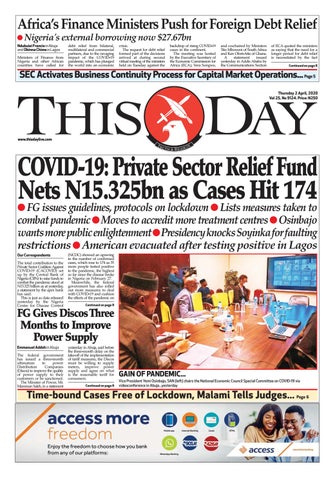
GAIN OF PANDEMIC... Vice President Yemi Osinbajo, SAN (left) chairs the National Economic Council Special Committee on COVID-19 via videoconference in Abuja...yesterday
Time-bound Cases Free of Lockdown, Malami Tells Judges...
Page 6
2
THURSDAY APRIL 2, 2020 •T H I S D AY
THURSDAY APRIL 2, 2020 • T H I S D AY
3
4
THURSDAY APRIL 2, 2020 •T H I S D AY
5
THURSDAY, ͺ˜ ͺͺ ˾ T H I S D AY
NEWS
Group News Editor Ejiofor Alike Email Ejiofor.Alike@thisdaylive.com, 08066066268
SEC Activates Business Continuity Process for Capital Market Operations Ndubuisi Francis in Abuja In compliance with the federal government’s directives on the restriction of movements in Lagos and Ogun States as well as the
Federal Capital Territory (FCT), the Securities and Exchange Commission (SEC) has activated its business continuity process. According to a circular dated March 31, 2020, and
FG Disburses Cash Palliatives to 5,000 FCT Households Olawale Ajimotokan in Abuja The Ministry of Humanitarian Affairs, Disaster Management and Social Development has commenced the disbursement of conditional cash transfer to the vulnerable households in the Federal Capital Territory (FCT). This year’s exercise was kicked off in Kwali Area Council with 5,000 registered beneficiaries. The Minister of Humanitarian Affairs, Ms. Sadiya Farouq, supervised the disbursement of four months’ cash transfer to the vulnerable persons. Farouq said 190 households in a ward in Kwali were paid N20, 000 each in line with President Muhammadu Buhari’s directive of immediate payment to the vulnerable to mitigate the effect of COVID-19 on the poor people in the country. “As we know, the CCT is for poor and vulnerable households in the country. It is going to happen all over the country, but we are starting with FCT,
Lagos, and Ogun. These are the frontline states. Other states will follow. With the current pandemic and circumstances on the ground, this amount will go a long way to support the families in their daily lives,” Farouq added. She stated that about 5,000 households in each of the six Area Councils would receive the stipends. Over one million vulnerable people from 35 states are enrolled in the Social Investment Programme. The National Co-ordinator for Conditional Cash Transfer Programme, Dr. Temitope Sinkaiye, said the beneficiaries were identified by their communities. “The community members determine what poverty is in their village and who falls within that definition in their perception. We now collect these names from the community,” Sinkaiye said. She explained that although the beneficiaries were to be paid N5,000 every two months, the payment was combined through the mobile bank because of the logistics of getting the money to them.
released by the SEC, staff members of the commission are working remotely while all its electronic channels remain open to provide the necessary support to capital market stakeholders. The commission noted that it was providing additional guidance to the capital market in the light of the COVID-19 pandemic and in furtherance to its circular of March 24, 2020. The circular said: “All public companies are required to continue to make material disclosures to investors on the impact of COVID-19 pandemic on their business operations.
“They should also continue to disclose the trend and outlook for the company and updates on implementation of business continuity plans. Public companies are to publish these disclosures on their websites and on other relevant media. “Public companies who plan to conduct AGMs are required to ensure that the conduct of the meetings comply with the provisions of the Companies and Allied Matters Act, the Investments and Securities Act, the SEC Rules and Regulations, relevant government and health circulars and
guidelines issued in this regard." The circular noted that debt issuers were also expected to continue to engage trustees to ensure that disclosures are provided, adding that trustees are required to provide updates to the commission. SEC urged all capital market operators "to continue to monitor the real and potential risks COVID-19 may have on their business operations and the discharge of services to investors and clients." It stated that for further guidance, the commission could be contacted through
the dedicated email addresses for filing CMOs' returns. The SEC also urged all issuers and trustees who may require further guidance to contact it, stating that it will continue to engage and collaborate with all stakeholders to ensure that the capital market remains resilient. “While we work to maintain market stability, we encourage everyone to continue to comply with all directives issued by the federal government and relevant agencies during this challenging period,” the SEC added.
KEEPING THE DISTANCE... Edo State medical personnel during a training session on COVID-19 in Benin City…yesterday
Military Helicopter WTO, WHO, FAO Seek Protection for Food Supply Chain Gunship Decimates Scores of Bandits in Niger Ndubuisi Francis in Abuja
Kingsley Nwezeh in Abuja Helicopter gunship deployed by the air component of the Armed Forces of Nigeria bombed armed bandits wrecking havoc in Kalaibu Village near Pandogari in Niger State, killing many of them. Armed bandits had recently attacked and killed a joint patrol team of security agencies killing many policemen and soldiers. The Directorate of Defence Media Operations said the attack helicopter launched air strikes at a settlement where the bandits had gathered to attack the village. "In continuation of operations aimed at flushing out armed bandits from the country, the Armed Forces of Nigeria, through the air component of Operation Gama Aiki has neutralised some bandits at
their hideout located about 10kilometres South-east of Pandogari in Niger State. "The attack was undertaken on March 31, 2020 sequel to credible human intelligence reports indicating that the bandits had assembled under a group of trees at Kalaibu Village near Pandogari", it said. The update issued by Brigadier-General Bernard Onyeuko said "a Nigerian Air Force (NAF) attack helicopter dispatched for an armed reconnaissance mission in the area spotted and engaged the bandits, neutralising some, while others managed to escape with gunshot wounds. "The Armed Forces of Nigeria, in furtherance of the objective of restoring peace and security in the North-west will sustain the offensive against the enemies of our nation until our mission is accomplished".
The World Trade Organisation (WTO), United Nations Food and Agriculture Organisation (FAO), and the World Health Organisation (WHO) have called on governments across the world to find ways to ensure that the border restrictions, occasioned by the COVID-19 pandemic, do not adversely affect the food supply chain. In a joint statement issued by the Directors General of FAO, WHO, and WTO, QU Dongyu, Tedros Adhanom Ghebreyesus, and Roberto Azevêdo, respectively, they said: “Now is the time to show solidarity, act responsibly and adhere to our common goal of enhancing food security, food safety and nutrition and improving the general welfare of people around the world." Millions of people around the world depend on international trade for their food security and livelihoods, the statement added. According to it, as
countries move to enact measures aiming to halt the accelerating COVID-19 pandemic, care must be taken to minimise potential impacts on the food supply or unintended consequences on global trade and food security. When acting to protect the health and well-being of their citizens, countries, they said, must ensure that trade-related measures do not disrupt the food supply chain. They noted that such disruptions, including hampering the movements of agricultural and food industry workers and extending border delays for food containers, result in the spoilage of perishables and increasing food waste. Food trade restrictions could also be linked to unjustified concerns on food safety. "If such a scenario were to materialise, it would disrupt the food supply chain, with particularly pronounced consequences for the most vulnerable and food-insecure populations," the statement noted.
It added that uncertainty about food availability could spark export restrictions, creating a shortage on the global market. Such reactions can alter the balance between food supply and demand, resulting in price spikes and increased price volatility. "We learned from previous crises that such measures are particularly damaging for low-income, fooddeficit countries and to the efforts of humanitarian organisations to procure food for those in desperate need. "We must prevent the repeat of such damaging measures. It is at times like this that more, not less, international cooperation becomes vital. In the midst of the COVID-19 lockdowns, every effort must be made to ensure that trade flows as freely as possible, especially to avoid food shortage. "Similarly, it is also critical that food producers and food workers at processing and retail level are protected to minimise the spread of the disease within this sector and maintain food
supply chains. "Consumers, in particular, the most vulnerable, must continue to be able to access food within their communities under strict safety requirements. "We must also ensure that information on foodrelated trade measures, levels of food production, consumption and stocks, as well as on food prices, is available to all in real-time. This reduces uncertainty and allows producers, consumers, and traders to make informed decisions. Above all, it helps contain ‘panic buying’ and the hoarding of food and other essential items," they said. According to the three global organisations, "Now is the time to show solidarity, act responsibly and adhere to our common goal of enhancing food security, food safety, and nutrition and improving the general welfare of people around the world. We must ensure that our response to COVID-19 does not unintentionally create unwarranted shortages of essential items and exacerbate hunger and malnutrition."
6
THURSDAY, ͺ˜ ͺͺ ˾ T H I S D AY
NEWS
Time-bound Cases Free of Lockdown, Malami Tells Judges Alex Enumah in Abuja The Attorney-General of the Federation and Minister of Justice, Mr. Abubakar Malami (SAN), has directed that courts should attend to
matters that are urgent, essential or time-bound even during the lockdown. The directive was communicated in a letter addressed to all Heads of Courts dated April 1, 2020
Gunmen Kill Three Persons, Injure Seven in Plateau Seriki Adinoyi in Jos Three persons have been confirmed killed and seven others severely injured in a fresh attack by gunmen suspected to be Fulani herdsmen in Ancha community, Miango District, Bassa Local Government Area of Plateau State. The Chairman-elect for Miango Youth Development Association, Mr. Nuhu Nkali, who confirmed the incident yesterday, said the gunmen also set some houses ablaze. Nkali said: “Yes, the attack on Ancha community is true. It occurred around 1:00 am on Wednesday. Unfortunately, three persons, including two men and a woman, were killed. Some people were also injured. “As I talk with you now, so many of our people are now homeless because their houses have been burnt by the assailants.” Nkali added that the latest attack could have been averted if the security operatives had responded to their calls. He said: “Our community has been under siege of the gunmen in recent times but we believe that the latest attack on our people could have been prevented because when we noticed strange and suspicious movements in the evening of Tuesday, the community made efforts to alert the security agents but nothing was done about it. “So, around 10 pm, the Fulani gunmen arrived in the community and started shooting and burning houses, an operation which lasted till 1:00 am. At the end of their operation, three of the victims
were discovered dead. “From the look of things, it is clear that they have marked out the community for attacks because it is the same village where two soldiers were killed a few days ago by the same assailants. “Two other women who had gone to sympathise with a bereaved family were also killed in a similar attack while two young men are still missing in another attack, all within a space of three weeks. “So, we don’t know what we have done to warrant this wickedness against our people without the authorities moving in quickly to protect our people and stop the gunmen from causing more havoc in our community.” The Chairman of Irigwe Development Association, Hon. Sunday Abdul, who also confirmed the attack, said the community had been under siege for some time, adding that the attackers had initially attacked a nearby village, but met stiff resistance before they moved in their large numbers to Ancha village. Abdul said: “At about 11:45, they came to Ancha. They were many that nobody could resist them. They burnt houses at random, burnt four cars and killed three people while seven others sustained various degrees of injuries.” Spokesman of the State Police Command, Mr. Ubah Ogaba, an Assistant Superintendent of Police (ASP), when contacted, confirmed the attack, saying an investigation into the killing is ongoing. “I will get back to you after making confirmation,” he stated.
conveying the COVID-19 Regulation 2020. According to a statement by his media aide, Dr. Umar Gwandu, the minister said the measure is in line with the present administration's pursuit of speedy dispensation of justice in the country.
"Speedy dispensation of justice is a cardinal principle of Justice Sector Reform of the present administration," the statement read, adding that the judiciary should ensure that “time-bound cases are treated with dispatch and accorded the required attention.”
The letter with reference: "Further to the letter Ref. No. NJC/CIR/HOC/11/631 dated March 23, 2020, by the Chief Justice of Nigeria, Hon. Justice I. T. Mohammad, directing suspension of court sittings for an initial period of two weeks at the first instance, except in matters
that are urgent, essential or time-bound according to extant laws," Malami said the directive issued by the Chief of Justice of Nigeria was in tandem with the COVID-19 Regulations 2020 made pursuant to Quarantine Act 2004 by the President Muhammadu Buhari.
GO HOME... Commander, Rapid Response Squad (RRS), Deputy Commissioner of Police Olatunji Disu (third right) telling the youth to abide by the stay-at-home order to avoid the spread of COVID-19 in Lagos…yesterday
Oyetola Urges FG to Lock Down Nigeria Yinka Kolawole in Osogbo The Governor of Osun State, Adegboyega Oyetola, yesterday called on the federal government to extend the lockdown measures to other states of the federation as the means to eliminate the spread of the COVID-19 in the country. He stated this against the background of the three new confirmed cases in the state as last Tuesday. However, THISDAY yesterday gathered that the three new cases are part of the 127 returnees from Cote d’ivoire, who have been at an isolation centre in Ejigbo. The three new cases returned positive after 24 suspected cases were tested. Speaking last Tuesday night, Oyetola said the total
lockdown of the country was necessary to avoid what he termed trans-border transfer of the virus. The governor insisted that the only way to properly safeguard entry and exit into the country and between states in the country was to announce a total lockdown of the country. Oyetola stated this while on a special programme tagged: ‘Journalists Hangout’ on Television Continental (TVC) last Tuesday evening. According to him, “The war against coronavirus must be total. We should not be concentrating on three or few states alone. We should see this as a national emergency. “I am advocating for a total lockdown so that what is happening in Lagos and Ogun States and the Federal Capital Territory
(FCT) can be extended to other states as a better way to curb the spread of the coronavirus. “About four days ago, my colleague governor in Ogun State alerted me to the fact that some Nigerians of Osun State origin were coming in from Cote d’ivoire. I thanked him for his efforts because he also provided escort for them to reach us. “We immediately received them on arrival and kept them in an isolation centre in Ejigbo. By Tuesday, out of the 24 samples that were tested, three are already positive. So you can imagine what the other outcomes will look like by the time we get the results of the remaining 103 samples. “So we should look beyond FCT, Lagos and Ogun States if we must adequately contain
the spread of the virus. I want the federal government to come to the aid of the states. As it is, most of the states do not have the facilities to combat the disease. “As we all know, most of the states are struggling to pay salaries; like us in Osun State, in spite of the fact that we are struggling to pay salaries, we have purchased seven new ventilators and set up isolation centres. So the federal government should come to our aid.” The governor appealed to Nigerians particularly the people of Osun State to adhere to the ‘stay at home’ directive put in place by the state government, saying the measure was ordered in the interest of the state and the citizens.
Presidency Knocks Soyinka for Faulting Lockdown Omololu Ogunmade in Abuja The presidency last night called the bluff of Nobel Laureate, Prof. Wole Soyinka, asking Nigerians to ignore his fictional postulations and embrace science. The presidential attack on Soyinka was provoked by the latter's criticism of the current lockdown of the Federal Capital Territory (FCT), Lagos and Ogun States by President Muhammadu Buhari as a measure to contain further spread of COVID-19. Soyinka had questioned the rationale behind the lockdown, more so that the country was not in a state of war emergency. But presidential spokesman, Malam Garba Shehu,
in a statement, believed that Soyinka lacked the professional competence to comment on a matter like the handling of the scourge of COVID-19. According to him, such matter requires scientific interventions and not a mere fiction which he believes the Nobel Laureate is only known for. Shehu, therefore, counseled Soyinka to consider writing a fiction on the pandemic when it is finally over, but admonished Nigerians to trust scientists and not authors of fiction like the Nobel Laureate. "Perhaps Wole Soyinka may write a play on the coronavirus pandemic after this emergency is over. In the meantime, we ask the people
of Nigeria to trust the words of our doctors and scientists - and not fiction writers - at this time of national crisis,’’ Shehu said. Furthermore, Shehu said Soyinka was not a professor of medical sciences and that all he knew was writing literary books and hence, his opinions on the matter lacked scientific backing. Shehu argued that it was a common belief that an effective way of containing the scourge across the globe was the lockdown as he proceeded to cite opinions of medical scientists to buttress his submission simultaneously countering Soyinka's view that the situation was not a war emergency. He said: "Yesterday, the
esteemed Nobel Laureate, Prof. Wole Soyinka, made comments on the legal status and description of 14-day lockdown announced by President Muhammadu Buhari. “Professor Soyinka is not a medical professor. His qualifications are in English Literature, and his prizes are for writing books and plays for theatres. He is of course entitled to his opinions – but that is exactly all they are: semantics, not science. They cannot – and should not - therefore be judged as professional expertise in this matter in any shape or form. “Across the world – from parts of the United States and China to countries including the United Kingdom and
France, government-mandated lockdowns are in place to slow and defeat the spread of coronavirus. All have been declared, and all have been made necessary, based on medical and scientific evidence. The guidance of the Nigerian Government’s medical specialists is to advise the same. “Professor Soyinka has also declared, doubtless based on his specialism as a playwright, that: 'We are not in a war emergency.' “Eminent scientists say otherwise: “Dr. Richard Hatchett, Head of the International Coalition for Epidemic Preparedness Innovations (and former Director of the US Biomedical Advanced
Research and Development Authority) has said, ‘War is an appropriate analogy.’ “Professor Anthony Fauci, Director of the United States National Institute of Allergy and Infectious Diseases and member of the White House Coronavirus Task Force has said of the battle against the pandemic: ‘It’s almost like the fog of war.’ “As for the legality of the lockdown, the Government of Nigeria’s primary duty in law and action is the defence of the people of Nigeria. We face a global pandemic. Nigeria is now affected. The scientific and medical guidance the world over is clear: the way to defeat the virus is to halt its spread through the limitation of movement of people."
THURSDAY APRIL 2, 2020 • T H I S D AY
7
8
THURSDAY, ͺ˜ ͺͺ ˾ T H I S D AY
PAGE EIGHT COVID-19: PRIVATE SECTOR RELIEF FUND NETS N15.325BN AS CASES HIT 174 the populace even as it issued the implementation guidelines for the lockdown of the Federal Capital Territory (FCT) as well as Lagos and Ogun States. Following President Muhammadu Buhari's approval, the federal government will also release 70,000 metric tonnes of grains from the national reserves for distribution to the poor and the vulnerable to cushion the effect of the lockdown on the people. The list of contributors to the COVID-19 fund, according to a statement issued on behalf of the coalition by the Director, Corporate Communications, CBN, Mr. Isaac Okorafor, showed that CACOVID, which was inaugurated last Thursday, has so far attracted contributions into the relief fund from 37 individuals and private organisations. The objective of CACOVID is to mobilise private sector thought leadership and private sector resources; increase general public awareness, education, and buy-in; and provide direct support to private and public healthcare ability to respond to the crisis as well as support the federal government's efforts. A breakdown of the contributions showed that the CBN and President, Dangote Group, Alhaji Aliko Dangote donated N2 billion each into the fund while Alhaji Abdul Samad Rabiu (Bua Sugar Refinery); Mr. Segun Agbaje (GTBank); Mr. Tony
Elumelu (United Bank for Africa); Chief Oba Otudeko (First Bank); Chief Jim Ovia (Zenith Bank); Mr. Herbert Wigwe (Access Bank); and Mr. Femi Otedola of Amperion Power Distribution, donated N1 billion each. Other donors included Pacific Holding Ltd, Union Bank Plc, Sterling Bank Plc, Standard Chartered Bank, Stanbic IBTC, Citi Bank Nigeria Ltd, FCMB, Fidelity Bank, Ecobank Nigeria, African Steel Mills and Multichoice Nigeria Limited. The statement listed other contributors to include FSDH Merchant Bank, FBN Merchant Bank, Rand Merchant Bank, Coronation Merchant Bank, Sun Trust Bank, Providus Bank, Wema Bank, Unity Bank, Heritage Bank, Nova Merchant Bank, Polaris Bank, and Keystone Bank. Also, Globus Bank, Titan Trust Bank, Takagro Chemicals Ltd, Ahmadu Mahmoud, and Handy Capital Ltd made up the list of those that have so far made contributions into the CACOVID relief fund domiciled at the CBN. Okorafor noted that the coalition thanked the donors for hearkening to the clarion call championed by the CBN and the private sector. He, however, urged more Nigerians and corporate bodies to key into the coalition with a view to supporting the fight against the pandemic, stressing that Nigeria could overcome the scourge with support from all.
FG Issues Guidelines, Protocols on Lockdown The guidance for the lockdown, which was presented by the National Coordinator on COVID-19 Control, Mr. Sani Aliyu, at the Presidential Task Force on COVID-19 press briefing yesterday in Abuja, was broken into two sections. It contains measures on how COVID-19 can be controlled in the FCT and two other states where the federal government has imposed restrictions on movement for 14- days. It stated that for the period of the lockdown, all borders linking Lagos and Ogun and FCT to the rest of the country must be shut, except for the transportation of persons on essential duties, food, fuel, manufactured goods or donated relief items. It prohibited the mass gathering of people, except for funeral services as guided by infection prevention and control regulations, for which social distancing rules apply and crowds are limited to not more than 20 persons. It also listed the essential services and businesses that are exempted from the lockdown. They include medical, retail, food and drink, logistics and transportation, hotel accommodation, financial institutions, places
of worship, agriculture, aviation, manufacturing and communication. Others are legal and security services and diplomatic mission, international development partners and honorary consulates. The guidance stipulates that the staff members of supermarkets and food stores are to be screened for high temperature. Those found to have a body temperature above 38oC should be denied entry and advised to immediately seek medical attention. According to the protocols, the opening hours for stores in Lagos, Ogun, and FCT is now between 10 am and 4 pm daily for customers while for markets only, shops and stalls selling food and groceries shall be allowed to open to customers between 10 am to 2 pm every 48 hours or less frequently. Some of the government agencies exempted from the lockdown include the Presidency, Department of State Services, CBN, Ministry of Agriculture, National Grain Reserves, Ministry of Aviation, Nigeria Customs Service, Ministry of Humanitarian Affairs, Disaster Management and Social Development, National Agency for Prohibition of Trafficking in Persons, among others.
FG Approves Release of 70,000mt of Grains
The federal government is soon to start the distribution of grains from the national reserves to the needy following Buhari's approval for the release of 70,000 metric tonnes of grains from the reserves. Secretary to the Government of the Federation (SGF), Mr. Boss Mustapha, said the first tranche of 6,000 metric tonnes would go to Lagos, Ogun, and FCT while the remaining will go the other frontline states in the fight against the contagion. “Mr. President has graciously approved the release of 70,000 metric tonnes of grains from the National Reserves for distribution to the poor, the vulnerable and those whose livelihood could be affected by this lock-up. The first tranche of about 6,000 MT will go to Lagos, Ogun, and FCT. The remaining will go to the other frontline states in the fight against COVID-19,” Mustapha, who is also the Chairman of PTF on COVID-19, said. He added that in the continuing effort to ensure that very minimal destruction is inflicted on upstream oil and gas production, the president has also approved limited operations for operating companies, services, and logistics firms in the upstream services to ensure a regular supply of gas and export for domestic need. The SGF explained that the president has approved exemption of essential staff of
the seaport and other activities in the seaports of Port Harcourt.
FG Lists Measures to Combat Pandemic Nigeria yesterday recorded 35 new cases of the pandemic, bringing the total number of its confirmed cases to 174. The NCDC, in a breakdown of the new cases said Lagos and Osun states recorded nine incidences each; FCT, seven; Akwa Ibom, five; Edo, two; while Ekiti, Kaduna, and Bauchi recorded one case each. Of the 174 cases, 163 are currently being managed; nine have been discharged while two have died. A state-by-state analysis of the figure showed Lagos currently has 91 cases; FCT, 35; Osun, 14; Oyo, eight; Akwa Ibom, five; Ogun, Edo and Kaduna four each; Bauchi, three; Enugu and Ekiti have two each, while Rivers and Benue have one each. However, the presidency has listed about 50 measures taken by the Buhari administration to combat the pandemic. Presidential spokesman, Mr. Femi Adesina, said the precautionary measures were carried out by federal government agencies and experts “under the leadership of President Muhammadu Buhari.” Continued on page 12
FG GIVES DISCOS THREE MONTHS TO IMPROVE POWER SUPPLY However, power Generation Companies (Gencos) have blamed the epileptic electricity supply on the federal government for its inability to guarantee adequate gas supply to generate electricity. The minister said there would only be a rise in tariff when the Discos had committed themselves to play their roles effectively, rather than waiting for Nigerians to pay more for electricity. “Tariffs will only be raised as the Distribution Companies (Discos) improve the quality of supply, meter consumers, and agree with consumers on rates. Discos that fail to improve will be sanctioned,” he said. Mamman added that the ministry of power remained supportive of a “servicereflective” tariff system, which he said would be more equitable and would encourage investment in the sector. He said: “The ministry will work with NERC to ensure that improvements happen in
the entire Discos network and estimated billing is capped per NERC Order 197/2020. This will eliminate arbitrary billing that Nigerians have raised issues with. “We are also implementing other key emergency measures to support the NESI (Nigerian Electricity Supply Industry). We are working with the CBN to ensure payments to the generators and gas suppliers through the Payment Assurance Facility (PAF) are expedited to support power supply. “TCN is also creating emergency measures to ensure staff will be available to monitor the grid and perform technical interventions. “These changes and emergency measures will have an impact on government finances. The Power Sector Recovery (PSRP) Financing Plan is being updated to reflect the changes. The financing plan will help support ongoing discussions with the World Bank on financial support for the sector and the transition
away from tariff support as government optimises its resources,” Mamman added. He explained that the ministry would continue to implement key infrastructure programmes such as the Siemens/Presidential Power Initiative (PPI), continue the transmission rehabilitation and expansion programme in partnership with the World Bank, African Development Bank (AfDB) and other key development partners. “To support the underserved and citizens without access in this difficult time, the ministry will accelerate programmes with the Rural Electrification Agency (REA) focusing on solar home systems and solar mini-grids that impact the poor. These programmes continue to be supported by the World Bank, African Development Bank, USAID, DFID, and other key development partners. “The ministry is also in discussions with the central bank to provide financing to accelerate
solar off-grid programmes with the REA. We will engage with key NESI players in this difficult time to ensure sustainability of supply,” he noted The Nigerian Electricity Regulatory Commission (NERC) has also urged operators in the industry to ensure quick resolution of customers' complaints during the lockdown in parts of the country. “We have been monitoring the rampaging effects of the COVID -19 pandemic in Nigeria and the world at large. Considering the cardinal role of electric power in sustaining the wellbeing of any nation and particularly in powering critical infrastructure, the commission is directing all operators in the electricity industry to ensure continuity of service during this difficult period. “All operators shall continue to observe instructions and guidance issued by the federal government and the Nigeria Centre for Disease Control
towards containing the spread of COVID-19. The Nigerian Electric Supply Industry has been directed to immediately activate its Business Continuity Plan,” NERC said in a statement by its Chairman, Prof. James Momoh.
“The ministers welcomed the use of technology such as mobile phones to support awarenessraising, identify communities in need and create accountability and governance mechanisms around the use of the stimulus. "They asked ECA to work with the telecommunications company to design a system to support these objectives,” the statement added.
are owed multilateral institutions. These include the World Bank Group, comprising the International Development Association (IDA) and the International Bank for Reconstruction and Development (IBRD) $9,692.32 and $409.51 million respectively. Other multilateral institutions owed are the African Development Bank Group (AfDB) with a total debt of $2,558.55. Bilateral debts, which totaled $3,847.41 billion during the period under review included those owed the Exim Bank of China--$3.175.12 billion; AFD of France--$361.75 million; JICAN (Japan)--$76.13 million, and Exim Bank of India--$32.14 million as well as Germany's KFW--$202.27 million. Commercial debt, which include Eurobonds and Diaspora bond, accounted for $11,168.35 billion of Nigeria's total external debt stock. While debt from Eurobonds stood at $10,868.35 billion during the period, Diaspora bond accounted for $300 million. Nigeria's total public debt stood at N26.215 trillion as at September 2019.
Govt Must Resolve Gas Challenges, Gencos Insist Also yesterday, the Gencos said for the country to attain a stable supply of electricity, the federal government must sort out the incessant gas supply issues in the sector. The Gencos stated that with thermal power accounting for 80 per cent of Nigeria’s power generation and with expenses on gas taking about 60 per cent of all wholesale electricity tariffs in the country, the matter must be resolved for Nigerians to enjoy a stable power supply. Executive Secretary of the Association of Power Generation
AFRICA’S FINANCE MINISTERS PUSH FOR FOREIGN DEBT RELIEF that the global economy has entered a period of synchronized slow down, with recovery only expected after about 24 to 36 months. “Development partners should consider debt relief and forbearance of interest payments over a two to three-year period for all African countries, lowincome countries (LICs) and middle-income countries (MICs) alike,” they stated. The ministers also called for the support of multilateral and bilateral financial institutions such as the International Monetary Fund (IMF), the World Bank Group, and the European Union, to ensure fiscal space required by African countries to deal with the COVID-19 crisis. The call for debt relief, they added, should be for all of African nations and should be undertaken in a coordinated and collaborative way. The ministers called for a special purpose vehicle to be created to deal with all sovereign debt obligations. “Substantial drops in revenue from commodity price drops coupled with increasing costs of imports are putting pressure on both inflation and the exchange
rate. “Countries shared their experiences and also discussed opportunities for mutual support. While acknowledging the commendable policy measures taken by governments, the ministers underscored that Africa’s economy is facing a deep and synchronized slow down and could take up to three years to turn the corner,” the statement added. The ministers stressed the need to take “all possible actions to slow down and bring the spread of COVID-19 under control in the short term but acknowledged this is an uphill battle. “The immediate focus must remain on the health and humanitarian front. There is a need to continue the awarenessraising, testing, social distancing. Many ministers joined the meetings with masks,” the statement said. The ministers acknowledged the importance of the private sector in job creation and the recovery efforts, even as they called on development finance institutions (DFIs) to support the private sector in this difficult time.
“In addition, since Africa is a net importer of pharmaceutical products, enabling local continental production could serve to protect some jobs and guarantee the supply of essential medicines during the crisis. Over 54 countries have banned exports of pharmaceutical products. Ministers called for an end to these procedures. “Ministers called for joint protocols on border closures to allow for trade and humanitarian corridors. There is a need for liquidity facilities, refinancing and guarantee facilities to support the private sector. “The ministers discussed the enormous losses being incurred in the airline and hospitality industry. They called for the protection and preservation of the African airline, logistics tourism industry, including by advocating for a stay on interest, lease, and debt payments. “This is an important jobcreating sector for millions of Africans and must be protected. The ministers agreed to set up a meeting for countries affected by transport and tourism losses due to the pandemic, in order to better plan on policies to combat the losses.
Nigeria's External Borrowing Stock Now $27.67bn Nigeria's external debt stock rallied to $27,676.14 billion as at December 31, 2019, according to data obtained from the Debt Management Office (DMO). This indicated a growth of $734.64 million over the $26,941.50 billion posted as at September 30, 2019. It also emerged that more than N254 billion was expended in servicing domestic debt over a three-month period – October to December 2019. A breakdown of the nation's foreign debt for the review period shows that out of the over $27 billion debt, $12,660.38
Companies (APGC), the umbrella body of the Gencos, Mrs. Joy Ogaji, in a statement in Abuja, noted that the Gencos were ready to partner the government and stakeholders to evolve strategies that will fast-track the quest for adequate and stable electricity supply in Nigeria. “The Gencos reiterate their commitment to improving power generation from its thermal and renewable (hydropower plants) sources across the country,” it said, adding: “There is, however, a shortage of gas supply for thermal generation companies. Thermal power from gas and steam turbines accounts for about 80 per cent of Nigeria’s power generation. Gas unavailability greatly hinders power generation in thermal power plants.” It complained that gas suppliers demanded upfront payment (pre-payment) before they made gas available and that the Gencos could not afford to meet this request given the liquidity issues in the sector. It added that the Gencos were willing to invest to increase the capacity of power plants and provide investments to cater for maintenance and repairs.
TOP GAINERS NGN NGN % MTNN 8.40 98.40 9.3 INTERBREW 0.45 5.35 9.1 LIVESTOCK 0.05 0.64 8.4 CADBURY 0.30 7.10 4.4 NAHCO 0.10 2.60 4.0 TOP LOSERS NGN % UNILEVER 1.10 9.90 10 DANGCEM 12.90 116.80 9.9 GUINNESS 2.50 22.70 9.9 FLOURMILLS 2.10 19.15 9.8 ETI 0.40 4.05 8.9 HPE Nestle Nig Plc ₦765.00 Volume: 154.550 million shares Value: N1.767 billion Deals: 3,415 As at yesterday 1/04/2020 See details on Page 37
9
THURSDAY APRIL 2, 2020 ˾ T H I S D AY
NEWS
Gbajabiamila Meets NERC, Ministers, Others over Poor Power Supply Adaora Orizu in Abuja Following the renewed clamour for improved power supply as a result of the stay-athome order by the federal government, the Speaker of the House of Representatives, Hon. Femi Gbajabiamila, has met with the Minister of Power, Mr. Sale Mamman and officials of the Nigerian Electricity Regulatory Commission (NERC). The meeting which held yesterday, sought to address some of the issues regarding electricity, as well as a viral video by Nollywood actress, Ada Ameh. In the video, Ameh lamented over the poor electricity supply to Nigerians during the ongoing lockdown in major parts of the country. While giving his opening
remark, Gbajabiamila expressed dismay over the barrage of calls and messages from many Nigerians through his social media account, reacting to the protest video and therefore, called for prompt action. “It has become imperative that I urgently call for this meeting to find a solution to the poor supply of electricity during this lockdown period. If we ask people to stay at home to prevent the spread of the coronavirus, at least we have to make their homes comfortable for them to stay. “The complaints have just been too much in the last 24 hours. There are people also in the hospital now without electricity; we need to brainstorm over an urgent solution,” he said. On his part, the Minister of Power, Mamman, highlighted
the challenges encountered by power generating companies (Gencos) and the possible intervention of the leadership of the House of Representatives. “We are aware of the challenges faced by Nigerians, so we have started talking to GENCOs because they have been complaining that Discos are not paying and only about 20% of their dues are remitted. “So, the Gencos are facing technical and revenue shortfall.
Consequently, they can’t as well meet their financial obligations to gas companies. The Discos also pay less of their generated revenue to GENCOs, because they complain about power theft by consumers, high technical costs, etc. “The sum of N130 billion is what the government gives GENCOs to augment the shortfall of payments not fulfilled by Discos. We still have about N1.2 trillion payment
shortfall in all. I have been begging the gas suppliers to please, in the interest of Nigerians, release gas to the GENCOs. The shortfalls are accruals from the problem of estimated billing, non-payment of bills by estimated customers, etc. “What the NASS can do is to plead with CBN to help with funds to enable the Federal Government to augment the revenue shortfall to enable
government pay gas companies and thereafter bring all the critical stakeholders to a table,”, the power minister said. NERC’s Commissioner in charge of Legal, Enforcement and Compliance, Mr. Dafe Akpaneye, assured the Speaker and the leadership of the House that the commission is committing the Discos to a new guideline that shows empathy with Nigerians during this COVID-19 lockdown.
PGF DG Accuses Falana, Adegboruwa of Rigid Application of Law Adedayo Akinwale in Abuja The Director General of Progressive Governors Forum (PGF), Dr. Salihu Lukman, has said that those criticising the current lockdown of Abuja, Lagos State and Ogun State by the federal government, including Nobel Laureate, Prof. Wole Soyinka, Mr. Ebùn Adegborunwa (SAN), Mr. Femi Falana (SAN) should know that containing the spread of the virus is not about rigid applications of knowledge and laws. The director-general in a statement issued yesterday said that the current debate around legality are needless, adding that what the COVID-19 emergency timeline dictates is about innovative application of knowledge and laws. According to him, “to miss the reality of this, may mean being reckless”. “It would appear many of us,
including very experienced elder statesmen such as our Nobel Laureate, Prof. Wole Soyinka, are still operating in the old activist timelines of being in opposition to government. COVID-19 doesn’t allow us the luxury of government vs citizens dichotomy. Lukman said that all the energy being expended to question the legality of decisions of government to lock down these three cities with the highest potential to spread the virus to every part of the country might only serve to distract the attention of government from the critical issue of ensuring effective response to contain the spread of the virus. He added that rather than asking the question whether locking down Abuja, Lagos and Ogun states is sufficient to contain the spread of the virus, they are seeking to undermine the government.
Ikeja Electric Suspends Disconnection of Customers Ikeja Electric Plc, has announced that indebted customers within its franchise network will not be disconnected during the two-week stay-at-home period enforced by the government to curb the spread of COVID-19. The company said in a statement yesterday that the decision to suspend all disconnection activities was taken to allow all its customers enjoy electricity supply during the lockdown period, while giving consideration to those who cannot afford to pay their March 2020 bills due to the closure. Acting Chief Executive Officer of the company, Folake Soetan, said in the statement that, “at Ikeja Electric, we recognise the fact that electricity supply is critical to our ability to stay safe, clean and indoors. “Therefore, we have also taken a decision to suspend all
disconnection activities of nonpaying customers for a period of two weeks starting today. “This is to ensure that customers who cannot afford to pay their March bills due to the closure continue to enjoy supply until the stay at home order is lifted. Customers who also wish to pay their bills can also do so using any of our designated online payment platforms. Our prepaid customers can buy energy online using any of your preferred online banking or merchant platforms. You can also visit our website to purchase vending units.” She disclosed that the company has put measures in place to ensure that engineers and technicians are available to clear all forced and unforced outages, while also continuing with the preventive maintenance programmes.
GIVING BACK TO THE SOCIETY...
L-R: Lagos State Governor, Mr. Babajide Sanwo-Olu; Managing Director/CEO, GTBank, Mr. Segun Agbaje; and Lagos State Commissioner for Health, Prof. Akin Abayomi, during the handover of the 110-bed isolation centre at Onikan by GTBank to Lagos State Government… ETOP UKUTT recently
Akure Explosion: I Didn’t Know I Was Carrying Explosives, Says Driver James Sowole in Akure The driver of the explosive-laden truck that exploded last Saturday at Eleyewo community in Akure North Local Government Area of Ondo State, Isiaka Yinusa, has stated that he did not know he was carrying explosives. The driver, who was still recuperating from the surgery he underwent to remove shrapnel from his stomach, said he never knew when and how he got
to hospital. Speaking in an interview on the state television, Yinusa said his boss contacted him to move some items from a stranded truck at Osu axis along Ife-Ibadan expressway. Yinusa said they loaded the consignment and was to deliver them to a company in Auchi, headquarters of Estako West Local Government Area in Edo State. The drive said there was a
police escort team and a staff of the company where the explosives were to be delivered. He stated that when they got to the Shasha market in Akure, the vehicle developed fault, so they decided to pass the night there. According to Yinusa, who spoke in Yoruba language, “I was already sleeping inside the truck around some minutes to midnight when one of the police escort told him they should
urgently leave the area because of the population in the area as smoke was emitting from the truck. “So we quickly moved. The policeman who led the team said we should move ahead. As we were moving, the policemen in the escort started signaling on me to stop. As we got down, I saw fire coming out of the vehicle. We brought out fire extinguisher. While other vehicles parked.
Worshippers Attack Task Force in Lagos Ogba residents violate lockdown directive Rebecca Ejifoma and Ayodeji Ake The Lagos State COVID-19 Taskforce was yesterday attacked by worshippers who were observing their Solatul ishal in a large congregation in Agege Central Mosque contrary to government’s directive for a lockdown of the state as part of measures to halt the spread of COVID-19 in Nigeria. This is coming as some residents of Ogba in Lagos State have defied the mandatory lockdown imposed on the state by President Muhammadu Buhari to curtail the spread of COVID-19. The taskforce, which comprised of the Lagos State Environmental
Protection Agency (LASEPA), Lagos Safety Commission, and the Rapid Respond Squad, was inaugurated to enforce the executive orders of the federal government towards controlling the spread of COVID-19. However, a drama was said to have ensued at the sight of government officials as the youths were said to have attacked the officials. The General Manager, LASEPA, Dolapo Fasawe said: “The crowd numbering about 300 rushed out of the mosque, chanting Allah Akbar and started throwing stones and hitting the vehicles. All moves to talk to the imam failed as the youths were unabated. The police were able
to curtail the atmosphere and ensure safety of the team.” She condemned the attack and described it as barbaric and uncalled for. “Our people are out to protect the lives of the residents of the state and yet were attacked for doing their jobs. The state will not hesitate to sanction violators to serve as deterrent to others”. On his own part, the Director General of Lagos State Safety Commission, Mr. Lanre Mojola said the leadership of the two prominent religions have been sensitised and carried along in the fight against the pandemic. “We won’t relent. We will continue to appeal to our people to heed to advice. Prayers can be
observed at home. Businesses can be resuscitated but this deadly virus is dangerous if not well managed and timely controlled.” Meanwhile, some residents of Ogba in Lagos State have defied the mandatory lockdown imposed on the state. THISDAY sighted pedestrians loitering the streets of Ogba, while cars, though scanty, moved uninterrupted. While law enforcement officers in their mounted duty posts challenged pedestrians for violating curfew , most of the pedestrians pleaded they were heading to the hospital on a visit to their relatives on admission, while some pleaded they were haunting for food.
10
THURSDAY APRIL 2, 2020 ˾ T H I S D AY
NEWS
Makinde: Why We Can’t Declare Lockdown Now Oyo State Governor, Seyi Makinde, has explained that a total lockdown of the state has no benefit for now in spite of the rising cases of confirmed coronavirus dubbed COVID-19 in the state. Makinde gave the explanation while participating in a Fresh FM programme in Ibadan. The governor said he opted for curfew as a form of partial lockdown, which will still allow millions of people who earn daily income to go about their normal businesses while observing World Health Organisation (WHO) precautions on COVID-19. Makinde said: “when we spoke last Saturday, everything that can be done to prevent the spread of COVID-19 in Oyo State, I said, were on the table. We will continue to assess the
situation and take additional measures where necessary. “But remember also that my own background is engineering and I kept saying to people that as an engineer, you take decisions that are based on logic and fact. It’s an uncharted territory. We kept on interacting with the experts to find out what are the facts emerging. “Yes, Lagos can be on lockdown, Ogun can be on lockdown, Oyo State, yes, people have been saying have a total lockdown and then I have been asking them questions. What will be the benefits here? Are there alternative courses of action for us to take? If you ask people not to come out, you lock down the market places, there are people who what they sell today – the profit from today’s activities is what they will eat tomorrow.
JAMB Donates Ventilators to Abuja Hospitals Kuni Tyessi in Abuja In its efforts to help fight the spread of COVID-19, the Joint Admissions and Matriculation Board (JAMB) has donated two ventilators to the University of Abuja Teaching Hospital in Gwagwalada and one to the principal hospital in the Board’s host community, the Bwari General Hospital, in preparation for any eventuality. In a statement signed by the Board’s spokesperson, Dr. Fabian Benjamin, JAMB decision was borne out of the desire to plan in line with the federal government’s determination to ensure that no Nigerian succumbed to the virus. He said the donation of the ventilators which cost millions of naira is to strategically place the hospitals in good stead to give necessary treatment to COVID-19 patients whether in Bwari or any other part of Abuja. “These are indeed difficult
times for all Nigerians as we collectively battle to contain the spread of COVID-19. It is in the light of this that JAMB is urging all prospective tertiary institutions intakes, students, parents and indeed the entire country to support the government by abiding by all instructions aimed at fighting the spread of the pandemic. “Furthermore, the Board appreciates the support and donations from corporate bodies and individuals towards complementing government’s efforts aimed at containing the spread of the pandemic as well as treating those already infected with the virus. “However, this gesture was in addition to the several other interventions aimed at aiding the fight against the virus. “JAMB will continue to support the fight against the pandemic within its limited means and by so doing, protect our teeming candidates who are the hopes of the future,” he said.
There are plenty people like that within our environment. So, are there alternatives available to us?
Can we do selective lockdowns? That’s why I imposed the curfew, to say limit interactions.
“I think, everything is on the table but it has to follow a logical pattern and it will need
the input of experts. We are not just going to lockdown because everyone is locking down”.
CORPORATE SOCIAL RESPONSIBILITY...
Edo State Deputy Governor and Chairman, Edo State Response Committee on COVID-19, Hon. Philip Shaibu (left), receiving protective kits from representatives of Seplat Petroleum Development Company, Nigerian Petroleum Development Company Limited (NPDC) and Esehi Pharmaceutical Industries, at the Government House, Benin City…yesterday
Organised Labour Rejects 25% Salary Cut in Nasarawa LGs Igbawase Ukumba in Lafia Organised Labour in Nasarawa State yesterday rejected plans by local government area chairmen of the state to cut down their monthly salaries by 25 percent. State Chairman of the Nigeria Labour Congress (NLC), Yusuf Sarki Iyah, made the position of the Organised Labour known at a press briefing in Lafia, the state capital.
According to him, “There is an orchestrated plan by LGAs chairmen in the state to pay March salaries to local government workers on percentages. “Consequently, the Organised Labour met with the Joint Local Government Union, and at the meeting expressed dissatisfaction with plans by the state Ministry for Local Government and Chieftaincy Affairs, LGA chairmen and overseers of Development Areas
to pay only 75 percent of salaries to local government workers.” Iya, who described the plans as discrimination in payment of wages, faulted it because workers on the state government payroll were being paid100 percent salaries for the month of March. He said: “We observed the plans as total departure from the vision and mission of the state governor who had mentioned in different forums that the era
of percentage payment is over in Nasarawa State. “We unanimously condemned a proposed plan by local government authorities at this moment of self-isolation when workers need more funds to feed their family well.” Iyah, however, warned that any attempt to pay salaries in percentages would not be accepted by the Organised Labour, and would result in industrial action.
Rainstorm Wrecks Havoc in Ondo James Sowole in Akure Rainstorm has destroyed properties in several communities in the Akoko North East and Akoko North West Local Government Areas in Ondo State. The storm, which accom-
panied a heavy downpour that lasted for about 45 minutes, affected residential houses, churches, mosque, shops and electrical poles. The areas affected include Ugbe in Jubilee area of Ikare, Semu in Semu area and Olokun Agbaluku Arigidi Akoko.
The storm blew away the roofs of many residential houses and shops and damaged many electrical poles, thereby raising concerns that the affected communities might suffer total blackout.Some residents, who were affected by the storm, lamented that
the closure of markets would hinder their ability to carry out speedy repairs of the houses. Shop owners whose means of livelihood had been destroyed called for assistance from the government in view of the current economic situation in the country.
Rivers Assembly Members Donate One-month Salary Woman Rescued after Speaking at a press conference said: “Based on this feedback of our various constituencies, we Ernest Chinwo in Port Harcourt in Port Harcourt yesterday, the so far received from the joint resolved that one month salary of Jumping into Osun River Members of the Rivers State Speaker of the Rivers State House committee on the proactive all members of the Rivers State House of Assembly have resolved of Assembly, Hon. Ikuinyi Ibani, and preventive measures put House of Assembly be deducted in Suicide Attempt to collectively donate their one- said the members arrived at the in place by the security council by the Ministry of Finance and month salary to assist the state decision after an interface with of the state headed by the Rivers remitted to the committee set Yinka Kolawole in Osogbo
Residents of the Aregbesola area in Osogbo, Osun State capital, trooped out in their numbers to rescue a woman, who is simply identified as Kafayat Alake, after jumping into the Osun river in a suicide attempt. The woman, after jumping into the river from the bridge, was however lucky as rescuers saved her before drowning. The state government had imposed stay-at-home order on the residents of the state as part of the measures to curb the spread of the deadly COVID-19 pandemic in the state. Alake, whose strange movement on the bridge was noticed before she eventually jumped into the river, drew the attention of passersby who were in the area.
According to one of her rescuers, the woman, who dressed in blue gown, was trekking and got to the middle of the bridge, climbed the rail and jumped down. “The incident happened so fast that we could not stop her. However, when she jumped, some people called for help, prompting me to dive in and rescued her,” David Johnson explained. He added: “We were somewhere around that place when the woman jumped from the bridge. At first we thought she was either pushed or fell over by mistake. So while others were calling for help, I had to jump into the river and rescued her.” When some journalists got to the scene, the woman was sat down looking dejected by the river bank.
government fight the spread of COVID-19 in the state
the state Ministry of Health on the fight against virus. He
State Governor, bearing in mind that as responsible representatives
up to fight coronavirus in the state.
Encomiums as Fadile Retires after 33 Years at NIWA The General Manager, Corporate Affairs, of the National Inland Waterways Authority (NIWA) Mr. Tayo Fadile, would retire from public service in April after 33 years, amid encomiums for his public relations expliots in the Nigerian maritime sector.
Fadile began his public relations career at the Nigerian Shippers Council in 1986 but spent a greater part of his career at the NIWA, Lokoja, where he set up and managed its Corporate Affairs Department for 22 years. Fadile, who hailed from Kabba, Kogi State,
is a graduate in Mass Communication from the University of Lagos and the publisher of the community journal, KabbaScope. He planned to mark his exit from public service with the launching of a publication titled “33 Years of Public Relations
Practice in the Maritime Industry of Nigeria.” The book, with foreword by Cardinal John Onaiyekan, the Catholic Archbishop of Abuja, is an in-depth but breezy account of his illustrious career from its humble inception to rousing retirement in April 2020.
Mandilas Group Donates Cooling Systems to Isolation Centres Mandilas Group Limited has donated Carrier air-conditioners to the Nigeria Centre for Disease Control (NCDC). The donation was to assist in the fight against the COVID-19 in Nigeria and to make the
isolation centre in Lagos conducive for its purpose. The Mandilas team and donation were warmly received on behalf of the Director General, NCDC, by the Head Emergency Operations, Dr.
Everistus Aniaku, and the Deputy Director, Central Public Health Laboratory, NCDC, Mrs. Olajumoke Babatunde. Aniaku commended Mandilas for the gesture and applauded the team for their
proactiveness. Mandilas is a foremost brand in the Nigerian auto and cooling business terrain and the sole franchise distributor of Carrier Residential and Industrial ACs in Nigeria.
THURDAY APRIL 2, 2020 ˾ T H I S D AY
11
COVID-19 UPDATE...
COVID-19 UPDATE...
Two Egyptians, Others Convicted for Violating Restriction Order in Ekiti Victor Ogunje in Ado-Ekiti Twelve persons who violated the provisions of Ekiti State Coronavirus (Prevention of Infection) Regulations,2020 made pursuant to Section 8 of the Quarantine Act, Cap 2, LFN, 2004, were fine accordingly for violating the stay at home order by the state government. The Magistrate Court sitting in Ado-Ekiti yesterday convicted two Egyptian nationals, Mohammed Mustapha and Mahmud Ahmed, who were found guilty of the two count charges leveled against them by the state government for violating the Covid-19 order. “On the 1st day of April, 2020 at Fajuyi Area within the Ado-Ekiti Magistrate District did violate the Provision of Regulation 2 (1) (b) punishable under Regulation 12 of the
Provisions of Ekiti State Coronavirus (Prevention of Infection) Regulations, 2020 made pursuant to Section 8 of the Quarantine Act, Cap 2, LFN, 2004”. “On about the 1st day of April 2020 at Fajuyi Area within Ado-Ekiti Magistrate District, did without lawful excuse drive Rav 4, Car contrary to and punishable under Section 202 of the Criminal Code Law, Cap C16, Laws of Ekiti State, 2012”. Mohammed Mustapha and Mahmud were both fined N2,500 each on count 1 and count 2, totaling N10,000. The Chief Magistrate, Mr. Abdullamid Lawal, said both defendants are reasonably suspects and should be kept in mandatory isolation for 14 days, since one of them, Mustapha, gave evidence in court that he came into the
Lagos Seals off Jumia, Brothel for Flouting Lockdown Order NHRC condemns violation of human rights by enforcement agents Rebecca Ejifoma The Lagos State Taskforce has sealed off Jumia warehouse, a Chinese firm and a brothel for non-compliance with the 14 days lockdown order issued by President Muhammadu Buhari. This is coming as the National Human Rights Commission (NHRC) directed its staff to monitor and document all cases of human rights violations across the country for necessary actions after they received cases of human rights violations by security operatives enforcing government directives on COVID-19. The taskforce announced the sealing off of Jumia and other erring business ventures via its Twitter account, @Lasepainfo on Wednesday with images as evidence.
Accusing security forces of human rights violations, NHRC through the Executive Secretary, Tony Ojukwu, said the public should report by telephone calls or text messages or video to relevant staff of the commission and ensure that such reports include the location of the violation, date, time of such violations including a clear description of alleged violators and their victims, their gender and vulnerability. NHRC’s complaint is coming two days after the commencement of the lockdown in Lagos and Abuja. “Complaints should be reported to the commission for documentation and directed for redress to the commissioners of police of the three areas which include: CP FCT: 08033438900; CP Lagos: 08033438179, and CP Ogun: 08033438900,” Ojukwu noted.
Lalong Directs Total Closure of Plateau Borders Seriki Adinoyi in Jos The Chairman of the Plateau State COVID-19 Taskforce and the state Governor, Simon Lalong, has directed that all entry and exist routes into the state be totally closed from April 2, 2020, to complement the measures put in place to prevent the spread of COVID-19 in the state. Addressing journalists in the state, the State Secretary to the Government (SSG) and Coordinating Secretary of the taskforce, Professor Danladi Atu, said the governor gave the directive after a careful assessment of the situation, adding that “as from 6 a.m. on April 2, 2020, no one will be allowed to come in or leave the state.” Atu reaffirmed that so far, there was no recorded case of the virus in the state, even though some suspected samples
have been taken for examination, none has turned out positive. He added that the taskforce has continued to enforce regulations earlier issued, noting that so far, there was substantial compliance while the state government was working to ensure total adherence by all citizens. Expressing concern that transport operators were yet to fully comply and still carry passengers the way they previously did before the outbreak of the virus, Atu said they would be called upon for further engagement where they will be issued the last warning. “Some religious organisations that flouted the order of not gathering of more than 50 people last week have been invited by security agencies and have apologised and have been made to vow not to violate government orders again.”
state this morning April 1, 2020 from Ilorin, Kwara State. Others who received various fines for acts of violations of the restriction order of the
state government include two brothers Oladapo Oyinlade and Matthew Oyinlade, for riding on Okada, during the stay at home order. They will both pay N2,500
each on count 1 and N2,500 on count 2, totaling N10,000. The rest are Ogundana Gbenga, who was discharged but was told to produce evidence and his
identity, due to his plea that he assisted someone who wants to go and buy medicine for someone who is sick before he was caught.
FIGHTING AGAINST PANDEMIC...
L-R: Official of Waltersmith, Mr. Percy Opara; Mr. Emeka Onyeagba of Seplat Petroleum Development Company Plc; Imo State Governor, Senator Hope Uzodinma; Chairman of Imo State Committee on COVID-19 Prevention and Control, Prof. Maurice Iwu; Deputy Governor, Prof. Placid Njoku; and Imo State Commissioner for Health, Dr. Damaris Osunkwo, during the donation of medical facilities to the state by Seplat and Waltersmith at the Government House, Owerri...yesterday
MultiChoice Nigeria Announces N1.2bn Package to Fight Pandemic MultiChoice Nigeria has announced a number of initiatives to support the federal and Lagos governments’ efforts in ameliorating the impact of the COVID-19 outbreak in Nigeria. The contribution includes: Cash support of N200million and N50million to the federal and Lagos State governments, respectively, the donation of 10,000 certified test kits to the Nigeria Centre for Disease Control (NCDC), public service announcement on COVID-19
prevention tips in English, Pidgin, Igbo, Yoruba and Hausa languages as well as approved inventory worth over N550million highlighting the NCDC’s COVID-19 helplines and PSAs on more than 10 channels across DStv and GOtv. The company said in a statement that it will also cover the remuneration for engaged creative industry professionals whose productions have been disrupted, with a committed sum of up to N400million.
MultiChoice Nigeria said its intervention, which is in line with its values as a responsible corporate organisation and leader in the media and creative sector, is aimed at supporting the authorities in fighting the pandemic and reducing its attendant impact on Nigeria’s national economy. According to the Chairman MultiChoice Nigeria, Mr. Adewunmi Ogunsanya (SAN): “We are donating 10,000 certified test kits to
support the great work being done by the Nigeria Centre for Disease Control (NCDC) and the Federal Ministry of Health. In addition to these, we are also contributing N250 million to the Federal and Lagos State Governments’ efforts in providing adequate healthcare delivery facilities to fight Covid-19. We are doing this because we recognise the impact that the Covid-19 pandemic has on Nigerians and the economy. We hope
VSF to Provide N1bn Food, Medicines for IDPs Kasim Sumaina in Abuja As part of its contributions to the government efforts to fight COVID-19, the Victims Support Fund (VSF) has inaugurated a task force on COVID-19, and mandated it to provide palliative measures to Internally Displaced Persons (IDPs) and other vulnerable people in the country. The Chairman of the VSF, General Theophilus Danjuma
(rtd), while inaugurating the taskforce in Abuja, said the aim was to provide N1 billion worth of medical supplies, food, water and non-food items for IDPs and others who will face special challenges at this difficult time. Danjuma in a statement by the Task Force Spokesman, Abdulkadir Alkasim, which was made available to journalists yesterday, noted that they shall also work closely with all federal and state government
organs and agencies tasked with the responsibility for providing direction and leadership in the fight against COVID-19, including the Presidential Task Force on COVID-19 and all relevant ministries, departments and agencies (MDAs). He added that the Task Force would also extend support to other frontline organisations working to curtail the spread of the novel virus. The committee, he revealed
has the following as membersMrs Toyosi-Akerele Ogunsuji, Chairperson; Dr. Bulama Mali Gubio, John Gana, Mr. Sunday Oibe, Mr. Alkasim Abdulkadir, Prof. Sunday Ochoche as members. Danjuma said the intervention had become necessary in view of the global devastation of the coronavirus pandemic and the huge human challenges it poses for the country.
Ikpeazu Locks down Abia Emmanuel Ugwu in Umuahia Abia State Governor, Dr. Okezie Ikpeazu, yesterday announced a total lockdown of the state as the state government ramped up strategies to keep COVID-19 out of the state. He announced the extra
measure in a state broadcast to update citizens “on steps we have taken so far to deal with the coronavirus pandemic and measures we have put in place for containment and dealing with future eventualities.” The governor said the total lockdown, which took effect in
the midnight of last Tuesday, had become inevitable because of the increasing cases of the virus in Nigeria and the need to protect Abia people from the disease. “This imposes on us a necessity to take urgent and stringent steps to safeguard the lives of our people in the state
and prevent the pandemic from ravaging our people,” he said. Ikpeazu noted that though Abia State has presently not recorded any case of COVID-19, the state must be kept in heightened vigilance as prevention is always better than cure.
Niger Searches for COVID-19 Patient Laleye Dipo in Minna The officials Niger State Government have mounted a manhunt for an alleged COVID-19 patient who is currently on the run. The patient, who had been diagnosed positive of COVID-19, reportedly escaped from an isolation facility in Bida.
The patient, according to findings, was a driver who came to Bida from an unknown place. The COVID-19 task force team was also on the lookout for the boss of the driver and those who boarded the same vehicle with him. The Niger State Commissioner of Health and Hospital Services,
Dr. Mohammed Makun Sidi, who is also the Deputy Chairman of the state’s Covid 19 Taskforce, confirmed the story. Sidi said: “Officials of the ministry have been deployed to track down the escapee suspect and take him back to isolation centre. “We heard that he escaped
into Bida, so we are after him now. Some members of the state taskforce on COVID-19 and officials of the Ministry of health and Hospital Services are in the Bida area of the state to locate him and make sure he does what the Nigeria Centre for Decease Control has asked him to do.”
12
THURSDAY APRIL 2, 2020 ˾ T H I S D AY
COVID-19 UPDATE...
COVID-19 UPDATE...
Ondo Closes Borders Ondo State Government has ordered the closure of its borders with the neighbouring states of Ekiti, Osun, Kogi, Edo and
Elefon, which is coastal border with Ogun State. The coastal border community had in the recent past, witnessed
Ize-Iyamu Tasks Edo Govt on Poor Citizens’ Welfare A governorship aspirant of the All Progressives Congress (APC) in Edo State, Pastor Osagie Ize Iyamu, has urged the state government to immediately set up a food bank in strategic points across the state to provide food materials to the poor and rural dwellers in order to ease the expected adverse effect the restrictions implemented in the state will have on their socio-economic wellbeing. He made this call at a press briefing yesterday in Benin-city, the state capital, where he also announced that his campaign organisation has produced more hand sanitizers and informational materials on the COVID-19 for a fresh round
Kaduna State Government has temporarily relaxed the restriction of movement imposed throughout the state to check the spread of COVID-19. The state Deputy Governor, Dr. Hadiza Balarabe, who announced this in a statewide broadcast yesterday, said the curfew would be eased from 3 p.m. on Wednesday to 12 midnight on Thursday. She said the decision to relax the curfew “is to enable people to stock up foods and other essentials in their house. ‘’Subsequently, the restriction of movement will be lifted every Tuesday and Wednesday. Traders in food and other essentials will open their shops on these two days.” The deputy governor apologised for the
inconvenience the restriction of movement has caused, stressing that the decision was taken because of the extraordinary situation caused by COVID-19 pandemic. She appealed to the people of the state to ensure the observance of social distancing, avoid crowded places and wash their hands regularly. The state government had on Thursday last week imposed a 24-hour curfew to curb the spread of the coronavirus. Residents of the state had been groaning under serious difficulties as a result of shortage of food and other essential commodities following the curfew. There had been agitation by members of the public for the curfew to be relaxed.
JOHESU Rallies Health Workers against COVID-19 Onyebuchi Ezigbo in Abuja The Joint Health Sector Unions, (JOHESU) and Assembly of Healthcare Professionals (AHPA) have urged all health workers across Nigeria to support the government at all levels to curtail the spread of the novel COVID-19 pandemic. The unions commended members for their courageous efforts so far, especially those at border, emergency units and in various isolation centres for their resilience and commitment to combat the dreaded COVID-19. In a statement jointly signed by National Chairman of JOHESU, Bio Joy Josiah, and National Secretary, Mrs. Ekpebor Florence, the union said despite agitations among health workers over failed commitment and promises from the federal and state governments, health workers have stood strong in the forefront as first responders in stemming the spread of the COVID-19 pandemic According to the statement, “Our leadership greatly salutes the commitment and patriotism shown by members, and we, therefore, call for both the federal and state governments to provide the needed tools like PPEs and other necessary gadgets for the
6.00 p.m today (Thursday). He said security operatives as well as monitoring teams have been put on the alert to enforce this order as part of measures already taken to stem COVID-19 incursion into Ondo State. He said: “To His Glory, Ondo State has remained one of the states in the country
without a single confirmed case of COVID-19. This is an uncommon grace government and indeed, the people must not take for granted. “As a way of thanking God and seeking His face for this immeasurable Grace and continuous favour, Government hereby declares a three-day
period of fasting and prayers commencing from Thursday, 2nd to Saturday, 4th April for Ondo State and the country at large. “Government therefore, urges the good people of Ondo State to use this period to stand firm in prayers and remain inexorable in His praise as mankind faces this pandemic,” Ojogo said.
of distribution across the state, with focus on journalists, health workers, bus drivers and other providers of essential services exempted from the restrictions and allowed to operate skeletally. Ize-Iyamu said: “In a bid to escalate our ongoing efforts to curtail the spread of the virus at home, we have produced more hand sanitizers and sensitisation handbills for distribution to our people. “Specifically, we will donate these hand sanitizers across the state, and we shall also focus on journalists, bus drivers, health workers and other providers of essential services who, despite the movement restriction, may be required to remain mobile and operative.
Kaduna Relaxes Curfew John Shiklam in Kaduna
heavy human traffic from Lagos and Ogun states. The order to close the border, was contained in a statement signed by the Commissioner for Information and Orientation, Mr. Donald Ojogo. According to him, the order prohibits inter-state travels into the state and takes effect from
protection of members at this very trying time of our country.” While commending President Muhammadu Buhari for an instructive broadcast on COVID-19, JUHESU also demanded strong inclusion of its members in the implementation of the various economic stimulus interventions and palliatives mentioned in the speech to motivate health professionals and staff. The statement further said: “JOHESU/AHPA charge members to actively participate in all task force/committees on the virus, and urge the inclusion of members in the various COVID-19 taskforce and committees by both federal and state governments in combatting the pandemic. “We appeal to Nigerians to adhere to all instructions/ regulations, including the stay-at-home order and workfrom-home directives to guide against further spread of the virus, while strongly appealing to citizens to maintain good hygiene by washing hands with soap frequently or use appropriate alcohol-based hand sanitizers as well as the importance of strict observance of social distancing and staying safe.”
EFFECTS OF LOCKDOWN BITE HARDER...
Youths otherwise known as Awawa boys blocking the Old Lagos-Abeokuta Expressway, by Johnson Agiri Farm, demanding for free food to KOLA OLASUPO save them from the hunger they suffered by staying at home…yesterday
COVID-19: PRIVATE SECTOR RELIEF FUND NETS N15.325BN AS CASES HIT 174 Among the measures, which Adesina listed in a statement yesterday, was the setting up of the presidential task force and the lockdown of Lagos, Ogun, and Abuja. He also highlighted the release of funds to Lagos State, the epicentre of COVID-19 in Nigeria, and the support provided to the NCDC to boost its operations. Adesina restated the president’s earlier message that in combating COVID-19, “there is no such thing as an overreaction or under-reaction, (rather) it is all about the right reaction by the right agencies and trained experts.” Among the measures, which Adesina also attributed to Buhari, is the decision of the Independent National Electoral Commission (INEC) to suspend its activities and that of the Chief Justice Nigeria (CJN), Justice Ibrahim Muhammad, to shut down courts in order to curb the spread of the virus. FG Moves to Accredit More Treatment Centres Minister of Health, Dr. Osagie Ehanire, also spoke on efforts by the federal government to test more people suspected of contracting the virus. According to him, a special committee is to undertake the inspection and accreditation of more isolation and treatment centres across the states to take care of infected patients. He said a team comprising experts from NCDC, and the Federal Teaching Hospital, Irrua, headed by the Commissioner for Health of Lagos State, Prof. Akin Abayomi, will be visiting all the prepared isolation facilities in the states to accredit them after ensuring that they meet required hospital standards. He also said the Office of the National Security Adviser will be joining the accreditation team since the pandemic is now being treated as a national security issue. “All facilities, including private facilities where isolation and
treatment of coronavirus infected persons are to be conducted, will be visited for accreditation by a team, comprising experts from NCDC, Federal Teaching Hospital Irrua and headed by the Hon. Commissioner for Health of Lagos State.” Ehanire added that a team from Federal Specialist Hospital Irrua has arrived in Abuja to inspect facilities at the Gwagwalada Teaching Hospital. As part of preparedness in the Abuja metropolis, the minister said the federal government had secured facilities that could contain 1,000-bed spaces for isolation and treatment of mild to moderate cases, with capacity for further expansion, if necessary. Speaking on the allegation that the NCDC was concealing the identities of those that tested positive for the virus, especially the VIPs among them, Ehanire said it was part of the ethics of the medical practice to respect the patient’s privacy and seek consent before divulging anything about his health status. Ehanire said 12 of the new cases came from the results of the tests conducted on passengers of a bus that brought some Nigerian travelers from Ivory Coast and Togo en route to Osun State. He said a breakdown of the cases showed that 70 per cent are male and 30 per cent female. “The age range is mostly between 30 and 60 years. I must stress that both men and women of all ages can be infected,” he added. American Evacuated after Testing Positive in Lagos Meanwhile, the Lagos State Commissioner for Health has said an American who tested positive for COVID-19 had been evacuated to the United States. He made this known while giving an update on his Twitter handle yesterday. Osinbajo Wants More Public Enlightenment Vice President Yemi Osinbajo
has called for more public enlightenment and sensitisation on the seriousness of the COVID-19 pandemic. The vice president urged governments at all levels to intensify efforts so that more Nigerians would become aware of the compelling and critical dimensions of the situation. Osinbajo’s spokesman, Mr. Laolu Akande, in a statement issued yesterday, said the vice president presided over the meeting of the National Economic Council (NEC)’s Special Committee on COVID-19 anchored from the Presidential Villa, Abuja via video-conferencing. The meeting was the second for the committee tasked with coordinating the federal and state governments’ responses to the impact of the pandemic. Osinbajo harped on the importance of the assignment and the urgency required. “The federal government is already packaging further resources for a comprehensive economic response to alleviate the challenges of the pandemic, support the states and provide succor to Nigerians in a timely and effective manner. “The newly created Economic Sustainability Committee constituted by the president will also be meeting this week to start its work and respond to the situation appropriately. “The Special Committee of the National Economic Council on COVID-19 is working hard to develop additional measures to alleviate the challenges being faced by Nigerians because of the implications of the global pandemic in the country,’’ he said. Peterside Faults Intervention Policies, Seeks More Proactive Measures Meanwhile, the Founder of Stanbic IBTC Bank, Chief Atedo Peterside, has faulted the government’s intervention policy and called for more proactive measures to fight the spread of COVID-19.
Peterside who spoke yesterday as a guest speaker on the Arise TV Morning Show, the broadcast arm of THISDAY, faulted the intervention policies of the federal government to combat the spread of the virus. He said the country had no proper mechanism to track those flying in and out of Lagos and Abuja, and that the federal government had made the current threat of the virus to appear as if it was a challenge to only the people residing in Lagos and Abuja. “In the first place, the sum total of our preparation is like a bucket waiting for a tidal wave. Those who understand Coronavirus know that the ability to curtail the virus in terms of spread is likely determined by the testing capacity. Another mistake from the federal government is that up till now, I have not heard of the strategy to bring back those that bolted away for fear of being confined in a place,” Peterside stated. He applauded Buhari’s nationwide broadcast on Sunday, saying: “Because in reality when you have a strategy to confine those with the virus in a place, you should also have to be phenomenally clever and intelligence to know how to arrest those that will bolt for fear of being confined in a place. “Buhari’s plan for those affected in Abuja, Lagos, Ogun states could be acceptable, but in his speech, I noticed there were no proper safety nets for those not affected in these states and for people in other states. “You are talking about a lockdown and I considered the 200 million Nigerians and discovered that Buhari’s plan could only be perfect for about 160 million, without considering the other 40 million people that are unemployed. Again, with the intervention policy of the federal government, it is not certain if the planned distribution of relief materials will actually get to those it was intended to reach.”
THURSDAY APRIL 2, 2020 • T H I S D AY
13
14
T H I S D AY ˾ ˜ Ͱ˜ ͰͮͰͮ
COMMENT
Editor, Editorial Page PETER ISHAKA Email peter.ishaka@thisdaylive.com
IDEOLOGY WARS AND CORONAVIRUS
Coronavirus is challenging the ‘single power’ hegemony that Donald Trump preaches, writes Okello Oculi
M
ilitary victories by liberation wars in China, North Vietnam and Cuba followed anti-colonial ones in Tunisia, Algeria, Zimbabwe, Mozambique, Angola, Guinea Bissau and Cape Verde; adding to economies in territorial spaces ruled by Socialist leaders in the Soviet Union. The administration of these countries injected into global culture the notion of politics as a curative Revolution and a moral process for achieving the economic development of citizens; as well as promoting their participation in politics in order to achieve communal welfare. In contrast, American public intellectuals valued politics as a negotiated art by which ‘’interest groups’’ bargained with each other over shares of the national budget and public policies. Politicians from the Southern States, however, built into this ritual hurdle which ensured that they could veto policies which ensured that access to education, roads, health care to communities in states in the North did not apply to groups like African-Americans living in the South. In the 1960s and 1970s, the federal government used troops to protect Black students from angry racist white parents opposed to their children sharing classrooms with African-American classmates. Schools in white communities enjoyed classrooms in which the quality of teaching and teaching aides were higher. The principle that social welfare policies are paid for by local taxpayers ensures that only communities in which members have well-paid jobs collect enough taxes to employ good quality teachers and provide classroom tools for children to keep up with best learning experiences in top schools. In her autobiography: ‘’BECOMING’’, Michele Obama mentions the value of going on a trip to Paris organized by her local school. It contributed to her subsequent admission to one of America’s top universities which, in turn, guaranteed her being admitted to Yale Law School, which opened gates to employment by a top law company. In the health sector, like in education, high quality doctors and test institutions are available only to rich clients who have expensive health insurance plans. By the 1970s, the most expensive service was surgical operations. A CBS television documentary, ‘’60 MINUTES’’, reported that surgeons borrowed large loans to finance their medical education. They later conducted surgery on backs of patients who complained of sore throat because insurance companies paid the charges. More surgeries forced them to consume cocaine to work for long hours without exhaustion. Studies showed that top quality doctors opened their clinics in high income residential areas and office areas of
CORONAVIRUS IS USING SLUMS TO BRING A DEATH THAT KNOWS NO CLASS BOUNDARIES
major corporations’ in central areas of major urban areas. Urban ghettos, rural communities and small towns are served by low-wage immigrants from countries which export nurses and doctors, notably Philippines, Pakistan and African countries. In his book ‘’BLACK MAN IN WHITE COAT’’ Damon Tweedy reports that only 6 per cent of physicians and surgeons are African-Americans, while ‘’white doctors … struggle to relate to Black patients’’. He asserts that ‘’racial disparities in health and care providers persist in the United States, and may go hand in hand’’. It is into this highly fractured and unequal medical arena that Coronavirus has surged across America. By 25th March, 2020, officials in New York reported that 40 per cent of healthcare workers had become infected by the virus. Despite being a highly industrialized economy, and a leader in top quality research, the country’s health sector could not provide adequate numbers of life-saving equipment; protective clothing, and adequate numbers of doctors and nurses. President Trump boasted about constructing new hospitals for New York; providing 34,000 respiratory equipment while the state’ s governor asked for 25 million if the disease peaked. The establishment of ‘’BRICS’’- composed of Brazil, Russia, India, China and South Africa, created a group which injected into global politics the pro-people liberation wars, human development and economic sovereignty embedded in their historical roots. The trans-border spread of Coronavirus has seen them propose cooperation among countries in controlling and defeating the virus; enhancing people’s wellbeing; ‘’non-confrontations’’; ‘’non-conflict’’ and sharing material supplies to hard-pressed Italy, Spain and the United States. This is a challenge to the ‘’single power’’ hegemony and ‘’America First’’ ideology that Trump preaches. African leaders must respond with Self -Confidence anchored in ancient peasant ideology of rooting dignity in constructing economic self-reliance. Billions of funds should enable millions of unemployed youths to engage in rural-based industrial innovation for processing food crops; pharmaceutical plants, animal products and fisheries. The ‘Rat Mentality’ by Africa’s elites (of stealing from a home and inflicting Plague or Lassa fever on their human victims), is being replicated by those of them carrying Coronavirus home. In Nairobi, Johannesburg, Lagos and Kinshasa, lack of water, food, toilets, and crowded sleeping inside shacks, have shamed and scared selfish ruling elites. Coronavirus is using slums to bring a death that knows no class boundaries. Think Big.
MALLAM HAS SAID THERE’S NO CORONA Olusegun Adeniyi argues for a coordinated response to the health emergency t $POUJOVFE GSPN CBDLQBHF
O
n a positive note, it is in moments of crisis like this that leaders are made and we are seeing quite a few in our country. From the Lagos State Health Commissioner, Prof Akin Abayomi to Chikwe Ihekweazu at NCDC to young professionals like Tokini Peterside who is exploiting both her ART X network and her father’s ANAP Foundation, there are many Nigerians on the frontline of the campaign to help rid our country of coronavirus as quickly as possible. Even the two market women who spoke passionately to Premium Times in the trending video about ‘the disease of the Egyptians’ brought by rich Nigerians to disturb the poor should be commended for their insight. But for me, the real revelation of this season is Ikharo Attah, chairman of the FCT ministerial task team. From churches to mosques, the fear of Attah is now the beginning of wisdom in Abuja for those who refuse to do the right thing. Yet he is performing his task with courtesy and without the usual Nigeria ‘gra gra’. He is passing a strong message about the efficacy of civility in the conduct of public affairs. I am particularly delighted because I know Attah very well as he was a State House Correspondent when I was at the Villa in
another world. He is still on the beat for ITV Television. The story of how he got the assignment is rather interesting but it is about preparation meeting opportunity. “On 18th September last year, I complained to the FCT minister about the traffic gridlock at Nyanya. He invited me to see him the next day. I arrived at his office expecting an exclusive interview. I was shocked when, in the presence of his top personnel, he announced me as the chairman of the FCT Traffic management task force. After a while I saw the assignment as a challenge to journalism and that has been my part-time job until this COVID-19 enforcement operation came and some FCT officials insisted I play a lead role,” Attah told me yesterday. From the foregoing, there are two issues we must address to effectively tackle this pandemic which threatens our nation in so many ways. The first is to ensure a coordinated response to the health emergency. Information management is key and we are, to put it mildly, not doing well in that area. With COVID-19 creeping into major cities, deliberate steps must be taken to ensure that we don’t end up with the Ebola crisis that lasted two years in some African countries, leaving in its wake death and destruction. But the greater challenge confronting us is managing the economic fall-out of the crisis. Vice President Yemi Osinbajo was on Monday
appointed to chair an economic sustainability committee. Although we do not yet know what exactly that means, including the composition of its membership and the terms of reference, the committee has its job already cut out for it. Saudi and other low-cost producers continue to flood the market with crude oil at discounted prices of between $18 and $22 per barrel, at the expense of Nigeria’s average crude oil production cost of about $30 per barrel. Economic projections for this year are already out the window. Apart from the risks of oil price volatility and the associated decline in foreign exchange flow, we have to contend with production uncertainties arising from frequent disruptions due to insecurity and community issues. Operators in the industry have to therefore endure extended budgetary provision for securing and maintaining oil gas infrastructure. This makes it more expensive to produce a barrel of oil in Nigeria compared to other competing climes, especially in the Middle East. Looking at the 2020 budget deficit reaching as much as $35 per barrel and the out-of-plan expenditure mode switched on by federal government to halt COVID-19 spread, it is obvious that our people must brace up for an impending harsh economic winter. When I spoke to the Nigerian National Petroleum Corporation (NNPC) Group Managing
Director, Mr Mele Kyari on the way forward yesterday, he shared with me their short and medium-term plans with the ultimate goal being “a diversification drive to expand midstream gas infrastructure and improve power generation and the growth of gasbased industries.” But such fortunes ‘in the pipeline’ will be no music to the ears of the Federation Account Allocation Committee (FAAC) when commissioners of finance from the 36 states gather at the end of the month for their share of oil proceeds. In the end, it is obvious that Nigerians will need to prepare and brace ourselves up for the immediate, short, medium and long-term implications of this global pandemic. And this will necessarily have health, social, political and economic ramifications. But as bad as the situation may seem, coronavirus is not a death sentence and we must continue to stress that. In fact, many of those infected by the virus have already begun telling their stories of how they beat it. For those who may want more details from a survivor, I recommend the account of Dana Goldstein, a reporter with New York Times. https://twitter.com/DanaGoldstein/ status/1245019559855378438. To all my readers who are on lockdown, please stay safe. And stay well! "EFOJZJ JT $IBJSNBO 5)*4%": &EJUPSJBM #PBSE
15
T H I S D AY ˾ THURSDAY, APRIL 2, 2020
EDITORIAL ADDRESSING BLINDNESS IN NIGERIA The health authorities should pay more attention to people with visual impairments
O
ne of the most neglected health challenges in Nigeria is blindness, with reports suggesting that 1.6 million persons are visually impaired. While that number may appear insignificant in a population of 200 million people, the World Health Organisation (WHO) believes the visual impairment of one person affects four other persons: which means that at least 6.4 million Nigerians are either spending the productive times of their lives as caregivers for blind persons or are unable to live quality lives because they have a blind family member to take care of. Also worrisome is that the partially impaired Nigerians are likely to go totally blind as well if nothing is done to address the burden. This is a challenge for the authorities in the health sector. Sadly, of these 1.6 million blind Nigerians, many are within the productive years, and are likely not going to make ends meet for themselves and their families - a scenario that fuels poverty for themselves and the society. The tragedy really is that despite these worrying indices, Nigeria has not GOVERNMENT taken the public SHOULD ESTABLISH health challenge as a AN INTERVENTION priority, as there are PROGRAMME FOR currently no special available healthcare BLINDNESS, JUST AS IT interventions or social HAS DONE FOR LASSA FEVER, HIV, MALARIA AND programmes against visual impairment, TUBERCULOSIS commonly caused by glaucoma, cataract, and trachoma. The former president of the Nigerian Medical Association (NMA), Prof. Mike Ogirima, recently raised the alarm that only about 300 ophthalmologists are in the country for its 200 million populations. With many of our health professionals relocating abroad due to the nature of our reward system, it is instructive that Egypt, a fellow African country, has 2,139 ophthalmologists for its population of 94 million, while
the South African population of 57 million has at least 342 ophthalmologists to cater for the eyes of its citizens. That Nigeria, which prides itself as the giant of Africa, and the biggest economy on the continent, has only 1.5 ophthalmologists per one million citizens, is shameful. Just recently, Noor Dubai Foundation said Katsina State has over 25,000 blind people and another 100,000 with some visual loss. More worrisome was that the report suggested that there were only four ophthalmologists to cater for the thousands of blind people, with the entire state having only about 10 to15 per cent of eye care services being covered.
T T H I S DAY EDITOR BOLAJI ADEBIYI DEPUTY EDITOR YEMI AJAYI, DAVIDSON IRIEKPEN, MANAGING DIRECTOR ENIOLA BELLO DEPUTY MANAGING DIRECTOR KAYODE KOMOLAFE CHAIRMAN EDITORIAL BOARD OLUSEGUN ADENIYI EDITOR NATION’S CAPITAL IYOBOSA UWUGIAREN MANAGING EDITOR JOSEPH USHIGIALE
T H I S DAY N E W S PA P E R S L I M I T E D EDITOR-IN-CHIEF/CHAIRMAN NDUKA OBAIGBENA GROUP EXECUTIVE DIRECTORS ENIOLA BELLO, KAYODE KOMOLAFE, ISRAEL IWEGBU, IJEOMA NWOGWUGWU, EMMANUEL EFENI DIVISIONAL DIRECTORS BOLAJI ADEBIYI, PETER IWEGBU, ANTHONY OGEDENGBE DEPUTY DIVISIONAL DIRECTOR OJOGUN VICTOR DANBOYI SNR. ASSOCIATE DIRECTOR ERIC OJEH ASSOCIATE DIRECTORS PATRICK EIMIUHI, SAHEED ADEYEMO CONTROLLERS ABIMBOLA TAIWO, UCHENNA DIBIAGWU, NDUKA MOSERI DIRECTOR, PRINTING PRODUCTION CHUKS ONWUDINJO HEAD, COMPUTER DEPARTMENT PATRICIA UBAKA-ADEKOYA
his therefore calls for urgent intervention from the federal and state governments, as well as healthcare stakeholders, including development partners. There is an urgent need to put up programmes that would ensure the requisite intervention the challenge of blindness deserves in the country. Specifically, government at all levels should establish an intervention programme for blindness, just as it has done for Lassa fever, HIV, malaria and tuberculosis. They should also put in place policies that would encourage doctors to major in eye care. With the disease known to have a close relationship with poverty and illiteracy, it should set up social intervention programmes to support treatment and management of the health challenge in persons affected. Of important consequences are the number of outof-school children who will end up not getting proper education because they are blind and unable to learn, and the inability of children to attend school because the bread winners of their homes, who should take them through school are blind and unable to earn money for their educational support. Nigerians should also do well to prevent risk factors associated with blindness, which include smoking, unhealthy diets and hygiene, direct sunlight, injuries to the eyes, among others. Since the situation we are in is that of emergency in the sector, we call for more concerted efforts in dealing with the menace of blindness in the country.
TO SEND EMAIL: first name.surname@thisdaylive.com
Letters to the Editor
TO OUR READERS Letters in response to specific publications in THISDAY should be brief (150-200 words) and straight to the point. Interested readers may send such letters along with their contact details to opinion@thisdaylive.com. We also welcome comments and opinions on topical local, national and international issues provided they are well-written and should also not be longer than (9501000 words). They should be sent to opinion@thisdaylive.com along with the email address and phone numbers of the writer.
MAKING THE MOST OF COVID-19 DONATIONS
L
ike in other aspects of life, time is central in the spread and control of this behemoth called Covid-19. Time however will always play a fast one on the collective memory and psyche of mankind. This partly explains why defense budgets of most of the nations of the world are in multiple of dollars over and above that of health. While there is global anticipation of war dimensioned in tanks and bombs, there is little anticipation or preparation for a war that is invisible and pandemic in nature. One instructive denouement this Covid-19 tragedy is certain to stamp on history is the awakened realization across the class- sequestered world that when the chips are down, all the worldly stuff at which primitive acquisition of wealth are targeted would not matter a shrimp. With corporate concerns and well-meaning individuals donating hundreds of millions to stem the tide of this hydra-headed virus, it is not out of place to demand an efficient management of this crowdfunding receipts in a way that will not suffer the pilfering valve of kleptomaniac bureaucracy. Government should constitute a transparent body of credible individuals with track record of integrity to manage the funds and trouble shoot on various health projects that are people-oriented. More test centres could be built across the country with a long-term aim of equipping them with state-of-the-arts medical facilities that meet world standard.
If the state house clinic could be so mismanaged with the billions of naira allocated for its running on yearly basis left unaccounted for and no first respondent in such larceny brought to book, its left to be imagined what awaits the present crowdfunding initiative if early caveat is not heeded. Overall, it does seem that the chasm between the government and the governed in Nigeria is further brought to the fore by the flip-flop efforts of the three tiers of government to reach the grassroots in terms of administering palliatives. National identification program is so muddled up and has remained as it were an epic failure whereas it is for such a time like this that nations prepare reliable national identity data base. Our rudderless identity database does not only upend our ability to respond to emergencies, it also undermines government’s revenue generation efforts, budgetary forecasts and growth projections. While other nations have used social security initiatives to advance social welfare and push the frontiers of industrialization, all these modern renaissance that define developed nationhood have simply become rocket science in Nigeria. Now that the chicken has come home to roost and our policymakers are locked down in the same space they have allowed to atrophy through dehumanizing negligence and delinquent aloofness, it is hoped that every resource available including the receipts from the crowdfunding would be responsibly utilized going forward. Bukola Ajisola, bukymany@yahoo.com
MAKE GOOD USE OF JACK MA’S DONATIONS
M
y prayers and best wishes are with all the health personnel combating the COVID—19 spread. The Nigeria Centre for Disease Control (NCDC), Federal Ministry of Health and other relevant authorities have done fairly well by partnering to collectively combat the pandemic. However, in Nigeria, it is pathetic that the health practitioners are underequipped especially with the Personal Protective Equipment (PPE); which makes them more vulnerable to the pandemic. Consequently, they are incapacitated to treat the COVID—19 carriers and could also endanger their family. A few days ago, the renowned business pundit, Jack Ma, donated some equipment and safety materials to our country for the fight against the COVID—19. However, rather than taking a proactive measure with it,
the government has made it worse by transferring the equipment to the Abuja; for what? For official commissioning or what? Do we have to politicize everything in Nigeria? Those materials are just lying there for nothing. Things may get worse with the pandemic if Nigerians and the government don’t take proactive measures to continue fighting the spread. So far, the researchers in the world are actively seeking for cure and vaccine and none is found yet. Nigeria government can do better by ensuring strict enforcement of precautionary measures and provision of relief materials. No doubt, it’s a hard time for the nation. Nevertheless, if we remain relentless, steadfast and prayerful, we will triumph and less damage will be inflicted on our dear nation. I urge the government and citizens to remain strong, supportive and prayerful while we collectively fight COVID—19. Muhydeen Giwa, Ilorin, Kwara State
16
THURSDAY APRIL 2, 2020 •T H I S D AY
THURSDAY APRIL 2, 2020 • T H I S D AY
17
18
T H I S D AY ˾ THURSDAY APRIL 2, 2020
POLITICS
Group Politics Editor NSEOBONG OKON-EKONG Email nseobong.okonekong@thisdaylive.com (08114495324 SMS ONLY)
‘The Quarel Between Obaseki and Oshiomhole is Political’ Adibe Emenyonu dialogues with Mr. Taiwo Akerele, Chief of Staff to Governor Godwin Obaseki of Edo State, about his recently published memoir on his upbringing, the interaction with influential personalities. He also explained that the quarel between Obaseki and his benefactor, Adams Oshiomhole is political
Y
ou wrote a book recently, what motivated that piece of literature? I finished writing the book in 2016 shortly before I was appointed Chief of Staff but I had to hold on to the public presentation because I became extremely busy afterwards. Right now, I wanted to do public readings but due to the Coronavirus and the political tension I also have to reschedule again. But nevertheless the book is ready. The book is dedicated to my parents especially my mother, Late Modupe Akerele who thought us a lot of values and issues of life and of course my dad who died when myself and my twin brother Kehinde were just 13 years old. I was extremely close to my father and I was the last person that saw him and spoke to him before he died that fateful Sunday morning. The book is about my growing up years at Igarra, my student days at St. Paul now Anglican Grammar School in Igarra and University of Benin, life as a pro-democracy activist, a banker and development economist. The role of mentors like Prof. Utomi, Julius Ihonvbere, Godwin Obaseki, Adams Oshiomhole and others in my life and of course, I wrote a little on the principles of Ujamah and Ozoveshe (good neighbourliness, collective humanity and selflessness). I looked at economic growth, domestic racial discrimination in Africa, the evil of quota system and federal character and other issues. Part two looks at my life as a development economist and my role working with the World Bank and the EU (European Union) to draw resources for the development of Edo State. I documented the various steps we took and the entire political economy of working with development partners in Nigeria. I thank Governor Kayode Fayemi of Ekiti state for his support, remember we were all in the June 12 struggle together, also Dr. Reuben Abati who contributed one of his articles to support the book, of course Prof. Pat Utomi of the Center for Values in Leadership who thought me the principles of deferred gratification. How has life been working as Chief of Staff? I am in my fourth year now and I will rather view the glass as half full than half empty. First, I thank his Excellency, Gov Godwin Obaseki for the opportunity given me to serve in this capacity. At a time most people thought I was the youngest until I started drawing their attention to some of my colleagues in other states especially Kaduna that I am older than with some years. It has not been rosy for me as Chief of Staff, everyday I wake up I always see it as the last day. Up till now when I am going on holidays I remove all my private items from the office because one can be relieved of this position anytime any day by the appointing authority. I told some of my friends in the civil society coalition in January that I am surprised I am still Chief of Staff for almost four years. I am surprised especially when you don’t have a godfather or godmother standing in the gap for you during crisis. I really thank the Governor once again for the opportunity and my people of AkokoEdo who had earlier been marginalized over the years. I also appreciate this golden opportunity but as I said this is not an elective position you can exit or be exited at anytime. One thing I am happy about is that my life remains the same, I am still who I am, I still eat my normal food, I go to Ogbelaka for lunch, I go to Etete for Pomo sauce, I drive
the leader of the party in the state while Comrade continues to be father of all not only as a former governor but as current national chairman of the party. Adams Oshiomhole is our man anytime any day and he is best of friends with Godwin Obaseki what happened was a normal political disagreement which is settleable. Every other issue is subsumed under this sub issue. In any case, no matter the degree of war, dialogue and peaceful settlement remains the ultimate. Obaseki means well and he requires the support of all APC members and the electorate. I also want to use this medium to call on our colleagues who disagree with him to understand and forget whatever may have happened in the past. He is a man of peace and pro-development economist cum politician.
Akerele myself as much as possible, I am happy I am still part of the larger society, as you can see I just drove into the NUJ to have one or two bottles with my men here. Honestly, it’s a major victory for me and I thank God. It’s not easy for godfatherless appointees to survive public service no matter how competent or educated or intelligent you think you may be and I am talking very honestly here. Combining the business of politics, administration and governance together is a major assignment for the Chief of Staff. How well do you know Godwin Obaseki your boss the Governor? He is a very versatile man, very experienced and we had worked together for eight years before he became governor. We were very close pals even though he is way older than us in the economic team then. He treated all of us equally along with Igbinidu Inneh who is chairman Internal Revenue Service a very intelligent fellow with an MBA from Imperial College, and Henry Idogun who is the MD of the Procurement Agency a chartered accountant and others. Godwin
Obaseki is a highly detribalised Nigerian. He has worked with people from different ethnic groups from all over Nigeria. He is very much in touch with his native Benin/ Edo origin and I am always very happy when I hear him speak the Benin language very eloquently. He comes from one of the most educated, industrialized, enterprising and large family in the city. When he made up his mind to run as Governor we were among the first set of believers and we told him he would make a very good governor anytime any day we never doubted and we immediately started work on voluntary basis. When I first mentioned his name in my Local Government Akoko-Edo, I was looked at as a very unserious fellow. But today he is doing very well. How do you see the current political differences between the Governor and National Chairman of the APC, Comrade Adams Oshiomhole? I have expressed my views on several occasions concerning this matter and I will just summarize by saying the governor remains
Any country that is dependent on one source of revenue is doomed to always rise and fall and your GDP growth cannot be on the upward swing all the time. Especially when the price of our single product (crude oil) is determined by external forces such as the recent coronavirus pandemic, global recession, war or restiveness in the middle East etc and of course you don’t control OPEC. Even your domestic realities and fundamentals do not support maximum production capacity. Until we begin to be serious about economic diversification, and I agree with Aliko Dangote on this in his recent interview, that we must take diversification seriously
As a development economist what are your thoughts on the Nigerian economy? Nigeria is an extremely poor country (simply divide your annual revenue by your population) but most people don’t understand when this statement is made simply because they see a few rich men here and there. But the quality of life of an average citizen is determined by the per capital income. Any country that is dependent on one source of revenue is doomed to always rise and fall and your GDP growth cannot be on the upward swing all the time. Especially when the price of our single product (crude oil) is determined by external forces such as the recent coronavirus pandemic, global recession, war or restiveness in the middle East etc and of course you don’t control OPEC. Even your domestic realities and fundamentals do not support maximum production capacity. Until we begin to be serious about economic diversification, and I agree with Aliko Dangote on this in his recent interview, that we must take diversification seriously, (agric business, production, manufacturing, services, efficient maritime sector, organized diaspora engagement, meeting our domestic need) our people will continue to remain poor because economic opportunities are limited as a percentage of demand for formal engagement by the qualified and energetic youths. SMEs are largely informal and your data base for computation of indices is weak, infrastructure remains inadequate, population growth is not commensurate to economic growth. Nigeria credit system is still developing hence most people who are eligible for credit cannot access due to lack of reliable credit registry. Looking at our educational sector and curricula, we still offer outdated courses that are not relevant to modern day economic and industrial realities, our engineers are not encouraged, technology and science is treated with levity, our investment in mathematics, artificial intelligence, research and development is one of the lowest in the world. How much do we earn from cocoa, oil palm, cassava, yam, dairy products? And these are areas we have comparative advantage compared to other countries. But Izovida! Hence when the Governor of Edo state talk of investing in production centres, industrial hubs, agriprenuers business initiatives, solid mineral processing, oil palm and electricity in the state we know exactly what we are talking about and I am happy Mr Governor has not deviated from the trajectory of his mission. NOTE: Interested readers should continue in the online edition on www.thisdaylive.com
19
T H I S D AY ˾ THURSDAY APRIL 2, 2020
POLITICS DISSENTING VOICE...IN HIS OWN WORDS ‘In Two Weeks, We Will Have Drastic Change in Why Buhari’s COVID-19 our Institutions’ Broadcast is Right
Nseobong Okon-Ekong engages Prof. Itse Sagay Legal practitioner, Kayode Ajulo argues that (SAN), Chairman of the Presidential Advisory President Muhammadu Buhari did the right thing Committee Against Corruption (PACAC) on the in COVID-19 broadcast to the nation efforts by the Federal Government to tackle the Introduction s the spate of the invasion of COVID-19 pandemic the deadly Coronavirus CO-
A
W
hat lessons do you think we can learn from this COVID-19 pandemic? I want to say this. This plague that we are experiencing is something that transcends not only international borders but also transcends politics, gender or religion. Yet, some people who cannot grow out of politics on any issue, who will not be matured men, who will never get to the level of a rational person are still playing politics with it and attacking the government over the measures it has taken instead of simply trying to contribute. To me, that is a pity because in my view, this government has done very well. The way we have tackled the pandemic so far has been good. I agree that our health infrastructures are totally inadequate but luckily, given the low level of infection we have so far, the resources we have has been able to take care of them. I believe we should be better prepared for the future. We should not stop after this plague has been defeated. We should build well on our resources and plan well for the future. Right now in terms of world view, everything we have now is inadequate but it is manageable based on the level of infection that we have. Not only that, the institutions we have on the ground, the one set up by the Lagos State Government and the Nigeria Centre for Disease Control (NCDC) has been excellent. The Director-General, Dr. Chikwe Ihekweazu, nobody needs to tell you that he is a world class scientist who knows what he is doing. We are lucky because the plague is being contained. Now that we are locked down in Lagos, I believe that in two weeks, we will have drastic change in our institutions. But I agree that after this has passed, we should now sit down and plan for the future because something worse will come in future and we should not be taken by surprise. Some lawyers, including Ebun – Olu Adegboruwa, a Senior Advocate of Nigeria have faulted the order by the President locking down Lagos, Ogun and FCT without recourse to the National Assembly. What is your take on that? Some people prefer to be legally right in the grave than to risk being legally incorrect and alive. So, he now gets up and begins to look for thinks to pick here and there to show learning to the rest of us as and to the whole world when we are dealing with a very serious existential threat. People like Adegboruwa have these
People like Adegboruwa have these Lilliputian points to make just to show off. Honestly, I don’t really want to bother myself because the President is taking on a life and death matter. If i do my research, I know I will be able to completely expose Ebun- Olu Adegboruwa. His points are totally incorrect because there is hardly any law, either in the constitution or at any other level that does not have exemptions
Sagay Lilliputian points to make just to show off. Honestly, I don’t really want to bother myself because the President is taking on a life and death matter. If i do my research, I know I will be able to completely expose Ebun- Olu Adegboruwa. His points are totally incorrect because there is hardly any law, either in the constitution or at any other level that does not have exemptions. Like somebody said, if the President is acting under the emergency powers, he needs to send it to the National Assembly. He doesn’t need to do that. The provisions of Section 305 states clearly that the President can declare emergency. If the National Assembly are operating normally, within two days they should confirm it. If they are on recess, then within 10 days they should confirm it. That’s what the constitution says. So, it is even premature to say that it is illegal under Section 305. This anxiety to show off at the expense of the safety and security of the country is totally improper. If you say you are a Senior Advocate, I think you should be responsible. What is your assessment of the speech made by President Muhammadu Buhari on Sunday night detailing the plans by his administration to combat the COVID-19 outbreak in the country? It was a very comprehensive speech even though it lasted for just 19 minutes. The President in the speech touched all the important points and in my view, he took all the right decisions because if you look at it critically, it is Lagos and Abuja that are the epicentres of this virus attack. We really need to close down, let everybody stay home so that for those who have the virus, it would have gone through their system and by the time everybody comes out, those who didn’t have it will not be infected while those who have it would have gone through the system and they will come out clean. So, the level of infection will be either extremely low or totally eliminated. I think altogether the President took a very laudable decision. Provisions are made for the vulnerable and various interests such as the Tradermoni and Conditional Cash Transfer where two months will be paid at once. He also gave exemptions to medical personnel, journalists and other essential workers because they comprise part of the critical professions and operatives. For example, if journalists don’t move around to report the news, we won’t know what is going on. Nigerians need to be informed, doctors need to keep working to save lives and help treat those affected by this plague. All the people who are exempted, including security agencies are absolutely necessary. So, I think the speech encapsulates everything and I don’t have any reservations about it. The President should be applauded for this. NOTE: Interested readers should continue in the online edition on www.thisdaylive.com
VID-19 increases in geometric proportion, the President of the Federal Republic of Nigeria, on the 29thMarch, 2020 gave a presidential Address and reeled out measures to curtail the spread of the infectious pandemic which among others include the restriction of movement of persons and vehicles in the Federal Capital Territory, Lagos State and Ogun State for an initial period of 14 days from 11PM, 30th March, 2020. No doubt the imminent measures taken by Mr. President has generated reactions from different quarters. Legal Practitioners, Political Pundits and other stakeholders have lent their voices on the legality or otherwise of the address of Mr. President. Some persons have argued that the restriction of movement of persons as contained in Mr. President’s Address is a violation of the fundamental rights to personal liberty and movement of persons as enshrined in Sections 35 and 41 of the 1999 Constitution. The argument was stretched further that Mr. President ought to have followed the procedure as contained in section 305 of the Constitution by declaring a “State of Emergency” before making such a proclamation which ought to have been published in a Federal Gazette and addressed to the Senate President and Speaker of the Federal House of Representatives. In the bid to justify and cloak the address of Mr. President with the garb of legality, the Attorney General has reacted by stating that the President need not declare a ‘State of Emergency’ and that the President derived its authority under the Quarantine Act. This argument is further fortified by the Regulation which was passed on the 30thof March, 2020 by the President. In the circumstance, as a Legal Practitioner and passionate Right Advocate it therefore behooves on me to beam a searchlight on relevant provisions of the Constitution and other relevant statutes in order to pensively determine the legality or otherwise of Mr. President’s declaration of 29thMarch, 2020. Derogation of Fundamental Rights under the Constitution While it is trite that the fundamental rights as contained in Chapter II of the 1999 Constitution of the Federal Republic of Nigeria (as amended) are inalienable, it is also clear that none of these rights are absolute. Conversely, the Constitution provides for instances in which the rights could be derogated from. In the circumstance, Section 45 of the Constitution is quite pungent and sacrosanct. It provides thus: (1) Nothing in sections 37, 38, 39, 40 and 41 of this Constitution shall invalidate any law that is reasonably justifiable in a democratic society (a) in the interest of defence, public safety, public order, public morality or public health; or (b) for the purpose of protecting the rights and freedom or other persons (2) An act of the National Assembly shall not be invalidated by reason only that it provides for the taking, during periods of emergency, of measures that derogate from the provisions of section 33 or 35 of this Constitution; but no such measures shall be taken in pursuance of any such act during any period of emergency save to the extent that those measures are reasonably justifiable for the purpose of dealing with the situation that exists during that period of emergency: Provided that nothing in this section shall authorise any derogation from the provisions of section 33 of this Constitution, except in respect of death resulting from acts of war or authoriseany derogation from the provisions of section 36(8) of this Constitution. (3) In this section, a “ period of emergency”
Ajulo means any period during which there is in force a Proclamation of a state of emergency declared by the President in exercise of the powers conferred on him under section 305 of this Constitution. A surgical dissection of the above provisions shows three instances whereby the rights as contained in section 37 to 41 could be derogated from, which are: i. Where a Law that is reasonably justifiable in a democratic society provides for such derogation in the interest of defence, public safety, public order, public morality or public health; or ii. for the purpose of protecting the rights and freedom or other persons iii. Where there is a proclamation of a state of emergency by the President in exercise of the powers conferred on him under section 305 of the Constitution. By the application of elimination method, the most relevant circumstance from the above in relation to the regulation of Mr. President would be the first instance which is: where a Law that is reasonably justifiable in a democratic society which in the instant is the National Centre for Disease Control and Prevention (Establishment) Act (2018). Section 1 of the Act provides for the objectives of the Centre which among others include: Development and coordination of capabilities, measures and activities to control outbreaks and mitigate the health impact of public health disasters; Section 3(1) (a) of the Act also provides that the Centre shallPrevent, detect, monitor and control diseases of national and international public health importance, including emerging and reemerging diseases. See also section 4 of the Act. It suffices to recall that the President in his Address of 29th March, 2020 had stated that his actions were based on the recommendations of the Federal Ministry of Health and the National Centre for Disease Control and Prevention(NCDC). It therefore presupposes that flowing from the functions of the NCDC, the President as the Chief Executive officer can make a directive in order to curtail the spread of the disease without the need of declaring state of emergency. On the Applicability of Quarantine Act While it has been argued that the Applicable Law in the circumstance is the Quarantine Act, CAP 384 LFN 2004, however, a cursory perusal of the Act would reveal otherwise. it suffices to note that the intendment of the draftsman of this legislation wasn’t to impede or restrict the movement of healthy persons but infected persons in a community. NOTE: Interested readers should continue in the online edition on www.thisdaylive.com
20
THURSDAY, APRIL 2, 2020 ˾ T H I S D AY
MARKET NEWS
FCMB Grows Profit to N20bn, Proposes Dividend of 14kobo Per Share Goddy Egene FCMB Group Plc has announced an improved performance for the year ended December 2019 and recommended a dividend of 14 kobo per share for the shareholders. Details of the audited results
showed gross earnings of N181.249 billion in 2019, indicating a growth of 2.2 per cent, compared with N177.248 billion in 2018.Net interest income rose from N72.573 billion to N75.975 billion, net fee and commission income fell from N21.606 billion to N20.722 billion.
A Mutual fund (Unit Trust) is an investment vehicle managed by a SEC (Securities and Exchange Commission) registered Fund Manager. Investors with similar objectives buy units of the Fund so that the Fund Manager can buy securities that willl generate their desired return. An ETF (Exchange Traded Fund) is a type of fund which owns the assets (shares of stock, bonds, oil futures, gold bars, foreign currency, etc.) and divides ownership of those assets into shares. Investors can buy these ‘shares’ on the
Profit before tax rose from N18.442 billion to N20.130 billion showing an increase of 9.1 per cent, while profit after tax grew faster by 15.8 per cent to print at N17.337 billion, compared with N14.972 billion in 2018. Based on the performance, the
floor of the Nigerian Stock Exchange. A REIT (Real Estate Investment Trust) is an investment vehicle that allows both small and large investors to part-own real estate ventures (eg. Offices, Houses, Hospitals) in proportion to their investments. The assets are divided into shares that are traded on the Nigerian Stock Exchange. GUIDE TO DATA: Date: All fund prices are quoted in Naira as at 31Mar-2020, unless otherwise stated.
board has recommended a dividend of 14 kobo per share, which is the same paid the previous year. A further analysis of the results, showed that deposits improved by 14.7 per cent to N943.085 billion, up from N821.147 billion. Similarly, loans and advances increased by
13 per cent to N715.88 billion, from N633.035 billion in 2018. Commenting on the results, analysts at FBNQuest said on a full year basis, FCMB’s 2019 PAT beat theirs and consensus PAT forecasts of around N10 billion. “The bank’s PAT implies a return
on average equity (ROAE) of 10.4 per cent. Management did not provide a ROAE guidance for 2019. Although the 10.4 per ent ROAE is an improvement over the 9.0 per cent that the bank delivered in 2018, it is the lowest within our universe of banks coverage.
Offer price: The price at which units of a trust or ETF are bought by investors. Bid Price: The price at which Investors redeem (sell) units of a trust or ETF. Yield/Total Return: Denotes the total return an investor would have earned on his investment. Money Market Funds report Yield while others report Year- to-date Total Return. NAV: Is value per share of the real estate assets held by a REIT on a specific date.
DAILY PRICE LIST FOR MUTUAL FUNDS, REITS and ETFS MUTUAL FUNDS / UNIT TRUSTS AFRINVEST ASSET MANAGEMENT LTD aaml@afrinvest.com Web: www.afrinvest.com; Tel: +234 818 885 6757 Fund Name Bid Price Offer Price Yield / T-Rtn Afrinvest Equity Fund 111.66 115.17 -23.81% Afrinvest Plutus Fund 100.00 100.00 6.47% Nigeria International Debt Fund 297.16 297.16 -4.92% ALTERNATIVE CAPITAL PARTNERS LTD info@acapng.com Web: www.acapng.com, Tel: +234 1 291 2406, +234 1 291 2868 Fund Name Bid Price Offer Price Yield / T-Rtn ACAP Canary Growth Fund N/A N/A N/A ACAP Income Funds N/A N/A N/A AIICO CAPITAL LTD ammf@aiicocapital.com Web: www.aiicocapital.com, Tel: +234-1-2792974 Fund Name Bid Price Offer Price Yield / T-Rtn AIICO Money Market Fund 100.00 100.00 7.07% AIICO Balanced Fund 2.46 2.52 0.00% info@anchoriaam.com ANCHORIA ASSET MANAGEMENT LIMITED Web:www.anchoriaam.com, Tel: 08166830267; 08036814510; 08028419180 Fund Name Bid Price Offer Price Yield / T-Rtn Anchoria Money Market N/A N/A N/A Anchoria Equity Fund N/A N/A N/A Anchoria Fixed Income Fund N/A N/A N/A ARM INVESTMENT MANAGERS LTD enquiries@arminvestmentcenter.com Web: www.arm.com.ng; Tel: 0700 CALLARM (0700 225 5276) Fund Name Bid Price Offer Price Yield / T-Rtn ARM Aggressive Growth Fund 12.35 12.72 -19.37% ARM Discovery Fund 303.33 312.47 -12.19% ARM Ethical Fund 25.18 25.94 -13.43% ARM Money Market Fund 1.00 1.00 6.54% AXA MANSARD INVESTMENTS LIMITED investmentcare@axamansard.com Web: www.axamansard.com; Tel: +2341-4488482 Fund Name Bid Price Offer Price Yield / T-Rtn AXA Mansard Equity Income Fund 84.55 85.15 -12.00% AXA Mansard Money Market Fund 1.00 1.00 6.12% CAPITAL EXPRESS ASSET AND TRUST LIMITED info@capitalexpressassetandtrust.com Web: www.capitalexpressassetandtrust.com ; Tel: +234 803 307 5048 Fund Name Bid Price Offer Price Yield / T-Rtn CEAT Fixed Income Fund N/A N/A N/A CHAPELHILL DENHAM MANAGEMENT LTD investmentmanagement@chapelhilldenham.com Web: www.chapelhilldenham.com, Tel: +234 461 0691 Fund Name Bid Price Offer Price Yield / T-Rtn Chapelhill Denham Money Market Fund 0.07 0.06 7.24% Paramount Equity Fund 9.52 9.90 -23.12% Women's Investment Fund 104.22 104.98 -5.68% CORDROS ASSET MANAGEMENT LIMITED assetmgtteam@cordros.com Web: www.cordros.com, Tel: 019036947 Fund Name Bid Price Offer Price Yield / T-Rtn Cordros Money Market Fund 100.00 100.00 6.39% Cordros Milestone Fund 2023 91.80 92.17 Cordros Milestone Fund 2028 98.47 98.93 CORONATION ASSEST MANAGEMENT investment@coronationam.com Web:www.coronationam.com , Tel: 012366215 Fund Name Bid Price Offer Price Yield / T-Rtn Coronation Money Market Fund 1.00 1.00 4.67% Coronation Balanced Fund 0.81 0.81 -13.10% Coronation Fixed Income Fund 1.33 1.33 -0.17% EDC FUNDS MANAGEMENT LIMITED mutualfundng@ecobank.com Web: www.ecobank.com Tel: 012265281 Fund Name Bid Price Offer Price Yield / T-Rtn EDC Nigeria Money Market Fund Class A N/A N/A N/A EDC Nigeria Money Market Fund Class B N/A N/A N/A EDC Nigeria Fixed Income Fund N/A N/A N/A FBNQUEST ASSET MANAGEMENT LTD invest@fbnquest.com Web: www.fbnquest.com/asset-management; Tel: +234-81 0082 0082 Fund Name Bid Price Offer Price Yield / T-Rtn FBN Fixed Income Fund 1,303.08 1,304.73 0.93% FBN Balanced Fund 127.84 128.70 -12.93% FBN Money Market Fund N/A N/A N/A FBN Nigeria Eurobond (USD) Fund - Institutional 111.05 111.74 -6.87% FBN Nigeria Eurobond (USD) Fund - Retail 111.62 112.30 -6.85% FBN Nigeria Smart Beta Equity Fund 100.56 101.71 -22.72% FCMB ASSET MANAGEMENT LIMITED fcmbamhelpdesk@fcmb.com Web: www.fcmbassetmanagement.com; Tel: +234 1 462 2596 Fund Name Bid Price Offer Price Yield / T-Rtn Legacy Money Market Fund 1.00 1.00 7.05% Legacy Debt Fund 3.72 3.72 1.85% Legacy Equity Fund 0.93 0.95 -17.59% Legacy USD Bond Fund 1.09 1.09 1.12% FSDH ASSET MANAGEMENT LTD coralfunds@fsdhgroup.com Web: www.fsdhaml.com; Tel: 01-270 4884-5; 01-280 9740-1 Fund Name Bid Price Offer Price Yield / T-Rtn Coral Growth Fund N/A N/A N/A Coral Income Fund N/A N/A N/A FSDH Treasury Bills Fund N/A N/A N/A GREENWICH ASSET MANAGEMENT LIMITED assetmanagement@gtlgroup.com Web: www.gtlgroup.com ; Tel: +234 1 4619261-2 Fund Name Bid Price Offer Price Yield / T-Rtn Greenwich Plus Money Market Fund N/A N/A N/A Nigeria Entertainment Fund N/A N/A N/A
GROWTH & DEVELOPMENT ASSET MANAGEMENT LIMITED assetmanagement@gdl.com.ng Web: www.gdl.com.ng ; Tel: +234 9055691122 Fund Name Bid Price Offer Price Yield / T-Rtn GDL Money Market Fund N/A N/A N/A INVESTMENT ONE FUNDS MANAGEMENT LTD enquiries@investment-one.com Web: www.investment-one.com; Tel: +234 812 992 1045,+234 1 448 8888 Fund Name Bid Price Offer Price Yield / T-Rtn Abacus Money Market Fund N/A N/A N/A Vantage Balanced Fund N/A N/A N/A Vantage Guaranteed Income Fund N/A N/A N/A Kedari Investment Fund (KIF) N/A N/A N/A LOTUS CAPITAL LTD fincon@lotuscapitallimited.com Web: www.lotuscapitallimited.com; Tel: +234 1-291 4626 / +234 1-291 4624 Fund Name Bid Price Offer Price Yield / T-Rtn Lotus Halal Investment Fund 1.12 1.14 -3.97% Lotus Halal Fixed Income Fund 1,130.28 1,130.28 2.87% MERISTEM WEALTH MANAGEMENT LTD info@meristemwealth.com Web: http://www.meristemwealth.com/funds/ ; Tel: +234 1-4488260 Fund Name Bid Price Offer Price Yield / T-Rtn Meristem Equity Market Fund 7.31 7.38 -25.41% Meristem Money Market Fund 10.00 10.00 4.56% PAC ASSET MANAGEMENT LTD info@pacassetmanagement.com Web: www.pacassetmanagement.com/mutualfunds; Tel: +234 1 271 8632 Fund Name Bid Price Offer Price Yield / T-Rtn PACAM Balanced Fund 1.27 1.29 4.59% PACAM Fixed Income Fund 11.36 11.39 1.13% PACAM Money Market Fund 10.00 10.00 4.50% PACAM Equity Fund 0.90 0.90 PACAM EuroBond Fund 85.04 87.05 SCM CAPITAL LIMITED info@scmcapitalng.com Web: www.scmcapitalng.com; Tel: +234 1-280 2226,+234 1- 280 2227 Fund Name Bid Price Offer Price Yield / T-Rtn SCM Capital Frontier Fund 109.92 110.76 -11.16% SFS CAPITAL NIGERIA LTD investments@sfsnigeria.com Web: www.sfsnigeria.com, Tel: +234 (01) 2801400 Fund Name Bid Price Offer Price Yield / T-Rtn SFS Fixed Income Fund 1.03 1.03 2.68% STANBIC IBTC ASSET MANAGEMENT LTD assetmanagement@stanbicibtc.com Web: www.stanbicibtcassetmanagement.com; Tel: +234 1 280 1266; 0700 MUTUALFUNDS Fund Name Bid Price Offer Price Yield / T-Rtn Stanbic IBTC Balanced Fund 2,521.35 2,532.80 -5.36% Stanbic IBTC Bond Fund 210.33 210.33 1.71% Stanbic IBTC Ethical Fund 0.88 0.89 -14.61% Stanbic IBTC Guaranteed Investment Fund 273.87 273.95 1.94% Stanbic IBTC Iman Fund 154.92 156.64 -14.43% Stanbic IBTC Money Market Fund 100.00 100.00 5.53% Stanbic IBTC Nigerian Equity Fund 7,674.15 7,756.30 -14.77% Stanbic IBTC Dollar Fund (USD) 1.16 1.16 1.44% Stanbic IBTC Shariah Fixed Income Fund 118.18 118.18 0.00% UNITED CAPITAL ASSET MANAGEMENT LTD Web: www.unitedcapitalplcgroup.com; Tel: +234 803 306 2887 Fund Name Bid Price Offer Price Yield / T-Rtn United Capital Balanced Fund N/A N/A N/A United Capital Bond Fund N/A N/A N/A United Capital Equity Fund N/A N/A N/A United Capital Money Market Fund N/A N/A N/A United Capital Eurobond Fund N/A N/A N/A United Capital Wealth for Women Fund N/A N/A N/A QUANTUM ZENITH ASSET MANAGEMENT & INVESTMENTS LTD service@quantumzenithasset.com.ng Web: www.quantumzenith.com.ng; Tel: +234 1-2784219 Fund Name Bid Price Offer Price Yield / T-Rtn Zenith Equity Fund 9.00 9.10 -12.48% Zenith Ethical Fund 10.93 11.03 -5.97% Zenith Income Fund 23.27 23.27 4.64% Zenith Money Market Fund 1.00 1.00 4.97%
REITS NAV Per Share
Yield / T-Rtn
3.20 120.83 52.49
-66.85% 1.45% 0.85%
Bid Price
Offer Price
Yield / T-Rtn
7.00 73.93 54.76
7.10 75.48 55.77
-19.47% -20.07% -25.73%
Fund Name FSDH UPDC Real Estate Investment Fund SFS Skye Shelter Fund Union Homes REIT
EXCHANGE TRADED FUNDS Fund Name Lotus Halal Equity Exchange Traded Fund SIAML Pension ETF 40 Stanbic IBTC ETF 30 Fund
VETIVA FUND MANAGERS LTD Web: www.vetiva.com; Tel: +234 1 453 0697 Fund Name Vetiva Banking Exchange Traded Fund Vetiva Consumer Goods Exchange Traded Fund Vetiva Griffin 30 Exchange Traded Fund Vetiva Industrial Goods Exchange Traded Fund Vetiva S&P Nigeria Sovereign Bond Exchange Traded Fund
funds@vetiva.com Bid Price
Offer Price
Yield / T-Rtn
N/A N/A N/A N/A N/A
N/A N/A N/A N/A N/A
N/A N/A N/A N/A N/A
NAV Per Share
Yield / T-Rtn
108.69
17.60%
INFRASTRUCTURE FUND Fund Name Chapel Hill Denham Nigeria Infrastructure Debt Fund
The value of investments and the income from them may fall as well as rise. Past performance is a guide and not an indication of future returns. Fund prices published in this edition are also available on each fund manager’s website and FMAN’s website at www.fman.com.ng. Fund prices are supplied by the operator of the relevant fund and are published for information purposes only.
21
T H I S D AY ˾ APRIL 2, 2020
BUSINESSWORLD R A T E S
A S
MONEY MARKET OBB OVERNIGHT
A T
REPO 15.80 % 17.10 %
CALL 1-MONTH
14.50 % 10 %
M A R C H S & P INDEX INDEX INDEX LEVEL 1-DAY
Group Business Editor Obinna Chima Email obinna.chima@thisdaylive.com 08152447875
2 7 , 2 0 2 0 S&P 461.82 % 0.29 %
1/4 TO DATE YEAR TO DATE
EXCHANGE RATE -4.02 % -4.02 %
N361/1US DOLLAR* *AS AT LAST FRIDAY
Quick Takes Airtel Subscriber Wins N5m
ThefamilyofDanielOladipupo,the23-year-oldAirtelsubscriberwhowon N5million,hasexpressedtheirheartfeltgratitudetoAirteloverthewin, whichcameasasurprisetothem. HewonattheA ‘ irtelThanks’,aCashTokenrewardprogrammeorganised byAirtelNigeria,inconjunctionwithCeLD. Oladipupo, was presented with a cheque during a ceremony, which held inLagos,recently,andwasattendedbymembersoftheNationalLottery RegulatoryCommission(NLRC). Director,CustomerExperience,AirtelNigeria,VeronicaOnoja,whospoke duringtheprizepresentation,saidAirtelThankswouldcreatelife-changing opportunitiesforitsover50millioncustomers. “Thisisaplatformwehavecreatedtorewardandappreciateourcustomers, withnumerousbenefits;rangingfromcashrewardstobirthdayappreciationgifts,invitetospecialevents,priorityserviceaccessandpersonalied relationshipmanagement,amongothers. “When CeLD Innovation Limited approached us with the cash token initiative, we felt it was something Airtel could key into, so as to reward ourcustomerswithlife-changingcashopportunities. “TheCashTokenRewardschemeisaimedatgivingAirtelcustomersthe opportunitytoearncashback,ratherthanjustairtimeanddatabonuses,” sheadded. Furtherexplaininghowtherewardplatformworks,CEO,CeLDInnovations Limited, Lai Labode, stated that each time customers purchase data or airtime,theyarepotentiallyturningthingsaroundforthemselves,asthisisan avenuebyAirtelwhichisaimedatimpactingthelivesofitsloyalcustomers.
CLOSING GONG CEREMONY
L-R: Communications, Public Affairs and Sustainable Development Director, Folashade Ambrose-Medebem; Chief Financial Officer, Lafarge Africa Plc, Lolu Alade-Akinyemi; Chief Executive Officer, Nigerian Stock Exchange, Oscar Onyema; Chief Executive Officer, Lafarge Africa Plc, Khaled Abdel Aziz El Dokani, and Non-Executive Director, Elenda Giwa-Amu, during the closing gong ceremony at the NSE…recently
‘Free Service Offerings Will Lead to Network Congestion’ Stories by Emma Okonji Telecoms operators under the aegis of the Association of Licensed Telecoms Operators of Nigeria (ALTON), have said it will be difficult to offer free data and voice call services to telecoms subscribers during the period of sit-at-home order, just to avoid network congestion that could lead to national catastrophe. The operators were reacting to calls from some subscribers who were of the view that telecoms operators should provide free and unlimited data and voice call services throughout the period the COVID-19. The Chairman of ALTON, Mr. Gbenga Adebayo, told THISDAY in a telephone interview that the
TELECOM call for free data and voice calls could lead to network congestion and result in a national catastrophe when there is a total collapse of the network. According to Adebayo, “If we attempt to offer free data and voice calls or even slash tariff at this period, more people will tend to make more calls than usual, which will result in network congestion. We must therefore balance the call for free service with that of network congestion. What the nation need most at this point in time is availability of quality service at every location that will enable telecoms subscribers get connected easily during this period of sit-at-home order by
the government.” Adebayo, however said telecoms operators were already providing some forms of palliative for telecoms subscribers as well as support for government agencies. He said MTN was already giving out free 30 SMS in 30 days, with each subscriber not exceeding 10 SMS per day. He also said the communication equipment currently used by the various health centres across the country, including the Nigeria Centre for Disease Control (NCDC), was provided free of charge by telecoms operators, including toll free lines to some designated numbers that subscribers could use free of charge throughout the period the Coronavirus outbreak.
He commended the Nigerian Communications Commission (NCC) and the presidential task force for granting telecoms operators the approval for Right of Passage (RoP) that woul enable telecoms staff on essential duty to freely move around while ensuring that the networks operate at optimal capacities throughout the period of the sit-at-home order. The Association of Telephone, Cable TV and Internet Subscribers (ATCIS) had also called on telecommunications companies in Nigeria to reduce tariffs for voice and data services on their networks in the light of the current disruption triggered by Coronavirus pandemic Continued on page 22
Expert Promotes e-Commerce A Lagos-based Development Economist, Adeola Seyi-Smith, has stressed the need for the federal and state governments to encourage e-Commerce and support online shopping among Nigerians, with the outbreak of the COVID-19. He, advised governments to encourage and promote online shopping among Nigerians, in order to stop the spread of Coronavirus. However, he faulted the recent decision by the federal government to shut down economic activities in some states of the country, as measures to stop the spread of virus. Reacting to Sunday’s nationwide broadcast of President Muhammadu Buhari, where
TELECOM the he ordered a total lockdown in the Federal Capital Territory, Lagos and Ogun states, Seyi-Smith Seyi-Smith said: “Hundreds of jobs have been wiped off like almost all the value chains including manufacturing, sales, and marketing, distribution, wholesale and retail, governance, aviation, tourism among others have been impacted negatively by COVID-19. “The aviation industry, one of the worst-hit as a result of travel restrictions imposed by many countries, has recorded more job losses. For instance, WestJet has laid off 6,900 workers due to a downturn in business because of COVID-19.
In a similar circumstance, Air Canada has put 600 pilots on compulsory unpaid leave pending improvement in the situation of things. “Coming home, the International Air Transport Association (IATA) has estimated that the restriction on air travel by the Federal Government aimed at curtailing the spread of coronavirus would cost the aviation industry $434 million in revenue, 2,200 lost jobs, and loss of approximately 2.2 million passengers.” According to him, The Wall Street Journal puts the US job losses at around five million while experts have predicted that economic shortfall arising from the effects of COVID-19 could hit up to $1.5 trillion
across the US and a probable economic recession. He said as travel bans, restrictions on large gathering and enforcement of social distancing among other preventive measures to curb the widespread of the deadly virus intensify, both the federal and state governments in Nigeria are even rolling out stricter measures to halt the spread, some of which may hurt more in the long run. Given that the number of infected persons in Nigeria has risen significantly, Seyi-Smith said it became pertinent to advise the government to exercise caution in pronouncing total lockdown or shutdown
Phase3 Supports Customers, Staff
InlightoftheCOVID-19pandemicanditsfar-reachingimpactongovernments,businesses,institutions,andhumanity,Phase3Telecomhasgiven supporttoitscustomersandstaffbyputtinginplace,measuresthatwill enablethemstaysafeallthroughtheperiodofthevirusoutbreak. InastatementsignedbyitsExecutiveChairman,Mr.StanleyJegede,the companysaid,“ItisofforemostprioritytousatPhase3Telecomthatthe safetyandwellbeingofourclients,employeesandstakeholdersremain a continued effort. Hence, we are taking conscientious steps to ensure that services rendered to our customers and required communication with our partners, are made available during the 14-day lockdown order bytheFederalGovernmentofNigeria.” AccordingtoJegede,thecompanywasalsotakingconcretestepstohelp curbthespreadnationallythroughitsrobustremoteworkpolicyaswell asthoroughhealthandsafetymeasuresforitsemployees. “Asitispartofourresponsibility,toensurethattheeffortsofhealthcare workers and providers on the frontlines of putting an end to the virulent diseasedoesnotgotowaste. “Consequently,thefollowingmeasureshavebeenputinplacetoensurethe servicesweareprivilegedtoprovideyouwith,remainsoptimalinspiteof ourcurrentdirectiononadherencetoremoteworkpolicybyouremployees,” Jegedesaid.Helistedthemeasurestoincludetechnicalsupport,logistics, onlineservicesupport,amongothers. Ontechnicalsupport,Jegedesaid:“Onappropriateconsultationandprior arrangementwiththecustomer,oursupportengineersareavailable,to provideremoteoron-sitetechnicalsupportwhenapplicable.
CIBN Holds AGM, Election
TheCharteredInstituteofBankersofNigeria(CIBN)saidithasperfected arrangementstowardshostingitsAnnualGeneralMeeting(AGM)aswell astheelectionofnewofficerstoruntheaffairsoftheinstituteforaperiod oftwoyears.Theannualgeneralmeetingwhichwouldholdvirtuallywas scheduledtoholdthisSaturday. The President/Chairman of council, CIBN, Dr. ‘Uche Olowu, is expected topresideoverthemeeting. Inlinewiththeinstitute’stradition,chairmenandchiefexecutivesofbanks, past presidents of the institute, presidents of other professional bodies, top government functionaries, fellows, honourary senior members, associates,internationalorganisationsandotherrelevantstakeholders havebeeninvitedtojointheonlinemeetingwhilethe2020electionshall beconductedviaanoff-siteelectronicvotingsystem. “Bythis,voterscanvotefromthecomfortoftheirhomesinanypartofthe globe.Thevotingwillcommenceat12.01amonWednesday,April1,2020 andcloseat12.01amonSaturday,April4,2020. “The election notification message has been sent to eligible voters via emailand/orSMStoexercisetheirfranchise.”
“If we attempt to offer free data and voice calls or even slash tariff at this period, more people will tend to make more calls than usual, which will result in network congestion. We must therefore balance free service with network congestion” Chairman, ASsociation of Licensed Telecoms Operators of Nigeria (ALTON),
Gbenga Adebayo Continued on page 22
T H I S D AY ˾ APRIL 2, 2020
22
BUSINESSWORLD ‘FREE SERVICE OFFERINGS WILL LEAD TO NETWORK CONGESTION’ (COVID-19). The consumer advocacy body stressed that now that most companies have resorted to remote operations and people are dealing with movement restrictions, everyone is left with voice calls, small messaging service (SMS) and data services to keep up with daily business trends and social realities. In a statement issued by ATCIS and signed by its National President, Prince Sina Bilesanmi, the association urged operators to be patriotic and not exploit the disruption caused by the pandemic as an opportunity to rake in easy money. Bilesanmi added: “With self-isolation, and with federal government directive that many institutions be closed as well as curfew in some states to ensure that the spread of the virus is curtailed, this will naturally lead to change in consumer behavior. “These changes are reflected in the uptake in the usage of collaborative tools to communicate, to do business and work from home as well as e-learning starting from primary, secondary to tertiary institutions. “However, the situation at hand is a very delicate one and the only way we can have a breakthrough is by prioritising patriotism above personal gains and gratifications. Everyone is caught almost unprepared by COVID-19, therefore forcing us to abandon our places of works and start working from home.”
EXPERT PROMOTES E-COMMERCE of the entire system especially the e-commerce operators that become the obvious lifesavers in time of lockdown. He said the best option was for government to encourage and support online trading for all commodities. While insisting that the Nigerian economy was largely driven by the informal sector, he said about 70 per cent of the working people earn daily wages, and total lockdown or shutdown would create ripple dysfunctions including worsening the current high unemployment level and inflation in the country.
Group Business Editor
Obinna Chima
Capital Market Editor
Goddy Egene
Comms/e-Business Editor
Emma Okonji
Senior Correspondent
Raheem Akingbolu (Advertising) Correspondents
Chinedu Eze (Aviation) Eromosele Abiodun (Maritime) James Emejo (Finance) Ebere Nwoji (Insurance) Chineme Okafo (Energy) Reporters
Nume Ekeghe (Money Market) Nosa Alekhuogie (ICT)
NEWS
COVID-19: Facebook Supports News Industry with $100m Stories by Emma Okonji Facebook has announced an additional $100 million investment to support the news industry at a time when the news industry is working under extraordinary conditions to keep people informed during the COVID-19 pandemic. A breakdown of the support showed that $25 million is for emergency grant funding for local news through the Facebook Journalism Project, and $75 million in additional marketing spend to move money over to news organisations around the world. The support came a time when journalism was needed more than ever, ad revenues are declining due to the economic impact of the virus. Local journalists are being hit especially hard, even as people turn to them for critical information to keep their friends, families and communities safe. Vice President, Global News Partnerships, Campbell Brown, said: “Through the COVID-19 Community Network grant program, direct funding is helping journalists cover important stories when we all need them most. We are building on this work and will direct a portion of these funds to publishers most in need in the hardest hit countries. “The first round of these grants went to 50 local newsrooms in the US and Canada. Giving examples of how some newsrooms have used the funding to support
their COVID-19 news coverage,” Brown said. The Post and Courier, South Carolina, for instance, took down its paywall for coronavirus stories. It will use the grant to cover travel costs and remote work capabilities to extend coverage to rural, news desert portions of the state. The South-east Missourian, Missouri, which publishes email newsletters highlighting coronavirus coverage, will use its grant to bolster remote work technology and on contingency plans for reaching elderly readers, should
print distribution be disrupted. In Texas, El Paso Matters, a new local online news organisation, which was launched earlier this year by former El Paso Times Editor, Bob Moore, will use their grant to hire freelance reporters and translators to expand coverage of coronavirus in El Paso and across the border in Ciudad Juarez, Mexico. The CEO of Local Media Association, Nancy Lane, said: “This money will not only help keep journalists reporting right now amidst the crisis, the funding will also fuel opportunities
for local media to accelerate business transformation toward a more sustainable digital footing.” Publisher of The Atlanta Voice, Janis Ware, said: “Local news organisations, especially hyper-local news organisations including those serving black and other underserved communities, have experienced challenges with the sustainability and distribution of news and information in the current media environment. COVID-19 has exacerbated an already existing crisis and our jobs have just gotten tougher.
“With such a sizable infusion from Facebook, local news organisations across the country will benefit as will our readers, our viewers and our listeners.” According to Facebook, the commitment would build upon $300 million we have committed already to serving journalists around the world through diverse and inclusive news programs and partnerships, including Report for America, the Pulitzer Center, the Community News Project and the Facebook Journalism Project’s Local News Accelerator training program.
CSR IN ACTION
L-R: Representative of Speaker, Lagos State House of Assembly, Hon. Rauf Olawale Sulaimao; Prof. Pat Utomi; Chairman of Westron Nigeria Properties Limited, Chief George lgboegwu, and his wife, Gogo, during the inspection tour and inauguration of the Westron Road and Bridge at ljegun Egba, Satellite Town, Lagos State...recently PHOTO: ABIODUN AJALA
Firm Partners Lagos State on SDGs The Lagos State Government, through the Office of Sustainable Development Goals and Investment (SDGs)), has concluded plans to launch the Lagos State Volunteer Corps, an initiative designed to encourage Lagosians to support efforts geared towards the attainment of the United Nations 17 Sustainable Development Goals. The Special Adviser to the Governor on Sustainable Development Goals and Investment, Mrs. Solape Hammond, who made this known during an interactive session with the technical partners on the project, Teksight Edge and Zeno Lynk Technology Limited, noted that the state government sought to promote the use of short, medium and long term volunteering to support the development agenda of the State.
Explaining further, Hammond stated that the Lagos State Volunteer Corps will address the gaps in essential service delivery, provide an opportunity for people to give back to society, build positive community relations, and improve employability prospects of youths through job experience, among other noble objectives. She affirmed that the initiative is informed by the desire of the government to leave no segment of the society behind in the development of the State by ensuring equal distribution of resources to meet their needs. According to the Special Adviser, volunteering for a project of interest is easy and flexible and can be done online, real-time, through the website (lsvc.ng), adding that Online Volunteering allows the
government to tap into a wide range of skills and expertise as students, people in the diaspora and others can volunteer from anywhere. The programme also targets retirees, people who are actively engaged in the labour market and people with disabilities. “Government is seeking support from residents in Lagos to volunteer their time and get involved in any projects like education, environment, health, information technology, social work, especially in any area that appeals to them as detailed in the THEMES Agenda of the present administration”, the Special Adviser stated. Speaking on the development, the Chief Executive Officer of TekSight Edge Limited, Mr. Charles Edosomwan, said as an innovation-driven public relations agency, they deploy
technologyas much as possible to assist brands deliver value. “That is basically what this project is all about. It is a CSR for us because we want to be able to help the government to sort out most of its needs. We have to support the government or partner with them if we really want to move our communities forward. “We see this as service or obligation to the general public. Thus, we are volunteering as a business. We are also encouraging other businesses and individuals to partner with the government on the SDGs because the tenets of the Goals touch the very needs of the society. We all can volunteer to do a whole lot of things,” Edosomwan said. He added that different and specific projects under the Volunteer Corps shall be
unveiled in the next few days. “Basically, it is time for us to really go back to our citizensparticipation side and really help grow the country”, he said. Meanwhile, Hammond encouraged interested residents of the state to sign up at lsvc. ng, register or log-in either as an individual or an organisation to allow them to participate in any project of their choice, stressing that volunteerism is a global practice that entails providing time and skills for the benefit of other people and causes rather than for financial benefits. Hammond listed the benefits of Volunteer Corps to include, securing access to basic social needs, community resilience for environment and disaster, risk reduction and management, youth engagement and skills development.
FG, HP Destroy Counterfeit Printers, Cartridges HP and Nigerian authorities have successfully obstructed over 20 illicit trading operations for fraudulent HP printer cartridges across the country, according to a statement from Hewlett-Packard (HP). The statement said between September and October 2019, Nigerian authorities raided around two dozen illicit trading operations in Lagos, Niger and Plateau. As a result of the action, law enforcement personnel were
able to confiscate approximately 25,000 counterfeit products from retail outlets and storage facilities, removing them from the Nigerian market. According to the statement, “Counterfeiting is a crime. For users, such illegal imitations can cause a multitude of problems that can cause performance and reliability issues. Should your printer break because of using counterfeit printer ink or toner, you could also have issues with
your manufacturer’s warranty becoming not applicable. “In contrast, original HP products are designed to meet HP’s strict quality and reliability standards, based on a long history of inventing and testing. Original HP LaserJet and HP inkjet cartridges, unlike counterfeits, benefit from outstanding performance and consistent results. “Across Europe, Middle East and Africa (EMEA), over the
last five years, approximately 12 million counterfeits and components have been seized by local authorities, supported by HP, which has so far conducted over 4,500 audits and inspections of partners’ stocks or suspicious deliveries for customers.” Through HP’s Anti-Counterfeiting and Fraud (ACF) Programme, the company actively educates its customers and partners to be vigilant against fake printing supplies.
It also cooperates closely with local and global law enforcement authorities to detect and dismantle illegal operations that produce counterfeit HP printing components. HP creates technology that makes life better for everyone, everywhere. Through its portfolio of printers, PCs, mobile devices, solutions, and services, HP engineers have been able to enhance users’ experience in the use of the devices.
T H I S D AY ˾ APRIL 2, 2020
23
BUSINESSWORLD
ANALYSIS
COVID-19 as Litmus Test for Telecoms Facilities The outbreak of COVID-19 has become a litmus test for the resilience of telecoms facilities across the country, especially in the face of economic lockdown, writes Emma Okonji
T
he directive to lockdown Abuja, Lagos and Ogun States, given by President Muhammadu Buhari coupled with the sit-at-home order given by the federal and state governments, as measures to stop the spread of the virus, has turned out to be a litmus test for telecoms facilities nationwide. During the 14 days period of the sit-at-home order as declared by government, Nigerians will need telecoms services the most, throughout the period, in order to keep connected to their loved ones and the office daily routine jobs, especially for those that can still work and trade online. According to Buhari in his broadcast, the restriction order would last for an initial period of 14 days with effect from Monday, 30th of March, 2020. “The few confirmed cases outside Lagos and Abuja are linked to persons who have travelled from these centres. We are therefore working to ensure such inter-state and inter-city movements are restricted to prevent further spread. “Based on the advice of the Federal Ministry of Health and the Nigerian Centre for Disease Control (NCDC), I am directing the cessation of all movements in Lagos and the FCT for an initial period of 14 days with effect from 11pm on Monday, March 30, 2020. This restriction will also apply to Ogun State due to its close proximity to Lagos and the high traffic between the two states,” Buhari said. Going by the government directive, it is obvious that more people would depend on existing telecoms infrastructure for daily communication, especially to get informed about the development of things in the country and how to keep safe measures about the effect of the virus. During the period, it was estimated that there would be more pressure on telecoms facilities, which will test the strength and resilience of the capacity of telecoms network nationwide. There has never been a time in the history of humanity when the need to have seamless access to telecoms services has become very central than now, when people need to keep in touch with their friends, relatives, business partners and to carry out official engagements in the era of coronavirus. Nigerians need data for social media communication as well as seamless voice connectivity, to enable them feel comfortable throughout the period that they will be staying at home, and all these will definitely put additional pressure on the existing networks across the country, which calls for proactive measures to keep the telecoms infrastructure active all through the period of the sit-at-home order. Effect on telecoms infrastructure Although government is taking measures to curb the pandemic, but one of the sectors that has continued to provide succor to Nigerians in the area of access to telecommunications services, is the telecoms sector. Despite the various efforts put in place by the Nigerian Communications Commission (NCC), there are perennial challenges facing telecoms infrastructure that is affecting the growth of the sector, which may be compounded this period, if immediate action is not taken. Some of the challenges include Right of Way (RoW) issue, where telecoms operators are denied access to lay cables for the expansion of telecoms network; Multiple regulations and multiple taxation; Indiscriminate shutdown of telecoms base stations by the state agents, leading to service outage; Vandalism of telecoms facilities by hoodlums/insurgents; Fibre cuts caused by road construction companies, among others. Now that the pressure on telecoms facilities will likely increase, the Minister of Communications and Digital Economy, Dr. Isa Pantami must begin to device means to work closely with NCC to ensure that the network capacities are resilient enough to withstand the pressure that will come this period. Realising the centrality of robust telecoms infrastructure to the nation, Buhari at a recent official function in Abuja, directed the Minister of Communications and Digital Economy to work with NCC, the state governments and other relevant Ministries, Department and
sharing by operators throughout the period of coronavirus. These include fibre optics cables and other resources in the event of cable cuts and other unforeseen developments during the period of coronavirus outbreak. “The commission has also directed Mobile Network Operators (MNOs) to ensure that their Corporate Social Responsibility (CSR) programmes are in tandem with government initiatives to curtail the COVID-19 pandemic in order to provide safety and support aid materials that will protect the public against coronavirus. The statement said NCC would support RoP for all telecommunications members for easy movement in the event of a total lockdown and or restriction of movement. The regulator is also in support of RoP for suppliers that are involved in supplies of fuels, foods and other support services to telecom operators, to allow for free movement in the event of partial or total lockdown as a result of the coronavirus. “We are in touch with Law Enforcement Agencies to constantly protect telecom infrastructure nationwide. We will come out from time to time with enlightenment information on the dangers of the virus so that consumers can be guided accordingly. “ Since we are in this together, no effort would be spared to bring this deadly disease to an end,” the statement said.
Telecoms mast
Agencies (MDAs) of government, towards protecting telecoms infrastructure as Critical National Infrastructure (CNI). The presidential directive is based on the president’s recognition of the fact that the Minister needed to truly face the task of addressing industry-based issues. If this is achieved by the minister, more Nigerians will have access to voice and internet/ broadband services, including data services that will enable Nigerians leverage digital platforms to achieve more efficiency in their daily activities, which will result in increased growth of the telecoms industry. Industry players have therefore called on the minister to urgently address the myriad of industry challenges that will lead to a robust telecom infrastructure throughout the period that the Coronavirus scourge will last. Although NCC has been playing key role in addressing these challenges, industry players have said that collaboration between NCC and the Ministry of Communications and Digital Economy, would go a long way in addressing the challenges of the telecoms sector. Telcos’ readiness In anticipation of a possible economic lockdown, telecoms operators (Telcos), under the aegis of Association of Licensed Telecoms Operators of Nigeria (ALTON), held a meeting in Lagos, where it took a far-reaching decision to cushion the effect of the Coronavirus pandemic on telecoms infrastructure nationwide. Chairman of ALTON, Gbenga Adebayo, who gave a rundown of the global effect of the Coronavirus that has claimed the lives of many people globally, including Nigeria, said that the Nigerian government might likely declare partial or complete lockdown of its economy, like other economies of the world. He said fear of the possible lockdown of the economy, compelled ALTON to hold an emergency meeting in order to make recommendations to the telecoms regulator, the NCC and the federal and state governments on how best to ensure hitch-free telecoms services throughout the period of the Coronavirus outbreak. Some of the resolutions, included the need for NCC to facilitate the process of getting approval for Right of Passage (RoP) for all telecoms operators, from the federal and state governments, to allow for easy movement, during the shutdown.
The telcos also recommended that NCC should facilitate the process of RoP for logistics companies that are involved in supplies of goods and services to telecoms operators, in order to allow free movement throughout the period. Among others, the telcos equally urged NCC to seek support from law enforcement agents to protect telecoms facilities throughout the period of Coronavirus outbreak. They also suggested that NCC should consider stepping down Number Portability during the period of the Coronavirus outbreak in order to reduce pressure on networks, when subscribers tend to migrate from one network to another. They suggested that NCC should call on government agencies to put a stop to all government orders, directing the closure of telecoms sites, to enable the proper management of telecoms sites throughout the period of Coronavirus outbreak. They said NCC and the state government should reduce the frequency of physical meetings all through the period of the Coronavirus outbreak and deploy alternative meeting platforms, in order to reduce the risk of contacting the Coronavirus during travels for meetings. NCC’s readiness In reaction to the readiness of telcos over the Coronavirus scourge, NCC also came up with new measures to reduce its spread. In a recent statement issued by NCC and signed by its Director, Public Affairs, Dr. Henry Nkemadu, NCC said the new measures would support initiatives by other stakeholders to curtail the scourge. The commission in conjunction with industry players and all other government agencies, agreed to reduce the frequency of physical meetings between it and telecoms operators, all through the period of the Coronavirus outbreak and considered alternative electronic meeting platforms, in order to reduce person to person contact that may arise from travels or meetings. “Departments within the commission that interface with customers have developed e-platforms where all licensing requests, consumer complaints and BTS investigation requests could be channeled or provide designated e-mail addresses to be used for such requests throughout the pandemic period. The commission has also approved resource
Global readiness In the same vein, the International Telecoms Union (ITU), the United Nations specialised agency in charge of global regulation of information and communications technologies, has resolved to strengthen telecoms operators’ networks across countries, while advising the operators to increase their network capacities during this period of Coronavirus scourge, in order to maintain steady connectivity for all telecommunication services rendered globally. ITU equally provided some form of palliatives for telecoms service providers in order to keep the network active all through the period of the outbreak of the virus. While launching a new platform called REG4COVID in Geneva, Switzerland recently, that will assist governments all over the world and the private sector in ensuring that telecoms networks are kept resilient and telecommunication services are available to all, ITU Secretary-General, Mr. Houlin Zhao, said the launch of the global platform, would protect telecommunications networks during the COVID-19 crisis. According to Zhao, “As a result of the Coronavirus scourge, I have instructed my team to leverage without any delay, ITU’s existing regulatory and policy-maker platform to help countries and industry cope with the increasing stress being put on global networks. “The new Global Network Resiliency Platform aims to assist national policy makers, regulators and industry stakeholders to ensure that networks are kept resilient and telecommunication services are available to all to the maximum extent possible by sharing best practices and initiatives put in place during the COVID-19 crisis. It will collect relevant and trustworthy information and expertise on actions that telecommunication policy makers, regulators and others in the regulatory community can use to ensure that their telecommunication networks and services serve the needs of their country. “This new ITU platform will provide countries struggling to find appropriate solutions to ensure their networks’ resiliency with relevant and trustworthy information and expertise on how to cope with the stresses faced by their infrastructure. And because time is of the essence, it will give those countries that still have time to prepare an opportunity to learn from what is being done elsewhere – from emergency spectrum reassignments to guidelines for consumers on responsible use. Serving initially as an informative tool, the Global Network Resiliency Platform will soon be expanded to provide an interactive and engaging platform for continuous sharing throughout this crisis and beyond.”
24
T H I S D AY ˞ Ͱ˜ Ͱ͎Ͱ͎
Ě“
Stanbic IBTC Bank Offers COVID-19: Jumia Implements Relief Initiatives Contactless Delivery, Cashless Payments Stanbic IBTC Bank Plc, a subsidiary of Stanbic IBTC Holdings Plc, has introduced customer relief initiatives aimed at reducing the unease felt by its customers as a result of the Covid-19 global pandemic. The movements of individuals had to be curtailed to discourage physical contact between people as a way of containing the spread of the virus. Stanbic IBTC Bank Plc has also announced the closure of some of its branches, to safeguard the lives of its customers and employees. The bank has also encouraged its customers to make use of its digital banking platforms for transactions during this period, the bank said in a statement. The statement further said management of the bank has introduced further relief measures for its customers beginning from April 1, 2020, which include: full waiver of merchant settlement charge (MSC) for two weeks for all merchants who accept payments using Stanbic IBTC Bank Point of Sale (POS) terminal; full waiver of current account maintenance (CAM) fees and interbank transfer charges for
one month for customer who reactivate their dormant or inactive accounts; waiver of transfer charges on the first five Interbank transfers they effect within the month of April 2020 for other customers with active accounts. Speaking on the customer relief initiative, the Chief Executive, Stanbic IBTC Holdings Plc, Mr. Yinka Sanni, said the measure was aimed at ameliorating the pains of the customers while also preventing the spread of COVID-19. He added: “As a responsible financial institution, we are not unaware of the effect of COVID-19, especially on our staff and customers. The decision by the bank to set aside the Merchant Settlement Charge for two weeks for those who use Stanbic IBTC POS terminals, and to waive current account maintenance fees and free interbank transfers for inactive/ dormant account holders and zero interbank transfer charges for the first five transactions for all other customers within the month of April; is our way of easing the pains and discomfort they are going through during this period.�
Stories by Emma Okonji Jumia, an e-Commerce platform has announced the implementation of ‘contactless’ delivery for prepaid packages on the platform. The company is taking additional measures to keep consumers, delivery agents and partners safe in the wake of the COVID-19 outbreak. To drive the initiative, the ‘contactless safe delivery’ option has been implemented on JumiaPay, the payment platform. This enables
consumers to make prepaid payments for products online and get it delivered without a direct body contact or cash exchange with the delivery agent. Announcing the initiative, Senior Vice President, Logistics at Jumia, Apoorva Kumar, said: “The health and safety of our customers and delivery agents is our absolute priority. We are uniquely positioned to step up and be part of Africa’s response strategy in this challenging time. We have implemented a “Contact-
less� delivery option, which eliminates any possibility of physical contact. Convenience, social distancing and cashless measures are woven into one solution to combat the current situation.� Jumia’s delivery agents have been trained to enforce necessary standards during delivery. They are instructed to call or text when they arrive at the customer’s place and drop off the package at their doorstep, then step back to the safe distance limit and will wait for the customer
to take the package before leaving. Consumers are strongly encouraged to pay “cashless� on Jumia through JumiaPay. This will ensure less physical cash coming into contact with delivery riders and the wider population and will in turn help reduce the risk of coronavirus transmission. Jumia “Contactless� delivery payment option is available on all JumiaPay/ Prepaid Packages and all cashless delivery modes that are contactless such as mobile money.
MTN, Ericsson Commence Network-managed Operations in Benin COURTESY VISIT MTN Benin has extended its new managed services partner- L-R: Vice Chairman, Senate Committee on Communications, Ibrahim Mohammud Bomai; Chairman, Oluremi Tinubu; Executive long-term relationship with Ericsson to provide world-class managed services, including network operations centre, field services in radio, core and transmission in Benin. The new contract will propel MTN Benin towards intelligent and data driven operations with the power of Artificial Intelligence (AI) used cases. Under the agreement, the future capabilities of efficiencies, automation and data will enable MTN Benin and Ericsson to jointly create a world of predictive operations with focus on customer experience, network quality, performance and automation. Chief Executive Officer at MTN Benin, Stephen Blewett, said: “Network managed operations play a significant role in improving MTN customers’ satisfaction and enhancing customer experience as well as enabling revenue growth and cost efficiency. We expect advanced technologies like AI, automation and analytics to further accelerate operational transformation through this
ship.� Fuelled by AI and automation, future data-driven operations will enable the shift from reactive to proactive IT and network management. Vice President, Middle East and Africa at Ericsson, Nicolas Blixell, said: “We are strengthening our longterm partnership with MTN Benin and we look forward to leveraging the skills and know-how we have developed by managing networks around the world. We believe this contract will enable MTN to improve its focus on its core business. Ericsson will facilitate through this contract a even more effective and integrated management of its networks and service delivery.� Ericsson’s AI -based managed services offering is an end-to-end managed services operating model that, through Artificial Intelligence, automation, and the power of data, reimagines network and IT operations, network design and optimization, and applications development and maintenance.
Vice Chairman, Nigerian Communications Commission (NCC), Prof. Umar Danbatta, and Executive Commissioner, Stakeholders Management, Mr. Adeleke Adewolu, during the senate committee’s oversight visit to the commission’s headquarters in Abuja .... recently
Aganbi Marks 20yrs of Tech Broadcasting in ICT Advocacy Don Pedro Aganbi, one of Nigeria’s top information communication technology (ICT) broadcast journalist, is set to celebrate 20 years of reporting the information technology (IT) and telecoms industry in Nigeria and championing the course of ICT advocacy in the country. Tagged “Celebrating 20 years of positive impact in Tech Broadcasting and Advocacy�, the event which is set to hold in June 2020 in Lagos will host leading stakeholders in the IT and telecoms industry in Nigeria. Aganbi, who made this known at an interactive session with the media in Lagos recently, described his contribution towards the growth of the IT and telecoms industry of the country as
one of the best part of his life saying that it has been twenty years of passion, consistency and resilience. He disclosed that various activities have been lined up to mark what promises to be a true celebration of innovation in tech broadcast journalism. Aganbi, a United Nation Award winner and a recipient of the Global IT Champion Award stated that the event would be a three-day of activities. “My 20th anniversary celebration is going to be a part of the annual Titans of Tech conference,� he said. According to him, the event would feature a definitive documentary on the impact of IT and Telecoms on the Nigerian economy over the last decade, the Nigeria ICT Youth Summit and Digital
Ideas contest and the premiere of the first ever documentary movie on cybercrime. He explained that the three-day activities would be rounded off with the induction of tech pioneers, innovators, men and women who are at the forefront of ICT adoption and usage in Nigeria. They will be inducted into the Titans of Technology Hall of Fame Awards. On the choice of the theme of the celebration: “Harnessing the Potential of AI, loT and Big Data in a Digital Economy,� he said the theme would highlight the crucial role of AI, loT and big data in today’s digital economy. “In a world that is increasingly characterised by enhanced connectivity and where Artificial Intelligence
(AI), Internet of Things (loT) and big data are as pervasive as they are valuable, Nigeria has a unique opportunity to leverage new digital technologies to drive large-scale transformation�, he noted. Speaking further, Aganbi said The Titans of Tech event will provide a platform for government to present its plans/policies, stressing that the private sector will also provide insights into opportunities, available solutions and options in deploying infrastructure to support the emerging digital economy. He said the event would be a great opportunity for networking and forging strategic partnerships among key stakeholders in the sector.
9mobile Reaffirms Commitment to Keep Nigerians Connected As more cases of the Coronavirus (COVID-19) are confirmed around the country, 9mobile has reassured Nigerians of its support to enable them access timely information on the virus and stay connected with their loved ones with its fast and reliable services. Acting Managing Director, 9mobile, Stephane Beuvelet, gave the assurance in a message to empathise with its
customers on the disruptions occasioned by the crisis to lives and businesses. Beuvelet said the company recognised the toll the crisis was having on people’s lives and affirmed it would live up to its promise as a caring network by keeping them connected with their loved ones round the clock. “I want to personally send my heartfelt wishes to those affected by the virus, both
directly and indirectly, and wish them a speedy recovery. I urge our customers and all Nigerians to take adequate precautions to protect themselves and their loved ones from this unfortunate incident that has enveloped the globe,� he said. Beuvelet added that 9mobile’s recognition of the importance of high-quality telecoms services in the dissemination of information
and staying connected, made it embark on the ongoing expansion of its 4G LTE across the country. He said: “Our recent efforts in expanding our LTE capability across the country will enable us to provide robust broadband services to keep you connected with family and friends. The 9mobile network is purposely set up with adequate redundancies and buffers to ensure
the seamless continuity of services.� He disclosed that 9mobile had put together preventive tips in line with the necessary protective measures against the virus. Also, our business continuity strategy has been activated to ensure customers continue to get support through service line 200 and all digital channels. Beuvelet expressed hope that the virus would be
defeated in no distant time, adding that its customers can access the Nigeria Centre for Disease Control (NCDC) website free to obtain accurate health tips and information. “I am positive we will beat this virus, and I urge you to take care of yourselves, support each other, and look out for one another. Please stay healthy as we look forward to better times ahead,� he said.
25
T H I S D AY ˾ APRIL 2, 2020
BUSINESSWORLD
SMALL BUSINESS SOLUTION
Profitable Investment in Napkins, Diaper Producing Plant Godwin Uba
storage and raw material rooms as well as the administration/accounting rooms
T
he only way to reduce unemployment in this country is to embark on establishment of small, medium and large-scale industries. The Federal Government of Nigeria at present is putting every effort to see that enabling environment for setting up and running of industries in the country is achieved. The major problem of manufacturing industries today is power. Once power problem of Nigeria is resolved and enabling environment put in place the Nigerian industries will start doing very well. Another basic challenge is funds for investment. The cost of obtaining credit facilities from the banks is very high in Nigeria in comparison to other parts of the world. Nigeria banks find it very difficult to support start-ups. However, the market is in Nigeria. The population of Nigeria is huge and the demand for goods is always very high. Having said so, there are some manufacturing investment projects which one can set up in small scale and medium scale level with the intention to expand in the near future. The writer is readily available to guide prospective investors in this regard. One of them is Napkins and Diapers production. This is a project that can ensure regular provision of daily cash for you and your family. This is a project that you can introduce after related products like serviettes, toilets rolls, facial tissues, face towels etc. In this write up brief information is provided on how to set up and run the project. For further, detailed information please contact the writer. Project Concept The envisaged project will be able to produce quality napkins and diapers to be well accepted in Nigeria and other parts of the world. Marketing Potentials and Strategies Napkins & Diapers are consumed on daily basis by all and sundry irrespective of age, social class or religious. Napkins and Diapers are device for sanitary and cleansing purposes. They enjoy high aggregate demand in places like households, schools, hospitals. Others are maternity homes,
Napkin Plant
shopping centres. The arsenals of any mother/lady are not complete and properly assembled without a napkins and diapers. Consider the number of new born babies and children under the age of 6 in the country. The number is also rising every day. Napkins and Diapers have a high repeat sales tendency which is fuelled by such factors as increasing sanitary awareness of the need for hygienic and good quality living standard, geometrically exploding population, continued drift from the rural to the urban centres in search of the better things of life and job opportunities, after ability of the product price etc. The markets for napkins and diapers have been well established and developed. It is large, expanding and sustainable. My recent research findings revealed that supply is inadequate to meet up with the increase in demand, thus creating a large gap yearning to be filled. This enormous demand supply gap translates into a viable venture for Nigerians. Raw Materials The essential raw materials needed for
this project are the jumbo reels and cotton lint and packaging materials like the wrapping with the producer’s name logo, address and brand name conspicuously printed. Each of these is obtained locally from suppliers and producers. Details will be given to prospective investors. Plants & Machinery The machines for the project are not locally available. They are all imported machines. The writer has reputable producers and suppliers of quality machines from South Africa, China, Taiwan and Germany. Details will be given to prospective investors. Packaging Machines The project can be located in any part of the country particularly where the market lies and nearness to the source of raw materials. The writer will discuss this issue with prospective investors. Accommodation The project does not need much space. It can be comfortably set up in a rented building of three bedroom flats. This will take care of the production room, the
Financial Implications The project will take an estimated sum of about N23.0 million to set up. This amount many change depending on the capacity level the prospective investor intends to embark upon. The breakdown of this amount on a small-scale level is as follows Financial Estimates (take off) Accommodation (rented) N1, 500, 000 Plants & machinery N15, 500,000 Utilities N 2, 500,000 Working capital N3, 000,000 Preliminary Expenses (including feasibility studies/Bus plan) N500, 000 Total N23, 000,000 If the project is going to be on medium or large scale, the cost will be higher than the above. Details will be presented via a feasibility studies reports. Investment Analysis The payback period based on our preliminary projections will be about two years. The return on investment is about 52% and there is positive NPV. Details will be discussed with the prospective investors. The project is very profitable with about Gross Profit of N16million in the first year, N24million in the 2nd year, N38million in the 3rd year and N62million in the 5th year of operation. The turnover is also very impressive. Conclusion This project is very profitable. The market is wide and the supply demand positions keep on elongating. This is need for Nigeria to set up small medium and large-scale industries to reduce the level of unemployment in the country. Think out of any manufacturing industry of your interest and discuss with us today. You will not regret your actions. For details on any project in the area of comprehensive & bankable feasibility studies, investment advisory services, sourcing of project funds, procurement & installation of your manufacturing project machines & equipment, training of your manpower, please contact the writer. -Uba can be reached via 08034494437
How COVID-19 is Impacting Nigeria’s Economy Lukman Otunuga On March 26, Nigeria joined many other nations banning flights into the country and urging shelter-in-place, social isolation practices amid the coronavirus COVID-19 pandemic. President Buhari approved a N10 billion grant to the epicentre Lagos to fight the outbreak in the region and a N5 billion grant to support the Nigeria Centre for Disease Control. Exports of oil and gas will continue and more fiscal and monetary policy measures will be needed, said the president. Having left interest rates unchanged during its March meeting, the Central Bank of Nigeria (CBN) still has scope to reduce its key rates if inflationary pressures recede. This raises the central question of what will happen to inflation levels. Food prices may rise sharply if measures are not taken to cap them under the current circumstances. Prices of pharmaceuticals, masks, and hand sanitiser in Europe were capped as part of governmental measures to control skyrocketing prices for these goods, for example. Other goods which feed into price benchmarks are gasoline and electricity.
Osinbajo
These are expected to fall along with the price of oil and government coffers should see some relief from the fuel subsidy, which had risen on the back of higher oil prices earlier this year. Additionally, the naira is weakening and may fall further against other currencies if foreign reserves decline below $30 billion. A weaker naira would add to inflationary pressures.
All told, the coronavirus pandemic is expected to have an unprecedented impact on the Nigerian economy. The disease represents a major threat to the economy because of plummeting Oil prices and close trading ties with China. While China is in the recovery stage of its coronavirus outbreak, the country’s industrial growth fell by 13.5 percent in the first quarter. As industry is one of the biggest consumers of oil with transportation being another, oil prices could fall further than the 60 per cent they already have since the beginning of the year. The International Monetary Fund (IMF) estimates that with each 10 per cent fall in oil prices, oil exporting countries like Nigeria will see a 0.6 per cent drop in GDP and an increase in fiscal deficits of 0.8 percent of GDP. Under the current circumstances, the federal government appears well aware after announcing a N10.6 trillion cut in the 2020 budget and a change in the benchmark oil price from $50 to $30 per barrel. The emergency should be a wakeup call for Nigeria to reduce its dependence on the oil industry in order to weather future storms and black swan events. This was the direction taken
by the CBN during its ‘Growth 2.0’ roundtable. Along with an initiative to depreciate the rate of foreign exchange sales to foreign portfolio investments (FPIs) to roughly N380.00, the reinvigorated drive towards diversification may help to stimulate interest in Nigeria’s financial instruments. Nonetheless, the CBN may be forced to cut interest rates in the second half of the year if global conditions fail to improve. Fiscal measures may need support from an IMF loan after the fund expressed concerns over the global landscape and the impact of the coronavirus pandemic on African countries, extending emergency financing of up to $50 billion. There is little doubt that aggressive monetary policy and strong fiscal responses must be put in place to cushion the damage inflicted by the coronavirus outbreak in Nigeria. Such steps would increase confidence for FPI’s to keep investing in Nigeria’s financial instruments and position the economy on the path to recovery after the pandemic is over. -Otunuga is a Senior Research Analyst at FXTM
26
T H I S D AY ˾ Ͱ˜ ͰͮͰͮ
BUSINESSWORLD
DEVELOPMENT
Combating Poverty Ugo Aliogo examines efforts by an international organisation in tackling poverty
I
n September 2015, the General Assembly adopted the 2030 Agenda for Sustainable Development that includes 17 Sustainable Development Goals (SDGs). The agenda was hinged on the principle of “leaving no one behind.” It emphasises a holistic approach to achieving sustainable development for all. Poverty reduction is one of the goals of the SDGs. The SDGs also explicitly include disability and persons with disabilities 11 times. Disability is referenced in multiple parts of the SDGs, specifically in the parts related to education, growth and employment, inequality, accessibility of human settlements, as well as data collection and the monitoring of the SDGs. The 17 SDG goals includes: no poverty; zero hunger; good health and well-being; quality education; gender equality; clean water and sanitation; affordable and clean energy; decent work and economic growth; industry; innovation and infrastructure. Others are reduced inequality; sustainable cities and communities; responsible consumption and production; climate action; life below water; life on land; peace and justice; strong institutions, and partnerships to achieve the goal. Over the years, there have been intervention efforts by civil society organisations (CSOs) and international non-governmental organisations (INGOs). One of such is Actionaid Nigeria. As an INGO, Actionaid Nigeria has implemented a number of programmes in the north-east. Recently it launched a programme known as Achieving Continuous Education in Secondary Schools, (ACESS). Speaking to THISDAY, the Project Coordinator, (South) ActionAid Nigeria, Vivian Efem-Bassey, said there are a number of programmes that Action Aid has launched to address poverty reduction in the country. She also stated that poverty reduction is multi-dimensional, and it involves access to health, education, basic amenities, and social protection nutrition. She explained that in 2015, Actionaid rolled out a programme in partnership with United Nations Population Fund (UNFPA) as part of the organisation’s drive to strengthen sexual reproductive health in north-eastern states. Efem-Bassey affirmed that the programme which had various components, provided the platform to offer physic-social support and counselling to survivors of gender based violence. According to her, “The initiative was a partnership between UNFPA and some other organisations. Presently, we are working in three states. Those we have identified that have suffered gender violence and have been trafficked; we partner with the Women Affairs Ministry in Bornu, Gombe, and Adamawa States. “We worked with the social welfare staff in the women affairs ministry in three states and local government areas and ensured that they were re-trained in the areas of providing physic-social support and advanced trauma care. “We have also trained these women on income generating activities. They were assigned to different instructors depending on their areas of interests. “The training went well on for weeks. There were women trained on bead making, hat making, sewing and pastries. Some were given work kits at the completion of their training exercise.” Project Monitoring and Evaluation As part of efforts to track the project, Actionaid works in partnership with local Civil Society Organisations (CSOs) and government agencies to carry out the monitoring and evaluation of the initiative. She further hinted that the CSOs have built a level of trust and relationship with the communities, noting that even as the women are going about their businesses, “there is a review process where we find out if there is a change in the standard of
poverty would be a major issue. She maintained that the type of terrorism experienced in Nigeria is not only regional, but continental. “If you look at Boko Haram insurgent group, you cannot say that the group is a stand-alone group. If you look at it from the lenses of a social scientist, you will realise that you that the group has linkages with the Islamic fundamentalism in the Islamic Maghreb, Al-Shabaab, and ISIS. “You find that all the States of Economic Community of West Africa States (ECOWAS) vote a certain amount of money to tackle terrorism which is not good enough because it will not create job. “When you don’t create jobs, you find out that your citizenry will not live well and migration will continue. The Africa Union (AU) must have a blueprint on how to tackle terrorism on the continent. In regions, where you find poverty, there is a high tendency to have a high number of Out of School Children (OOSC).”
Buhari
living of these women.” She added: “In accessing their standard of living, we found out if there is a change in your standard of living in comparison to when you had not started the business? Are their children are going to school? Are their children feeding well? “As an individual are you feeding better? Have there been incidences of you or your children falling ill? Has the wealth you have generated trickled down your extended family?” As part of its poverty reduction drive, Actionaid also organised another project known as ‘Back to Home’ which was aimed at reuniting children that were displaced and they couldn’t find their family. The children were placed in homes which were identified by communities because it was realised that it would not be proper to keep the children in orphanage homes where they cannot find a family to settle. The project coordinator remarked that children grow much better physically, emotionally and mentally in a home setting, stating that the project focuses on placing children in a home and providing for the home as well. She revealed that through the project, the children get school uniforms, and books to go to school, while the parents taking care of a particular child are supported with income generating businesses. She espoused that the provision of income generating businesses was geared towards assisting the parents to provide for the children and prevent segregation between the displaced children and the main children of the home. According to her, “So we provide financial support for these parents to take care of themselves and the children. I am saddened by the way governments approach poverty alleviation. “Much more can be done in tackling poverty alleviation in Nigeria. In tackling poverty, government should focus attention on improving the standard of living, driving even development in the country; provide basic amenities and healthcare systems in Nigeria. There is also need for government to go the grassroots levels.” Experts’ Opinion In her, reaction a Senior Lecturer in the Department of Sociology, University of Lagos, Dr. Franca Attoh, said Nigeria was grappling with poverty reduction because there are issues of conflicts, pointing out that when the country is finding it hard to fight the issues of insurgency, it becomes absolutely difficult to fight poverty. She affirmed that in sociology, a social structure is akin to a system; therefore, she
noted that if a part of the system malfunctions, the entire part is dysfunctional. According to her, “The monies that should have been voted for hospital, and education are been voted for security. In as far as we have issues of insurgency and banditry; it will be very difficult for us to tackle poverty because most governors tend to increase their security votes. It is not because these governors are doing it willfully, but it is because of the issues of insecurity in the land. “Once the society is not secured, we will return to the era of social disorder. In the 70s, we didn’t have the issues of insecurity which we had now. Presently, we have insurgency and multiplicity of conflicts in different parts of the country, therefore it will be very difficult to say that we cannot say we are eradicating poverty, what we are doing is poverty alleviation.” She remarked that the essence of the SDGs, was to ensure that the environment becomes sustainable, in order to eradicate poverty. She urged government to ensure that the issue of insurgency takes a back burner in order allow rightful policies and initiatives would bring poverty to the front seat. The Role of INGOs The University Don lauded the International Non-Governmental Organisations (INGOs) for the humanitarian role they are playing in eradicating poverty in some parts of the North-east, but however said it is not sustainable. “As long as people have been taken out of their homes and they are still in IDP camps, you cannot say that such efforts are sustainable. The only way you can talk about sustainability is when people are staying in their homes. “Most people who are staying in IDP camps are famers and living in IDP camps, they cannot farm. But sustainability can only be anchored, when you take people back to their environment which is one of the goals of the SDGs. “As a sociologist, I’m not interested in poverty alleviation because it is only a temporary measure. I’m interested in eradication of poverty because it is something that is sustainable. Once you eradicate poverty, you will realise that development will crystalize because people can now make surplus for themselves and plough back for future generation.” Linkage Between Poverty, Terrorism Attoh argued that terrorism is a fundamental factor in the West Africa sub region, adding that if there is no cooperation by ECOWAS to fight terrorism, eradicating
The Girl-Child and Poverty In regions with high incidents of poverty, the sociologist revealed that the girl-child stands no chance of reaching her full potentials because she is the sacrificial lamb who is either married off at a young age or forced to stop schooling to help the boy-child to complete his schooling. Attoh, said that when the situation becomes dire, both the boy and the girl-child are dropped out of school, while in some part of the country, there is a huge population of children who are not in school, “it is not something we have to wish away.” Social Investment Programmes In line with the federal government’s commitment to reduce poverty, the administration under President Muhammadu Buhari, introduced social investment programmes such as school feeding programme, trader-moni, cash transfer scheme and others. However, there is a view in some quarters that the initiative has not lived up to expectations because a large chunk of the beneficiaries are not benefitting from the scheme. Therefore, making the scheme a failure. In examining the social investments programme, Attoh appealed to government to develop an evaluation mechanism to measure the successes that have been recorded, the pitfalls, and the way forward. She said social investment programmes typically have stages of growth and each stage has several questions its answers. She affirmed: “In accessing the successes recorded, you can have stages of growth, for instance, in the first three years, there should be target of what the initiative is set out to achieve and in the subsequent years, there should be a projection of what is to be achieved. Indian is a case in point that implemented such policy in driving its social investment programme. When Indian started addressing poverty, it seemed stupid, today, they are no longer using firewood to cook, and people are using gas to cook. Presently, they are focusing on providing clean water. There is need to have a synergy where we develop a blueprint that will transform to increased growth and development.” Way forward Commenting on the federal government led social investment programmes, Attoh called for adoption of a social science research, noting that it is an effective determinant especially in accessing the poverty conditions in countries and it focuses on the past and the present situation. She remarked that it would also assist governments in understanding the impacts of the social investments programmes, the pitfalls and way forward. She maintained that social science research would help drive strategic development in line with the goals and aspirations of the people. It also helps to drive inclusive development efforts.
27
T H I S D AY ˞ Ͱ˜ Ͱ͎Ͱ͎
Usman: We Sensitise Traders about COVID-19 The Executive Chairman, Mile 12 International Market, Lagos, Mr. Shehu Usman, in this interview speaks about measures introduced to prevent the spread of the COVID-19. Oluchi Chibuzor brings the excerpts:
W
hat are the measures put in place to control the spread of the COVID-19 by your association? I am sure when you were coming to the market, you were screened for temperature and equally you were given sanitiser? That is one way we are helping to as a management. We give people sanitiser as they come into the market, because the government has closed down some markets and our market was excluded. So, we anticipate that people will come from various parts to shop in Mile 12, due to the fact this is where they can get much of the things they need. So, that makes then troop to the market. We decided to get the temperature machine across our gates. We have about 15 gates in the markets gates, only four are open so that we can monitor those coming in and those going out. People who come into the markets can testify to this. Another thing we did before now was that we tried to educate people on the virus. We told that we would not allow complacency; as anybody who felt sick in the markets should not just come in the markets the following day and if you don’t come because you were sick, then do not come until you get better. We also asked them to check and look for their neighbors - those selling around them. Once your neighbor is sick, look at his activities on daily basis if something is wrong quickly get to us or advise them to go to the hospital. We are happy people complied with all the precautionary measures stipulated by government. We took these measures recognising that the market
How were you able to control the hike in prices? What people do not know is that there is no way you can hoard perishable items, you cannot hoard tomato, where do you keep it? People will just go and buy tomato and when there is situation that price will go up, then you bring it out, does not exist? We do not have where you can store those items. Our perishable items once they come into the markets, we offload them and sell them. Of course again, for tomato when it is ripe in the farm you have to bring it in; you just have to bring it and there is no way you can say when this tomato ripe let me go and keep it somewhere before i bring it to the market. You just have to bring it or else you lose. As long tomato is getting ripe they will keep bringing it to Mile 12 market.
Usman
plays a critical role in food security for so many people and particularly for labourers. We have told them if you are going out of the market 10 times, you must be sanitised 10 times and must be checked 10 times. We also have so many mosques inside the markets and we did not allow people to pray as government directive. As leaders we are doing our best to ensure nobody gets inside the market without being tested and also to ensure that the traffic is free.
How did the market community react to the strict measures? We are very grateful as nobody has complained till now and we keep monitoring as we have some volunteers, or students selling in this markets or their parents selling in this markets. They are around the market going round to see how we can help people and sensitise people to understand what this COVID-19 is all about. Have there been any government efforts in the market relating to COVID-19? Yes, they are, today we received some officials of government from the Ministry of Agriculture and they said the government has given the directives to fumigate the market.
We are supporting them with human resources, so that people will go around with them to those areas they want to fumigate. What is your advice to market community? People must be patient with one another is a phenomenon. It has come and it will go. We overcame Lassa fever; with Lagos state government, particularly the governor is doing extremely very well to make sure that the state curtails this. We are also not happy with the casualties in the state, but we are equally happy that Lagos has number because they can curtail, control and monitor it. That is why we are so confident that the Lagos State government is capable and as a market, whatever comes we abide by the rule of law. If government wishes to lock the market by the fact that they want the market to be safe, they want people in Lagos to be safe; we are not disturbing about the closure of the market. Whatever government will do to ensure that life is not lost, we will abide by the rule, provided people’s life is saved. We prefer losing money than losing lives. We take the health of our customers and the entire state seriously. To make sure we don’t have issues here, I called the sectional heads and we decided to go beyond customers washing their hands. We went ahead to procure 20 temperature machines and sanitisers. Everybody coming into the market is checked and also given sanitiser. Coronavirus is a global issue and every sensible person or organisation will abide with the government’s directive on this issue.
Epidemic of Fear Adaeze Oreh A few weeks ago, Masaka, the last patient receiving treatment for Ebola, the deadly viral haemorrhagic disease was discharged in the Democratic Republic of Congo (DRC) with a clean bill of health. For the country with the world’s second largest outbreak of Ebola on record, it was a good reason to celebrate. With no new cases for over two weeks, if the country can go without any new cases for 42 days, it will be the first time since August 2018 that the DRC will be considered free of a virus that has claimed the lives of over 2,200 Congolese. A huge breakthrough for sure, but the world hardly noticed. Why? COVID-19. As the world comes to grips with addressing the massive and swift-moving pandemic, we must remember to learn from past outbreaks. As a Senior Health Policy Adviser with Nigeria’s Federal Ministry of Health, I was part of the effort to combat Ebola in West Africa between 2013 and 2016. One of the lessons we learnt then was that messages on infection prevention and control delivered by trusted community leaders, were critical to ending the three-year crisis. In many communities across Liberia, Guinea and Sierra Leone, there was widespread disbelief in the existence of Ebola. People believed that the outbreak had been fabricated for financial gain and was a ploy of the government, police and military to strong-arm people to attend treatment centres in the company of health workers in strange looking “space suits.� This disbelief heightened tensions and hostility between locals and response teams. The dynamic only changed when response teams began to involve respected community chiefs and, religious and youth leaders who used local languages and storytelling to explain to their people what the virus was, how it spread and the urgent need for changes in community practices. As a result, the infection rate finally began to decrease. Unfortunately, the same spread of misin-
formation is hindering the prevention and treatment of the novel corona virus. From India to France to Nigeria, misinformation and harmful advice such as drinking hot water, spurious chemicals and sun exposure have spread like wild-fire to hundreds of millions at the other end of smartphone screens. In fact, the French government had to issue a statement telling citizens that cocaine is not protective against COVID-19. The impact of this spread of misinformation can be seen in the global panic, plunging economic markets and nose-diving oil prices that have been described as an “epidemic of fear�. This fear and panic have led to the stealing of N95 masks from local hospitals and emergencies, leaving health workers without the necessary protective gear to carry out their jobs. The wide-ranging effects of the virus on the global economy are evident in tumbling financial markets, closure of companies, schools and places of worship; travel restrictions and entire country lockdowns across Europe and now increasingly observed across several countries in Africa including Nigeria. As the Ebola outbreak started to wind down, the World Health Organisation (WHO)
rightly advocated investing in primary health care to prevent outbreaks. Clearly, however, resources are needed not only for strong emergency responses in disease outbreaks and for building primary healthcare structures that will outlast emergencies, but also for efforts to effectively inform the public during epidemics and pandemics. In China, France, Italy, United Kingdom, United States and Nigeria, governments have had to reactively respond to the many “rumours� and “untruths� circulating in societies about the corona virus due to gaps in communication between government and the people that have allowed falsehoods to circulate in the public. What this has done has made the people distrustful of official statements, leading them to continually seek “reliable� information from often “unreliable� sources on the internet. In the DRC, people were very mistrustful of health workers – both local and international – leading to numerous attacks on health workers and clinics during the outbreak. Similar to the West African outbreak, misinformation was spread that Ebola did not exist, and that the outbreak was financially motivated. This is not dissimilar to the many conspiracy theories circulating around COVID-19. There is a huge inequality and neglect
of access to healthcare in Africa, which has been acknowledged to drive grievance and mistrust. However, we have seen that even in higher-resource settings when systems are stretched and overwhelmed, ultimately, human survival instincts kick in. Distrust of authority is evidently not the exclusive preserve of Africans. We have seen it in China, in the US and Italy in response to the fear and uncertainty of the corona virus. National, state and local governments now need to make it a point to address health communications as a vital part of any outbreak response. This should not be left to the disease control bodies alone but should be in collaboration with them to disseminate information to the populace using mass public enlightenment strategies. Such communication must be multi-sector driven – involving health, information and communication ministries, accredited organisations such as WHO, telecommunications, information technology and social media corporations – utilising trained volunteers where manpower is constrained, to deliver clear and coherent messages to the public. This would avoid contradictions and dispel confusion and the spiralling panic that would otherwise ensue. People are far less likely to distrust a system that clearly and consistently communicates updates and prevention strategies regarding the lives and wellbeing of their families and communities. When citizens trust the information released by their governments on infection control measures, panic-driven stigmatisation, stock-piling and thefts of commodities and supplies will cease and only then will we stand a fighting chance against the outbreaks and “infodemics� threatening the lives of millions across the world. -Dr. Oreh is a family physician, Senior Health Policy Adviser with Nigeria’s Federal Ministry of Health and Fellow of the West African College of Physicians. She was involved in emergency preparedness during the 2013 – 2016 Ebola outbreak in West Africa and is also a Senior Fellow for Global Health with the Aspen Institute.
28
T H I S D AY ˞ Ͱ˜ Ͱ͎Ͱ͎
COVID-19: Impact on Corporate Governance Practice Dele Alimi
C
oronavirus, commonly known as COVID-19, emerged in December 2019 and has quickly become a global pandemic that threatens the health of individuals and the welfare of societies on a vast scale, including its impact on global economic activity and growth. Today, the COVID-19 crisis is well documented in the media and continues to propagate in many countries around the world, including Nigeria. While government policy responses will be required to address, as a matter of urgency, the risks to individuals and public health, the COVID-19 crisis is also having a real impact on economic activities and financial markets. Particularly, the unfolding and profound uncertainties create great challenges for corporate organisations, their boards and their investors as they contemplate how best to navigate these difficult and dynamic times. Generally, companies listed on global stock exchanges are required by law to hold Annual General Meetings (AGM) to present their statement of financial affairs to shareholders. In Nigeria, the Company and Allied Matters Act (CAMA) requires all Nigerian public limited companies to hold AGMs within 15 months of their last AGM. However, with restrictions imposed on social gatherings as a result of COVID-19, it becomes glaring that holding these meetings over the next few months will be difficult or impossible. It is expected that these conventional duties need to be considered in the contemporary context and with reference to the increasingly unconventional issues of the modern day business environment, and in times of global health emergencies such as the current COVID-19 outbreak, with its inherent commercial risks, such as impacts on business operations and meetings which may impede an ability to deliver good products and services to its customers and dividends to shareholders. Commendation Institute of Directors Nigeria (IoD Nigeria) commends the bold steps taken by the federal and state governments to curtail the spread of COVID-19 in Nigeria, especially by responding quickly to the country’s first known case and employing extensive efforts to trace other suspected cases or people who may have come in contact with the index case. It is also worthy of note that the government has undertaken extensive documentation and health checks for passengers entering the country, before eventually placing a ban on international travels and incoming flights on March 20, 2020. The institute also appreciates the fact that since March 18, 2020, the federal and states governments and the Federal Capital Territory began shutting down of schools and banning large gatherings, with the government providing daily updates on the epidemiological situation and response. The recent announcement by the CBN of a credit relief of $136.6 million to businesses affected by the coronavirus pandemic is also commendable and we applaud the recent advice by the Nigerian Stock Exchange for all listed companies to put in place adequate precautionary measures to ensure the safety of all stakeholders during their Annual General Meetings (AGM), while also urging companies to adopt the safety procedures provided by the NCDC in preparation for their AGMs. Disruptive Impact of COVID -19
Ihekweazu
Ehanire
on Corporate Governance As governments, regional authorities, and companies all over the world adopt measures to curtail the spread of coronavirus, which include total shut down of cities, states and even entire countries, there is obviously an impact on annual shareholder meetings which have been scheduled to be held in the coming days and months, in compliance with the extant provisions of the Memorandum and Articles of Association of various quoted companies and as required by the law. COVID-19 would have been for most companies and boards a proverbial ‘unknown unknown.’ However, many companies would have had in place disaster or crisis planning capabilities and/or business continuity plans, to deal with these sorts of unknowns or unanticipated shocks. This often comes under a company’s risk management function and then through risk oversight of management’s response to such risks at the board level. While some boards may have existing risk or crisis committees to help define decisionmaking or operational protocols, working with management to address unexpected emergencies, the urgency and devastating effect of COVID-19 makes it a matter for the whole board notwithstanding management’s role of managing company’s day to day risk expectations. Therefore, as a way of addressing some of the challenges posed by COVID-19, some companies may have to choose between cutting dividend payments, cutting capital spending or cutting costs, possibly leading to redundancies. As they navigate potentially acute financial threats and market pressures, they may also be compelled to undertake undue risks that might provide a short-term investor benefit, but could also jeopardize a company’s financial stability or the sustainability of its business model. This reflects not only some level of enlightened self-interest, but also the moral imperative to contribute positively to the broader threats to public health and social stability.
and various government have banned all social gatherings, including weddings, festivals, parades, concerts, sporting events, religious activities, conferences and other types of assemblies. The Company and Allied Matters Act (CAMA) requires all Nigerian public limited companies to hold AGMs within 15 months of the last AGM. However, with restrictions imposed on social gatherings as a result of COVID-19 holding these meetings over the next few months will be difficult or to be more realistic, impossible. As a result of the above, it is anticipated that companies listed on the Nigerian Stock Exchange (NSE) may soon find themselves suspending their annual general meetings (AGMs) indefinitely or explore other ways of holding such meetings without flouting government directives and/or endangering the lives of their stakeholders. This may also mean that corporations intending to hold mandatory meetings such as AGMs, Extraordinary General Meetings (EGMs) and court ordered shareholders meetings may have to look for a “walk-around� arrangement that meets minimum legal requirements while still respecting the rules of social distancing at a time of a pandemic virus spread as this.
Corporate Regulatory Requirements As the impact of the disease becomes widespread in Nigeria and elsewhere, governments globally are imposing new rules of social gatherings with social distancing becoming the new normal. Therefore, as infections and deaths from the coronavirus continue to spread around the globe, it might be time for corporate boards to assess the impact a prolonged fight to contain the pandemic will have on their businesses. For Nigeria, in a bid to prevent the spread of the virus, the National Center for Disease Control (NCDC) recommended
The Way Forward With increasing restrictions arising from the spread of COVID-19, workable suggestions on how companies can navigate the challenge is pertinent. The situation may present a need for some regulatory framework that will accommodate and provide for unconventional issues of the modern day business environment, such as health emergency situations that have inherent commercial risks and impacts on businesses and corporate governance obligations. There is, therefore, a great need for the government and relevant agencies such as Security and Exchange Commission (SEC), Corporate Affairs Commission (CAC) and the Nigerian Stock Exchange (NSE) to consider reviewing and amending existing regulatory frameworks that are guiding corporate organisations to accommodate and provide for emerging issues arising from COVID-19 and related matters. Globally, Stock Exchanges have taken a number of steps in response to the outbreak. Some of them are extending the reporting period for annual results from March 30, 2020 to April 30, 2020, waiving initial an annual listing fees for issuers registered in Hubei province; and encouraging companies to hold their meetings electronically. In the UK, a guidance for holding AGM in the midst of coronavirus was jointly produced by Slaughter and May and The Chartered Governance Institute. The guidance offers five (5) suggestions
reflecting the UK company law and associated regulation. They include adapting the basis on which you hold the AGM, delaying the convening of AGM, postponing the AGM (if permitted under the Articles), adjourning the AGM and conducting a hybrid AGM (if permitted under the Articles). Furthermore, in the USA, the Securities and Exchange Commission has issued “conditional� regulatory relief, providing companies impacted by the virus up to 45 extra days to file disclosures due between March 1 and April 30, including quarterly reports. In Nigeria, while companies may want to move to a virtual or hybrid meeting in order to deal with the challenges presented by Covid-19, the lack of facilities and/or capacity, may force them to determine that the better course of action for them is to postpone or adjourn their annual meetings with attendant consequences. To provide succor for corporate Nigeria therefore, Government should consider putting in place a regulatory provision for companies to adopt either virtual-only or hybrid (with both in-person and virtual options) meeting structures to cater to unconventional and emergency situations in the business environment, going forward. More so, given that companies across the globe are currently considering the manner and speed in which they communicate to shareholders on the perceived risks that they face from the outbreak and the potential impact on their operations and supply chains, as well as the need for a hitch-free filing of records, it becomes important to consider and adopt a new regulatory provision that facilitates uninterrupted meetings, exchange of information and submission/filing of statutory records in times of business environment emergency. Conclusion IoD Nigeria notes the risks posed by the coronavirus to global economic growth, emerging markets economic growth, and the Nigerian economic growth. However, we believe that based on the ongoing efforts made by the Federal and State Governments and all well-meaning stakeholders, the coronavirus could be contained much sooner. We also note that addressing systemic risks responsibly is a moral and economic imperative both for regulators and companies. It is therefore on this note that we wish to call on the government to put in place measures to consider and adopt virtual and or hybrid regulatory windows in order to ensure that companies fully comply with their legal obligations and duties at such a time as this presented Covid-19 without having to take matters into their own hands. We conclude that COVID-19 clearly meets the criteria of a systemic risk, which amongst others, builds over time, is interactive and synergistic and, once in play, is difficult to control. Its drivers tend to be cumulative and/or interdependent, and could re-occur, resulting in far-reaching impacts, shocks or even system-wide failure. Hence the need to put in place some new regulatory mechanisms that can help address its impact on the business environment. Finally, while we note that the rise in the number of registered cases of the coronavirus infection and attendant restrictions by government in recent days is a worrying sign that all is far from being well, we call for increased efforts by the Government and all stakeholders to work together to stem the tide of the pandemic and impact on humans and on businesses. -Alimi is the Director General/CEO Institute of Directors, Nigeria
29
T H I S D AY ˾ THURSDAY APRIL 2, 2020
BUSINESSWORLD
PERSPECTIVE
COVID-19, an Awakening Roy Ilegbodu
H
uman coronaviruses, first characterised in the 1960s, are responsible for a substantial proportion of upper respiratory tract infections. Since 2003, at least seven new human coronaviruses have been identified, including the Severe Acute Respiratory Syndrome (SARS) coronavirus, which caused significant morbidity and mortality. 229E, NL63, OC43 and HKU1 represent a group of identified group I coronaviruses that people around the world commonly get infected with. These common human coronaviruses have long been identified and associated with both upper and lower respiratory tract disease. MERS-CoV and SARS-CoV are relatively new human coronaviruses, representing a group of identified group II coronaviruses which evolved from animals and have also been associated with both upper and lower respiratory tract disease. The SARS epidemic put the animal coronaviruses in the spotlight. On 31 December 2019, a pneumonia outbreak in China, which was first noticed earlier in December 2019, was traced to a new strain of coronavirus. This new strain was given the interim name 2019-nCoV by the World Health Organisation (WHO), and later renamed SARSCoV-2 or COVID-19 by the International Committee on Taxonomy of Viruses. This, now popular strain, has been identified as a strain of coronavirus from group II with approximately 70 per cent genetic similarity to the SARS-CoV. As of 28 March 2020, there have been no less than 28,000 confirmed deaths and 600,000 confirmed cases of infection in the coronavirus pneumonia pandemic. As the days roll by and testing is intensified, these figures continue to climb, sometimes exponentially, indicating a present acceleration in the transmission of the virus. While China has been accused of complicity in withholding crucial data on the outbreak of COVID-19, the World Health Organisation also failed in its duty to adequately educate the world on the history and nature of coronaviruses in their initial report on the outbreak. These two factors have contributed in no small way to the
Ilegbodu
widespread transmission of the COVID-19 disease. The data available as of today suggests that at least 165,000 people were infected by the virus in China alone. The resultant effect of this is that many more people have been infected, over the months, by the virus than is currently being revealed through testing. Apart from this, judging by the lifecycle of the virus, it is instructive to assume that an equally large number of those infected by the virus would have had their infections resolved without even realising that they were afflicted by this particular virus. Added to this is that many people seem to simply carry this virus without showing any signs or symptoms. If this is the case, then, unless every single person is subjected to testing, the world is confronted with a colossal challenge in attempting to break the cycles
of transmission. The foregoing likely accounts for why most of the forecasts made by countries and scientists have failed to be close to accurate to date. One thing that clearly stands out is that, scientists need to urgently come up with a new algorithm that employs some more radical assumptions to help determine the best approach to dealing with this ongoing pandemic. What makes the present outbreak appear particularly bad, is the fact that it has touched all parts of the globe. Countries that prior to now, seemed less susceptible to communicable diseases, now find themselves in the forefront of the outbreaks. In spite of this, the reality is that the fatality numbers actually pale in comparison to what is witnessed in parts of Africa from other diseases, on an ongoing basis. Africa has long been at the receiv-
ing end of the scourge of communicable diseases, with millions of lives lost annually without an end in sight. To briefly put things in context, before the advent of COVID-19, over 900,000 die in Africa every year, or 2,500 every day from lower respiratory tract infections which include those caused by other strains of coronaviruses. These already huge numbers do not include the over 4,000,000 people that die in Africa every year from Malaria, Tuberculosis, Diarrhea and other communicable diseases. If the rest of the world had genuinely paid attention to these huge numbers that have been coming out of Africa over the years, enough would have been learnt on how to effectively manage such outbreaks and avoid the uncertainty, panic and significant economic disruptions generated by this present outbreak. The current developments suggest that the coronaviruses identified in human infections and responsible for causing respiratory disease are heterogeneous and quite widely distributed. This clearly implies that additional human coronavirus strains will be discovered in the near future and stresses the need for more intense investigation into the virology and etiology of these and indeed other infectious organisms. Without any specific solutions in sight, if future strains of these viruses of even other pathogens have the potential to wipe out humanity, then we should all start counting our days. With the full impact of this outbreak on global economies yet to be reconciled, the unfolding events provide the rare opportunity for world leaders to refocus their thinking, and allocate a much larger share of capital expenditure to global health concerns. High-income countries should take the cue and lead the battle by deploying appropriate and adequate technology and systems across the world, for collecting information on causes of death, with the ultimate goal of implementing a global strategy for improving the production of high quality cause-of-death data, enhancing research, improving health and reducing preventable deaths globally. -Ilegbodu is a pilot and CEO of a Nigerian airline
COVID-19: CISLAC Demands Accountability of Donated Funds Ugo Aliogo
T
he Civil Society Legislative Advocacy Centre (CISLAC) in conjunction with the Transparency International in Nigeria, have commended ongoing donations by private sector organisations towards combating the COVID-19 pandemic and its socio-economic impacts. They, however, called for total accountability in the utilisation and distribution of funds. A statement signed by the Executive Director, CISLAC, Auwal Rafsanjani, lauded the recent constitution of a Presidential Task Force on COVID-19 response with specific responsibility to coordinate donations for efficient and impactful spending. They stated that they were surprised that the selection and appointment into the Committee did not take cognisance of representatives from the media and other credible governmental and non-
governmental organisations (NGOs) working, “on anti-corruption, transparency and accountability in governance and public financial management.” The statement explained that in times of global public emergency, proactive measures to ensure judicious utilisation and distribution of funds are needed more than ever. They noted that the inclusion of media and other accountability entities in the Committee would compel transparency and accountability in the utilisation and dissemination of managed funds. The statement said at this critical junction, Nigeria cannot afford mismanagement and misappropriation of public and donated funds. The statement further noted that the diversion or misappropriation of the funds would be tantamount to total betrayal, unpatriotic, and selfishness in the management of the nation’s treasury which are punishable under relevant laws.
According to the statement, “While we monitor with keen interest the response of various authorities to the commitment of the federal government towards alleviating the impact of the newly pronounced lockdown in some states, we demand sincere effort to ensure relief materials and other financial and material assistance are deployed accordingly to citizens irrespective of their socio-economic status with holistic and transparent strategy to adequately distribute relief package to citizens at the grassroots level. “We also observe that ongoing development has further revealed the government’s inadequate preparedness to mitigate impact of the pandemic and other national emergency with existing poor national storage capacity for food and other basic needs to respond adequately. “Let us recall that, according to United Nation Children Education Fund (UNICEF) only 26.5 percent of the population
use improved drinking water sources and sanitation facilities. Furthermore, around 75 million Nigerians do not have access to electricity. “Given the global trend, we observe that the lockdown cannot be meaningful without adequate proactive measures by the Government on the provision of basic amenities such as sufficient food supplies, access to water and regular power supply to genuinely address the plights and agitations of common citizens, whose daily means of income would be largely affected. Any lockdown must take into consideration these underlying infrastructure deficits. “We, therefore, call on the federal government, relevant authorities and anti-graft institutions to ensure proper accountability in the utilisation and distribution of the donated funds. All distributed funds need to be recorded and pro-actively published so that impartial and objective verification is enabled.”
30
IMAGES
T H I S D AY ˾ ˜ Ͱ˜ ͰͮͰͮ
Photo Editor ÌÓÙÎßØ ÔËÖË Email ËÌÓÙÎßØ˛ËÔËÖË̶ÞÒÓÝÎËãÖÓàÏ˛ÍÙ×
Members of Gombe State Task Force Committee on Coronavirus during their awareness campaign to the Palace of the Emir of Deba, Alhaji Ahmed Usman (3rd R) against COVID-19 in Deba, Gombe State...recently
Members of Lagos State Neighborhood Safety Corps (LNSC) inspecting motorist at a makeshift check point at Idimu area of the state to enforce the Federal Government fourteen days stay at home directive as a preventive measures to curb the spread of Covid-19 in the country...recently kunle ogunfuyi
Ikotun market like other markets visited around Lagos state complied with the Federal Government 14 days stay at home directive as a preventive measures to curb the spread of Covid-19 in the country, recently. kunle ogunfuyi
Kaduna State Vigilante Services and the Local Joint Task Force in a move to enforce the restriction of movement of people in Kaduna...recently L-R: Chairman, State Emergency Management Agency (SEMA), Dr. Zedekiah Isu; Deputy Governor, Senator Lawrence Ewhrudjakpo, Deputy Chief of Staff, Government House, Yenagoa, Hon.(Pst) Peter Akpe; Secretary to the State Government, Rt. Hon. Konbowei Benson and Bayelsa State Governor, Senator Douye Diri, during an inspection of food items to be distributed to Bayelsans to cushion the effect of the Covid-19 lockdown at Igbogene, Bayelsa...recently
Governor of Sokoto State, Rt Hon. Aminu Waziri Tambuwal(2nd left) flagging off the Argungu Motor Rally in Sokoto...recently
Lagos state government Covid-19 response team fumigating Yaba market and other markets across the state as a preventive measures to curb the spread of the virus in public places during Federal Government 14 days stay at home. directive in Lagos... recently kunle ogunfuyi
31
T H I S D AY ˞ ˜ Ͱ˜ Ͱ͎Ͱ͎
Senate President, Senator Mohammed Lawan(left) and Governor of Kebbi State Atiku Bangudu at the Argungu Fishing Festival in Kebbi State...recently
Ooni of lfe, Oba Adeyeye Enitan Ogunwusi(left) and Sultan of Sokoto, Muhammadu Sa’ad Abubakar 111 at the Argungu Fishing Festival in Kebbi State...recently
Two gentlemen seen heading home with some tubers of yams bought at lle-Epo Market despite the stay at home directives given by Federal Government as a measure to curb the spread of COVID 19 Pandemic in Lagos...recently abiodun ajala
People queueing at GTBank Phase 4 Kubwa, Abuja to collect money through ATM in order to comply with 14 days stay at home directives given by Federal Government as a preventive measure to curb the spread of COVID 19 in the Country... recently Enuch Reuben
Fumigation of Langtang North Local Government Area of Plateau by the Chairman Mr Laven Ubandoma in preparation for the prevention of COVID-19 in Langtang North...recently
Plateau State Commissioner for Finance, Dr Ragina Soemlat (Left) and the Chief of Staff to the Governor of Plateau, Noel Donjur during a stakeholders meeting on COVID-19 in Jos...recently
L- R: Head of Administration, Tropical General Investments (TGI) Group, Toyin Adekunle; Lagos State Commissioner for Agriculture, Gbolahan Lawal; Corporate Communication Manager, TGI Group, Rafiat Raji; Special Adviser to the Lagos State Governor on Agriculture, Abisola Olusanya and Head, Government Relations, TGI Group, Oyekanmi Onagbola at the donation of food items to Lagos Food Bank by TGI Group in Lagos...recently.
T H I S D AY ˾ , ARIL 2, 2020
32
HEALTH & LIFESTYLE
ÜÙßÚ ÏËÞßÜÏÝ ÎÓÞÙÜ˝ ÒÓÏ×ÏÖÓÏ äÏÙÌÓ ×ËÓÖ chiemelie.ezeobi@thisdaylive.com, Tel: 08038901925
COVID-19 Pandemic: The Frontlines, The Impact, The Road Ahead As COVID-19 pandemic continues to sweep across nations, grinding the world to a stand-still, thought leaders who were panelists at the recent Arise TV Channel Global Briefing explored the issues, challenges and options in the days ahead. Abiodun Eromonsele, Chinedu Eze, Onyebuchi Ezigbo and Martins Ifijeh, who monitored the discuss, write
Abayomi
Griffiths
Johnson
Aluko
T
Another crisis we are experiencing is lack of information to survive. During shutdown how would the vulnerable take care of their homes? Hospitals are being overwhelmed globally so people need information on alternatives. I have a lot of friends in Nigeria and I have seen the movie, 93 days where the country showed resilience. There was Ebola in Nigeria in 2014 so Nigerians are more experienced than the United States on disease outbreaks because we have not had this problem for 100 years. Nigeria is handling the pandemic better than the US. It took the US President Donald Trump thousands of confirmed cases before issuing a lockdown but with less than 100 cases, the Nigerian government has done what is needed in halting the spread of the pandemic in any country. I watched President Muhammadu Buhari’s broadcast and I think the two weeks lockdown he declared in Abuja, Lagos and Ogun State is a very smart move. Nigeria is smarter than US because we had thousands of cases before we had a lockdown. If we did this on time, things would not have been this bad in the US. The lockdown in Nigeria is a game changer. If people adhere to social distancing and stay at home, the virus will not spread.
sending that patient to the community where he or she will infect other persons. The Federal and the Lagos State governments are offering testing free of charge and there are limitations on what we can do because of the complexity of the testing, however, there are other institutions that have that capacity and just like in Europe and America, they have decided to have a small charge for their test. This helps them have a bit of sustainability which is a widely spread practice all over the world, and so if you are willing to pay for a test then you can access these laboratories. With the combination of our medical endowment and a bit of luck, we were able to overcome Ebola. We learnt a lot from that experience and we were not ready to go through a similar experience in the future. We have been watching the global space and seeing that a lot of infectious diseases are increasing in nature and complexity. We hear of the World Health Organisation (WHO) talking about agent X all the time and COVID-19 is an agent X. We know that our health system has some weaknesses, but when you know what your weaknesses are then you can defend yourself appropriately. We have been building a biosecurity capacity in Lagos for five years and we have got a very complex network of medical intelligence, we have built bio safety facilities, we have been training personnel, practicing simulations for the introduction of agent X or any other pathogen of high consequence for several years now. Governor Babajide Sanwo-Olu initiated what we call the incident command structure with him as the commander, and we started putting things in place, screening all flights coming into Lagos, making sure we are watching the landscape, the dynamics of the global outbreak, changing our focus from country to country and watching the inflow of air traffic from one part of the world to another as the outbreak was moving from East Asia to the Mediterranean to Europe. We were also anticipating Nigerians will start coming back so we started watching them as well. For our index case, who came from Italy on February 27, we were able to track all his 179 contacts very effectively and we only manage to experience one transmission from him. It didn’t result into any transmission in the community. On the resources we need right now to contain the disease, I will say the most important is how to sensitise and teach the vulnerable population
about best hygiene practices to help them avoid being infected. We are studying this outbreak very carefully and we are thinking ahead on strategies to adopt because if we get overwhelmed in the course of dealing with the outbreak, and our hospitals cannot cope with the sick, we might change our strategy to managing things at community levels and deploying personnel at people’s homes. In that case we will reserve the facilities that we are building now for the very sick. Everyone talks about flattening the curves but I think what all that means is trying to interrupt the virus infection while buying time to enable us build the needed capacity.
here appears not to be a slowing down in the COVID-19 pandemic which started in Wuhan city in China since December 19, 2019 and currently sweeping across almost all nations of the world. As at the last count, it has affected 203 countries, infected 886, 495 persons, and killed about 45,000 persons in six continents; a scenario that has brought the world to a standstill with countries making concerted efforts to halt its spread and the accompanying devastations it carries along. One of the countries presently battling the virus is Nigeria which has recorded 131 confirmed cases and two deaths; forcing the federal and various state governments to declare stringent measures against its spread. It is in addressing the pandemic in Nigeria that the Publisher, Arise TV Channel, the broadcast arm of THISDAY Newspapers, Prince Nduka Obaigbena, brought together health practitioners around the world to discuss the issue and suggest roadmaps that would help in defeating the public health challenge. Among the contributors were the Minister of Health, Dr. Osagie Ehanire; an entrepreneur and contractor to Obama’s White House, Mr. Alex Lightman; Commissioner for Health, Lagos State, Prof. Akin Abayomi; Emeritus Professor, Chinese University, Hong Kong, Siam Griffiths; Chairman, ANAP Foundation, Mr. Atedo Peterside, one of Nigeria’s leading internal medicine practitioner, Yemi Johnson, Head of News and Media, British Medical Association, Helen Robinson-Gordon, among others. Contractor to the Obama White House, Alex Lightman: The COVID-19 pandemic is a very expensive problem far more than what we had during the time of the Spanish flu outbreak in 1918 and 1920. At that time, the world was not as interconnected as what we have now. But now the world is a global village. With technology it is easy to anywhere. With this pandemic and the restrictions across the world, we are having three big problems economically. First, ships and other carriers moving things within countries have been shut down. The second is that industries have shut down. The third is that markets are shut; people have stopped buying and selling because they are looking for safety.
Commissioner for Health, Lagos State, Prof. Akin Abayomi: We here people ask why we are not deploying the rapid diagnostic test, but what I tell them is that molecular test is still the benchmark for COVID-19 testing because it is very precise. The test is only done in reference laboratories. We have three of such laboratories in Lagos, and we test about 100 persons every day. In the coming weeks, this will triple it. The problem with rapid diagnostic test is that it hasn’t been validated in this environment even if validated in China or in Europe. There are certain compounding factors which apply to this environment that may not apply to China. If you test 10 people and your inaccuracy is 50 percent, it means five out of 10 times you are going to get a wrong result which could have a devastating implication for us. For example, if you test someone who is negative and your result says positive because of some environmental factors, you will then admit that person into an isolation ward where there are other positive people. Within hours, that person can become infected. Similarly, if the patient is positive and the test result shows negative, you will end up
Medical Director, First Consultant Cardiologist, Dr. Yemi Johnson: While COVID-19 is often said to affect the respiratory system, evidence has shown it does affect the heart. It first presents itself as fever, cough and shortness of breathe, and then in some persons, you see myocarditis which means the heart is infected. From there the heart is inflamed and then all sorts of things can happen, from pancreatic failure as well as sudden death. New York is now overwhelmed with COVID-19 patients and so you can’t do with a heart attack now in that city or in London, because you are going to be assumed to have a COVID-19 until proven otherwise. So the best treatment for heart attack won’t even be given because they are scared of getting infected by COVID-19 patients, so they give medications and stabilise the patients and wait for the COVID-19 test results. Even in London and New York, test results don’t come out immediately. It takes some time, which may elevate the cardiac problem. Now, talking about cardiac treatment in Nigeria, we have been seeing some sick patients but the concern is if this thing gets out of hand, and we end up like New York of London, the hospitals that have critical care beds will now be overwhelmed with COVID-19 patients and when someone comes with a heart attack, stroke or heart failure, there won’t be any space for him. That is why in our facility what we are doing is separating the intensive care unit and critical care unit from the rest of the hospital so that when we start treating coronavirus patients we will be able to isolate them to protect our staff and everybody.
CONTINUED ON NEXT PAGE
T H I S D AY ˾ , ARIL 2, 2020
33
HEALTH COVID-19 PANDEMIC: THE FRONTLINES, THE IMPACT, THE ROAD AHEAD announced relative successes, but before then, it got pretty bad. It’s a mixture of many factors, part of it with be pure luck of how many incident cases, and index cases you have got. And also, the style and strategy you employed in managing it. We want to pursue very aggressive contact tracing and be able to identify those who might be at risk. We believe that if we do that, we reduce the possible loads of patients and reduce the problems we have to deal with. If your health system is not strong, you better be quick.
Lightman
Robinson-Gordon
Ehanire
Head, News and Media, British Medical Association, Helen Robinson Gordon: One of the most important things needed in fighting pandemic is information. There should be a very clear and concise messaging both for the general public and healthcare workers. The public has to understand why they are being asked to stay at home and observe social distancing. I think particularly for the UK, we have seen unfortunately a lack of trust and this has caused some issues. Nigeria should learn from our mistakes. While government is making plans for the people, it should also think of health workers because they are at the frontline. They need enough Private Protective Equipment (PPE) so they do not become infected as well. Not all UK’s 200,000 have PPE, but efforts are been made to address this. Nigerian government should also do same because if you don’t, it may hamper fight against the pandemic.
Medical Director, Premier Hospital, Dr. Abiodun Aluko: Nigeria’s private sector is putting efforts in place to assist the public sector in containing the virus as well as providing capacity. The problems are not only about isolation centres, but about misinformation. There is a lot of panic and fear. Private practitioners actually provide about 70 per cent of the healthcare offered in Nigeria and so we have a great role to play. We found ourselves in the middle of this pandemic essentially not prepared; having to do things without the required manpower that we need. We do not have the PPE that we need for our people. In the system we have, patients just walk into the hospital. We don’t have the system like in the US where the emergency room is clearly delineated and the clinics are by appointments. So we have a situation where patients will just walk in. Some of these patients have travel history to high risk countries. Our health workers feel
threatened because they are not protected enough by the protocols in place. Emeritus Professor, Chinese University of Hong Kong, Prof. Sian Griffiths: The virus is passed over from animal species into man and successfully transferred between human beings. There is a lot Nigeria can learn from Wuhan city on this virus. The knowledge will be very useful in containing the spread in Nigeria. The lockdown instituted by President Buhari is a good measure, but you also need to think of the economic impact. People who are self-employed are struggling to survive. Government needs to put in place adequate support for the vulnerable groups. Where would the unemployed get their next meal? On how long curbing this disease will last, I think it is getting worse in some countries, and I am sure before it got better in some other countries it got worse. China and South Korea
Minister of Health, Osagie Ehanire: One of our biggest worries as a team is the grey areas and shadow zones. These are the areas you do not know. These could lead to community transmission. So the earlier we identify them and their contacts, the better for everyone. That is why we had all those who came in the country, fill in forms, ask they call us if they are not feeling well and self-isolate for 14 days. This gives us the opportunity to identify as many of them as possible. It might not be 100 per cent, but the more we identify them and have them isolated, the fewer they are who threaten the society. We are calling on influencers, political, religious, community leaders and other gate keepers to help us prevail on their people to observe the stay at home measures. It is important we all comply with the advisories. We are fighting an invisible enemy. This is an enemy that has done havoc in other countries. We would be happy not to have that repeated here, therefore, all measures that needs to be taken to avoid such scenarios needs to be taken. Hard situations demands hard responses. ...With additional reports from Rebecca Ejiforma, Ayodeji Ake and Sunday Ehigiator
Advancing Autism Awareness Drive through Orange Ribbon Initiative Martins Ifijeh The World Autism Awareness Day is an internationally recognised day by the United Nations in order to encourage member countries to take measures about people with Autism Spectrum Disorder (ASD) throughout the world. The day, which began in 2008, draws special attention to people with special needs that should be managed by others. Over the years, there have been various themes that have sought to highlight the needs and propose ways of addressing the challenges faced by autistic people, their families and immediate environment. Some of the themes that has been discussed include, “Employment: The Autism Advantage” in 2015; “Autism and the 2030 Agenda: Inclusion and Neurodiversity” in 2016; “Toward Autonomy and Self-Determination” in 2017; “Empowering Women and Girls with Autism” in 2018 and “Assistive Technologies, Active Participation” in 2019. According to the UN, the 2020 theme is “The Transition to Adulthood”. As expected, adulthood is typically equated with becoming a full and equal participant in social, economic and political life of one’s community. However, the transition to adulthood remains a fundamental challenge for anyone with autism majorly because of the lack of opportunities and support devoted to this phase of life. According to the World Health Organisation, one in 160 children live with Autism Spectrum Disorders (ASD) worldwide. Further statistics shows that there are 135 million established cases of autism globally, with more than one million children and teenagers suffering from the condition in Nigeria. Although there are no specific statistics for Nigeria because the condition is hardly diagnosed and rarely understood, people living with this condition lack medical and psycho-social help. Despite the rising number of sufferers, autism is one of the most ignored health issues in the country as there is low awareness to early diagnosis and management of the cognitive disorder in Nigeria. Unfortunately, many children suffer great
health loss, and denied right to basic needs. Some are isolated by their families due to the shame of having a child with intellectual/cognitive disability, while some suffer from the menace of cultural beliefs, superstitions and myths as they are being called various names. All of these show that more work needs to be done to identify children with autism at an early age, refer them to early intervention and create adequate help for them. Research has shown that there is practically no cure for autism but studies are constantly going on to examine causes and create proper treatments. For some autistic children, administering certain medications and behavioral health patterns can improve the condition and enable them to be self-reliant as they approach adulthood. Every year, thousands of children in Nigeria are born with autism and other developmental disorders that affect their abilities to learn and build social skills. Most of these children do not get the adequate medical, social and academic support that they require and when they grow up, they are often faced with little or no employment or vocational opportunities to build their own lives.
To help rescue this situation, one of Africa’s financial institution, Guaranty Trust Bank has Since 2009 been at the forefront of leading an annual discourse on the management and care of persons with the Autism Spectrum Disorder through her GTBank’s Orange Ribbon Initiative. The initiative is an advocacy programme designed to support children with developmental disabilities, most especially ASD. It seeks to ensure that these children are not stigmatised and that they receive the required support from parents, teachers, friends, government and the society. The initiative started with the gathering of a small group of people with similar interest in seminars and talks aimed at improving awareness and management of ASD, which has now grown to become a conference which is annually well attended by parents, professionals and care-givers and viewed through several channels across the globe. Usually designed as a two to three days programme coordinated by world leading experts in the management of ASD, the conference is comprised of critical discourse on topics relating to the support of children and adults living with Autism.
The conference also has sessions for free one-on-one consultations for children with Autism and other developmental challenges as well as counseling for parents and guardians. Some of the other sessions held during the annual conference are seek to address challenges relating to Speech Therapy, Physical Therapy, Behaviour Analysis, Audiology, Clinical Psychology, Developmental Psychiatry, Physiotherapy and Occupational therapy. Speaking about the bank’s Orange Ribbon Initiative, the Managing Director and Chief Executive Officer of GTB, Segun Agbaje said: “With autism being reported constantly, it is crucial that we continue to educate people around us, we will promote awareness and acceptance of individuals with autism. As a bank, we are delighted to be a part of this great initiative and it gives us so much joy that we can impact our society and enlighten people on the need to create more enabling environments for kids living with autism. “People with autism have their own aspirations, dreams and God-given potential, just like any other person; they just require a little more support to live fulfilling lives, we strongly believe that reaching out and supporting these children and adults who are often the most vulnerable in our society, is how we truly demonstrate our shared humanity,” he said. He added that the bank will continue to be a voice for people living with autism by constantly investing in initiatives that help them lead better lives and by partnering with like minds at home and around the world who share in our belief in a world full of support and attention and free from stigma and prejudice, against people with special needs. GTB, through its corporate social responsibility, champions education for all, empowers underserved people and communities, expands access to healthcare, promotes art and advocate for environmental protection. The bank undertakes hundreds of community development projects every year across Nigeria and beyond to expand opportunities for individuals and families in the communities where it operates.
34
T H I S D AY ˾ , ARIL 2, 2020
PERSPECTIVE
How Private Sector Can Help with COVID-19 Response Olumide Okunola The ravaging COVID-19 pandemic presents an opportunity for the Nigerian health system to harness the potential available in the private sector to fill in the acute gaps as a result of much reduced and in most cases unavailable capacity in the public health system. As different countries deploy their suppression or mitigation strategies, the capacities available in the private sector have allowed countries to respond to dealing with the COVID19 surge. In China acute shortage of public health resources in Wuhan led to the incorporation of private health and third party diagnosis facilities. Singapore treated acutely ill patients at the publicly funded National Centre for Infectious Disease and as soon as they got better were moved to the privately-owned Mt Elizabeth of the Parkway group. Timeliness, enhanced testing capacities and adaptability are critical success factors regardless of the strategy. The Nigeria private health sector is large and provides services for more than 70 per cent of the population. As is to be expected, a higher proportion of the private-for-profit health facilities are mostly concentrated in urban areas where there is a higher willingness to pay for services. Poor and vulnerable Nigerians also go private, patronising PPMVs, drug sellers and the like. Clearly the heterogeneity in the private provision of health services makes the trio of equity, quality and affordability a major concern. Despite the concerns enumerated the capacities available in the Nigeria private health sector ought to be leveraged in the COVID-19 response. Before discussing this we highlight the response of the Nigerian government thus far. It has deployed a suppression strategy as the main policy option over mitigation. The chosen option was recently made more stringent thereby moving Nigeria above the line on the Stringency-Risk Ratio. For a country with an extremely fragile health system weakened by inadequate public expenditures and insufficient availability of much needed human resources for health there was no other feasible option. As expected, suppression strategy comes with severe socio-economic challenges with possible impact on health and well-being. It has therefore being advocated that countries like Nigeria implement substantial targeted fiscal, monetary, and financial market measures to help affected households and businesses. In this regard the Central Bank of Nigeria (CBN) has made monetary policy pronouncements as part of its sectoral intervention to the health sector. The CBN proposed a bouquet of support to include a wide range of healthcare businesses including pharmaceutical drugs and medical equipment; healthcare service providers/ medical facilities – hospitals/clinics, diagnostic centres amongst others. Modeling studies indicate Nigeria will hit its 10,000 COVID-19 positive cases landmark by late April 2020. Assuming that the current trend of five
to 10 per cent are in the moderate to severe categories, it means that we will need and should have at the ready a minimum of 1000 critical care beds by the middle of April 2020 in at least two locations (Lagos and Abuja). However expansion of testing capabilities and even community transmission might lead to the exponential growth as seen in other countries. Furthermore, one quick way to assess the preparedness of the health system is the ventilatory surge capacity – an issue which has highlighted the need for ventilators especially for the cases who will fall into the severe category. While a count of such device in Nigeria is necessary they might not be sufficient as there are other components essential for adequate ventilator therapy. The four key components necessary to provide ventilation therapy to a patient include the necessary equipment such as ventilators and ancillary supplies including circuits and bacterial filters (supplies), hospital beds equipped for ventilation and comprehensive critical care (space), and specialised medical personnel to manage patients on mechanical ventilators (staff). However it is estimated that there might be just under 400 ventilators in the country at the moment and difficult to tell if all of these are full-feature mechanical ventilators which are the sort indicated in the treatment of COVID-19 patients. Clearly Nigeria does not meet the most basic capacity level that is Conventional not
to talk of the other two – Contingency and Crisis capacity levels. The almost nonexistent ventilatory surge capacity is an indication of the lack of surge capacity which characterizes the Nigerian health system inability to deal with a surge expected in phase two or three of the pandemic. Quick adaptability of options in the private health sector is a much needed option to pursue. Taking advantage of the CBN measures earlier enumerated, private health providers can make immediate investment in ICU infrastructure. Working through commercial banks who aggregate interested providers a minimum of 300 new ICU beds can be added to the health system. For hospitals with some existing ICU infrastructure a further 200 ICU beds can be added with only minimal capital outlay unlike in the first group. It is heartwarming to see the Healthcare Federation of Nigeria rose to the occasion by organising a teleconference to articulate a strategic response on how the Private sector can be mobilized. Several of its leaders are members of the Presidential Task Force on the National COVID response. In a similar vein the organised private sector in Nigeria has come together in record time to set up the Private Sector Coalition against COVID-19 (CACOVID). This extraordinary coalition of some of the leading businesses and high net worth individuals in Nigeria is set to deliver about 2,500 beds including critical care beds
and molecular testing labs in the next three weeks. The frequency of testing is another area where the capacities in the private sector can be rapidly harnessed. Nigeria needs more testing. A million tests in the next four weeks should be possible. It is argued that allowing the private sector to test will boost the collector workforce, scale up operation, and reduce further person-to-person transmission. According to guidelines by the NCDC, the diagnosis of COVID-19 must be confirmed by reverse-transcription polymerase chain reaction (RT-PCR). There are companies like 54gene who have capabilities for molecular testing but also several of the privately owned labs can be used to collect samples for onward transmission to the accredited molecular testing sites. At the end of the day the resolve of Government to partner with the private sector will be tested - it must be ready to contract and abide with the terms of such contracts. It will need to defer tedious rules and policy for more nimble engagement with the private sector. As we have seen from other lands where countries adapt quickly in dealing with COVID-19 such countries are one step ahead of the virus. The Nigerian Private health sector could provide Nigeria with that much needed head start. r Okunola is a Senior Health Specialist for the World Bank Nigeria (Views expressed in the article are those of the author and not of the World Bank).
COVID-19: Kwara to Fumigate Markets Today Hammed Shittu ÓØ ÖÙÜÓØ The Kwara State Deputy Governor and Chairman, Technical Committee on COVID-19, Mr. Kayode Alabi has said the state government will today commence the fumigation of some specific locations and
markets as a move to curtail the spread of COVID-19 in the state. Towards this end, the deputy governor announced immediate closure of its local and external borders amid ramped up efforts to block entries of vehicles from outside so as
to achieve maximum result on preventive measure to curb the invasion of pandemic disease in the state. Speaking on the activities of the committee in the last five days, Alabi said the new order became imperative so as to assist the state to put a
stop of any invasion of the pandemic disease to the state. “200 fumigating machines have been purchased for this purpose and should begin latest April 2 to decontaminate these places. “Thereafter, specific markets in the state would be
designated and announced for people to purchase food stuffs and other essentials only. Public transportation (Soludero buses) will be made available with strict adherence to social distancing and other preventive protocols”.
He however added that the border closure excludes all categories of movement sanctioned in the broadcast of President Muhammadu Buhari, adding that the partial shutdowns within the state remain in force until further notice.
COVID-19: Siju Iluyomade’s Arise Women to Donate Ventilator, Protective Equipment to Lagos Mary Nnah As the world is uniting to fight the deadly COVID-19 pandemic which has ravaged over 150 countries across the globe, one of the prominent Non-Governmental Organisation in Africa, Arise Women has concluded plans to support
the Lagos State Government with Ventilator and Personal Protective Equipment in tackling the virus by donating to further stop the spread. Led by a Lawyer of 35years cognate experience, Dr Siju Iluyomade, Arise Women has procured several Surgical Masks, Sanitizers; Hand
gloves Ventilators and many other Safety kits that will be presented to the government of Lagos State which has been the epicentre of Coronavirus in Nigeria since the first case was recorded in the country on the 27th of February. The Organisation which has always been on the forefront
of several empowerment and humanitarian activities over the years building Hospitals, Schools, Mobile Clinics and empowering over 50,000 Nigerians irrespective of tribe or religion, is joining other well-meaning Nigerians, corporate bodies who have come together to support the government.
According to Iluyomade, “The times call for payers and goodwill, let’s remember the poor, lets reach out with food, hand wash, sanitizers, gloves, mask. Please let’s remember the health workers, doctors, nurses, Lab technicians, cleaners who are all on the frontline, lets pray for them and their families”
The novel coronavirus since its first case in Wuhan, China, December 2019 has affected over 360,000 and killed over 36,000 across the world, while Nigeria has recorded over 130 confirmed cases, Lagos State has been the epicentre with over 80 cases has been doing great led by Governor Babajide Sanwo-Olu.
T H I S D AY Ëž , ARIL 2, 2020
35
PERSPECTIVE
Fight against COVID-19 and Other Tales by Moonlight Nnamdi Nwokocha-Ahaaiwe Citizens are locked up in their homes. Businesses and all means of income are closed down. People are being flogged on the streets for disobeying “social distance rules�. Everyone is being monitored. Anyone who dares to question whether the lockdown and quarantine is ideal for the Nigeria situation and condition is framed as a saboteur. Contrary opinion is frowned upon without any attempt to query or interrogate its merits. All that is promoted is panic, fear, anxiety, fright, pandemonium. Its been a season of dejavu. In all these, what has now finally dawned on Nigerians with the arrival of COVID-19 is that the concept of leadership is fiction in these climes. There has been no announcement of the number of ventilators and ICUs in their various states. No announcement of the number of persons so far tested and the results; Governors have only boasted of setting up isolation centers which are no better than piggeries as if the concept of isolation centers is a place for quarantining those infected with the virus to be left to die in isolation. Before I delve into the meat of this article, let us agree on the known: the numbers, the statistics, and the data. What is clear is that countries around the world tailored their individual response according to what works for them. China where the virus started for instance, adopted an approach based on the communist centralised system which is impossible to replicate anywhere else in the world and it worked for them. The USA has voted $2 trillion stimulus package for reviving their economy after their lockdown. That is about Eight Hundred Trillion Naira. The UK has voted billions of pounds sterling for similar purpose. Here in Nigeria, even before the advent of the COVID-19, our entire oil-dependent Federal Budget was to be funded by borrowing. How fatal is COVID-19? Available, verifiable statistics show that over 85 per cent of those who contract the virus will either show no symptoms at all or will show mild to moderate symptoms and recover on their own without need for hospitalisation. Of the 15 per cent or less who require hospitalisation, only about 20 percent of that number will become critically ill and require ICU and ventilators; many of those will still recover. According to the WHO, COVID-19, Situation Report No. 68 published on 28 March 2020, out of about 7.8 Billion people on Earth, there are just 571,678 confirmed cases and 26,494 deaths globally while the figure for Africa is 2,831 confirmed cases with 48 deaths. What percentages are we looking at? These figures include China, Nigeria, USA, UK, Italy, Spain and every country on earth. Then consider: According to the CDC, between October 1, 2019 through February 1, 2020, a period of four months, 12,000 people died of influenza (flu) in the USA. On the other hand, between late December 2019 when the first cases of COVID-19 was identified in the USA and March 28, 2020, a period of about three months only about 1,100 persons have died of the virus.
Of these fatalities, 95 percent are aged sixty-five and above while most of the others are those with underlying health conditions. Less than 40 persons under 40 years have died of the virus so far globally. The Wife of the Prime Minister of Canada, Mikel Arteta, Coach of Arsenal FC, several footballers and thousands of others who have been infected did not need hospitalisation but recovered in their houses. Prime Minister Boris Johnson, Prince Charles of Wales, Governor El’Rufai and many thousands of others across the world who are infected have not gone to hospital. They are self-isolating at home so as not to infect others and will recover. So is this disease the death sentence being promoted? Can we pause, take a deep breath and think. What exactly is behind this mindless panic and for which draconian measures have been enacted which will destroy millions of households from which we may never recover. Are there forces who will gain from this crises and are deliberately fueling this panic? Are there forces who will gain if the global economy collapses, enters recession and a new world order is enacted? Can we at least think about it? Can we in Nigeria say: “hold on a minute, let’s tow a different path and approach�? This is not promoting conspiracy theories; remember we are talking figures which don’t lie. Let’s consider other statistics in respect of the elderly who are the most at risk. According to WHO, over 646,000 person’s mostly above 65 years die from falls alone each year. Don’t take my word for it; go to the WHO website. By the time you add other causes of death from heart attacks, strokes, etc, well over 1,000,000 elderly people die globally each year from various causes not related to COVID-19. What does this tell us? Many of those elderly people who have died so far from the COVID-19 would have died from other causes anyway. Still looking at the empirical numbers, the Nigeria Malaria Fact Sheet says there are over 300,000 deaths from malaria per year compared to about 215,000 deaths from HIV/AIDS. Malaria and HIV alone account for 515,000 deaths. By
the time you add deaths from typhoid, Lassa fever, measles, tuberculosis, road accidents, Boko Haram and other causes, you are talking about millions of deaths from diseases and other preventable causes each year. Yet in the three months plus COVID-19 have entered our dictionary, only two people have died of it in Nigeria and assuming there is a massive outbreak, the trajectory, figures and data show that probably less than 5,000 people, mostly the elderly and those with underlying conditions will die. Most of these projected 5,000 are likely to have also died this year from the other above causes highlighted. Indeed, out of the two recorded deaths in Nigeria, one just returned from the UK where he underwent treatment for cancer and we all know, cancer could kill even without COVID-19. On the basis of these easily data and statistics, I believe our leaders should take a second look and break us out of the global pandemonium. Lockdown is simply not a solution for Nigeria and our leaders must be brave and bold to search for other paths. We must not follow the western world sheepishly. In Nigeria, 90 per cent of households do not have running water and must go to public boreholes, streams and wells to fetch water for drinking, cooking, washing, bathing and other needs; they do not have gas piped to their kitchens and must go fetch firewood or get coal to cook. Millions of households live in “face-me-I-face-you� accommodation where over fifty persons share one toilet, one bath room and one kitchen. What does self-isolation mean for the vast majority of Nigerians then? Minimum wage is still N20, 000 a month as most states have not started paying the new one. Many States locked citizens down while owing several months’ arrears of salaries and pensions and people have been told to stock up food and provisions for one to four months? With what? And for the few who can actually buy something, it rots after a few days because there is no electricity to power the refrigerator. These effects make these drugs a possible option
in the treatment of several tumors in association with radiotherapy and chemotherapy. Prime Minister of Britain ordered Rolls Royce, Land Rover and other vehicle manufacturing companies to repurpose their production lines to start manufacturing ventilators. President Trump similarly ordered Ford, Chevrolet, GM, Tesla and others to start manufacturing ventilators which are needed for respiratory purposes for critically ill people such as in COVID-19 infection; their governments will pay for all the ventilators so produced. These countries between them already have over 100,000 ventilators before the additional ones to be produced. With a population of about 200 million, Nigeria has less than ten ventilators with about two said to be in Abuja. There is no single ventilator in the entire South East; South-South, North West, North East, Middle Belt. In the face of this, Innoson Motors Corporation about a month ago offered to repurpose some of their production lines to start manufacturing ventilators. A leadership who know what governance means would have since invited the management of the company for discussion, agree on payment terms which may include such incentives as thirty year moratorium on taxes, thirty year zero import duty on their CKDs and other inputs, etc. But our leadership is in slumber; they have not taken up the offer. They need to wake up and fast. If not, in view of our peculiar circumstances and in a matter of one or two weeks, people will be forced by nature to revolt and decide that they rather die from COVID-19 which is not certain than from hunger which is certain. The plan to lock this country down until about June which is the period the Western world are anticipating to reduce restrictions, is not an option for Nigeria. We in Nigeria can lead Africa to tow a different path. t/XPLPDIB "IBBJXF &TR JT BO "CVKB CBTFE MFHBM QSBDUJUJPOFS BOE UIF &YFDVUJWF %JSFDUPS )*7 "*%4 &SBEJDBUJPO -JCFSBUJPO BOE 1SFWFOUJPO *OJUJBUJWF
COVID –19: STK Biotech Champions Traditional Herbal Supplement to Boost Immune System Amby Uneze Ă“Ă˜ ĂĄĂ?ĂœĂœĂ“ Against the backdrop of the directive by the federal government that the National Institute for Pharmaceutical Research and Development (NIPRD) develop models for identifying herbal medicines active against COVID-19, the STK Biotech has thrown her weight through her traditional, complimentary, alternative and orthodox medicine (supplement) that can seamlessly be deployed side by side to address chronic diseases. STK Biotech Limited has the primary focus of impacting on the lives of the populace by translating research findings to products that addresses non
communicable diseases as well as infectious and making them affordable available to all. In a letter addressed to the Director General of Nigeria Centre for Disease Control (NCDC), Abuja, Dr. Chikwe Ihekweazu dated March 17, 2020, the Chief Executive Officer of STK Biotech, Engr. Stanley Ukaga said the firm aims to provide sciencebased evidence for medically important phyto-products readily and locally sourced from the communities, while at the same time make available training, laboratory production space and expertise for capacity development of researchers based in tertiary and other institutions. He told the NCDC DG that “we are geared towards
producing affordable nature driven supplements developed solely from locally available bio-resources backed up with extensive credible research as well as research publications, having developed and licensed six products as certified by NAFDAC. “Some of which are of particular interest are: STK Phytoimmune which is indicated as immune support for HIV/ AIDS patients on antiretroviral therapies that enhances the increase in CD4 counts and significantly reduces the viremia and cleanses the liver. “This is evident in the stabilisation of the liver enzyme markers: SGOT, SGPT etc. We do know that the toxic side effects of
synthetic antiretroviral therapies are felt at the level of the liver and kidneys. “Phytoimmune is a great complement to the antiretroviral drugs enhancing and prolonging lives. Its major constituent is naturally extracted beta glucans with immune stimulatory activities. “Another product is STK Hepatozone and STK Boosters that are antiviral and immune boosting nutraceuticals extracted organically from locally consumed mushrooms and vegetables. “They are good support for management of hepatitis and other viral infections such as viral hemorrhagic fevers, respectively.� Ukaga pointed out that the
letter to the NCDC DG indicated “offering our assistance both in terms of products and our research head, Prof Kenneth Yongabi to assist in treating the patients infected with this Covid-19. “We do not claim to have any cure but we do know that if people’s immune systems are boosted that their bodies are then better equipped to fight off any infection. “Also if they do fall ill and are infected that our supplements especially the Phytoimmune has shown great promise in managing the patients back to full health especially in early detection and treatment�, he stated. Earlier this year, the DG,
NIPRD, Abuja, Dr. Obi Adigwe visited STK Biotech facility at Umualum, Uratta in Oweeri, Imo State capital where he expressed federal government’s interest in promoting and improving herbal medicine for the cure of ailments, even as the Institute commended the management of STK Biotech Limited for producing world-class standard herbal supplement from plants for the treatment of diseases. Adigwe, who made the observation during a facility tour stated that the research for the production of the medicines met international standard more especially as the company sourced their raw materials locally and within the nearby West African sub-region.
36
T H I S D AY ˞ Ͱ˜ 2020
BUSINESS/MONEYGUIDE
CBN Offers N95.681bn TBills, Records 59% Oversubscription Obinna Chima The Central Bank of Nigeria (CBN) offered a total of N95.681 billion debt instrument at its Nigerian Treasury Bills Primary Market Auction held yesterday. The results of the auction seen at the end of trading showed that the fixed income instrument was over-subscribed by 59 per cent, as total demand was put at N161.385 billion. However, the central bank allotted only the total amount it had offered. A breakdown of the treasury bills auction showed that for the 91-day bill, whereas the CBN offered a total of N10 billion, total subscription stood
at N20.707 billion. Also, for the 182-day bill, while the regulator offered a total of N17.600 billion to investors, total subscription recorded was N28.819 billion. For the 364-day debt instrument, whereas total subscription stood at N111.859 billion, the regulator offered a total of N86.080 billion. The stop rates dipped across all tenors. While the 91-day bill closed at 2.20 per cent, lower than the previous rate of 2.6 per cent; the 182-day bill also closed lower at 3.2 per cent, from 3.4 per cent; while the 364-day bill closed at 4.3 per cent, lower than 4.6 per cent. The Central Bank of Nigeria (CBN) last week
retained the Monetary Policy Rate (MPR), otherwise known as the benchmark interest rate at 13.5 per cent. The apex bank also left both the Cash Reserve Ratio (CRR) and Liquidity Ratio unchanged at 27.5 per cent and 30 per cent respectively. The MPR is the rate at which the CBN lends to commercial banks and often determines the cost of borrowing in the economy. CBN Governor, Mr. Godwin Emefiele, had said the decision to keep all monetary policy tools unchanged was to allow previously announced interventions “time to permeate the economy and allow pandemic to wear out itself.�
Banks Limit Debit Card Withdrawal Abroad Nigerian banks are limiting the amount individuals can withdraw with their debit cards while abroad, bankers said on Wednesday, in an effort to ease foreign currency settlement risk. The central bank is battling to conserve dollar reserves that are down 16 per cent from a year ago after the coronavirus outbreak triggered a sharp fall in the price of oil, Nigeria’s main export. The oil price plunge
has also prompted foreign investors to shed Nigerian assets. Fidelity Bank said it would impose a new limit of $1,000 from April 1, down from $3,000 previously, a senior executive told Reuters. Other lenders — Zenith Bank and GT Bank — have lowered withdrawal limits for individuals while abroad. Stanbic IBTC Bank said it has pegged its daily limit at $300.
Such moves have previously been at the behest of the central bank, but it was not clear if the regulator was behind the latest action. The naira has hit fresh lows on both the official and over-the-counter spot markets after the central bank devalued the currency last month and suspended forex sales to retail currency traders, due to the safety measures adopted against the COVID-19.
COVID-19: Fidelity Bank Cuts Profit Target Fidelity Bank Plc said yesterday it has cut its profit target for the year, citing the impact of the coronavirus pandemic. The bank also said it had set aside money for a Eurobond coupon payment due in two weeks, before the country begins a lockdown. The mid-tier bank now expects to see a 15 per cent drop in profit this year, to N25.8 billion, compared with its 2019 profit of N30.4 billion, its Chief Operations and Information Officer Gbolahan Joshua told Reuters. “We assume that Q2 is going to be soft after the disruptions associated with coronavirus,� he told Reuters. Africa’s largest economy has been hit hard by the coronavirus pandemic. It is struggling for foreign income from its production of oil, for
which prices have slumped due to a drop in demand from China and a price war between major producers Saudi Arabia and Russia. But Joshua said Fidelity had enough cash to honour its Eurobond coupon payments. “There’s been no mass discussion for loan restructuring. It’s still early days,� he said, adding that the sectors of the economy that could be impacted by the virus had been identified. He said the bank had transferred $21 million to bond trustees for the half-yearly coupon payment on its $400 million 2022 Eurobond due on April 13 as part of its contingency plans for a lockdown. The bank transferred the funds to Citibank, the trustees, on Monday, Joshua said. He said the bond issue
was now yielding 16 per cent interest, compared with five per cent in January, due to investors shedding emerging market assets. Around 60 per cent of the bank’s 3,000 staff were working from home before the lockdown began, and the bank has looked at several scenarios to keep operations running, Joshua said. Joshua said the bank had reduced its exposure to upstream oil and gas production to $365 million from $500 million in 2015 shortly before Nigeria entered a recession. Fidelity has also increased its cost of risk guidance for 2020 to a six-year high of 1.5 per cent, he said, up from one per cent last year, on its loan book worth around N1.1 trillion. The higher cost of risk would hurt the bank’s profits, he said.
MARKET INDICATORS MONEY AND CREDIT STATISTICS
(MILLION NAIRA)
SEPTEMBER 2019 Money Supply (M3)
35,029,779.72
-- CBN Bills Held by Money Holding Sectors
7,374,356.91
Money Supply (M2)
27,655,422.82
-- Quasi Money
116,533,891.21
-- Narrow Money (M1)
11,121,531.60
---- Currency Outside Banks
1,625,047.69
---- Demand Deposits
9,496,483.91
Net Foreign Assets (NFA)
13,911,335.83
Net Domestic Assets(NDA)
21,118,443.89
-- Net Domestic Credit (NDC)
35,918,179.45
---- Credit to Government (Net)
10,452,199.38
---- Memo: Credit to Govt. (Net) less FMA
11,007,422.79
---- Memo: Fed. and Mirror Accounts (FMA)
25,465,980.07
---- Credit to Private Sector (CPS)
-14,799,735.56
--Other Assets Net
7,000,253.07
Reserve Money (Base Money
2,005,600.83
--Currency in Circulation
4,677,530.81
--Banks Reserves
317,121.43
Ëž Ă™Ă&#x;ĂœĂ?Ă? Ě‹
Money Market Indicators (in Percentage) Month
March 2018
Inter-Bank Call Rate
15.16
Minimum Rediscount Rate (MRR)
Unilever Donates Products to Lagos, Ogun Oluchi Chibuzor Unilever Nigeria has donated its hygiene portfolio brands of Lifebuoy, omo, Sunlight soap and detergents to the Lagos and Ogun state governments, to complement their efforts towards combating the COVID-19 pandemic. This, the company said was in demonstration of its commitment to the fight against the virus. While making the donations to the government of both states, the company’s Director, Corporate Affairs & Sustainable Business, Ghana and Nigeria, Mrs. Soromidayo George, commended the states for leading effectively in the crisis and demonstrating capabilities to stem the spread of the virus. “Since the confirmation of the first case, the government has proven beyond reasonable
doubt their capabilities to curtail the virus from spreading. The strategic engagement of the state in keeping everyone informed through its channels of communications has been effective with the right actions taken to keep everyone safe.� she said. The Brand Manager, Beauty and Hygiene, Unilever Nigeria, Motunrayo Babalola, also said the Lifebuoy brand and other hygiene products of Unilever had been in the forefront of the global battle for combatting diseases like Ebola, Diarrhea and others. She noted that hygiene plays a crucial part in combating diseases. “Unilever brands such as Lifebuoy have social missions that have committed to helping people always live well by promoting hygiene in all spheres of live. This is a charge that specifically comes to
bear during these challenging times,� she added. Receiving the products from Unilever in Ogun State, the Commissioner for Health, Dr. Tomi Coker, commended the company for its initiative in donating the products in support of the government efforts to fight the virus in the state. According to her, “We are making conscious efforts in our infrastructure set up to handle the COVID-19 cases confirmed in the state, and the support of Unilever will go a long way to curtail the spread,� she said. In Lagos State, the Permanent Secretary, Lagos State Ministry of Health, Dr. Olusegun Ogboye, appreciated Unilever for its initiative and urged the company to continue its good works of advocating strict adherence of the safety measures put in place by the state government and the World Health Organisation.
Monetary Policy Rate (MPR)
14.00
Treasury Bill Rate
11.84
Savings Deposit Rate
4.07
1 Month Deposit Rate
8.82
3 Months Deposit Rate
9.72
6 Months Deposit Rate
10.93
12 Months Deposit Rate
10.21
Prime Lending rate
17.35
Maximum Lending Rate
31.55
Ëž Ă™Ă˜Ă?ĂžĂ‹ĂœĂŁ ÙÖÓĂ?ĂŁ Ă‹ĂžĂ? Ě‹ ͯ͹Ϲ
OPEC DAILY BASKET PRICE Ëœ ͹͎ Í°ÍŽÍ°ÍŽ
The price of OPEC basket of thirteen crudes stood at $21.66 a barrel on Monday, compared with $24.26 the previous Friday, according to OPEC Secretariat calculations The OPEC Reference Basket of Crudes (ORB) is made up of the following: Saharan Blend (Algeria), Girassol (Angola), Djeno (Congo), ZaďŹ ro (Equatorial Guinea), Rabi Light (Gabon), Iran Heavy (Islamic Republic of Iran), Basra Light (Iraq), Kuwait Export (Kuwait), Es Sider (Libya), Bonny Light (Nigeria), Arab Light (Saudi Arabia), Murban (UAE) and Merey (Venezuela). SOURCE: OPEC headquarters, Vienna
37
T H I S D AY ˾ Ͱ˜ ͰͮͰͮ
MARKET NEWS
Covid-19: SEC Tasks Companies on Full Disclosure to Investors Goddy Egene The Securities and Exchange Commission (SEC) has urged all listed companies to continue to make material disclosures to investors despite the lockdown order by the federal government in Lagos, Ogun States and Abuja. The lockdown order has shut down business except the financial sector where permission was given for skeletal services. Trading in the stock market has been remotely
since last week, while most players have activated various business continuity processes. However, SEC, which is the apex regulator of the capital market said all public companies are required to continue to make material disclosures to investors on the impact of COVID-19 Pandemic on their business operations. “They should also continue to disclose the trend and outlook for the company, and updates on implementation of business
P R I C E S MAIN BOARD
F O R DEALS
continuity plans. Public companies are to publish these disclosures on their websites and on other relevant media. Public companies who plan to conduct annual general meetings (AGMs) are required to ensure that the conduct of the meetings comply with the provisions of the Companies and Allied Matters Act, the Investments and Securities Act, the SEC Rules and Regulations, relevant government and health circulars and guidelines issued in
S E C U R I T I E S MARKET PRICE
QUANTITY TRADED
VALUE TRADED ( N )
this regard,” the commission said. SEC added that debt issuers should continue to engage Trustees to ensure that relevant disclosures are provided, stressing that Trustees are required to provide updates to the commission accordingly. “ All capital market operators (CMOs) are required to continue to monitor the real and potential risks COVID-19 may have on their business operations and the discharge of services to investors
T R A D E D MAIN BOARD
A S
and clients. In compliance with the federal government’s directives on the cessation of movement in Lagos, Ogun and the Federal Capital Territory, the commission has activated its business continuity process. Consequently, staff of the Commission are working remotely. All its electronic channels remain open to provide the necessary support to capital market stakeholders. The commission will continue to engage and collaborate with all stakeholders to ensure
O F
that the capital market remains resilient,” SEC said. Meanwhile, trading at the stock market remained bearish as the second quarter begins. The Nigerian Stock Exchange (NSE) All-Share Index declined 0.94 per cent to close at 21,100.54 following losses by Dangote Cement Plc, Zenith Bank Plc and Flour Mills of Nigeria Plc. Market capitalisation shed N104.2 billion to close below the N11 trillion mark at N10. 9trillion.
0 1 / 0 4 / 2 0 2 0 DEALS
MARKET PRICE
QUANTITY TRADED
VALUE TRADED ( N)
38
THURSDAY APRIL 2, 2020 ˾ T H I S D AY
INTERNATIONAL
Spain Death Toll Hits 9,053 as COVID-19 Cases Pass 100,000 UK records over 500 COVID-19 deaths in a day The coronavirus death toll in Spain surged over 9,000 on Wednesday after a record 864 deaths in 24 hours, with the number of confirmed cases passing the 100,000 mark, the government said. This is as Britain yesterday reported 563 daily coronavirus deaths, the first time the national toll has exceeded 500, bringing the total fatalities to 2,352, according to official figures. Spain has the world’s second-highest death toll after Italy, with the virus so far claiming 9,053 lives and the number of confirmed cases reaching 102,136. But on a day-to-day basis, the rate of new infections continued its downward trend, showing an increase of just over 8.0 per cent, compared with nearly 11 per cent on Tuesday, health ministry figures showed. And the death rate has also slowed, from 27 per cent a week ago to 10.5 per cent on Wednesday, with officials saying the data appear to show the epidemic is reaching its peak. But officials have warned that even if the epidemic is
peaking, the pressure on the intensive care system would be subject to a lag of at least a week or longer, with hospitals likely to reach crisis point by the end of this week or early next. Madrid remains the worst-hit region, with 3,865 deaths and nearly 30,000 cases, leaving hospitals and mortuaries overwhelmed. Meanwhile, Britain on Wednesday announced 563 daily coronavirus deaths “As of 5 pm (1600 GMT) on 31 March, of those hospitalised in the UK who tested positive for coronavirus, 2,352 have sadly died,” the health ministry said on its official Twitter page. Some 29,474 people have now tested positive, an increase of 4,324 over the previous day, it added. Britain locked down last week in an attempt to combat the virus, but Prime Minister Boris Johnson, who himself has tested positive, warned that it would “get worse before it gets better.” The virus has also hit the royal family, with Prince Charles only coming out of isolation on Tuesday after displaying mild symptoms
of the disease. On Wednesday he released a video message praising
the “remarkable” state-run National Health Service. “None of us can say when this will
end, but end it will,” he said. “Until it does, let us all try and live with hope and, with
faith in ourselves and each other, look forward to better times to come.”
A member of the ambulance services assists in moving a patient from an ambulance to St Thomas’ Hospital in London, as the country is under AFP lockdown due to the novel coronavirus COVID-19 pandemic
Europe COVID-19 Putin in Self-isolation after Contact with Death Toll Tops Doctor Who Tested Positive 30,000 The coronavirus pandemic has killed more than 30,000 people in Europe, more than three-quarters of the deaths registered in Italy and Spain, according to an AFP tally at 0700 GMT Wednesday using official figures. A total of 30,063 deaths have been recorded in Europe out of 458,601 cases, making it the continent hit hardest by COVID-19. The most deaths were recorded in Italy, with 12,428
fatalities, followed by Spain with 8,189 and France with 3,523. The latest European figures come just a few hours after the United States announced its death toll had risen to 4,076, according to a running tally by Johns Hopkins University. That is more than twice the 2,010 recorded late Saturday and higher than the death toll in China, where the disease first emerged late last year. The global death toll passed 40,000 on Tuesday.
COVID-19: Israel Converts Missile Production Lines to Ventilator Production Sunday Ehigiator Israel has switched some missile production lines in the country to ventilator making centres in an effort to address the shortages of medical equipment used in the treatment of COVID-19. Itd Defence Minister, Naftali Bennett disclosing this on Wednesday through a statement in Tel Aviv, said the production line for the ventilators was inaugurated in the Israel Aerospace Industries’ classified missile production department. According to Bennett, Israel must develop independent capabilities in everything related to dealing with the COVID-19 virus pandemic. “We cannot remain dependent on procurement from other countries,” the minister said. The initiative is a joint effort
between the ministry, the IAI and Israeli Medical Technology Company, Inovytec. The first 30 ventilators produced have already been delivered to the Health Ministry but it did not state how many ventilators were set to be produced each day by the facilities. Shortages of the respiratory devices have been reported worldwide, and the production lines face challenges in the international supply chain, and record demand and difficulty purchasing components. The converted production lines had been used in the production of advanced defence systems such as the Arrow 2 and 3 weapon systems, as well as advanced satellite systems, among other high-tech equipment.
President of Russia, Vladimir Putin, has said he would work remotely after shaking hands with a doctor who tested positive for the coronavirus. Denis Protsenko, who heads the country’s main coronavirus hospital said he tested positive for the disease, but that he feels well. “I have tested positive, But
I feel fine,” Protsenko said. “I’ve isolated myself in my office, where everything is in place for remote work, management and telemedicine consultations,” Protsenko wrote. “I think the immunity that I’ve built up over this month is doing its work….stay tuned.” The Russian president had met the doctor in Kommunarka
hospital in Moscow on March 24 and they shook hands. Dmitry Peskov, press secretary to Putin, said the president is regularly tested and he is fine. “The president prefers these days to work remotely,” Peskov said. “We are taking all precautionary measures. All
of those who were with the president at Kommunarka are being tested daily for the coronavirus,” The spokesman added that Putin was at the presidential residence in Novo-Ogaryovo outside Moscow. Russia has recorded a total of 2,777 cases of COVID-19 and 24 deaths.
Measles Threat Grows Amid COVID-19 Crisis, Says Vaccine Group With all eyes on the rapid global spread of the novel coronavirus, health experts fear a drop in routine vaccinations could fuel other, potentially deadlier outbreaks of diseases like measles. With nearly half of the world’s population told to stay at home, many parents are having to postpone taking their children in for routine immunisations, while big vaccine drives have been halted, leaving many vulnerable to a range of infectious diseases. “Measles is probably number one in my worry list at the current time,” Seth Berkley, who heads the Gavi Vaccine Alliance, told AFP in an interview. He warned of the impact that an outbreak of measles or other diseases could have on health services already reeling from the COVID-19 pandemic, which has killed some 40,000 people and infected 800,000 worldwide in
a matter of months. “Routine immunisation is absolutely critical always, but is particularly critical at a time like this because if other outbreaks occur, they will overwhelm the health system,” Berkley said. He pointed out that during the Ebola outbreak in the Democratic Republic of Congo’s North Kivu region, which has killed nearly 2,300 people since mid-2018, measles has proved more deadly. “Everybody was focused on Ebola, but 2.5 times the number of people died in the country from measles than died from Ebola,” he said. Gavi provides vaccines against a wide range of diseases for the 60 percent of the world’s children who live in developing countries. While it may not be too big a deal to delay vaccines for some of those diseases for a few months, timely immunisation
against the more contagious ones like measles is essential. Already, the world is facing a resurgence of the once all-buteradicated disease, which is a highly contagious, sometimes fatal viral infection. Poorer countries are hit hardest. The vast majority of the more than 140,000 global measles deaths recorded by the World Health Organization in 2018 were in sub-Saharan Africa. But a growing anti-vaccine movement has also helped spark measles outbreaks in many richer countries in recent years. The anti-vax phenomenon has adherents across Western countries but especially in the United States, where it has been fuelled by the spread on social media of medically baseless claims, debunked 20 years ago, that the jab could cause autism. Berkley pointed out that
Europe has seen recent outbreaks in 47 out of 53 countries, warning that while the outbreaks had been small, if vaccination coverage falls, “these could be massive outbreaks”. He acknowledged that the physical distancing measures in place in many countries to halt a spread of the new coronavirus could also prevent broad spread of other infectious diseases too. “If there is less contact there is less likely to be an explosive spread,” he said, while stressing that “measles is even more infectious than COVID”. Meanwhile, Berkley said the pandemic might undermine the anti-vaccine movement. He pointed out that one reason behind the hesitancy to immunise in wealthy countries was that “vaccines have been so successful that we don’t see the diseases (they protect against) anymore.”
Former Somalia PM Dies of COVID-19 in UK Former Somali Prime Minister Nur Hussein died on Wednesday in Britain, about a week after being diagnosed with COVID-19. Hussein’s family confirmed
the death at King’s College Hospital in London. The former prime minister served between November 2007 and February 2009 in the transitional government of
Somalia. The current Somali Prime Minister, Hassan Khaire, mourned the death of Hussein. “My deepest condolences to the people of Somalia and to the
family of former Prime Minister who died in London. “I pray to Allah to let his soul rest in peace,” Khaire said in a statement.
39
THURSDAY APRIL 2, ͺͺ ˾ T H I S D AY
THURSDAYSPORTS
Group Sports Editor Duro Ikhazuagbe Email duro.ikhazuagbe@thisdaylive.com 0811 181 3083 SMS ONLY
Champions League, Europa Suspended ‘Until Further Notice’
Late Ndidi Nwosu
Dare, Paralympic Committee Mourn Late Team Nigeria’s Powerlifter Minister of Youth and Sports Development, Mr. Sunday Dare, has expressed deep shock and sadness over the death of Nigeria’s Powerlifter, Ndidi Nwosu, who passed on recently. Nwosu represented Nigeria at various international competitions, the high point was the gold medal winning feat at the 2018 Commonwealth Games in Gold Coast, Australia. While expressing deep condolences and sympathy to the family of the late powerlifter, Dare extolled the performances of the deceased which raised Nigeria’s profile on the international scene. “It is with deep shock and sadness that i received the news of the death of Nwosu. Our thoughts and prayers are with her family, friends and colleagues. “It is indeed a great loss to Nigerian sports. We pray that God will console her family,” stressed Dare. The minister stated that she will forever be remembered as a patriot who committed herself to advance Nigeria in para powerlifting globally. He prayed that God will grant Nwosu eternal rest and her family and friends the fortitude to bear the irreparable loss. Similarly, the Paralympic Committee Nigeria, has expressed it’s sadness over the death of Nwosu. President of PCN, Brig. Gen. Emico Eruwa, while commiserating with the Nigeria Para Powerlifting Federation and the family of the deceased, said the death
of Nwosu came to him as a rude shock and has thrown the entire paralympic family into mourning mood. “I am shocked and saddened by the sad news of Nwosu’s passage which has thrown the entire Paralympic family into sad mode. This is a young woman full of life and has been representing Nigeria very well internatiinally only to be snatched away by cold hand of death,” the PCN Chief lamented. Secretary General of PCN, Isa Suleiman also expressed his condolence stressing that Nwosu was a role model to the present generation of Para Powerlifters. “Nwosu , was a lifter that other athletes want to emulate due to her hard work and approach to duties. No wonder she is holding the world record even to death” According to Suleiman, Ndidi Nwosu who died on March 1, 2020 was the Paralympic world record holder. She won gold medal for Nigeria at the Rio 2016 Paralympic Games in Brazil, another gold medal at the Gold Coast 2018 Commonwealth Games in Australia and the Mexico 2019 Wold Cup among others. She died after a protracted ilness following complications arising from the spinal cord injury she sustained at the 2018 Commonwealth Games in Australia. Aged 43, the late Ndidi Nwosu is survived by her husband Ikechukwu Nwosu and two children.
All Champions League and Europa League matches have been suspended “until further notice” by UEFA because of the global coronavirus (Covid-19) pandemic. All national team games in June have also been postponed, including play-off matches for Euro 2020 - already postponed to 2021 - and qualifying matches for the Women’s Euro 2021. The European governing body’s 55 member associations met yesterday. The Premier League is suspended until at least 30 April. The Euro 2020 play-offs
are set to feature Northern Ireland, the Republic of Ireland and Scotland. Premier League clubs Manchester City and Chelsea are both still in the Champions League, while Manchester United, Wolves and Scottish Premiership side Rangers are all in the Europa League. The finals of the Champions League, Europa League and Women’s Champions League, all of which were scheduled for May, had already been postponed. While most leagues in Europe hope to finish their domestic seasons once restrictions on movement
and social contact are lifted, UEFA President Aleksander Ceferin said last week the season could be lostif play does not start by the end of June. “If we don’t succeed in restarting, the season will probably be lost,” the Slovenian said. He told Italian newspaper La Repubblica: “There is a plan A, B and C. “The three options are to start again in mid-May, in June or at the end of June. “There is also the possibility of starting again at the beginning of the next (season), starting the following one later. We will see the best solution
for leagues and clubs.” Ceferin said that playing remaining games behind closed doors would have to be an option across Europe. “It’s hard for me to imagine all the matches behind closed doors, but we still don’t know whether we’ll resume, with or without spectators,” he said. “If there was no alternative, it would be better to finish the championships.” A mini-tournament to decide the Champions League and Europa League is expected to be one option put forward to ease fixture congestion caused by the Covid-19 pandemic.
Defending champions Liverpool were knocked out by Atletico Madrid
Wimbledon Cancelled Due to COVID-19 Wimbledon has been cancelled for the first time since World War Two because of the coronavirus pandemic. The tournament was due to be played between 29 June and 12 July. The entire grass-court season has been abandoned, and there will be no professional tennis anywhere in the world until at least 13 July. Wimbledon is the latest major summer sporting event to be called off, with Euro
2020 and the Tokyo Olympics postponed for 12 months. It follows the postponement of the French Open, which was due to begin in May but has been rescheduled to 20 September-4 October. “This is a decision that we have not taken lightly, and we have done so with the highest regard for public health and the wellbeing of all those who come together to make Wimbledon happen,” said Ian Hewitt, All England
Lawn Tennis Club chairman. “It has weighed heavily on our minds that the staging of the Championships has only been interrupted previously by World Wars but, following thorough and extensive consideration of all scenarios, we believe it is ultimately the right decision to cancel this year’s Championships, and instead concentrate on how we can use the breadth of Wimbledon’s resources to help those in our local
communities and beyond. “Our thoughts are with all those who have been and continue to be affected by these unprecedented times. The All England Club did not need to make a decision before the end of April, but the writing has been on the wall for some time. That is when on-site preparations would have had to begin in earnest: a forlorn hope given the current restrictions in place in the UK.
Fury’s Camp Wants Anthony Joshua Instead of Rematch with Wilder
Tyson Fury’s team will reportedly try to convince Deontay Wilder to step down from a proposed third fight with their client so that he can take on Anthony Joshua sooner rather than later. Following The Gypsy King’s stunning victory over Wilder in February there has been much anticipation over a potential huge clash between the two British heavyweights, but Wilder exercised a right in his contract to take on Fury again first, with the rematch scheduled for July.
However, the coronavirus crisis has wreaked havoc with the sporting calendar, and as a result that fight will have to be pushed back, with October looking the most likely new date. That in turn would see any possible Fury v Joshua bout postponed, with the clash mooted for November or December before the COVID-19 outbreak, but according to the Metro Fury’s promotional team, which include FrankWarren and Bob Arum, want their client to be released from his obligation
to fight Wilder again. Fury is said to be far more interested in a unification fight with Joshua than taking on Wilder for a third time, and the current circumstancesmean it would be some time before that happens if all the current proposed fights go ahead at a later date. Joshua is locked in to fight his IBF mandatory Kubrat Pulev in June, but again that bout is highly likely to be pushed back over public health fears. Arum, however, also promotes Pulev, and therefore
is hopeful he can convince the Bulgarian to step aside from the fight altogether to free up Joshua to take on Fury later this year. Fury reacted to news of his third fight with Wilder being postponed earlier this week, saying: “I’ll be obliged to give him a bit more. You never get boredof beating Deontay Wilder , obviously. “I’m looking forward to getting this coronavirus out of the way, getting the world back on track and getting back to my job.”
Tyson Fury (left), wants Anthony Joshua in Heavyweight Unification Clash
Thursday, April 2, 2020
TR
UT H
& RE A S O
N
Price: N250
MISSILE Onyebuchi Chukwu to Fed Govt “In a country like Nigeria, where we do not have the welfare support for our people, we should limit the number of weeks that we will lock down. People do not realise what it means to put a country on a lockdown, because it means all these people who earn their living on daily basis will have difficulty” – Former Health Minister, Prof Onyebuchi Chukwu, on the management of Covid-19 pandemic.
OLUSEGUNADENIYI Mallam Has Said There’s No Corona THE VERDICT
olusegun.adeniyi@thisdaylive.com
“Social distancing is a privilege. It means you live in a house large enough to practise it. Hand washing is a privilege too. It means you have access to running water. Hand sanitisers are a privilege. It means you have money to buy them. Lockdowns are a privilege. It means you can afford to be at home. Most of the ways to ward the Corona off are accessible only to the affluent. In essence, a disease that was spread by the rich as they flew around the globe will now kill millions of the poor”—Jayshre Shukal, India
T
he spiritual leader of Jamma’atu Izalatil Bid’a Waikamatis Sunnah (JIBWIS), Sheik Sani Yahaya Jingir is not new to confronting authorities. But he upped his game last Friday when he told the mammoth crowd that gathered at his mosque for Jumma’at prayers that the coronavirus pandemic is a hoax. Immediately he finished his sermon, members of the congregation, primarily comprised of young men, trooped out chanting in Hausa, “Mallam Ya ce babu korona” (Mallam has said there’s no corona). At least they were civil. Elsewhere in Kusada, Katsina State, angry youths prevented from observing prayers in compliance with the government directive, descended on a police station which they burnt down along with seven cars, two motorcycles and a generator. As it is has now become obvious, one of the greatest impediments to measures being put in place to deal with the spread of coronavirus in Nigeria is the disposition of religious clerics. In a bid to keep their flocks, many now peddle dubious messages. You hear Pastors telling their congregations about some ‘corrosive anointing’ that will prevent coronavirus as long as their tithes and offerings keep coming. In defiance of authorities, these pastors gathered large crowds in their churches last Sunday. But they are not alone. Even governors are playing the religious card to hoodwink their constituents. “Abia is the only state that is mentioned in the Bible. We have a promise from God that none of these diseases will touch God’s people. And I hold on to God’s promise. We saw Ebola, it did not get to us. We saw monkey pox, it didn’t get to us. Even this one (coronavirus) will also pass us by,” Governor Okezie Ikpeazu said last week in what amounts to a perfect alibi to shirk his responsibility. In the world we live in, religion is a powerful weapon. And the preponderance of charlatans we have in the business in our country portends a significant problem. This is not peculiar to Nigeria, though. In the United States, Pastor Rodney Howard-Browne held two large services last Sunday in Florida. He was charged Tuesday for violating a county order that residents stay at home to limit the spread of coronavirus. Howard-Browne, who once proclaimed himself as the ‘Holy Ghost bartender’, has not only dismissed coronavirus as a ‘phantom plague’, he has also woven a conspiracy theory around how China, the Rockefeller Foundation, Mr Bill Gates and other actors invented
The late Dr. Alfa Saadu the pandemic. Meanwhile, it is comforting that President Muhammadu Buhari finally addressed the nation last Sunday. However, questions remain about the impact of a lockdown restricted only to Lagos and Abuja in a nation where mobility is high. We pray that the current measures work, but let us deal with a few of the lessons we can already discern from the pandemic. The first comes from a pithy message on social media: ‘Discipline helped China. Indiscipline drowned Europe. Arrogance is killing America. Let us hope ignorance will not bury Africa.’ I like the bit about American arrogance. If there is anything coronavirus has taught us, it is to disprove the superiority of any race over another. This is significant. During the Ebola crisis of 2014, the world was made to believe that such a calamity could only happen in Africa and that if it had occurred in the West, there was sufficient medical capacity to quickly handle it. In a story titled ‘Why is Ebola less deadly in America than in Africa?’ published on 28th August 2014, Julia Belluz was almost gloating: “So far, every story of an American infected with Ebola has ended happily...Beating the virus has become a familiar, almost expected, narrative here: eight out of the nine Ebola patients treated in the United States have so far survived. (Only Craig Spencer — the New York doctor who contracted Ebola in Guinea — remains in hospital, in serious but stable condition.)” The view expressed by Belluz tallied with that of other American commentators who were certain that no virus could enter their country and claim as many as 12,000 victims as Ebola did within two years in Africa. “This virus didn’t change when it arrived in the US. But its medical setting did. It is true that the average West African has a lower life expectancy than the average American. Until this year, Ebola was treated in rural and remote areas of some of the poorest countries on earth. Through this epidemic, doctors are learning just how much quick diagnoses, ready access to life-sustaining tools and drugs, and good
infection-control practices seem to matter when it comes to a disease that was once believed to be a death sentence,” Belluz wrote. From what has become evident, that much-touted advancement in medical science has not helped America. On Tuesday, the White House coronavirus task force projected that between 100,000 to 240,000 Americans could die from the virus, with almost a thousand victims recorded within the preceding 24 hours. Now that we know the United States is not immune from a virus attack, we can move to the second lesson which is for us on the continent. I have noticed in recent days that vendors on Abuja streets have diversified their businesses, selling facemasks and hand gloves of all hues. With the disclosure on Tuesday by the National Centre for Disease Control (NCDC) Director General, Dr Chikwe Ihekweazu that Nigerians may be compelled to wear facemasks, there are testy days ahead. Just 24 hours before Ihekweazu spoke, the World Health Organization (WHO) reiterated its earlier position that except for health workers or those down with Covid-19, wearing a face mask does more harm than good. “There is no specific evidence to suggest that the wearing of masks by the mass population has any potential benefit. In fact, there’s some evidence to suggest the opposite in the misuse of wearing a mask properly or fitting it properly,” according to Dr. Mike Ryan, executive director of the WHO health emergencies programme. If Nigerians are now compelled to wear facemasks that are not readily available, businesses will boom for some smart people but who is to guarantee the safety of such products? There are other challenges that need to be dealt with. A WhatsApp message regarding what is happening in Imo State is instructive because it is a national problem. “… Mean looking, gun-wielding officials, harassing and arresting motorists, even those conveying health workers to their places of work. I asked one of the NSCDC officers who jumped into the vehicle of a motorist if he was sure the driver he was arresting didn’t have the virus, and his helplessness was obvious. Barricading roads, harassing citizens like they are common criminals are about the most idiotic and least effective ways to stop the spread of the virus” part of the message reads. If we are to succeed in beating coronavirus, the message must be made clear to security
and law enforcement agencies: The restrictions that are placed on movement and large gatherings are not done to punish Nigerians. They are to ensure our collective good. But rogue security agents have turned the restrictions into a weapon to shake down and brutalise poor people. In the quote with which I opened the page, we know the class of people to hold responsible for spreading this plague and the class that will most suffer the consequences. How do you do social distancing in Nyanyan, Mararaba and other suburbs of Abuja or densely populated areas of Lagos like Ajegunle, Ipaja, Ijegun etc.? In a trending video, two market women in Abuja who spoke to Premium Times explained why the lockdown and the sudden manner it was being implemented “will likely expose the people to untold hardship and difficulties.” We have seen evidence of that in recent days. Those who sell bread and eggs by the roadside, those who fry ‘akara’ or roast yam and plantain beside their houses, those who sell ‘pure water’ and those who provide other basic human needs do not commit any offence by being in business. In fact, they are very much needed in times like this. But many of them are daily harassed and their means of livelihood is being brutally destroyed by security men. In trying to resolve one problem, we are unwittingly creating bigger ones. Now that significant funds are being put together by stakeholders in both the private and public sectors to fight coronavirus, I implore them to earmark a substantial sum for the medical personnel who treat victims. Even in advanced countries with access to protective gear, caregivers are endangered. So the welfare of Nigerian caregivers and that of their families is really important. On Tuesday in the United Kingdom, former medical director of the Princess Alexandra Hospital NHS Trust, Dr Alfa Saadu, who returned from retirement to help fight Codiv-19, died after becoming infected with the disease. Dr. Saadu is of Nigerian descent and hails from Pategi in Kwara State where he holds the traditional title of Galadima. His death has brought into sharp focus the danger the virus poses to medical practitioners so we must factor them into all our plans. NOTE: Please continue on page 14
Naked Abuse: A Statement As at the time I announced the cancellation of the public presentation of my book, ‘NAKED ABUSE: Sex for Grades in African Universities’ two weeks ago, Nigeria was yet to come to terms with how devastating the Coronavirus pandemic could be. But I knew back then that we would eventually have to face reality. Following a discussion with the Chief Growth Officer of Metro Africa Express (MAX), Chinedu Azodoh, it was agreed that the bike-hailing delivery company would push out the book, given that the gospel of ‘social distancing’ was already gaining
traction at the time. Working with Chinedu and the MAX team, we built an online store to enable anyone purchase the book and get it delivered to their door, in Lagos and Abuja. We were set to go live until the presidential proclamation last Sunday. With that, we had to suspend the plan for selling the book which officially is out since I have signed complimentary copies for a few people. This is therefore to assure those who have been asking me about where to get the book that it will be available for sale once this crisis is over.
Printed and Published in Lagos by THISDAY Newspapers Limited. Lagos: 35 Creek Road, Apapa, Lagos. Abuja: Plot 1, Sector Centre B, Jabi Business District, Solomon Lar Way, Jabi North East, Abuja . All Correspondence to POBox 54749, Ikoyi, Lagos. EMAIL: editor@thisdaylive.com, info@thisdaylive.com. TELEPHONE Lagos: 0802 2924721-2, 08022924485. Abuja: Tel: 08155555292, 08155555929 24/7 ADVERTISING HOT LINES: 0811 181 3085, 0811 181 3086, 0811 181 3087, 0811 181 3088, 0811 181 3089, 0811 181 3090. ENQUIRIES & BOOKING: adsbooking@thisdaylive.com